Tag: China

  • US strategists lost empathy, along with their wars

    US strategists lost empathy, along with their wars

    This article was published earlier in Responsible Statecraft.

    The great realist thinker Hans Morgenthau stated that a fundamental ethical duty of the statesman is the cultivation of empathy: the ability through study to see the world through the eyes of rival state elites. Empathy in this sense is not identical with sympathy. Thus, George Kennan’s deep understanding of Stalinism led to an absolute hostility to that system.

    This kind of empathy has very valuable consequences for foreign policy. It makes for an accurate assessment of another state establishment’s goals based on its own thoughts, rather than a picture of those goals generated by one’s own fears and hopes; above all, it permits one to identify the difference between the vital and secondary interests of a rival country as that country’s rulers see them.

    A vital interest is one on which a state will not compromise unless faced with irresistible military or economic pressure. Otherwise, it will resist to the very limit of its ability, including, if necessary, by war. A statesman who sets out to challenge another state’s vital interests must therefore be sure not only that his or her country possesses this overwhelming power, but that it is prepared actually to use it.

    Geopolitical power is really, in the end, local and relative: it is the power that a state is willing to bring to bear in a particular place or on a particular issue relative to the power that a rival state will bring to bear. Furthermore, the degree of the willingness to mobilize and use power and to make sacrifices depends ultimately on whether the issue concerned is believed to be a vital national interest. If it is only a secondary interest, then it is one on which the statesman should be prepared to make concessions and seek compromise.

    The first step in this process of empathy is simply to listen to what the other side says. This however is not in itself enough, for they may of course be exaggerating an issue’s importance as a bluff or a negotiating gambit. It is therefore also necessary to study in depth the history, politics and culture of the country concerned. Thus, despite what Chinese officials say, we might doubt that they would actually go to war if Taiwan declares independence. A study of modern Chinese history, and of the importance of nationalism to the legitimacy of the Chinese state, makes clear that they are not bluffing.

    What makes this search for understanding easier is that foreign and security establishments generally hold historically-derived doctrines about their country’s vital interests that are relatively easy to identify given study and an open mind.

    The greatest enemy of an open mind and a capacity for empathy is self-righteousness. One aspect of self-righteousness is a confusion between basic moral commitments and the inevitable moral compromises forced upon state representatives trying to defend their country’s interests in a morally flawed and chaotic world.

    The morality of Western policymakers lies in their commitment to Western democracy, and their renunciation of absolutely immoral means: notably the mass murder of civilians. This commitment however, while it may restrain Western democracies from the most evil actions, does not confer some kind of innate innocence on their conduct of policy.

    This is especially true of the Middle East where I have worked for a number of years. Given the nature of this region, any outside state, democratic or otherwise, seeking to play an important role there will inevitably be compelled to engage in certain immoral actions — including alliances with corrupt and murderous dictatorships. What Western policymakers can, however, be blamed for is the pretense that because our systems are democratic, this somehow in itself makes these immoral actions better than those same actions when engaged in by other states.

    The least excusable Western failure of empathy since the end of the Cold War has been with regard to Russia because — by contrast to some Middle East countries, let alone North Korea — the attitudes and beliefs of the Russian establishment are not hard to understand, at least for anyone with a minimal grasp of Russian history and culture. Moreover, the realism of Russian policymakers fits the mindset of many American security officials.

    The vital interests of Russia are adhered to by the Russian establishment as a whole. They consist chiefly of a belief that Russia must be one pole of a multipolar world — not a superpower, but a great power with real international influence. Also: that Russia must retain predominant influence on the territory of the former Soviet Union, that any rival alliance must be excluded, and that international order depends on the preservation of existing states. In addition, as with any political system, there is a commitment to the existing Russian political order and a determination that any change in it must not be directed from outside.

    There are obvious tensions between some of these Russian interests and secondary U.S. interests, but on one issue — the danger from Sunni Islamist extremism and terrorism — a vital interest of Russia is completely identical with our own. Because of this danger, U.S. administrations, like the Russians, have often supported existing authoritarian Muslim states for fear that their overthrow would lead to chaos and the triumph of Islamist extremism.

    In Syria, Russia followed the policy of the U.S. in Algeria 20 years earlier — and indeed in its support for General Abdel Fattah al-Sisi in Egypt today. Russian fears of an ISIS takeover of Syria if the state collapsed were echoed in briefings to President Obama by the CIA. Yet a Western narrative has emerged of Russia engaging in wicked support for “brutal dictatorships” in the Middle East, and that this policy in turn is linked not to fear of Islamist extremism, but implacable anti-Americanism and reckless geopolitical ambition.

    Straightforward Western prejudices (now dignified with the abominable euphemism of “narratives”) are part of the reason for these false perceptions derived from the Cold War. The collapse of Communism, however, also led to a growth in Western hubris that led Western policymakers to fail either to listen to their Russian colleagues when they stated Russia’s vital interests, or to study Russia in sufficient depth to understand that they were not bluffing but really meant what they said. Instead, you had the tragicomic picture of American officials lecturing Russian officials on the “real” interests of Russia.

    As a result, U.S. and British officials ignored Russian warnings that if Washington persisted in trying to extend NATO membership to Georgia and Ukraine, Russia would fight. And when Russia did fight — albeit in a very limited way — this was taken as a sign not of a Western failure to listen, but of Russian “madness,” aggression, and evil. Though if one thinks of the Monroe Doctrine, Russian concerns in this regard should hardly be incomprehensible to an American official. It should also have been easy enough to accept the Russian point that this was a vital interest for the sake of which Moscow was prepared to make very important concessions to Washington on other issues.

    Instead, the United States establishment embroiled itself in confrontations with Russia, only to recognize at the last moment in Georgia in 2008 and Ukraine in 2014 that these countries were not in fact American vital interests, and that the U.S. was not prepared to fight to defend them. An additional danger therefore in refusing to study other countries’ vital interests is that it makes it more difficult to think seriously about your own. We had better hope that in dealing with the vastly more formidable challenge of China our policy elites will engage in real study, eschew self-righteousness, and identify and not attack the vital interests of China, as long as Beijing does not seek to attack our own.

    This article is republished with the permission of the author and Quincy Institute.
    Image credit: Pexels
     
  • BeiDou: China’s Space Flight to Global Dominance

    BeiDou: China’s Space Flight to Global Dominance

    Technological independence and Economic prowess define a ‘Great power’ in today’s Information Age. In an era of rapid technological advancements, China has emerged as an economic and technology juggernaut, rising in stature as a global superpower. Ever since the beginning of Deng Xiaoping’s modernisation strategy, China has invested heavily in its science and technology sector aiming to reduce its dependency on foreign technology. After nearly three decades of the relentless pursuit of technological competence, China has now established itself as a dominant force in innovation and technology. One such milestone because of its relentless pursuit is the establishment of its indigenous Global Navigation Satellite System (GNSS), The BeiDou Navigation Satellite System (BDS). BeiDou marks China’s entry into an elite club of GNSS systems, becoming one of only four global navigation systems worldwide. It cements China’s place as a prominent Space Power and as a potential suitor among countries for future space co-operation. BeiDou will directly rival the Global Positioning System (GPS) of the U.S. and its cheap costs with greater accuracy could bring an end to the monopoly of GPS in the global navigation systems arena.

    Military Objectives

    ‘National security’ is the primary reason for the development of the BDS navigation system. China’s ambition to build an indigenous satellite navigation system stemmed from the “embarrassment” it suffered during the Taiwan strait missile crisis in 1996[1]. It is believed that two of the warning missiles fired by the PLA, close to Taiwan’s Keelung military base, failed to hit the designated target due to the sudden disruption of the GPS. Missiles launched rely on Position Navigation and Timing (PNT) data, provided by a constellation of satellites, to navigate accurately to their designated target. With the BeiDou Navigation System (BDS) online, the Chinese military possesses a military and strategic autonomy and no longer requires to be dependent solely on the GPS for tracking and navigation. BeiDou aims to offer the Chinese PLA with precision-guided missile delivery systems, robust communication systems, enhanced cyber and drone warfare capabilities. Thus, integrating BeiDou into military systems and equipment will enable China to effectively bypass any constraints on GPS imposed by the U.S.[2].

    The BDS navigation system offers signals at a higher bandwidth, thus providing better accuracy than the GPS. Its global position accuracy is under 10 cm in the Asia-Pacific compared to the GPS’s 30cm [3]. BeiDou’s higher accuracy and affordable prices may encourage many countries to consider it as a viable alternative to GPS service provided by the U.S. Many militaries today fear manipulation of the navigation signals by the U.S. in times of conflict, as they are solely reliant on GPS for precision guidance and navigation. The BDS is compatible with GPS, GLONASS & GALILEO navigation systems, thus offering militaries with a fool-proof alternative. This dynamism will be a key strategic asset to any country during conflict situations[4]. One such example of countries moving away from GPS is Pakistan, which is all set to incorporate BeiDou into its civil and military domain as part of its defence and strategic cooperation with China. It gives Pakistan access to precise geospatial data for application in surveying and mapping, construction and scientific studies[5]. With Pakistan on a defence equipment buying spree from China, its military would gradually be fully integrated with the BDS navigation system soon, moving away from its reliance on GPS. This shows China’s pursuit of establishing its indigenous navigation system in the Asian region, putting an end to the GPS hegemony.

    Space Silk Road

    The BeiDou navigation satellite system is of critical importance to China’s Belt and Road Initiative (BRI). The BDS navigation system will ensure accurate navigation capabilities that will complement the Land and Maritime Silk routes, which are a part of the larger Belt and Road Initiative of China. The Space Silk road aims to establish an array of space capabilities including a fully operational space station, ground infrastructure, launch services, satellites, aerospace industries and BDS related industries[6]. It offers a wider dimension to China’s ambitions for BRI and could promote greater growth and development of its space infrastructure and technology. It also promotes civil-military dual-use technologies and provides a platform for enhancing China’s indigenisation in communication, satellite navigation, aerospace and artificial intelligence[7]. It aims to provide the international community with credible alternative infrastructure and promote further cooperation in space-innovation and space-technology. China’s Space Silk Road legitimises its stake as a credible leader in space and a growing superpower in the international system.

    Over 30 countries including Pakistan, Saudi Arabia, Myanmar, Thailand, Laos and Indonesia have already signed agreements with China to integrate the BDS navigational system in the domestic sectors like transportation, communication, etc. They have also allowed the construction of ground stations, which would improve the accuracy and range of the BDS navigation system. The Space Silk road aims to tap into the lucrative satellite navigation industry, its system and components market enabling China to wield greater influence in third countries and their economy[8]. The BDS navigation satellite system is the centrepiece of the Space Silk Road under China’s Belt and Road Initiative and is of massive strategic and geopolitical importance in China’s ambition to establish itself as a global superpower.

    Economic Implications of BeiDou

    It is clear as day that any country that possesses an economic might wields greater influence in the world’s geopolitics. The U.S. has been the dominant force in the world economy until the turn of the 21st century, but not anymore. China’s meteoric rise to economic supremacy is deeply rooted in its aim to knock the U.S. right off their perch and take its place as a global leader in technology innovation and manufacturing. It aims to be the focal point of global manufacturing and offer nations credible and high-tech equipment and exercise a greater foothold in the global markets. ‘Made in China 2025’ espouses this ambition of China to cement its place as a global manufacturing leader in strategic industries like information technology, communication systems, a global navigation system, aerospace, railways, agricultural machinery etc. which are critical to the economic competitiveness and growth in the 21st century[9].

    A major cornerstone of the ‘Made in China 2025’ and the ‘13th 5-year plan’ is to fast-track the commercial applications of the BeiDou navigation satellite system. The Global Navigation Satellite System (GNSS) industry is estimated to be worth US$82.4 billion and is forecast to grow at an average rate of 7% p.a. through 2023 with over 3.6 billion GNSS devices currently in use worldwide. China aims to gain control of this lucrative market, which would give it economic superiority against the U.S. in the GNSS downstream industry and also aims to break the monopoly that the GPS enjoys in the satellite navigation industry. As of 2012, the U.S. led the GNSS downstream industry with a share of 31% followed by Japan 26%, the E.U. 25.8% and China with 7% share. China aims to capture 60% of the domestic GNSS downstream industry and 80% of important applications, becoming globally competitive by 2020. It envisions to build an industrial chain comprising all parts of the GNSS downstream industry ranging from chips, modules, antennae, receivers etc, all compatible with the BDS navigation system. China expects Beidou to have a global market penetration of 60% and attain worldwide coverage by 2020[10].

     In sheer numbers, it projects the GNSS market to grow by US$81.5 billion and have a compounded annual growth rate of 6.6%. Estimated at US$155.1 billion in 2027, the GNSS global market is expected to reach US$228.7 billion by 2027 growing at a CAGR of almost 6% between 2020-2027. The U.S. GNSS market is estimated to be worth US$42 billion in 2020 while China, being the world’s second-largest economy is likely to reach a GNSS market size worth US$47.8 billion in 2027 with a CAGR of 8.6%, effectively getting even with or overtaking the U.S. in the global GNSS market[11]. In a study carried out by a North Carolina based research organization RTI International, sponsored by the U.S. government’s National Institutes of Standards and Technology, between 1984-2017 GPS has generated economic benefits to the tune of US$1.4 trillion. The largest contributing sectors were the telecommunications industry with US$685.9 billion, telematics with US$325 billion and location-based services on smartphones with US$215 billion. It is estimated that losing GPS service business would have a US$1 billion per day impact on the economy[12].

    In a recent report published in the White Paper on the Development of China’s Satellite Navigation and Location Services Industry (2020), released by the GNSS and LBS Association of China, China’s satellite navigation and location-based services industry achieved an output of US$48.58 billion in 2019. The industry’s core sector associates with the development and implementing satellite navigation technology including chips, devices, algorithms, software, navigation data, terminal equipment and infrastructure. The BDS navigation system alone has contributed a whopping 80% of output value generated from these sectors[13]. The sheer scope and economic opportunity in the GNSS sector substantiate China’s dogged persistence to gain control of this industry. As the global navigation satellite systems move towards interoperability soon, BeiDou could lead the race to offer high-tech navigation systems and equipment compatible with GPS, GLONASS, GALILEO to the international community. Implementing the BDS navigation system has bolstered China’s standing in the international community as an economic powerhouse and stands as a testament to the country’s resilience and steadfast vision to become a global superpower and a leader in space.

    BeiDou’s Geopolitical Implications and the Future of Space

    The BeiDou Navigation Satellite System is an important strategic asset for China, in its ambitions to achieve global supremacy and establish itself as a leader in Space. China looks to use BeiDou’s scope and potential to achieve its larger geopolitical and strategic goals in the military and economic domain. On the economic front, this would negatively affect U.S. companies operating in the Chinese markets, as China has taken steps to reward its domestic sector to promote BeiDou and expand its GNSS industry. Effectively, U.S. suppliers would be driven out of the market by the local Chinese suppliers whose equipment would be on par or even better than equipment bought from the West. It would enable China to create a global industrial chain of satellite navigation and telecommunication equipment, which are of the highest quality and at affordable prices, wooing third countries and providing a credible alternative to the Western equipment. This serves well to two of China’s prominent strategic objectives of establishing itself as a leading global economy and driving the U.S. out of the Asian markets.

    Considering heightened U.S. presence in the highly contested South China Sea and China’s lingering territorial disputes with neighbouring countries, BeiDou’s initial deployment in South East Asia offers China strategic advantage and Area Access/Area Denial capabilities. Incorporating the BDS navigation system, possessing greater accuracy than GPS, in both ballistic and cruise missile systems offers China with precision-guided weapons capability, thus acting as an effective deterrent and strategic threat to the U.S. in the region. Greater precision and accuracy implies greater reconnaissance capabilities, digital espionage and enhanced tracking capabilities, thus countries like the U.S. feel BeiDou poses a critical security threat to their national security[14] With the BeiDou navigation satellite system going online, all roads lead to China realizing its dream of an Asia devoid of the West and attaining military autonomy over the U.S., especially in South East Asia.

    The BDS satellite navigation system is the third dimension of China’s strategic Belt and Road Initiative, aiming to achieve global coverage from all fronts. It is an effective foreign policy tool that China can utilise to garner international support and cooperation. With over 130 countries on board China’s BRI project, BeiDou would be a critical asset to attract more countries aboard its ambitious project. Achieving global coverage through BRI, supported by BeiDou, would increase China’s standing in the international community and mark another step towards the end of U.S. dominance in the global geopolitical arena.

    The global ambitions of China with its BeiDou navigation system bring with it a sense of caution and uncertainty in the geopolitical arena. Behind the veil of China’s good Samaritan measures, lie the desires of a power-hungry dragon. The BDS navigation system and its subsequent GNSS downstream industrial chain offer countries lucrative opportunities, but at what cost? Recent patterns would show clearly China’s cut-throat diplomacy with its BRI project. Deceived by vast sums of money in the BRI project, countries who were aboard the project were pushed into a debt-trap by the Chinese, ceding control over their markets and economy to China. BeiDou could be just another tool China could use to seize control of the third country’s markets and strong-arm them to bend to their will and desire.

    In the geopolitical arena of Space, China’s emergence as a space power would no longer give the U.S. leverage that it had been enjoying in the international institutions on discussions and matters on Space technology and governance. BeiDou could be China’s ticket to space superiority. It could give China the upper hand in GNSS discussions and the ability to wield greater influence in Space innovation and technology. History has taught us frequently that once a nation or group of nations achieve technology superiority in any sector, they monopolize it to safeguard their strategic interests and consolidate their position of power. A good example would be the discriminatory Non-Proliferation Treaty which, under the pretext of bringing order in the domain of Nuclear Technology, has only achieved to limit the capabilities and ambitions of aspiring nuclear states driving a wedge between haves and have-nots. The signatory parties themselves show no compliance with the guidelines of the Treaty. Today, there are nine countries having space launch capabilities. China’s place at the top in countries having space capabilities is fast becoming a reality, and its role in the politics of Space presents an interesting conundrum. China’s pattern of unilateral acts of aggression and its zero-sum approach could sow the seeds for its hegemony in Space. BeiDou could be the most important piece for China in the jigsaw of Space, setting the precedent for an interesting future in the geopolitics of Space, possibly tilting the fine margins of power in favour of the Dragon that is poised to take its decisive flight.


    References

    [1] Chan, Minnie. “‘Unforgettable Humiliation’ Led to Development of GPS Equivalent.” South China Morning Post [Hong Kong], 13 Sept. 2009, www.scmp.com/article/698161/unforgettable-humiliation-led-development-gps-equivalent

    [2] Sloane, Heath. “Precision Politics: China’s Answer to GPS Comes Online.” The Diplomat, 7 Apr. 2020, https://thediplomat.com/2020/04/precision-politics-chinas-answer-to-gps-comes-online/

     [3] Woo, Ryan, and Liangping Gao. “China Set to Complete Beidou Network Rivalling GPS in Global Navigation.” Reuters [Beijing], 12 June 2020, www.reuters.com/article/us-space-exploration-china-satellite-idUSKBN23J0I9

    [4] Xiaoci, Deng. “China Completes BDS Navigation System, Reduces Reliance on GPS.” Global Times, 23 June 2020, www.globaltimes.cn/content/1192482.shtml.

    [5] “Pakistan Military to Use Chinese Navigation System BeiDou to Improve Interoperability.” The Economic Times, 21 Aug. 2020, https://economictimes.indiatimes.com/news/defence/pakistan-military-to-use-chinese-navigation-system-beidou-to-improve-interoperability/articleshow/77675471.cms?from=mdr

     [6]  Ibold, Sebastian. “China’s Space Silk Road.” Belt and Road Initiative, 12 Apr. 2018, www.beltroad-initiative.com/space-silk-road.

    [7] Aluf, Dale. “China’s Space Silk Road Reaches Mars and beyond.” Asia Times, 31 July 2020, https://asiatimes.com/2020/07/chinas-space-silk-road-reaches-mars-and-beyond/

    [8] China Briefing. Dezan Shira & Associates, www.china-briefing.com/news/made-in-china-2025-explained. Accessed 4 Nov. 2020.

    [9] United States Chamber of Commerce. “Made in China 2025: Global Ambitions Built on Local Ambitions”. Washington D.C.: 16 March 2017, https://www.uschamber.com/report/made-china-2025-global-ambitions-built-local-protections-0

     [10]  Wilson, Jordan. “China’s Alternative to GPS and its implications for the United States”, U.S. – China Economic and Security Review Commission. 5 January 2017. https://www.uscc.gov/research/chinas-alternative-gps-and-its-implications-united-states

    [11] “Global Global Navigation Satellite System (GNSS) industry.” ReportLinker, July2020, www.reportlinker.com/p05443565/Global-Global-Navigation-Satellite-System-GNSS-Industry.html?utm_source=PRN.

    [12] RTI International, “Economic Benefits of the Global Positioning System”. North Carolina. 31 May 2019. https://www.rti.org/publication/economic-benefits-global-positioning-system-gps

    [13] Global Times. “China’s Satellite Navigation Industry Turned up $49 Billion in 2019.” Global Times, 23 Sept. 2019, www.globaltimes.cn/content/1188659.shtml.

    [14]https://www.uscc.gov/sites/default/files/Research/Staff%20Report_China’s%20Alternative%20to%20GPS%20and%20Implications%20for%20the%20United%20States.pdf
  • International Institutions in post-Covid Era

    International Institutions in post-Covid Era

    Pandemic exposes inadequacies in the 21st century world

    At the Munich Security Conference 2020, the Indian External Affairs Minister stated that multilateralism has weakened, and attributed it to the inadequacy of international institutions, established seventy-five years ago, to cope with the challenges of 21st century. This was just before the coronavirus became a global pandemic. Today, among other aspects of society that are challenged by the pandemic, its impact on the world has exposed the inability of international organizations to develop a globally cooperative strategy. The September edition of the UNSC meeting held regarding the coronavirus pandemic saw the United States, China, and Russia fight bitterly over responsibility and responsiveness to the pandemic. Instead of building constructive solutions to face the challenge each country focused on accusing others. Similarly, although the Covid-19 global response pledging event secured 7.4 billion euros, their origins (whether new or retargeting of approved grants), method of fund application, proposed call for global research sharing platforms are either ambiguous or not yet set up. Hence, although international organizations have promoted dialogue, the jury is still out on their efforts towards alleviating the crisis or cushioning its impact. The pandemic thus leads to questions about their effectiveness and what post-covid international institutions might look like.

    Given the manner in which various nation-states represent, contribute to, and run international organizations it is definitive that the nature of international institutions is susceptible to change.

    Institutionalism and International Organisations

    International Organisations such as the United Nations and its predecessor the League of Nations mark the variety of multilateralism brought to life based on the theory of institutionalism. Institutionalism originated from the thought that if humans are fundamentally good but act otherwise it is because of anarchy in the international system, and through institutions fostering international cooperation anarchy can be countered to promote the fundamental good in human nature. The final goal of institutionalism stood to promote supranational organizations. However, there have been drawbacks in bringing practicality to this theory. These institutions are built on belief (an individual external factor to the institution itself brought by participants) and power in international institutions is extended when states surrender part of their sovereignty. The changes and differences in individual beliefs cause significant changes in institutions in both the way they operate and the consequences of their operations. Given the manner in which various nation-states represent, contribute to, and run international organizations it is definitive that the nature of international institutions is susceptible to change. Hence, better international coordination and responses to the past crisis such as the 2008 financial crisis, controlling the Ebola breakout in West Africa were also a result of the leftist individual beliefs of participants. However, with global politics inclining towards the right, with waves of hyper-nationalism sweeping across nations, efforts towards multilateralism have taken a back seat. Stephen Walt maintained that the pandemic will reinforce nationalism as the world retreats from hyper-globalization to reduce future vulnerabilities and will create a world that is ‘less open, less prosperous, and less free’. The pandemic has put the world on a trajectory towards the right with politicians becoming more authoritative, and thus multilateralism will see significant changes in the post-covid era.

    Rise of narrow Nationalism and Right Wing Politics

    Despite the rise of right-wing politics globally, the benefits of multilateralism cannot be foregone. Multilateralism in international institutions in past crises followed a model wherein the United States took the lead across various organizations and coordinated the world towards a united response. Since such leadership has been replaced with great power politics, multilateralism has taken an operational role instead of a supervisory role. The main difference between the two roles is that the latter had better potential to progress as a supranational organization while the former traverses as a platform offering supporting services to different countries. Examples of this are efforts led by NATO to use their airlifting capabilities to move vital medical equipment and food supplies, and WHO’s initiative to share guidelines and important research to countries who then took individual decisions. In the current trajectory, these changes in institutional consequences can lead towards three possibilities in the future of multilateralism:

    At the risk of sounding highly pessimistic, the institutional belief in multilateralism is likely to see a steep decline and sovereignty surrendered to international organizations will erode. The role of the UN and its organs may change focus on global data collection, analysis, and politically motivated discussions from the current (weakening) narrative of progress, development, conflict prevention, and resolution.

    • As Robert Kaplan argues, Coronavirus has become the watershed movement segregating the upcoming era as Globalisation 2.0 with the rise of autocracies, social and class divides, and new emerging global divisions. This image of globalization 2.0 can be used to reflect on what the next era of multilateralism will be. In the continuing trajectory with no clear international leadership, international institutions would reduce to becoming a platform of dialogue in great power politics with the initiative and effectiveness of resolutions substantially watered down. At the risk of sounding highly pessimistic, the institutional belief in multilateralism is likely to see a steep decline and sovereignty surrendered to international organizations will erode. The role of the UN and its organs may change focus on global data collection, analysis, and politically motivated discussions from the current (weakening) narrative of progress, development, conflict prevention, and resolution. For instance, the pandemic-induced embargo on the movement of people would in turn catalyse the degeneration of organs such as the UNHCR as the dialogue focuses on data collection and blame allocation instead of refugee crisis management. The international political narrative will shift from globalism to regionalism for effective conflict resolution.


    • As US-China rivalry hampers effective policymaking, relatively smaller powers will lead the narrative in these institutions. The foundations for this possibility are already evident. The United Kingdom and other European countries have been increasingly calling for global summits to promote multilateralism. Their efforts can be theorized to be an enmeshment strategy similar to that used by small states in ASEAN. The objective of this strategy is to alleviate the high risks of major powers directly competing by creating interdependence (if not directly between the great powers) among the various actors in the system through increased multilateral participation to an extent that great powers are tied down in this system and their interests are intertwined such that conflict would become costly. Thus smaller powers prevent the complete breakdown of international organizations by continuing to promote dialogue and ensure the persistence of multilateralism, albeit weaker, but prevent the division into two great-power blocs as with the first scenario. This approach where smaller states remain neutral to great power influences would in turn result in the latter’s effort to win over small states characterized by the exploitation of the cold war by small states. Although the US has so far managed to step away from this, with the oncoming elections it is likely that a change in administration would enable the enmeshment strategy to prevent an extreme global division.


    • Taking an optimistic view, the pandemic may catalyse the trajectory towards Ikenberry’s Multilateralism 3.0 where power in the institutions is more reflective of present-day world powers. Given the shift in American foreign policy and lack of initiative, the pandemic could become an important shaper for other Asian powers to get higher representation to balance China’s rise. Although this demonstrates an idealistic situation far from the rightist trajectory, Ikenberry concedes to the fact that in the short-run countries will be nationalistic but in the long run, democracies will break out from the authoritarian, nationalistic regimes to promote a pragmatic and protective internationalism. Ikenberry makes this interpretation based on the enlightenment world leaders had following the destruction and suffering from the world wars. Hence, the pandemic marks the starting point for the butterfly effect which will lead to wartime-like geopolitics, followed by enlightenment to build stronger international institutions with representations reflective of the new world order and better capable of dealing with issues the current institutions struggle to resolve.

    Conclusion

    Although international cooperation would be the sensible means to navigate through the pandemic and other crisis induced by the pandemic, due to factors external to the institution, such as domestically controlled participant change – multilateralism will see considerable weakening. Among the three possibilities identified for the future of international institutions, only time can tell which path the world will take. However, a combination of the second possibility in the short run progressing to the third over the long run is the most optimistic option to work upon for a better pathway to navigate through this crisis.

    Image: Pixabay

  • Chinese Economic Sops over the South China Sea: A Mixed Bag of Successes

    Chinese Economic Sops over the South China Sea: A Mixed Bag of Successes

    The South China Sea is a resource-rich sea space and its net worth is estimated to be US$ 2.5 trillion.[i]  The proven oil reserves are around 7.7 billion barrels and natural gas reserves could be around 266 trillion cubic feet.[ii] The Chinese strategy in the South China Sea against other claimant States is a mix of aggressive posturing including the threat of use of force as also offering economic incentives and sops such as ‘joint development of resources’ in the contested waters.

    Deng preferred a “moderate approach” i.e. “sovereignty remains ours; shelve disputes; pursue joint development.

    The idea of joint development can be attributed to Deng Xiaoping, the Chinese leader and author of market-economy reforms in the 1980s that earned him the title of ‘Architect of Modern China’. Deng preferred a “moderate approach” i.e. “sovereignty remains ours; shelve disputes; pursue joint development.”[iii]


    Map Credit: The Australian Naval Institute

    China’s current thinking on joint development of resources in South China is built around at least seven policy choices i.e. (a) promote good faith in the South China Sea; (b) limit unilateral activities in disputed areas; (c) focus on less-sensitive areas of the South China Sea; (d) reach joint development arrangements by establishing relevant working mechanism; (e) begin the process in areas where there are only two claimants; (f) define sea areas for the joint development by seeking consensus, and (g) discuss the feasibility of setting up a Spratly Resource Management Authority (SRMA) with supranational character.[iv] Further, it has been argued that the ASEAN-China Single Draft Negotiating Text of the Code of Conduct (COC) is “conducive to creating benign bilateral relations, which serves as a prerequisite to joint development”.[v]

    The general belief among the claimants is that China thinks ‘what is mine [Chinese] is of course mine, but what is your [claimants] is also mine’

    However, the above policy choices for joint development and intention are flawed and dismissed by the aggrieved claimants of the South China Sea. The general belief among the claimants is that China thinks ‘what is mine [Chinese] is of course mine, but what is your [claimants] is also mine’; i.e.  Chinese joint development initiatives are based on the wrong assumption that what belongs to China is for China only to develop, and what belongs to other claimants is for development.

    In 2018, China and the Philippines signed a Memorandum of Understanding on Cooperation on Oil and Gas Development. President Xi Jinping urged President Philippine President Rodrigo Duterte to “set aside disputes, eliminate external interference, and concentrate on conducting cooperation, making pragmatic efforts and seeking development”; furthermore, “both sides can take a ‘bigger step’ in the joint development of offshore oil and gas”.[vi] The Philippines proposed a “60-40 sharing arrangement in its favour” and both sides could then develop the “Reed Bank, the main site of the oil and gas reserves, despite the arbitration award declaring that Manila had sovereign rights to exploit them”.[vii]

    Similarly, Brunei has an ongoing arrangement with China on bilateral joint development/cooperation in the South China Sea. Economic and strategic considerations are Brunei’s twin drivers; it has been “pushing hard to diversify its economy away from the oil and gas industry” for a long time and the “unstable oil market, a slow foreign investment growth (especially in non-oil and gas sector) and a contracting national GDP” has acted as a catalyst to diversify and “joint development” is an integral part of Brunei’s wider economic diversification strategy. [viii]

    Unlike the Philippines and Brunei, Malaysia and Vietnam have shied away from joint development of resources with China in the South China Sea.

    Unlike the Philippines and Brunei, Malaysia and Vietnam have shied away from joint development of resources with China in the South China Sea. This is despite the March 2005 China, the Philippines and Vietnam Tripartite Agreement for Joint Marine Scientific Research in Certain Areas in the South China Sea by respective national oil companies.

    Malaysia is not averse to joint development with other claimants except China and at least four such projects were undertaken i.e. (a) Malaysia-Thai Joint Development Authority in the Gulf of Thailand based on the 1979 MOU; (b) 1992 MOU which designates overlapping continental shelf claims (about 2000km square) in the Gulf of Thailand as Commercial Arrangement Area (CAA); (c) the 2009 CAA between Brunei and Malaysia; and (d) Fisheries MOU between Malaysia and Indonesia, quasi-joint exploitation of fisheries resources, in overlapping claim area of about 14,300 square kilometres in the Straits of Malacca.[ix]

    Vietnam’s boundary and territorial disputes with China in the South China Sea including clashes over the Parcels have resulted in mistrust and preclude joint development with China. In essence, Vietnam does not accept joint development in areas that belong to Vietnam according to the UNCLOS 1982.

    Vietnam promotes international cooperation on resource development and has a rich body of laws to support such initiatives such as the 1982 United Nations Law of the Sea, the Petroleum Law (Article 3, No. 12), the Navigation Law, Fisheries Law, the Law on Natural Resources and Environment of Sea and Islands (Article 4, No. 5), the Tourism Law, and the Mineral Law. However, its boundary and territorial disputes with China in the South China Sea including clashes over the Parcels have resulted in mistrust and preclude joint development with China. In essence, Vietnam does not accept joint development in areas that belong to Vietnam according to the UNCLOS 1982.

    The US rejects Chinese maritime claim in the South China Sea and proclaimed “any PRC action to harass other states’ fishing or hydrocarbon development in these waters – or to carry out such activities unilaterally – is unlawful.”[x]Furthermore, while extending help to Vietnam on the matter, US Secretary of State Michael Pompeo announced that “America stands with our South-East Asian allies and partners in protecting their sovereign rights to offshore resources, consistent with their rights and obligations under international law.”


    Notes

    [i]China Escalates Coercion against Vietnam’s Longstanding Oil and Gas Activity in the South China Sea”, https://china.usembassy-china.org.cn/china-escalates-coercion-against-vietnams-longstanding-oil-and-gas-activity-in-the-south-china-sea/  (accessed 15 September 2020).

    [ii] “South China Sea: Beijing has a major natural advantage in the geopolitical power game”, https://economictimes.indiatimes.com/news/defence/south-china-sea-beijing-has-a-major-natural-advantage-in-the-geopolitical-power-game/articleshow/76423659.cms (accessed 15 September 2020).
    [iii] “Xi Jinping and China’s Maritime Disputes”, https://taylorfravel.com/2013/08/xi-jinping-and-chinas-maritime-disputes/  (accessed 15 September 2020).
    [iv] “Joint development in the South China Sea: China’s incentives and policy choices”,https://www.tandfonline.com/doi/full/10.1080/24761028.2019.1685427  (accessed 15 September 2020).
    [v] Ibid.
    [vi] “China Focus: Xi, Duterte meet on pushing forward ties”, http://www.xinhuanet.com/english/2019-08/30/c_138350348.htm  (accessed 15 September 2020).
    [vii] “China’s Xi sees bigger role for joint energy exploration with Philippines”, https://www.reuters.com/article/us-china-philippines/chinas-xi-sees-bigger-role-for-joint-development-of-offshore-oil-gas-with-philippines-idUSKCN1VK00M  (accessed 15 September 2020).
    [viii] “Cooperative Research Report on Joint Development in the South China Sea: Incentives, Policies & Ways Forward”, http://www.iis.fudan.edu.cn/_upload/article/files/9f/21/992faf20465fae26c23ccce1ecc6/f003a68f-eb6a-4b09-a506-3c00897b0862.pdf  (accessed 15 September 2020).
    [ix] “Cooperative Research Report on Joint Development in the South China Sea: Incentives, Policies & Ways Forward”, http://www.iis.fudan.edu.cn/_upload/article/files/9f/21/992faf20465fae26c23ccce1ecc6/f003a68f-eb6a-4b09-a506-3c00897b0862.pdf  (accessed 15 September 2020).
    [x] “China pressurizes Vietnam to cancel, compensate offshore firms operating in South China Sea”, https://energy.economictimes.indiatimes.com/news/oil-and-gas/china-pressurises-vietnam-to-cancel-compensate-offshore-firms-operating-in-south-china-sea/77189060  (accessed 15 September 2020).
     
    Image Credit: nbcnews.com

  • US-China Tensions Could Spill Into Lancang-Mekong River Basin

    US-China Tensions Could Spill Into Lancang-Mekong River Basin

     The Lancang-Mekong River is the 12th longest river and runs through six countries i.e. China (upper riparian), Myanmar, Thailand, Laos, Cambodia and Vietnam (the lower riparian)and finally discharges into South China.

    A recent US government-funded study has noted that in 2019 China held back large amounts of water upstream in dams on the Mekong River which caused a  severe drought in the downstream countries,[1] prompting a US ambassador in the region accusing China of “hoarding” water and “harming the livelihoods of millions of people in downstream countries”.[2] Likewise, another report by Stimson Centre, a Washington-based think tank, has corroborated the above and pointed that in 2019 “upstream dams at Nuozhadu and Xiaowan had restricted around 20 billion cubic meters of water between July and November” and that current “satellite images show those dams are once again poised to restrict a similar amount of water from July 2020 through the end of this year … Portions of the Mekong mainstream are once again dropping to historically low levels,”[3]

    China has dismissed the reports and the Global Times in an article cited a report by the Tsinghua University and clarified that the “river dams in China [instead] helped alleviate drought along Lancang-Mekong”; furthermore, in November 2019, the Mekong River Commission (MRC) had concluded that “the drought was caused by insufficient rainfall during the wet season with a delayed arrival and earlier departure of the monsoon rain and an El Niño event that led to abnormally high temperatures and high evapotranspiration”.[4]

    At the heart of this problem is that China has built as many as 11 dams on the 4,800 kilometres long Lancang-Mekong River that originates in the Tibetan Plateau.

    At the heart of this problem is that China has built as many as 11 dams on the 4,800 kilometres long Lancang-Mekong River that originates in the Tibetan Plateau.  The Lancang-Mekong River is the 12th longest river and runs through six countries i.e. China (upper riparian), Myanmar, Thailand, Laos, Cambodia and Vietnam (the lower riparian)and finally discharges into South China.

    China has been reluctant to share hydrological data particularly during the dry seasons and releases water during rainy seasons causing flooding in lower riparian countries. This is despite the 2002 MoU under which China had agreed to provide daily river flow and rainfall data from two monitoring stations in Yunnan Province during the wet season, and the periodic MRC Heads of Government meeting over a Summit which is held every four years.

    Earlier this year, the Chinese State Councilor and Foreign Minister Wang Yi had assured that his country would “give positive consideration to share the full-year hydrological information with Mekong countries and enhance cooperation under the Lancang-Mekong Cooperation (LMC) framework to ensure reasonable and sustainable use of water resources”.[5]

    Perhaps a recent statement by the MRC may temporarily obviate suspicions over China not sharing hydrological information on the Lancang-Mekong River which notes that it welcomes China’s sharing of data “ throughout the year” as also for the “ establishment of an information-sharing platform for water resources cooperation led by China and Myanmar”.[6] Also, during the 3rd Mekong-Lancang Cooperation (MLC) Leaders’ Meeting, the Global Center for Mekong Studies (GCMS) has been tasked to study the potential benefits from “aligning and synergizing the MLC and the New International Land-Sea Trade Corridor with a vast market”.[7]

    It has been observed that although the 1995 Agreement on the Cooperation for the Sustainable Development of the Mekong River Basin is legally binding, it “does not have a compliance mechanism such as punitive measures on the party that violates the spirit and principles of the Agreement.

    In 1995, the upper and lower riparian countries had adopted Agreement on the Cooperation for the Sustainable Development of the Mekong River Basin which lays out “principles and norms of regional cooperation in managing the river basin”. A formal dialogue process under the MRC was instituted to address issues relating to Mekong River and the Member States agreed to “promote common procedures and practices throughout the region for data collection, storage and analysis to support data sharing and integration of existing data management systems based on the voluntary participation of countries and institutions.”[8] In 2001, they adopted the “Procedures for Data and Information Exchange and Sharing,” or PDIES to enable the Member States to share data ‘to provide real-time water level information and more accurate flood forecasting.

    It has been observed that although the 1995 Agreement on the Cooperation for the Sustainable Development of the Mekong River Basin is legally binding, it “does not have a compliance mechanism such as punitive measures on the party that violates the spirit and principles of the Agreement. The conflict resolution mechanism is also not clearly stipulated”.[9] This is one of the many reasons for discord among the Parties which needs to be addressed by the MRC whose mandate includes dispute resolution.

    Be that as it may, the lower Mekong countries have set up the Mekong Water Data Initiative, and at the 10th Ministerial Meeting of the Lower Mekong Initiative (LMI) in 2017 to ‘create a robust, integrated, and transparent platform for collecting, sharing, and managing data on the Mekong River system.’[10]

    there are fears that the Lancang-Mekong River issue is slowly shaping into a major ASEAN-China bilateral issue similar to the contestation in the South China Sea.

    At another level, there are fears that the Lancang-Mekong River issue is slowly shaping into a major ASEAN-China bilateral issue similar to the contestation in the South China Sea; and the current situation is being described as “becoming a geopolitical issue, much like the South China Sea, between the United States and China,”[11] Perhaps the biggest worry is that the Lancang-Mekong River should not attract contestation between the US and China which surely is going to make the region more turbulent. It would thus be prudent that ASEAN and China work on a Code of Conduct to manage the river affairs or add more robustness in the existing dialogue mechanism over the Lancang-Mekong River.

     
    End Notes
    [1] “China could have choked off the Mekong and aggravated a drought, threatening the lifeline of millions in Asia”, https://www.cnbc.com/2020/04/28/china-choked-off-the-mekong-which-worsened-southeast-asia-drought-study.html  (accessed 12 September 2020).
    [2] “Water wars: Mekong River another front in U.S.-China rivalry”, https://www.japantimes.co.jp/news/2020/07/25/asia-pacific/mekong-river-us-china/  (accessed 12 September 2020).
    [3] “The next US-China battleground: Chinese dams on the Mekong River?”,https://www.scmp.com/week-asia/politics/article/3095581/next-us-china-battleground-chinese-dams-mekong-river  (accessed 12 September 2020).
    [4] “River dams in China helped alleviate drought along Lancang-Mekong, research finds”, https://www.globaltimes.cn/content/1194654.shtml  (accessed 10 September 2020).
    [5] “River dams in China helped alleviate drought along Lancang-Mekong, research finds”, https://www.globaltimes.cn/content/1194654.shtml  (accessed 10 September 2020).
    [6] “Lancang-Mekong cooperation provide stronger impetus for regional development and prosperity”, http://www.lmcchina.org/eng/hzdt_1/t1812281.htm  (accessed 12 September 2020)
    [7] “Full text of Co-chairs’ Statement on Cooperation of Synergizing the MLC and the New International Land-Sea Trade Corridor of the Third MLC Leaders’ Meeting”, http://www.lmcchina.org/eng/zyxw_5/t1808947.htm  (accessed 12 September 2020).
    [8] “Joint Statement To Strengthen Water Data Management and Information Sharing in The Lower Mekong”,
    https://www.lowermekong.org/news/joint-statement-strengthen-water-data-management-and-information-sharing-lower-mekong (accessed 14 April 219)
    [9] “Code of Conduct for the Mekong”,https://vannarithchheang.com/2018/04/04/code-of-conduct-for-the-mekong/  (accessed 12 September 2020).
    [10] “Mekong River Commission keen to improve data sharing and management in the Lower Mekong Basin”, https://mrcmekong.org/news-and-events/news/mrc-keen-data-management-in-mekong-basin/  (accessed 12 September 2020.
    [11] “Water wars: Mekong River another front in U.S.-China rivalry”, https://www.japantimes.co.jp/news/2020/07/25/asia-pacific/mekong-river-us-china/  (accessed 12 September 2020).
     
    Image: Mekong Riverside, Phnom Penh-Cambodia

  • Vietnam: Bright Economic Outlook post-COVID

    Vietnam: Bright Economic Outlook post-COVID

    COVID-19 is truly a ‘Black Swan’ event and its impact is being felt across the globe. There is widespread worry about the future of economic growth in the post-pandemic period and the World Bank has observed that the pandemic caused the deepest global recession since Second World War. [i] There are at least three reasons which triggered and added to the current crisis. First, it has involved the US and China in a trade war since July 2018, when US President Donald Trump imposed wide-ranging tariffs on China for its alleged unfair trade practices. In August 2019, Trump ordered U.S. companies to “immediately start looking for an alternative to China, including bringing your companies home and making your products in the USA.”[ii] China responded in a similar manner with counter tariffs on US goods. Since then numerous negotiations between them have been held, the last in June 2020 at Hawaii, did not yield any breakthrough. This revengeful tariff war has now blown into a full-fledged trade war and President Trump aggravated with the renewed threat of a “complete decoupling from China.”

    There is widespread worry about the future of economic growth in the post-pandemic period and the World Bank has observed that the pandemic caused the deepest global recession since Second World War.

    Second, amid the trade war, the Corona-19 pandemic made matters worse for the two protagonists. The US accused China of withholding information about the Wuhan virus which was detected in December 2019 and Beijing did not make public the information till January 2020 after which it spread across the globe from Europe to the US. The pandemic has caused massive disruptions in supply chains and some countries have decided to shift businesses out of China. For instance, Prime Minister Shinzo Abe government announced US $2.2 billion stimulus package to help companies shift production out of China back to Japan or elsewhere.[iii]

    Third, the new security law in Hong Kong has triggered an exodus by several companies to move out of China. The Law “targets acts of secession, subversion, terrorism and collusion with foreign forces, with life in prison for those committing the most serious offences”[iv] has scared common people. Many technology companies, startups, entrepreneurs are now confronted with uncertainty and are exploring alternative destinations.[v]

    many companies are being forced to shut down their operation in China and rethink-reevaluate-reinvest in new destinations to remain buoyant for the time being and slowly make their networks more resilient across sectors for the future.

    Furthermore, the pandemic exposed the weaknesses and susceptibilities of many organizations, business houses and industries particularly those that are intimately connected and dependent on China to fulfil their need for raw materials or finished products. Consequently, many companies are being forced to shut down their operation in China and rethink-reevaluate-reinvest in new destinations to remain buoyant for the time being, and slowly make their networks more resilient across sectors for the future. According to a leading business research and advisory company, “tariffs imposed by the U.S. and Chinese governments during the past years have increased supply chain costs by up to 10% for over 40% of organizations” and “popular alternative locations are Vietnam, India, and Mexico.” [vi]

    Vietnam and Thailand have a very good scorecard in their fight against COVID-19 and are rearing to attract investments and kick start the economy.

    Even before COVID-19 pandemic crisis, in 2019, five Asian countries i.e. Malaysia, India, Thailand, Indonesia and Vietnam (MITI-V) or “Mighty Five” had been identified as “up-and-coming players” with high potential for being world’s next manufacturing hubs.[vii] Among these, Vietnam and Thailand have a very good scorecard in their fight against COVID-19 and are rearing to attract investments and kick start the economy.

    According to the World Economic Forum, Vietnam’s economic rise is marked by trade liberalization, domestic reforms through deregulation, lowering the cost of doing business and investments made in human resource development.[viii] During the first six months of the current year, FDI commitments was at over US$15 billion which is a positive outlook for the country. In fact, Vietnam has attracted FDI from 136 countries and territories with nearly 32,000 projects with a combined value of US$378 billion. Among these Japan is the second largest investor with over US$60 billion. Last month, Vietnam’s Ministry of Planning and Investment, Embassy of Japanese at Hanoi, Japan External Trade Organization (JETRO), and Japan Bank for International Cooperation (JBIC) held a virtual conference to explore FDI investments “especially in the context of Japanese government providing a US$2.3 billion aid package for Japanese firms to diversify their supply chains”.[ix]

    Vietnam has many common export products from China such as broadcasting equipment, and could emerge as the “top exporter of broadcasting equipment to developed countries” but is constrained by “smaller GDP and workforce”; but its   progresses in infrastructure could potentially make it a more appealing option.[x]

    Vietnam has attracted FDI from 136 countries and territories with nearly 32,000 projects with a combined value of US$378 billion. Among these Japan is the second largest investor with over US$60 billion.

    Besides, there are other contenders such as Thailand and India to attract FDI and these two countries offer attractive FDI policies and manufacturing infrastructure. In mid-2019, as many as 200 American companies were planning to move their manufacturing base from China and were looking at India.[xi] Similar trends have been reported from South Korea [xii] and Japan [xiii] who could migrate to “production-conducive economies like India, Vietnam and Thailand”.[xiv]

    According to one estimate, FDI “across the globe may decline by 40% this year due to the Covid-19 crisis”[xv], but by all counts and accounts, Vietnam is a resounding success story.  It is a stable economy, possesses necessary infrastructure and facilities, and above all it enjoys “multilateral and bilateral agreements with foreign countries”[xvi], which makes it a popular destination in the post-COVID economic revival outlook.

    Notes

    [i] “Global Economic Prospects”, https://www.worldbank.org/en/publication/global-economic-prospects (accessed 16 July 2020).
    [ii] “Trump says he’s ordering American companies to immediately start looking for an alternative to China”, https://www.cnbc.com/2019/08/23/trump-says-hes-ordering-american-companies-to-immediately-start-looking-for-an-alternative-to-china.html (accessed 30 July 2020).
    [iii] “Coronavirus Impact: Japan to offer $2.2 billion to firms shifting production out of China”, https://www.businesstoday.in/current/world/coronavirus-impact-japan-to-offer-22-billion-to-firms-shifting-production-out-of-china/story/400721.html (accessed 30 July 2020).
    [iv] “Hongkongers contemplate a second exodus”, https://www.scmp.com/week-asia/politics/article/3093517/home-and-away-after-national-security-law-hongkongers (accessed 30 July 2020).
    [v] “Tech Firms Begin to Abandon Hong Kong over Security Law”, https://webcache.googleusercontent.com/search?q=cache:tmQW3Yjx5vcJ:https://www.bloomberg.com/news/articles/2020-07-20/tech-firms-begin-to-abandon-hong-kong-because-of-security-law+&cd=13&hl=en&ct=clnk&gl=in (accessed 30 July 2020).
    [vi] “Gartner Survey Reveals 33% of Supply Chain Leaders Moved Business Out of China or Plan to by 2023”, https://www.gartner.com/en/newsroom/press-releases/2020-06-24-gartner-survey-reveals-33-percent-of-supply-chain-leaders-moved-business-out-of-china-or-plan-to-by-2023 (accessed 30 July 2020).
    [vii] “5 China Sourcing Alternatives In Asia”, https://www.intouch-quality.com/blog/5-alternatives-to-sourcing-from-china (accessed 30 July 2020).
    [viii] “Vietnam races ahead of China in economic growth: opportunities and challenges for Vietnam in the post-COVID- 19 period”, https://timesofindia.indiatimes.com/blogs/ChanakyaCode/vietnam-races-ahead-of-china-in-economic-growth-opportunities-and-challenges-for-vietnam-in-the-post-covid-19-period/ (accessed 30 July 2020).
    [ix] Ibid.
    [x] “COVID-19: Developing countries and shrouded opportunities”, https://www.orfonline.org/expert-speak/covid-19-developing-countries-and-shrouded-opportunities/ (accessed 30 July 2020).
    [xi] “About 200 US firms aim to move manufacturing base from China to India post-general election: USISPF”, https://www.businesstoday.in/current/economy-politics/about-200-us-firms-aim-to-move-manufacturing-base-from-china-to-india-post-general-election-usispf/story/341011.html ( 30 July 2020).
    [xii] “Korean companies keen to move out of China to India”, http://timesofindia.indiatimes.com/articleshow/75130387.cms?utm_source=contentofinterest&utm_medium=text&utm_campaign=cppst (30 July 2020).
    [xiii] “Global firms look to shift from China to India”, https://www.livemint.com/industry/manufacturing/global-firms-look-to-shift-from-china-to-india-11587494725838.html  (30 July 2020).
    [xiv] “India isn’t ready yet for foreign companies that want to quit China”, https://theprint.in/opinion/india-isnt-ready-yet-for-foreign-companies-that-want-to-quit-china/415040/ (accessed 30 July 2020).
    [xv] “1,000 Japanese firms looking for investment opportunities in Vietnam”, http://hanoitimes.vn/1000-japaneses-firms-looking-for-investment-opportunities-in-vietnam-313133.html (accessed 30 July 2020).
    [xvi] “Vietnam races ahead of China in economic growth: opportunities and challenges for Vietnam in the post-COVID- 19 period”, https://timesofindia.indiatimes.com/blogs/ChanakyaCode/vietnam-races-ahead-of-china-in-economic-growth-opportunities-and-challenges-for-vietnam-in-the-post-covid-19-period/ (accessed 30 July 2020).


    Image: Ho Chi Minh city and Saigon River – Credit: Adobe Stock

  • Trade during the Sangam Age: Exploring the Sangam literature and Keezhadi excavations

    Trade during the Sangam Age: Exploring the Sangam literature and Keezhadi excavations

    The sculpted marvels which bejewel the ancient temples all across Tamil Nadu stand testimony to the magnificence of Sangam age (3rd century BC to 3rd century AD) and the prolific artistic innovations which are characteristic of that period. But that’s not all there is to it. Matching the artistic and cultural fervour, trade activities were also at an all-time high during the Sangam age. Evidentiating this claim, the Sangam literature chronicles details of all the fine merchandise which were produced in Ancient Tamilakam. Building up on their strengths, the Tamils ventured into lands far and wide, establishing trading associations in foreign countries, some of which till date retain imprints of their existence. Coupled with manifest cultural similarities, archaeological and inscriptional evidence add on to the credibility of Sangam literature by making a strong case for the existence of an extensive trade between Tamilakam and the rest of the Old World.

    Sangam Literature: Valuable source of Information on Trade

    Pattinappalai, one of the poems (301 lines in ‘Vanji’ meter and Asiriyapa/Akaval meter) in Pattuppāṭṭu which is a corpus of ten poems, talks in great detail about Kaveripoompattinam, the capital city of the Early Cholas.

    Even though only half of what is claimed to have been created remains, the Sangam literature is too big a chunk to be thoroughly studied in a short time. There might still be parts of it that are waiting to be looked into. But of what has been discovered, the details pertinent to trade can predominantly be found in three major literary works, namely Pattuppāṭṭu, Silappatikaram and its sequel Manimekalai. Pattinappalai, one of the poems (301 lines in ‘Vanji’ meter and Asiriyapa/Akaval meter) in Pattuppāṭṭu which is a corpus of ten poems, talks in great detail about Kaveripoompattinam, the capital city of the Early Cholas. The port of Puhar / Kaveripoompattinam had ” an abundance of horses brought over the seas, sacks of black pepper brought overland in carts, gemstones and gold from the northern mountains, and sandalwood and eaglewood from the Western hills, pearls from the southern seas and coral from the eastern seas, grains from the regions of Ganga and Kaveri, food grains from Eelam (Sri Lanka) and products from Burma and other rare and great commodities.”

    A description of the port warehouses of Kaveripoompattinam in Pattuppattu is revealing of the flourishing trade – “Like the monsoon season when clouds absorb ocean waters and come down as rains on mountains, limitless goods for export come from inland and imported goods arrive in ships. Fierce, powerful tax collectors are at the warehouses collecting taxes and stamping the Chola tiger symbols on goods that are to be exported.”

    Silappatikaram and Manimekalai, on the other hand, talk about the cities of Madurai, Puhar and Kanchipuram, which served as major centres for cloth weaving, from whence fine quality fabrics were manufactured and exported through the Coromandel Coast. Silk, cotton and wool are some of the fabrics which are mentioned to have been exported from the coast. The epics also present a vivid description of the urban market scenes. The details paint the picture of a buzzing market where trade was carried out in a variety of supreme quality products, starting from agricultural products like black pepper, food grains, areca nuts, white sugar, eaglewood to luxury commodities like gold, pearls, gems, jewels, coral and silk, among other things. In fact, the urban markets are said to have had a separate street dedicated to food grains alone. So high was the demand for food grains that despite having close to eighteen indigenous varieties, grains also had to be imported from other countries in exchange for white salt. Likewise, the demand for aromatic products were too high to be met by home-gown eagle woods and sandalwoods, resulting in the import of the same from South East Asian countries, particularly from China and Indonesia.

    Tamilakam: Maritime Trade hub-centre between the East and the West

    Both literary and archaeological evidence have time and again reaffirmed one another; the merchants of Tamilakam had traded with the East and the West with equal flair. While there is a substantial amount foreign and native literature, and archaeological findings to assert the latter, there is relatively less evidence to support the former. And not only did Tamilakam engage in direct trade with the West, but because all products from Southeast Asia had to be sent through ports along the coast of South India, Tamilakam also acted as the hub-centre for the trade between the East and the West.

    Commodities from Tamilakam had a great demand in Rome. Black pepper, cardamom, pearls and gemstones, especially Beryl which was mined from sites in Kodumanal, Padiyur and Vaniyampadi, were highly sought after in Rome.

    With regard to the West, Tamil merchants have had a long-standing trade relationship with the Egyptians and the Romans. Beginning from the period when Alexandria was the centre of Mediterranean commerce, trade with the West extended well into the time when Rome assumed dominance and became the centre-stage of Mediterranean economy. Trade with Tamilakam was in fact a deciding factor in the question of dominance in sea trade. The Arabs held ground against the competing Romans by monopolizing the knowledge regarding direct sea route to India and information about the source markets in India. Nevertheless, eventually the Romans established direct trade links with India and Rome became the largest market ground for Indian products. Commodities from Tamilakam had a great demand in Rome. Black pepper, cardamom, pearls and gemstones, especially Beryl which was mined from sites in Kodumanal, Padiyur and Vaniyampadi, were highly sought after in Rome.


    Picture: Interpretation map from ‘The Periplus of the Erythraean Sea”.

    In the interpretations of a historical document called ‘The Periplus of the Erythraean Sea, originally authored by a Greek Navigator in the 1st century, there is said to have been  mentions of a marketplace called Poduk’e in the historical text . G.W.B. Hunting Ford, a historian, has postulated that this place might have been Arikamedu, a location two miles away from modern day Pondicherry.  Hunting Ford also notes that Roman pottery have been excavated in Arikamedu and that these evidence point at the possibility that this region might have been a trading centre for Roman goods in the 1st century AD. Arikamedu, known as Poduk’e in the Greco-Roman world was a manufacturing hub of textiles particularly of Muslin clothes, fine terracotta objects, jewelleries from beads of precious and semi-precious stones, glass and gold. The city had an extensive glass bead manufacturing facilities and is considered as “mother of all bead centres” in the world. Most of their production were aimed for export.

    Picture: Arikamedu – credit: Wikipedia

    Arikamedu, known as Poduk’e in the Greco-Roman world was a manufacturing hub of textiles particularly of Muslin clothes, fine terracotta objects, jewelleries from beads of precious and semi-precious stones, glass and gold. The city had an extensive glass bead manufacturing facilities and is considered as “mother of all bead centres” in the world.

    Descriptions of Puhar, Korkai, Muziris and Arikamedu in Sangam literature indicate extensive presence of Yavanas’ (foreigners) settlements in port cities on account of trade. Pattinapalai describes the port activities and the Chola customs revenue system in detail.

    Keezhadi: Evidences of  Industrial and Trade Centre

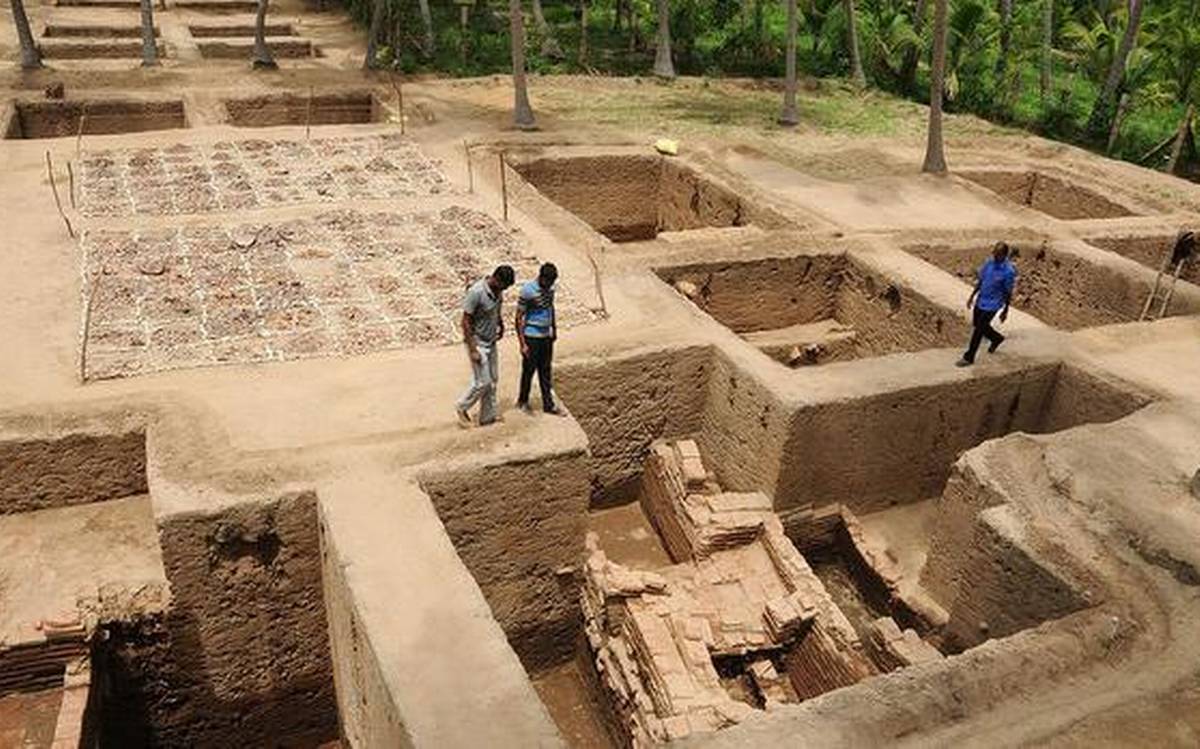
     In addition to these, the Keezhadi excavation, conducted by the Archaeological Survey of India in 2016, has unearthed around 13000 antiquities like shells, glass beads, rusted old coins, weapons, pottery of various kinds and iron tools, belonging to the Sangam age. Among the fine quality red and black ware bowls excavated in the region, are the Roman roulette wares which evidentiate the existence of trade links between the Tamils and Romans. Moreover, seven furnaces were discovered at the site and these, according to the archaeologists, are an indication of the possibility that the site might have been a textile unit and settlers in the region might have been involved in industrial activities.

    Keezhadi findings places the Sangam age to an even earlier period starting from 6th century BC. As per Amarnath Ramakrishna, who led the first two phases of excavations, Keezhadi site was one among the 100 sites of possible human habitation shortlisted for excavation. Discovery of Tamil Brahmi inscriptions and graffiti that date back to earliest times as compared to any other findings in India. Quite obviously, Keezhadi points to the potential of a huge trading and manufacturing habitation and a distinct civilization – the Tamil Vaigai River Valley Civilisation. The Sangam literature is rich and a huge treasure trove of information that needs to be researched extensively.


    Picture: Australian seaboard, Statue of Garuda and Tamil Inscriptions, symbolising maritime culture – Credit: ancient-origins.net

    Maritime Trade in Tamilakam: A Core Activity

    Several artefacts with Tamil Brahmi inscriptions have been excavated in foreign countries as well. In Thailand, potsherd with Brahmi inscriptions were unearthed. Likewise, Cheena Kazhakam ( Chinese gold coins) were discovered in Srivijaya (modern day Sumatra in Indonesia) and Kadaram (modern day Kedah in Malaysia), places which were under the occupation of the Cholas.

    The aforementioned evidence when correlated with the inscriptional evidence, found in foreign lands about Tamil trading settlements, will help in the historical reconstruction of the maritime trade links of Ancient Tamilakam and will attest to the extensive nature of trade carried out by the Tamils during the Sangam age.


    References

     Mukund, Kanakalatha. The Trading World of the Tamil Merchant: Evolution of Merchant Capitalism in the Coromandel. Orient Blackswan, 1999. https://books.google.co.in/books?id=tjXdDYChdGsC&lpg=PP1&pg=PP1#v=onepage&q&f=false.

    Mukund, Kanakalatha. The World of the Tamil Merchants. Portfolio Books Limited, 2015. https://books.google.co.in/books?id=Bha2eLqMPWcC&lpg=PT6&ots=tw2qDuzDlf&dq=trade during sangam age kanakalatha mukund&pg=PT5#v=onepage&q=trade during sangam age kanakalatha mukund&f=false.

    “Roman Trade with India.” Roman Trade with India – New World Encyclopedia. Accessed June 24, 2020. https://www.newworldencyclopedia.org/entry/Roman_trade_with_India#cite_ref-31.

    Kannan, Gokul. “Keezhadi Excavation Points to Vaigai River Civilisation in Sangam Period.” Deccan Chronicle. October 1, 2016. Accessed June 24, 2020. https://www.google.com/amp/s/www.deccanchronicle.com/amp/nation/in-other-news/011016/keezhadi-excavation-points-to-vaigai-river-civilisation-in-sangam-period.html.

    Annamalai, S. “Uncovered: Pandyas-Romans Trade Link.” The Hindu. May 16, 2017. Accessed June 24, 2020. https://www.google.com/amp/s/www.thehindu.com/news/national/tamil-nadu/archaeological-excavation-in-sivaganga-uncovers-pandya-roman-trade-links/article10879282.ece/amp

    Saju, M.T. “Tamil Trade Ships That Sailed to Foreign Shores.” Times of India. March 29, 2018. Accessed June 24, 2020. https://www.google.com/amp/s/timesofindia.indiatimes.com/blogs/tracking-indian-communities/tamil-trade-ships-that-sailed-to-foreign-shore

    Main Image: Keezhadi Excavation Site – Credit – ASI

  • The Catalysing Effect of Covid-19 on the Changing World Order

    The Catalysing Effect of Covid-19 on the Changing World Order

    Contrary to the realist belief, international states co-exist in a world order of hierarchy rather than anarchy. Ikenberry presents this hierarchical world order and the cyclical rise and fall of hegemonic powers. Early 20th century witnessed the shift from Pax-Britannica to Pax-Americana that was complete by 1945, from which point the US defended its position during the Cold War with the erstwhile USSR. It exercised its hegemonic influence even more aggressively after the Cold War. However, US dominance of the world order has been diminishing owing to the Trump administration’s isolationist approach to foreign policy, and the increasing influence of China in world politics. This article examines the catalysing effect of Covid-19 and the rise of China on the current World Order.

    Trump’s policy of disregarding multilateralism and imposing its unilateralism on the world has catalysed into an involuntary retreat, protectionism, and isolationism for the USA with dire consequences for its foreign policy effectiveness.

    Trump’s policy of disregarding multilateralism and imposing its unilateralism on the world has catalysed into an involuntary retreat, protectionism, and isolationism for the USA with dire consequences for its foreign policy effectiveness. The net result is that the world is witnessing an abdication of leadership by America in a world disrupted by the Covid-19 pandemic. A clear pattern of isolationism can be seen in various actions of the Trump Administration since it’s assumption of the Office. In 2017, the US withdrew from the Paris Agreement, in 2018 it unilaterally reneged from the JCPOA, re-imposed sanctions on Iran and threatened sanctions on allies who supported Iran. In 2019, it withdrew troops from Syria, which led to subsequent Turkish incursion on Rojava Kurds, and in early 2020 it negotiated with the Taliban to enable withdrawal of US troops from Afghanistan. With the onset of Covid19 global pandemic, the Trump administration has accused the WHO of protecting China. In a unilateral action not endorsed by its allies, USA first stopped its funding for WHO and then terminated its relationship with the UN institution. This comes as a blow to multilateralism since the US was WHO’s largest donor, contributing about $440 million yearly. In addition to this, the US has failed to provide the lead in the global response to tackle the virus despite its initiatives in the past pandemics such as H1N1, Ebola and the Zika virus. The US was absent from the WHO initiative – Global Coronavirus Response Summit (before its withdrawal from the association). In addition, the US has been unable to provide external aid to combat the virus due to domestic shortages, which explains its restraint to guide an international response in the absence of a coherent domestic plan of action. Thus, the coronavirus pandemic has acted as a catalyst in increasing the pace of US isolationism from world politics.

    China has turned the tide on its previous missteps in containing the virus by publicising its governance model as the most effective way to combat the pandemic.

    Meanwhile, the pandemic has established firmly China’s rise in the international stage. Though China is facing backlash for suppressing details about the virus, it is battling to overcome this criticism by providing international aid and stepping up to lead a global response using Beijing’s success as a template to overcome the novel virus. China has contributed significantly to the global response by providing materials such as ventilators, respirators, masks, protective suits and test kits to Italy, Iran, Serbia, and the whole of Africa. Grabbing its opportunities to lead international responses, China hosted Euro-Asia conference, participated in the Global Coronavirus Summit where it pledged an emergency funding of $20 million to WHO, and pledged $ 2 billion to the WHO (equalling its annual budget) to be disbursed over the next two years, thus contrasting sharply with the US behaviour of withdrawing from the WHO. China has turned the tide on its previous missteps in containing the virus by publicising its governance model as the most effective way to combat the pandemic. It continues to highlight the inadequacies and shortfalls in healthcare systems of the western world as against the success of its governance model, Beijing Consensus, and variations of it in East Asia. It is clear that China has seized the Covid-19 pandemic as a huge opportunity to establish its global leadership.

    Taking advantage of the global disarray due to the pandemic, China has taken strong actions to deflect global criticism of its initial handling of the virus. Two prominent examples of this being, European Union watering down the report on Covid19 disinformation owing to pressure from Beijing, and the passing of the controversial Hong Kong security law. While the US has taken initiative in cracking down on China by repealing the special privileges to Hong Kong, other countries were cautious in retaliating against China significantly and limited their actions to sympathetic support for pro-democracy protestors. The exception to this was Britain, which offered UK citizenship to British National Overseas Passport holders in Hong Kong, despite seriously offending China. Despite the global backlash against Chinese diplomacy in the form of generous aids, international actors have expressed limited concerns through action against Chinese domination. This is due to the circumstantial mismatch in global balancing against China’s rise. The US uses unilateral actions and ‘expects’ its allies to follow, while its allies despite their serious concern over China’s rise, remain vary of following in the American footsteps. This is because US allies treat coronavirus as an immediate threat as opposed to China’s rise. The US being a status quo power is more threatened by China’s rise since it posits as a revisionist state. However, in view of China’s proactive efforts in leading global contributions to battle the coronavirus, US allies remain tolerant of China’s dominance.

    The passive and fractured response to China’s aggressive exploitation of the pandemic to establish its global leadership is a concern for India. The recent setting up of Chinese military camps in Indian controlled territory of Ladakh is a manifestation of China’s complex strategy. India has, true to its traditional policy, opted out of involving the United Statesin the ‘bilateral issue. However, it would be beneficial to be united in balancing against China’s rise. While it is necessary to work together to utilise Global Supply Chains (GSC) during the pandemic to battle the coronavirus pandemic, it is equally important to look at global balancing against China to ensure its compliance to rules-based world order. Since China’s power is derived from its economic strength, balancing strategy against China should focus on trade and economy. Chinese foreign policy depicts a pattern of economic coercion to reward or punish its counterparts. This can be tackled through concerted global action. India is, as one of the largest producer of pharmaceuticals, playing a crucial role in global efforts to fight the pandemic by providing Hydroxychloroquine globally. However, given that most raw materials are sourced from China, balancing against China requires a favourable movement of GSC diversification. US-China trade war has, encouraged companies to move production out of China and into Asian countries such as Vietnam and Taiwan. As a result of the coronavirus crisis and the global backlash, companies look to further diversify their resources and supply chains. India and other Asian countries could benefit from this if they adapt their policies suitably.

    Global backlash against China’s handling of the virus in Wuhan is still a challenge for China’s geopolitical strategy. Its foreign policy is seen more as displaying aggressive and coercive approach than persuasive diplomacy.

    It is difficult to estimate whether China would aspire for hegemonic leadership. Global backlash against China’s handling of the virus in Wuhan is still a challenge for China’s geopolitical strategy. Its foreign policy is seen more as displaying aggressive and coercive approach than persuasive diplomacy. Given the current volatile scenario most countries have, in the absence of US leadership, increased their dependence on China as it is now the largest provider of aid. While all this tips the scale in China’s favour, it’s hegemonic ambitions can be countered through trade strategies as its weakness stems from the fact that it is a hugely export driven economy. Global diversification of supply chains would reduce the world’s increasing dependency on Chinese manufacture and products. The world will need to be cautious as the pandemic has provided China an opportunity to tighten its grip on the global economy as the world’s workshop and technology provider. Here on, international efforts to bandwagon or balance will become a decisive factor in determining China’s rise to apex position in the world order.


  • ASEAN Unity Critical for South China Sea:  But Time to Address Newer Issues

    ASEAN Unity Critical for South China Sea: But Time to Address Newer Issues

    Perhaps the most defining character of the ASEAN in the last six decades of its existence has been ‘Unity’ among its Member States who have scrupulously adhered to the fundamental principles contained in the various treaties signed by the Member States. The ‘ASEAN Way’ is unique and helps them to remain ‘united’ despite diversity in their political systems, national economic indicators, development levels, and military capabilities. ASEAN has also done well to be labelled as the ‘driver of regional integration’ and promoted a variety of regional political, security and economic initiatives to ensure peace and stability. It has managed with sophistication and alacrity relations with its partner countries bilaterally as also through multilateral structure.

    The ‘ASEAN Way’ is unique and helps them to remain ‘united’ despite diversity in their political systems, national economic indicators, development levels, and military capabilities.

    ASEAN’s engagements with China are through various political and diplomatic exchanges such as Summits and several ASEAN led mechanisms also provide opportunities to its Member States to engage China. The free trade agreement (FTA) is particularly important and catalytic for trade and both sides have taken upon themselves to accelerate negotiations of the Regional Comprehensive Economic Partnership (RCEP).

    At the strategic level, ASEAN Member States have been quite disillusioned with China over its intention to resolve disputes in South China Sea; but the ASEAN leadership has assiduously pursued the Code of Conduct in the South China Sea and succeeded in completing the first reading of the Single Draft COC Negotiating Text. It is now putting pressure on China to quickly conclude the CoC in the stipulated timeframe to ensure region remains peaceful and stable to enable member countries to invest in national and regional development.

    Ironically some ASEAN Member States have not been keen to openly making reference to Chinese reclamation in South China Sea and near continuous buildup of military infrastructure on islands and features in the Parcels and the Spratly group of islands.

    The report card of ASEAN Unity vis a vis China, so far, has been just about quite decent with at least two exceptions when China was suspected of interfering in ASEAN matters; first in 2012, Cambodia resisted reference to South China Sea in the Chairman’s statement, and again in 2016 soon after the South China Sea Arbitration award.[i]

    Ironically some ASEAN Member States have not been keen to openly making reference to Chinese reclamation in South China Sea and near continuous buildup of military infrastructure on islands and features in the Parcels and the Spratly group of islands. While Vietnam and the Philippines have openly confronted China over their claims in South China Sea, Malaysia chose to pursue “quiet diplomacy” but has stubbornly displayed “lawfare in the South China Sea”;[ii] Brunei has remained quiet because its policy makers “see little choice but to remain quiescent about its dispute with China,” Notwithstanding that, the Chairman’s Statement of the 36th ASEAN Summit 26 June 2020 is a clear display of their ‘unity’ and they have collectively expressed concerns on the Chinese activities and recognised the seriousness of a series of incident at sea which have eroded trust and confidence.

    To some extent ASEAN has succeeded in internationalising the Chinese non-compliance of international treaties such as the 1982 UNCLOS to which Beijing is a signatory.

    Today, South China Sea issue has made global headlines. The US has unabashedly rejected Chinese claims over South China Sea and China is accused of not adhering to internal law. To some extent ASEAN has succeeded in internationalizing the Chinese non-compliance of international treaties such as the 1982 UNCLOS to which Beijing is a signatory as also retained a “minimal formal consensus on the South China Sea, rejecting the pernicious idea that the waterway is only the concern of littoral states, and resisting Chinese pressures to avoid discussion of the issue in ASEAN -led forums, certainly contributed to this outcome.”[iii]

    Perhaps it is time for the ASEAN to bring to the forefront the Lachang-Mekong river issue. Several trans-boundary river management issues and concerns between China (the upper riparian and Thailand, Laos, Cambodia and Vietnam (the lower riparian) have emerged over the years. China has been building dams on the river and its tributaries; has avoided sharing full hydrological data particularly during dry seasons; and released river water untimely. The lower riparian states have called for a ‘code of conduct’ and a ‘rule based trans-boundary resource management’ mechanism for the Mekong River between the upper and the lower riparian states.[iv]

    It is tempting to believe that China has successfully stifled lower riparian member states concerns through sops and infrastructure development projects under the Belt and Road Initiative. Interestingly, Lancang-Mekong Cooperation (LMC), the most active forum is dominated by China.

    Non-riparian ASEAN members are accused of “minimal interest” in the Lancang-Mekong issues and they “generally do not participate”. Even attempts to interest the rest of ASEAN on Mekong issues “are met with only the pretense of polite interest”. [v]

      If ASEAN is to preserve ‘unity’ it must see maritime and continental Southeast Asia as one strategic space and take into account challenges faced by ASEAN Member States who border China on land particularly Myanmar who has accused China of interfering in its internal politics and arming the ethnic armed groups operating near the Chinese border,[vi]  and Laos[vii] that is economically and militarily weak to fend off Chinese pressures unlike Vietnam which has withstood Chinese pressures on land and at sea. Otherwise, China will open yet another contentious front for the ASEAN.  Finally, under the circumstances, prudence necessitates that ASEAN should prepare to incorporate newer issues other than the South China Sea in its agenda!

    Notes:
    [i] “ASEAN deadlocked on South China Sea, Cambodia blocks statement, https://www.reuters.com/article/us-southchinasea-ruling-asean/asean-deadlocked-on-south-china-sea-cambodia-blocks-statement-idUSKCN1050F6 (accessed 18 July 2020).
    [ii] “US-China tensions: why is Malaysia so quiet about the South China Sea?”, https://www.scmp.com/week-asia/politics/article/3093715/us-china-tensions-why-malaysia-so-quiet-about-south-china-sea (accessed 18 July 2020).
    [iii] “Why Asean should treat the Mekong like the South China Sea”, https://www.scmp.com/week-asia/opinion/article/3093546/why-asean-should-treat-mekong-south-china-sea (accessed 18 July 2020).
    [iv] Chheang Vannarith, “Code of conduct for the Mekong”, https://www.khmertimeskh.com/298648/code-of-conduct-for-the-mekong/ (accessed 19 July 2020).
    [v]“Why Asean should treat the Mekong like the South China Sea”, https://www.scmp.com/week-asia/opinion/article/3093546/why-asean-should-treat-mekong-south-china-sea (accessed 18 July 2020).
    [vi] “After ASEAN & India, Now Myanmar Accuses China of Creating trouble on the Border”, https://eurasiantimes.com/now-myanmar-accuses-china-for-creating-trouble-in-the-country/ (accessed 19 July 2020).
    [vii] China also claims its right over a large part of Laos on historical precedents (China’s Yuan Dynasty, 1271-1368). “China faces territorial issues with 18 nations; check details”, https://zeenews.india.com/world/china-faces-territorial-issues-with-18-nations-check-details-2292826.html (accessed 19 July 2020).

    Image: Adobe Stock

  • What After The Galwan Incident?

    What After The Galwan Incident?

    As one writes, a phase of the events in the Galwan valley near the Line of Actual Control (LAC) has come to an end. Inputs from government, media and private commentators, have provided a perspective of the events preceding the incidents of 15/16 June and thereafter till the current day. For the world, the occasion has provided the opportunity yet again to witness the fighting spirit and junior leadership of all ranks of the Indian Army, who despite being outnumbered, were able to inflict far greater casualties on their adversaries, in inhospitable terrain under fading light conditions. The sacrifices of the men of 16 BIHAR, 3 PUNJAB, 3 Medium Regiment, and individual personnel from 81 Field Regiment, Corps of Signals and the Army Medical Corps have added lustre to the reputation of the Indian military. Their deeds shall remain enshrined in the memory of a grateful nation. At this watershed moment, we salute them.
    China is contesting control over settled areas (Galwan), exploiting laid down rules and norms of border management by resorting to use of primitive weapons instead of firearms, and pushing the envelope on the ground in attempting to increase areas under control such as at Hot Springs and Pangong Tso – all actions just short of war.
    One theory gaining currency in attempting to understand China’s recent behaviour, pertains to its unhappiness over what it perceives as alteration of the status quo on the LAC by designating Ladakh as a Union Territory – resulting in active collusion with Pakistan which shares Beijing’s sentiments on this issue, amongst others. However, there is no doubt that the strategy applied by China in East Ladakh comes straight out of its manual on Grey Zone Warfare. It is contesting control over settled areas (Galwan), exploiting laid down rules and norms of border management by resorting to use of primitive weapons instead of firearms, and pushing the envelope on the ground in attempting to increase areas under control such as at Hot Springs and Pangong Tso – all actions just short of war.

    While the situation on the Pangong Tso awaits resolution, what is amply clear is that the era of explaining away patrol clashes on the LAC to the Indian public, in terms of ‘varying perceptions held by both sides’, is past. By its perfidious actions in East Ladakh this year, China has shredded in letter and spirit the border agreements built up over the last three decades. The recent incidents have brought greater clarity to the public mind, with a consensus that China’s salami slicing tactics cannot be tolerated any further. Indian soldiers see the LAC as a line marked on the map. Commanders are clear that the areas up to that line are to be either physically occupied or patrolled at will from bases in the vicinity, supplemented by other forms of surveillance. As per media reports, the Government has over the weekend ‘revised the Rules of Engagement’, giving ‘a free hand to the Army’ to deal with occurrences of this nature. By implication, in future if patrols cannot resolve their face offs peacefully, there will be no resorting to hand to hand scuffles with primitive weapons – unsuccessful efforts at border management will give way to border defence, through resort to tactical military operations.
    As per media reports, the Government has over the weekend ‘revised the Rules of Engagement’, giving ‘a free hand to the Army’ to deal with occurrences of this nature. By implication, in future if patrols cannot resolve their face offs peacefully, there will be no resorting to hand to hand scuffles with primitive weapons – unsuccessful efforts at border management will give way to border defence, through resort to tactical military operations.
    Response to this new paradigm places another set of challenges before the Indian Army. Prior to May 2020, Galwan was not in the category of disputed areas, as understood in LAC parlance. Neither had any Chinese activity been sensed in the preceding years. While construction of the DSDBO road could be the trigger, the fact that an area where the LAC had lain undisturbed since 1962 could become the scene of such a violent action, warrants scrutiny of PLA intent across the board. Previous assumptions with respect to the PLAs likely areas of interest across the entire Northern border, therefore, certainly warrants a relook. Conclusions drawn would mandate contingency planning and consequent tasking at strategic, operational and tactical levels. Such plans doubtless exist. However, it is obvious that their scope, timelines, and imperatives for successful implementation will need review in conjunction with the other services.
    Outcomes of such reviews would inevitably renew the focus on capability building and in the middle term, might even alter priorities for the same. Substantial enhancements in the areas of surveillance, tactical and strategic air mobility and real time communication links continue to retain their importance. Induction of greater varieties of kinetic non-contact weapon systems, complemented by force multipliers such as cyber warriors and special forces too remain on top of the list. Also, the continued ceasefire violations on the Line of Control to the West, and the relentless tempo of counter terrorist operations in the Valley during this period smack of collusion and tell a tale which defence planners must take note of. Developing the desired capability will be predicated on guaranteed funding and fast track procedures. It is heartening to peruse reports in the Economic Times of 22 June that the Government has granted emergency financial powers up to Rs 500 crore per procurement project to each service for buying weapons and ammunition. Even if new projects cannot be initiated immediately because of fund constraints imposed by the Covid-19 pandemic and otherwise, it is time for stalled ones like the Mountain Strike Corps to be quickly completed. The example of the PLA which has almost completed its reorganisation for fighting wars of the future and tested the response of its field force during the Covid-19 pandemic, must be taken note of.
    Thanks to the Galwan episode, the vital aspect of border infrastructure has gained nationwide attention. There is perceptive increase in the pace of development over the last few years. The sequence and methodology however are dictated essentially by two factors – availability of resources (funds and specialist equipment) and the need for calibrating messages implicit in such actions to China. Despite Covid-19 constraints, the current crisis mandates that funds currently earmarked for infrastructure development continue to flow so that development progresses, albeit at a slower pace. As regards messaging to China, we have reached a watershed moment. As high level military talks continue and spell out the Indian position on the ground to the Chinese, creating an ‘all of nation approach’ for tackling China becomes necessary.
    Galwan incident has ensured that the negative perception of China worldwide is now shared by almost all sections of Indian society. This bitterness is fuelled by the sheer brutality of the Chinese military and duplicity of the Chinese government, bringing back memories of 1962 for many who have only heard of that era. It is driven further by a realisation of the scale of India’s dependence on China, be it in the import of manufactured goods of all hues, or technology, and the consequent harm to Indian interests and livelihoods. Awareness has spread amongst Indians that China’s constant working against India’s interests in world fora, be it in vetoing expansion of the permanent membership of the Security Council for ‘technical reasons’, blocking its membership in the Nuclear Suppliers Group or introducing discussions on Kashmir are all part of its plan to obstruct India’s progress to its rightful place in the comity of nations. In attempting to correct an unequal economic relationship, ensuring that India retains its position in the region and preventing erosion of its influence in South Asia and beyond, all elements of the Indian state have their tasks cut out. It becomes imperative now to prepare a different toolkit with a wider range of options (including those not envisaged earlier) to manage India-China relations. Such options now require to be coordinated at all levels of the government and intimated to stakeholders including industry and other influencers for implementation. This coordination is long overdue. Resetting the economic relationship will not be easy. However, announcement of a practical time bound and holistic road map which has been thought through with all stakeholders would be a beginning.
    Galwan incident has ensured that the negative perception of China worldwide is now shared by almost all sections of Indian society.
    To supplement the proposed policy outlined above, articulation of a holistic Strategic Narrative vis-a-vis China becomes necessary. Such a narrative would pertain to as many aspects as possible – bilateral issues (including border management), local and regional matters, so that consistent, coherent and long term views are voiced, keeping in mind the national interest. information operations would be a subset of such a narrative, and briefings organised as frequently as possible would be useful force multipliers. It might be necessary for the concerned sections in the newly formed Department of Military Affairs and the Department of Defence to coordinate these aspects. India must also actively consider the possibilities that other forms of conflict, including hybrid warfare, are necessary to exploit and invest in the same. Here too, employment of such methodologies by China is an example. China has been refining its doctrine of ‘Unrestricted Warfare’ since the early 90s. The effects are there to see in South China Sea and elsewhere. It is executing certain aspects of this strategy against India on the Northern borders.
    Managing relations with China is destined to remain the major preoccupation for Indian strategic thinkers in coming years. Tensions along the LAC are but one manifestation of this problem. Both nations are hostage to geography. China’s behaviour over the last decade has influenced Indian foreign and military policies like no other, causing India to take decisions that were not in the realms of possibility earlier. Articulating a holistic China strategy through an all of government approach within the overall ambit of a National Security Strategy to ensure that India achieves its rightful place, has never been so important.
    Image Credit: ASPI:The Strategist – Nathan Ruser