Blog

  • Cryptos and CBDC: Is the RBI on the Right Track?

    Cryptos and CBDC: Is the RBI on the Right Track?

    “The history of money is entering a new chapter”. The RBI needs to heed this caution and not be defensive.

    Cryptocurrency will be discouraged by the government was the message from the FM during the budget discussion in parliament. There will be heavy taxation and no relief in capital gains for past losses. But, India has to contend with growing use of cryptos in these uncertain times. Russian kleptocrats are reportedly using cryptos to evade sanctions. Ukraine which has been a center for cryptos trading due to its lax rules is now using them to get funds.

    President Joe Biden recently signed an executive order requiring government agencies to assess use of digital currency and cryptos due to their growing importance. The Indian authorities have also been trying to bring legislation to deal with the issue since October 2021. Would the US clarifying its position help India also decide on cryptos?

    The SC has asked the government to clarify its position on the legality of cryptos. The FM in the Budget 2022-23 proposed taxing the capital gains and crypto transactions but did not declare them illegal. The RBI Governor was more expansive in February when he highlighted three things. First, “Private cryptocurrencies are a big threat to our financial and macroeconomic stability”. Second, investors are “investing at their own risk” and finally, “these cryptocurrencies have no underlying (asset)… not even a tulip”. Subsequently, a RBI Deputy Governor called cryptos worse than a Ponzi scheme and suggested that they not be “legitimized”. It is only recently that the RBI has announced that it will float Central Bank Digital Currency (CBDC)

    Difficult to Declare Cryptos Illegal

    The governor calling cryptos as cryptocurrency has unintentionally identified them as a currency. His statements indicate RBI’s worry about its place in the economy’s financial system as cryptos proliferate and become more widely used. This threat emerges from the decentralized character of cryptos based on the Blockchain technology which the Central Banks cannot regulate and which enables enterprising private entities (like, Satoshi Nakamoto initiated Bitcoins in 2009) to float cryptos which can function as assets and money.

    The total valuation of cryptos recently was upward of $2 trillion – more than the value of gold held globally. Undoubtedly, this impacts the financial systems and sovereignty of nations. So, the RBI rather than be defensive needs to think through how to deal with cryptos.

    Cryptos which operate via the net can be banned only if all nations come together. Even then, tax havens may allow cryptos to function defying the global agreement. They have been facilitating flight of capital and illegality in spite of pressures from powerful nations.

    The genie is out of the bottle. The total valuation of cryptos recently was upward of $2 trillion – more than the value of gold held globally. Undoubtedly, this impacts the financial systems and sovereignty of nations. So, the RBI rather than be defensive needs to think through how to deal with cryptos.

    Cryptos as Currency

    Source: Crypto-current.co

    Will a CBDC help tackle the emerging problem? Indeed not, since it can only be a fiat currency and not a crypto. However, cryptos can function as money. This difference needs to be understood.

    A currency is a token used in market transactions. Historically, not only paper money but cows and copper coins have been used as tokens since they are useful in themselves. But paper currency is useless till the government declares it to be a fiat currency. Everyone by consensus then accepts it at the value printed on it.

    So, paper currency with little use value derives its value from state backing and not any underlying commodity. Cryptos are a string of numbers in a computer programme and are even more worthless. And, without state backing. So, how do they become acceptable as tokens for exchange?

    Their acceptability to the rich enables them to act as money. Paintings with little use value have high valuations because the collectivity of the rich agrees to it. Cryptos are like that.

    Bitcoin, the most prominent crypto, has been designed to become expensive. Its total number is limited to 21 million and progressively it requires more and more of computer power and energy to produce (called mining like, for gold). As the cost of producing the Bitcoin has risen, its price has increased. This has led to speculative investment which drives the price higher, attracting more people to join. So, since 2009, in spite of wildly fluctuating prices, they have yielded high returns making speculation successful.

    Unlike the Tulip Mania

    The statement that cryptos have no underlying asset, not even a tulip refers to the time when tulip prices rose dramatically before they collapsed. But, tulips could not be used as tokens, while cryptos can be used via the internet. Also, the supply of tulips could expand rapidly as its price went up but the number of Bitcoins is limited.

    So, cryptos acquire value and become an asset which can be transacted via the net. This enables them to function as money. True, transactions using Bitcoins are difficult due to their underlying protocol, but other simpler cryptos are available.

    The different degrees of difficulties underlying cryptos arises from the problem of `double spending’. Fiat currency whether in physical or electronic form has the property that once it is spent, it cannot be spent again, except fraudulently, because it is no more with the spender. But, a software on a computer can be repeatedly used.

    Blockchain and encryption solved the problem by devising protocols like, the `proof of work’ and `proof of stake’. They enable the use of cryptos for transactions. The former protocol is difficult. The latter is simpler but prone to hacking and fraud. Today, thousands of different kinds of cryptos exist – Bitcoin like cryptos, Alt coins and Stable coins. Some of them may be fraudulent and people have lost money.

    CBDC, Unlike Cryptos

    Source: cointelegraph.com

    Blockchain enables decentralization. That is, everyone on the crypto platform has a say. But, the Central Banks would not want that. Further, they would want a fiat currency to be exclusively issued and controlled by them. But the protocols mentioned above theoretically enable everyone to `mine’ and create currency. So, for CBDC to be in central control, solve the `double spending’ problem and be a crypto (not just a digital version of currency) seems impossible.

    A centralized CBDC will require RBI to validate each transaction – something it does not do presently. Once a currency note is issued, RBI does not keep track of its use in transactions. Keeping track will be horrendously complex which could make the crypto like CBDC unusable unless new secure protocols are designed. No wonder, according to IMF MD, “… around 100 countries are exploring CBDCs at one level or another. Some researching, some testing, and a few already distributing CBDC to the public. … the IMF is deeply involved in it ..”

    Conclusion

    Issuing CBDCs will not only be complicated but presently cannot be a substitute for cryptos which will eventually be used as money. This will impact the functioning of the Central Banks and commercial banks. Further, it is now too late to ban cryptos unless there is global coordination which seems unlikely. The rich who benefit from cryptos will oppose banning them. Can the US work out a solution? The IMF MD has said, “The history of money is entering a new chapter”. The RBI needs to heed this caution and not be defensive.


    Slightly shortened version of this article was published earlier in The Hindu.

    Feature Image Credit: doralfamilyjournal.com


  • Sanctions on Russia Are a Tool That Must Be Calibrated Like Any Other

    Sanctions on Russia Are a Tool That Must Be Calibrated Like Any Other

    If de-dollarisation occurs, the impact will be felt wide and far. Severe sanctions are a double-edged sword which will impact every nation.

    Russia’s invasion of Ukraine has been condemned by the majority of countries in the United Nations. NATO has not intervened militarily since that runs the danger of a wider conflagration with the possible use of nuclear weapons. So, instead, the NATO powers have supplied Ukrainian forces with weapons and imposed severe sanctions on Russia. Evermore sanctions are announced every week.

    It was said that this would degrade Russia’s capacity to wage war by freezing its assets held in Western banks. Also, its earnings through trade would decline and impoverish it. It was also argued that the Russians would be hurt through multiple channels – higher inflation, the inability of its citizens to get dollars, a collapse in prices of financial assets, like, shares and so on.

    Thus, while Russia is attacking militarily, the West is hitting back through economic means. Further, there is also a cyber and media component to the war. It is perhaps the first war on multiple fronts. Will the Russians be hurt enough to stop the war? Can one draw lessons from the sanctions against Iran?

    [powerkit_button size=”lg” style=”info” block=”true” url=”https://thewire.in/economy/sanctions-on-russia-are-a-tool-that-must-be-calibrated-like-any-other” target=”_blank” nofollow=”false”]
    Read More
    [/powerkit_button]

  • Towards a New Movement of Non-Alignment: Politics of John Mearsheimer and Alexander Dugin

    Towards a New Movement of Non-Alignment: Politics of John Mearsheimer and Alexander Dugin

    Only last August, the U.S. had to leave Afghanistan in disgrace, leaving behind a destroyed country – and now they suddenly appear as the guardians of freedom, human rights and as the leading power of the West?

    Without equating Russia and the USA, they are very similar in their foreign policy behaviour. Despite all the problems under Trump, the U.S. is and remains a democracy in which human rights can be litigated. Russia is only formally an (electoral) democracy, as Putin himself once put it, a managed democracy in which human rights can hardly be claimed. Despite this fundamental difference, it is quite astonishing how the past 20 years have been forgotten in the West. Were the wars in Afghanistan, Iraq and Libya always and in every respect legitimate? Weren’t hundreds of thousands of people killed in them and by no means always only the soldiers? Only last August, the U.S. had to leave Afghanistan in disgrace, leaving behind a destroyed country – and now they suddenly appear as the guardians of freedom, human rights and as the leading power of the West? Conversely, we need to realize that while the U.S. would advocate regime change in Russia as well, does this legitimize all the actions of the Russian leadership and the Russian army?

    It is not only questionable whether Mearsheimer had the ear of the U.S. government – much more decisive is that he not only presents an analysis but in a sense naturalizes the struggle for spheres of influence and large areas. 

    And in essence, Mearsheimer can hardly hide the fact that neo-realism has models in the large-area policy of the Nazis and at least that of Carl Schmitt.

    To find an explanation for the conflict over Ukraine, two theorists are very often referred to, John Mearsheimer from the U.S. and Alexander Dugin from Russia. The defenders of Russia resort to the line of thought of the neo-realists, which was significantly influenced by Mearsheimer. And Mearsheimer argues that Ukraine is not the issue at all, but rather a global political showdown between the United States and Russia over spheres of influence. He attests that the Russian side under Putin is only reacting to a covert war of the USA – with the means at their disposal. And with countries like Sweden, Finland and even Switzerland soon to join NATO, the U.S. strategy – if the government in Washington had stuck to Mearsheimer’s indirect script – would have been extremely successful. The unity of the West under U.S. leadership has also been restored overnight. Mearsheimer is always used in this context as evidence of the true intentions of the U.S. and the real culprit in this war. However, it is not only questionable whether Mearsheimer had the ear of the U.S. government – much more decisive is that he not only presents an analysis but in a sense naturalizes the struggle for spheres of influence and large areas. For the next step, if one were to share his views, one would have to concede such a policy to the US as well? And in essence, Mearsheimer can hardly hide the fact that neo-realism has models in the large-area policy of the Nazis and at least that of Carl Schmitt.

    Dugin’s vision of Eurasia, on the other hand, is ideologically determined. But from his writings can be read the will to reconquer the Baltic states and large parts of the former Soviet Union and the Warsaw Treaty after Ukraine and to achieve at least Russian hegemony in Europe.

    The same applies to the dreams of Alexander Dugin, a neo-fascist ideologue who has at times been said to be particularly close to Vladimir Putin. Just as with Mearsheimer, the government action of Russia cannot be traced to his ideologue, but there are similarities here as well. Dugin, too, starts from large spaces and, like Putin, includes in his considerations the great Eurasian project, the political-ideological linking of Asia and Europe under Russian leadership. And indeed, this perspective already exists in the Chinese New Silk Road and is being built up economically by President Xi and the Chinese leadership with billions of Yuan. Dugin’s vision of Eurasia, on the other hand, is ideologically determined. But from his writings can be read the will to reconquer the Baltic states and large parts of the former Soviet Union and the Warsaw Treaty after Ukraine and to achieve at least Russian hegemony in Europe.

    What seems progressive here at first glance is the rejection of human equality – at its core, Dugin is concerned with a strictly hierarchical, estates-based society in which “white, male Europeans” are at the top.

    In this way, Dugin positioned himself as an outstanding representative of geopolitical thought as well as a mastermind of a “Eurasian” – as opposed to “Atlantic” – cultural space. This corresponds to the “fourth political theory” he postulates, which, after liberalism, fascism and communism, is most likely to ensure the survival of mankind in the age of globalization in his view. Dugin’s theoretical advisers, besides Heidegger, is the French founder of the “Nouvelle Droite,” Alain de Benoist.  All political systems of modernity are accordingly the results of three ideologies: The first and oldest, he says, is liberal democracy, the second is Marxism, and the third is fascism. The latter has long since failed, banished from history; the first no longer functions as an ideology, but as something taken for granted. The world today is on the brink of a post-political reality in which the values of liberalism are so deeply ingrained that the average person is not even aware of the effect of an ideology in his environment. Thus, liberalism threatens to monopolize political discourse, to flood the world with a universalistic sameness, and to destroy everything that makes different cultures and peoples unique. What seems progressive here at first glance is the rejection of human equality – at its core, Dugin is concerned with a strictly hierarchical, estates-based society in which “white, male Europeans” are at the top.

    a new policy of the Non-Aligned Movement is necessary, because as understandable as partisanship may be due to the suffering in Ukraine, we should not allow ourselves to be instrumentalized by either side.

    At their core, Mearsheimer and equally Dugin are representatives of a neo-colonial policy, in that they want to divide the whole world into their spheres of influence. This is what the U.S. has been trying to do since 2001 and now Russia as well. Still unclear is the role of China, which has not yet made a final decision and sees itself equally threatened by both visions. Instead of taking sides for one of the two positions, a new policy of the Non-Aligned Movement is necessary, because as understandable as partisanship may be due to the suffering in Ukraine, we should not allow ourselves to be instrumentalized by either side. Foreign Minister Lavrov had spoken of the need for a balanced world order during his visit to New Delhi. It would be of fundamental importance if Russia were to adhere to this itself. The real actors in such a balanced world order, however, would be the middle powers in a new movement of non-aligned states.

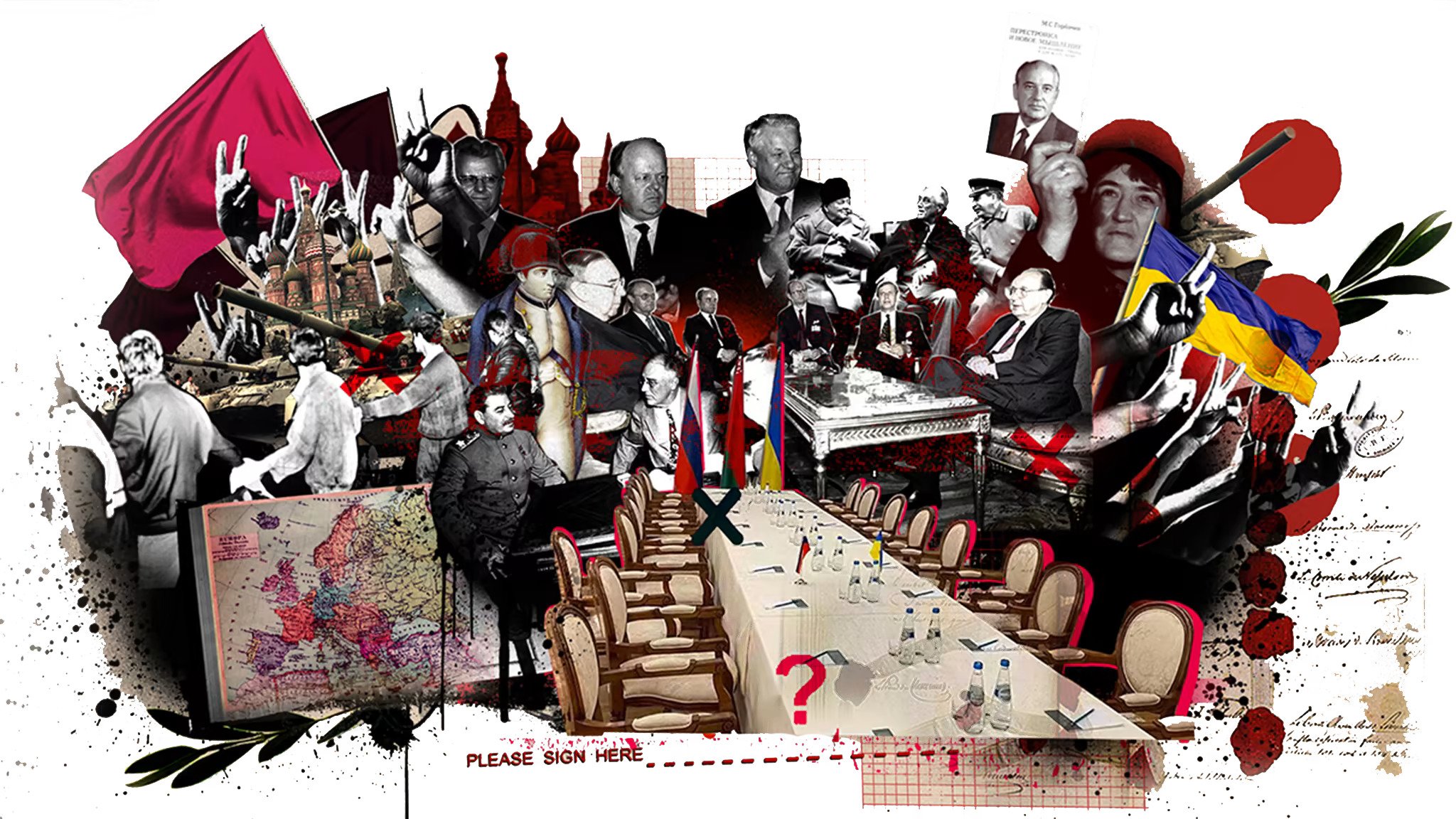
    Feature Image Credit: ipis.ir

  • The Military Situation in Ukraine

    The Military Situation in Ukraine

    Understanding the war in Ukraine is a challenge as all the available information is mired in Western Propaganda. However, there are sane voices of scholars like John Mearsheimer and a small group of excellent professionals and military veterans who provide extremely accurate analysis to ensure we get the true picture of this geopolitical contest between Russia and the US and NATO. Jacques Baud is a former Colonel of the General Staff, intelligence expert in NATO, and ex-member of the Swiss intelligence, and specialist on Eastern countries.

    In this excellent analysis, Jacques Baud brings out how the US and NATO have created conditions for the war and are using Ukraine as the sacrificial pawn in their proxy war against Russia. Jacques Baud demolishes the West’s propaganda about Russia’s invasion of Ukraine on Feb 24th and traces the start of the war to Feb 16th by the US and NATO.  Contrary to the American propaganda, he sees Putin as the master strategist. The end of this conflict will usher in a new multi-polar world order, in which the West may cease to be the rule maker.

    TPF is immensely happy to republish this article through the gracious courtesy of Centre Francaise de Recherche sure le Renseignement

    Capitulation – 1946 painting by Soviet Artist Pyotr Aleksandrovich Krivonogov, a veteran of The Great Patriotic War


    PART ONE: ON THE ROAD TO WAR

    For years, from Mali to Afghanistan, I worked for peace and risked my life for it. It is therefore not a question of justifying the war, but of understanding what led us to it. I note that the “experts” who take turns on the television sets analyze the situation based on dubious information, most often hypotheses turned into facts, and therefore we no longer manage to understand what is happening. That’s how you create panic.

    The problem is not so much who is right in this conflict, but how our leaders make their decisions.

    Let’s try to examine the roots of the conflict. It starts with those who for the past eight years have been talking to us about “separatists” or “independence” from the Donbas. It’s wrong. The referendums conducted by the two self-proclaimed republics of Donetsk and Luhansk in May 2014 were not ”  independence ” (независимость) referendums, as some unscrupulous journalists claimed, but ”  self-determination  ” or ”  autonomy (самостоятельность). The term “pro-Russian” suggests that Russia was a party to the conflict, which was not the case, and the term “Russian speakers” would have been more honest. Moreover, these referendums were conducted against the advice of Vladimir Putin.

    In fact, these republics did not seek to separate from Ukraine, but to have a statute of autonomy guaranteeing them the use of the Russian language as an official language. Because the first legislative act of the new government resulting from the overthrow of President Yanukovych, was the abolition, on February 23, 2014, of the Kivalov-Kolesnichenko law of 2012 which made Russian an official language. A bit as if putschists decided that French and Italian would no longer be official languages ​​in Switzerland.

    This decision causes a storm in the Russian-speaking population. This resulted in fierce repression against the Russian-speaking regions (Odesa, Dnepropetrovsk, Kharkov, Lugansk and Donetsk) which began in February 2014 and led to a militarization of the situation and a few massacres (in Odesa and Mariupol, for the most important). At the end of summer 2014, only the self-proclaimed republics of Donetsk and Lugansk remained.

    At this stage, too rigid and stuck in a doctrinaire approach to the operational art, the Ukrainian staff suffered the enemy without succeeding in imposing themselves. Examination of the course of the fighting in 2014-2016 in the Donbas shows that the Ukrainian general staff systematically and mechanically applied the same operational plans. However, the war waged by the autonomists was then very close to what we observed in the Sahel: very mobile operations carried out with light means. With a more flexible and less doctrinaire approach, the rebels were able to exploit the inertia of the Ukrainian forces to “trap” them repeatedly.

    In 2014, I am at NATO, responsible for the fight against the proliferation of small arms, and we are trying to detect Russian arms deliveries to the rebels in order to see if Moscow is involved. The information that we receive then comes practically all from the Polish intelligence services and does not “match” with the information from the OSCE: in spite of rather crude allegations, we do not observe any delivery of arms and materials Russian military.

    The rebels are armed thanks to the defections of Russian-speaking Ukrainian units which cross over to the rebel side. As the Ukrainian failures progressed, the entire tank, artillery or anti-aircraft battalions swelled the ranks of the autonomists. This is what drives the Ukrainians to commit to the Minsk Accords.

    But, just after signing the Minsk 1 Accords, Ukrainian President Petro Poroshenko launched a vast anti-terrorist operation (ATO/Антитерористична операція) against Donbas. Bis repetita placent: poorly advised by NATO officers, the Ukrainians suffered a crushing defeat at Debaltsevo which forced them to commit to the Minsk 2 Agreements…

    It is essential to recall here that the Minsk 1 (September 2014) and Minsk 2 (February 2015) Agreements provided for neither the separation nor the independence of the Republics, but their autonomy within the framework of Ukraine. Those who have read the Accords (they are very, very, very few) will find that it is written in full that the status of the republics was to be negotiated between Kyiv and the representatives of the republics, for an internal solution in Ukraine.

    This is why since 2014, Russia has systematically demanded their application while refusing to be a party to the negotiations, because it was an internal matter for Ukraine. On the other side, the Westerners – led by France – have systematically tried to replace the Minsk Accords with the “Normandy format”, which put Russians and Ukrainians face to face. However, let us remember, there were never any Russian troops in the Donbas before February 23-24, 2022. Moreover, OSCE observers have never observed the slightest trace of Russian units operating in the Donbas. Thus, the US intelligence map published by the Washington Post on December 3, 2021, does not show Russian troops in Donbas.

    In October 2015, Vasyl Hrytsak, director of the Ukrainian Security Service (SBU), confessed that only 56 Russian fighters had been observed in the Donbas. It was even comparable to that of the Swiss going to fight in Bosnia during the weekends, in the 1990s, or the French who are going to fight in Ukraine today.

    The Ukrainian army was then in a deplorable state. In October 2018, after four years of war, Ukraine’s chief military prosecutor Anatoly Matios said that Ukraine had lost 2,700 men in the Donbas: 891 from disease, 318 from traffic accidents, 177 from other accidents, 175 from poisoning (alcohol, drugs), 172 from careless handling of weapons, 101 from breaches of safety rules, 228 from murder and 615 from suicide.

    In fact, the army is undermined by the corruption of its cadres and no longer enjoys the support of the population. According to a UK Home Office report, when reservists were called up in March-April 2014, 70% did not show up for the first session, 80% for the second, 90% for the third and 95% for the fourth. In October/November 2017, 70% of callers did not show up during the “  Autumn 2017  ” callback campaign. This does not include suicides and desertions(often for the benefit of the autonomists) which reach up to 30% of the workforce in the ATO zone. Young Ukrainians refuse to go and fight in the Donbas and prefer emigration, which also explains, at least partially, the country’s demographic deficit.

    The Ukrainian Ministry of Defense then turned to NATO to help it make its armed forces more “attractive”. Having already worked on similar projects within the framework of the United Nations, I was asked by NATO to participate in a program intended to restore the image of the Ukrainian armed forces. But it’s a long process and the Ukrainians want to go quickly.

    Thus, to compensate for the lack of soldiers, the Ukrainian government resorted to paramilitary militias. They are essentially made up of foreign mercenaries, often far-right activists. As of 2020, they constitute around 40% of Ukraine’s forces and number around 102,000 men according to Reuters. They are armed, financed and trained by the United States, Great Britain, Canada and France. There are more than 19 nationalities – including Swiss.

    Western countries have therefore clearly created and supported Ukrainian far-right militias. In October 2021, the Jerusalem Post sounded the alarm by denouncing the Centuria project. These militias have been operating in the Donbas since 2014, with Western support. Even if we can discuss the term “Nazi”, the fact remains that these militias are violent, convey a nauseating ideology and are virulently anti-Semitic. Their anti-Semitism is more cultural than political, which is why the adjective “Nazi” is not really appropriate. Their hatred of the Jew comes from the great famines of the years 1920-1930 in Ukraine, resulting from the confiscation of crops by Stalin in order to finance the modernization of the Red Army. However, this genocide – known in Ukraine as the Holodomor – was perpetrated by the NKVD (predecessor of the KGB) whose upper echelons of leadership were mainly made up of Jews. That is why, today, Ukrainian extremists are asking Israel to apologize for the crimes of communism, as the Jerusalem Post reports. We are therefore a long way from a “  rewriting of history  ” by Vladimir Putin.

    These militias, stemming from the far-right groups that led the Euromaidan revolution in 2014, are made up of fanatical and brutal individuals. The best known of these is the Azov regiment, whose emblem is reminiscent of that of the 2nd SS Das Reich Panzer Division, which is the object of real veneration in Ukraine, for having liberated Kharkov from the Soviets in 1943, before perpetrating the massacre of Oradour-sur-Glane in 1944, in France.

    Among the famous figures of the Azov regiment was the opponent Roman Protassevich, arrested in 2021 by the Belarusian authorities following the case of RyanAir flight FR4978. On May 23, 2021, there is talk of the deliberate hijacking of an airliner by a MiG-29 – with Putin’s agreement, of course – to arrest Protassevich, although the information then available does not confirm this scenario in any way.

    But it must then be shown that President Lukashenko is a thug and Protassevich a “journalist” in love with democracy. However, a rather edifying investigation produced by an American NGO in 2020, highlighted Protassevich’s far-right militant activities. Western conspiracy then sets in motion and unscrupulous media “groom” his biography. Finally, in January 2022, the ICAO report is published and shows that despite some procedural errors, Belarus acted in accordance with the rules in force and that the MiG-29 took off 15 minutes after the RyanAir pilot decided to land in Minsk. So no Belarus plot and even less with Putin. Ah!… One more detail: Protassevich,cruelly tortured by Belarusian police, is now free. Those who would like to correspond with him can go to his Twitter account.

    The labelling of “Nazi” or “neo-Nazi” given to Ukrainian paramilitaries is considered Russian propaganda. Perhaps; but that is not the opinion of The Times of Israel, the Simon Wiesenthal Center or the Counterterrorism Center at West Point Academy. But this remains debatable, because, in 2014, Newsweek magazine seemed to associate them with… the Islamic State. A choice!

    So the West supports and continues to arm militias that have been guilty of numerous crimes against civilian populations since 2014: rape, torture and massacres. But while the Swiss government has been very quick to impose sanctions against Russia, it has not adopted any against Ukraine, which has been slaughtering its own population since 2014. In fact, those who defend the rights of the men in Ukraine have long condemned the actions of these groups, but have not been followed by our governments. Because, in reality, we are not trying to help Ukraine, but to fight Russia.

    The integration of these paramilitary forces into the National Guard was not at all accompanied by a “denazification”, as some claim. Among the many examples, that of the insignia of the Azov Regiment is edifying:


    In 2022, very schematically, the Ukrainian armed forces fighting the Russian offensive are structured as:

    – Army, subordinate to the Ministry of Defence: it is articulated in 3 army corps and composed of manoeuvre formations (tanks, heavy artillery, missiles, etc.).

    – National Guard, which depends on the Ministry of the Interior and is articulated in 5 territorial commands.

    The National Guard is therefore a territorial defence force that is not part of the Ukrainian army. It includes paramilitary militias, called ”  volunteer battalions” (добровольчі батальйоні), also known by the evocative name of ”  retaliatory battalions  “, composed of infantry. Mainly trained for urban combat, they now ensure the defence of cities such as Kharkov, Mariupol, Odesa, Kyiv, etc.

    PART II: THE WAR

    The former head of the Warsaw Pact forces in the Swiss strategic intelligence service, I observe with sadness – but not astonishment – ​​that our services are no longer in a position to understand the military situation in Ukraine. The self-proclaimed “experts” who parade across our screens wirelessly relay the same information modulated by the assertion that Russia – and Vladimir Putin – is irrational. Let’s take a step back.

    • THE OUTBREAK OF WAR

    Since November 2021, the Americans have constantly brandished the threat of a Russian invasion against Ukraine. However, the Ukrainians do not seem to agree. Why?

    We have to go back to March 24, 2021. On that day, Volodymyr Zelensky issued a decree for the reconquest of Crimea and began to deploy his forces towards the south of the country. Simultaneously, several NATO exercises were conducted between the Black Sea and the Baltic Sea, accompanied by a significant increase in reconnaissance flights along the Russian border. Russia then conducts a few exercises to test the operational readiness of its troops and show that it is following the evolution of the situation.

    Things calm down until October-November with the end of the ZAPAD 21 exercises, whose troop movements are interpreted as a reinforcement for an offensive against Ukraine. However, even the Ukrainian authorities refute the idea of ​​Russian preparations for a war and Oleksiy Reznikov, Ukrainian Minister of Defense declares that there has been no change on its border since the spring.

    In violation of the Minsk Accords, Ukraine is conducting aerial operations in Donbas using drones, including at least one strike against a fuel depot in Donetsk in October 2021. The American press points this out, but not the Europeans and no one condemns these violations.

    In February 2022, events rush. On February 7, during his visit to Moscow, Emmanuel Macron reaffirms to Vladimir Putin his attachment to the Minsk Accords, a commitment he will repeat after his interview with Volodymyr Zelensky the next day. But on February 11, in Berlin, after 9 hours of work, the meeting of the political advisers of the leaders of the ”  Normandy format  “ ends, without a concrete result: the Ukrainians still and always refuse to apply the Accordsof Minsk, apparently under pressure from the United States. Vladimir Putin then notes that Macron has made empty promises to him and that the West is not ready to enforce the Accords, as they have been doing for eight years.

    Ukrainian preparations in the contact zone continue. The Russian Parliament is alarmed and on February 15 asks Vladimir Putin to recognize the independence of the Republics, which he refuses.

    On February 17, President Joe Biden announces that Russia will attack Ukraine in the coming days. How does he know? Mystery… But since the 16th, the artillery shelling of the populations of Donbas has increased dramatically, as shown by the daily reports of OSCE observers. Naturally, neither the media, nor the European Union, nor NATO, nor any Western government reacts and intervenes. We will say later that this is Russian disinformation. In fact, it seems that the European Union and some countries purposely glossed over the massacre of the people of Donbas, knowing that it would provoke Russian intervention.

    At the same time, there are reports of acts of sabotage in the Donbas. On January 18, Donbas fighters intercept saboteurs equipped with Western equipment and speaking Polish seeking to create chemical incidents in Gorlivka. They could be CIA mercenaries, led or “advised” by Americans and made up of Ukrainian or European fighters, to carry out sabotage actions in the Donbas Republics.

    In fact, as early as February 16, Joe Biden knows that the Ukrainians have begun to shell the civilian populations of Donbas, putting Vladimir Putin in front of a difficult choice: to help Donbas militarily and create an international problem or to sit idly by and watch the Russian speakers. from the Donbas being run over.

    If he decides to intervene, Vladimir Putin can invoke the international obligation of “  Responsibility To Protect  ” (R2P). But he knows that whatever its nature or scale, the intervention will trigger a shower of sanctions. Therefore, whether its intervention is limited to the Donbas or whether it goes further to put pressure on the West for the status of Ukraine, the price to be paid will be the same. This is what he explains in his speech on February 21.

    That day, he acceded to the request of the Duma and recognized the independence of the two Republics of Donbas and, in the process, he signed treaties of friendship and assistance with them.

    The Ukrainian artillery bombardments on the populations of Donbas continued and, on February 23, the two Republics requested military aid from Russia. On the 24th, Vladimir Putin invokes Article 51 of the United Nations Charter which provides for mutual military assistance within the framework of a defensive alliance.

    In order to make the Russian intervention totally illegal in the eyes of the public, we deliberately obscure the fact that the war actually started on February 16th. The Ukrainian army was preparing to attack the Donbas as early as 2021, as certain Russian and European intelligence services were well aware… The lawyers will judge.

    In his speech on February 24, Vladimir Putin stated the two objectives of his operation: to “demilitarize” and “denazify” Ukraine. It is therefore not a question of seizing Ukraine, nor even, in all likelihood, of occupying it and certainly not of destroying it.

    From there, our visibility on the progress of the operation is limited: the Russians have excellent security of operations (OPSEC) and the detail of their planning is not known. But fairly quickly, the course of operations makes it possible to understand how the strategic objectives were translated into the operational plan.

    – Demilitarization:

    . ground destruction of Ukrainian aviation, air defence systems and reconnaissance assets;

    . neutralization of command and intelligence structures (C3I), as well as the main logistics routes in the depth of the territory;

    . encirclement of the bulk of the Ukrainian army massed in the southeast of the country.

    – Denazification:

    . destruction or neutralization of volunteer battalions operating in the cities of Odesa, Kharkov and Mariupol, as well as in various facilities on the territory.

    • THE “DEMILITARIZATION”

    The Russian offensive proceeds in a very “classic” manner. At first – as the Israelis had done in 1967 – with the destruction on the ground of the air forces in the very first hours. Then, we witness a simultaneous progression on several axes according to the principle of “flowing water”: we advance wherever resistance is weak and we leave the cities (very voracious in troops) for later. To the north, the Chernobyl plant is occupied immediately to prevent acts of sabotage. The images of Ukrainian and Russian soldiers jointly guarding the plant are naturally not shown…

    The idea that Russia is trying to take over Kyiv, the capital, to eliminate Zelensky, typically comes from the West: this is what they did in Afghanistan, Iraq, Libya and what they wanted to do in Syria with the help of the Islamic State. But Vladimir Putin never intended to take down or overthrow Zelensky. On the contrary, Russia seeks to keep him in power by pushing him to negotiate by encircling Kyiv. He had refused to do so far to apply the Minsk Accords, but now the Russians want to obtain Ukraine’s neutrality.

    Many Western commentators marvelled that the Russians continued to seek a negotiated solution while conducting military operations. The explanation is in the Russian strategic conception, since Soviet times. For Westerners, war begins when politics ceases. However, the Russian approach follows a Clausewitzian inspiration: war is the continuity of politics and one can pass fluidly from one to the other, even during combat. This creates pressure on the opponent and pushes him to negotiate.

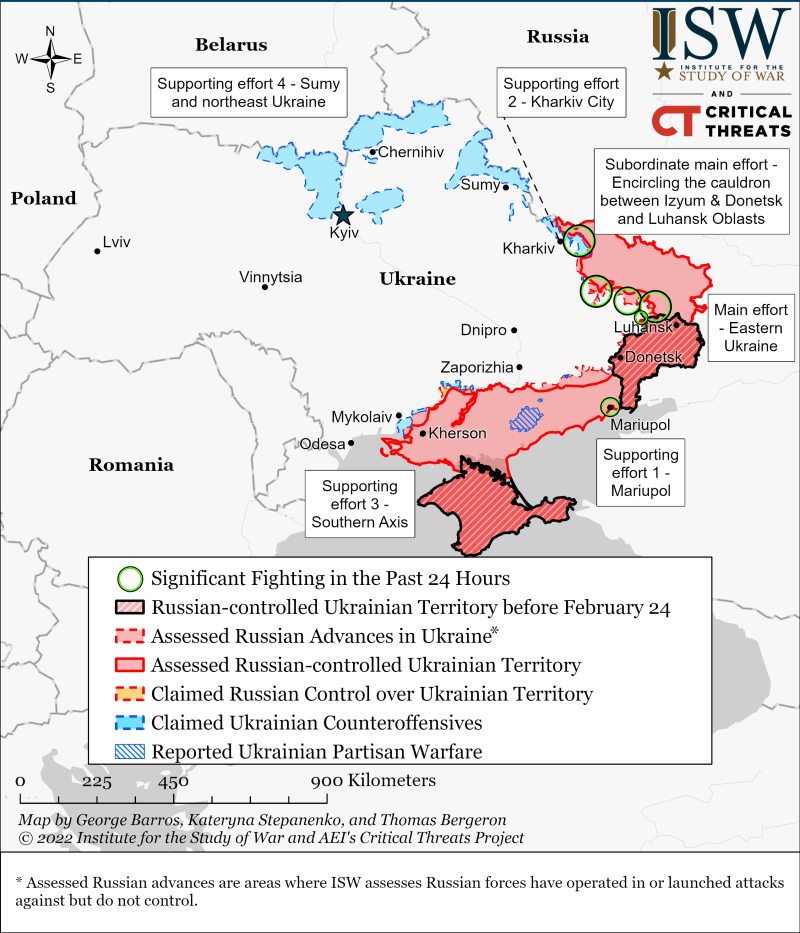
    From an operational point of view, the Russian offensive was an example of its kind: in six days, the Russians seized a territory as vast as the United Kingdom, with a speed of advance greater than what the Wehrmacht made in 1940.

    The bulk of the Ukrainian army was deployed in the south of the country for a major operation against Donbas. This is why the Russian forces were able to encircle it from the beginning of March in the “cauldron” between Slavyansk, Kramatorsk and Severodonetsk, by a thrust coming from the east via Kharkov and another coming from the south from the Crimea. The troops of the Republics of Donetsk (DPR) and Lugansk (RPL) complete the action of the Russian forces with a push from the East.

    At this stage, the Russian forces are slowly tightening the noose, but are no longer under time pressure. Their objective of demilitarization is practically achieved and the residual Ukrainian forces no longer have an operational and strategic command structure.

    The “slowdown” that our “experts” attribute to poor logistics is only the consequence of having achieved the objectives set. Russia does not seem to want to engage in an occupation of the whole Ukrainian territory. In fact, it seems rather that Russia is trying to limit its advance to the country’s linguistic border.

    Our media speak of indiscriminate bombardments against civilian populations, particularly in Kharkov, and Dantesque images are broadcast on a loop. However, Gonzalo Lira, a Latin American who lives there, presents us with a calm city on March 10, and on March 11. Admittedly, it’s a big city and you can’t see everything, but that seems to indicate that we are not in the total war that we are being served continuously on our screens.

    As for the Republics of Donbas, they have “liberated” their own territories and are fighting in the city of Mariupol.

    • “DENAZIFICATION”

    In cities like Kharkov, Mariupol and Odesa, defence is provided by paramilitary militias. They know that the objective of “denazification” is aimed primarily at them.

    For an attacker in an urbanized area, civilians are a problem. This is why Russia seeks to create humanitarian corridors to empty the cities of civilians and leave only the militias in order to fight them more easily.

    Conversely, these militias seek to keep civilians in the cities in order to dissuade the Russian army from coming to fight there. This is why they are reluctant to implement these corridors and do everything so that Russian efforts are in vain: they can thus use the civilian population as “human shields”. Videos showing civilians trying to leave Mariupol and being beaten up by fighters from the Azov regiment are naturally carefully censored here.

    On Facebook, the Azov group was considered in the same category as the Islamic State and subject to the platform’s ”  dangerous individuals and organizations policy  “. It was therefore forbidden to glorify him, and the “posts” that were favourable to him were systematically banned. But on February 24, Facebook changed its policy and allowed posts favourable to the militia. In the same spirit, in March, the platform authorizes, in the former Eastern European countries, calls for the murder of Russian soldiers and leaders. So much for the values ​​that inspire our leaders, as we will see.

    Our media propagate a romantic image of popular resistance. It is this image that has led the European Union to finance the distribution of arms to the civilian population. It is a criminal act. In my role as chief of doctrine for peacekeeping operations at the UN, I worked on the issue of the protection of civilians. We then saw that violence against civilians took place in very specific contexts. Especially when weapons abound and there are no command structures.

    Now, these command structures are the essence of armies: their function is to channel the use of force according to an objective. By arming citizens in a haphazard fashion as is currently the case, the EU turns them into combatants, with the attendant consequences: potential targets. Moreover, without command, without operational goals, the distribution of arms inevitably leads to settling of scores, banditry and actions that are more deadly than effective. War becomes a matter of emotions. Force becomes violence. This is what happened in Tawarga (Libya) from August 11 to 13, 2011, where 30,000 black Africans were massacred with weapons parachuted (illegally) by France. Moreover, the British Royal Institute for Strategic Studies(RUSI) sees no added value in these arms deliveries.

    Moreover, by delivering arms to a country at war, one exposes oneself to being considered as a belligerent. The Russian strikes on March 13, 2022, against the Mykolaiv airbase follow Russian warnings that weapons transports would be treated as hostile targets.

    The EU repeats the disastrous experience of the Third Reich in the last hours of the Battle of Berlin. War should be left to the military and when one side has lost, it should be admitted. And if there is to be resistance, it must imperatively be led and structured. However, we are doing exactly the opposite: we are pushing citizens to go and fight and at the same time, Facebook is allowing calls for the murder of Russian soldiers and leaders. So much for the values ​​that inspire us.

    In some intelligence services, this irresponsible decision is seen as a way of using the Ukrainian population as cannon fodder to fight Vladimir Putin’s Russia. This kind of murderous decision had to be left to the colleagues of Ursula von der Leyen’s grandfather. It would have been wiser to engage in negotiations and thus obtain guarantees for the civilian populations than to add fuel to the fire. It’s easy to be combative with other people’s blood…

    • MARIUPOL MATERNITY

    It is important to understand beforehand that it is not the Ukrainian army that ensures the defence of Mariupol, but the Azov militia, composed of foreign mercenaries.

    In its summary of the situation on March 7, 2022, the Russian UN mission in New York states that ”  Residents report that the Ukrainian armed forces have expelled the personnel of the Natal Hospital No. 1 from the city of Mariupol and have installed a shooting station inside the establishment. »

    On March 8, the independent Russian media Lenta.ru published the testimony of civilians from Mariupol who said that the maternity hospital was taken over by the militias of the Azov regiment, and chased out the civilian occupants, threatening them with their weapons. They thus confirm the statements of the Russian ambassador a few hours earlier.

    The Mariupol hospital occupies a dominant position, perfectly adequate for installing anti-tank weapons and for observation. On March 9, Russian forces hit the building. According to CNN, there are 17 injured, but the footage shows no casualties on the premises and there is no evidence that the reported casualties are related to this strike. We talk about children, but in reality, we see nothing. It may be true, but it may be false… Which does not prevent EU leaders from seeing it as a war crime … Which allows Zelensky, just afterwards, to claim a no-fly zone over Ukraine…

    In reality, we don’t know exactly what happened. But the sequence of events tends to confirm that the Russian forces struck a position of the Azov regiment and that the maternity ward was then free of all civilians.

    The problem is that the paramilitary militias that ensure the defence of cities are encouraged by the international community not to respect the customs of war. It seems that the Ukrainians have re-enacted the scenario of the maternity hospital in Kuwait City in 1990, which had been completely staged by the firm Hill & Knowlton for the amount of 10.7 million dollars in order to convince the United Nations Security Council to intervene in Iraq for Operation Desert Shield/Storm.

    Western politicians have also accepted strikes against civilians in Donbas for eight years, without adopting any sanctions against the Ukrainian government. We have long since entered into a dynamic where Western politicians have agreed to sacrifice international law to their objective of weakening Russia .

    PART THREE: CONCLUSIONS

     As a former intelligence professional, the first thing that strikes me is the total absence of Western intelligence services in representing the situation for a year. In Switzerland, the services have been criticized for not having provided a correct picture of the situation. In fact, it seems that all over the Western world, the services have been overwhelmed by the politicians. The problem is that it is the politicians who decide: the best intelligence service in the world is useless if the decision-maker does not listen to it. This is what happened during this crisis.

    That said, while some intelligence services had a very precise and rational image of the situation, others clearly had the same image as that propagated by our media. In this crisis, the services of the countries of the “new Europe” played an important role. The problem is that, by experience, I found that they were extremely bad on the analytical level: doctrinaire, they do not have the intellectual and political independence necessary to appreciate a situation with a military “quality”. It is better to have them as enemies than as friends.

    Then, it seems that in some European countries, politicians have deliberately ignored their services to respond ideologically to the situation. This is why this crisis has been irrational from the start. It will be observed that all the documents that have been presented to the public during this crisis have been presented by politicians on the basis of commercial sources…

    Some Western politicians obviously wanted there to be a conflict. In the United States, the attack scenarios presented by Anthony Blinken to the Security Council were only the fruit of the imagination of a Tiger Team working for him  : he did exactly like Donald Rumsfeld in 2002, who thus “bypassed” the CIA and other intelligence services that were far less assertive about Iraqi chemical weapons.

    The dramatic developments we are witnessing today have causes we knew about, but refused to see:

    – on the strategic level, the expansion of NATO (which we have not dealt with here);

    – on the political level, the Western refusal to implement the Minsk Agreements;

    – and on the operational level, the continuous and repeated attacks on the civilian populations of Donbass for years and the dramatic increase at the end of February 2022.

    In other words, we can naturally deplore and condemn the Russian attack. But WE (that is to say: the United States, France and the European Union in the lead) have created the conditions for a conflict to break out. We show compassion for the Ukrainian people and the two million refugees . It’s good. But if we had had a modicum of compassion for the same number of refugees from the Ukrainian populations of Donbass massacred by their own government and who have been accumulating in Russia for eight years, none of this would probably have happened.


    Whether the term “genocide” applies to the abuses suffered by the populations of Donbass is an open question. This term is generally reserved for larger cases (Holocaust, etc.), however, the definition given by the Genocide Convention is probably broad enough to apply. Lawyers will appreciate.

    Clearly, this conflict has led us into hysteria. Sanctions seem to have become the preferred tool of our foreign policies. If we had insisted that Ukraine respect the Minsk Accords, which we negotiated and endorsed, none of this would have happened. The condemnation of Vladimir Putin is also ours. There is no point in whining after the fact, we had to act before. However, neither Emmanuel Macron (as guarantor and as a member of the UN Security Council), nor Olaf Scholz, nor Volodymyr Zelensky have respected their commitments. Ultimately, the real defeat is that of those who have no voice.

    The European Union was unable to promote the implementation of the Minsk agreements, on the contrary, it did not react when Ukraine bombarded its own population in the Donbass. Had she done so, Vladimir Putin would not have needed to react. Absent from the diplomatic phase, the EU distinguished itself by fueling the conflict. On February 27, the Ukrainian government agrees to start negotiations with Russia. But a few hours later, the European Union voted a budget of 450 million euros to supply arms to Ukraine, adding fuel to the fire. From there, the Ukrainians feel that they will not need to come to an agreement. The resistance of the Azov militias in Mariupol will even causea raise of 500 million euros for weapons .

    In Ukraine, with the blessing of Western countries, those who are in favor of a negotiation are eliminated. This is the case of Denis Kireyev, one of the Ukrainian negotiators, assassinated on March 5 by the Ukrainian secret service (SBU) because he is too favorable to Russia and is considered a traitor. The same fate is reserved for Dmitry Demyanenko, former deputy head of the main directorate of the SBU for Kiev and its region, assassinated on March 10 , because too favorable to an agreement with Russia: he is killed by the Mirotvorets militia (”  Peacemaker  “). This militia is associated with the Mirotvorets website which lists the ”  enemies of Ukraine”, with their personal data, address and telephone numbers, so that they can be harassed or even eliminated  ; a punishable practice in many countries, but not in Ukraine . The UN and some European countries have demanded its closure… refused by the Rada.

    Eventually, the price will be high, but Vladimir Putin will likely achieve the goals he set for himself. Its ties with Beijing have solidified. China emerges as a mediator of the conflict, while Switzerland enters the list of enemies of Russia. The Americans must ask Venezuela and Iran for oil to get out of the energy impasse in which they have gotten themselves: Juan Guaido leaves the scene definitively and the United States must pitifully reverse the sanctions imposed on their enemies.

    Western ministers who seek to collapse the Russian economy and make the Russian people suffer , even calling for the assassination of Putin, show (even if they partially reversed the form of their remarks, but not on bottom!) that our leaders are no better than those we hate. Because, sanctioning Russian athletes from the Para-Olympic Games or Russian artists has absolutely nothing to do with a fight against Putin.

    So, therefore, we recognize that Russia is a democracy since we consider that the Russian people are responsible for the war. If not, then why are we trying to punish an entire population for the fault of one? Remember that collective punishment is prohibited by the Geneva Conventions…

    The lesson to be drawn from this conflict is our sense of variable geometry humanity. If we were so attached to peace and to Ukraine, why didn’t we encourage her more to respect the agreements that she had signed and that the members of the Security Council had approved?

    Media integrity is measured by their willingness to work under the terms of the Munich Charter. They had succeeded in propagating hatred of the Chinese during the Covid crisis and their polarized message leads to the same effects against the Russians . Journalism is stripping itself more and more of professionalism to become militant…

    As Goethe said: “  The greater the light, the darker the shadow  ”. The more the sanctions against Russia are excessive, the more the cases where we have done nothing highlight our racism and our servility. Why has no Western politician reacted to the strikes against the civilian populations of Donbass for eight years?

    After all, what makes the conflict in Ukraine more blameworthy than the war in Iraq, Afghanistan or Libya? What sanctions have we adopted against those who have deliberately lied before the international community to wage unjust, unjustified, unjustifiable and murderous wars? Did we try to “make suffer” the American people who had lied to us (because it is a democracy!) before the war in Iraq? Have we even adopted a single sanction against the countries, companies or politicians who are fueling the conflict in Yemen, considered the ”  worst humanitarian disaster in the world  “? Have we sanctioned the countries of the European Union who practice the most abject torture on their territory for the benefit of the United States?

    To ask the question is to answer it… and the answer is not glorious.


    Feature Image Credit: Raising the Flag over Reichstag – iconic photo in 1945 by Yevegny Khaldei – kosmofoto.com 


  • National Education Policy, 2020 – Policy Brief

    National Education Policy, 2020 – Policy Brief

    [powerkit_button size=”lg” style=”info” block=”true” url=”https://admin.thepeninsula.org.in/wp-content/uploads/2022/04/Policy-Brief-NEP-2020.docx-1_compressed-1.pdf” target=”_blank” nofollow=”false”]
    Download – Policy Brief on National Education Policy, 2020
    [/powerkit_button]

    Executive Summary:

    In line with the New Education Policy (NEP) 2020 mandate, the UGC released the draft National Higher Educational Qualifications Framework (NHEQF) in February 2022. Its release has reignited the controversy over the policy that was criticized and even rejected by many state governments. The inclusion of Education in the concurrent list gives overriding powers to the centre. However, the sweeping changes the NEP is set to bring have raised concerns that the states would turn into mere implementing agencies while all the decisions regarding education will be taken by the centre. At the root of the controversy lies the federal structure of India which would be jeopardized by the implementation of the policy. Hence, significant and appropriate amendments to the draft are required to address the grievances of the states.

    What is NEP (2020)?

    The NEP, released in July of 2020 by the Union Government, seeks to overhaul the entire education system of the country by replacing the thirty four-year-old National Policy on Education (1986). In the domain of pre-University education, the new policy aims to transform the curricula structure from 10+2 to 5+3+3+4, mandates the Three Language Formula (TLF), reduces the syllabus to make board exams “easier” and gives thrust to vocational training and skill development. In the realm of higher education, it envisions a single regulator- the Higher Education Council India (HECI)- for Higher Education Institutes (HEIs) by merging UGC, AICTE and other regulatory bodies. The HECI is further divided into four verticals, namely the National Higher Education Regulatory Council (NHERC), National Accreditation Council (NAC), Higher Education Grants Council (HEGI) and General Education Council (GEC). 

    The policy introduces four-year undergraduate programmes with multiple exit options, along with proposing a national Academic Bank of Credit and a national entrance exam for all universities. It further allows higher education to be taught in regional languages. Additionally, it proposes the National Testing Agency (NTA) conduct a “high quality” common entrance test and a common specialized subject exam in sciences, humanities, language, arts, and vocational subjects, at least twice a year. It blurs the distinction between research-oriented and employment-oriented education, emphasizing a multidisciplinary approach to education. Additionally, it proposes facilitation to top global universities to set up campuses in India and to top Indian Universities to establish campuses abroad.

    The policy also touches upon the issue of Adult Education. It proposes strong and innovative government initiatives to achieve 100% adult literacy, educate about critical life skills (including financial literacy, digital literacy, commercial skills, health care and awareness etc.), impart vocational skills and provide basic education to adults. It also ensures providing the necessary infrastructure for adults to facilitate its implementation.  

    Why is it a problem? 

    Since its release, the policy has been opposed by a few states. Though other states have voiced their reservations, none have been as vocal and vehement as Tamil Nadu. 

    • The foremost reason pertains to the Three Language Formula. The policy states that out of the three languages that ought to be taught at the pre-University level, two must be Indian. This leaves the students from the southern states to learn Hindi, along with English and the regional language in their curriculum. The formula was brought forward in 1968 by the then Indira Gandhi government as recommended by Kothari Commission. All states adopted the policy except Tamil Nadu, which continued its two language policy.

    The Three Language Formula finds its explicit mention in Section 4.13 of the Draft policy. In order to promote multilingualism, the draft states that, “The three-language formula will continue to be implemented”. Moreover, a student is given the option to change one of the three languages only once- in Grade 6 or 7. Though the formula has been in continuance since the 1970s, an exclusive emphasis upon it raises eyebrows. The draft further falls short of assuring the states unwilling to implement the formula of any compulsion by the centre, instead offering “greater flexibility” in its implementation. 

    Learning Hindi has always been a controversial issue in Tamil Nadu. The state has seen numerous instances of violence and public protests against the imposition of Hindi. The state has also actively promoted Tamil learning in schools. In 2006, the state enacted Tamil Nadu Tamil Learning Act, making it compulsory for every school operating in the state to teach Tamil. The state government is also opposed to the establishment of Navodaya Schools by the centre in the state.

    • The draft also places an unprecedented emphasis on learning Sanskrit. Section 4.16 stresses the need for learning Sanskrit since most of the Indian other languages attribute “their origins and sources of vocabularies” to it. Section 4.17 emphasizes the importance of classical literature possessed by the language. It thus offers its teaching “at all levels of school and higher education”. Moreover, it promotes the teaching of the language through its classical literature in mathematics, philosophy, grammar, music, politics, medicine, architecture, metallurgy, drama, poetry etc.

    Laying such a huge emphasis upon an archaic language in schools and even HEIs at “all levels” would leave a student burdened with an unnecessary curriculum. Offering courses in Sanskrit to college students, for instance, in non-Hindi speaking states would decrease their grades. Worse still, in Central Universities- mostly dominated by Hindi speakers, such courses will make naked and even exacerbate the language barrier the non-Hindi speaking students face. Further, the postulate that most of the major Indian languages owe their “origins” to Sanskrit is not even remotely true. Additionally, the literature in Sanskrit can be discriminatory against varna, caste or group, especially in social sciences. 

    • However, the major concern relates to the federal structure of India. The policy proposes the establishment of the all-powerful HECI and its verticals. The NHERC, one of its verticals, reserves the power to regulate every facet of HEIs, including financial probity, good governance, and the full online and offline public self-disclosure of all finances, audits, procedures, infrastructure, faculty/staff, courses, and educational outcomes[Section 18.3]. It further envisions a “graded accreditation” system to be given by the NAC, that will “specify phased benchmarks for all HEIs to achieve set levels of quality, self-governance, and autonomy…to attain the highest level of accreditation over the next 15 years” [Section 18.4]. The GECI, another of its verticals, will frame “expected learning outcomes for higher education programmes” and mandate the identification of “specific skills that students must acquire during their academic programmes” [Section 18.6].

    Owing to its vague language, the draft lacks clarity on the extent of jurisdiction of HECI and its verticals. It reserves the power to regulate the faculty/staff, courses, educational outcomes etc., thus infringing upon the state’s rights on reservations and education. Moreover, the students are required to acquire “specific skills” and “learning outcomes” framed by the central government, making it difficult for them to cater to the needs of their respective states. Further, the vocabulary used, such as “good governance”, leaves room for significant manipulation in the future.

    • The policy veritably promotes the centralization of education at every level. For instance, it envisages a nation-wide “high-quality” common aptitude test for admission into the universities, as well as “specialized common subject exams in the sciences, humanities, languages, arts, and vocational subjects” [Section 4.42], which it assumes will reduce the burden on students. Moreover, an all-India test is to be conducted by NTA for admission into pre-service teacher preparation programmes of Teacher Education Institutions (TEIs) [Section 15.7], which it envisions to convert into multidisciplinary institutions [Section 15.4]. Moreover, it places an undue emphasis on centralized vocational training in all schools and HEIs which would be overseen by the National Committee for the Integration of Vocational Education (NCIVE) [Section 16.8]. In the field of academic research, the policy envisions the establishment of the National Research Foundation to provide funding for research [Section 17.9]. Further, it proposes to establish the National Research Foundation (NRF) which is meant to provide funding for research to the institutions, and “undertake major initiatives to seed and grow research at the state universities and other public institutions”[Section 17.9], centralizing disbursement of research-oriented funding. It is further empowered to ensure that the Research Scholars are “constantly made aware of the most urgent national research issues” to allow breakthroughs to be optimally brought into policy [Section 17.11(c)].

    Tamil Nadu’s objection to a country-wide entrance test is premised upon the recommendations of the M. Anandakrishnan committee. Constituted in 2006, it recommended the abolition of the Common Entrance Test (CET) in the state from the academic year 2007-08 (Srinivasan, 2016), due to the unaffordability of the high fees of coaching for the rural and underprivileged students. Furthermore, the NRF is empowered to fund the research on urgent “national” issues, thus again leaving the door ajar for manipulation of their jurisdiction, and depriving state-funded institutions of funding for research on regional issues.

    • The policy seizes the administrative autonomy from both public and private HEIs. It mandates every such institution to establish a Board of Governors (BoG) which would be empowered to govern the institution[Section 19.2], including the selection of leaders of the institution [Section 19.4]. Further, the policy subjugates the BoG to guidelines formulated by NHERC[Section 19.3]. Additionally, it makes it compulsory for every institution to formulate its own Institutional Development Plan [Section 19.5] to strategize its roadmap.

    In subjugating the administrative system of the colleges to a central body, the central government ignores the urban-rural divide and caste-based discrimination entrenched in them. Moreover, drafting the same guidelines for urban, rural, minority etc. institutions would, along with waning their autonomy, undermine the purpose they are meant to serve. 

    • The policy provides multiple exit and entry options to the students pursuing higher education[Section 11.9], along with the creation of an Academic Bank of Credits to digitally store credits earned by the student and different designs of Master’s programmes [Section 11.10].  

    The central government does not contemplate the unintended consequences of the above proposition, especially for the backward communities and female students. It leaves the students of the said groups with multiple exit options but few entry options. Multiple choices of exit will compel such students facing monetary or familial issues to quit their education in the middle. Further, it burdens a teenage student with critical life-changing decisions.  Moreover, the proposed system disallows a student to carry backlogs into the next year, bringing about the apprehension of exacerbation of the dropout rate, which currently stands at 12.6%.

    • Both the draft NHEQF and the draft policy suggest, in multiple instances, that all colleges either become multidisciplinary or merge with existing universities. However, both the documents do not provide any provision regarding how the same will be executed without any monetary assistance. This has raised concerns about many state government colleges becoming defunct due to a lack of finances to become multidisciplinary, thus depriving a large number of students of educational opportunities. 
    • The policy makes no mention of the Reservation System in educational institutions, both in admission and faculty recruitment, making it non-inclusive to all sections of the society. Further, it does not mention the drop-out rates among the backward communities, let alone ways to tackle them. The NEP policy-makers veritably fail to view education as a tool to uplift the poor and backward classes while formulating it.
    • The proposal also lacks a grievance redressal mechanism, either for the states or the institutions regarding any facet of the policy. The institutions and state governments are left with no choice but to follow the guidelines of the would-be central institutions. Institutions failing to comply with the guidelines are feared to become defunct. Moreover, the power of ‘light but tight’ regulation bestowed upon the central bodies also leaves the door ajar for manipulation of their jurisdiction. 

    Tamil Nadu’s response to NEP

    Since early on, Tamil Nadu’s policies have emphasized education as a modus operandi to uplift the backward castes. As early as 1919, certain legislations were in place to encourage and mandate local education authorities to establish schools at places that were accessible to everyone, thus broadening the social base of its educated bracket. The reasons for the Tamil Nadu government opposing NEP are manifold. 

    Tamil Nadu Chief Minister MK Stalin has explicitly stated that the policy will not be implemented in the state. He has called it a policy “for elites” and, if implemented, education “will be confined and limited to a few sections”. The state government has even set up a committee to formulate its own State Education Policy in a bid to replace the NEP. Furthermore, the state plans to implement only some ‘good aspects’ of the central policy (Sathyanarayana, 2021). It claims that the policy negates the efforts of more than a hundred years of social justice aspirations that were carefully envisaged in Tamil Nadu. State Education Minister K. Ponmudi noted that mandating entrance exams for getting admissions to arts and science colleges would affect the students from rural areas.

    Similar concerns were raised by L. Jawahar Nesan, head of the All India Save Education Committee, while complaining that the proposed Academic Bank of Credits (ABC) could result in “students dropping out of higher educational institutions before completing their course”. “The proposed system aims at furthering vocational education and creation of a workforce pool”, he added (“Academics call for the withdrawal of draft”, 2022). The State Platform for Common School System- Tamil Nadu (SPCSS-TN) termed the framework “a crude form of diarchy”(Sathyanarayana, 2022). Regarding the mandatory entrance test akin to NEET, PB Prince Gajendra Babu, General Secretary of the body, said that the students don’t have sufficient time and their family circumstances do not permit them to undergo separate coaching for entrance exams(ibid). In September last year, the Coimbatore-based Aram Seiya Virumbu Trust filed a writ petition in Madras High Court challenging the constitutionality of Section 57 of the 42nd Amendment that brought education in the concurrent list as a response to the policy, whose implementation, the trust alleged, will lead to “autonomy of the states in education be completely taken away thereby striking at the very root of the federal structure”(Imranullah S., 2021).

    The issue of centralization of education has always been a hot potato in the state. Back in 2006, M. Karunanidhi’s government constituted a committee under the chairmanship of M. Anandakrishnan to recommend measures for the abolition of the Common Entrance Test (CET) in the state from the academic year 2007-08. On the recommendations of the committee, the state government terminated its practice of conducting CET for admission into technical and medical courses, making it easier for underprivileged students to pursue the said graduate courses (Rajasekaran, 2021). Other policy decisions taken by the state for similar causes include the 50% ‘in-service’ super speciality seats quota in government medical colleges which was recently upheld by the Supreme Court. Prior to NEET, the quota had provided opportunities to the lower strata of society to enter the colleges which in turn helped the state government in providing an uninterrupted supply of doctors in primary health centres (P.M., 2019). 

    Other States’ Response

    Among other states, West Bengal has most emphatically opposed the implementation of the policy. Within a month of its release, Partha Chatterjee, the state Education Minister, announced the government’s unwillingness to implement the policy in the state “any time soon”, due to its undermining of the federal structure and non-inclusion of Bengali in the list of classical languages(“No NEP 2020 in West Bengal”, 2020). He also said that no one in the state government was consulted for its formulation. Kerala has also protested against the policy in the report of the six-member committee, chaired by Professor Prabhat Patnaik. 

    Delhi Education Minister Manish Sisodia accused the central government of encouraging the privatisation of education and reducing its responsibility as a government to provide quality education to all, while questioning the need to make board exams easier. Chhattisgarh CM Bhupesh Baghel termed it as centralization of education which goes against the federal structure of the country(Sharma, 2020). Rajasthan Education Minister Govind Datasra also criticized the draft for lack of clarity.

    Conclusion

    The policy possesses strong tendencies of centralization of education, contravening federalism as a basic structure of our constitution. It establishes bodies that are empowered to determine policies and curriculum for all educational institutions, including state institutions, with little or no role of the states in formulating them, turning them into mere implementing bodies. Moreover, it imposes teaching of Hindi and Sanskrit in all schools across the country with no consent of the states. The policy violates numerous Supreme Court rulings that have upheld federalism as a basic structure of the constitution. The central government must make significant changes to the draft policy to make it more reflective, just and fair to India’s diversity.

    Recommendations

    • The draft policy is an onslaught on federalism as a basic structure of our constitution. The concerned authorities, while acknowledging the competence of the states in educational planning and execution, and its role as a determinant of their development, must re-draft the policy to omit the provisions that dilute the federal structure.
    • The Three Language Formula must be waived off for the states unwilling to pursue it. Additionally, the students of the states that choose to implement the formula must be given the option to change any of the languages in secondary schooling.
    • In view of the large endemic socio-economic disparity in India, the states must be allowed to formulate their own processes of enrolling the students into higher education. Imposing a central exam on constituents of the backward community might disrupt the smooth process in which they have been uplifted from their backwardness in the last few decades.
    • The proposed provision of multiple exit options in higher education must be reformulated so as to prevent dropouts in the middle of the courses. The policy must also consider instating multiple options to clear backlogs to further reduce the number of dropouts.
    • The colleges must be given more autonomy in deciding their curriculum. To turn a vast number of government colleges into multidisciplinary ones might be expensive for the state governments, which could possibly result in these colleges being permanently closed.
    • The attempts to centralize education must be clamped down to address the grievances of various states. Moreover, the necessary central bodies proposed in the draft must be given adequate representation by all the states.
    • The policy must explicitly uphold the reservation system in educational institutions regarding admissions and jobs.
    • The draft lacks clarity on the extent of jurisdiction of the proposed central bodies. Hence, the government must elaborate on the roles of these institutions
    • The undue emphasis on vocational education must be dialled down. Instead, emphasis must be placed upon academic education and critical thinking.  

    References

    1. “Academics call for withdrawal of draft National Higher Education Qualification Framework”,(2022, March 9) The Hindu. https://www.thehindu.com/news/national/tamil-nadu/academics-call-for-withdrawal-of-draft-national-higher-education-qualification-framework/article65207193.ece
    2. Imranullah S., Mohamed. (2021, September 14) “Case in Madras HC challenges constitutional amendment shifting education from state list to concurrent list” The Hindu. https://www.thehindu.com/news/national/tamil-nadu/case-in-madras-hc-challenges-constitutional-amendment-shifting-education-from-state-list-to-concurrent-list/article36448046.ece
    3. “No NEP 2020 in West Bengal, it undermines role of states: Education minister”(2020, September 7) Livemint. https://www.livemint.com/politics/news/no-nep-2020-in-west-bengal-it-undermines-role-of-states-state-education-minister-11599477761391.html
    4. P.M., Yazhini.(2019, June 8) “Common Entrance Exams Like NEET Ignore India’s Gender and Social Realities”. The Wire. https://thewire.in/education/neet-tamil-nadu-caste-gender
    5. Rajasekaran, Ilangovan.(2021, May 29) “M. Anandakrishnan, an educationist who democratised technical education in Tamil Nadu, passes away”. Frontline. https://frontline.thehindu.com/dispatches/m-anandakrishnan-educationist-who-democratised-technical-education-in-tamil-nadu-passes-away/article34677215.ece
    6. Sathyanarayana, R.(2021, December 30) “Tamil Nadu to accept ‘good aspects’ of National Education Policy”. DT Next. https://www.dtnext.in/News/TopNews/2021/12/30135026/1336439/Tamil-Nadu-to-accept-good-aspects-of-National-Education-.vpf
    7. Sathyanarayana, R.(2022, February 22) “Experts flay draft higher education framework”. DT Next. https://www.dtnext.in/News/TopNews/2022/02/22022833/1354869/Experts-flay-draft-higher-education-framework.vpf
    8.  Sharma, Nidhi. (2020, August 18) “New Education Policy an attempt to centralise education: Opposition-ruled states” The Economic Times. https://economictimes.indiatimes.com/news/politics-and-nation/new-education-policy-an-attempt-to-centralise-education-opposition-ruled-states/articleshow/77604704.cms?from=mdr
    9. Srinivasan, R.(2016). Reservation in Educational Institutions: Who Gains from Abolishing the Common Entrance Test (CET) in Tamil Nadu. The Hindu Centre. https://www.thehinducentre.com/incoming/article23697651.ece/BINARY/Policy%20Watch%20No_3.pdf

    Featured Image: Deloitte

    [powerkit_button size=”lg” style=”info” block=”true” url=”https://admin.thepeninsula.org.in/wp-content/uploads/2022/04/Policy-Brief-NEP-2020.docx-1_compressed-1.pdf” target=”_blank” nofollow=”false”]
    Download – Policy Brief on National Education Policy, 2020
    [/powerkit_button]

  • Mining the Moon

    Mining the Moon

    In view of our upcoming event on ‘Scramble for the Skies: The Great Power Competition to control the Resources of Outer Space’, TPF is happy republish this old but excellent article under the Creative Commons License 4.0. Establishing outer space colonies and ‘mining the moon’ is a very distinct possibility in the near future. However, commercial scale of this process may take decades. Space resources, in terms of materials to be mined, will become the major focus in the coming decades.

    This article by Paul K Byrne was published originally in The Conversation.

    If you were transported to the Moon this very instant, you would surely and rapidly die. That’s because there’s no atmosphere, the surface temperature varies from a roasting 130 degrees Celsius (266 F) to a bone-chilling minus 170 C (minus 274 F). If the lack of air or horrific heat or cold don’t kill you then micrometeorite bombardment or solar radiation will. By all accounts, the Moon is not a hospitable place to be.

    Yet if human beings are to explore the Moon and, potentially, live there one day, we’ll need to learn how to deal with these challenging environmental conditions. We’ll need habitats, air, food and energy, as well as fuel to power rockets back to Earth and possibly other destinations. That means we’ll need resources to meet these requirements. We can either bring them with us from Earth – an expensive proposition – or we’ll need to take advantage of resources on the Moon itself. And that’s where the idea of “in-situ resource utilization,” or ISRU, comes in.

    Underpinning efforts to use lunar materials is the desire to establish either temporary or even permanent human settlements on the Moon – and there are numerous benefits to doing so. For example, lunar bases or colonies could provide invaluable training and preparation for missions to farther flung destinations, including Mars. Developing and utilizing lunar resources will likely lead to a vast number of innovative and exotic technologies that could be useful on Earth, as has been the case with the International Space Station.

    As a planetary geologist, I’m fascinated by how other worlds came to be, and what lessons we can learn about the formation and evolution of our own planet. And because one day I hope to actually visit the Moon in person, I’m particularly interested in how we can use the resources there to make human exploration of the solar system as economical as possible.

    A rendering of a possible lunar habitat. credit: Eos.org

    In-situ resource utilization

    ISRU sounds like science fiction, and for the moment it largely is. This concept involves identifying, extracting and processing material from the lunar surface and interior and converting it into something useful: oxygen for breathing, electricity, construction materials and even rocket fuel.

    Many countries have expressed a renewed desire to go back to the Moon. NASAhas a multitude of plans to do so, China landed a rover on the lunar farside in January and has an active rover there right now, and numerous other countrieshave their sights set on lunar missions. The necessity of using materials already present on the Moon becomes more pressing.

    Anticipation of lunar living is driving engineering and experimental work to determine how to efficiently use lunar materials to support human exploration. For example, the European Space Agency is planning to land a spacecraft at the lunar South Pole in 2022 to drill beneath the surface in search of water ice and other chemicals. This craft will feature a research instrument designed to obtain water from the lunar soil or regolith.

    There have even been discussions of eventually mining and shipping back to Earth the helium-3 locked in the lunar regolith. Helium-3 (a non-radioactive isotope of helium) could be used as fuel for fusion reactors to produce vast amounts of energy at very low environmental cost – although fusion as a power source has not yet been demonstrated, and the volume of extractable helium-3 is unknown. Nonetheless, even as the true costs and benefits of lunar ISRU remain to be seen, there is little reason to think that the considerable current interest in mining the Moon won’t continue.


    It’s worth noting that the Moon may not be a particularly suitable destination for mining other valuable metals such as gold, platinum or rare earth elements. This is because of the process of differentiation, in which relatively heavy materials sink and lighter materials rise when a planetary body is partially or almost fully molten.

    This is basically what goes on if you shake a test tube filled with sand and water. At first, everything is mixed together, but then the sand eventually separates from the liquid and sinks to the bottom of the tube. And just as for Earth, most of the Moon’s inventory of heavy and valuable metals are likely deep in the mantle or even the core, where they’re essentially impossible to access. Indeed, it’s because minor bodies such as asteroids generally don’t undergo differentiation that they’re such promising targets for mineral exploration and extraction.

    Artist’s impression of In Situ Resource Utilisation. Credit: Universe Today

    Lunar formation

    Apollo 17 astronaut Harrison H. Schmitt standing beside a boulder on the lunar surface. NASA

    Indeed, the Moon holds a special place in planetary science because it is the only other body in the solar system where human beings have set foot. The NASA Apollo program in the 1960s and 70s saw a total of 12 astronauts walk, bounce and rove on the surface. The rock samples they brought back and the experimentsthey left there have enabled a greater understanding of not only our Moon, but of how planets form in general, than would ever have been possible otherwise.

    From those missions, and others over the ensuing decades, scientists have learned a great deal about the Moon. Instead of growing from a cloud of dust and ice as the planets in the solar system did, we’ve discovered that our nearest neighbor is probably the result of a giant impact between the proto-Earth and a Mars-sized object. That collision ejected a huge volume of debris, some of which later coalesced into the Moon. From analyses of lunar samples, advanced computer modeling and comparisons with other planets in the solar system, we’ve learned among many other things that colossal impacts could be the rule, not the exception, in the early days of this and other planetary systems.

    Carrying out scientific research on the Moon would yield dramatic increases in our understanding of how our natural satellite came to be, and what processes operate on and within the surface to make it look the way it does.

    The coming decades hold the promise of a new era of lunar exploration, with humans living there for extended periods of time enabled by the extraction and use of the Moon’s natural resources. With steady, determined effort, then, the Moon can become not only a home to future explorers, but the perfect stepping stone from which to take our next giant leap.


    Feature Image Credit: SciTechDaily


  • America defeats Germany for the third time in a century

    America defeats Germany for the third time in a century

    This is a very profound article by Michael Hudson, wherein he exposes the real drivers of the conflict in Ukraine – the American Military Industrial Complex; Oil, Gas and Mining Industry; and the FIRE (Finance, Insurance and Real Estate) – the three oligarchs who form the deep state or the national security state that conducts the American foreign policy. To this we can add the fourth – the Big Tech. Clearly, as Paul Kennedy identified more than three decades ago, like all empires of the past, the American Empire has entered an irretrievable imperial overstretch and the consequent decline that would accelerate post the war in Ukraine.

    TPF is happy to republish this excellently analysed article by Michael Hudson under the Creative Commons Attribution-Non Commercial-No Derivatives 4.0 International License. It was published earlier in MRonline.

    The MIC, OGAM and FIRE Sectors Conquer NATO

    My old boss Herman Kahn, with whom I worked at the Hudson Institute in the 1970s, had a set speech that he would give at public meetings. He said that back in high school in Los Angeles, his teachers would say what most liberals were saying in the 1940s and 50s: “Wars never solved anything.” It was as if they never changed anything—and therefore shouldn’t be fought.

    Herman disagreed, and made lists of all sorts of things that wars had solved in world history, or at least changed. He was right, and of course that is the aim of both sides in today’s New Cold War confrontation in Ukraine.

    The question to ask is what today’s New Cold War is trying to change or “solve.” To answer this question, it helps to ask who initiates the war. There always are two sides—the attacker and the attacked. The attacker intends certain consequences, and the attacked looks for unintended consequences of which they can take advantage. In this case, both sides have their dueling sets of intended consequences and special interests.

    the U.S. policy executed by the Clinton and subsequent administrations to wage a new military expansion via NATO has paid a 30-year dividend in the form of shifting the foreign policy of Western Europe and other American allies out of their domestic political sphere into their own U.S.-oriented “national security” blob. NATO has become Europe’s foreign policy-making body, even to the point of dominating domestic economic interests.

    The active military force and aggression since 1991 has been the United States. Rejecting mutual disarmament of the Warsaw Pact countries and NATO, there was no “peace dividend.” Instead, the U.S. policy executed by the Clinton and subsequent administrations to wage a new military expansion via NATO has paid a 30-year dividend in the form of shifting the foreign policy of Western Europe and other American allies out of their domestic political sphere into their own U.S.-oriented “national security” blob (the word for special interests that must not be named). NATO has become Europe’s foreign policy-making body, even to the point of dominating domestic economic interests.

    The recent prodding of Russia by expanding Ukrainian anti-Russian ethnic violence by Ukraine’s neo-Nazi post-2014 Maidan regime was aimed at (and has succeeded in) forcing a showdown in response the fear by U.S. interests that they are losing their economic and political hold on their NATO allies and other Dollar Area satellites as these countries have seen their major opportunities for gain to lie in increasing trade and investment with China and Russia.

    To understand just what U.S. aims and interests are threatened, it is necessary to understand U.S. politics and “the blob,” that is, the government central planning that cannot be explained by looking at ostensibly democratic politics. This is not the politics of U.S. senators and representatives representing their congressional voting districts or states.

    America’s three oligarchies in control of U.S. foreign policy

    It is more realistic to view U.S. economic and foreign policy in terms of the military-industrial complex, the oil and gas (and mining) complex, and the banking and real estate complex than in terms of the political policy of Republicans and Democrats. The key senators and congressional representatives do not represent their states and districts as much as the economic and financial interests of their major political campaign contributors.

    It is more realistic to view U.S. economic and foreign policy in terms of the military-industrial complex, the oil and gas (and mining) complex, and the banking and real estate complex than in terms of the political policy of Republicans and Democrats. The key senators and congressional representatives do not represent their states and districts as much as the economic and financial interests of their major political campaign contributors. A Venn diagram would show that in today’s post-Citizens United world, U.S. politicians represent their campaign contributors, not voters. And these contributors fall basically into three main blocs.
    Three main oligarchic groups that have bought control of the Senate and Congress to put their own policy makers in the State Department and Defense Department.

    First is the Military-Industrial Complex (MIC)—arms manufacturers such as Raytheon, Boeing and Lockheed-Martin, have broadly diversified their factories and employment in nearly every state, and especially in the Congressional districts where key Congressional committee heads are elected. Their economic base is monopoly rent, obtained above all from their arms sales to NATO, to Near Eastern oil exporters and to other countries with a balance of payments surplus. Stocks for these companies soared immediately upon news of the Russian attack, leading a two-day stock market surge as investors recognized that war in a world of cost-plus “Pentagon capitalism” (as Seymour Melman described it) will provide a guaranteed national security umbrella for monopoly profits for war industries. Senators and Congressional representatives from California and Washington traditionally have represented the MIC, along with the solid pro-military South. The past week’s military escalation promises soaring arms sales to NATO and other U.S. allies, enriching the actual constituents of these politicians. Germany quickly agreed to raise its arms spending to over 2% of GDP.

    Monopolizing the Dollar Area’s oil market and isolating it from Russian oil and gas has been a major U.S. priority for over a year now, as the Nord Stream 2 pipeline threatened to link the Western European and Russian economies more tightly together.

    The second major oligarchic bloc is the rent-extracting oil and gas sector, joined by mining (OGAM), riding America’s special tax favoritism granted to companies emptying natural resources out of the ground and putting them mostly into the atmosphere, oceans and water supply. Like the banking and real estate sector seeking to maximize economic rent and maximizing capital gains for housing and other assets, the aim of this OGAM sector is to maximize the price of its energy and raw materials so as to maximize its natural resource rent. Monopolizing the Dollar Area’s oil market and isolating it from Russian oil and gas has been a major U.S. priority for over a year now, as the Nord Stream 2 pipeline threatened to link the Western European and Russian economies more tightly together.

    If oil, gas and mining operations are not situated in every U.S. voting district, at least their investors are. Senators from Texas and other Western oil-producing and mining states are the leading OGAM lobbyists, and the State Department has a heavy oil sector influence providing a national security umbrella for the sector’s special tax breaks. The ancillary political aim is to ignore and reject environmental drives to replace oil, gas and coal with alternative sources of energy. The Biden administration accordingly has backed the expansion of offshore drilling, supported the Canadian pipeline to the world’s dirtiest petroleum source in the Athabasca tar sands, and celebrated the revival of U.S. fracking.

    The foreign policy extension is to prevent foreign countries not leaving control of their oil, gas and mining to U.S. OGAM companies from competing in world markets with U.S. suppliers. Isolating Russia (and Iran) from Western markets will reduce the supply of oil and gas, pushing up prices and corporate profits accordingly.

    The third major oligarchic group is the symbiotic Finance, Insurance and Real Estate (FIRE) sector, which is the modern finance-capitalist successor to Europe’s old post-feudal landed aristocracy living by land rents. With most housing in today’s world having become owner-occupied (although with sharply rising rates of absentee landlordship since the post-2008 wave of Obama Evictions), land rent is paid largely to the banking sector in the form of mortgage interest and debt amortization (on rising debt/equity ratios as bank lending inflates housing prices). About 80 percent of U.S. and British bank loans are to the real estate sector, inflating land prices to create capital gains—which are effectively tax exempt for absentee owners.

    Internationally, the FIRE sector’s aim is to privatize foreign economies (above all to secure the privilege of credit creation in U.S. hands), so as to turn government infrastructure and public utilities into rent seeking monopolies to provide basic services (such as health care, education, transportation, communications and information technology) at maximum prices instead of at subsidized prices to reduce the cost of living and doing business.

    This Wall Street-centered banking and real estate bloc is even more broadly based on a district-by-district basis than the MIC. Its New York senator from Wall Street, Chuck Schumer, heads the Senate, long supported by Delaware’s former Senator from the credit card industry Joe Biden, and Connecticut’s senators from the insurance sector centered in that state. Domestically, the aim of this sector is to maximize land rent and the “capital’ gains resulting from rising land rent. Internationally, the FIRE sector’s aim is to privatize foreign economies (above all to secure the privilege of credit creation in U.S. hands), so as to turn government infrastructure and public utilities into rent seeking monopolies to provide basic services (such as health care, education, transportation, communications and information technology) at maximum prices instead of at subsidized prices to reduce the cost of living and doing business. And Wall Street always has been closely merged with the oil and gas industry (viz. the Rockefeller-dominated Citigroup and Chase Manhattan banking conglomerates).

    The FIRE, MIC and OGAM sectors are the three rentier sectors that dominate today’s post-industrial finance capitalism. Their mutual fortunes have soared as MIC and OGAM stocks have increased. And moves to exclude Russia from the Western financial system (and partially now from SWIFT), coupled with the adverse effects of isolating European economies from Russian energy, promise to spur an inflow into dollarized financial securities

    As mentioned at the outset, it is more helpful to view U.S. economic and foreign policy in terms of the complexes based on these three rentier sectors than in terms of the political policy of Republicans and Democrats. The key senators and congressional representatives are not representing their states and districts as much as the economic and financial interests of their major donors. That is why neither manufacturing nor agriculture play the dominant role in U.S. foreign policy today. The convergence of the policy aims of America’s three dominant rentier groups overwhelms the interests of labor and even of industrial capital beyond the MIC. That convergence is the defining characteristic of today’s post-industrial finance capitalism. It is basically a reversion to economic rent-seeking, which is independent of the politics of labor and industrial capital.

    The dynamic that needs to be traced today is why this oligarchic blob has found its interest in prodding Russia into what Russia evidently viewed as a do-or-die stance to resist the increasingly violent attacks on Ukraine’s eastern Russian-speaking provinces of Luhansk and Donetsk, along with the broader Western threats against Russia.

    The rentier “blob’s” expected consequences of the New Cold War

    As President Biden explained, the current U.S.-orchestrated military escalation (“Prodding the Bear”) is not really about Ukraine. Biden promised at the outset that no U.S. troops would be involved. But he has been demanding for over a year that Germany prevent the Nord Stream 2 pipeline from supplying its industry and housing with low-priced gas and turn to the much higher-priced U.S. suppliers.

    U.S. officials first tried to stop construction of the pipeline from being completed. Firms aiding in its construction were sanctioned, but finally Russia itself completed the pipeline. U.S. pressure then turned on the traditionally pliant German politicians, claiming that Germany and the rest of Europe faced a National Security threat from Russia turning off the gas, presumably to extract some political or economic concessions. No specific Russian demands could be thought up, and so their nature was left obscure and blob-like. Germany refused to authorize Nord Stream 2 from officially going into operation.

    A major aim of today’s New Cold War is to monopolize the market for U.S. shipments of liquified natural gas (LNG)

    A major aim of today’s New Cold War is to monopolize the market for U.S. shipments of liquified natural gas (LNG). Already under Donald Trump’s administration, Angela Merkel was bullied into promising to spend $1 billion building new port facilities for U.S. tanker ships to unload natural gas for German use. The Democratic election victory in November 2020, followed by Ms. Merkel’s retirement from Germany’s political scene, led to cancellation of this port investment, leaving Germany really without much alternative to importing Russian gas to heat its homes, power its electric utilities, and to provide raw material for its fertilizer industry and hence the maintenance of its farm productivity.

    So the most pressing U.S. strategic aim of NATO confrontation with Russia is soaring oil and gas prices, above all to the detriment of Germany. In addition to creating profits and stock market gains for U.S. oil companies, higher energy prices will take much of the steam out of the German economy. That looms as the third time in a century that the United States has defeated Germany—each time increasing its control over a German economy increasingly dependent on the United States for imports and policy leadership, with NATO being the effective check against any domestic nationalist resistance.

    Higher gasoline, heating and other energy prices also will hurt U.S. consumers and those of other nations (especially Global South energy-deficit economies) and leave less of the U.S. family budget for spending on domestic goods and services. This could squeeze marginalized homeowners and investors, leading to further concentration of absentee ownership of housing and commercial property in the United States, along with buyouts of distressed real estate owners in other countries faced with soaring heating and energy costs. But that is deemed collateral damage by the post-industrial blob.

    Food prices also will rise, headed by wheat. (Russia and Ukraine account for 25 percent of world wheat exports.) This will squeeze many Near Eastern and Global South food-deficit countries, worsening their balance of payments and threatening foreign debt defaults.

    Russian raw materials exports may be blocked by Russia in response to the currency and SWIFT sanctions. This threatens to cause breaks in supply chains for key materials, including cobalt, palladium, nickel and aluminum (the production of which consumes much electricity as its major cost—which will make that metal more expensive). If China decides to see itself as the next nation being threatened and joins Russia in a common protest against the U.S. trade and financial warfare, the Western economies are in for a serious shock.

    The long-term dream of U.S. New Cold Warriors is to break up Russia, or at least to restore its Yeltsin/Harvard Boys managerial kleptocracy, with oligarchs seeking to cash in their privatizations in Western stock markets

    The long-term dream of U.S. New Cold Warriors is to break up Russia, or at least to restore its Yeltsin/Harvard Boys managerial kleptocracy, with oligarchs seeking to cash in their privatizations in Western stock markets. OGAM still dreams of buying majority control of Yukos and Gazprom. Wall Street would love to recreate a Russian stock market boom. And MIC investors at happily anticipating the prospect of selling more weapons to help bring all this about.

    Russia’s intentions to benefit from America’s unintended consequences

    What does Russia want? Most immediately, to remove the neo-Nazi anti-Russian core that the Maidan massacre and coup put in place in 2014. Ukraine is to be neutralized, which to Russia means basically pro-Russian, dominated by Donetsk, Luhansk and Crimea. The aim is to prevent Ukraine from becoming a staging ground of U.S.-orchestrated anti-Russian moves a la Chechnya and Georgia.

    Russia’s aim is to dissolve NATO altogether, and then to promote the broad disarmament and denuclearization policies that Russia has been pushing for. Not only will this cut back foreign purchases of U.S. arms, but it may end up leading to sanctions against future U.S. military adventurism

    Russia’s longer term aim is to pry Europe away from NATO and U.S. dominance—and in the process, create with China a new multipolar world order centered on an economically integrated Eurasia. The aim is to dissolve NATO altogether, and then to promote the broad disarmament and denuclearization policies that Russia has been pushing for. Not only will this cut back foreign purchases of U.S. arms, but it may end up leading to sanctions against future U.S. military adventurism. That would leave America with less ability to fund its military operations as de-dollarization accelerates.

    Now that it should be obvious to any informed observer that (1) NATO’s purpose is aggression, not defense, and (2) there is no further territory for it to conquer from the remains of the old Soviet Union, what does Europe get out of continued membership? It is obvious that Russia never again will invade Europe. It has nothing to gain—and had nothing to gain by fighting Ukraine, except to roll back NATO’s proxy expansion into that country and the NATO-backed attacks on Novorossiya.

    Will European nationalist leaders (the left is largely pro-US) ask why their countries should pay for U.S. arms that only put them in danger, pay higher prices for U.S. LNG and energy, pay more for grain and Russian-produced raw materials, all while losing the option of making export sales and profits on peaceful investment in Russia—and perhaps losing China as well?

    The U.S. confiscation of Russian monetary reserves, following the recent theft of Afghanistan’s reserves (and England’s seizure of Venezuela’s gold stocks held there) threatens every country’s adherence to the Dollar Standard, and hence the dollar’s role as the vehicle for foreign exchange savings by the world’s central banks. This will accelerate the international de-dollarization process already started by Russia and China relying on mutual holdings of each other’s currencies.

    Over the longer term, Russia is likely to join China in forming an alternative to the U.S.-dominated IMF and World Bank. Russia’s announcement that it wants to arrest the Ukrainian Nazis and hold a war crimes trial seems to imply an alternative to the Hague court will be established following Russia’s military victory in Ukraine. Only a new international court could try war criminals extending from Ukraine’s neo-Nazi leadership all the way up to U.S. officials responsible for crimes against humanity as defined by the Nuremberg laws.

    Did the American blob actually think through the consequences of NATO’s war?

    It is almost black humor to look at U.S. attempts to convince China that it should join the United States in denouncing Russia’s moves into Ukraine. The most enormous unintended consequence of U.S. foreign policy has been to drive Russia and China together, along with Iran, Central Asia and other countries along the Belt and Road initiative.

    Russia dreamed of creating a new world order, but it was U.S. adventurism that has driven the world into an entirely new order—one that looks to be dominated by China as the default winner

    Russia dreamed of creating a new world order, but it was U.S. adventurism that has driven the world into an entirely new order—one that looks to be dominated by China as the default winner now that the European economy is essentially torn apart and America is left with what it has grabbed from Russia and Afghanistan, but without the ability to gain future support.

    And everything that I have written above may already be obsolete as Russia and the U.S. have gone on atomic alert. My only hope is that Putin and Biden can agree that if Russia hydrogen bombs Britain and Brussels, that there will be a devil’s (not gentleman’s) agreement not to bomb each other.

    With such talk I’m brought back to my discussions with Herman Kahn 50 years ago. He became quite unpopular for writing Thinking about the Unthinkable, meaning atomic war. As he was parodied in Dr. Strangelove, he did indeed say that there would indeed be survivors. But he added that for himself, he hoped to be right under the atom bomb, because it was not a world in which he wanted to survive.

  • Colonial taxes built Britain. That must be taught in lessons on Empire

    Colonial taxes built Britain. That must be taught in lessons on Empire

    UK government ministers want the British Empire’s benefits taught in schools. Don’t let them ignore the death and destruction it inflicted says Professor Gurminder K Bhambra. Her observation is equally if not more important for India and other erstwhile colonies. Britain and other European colonial powers not only looted and decimated Indian economy over three centuries of colonial interaction but their ruthless exploitation led to much of the poverty that has afflicted the global south ever since. This fact of history must be taught extensively in Indian schools. There are many who propagate the fallacy that the British empire was beneficial but the truth that it was ruthlessly exploitative must be taught and researched in a big way. The wealth of the West was built on built on exploitation of Africa, Asia, and Latin America. The West continues to dominate the global economic system and it is inherently exploitative. History teaching and research, from policy and science perspectives, are in dire need for elimination of Western bias.


    Recent weeks have seen a variety of UK government ministers – fromOliver Dowden to Kemi Badenoch to, most recently, education secretary Nadhim Zahawi – both extol the benefits of British Empire and urge the teaching of those benefits. This follows on from the government’s response to the Commission on Race and Ethnic Disparities, which set out the need for a new model curriculum for history which would advise schools on how best to teach these issues. This is all part of the government’s Inclusive Britain strategy which calls on us to acknowledge the rich and complex history of ‘global Britain’.

    In the spirit of this call, I offer one account of the complex, entangled histories of colonial taxation and national welfare that continue to shape modern Britain. Few people know that colonial subjects from the Indian subcontinent paid taxation, including income tax, to the British government in Westminster. Or that that taxation was used to alleviate the conditions of poorer people within Britain at a time when the working class and middle class here were exempt from paying income tax.

    Taxation – and the ways in which it is returned to citizens through welfare – is one of the main ways in which the ‘imagined community’ of the nation comes into being. That is, the relationship between taxes and welfare is part of the process of constructing institutions and the idea of the nation. If we were to recognise that this ‘imagined community’ was built not only through national taxes, but also colonial ones, then how might that change our understanding of what it is to be British today?

    My grandfather, Mohan Singh, was born in 1913 in a small village in the Punjab, in what was then British India. He was four years old when his father, Gurdit Singh, died and 17 when his uncle, Harnam Singh, who had been supporting him, also passed away. My grandfather had planned on attending the Government College in Lahore, but – needing to support his mother and younger sister – he instead spent six months training as a boilermaker. He then got married to Pritam Kaur and travelled to Calcutta to work in a variety of factories, engineering works and rolling mills.

    In 1942, he travelled to the British colony of Kenya – bringing his family over later – and worked for 18 years at the East African Railways and Harbour Company. He spent the last two decades of his life in the UK, working at Chalvey Engineering in Slough as a sheet metal worker before retiring at the age of 65 in Southall, west London.

    Calls to ‘go home’ have been the refrain of right-wing opponents of immigration from at least the 1970s

    Mohan Singh criss-crossed three continents during his lifetime, but he never left the jurisdiction of the British Empire. In his application for registration as a citizen of the UK and Colonies – in the aftermath of the British Nationality Act of 1948 – he wrote: “I was born in British India.” He further noted that he lived and worked in India and Kenya, two countries that were colonies of Britain. It was these connections that confirmed his citizenship and gave him the right to travel to and live in Britain. He duly exercised those rights but, on arrival, he had them called into question by the local population, who were either unaware of them or indifferent.

    Calls to ‘go home’ have been the refrain of right-wing opponents of immigration from at least the 1970s – as well as having been plastered on the sides of vans as part of the UK government’s ‘hostile environment’policies of recent years. They are also implicit in an influential body of scholarly work oriented to questions of belonging and entitlement that argue for priority in public policy to be given to the ‘white working class.’ This is on the basis of them being ‘insiders’ who have contributed through their taxes to the wealth that is disbursed through welfare.

    Former colonial subjects, like my grandfather, are regarded as immigrant outsiders even when they come to the metropole carrying passports of British citizenship. They are not seen to have contributed to the wealth of Britain by paying taxes and they are regarded as unfairly gaining access to the national patrimony. As Geoff Dench, Kate Gavron and Michael Youngwrite in ‘The new East End’: “As newcomers, their families cannot have put much into the system, so they should not be expecting yet to take so much out.”

    Britain established direct rule over India after suppressing the 1857 Indian Mutiny (also known as the First War of Independence). In 1860, it implemented an income tax upon colonial subjects, in part to pay for the costs associated with those revolts. Initially, a 2% rate was imposed on those earning between 200 rupees and 500 rupees a year and a 4% rate on those earning above 500 rupees annually.

    Famine Genocide 1876-1879 in British Raj Madras, India. Credit: Wikimedia Commons

    The arrival of the British in India – first via the English East India Company and then through direct rule – had brought endemic famine across the subcontinent

    When my grandfather started work in the 1930s, the average wage for a skilled worker in British India was about 40 rupees a month. He was very unlikely to have paid income tax, however, as he would not have earned enough to meet the threshold, which by then was 2,000 rupees a year. Of the amount that was collected, around three-quarters went to the imperial treasury, with only one rupee in a hundred for local purposes. Local purposes included the building of canals and roads, but not the alleviation of poverty, not even in times of catastrophic famine.

    The arrival of the British in India – first via the English East India Company and then through direct rule – had brought endemic famine across the subcontinent. The 50 years after the implementation of the income tax saw one of the most intense such periods of famine, in which it is estimated over 14 million people died of starvation. This was in the context of grain being exported by rail from the famine regions (including to Britain) and colonial taxes continuing to be collected even in the worst-affected areas.

    In all cases, the demands of ‘sound finance’ trumped those of public health and the primary thing to be avoided was any idea that the poor in India should be maintained at public expense. Ensuring sufficient funds for the ensuing military campaign in Afghanistan – from the taxes paid by colonial subjects for local purposes – was of more importance than using those taxes to alleviate severe hunger and avert the deaths of millions.

    Here, we see quite clearly that the idea of the ‘imagined community’ created through taxation and its redistribution did not include colonial subjects. The taxes that Indians paid to the imperial treasury and to local provinces did not give them any entitlement to the redistribution of that income. Worse, any relief provided during famines was often dependent on undertaking hard labour in camps at a distance from a claimant’s locality.

    The most extreme instance was where the rations provided in return for heavy labour were scarcely above the level required for basic subsistence. The ‘Temple wage’ – named after the lieutenant-governor, Richard Temple, who brought it in – produced lethal results and, as Mike Davis notes in ‘Late Victorian Holocausts’, turned the work camps into extermination camps.

    The death and destruction brought about by the Empire were known at the time. In 1925, Harry Pollitt, the leader of the Boilermakers Union in the UK, stated that the British Empire was drenched in blood. This was in the context of debates at the Trades Union Congress in Scarborough, where a resolution was eventually adopted – by three million votes to 79,000 – against imperialism and in support of the right of self-determination of those who were colonised.

    Such sentiments, however, came up against more hard-nosed understandings concerning the utility of the Empire to those in Britain. As Labour foreign secretary Ernest Bevin proclaimed in Parliament in 1946, “I am not prepared to sacrifice the British Empire, because I know that if the British Empire fell … it would mean that the standard of life of our constituents would fall considerably.”

    Here, Bevin acknowledged that the life of all within Britain was enhanced as a consequence of Empire. However, Empire was overwhelmingly disastrous for the majority of people subject to it. Their standard of life fell considerably as a consequence of colonialism and the famines it produced and, in many, many cases, they lost their lives to it.

    One mode of survival was to move. This is why my grandfather moved from a village in the Punjab to train as a boilermaker in Lahore, before working in Calcutta, Nairobi and London. This is likely why his grandfather before him moved from famine-struck Orissa to Rajasthan to Punjab. These movements tend not to be seen to be part of the histories of Britain, global or otherwise, or of any consequence to understanding Britain or Britishness in the present.

    The forgetting of the Empire involves also the forgetting of the political community – colonial and postcolonial – that was constructed through taxation. Few in Britain today understand the extent to which national projects – from social welfare to cultural institutions such as country houses, museums, and galleries – have been enabled through the taxes paid by former colonial subjects. There is an urgent need for us to recognise our shared histories and account for them.

    One aspect of the ‘culture wars’ is the call to take the views of taxpayers into account when discussing ‘contested histories’. Samir Shah, the chair of London’s Museum of the Home, for example, argued that as heritage bodies are funded by taxpayers’ money, then the views of taxpayers – those he considers the silent majority – ought to be taken more explicitly into account. Given that both colonial subjects and their descendants paid taxes to the government in Westminster, then they/we also have a legitimate stake, in the government’s own terms, in how our shared history is represented. There is a benefit to the teaching of British Empire, but the reality is different from what these ministers suppose.


    This essay was published earlier in openDemocracy and is republished under Creative Commons Attribution – Non Commercial 4.0 International License.


    Feature Image Credit: The Irish Times


  • Washington Accuses Russia of Committing War Crimes in Ukraine: Terrible and True, But What About US War Crimes?

    Washington Accuses Russia of Committing War Crimes in Ukraine: Terrible and True, But What About US War Crimes?

    This article is republished from Antiwar.com with permission.

    Nothing can justify this terrible toll and Moscow’s attack. However, those who judge the moral conduct of others should be measured by the same standard. Which raises the question of war crimes committed by the US in its many conflicts.

    Washington appears intent on making Russia’s war on Ukraine into a moral crusade. Pentagon spokesman John Kirby last week declared that “we’re certainly seeing clear evidence that the Russian military is conducting war crimes.”

    Any large-scale conflict is going to kill civilians, some directly in combat, others from the impact of war’s destructive impact on a modern society. Thus, Russian attacks on Ukrainian cities such as Mariupol cannot help but kill civilians. Last week the UN Office of the High Commissioner for Human Rights estimated 953 dead and 1557 injured Ukrainian civilians. But that is merely the number of victims whose death can be confirmed.

    OHCHR reported that it “believes that the actual figures are considerably higher, especially in Government-controlled territory and especially in recent days, as the receipt of information from some locations where intense hostilities have been going on has been delayed and many reports are still pending corroboration. This concerns, for example, Mariupol and Volnovakha (Donetsk region), Izium (Kharkiv region), Sievierodonetsk and Rubizhne (Luhansk region), and Trostianets (Sumy region), where there are allegations of numerous civilian casualties. These figures are being further corroborated and are not included in the above statistics.”

    And if war criminals were routinely prosecuted, Americans would be in the dock as well as Russians.

    Nothing can justify this terrible toll and Moscow’s attack. However, those who judge the moral conduct of others should be measured by the same standard. Which raises the question of war crimes committed by the US in its many conflicts. American forces may attempt to fight “cleaner” wars than does Russia, but even so no one should have any illusion about the high civilian cost of Washington’s interventions. Innocent people die, some directly, many indirectly. And if war criminals were routinely prosecuted, Americans would be in the dock as well as Russians.

    Consider Washington’s widespread drone war. One terrible strike made last August when Americans were withdrawing from Afghanistan wiped out a family, including seven kids. It was a terrible mistake, but the US was culpable. Reported the New York Times: “Military officials said they did not know the identity of the car’s driver when the drone fired, but deemed him suspicious because of how they interpreted his activities that day, saying that he possibly visited an ISIS safe house and, at one point, loaded what they thought could be explosives into the car.” [Italics added] Upon this litany of unproved suppositions, which turned out to be wild speculation, Washington acted like a terrorist and wiped him out along with all those around him.

    Such mistakes are common because America relies on such “signature” strikes, based on interpretating the actions of people typically hundreds or thousands of miles away. Noted the New York Times: “Every independent investigation of the strikes has found far more civilian casualties than administration officials admit. Gradually, it has become clear that when operators in Nevada fire missiles into remote tribal territories on the other side of the world, they often do not know who they are killing, but are making an imperfect best guess.”

    Afghanistan has been a major focus of America’s drone war. A detailed investigation in 2015 by two media organizations and a foundation concluded that drone strikes had killed 3852 people, 476 of whom were civilians. That’s a civilian kill rate of 12.4 percent, better than untargeted air or artillery strikes, but still much higher than claimed by Washington.

    According to journalist Emran Feroz: “Afghanistan is the most drone-bombed country in the world. The United States dropped more bombs on Afghanistan in 2019 than in any other years since the Defense Department began keeping track in 2006. According to new figures released by the U.S. military, at least 7,423 bombs and other munitions were dropped on the country in 2019, a nearly eight-fold increase from 2015 and an average of 20 bombs a day.”

    He described another drone attack that apparently went awry: “Ordinary Afghans say it has happened to them many times and never – not once – has it made news anywhere outside Afghanistan. Last November, an American Reaper drone targeted a group of villagers in the mountainous area of Afghanistan’s southeastern province of Paktia and killed seven of them. Paktia has long been home to Taliban militants, but local residents say all the victims were civilians, including three women and one child. They had gone to the remote area to graze their cattle and collect wood. Suddenly, they were dead.”

    Another cost of the drone war: creating new terrorists who target Americans. Waging war on Muslims around the world makes a lot of enemies, some of whom strike back.

    For instance, Pakistani-American Faisal Shahzad attempted to set off a bomb in Times Square in response to Washington’s drone campaign. He explainedto the court in 2010: “I want to plead guilty 100 times because unless the United States pulls out of Afghanistan and Iraq, until they stop drone strikes in Somalia, Pakistan and Yemen and stop attacking Muslim lands, we will attack the United States and be out to get them.” The judge asked him why he was willing to kill kids. He explained: “When the drones hit, they don’t see children.” Hence, Shahzad concluded that “I am part of the answer to the US killing the Muslim people.”

    America’s anti-ISIS bombing campaign also killed civilians in prodigious numbers. NPR reported on the work of New York Times correspondent David Philipps, who said “the United States’ air war against ISIS seems to have been particularly brutal on innocent civilians in Syria. In recent stories, Philipps reports that a top-secret unit of the US military was allowed to pick targets for drone attacks and bombing runs with little oversight, and that as the conflict wore on, it increasingly sidestepped rules to protect noncombatants, ordering airstrikes that killed farmers in their fields, children in the street and families fleeing combat.”

    According to Philipps, the military counted 1400 dead civilians “during the four years of the war. And they were very confident that those numbers were real and that outside organizations like Human Rights Watch that were reporting numbers that were many times higher were being unreasonable. But once we looked under the hood at how it worked, we found that, you know, time and time again, their accounts were just seriously flawed.”

    The Times explained that it “worked with journalist Azmat Khan, who went to dozens and dozens of these sites on the ground and talked to people who were there and compared what they said to what the military’s own records said and found repeatedly that there was a gulf between them.” For instance, Human Rights Watch estimated some 7000 dead civilians. A toll that dwarfs the number of civilian dead in Ukraine, where the US is blaming Russia for committing war crimes.

    The US also has armed Saudi Arabia and United Arab Emirates, helping them wreak death and destruction against Yemen, the poorest nation in the Mideast. No participant in this civil war, which was internationalized by the Saudis and Emiratis, looks good. However, most casualties and damage are a result of the royal regimes’ air attacks and effective blockade, which has resulted in mass malnutrition, immiseration, and disease.

    President Joe Biden once criticized the Kingdom of Saudi Arabia and its pernicious role in the Yemen war. Like so many of his predecessors, however, he has since effectively turned US policy over to Riyadh and Abu Dhabi, continuing to sell them weapons and deploying US forces to help protect them from retaliation for their continuing attacks on Yemeni civilians. A year after the president took office the war is heating back up in Yemen.

    Reported the Yemen Data Project: “January 2022 was the most violent month in the Saudi-led air war in Yemen in more than five years. Yemen Data Project recorded 139 civilian deaths and 287 civilians injured in Saudi coalition airstrikes in January, taking the casualty toll to over 19,000 civilians killed and injured since Saudi Arabia launched its bombing campaign in Yemen in March 2015. Not since October 2016 have more civilian casualties been recorded in a single month in the air war. Saudi-led coalition airstrikes caused more civilian harm in the first month of 2022 than in the two previous years combined.”

    The UN Group of Eminent International and Regional Experts on Yemenrevealed that civilians were routinely targeted by the Saudi and Emirati royals. Victims included “civilians shopping at markets, receiving care in hospitals, or attending weddings and funerals; children on buses; fishers in boats; migrants seeking a better life; individuals strolling through their neighborhoods; and people who were at home.”

    Widespread air attacks also wrecked basic infrastructure, with catastrophic consequences for health, nutrition, commerce, and safety. The United Nations Development Program reported:

    “By comparing the current reality in Yemen to a scenario where no conflict ever occurred, we can provide an estimate of the total death count – the number of deaths caused both directly and indirectly from the conflict. By doing so, we found that by the end of 2021, Yemen’s conflict will lead to 377,000 deaths – nearly 60 per cent of which are indirect and caused by issues associated with conflict like lack of access to food, water, and healthcare. These deaths are overwhelmingly made up of young children who are especially vulnerable to under and malnutrition. In 2021, a Yemeni child under the age of five dies every nine minutes because of the conflict. This is a significant increase since our 2019 report, Assessing the Impact of War on Development in Yemen, that – through the same assessment – found this to be approximately every 12 minutes.”

    In 2021, a Yemeni child under the age of five dies every nine minutes because of the conflict.

    The experts’ group also found devastating impact: “Protracted conflict, disease outbreaks, the COVID-19 pandemic, flooding, import restrictions, an economic and fuel crisis, and limited humanitarian aid have made everyday life in Yemen unbearable for many. According to the Office for the Coordination of Humanitarian Affairs, around 20.7 million people in Yemen currently require some form of humanitarian and protection assistance. More than 16.2 million of them will face significant food insecurity this year. Additionally, international funding has fallen far short of the required levels to address the humanitarian crisis.”

    Harm from this kind of warfare goes even further. Last fall the experts’ group observed that “Living in a country subjected to an average of 10 airstrikes per day has left millions feeling far from safe. Although the frequency and intensity of airstrikes have fluctuated over the last four years, the Group of Eminent Experts has continued to observe their devastating impact on civilians.”

    “The civilian death toll from Saudi Arabia’s disastrous air war over Yemen was steadily rising in 2016 when the State Department’s legal office in the Obama administration reached a startling conclusion: Top American officials could be charged with war crimes for approving bomb sales to the Saudis and their partners. Four years later, more than a dozen current and former US officials say the legal risks have only grown as President Trump has made selling weapons to Saudi Arabia, the United Arab Emirates and other Middle East nations a cornerstone of his foreign policy.”

    Assessing Washington’s moral blame in aiding the royal aggressors is easy. The legal case is more difficult, but the State Department already made the connection. It warned previous administrations that US officials were committing war crimes. The New York Times reported: “The civilian death toll from Saudi Arabia’s disastrous air war over Yemen was steadily rising in 2016 when the State Department’s legal office in the Obama administration reached a startling conclusion: Top American officials could be charged with war crimes for approving bomb sales to the Saudis and their partners. Four years later, more than a dozen current and former US officials say the legal risks have only grown as President Trump has made selling weapons to Saudi Arabia, the United Arab Emirates and other Middle East nations a cornerstone of his foreign policy.”

    Washington intervened in Libya’s civil war more than a decade ago to promote regime change under cover of helping to protect civilians from the Khadafy government. The country that was the most developed and wealthiest in Africa was bombed to stone age by the US and NATO.

    There is much more to criticize in US policy. Rural Afghanistan suffered desperately for years as a battleground between the US and Taliban, causing many residents to turn toward the insurgents. Washington intervened in Libya’s civil war more than a decade ago to promote regime change under cover of helping to protect civilians from the Khadafy government. Hopes for a better future remained unfulfilled as contending factions subsequently fought for control and now squabble over plans to hold elections.

    Russia deserves to be criticized and held accountable for its increasingly brutal military campaign in Ukraine. However, Washington would have more credibility to judge if its message wasn’t do as I say, not as a I do. US officials should come clean internationally and admit when they have failed in their obligation to protect human rights, including in wartime. Next time they shouldn’t just promise to do better. They should do so.


  • Authoritarian Persistence in West Asia and North Africa

    Authoritarian Persistence in West Asia and North Africa

    [powerkit_button size=”lg” style=”info” block=”false” url=”https://admin.thepeninsula.org.in/wp-content/uploads/2022/04/Rupal-Anand_Authoritarian-Persistence-in-West-Asia-and-North-Africa_compressed-1.pdf” target=”_blank” nofollow=”false”]
    Download
    [/powerkit_button]

    Abstract:

    The robustness of coercive apparatus in West Asia and North Africa has been a result of a culmination of factors over the years. The paper looks at three such arguments – those based on cultural and religious exceptionalism which look at Islam’s inhospitality towards democratization. Here, the author contends that such arguments overlook the fact that Islam is not monolithic, and varies too widely by context and time to remain a static, uniformed religious obstacle to democratic transition. Second, the paper looks at the framework of the rentier theory where the argument has been supported by looking at three primary features of the framework – first, the lack of taxation and the subsequent absence of democratic obligation; second, the presence of heavy security apparatus; and lastly, the lack of any credible political opposition. Finally, the paper looks at the institutional and political systems in the region where the presence of strong patron-client networks and the loyalty of the elite groups towards the regime present a considerable obstacle to the realization of democratic reforms.

    Introduction:

    The robustness of coercive apparatus in West Asia and North Africa has been a result of restrictive political participation and the lack of representative institutions. Two primary features that have come to characterize the authoritarian regimes of the region are the nature of states’ rent economy and the rampant patrimonialism and the associated patron-client networks.

    Over the years, single-party regimes in the region have been seen as more capable of containing elite fragmentation and surviving challenges caused by the economic crisis and political difficulties. Patronage-based economic liberalization in various countries, including Egypt, Syria, and Tunisia have further provided the resources necessary for authoritarian incumbents to create new bases for support. The states have witnessed the emergence of electoral and political party laws, particularly designed to undermine democracy, accompanied by limited press freedom and widespread electoral fraud. In Egypt and Iraq, democratic instincts were thwarted in the post-colonial period by the refusal of the states’ elite class to address the societies’ social needs, leading to declining standards of living and the subsequent violent protests.

    [powerkit_button size=”lg” style=”info” block=”true” url=”https://admin.thepeninsula.org.in/wp-content/uploads/2022/04/Rupal-Anand_Authoritarian-Persistence-in-West-Asia-and-North-Africa_compressed-1.pdf” target=”_blank” nofollow=”false”]
    Read the Full Paper
    [/powerkit_button]