Category: Democracy & Governance

  • “And Now to some serious Governance”

    “And Now to some serious Governance”

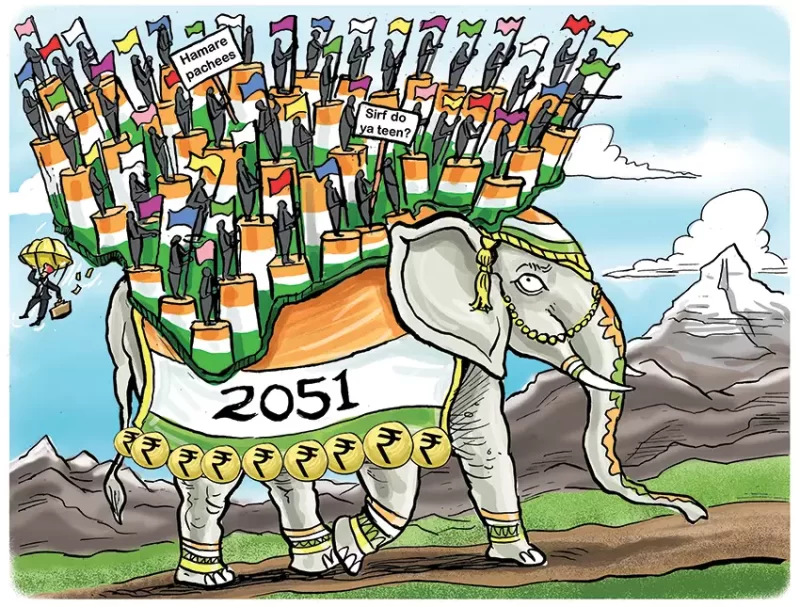
    A time comes for each leader and government to rise above pettiness, discarding ill will and hatred towards all. For the BJP, now uniquely in its third term, this is the time to show the nation that it is a party with a difference. For the opposition equally, this is the time to cooperate with the government on critical issues impacting the country.  


    Since my retirement from active service, I have avoided politics and political writings like the plague, but the avoidable happenings of the past few months have caused me, like am sanguine would have to millions of our countrymen, pain and a sense of despair.

    India has conducted over 18   general elections to its Parliament since 1952 with a lot of fury and vibrancy, but the Lok Sabha 2024 general elections were indeed an example of abysmally low-level politics transcending our better senses.

            How the world’s largest democracy indulged in its Lok Sabha 2024 elections was hardly complimenting to it considering the unquestionable fact that among the emerging nations in the world, call it from the Global South, the conduct of our elections showed some among those participating in poor light. Between competing political parties, enlightened debates and mutual civility were sadly lacking.   India has conducted over 18   general elections to its Parliament since 1952 with a lot of fury and vibrancy, but the Lok Sabha 2024 general elections were indeed an example of abysmally low-level politics transcending our better senses. India, which carries a fair amount of moral authority and is considered an example of a true and vibrant democracy, cannot let its hallowed image be sullied attributable to the selfish electoral games of some of its political leaders. The party in power at the Centre, the principal Opposition party and all those regional parties at the helm in the states have to display adequate maturity and a modicum of propriety and civility towards each other and not politicize each and every aspect of governance or national issues impacting India. The opposition, as it shows the mirror to the government on critical issues of governance, must not criticise each and every act of the government as a matter of routine.

             With the outcome of the general elections now done and dusted and the previous BJP government back in power, albeit with a clear reduction in its seats tally from 303 down to 240, it must get down to the exacting business of good governance from the Centre. That the same government, with its experience of the last ten continuous years in power, fielding more or less the same faces in the Cabinet in critical ministries and importantly serviced by the same bureaucrats should have, relatively speaking, not such an arduous task in governance. However, the thrust for fair, equitable, and sensitive handling of all critical matters across the nation has to come from the top political leadership. All our states must never feel discrimination by the Centre, especially in financial allocations urgently required for developmental works and disaster management. Additionally, the new government must take stern measures to keep rising inflation and unnecessary governmental expenditure under check before the economy takes a severe nose-dive.

             The Modi government, with the continuous experience of the last ten years, will have more than a good idea of the systemic improvements required and about areas needing additional financial resources and effort. It is unnecessary to worry too much about criticisms from the opposition but to carry on regardless in developmental works, without fear or favour, and with impartiality towards all the states in the true spirit of federalism. A time comes for each leader and government to rise above pettiness, discarding ill will and hatred towards all. For the BJP, now uniquely in its third term, this is the time to show the nation that it is a party with a difference. For the opposition equally, this is the time to cooperate with the government on critical issues impacting the country.

             New Delhi’s hands will be full of the nation’s diverse and formidable challenges, requiring attention and effectiveness. On the foreign policy front, India will have to walk the tightrope of maintaining strategic autonomy and sustaining its good relations with both the US and Russia. However, as it determinedly confronts an overly assertive China, India needs to use its economic clout and sophisticated diplomacy to get its South Asian neighbourhood closer to it and each other, avoiding the debt trap diplomacy and financial machinations of China.

    The number of terror-related incidents in J&K has gone up substantially in the last three months, and Pakistan will have to be kinetically chastened.

          India must, at the appropriate level, convey to China that their confrontationist attitude towards us will be harmful to the Chinese, too and may propel India to rethink its existing Tibet policy. Nevertheless, India must maintain the utmost vigil along the 3485 km Line of Actual Control/ IB, which it shares with  China. Meanwhile, Pakistan once again needs to be cautioned against stepping up terror activities in J&K  or elsewhere in the Indian hinterland. India is in full knowledge of Pakistan’s many fault lines. Still, it has refrained from exploiting these, and Pakistan must also cooperate in ensuring a peaceful and prosperous South Asian neighbourhood independent of China’s wily stratagems. The number of terror-related incidents in J&K has gone up substantially in the last three months, and Pakistan will have to be kinetically chastened.

    Meanwhile, India’s preparations to successfully improve its security capabilities to confront a two-front war must go ahead with realism and an unfailing determination. Measures to augment capital expenditure for major defence acquisitions must be identified. Transformative defence reforms like the introduction of integrated theatre commands will need the attention of the Centre. In addition, India must take all steps to restore peace in our restive NE states.

             The Modi government has come in for some criticism abroad on its human rights record and dealings with its Muslim population. This unjust criticism must be dealt with judiciously and with maturity. India’s overall inclusiveness and celebration of its diversity are unique examples for the entire world, especially the nations of the Global South. We must never deviate or be even seen to shift from this noble orientation.

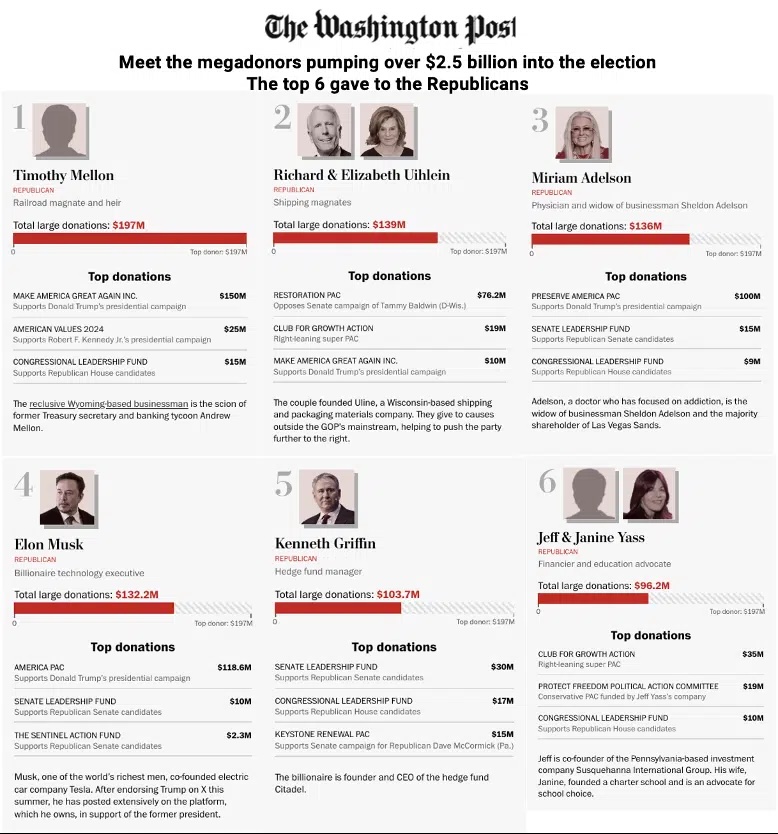
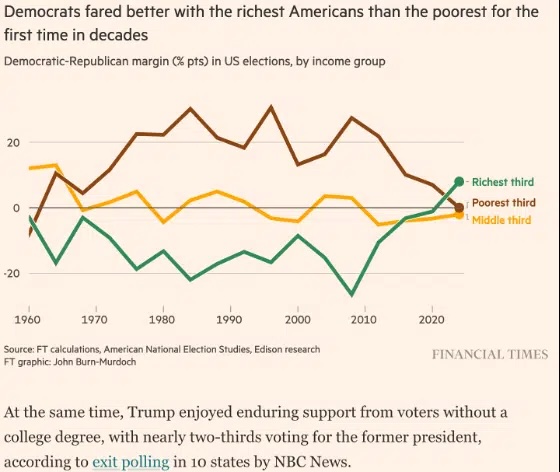
    Reduction of the yawning gap between the countless ultra-rich and those millions in abject poverty is essential as we boast of becoming the 5th largest economy in the world. The many human indices where we are faltering also need to be addressed.

             As economic strength is the pillar that propels and sustains progress, the Modi government must take measures to improve our economic health. Reduction of the yawning gap between the countless ultra-rich and those millions in abject poverty is essential as we boast of becoming the 5th largest economy in the world. The many human indices where we are faltering also need to be addressed.

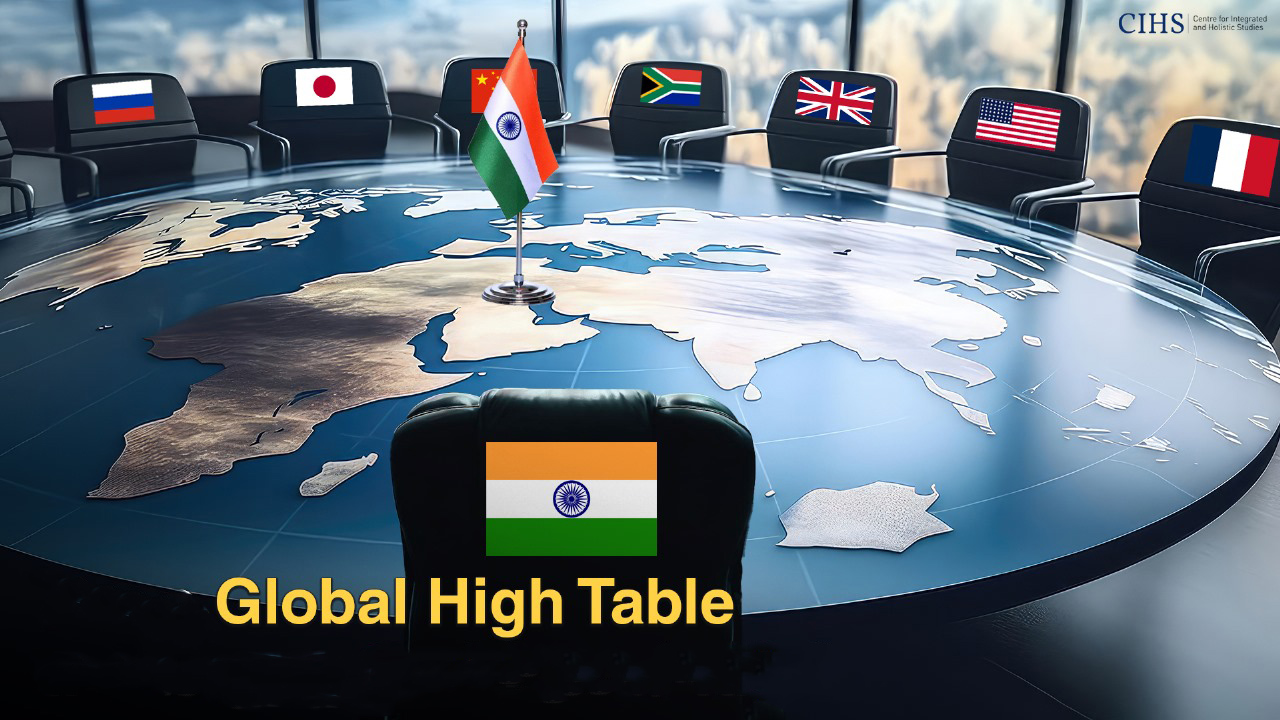
             By all yardsticks, India is deservingly on the cusp of acquiring a seat on the global high table. Let us not squander away this golden opportunity by internal squabbling but instead work together in addressing crucial issues that affect our nation; we must seize this opportunity.

    Feature Image Credit:  vskbharat.com    

    Cartoon Credit: Times of India

  • The catastrophe of modern capitalism: Inequality as an aim in Neo-Liberal-Ideology

    The catastrophe of modern capitalism: Inequality as an aim in Neo-Liberal-Ideology

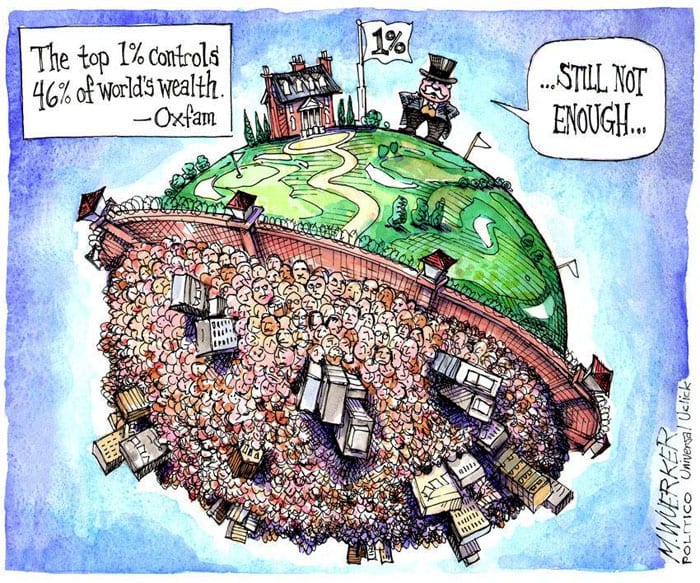
    Neoliberalism is the dominant form of capitalism that began in the 1980s as a way to promote global trade and grow all economies. That was a false promise, whereas in essence it supported individuals amassing massive wealth in the name of market forces, at the expense of common man by ensuring states minimise their role and eliminate welfare economics. It ensured least-developed and developing economies remained resource providers to developed economies, exemplifying extraction and exploitation. Neoliberalism is a top down economic policy that does not benefit those who are impoverished. The inequality we see on a global scale is mind-numbing. In 2006, the world’s richest 497 people were worth 3.5 trillion US dollars representing 7% of the world’s GDP. That same year, the world’s lowest income countries that housed 2.4 billion people were worth just 1.4 trillion US dollars, which only represents 3.3% of the world’s GDP. The situation today is far worse as Andreas Herberg-Rothe explains in his critical analysis below. The world is in urgent need of freeing itself from the clutches of neoliberal capitalism. 


    ..neoliberalism contains a general tendency towards an extensive economisation of society. Thus, inequality transcends the economy and becomes the dominant trend in society, as in racism, radical extremism, and hate ideologies in general: Us against the rest, whoever the rest may be.


    Following on from the initial question about Hannah Arendt’s thesis that equality must be confined to the political sphere, we must ask how democracy and human rights can be preserved in the face of social inequality on an extraordinary scale. By the end of this century, 1% of the world’s population will own as much as the “rest” of the other 99%. And already today, only 6 people own more property than 3.6 billion. Let us take a closer look at some of the ideas of the currently dominant neo-liberalism, which sheds some light on the acceptance of these current obscene inequalities. For this ideology, social inequality is a means to greater wealth. However, since it sets no limits on social inequality, it can be used to legitimize even obscene inequalities. We argue that neoliberalism as an ideology is the result of the spread of a specific approach to economic thought that has its roots in the first half of the twentieth century, when Walter Lippmann’s seminal book “An Inquiry into the Principles of the Good Society” (1937), followed by Friedrich August von Hayek’s “The Road to Serfdom” (1944), gave rise to neoliberalism. During the Cold War period, neoliberals gained more and more ground in establishing a global system. With the support of Milton Friedman and his “Chicago Boys,” the first attempt to establish a pure neoliberal economic system took place in Chile under the military dictatorship of General Pinochet in the 1970s. In the last decade of the Cold War, neoliberal architects such as Margaret Thatcher and Ronald Reagan began to impose the new economic model. Since the end of the Cold War, the final development was that neoliberalism became THE hegemonic economic system, as capitalism was de jure allowed to spread unhindered worldwide, and neoliberalism continued on its way to becoming the dominant belief system.

    The critical message in this sense is the following: This process is not limited to an economic dimension – neoliberalism contains a general tendency towards an extensive economisation of society. Thus, inequality transcends the economy and becomes the dominant trend in society, as in racism, radical extremism, and hate ideologies in general: Us against the rest, whoever the rest may be.

    When we talk about global inequality in the era of neoliberalism, we are referring to two other major developments: To this day, inequality between the global North and South persists. While the total amount of poverty has decreased, as seen in the World Bank’s report (2016), there is still a considerable gap between those countries that benefit from the global economy and those that serve as cheap production or commodity areas. The second development takes place in countries that are more exposed to the neoliberal project. In this sense, societies are turning into fragmented communities where the “losers of neoliberalism” are threatened by long-term unemployment, a life of poverty, social and economic degeneration.

    After three decades of intense global neo-liberalism, the result has been a significant increase in social inequalities, polarization and fragmentation of societies (if not the entire world society), not to mention a global financial crisis in 2008 caused by escalating casino capitalism and the policies of a powerful global financial elite.

    We are witnessing a global and drastic discontent of peoples, fears and anger, feelings of marginalization, helplessness, insecurity and injustice. After three decades of intense global neo-liberalism, the result has been a significant increase in social inequalities, polarization and fragmentation of societies (if not the entire world society), not to mention a global financial crisis in 2008 caused by escalating casino capitalism and the policies of a powerful global financial elite. We witness a global and drastic dissatisfaction of the peoples, fears, and anger, the feelings of marginalization, helplessness, insecurity, and injustice. After three decades of intense worldwide Neo-Liberalism, the result significantly intensified social inequalities, polarization, and fragmentation of societies (if not the entire world society), not to mention a global financial crisis in 2008 caused by escalating casino capitalism and the policy of a powerful global finance elite.

    The central critique is that neoliberalism includes social inequality as part of its basic theory. Such capitalism emphasizes the strongest/fittest (parts of society) and uses inequality as a means to achieve more wealth.

    Remarkably and frighteningly, the situation outlined does not provoke the oppressed, marginalised, and disadvantaged populations to turn against their oppressors and their exploitation. These people tend to sympathize with ideological alternatives, either with more triumphant (right-wing) populist movements and parties or are attracted by radical/fundamentalist religious groups such as the Islamic State. The result is an increase in polarization and violence, and even more protracted wars and religious-ideological disputes. Europe is not exempt from the trend toward obscene social inequality. We also find a polarization between rich and poor, between those who have good starting conditions and those who have little chance of prosperity, between those who are included and those who feel excluded. The fact that Europe has so far largely avoided populist parties gaining administrative power (although we have already witnessed this process in France, Hungary and Poland) may be due to the remnants of the welfare state. In this respect, at least a minimum of financial security remains and limits the neoliberal trend. In the United States, on the other hand, a flawless populist could reach the highest office. The people, stuck in their misery, fear and insecurity, voted for a supposed alternative to the neoliberal establishment, but above all against other social outcasts whom they blamed for their misery. This brings us to the central critique of neoliberalism, a system that has caused fundamental social oddities, the impact of which as an ideology has been highlighted above. The central critique is that neo-liberalism includes social inequality as part of its basic theory. Such capitalism emphasizes the strongest/fittest (parts of society) and uses inequality as a means to achieve more wealth.

    In an interview with the German magazine Wirtschaftswoche, Hayek spoke bluntly about the neoliberal value system: He emphasizes that social inequality, in his view, is not at all unfortunate, but rather pleasant. He describes inequality as something simply necessary (Hayek, 1981). In addition, he defines the foundations of neo-liberalism as the “dethronement of politics” (1981). First, he points out the importance of protecting freedom at all costs (against state control and the political pressure that comes with it). The neoliberals see even a serious increase in inequality as a fundamental prerequisite for more economic growth and the progress of their project. One of the most renowned critics of neoliberalism in Germany, Christoph Butterwegge (2007), sees in this logic a perfidious reversal of the original intentions of Smith’s (reproduced in 2013) inquiry into the wealth of nations in the current precarious global situation. The real capitalism of our time – neoliberalism – sees inequality as a necessity for the functioning of the system. It emphasizes this statement: The more inequality, the better the system works. The hardworking, successful, and productive parts of society (or rather the economy) deserve their wealth, status, and visible advantage over the rest (the part of society that is seen as less strong or less ambitious). The deliberate production of inequality sets in motion a fatal cycle that leads to the current tense global situation and contributes to several intra-societal conflicts.

    The market alone is the regulating mechanism of development and decision-making processes within a society dominated by neo-liberalism, and as such is not politics at all. This brings us closer to the relationship between neoliberalism and democracy. The understanding of democracy in neoliberal theory is, so to speak, different. Principles such as equality or self-determination, which are prominent in the classical understanding of democracy, are rejected. Neo-liberalism strives for a capitalist system without any limits set by the welfare state and even the state as such, in order to shape, enforce and legitimize a society dominated only by the market economy. Meanwhile there are precarious tendencies recognizable, where others than the politically legitimized decision-makers dictate the actual political and social direction (e.g. the extraordinarily strong automobile lobby with VW, BMW and Mercedes in Germany or big global players in the financial sector like the investment company BlackRock). Neoliberalism only seemingly embraces democracy. The elementary democratic goals (protection of fundamental and civil rights and respect for human rights) can no longer be fully realized. Democracy cannot defend itself against neo-liberalism if political decision-makers do not resolutely oppose the neo-liberal zeal for expansion into all areas of society. The dramatic increase in inequality coincides with the failure of the state as an authority of social compensation and adjustment, as neoliberalism eliminates the state as an institution that mediates conflicts in society. To put it in a nutshell: Whereas in classical economic liberalism the state’s role is to protect and guarantee the functioning of the market economy, in neoliberalism the state must submit to the market system.

    Our discussion of neoliberalism here is not about this conceptualization and its history, which would require a separate article. Nevertheless, we want to emphasize that in neo-liberalism, social inequality is a means to achieve more wealth for the few. Therefore, we argue that there must be a flexible but specific limit to social inequality in order to achieve this goal, while excessive inequality is counterproductive.

    As noted above, moderate levels of inequality are not necessarily wrong per se. In a modern understanding, it also contributes to a just society in which merit, better qualifications, greater responsibility, etc. are rewarded. The principle of allowing differences, as used in the theory of the social market economy, is a remarkably positive one when such differentiation leads to the well-being of the majority of people in need. However, neo-liberalism adopts a differentiation that intensifies inequality to a very critical dimension. The current level of social inequality attacks our system of values, endangers essential democracy, and destroys the social fabric of societies. Even if we consider a “healthy” level of inequality to be a valuable instrument for a functioning market society, what has become the neoliberal reality has nothing to do with such an ideal. Neoliberalism implies an antisocial state of a system in which inequality is embedded in society as its driving mechanism. Consequently, we witness a division between rich and poor in times of feudalism. A certain degree of social equalization through the welfare state and a minimum of social security is no longer guaranteed. The typical prerequisites today are flexibility, performance, competitiveness, etc. – In general, we see the total domination of individualism within neo-liberalism, leading to the disintegration of society. In one part of the world, mainly in the Global South, we observe the decline of entire population groups. In contrast, in other parts of the world we see fragmented societies in hybrid globalization and increasing tendencies towards radical (religious) ideologies, violence and war.

    It must be acknowledged that neoliberalism was one of the causes of the rise of the newly industrialized nations, but the overemphasis on individual property also contributes to obscene inequality and thus to the decline of civilized norms.

    The Polish-British sociologist Zygmunt Bauman summed up this problem by comparing it to the slogan of the French Revolution: “Liberté, Egalité, Fraternité”. According to the proponents of the time, each element could only be realized if all three remained firmly together and became like a body with different organs. The logic was as follows: “Liberté could produce Fraternité only in company with Egalité; cut off this medium/mediating postulate from the triad – and Liberté will most likely lead to inequality, and in fact to division and mutual enmity and strife, instead of unity and solidarity. Only the triad in its entirety is capable of ensuring a peaceful and prosperous society, well integrated and imbued with the spirit of cooperation. Equality is therefore necessary as a mediating element of this triad in Bauman’s approach. What he embraces is nothing less than a floating balance between freedom and equality. It must be acknowledged that neoliberalism was one of the causes of the rise of the newly industrialized nations, but the overemphasis on individual property also contributes to obscene inequality and thus to the decline of civilized norms. When real socialism passed into history in 1989 (and rightly so), the obscene global level of social inequality could be the beginning of the end (Bee Gees) of neo-liberalism, centered on the primacy of individual property, which is destroying the social fabric of societies as well as the prospects for democratic development. Individual property is a human right, but it must be balanced with the needs of communities, otherwise it would destroy them in the end.


    Feature Image Credit: cultursmag.com

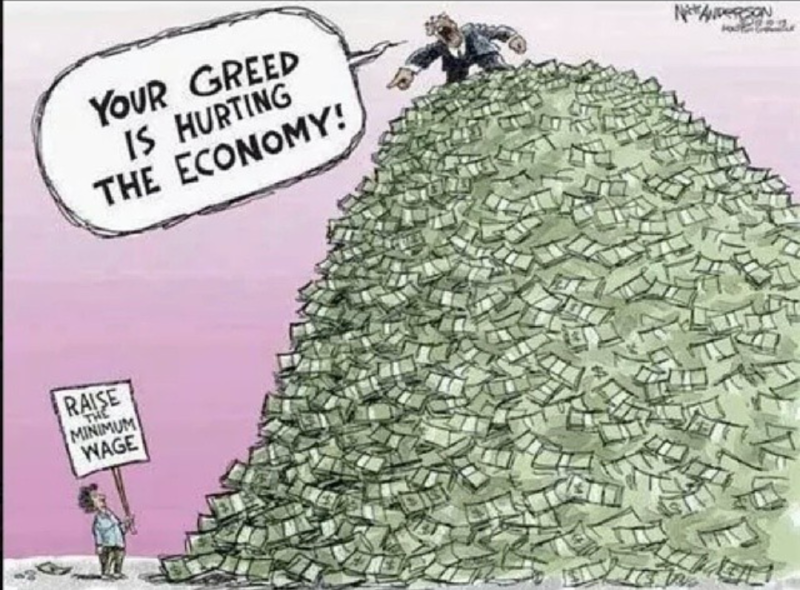
    Cartoon Image Credit: ‘Your greed is hurting the economy’ economicsocialogy.org

  • Can a Muscular Response deter Chinese Aggression?

    Can a Muscular Response deter Chinese Aggression?

    The Sino-Indian War of 1962, which is seen as a humiliating defeat for India, continues to rankle all Indians. Clearly, it is seen as a result of poor leadership both at the political and military levels. In hindsight, many believe that the PLA could have been routed had India regrouped its Army and used the IAF in a massive counterattack. It was November, and with the onset of winter and the closing of the Himalayan passes, the PLA could have been demolished completely. That we didn’t even think of it shows the serious vacuum in strategic thinking. More than half a century later, and with the Indian military much stronger and battle-hardened, it is inexplicable why India’s leadership is shy of following an aggressive strategy, including the use of force proactively against China. Brigadier Deepak Sinha, a vetran and TPF’s Senior Fellow, raises this question while correlating the current situation with that of 1962.

    There is an urgent need for us all to shed our divisive politics, long-held dogmas and skewed perceptions, forget fanciful visions and face reality, especially when it comes to the question of national security. The last thing we need is for petty politics and fragile egos to control our nation’s destiny. Nothing can be more consequential, traumatic or shameful than being bested by a rival on the battlefield. The consequences of our “defeat” in the Sino-Indian Conflict of 1962 continue to rankle and haunt us to this day.

    Quite clearly, the fear psychosis that permeates our higher military and political leadership is palpable.

    Indeed, our reluctance, for fear of escalation, to launch a quid-pro-quo riposte and grab disputed territory elsewhere as a bargaining chip following the PLA’s blatant land grab of disputed territory in Eastern Ladakh is a clear indication of this. This was reinforced by an earlier interview with ANI by our Foreign Minister, who stated, “Look, they (China) are the bigger economy. What am I going to do? As a smaller economy, I am going to pick up a fight with the bigger economy? It is not a question of being reactionary, it’s a question of common sense….” Quite clearly, the fear psychosis that permeates our higher military and political leadership is palpable.

    On the other hand, the Chinese leadership has a very different perception of our capabilities as was reflected back in 1959 following the Longju incident. A declassified United States document of that time points out that “the late August clashes point to a mode of thought which has remained an ingredient in the Chinese leaders’ calculations on the border dispute: ‘When the Indians show a temperament to advance on the ground, we must alter their frame of mind by letting military action take over political caution. Besides, military risk itself is negligible because we are the stronger side.” Obviously, over the years, they have been given no reason to believe otherwise. In order to understand what ails us, it is worth briefly examining the course of the 1962 conflict to get a clearer idea of the extent of our loss at the hands of the Chinese. That should help us understand why, over fifty years later, we continue to remain so traumatised and fearful.

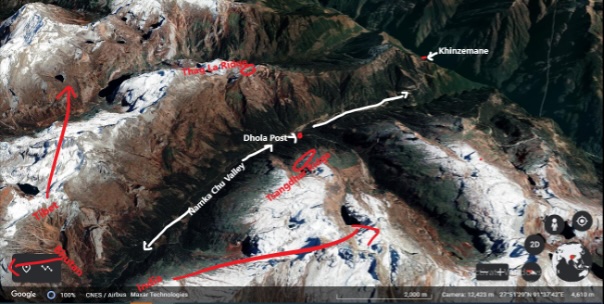
    The opening skirmish of that conflict occurred in the North East with the capture, on 8th Sept, of the isolated Assam Rifles post at Dhola, on the southern slopes of the Thag La ridgeline. This post was surrounded and completely dominated by PLA positions on higher ground, and its loss was a foregone conclusion. The actual conflict commenced at approximately 0500 hours on 20th October, when the PLA launched a massive infantry attack, supported by artillery, on the 7 Infantry Brigade positions. The Brigade was deployed in a tactically unsound manner on direct orders of GOC 4 Corps, Lt Gen B M Kaul, along the Southern banks of the Namka Chu River over a 20 Km frontage instead of on the heights overlooking the river.
    The battalions were deployed in platoon penny pockets, lacking mutual support, in temporary positions with no overhead cover. Artillery support was restricted to just one battery of Heavy Mortars and a troop of two field guns with limited ammunition. No intelligence was available to the Brigade Headquarters or any of the other higher headquarters as to PLA force levels or their intentions. The assault came as a surprise and just four hours later, by 0900 Hours, the Brigade ceased to exist as a fighting force. Within just another 96 Hours, the strategic border town of Tawang, approximately 100 Km in-depth, held by an understrength battalion, was attacked and captured without a fight.

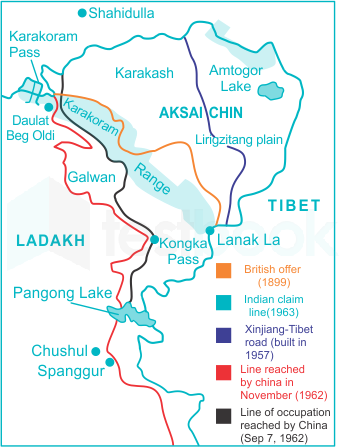
    Almost simultaneously in the Northern Theatre, isolated forward positions at Aksai Chin and the Pangong Tso area were also cleared after a brief skirmish. After an administrative pause of approximately a month, the PLA launched the next phase of its offensive with its assault on the Walong positions on 16th Nov and on the main defences of the 4 Infantry Division at Bomdi La, Se La and on the Division Headquarters at Dirang Dzong. Simultaneously, on 20th Nov, Chushul came under attack by an Infantry Divison. On 21st Nov the Chinese announced a unilateral ceasefire and subsequently withdrew to positions occupied by them prior to the commencement of the conflict.

    There are three main deductions that can be drawn from an examination of the facts. Firstly, that the conflict was, in essence, extremely limited in terms of time, space and force levels involved. From an army of 550,000 personnel, approximately 20,000 personnel were committed into this conflict, primarily due to our limited logistical capabilities. The conflict was primarily restricted to the tactical level only, at battalion level and below. While the conflict itself was spread over one month, the tactical engagements themselves lasted a few hours at best, and on one or two occasions where stiffer resistance was put up, extending to 48-72 Hours. Unfortunately, given the terrain, lack of field fortifications, etc, casualties suffered were relatively high, with approximately fifteen hundred killed, similar numbers wounded, two thousand missing and another 4000 taken prisoner. The Air Force, which could have played a critical role in blunting the PLA attacks and destroying their lines of communications, was deliberately confined to the logistics role for reasons that are still not clear, while the Navy remained a bystander.

    Sadly, our military and political leadership exhibited an utter lack of moral courage, determination and willpower by quietly acquiescing to the unilateral ceasefire, thereby kicking the main irritant of the demarcation of borders further up the road, where it has once again come to bite us on our posteriors.

    Secondly, far from being a major defeat, as has been commonly made out, it was at best a temporary reverse that could, and should, have been countered with the use of fresh troops under a more determined and professional leadership. More importantly, the PLA understood this fact and, therefore, undertook a unilateral withdrawal to its earlier pre-war line of defences. It must have been fully cognisant that if hostilities were to continue, it would find itself in an increasingly untenable position with its supply lines already badly stretched and being further impacted with the onset of winter. It would only have been a matter of time before the Indian Army got over its shock, regrouped and reorganised itself and launched a counter-offensive to recapture lost territory. Sadly, our military and political leadership exhibited an utter lack of moral courage, determination and willpower by quietly acquiescing to the unilateral ceasefire, thereby kicking the main irritant of the demarcation of borders further up the road, where it has once again come to bite us on our posteriors.

    Thirdly, what continues to remain totally inexplicable is the reasons why our military and political leadership continue to remain so traumatised and scared to this day. The truth is that the narrative that emanated following the reverses was set by officers and men belonging to units that, for the most part, had withdrawn before coming in contact with the PLA. They were low on morale and had come to believe the Chinese were supermen who could not be stopped by mere mortals. It was from amongst the experience and perception of these personnel that pamphlets on the tactics and capabilities of the PLA were subsequently formulated that continue to be relied on to this day, thereby giving further credence to that distorted narrative.

    The fact of the matter is that in any future conflict, the PLA will be fighting over 2000 Kms away from its home bases, supported along communication lines that run over some of the most difficult and inhospitable terrain in the world. They are also easily susceptible to interdiction, given the nature of the terrain. In addition, they would have to contend with a hostile and badly oppressed population not just within Tibet but in Xingjian as well, which could revolt if a suitable opportunity arose. This would require the PLA to deploy additional forces for rear area security to prevent disruption of the lines of communication.

    Moreover, while there are sizeable disparities in aspects such as force levels and capabilities, infrastructure development and economic strength, one needs to be cognizant of the fact that we have also made tremendous strides with regard to infrastructure development, logistics and offensive capabilities. Our forces still hold the edge vis-à-vis combat experience and operating in mountains, while the Air Force continues to hold the upper hand in the TAR purely on account of terrain profile and radius of action. Most importantly, the availability of two Mountain Strike Corps gives us immense flexibility, if properly utilized, to grab the initiative and force a decision dilemma on the PLA. In the circumstances, the reason for our extreme reluctance to stand up against the Chinese bully must lie elsewhere. One distinct possibility is that our political leadership lacks faith in the military leadership and its ability to fight and win.

    This will seem at odds with the fact that the military has a splendid history of having always successfully completing any task given to it. If anything, it has been grossly misused by the Central and State Governments to carry out tasks that are not in their ambit, whether these be organizing the Commonwealth Games or construction of railway over-bridges, because the concerned departments and agencies have been unable to produce the requisite results. Clearly, this mistrust, primarily in the sphere of civil-military relations, has more pernicious roots and is very deeply embedded in the politico-bureaucratic psyche.

     Interestingly, in the Official History of the 1962 Conflict with China, available in the public domain but yet to be published, the Chief Editor, Dr S N Prasad, concludes that the chief reason for our defeat was that the political establishment was unable to avoid war while it was in the process of transforming the military establishment. Given Prime Minister Nehru’s apprehensions about the military taking control, he wanted to change it from being, as Mr Prasad puts it, a “close-knit professional body, deliberately isolated from the citizen. Its predominant motive force remained esprit de corps and not identification with the people… Perhaps he wanted to model it after the People’s Liberation Army of China, more egalitarian, flexible, closer to the people………Such basic changes required a committed, or at least a pliant, band of army officers in key positions. So mediocre Thapar was selected instead of the doughty Thorat as Army Chief, and Bijji Kaul was made CGS……. “

      He further goes on to add that “To carry out this transformation of the national defence set up, a decade of peace was absolutely essential. For establishing indigenous weapons manufacture, money had to be found by cutting arms imports. The armed forces would be short of equipment and stores for several years till the new arms factories started producing. The officer cadre was a house divided within itself till the new breed fully took over. A period of transition was inevitable, during which the fighting machine would not be fully efficient and would be vulnerable………Therein seems to lie the basic cause of the debacle of 1962. India failed to avoid a war during the transition period. Lulled by faulty political assessment and wrong intelligence forecasts, the country got caught in a war when it was least prepared.

    With Mr Modi’s ascension to power, we came a full circle as he took it upon himself to steer it away from its apolitical and secular character towards a more ideologically compatible institution that would be in sync with his Party’s long-held vision of making India into a Hindu Rashtra.

    Fortuitously for the country, Nehru’s vision for a transformed military was stymied by the 1962 Conflict and the most important lesson that his successors assimilated quickly was to stay away from interfering in the internal affairs of the military as that could gravely damage internal cohesion and morale. With Mr Modi’s ascension to power, we came a full circle as he took it upon himself to steer it away from its apolitical and secular character towards a more ideologically compatible institution that would be in sync with his Party’s long-held vision of making India into a Hindu Rashtra.

    Towards this end Mr Modi has smartly used the concept of “deep selection” to ensure key senior appointments were filled by officers displaying an affinity for his government’s ideology, regardless of existing rules, seniority or merit. This, in turn, made them personally beholden to him, and he was thus able to use them to take ownership and deflect criticism from initiatives that were pushed through by his government regardless of their adverse impact on long-standing and cherished customs and traditions or on the operational capabilities of the Services. This has led to schisms within the institution, damaged the integrity and cohesion of the chain of command and cast a big question mark on the apolitical and secular character of the Services.

    In this context, a politically compromised Chief of Defence Staff and other senior officers shamefully endorsed the PMO, thrusting down the ill-conceived Agnipath Scheme on the military with not a single objection being raised. This scheme has all but destroyed the basic ethos of our fighting arms, ensuring that the deeply entrenched and effective Regimental System has been severed at the roots. Given their ignorance of matters military, they would have been ignorant of Winston Churchill’s wise advice that “Regiments are not like houses. They cannot be pulled down and altered structurally to suit the convenience of the occupier or the caprice of the owner. They are more like plants; they grow slowly if they are to grow strong…and if they are blighted or transplanted, they are apt to wither.”

    And wither they have, the resulting adverse impact on morale is not difficult to gauge. This is undoubtedly being further exacerbated by the considerable voids in manpower, with combat units reportedly functioning at less than 75% of their authorised strength, and truncated peace tenures to fill up operational voids in Eastern Ladakh, Manipur and Jammu & Kashmir. In addition, the government’s emphasis on the ‘Atman Nirbhar Abhiyan’ and ‘Make in India Scheme’ has resulted in deficiencies, even if temporary, in the holdings of weapons systems, ammunition and other warlike stores. Given all these factors, the military obviously finds itself in an extremely precarious situation, committed to its fullest capacity with limited options available. Ironically, a government that lays such a great emphasis on our Hindu origins, culture and history has managed to display a profound ignorance of statecraft and warfare, as brought out in Kautilya’s Arthashastra. In this classic, Chanakya points to the necessity for a strong army because, for all nation-states, there are only two states of being: either conquer or be conquered.

    …at the present time, we are once again confronted with an extremely turbulent geopolitical situation, with the world’s attention on the ongoing crises in Europe and the Middle East. The situation today, in many ways, is clearly reminiscent of the period on the eve of the 1962 Conflict. For reasons not very different from then, the Indian Military finds itself in a very similar situation as well.In these circumstances, the real question that we should be asking ourselves is not whether we can overcome our past traumas and face down the PLA, but more importantly, whether China will seize this opportunity to recalibrate the Sino-Indian relationship through the use of force.

    Interestingly, in 1962, China launched major operations against us at the end of the campaigning season, which could have been jeopardised by unseasonal snow. Obviously, this was because, at that time, the world’s attention was riveted to the Cuban Missile Crisis. Similarly, at the present time, we are once again confronted with an extremely turbulent geopolitical situation, with the world’s attention on the ongoing crises in Europe and the Middle East. In addition, the United States is deeply immersed in its own internal problems with presidential elections just around the corner and with little time for other matters.

    The situation today, in many ways, is clearly reminiscent of the period on the eve of the 1962 Conflict. Moreover, at that time, Chairman Mao was under intense pressure as his Great Leap Forward experiment had failed, and he had been removed from his appointment as State President. Today, President Xi also finds himself under similar pressure following his disastrous Zero Covid and hard-line economic policies that have tanked the economy. For reasons not very different from then, the Indian Military finds itself in a very similar situation as well.

    Undoubtedly, the political leadership and the military top brass must be fully cognizant of this state of affairs. Clearly, they are in no position to stare down the PLA. What makes matters worse is that following the General Elections, Mr. Modi’s authority and standing have been greatly diminished. Where does this leave those senior officers who have progressed by hanging on to his ideological coat-tails? Has the authority and credibility of the CDS, an out-and-out political appointee and loyalist, been affected within the Chiefs of Staff Committee of which he is the Chairman? What will be its impact on the move towards the establishment of theatre commands? In these circumstances, the real question that we should be asking ourselves is not whether we can overcome our past traumas and face down the PLA, but more importantly, whether China will seize this opportunity to recalibrate the Sino-Indian relationship through the use of force.


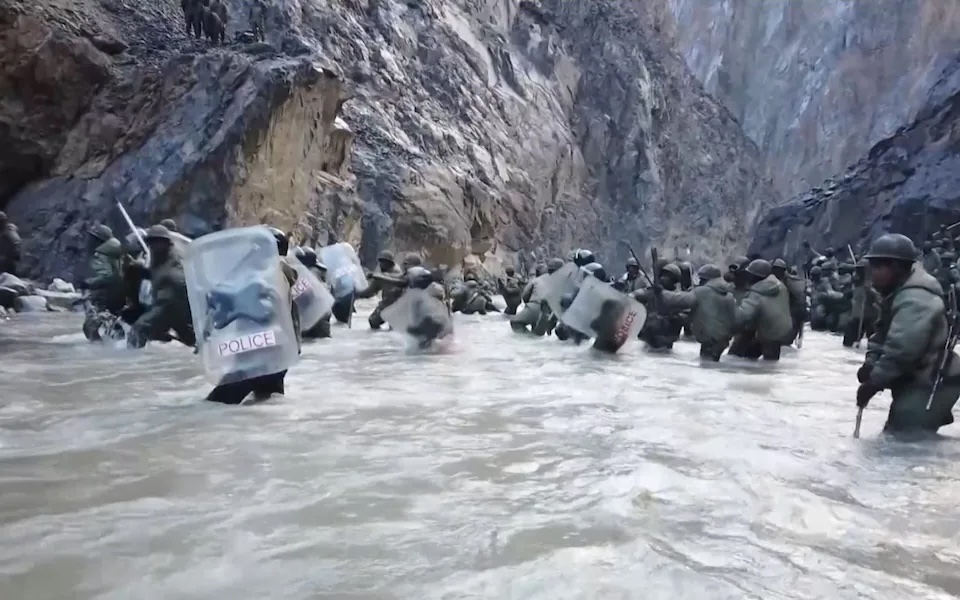
    Feature Image Credit: Border Clashes between India and China ‘regularly covered up’  The Telegraph

    Namka Chu and Dhola Post Picture credit: www.indiasentinels.com

  • The Centre is notional, the States the real entities

    The Centre is notional, the States the real entities

    Utilisation of the country’s resources needs to be decided jointly by the Centre and the States. The changed political situation after the general election makes this feasible.

    The results of the general election 2024 have thrown up a surprise. They portend greater democratisation in the country, with the regional parties doing well. These parties will share space on the ruling party benches as well as on the Opposition side in Parliament. This will help strengthen federalism, which is so crucial for a diverse nation such as India. It was badly fraying until recently.
    Centre-State relations became contentious during the general election campaign. The idea of’ 400 par’, ‘one nation, one election’, and the Prime Minister threatening that the corrupt (i.e., Opposition leaders) would soon be in jail were perceived as threats to the Opposition-ruled States.
    The Opposition-ruled States have been complaining about step-motherly treatment by the Centre. Protests have been held in Delhi and the State capitals. The Supreme Court of India has said that ‘a steady stream of States are compelled to approach it against the Centre’. Kerala has complained about the inadequate transfer of resources, Karnataka about drought relief and West Bengal about funds for the Mahatma Gandhi National Rural Employment Guarantee Scheme (MGNREGS). The attempt seems to be to show the Opposition-ruled States in a bad light.
    The Supreme Court, expressing its helplessness, recently said that Centre-State issues need to be sorted out amicably. When the Bharatiya Janata Party came to power in 2014, it had talked of cooperative federalism. The introduction of the Goods and Services Tax (GST) in 2017 was an example of this when some States that had reservations about it eventually agreed to its rollout. But that was the last of it. With federalism fraying, discord has grown between the Centre and the Opposition-ruled States.
    There is huge diversity among the States—Assam is unlike Gujarat, and Himachal Pradesh is very different from Tamil Nadu. A common approach is not conducive to the progress of such diverse States. They need greater autonomy to address their issues in their own unique ways. This is both democracy and federalism. So, a dominant Centre forcing its will on the States, leading to the deterioration in Centre-State relations, does not augur well for India.

    Financing and conflict is one issue
    States face three broad kinds of issues. Some of them can be dealt with by each State without impacting other States, such as education, health, and social services. But infrastructure and water sharing require States to come to an agreement. Issues such as currency and defence require a common approach. The last two kinds of issues require a higher authority, in the form of the Centre, to bring about coordination and optimality.
    Expenditures have to be financed to achieve goals, and that results in conflict. Revenue has to be raised through taxes, non-tax sources and borrowings. The Centre has been given a predominant role in raising resources due to its efficiency in collecting taxes centrally. Among the major taxes, personal income tax (PIT), corporation tax, customs duty and excise duty are collected by the Centre. GST is collected by both the Centre and the States and shared. So, the Centre controls most of the resources, and they have to be devolved to the States to enable them to fulfil their responsibilities.

    The Centre sets up the Commission and has mostly set its terms of reference. This introduces a bias in favour of the Centre and becomes a source of conflict between the Centre and the States.

    A Finance Commission is appointed to decide on the devolution of funds from the Centre to the States and the share of each State. The Centre sets up the Commission and has mostly set its terms of reference. This introduces a bias in favour of the Centre and becomes a source of conflict between the Centre and the States. Further, there has been an implicit bias in the Commissions that the States are not fiscally responsible. This reflects the Centre’s bias — that the States are not doing what they should and that they make undue demands on the Centre.
    The States also pitch their demands high to try and get a larger share of the revenues. They tend to show lower revenue collection and higher expenditures in the hope that there will be a greater allocation from the Commission. The Commission becomes an arbiter, and the States the supplicants.

    Inter-State tussles, Centre-State relations
    The States cannot have a common position as they are at different stages of development and with vastly different resource positions. The rich States have more resources, while the poor ones need more resources in order to develop faster and also play catch up. So, the Finance Commission is supposed to devolve proportionately more funds to the poorer States. Unfortunately, despite the efforts of the 15 Finance Commissions so far, the gap still remains wide.
    The rich States, which contribute more and get proportionately less, have resented this. What they forget is that the poorer States provide them the market, which enables them to grow faster. The poorer States also lose much of their savings which leak out to the rich States, accelerating their development. It is often said that as Mumbai contributes a bulk of the corporate and income taxes, it should get more. But this is because Mumbai is the financial capital. So, the big corporations are based there and pay their tax in Mumbai. More revenue is contributed in an accounting sense, and not that production is taking place in Mumbai.
    The Centre allocates resources to the States in two ways. First, on account of the Finance Commission award. Second, the Centre is notional, while the States are real. So, all expenditures by the Centre are in some State. The amount spent in each State is also a transfer. This becomes another source of conflict. Expenditures lead to jobs and prosperity in a State. Benefits accrue in proportion to the funds spent. As a result, each State wants more expenditure in its territory. The Centre can play politics in the allocation of schemes and projects. For instance, it is accused of favouring Gujarat and Uttar Pradesh. The Opposition-ruled States have for long complained of step-motherly treatment.
    To get more resources, the States have to fall in line with the Centre’s diktat. This has taken a new form when the call is for a ‘double engine ki sarkar’, i.e. for the same political party to be governing at the Centre and the States. It is an admission that the Opposition-ruled States will be at a disadvantage. This undermines the autonomy of the States and also weakens federalism.

    State autonomy is not to be confused with freedom to do anything. It is circumscribed by the need to function within a national framework for the wider good. It implies a fine balance between the common and the diverse.

    Issues in federalism
    The Sixteenth Finance Commission has begun work. It should try to reverse fraying federalism and strengthen the spirit of India as a ‘Union of States’. This is not only a political task but also an economic one. The Commission could suggest that there is even-handed treatment of all the States by the Centre and also less friction among the rich and poor States when proportionately more resources are transferred to poor States so as to keep rising inequality in check.
    The issue of governance, both at the Centre and in the States, needs to be flagged. It determines investment productivity and the pace of development. Corruption and cronyism lead to resources being wasted and a loss of social welfare.
    To reduce the domination of the Centre over the States, the devolution of resources from the Centre to the States could be raised substantially from its current level of 41%. The Centre’s role could be curtailed. For instance, the Public Distribution System and MGNREG Scheme are joint schemes, but the Centre asserts that it be given credit. It has penalised States that have not done so.

    The Centre is notional and constitutionally created, while States and local bodies are the real entities where economic activity occurs and resources are generated.

    The Centre’s undue assertiveness undermines federalism. Funds with the Centre are public funds collected from the States and spent in the States. The Centre is notional and constitutionally created, while States and local bodies are the real entities where economic activity occurs and resources are generated. The States have agreed to the Centre’s constitutional position, but that does not make them supplicants for their own funds.

    It is time that the utilisation of the country’s resources is jointly decided by the Centre and the States on the basis of being equal partners. This has become more feasible with the changed political situation after the results of the 2024 general election.


    This article was published earlier in The Hindu.

    Feature Image Credit: rediff.com


  • Between the Devil & the Deep Blue Sea: Tackling India’s Internal Security Challenges

    Between the Devil & the Deep Blue Sea: Tackling India’s Internal Security Challenges

    Our ability to develop and prosper, both as a society and a nation, are wholly dependent on the smooth functioning of our democratic institutions and their ability to faithfully uphold the tenets laid down in our Constitution.

    Our progress since Independence has not been without bumps along the road. Not only has the detritus of Partition haunted us, but we have also had to confront antagonistic neighbours intent on grabbing territory, creating divisions and curtailing our economic development and influence around the world. They have tried to do this by resorting to conventional operations, grey zone warfare, including using terrorist groups. In addition, we’ve had to overcome our internal troubles as well, what V.S. Naipaul referred to as a “million mutinies”, rebellions and insurgencies, for the most part, along our border regions. Undertaken by our disaffected citizens, in most cases with external support, aspiring to establish their own independent homelands because of ideological or religious motivations or out of a sense of frustration at being treated as second-class citizens within their own country.

    The response of the State and Central Governments to these internal challenges has invariably been to initially attempt some sort of half-hearted political accommodation or initiative aimed at preserving the status quo and giving themselves political advantage. Once this fails, as it is bound to, the Central Armed Police Forces or the Army are brought in, depending on the levels of violence, to neutralise the insurgency and regain political and administrative control. This can take anywhere from a decade to three or more. The Mizoram Insurgency, for example, commenced in 1966 and was successfully terminated with the agreement being signed between opposing sides in 1986, while the Punjab Insurgency lasted from the mid-80s to the mid-90s, though there are efforts to restart it.

    Unfettered exploitation of natural resources and minerals from those resource-rich regions by large corporations and their political acolytes has led to the displacement of tribals from their homelands and added to their economic woes. Given that the political, security and administrative establishments are wholly compromised and corrupt, the tribals have alleged that they have had little choice but to take up arms in an effort to break the nexus and get their rightful dues.

    We’ve had similar problems in our North-eastern States of Assam, Nagaland, Manipur and Tripura, which continue to persist in fits and starts, aided, and abetted by China. We have also faced a long-running Maoist rebellion in our hinterland, organised and conducted by tribals from those regions. Unfettered exploitation of natural resources and minerals from those resource-rich regions by large corporations and their political acolytes has led to the displacement of tribals from their homelands and added to their economic woes. Given that the political, security and administrative establishments are wholly compromised and corrupt, the tribals have alleged that they have had little choice but to take up arms in an effort to break the nexus and get their rightful dues.

    The issue we seem to have failed to comprehend is the transformation that has taken place in understanding what constitutes the basic elements of national security.

    Fortunately, good sense prevailed within the political and security establishment, and the military, other than limited support in casualty evacuation and surveillance by the Air Force was completely kept out of ant-Maoist operations. The military’s job is not to protect marauding corporates but our sovereignty from the depredations of inimical elements, both internal and external. The dynamics of the Military’s involvement in countering the Maoist insurgency would have undoubtedly had serious repercussions within the military’s functioning, and over a period of time, would have adversely impacted our existing governance structures, much in the manner that some of our neighbours have been so affected. The issue we seem to have failed to comprehend is the transformation that has taken place in understanding what constitutes the basic elements of national security. Until the end of the Cold War and before the advent of globalisation, national security had purely military and economic connotations with the stress on territorial control. This was achieved by controlling the flow of information, goods and services and the movement of people through various means, including physical barriers. The advent of the Info-Tech revolution and the consequent move towards globalisation made it increasingly difficult for governments to control access to and the free flow of information, ideas, digital services, and finances.

    As Professors, Wilson and Donan, note in their book, ‘Border Identities: Nation and State at the International Frontiers’ (UK, Cambridge: University Press, 1998), “International borders are becoming so porous that they no longer fulfil their historical role as barriers to the movement of goods, ideas and people and as markers of the extent of the power of the state.”

    Perforce, governments the world over have been forced into the realisation, for many at great cost, that it has become impossible to lock up people or ideas and isolate them from the global discourse. Thus, in the context of the security of the state, more than just ensuring territorial integrity, it is the security of the people through sustainable human development that is non-negotiable. We are today at a stage where, while traditional physical threats continue to pose serious challenges, especially from China and Pakistan, it is the non-military threats that are more dominant. These arise, on one side, from the host of cross-border insurgencies that afflict us because of ethnic, ideological, economic or religious conflicts, and on the other side, because of policies that emanate from politics of exclusion and economic exploitation. In both cases endemic corruption due to the nexus between the political-bureaucracy-security establishment and criminal elements involved in the smuggling of drugs and weapons and human trafficking remains the common thread. As a result, we not only face the threat of violence but also have to confront the increasing spread of religious radicalization.

    For example, in the Northeast, as my colleagues, Lt Gen J S Bajwa (Retd), Maj Gen N G George (Retd) and I, have pointed out in our paper, ‘Makeover of Rainbow Country: Border Security and connecting the Northeast’ (Manekshaw Paper No 62, Centre for Land Warfare Studies, 2016), “we are faced with a trans-border insurgency affecting our states that has metamorphosed into a serious law and order issue due to trans-national criminal syndicates having established linkages with armed gangs that are opposed to the existing political status-quo. This has also been accentuated with these groups being used by China and Pakistan for meeting their own nefarious designs…. Criminal syndicates have extended their reach to include complete control and dominance over all smuggling activities, be it of small arms, psychotropic drugs, livestock, or human trafficking. This economic clout has enabled them to subvert elements within the political parties, the bureaucracy, and the security establishment….”. Thus, it appears that the defining characteristic of on-going insurgencies is that they are nothing more than “businesses”, using all means at their disposal to make a profit. Thus, we see that has been that they have never crossed the threshold of violence or mass mobilisation that would lead to the next logical phase; from insurgency to civil war, where insurgent forces take on the military in conventional operations. These regions are further adversely impacted by poor governance, ineffective policing, agonisingly slow judicial processes, and unchecked criminal activity. The ability of the local populace to oppose the injustices heaped on them has been very subtly neutralised using the Security Forces and Police with wide ranging powers, including in some regions the use of AFSPA, to maintain the status quo. Our ability to develop and prosper, both as a society and a nation, are wholly dependent on the smooth functioning of our democratic institutions and their ability to faithfully uphold the tenets laid down in our Constitution. This is not feasible without sustained focus on providing high quality of universal education, emphasis on social justice and inclusion and an unvarying commitment to ensuring accountability and the rule of law. Focus on infrastructure development in border areas as well as ensuring free and fair elections, greater accountability and breaking the existing nexus between criminal groups and the local political and administrative establishment and unethical corporate houses. Clearly, all stakeholders have to accept that resorting to the use of force in order to ensure a stable security environment is an unviable option with very limited positives.

    The ability of the local populace to oppose the injustices heaped on them has been very subtly neutralised using the Security Forces and Police with wide ranging powers, including in some regions the use of AFSPA, to maintain the status quo.

    Finally, a word with regard to countering terrorist actions such as the one that targeted Mumbai on 26 November 2008. Much has changed since then with our major cites becoming far less vulnerable thanks to a quantum enhancement of the coastal surveillance infrastructure as well as better coordination, integration and demarcation of responsibilities amongst the stakeholders such as the Indian Navy, Coast Guard, local police and the intelligence agencies. In addition, the establishment of integrated National Security Guards (NSG) hubs in Mumbai and other metropolises ensures much speedier response as well as better coordination with local police and their Special Weapons and Tactics (SWAT) Teams. Efforts have also been directed to enhancing training of personnel and upgrading technical capabilities.

    Unfortunately, politics has played a major spoilsport and two important initiatives planned in the aftermath of the Mumbai attack, the establishment of the National Counter Terrorism Centre (NCTC) and its intelligence data exchange architecture (NATGRID) have not fully fructified. There can be little doubt that these initiatives, if pushed through as visualised, would have been of immense utility in ensuring our ability to prevent and respond to terror threats in a timely and effective manner. To conclude, it would be fair to suggest that we face an extremely difficult and challenging internal security environment that is deeply entwined in, and impacted by, our external threat perceptions. Of necessity, we must adopt robust policies, with the requisite capabilities, to be able to respond appropriately so as to be perceived as a ‘hard state’ by our neighbours. This would give us the necessary space andenvironment to push through policies focussing on sustainable human development, which is the only feasible option to ameliorate our internal security challenges.


    Feature Image Credit: the diplomat

  • Untangling the “socialism” vs. “capitalism” Dichotomy

    Untangling the “socialism” vs. “capitalism” Dichotomy

    Few ideological dichotomies polarize opinions as readily and as completely as that between “socialism” and “capitalism.” Those who embrace socialism tend to blame capitalism for everything that’s wrong with our world today. Those who embrace capitalism harbor a seething contempt for socialists, but both camps base their views on ideology with only vague notions about the true nature of either system.

    The “socialists” think of capitalism as a rapacious system of exploitation that favors a few at the detriment of many. There is some truth in that. The “capitalists” think of socialism as a system that gives free stuff to the lazy and undeserving, choking society’s progress. There’s some truth in that too, but having lived in both systems and having experienced the ideological brainwash from both sides, I find neither side convincing.

    Spoiler alert: it’s not a left vs. right thing. It’s a top-down vs. bottom-up thing.

    So, you’re a communist!?

    Both system’s ideological foundations amount to marketing, the intellectual gloss on the cover of their respective sales brochures. But the gloss never captures the essence of either system – an omission that is so egregious that it is almost certainly deliberate. Clear understanding of the essence of this dichotomy is not encouraged and instead of exploring all the relevant issues, on both sides of the ideological divide people readily resort to derogatory labels which usually shut down the much needed open minded discussion.

    Last week I had the privilege of participating in a “Capitalist Exploits” conference in Dubai. The event was by invitation only and attended by about 70 participants, all successful entrepreneurs and investors from all over the world. Our various discussion panels covered a lot of ground including health, technology, investing, politics and geopolitics. For my humble contribution I had the honor of being called a communist. This was in jest and not with malice, but as they say, there’s some truth in every joke. I earned the distinction simply by questioning the ideological orthodoxy prevalent in the “capitalist” Western world.

    As someone who grew up in the Communist block and experienced the Marxist brainwash, being called a communist felt comical: I’d rejected the Marxist ideology already as a teenager, not because I had any deep understanding of the economic and socio-political issues we faced but because the system wasn’t delivering as advertised: it was clearly evolving in the opposite direction from the promised utopia.

    At the age of 17, I moved to the “capitalist” United States which appeared to be based on a much, much superior system to the one I knew. The U.S. economy was vibrant with entrepreneurship and innovation and the American people seemed significantly more prosperous than we were. But the more I learned about the “capitalist” system, the more I became convinced that the same seed of doom that made “socialism” unsustainable was also baked into the foundation of the “capitalist” system.

    For starters, in both systems we had the familiar old fiat currency with fractional reserve lending. This one element guarantees the collapse of both systems: over time it reliably corrodes the democratic framework of society, suffocates free market economy, kills entrepreneurship and innovation, and guarantees that government sector of the economy will gradually displace more and more private enterprise. It does this due to an economic effect called the deflationary gap.

    Deflationary gap

    The following few paragraphs may seem convoluted but please bear with me, we’re getting to the essence of the issue at hand. To understand the deflationary gap, let’s consider a closed economic system that produces a certain quantity of goods and services. By “closed” I mean that we’ll assume the system has no foreign trade.

    The total of all the price tags attached to the goods and services produced is the aggregate cost of the system’s output: it represents the amounts of money expended by the businesses on things like raw materials, wages, rents and interest plus the entrepreneurs’ profits. These sums are income to those who receive them and also comprise the system’s total purchasing power. On the whole, the aggregate costs, aggregate incomes and aggregate prices are all the same, because they represent the opposite sides of the same transactions.

    The prices at which the system’s output can be sold in the marketplace are determined by the total amount of money which is available for spending in a given period of time. For the system to be in equilibrium, aggregate prices should exactly absorb the system’s total purchasing power. But a problem arises because in the current monetary system, there are two factors that significantly reduce the system’s purchasing power: (1) savings and (2) debt repayments.

    Namely, people don’t always spend all of their income. Instead, they prefer to set aside a part of it as savings which has the effect of reducing the total purchasing power available in the system.

    This is a problem

    So, if there are any savings, the available purchasing power will be less than the aggregate asking prices. For the system to remain in balance the savings would have to reappear in the market in the form of investments, but if total investment is less than total savings, the purchasing power will still fall short of the amount needed for all of the output to be sold at asking prices. This shortfall of purchasing power in the system, the excess of savings over investment is the deflationary gap.

    The other systemic drain on purchasing power (hat tip to author Liam Allonefor pointing this out to me) are debt repayments: since (nearly) all currency enters into circulation as debt, paying down debts extinguishes the currency and the purchasing power with it.

    Without government intervention we get a depression

    The system can be balanced either by lowering the supply and prices of goods, by enhancing its total purchasing power, or a combination of both. Lowering prices and production of goods will stabilize the economic system at a low level of economic activity. Increasing the purchasing power in the system will stabilize it on a higher level of activity. Left to itself and without intervention, a modern economic system would fall into what we call a self-reinforcing deflationary depression: the deflationary gap would lead to falling prices and output, decline of income and rising unemployment. Furthermore, in recessions and depressions, the level of investment typically declines even more rapidly than savings. To avert this, government intervention is necessary.

    Without government intervention, the economy would stabilize when the level of savings declined to the level of investments which would be at a depression level of activity. This is an anathema in all modern economies, and governments invariably pursue the imperative of economic growth. To generate growth, they must inject new purchasing power into the system. This cannot be done through taxation since taxation doesn’t create new purchasing power: taxes only transfer money from those who earn it to the government.

    This is why governments have no alternative but to continuously engage in deficit spending, adding debt in excess of their tax receipts. This is why virtually all governments in the world today run budget deficits and chronically grow public debt. In spite of all the incessant talk about balancing the budget, paying down debts or imposing debt ceilings, the debts only keep rising at rates that predictably accelerate over time. It doesn’t matter whether we call the system “socialist” or “capitalist,” they both necessitate an ever growing role of government in the economy.

    Today, in many of the “capitalist” nations, government spending accounts for almost half of the GDP and in some cases significantly more. In the UK, the mothership of capitalism, the government’s share of GDP is 44%. In France it’s over 58%.

    The great American debt ceiling Kabuki theater

    In the United States, for over a century now we’ve been treated to periodic reruns of the “debt ceiling” Kabuki theatre. When public debt reaches the “debt ceiling,” free-spending socialists call for more government spending and a raising of the debt ceiling. The conservatives enjoy grandstanding about fiscal conservatism and balancing budgets, but regardless of which side controls the Presidency or the Congress, for over a century now the debt ceiling has been raised every time. The only exceptions have been periods when the ceiling was simply ignored and the public debt continued its accelerating upward trajectory:

    You get socialism, whether you like it or not!

    Averting a depression and achieving economic growth necessitates government intervention and guarantees an accelerating rise in deficit spending with the corresponding rise in public debt regardless of whether we are talking about a “capitalist” or a “socialist” economies. This should be obvious, as the evolution of public debt in the U.S. illustrates:


    There’s no point railing against “socialism” and dreaming about a small government, private capital utopia which doesn’t, and cannot exist so long as our economies are based on fiat currencies with fractional reserve lending. Even if we start with zero public debt, the pursuit of economic growth will lead to the same outcomes.

    With fullness of time, government sector will progressively crowd out private enterprise: it’s a mathematical certainty. As a result, we get socialism whether we like it or not. Even if a political leader declares himself to be an anarcho-capitalist and thinks he can create the capitalist utopia (like Argentina’s Javier Millei), the endgame will be the same.

    The passionate disciples of capitalist ideology will protest and invoke the theoretical works by economists like Ludwig Von Mises, Murray Rothbardor Friedrich Hayek but I would simply ask them to please name one real-world example of a successful free market capitalist economy where the government never ran budget deficits and piled up public debt. I can wait.

    For those who would defend the free market ideology and excuse its failing as a consequence of human corruption and weakness of the structures of society, I’d warn them that this was exactly how Marxists explained away the failures of communist utopia.

    Top-down or bottom-up?

    With that, we can address the false dichotomy between “socialist” and “capitalist” economies as they’re commonly discussed. Namely, in what we call “capitalist” economies, a larger proportion of government-injected purchasing power flows top-down. In what we call “socialist” economies, it flows bottom-up.

    Capitalist governments splurge their largesse on large private corporations in the form of subsidies and generous government contracts. Socialist governments splurge on social welfare programs like low-cost or free health care, education, generous unemployment benefits and pension plans, and programs that maintain full employment even where jobs couldn’t be justified by private enterprise.

    It’s what the “capitalists” hate. As a rule, individuals who strongly favor free market capitalism tend to be the successful, entrepreneurial types who value risk taking, hard work and creating wealth through private initiative. The idea that the state would splurge on the lazy and undeserving free-loaders is understandably revolting.

    However, the alternative in splurging on large corporations is far more dangerous. If purchasing power is distributed bottom up, the decisions about how to spend that purchasing power are up to the ordinary people. As such, they’ll tend to benefit ordinary businesses that produce consumer goods and services: bakers, apparel makers, restaurants, coffee shops, musicians, tour guides, bicycle repairmen, etc.

    By contrast, if the state spends top-down, it runs the moral hazard of determining the winners and losers in the supposedly free market competition. The winners will tend to be those corporations and groups that can “invest” the most in political lobbying efforts. As a result, we get the TBTF banking behemoths, big Ag, big Pharma, big Media, big Tech and a massively bloated military-industrial complex. Ultimately, this favors the emergence of corporatism, as Benito Mussolini characterized fascism. Today we prefer the sanitized term, “private-public partnership.” The adverse effect of all this is a society’s addiction to permanent wars and a penchant for empire-building.


    This article is published in Alex Krainer’s Substack.


  • An Education Policy for Colonising Minds

    An Education Policy for Colonising Minds

    Imperialist hegemony over the third world is exercised not just through arms and economic might but also through the hegemony of ideas by making the victims see the world the way imperialism wants them to see it. A pre-requisite for freedom in the third world, therefore, is to shake off this colonisation of the mind, and to seek truth beyond the distortions of imperialism. The anti-colonial struggle was aware of this; in fact, the struggle begins with the dawning of this awareness. And since the imperialist project does not come to an end with formal political decolonisation, the education system in the newly independent ex-colonies must continuously aim to go beyond the falsehoods of imperialism.

    This requires that the course contents and syllabi in Indian educational institutions must be different from those in metropolitan institutions. This is obvious in the case of humanities and social sciences, where it is impossible to understand the present of the country without reckoning with its colonised past; and metropolitan universities scrupulously avoid making this connection, attributing the current state of underdevelopment of the country to all sorts of extraneous factors like laziness, lack of enterprise, superstition, and, above all, excessive population growth. But even in the case of natural sciences, the syllabi and course contents in third-world universities cannot be identical with those in metropolitan universities, not because Einstein’s theory or quantum physics have any imperialist ideology in them, but because the range of scientific concerns in the third world is not necessarily the same as in the metropolitan countries. In fact, this was the view of JD Bernal, the British scientist and Marxist intellectual, one of the great figures of the twentieth century.

    To believe that the syllabi and course contents in third-world universities should be identical to those in metropolitan universities is itself a symptom of being hegemonised by imperialism. Education policy in the dirigiste period in India was aware of this; despite the obvious failings of the education system the education policy of that period could not be faulted for having a wrong vision.

    With neo-liberalism, however, things begin to change, as the Indian big bourgeoisie gets integrated with globalised finance capital, as the Indian upper middle-class youth looks for employment in multinational corporations, as the nation’s development is made dependent upon exporting goods to foreign markets and attracting foreign finance and foreign direct investment to the country. Significantly, even top functionaries of the government started talking about reinviting the East India Company back to India.

    Since the era of neo-liberalism entails the hegemony of globalised finance capital, and since this capital requires a globalised (or at least a homogeneous) technocracy, the emphasis shifts to having a homogeneous education system internationally to train such a technocracy; and obviously such a system necessarily has to be one that emanates from the metropolis.

    This means an education system not for decolonising minds but for recolonising minds. To this end, the UPA government earlier had invited several well-known foreign universities to set up branches in India and even to “adopt’ some Indian universities that could be developed in their own image. Oxford, Harvard, and Cambridge were obviously invited under this scheme not to follow the syllabi and course contents prepared within India but to replicate what they followed back home. The idea was to start a process whereby there would be a uniformity of course contents and syllabi between the Indian and metropolitan universities, that is, to roll back the attempt made earlier towards decolonisation of minds in Indian universities. In fact, an Indian Human Resource Development minister had openly stated in parliament that his objective was to provide a Harvard education in India so that Indian students would not have to go abroad for it.

    The NDA government has carried forward to a very great extent what the UPA government had started; and the National Education Policy it has enacted gives an official imprimatur to this idea of a uniform education system between India and the metropolis, which necessarily means the adoption of common curricula, course contents and syllabi between Indian and metropolitan universities.

    Towards this uniformity, it has taken two decisive steps: one is the destruction of those universities in India that were providing a counter to the imperialist discourse and that had, for this very reason, attracted worldwide attention; the obvious examples here are the Jawaharlal Nehru University, the Hyderabad Central University, Jadavpur University, and others.

    The other is the carrying out of negotiations under the pressure of the University Grants Commission between individual Indian universities and foreign universities to make the course contents in various disciplines in the former clones of those in the latter. The only caveat here is that the UGC insists on having some material on subjects like Vedic Mathematics included in the course contents of Indian universities, which the foreign universities do not always agree with.

    No doubt, some accord will be reached on these issues in due course, in which case the Indian universities would have curricula and course contents that represent an admixture of the demands of neo-liberalism and the demands of the Hindutva elements. It would be a colonisation of minds with a veneer of “how great our country was in ancient times”. Imperialism should not have any problem with that. As long as imperialism, which is a modern phenomenon that has emerged with the development of capitalism, is painted not as an exploitative system but as a benevolent civilising mission for countries like India, as long as the present state of underdevelopment of these countries is not in any way linked to the phenomenon of imperialism, which it would not be if there is uniformity of course contents with metropolitan universities, then what had happened in ancient times is not of much concern to imperialism, at least to the liberal imperialist viewpoint, as distinct from the extreme right which favours a white supremacist discourse.

    An alternative tendency with the same consequence of recolonising minds is to do away with the social sciences and humanities altogether or to reduce them to inconsequential subjects and substitute them with courses that are exclusively “job-oriented” and do not ask questions about society, like management and cost accountancy. In fact, both the Hindutva elements and the corporates have a vested interest in this since both are keen to have students who are exclusively self-centred and do not ask questions about the trajectory of social development. This tendency, too, is gathering momentum at present.

    An education system that recolonises minds is the counterpart of the corporate-Hindutva alliance that has acquired political hegemony in the country. Such a recolonisation is what the corporates want; and the Hindutva elements that were never associated with the anti-colonial struggle, that never understood the meaning of nation-building, that do not understand the role and significance of imperialism, and hence of the need for decolonising minds, are quite content as long as lip service is paid to the greatness of ancient India. An education system that purveys the imperialist ideology with some Vedic seasoning is good enough for them. This is exactly the education system that the country is now in the process of building.

    The corporate- Hindutva alliance, however, is a response to the crisis of neo-liberalism, when corporate capital feels the need to ally itself with the Hindutva elements to maintain its hegemony in the face of the crisis. The National Education Policy likewise is not for carrying the nation forward but for managing the crisis by destroying thought and preventing people from asking questions and seeking the truth. The “job orientation” that this policy prides itself on is only for a handful of persons; in fact, the crisis of neo-liberalism means fewer jobs overall. In sync with this, the education system excludes large numbers of persons; their minds are to be filled instead with communal poison within an altered discourse that bypasses issues of material life and makes them potential low-wage recruits for fascistic thug-squads.

    This education policy, therefore, can only be transitory until the youth starts asking questions about the unemployment and distress that has become its fate. And as an alternative development trajectory beyond neo-liberal capitalism is explored, the quest for an education system beyond what the NDA government is seeking to introduce will also begin; and decolonisation of the mind will again come onto the agenda, as it had done during the anti-colonial struggle.


    This article was published earlier in People’s Democracy.

  • India’s National River Linking Project: Will it work or end up a Disaster?

    India’s National River Linking Project: Will it work or end up a Disaster?

    In October, India’s ambitious scheme to build a 230-kilometre canal between the Ken and Betwa rivers was finally approved. It’s the first of many projects planned for implementation under the National River Linking Project (NRLP), which aims to connect 37 Himalayan and peninsular rivers across the country via some 3,000 reservoirs and 15,000 kilometres of dams and canals. The government has touted the NRLP, which was first mooted more than four decades ago, as the solution to drought-proofing the country. But new research suggests the US$168 billion project could actually make the drought worse. 

    – From a study by the ‘Geographical‘ – Dec 2023.


    I keep hearing that Modiji is going to unveil the often-spoken and then shelved Rivers Link Up Scheme as his grand vision to enrich the farmers and unite India. In a country where almost two-thirds of the agricultural acreage is rainfed, water is wealth. Telangana has shown the way. Once India’s driest region has in just eight years been transformed into another granary of India. Three years ago, he had promised to double farmers’ incomes by 2022, and he has clearly failed. He now needs a big stunt. With elections due in 2024, he doesn’t even have to show any delivery. A promise will do for now.

    This is also a Sangh Parivar favourite, and I am quite sure the nation will once again set out to undertake history’s greatest civil engineering project by seeking to link all our major rivers. It will irretrievably change India. If it works, it will bring water to almost every parched inch of land and just about every parched throat in the land.

    On the other hand, if it doesn’t work, Indian civilization as it exists even now might then be headed the way of the Indus Valley or Mesopotamian civilizations destroyed by a vengeful nature, for interfering with nature is also a two-edged sword. If the Aswan High Dam turned the ravaging Nile into a saviour, the constant diversion of the rivers feeding Lake Baikal have turned it into a fast-receding and highly polluted inland sea, ranking it as one of the world’s greatest ecological disasters. Even in the USA, though the dams across the mighty Colorado have turned it into a ditch when it enters Mexico, California is still starved for water.

    I am not competent to comment on these matters, and I will leave this debate for the technically competent and our perennial ecological Pooh-Bahs. But the lack of this very debate is cause for concern. It is true that the idea of linking up our rivers has been afloat for a long time. Sir Arthur Cotton was the first to propose it in the 1800’s. The late KL Rao, considered by many to be an outstanding irrigation engineer and a former Union Minister for Irrigation, revived this proposal in the late 60’s by suggesting the linking of the Ganges and Cauvery rivers. It was followed in 1977 by the more elaborate and gargantuan concept of garland canals linking the major rivers, thought up by a former airline pilot, Captain Dinshaw Dastur. Morarji Desai was an enthusiastic supporter of this plan.

    The return of Indira Gandhi in 1980 sent the idea back into dormancy, where it lay all these years, till President APJ Abdul Kalam revived it on the eve of the Independence Day address to the nation in 2002. It is well known that Presidents of India only read out what the Prime Ministers give them, and hence, the ownership title of Captain Dastur’s original idea clearly was vested with Atal Behari Vajpayee.

    India’s acute water problem is widely known. Over sixty per cent of our cropped areas are still rain-fed, much too abjectly dependent on the vagaries of the monsoon. The high incidence of poverty in certain regions largely coincides with the source of irrigation, clearly suggesting that water for irrigation is integral to the elimination of poverty. In 1950-51, when Jawaharlal Nehru embarked on the great expansion of irrigation by building the “temples of modern India” by laying great dams across our rivers at places like Bhakra Nangal, Damodar Valley and Nagarjunasagar, only 17.4% or 21 million hectares of the cropped area of 133 million hectares was irrigated. That figure rose to almost 35% by the late 80s, and much of this was a consequence of the huge investment by the government in irrigation, amounting to almost Rs. 50,000 crores.

    Ironically enough, this also coincided with the period when water and land revenue rates began to steeply decline to reach today’s zero level. Like in the case of power, it seems that once the activity ceased to be profitable to the State, investment too tapered off.

    The scheme is humongous. It will link the Brahmaputra and Ganges with the Mahanadi, Godavari and Krishna, which in turn will connect to the Pennar and Cauvery. On the other side of the country, it will connect the Ganges, Yamuna, with the Narmada, traversing in part the supposed route of the mythical Saraswathi. This last link has many political and mystical benefits, too.

    There are many smaller links as well, such as joining the Ken and Betwa rivers in MP, the Kosi with the Gandak in UP, and the Parbati, Kalisindh and Chambal rivers in Rajasthan. The project, when completed, will consist of 30 links, with 36 dams and 10,800 km of canals diverting 174,000 million cubic meters of water. Just look at the bucks that will go into this big bang. It was estimated to cost Rs. 560,000 crores in 2002 and entail the spending of almost 2% of our GNP for the next ten years. Now, it will cost twice or more than that, but our GDP is now three times more, and it might be more affordable and, hence, more tempting to attempt.

    The order to get going with the project was the output of a Supreme Court bench made up of then Chief Justice BN Kirpal and Justices KG Balakrishnan and Arjit Pasayat, which was hearing a PIL filed by the Dravida Peravai, an obscure Tamil activist group. The learned Supreme Court sought the assistance of a Senior Advocate, Mr Ranjit Kumar, and acknowledging his advice, recorded: “The learned Amicus Curiae has drawn our attention to Entry 56 List of the 7th Schedule to the Constitution of India and contends that the interlinking of the inter-State rivers can be done by the Parliament and he further contends that even some of the States are now concerned with the phenomena of drought in one part of the country, while there is flood in other parts and disputes arising amongst the egalitarian States relating to sharing of water. He submits that not only these disputes would come to an end but also the pollution levels in the rivers will be drastically decreased, once there is sufficient water in different rivers because of their inter-linking.”

    The only problem with this formulation is that neither the learned Amicus Curiae nor the learned Supreme Court are quite so learned as to come to such sweeping conclusions.

    Feature Image Credit: geographical.co.uk

    Opinions expressed are that of the author and do not reflect TPF’s position on the issue.

  • From Global Democratisation to the Battle of World Powers? Contradictory Developments in the Present

    From Global Democratisation to the Battle of World Powers? Contradictory Developments in the Present

    Shortly after the democratic revolutions of 1989-1991, Francis Fukuyama wrote his highly influential essay on the end of history- that is, the end of violent history through global democratization.

    Members of the United Nations Security Council sit during a meeting on Syria at the United Nations Headquarters in New York City, NY, U.S. April 5, 2017. REUTERS/Shannon Stapleton – RC141DE9DE00. Image credit: world101.cfr.org

    The world has changed so dramatically since the end of the Cold War that it is necessary to look back in order to understand today’s global political situation. In total, there are five different discourses that will be discussed here as representative of historical developments. They range from Fukuyama’s thesis of global democratization to various versions of coming anarchy and global (“new”) civil wars (Kaplan, Kagan, Kaldor, Münkler), Huntington’s clash of civilizations, the concept of global governance and the “rise of the others” (Zakaria, Zhang), a multipolar world of nation-states, and the re-nationalization of world politics. My central thesis is that all five discourses are present in contemporary political conflicts and that we cannot neglect any of them.

    But if you look at the history of democracy, you can almost discover a law of motion of democratic revolutions based on Hannah Arendt’s analysis of the French Revolution. It starts with a democratic revolt against a dictator or colonial rule. Then the revolutionaries become radicalized, civil war breaks out, a new, this time totalitarian ruler takes power, and only after his overthrow does democracy prevail.

    Shortly after the democratic revolutions of 1989-1991, Francis Fukuyama wrote his highly influential essay on the end of history- that is, the end of violent history through global democratization. And his thoughts were very timely. What better confirmation could there be when, in just a few years, the old dictatorships from Berlin to Vladivostok, which only called themselves communist but were not, but rather geriocracies, were swept away in a wave of democratisation. The Arab Spring seemed to confirm his thoughts, as here, too, long-standing dictatorships were overrun by democratic movements virtually overnight, as in Egypt and Tunisia. But even then, there were counter-movements that contradicted the assumed linear process of global democratization. Fukuyama, therefore, had to defend his original thesis and argue that, despite all the setbacks, democracy was still at the end of history. In a way, he was echoing Hannah Arendt’s theory of revolution. The reverses of democratization in Russia, many Arab countries, and the global civil wars have often been cited as cultural – Russia, China, and Middle Eastern Islam were still too culturally authoritarian to allow for genuine democratization. But if you look at the history of democracy, you can almost discover a law of motion of democratic revolutions based on Hannah Arendt’s analysis of the French Revolution. It starts with a democratic revolt against a dictator or colonial rule. Then the revolutionaries become radicalized, civil war breaks out, a new, this time totalitarian ruler takes power, and only after his overthrow does democracy prevail. The French overthrew their king and got the emperor, Napoleon; the Russians revolted against the czar and got Stalin; the Chinese fought against their emperor and got Mao Tse-tung; the Germans overthrew their emperor after their military defeat and got the leader Adolf Hitler. Resistance to colonial rule also often followed this law of democratic movement: the colonial rulers were driven out and replaced by new rulers.

    In the same year that the Soviet Union collapsed, the terrible civil wars in the former Yugoslavia began, the first Chechen war, followed by countless “markets of violence” and so-called new wars, which in a narrower sense were new civil wars and wars of state collapse. Mass rape became a weapon of war to demoralize the enemy, and an almost complete dissolution of the boundaries of violence took on a life of its own, seeming to make any rational resolution of conflicts impossible. Warlords, drug lords, terrorists, child soldiers, and “archaic” warriors who seemed to belong to the past dominated warfare worldwide. Against this backdrop, Western armies were transformed into intervention armies that were supposed to maintain a minimum of order on the borders of the U.S. “liberal empire” in order to prevent global anarchy (Robert Kaplan) or a “world civil war” (Enzensberger) – at least according to Western discourse. From the perspective of the countries affected by these wars of intervention, however, they were wars to maintain their immediate exploitation (especially in Africa), to keep corrupt regimes that collaborated with Western states alive (Arabian Peninsula), or to eliminate those that opposed the West (Iraq, Iran, Afghanistan). In the open spaces of violence and violent markets, high-value illegal goods were traded: Drugs, blood diamonds, human beings (women and child slaves), weapons and rare earths.

    Linked to these wars of intervention was the apparent cultural triumph of the West, which is associated with the term globalisation, but was, in fact, initially an Americanization, the so-called McDonaldization or Mac World. However, this cultural globalization of the American way of life, combined with U.S. wars of intervention, led to a backlash as many societies saw their cultural identity threatened. Taken together, these two factors triggered Samuel Huntington’s concept of the clash of civilizations.

    In their liberal hubris, his Western critics argued that there could be no clash of civilizations because only the West had produced a civilization – the others were religions or cultures, but not civilizations.

     His book has often been misunderstood as a guide to action for the coming war – but in fact, he had written the book to prevent that clash, and he argued for the U.S. to withdraw from small wars around the world because he saw the liberal identity of the U.S. at risk. Perhaps more importantly, he saw non-Western religions not just as cultures but as civilizations that had grown out of their respective religions. In their liberal hubris, his Western critics argued that there could be no clash of civilizations because only the West had produced a civilization – the others were religions or cultures, but not civilizations.

    While globalization initially had the effect of Americanization, in the medium term, it facilitated the “rise of the others” (Zakaria), the great empires and civilizations that had perished under European colonization and Euro-American hegemony. As a result of their initial economic success (Malaysia, Singapore, the Asian Tigers, China, India, the Pacific Rim countries), they no longer sought to imitate Western culture in order to be recognized as equals, but to develop their own identity, which they considered superior to the West. From the point of view of Western discourse, the “others” were, at best, immature children or barbarians – now the West suddenly sees itself in the role of other civilizations, seeing themselves as superior to the West. One expression of this changed self-image was Zahng Weiwei’s book China – The Civilizational State. We are now experiencing a paradoxical situation in which the West is consumed by fear of decline and the dissolution of its own sense of superiority, leading to the rise of right-wing populist and radical right-wing movements; large parts of the Asian world population are filled with hope for a better life, and the Islamic-Arab world is desperate in the face of unfulfilled promises, leading to the radicalization of young people in Islamist movements.

    The concept of global governance was invented at the beginning of the 21st century as a reaction to advancing globalization. The assumption, correct in itself, was that the absence of a democratic world state did not necessarily mean that there was no possibility of at least regulating global problems, subjecting them to rules, if not solving them. Global governance was based on the idea of cooperation between nation-states, non-governmental organizations, globally active institutions, the emerging global civil society, globally active corporations, and global players. However, the resurgence of big states has pushed global governance into the background, just like globalization itself. Some states want to reverse globalization, at least in the economic and political spheres. This applies at least to Western democracies, whose citizens often see themselves as the losers of globalization.

    The relative loss of importance of the Western states and the institutions they helped to create, such as the U.N., cannot be overlooked – the overstretched role of the U.S. as the world’s policeman is due, on the one hand, to its own lack of investment in development and education, and on the other to the rise of others.

    What we are currently experiencing is not simply a multipolar world of great powers, even if there are signs of a renaissance of great power politics. Instead, we are witnessing a contradictory process of the five discourses alluded to here: Democratization, failed states, the clash of civilizations, further globalization, and the renaissance of great power politics. The still existing, but also partly former, Global South is still dependent on cooperation, even if new forms of cooperation are emerging, such as the expansion of the BRICS, which compete politically but cooperate economically. The relative loss of importance of the Western states and the institutions they helped to create, such as the U.N., cannot be overlooked – the overstretched role of the U.S. as the world’s policeman is due, on the one hand, to its own lack of investment in development and education, and on the other to the rise of others. What remains unpredictable is whether the emerging states of the Global South and the former superpower Russia will make the same mistake as the West in its centuries-long quest for hegemony, namely, to see itself as superior to all others. Eurocentrism would be replaced by an equally problematic ethnocentrism, and a nationalist dynamic would be set in motion that would be difficult for states to control. Even if all current developments point to the contrary and we see a return of tribalism in the form of “us versus them – whoever the others are” discourses, the only option left is to revive intercultural dialogue if we do not want to experience “another bloody century” (Colin S. Gray).


    Feature Image Credit: chinausfocus.com

  • Using Artificial Intelligence to address Corruption: A proposal for Tamilnadu

    Using Artificial Intelligence to address Corruption: A proposal for Tamilnadu

    Nations must adopt Artificial Intelligence as a mechanism to build transparency, integrity, and trustworthiness, which are necessary to fight corruption. Without effective public scrutiny, the risk of money being lost to corruption and misappropriation was vast. Dr Chris Kpodar, a global Artificial Intelligence Specialist, has advocated the use of artificial intelligence as an anti-corruption tool through the redesigning of systems to address systems that were previously prone to bribery and corruption.


    Artificial Intelligence Tools

    Artificial Intelligence has become popular due to its increasing applications in many fields. Recently, IIT Madras opened a course on B.Tech Data Science in Tanzania, demonstrating the popularity of Artificial Intelligence. The history of Artificial Intelligence goes back to the 1950s when computing power was less, and hardware were huge. These days, computing power has increased exponentially along with the miniaturisation of hardware, leading to algorithms being able to compute larger datasets. The field of AI, however, has gone through ups and downs in terms of popularity.

    Researchers have worked on Neural Networks (Figure below), a mathematical model modelled after neurons in the brain, a foundation unit, and one of the foundations of state-of-the-art AI.

    Artificial intelligence (AI), machine learning, deep learning, and data science are popular terms that describe computing fields that teach a machine how to learn. AI is a catch-all term that broadly means computing systems designed to understand and replicate human intelligence. Machine Learning is a subfield of AI where algorithms are trained on datasets to make predictions or decisions without explicitly being programmed. Deep Learning is a subfield of Machine Learning, which specifically refers to using multi-layers of neural networks to learn from large datasets, mimicking cognition of the neurons in the brain. Recently, the field of AI has resurged in popularity after a popular type of neural network architecture, AlexNET, achieved impressive results in the Image Recognition Challenge in 2012. Since then, neural networks have started to enter into applications in the industry, with colossal research funding mobilised.

    Breakthroughs that can aid Policy Implementation

    There are many types of neural networks, each designed for a particular application. The recent popularity of applications like ChatGPT is due to a neural network called Language Models. Language Models are probability models which ask the question, what is the next best token to generate, given the previous token?

    Two significant breakthroughs led towards ChatGPT, including translating language from one language to another using a machine learning technique called attention mechanism. Secondly, this technique was introduced in transformer-type language models, which led to increased state-of-the-art performance in many tasks in artificial intelligence.

    Transformers, a robust neural network, was introduced in 2017 by Google Researchers in “Attention is All You Need”. This translates into generating human-like text in ChatGPT. Large language models have taken a big step in the technology landscape. As Machine Learning applications are being deployed rapidly, it calls for a governance model for these models, as research in AI models is advancing quickly with innumerable breakthroughs. Earlier in 2019, GPT-2, a Machine Learning model based on transformers, could not solve fundamental mathematical problems such as elucidating numbers from 0-100. Within a year, more advancement in the GPT models led to models being able to perform higher-level scores in SAT exams, GRE, etc. Another breakthrough advancement was the ability of machine-learning programs to generate code, which has increased developer productivity automatically.

     Moreover, many researchers are working on AGI (Artificial General Intelligence), and nobody knows precisely when such capabilities might be developed or researched. Researchers have not settled on a convincing definition of AGI agreeable to everyone in the AI research community. The rate of advancement and investment in AI research is staggering, which calls for ethical concerns and governance of these large language models. India is an emerging economy where all sectors are growing rapidly. India’s economy grows nearly 10% yearly, with the services sector making up almost 50% of the entire economy. This translates to the government enjoying high tax revenues from this sector, generating high-paying jobs. Most of the Indian workforce is employed in the industrial and agricultural sectors.

    Using AI to deal with Corruption and enhance Trust

    The primary issue in India has been corruption at all levels of the government, from the panchayat, district level, and state level to central machinery. Corruption is attributed mainly to regulation, rent-seeking behaviour, lack of accountability, and requiring permits from the Government. Indian bureaucratic system and government employees are among the least efficient across sectors such as infrastructure, real estate, metal & mining, aerospace & defence, power and utility, which are also most susceptible to corruption. Due to inefficiency, the productivity of the public sector is low, impacting the local Indian economy.

    India ranks 85 out of 180 countries using the Corruption Index measured in 2022, with close to 62% of Indians encountering corruption, paying bribes to government officials to get the job done. There are many reasons for corruption in India: excessive regulation, a complicated tax system, bureaucratic hurdles, lack of ownership of work, and the public sector being the least productive organisation. Corruption is dishonest or fraudulent conduct by those in power, typically involving bribery. Bribery is defined generally as corrupt solicitation, acceptance, or transfer of value in exchange for official action. In bribery, there are two actors in the transaction, the giver and the receiver; however, corruption involves primarily one actor who abuses the position of power for personal gain. Bribery is a singular act, while corruption might be an ongoing abuse of power to benefit oneself.

    Trust is a critical glue in financial transactions; where trust between individuals is higher, the economic transactions are faster, and the economy grows, with more businesses moving, bringing capital, and increasing the production and exchange of goods. However, when trust is low, businesses hesitate, and the economy either stagnates or declines. High-trust societies like Norway have advanced financial systems, where credit and financial instruments are more developed, compared with lower-trust societies such as Kenya and India, where many financial instruments and capital markets to raise finances are unavailable. Therefore, public policymakers must seek ways to increase trust in their local economies by forming policies conducive to business transactions.

    The real-estate sector in Tamilnadu: a fit case for the use of AI

    Tamil Nadu is India’s second-largest economy and is the most industrialised and urbanised state in India. Real estate is an economic growth engine and a prime mover of monetary transactions. It is a prime financial asset for most Tamils from many social strata. However, real estate in Tamil Nadu is prone to corruption at many levels. One specific popular method is the forgery of land registration documents, which has resulted in a lack of trust among investors at all levels in Tamil Nadu.

    To address this lack of trust, we can use technology tools to increase confidence and empower the public to create an environment of accountability, resulting in greater confidence. Machine Learning can provide algorithms to detect these forgeries and prevent land grabbing. Tools such as identity analysis, document analysis, and transaction pattern analysis can help to provide more accountability. In addition to the above, machine learning offers many methods or combinations of methods that can be used. One advanced way is using transformer-based models, which are the foundation for language models such as BERT and generative Pre-Trained Models for text-based applications. The original documents could be trained using large language models as a baseline to frequently check and find forgeries. Documents can be encoded to compare semantic anomalies between different types of documents.

    Once forgery is detected, it can be automatically sent to civil magistrates or pertinent authorities. Additionally, the recent introduction of Software repository sites allows the public to be informed or notice any change in the status or activity. Customised public repositories based on GitHub might create immense value for Tamil Nadu’s Department of Revenue, create accountability, increase productivity and reduce workload. The Customised public repositories displaying land transaction activity might inform the public of such forgeries, thus creating an environment of greater accountability and trust for the people. Another popular method can be introduced by introducing Computer Vision Algorithms, such as convolutional neural networks combined with BERT, that can validate signatures, document tampering, and time-frames to flag forgeries. This can be done by training original documents with specific algorithms and checking documents with reasonable doubts about forgery.

    Another primary concern in Tamil Nadu’s Government has been people in positions of power in the government or close to financial oversight. They are more prone to corruption, which can be flagged or monitored using graph neural networks, which can map individuals, connections, and economic transactions in a network to flag which individuals are more likely or prone to corruption. Another method to reduce corruption is to remove personal discretion in the process, which Machine Learning can enable to automate the tasks and documents in land registration; digitisation might help reduce corruption. Large Language Models can also be used as classifiers and released to the public to keep accountability on the Tamil Nadu Government’s spending, so the public is aware and personal gain of Government money can be further reduced this way. Another central area of corruption is the tender, the bidding process for government contracts in Tamil Nadu, such as public development works or engineering projects. Tamil Nadu’s tender or bidding process can be made more public, and machine learning algorithms can be used to check if norms, contracts, and procedures are followed to award tender bids for government projects. To save wasteful expenditure, algorithms can check if objective conditions are met, with any deviations flagged and in the public domain. Given any suspicion, the public can file a PIL in Tamil Nadu’s court system.

    We can argue and conclude that with more deployed machine learning tools being part of Tamil Nadu’s State machinery, we can confidently say that corruption can be reduced to more significant levels by releasing all information to the public and creating an environment of greater accountability.

    References:

    1. Russell, Stuart J.; Norvig, Peter. (2021). Artificial Intelligence: A Modern Approach

    2.Bau, D., Elhussein, M., Ford, J. B., Nwanganga, H., & Sühr, T. (n.d.). Governance of AI models. Managing AI risks. https://managing-ai-risks.com/

    1. S. Department of State. (2021). 2021 Country Reports on Human Rights Practices: India. U.S. Department of State. https://www.state.gov/reports/2021-country-reports-on-human-rights-practices/india/
    1. Devlin, J., Chang, M.-W., Lee, K., & Toutanova, K. (2019). BERT: Pre-training of deep bidirectional transformers for language understanding. In Proceedings of NAACL-HLT (pp. 4171-4186). https://arxiv.org/abs/1810.04805
    1. Radford, A., Wu, J., Child, R., Luan, D., Amodei, D., & Sutskever, I. (2019). Language models are unsupervised multitask learners. OpenAI blog, 1(8). https://openai.com/blog/better-language-models/
    1. Radford, A., Narasimhan, K., Salimans, T., & Sutskever, I. (2018). Improving language understanding by generative pre-training. OpenAI blog, 12. https://openai.com/blog/language-unsupervised/
    2. Bai, Y., Kadavath, S., Kundu, S., Askell, A., Kernion, J., Jones, A., … Kaplan, J. (2022). Constitutional AI: Harmlessness from AI feedback. arXiv preprint arXiv:2212.08073. https://arxiv.org/pdf/2212.08073.pdf,

    https://www.anthropic.com/news/constitutional-ai-harmlessness-from-ai-feedback

    1. Reinforcement Learning with Human Feedback (RLHF), Ouyang, L., Wu, J., Jiang, X., Almeida, D., Wainwright, C. L., Mishkin, P., Zhang, C., Agarwal, S., Slama, K., Ray, A., Schulman, J., Hilton, J., Kelton, F., Miller, L., Simens, M., Askell, A., Welinder, P., Christiano, P., Leike, J., & Lowe, R. (2022). Training language models to follow instructions with human feedback. arXiv preprint arXiv:2203.02155. https://arxiv.org/abs/2203.02155

    Feature Image: modernghana.com