Category: Democracy & Governance

  • Untangling the “socialism” vs. “capitalism” Dichotomy

    Untangling the “socialism” vs. “capitalism” Dichotomy

    Few ideological dichotomies polarize opinions as readily and as completely as that between “socialism” and “capitalism.” Those who embrace socialism tend to blame capitalism for everything that’s wrong with our world today. Those who embrace capitalism harbor a seething contempt for socialists, but both camps base their views on ideology with only vague notions about the true nature of either system.

    The “socialists” think of capitalism as a rapacious system of exploitation that favors a few at the detriment of many. There is some truth in that. The “capitalists” think of socialism as a system that gives free stuff to the lazy and undeserving, choking society’s progress. There’s some truth in that too, but having lived in both systems and having experienced the ideological brainwash from both sides, I find neither side convincing.

    Spoiler alert: it’s not a left vs. right thing. It’s a top-down vs. bottom-up thing.

    So, you’re a communist!?

    Both system’s ideological foundations amount to marketing, the intellectual gloss on the cover of their respective sales brochures. But the gloss never captures the essence of either system – an omission that is so egregious that it is almost certainly deliberate. Clear understanding of the essence of this dichotomy is not encouraged and instead of exploring all the relevant issues, on both sides of the ideological divide people readily resort to derogatory labels which usually shut down the much needed open minded discussion.

    Last week I had the privilege of participating in a “Capitalist Exploits” conference in Dubai. The event was by invitation only and attended by about 70 participants, all successful entrepreneurs and investors from all over the world. Our various discussion panels covered a lot of ground including health, technology, investing, politics and geopolitics. For my humble contribution I had the honor of being called a communist. This was in jest and not with malice, but as they say, there’s some truth in every joke. I earned the distinction simply by questioning the ideological orthodoxy prevalent in the “capitalist” Western world.

    As someone who grew up in the Communist block and experienced the Marxist brainwash, being called a communist felt comical: I’d rejected the Marxist ideology already as a teenager, not because I had any deep understanding of the economic and socio-political issues we faced but because the system wasn’t delivering as advertised: it was clearly evolving in the opposite direction from the promised utopia.

    At the age of 17, I moved to the “capitalist” United States which appeared to be based on a much, much superior system to the one I knew. The U.S. economy was vibrant with entrepreneurship and innovation and the American people seemed significantly more prosperous than we were. But the more I learned about the “capitalist” system, the more I became convinced that the same seed of doom that made “socialism” unsustainable was also baked into the foundation of the “capitalist” system.

    For starters, in both systems we had the familiar old fiat currency with fractional reserve lending. This one element guarantees the collapse of both systems: over time it reliably corrodes the democratic framework of society, suffocates free market economy, kills entrepreneurship and innovation, and guarantees that government sector of the economy will gradually displace more and more private enterprise. It does this due to an economic effect called the deflationary gap.

    Deflationary gap

    The following few paragraphs may seem convoluted but please bear with me, we’re getting to the essence of the issue at hand. To understand the deflationary gap, let’s consider a closed economic system that produces a certain quantity of goods and services. By “closed” I mean that we’ll assume the system has no foreign trade.

    The total of all the price tags attached to the goods and services produced is the aggregate cost of the system’s output: it represents the amounts of money expended by the businesses on things like raw materials, wages, rents and interest plus the entrepreneurs’ profits. These sums are income to those who receive them and also comprise the system’s total purchasing power. On the whole, the aggregate costs, aggregate incomes and aggregate prices are all the same, because they represent the opposite sides of the same transactions.

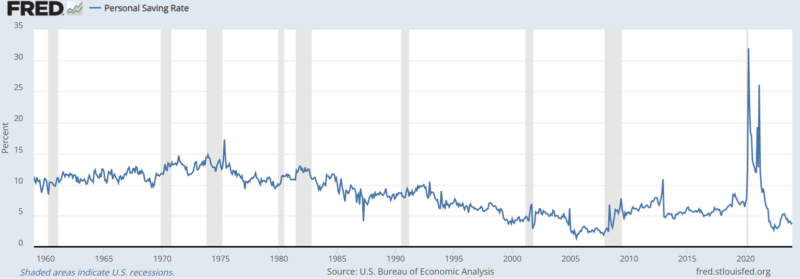
    The prices at which the system’s output can be sold in the marketplace are determined by the total amount of money which is available for spending in a given period of time. For the system to be in equilibrium, aggregate prices should exactly absorb the system’s total purchasing power. But a problem arises because in the current monetary system, there are two factors that significantly reduce the system’s purchasing power: (1) savings and (2) debt repayments.

    Namely, people don’t always spend all of their income. Instead, they prefer to set aside a part of it as savings which has the effect of reducing the total purchasing power available in the system.

    This is a problem

    So, if there are any savings, the available purchasing power will be less than the aggregate asking prices. For the system to remain in balance the savings would have to reappear in the market in the form of investments, but if total investment is less than total savings, the purchasing power will still fall short of the amount needed for all of the output to be sold at asking prices. This shortfall of purchasing power in the system, the excess of savings over investment is the deflationary gap.

    The other systemic drain on purchasing power (hat tip to author Liam Allonefor pointing this out to me) are debt repayments: since (nearly) all currency enters into circulation as debt, paying down debts extinguishes the currency and the purchasing power with it.

    Without government intervention we get a depression

    The system can be balanced either by lowering the supply and prices of goods, by enhancing its total purchasing power, or a combination of both. Lowering prices and production of goods will stabilize the economic system at a low level of economic activity. Increasing the purchasing power in the system will stabilize it on a higher level of activity. Left to itself and without intervention, a modern economic system would fall into what we call a self-reinforcing deflationary depression: the deflationary gap would lead to falling prices and output, decline of income and rising unemployment. Furthermore, in recessions and depressions, the level of investment typically declines even more rapidly than savings. To avert this, government intervention is necessary.

    Without government intervention, the economy would stabilize when the level of savings declined to the level of investments which would be at a depression level of activity. This is an anathema in all modern economies, and governments invariably pursue the imperative of economic growth. To generate growth, they must inject new purchasing power into the system. This cannot be done through taxation since taxation doesn’t create new purchasing power: taxes only transfer money from those who earn it to the government.

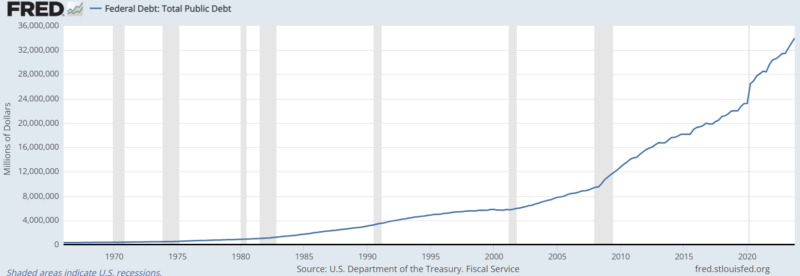
    This is why governments have no alternative but to continuously engage in deficit spending, adding debt in excess of their tax receipts. This is why virtually all governments in the world today run budget deficits and chronically grow public debt. In spite of all the incessant talk about balancing the budget, paying down debts or imposing debt ceilings, the debts only keep rising at rates that predictably accelerate over time. It doesn’t matter whether we call the system “socialist” or “capitalist,” they both necessitate an ever growing role of government in the economy.

    Today, in many of the “capitalist” nations, government spending accounts for almost half of the GDP and in some cases significantly more. In the UK, the mothership of capitalism, the government’s share of GDP is 44%. In France it’s over 58%.

    The great American debt ceiling Kabuki theater

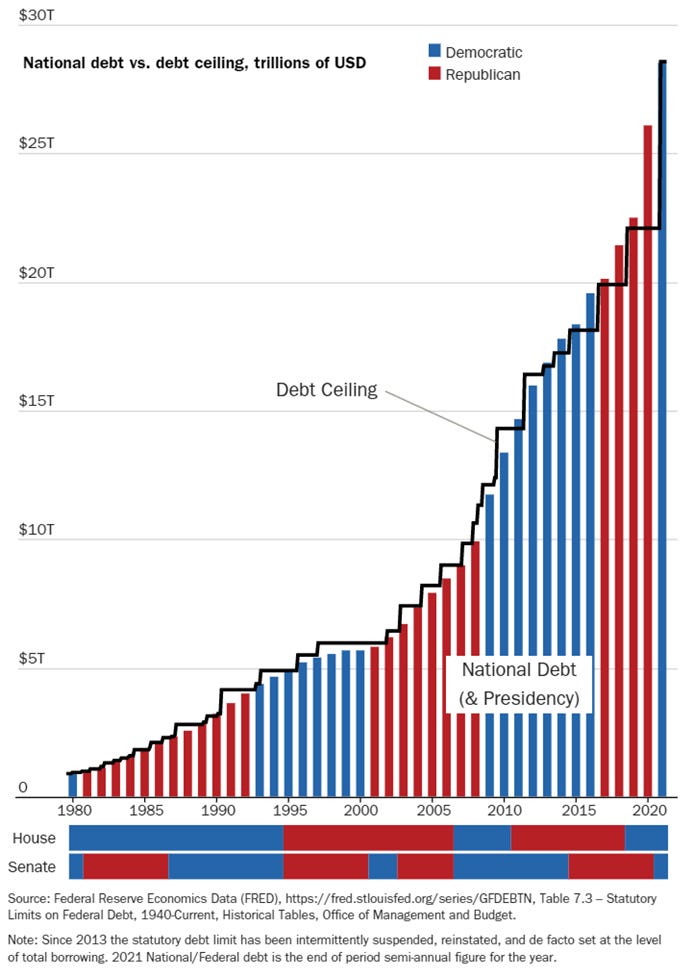
    In the United States, for over a century now we’ve been treated to periodic reruns of the “debt ceiling” Kabuki theatre. When public debt reaches the “debt ceiling,” free-spending socialists call for more government spending and a raising of the debt ceiling. The conservatives enjoy grandstanding about fiscal conservatism and balancing budgets, but regardless of which side controls the Presidency or the Congress, for over a century now the debt ceiling has been raised every time. The only exceptions have been periods when the ceiling was simply ignored and the public debt continued its accelerating upward trajectory:

    You get socialism, whether you like it or not!

    Averting a depression and achieving economic growth necessitates government intervention and guarantees an accelerating rise in deficit spending with the corresponding rise in public debt regardless of whether we are talking about a “capitalist” or a “socialist” economies. This should be obvious, as the evolution of public debt in the U.S. illustrates:


    There’s no point railing against “socialism” and dreaming about a small government, private capital utopia which doesn’t, and cannot exist so long as our economies are based on fiat currencies with fractional reserve lending. Even if we start with zero public debt, the pursuit of economic growth will lead to the same outcomes.

    With fullness of time, government sector will progressively crowd out private enterprise: it’s a mathematical certainty. As a result, we get socialism whether we like it or not. Even if a political leader declares himself to be an anarcho-capitalist and thinks he can create the capitalist utopia (like Argentina’s Javier Millei), the endgame will be the same.

    The passionate disciples of capitalist ideology will protest and invoke the theoretical works by economists like Ludwig Von Mises, Murray Rothbardor Friedrich Hayek but I would simply ask them to please name one real-world example of a successful free market capitalist economy where the government never ran budget deficits and piled up public debt. I can wait.

    For those who would defend the free market ideology and excuse its failing as a consequence of human corruption and weakness of the structures of society, I’d warn them that this was exactly how Marxists explained away the failures of communist utopia.

    Top-down or bottom-up?

    With that, we can address the false dichotomy between “socialist” and “capitalist” economies as they’re commonly discussed. Namely, in what we call “capitalist” economies, a larger proportion of government-injected purchasing power flows top-down. In what we call “socialist” economies, it flows bottom-up.

    Capitalist governments splurge their largesse on large private corporations in the form of subsidies and generous government contracts. Socialist governments splurge on social welfare programs like low-cost or free health care, education, generous unemployment benefits and pension plans, and programs that maintain full employment even where jobs couldn’t be justified by private enterprise.

    It’s what the “capitalists” hate. As a rule, individuals who strongly favor free market capitalism tend to be the successful, entrepreneurial types who value risk taking, hard work and creating wealth through private initiative. The idea that the state would splurge on the lazy and undeserving free-loaders is understandably revolting.

    However, the alternative in splurging on large corporations is far more dangerous. If purchasing power is distributed bottom up, the decisions about how to spend that purchasing power are up to the ordinary people. As such, they’ll tend to benefit ordinary businesses that produce consumer goods and services: bakers, apparel makers, restaurants, coffee shops, musicians, tour guides, bicycle repairmen, etc.

    By contrast, if the state spends top-down, it runs the moral hazard of determining the winners and losers in the supposedly free market competition. The winners will tend to be those corporations and groups that can “invest” the most in political lobbying efforts. As a result, we get the TBTF banking behemoths, big Ag, big Pharma, big Media, big Tech and a massively bloated military-industrial complex. Ultimately, this favors the emergence of corporatism, as Benito Mussolini characterized fascism. Today we prefer the sanitized term, “private-public partnership.” The adverse effect of all this is a society’s addiction to permanent wars and a penchant for empire-building.


    This article is published in Alex Krainer’s Substack.


  • An Education Policy for Colonising Minds

    An Education Policy for Colonising Minds

    Imperialist hegemony over the third world is exercised not just through arms and economic might but also through the hegemony of ideas by making the victims see the world the way imperialism wants them to see it. A pre-requisite for freedom in the third world, therefore, is to shake off this colonisation of the mind, and to seek truth beyond the distortions of imperialism. The anti-colonial struggle was aware of this; in fact, the struggle begins with the dawning of this awareness. And since the imperialist project does not come to an end with formal political decolonisation, the education system in the newly independent ex-colonies must continuously aim to go beyond the falsehoods of imperialism.

    This requires that the course contents and syllabi in Indian educational institutions must be different from those in metropolitan institutions. This is obvious in the case of humanities and social sciences, where it is impossible to understand the present of the country without reckoning with its colonised past; and metropolitan universities scrupulously avoid making this connection, attributing the current state of underdevelopment of the country to all sorts of extraneous factors like laziness, lack of enterprise, superstition, and, above all, excessive population growth. But even in the case of natural sciences, the syllabi and course contents in third-world universities cannot be identical with those in metropolitan universities, not because Einstein’s theory or quantum physics have any imperialist ideology in them, but because the range of scientific concerns in the third world is not necessarily the same as in the metropolitan countries. In fact, this was the view of JD Bernal, the British scientist and Marxist intellectual, one of the great figures of the twentieth century.

    To believe that the syllabi and course contents in third-world universities should be identical to those in metropolitan universities is itself a symptom of being hegemonised by imperialism. Education policy in the dirigiste period in India was aware of this; despite the obvious failings of the education system the education policy of that period could not be faulted for having a wrong vision.

    With neo-liberalism, however, things begin to change, as the Indian big bourgeoisie gets integrated with globalised finance capital, as the Indian upper middle-class youth looks for employment in multinational corporations, as the nation’s development is made dependent upon exporting goods to foreign markets and attracting foreign finance and foreign direct investment to the country. Significantly, even top functionaries of the government started talking about reinviting the East India Company back to India.

    Since the era of neo-liberalism entails the hegemony of globalised finance capital, and since this capital requires a globalised (or at least a homogeneous) technocracy, the emphasis shifts to having a homogeneous education system internationally to train such a technocracy; and obviously such a system necessarily has to be one that emanates from the metropolis.

    This means an education system not for decolonising minds but for recolonising minds. To this end, the UPA government earlier had invited several well-known foreign universities to set up branches in India and even to “adopt’ some Indian universities that could be developed in their own image. Oxford, Harvard, and Cambridge were obviously invited under this scheme not to follow the syllabi and course contents prepared within India but to replicate what they followed back home. The idea was to start a process whereby there would be a uniformity of course contents and syllabi between the Indian and metropolitan universities, that is, to roll back the attempt made earlier towards decolonisation of minds in Indian universities. In fact, an Indian Human Resource Development minister had openly stated in parliament that his objective was to provide a Harvard education in India so that Indian students would not have to go abroad for it.

    The NDA government has carried forward to a very great extent what the UPA government had started; and the National Education Policy it has enacted gives an official imprimatur to this idea of a uniform education system between India and the metropolis, which necessarily means the adoption of common curricula, course contents and syllabi between Indian and metropolitan universities.

    Towards this uniformity, it has taken two decisive steps: one is the destruction of those universities in India that were providing a counter to the imperialist discourse and that had, for this very reason, attracted worldwide attention; the obvious examples here are the Jawaharlal Nehru University, the Hyderabad Central University, Jadavpur University, and others.

    The other is the carrying out of negotiations under the pressure of the University Grants Commission between individual Indian universities and foreign universities to make the course contents in various disciplines in the former clones of those in the latter. The only caveat here is that the UGC insists on having some material on subjects like Vedic Mathematics included in the course contents of Indian universities, which the foreign universities do not always agree with.

    No doubt, some accord will be reached on these issues in due course, in which case the Indian universities would have curricula and course contents that represent an admixture of the demands of neo-liberalism and the demands of the Hindutva elements. It would be a colonisation of minds with a veneer of “how great our country was in ancient times”. Imperialism should not have any problem with that. As long as imperialism, which is a modern phenomenon that has emerged with the development of capitalism, is painted not as an exploitative system but as a benevolent civilising mission for countries like India, as long as the present state of underdevelopment of these countries is not in any way linked to the phenomenon of imperialism, which it would not be if there is uniformity of course contents with metropolitan universities, then what had happened in ancient times is not of much concern to imperialism, at least to the liberal imperialist viewpoint, as distinct from the extreme right which favours a white supremacist discourse.

    An alternative tendency with the same consequence of recolonising minds is to do away with the social sciences and humanities altogether or to reduce them to inconsequential subjects and substitute them with courses that are exclusively “job-oriented” and do not ask questions about society, like management and cost accountancy. In fact, both the Hindutva elements and the corporates have a vested interest in this since both are keen to have students who are exclusively self-centred and do not ask questions about the trajectory of social development. This tendency, too, is gathering momentum at present.

    An education system that recolonises minds is the counterpart of the corporate-Hindutva alliance that has acquired political hegemony in the country. Such a recolonisation is what the corporates want; and the Hindutva elements that were never associated with the anti-colonial struggle, that never understood the meaning of nation-building, that do not understand the role and significance of imperialism, and hence of the need for decolonising minds, are quite content as long as lip service is paid to the greatness of ancient India. An education system that purveys the imperialist ideology with some Vedic seasoning is good enough for them. This is exactly the education system that the country is now in the process of building.

    The corporate- Hindutva alliance, however, is a response to the crisis of neo-liberalism, when corporate capital feels the need to ally itself with the Hindutva elements to maintain its hegemony in the face of the crisis. The National Education Policy likewise is not for carrying the nation forward but for managing the crisis by destroying thought and preventing people from asking questions and seeking the truth. The “job orientation” that this policy prides itself on is only for a handful of persons; in fact, the crisis of neo-liberalism means fewer jobs overall. In sync with this, the education system excludes large numbers of persons; their minds are to be filled instead with communal poison within an altered discourse that bypasses issues of material life and makes them potential low-wage recruits for fascistic thug-squads.

    This education policy, therefore, can only be transitory until the youth starts asking questions about the unemployment and distress that has become its fate. And as an alternative development trajectory beyond neo-liberal capitalism is explored, the quest for an education system beyond what the NDA government is seeking to introduce will also begin; and decolonisation of the mind will again come onto the agenda, as it had done during the anti-colonial struggle.


    This article was published earlier in People’s Democracy.

  • India’s National River Linking Project: Will it work or end up a Disaster?

    India’s National River Linking Project: Will it work or end up a Disaster?

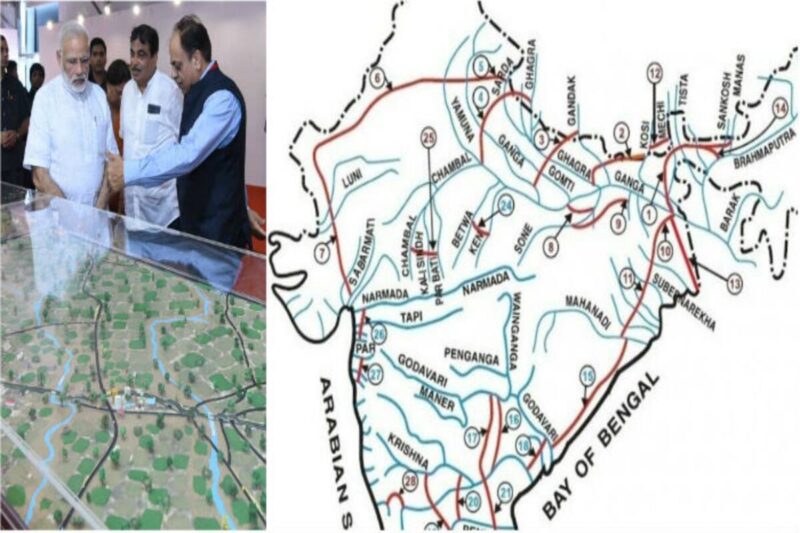
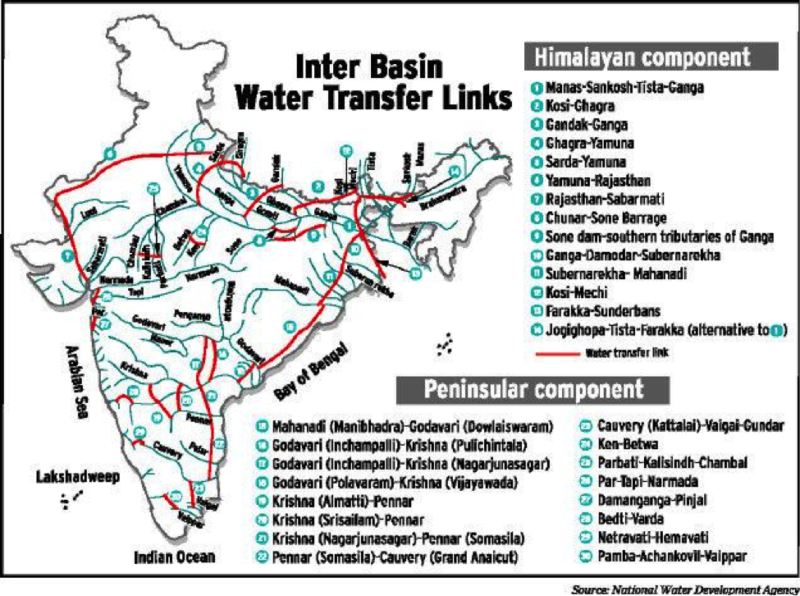
    In October, India’s ambitious scheme to build a 230-kilometre canal between the Ken and Betwa rivers was finally approved. It’s the first of many projects planned for implementation under the National River Linking Project (NRLP), which aims to connect 37 Himalayan and peninsular rivers across the country via some 3,000 reservoirs and 15,000 kilometres of dams and canals. The government has touted the NRLP, which was first mooted more than four decades ago, as the solution to drought-proofing the country. But new research suggests the US$168 billion project could actually make the drought worse. 

    – From a study by the ‘Geographical‘ – Dec 2023.


    I keep hearing that Modiji is going to unveil the often-spoken and then shelved Rivers Link Up Scheme as his grand vision to enrich the farmers and unite India. In a country where almost two-thirds of the agricultural acreage is rainfed, water is wealth. Telangana has shown the way. Once India’s driest region has in just eight years been transformed into another granary of India. Three years ago, he had promised to double farmers’ incomes by 2022, and he has clearly failed. He now needs a big stunt. With elections due in 2024, he doesn’t even have to show any delivery. A promise will do for now.

    This is also a Sangh Parivar favourite, and I am quite sure the nation will once again set out to undertake history’s greatest civil engineering project by seeking to link all our major rivers. It will irretrievably change India. If it works, it will bring water to almost every parched inch of land and just about every parched throat in the land.

    On the other hand, if it doesn’t work, Indian civilization as it exists even now might then be headed the way of the Indus Valley or Mesopotamian civilizations destroyed by a vengeful nature, for interfering with nature is also a two-edged sword. If the Aswan High Dam turned the ravaging Nile into a saviour, the constant diversion of the rivers feeding Lake Baikal have turned it into a fast-receding and highly polluted inland sea, ranking it as one of the world’s greatest ecological disasters. Even in the USA, though the dams across the mighty Colorado have turned it into a ditch when it enters Mexico, California is still starved for water.

    I am not competent to comment on these matters, and I will leave this debate for the technically competent and our perennial ecological Pooh-Bahs. But the lack of this very debate is cause for concern. It is true that the idea of linking up our rivers has been afloat for a long time. Sir Arthur Cotton was the first to propose it in the 1800’s. The late KL Rao, considered by many to be an outstanding irrigation engineer and a former Union Minister for Irrigation, revived this proposal in the late 60’s by suggesting the linking of the Ganges and Cauvery rivers. It was followed in 1977 by the more elaborate and gargantuan concept of garland canals linking the major rivers, thought up by a former airline pilot, Captain Dinshaw Dastur. Morarji Desai was an enthusiastic supporter of this plan.

    The return of Indira Gandhi in 1980 sent the idea back into dormancy, where it lay all these years, till President APJ Abdul Kalam revived it on the eve of the Independence Day address to the nation in 2002. It is well known that Presidents of India only read out what the Prime Ministers give them, and hence, the ownership title of Captain Dastur’s original idea clearly was vested with Atal Behari Vajpayee.

    India’s acute water problem is widely known. Over sixty per cent of our cropped areas are still rain-fed, much too abjectly dependent on the vagaries of the monsoon. The high incidence of poverty in certain regions largely coincides with the source of irrigation, clearly suggesting that water for irrigation is integral to the elimination of poverty. In 1950-51, when Jawaharlal Nehru embarked on the great expansion of irrigation by building the “temples of modern India” by laying great dams across our rivers at places like Bhakra Nangal, Damodar Valley and Nagarjunasagar, only 17.4% or 21 million hectares of the cropped area of 133 million hectares was irrigated. That figure rose to almost 35% by the late 80s, and much of this was a consequence of the huge investment by the government in irrigation, amounting to almost Rs. 50,000 crores.

    Ironically enough, this also coincided with the period when water and land revenue rates began to steeply decline to reach today’s zero level. Like in the case of power, it seems that once the activity ceased to be profitable to the State, investment too tapered off.

    The scheme is humongous. It will link the Brahmaputra and Ganges with the Mahanadi, Godavari and Krishna, which in turn will connect to the Pennar and Cauvery. On the other side of the country, it will connect the Ganges, Yamuna, with the Narmada, traversing in part the supposed route of the mythical Saraswathi. This last link has many political and mystical benefits, too.

    There are many smaller links as well, such as joining the Ken and Betwa rivers in MP, the Kosi with the Gandak in UP, and the Parbati, Kalisindh and Chambal rivers in Rajasthan. The project, when completed, will consist of 30 links, with 36 dams and 10,800 km of canals diverting 174,000 million cubic meters of water. Just look at the bucks that will go into this big bang. It was estimated to cost Rs. 560,000 crores in 2002 and entail the spending of almost 2% of our GNP for the next ten years. Now, it will cost twice or more than that, but our GDP is now three times more, and it might be more affordable and, hence, more tempting to attempt.

    The order to get going with the project was the output of a Supreme Court bench made up of then Chief Justice BN Kirpal and Justices KG Balakrishnan and Arjit Pasayat, which was hearing a PIL filed by the Dravida Peravai, an obscure Tamil activist group. The learned Supreme Court sought the assistance of a Senior Advocate, Mr Ranjit Kumar, and acknowledging his advice, recorded: “The learned Amicus Curiae has drawn our attention to Entry 56 List of the 7th Schedule to the Constitution of India and contends that the interlinking of the inter-State rivers can be done by the Parliament and he further contends that even some of the States are now concerned with the phenomena of drought in one part of the country, while there is flood in other parts and disputes arising amongst the egalitarian States relating to sharing of water. He submits that not only these disputes would come to an end but also the pollution levels in the rivers will be drastically decreased, once there is sufficient water in different rivers because of their inter-linking.”

    The only problem with this formulation is that neither the learned Amicus Curiae nor the learned Supreme Court are quite so learned as to come to such sweeping conclusions.

    Feature Image Credit: geographical.co.uk

    Opinions expressed are that of the author and do not reflect TPF’s position on the issue.

  • From Global Democratisation to the Battle of World Powers? Contradictory Developments in the Present

    From Global Democratisation to the Battle of World Powers? Contradictory Developments in the Present

    Shortly after the democratic revolutions of 1989-1991, Francis Fukuyama wrote his highly influential essay on the end of history- that is, the end of violent history through global democratization.

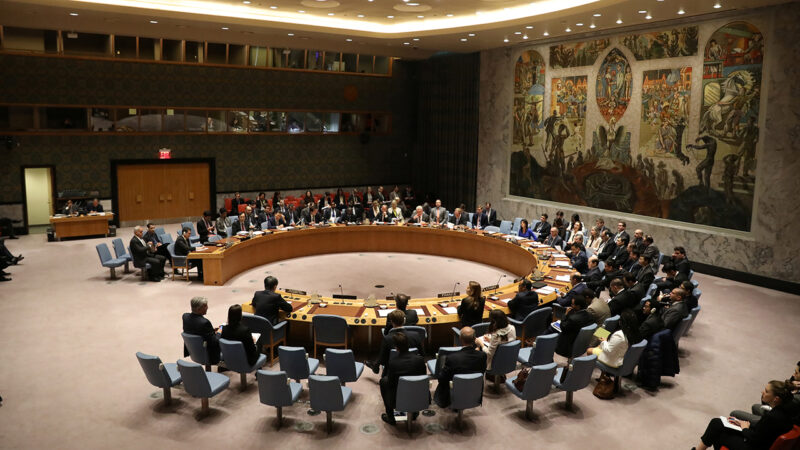
    Members of the United Nations Security Council sit during a meeting on Syria at the United Nations Headquarters in New York City, NY, U.S. April 5, 2017. REUTERS/Shannon Stapleton – RC141DE9DE00. Image credit: world101.cfr.org

    The world has changed so dramatically since the end of the Cold War that it is necessary to look back in order to understand today’s global political situation. In total, there are five different discourses that will be discussed here as representative of historical developments. They range from Fukuyama’s thesis of global democratization to various versions of coming anarchy and global (“new”) civil wars (Kaplan, Kagan, Kaldor, Münkler), Huntington’s clash of civilizations, the concept of global governance and the “rise of the others” (Zakaria, Zhang), a multipolar world of nation-states, and the re-nationalization of world politics. My central thesis is that all five discourses are present in contemporary political conflicts and that we cannot neglect any of them.

    But if you look at the history of democracy, you can almost discover a law of motion of democratic revolutions based on Hannah Arendt’s analysis of the French Revolution. It starts with a democratic revolt against a dictator or colonial rule. Then the revolutionaries become radicalized, civil war breaks out, a new, this time totalitarian ruler takes power, and only after his overthrow does democracy prevail.

    Shortly after the democratic revolutions of 1989-1991, Francis Fukuyama wrote his highly influential essay on the end of history- that is, the end of violent history through global democratization. And his thoughts were very timely. What better confirmation could there be when, in just a few years, the old dictatorships from Berlin to Vladivostok, which only called themselves communist but were not, but rather geriocracies, were swept away in a wave of democratisation. The Arab Spring seemed to confirm his thoughts, as here, too, long-standing dictatorships were overrun by democratic movements virtually overnight, as in Egypt and Tunisia. But even then, there were counter-movements that contradicted the assumed linear process of global democratization. Fukuyama, therefore, had to defend his original thesis and argue that, despite all the setbacks, democracy was still at the end of history. In a way, he was echoing Hannah Arendt’s theory of revolution. The reverses of democratization in Russia, many Arab countries, and the global civil wars have often been cited as cultural – Russia, China, and Middle Eastern Islam were still too culturally authoritarian to allow for genuine democratization. But if you look at the history of democracy, you can almost discover a law of motion of democratic revolutions based on Hannah Arendt’s analysis of the French Revolution. It starts with a democratic revolt against a dictator or colonial rule. Then the revolutionaries become radicalized, civil war breaks out, a new, this time totalitarian ruler takes power, and only after his overthrow does democracy prevail. The French overthrew their king and got the emperor, Napoleon; the Russians revolted against the czar and got Stalin; the Chinese fought against their emperor and got Mao Tse-tung; the Germans overthrew their emperor after their military defeat and got the leader Adolf Hitler. Resistance to colonial rule also often followed this law of democratic movement: the colonial rulers were driven out and replaced by new rulers.

    In the same year that the Soviet Union collapsed, the terrible civil wars in the former Yugoslavia began, the first Chechen war, followed by countless “markets of violence” and so-called new wars, which in a narrower sense were new civil wars and wars of state collapse. Mass rape became a weapon of war to demoralize the enemy, and an almost complete dissolution of the boundaries of violence took on a life of its own, seeming to make any rational resolution of conflicts impossible. Warlords, drug lords, terrorists, child soldiers, and “archaic” warriors who seemed to belong to the past dominated warfare worldwide. Against this backdrop, Western armies were transformed into intervention armies that were supposed to maintain a minimum of order on the borders of the U.S. “liberal empire” in order to prevent global anarchy (Robert Kaplan) or a “world civil war” (Enzensberger) – at least according to Western discourse. From the perspective of the countries affected by these wars of intervention, however, they were wars to maintain their immediate exploitation (especially in Africa), to keep corrupt regimes that collaborated with Western states alive (Arabian Peninsula), or to eliminate those that opposed the West (Iraq, Iran, Afghanistan). In the open spaces of violence and violent markets, high-value illegal goods were traded: Drugs, blood diamonds, human beings (women and child slaves), weapons and rare earths.

    Linked to these wars of intervention was the apparent cultural triumph of the West, which is associated with the term globalisation, but was, in fact, initially an Americanization, the so-called McDonaldization or Mac World. However, this cultural globalization of the American way of life, combined with U.S. wars of intervention, led to a backlash as many societies saw their cultural identity threatened. Taken together, these two factors triggered Samuel Huntington’s concept of the clash of civilizations.

    In their liberal hubris, his Western critics argued that there could be no clash of civilizations because only the West had produced a civilization – the others were religions or cultures, but not civilizations.

     His book has often been misunderstood as a guide to action for the coming war – but in fact, he had written the book to prevent that clash, and he argued for the U.S. to withdraw from small wars around the world because he saw the liberal identity of the U.S. at risk. Perhaps more importantly, he saw non-Western religions not just as cultures but as civilizations that had grown out of their respective religions. In their liberal hubris, his Western critics argued that there could be no clash of civilizations because only the West had produced a civilization – the others were religions or cultures, but not civilizations.

    While globalization initially had the effect of Americanization, in the medium term, it facilitated the “rise of the others” (Zakaria), the great empires and civilizations that had perished under European colonization and Euro-American hegemony. As a result of their initial economic success (Malaysia, Singapore, the Asian Tigers, China, India, the Pacific Rim countries), they no longer sought to imitate Western culture in order to be recognized as equals, but to develop their own identity, which they considered superior to the West. From the point of view of Western discourse, the “others” were, at best, immature children or barbarians – now the West suddenly sees itself in the role of other civilizations, seeing themselves as superior to the West. One expression of this changed self-image was Zahng Weiwei’s book China – The Civilizational State. We are now experiencing a paradoxical situation in which the West is consumed by fear of decline and the dissolution of its own sense of superiority, leading to the rise of right-wing populist and radical right-wing movements; large parts of the Asian world population are filled with hope for a better life, and the Islamic-Arab world is desperate in the face of unfulfilled promises, leading to the radicalization of young people in Islamist movements.

    The concept of global governance was invented at the beginning of the 21st century as a reaction to advancing globalization. The assumption, correct in itself, was that the absence of a democratic world state did not necessarily mean that there was no possibility of at least regulating global problems, subjecting them to rules, if not solving them. Global governance was based on the idea of cooperation between nation-states, non-governmental organizations, globally active institutions, the emerging global civil society, globally active corporations, and global players. However, the resurgence of big states has pushed global governance into the background, just like globalization itself. Some states want to reverse globalization, at least in the economic and political spheres. This applies at least to Western democracies, whose citizens often see themselves as the losers of globalization.

    The relative loss of importance of the Western states and the institutions they helped to create, such as the U.N., cannot be overlooked – the overstretched role of the U.S. as the world’s policeman is due, on the one hand, to its own lack of investment in development and education, and on the other to the rise of others.

    What we are currently experiencing is not simply a multipolar world of great powers, even if there are signs of a renaissance of great power politics. Instead, we are witnessing a contradictory process of the five discourses alluded to here: Democratization, failed states, the clash of civilizations, further globalization, and the renaissance of great power politics. The still existing, but also partly former, Global South is still dependent on cooperation, even if new forms of cooperation are emerging, such as the expansion of the BRICS, which compete politically but cooperate economically. The relative loss of importance of the Western states and the institutions they helped to create, such as the U.N., cannot be overlooked – the overstretched role of the U.S. as the world’s policeman is due, on the one hand, to its own lack of investment in development and education, and on the other to the rise of others. What remains unpredictable is whether the emerging states of the Global South and the former superpower Russia will make the same mistake as the West in its centuries-long quest for hegemony, namely, to see itself as superior to all others. Eurocentrism would be replaced by an equally problematic ethnocentrism, and a nationalist dynamic would be set in motion that would be difficult for states to control. Even if all current developments point to the contrary and we see a return of tribalism in the form of “us versus them – whoever the others are” discourses, the only option left is to revive intercultural dialogue if we do not want to experience “another bloody century” (Colin S. Gray).


    Feature Image Credit: chinausfocus.com

  • Using Artificial Intelligence to address Corruption: A proposal for Tamilnadu

    Using Artificial Intelligence to address Corruption: A proposal for Tamilnadu

    Nations must adopt Artificial Intelligence as a mechanism to build transparency, integrity, and trustworthiness, which are necessary to fight corruption. Without effective public scrutiny, the risk of money being lost to corruption and misappropriation was vast. Dr Chris Kpodar, a global Artificial Intelligence Specialist, has advocated the use of artificial intelligence as an anti-corruption tool through the redesigning of systems to address systems that were previously prone to bribery and corruption.


    Artificial Intelligence Tools

    Artificial Intelligence has become popular due to its increasing applications in many fields. Recently, IIT Madras opened a course on B.Tech Data Science in Tanzania, demonstrating the popularity of Artificial Intelligence. The history of Artificial Intelligence goes back to the 1950s when computing power was less, and hardware were huge. These days, computing power has increased exponentially along with the miniaturisation of hardware, leading to algorithms being able to compute larger datasets. The field of AI, however, has gone through ups and downs in terms of popularity.

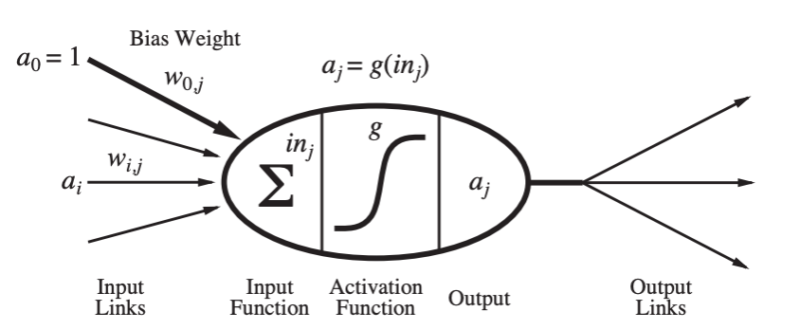
    Researchers have worked on Neural Networks (Figure below), a mathematical model modelled after neurons in the brain, a foundation unit, and one of the foundations of state-of-the-art AI.

    Artificial intelligence (AI), machine learning, deep learning, and data science are popular terms that describe computing fields that teach a machine how to learn. AI is a catch-all term that broadly means computing systems designed to understand and replicate human intelligence. Machine Learning is a subfield of AI where algorithms are trained on datasets to make predictions or decisions without explicitly being programmed. Deep Learning is a subfield of Machine Learning, which specifically refers to using multi-layers of neural networks to learn from large datasets, mimicking cognition of the neurons in the brain. Recently, the field of AI has resurged in popularity after a popular type of neural network architecture, AlexNET, achieved impressive results in the Image Recognition Challenge in 2012. Since then, neural networks have started to enter into applications in the industry, with colossal research funding mobilised.

    Breakthroughs that can aid Policy Implementation

    There are many types of neural networks, each designed for a particular application. The recent popularity of applications like ChatGPT is due to a neural network called Language Models. Language Models are probability models which ask the question, what is the next best token to generate, given the previous token?

    Two significant breakthroughs led towards ChatGPT, including translating language from one language to another using a machine learning technique called attention mechanism. Secondly, this technique was introduced in transformer-type language models, which led to increased state-of-the-art performance in many tasks in artificial intelligence.

    Transformers, a robust neural network, was introduced in 2017 by Google Researchers in “Attention is All You Need”. This translates into generating human-like text in ChatGPT. Large language models have taken a big step in the technology landscape. As Machine Learning applications are being deployed rapidly, it calls for a governance model for these models, as research in AI models is advancing quickly with innumerable breakthroughs. Earlier in 2019, GPT-2, a Machine Learning model based on transformers, could not solve fundamental mathematical problems such as elucidating numbers from 0-100. Within a year, more advancement in the GPT models led to models being able to perform higher-level scores in SAT exams, GRE, etc. Another breakthrough advancement was the ability of machine-learning programs to generate code, which has increased developer productivity automatically.

     Moreover, many researchers are working on AGI (Artificial General Intelligence), and nobody knows precisely when such capabilities might be developed or researched. Researchers have not settled on a convincing definition of AGI agreeable to everyone in the AI research community. The rate of advancement and investment in AI research is staggering, which calls for ethical concerns and governance of these large language models. India is an emerging economy where all sectors are growing rapidly. India’s economy grows nearly 10% yearly, with the services sector making up almost 50% of the entire economy. This translates to the government enjoying high tax revenues from this sector, generating high-paying jobs. Most of the Indian workforce is employed in the industrial and agricultural sectors.

    Using AI to deal with Corruption and enhance Trust

    The primary issue in India has been corruption at all levels of the government, from the panchayat, district level, and state level to central machinery. Corruption is attributed mainly to regulation, rent-seeking behaviour, lack of accountability, and requiring permits from the Government. Indian bureaucratic system and government employees are among the least efficient across sectors such as infrastructure, real estate, metal & mining, aerospace & defence, power and utility, which are also most susceptible to corruption. Due to inefficiency, the productivity of the public sector is low, impacting the local Indian economy.

    India ranks 85 out of 180 countries using the Corruption Index measured in 2022, with close to 62% of Indians encountering corruption, paying bribes to government officials to get the job done. There are many reasons for corruption in India: excessive regulation, a complicated tax system, bureaucratic hurdles, lack of ownership of work, and the public sector being the least productive organisation. Corruption is dishonest or fraudulent conduct by those in power, typically involving bribery. Bribery is defined generally as corrupt solicitation, acceptance, or transfer of value in exchange for official action. In bribery, there are two actors in the transaction, the giver and the receiver; however, corruption involves primarily one actor who abuses the position of power for personal gain. Bribery is a singular act, while corruption might be an ongoing abuse of power to benefit oneself.

    Trust is a critical glue in financial transactions; where trust between individuals is higher, the economic transactions are faster, and the economy grows, with more businesses moving, bringing capital, and increasing the production and exchange of goods. However, when trust is low, businesses hesitate, and the economy either stagnates or declines. High-trust societies like Norway have advanced financial systems, where credit and financial instruments are more developed, compared with lower-trust societies such as Kenya and India, where many financial instruments and capital markets to raise finances are unavailable. Therefore, public policymakers must seek ways to increase trust in their local economies by forming policies conducive to business transactions.

    The real-estate sector in Tamilnadu: a fit case for the use of AI

    Tamil Nadu is India’s second-largest economy and is the most industrialised and urbanised state in India. Real estate is an economic growth engine and a prime mover of monetary transactions. It is a prime financial asset for most Tamils from many social strata. However, real estate in Tamil Nadu is prone to corruption at many levels. One specific popular method is the forgery of land registration documents, which has resulted in a lack of trust among investors at all levels in Tamil Nadu.

    To address this lack of trust, we can use technology tools to increase confidence and empower the public to create an environment of accountability, resulting in greater confidence. Machine Learning can provide algorithms to detect these forgeries and prevent land grabbing. Tools such as identity analysis, document analysis, and transaction pattern analysis can help to provide more accountability. In addition to the above, machine learning offers many methods or combinations of methods that can be used. One advanced way is using transformer-based models, which are the foundation for language models such as BERT and generative Pre-Trained Models for text-based applications. The original documents could be trained using large language models as a baseline to frequently check and find forgeries. Documents can be encoded to compare semantic anomalies between different types of documents.

    Once forgery is detected, it can be automatically sent to civil magistrates or pertinent authorities. Additionally, the recent introduction of Software repository sites allows the public to be informed or notice any change in the status or activity. Customised public repositories based on GitHub might create immense value for Tamil Nadu’s Department of Revenue, create accountability, increase productivity and reduce workload. The Customised public repositories displaying land transaction activity might inform the public of such forgeries, thus creating an environment of greater accountability and trust for the people. Another popular method can be introduced by introducing Computer Vision Algorithms, such as convolutional neural networks combined with BERT, that can validate signatures, document tampering, and time-frames to flag forgeries. This can be done by training original documents with specific algorithms and checking documents with reasonable doubts about forgery.

    Another primary concern in Tamil Nadu’s Government has been people in positions of power in the government or close to financial oversight. They are more prone to corruption, which can be flagged or monitored using graph neural networks, which can map individuals, connections, and economic transactions in a network to flag which individuals are more likely or prone to corruption. Another method to reduce corruption is to remove personal discretion in the process, which Machine Learning can enable to automate the tasks and documents in land registration; digitisation might help reduce corruption. Large Language Models can also be used as classifiers and released to the public to keep accountability on the Tamil Nadu Government’s spending, so the public is aware and personal gain of Government money can be further reduced this way. Another central area of corruption is the tender, the bidding process for government contracts in Tamil Nadu, such as public development works or engineering projects. Tamil Nadu’s tender or bidding process can be made more public, and machine learning algorithms can be used to check if norms, contracts, and procedures are followed to award tender bids for government projects. To save wasteful expenditure, algorithms can check if objective conditions are met, with any deviations flagged and in the public domain. Given any suspicion, the public can file a PIL in Tamil Nadu’s court system.

    We can argue and conclude that with more deployed machine learning tools being part of Tamil Nadu’s State machinery, we can confidently say that corruption can be reduced to more significant levels by releasing all information to the public and creating an environment of greater accountability.

    References:

    1. Russell, Stuart J.; Norvig, Peter. (2021). Artificial Intelligence: A Modern Approach

    2.Bau, D., Elhussein, M., Ford, J. B., Nwanganga, H., & Sühr, T. (n.d.). Governance of AI models. Managing AI risks. https://managing-ai-risks.com/

    1. S. Department of State. (2021). 2021 Country Reports on Human Rights Practices: India. U.S. Department of State. https://www.state.gov/reports/2021-country-reports-on-human-rights-practices/india/
    1. Devlin, J., Chang, M.-W., Lee, K., & Toutanova, K. (2019). BERT: Pre-training of deep bidirectional transformers for language understanding. In Proceedings of NAACL-HLT (pp. 4171-4186). https://arxiv.org/abs/1810.04805
    1. Radford, A., Wu, J., Child, R., Luan, D., Amodei, D., & Sutskever, I. (2019). Language models are unsupervised multitask learners. OpenAI blog, 1(8). https://openai.com/blog/better-language-models/
    1. Radford, A., Narasimhan, K., Salimans, T., & Sutskever, I. (2018). Improving language understanding by generative pre-training. OpenAI blog, 12. https://openai.com/blog/language-unsupervised/
    2. Bai, Y., Kadavath, S., Kundu, S., Askell, A., Kernion, J., Jones, A., … Kaplan, J. (2022). Constitutional AI: Harmlessness from AI feedback. arXiv preprint arXiv:2212.08073. https://arxiv.org/pdf/2212.08073.pdf,

    https://www.anthropic.com/news/constitutional-ai-harmlessness-from-ai-feedback

    1. Reinforcement Learning with Human Feedback (RLHF), Ouyang, L., Wu, J., Jiang, X., Almeida, D., Wainwright, C. L., Mishkin, P., Zhang, C., Agarwal, S., Slama, K., Ray, A., Schulman, J., Hilton, J., Kelton, F., Miller, L., Simens, M., Askell, A., Welinder, P., Christiano, P., Leike, J., & Lowe, R. (2022). Training language models to follow instructions with human feedback. arXiv preprint arXiv:2203.02155. https://arxiv.org/abs/2203.02155

    Feature Image: modernghana.com

  • The Philippines’ History Curriculum: Origins and Repercussions

    The Philippines’ History Curriculum: Origins and Repercussions

    Background

    The Philippines, a twice-colonized archipelago that achieved its complete independence in 1946, is a member of the ASEAN and an essential player in the geopolitics of the Southeast Asia region. Its status is owed mainly to its rapidly growing economy, of which the services industry is the most significant contributor, comprising 61% of its Gross Domestic Product (GDP) (Bajpai, 2022). Services refer to various products – for example, business outsourcing, tourism, and the export of skilled workers, healthcare workers, and labourers in other industries. In recent years, a growing demand for qualified professionals has grown as the economy has grown, thus necessitating more robust educational systems (Bajpai, 2022). Although the Philippines has a high literacy rate, hovering at around 97%, the efficacy of its educational system is often called into question (“Literacy Rate and Educational Attainment”, 2020). Administration oversight, infrastructural deficiencies, and pervasive corruption in the government that seeps into the entities responsible for educational reform are significant issues that legitimize these doubts (Palatino, 2023). However, reforming the current flaws in the system requires an understanding of the basic underlying structure of the country’s educational system as it is today. This fundamental understanding can help clarify specific political trends in the status quo and highlight the importance of proper historical education in developing a nation. Despite its ubiquity in nearly every curriculum, the study of history as a crucial part of the education system is often not prioritized, leading to an underdeveloped understanding of the society’s culture and previous struggles with colonial exploitation. Though it is present in the Philippines’ education today, it continues to change because of its historically dynamic demographic and political atmosphere.
    Origins of the Education System 

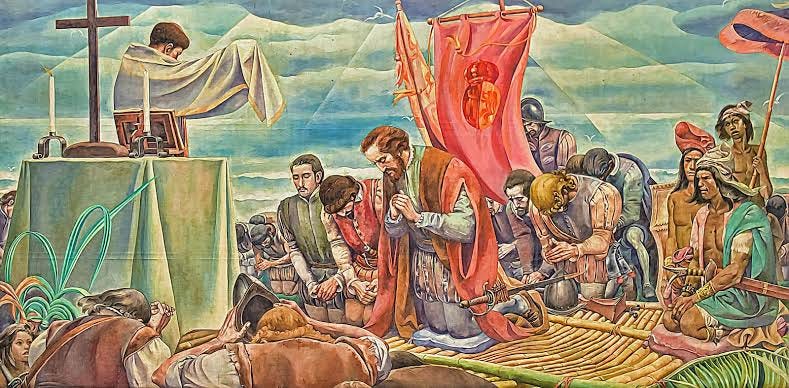
    To begin with, the educational system, and especially the modes of linguistic and history education in the country, have been heavily influenced by the major powers that occupied it – namely, the Spanish Empire and the United States. The impact of these periods of colonization can be seen most significantly in the historical education and consciousness of the general population, as well as the propagation of the English language. The Philippines possesses a great deal of linguistic diversity, especially among indigenous groups – an estimated 170 distinct languages in the country today (Postan, 2020). However, even in pre-colonial times – typically considered by historians to be the years before 1521 – the most common language in the country was Old Tagalog, and other indigenous languages are still spoken today (Stevens, 1999). Records suggest that the Spanish did not forcefully erase indigenous languages spoken in the country. However, they did conduct business and educational institutions in Spanish, leading to the language being used almost exclusively amongst the upper classes – the colonizers, business people in the country, and other influential figures in the empire. Though there were attempts to conduct education in Castilian Spanish, priests and friars responsible for teaching the locals preferred to do so in local languages as it was a more effective form of proselytization. This cemented the reputation of Spanish as a language for the elite, as the language was almost exclusively limited to those chosen to attend prestigious institutions or government missions that operated entirely in Spanish (Gonzales, 2017). In terms of popularising education to expose a broader audience to Christianity, the Spanish also established a compulsory elementary education system. However, restrictions existed based on social class and gender (Musa & Ziatdinov, 2012). Because of this, although the influence of Spanish on local languages can be seen through the borrowing of certain words, indigenous and regional languages were not supplanted to a large extent, though their scripts were Latinised in some instances to make matters more convenient for the Spanish (Gonzales, 2017). However, the introduction of Catholicism to a large segment of the population and a more organized educational system are aspects of Spanish rule that remain in Philippine society today, as do the negative ramifications of the social stratification that was a significant element of its occupation (Herrera, 2015).

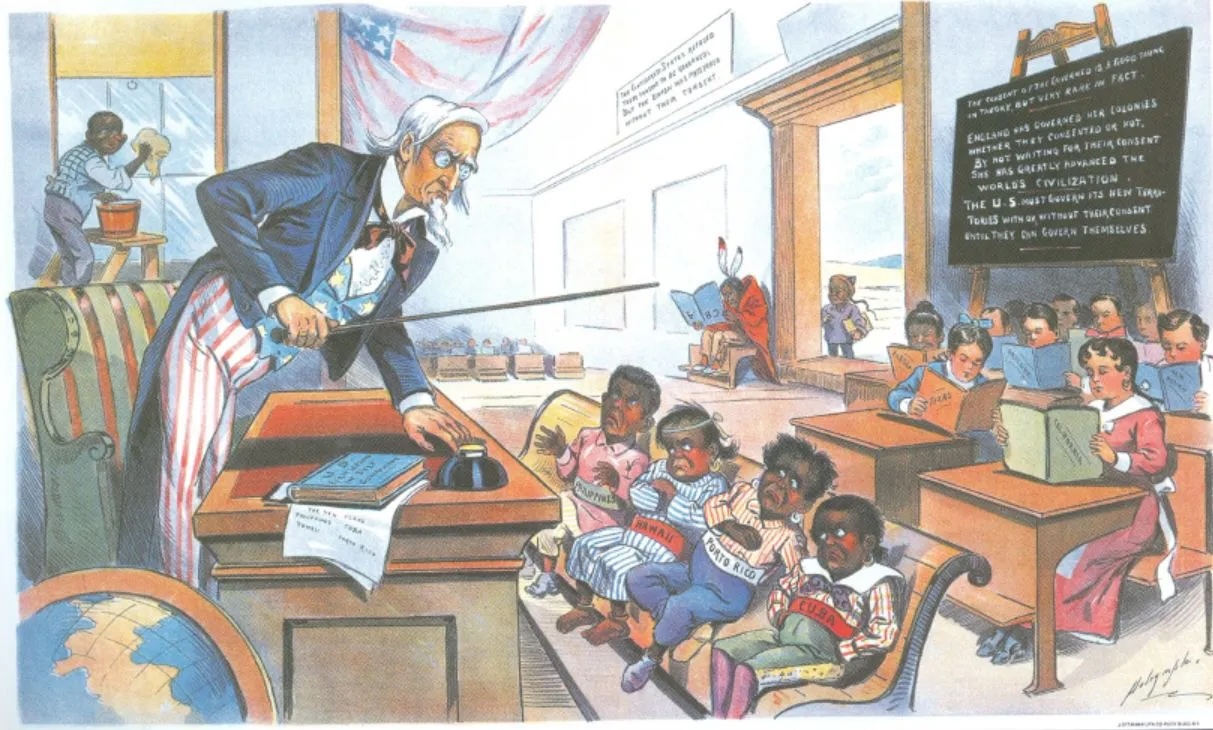
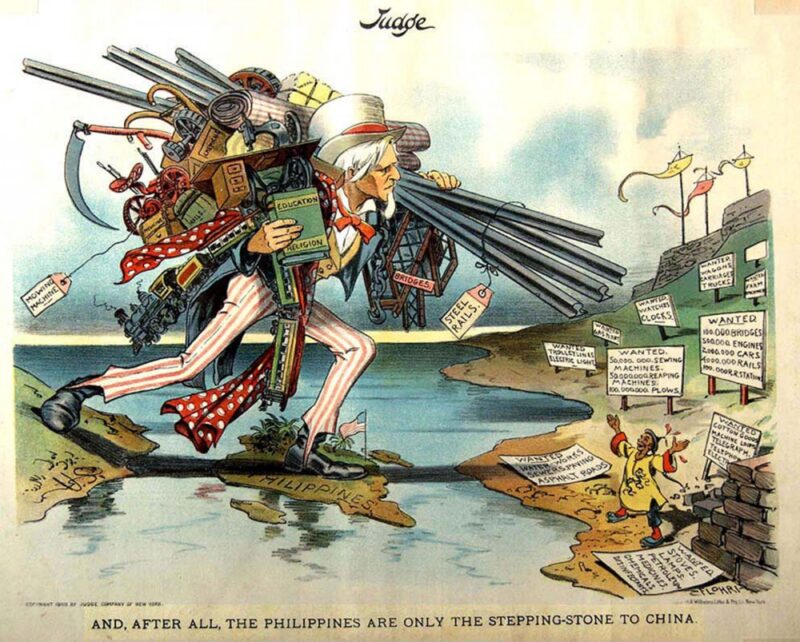
    Uncle Sam, loaded with implements of modern civilization, uses the Philippines as a stepping-stone to get across the Pacific to China (represented by a small man with open arms), who excitedly awaits Sam’s arrival. With the expansionist policy gaining greater traction, the possibility for more imperialistic missions (including to conflict-ridden China) seemed strong. The cartoon might be arguing that such endeavours are worthwhile, bringing education, technological, and other civilizing tools to a desperate people. On the other hand, it could be read as sarcastically commenting on America’s new propensity to “step” on others. “AND, AFTER ALL, THE PHILIPPINES ARE ONLY THE STEPPING-STONE TO CHINA,” in Judge Magazine, 1900 or 1902. Wikimedia.
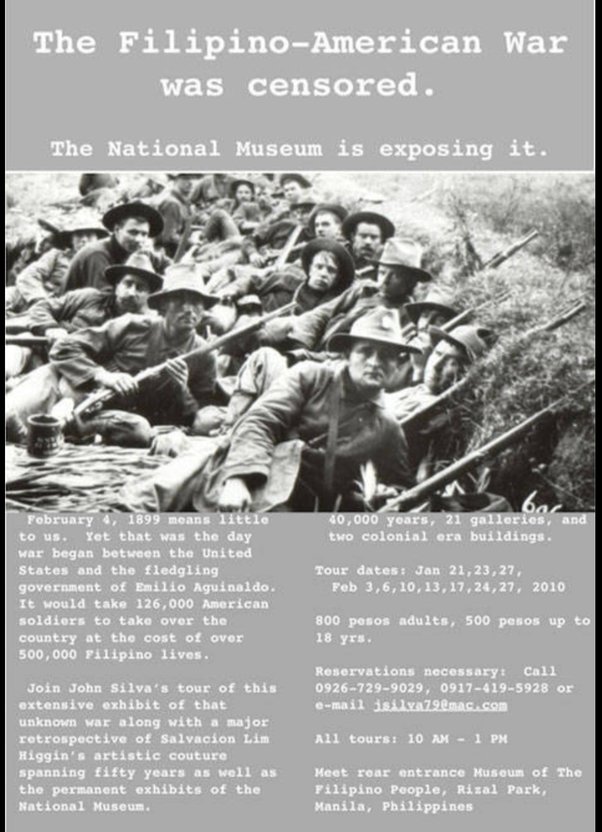
    In contrast, the American occupation following Spain’s defeat in the Spanish-American War in 1898 significantly changed the country’s linguistic patterns and revolutionized the education system. Upon arriving in the country, the Americans decided to create a public school system in the country, where every student could study for free. However, the medium of instruction was in English, given that they brought teachers from the United States (Casambre, 1982). This differed from the Spanish system in that social class and gender did not influence students’ access to education to the same extent. Furthermore, the Americans brought their own material to the country due to a lack of school textbooks. As the number of schools in the country and the pedagogical influence of American teachers increased, the perception of the Americans’ role as colonizers ultimately changed. Education became a tool to exert cultural influence, leading to the propagation of American ideals like capitalism, in addition to subverting separatist tendencies that were cropping up in the country as one colonizer was replaced by another. It also led to the suppression of knowledge concerning the US’ exploitation of the nation.  Ultimately, the colonizers’ influence on the linguistic and educational landscape of the nation manifests itself in the general population’s understanding of their country’s history.

    The Current History Curriculum

    The social studies curriculum in the Philippines, called Araling Panlipunan (AP), is an interdisciplinary course that combines topics of economics and governance with history, primarily post-colonial history (“K to 12 Gabay Pangkurikulum”, 2016). The topic of World War II takes up nearly 50% of the course, while other aspects of indigenous and pre-colonial history are included to a limited extent (Candelaria, 2021). This act of prioritization is a colonial holdover. Although the Philippines indubitably played a crucial role in the Pacific Theatre during WW II, its massive presence in the AP course signals the nation’s continued alliance with the US and reinforces a mentality amongst the general public that favours it. This bias occurs as a singular American perspective is promoted by the course, wherein the actions of other countries against the Philippines are highlighted. At the same time, the exploitation of the Philippines by the Spanish and Americans is not as widely discussed. For example, although the atrocities committed by the Japanese during World War II are taught extensively as part of the curriculum, the American actions during the Philippine-American War (1899-1902), during which the Americans burned and pillaged entire villages, are not emphasized (Clem, 2016). Furthermore, it leads to the sidelining of historical events that have created the political situation in the country today, such as the issue of the current president being related to the former dictator, Ferdinand Marcos.

    As the course is conducted chronologically, discussions of topics such as the Marcos Regime are left up to teachers’ discretion due to the subject’s controversial nature, given that the dictator’s son is the current president (Santos, 2022). This means that as much or as little time can be spent on it is as decided. Because of the American influence, even citizens who are taught about the atrocities that occurred during the dictatorship are not informed of the support provided to the Marcos dictatorship by the US government. During his presidency, which lasted from 1965 to 1986, the Philippines received significant economic aid from the US government in exchange for the continuation of its military presence in the country, which proved helpful to the US during the Vietnam War as it was able to utilize its bases in Subic Bay and Clark air base(Hawes, 1986). As a result of the necessity of these bases, a 1979 amendment to the 1947 Military Bases Agreement was signed, which increased the US’ fiscal contributions to security assistance. To further support this military objective, the Carter and Reagan administrations showed their diplomatic support to Marcos by visiting the Philippines and inviting him to Washington.

    Additionally, when Marcos was ousted from power in 1986 by the People Power Revolution, he spent his exile in ‘Hawaii’, in the US (Southerl, 1986). Therefore, while the US is credited for introducing democratic principles to the country through its program for expanding education while occupying the archipelago, it also played a significant role in supporting a despotic government that is not as widely acknowledged. Because of this, the Filipino perception of and relationship with the US has been heavily influenced by a lack of awareness amongst the general public about its involvement in a massively corrupt administration.

    Significant Developments 

    Despite the importance of a robust historical education in improving the public’s awareness of their own culture and geopolitical relationships, history as a subject has been transformed into a political tool in the Philippines, twisted when it can be useful and neglected when it does not support an agenda. Various bills passed in the House of Representatives (the lower house of parliament in the Philippines, below the Senate), as well as decisions taken by the Department of Education, have diminished the significance of history in the overall school curriculum and reinforced an American perspective in the historical content that continues to be taught. Department of Education Order 20, signed in 2014, removed Philippines History as a separate subject in high school (Ignacio, 2019). The argument for this decision was that Philippines History would be integrated within the broader AP social studies curriculum under different units, such as the Southeast Asian political landscape. However, educators opposing the abolition of Philippine History as a separate subject state that due to fewer contact hours being allocated for AP in total compared to English, maths, and science, it is unlikely that Philippine history can be discussed in adequate depth, considering the other social science topics mandated by the AP curriculum. In addition, House Bill 9850, which was passed in 2021, requires that no less than 50% of the subject of Philippine history centres around World War II (Candelaria, 2021). The bill’s primary concerns mention that it prioritizes the war over other formative conflicts in the nation’s history, such as the Philippine Revolution against Spain or the Philippine-American War. Furthermore, it requires modifying or reducing discussions surrounding other vital events in the Philippines, such as agrarian reforms and more recent developments like the conflict in Mindanao.

    Both of these policies face significant opposition. For example, a Change.org petition demanding the return of the subject of Philippine history in high schools has garnered tens of thousands of signatures. At the same time, numerous historical experts and teachers have spoken against HB 9850 (Ignacio, 2018). Despite this resistance from academics and teaching professionals, it is unlikely that history will be prioritized unless the general public also learns to inform itself. Around 73% of the total population (approximately 85.16 million people) have access to the internet, of which over 90% are on social media (Kemp, 2023). Because of the large working population in the country, social media companies like Facebook have set up offices there. Programs that offered data-free usage in 2013 have made the Philippines a huge market for Facebook, and many Filipinos trust the news they find on the website more than some mainstream media sources (Quitzon, 2021). Even though internet access is relatively widespread, signifying that information is readily available to the average Filipino, social media, especially Facebook, often functions as a fertile breeding ground for misinformation.

    Repercussions of the History Curriculum

    In recent years, misinformation has become an important political tool to propagate ignorance and manipulate historical and current events to promote specific agendas. The most relevant example was the mass historical revisionism campaign leading to the 2022 general elections (Quitzon, 2021). Given that Bongbong Marcos, Ferdinand Marcos’ son, was running for president alongside vice presidential candidate Sara Duterte (former president Rodrigo Duterte’s daughter), the campaign focused on changing the public perception of both families and their period of rule. Preceding the elections, social media trolls and supporters of the campaign spread videos, doctored images, and fake news that minimized the atrocities and scale of theft that occurred throughout the Marcos regime and the Duterte administration, instead highlighting and exaggerating the perceived benefits they brought to the country. The prioritization of these political agendas is reflected in the history curriculum, as it does not sufficiently cover critical areas of Philippine history that have directly led to the political situation of today and the pre-colonial era that is an inseparable part of Filipino culture.

    Recommended Policy Measures 

    However, another by-product of this absence of consciousness is that the general public is desensitized to poor governance and neocolonialism as their education systems and news sources constantly feed them biased and inaccurate information about the history of their own country and its relationship to others. When dictators are portrayed as good rulers and previous colonizers are portrayed as historical allies, it results in a population that unknowingly votes against its interests as they are unaware of the past events that have shaped the current political atmosphere and the various deficiencies in the system. Considering that these political campaigns rely on the general public not having a solid understanding of historical events, especially those about the martial law era, it is unlikely that politicians will take meaningful steps to improve historical education in the country since they benefit from citizens lacking awareness. As such, the onus must, unfortunately, be placed on the general public to educate themselves on good citizenship and exercise their right to vote at the grassroots level responsibly so that future local politicians and members of parliament may at least be able to encourage the study of history in the government. Additionally, teaching students how to use the internet to conduct reliable research is imperative to reduce misinformation so they can counter the misinformation they find online.

    Conclusion

    In conclusion, the Philippine education system has been shaped by the periods of colonization the country has experienced. This has led to a history curriculum favouring the American perspective and thus disadvantages crucial elements of local history. The consequences of the lack of awareness this has caused in the general public are manifold: it has made them more susceptible to misinformation and historical revisionism. It has worked to the advantage of politicians who take advantage of it. Nevertheless, the Philippines can still reverse this trend by utilizing its high literacy rates and social media presence to promote reliable historical education. They can also push for better historical education policies through petitions and appeals to local government agencies and Senate committees related to education – such as the National Commission for Culture and the Arts (NCCA), the Committee on Basic Education and Culture, and the Committee on Education, Arts and Culture – amongst others (Ignacio, 2018). Overall, there are many deficiencies in the current history education system in the Philippines, but they still coexist with the potential for change. Citizens have the power to advocate and must continue using it to usher forth a more well-informed society and nation.


    References

    Bajpai, Prableen. “Emerging Markets: Analyzing the Philippines’s GDP.” Investopedia, 12 July 2023, www.investopedia.com/articles/investing/091815/emerging-markets-analyzing-philippines-gdp.asp#:~:text=The%20country.

    Casambre, Napoleon. The Impact of American Education in the Philippines. Educational Perspectives, scholarspace.manoa.hawaii.edu/server/api/core/bitstreams/f3bbc11f-f582-4b73-8b84-76cfd27a6f77/content#:~:text=Under%20the%20Americans%2C%20English%20was.

    Clem, Andrew. “The Filipino Genocide.” Series II, vol. 21, 2016, p. 6, scholarcommons.scu.edu/cgi/viewcontent.cgi?article=1138&context=historical-perspectives.

    Constantino, Renato. “The Miseducation of the Filipino.” Journal of Contemporary Asia, vol. 1, no. 1, 1970, eaop.ucsd.edu/198/group-identity/THE%20MISEDUCATION%20OF%20THE%20FILIPINO.pdf.

    Department of Education. K To12 Gabay Pangkurikulum. 2016, www.deped.gov.ph/wp-content/uploads/2019/01/AP-CG.pdf.

    “Education Mass Media | Philippine Statistics Authority | Republic of the Philippines.” Psa.gov.ph, 28 Dec. 2019, psa.gov.ph/statistics/education-mass-media.

    Gonzales, Wilkinson Daniel Wong. “Language Contact in the Philippines.” Language Ecology, vol. 1, no. 2, Dec. 2017, pp. 185–212, https://doi.org/10.1075/le.1.2.04gon.

    Hawes, Gary. “United States Support for the Marcos Administration and the Pressures That Made for Change.” Contemporary Southeast Asia, vol. 8, no. 1, 1986, pp. 18–36, www.jstor.org/stable/25797880.

    Herrera, Dana. “The Philippines: An Overview of the Colonial Era.” Association for Asian Studies, vol. 20, no. 1, 2015, www.asianstudies.org/publications/eaa/archives/the-philippines-an-overview-of-the-colonial-era/.

    Ignacio, Jamaico D. “[OPINION] The Slow Death of Philippine History in High School.” RAPPLER, 26 Oct. 2019, www.rappler.com/voices/ispeak/243058-opinion-slow-death-philippine-history-high-school/.

    —. “We Seek the Return of ‘Philippine History’ in Junior High School and Senior High School.” Change.org, 19 July 2018, www.change.org/p/we-seek-the-return-of-philippine-history-in-junior-high-school-and-senior-high-school.

    John Lee Candelaria. “[OPINION] The Dangers of a World War II-Centered Philippine History Subject.” RAPPLER, 20 Sept. 2021, www.rappler.com/voices/imho/opinion-dangers-world-war-2-centered-philippine-history-subject/.

    Kemp, Simon. “Digital 2023: The Philippines.” DataReportal – Global Digital Insights, 9 Feb. 2023, datareportal.com/reports/digital-2023-philippines#:~:text=Internet%20use%20in%20the%20Philippines.

    Musa, Sajid, and Rushan Ziatdinov. “Features and Historical Aspects of the Philippines Educational System.” European Journal of Contemporary Education, vol. 2, no. 2, Dec. 2012, pp. 155–76, https://doi.org/10.13187/ejced.2012.2.155.

    Quitzon, Japhet. “Social Media Misinformation and the 2022 Philippine Elections.” Center for Strategic & International Studies, 22 Nov. 2021, www.csis.org/blogs/new-perspectives-asia/social-media-misinformation-and-2022-philippine-elections.

    Santos, Franz Jan. “How Philippine Education Contributed to the Return of the Marcoses.” Thediplomat.com, 23 May 2022, thediplomat.com/2022/05/how-philippine-education-contributed-to-the-return-of-the-marcoses/.

    Southerl, Daniel. “A Fatigued Marcos Arrives in Hawaii.” Washington Post, 27 Feb. 1986, www.washingtonpost.com/archive/politics/1986/02/27/a-fatigued-marcos-arrives-in-hawaii/af0d6170-6f42-41cc-aee8-782d4c9626b9/.

    Stevens, J. Nicole. “The History of the Filipino Languages.” Linguistics.byu.edu, 30 June 1999, linguistics.byu.edu/classes/Ling450ch/reports/filipino.html.

    Stout, Aaron P. The Purpose and Practice of History Education: Can a Humanist Approach to Teaching History Facilitate Citizenship Education? 2019, core.ac.uk/download/pdf/275887751.pdf.

    Feature Image Credit: actforum-online.medium.com Filipino Education and the Legacies of American Colonial Rule – Picture from ‘Puck’ Magazine

  • Effect of Neo-Liberal Globalisation on Women in Garment Industries: A Third World  Perspective

    Effect of Neo-Liberal Globalisation on Women in Garment Industries: A Third World Perspective

    Abstract

    Globalisation is a phenomenon that has brought about an effective change in the nature of the economy of the world nations. An inevitable result of this has been industrialisation, from heavy industries like iron and steel to software industries that house recent developments like artificial intelligence. Garment Industries have been a part of this industrial surge and have significantly contributed to the country’s economic growth, involving significant exports. At the heart of this unprecedented growth, an often unsaid and silenced issue remains the labour and lives of millions of women. Women, especially in the so-called third-world countries like Bangladesh,  Cambodia, and India, constitute more than 50% of the labour force in the garment sector. However,  the gender inequality that persists within these industries exists in the form of a lack of safety standards, wage disparity, stringent maternity benefits and improper compensation packages. World organisations like the International Labour Organisation (ILO) have developed projects to ensure decent working conditions. Still, the resultant effect has been scant due to the lack of gendered understanding of the issues. This research aims to illuminate the consequences of organisational patriarchy in comprehending the issues faced by women in the garment sector and subsequent policy framing. The study is based on the assumption that the inclusion of women andan opportunity to voice their concerns is absent. Therefore, there is a need for a gendered lens in framing policies, their implementation and further monitoring. Thus, this understanding will not only enhance the awareness of the working conditions of women in the garment industry but also be an eye-opener concerning the effect of global policies on the female labour force.

    Keywords: Female labour, Globalisation, Gender inequality


    Introduction

    The second five-year plan (1956-1961) in India had rapid industrialisation as one of its focuses and followed the Mahalanobis model of production of capital goods. This saw capitalism take the

    reins of development, which later consolidated with globalisation and took the world economy by storm, making possible the impossible, i.e., connecting the global markets. The transnational phenomenon led to the import of frontier technologies, which are highly capital-intensive (Indira  Hirway, 2012). The consequent effect was an improvement in technology and an increase in productivity accompanied by a decrease in employment intensity. This reduction affected the often underrepresented and discriminated group – women. Women’s growth was curtailed by ensuring that patriarchy was perpetuated in the organisational setup as well. The women in the lower strata of the industrial workforce faced the wrath of wage disparity, and the women in the higher echelons had a glass ceiling that prevented them from occupying managerial positions. They also had to endure the double burden of work and household chores, affecting the female labour force participation rate. Garment industries in developing countries like India, Pakistan and Bangladesh have witnessed large-scale employment of women as formal and informal labour to fulfil the needs of international buyers. In this paper, based on secondary research, I would like to traverse the historical aspects that led to globalisation, subsequent policies and the consequential effect it had on women, primarily focusing on export garment industries, which house the highest percentage of employed women.

    Industrialisation and women 

    The post-independence era in India, from 1947 onwards, witnessed industrial growth. The employment of labour also saw a shift from traditional agriculture. “Gender was the primary axis along  which industrial labour and the labour force were constituted.” Very few women worked in factories, and the support and protection they received were also poor compared to men. The policies that catered to labour protection, like the Factories Act (1948),  The Minimum Wages Act (1948) and The Employees’ State Insurance Act (1948) that paraded gender neutrality were gender blind. The ensuing period of globalisation, which questioned the conservative market nature, also brought about changes in the perception of women’s labour. With the world markets creating an arena for exports, the need for developing countries like India to keep up with the race became necessary, and the viable solution was to employ women from the lower strata of the society, mostly Dalits, in the name of empowering them. They were bait in the corporate hawk culture. The governments also failed to visualise the consequences of liberal markets and the capitalists donning the crown.

    As a part of the capitalist world, women were subject to both economic and emotional labour, which affected the female labour force participation rate, and the percentage of women in the informal sector became higher than women in the formal sector. However, there have been a lot of studies on the women employed in the informal sector, and there have also been time-use surveys conducted in this regard. Women’s labour in the formal sector has been consistently neglected due to the common belief that they enjoy the protection of an organised system. This may hold true to some extent, but in the case of garment or textile industries, which are a focus here, women are also the most penalised according to the reports by the International Labour  Organisation (ILO).

    Ministry of Labour and Employment, India – Statistics on Women Labour

    According to the information provided by the Office of Registrar General & Census Commissioner of India in the 2011 Census, the total number of female workers in India is 149.8 million, of which  121.8 and 28.0 million are from rural and urban areas, respectively. Out of the total 149.8 million female workers, 35.9 million females work as cultivators and another 61.5 million as agricultural labourers. Of the remaining female workers, 8.5 million remain in households, and 43.7 million are classified as other workers.


    As per Census 2011, the work participation rate for women is 25.51 per cent compared to 25.63  per cent in 2001. The female labour participation rate decreased marginally in 2011 but has seen an improvement from 22.27 per cent in 1991 and 19.67 per cent in 1981. The work participation rate for women in rural areas is 30.02 per cent compared to 15.44 per cent in urban areas.

    As far as the organised sector is concerned, in March 2011, women workers constituted 20.5 per cent of total employment in the organised sector in the country, which is higher by 0.1 per cent compared to the preceding year. As per the last Employment Review by the Directorate General of  Employment & Training (DGE&T), on 31st March 2011, about 59.54 lakh women workers were employed in the organised sector (public and private). Nearly 32.14 lakh women were employed in the community, social, and personal service sectors.

    Feminist Analysis of Existing Laws

    The labour laws in India have thoroughly focused on the idea of promoting growth along with social justice in tandem with the efforts of labour unions. However, despite the state and the unions’ consistent efforts, the laws’ ability to improve women’s living and working conditions was negligible, as described in the landmark report published in 1971, “Towards Equality”. It was an eye-opener to the dire circumstances in which women were surviving with patriarchy clawing its way into not just the domestic sphere but the workplace as well. While acts like the Maternity Benefit Act of 1961 offer relief to women on some levels,  there is a lack of legal awareness among women workers. This is a contributing factor to their being taken advantage of by employers. An analysis of the allocation of Variable Dearness  Allowance of Minimum Wages with effect from October 2022 has no separate mention of women’s labour. The general labour classification in this regard has been Unskilled, Skilled/Clerical, Semi Skilled and Highly skilled are the most probable categories in which women fall under unskilled due to a plethora of reasons. Despite the assumption that the New Labour Code is a relief to women labour across the country, measures must be taken to understand its effective implementation in both the public and private sector organisations.

    Women in Garment Industries

    The garment industries in South Asian nations like India and Bangladesh have been significant contributors to their economies and increased the employment ratio of women in the labour force. “India’s ready-made garment industry contributes around 16 per cent to total export earnings and is the largest foreign exchange earner in the country” (WTO,2019). Post-1980 saw unprecedented growth of the export industry, and the growth chart statistics show that from $2  million in 1960-61 to $696 million in 1980-81, it then increased sharply to $2,236 million in 1990- 91 and to $4,765 million in 1999-2000. The vast wage disparity was the driving force behind the globalisation of the garment industry. Studies have shown that the hourly wage of Indian

    labour is a meagre Rs.8 per hour, whereas a British worker performing the same work received around Rs.420. Thus, the capitalist tendency of the upper class and lower class is synonymous with the imperialist notion of civilised and barbaric groups pushing for cheap labour and higher production of goods.

    The onus of cheap labour fell on women, mainly from the marginalised communities who were desperate for jobs that promised a stable source of income. The Indian state also firmly believed that this was a way to empower women and ensure financial freedom. However, the challenges were masked by the rosy nature of the benefits put forth by the employers. The actual reasons for the employment of women, which were different from the portrayed norms, were: i) the common notion that women in the developing regions were meek beings who would barely retort against any kind of discomfort and would succumb to the system, ii) women will not question the wage disparity for they are fed the patriarchal notion of the superiority of men iii) the stable source of income will not let them rise in protest despite the atrocities meted out to them.

    Here, I would like to discuss a study conducted in Bangalore, Karnataka, which houses more than  800 garment industries and has the largest workforce of women. The exploitative nature of the employment of women in the garment industry is well documented and needs no elaboration. Briefly, the large majority of women, whether working as skilled tailors or as unskilled helpers, do not get even the legally stipulated minimum wage. Workers are frequently required to work overtime, but since this is set against production targets, they are not paid for overtime work. Insecurity of work is one of the most widely reported problems, as employers frequently terminate a woman’s service just before the completion of five years to avoid payment of gratuity. Harsh production targets, sexual and verbal abuse, lack of maternity and other leave, lack of accident insurance, and absence of toilet and creche facilities are some of the commonly stated and widely known features of female employment in garment manufacture. This misery underpins the production of high fashion garments sold in chic stores in the first world and worn by middle and upper-class women who pay for a single dress at a price that exceeds several times the monthly income of a woman who produces it.

    Challenges to women in the garment labour force due to Globalisation

    The post-1991 era in India saw a massive difference in the treatment of women as the labour force in industries, especially the textile sector. Female workers typically migrate from rural areas to work in the garment industry to meet their financial needs. Women labour in the garment industry mostly come from households below the poverty line. Therefore, the proposition for the ’empowerment of women’ through employment in these capitalist industries was thought to pave the road for the emancipation of this vulnerable group. However, with the fast fashion industry booming and the convergence of interests among global consumers, there was and still exists a constant need to satiate consumer behaviour consistently. The mass production of goods became inevitable. This had adverse effects in that it created a hostile working  environment, and reports suggest that it took a toll on the physical and mental health of women:

    i) Impact on physical well-being: The study “Sewing shirts with injured fingers and tears: exploring the experience of female garment workers’ health problems in Bangladesh” found that physical health problems included headaches, eye pain, musculoskeletal pains and fatigue. It further revealed that garment work is also so physically demanding that women cannot work for more than ten years. These findings are consistent with other research, which found that the highest proportion of female workers quit factory work before they reach 40. The workers reported that getting sick and injured was an everyday phenomenon. The doctors thought that women in factories could not work for more than ten years owing to the stressful conditions. This study also described that since the manufacturing units have men as supervisors, it becomes difficult for women to voice their concerns, particularly those related to their menstrual health. Further, this gendered division of labour extends to their home life, where their husbands expect them to fulfil their domestic obligations despite long, physically demanding hours at work.

    ii) Impact on mental well-being: The article “Mental Health Status of Female Workers in Private Apparel Manufacturing Industry in Bangalore City, Karnataka, India” steers the discussion in the direction of the importance of mental health awareness and the need for a safe work environment for women in garment factories. Mental health problems, including depression, have become a global health priority, and socially disadvantaged people are more vulnerable to suffering from mental health problems. There is evidence that scarcity of human resources, limited access to, and cost of mental health services are critical issues in most low- and middle-income countries. Separation from their children is an important issue for them. Most had left their children in their home villages, citing lack of time to care for them due to their long work hours and difficulties in paying for their children’s living costs in the city. They work from morning to night and during weekends, with nobody at home to look after their children. They get to leave only a few times a  year, and the distance to their villages can be up to 10 hours of travel time. As such, they have no option but to leave their children in their village to live with their grandparents. However, avoiding long working hours is impossible, as they need money to provide for their impoverished families.

    To improve the health and well-being of female garment workers, steps should be taken to develop health interventions to meet the needs of this important group of workers who contribute significantly to the country’s economic development.

    Way Forward

    Although women are at a disadvantage, the involvement of women in decision-making becomes indispensable. A developmental perspective based on male priorities and the male concept of the role of women in a patriarchal society such as ours cannot alleviate the lot of women already inhibited by traditional gender-role expectations. Stakeholder theory advocates that firms bear responsibility for the implications of their actions, and based on this, women come under the category of normative stakeholders to whom the industry has a moral obligation: an obligation of stakeholder fairness. Also, stress has to be placed on including women in the policy-making process, thereby increasing accountability of the framed policies. Illiteracy is a global problem and one of the reasons for the deterioration in the status of women and the feminisation of poverty. Ignorance of their rights- political, social, and economic- leads to the exploitation of women and their inability to converge to form a pressure group. The interface between the grassroots women and the activists must be used to build awareness and sensitise people, both men and women. Involving men who are sensitive to women’s issues is a healthy practice. It would benefit the cause of women if their struggle is seen as a fight for human rights,  which it is, and not merely as a gender-based movement.


    References

    • Ahmed, F. (2004). The rise of the Bangladesh garment industry: globalisation, women workers, and voice. NWSA Journal, 16(2), 34–45. https://doi.org/10.2979/nws.2004.16.2.34
    • Unni, J., Bali, N., & Vyas, J. H. (1999). Subcontracted women workers in the global economy: the case of the garment industry in India. http://www.sewaresearch.org/pdf/researches/subcontracted.pdf
    • Saha, T. K., Dasgupta, A., Butt, A., & Chattopadhyay, O. (2010). Health status of workers engaged in the small-scale garment industry: How healthy are they? Indian Journal of Community Medicine, 35(1), 179. https://doi.org/10.4103/0970-0218.62584
    • Baud, I., & De Bruijne, G. (1993). Gender, small-scale industry, and development policy. https://doi.org/10.3362/9781780442280
    • Oonk, G., Overeem, P., Peepercamp, M., & Theuws, M. (2012). Maid in India: Young Dalit women continue to suffer exploitative conditions in India’s garment industry. Social Science Research Network. https://doi.org/10.2139/ssrn.2119816
    • Carr, M. (2001). GLOBALISATION AND THE INFORMAL ECONOMY: HOW GLOBAL TRADE AND INVESTMENT IMPACT ON THE WORKING POOR. RePEc: Research Papers in Economics. http://info.worldbank.org/etools/docs/library/76309/dc2002/proceedings/pdfpaper/module6mcmc.pdf
    • Hale, A., & Shaw, L. M. (2001). Women workers and the promise of ethical trade in the globalised garment industry: a serious beginning? Antipode, 33(3), 510–530 https://doi.org/10.1111/1467-8330.00196
    • Mezzadri, A. (2014). Indian Garment clusters and CSR norms: incompatible agendas at the bottom of the garment commodity chain. Oxford Development Studies, 42(2), 238–258. https://doi.org/10.1080/13600818.2014.885939
    • Sharma, L., & Srivastava, M. (2020). A scale to measure organisational stress among women workers in the garment industry. European Journal of Training and Development, 46(9), 820–846. https://doi.org/10.1108/ejtd-04-2019-0060
    • Kabeer, N., & Mahmud, S. (2003). Globalisation, gender, and poverty: Bangladeshi women workers in export and local markets. Journal of International Development, 16(1), 93–109 https://doi.org/10.1002/jid.1065
    • ANNUAL REPORT 2022-23. (n.d.). In Ministry of Labour and Employment. Ministry of Labour and Employment, Government of India.


    Feature Image Credit: www.changealliance.in

  • The Impact of Domestic Politics on Foreign Policy: The Colombian Case Study

    The Impact of Domestic Politics on Foreign Policy: The Colombian Case Study

    Introduction

    Colombia is amongst the world’s highly polarised states and has endured conflict for decades. The country witnessed around 50 years of armed struggle between militant groups, the government, and the drug cartels and has seen various forms of human rights violations in these years. The country saw more than 220,000 people killed in the conflict, roughly 25000 kidnapped or disappeared and more than 5 million displaced citizens (García-Perdomo, Harlow & Brown, 2022). However, after much pressure from the people and the government, the guerrilla factions and the ruling party convened to sign a peace agreement that essentially brought the active warring factions to a pause. On November 24, 2016, the Revolutionary Armed Forces of Colombia – People’s Army, or FARC, signed a landmark peace agreement, which also saw the militants present a public apology to the people of Colombia for their violent actions (Georgi, 2022).

    Since the end of the Second World War, Colombia has seen various governments adopt different stances and approaches to their foreign policies. Multiple domestic actors – state and non-state- have strongly influenced the country’s diplomacy. For example, between 1998 – 2002, Colombia moved from the narrative of remaining a failed state and developed ties with the US (Monroy & Sanchez, 2017). The Republic of Colombia has had 17 presidents since 1946, most of whom belong to Right-Wing conservative parties. The current President, Gustavo Francisco Petro Urrego, is the first President from a liberal and leftist political party (Tickner, 2022, 8:10) in decades. The country has never had a progressive-left leader in its political history, and his government has been making waves on all fronts concerning ties with neighbouring countries, attempting to resolve the internal conflict, and dealing with economic disparities within the population.

    A state’s foreign policy primarily focuses on interactions with other states and international actors and is essential to its political agenda. Given the interdependence of these two domains, domestic politics play a vital role in determining a state’s foreign policy. Foreign policy refers to a state’s approach and actions internationally. In contrast, domestic politics refers to the political processes, institutions, and actors within a state that affect the country’s policies. This essay uses Colombia as a case study to investigate how the country’s domestic politics and conflicts have affected its foreign policy. The timeline under revision is from the end of the Second World War to the present.

    This paper will look at the following factors as critical points of discussion. Determining the success of a policy is done by evaluating its efficiency and the evident improvement of situations. The paper will examine 1. How has the evolution of state leadership impacted Colombia’s foreign policy? 2. What role did the insurgents and drug lords play in this scenario? The state leadership (Hey, 1997), the insurgents, and the drug lords are critical players in Colombia’s political landscape and the evolution of its foreign policy. King, Keohane and Verba (1994, p.76) define causality as “a theoretical concept independent of the data used to learn about it”. It is difficult to draw causal inferences in a limited paper. Still, by examining the players mentioned earlier, this paper hopes to attract inferences between domestic politics and the direction of the country’s foreign policy.

    State Leadership and Foreign Policy

    There is a crisp scent of dependency theory when exploring literature about the foreign policies of Latin American countries (Hey, 1997). Similarly, Colombia – a state that witnessed long years of violent conflicts, deaths, kidnappings and illegal drug production continued on the same path as the rest of the countries in the continent. Significant economic disparities and multiple right-wing presidencies saw the inequality between people grow larger and larger (Hey, 1997). These were all critical factors in shaping how the country’s foreign policy presented itself to the world. After the end of the Second World War, Colombia maintained a low profile with respect to its foreign policy (Drekonja-Kornat, 1983). However, Colombia did have a traditional foreign policy – as in a Ministry to oversee relations and maintain ties with neighbouring countries, especially since border disagreements were high. Colombia had closer ties with the US than its immediate neighbouring states. At the same time, there appeared to be a consensus on the state leadership directing policies to suit principles of capitalistic democracy, free trade and markets; Colombia’s external affairs seemed to feed off of international support, especially from the United States of America. The US, in its quest to spread its capitalist democracy, assisted the various presidencies with aid and other means to combat guerrilla movements and insurgent activities. In turn, Colombia helped the US in the Korean War and stood by the US during the Cold War years, too. Drekonja-Kornat (1983) says Colombia was the only Latin American Country involved in the Korean conflict. During Turbay’s presidency, the US-Colombia ties grew closer, and US assistance helped establish his regime further (Hey, 1997). He held office from 1978 – 1982.

    The state’s leadership, in return, adopted and often tailored policies to suit strategic and international partners, particularly the US. Examples of presidencies adopting such policies include supporting the US stance on drugs (Hey, 1997), committing to recognise threats and terrorist activities as adjudged by the US and the EU, etc. (United States Department of State, 2021). Colombia’s constant internal security dilemma accentuates the existence of a dependency theory of Foreign Policy.

    Impact of the Internal Conflict on Colombia’s Foreign Policy

    The insurgents, guerrilla groups, and drug cartels played a role in shaping the foreign policy of Colombia. The entry of drugs into neighbouring countries, particularly the US, brought an international player into Colombia’s domestic issues (Gomez-Suarez & Newman, 2013). The United States desperately tried to solve the drug menace, which led to fighting the drug cartels and networks. America aided and supported the governments in curbing the cartel’s activities and eliminating insurgents who pushed for a more communist ideology, primarily in the Cold War period. Colombia’s alignment with the US on account of the Cold War influenced its domestic politics, which had a more significant say in shaping the country’s foreign policy. The United States of America is Colombia’s largest aid donor; listed below are some of the aid packages received by Colombia:

    1. The US has provided more than $1 billion in direct and indirect support for implementing peace in Colombia since 2016. (United States Department of State, 2021).
    2. The US provided roughly $700 million to assist Colombia with the Venezuelan migrant crisis and host approximately 1.8 million refugees in Colombia. (United States Department of State, 2021).

    Viewing the case from a realist perspective, much of Colombia’s foreign affairs has been dictated by the ebbs and flow of the insurgency. With Colombia’s development and domestic affairs requiring external support, it lacked the necessary flexibility to implement social development schemes as dependency on external aid was high (Monroy & Sanchez, 2017). Colombia became an instrument of the American War on Drugs, almost a pawn to the American foreign policy in Latin America (Tickner, 2011).

    While examining the history of how the state’s leadership handled its foreign policy directives and its domestic issues, there is space for some leniency. Many attempts to broker a peace agreement between the insurgents and the state were met with strong reluctance from the general public and a lack of participation from insurgent groups. Furthermore, corruption in various levels of government offices withheld any progress that could have been made. One could interpret the constant repetition of right-wing presidencies as people’s reluctance to move away from conservative rules, much to the dismay of insurgents, ultimately rendered the public most affected in the struggle for domestic power in the country.

    The Way Forward

    Gustavo Petro became the first leftist President of Colombia on June 19, 2022, in decades (Freeman, 2023). His Presidential victory also marked the first-ever Afro-Colombian, Francia Marquez, to take office as Vice President. Unlike his liberal predecessors, the change in power was smooth from his rightist counterparts. As a leftist, there were questions about his merit and reputation as the country’s leftists were primarily likened to insurgents and militants. While the 2016 Peace Accords dismantled and disarmed most militants from the Fuerzas Armadas Revolucionarias de Colombia or FARC, the associations took longer to change.

    President Petro, however, is having quite the start to office. He is leading a policy of ‘Total Peace’, an effort to include all factions and players in the internal conflict and arrive at an end to the insurgency; his presidency plans to shift Colombia’s economic dependency on trade from the US, fossil fuels and the illicit drug trade to a more sustainable approach (Freeman, 2023), that would be similar to the Green Theory. One can interpret his actions as playing on both sides of the solid and historical US-Colombia ties (Santa Eulalia, 2022). Owing to the associations with his left-leaning tendencies, his moves are somewhat open to more scrutiny by the public. After all, no incumbent President has been re-elected to office in the last 15 elections (Freeman, 2023).

    A significant part behind his election to office has been the general public’s displeasure at rising economic inequalities between people, the inability of the previous government to provide and implement social welfare schemes and the financial toll caused by inactivity during the Covid-19 pandemic. While Drekonja-Konrat (1986) argues that most Latin-American countries can shape their foreign policies to the extent that it doesn’t hurt US interests, Petro is challenging the very notion of keeping his voters happy (Santa Eulalia, 2022). The truth in the details is that they are pretty co-dependent; Colombia needs the support of the US in tackling drug issues and the matter of the guerrilla militant groups, while the US views Colombia as a key strategic partner in the region. Accordingly, Petro has to carefully cater to his vote-bank’s anti-Americanism and yet maintain cordial ties with the US. It is a fragile line to tread, but the room to navigate and keep the US and the public happy is also quite small. Political revisionism is prevalent, given Petro is trying to appease both sides of support, constantly showing evident links as to how a country’s domestic politics can affect its foreign policy.

    References

    Drekonja-Kornat., G. (1983). Colombia: Learning the Foreign Policy Process, Journal of Inter-American Studies and World Affairs, 25(2). Pp- 229-250.

    Drekonja-Kornat., G. (1986). The rise of Latin America’s foreign policy: Between hegemony and autonomy. Latin American Research Review, 21(1), 239-259.

    Freeman, W. (February 2023). Colombia tries a transformative Left Turn, Council on Foreign Relations. Retrieved from: https://www.cfr.org/article/colombia-tries-transformative-left-turn

    García-Perdomo, V.,  Harlow, S. & Brown, D. K., (2022). Framing the Colombian Peace Process: Between Peace and War Journalism, Journalism Practice.

    Georgie, R. (2022). Peace that antagonises: Reading Colombia’s peace process as a hegemonic crisis, Security Dialogue, pp – 1-19.

    Gomez-Suarez, A. & Newman, J., (2013). Safeguarding Political Guarantees in the Colombian Peace Process: have Santos and FARC learnt the lessons from the past?, Third World Quarterly, 34(5), pp – 819-837.

    Hey, J. A. K. (1997). Three Building Blocks of a Theory of Latin American Foreign Policy, Third World Quarterly, 18(4), pp -631-658.

    King, G., Keohane, R.O, & Verba, S. (1994). Designing Social Inquiry: Scientific Inference in Qualitative Research.Princeton, NJ, Princeton University Press.

    Monroy, M. C. & Sánchez, F. (2017) Foreign Policy Analysis and the Making of Plan Colombia, Global Society, 31(2), pp – 245-271.

    Santaeulilah, I. (October 2022). Petro Playing Both Sides in Colombia-US Relations, El Pais. Retrieved from: https://english.elpais.com/international/2022-10-26/petro-playing-both-sides-in-colombia-us-relations.html

    Feature Image Credit: Foreign Policy


  • Social and Economic Aspects of Caste Survey in Bihar

    Social and Economic Aspects of Caste Survey in Bihar

    The need for caste census today is because after independence we adopted the top-down development model. It was thought that the development benefits would flow from the upper strata to the lower ones. But this hope has been belied with the well-off capturing most of the benefits, leaving little for the marginalized sections who are lagging behind in development.
    ————-

    The release of the figures of the caste survey in Bihar has immediately led to the heating up of politics in the entire country. There is a demand for conducting a caste survey in many states, including Uttar Pradesh, Madhya Pradesh, Rajasthan and Maharashtra. In Karnataka, the demand is to make public the data of the caste survey conducted in 2015.

    Poverty and Population Increase

    According to the Bihar survey report, the largest population in the state belongs to the extremely backward class (EBC), constituting about 36 per cent of the total population. While the Report clarifies the situation in Bihar, it does not tell us the situation in the entire country. That would require a national survey. Therefore, now the pressure will increase on the Central Government to conduct and make public the data at the national level. That is the only way the caste composition of the total population can be known. This is required to make policies which can enable equitable shares in employment and education for different sections of the population.

    The increase in the proportion of extremely backward classes in the total population of Bihar should have been expected because of the prevailing poverty among them. Those who are poor have more children due to several reasons, like lack of education and awareness. Most importantly, for their social security in old age. The poor do not have savings; hence children constitute their old-age social security. They have more children to ensure at least one child survives till their old age. Also, more children mean more earning hands in the family. As people become more prosperous, people produce fewer children. The economic condition of the middle class and the well-off are relatively better, so they have fewer children, and their population grows less.

    The question arises: what is the likely consequence? Upper caste people are worried that since extremely backward castes constitute a higher proportion of the population, their demand for reservation will increase.

    Growing Unemployment a Crucial Factor

    I believe that if we had given more importance in employment and education to the extremely backward castes from the beginning, today’s situation would not have arisen. Reservation makes no difference if jobs are available in sufficient numbers. Reservation becomes critical when employment generation is weak. When there is a lack of adequate employment, a dispute arises over reservations as to who will get how much employment. At present, due to large unemployment among the educated youth and few available government jobs, the demand for reservations has increased.

    The problem has been growing because, after independence, we have adopted the top-down and trickle-down policy. The result has been that the upper sections of society have cornered most of the benefits while the marginalized sections have received very little benefits. Disparities have grown, and so have expectations, thereby raising the level of conflict in society. The use of more advanced technology in every sector has displaced labour and contributed to increasing unemployment. The Agriculture sector, which has the most employment (46%) in our country, has seen increased use of tractors, harvester combines, threshers, potato digging machines, etc., thereby reducing the need for employment and displacing workers. This is also true of manufacturing and services, like banking.

    Impact of Government Policies

    The government is also fueling this change by promoting the growth of the capital-intensive organized sector at the expense of the unorganized sector (which employs 94% of the workers). For example, the government reduced the tax rates on the corporate sector and rolled out the PLA scheme while cutting allocations to the National Rural Employment Guarantee Scheme. Allocations to education and health sectors have also been kept low and cut, even though both these sectors generate more employment. Due to these policies, most of the investments are being made in big projects, like railway freight corridors, where human labour is being replaced by big machines.

    The result is rising inequality, frustration, alienation and sharpening social conflict. Therefore, the parties pursuing social justice politics for the lower classes and the people themselves have been demanding greater reservation for the backward castes according to their proportion in the population. With Bihar’s caste survey becoming public, the demand for conducting such surveys in other states and nationally will become more vociferous. The demand will also arise that the maximum limit of reservation, which is fixed at 50 per cent by the Supreme Court, should be increased. But reservations will be only for a few million jobs while the need is for work for tens of millions. So, the real issue is the generation of enough employment and good education for the children of the poor.

    Political Implications

    Opponents of caste surveys argue that castes with a lower proportion in the population will start competing to increase their population by bypassing family planning policies. But I don’t accept this. Around the world, as family prosperity increases and education levels rise, people have fewer children. The well-off families with less share in the population are already sending their children abroad for education and employment, which may accelerate.

    Bihar’s caste survey data is bound to impact national politics. All political parties would like to use it in their own way, and Mandal-Kamandal politics will intensify in the country. But, the situation for BJP has changed compared to the 1990s since in the last few elections, it has wooed the votes of backward castes. The issue of reservation and demand for an increase in the maximum prescribed reservation limit will intensify. The ruling party will be reluctant, but in view of the electoral arithmetic, it will also not oppose it vociferously. It will hope that the Supreme Court will not agree to increase the limit. Further, it will try to divert the public attention towards issues like Sanatan dharma, terrorism and threats from China-Pakistan.
    The lesson is that when socially correct policies are not implemented in a timely manner, social strife and alienation spread, and the nation is forced to implement sub-optimal policies.

    This is a translation of the article in Hindi published earlier in Amar Ujala.

  • Trump followed four years later by Trump: Would America’s trustiness and system of alliances survive?

    Trump followed four years later by Trump: Would America’s trustiness and system of alliances survive?

    Ambassador Alfredo Toro Hardy examines, in this excellently analysed paper, the self-created problems that have contributed to America’s declining influence in the world. As he rightly points out, America helped construct the post-1945 world order by facilitating global recovery through alliances, and mutual support and interweaving the exercise of its power with international institutions and legal instruments. The rise of neoconservatism following the end of the Cold War, particularly during the Bush years from 2000 to 2008, led to American exceptionalism, unipolar ambitions, and the failure of American foreign policy.  Obama’s Presidency was, as Zbigniew Brezinski said, a second chance for restoring American leadership but those gains were nullified in Donald Trump’s 2016-20 presidency leading to the loss of trust in American Leadership. In a final analysis that may be questionable for some, Ambassador Alfredo sees Biden’s administration returning to the path of liberal internationalism and recovering much of the lost trust of the world.  His fear is that it may all be lost if Trump returns in 2024.                               – Team TPF


    TPF Occasional Paper   9/2023    

    Trump followed four years later by Trump: Would America’s trustiness and system of alliances survive?


    According to Daniel W. Drezner: “Despite four criminal indictments, Donald Trump is the runaway frontrunner to win the GOP nomination for president. Assuming he does, current polling shows a neck-and-neck race between Trump and Biden in the general election. It would be reckless for other leaders to dismiss the possibility of a second Trump term beginning on January 20, 2025. Indeed, the person who knows this best is Biden himself. In his first joint address to Congress, Biden said that in a conversation with world leaders, he has ‘made it known that America is back’, and their responses have tended to be a variation of “but for how long?”. [1]

    A bit of historical context

    In order to duly understand the implications of a Trump return to the White House, a historical perspective is needed. Without context, it is difficult to comprehend the meaning of the “but for how long?” that worries so many around the world. Let’s, thus, go back in time.

    Under its liberal internationalist grand vision, Washington positioned itself at the top of a potent hegemonic system. One, allowing that its leadership could be sustained by the consensual acquiescence of others. Indeed, through a network of institutions, treaties, mechanisms and initiatives, whose creation it promoted after World War II, the United States was able to interweave the exercise of its power with international institutions and legal instruments. Its alliances were a fundamental part of that system. On the other side of the Iron Curtain, though, the Soviet Union established its own system of alliances and common institutions.

                In the 1970s, however, America’s leadership came into question. Two reasons were responsible for it. Firstly, the Vietnam War. The excesses committed therein and America’s impotence to prevail militarily generated great discomfort among several of its allies. Secondly, the crisis of the Bretton Woods system. As a global reserve currency issuer, the stability of the U.S. currency was fundamental. In a persistent way, though, Washington had to run current account deficits to fulfil the supply of dollars at a fixed parity with gold. This impacted the desirability of the dollar, which in turn threatened its position as a reserve currency issuer. When a run for America’s gold reserves showed a lack of trust in the dollar, President Nixon decided in 1971 to unhook the value of the dollar from gold altogether.

                Notwithstanding these two events, America’s leadership upon its alliance system would remain intact, as there was no one else to face the Soviet threat. However, when around two decades later the Soviet Union imploded, America’s standing at the top would become global for the same reason: There was no one else there. Significantly, the United States’ supremacy was to be accepted as legitimate by the whole international community because, again, it was able to interweave the exercise of its power with international institutions and legal instruments.

    Inexplicable under the light of common sense

                In 2001, however, George W. Bush’s team came into government bringing with them an awkward notion about the United States’ might. Instead of understanding that the hegemonic system in place served their country’s interests perfectly well, the Bush team believed that such a system had to be rearranged in tandem with America’s new position as the sole superpower. As a consequence, they began to turn upside down a complex structure that had taken decades to build.

    The Bush administration’s world frame became, indeed, a curious one. It believed in unconditional followers and not in allies’ worthy of respect; it believed in ad hoc coalitions and “with us or against us” propositions where multilateral institutions and norms had little value; it believed in the punishment of dissidence and not in the encouragement of cooperation; it believed in preventive action prevailing over international law.

    In proclaiming the futility of cooperative multilateralism, which in their perspective just constrained the freedom of action of America’s might, they asserted the prerogatives of a sole superpower. The Bush administration’s world frame became, indeed, a curious one. It believed in unconditional followers and not in allies’ worthy of respect; it believed in ad hoc coalitions and “with us or against us” propositions where multilateral institutions and norms had little value; it believed in the punishment of dissidence and not in the encouragement of cooperation; it believed in preventive action prevailing over international law. Well-known “neoconservatives” such as Charles Krauthammer, Robert Kagan, and John Bolton, proclaimed America’s supremacy and derided countries not willing to follow its unilateralism.

                But who were these neoconservatives? They were the intellectual architects of Bush’s foreign policy, who saw themselves as the natural inheritors of the foreign policy establishment of Truman’s time. The one that had forged the fundamental guidelines of America’s foreign policy during the Cold War, in what was labelled as the “creation”. In their view, with the United States having won the Cold War, a new creation was needed. Their beliefs could be summed up as diplomacy if possible, force if necessary; U.N. if possible, ad hoc coalitions, unilateral action, and preemptive strikes if necessary. America, indeed, should not be constrained by accepted rules, multilateral institutions, or international law. At the same time, the U.S.’ postulates of freedom and democracy, expressions of its exceptionalism, entailed the right to propitiate regime change whenever necessary, in order to preserve America’s security and the world order.

    Bogged down in Iraq and Afghanistan, while deriding and humiliating so many around the world, America’s neoconservatives undressed the emperor. By taking off his clothes, they made his frailties visible for everyone to watch.

    Inexplicable, under the light of common sense, the Bush team disassociated power from the international structures and norms that facilitated and legitimized its exercise. As a consequence, America moved from being the most successful hegemonic power ever to becoming a second-rate imperial power that proved incapable of prevailing in two peripheral wars. Bogged down in Iraq and Afghanistan, while deriding and humiliating so many around the world, America’s neoconservatives undressed the emperor. By taking off his clothes, they made his frailties visible for everyone to watch.

                At the beginning of 2005, while reporting a Pew Research Center poll, The Economist stated that the prevailing anti-American sentiment around the world was greater and deeper than at any other moment in history. The BBC World Service and Global Poll Research Partners, meanwhile, conducted another global poll in which they asked, “How do you perceive the influence of the U.S. in the world?”. The populations of some of America’s traditional allies gave an adverse answer in the following percentages: Canada 60%; Mexico 57%; Germany 54%; Australia 52%; Brazil 51%; United Kingdom 50%. With such a negative perception among Washington’s closest allies, America’s credibility was in tatters.[2]

             Is the liberal international order ending? what is next? dailysabah.com

     While Bush’s presidency was reaching its end, Zbigniew Brzezinski wrote a pivotal book that asserted that the United States had lost much of its international standing. This felt, according to the book, particularly disturbing. Indeed, as a result of the combined impact of modern technology and global political awakening, that speeded up political history, what in the past took centuries to materialize now just took decades, whereas what before had taken decades, now could materialize in a single year. The primacy of any world power was thus faced with immense pressures of change, adaptation and fall. Brzezinski believed, however, that although America had deeply eroded its international standing, a second chance was still possible. This is because no other power could rival Washington’s role. However, recuperating the lost trust and legitimacy would be an arduous job, requiring years of sustained effort and true ability. The opportunity of this second chance should not be missed, he insisted, as there wouldn’t be a third one. [3]

    A second chance

                Barak Obama did certainly his best to recover the space that had been lost during the preceding eight years. That is, the U.S.’s leading role within a liberal internationalist structure. However, times had changed since his predecessor’s inauguration. In the first place, a massive financial crisis that had begun in America welcomed Obama, when he arrived at the White House. This had increased the international doubts about the trustiness of the country. In the second place, China’s economy and international position had taken a huge leap ahead during the previous eight years. Brzezinski’s notion that no other power could rival the United States was rapidly evolving. As a result, Obama was left facing a truly daunting challenge.

                To rebuild Washington’s standing in the international scene, Obama’s administration embarked on a dual course of action. He followed, on the one hand, cooperative multilateralism and collective action. On the other hand, he prioritized the U.S.’ presence where it was most in need, avoiding unnecessary distractions as much as possible. Within the first of these aims, Obama seemed to have adhered to Richard Hass’ notion that power alone was simple potentiality, with the role of a successful foreign policy being that of transforming potentiality into real influence. Good evidence of this approach was provided through Washington’s role in the Paris Agreement on Climate Change, in the Joint Comprehensive Plan of Action in relation to Iran, in the NATO summits, in the newly created G20, and in the summits of the Americas, among many other instances. By not becoming too overbearing, and by respecting other countries’ points of view, the Obama Administration played a leading influence within the context of collective action. Although theoretically being one among many, the United States always played the leading role.[4]

    Within this context, Obama’s administration followed a coalition-building strategy. The Trans-Pacific Partnership represented the economic approach to the pivot and aimed at building an association covering forty per cent of the global economy. There, the United States would be the first among equals. As for the security approach to the pivot, the U.S. Navy repositioned its forces within the Pacific and the Atlantic oceans.

                To prioritize America’s presence where it was most needed, Obama turned the attention to China and the Asia-Pacific. While America was focusing on the Middle East, China enjoyed a period of strategic opportunity. His administration’s “pivot to Asia” emerged as a result. This policy had the dual objective of building economic prosperity and security, within that region. Its intention was countering, through facts, the notion that America was losing its staying power in the Pacific. Within this context, Obama’s administration followed a coalition-building strategy. The Trans-Pacific Partnership represented the economic approach to the pivot and aimed at building an association covering forty per cent of the global economy. There, the United States would be the first among equals. As for the security approach to the pivot, the U.S. Navy repositioned its forces within the Pacific and the Atlantic oceans. From a roughly fifty-fifty correlation between the two oceans, sixty per cent of its fleet was moved to the Pacific. Meanwhile, the U.S. increased joint exercises and training with several countries of the region, while stationing 2,500 marines in Darwin, Australia. As a result of the pivot, many of China’s neighbours began to feel that there was a real alternative to this country’s overbearing assertiveness.[5]

                Barak Obama was on a good track to consolidating the second chance that Brzezinski had alluded to. His foreign policy helped much in regaining international credibility and standing for his country, and the Bush years began to be seen as just a bump on the road of America’s foreign policy. Unfortunately, Donald Trump was the next President. And Trump coming just eight years after Bush, was more than what America’s allies could swallow.

    Dog-eat-dog foreign policy

                The Bush and Trump foreign policies could not be put on an equal footing, though. The abrasive arrogance of Bush’s neoconservatives, however distasteful, embodied a school of thought in matters of foreign policy. One, characterized by a merger between exalted visions of America’s exceptionalism and Wilsonianism. Francis Fukuyama defined it as Wilsionanism minus international institutions, whereas John Mearsheimer labelled it as Wilsionanism with teeth. Although overplaying conventional notions to the extreme, Bush’s foreign policy remained on track with a longstanding tradition. Much to the contrary, Trump’s foreign policy, according to Fareed Zakaria, was based on a more basic premise– The world was largely an uninteresting place, except for the fact that most countries just wanted to screw the United States. Trump believed that by stripping the global system of its ordering arrangements, a “dog eat dog” environment would emerge. One, in which his country would come up as the top dog. His foreign policy, thus, was but a reflection of gut feelings, sheer ignorance and prejudices.[6]

                Trump derided multilateral cooperation and preferred a bilateral approach to foreign relations. One, in which America could exert its full power in a direct way, instead of letting it dilute by including others in the decision-making process. Within this context, the U.S.’ market leverage had to be used to its full extent, to corner others into complying with Washington’s positions. At the same time, he equated economy and national security and, as a consequence, was prone to “weaponize” economic policies. Moreover, he premised on the use of the American dollar as a bullying tool to be used to his country’s political advantage. Not only China but some of America’s main allies as well, were targeted within this approach. Dusting off Section 323 of the 1962 Trade Expansion Act, which allowed tariffs on national security grounds, Trump imposed penalizations in every direction. Some of the USA’s closest allies were badly affected as a result.

                Given Trump’s contempt for cooperative multilateralism, but also aiming at erasing Obama’s legacy, an obsessive issue with him, he withdrew the U.S. from the Trans-Pacific Partnership, from the Paris Agreement on Climate Change, and from the Joint Comprehensive Plan of Action in relation to Iran. He also withdrew his country from other multilateral institutions, such as the United Nations’ Human Rights Commission and, in the middle of the Covid 19 pandemic, from the World Health Organization. Trump threatened to cut funding to the U.N., waged a largely victorious campaign to sideline the International Criminal Court, and brought the World Trade Organization to a virtual standstill. Even more, he did not just walk away from the Joint Comprehensive Plan of Action, in relation to Iran, but threatened its other signatories to impose sanctions on them if, on the basis of the agreement, they continued to trade with Iran.

    Trump followed a transactional approach to foreign policy in which principles and allies mattered little, and where trade and money were prioritized over security considerations.

                Trump followed a transactional approach to foreign policy in which principles and allies mattered little, and where trade and money were prioritized over security considerations. In 2019, he asked Japan to increase fourfold its annual contribution for the privilege of hosting 50,000 American troops in its territory, while requesting South Korea to pay 400 percent more for hosting American soldiers. This, amid China’s increasing assertiveness and North Korea’s continuous threats. In his relations with New Delhi, a fundamental U.S. ally within any containment strategy to China, he subordinated geostrategic considerations to trade. On the premise that India was limiting American manufacturers from access to its market, Trump threatened this proud nation with a trade war.[7]

                Irritated because certain NATO member countries were not spending enough on their defence, Trump labelled some of Washington’s closest partners within the organization as “delinquents”. He also threatened to reduce the U.S.’ participation in NATO, calling it “obsolete”, while referring to Germany as a “captive of Russia”. At the same time, Trump abruptly cancelled a meeting with the Danish Prime Minister, because she was unwilling to discuss the sale of Greenland to the United States. This, notwithstanding the fact that this was something expressively forbidden by the 1975 Helsinki Final Act, represents the cornerstone of European stability. The European Union, in his view, was not a fundamental ally, but a competitor and an economic foe. Deliberately, Trump antagonized European governments, including that of London at the time, by cheering Brexit. Meanwhile, he imposed tariffs on steel and aluminium on many of its closest partners and humiliated Canada and Mexico by imposing upon them a tough renegotiation of NAFTA. One, whose ensuing accord did not bring significant changes. Moreover, he fractured the G7, a group integrated by Washington’s closest allies, leaving the United States standing alone on one side with the rest standing on the other.

    In June 2018, Donald Tusk, President of the European Council, expressed his bewilderment at seeing that the rules-based international order was being challenged precisely by its main architect and guarantor– the United States. Financial Times columnist Martin Wolf summoned up all of this, by expressing that under Trump the U.S. had become a rogue superpower.

                Unsurprisingly, thus, America’s closest allies reached the conclusion that they could no longer trust it. Several examples attested to this. In November 2017, Canberra’s White Paper on the security of Asia expressed uncertainty about America’s commitment to that continent. In April 2018, the United Kingdom, Germany and France issued an official statement expressing that they would forcefully defend their interests against the U.S.’ protectionism. On May 10, 2018, Angela Merkel stated in Aquisgran that the time in which Europe could trust America was over. On May 31, 2018, Justin Trudeau aired Canada’s affront at being considered a threat to the United States. In June 2018, Donald Tusk, President of the European Council, expressed his bewilderment at seeing that the rules-based international order was being challenged precisely by its main architect and guarantor– the United States. In November 2019, in an interview given to The Economist, Emmanuel Macron stated that the European countries could no longer rely on the United States, which had turned its back on them. Financial Times columnist Martin Wolf summoned up all of this, by expressing that under Trump the U.S. had become a rogue superpower.[8]

    The return of liberal internationalism

    Politically and geopolitically Biden rapidly went back to the old premises of liberal internationalism. Cooperative multilateralism and collective action were put back in place, and alliances became, once again, a fundamental part of America’s foreign policy. 

               As mentioned, George W. Bush followed a few years later by Donald Trump was more than what America’s allies could handle. Fortunately for that country, and for its allies, Trump failed to be re-elected in 2020, and Joe Biden came to power. True, the latter’s so-called foreign policy for the middle classes kept in place some of Trump’s international trade policies. However, politically and geopolitically he rapidly went back to the old premises of liberal internationalism. Cooperative multilateralism and collective action were put back in place, and alliances became, once again, a fundamental part of America’s foreign policy.  Moreover, Biden forcefully addressed some of his country’s main economic deficiencies, which had become an important source of vulnerability in its rivalry with China. In sum, Biden strengthened the United States’ economy, its alliances, and its international standing.

                Notwithstanding the fact that Biden had to fight inch by inch with a seemingly unconquerable opposition, while continuously negotiating with two reluctant senators from his own party, he was able to pass a group of transformational laws. Among them, are the Infrastructure Investment and Job Act, the CHIPS and Science Act and the Inflation Reduction Act. Together, these legislations allow for a government investment of a trillion dollars in the modernization of the country’s economy and its re-industrialization, including the consolidation of its technological leadership, the updating of its infrastructures and the reconversion of its energy matrix towards clean energy. Private investments derived from such laws would be gigantic, with the sole CHIPS Act having produced investment pledges of more than 100 billion dollars. This projects, vis-à-vis China’s competition, an image of strength and strategic purpose. Moreover, before foes and friends, these accomplishments prove that the U.S. can overcome its legislative gridlocks, in order to modernize its economy and its competitive standing.

                Meanwhile, Washington’s alliances have significantly strengthened. In Europe, Russia’s invasion of Ukraine and Washington’s firm reaction to it had important consequences. While the former showed to its European allies that America’s leadership was still indispensable, the latter made clear that the U.S. had the determination and the capacity to exercise such leadership. Washington has indeed led in response to the invasion, in the articulation of the alliances and the revitalization of NATO, in sanctions on Russia, and in the organization of the help provided to Ukraine. It has also been Kyiv’s main source of support in military equipment and intelligence, deciding at each step of the road what kind of armament should be supplied to the Ukrainian forces. In short, before European allies that had doubted Washington’s commitments to its continent, and of the viability of NATO itself, America proved to be the indispensable superpower.

                Meanwhile, American alliances in the Indo-Pacific have also been strengthened and expanded, with multiple initiatives emerging as a result. As the invasion of Ukraine made evident the return of geopolitics by the big door, increasing the fears of China’s threat to regional order, Washington has become for many the essential partner. America’s security umbrella has proved to be for them a fundamental tool in containing China’s increasing arrogance and disregard for international law and jurisprudence. Among the security mechanisms or initiatives created or reinforced under its stewardship are an energized Quad; the emergence of AUKUS; NATO’s approach to the Indo-Pacific region; the tripartite Camp David’s security agreement between Japan, South Korea and the U.S.; a revamped defence treaty with The Philippines; an increased military cooperation with Australia; and Hanoi’s growing strategic alignment with Washington. On the economic side, we find the Indo-Pacific Economic Framework for Prosperity and the freshly emerged Partnership for Global Infrastructure and Investment & India-Middle East-Europe Economic Corridor.

    Enough would be enough

                Although the Global South has proved to be particularly reluctant to fall back under the security leadership of the superpowers, Washington has undoubtedly become the indispensable partner for many in Europe and the Indo-Pacific. Thanks to Biden, the United States has repositioned itself on the cusp of a potent alliance system, regaining credibility and vitality. What would happen, thus, if he is defeated in the 2024 elections and Trump regains the White House? In 2007, Brzezinski believed, as mentioned, that although America had deeply eroded its international standing, a second chance was still possible. Actually, with Biden (and thanks in no small part to the Russian invasion and China’s pugnacity), the U.S. got an unexpected third chance. But definitively, enough would be enough. Moreover, during Trump’s first term in office, a professional civil service and an institutional contention wall (boosted by the so-called “adults in the room”), may have been able to keep at bay Trump’s worst excesses. According to The Economist, though, that wouldn’t be the case during a second term, where thousands of career public servants would be fired and substituted by MAGA followers. The deconstruction of the so-called “deep State” would be the aim to be attained, which would translate into getting rid of anyone who knows how to get the job done within the Federal Government. Hence, for America’s allies, Trump’s nightmarish first period would pale in relation to a second one. Trump followed four years later by Trump, no doubt about it, would shatter America’s trustiness, credibility, international standing, and its system of alliances. [9]

    Notes:

    [1] “Bracing for Trump 2.0”, Foreign Affairs, September 5, 2023

    [2] The Economist, 19th February, 2005; Walt, Stephen M, Taming American Power, New York: W.W. Norton and Company, 2005, p.72.

    [3] Second Chance, New York: Basic Books, 2007, p. 191, 192, 206.

    [4] Hass, Richard, “America and the Great Abdication”, The Atlantic, December 28, 2017.

    [5] Campbell, Kurt, The Pivot, New York: Twelve, 2016, pp. 11-28.

    [6] Steltzer, Irwin, Neoconservatism, London: Atlantic Books, 2004, pp. 3-28; Fukuyama, Francis, “After the Neoconservatives”, London: Profile Books, 2006, p. 41; Zakaria, Farid, “The Self-Destruction of American Power”, Foreign Affairs, July-August 2019.

    [7] World Politics Review, “Trump works overtime to shake down alliances in Asia and appease North Korea”, October 14, 2019.

    [8] White, Hugh, “Canberra voices fears”, The Strait Time, 25 November, 2017; Breuninger, Kevin, “Canada announces retaliatory tariffs”, CNBC, May 31, 2018; The Economist, “Emmanuel Macron warns Europe”, November 7th, 2019; Kishore Mahbubani, Has China Won? New York: Public Affairs, 2020, p. 56; Cooley, Alexander and Nexon, Daniel, Exit from Hegemony , Oxford: Oxford University Press, 2020, p. 70.

    [9]  The Economist, “Preparing the way: The alarming plans for Trump’s second term”, July 15th, 2023.


    Feature Image Credit: livemint.com

    Cartoon Credit: seltzercreativegroup.com