
Critics and welfare economists argue that the new Act fundamentally alters the risk-sharing mechanism for rural employment.

In December 2025, India’s employment guarantee scheme underwent a monumental shift when the Union Government repealed the nearly two-decade-old Mahatma Gandhi National Rural Employment Guarantee Act (MGNREGA), replacing it with the Viksit Bharat – Guarantee for Rozgar and Ajeevika Mission (Gramin) Act, 2025 (VB-G-RAM-G Act). This transition, marked by Presidential assent on 21st December, 2025, signals a shift from a right-based, demand-driven welfare model towards a centrally sponsored, infrastructure-focused mission aligned with the “Viksit Bharat 2047 Vision”. While the new Act ostensibly increases the statutory number of workdays from 100 to 125 per household, it has sparked serious national and international debate over its potential to dismantle the safety net for India’s rural poor and erode the states’ federal powers to address such matters.
The Government Rational
The primary justification for this comprehensive legislative overhaul is set out in the Economic Survey 2025-26, which argues that India’s rural economy has matured beyond the need for a survival-oriented safety net. The Survey points to a 53% decline in MGREGA work demand from its pandemic peak, with demand falling by approximately 1837 million person-days in the 2025-26 financial year. Currently, rural unemployment reportedly decreased from 3.3% in 2020-21 to 2.5% in 2023-24, suggesting that the rural workforce is penetrating into non-farm employment. According to findings from NABARD, rural economic fundamentals, including formal credit access and consumption, have strengthened significantly, rendering the MGREGA model obsolete. The government also identifies “persistent structural weaknesses” in the old system, such as monitoring gaps, fake muster rolls, and the unauthorised use of machinery. The new Act intends to address these problems through advanced technological oversight.
Structural Sabotage
Jean Dreze, a key architect of the original MGREGA, warns that these normative allocations will function as de facto budget ceilings, effectively transforming a legal right into a rationing system and making it a supply-driven employment scheme.
Critics and welfare economists argue that the new Act fundamentally alters the risk-sharing mechanism for rural employment. Under the previous Act, the Central Government provided 100% of unskilled manual wages, with a demand-driven budget. The new Act reclassifies the programme as a Central Sponsored Scheme (CSS), introducing a 60:40 funding-sharing ratio for general states and a 90:10 ratio for the Himalayan and North Eastern states. Most contentious is the provision allowing the Centre to determine “normative state-wise allocations” based on parameters it prescribes. Any expenditure incurred by a state beyond this central cap must be borne entirely by the state. Jean Dreze, a key architect of the original MGREGA, warns that these normative allocations will function as de facto budget ceilings, effectively transforming a legal right into a rationing system and making it a supply-driven employment scheme.
The Switch-off Clause and Labour Market Vulnerability
Section 6 of the new Act introduces a “switch-off” clause, allowing states to suspend the employment guarantee for up to 60 days during peak agricultural seasons like sowing and harvesting. The government frames this as a “calibrated balance” to ensure the availability of agricultural labour and prevent wage inflation. However, this provision has been heavily criticised for institutionalising inequality. Dreze points out that this is an unnecessary complication, as rural labourers naturally seek higher-paying private-market work during peak seasons, and any additional layer of government discretion risks diluting the fundamental right to work.
Technological Barriers and Risk of Exclusion
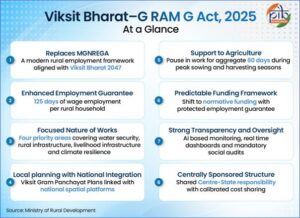
To address leakages, the new Act mandates an extensive technological ecosystem, including biometric authentication, AI-based fraud detection, GPS monitoring and e-measurement books. While the government promotes this as a move toward transparency and accountability, experts warn of a “discouraged worker effect”. Rajendran Narayanan of Azim Premji University suggests that digital layers often act as structural barriers for workers trying to access jobs and payments. There is a growing concern that removing individuals from welfare rolls due to data mismatches and branding them as ‘fake’ normalises the denial of genuine entitlements. Furthermore, while the government highlights the increase in the administrative expenditure ceiling from 6% to 9% to support this digital transition, critics argue that these resources should instead be directed toward ensuring timely wage payments, which have historically been plagued by delays.
Federalism and Future Social Protection
The Act’s transition to a CSS has significant implications on fiscal federalism for Indian states. Development economist Jayati Ghosh warns that the Centre’s increased power to determine normative allocations could be “weaponised” against opposition-ruled states. The case of West Bengal, where central funding was suspended for three years, is a classic precedent to political misuse of such a scheme. By placing the legal responsibility for employment on states while simultaneously withdrawing central funding, the Act creates what critics term as “unfunded mandate”. This has already led to regional resistance, with Gram Sabhas across states like Bihar, West Bengal and Jharkhand adopting a resolution rejecting the new Act and demanding the restoration of the old one.
Infrastructure over Individuals
Under the new Act, wage employment is tied to the creation of durable public assets through the Viksit Bharat National Rural Infrastructure Stack. Works are confined to four priority verticals: water security, core rural infrastructure, livelihood-related infrastructure and extreme weather mitigation. These plans are digitally integrated with national platforms like PM Gati Shakti to ensure whole-of-government convergence. While the government argues that this ensures every person contributes to national development, critics fear that shifting from small-scale, community-led projects to large-scale infrastructure projects prioritises macroeconomic metrics over local livelihood security, which MGNREGA prioritised.
The dismantling of a Global Benchmark:
The repeal of MGNREGA has drawn sharp condemnation from the global academic community. A collective letter signedby leading economists, including Thomas Piketty, Joseph Stiglitz, and Mariana Mazzucato, urged the Indian government not to dismantle the program that was once a global benchmark for rights-based social security employment. The signatories argue that ending MGNREGA is a “historic mistake” that eliminates a proven instrument for poverty reduction and social justice.
Transition Realities
As the new Act is implemented in the 2026-27 financial year, millions of rural households face an uncertain transition. To mitigate immediate disruption, the Ministry of Rural Development has indicated that verified MGNREGA job cards- those that have completed Aadhar-based e-KYC will likely remain valid during the initial transition phase. Currently, approximately 75% of existing job cards meet these criteria. States have been given a six-month window to formulate their own schemes consistent with the new Act. However, for the millions whose cards remain unverified, the shift to a digital-first, AI-monitored mission risks creating a period of significant instability in livelihoods.
Conclusion
The replacement of MGREGA with the VB-G-RAM-G Act represents one of the most significant pivots in the Indian social policy on rural employment since independence. It reflects a fundamental ideological shift from a right-based moral obligation of the state toward a technocratic mission focused on data, efficiency and infrastructure. The government’s gamble rests on the belief that the rural economy is now robust enough to ensure the withdrawal of its primary safety net. However, if the transition results in the suppression of work demand due to fiscal pressures or the exclusion of the most vulnerable due to digital barriers, the cost to India’s rural poor would be tragic.
As the original architect, Jean Dreze, notes, if social legislation is to succeed, it must be heavily favouring a rights-based framework, for governments naturally seek to wriggle out of their obligations. By granting the Central government maximum powers and minimum obligations, the VB-G-RAM-G Act may have secured the vision of “Viksit Bharat” at the potential expense of the very people it was originally intended to serve and protect.
Feature Image Credit: https://countercurrents.org
Leave a Reply