Category: TPF Analysis

  • Sustainability and Climate Change: Part of the Environment Complex Challenge

    Sustainability and Climate Change: Part of the Environment Complex Challenge

    Sustainability can be addressed through an independent inquiry into the fundamental issues at hand; at the same time, its interconnection with climate change cannot be ignored. What is more, both sustainability and climate change are part of a wider, existential challenge humanity faces, which I prefer to describe as the Environment Complex Challenge, encompassing biodiversity loss, environmental degradation, and air, water, and soil pollution. While I would prefer to use the fitting term Anthropocene – as the concept offers a comprehensive description of human impact on Earth and is clearly a primary concern in any debate on sustainability and climate change – it is too closely associated with the failed attempt to name a geological epoch in Earth’s history.[1] Though I was never much of a supporter of that undertaking, I always appreciated the comprehensiveness of its focus. Indeed, in the words of Delanty and Mota (2017), the Anthropocene approach highlights the co-existence of natural and social worlds and the deep intertwining of human and other planetary life. After all, sustainability is about the enduring relationship among society, the economy, and the environment, including how society organises its impact on resources and the critical issue of how to organise economic development and growth.

    With regard to sustainability, it is worth recalling its basic definition as stated in the Brundtland Report: meeting the development needs of the present without compromising the ability of future generations to meet their own needs (Our Common Future, 1987). The core argument is that we should be mindful of resource use and not consume more of existing resources than can be replaced, so that future generations will have the same opportunity for development. It is also worth recognising that reducing resource use will help mitigate climate change. While the definition in the Brundtland Report represents a general call for conscious behaviour, several more specific ‘calls to action’ can be identified. One with overriding importance is the increasing global water scarcity, a global challenge but with region-specific impacts. A recent United Nations report (Global Water Bankruptcy, 2026) highlights the seriousness of the water shortage that humanity is facing, assessing that humanity is living beyond water sustainability, as most water-related resources (rivers, lakes, aquifers, wetlands, and glaciers) are beyond full recovery; consequently, water-related risks have become systemic. It added that billions of people face water insecurity, and almost three-quarters of the global population live in countries classified as ‘water insecure’. Another serious topic is food security, and, equally worrying, food waste. A recent UN report states that in 2022, 1.05 billion tonnes, close to one-fifth of the available food, was wasted (UNEP Food Waste Index Report, 2024). With it, a considerable amount of resources is lost in growing and transporting the food in the first place, thereby having a strong negative impact on resource sustainability and on the dynamics of climate change. Land use offers another important focus, not least in connection with biodiversity loss.

    When we consider these aspects, the inherent interlinkage between sustainability (the misuse and overuse of resources) and the dynamics of climate change needs to be acknowledged. Yet sustainability is also closely aligned with the broader human environmental imprint, which, in turn, links it to core aspects of the Anthropocene discourse (setting aside the earlier call to describe a geological epoch). As such, resource extraction and resource (mis)use are critical aspects that link sustainability to the Anthropocene concept. Such a perception is also supported by a critical discussion within the Anthropocene movements: when exactly humanity started to generate a fundamental and recognisable impact on the earth. Ruddiman et al. (2015) focus far back in human history on the beginning of the agricultural era, while Delanty and Mota (2017) identify the 18th-century Industrial Revolution as the beginning of the Anthropocene. While the selection of each date can be well supported by different perceptions and interpretations, one could still argue that, from the perspective of resource use, the Industrial Revolution may be the more impactful and lasting event. After all, it can also be interpreted as the starting point of capitalism and as a never-ending demand for resources, pursued through a continuous economic growth strategy at all costs. Indeed, it is capitalism, with its relentless push for relentless economic growth and resource overuse, which undermines any long-term sustainable prospect for humanity. This unyielding pressure for continued economic growth also underlies the dynamics of climate change and thus fundamentally contributes to what I describe as the Environmental Complex Challenge.

    Returning to the Brundtland definition of sustainability, the primary demand is that humanity, indeed, every individual, must reconsider their use of resources to reduce the individual’s and, in extension, humanity’s environmental impact as much as possible. One may argue this is not only with a view towards future generations, but also with a view to the present. After all, reducing resource overuse will reduce air, water, and soil pollution, contributing to a healthy environment and a healthy life for everyone. It will also be an integral part of mitigating the climate change dynamic and, thus, climate change-related risks. However, one can argue that the list of public-professional references to sustainability exists longer than the list of references to the climate change dynamic, with a line of connected concepts and programs identifiable from the Brundtland Report (1987) to the Rio Declaration and its Agenda 21 (1992) to the Sustainable Development Goals (Agenda 2030). In addition, we could observe influential regional concepts related to sustainability, such as the Factor 4 approach, developed by von Weizsaecker, Lovins, and Lovins (1997), which advocates increasing resource productivity to achieve sustainable development. They emphasise that improving resource efficiency would not only enhance sustainable development by reducing resource overuse but also generate additional wealth. This concept reminds us again of the interlinkage between the environment, the economy, and society. This triangular relationship is a defining one for thinking about sustainability.

    Take, for example, climate change as part of the Environment Complex Challenge, of which sustainability is an inherent aspect. While it represents a global challenge, its impact is always local or regional, thereby affecting the individuals living in those areas. Examples include urban heat waves in Europe and South Asia, and widespread changes in rainfall patterns across Asia, which generate extensive negative impacts on vast rural communities that can last for years. Indeed, extreme weather events are becoming increasingly the norm and increasingly impactful. An estimation of the increasing costs associated with extreme weather events is provided by the World Economic Forum. While during the 1970-1979 decade, associated costs were USD 183.9 billion, they rose to USD 906.4 billion in the 1990-1999 decade, and to USD 1.5 trillion during the 2010-2019 decade (Charlton, 2023). Certainly, responding to extreme weather events by rebuilding and protecting is resource-intensive and therefore a challenge to sustainability in the long run or short run, depending on local circumstances. The threat of sea-level rise, again a global challenge with different local and regional implications, provides another good example. One just has to think about the various Asian megacities, from India to China, that are exposed to sea level rise. Or the threat of sea level rise to food security, when considering the potential devastating impact on the Mekong Delta, the ‘rice bowl’ of Vietnam. While localities and communities around the world are affected by climate change, some face a more severe challenge. We may take the case of Bangladesh, where rising sea levels may submerge wide parts of the country. Where will the people go? They will not stay to drown. As a consequence, tens of millions of climate refugees may move towards West Bengal, in India, and will not be stopped by security measures, when the alternative is drowning. Reducing resource use or increasing the productivity of its use will provide strong support for mitigating climate change by slowing the rate of CO2 increase. Once again, these factors highlight the linkages within the Environmental Complex Challenge and the role of sustainability within it.


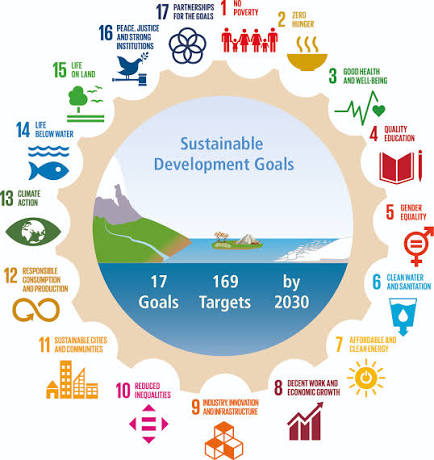
    At the same time, humanity still faces a fundamental challenge: widespread underdevelopment. One approach to addressing this challenge was the establishment of Agenda 2030, with the aim of ending poverty and hunger in all their forms and dimensions. The sustainable use of resources and protection from environmental degradation are two of the stated goals. Acknowledging the challenges facing the majority of the human population, 17 goals with 169 associated targets were identified (UN Resolution, 2015). What is more, the 2030 Agenda also underscores the interlinkages between development and the climate change challenge. Not only can climate change undermine some of the success already achieved in addressing underdevelopment, but it also increases the challenge of achieving some of the 2030 Agenda goals. Fuso Nerini et al. (2019) assert that 16 of the 17 SDGs and 40 per cent of all targets are impacted by climate change. The climate change challenge to sustainable development is increasing, since we are failing to arrest the climate change dynamic. A recent assessment indicates that we can no longer remain below a 2°C increase, let alone the 1.5°C enhanced climate target agreed in the Paris Agreement. Instead, the predictions made in the last couple of years state that we will be reaching 2.7°C warming by the end of the century (Climate Action Tracker, 2024: 1).

    The Environment Complex Challenge highlights and supports another discussion, one related to reconsidering the object of security. While this topic is linked with the late-1980s to mid-1990s debate on the meaning and interpretation of security, by replacing the state as the object of security with a focus on the individual, the relevance of these challenges is as powerful as it was back then, considering the fundamental challenges humanity is facing; unsustainable use of resources, climate change dynamic, biodiversity loss, widespread pollution issues, and environmental destruction. Lipschutz (1995) states that individual security offers a broader recognition of the insecurity people face by including human welfare issues and underdevelopment. Similarly, Smith (2005) argues that security should focus on the real conditions of insecurity that people and collectives are facing. Such a strong focus on the individual, while the role of neither central nor regional governments should be ignored when addressing the sustainability and climate change challenge, is further justified because sustainable development and addressing climate change require a change of behaviour at the individual level. Otherwise, change will not happen. Indeed, it is our responsibility to bring about change and address the fundamental challenge to our future.

    Bibliography

    Brundtland Report (1987) World Commission on Environment and Development. Oxford University Press. https://www.brundtland.co.za/wp-content/uploads/2022/08/Brundtland-Report-1987-Our-Common-Future.pdf

    Charlton, E. (2023). This is what the climate crisis is costing economies around the world. World Economic Forum. https://www.weforum.org/stories/2023/11/climate-crisis-cost-global-economies/

     Climate Action Tracker (2024) Warming Projections Global Update. Climate Action Tracker.https://climateactiontracker.org/documents/1277/CAT_2024-11-14_GlobalUpdate_COP29.pdf

    Delanty, G., & Mota, A. (2017). Governing the Anthropocene: Agency, Governance, Knowledge. European Journal of Social Theory, 20(1), 9-38.

    GLOBAL WATER BANKRUPTCY Living Beyond Our Hydrological Means in the Post-Crisis Era

    The United Nations University Institute for Water, Environment and Health (UNU-INWEH)

    https://collections.unu.edu/eserv/UNU:10445/Global_Water_Bankruptcy_Report__2026_.pdf

    Nerini, F., F., Sovacool, B., Hughes, N., Cozzi, L., Cosgrave, E., Howells, M., Tavoni, M., Tomei, J., Zerriffi, H., & Milligan, B. (2019). Connecting climate action with other Sustainable Development Goals. Nature Sustainability, 2(8), 674–680.

    Lipschutz, R. D. (1995). On Security. In R. D. Lipschutz (Ed.), On Security (pp. 1-23). Columbia University Press.

    Ruddiman, W. F., Ellis, E. C., Kaplan, J. O., Dorian Q., & Fuller, D. O. (2015). Defining the Epoch We Live In. Science, 348(6230), 348-389.

    Smith, S. (2005). The Contested Concept of Security. In K. Booth (Ed.), Critical Security Studies and World Politics (pp. 27-62). Lynne Rienner Publisher.

    United Nations Environment Programme (2024). Food Waste Index Report 2024. Nairobi.
    UNEP Food Waste Index Report 2024
    https://wedocs.unep.org/bitstreams/5c6e505d-e1d3-4731-b5b8-4ecb9693a056/download

    UN Resolution (2015). Transforming our world: the 2030 Agenda for Sustainable Development. Resolution adopted by the General Assembly on 25 September 2015 70/1. 31, https:// digitallibrary.un.org/record/3923923?v=pdf.

    von Weizsäcker, E. U., Lovins, A. B., & L. H.(1997). Factor Four – Doubling Wealth, Halving Resource. Use Earthscan.

    [1] In early March 2024, the International Union of Geological Sciences confirmed the dismissal of recognition of the Anthropocene as a description of a new geological time.

  • The West Will Fall; Fall It Must: A Moral and Civilisational Analysis of Hegemonic Decline and the Imperative of Justice

    The West Will Fall; Fall It Must: A Moral and Civilisational Analysis of Hegemonic Decline and the Imperative of Justice

    Colonial and Imperial culture of greed for wealth, manifested in exploitative and extractive strategies, and an attitude of racial supremacy-endorsed by the Church,  is so deeply entrenched in the West that it has never gone away but has continued in different forms and structures. It is this culture that needs to fall, to truly lead to a world of equality, values and ethics – reflected by the 2000-year old declaration –

    “Yaadhum Oorey, Yavarum Kelir”  – meaning “To us the world is one, All people are Kin”.

    To say the West will fall is neither prophecy nor vindictiveness but the recognition of a historical necessity. Western global dominance — built across six centuries of slavery, colonial extraction, and neocolonial control — rested on the systematic violation of ethical principles that every major civilisation has independently affirmed. Systems founded on extraction and racial hierarchy carry the mechanisms of their own collapse. The decline now visible across economic, diplomatic, and moral indicators is not an accident of geopolitics but a consequence.

    The Peninsula Foundation reads this moment through humanity’s deepest ethical traditions: Thiruvalluvar’s Thirukkural, Kaniyan Poongundranar’s declaration that all places are one and all people kin, Confucian governance by virtue, Platonic justice as harmony, and African Ubuntu — a person is a person through other people, in other words – I am because We are. Arising independently across continents and millennia, they converge on the very principles imperialism negates: universal human dignity, compassionate restraint, justice as social order, and communal interdependence.

    By 2026, even Western institutions will concede the turn. The UN Secretary-General calls for accelerating an inclusive multipolarity; the JPMorgan Centre for Geopolitics describes a multi-speed order in which universal rules no longer bind; at Davos, middle powers spoke of permanent rupture rather than transition. Against this backdrop, the United States Secretary of State stood before the world’s premier security forum and called for the restoration of five centuries of colonial empires.

    The Rubio Confession

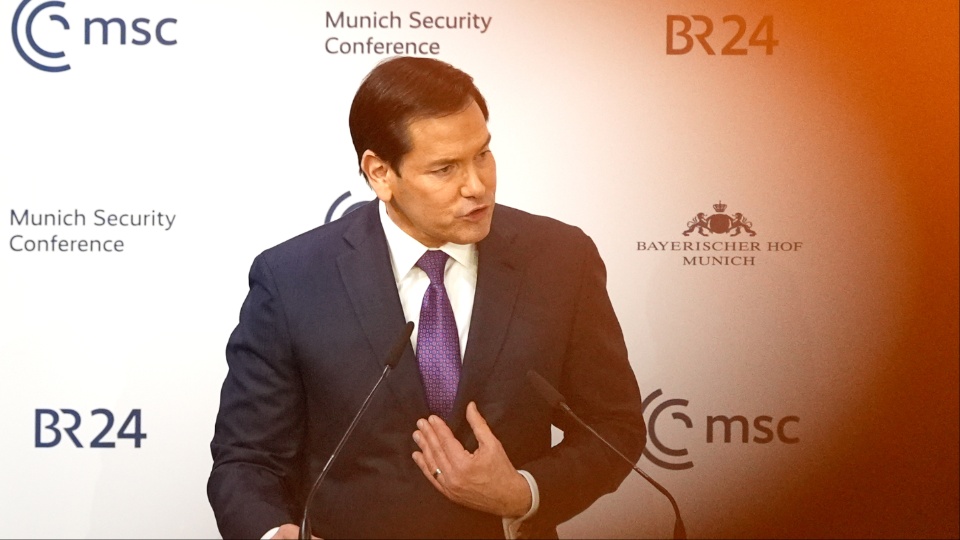
    On 14 February 2026, at the Munich Security Conference, Secretary of State Marco Rubio delivered what critics across the spectrum called the most openly pro-colonial address by a senior Western official this century. He mourned the loss of five centuries of Western imperial expansion; named anti-colonial uprisings as a cause of Western decline; urged European allies to shed their guilt and shame over colonialism; and summoned the West to a new Western century by competing for market share in the economies of the Global South — framing that South not as sovereign nations but as an economic space to be recaptured, that precise colonial and predatory framing.

    This is not merely reprehensible; it is a confession. Facing structural decline, the imperial culture has abandoned even the pretence of moral authority and reverted openly to the logic of domination. Harvard’s Mathias Risse called the speech civilisational panic dressed as statecraft. The Global South’s response was swift: Indian commentary asked whether an American East India Company was coming; Brahma Chellaney saw the restoration of an exclusionary hierarchy; Sanjaya Baru urged India, as the beacon of anti-colonialism, to condemn it with the contempt it deserves.

    The Architecture of Extraction

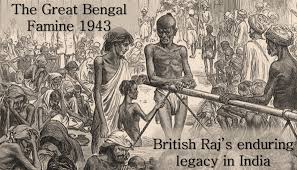
    Rubio’s call to shed guilt is not only obscene; it is historically false. Utsa Patnaik’s study for Columbia University Press establishes that Britain drained £9.2 trillion — some $45 trillion — from India between 1765 and 1938, seventeen times Britain’s current annual GDP, by compounding India’s intercepted export-surplus earnings at the ordinary rate of opportunity cost.

    India’s gold and foreign-exchange earnings — among the largest in the world — were permanently diverted to London, funding Britain’s industrial revolution, its wars, and its administration, and consuming between a quarter and a third of the central budget.

    The mechanism was an elegant deception. After 1765, the East India Company taxed Indian producers, then used roughly a third of that revenue to buy their goods for export — paying them with their own taxes while acquiring their produce for nothing. The Council Bills system of 1861 industrialised this: foreign buyers paid London in gold and sterling for bills cashable only in rupees, which the colonial government paid out of its own budget. India’s gold and foreign-exchange earnings — among the largest in the world — were permanently diverted to London, funding Britain’s industrial revolution, its wars, and its administration, and consuming between a quarter and a third of the central budget.

    Jason Hickel calculates that rich countries have drained $152 trillion from the Global South since 1960 alone. There is no Western century to restore that was not built on the theft of other civilisations’ wealth — legitimised for six centuries by the Three Cs of civilisation, Christianity, and commerce, and continued after independence through structural-adjustment programmes, an African external debt of $824 billion, and more than 13,000 active US sanctions.

    The result was stark. India held the world’s second-largest export surplus for three decades before 1929, yet per capita income barely moved between 1900 and 1946, because the surplus was siphoned abroad rather than invested at home. Its share of global industrial output collapsed from 25 per cent in 1750 to 2 per cent in 1900. Japan, which kept its earnings, industrialised; India, whose earnings were confiscated, could not. The same logic ran through slavery, which research now confirms accelerated Britain’s industrial revolution — vindicating Marx’s image of capital arriving dripping with blood and dirt. Jason Hickel calculates that rich countries have drained $152 trillion from the Global South since 1960 alone. There is no Western century to restore that was not built on the theft of other civilisations’ wealth — legitimised for six centuries by the Three Cs of civilisation, Christianity, and commerce, and continued after independence through structural-adjustment programmes, an African external debt of $824 billion, and more than 13,000 active US sanctions.

    The sanctifying licence was issued long before the Council Bills, in Rome. A sequence of papal bulls — Nicholas V’s Dum Diversas (1452) and Romanus Pontifex (1455), and Alexander VI’s Inter Caetera (1493), proclaimed the year after Columbus reached the Americas — granted Catholic monarchs the asserted right to “invade, search out, capture, vanquish and subdue” non-Christian peoples, reduce them to perpetual slavery, seize their lands, and partition the non-Christian world between Spain and Portugal. From these decrees grew the Doctrine of Discovery: the claim that lands not inhabited by Christians were free to be “discovered” and their peoples’ sovereignty void. It furnished the racial and civilisational hierarchy — Christian over heathen, European over all others — on which five centuries of conquest were built, dressing the pursuit of gold, land, and labour in the vestments of salvation. The piety was the facade; extraction was the motive. Nor is the point contested by Rome: in 2023 the Vatican formally repudiated the doctrine, conceding the bulls were “linked to political questions” and never expressions of the faith — an admission, five centuries late, that the licence to colonise was always politics wearing the mask of God.

    The Civilisational Verdict

    Every tradition the Foundation invokes condemns this architecture. Thiruvalluvar’s Kural 113 warns that gain wrongly acquired must not be retained even for a day — the exact verdict on a Council Bills system that gave Indians rupees while stealing their gold; his Kural 551 holds a ruler who works injustice crueller than a murderer. Kaniyan Poongundranar’s Yaadhum Oore Yaavarum Kelir dissolves, at its root, the civilisational tribalism Rubio attempts to revive, for exploitation requires first believing that the exploited are not our kin. Confucius taught that legitimacy flows from virtue, not force; Plato named the tyrant as one who turns governance to private enrichment — the shape of a state that declares it will run another nation and seize its oil; and Ubuntu’s relational personhood is negated wherever a system is built to take from people, unawares, what they have earned.

    Risse’s verdict is sharper still: Rubio’s West has no Indigenous peoples, no colonised subjects, no enslaved Africans, no Buchenwald near Weimar — only heroes and temporary setbacks. Such a West has never existed, and cannot be reinvigorated in 2026.

    The New Theatre of Predation

    The doctrine is not rhetorical. In January 2026, the United States bombed Venezuela, abducted its elected president, and announced that US companies would seize its oil while Washington “ran the country” — a clear violation of Article 2(4) of the UN Charter, the International Commission of Jurists held. The same month, it cut off Cuba’s main oil supplier and, through Executive Order 14380, threatened any country that resupplied it, until the UN warned of humanitarian collapse — collective punishment of a civilian population. And in February 2026, the US and Israel launched a full-scale attack on Iran, killing its Supreme Leader, striking over 42,000 civilian sites, and — at a girls’ school in Minab — at least 167 children; the American Society of International Law named it a crime of aggression, and the UN Secretary-General confirmed it contravened international law. As Britain once dressed theft as commerce, the US now dresses resource seizure as law enforcement — the structural logic is identical.

    The Measured Decline

    The economic premise of the Rubio doctrine is fiction. Asia’s share of global GDP reached 55 per cent in 2024, years ahead of projection, and BRICS economies now exceed the G7 at purchasing-power parity. The Global South’s ascent is no Western beneficence but a return to the norm colonialism interrupted — China and India together held half of world income in 1700 before colonialism drove their share below a tenth. A declining West, in truth, needs the Global South to survive.

    Moral authority has collapsed in tandem. Only 39 per cent of Americans now believe the United States is the world’s moral leader, down from 60 per cent in 2017; across Europe, support for Israel has fallen to between 13 and 21 per cent. Above all, Gaza has erased Western moral pretension: independent research estimates roughly 75,200 violent deaths and the displacement of about 90 per cent of the population, as governments that once lectured the world on human rights moved to justify mass killing — not an aberration, as one analysis put it, but an unveiling.

    The Oligarchy Behind the Flag

    Analysing nearly 1,800 US policy decisions, Martin Gilens and Benjamin Page found that economic elites and business groups exert substantial independent influence on policy while ordinary citizens have little or none — a pattern they termed economic-elite domination rather than democracy.

    There is a sharper way to name what must fall. “The West” is not its peoples; it is a structure of concentrated power that governs in their name while serving far narrower interests. Analysing nearly 1,800 US policy decisions, Martin Gilens and Benjamin Page found that economic elites and business groups exert substantial independent influence on policy while ordinary citizens have little or none — a pattern they termed economic-elite domination rather than democracy. Their method has been contested, but elite-skewed influence is widely corroborated.

    The architecture is visible and legal. Since Citizens United (2010), outside US election spending has risen more than twenty-eight-fold — from $144 million in 2008 to over $4.2 billion in 2024 — roughly $1.9 billion of it untraceable “dark money,” a few hundred mega-donors providing the bulk. Oxfam records billionaire wealth at a record $18.3 trillion in 2026, up 81 per cent since 2020; the twelve richest now hold more than the poorest four billion people, and billionaires are four thousand times likelier than ordinary citizens to hold office. Across 66 countries, nearly half of those surveyed say the rich simply buy elections.

    The same convergence runs through the war and information economies. Some $191 million was spent lobbying the US defence sector in 2025, and more than 315 senior officers passed through the revolving door into the top weapons firms between 1995 and 2021 — Eisenhower’s “military-industrial complex” at industrial scale. At the 2025 presidential inauguration, the heads of Amazon, Meta, Apple, Google, and Tesla stood arrayed behind the president — a tableau of what Shoshana Zuboff calls surveillance capitalism, in which control over information becomes a lever over democracy itself, as a Stanford working group chaired by Francis Fukuyama warned.

    None of this requires a secret cabal — only aligned interests, legalised influence, and a public whose consent is manufactured rather than freely given. The decisive point is this: the structure that drains the Global South is the same one that hollows out wages, democracy, and dignity within the West. The dividing line is not West against the rest but concentrated extractive power against the world’s peoples — the Western working majority among them, conscripted to fight its wars and absorb its costs. When we say the West must fall, it is this structure that must fall, and democratic power that must be restored, at home as much as abroad. That is not the elimination of a people; it is the end of their domination by an oligarchy that has long claimed to speak in their name.

    The Self-Defeating Logic of Overreach

    Like the Council Bills before it, the Rubio doctrine carries the mechanism of its own defeat, for each intervention rebounds structurally. The seizure of Russian assets accelerated de-dollarisation; the bombing of Iran united a region against the US–Israel alliance; the abduction of Venezuela’s president hastened Latin America’s diversification away from Washington; the oil siege of Cuba drew unprecedented condemnation. An order that must abduct, blockade, and bomb to assert itself is not ascendant — it is exhausting the legitimacy on which power finally depends.

    The Imperative of Justice

    The fall of Western hegemony opens the possibility of justice but does not guarantee it; the outcome depends on whether rising powers build the multipolar order on genuine ethical foundations rather than replicating what they inherit. That demands sovereign equality without exception — Article 2(4) applied universally, and a Security Council reformed so that no state acts as judge, party, and executor at once. It demands historical accountability: reparative justice through climate finance, debt cancellation, technology transfer, and restitution is not charity but the minimum acknowledgement of documented theft. It demands that the ICJ, ICC, and UN human-rights bodies function without great-power interference; civilisational pluralism against civilisational supremacism; and, finally, democratic renewal within the Western societies themselves, whose peoples are not the authors of empire but among its subjects.

    India is uniquely placed to articulate that alternative. Its inheritance — Thiruvalluvar’s justice, Kaniyan Poongundranar’s universal kinship, and the Gandhian tradition of non-violent resistance to precisely the domination Rubio seeks to revive — is the moral tradition colonialism suppressed but could never extinguish. Against a new Western century of restored hierarchy, the Peninsula Foundation offers the Tamil poet’s ancient answer, as relevant in Munich today as on the banks of the Kaveri two millennia ago:

    Yaadhum Oore, Yaavarum Kelir — to us all towns are one, all people are our kin.

    The West will fall. Fall it must. From its ruins, may justice arise.

    Sources

    THE MULTIPOLAR TRANSITION

    • JPMorgan Centre for Geopolitics — World Rewired: Navigating a Multi-Speed, Multipolar Order
    • United Nations — Secretary-General’s press conference on his 2026 priorities
    • World Economic Forum — Davos 2026: How middle powers are reading the global moment

    THE RUBIO MUNICH SPEECH AND RESPONSES

    • US Department of State — Secretary Rubio at the Munich Security Conference (14 February 2026)
    • The New York Times — In Munich, Rubio Stresses Shared History to Europeans
    • Mathias Risse, Harvard Kennedy School (Carr Center) — A Human-Rights-Based Reply to Marco Rubio’s Munich Speech
    • China-US Focus — American Neo-Colonialism and the Confessional State
    • Chatham House — The West vs the West at the Munich Security Conference
    • India Today — Rubio’s Munich speech signals US colonial competition for the Global South
    • The Wire — Marco Rubio’s Defence of Colonialism Demands a Response from India
    • Firstpost — Rubio’s claim of a Western century is a myth

    COLONIAL EXTRACTION: THE DRAIN AND THE COUNCIL BILLS

    • Utsa Patnaik (Columbia University Press), via Al Jazeera — How Britain stole $45 trillion from India
    • NDTV — How the British Empire robbed India of $45 trillion
    • self_study_history — Drain of Wealth: the Council Bills mechanism
    • COLLECTIVE India — ‘Drain of Wealth’, today
    • Wikipedia — Economy of India under the British Raj (global GDP share)
    • CEPR / VoxEU — Slavery and the British Industrial Revolution
    • Walter Rodney — How Europe Underdeveloped Africa
    • Jason Hickel, via Al Jazeera — Rich countries drained $152tn from the global South since 1960

    THE LICENCE TO COLONISE: PAPAL BULLS, CHRISTIANITY, AND NEOCOLONIALISM

    • Vatican News (2023) — Church defends Indigenous peoples: ‘Doctrine of Discovery’ was never Catholic — the formal repudiation
    • Canadian Museum for Human Rights — The Doctrine of Discovery (papal bulls and their language)
    • Church Life Journal, University of Notre Dame — Papal Condemnation of the Doctrine of Discovery
    • Emory University — The Philosophy of Colonialism: Civilization, Christianity and Commerce
    • Church Mission Society — Mission after George Floyd: on white supremacy, colonialism and world Christianity
    • Catalyst (McGill) — The IMF and World Bank: Neocolonial Domination, Debt Trap and Resistance

    THE CIVILISATIONAL FRAMEWORK

    • Thiruvalluvar, Thirukkural (G.U. Pope translation) — Project Madurai
    • Kaniyan Poongundranar, Purananuru 192 — Kaniyan Pungundranar
    • Confucius, The Analects — LibreTexts, Compact Anthology of World Literature
    • Plato, Republic — Plato’s Theory of Justice
    • Mogobe B. Ramose — African Philosophy Through Ubuntu

    THE OLIGARCHY BEHIND THE FLAG: CONCENTRATED POWER IN THE WEST

    • Martin Gilens & Benjamin I. Page — Testing Theories of American Politics: Elites, Interest Groups, and Average Citizens (2014)
    • Omar S. Bashir (Research & Politics, 2015) — A Review of the ‘Oligarchy’ Result — methodological critique
    • Oxfam International (January 2026) — Resisting the Rule of the Rich: billionaire wealth and political inequality
    • Brennan Center for Justice — Dark Money Hit a Record High of $1.9 Billion in 2024 Federal Races
    • Center for American Progress — Undoing Citizens United and Reining In Super PACs (28-fold rise in outside spending)
    • OpenSecrets — Defense Lobbying Profile ($191m in 2025)
    • Quincy Institute, via Jacobin — The Publicly Funded Defense Contractor Revolving Door (315+ officers)
    • ProMarket (Stigler Center) — The Trends That Defined US Antitrust in 2025 (platform power and modern oligarchy)
    • Shoshana Zuboff — The Age of Surveillance Capitalism (PublicAffairs, 2019)

    VENEZUELA

    • International Commission of Jurists — Territorial sovereignty, the rule of law and human rights must be respected
    • Le Monde — The US intervention in Venezuela violates foundational principles of international law
    • UN Security Council — US action in Venezuela puts sovereignty of states, international law at stake

    CUBA

    • Al Jazeera — US sanctions reshaping life in Cuba: UN rapporteur
    • Baker McKenzie — US declares national emergency on Cuba; Executive Order 14380
    • UN News — Cuba: UN warns of possible humanitarian ‘collapse’ as oil supplies cut

    IRAN

    • American Society of International Law — Statement Regarding the Use of Force Against Iran (2 March 2026)
    • Reuters — Iran’s UN envoy says 1,332 civilians killed in the war
    • Al Jazeera — Iranian government reveals scale of civilian casualties (42,000+ sites damaged)
    • Associated Press — International legal order tested by war in Iran (‘crime of aggression’)

    DECLINE METRICS AND MORAL AUTHORITY

    • Atlantic Council — Piece by piece, the BRICS really are building a multipolar world
    • Mastercard — Welcome to the nuanced reality of the Asian Century
    • Forbes — Americans think the US is losing its moral authority, new poll shows
    • The New Humanitarian — The end of Western values

    GAZA

    • Al Jazeera — Gaza death toll exceeds 75,000 as independent data verify loss
    • OHCHR — End unfolding genocide or watch it end life in Gaza: UN experts
  • The Costs of Strategic Silence: An Analysis of India’s Stance during the 2026 Iran War

    The Costs of Strategic Silence: An Analysis of India’s Stance during the 2026 Iran War

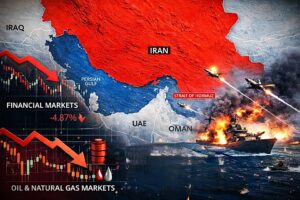
    As West Asia’s geopolitical flashpoints grew more volatile, most notably with direct confrontation between the U.S., Iran and Israel, and the broader regional escalation, New Delhi’s diplomatic posture has come under intense scrutiny. India’s response is not a sign of diplomatic paralysis, nor a passive withdrawal from the global stage, but a calculated, measured quietude – an active realisation of its “calibrated multi-alignment” strategy.
    This analysis decodes the rationale behind India’s silence through the lens of deep economic vulnerabilities, critical infrastructure dilemmas and multilateral frictions that New Delhi must navigate in order to preserve its foundational doctrine of strategic autonomy.

    Juggling Act of Multi-Alignment

    India’s diplomatic manoeuvring is taking place in a highly fractured West Asian landscape. Crucial regional partners are pulling New Delhi in opposite directions, and the government has to use precise verbiage and a highly restrained tone.

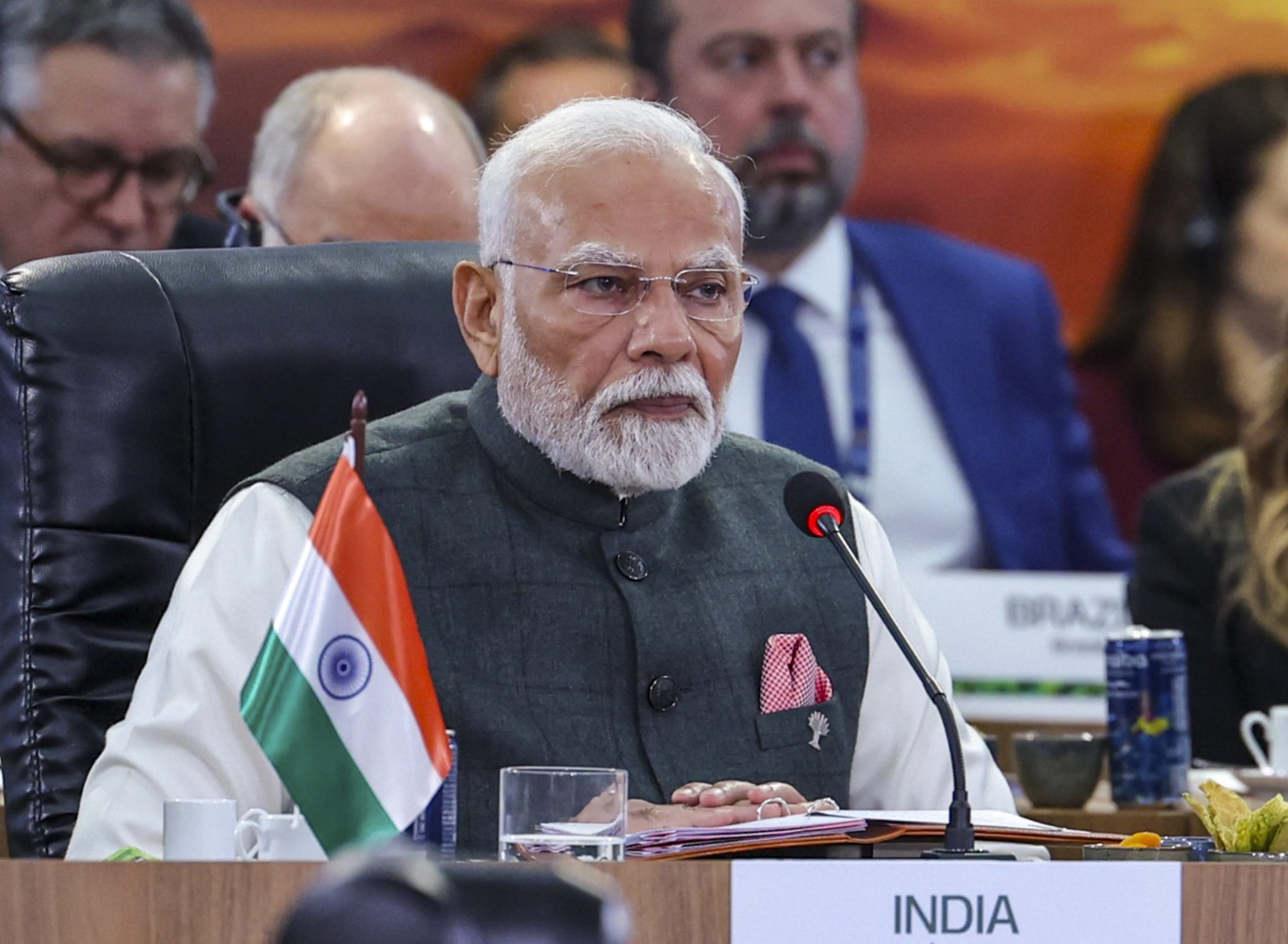
    Two conflicting diplomatic realities illuminate the complexity of this tightrope. One is New Delhi’s Gulf alignment. India signed landmark defence and energy pacts during a high-profile state visit by the Indian Prime Minister Narendra Modi to the UAE, standing “shoulder-to-shoulder” with Abu Dhabi after drone and missile strikes by Iran hit Emirati soil.

    Second is Tehran’s direct engagement with New Delhi, assuring the security of Indian commercial ships in the key Strait of Hormuz, and proposing a long-term constructive role for India in the region.

    At the same time India was hard at work, striving to ensure some degree of balancing vis-à-vis the warring parties that include negotiating for U.S.  strategic partnership and Israeli technology and weapons (The West and Israel Axis); UAE energy and defence cooperation and Saudi capital flows (The Gulf Cooperation Council – GCC); and striving to retain its stakes in the Iran and Eurasian corridor via the Chabahar port and INSTC (International North–South Transport Corridor) trade route.

    Now that these bedrock bilateral partnerships are in direct conflict, it is extraordinarily difficult to maintain tight strategic autonomy.

    Costs of Silence

    Diplomatically, India’s external attitude is restrained, but the internal home reality is one of high-stakes management of acute energy and trade vulnerabilities. The ongoing conflict between the U.S., Israel and Iran has created immediate economic headwinds to New Delhi’s neutrality, threatening its viability.

    Economic Vulnerability

    For New Delhi, the most immediate casualty is energy supply security with long-term impacts.  Retaliatory disruptions in the Strait of Hormuz have forced India to draw down its national petroleum inventories by 15%. Rising domestic fuel prices and supply chain shocks present a risk to broader inflationary pressures. These are evident in high-level political appeals to citizens to conserve fuel and undertake temporary demand reduction, and in suggestions of structural changes, including working from home and limiting gold imports, to stabilise the current account deficit.

    Unfortunately, the public at large interpreted these as signs of impending doom rather than the precautionary measures, which were the intent. Thus, people rushed in to stock up on cooking gas, vehicle fuels, and even groceries, with many hoteliers reducing their menu offerings and food aggregators that service home delivery charging additional amounts in the guise of “packing charges,” etc., pushing up retail prices for unfounded reasons.

    The most chaotic but strategic impact is expatriate safety. The transport disruptions, especially air transport to and from the Middle East, heightened fears of the potential displacement of the large Indian workforce in the region (approximately 8.5 to 10 million Indians reside and work across West Asia, primarily in the GCC countries). This prompted transactional diplomacy over “prestige politics,” focusing on localised maritime safe-passages and repatriation readiness.

    Chabahar Port Puzzle & Infrastructure Stakes

    India’s Eurasian connectivity plan is based on two big projects, the Chabahar Port in Iran and the International North-South Transport Corridor (INSTC). New Delhi’s investments are designed to bypass overland blockades and build a direct trade route to Central Asia and Russia. However, the recent surge of regional hostilities has put these strategic transit corridors in temporary jeopardy.
    India can cede operational stakes to an indigenous Iranian operator to avoid secondary sanctions, or retain direct control and risk an instant diplomatic confrontation with Washington.
    The impasse starkly illustrates the tension between India’s desire for sovereign regional connectivity and the hard realities of international secondary sanctions regimes.

    Strategic Silence: Neutrality and Autonomy
    India’s quiet reactions and generic pleas for “dialogue and restraint” are often seen by detractors as diplomatically problematic – the reluctance of a rising power to take a stand. But this could also be interpreted as a deliberate tactic for survival.

    For decades, India has been decoupling its bilateral ties under its multi-alignment framework: procuring oil from Iran and the Gulf; sourcing weapons and defence technology from Israel; securing advanced technology and strategic backing from the U.S.; and taking sovereign wealth and capital out of the UAE and Saudi Arabia.

    Both the Russian and Iranian leaderships have publicly called upon India to use its unique position to be a long-term mediator, but New Delhi has deliberately refrained from doing so.

    India has thus been consciously avoiding “prestige politics” by not taking on high-risk mediation initiatives beyond its immediate regional mandate. This stance replaces grandstanding with pragmatic, transactional arrangements, such as securing localised maritime safe passages for its commercial ships, rather than seeking to resolve deep-seated ideological wars.

    Process Diplomacy: Handling Multilateral Frictions

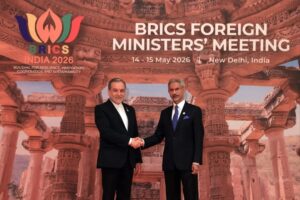
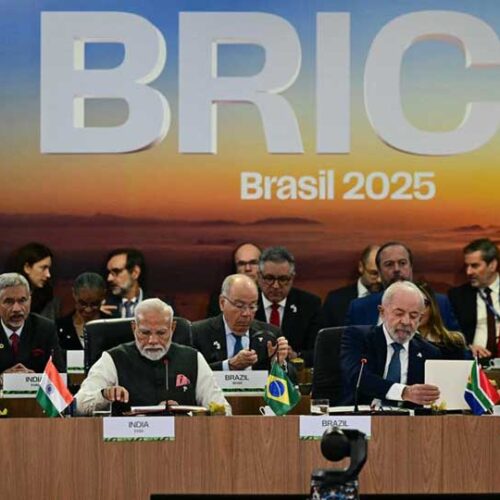
    The West Asia skirmishes have also tested India’s aspirations to lead the Global South, particularly in larger international platforms such as BRICS. The June 2026 BRICS foreign ministers meeting held in India exposed the limitations of consensus-based diplomacy.


    Iran and the UAE, the new members, joined the forum in the midst of a heated deadlock; Tehran insisted on a direct and explicit condemnation of the U.S. and Israel, while Abu Dhabi countered with a call for a formal condemnation of Iranian actions in the region.

    India used procedural diplomacy to recognise internal rifts without sweeping them away, avoiding the fracturing of the broader multilateral partnership over regional disputes, and thereby preserving its bilateral capital with both capitals- Abu Dhabi and Tehran.

    Conclusion: Is Calibrated Silence Sustainable?

    India’s strategic quiet is not an abnegation of responsibility. It is a conscious effort to protect its national interests from a volatile external crisis. In a remarkable blend of procedural diplomacy at forums like BRICS, refusal to be sucked into risky regional mediation, and pragmatic bilateral hedging, New Delhi has managed to avoid burning its bridges with either Tehran or the US-Israel-Gulf axis.

    At the same time, this crisis is a crucial test of New Delhi’s professed policy of strategic autonomy. As the country’s domestic oil reserves dwindle and external sanctions squeeze key assets such as the Chabahar Port, the economic repercussions may ultimately outweigh the benefits of diplomatic quietude. India’s challenge going forward will be to ensure that its calculated neutrality is flexible enough to change if the regional balance tips into an outright breakdown of the regional order from a managed crisis.

    Feature Image Credit: https://thewire.in

  • A Paradigm Shift in Rural Governance

    A Paradigm Shift in Rural Governance

    Critics and welfare economists argue that the new Act fundamentally alters the risk-sharing mechanism for rural employment.

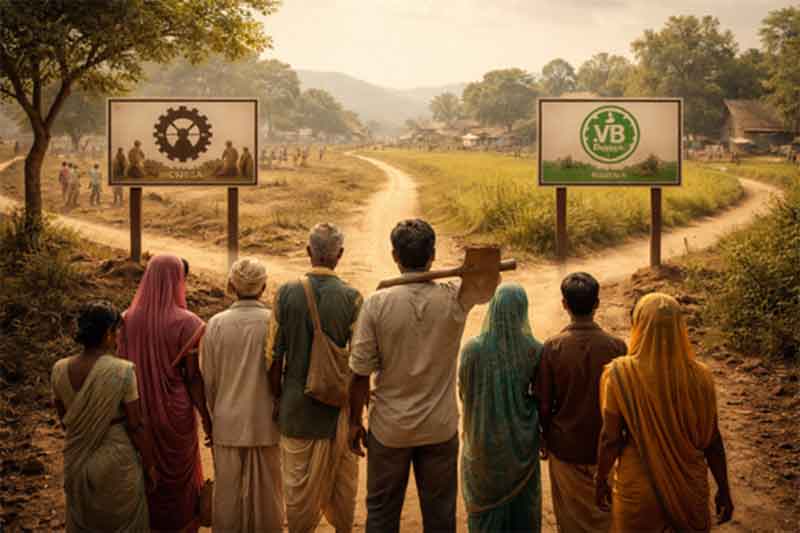
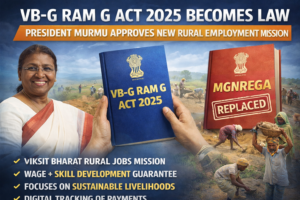
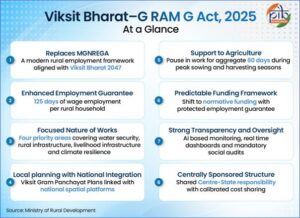
    In December 2025, India’s employment guarantee scheme underwent a monumental shift when the Union Government repealed the nearly two-decade-old Mahatma Gandhi National Rural Employment Guarantee Act (MGNREGA), replacing it with the Viksit Bharat – Guarantee for Rozgar and Ajeevika Mission (Gramin) Act, 2025 (VB-G-RAM-G Act). This transition, marked by Presidential assent on 21st December, 2025, signals a shift from a right-based, demand-driven welfare model towards a centrally sponsored, infrastructure-focused mission aligned with the “Viksit Bharat 2047 Vision”. While the new Act ostensibly increases the statutory number of workdays from 100 to 125 per household, it has sparked serious national and international debate over its potential to dismantle the safety net for India’s rural poor and erode the states’ federal powers to address such matters.

    The Government Rational

    The primary justification for this comprehensive legislative overhaul is set out in the Economic Survey 2025-26, which argues that India’s rural economy has matured beyond the need for a survival-oriented safety net. The Survey points to a 53% decline in MGREGA work demand from its pandemic peak, with demand falling by approximately 1837 million person-days in the 2025-26 financial year. Currently, rural unemployment reportedly decreased from 3.3% in 2020-21 to 2.5% in 2023-24, suggesting that the rural workforce is penetrating into non-farm employment. According to findings from NABARD, rural economic fundamentals, including formal credit access and consumption, have strengthened significantly, rendering the MGREGA model obsolete. The government also identifies “persistent structural weaknesses” in the old system, such as monitoring gaps, fake muster rolls, and the unauthorised use of machinery. The new Act intends to address these problems through advanced technological oversight.

    Structural Sabotage

    Jean Dreze, a key architect of the original MGREGA, warns that these normative allocations will function as de facto budget ceilings, effectively transforming a legal right into a rationing system and making it a supply-driven employment scheme. 

    Critics and welfare economists argue that the new Act fundamentally alters the risk-sharing mechanism for rural employment. Under the previous Act, the Central Government provided 100% of unskilled manual wages, with a demand-driven budget. The new Act reclassifies the programme as a Central Sponsored Scheme (CSS), introducing a 60:40 funding-sharing ratio for general states and a 90:10 ratio for the Himalayan and North Eastern states. Most contentious is the provision allowing the Centre to determine “normative state-wise allocations” based on parameters it prescribes. Any expenditure incurred by a state beyond this central cap must be borne entirely by the state. Jean Dreze, a key architect of the original MGREGA, warns that these normative allocations will function as de facto budget ceilings, effectively transforming a legal right into a rationing system and making it a supply-driven employment scheme.

    The Switch-off Clause and Labour Market Vulnerability

    Section 6 of the new Act introduces a “switch-off” clause, allowing states to suspend the employment guarantee for up to 60 days during peak agricultural seasons like sowing and harvesting. The government frames this as a “calibrated balance” to ensure the availability of agricultural labour and prevent wage inflation. However, this provision has been heavily criticised for institutionalising inequality. Dreze points out that this is an unnecessary complication, as rural labourers naturally seek higher-paying private-market work during peak seasons, and any additional layer of government discretion risks diluting the fundamental right to work.

    Technological Barriers and Risk of Exclusion

    To address leakages, the new Act mandates an extensive technological ecosystem, including biometric authentication, AI-based fraud detection, GPS monitoring and e-measurement books. While the government promotes this as a move toward transparency and accountability, experts warn of a “discouraged worker effect”. Rajendran Narayanan of Azim Premji University suggests that digital layers often act as structural barriers for workers trying to access jobs and payments. There is a growing concern that removing individuals from welfare rolls due to data mismatches and branding them as ‘fake’ normalises the denial of genuine entitlements. Furthermore, while the government highlights the increase in the administrative expenditure ceiling from 6% to 9% to support this digital transition, critics argue that these resources should instead be directed toward ensuring timely wage payments, which have historically been plagued by delays.

    Federalism and Future Social Protection

    The Act’s transition to a CSS has significant implications on fiscal federalism for Indian states. Development economist Jayati Ghosh warns that the Centre’s increased power to determine normative allocations could be “weaponised” against opposition-ruled states. The case of West Bengal, where central funding was suspended for three years, is a classic precedent to political misuse of such a scheme. By placing the legal responsibility for employment on states while simultaneously withdrawing central funding, the Act creates what critics term as “unfunded mandate”. This has already led to regional resistance, with Gram Sabhas across states like Bihar, West Bengal and Jharkhand adopting a resolution rejecting the new Act and demanding the restoration of the old one.

    Infrastructure over Individuals

    Under the new Act, wage employment is tied to the creation of durable public assets through the Viksit Bharat National Rural Infrastructure Stack. Works are confined to four priority verticals: water security, core rural infrastructure, livelihood-related infrastructure and extreme weather mitigation. These plans are digitally integrated with national platforms like PM Gati Shakti to ensure whole-of-government convergence. While the government argues that this ensures every person contributes to national development, critics fear that shifting from small-scale, community-led projects to large-scale infrastructure projects prioritises macroeconomic metrics over local livelihood security, which MGNREGA prioritised.

    The dismantling of a Global Benchmark:

    The repeal of MGNREGA has drawn sharp condemnation from the global academic community. A collective letter signedby leading economists, including Thomas Piketty, Joseph Stiglitz, and Mariana Mazzucato, urged the Indian government not to dismantle the program that was once a global benchmark for rights-based social security employment. The signatories argue that ending MGNREGA is a “historic mistake” that eliminates a proven instrument for poverty reduction and social justice.

    Transition Realities

    As the new Act is implemented in the 2026-27 financial year, millions of rural households face an uncertain transition. To mitigate immediate disruption, the Ministry of Rural Development has indicated that verified MGNREGA job cards- those that have completed Aadhar-based e-KYC will likely remain valid during the initial transition phase. Currently, approximately 75% of existing job cards meet these criteria. States have been given a six-month window to formulate their own schemes consistent with the new Act. However, for the millions whose cards remain unverified, the shift to a digital-first, AI-monitored mission risks creating a period of significant instability in livelihoods.

    Conclusion

    The replacement of MGREGA with the VB-G-RAM-G Act represents one of the most significant pivots in the Indian social policy on rural employment since independence. It reflects a fundamental ideological shift from a right-based moral obligation of the state toward a technocratic mission focused on data, efficiency and infrastructure. The government’s gamble rests on the belief that the rural economy is now robust enough to ensure the withdrawal of its primary safety net. However, if the transition results in the suppression of work demand due to fiscal pressures or the exclusion of the most vulnerable due to digital barriers, the cost to India’s rural poor would be tragic.

    As the original architect, Jean Dreze, notes, if social legislation is to succeed, it must be heavily favouring a rights-based framework, for governments naturally seek to wriggle out of their obligations. By granting the Central government maximum powers and minimum obligations, the VB-G-RAM-G Act may have secured the vision of “Viksit Bharat” at the potential expense of the very people it was originally intended to serve and protect.

    Feature Image Credit: https://countercurrents.org

  • Part 1 – Air India 171 Crash: NO-GO Fault & Electric Arc

    Part 1 – Air India 171 Crash: NO-GO Fault & Electric Arc

    Air India crash: How AI 171 had NO-GO faults and still flew; leading to electrical cascade, systems failure

    There is exclusive evidence that Air India 171 reported multiple NO-GO faults 15 minutes before takeoff and was still allowed to fly. Faults that likely resulted in an electric arc on the plane; as a high voltage inverter reached its thermal and dielectric limit, frying the emergency beacon, tail blackbox and knocking out the flight computers and avionics rack – a situation that ultimately could’ve led to engine computer FADEC getting corrupted data and cutting off fuel mid-air.

     

    AI 171 was one of the shortest flights in aviation history. 32 seconds in total. From takeoff to crash.

    A deadly tragedy that claimed the lives of 260. While everyone is familiar with the names of the pilots – Capt Sumeet Sabharwal and First Officer Cliver Kunders. On duty that afternoon of June 12, 2025, were also Air India 171 crew members like Shradha Dhavan, Aparna Mahadik, Saineeta Chakravarty, Nganthoi Sharma Kongbrailatpam, Deepak Pathak, Maithili Patil, Irfan Shaikh, Lamnunthem Singson, Roshni Rajendra Songhare and Manisha Thapa. Their names — representative of the ethnic diversity and cultural richness of India; just as much as the passenger list represented the broader global connect on that fateful day.

    All of them boarded the flight, unaware that AI 171’s systems had likely begun unraveling. Months, days earlier. Deep beneath their feet; inside the aircraft’s labyrinth of wires and power buses.

    The first domino: a failing core network
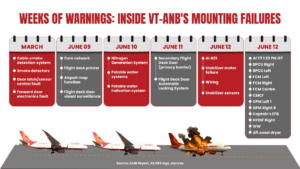
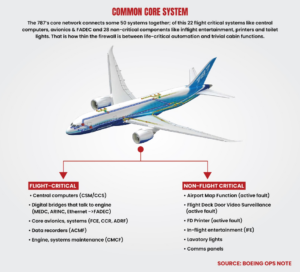
    On June 9, 2025, maintenance staff logged that the plane’s core network was degrading, as per the Aircraft Accident Investigation Bureau (AAIB) preliminary report. But because Boeing in its operations notes to airlines minimised the damage an inoperative core network could do; maintenance marked the core network as medium-risk (can be fixed in 10 days). And this core network connected about 22 flight critical systems, including FADEC; apart from 28 other more mundane functionalities like the plane’s air conditioning. And later in this article, we’ll show how this was the more important fault and how it connects to all the other failures that followed.

    But prior to core network degradation, the plane was already reporting cabin and cargo related faults in the weeks prior to the crash, as per the AAIB report. Engineers say this points to an intermittent electrical integrity fault affecting the common core cabinets and network interfaces — i.e., the shared platform that hosts cabin and cargo functions and flight critical systems. Now this could be because of electrical fault in the power conditioning module (PCM) — essentially the core cabinet’s internal power supply — which provides regulated electrical power to the aircraft’s network hardware, including the the data traffic router or ARINC 664 Cabinet Switch (ACS) and the the copper-to-fibre signal converter Fibre Optic Translator (FOX).

    And it’s first victim was the common data network (CDN) or core network on June 9 (marked “medium-risk” or CAT C MEL), followed by a fire inerter, a stabilizer motor trim unit and then all three of the plane’s flight control modules by crash day.

    Now let’s take a closer look at the second domino in the chain of failures. On June 10, the plane’s fire inerter or nitrogen generation system (NGS) — which prevents fires in the fuel tanks by depleting oxygen and replacing it with nitrogen — faulted. It was marked as “high risk” (CAT A MEL) and was likely physically inhibited by maintenance.
    (Credit: Federal published content)

    In technical terms, the AAIB report notes that the core network got marked a CAT C MEL or “medium-risk,” while the fire inerter got a CAT A MEL or “high-risk.” MELs or minimum equipment lists are the faults with which a plane is allowed to fly, provided it fixes these issues within a specified number of days. And on the day of the crash, Air India had 7 more days to fix the core network issue (till June 19, 2025) and 8 more days to fix the fire inerter issue, as per the AAIB report.

    But the issues kept piling up and then there was a third domino. On June 12, the day of the crash, the stabilizer motor unit and sensors faulted and had to be replaced on the previous morning flight (AI 423 Delhi to Ahmedabad), as per reports.
    D-Day: A jet in fault mode, a cockpit left blind

    The plane’s condition kept deteriorating.

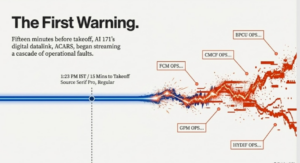
    On June 12, 2025, the day of the crash, 15 minutes before takeoff; at 1.23 PM IST, the aircraft’s ACARS logs started streaming… “BPCU OPS…FCM OPS…CMCF OPS…GPM OPS….HYDIF OPS….”

    “OPS” in Boeing maintenance parlance is “Operations” — shorthand for a detected operational fault. And AI 171 didn’t have one, but multiple operational faults, according to data shared by two independent sources. Malfunctions serious enough to disrupt electrical power stability and data flow across the length and breadth of the 120-tonne carbon-fiber leviathan.
    (Graphic by Capt Amit Singh)

    A NO-GO plane that still flew

    And not just operational faults, but NO-GO items as well. Regulations don’t permit planes to fly with faults as severe as these. So how did AI 171 still fly with no one being the wiser?

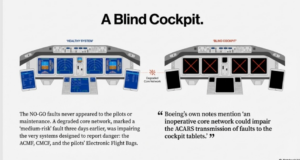
    Rewind to three days earlier, on June 9, when the jet’s core network was marked an active fault. This core network once it starts degrading can also impact the function of the systems that report faults — the Aircraft Condition Monitoring Function (ACMF), the Central Maintenance Computing Function (CMCF), and even the pilots’ Electronic Flight Bags (EFBs).

    Boeing’s internal note itself mentions this possibility, saying, “an inoperative core network could impair the ACARS transmission of faults to the cockpit tablets or EFBs.”

    By June 12, the day of the crash, the timing of the failures had turned vicious. The NO-GO faults were occurring at the exact moment the systems responsible for reporting NO-GO faults were themselves failing. The fault-reporting chain went dark.

    So when maintenance signed off on the jet at 12:10 PM IST and when the pilots performed their checks at 1:23 PM IST — the critical faults or NO-GO items simply never appeared.

    So maintenance didn’t know. Pilots didn’t know. But Boeing would’ve known. And so would Air India.
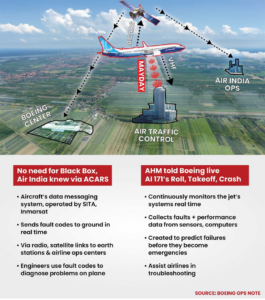
    The ACARS ring that bound them all: Boeing, Air India, SITA, Inmarsat

    As the plane kept sending out warnings — upstream, Boeing and Air India were seeing everything. Like Sauron’s unblinking eye, they were receiving a ring of real-time data from the aircraft’s digital datalink, ACARS.

    That ring formed a tight closed loop: carried by Air India’s sub-contractor SITA, relayed over satellite provider Inmarsat, and delivered to Air India’s operations centre in Gurugram and Boeing’s data monitoring hub in Belleville, Illinois, US.

    At 1:23 PM IST, that ring flashed three sets of NO-GO warnings. ACARS told everyone in the loop that AI 171’s left and right bus power control units (BPCUs), the computers that act as traffic controllers for electrical power, had entered fault mode, unable to keep the left and right 115-volt AC buses in sync. Meaning the airplane’s two main power highways were falling out of phase, a condition that can cause surges, flickers, or even short-circuits across systems.

    The domino effect: Flight computers, processors fall one by one

    Next, all three flight control modules (FCMs) left, right and centre began reporting operational errors. These are the units at the heart of the 787’s fly-by-wire system. They take instructions from the flight computers and translate pilot inputs into precise movements of the stabilizer, ailerons, and spoilers.

    And it doesn’t stop there. Two general processor modules (GPMs) also faulted. These were the 787’s backstage processors; running key software, performing calculations that feed flight management and crew alerting and the nerve-centre for fault detection and reporting.

    Taken together — the out-of-phase power buses, failing flight control modules, and glitching GPMs — AI 171 wasn’t dealing with a single fault but a system-wide degradation. As pilot Rajneesh S puts it, “Aviation outcomes emerge from complex, tightly coupled systems… failures rarely stem from a single decision or individual lapse.”

    And yet, the plane was cleared for takeoff at 1:25:15 PM IST.

    The plane’s pilots — Capt Sumeet Sabharwal and First Officer Clive Kunders, unaware of what was happening inside, guided the plane to the runway. Started roll and lifted-off at 1:38:39 PM IST.

    A surge, an arc, a cascade of collapse

    Now, takeoff is always the most electrically demanding phase of flight — all four power channels, bus control units, and hydraulic pumps draw maximum load as the plane transitions from ground to airborne mode.

    For AI 171, that surge became catastrophic. And core network degradation could’ve caused an electric arc. Now we’ll show you how AI 171’s systems could’ve arced by tracing the failure chain back to what happened on the previous flight of VT-ANB.

    “Gremlins” in VT-ANB; blank screens to blackout


    A few hours before the crash, passenger Akash Vatsa — seated aboard the same aircraft VT-ANB on its previous flight (AI 423) from Delhi to Ahmedabad— recorded a short video complaining that the air-conditioning and in-flight entertainment weren’t working, and that even the crew call buttons were dead. Post-crash when he posted the video, viewers mocked him —  calling him a fussy traveller who didn’t understand aircraft systems. But Akash was perhaps unknowingly documenting the first public evidence of a deep electrical failure spreading through VT-ANB’s core.

    Trolled for it; but 787’s Architecture vindicated Akash

    “I was badly trolled, people said I was just doing it to gain publicity; linking the inflight entertainment with air conditioning makes no sense and neither it has anything to do with the crash…I was told a non-working AC and inflight entertainment is very common in Air India,” Akash Vatsa told this reporter.

    But turns out Akash was right. On the 787, the in-flight entertainment, cabin climate control, and crew communication panels are not isolated luxuries; they share both power and data on the aircraft’s core network. The same core network that connects 22 flight critical systems including the pathways to engine computer FADEC.

    So in a scenario that resembles Lewis Caroll’s Alice in Wonderland, engineers say Boeing has created its own electrical hard-to-believe architecture, where the air conditioning, a non-flight critical system, sits ensconced on a network with other flight critical systems.

    And one of the cabin air conditioning’s compressors was sharing the same power source — a high voltage inverter, managed by a common motor system controller (CMSC R2) on the R2 line — as the fire inerter (NGS), marked “high-risk” two days earlier. The same R2 line which on the same flight also saw its right horizontal stabilizer electric motor control unit (EMCU) and stabilizer sensors fail during the descent phase, before landing.

    R2: The Rogue Power Lane
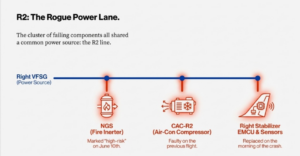
    So when the cabin air conditioning’s cabin air compressor (CAC) is in a bad power domain experiencing power surges and voltage spikes  — it can result in fluctuating air conditioning as Akash and other passengers on Flight 423 (VT-ANB) experienced.

    Below is the power path mapping from the right engine’s variable frequency starter generator (VFSG) to the high-voltage drive used by the fire inerter (NGS) and the right compressor (CAC); and to the power conversion system (PCS) to the right stabilizer motor (EMCU) and sensors.

    Power paths:

    R2 235 V AC main bus → ATRU R2 → ±270 V HVDC → CMSC R2  → NGS/ CAC-R2 / Hyd L EMP

    L2/R2 235 V AC main bus  → PCS (115 V/±130 V/28 V) → right stabilizer EMCU (115 V/±130 V) → right stabilizer sensors (28 V)

    This shows the cluster of failing components — be it the fire inerter (NGS), stabilizer motor (EMCU) or the air-conditioning compressor (CAC) — were all on the R2 line.

    Line 26: Legacy of the “Terrible Teens”
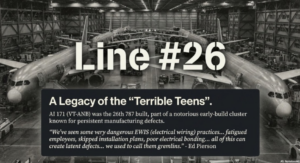
    The problems faced by Air India’s Dreamliner AT-VNB have their origin in the ‘Terrible Teens,’ say experts. In aviation parlance, the “Terrible Teens” refers to a cluster of early-build 787s that came off the assembly line with serious manufacturing defects, requiring heavy rework; becoming notorious inside the industry for persistent quality problems.

    “You see VT ANB (AI 171) was only the twenty sixth 787 built (line #26) , and back then the 787 factory in Everett, Washington was known to be having a lot of manufacturing quality issues,” Ed Pierson told the reporter.

    He said one area of particular concern was the aircraft’s electrical wiring interconnect system (EWIS). “Over the years, we’ve seen some very dangerous EWIS practices across multiple Boeing programs — not just the 737, but the 787 as well. Fatigued employees, skipped installation plans, poor electrical bonding and grounding, improperly installed wire bundles, unqualified staff performing electrical work, rushed functional systems testing, and the removal of long-standing quality inspections— all of this can create latent defects in a variety of aircraft systems that can be extremely difficult to troubleshoot,” said Pierson. He adds, “These flaws often produce those frustrating ‘No Fault Found’ or ‘Could Not Duplicate’ maintenance reports. In the military, we used to call them gremlins.”

    Was Fire inerter a victim to power transients?

    And if we rewind a little here, we can see how the first gremlin may have been the fire inerter. Remember how two days before the crash on June 10, maintenance engineers had marked the fire inerter (NGS) a high-risk fault?

    Well this fire inerter (NGS) is designed to prevent explosions by flooding the 787’s fuel tanks with nitrogen-enriched air and depleting its flammable vapour i.e. “live” oxygen. To feed that flow, the NGS uses a compressor and a high-voltage inverter, controlled by a common motor system controller (CMSC R2). And this high-voltage power line (CMSC R2 ±270 V) also feeds a cabin air compressor (CAC) and hydraulic electric motor pump (L) in the aft power distribution bay. The same compressor (CAC) whose faults were visible to the passengers above when the air-conditioning fluctuated on the previous flight (AI 423).

    Where cooling failure becomes combustion risk
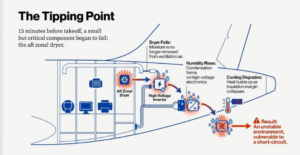
    Now comes the most inconspicuous but dark horse fault of all on the crash flight. In the tail section there is an aft zonal dryer, a small unit that removes moisture from the ventilation air around the fire inerter (NGS), compressor and its cooling ducts.

    On AI 171, this started showing abnormal readings at 1.23 PM IST, 15 minutes before takeoff, as per data from two independent sources.

    This would lead to moisture building in the aft bay; a sharp rise in humidity as the dryer isn’t removing water vapor. Condensation risk increases as droplets can form on wiring, high voltage inverters, raising the risk of short circuits or even an arc. And the cooling efficiency also drops as the moisture load would make the environmental control system (ECS) work harder and reduce heat removal margin from electronics.

    Water turns fire: How aft-bay moisture caused electrical failure

    Given what Ed Pierson and other whistleblowers have said about Boeing’s practises and improper bonding of the electric wiring interconnected system (EWIS) — a latent EWIS defect could also play in.

    So 15 minutes before takeoff and 2 minutes before taxi clearance, it’s possible the AI 171’s aft high voltage system was in an unstable state. With cooling faltering, heat building up, moisture settling in and the twin power buses (BPCUs) slipping out of phase, the airplane’s systems were likely reaching their tipping point.

    Zonal dryer turns tail into heat zone: The first ripple in AI 171’s core

    And then they seemed to have tipped over. As per data from the sources the “aft zonal dryer” anomaly seen at 1:23 PM IST likely escalated into a full-blown failure after takeoff at 13:38:39 IST.

    Flight logs accessed show an ACARS message (167280002) shows that there was a failure on the aft zonal dryer’s control feedback path in the integrated cooling system (ICS) that connects to the aircraft’s core data network. Or in other words the moisture-removal or dehumidification loop in the tail section likely failed.

    High voltage inverter drives turns metal-melting arc source
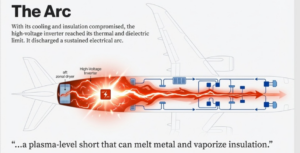
    When the aft zonal dryer fails, humidity rises and the insulation margin inside the high-voltage inverter, controlled by CMSC R2, drops sharply. If the BPCUs are also faulting, power quality can swing violently and protection may not isolate the inverter when it should. At the same time, a degraded core network can delay or corrupt trip commands, keeping the inverter energised even as its insulation environment is collapsing. And loads such as cabin air compressors for the air conditioning would likely put more stress on the inverter precisely as the insulation environment was most vulnerable.

    Under these stacked conditions, the high voltage inverter would possibly become increasingly vulnerable. As the heat builds up it is likely the inverter reached its thermal and dielectric threshold limits — meaning its cooling and insulation could no longer contain the voltage.

    “When that happens the inverter will discharge through nearby wiring harnesses a sustained electrical arc, a plasma-level short that can melt metal and vaporize insulation,” said a flight engineer, who did not want to be named.

    The surge that reached the Dreamliner’s nerve center
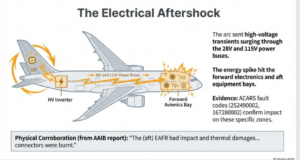
    So if a high voltage inverter arced; then this burst of energy would’ve sent transients —  sharp voltage spikes — surging back through the airplane’s 28-volt and 115-volt power buses, rippling through the core network, the data-power spine that links almost every system on the 787.

    And it looks like it did — because ACARS fault codes (252490002, 167280002) indicate that this arc likely hit the forward electronics and electrical bay. And they were probably hit harder than they normally would have because of the existing faults before takeoff.

    When two power lines fail, two others carry the plane — until they don’t

    At 1.23 PM IST, 15 minutes before takeoff, when the system began throwing up processor (GPM), fault monitoring system (CMCF), power controller (BPCU faults) this would have impacted the power routing of flight critical systems.

    The plane has two engine generators (left and right VFSGs) supplying power to four lines — L1, L2, R1 and R2. Given the nature of the faults, the system would have first decided to route flight critical components away from L1 as this line had multiple faults (GPM Left 1 + CMCF Left + BPCU Left) and would have been identified as an unclean source of energy. The next line that would’ve been marked as suspect would have been R1 as this too had faults (GPM Right 4 + BPCU Right). Leaving L2 and R2 as the lines that were probably being used most by the flight critical components on the plane. If L2 or R2 were the components’ secondary electrical path.

    The arc that hit the heart: the R2 power-line arc

    But these two lines L2 and R2 were also seeing components faulting. At 1.23 PM, 15 minutes before takeoff, the right hydraulic electric motor‑driven pump on the L2 line was faulting (HYDIF RIGHT OPS). And as we discussed earlier the R2 line had already seen the fire-inerter (NGS), stabilizer motor (EMCU) and air conditioning compressor (CAC) failing.

    So given more than normal components might be mapped on to the L2 and R2 lines – an arc on the R2 line could’ve had far more impact than normal as it hit the forward and aft avionics bay.

    Once forward and tail avionics are hit they can begin spitting corrupted data and degraded voltage states. And those kinds of faults can bleed directly into FADEC logic. If FADEC sees invalid or contradictory control signals — it can try to “protect the engine” by limiting thrust during takeoff roll. And more dangerously — if this happens once airborne — FADEC could decide to shut the engines.

    When power source for cooling systems starts the fire
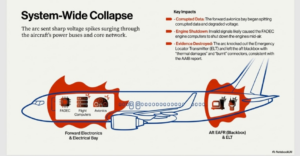
    The irony could not be more brutal. If the above interpretation is true the power sources for systems designed for cooling and to prevent fires — appears to have ignited the airplane’s electrical core instead. The high voltage inverter of the fire inerter and airconditioning likely arced to structure, burning through the aft equipment frame, cooking the wiring of the emergency distress beacon (ACARS code 252490002), crippling the auxiliary power unit (APU), charring the tail blackbox (aft EAFR), cutting the anti-collision strobe lights and starting a blackout that killed half the aircraft’s avionics and its lines to the engines.

    The scenario of the plane’s ELT and EAFR getting knocked out by an electric arc is consistent with the AAIB report, which says, “the Emergency Locator Transmitter (ELT) was not activated during this event…..the (aft) EAFR had impact and thermal damages to the housing. The wires were protruding from the housing and the connectors were burnt.”

    Boeing Papers Admit: Single Fault Can Trigger 787 Cascade

    This possibility of an arc on the R2 line cascading across multiple systems is admitted by Boeing in an internal document, where it states, “The loss of a single component within the common core system (CCS) can affect multiple systems.” And on AI 171, the component failing  – if it can be called that – was the core network. The host of the central computers, CCS, flight control computers and the command arm of the power controllers or BPCUs.

    Boeing itself states that the 787’s architecture “differs from the traditional aircraft system, where each individual system requires its own dedicated communications route…the 787 architecture reduces the amount of wiring, hardware and overall weight of the airplane…and in this architecture, individual component failures can impact multiple systems.

    Neither Boeing, Air India, DGCA India, AAIB, or other regulatory agencies like EASA have responded to request for comment.

    What Boeing didn’t design for: emergency power failing before engines
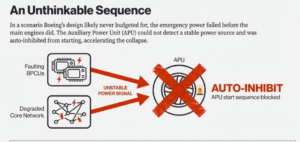
    And then comes an event that could star in Ripley’s “Believe it or Not” as this plane seems to have had its emergency power fail before the engines did. An ACARS fault code (163840003) could indicate the APU’s control unit was also hit in the power transient.

    But even if one didn’t go by the fault code but just by logic and Boeing literature, then again the emergency power or auxiliary power unit (APU) will not function until it can clearly determine a stable high-voltage source. And on AI 171, the APU likely didn’t have that.

    The power gatekeeping BPCUs had started faulting and the core network was degraded —  meaning commands to isolate a failing unit would get delayed or corrupted. So in this deck of cards, when one of the high voltage inverters arcs, with no clean high-voltage source, the 787 can auto-inhibit APU start. Because Boeing’s design philosophy was that loading a heavy consumer like the APU starter motor onto an unverified rail risks accelerating the collapse. What it wasn’t budgeting for was an electric failure that possibly first crippled the emergency power, before it triggered dual engine failure, say engineers.

    The APU That ‘Looked Fine’
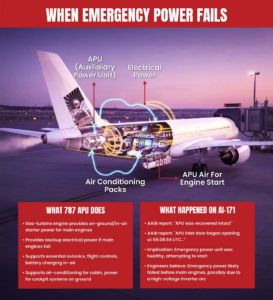
    But going by the AAIB report, you wouldn’t think anything was amiss with the APU. As AAIB report states, “ÄPU was recovered intact…APU inlet door began opening at 08:08:54 UTC.”

    Engineers say APU inlet door opening was probably a result of manual action by Captain Sumeet; and not system-driven as the 787 is unlikely to auto-start in the middle of a surge on the high-voltage drive line.

    Faults treated in isolation hid electrical failure behind 787 crash
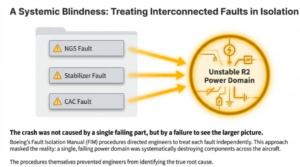
    So going back in time, the fire inerter (NGS) being identified as an active fault on June 10 seems to have been the alarm siren for a deeper electrical problem on the plane. In hindsight the engineers say the crash itself may have never had happened had the NGS and stabilizer motor problem not been seen in isolation as Boeing’s fault isolation manual (FIM) asked engineers to do.

    If Boeing and the airline had given engineers more authority, leeway and time when it came to dealing with faults, engineers say they are certain that the root cause would have been identified. That it was likely a bad power domain that had impacted the fire inerter, stabilizer motor unit and finally the high voltage inverter — triggering an arc that likely hit the forward avionics rack and inputs to engine computer FADEC — possibly resulting in engine shutdown and ultimately the plane crash.
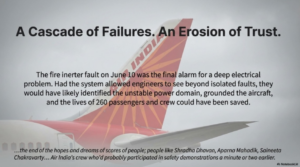
     

    And the end of the hopes and dreams of scores of people; people like Shradha Dhavan, Aparna Mahadik, Saineeta Chakravarty, Nganthoi Sharma Kongbrailatpam, Deepak Pathak, Maithili Patil, Irfan Shaikh, Lamnunthem Singson, Roshni Rajendra Songhare and Manisha Thapa — Air India’s crew who’d probably participated in safety demonstrations a minute or two earlier.

    (Disclaimer: The AAIB has not yet released its final report on the AI-171 crash. All the technical scenarios presented here are based on preliminary information, evidence submitted in India’s Parliament and Supreme Court and remain hypotheses. Also the ACARS codes mentioned in the story are not a direct map to maintenance faults as listed in Boeing’s Fault Isolation Manual; as maintenance faults are 7-8 digit strings. The 9-digit ACARS string is only partially recognisable to engineers as its proprietary code of Boeing.  For this story on conditions of anonymity we have spoken to pilots and flight engineers in India, Europe and US; and for details on actuators, sensors, structural engineering and logic paths to IT, mechanical, electrical and electronic engineers from India, working for firms that are Boeing sub contractors.)




  • India-EU Free Trade Agreement

    India-EU Free Trade Agreement

    Introduction

    After almost two decades of negotiations, the India-European Union Free Trade Agreement (FTA), an important milestone in strategic and economic partnership, was concluded. The FTA is crucial for navigating contemporary global challenges by enabling deeper market integration between the world’s 4th– and 2nd-largest economies.

    Dubbed as the “mother of all deals”, the agreement links India’s tightly guarded market to the 27 nations of the EU bloc. The focus will be on the manufacturing and services sectors and on easing market access for key European products such as cars and wine, in return for easier exports of textiles, gems, and pharmaceuticals. The formal signing of the agreement would take place later this year, after the legal scrubbing is complete and ratification by EU member states.

    The evolution of bilateral ties and the FTA

    Post-Cold War, shared democratic values increased political and economic engagement, leading to the establishment of a Strategic Partnership in 2004. The Eurozone crisis stalled the progress made under the Joint Action Plan (2005) and Broad-based Trade and Investment Agreement (BTIA) talks (2007). Ties remained under-leveraged as Europe turned inward and India diversified its partnerships, turning the relationship economically transactional and geopolitically underdeveloped.

    The talks for the FTA started in 2007, but differences over market access for automobiles in 2013 led to a jettison. The EU had stringent legal mandates for Intellectual Property Rights (IPR), investment protection, massive import duty cuts and sustainable development goals (SDGs). India, on the other hand, needed a more liberal framework for skilled professionals, addressing non-tariff barriers and excluding government procurement.

    The 2019 COVID-19 Pandemic resulted in supply chain shocks. China’s assertiveness triggered convergence on resilience and technology, leading to the revival of trade talks and the establishment of the trade and technology council (2022).The resumption of negotiations aimed at three separate agreements- two on investment protection and geographical indication, to try for an early harvest on trade. Issues like data privacy and security-related legislation, Carbon Border Adjustment Mechanism (CBAM) and IPR were not of primary concern and opening up government procurement was to follow the deals as concluded with the UAE and UK in 2025.

    The FTA has now been finalised during the 16th India-EU summit, held in New Delhi on 27 January 2026. The summit has also led to the creation of a comprehensive strategic agenda towards 2030, which will replace the EU-India Strategic Partnership: A Roadmap to 2025. The past six months of accelerated talks leading up to the agreement are a by-product of incessant increases in tariff rates on the US side, China’s economic heft, and the economic impact on the EU from the Russian invasion of Ukraine. The deal aims to advance the security alignment between the EU and Indiaami with growing concerns about India’s ties with Russia.

    The EU-India Agenda 2025 strategy is to reinforce prosperity and security with India. The key pillars of this engagement are foreign policy and security cooperation, trade and investment, sustainable modernisation, transport and urban development, clean energy, focus on outer space, artificial intelligence, issues such as global economic governance, migration and mobility, education and culture and human rights.

    Sectors of engagement

    Currently, the major focus of bilateral ties is the trade and services sector, which is showing steady growth. The EU is India’s largest trading partner; total merchandise trade with the bloc was 136.54 billion USD in 2024-25. Indian exports have increased from EUR 19 billion in 2019 to EUR 37 billion in 2024, and imports from the EU have also reached EUR 29 billion in 2024. India-EU trade in services reached INR 7.2 Lakh Crore (USD 83.10 billion) in 2024.

    Security and defence ties have deepened since the College of Commissioners’ visit to India in February 2025. The statement from this visit agreed to explore a security and defence partnership between the EU Commissioner for Defence and Space and India’s Minister of State for Defence. Simultaneous visits from the EU delegation in September and December 2025 led to advances in strategic dialogue.

    The talks have been complemented by joint naval exercises and escort operations for humanitarian assistance near Somalia in 2018 and 2019, the Gulf of Aden in June 2021, the Gulf of Guinea in October 2023 and the Indian Ocean in June 2025. On the sidelines of the EU-India summit, a security and defence partnership has also been signed. This will expand cooperation in maritime security, counter terrorism and cyber defence.

    Benefits for EU countries

    Tariffs on 96.6% of EU goods will be eliminated or reduced, saving up to 4 billion euros per year in duties on European products. The FTA grants a competitive advantage for EU exporters, granting the biggest trade opening India has given to any trade partner. The deal ensures privileged access to the Indian services market in key sectors like financial services and maritime transport, but also ensures protection of the EU intellectual property, like trademarks. This makes the customs procedures in exports quicker and easier.

    Breaking down the available data on exports for 2024 and considering the current and finalised tariff rates for the upcoming year, the bilateral relations look promising. The exports of machinery and electrical equipment amounted to 16.3 billion euros in 2024, with prevailing tariff rates of 44%. Aircraft and spacecraft, optical, medical, and surgical equipment exports amount to up to 6.4 and 3.4 billion euros, with tariff rates of 11% and 27.5%, respectively. Exports of plastics and pearls, precious stones and metals amounted to 2.2 and 2.1 billion euros, with tariff rates of up to 16.6% and 22.5%, respectively, in 2024.

    Similarly, trade in other products is depicted as product (amount of exports, tariff rates) as of 2024: In chemicals (€3.2 billion, 22%), motor vehicles (€1.6 billion, 110%), Iron and steel (€1.5 billion, 22%) and pharmaceuticals (€1.1 billion, 11%) are also remarkable. The future tariffs on these products, as part of the deal, will be 0% except for motor vehicles, which will be 10% with a quota of 250,000 EU vehicles annually; this is still beneficial for European car makers.

    Benefits for Indian sectors

    With the FTA, over 99% of Indian exports gain preferential entry into the EU, apart from bolstering the ‘Make in India’ initiative, granting new opportunities for MSMEs and creating jobs for women, artisans, youth and professionals. Indian products worth 75 billion USD are set to be exported, and commodities from sectors like textiles, leather, marine products, gems, and jewellery amounting to 33 billion USD will gain immensely from the preferential access from the FTA.

    India is powered by a young and dynamic workforce that can be leveraged to unlock opportunities across sectors and to enhance competitiveness on the global stage. The FTA also helps in integrating Indian businesses more deeply into global value chains, ensuring the country maintains its role as a key player and supplier in global trade. The labour mobility agreement opens opportunities for young professionals and seasonal workers and brings India into the EU’s Horizon research programme. The EU’s commitment to opening 144 subsectors in IT, professional services and education, and to facilitating easier labour mobility has also brought in a positive outlook.

    In exchange for the tariff cuts, the EU has granted India immediate zero-duty access for labour-intensive exports such as textiles, apparel, leather, footwear, gems and jewellery. The deal is also expected to boost India’s agricultural and food sector through preferential market access for its agricultural exports and increased competitiveness for processed foods.

    Geopolitical side of the agreement

    In the past two decades, EU-India relations have matured in a stable geopolitical environment. The India-US relationship and Europe’s transatlantic bond were held as a matter of long-term potential rather than immediate necessity. But the scenario has changed, with rampant changes in the political leadership and incessant wars. Russia’s invasion of Ukraine has forced Europe to commit to long-term defence rearmament and deterrence planning. The return of President Donald Trump to the White House has reduced trust and introduced uncertainty into Washington’s role for both Brussels and New Delhi, albeit in different ways.

    The FTA was the result of a growing common concern: aggressive tariff rates by the US and its one-sided, unilateral approach with absolute disregard for the principle of reciprocity. Some EU countries recently faced fresh tariff threatsfrom Trump, who was put out by their refusal to accept his proposed takeover of Greenland. The deal was secured amid a flurry of countries striking deals and patching things up to navigate global uncertainty. During negotiations for the FTA, the potential repercussions of US interference were a concern, particularly the kinds of reactions to the agreement.

    India-US Trade Deal

    Fortunately for India, the US and India reached a trade deal on 1 February 2026, less than a week after the India-EU FTA was announced. The current tariff rates will be cut down from 50% to 18% on Indian goods in the US. The trade relationship between the US and India has been strained since the US imposed 50% tariffs, including a 25% penalty linked to India’s purchases of Russian oil. US stocks inched higher after Trump announced the deal with Delhi on Truth Social. On the other hand, this reduction will affect small businesses in the US, which will have to pay an average tariff of 2.5% on goods from India.

    India, EU, Russia and China Relations

    The EU-India relationship is often framed as a natural strategic alignment rooted in shared values and converging interests, but it is better understood as a parallel response to a shared pressure environment. India’s decision to preserve ties with Moscow, refrain from political condemnation, and expand economic engagement through a sharp rise in energy imports remains a persistent source of friction in the EU-India relationship. Meanwhile, recalibrated threat perceptions regarding economic and security policy are a serious point of friction with India. On the sidelines of the announcement of the trade deal, the EU has pressed for a change in India’s stance toward Moscow.

    In their dealings with China, neither side can afford to fully decouple from Beijing. Deeper EU-India economic integration can help mitigate vulnerabilities linked to trade imbalances, technological dependence, and critical digital infrastructure. But India’s concerns about China’s territorial proximity and its defence engagement with Pakistan are significant. The FTA functions less as a mechanism for strategic risk reduction than as a political catalyst for strengthening resilience and autonomy.

    Challenges

    The lack of a resolution in some of the issues that jeopardised the finalisation of the deal in 2013 persists and is not addressed in the current agreement. Agricultural trade negotiations, which  historically have been a sticking point, are kept outside the tariff reductions on both sides. Under the agreement, India will not be granted exemptions under the CBAM, which came into effect on 1 January 2026. CBAM can negatively impact Indian Iron and Steel exports. This was a contentious issue even in the India-UK FTA, with a fear of exporters from India having to pay ‘Green tax’. The duty-free access of EU goods into India can disrupt the trade balance and negatively affect domestic products.

    On issues like easing of regulatory complexity, non-tariff barriers, high compliance standards, climate-related commitments, and rules of origin, both parties have differing interests. All of these issues carry adjustment costs that may be felt most acutely by exporters and suppliers operating with limited capacity. It would be critical to see whether, after the current geopolitical uncertainty settles, the intention to smooth these issues still remains.

    The FTA’s ratification in the European Parliament is pending, but the commitment to early operationalisation means the deal is set to enter into force within a year. However, the EU-Mercosur agreement, concluded after 25 years of negotiations, is now facing opposition from the European Parliament. Although approval from each country is not necessary for the India-EU FTA to be operationalised, it would still need parliamentary approval.

    Apart from the trade deal, the agreement also considers a broad array of topics. Maintaining balance amid shifting positions and competing geopolitical interests is essential for the deal to meet its preconditions.

    Feature Image Credit: weforum.org

    Infograph Credit: Al Jazeera

  • Positioning Sri Lanka in an Emerging Multipolar World Order

    Positioning Sri Lanka in an Emerging Multipolar World Order

     Summary 

    Sri Lanka sits at a strategic crossroads, with geography that positions it at the heart of global trade and regional security. Yet economic vulnerability, political inconsistency, and limited strategic clarity have constrained its influence. As global power fragments and the Global South rises, the island faces a choice: remain reactive and peripheral or leverage its location, strengthen its economy, and build stable institutions to become a neutral logistics hub, a trusted diplomatic partner, and an active contributor to the emerging multipolar order. Acting decisively now will transform strategic opportunity into lasting national influence. 

    Over the past four years, geopolitical, economic, and technological shifts have progressed at a pace unmatched in the previous three decades. The world we face today is fundamentally different from the one we knew before. War has returned to Europe, shattering the assumption that major interstate conflict on the continent was a thing of the past. The Middle East is once again engulfed in overlapping crises that draw in both regional actors and global powers. Across Africa—from the Sahel to the Horn—coups, insurgencies, and persistent violence are eroding state institutions and deepening humanitarian emergencies. The impact of Trump’s tariffs threatened many sectors globally.

    At the same time, trust in multilateral institutions, long the guardians of global order, is fading. The UN struggles to act decisively, the WTO is weakened, and even climate negotiations are increasingly shaped by national interests rather than collective responsibility. The consensus that once underpinned global cooperation is fragmenting. 

    Meanwhile, technological disruption is accelerating competition. Artificial intelligence, quantum computing, and strategic supply chains have become the new battlegrounds for influence. Nations no longer compete only for territory or ideology; they compete for data, minerals, energy, and technological dominance. 

    The post–Cold War optimism that once promised a borderless world of global democracy and free markets has evaporated. In its place has emerged an era defined by political fragmentation, economic rivalry, and strategic competition. Great-power tensions are rising, regional blocs are hardening, and smaller states are being compelled to navigate an increasingly complex and divided international landscape. 

    The rules-based order that emerged after World War II is weakening, and neither the United States nor China can dictate the future alone. Instead, a triangular contest among the global West, global East, and the global South is shaping a new geopolitical reality. 

    In addition, the Indo-Pacific has become the central arena of strategic competition between the United States and China. As China expands its economic reach, military power, and political influence, the U.S. seeks to uphold a free, open, and rules-based regional order. This rivalry now shapes security, diplomacy, trade, and technology across the entire region, with flashpoints such as the Taiwan Strait and the South China Sea posing the greatest risks of confrontation and global economic disruption. 

    Where does Sri Lanka stand 

    Sri Lanka is a small island nation, but one with a singular and powerful advantage: its geography. Positioned at the center of the world’s busiest East–West maritime corridor, the island lies along sea lanes that carry nearly two-thirds of global oil shipments and almost half of all container traffic. In an era when supply chains, shipping routes, and energy pathways are becoming strategic assets in their own right, Sri Lanka’s location is not merely convenient—it is consequential.

    This makes the island strategically valuable to every major power. For India, Sri Lanka’s stability is essential to security in its immediate neighbourhood and to its ambitions in the wider Indian Ocean. For China, the island is a vital node in the Belt and Road Initiative, linking the maritime silk route to broader trade and energy networks. For the United States, Sri Lanka is central to its Indo-Pacific strategy, where freedom of navigation, open sea lanes, and counter-balancing rival influences are paramount. 

    Beyond the great powers, there is a range of middle powers, which includes Japan, the UAE, Saudi Arabia, South Korea, and even Turkey. These countries are deepening economic, maritime, and diplomatic engagement across the Indian Ocean. Their interests converge on Sri Lanka not merely because of geography, but because of the island’s potential as a stable partner, a logistical hub, and a platform for regional connectivity. Collectively, these factors position Sri Lanka as not just a nation-state but a geopolitical crossroads, where the interests of global and regional actors meet, overlap, and at times compete. 

    Yet, despite this inherent strategic value, Sri Lanka continues to struggle in transforming geography into meaningful geopolitical influence. The island’s location offers an extraordinary opportunity, but opportunity alone does not translate into power. 

    Policy inconsistency—driven by frequent political turnover, short-term decision-making, and competing domestic priorities—has created persistent uncertainty that discourages long-term investment and undermines Sri Lanka’s international credibility. At the same time, an overly cautious geopolitical posture, often bordering on indecision, has prevented the country from defining a clear strategic identity in the Indian Ocean. 

    As a result, Sri Lanka has too often been a reactor rather than an actor: responding to external pressures instead of anticipating them, accommodating the interests of major powers instead of assertively advancing its own. Although global actors are drawn to the island because of its strategic location, Sri Lanka has not consistently leveraged that interest to secure lasting economic, diplomatic, or security advantages. 

    The task ahead is to break this cycle. Sri Lanka must transition from being merely a geographical point of convergence to becoming a strategic participant capable of shaping outcomes that affect its future. This requires strengthening the domestic economic base, setting coherent long-term foreign policy priorities, and building the institutional stability needed to negotiate with confidence. Only then can Sri Lanka convert its location into lasting influence—anchoring its long-term security, enhancing its prosperity, and securing a respected place within a rapidly reordering world. 

    For countries like Sri Lanka, the challenge is to navigate this environment with careful diplomatic balance—leveraging economic opportunities from both the U.S. and China while preserving strategic autonomy and avoiding undue dependency. At the same time, Sri Lanka’s trade-driven economy relies heavily on stable, rules-based maritime routes across the Indian Ocean and the wider Indo-Pacific, making regional peace and open sea lanes essential for national economic stability. 

    The Weak Link in Sri Lanka’s Strategy. 

    The 2022 economic crisis significantly weakened Sri Lanka’s geopolitical standing. A nation’s foreign policy is only as strong as the economic foundation beneath it. When an economy collapses, sovereignty is not formally lost, but it is quietly constrained. Sri Lanka’s reliance on external lenders, bilateral creditors, and major-power investments has narrowed its strategic flexibility and limited its ability to negotiate from a position of strength. 

    Instead of shaping regional agendas, we increasingly find ourselves adjusting to those set by others. Unless Sri Lanka restores economic resilience and rebuilds fiscal credibility, the country risks becoming a pawn in a larger great power contest rather than a strategic actor capable of advancing its own interests. 

    Real impact on Sri Lanka 

    The Trump administration’s imposition of tariffs on Sri Lankan exports functioned as a form of trade restriction rather than a targeted sanction or financial embargo. Nevertheless, the measures had material implications for the country’s economy. The garment sector, which constitutes the backbone of Sri Lanka’s foreign-exchange earnings and employment, was particularly exposed. Given that the United States represents a significant share of Sri Lanka’s export market, the tariffs threatened to impede post-2022 economic recovery and constrain critical foreign-exchange inflows. Beyond immediate economic effects, the episode highlights Sri Lanka’s structural vulnerability to shifts in global trade policy, revealing a broader strategic challenge: without enhanced economic resilience and proactive engagement in international trade frameworks, Sri Lanka risks being perpetually reactive rather than an influential actor in the global economic system. 

    The Global South Is Rising 

    One of the most consequential geopolitical shifts of our time is the emergence of middle powers within the Global South as influential actors in global affairs. Countries such as India, Brazil, Saudi Arabia, South Africa, Turkey, Nigeria, Indonesia, and Mexico are no longer peripheral participants in a system dominated by the West. They possess the economic weight, demographic scale, technological ambition, and diplomatic confidence to reshape global institutions, from trade and finance to climate governance and security frameworks. 

    This rise is visible everywhere. India is now the world’s fastest-growing major economy and a central player in the G20 and Indo-Pacific. Brazil shapes global environmental and agricultural policy. Saudi Arabia and the UAE are redefining energy geopolitics and investing heavily across Asia and Africa. South Africa and Nigeria influence continental politics, peacekeeping, and resource diplomacy. Turkey has become a pivotal actor in West Asia, Central Asia, and global mediation efforts. Together, these countries are forming new coalitions, from BRICS+ to the G20’s expanded role, challenging the old North–South divide and demanding a more equitable international order. 

    And yet, amid this global transformation, Sri Lanka remains largely absent from the strategic conversation. We participate in international forums, but seldom shape their agendas. We attend summits, but rarely articulate a coherent long-term national strategy. The country possesses clear potential, but lacks the strategic clarity and diplomatic consistency required to convert that potential into influence. 

    Sri Lanka belongs to the Global South by geography, history, and shared developmental challenges—but not yet by strategic weight or leadership. At a time when emerging powers across Asia, Africa, and Latin America are redefining global governance, Sri Lanka risks remaining on the sidelines. Unless we strengthen our capacity to articulate priorities, build alliances, and engage proactively, we may become spectators in a moment when others are reshaping the international order. 

    If the Global South continues its ascent as current economic, demographic, and diplomatic trends indicate, it will become a decisive force in global negotiations on climate, trade, energy, technology, and security. The question then becomes: Where will Sri Lanka stand? We must choose whether to meaningfully align with this emerging bloc, articulate our own national priorities, and build partnerships that reflect our strengths or risk being left behind, irrelevant in a world that is rapidly reorganising itself. 

    Opportunities in the New Disorder 

    Disorder brings danger, but it also brings opportunity. History shows that moments of global turbulence create openings for small, agile states to elevate their influence. Finland, Singapore, Qatar, and the UAE are prime examples—nations that turned geography, diplomacy, and strategic clarity into disproportionate global relevance. They became connectors, mediators, hubs, and conveners at a time when great powers were distracted by rivalry. Sri Lanka, too, possesses the attributes to rise in this emerging landscape, if we choose to act with purpose. 

    As a Maritime and Logistics Hub, Sri Lanka sits along the world’s most important East–West maritime highway, yet has not fully realised the potential of this position. With the right investment climate, regulatory consistency, and diplomatic balance, the island can become an efficient, neutral logistics hub serving all blocs: West, East, and South. This includes strengthening ports, aviation links, and digital infrastructure to support regional supply chains and trans-shipment networks. 

    As a Diplomatic Bridge in the Indian Ocean Geopolitics in the Indo-Pacific is increasingly defined by competition, mistrust, and strategic ambiguity. Amid this environment, Sri Lanka can offer what few others can: a neutral, trusted venue for dialogue, confidence-building, and conflict prevention. By convening maritime security forums, climate adaptation roundtables, and regional economic dialogues, Sri Lanka can redefine itself as a facilitator rather than a battleground for competing interests. This diplomatic role, rooted in neutrality and credibility, can become a cornerstone of the island’s long-term relevance. 

    The global transition to clean energy is rewriting economic and political priorities across continents. Sri Lanka’s hydropower, solar, and wind capacity create an opportunity to position the country as a renewable energy partner for the region. Expanding grid connectivity, attracting green financing, and partnering on technology transfers can anchor national energy security while forging deeper alliances with both great powers and rising middle powers as a Renewable Energy Partner. 

    As the Global South demands a fairer international order, Sri Lanka has the opportunity to join voices calling to democratise global governance, from the UN Security Council to the IMF and World Bank. Smaller nations deserve equitable representation and greater institutional responsiveness. By aligning with reform-oriented coalitions, Sri Lanka can gain diplomatic visibility and credibility that far exceeds its size, as a Voice for Reform in Global Institutions. 

    But seizing these opportunities requires qualities we have not consistently demonstrated: political stability, coherent foreign policy, and economic credibility. These are the foundations upon which successful small states build influence, and they are the areas where Sri Lanka has repeatedly stumbled. If Sri Lanka can correct this trajectory, through disciplined governance, strategic clarity, and long-term national planning, then the disorder of today’s world need not be a threat. Instead, it can become the opening through which the island finally realises its potential as a regional connector, a diplomatic actor, and a resilient nation in a rapidly changing global order. 

    The Path Forward 

    Choosing Influence Over Vulnerability Sri Lanka must urgently embrace a new strategic mindset built on five pillars: Balanced Foreign Policy, Avoiding entanglement in rival blocs. Economic Transformation, Strengthening the economy to regain autonomous decision-making. Indian Ocean Strategy, Leveraging geography as a national asset, not a bargaining chip. Institutional Reform, building trustworthy governance that inspires investor and diplomatic confidence. Most importantly engagement with the Global South, positioning Sri Lanka as an active contributor to the emerging world order. The next decade will determine the shape of global power for a generation. If Sri Lanka hesitates, the world will move forward without us. 

    A Moment of Choice 

    Sri Lanka stands at a historic juncture. We possess strategic advantages that many nations envy, yet economic vulnerabilities limit our choices. The world is being reordered, messily, rapidly, irreversibly. The question is not simply Where does Sri Lanka stand today? The real question is: Where will Sri Lanka choose to stand tomorrow? In a world drifting toward rivalry and fragmentation, Sri Lanka must choose to be not a pawn, but a purposeful small power—neutral, stable, connected, and confident. This is our moment to reclaim agency. If we fail, the new world order will be written around us, not with us. The choice before us is stark, to remain a spectator in a world that is rapidly changing—or to step forward, with clarity and purpose, as a nation that shapes its own destiny. 

    References: 

    Alexander Stubb, The West’s Last Chance How to Build a New Global Order Before It’s Too Late January/February 2026 Published on December 2, 2025 https://www.foreignaffairs.com/ 

    Rizwie, Rukshana; Athas, Iqbal; Hollingsworth, Julia “Rolling power cuts, violent protests, long lines for basics: Inside Sri Lanka’s unfolding economic crisis” (3 April 2022). 

    Wignaraja, Ganeshan (16 February 2025). “Sri Lanka struggles to deliver a new era of post-crisis growth | East Asia Forum”. East Asia Forum. Retrieved 29 July 2025. 

    https://www.bloomberg.com/news/articles/2022-03-17/shock-waves-from-the-war-in-ukraine-threaten-to-swamp-sri-lanka 

    https://www.reuters.com/markets/rates-bonds/sri-lankas-ambitious-governance-macro-linked-bonds-2024-12-17/#:~:text=LONDON%2C%20Dec%2017%20(Reuters),ever%20arranged%20in%20a%20restructuring. 

    https://www.voanews.com/a/india-feels-the-squeeze-in-indian-ocean-with-chinese-projects-in-neighborhood-/6230845.html 

    Reuters+2isas.nus.edu.sg+2 

    https://www.business-humanrights.org/en/latest-news/tracking-impact-of-us-tariffs-on-apparel-footwear-supply-chains-wpftc/ 

    Author:

    Air Chief Marshal Gagan Bulathsinghala RWP RSP VSV USP MPhil MSc FIM  ndc psc.

    Formerly Commander Sri Lanka Air Force & Ambassador to Afghanistan

    Director, Charisma Energy
    Director, Strategic Development, WKV Group 
    President, Association of Retired Flag Rank Officers
    Senior Fellow South Asia Foresight Network
     

    Feature Image Credit: ndtv.com


  • IndiGo Airlines’ Operational Crisis and Its Consequences for Indian Aviation

    IndiGo Airlines’ Operational Crisis and Its Consequences for Indian Aviation

    Quick Take
    IndiGo Airlines, India’s largest domestic carrier, hit a massive snag in early December 2025 with a large number of cancelled and delayed flights. The main reason was that Indigo was not ready for the strict new safety rules on how long pilots can fly, known as Flight Duty Time Limitation (FDTL), set by the aviation watchdog, the DGCA. This blunder was compounded by the fact that the airline also had 50 to 70 planes sitting idle due to technical glitches involving Pratt & Whitney engines.

    The fallout was nasty: big financial hits evidenced by a decline in stock valuation and substantial refund expenditures, and a seriously bruised reputation with IndiGo’s On-Time Performance (OTP) tanking to an abysmal 19.7%, which typically exceeded 80% before the crisis. It also left a whole lot of unhappy passengers stranded across major airports, particularly during the high-demand winter period. Competitors like Air India and Akasa Air cashed in with higher prices and snatched up market share. The IndiGo crisis also placed considerable strain on the country’s overall airport infrastructure.

    This whole chaos was a wake-up call, demonstrating that running a “bare-bones crew” model just doesn’t fly in the face of non-negotiable safety rules mandated by the regulators or, as in this case, the judiciary. It also underscored the role of the regulatory and judicial authorities in fundamentally shaping the operational and financial strategies of both private and public airline entities.

    Why the Wheels Came Off?

     The disaster was the result of new safety rules colliding with a risky strategy, particularly that of IndiGo Airlines. The new rules require the DGCA to implement the revised FDTL norms, which were intended to mitigate pilot fatigue and enhance flight safety standards.

    Table 1.

    Cause Category Specific Cause/Factor Description
    Regulatory Change New FDTL Norms The DGCA mandate necessitated an increase in the weekly pilot rest period from 36 to 48 hours, an expansion of the definition of night hours, and a severe limitation on the maximum number of night landings (from six to two per roster cycle).
    Operational Strategy Under-Rostering/Crew Shortage IndiGo historically operated with a paradigm focused on high aircraft utilisation. Its standard crew buffer (estimated at approximately 4%) became effectively zero under the new regulatory framework. Pilot associations contend that this shortfall resulted from management’s “lean manpower strategy” and hiring moratoria, despite a two-year period for preparatory action.
    Technical Factors Grounded Aircraft The airline’s capacity for operational flexibility was severely constrained by the grounding of an estimated 50–70 Airbus A320neo family aircraft. This was principally attributable to inspection requirements and component shortages related to Pratt & Whitney engines.
    Outside Interference Winter/Airport Traffic Bad winter weather, minor technical issues, and already overcrowded major airports led to crew-related delays that rippled across their entire flight network, resulting in a substantial number of daily cancellations.

     Consequences

     The Damage and the Industry Reaction

    The consequences of the IndiGo crisis were immediate and painful, which spread across the entire aviation industry.

    • Money and Image: The stock price for the parent company, InterGlobe Aviation, dropped due to higher costs and refund payments. Its image as the reliable, on-time airline was severely damaged. The company, previously lauded for its operational punctuality, faced widespread public indignation and negative media coverage over delays, inadequate communication, and poor passenger support, thereby eroding its brand equity. The widespread chaos also raised doubts among investors and passengers about the overall stability and planning skills of the Indian airline industry.
    • Operations and Oversight:  The disruptions instigated a massive cascading failure across the network, resulting in delayed crew rotations, aircraft being immobile at various airports, and a generalised loss of effective operational control.
    • Regulatory: The DGCA stepped in with a formal investigation, putting IndiGo under the microscope.

    The wider effect on the Indian aviation market was concerning as well.

    Impact on Other Major Airlines in India
    Given IndiGo’s dominant market position (exceeding 60% of the domestic market), its operational disruptions invariably affected the entire Indian aviation ecosystem, albeit with varying impacts.

    IndiGo Versus Competitors
    The differential impact of the FDTL norms as described in Table -2 highlights the varying operational strategies employed by major Indian carriers.

    Table 2

    Carrier Operational Strategy FDTL Impact & On-Time Performance (OTP)
    IndiGo The Low-Cost Carrier (LCC) model focuses on high fleet utilisation, fast turnarounds, and aggressive scheduling, particularly for late-night flights. Hit the hardest due to insufficient crew planning. OTP dropped to lows of 19.7%, significantly impacting reputation and revenue.
    Air India/Vistara (Tata Group) More diversified/Full-Service models; typically maintain larger pilot buffers and fewer highly aggressive night schedules compared to IndiGo’s LCC core. While the group also lobbied against the rules, they were largely unaffected by the immediate operational meltdown. Their OTP remained relatively stable (e.g., 66.8%–67.2% during the crisis).
    Akasa Air Newer, agile LCC. Benefited from learning from older airlines’ mistakes and potentially scaling up its crew faster. Maintained strong operational stability during the crisis, reporting OTPs in the range of 67.5%–73.2%.
    SpiceJet Legacy LCC, often facing its own financial/operational challenges. While not immune to industry pressures, their OTP (e.g., 68.7%–82.5% range) remained significantly higher than IndiGo’s during the disruption period.


    Market and Systemic Effects of IndiGo’s Crisis

     Table 3

    Airline/Sector Impact Description Market Effect
    Competitors (e.g., Air India, Vistara, Akasa Air) Temporary Market Share Gain Passengers displaced by IndiGo’s cancellations transitioned to competing carriers, leading to a short-term increase in passenger volumes for rivals.
    Competitors (Revenue) Surge Pricing and Higher Yields The sudden reduction in available network capacity from IndiGo’s cancellations allowed other airlines to implement substantial surge pricing, yielding significantly higher ticket revenue on specific routes (e.g., Delhi-Bengaluru).
    Airport Operations Systemic Strain The disorder at major aviation hubs (Delhi, Pune, Mumbai, Bengaluru) was not restricted to IndiGo. Grounded IndiGo aircraft occupying parking positions impeded the movement and punctuality of all other airlines. Furthermore, passenger unrest at boarding gates disrupted the boarding processes for other flights.
    Broader Market Negative Sector Sentiment Although competitors realised short-term financial gains, the extensive chaos undermined overall investor and passenger confidence regarding the stability and planning efficiency of the Indian aviation sector.


    The IndiGo crisis vividly demonstrated the fragility of a hyper-efficient, operationally lean business model when confronted by abrupt, non-negotiable regulatory shifts, particularly ordained by those prioritising aviation safety, such as the FDTL norms. While competitors accrued temporary benefits from increased fares and passenger diversion, the underlying issue underscored the necessity for long-term human resource planning across the entire industry.

    Besides, ultimately, the Indian aviation sector functions under the guidelines and standards, including critical safety mandates, that the regulators like DGCA and AAI enforce, while economic regulators determine market structure and operational costs. Policies, whether judicial in origin (e.g., the High Court’s directive leading to new FDTL) or governmental (e.g., AERA tariffs and privatisation initiatives), emphasise the parameters that all airlines, public or private, must navigate to ensure safety (for the customers), viability and stability (for the industry).

    The Fix: Getting Back on Track
    Solving these critical issues needs both a quick patch-up and a fundamentally sound long-term strategy.

    The central challenge involves addressing immediate resource constraints, specifically, the deficit of pilots due to the new FDTL norms and the incapacitation of 50–70 aircraft due to issues with Pratt & Whitney engines, while simultaneously pursuing long-term, systematic solutions to ensure sustainable expansion of the aviation sector.

    Short-Term Fixes

    Cut flights: IndiGo must actively reduce its flight schedule with “calibrated adjustments” to match the limited FDTL-compliant crew it actually has. The airlines should focus on reducing nighttime flights to comply with the new norms. The DGCA must formally approve the diminished schedule and enforce a strict timeline for restoration, ensuring the rebalancing measure is authentic and not a transient manoeuvre.

    Temporary FDTL Exemption: On 5 December 2025, the DGCA provided IndiGo with a one-time exemption from new pilot night-duty rules and revoked a regulation that prohibited airlines from classifying pilot leave as weekly rest. However, this exemption has generated widespread apprehension, most notably from the International Federation of Air Line Pilots’ Associations (IFALPA), which states that crew fatigue “clearly affects safety.”

    Fast Leasing:  IndiGo need to quickly hire temporary aircraft and foreign crew through wet and damp leasing arrangements to instantly inject pilots and capacity. The DGCA must streamline the security clearance and licensing endorsement procedures for wet-leased crew and aircraft to facilitate rapid deployment

    Fix the Planes: IndiGo and other affected carriers must engage in intensified collaboration with Pratt & Whitney (P&W) to expedite the delivery of spare engines and components. This necessitates aggressive follow-up, including, if necessary, diplomatic pressure on P&W’s parent company (RTX Corporation) to prioritise Indian carriers, given the magnitude of the crisis.

    Maintenance, Repair, and Overhaul (MRO) Push: Engine maintenance must be expedited through the utilisation of P&W’s Customer Training Centre and the India Engineering Centre (IEC) in Bengaluru. The government should provide incentives (such as the reduced GST on MRO components) to encourage domestic and international MRO centres to rapidly expand their capacity for quick engine turnarounds

    Long-Term Strategy
    To ensure the industry’s future growth, particularly in demand, does not precipitate a recurrence of systemic failure, the industry requires strategic, large-scale investment in both human capital and physical infrastructure.

    Invest in People:
    All airlines must set aside resources for a mandatory 15-20% crew buffer, as is the rule now. This means saying goodbye to the “lean manpower” idea and building a required crew reserve pool to ensure compliance with the new rules and also absorb future regulatory adjustments, training demands, and natural attrition rates.

    Better Training: The Indian Ministry of Civil Aviation (MoCA) needs to incentivise the rapid expansion of local flying schools and flight simulators to keep up with the massive number of new planes ordered by various airlines and reduce the reliance on expensive foreign training.

    Upgrade Infrastructure: The government needs to speed up the construction of secondary airports (such as Jewar and Navi Mumbai) to take the pressure off the fully packed primary hubs. The Airports Authority of India (AAI) must invest in modern Air Traffic Management (ATM) systems to allow more planes in the airspace and reduce delays caused by weather.

    Stronger Supply Chain: Airlines should think about mixing their fleets (e.g., using both Airbus and Boeing jets). The “Make in India” scheme needs to aggressively focus on building local MRO capacity for new-generation engines to reduce reliance on fragile global supply chains for crucial maintenance.

    To sum up, IndiGo needs to honestly cut its schedule in the short term, with the regulators keeping a close watch on any temporary waivers. But for lasting stability, the entire Indian aviation sector must make coordinated, major investments in its human capital and physical assets to comply with the necessary regulatory and judicial mandates.  The primary focus for the entire industry is safety and passenger comfort, which can’t be overemphasised.

    Feature Image Credit: freepressjournal.in

    Image; Indigo Chaos www.indiatoday.in 

  • BRICS, SCO, and Beyond: Multilateralism as a Sovereignty Safeguard:

    BRICS, SCO, and Beyond: Multilateralism as a Sovereignty Safeguard:

    Introduction

     In an era marked by profound geopolitical transformations and the gradual erosion of the Western-dominated liberal world order, emerging multilateral institutions have emerged as crucial pillars for safeguarding state sovereignty. The BRICS coalition and the SCO represent more than mere economic or regional partnerships– they embody a new paradigm of multilateralism that prioritises sovereign equality, non-interference, and consensus-based decision-making. As traditional multilateral institutions struggle to adapt to contemporary power dynamics, these alternative frameworks offer developing countries pathways to maintain autonomy while engaging meaningfully in global governance.

    The significance of these institutions extends beyond their immediate membership. They represent what scholars term “non-Western multilateralism”- a system of international cooperation that explicitly challenges the hegemonic tendencies of Western-led institutions while promoting a more inclusive and equitable global order. This emerging multilateral architecture does not seek to destroy existing institutions, but rather create parallel frameworks that better reflect the interests and values of the Global South.

    The Crisis of Traditional Multilateralism

    The contemporary crisis of multilateralism stems from structural imbalances that have persisted since the establishment of the post-World War II international order. Traditional institutions such as the IMF, the World Bank, and the UNSC reflect power distributions that no longer reflect current global realities. The Global South, which represents over 80% of the world’s population, remains underrepresented in decision-making despite its growing economic significance.

    This crisis has been further aggravated by the instrumentalisation of multilateral institutions by dominant powers. The “weaponisation of finance” through unilateral sanctions and conditional lending has prompted developing countries to seek alternatives that respect their sovereignty. Recent developments, including the blocking of Russian assets and the use of SWIFT as a political tool, have demonstrated how traditional financial architecture can be used to coerce sovereign states. Moreover, the decline of American hegemony has created what scholars describe as a “multipolar reality” without corresponding multilateral adaptation. The US, while maintaining significant capabilities, faces increasing challenges to its global leadership from rising powers, internal polarisation and diminished moral authority. This hegemonic transition has created space for alternative arrangements to emerge and flourish.

    BRICS: Institutional Innovation and Economic Sovereignty

    BRICS has evolved from an economic concept to a comprehensive institutional framework that challenges Western financial dominance through concrete initiatives. The New Development Bank (NDB), established in 2014 with $100 billion in authorised capital, provides infrastructure financing without the political conditionalities typically imposed by Western institutions. Unlike the World Bank or the IMF, the NDB operates on the principle of equal governance, with founding members maintaining equal voting rights regardless of their economic contributions. The bank’s commitment to financial sovereignty is evidenced by its promotion of local currency lending, reducing dependence on the US Dollar and enhancing monetary autonomy for member states. Since its establishment, the NDB has approved over $32.8 billion across 96 projects, extending beyond the original BRICS members to include countries like Bangladesh, the UAE, Egypt, and Algeria. This expansion demonstrates the institution’s growing appeal as an alternative development finance mechanism.

    The Contingent Reserve Arrangement (CRA)[1], BRICS $100 billion financial safety net, further exemplifies this sovereignty-preserving approach. Unlike IMF bailout programs that typically require structural adjustment policies, the CRA provides emergency liquidity support without compromising domestic policy autonomy. This mechanism reflects BRICS’ broader commitment to “sovereign equality”- the principle that all states, regardless of size or power, possess equal rights in international affairs. BRICS has also pioneered what can be termed “multipolarity without hegemony”[2]. Unlike traditional power blocs dominated by a single leader, BRCIS operates through consensus-based decision-making, preventing any member from imposing its will on others. This approach has enabled the organisation to survive even amid tensions between members, such as the China-India border disputes, demonstrating institutional resilience.

    SCO: Security and Sovereignty in Eurasia

    The Shanghai Cooperation Organisation presents a different but complementary model of sovereignty-preserving multilateralism. Founded in 2001 and now encompassing ten full members from Kazakhstan to Iran, the SCO operates under the “Shanghai Spirit”- a framework emphasising mutual trust, mutual benefit, equality, and respect for civilisational diversity. This principle explicitly rejects hegemonic behaviour and promotes what member states call “sovereign equality”.   The SCO’s approach to security cooperation illustrates how multilateralism can enhance rather than diminish sovereignty. Unlike NATO’s collective security model, which subordinates national decision-making to alliance commitments, the SCO’s Regional Anti-Terrorist Structure (RATS) operates through voluntary coordination and information-sharing while respecting member states’ autonomous security policies. This flexibility allows diverse political systems- from China’s one-party rule to India’s democracy- to cooperate without ideological convergence.

    Recent SCO initiatives further demonstrate this sovereignty-preserving orientation. The organisation’s condemnation of Israeli airstrikes on Qatar in 2025 emphasised violations of sovereignty and territorial integrity, reaffirming members’ commitment to the UN Charter and international law. Similarly, the SCO’s consistent opposition to unilateral sanctions and “use of force” reflects its members’ shared experience of external pressure and desire for autonomous development. The proposed SCO Development Bank, approved during the 2025 Tianjin Summit, represents the organisation’s evolution toward comprehensive economic cooperation while maintaining its sovereignty-centric principles. This institution aims to reduce dependence on Western-controlled financial mechanisms.

    Beyond BRICS and SCO: The Emerging Multipolar Architecture

    The significance of BRICS and SCO extends beyond their individual contributions, encompassing their role in fostering a broader “alternative multilateral order”. This emerging architecture is characterised by overlapping institutional arrangements that provide developing countries with multiple options for international cooperation. The intersection between BRICS and SCO- with China, Russia, India and Iran participating in both organisations-creates synergies that multiply their collective influence. This networked approach to multilateralism offers several advantages for sovereignty preservation.

    First, it provides “institutional balancing” against Western dominance without creating rigid opposing blocs. Countries can selectively engage with different institutions based on their specific interests and needs, maintaining strategic autonomy while benefiting from multilateral cooperation. Second, the proliferation of alternative institutions creates competitive pressure on traditional multilateral organisations to reform. The success of the NDB and AIIB has prompted the World Bank to reconsider its lending practices, while BRICS expansion has encouraged greater Global South representation in G20 deliberations. Third, these institutions promote what scholars term “civilisational diversity” by accommodating different political systems and development models without imposing uniform standards. This approach contrasts sharply with the liberal internationalist emphasis on convergence toward Western norms and institutions.

    Challenges Ahead

    Despite their achievements, BRICS and SCO face significant challenges that constrain their effectiveness as sovereignty safeguards. Internal heterogeneity presents the most fundamental obstacle. BRICS encompasses liberal democracies, authoritarian systems, and hybrid regimes with vastly different economic structures and foreign policy priorities. This diversity, while philosophically valuable, complicates coordination on specific issues and limits the depth of integration possible.

    The organisation also suffers from what critics describe as “institutional impersonation”, rather than genuine innovation. The NDB, despite its rhetoric of alternative development finance, continues to rely heavily on US Dollar funding and has yet to break from neoliberal lending paradigms fundamentally. Similarly, the SCO’s expansion has diluted its cohesion without proportionally enhancing its capabilities.

    Geopolitical tensions among members pose additional challenges. China-India border disputes, Russia-Iran competition in Central Asia and Brazil’s complex relationship with both Washington and Beijing create centrifugal forces that limit institutional effectiveness. The organisations’ consensus-based decision-making, while respecting sovereignty, can also enable paralysis when member interests diverge significantly. Moreover, these institutions seem primarily reactive rather than proactive in their approach to global governance, except for the SCO. They struggle to develop comprehensive solutions to transnational challenges such as climate change, cross-border terrorism, pandemic response, or financial instability.

    Implications for Global Governance

    The rise of BRICS, SCO and similar institutions signals a fundamental transformation in global governance architecture. Rather than replacing existing institutions, they are creating a phenomenon of competitive multilateralism, a system where multiple institutional frameworks compete for legitimacy and membership. This competition has both positive and negative implications for international cooperation. On the positive side, institutional competition encourages innovation and responsiveness to members’ needs. The success of alternative development banks has prompted traditional institutions to reform their practices and increase the representation of developing countries. Competition also gives smaller states greater bargaining power by offering alternative forums to address their concerns.

    However, competitive multilateralism also risks fragmenting global governance and reducing its effectiveness in addressing transnational challenges. If great powers increasingly retreat into separate institutional ecosystems, the coordination necessary to manage global problems may become more difficult. The Ukraine conflict has already demonstrated how geopolitical divisions can paralyse international institutions and hinder collective responses to security threats.

    The success of these institutions lies in creating alternatives to traditional development finance, providing platforms for South-South cooperation and articulating alternative visions of international order for contemporary global governance. However, their ultimate impact will depend on their ability to transcend their current limitations and develop more sophisticated approaches to balancing the preservation of sovereignty with practical international cooperation. Their continued evolution will significantly influence whether the emerging multipolar world becomes characterised by cooperation or competition, inclusion and fragmentation.

    Notes:

    [1]Wso, A.A. & Mahmood, R.M. (2025). The Role of BRICS in Reshaping the Global Order: Confronting Western Hegemony in a Multipolar World. European Scientific Journal, ESJ, 21 (17), 24. https://doi.org/10.19044/esj.2025.v21n17p24

    [2] ibid

  • INDIA AND AFGHANISTAN: PRAGMATISM IS KEY

    INDIA AND AFGHANISTAN: PRAGMATISM IS KEY

    Given that the Taliban appear sincere in their determination to secure peace and improve their citizens’ standard of living, it is prudent for India to remain cooperative and avoid overinvolvement in such matters at this time. It is also likely that, over time, Indian influence on Afghanistan—whether through development, trade, security, health, or education—will have a positive impact on Afghan society, mainly through the younger generation of Afghans studying in India


    Introduction

    During his week-long visit to India in October 2025, Mawlawi Amir Khan Muttaqi, the foreign minister of the Islamic Emirate of Afghanistan, became the first high-ranking Afghan official to travel to the country since the fall of the Ashraf Ghani regime in August 2021. The minister who faced a travel ban was permitted to enter India after the UN Security Council Sanctions Committee approved a waiver application on his behalf [1]. His visit and its portents have sparked numerous commentaries across South Asia. India-Afghanistan relations, which had receded from the limelight post the 2021 Taliban takeover in Kabul, are now being viewed with renewed interest.

    ‘Afghanistan Map: courtesy Nations Online Project’

    Afghanistan’s Enduring Importance

    A glance at the map above shows why Afghanistan is called the ‘Heart of Asia’. A country for the most part rugged and mountainous, it borders seven nations – Iran, Turkmenistan, Uzbekistan, Tajikistan, China (Tibet at the tip of the Wakhan Corridor), India, and Pakistan- and sits at the crossroads of South, Central, and West Asia. The sheer geostrategic importance of this location, the multitude of tribal ethnicities and loyalties that transcend borders, and a fierce sense of independence have resulted in a turbulent history and the awarding of a less flattering designation: ‘Graveyard of Empires’. The most recent example is the defeat of the mighty Soviet Union by the Afghan Mujahedin, who were armed and aided by the West and trained by its proxy, Pakistan.

    Another reason for interest in Afghanistan is its vast untapped mineral reserves, valued at over $1 trillion, located in 24 specific ‘areas of interest’ across the country’s 34 provinces[2]. With nations eager to diversify sources of critical minerals and rare earths, this represents a hugely attractive opportunity. Landlocked Afghanistan’s access to the Arabian Sea and Persian Gulf passes through Pakistan and Iran, respectively. This has implications for the West’s relations with both countries. Russia, seeking to consolidate influence in its neighbourhood, became the first country to recognise the Taliban regime in July this year. However, it is China that has arguably taken the lead in rehabilitating the Taliban regime globally. It has resumed full diplomatic relations by posting an ambassador in Kabul. To quote Shivam Shekhawat in his paper of July 2025, ‘…At the international level, Beijing has argued for Afghanistan’s reintegration and urged the international community not to interfere in its internal affairs. It has called for the removal of sanctions imposed on the Taliban leaders, the release of the country’s foreign reserves, and keeping aid independent from any political preconditions[3]. Also, it steadily expands its influence through trade. During the period August 2024 to August 2025, its exports to Afghanistan increased by 41.7% from $114 million to $161 million[4].

    With its unbroken history of conflict since 1979 and the geopolitical, social, and economic consequences on its neighbours, Afghanistan remains crucial to regional stability. Zobair Solahi discusses this in his April 2022 paper, where he states, ‘..A stable and peaceful Afghanistan could be an integral actor in trade, transit, and political stability across the Eurasian continent, but continued unrest will undermine regional peace and stability…’[5] This perspective needs to be appreciated by those who hold reservations about India-Afghanistan relations and who attribute hidden motives to our development efforts aimed at improving the lives of the Afghan people.

    The Situation Today

    The reasons for the failure of Operation Freedom’s Sentinel (the US mission focused on counterterrorism and strengthening Afghan security forces) and NATO’s Operation Resolute Support are widely debated. What is not debated is the outcome – a Taliban regime that holds sway over the entire country. The new government (Taliban 2.0) now includes various factions of the Taliban militia, integrated into a new Afghan Army (AA). This AA has kept the structures of the old Afghan National Army (ANA) intact, replacing key commanders with Taliban loyalists. The AA has successfully sidelined a splintered opposition. While certain officials of previous regimes are eking out a quiet existence in Kabul under Taliban watch, warlords of past eras like Gen Rashid Dostum, now largely ineffective, live in exile. Younger men such as Ahmed Masood, son of the renowned ‘Lion of Panjsher’, Ahmed Shah Masood, lack both experience and influence. The few leaders of significance who still hold credibility, like former Vice President Amrullah Saleh, do not possess the resources to challenge the Taliban on a large scale needed to effect regime change. Although an armed opposition will continue mounting guerrilla actions against the Islamic Emirate, these are unlikely to lead to a change of government, at least in the medium term, and that too with extensive outside support, which is currently not forthcoming.

    After its voluntary exit in 2021, the recent shift of the US towards Afghanistan has sparked much speculation. The US desire to retake the Bagram air base outside Kabul is being linked to a host of reasons, including the official one of monitoring Chinese nuclear assets across the Wakhan corridor. There may be other motives—such as using a strategic asset like Bagram to effectively oversee activities in Russia, Iran, and Pakistan, and even the possibility that the threat of retaking the base could be used to extract unspoken concessions from the Taliban. Nonetheless, it seems unlikely that the US would forcibly enter Afghanistan without the Taliban’s approval. More critically, even if a small American military presence is allowed by the Taliban, the implications of a superpower’s re-entry into the Heart of Asia will be significant, considering China’s and Russia’s footprints, and the situations in Iran and Pakistan. Afghanistan will once again be a key factor, with potential consequences for India.

    India and Afghanistan

    The Indian Embassy in Kabul. Original photo courtesy India Today, posted on KabulNow 22 October 2025

    Although India downgraded its diplomatic presence in Kabul following the Taliban takeover, it maintained a ‘technical mission’ with minimal staff. After a four-year period of ‘wait and watch’, it became evident that the Taliban is now the sole governing force in Afghanistan. The longstanding history of friendly economic, developmental, and people-to-people ties, the shared strategic understanding with previous regimes dating back to 1947, and the current regional security concerns highlight the need to restore the relationship for the benefit of both nations. On its part, the Taliban is eager to once again secure Indian developmental assistance, especially amid the reduction of Western aid following criticism of the human rights situation in the country.

    The outcome of this understanding is the visit of Mawlawi Muttaqi, an event of seminal importance. This was followed by the elevation of the technical mission in Kabul to the status of the Embassy of India on 21 October 2025[6]. Even a brief review of India’s assistance to Afghanistan over the years would reveal the substantial stakes India has in that country and the benefits it has gained in terms of goodwill. Areas of cooperation and assistance (including security collaboration) are well-known and numerous. It is to the credit of successive Indian governments that policy towards Afghanistan has remained consistent (except for a brief cooling period during the first Taliban regime and the current situation).

    Understandably, India at this juncture does not want to be crowded out of Afghanistan, ceding all the space to others. To their credit, the Taliban have recognised the advantages of cooperation. Mawlawi Muttaqi struck the right chords in his media interactions in Delhi by answering all questions (including those about women’s rights from Indian women journalists). He has welcomed the return of Sikh and Hindu refugees (an unlikely event, considering that most have either obtained Indian citizenship or secured asylum in the West) and has echoed India’s stance on terrorism. Importantly, he has criticised Pakistan, blaming its policies for the unrest along the Durand Line. India, on its part, has announced six new development projects in Afghanistan, along with several other measures outlined by External Affairs Minister Mr Jaishankar during his meeting with Mawlawi Muttaqi[7]. Muttaqi has also requested increased trade, including via Wagah-Attari, for which Pakistan’s cooperation is vital. Given that countries with hostile relations continue to trade (Bangladesh and Myanmar being examples, with Bangladesh approving the import of 50,000 tonnes of rice from Myanmar under government-to-government agreements)[8], this is a proposal worth pursuing, especially with Chabahar under US sanctions and the economic unviability of a sustained air corridor for trade and commerce.

    Importantly, on security issues, India and non-Taliban Afghan regimes have traditionally shared a similar outlook. With Taliban 2.0 promising to end the influence of terror organisations, including Al Qaeda and Islamic State, a stable Afghanistan could become a reality, benefiting regional stability. This would support Indian plans for trade corridors to Central Asia and beyond. It is clear that Afghanistan no longer considers Pakistan its benefactor, as shown by the changes in Afghan-Pakistani relations following the rise of Taliban 2.0. Actions such as Pakistan’s unilateral fencing of the Durand Line (allegedly even encroaching on Afghan territory in certain instances)[9], forcibly returning Afghan refugees, and border skirmishes culminating in Pakistani air strikes on Kabul, followed by the Doha ceasefire, are indicators. Currently, Pakistan’s prized ‘strategic depth’ through Afghanistan stands denied. This benefits India, as Pakistan must maintain heightened vigilance on two borders. If the Pakistani government recognises its constraints, a less hostile relationship with India might also be possible.

    Conclusion

    Optimists might argue that India-Afghanistan relations have come full circle over four years. However, there are vital differences in how the two nations approach ideology and governance. Despite claims to the contrary, gender and ethnic disparities in Afghanistan are too evident to overlook. Additionally, India must bear in mind that the opposition’s return to power could always be a possibility in the long run. Therefore, fully endorsing Taliban policies in the face of visible social instability in Afghanistan is neither wise nor desirable, as it conflicts with India’s longstanding views on such issues.

    That said, the mere fact that such problems have been acknowledged by Taliban 2.0, even if somewhat vaguely, is a step forward. Also, given that the Taliban appear sincere in their determination to secure peace and improve their citizens’ standard of living, it is prudent for India to remain cooperative and avoid overinvolvement in such matters at this time. It is also likely that, over time, Indian influence on Afghanistan—whether through development, trade, security, health, or education—will have a positive impact on Afghan society, mainly through the younger generation of Afghans studying in India. With a combination of pragmatism and goodwill, this relationship is destined to benefit both nations.


    End Notes:

    [1]‘UNSC Panel Clears Muttaqi’s Travel, Paving Way for Taliban’s First Ministerial Trip to India’ The Wire 03 October 2025.

    [2]  ‘Mapping Afghanistan’s Untapped Natural Resources’ Mohammed Hussein and Mohammed Haddad  Al Jazeera, 24 September 2021.

    [3] ‘Understanding China’s Engagement with Afghanistan Under Taliban 2.0’  Shivam Shekhawat  Issue Brief Issue No 816 July 2025 Observer Research Foundation.

    [4] ‘  Website of the Observatory of Economic Complexity (OEC) China and Afghanistan trade figures’.

    [5] ‘Afghanistan: A Junction of Asia’s Connectivity’  Zobair Salahi  The National Bureau of Asian Research May 28, 2022

    [6] Upgradation of the Technical Mission of India in Kabul to Embassy of India, Government of India, Ministry of External Affairs  , media centre press release dated 21 October 2025 on website mea.gov.in

    [7] EAM’s opening remarks during meeting with Foreign Minister of Afghanistan (October 10, 2025)’ Government of India, Ministry of External Affairs media centre speeches and statements on website mea.gov.in

    [8] 100,000 tons of rice to be imported from Myanmar, Dubai, Dhaka Tribune, 22 October 2025,   Tribune Desk.[4] ‘  Website of the Observatory of Economic Complexity (OEC) China and Afghanistan trade figures’.

    [9] ‘The Durand Line and the Fence: How are communities managing with cross-border lives?’ Sabawoon Samim,  Afghanistan Analysts Network  , Regional Relations  , April 2024.


    Feature Image Credit: www.arabnews.com