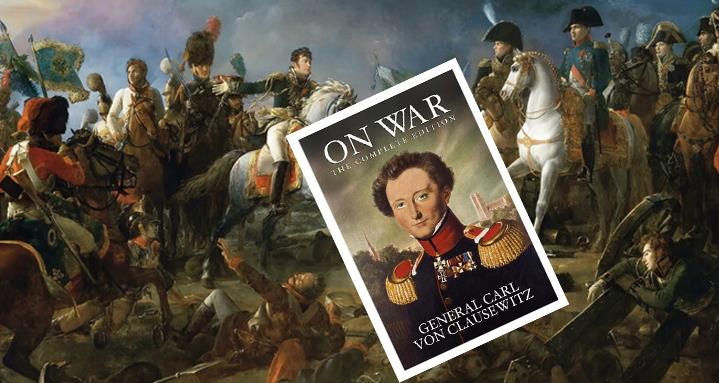
For the uninitiated, Carl Von Clausewitz (1780-1831) was a Prussian General and one of the foremost military thinkers of his era. His seminal work, Vom Kriege (On War), remains required reading to this day.
While attending the book launch of a respected colleague and friend on the nature and conduct of future wars, I was immediately struck by his comment questioning Clausewitz’s relevance nearly two centuries after his passing. Ironically, his book’s title was an adaptation of a quote from Clausewitz’s work!
Undoubtedly, questioning the relevance of his ideas, first published in 1832 by his widow after his sudden death from cholera, is a pertinent question. The ongoing conflicts in Ukraine and Iran have made abundantly clear the overwhelming impact of technology on the battlefield.
That is not only changing how armies are organised and fight, but also reshaping our understanding of the very nature or character of war, what victory implies, and how one aspires to achieve it. In fact, these are the very questions that Clausewitz examined more than two centuries ago.
Thus, there is no gainsaying the fact that any serious critical commentary on the relevance, or otherwise, of his Works in this day and age requires us to first delve into the prevailing environment of the time. It stands to reason that we cannot fully grasp his concepts and philosophy, or their nuances, without a better understanding of the influences that shaped his thinking.
Interestingly, earlier in his service, he spent two years as a French captive in 1806, following the Prussian defeat by Napoleon. At the time, he served as Aide-de-Camp to Prince August of Prussia. After his release, he initially tutored Crown Prince Friedrich Wilhelm of Prussia, then helped Scharnhorst rebuild the Prussian Army and served as an advisor to the Archduke of Prussia.
Subsequently, upset that Prussia was forced to assist the French, he resigned his commission in 1812 to join the Imperial Russian Army. In September of that year, he fought at the brutal Battle of Borodino, the bloodiest single day of combat and the turning point in Napoleon’s campaign against Russia. He was wounded in another battle in 1813.
He then rejoined the Prussian Army and went on to serve as Chief of Staff to one of the Prussian Corps Commanders at Waterloo in 1815. From 1818 to 1830, he was the Administrative Director of the Military Academy in Berlin, where he devoted himself to his writings.
His ideas on war were undoubtedly grounded in his own experiences in the field and at the highest levels of the military. Beyond that, his views were also shaped by the collision of two major historical revolutions that dominated his life and times.
The first was the French Revolution, which introduced the concept of “total war and mass mobilisation” (levée en masse) and transformed warfare from a limited conflict fought by mercenary armies into a clash driven by nationalism and the collective will of the civilian populace.
The second is the rise of Romanticism, a reaction against the rigid and rationalistic ideas of the Enlightenment, or the Age of Reason. An Age that championed logic, order and scientific calculation, including the notion that warfare could be calculated with perfect mathematical formulae.
Romanticism, on the other hand, held the belief that human beings cannot fully understand the universe through intellect alone. It shifted the focus towards intense emotion, individual imagination, and the wild, untamed power of nature.
On War, as translated by Colonel J J Graham, is in three volumes, divided into a total of eight “books” as follows:
- Book I: On the Nature of War.
- Book II: On the Theory of War.
- Book III: Of Strategy in General.
- Book IV: Combat.
- Book V: Military Forces
- Book VI: Defence
- Book VII: The Attack.
- Book VIII: Plan of War
In essence, Clausewitz came to believe that war was not governed by any rigid system of rules and principles in its conduct. Instead, it celebrated the free operation of genius, changing historical conditions, moral forces, and the elements of uncertainty and chance. These elements, especially the enemy’s counteractions, created “friction” that made even the simplest tasks difficult, uncertain, and wholly based on nonlinear logic.
Many regard his most important contribution to strategic thought as his dictum that “war is a continuation of state policy by other means”, thereby making clear that the military is the last resort and must be so tasked as to assist in fulfilling the chosen political aim. In this context, even newer concepts, such as the Chinese concept of ‘Three Warfares‘ and what is now commonly referred to as hybrid or grey zone war, only reinforce the Clausewitzian dictum.
After all, for example, the Three Warfares concept integrates psychological, media and legal warfare in peacetime to achieve strategic political objectives without resorting to violent confrontation. As the leading thinker on this subject, Stefan Halper of Cambridge University explained, “it is a dynamic three-dimensional war-fighting process that constitutes war by other means.”
If one were to apply this Clausewitzian dictum to the ongoing US-Iran Conflict, the major lessons that emerge, and which point to its continuing relevance, are:
- First, American leadership’s lack of clarity about its political aim. Was it regime change, preventing Iran from going nuclear, or ensuring the Straits of Hormuz remained open? Each aim required very different military responses. By trying to club them together, the US Military fell through the cracks, with debilitating results.
- The fact that US military operations were launched at a time when there were indications that third-party-facilitated negotiations over nuclear proliferation were succeeding, probably because of the impact of the earlier attacks on Iran’s nuclear facilities and the ongoing economic blockade, again points to a lack of clarity regarding political aim.
- Alternatively, if regime change was the political objective, then ground operations to “compel their opponent to fulfil their will” were unavoidable. That would have required establishing a suitable firm base from which ground forces, in appropriate strength, could have been launched. It is clear that confusion over the selection of the primary political objective and the premature unleashing of forces, without adequate preparation, is largely responsible for the situation the United States finds itself in.
There have been public statements by President Trump on a couple of occasions when his frustrations with the campaign’s progress have got the better of him, hinting at the use of nuclear weapons against Iran. It is a threat, though expressed much more subtly, that has also been made by a frustrated President Putin, unhappy with the stalemate in the ongoing Russo-Ukrainian Conflict.
While the portents of such an action are deeply disturbing, the question of escalation can be clearly understood through the distinction Clausewitz made between ‘Absolute War’, or war on paper as he called it, and ‘Real War’, or war as it really occurs in the real world. In the abstract, absolute war aims at compelling the adversary to do one’s will, with no logical limit to the application of force, which clearly invites inherent escalation as the adversary responds in a like manner, and can only end in the annihilation of one or both sides.
Real war, by contrast, is premised on fulfilling political objectives shaped by three “real-world” factors, the ‘Trinity’, as he called them. These are, first, the government and the political objectives it sets, primarily to ensure it remains in power. Second, the people: their expectations, levels of patriotism, and willingness to bear the humongous costs war imposes, especially as “friction” adds to the unpredictability of outcomes. And finally, the military (or Army, as it was then), and their capabilities, standards of leadership, training, and levels of motivation and morale.
From all of this, it is quite evident that if wars are to lead to a successful culmination, a balance among the dynamics that shape each of the factors is vital. The practical, the social, and the psychological have to be in harmony. Otherwise, escalation, stalemate, or annihilation are the likely outcomes. Clearly, all wars of the 21st Century, whether past or ongoing, have borne out this truth.
In the context of the US-Iran Conflict, for example, Iran, by its actions, has shown us the impact of friction on an adversary’s conduct of operations. Whilst wars are still tethered to Clausewitz’s dictum “war is a continuation of policy by other means”, a rational, intentional instrument of state policy to achieve political goals, victory continues to be defined by one’s ability to impose one’s will on an adversary, which, in most circumstances, requires a preponderance of boots on the ground. Something that seems unlikely when adversaries have no common border and are separated by 1000s of kilometres.
What has changed, however, is the character of war, with its conduct shaped by tactics, technology, and psycho-social dynamics. Iran has adopted an asymmetric response and shifted its use of missiles from purely military destruction to using them as tools of influence, targeting urban centres and infrastructure to create psycho-social impact. Clausewitz, in fact, referred to this very aspect when he described “war as more than a true chameleon that slightly adapts its characteristics to the given case”.
While a chameleon changes only its colour on the outside and remains exactly the same creature on the inside, war changes its internal nature in every single conflict. Interestingly, in his work he covered only two operations of war, attack and defence, on which victory depended, which, it can be said, in the modern context translate to manoeuvre and firepower.
Although all attention and focus at present are on technological advancements and their impact on the nature and conduct of war, the fact of the matter is that C4ISR, drones, artificial intelligence, autonomous weapons systems and stand-off precision-guided munitions continue to directly affect the two fundamental aspects governing the conduct of operations—manoeuvre and firepower, or attack and defence.
To fully appreciate Clausewitz’s importance and relevance in the 21st Century, one must clearly understand the distinction he drew between strategy and tactics. As he put it in Book 2, Chapter 1, “Tactics is the theory of the use of military forces in combat. Strategy is the theory of the use of combats for the object of the war”.
As the prominent Clausewitz scholar Christopher Bassford emphasises in his introductory essay to the book ‘Clausewitz on Strategy: Inspiration and Insight from a Master Strategist’ (Ed T von Ghyczy, B von Oetinger, C Bassford, published by John Wiley & Sons, 2001), ‘On War’ is “quintessentially a philosophy of strategy that contains the conceptual seeds for its constant rejuvenation”.
He implies that Clausewitz’s holistic approach incorporates logical, historical, psychological, and sociological elements to prevent strategic thinking from becoming rigid dogma.
In essence, Clausewitz helps us understand how strategy should be formulated: not within some laid-down matrix, but through first principles that allow preparation for future conflict. An issue that is often missed leads militaries to fall into the “Last War Trap”, or, to quote Georges Clemenceau, the French Prime Minister during the closing stages of World War I, “generals always prepare to fight the last war, especially if they had won it”.
Other examples also show why Clausewitz remains relevant today. The universal Principles of War, which most militaries continue to follow, emanate from the very philosophy that Clausewitz enunciated. For example, take two of the accepted Principles of War—‘selection and maintenance of aim’ and ‘concentration of force’. In Book 3, Chapter 11, Clausewitz states, “The best strategy is always to be very strong; first in general, then at the decisive point… There is no more imperative and no simpler law for strategy than to keep the forces concentrated. No portion is to be separated from the main body unless called away by some urgent necessity.”
Similarly, regarding ‘Flexibility’, another important Principle of War that remains relevant today, he writes in Book 1, Chapter 7, “Everything in war is very simple, but the simplest thing is difficult”. In essence, he suggests that because unexpected complications (friction) always occur, a plan must be simple and adaptable, so that it can withstand chaos. The true genius of the commander lies in its preparation.
In conclusion, I would add that while it may superficially appear that wars of today have no connection to either Napoleon’s invasion of Russia or how the Battle of Waterloo came to be fought, the truth is that they remain intricately connected. It is this vital connection that Clausewitz minutely examined — namely, what was meant to be achieved by undertaking a war and the factors that governed the formulation of strategy. What he wrote two centuries ago remains relevant, and we can only ignore his views on strategy and the higher direction of war to our own detriment.
Leave a Reply