Tag: Human rights

  • The end of the liberal world order is not the end of the world – we just need to fight for freedom AND equality

    The end of the liberal world order is not the end of the world – we just need to fight for freedom AND equality

    The turmoil concerning Brexit, the Rise of the „Rest” (the fast developing countries), dramatic social inequality, the exclusion of ever larger parts of the populace (the decline of the „Rest“, which is excluded from globalization), the rise of radical Salafism, all these developments have contributed to worldwide emotions, that the promises of globalization have been disappointed and been revealed as illusions. When Juergen Habermas, the noted German philosopher judged in 1991 concerning the democratic revolutions in the former states of the Warsaw treaty, that Western modernity would now transcend into the Orient not only with its technical achievements, but also with its emancipatory and democratic principles he was hardly more than the prisoner of the idealism concerning Western modernity. Although being fully aware of the negative impact of two world wars, colonization and its exorbitant violence, Auschwitz and the Cold War, and fighting for his whole life against a repetition of these developments he still believed to be able to rely on a cleaned, purified Western modernity, an approach which his companions, Anthony Giddens and Ulrich Beck, labeled second modernity. Again, in the years starting with the Arab Rebellion or the Arab Spring it seemed as if the conceptions of democracy, human rights and freedom were transcending from the Western world to the Orient, and its final victory seemed to be plausible – a purified Western modernity would triumph in the end – and Francis Fukuyama wrote his second masterpiece by arguing that at the end of history still stands democracy. But now we are already discussing post-democracy and Paraq Khanna is labeling the current phase as devolution – struggles for a local or at least regional identity.

    The liberal world order after 1991 was based on capitalism (centered on property as natural and human right), the assumption that worldwide free trade will finally lead to peace (economic globalization) and is accompanied by the orientation towards consumerism as a cultural norm. But consume does neither generate values nor identity. International organizations served the purpose of regulating conflicts between sovereign states and the military, political and economic hegemony of the United States secured this kind of liberal world order, or rather the United States payed the costs (this is the point Trump hangs up), both, out of their own interest or as being the trustee of the whole. This liberal world order now is tattered in fragments, not least because the US under Trump abandoned it willfully, whereas the Europeans are desperately trying to preserve it but don’t stand a chance, because they are relying on an idealized past which never existed in the developing and poor countries.

    Contrary to the assumptions of the pundits of glo-calization (Robertson and Bauman), the local showed to be not only an amendment of neoliberal globalization, but a counter-movement to the process of globalization (IS, Trump, „Buy American“, Brexit, Marine Le Pen, Duterte, Bolsonaro, Salafism, the European radical right, populistic movements). In his notes on Nationalism, George Orwell already wrote, that emotion does not always attach itself to a nation. It can attach itself to a church or a class, or it may work in a merely negative sense, against something or other – we can add against anybody, who does not belong to “us”. In short: We against the Rest. But the “Rest” is not far away anymore, as in neoliberal globalization the regions in Sub-Saharan and Saharan Africa, in southern India, in the MENA-states, but they are within the West (either as excluded sub-proletarians, the precariat, or as refugees). Although being a counter-reaction, the current waves of struggles for local identities and advantages are as a negation bound to neo-liberal globalization, the globalization of liberalism without equality, which we label tribal globalization.

    The advent of tribal globalization does not signify the end of globalization, but the end into the illusions into globalization, which nevertheless has its undisputed successes. But there is no way back to an idealized globalization before Trump, Salafism, or an idealized neo-liberal world-order, because these developments were exactly the result of which they are purporting to fight. The exclusion of the „superfluous“, the „Rest“, produced by neo-liberal globalization, the advent of precarious kinds of life and the liquidity of identity throughout the world must be understood as a double one: The “Rest” is excluded from the positive aspects of globalization and people who are belonging to the  Rest are the arbitrarily used enemy-image to construct a fixed „We“-identity („We against the Rest”). And this “Rest” comprises roughly two third of the world’s populace. As the neo-liberal globalization has led to such a social acceleration of the transformation of the whole world,  people, communities and polities of all kinds are trying to cope with this process by re-inventing age-old static identities, which are so old, that it is supposed that these will outdo even this transformation. Such seemingly fixed identities are: Race, ethnicity, religion, patriarchy, and – perhaps the oldest one, sex and gender (this can explain the terrible rise of violence against women); and of course, identity through the exercise of violence itself, which is reverting the feeling of being totally powerless into being almighty. Especially biological differences are re-actualized, because they seem to be not subject to change.

    These seemingly fixed identities are those of the pluperfect, the far distant past, which can be viewed as being free from the failures of the simple past, and mainly free from the failure of the immediate fathers – as already was typically for the German Nazis. Tribal identity is a perfect construction, because it is transporting the ideal of being absolutely united against everybody who is not belonging – and the question: Do I belong is the most important question in tribal globalization. Whereas tribes throughout the world are vanishing, tribal thinking in terms of „We against the Rest“ is flourishing. Such a modern tribe could be based on ethnicity, religion, sex, nation or whatsoever, it is not the content, which characterizes a modern tribe, but having a tribal identity (typically is Trump’s crony capitalism and with relation to the IS, not their ideology is so much counting, but belonging to a previously powerful tribe). With the emergence of tribal globalization, the very understanding of local order and world order is at stake; order wars are arising, when our order or that of others is dissolving (either only in our perception or in reality); our own order is challenged by another concept or and another order is transgressing into our own (the refugee crisis in Europe). The fast developing countries are not immune concerning the accelerated transformation of societies and identities and the task to cope with this development.  As the main problem of neo-liberal globalization is the dissolution of identities and the exclusion of ever growing parts of the populace, that of the emerging tribal globalization the re-invention of age-old fixed identities, which is leading to order wars, what might be a solution?

    Based on the concept of the floating (Clausewitz) and developing (Hegel) balance and harmony (Confucius), we strongly advocate the position, that the West as well as the East is only able to hold on their order and values, if these are discursively balanced and harmonized by the contribution of all great civilizations of the earth. Although the liberal world had its undisputed advantages like the rise of the newly industrialized nations, the current developments are already indicating its end. To put it to the core: freedom as the basis of the liberal world order is turning into oppression or civil wars without equality– just in the name of freedom. Whereas in the 20th century the colonized civilizations had to learn to live with the victorious West, in the twenty-first century the civilizations of the earth finally have to learn to live with one another. This task requires a floating balance (Clausewitz) between freedom and equality, a kind of harmony (Confucius: difference with unity and unity with difference) within societies and between states.

    Image Credit: WikiImages from Pixabay
  • The Demand for Gondwana: India’s Adivasi Homeland

    The Demand for Gondwana: India’s Adivasi Homeland

    Mohan Guruswamy December 03, 2017

     The scion of the former Gond kings of Chandagarh or Chandrapur now in Maharashtra, Birshah Atram was recently visiting the Gond homelands in the former composite Adilabad district to meet his kinsmen in the various garhi’s in the region. Birshah Atram is descended from a line that was established in Chandrapur in the 13th century by Kandakya Balal Sah. The Gond kings ruled till 1751 when the British annexed it after the Raja of Nagpur died childless. Birshah who holds two PhD’s in English and Ancient Indian History has for long been seeking a solution to the vexed Adivasi problem, that has also morphed into the Telugu led Naxalite rebellion that enables the Central and State governments to turn it into a law and order issue, by highlighting the grievances of the Adivasi people. He believes that the Central Government needs to implement the constitutional provisions and promises made in the Constituent Assembly by recognizing Gondi language and self-rule for the Gond people by carving out a Gondwana state of the Gond homelands in Maharashtra, Madhya Pradesh, Andhra Pradesh and Chhattisgarh.

    There is a vast and mostly forested region spanning almost the entire midriff of India from Orissa to Gujarat, lying between the westbound Narmada and eastbound Godavari, bounded by many mountain ranges like the Vindhya, Satpura, Mahadeo, Meykul, and Abujhmar, that was once the main home of the Adivasi. The late Professor Nihar Ranjan Ray, one of our most distinguished historians, described the central IndianAdivasis as “the original autochthonous people of India” meaning that their presence in India pre-dated by far the Dravidians, the Aryans and whoever else settled in this country. The anthropologist Dr. Verrier Elwin states this more emphatically when he wrote: “These are the real swadeshi products of India, in whose presence all others are foreign. These are ancient people with moral rights and claims thousands of years old. They were here first and should come first in our regard.”

    Unfortunately like indigenous people all over the world, the India’sAdivasis too have been savaged and ravaged by later people claiming to be more “civilized”. They still account for almost 8% of India’s population and are easily it’s most deprived and oppressed section. Though this is the home of many tribal groups, the largest tribal group, the Gonds, dominated the region. The earliest Gond kingdom appears to date from the 10th century and the Gond Rajas were able to maintain a relatively independent existence until the 18th century, although they were compelled to offer nominal allegiance to the Mughal Empire.

     The great historian Sir Jadunath Sarkar records: “In the sixteenth and seventeenth century much of the modern Central Provinces (today’s MP) were under the sway of aboriginal Gond chiefs and was known under the name of Gondwana. A Mughal invasion and the sack of the capital had crippled the great Gond kingdom of Garh-Mandla in Akbar’s reign and later by Bundela encroachments from the north. But in the middle of the seventeenth century another Gond kingdom with its capital at Deogarh, rose to greatness, and extended its sway over the districts of Betul, Chindwara, and Nagpur, and portions of Seoni, Bhandara and Balaghat. In the southern part of Gondwana stood the town of Chanda, the seat of the third Gond dynasty and hereditary foe and rival of the Raja of Deogarh.” But the glory of Deogarh departed when the Maratha ruler of Nagpur annexed Deogarh after the death of Chand Sultan.

    Incidentally the Gond ruler of Deogarh, Bakht Buland, founded the city of Nagpur. Jadunath Sarkar writes about him thus: “He lived to extend the area, power and prosperity of his kingdom very largely and to give the greatest trouble to Aurangzeb in the last years of his reign.” In fact the one big reason Aurangzeb could not deploy all his power against Shivaji was because the Gond kings were constantly at war with the Mughals and kept interdicting the lines from the Deccan to Agra. But of course the history of modern India is not generous to them.

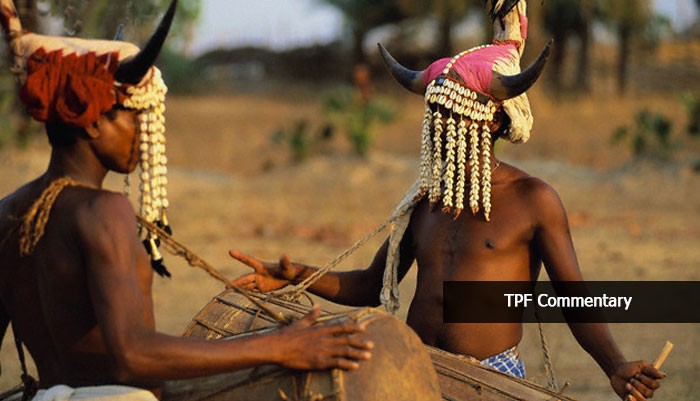
    During the British days this region constituted much of the Central Provinces of India later to become Madhya Pradesh. This is the main home of about sixteen million Gond people who are India’s largest single tribal grouping. The Gonds are now a culturally and linguistically heterogeneous people having attained much cultural uniformity with the dominant linguistic influences of their region. Thus, the Gonds of the eastern and northwestern Madhya Pradesh region that now includes the new state of Chhattisgarh speak Chhattisgarhi and western Hindi. But the Gonds of Bastar, which is at the southeastern end of this vast region and a part of Chhattisgarh, are different in this respect. Though there are many tribal groups like the Halbas, Bhatras, Parjas and Dorlas, the Maria and Bison Horned Gonds are the most numerous. The language spoken by them, like that of the Koyas of AP is an intermediate Dravidian language closer to Telugu and Kannada.

    The process of Hinduization combined with Hindi culture has reduced the egalitarian Koitur to the bottom of the social strata. Dr. Kalyan Kumar Chakravarthy, Director of the Indira Gandhi Rashtriya Manav Sangrahalaya, Bhopal has written eloquently and cogently on this in his concluding chapter “Extinction or Adaptation of the Gonds” in the book “Tribal Identity in India” also edited by him. The real enemy of theAdivasi is the creeping Hinduization with all its attendant values and exclusionary practices, seems to me a good start to the process of saving its tribal society from extinction. All over the rest of India’s central highlands our policies by forcing the Adivasis to merge their identities with that of the encroaching culture have crushed them into a becoming a feeble and self-pitying underclass.

    Clearly there are two distinct reasons for the present unrest in the Adivasihomelands of India. The first and probably the more important one is the struggle for identity against the creeping Hinduization or de-culturization of Adivasi society. Adivasi society was built on a foundation of equality. People were given respect and status according to their contribution to social needs but only while they were performing that particular function. Such a value-system was sustainable as long as the Adivasi community was non-acquisitive and all the products of society were shared. Adivasisociety has been under constant pressure as the money economy grew and made traditional forms of barter less difficult to sustain.

    The Fifth and Sixth Schedules under Article 244 of the Indian Constitution in 1950 provided for self-governance in specified tribal majority areas. In 1999 the Government of India even issued a draft National Policy on Tribals to address the developmental needs of tribal people. Special emphasis was laid on education, forestry, healthcare, languages, resettlement and land rights. The draft was meant to be circulated between MP’s, MLA’s and Civil Society groups. A Cabinet Committee on Tribal Affairs was meant to constantly review the policy. Little has happened since. The draft policy is still a draft, which means there is no policy.

    Even before Independence on December 16 1946, welcoming the Objectives Resolution in the Constituent Assembly, the legendary Adivasileader Jaipal Singh stated the tribal case and apprehensions explicitly. He said: “Sir, if there is any group of Indian people that has been shabbily treated it is my people. They have been disgracefully treated, neglected for the last 6,000 years. …The whole history of my people is one of continuous exploitation and dispossession by the non-aboriginals of India punctuated by rebellions and disorder, and yet I take Pandit Jawahar Lal Nehru at his word. I take you all at your word that now we are going to start a new chapter, a new chapter of independent India where there is equality of opportunity, where no one would be neglected.”

    The Adivasi’s paid dearly for taking Jawaharlal Nehru and the Constituent Assembly at their word.

    Shri Mohan Guruswamy is a former Rajya Sabha MP and a political commentator. He is a Trustee of TPF.

    This article was published earlier in ‘The Citizen’.