Blog

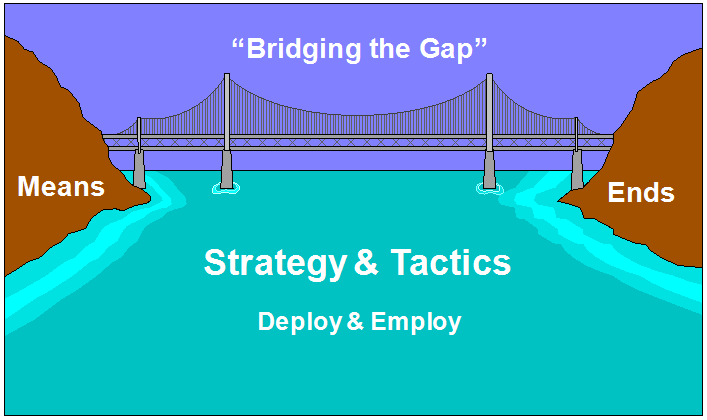
  • Amid India-China friction, we need to set real LAC

    Amid India-China friction, we need to set real LAC

    We have two outstanding issues between India and China. The larger one is about the large tracts of territory in Ladakh and Arunachal Pradesh. These two territorial disputes are not going to be resolved even in the foreseeable long term. Hence, Deng Xiaoping sagaciously suggested to Rajiv Gandhi in their 1988 meeting in Beijing that it was best left to history. A hundred years ago, the situations in both countries and their frontiers were very different. What they will be after another hundred years can be anybody’s guess?
    The urgent and pressing dispute on hand is the issue of the two LACs. These LACs frequently overlap. The term Line of Actual Control, or LAC, was first used by then Chinese PM Zhou Enlai in November 1959 when he wrote to his India’s Prime Minister Jawaharlal Nehru defining it as “the so-called McMahon Line in the east and the line up to which each side exercises actual control in the west”. Nehru rejected this line even after the events of 1962. By this time, he was also saddled with a parliamentary resolution pledging to recover all territories occupied by China. Interestingly, this LAC did not change very much even after 1962.


    Read more…

  • The Impact of Domestic Politics on Foreign Policy: The Colombian Case Study

    The Impact of Domestic Politics on Foreign Policy: The Colombian Case Study

    Introduction

    Colombia is amongst the world’s highly polarised states and has endured conflict for decades. The country witnessed around 50 years of armed struggle between militant groups, the government, and the drug cartels and has seen various forms of human rights violations in these years. The country saw more than 220,000 people killed in the conflict, roughly 25000 kidnapped or disappeared and more than 5 million displaced citizens (García-Perdomo, Harlow & Brown, 2022). However, after much pressure from the people and the government, the guerrilla factions and the ruling party convened to sign a peace agreement that essentially brought the active warring factions to a pause. On November 24, 2016, the Revolutionary Armed Forces of Colombia – People’s Army, or FARC, signed a landmark peace agreement, which also saw the militants present a public apology to the people of Colombia for their violent actions (Georgi, 2022).

    Since the end of the Second World War, Colombia has seen various governments adopt different stances and approaches to their foreign policies. Multiple domestic actors – state and non-state- have strongly influenced the country’s diplomacy. For example, between 1998 – 2002, Colombia moved from the narrative of remaining a failed state and developed ties with the US (Monroy & Sanchez, 2017). The Republic of Colombia has had 17 presidents since 1946, most of whom belong to Right-Wing conservative parties. The current President, Gustavo Francisco Petro Urrego, is the first President from a liberal and leftist political party (Tickner, 2022, 8:10) in decades. The country has never had a progressive-left leader in its political history, and his government has been making waves on all fronts concerning ties with neighbouring countries, attempting to resolve the internal conflict, and dealing with economic disparities within the population.

    A state’s foreign policy primarily focuses on interactions with other states and international actors and is essential to its political agenda. Given the interdependence of these two domains, domestic politics play a vital role in determining a state’s foreign policy. Foreign policy refers to a state’s approach and actions internationally. In contrast, domestic politics refers to the political processes, institutions, and actors within a state that affect the country’s policies. This essay uses Colombia as a case study to investigate how the country’s domestic politics and conflicts have affected its foreign policy. The timeline under revision is from the end of the Second World War to the present.

    This paper will look at the following factors as critical points of discussion. Determining the success of a policy is done by evaluating its efficiency and the evident improvement of situations. The paper will examine 1. How has the evolution of state leadership impacted Colombia’s foreign policy? 2. What role did the insurgents and drug lords play in this scenario? The state leadership (Hey, 1997), the insurgents, and the drug lords are critical players in Colombia’s political landscape and the evolution of its foreign policy. King, Keohane and Verba (1994, p.76) define causality as “a theoretical concept independent of the data used to learn about it”. It is difficult to draw causal inferences in a limited paper. Still, by examining the players mentioned earlier, this paper hopes to attract inferences between domestic politics and the direction of the country’s foreign policy.

    State Leadership and Foreign Policy

    There is a crisp scent of dependency theory when exploring literature about the foreign policies of Latin American countries (Hey, 1997). Similarly, Colombia – a state that witnessed long years of violent conflicts, deaths, kidnappings and illegal drug production continued on the same path as the rest of the countries in the continent. Significant economic disparities and multiple right-wing presidencies saw the inequality between people grow larger and larger (Hey, 1997). These were all critical factors in shaping how the country’s foreign policy presented itself to the world. After the end of the Second World War, Colombia maintained a low profile with respect to its foreign policy (Drekonja-Kornat, 1983). However, Colombia did have a traditional foreign policy – as in a Ministry to oversee relations and maintain ties with neighbouring countries, especially since border disagreements were high. Colombia had closer ties with the US than its immediate neighbouring states. At the same time, there appeared to be a consensus on the state leadership directing policies to suit principles of capitalistic democracy, free trade and markets; Colombia’s external affairs seemed to feed off of international support, especially from the United States of America. The US, in its quest to spread its capitalist democracy, assisted the various presidencies with aid and other means to combat guerrilla movements and insurgent activities. In turn, Colombia helped the US in the Korean War and stood by the US during the Cold War years, too. Drekonja-Kornat (1983) says Colombia was the only Latin American Country involved in the Korean conflict. During Turbay’s presidency, the US-Colombia ties grew closer, and US assistance helped establish his regime further (Hey, 1997). He held office from 1978 – 1982.

    The state’s leadership, in return, adopted and often tailored policies to suit strategic and international partners, particularly the US. Examples of presidencies adopting such policies include supporting the US stance on drugs (Hey, 1997), committing to recognise threats and terrorist activities as adjudged by the US and the EU, etc. (United States Department of State, 2021). Colombia’s constant internal security dilemma accentuates the existence of a dependency theory of Foreign Policy.

    Impact of the Internal Conflict on Colombia’s Foreign Policy

    The insurgents, guerrilla groups, and drug cartels played a role in shaping the foreign policy of Colombia. The entry of drugs into neighbouring countries, particularly the US, brought an international player into Colombia’s domestic issues (Gomez-Suarez & Newman, 2013). The United States desperately tried to solve the drug menace, which led to fighting the drug cartels and networks. America aided and supported the governments in curbing the cartel’s activities and eliminating insurgents who pushed for a more communist ideology, primarily in the Cold War period. Colombia’s alignment with the US on account of the Cold War influenced its domestic politics, which had a more significant say in shaping the country’s foreign policy. The United States of America is Colombia’s largest aid donor; listed below are some of the aid packages received by Colombia:

    1. The US has provided more than $1 billion in direct and indirect support for implementing peace in Colombia since 2016. (United States Department of State, 2021).
    2. The US provided roughly $700 million to assist Colombia with the Venezuelan migrant crisis and host approximately 1.8 million refugees in Colombia. (United States Department of State, 2021).

    Viewing the case from a realist perspective, much of Colombia’s foreign affairs has been dictated by the ebbs and flow of the insurgency. With Colombia’s development and domestic affairs requiring external support, it lacked the necessary flexibility to implement social development schemes as dependency on external aid was high (Monroy & Sanchez, 2017). Colombia became an instrument of the American War on Drugs, almost a pawn to the American foreign policy in Latin America (Tickner, 2011).

    While examining the history of how the state’s leadership handled its foreign policy directives and its domestic issues, there is space for some leniency. Many attempts to broker a peace agreement between the insurgents and the state were met with strong reluctance from the general public and a lack of participation from insurgent groups. Furthermore, corruption in various levels of government offices withheld any progress that could have been made. One could interpret the constant repetition of right-wing presidencies as people’s reluctance to move away from conservative rules, much to the dismay of insurgents, ultimately rendered the public most affected in the struggle for domestic power in the country.

    The Way Forward

    Gustavo Petro became the first leftist President of Colombia on June 19, 2022, in decades (Freeman, 2023). His Presidential victory also marked the first-ever Afro-Colombian, Francia Marquez, to take office as Vice President. Unlike his liberal predecessors, the change in power was smooth from his rightist counterparts. As a leftist, there were questions about his merit and reputation as the country’s leftists were primarily likened to insurgents and militants. While the 2016 Peace Accords dismantled and disarmed most militants from the Fuerzas Armadas Revolucionarias de Colombia or FARC, the associations took longer to change.

    President Petro, however, is having quite the start to office. He is leading a policy of ‘Total Peace’, an effort to include all factions and players in the internal conflict and arrive at an end to the insurgency; his presidency plans to shift Colombia’s economic dependency on trade from the US, fossil fuels and the illicit drug trade to a more sustainable approach (Freeman, 2023), that would be similar to the Green Theory. One can interpret his actions as playing on both sides of the solid and historical US-Colombia ties (Santa Eulalia, 2022). Owing to the associations with his left-leaning tendencies, his moves are somewhat open to more scrutiny by the public. After all, no incumbent President has been re-elected to office in the last 15 elections (Freeman, 2023).

    A significant part behind his election to office has been the general public’s displeasure at rising economic inequalities between people, the inability of the previous government to provide and implement social welfare schemes and the financial toll caused by inactivity during the Covid-19 pandemic. While Drekonja-Konrat (1986) argues that most Latin-American countries can shape their foreign policies to the extent that it doesn’t hurt US interests, Petro is challenging the very notion of keeping his voters happy (Santa Eulalia, 2022). The truth in the details is that they are pretty co-dependent; Colombia needs the support of the US in tackling drug issues and the matter of the guerrilla militant groups, while the US views Colombia as a key strategic partner in the region. Accordingly, Petro has to carefully cater to his vote-bank’s anti-Americanism and yet maintain cordial ties with the US. It is a fragile line to tread, but the room to navigate and keep the US and the public happy is also quite small. Political revisionism is prevalent, given Petro is trying to appease both sides of support, constantly showing evident links as to how a country’s domestic politics can affect its foreign policy.

    References

    Drekonja-Kornat., G. (1983). Colombia: Learning the Foreign Policy Process, Journal of Inter-American Studies and World Affairs, 25(2). Pp- 229-250.

    Drekonja-Kornat., G. (1986). The rise of Latin America’s foreign policy: Between hegemony and autonomy. Latin American Research Review, 21(1), 239-259.

    Freeman, W. (February 2023). Colombia tries a transformative Left Turn, Council on Foreign Relations. Retrieved from: https://www.cfr.org/article/colombia-tries-transformative-left-turn

    García-Perdomo, V.,  Harlow, S. & Brown, D. K., (2022). Framing the Colombian Peace Process: Between Peace and War Journalism, Journalism Practice.

    Georgie, R. (2022). Peace that antagonises: Reading Colombia’s peace process as a hegemonic crisis, Security Dialogue, pp – 1-19.

    Gomez-Suarez, A. & Newman, J., (2013). Safeguarding Political Guarantees in the Colombian Peace Process: have Santos and FARC learnt the lessons from the past?, Third World Quarterly, 34(5), pp – 819-837.

    Hey, J. A. K. (1997). Three Building Blocks of a Theory of Latin American Foreign Policy, Third World Quarterly, 18(4), pp -631-658.

    King, G., Keohane, R.O, & Verba, S. (1994). Designing Social Inquiry: Scientific Inference in Qualitative Research.Princeton, NJ, Princeton University Press.

    Monroy, M. C. & Sánchez, F. (2017) Foreign Policy Analysis and the Making of Plan Colombia, Global Society, 31(2), pp – 245-271.

    Santaeulilah, I. (October 2022). Petro Playing Both Sides in Colombia-US Relations, El Pais. Retrieved from: https://english.elpais.com/international/2022-10-26/petro-playing-both-sides-in-colombia-us-relations.html

    Feature Image Credit: Foreign Policy


  • Propaganda Blitz: How Mainstream Media is Pushing Fake Palestine Stories

    Propaganda Blitz: How Mainstream Media is Pushing Fake Palestine Stories

    Biased media reporting and propaganda with fake news is now a major strategy to create polarised perceptions worldwide. This type of reporting is now led by leading media houses of the West, whose only aim is to create a narrative that suits their foreign policy and economic objectives. Truth is a big casualty in the bargain, along with innocent lives, communities, and nations. The ongoing Israel-Hamas conflict is mired in heavy propaganda. It is important for the world to re-examine the past, extract the truth and history, and the current geopolitical machinations to understand this long-drawn Middle East conflict properly. TPF endeavours to provide, through select articles and accurate analysis, the right analysis and perspective of the Israel-Palestine issue. In the article below, Alan Macleod clearly describes how mainstream media pushes many false narratives to obfuscate the true nature, causes, and victims of the conflict.         – Team TPF


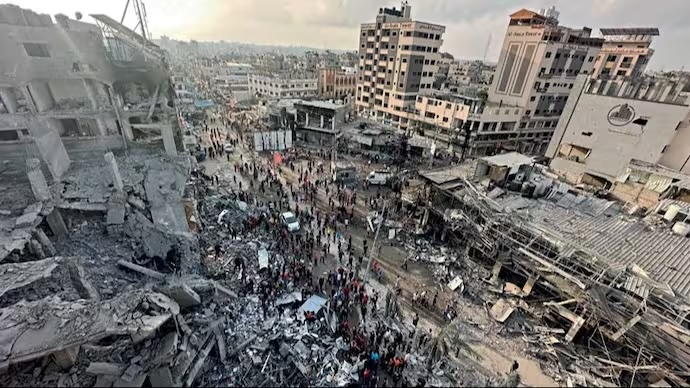
    After Hamas launched a surprise attack on Israel, IDF forces responded with airstrikes, levelling Gazan buildings. The violence so far has claimed the lives of more than 2,500 people. Western media, however, show far more interest and have much greater sympathy with Israeli dead than Palestinian ones and have played their usual role as unofficial spokespersons for the Israeli Defense Forces (IDF).

    EXTRAORDINARY CLAIMS, ZERO EVIDENCE

    One case in point is the claim that, during their incursion into southern Israel, Hamas fighters stopped to round up, kill and mutilate 40 Israeli babies, beheading them and leaving their bodies behind.

    The extraordinary assertion was originally reported by the Israeli channel i24 News, which based it on anonymous Israeli military sources. Despite offering no proof whatsoever, this highly inflammatory claim about an enemy made by an active participant in a conflict was picked up and repeated across the world by a host of media (e.g., in the United States by Fox NewsCNNMSNBusiness Insider, and The New York Post)

    Meanwhile, the front pages of the United Kingdom’s largest newspapers were festooned with the story, the press outraged at the atrocity and inviting their readers to feel the same way.

    Extraordinary claims should require extraordinary evidence, and a story like this should have been met with serious skepticism, given who was making the claim. The first question any reporter should have asked was, “Where is the evidence?” Given multiple opportunities to stand by it, the IDF continually distanced itself from the claims. Nevertheless, the story was simply too useful not to publish.

    The decapitated baby narrative was so popular that even President Biden referenced it, claiming to have seen “confirmed” images of Hamas killing children. This claim, however, was hastily retracted by his handlers at the White House, who noted that Biden was simply referencing the i24 News report.

    The story looked even more like a piece of cheap propaganda after it was revealed that the key source for the claim was Israeli soldier David Ben Zion, an extremist settler who had incited race riots against Palestinians earlier this year, describing them as “animals” with no heart who needs to be “wiped out.”

    Manipulating the U.S. public into supporting the war by feeding them atrocity propaganda about mutilating babies has a long history. In 1990, for instance, a girl purporting to be a local nurse was brought before Congress, where she testified that Iraqi Dictator Saddam Hussein’s men had ripped hundreds of Kuwaiti babies from their incubators and left them to die. The story helped whip the American public up into a pro-war fervor. It was later revealed that it was a complete hoax dreamed up by a public relations firm.

    THE MURDERED GIRL WHO CAME BACK TO LIFE

    Another piece of blatantly fake news is the case of Shani Louk. Louk attended the Supernova Festival, ambushed by Hamas. It was widely reported that Hamas murdered her (e.g., Daily MailMarcaYahoo! NewsTMZBusiness Insider), stripped her, and paraded her naked body trophy-like through the streets on the back of a truck. Louk’s case incited global anger and calls for an overwhelming Israeli military response.

    There was only one problem: Louk was later confirmed to be alive and in hospital, a fact that suggests the videos of her on the back of a truck were actually images of people saving her life by taking her to seek medical assistance.

    Few of the outlets irresponsibly publishing these wildly incendiary stories have printed apologies or even retractions. The Los Angeles Times was one exception: after publishing a report claiming that Palestinians had raped Israeli civilians, it later informed readers that “such reports have not been substantiated.”

    LIONIZING ISRAEL, DEHUMANIZING PALESTINIANS

    Few readers, however, see these retractions. Instead, they are left with visceral feelings of anger and disgust towards Hamas, priming them to support Western military action against Palestine or the wider region.

    In case their audiences did not get the message, op-eds and editorials in major newspapers hammered home this idea. The Wall Street Journal ran an op-ed entitled “The Moral Duty to Destroy Hamas”, which insisted to readers that “Israel is entitled to do whatever it takes to uproot this evil, depraved culture that resides next to it.” Thus, the outlet implicitly gave Israel a free pass to carry out whatever war crimes it wished on the civilian population, whether that is using banned chemical weapons, cutting off electricity and water, or targeting ambulances or United Nations officials.

    The National Review’s editorial board was of a similar mind, stating that “Israel needs a long leash to destroy Hamas.” This long leash, they explained, meant giving Israel far more time to carry out the destruction of Gaza. Western leaders would have to refrain from criticizing Israel or calling for calm and peace.

    The message was clear: international unity was paramount at this time. Mere trifles such as war crimes must be overlooked. And while Israel and its people were treated with special sympathy (e.g., Washington Post), the other side was written off as bloodthirsty radicals. While the phrase “Palestinian terrorists” could be found across the media spectrum (e.g., Fox NewsNew York PostNew York Times), its opposite, “Israeli terrorists” was completely absent from corporate media. This, despite casualties on the Palestinian side, outnumbering Israelis.

    Underlining the fact that Israeli lives are deemed more important is the way in which deaths from each side are reported. The BBC, for example, told its readers that Israelis have been “killed” while people in Gaza merely “died,” removing any agency from its perpetrators and almost suggesting their deaths were natural.

    CONTEXT-FREE VIOLENCE

    Missing from most of the reporting was the basic factual background of the attack. Few articles mentioned that Israel was built upon an existing Palestinian state and that most of the inhabitants of Gaza are descended from refugees ethnically cleansed from southern Israel in order to make way for a Jewish state. Also left unmentioned was that Israel controls almost every aspect of Gazan’s life. This includes deciding who can enter or leave the densely populated strip and limiting the import of food, medicine and other crucial goods. Aid groups have called Gaza “the world’s largest open-air prison.” The United Nations has declared the conditions in Gaza to be so bad as to be unlivable.

    One of the principal reasons that this crucial context is not given is that it could influence Western audiences into sympathizing with Palestinians or supporting Palestinian liberation. Giant media corporations are largely owned by wealthy oligarchs or by transnational corporations, both of whom have a stake in preserving the status quo and neither of whom wish to see national liberation movements succeed.

    https://twitter.com/AlanRMacLeod/status/1712797752709566763?ref_src=twsrc%5Etfw%7Ctwcamp%5Etweetembed%7Ctwterm%5E1712797752709566763%7Ctwgr%5Eb05f8d7d7e0b67196918b4e46787442438501a6b%7Ctwcon%5Es1_&ref_url=https%3A%2F%2Fscheerpost.com%2F2023%2F10%2F14%2Fpropaganda-blitz-how-mainstream-media-is-pushing-fake-palestine-stories%2F

    Some media outlets make this explicit. Axel Springer – the enormous German broadcaster that owns Politico – requires its employees to sign its mission statement endorsing “the trans-Atlantic alliance and Israel” and has told any staff members that support Palestine to leave their jobs.

    Other outlets are slightly less overt but nonetheless have Israel red lines that employees cannot cross. CNN fired anchor Marc Lamont Hill for calling for a free Palestine. Katie Halper was fired from The Hill for (accurately) calling Israel an Apartheid state. The Associated Press dismissed Emily Wilder after it became known that she had been a pro-Palestine activist during her college years. And The Guardian sacked Nathan J. Robinson after he made a joke mocking US military aid to Israel. These cases serve as examples to the rest of the journalistic world. The message is that one cannot criticize the Israeli government’s violent apartheid system or show solidarity for Palestine without risking losing their livelihoods.

    Ultimately, then, corporate media play a key role in maintaining the occupation by manipulating public opinion. If the American people were aware of the history and the reality of Israel/Palestine, the situation would be untenable. For those wishing to maintain the unequal state of affairs whereby an apartheid government expels or imprisons its indigenous population, the pen is as important as the sword.


    This article was published earlier in scheerpost.com and is republished under the Creative Commons Attribution-NonCommercial-NoDerivatives 4.0 International license

    Feature Image Credit: aljazeera.com


  • Technological Challenges to Becoming a Developed Country by 2047

    Technological Challenges to Becoming a Developed Country by 2047

    For a developed India, bulkier investment and technological changes are required to keep up in the race with other developed nations. In doing so, the country should not be afraid of failure. After all, Chandrayaan 3 was made possible by the lessons from the failure of Chandrayaan 2.

    THE Prime Minister has set the goal of India becoming a developed country by 2047.

    On the way, India’s Gross Domestic Product (GDP) is soon going to surpass that of Germany and Japan, if the current official rates of growth are maintained.

    In today’s world, projecting five years or 24 years ahead is fraught with challenges. Who could have foreseen the Covid pandemic in 2020 and the war in Ukraine in 2022?

    Successful landing of Chandrayaan 3 near the South Pole of the Moon is undoubtedly a great achievement for the nation. But that does not make India a developed nation.

    Major challenges confront the nation, such as providing good education and healthcare. This can only be achieved if the number of schools and health facilities in rural and semi-rural areas is increased substantially.

    [powerkit_button size=”lg” style=”info” block=”true” url=”https://theleaflet.in/technological-challenges-to-becoming-a-developed-country-by-2047/” target=”_blank” nofollow=”false”]
    Read More
    [/powerkit_button]

  • G20’s New Delhi Declaration: Serving the Interest of the Global Landlords

    G20’s New Delhi Declaration: Serving the Interest of the Global Landlords

    The Delhi declaration’s achievement is preservation of the interest of the global elite (including the Indian elite). The global landlords enabled it while paying lip service to global good.

    The G20 summit in India ended on a high note with a New Delhi Declaration. This is a matter of immense satisfaction for the prime minister personally and for his entire team which had to struggle to arrive at a consensus among the warring elements of the grouping. It highlights India’s present pole position in the global order. Other nations are trying to draw it into their sphere of influence, or at least trying to prevent it from getting closer to the other side.

    India’s advantage is a result of the continuing Ukraine war and the aggravating Cold War between the G7 and China-Russia combine. It has required deft manoeuvring, more so because of India’s political problems with China which resulted in its president giving the meeting a miss. This caused considerable consternation, given China’s economic and political clout.

    [powerkit_button size=”lg” style=”info” block=”true” url=”https://thewire.in/world/g20s-new-delhi-declaration-serving-the-interest-of-the-global-landlords” target=”_blank” nofollow=”false”]
    Read More
    [/powerkit_button]

  • Social and Economic Aspects of Caste Survey in Bihar

    Social and Economic Aspects of Caste Survey in Bihar

    The need for caste census today is because after independence we adopted the top-down development model. It was thought that the development benefits would flow from the upper strata to the lower ones. But this hope has been belied with the well-off capturing most of the benefits, leaving little for the marginalized sections who are lagging behind in development.
    ————-

    The release of the figures of the caste survey in Bihar has immediately led to the heating up of politics in the entire country. There is a demand for conducting a caste survey in many states, including Uttar Pradesh, Madhya Pradesh, Rajasthan and Maharashtra. In Karnataka, the demand is to make public the data of the caste survey conducted in 2015.

    Poverty and Population Increase

    According to the Bihar survey report, the largest population in the state belongs to the extremely backward class (EBC), constituting about 36 per cent of the total population. While the Report clarifies the situation in Bihar, it does not tell us the situation in the entire country. That would require a national survey. Therefore, now the pressure will increase on the Central Government to conduct and make public the data at the national level. That is the only way the caste composition of the total population can be known. This is required to make policies which can enable equitable shares in employment and education for different sections of the population.

    The increase in the proportion of extremely backward classes in the total population of Bihar should have been expected because of the prevailing poverty among them. Those who are poor have more children due to several reasons, like lack of education and awareness. Most importantly, for their social security in old age. The poor do not have savings; hence children constitute their old-age social security. They have more children to ensure at least one child survives till their old age. Also, more children mean more earning hands in the family. As people become more prosperous, people produce fewer children. The economic condition of the middle class and the well-off are relatively better, so they have fewer children, and their population grows less.

    The question arises: what is the likely consequence? Upper caste people are worried that since extremely backward castes constitute a higher proportion of the population, their demand for reservation will increase.

    Growing Unemployment a Crucial Factor

    I believe that if we had given more importance in employment and education to the extremely backward castes from the beginning, today’s situation would not have arisen. Reservation makes no difference if jobs are available in sufficient numbers. Reservation becomes critical when employment generation is weak. When there is a lack of adequate employment, a dispute arises over reservations as to who will get how much employment. At present, due to large unemployment among the educated youth and few available government jobs, the demand for reservations has increased.

    The problem has been growing because, after independence, we have adopted the top-down and trickle-down policy. The result has been that the upper sections of society have cornered most of the benefits while the marginalized sections have received very little benefits. Disparities have grown, and so have expectations, thereby raising the level of conflict in society. The use of more advanced technology in every sector has displaced labour and contributed to increasing unemployment. The Agriculture sector, which has the most employment (46%) in our country, has seen increased use of tractors, harvester combines, threshers, potato digging machines, etc., thereby reducing the need for employment and displacing workers. This is also true of manufacturing and services, like banking.

    Impact of Government Policies

    The government is also fueling this change by promoting the growth of the capital-intensive organized sector at the expense of the unorganized sector (which employs 94% of the workers). For example, the government reduced the tax rates on the corporate sector and rolled out the PLA scheme while cutting allocations to the National Rural Employment Guarantee Scheme. Allocations to education and health sectors have also been kept low and cut, even though both these sectors generate more employment. Due to these policies, most of the investments are being made in big projects, like railway freight corridors, where human labour is being replaced by big machines.

    The result is rising inequality, frustration, alienation and sharpening social conflict. Therefore, the parties pursuing social justice politics for the lower classes and the people themselves have been demanding greater reservation for the backward castes according to their proportion in the population. With Bihar’s caste survey becoming public, the demand for conducting such surveys in other states and nationally will become more vociferous. The demand will also arise that the maximum limit of reservation, which is fixed at 50 per cent by the Supreme Court, should be increased. But reservations will be only for a few million jobs while the need is for work for tens of millions. So, the real issue is the generation of enough employment and good education for the children of the poor.

    Political Implications

    Opponents of caste surveys argue that castes with a lower proportion in the population will start competing to increase their population by bypassing family planning policies. But I don’t accept this. Around the world, as family prosperity increases and education levels rise, people have fewer children. The well-off families with less share in the population are already sending their children abroad for education and employment, which may accelerate.

    Bihar’s caste survey data is bound to impact national politics. All political parties would like to use it in their own way, and Mandal-Kamandal politics will intensify in the country. But, the situation for BJP has changed compared to the 1990s since in the last few elections, it has wooed the votes of backward castes. The issue of reservation and demand for an increase in the maximum prescribed reservation limit will intensify. The ruling party will be reluctant, but in view of the electoral arithmetic, it will also not oppose it vociferously. It will hope that the Supreme Court will not agree to increase the limit. Further, it will try to divert the public attention towards issues like Sanatan dharma, terrorism and threats from China-Pakistan.
    The lesson is that when socially correct policies are not implemented in a timely manner, social strife and alienation spread, and the nation is forced to implement sub-optimal policies.

    This is a translation of the article in Hindi published earlier in Amar Ujala.

  • Indian Air Force at 91:  Challenges and Opportunities

    Indian Air Force at 91: Challenges and Opportunities

    The Indian Air Force, created on October 8, 1932, completes 91 years of glorious service as it celebrates the Air Force Day today, October 8, 2023. As the IAF celebrates its annual day with customary elan, it is a time to reflect and assess the future in terms of challenges and opportunities. On the operational front, the die is already cast with two nuclear-powered neighbours, one in political and economic turmoil and the other continuing an aggressive posture. A three-yearlong standoff on the northern border with no signs of reconciliation makes the environment precarious.

    China, with its goal of becoming the leading military power with global reach by 2049, has moved fast to replace and transform its antiquated equipment, systems, and organizations, especially after observing the 1991 Gulf War. Reorganization of the PLA in the last decade, consolidation of forces under one command to oversee military operations against India and creation a Special Support Group (SSG) has enhanced its force application capabilities. Specifically, the upgradation of military infrastructure, airfields, and helipads just north of India is a matter of concern. Robust military hardware production for modern systems and investment in R&D in new-era fields like quantum computing, quantum radars, artificial intelligence, and aircraft and weapon systems development have facilitated significant growth in PLA’s capabilities. Qualitatively and quantitatively, India cannot match the Chinese economy, military hardware, military industry, or infrastructure in the foreseeable future. The only way forward for India is to use its resources in a focused manner to achieve its well-defined strategic goals commensurate with available resources. Lessons from the ongoing Russia-Ukraine war, a contest between unequal forces, are relevant in our context.

    Force Structure Challenges to Overcome

    Besides the operational challenges the Indian Air Force faces on the borders, there are issues related to equipment and organization.


    The salience of combat aircraft in battlespace is well known. However, combat aircraft numbers are declining worldwide, with older systems paving the way for modern and more capable platforms. In India, the decline has been rather steep, and replacements are not potent enough to offset the quantity quality. Against an authorization of over 1000 combat aircraft, the Indian armed forces are now in the region of 600. This decline will continue, and by 2030, IAF combat aircraft strength will be down to 450 with the phase-out of MiG-21, MiG-29, Jaguar, and Mirage-2000 fleets. The induction of 36 Rafales, the prolonged induction of LCA, and the planned acquisition of more Su30MKIs will not be able to reverse the declining trend. The ambitious plans for India’s fifth-generation aircraft, AMCA, are still far away. Given this reality, the IAF must make do with, at best, 34-36 fighter squadrons in the 2035 timeframe. It must work on operational strategies based on superior tactics and a local favourable balance of power in case a war is inevitable during this period.

    In the critical area of force multipliers, the numbers have been nearly static since their initial induction in 2003 concerning IL-78 In-Flight Refuellers and in 2010 concerning AWACS. The number of long-range weapons is somewhat limited. And in the surveillance and space domains, the resources are meagre. The situation is unlikely to change in the foreseeable future.

    There are positive changes regarding airlift capability, and single-wave airlift capability is gradually increasing with the commencement of induction of the first of the 56 new C-295 transport aircraft replacing vintage Avro. Despite the gradual phase-out of heavy lift Il-76 and light transport aircraft An-32, the fleet of C-17 and C-130 will sustain the requisite airlift capability that enabled the rapid deployment of Indian Army units in Ladakh against PLA build-up. Similarly, the enhanced number of more versatile and potent indigenous helicopters, ALH and LCH, will increase local mobility and firepower.

    The area that is yet to take centre stage is the Unmanned systems. Although the numbers and types increase due to imports, recent conflicts have demonstrated their hugely versatile utility. This aspect needs more attention to offset the capability deficit owing to the reduced number of combat aircraft. Tasks like intelligence, surveillance, reconnaissance, and ground and maritime attack can be effectively performed by unmanned aerial systems, resulting in the release of aircraft for other roles.

    New and more capable radars and integrated networks are replacing the older systems, giving a robust defensive capability. These need to be backed by long-range and quick-reaction surface-to-air weapon systems. Currently, the numbers are limited, and the area to be covered is extensive. Agility in planning, deployment and redeployment is the key to effective defence with limited resources.

    Evolving Battlespace and the Imperative of Jointness

    The battle space is evolving. Conflict hybridization has accelerated the expansion of battlespace, leading to enhanced significance of battlespace transparency. Induction of hypersonic systems, fast relocation of combat elements, and reduced times for systems operationalization have compressed the reaction time. This time-compression for action has tilted the offence-defence balance in favour of the offence. The concept of operations needs to factor in these realities, especially when dealing with a potent and stronger adversary with significant reverse capability.

    Organisationally, the integration of three wings of the Indian armed forces will likely pick up pace in the coming year(s). Integration is now an operational necessity and needs to be fast-tracked. Once theatre commands come into being, the most critical factor will be the allocation and plan of utilization of various combat assets that are limited in numbers but can operate seamlessly between multiple sectors. Will the integration model follow the complex assignment of such resources? That will be suboptimal and possibly counterproductive to enhancing combat capability through integration. IAF will have to make a holistic plan to exploit the full combat potential of its assets, irrespective of how the integration model pans out. Organisationally, this will be the most significant challenge for the men and women in blue in the coming year(s).

    Conclusion

    In the last five decades, India has taken the pole position in money spent on military hardware imports. Saudi Arabia is a distant second, spending less than half of Indian expenditure in this sector. How did India reach here? Public sector monopoly in defence has not yielded the desired results for the last seven decades. Inadequate focus and investment in R&D, captive customers, the Indian armed forces not hand-holding the industry, restrictive policies, monopoly of the public sector, dependency on imported military hardware and inability to leverage large imports for technology access are the factors contributing to this state. Atamnirbhar, from being a rhetoric, is gradually taking shape with orders being placed on Indian enterprises. The policy of earmarking part of the capital budget for Indian manufacturers will undoubtedly encourage the Indian defence industry. Although production efficiency and quality control have been a concern regarding the public sector, things are likely to improve as they face competition from the private sector. The lack of control over critical technologies in areas of aero engines, air-launched weapons, and electronic warfare systems remains a severe vulnerability. Opening the defence sector for private entities, allowing DRDO to share available testing facilities and technology, and creating defence manufacturing corridors are steps in the right direction.

    Capability differential and information differential between the competing sides form the basis of military operations. A classical information matrix about the opposing force includes intent, strategy, military doctrine, and military objectives; besides the overall direction that military strategy gives, an operational plan and its execution are based on an information matrix to achieve defined goals with the least cost or in the minimum possible timeframe. IAF, with its new doctrine IAP2000-22, endeavours to capture the essence of these changes. Indian Air Force needs to be ready with its limited assets and deter war. IAF must augment its limited resources with courage, ingenuity and clever resource employment to outwit the adversary. Given the limited resources and challenges ahead, the IAF will need to be a smart force for efficient management of resources and clever exploitation of force application.

    Photo Credits: Sunil Jain

    The views expressed are the author’s own and do not reflect that of the TPF or the IAF.

  • Trump followed four years later by Trump: Would America’s trustiness and system of alliances survive?

    Trump followed four years later by Trump: Would America’s trustiness and system of alliances survive?

    Ambassador Alfredo Toro Hardy examines, in this excellently analysed paper, the self-created problems that have contributed to America’s declining influence in the world. As he rightly points out, America helped construct the post-1945 world order by facilitating global recovery through alliances, and mutual support and interweaving the exercise of its power with international institutions and legal instruments. The rise of neoconservatism following the end of the Cold War, particularly during the Bush years from 2000 to 2008, led to American exceptionalism, unipolar ambitions, and the failure of American foreign policy.  Obama’s Presidency was, as Zbigniew Brezinski said, a second chance for restoring American leadership but those gains were nullified in Donald Trump’s 2016-20 presidency leading to the loss of trust in American Leadership. In a final analysis that may be questionable for some, Ambassador Alfredo sees Biden’s administration returning to the path of liberal internationalism and recovering much of the lost trust of the world.  His fear is that it may all be lost if Trump returns in 2024.                               – Team TPF


    TPF Occasional Paper   9/2023    

    Trump followed four years later by Trump: Would America’s trustiness and system of alliances survive?


    According to Daniel W. Drezner: “Despite four criminal indictments, Donald Trump is the runaway frontrunner to win the GOP nomination for president. Assuming he does, current polling shows a neck-and-neck race between Trump and Biden in the general election. It would be reckless for other leaders to dismiss the possibility of a second Trump term beginning on January 20, 2025. Indeed, the person who knows this best is Biden himself. In his first joint address to Congress, Biden said that in a conversation with world leaders, he has ‘made it known that America is back’, and their responses have tended to be a variation of “but for how long?”. [1]

    A bit of historical context

    In order to duly understand the implications of a Trump return to the White House, a historical perspective is needed. Without context, it is difficult to comprehend the meaning of the “but for how long?” that worries so many around the world. Let’s, thus, go back in time.

    Under its liberal internationalist grand vision, Washington positioned itself at the top of a potent hegemonic system. One, allowing that its leadership could be sustained by the consensual acquiescence of others. Indeed, through a network of institutions, treaties, mechanisms and initiatives, whose creation it promoted after World War II, the United States was able to interweave the exercise of its power with international institutions and legal instruments. Its alliances were a fundamental part of that system. On the other side of the Iron Curtain, though, the Soviet Union established its own system of alliances and common institutions.

                In the 1970s, however, America’s leadership came into question. Two reasons were responsible for it. Firstly, the Vietnam War. The excesses committed therein and America’s impotence to prevail militarily generated great discomfort among several of its allies. Secondly, the crisis of the Bretton Woods system. As a global reserve currency issuer, the stability of the U.S. currency was fundamental. In a persistent way, though, Washington had to run current account deficits to fulfil the supply of dollars at a fixed parity with gold. This impacted the desirability of the dollar, which in turn threatened its position as a reserve currency issuer. When a run for America’s gold reserves showed a lack of trust in the dollar, President Nixon decided in 1971 to unhook the value of the dollar from gold altogether.

                Notwithstanding these two events, America’s leadership upon its alliance system would remain intact, as there was no one else to face the Soviet threat. However, when around two decades later the Soviet Union imploded, America’s standing at the top would become global for the same reason: There was no one else there. Significantly, the United States’ supremacy was to be accepted as legitimate by the whole international community because, again, it was able to interweave the exercise of its power with international institutions and legal instruments.

    Inexplicable under the light of common sense

                In 2001, however, George W. Bush’s team came into government bringing with them an awkward notion about the United States’ might. Instead of understanding that the hegemonic system in place served their country’s interests perfectly well, the Bush team believed that such a system had to be rearranged in tandem with America’s new position as the sole superpower. As a consequence, they began to turn upside down a complex structure that had taken decades to build.

    The Bush administration’s world frame became, indeed, a curious one. It believed in unconditional followers and not in allies’ worthy of respect; it believed in ad hoc coalitions and “with us or against us” propositions where multilateral institutions and norms had little value; it believed in the punishment of dissidence and not in the encouragement of cooperation; it believed in preventive action prevailing over international law.

    In proclaiming the futility of cooperative multilateralism, which in their perspective just constrained the freedom of action of America’s might, they asserted the prerogatives of a sole superpower. The Bush administration’s world frame became, indeed, a curious one. It believed in unconditional followers and not in allies’ worthy of respect; it believed in ad hoc coalitions and “with us or against us” propositions where multilateral institutions and norms had little value; it believed in the punishment of dissidence and not in the encouragement of cooperation; it believed in preventive action prevailing over international law. Well-known “neoconservatives” such as Charles Krauthammer, Robert Kagan, and John Bolton, proclaimed America’s supremacy and derided countries not willing to follow its unilateralism.

                But who were these neoconservatives? They were the intellectual architects of Bush’s foreign policy, who saw themselves as the natural inheritors of the foreign policy establishment of Truman’s time. The one that had forged the fundamental guidelines of America’s foreign policy during the Cold War, in what was labelled as the “creation”. In their view, with the United States having won the Cold War, a new creation was needed. Their beliefs could be summed up as diplomacy if possible, force if necessary; U.N. if possible, ad hoc coalitions, unilateral action, and preemptive strikes if necessary. America, indeed, should not be constrained by accepted rules, multilateral institutions, or international law. At the same time, the U.S.’ postulates of freedom and democracy, expressions of its exceptionalism, entailed the right to propitiate regime change whenever necessary, in order to preserve America’s security and the world order.

    Bogged down in Iraq and Afghanistan, while deriding and humiliating so many around the world, America’s neoconservatives undressed the emperor. By taking off his clothes, they made his frailties visible for everyone to watch.

    Inexplicable, under the light of common sense, the Bush team disassociated power from the international structures and norms that facilitated and legitimized its exercise. As a consequence, America moved from being the most successful hegemonic power ever to becoming a second-rate imperial power that proved incapable of prevailing in two peripheral wars. Bogged down in Iraq and Afghanistan, while deriding and humiliating so many around the world, America’s neoconservatives undressed the emperor. By taking off his clothes, they made his frailties visible for everyone to watch.

                At the beginning of 2005, while reporting a Pew Research Center poll, The Economist stated that the prevailing anti-American sentiment around the world was greater and deeper than at any other moment in history. The BBC World Service and Global Poll Research Partners, meanwhile, conducted another global poll in which they asked, “How do you perceive the influence of the U.S. in the world?”. The populations of some of America’s traditional allies gave an adverse answer in the following percentages: Canada 60%; Mexico 57%; Germany 54%; Australia 52%; Brazil 51%; United Kingdom 50%. With such a negative perception among Washington’s closest allies, America’s credibility was in tatters.[2]

             Is the liberal international order ending? what is next? dailysabah.com

     While Bush’s presidency was reaching its end, Zbigniew Brzezinski wrote a pivotal book that asserted that the United States had lost much of its international standing. This felt, according to the book, particularly disturbing. Indeed, as a result of the combined impact of modern technology and global political awakening, that speeded up political history, what in the past took centuries to materialize now just took decades, whereas what before had taken decades, now could materialize in a single year. The primacy of any world power was thus faced with immense pressures of change, adaptation and fall. Brzezinski believed, however, that although America had deeply eroded its international standing, a second chance was still possible. This is because no other power could rival Washington’s role. However, recuperating the lost trust and legitimacy would be an arduous job, requiring years of sustained effort and true ability. The opportunity of this second chance should not be missed, he insisted, as there wouldn’t be a third one. [3]

    A second chance

                Barak Obama did certainly his best to recover the space that had been lost during the preceding eight years. That is, the U.S.’s leading role within a liberal internationalist structure. However, times had changed since his predecessor’s inauguration. In the first place, a massive financial crisis that had begun in America welcomed Obama, when he arrived at the White House. This had increased the international doubts about the trustiness of the country. In the second place, China’s economy and international position had taken a huge leap ahead during the previous eight years. Brzezinski’s notion that no other power could rival the United States was rapidly evolving. As a result, Obama was left facing a truly daunting challenge.

                To rebuild Washington’s standing in the international scene, Obama’s administration embarked on a dual course of action. He followed, on the one hand, cooperative multilateralism and collective action. On the other hand, he prioritized the U.S.’ presence where it was most in need, avoiding unnecessary distractions as much as possible. Within the first of these aims, Obama seemed to have adhered to Richard Hass’ notion that power alone was simple potentiality, with the role of a successful foreign policy being that of transforming potentiality into real influence. Good evidence of this approach was provided through Washington’s role in the Paris Agreement on Climate Change, in the Joint Comprehensive Plan of Action in relation to Iran, in the NATO summits, in the newly created G20, and in the summits of the Americas, among many other instances. By not becoming too overbearing, and by respecting other countries’ points of view, the Obama Administration played a leading influence within the context of collective action. Although theoretically being one among many, the United States always played the leading role.[4]

    Within this context, Obama’s administration followed a coalition-building strategy. The Trans-Pacific Partnership represented the economic approach to the pivot and aimed at building an association covering forty per cent of the global economy. There, the United States would be the first among equals. As for the security approach to the pivot, the U.S. Navy repositioned its forces within the Pacific and the Atlantic oceans.

                To prioritize America’s presence where it was most needed, Obama turned the attention to China and the Asia-Pacific. While America was focusing on the Middle East, China enjoyed a period of strategic opportunity. His administration’s “pivot to Asia” emerged as a result. This policy had the dual objective of building economic prosperity and security, within that region. Its intention was countering, through facts, the notion that America was losing its staying power in the Pacific. Within this context, Obama’s administration followed a coalition-building strategy. The Trans-Pacific Partnership represented the economic approach to the pivot and aimed at building an association covering forty per cent of the global economy. There, the United States would be the first among equals. As for the security approach to the pivot, the U.S. Navy repositioned its forces within the Pacific and the Atlantic oceans. From a roughly fifty-fifty correlation between the two oceans, sixty per cent of its fleet was moved to the Pacific. Meanwhile, the U.S. increased joint exercises and training with several countries of the region, while stationing 2,500 marines in Darwin, Australia. As a result of the pivot, many of China’s neighbours began to feel that there was a real alternative to this country’s overbearing assertiveness.[5]

                Barak Obama was on a good track to consolidating the second chance that Brzezinski had alluded to. His foreign policy helped much in regaining international credibility and standing for his country, and the Bush years began to be seen as just a bump on the road of America’s foreign policy. Unfortunately, Donald Trump was the next President. And Trump coming just eight years after Bush, was more than what America’s allies could swallow.

    Dog-eat-dog foreign policy

                The Bush and Trump foreign policies could not be put on an equal footing, though. The abrasive arrogance of Bush’s neoconservatives, however distasteful, embodied a school of thought in matters of foreign policy. One, characterized by a merger between exalted visions of America’s exceptionalism and Wilsonianism. Francis Fukuyama defined it as Wilsionanism minus international institutions, whereas John Mearsheimer labelled it as Wilsionanism with teeth. Although overplaying conventional notions to the extreme, Bush’s foreign policy remained on track with a longstanding tradition. Much to the contrary, Trump’s foreign policy, according to Fareed Zakaria, was based on a more basic premise– The world was largely an uninteresting place, except for the fact that most countries just wanted to screw the United States. Trump believed that by stripping the global system of its ordering arrangements, a “dog eat dog” environment would emerge. One, in which his country would come up as the top dog. His foreign policy, thus, was but a reflection of gut feelings, sheer ignorance and prejudices.[6]

                Trump derided multilateral cooperation and preferred a bilateral approach to foreign relations. One, in which America could exert its full power in a direct way, instead of letting it dilute by including others in the decision-making process. Within this context, the U.S.’ market leverage had to be used to its full extent, to corner others into complying with Washington’s positions. At the same time, he equated economy and national security and, as a consequence, was prone to “weaponize” economic policies. Moreover, he premised on the use of the American dollar as a bullying tool to be used to his country’s political advantage. Not only China but some of America’s main allies as well, were targeted within this approach. Dusting off Section 323 of the 1962 Trade Expansion Act, which allowed tariffs on national security grounds, Trump imposed penalizations in every direction. Some of the USA’s closest allies were badly affected as a result.

                Given Trump’s contempt for cooperative multilateralism, but also aiming at erasing Obama’s legacy, an obsessive issue with him, he withdrew the U.S. from the Trans-Pacific Partnership, from the Paris Agreement on Climate Change, and from the Joint Comprehensive Plan of Action in relation to Iran. He also withdrew his country from other multilateral institutions, such as the United Nations’ Human Rights Commission and, in the middle of the Covid 19 pandemic, from the World Health Organization. Trump threatened to cut funding to the U.N., waged a largely victorious campaign to sideline the International Criminal Court, and brought the World Trade Organization to a virtual standstill. Even more, he did not just walk away from the Joint Comprehensive Plan of Action, in relation to Iran, but threatened its other signatories to impose sanctions on them if, on the basis of the agreement, they continued to trade with Iran.

    Trump followed a transactional approach to foreign policy in which principles and allies mattered little, and where trade and money were prioritized over security considerations.

                Trump followed a transactional approach to foreign policy in which principles and allies mattered little, and where trade and money were prioritized over security considerations. In 2019, he asked Japan to increase fourfold its annual contribution for the privilege of hosting 50,000 American troops in its territory, while requesting South Korea to pay 400 percent more for hosting American soldiers. This, amid China’s increasing assertiveness and North Korea’s continuous threats. In his relations with New Delhi, a fundamental U.S. ally within any containment strategy to China, he subordinated geostrategic considerations to trade. On the premise that India was limiting American manufacturers from access to its market, Trump threatened this proud nation with a trade war.[7]

                Irritated because certain NATO member countries were not spending enough on their defence, Trump labelled some of Washington’s closest partners within the organization as “delinquents”. He also threatened to reduce the U.S.’ participation in NATO, calling it “obsolete”, while referring to Germany as a “captive of Russia”. At the same time, Trump abruptly cancelled a meeting with the Danish Prime Minister, because she was unwilling to discuss the sale of Greenland to the United States. This, notwithstanding the fact that this was something expressively forbidden by the 1975 Helsinki Final Act, represents the cornerstone of European stability. The European Union, in his view, was not a fundamental ally, but a competitor and an economic foe. Deliberately, Trump antagonized European governments, including that of London at the time, by cheering Brexit. Meanwhile, he imposed tariffs on steel and aluminium on many of its closest partners and humiliated Canada and Mexico by imposing upon them a tough renegotiation of NAFTA. One, whose ensuing accord did not bring significant changes. Moreover, he fractured the G7, a group integrated by Washington’s closest allies, leaving the United States standing alone on one side with the rest standing on the other.

    In June 2018, Donald Tusk, President of the European Council, expressed his bewilderment at seeing that the rules-based international order was being challenged precisely by its main architect and guarantor– the United States. Financial Times columnist Martin Wolf summoned up all of this, by expressing that under Trump the U.S. had become a rogue superpower.

                Unsurprisingly, thus, America’s closest allies reached the conclusion that they could no longer trust it. Several examples attested to this. In November 2017, Canberra’s White Paper on the security of Asia expressed uncertainty about America’s commitment to that continent. In April 2018, the United Kingdom, Germany and France issued an official statement expressing that they would forcefully defend their interests against the U.S.’ protectionism. On May 10, 2018, Angela Merkel stated in Aquisgran that the time in which Europe could trust America was over. On May 31, 2018, Justin Trudeau aired Canada’s affront at being considered a threat to the United States. In June 2018, Donald Tusk, President of the European Council, expressed his bewilderment at seeing that the rules-based international order was being challenged precisely by its main architect and guarantor– the United States. In November 2019, in an interview given to The Economist, Emmanuel Macron stated that the European countries could no longer rely on the United States, which had turned its back on them. Financial Times columnist Martin Wolf summoned up all of this, by expressing that under Trump the U.S. had become a rogue superpower.[8]

    The return of liberal internationalism

    Politically and geopolitically Biden rapidly went back to the old premises of liberal internationalism. Cooperative multilateralism and collective action were put back in place, and alliances became, once again, a fundamental part of America’s foreign policy. 

               As mentioned, George W. Bush followed a few years later by Donald Trump was more than what America’s allies could handle. Fortunately for that country, and for its allies, Trump failed to be re-elected in 2020, and Joe Biden came to power. True, the latter’s so-called foreign policy for the middle classes kept in place some of Trump’s international trade policies. However, politically and geopolitically he rapidly went back to the old premises of liberal internationalism. Cooperative multilateralism and collective action were put back in place, and alliances became, once again, a fundamental part of America’s foreign policy.  Moreover, Biden forcefully addressed some of his country’s main economic deficiencies, which had become an important source of vulnerability in its rivalry with China. In sum, Biden strengthened the United States’ economy, its alliances, and its international standing.

                Notwithstanding the fact that Biden had to fight inch by inch with a seemingly unconquerable opposition, while continuously negotiating with two reluctant senators from his own party, he was able to pass a group of transformational laws. Among them, are the Infrastructure Investment and Job Act, the CHIPS and Science Act and the Inflation Reduction Act. Together, these legislations allow for a government investment of a trillion dollars in the modernization of the country’s economy and its re-industrialization, including the consolidation of its technological leadership, the updating of its infrastructures and the reconversion of its energy matrix towards clean energy. Private investments derived from such laws would be gigantic, with the sole CHIPS Act having produced investment pledges of more than 100 billion dollars. This projects, vis-à-vis China’s competition, an image of strength and strategic purpose. Moreover, before foes and friends, these accomplishments prove that the U.S. can overcome its legislative gridlocks, in order to modernize its economy and its competitive standing.

                Meanwhile, Washington’s alliances have significantly strengthened. In Europe, Russia’s invasion of Ukraine and Washington’s firm reaction to it had important consequences. While the former showed to its European allies that America’s leadership was still indispensable, the latter made clear that the U.S. had the determination and the capacity to exercise such leadership. Washington has indeed led in response to the invasion, in the articulation of the alliances and the revitalization of NATO, in sanctions on Russia, and in the organization of the help provided to Ukraine. It has also been Kyiv’s main source of support in military equipment and intelligence, deciding at each step of the road what kind of armament should be supplied to the Ukrainian forces. In short, before European allies that had doubted Washington’s commitments to its continent, and of the viability of NATO itself, America proved to be the indispensable superpower.

                Meanwhile, American alliances in the Indo-Pacific have also been strengthened and expanded, with multiple initiatives emerging as a result. As the invasion of Ukraine made evident the return of geopolitics by the big door, increasing the fears of China’s threat to regional order, Washington has become for many the essential partner. America’s security umbrella has proved to be for them a fundamental tool in containing China’s increasing arrogance and disregard for international law and jurisprudence. Among the security mechanisms or initiatives created or reinforced under its stewardship are an energized Quad; the emergence of AUKUS; NATO’s approach to the Indo-Pacific region; the tripartite Camp David’s security agreement between Japan, South Korea and the U.S.; a revamped defence treaty with The Philippines; an increased military cooperation with Australia; and Hanoi’s growing strategic alignment with Washington. On the economic side, we find the Indo-Pacific Economic Framework for Prosperity and the freshly emerged Partnership for Global Infrastructure and Investment & India-Middle East-Europe Economic Corridor.

    Enough would be enough

                Although the Global South has proved to be particularly reluctant to fall back under the security leadership of the superpowers, Washington has undoubtedly become the indispensable partner for many in Europe and the Indo-Pacific. Thanks to Biden, the United States has repositioned itself on the cusp of a potent alliance system, regaining credibility and vitality. What would happen, thus, if he is defeated in the 2024 elections and Trump regains the White House? In 2007, Brzezinski believed, as mentioned, that although America had deeply eroded its international standing, a second chance was still possible. Actually, with Biden (and thanks in no small part to the Russian invasion and China’s pugnacity), the U.S. got an unexpected third chance. But definitively, enough would be enough. Moreover, during Trump’s first term in office, a professional civil service and an institutional contention wall (boosted by the so-called “adults in the room”), may have been able to keep at bay Trump’s worst excesses. According to The Economist, though, that wouldn’t be the case during a second term, where thousands of career public servants would be fired and substituted by MAGA followers. The deconstruction of the so-called “deep State” would be the aim to be attained, which would translate into getting rid of anyone who knows how to get the job done within the Federal Government. Hence, for America’s allies, Trump’s nightmarish first period would pale in relation to a second one. Trump followed four years later by Trump, no doubt about it, would shatter America’s trustiness, credibility, international standing, and its system of alliances. [9]

    Notes:

    [1] “Bracing for Trump 2.0”, Foreign Affairs, September 5, 2023

    [2] The Economist, 19th February, 2005; Walt, Stephen M, Taming American Power, New York: W.W. Norton and Company, 2005, p.72.

    [3] Second Chance, New York: Basic Books, 2007, p. 191, 192, 206.

    [4] Hass, Richard, “America and the Great Abdication”, The Atlantic, December 28, 2017.

    [5] Campbell, Kurt, The Pivot, New York: Twelve, 2016, pp. 11-28.

    [6] Steltzer, Irwin, Neoconservatism, London: Atlantic Books, 2004, pp. 3-28; Fukuyama, Francis, “After the Neoconservatives”, London: Profile Books, 2006, p. 41; Zakaria, Farid, “The Self-Destruction of American Power”, Foreign Affairs, July-August 2019.

    [7] World Politics Review, “Trump works overtime to shake down alliances in Asia and appease North Korea”, October 14, 2019.

    [8] White, Hugh, “Canberra voices fears”, The Strait Time, 25 November, 2017; Breuninger, Kevin, “Canada announces retaliatory tariffs”, CNBC, May 31, 2018; The Economist, “Emmanuel Macron warns Europe”, November 7th, 2019; Kishore Mahbubani, Has China Won? New York: Public Affairs, 2020, p. 56; Cooley, Alexander and Nexon, Daniel, Exit from Hegemony , Oxford: Oxford University Press, 2020, p. 70.

    [9]  The Economist, “Preparing the way: The alarming plans for Trump’s second term”, July 15th, 2023.


    Feature Image Credit: livemint.com

    Cartoon Credit: seltzercreativegroup.com

  • Balancing Civilizations: Neither Clash, mere Multiplicity nor Conversion

    Balancing Civilizations: Neither Clash, mere Multiplicity nor Conversion

    The modern world is a product of intense competition and conflict that evolved from the European ‘system of states’ propensity and greed for the acquisition of territory and resources through colonialism and imperialism. The post-1945 world continues to suffer the ills of Western domination and exploitation as is evidenced by the innumerable number of wars, conflicts, and interventions….supposedly part of the imperial civilising missions. As the non-Western world rises the choices are either conflict or cooperation. The G20 Summit 2023 being held in New Delhi is an opportunity to recognise and chart a new path for the world. The authors, Andreas Herberg-Rothe and Key-young Son, emphasise the importance and need for cooperation and harmony amongst the civilisations of the world.

    G20 Summit 2023 in New Delhi is underway on September 9-10, 2023. 

    We propose the non-binary concepts of Clausewitzian floating equilibrium, Confucian harmony, and Arendtian politics of plurality as key ideas to avert and mitigate contemporary conflicts.

    In many of the world’s hot spots, both civil and governmental combatants have become embroiled in unending conflicts based on a binary position: “us against the rest.” After two hundred years of imperialism and Euro-American hegemony that have produced varying degrees of adaptation or rejection of Western modernity, it may be time for the world’s great civilizations to learn how to live harmoniously with one another. The world order of the twenty-first century will not be based entirely on modernist ideas and institutions such as nation-states, laissez-faire capitalism, individualism, science and technology, and progress. How then can we accommodate other civilizations and cultures?

    We propose mediation, recognition, harmony and floating balance as key principles for inter-civilizational and inter-cultural dialogue and conviviality, accompanied by the awareness that we are all descended from a small group of African ancestors. Mediation and recognition between friends and enemies will be the initial recipes for transforming hostility into partnership, while harmony and floating balance between and within opposites, such as individual versus community, freedom versus equality, will help sustain the momentum for forging constructive relationships.

    After the process of political decolonization in the twentieth century, we still need to decolonize our way of thinking. The values of the East and the West cannot survive in their absolute form in this globalized world.

    As former Israeli Prime Minister Yitzhak Rabin put it, “You don’t have to make peace with your friends; you have to make peace with your enemies. As a legacy of previous centuries, however, the binary thinking of “us against them” has paradoxically retained a strong presence in twenty-first-century international relations. If this thinking continues to be the decisive force, we could repeat the catastrophes of the twentieth century. After the process of political decolonization in the twentieth century, we still need to decolonize our way of thinking. The values of the East and the West cannot survive in their absolute form in this globalized world. It is our deepest conviction that the Western and like-minded states could only hold on to values such as freedom, equality, emancipation and human rights if they could be harmoniously balanced with the contributions of other civilizations and cultures.

    The concept of floating equilibrium, derived from our interpretation of the “wondrous trinity” of the Prussian military theorist Carl von Clausewitz, means not relativity, but relationality and proportionality. At the end of his life, Clausewitz drew the conclusion for the theory of violent conflict that every war is composed of the three opposing tendencies of primordial violence, which he compared to hatred and enmity as a blind natural force, to chance and probability, and to the subordination of war as a political instrument, which makes war subject to pure reason. With Clausewitz’s concept, it is clear that war involves two extreme opposites – primordial violence on the one hand and pure reason on the other. By adding the third tendency, chance and probability, wars become different in their composition.

    We use Clausewitz’s concept as a methodological starting point to find a floating balance between various contrasts and contradictions that are evident in the current phase of globalization, which Zygmunt Bauman calls “liquid modernity”. These contrasts include those between the individual and the community, equality and freedom, war and peace, and recognition and disrespect. We argue that Clausewitz’s wondrous trinity and “floating equilibrium” can be used as a way to interpret and mitigate today’s conflicts, although Clausewitz developed these notions to analyze the warfare of his time.

    Globalization has led to the “rise of the rest” or Amitav Acharya’s “multiplex world” of nation-states, NGOs, global institutions, global terrorism, and violent gangs of young people from the suburbs of Paris to the slums of Rio who are excluded from the benefits of globalization. This includes both of the following macro developments:

    On the one hand, globalization allows the former empires (China, Russia and India) and some developing countries with large populations (Brazil, Indonesia, South Africa) to regain their status as great powers. This development could lead to a global network of megacities competing on connectivity rather than borders, as in China’s efforts to reestablish the ancient trade routes of the Silk Road. On the other hand, it dissolves traditional identities and forms of governance to some extent as a result of social inequality, leading to fragmented societies and a re-ideologization of domestic conflicts, as already seen with the rise of the far right in the US, Europe and Russia, but also Salafism, exaggerated Hindu and Chinese nationalist movements.

    the terrible inequalities in this world, where 1% of the world’s population has as much as 99% of the “rest”, or 62 billionaires own as much as 3.5 billion people, are the result of unrestricted and unbalanced freedom. We need to reinvent a balance between freedom and equality so as not to legitimize the inversion of freedom in the name of freedom by the aristocracy of property owners.

    Failed states, the wave of migrants and refugees around the world, climate catastrophes, and growing inequalities are the result of the “liquid modernity” that accompanies the dissolution of individual, community, and state identities. Ideologies did not dissolve with the end of the twentieth century or the advent of globalization but rather shifted from modern, utopian ideologies such as socialism and democracy and their aberrations such as Nazism and Stalinism to postmodern ones. The rise of postmodern ideologies such as Salafism is the result of globalization and the West’s refusal to recognize other civilizations and cultures. Moreover, the terrible inequalities in this world, where 1% of the world’s population has as much as 99% of the “rest”, or 62 billionaires own as much as 3.5 billion people, are the result of unrestricted and unbalanced freedom. We need to reinvent a balance between freedom and equality so as not to legitimize the inversion of freedom in the name of freedom by the aristocracy of property owners.

    In short, we propose the non-binary concepts of Clausewitzian floating equilibrium, Confucian harmony, and Arendtian politics of plurality as key ideas to avert and mitigate contemporary conflicts. Both Confucian harmony and Hanna Arendt’s concept of plurality are based on the harmonious relationship between different actors, or the floating balance of equality and difference, given that all human beings are similar enough to understand each other, but each is an individual endowed with uniqueness.

    Due to the speed and scale of information processing and transmission, the contemporary world is turning much faster than the commonly known modern world. If modernity is a temporal and spatial playground for rationality, the contemporary world is rather a playground for the mixture of the Clausewitzian trinity: reason, emotion, and chance. This means that while we would like to use reason in making decisions, we are often swamped by emotion and ultimately forced to take chances, given the short time frame available for any reasonable calculation and the ever-changing, chameleon-like internal and external environments. As an analyst of war, Clausewitz had long studied this trinity, for war, as a microcosm of human realities, is where reason, emotion, and chance play their respective roles.

    In this everyday situation of war, Clausewitz’s revived ideas can offer his posterity many valuable insights. All in all, Clausewitz diverts our attention from the unbalanced diet of the modernists in favour of rationality and offers a healthy recipe for analyzing contemporary problems where reason, emotion, and chance intersect, often with an unexpected outcome.

    No matter how powerful a single state may be, it will remain a minority compared to the rest of the world. In this globalized world, there would be no room for any kind of exceptionalism, American or Chinese, but only a floating balance between the world’s great civilizations.

    It is a choice between repeating the same mistake of forcibly imposing our own values on the rest of the world, as we did in the twentieth century, or embarking on a new civilizational project of harmony and co-prosperity. No matter how powerful a single state may be, it will remain a minority compared to the rest of the world. In this globalized world, there would be no room for any kind of exceptionalism, American or Chinese, but only a floating balance between the world’s great civilizations. Such a floating balance is a kind of mediation between the opposites of Huntington’s clash of civilizations on the one hand and the generalization of the values of only one civilization on the other. A mere multiplicity of approaches would only lead to a variant of the clash of civilizations. The first step in this direction is to recognize that in a globalized world, great civilizations must learn from each other for their own benefit and interest. If the values of the Western world lead to such terrible and immoral inequalities, we need to rethink our value systems – and if the concept of hierarchy in the Eastern world leads to violations of a harmoniously balanced society, we need to rethink those value systems as well. Whereas in classical Confucianism harmony was based on strict hierarchical oppositions, in a globalized world we need a floating balance between hierarchical and symmetrical social relations, combining Clausewitz and Confucius.

    Feature Image Credit: Storming of the Srirangapattinam Fort by the British. Fourth Anglo-Mysore War, 1799. Consolidation of colonialism and imperialism. www.mediastorehoise.com

  • The US economic war on China

    The US economic war on China

    The anti-China policies come out of a familiar playbook of US policy-making. The aim is to prevent economic and technological competition from a major rival.

    China’s economy is slowing down. Current forecasts put China’s GDP growth in 2023 at less than 5%, below the forecasts made last year and far below the high growth rates that China enjoyed until the late 2010s. The Western press is filled with China’s supposed misdeeds: a financial crisis in the real estate market, a general overhang of debt, and other ills. Yet much of the slowdown is the result of US measures that aim to slow China’s growth. Such US policies violate World Trade Organization rules and are a danger to global prosperity. They should be stopped.
    The anti-China policies come out of a familiar playbook of US policy-making. The aim is to prevent economic and technological competition from a major rival. The first and most obvious application of this playbook was the technology blockade that the US imposed on the Soviet Union during the Cold War. The Soviet Union was America’s declared enemy and US policy aimed to block Soviet access to advanced technologies.

    At the end of the 1980s and early 1990s, the US deliberately sought to slow Japan’s economic growth. This may seem surprising, as Japan was and is a US ally. Yet Japan was becoming “too successful,” as Japanese firms outcompeted US firms in key sectors, including semiconductors, consumer electronics, and automobiles.

    The second application of the playbook is less obvious, and in fact, is generally overlooked even by knowledgeable observers. At the end of the 1980s and early 1990s, the US deliberately sought to slow Japan’s economic growth. This may seem surprising, as Japan was and is a US ally. Yet Japan was becoming “too successful,” as Japanese firms outcompeted US firms in key sectors, including semiconductors, consumer electronics, and automobiles. Japan’s success was widely hailed in bestsellers such as Japan as Number One by my late, great colleague, Harvard Professor Ezra Vogel.
    In the mid-to-late 1980s, US politicians limited US markets to Japan’s exports (via so-called “voluntary” limits agreed with Japan) and pushed Japan to overvalue its currency. The Japanese Yen appreciated from around 240 Yen per dollar in 1985 to 128 Yen per dollar in 1988 and 94 Yen to the dollar in 1995, pricing Japanese goods out of the US market. Japan went into a slump as export growth collapsed. Between 1980 and 1985, Japan’s exports rose annually by 7.9 percent; between 1985 and 1990, export growth fell to 3.5 percent annually; and between 1990 and 1995, to 3.3 percent annually. As growth slowed markedly, many Japanese companies fell into financial distress, leading to a financial bust in the early 1990s.

    In the mid-1990s, I asked one of Japan’s most powerful government officials why Japan didn’t devalue the currency to re-establish growth. His answer was that the US wouldn’t allow it.

    Now the US is taking aim at China. Starting around 2015, US policymakers came to view China as a threat rather than a trade partner. This change of view was due to China’s economic success. China’s economic rise really began to alarm US strategists when China announced in 2015 a “Made in China 2025” policy to promote China’s advancement to the cutting edge of robotics, information technology, renewable energy, and other advanced technologies. Around the same time, China announced its Belt and Road Initiative to help build modern infrastructure throughout Asia, Africa and other regions, largely using Chinese finance, companies, and technologies.

    After winning the 2016 election on an anti-China platform, Trump imposed unilateral tariffs on China that clearly violated WTO rules. To ensure that WTO would not rule against the US measures, the US disabled the WTO appellate court by blocking new appointments.

    The US dusted off the old playbook to slow China’s surging growth. President Barrack Obama first proposed to create a new trading group with Asian countries that would exclude China, but presidential candidate Donald Trump went further, promising outright protectionism against China. After winning the 2016 election on an anti-China platform, Trump imposed unilateral tariffs on China that clearly violated WTO rules. To ensure that WTO would not rule against the US measures, the US disabled the WTO appellate court by blocking new appointments. The Trump Administration also blocked products from leading Chinese technology companies such as ZTE and Huawei and urged US allies to do the same.

    When President Joe Biden came to office, many (including me) expected Biden to reverse or ease Trump’s anti-China policies. The opposite happened. Biden doubled down, not only maintaining Trump’s tariffs on China but also signing new executive orders to limit China’s access to advanced semiconductor technologies and US investments. American firms were advised informally to shift their supply chains from China to other countries, a process labelled “friend-shoring” as opposed to offshoring. In carrying out these measures, the US completely ignored WTO principles and procedures.

    The US strongly denies that it is in an economic war with China, but as the old adage goes, if it looks like a duck, swims like a duck, and quacks like a duck, it’s probably a duck. The US is using a familiar playbook, and the Washington politicians are invoking martial rhetoric, calling China an enemy that must be contained or defeated.

    The results are seen in a reversal of China’s exports to the US. In the month that Trump came into office, January 2017, China accounted for 22 per cent of US merchandise imports. By the time Biden came into office in January 2021, China’s share of US imports had dropped to 19 per cent. As of June 2023, China’s share of US imports had plummeted to 13 per cent. Between June 2022 and June 2023, US imports from China fell by a whopping 29 per cent.

    Of course, the dynamics of China’s economy are complex and hardly driven by China-US trade alone. Perhaps China’s exports to the US will partly rebound. Yet Biden seems unlikely to ease trade barriers with China in the lead-up to the 2024 election.

    Unlike Japan in the 1990s, which was dependent on the US for its security, and so followed US demands, China has more room for maneuver in the face of US protectionism. Most importantly, I believe, China can substantially increase its exports to the rest of Asia, Africa, and Latin America, through policies such as expanding the Belt and Road Initiative. My assessment is that the US attempt to contain China is not only wrongheaded in principle but destined to fail in practice. China will find partners throughout the world economy to support a continued expansion of trade and technological advances.


    Feature Image Credit: The limits of US-China Economic Rivalry www.setav.org