Category: TPF Analysis

  • Lessons for today? Why did Europeans conquer the world while other civilisations did not?

    Lessons for today? Why did Europeans conquer the world while other civilisations did not?

    There is no question that India, China, Egypt, and Persia, in particular, produced flourishing civilisations long before the Europeans. The axial period around which world history revolves, as constructed by Jaspers, between the 7th and 3rd centuries B.C., does not refer to Europeans but to the three great civilisations of China, India, and Persia.

    There is no question that India, China, Egypt, and Persia, in particular, produced flourishing civilisations long before the Europeans. The axial period around which world history revolves, as constructed by Jaspers, between the 7th and 3rd centuries B.C., does not refer to Europeans but to the three great civilisations of China, India, and Persia (see also Katzenstein). Nevertheless, Europeans conquered and colonised the world in the 18th and 19th centuries, not the other way around. There are essentially four explanatory approaches, which are not only mutually exclusive but also determine the self-image of large parts of the world to this day. Put simply, the twentieth century saw a political and, in large parts of the world, an economic decolonisation, but by no means a decolonisation of thought and self-understanding. Moreover, there is a danger that the Eurocentrism that needs to be overcome will only be replaced by ethnocentrism (as is currently the case in Russia and, to some extent, in Israel) or even a civilisational-cultural centrism that is no less problematic than Eurocentrism. China, in particular, is in danger of repeating the mistakes of the West.

    the twentieth century saw a political and, in large parts of the world, an economic decolonisation, but by no means a decolonisation of thought and self-understanding

    So, what are the four explanatory approaches mentioned above? There are two Eurocentric approaches: an Asia-centric approach and a globalist approach. The first Eurocentric approach explains the worldwide colonisation of Europeans in terms of an intellectual superiority that began either in the development of Greek thought or in the Middle Ages. However, since the European Middle Ages were extremely “dark,” there is no direct connection between Greek rationality and the supposed intellectual superiority of the Europeans. Rather, this connection was made possible only by the translations into Arabic of the most important Greek philosophers, such as Plato and Aristotle, and by further translations into Latin. From my point of view – and a little local patriotism is allowed here, as I live near Fulda – the rise of the Europeans began with a letter from Charlemagne to the monastery in Fulda, in which he praised the religious zeal of the monks, but harshly criticised their intellectual understanding of religion. This gave rise to the so-called Carolingian Renaissance of work, which for the first time saw physical and manual labour as equal value to spiritual development – although it is debatable whether this was the first time this happened. Still, the facts remain undisputed in this explanatory approach. As a result, inventions were made in ever-new waves, the sciences developed, and this ultimately led to spurts of individualisation, the struggle for freedom and human rights that characterised the entire 18th and 19th centuries in the European-American world. This intellectual advantage led to a military superiority that enabled the Europeans to colonise the world despite being vastly outnumbered. To this day, Euro-American civilisation considers itself superior to all others. As for violent colonisation, it is admitted that Europeans are “sorry” for it but that it has nothing to do with the essence of Euro-American civilisation, which is characterised by human rights, democracy, and freedom (see Kant, Hegel, Marx, Weber: for an overview see Stark).

    The second Eurocentric position also assumes European superiority but places it not in the intellectual but in the purely military sphere. The consequence is that Europeans owe their relative prosperity, democracy, and human rights not to themselves but to the violent exploitation of the entire world. Here, too, there are two variants, referring to the Spanish-Portuguese conquests and the Orange army reform in Holland. Since the Muslim armies’ extensive conquest of the Mediterranean region, the Iberian Peninsula had been engaged in a defensive struggle for almost seven hundred years, which ended with their conquest. This created a caste of highly skilled warriors who sought a new vocation after defeating the Muslim armies, which they found in the conquest of Central and South America. The reform of the Orange army, in turn, made modern warfare possible. Based on both, the Europeans first plundered the gold and silver in both Americas.

    Still, they soon introduced enslaved Africans, as they were more likely to survive the plantation work on the Caribbean islands than the indigenous peoples, who were nearly wiped out. The gold and silver shipped to Europe and the products of slave labour created a demand in Europe that was not met by Spain and Portugal but by England and the Netherlands – the Industrial Revolution was thus triggered by a demand created by the exploitation of large parts of the world, precious metals and the “black gold” of slave labour. “Incidentally, the discovery of the sea route to China and India also caused the decline of the Muslim empires and civilisations, as they were no longer the link between Europe and South and East Asia but stood isolated. Political decolonisation was eventually replaced by mostly indirect rule, in which the respective elites were supported militarily and economically to continue exploiting the population.

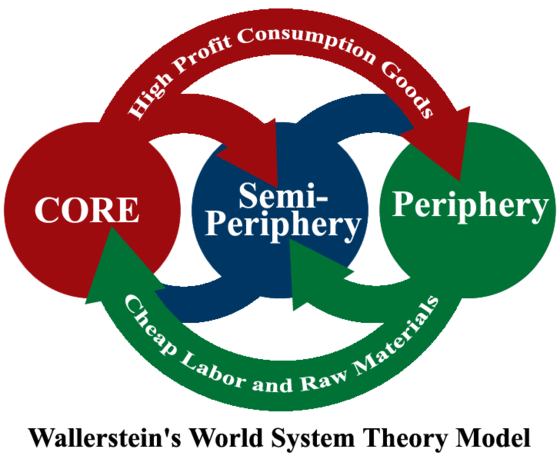
    In most cases, partial military intervention was sufficient for the industrialised states to maintain this system. In the world systems theory of Immanuel Wallerstein and Samir Amin, this practice was conceptualised by dividing the world into centres, semi-peripheries, and peripheries and defining it as a continuous influx of raw materials, goods, and people (brain drain) from the periphery to the mostly Western centres (Amin and Wallerstein).


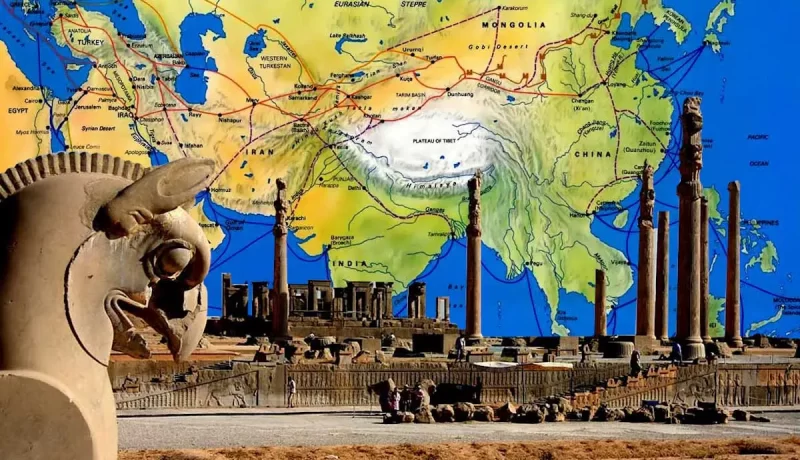
    A third explanation, however, is Asia-centric. In this view, the dominance of the Europeans and the hegemony of the United States are nothing more than an accident of world history. In this view, East and South Asia have always been the centre of the world economy and intellectual and civilisational development. More precisely, on the shores of the North Pacific and the Indian Ocean (including the Arabian Sea), a power shift has been taking place for thousands of years between China, India, and the Arab-Persian powers. Coincidentally, the retreat of China from about 1500 created a power vacuum in this area, into which the Europeans were gradually able to move. However, they could not compete with these civilisations. The current rise of the great empires and civilisations that were destroyed by European colonisation and Euro-American hegemony is nothing more than a return to the centre of the world, to the countries on the shores of the North Pacific and both parts of the Indian Ocean. In this view, the Europeans and the great powers that emerged from them are in no way superior, but rather the barbarians who caused an unprecedented bloodbath in colonisation and two world wars, including the Holocaust. Now, the centre of the world is returning to where it has always been (Abu-Lughod)

    Another approach is the globalisation approach. It assumes that every five hundred years or so, there has been a shift from one global political centre to the next, i.e., hegemonic empires’ rise, peak, and decline. For the late Andre Gunder Frank, we need to review the last 5000 years, not just the previous 500). At times, individual civilisations succeeded in becoming such hegemonic empires twice. Examples include the Egyptian society, the Chinese Empire of the Han dynasty, the Roman Empire, the Sassanid Empire (Persia), the Muslim Empire until its destruction by the Mongols, and finally European colonisation from about 1500.

    we need a floating balance and mutual recognition of the world’s civilisations

    The crucial question for today is whether globalisation will override this succession of great powers and civilisations or whether there will be a renewed, now genuinely global, struggle for world domination. In my view, we need a floating balance and mutual recognition of the world’s civilisations (Herberg-Rotzhe/Son). The rising civilisations are again faced with whether they will merely repeat the past mistakes and the ethnocentrism of the Europeans under different auspices or contribute to an equal coexistence of the world’s civilisations. And conversely, will the Europeans and the settler colonies they founded also learn to regard other civilisations as equals? Both perspectives will determine the fate of the 21st century if we do not want to experience yet another “bloody century”!

    References:

    Abu-Lughod, Janet: Before European Hegemony: The World System A.D. 1250-1350. Reprint edition. Oxford University Press: Oxford. 1991.

    Amin, Samir: Accumulation on a World Scale: A Critique of the Theory of Underdevelopment. (2 Volumes). Monthly Review Press: New York. 1974.

    Frank, Andre Gunder, The World System: Five Hundred Years or Five Thousand? Routledge: New York. 1996.

    Herberg-Rothe, Andreas and Son, Key-young: Order wars and floating balance. How the rising powers are reshaping our worldview in the twenty-first century. Routledge: New York. 2018.

    Jaspers, Karl: The Origin and Goal of History. Routledge: New York 2021 (original in German 1949).

    Katzenstein, Peter J.” Civilizations in World Politics: Plural and Pluralist Perspectives. Routlöedge: New York 2009.

    Stark, Rodney: How the West Won: The Neglected Story of the Triumph of Modernity. ‎ ISI Books: NewYork. 2015.

    Wallerstein, Immanuel: World-Systems Analysis: An Introduction. Duke University Press: Durham. 2004.


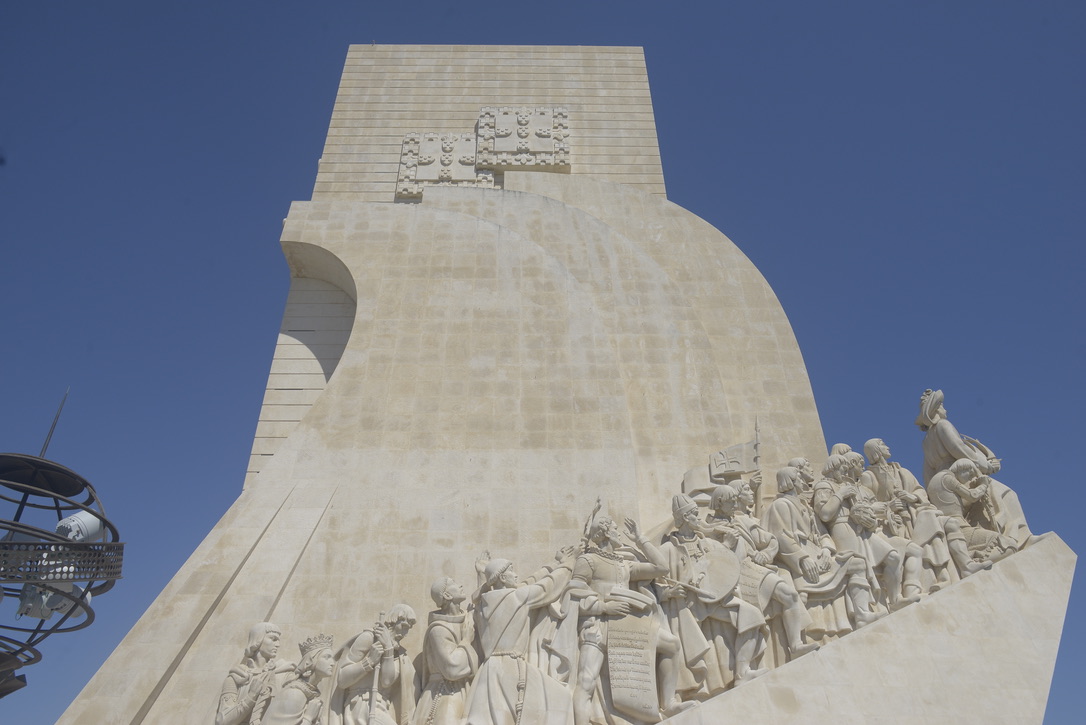
    Feature Photo Credit: Photo of ‘Monument of Discoveries’ in Lisbon. Photo by M Matheswaran. The Monument depicts Henry the Navigator followed by 33 pioneers, including Vasco-da-Gama whose exploration voyages were instrumental in establishing the Portuguese colonial empire, and thus begin the age of colonialism and imperialism.

    Image 1-Map: Asian empires and trade routes – the collector.com

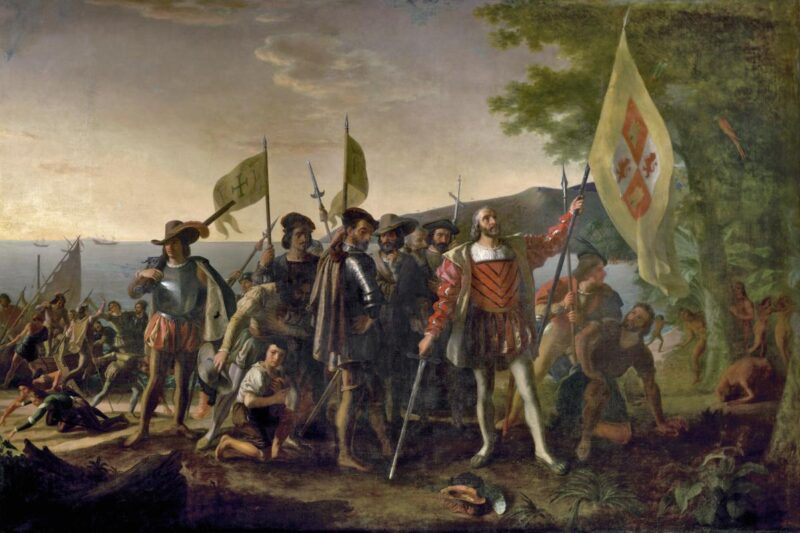
    Image 2: Columbus reaching the Americas (actually the Caribbean) in 1492 – Wikimedia Commons

    Image 3: The story of the colonial looting of Africa – Photo of exhibit in African American Museum, Washington D.C. (Photo – M Matheswaran).

    Image 4: Robert Clive meeting Mir Jaffer in Battle of Plassey 1757 – the beginnings of the British Indian Empire – Wikimedia Commons.


  • From Global Democratisation to the Battle of World Powers? Contradictory Developments in the Present

    From Global Democratisation to the Battle of World Powers? Contradictory Developments in the Present

    Shortly after the democratic revolutions of 1989-1991, Francis Fukuyama wrote his highly influential essay on the end of history- that is, the end of violent history through global democratization.

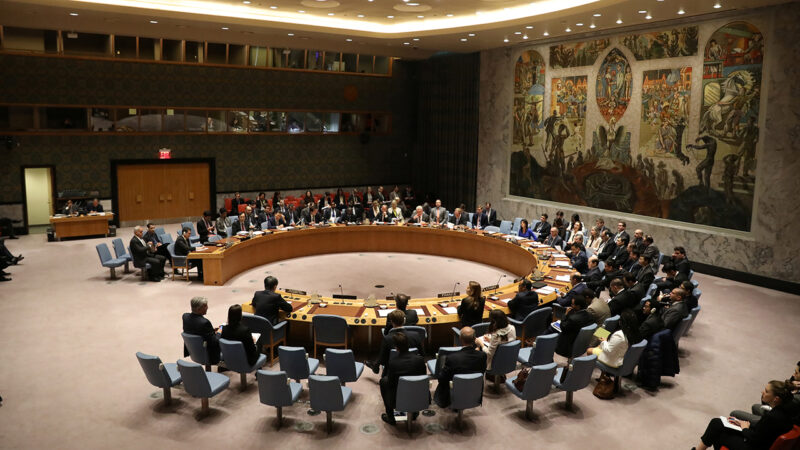
    Members of the United Nations Security Council sit during a meeting on Syria at the United Nations Headquarters in New York City, NY, U.S. April 5, 2017. REUTERS/Shannon Stapleton – RC141DE9DE00. Image credit: world101.cfr.org

    The world has changed so dramatically since the end of the Cold War that it is necessary to look back in order to understand today’s global political situation. In total, there are five different discourses that will be discussed here as representative of historical developments. They range from Fukuyama’s thesis of global democratization to various versions of coming anarchy and global (“new”) civil wars (Kaplan, Kagan, Kaldor, Münkler), Huntington’s clash of civilizations, the concept of global governance and the “rise of the others” (Zakaria, Zhang), a multipolar world of nation-states, and the re-nationalization of world politics. My central thesis is that all five discourses are present in contemporary political conflicts and that we cannot neglect any of them.

    But if you look at the history of democracy, you can almost discover a law of motion of democratic revolutions based on Hannah Arendt’s analysis of the French Revolution. It starts with a democratic revolt against a dictator or colonial rule. Then the revolutionaries become radicalized, civil war breaks out, a new, this time totalitarian ruler takes power, and only after his overthrow does democracy prevail.

    Shortly after the democratic revolutions of 1989-1991, Francis Fukuyama wrote his highly influential essay on the end of history- that is, the end of violent history through global democratization. And his thoughts were very timely. What better confirmation could there be when, in just a few years, the old dictatorships from Berlin to Vladivostok, which only called themselves communist but were not, but rather geriocracies, were swept away in a wave of democratisation. The Arab Spring seemed to confirm his thoughts, as here, too, long-standing dictatorships were overrun by democratic movements virtually overnight, as in Egypt and Tunisia. But even then, there were counter-movements that contradicted the assumed linear process of global democratization. Fukuyama, therefore, had to defend his original thesis and argue that, despite all the setbacks, democracy was still at the end of history. In a way, he was echoing Hannah Arendt’s theory of revolution. The reverses of democratization in Russia, many Arab countries, and the global civil wars have often been cited as cultural – Russia, China, and Middle Eastern Islam were still too culturally authoritarian to allow for genuine democratization. But if you look at the history of democracy, you can almost discover a law of motion of democratic revolutions based on Hannah Arendt’s analysis of the French Revolution. It starts with a democratic revolt against a dictator or colonial rule. Then the revolutionaries become radicalized, civil war breaks out, a new, this time totalitarian ruler takes power, and only after his overthrow does democracy prevail. The French overthrew their king and got the emperor, Napoleon; the Russians revolted against the czar and got Stalin; the Chinese fought against their emperor and got Mao Tse-tung; the Germans overthrew their emperor after their military defeat and got the leader Adolf Hitler. Resistance to colonial rule also often followed this law of democratic movement: the colonial rulers were driven out and replaced by new rulers.

    In the same year that the Soviet Union collapsed, the terrible civil wars in the former Yugoslavia began, the first Chechen war, followed by countless “markets of violence” and so-called new wars, which in a narrower sense were new civil wars and wars of state collapse. Mass rape became a weapon of war to demoralize the enemy, and an almost complete dissolution of the boundaries of violence took on a life of its own, seeming to make any rational resolution of conflicts impossible. Warlords, drug lords, terrorists, child soldiers, and “archaic” warriors who seemed to belong to the past dominated warfare worldwide. Against this backdrop, Western armies were transformed into intervention armies that were supposed to maintain a minimum of order on the borders of the U.S. “liberal empire” in order to prevent global anarchy (Robert Kaplan) or a “world civil war” (Enzensberger) – at least according to Western discourse. From the perspective of the countries affected by these wars of intervention, however, they were wars to maintain their immediate exploitation (especially in Africa), to keep corrupt regimes that collaborated with Western states alive (Arabian Peninsula), or to eliminate those that opposed the West (Iraq, Iran, Afghanistan). In the open spaces of violence and violent markets, high-value illegal goods were traded: Drugs, blood diamonds, human beings (women and child slaves), weapons and rare earths.

    Linked to these wars of intervention was the apparent cultural triumph of the West, which is associated with the term globalisation, but was, in fact, initially an Americanization, the so-called McDonaldization or Mac World. However, this cultural globalization of the American way of life, combined with U.S. wars of intervention, led to a backlash as many societies saw their cultural identity threatened. Taken together, these two factors triggered Samuel Huntington’s concept of the clash of civilizations.

    In their liberal hubris, his Western critics argued that there could be no clash of civilizations because only the West had produced a civilization – the others were religions or cultures, but not civilizations.

     His book has often been misunderstood as a guide to action for the coming war – but in fact, he had written the book to prevent that clash, and he argued for the U.S. to withdraw from small wars around the world because he saw the liberal identity of the U.S. at risk. Perhaps more importantly, he saw non-Western religions not just as cultures but as civilizations that had grown out of their respective religions. In their liberal hubris, his Western critics argued that there could be no clash of civilizations because only the West had produced a civilization – the others were religions or cultures, but not civilizations.

    While globalization initially had the effect of Americanization, in the medium term, it facilitated the “rise of the others” (Zakaria), the great empires and civilizations that had perished under European colonization and Euro-American hegemony. As a result of their initial economic success (Malaysia, Singapore, the Asian Tigers, China, India, the Pacific Rim countries), they no longer sought to imitate Western culture in order to be recognized as equals, but to develop their own identity, which they considered superior to the West. From the point of view of Western discourse, the “others” were, at best, immature children or barbarians – now the West suddenly sees itself in the role of other civilizations, seeing themselves as superior to the West. One expression of this changed self-image was Zahng Weiwei’s book China – The Civilizational State. We are now experiencing a paradoxical situation in which the West is consumed by fear of decline and the dissolution of its own sense of superiority, leading to the rise of right-wing populist and radical right-wing movements; large parts of the Asian world population are filled with hope for a better life, and the Islamic-Arab world is desperate in the face of unfulfilled promises, leading to the radicalization of young people in Islamist movements.

    The concept of global governance was invented at the beginning of the 21st century as a reaction to advancing globalization. The assumption, correct in itself, was that the absence of a democratic world state did not necessarily mean that there was no possibility of at least regulating global problems, subjecting them to rules, if not solving them. Global governance was based on the idea of cooperation between nation-states, non-governmental organizations, globally active institutions, the emerging global civil society, globally active corporations, and global players. However, the resurgence of big states has pushed global governance into the background, just like globalization itself. Some states want to reverse globalization, at least in the economic and political spheres. This applies at least to Western democracies, whose citizens often see themselves as the losers of globalization.

    The relative loss of importance of the Western states and the institutions they helped to create, such as the U.N., cannot be overlooked – the overstretched role of the U.S. as the world’s policeman is due, on the one hand, to its own lack of investment in development and education, and on the other to the rise of others.

    What we are currently experiencing is not simply a multipolar world of great powers, even if there are signs of a renaissance of great power politics. Instead, we are witnessing a contradictory process of the five discourses alluded to here: Democratization, failed states, the clash of civilizations, further globalization, and the renaissance of great power politics. The still existing, but also partly former, Global South is still dependent on cooperation, even if new forms of cooperation are emerging, such as the expansion of the BRICS, which compete politically but cooperate economically. The relative loss of importance of the Western states and the institutions they helped to create, such as the U.N., cannot be overlooked – the overstretched role of the U.S. as the world’s policeman is due, on the one hand, to its own lack of investment in development and education, and on the other to the rise of others. What remains unpredictable is whether the emerging states of the Global South and the former superpower Russia will make the same mistake as the West in its centuries-long quest for hegemony, namely, to see itself as superior to all others. Eurocentrism would be replaced by an equally problematic ethnocentrism, and a nationalist dynamic would be set in motion that would be difficult for states to control. Even if all current developments point to the contrary and we see a return of tribalism in the form of “us versus them – whoever the others are” discourses, the only option left is to revive intercultural dialogue if we do not want to experience “another bloody century” (Colin S. Gray).


    Feature Image Credit: chinausfocus.com

  • Houthi’s attacks in the Red Sea: What does this mean for the world?

    Houthi’s attacks in the Red Sea: What does this mean for the world?

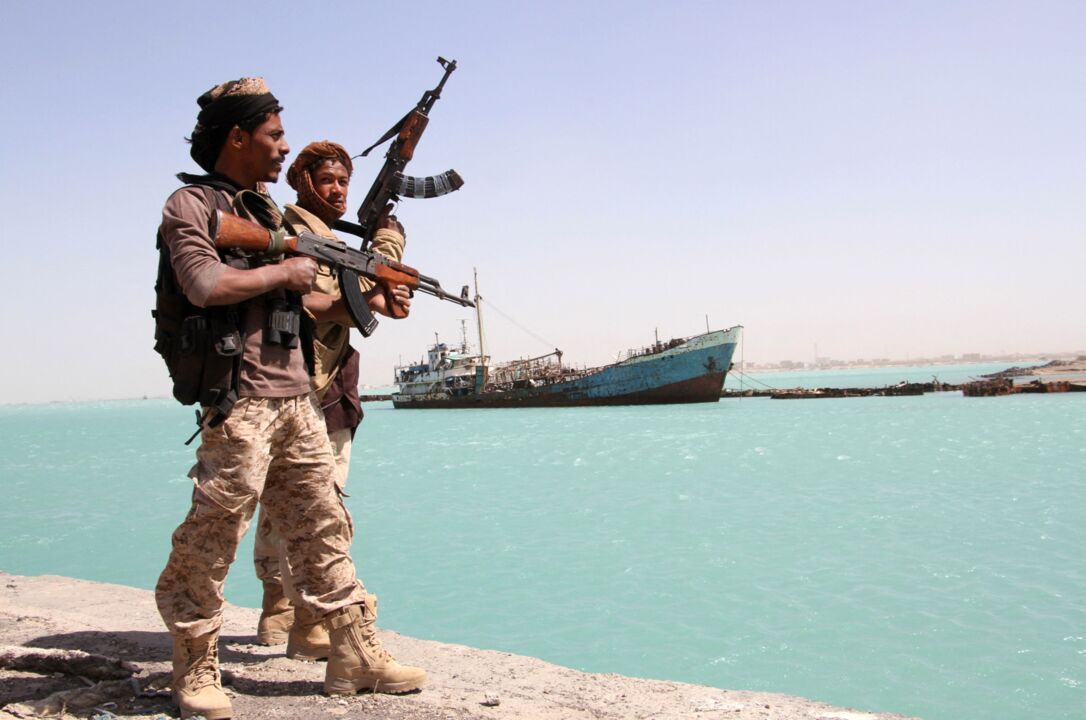
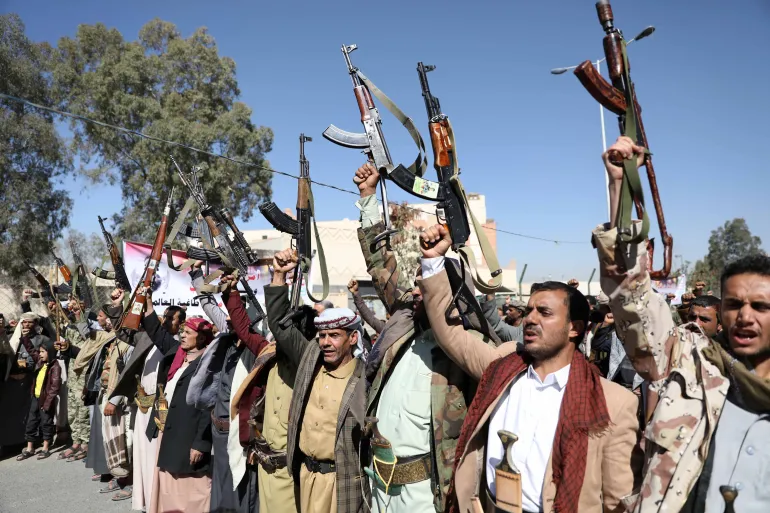
    The Houthis started in the 1990s as an armed group in Yemen, fighting against corruption. They belong to a community called Zaidis, who are a part of the Shia-Muslim minority. Along with Hamas and Hezbollah, the Houthis have declared themselves to be a part of the Iranian-led “axis of resistance” against Israel, the US, and the larger West.1 The Houthis have been attacking commercial ships passing through the lower Red Sea, and this has dramatically increased since mid-November in retaliation to Israel’s bombardment of Gaza. Due to these events, the Red Sea trade route is significantly affected, impacting the flow of global trade and having the potential to cause further damage. With ships attacked and stranded in one of the leading shipping routes of the world, countries seem to find themselves in yet another geopolitical fix. As the war continues between Israel and Gaza, the Red Sea has become a renewed hotspot for geopolitical and military tensions.

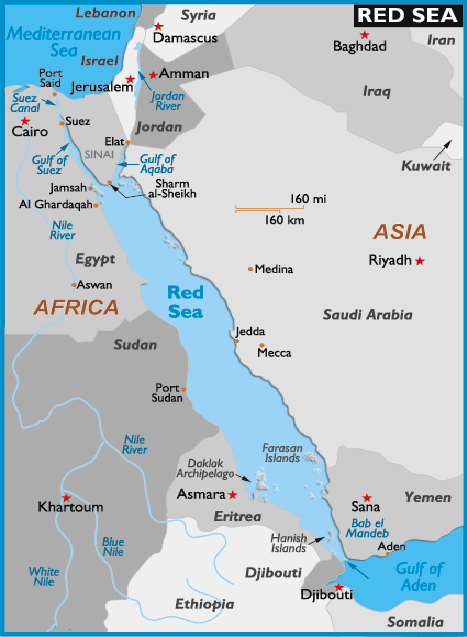
    Situated between Africa and West Asia, the Red Sea is a seawater entrance to the Indian Ocean in the south and goes through the Gulf of Aden and the Bab El Mandeb Strait, meeting the Gulf of Suez in the north. Countries like the US, France, Japan, and China have military bases in the region, including in Djibouti and many along the Horn of Africa, with considerable deployment of ships, weapons, and personnel. Establishing such bases conveys how critical it is to have control of the area as a measure of regional power and as a way of asserting their dominance internationally. Big players, including the Cold War rivals, have long struggled to gain presence and influence in West Asia. Having a military and economic presence in Africa with proximity to the Red Sea was necessary, for it provides access to almost 12% of the world’s trade, including nearly 40% of the trade between Europe and Asia.

    Until recently, the Houthis had been targeting ships heading towards Israel or ones that Israelis owned. However, recent developments showing attacks on ships bound for Israel with flags of various countries have raised grave concerns for global trade and security in the immediate future. The US, along with countries like the UK, France, and Bahrain, have tried to stop Houthi attacks on ships passing through the Red Sea under what Washington calls the “Operation Prosperity Guardian”. On the first day of the new year, The US military released a statement conveying that they killed at least 10 Houthi rebels and sabotaged three Houthi ships. Although the US was successful in deterring the Houthis from their attempt to attack, it did not do much to stop the group from being involved in disrupting peaceful navigation through the Red Sea.

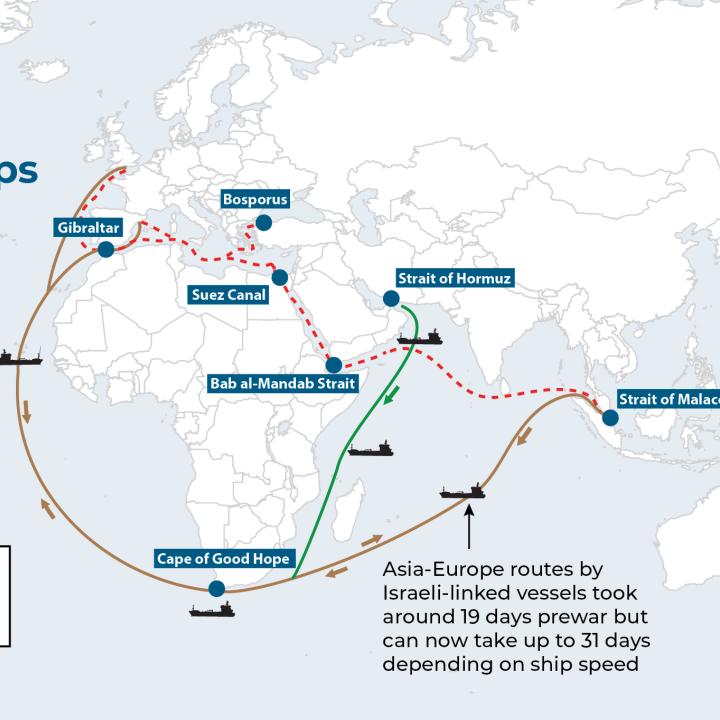
    Private shipping companies such as Maersk, CMA CGM, Hapag-Lloyd, and MSC have begun to avoid using the Red Sea route due to the imminent threat from Houthis.3  The ongoing supply chain disruption caused by the COVID-19 pandemic and Russia’s invasion of Ukraine could further escalate due to the Red Sea crisis and cause severe concerns for world trade and consumer goods supply. With the suspension of trade via the Suez Canal, traffic through the Red Sea has dropped by 35%.4  The Houthis have raised the shipping cost internationally, imposing additional costs on commerce when trouble at the Panama Canal due to low water levels has already made shipping more complicated and central banks worry about a new inflationary spike. While trade hasn’t wholly stopped, most ships can choose the longer but safer route around Africa through the Cape of Good Hope to reach Europe and Asia from either side. This option imposes significant costs on shipping and, therefore, to consumers and affects local states in the region if the Houthi “blockade” persists. In the worst-case scenario, crude oil prices would rise in 2024 if oil shipments through the canal were stopped entirely, and this could cause a significant disturbance.

    Image Credit: washingtoninstitute.org

    Surprisingly, though, Russian ships have enjoyed free navigation through the Red Sea. Russian ships travel to Asia through the Black Sea, connecting to the Mediterranean Sea, passing through the Suez Canal and the Red Sea, and joining the Indian Ocean. With sanctions from Europe and the US amid the war in Ukraine, Russia cannot afford to lose its markets in Asia, particularly India and China, since these two countries buy almost 90% of Russia’s oil exports.5  The free navigation of Russian ships could possibly be due to its close relationship with Iran or due to the adoption of a similar stance with the Houthis on the war between Israel and Gaza. In the unlikely scenario that Russia does not have access to the Red Sea, it leaves them with the only other option of travelling through the Cape of Good Hope, adding 8,900 kilometres with an additional two weeks of travel. Such delays in oil shipments and a highly possible hike in price may prompt countries like India and China to start looking for other alternatives to their oil requirement, given the pre-existing energy crisis. Most probable alternatives include Saudi Arabia and other Gulf countries that do not need to pass the Red Sea to reach the Indian Ocean and thus Asian markets since they have ports in the Persian Gulf with access to the Arabian Sea.

    The disruption in trade has caused an impact on Indian imports and exports as well. Indian exports traverse the Indian Ocean and reach the Suez Canal through the Arabian Sea to reach European markets. Trade between India and Europe has been rising, at an all-time high in 2022, with goods traded worth $130 Billion.6   As of 2021, India engaged in trade worth $200 Billion through the Suez Canal, making the EU one of India’s main export destinations, with a Free trade agreement in the talks.7  India also procures its oil from Russia using the Suez Canal and the Red Sea. A slowdown or possible pause of oil imports may cause severe concerns amid the ongoing energy crisis. At such a juncture for the Indian economy, if the situation persists, trade will likely take a hit along with India’s domestic economy. If the condition fails to change decisively, the higher fees and the expense of prolonged travel duration will also put inflationary pressure on the global economy and India.

    The Houthis will most likely continue to put pressure on Israel to stop its onslaught in Gaza, and they are likely to keep attacking until they reach their goal. By taking control of the Red Sea and indirectly and directly hurting countries irrespective of their size and power, Houthis pressurize the international community to, in turn, put pressure on Israel. This also means that the group is unlikely to agree on any other way of settlement. Not only does this fall on Israel to stop their attacks but also on the US since the latter has always portrayed itself as a peace negotiator in the Middle East and, therefore, has the responsibility to restore order in the region. The Houthis possess a plethora of Iranian-supplied weaponry, ranging from precision drones to anti-ship cruise and ballistic missiles that can strike a moving vessel hundreds of kilometres away. What makes the Houthis more dangerous is the enormous stockpile that can help them continue their campaign indefinitely.

    The attacks have also prompted an unanticipated return of Somali piracy in international seas. As a result, increased expenses are now a worry for merchant shipping lines and seafarer safety for governments worldwide. The ship Lila Norfolk, under the Liberian flag and carrying six Filipinos and fifteen Indians, was taken over by Somali pirates on January 4th, 2024. The Indian navy had already deployed four warships patrolling the Indian Ocean, including INS Chennai, which was involved in the rescue operation during the recent highjack of ship Lila Norfolk. Even though the Indian Navy’s intervention allowed for the sailors’ rescue, it caused further concerns for India’s security and economy. The spill over of these attacks onto the Indian Ocean may threaten India’s security.

    Countries must monitor developments in the Red Sea and, for India, the Indian Ocean. Although India has not joined any Western-led operations on this matter, the country must push the international community to ensure freedom of navigation and the territorial integrity of countries over their sea is upheld under the UN Convention on the Law of the Seas.


    References

    [1] Who are the Houthi rebels and why are they attacking Red Sea ships? (2023, December 23). BBC News. https://www.bbc.com/news/world-middle-east-67614911

    [2] Yerushalmy, J. (2023, December 19). Red Sea crisis explained: what is happening and what does it mean for global trade? The Guardian.

    [3] A new Suez crisis threatens the world economy. (2023, December 16). The Economist. https://www.economist.com/international/2023/12/16/a-new-suez-crisis-threatens-the-world-economy

    [4] Graham, R., Murray, B., & Longley, A. (2023, December 19). Houthi Red Sea Attacks Start Shutting Down Merchant Shipping. Bloomberg.com. https://www.bloomberg.com/news/articles/2023-12-18/houthi-attacks-start-shutting-down-red-sea-merchant-shipping

    [5] Russia: crude oil shipments by destination 2023 | Statista. (2023, September 14). Statista. https://www.statista.com/statistics/1350506/russia-crude-oil-shipments-by-destination/

    [6] I. (n.d.). First India-EU Trade and Technology Council: Significant Milestone in India-EU Relations – Indian Council of World Affairs (Government of India). https://www.icwa.in/show_content.php?lang=1&level=3&ls_id=9416&lid=6112#:~:text=The%20EU%20is%20India’s%202nd,EU%20total%20trade%20in%20goods.

    [7] Ibid.


    Feature Image Credit: dailynewsegypt.com

  • Is Singularity here?

    Is Singularity here?

    One of the most influential figures in the field of AI, Ray Kurzweil, has famously predicted that the singularity will happen by 2045. Kurzweil’s prediction is based on his observation of exponential growth in technological advancements and the concept of “technological singularity” proposed by mathematician Vernor Vinge.

    The term Singularity alludes to the moment in which artificial intelligence (AI) becomes indistinguishable from human intelligence. Ray Kurzweil, one of AI’s fathers and top apologists, predicted in 1999 that Singularity was approaching (Kurzweil, 2005). In 2011, he even provided a date for that momentous occasion: 2045 (Grossman, 2011). However, in a book in progress, initially estimated to be released in 2022 and then in 2024, he announces the arrival of Singularity for a much closer date: 2029 (Kurzweil, 2024). Last June, though, a report by The New York Times argued that Silicon Valley was confronted by the idea that Singularity had already arrived (Strifeld, 2023). Shortly after that report, in September 2023, OpenAI announced that ChatGPT could now “see, hear and speak”. That implied that generative artificial intelligence, meaning algorithms that can be used to create content, was speeding up.

     Is, thus, the most decisive moment in the history of humankind materializing before our eyes? It is difficult to tell, as Singularity won’t be a big noticeable event like Kurzweil suggests when given such precise dates. It will not be a discovery of America kind of thing. On the contrary, as Kevin Kelly argues, AI’s very ubiquity allows its advances to be hidden. However, silently, its incorporation into a network of billions of users, its absorption of unlimited amounts of information and its ability to teach itself, will make it grow by leaps and bounds. And suddenly, it will have arrived (Kelly, 2017).

    The grain of wheat and the chessboard

             What really matters, though, is the gigantic gap that will begin taking place after its arrival. Locked in its biological prison, human intelligence will remain static at the point where it was reached, while AI shall keep advancing at exponential speed. As a matter of fact, the human brain has a limited memory capacity and a slow speed of processing information: About 10 Hertz per second (Cordeiro, 2017.)  AI, on its part, will continue to double its capacity in short periods of time. This is reminiscent of the symbolic tale of the grain of wheat and the chess board, which takes place in India. According to the story, if we place one grain of wheat in the first box of the chess board, two in the second, four in the third, and the number of grains keeps doubling until reaching box number 64, the total amount of virtual grains on the board would exceed 18 trillion grains (IntoMath). The same will happen with the advance of AI.

    The initial doublings, of course, will not be all that impressive. Two to four or four to eight won’t say much. However, according to Ray Kurzweil, the moment of transcendence would come 15 years after Singularity itself, when the explosion of non-human intelligence should have become overwhelming (Kurzweil, 2005). But that will be only the very beginning. Centuries of progress would be able to materialize in years or even months. At the same time, though, centuries of regression in the relevance of the human race could also occur in years or even months.

    Humans equaling chickens

             As Yuval Noah Harari points out, the two great attributes that separate homo sapiens from other animal species are intelligence and the flow of consciousness. While the first has allowed humans to become the owners of the planet, the second gives meaning to human life. The latter translates into a complex interweaving of memories, experiences, sensations, sensitivities, and aspirations: meaning, the vital expressions of a sophisticated mind. According to Harari, though, human intelligence will be utterly negligible compared to the levels to be reached by AI. In contrast, the flow of consciousness will be an expression of capital irrelevance in the face of algorithms’ ability to penetrate the confines of the universe. Not in vain, in his terms, human beings will be to AI the equivalent of what chickens are for human beings (Harari, 2016).

             Periodically, humanity goes through transitional phases of immense historical significance that shake everything on its path. During these, values, beliefs and certainties are eroded to their foundations and replaced by new ones. All great civilizations have had their own experiences in this regard. In the case of the Western World, there have been three significant periods of this kind in the last six hundred years: The Renaissance that took place in the 15th and 16th centuries, the Enlightenment of the 18th, and Modernism that began at the end of the 19th century and reached its peak in the 20th.

    Renaissance, Enlightenment and Modernism

    The Renaissance is understood as a broad-spectrum movement that led to a new conception of the human being, transforming it in the measure of all things. At the same time, it expressed a significant leap in scientific matters where, beyond great advances in several areas, the Earth ceased to be seen as the centre of the universe. The Enlightenment placed reason as the defining element of society. Not only in terms of the legitimacy of political power but also as the source of liberal ideals such as freedom, progress, or tolerance. It was, concurrently, the period in which the notion of harmony was projected into all orders, including the understanding of the universe. During this time, the scientific method began to be supported by verification and evidence. Enlightenment represented a new milestone in the self-gratifying vision human beings had of themselves.

    Modernism, understood as a movement of movements, overturned prevailing paradigms in almost all areas of existence. Among its numerous expressions were abstract art in its multiple variables, an introspective narrative that gave a free run to the flow of consciousness, and psychoanalysis, the theatre of the absurd. In sum, reason and harmony were turned upside down at every step. Following its own dynamic but feeding back the former, science toppled down the pillars of certainty. This included the conception of the universe built by Newton during the Enlightenment. The conventional notions of time and space lost all meaning under the theory of Relativity while, going even further, quantum physics made the universe a place dominated by randomness. Unlike the previous two periods of significant changes, Modernism eroded to its bones the self-gratifying vision human beings had of themselves.

    The end of human centrality

             Renaissance, Enlightenment and Modernism unleashed and symbolized new ways of perceiving the human being and the universe surrounding him. Each of these movements placed humanity before new levels of consciousness (including the subconscious during Modernism). In each of them, humans could feel themselves more or less valued, more secure or insecure with respect to their own condition and its position in relation to the universe itself. However, a fundamental element was never altered: Humans always studied themselves and their surroundings. Even while questioning their nature and motives, they reaffirmed their centrality within the planet. As it had been defined since the Renaissance, humans kept being the measure of all Earthly things.

    Singularity, however, is called to destroy that human centrality in a radical, dramatic, and irreversible way. As a result, human beings will not only confront its obsolescence and irrelevance but will embark on the path towards becoming equals to chickens. Everything previously experienced in the march of human development, including the three above-mentioned groundbreaking periods, will pale drastically by comparison.

    The countdown towards the end

             We are, thus, within the countdown towards the henhouse grounds. Or worse still, towards the destruction of the human race itself. That is what Stephen Hawking, one of the most outstanding scientists of our time, believed would result from the advent of AI’s dominance. This is also what hundreds of top-level scientists and CEOs of high-tech companies felt when, in May 2023, they signed an open letter warning about the risk to human subsistence involved in an uncontrolled AI. For them, the risk for humanity associated with this technology was on par with those of a nuclear war or a devastating human pandemic. Furthermore, at a “summit” of bosses of large corporations held at Yale University in mid-June this year, 42 percent indicated that AI could destroy humanity in five to ten years (Egan, 2023).

    The risk for humanity associated with AI technology was on par with those of a nuclear war or a devastating human pandemic. At a “summit” of bosses of large corporations held at Yale University in mid-June this year, 42 percent indicated that AI could destroy humanity in five to ten years.

             In the short to medium term, although at the cost of increasing and massive unemployment, AI will spurt gigantic advances in multiple fields. Inevitably, though, at some point, this superior intelligence will escape human control and pursue its own ends. This may happen if freed from the “jail” imposed by its programmers by some interested hand. The natural culprits of these actions would come from what Harari labels as the community of experts. Among its members, many believe that if humans can no longer control the overwhelming volumes of information available, the logical solution is to pass the commanding torch to AI (Harari, 2016). The followers of the so-called Transhumanist Party in the United States represent a perfect example of this. They aspire to have a robot as President of that country within the next decade (Cordeiro, 2017). However, AI might be able to free itself of human constraints without any external help. Along the road, its own self-learning process would certainly allow so. One way or the other, when this happens, humanity will be doomed.

             As a species, humans do not seem to have much of an instinct for self-preservation. If nuclear war or climate change doesn’t get rid of us, AI will probably take care of it. The apparently imminent arrival of Singularity, thus, should be seen with frightful eyes.

    References

    Cordeiro, José Luis (2017). “En 2045 asistiremos a la muerte de la muerte”. Conversando con Gustavo Núñez, AECOC, noviembre.

    Egan, Matt (2023). “42% of CEOs say AI could destroy humanity in five to ten years”, CNN Business, June 15.

    Harari, Yuval Noah (2016). Homo Deus. New York: Harper Collins.

    Grossman, Lev (2011) “2045: The Year the Man Becomes Inmortal”, Time, February 10.

    IntoMath, “The Wheat and the Chessboard: Exponents.

    Kelly, Kevin (2017). The Inevitable. New York: Penguin Books.

    Kurzweil, Ray (2005). The Singularity is Near. New York: Viking Books.

    Kurzweil, Ray (2024). The Singularity is Nearer. New York: Penguin Random House.

    Streifeld, David (2023). “Silicon Valley Confronts the Idea that Singularity is Here”, The New York Times, June 11.

    Feature Image Credit: Technological Singularity https://kardashev.fandom.com

    Text Image: https://ts2.space

  • Hamas Attack – What really happened on 7th October? – Sifting truth from propaganda

    Hamas Attack – What really happened on 7th October? – Sifting truth from propaganda

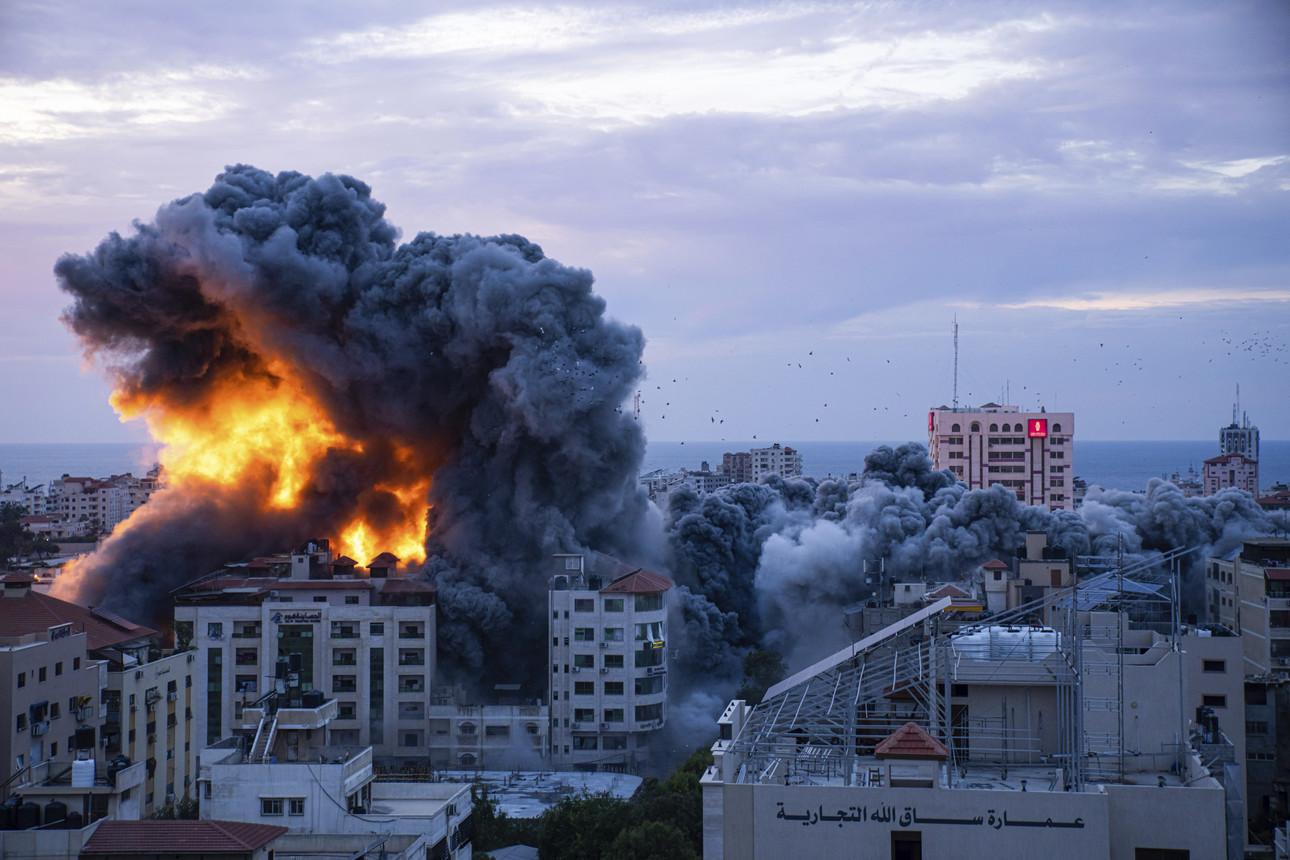
    As Gaza is under a catostrophic military assault by Israeli forces it is important to analyse the trigger for the Israeli assault – the Hamas attack of October 7th. Evidence is now emerging that up to half the Israelis killed were combatants; that Israeli forces were responsible for some of their own civilian deaths; and that Tel Aviv disseminated false ‘Hamas atrocities’ stories to justify its devastating air assault on Palestinian civilians in Gaza. This article, a persuasive analysis, was published earlier in The Cradle.

    Two weeks after the Hamas breakout assault on Israel on 7 October, a clearer picture of what happened – who died, and who killed – is now beginning to emerge.

    Instead of the wholescale massacre of civilians claimed by Israel, incomplete figures published by the Hebrew newspaper Haaretz show that almost half the Israelis killed that day were in fact combatants – soldiers or police.

    In the interim, two weeks of blanket western media reporting that Hamas allegedly killed around 1,400 Israeli civilians during its 7 October military attack has served to inflame emotions and create the climate for Israel’s unconstrained destruction of the Gaza Strip and its civilian population.

    Accounts of the Israeli death toll have been filtered and shaped to suggest that a wholesale civilian massacre occurred that day, with babies, children, and women the main targets of a terror attack.

    Now, detailed statistics on the casualties released by the Israeli daily Haaretz paint a starkly different picture. As of 23 October, the news outlet has released information on 683 Israelis killed during the Hamas-led offensive, including their names and locations of their deaths on 7 October.

    Of these, 331 casualties – or 48.4 percent – have been confirmed to be soldiers and police officers, many of them female. Another 13 are described as rescue service members, and the remaining 339 are ostensibly considered to be civilians.

    While this list is not comprehensive and only accounts for roughly half of Israel’s stated death toll, almost half of those killed in the melee are clearly identified as Israeli combatants.

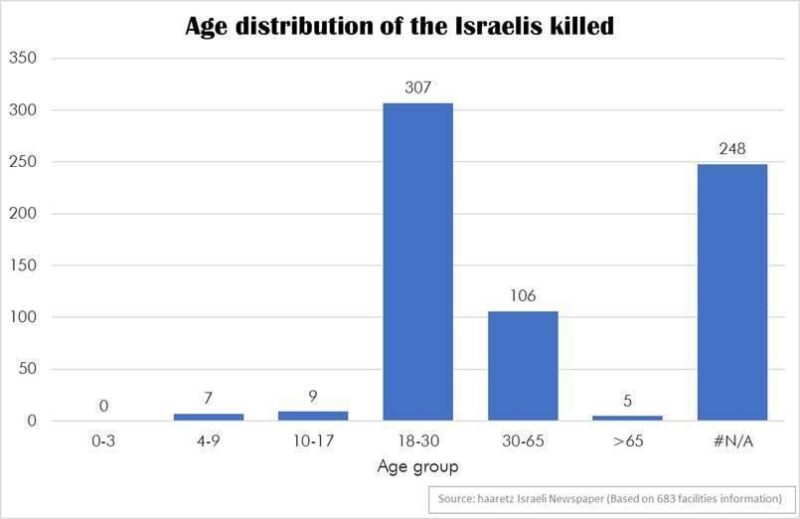
    There are also so far no recorded deaths of children under the age of three, which throws into question the Israeli narrative that babies were targeted by Palestinian resistance fighters. Of the 683 total casualties reported thus far, seven were between the ages of 4 and 7, and nine between the ages of 10 and 17. The remaining 667 casualties appear to be adults.


    Age Distribution of the Israelis killed during Hamas’ October 7 operation (as of 23 October)
    The numbers and proportion of Palestinian civilians and children among those killed by Israeli bombardment over the past two weeks – over 5,791 killed, including 2,360 children and 1,292 women, and more than 18,000 injured – are far higher than any of these Israeli figures from the events of 7 October.

    Revisiting the scene

    The daring Hamas-led military operation, codenamed Al-Aqsa Flood, unfolded with a dramatic dawn raid at approximately 6:30 AM (Palestine time) on 7 October. This was accompanied by a cacophony of sirens breaking the silence of occupied Jerusalem, signaling the start of what became an extraordinary event in the occupation state’s 75-year history.

    As per the spokesperson of Hamas’ armed wing, the Al-Qassam Brigades, around 1,500 Palestinian fighters crossed the formidable Gaza-Israel separation barrier.

    However, this breakout was not limited to Hamas forces alone; numerous armed fighters belonging to other factions such as Palestinian Islamic Jihad (PIJ) later breached the armistice line, along with some Palestinians unaffiliated with any organized militia.

    As it became apparent this was no ordinary resistance operation, hundreds of videos quickly flooded social media, most of which have been viewed by The Cradle, depicting dead Israeli troops and settlers, fierce gunfire battles between various parties, and Israelis being taken captive into Gaza.

    These videos were either taken on the phones of Israelis, or were released by Palestinian fighters filming their own operation. It wasn’t until hours later that more gruesome and downright dubious allegations began to surface.

    Unsubstantiated allegations of ‘Hamas atrocities’

    Aviva Klompas, a former speechwriter for the Israeli mission to the UN, was the first Israeli of note to spread the claim that there were reports of “Israeli girls being raped and their bodies dragged through the street.

    She posted this on X at 9:18 PM (Palestine time), on 7 October, although an op-ed Klompa published with Newsweek at 12:28 AM (Palestine time), on 8 October, made no mention of any sexual violence.

    Klompas is also the co-founder of Boundless Israel, a “think-action tank” that works “to revitalize Israel education and take bold collective action to combat Jew-hatred.” An “unapologetically Zionist” charitable group that works to promote Israeli narratives on social media.

    The one case touted as proof of rape was that of a young German-Israeli woman named Shani Louk, who was filmed face down in the back of a pickup truck and was widely assumed dead.

    It was unclear whether the fighters filmed with Louk in the Gaza-bound vehicle were members of Hamas, as they do not sport the uniforms or insignia of the Al-Qassam troops identifiable in other Hamas videos – some even wore casual civilian clothing and sandals.

    Later, her mother claimed to have evidence that her daughter was still alive, but had suffered a severe head wound. This rings true with information released by Hamas that indicated Louk was being treated for her injuries at an unspecified Gaza hospital.

    Complicating matters further, on the day these rape allegations arose, Israelis would not have had access to this information. Their armed forces had not yet entered many, if not most, of the areas liberated by the resistance and were still engaged in armed clashes with them on multiple fronts.

    Nevertheless, these rape claims took on a life of their own, with even US President Joe Biden alleging, during a speech days later, that Israeli women were “raped, assaulted, paraded as trophies” by Hamas fighters. It is important to note that The Forward’s article on 11 October reported that the Israeli military acknowledged they had no evidence of such allegations at that point.

    When the army later made its own allegations of decapitations, foot amputations, and rape, Reuters pointed out that “the military personnel overseeing the identification process didn’t present any forensic evidence in the form of pictures or medical records.” To date, there is no credible evidence of these atrocities that has been presented.

    Other outrageous allegations, such as the story of Hamas “beheading 40 babies‘ made headlines and the front pages of countless western news outlets. Even Biden claimed to have seen “confirmed photos of terrorists beheading babies.” The claims trace back to Israeli reserve settler and soldier David Ben Zion, who has previously incited violent riots against Palestinians and called for the West Bank town of Huwara to be wiped out. No evidence was ever produced to support these claims and the White House itself confirmed later that Joe Biden had never seen such photos.

    The Hamas plan

    There is little to no credible evidence that Palestinian fighters had a plan to – or deliberately sought to – kill or harm unarmed Israeli civilians on 7 October. From the available footage, we witness them engaging primarily with armed Israeli forces, accounting for the deaths of hundreds of occupation soldiers. As Qassam Brigades’ Spokesman Abu Obeida made clear on 12 October:

    Al-Aqsa Flood operation aimed to destroy the Gaza Division (an Israeli army unit on Gaza’s borders) which was attacked at 15 points, followed by attacking 10 further military intervention points. We attacked the Zikim site and several other settlements outside the Gaza Division headquarters.

    Abu Obeida and other resistance officials claims that the other key objective of their operation was to take Israeli prisoners that they could exchange for the approximately 5,300 Palestinian prisoners held in Israeli detention centers, many of whom are women and children.

    Hamas Deputy Head of the Political Bureau of Saleh Al-Arouri, in an interview after the operation, stressed: “We have a large and qualitative number and senior officers. All we can say now is that the freedom of our prisoners is at the doorstep.”

    Both sides play this game: Since the start of its military assault on Gaza, Israel has rounded up and imprisoned more than 1,200 Palestinians in the occupied West Bank. To date there have been 38 prisoner exchange deals between the resistance factions and Tel Aviv – deals that Israelis often resist to the very last minute.

    While these kinds of testimonies trickle out, reports are emerging that Israeli authorities have dialed up the mistreatment, torture, and even killing of Palestinian prisoners in their custody – a violation of the Geneva Conventions, which ironically, a non-state actor like Hamas appears to have followed to the letter.

    In relation to the events of 7 October, there are certainly some videos depicting possibly unarmed Israelis, killed in their vehicles or at entrances to facilities, so that Palestinian troops could gain access.

    There are also videos which show the fighters engaging in shootouts with armed Israeli forces, where there were unarmed Israelis taking cover in between, in addition to videos of fighters shooting toward houses and throwing grenades into fortified areas. Eyewitness testimony also suggests grenades were thrown into bomb shelters, though by whom is unclear.

    Even at the Israeli “peace rave”, which has been cited as the single deadliest attack committed by Palestinian fighters during their operation, videos emerged that appeared to show Israeli forces opening fire through a crowd of unarmed civilians, toward targets they believed to be Hamas members. ABC News also reported that an Israeli tank had headed to the site of the festival.

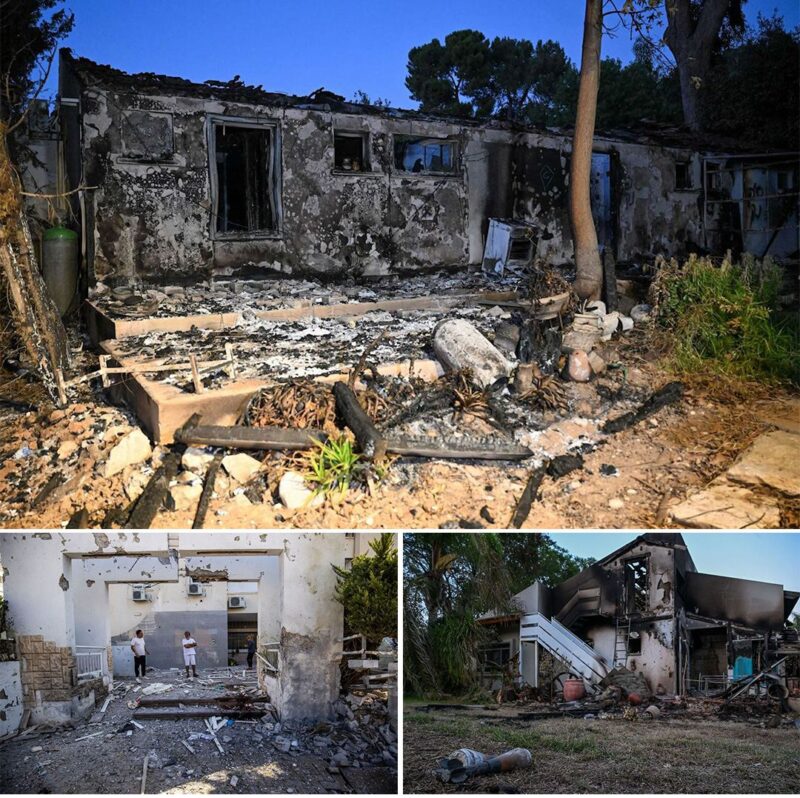
    An Israeli massacre in Kibbutz Be’eri?

    In its report on the events at Be’eri Kibbutz, ABC News photographed artillery pieces resembling Israeli munitions outside a bombed-out home. The reporter, David Muir, mentioned that Hamas fighters, covered in plastic bags, were found in the aftermath.

    Additionally, videos of the scene show homes that appear to have been struck by munitions that Hamas fighters did not possess. Muir reported that about 14 people were held hostage in a building by Palestinian fighters.

    A Hebrew-language Haaretz article published on 20 October, which only appears in English in a must-read Mondoweiss article, paints a very different story of what went down in Be’eri that day. A Kibbutz resident who had been away from his home – whose partner was killed in the melee – reveals stunning new details:

    His voice trembles when his partner, who was besieged in her home shelter at the time, comes to mind. According to him, only on Monday night (9 October) and only after the commanders in the field made difficult decisions — including shelling houses with all their occupants inside in order to eliminate the terrorists along with the hostages — did the IDF complete the takeover of the kibbutz. The price was terrible: at least 112 Be’eri people were killed. Others were kidnapped. Yesterday, 11 days after the massacre, the bodies of a mother and her son were discovered in one of the destroyed houses. It is believed that more bodies are still lying in the rubble.”

    Photo evidence of the destruction in Be’eri corroborates his account. Only the heavy munitions of the Israeli army could have destroyed residential homes in this manner.
    Aftermath or Be’eri Kibbutz after the fire power of the two sides cease

    Hamas behaviors: Evidence vs allegations

    Yasmin Porat, a survivor from Kibbutz Be’eri, said in an interview for an Israeli radio-show, hosted by state-broadcaster Kan, that Israeli forces “eliminated everyone, including the hostages,” going on to state that “there was very, very heavy crossfire” and even noted tank shelling.

    Porat had attended the Nova rave and testified to the humane treatment throughout different interviews she conducted with Israeli media. She explained that when she was held prisoner, the Hamas fighters “guarded us”, telling her in Hebrew to “Look at me well, we’re not going to kill you. We want to take you to Gaza. We are not going to kill you. So be calm, you’re not going to die.” She also added the following:

    They give us something to drink here and there. When they see we are nervous they calm us down. It was very frightening but no one treated us violently. Luckily nothing happened to me like what I heard in the media.

    Increasingly, and to the horror of some Israeli officials and news outlets, Israeli eyewitnesses and survivors of the bloodshed are testifying that they were treated well by Palestinian fighters. On 24 October, Israeli state broadcaster Kan bemoaned the fact that prisoner Yocheved Lifshitz, released by Hamas the day before, was allowed to make statements live on air.

    As she was handed over to Red Cross intermediaries, the elderly Israeli female captive was caught on camera turning back to squeeze the hand of her Hamas captor in her last goodbyes. Lifshitz’s live broadcast, in which she spoke about her two-week ordeal, “humanized” her Hamas captors even further as she recounted her daily life with the fighters:

    “They were very friendly toward us. They took care of us. We were given medicine and were treated. One of the men with us was badly injured in a motorbike accident. Their (Hamas) paramedics looked after his wounds, he was given medicine and antibiotics. The people were friendly. They kept the place very clean. They were very concerned about us.

    More questions than answers

    It is essential to recognize that in many reports by western journalists on the ground, the majority of information regarding the actions of Hamas fighters comes from the Israeli army – an active participant in the conflict.

    Emerging evidence now indicates that there is a high probability, especially due to the scale of the infrastructural damage, that Israeli military forces could have deliberately killed captives, fired on incorrect targets, or mistaken Israelis for Palestinians in their firefights. If the only source of information for a serious claim made is the Israeli army, then it has to be taken into account that they have reason to conceal cases of friendly fire.

    Israeli friendly fire was rampant, even in the days that followed, from an army with very little actual combat experience. In the city of Ashkelon (Askalan) on 8 October, Israeli soldiers shot dead and shouted insults at the body of a man they believed to have been a Hamas fighter, yet later realized they had executed a fellow Israeli. This is just one of three such examples of friendly fire in one day, resulting in the killing of Israelis by their own troops.

    Amid the fog of war, parties to the conflict have different perspectives on what occurred during the initial raid and its aftermath. It’s not disputed that Palestinian armed groups inflicted significant losses on the Israeli military, but there will be plenty of ongoing debate regarding everything else in the weeks and months to come.

    An independent, impartial, international investigation is urgently needed, one that has access to information from all sides involved in the conflict. Neither the Israelis nor the Americans will agree to this, which itself suggests that Tel Aviv has much to conceal.

    In the meantime, Palestinian civilians in Gaza endure ongoing, indiscriminate attacks with the most sophisticated heavy weapons in existence, living under the persistent threat of forced and potentially irreversible displacement. This Israeli air blitz was made possible only by the flood of unsubstantiated ‘Hamas atrocities’ stories that media began to circulate on and after 7 October.


    The views expressed in this article do not necessarily reflect those of TPF.

    Feature Image: Gaza under attack – Politico

  • BRICS Summit 2023

    BRICS Summit 2023

    The 15th BRICS Summit will be held next week from the 22nd to the 24th of August in Johannesburg under the chairmanship of South Africa. Unlike in the past when the West largely ignored the summits as of little consequence, the 15th Summit has got the world’s attention in a major way. Given the current turmoil in the world order and the realisation in much of the world that the West is largely responsible for the unending wars and interventions, this summit has assumed enormous importance. To put it bluntly, the BRICS is being seen as having the potential to end Western dominance and reshape the world into a more equitable and multipolar world order. The summit, which South Africa hosts next week, could mark a significant step in the reconfiguration of geopolitical power in the not-too-distant future.

    Already, BRICS countries represent over 40% of the global population and an estimated 30% of its GDP, and with China expected to overtake the United States as early as 2035 as the world’s largest economy, many sovereign states are eager to establish themselves for a de-dollarised future. 40 countries have expressed their interest to join BRICS, while 23 countries have formally applied, including Argentina, Iran, Saudi Arabia, the United Arab Emirates, Indonesia, Thailand, Cuba, Egypt, and Nigeria. A total of 67 countries, including 53 African states have been invited to the BRICS Summit 2023. This is a significant development. The important issues likely to be discussed at the summit include the expansion of BRICS and the possible introduction of BRICS currency.  As a prelude, the joint statement of BRICS’ foreign ministers meeting in June 2023 shows the expanding domains of cooperation that included international security and world order. The joint statement is reproduced below.

    – Team TPF

    Joint Statement of the BRICS Ministers of Foreign Affairs and International Relations Cape Town, South Africa 1 June 2023

    1. The BRICS Ministers of Foreign Affairs and International Relations met on 1 June 2023 in Cape Town, South Africa. They exchanged views on major global and regional trends and issues. They reaffirmed their commitment to strengthening the framework of BRICS cooperation under the three pillars of political and security, economic and financial, and cultural and people-to-people cooperation upholding the BRICS spirit featuring mutual respect and understanding, equality, solidarity, openness, inclusiveness, and consensus.

    2. The Ministers reiterated their commitment to strengthening multilateralism and upholding international law, including the purposes and principles enshrined in the Charter of the United Nations (UN) as its indispensable cornerstone, and the central role of the UN in an international system in which sovereign states cooperate to maintain peace and security, advance sustainable development, ensure the promotion and protection of democracy, human rights and fundamental freedoms for all, and promoting cooperation based on the spirit of solidarity, mutual respect, justice and equality.

    3. The Ministers expressed concern about the use of unilateral coercive measures, which are incompatible with the principles of the Charter of the UN and produce negative effects notably in the developing world. They reiterated their commitment to enhancing and improving global governance by promoting a more agile, effective, efficient, representative and accountable international and multilateral system.

    4. The Ministers recalled UN General Assembly (UNGA) Resolution 75/1 and reiterated the call for reforms of the principal organs of the United Nations. They recommitted to instil new life in the discussions on the reform of the UN Security Council (UNSC) and continue the work to revitalise the General Assembly and strengthen the Economic and Social Council. They recalled the 2005 World Summit Outcome document and reaffirmed the need for a comprehensive reform of the UN, including its Security Council, with a view to making it more representative, effective and efficient, and to increase the representation of the developing countries so that it can adequately respond to global challenges. China and Russia reiterated the importance they attach to the status and role of Brazil, India and South Africa in international affairs and supported their aspiration to play a greater role in the UN.

    5. The Ministers reaffirmed the importance of the G20 to continue playing the role of the premier multilateral forum in the field of economic cooperation that comprises both developed and developing countries where major economies jointly seek solutions to global challenges. They looked forward to the successful hosting of the 18th G20 Summit under the Indian G20 Presidency. They noted the opportunities to build sustained momentum for change by India, Brazil and South Africa chairing the G20 from 2023 to 2025 and expressed support for continuity and collaboration in their G20 presidencies and wish them all success in their endeavours.

    6. The Ministers called for the implementation of the 2030 Agenda for Sustainable Development in its three dimensions – economic, social and environmental – in a balanced and integrated manner by mobilising the means required to implement the 2030 Agenda. They highlighted in this regard that the Sustainable Development Goals (SDGs) Summit, to be held in New York in September 2023, constitutes a unique opportunity for renewing international commitment to the implementation of the 2030 Agenda.

    7. The Ministers recognised the impact on the world economy from unilateral approaches in breach of international law and they also noted that the situation is complicated further by unilateral economic coercive measures, such as sanctions, boycotts, embargoes and blockades.

    8. The Ministers expressed their support for the free, open, transparent, fair, predictable, inclusive, equitable, non-discriminatory and rules-based multilateral trading system with the World Trade Organisation (WTO) at its core, with special and differential treatment (S&DT) for developing countries, including Least Developed Countries. They stressed their support to work towards positive and meaningful outcomes on the issues at the 13th Ministerial Conference (MC13). They committed to engage constructively to pursue the necessary WTO reform with a view to presenting concrete deliverables to MC13. They called for the restoration of a fully and well-functioning dispute settlement system accessible to all members by 2024, and the selection of new Appellate Body Members without further delay. They condemned unilateral protectionist measures under the pretext of environmental concerns such as unilateral and discriminatory carbon border adjustment mechanisms, taxes and other measures.

    9. They supported a robust Global Financial Safety Net with a quota-based and adequately resourced International Monetary Fund (IMF) at its centre. They called on continuing the process of IMF governance reform under the 16th General Review of Quotas, including a new quota formula as a guide, to be completed by 15 December 2023.

    10. The Ministers congratulated Ms Dilma Rousseff, former President of the Federative Republic of Brazil, as President of the New Development Bank (NDB) and expressed confidence that it will contribute to strengthening the NDB in effectively achieving its mandate. They encouraged the NDB to follow the member-led and demand-driven principle, mobilise financing from diversified sources, enhance innovation and knowledge exchange, assist member countries in achieving the SDGs and further improve efficiency and effectiveness to fulfil its mandate, aiming to be a premier multilateral development institution.

    11. The Ministers emphasised the importance of financial inclusion so that citizens can reap the benefits of economic growth and prosperity and welcomed the many new technological instruments for financial inclusion, developed in BRICS countries, that can contribute to ensuring the citizens full participation in the formal economy.

    12. Ministers underscored the importance of encouraging the use of local currencies in international trade and financial transactions between BRICS as well as their trading partners.

    13. The Ministers emphasised that ensuring energy security is a crucial foundation for economic development, social stability, national security, and the welfare of all nations worldwide. They called for resilient global supply chains and predictable, stable energy demand to ensure universal access to affordable, reliable, sustainable, and modern energy sources. They also stressed the importance of enhancing energy security and market stability by strengthening value chains, promoting open, transparent, and competitive markets, and ensuring the protection of critical energy infrastructure. They strongly condemned all terrorist attacks against critical infrastructure, including critical energy facilities, and against other vulnerable targets.

    14. The Ministers reiterated that the objectives, principles and provisions of the United Nations Framework Convention on Climate Change (UNFCCC) and its Paris Agreement, in particular, the principles of common but differentiated responsibilities and respective capabilities (CBDR-RC) in the light of different national circumstances, must be honoured. They reaffirmed their national and joint efforts to promote the implementation of the Paris Agreement In this regard, they stressed the importance of the fulfilment by developed countries of their commitments to provide technology and adequate, predictable, timely, new and additional climate finance that is long overdue to assist developing countries to address climate change. They expressed concern that the goal of developed countries to jointly mobilise USD 100 billion per year by 2020, and annually through 2025, has not been achieved and urged developed countries to meet their commitments. They rejected attempts to link security with the climate change agenda and recalled that the UNFCCC, including the annual Conference of the Parties (COP) sessions, is the appropriate and legitimate international forum to discuss the issue of climate change in all its dimensions.

    15. The Ministers emphasised their determination to contribute to a successful COP28 in Dubai, later this year, with the focus on implementation. As the main mechanism for promoting implementation and climate action on all aspects of the Paris Agreement under the UNFCCC, the Global Stocktake must be effective in assessing and identifying implementation gaps on the global response to climate change, whilst prospectively laying the foundations for enhanced ambition by all, in particular by developed countries, and for the fulfilment of outstanding gaps in means of implementation for mitigation and adaptation actions in developing countries.

    16. The Ministers welcomed Brazil’s candidacy to host COP30 as the year 2025 will be key to the very future of the global response to climate change.

    17. The Ministers recognised the importance of the inclusion of women in peace processes including in conflict prevention and resolution, peacebuilding, post-conflict reconstruction and development, and sustaining peace.

    18. The Ministers recalled their national positions concerning the situation in and around Ukraine as expressed at the appropriate fora, including the UNSC and UNGA. They noted with appreciation relevant proposals of mediation and good offices aimed at peaceful resolution of the conflict through dialogue and diplomacy. They called for the full and effective implementation of both the Black Sea Grain Initiative and the Memorandum of Understanding between the Russian Federation and the Secretariat of the United Nations on promoting Russian food products and fertilizers to the world markets and stress the importance of allowing grains and fertilisers to continue to reach those most in need.

    19. The Ministers expressed serious concern over continued conflicts in the Middle East and North Africa (MENA) region and endorsed the Joint Statement by BRICS Deputy Foreign Ministers and Special Envoys at their meeting of 26 April 2023.

    20. The Ministers welcomed the readmission of the Syrian Arab Republic to the League of Arab States on 7 May 2023 and reaffirmed their support to all efforts conducive to a political and negotiated solution that respects Syrian sovereignty and territorial integrity.

    21. The Ministers expressed concern about the outbreak of violence in Sudan. They urged the immediate cessation of hostilities and they called for the unimpeded access of the Sudanese population to humanitarian assistance. They welcomed the efforts of the African Union, the Intergovernmental Authority for Development, the League of Arab States, the United Nations and its Security Council in seeking solutions for the ongoing crisis. They further welcomed support rendered by various countries, international organisations and agencies in the evacuation of foreign citizens from Sudan.

    22. The Ministers expressed strong condemnation of terrorism in all its forms and manifestations whenever, wherever and by whomsoever committed. They recognised the threat emanating from terrorism, extremism conducive to terrorism and radicalisation. They are committed to combating terrorism in all its forms and manifestations, including the cross-border movement of terrorists, and terrorism financing networks and safe havens. They reiterated that terrorism should not be associated with any religion, nationality, civilisation or ethnic group. They reaffirmed their unwavering commitment to contribute further to the global efforts of preventing and countering the threat of terrorism on the basis of respect for international law, in particular the Charter of the United Nations, and human rights, emphasising that States have the primary responsibility in combating terrorism with the United Nations continuing to play central and coordinating role in this area. They also stressed the need for a comprehensive approach of the whole international community to effectively curb the terrorist activities, which pose a serious threat, including in the present-day pandemic environment. The Ministers rejected double standards in countering terrorism and extremism conducive to terrorism. The Ministers called for an expeditious finalisation and adoption of the Comprehensive Convention on International Terrorism within the UN framework and for launching multilateral negotiations on an international convention for the suppression of acts of chemical and biological terrorism, at the Conference of Disarmament. They welcomed the activities of the BRICS Counter-Terrorism Working Group and its five Subgroups based upon the BRICS Counter-Terrorism Strategy and the BRICS Counter-Terrorism Action Plan. We also look forward to further deepening counter-terrorism cooperation.

    23. They expressed the need to comprehensively strengthen mechanisms for countering the increased use, in a globalised society, by terrorists and their supporters of emerging and evolving technologies such as Unmanned Aerial Systems, the Internet and other information and communications technologies, including social media platforms, for terrorist purposes, such as for recruitment and incitement to commit terrorist acts, as well as for the financing, planning, and preparation of their activities.

    24. The Ministers called for strengthening the system of arms control, disarmament and non-proliferation, including the Convention on the Prohibition of the Development, Production and Stockpiling of Bacteriological (Biological) and Toxin Weapons and on their Destruction (BTWC) and the Convention on the Prohibition of the Development, Production, Stockpiling and Use of Chemical Weapons and on Their Destruction (CWC), and for preserving their integrity and effectiveness to maintain global stability and international peace and security. They underlined the need to comply with and strengthen the BTWC, including by adopting a legally binding Protocol to the Convention that provides for, inter alia, an efficient verification mechanism. The Ministers reasserted their support for ensuring the long-term sustainability of outer space activities and prevention of an arms race in outer space (PAROS) and of its weaponization, including through negotiations to adopt a relevant legally binding multilateral instrument. They recognised the value of the updated Draft Treaty on the Prevention of the Placement of Weapons in Outer Space, the Threat or Use of Force against Outer Space Objects (PPWT) submitted to the Conference on Disarmament in 2014. They stressed that practical Transparency and Confidence-Building Measures (TCBMs), may also contribute to PAROS.

    25. The Ministers, while emphasising the formidable potential of the ICTs for growth and development, recognised new associated possibilities they bring for criminal activities and threats, and expressed concern over the rising level and complexity of criminal misuse of ICTs. They welcomed the ongoing work in the Ad Hoc Committee to elaborate a comprehensive international convention on countering the use of ICTs for criminal purposes and reaffirmed their commitment to cooperating in the implementation of the mandate adopted by the UN General Assembly resolution 75/282 in a timely manner.

    26. In line with paragraph 57 of the Beijing Declaration, the Ministers emphasised the responsible and ethical development and use of Artificial Intelligence (AI) for socio-economic development and inclusive growth of all societies. They supported communication and cooperation on AI technology to promote mutual benefits, called for strengthening AI international governance and encourage policy exchanges and dialogues on AI, with a view to exploring to establish an effective global governance framework with the aim to protect human rights and spur innovation and economic growth.

    27. The Ministers reiterated the need for all countries to cooperate in promoting and protecting human rights and fundamental freedoms under the principles of equality and mutual respect. They agreed to continue to treat all human rights, including the right to development, in a fair and equal manner, on the same footing and with the same emphasis. They agreed to strengthen cooperation on issues of common interests both within BRICS and in multilateral fora including the United Nations General Assembly and Human Rights Council, taking into account the necessity to promote, protect and fulfil human rights in a non-selective, non-politicised and constructive manner and without double standards.

    28. The Ministers noted the Chair’s internal report on BRICS Institutional Development in line with paragraphs 71 to 73 of the Beijing Declaration.

    29. The Ministers welcomed the Friends of BRICS Foreign Ministers meeting on 2 June 2023.

    30. The Ministers expressed their full support to South Africa’s BRICS Chairship in 2023 under the theme “BRICS and Africa: Partnership for Mutually Accelerated Growth, Sustainable Development, and Inclusive Multilateralism”. They expressed their commitment to working together to ensure the success of the XV BRICS Summit. The Ministers looked forward to the next BRICS Ministers of Foreign Affairs and International Relations meeting to be held on the margins of UNGA78 and hosted by the Russian Federation as the incoming Chair of BRICS in 2024.


  • From Civil Wars to Gang Wars

    From Civil Wars to Gang Wars

    Depending on the context, these uprooted and redundant young people can become terrorists, child soldiers, members of youth gangs that dominate the suburbs from Paris to Rio, drug cartels, mafia gangs, or human traffickers.

    With the end of the Cold War in 1991, interstate war seemed to have said goodbye. But even then, there was no end of history, as Francis Fukuyama had assumed. Instead, interstate war was largely replaced by wars of intervention in weak states and civil wars. At the latest since the war in Ukraine, however, interstate war is back on the agenda and a new arms race has begun – the wars of the present have been nationalized. What is often overlooked, however, is that civil wars have not completely ceased to exist but have been replaced by gang wars. This will be analyzed here using the example of South American gangs, but it applies equally to large parts of Africa, Iraq, or Southeast Asia.

    A Brief Review

    In order to analyze this, a brief review is necessary. After the fall of the USSR, a return to the Middle Ages was diagnosed in security policy, and a return to pre-modern weapon carriers such as child soldiers, warlords, and private security companies. After the attacks of September 11, the fight against a new totalitarianism, this time Islamist, seemed imminent, and the “war on terror” was proclaimed. Meanwhile, China and Russia have re-emerged as serious rivals to the U.S., at least militarily, and a new arms race is on the horizon. The U.S. has been weakened by its lost wars in Afghanistan and Iraq, which even the much-vaunted and overestimated military-technological revolution could not stop.

    While in the 19th century the Western states conquered the whole world, in the 20th century the defeated empires and civilizations had to learn to live with the victorious West, and now the resurgent empires and the West have to learn to live with each other.

    Are there long-term trends in this rapid succession of different experiences and analyses of violent events? Two immediately come to mind: the “rise of the others,” as the influential US columnist Fareed Zakaria has called it, that is, the resurgence of the great empires and civilizations submerged by European colonization and US hegemony. These are primarily China and India, but also Russia and the littoral states of the North Pacific. In short, world affairs are shifting from the North Atlantic to the North Pacific. Whereas the entire 20th century was dominated by the North Atlantic littoral states (with the exception of Japan), in the 21st century there are at least two such centers: the North Atlantic littoral states and the North Pacific littoral states.  Here, the United States has the unbeatable geostrategic advantage of being located on both oceans. These former great empires and civilizations have almost one goal: to no longer be considered underdeveloped or backward by the states of the West, but as equals. While in the 19th century the Western states conquered the whole world, in the 20th century the defeated empires and civilizations had to learn to live with the victorious West, and now the resurgent empires and the West have to learn to live with each other.

    more and more people are becoming aware that Western modernity has a Janus face.   What is the hallmark of Western modernity: human rights, democracy and the emancipation of women, or colonialism, racism, two world wars?

    While until well into the 20th century many assumptions were that the values of Western modernity would spread throughout the world, more and more people are becoming aware that Western modernity has a Janus face.   What is the hallmark of Western modernity: human rights, democracy and the emancipation of women, or colonialism, racism, two world wars? And even Auschwitz was not carried out by “barbarians” but by the Germans, of all people, who are often associated abroad with Goethe, Schiller, Bach, Beethoven, and Mozart.  The opposing interpretations either argue that this is regrettable but has nothing to do with the nature of the West. And conversely, critics of the West argue just as one-sidedly that Western values are just empty words, and that the reality of Western politics is characterized by colonialism and racism. And Donald Trump’s current polemic against female Democratic Party politicians with immigrant backgrounds is racist, colonialist, and hostile to women. And the fact that there has been no outcry from the liberal West against this polemic may even indicate a concealed complicity because we Europeans also come to terms with racist and colonialist stereotypes. Donald Trump’s racism can be summed up in the simple formula: Make America white again. People of a different skin color or origin are only tolerated as long as they fit into the new hierarchy.

    Racist polemics like those of the new right in Europe, of White Power in the U.S., or even of Bolsonaro’s movement in Brazil can really only be understood against a backdrop of fundamental insecurity and grievance. The West feels deeply offended that the “others” who were always seen as less developed no longer want to copy it, and full of fear that they could even overtake the West. Fear rules the politics of the West, fear of the end of its feeling of superiority and of the fact that nothing could then be left if one no longer feels superior to the others.  Freely according to the motto: I am nothing, I can do nothing, but I am German – and this shows its ugly grimace in hate speech and violent outbursts. But we are not alone in this respect. For alongside the resurgence of the Others, which is significant in terms of world politics, civil wars around the world are turning into gang wars – the political community is disintegrating into ever new gangs. This has not been adequately perceived in the West until today because we have not been able to describe this process adequately with our conceptual system. In Western thought, the paradigm of Thomas Hobbes from the 17th century is still valid. It states that in a theoretically constructed state of nature, which always occurs when there is no longer a functioning state, the “state of nature” of the “war of all against all” occurs. In this conception, everyone is absolutely free and has a right to everything he can take, provided he has the power to do so. This life, however, according to Hobbes, is full of violence and fear eats the soul. To overcome this self-destructive “state of nature,” all individuals transfer all violence to a single sovereign, who in return provides them with protection and security. In this simple construction the modern state was born, secured by the state monopoly of violence. Here, only the state has a right to legitimately exercise violence, and non-state violence is criminalized.

    Gang Wars

    What is not included in this construction are gangs – groups of mostly young men left over from the civil wars since the end of the Cold War, uprooted in the refugee movements, or who have lost their identity in the dramatic transformation process we trivialize as globalization. Depending on the context, these uprooted and redundant young people can become terrorists, child soldiers, members of youth gangs that dominate the suburbs from Paris to Rio, drug cartels, mafia gangs, or human traffickers. The context varies, but the cause is the same everywhere: these young people feel marginalized, superfluous, and uprooted. Approaches that have analyzed related global violence have almost always emphasized individual violence or violent enrichment. Of course, there are civil war economies, markets of violence, and state collapse, including “new wars” (Kaldor and Münkler) characterized by the privatization and economization of violence and asymmetric warfare against the weakest in societies. In such markets of violence, people are traded first and foremost, and about 79% of them are women and children, but also weapons, drugs, rare earths, and the well-known blood diamonds as a synonym for precious stones. In many countries, however, violent gangs play at least as large a role.

    A characteristic feature of these gangs is that they are not exclusively concerned with private enrichment through violence, but paradoxically give their members a sense of identity and even home through their violence. This paradox is not provided for in our conceptual system for understanding violence.  Islamist terrorism can in no way be attributed to the pursuit of material interests. It is true that the Islamic State also used oil and that the Taliban dominate the opium trade in the Golden Crescent between Iran, Afghanistan and Pakistan. This only proves that there is a link between political and economic struggles, not that the struggles for recognition and identity in these organizations are economically determined. This means that there is still a link between violence and the market, perhaps it has just become more “invisible”, more visible at the micro level. Macro-violence, on the other hand, is increasingly characterized by struggles for identity and recognition.

    If we say there is a transition to a global war of all against all, I think there is a global transition to gang wars. These may or may not be youth gangs. Drug cartels and mafia organizations can also be based on gang structures. Of course, economic interests play an important role here, but I doubt that cohesion is guaranteed by economic interests alone. One example is the Japanese Yakuza. What are gangs?  A gang is a group that originally formed spontaneously and socializes and integrates its members through fighting and conflict. Typical behaviors include meeting in person, hanging out and occupying public space, traveling in a group, and having a high propensity for conflict – such as rocker groups.

    Many children, adolescents, and young adults in Central and South America are active members of youth gangs called “maras” or “pandillas”.

    The result of this behavior is the development of a distinct tradition, an unreflective internal structure, an esprit de corps, paradoxically solidarity and morality within the group, and a sense of belonging to a unified territory.  The leader must constantly maintain a threatening gesture against his own and also constantly rekindle the waning enthusiasm of his followers; in other words, respect for him must be constantly maintained. Many children, adolescents, and young adults in Central and South America are active members of youth gangs called “maras” or “pandillas”.

    After the end of the civil wars in Nicaragua in 1990, El Salvador in 1992, and Guatemala in 1996, there was a forced migration of illegal immigrants from the U.S. to their home countries, including the deportation of Central American-born members of street gangs formed in the U.S. to their parents’ home countries.  These young people had fled poverty and civil war, formed criminal gangs (maras) primarily on the West Coast of the U.S., and were now forced to return to their home countries, which they may never have seen. Back in Latin America, the mareros regrouped and received a large influx of both young people looking for direction and demobilized security forces and guerrillas (there were about 40,000 of them at the time).

    The most important aspects of a Latin American gang member’s life are honor, drugs, and violence. This is what a pandillero’s entire daily life revolves around, and in most cases, it also determines the when, how, and why of his death. In the gangs, there is a certain code of honor that states that gang solidarity and reputation are more important than anything else.  In a sense, the honor of the gang becomes the transcendence of the members, as the collective as such is religiously exalted and the individual counts for less and less. The individual is obligated to kill unconditionally for the honor of the group or die himself. There is also a paradoxical construction in another point: on the one hand, there is an absolute hierarchy, on the other hand, there is a feeling of being a gang: “We rule the barrio so that no one tells us what to do. If someone does, we silence them. You submit because we are many. We young people rule.  The response of the pandillero in a world where he is nothing is to attack, to dominate the barrio, to submit because he is submitted, to define a territory because he lives in uprootedness, to join an institution that gives identity because he lacks it. The pandillero strives to dominate in an environment that excludes him.

    Whoever belongs to a pandilla must not only master the exercise of violence, but must also be able to accept the suffering of violence. The initiation rituals for men and women are different: men must allow themselves to be beaten by existing members of the gang for a certain period of time, which varies from gang to gang, while women must allow themselves to be raped by any member of the gang. The unimaginable extent of violence in Central American youth gangs is an indication that gangs cannot be attributed to interests alone, for although these interests may be predominant in the exercise of violence, they are unlikely to play a role in voluntary submission to the group, self-sacrifice for it, and endurance of violence. Rather, the recognition by group members of having endured violence is the central aspect of one’s identity and loyalty to the gang. This is the too often overlooked connection between the wars of states and parastatal organizations (IS, Hamas, Hezbollah, Iran’s Revolutionary Guards) and the violence that takes place on a mass but individual level (Hobbes, war of all against all). They cannot be attributed to either level, but are the intermediate realm, the hybrid between the two.

    Feature Image: Salvadoran left wing revolutionary group Farabundo Marti National Liberation Front

  • Mercenaries in Libyan Conflict: Need for a Strong International Law Against Mercenary Activities

    Mercenaries in Libyan Conflict: Need for a Strong International Law Against Mercenary Activities

    The presence of mercenary groups and foreign fighters in Libya potentially had an impact in intensifying and prolonging the Libyan conflict, further complicating the search for a peaceful solution to the crisis. Foreign fighters and mercenaries have grossly violated domestic and international human rights and contributed to enormous human suffering. Mohamad Aujjar, Chair of the independent international fact-finding mission on Libya, told the UN Human Rights Council that the “mission’s investigations had found that all parties to the conflict in Libya since 2016, including third states, foreign fighters, and mercenaries, have violated international humanitarian law, particularly the principles of proportionality and distinction, and that some had committed war crimes”. Twelve years after violent conflicts and political crises, Libya is turning to a crucial election this year, one that was originally scheduled in December 2021 but could not be held due to disagreement between various political groups. It is considered that the presence of mercenaries and foreign fighters in the conflicting territories will be an obstacle to peaceful elections. African Union chairman stated that “the departure of foreign mercenaries could help Libya to achieve greater stability which was in a constant tussle since 2011”. As mentioned previously, mercenary involvement is one of the primary causes for the prolongation of the Libyan conflict, caused by the absence of firm international law concerning mercenary activities.

    The growing presence of mercenaries in armed conflicts across the world, and the threat that mercenaries are posing towards international peace and human security is a signal of the need for a strong legal framework for regulating mercenary activities.

    The conflict in Libya started when NATO-backed Western powers toppled the former authoritarian leader Muammar Gaddafi in 2011 and failed in placing a stable central authority in the country. In 2014 this political vacuum and crisis turned into a civil war between two rival groups, the Government of National Accord (GNA) in the western parts of the country that is recognised by the United Nations, and the Libyan National Army (LNA) in the eastern parts of the country, headed by Khalifa Haftar. Foreign powers had strategically aligned with the conflicting parties to protect their own parochial geopolitical and economic interests in the region. GNA had the support of Turkey and Western countries like Italy. In December 2020, the Turkish parliament authorised the deployment of troops to Libya in support of the GNA. It is estimated that Turkey sent between 2000 and 4000 mercenaries from Syria to Libya, all of whom were under the direct control of the Turkish military. The Sadat, a Turkish private military firm, was also directly involved in the Libyan conflict. On the other hand, the LNA enjoyed the support of Russia, Egypt, and the United Arab Emirates (UAE). Since 2014, UAE has supported the LNA by supplying arms while Russia sent mercenaries to boost LNA. In February 2021, the UN-led Libyan Political Dialogue Forum (LPDF) formed a new government called the Government of National Unity (GNU) with Abdulhamid AlDabaiba as Prime Minister with the approval of the Libyan House of Representatives. GNU failed to hold the national election which was the main purpose for the formation of the GNU. Thus, the country was again divided into two camps. On the one side, Egypt, Russia, France, and Qatar supported Bashaga and his eastern supporters. On the other side were Italy, Turkey (with some exceptions), the United Nations, and the United States. The UAE, surprisingly, supported Dbeibah. Once again, the situation on the ground demonstrates that a plethora of foreign actors are interfering in Libyan domestic affairs, each pursuing its interests rather than those of Libya and the entire region. Libya has become another battleground for proxy wars between Russia and Western powers. For Russian oil companies, Libya is attractive due to its vast oil reserves and vital from a military standpoint due to its strategic location. By constructing naval facilities in the Mediterranean, Russia would be able to expand its military presence further west. Regional and global powers are struggling to reshape the region according to their interests in the Sahel region. Russia and Turkey are leaders in this trend by using several mercenary groups. Thus, the complete elimination of mercenaries from Libya is one of the preconditions for peace and stability in Libya.

    The growing presence of mercenaries in armed conflicts across the world, and the threat that mercenaries are posing towards international peace and human security is a signal of the need for a strong legal framework for regulating mercenary activities. There are a few reasons why mercenaries need to be legally regulated. First, mercenaries are beyond state control and may pose a practical threat to state sovereignty and security, as well as challenge the traditional realist idea of the state monopoly to use coercion or force, though realists agree that the nation-states no longer hold a monopoly over coercive instruments*. Second, mercenaries are profit-oriented firms, where financial gain is the goal. This raises both a political and moral dilemma that an individual who does not have any political or ideological affiliation towards the conflict is direct participant in the conflict. Above all, mercenary involvements in conflicts across the world are significantly changing the nature of conflicts by intensifying and complicating the pre-existing dynamics, especially considering they openly defy human rights and avoid related responsibilities.

    The major treatise and conventions that regulate mercenary activities include Additional Protocol I and II to Article 47 of the Geneva Convention (1949), the Organisation of African Unity (OAU) Convention for the Elimination of Mercenaries in Africa (1972), and the International Convention against the Recruitment, Use, Financing and Training of Mercenaries (1989). However, these treatises are far from perfect as Sarah Percy says, “International law dealing with mercenaries is notoriously flawed”. According to her, the primary reason why international is weak is that states, back in the 1970s and 1980s, did not care enough to create effective regulations as they were not considered enough of a “practical difficulty” or warranted enough “moral attention” to necessitate legal attention. Another reason is that notably, weaker African states are vulnerable to mercenary activities as even Western states were willing to use mercenaries in the African continent for their strategic gains, and as well these African states have intentionally created loopholes within the law to use mercenaries themselves for their advantage. Immediately following World War II, Western states suppressed the African people’s struggle for self-determination and sovereignty by using mercenaries. Dusoulier says that “the private security industry has a long history on the African continent whether in the Sahel, Mali, or the Central African Republics”. He further points out that this state of affairs is a consequence of two factors: the weakness of government institutions in some countries and the continent’s wealth of mineral resources. Hence, it is evident that the laws concerning mercenaries are not strong enough to contain the spread of mercenary activities across the globe.

    Recent conflicts in Libya, Yemen, Ukraine, and Syria are showing the paucity of international law concerning mercenary activities. Without an effective international framework to regulate mercenary activities, conflicts in this world will be turning more violent and intensified. Bilateral cooperation, information sharing, and the efforts of international organisations are important in this regard. The withdrawal of mercenaries from Libya will contribute to peaceful elections in the country and further lead to peace and stability in the country. Peace and stability in Libya will create a larger scope for peace in the entire Sahel region. 

    REFERENCES

    1. OHCHR. (n.d.). All Parties to the Conflict in Libya, including Third States, Foreign Fighters and Mercenaries, Have Violated International Humanitarian Law, and Some Have Also Committed War Crimes, Chair of Fact-finding Mission on Libya Tells Human Rights Council. https://www.ohchr.org/en/press-releases/2021/10/all-parties-conflict-libya-including-third-states-foreign-fighters-and
    2. Cascais, A., & Koubakin, R. (2023b, January 17). Mercenary armies in Africa. Retrieved from https://www.dw.com/en/the-rise-of-mercenary-armies-in-africa/a-61485270
    3. Beaumont, P. (2020, January 3). Turkish MPs pass bill to send troops to support Libyan government. Retrieved from https://www.theguardian.com/world/2020/jan/02/turkish-parliament-to-vote-on-sending-troops-to-libya
    4. Libya: Help make 2023 the year of ‘free and fair elections’, Security Council urged. (2022b, December 16). Retrieved from https://news.un.org/en/story/2022/12/1131817
    5. El-Assasy, A. (2023, February 20). AU Voices Commitment to Reconciliation in Libya. Retrieved from https://libyareview.com/32092/african-union-voices-commitment-to-reconciliation-initiative-in-libya/
    6. Powers, M. (2021, October 8). Making Sense of SADAT, Turkey’s Private Military Company – War on the Rocks. Retrieved from https://warontherocks.com/2021/10/making-sense-of-sadat-turkeys-private-military-company/
    7. Percy, S. V. (2007). Mercenaries: Strong Norm, Weak Law. International Organization, 61(02). https://doi.org/10.1017/s0020818307070130
    8. On the Approval of the Government of Libyan National Unity. (n.d.). Retrieved from https://www.embassyoflibyadc.org/news/on-the-approval-of-the-government-of-libyan-national-unity

    Featured Image Credits: Council on Foreign Relations

  • Analysis of the Portrayal of Fictionalised Women ‘Namesake’ by Jhumpa Lahiri and ‘A Fine Balance’ by Rohinton Mistry

    Analysis of the Portrayal of Fictionalised Women ‘Namesake’ by Jhumpa Lahiri and ‘A Fine Balance’ by Rohinton Mistry

    Introduction

    ‘The Namesake’ by Jhumpa Lahiri (2003) and ‘A Fine Balance’ by Rohinton Mistry (1995) are accounts of fiction written during the millennial period. From a sociological perspective, both authors give us an insight into how human attitudes are moulded. The novels are based on Indian society and consider the influence of culture and traditions on human nature, which is testimony to how the plot progresses.

    An outline of the plots

    ‘Namesake’ is a debut novel by the author Jhumpa Lahiri, and revolves around an Indian family settled in Cambridge, Massachusetts, United States of America. The story begins with  an introduction to the life of a pregnant woman, the mother of the protagonist, Ashima Ganguli in her twenties, struggling to find the ‘Bhelpuri’ she craves. The entire plot revolves around Ashoke and Ashima’s son, Gogol named after Ashoke’s favourite author Nikolai Gogol and his struggle to overcome the identity crisis and the shame he associates with the name. As the characters traverse through their lives, the reader witnesses Gogol moving to a new city for college, him changing his name to Nikhil, Ashoke’s death and Ashima’s loneliness. There are other supporting characters including Gogol’s sister Sonia, of which the most important are Maxine and Moushumi, who are the love interests of Gogol.

    ‘A Fine Balance’ is written by a non-resident Indian Rohinton Mistry who portrays how the lives of four different people: Dina Shroff who becomes Dina Dalal post her marriage; Ishvar and Omprakash Darji, and Maneck Kohlah, from different backgrounds, get associated with each other during the period of emergency (1973). It is set in an ‘unidentified’ city and is often considered Mistry’s critique of Prime Minister Indira Gandhi and her rule. He also gives the readers an account of their lives before Article-356 of the Indian Constitution was enforced. Dina is a Parsee survivor of child sexual abuse and becomes a young widow when she loses her beloved husband to an unfortunate accident. She is portrayed as a woman of solid resolve who tries to be financially independent and refuses help from her brother Nusswan Shroff. Ishvar and Omprakash are an uncle-nephew duo from the Chamar caste (Dalits) and therefore were involved with the caste-based occupation of leather tanning. This duo moves to the city in search of a respectable livelihood and plans to use their tailoring skill. Maneck is a pampered college student who is the son of a friend of Dina’s. Ishvar and Om become tailors for Dina who has taken up a contract from the garment industry and Maneck after a traumatising incident in the college hostel, shifts to Dina’s house as a paying guest. Dina often is taunted by her landlord, who is against any other activity being practised in his house, but she finds ways to elude him.

    Emerging Themes – An Overview

    THE NAMESAKE A FINE BALANCE
    Ideal Indian Woman

    Jhumpa Lahiri, through the character of Ashima Ganguli, brings out an ideal Indian woman. She is portrayed as a pious, devoted wife and a caring mother, who wears a saree, speaks broken English and sticks to her Indian culture and traditions. The author tells us that “She hates coming back to an empty house” when her husband and children move to various places for their work. This prompts her to take up a job at the local library, showing that women get used to the idea of domestic labour as love. Till the death of Ashoke, she looks after his needs and remains a ‘good’ wife.

    Women and Family Abuse

    After her father’s death, Dina Shroff’s brother takes up the role of the head of the family, as is the norm. She is then brutally abused and beaten by her brother Nusswan to ‘correct’ her wayward behaviour. The brutality reaches an extreme point when she goes against his order not to get a haircut. He slaps her, asks Dina to take a bath before him, and looks on lecherously while she does. The author leaves no stone unturned to explain Dina’s brother’s arrogant and lecherous nature. 

    Benevolent misogyny

    Ashoke Ganguli is a learned man who is the patriarch of the family. Though he is a man of few words, his actions prove masculine traits such as rationality and intelligence. This is in stark contrast to Ashima’s character, portrayed as emotional. Even though he is learned he believes that housework is a feminine activity and does not once help Ashima in her work. Even if he had wanted to, she would not let him because a ‘good’ woman fulfils her husband’s wishes and not vice versa. The author attempts to give the readers an overview of the concept of feminine duties and the burden on an Indian woman to uphold family integrity by slaving to the needs of the patriarch.

    The societal notion of the single woman

    Indian society has marred the lives of its women in the name of culture and tradition. Dina as a widowed single woman lives with the constant fear of being questioned by people. Her aim for financial independence is testimony to the fact that she wants to establish for herself a ‘respectable’ position in the community. When she brings in Ishvar and Om to work for her, she is at loggerheads with herself and gives in to the decision because of her dire need for money. This shows that a single woman has to consider several factors and not just her aspiration to be valued in society. A heterosexual woman in a marital relationship with a heterosexual man equals perfection according to Indian norms.

    Woman and Fidelity

    Ashima and Moushumi can be compared in this regard because Ashima is portrayed as a loyal wife who is naive and has an eye for no man other than her husband while Moushumi, wife of Nikhil aka Gogol is a modern, well-read, PhD scholar who has a different take on sexuality and relationships. Moushumi has an extra-marital affair with another man which forces Gogol to leave the marriage. This shows that a woman exploring her sexuality is considered infidel and disloyal. 

    Caste atrocities

    The author vehemently tries to engage the readers with the concept of purity and pollution throughout the text. Ishvar and Om are from the Chamar caste whose lives in the village are described in detail. There is a specific instance of Ishvar’s mom being sexually exploited for trying to sneak mangoes from a landlord’s orchard to ameliorate her son’s hunger. The landlord uses this to exact sexual favours from her. Many such instances throughout the book exist with Ishvar being forcefully sterilised during the emergency due to his lower caste origins. With a picturesque description of these events, Mistry centres his conversation around caste-based atrocities rampant in the Indian society.  

    Perception of women – A comparison

    The portrayal of women in both books is strikingly different owing to the lens through which they are viewed. A commonality is that both authors are descriptive in their narratives with a focus on providing the readers with a vivid reflection of their thoughts and the situation in question. Despite this, there is a visible contrast in the writing method with Jhumpa Lahiri taking a platonic tone with the specificity of minute details, whereas Mistry uses strong writing to describe the despicable traditions and norms in the Indian society; also, evidence of a non-resident Indian’s view of the societal norms. Women characters in both novels are depicted with varying densities, touching upon the aspects of femininity conditioned by the patriarchal society.

    Namesake

    The fact that ‘Namesake’ is written by a woman does not make the patriarchal norms that are inherent in an Indian woman fade away. However, Lahiri’s portrayal of Ashima is brilliant in execution and gives life to the internal conflict that occurs in a woman, who has been sent away from her natal home to a foreign land thereby making the readers feel the pain of loneliness.

    Ashoke is the only earning member of the family, her needs during pregnancy are also side-lined because Ashima knows that her husband “has to work”.

    This quote in the image is from the book that elicits the idea that she, as a foreigner, was left feeling sad and lonely. Lahiri captures these nuances from a gendered lens, i.e., the suffering of every Indian woman who is married and has to stay away from their natal home. However, the portrayal of Ashima as a typical Indian homemaker and her lack of financial independence in the initial stages of the plot to one of financial freedom when she takes up a job at the local library can be likened to the Western concept of liberation. Ashoke’s death is also an event which brings out the strength in Ashima, despite feeling lost she moves on with a “life must go on” attitude.

    Another character which has to be analysed from a feminist perspective is Moushumi, Gogol’s wife whom he later divorces owing to her infidelity. Lahiri’s writing, despite having the perks of the feminist notion of women, sticks to the idea of liberal feminism where the dichotomy of ‘good’ and ‘bad’ woman arises. Moushumi’s extra-marital affair is construed as a deviant from the dichotomous norm and this can be seen as an attempt to appease the larger group of the society. Taking into account Foucault’s work on sexuality, this deviance is constructed as bad behaviour. The fact that not everything is black and white and that there are shades of grey is forgotten in the portrayal of Moushumi, who is an educated, well-read doctorate scholar. Lahiri’s writing is therefore poetic in all its sense but the women characters in her book may come across as lacking depth due to its affinity to a single view of ‘liberated women’, despite the scope it had for exploring the roles of women.

    A Fine Balance

    The women characters in this book are few, and some of them are Dina Shroff, her mother and her sister-in-law. There is also a take on the atrocities of the caste system on women, which can be considered as taking Crenshaw’s intersectionalities into account. However, the entire book is all over the place due to its attempt to explore multifarious issues. Primarily of import are the character of Dina and her attempt at exploring her sexuality. The choice of words to describe an event like sexual abuse is sexualised rather than creating a wave of anger in the reader. Casual sexism can be seen throughout the book, probably reflecting the author’s desperate attempt to capture the reader’s interest. For example, a male gaze in explaining how Dina was shunned by her brother Nusswan for getting a haircut can come across as strong writing but can also find itself on the spectrum of voyeurism. He writes,

    “She was standing naked on the tiles now, but he did not leave. “I need hot water,” she said. He stepped back and flung a mugful of cold water at her from the bucket. Shivering, she stared defiantly at him, her nipples stiffening. He pinched one, hard, and she flinched. “Look at you with your little breasts starting to grow. You think you are a woman already. I should cut them right off, along with your wicked tongue.”

    Although these depictions may be to ensure that the reader understands the depth of patriarchy, they can also create in the minds of the readers a voyeuristic portrayal of child abuse. Though Dina is shown as a woman trying to propel her life and create her own destiny, it can be a shadow representation of women. The importance of Dina to the plot is minimised to abuse and being a widow struggling for financial freedom with no evidence of trauma outcomes, i.e. of her sexual abuse as a child, whatsoever. Though it has Dina as one of the main characters, the storyline seems like an attempt at a comprehensive and extensive description of the issues in the Indian society and soon the focus is lost. In comparison, we can say that the depiction of women in ‘Namesake’ is more poetic and has considerate sexism, whereas ‘A Fine Balance’ is profane in depicting women as fragile beings.

    Conclusion

    Thus, the portrayal of women in these writings derails from the feminist attitude of empathising with fellow women and showcases outright sexism both in the physical and social sense. An attempt from both authors could have been made to focus on the internal conflict that occurs in a woman with regard to exploring her sexuality. The works find value, in assuaging the larger societal constructs of monogamy in the case of Lahiri and trying to cover all issues plaguing the Indian society at one time in the case of Mistry. There is an essence of a condescending tone which is similar in both works. The works were of the millennial period, and therefore, it is also necessary to consider historical perception, but even this argument does not hold water because it was also the era of a feminist fictional writer like Arundhati Roy. Therefore, the women in both these works could have had better portrayals if an effort was taken in the right direction to understand gender politics of sexuality, power, and violence.

    References

    • C. A. M., & Lourdusamy, A. (2022). Review of Displacement, Space, and Identity in the Postcolonial Novels of Jhumpa Lahiri, Rohinton Mistry and Manju Kapur. International Journal of Management, Technology, and Social Science, 354–372. https://doi.org/10.47992/ijmts.2581.6012.0195
    • (2023). Namesake (03) by Lahiri, Jhumpa [Paperback (2006)]. Mariner s, Paperback(2006).
    • Mistry, R. (2023). A Fine Balance by Mistry, Rohinton [Vintage,2001] (Paperback). Vintage,2001.
    • Alfonso-Forero, A. M. (2007). Immigrant Motherhood and Transnationality in Jhumpa Lahiri’s Fiction. Literature Compass. https://doi.org/10.1111/j.1741-4113.2007.00431.x
    • Doron, A., & Raja, I. (2015). The cultural politics of shit: class, gender and public space in India. Postcolonial Studies, 18(2), 189–207. https://doi.org/10.1080/13688790.2015.1065714

    Featured Image Credits: German Federal Ministry for Economic Cooperation and Development (BMZ)

  • How blockchain can help dismantle corruption in government services

    How blockchain can help dismantle corruption in government services

    As India celebrated its 76th independence day with great fanfare and jubilation, it is time to introspect on the most serious threat to India’s growth and emergence as a world. This threat is corruption, which is internal and societal. Over the 75 years of modern India’s journey, corruption has become endemic in Indian society. Infused by the political culture, corruption has seeped into every aspect of governance, be it the executive, legislature, or judiciary. This is so because an average citizen has come to accept bribing as a routine and inevitable part of daily life. Hence, if India has to eliminate the scourge of corruption it needs a massive transformation of its society. This can come only through the sustained practice of transparency, ruthless accountability, efficiency, and deterrent punishment. Corruption is commonly perceived as related to monetary benefits but it is much more in terms of misuse of power, coercion, disinformation, lack of transparency, non-performance, inefficiency and delay tactics, and the lack of accountability/responsibility. There is a misconception that digitisation will overcome corruption. Unless timelines, tamper-proof records, and transparency are ensured the corrupt will find ways to get around. These are clearly seen in the revenue tax systems, licensing systems, land registration systems etc. Even though these departments have digitised the processes well, there is a proliferation of middlemen linking the client and the department. This can only be eliminated by the right policies that enforce strict timelines, respond to citizens’ complaints, enforce accountability and transparency on the officials and create clarity for the public in the usage of such systems. The adoption of blockchain technologies could go a long way toward eliminating corruption in India. Widespread corruption has been India’s greatest threat and it is never more urgent than now to address this problem through innovative technologies like blockchain.

    TPF republishes this article on ‘Blockchain and Governance’  from the World Economic Forum under the creative commons license 4.0

    TPF Editorial Team

    Key Points

    • Blockchain could increase the fairness and efficiency of government systems while reducing opportunities for corruption;
    • Blockchain could improve the transparency and disclosure of procurement processes, investment in which can be lost to corruption;
    • The emerging technology can also enhance the property and land registry systems, streamlining lengthy processes and protecting people’s rights.

    Governments regularly have to make trade-offs between efficiency and fairness in their services. Unfortunately, choosing one over the other often increases the likelihood of corruption. In efficient systems, the public is largely content to operate within the bounds of that system; inefficient systems cause large numbers of individuals to seek less-than-legal workarounds. Similarly, fair systems engender trust, pride and a sense of community; while unfair systems encourage individuals to seek out illegal alternatives without remorse.

    Occasionally, new technologies come along that offer the opportunity to increase both efficiency and fairness. Blockchain is one such opportunity and it has a variety of use-cases for government applications. Here are two in more detail:

    Blockchain and procurement

    Public procurement is the process of governments acquiring goods, services and works. It represents a significant portion of governmental budgets, accounting for 29% of general government expenditure totalling €4.2 trillion in OECD countries in 2013. With so much money at stake, it is unsurprising that OECD estimates that 10-30% of the investment in publicly funded construction projects may be lost to corruption.

    Public procurement is vulnerable to corruption for a number of reasons. Parties in the procurement process, both on the public and private sides, are induced into corrupt acts by the size of potential financial gains, the close interaction between public officials and businesses, and how easy it is to hide corrupt actions. Blockchain has the potential to protect against these weaknesses at almost every stage of the procurement process.

    In the planning stage, public officials create evaluation criteria by which bidding companies will be judged. In the bidding evaluation stage, public officials assign scores to companies using the evaluation criteria as their rubric. Without transparency, there are many opportunities for compromised public officials to rig the outcome of the evaluation process. Evaluation criteria could be retroactively changed or company bids altered, for example. Blockchain can guarantee any change is public, the original information is retained and there is a record of who made the change.

    Blockchain can also encourage a wider coalition of stakeholders to participate in and monitor procurement cycles. Too often, the most active stakeholders in any given procurement process are the public officials and the businesses directly involved – a potential problem when more than half of all foreign bribery cases likely occur to obtain public procurement contracts. Watchdog organizations, end-users, the media and citizens are discouraged from participating because procurement information is not readily available, untrustworthy, modified and/or delayed. Blockchain can provide an easily accessible, tamper-proof and real-time window into ongoing procurement processes

    Projects integrating blockchain into procurement, such as this pilot programme in Colombia, conclude that “blockchain-based e-procurement systems provide unique benefits related to procedural transparency, permanent record-keeping and honest disclosure.” The Colombia project noted several drawbacks, such as scalability and vendor anonymity, but newer proposals like this one to overhaul India’s public procurement system are taking steps to overcome those and other shortcomings.

    Blockchain and registries

    Land title registries track the ownership of land and property for a given region. Registration titling systems have had important consequences for the economy, leading to “better access to formal credit, higher land values, higher investment in land, and higher income.” Yet they are far from perfect. They are inefficient, for example, closing a property sale can take months and typically consumes 2-5% of the purchase price of a home. Registration systems can act as bottlenecks for land transactions. There are complaints going back to 2015 of England’s Land Registry having six-month transaction delays and similar complaints persisted in 2020.

    The inefficiencies in land titling systems are a major source of corruption. The Organized Crime and Corruption Reporting Project’s 2019 report on land registry corruption in Bangladesh found that obtaining a licence as a deed writer incurs a bribe to the highest-level administrators. Land registry corruption is not restricted to developing regions: in regions with longer histories of legal stability, it simply becomes more complex. Anti-corruption NGO, Global Witness, estimated in 2019 that £100 billion worth of property in England and Wales was secretly owned by anonymous companies registered in tax havens.

    A good first step to fighting corruption is by cutting down on inefficiencies. Blockchain can streamline much of the process. Take, for example, the number of steps required in the UK for one person to sell the property to another person and compare this with a blockchain-based registry system.

    Some countries are already experiencing positive results. In 2018, Georgia registered more than 1.5 million land titles through their blockchain-based system.

    An urban land registry project underway in Africa uses blockchain to address the problems of digitizing urban land registries. In many densely populated impoverished urban areas, no pre-existing land registry or paper trail exists. Relying on the meagre data available often causes legal disputes. Courts quickly become overwhelmed and digitization efforts stall.

    Blockchain is now being added to the project. To confirm property rights, the new system seeks out and consults community elders. Through a blockchain-based application, those elders receive the authority to confirm the validity of land registry claims. The elders can check directly with residents if they consent to the land assessment. By delegating cryptographically guaranteed authority to respected community members, the quality of the data is improved and the number of land dispute cases handled by the judiciary should decrease. Finally, the remaining cases should resolve faster since the elders’ cryptographic confirmations are admissible as evidence for land dispute resolution.

    The final challenge: Adoption

    The government blockchain-based projects referenced in this article represent just a few of a growing number of pilot or in-production applications of blockchain. This shows that governments are serious about fixing inefficient and unfair services. The potential gains from blockchain are substantial, yet as a new technology, there are many challenges in designing and implementing blockchain-based applications. For large institutions such as governments to deploy blockchain-based applications in a timely fashion and reap the benefits, education and tools are imperative.