Category: TPF Analysis

  • Mercenaries in Libyan Conflict: Need for a Strong International Law Against Mercenary Activities

    Mercenaries in Libyan Conflict: Need for a Strong International Law Against Mercenary Activities

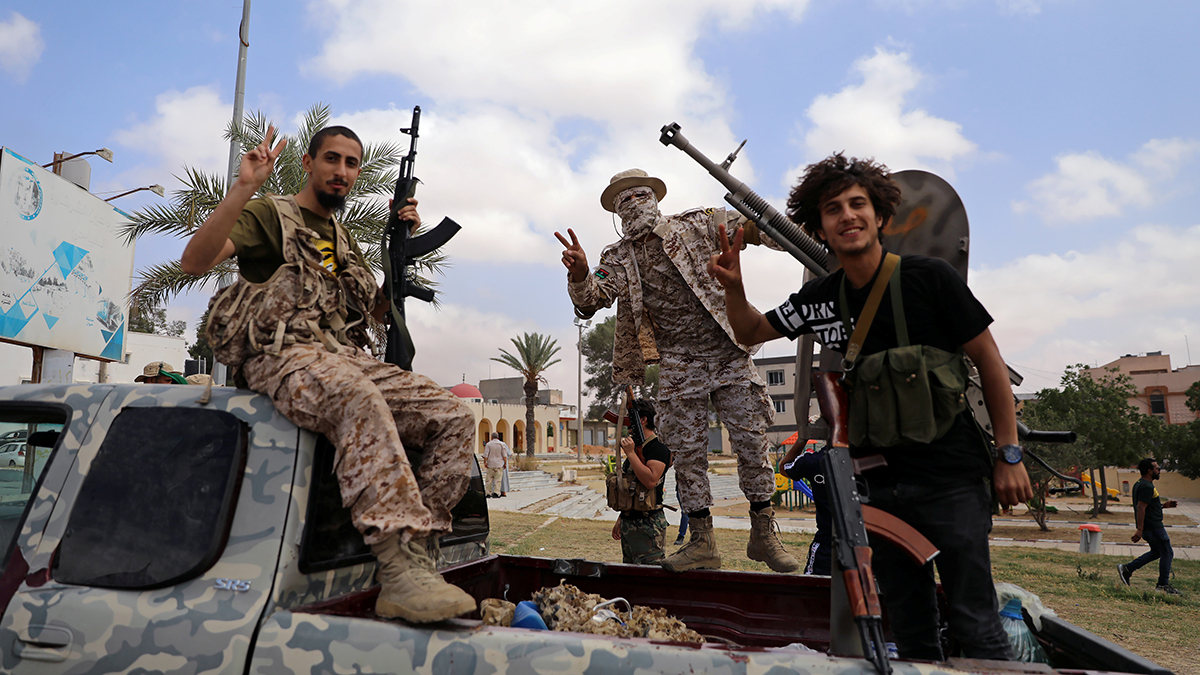
    The presence of mercenary groups and foreign fighters in Libya potentially had an impact in intensifying and prolonging the Libyan conflict, further complicating the search for a peaceful solution to the crisis. Foreign fighters and mercenaries have grossly violated domestic and international human rights and contributed to enormous human suffering. Mohamad Aujjar, Chair of the independent international fact-finding mission on Libya, told the UN Human Rights Council that the “mission’s investigations had found that all parties to the conflict in Libya since 2016, including third states, foreign fighters, and mercenaries, have violated international humanitarian law, particularly the principles of proportionality and distinction, and that some had committed war crimes”. Twelve years after violent conflicts and political crises, Libya is turning to a crucial election this year, one that was originally scheduled in December 2021 but could not be held due to disagreement between various political groups. It is considered that the presence of mercenaries and foreign fighters in the conflicting territories will be an obstacle to peaceful elections. African Union chairman stated that “the departure of foreign mercenaries could help Libya to achieve greater stability which was in a constant tussle since 2011”. As mentioned previously, mercenary involvement is one of the primary causes for the prolongation of the Libyan conflict, caused by the absence of firm international law concerning mercenary activities.

    The growing presence of mercenaries in armed conflicts across the world, and the threat that mercenaries are posing towards international peace and human security is a signal of the need for a strong legal framework for regulating mercenary activities.

    The conflict in Libya started when NATO-backed Western powers toppled the former authoritarian leader Muammar Gaddafi in 2011 and failed in placing a stable central authority in the country. In 2014 this political vacuum and crisis turned into a civil war between two rival groups, the Government of National Accord (GNA) in the western parts of the country that is recognised by the United Nations, and the Libyan National Army (LNA) in the eastern parts of the country, headed by Khalifa Haftar. Foreign powers had strategically aligned with the conflicting parties to protect their own parochial geopolitical and economic interests in the region. GNA had the support of Turkey and Western countries like Italy. In December 2020, the Turkish parliament authorised the deployment of troops to Libya in support of the GNA. It is estimated that Turkey sent between 2000 and 4000 mercenaries from Syria to Libya, all of whom were under the direct control of the Turkish military. The Sadat, a Turkish private military firm, was also directly involved in the Libyan conflict. On the other hand, the LNA enjoyed the support of Russia, Egypt, and the United Arab Emirates (UAE). Since 2014, UAE has supported the LNA by supplying arms while Russia sent mercenaries to boost LNA. In February 2021, the UN-led Libyan Political Dialogue Forum (LPDF) formed a new government called the Government of National Unity (GNU) with Abdulhamid AlDabaiba as Prime Minister with the approval of the Libyan House of Representatives. GNU failed to hold the national election which was the main purpose for the formation of the GNU. Thus, the country was again divided into two camps. On the one side, Egypt, Russia, France, and Qatar supported Bashaga and his eastern supporters. On the other side were Italy, Turkey (with some exceptions), the United Nations, and the United States. The UAE, surprisingly, supported Dbeibah. Once again, the situation on the ground demonstrates that a plethora of foreign actors are interfering in Libyan domestic affairs, each pursuing its interests rather than those of Libya and the entire region. Libya has become another battleground for proxy wars between Russia and Western powers. For Russian oil companies, Libya is attractive due to its vast oil reserves and vital from a military standpoint due to its strategic location. By constructing naval facilities in the Mediterranean, Russia would be able to expand its military presence further west. Regional and global powers are struggling to reshape the region according to their interests in the Sahel region. Russia and Turkey are leaders in this trend by using several mercenary groups. Thus, the complete elimination of mercenaries from Libya is one of the preconditions for peace and stability in Libya.

    The growing presence of mercenaries in armed conflicts across the world, and the threat that mercenaries are posing towards international peace and human security is a signal of the need for a strong legal framework for regulating mercenary activities. There are a few reasons why mercenaries need to be legally regulated. First, mercenaries are beyond state control and may pose a practical threat to state sovereignty and security, as well as challenge the traditional realist idea of the state monopoly to use coercion or force, though realists agree that the nation-states no longer hold a monopoly over coercive instruments*. Second, mercenaries are profit-oriented firms, where financial gain is the goal. This raises both a political and moral dilemma that an individual who does not have any political or ideological affiliation towards the conflict is direct participant in the conflict. Above all, mercenary involvements in conflicts across the world are significantly changing the nature of conflicts by intensifying and complicating the pre-existing dynamics, especially considering they openly defy human rights and avoid related responsibilities.

    The major treatise and conventions that regulate mercenary activities include Additional Protocol I and II to Article 47 of the Geneva Convention (1949), the Organisation of African Unity (OAU) Convention for the Elimination of Mercenaries in Africa (1972), and the International Convention against the Recruitment, Use, Financing and Training of Mercenaries (1989). However, these treatises are far from perfect as Sarah Percy says, “International law dealing with mercenaries is notoriously flawed”. According to her, the primary reason why international is weak is that states, back in the 1970s and 1980s, did not care enough to create effective regulations as they were not considered enough of a “practical difficulty” or warranted enough “moral attention” to necessitate legal attention. Another reason is that notably, weaker African states are vulnerable to mercenary activities as even Western states were willing to use mercenaries in the African continent for their strategic gains, and as well these African states have intentionally created loopholes within the law to use mercenaries themselves for their advantage. Immediately following World War II, Western states suppressed the African people’s struggle for self-determination and sovereignty by using mercenaries. Dusoulier says that “the private security industry has a long history on the African continent whether in the Sahel, Mali, or the Central African Republics”. He further points out that this state of affairs is a consequence of two factors: the weakness of government institutions in some countries and the continent’s wealth of mineral resources. Hence, it is evident that the laws concerning mercenaries are not strong enough to contain the spread of mercenary activities across the globe.

    Recent conflicts in Libya, Yemen, Ukraine, and Syria are showing the paucity of international law concerning mercenary activities. Without an effective international framework to regulate mercenary activities, conflicts in this world will be turning more violent and intensified. Bilateral cooperation, information sharing, and the efforts of international organisations are important in this regard. The withdrawal of mercenaries from Libya will contribute to peaceful elections in the country and further lead to peace and stability in the country. Peace and stability in Libya will create a larger scope for peace in the entire Sahel region. 

    REFERENCES

    1. OHCHR. (n.d.). All Parties to the Conflict in Libya, including Third States, Foreign Fighters and Mercenaries, Have Violated International Humanitarian Law, and Some Have Also Committed War Crimes, Chair of Fact-finding Mission on Libya Tells Human Rights Council. https://www.ohchr.org/en/press-releases/2021/10/all-parties-conflict-libya-including-third-states-foreign-fighters-and
    2. Cascais, A., & Koubakin, R. (2023b, January 17). Mercenary armies in Africa. Retrieved from https://www.dw.com/en/the-rise-of-mercenary-armies-in-africa/a-61485270
    3. Beaumont, P. (2020, January 3). Turkish MPs pass bill to send troops to support Libyan government. Retrieved from https://www.theguardian.com/world/2020/jan/02/turkish-parliament-to-vote-on-sending-troops-to-libya
    4. Libya: Help make 2023 the year of ‘free and fair elections’, Security Council urged. (2022b, December 16). Retrieved from https://news.un.org/en/story/2022/12/1131817
    5. El-Assasy, A. (2023, February 20). AU Voices Commitment to Reconciliation in Libya. Retrieved from https://libyareview.com/32092/african-union-voices-commitment-to-reconciliation-initiative-in-libya/
    6. Powers, M. (2021, October 8). Making Sense of SADAT, Turkey’s Private Military Company – War on the Rocks. Retrieved from https://warontherocks.com/2021/10/making-sense-of-sadat-turkeys-private-military-company/
    7. Percy, S. V. (2007). Mercenaries: Strong Norm, Weak Law. International Organization, 61(02). https://doi.org/10.1017/s0020818307070130
    8. On the Approval of the Government of Libyan National Unity. (n.d.). Retrieved from https://www.embassyoflibyadc.org/news/on-the-approval-of-the-government-of-libyan-national-unity

    Featured Image Credits: Council on Foreign Relations

  • Analysis of the Portrayal of Fictionalised Women ‘Namesake’ by Jhumpa Lahiri and ‘A Fine Balance’ by Rohinton Mistry

    Analysis of the Portrayal of Fictionalised Women ‘Namesake’ by Jhumpa Lahiri and ‘A Fine Balance’ by Rohinton Mistry

    Introduction

    ‘The Namesake’ by Jhumpa Lahiri (2003) and ‘A Fine Balance’ by Rohinton Mistry (1995) are accounts of fiction written during the millennial period. From a sociological perspective, both authors give us an insight into how human attitudes are moulded. The novels are based on Indian society and consider the influence of culture and traditions on human nature, which is testimony to how the plot progresses.

    An outline of the plots

    ‘Namesake’ is a debut novel by the author Jhumpa Lahiri, and revolves around an Indian family settled in Cambridge, Massachusetts, United States of America. The story begins with  an introduction to the life of a pregnant woman, the mother of the protagonist, Ashima Ganguli in her twenties, struggling to find the ‘Bhelpuri’ she craves. The entire plot revolves around Ashoke and Ashima’s son, Gogol named after Ashoke’s favourite author Nikolai Gogol and his struggle to overcome the identity crisis and the shame he associates with the name. As the characters traverse through their lives, the reader witnesses Gogol moving to a new city for college, him changing his name to Nikhil, Ashoke’s death and Ashima’s loneliness. There are other supporting characters including Gogol’s sister Sonia, of which the most important are Maxine and Moushumi, who are the love interests of Gogol.

    ‘A Fine Balance’ is written by a non-resident Indian Rohinton Mistry who portrays how the lives of four different people: Dina Shroff who becomes Dina Dalal post her marriage; Ishvar and Omprakash Darji, and Maneck Kohlah, from different backgrounds, get associated with each other during the period of emergency (1973). It is set in an ‘unidentified’ city and is often considered Mistry’s critique of Prime Minister Indira Gandhi and her rule. He also gives the readers an account of their lives before Article-356 of the Indian Constitution was enforced. Dina is a Parsee survivor of child sexual abuse and becomes a young widow when she loses her beloved husband to an unfortunate accident. She is portrayed as a woman of solid resolve who tries to be financially independent and refuses help from her brother Nusswan Shroff. Ishvar and Omprakash are an uncle-nephew duo from the Chamar caste (Dalits) and therefore were involved with the caste-based occupation of leather tanning. This duo moves to the city in search of a respectable livelihood and plans to use their tailoring skill. Maneck is a pampered college student who is the son of a friend of Dina’s. Ishvar and Om become tailors for Dina who has taken up a contract from the garment industry and Maneck after a traumatising incident in the college hostel, shifts to Dina’s house as a paying guest. Dina often is taunted by her landlord, who is against any other activity being practised in his house, but she finds ways to elude him.

    Emerging Themes – An Overview

    THE NAMESAKE A FINE BALANCE
    Ideal Indian Woman

    Jhumpa Lahiri, through the character of Ashima Ganguli, brings out an ideal Indian woman. She is portrayed as a pious, devoted wife and a caring mother, who wears a saree, speaks broken English and sticks to her Indian culture and traditions. The author tells us that “She hates coming back to an empty house” when her husband and children move to various places for their work. This prompts her to take up a job at the local library, showing that women get used to the idea of domestic labour as love. Till the death of Ashoke, she looks after his needs and remains a ‘good’ wife.

    Women and Family Abuse

    After her father’s death, Dina Shroff’s brother takes up the role of the head of the family, as is the norm. She is then brutally abused and beaten by her brother Nusswan to ‘correct’ her wayward behaviour. The brutality reaches an extreme point when she goes against his order not to get a haircut. He slaps her, asks Dina to take a bath before him, and looks on lecherously while she does. The author leaves no stone unturned to explain Dina’s brother’s arrogant and lecherous nature. 

    Benevolent misogyny

    Ashoke Ganguli is a learned man who is the patriarch of the family. Though he is a man of few words, his actions prove masculine traits such as rationality and intelligence. This is in stark contrast to Ashima’s character, portrayed as emotional. Even though he is learned he believes that housework is a feminine activity and does not once help Ashima in her work. Even if he had wanted to, she would not let him because a ‘good’ woman fulfils her husband’s wishes and not vice versa. The author attempts to give the readers an overview of the concept of feminine duties and the burden on an Indian woman to uphold family integrity by slaving to the needs of the patriarch.

    The societal notion of the single woman

    Indian society has marred the lives of its women in the name of culture and tradition. Dina as a widowed single woman lives with the constant fear of being questioned by people. Her aim for financial independence is testimony to the fact that she wants to establish for herself a ‘respectable’ position in the community. When she brings in Ishvar and Om to work for her, she is at loggerheads with herself and gives in to the decision because of her dire need for money. This shows that a single woman has to consider several factors and not just her aspiration to be valued in society. A heterosexual woman in a marital relationship with a heterosexual man equals perfection according to Indian norms.

    Woman and Fidelity

    Ashima and Moushumi can be compared in this regard because Ashima is portrayed as a loyal wife who is naive and has an eye for no man other than her husband while Moushumi, wife of Nikhil aka Gogol is a modern, well-read, PhD scholar who has a different take on sexuality and relationships. Moushumi has an extra-marital affair with another man which forces Gogol to leave the marriage. This shows that a woman exploring her sexuality is considered infidel and disloyal. 

    Caste atrocities

    The author vehemently tries to engage the readers with the concept of purity and pollution throughout the text. Ishvar and Om are from the Chamar caste whose lives in the village are described in detail. There is a specific instance of Ishvar’s mom being sexually exploited for trying to sneak mangoes from a landlord’s orchard to ameliorate her son’s hunger. The landlord uses this to exact sexual favours from her. Many such instances throughout the book exist with Ishvar being forcefully sterilised during the emergency due to his lower caste origins. With a picturesque description of these events, Mistry centres his conversation around caste-based atrocities rampant in the Indian society.  

    Perception of women – A comparison

    The portrayal of women in both books is strikingly different owing to the lens through which they are viewed. A commonality is that both authors are descriptive in their narratives with a focus on providing the readers with a vivid reflection of their thoughts and the situation in question. Despite this, there is a visible contrast in the writing method with Jhumpa Lahiri taking a platonic tone with the specificity of minute details, whereas Mistry uses strong writing to describe the despicable traditions and norms in the Indian society; also, evidence of a non-resident Indian’s view of the societal norms. Women characters in both novels are depicted with varying densities, touching upon the aspects of femininity conditioned by the patriarchal society.

    Namesake

    The fact that ‘Namesake’ is written by a woman does not make the patriarchal norms that are inherent in an Indian woman fade away. However, Lahiri’s portrayal of Ashima is brilliant in execution and gives life to the internal conflict that occurs in a woman, who has been sent away from her natal home to a foreign land thereby making the readers feel the pain of loneliness.

    Ashoke is the only earning member of the family, her needs during pregnancy are also side-lined because Ashima knows that her husband “has to work”.

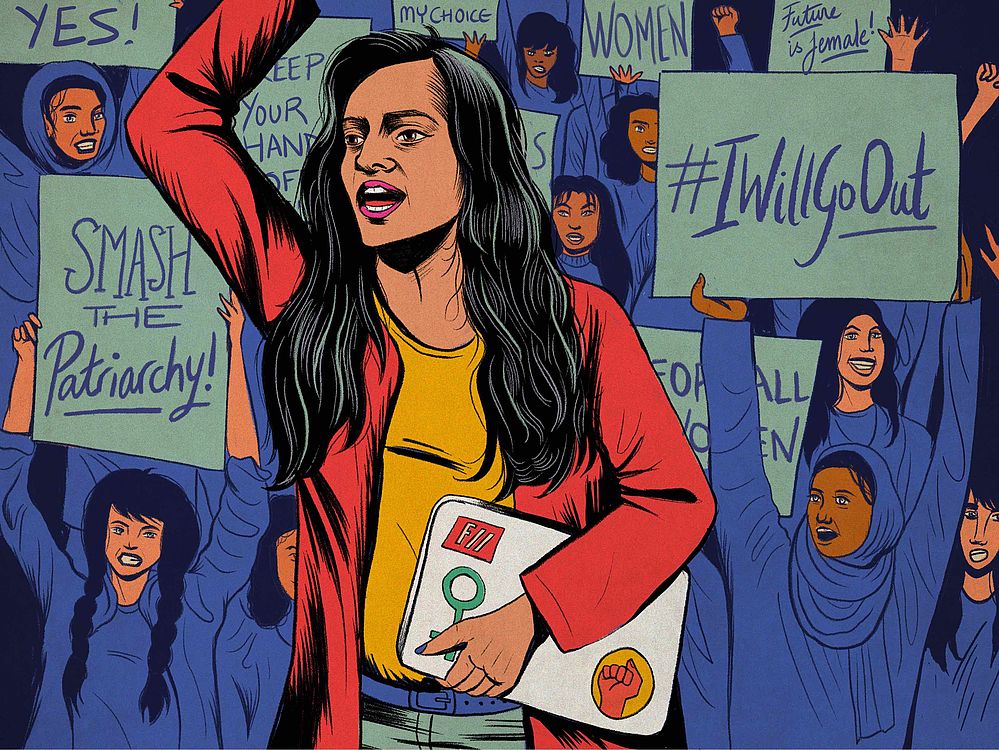
    This quote in the image is from the book that elicits the idea that she, as a foreigner, was left feeling sad and lonely. Lahiri captures these nuances from a gendered lens, i.e., the suffering of every Indian woman who is married and has to stay away from their natal home. However, the portrayal of Ashima as a typical Indian homemaker and her lack of financial independence in the initial stages of the plot to one of financial freedom when she takes up a job at the local library can be likened to the Western concept of liberation. Ashoke’s death is also an event which brings out the strength in Ashima, despite feeling lost she moves on with a “life must go on” attitude.

    Another character which has to be analysed from a feminist perspective is Moushumi, Gogol’s wife whom he later divorces owing to her infidelity. Lahiri’s writing, despite having the perks of the feminist notion of women, sticks to the idea of liberal feminism where the dichotomy of ‘good’ and ‘bad’ woman arises. Moushumi’s extra-marital affair is construed as a deviant from the dichotomous norm and this can be seen as an attempt to appease the larger group of the society. Taking into account Foucault’s work on sexuality, this deviance is constructed as bad behaviour. The fact that not everything is black and white and that there are shades of grey is forgotten in the portrayal of Moushumi, who is an educated, well-read doctorate scholar. Lahiri’s writing is therefore poetic in all its sense but the women characters in her book may come across as lacking depth due to its affinity to a single view of ‘liberated women’, despite the scope it had for exploring the roles of women.

    A Fine Balance

    The women characters in this book are few, and some of them are Dina Shroff, her mother and her sister-in-law. There is also a take on the atrocities of the caste system on women, which can be considered as taking Crenshaw’s intersectionalities into account. However, the entire book is all over the place due to its attempt to explore multifarious issues. Primarily of import are the character of Dina and her attempt at exploring her sexuality. The choice of words to describe an event like sexual abuse is sexualised rather than creating a wave of anger in the reader. Casual sexism can be seen throughout the book, probably reflecting the author’s desperate attempt to capture the reader’s interest. For example, a male gaze in explaining how Dina was shunned by her brother Nusswan for getting a haircut can come across as strong writing but can also find itself on the spectrum of voyeurism. He writes,

    “She was standing naked on the tiles now, but he did not leave. “I need hot water,” she said. He stepped back and flung a mugful of cold water at her from the bucket. Shivering, she stared defiantly at him, her nipples stiffening. He pinched one, hard, and she flinched. “Look at you with your little breasts starting to grow. You think you are a woman already. I should cut them right off, along with your wicked tongue.”

    Although these depictions may be to ensure that the reader understands the depth of patriarchy, they can also create in the minds of the readers a voyeuristic portrayal of child abuse. Though Dina is shown as a woman trying to propel her life and create her own destiny, it can be a shadow representation of women. The importance of Dina to the plot is minimised to abuse and being a widow struggling for financial freedom with no evidence of trauma outcomes, i.e. of her sexual abuse as a child, whatsoever. Though it has Dina as one of the main characters, the storyline seems like an attempt at a comprehensive and extensive description of the issues in the Indian society and soon the focus is lost. In comparison, we can say that the depiction of women in ‘Namesake’ is more poetic and has considerate sexism, whereas ‘A Fine Balance’ is profane in depicting women as fragile beings.

    Conclusion

    Thus, the portrayal of women in these writings derails from the feminist attitude of empathising with fellow women and showcases outright sexism both in the physical and social sense. An attempt from both authors could have been made to focus on the internal conflict that occurs in a woman with regard to exploring her sexuality. The works find value, in assuaging the larger societal constructs of monogamy in the case of Lahiri and trying to cover all issues plaguing the Indian society at one time in the case of Mistry. There is an essence of a condescending tone which is similar in both works. The works were of the millennial period, and therefore, it is also necessary to consider historical perception, but even this argument does not hold water because it was also the era of a feminist fictional writer like Arundhati Roy. Therefore, the women in both these works could have had better portrayals if an effort was taken in the right direction to understand gender politics of sexuality, power, and violence.

    References

    • C. A. M., & Lourdusamy, A. (2022). Review of Displacement, Space, and Identity in the Postcolonial Novels of Jhumpa Lahiri, Rohinton Mistry and Manju Kapur. International Journal of Management, Technology, and Social Science, 354–372. https://doi.org/10.47992/ijmts.2581.6012.0195
    • (2023). Namesake (03) by Lahiri, Jhumpa [Paperback (2006)]. Mariner s, Paperback(2006).
    • Mistry, R. (2023). A Fine Balance by Mistry, Rohinton [Vintage,2001] (Paperback). Vintage,2001.
    • Alfonso-Forero, A. M. (2007). Immigrant Motherhood and Transnationality in Jhumpa Lahiri’s Fiction. Literature Compass. https://doi.org/10.1111/j.1741-4113.2007.00431.x
    • Doron, A., & Raja, I. (2015). The cultural politics of shit: class, gender and public space in India. Postcolonial Studies, 18(2), 189–207. https://doi.org/10.1080/13688790.2015.1065714

    Featured Image Credits: German Federal Ministry for Economic Cooperation and Development (BMZ)

  • How blockchain can help dismantle corruption in government services

    How blockchain can help dismantle corruption in government services

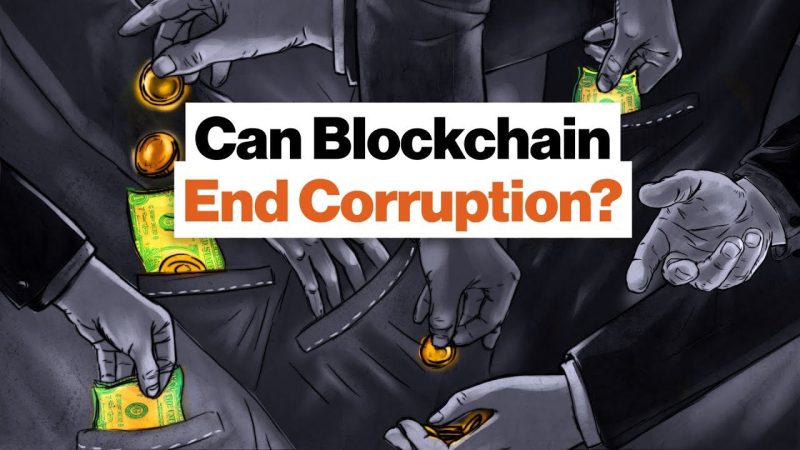
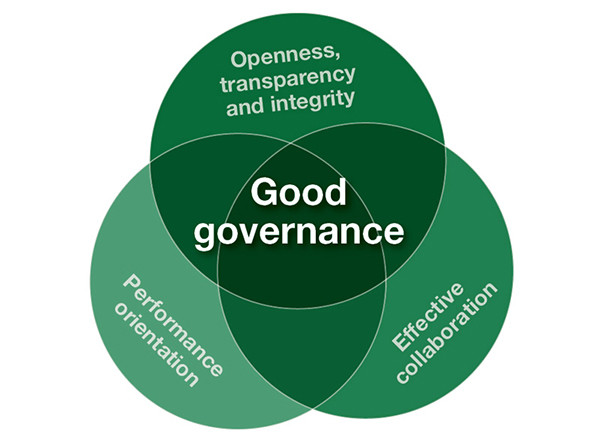
    As India celebrated its 76th independence day with great fanfare and jubilation, it is time to introspect on the most serious threat to India’s growth and emergence as a world. This threat is corruption, which is internal and societal. Over the 75 years of modern India’s journey, corruption has become endemic in Indian society. Infused by the political culture, corruption has seeped into every aspect of governance, be it the executive, legislature, or judiciary. This is so because an average citizen has come to accept bribing as a routine and inevitable part of daily life. Hence, if India has to eliminate the scourge of corruption it needs a massive transformation of its society. This can come only through the sustained practice of transparency, ruthless accountability, efficiency, and deterrent punishment. Corruption is commonly perceived as related to monetary benefits but it is much more in terms of misuse of power, coercion, disinformation, lack of transparency, non-performance, inefficiency and delay tactics, and the lack of accountability/responsibility. There is a misconception that digitisation will overcome corruption. Unless timelines, tamper-proof records, and transparency are ensured the corrupt will find ways to get around. These are clearly seen in the revenue tax systems, licensing systems, land registration systems etc. Even though these departments have digitised the processes well, there is a proliferation of middlemen linking the client and the department. This can only be eliminated by the right policies that enforce strict timelines, respond to citizens’ complaints, enforce accountability and transparency on the officials and create clarity for the public in the usage of such systems. The adoption of blockchain technologies could go a long way toward eliminating corruption in India. Widespread corruption has been India’s greatest threat and it is never more urgent than now to address this problem through innovative technologies like blockchain.

    TPF republishes this article on ‘Blockchain and Governance’  from the World Economic Forum under the creative commons license 4.0

    TPF Editorial Team

    Key Points

    • Blockchain could increase the fairness and efficiency of government systems while reducing opportunities for corruption;
    • Blockchain could improve the transparency and disclosure of procurement processes, investment in which can be lost to corruption;
    • The emerging technology can also enhance the property and land registry systems, streamlining lengthy processes and protecting people’s rights.

    Governments regularly have to make trade-offs between efficiency and fairness in their services. Unfortunately, choosing one over the other often increases the likelihood of corruption. In efficient systems, the public is largely content to operate within the bounds of that system; inefficient systems cause large numbers of individuals to seek less-than-legal workarounds. Similarly, fair systems engender trust, pride and a sense of community; while unfair systems encourage individuals to seek out illegal alternatives without remorse.

    Occasionally, new technologies come along that offer the opportunity to increase both efficiency and fairness. Blockchain is one such opportunity and it has a variety of use-cases for government applications. Here are two in more detail:

    Blockchain and procurement

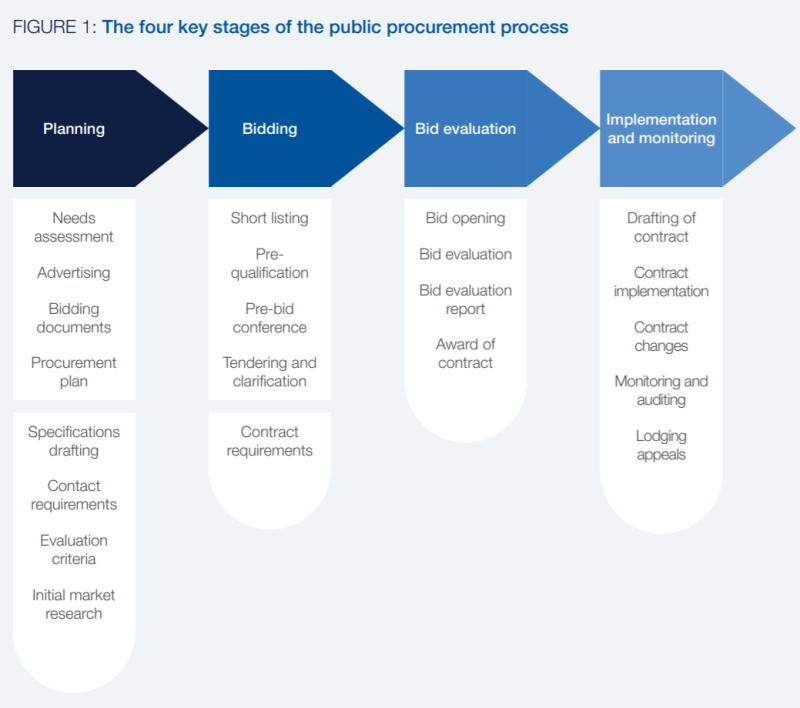
    Public procurement is the process of governments acquiring goods, services and works. It represents a significant portion of governmental budgets, accounting for 29% of general government expenditure totalling €4.2 trillion in OECD countries in 2013. With so much money at stake, it is unsurprising that OECD estimates that 10-30% of the investment in publicly funded construction projects may be lost to corruption.

    Public procurement is vulnerable to corruption for a number of reasons. Parties in the procurement process, both on the public and private sides, are induced into corrupt acts by the size of potential financial gains, the close interaction between public officials and businesses, and how easy it is to hide corrupt actions. Blockchain has the potential to protect against these weaknesses at almost every stage of the procurement process.

    In the planning stage, public officials create evaluation criteria by which bidding companies will be judged. In the bidding evaluation stage, public officials assign scores to companies using the evaluation criteria as their rubric. Without transparency, there are many opportunities for compromised public officials to rig the outcome of the evaluation process. Evaluation criteria could be retroactively changed or company bids altered, for example. Blockchain can guarantee any change is public, the original information is retained and there is a record of who made the change.

    Blockchain can also encourage a wider coalition of stakeholders to participate in and monitor procurement cycles. Too often, the most active stakeholders in any given procurement process are the public officials and the businesses directly involved – a potential problem when more than half of all foreign bribery cases likely occur to obtain public procurement contracts. Watchdog organizations, end-users, the media and citizens are discouraged from participating because procurement information is not readily available, untrustworthy, modified and/or delayed. Blockchain can provide an easily accessible, tamper-proof and real-time window into ongoing procurement processes

    Projects integrating blockchain into procurement, such as this pilot programme in Colombia, conclude that “blockchain-based e-procurement systems provide unique benefits related to procedural transparency, permanent record-keeping and honest disclosure.” The Colombia project noted several drawbacks, such as scalability and vendor anonymity, but newer proposals like this one to overhaul India’s public procurement system are taking steps to overcome those and other shortcomings.

    Blockchain and registries

    Land title registries track the ownership of land and property for a given region. Registration titling systems have had important consequences for the economy, leading to “better access to formal credit, higher land values, higher investment in land, and higher income.” Yet they are far from perfect. They are inefficient, for example, closing a property sale can take months and typically consumes 2-5% of the purchase price of a home. Registration systems can act as bottlenecks for land transactions. There are complaints going back to 2015 of England’s Land Registry having six-month transaction delays and similar complaints persisted in 2020.

    The inefficiencies in land titling systems are a major source of corruption. The Organized Crime and Corruption Reporting Project’s 2019 report on land registry corruption in Bangladesh found that obtaining a licence as a deed writer incurs a bribe to the highest-level administrators. Land registry corruption is not restricted to developing regions: in regions with longer histories of legal stability, it simply becomes more complex. Anti-corruption NGO, Global Witness, estimated in 2019 that £100 billion worth of property in England and Wales was secretly owned by anonymous companies registered in tax havens.

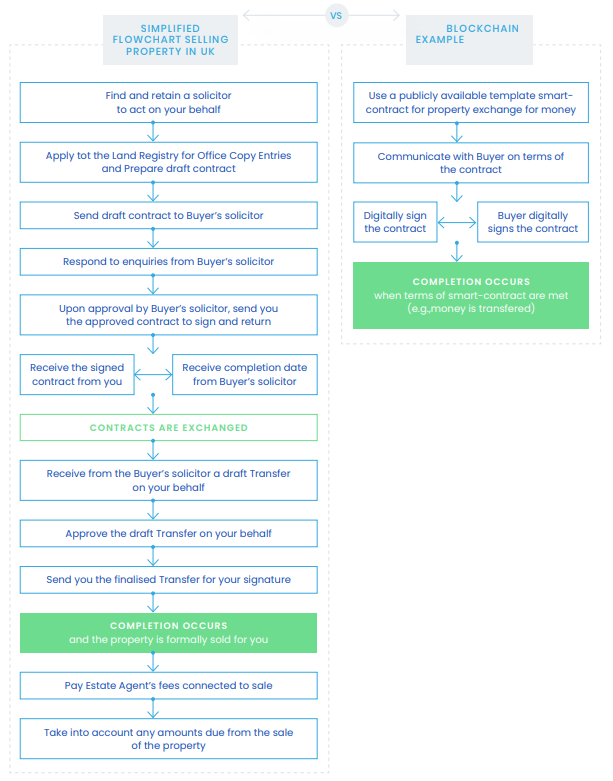
    A good first step to fighting corruption is by cutting down on inefficiencies. Blockchain can streamline much of the process. Take, for example, the number of steps required in the UK for one person to sell the property to another person and compare this with a blockchain-based registry system.

    Some countries are already experiencing positive results. In 2018, Georgia registered more than 1.5 million land titles through their blockchain-based system.

    An urban land registry project underway in Africa uses blockchain to address the problems of digitizing urban land registries. In many densely populated impoverished urban areas, no pre-existing land registry or paper trail exists. Relying on the meagre data available often causes legal disputes. Courts quickly become overwhelmed and digitization efforts stall.

    Blockchain is now being added to the project. To confirm property rights, the new system seeks out and consults community elders. Through a blockchain-based application, those elders receive the authority to confirm the validity of land registry claims. The elders can check directly with residents if they consent to the land assessment. By delegating cryptographically guaranteed authority to respected community members, the quality of the data is improved and the number of land dispute cases handled by the judiciary should decrease. Finally, the remaining cases should resolve faster since the elders’ cryptographic confirmations are admissible as evidence for land dispute resolution.

    The final challenge: Adoption

    The government blockchain-based projects referenced in this article represent just a few of a growing number of pilot or in-production applications of blockchain. This shows that governments are serious about fixing inefficient and unfair services. The potential gains from blockchain are substantial, yet as a new technology, there are many challenges in designing and implementing blockchain-based applications. For large institutions such as governments to deploy blockchain-based applications in a timely fashion and reap the benefits, education and tools are imperative.

  • The Bridge on River Chenab

    The Bridge on River Chenab

    “The only way to discover the limits of the possible is to go beyond them into the impossible”

    -Arthur C. Clarke

    Introduction

    On 13 Aug 2022, the bridge on the River Chenab in the Reasi District of J&K was finally completed. It was a case of the impossible becoming possible. It all happened because of a very high degree of self-belief of those who planned it and the sincerity of thousands of those who worked hard for the last 18 years.   Indeed, it was the best gift the Indian Railway in general and Indian Engineers, in particular, could give to India on the 76th Independence Day of India. It is also highly symbolic that it is located in the State of J&K and in a way appeared to be a giant step towards the integration of J&K with the rest of the country.

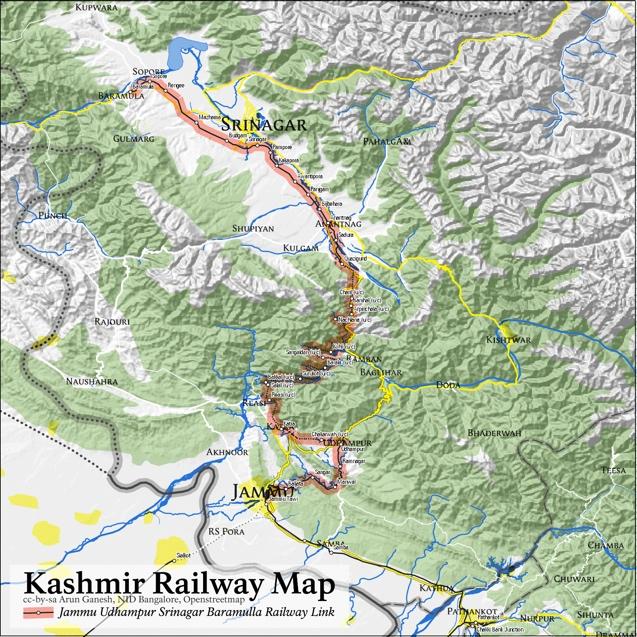
    The Bridge over the River Chenab is part of the Jammu-Udhampur-Baramulla Railway line, which is being constructed. While Sections of Jammu-Udhampur, Udhampur-Katra and Banihal-Baramulla are already completed and opened for traffic, section Katra- Banihal is still not complete. The degree of difficulty in this section is enormous. Besides this Bridge on Chenab (more about it a little later), the Bridge on Anji Khad (which is under construction) and a total of 35 tunnels and 37 bridges make this section of 111 km in the mountainous terrain extremely challenging and an engineering marvel in the making.

    Progress of the Project –  It is a 356 km railway project, starting at Jammu and going up to Baramulla. It was started in 1983 with the objective of connecting Jammu Tawi to Udhampur.  Construction of the route faced natural challenges including major earthquake zones, extreme temperatures and inhospitable terrain.  Finally, in 2005  The 53 km long Jammu–Udhampur section opened after 21 years with 20 tunnels and 158 bridges. The cost of the project had escalated to ₹515 crores from the original estimated cost of ₹50 crores.  In 1994 The railway accepted the necessity to extend the track to Baramulla. However, at that point it was thought that the project will have two disconnected arms; one from Jammu to Udhampur and the second from Qazigund to Baramulla. In 2002 the GoI declared this project to be a national project. This means hereafter, the entire funding will be from the Central Budget. At that time the necessity was also accepted to connect the two disconnected arms. The estimated cost of the project assessed then was   ₹6,000 crore.  In 2008 the 66 km section between Anantnag and Manzhama (outside Srinagar) was opened for traffic. In 2009 this Service was extended to Baramulla. During the same year, the line from Anantnag was extended to Qazigund.

    Also  Around the same time, an extension of the track from Baramulla to Kupwara was proposed, and its survey got completed in 2009. In 2009 itself, work on the section between Katra and Qazigund resumed after a review based on geotechnical studies. In 2011, an 11.215 Km long Banihal Qazigund tunnel across the Pir Panjal Range was completed.  This paved the way for a trial run in Dec 2012 from Banihal to Qazigund. In 2014 the train route from Udhampur to Katra was also operationalised. Now the only missing link in this nationally vital rail line was Katra-Banihal. Finally, in 2018 the GoI approved the extension of the railway line to Kupwara.

    Degree of Difficulty in Katra- Banihal Section – This is a 111 km long stretch. 97.34 km of this stretch will be through tunnels. There are 20 Major (including the bridge across the Chenab river and a bridge on Anji Khad) and 10 minor bridges on this stretch. 

    Bridge Across Chenab

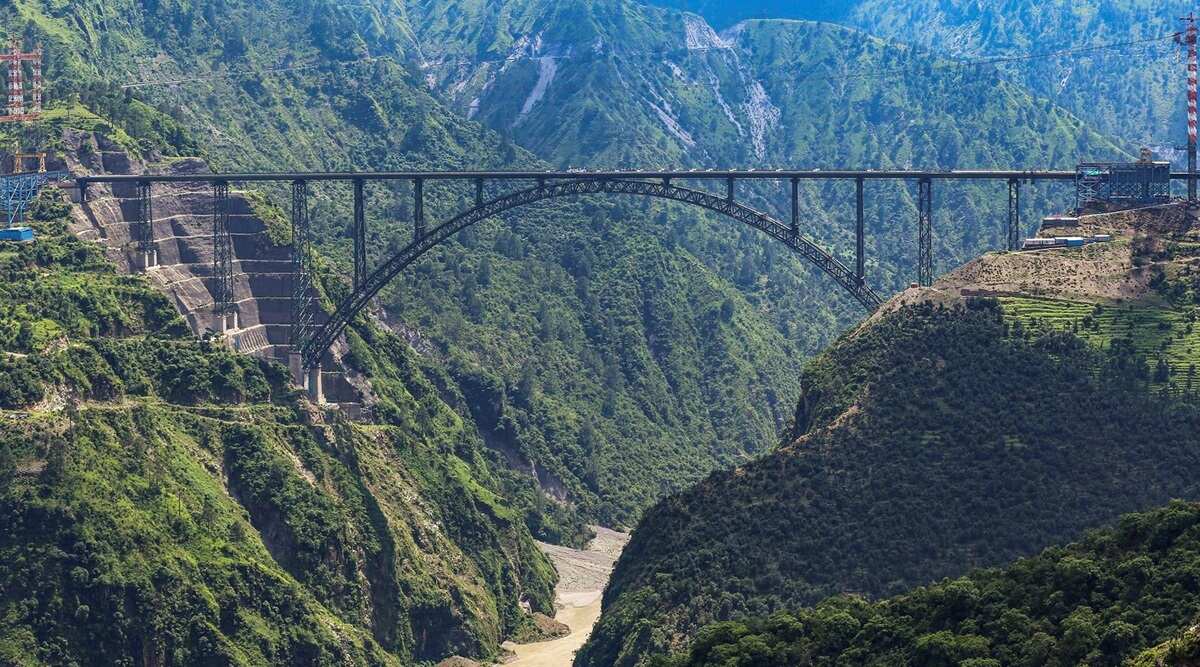
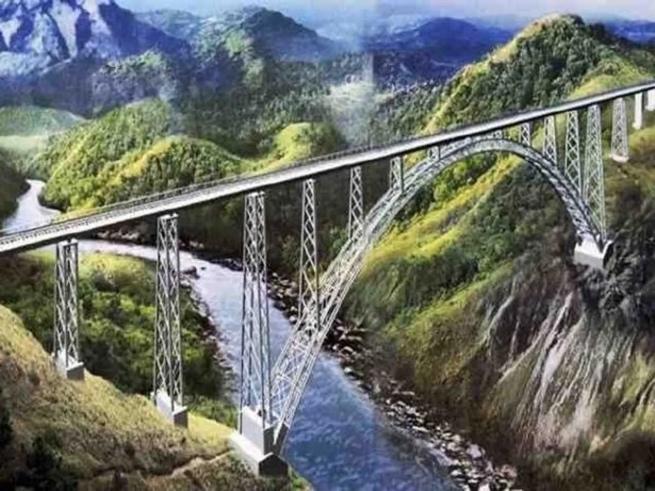
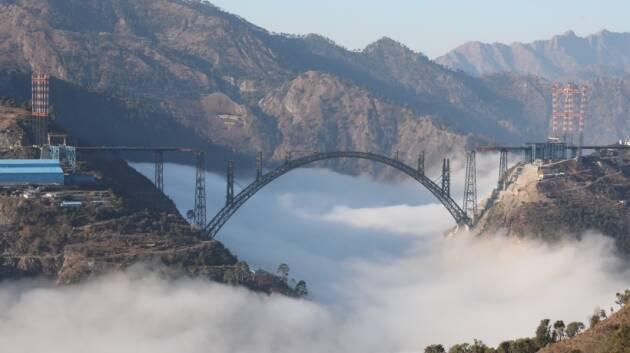
    Location: The Chenab Rail Bridge is a steel and concrete arch bridge between Bakkal and Kauri in the Reasi district of J&K, India.  It needs to be noted that it is the highest railway bridge in the world. After many hick-ups, finally in 2012 excavation of the foundation of the bridge commenced. The tender was with Afcons Infrastructure Limited. The alignment crosses a deep gorge of the Chenab River, which necessitates the construction of a long-span railway bridge with a viaduct for approaches on either side. 

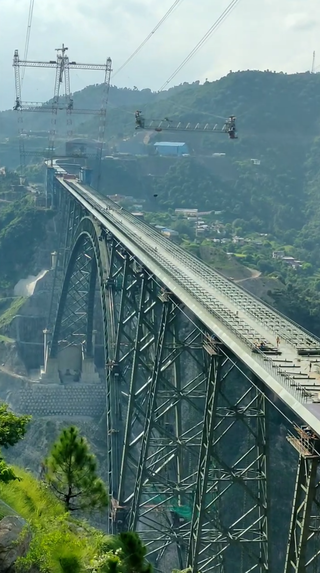
    Details: It is a 785 meters long single arch bridge where the main arch is 467 meters. The total span of the bridge is 1315 meters including a viaduct of 650 meters on the Northern side, Deck height is 359 meters above the river bed and 322 meters above the water surface which is 35 meters more than the height of the Eiffel Tower. The project also entails the construction of 203 km of access roads.  The deck is 13.5 meters wide, where two rail tracks will be available. The total cost of the Bridge is Rs 1486 Crores.


    Design: The steel arch has been planned because the construction of the pillar was difficult and the load had to be distributed. Chords have been provided to cater for the swaying load. The steel structures of the bridge were manufactured in workshops built in the mountains. The workshops had been moved to the building site because there is no proper road network in the challenging terrain. The longest building parts that could be delivered to the site were 12 meters in length. Therefore, four workshops were established in the mountains. Workshops and paint shops were built on both sides of the valley. All steel materials, except for the smallest rolled profiles, were delivered to the mountains as steel boards. The insufficient infrastructure of the area caused additional problems. There was no electricity and the water of the river was not suitable for manufacturing concrete. All electricity had to be produced at the site and the water was delivered from further away in the mountains. The job was also challenging because the track had a curvature in the approach bridge. In this section, the construction stage bearings had been designed in such a way that it was possible to launch the steel deck in the curvature portion as well. The bridge consists of about 25000 tonnes of steel structures, the main portion of which was used for the arch bridge section. It is a unique design and as such none of the Indian codes fully catered for the design validation. Therefore it was decided to follow the BS Code. The design also caters for wind load effects as per wind tunnel tests. It can cater for wind pressure of 1500 Pa. It is a blast resistance design. The design of the decking has been checked for fatigue as per the BS Code. The most important aspect is that it caters for redundancy within the structure, for a lower level of operation during mishaps and against collapse in extreme cases of one-pier failure. The area has high seismicity and the design was planned to withstand earthquakes of the severity of 8 on the Richter Scale. The bridge design is for a rail speed of 100 kmph. This means it can withstand very high-intensity of vibrations. The designed life of the bridge is 120 years and to take care of assessed steel fatigue the fatigue design selected is BS:5400 Part-10. The bridge will be able to withstand a temperature of minus 200C and a wind speed of 266 kmph.

    Team: The viaduct and foundation have been designed by M/s WSP(Finland) and the Arch design has been made by M/s Leonhart, Andra and Partners (Germany), the foundation protection has been designed by IISc Bangalore. The executing agency has been M/s Konkan Railway Corporation Limited.

    Status of Katra-Banihal project

    Although, the construction of Chenab Bridge is a major milestone in the progress of the project, however, still many more landmarks are required to be crossed before the completion of the project. Foremost of them is the Anji Khad bridge which is expected to be ready only by Dec 2022. It is expected that this rail Section will finally be operational by the middle of 2023.

    Conclusion

    The Jammu-Udhampur-Katra-Banihal-Srinagar-Baramulla Rail project is a vital national project which has a major bearing on national security and nation building. It is a matter of pride that Indian Engineers have achieved what at one point had appeared impossible. It will help in the integration of J&K with the rest of the country and will help strategically in many ways. The completion of the project will also give confidence to expeditiously complete other projects of national importance like; the railway line to Leh and the Railway line to Tenga in the North-East.

    End Note:

    1. Conceptual Design of the Chenab Bridge in India by Pekka Pulkkine WSP Finland, S Hopf and A Jutila. Available on Research Gate: https://www.researchgate.net/publication/257725212_Conceptual_Design_of_the_Chenab_Bridge_in_India.

    2. An internet upload: https://byjus.com/current-affairs/chenab-bridge/

    3. A Report by OT Staff, “Once the bridge is completed, it will provide all-weather connectivity between Kashmir and the rest of India” reported on 07 Apr 2021 and uploaded on https://www.outlookindia.com/outlooktraveller/travelnews/story/71397/all-about-the-chenab-bridge

    4. An internet upload: https://en.wikipedia.org/wiki/Jammu–Baramulla_line

    5. An internet upload: https://en.wikipedia.org/wiki/Chenab_Rail_Bridge

    6. An internet upload: https://www.pib.gov.in/PressReleasePage.aspx?PRID=1709652

    7. Zee Media Bureau, “Indian Railways: Delhi-Kashmir, Katra-Banihal train route to open soon, project nears completion” dated 08 Aug 2022 and uploaded on https://zeenews.india.com/railways/indian-railways-delhi-kashmir-katra-banihal-train-route-to-open-soon-project-nears-completion-2494827.html

    Image 1 Credits: Arun Ganesh

    Image 2 Credits: Indian Railways

    Image 3 Credits: Indian Express

    Image 4 Credits: Indian Railways

    Feature Image Credits: The Indian Express

  • China’s Role in the Infrastructure Development in Post-Civil War Sri Lanka: A Causal Factor for Current Crisis

    China’s Role in the Infrastructure Development in Post-Civil War Sri Lanka: A Causal Factor for Current Crisis

    It is also obvious that the way China handles Sri Lanka’s issue will have a significant impact on the future of China’s debt strategy in other developing nations across the world

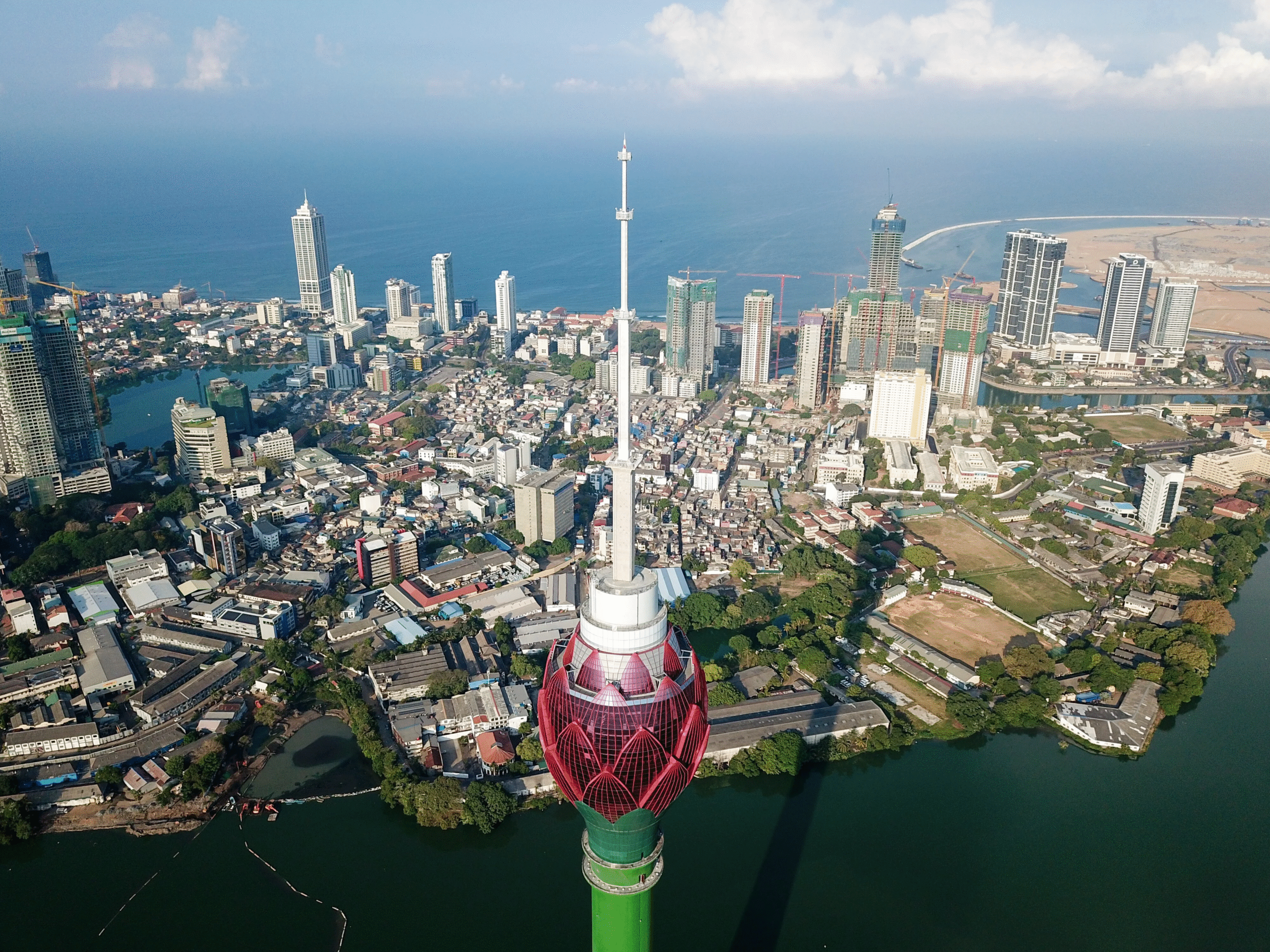
    Sri Lanka and China share an ‘all-weather friends’ relationship. Long-standing diplomatic ties between Sri Lanka and China have developed into an infrastructure-focused economic partnership. Beginning in the early 1970s, China began to offer support for the economic development of some landmark projects in the country. The financial assistance offered by China has increased significantly since 2005. Soon their relationship transformed into a model that made use of interest-bearing loans and foreign direct investments. With Chinese assistance, the Mahinda Rajapaksa administration launched significant transportation, energy, and telecommunications projects. Some of these were the coal-fired Norocholai power station in 2006, the Hambantota port in 2007, the Mattala International Airport in 2010, the Colombo International Container Terminal at the Colombo port in 2011, and the Lotus Tower in 2012. With the launch of China’s BRI (Belt and Road Initiative) strategy in 2013, projects like Colombo Port City were taken up and further investment was made in earlier projects like the Hambantota port deal (Wignaraja et al. 2020).

    During the period between 2006 and 2019, the total value of Chinese investment in Sri Lanka was around $12.1 Billion (Wignaraja et al. 2020). According to a data analysis, China’s bilateral assistance and export credit loans have tripled from US $386.1 million in 2007 to US$1.2 billion in 2009 (Nilanthi Samaranayake 2011). The major sector of Chinese investment is the road and expressway, which accounts for over 68% of the country’s total expressway length. The other significant sector which has received Chinese investment and loans is the port projects.

    Port City – Colombo

    The Port City of Colombo (PCC) is the dream project of Sri Lanka that was unveiled during Chinese President Xi Jinping’s visit in 2014. Since Colombo is one of the top 25 busiest ports in the world, the proposed project promoted Colombo as a “world-class city” not only for Sri Lanka but also for South Asia as a whole (Revi 2021), with the government expecting to turn it into a financial centre like Singapore and Dubai. The initiative is supposed to improve Sri Lanka’s economy, which is primarily dependent on the export of tea and tourism, to more prosperity through a wide range of service sectors. It is projected to cost $14 billion, with China investing $1.4 billion to assist PCC in reclaiming 269 hectares of land in the Indian Ocean. In return, China received a 99-year lease over 116 hectares of the surrounding area. The initiative is a private-public partnership project between the Sri Lankan government and CHEC Port City Colombo Pvt. Ltd. It is also the first Special Economic Zone of Sri Lanka. CHEC Port City Colombo Pvt. Ltd is a part of China Communication Construction Enterprise, which is the state-run infrastructure company that oversees the Belt and Road Initiative (Basu 2022). However, even if Port City manages to produce a sixth of Sri Lanka’s present economic production by 2041, as suggested by an independent study, it will still be a costly venture. Even though China is funding its construction, these commercial activities will provide little income for the debt-ridden country (Mukherjee 2022).

    The Hambantota Port 

    The Hambantota port is in southern Sri Lanka. Its construction began in 2008. The port was built under the state-owned enterprises – China Harbour Engineering and Sinohydro Corporation. Around $1.4 billion was financed by EXIM Bank China in the form of three fixed interest rate loans (Wignaraja et al. 2020, 9). The project’s first phase was finished in 2010 at a cost of US $361 million (Samaranayake 2011), and the port started operations in November 2011. The second phase started in 2012 and ended in 2015. The project took more time than was expected to complete, and was not very successful, leading to a substantial capital loss. By 2016, the Sri Lanka Ports Authority, which owned the Hambantota Port, had suffered losses roughly amounting to SLR 46.7 billion. By this time, it was also evident that this extravagant project was not commercially viable, as had been demonstrated in preliminary feasibility studies (Gupta 2022). To counter this financial loss, the government, in 2017, decided to grant the port to the Chinese state-owned enterprise – China Merchant Port Holdings Company Limited – for a 99-year lease. The revenue from the contract was primarily utilised to address the balance of payment problems brought on by the rising cost of debt payments in the country. 

    The leasing of the port also represents Sri Lanka’s current external sector crisis (Moramudali 2020). Despite restructuring and turning it over to a Chinese entity for 99 years, Sri Lanka is still responsible for paying the debt associated with the failed port. The presence of the established trans-shipment hub, Colombo Port, which is 200 kilometres from Hambantota also makes the port commercially unviable. Because of this proximity issue, even though the port possesses several berths for diverse purposes, just about 400 vessels visit it each year as compared to 4,000 vessels in Colombo Port (Gupta 2022). Moreover, the Mattala Rajapaksa International Airport (MRIA) constructed in the southern Hambantota district with a $200 million loan from China, is referred to as the “emptiest airport in the world” (Shepard 2016). 

    Investments in the Energy sector

    Another key sector that has received Chinese investment is the energy sector. The Norocholai power station was built by the China Machinery Engineering Corporation over a seven-year period in three phases. Three loans from the EXIM Bank of China totalling $1.4 billion and extra funding from the Sri Lankan government contributed to its co-financing. The power plant is now the largest and a vital contributor to the nation’s electricity supply (Wignaraja et al. 2020).

    Projects’ Viability and Performance

    In the Global Competitiveness Report 2019, released by the World Economic Forum, Sri Lanka ranked 84 out of 141 countries, which shows that the country’s infrastructure performance is far worse than that of other middle-income economies like Malaysia (Wignaraja et al. 2020). According to the publicly available figures, the Chinese debt is around 10% of Sri Lanka’s total foreign debt of $55 Billion and the actual figures are much higher than that. Chinese loans to Sri Lankan state-owned firms and other sorts of loans are not included in the current official estimates. According to some experts, this might amount to more than the US $6 billion, or about 20% of Sri Lanka’s external debt with higher interest rates (Gupta 2022). 

    The protracted effects of  Chinese investments must be carefully re-examined by the Sri Lankan government so as to prevent an increase in China’s coercive influence

    Hambantota Port which was built in the home district of the Rajapaksa family clearly portrays the family’s interest in their hometown. The 99-year lease of the port reflects the ever-increasing hold of China on the trade in the strategic Indian Ocean region and there are also prevailing accusations that China is likely to use the port for military purposes in future. In the case of Port City Colombo, scholars worry that it might develop into another Hambantota. Given the present situation, where Sri Lanka is unable to pay its obligations, Colombo Port City may also fall into Chinese control. Due to the political upheaval and financial issues the project construction has been interrupted multiple times. 

    The main causes behind the failures of these projects are that many of these were undertaken for political expediency and electoral considerations rather than for sound economic analysis and commercial viability. The government did not conduct proper feasibility studies to establish the commercial viability of these projects. Unbridled corruption made it worse. For the Hambantota port, more connectivity projects would provide more market and for the Port City Colombo, proper management plans should be given during its ongoing construction period.

    The protracted effects of such Chinese investments must be carefully re-examined by the Sri Lankan government so as to prevent an increase in China’s coercive influence. In light of the current economic crisis in Sri Lanka, China as the largest creditor in the country should offer reasonable restructuring on its loans. China’s response to the current crisis, particularly in the aftermath of the large-scale protests and a new government, will impact the relations between the two countries. It is also obvious that the way China handles Sri Lanka’s issue will have a significant impact on the future of China’s debt strategy in other developing nations across the world (Latiff and Wijesinha 2022).

    References

    Basu, Nayanima. 2022. “Crisis-Hit Sri Lanka Bets Big on $14 Bn China-Backed Port City, Wants Reluctant India to Invest.” ThePrint. March 24, 2022. https://theprint.in/diplomacy/crisis-hit-sri-lanka-bets-big-on-14-bn-china-backed-port-city-wants-reluctant-india-to-invest/883643/.

    Gupta, Shishir. 2022. “Was Cash Strapped Sri Lanka Duped by China in Hambantota Port?” Hindustan Times. June 26, 2022. https://www.hindustantimes.com/world-news/was-cash-strapped-sri-lanka-duped-by-china-in-hambantota-port-101656205405799.html.

    Latiff, Aquilah, and Anushka Wijesinha. 2022. “Understanding China’s Role in Sri Lanka’s Debt Restructuring Efforts.” Thediplomat.com. August 2, 2022. 

    Moramudali, Umesh. 2020. “The Hambantota Port Deal: Myths and Realities.” Thediplomat.com. January 1, 2020. https://thediplomat.com/2020/01/the-hambantota-port-deal-myths-and-realities/.

    Mukherjee, Andy. 2022. “Port City Colombo: The Great Chinese White Elephant of Sri Lanka.” Business Standard India, April 14, 2022. https://www.business-standard.com/article/international/port-city-colombo-the-great-chinese-white-elephant-of-sri-lanka-122041400365_1.html.

    Revi, Vinitha. 2021. “Colombo Port City Project: Controversial since Its Inception.” ORF. December 28, 2021. https://www.orfonline.org/expert-speak/colombo-port-city-project/.

    Samaranayake, Nilanthi. 2011. “Are Sri Lanka’s Relations with China Deepening? An Analysis of Economic, Military, and Diplomatic Data.” Asian Security 7 (2): 119–46. https://doi.org/10.1080/14799855.2011.581603.

    Shepard, Wade. 2016. “For Sale: The World’s Emptiest International Airport.” Forbes. July 18, 2016. https://www.forbes.com/sites/wadeshepard/2016/07/18/for-sale-the-worlds-emptiest-international-airport-mattala-international-hambantota-sri-lanka/?sh=74595f4c1e3b.

    Wignaraja, Ganeshan, Dinusha Panditaratne, Pabasara Kannangara, and Divya Hundlani. 2020. “Chinese Investment and the BRI in Sri Lanka.” Chatham House – International Affairs Think Tank. March 24, 2020. https://www.chathamhouse.org/2020/03/chinese-investment-and-bri-sri-lanka-0/2-economy.

    Feature Image Credits: South China Morning Post

  • Reality of India’s Performance as put Forth by the Environmental Performance Index (EPI)

    Reality of India’s Performance as put Forth by the Environmental Performance Index (EPI)

    India ranked 117 out of 180 countries as per the latest “The State of India’s Environment Report 2021” released by the Centre for Science and Environment (CSE) in June 2021, while it ranked 87th out of 115 countries in the Energy Transition Index (ETI) released by the World Economic Forum in 2021

    Taking adequate measures to combat climate change and global warming has become a key priority of nation-states today. With a global understanding that reducing greenhouse gas emissions, achieving carbon neutrality, and switching to renewable sources of energy are the ways forward for sustainable development, countries around the world, including India, have made various pledges and commitments to achieve defined targets in respect of climate change and environmental protection. While developing countries have called for the adoption of the principle of ‘Common but Differentiated Responsibilities and Respective Capabilities’ (CBDR–RC), India, as the third largest carbon emitter in the world, has considerable responsibility in enacting the much-needed changes. In the budget presented for 2022-23, the Indian government has pledged to reach net-zero carbon emissions by 2070, and achieve a non-fossil fuel energy capacity of 500 GW by 2030. It further seeks to meet 50% of the energy requirements from renewable sources, while also reducing the total projected carbon emissions by 1 billion tonnes and reducing the carbon intensity of the economy to less than 45%. These are stiff targets to achieve, maybe even impractical in the view of some analysts.

    While the Indian government has celebrated the inauguration of various policies and schemes which would contribute to these lofty goals, India’s performance according to global indices reveal an immediate need for a change of tactics.  India ranked 117 out of 180 countries as per the latest “The State of India’s Environment Report 2021” released by the Centre for Science and Environment (CSE) in June 2021, while it ranked 87th out of 115 countries in the Energy Transition Index (ETI) released by the World Economic Forum in 2021. Similar positions have been held by the country in other notable indices like the Climate Change Performance Index (CCPI) where India was ranked 10th out of 60 countries and the European Union released by German Watch. Thus, India’s rank of 180 out of 180 countries in the Environment Performance Index came as a surprise to many. 

    The Environment Performance Index presents a data-driven summary of the state of sustainability around the world using 40 performance indicators based on climate change performance, environmental health, and ecosystem vitality. It is released biennially by the Yale Centre for Environmental Law and Policy and the Columbia University Centre for International Earth Science Information Network in partnership with the World Economic Forum. India’s position in the latest 2022 report is a step down from EPI-2020 where it ranked 168th with a score of 27.6. 

    India’s aggregate score according to EPI -2022 is 18.9 with the report stating that “India slips to the bottom of the rankings for the first time, with increasingly hazardous air quality and quickly rising greenhouse gas emissions.” Further, according to EPI, India also ranks poorly in terms of rule of law, corruption control, and government performance. On its release, the results have been contested by the Indian government which claimed that many of the indicators used are based on “unfounded assumptions” and that these were based on “surmises and unscientific methods”. 

    According to the concerns raised by the Indian government, Projected GHG Emissions Levels in 2050 which is the new indicator in the Climate Policy Objective,  is calculated in the Environment Performance Index using the average rate of change in emissions over the previous ten years rather than modelling that takes into account a longer time period and which considers other factors like the level of renewable energy capacity and usage, extra carbon sinks, energy efficiency and the like in the individual nations. While the principle of ‘Common But Differentiated Responsibility and Respective Capabilities’ (CBDR–RC) has been enshrined in the United Nations Framework Convention on Climate Change (UNFCCC) acknowledges the different capabilities and differing responsibilities of individual countries in addressing climate change, the EPI report’s emphasis on data and statistics have led to the overlooking of this principle in the course of its analysis. The time period used by the EPI of 10 years with regards to projected Greenhouse Gas emissions is unlike other indices like the CCPI (Climate Change Performance Index) which uses a timeframe of 5 years for its calculations (to take into consideration the new and renewed commitments made by countries at the 2015 Paris conference). The CCPI in comparison also uses a past trends indicator under the category of GHG emissions (with a 40 % weightage) where historical GHG emissions (Co2, Methane, Fluorinated gases, Nitrous Oxide) are considered with reference to the base year of 1990 as put forth by the Kyoto Protocol. The absence of acknowledgement of India’s historical emissions which have been minimal i.e.:  from 1870 to 2019, its emissions have added up to a minuscule 4 percent of the global total is also noticeable in the EPI findings. 

    The exclusion of the Indian Forest cover, which is far greater than many countries, as a vital carbon sink is a significant downfall of the EPI analysis

    Forests and wetlands have been globally acknowledged as vital carbon sinks with great effectiveness in controlling carbon levels. The world’s forests absorb a total of 15.6 gigatons of CO2 per year although these figures are threatened by threats like deforestation, natural disasters, and forest fires. According to the latest Forest Survey of India report, the total forest cover in India (2022) is 7,13,789 square kilometres which are 21.71% of the total geographical area. In comparison, Denmark, which topped the EPI rankings 2022, officially possesses  608,078 ha or 6080.78 square kilometres of forest corresponding to 14.1% of the land area. The exclusion of the Indian Forest cover, which is far greater than many countries, as a vital carbon sink is a significant downfall of the EPI analysis. 

    Wetland ecosystems have been scientifically proven as one of the most biologically productive areas on the planet. They provide a wide range of important services, such as food, water, groundwater recharge, water purification, flood moderation, erosion control, microclimate regulation and landscape aesthetics outside of being viable carbon sinks. According to the National Wetland Inventory and Assessment compiled by the Indian Space Research Organisation (ISRO), wetlands are spread over 1,52,600 square kilometres (sq. km) in India which is 4.63 percent of the total geographical area of the country. The difference in topography of the high-ranking countries in the index with India can mean that the effect of wetlands and forests can have a significant impact on India’s rankings as opposed to countries like Denmark where wetlands make up only 0.6 % of the land area where the impact is comparatively much lower. 

    The government further argues that the equity principle is given relatively little weightage in the form of statistics such as GHG emission per capita and GHG emission intensity trend which can be found to be grounded in the EPI’s disregard of the CBDR principle. The EPI rankings with regards to GHG emissions are also in contrast to other indices like the CCPI where seven G20 countries received a very low rating for their performance, including Russia (with 165 ranking with respect to GHG emissions and an overall ranking of 112), Australia (with 171 ranking with respect to GHG per capita and an overall rank of 17), the United States (with 167 ranking with respect to GHG per capita and overall rating of 43), and Canada (with 169 ranking with respect to GHG emissions and overall rating of 49). 

    While the EPI utilises indicators like Pesticides and N mgmt index under the category of agriculture and solid waste, recycling and ocean plastics under the category of waste management, other indicators such as agricultural biodiversity, soil health, food loss and waste are also not included in the report despite the fact that these are critical for developing nations with significant agrarian populations. Furthermore, the index computes the geographical distribution of various ecosystems but makes no mention of their efficiency and functioning with regard to climate change which can have a significant impact when gauging factors like biodiversity, waste management, air quality and fisheries. 

    India installed 15.4 gigawatts (GW) of renewable energy projects in 2021 alone but operations of these projects remain a fraction of these capacities

    Thus, it can be found that certain critiques of the Environment Performance Index are well founded and must be acknowledged, and respective changes must be introduced to improve the reach, relevance, and functionality of the index. However, even with the addition of these factors, the fact remains that India’s performance on climate action is still underwhelming with significant gaps between capabilities and action in reality. India installed 15.4 gigawatts (GW) of renewable energy projects in 2021 alone but operations of these projects remain a fraction of these capacities. Therefore, the government must concentrate on redoubling its efforts to meet its 2030 targets and use the reports of various indices including the Environment Performance Index as a gauge of the country’s closeness to achieving its promised goals. 

    Feature Image Credits: The New York Times

  • Declining Number of Tibetan Refugees in India

    Declining Number of Tibetan Refugees in India

    His Holiness the Dalai Lama, and his followers, were welcomed by then Prime Minister Jawaharlal Nehru with open arms whose government helped them settle in India as they fled Tibet, following the Chinese invasion

    Introduction

    India is the largest democracy in the world, with a multi-party system, and a diverse set of cultures. It has a long tradition of hosting a large number of refugees. India has been particularly supportive of Tibetan refugees, right from the start of the Nehruvian era in the early 1950s. The number of Tibetan refugees living in India is estimated at well over 150,000 at any given time. However, a recent survey conducted by the United Nations High Commissioner for Refugees (UNHCR) in India, in association with the Ministry of Home Affairs (MHA), showed that only 72,312 Tibetans remain in the country.

    In India, Tibetans are considered to be one of the most privileged refugees unlike other refugees in the country. His Holiness the Dalai Lama, and his followers, were welcomed by then Prime Minister Jawaharlal Nehru with open arms whose government helped them settle in India as they fled Tibet, following the Chinese invasion. That period saw a large influx of Tibetans towards India as they sought asylum. The Tibetan refugees have been allotted settlements where they continue to live under the management of the MHA and the Tibetan government-in-exile, or the Central Tibetan Administration (CTA). These facilities have contributed to a sense of community-living and have enabled them to keep their culture alive till today. Tibetan refugees in India have enjoyed freedom, which was impossible in their own land under the Chinese Communist Party (CCP) rule. However, after residing in India for almost seven decades now, recent data estimates a large decline in the number of Tibetan refugees. Therefore, this study examines the theoretical concerns and empirical findings of refugee problems in general as well as distinctive features of the Tibetan refugee experience in India.

    The status of Tibetans in India is determined under the Passports Act 1967, Foreigner’s Act of 1946, and the Registration of Foreigners Act of 1939 which refer to Tibetans as simply “foreigners”. These provisions cover everyone apart from Indian citizens thus, restricting refugees’ mobility, property, and employment rights. Recognizing this, the Government of India sanctioned the Tibetan refugees with the 2014 Tibetan Rehabilitation Policy (TRP) which caters to the issues faced by them and promises a better life for Tibetans in India. An array of provisions under this policy include land leases, employment, trade opportunities such as setting up markets for handicrafts and handlooms, housing, etc. to all Tibetans in possession of the RC (Registration Certificate). Further, certain policies applicable to Indian citizens are extended to Tibetan refugees as well. For instance, the Constitution of India grants the right to equality (Article 14) and the right to life and liberty (Article 21), and India is obliged to provide asylum as outlined in Article 14 of the Universal Declaration of Human Rights (UDHR). Despite these facilities and the cordial relationship that has been built over 70 years between the Tibetans and Indians, the question raised by many, including Indian authorities is – why is the number of Tibetans migrating out of India increasing?

    With increased awareness about Tibetan refugees and their problems, many countries have opened their borders to Tibetans by introducing numerous favourable policies

    The various push and pull factors- motivation for migration

    The Tibetan Exit continues to grow with about 3000 refugees migrating out of India every year. The support and admiration of His Holiness the Dalai Lama gained worldwide has been partly due to the exhibition of the rich culture and traditions of Buddhism. With India being the birthplace of the religion, Tibetans in India caught the limelight in the global arena, leading many researchers to study their migration patterns to India. Attention is now being placed on Tibetans exiting India despite years of strong cultural and social bonding. General migratory trends of humans can be analyzed using eminent scholar Everett Lee’s comprehensive theory of migration of 1966. The term ‘migration’ is defined broadly as a permanent or semi-permanent change of residence. Many factors tend to hold people within the area or attract people towards it, and there are others that repel them from staying. This theory could also be applied to the Tibetan migratory trends by looking at the “Push and Pull” factors proposed by Lee. The ‘push theory’ here encompasses the aspects that encourage the Tibetans to emigrate outside India, and the pull theory is associated with the country of destination that attracts the Tibetans to emigrate. Ernest George Ravenstein, in his “Laws of Migration”, argues that ‘migrants generally proceed long distances by preference to one of the great centers of commerce and industry and that ‘the diversity of people defines the volume of migration’. Ravenstein’s laws provide a theoretical framework for this study, as Tibetans tend to migrate out of India with a special preference to Europe, the USA, Canada, and Australia. With increased awareness about Tibetan refugees and their problems, many countries have opened their borders to Tibetans by introducing numerous favourable policies. For instance, with the Immigration Act of 1990, the Tibetan community in New York grew exponentially. The US Congress authorised 1000 special visas for Tibetans under the Tibetan Provisions of the U.S. Immigration Act of 1990, leading to the rampant growth of Tibetan migrants in the US. The first 10 to 12 Tibetan immigrants arrived in the U.S. in the 1960s, and then hundreds in the 1970s. Today, New York alone consists of roughly 5,000 to 6,000 Tibetan immigrants.

    Former Canadian Prime Minister Stephen Harper agreed to resettle 1,000 Tibetans from Arunachal Pradesh in 2007 (CTA 2013) encouraging substantial migration. The fundamental intention of migration is to improve one’s well-being from the current state.

    The motivation for migration can be analysed by correlating origin and destination places with push and pull aspects. Push factors in the place of origin generally include lack of opportunities, religious or political persecution, genocide, hazardous environmental conditions, etc. The pull factors at the destination, on the other hand, are environment responsive to the push variables. The flow of migrants between the two points is hindered by intervening obstacles or intervening opportunities, which can also affect the motivations of individuals while migrating.

    Fig. 2 Lee’s (1966) push-pull theory in graphic form

    Fig.2 shows there are two points in the flow of migration – a place of origin and a destination, with positive and negative signs indicating the variables of pull and push factors with intervening obstacles between them. Both the origin and destination have pluses and minuses which means each place has its push and pull aspects. Every migrant is influenced by the positives of staying and the negatives of leaving a particular place. The factors to which people are essentially indifferent are denoted as zeroes. The logic of the push-pull theory is that if the pluses (pulls) at the destination outweigh the pluses of staying at the origin, as shown above, then migration is likely to occur.

    The three main pull factors or the aspects that pull Tibetans out of India are – economic opportunities, better policies for Tibetan refugees outside India, and world attention.

    Better opportunities and more earning capacity are the primary reasons for the migration of Tibetan refugees out of India. They claim that there are better options, job security, better facilities, and more accessible resources. All this put together expands their level of awareness. People outside treat them as equals which makes the living situation a lot easier, whereas in India, except for a handful who are well educated, Tibetans are mostly given very low-paid jobs such as servants, waiters, cleaners, etc.

    Second, concerning open policies in other countries, it can be argued that the migratory trend of Tibetans started in 1963 when Switzerland allowed 1,000 Tibetan refugees who were then the country’s first non-European refugees. Their population is now around 4,000. Further, in 1971, under the Tibetan Refugee Program (TRP), the original 240 Tibetans arrived in Canada, which now is a community of 5,000.

    Third, the migrants and His Holiness the Dalai Lama’s transnational travels have helped to promote Tibetan culture and give the West exposure to the richness and traditions of Tibetan Buddhism. Tibetans also migrate to spread awareness. Sonam Wang due, a young Tibetan activist from India who was the President of the Tibetan Youth Congress in Dharamshala, says that he moved to the U.S. to protest more effectively and freely. An important day known as the Tibetan Lobby Day is conducted annually in the U.S, where hundreds of Tibetans along with their supporters assemble to urge their respective governments and parliamentarians to continue their support for Tibet and the Tibetan people.

    Fig. 3 Tibetan Lobby Day in the U.S

    On the other hand, some factors tend to push people away from their origin country. Push factors from India are mainly restrictions and social reasons. There are many Tibetan schools and colleges in the subcontinent with a large number of Tibetan students. According to the Planning Commission’s data on Tibetan Demography 2010, there is growing unemployment among Tibetan youth, with levels as high as 79.4 percent. When students return to their settlements after graduation, only 5 percent of them get absorbed in employment in the Tibetan community, as jobs here are scarce with mediocre salaries. Finding a job in the Indian community is further restricted by the authorization issue which holds that they are not Indian citizens. Many of them join the Indian Army, work in call centers, or become nurses as these are a few employment opportunities in which they can earn reasonably to support their families. Those without RC are restricted while applying for business documents and procuring licenses, and the youths who have acquired education and skills are pushed out of India as they search for better job opportunities. The younger generation of Tibetans in India realizes the discrimination they face and are motivated to migrate elsewhere for a better life. Although there is Article 19 of the Indian Constitution for freedom of speech and expression and the right to assemble peacefully, when it comes to Tibetans’ protesting, they are restricted in every possible way. Tibetans must secure a legal permit before any protest outside Tibetan settlements. This varies from one region to another, for instance, Tibetans in Dharamshala can protest peacefully as that is their officially recognized place by the Central government. In spite of having authorized Tibetan settlement areas in Chandigarh, Delhi, Arunachal Pradesh, Karnataka, etc., protests conducted in these states are not tolerated and require permits because the decision-making power is solely vested in each of the State governments.

    According to Mr. Sonam Dagpo, a spokesperson for the CTA, the main reason for the decline of refugees in India is because “Tibetans are recognized as ‘foreigners’, not refugees”. The Indian government does not recognize Tibetans as refugees primarily because India is not a party to the 1951 Refugee Convention. This Convention relates to the status of refugees and is built on Article 14 of the Universal Declaration of Human Rights, which recognizes the right of people seeking asylum in other countries because of persecution in their own countries. Another important reason is the lack of awareness among Tibetan refugees that they are the stakeholders to benefit from the TRP. However, implementation of the policy is left to the discretion of the respective States, which makes it problematic. Many Tibetans use India as a transit spot. They enter India primarily to meet His Holiness the Dalai Lama and study here, after which in pursuit of a better life and the West’s influence, they tend to resettle abroad. Nepal in recent times, generously funded by the Chinese, started strictly patrolling the borders with India and are sending back Tibetans to their homeland. Therefore, this is also one of the reasons why Tibetans entering India have decreased drastically.

    The introduction of the Rehabilitation Policy (TRP) in India has decreased the burden on Tibetans. However, efforts are to be made to widen the level of awareness about the policy among the stakeholders and States

    Conclusion

    Egon F. Kunz (1981) theorized about refugee movements and formulated two categories of refugee migrants namely – ‘Anticipatory’ and ‘Acute’. Anticipatory migrants are people who flee in an orderly manner after a lot of preparation and having prior knowledge about the destination, the latter category of migrants is those who flee erratically due to threats by political or military entities and from persecution in their place of origin. Tibetans migrating out of India are largely Anticipatory refugee migrants well aware and seeking betterment. The introduction of the Rehabilitation Policy (TRP) in India has decreased the burden on Tibetans. However, efforts are to be made to widen the level of awareness about the policy among the stakeholders and States.

    Tibetans are mostly living and visiting India from abroad by and large because of His Holiness the Dalai Lama. Considering his advancing age and the number of Tibetans migrating out of India on the rise, will there be a time when Tibetans will give away the hold of solidarity by living in large communities in India? This is the burning question that lies ahead in the future of India-Tibet relations.

    Feature Image Credits: Karnataka Tourism

    Fig. 1 Source: https://reporting.unhcr.org/document/2681

    Fig 2 Source: Dolma, T. (2019). Why are Tibetans Migrating Out of India? The Tibet Journal, 44(1), 27–52. https://www.jstor.org/stable/26921466

    Fig 3 Source: https://tibetlobbyday.us/testimonials/2020-photographs/

  • Roe overturned: What you need to know about the American Supreme Court abortion decision

    Roe overturned: What you need to know about the American Supreme Court abortion decision

    Despite the terminal decline of the American Empire or the Deep State, the American Republic still remains an inspiration for people across the world, for reasons of its vibrant democracy and peoples’ liberty ensured through robust institutions, law and order, and the strong constitutional process. To paraphrase Johan Galtung – ‘the US is a fabulous Republic but a terrible empire’. But even that seems to be changing as society’s democratic values, ethics, and morals are in serious decline.  The rise of right wing politics has led to a decline in the standards and values, and in the independence of institutions most notably the Judiciary. Separation of the Church and the State is a core tenet of the American Constitution and governance. That seems to be compromised as many judges bring their personal and religious beliefs in to their work. This was in demonstration in the American Supreme Court’s judgement that ends one of the most critical fundamental rights of women to their bodies and their choices for abortion. 

    After half a century, Americans’ constitutional right to get an abortion has been overturned by the Supreme Court.The ruling in Dobbs v. Jackson Women’s Health Organization – handed down on June 24, 2022 – has far-reaching consequences. There is a strong religious influence to this judgement. This could influence many other countries, particularly in an environment where right wing politics, influenced by narrow religious overtones,  is on the upswing in many countries across the world, including the world’s largest Democracy, India. Fortunately, India’s abortion laws are governed by medical advice and womens’ safety (and so it is termed MTP – Medical termination of Pregnancy). The MTP Act of 1971 was further liberalised through an Amendment Act of 2021 wherein the gestation limit for abortions is raised from 20 to 24 weeks. While India’s laws are considerate by supporting abortion decision to rape and incest survivors, the American judgement will deny this freedom or choice to the victim women.

     Nicole Huberfeld and Linda C. McClain, health law and constitutional law experts at Boston University, explain what just happened, and what happens next. This article was published earlier in The Conversation. TPF is happy to republish this article under the Creative Commons Attribution-No Derivatives 4.0-International (CC BY-ND 4.0).

    – TPF Editorial Team

    What did the Supreme Court rule?

    The Supreme Court decided by a 6-3 majority to uphold Mississippi’s ban on abortion after 15 weeks of pregnancy. In doing so, the justices overturned two key decisions protecting access to abortion: 1973’s Roe v. Wade and Planned Parenthood v. Casey, decided in 1992.

    The court’s opinion, written by Justice Samuel Alito, said that the Constitution does not mention abortion. Nor does the Constitution guarantee abortion rights via another right, the right to liberty.

    The opinion rejected Roe’s and Casey’s argument that the constitutional right to liberty included an individual’s right to privacy in choosing to have an abortion, in the same way that it protects other decisions concerning intimate sexual conduct, such as contraception and marriage. According to the opinion, abortion is “fundamentally different” because it destroys fetal life.

    The court’s narrow approach to the concept of constitutional liberty is at odds with the broader position it took in the earlier Casey ruling, as well as in a landmark marriage equality case, 2015’s Obergefell v. Hodges. But the majority said that nothing in their opinion should affect the right of same-sex couples to marry.

    Alito’s opinion also rejected the legal principle of “stare decisis,” or adhering to precedent. Supporters of the right to abortion argue that the Casey and Roe rulings should have been left in place as, in the words of the Casey ruling, reproductive rights allow women to “participate equally in the economic and social life of the Nation.”

    The ruling does not mean that abortion is banned throughout the U.S. Rather, arguments about the legality of abortion will now play out in state legislatures, where, Alito noted, women “are not without electoral or political power.”

    States will be allowed to regulate or prohibit abortion subject only to what is known as “rational basis” review – this is a weaker standard than Casey’s “undue burden” test. Under Casey’s undue burden test, states were prevented from enacting restrictions that placed substantial obstacles in the path of those seeking abortion. Now, abortion bans will be presumed to be legal as long as there is a “rational basis” for the legislature to believe the law serves legitimate state interests.

    In a strenuous dissent, Justices Stephen Breyer, Elena Kagan and Sonia Sotomayor faulted the court’s narrow approach to liberty and challenged its disregard both for stare decisis and for the impact of overruling Roe and Casey on the lives of women in the United States. The dissenters said the impact of the decision would be “the curtailment of women’s rights, and of their status as free and equal citizens.” They also expressed deep concern over the ruling’s effect on poor women’s ability to access abortion services in the U.S.

    Where does this decision fit into the history of reproductive rights in the U.S.?

    This is a huge moment. The court’s ruling has done what reproductive rights advocates feared for decades: It has taken away the constitutional right to privacy that protected access to abortion.

    This decision was decades in the making. Thirty years ago when Casey was being argued, many legal experts thought the court was poised to overrule Roe. Then, the court had eight justices appointed by Republican presidents, several of whom indicated readiness to overrule in dissenting opinions.

    Instead, Republican appointees Anthony Kennedy, Sandra Day O’Connor and David Souter upheld Roe. They revised its framework to allow more state regulation throughout pregnancy and weakened the test for evaluating those laws. Under Roe’s “strict scrutiny” test, any restriction on the right to privacy to access an abortion had to be “narrowly tailored” to further a “compelling” state interest. But Casey’s “undue burden” test gave states wider latitude to regulate abortion.

    Even before the Casey decision, abortion opponents in Congress had restricted access for poor women and members of the military greatly by limiting the use of federal funds to pay for abortion services.

    In recent years, states have adopted numerous restrictions on abortion that would not have survived Roe’s tougher “strict scrutiny” test. Even so, many state restrictions have been struck down in federal courts under the undue burden test, including bans on abortions prior to fetal viability and so-called “TRAP” – targeted regulation of abortion provider – laws that made it harder to keep clinics open.

    President Donald Trump’s pledge to appoint “pro-life” justices to federal courts – and his appointment of three conservative Supreme Court justices – finally made possible the goal of opponents of legal abortion: overruling Roe and Casey.

    What happens next?

    Even before Dobbs, the ability to access abortion was limited by a patchwork of laws across the United States. Republican states have more restrictive laws than Democratic ones, with people living in the Midwest and South subject to the strongest limits.

    Thirteen states have so-called “trigger laws,” which greatly restrict access to abortion. These will soon go into effect now that the Supreme Court has overturned Roe and Casey, requiring only state attorney general certification or other action by a state official.

    Nine states have pre-Roe laws never taken off the books that significantly restrict or ban access to abortion. Altogether, nearly half of states will restrict access to abortion through a variety of measures like banning abortion from six weeks of pregnancy – before many women know they are pregnant – and limiting the reasons abortions may be obtained, such as forbidding abortion in the case of fetal anomalies.

    Meanwhile, 16 states and the District of Columbia protect access to abortion in a variety of ways, such as state statutes, constitutional amendments or state Supreme Court decisions.

    None of the states that limit abortion access currently criminalize the pregnant person’s action. Rather, they threaten health care providers with civil or criminal actions, including loss of their license to practice medicine.

    Some states are creating “safe havens” where people can travel to access an abortion legally. People have already been traveling to states like Massachusetts from highly restrictive states.

    The court’s decision may drive federal action, too.

    The House of Representatives passed the Women’s Health Protection Act, which protects health care providers and pregnant people seeking abortion, but Senate Republicans have blocked the bill from coming up for a vote. Congress could also reconsider providing limited Medicaid payment for abortion, but such federal legislation also seems unlikely to succeed.

    President Joe Biden could use executive power to instruct federal agencies to review existing regulations to ensure that access to abortion continues to occur in as many places as possible. Congressional Republicans could test the water on nationwide abortion bans. While such efforts are likely to fail, these efforts could cause confusion for people who are already vulnerable.

    The Supreme Court’s rolling back a right that has been recognized for 50 years puts the U.S. in the minority of nations, most of which are moving toward liberalization.

    What does this mean for people in America seeking an abortion?

    Unintended pregnancies and abortions are more common among poor women and women of color, both in the U.S. and around the world.

    Research shows that people have abortions whether lawful or not, but in nations where access to abortion is limited or outlawed, women are more likely to suffer negative health outcomes, such as infection, excessive bleeding and uterine perforation. Those who must carry a pregnancy to full term are more likely to suffer pregnancy-related deaths.

    The state-by-state access to abortion resulting from this decision means many people will have to travel farther to obtain an abortion. And distance will mean fewer people will get abortions, especially lower-income women – a fact the Supreme Court itself recognized in 2016.

    But since 2020, medication abortion – a two-pill regimen of mifepristone and misoprostol – has been the most common method of ending pregnancy in the U.S. The coronavirus pandemic accelerated this shift, as it drove the Food and Drug Administration to make medication abortions more available by allowing doctors to prescribe the pills through telemedicine and permitting medication to be mailed without in-person consultation.

    Many states that restrict access to abortion also are trying to prevent medication abortion. But stopping telehealth providers from mailing pills will be a challenge. Further, because the FDA approved this regimen, states will be contradicting federal law, setting up conflict that may lead to more litigation.

    The Supreme Court’s rolling back a right that has been recognized for 50 years puts the U.S. in the minority of nations, most of which are moving toward liberalization. Nevertheless, even though abortion is seen by many as essential health care, the cultural fight will surely continue.

    Featured Image Credit: Evening Standard

  • The Geopolitical Consolidation of Artificial Intelligence

    The Geopolitical Consolidation of Artificial Intelligence

    Key Points

    • IT hardware and Semiconductor manufacturing has become strategically important and critical geopolitical tools of dominant powers. Ukraine war related sanctions and Wassenaar Arrangement regulations invoked to ban Russia from importing or acquiring electronic components over 25 Mhz.
    • Semi conductors present a key choke point to constrain or catalyse the development of AI-specific computing machinery.
    • Taiwan, USA, South Korea, and Netherlands dominate the global semiconductor manufacturing and supply chain. Taiwan dominates the global market and had 60% of the global share in 2021. Taiwan’s one single company – TSMC (Taiwan Semiconductor Manufacturing Co), the world’s largest foundry, alone accounted for 54% of total global revenue.
    • China controls two-thirds of all silicon production in the world.
    • Monopolisation of semiconductor supply by a singular geopolitical bloc poses critical challenges for the future of Artificial Intelligence (AI), exacerbating the strategic and innovation bottlenecks for developing countries like India.
    • Developing a competitive advantage over existing leaders would require not just technical breakthroughs but also some radical policy choices and long-term persistence.
    • India should double down over research programs on non-silicon based computing with a national urgency instead of pursuing a catch-up strategy.

    Russia was recently restricted, under category 3 to category 9 of the Wassenaar Arrangement, from purchasing any electronic components over 25MHz from Taiwanese companies. That covers pretty much all modern electronics. Yet, the tangibles of these sanctions must not deceive us into overlooking the wider impact that hardware access and its control have on AI policies and software-based workflows the world over. As Artificial Intelligence technologies reach a more advanced stage, the capacity to fabricate high-performance computing resources i.e. semiconductor production becomes key strategic leverage in international affairs.

    Semiconductors present a key chokepoint to constrain or catalyse the development of AI-specific computing machinery. In fact, most of the supply of semiconductors relies on a single country – Taiwan. The Taiwan Semiconductor Manufacturing Corporation (TSMC) manufactures Google’s Tensor Processing Unit (TPU), Cerebras’s Wafer Scale Engine (WSE), as well as Nvidia’s A100 processor. The following table provides a more detailed1 assessment:

    Hardware Type

    AI Accelerator/Product Name

    Manufacturing Country

    Application-Specific Integrated Circuits (ASICs)

    Huawei Ascend 910

    Taiwan

    Cerebras WSE

    Taiwan

    Google TPUs

    Taiwan

    Intel Habana

    Taiwan

    Tesla FSD

    USA

    Qualcomm Cloud AI 100

    Taiwan

    IBM TrueNorth

    South Korea

    AWS Inferentia

    Taiwan

    AWS Trainium

    Taiwan

    Apple A14 Bionic

    Taiwan

    Graphic Processing Units (GPUs)

    AMD Radeon

    Taiwan

    Nvidia A100

    Taiwan

    Field-Programmable Gate Arrays (FPGAs)

    Intel Agilex

    USA

    Xilinx Virtex

    Taiwan

    Xilinx Alveo

    Taiwan

    AWS EC2 FI

    Taiwan

    As can be seen above, the cake of computing hardware is largely divided in such a way that the largest pie holders also happen to form a singular geopolitical bloc vis-a-vis China. This further shapes the evolution of territorial contests in the South China Sea. This monopolisation of semiconductor supply by a singular geopolitical bloc poses critical challenges for the future of Artificial Intelligence, especially exacerbating the strategic and innovation bottlenecks for developing countries like India. Since the invention of the transistor in 1947, and her independence, India has found herself in an unenviable position where there stands zero commercial semiconductor manufacturing capacity after all these years while her office-bearers continually promise of leading in the fourth industrial revolution.

    Bottlenecking Global AI Research

    There are two aspects of developing these AI accelerators – designing the specifications and their fabrication. AI research firms first design chips which optimise hardware performance to execute specific machine learning calculations. Then, semiconductor firms, operating in a range of specialities and specific aspects of fabrication, make those chips and increase the performance of computing hardware by adding more and more transistors to pieces of silicon. This combination of specific design choices and advanced hardware fabrication capability forms the bedrock that will decide the future of AI, not the amount of data a population is generating and localising.

    However, owing to the very high fixed costs of semiconductor manufacturing, AI research has to be focused on data and algorithms. Therefore, innovations in AI’s algorithmic efficiency and model scaling have to compensate for a lack of equivalent situations in the AI’s hardware. The aggressive consolidation and costs of hardware fabrication mean that firms in AI research are forced to outsource their hardware fabrication requirements. In fact, as per DARPA2, because of the high costs of getting their designs fabricated, AI hardware startups do not even receive much private capital and merely 3% of all venture funding between 2017-21 in AI/ML has gone to startups working on AI hardware.

    But TSMC’s resources are limited and not everyone can afford them. To get TSMC’s services, companies globally have to compete with the likes of Google and Nvidia, therefore prices go further high because of the demand side competition. Consequently, only the best and the biggest work with TSMC, and the rest have to settle for its competitors. This has allowed this single company to turn into a gatekeeper in AI hardware R&D. And as the recent sanctions over Russia demonstrate, it is now effectively playing the pawn which has turned the wazir in a tense geopolitical endgame.

    Taiwan’s AI policy also reflects this dominance in ICT and semiconductors – aiming to develop “world-leading AI-on-Device solutions that create a niche market and… (make Taiwan) an important partner in the value chain of global intelligent systems”.3 The foundation of strong control over the supply of AI hardware and also being #1 in the Global Open Data Index, not just gives Taiwan negotiating leverage in geopolitical competition, but also allows it to focus on hardware and software collaboration based on seminal AI policy unlike most countries where the AI policy and discourse revolve around managing the adoption and effects of AI, and not around shaping the trajectory of its engineering and conceptual development like the countries with hardware advantage.

    Now to be fair, R&D is a time-consuming, long-term activity which has a high chance of failure. Thus, research focus naturally shifts towards low-hanging fruits, projects that can be achieved in the short-term before the commissioning bureaucrats are rotated. That’s why we cannot have a nationalised AGI research group, as nobody will be interested in a 15-20 year-long enterprise when you have promotions and election cycles to worry about. This applies to all high-end bleeding-edge technology research funding everywhere – so, quantum communications will be prioritised over quantum computing, building larger and larger datasets over more intelligent algorithms, and silicon-based electronics over researching newer computing substrates and storage – because those things are more friendly to short-term outcome pressures and bureaucracies aren’t exactly known to be a risk-taking institution.

    Options for India

    While China controls 2/3 of all the silicon production in the world and wants to control the whole of Taiwan too (and TSMC along with its 54% share in logic foundries), the wider semiconductor supply chain is a little spreadout too for any one actor’s comfort. The leaders mostly control a specialised niche of the supply chain, for example, the US maintains a total monopoly on Electronic Design Automation (EDA) software solutions, the Netherlands has monopolised Extreme UltraViolet and Argon Flouride scanners, and Japan has been dishing out 300 mm wafers used to manufacture more than 99 percent of the chips today.4 The end-to-end delivery of one chip could have it crossing international borders over 70 times.5 Since this is a matured ecosystem, developing a competitive advantage over existing leaders would require not just proprietary technical breakthroughs but also some radical policy choices and long term persistence.

    It is also needless to say that the leaders are also able to attract and retain the highest quality talent from across the world. On the other hand, we have a situation where regional politicians continue cribbing about incoming talent even from other Indian states. This is therefore the first task for India, to become a technology powerhouse, she has to, at a bare minimum, be able to retain all her top talent and attract more. Perhaps, for companies in certain sectors or of certain size, India must make it mandatory to spend at least X per cent of revenue on R&D and offer incentives to increase this share – it’ll revamp things from recruitment and retention to business processes and industry-academia collaboration – and in the long-run prove to be a lot more socioeconomically useful instrument than the CSR regulation.

    It should also not escape anyone that the human civilisation, with all its genius and promises of man-machine symbiosis, has managed to put all its eggs in a single basket that is also under the constant threat of Chinese invasion. It is thus in the interest of the entire computing industry to build geographical resiliency, diversity and redundancy in the present-day semiconductor manufacturing capacity. We don’t yet have the navy we need, but perhaps in a diplomatic-naval recognition of Taiwan’s independence from China, the Quad could manage to persuade arrangements for an uninterrupted semiconductor supply in case of an invasion.

    Since R&D in AI hardware is essential for future breakthroughs in machine intelligence – but its production happens to be extremely concentrated, mostly by just one small island country, it behoves countries like India to look for ways to undercut the existing paradigm of developing computing hardware (i.e. pivot R&D towards DNA Computing etc) instead of only trying to pursue a catch-up strategy. The current developments are unlikely to solve India’s blues in integrated circuits anytime soon. India could parallelly, and I’d emphatically recommend that she should, take a step back from all the madness and double down on research programs on non-silicon-based computing with a national urgency. A hybrid approach toward computing machinery could also resolve some of the bottlenecks that AI research is facing due to dependencies and limitations of present-day hardware.

    As our neighbouring adversary Mr Xi says, core technologies cannot be acquired by asking, buying, or begging. In the same spirit, even if it might ruffle some feathers, a very discerning reexamination of the present intellectual property regime could also be very useful for the development of such foundational technologies and related infrastructure in India as well as for carving out an Indian niche for future technology leadership.

    References:

    1. The Other AI Hardware Problem: What TSMC means for AI Compute. Available at https://semiliterate.substack.com/p/the-other-ai-hardware-problem

    2. Leef, S. (2019). Automatic Implementation of Secure Silicon. In ACM Great Lakes Symposium on VLSI (Vol. 3)

    3. AI Taiwan. Available at https://ai.taiwan.gov.tw/

    4. Khan et al. (2021). The Semiconductor Supply Chain: Assessing National Competitiveness. Center for Security and Emerging Technology.
    5. Alam et al. (2020). Globality and Complexity of the Semiconductor Ecosystem. Accenture.

  • TPF Analysis Series on Russia – Ukraine Conflict #1

    TPF Analysis Series on Russia – Ukraine Conflict #1

    The Peninsula Foundation is releasing a series of analysis papers on the Ukraine-Russia conflict to help the public have a better understanding of the geo-political and security dimensions underlying the conflict. The first paper of the series will introduce you to an overview of the historical, political and humanitarian aspects of the ongoing conflict which is snowballing to be a major conflict and a turning point in Europe’s history since World War II.

    Russia – Ukraine History

    Russia and Ukraine have had a long interwoven history, since as early as the 18th century. One of the most contested territories, Crimea, was first annexed by the Russian empire in 1783 back when it was controlled by the Crimean Khanate. The territory then became a part of the erstwhile Soviet Union in 1921, to be later controlled by Nazi Germany for a brief period in 1942. Following the end of World War II, the autonomous status of Crimea was dissolved as it now became a province of the USSR, but was later handed over to Ukraine as a goodwill gesture by Nikita Khrushchev in 1954 to mark the 300th anniversary of Ukraine’s reunification with the USSR.

    Crimea: White Russian refugees gathering at a Crimean port during the Russian Civil War.

    Image: Library of Congress, Washington, D.C.

    With the dissolution of the Soviet Union in 1991, many had expected Boris Yelsten to take up the issue and bring back Crimea to Russia, but instead, the Crimean parliament proclaimed the independence of its territory in May 1992, a proclamation only to be annulled by Ukraine. Over twenty years later, a similar referendum, with most of the Crimean population voting to join Russia – a referendum declared illegal by Ukrainian and European governments alike. What followed next was a dramatic escalation with the deployment of the Russian Black Sea Fleet.

    Some have argued that NATO’s expansion towards the East is the primary cause of the war, since the organisation was formed primarily to counter the Soviet Union during the Cold War. While it must be acknowledged that such expansion was to be viewed by Russian officials as a provocation even back in the 1990s, the arguments, however, also take away the agency of states in Eastern Europe with most of them ‘demanding’ to join NATO, eager to reap the benefits of the West’s economic system. Over the years, several small states, including Georgia, Ukraine, Uzbekistan, Azerbaijan and Moldova, have seen their relationship with the West as a tool to bring regional stability, and increase their bargaining power against Russia.

    Events leading up to the war

    2021 was a year of security challenges that shook the world amid an ever-mutating Covid-19 pandemic. In October 2021, Russia started moving its troops and military equipment closer to the Ukraine border rekindling concerns of a potential invasion. By mid-December 2021, Russia’s Foreign Minister, Sergey Lavrov released a set of security guarantees and assurances to be met by the U.S. and NATO in exchange for non-intervention in Ukraine. Putin also threatened unspecified ‘military technical’ measures if the West fails to accede to his demands. Putin’s major demands were; (i) Ban on Ukraine entering NATO, (ii) No further expansion of NATO in the Eastern European region, (iii) Withdrawal of any troops or weapons deployed in countries which entered NATO after 1997 (Poland, Estonia, Lithuania, Latvia, and the Balkan countries), (iv) No NATO drills to be conducted in Ukraine, Georgia and Central Asia without prior agreement with Russia. Although NATO was formed to counter the USSR during the Cold War,  it continued its expansion into Eastern Europe territories even long after the dissolution of the USSR. Putin was threatened by the continuous NATO expansionism, the security implications and the loss of the Russian sphere of influence in Eastern Europe.

    The U.S. and NATO immediately rejected these main demands warning if Russia invades Ukraine, there will be serious retaliation and Russia will be met with a ‘massive forceful package’ of economic sanctions. Ukraine’s Foreign Minister Kuleba had said that although they were expecting and already experiencing aggressive Russian cyber-attacks and destabilisation of the Ukrainian economy, the number of Russian troops on the border was ‘insufficient’ and the build-up was missing some key military indicators to execute an imminent ‘full-scale invasion’ of Ukraine. Many experts and theorists also opined that despite Putin’s bold demands and his game of brinkmanship, the reality of war was in question.

    On 21st February, in a televised address Putin said that ‘Ukraine is an integral part of Russia’s history’ and declared the regions of Donetsk and Luhansk as independent Republic States and sent Russian troops into those regions for ‘peacekeeping’.

    The beginning of February showed some positive signs of diplomacy or at the least maintenance of the status quo between Ukraine and Russia despite the West’s declining Putin’s demands. However, it was only calm before the storm. On 21st February, in a televised address Putin said that ‘Ukraine is an integral part of Russia’s history’ and declared the regions of Donetsk and Luhansk as independent Republic States and sent Russian troops into those regions for ‘peacekeeping’. As a response to this, the US and other NATO members imposed economic sanctions on Russian parliament members, banks and other assets and Germany decisively halted the Nord Stream 2 gas pipeline project.

    ‘Special Military Operation’

    On 24th February, Putin announced a ’special military operation’ and Russian forces launched missile and artillery attacks on major Ukrainian cities including Kyiv. Ukrainian Foreign Minister affirmed that Russia has launched a ‘full-scale invasion of Ukraine’, following which Ukraine shut down its entire airspace as a response to the Russian operation in Donbas. The West imposed further sanctions on Russia including but not limited to, removing select Russian banks from the SWIFT system, freezing the assets of the Russian Central Bank and curbing products exported to Russia.

    Zaporizhzhia is a vital asset in fulfilling Ukraine’s energy requirements with six nuclear reactors with a capacity of generating 950MW per reactor. Capturing Zaporizhzhia nuclear power plant would have been a major plan of the invading forces given its strategic nature.

    Nearly four weeks since the Russian Federation launched a ‘special military operation’, the situation on the ground in Ukraine continues to remain dire. The United Nations Human Rights Monitoring Mission in Ukraine (HRMMU) has been responsible for documenting civilian casualties in Ukraine since 2014. In the span of three weeks, Ukraine’s infrastructure and cultural heritage have suffered irreparable damage or been completely destroyed. The ceaseless shelling by Russian forces of cities and hospitals have exacerbated the human toll.

    According to a press briefing released by the Office of the High Commissioner for Human Rights (OHCHR), civilian casualties as of 26 March 2022 stand at 2,909 – 1,119 people killed and 1,790 injured.

    The OHCHR assesses that actual figures might be higher than what is currently being reported as they wait for figures to be corroborated. Most of the civilian casualties are reportedly caused by explosive weapons with a wide impact area. This includes shelling from heavy artillery and multiple-launch rocket systems and missile and air strikes.

    In a rather unexpected move, on 4th March, 2022 the Russian forces attacked and captured the Zaporizhzhia nuclear power plant, located in Energodar, Ukraine. Zaporizhzhia is a vital asset in fulfilling Ukraine’s energy requirements with six nuclear reactors with a capacity of generating 950MW per reactor. Capturing Zaporizhzhia nuclear power plant would have been a major plan of the invading forces given its strategic nature.

    The Russian attack on the nuclear plant raised alarm bells among nations and nuclear watchdogs. Intense shelling on the complex caused a fire in one of the training buildings. Reports have noted the damage to multiple locations within the complex. The Ukrainian government was quick to act and called it an “act of terror”. Contrary to Ukrainian claims, the Russian Ministry of Defence spokesperson Maj. Gen. Igor Konashenkov claimed that the entire event was a sabotage act by the Ukrainian forces. With Chernobyl captured very early in the invasion, the attack on Zaporizhzhia nuclear power plant raises questions about the safety and security of nuclear infrastructures during times of crisis.

    On March 9, 2022, a hospital in Mariupol that also housed a maternity ward came under attack. It was reported that at least 4 people were killed in the bombing, including a pregnant woman. Presently, Mariupol is seeing some of the fiercest attacks, since the port city is a strategic target for Russia. It is estimated that some 300,000 people are trapped with supplies running low. The Russian Federation’s offer of safe passage out of Mariupol for the Ukrainian people has been summarily rejected by Ukraine’s Deputy Prime Minister Iryna Vereshchuk who was quoted saying, “There can be no question of any surrender, laying down of arms”.

    Other areas to have been hit include Kyiv, Kharkiv, Borodyanka, Ochakiv, Sumy, Mykolaiv, Odessa etc. On March 1, the Central Freedom Square in Kharkiv was bombed that leaving both the administrative building and surrounding structures destroyed. On 14 March the Ukrainian health minister Viktor Liashko reported that nearly 100 hospitals had been damaged. As of 17 March, the World Health Organisation (WHO) has verified 44 instances of attacks on healthcare facilities in Ukraine. 

    West’s Sanctions

    The global media coverage of the invasion can be best described as a cacophony of partisanship. The western media has been charged with accusations of brushing off Russian security concerns and, of course, brazen racism. It has followed its own orientalist approach to present the crisis as a result of Russian imperialism.

    The West has swiftly responded by imposing sanctions; a course of action meant to deter and halt Russia’s actions in Ukraine. Germany’s Chancellor Olaf Scholz announced halting final approval for the Nord Stream 2 gas pipeline following Russia’s recognition of two breakaway regions of Eastern Ukraine – Luhansk and Donetsk.

    On 8 March, President Biden, with bipartisan support, announced that the US would be banning imports of Russian oil, gas and energy. The UK also announced that it would phase out Russian oil imports by the end of 2022 on the same day. Both the US and the UK are working with their European counterparts to reduce dependency on Russian hydrocarbon imports. The European Commission responded to Russia’s aggression in Ukraine by stating that the EU countries would work to become independent of Russian energy imports “well before 2030”. Other economic deterrents imposed have been the ban on exports of luxury goods like vehicles, fashion and art to Russia by the UK and EU. The UK has also imposed a 35% tax on imports from Russia, including vodka. Russian oligarchs’ assets in the US, UK and the EU have been targeted. Sanctions have also been imposed on former Russian leaders, ministers and current members of the Russian Parliament.

    Russian flights and private jets have been banned from the US, UK, EU and Canadian airspaces. The G7 countries have also stripped Russia of its “most favoured nation” status; a move that will impact Russia’s trade. Assets of most Russian banks have been frozen and some of them have been removed from the international financial system SWIFT. Other countries to have imposed sanctions on Russia include Japan, Taiwan, New Zealand, Australia and Switzerland. Australia moved to ban exports of alumina and aluminium ore, including bauxite to Russia. Russia relies on Australia for 20% of its alumina requirements – aluminium being a major export for Russia. Several energy, automobile, tech, financial, food and fashion companies have also halted operations in Russia – Exxon, Shell, Apple, Alphabet, Goldman Sachs, JP Morgan, Ferrari, Harley-Davidson, Nike, McDonald’s etc.

    Globally, the impact of the Russia-Ukraine war has been felt in oil markets as prices continue to surge to well over $100 per barrel. Russia’s response to being hit with global sanctions has been to ban the exports of over 200 products, including telecoms, electrical equipment, agricultural, medical goods etc. However, this list does not include energy and raw material resources. It has also banned and blocked interest payments to foreign investors and dividends to overseas shareholders and also banned the sale of Russian stocks and bonds held by foreign investors. It has also passed a decree suspending the IP rights of ‘unfriendly countries’.

    On 15 March, President Zelensky said that it must be accepted that Ukraine will not become a member of NATO, possibly appeasing one of Putin’s major security concerns. Additionally, on 15 March, Moscow announced its decision to withdraw from the Council of Europe after 26 years of membership, hours ahead of a formal decision taken by the Council to expel Russia over its aggression in Ukraine. The move also means that Russia will no longer be a signatory to the European Convention on Human Rights, depriving its citizens of the right to appeal to the European Court of Human Rights. A statement from the Russian foreign ministry cited that the EU and NATO had “destroyed” the Council of Europe and turned the organisation into an “anti-Russia policy tool”.

    Russia also made the decision to sanction President Biden, Prime Minister Trudeau and several top US officials. The list includes Secretary of State Anthony Blinken, Defence Secretary Lloyd Austin, National Security Advisor Jake Sullivan, CIA Director William Burns, WH Press Secretary Jen Psaki and former Secretary of State and Democratic Presidential candidate Hilary Clinton.

    The global media coverage of the invasion can be best described as a cacophony of partisanship. The western media has been charged with accusations of brushing off Russian security concerns and, of course, brazen racism. It has followed its own orientalist approach to present the crisis as a result of Russian imperialism. Popular Russian media channels such as RT and Sputnik have been banned by YouTube across Europe, essentially leading to the West dominating the information warfare, controlling the narrative and presenting a one-sided perspective to the world.  The Russian Federal Service for Supervision of Communications, Information Technology and Mass Media, commonly known as the Roskomnadzor, released a statement informing media and other information sources that any publication regarding the ‘special military operation’ must only use the information received from Russian officials. Several independent Russian media outlets like Ekho Moskvy, InoSMI, Mediazona, New Times, Dozhd, Svobodnaya Pressa, Krym, Realii, Novaya Gazeta, Journalist, Lenizdat etc. were sent notifications by the Roskomnadzor on allegations of reporting false information regarding the actions of the Russian Army, shelling in Ukrainian cities and referring to the military operation as ‘war’, ‘invasion’ and ‘attack’. Nonetheless, some media houses have stood up to the pressure to report more appropriately.

    The war in Ukraine could also leave lasting environmental damage, being a highly industrialised state. The threat of radiation resulting from an attack on any one of Ukraine’s nuclear plants could have devastating consequences. Carcinogenic dust from bombed buildings, groundwater contaminations from spilled chemicals and attacks on industrial facilities will have a lasting impact on the health of the people in the country.

    UN Response

    As Russian troops continue to shell Ukrainian cities, the various United Nations bodies have called for emergency meetings, albeit with no successful outcome to halt the war. In February 2022, a Security Council meeting calling for a resolution to condemn the Russian military operations and demanding an end to Russian attacks had similarly failed with the resolution having been vetoed by Russia.

    Although Putin’s end may not justify his means, one needs to look at this crisis holistically and historically. Putin may have been the one to declare war, but the triggering and contributing events and actions by NATO and the US should also be taken into consideration while analysing this conflict.

    However, the United Nations has been swift with its humanitarian response, an effort visible with its coordinated appeals calling for the allocation of an estimated USD 1.7 billion to help the Ukrainians. Dividing the allocation of funds into two categories – one for people within Ukraine, and the other for its comprehensive response towards refugees coming from Ukraine, the United Nations’ relief efforts have seen one of the most generous responses to its funding appeal. Further, as fighting continues amidst multiple rounds of talks between Russia and Ukraine, UN Agencies, including UNICEF, continue to supply humanitarian aid, including medical supplies to the country. As part of its cash-response strategy, the UN agencies have additionally planned to implement its program of cash-for-rent assistance, where they seek to provide the affected population with the resources to find themselves an accommodation, in order to avoid large-scale displacement.

    Although Putin’s end may not justify his means, one needs to look at this crisis holistically and historically. Putin may have been the one to declare war, but the triggering and contributing events and actions by NATO and the US should also be taken into consideration while analysing this conflict. It seems to be that Putin has not entered into an all-out war yet, as his objectives and weaponry employed are limited. In the forthcoming series of analyses, The Peninsula Foundation delves into each of the facets of the conflict mentioned in this paper.

    Featured Image Credits: The Times

    NATO Expansion Image Credits: Statista

    Russian General Image Credits: Moscow Times

    UNSC Image Credits: Harvard Law Today