Category: TPF Analysis

  • Dynamics Of Trade Surplus

    Dynamics Of Trade Surplus

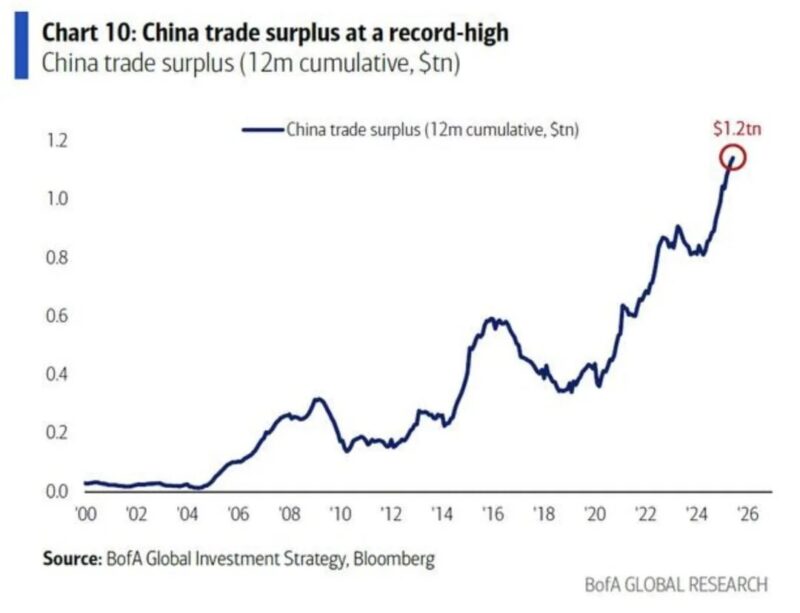
    While a trade surplus is usually seen as a positive sign of economic health because it indicates a country is exporting more than it imports, a persistent and large trade surplus, especially by major global players like China, has also generated geopolitical and economic tensions worldwide.

    Interestingly, in the decades preceding China’s emergence as a major exporter, from the end of World War II to the early 1970s, the United States ran trade surpluses, primarily due to its industrial strength and its role as a key exporter in the global market —a position China has only recently assumed.

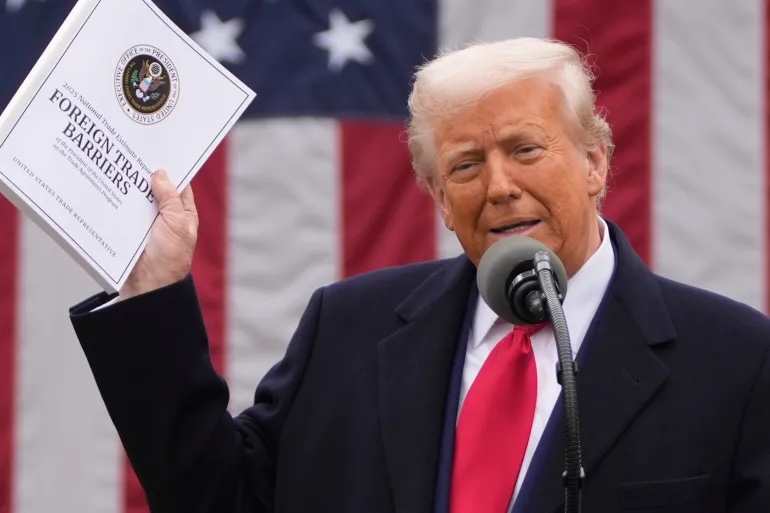
    The issue of trade surplus is now becoming the new nuisance in global affairs. Those who benefit from it support it; others protest. However, the discussion of this topic arises from actions by US President Trump, who is attempting to manipulate trade tariffs to influence global trade in favour of the American economy. While a trade surplus is usually seen as a positive sign of economic health because it indicates a country is exporting more than it imports, a persistent and large trade surplus, especially by major global players like China, has also generated geopolitical and economic tensions worldwide. A recent US Treasury report accused China of disrupting the global economic balance through its substantial trade surplus. This article critically examines the financial mechanisms behind trade surpluses, the strategic narratives of developed nations, and the counter-narratives of developing economies, with a particular focus on China.

    The latest semi-annual US Treasury report (June 2025) did not label China as a currency manipulator but criticised its lack of transparency in managing the renminbi. Instead, it added countries such as Ireland and Switzerland to its “monitoring list” based on trade surplus and intervention metrics. The report highlights China’s opaque exchange rate practices and suggests that intervention through state tools (e.g., sovereign wealth funds) should be more closely monitored.

    Western media and think tanks argue that China’s surplus fuels its industrial oversupply, causing global spillovers and structural trade imbalances. This has harmed local industries in emerging economies by flooding markets with cheap Chinese goods made in factories connected to the Belt and Road Initiative. As a result, many of these countries are now imposing anti-dumping duties to safeguard their domestic industries.

    China’s larger economic footprint means its external balance continues to significantly influence trading partners.

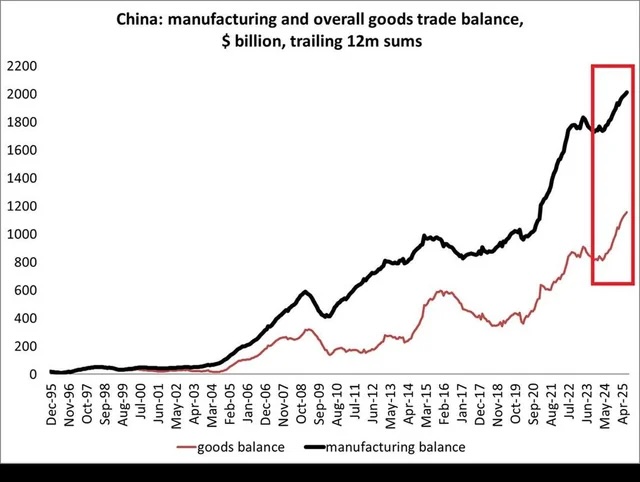
    For China, a trade surplus serves both as a consequence and a policy. The IMF contends that China’s surplus mainly stems from internal macroeconomic factors — such as weak household consumption and excess industrial capacity — rather than intentional export strategies or outright manipulation. Although this surplus rate is lower than at the peak of the “China shock” in the 2000s, China’s larger economic footprint means its external balance continues to significantly influence trading partners. IMF models suggest that weak domestic demand — driven by property downturns and low consumer confidence — has caused a decline in consumption in China and has pushed the real renminbi lower, which in turn enhances exports. This has further amplified the trade surplus.

    However, Western policymakers and scholars argue that Beijing’s industrial model, underpinned by subsidies and exchange rate policies, amplifies this surplus into a global oversupply and trade friction. Brookings researchers describe this as a “mercantilist trade policy,” characterised by low domestic consumption, state-driven subsidies, and a focus on exports. The resulting surplus—now larger relative to global GDP than during the 2008 peak—puts pressure on trading partners despite US tariffs that have failed to reduce the bilateral trade deficit.

    Statistical Distortions: “Missing Imports”

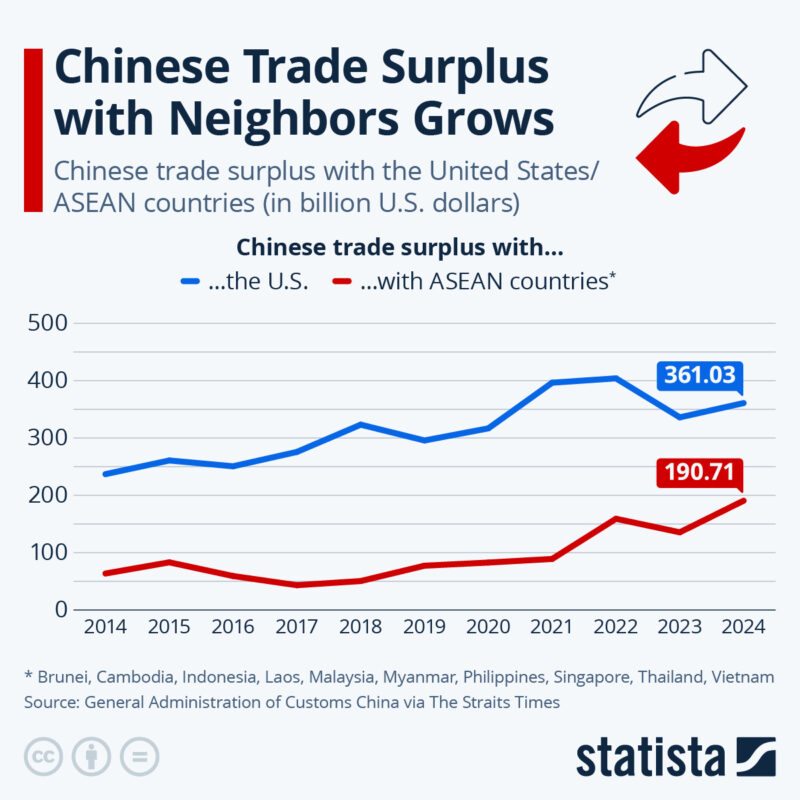
    The most revealing statistic is that from 2018 to 2024, official US data revealed a $66 billion reduction in imports from China, while Chinese records indicated a $91 billion increase in exports to the US, a discrepancy of $157 billion. Much of this is due to the US de minimis rule, which permits parcels valued at under USD 800 to enter the country duty-free and bypass detailed customs reporting. E-commerce giants like Temu and Shein exploit this loophole, and 1.36 billion de minimis parcels entered the US market in 2024 alone, most of which originated from China. This underreporting skews trade data, underestimating China’s market reach and downplaying the structural impact of the surplus.

    Global Spillovers and E-commerce Consequences

    These surplus-driven shipments have severely impacted U.S. domestic retailers. However, bricks-and-mortar firms face import duties, labour regulations, intellectual property standards, and environmental rules. They cannot compete with low-value imports, which are not subject to duties or other regulations. Recent changes in U.S. policy have directly addressed the de minimis loophole, and an exemption for low-value Chinese imports was removed as of 2 May 2025, causing parcel duties to rise to 145%. This has caused small U.S. retailers to halt shipments, and platforms like Temu have been using local warehouses to circumvent fees, only to have the policy to be temporarily rolled back on May 14, highlighting the unstable political climate surrounding e-commerce regulation.

    Impact on Emerging Economies

    Developing countries are increasingly feeling the impact of China’s surplus-led export model. According to the World Bank, two-thirds of developing economies are expected to see their GDP growth slow from 4.2 per cent to 3.8 per cent by 2025, due to ongoing trade frictions, particularly between the US and China. Inexpensive Chinese goods, whether cheaper solar panels, electronics, or textiles, also pose a threat to emerging markets, and many are fighting back with anti-dumping duties and trade defence measures. At the same time, countries like Brazil, Indonesia, South Africa, and India have imposed tariffs, launched dumping investigations, and reconsidered their trade dependencies. Even countries that are traditionally aligned with China are concerned about the surging Chinese exports. An additional concern is that FDI in developing countries has declined to its lowest level since 2005, reaching just $435 billion in 2023. There is a risk that investment will fall further, raising concerns about investment, infrastructure, and poverty reduction.

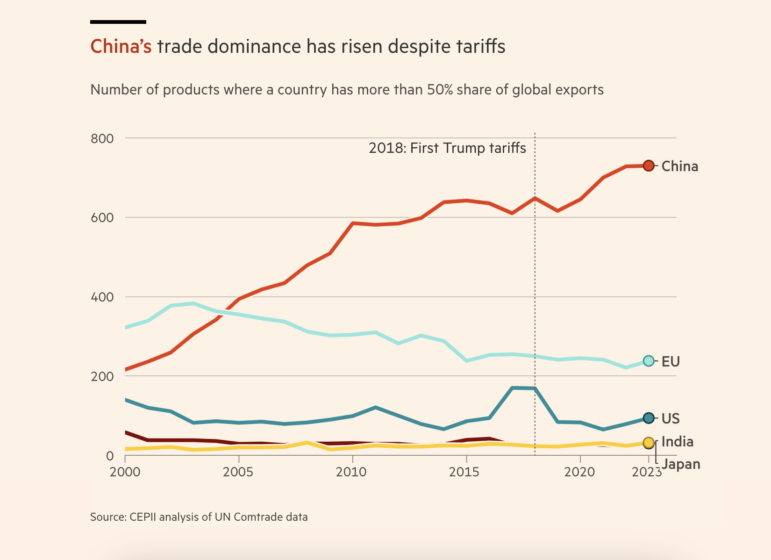
    The Times article explains that Donald Trump’s tariffs did not reduce Chinese imports. Even with highly aggressive tariffs, the share of U.S. imports from China decreased by only 7 to 8 percentage points from 2018 to 2024, although industry estimates suggest that the actual fall in Chinese-origin goods entering U.S. supply chains is smaller (perhaps around 3 to 4 percentage points), due to relabelling and third-party routing.

    This raises stark questions about the effectiveness of the counter-tariff cycle. The overall outcome of this tariff war is simply a confusing and panicked state of affairs. The Times article explains that Donald Trump’s tariffs did not reduce Chinese imports. Even with highly aggressive tariffs, the share of U.S. imports from China decreased by only 7 to 8 percentage points from 2018 to 2024, although industry estimates suggest that the actual fall in Chinese-origin goods entering U.S. supply chains is smaller (perhaps around 3 to 4 percentage points), due to relabelling and third-party routing.

     Theoretical perspectives

    Dependency Theory and the Prebisch–Singer Hypothesis argue that developing countries experience declining terms of trade because they focus on primary goods, whereas industrialised nations retain advantages in high-value manufacturing. However, China has challenged this idea by dominating global markets in both primary and advanced products. As a result, we might reasonably conclude that even rising industrial powers, when driven by surplus, tend to uphold the global structures of dependency. Models like Unequal and Ecologically Unequal Exchange demonstrate how trade surpluses frequently involve a systematic undervaluation of labour and environmental costs in poorer countries, redirecting wealth to the Global North.

    These theories emphasise how global trade undervalues labour, worsens resource extraction, and causes environmental degradation, thereby transferring wealth from peripheral to core countries. Research suggests that Chinese-led global supply chains contribute to environmental damage and resource depletion in exporting countries, externalising ecological costs, which worsens the structural disadvantages for those nations. China’s GVC-enabled export surge often externalises ecological costs to commodity-exporting nations.

    Macroeconomic accounting theory states that a capital account deficit indicates a trade surplus, which means that for China, this results in capital inflows. Consequently, China needs to impose tight controls on its currency to maintain financial stability. With a current account surplus of approximately 3% of GDP, global capital flows, combined with managed exchange rates and the accumulation of foreign reserves—mainly US Treasuries—demonstrate structural policies designed to keep the renminbi weak and direct money into Western securities.

    The current trade environment is shaped by negotiation frameworks, such as the US–China truce, and tools, such as WTO rules and anti-dumping procedures. However, the US is now expanding its pressure on Europe, targeting its large goods surplus and digital tax regimes in an effort to rebalance trade.

    Global Debate

    IMF chief economist Pierre Olivier Gourinchas emphasised that “external balances are determined by macroeconomic fundamentals, not the link to trade and industrial policy, which is more tenuous”. The IMF analysis from the spring meetings similarly implies that internal imbalances (such as differences in savings and investment) influence external current account outcomes, and that China’s surplus reflects its high savings rate, low consumption, and industrial overcapacity. Therefore, while US officials describe China’s trade surplus as a sign of mercantilist excess, IMF analysis reminds us that external imbalances are a reflection of underlying macroeconomic divisions: in China’s case, a high savings rate, low consumption, and industrial overcapacity.

    Inderjit Gill, Chief Economist and Senior Vice President for Development Economics at the World Bank, said: “In the rest of the world, the developing world is now a development-free zone.”

    Surplus narratives are tools of structural power: while developed nations try to portray surplus as distortion, dumping, and manipulation to justify tariffs, subsidies, and monitoring, developing countries aim to reframe them as ecological exchange and dependency to highlight systemic inequalities

    Growth in developing economies, which has ratcheted down from 6 per cent in the 2000s to 5 per cent in the 2010s, and then to less than 4 per cent in the 2020s, mirrors the decline in global trade growth, from 5 per cent in the 2000s to around 4.5 per cent in the 2010s, and below 3 per cent in the 2020s. This illustrates the bilateral nature of the trade surplus. First, fundamentally, surplus narratives are tools of structural power: while developed nations try to portray surplus as distortion, dumping, and manipulation to justify tariffs, subsidies, and monitoring, developing countries aim to reframe them as ecological exchange and dependency to highlight systemic inequalities.

    China promotes an alternative narrative about its surplus, arguing that it stems from genuine investment, state-led development, and economies of scale, rather than protectionism or currency manipulation. Belt and Road infrastructure is presented as development, not geopolitical trap – although critics raise concerns of “debt-trap diplomacy”.

    Interestingly, in the decades preceding China’s emergence as a major exporter, from the end of World War II to the early 1970s, the United States ran trade surpluses, primarily due to its industrial strength and its role as a key exporter in the global market —a position China has only recently assumed.

    A paper by Robert Stehrer titled “What Is behind the US Trade Deficit?” published in ‘The Vienna Institute for International Economic Studies’ (WIW), traces the historical US trade deficit back to the 19th century and places it in a global context. A reading of it would show a broader narrative at play.

    Policy Roadmap

    Stricter transparency rules are essential to close statistical loopholes and create a level playing field by mandating the disclosure of foreign exchange interventions and de minimis trade flows (such as e-commerce transactions below US$800). These flows can artificially keep a country’s exports cheap and imports expensive, thereby inflating its trade surplus. Countries with persistent surpluses (exceeding 3% of GDP) should participate in a dialogue-based “Global Adjustment Protocol” that includes concessional finance for structural reforms, aiming to strike a balance between conditionality and developmental needs.

    One crucial step in this direction would be to include a green surplus index as part of a Green Current Account Score, which measures environmental degradation and natural resource depletion, thereby aligning surplus behaviour with sustainability goals.

    The urgent need is for reform of international organisations, liberating the IMF and WTO from Western dominance, transforming them into genuinely global entities or replacing them with organisations like the BRICS bank (NDB) and AIIB. Additionally, they should be empowered with greater authority to monitor global imbalances and suggest corrective measures, such as managing capital flows instead of imposing unilateral tariffs. This would help streamline WTO procedures, reducing delays, and defend policy space—such as supporting trade defence measures (anti-dumping duties, safeguards) by emerging economies.

    Conclusion:

    This article argues, through an economic analysis of current trade affairs, how hegemonic powers manipulate the political landscape. Trade surpluses are not merely economic aggregates—they are narrative tools in international power politics, with developed countries portraying surpluses as dumping or currency manipulation to justify tariffs and regulatory barriers. Conversely, surplus nations (both developed and emerging) describe their surpluses as the result of sound investments, economies of scale, and effective state guidance.

    From the macroeconomic surplus in the economy to the underreported e-commerce inflows, the reality of modern trade imbalances is far more complex than what mercantilist rhetoric suggests. An analysis of China’s experience demonstrates this point. The next phase of global trade reforms should emphasise transparency, robust multilateral regulations, and ecological responsibility. Beyond mercantilist rhetoric, there is a need for systemic frameworks that accurately reflect economic realities and sustainable goals—only then can tensions caused by surpluses be managed in a balanced and lasting manner.


     References:


    Feature Image Credit: Aljazeera.com

    Graphs Credits: Reddit; Financial Times; Statista

  • India’s war on the Mughal Empire

    India’s war on the Mughal Empire

    The profound legacies of the Mughal Empire, forged through a remarkable fusion of Persian and Sanskrit worlds, are now under siege from a mythical vision of India’s past.

    On every 15 August since 1947, India’s Independence Day, the country’s prime minister unintentionally acknowledges the Mughals’ political legacy by delivering a nationwide address from the parapets of the mightiest symbol of Mughal power – Delhi’s massive Red Fort, built in 1648.

    ‘As is true of autocracies everywhere’, wrote David Remnick last April, ‘this Administration demands a mystical view of an imagined past.’  Although Remnick was referring to Trump’s America, something of the same sort could be said of India today. Informed by Hindutva (Hindu-centric) ideals, the country’s governing BJP party imagines a Hindu ‘golden age’ abruptly cut short when Muslim outsiders invaded and occupied an imagined sacred realm, opening a long and dreary ‘dark age’ of anti-Hindu violence and tyranny. In 2014, India’s prime minister declared that India had experienced 1,200 years of ‘slavery’ (ghulami), referring to ten centuries of Muslim rule and two of the British Raj. But whereas the British, in this view, had the good sense to go home, Muslims never left the land they had presumably violated and plundered. To say the least, India’s history has become a political minefield.

    Today’s India would be unrecognisable without the imprint the Mughals had made, and continue to make, on its society and culture. It was they who, for the first time, unified most of South Asia politically.

    Between the early 16th and the mid-18th century, towards the end of those 12 centuries of alleged ‘slavery’, most of South Asia was dominated by the Mughal Empire, a dazzling polity that, governed by a dynasty of Muslims, was for a while the world’s richest and most powerful state. Although it declined precipitously during the century before its liquidation by Queen Victoria in 1858, today’s India would be unrecognisable without the imprint the Mughals had made, and continue to make, on its society and culture. It was they who, for the first time, unified most of South Asia politically. On every 15 August since 1947, India’s Independence Day, the country’s prime minister unintentionally acknowledges the Mughals’ political legacy by delivering a nationwide address from the parapets of the mightiest symbol of Mughal power – Delhi’s massive Red Fort, built in 1648. Much of modern India’s administrative and legal infrastructure was inherited from Mughal practices and procedures. The basis of India’s currency system today, the rupee, was standardised by the Mughals. Indian dress, architecture, languages, art, and speech are all permeated by Mughal practices and sensibilities. It’s hard to imagine Indian music without the sitar, the tabla, or the sarod. Almost any Indian restaurant, whether in India or beyond, will have its tandoori chicken, kebab, biryani, or shahi paneer. One can hardly utter a sentence in a north Indian language without using words borrowed from Persian, the Mughals’ official language. India’s most popular entertainment medium – Bollywood cinema – is saturated with dialogue and songs delivered in Urdu, a language that, rooted in the vernacular tongue of the Mughal court, diffused throughout India thanks to its association with imperial patronage and the prestige of the dynasty’s principal capital, Delhi.

    Yet, despite all this, and notwithstanding the prime minister’s national address at Delhi’s Red Fort, India’s government is engaged in a determined drive to erase the Mughals from public consciousness, to the extent possible. In recent years, it has severely curtailed or even abolished the teaching of Mughal history in all schools that follow the national curriculum. Coverage of the Mughals has been entirely eliminated in Class Seven (for students about 12 years old), a little of it appears in Class Eight, none at all in Classes Nine to 11, and a shortened version survives in Class 12. In 2017, a government tourism brochure omitted any mention of the Taj Mahal, the acme of Mughal architecture and one of the world’s most glorious treasures, completed in 1653. Lawyers in Agra, the monument’s site, have even petitioned the courts to have it declared a Hindu temple.

    Although such radical measures have failed to gain traction, the national government has made more subtle efforts to dissociate the monument from the Mughals and identify it with Hindu sensibilities. For example, authorities have eliminated the initial ‘a’ from the name of one of its surrounding gardens, so that what had been Aram Bagh, the ‘Garden of Tranquility’, is now Ram Bagh, the ‘Garden of Ram’, the popular Hindu deity. This is the same deity to which India’s current government recently dedicated an extravagant temple complex on the site of the Babri Masjid, the mosque in eastern India that the Mughal Empire’s founder had built in 1528, but which a mob of Hindu activists tore down brick by brick in 1992.

    All of this prompts two related questions: how did a rich, Persian-inflected Mughal culture sink such deep roots in today’s India in the first place? And why in recent years has the memory of that culture come under siege?

    Ever since the early 13th century, a series of dynastic houses, known collectively as the Delhi sultanate, had dominated the north Indian plain. The last of these houses, the ethnically Afghan Lodis, was dislodged by one of the most vivid figures in early modern history, Zahir al-Din Babur(1483-1530). In 1526, Babur led an army of mostly free-born Turkish retainers from his base in Kabul, down through the Khyber Pass and onto the wide Indo-Gangetic plain, thereby launching what would become the Mughal Empire.

    As was true for the Delhi sultans, the new polity’s success lay in controlling access to ancient trade routes connecting Delhi and Lahore with Kabul, Balkh, and Central Asian markets, such as Samarkand and Bukhara. For centuries, cotton and other Indian goods moved northwards along this route, while horses – more than a hundred thousand annually, by Babur’s day – moved southwards to markets across South Asia. War horses had long formed the basis of power for Indian states, together with native war elephants. But the larger and stronger horses preferred by Indian rulers had to be continually imported from abroad, especially from Central Asia’s vast, long-feathered grasslands where native herds roamed freely.

    Having established a fledgling kingdom centred on Delhi, Agra and Lahore, Babur bequeathed to his descendants a durable connection to the cosmopolitan world of Timurid Central Asia, a refined aesthetic sensibility, a love of the natural world reflected in his delightful memoir, the Baburnama, and a passion for gardens. Aiming to recreate in India the refreshing paradisiac spaces that he knew from his Central Asian homeland, Babur built gardens across his realm, a practice his descendants would continue, culminating in the Taj Mahal.

    Since he died only four years after reaching India, Babur’s new kingdom merely continued many institutions of the defeated Lodis, such as giving his most trusted retainers land assignments, from which they collected taxes and maintained specified numbers of cavalry for state use. It was Babur’s son Humayun (r. 1530-40, 1555-56) who took the first steps to deepen the roots of Mughal legitimacy in Indian soil, as when he married the daughter of an Indian Muslim landholder rather than a Central Asian Turk, a practice he encouraged his nobles to follow. More importantly, while seated in a raised pavilion (jharokha) that projected from his palace’s outer walls, he would greet the morning’s rising sun and show his face to the public, just as the sun showed itself to him. This followed an ancient practice of Indian rajas that subtly conflated the image of a seated monarch with the icon of a Brahmanical deity, before whom one pays respectful devotion through mutual eye contact (darshan).

    The Mughals became further Indianised during the long reign of Humayun’s son Akbar (r. 1556-1605). Whereas for three centuries the Delhi sultans had struggled to defeat the Rajput warrior clans that dominated north India’s politics, Akbar adopted the opposite policy of absorbing them into his empire as subordinate kings. Nearly all Rajput kings accepted this arrangement, for by doing so they could retain rulership over their ancestral lands while simultaneously receiving high-ranking positions in Akbar’s newly created ruling class – the imperial mansabdars. Their new status also allowed them to operate on an all-India political stage instead of remaining provincial notables. Moreover, they were granted religious freedom, including the right to build and patronise Hindu temples. Over time, there emerged a warrior ethos common to both Mughals and Rajputs that superseded religious identities, allowing the latter to understand Muslim warriors as fellow Rajputs, and even to equate Akbar himself with the deity Rama. For their part, Akbar and his successors, as the Rajputs’ sovereign overlords, acquired regular tribute payments from subordinate dynastic houses, the service of north India’s finest cavalry, access to the sea through Rajasthani trade routes leading to Gujarat’s lucrative markets, and the incorporation of Rajput princesses in the imperial harem.

    Moreover, since Rajput women could become legal wives of the emperor, from Akbar’s time onwards, an emperor’s child by a Rajput mother was eligible for the throne. As a result, Akbar’s son Jahangir (r. 1605-23) was half Rajput, as his mother was a Rajput princess. Jahangir, in turn, married seven daughters of Rajput rulers, one of whom was the mother of his imperial successor Shah Jahan, making the latter biologically three-quarters Rajput.

    This last point proved especially consequential. As more Rajput states submitted to Mughal overlordship, the imperial court swelled into a huge, multi-ethnic and women-centred world in which the Rajput element steadily gained influence over other ethnicities. Moreover, since Rajput women could become legal wives of the emperor, from Akbar’s time onwards, an emperor’s child by a Rajput mother was eligible for the throne. As a result, Akbar’s son Jahangir (r. 1605-23) was half Rajput, as his mother was a Rajput princess. Jahangir, in turn, married seven daughters of Rajput rulers, one of whom was the mother of his imperial successor Shah Jahan, making the latter biologically three-quarters Rajput.

    Inevitably, Rajput mothers in the imperial harem imparted their culture to their offspring, who were raised in the harem world. This allowed Indian sensibilities and values to seep deeply into Mughal imperial culture, reflected in imperial art, architecture, language, and cuisine. At the same time, the absorption of Rajput cavalry in the imperial system allowed native military practices to diffuse throughout the empire’s military culture.

    The Mughals engaged with Sanskrit literary traditions and welcomed Brahmin and Jain scholars to their courts. From the 1580s on, Akbar sponsored Persian translations of the great Sanskrit epics Mahabharata and Ramayana, effectively accommodating Indian thought to Mughal notions of statecraft.

    Like all authentically Indian emperors, moreover, the Mughals engaged with Sanskrit literary traditions and welcomed Brahmin and Jain scholars to their courts. From the 1580s on, Akbar sponsored Persian translations of the great Sanskrit epics Mahabharata and Ramayana, effectively accommodating Indian thought to Mughal notions of statecraft. Whereas the Sanskrit Mahabharata stressed cosmic and social order (dharma), its Persian translation stressed the proper virtues of the king. Similarly, the Sanskrit Ramayana was subtly refashioned into a meditation on Mughal sovereignty, while the epic’s hero, Rama, was associated with Akbar himself, as though the emperor were an avatar of Vishnu.

    Beginning with Akbar, the Mughals also fostered cultural fusions in the domains of medicine and astronomy.  By the mid-17th century, the Mughals’ Greco-Arab (Yunani) medical tradition had become thoroughly Indianised, as Indo-Persian scholars engaged with Indian (Ayurvedic) works on pharmacology and the use of native Indian plants.

    Similarly, from the late 16th century on, Persian-Sanskrit dictionaries allowed Sanskrit scholars to absorb Arabo-Persian ideas that had derived from ancient Greek understandings of the uniformity of nature and laws of motion. That knowledge, together with astronomical tables patronised by Shah Jahan that enabled the prediction of planetary movements, then spread among the Mughal-Rajput ruling class at large.

    The most telling indication of the public’s acceptance of the Mughals as authentically Indian is that in both the 18th and 19th centuries, when the empire faced existential threats from outside, native forces rallied around the Mughal emperor as the country’s sole legitimate sovereign. In 1739, the Persian warlord Nadir Shah invaded India, routed a much larger Mughal army, sacked Delhi, and marched back to Iran with enormous loot, including the symbolically charged Peacock Throne. At this moment, the Marathas, who for decades had fiercely resisted the imposition of Mughal hegemony over the Indian peninsula, realised that the Mughals represented the ultimate symbol of Indian sovereignty and must be preserved at all costs. The Marathas’ chief minister Baji Rao (1700-40) even proposed that all of north India’s political stakeholders form a confederation to support and defend the weakened Mughal dynasty from foreign invaders.

    Similarly, by the mid-19th century, the English East India Company had acquired de facto control over much of the subcontinent, while the reigning Mughal ruler, Bahadur II (r. 1837-57), had been reduced to a virtual prisoner in Delhi’s Red Fort, an emperor in name only. But in 1857, a rebellion broke out when a disaffected detachment of the Company’s own Indian troops massacred their English officers in the north Indian cantonment of Meerut. Seeking support for what they hoped would become an India-wide rebellion, the mutineers then galloped down to Delhi and enthusiastically rallied around a rather bewildered Bahadur II.  Notwithstanding his own and his empire’s decrepit condition, to the rebels, this feeble remnant of the house of Babur still represented India’s legitimate sovereign.

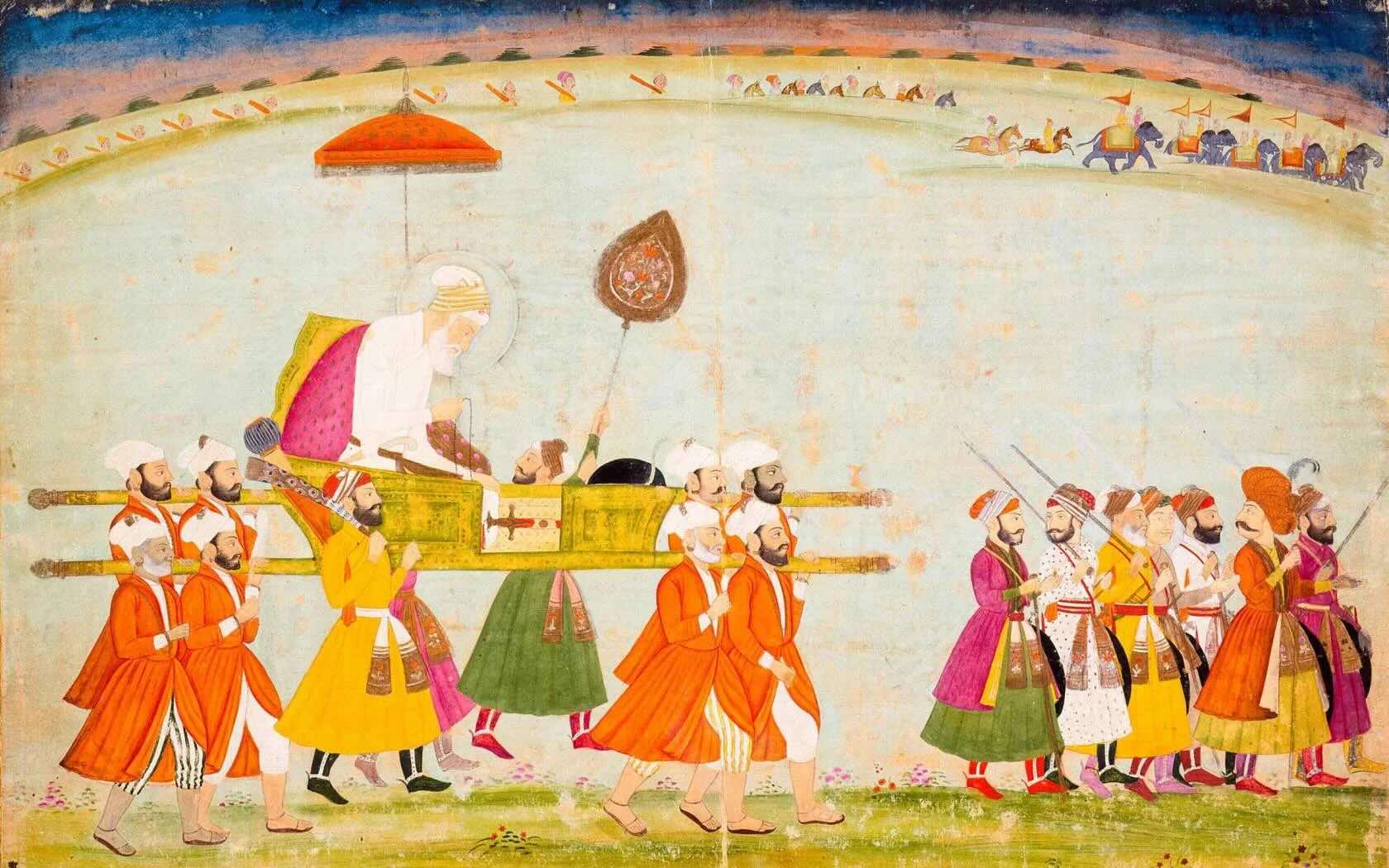
    Through the Mughals’ twilight years, spanning the two incidents mentioned above, one emperor was especially revered in public memory – ‘Alamgir (r. 1658-1707), widely known today by his princely name, Aurangzeb. Upon his death, large and reverential crowds watched his coffin move 75 miles across the Deccan plateau to Khuldabad, a saintly cemetery in present-day Maharashtra. There, the emperor’s body was placed, at his own request, in a humble gravesite open to the sky, quite unlike the imposing monuments built to glorify the memory of his dynastic predecessors (excepting Babur). That simple tomb soon became an object of intense popular devotion. For years, crowds thronged his gravesite, beseeching ‘Alamgir’s intercession with the unseen world, for his saintly charisma (baraka) was believed to cling to his gravesite, just as in life it had clung to his person. For, during his lifetime, the emperor was popularly known as ‘Alamgir zinda-pir, or ‘Alamgir, the living saint’, one whose invisible powers could work magic.

    ‘Alamgir’s status as a saintly monarch continued to grow after his death in 1707. Already in 1709, Bhimsen Saksena, a former imperial official, praised ‘Alamgir for his pious character and his ability to mobilise supernatural power in the empire’s cause. In 1730, another retired noble, Ishwar Das Nagar, credited ‘Alamgir for the exceptional peace, security, and justice that had characterised his long reign. Nagar’s account followed a spate of histories that praised the emperor as a dedicated, even heroic administrator, and his half-century reign as a ‘golden age’ of governmental efficiency.

    Further contributing to ‘Alamgir’s cult was the appearance of hundreds of images depicting the emperor engaged in administration, military activity, or religious devotion. Reflecting the extent of the ‘Alamgir cult, many of these post-1707 paintings were produced not at the imperial court but in north India’s Hindu courts, including those of the Mughals’ former enemies. No other Mughal emperor was so venerated, and for so long a period, as ‘Alamgir.

    Over time, however, Indians gradually came to see the Mughal period – and especially ‘Alamgir’s reign – in an increasingly negative light. As the East India Company attained control over South Asia in the late 18th century, British administrators, being unable as foreigners to deploy a nativist rationale to justify their rule, cited the efficiency, justice, peace and stability that they had brought to their Indian colony. And because the Mughals had immediately preceded the advent of Company rule, those rulers were necessarily construed as having been inefficient and unjust despots in a war-torn and unstable land. The colonial understanding of Muslims and Hindus as homogeneous and mutually antagonistic communities also facilitated aligning colonial policies with the old Roman strategy of divide et impera. More perniciously, the colonial view of the Mughals as alien ‘Mahomedans’ who had oppressed a mainly non-Muslim population reinforced the notion of a native Hindu ‘self’ and a non-native Muslim ‘other’ – constructions that would bear bitter fruit.

    Although originating from within the colonial regime, such ideas gradually percolated into the public domain as the 19th century progressed and Indians became increasingly absorbed in the Raj’s educational and administrative institutions. It was not until the 1880s, with the first stirrings of Indian nationalist sentiment, however, that such colonial tropes became widely politicised. As the possibility of an independent nation took root, Indian nationalists began to look to their own past for models that might inspire and mobilise mass support for their cause. The writing of history soon became a political endeavour, ultimately degenerating into a black-and-white morality play that clearly distinguished heroes from villains. In short, India’s precolonial past became a screen onto which many – though not all – Hindu nationalists projected the tropes of the Hindu self and the Muslim other.

    Between 1912 and 1924, one of India’s most esteemed historians, Jadunath Sarkar, published his five-volume History of Aurangzib, the princely name of ‘Alamgir, who would soon become the most controversial – and ultimately the most hated – ruler of the Mughal dynasty. Sarkar’s study was so detailed, so thoroughly researched, and so authoritative that, in the century following its publication, no other historian even attempted a thorough survey of ‘Alamgir’s reign.

    Importantly, Sarkar wrote against the backdrop of the Great War and a nationalist movement that was just then reaching a fever pitch. In 1905, Lord Curzon, the Viceroy for India, had partitioned Sarkar’s native province of Bengal in half, a cynical divide-and-rule measure that ‘awarded’ Bengali Muslims with their own Muslim-majority province of eastern Bengal. The very next year, there appeared the All-India Muslim League, a political party committed to protecting the interests of India’s Muslims. Meanwhile, the partition of Bengal had provoked a furious protest by Bengali Hindus, leading to India-wide boycotts against British-made goods. Ultimately, the government gave in to Hindu demands and, in 1911, annulled the partition, which only intensified fear and anxiety within India’s Muslim minority community.

    It was in this highly charged political atmosphere that Sarkar worked on his biography of ‘Alamgir. With each successive volume of his study, the emperor was portrayed in darker colours, as were Muslims generally. In the end, Sarkar blamed ‘Alamgir for destroying Hindu schools and temples, thereby depriving Hindus of the ‘light of knowledge’ and the ‘consolations of religion’, and for exposing Hindus to ‘constant public humiliation and political disabilities’. Writing amid the gathering agitation for an independent Indian nation, Sarkar maintained that ‘no fusion between the two classes [Hindus and Muslims] was possible’, adding that while a Muslim might feel that he was in India, he could not feel of India, and that ‘Alamgir ‘deliberately undid the beginnings of a national and rational policy which Akbar [had] set on foot.’

    Perhaps more than any other factor, Sarkar’s negative assessment of ‘Alamgir has shaped how millions have thought about that emperor’s place in Indian history. Since the publication of History of Aurangzib, professional historians have generally shied away from writing about the emperor, as though he were politically radioactive. This, in turn, opened up space in India’s popular culture for demagogues to demonise the Mughal emperor. For millions today, ‘Alamgir is the principal villain in a rogues’ gallery of premodern Indo-Muslim rulers, a bigoted fanatic who allegedly ruined the communal harmony established by Akbar and set India on a headlong course that, many believe, in 1947, culminated in the creation of a separate Muslim state, Pakistan. In today’s vast, anything-goes blogosphere, in social media posts, and in movie theatres, he has been reduced to a cardboard cutout, a grotesque caricature serving as a historical punching bag. A recent example is the film Chhaava, a Bollywood blockbuster that was released on February 14, 2025 and has since rocketed to superstar status. Among films in only their sixth week since release, already by late March, it had grossed the second-largest earnings in Indian cinema history.

    Loosely based on a Marathi novel of the same title, Chhaava purports to tell the story of a pivotal moment in ‘Alamgir’s 25-year campaign to conquer the undefeated states of the Deccan plateau. These included two venerable sultanates, Bijapur and Golkonda, and the newly formed Maratha kingdom, launched in 1674 by an intrepid chieftain and the Mughals’ arch-enemy, Shivaji (r. 1674-80). The film concerns the reign of Shivaji’s elder son and ruling successor, Sambhaji (r. 1680-89), his struggles with Mughal armies, and finally his capture, torture, and execution at ‘Alamgir’s order in 1689.

    The film is not subtle. With its non-stop violence, gratuitous blood and gore, overwrought plot, and black-and-white worldview, the movie turns the contest between Sambhaji and ‘Alamgir into a cartoonish spectacle, like a Marvel Comics struggle between Spiderman and Doctor Doom. Whereas Sambhaji single-handedly vanquishes an entire Mughal army, ‘Alamgir is pure, menacing evil. Mughal armies display over-the-top brutality toward civilians: innocent Indians are hanged from trees, women are sexually assaulted, a shepherdess is burned to death, and so forth.

    In reality, ‘Alamgir is not known to have plundered Indian villages or attacked civilians (unlike the Marathas themselves, whose raids in Bengal alone caused the deaths of some 400,000 civilians in the 1740s). On the other hand, contemporary sources record Sambhaji’s administrative mismanagement, his abandonment by leading Maratha officers inherited from his father reign, his weakness for alcohol and merry-making, and how, instead of resisting Mughal forces sent to capture him, he hid in a hole in his minister’s house, from which he was dragged by his long hair before being taken to ‘Alamgir.

    Historical accuracy is not Chhaava’s strength, nor its purpose. More important are its consequences. Within weeks of its release, the film whipped up public fury against ‘Alamgir and the Mughals. In one venue where the movie was showing, a viewer wearing medieval warrior attire rode into the theatre on horseback; in another, a viewer became so frenzied during the film’s protracted scene of Sambhaji’s torture that he leapt to the stage and began tearing the screen apart.

    Politicians swiftly joined the fray. In early March, a member of India’s ruling BJP party demanded that ‘Alamgir’s grave be removed from Maharashtra, the heartland of the Maratha kingdom. On 16 March, another party member went further, demanding that the emperor’s tomb be bulldozed. The next day, a riot broke out in Nagpur, headquarters for the far-right Rashtriya Swayamsevak Sangh, India’s paramilitary Hindu supremacist organisation. It began when around 100 activists who supported bulldozing ‘Alamgir’s grave burned an effigy of the emperor. In response, a group of the city’s Muslims staged a counter-protest, culminating in violence, personal injuries, the destruction of property, and many arrests. The fevered demand for bulldozing ‘Alamgir’s final resting place, however, is deeply ironic. In 1707, Sambhaji’s son and eventual successor to the Maratha throne, Shahu, travelled 75 miles on foot to pay his pious respects to ‘Alamgir’s tomb.

    In the end, the furore over ‘Alamgir’s gravesite illustrates the temptation to adjust the historical past to conform to present-day political priorities. Indicating the Indian government’s support for Chhaava’s version of history, in late March, India’s governing party scheduled a special screening of the film in New Delhi’s Parliament building for the prime minister, Cabinet ministers, and members of parliament.

    Nor is it only the historical past that is being adjusted to accord with present-day imagination. So is territory. In 2015, the Indian government officially renamed New Delhi’s Aurangzeb Road – so-named when the British had established the city – after a former Indian president. Eight years later, the city of Aurangabad, which Prince Aurangzeb named for himself while governor of the Deccan in 1653, was renamed Sambhaji Nagar, honouring the man the emperor had executed in 1689.

    Such measures align with the government’s broader agenda to scrub from Indian maps place names associated with the Mughals or Islam and replace them with names bearing Hindu associations, or simply to Sanskritise place-names containing Arabic or Persian lexical elements. Examples include: Mustafabad to Saraswati Nagar (2016), Allahabad to Prayagraj (2018), Hoshangabad to Narmadapuram (2021), Ahmednagar to Ahilyanagar (2023), and Karimgunj to Sribhumi (2024). Many more such changes have been proposed – at least 14 in the state of Uttar Pradesh alone – but not yet officially authorised.

    It is said that the past is a foreign country. Truly, one can never fully enter the mindset of earlier generations. But if history is not carefully reconstructed using contemporary evidence and logical reasoning, and if it is not responsibly presented to the public, we risk forever living with a ‘mystical view of an imagined past’ with all its attendant dangers, as Remnick warns.


    This essay was published earlier on www.engelsbergideas.com

    Feature Image Credit: www.engelsbergideas.com


  • India–U.S. Ties Beyond the Trump Show

    India–U.S. Ties Beyond the Trump Show

    With its deep institutional roots and strategic clarity, the India–U.S. relationship is well-positioned to advance further, driven not by transient rhetoric but by enduring common purpose

    U.S. President Donald Trump’s repeated assertions about mediating a ceasefire between India and Pakistan have reignited long-standing apprehensions surrounding external involvement in the Kashmir issue. His remarks, including those referenced during a U.S. court hearing in May 2025—where U.S. Commerce Secretary Howard Lutnick testified that the Trump administration’s trade policies helped avert a potential nuclear confrontation in South Asia—were met with widespread criticism from strategic experts and policymakers alike. New Delhi has remained steadfast in its position: the issue of Jammu and Kashmir is strictly bilateral and not subject to international mediation.

    Diaspora Influence and Institutional Depth

    Despite Trump’s controversial rhetoric, the India–U.S. relationship has matured well beyond the influence of individual leaders. It now stands as a robust, multi-dimensional partnership, underpinned by shared strategic interests, deepening economic ties, and strong people-to-people linkages. This is evident through the formalization of the relationship via key agreements and strategic initiatives. Today, it is regarded as a promising and one of the most consequential partnerships of the 21st century, given its potential to reshape the dynamics of the Indo-Pacific region and beyond. Moreover, this strength is particularly reflected in the vibrant Indian diaspora in the United States—numbering over four million—one of the most educated and affluent immigrant communities in the country, playing an increasingly influential role in shaping policy.


    The diaspora’s clout in U.S. policymaking has grown remarkably. A striking example of this influence was witnessed during the COVID-19 crisis in 2021. At a critical juncture, when the Biden administration had imposed export restrictions on essential medical supplies, Indian-Americans mounted an organized lobbying campaign. Their efforts succeeded in convincing the administration to reverse the ban and dispatch critical medical equipment and raw materials for vaccines to India. This intervention demonstrated the community’s capacity to influence key policy decisions at the highest levels. Their role is not limited to crisis management. The Indian-American community has been instrumental in advancing landmark initiatives such as the U.S.–India civil nuclear agreement, and today, many Indian-Americans serve in influential roles within the U.S. government. This diaspora acts as a cultural and strategic bridge, enhancing bilateral understanding and reinforcing long-term cooperation.

    The evolving India–U.S. partnership is bolstered by a diverse and committed set of stakeholders,including government institutions, private enterprises, think tanks, academic bodies, and civil society in both nations. Crucially, U.S. institutions such as the State Department and Congress continue to regard India as a vital strategic partner, particularly in the context of the Indo-Pacific strategy and broader efforts to counterbalance China’s growing regional influence. These institutions take a long-term, bipartisan approach to India–U.S. relations, one that is grounded in continuity and strategic alignment rather than reactive or transactional impulses, such as those reflected in Trump’s pronouncements.

    Strategic Continuity

    Trump’s leadership style has often been described as transactional, business-oriented, and self-promoting. He frequently projects himself as a master negotiator and dealmaker, but many of his actions suggest otherwise. His tendency to prematurely claim success and take credit has often weakened his own negotiating position, whether in the context of Ukraine, North Korea, Iran, or South Asia. For instance, Trump repeatedly announced breakthroughs in negotiations between Russia and Ukraine that never materialized, thereby weakening his credibility and diminishing his effectiveness as a serious diplomatic actor.

    While Trump’s erratic rhetoric may generate headlines, it is critical not to exaggerate its impact on this deeply rooted relationship. His habitual tendency to seek the spotlight and amplify his personal role in global diplomacy often lacked substantive backing or long-term vision.

    In the case of India and Pakistan, Trump’s attempt to “hyphenate” the relationship—suggesting he could broker a deal between both nations—ignored the decades-long efforts by previous U.S. administrations to de-hyphenate the ties and treat each relationship on its own strategic merits. His statement that “they’ve been fighting for 1,500 years” reveals a superficial understanding of South Asian geopolitics and history. Such remarks reflect a lack of diplomatic nuance and strategic depth.

    In contrast, previous U.S. presidents devoted sustained efforts toward cultivating strategic trust with India—especially in light of their fraught Cold War history and the lingering presence of anti-American sentiment within Indian political and intellectual circles. During this era, American foreign policy toward India embodied a form of strategic altruism, emphasizing long-term engagement grounded in mutual respect rather than immediate concessions or gains. Successive administrations—Republican and Democratic alike, including Trump’s own during his first term—recognized the importance of winning India’s trust, acknowledging its historic skepticism of U.S. intentions and its adherence to a non-aligned foreign policy stance.

    These efforts bore fruit in the form of landmark agreements and growing strategic alignment across a broad spectrum of areas, including defense cooperation, civil nuclear energy, high technology, artificial intelligence, cybersecurity, and counterterrorism. Recent developments—including the Initiative on Critical and Emerging Technologies (iCET), the U.S.–India Major Defense Partnership Framework (2025–2035), the COMPACT Initiative, and collaborations through platforms like INDUS-X and the Artemis Accords—have deepened cooperation. These engagements signify that the India–U.S. partnership is now an essential component of the 21st-century global security and economic architecture.

    the India–U.S. partnership rests on far more stable and enduring foundations: bipartisan consensus within the U.S. strategic establishment, shared democratic values, converging geopolitical interests, and institutional mechanisms that safeguard continuity and progress.

    While Trump’s erratic rhetoric may generate headlines, it is critical not to exaggerate its impact on this deeply rooted relationship. His habitual tendency to seek the spotlight and amplify his personal role in global diplomacy often lacked substantive backing or long-term vision.  Even his relationship with Elon Musk—once a vocal ally who contributed nearly $300 million to pro-Trump political efforts during the 2024 campaign—has deteriorated into public conflict, highlighting the unpredictability of Trump’s leadership style. In stark contrast, the India–U.S. partnership rests on far more stable and enduring foundations: bipartisan consensus within the U.S. strategic establishment, shared democratic values, converging geopolitical interests, and institutional mechanisms that safeguard continuity and progress.

    West Asia dynamics: No Indian shift

    Moreover, recent U.S. gestures toward Pakistan—including inviting Pakistan’s Army Chief to U.S. Army Day celebrations, public praise for its leadership, the release of funds for upgrading the F-16 fleet—and support in securing IMF bailout packages—should be analysed through the lens of broader strategic imperatives, particularly concerning Iran. Amid escalating tensions with Tehran and recent Israeli airstrikes on Iranian targets by its close ally Israel, Washington may be positioning itself for potential regional contingencies and wider escalation. In this context, logistical access to Pakistani military bases—notably Noor Khan Airbase, and other facilities which, according to senior analyst Imtiaz Gul, is already under partial U.S. operational control—could become critical. Pakistan has a history of facilitating U.S. military operations, such as during the War on Terror. Given its proximity to Iran, Pakistan is strategically well-placed to support U.S. initiatives in the region.

    The U.S. may also seek to ensure that Pakistan remains aligned with Western objectives should Israel act unilaterally against Iran. Therefore, recent goodwill gestures by the U.S. toward Pakistan should be interpreted not as a shift away from India, as some within the Indian strategic establishment might fear, but as part of a calculated strategy to secure regional flexibility amid evolving geopolitical uncertainties in West Asia.

    Ultimately, the strength and resilience of the India–U.S. relationship derive from its firm institutional foundation and shared strategic vision. It is largely insulated from the whims of transient political figures. Despite periodic turbulence, the partnership has demonstrated remarkable continuity and adaptability. Key U.S. national security documents—including the Indo‑Pacific Strategy and the National Security Strategy—consistently describe India as a “major defense partner” and an indispensable actor in the effort to balance China’s regional ambitions. These structural commitments ensure that the bilateral relationship remains on a trajectory of deepening cooperation. As articulated in the 2022 U.S. Indo-Pacific Strategy, India is seen as a “like-minded partner and leader in South Asia and the Indian Ocean, active in and connected to Southeast Asia,” and a “driving force of the Quad and a net security provider in the region.”

    Conclusion

    Today, the India–U.S. relationship stands as a beacon of mutual trust, strategic alignment, and forward-looking engagement. Decades of deliberate diplomacy, institutional investment, and cultural linkage have given rise to one of the most promising partnerships of the 21st century. While figures like President Trump may generate momentary uncertainty, they lack the capacity to derail the deep-rooted and multidimensional nature of this partnership. The future of India–U.S. relations remains bright, anchored in shared democratic ideals, strategic complementarity, and a common vision for a free, open, and inclusive Indo-Pacific.

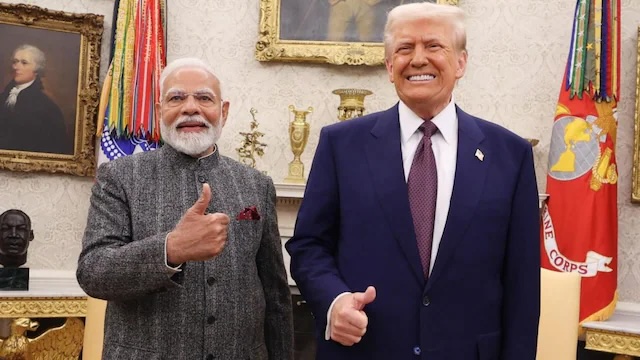
    Feature Image credit: news18.com

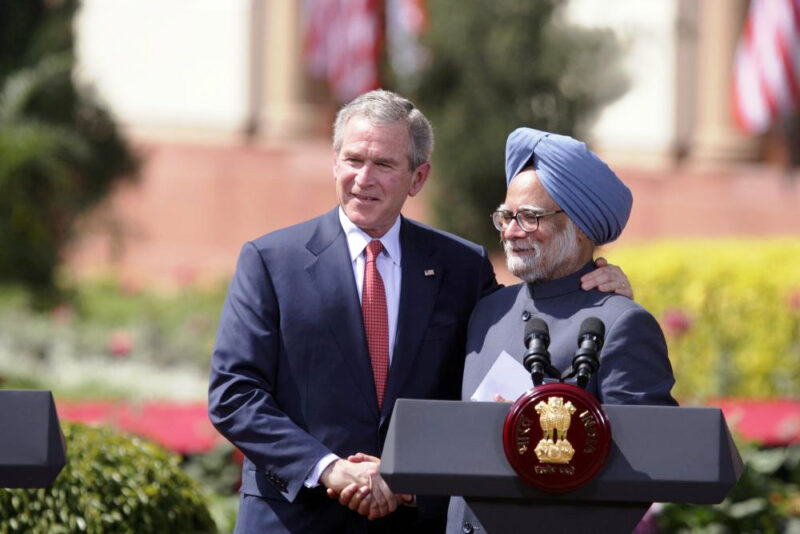
    Image of  President Bush and PM Manmohan Singh: wikipedia India-United States Civil Nuclear Deal.

  • The End of War in Ukraine: A Tough Road Ahead

    The End of War in Ukraine: A Tough Road Ahead

    The war, which began when NATO leaders dismissed Russia’s demand for security guarantees from the West, was intended as a way for Russia to reclaim its power and prestige on the global stage while strengthening its security in the region. Neither of these objectives has been achieved, nor will they be with Ukraine’s defeat. The war quickly escalated into a proxy conflict between Moscow and the collective West, with significant losses on both sides.

    Given that President Putin has recently signed an order to draft 160,000 additional soldiers with the goal of “finishing off” the Ukrainian resistance, the Russia-Ukraine war is far from a definitive resolution. Nonetheless, it is never too early to begin considering the options for a successful post-war settlement and the potential to transform the US-advocated ceasefire (if it ever materializes) into a lasting peace.


    Unfortunately, neither side of the conflict has presented anything even remotely resembling a plan for a sustainable, acceptable post-war settlement. The war, which began when NATO leaders dismissed Russia’s demand for security guarantees from the West, was intended as a way for Russia to reclaim its power and prestige on the global stage while strengthening its security in the region. Neither of these objectives has been achieved, nor will they be with Ukraine’s defeat. The war quickly escalated into a proxy conflict between Moscow and the collective West, with significant losses on both sides. Russia’s international security situation is now worse than it was before the war began, and this will remain the case for some time, regardless of what happens in Ukraine.

    Ukraine, in fact, is fighting a losing battle. Its leaders are sacrificing the country in the midst of a geopolitical rivalry involving Russia, Europe, and the USA. If Ukraine accepts a Trump-mediated deal with Russia, it will lose four regions occupied by Russian forces since 2022, agree to the annexation of Crimea, and abandon any hopes of NATO membership in the future. If Ukraine is defeated on the battlefield, it will lose its independence and be forced to submit to what Russian leaders refer to as demilitarization and denazification—essentially, a regime change and the reconstitution of Ukrainian governance.

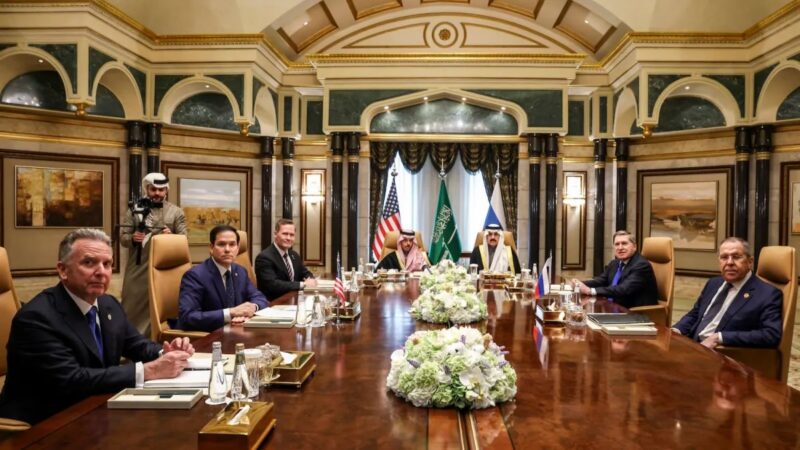
    With no realistic prospect of pushing Russian forces out of the country and with the increasing likelihood of an exploitative “resources plus infrastructure” deal imposed by Washington, Ukraine risks losing not only its state sovereignty but any semblance of international agency. If Ukraine’s role in a post-war settlement, as envisioned in the Saudi negotiations, is reduced to either a Russian-occupied territory or a de facto resource colony of the United States, such a “settlement” would merely serve as an interlude between two wars, offering no lasting resolution to the conflict.

    As the Kremlin proposes placing Ukraine under external governance and the White House demands control over all of Ukraine’s natural resource income for several years—along with a perpetual share of that revenue—the process of transforming Ukraine into a non-self-governing territory accelerates. However, Russia also faces setbacks. Despite Putin’s efforts to halt NATO’s expansion and push the alliance back to its 1997 military posture, NATO has grown closer to Russia’s borders, with formerly neutral Sweden and Finland joining the alliance in direct response to Russia’s invasion of Ukraine. Trump’s previous alignment with Putin prompted EU leaders to agree to a substantial €800 billion increase in defence spending, while French President Macron proposed extending France’s nuclear deterrent to protect all of Europe from potential Russian threats. This may lead to France positioning its nuclear-capable jets in Poland or Estonia, and its ballistic-missile submarines in the Baltic Sea. The British nuclear deterrent is already committed to NATO policy, and it is not unimaginable that some or all of the UK’s nuclear submarines could be deployed closer to Russia’s borders. A UK contribution to a European nuclear umbrella, along with the creation of a low-yield variant of existing nuclear capabilities, would further erode Russia’s already fragile security.

    Putin’s proposal for the external governance of Ukraine reveals Russia’s deep vulnerabilities, which the full occupation of Ukraine would soon expose. A collapse of Ukrainian statehood and the need to occupy the entire country would require Russia to maintain an occupation force of several hundred thousand troops, while also assuming responsibility for law enforcement, security, state administration, essential services, and more. Rebuilding Ukraine’s devastated southeast would cost billions of dollars, and efforts to restore the entire former Ukrainian nation are simply beyond Russia’s capacity. Meanwhile, the guerrilla warfare that the Ukrainians will inevitably intensify in response to Russia’s territorial expansion will further drain the occupiers’ resources.

    The end of the war would mark a slowdown in the military-industrial complex that has driven Russia’s economic growth in recent years. Additionally, the ongoing militarization of society, the rise of nationalist totalitarianism, and the enormous costs of occupying the “new territories” highlight the Pyrrhic nature of Russia’s supposed “victory.”

    Despite the Kremlin’s bravado, Russia’s economy and society have been significantly weakened by the war. With the key interest rate at 21 percent, annual inflation at 10 percent, dwindling welfare fund reserves, and an estimated 0.5 to 0.8 million casualties (killed and wounded) on the battlefield, it’s unclear how much longer Putin can stave off economic decline and maintain reluctant public support for his administration. The end of the war would mark a slowdown in the military-industrial complex that has driven Russia’s economic growth in recent years. Additionally, the ongoing militarization of society, the rise of nationalist totalitarianism, and the enormous costs of occupying the “new territories” highlight the Pyrrhic nature of Russia’s supposed “victory.” The best possible settlement from Russia’s perspective—leaving a rump Ukraine that is independent, self-sufficient, and friendly—is simply out of reach. The remaining options will only delay the inevitable second round of hostilities.

    Finally, the Western proposals for post-war settlements are either unsustainable or outright counterproductive. This is perplexing, given that the war has cost Europe dearly, and it should be in the EU’s interest to see it end as soon as possible. While predictions of seeing the Russian economy in tatters have not materialized, Europe now faces an imminent financial crisis. With the EU economy growing by less than 1 percent in 2024, while Russia’s economy grows 4.5 times faster, it’s time for those like President Macron of France—who advocate continuing the war with extensive European military and financial support—to reconsider their stance.

    However, this is not happening. Instead, EU leaders are urging Russia to agree to an “immediate and unconditional ceasefire on equal terms, with full implementation,” under the threat of new sanctions and the redoubling of Europe’s support for Ukraine.

    This approach is counterproductive and likely to strengthen Russia’s resolve. Beyond the fact that continued support for Ukraine’s war effort will further strain the already fragile budgets of the supporting states, insisting that Ukraine fight to the bitter end is both practically and morally indefensible. At the same time, abandoning Ukraine to face Russia alone could lead to the collapse of Ukrainian statehood. In either case, the collective West loses.

    A negotiated settlement, as proposed by President Trump, is a lesser evil under the current circumstances. Yes, it’s a suboptimal solution that could embolden Putin, harm Ukraine, deepen the divide between Russia and Europe, and create new challenges for international security.

    Yet, the preservation of Ukrainian statehood would be ensured. Death and destruction would cease. Europe’s economy would recover, and the global economy would see a boost. The risk of nuclear war in Europe would fade away. The need for European citizens to stockpile 72 hours’ worth of supplies, as per the European Commission’s recent guidance, might become less of a priority for the already-intimidated European citizens.

    European leaders should consider working alongside Trump, Putin, and Zelensky to craft a balanced, negotiated solution that accounts for the interests of all sides. Even if everyone must make sacrifices, it is better than losing everything. 

    While any path out of this war will be difficult, the strategy of threatening Russia with harsher sanctions, forming “coalitions of the willing,” and creating EU nuclear-armed forces will not make it any easier. Instead, European leaders should consider working alongside Trump, Putin, and Zelensky to craft a balanced, negotiated solution that accounts for the interests of all sides. Even if everyone must make sacrifices, it is better than losing everything.

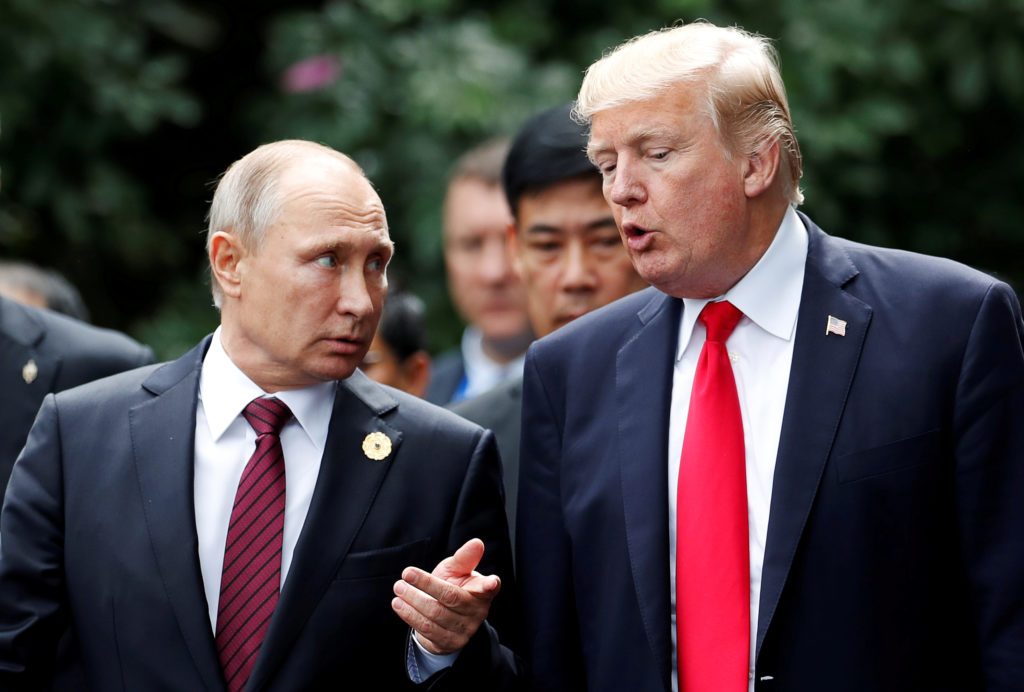
    Feature Image Credit: www.pbs.org

  • Guerrilla Air Defence: Strategy of the Underdog

    Guerrilla Air Defence: Strategy of the Underdog

    Guerrilla air defence is a testament to human ingenuity in asymmetrical warfare. Irregular forces can challenge even the most sophisticated air powers by adapting low-cost solutions, decentralised tactics, innovative technologies, and asymmetrical strategies.

    In the modern era of warfare, air superiority has become a cornerstone of military strategy. Nations with advanced air forces often dominate battlefields, leveraging precision-guided munitions, reconnaissance drones, and stealth technology. However, guerrilla forces, lacking comparable resources, have developed innovative air defence strategies to counter such overwhelming air dominance. Guerrilla air defence embodies the ingenuity of the underdog, employing asymmetric tactics and exploiting weaknesses in advanced air forces.

    Guerrilla Air Defence

    Guerrilla air defence refers to the methods and tactics employed by ground forces, mainly non-state actors or irregular forces, to counter the overwhelming aerial superiority of state militaries. In modern conflicts, air dominance often plays a pivotal role in determining outcomes, and ground forces must innovate to level the battlefield. These tactics range from using man-portable air defence systems (MANPADS) to employing deception, leveraging urban terrain, and deploying counter-drone measures.                                  

    Historical Background

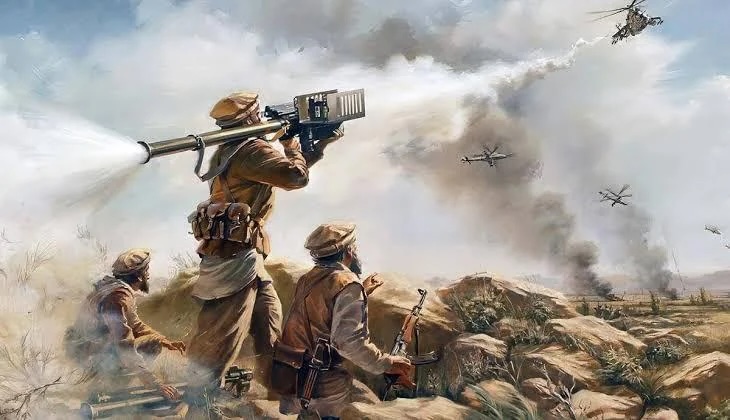
    Mujahideen firing a Stinger (Soviet-Afghan War 1979-89): Image Credit-wikimedia commons

    Vietcongs in action against US aircraft during Vietnam War 1965-1975 (Image – www.thearmorylife.com)

    The concept of guerrilla air defence emerged during the Cold War, as smaller forces sought ways to combat technologically superior opponents. Early examples include the North Vietnamese forces, with Soviet and Chinese support, employing a mix of surface-to-air missiles (SAMs), anti-aircraft artillery (AAA), and man-portable air defence systems (MANPADS) to counter American air supremacy. The infamous downing of U.S. planes over Hanoi—dubbed “SAM City”—highlighted the effectiveness of such strategies. During the Afghan-Soviet War (1979-1989), Afghan mujahideen famously utilised U.S.-supplied Stinger missiles to neutralise Soviet helicopters and jets, turning the tide in specific regions and undermining Soviet morale. These historical precedents set the stage for modern guerrilla air defence tactics, which blend ingenuity, adaptability, and external support.

     Principles of Guerilla Air Defence

    Mobility and Concealment: Mobility and concealment are fundamental to guerrilla air defence. Unlike conventional militaries that deploy fixed air defence installations, guerrilla forces rely on portable systems and improvised techniques to remain undetected. Camouflage, underground networks, and rapid movement are essential to avoid detection by aerial surveillance. Guerrilla fighters exploit natural and urban terrain to conceal their positions, using forests, mountains, and cityscapes as cover.

    Decentralisation: Unlike conventional forces, guerrillas rely on dispersed, mobile, small, independent cells. This limits the effectiveness of an enemy’s centralised air strikes and ensures survivability by reducing the risk of total system compromise if one group is detected.

    Exploiting Vulnerabilities: Guerrilla air defence capitalises on the inherent vulnerabilities of modern air power. Helicopters and battlefield air support aircraft often operate at low altitudes and are prime targets for guerrilla forces. Air forces operating in conflict zones usually follow predictable flight paths or schedules. Guerrilla forces use intelligence and reconnaissance to identify and exploit these patterns.

    Innovation, Improvisation and Resource Maximisation: Guerrillas rely on improvised systems, salvaged weaponry, and external aid to bolster their capabilities. Guerrilla air defence thrives on innovation, often repurposing civilian technologies or adapting outdated equipment. Guerrilla groups have been known to convert commercial drones into makeshift anti-aircraft platforms or deploy modified artillery to target aircraft. Using decoys and false signals to mislead enemy pilots and air defence systems is a common tactic.

    Psychological and Strategic Impact: The psychological effects of guerrilla air defence extend beyond physical damage to aircraft. Even a limited success rate in downing aircraft can significantly reduce the adversary’s willingness to conduct low-risk operations. Each successful engagement serves as a propaganda tool, showcasing the resilience and effectiveness of the underdog.

    Modern Techniques in Guerilla Air Defence

    Modern technology, the fighting environment, and new systems and platforms influence the evolution of newer techniques of guerrilla warfare.

    MANPADS: MANPADS have revolutionised guerrilla air defence due to their portability, ease of use, and effectiveness against low-flying aircraft. One of the most effective tools in guerrilla air defence is using MANPADS, such as the American-made FIM-92 Stinger or the Russian Igla systems. Small teams can carry these portable missile systems and target low-flying aircraft, including helicopters and drones. By utilising these weapons in ambushes or from concealed positions, ground forces can inflict significant damage on technologically superior adversaries, as demonstrated in Afghanistan during the 1980s and the recent Russia-Ukraine war.

    Innovations: While less mobile than MANPADS, AAA remains a staple of guerrilla air defence. Improvised mounts, hidden emplacements, and integration with civilian infrastructure enhance its effectiveness. Groups frequently modify heavy machine guns and anti-aircraft guns like the ZSU-23-4 Shilka. These systems are often mounted on trucks for mobility and used to target low-altitude threats. While less precise than missiles, their volume of fire can pose a substantial threat to helicopters and low-flying planes.

    Urban Environment: Urban environments provide an advantage for the ground forces due to the dense infrastructure that limits aircraft manoeuvrability.  Ground fighters use rooftops, narrow streets, and underground networks to evade detection and launch surprise attacks. In Syria and Iraq, insurgents have used such strategies to counter aerial operations by state and coalition forces.

    Drones: Modern airpower—characterised by drones, advanced jets, and electronic warfare capabilities—poses unique challenges to ground forces. The proliferation of drones has forced forces to develop countermeasures, such as portable jammers, anti-drone rifles, and improvised kinetic solutions like nets or small arms fire.

    Passive Measures: Camouflage and deception remain critical in evading aerial surveillance. Ground forces must rely on natural cover, decoy installations, and rapid mobility to avoid detection. In the Vietnam War, the Viet Cong famously used tunnels and dense jungle foliage to counter U.S. air superiority.

    Implications of Guerilla Air Defence on Modern Warfare

    Guerrilla air defence has emerged as a critical factor in modern warfare, reshaping the dynamics of aerial supremacy and asymmetric conflict. While these strategies aim to counter technologically superior air forces, they carry profound implications for guerrilla groups and conventional militaries. By disrupting aerial operations and imposing costs on powerful adversaries, guerrilla air defence challenges traditional military doctrines and influences the broader landscape of modern conflict.

    Prolonging Conflicts and Increasing Costs: Guerrilla air defence strategies can effectively neutralise or deter low-altitude operations. This capability forces adversaries to adapt, often at significant financial and operational costs. For instance, deploying advanced countermeasures, rerouting flight paths, or relying on high-altitude bombers requires additional resources. As a result, conflicts involving guerrilla air defence tend to become protracted, straining the logistics and finances of all involved parties. The prolonged nature of such conflicts can also erode public and political support for military interventions. For example, the psychological and economic toll of losing expensive aircraft or personnel to guerrilla defences can influence domestic perceptions of the conflict’s viability.

    Evolving Air Warfare Tactics: Conventional militaries must adapt their air warfare strategies to counter guerrilla air defence. This evolution includes increased reliance on high-altitude operations, precision-guided munitions, and stealth technology. Modern air forces also invest heavily in countermeasures such as infrared jammers, flares, and electronic warfare systems to neutralise guerrilla threats. The rise of guerrilla air defence has also accelerated the development of unmanned aerial systems (UAS) for reconnaissance, surveillance, and strike missions. Being expendable and capable of operating in hostile environments, drones minimise the risks associated with manned operations. This shift represents a significant transformation in aerial warfare, emphasising technology over traditional pilot-led missions.

    Impact on Urban and Asymmetric Warfare: Urban environments provide natural concealment and mobility advantages for guerrilla fighters, making them ideal battlegrounds for deploying guerrilla air defence systems. By leveraging civilian infrastructure and the complexity of urban terrain, guerrilla forces can create no-fly zones or deny access to key air corridors. This trend has made urban warfare increasingly challenging for conventional militaries, which must balance operational objectives with minimising civilian casualties and collateral damage.

    Proliferation of Advanced Technology: The success of guerrilla air defence has spurred the proliferation of advanced yet accessible technologies. MANPADS, drones, and electronic warfare tools have become increasingly available on the black market or through state sponsorship. This diffusion of technology not only empowers guerrilla groups but also raises concerns about their use by terrorist organisations or non-state actors in unconventional warfare.

    Redefining Air Superiority: In traditional warfare, air superiority was synonymous with dominance over adversaries. However, guerrilla air defence challenges this notion by proving that even technologically inferior forces can contest airspace. This shift underscores the importance of integrating multi-domain strategies considering ground-based threats alongside aerial operations. For example, in conflicts such as the Syrian Civil War or the Ukraine-Russia war, guerrilla air defence has demonstrated that controlling the skies no longer guarantees uncontested dominance on the ground. The interplay between air and ground forces requires a more nuanced approach, blending technology with adaptable tactics.

    Strategic and Political Implications: Guerrilla air defence imposes strategic dilemmas on conventional forces, often compelling them to overextend resources or adopt more cautious operational postures. This dynamic can undermine the perceived effectiveness of powerful militaries, affecting their credibility and deterring future interventions. Politically, the effectiveness of guerrilla air defence can shift the balance of power in asymmetric conflicts. By contesting air supremacy, guerrilla forces gain leverage in negotiations or peace processes, demonstrating their resilience and capacity to endure prolonged engagements.

    Challenges and Limitations of Guerilla Air Defence

    Guerrilla air defence, while innovative and impactful in certain situations, faces numerous challenges and limitations. These obstacles stem from technological gaps, resource constraints, and the inherent asymmetry between irregular forces and advanced air power.

    Technological Disparity: One of the primary challenges guerrilla groups face is the vast technological gulf between them and conventional military forces. Modern air forces deploy fifth-generation stealth aircraft, precision-guided munitions, and advanced surveillance systems. In contrast, guerrilla forces often rely on outdated or improvised equipment. While tools like man-portable air defence systems (MANPADS) can neutralise low-flying aircraft, they are ineffective against high-altitude bombers or stealth fighters. Advanced countermeasures, such as infrared jammers and decoys, further diminish the impact of guerrilla tactics.

    Logistics and Maintenance: Air defence systems, even portable ones, require robust logistical support. Maintaining and deploying these systems necessitates technical expertise, spare parts, and a steady supply of ammunition. Guerrilla groups, often operating in resource-scarce environments, struggle to sustain such logistical chains. Over time, wear and tear render many systems inoperable, and acquiring replacements or repairs can be risky and costly.

    Detection and Targeting Vulnerabilities: The effectiveness of guerrilla air defence relies heavily on concealment and mobility. However, advancements in surveillance technology, such as drones, satellite imagery, and AI-powered analytics, make it increasingly challenging for guerrilla forces to remain hidden. Once detected, these forces become vulnerable to precision strikes or overwhelming aerial assaults, negating their defensive efforts.

    Dependence on External Support: Guerrilla groups often depend on external states or entities to access advanced air defence systems. This reliance introduces vulnerabilities, as shifts in international politics or interruptions in supply chains can leave these groups without critical resources. For example, a sudden embargo or the withdrawal of support from a sponsor state can cripple guerrilla air defence capabilities.

    Financial Constraints: Air defence is inherently resource-intensive. Procuring, transporting, and maintaining systems like MANPADS or drones requires significant financial investment. Guerrilla groups operating with limited funding must prioritise resources across multiple operational needs, often leaving air defence underfunded. Moreover, the cost-benefit ratio usually favours their adversaries; an advanced air force can deploy inexpensive countermeasures or overwhelm defences with superior numbers.

    Psychological and Operational Strain: Constant exposure to aerial bombardments and the awareness of technological inferiority take a toll on guerrilla fighters’ morale. The strain of operating under the persistent threat of airstrikes can lead to operational inefficiencies and diminished cohesion. Furthermore, the psychological impact of losing critical assets, such as an air defence unit or a valuable weapon system, can significantly affect a group’s strategic planning.

    Limited Strategic Impact: Guerrilla air defence is inherently reactive, designed to mitigate air superiority rather than achieve dominance. While it can disrupt operations and impose costs on adversaries, it rarely shifts the overall balance of power in a conflict. This limitation means that guerrilla air defence is more a delaying tactic than a decisive strategy.

    Conclusion

     Guerrilla air defence is a testament to human ingenuity in asymmetrical warfare. Irregular forces can challenge even the most sophisticated air powers by adapting low-cost solutions, decentralised tactics, innovative technologies, and asymmetrical strategies. Guerrilla air defence’s implications for modern warfare are far-reaching, influencing military strategy, technology development, and conflict outcomes. While it disrupts aerial operations and challenges conventional doctrines, guerrilla air defence also faces significant limitations, such as resource constraints and susceptibility to countermeasures. Nevertheless, its role in redefining the dynamics of air superiority and asymmetric warfare highlights its growing importance in the ever-evolving landscape of modern conflict.

    References:

    1. Boot, M. (2002). The Savage Wars of Peace: Small Wars and the Rise of American Power. Basic Books.
    2. Coll, S. (2004). Ghost Wars: The Secret History of the CIA, Afghanistan, and Bin Laden. Penguin Books.
    3. Jones, S. G. (2017). Waging Insurgent Warfare: Lessons from the Viet Cong to the Islamic State. Oxford University Press.
    4. Hura, M. et al. (2000). Interoperability: A Continuing Challenge in Coalition Air Operations. RAND Corporation.
    5. “Counter-Unmanned Aircraft Systems (C-UAS)” (2021). Center for Strategic and International Studies (CSIS).
    6. Biddle, Stephen, and Jeffrey A. Friedman. “The 2006 Lebanon Campaign and the Future of Warfare: Implications for Army and Defence Policy.” Strategic Studies Institute, 2008.
    7. McInnes, Colin. “The Impact of Air Power on Insurgency and Guerrilla Warfare.” RUSI Journal, Vol. 134, No. 2 (1989): 47–53.
    8. Schulte, Paul. “Proliferation and the Revolution in Military Affairs.” Survival, Vol. 39, No. 1 (1997): 21–42.
    9.   Small Arms Survey. MANPADS: Combating the Threat to Global Aviation from Portable Air Defence Systems. Geneva: Graduate Institute of International and Development Studies, 2011.
    10. RAND Corporation. The Air War in the Gulf: Assessing the Results. Santa Monica: RAND, 1993.
    11. Keegan, John. The Face of Battle. New York: Viking Press, 1976.
    12. Cordesman, Anthony H. The Changing Face of War: Lessons of Combat, from the Marne to Iraq. Washington, D.C.: CSIS Press, 2007.
    13. Grau, Lester W., and Michael A. Gress. The Soviet-Afghan War: How a Superpower Fought and Lost. Lawrence: University Press of Kansas, 2002.
    14. Beckett, Ian F.W. Modern Insurgencies and Counter-Insurgencies: Guerrillas and Their Opponents since 1750. London: Routledge, 2001.
    15. United Nations Office for Disarmament Affairs (UNODA). Study on the Proliferation of Small Arms and Light Weapons, Including MANPADS.
    16. U.S. Department of Defence. Counter-Insurgency Air Operations: Best Practices and Challenges.


    Feature Image Credit: www.reddit.com

    Image of US aircraft shot down by Vietnamese: https://en.topwar.ru

  • Crimson Cows and Indian Sensibilities

    Crimson Cows and Indian Sensibilities

    That Israel, in addition to being an apartheid state, has gone completely rogue is no longer in doubt. As Israel digs itself into a deeper hole, in the belief that it can kill its way to success, it finds that this year its GDP has collapsed from 4.8% in 2022 to 1.5%, with over 46000 small businesses having shut down. By some estimates, between 500,000 to 1 million Israelis have permanently emigrated.


    Approximately 7 million Jewish Israelis and an equal number of Palestinians live cheek-by-jowl between the Mediterranean Sea and the Jordan River. The area encompasses Israel, the occupied territories of the West Bank, including East Jerusalem, and the Gaza Strip.  Nominally, the Palestinians in the West Bank do have limited self-rule, but defacto have no control over the movement of people and goods, or taxes. Agreements signed in the 1990’s, permit the Israeli Government to collect taxes on behalf of the Palestinian Authority (PA), which it then disburses to the PA for its use. These taxes make up over 65-70% of the PA’s public budget and have a critical impact on the quality of life of ordinary Palestinians.

    As has been the norm with Israel, it has used every means, including financial control, to inflict collective punishment on the Palestinians at any attempt by them to free themselves from Israeli occupation. In May this year, for example, it withheld disbursal of all taxes collected over the past three months on grounds that Spain, Ireland and Norway had announced they would recognise the Palestinian State. This resulted in the breakdown of municipal services and widespread loss of jobs. Subsequently, in June it indulged in blatant blackmail when it agreed to disburse withheld funds, provided the PA retroactively approved five settlements in the West Bank that had been illegally established earlier, despite condemnation by Palestinians and the international community.

    While the Hamas attack of 7 October 2023, especially their despicable actions against women, children and civilians, has been widely condemned, the fact that over half of the 1200 Israelis killed, were by their own military in pursuant of the reprehensible “Hannibal Directive”, continues to be glossed over. Oddly enough, over the course of that year, prior to the attack, the fact that over 200 Palestinians had been killed by the Israeli military and settlers for a variety of reasons has simply been ignored by the international media and not been seen as the immediate provocation for the attack, especially its ferocity.

    It now emerges, that the numbers of Palestinians killed by the Israeli response has been grossly underestimated. As per a study dated 10 July 2024 in the Lancet, a respectable and authoritative medical journal, an estimated 186000-200,000 Palestinians have been killed in Gaza, directly or indirectly. This is approximately 9% of the total population, the overwhelming majority of them being women and children.

    The Israeli response to this attack was disproportionate, to put it mildly, but it still continues to receive full support from Western Governments. It now emerges, that the numbers of Palestinians killed by the Israeli response has been grossly underestimated. As per a study dated 10 July 2024 in the Lancet, a respectable and authoritative medical journal, an estimated 186000-200,000 Palestinians have been killed in Gaza, directly or indirectly. This is approximately 9% of the total population, the overwhelming majority of them being women and children.

    The difference between these estimates and the official figures released by the Gaza Health Ministry, which presently stands at approximately 43000, is explained by the fact that the Ministry only accounts for bodies that have been found and not for those remaining under the rubble, that the cities have been reduced to. Nor does it account for the indirect deaths due to hunger, non-availability of medical help etc. Studies suggest that these tend to be between 5-10 times higher than the official figures.

    Israel’s inhuman and deliberate response has been decried by experts, governments, United Nations Agencies and NGOs. They have gone on to accuse Israel of carrying out a genocide against the Palestinian population in Gaza, and more recently, in the West Bank. What is even more horrific, if that is even possible, are the accusations made by Dr. Feroze Sidhwa, an American trauma surgeon, on his return from Gaza. In his devastating op-ed in The New York Times, titled “65 Doctors, Nurses and Paramedics: What We Saw in Gaza”, he recounts harrowing stories from dozens of healthcare workers and CT scans of children shot in the head or the left side of the chest. The Times called the corresponding images of the patients too graphic to publish. In his words, “44 doctors, nurses and paramedics saw multiple cases of preteen children who had been shot in the head or chest in Gaza… He personally identified 13 such cases in his two weeks there”.

    That Israel, in addition to being an apartheid state, has gone completely rogue is no longer in doubt. In July this year, for example,  a video was leaked of the gangrape of a male Palestinian prisoner by guards of the IDF at the Sde Teiman detention facility in Southern Israel. Commentators in Israel referred to this video as just the tip of the iceberg, but what followed is instructive. Ten soldiers were arrested and faced trial for this act, but not before a mob, led by government ministers, attempted to free them forcibly from detention. Another minister demanded an investigation to identify the individual who had leaked the video so that he could be tried for treason. An MP from the governing Likud Party defended the actions of the guards in Parliament, responding to a question by an Arab-Israeli MP with “If he is a Nukhba (Hamas militant), everything is legitimate to do! Everything!”  Even the Minister responsible for  Prison Services, Ben-Gvir, told Israeli media on the day of the reservists’ arrest that it was “shameful for Israel to arrest our best heroes”.

    This race to the bottom doesn’t end there of course, and as the saying goes, the best is yet to come. As is well known, the Holy City of Old Jerusalem is home to the “Temple”, or as it is now known the Temple Mount. It refers to the two existing Islamic religious structures, the Dome of the Rock and the Al Aqsa Mosque, collectively known as Haram al-Sharif, and considered the third holiest site in Islam. However, according to the Tanakh or the Hebrew Bible, prior to these structures, the ‘First Temple’ was supposedly built on that very site in the 10th century BCE by King Solomon, and stood for five hundred years before being destroyed by the Babylonians. Almost a century later, it was replaced by the ‘Second Temple’ built by Cyrus the Great, only for it to be destroyed by the Romans in 70 CE. The New Testament holds that important events in Jesus’ life took place in the Temple, and the Crusaders attributed the name “Templum Domini” to the Dome of the Rock.

    However, many Jews see the building of a “Third Temple” in Jerusalem as an object of longing and a symbol of future redemption, as it would announce the arrival of a new Messiah who would unite the flock and lead them to salvation. Incidentally, the promised land would incorporate the whole of Palestine, along with parts of Turkey, Syria, Iraq, Saudi Arabia and Kuwait.

    Thus the religious significance and sensitivity of Temple Mount cannot be underestimated. Fortunately, as things stand Non-Muslims are not permitted to enter the two structures, while Jews are only allowed to pray at the Western Wall that runs along the side of the hill and is thought to be a remnant of the Second Temple. However, many Jews see the building of a “Third Temple” in Jerusalem as an object of longing and a symbol of future redemption, as it would announce the arrival of a new Messiah who would unite the flock and lead them to salvation. Incidentally, the promised land would incorporate the whole of Palestine, along with parts of Turkey, Syria, Iraq, Saudi Arabia and Kuwait.

    But before its construction can be undertaken, it would require purification of the site and of the construction crew. That would, however, only be feasible, by sacrificing a red heifer, specifically bred to meet stringent biblical requirements. It would be required to be burnt alive at the Mount of Olives, adjacent to the Al Aqsa Mosque, and its ashes used to consecrate the holy ground and the people. The stuff of hopes and dreams for a tiny minority, with little hope of fulfilment in the modern world, or so one thought.

    These cows represent a tangible step towards the construction of the Temple and fulfilment of the prophecy.  The next obvious step in this tragedy will be the demolition of the Haram al-Sharif, for which dry rehearsals have already been undertaken. The consequences of such a step in the region are not difficult to visualise, but will it stop the extremists? Very unlikely.

    However, in September 2022, an unprincipled collaboration between extreme Zionist religious leaders, Right-Wing Christian Evangelicals and the present Israeli Government allowed for five red heifers to be flown from Texas to Israel. Ironically enough, despite the Evangelicals being well-known for their antisemitic beliefs. Brought in as pets, to avoid existing restrictions on livestock, they are now kept in an archaeological park in Shiloh, an illegal Israeli settlement, near the Palestinian city of Nablus. These cows represent a tangible step towards the construction of the Temple and fulfilment of the prophecy.  The next obvious step in this tragedy will be the demolition of the Haram al-Sharif, for which dry rehearsals have already been undertaken. The consequences of such a step in the region are not difficult to visualise, but will it stop the extremists? Very unlikely.

    As Israel digs itself into a deeper hole, in the belief that it can kill its way to success, it finds that this year its GDP has collapsed from 4.8% in 2022 to 1.5%, with over 46000 small businesses having shut down. By some estimates, between 500,000 to 1 million Israelis have permanently emigrated. In addition, it finds itself short of weapons, ammunition, tanks and manpower as heavy casualties in the ongoing conflict have taken their toll. Yet, its arrogant leadership refuses to pay heed to that one cardinal rule about tackling insurgencies; they are a political problem and can only be resolved politically.

    The question that it raises for us is do we really need such friends, and more importantly, are our commercial interests so important that we are willing to forego all that we hold sacred?

    Clearly, if Israel refuses to change direction its days are numbered. After all its most steadfast ally, the United States, can only support so many losing causes. With Ukraine on the brink, an ascending Russo-China coalition to deal with and Taiwan increasingly under threat, an intransigent Benjamin Netanyahu is a liability, who may well find himself the target of a drone, be it American or Iranian. This is very likely despite Trump’s victory to become the 47th President of the United States. The question that it raises for us is do we really need such friends, and more importantly, are our commercial interests so important that we are willing to forego all that we hold sacred?

    Feature Image Credit: Middle East Eye
    Image – De Gaza: reliefweb.int
    Children of Gaza Image Credit: Middle East Eye – How Israel’s Genocide in Gaza sparked a protest movement in the UK.
    Wailing Wall and Al Aqsa Mosque: Tourist Israel
    Red Heifer Sacrifice Ritual Image: thetorah.com

  • China’s Role in reducing the Global Carbon Footprint: The 2060 Promise and Geopolitics on the Climate Front

    China’s Role in reducing the Global Carbon Footprint: The 2060 Promise and Geopolitics on the Climate Front

    Introduction

    The devastating role carbon plays in climate change cannot be underestimated. The rise in global surface temperatures, air pollution, and sea levels are visible effects of a rapidly changing environment. China, the world’s second most populous country, is also the largest emitter of greenhouse gases[i]. According to the CAIT database, in 2020, China emitted what amounted to 27% of the total greenhouse gas emissions in the world[ii]. Under President Xi Jinping, China has moved to position itself as an “ecological civilization”, striving to advance its role in global climate protection[iii]. China’s endeavours received acclaim when it became one of the first major countries to ratify the Paris Agreement in 2015, pledging to attain peak emissions by 2030 and net zero carbon emissions by 2060. This article aims to delineate China’s strategies and motivations for addressing carbon emissions and contrast these with the measures implemented by Western and developing countries to diminish their carbon footprint.

    China’s Image and Geopolitics in the Climate Sector

    Considering China’s position on the world stage as one of the largest and fastest-growing economies in the world, it has faced international pressure to take accountability for its contribution to climate change. China has previously argued that as a developing country, it should not have to share the same responsibilities of curbing climate change that developed countries, whose emissions went “unchecked for decades”, have[iv]. Nonetheless, they have pledged to lead by example in the climate sector. A large part of President Xi’s campaign to amplify China’s climate ambitions may come from appeasing the West while also setting up leadership in the clean energy sector to better cement its role as a superpower. According to a New York Times article, their promise to contribute to climate protection could be used to soothe the international audience and to counterbalance the worldwide anger that China faces over their oppression of the Uyghur Muslims in the Xinjiang province and their territorial conflicts in the South China Sea and Taiwan[v]. President Xi’s pledge at the UN to reach peak emissions before 2030 may have been an attempt to depict China as a pioneering nation striving to achieve net zero carbon emissions, serving as an alternative powerful entity for countries to turn to in lieu of the United States. This holds particular significance, as the USA remained mute about taking accountability for its own carbon emissions and withdrew from the Paris Agreement during Donald Trump’s presidency[vi]. This also shows China’s readiness to employ the consequences of climate change on its geopolitical agenda[vii].

    The future actions of China may significantly influence the climate policies of both developing and developed nations, potentially establishing China as a preeminent global force in climate change mitigation.

    China has endeavoured to shape its image in the climate sector. In 2015, despite being classified as a developing country, China refrained from requesting climate finance from developed countries and instead pledged $ 3.1 billion in funding to assist other developing countries in tackling climate change[viii]. As per the World Bank’s Country Climate and Development Report for China, China is poised to transform “climate action into economic opportunity.”[ix] By transitioning to a net zero carbon emissions economy, China can generate employment opportunities while safeguarding its non-renewable resources from depletion. China’s economy is also uniquely structured to seize the technological and reputational benefits of early climate action[x]. The future actions of China may significantly influence the climate policies of both developing and developed nations, potentially establishing China as a preeminent global force in climate change mitigation. Nonetheless, if China fails to fulfil its commitment to attain net zero carbon emissions by 2060, it may suffer substantial reputational damage, particularly given its current status as a pioneer in “advancing low carbon energy supply”[xi].

    Domestic Versus International Efforts in the Clean Energy Race

    However, domestic and international factors could affect China’s goal to peak emissions and the deadlines it has set for itself. A global event that may have affected their efforts to peak carbon emissions was the COVID-19 pandemic, in which the rise in carbon emissions from industries and vehicles was interrupted[xii]. However, after the pandemic, China’s economy saw swift growth, and in 2021, China’s carbon emissions were 4% higher than in the previous year[xiii]. Not only is China back on track to peak carbon emissions by 2030, but the International Energy Agency and World Energy Outlook 2023 also found that “China’s fossil fuel use will peak in 2024 before entering structural decline.”[xiv]

    Although China’s industrial sector is heavily reliant on coal and fossil fuels, it also boasts the world’s largest production of electric vehicles and is a leader in manufacturing solar panels and wind turbines[xv]. In contrast, developed countries, particularly the US, which withdrew from the Paris Agreement in 2017 during the Trump presidency, appear to be making less of an effort towards environmental protection.

    Developing countries, while not entirely possessed of the immense sprawl of China’s economy and population, are nonetheless not at the level of transitioning to clean energy that China is. India, too, has pledged to be carbon neutral by 2070 and to have emissions peak by 2030. Given its increasing economic growth rate, India must decrease its carbon intensity at the same pace. India lags behind China when it comes to manufacturing solar panels and other renewable energy sources. India’s central government is preparing to push energy modernization to “align with global energy transition trends.”[xvi] According to the Economic Times, particular emphasis has been laid on renewable energy sources like solar capacity and e-vehicles in the 2024-25 budget.[xvii]

    China and International Cooperation for Climate Protection

    With China producing sufficient solar capacity in 2022 to lead the rest of the world considerably and the deployment of solar power expected to rise until 2028, it is essential that the West does not make the mistake of isolating China

    Given that China has emerged as the leading manufacturer of electric vehicles (EVs), it remains to be seen whether developed and developing countries will leverage their supply chains to combat their own climate crises. While opportunities are plentiful for Western businesses to integrate with China’s cutting-edge alternatives for traditional energy sources, the United States has adopted a hardline stance towards China[xviii]. The US has imposed 100 per cent tariffs on Chinese-made e-vehicles, and solar cells face tariffs at 50 per cent.[xix] Simultaneously, rivalry and competition between the two countries on the climate front may help combat the climate dilemma and ever-increasing carbon emissions by avoiding the collective action problem. However, this will depend heavily on smooth cooperation and effective communication between Chinese authorities and developed nations within the EU and the USA[xxi]. Empowering domestic groups within countries can raise awareness of climate crises. A poll conducted in China revealed that 46% of the youth considered climate change the “most serious global issue.”[xxii] According to a survey conducted by the United Nations, 80% of people worldwide say they want climate action[vii]. With China producing sufficient solar capacity in 2022 to lead the rest of the world considerably and the deployment of solar power expected to rise until 2028, it is essential that the West does not make the mistake of isolating China[xxiii].

    Conclusion

    China has a significant advantage in its renewable energy sector. Western countries and other developing economies rely heavily on China’s green exports to address climate change urgently. China’s stringent measures to curb emissions from its coal-based industries and the growing output from its alternative energy sources reflect its proactive stance in becoming a global leader in addressing climate change — a position that surpasses other nations’ efforts. While it is debatable whether China’s commitment to reduce its carbon emissions was a political strategy to appease Europe, it is undeniable that tackling climate change is a pressing issue. With the public’s overwhelming support for implementing change in the climate sector, governments worldwide must prioritise their citizens’ needs and cooperate to develop policies that ensure a sustainable future for our planet.


    Notes:

    [i] Saurav Anand, “Solar Capacity, EVs, and Nuclear SMRs to Get Budget Boost for Energy Security – ET EnergyWorld,” ETEnergyworld.com, July 11, 2024, https://energy.economictimes.indiatimes.com/news/renewable/solar-capacity-evs-and-nuclear-smrs-to-get-budget-boost-for-energy-security/111648384?action=profile_completion&utm_source=Mailer&utm_medium=newsletter&utm_campaign=etenergy_news_2024-07-11&dt=2024-07-11&em=c2FuYS5zYXByYTIyMUBnbWFpbC5jb20.

    [ii]Saurav Anand, “Solar Capacity, EVs, and Nuclear Smrs to Get Budget Boost for Energy Security – ET EnergyWorld,” ETEnergyworld.com, July 11, 2024, https://energy.economictimes.indiatimes.com/news/renewable/solar-capacity-evs-and-nuclear-smrs-to-get-budget-boost-for-energy-security/111648384?action=profile_completion&utm_source=Mailer&utm_medium=newsletter&utm_campaign=etenergy_news_2024-07-11&dt=2024-07-11&em=c2FuYS5zYXByYTIyMUBnbWFpbC5jb20.

    [iii]Shameem Prashantham and Lola Woetzel, “To Create a Greener Future, the West Can’t Ignore China,” Harvard Business Review, April 10, 2024, https://hbr.org/2024/05/to-create-a-greener-future-the-west-cant-ignore-china.

    [iv]“Fact Sheet: President Biden Takes Action to Protect American Workers and Businesses from China’s Unfair Trade Practices,” The White House, May 14, 2024, https://www.whitehouse.gov/briefing-room/statements-releases/2024/05/14/fact-sheet-president-biden-takes-action-to-protect-american-workers-and-businesses-from-chinas-unfair-trade-practices/?utm_source=dailybrief&utm_medium=email&utm_campaign=DailyBrief2024May14&utm_term=DailyNewsBrief.

    [v]Noah J. Gordon et al., “Why US-China Rivalry Can Actually Help Fight Climate Change,” Internationale Politik Quarterly, March 24, 2023, https://ip-quarterly.com/en/why-us-china-rivalry-can-actually-help-fight-climate-change.

    [vi] Simon Evans Hongqiao Liu, “The Carbon Brief Profile: China,” Carbon Brief, November 30, 2023, https://interactive.carbonbrief.org/the-carbon-brief-profile-china/.

    [vii]“Climatechange,” United Nations, accessed July 18, 2024, https://www.un.org/en/climatechange#:~:text=The%20world’s%20largest%20standalone%20public,to%20tackle%20the%20climate%20crisis.

    [viii]Martin Jacques, “China Will Reach Climate Goal While West Falls Short,” Global Times, accessed July 19, 2024, https://www.globaltimes.cn/page/202402/1306788.shtml#:~:text=There%20has%20been%20constant%20low,than%202050%20for%20carbon%20zero.

    [ix] Steven Lee Myers, “China’s Pledge to Be Carbon Neutral by 2060: What It Means,” The New York Times, September 23, 2020

    [x] Simon Evans, Hongqiao Liu et al, “The Carbon Brief Profile: China,” Carbon Brief, November 30, 2023, https://interactive.carbonbrief.org/the-carbon-brief-profile-china/.

    [xi] China | nationally determined contribution (NDC), accessed July 17, 2024, https://www.climatewatchdata.org/ndcs/country/CHN?document=revised_first_ndc.

    [xii] Simon Evans, Hongqiao Liu et al, “The Carbon Brief Profile: China,” Carbon Brief, November 30, 2023, https://interactive.carbonbrief.org/the-carbon-brief-profile-china/.

    [xiii] Steven Lee Myers, “China’s Pledge to Be Carbon Neutral by 2060: What It Means,” The New York Times, September 23, 2020,https://www.nytimes.com/2020/09/23/world/asia/china-climate-change.html.

    [xiv] Steven Lee Myers, “China’s Pledge to Be Carbon Neutral by 2060: What It Means,” The New York Times, September 23, 2020, https://www.nytimes.com/2020/09/23/world/asia/china-climate-change.html.

    [xv] Simon Evans, Hongqiao Liu et al, “The Carbon Brief Profile: China,” Carbon Brief, November 30, 2023, https://interactive.carbonbrief.org/the-carbon-brief-profile-china/.

    [xvi] Matt McGrath, “Climate Change: China Aims for ‘Carbon Neutrality by 2060,’” BBC News, September 22, 2020, https://www.bbc.com/news/science-environment-54256826.

    [xvii] Simon Evans, Hongqiao Liu et al, “The Carbon Brief Profile: China,” Carbon Brief, November 30, 2023, https://interactive.carbonbrief.org/the-carbon-brief-profile-china/.

    [xviii] World Bank Group, “China Country Climate and Development Report,” Open Knowledge Repository, October 2022, https://openknowledge.worldbank.org/entities/publication/ef01c04f-4417-51b6-8107-b688061a879e.

    [xix] World Bank Group, “China Country Climate and Development Report,” Open Knowledge Repository, October 2022, https://openknowledge.worldbank.org/entities/publication/ef01c04f-4417-51b6-8107-b688061a879e.

    [xx] World Bank Group, “China Country Climate and Development Report,” Open Knowledge Repository, October 2022, https://openknowledge.worldbank.org/entities/publication/ef01c04f-4417-51b6-8107-b688061a879e.

    [xxi] Steven Lee Myers, “China’s Pledge to Be Carbon Neutral by 2060: What It Means,” The New York Times, September 23, 2020.

    [xxii]  Steven Lee Myers, “China’s Pledge to Be Carbon Neutral by 2060: What It Means,” The New York Times, September 23, 2020.

    [xxiii] Simon Evans, Hongqiao Liu et al, “The Carbon Brief Profile: China,” Carbon Brief, November 30, 2023, https://interactive.carbonbrief.org/the-carbon-brief-profile-china/.


    Feature Image: wionews.com  China leads the charge: Beijing develops two-thirds of global wind and solar projects.


  • Decoding Quantum Computing: Understanding the Basics

    Decoding Quantum Computing: Understanding the Basics


    Quantum computing has the potential to revolutionise the field of computing and has far-reaching implications for the future of technology. It is a complex and rapidly evolving field that requires a deep understanding of quantum mechanics and computer science.

    Quantum Computing and Moore’s Law

    Quantum computing is set to revolutionise the field of computation by leveraging the principles of quantum mechanics. While classical computing, which follows Moore’s Law, is approaching its physical limits, quantum computing offers a way to surpass these boundaries. Moore’s Law states that the number of transistors on a microchip doubles approximately every two years, leading to exponential growth in computing power. However, this trend cannot continue indefinitely due to the physical limitations of classical hardware.

    Nature Simulation with Quantum Processors

    Unlike classical bits, quantum bits (qubits) can exist in multiple states simultaneously, thanks to a property known as superposition. This means that a quantum computer can process a vast number of possibilities all at once. For example, in a maze, a classical computer would explore each path one by one, while a quantum computer could explore all paths simultaneously. This is illustrated in the following diagram:

    Quantum computing exploits entanglement and superposition to perform calculations at unprecedented speeds. This capability makes it particularly suited for simulating natural processes at the atomic and molecular levels, tasks that classical computers struggle with.

    Challenges in Quantum Computing

    Quantum computing, despite its promising potential, encounters notable obstacles primarily stemming from the delicate nature of qubits. Qubits, the fundamental units of quantum information, exhibit high sensitivity to external factors, rendering them susceptible to coherence loss caused by thermal noise. This susceptibility results in increased error rates during computation. Preserving qubit coherence presents a significant challenge, as even minimal disturbances can induce decoherence, disrupting quantum operations.

    In addition to superconducting qubits, other quantum computing methods also face significant challenges. For instance, trapped ion qubits are highly susceptible to environmental noise and require extremely precise laser control to maintain coherence, which is technically demanding and resource-intensive. Topological qubits, while theoretically more robust against local perturbations, are still in nascent stages of experimental realisation, and creating and manipulating these qubits remains a formidable challenge. Photonic qubits rely on maintaining precise control over individual photons, which is difficult due to losses and the need for high-fidelity detectors and sources. Quantum dot qubits face issues with variability in dot size and composition, affecting their uniformity and coherence times. Each of these methods requires sophisticated error correction techniques and significant advancements in material science and engineering to overcome their respective challenges.

    Remarkably, natural quantum processes (Quantum Biology) operate seamlessly at room temperature, a phenomenon that remains elusive in terms of being replicated effectively in artificial quantum systems.

    If these significant technical challenges can be overcome, quantum computing promises unprecedented computational power and transformative applications across various fields.

    Ultimate Applications of Quantum Computing

    Quantum computing holds the promise of facilitating groundbreaking advancements across various disciplines. Research literature underscores its potential in drug discovery, where quantum computers exhibit superior efficacy in modelling intricate molecular structures compared to classical counterparts. Similarly, in financial modelling, quantum algorithms demonstrate the capacity to optimise portfolios with unparalleled precision.

    Military Advancements

    Quantum sensing and communication technologies have the potential to significantly revolutionise military capabilities. Quantum radar systems, for instance, possess the capability to detect stealth aircraft, overcoming the limitations of conventional radar systems. Additionally, secure Quantum communication could provide robust defences against cyber threats, ensuring the integrity and confidentiality of sensitive information.

    Elevating Humanity

    The applications of quantum computing have the potential to propel humanity towards a Type II civilization on the Kardashev Scale, endowed with the capability to harness and manage energy on a planetary scale. By manipulating quantum processes, we stand poised to address pressing global challenges such as climate change and energy scarcity.

    Green Revolution and Sustainability

    Among the most auspicious applications of quantum computing is its potential to revolutionise artificial photosynthesis, thereby paving the way for sustainable energy solutions. Quantum computers are poised to streamline nitrogen capture processes, indispensable for enhancing agricultural productivity and potentially instigating a second green revolution. Such advancements hold the promise of ameliorating food security concerns and accommodating the burgeoning global population, echoing the transformative impact of the initial green revolution.

    How the Race Started

    The Inception and Influence of Peter Shor’s Algorithm

     The quest for quantum supremacy gained significant momentum with the groundbreaking work of Peter Shor, a mathematician and theoretical computer scientist. In 1994, Shor developed an algorithm that fundamentally challenged the security of classical cryptographic systems. Shor’s algorithm, designed to run on a quantum computer, efficiently factors large integers—a task that is exponentially time-consuming for classical computers. This capability poses a direct threat to widely used cryptographic schemes, such as RSA, which rely on the difficulty of factoring large numbers for security.

    Shor’s discovery was a pivotal moment that captured the attention of both the academic community and government agencies, particularly those concerned with national security, such as the National Security Agency (NSA). Recognizing the profound implications for encryption and data security, the NSA and other entities significantly increased their investments in quantum computing research and development.

    This breakthrough ignited international competition, with major world powers like the United States, China, and the European Union vying for dominance in the field. Each nation adopted different technological approaches in their pursuit of quantum supremacy. For example, Google and IBM focus on superconducting qubits, IonQ employs trapped ion technology, and Microsoft explores the potential of topological qubits.

    These diverse methodologies reflect the broad and multifaceted efforts to harness the unprecedented computational power promised by quantum computing.

    Race of the 21st Century

    The quest for quantum supremacy is the new frontier in technological competition, reminiscent of past races like the nuclear arms race (peaking in the 1950s) and the space race1 (culminating in the 1969 moon landing). However, the stakes in the quantum race are arguably higher. Estimates suggest the global quantum computing market could reach $50 billion by 2030. Achieving quantum supremacy, the ability of a quantum computer to outperform a classical computer for a specific task, is not just a scientific milestone but a potential economic and strategic game-changer.

    The country that first achieves and leverages quantum supremacy is poised to become a global leader in innovation, economic growth, and, potentially, military dominance. This potential has spurred fierce international competition, with nations like China, the United States, and the European Union investing heavily in quantum research and development.

    References

    Kaku, Michio. Quantum Supremacy: The Quest to Build the World’s Most Powerful Computer. New York: Doubleday, 2023

    – (2017) “Feeding the World with Die Rolls: Potential Applications of Quantum Computing,” Dartmouth Undergraduate Journal of Science: Vol. 20: No. 1, Article 9.

    Shor algorithm

     Quantum computational chemistry

    Quantum computing research trends report


  • Cinema as a tool of National narratives and Geopolitics

    Cinema as a tool of National narratives and Geopolitics

    ABSTRACT

    This paper aims to understand how world politics, the geopolitical environment in the international arena, and economic relationships between countries are portrayed in films and entertainment media. This paper attempts to understand the portrayal of the themes through varied parameters, namely, the geopolitical timeline of when the film was released, the theme or the event that the film is trying to address, the region the movie was produced in and the audience it would cater to. As films are pretty nuanced and very interpretative, these themes might overlap. Nevertheless, it will attempt to identify and understand the themes as best possible. This paper also aims to understand the active relationship between films and the various global interactions among nation-states. It will also examine the impact of these films on the foreign policy decisions made by the State and how the narratives change with changing leadership. This paper will understand films through the lens of international politics and not just as a medium of entertainment.


    INTRODUCTION

    Beyond the fiction of reality, there is the reality of the fiction.

    – Slavoj Žižek

    Let’s ask a simple question. How much of the reality that we live in do we see in fiction? This question seems to have a complex answer. The main reason for the existence of films is their ability to transport viewers to a world of imagination or fiction where anything can happen, unlike the rigid realities we live in. However, upon closer examination, one might find that fiction interacts with present, everyday realities and fosters an ideology within itself. Films and ideology have a deep-rooted connection, and it is impossible to analyse films without encountering the ideology they inevitably promote. This is particularly evident in films that fall under the genre of politics or political commentary. Politics is often described as a struggle for power, where ideology plays a crucial role. Films have the power to influence the masses, making them a potent tool for those in power to wield. This is why ideology is embedded in films. According to Slavoj Žižek’s documentary ‘The Pervert’s Guide to Ideology’, ideology is a socio-economic and political apparatus that is created and propagated by humans. He argues that ideology is a social reality, and attempting to escape it is also an ideology.

    Ideology has a significant impact on the superstructure, shaping our perception of political reality. Unfortunately, this often results in a distorted or biased portrayal of events that goes unchallenged due to the disclaimer that it is a work of fiction. This allows ideologies to spread without being acknowledged. Films with political themes are particularly susceptible to this, as they are shaped by the prevailing ideology of the time and place in which they are created and discussed. These films serve as a means of propagating state-sponsored ideologies, which can then be used to legitimise state propaganda. They are essentially used as a trial run to measure the public’s reaction to certain ideas before implementing them. These films function as a symbolic order, swaying public opinion in line with the desired political narrative. The depictions in these movies, being fictional, are often exaggerated and used to evoke feelings of patriotism and nationalism, making it easier for political leaders to shape the status quo in their favour.

    Films are generally regarded as a source of entertainment, but they also have a profound impact on the realities of our lives. Even movies with superhero themes, which are purely fictional, have the power to shape political realities. For instance, the Marvel Cinematic Universe, a franchise that features individuals with exceptional abilities, highlights the inability of governments to address significant issues or credible threats. These governments tend to view those who can effect change as a greater threat than the aliens themselves. This commentary reflects on the governments’ and leadership’s propensity to prioritize personal insecurities and power politics over the greater good. This, in turn, questions the relevance of democratic institutions and government, which is ironic given that the films originate from a country that has historically promoted democracy. This paper aims to explore how these films portray global politics and economic relations, and the rationale behind these depictions.

    RELATIONSHIP BETWEEN POLITICS AND THE FILM INDUSTRY

    Before examining the portrayal of political institutions in films, it is important to consider the extent to which these institutions influence the film industry, as this relationship will greatly determine the narrative or nature of the films. It is crucial to understand the independence of the film industry when it comes to politics. During the Cold War era, also known as the era of ideological conflict, films played a significant role in fostering a sense of nationalism among the population. They served as an effective means of disseminating an ideology that would advantage the host country. Films became a tool of soft power, and both sides utilized them to the fullest.

    Independence Day, a motion picture released in 1996 and starring Will Smith, exemplifies the interconnection between politics and cinema. The film centres around an alien assault on Earth and the United States of America’s leadership and military’s endeavour to exact retribution and obliterate the extraterrestrial ships, thereby preventing further attacks. This reflects the ‘saviour of the world’ narrative that the United States of America champions and takes pride in. The movie’s portrayal of the United States as the epicentre of the world is strikingly evident. The Cold War period in Hollywood was greatly influenced by the United States’ aspiration for global dominance. It sought to establish US supremacy across the globe. The Cold War was a critical juncture in US political history, and it was essential to emerge victorious in ideological warfare. Consequently, the United States utilised film as a medium to rally the masses and legitimise its actions through an exalted portrayal of patriotism and nationalism. Depicting the US as the only state capable of addressing global threats was a recurring theme in these films. Although the movie is more than a decade old, it accurately portrays the nature of the international arena. It depicts the US at the centre, emphasising that the US is a superpower today and an economically advanced nation with immense financial resources and the ability to carry out military operations. However, compared to the present reality, this portrayal might not be entirely accurate, as the US is currently grappling with enormous debt and bearing significant costs for its interventions around the world.

    Nonetheless, it maintains a significant influence and directs economic ties in some manner or form. Hence, one can argue that the depiction is a fictionalized exaggeration of reality, despite the presence of some factual elements. How autonomous is the film industry -from any location or time frame- in creating or presenting narratives that challenge the established order? This study will delve into specific films as case studies and scrutinize them meticulously to glean a clearer understanding of the portrayal and to what extent it reflects the true picture of the global arena.

    Analysis

    Part 1 of the paper examined films as tools of ideological expression and explored the relationship between the film industry and the State. Moving forward, the paper will delve into regional cinema to investigate its narratives and discourses. Entertainment media has emerged as a powerful socio-political institution that wields influence over the state and individuals through the stories and ideologies it presents. Media has the capacity to depict social realities in accordance with the norms, values, and laws of society at a particular time (Zelizer and Allan, 2011). By comparing and contrasting films from different eras with the social realities of their respective times, it becomes possible to uncover the interconnections between reality and representation. During the Cold War era, films were utilized to foster domestic patriotism, thereby granting the State the legitimacy to pursue its ambitions and achieve greatness. Independence Day is an illustration of this phenomenon.

    The way in which the domestic audience receives information about foreign policy through portrayals of interstate relations is complex, and these portrayals are often influenced by state-centred bias and ideology, which can result in the transmission of biased information (Baum, 2007; Cohen, 1963; Entman, 2004; Chomsky, 1989; McChesney, 2008; McQuail, 2005). The role of the media as a discourse-producing entity and as an entity that defines the complex but symbiotic relationship between the government and the media is central. However, while the media should work independently, it is often commercially motivated and, therefore, promotes the ideas and beliefs of the status quo due to the intertwining of vested interests with the corridors of power (Bagdikian, 2004; Bettig and Hall, 2003; Norris, 1990; Vivian, 2006). This results in the media and government submitting to the interests of a small section of the community being propagated, rather than serving the socio-cultural aspect of the institution.

    In the 21st century, propaganda and ideology have become increasingly pervasive. This is due to the rise in content production that aligns with state agendas and the status quo. In India, the movie “The Kashmir Files” has sparked debates regarding whether it is a right-wing propaganda. The movie recounts the exodus of Kashmiri Pandits in Kashmir and the bloodshed that occurred during the 1990s. In today’s context, where right-wing ideologies are gaining momentum, it is evident that ideology and statecraft are interconnected. The portrayal of world and domestic politics is not devoid of an underlying ideological intent. For instance, Bollywood movies like “Raazi” and “LOC Kargil” play a crucial role in propagating India’s foreign policy stance within the domestic political arena. These movies depict India as a progressive global entity, while also propagating the Indian “Big Brother Syndrome” towards its neighbours.

    In the movie “Raazi,” released in 2018 and starring Alia Bhatt and Vicky Kaushal, an undercover RAW agent is married to a Pakistani army official to retrieve crucial information regarding Pakistani moves in Bangladesh and India in 1971. The movie portrays India as a superior state trying to liberate Bangladesh (then East Pakistan) from the “Enemy.” This theme of Indian superiority among its neighbours is prevalent in most films that deal with world and domestic politics. Similarly, the developed West promotes capitalism through films and other visual media.

    Hollywood emerged as a centre for state-sponsored and ideology-driven content during the Cold War. Movies like Wall Street, released in 1987 during an ideological conflict between the United States and the USSR, reflected capitalist ideologies and demonized the USSR and its communist system. The film depicted the ruthless and often exploitative nature of capitalism that prevailed during the 1980s. One of the lead characters, Gordon Gekko, portrayed by Michael Douglas, advocated for the greed and highly capitalistic nature of businessmen. In the context of the Cold War, this promoted a specific type of capitalist ideology to counter the Soviet or communist threat. The glorification of the businessman and the discontentment of the businessman played a significant role in the domestic economic output. The 1980s glorified greed, and this movie accurately represented it. Wall Street explicitly conveyed the notion that morality should not be prioritized over money. The film also featured a speech by Gordon Gekko, in which he declared, “Greed is good.” Movies like this projected a sense of American exceptionalism in the political and economic sense.

    “Don’t Look Up” is a satirical film released in 2022 that critiques the global response to the impending climate crisis. Although the movie aimed to address the issue on a worldwide scale, it primarily focused on Western perspectives. A film that seeks to tackle an international issue should address it on a more comprehensive level. The film, produced in the United States and released on an Over-The-Top (OTT) platform, failed to address the problem it intended to address due to the country’s state-centred ideology and propaganda, which portrays the United States as the saviour of the world. Even though countries like Russia and India were mentioned, the film’s Western bias was evident in the portrayal of these countries as technologically inadequate in stopping the comet from colliding with Earth. This bias is also reflected in movies produced globally, where the notion that national interest takes precedence over all else is a recurring theme.

    Therefore, it can be asserted with confidence that when motion pictures address world politics and economic relationships either currently or historically, the narrative is not unconnected to the state’s agenda. It is permeated with ideology that continually resurfaces. The only solution is the establishment of an autonomous media institution. It is crucial to distinguish between art and the state, as art has proven to be revolutionary in the past. The art produced in India during its quest for independence embodies that essence of truth and authenticity which appears to be lacking in today’s profit-driven, capitalistic world. It is vital to view things objectively, removing the tint of ideology, and acknowledge reality for what it is. This is where the political economy comes into play, exposing the exploitative, biased, and dismissive workings of the industry and institution. Numerous academic studies have examined and concluded that films have significantly influenced the public’s perspective on the State and its actions, making a thorough analysis of contemporary films even more necessary. In a world where false information spreads rapidly, independent media is indispensable.


    Feature Image Credit:  Wikimedia Commons
    Scene from Dr Zhivago depicting the Cossacks attacking peaceful demonstrators, a prelude to the Russian Revolution.  Dr Zhivago was a book written by Boris Pasternack, with the plot set in the last days of the Second World War and the break out of the Russian revolution. The book was banned in the USSR, was smuggle out into Europe and translated into English and other European languages. It was made into a classic movie by David Lean during the peak of the Cold War. The movie became a weapon in the cultural component of the Cold War, for its depiction of a totalitarian tendency inherent in the Russian revolution from the start. Boris Pasternack was awarded the Nobel prize (for his book ‘And Quite flows the Don’) but refused to receive it due to the pressure of the ideological  contest between the communist USSR and the capitalist West.    

    Kashmir Files poster Image: koimoi.com

    Raazi poster Image: Mumbai Mirror  

    Bibliography

    Bagdikian, Ben H. 2004. The New Media Monopoly. Boston: Beacon. https://library.uniteddiversity.coop/Media_and_Free_Culture/The_New_Media_Monopoly-Ben_H_Bagdikian.pdf.

    BAUM, MATTHEW A. 2007. “Soft News and Foreign Policy: How Expanding the Audience Changes the Policies.” Japanese Journal of Political Science 8 (1): 115–45. https://doi.org/10.1017/s1468109907002502.

    Bettig, Ronald V., and Jeanne Lynn Hall. (2003) . Big Media, Big Money : Cultural Texts and Political Economics. Lanham, Md.: Rowman & Littlefield Publishers, Inc.

    Chomsky, Noah. 1991. “Necessary Illusions: Thought Control in Democratic Societies, Noam Chomsky. 1989. Sough End Press, Boston, MA. 432 Pages. ISBN: 0-89608-366-7. $16.00.” Bulletin of Science, Technology & Society 11 (3): 183–83. https://doi.org/10.1177/027046769101100328.

    Cohen, Bernard C. 1963. The Press and Foreign Policy. The American Historical Review. https://doi.org/10.1086/ahr/69.3.805.

    Entman, Robert. 2005. “Robert M. Entman. Projections of Power: Framing News, Public Opinion, and U.S. Foreign Policy. Chicago: University of Chicago Press. 2003. .Public Opinion Quarterly 69 (2): 324–26. https://doi.org/10.1093/poq/nfi017.

    Mcchesney, Robert Waterman . 2008. The Political Economy of Media : Enduring Issues, Emerging Dilemmas. New York: Monthly Review Press.

    McQuail, Denis . 2005. McQuail’s Mass Communication Theory. Sage Publications Ltd., London. https://www.scirp.org/reference/referencespapers?referenceid=1839060.

    Norris, Pippa. 2002. “Studying the Media and Politics in Britain: A Tale of Two Literatures?” The British Journal of Politics and International Relations 4 (2): 359–73. https://doi.org/10.1111/1467-856x.t01-1-00009.

    Vivian, John. 2006. The Media of Mass Communication. Allyn & Bacon.

    Zelizer, Barbie, and Stuart Allan. 2011. Journalism after September 11. Taylor & Francis.


  • The catastrophe of modern capitalism: Inequality as an aim in Neo-Liberal-Ideology

    The catastrophe of modern capitalism: Inequality as an aim in Neo-Liberal-Ideology

    Neoliberalism is the dominant form of capitalism that began in the 1980s as a way to promote global trade and grow all economies. That was a false promise, whereas in essence it supported individuals amassing massive wealth in the name of market forces, at the expense of common man by ensuring states minimise their role and eliminate welfare economics. It ensured least-developed and developing economies remained resource providers to developed economies, exemplifying extraction and exploitation. Neoliberalism is a top down economic policy that does not benefit those who are impoverished. The inequality we see on a global scale is mind-numbing. In 2006, the world’s richest 497 people were worth 3.5 trillion US dollars representing 7% of the world’s GDP. That same year, the world’s lowest income countries that housed 2.4 billion people were worth just 1.4 trillion US dollars, which only represents 3.3% of the world’s GDP. The situation today is far worse as Andreas Herberg-Rothe explains in his critical analysis below. The world is in urgent need of freeing itself from the clutches of neoliberal capitalism. 


    ..neoliberalism contains a general tendency towards an extensive economisation of society. Thus, inequality transcends the economy and becomes the dominant trend in society, as in racism, radical extremism, and hate ideologies in general: Us against the rest, whoever the rest may be.


    Following on from the initial question about Hannah Arendt’s thesis that equality must be confined to the political sphere, we must ask how democracy and human rights can be preserved in the face of social inequality on an extraordinary scale. By the end of this century, 1% of the world’s population will own as much as the “rest” of the other 99%. And already today, only 6 people own more property than 3.6 billion. Let us take a closer look at some of the ideas of the currently dominant neo-liberalism, which sheds some light on the acceptance of these current obscene inequalities. For this ideology, social inequality is a means to greater wealth. However, since it sets no limits on social inequality, it can be used to legitimize even obscene inequalities. We argue that neoliberalism as an ideology is the result of the spread of a specific approach to economic thought that has its roots in the first half of the twentieth century, when Walter Lippmann’s seminal book “An Inquiry into the Principles of the Good Society” (1937), followed by Friedrich August von Hayek’s “The Road to Serfdom” (1944), gave rise to neoliberalism. During the Cold War period, neoliberals gained more and more ground in establishing a global system. With the support of Milton Friedman and his “Chicago Boys,” the first attempt to establish a pure neoliberal economic system took place in Chile under the military dictatorship of General Pinochet in the 1970s. In the last decade of the Cold War, neoliberal architects such as Margaret Thatcher and Ronald Reagan began to impose the new economic model. Since the end of the Cold War, the final development was that neoliberalism became THE hegemonic economic system, as capitalism was de jure allowed to spread unhindered worldwide, and neoliberalism continued on its way to becoming the dominant belief system.

    The critical message in this sense is the following: This process is not limited to an economic dimension – neoliberalism contains a general tendency towards an extensive economisation of society. Thus, inequality transcends the economy and becomes the dominant trend in society, as in racism, radical extremism, and hate ideologies in general: Us against the rest, whoever the rest may be.

    When we talk about global inequality in the era of neoliberalism, we are referring to two other major developments: To this day, inequality between the global North and South persists. While the total amount of poverty has decreased, as seen in the World Bank’s report (2016), there is still a considerable gap between those countries that benefit from the global economy and those that serve as cheap production or commodity areas. The second development takes place in countries that are more exposed to the neoliberal project. In this sense, societies are turning into fragmented communities where the “losers of neoliberalism” are threatened by long-term unemployment, a life of poverty, social and economic degeneration.

    After three decades of intense global neo-liberalism, the result has been a significant increase in social inequalities, polarization and fragmentation of societies (if not the entire world society), not to mention a global financial crisis in 2008 caused by escalating casino capitalism and the policies of a powerful global financial elite.

    We are witnessing a global and drastic discontent of peoples, fears and anger, feelings of marginalization, helplessness, insecurity and injustice. After three decades of intense global neo-liberalism, the result has been a significant increase in social inequalities, polarization and fragmentation of societies (if not the entire world society), not to mention a global financial crisis in 2008 caused by escalating casino capitalism and the policies of a powerful global financial elite. We witness a global and drastic dissatisfaction of the peoples, fears, and anger, the feelings of marginalization, helplessness, insecurity, and injustice. After three decades of intense worldwide Neo-Liberalism, the result significantly intensified social inequalities, polarization, and fragmentation of societies (if not the entire world society), not to mention a global financial crisis in 2008 caused by escalating casino capitalism and the policy of a powerful global finance elite.

    The central critique is that neoliberalism includes social inequality as part of its basic theory. Such capitalism emphasizes the strongest/fittest (parts of society) and uses inequality as a means to achieve more wealth.

    Remarkably and frighteningly, the situation outlined does not provoke the oppressed, marginalised, and disadvantaged populations to turn against their oppressors and their exploitation. These people tend to sympathize with ideological alternatives, either with more triumphant (right-wing) populist movements and parties or are attracted by radical/fundamentalist religious groups such as the Islamic State. The result is an increase in polarization and violence, and even more protracted wars and religious-ideological disputes. Europe is not exempt from the trend toward obscene social inequality. We also find a polarization between rich and poor, between those who have good starting conditions and those who have little chance of prosperity, between those who are included and those who feel excluded. The fact that Europe has so far largely avoided populist parties gaining administrative power (although we have already witnessed this process in France, Hungary and Poland) may be due to the remnants of the welfare state. In this respect, at least a minimum of financial security remains and limits the neoliberal trend. In the United States, on the other hand, a flawless populist could reach the highest office. The people, stuck in their misery, fear and insecurity, voted for a supposed alternative to the neoliberal establishment, but above all against other social outcasts whom they blamed for their misery. This brings us to the central critique of neoliberalism, a system that has caused fundamental social oddities, the impact of which as an ideology has been highlighted above. The central critique is that neo-liberalism includes social inequality as part of its basic theory. Such capitalism emphasizes the strongest/fittest (parts of society) and uses inequality as a means to achieve more wealth.

    In an interview with the German magazine Wirtschaftswoche, Hayek spoke bluntly about the neoliberal value system: He emphasizes that social inequality, in his view, is not at all unfortunate, but rather pleasant. He describes inequality as something simply necessary (Hayek, 1981). In addition, he defines the foundations of neo-liberalism as the “dethronement of politics” (1981). First, he points out the importance of protecting freedom at all costs (against state control and the political pressure that comes with it). The neoliberals see even a serious increase in inequality as a fundamental prerequisite for more economic growth and the progress of their project. One of the most renowned critics of neoliberalism in Germany, Christoph Butterwegge (2007), sees in this logic a perfidious reversal of the original intentions of Smith’s (reproduced in 2013) inquiry into the wealth of nations in the current precarious global situation. The real capitalism of our time – neoliberalism – sees inequality as a necessity for the functioning of the system. It emphasizes this statement: The more inequality, the better the system works. The hardworking, successful, and productive parts of society (or rather the economy) deserve their wealth, status, and visible advantage over the rest (the part of society that is seen as less strong or less ambitious). The deliberate production of inequality sets in motion a fatal cycle that leads to the current tense global situation and contributes to several intra-societal conflicts.

    The market alone is the regulating mechanism of development and decision-making processes within a society dominated by neo-liberalism, and as such is not politics at all. This brings us closer to the relationship between neoliberalism and democracy. The understanding of democracy in neoliberal theory is, so to speak, different. Principles such as equality or self-determination, which are prominent in the classical understanding of democracy, are rejected. Neo-liberalism strives for a capitalist system without any limits set by the welfare state and even the state as such, in order to shape, enforce and legitimize a society dominated only by the market economy. Meanwhile there are precarious tendencies recognizable, where others than the politically legitimized decision-makers dictate the actual political and social direction (e.g. the extraordinarily strong automobile lobby with VW, BMW and Mercedes in Germany or big global players in the financial sector like the investment company BlackRock). Neoliberalism only seemingly embraces democracy. The elementary democratic goals (protection of fundamental and civil rights and respect for human rights) can no longer be fully realized. Democracy cannot defend itself against neo-liberalism if political decision-makers do not resolutely oppose the neo-liberal zeal for expansion into all areas of society. The dramatic increase in inequality coincides with the failure of the state as an authority of social compensation and adjustment, as neoliberalism eliminates the state as an institution that mediates conflicts in society. To put it in a nutshell: Whereas in classical economic liberalism the state’s role is to protect and guarantee the functioning of the market economy, in neoliberalism the state must submit to the market system.

    Our discussion of neoliberalism here is not about this conceptualization and its history, which would require a separate article. Nevertheless, we want to emphasize that in neo-liberalism, social inequality is a means to achieve more wealth for the few. Therefore, we argue that there must be a flexible but specific limit to social inequality in order to achieve this goal, while excessive inequality is counterproductive.

    As noted above, moderate levels of inequality are not necessarily wrong per se. In a modern understanding, it also contributes to a just society in which merit, better qualifications, greater responsibility, etc. are rewarded. The principle of allowing differences, as used in the theory of the social market economy, is a remarkably positive one when such differentiation leads to the well-being of the majority of people in need. However, neo-liberalism adopts a differentiation that intensifies inequality to a very critical dimension. The current level of social inequality attacks our system of values, endangers essential democracy, and destroys the social fabric of societies. Even if we consider a “healthy” level of inequality to be a valuable instrument for a functioning market society, what has become the neoliberal reality has nothing to do with such an ideal. Neoliberalism implies an antisocial state of a system in which inequality is embedded in society as its driving mechanism. Consequently, we witness a division between rich and poor in times of feudalism. A certain degree of social equalization through the welfare state and a minimum of social security is no longer guaranteed. The typical prerequisites today are flexibility, performance, competitiveness, etc. – In general, we see the total domination of individualism within neo-liberalism, leading to the disintegration of society. In one part of the world, mainly in the Global South, we observe the decline of entire population groups. In contrast, in other parts of the world we see fragmented societies in hybrid globalization and increasing tendencies towards radical (religious) ideologies, violence and war.

    It must be acknowledged that neoliberalism was one of the causes of the rise of the newly industrialized nations, but the overemphasis on individual property also contributes to obscene inequality and thus to the decline of civilized norms.

    The Polish-British sociologist Zygmunt Bauman summed up this problem by comparing it to the slogan of the French Revolution: “Liberté, Egalité, Fraternité”. According to the proponents of the time, each element could only be realized if all three remained firmly together and became like a body with different organs. The logic was as follows: “Liberté could produce Fraternité only in company with Egalité; cut off this medium/mediating postulate from the triad – and Liberté will most likely lead to inequality, and in fact to division and mutual enmity and strife, instead of unity and solidarity. Only the triad in its entirety is capable of ensuring a peaceful and prosperous society, well integrated and imbued with the spirit of cooperation. Equality is therefore necessary as a mediating element of this triad in Bauman’s approach. What he embraces is nothing less than a floating balance between freedom and equality. It must be acknowledged that neoliberalism was one of the causes of the rise of the newly industrialized nations, but the overemphasis on individual property also contributes to obscene inequality and thus to the decline of civilized norms. When real socialism passed into history in 1989 (and rightly so), the obscene global level of social inequality could be the beginning of the end (Bee Gees) of neo-liberalism, centered on the primacy of individual property, which is destroying the social fabric of societies as well as the prospects for democratic development. Individual property is a human right, but it must be balanced with the needs of communities, otherwise it would destroy them in the end.


    Feature Image Credit: cultursmag.com

    Cartoon Image Credit: ‘Your greed is hurting the economy’ economicsocialogy.org