Category: Opinion/Commentary

  • Lebanon’s Food Security Crisis

    Lebanon’s Food Security Crisis

    Security has been a buzzword in the arena of International Politics since the Cold War, and this is widely recognized to be the subject’s genesis as articulated by Barry Buzan and Lene Hansen in their book, The Evolution of International Security Studies. The traditional view of security as largely related to military is the aspect that is given the most prominent focus in discourses on the subject. However, since the 1990s, “societal security” and concepts related to people are broader and sub-concepts such as food security have gained in importance. Food security looks at how much food is available, the access and affordability of food to all people in a country. Food security is also the ability of the country to keep sufficient food available during tough times, such as inflation, disasters, and other such hardships. The Food Climate Research Network speaks of the five factors of food security; availability of food, access to food, utilization of food, stability, and malnutrition. Perhaps food security is one of the most essential forms of security, as the lack of food leads to starvation. This is the reason one hears of bread riots and bread in many protest slogans; ‘bread’ symbolizes food security and represents people’s survival. The economic meltdown of Lebanon and the failure of governance has created a human catastrophe of instability and poverty. The recent Beirut explosion has highlighted not only the failure of the government but a complete breakdown of safety and social security for its common citizens. Under the current circumstances, Lebanon’s food security situation is a major cause for concern.

    Hikes in Food Prices

    Lebanon today is a country with massive debt, income inequality, with much of its revenue going towards servicing of national debts. In addition, Lebanon has been facing high inflation for the last few months, making it very difficult for families to access food. As a result, basic food items are overpriced and in short supply; for instance, a pat of butter costs 9.4 Euros.  Meat, fruits and other commodities have become luxuries for most Lebanese citizens. There are huge breadlines across Lebanon, and many grocery stores cannot afford to buy food to sell to consumers. The COVID-19 crisis has compounded the economic crisis. Prices of eight basic food items have increased by 56%. Lebanon’s food crisis is so grave that parents are bartering their children’s toys and furniture for food online.

     Economic collapse and Food Security

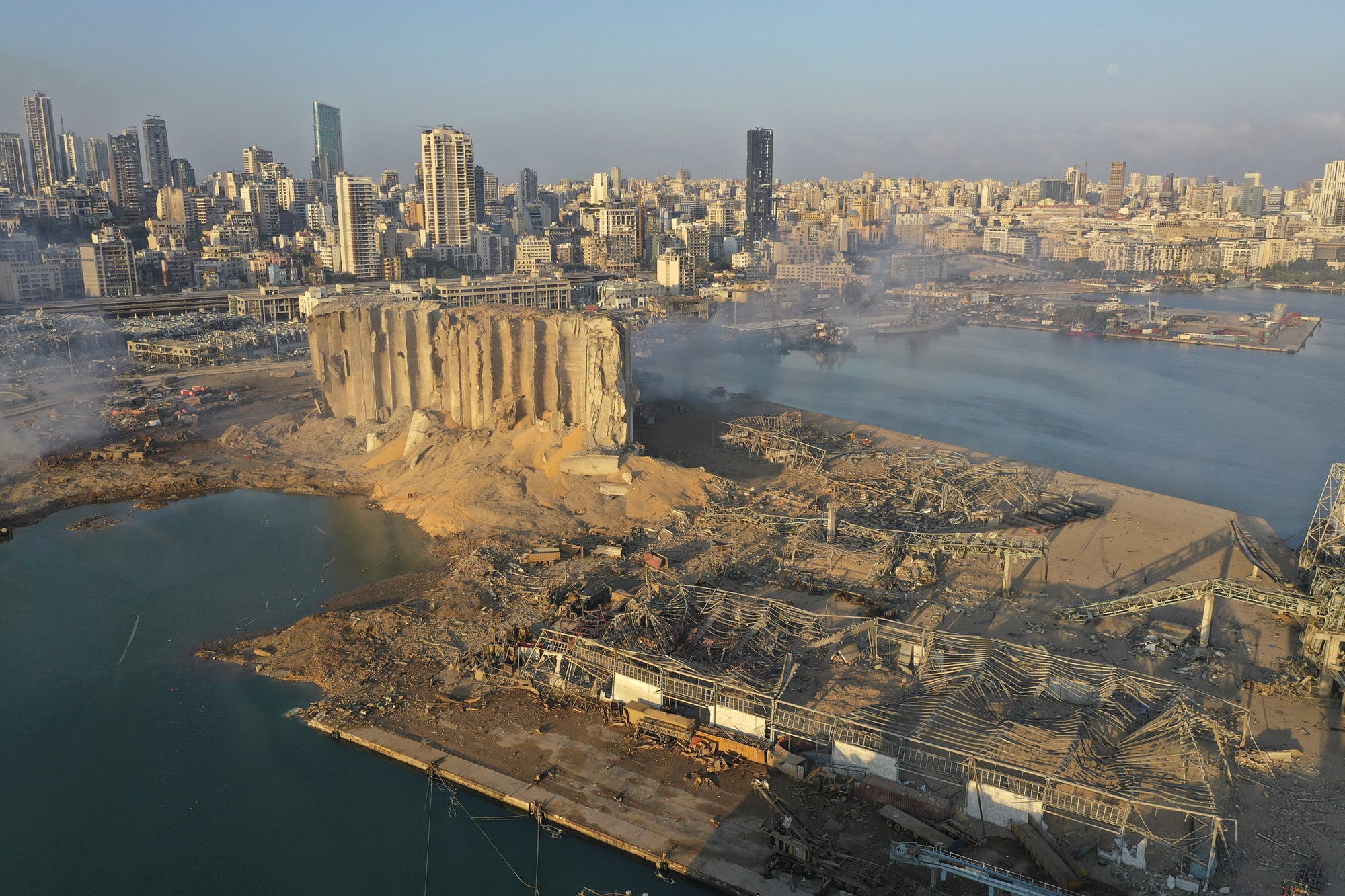
    The most circulated pictures over the last few weeks on media are of the explosion in Beirut and the spillage of grains. This blast occurred because of the unsafe storage of ammonium nitrate and has led to the death of over 200 people, with over 6,000 injured so far. There are many still missing. For Lebanon, this is a triple layer of burden, as the country is fighting a mismanaged economy, a pandemic, and now the horrific aftermath of the explosion. Post the explosion, many countries and global institutions have rushed emergency support by providing minimal aid and funding to facilitate fast recovery from this catastrophe.  While the world has come together to help Lebanon, the situation remains grim because of the shortage of various necessities like medicine and food. The second-largest port in Lebanon, Tripoli has some storage of flour; however, this suffices to cover just one month’s requirements. Beirut port, the largest in Lebanon, is virtually unusable because of the blast. The port infrastructure is severely damaged, thus hurting imports. Lebanon is a country that relies hugely on imports; it imports 85% of its food from outside, making this a major crisis . By one estimate the blast has destroyed 120,000 metric tons of grains, and this could affect food availability as well as sky-rocketing of food prices. The United Nations Food Program reiterated that Lebanon is in a grim situation regarding food security. The current assessment is that the grains can sustain them for less than a month.

    Grim Outlook and Tough Challenges

    The looming food security crisis is a direct fall-out of the economic collapse and multiple crises facing the country. Discontent with the government in Lebanon is not new, since the protests have been on since last October. The explosion and its resulting loss of life and property have triggered waves of protests again, forcing Hassan Diab, the Prime Minister of Lebanon, to step down from his office on 10th August. Decades of poor governance, entrenched kleptocracy, corrupt political class, criminal negligence, incompetence and economic mismanagement have led to the current catastrophe. The former economy minister, Nasser Saidi, says that ‘Lebanon is on the brink of the abyss of depression, with GDP declining by 25% this year, growing unemployment, hyperinflation, and humanitarian disaster with poverty exceeding half the population. The growing food crisis and poverty could lead to famine conditions’. The government will need to address income inequality, large-scale corruption, and the role of foreign players in contributing to the economic collapse.  Financial institutions and other creditors, more often foreign powers, need to suspend debt repayments and allow the Lebanese economy to recoup; since a considerable portion of the revenue goes into debt servicing, which is unsustainable for long.  International funding agencies, while sympathetic to the common peoples’ plight, are hesitant to go ahead with aid due to the poor governance track record of the political class. By some estimates, they put the immediate requirement for humanitarian aid and the cost of rebuilding essential infrastructure post the blast at USD 15 billion. This pales compared to the even bigger mess in the financial system. Ghazi Wazni, the country’s finance minister who quit with the rest of the government last week, has put the total losses in the banking system at $83 billion, and a black hole in the central banking system of $50 billion. The people are displaying discontent over the sectarian politics that have afflicted the country for decades and are the root cause of endemic corruption. Last year’s protests led to a new government in December, which was forced to resign post the explosion.

    Amidst the political crisis, food security is increasingly the major problem in Lebanon for months now. The blast has left 300,000 people homeless.  International Organizations and Civil Society Organizations, Ukraine, Russia, and the United States are enabling and mobilizing food supplies.

    Poverty is the immediate concern; there are already one million Lebanese in poverty, with the likelihood of more than half of the Lebanese population falling into poverty. Food shortages will most likely result in starvation, malnutrition, and death. Looking at the five tenets of food security mentioned above, Lebanon satisfies neither of the five criteria. Lebanon is an example of how decades of factional strife, warlordism, corruption, and power in the hands of the kleptocratic elite can push a country and its people into the abyss of poverty. While resolving Lebanon’s food security crisis is possible through immediate international aid and support, resolving the larger problem of its economic mess and humanitarian catastrophe will need international intervention.

  • Freedom of Speech and Right to Information amidst the Covid-19 Pandemic

    Freedom of Speech and Right to Information amidst the Covid-19 Pandemic

    The global pandemic hit India in March 2020 and Prime Minister Modi announced a 21 day lockdown beginning on 25th March 2020. Since then the lockdown has been extended multiple times as the country grapples with a major public health crisis. Media houses have been on their feet, both literally and metaphorically, as they cover new stories, cases and most importantly, the state response towards the pandemic. The citizenry relies on news reportage to learn more about their government’s approach towards handling this unconventional situation. Media is often regarded as the fourth pillar of democracy meaning it is a supporting figure for democracy to persist and flourish. The pandemic has exposed some paramount inadequacies in the government’s handling of the situation such as lack of a robust public health infrastructure and other issues. The reportage on such instances has often faced backlash from the government resulting in legal notices against the journalists and media houses. India also dropped two places in the World Press Freedom Index making it 142nd in position citing the curfew in Jammu and Kashmir. The watchdog has also issued a warning about the implications of the pandemic, “the looming health crisis could serve as an excuse for governments to take advantage of the fact that politics are on hold, the public is stunned and protests are out of the question, in order to impose measures that would be impossible in normal times” (Scroll Staff, 2020).

    Media is often regarded as the fourth pillar of democracy meaning it is a supporting figure for democracy to persist and flourish.

     Two patterns can be observed with regards to media freedom in India during a time like this; furthering a certain narrative through misinformation and misrepresentation and carrying out state-sponsored propaganda. In this lockdown, the state wants a narrative which eulogizes their efforts during the lockdown and overall handling the situation. However, there are major loopholes in the measures taken by the government which has led to the system failing its most vulnerable class of individuals; the marginalized and the poor. The state has also taken this time to strike upon certain civil liberties and advance their propaganda by curbing dissent.

     Misinformation and misrepresentation of certain communities has been rampant during this time. Nabeela Khan, in an article called Trends in Covid19 misinformation in India for Health Analytics Asia categorizes the spread of misinformation in four waves. First, misinformation about the origin of the virus, this has been debated not just in India but worldwide where they have accused China of producing this virus in a lab and spreading it to use to its advantage. There have also been multiple other theories available online related to consumption of certain meats in China. Second circulation of old images and videos to create fear, in this case the Tablighi Jamaat incident was highlighted immensely and videos from before the pandemic were used to show that ‘Muslims’ in India spread the virus. Third, on ‘cures’ and prevention techniques which is particularly famous on several WhatsApp groups where home-made remedies of lemon, honey, turmeric or any other ‘Ayurvedic’ cures are posted every day. And fourth, on lockdowns in India, where the news of lockdown being extended were spread even before the official announcements were made. Increasingly, there has been excess confusion over the surging numbers in India and whether or not governments give out the exact figures. Additionally, there is no clarity about government aid and funding towards the poor such as the internal migrants in the country.

    Kaye makes an important point as he says that the governments are using the pandemic as a smokescreen to carry forward their agenda and take actions that they have wanted to take for a long time.

    The UN Special Rapporteur David Kaye, talks to The Lawfare Podcast about his latest UN report Disease, pandemics and the freedom of opinion and expression. Kaye makes an important point as he says that the governments are using the pandemic as a smokescreen to carry forward their agenda and take actions that they have wanted to take for a long time. He gives an example from Hungary where the Press is under strict scrutiny of the government. Since the coronavirus is a recent occurrence, there is not a very large body of information available on it. The information keeps changing as cases increase or decrease, as there are multiple waves of it so the orders issued by the government are subject to change. He also particularly criticizes India for its treatment of Jammu and Kashmir since August 2019 and calls it “a real misuse of the situation”.

     Journalists and activists across the world have been arrested during this lockdown and India is no exception to this trend of suppressing free speech. Siddharth Varadarajan, Gautam Navlakha, Anand Teltumbde, Safoora Zargar, Umar Khalid, Dhaval Patel, Supriya Sharma among many others have either been arrested or served notice by the government during the lockdown. These journalists have either been arrested on the grounds of their reportage of the pandemic, during the pandemic or incidents that took place before the pandemic.

     An FIR was lodged against Siddharth Varadarajan, one of the founding editors of The Wire, an acclaimed media house, on the grounds of making unverifiable claims. Varadarajan tweeted on March 31st saying that UP Chief Minister Yogi Adityanath had given a go-ahead for the Ram Navami festival to be held from March 25th to April 2nd, in the middle of the lockdown and Yogi also said that “Lord Rama would protect the devotees from coronavirus”. As a matter of fact, it was Acharya Paramhans who gave out this statement and not CM Adityanath and Varadarajan tweeted a clarification the following day. On April 10, police from Ayodhya showed up at his doorstep in Delhi to serve him notice and his wife Nandini Sundar explained this instance elaborately in her tweets. However, this act only suggests the government’s misuse of power and tactics to pursue a culture of intimidation. It could be argued that the journalist was peddling unverified claims but CM Adityanath in fact supported the decision to have a Ram Navami mela. The Wire has published an elaborate FAQs list on this matter explaining every detail of it. It has also been condemned by the Editors’ Guild of India who have called this episode “an overreaction and an act of intimidation”.

     Journalists and activists such as Gautam Navlakha, Anand Teltumbde, Safoora Zargar, Umar Khalid, Sharjeel Imam etc. have been booked under the UAPA, Unlawful Activities Prevention Act. This Act was formulated as a law in 1967 to prevent any ‘unlawful’ activities or any measures which threatened the integrity and sovereignty of India. In 2004, the UPA government expanded on it further to target terrorist outfits or any organizations harming the state but not individuals. The 2019 Amendment of the Act has entrusted the government with identifying individuals who might be harming the integrity of the state, the definition of which the government decides. The contemporary term used for such people on social media and other platforms is ‘urban naxals’. Student activists and journalists have been booked under this act for protesting against oppressive government laws which promotes a narrative that dissent is by its very nature, ‘anti national’. There have also been cases where activists have been arrested, then granted bail and arrested again based on some other complaint. Safoora Zargar’s case is a particularly complex one in this regard where she was arrested after she was granted bail and was granted bail again recently on humanitarian grounds. Zargar is five months pregnant which was the basis of her bail but the discourse around this has been to release her not because of her pregnancy because dissent is a fundamental right.

    The moment we no longer have a free press, anything can happen. What makes it possible for a totalitarian or any other dictatorship to rule is that people are not informed; how can you have an opinion if you are not informed? If everybody always lies to you, the consequence is not that you believe the lies, but rather that nobody believes anything any longer. This is because lies, by their very nature, have to be changed, and a lying government has constantly to rewrite its own history – Hannah Arendt

     Praveen Swami makes a compelling argument in a FirstPost article about hate speech and freedom of speech. He opines that the response to hate speech is not censorship but plurality where opinions are allowed to coexist. In India, a large part of the Press is controlled and supported by the government leading them to produce streamlined biased news. According to him, alternatives need to come up for hate speech where the dominant narrative does not remain unchallenged.

     To conclude, Hannah Arendt’s cautioning words on freedom of press and misinformation are very relevant today and sounds the alarm bells:

    “The moment we no longer have a free press, anything can happen. What makes it possible for a totalitarian or any other dictatorship to rule is that people are not informed; how can you have an opinion if you are not informed? If everybody always lies to you, the consequence is not that you believe the lies, but rather that nobody believes anything any longer. This is because lies, by their very nature, have to be changed, and a lying government has constantly to rewrite its own history”


    Reference

    Bakshi, Asmita (2020, May 31) From Pinjra Tod to Kashmiri Journalists: What’s the Deal with UAPA?. Livemint. Retrieved from https://www.livemint.com/mint-lounge/features/from-pinjra-tod-to-kashmiri-journalists-what-s-the-deal-with-uapa-11590915249625.html


    Chakma, Suhas (2020, June 22) FIR Against Supriya Sharma is Emblematic of how the Law is Abused to Throttle Press Freedom. The Wire. Retrieved from https://thewire.in/media/supriya-sharma-fir-abuse-law-press-freedom


    Goldsmith, J (Host) (2016, May 16). The Lawfare Podcast: David Kaye on Free Speech During a Pandemic. (Audio podcast episode). In Lawfare. Retrieved from https://www.lawfareblog.com/lawfare-podcast-david-kaye-free-speech-during-pandemic

     Khan, Nabeela (2020, June 12) Trends in Covid19 misinformation in India. Health Asia Analytics. Retrieved from https://www.ha-asia.com/trends-in-covid-19-misinformation-in-india/

     Scroll Staff (2020, April 21) Covid-19: India drops 2 places on World Press Freedom Index, as watchdog warns of pandemic impact. Scroll.in. Retrieved from https://scroll.in/latest/959816/covid-19-india-drops-2-places-on-world-press-freedom-index-as-watchdog-warns-of-pandemics-impact

     Scroll Staff (2017, December 4) Top ten things that Hannah Arendt said that are eerily relevant in today’s times. Scroll.in. Retrieved from https://scroll.in/article/856549/ten-things-hannah-arendt-said-that-are-eerily-relevant-in-todays-political-times

     Swami, Praveen (2020, April 27) Hate speech in the time of a pandemic: Answer to malevolent incendiary language is plurality, not censorship. Firstpost. Retrieved from https://www.firstpost.com/india/hate-speech-in-the-time-of-a-pandemic-answer-to-malevolent-incendiary-language-is-plurality-not-censorship-8295271.html

     The Wire Analysis (2020, April 19) FAQ: What are the UP Police FIRs Against The Wire Actually about? The Wire. Retrieved from https://thewire.in/media/faq-up-police-fir-siddharth-varadarajan


    The views expressed are the author’s own.

    Image Credit: Rhy Design and medium.com

     

  • India’s Agriculture: The Failure of the Success

    India’s Agriculture: The Failure of the Success

    It was around the mid-1960s when the Paddock brothers, Paul and William, the ‘prophets of doom’, predicted that in another decade, recurring famines and an acute shortage of food grains would push India towards disaster. Stanford University Professor Paul R. Ehrlich in his 1968 best selling book The Population Bomb warned of the mass starvation of humans in the 1970s and 1980s in countries like India due to over population.

    Their prophecies were based on a rising shortage of food because of droughts, which forced India to import 10 million tonnes of grain in 1965-66 and a similar amount a year before. Little did they know that thanks to quick adoption of a new technology by Indian farmers, the country would more than double its annual wheat production from 11.28 million tonnes in 1962-63 to more than twice that within ten years to 24.99 million tonnes. It was 71.26 million tonnes in 2007. Similarly rice production also grew spectacularly from 34.48 million tonnes to almost 90 million tonnes in 2007.

    Total food grains production in India reached an all-time high of 251.12 million tonnes (MT) in FY15. Rice and wheat production in the country stood at 102.54 MT and 90.78 MT, respectively. India is among the 15 leading exporters of agricultural products in the world. The value of which was Rs.1.31 lakh crores in FY15.

    India is among the 15 leading exporters of agricultural products in the world. The value of which was Rs.1.31 lakh crores in FY15.

    Despite its falling share of GDP, agriculture plays a vital role in India’s economy. Over 58 per cent of the rural households depend on agriculture as their principal means of livelihood. Census 2011 says there are 118.9 million cultivators across the country or 24.6 per cent of the total workforce of over 481 million. In addition there are 144 million persons employed as agricultural laborers. If we add the number of cultivators and agricultural laborers, it would be around 263 million or 22 percent of the population. As per estimates by the Central Statistics Office (CSO), the share of agriculture and allied sectors (including agriculture, livestock, forestry and fishery) was 16.1 per cent of the Gross Value Added (GVA) during 2014–15 at 2011–12 prices. This about sums up what ails our Agriculture- its contribution to the GDP is fast dwindling, now about 13.7 per cent, and it still sustains almost 60 per cent of the population.

    If we add the number of cultivators and agricultural laborers, it would be around 263 million or 22 percent of the population. As per estimates by the Central Statistics Office (CSO), the share of agriculture and allied sectors (including agriculture, livestock, forestry and fishery) was 16.1 per cent of the Gross Value Added (GVA) during 2014–15 at 2011–12 prices.

    With 157.35 million hectares, India holds the world’s second largest agricultural land area. India has about 20 agro-climatic regions, and all 15 major climates in the world exist here. Consequently it is a large producer of a wide variety of foods. India is the world’s largest producer of spices, pulses, milk, tea, cashew and jute; and the second largest producer of wheat, rice, fruits and vegetables, sugarcane, cotton and oilseeds. Further, India is 2nd in global production of fruits and vegetables, and is the largest producer of mango and banana. It also has the highest productivity of grapes in the world. Agricultural export constitutes 10 per cent of the country’s exports and is the fourth-largest exported principal commodity.
    According to the Agriculture Census, only 58.1 million hectares of land was actually irrigated in India. Of this 38 percent was from surface water and 62 per cent was from groundwater. India has the world’s largest groundwater well equipped irrigation system.

    There is a flipside to this great Indian agriculture story.The Indian subcontinent boasts nearly half the world’s hungry people. Half of all children under five years of age in South Asia are malnourished, which is more than even sub-Saharan Africa.

    More than 65 per cent of the farmland consists of marginal and small farms less than one hectare in size. Moreover, because of population growth, the average farm size has been decreasing. The average size of operational holdings has almost halved since 1970 to 1.05 ha. Approximately 92 million households or 490 million people are dependent on marginal or small farm holdings as per the 2001 census. This translates into 60 per cent of rural population or 42 per cent of total population.

    Approximately 92 million households or 490 million people are dependent on marginal or small farm holdings as per the 2001 census.

    About 70 per cent of India lives in rural areas and all-weather roads do not connect about 40 per cent of rural habitations. Lack of proper transport facility and inadequate post harvesting methods, food processing and transportation of foodstuffs has meant an annual wastage of Rs. 50,000 crores, out of an out of about Rs.370, 000 crores.

    There is a pronounced bias in the government’s procurement policy, with Punjab, Haryana, coastal AP and western UP accounting for the bulk (83.51 per cent) of the procurement. The food subsidy bill has increased from Rs. 24500 crores in 1990-91 to Rs. 1.75 lakh crores in 2001-02 to Rs. 2.31 lakh crores in 2016. Instead of being the buyer of last resort FCI has become the preferred buyer for the farmers. The government policy has resulted in mountains of food-grains coinciding with starvation deaths. A few regions of concentrated rural prosperity.

    The total subsidy provided to agricultural consumers by way of fertilizers and free power has quadrupled from Rs. 73000 crores in 1992-93, to Rs. 3.04 lakh crores now. While the subsidy was launched to reach the lower rung farmers, it has mostly benefited the well-off farmers. Free power has also meant a huge pressure on depleting groundwater resources.
    These huge subsidies come at a cost. Thus, public investment in agriculture, in real terms, had witnessed a steady decline from the Sixth Five-Year Plan onwards. With the exception of the Tenth Plan, public investment has consistently declined in real terms (at 1999-2000 prices) from Rs.64, 012 crores during the Sixth Plan (1980-85) to Rs 52,107 crores during the Seventh Plan (1985-90), Rs 45,565 crores during the Eighth Plan (1992-97) and about Rs 42,226 crores during Ninth Plan (1997-2002).

    With the exception of the Tenth Plan, public investment has consistently declined in real terms (at 1999-2000 prices) from Rs.64, 012 crores during the Sixth Plan (1980-85) to Rs 52,107 crores during the Seventh Plan (1985-90), Rs 45,565 crores during the Eighth Plan (1992-97) and about Rs 42,226 crores during Ninth Plan (1997-2002).

    Share of agriculture in total Gross Capital Formation (GCF) at 93-94 prices has halved from 15.44 per cent to 7.0 per cent in 2000-01. In 2001-02 almost half of the amount allocated to irrigation was actually spent on power generation. While it makes more economic sense to focus on minor irrigation schemes, major and medium irrigation projects have accounted for more than three fourth of the planned funds
    By 2050, India’s population is expected to reach 1.7 billion, which will then be equivalent to nearly that of China and the US combined. A fundamental question then is can India feed 1.7 billion people properly? In the four decades starting 1965-66, wheat production in Punjab and Haryana has risen nine-fold, while rice production increased by more than 30 times. These two states and parts of Andhra Pradesh and Uttar Pradesh now not only produce enough to feed the country but to leave a significant surplus for export.

    Since food production is no longer the issue, putting economic power into the hands of the vast rural poor becomes the issue. The first focus should be on separating them from their smallholdings by offering more gainful vocations.

    Farm outputs in India in recent years have been setting new records. It has gone up from 208 MT in 2005-06 to an estimated 251 MT in 2014-15. Even accounting for population growth during this period, the country would need probably around 225 to 230 MT to feed its people. There is one huge paradox implicit in this. Record food production is depressing prices. No wonder farmers with marketable surpluses are restive.

    India is producing enough food to feed its people, now and in the foreseeable future. Since food production is no longer the issue, putting economic power into the hands of the vast rural poor becomes the issue. The first focus should be on separating them from their smallholdings by offering more gainful vocations. With the level of skills prevailing, only the construction sector can immediately absorb the tens of millions that will be released. Government must step up its expenditures for infrastructure and habitations to create a demand for labor. The land released can be consolidated into larger holdings by easy credit to facilitate accumulation of smaller holdings to create more productive farms.

    Finally the entire government machinery geared to controlling food prices to satisfy the urban population should be dismantled. If a farmer has to buy a motorcycle or even a tractor he pays globally comparative prices, why should he make food available to the modern and industrial sector at the worlds lowest prices?
    Why should Bharat have to feed India at its cost?

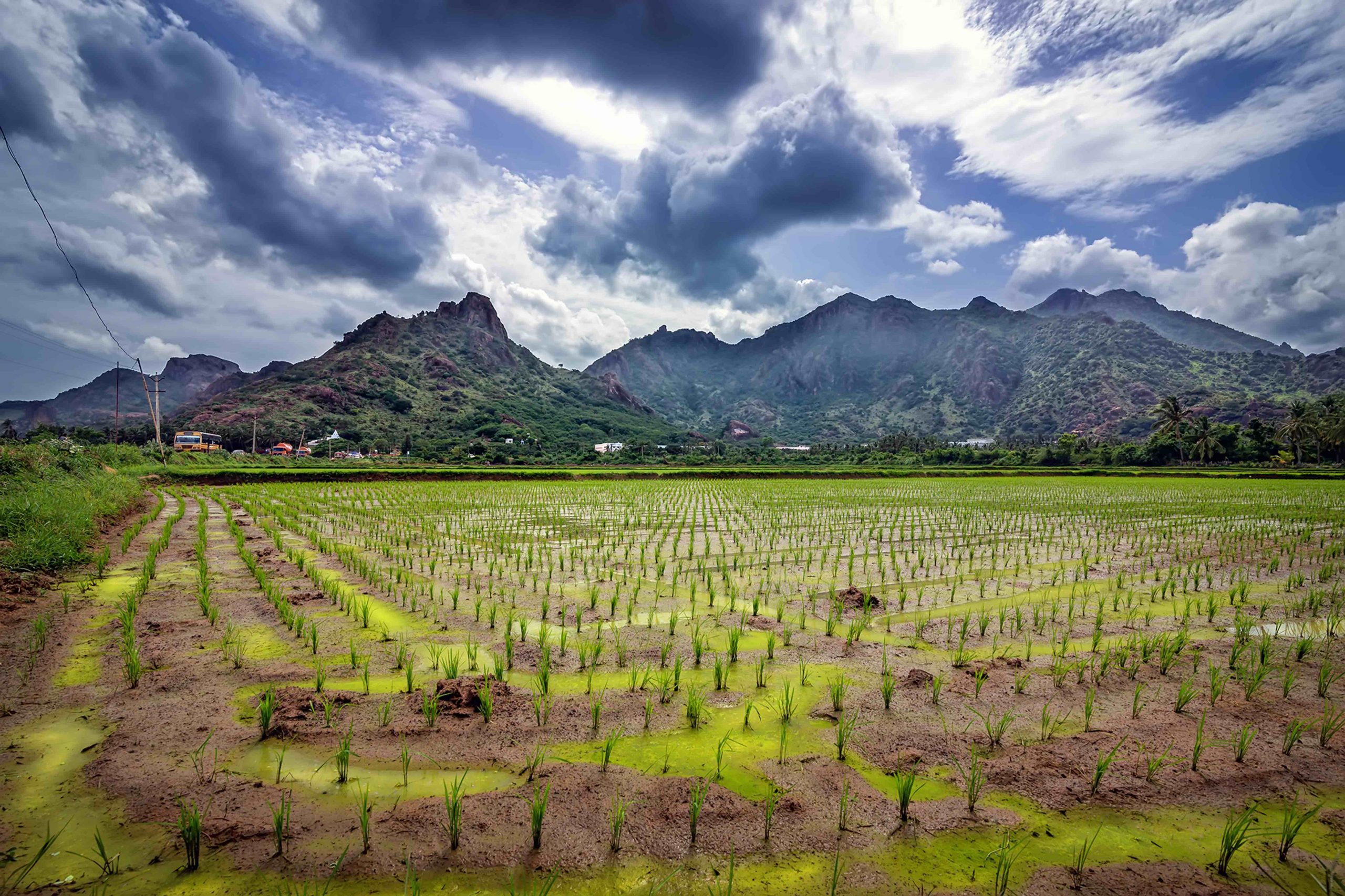
    Image: Kanyakumari farm lands during onset of monsoon. 


  • Some Crucial Lessons as we Prepare for ‘Lock Down 3.0’

    Some Crucial Lessons as we Prepare for ‘Lock Down 3.0’

    Category : Democracy & Governance/Public Health
    Title : Some Crucial Lessons as we Prepare for ‘Lockdown 3.0’
    Author : M A Kalam  02-05-2020Covid-19 is a jolt to the way we work and live. India has been under, what IMF has called, “The Great lockdown”. As India moves into ‘Lockdown 3.0’, M A Kalam explores, in his opinion piece, the challenges faced by different segments of the Indian population. The economic impact is seen to be huge, and as we return to work and business gradually, we will witness huge behavioural changes that will necessitate how we address the new economic challenges.

    Read More

  • Going for Broke

    Going for Broke

    Category : Democracy & Governance/Public Health

    Title : Going for Broke

    Author : Deepak Sinha 21-03-2020

    Spanish flu of 1918-20 was the worst and biggest pandemic in the modern age. By various estimates it killed 50-100 million people worldwide. In India the death toll was 17.5 million. This was at a time when vaccines and antibiotics were not yet widely used and the pandemic exploded in the wake of a globalisation of different sort, returning soldiers of World War I who carried the flu from the battlefields to all parts of the world. The world survived it. Covid-19 threatens a similar fate which calls for concerted effort from the global community as Deepak Sinha observes in his article.

    Read More

  • Think tanks’ role growing: Is that a good thing?

    Think tanks’ role growing: Is that a good thing?

    Category : Education/Think tanks/Policy Research

    Title : Think tank’s role growing: Is that a good thing?

    Author : Mohan Guruswamy 20.01.2020

    The word “think tank” owes its origins to John F. Kennedy, America’s 35th President, who collected a group of top intellectuals in his White House – people like McGeorge Bundy, Robert S. McNamara, John Kenneth Galbraith, Arthur Schlesinger and Ted Sorenson, among others, to give him counsel on issues from time to time. In India, while the number of think tanks are now increasing, neither the government nor the think tanks have a culture of serious and in-depth research that would aid government’s policy making. Mohan Guruswamy analyses the think tanks and their culture in India.

    Read More

  • Tectonic shift in US’ Attitude

    Tectonic shift in US’ Attitude

    Category : International Affairs/ USA-Iran

    Title : Tectonic Shift in US attitude

    Author : Deepak Sinha 18-01-2020

    The targeted execution of a serving Iranian General and war hero, Qasem Soleimani, while on an official visit to Iraq raises serious questions of sovereignty, morality, ethical conduct and can never be justified in any civilised society. It is a blatant act of aggression in clear violation of international law and a war crime, made even more heinous because neither America nor Iran is at war with each other. Deepak Sinha comments on American motives and likely impact of this assassination.

    Read More

  • ‘Pawar Play’ in Maharashtra

    ‘Pawar Play’ in Maharashtra

    Henry Luis Mencken (1880-1956), well known American journalist and essayist, once wrote “As democracy is perfected, the office of president represents, more and more closely, the inner soul of the people. On some great and glorious day the plain folks of the land will reach their heart’s desire at last and the White House will be adorned by a downright moron.” As we sit back and watch as the Impeachment drama plays out in the United States, one cannot help but marvel at Mr. Mencken prescience. The election of Donald Trump does seem to suggest that the American public has indeed found its inner soul, but as to whether it has really perfected democracy in the process remains questionable.

                Especially, more so, if it was to compare itself to what passes for democracy here. In short order they would then realize the vast distance they have yet to cover to reach true perfection. As a matter of fact, they would do well to follow the ongoing “Pawar Play” in Maharashtra, which incidentally is only the latest manifestation of what perfection in a democracy looks like, and has all the ingredients of a true Bollywood potboiler in the making. That is the only way in which realization would dawn on them that Mencken’s deductions were slightly awry. Invariably in perfect democracies it is not the political leaders who are morons, but the people who voted them to power. That is the fundamental reality we have been confronting ever since Independence, regardless of the political ideologies of the people and parties we vote into power.

                Whatever the host of legal eagles fighting the case in our Supreme Court may say to justify their arguments, and regardless of the conclusions the Hon’ble Court may arrive at, the simple truth of the matter is that for all sides concerned, Maharashtra is too important to lose. To start with the inability to form the government in Maharashtra would not just be a simple loss of face, but utter humiliation for the BJP, and more importantly, for its mentors from Nagpur, located in the heart of the State. If they cannot control their own fiefdom, what control will they exercise tomorrow over the rest of the country, more so given that elections are due in states like Bihar and Jharkhand in the coming months?

                Similarly for the Shiv Sena after having openly cast aside the cloak of morality and gambled everything, including the kitchen sink, in its blatant attempt to go one up and grab the Chief Ministership for Balasaheb’s scion, a loss would spell utter disaster and lead to questions of survivability of the dynasty. For the NCP, and especially the Pawars, being on the winning side is the only hope for redemption for past transgressions. As events have played out, it is now obvious that Pawar the younger was carried away by the brashness of youth and the fact that leadership of the Party would remain just a mirage due to circumstances of birth as long as Pawar the elder had any say in the matter. Finally, for the Congress that continues to be on the ventilator this was an unexpected bonus, a fleeting opportunity to start again.

         While each of these stakeholders has its own particular motivations for their actions, however, the most important aspect  incentive for all in this battle royal for the stewardship of the State is the simple fact that not only is Maharashtra a large state, governing which is undoubtedly prestigious, but also an extremely rich one. It doesn’t exactly require a leap of faith to suggest that whosoever controls the money controls the votes. After all, is that not the very reason that controversy dogs the issue of electoral bonds that were introduced not too long back?

                Leave aside mundane issues of malfeasance, personal greed, overarching ambition and rank opportunism, what is indeed truly astounding to see is the utter lack of constitutional propriety and ethical conduct on the part of those charged with its very protection. For them to let petty loyalties and servility take precedence over self- respect and principled conduct is not just a reflection on how unworthy they are to hold such positions of eminence, but also a shameful blot on our social mores that encourages such people to claw their way up despite lacking an iota of integrity or moral fibre. One cannot but feel embarrassment for the President, a former advocate, who unquestioningly accepts the recommendations of a Prime Minister without the requisite cabinet approval, justified by the use of a most inappropriate rule to cover the lapse. That such a rule can be invoked at the dead of night to swear- in a government at dawn, in the futile hope that it would provide stability, after weeks of confusion, is indeed laughable, if it were not so tragic.

                The Supreme Court’s directions to the newly sworn-in Chief Minister, Devendra Fadnavis, to prove his majority on the floor of the House within two days, set the cat among the pigeons as it left only limited scope for horse trading. It forced him to resign prior to the House being called into session as by that time it was abundantly clear that Mr. Ajit Pawar was in no position to provide the necessary support of the NCP legislators required to gain a majority, as he had promised. It is only now becoming increasingly clear that the ‘Ajit Pawar move’ was in all likelihood, a move conceived by his uncle and leader of the NCP, Mr. Sharad Pawar, to kill two birds with one stone; firstly lure the BJP into withdrawing President’s Rule in the State, which it may otherwise not have done in a hurry, and to force the Congress to reduce its demands in exchange for joining the anti BJP Coalition, Maharashtra Vikas Agadi, under the leadership of Mr. Uddhav Thackeray as Chief Minister.

                Events in Maharashtra only accentuate the utter lack of morality on display on the part of all concerned. If we were to look at the winners and losers that have emerged after this power play, clearly the BJP finds itself stranded by the wayside and has much to introspect, but it is not the only loser, The Shiv Sena may have won itself a reprieve and fulfilled Thackeray’s ambition of being Chief Minister, it has come at a cost, as it appears to have caused grevious damage to its ideological foundations. There is always the possibility that Uddhav may have realized that with the Ayodhya Temple issue having been resolved to a large extent, hard Hindutva is unlikely to be a crowd puller in the coming days and an ideological shift was necessary if the Shiv Sena is to flourish. The Congress continues to be seen as disorganized, lacking leadership, confused and opportunistic, a perception that is unlikely to change until the Gandhi’s are leached out of its organizational structure. Only the NCP appears to have emerged as clear winners, especially Mr. Sharad Pawar, as he will undoubtedly wield the remote control on this coalition government. Off course, all of these shenanigans only reinforce the fact that it has been the people of Maharashtra, who have lost out the most, and were, in Mencken’s words, “moronic” enough to vote these ingrates into power.

    The writer is a military veteran and consultant with the Observer Research Foundation and a Senior Visiting Fellow with The Peninsula Foundation, Chennai. The views expressed are the author’s own.

  • Winds of Climate Change Blow across South Asia

    Winds of Climate Change Blow across South Asia

    The India-Pakistan enmity is possibly the world’s most intractable and obdurate, with a mutual misreading of history made extremely volatile with the brandishing of nuclear weapons. Despite having two giant militaries at each others’ throats, the more immediate existential challenges that India and Pakistan face are related to how climate change and misuse of common natural resources have combined to confront both together. It is not the militaries which will determine our fates, but the degree of cooperation the two nations can summon. Our problems are common and perhaps India and Pakistan will find the good sense to act together?

    Looking at the climate change challenges Pakistan and India face together, collective action — as unlikely as it seems — may just be what is needed to secure the lives and livelihoods of future generations.

    According to climate researchers at Germanwatch, Pakistan ranks eighth on the Global Climate Risk Index, with over 145 catastrophic events — heat waves, droughts and floods — reported in the past 20 years. On the other hand, India ranks among the top 20 vulnerable countries in terms of climate risk. Pakistan is home to around 47 per cent of the Indus Basin, and India to around 39 per cent. The Indus Waters Treaty has been in effect since 1960. The recent political bickering aside, the Indus Waters Treaty has managed to survive the test of time, yet fails to comprehensively address climate change. Then again, at the time it was enacted, many of the stark realities we know today were not understood.

    According to the Pakistan Council of Research in Water Resources, Pakistan officially crossed the water scarcity line in 2005. The United Nations Development Programme and the Pakistan Council of Research in Water Resources have issued warnings about the upcoming scarcity of groundwater in just six years.

    According to some estimates, Pakistan is the fourth-largest user of its groundwater and over 70 per cent of drinking requirements and 50 per cent of irrigation needs are met through groundwater extraction. Due to excessive pumping, it is estimated that water tables could fall by as much as 20 per cent by 2025.

    South Asia is drained by the Indus, Ganga and Brahmaputra river basins, which collectively form the Indo-Gangetic Basin (IGB) and include some of the highest-yielding aquifers of the world. The aquifers associated with these river basins cross the international borders of the contiguous South Asian countries, forming numerous trans-boundary aquifers, including the Indus basin aquifers (between India and Pakistan), Ganga and Brahmaputra basin aquifers (between Bangladesh and India), the aquifers of the tributaries to the Ganga (between Nepal and India), the aquifers of the tributaries to the Brahmaputra (between Bhutan and India, and between India and Bangladesh).

    At the beginning of every hydrologic year, 4,000 billion cubic meters (bcm) water enters the South Asian hydrological systems, of which almost half is lost by poorly understood and un-quantified processes (such as overland flow, surface discharge through rivers to the oceans, submarine groundwater discharge and evaporation). The annual groundwater withdrawals in the region are estimated to exceed 340 bcm, and represent the most voluminous use of groundwater in the world. South Asia faces an acute shortage of drinking water and other usable waters in many areas, as it is seeing a rapid rise in water demand and change in societal water use pattern because of accelerated urbanisation and changes in lifestyle. In many urban and rural areas of the region, surface waters have been historically used as receptacles of sewage and industrial waste, rendering them unfit for domestic use, prompting a switch to groundwater and rainwater sources to meet drinking and agricultural water needs. At present, about 60–80 per cen
    t of the domestic water supplies across South Asia are met by groundwater.

    Irrigation accounts for 85 per cent of groundwater withdrawals and is considered to be the main contributor to groundwater depletion with the maximum possible groundwater footprint seen in the Gangetic aquifers.

    Among the main contributors to water stress in India and Pakistan are poor water resource management and poor water service delivery, including irrigation and drainage services. Moreover, the lack of reliable water data, subsequent analysis and consequent poor planning and allocation is leading to environmentally unviable methods of water withdrawal, causing an alarming reduction in groundwater.

    In both countries, water stress is attributed first and foremost to the massive population growth. Another cause is the lack of sufficient urban water treatment facilities, which prevent the usability of river water for drinking and irrigation.

    Air pollution contributes substantially to premature mortality and disease burden globally, with a greater impact in low-income and middle-income countries than in high-income countries. The northern plains of South Asia has one of the highest exposure levels to air pollution globally.

    The major components of air pollution are ambient particulate matter pollution, household air pollution, and to a smaller extent ozone in the troposphere, the lowest layer of atmosphere. The major sources of ambient particulate matter pollution are coal burning for thermal power production, industry emissions, construction activity and brick kilns, transport vehicles, road dust, residential and commercial biomass burning, waste burning, agricultural stubble burning, and diesel generators.

    In India and Pakistan, farm residues are burnt after harvesting in October to November, which affects the air quality of the region. In Pakistan, most of the rice cultivation takes place in Punjab, and the same is true for India’s Punjab due to suitable climatic conditions for the crop. In both countries, stubble burning is the key cause of smog. According to India’s new and renewable energy sources ministry, India’s Punjab contributes 44-51 million tonnes of residue annually. According to the estimates, paddy areas burnt every year in Indian Punjab and Haryana are 12.68 million hectares and 2.08 million hectares respectively. According to a study, farmers burn 30-90 per cent of residue, which contributes to the smog formation, not just in the immediate region, but the entire Indo-Gangetic plain. With air pollution levels lurking in the “extremely poor” band for almost half the year, the northern regions of South Asia may not be able to host healthy populations for very long.

    The number of deaths attributable to ambient particulate matter pollution in India in 2017 was 0·67 million and the number attributable to household air pollution was 0·48 million. The number of deaths due to ambient particulate matter pollution in Pakistan in 2017 was 60,000.

    Climate change over 3,000 years ago destroyed the Indus Valley Civilisation and it went into oblivion, leaving behind traces of what befell the people here before. The next few decades are extremely critical. Can we summon some good sense to survive or go the way of the Meluhans? The verses of Allama Iqbal, albeit in another context, still hold true: Watan ki fiqr kar nadaan museebat aane wali hai/ Teri barbadiyon ke mashware hain aasmanon mein…/ Na samjhoge tou mit jaoge Hindustan walon/ Tumari daastan tak bhi na hoge daastanon mein. (Think of the homeland, O ignorant one! Hard times are coming./Conspiracies for your destruction are afoot in the heavens./You will be finished if you do not care to understand, O ye people of India!/Even the mention of your being will disappear from the world’s chronicles).

    The author is a prolific commentator on economic, security, and China issues. He is a Trustee/Governing Council member of TPF.

    This article was published earlier in Deccan Chronicle.

    Image source: www.pri.org

  • Time for Structural Reforms, Modernisation

    Time for Structural Reforms, Modernisation

    The Prime Minister’s announcement on independence day of his decision to appoint Chief of Defence Staff (CDS) as the single-point military advisor to the CCS and the PM was received with great enthusiasm. The appointment of CDS, recommended in 2001 by the Kargil Review Committee and endorsed strongly by the Group of Ministers’ headed by the then Deputy Prime Minister Shri L K Advani has been long overdue. Like with every other decision with respect to military reforms, the CDS decision became a victim of bureaucratic manoeuvring, vindictiveness, engineered turf battles, and political indecisiveness. The process of setting up a tri-service integrated headquarters was, however, incorporated with a Vice Chief equivalent, CISC heading it. Major reforms such as integration of service headquarters, appointment of the CDS, and establishment of Indian Defence University – all remained in limbo or with just cosmetic changes. There is no doubt that the Indian military is in crying need of major structural reforms in tune with 21stcentury environment, technologies, strategies, and the primacy of joint operations in the conduct of war. The CDS is more than a single person’s appointment, it is an entire system.  Therefore, it needs to be accompanied by other major structural reforms.

     Integrated Defence Staff (IDS), the joint headquarters structure to assist the CDS is already in place. The current head, CISC, would become the VCDS. It has taken more than a decade for the IDS to establish a mature and optimised acquisition system and processes, develop Long-Term Integrated Perspective Plans, optimise the defence intelligence agency, and address joint operational and training systems. While significant expertise has evolved including coordination with multiple MOD agencies, the CISC has had to depend on the Chairman, COSC for major decisions. This was invariably subordinated to the Chairman’s priority for his role as the Chief of his Service. An integrated approach, driven by the CDS, should ensure speedy and optimal modernisation of individual services towards enhancing our joint warfare capability.

     Currently, Chiefs of respective services are responsible for operational capability, training, and the requisite modernisation plans. Acquisitions and modernisation plans were largely driven by individual service specific interests, and very often these ended up getting delayed or blocked by turf wars and prioritisation battles for share of the defence budget pie. This would change under the CDS, with operational decisions being driven by the CDS system while the Chiefs would be responsible for their service capability development, training, and maintenance in tune with joint strategies. This should speed up the modernisation process.

    This year’s defence budget is barely above the subsistence level. A decade of stalled modernisation has brought all three services to their lowest levels of force structures and capabilities. The Indian Air Force is down to 32 squadrons, and is likely to go down 28 squadrons over the next five years as the older, overdue for phase out aircraft are finally laid off. It would take more than a decade for the IAF to get back to its authorised force strength of 42 squadrons provided its modernisation process is undertaken on a war-footing. If not it would be at least two decades for full recovery. The Army is no better, as a former VCOAS stated – 60% of its weapon systems are vintage. Army’s two major modernisation programs – TCS and BMS, intended to be through ‘make’ route, has been shelved after more than a decade of work with two consortiums of Indian majors. This is bound to have huge adverse impact on its modernisation efforts. One can’t blame the Army though. Repeated delays in routine procurements, and lack of accountability on development programs have cost the Army dearly. Notwithstanding some of the recent decisions such as the joint venture between Kalashnikov and the OFB for small arms manufacture, light-weight howitzer and the fast-track procurement of assault rifles and weaponry for special forces, Army’s overall capability for a two-front war is  of concern. The FICV project continues to be in a limbo. Army Chief’s restructuring efforts towards ‘Integrated Battle Groups’ is a welcome step and would help the cause of jointness.

    Navy modernisation efforts are no better either. The progress of the Indian Aircraft Carrier continues in its slow pace. Very well laid out plans such as 30-year ship building and submarine-building programs have been approved years ago, if not decades ago. These have floundered for lack of timely budget allocation. Effectively the Navy continues to grapple with ageing ships, submarines and weapon systems.

    Much of the modernisation that has accrued over the last 15 years has been largely due to procurements from the US, almost exclusively through the FMS route, that is government-to-government contracts. It does not speak well for all our sloganeering on ‘make in India’, and reflects the lack of a coherent national strategy. This is a domain the CDS will need to address.

    In a recent announcement, the government indicated that it would allocate USD 130 billions over the next five to seven years for modernisation of the three services. The CDS will need to move beyond the current system of work in the IDS, as far as modernisation goes. Currently, the LTIPP is seen as a ‘Desired Capability’ document, which the government is happy to concur. There is no assurance of financial commitment, and so the plans remain wishful thinking. Big headlines are made whenever the DAC approves ‘Acceptance of Necessity’ for thousands of crores worth acquisitions. These turn out to be meaningless as the subsequent processes takes years, more than 50% AONs elapse, and less than 25% of approved AONs fructify into desired inductions. On an average the time taken from AON to contract signing has been about 9-10 years. The flaw lies in the mismatch between various aspects of indigenous development, ‘make in India’ manufacturing and huge import dependency versus the combat capability of the forces.

    It is quite clear that various organs of the government, over the last 70 years, have failed to address effectively the need of a vibrant indigenous defence industry that is export oriented and reduces our forces’ import dependency. The CDS system, if evolved correctly, should integrate different aspects of  integrated operational philosophy, requisite force structures and combat capability with indigenous manufacturing, technology development, and a balanced, accountable, and efficient  acquisition process. The CDS must also be given enough power to take operational and financial decisions to ensure appropriate force structures for India’s defence. The bottom line, however, is to see the wisdom that an allocation of 1.35% of GDP is abysmally low to meet India’s defence needs in the 21stcentury.

    This article was published earlier in Deccan Herald on 22 Sep 2019.

    The author is the Founder-Chairman and President of The Peninsula Foundation. He is a former Deputy Chief of Integrated Defence Staff. The views expressed are author’s own.