Category: Democracy & Governance

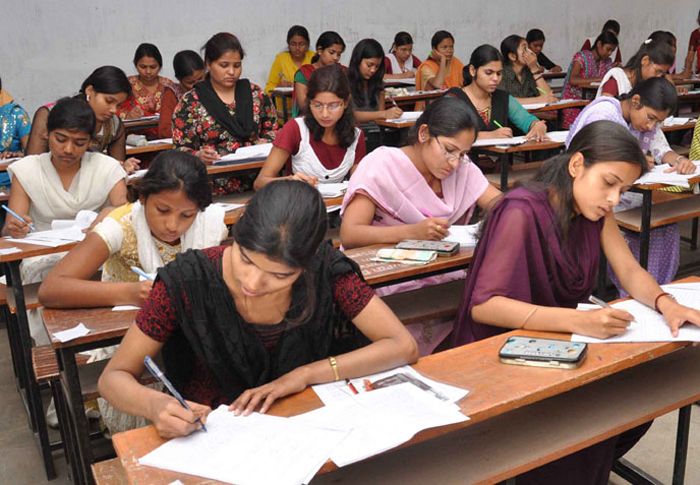
  • Let’s do away with marks, grades, and this façade of examination

    Let’s do away with marks, grades, and this façade of examination

    The Central Board of Secondary Education (CBSE) has cancelled examinations for Class 10 and postponed the one for Class 12. This adds to the uncertainty that had gripped the education sector ever since the pandemic broke out. Add to that the cascading effect it will have on entrance examinations and graduate courses.

    Currently, stakeholders, namely, the higher educational institutions such as colleges and universities, state governments, high courts, students and their parents, and the University Grants Commission (UGC), are also embroiled in the exams dilemma. This has to do with whether exams are to be held or not; and if yes, then in what way? Virtually or physically?

    The Examination Train

    The manifest justification for holding examinations are to test the pupils, award them marks/grades, rank them in an order of ‘merit’, or segregate them as per mediocrity. Away from the rather narrow confines of academics, who cares for marks/grades in the world outside? Hardly an organisation/institution gives any credence to marks awarded by colleges and universities. Public sector and private sector organisations, including the banks, the Union Public Service Commission (UPSC), and what have you, conduct their own examinations/tests to recruit personnel.

    If nobody outside of the academic realm cares for marks/grades and recruiting organisations devise their own way of assessing graduates, why do we go through the examination rigmarole? 

    The only thing they look for is the minimum qualification. Generally, graduation, at the most. Also, they have their own in-house training, orientation/refresher courses or workshops. Significantly, the UPSC has prescribed just graduation as the minimum qualification for the highly-desired and coveted civil services, to recruit personnel for the foreign, administrative and police, and other allied central services.

    Even ardent followers of Mahatma Gandhi who have passionately and zealously travelled in the ‘Third Class’ all through their academic careers, are eligible to appear at the prelims or the CSAT (Civil Services Aptitude Test) that the UPSC conducts. These Gandhians as well as those who have a second class, qualify in large numbers, and are in no way inferior to the self-styled first class passengers of/on our examination trains.

    Cracks and Fissure

    There appears to be hardly any correlation between the marks/grades/class awarded by our colleges and universities and those who get through the CSAT and make it to the civil services. Are there, going by what is obtained above, any chinks in the system that is so highly-skewed in favour of rote-learning, examination-based structure of our educational set-up? Of course, there appear to be multiple cracks and fissures, to say the least.

    Just look at the countless students awarded A+ or O (outstanding) grades, lots having secured 90 to 95 percent at the Master’s level (MA/MSc/MCom) struggling, if not failing, to get through the National Eligibility Test (NET) to become eligible for an assistant professor’s job.

    The UGC, the overarching Big Brother that avidly extends its leash over the state and central universities (also the deemed ones), itself has very little faith in marks/grades awarded by its various constituents. There is ample empirical evidence to uphold the misgivings of the UGC on this count. Just look at the countless students awarded A+ or O (outstanding) grades, lots having secured 90 to 95 percent at the Master’s level (MA/MSc/MCom) struggling, if not failing, to get through the National Eligibility Test (NET) to become eligible for an assistant professor’s job.

    It is another matter that many state governments contrived their own ways to dilute the stronghold of the UGC’s NET by devising alternative routes called SET (State Eligibility Test) and SLET (State Level Eligibility Test), and have succeeded in browbeating the UGC as regards recruitment to teaching posts in state/central universities.

    The Merit Myth

    Years back, the UGC wrote to various universities that those with really high marks at the postgraduate examinations performed abysmally in the NET. Moral of the story is that in spite of the UGC lurking in the background and looking over the shoulder, its affiliated constituents have been happy in dispensing the largesse of grades/marks over-generously. Unfortunately, this is perceived as merit.

    The facade of examinations that has taken generations of students, parents, and society in general, for a ride needs a serious revisit.

    The facade of examinations that has taken generations of students, parents, and society in general, for a ride needs a serious revisit. If nobody, virtually nobody, in the real world outside of the academic realm cares for the marks/grades and classes dished out by our universities, and each recruiting organisation assiduously tests and devises its own way of assessing our graduates and postgraduates (and doctorates too), why do we go through the examination rigmarole?

    Marks to what avail?

    Why not just handover certificates, listing courses/papers taught/learnt and assignments completed. At the end of the required term just make them qualify for the degree sought by them sans the drama staged pertaining to examinations. Some educational institutions, such as the Ducere Global Business School, in Melbourne, Australia, award graduate and postgraduate degrees without exams. It has been pointed out that “assessment is articulated through solution finding, improvisation, interrogation, interaction, integration and imagination — all of which shape change”.

    The agencies interested in employing these candidates have their own manner of assessing them through written, oral and associated tests. That they have been doing, anyway, for years, even to those students who have obtained grade sheets and marks cards testifying that they have been placed in A+, or had 90 to 95 percent and have been rank holders, or have obtained a first class.

    Are we ready and willing to deliberate and debate examinations and allied issues at different levels? For a start we could wake up the UGC to shed its lethargy and set it on an examination reform and course correction path.

    This article was published earlier in www.moneycontrol.com
    Featured Image: thewire.in


  • Tamil Civilisation and the Lost Land of Lemuria/Kumari Kandam

    Tamil Civilisation and the Lost Land of Lemuria/Kumari Kandam

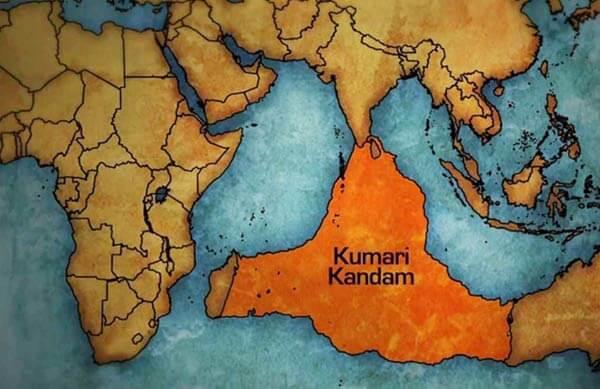
    Lemuria came to be identified as Kumari Kandam, the ancestral homeland of the Tamils, lost to the ravaging ocean in the distant past, due to what is called “Kadal Kol” in Tamil.

    The concept of the lost land of Lemuria hitherto a talking point in the west finds a new focus and interest in the study of the origins of Tamil Civilisation at the beginning of the 20th century. This was a direct result of the new consciousness of the ethnic and linguistic identity that emerged in Tamil speaking regions of South India. By the Tamil enthuse Lemuria came to be recast as the birthplace of the Tamil civilization. It came to be identified as Kumari Kandam, the ancestral homeland of the Tamils, lost to the ravaging ocean in the distant past, due to what is called “Kadal Kol” in Tamil.

    Tamil Nadu Government, during January 1981 at the Fifth International Conference of Tamil Studies held in Madurai, screened a documentary named “Kumari Kandam” both in Tamil and English. The documentary, produced with the financial support of the Tamil Nadu Government,  traced the roots of Tamil, its literature and culture, to the very beginning of time in Lemuria otherwise known as Kumari Kandam in Tamil. In this documentary, the Paleo history of the world is anchored around Tamil land and language. Thus Sclater’s[1] lost land of Lemuria was re-established in the timeless collective consciousness as a catastrophic loss of prelapsarian Tamil past. Even earlier to this, in 1879 Geological Survey of India brought out in the manual of GRGl, a discussion on the Mesozoic land bridge between Southern India and Africa. Dr.D.N. Wadia, a famed Professor of Geology, mentioned in 1990 “The evidence from which the above conclusion regarding an Indo-African land connection is drawn, is so strong and so many-sided that the differences of opinion that exist among geologists appertain to the main conclusion being accepted as one of the settled facts in the geography of this part of the world.[2]

    E.M. Forster in his famed novel ” A Passage to India “ (1984) begins his stunning stanza line “The Ganges, though flowing from the foot of Vishnu through, Siva’s hair, is not an ancient stream. Geology, looking further than religion, knows of a time when neither the river nor the Himalayas that nourished it existed, and an ocean flowed over the holy places of Hindustan. The mountains rose, their debris silted up the ocean, the gods took their seats on them and contrived the river, and the India we call immemorial came into being. But India is far older than anything in the world”.[3]

    In the ethnology chapter of the Manual, Maclean brought the findings of Ernest Haeckel about Lemuria as a primeval home of man. Maclean also draws a further conclusion from the German Biologist’s theory of the origin of various traces of mankind on the submerged Lemuria continent and reiterated that it was the primaeval home of the ancestors of India and Ceylon.

    Thus the fabled Kumari Kandam, which was based on Tamil Literary tradition, so far can receive immediate credibility through western studies. The foundation for this claim was laid by Charles D. Maclean Book “The Manual of the Administration of the Madras Presidency” published in 1835” Mr Maclean was an Officer of Indian Civil Services. In the ethnology chapter of the Manual, Maclean brought the findings of Ernest Haeckel about Lemuria as a primeval home of man. Maclean also draws a further conclusion from the German Biologist’s theory of the origin of various traces of mankind on the submerged Lemuria continent and reiterated that it was the primaeval home of the ancestors of India and Ceylon.[4] He suggested that Southern India was once the passage ground by which the ancient progenitors of northern and Mediterranean races proceeded to the parts of the globe which they now inhabit from Lemuria.[5]

    However, there is a distinct difference in perception of the Lemuria inhabitants from the point of view of Western Scholars and the Tamil enthuse. According to Western Scholars, the primitive inhabitants of Lemuria are barely human and do not represent the trace of civilization. However, the Tamil scholars hold Lemuria or Kumari Kantam as the birthplace of the Tamil Language and cradle of Tamil Civilisation. The antiquity of the Tamil language got a boost with the publication of Campbell’s Book “The competitive grammar of Dravidian Langauge”. J. Nellai swami Pillai wrote in the journal “The Light of Truth” or “Siddantha Deepika” that if you can believe in the tradition of there having been a vast continent south of Cape Comorin, all humanity and civilization flowed east and west and north, then there can be nothing strange in our regarding the Tamilians as the remnants of a pre-diluvian race. Even the existing works in Tamil speak of three separate floods which completely swamped the extreme southern shores and carried off with them all its literary treasures of ages.[6]

    Nella Swami Pillai gives a cautious conclusion that his theory stands on no serious historical or scientific evidence. The same was enthusiastically taken up fully by a well-known Tamil scholar Maraimalai Adigal.

    Though the name Lemuria came into the Tamil world only in 1903, it started gaining significance among the Tamil populous. Shri V.G.Suryanarayana Sastri started using the name Kumarinadu in his book “Tamilmoliyin varalaru. Thiru T.V.Kalyanasundaram the famous Congress Nationlist, and a noted Tamil scholar wrote emphatically that the Lemuria of “Western Scholars” like Ernst Haeckel and Scott Elliot was none other than the Kumarinadu of Tamil literature”.[7]

    The very name Kumari is suggestive of the pristine chastity and everlasting youth of the Tamil land. Later the legends linked the Devi Temple at Kanyakumari to Kumari Kantam or Kumar Nadu. The Kumari Kantam as mentioned in the old Tamil classics, has no reference to the Mesozoic continent of the Indian ocean. There is no reference to the old boundaries of Asiatic tablelands. The Tamil literature speaks of them as the original inhabitants of the great territory opened by two seas on the East and West, by Venkata hills and submerged rivers Pakruli and Kumari on the South.[8] Scholars like Somasundara Bharathi and others also invented hackers’ concept of Lemuria being the cradle of mankind, which implies that the ancient Tamil region is the birthplace of human beings and the Tamils were the first humans.

    Kumari Kantam was having a breadth of 700 kavatam south of Cape Cameron containing 49 principalities, 2 rivers called Pakruli and Kumari flowed there and it also had a hill called Kumari Koodu. The major cities in Kumari Kantam were Thenmadurai and Kapatapuram.

    The features of Kumari Kantam were referred to by Adiyarku Nallar, the commenter of Silapathikaram. Kumari Kantam was having a breadth of 700 kavatam south of Cape Cameron containing 49 principalities, 2 rivers called Pakruli and Kumari flowed there and it also had a hill called Kumari Koodu. The major cities in Kumari Kantam were Thenmadurai and Kapatapuram. This is also referred to in Tholkappia Orrai of Ilam Pooranar Nachinarkku Iniyan Perasiriyar.

    The Tamil Scholars, V.G. Suryanaryana Sastri and Abraham Pandithar lament the loss of works such as Mudunarai, Mudukurugu, etc, which had been swallowed by the ocean. These are derived from the fact that several poems in the Sangam anthology of later age refer to oceanic threat and consequent loss of lands and lives.

    The Tamil Scholar K.Anna Poorni delineates the extent of Kumari Kantam as she concludes in Tamilagham “ Today, the Tamilnadu that we inhabit consists of 12 districts within its limits. A few centuries ago. Cranach and a part of the Telugu land were part of Tamilnadu. Some thousands of years ago, the northern limit of Tamilnadu extended to the Vindhya mountain and the southern limit extended 700 Kavatam to the south of Cape Kumari which included regions such as Panainatu, mountains such as Kumari Kotu and Mani Malai, cities such as Muttur and Kapatapuram and rivers such as Pahruli. All these were seized by the ocean, so say scholars. That today’s the Indian Ocean was once upon a time a vast landmass and that that is where the man first appears has been stated by several scholars such as Ernst Haeckel and Scott Elliot in their books, History of Creation and Lost Lemuria. The landmass called Lemuria is what Tamilians call Kumarinadu. That which is remaining after this ancient landmass was seized by the ocean is the Tamil Motherland in which we reside today with pride.


    References

    [1] Philip Lutley Sclater was a zoologist and naturalist who studied extensively the presence of fauna and other species in different regions. He found that more than 30 species of Lemur monkeys inhabited Madagascar while they were hardly to be found in Africa but were seen in lesser number of species in India. Explaining the anomalies of the Mammal fauna of Madagascar, Sclater propounded that the Lemurs must have inhabited a lost continent in the Indian Ocean. Termed ‘Lemuria, this continent must have extended across the Indian Ocean and the Indian Peninsula to the further side of the Bay of Bengal and over the great islands of the Indian Archipelago. David Bressan, ‘A Geologists’ Dream: The lost continent of Lemuria’ in www.blogs.thescientificamerican.com

    [2] Wadia D.N. 1919, Geology of India for students, London: Macmillan – 1939, Geology of India, 2nd ed. London: Macmillan.

    [3] E.M.Forster, “A passage to India”: Harcourt Brace, New York 1984, pp 135-136.

    [4] Maclean Charles. D. “The Manual of the Administration of the Madras Presidency”, Vol.I, Asian Educational Publication, pp-33-43.

    [5] Ibid 111.

    [6] Nella Swami Pillai. J, “Ancient Tamil Civilisation in the light of truth” or Siddhanta Deepika. No. 5, pp 109-113.

    [7] T.V.Kalyanasundaram, “Indiyavum viduthalaiyum”, Charu Printing Press, Madras, P 106.

    [8] Sesha Iyengar K.G. Chera King of the Sangam Period, 1937, pp 658.

  • Rethinking Monetary policy during a Crisis: Are Unconventional Policies here to Stay?

    Rethinking Monetary policy during a Crisis: Are Unconventional Policies here to Stay?

    With global crises such as the 2008 financial crisis and more recently the COVID-19 pandemic, monetary policy worldwide has increasingly ventured into uncharted territory. In the last 10 years alone, the world has seen 3 major crises that have affected financial markets extensively. Given the increasingly complex nature of economies and financial markets, central bankers have had to function under great uncertainty and shrinking policy space. Even as governments and policymakers worldwide leave no stone unturned in the fightback against crises, the traditional policy has often fallen short of its objectives. In light of growing limits of existing policy tools during a crisis, it has forced central banks to resort to unconventional measures such as negative interest rates (NIRP), quantitative easing, forward guidance and yield curve controls. Before the financial crisis of 2008, such unorthodox policies were relatively less commonplace. Today they are increasingly becoming key components of the monetary toolbox. However, much of these new policies is yet to be studied or tested in the real world. The long-term effect of such policies is still unclear. In this light, it becomes imperative to understand and analyse these unconventional policies to chart a course for monetary policy in the near to long term.

    What is Unconventional Monetary Policy?

    Under normal conditions, the most powerful weapon in a central banker’s toolkit is the policy interest rate. However, as global financial markets get more interconnected and complex, central bankers have to act under great uncertainty. As crises push traditional policy tools to their limits, central bankers have had to bank on more unconventional policies than ever before. As the governor of the Swedish central bank, Stefan Ingves puts it, “Monetary policy and the way we ‘do’ monetary policy has changed. All the time, we need to stand ready to develop new tools and make new kinds of analysis – If the world changes, we need to change with it”.


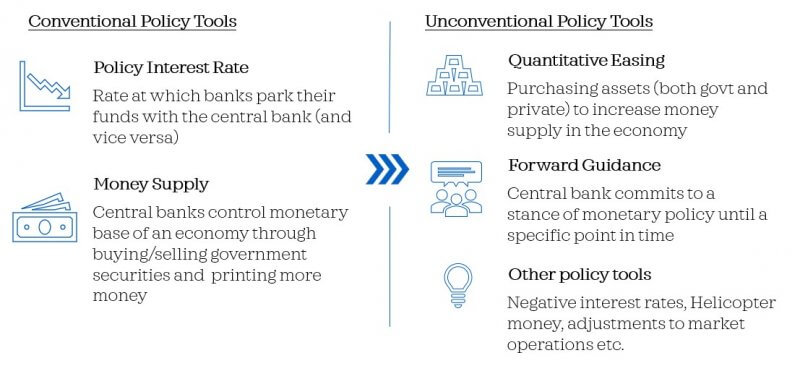
    Figure 1: Policy Tools Comparison

    Typically, interest rates and money supply are the two run-of-the-mill tools that central bankers resort to. Extreme versions of these policies, such as negative interest rates and quantitative easing, are termed unconventional monetary policies since they deviate from the traditional policy measures of a central bank. According to RBI’s Deepak Mohanty, “When central banks look beyond their traditional instrument of policy interest rate, the monetary policy takes an unconventional character”. Essentially, an Unconventional monetary policy is a set of measures taken by a central bank to bring an end to an exceptional economic situation. Central banks use these measures only in extraordinary situations when conventional monetary policy instruments cannot achieve the desired effect [1].

     Quantitative Easing

     Quantitative easing (QE) is a form of extreme and targeted control of the money supply in the economy. At its core, QE seeks to increase the money supply in the economy through the purchase of securities and bonds in the open market. When a central bank uses QE, it purchases large quantities of assets, such as government bonds, to lower borrowing costs, boost spending, support economic growth, and ultimately increase inflation.

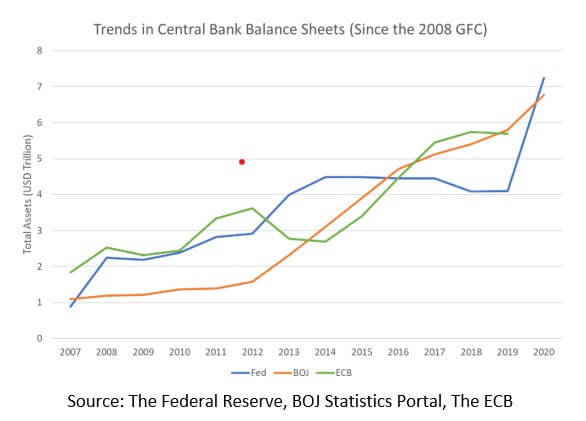
    Before the 2008 financial crisis, only one major economy, Japan, had implemented a significant Quantitative Easing program in the 1990s. Today, however, almost all major economies have some sort of QE or an asset purchase program. According to a report by Fitch Ratings, global QE asset purchases are set to hit $6 trillion in 2020 alone, which is more than half the cumulative global QE total seen over 2009 to 2018 [2]. As seen in the figure below, the balance sheets of major central banks have been expanding significantly since the financial crisis.


    Figure 2

    Quantitative Easing has been the cornerstone of the Fed’s crisis response since 2008. In the three rounds of QE post the 2008 crisis, the Fed balance sheets increased from $870 billion in August 2007 to $4.5 trillion in early 2015. Earlier this year, the Fed purchased a record $1.4 trillion worth of US treasuries in just six weeks in response to the COVID-19 crisis, speaking volumes of the role played by the unconventional policy during a period of crisis. Also, it’s not just the advanced economies that are resorting to extensive QE programs. Nearly 13 emerging market economies, including India, announced some form of a QE program following the crisis. In India, the RBI injected durable liquidity of ₹1.1 lakh crore through the purchase of securities under open market operations (OMOs) [3].

    Zero or Negative Interest Rates

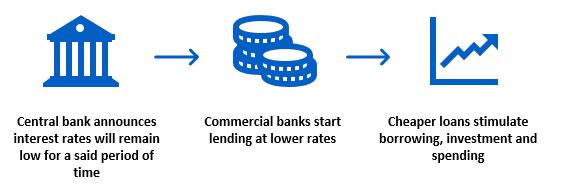
    Quantitative easing was just the beginning of the long list of tricks central bankers pulled out of their sleeves. Closely accompanying QE policies were accommodative monetary regimes of ultra-low interest rates. In 2020 alone, interest rates have been slashed across the globe on 37 separate occasions [4]. Interest rates have been falling across the globe even before the crisis, and the current pandemic has only sped up this fall.

    While many economies have reached the theoretical zero lower-bound of rates, some have even dared to venture below the surface into negative territory. As of today, 5 economies in the world follow a Negative Interest Rate Policy. While the very concept of negative rates may seem baffling, it’s even more shocking to note that over $15 trillion worth of bonds is traded at negative yields globally [5]. This means that over 30% of the world’s investment-grade securities are traded in a manner such that lenders pay borrowers to use their funds. Central banks envisage that negative policy rates would induce increased spending and stimulate the economy in two ways – first, by forcing banks to hold lesser deposits with the central bank and channelling these funds into increased lending to households and businesses. Second, a cut in the policy rate would also lead to lower rates in the overall lending market, thus encouraging borrowing and spending.

    Forward Guidance

    Forward guidance refers to official communication from a central bank on the future course of monetary policy in the economy for a specific period. It is more of a monetary policy stance than a monetary policy tool. The key idea here is to keep markets informed and eliminate any form of uncertainty, which becomes especially imperative during times of crisis.


    Figure 3

    Gone are the days when central bank rate cuts and other announcements of secrets that were sprung upon the markets when they least expect it. With forward guidance, central banks provide communication well in advance about the likely future course of monetary policy in the economy, and this boosts the confidence of investors, consumers and companies. The US’s Fed was one of the major central banks to adopt this policy during the COVID crisis – providing clear forward guidance in June showing that it will probably keep rates low until at least 2022. The policy has been the cornerstone of the Eurozone’s crisis response since the sovereign debt crisis. In July 2012, at the height of the crisis, ECB President Mario Draghi adopted a form of Forward Guidance, stating that the ECB will do “whatever it takes” to save the euro. It is believed that these three words single-handedly turned around the eurozone crisis.

    Are Unconventional Policies Here to Stay?

    Apart from QE, NIRP and FG, there are several other unconventional policies in practice world over – Australia is experimenting with yield curve controls, the Fed is attempting to influence markets with forward guidance while Japan is considering printing helicopter money. There are so many extreme measures being adopted across the globe that policy commentators are now referring to these nations as swimming in an alphabet soup of unconventional policies (QE, NIRP, ZIRP, U-FX, NDR etc.). Post the 2008 crisis, when such policies were first being debated upon and economies were just dipping their toes in the ocean of unconventional policy, many warned of dire consequences such as hyperinflation and collapsing currencies. Luckily for central bankers, none of these predicaments came true. Most advanced economies are still struggling to combat deflation and extremely low levels of inflation despite adopting several unconventional policies. In this scenario, fears of hyperinflation seem to be unwarranted. While there have been studies documenting the potentially harmful effects of unconventional policies, economies still seem to stick with these policies. On one hand, central bankers have no better alternative tools, and second, the positive effects seem to fairly outweigh the negative externalities.

    Thus, unconventional policy tools are going to be around for the near future. As economies and global markets grow more complex, so will the policies and policy tools regulating them. Similar to how drastically monetary policy has changed within just 10 years after the financial crisis, it will keep evolving and adapting with time by developing new tools and analyses. Monetary toolbox a decade or two later will look radically different from what it is now. The important question then becomes not whether unconventional policies are here to stay, but how nations can make the most effective use of them.

    The new monetary tools, including QE and forward guidance, should become permanent parts of the monetary policy toolbox – Ben Bernanke, Ex-Fed Chair

    Need for Monetary Policy and Fiscal Policy to Work in Tandem

    While central bankers have no stone unturned in the fightback against crises, the success of unconventional policies has been fairly moderate. In Japan, for example, the NIRP has failed to stimulate spending and investment in the economy. Rather, negative rates have only forced a massive outflow of funds from the country in favour of foreign assets. In the Eurozone as well, the policy has achieved no significant impact, with banks continuing to pay billions of euros as negative fees to the ECB. While QE has fared slightly better than the rest as a policy tool, the experiences of various economies with it have been mixed.

    The experiences of several economies have shown that while unconventional policies may work better than conventional ones during a crisis, there are limits to their performance as well. One of the key failures of unconventional policies (and conventional policies) has been the inability to stimulate healthy inflation in recessionary economies. Policies such as QE and NIRP, despite increasing the monetary base of economies, have failed to spur spending and investments. As we have seen in Japan, a standalone monetary policy, no matter how accommodative, is insufficient to pull economies out of downturns. In this light, it is imperative that monetary policy, conventional or unconventional, be accompanied by temporary fiscal stimulus during recessions. Public investment in infrastructure could give economies a much-needed boost in the absence of a private appetite for investments. Infrastructure is an enormous economic multiplier, and governments would do well to work in tandem with monetary regimes to provide the initial spur in economic activity. Several studies have shown that public investment during crises can generate employment and increase output. Originally theorised by British economist J.M. Keynes, the ‘Keynesian Multiplier’ of government spending could be the magic potion that makes unconventional policies go from good to great.

    How does the Keynesian Multiplier Work?

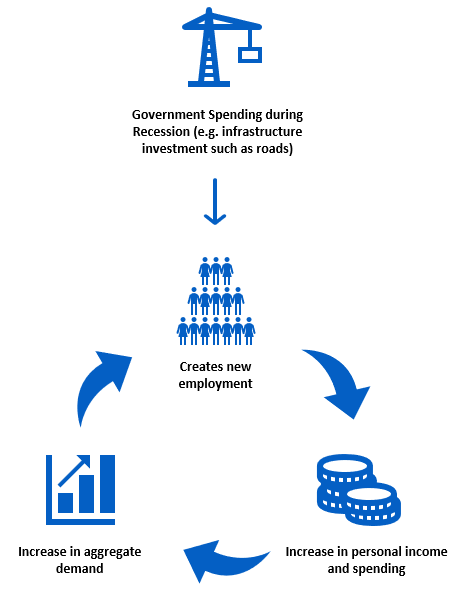
    During times of recession or economic downturn, government spending puts into action the Keynesian Multiplier. According to the Keynesian Multiplier, theorised by prominent economists such as Keynes, Kahn and Hicks, short term government spending boosts the economy by more than what is spent. Keynes was of the view that during a recession with a high level of unemployment, Governments should raise public spending to sustain effective demand and profits.


    Figure 4

    As seen from the figure above, an increase in government spending on large projects such as road building will lead to the creation of alternative employment. The increase in personal incomes and consequently aggregate demand in the economy will further stimulate economic activity and will create more employment than what was originally created by government spending. In effect, every unit of money spent by the government during a downturn increases GDP by a greater proportion than what was spent.

    Conclusion

    While unconventional policies are here to stay, they are a step in the dark. Economies are still experimenting and attempting to figure out the most effective use of these policies. Considering the fairly moderate performance of standalone unconventional policies, there is an established need for complementary fiscal policy to accompany monetary policy. An increase in infrastructure investment coupled with an accommodative monetary regime could help stimulate stagnant demand during a crisis. In developing economies, it can also help address structural bottlenecks subduing growth. These investments from the government, however, must be productive and efficient. Otherwise, they just end up adding on to already high levels of debt, especially during periods of crisis when governments have to borrow extensively for emergency requirements. It is also imperative that this investment is temporary and not permanent. Long-term government debt is unsustainable and can crowd out much-needed private investment.


    References


    [1] Central Charts. (2019). Definition of Unconventional Monetary Policy. Retrieved from

    https://www.centralcharts.com/en/gm/1-learn/9-economics/35-central-bank/976-definition-unconventional-monetary-policy

    [2] Fitch Ratings. (2020). Global QE Asset Purchases to Reach USD6 Trillion in 2020. Retrieved from

    https://www.fitchratings.com/research/sovereigns/global-qe-asset-purchases-to-reach-usd6-trillion-in-2020-24-04-2020

    [3] Reserve Bank of India. (2020). Policy Environment. Retrieved from

    https://www.rbi.org.in/scripts/PublicationsView.aspx?id=20269

    [4] Desjardins, J. (2020, March 17). The Downward Spiral in Interest Rates. Visual Capitalist.

    https://www.visualcapitalist.com/chart-the-downward-spiral-in-interest-rates/#:~:text=Global%20Rate%20Slashing,light%20of%20current%20oil%20prices.

    [5] Mullen, C. (2020, November 6). World’s Negative-Yield Debt Pile Has Just Hit a New Record. Bloomberg Quint.

    https://www.bloombergquint.com/onweb/negative-yielding-debt-hits-record-17-trillion-on-bond-rally#:~:text=The%20market%20value%20of%20the,it%20reached%20in%20August%202019.


    Image Credit: The Conversation

  • e-SLA and the Delhi Act 2011 (Right of Citizen to Time-bound delivery of Services)- Policy Analysis

    e-SLA and the Delhi Act 2011 (Right of Citizen to Time-bound delivery of Services)- Policy Analysis

    Introduction

    As the functions of the modern welfare state expand and the dependency of citizens on it increases, its services must be delivered in timely manner. To this end, the Delhi government developed a robust policy. Through the Delhi Act of 2011 (Right of Citizen to Time Bound Delivery of Services), referred to as “the Act”, and the Delhi (Right of Citizen to Time Bound Delivery of Services) Rules, 2011 [“the Rules”], it has guaranteed timely delivery of 361 services.[1] Delhi is not the only state to confer such a right. However, in these other states, the enforcement of this right requires physical presence. Delhi has used an e-Service Level Agreement [“e-SLA”] to digitise the entire enforcement process. Digitisation has enabled greater accountability, performance review, and convenience, whilst also reducing the invested time and cost of every stakeholder. Thus, through this e-governance tool, Delhi has developed a ‘new ecology’ for the citizen-state relationship.

    In this paper, I will first provide a primer on both the Act and the e-SLA. In the second section, I will examine the constitutionality of the Act. Last, I will test the Act against the principles of good governance and citizen-centric administration.

    Understanding the Act and e-SLA

    The Act and e-SLA are deeply interrelated. While the Act defines the legal rights, procedures, and obligations, e-SLA is the mechanism for their execution. The Act comprises four major components: defined rights and corresponding liabilities, procedural prescriptions, the delegation of rulemaking, and the monitoring platform.

    Every citizen is conferred with the right to time-bound delivery of services,[2] and a liability of compliance imposed on government servants.[3] In cases of default, the government servant is liable to pay the compensatory cost of ₹10 per day for the period of delay, subject to a maximum of ₹200 per application.[4] Correspondingly, citizens are entitled to recover the compensatory costs.[5]

    The Act makes three different but interrelated procedural prescriptions. First, it provides the appointment process, eligibility criteria, and powers of the “competent officer”.[6] He/she must not be below the rank of Deputy Secretary or its equivalent rank and is empowered to impose a compensatory cost on the defaulting government servant. Second, it establishes the procedure governing fixation of liability.[7] If there is a delay, the aggrieved citizen can approach the competent officer, who immediately pays the cost that has been automatically calculated by e-SLA.[8] At a second stage, the officer issues show-cause notice to the concerned servant. If justifiable grounds exist, then the payment is debited from the government exchequer. Otherwise, it is reimbursed from the concerned servant. Third, it prescribes the appointment process, eligibility criteria, and powers of appellate authority as well as a 30-day time limit for filing an appeal. He/she must not be below the rank of Joint Secretary or its equivalent rank and has final authority on the matter.[9]

    The Act provides for delegation of legislative authority in two senses. There is a power to make rules,[10] and the power to remove difficulties.[11] However, the exercise of these powers is subject to Parliamentary scrutiny.

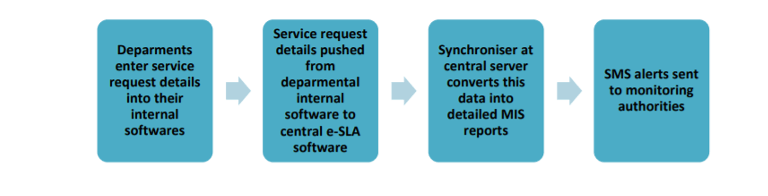
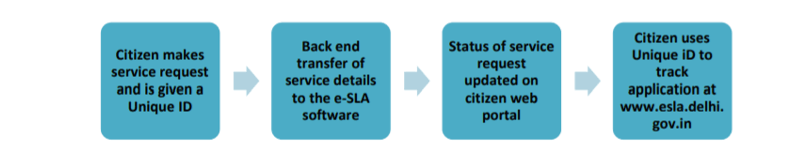
    It is the duty of departments and local bodies to process the application of every citizen and provide an application number. Furthermore, these authorities are obligated to maintain and update the status of applications online.[12] The e-SLA monitoring system has been designated as an online database.[13] To the government, it provides detailed information on the number of disposed or pending cases, which helps in performance evaluation and corrective measures. To the citizens, it provides online facility to track their applications.[14] The information flow is explained below:


    Figure 1: Information flow between government officials under e-SLA


    Figure 2: Information flow between government officials and citizens under e-SLA


    Constitutionality of the Act

    The Constitution provides certain safeguards to “civil servants”.[15] At the outset, it must be noted that these employees are only a sub-set of the “government servants” defined in the Act.[16] Thus, the applicable scope of protection, if any, is not to the entire class of employees enumerated in the Act, but only to civil servants.

    The legal issue herein is the constitutionality of imposing a compensation cost on the civil servant. This is a two-fold question:

    1. Whether there is the power to impose such a cost?

    Appropriate legislatures are empowered to regulate the service conditions of civil servants.[17] As the cost relates to a service condition (i.e., timely delivery), the Delhi Legislative Assembly was empowered in imposing it.

    1. If so, has this exercise violated any constitutional safeguard?

    However, this power is subject to constitutional safeguards guaranteed under Article 311.[18] The protection offered under Article 311(2) is exhaustive and with specific reference to the imposition of three penalties: dismissal, removal, and demotion.[19] Accordingly, the imposition of compensatory cost on the civil servant is beyond the scope of three-fold protection offered by Article 311. Thus, no constitutional safeguard has been violated herein.

    As the imposition of compensatory cost on the civil servants is both within the power and compliant with safeguards, it is constitutional.

    Testing the Act against principles of Good Governance and Citizen-Centric Administration

    Governance refers to the process of decision-making, and the process of implementing those decisions.[20] Good governance is when these processes are tested against a normative standard. Citizen-centric administration refers to governance that places citizens at the centre of all administrative functions.[21] In this section, I will use the characteristics of good governance and the principles of citizen-centric administration as a collective standard[22] to analyze the process of formation and implementation of the Act, its Rules, and e-SLA.

    Assessing Compliance in Formation and Implementation

    a) Participatory. In the absence of statutory provisions, the administrative authorities are not bound to comply with any procedural norms, including notice and prior consultation with the interested parties. The Delhi Act, 2011 does not provide for any such consultation or ante-natal publicity. In the process of policy-making, there was participation only from the relevant government ministries and departments. The government did not take any active steps to broaden consultation to stakeholders such as the civic society organizations, labour unions, or even the general public.

    The lack of participatory policy-making has directly impacted its awareness and enthusiasm among citizens. It was found that only 50% of the people know that their unique ID can be used to track their applications online. Further, only 15% of the people used their ID to track their application.[23]

    b) Transparency. The e-SLA allows for complete transparency to the citizen as to the status of all his applications. The information is not only easily comprehensible but also accessible. However, the transparency does not extend to releasing statistics of operations to the public domain. Currently, these statistics, such as the figures on the number of applications, pendency, disposal rate, performing/underperforming departments, are accessible only to government officials.[24]

    c) Responsiveness. The e-SLA system does not provide for any feedback mechanism. Thus, there is no avenue for the citizens availing these services to share their experiences. As feedback is the basis on which the system continually improves, this deficiency hinders the potential effectiveness of e-SLA.[25]

    1. Accountability

    The right to time-bound service delivery through the mechanism of compensatory cost has, in theory, ensured that the government and its officials are accountable to citizens. This is buttressed by the fact that the Act seeks to develop a culture of timely delivery among the government servants by additionally punishing habitual offenders and providing cash incentives for those without a single default in a year.[26] However, the liability of government servant has been capped at ₹200, compared to other state legislation that penalizes in thousands. Further, the cash incentives are only up to ₹5000. Thus, the quantum is inadequate to cause attitudinal changes in the servants.

    Moreover, there is no culture among public servants to hold their non-performing colleagues in disrepute.[27] There is no indication that this non-performance is factored into promotions. Anyhow, such public servants are typically complacent and not seeking promotions. The security of their present job and status is adequate incentive to persist with present behaviour. Thus, promotions and reputational loss among peers are not adequate incentives for performance either.

    Furthermore, by releasing all relevant statistics of operations to the public domain, the government can broaden its accountability. These statistics can be used by stakeholders, such as news and media agencies and policy think-tanks, to supplement the government in identifying issues and corrective measures. This would also pressurize the government to be more proactive.

         2.  Consensus orientation

    Through reasonable and extensively deliberated timelines, the Act sufficiently balances the interests of citizens in securing timely delivery with the government’s limited capacity.

         3.  Effectiveness and Efficiency

    The usage of e-governance to guarantee the right to public service is a revolutionary process reform. This must be gauged at two levels:

    • For the citizen, this system has reduced the number of physical visits required, thus saving time and cost. In a survey, 66.6% reported that they are not required to visit government offices more than once after submitting their applications.[28]
    • For the government, it eliminates systemic errors and inefficiencies.[29] The statistics help in assessing performance and preparing corrective action.[30] However, if the system can track internal departmental processes too, it would allow determining the exact level at which service delivery is being delayed. Furthermore, the Act ignores the quality of timely delivered services.[31] To provide a comprehensive right to public service, the legislature must develop standards to assess the quality of services rendered on time.


        4.  Equitable and Inclusive

    Under the Act, while the citizen is immediately compensated, the government servant is not immediately penalized for default. The procedure allows him/her to provide justified grounds that could excuse liability. For greater inclusivity, the government can prescribe a pro-rata calculation of the penalty. As the amount is automatically calculated by e-SLA, even complex formulas are acceptable.

       5.  Rule of Law

    The Act provides for a fair legal framework and impartial enforcement.

    Conclusion

    Executing the right to time-bound service delivery through an online portal is truly revolutionary. It has emerged as model legislation for other governments. The Act is constitutionally valid. However, when tested against standards of good governance, this policy suffers from problems of non-participation, transparency, responsiveness, accountability, and effectiveness at the government-level. But it scores par excellence on the principles of consensus orientation, effectiveness at the citizen-level, inclusiveness, and rule of law. To embrace the truly revolutionary potential of this policy, the government must make the suggestions recommended in the last section of the paper, vis-à-vis each principle.


    References:

    [1] IANS, ‘245 services brought under Delhi time-bound delivery act’ (Business Standard, 24 August 2014) <https://www.business-standard.com/article/news-ians/245-services-brought-under-delhi-time-bound-delivery-act-114082400707_1.html> accessed 17 January 2021.

    [2] The Act, s. 3.

    [3] The Act, s. 4.

    [4] The Act, s. 7.

    [5] The Act, s. 8.

    [6] The Act, s. 9.

    [7] The Act, s. 10.

    [8] The Rules, r. 4(1).

    [9] The Act, s. 11(1).

    [10] The Act, s. 15.

    [11] The Act, s. 16.

    [12] The Act, s. 5.

    [13] The Rules, r. 2(c).

    [14] Arjun Kapoor & Niranjan Sahoo, India’s Shifting Governance Structure: From Charter of Promises to Services Guarantee (ORF Occasional Paper No 35, 2012).

    [15] Constitution of India 1950, Art. 309, 310, 311.

    [16] The Act, s. 2(g).

    [17] Constitution of India 1950, Art. 309.

    [18] Union of India v. S.P. Sharma (2014) 6 SCC 351.

    [19] Yashomati Ghosh, Textbook on Administrative Law (1st edn, Lexis Nexis 2015) 416.

    [20] UN Economic and Social Commission for Asia and the Pacific, ‘What is Good Governance?’ <http://www. unescap.org/sites/default/files/good-governance.pdf>.

    [21] Ghosh (n 19) 14.

    [22] Second Administrative Reforms Commission, Citizen-Centric Administration (Report No 12, 2009) p. 8.

    [23] Audit of Functioning of Government of Delhi’s e-SLA Scheme, by Management Development Institute, Gurgaon (2012).

    [24] Ibid.

    [25] Rohit Sinha, ‘Delivering on service guarantee: A case of Delhi’s e-SLA’ (ORF, 29 December 2012) <https://www.orfonline.org/research/delivering-on-service-guarantee-a-case-of-delhis-e-sla/> accessed 17 January 2021.

    [26] The Act, s. 12.

    [27] Kapoor & Sahoo (n 14); Amit Chandea & Surbhi Bhatia, The Right of Citizens for Time Bound Delivery of Goods and Services and Redressal of their Grievances Bill, 2011 (CCS, 2015) p. 25-26.

    [28] Sinha (n 25).

    [29] Chandea & Bhatia (n 27).

    [30] Ibid.

    [31] Kapoor & Sahoo (n 14).


    Image Credit: Forbes India

  • History – Thailand’s Golden Buddha

    History – Thailand’s Golden Buddha

    In the month of May 2007 I was invited to speak at the Mahidol University of Bangkok during the SSEASR Conference. I gave a talk on Yogachara Buddhism there. During this occasion, I had the opportunity to visit various Buddhist temples at Bangkok. They include the magnificent ones like Emerald Buddha, Golden Buddha, Buddha in his Maha nirvana time etc. It is very interesting to note that in the Sanctum Sanctorum of all Buddha temples, while the right side wall is covered with pictures depicting instances in Buddha’s life, the left side has paintings exclusively from Ramayana. For a Thai devotee, Hinduism is as important as Mahayana Buddhism.

    During the visit of one of the temple, I learnt this great truth about ignorance obscuring Reality.

    One of these famous temples has a Buddha icon nearly 17 feet tall, which is known till the beginning of 20th century as “Terracotta Buddha temple” . The temple was established in the 13th century with its huge icon of Buddha, for several centuries it was worshipped by the devotees as “Terracotta Buddha”. One day the authorities decided to shift the Terracotta Buddha image to a place several kilometers away, probably to do some repairs to the temple. They put the Terracotta Buddha on a truck and were moving it. When they were half way through, a heavy downpour started. The rain was so heavy that the clay image of Buddha started dissolving. They tried to protect the image with tarpaulins and umbrellas, but to no effect. There was a very heavy wind which blew away the tarpaulins and umbrellas. Due to the heavy rain, the Buddha icon in clay was dissolving fast. The devotees were grief-stricken. They were wondering whether it would have been wiser to have left the temple un-repaired rather than allowing the centuries old terracotta Buddha icon to get dissolved in the heavy downpour.


    Presto! A wonderful thing was happening. As the clay was dissolving, from within the clay was emerging a golden Buddha idol! as the idol there was of clay. After a short while all the clay, which was covering the idol got completely dissolved. The people were witnessing the presence of a resplendent “Golden Buddha” appearing before them in all its grandeur.

    What really happened? It was really a golden Buddha at the time of its installation in the 13th century. After some time Thailand was experiencing foreign invasions. Fearing that the invaders would take away the golden image, which was 5.5 tons of solid gold, the devotees covered the image with clay. Thinking that it was only a Terracotta Buddha, the invaders left it untouched. That generation knowing that it was a golden Buddha inside the clay, worshipped Buddha in that form. As many years passed by, the subsequent generations were not aware of this fact. They truly believed in what they saw externally and worshipped it as a Terracotta Buddha only. Thus their minds were conditioned by externalities. Once the clay dissolved what is truly inside came out with all its effulgence. It is today worshipped as the golden Buddha in Bangkok.

    It is happening to all of us everyday, we assume ourselves to be only a body-mind-intellect complex and nothing beyond it. We are conditioned by our awareness of our body, our thinking process and our analysis of the phenomena. These are only externalities within each one of us. It is only a clay that surrounds the wonderful Immanence within us. Within each one of us is the golden Buddha, the great immanent Lord who is also transcendent, he is the great Shiva, who is constantly performing his cosmic dance. In our hearts we not aware of it as our minds are conditioned by what we see, do and think. It is like the Thais seeing only the clay image and concluding it as only terracotta Buddha. As the rain dissolved the clay, the golden icon which is the true-one inside is revealed. Likewise when the spiritual sadhaha and devotion dissolves our mental conditioning, the Lord within ourselves is also revealed. This is the lesson we learn from the Golden Buddha temple.

    The same idea is beautifully explained in Thirumoolar’s Thirumantiram. A sculptor has carved out a beautiful elephant from a block of wood. When you see it as an elephant, you do not see the underlying reality of the wood. When you will be able to see the substratum, the underlying reality of the wood, with which all the objects of carving are made, you do not see the carved elephant; you see the substratum of the wood. Likewise, the ignorance enveloping our minds obscure the ultimate reality within us, when we are graded by the body-mind-intellect complex. When the revelation comes to us through god’s grace and gurus’ teachings coupled with our devotion to Him, the conditioning disappears. The phenomena abide in the ultimate. We experience the Divinity within us.

    Even in the area of management, the story of Golden Buddha has a great relevance. A competent Manager, with a penetrating mind, should be able to see what is the reality hidden in the numerous external information. The external covering only obscures the truth, which you will be able to get through. Once you see the substratum, the ultimate truth is revealed.


    Image Credit: Wikimedia Commons

  • (Part-II) Proposing a Legal Framework for Distribution of the COVID-19 Vaccination

    (Part-II) Proposing a Legal Framework for Distribution of the COVID-19 Vaccination

    I.   Reassessing Vulnerabilities During a Pandemic

    A general problem across all conventional models is their failure to understand that vulnerabilities during a pandemic are created and compounded by socio-economic factors too. Therefore, there is a need to adopt approaches that holistically assess the correlation between socioeconomic factors and vulnerability during a pandemic.[1]

    The Syndemics Approach

    Under this approach, pandemics are understood as an interaction of that disease with other diseases and the socio-economic and political factors that increase the risk of vulnerability.[2] All these factors synergistically interact to impact the health of individuals and society. Through these risk factors, it identifies the overlapping health and socio-economic problems that increase vulnerability (‘syndemic vulnerabilities’). The socio-economic risk factors are influenced by social determinants of health, i.e., the conditions of housing, food, employment, healthcare, and education.[3] Therefore, the utility of this approach lies in its holistic conception of socio-economic factors that impact the formation, clustering, and progression of diseases.[4] Using this approach, I argue that the COVID-19 pandemic has synergistically interacted and exacerbated the existing diseases and socio-economic conditions of marginalized groups across countries.

    Higher Risks of Infection, Transmission, and Mortality: Typically, due to historic discrimination and denial, marginalized communities have a greater number of pre-existing diseases like diabetes and asthma,[5] which in turn elevates their risk of infection and mortality. Moreover, there is unequal access to healthcare among marginalized communities due to the high costs of medical care and the absence of health insurance.[6] Marginalized communities are also disproportionately poor,[7] which affects their ability to mitigate the impact of the pandemic.

    Typically, marginalized communities are housed in crowded neighbourhoods with smaller houses that lack outside space.[8] They also have higher population densities, especially in urban areas, and lower access to communal green space.[9]Due to historic discrimination, marginalized communities are over-represented in essential services, including low-wage healthcare sectors and sanitation jobs.[10] This reduces their ability to work from home, and thus increases their risk of infection and transmission. Marginalized communities are more likely to take public transportation,[11] which further increases their risk of infection and transmission.

    These syndemic vulnerabilities have increased the risk of mortality among these marginalized communities. For instance, in America, the mortality rate of African-Americans and Indigenous/Latino communities is 3.4 times and 3.3 times higher than a non-Hispanic White person.[12] Evidence from past epidemics/pandemics shows that the rates of infection and mortality are always disproportionately higher among marginalized communities.[13]

    Greater Socio-Economic Disruption: Due to a lack of quality education, members of marginalized communities tend to work in lower-wage jobs in the informal sector, which has been worst hit by the pandemic.[14] The percentage fall in employment for marginalized communities has been far greater, indicating that education was a protective factor in the first wave of job losses.[15] Consequently, there has also been greater housing evictions among these communities.[16]The access to quality education for children in marginalized communities has also been severely impacted because they lack access to the internet,[17] affecting their ability to access education. Moreover, low literacy among adults in marginalized communities indicates their inability to assist their children with any form of home learning.[18]

    Therefore, the increased syndemic vulnerabilities of marginalized communities and the consequent disproportionate socio-economic disruptions of the pandemic on them necessitate a greater strive for their inclusion in distributing the vaccine. Early access to such vaccines allows these groups the opportunity to proportionately mitigate these vulnerabilities and disruptions.

    Intersectionality

    Presently, vulnerabilities among individuals are dominantly viewed from a single-axis framework. This ignores the multiple layers and experiences of vulnerability, resulting from an interplay of power structures and different social identities, held by one individual. This ignorance is avoided when using intersectionality, which is an analytical framework that explains how different social, economic, and political identities overlap to create different modes of discrimination and privilege.[19] Thus, it explains how certain individuals in the population are relatively more disadvantaged than others.[20] Intersectionality not only provides a multi-layered understanding of vulnerabilities during a pandemic but also helps prioritize distribution within an identified category, given the scarcity of vaccines.


    II.   Proposing a Multi-Value Ethical Framework

    Given its rational criteria, incorporating utilitarianism’s clinical risk factors is quite valuable. However, as argued, vulnerability during a pandemic is also determined by socioeconomic risk factors. Therefore, there is a need to adopt a multi-value approach that incorporates both clinical and socio-economic risk factors. I propose to do so by simultaneously prioritizing the values of ‘collective wellbeing’ and ‘justice’.

    Borrowed from utilitarianism is the value of ‘collective wellbeing’, which aims at maximizing benefits and minimizing harms. Flowing from a syndemic conception of COVID-19 is the value of ‘justice’, which aims at reducing health inequities and treats like people alike. These values are not necessarily always distinct, but their overlap over one parameter indicates a stronger justification. They can be operationalized using an ‘intersectional multi-parameter weighted framework’.

    Operationalizing Values

    The framework is constructed through three layers: (1) for each risk parameter, there is (2) a value-based justification, along with (3) its extent of weightage. The risk parameters are viewed from an intersectional power axis, with value justifications sourced from clinical and syndemic vulnerabilities. The weightage typically connotes a three-point scale, where 3 indicates the highest priority, and 1 indicates the lowest. The priority order is based on the greatness of one’s total score. The lottery method should only be used as a tie-breaker when the score is the same, and no more doses are presently available.

    Age:    Older people are at a significantly higher risk of infection and severe morbidity or mortality due to physiological changes associated with ageing. Globally, more than 95% of COVID-19 deaths were among individuals aged 60 and above. Even among older people, more than half of all deaths occurred in people aged 80 and above.[21]

    Therefore, in descending order, weightage must be given to individuals above 80 years, individuals between 60-80 years, and individuals between 40-59 years.

    Comorbidities:          Depending on the country, between 48-75% of COVD-19 deaths are associated with existing comorbidities. Those with comorbidities are also at moderately higher risk of infection.[22]

    The prioritization has to be categorized based on the severity of the comorbidity, in contracting the infection and causing death. Therefore, in descending order, higher weightage must be given to severe comorbidities, moderate comorbidities, and mild comorbidities. The severity in infection and mortality is different for countries due to distinct socio-economic realities and evolutionary biology. Therefore, this identification and classification need to be uniquely undertaken. However, as a general rule, it is almost universal for HIV, cancer, and most cardiovascular diseases to be severe comorbidities.[23]

    Profession:     Prioritizing frontline healthcare, sanitation, and defence workers are justified because they engage in services, whose absence has the greatest negative societal impact- whether on health, safety/security, or economy. They are also in constant contact with areas and people having the greatest risk of infection. Therefore, protecting them has a multiplier effect, in that their ability to remain uninfected protects the health of others and minimizes societal and economic disruption. Since the state obligates these workers to work in risk conditions, while everyone else is working from home, it is further obligated to protect them.

    Therefore, in descending order, priority must be given to frontline workers, workers in other essential sectors, and workers in non-essential sectors.

    Income:          One’s economic status affects their ability to access healthcare, thus results in higher rates of mortality and severe morbidity.[24] The syndemic approach reveals that poverty compounds one’s syndemic vulnerability.

    Therefore, in descending order, priority must be given to individuals with low-income, middle-income, and high-income.

    Ethnic Identity:         The syndemic approach reveals that marginalized communities are at a greater risk of infection, transmission, and mortality. They are also worst affected by the pandemic, which further compounds their vulnerability. Given these vulnerabilities, prioritized vaccine access to marginalized communities also helps reduce all three risks among the general population.

    The prioritization criteria would depend on the marginalized communities within a country and the extent of their syndemic vulnerabilities. For instance, in America, the syndemic vulnerabilities are greatest for African-Americans, followed by the Indigenous/Latinos communities, and then Pacific Islanders.

    Conclusion

    The conventional models of vaccine distribution are unethical towards disadvantaged groups. While neoliberalism completely ignores the distributive function of law, utilitarianism, lottery, and FCFS at least acknowledge this. However, their criterion of distribution ignores socio-economic vulnerabilities. This ignorance can be addressed using a syndemics approach and intersectionality.

    The syndemics approach explains the socio-economic risk factors that disproportionately disadvantage marginalized communities, both medically and socio-economically. Intersectionality provides a layered understanding of how vulnerabilities affect people, even those in the same group, differently. Using these approaches, I propose a multi-value ethical framework that balances the pragmatic considerations of medical utilitarianism with greater social inclusion. It operationalizes the values of these ethical systems through the priority order generated under an ‘intersectional multi-parameter weighted framework’.


    Notes:

    [1] While each country has different marginalized groups, the patterns of vulnerability explored are similar. Thus, marginalized groups have been generally analyzed hereinafter.

    [2] Merrill Singer, Nicola Bulled, et al, ‘Syndemics and the biosocial conception of health’ (2017) 389 Lancet 941, 941-943.

    [3] Clare Bambra, Ryan Riordan, et al, ‘The COVID-19 pandemic and health inequalities’ (2020) 1 J Epidemiol Community Health 964, 965.

    [4] Singer (n 23) 948.

    [5] Harleen Kaur, ‘Indirect racial discrimination in COVID-19 ethical guidance’ (BMJ Blog, 27 August 2020) <https://blogs.bmj.com/covid-19/2020/08/27/indirect-racial-discrimination-in-covid-19-ethical-guidance/> accessed 8 January 2021.

    [6] Bambra (n 24) 965-966.

    [7] Melanie Moses, ‘A Model for a Just COVID-19 Vaccination Program’ (Nautilus, 25 November 2020) <http://nautil.us/issue/93/forerunners/a-model-for-a-just-covid_19-vaccination-program> accessed 8 January 2021.

    [8] Tonia Poteat, ‘Understanding COVID-19 Risks and Vulnerabilities among Black Communities in America: Syndemics’ (2020) 47 Annals of Epidemiology 1, 3.

    [9] Bambra (n 24) 966.

    [10] National Academies (n 16) 30-31.

    [11] ‘Beyond the data: Understanding the impact of COVID-19 on BAME groups’ (2020) Public Health England Report, 22-23 <https://assets.publishing.service.gov.uk/government/uploads/system/uploads/attachment_data/file/892376/COVID_stakeholder_engagement_synthesis_beyond_the_data.pdf> accessed 8 January 2021.

    [12] Harald Schmidt, ‘Is It Lawful and Ethical to Prioritize Racial Minorities for COVID-19 Vaccines?’ (2020) 324 JAMA <https://jamanetwork.com/journals/jama/fullarticle/2771874> accessed 8 January 2021.

    [13] Bambra (n 24) 967.

    [14] Shruti Srivastava, ‘Millions Escaped Caste Discrimination. Covid-19 Brought It Back’ (Bloomberg Quint, 21 August 2020) <https://www.bloombergquint.com/politics/millions-escaped-caste-discrimination-covid-19-brought-it-back> accessed 8 January 2021.

    [15] Ashwini Deshpande, ‘Differential impact of COVID-19 and the lockdown’ (The Hindu, 22 August 2020) <https://www.thehindu.com/opinion/lead/differential-impact-of-covid-19-and-the-lockdown/article32416854.ece> accessed 8 January 2021.

    [16] Schmidt (n 33).

    [17] Deshpande (n 36).

    [18] Ibid.

    [19] Olena Hankivsky, ‘An intersectionality-based policy analysis framework’ (2014) 13(119) Intl J Equity in Health 1, 2.

    [20] Ibid.

    [21] ‘Supporting older people during the COVID-19 pandemic’ (WHO, 3 April 2020) <https://www.euro.who.int/en/health-topics/health-emergencies/coronavirus-covid-19/news/news/2020/4/supporting-older-people-during-the-covid-19-pandemic-is-everyones-business> accessed 8 January 2021.

    [22] Awadhesh Kumar, ‘Impact of COVID-19 and comorbidities on health and economics’ (2020) 14(6) Diabetes Metab Syndr 1625, 1626-1627.

    [23] Ibid.

    [24] National Academies (n 16) 68-77.


    Image Credit: One India

  • Chief of Defence Staff, a year later: Lack of Clarity and an ambiguous Mandate

    Chief of Defence Staff, a year later: Lack of Clarity and an ambiguous Mandate

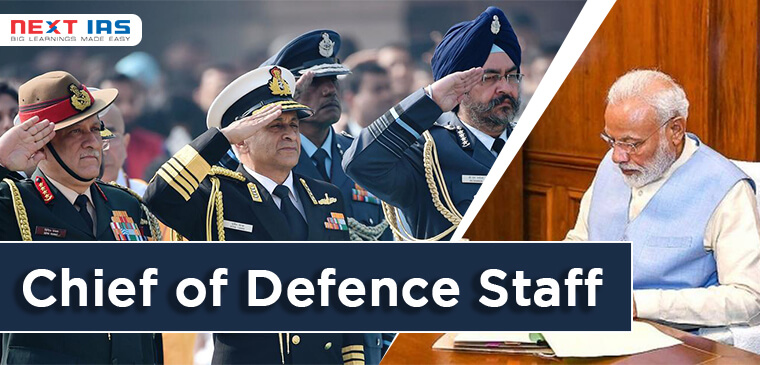
    On 31st of Dec 2020 India’s first Chief of Defence Staff (CDS), Gen Bipin Rawat, completed one-year in office.  With China recently unveiling its 14th Five Year Plan aiming to bring its military on par with the USA by 2027, it would be interesting to observe if the appointment of CDS has helped the Indian Military spruce up its structure and operational philosophy in any manner.

    Appointment of CDS was put on hold for almost two decades after the Kargil Review Committee made its recommendations.  Opinion among the strategic community has always been divided on the appointment of CDS. Those who argued in favour espoused that CDS would be the panacea for all ills while those who opposed, opined that the time-tested Higher Defence Organisation proposed by Lord Ismay has worked well over the years and hence, the western concept of CDS is unnecessary. Now that the CDS is in place, it is futile to revisit the debate but the functioning of CDS would be a subject of scrutiny for the next few years.

    In the last few months, the Department of Military Affairs (DMA) headed by the CDS came for intense criticism for making proposals about the increase in retirement age and reduction in pensions. Previous proposals such as the closure of CSD canteens at peace stations, opening up of cantonment, doing away with Army Day parade etc, which are believed to have emanated from the DMA have been subjected to ridicule and disdain in the social media. It wasn’t exactly clear as to why the office of CDS was being used for such purely administrative issues, which are counterproductive in enhancing the morale and pride of the forces.

    Men in uniform yearned that CDS would play a vital role in bringing about the true integration of Services HQ with the MoD and expedite the process of defence modernisation. However, after one year, it is indeed of great concern that the office of CDS (read DMA) appears to be focussed on administrative and ceremonial issues with absolutely no strategic significance.

    When CDS assumed charge on 1st Jan 20, it was reported that the CDS would be the Principal Military Advisor to the Government (read Def Minister) and he would head the newly created DMA.  Additionally, he would assume charge of the Integrated Defence Staff (IDS), serve as the permanent Chairman of the Chiefs of Staff Committee (COSC), Head the Tri-Service Commands, and be a member of the Defence Acquisition Council besides the Nuclear Command Authority. Quite a tall order indeed but doesn’t seem to be adequately equipped with a statutory mandate to perform effectively. Men in uniform yearned that CDS would play a vital role in bringing about the true integration of Services HQ with the MoD and expedite the process of defence modernisation. However, after one year, it is indeed of great concern that the office of CDS (read DMA) appears to be focussed on administrative and ceremonial issues with absolutely no strategic significance. One of the first initiatives announced by Gen Rawat was to create an Air Defence Command which is yet to materialise and creation of Theatre Commands seems to be a long haul.

    it is beyond comprehension to fathom what prompted the Government to create a Department of Military Affairs within the MoD when the Integrated Defence Staff (IDS) was already functioning since 2001 awaiting the appointment of a CDS.  As Service Chiefs continue to exercise Command over their respective Service, the CDS as the head of IDS would be rightly placed to promote joint training initiatives, validate joint operational plans and act as a catalyst in defence modernisation.  However, for all this to be achieved, the role and functioning of the CDS should be spelt out; particularly the role of CDS as the “Principal Military Advisor” to the Raksha Mantri, vis-à-vis the Defence Secretary who continues to be the “Principal Advisor” to the Defence Minister. Such vital aspects are never left to chance based on an individual’s equations with political leadership but need to be appropriately institutionalised, mandated and published.

    Currently, Defence Secretary functions as head of the Department of Defence and is additionally responsible for coordinating the activities of the five Departments in the Ministry, including the newly created DMA. The Defence Secretary draws his functional powers from the Cabinet Secretariat –Manual of Office Procedures (CS-MoP) which clearly states that the Secretary of the Department “is the principal adviser of the Minister on all matters of policy and administration within his Ministry/Department, and his responsibility is complete and undivided”. If Defence Secretary is coordinating the affairs of all the five departments including DMA as the Principal Advisor, what is the status of the four-star-CDS?

    The Government of India (Allocation of Business) Rules, 1961 are made by the President of India under Article 77 of the Constitution for the allocation of business of the Government of India. The business of the Government is transacted in the Ministries/Departments, Secretariats and offices (referred to as ‘Department’) as per the distribution of subjects specified in these Rules. Allocation of Business Rules has not been revised since 2017 though DMA has been created one year ago.  As a result, the DMA is not listed in the First Schedule of the Allocation of Business.

    Transaction of Business (Rules) 1961 are made by the President of India for the convenient transaction of the Business of the Government of India. The disposal of business by various ministries, inter-departmental transactions and mandates of various committees are published in these rules. The significance of these rules can be gauged from the fact that the rules have been recently amended to deal with unprecedented challenges posed by Covid 19 pandemic. Cabinet Secretariat has amended Government of India Transaction of Business Rules, 1961 to widen powers of two committees to meet the economic crisis caused by Covid 19, using the powers under the Act. However, Transaction of Business Rules has not been revised clearly defining the role of CDS as the Principal Military Advisor to the Government.

    The organisation chart in the MoD has been removed possibly because it would only be too embarrassing to place the CDS under the Defence Secretary. There is an urgent need for the GoI to create a meaningful role for the CDS and empower him with a statutory mandate.

    A cursory glance at the website of the Ministry of Defence would reveal a lack of any sincerity in assigning specific responsibilities for DMA. It has been casually mentioned that DMA “deals with the armed forces of the Union….. and promotes jointness among the three services”. Were these objectives not met by the MoD in the past? So what value addition has the DMA provided? The organisation chart in the MoD has been removed possibly because it would only be too embarrassing to place the CDS under the Defence Secretary. There is an urgent need for the GoI to create a meaningful role for the CDS and empower him with a statutory mandate.

    Indian Military is not expeditionary. However, if there is a convincing need to create Theatre Commands in pursuit of joint operations and interoperability, replacing the existing 17 Service-specific Commands by fewer Theatre Commands would be the most challenging task for the CDS. If the experience of USA, UK and other major militaries is anything go by, such major military reforms could be pushed through only with steadfast backing from the government, taking all three services into confidence and aligning the entire military leadership with the desired outcomes of this humungous exercise which may eventually need constitutional validity through an Act of the parliament.

    For the appointment of CDS to make a meaningful purpose the following measures are imperative:

    • Abolish the DMA and facilitate the CDS to take complete control of the IDS, keeping its functioning outside the purview of Def Secretary
    • Revise the CS-MOP, Allocation of Business Rules, Transaction of Business rules and the Warrant of Precedence, clearly bringing out the role and responsibilities of CDS as the Principal Military Advisor to the Defence Minister, in contrast to the roles and responsibilities of the Defence Secretary which may also now need to be re-drafted.
    • Make CDS a permanent member of the Cabinet Committee on Security facilitating the single-point military advice to the National Security Council.
    • The cabinet should spell out a Defence Policy Guidance (DPG) with a 12 year to the 15-year horizon in the light of prevailing and forecasted geo-political scenario and assist the CDS in preparing a clear roadmap for Indian Military Modernisation

    To abrogate the stigma of “Attached Offices”, and to integrate the Services HQ with MoD, a beginning needs to be made by augmenting the IDS with officials from the MoD.

    • Currently, the budgeting and procurement plans are made in isolation and subject to scrutiny by the Ministry of Fin (Def) thereby losing time and effort. IDS needs to be adequately empowered by augmenting it with an integral wing of the Ministry of Fin (Def) headed by a Joint Secretary ranked officer.
    • A Defence Production Wing under the charge of an Additional Secretary ranked officer reporting directly to the CDS should be created with the long term objective of achieving complete integration of the department of defence production with IDS. This suggestion would certainly be the most unpopular with the bureaucracy but could turn out to be a game-changer if achieved.

    Kargil Review Committee had recommended the appointment of CDS to integrate the armed forces in their planning, procurement and functioning to transform the Indian Military as a unitary force to reckon with.  In the absence of a clear mandate and constitutional validity for the functioning of the CDS, the entire effort of instituting one, seems to be of little consequence, much less, competent of driving any significant reforms. The current arrangement needs a complete overhaul if that is to be achieved.

  • The South: Where the Chariots stopped in the Past

    The South: Where the Chariots stopped in the Past

    There is no apparent reason why Dr. John Jackson (1835-1911), a 19th-century Yorkshire-born British Psychologist should be of any interest to us in the 21st India. Yet, he is important in order to understand what is happening to the BJP’s misplaced ambitions in India south of the Vindhyas.

    First about Dr. Jackson. He was the first scientist to come up with the answer as to why mariners experience directional disorientation when they sail on vast seas. This navigational impairment, described by Jackson as ‘topological agnosia’ (literally, loss of knowledge about directions) was caused in his analysis by a distortion in an individual’s memory. An individual afflicted by this agnosia is found unable to remember to a destination known to him to be able to recall important landmarks seen a long time ago. Among the patients that Jackson studied were some women who knew where the London Bridge was, but they did not know how to go there from their homes. In their memory, the ‘little maps’ were forgotten, though the larger maps were inscribed in their brain. European colonial expansion was distinctly marked by this disorientation. When it was spreading south of Europe, the colonial powers thought of the south as ‘east’ and built a strong binary between the west and the east.

    Topological Agnosia is the term that can most accurately describe the BJP’s ‘Mission South.’ In order to understand why the party that feels so much at home in the Hindi heartland in the north should feel so unsure of its direction in the south, we need to look at the context within which its foundations were laid. Obviously, one has to refer to the shaping of the core ideas of the Hindutva ideology. It is not necessary to state that at its heart is the dubious and non-scientific theory of ‘Aryans as a Master Race’. This idea was in circulation among some of the 19th century European linguists. They imagined that what was initially proposed as the name of a language (‘Indo-Aryan’) was in fact the name of a community (or a race). Some of them went to the length of proving that the Aryans resided in remote ancient times in North Europe. Karl Plenka actually gave a homeland for this imagined master race, unquestioningly assuming that the master race was the master race of the pure Aryans.

    Besides, the traditions of spirituality and worship developed in the south for the last three millennia have their own distinct and syncretic trajectories which do not easily gel with the RSS-VHP idea of Hinduism. Besides, as Basavanna, Akkamma, Periyar, Phule, Shahu, and Ambedkar so ably demonstrate, a larger majority of the people south of the Vindhyas have reason to find the exclusionary and myopic social and cultural interpretations of history entirely repugnant.

    Adolf Hitler

    In the third decade of the 20th century, Adolf Hitler made these theories the foundation of his ‘National Socialism’ and the associated drive for ‘racial purification.’ The founders of the RSS in India were his contemporaries and shared his enthusiasm for the theory of Aryan supremacy. Though completely unscientific in terms of the history of the people of India, the RSS, and the BJP like to believe that someday in the future they will be able to establish the supremacy of the (imaginary) Aryans over the diverse peoples in the Indian subcontinent, the south included. To aid this wishful aspiration, the RSS has brought in a misconstrued idea of what constitutes being Hindu. However, the Indian sub-continent South of the Vindhyas has a long history of resistance to the domination from the north. Besides, the traditions of spirituality and worship developed in the south for the last three millennia have their own distinct and syncretic trajectories which do not easily gel with the RSS-VHP idea of Hinduism. Besides, as Basavanna, Akkamma, Periyar, Phule, Shahu, and Ambedkar so ably demonstrate, a larger majority of the people south of the Vindhyas have reason to find the exclusionary and myopic social and cultural interpretations of history entirely repugnant. It is not a surprise, therefore, that despite desperate efforts by the VHP and RSS throughout the twentieth century, their general support base in the southern states had remained nominal.

    This has changed since 2014. The current regime has displayed an unmatched zeal in intimidating political leaders by using the ED, the CBI, and troll gangs. It has displayed a skill in the use of post-truth and propaganda for generating popular opinion as never before. The erosion of media and the collapse of institutions that are expected to uphold constitutional values and constitutional arrangements to safeguard democracy has apparently increased the chance of success for BJP’s south mission. Besides, the use of funds for party-swapping is a trick that the BJP has mastered well. All these factors—the use of muscle, official machinery, money, intimidation, and propaganda—have made the south more vulnerable to the divisive, exclusionary, and myopic nationalism of the BJP.

    Yet, it would be naïve to believe that countering the Hindutva and Pseudo-Nationalism onslaught would be possible by mouthing our worn-out phrases and analysis related to class-based or caste-based understanding of India in the third decade of the 21st century.

    Countering the flawed ideas of nationalism and the exclusionary notion of dharma is an urgent need for the people, language-communities and the political parties south of the Vindhyas. Probably, it is them alone who are now left with the capacity to do so, since the ‘Hindi, Hindu, Hindustan’ tune has overpowered the people and the northern ‘heartland-states’. Yet, it would be naïve to believe that countering the Hindutva and Pseudo-Nationalism onslaught would be possible by mouthing our worn-out phrases and analysis related to class-based or caste-based understanding of India in the third decade of the 21st century. Also, being fiercely against any geographical, linguistic or social factionalism, we have to reinvent our politics and political terminology. Remaining entirely within the framework of the Constitution, one very powerful message that the Southern States and people can give to the rest of India is that of federalism.

    The Constitution describes the country as a union of states’ and its provisions are oriented towards keeping this union intact and integrated by respecting the difference and diversity.

    The Constitution describes the country as a union of states’ and its provisions are oriented towards keeping this union intact and integrated by respecting the difference and diversity. Hence, our insistence on the principle of federalism would also mean our insistence on constitutional values. It would reiterate the need for recognizing and respecting diversities and, therefore, rejecting the Hindutva agenda of the RSS-BJP. This understanding, if shared by the communities, movements, language groups, political parties, theological sects, and cultural-industries in the states south of the Vindhyas, can—together—stop the BJP where it should be stopped and reverse the fortunes of fascism in India. We all owe it to India, our sacred nation. We also owe it to the great tradition of civilization that the south has built over the past millennia.

    The opinions expressed are personal views of the author.

    This article was published earlier in gaurilankeshnews.com

  • Performance-Based Pay for Teachers: A viable solution for Schools in India’s Rural Sector?

    Performance-Based Pay for Teachers: A viable solution for Schools in India’s Rural Sector?

    Over the last two decades, India’s education priorities have changed substantially. From a major focus on enrolment ratios and reducing drop-out rates, the priority is now on learning and skill outcomes and employability after education, thus stressing the importance of the development of ‘Human Capital’ for the country. The New Education Policy (2020)focuses majorly on this aspect of education, set in tune with the SDG4 of the United Nations Sustainable Development Goals that India adopted in 2015.  The SDG4 seeks to ‘Ensure inclusive and equitable quality education and promote lifelong learning opportunities for all’, which forms a top priority in the 2030 Global Human Development agenda.

    While inequality between rural and urban schooling is vast and the learning outcome levels of students from such schools are dismal, and there is a need for reform in rural education policies, literature shows that simply adding resources and ‘Best Practices’ including comprehensive assessments, detailed ratings, and customised improvement plans have no proven impact on student learning

    Yet, things are gloomy for India in terms of education. According to ASER 2019 National Findings, while more than 90% of young children are enrolled in some type of educational institution, a huge proportion of them are unable to perform basic numeracy and early language.  Children from less advantaged homes are the worst affected. While inequality between rural and urban schooling is vast and the learning outcome levels of students from such schools are dismal, and there is a need for reform in rural education policies, literature shows that simply adding resources and ‘Best Practices’ including comprehensive assessments, detailed ratings, and customised improvement plans have no proven impact on student learning (K. Muralidharan, et al, 2020), (Pradhan et al. 2011). Evidence also shows that the right mix of teaching tools, pedagogy, and design can bring about an effective blended learning environment for students. ( M.J. Kintu, et al, 2017).

    But why are policies not getting implemented efficiently? The heart of the whole problem seems to be the poor delivery of teachers, especially public school teachers, who taught less, are less qualified, and deliver dismal outcomes. While on the other hand, evidence (E.A. Hanushek, et al., 2012) also highlights the importance of ‘Teachers’ in delivering better outcomes, and consequently students attend college and earn some revenue. Thus, the only viable solution to better rural education is the betterment of teacher quality.

    Teacher Pay and Job Satisfaction

    Teacher absenteeism and lack of job satisfaction among the teachers have been the most discussed agendas while analysing dismal student performances in the rural areas, especially those from public schools. Teachers’ pay is the major chunk of all expenditure made on education in India. Teachers’ salaries make up around 80% of total non-capital expenditure on education. Around 50% of them get paid regularly despite their irregular attendance and lack of teaching or even deserting schools forever.  While pay for teachers might seem like the right way to nudge them towards delivering better outcomes, that is certainly not the case with public schooling in India.

    The dismal performance of Public-School teachers, even after a handsome pay can be related to their satisfaction from job security. Research shows that Public School teachers who report high job satisfaction are more likely to not be in class, and thus there can be inferred a negative correlation between the pay and satisfaction a teacher reports and the likeness of him/her to attend school, and even if attending school, to teach or not teach. Increasing teacher pay, in this case, might seem absurd but it is primarily due to a lack of accountability. But evidence also shows an increase in teacher performance, and incentives in pay tend to be more effective when accountability is well addressed.

    The Public-Private Dichotomy

    While financial incentives seem like a good gimmick to increase teacher performance, and in-turn student output, things yet seem gloomy in the public education system. Private School teachers in fact overwork and are underpaid, according to reports. Though learning and teaching outcomes are far better in the private education scenario, Public School teachers are the ones that enjoy the most benefit out of the rest.

    Teacher pay in Public Schools across the country is higher than that of teachers from private schools. According to the Seventh Pay Commission, the basic salary of primary and high school teachers is between Rs. 29,900 and Rs. 100,000 with additional grade pay. While the teachers in various levels in Public Schools get paid their salary according to the scale, this is rarely the case with private school teachers. According to reports, 85% of private schools in Delhi don’t pay teachers as per the pay scale laid down by the commission. Non- Implementation of the seventh-pay commission recommendations, lack of balance between workload, outcome levels and pay disparity with the government or public schools haunt private school teachers, despite the various recommendations and policy amendments to correct the inequality.

    Long-standing debates on whether the ‘Minimum Wage’ rule applies to private schools or not continue to remain ambiguous. In the last decade, when private schools paid a pittance to their teachers, legislative wings have denied the availability of a ‘Minimum Wage’ system to teachers in Private Unaided Schools. Up until today, there’s no such legislation that specifies a salary structure for teachers employed in private schools, except for the non-teaching staff who have coverage under the ‘Minimum Wages Act’. Even if prevalent in certain states the ‘Minimum Wages Act’ is openly violated by schools. The Government of Kerala, in the year 2019 sought to bring legislation to ensure minimum wages for school teachers, which wasn’t very successful. Other states including Karnataka have stressed the importance of paying better salaries to the teachers, by fixing a stipulated minimum monthly salary for teaching and non-teaching staff, and this might bring in more burden to parents in the form of fees; several extra and co-curricular activities must be made optional for parents to be able to leverage their fee burden, alongside quality education to the children.

    While the private sector still stands as a model of performance-based pay, this is seen as a ubiquitous and powerful tool in the private sector. While teachers in public schools are already well paid, providing additional incentives would just weigh upon the already existing expenses on public education. This increased expenditure on teachers’ pay makes Public Schools more expensive than their private counterparts, with low teacher accountability. Interestingly, evidence shows that by implementing a performance-based policy, the government would have just saved under Rs. 2,000 Billion over the 25 years from 1987-2012.  This again brings us to the question of whether increased financial incentives to public school teachers are any good and feasible?

    Evidence on Performance-Based Pay

     A study by Barrera, O and Raju, D(2017) relating to the first three years of a randomised control trial of a government-administered pilot teacher performance pay program in Punjab and Pakistan proves yearly cash bonuses to teachers in a sample of 600 public primary schools with the lowest mean student exam scores is linked to an increase in schools’ average student exam scores, increase in school enrolment ratio and the level of student exam participation in the school. A long term study by K. Muralidharan (2012) shows that students who completed their primary school under the performance-based pay programme performed better than their peers in control schools by 0.54 standard deviation in Mathematics.

    However, interventions in the forms of performance pay had an impact neither on student performance nor on the teacher’s reported attitude or behaviour towards teaching and absenteeism. On the other hand, a study by Neal and Schanzenbach (2010) points out that performance-based pay might encourage ill practices such as cheating during exams, which doesn’t hold any good to both the entities. The cost-effectiveness of a performance-based pay model is studied by Muralidharan and Sundararaman(2011) and shows a relation between additional funds and performance-based pay.

    Pay Design and other Models

     The ‘Contract Teachers’ model can work well for public schools. In this Teachers employed for relatively shorter durations, bound by a contract that can be terminated easily, play an important role in extending education to an increased number of children in an affordable manner. Studies involving student learning in rural schools (Muralidharan and Sundararaman,2010) show that while contract teachers are relatively cheaper to acquire over the normal long-term teachers, their impact on students and their performance is comparatively better. While the evidence suggests that performance-based pay might be a difficult model to implement in the public education front, hiring ‘Contract Teachers’ might be the right way out. Recent trends emerging out of the pandemic suggests paying teachers based on the hours of work done. The pandemic disruption has given rise to online education but teaching online requires different skills. Additionally, paying teachers based on the number of hours they work on a day will also help in cutting costs and finances for the employer.

    Constraints in revenues and a need to increase student learning makes ‘Tenure-track for teachers’ a viable option for schools.

    On the other hand, an ideal model of performance-based pay would help in solving the basic problems and inequalities in the system. Constraints in revenues and a need to increase student learning makes ‘Tenure-track for teachers’ a viable option for schools. This model, largely in practice in the western universities, might just be what rural schools in India need. This model, somewhat similar to the ‘Performance Pay’ model, rewards teachers by extending their tenures based on their performance. Good on finances and learning, this model can be the next big thing in rural education, given the constraints in learning and teaching. On the contrary, the ‘Tenure-track’ model might only work in the presence of a good evaluation system to measure teacher and student performances. Given the state of public and rural education and evaluation in India, this might be daunting. Proper evaluation methods to measure and analyse teacher performance is imperative for this model to work in the country.

    A best-fit pay model, with proper tools to measure student performance alongside teacher’s accountability, would do well with teachers all over the country. Alongside, proper publicity of such a pay model would make people familiar with the options. A study by Leaver, et.al.,(2019) shows that the impact of such programmes is higher when it is well advertised and familiar with the ones falling in the bracket.

    Conclusion

     This finally brings us to the question of whether the performance-based pay model might be the best fit for schools in rural India, that are mostly run and maintained by states and district administrations. Performance-based pay, though proven in increasing student performance, also contains a major loophole. Teachers may resort to malpractices like – letting students cheat during exams to show better results and malpractices during evaluation. In Rural India, where proper systems to evaluate the performance of teachers is not in place, the Performance-based pay model may become counter-productive given the lack of accountability and implementation challenges.

    While performance-based pay models have earned good results in the developing nations alike, the remote corners of India might not be the best place for its implementation, until and unless the teachers and all the stakeholders are well-informed of its implementation and proper evaluation mechanism for both the teacher and the student. In India where most public schools are hampered by teachers’ absenteeism and dismal delivery, increasing the pay of the teachers would just result in increased risks of teachers staying at home, without actually resulting in any improvement in their commitment and work methodology. Besides, it may encourage malpractices to show improved performance of students.

    Making teachers accountable to their performance and delivery is the first step towards effective policy change.

    In conclusion, Performance-based pay models may not be a suitable model to increase teacher performance in public schools. Whereas, other methods, such as hiring contract teachers and tenure-tracking might work better in the long run, given a proper evaluation of teacher’s performance in schools. Making teachers accountable to their performance and delivery is the first step towards effective policy change. If proper mechanisms are in place, shifting to various effective models like – Tenure Tracking or Contract Teaching become easier and more effective.

    Image Credit: Poverty Action Lab

  • Examining the Policy Effectiveness of Negative Interest Rates: A Case Study on Japan

    Examining the Policy Effectiveness of Negative Interest Rates: A Case Study on Japan

    As a global health crisis ravages across the world, central bankers have rushed to lower rates to historic levels in an attempt to soften the economic blow of the pandemic. Since the crisis hit in early 2020, interest rates have been slashed across the globe on 37 separate occasions. Almost all major economies have cut their policy rates and many are at near-zero levels. In light of this economic climate, the debate on whether negative interest rates could prove effective in adverse conditions has come to the forefront again.

    As of today, 5 economies in the world follow a negative interest rate policy (NIRP).  In 2012, Denmark was the first country to announce negative rates, subsequently followed by the Eurozone, Switzerland, Sweden and Japan.

    The decrease in interest rates is not a new phenomenon, rates have been sliding globally for the last 30 years [1]. This trend has been more pronounced since the financial crisis of 2008. While many economies have reached the theoretical zero lower-bound of rates, some have even dared to venture below the surface into negative territory. As of today, 5 economies in the world follow a negative interest rate policy (NIRP).  In 2012, Denmark was the first country to announce negative rates, subsequently followed by the Eurozone, Switzerland, Sweden and Japan. While the very concept of negative rates may seem baffling, it’s even more shocking to note that over $15 trillion’ worth of bonds is traded at negative yields globally [2]. This means that over 30% of the world’s investment-grade securities are traded in a manner such that lenders pay borrowers to use their funds.

    Negative Interest Rates in Theory

    Interest rates have widely been regarded as the most powerful weapon in a central banker’s arsenal. Until very recently, their only limitation seemed to be the zero-lower bound beyond which bankers have had their hands tied. However, with Denmark’s policy rates going negative in 2012, this limit seems to have been breached. In theory, the NIRP is put in effect by central banks making the policy rate or repo rate (rate at which banks park their funds with the central bank) negative. While the negative rates directly apply only to banks, its effects are transmitted to the entire system by effectively lowering overall real interest rates. Central banks envisage that negative policy rates would induce increased spending and stimulate the economy in two ways – firstly, by forcing banks to hold lesser deposits with the central bank and channelling these funds into increased lending to households and businesses. Secondly, a cut in the policy rate would also lead to lower rates in the overall lending market, thus encouraging borrowing and spending.

    This policy, however, is riddled with several loopholes and works only under certain conditions. There has also been evidence of unwanted externalities associated with negative rates. The experience of the 5 economies which implemented the NIRP has been mixed and there is no consensus so far among economists and policymakers on the merits/demerits of the policy.

    Japan’s Tryst with Negative Rates: A Case Study

    In 2016 the Bank of Japan (BOJ), facing a relentless battle against deflation and a depreciating Yen, decided to venture into negative territory and has stayed there ever since.  The Japanese economy’s long downward spiral began with the real-estate asset bubble bursting in 1989-90. While Japan’s ‘lost decade’ is a widely known concept, many academics argue that Japan has lost more than a decade and has not fully recovered yet. The economy has been in first-gear ever since the crash – today, almost 30 years hence, the Nikkei 225 is still languishing at about 40% of its 1989 peak [3].

    Over the years, the BOJ has tried almost every trick in the trade – low rates, printing more money, rounds of quantitative easing, you name it and it has been done already. But much like a car stuck in the mud, the Japanese economy just seems to be spinning its wheels in one place. It is in this backdrop that the BOJ pulled out one last trick up its sleeve, announcing a negative interest rate regime.

    What Did Japan Hope to Achieve Through the NIRP?

    To combat deflation, the BOJ has long been involved in multiple rounds of aggressive bond-buying, hoping to inject more cash in the economy. According to data from the BOJ statistics portal, the central bank has been purchasing bonds worth 8-12 trillion Yen per month consistently. This has led to a mammoth increase in the bond holdings of the BOJ and also the monetary base of the Japanese economy. This has had two direct implications –

    • Japanese banks were now flush with money but this did not translate into increased lending activity. Rather banks were now parking this excess cashback with the central bank as reserves, thus defeating the purpose. It has been estimated that over 90% of the new money created by the BOJ since 2013 has ended up back with the central bank
    • The downside of this aggressive bond-buying policy was that Japan had now accumulated a mountain of debt. As of 2020, Japan was the most indebted nation in the world, with its debt accounting for over 234% of its GDP [4]

    The BOJ hoped that the NIRP would help address both these concerns. By announcing a 0.1% negative interest rate on excess reserves, it hoped to force banks to hold lesser reserves with the BOJ and use the money for lending purposes. On the other hand, negative rates would also help ease the burden of interest payments on the national debt.

    Reasons for Failure of NIRP in Japan

    While the NIRP did succeed in its immediate goal of reducing banks holdings with the BOJ, it has failed to stimulate bank lending. Instead, Japanese banks are now looking to park their funds elsewhere, to beat the low returns at home. With rates at historic lows in Japan and lacklustre borrowing sentiment from households and businesses, banks have turned to foreign investments to rake up profits. The NIRP, rather than stimulate the economy through increasing lending has instead spurred a massive outflow of funds in favour of overseas assets. As a result, Japanese banks hold nearly 20% of the world’s CLO’s (collateralized loan obligations) [5]. The foreign investments of the Japan Post Office Bank (owned by the government) alone stood at $630 billion as of 2020, showing glimpses into the outflow of reserves from the domestic economy.

    The NIRP, rather than stimulate the economy through increasing lending has instead spurred a massive outflow of funds in favour of overseas assets. As a result, Japanese banks hold nearly 20% of the world’s CLO’s (collateralized loan obligations).

    The failure of the NIRP to stimulate domestic spending and investments has shown that the Japanese economy faces several structural challenges that need to be addressed first. Given Japan’s ageing workforce, it will not be easy to discourage households from saving, especially in the current economic climate. Unless businesses and households are willing to spend or invest, the availability of cheap loans is redundant. No matter how low the BOJ pushes interest rates, the economy cannot be revived unless the structural bottlenecks subduing growth are addressed.

    Policy Shortcomings of the NIRP

    Japan’s case and the experiences of the other four economies have highlighted several loopholes in the NIRP. While it has been successful in reducing commercial bank holdings with central banks, it has not managed to translate this into lending activity. As in the case of Japan, banks can always find other ways to make use of excess funds. Even if banks manage to pass on the negative rates to the general public, households would continue to hoard cash in the form of mattress money, thus defeating the purpose of the policy. Take Sweden’s case for example – despite having negative rates, Sweden still has the 3rd highest household savings rate in the world.

    The NIRP has also been associated with several unwanted externalities –

    • Decreasing Bank Profitability

    Negative rates can destabilize the entire banking system by adversely affecting bank profits. In the Euro-zone alone, banks have transferred $24.2 billion to the European Central Bank (ECB) as negative fees in the five years since negative interest rates were introduced

    • Create asset bubbles

    A negative rate regime could also lead to the creation of property and other asset bubbles. Since rates are low (or negative) for cash holdings, people tend to invest in real estate or other tangible assets, thus driving up prices.

    • Erode Pension Funds

    Many academics believe that negative rates would hurt economies in the long run by eroding pension funds. This could potentially be a major cause for concern for countries like Japan which have an ageing population

    Is the NIRP here to stay?

    Despite its long list of flaws and potential side-effects, nations still seem to be sticking with the NIRP, with trends showing that even more may follow suit soon. Given the current economic climate, central bankers are left with no choice but to continue with low rates – that they do so despite its shortcomings speaks volumes of the precarious global economic conditions. The NIRP however, cannot be written off as a completely failed policy as it has shown that it can be successful under certain conditions. In Switzerland for example, the NIRP has been largely successful in helping depreciate the Franc (to keep exports competitive) and maintaining exchange rate parity in the face of large foreign inflows into the country. Switzerland’s experience is replicated in Sweden, with negative rates helping boost exports, although not substantially.

    Different nations have had different motives for venturing into negative territory – while countries like Japan wanted to stimulate inflation, others like Switzerland and Sweden were more interested in maintaining their exchange rates. Success or failure of the NIRP depends on the prevailing conditions of the economy and the desired end-goals that countries are after. Since it has been a relatively new policy, countries are still in the phase of experimenting with negative rates and it is too early to draw conclusions on their successes and failures.  On whether the NIRP is an effective policy tool, the jury is still out.


    References

    [1] Neufeld, D. (2020, February 4). Visualizing the 700-Year Fall of Interest Rates. Visual Capitalist. https://www.visualcapitalist.com/700-year-decline-of-interest-rates/

    [2] Mullen, C & Ainger, J. (2020, November 6). World’s Negative-Yield Debt Pile Has Just Hit a New Record. Bloomberg Quint. https://www.bloombergquint.com/onweb/negative-yielding-debt-hits-record-17-trillion-on-bond-rally#:~:text=The%20market%20value%20of%20the,it%20reached%20in%20August%202019.

    [3] Tamura, M. (2019, December 29). 30 years since Japan’s stock market peaked, climb back continues. Nikkei Asia. https://asia.nikkei.com/Spotlight/Datawatch/30-years-since-Japan-s-stock-market-peaked-climb-back-continues

    [4] World Population Review. (2020). Debt to GDP Ratio by Country 2020. Retrieved from https://worldpopulationreview.com/countries/countries-by-national-debt

    [5] Japanese banks own 20% of collateralized loans market – survey. (2020, June 2). Reuters. https://in.reuters.com/article/japan-economy-boj-loans/japanese-banks-own-20-of-collateralised-loans-market-survey-idUSL4N2DF1LP


    Image Credit: www.gulftoday.ae