Introduction
After almost two decades of negotiations, the India-European Union Free Trade Agreement (FTA), an important milestone in strategic and economic partnership, was concluded. The FTA is crucial for navigating contemporary global challenges by enabling deeper market integration between the world’s 4th– and 2nd-largest economies.
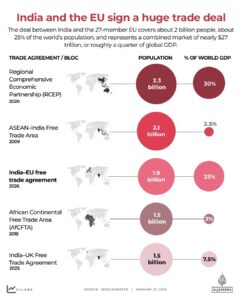
Dubbed as the “mother of all deals”, the agreement links India’s tightly guarded market to the 27 nations of the EU bloc. The focus will be on the manufacturing and services sectors and on easing market access for key European products such as cars and wine, in return for easier exports of textiles, gems, and pharmaceuticals. The formal signing of the agreement would take place later this year, after the legal scrubbing is complete and ratification by EU member states.
The evolution of bilateral ties and the FTA
Post-Cold War, shared democratic values increased political and economic engagement, leading to the establishment of a Strategic Partnership in 2004. The Eurozone crisis stalled the progress made under the Joint Action Plan (2005) and Broad-based Trade and Investment Agreement (BTIA) talks (2007). Ties remained under-leveraged as Europe turned inward and India diversified its partnerships, turning the relationship economically transactional and geopolitically underdeveloped.
The talks for the FTA started in 2007, but differences over market access for automobiles in 2013 led to a jettison. The EU had stringent legal mandates for Intellectual Property Rights (IPR), investment protection, massive import duty cuts and sustainable development goals (SDGs). India, on the other hand, needed a more liberal framework for skilled professionals, addressing non-tariff barriers and excluding government procurement.
The 2019 COVID-19 Pandemic resulted in supply chain shocks. China’s assertiveness triggered convergence on resilience and technology, leading to the revival of trade talks and the establishment of the trade and technology council (2022).The resumption of negotiations aimed at three separate agreements- two on investment protection and geographical indication, to try for an early harvest on trade. Issues like data privacy and security-related legislation, Carbon Border Adjustment Mechanism (CBAM) and IPR were not of primary concern and opening up government procurement was to follow the deals as concluded with the UAE and UK in 2025.
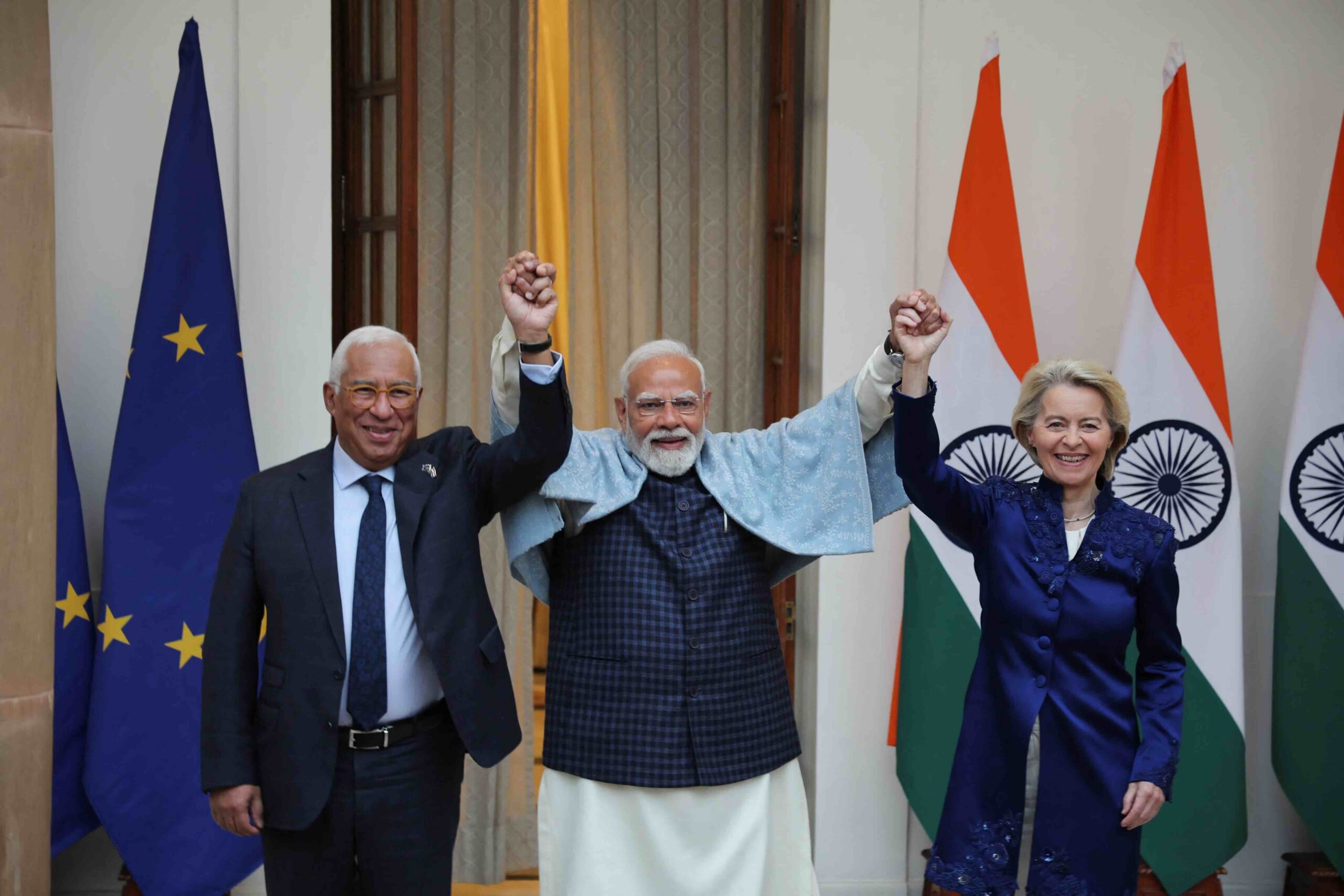
The FTA has now been finalised during the 16th India-EU summit, held in New Delhi on 27 January 2026. The summit has also led to the creation of a comprehensive strategic agenda towards 2030, which will replace the EU-India Strategic Partnership: A Roadmap to 2025. The past six months of accelerated talks leading up to the agreement are a by-product of incessant increases in tariff rates on the US side, China’s economic heft, and the economic impact on the EU from the Russian invasion of Ukraine. The deal aims to advance the security alignment between the EU and Indiaami with growing concerns about India’s ties with Russia.
The EU-India Agenda 2025 strategy is to reinforce prosperity and security with India. The key pillars of this engagement are foreign policy and security cooperation, trade and investment, sustainable modernisation, transport and urban development, clean energy, focus on outer space, artificial intelligence, issues such as global economic governance, migration and mobility, education and culture and human rights.
Sectors of engagement
Currently, the major focus of bilateral ties is the trade and services sector, which is showing steady growth. The EU is India’s largest trading partner; total merchandise trade with the bloc was 136.54 billion USD in 2024-25. Indian exports have increased from EUR 19 billion in 2019 to EUR 37 billion in 2024, and imports from the EU have also reached EUR 29 billion in 2024. India-EU trade in services reached INR 7.2 Lakh Crore (USD 83.10 billion) in 2024.
Security and defence ties have deepened since the College of Commissioners’ visit to India in February 2025. The statement from this visit agreed to explore a security and defence partnership between the EU Commissioner for Defence and Space and India’s Minister of State for Defence. Simultaneous visits from the EU delegation in September and December 2025 led to advances in strategic dialogue.
The talks have been complemented by joint naval exercises and escort operations for humanitarian assistance near Somalia in 2018 and 2019, the Gulf of Aden in June 2021, the Gulf of Guinea in October 2023 and the Indian Ocean in June 2025. On the sidelines of the EU-India summit, a security and defence partnership has also been signed. This will expand cooperation in maritime security, counter terrorism and cyber defence.
Benefits for EU countries
Tariffs on 96.6% of EU goods will be eliminated or reduced, saving up to 4 billion euros per year in duties on European products. The FTA grants a competitive advantage for EU exporters, granting the biggest trade opening India has given to any trade partner. The deal ensures privileged access to the Indian services market in key sectors like financial services and maritime transport, but also ensures protection of the EU intellectual property, like trademarks. This makes the customs procedures in exports quicker and easier.
Breaking down the available data on exports for 2024 and considering the current and finalised tariff rates for the upcoming year, the bilateral relations look promising. The exports of machinery and electrical equipment amounted to 16.3 billion euros in 2024, with prevailing tariff rates of 44%. Aircraft and spacecraft, optical, medical, and surgical equipment exports amount to up to 6.4 and 3.4 billion euros, with tariff rates of 11% and 27.5%, respectively. Exports of plastics and pearls, precious stones and metals amounted to 2.2 and 2.1 billion euros, with tariff rates of up to 16.6% and 22.5%, respectively, in 2024.
Similarly, trade in other products is depicted as product (amount of exports, tariff rates) as of 2024: In chemicals (€3.2 billion, 22%), motor vehicles (€1.6 billion, 110%), Iron and steel (€1.5 billion, 22%) and pharmaceuticals (€1.1 billion, 11%) are also remarkable. The future tariffs on these products, as part of the deal, will be 0% except for motor vehicles, which will be 10% with a quota of 250,000 EU vehicles annually; this is still beneficial for European car makers.
Benefits for Indian sectors
With the FTA, over 99% of Indian exports gain preferential entry into the EU, apart from bolstering the ‘Make in India’ initiative, granting new opportunities for MSMEs and creating jobs for women, artisans, youth and professionals. Indian products worth 75 billion USD are set to be exported, and commodities from sectors like textiles, leather, marine products, gems, and jewellery amounting to 33 billion USD will gain immensely from the preferential access from the FTA.
India is powered by a young and dynamic workforce that can be leveraged to unlock opportunities across sectors and to enhance competitiveness on the global stage. The FTA also helps in integrating Indian businesses more deeply into global value chains, ensuring the country maintains its role as a key player and supplier in global trade. The labour mobility agreement opens opportunities for young professionals and seasonal workers and brings India into the EU’s Horizon research programme. The EU’s commitment to opening 144 subsectors in IT, professional services and education, and to facilitating easier labour mobility has also brought in a positive outlook.
In exchange for the tariff cuts, the EU has granted India immediate zero-duty access for labour-intensive exports such as textiles, apparel, leather, footwear, gems and jewellery. The deal is also expected to boost India’s agricultural and food sector through preferential market access for its agricultural exports and increased competitiveness for processed foods.
Geopolitical side of the agreement
In the past two decades, EU-India relations have matured in a stable geopolitical environment. The India-US relationship and Europe’s transatlantic bond were held as a matter of long-term potential rather than immediate necessity. But the scenario has changed, with rampant changes in the political leadership and incessant wars. Russia’s invasion of Ukraine has forced Europe to commit to long-term defence rearmament and deterrence planning. The return of President Donald Trump to the White House has reduced trust and introduced uncertainty into Washington’s role for both Brussels and New Delhi, albeit in different ways.
The FTA was the result of a growing common concern: aggressive tariff rates by the US and its one-sided, unilateral approach with absolute disregard for the principle of reciprocity. Some EU countries recently faced fresh tariff threatsfrom Trump, who was put out by their refusal to accept his proposed takeover of Greenland. The deal was secured amid a flurry of countries striking deals and patching things up to navigate global uncertainty. During negotiations for the FTA, the potential repercussions of US interference were a concern, particularly the kinds of reactions to the agreement.
India-US Trade Deal
Fortunately for India, the US and India reached a trade deal on 1 February 2026, less than a week after the India-EU FTA was announced. The current tariff rates will be cut down from 50% to 18% on Indian goods in the US. The trade relationship between the US and India has been strained since the US imposed 50% tariffs, including a 25% penalty linked to India’s purchases of Russian oil. US stocks inched higher after Trump announced the deal with Delhi on Truth Social. On the other hand, this reduction will affect small businesses in the US, which will have to pay an average tariff of 2.5% on goods from India.
India, EU, Russia and China Relations
The EU-India relationship is often framed as a natural strategic alignment rooted in shared values and converging interests, but it is better understood as a parallel response to a shared pressure environment. India’s decision to preserve ties with Moscow, refrain from political condemnation, and expand economic engagement through a sharp rise in energy imports remains a persistent source of friction in the EU-India relationship. Meanwhile, recalibrated threat perceptions regarding economic and security policy are a serious point of friction with India. On the sidelines of the announcement of the trade deal, the EU has pressed for a change in India’s stance toward Moscow.
In their dealings with China, neither side can afford to fully decouple from Beijing. Deeper EU-India economic integration can help mitigate vulnerabilities linked to trade imbalances, technological dependence, and critical digital infrastructure. But India’s concerns about China’s territorial proximity and its defence engagement with Pakistan are significant. The FTA functions less as a mechanism for strategic risk reduction than as a political catalyst for strengthening resilience and autonomy.
Challenges
The lack of a resolution in some of the issues that jeopardised the finalisation of the deal in 2013 persists and is not addressed in the current agreement. Agricultural trade negotiations, which historically have been a sticking point, are kept outside the tariff reductions on both sides. Under the agreement, India will not be granted exemptions under the CBAM, which came into effect on 1 January 2026. CBAM can negatively impact Indian Iron and Steel exports. This was a contentious issue even in the India-UK FTA, with a fear of exporters from India having to pay ‘Green tax’. The duty-free access of EU goods into India can disrupt the trade balance and negatively affect domestic products.
On issues like easing of regulatory complexity, non-tariff barriers, high compliance standards, climate-related commitments, and rules of origin, both parties have differing interests. All of these issues carry adjustment costs that may be felt most acutely by exporters and suppliers operating with limited capacity. It would be critical to see whether, after the current geopolitical uncertainty settles, the intention to smooth these issues still remains.
The FTA’s ratification in the European Parliament is pending, but the commitment to early operationalisation means the deal is set to enter into force within a year. However, the EU-Mercosur agreement, concluded after 25 years of negotiations, is now facing opposition from the European Parliament. Although approval from each country is not necessary for the India-EU FTA to be operationalised, it would still need parliamentary approval.
Apart from the trade deal, the agreement also considers a broad array of topics. Maintaining balance amid shifting positions and competing geopolitical interests is essential for the deal to meet its preconditions.
Feature Image Credit: weforum.org
Infograph Credit: Al Jazeera
Leave a Reply