So, at a time when Israel finds itself on the back foot and bereft of friends, the question arises as to how have we ended up backing this losing horse? In actual fact, we have, as a nation, leaving aside the odd oligarch, little to gain from this relationship and much to lose.
Some may be aware of the global internet-based market research and data analytics firm, YouGov, that continuously collects and disseminates data from around the world on all manner of topics, concerns, and opinions, including political opinion polls. In fact, the banner headline on its website reads “YouGov: What the World Thinks”.
However, a caveat here worth keeping in mind, however accurate their polls, perceptions and opinions tend to be highly subjective and not necessarily an accurate reflection of ground realities.
For example, the vast majority around the world must necessarily be quite upset with the intemperate behaviour and antics of President Trump, especially his blatant racism, misogyny and the horrendous Epstein allegations. Apart from the horrific devastation he has wrought in Iran, his clampdown on immigration and the tariff fiasco have had a debilitating impact globally.
Given his multitude of sins, one could easily be forgiven for believing that he must surely be the worst performing and least popular President in American history. One would be wrong in drawing such a conclusion, because YouGov in its latest polls ranks him 38th out of the 45 Presidents to date. Incidentally, not unexpectedly, Abraham Lincoln leads this poll, with George Washington a close second, followed by John F Kennedy.
Interestingly, among the top three Presidents in popularity, two ended up assassinated. This not only makes popularity a questionable aspiration in the States, but also speaks volumes about the American psyche. Indeed, Trump would probably do well to avoid topping the charts, though if history is any indication, the real threat to his life may well lie elsewhere, and not necessarily from Iran, if some commentators are to be believed.
There is an interesting series on Substack by US Navy veteran, Rolf Kvalvik, on the JFK assassination that makes fascinating reading—-
In this eight-part series, he delves into new documentation that has recently been unclassified, ironically enough by President Trump, on the assassination of President Kennedy.
He points out that President Kennedy was extremely upset with Israel over its secret nuclear weapons programme and had put in motion various robust steps to shut it down. Going so far as to threatening to cut off all aid to that country, apart from clipping the wings of the very influential Zionist lobby in the States. So much so, that his actions were perceived as an existential threat by the Israeli leadership.
In Kvalvik’s view, he was thus neutralised by the Israeli Intelligence Services working in collusion with rogue elements within the CIA, the Mafia, Zionist lobby groups in the United States and some senior politicians.
Indeed, following his murder, Israel benefitted the most. Within days President Johnson ensured JFK’s directives against Israel were watered down sufficiently enough to make them ineffective and within two years Israel had produced a workable nuclear bomb.
Trump must be fully aware of what these and other documents hold, as well as of the brutal truth that the Zionist regime will stop at nothing, including blackmail, assassination, deception and false flag operations, in its pursuit of its Greater Israel agenda.
As remains evident, Zionist influence on Congress and the Government is fairly obvious, and in the circumstances one can clearly understand Trump’s fawning over Netanyahu, and as to why the Israeli tail gets to wag the American dog when it comes to West Asia.
Unfortunately for Israel, however, their pet project appears to have hit a dead end, thanks to Iran’s intransigence, against which even American military power seems rather ineffectual. Of course, America does have the ability to initiate massive destruction all around, but that in turn is bound to result in a military confrontation with Russia and China. Even Trump’s compromised military leadership must baulk at such a possibility.
So, at a time when Israel finds itself on the back foot and bereft of friends, the question arises as to how have we ended up backing this losing horse? In actual fact, we have, as a nation, leaving aside the odd oligarch, little to gain from this relationship and much to lose.
Aside from advanced weaponry, whose value in the transformed conventional warfare environment is highly questionable, seeing their inability to stop Iranian attacks, they have little to give us. In any case, those weapons don’t come cheap.
Of course, there is the employment factor, as Israel is keen; we provide the menial and blue- collar labour they require as replacement for the Palestinians who performed those tasks earlier. Ironically, one could say we are Israel’s equivalent of the much-maligned Bangladeshi’s here. In any case, this will amount to around a lakh or so at best finding employment.
Our importance lies in what Brigadier General (Reserve) Erez Winner told a mainstream television channel: “Israel has 1.4 billion Indians as a production line”. We are perceived by them as bonded labour available to them to fulfil their Zionist agenda.
From the Israeli point of view, however, apart from providing their murdering conscripts a safe and cheap haven to chill out in after completion of their terms, our importance lies in what Brigadier General (Reserve) Erez Winner told a mainstream television channel: “Israel has 1.4 billion Indians as a production line”. We are perceived by them as bonded labour available to them to fulfil their Zionist agenda.
Being perceived as lackeys of the Israeli-American duopoly is hardly helpful for the government’s reputation and plainly demeaning for us as well. Clearly, in purely geopolitical or socio-economic terms, there is hardly any reason to justify our pro-Israel tilt. Especially given that around 10 million of our citizens are employed around the region, other than in Israel.
Some opposition politicians, analysts and commentators here tend to believe that our government’s tilt towards Israel is predicated on the fact that the Hindutva and Zionist agenda have much in common, especially in regard to their virulent hatred for the Muslim community. While there may well be some truth to this, it is inconceivable that any government would risk its relationship with other countries of the region over this, given the socio-economic impact that would have.
In the circumstances, it increasingly appears, as Mr Gandhi and the Congress allege, that our government is being held hostage to other extraneous factors that could well embarrass the government if they ever came into the public domain. One cannot help but wonder what cost the general public will have to pay in the long term to keep these secrets out of the public eye.
U.S. is raising vague arguments and challenges such as ‘forced labour’ and ‘surplus capacity’, while advanced countries do not help with technological development.
On July 15, the India-U.K. trade deal came into force. That day, India banned the import of goods made using forced labour so as not to get unfavourable treatment from the U.S. under Section 301. A day later came the news that a bipartisan Bill has been proposed by U.S. Senators to levy up to 100% tariff on India and others for buying Russian crude. One way or the other, India’s trade with the U.S. is being buffeted by bottlenecks.
China’s trade
In contrast, without a trade deal, China has become India’s largest trading partner. Imports from China in the first half of 2026 have shot up by 21.8% while exports have risen by 37.2%, though on a small base. The already-high trade deficit with China of $116 billion last year is likely to rise since it has already topped $67 billion in the first half of the current year. The imports from China are high- and low-tech items, while exports are mostly low-value-added items.
India’s dependence on China is overwhelming. Factories and exports increasingly depend on China for machinery and intermediates. For instance, pharmaceuticals depend on imports of API from China. The average wage rates in key sectors such as automobiles and apparel are half to one-third of China’s. Yet, India is unable to outcompete China in global markets because of the huge technological advantage the latter has gained in the past 35 years.
While multinational companies (MNCs) have invested in China, as a share of total investment, it has been small. Further, to capture markets, China has been investing in other countries under the One Belt, One Road initiative. Thus, net foreign investment in China has been small. Finally, as Chinese companies have become big, they are outcompeting MNCs such as Tesla. And many U.S. companies have left China, including Amazon, Apple, Dell, IBM, and Uber.
India is unable to finalise a trade deal with the U.S. since at least July 2025, though Commerce Minister Piyush Goyal keeps assuring the nation that it is almost done. Last August, India’s exports were hit by a 50% tariff, leading to a decline in labour-intensive exports of apparel, shrimps, leather goods, and so on. India’s overall trade deficit increased in 2025 to $120 billion from $94 billion in 2024. China faced high US tariffs, but by diversifying trade, it increased its trade surplus in 2025 to $1.19 trillion from $992 billion in 2024.
Technology and investment
The lesson is that technology is the key to trade in today’s globalised world. China is accused by the West of currency manipulation and massive government help to cheapen its exports. The implication is that China is draining its surplus to sell to the rest of the world. And, it is supposed to have been doing so for at least the past 35 years. Such trade over long periods of time should have drained resources and made China suffer. Instead, the Chinese economy has boomed and become five times larger than India’s economy.
The reason is China’s high savings rate of above 35% of GDP since the 1980s and at times reaching close to 50%. This has been able to finance its huge investments of 40% and more, peaking at 47%. Its growth has not depended on foreign investment.
This massive investment has enabled China to invest in technology development and expand its industry. This has fuelled rapid economic growth, and initial low consumption levels have risen rapidly, as is visible in any modern Chinese city. The U.S. has tried to thwart Chinese advances in technology by putting restrictions, but China has managed to circumvent that and continue upgrading technology. So much so that the U.S. has come to depend on Chinese imports.
Since Trump has squeezed India, the latter has entered into trade agreements with important trade partners — the U.K., the European Union, the UAE, New Zealand, and so on. But caution is required since the earlier trade agreements with Japan, Korea and Australia led to a larger trade deficit with them. India could not increase its exports as much as others could because of their technological advantage.
The advanced countries have not helped India with technological development. They want to export but not share technology. The United States Deputy Secretary of State said at the Raisina Dialogue in New Delhi that the U.S. made a major strategic and economic error roughly 20 years ago by giving China extensive access to American markets, technology, and capital. He said such a mistake would not be made vis-a-vis India. The implication is that India has to develop its own technology; otherwise, it will lag behind the advanced countries and China.
Forced labour
By investigating India on “forced labour” under Section 301, the U.S. is seeking to create a bottleneck to extract concessions. Forced labour implies coercion to work. Workers have no choice but to do the bidding of the employer because the option is hunger. Employers take advantage and pay low wages. This gives an exporter an advantage as its produce becomes cheaper. The U.S. says that is unfair to its producers.
But wages in the developing world are much less than in the advanced nations. Does that mean that all production in the developing world is using forced labour? In India, unorganised labour receives low wages since it has little bargaining power to obtain decent wages. Thus, most of India’s production can be said to be based on forced labour. And its imports from developing nations can be said to be based on forced labour. This is a non-tariff barrier that the U.S. wants to apply to India.
Another non-tariff barrier the U.S. is threatening to use is “surplus capacity” in steel, textiles, and so on. Any export by any country is over and above what it uses within its own territory. So, all export is based on surplus capacity. The U.S. has a massive agricultural surplus which it wants to dump on India. Its companies provide massive amounts of defence armament to the rest of the world. Which country does not produce for export so that it can import what is needed by its economy? Entire trade depends on these surpluses based on “comparative advantage”. So, what is India being penalised for? Are these bargaining chips to extract concessions?
India’s trade with the U.S., till recently its largest trading partner, is being buffeted by vague arguments and challenges. Earlier it was the so-called “reciprocal tariffs” and now, Russian crude purchases, “forced labour” and “surplus capacity”. This huge uncertainty is buffeting Indian exporters. Indian officials negotiating a trade deal with the U.S. were hoping for favourable treatment, but that seems unlikely.
Meanwhile, trade with China has boomed, though there is no trade agreement with it. India avoided joining the RCEP in 2019 to stall Chinese dominance. Given U.S. coercive steps on trade, both India and China have diversified their trade with the rest of the world. That is the way to go. And the lesson from China is that trade deals or not, India needs to upgrade its R&D to become globally competitive.
This article was published earlier in ‘The Hindu.”
Feature Image Credit: aninews.in US Trade Representative Jamieson Greer meeting Union Minister of Commerce and Industry Piyush Goyal in New Delhi in June. | Photo Credit: ANI
Series: India’s Strategic Choices and Civilisational Responsibilities
The ideology that today presents itself as the authentic voice of Hindu civilisation was constructed by an atheist using conceptual tools borrowed from European ethnic nationalism — the very tradition most alien to India’s own pluralist philosophical inheritance.
In the previous two posts in this prologue, I traced the material foundations and ideological engine of five centuries of Western domination. I argued that India’s civilisational traditions offer a fundamentally different foundation for the emerging world order: pluralist, ethically grounded, and rooted in the universal kinship expressed in Kanian Poongundranar’s “Yaadhum Oorey, Yaavarum Kelir” and the Thirukkural’s vision of Aram, Porul, and Inbam. But intellectual honesty requires that the mirror be turned inward. Because the logic of exceptionalism — the claim to a uniquely chosen identity that exempts a community from the ethical constraints applying to others — is not exclusively a Western pathology. It is a temptation that every civilisation faces when political power finds it useful. And India is not immune.
The ideology known as Hindutva, which exercises dominant political influence in India today, must be examined with the same analytical rigour we have applied to Western and Zionist exceptionalism. Not because the comparison is comfortable — it is not — but because intellectual integrity demands it, and because India’s civilisational integrity depends on it. The examination is best conducted in three stages, because the ideology was not built in one.
Stage One: The Founder Who Separated the Nation from the Faith
The first and most important fact is one the movement rarely acknowledges: “Hindutva is not Hinduism.” Hindutva was founded by an atheist, and it was not, in its original formulation, a religious idea at all. Vinayak Damodar Savarkar, who coined the term in his 1923 pamphlet ‘Essentials of Hindutva’, was a self-declared atheist, rationalist, and materialist. He rejected scripture, ridiculed cow worship and ritual superstition, and championed European scientific temper over what he saw as the dead weight of religious tradition. He was explicit that Hindutva was not Hinduism. He defined a ‘Hindu’ not by religious belief but by three criteria: Pitribhumi, a common fatherland; Jati, a common race or descent; and Sanskriti, a common culture. A Hindu, in Savarkar’s definition, need not believe in any god at all. What mattered was that India was both his fatherland and his Holyland — a territorial and ethnic test, not a spiritual one.
Savarkar defined a ‘Hindu’ not by religious belief but by three criteria: Pitribhumi, a common fatherland; Jati, a common race or descent; and Sanskriti, a common culture.
Johan Caspar Bluntschli
Where did this conception come from? Not from the Vedas, the Upanishads, or any Hindu philosophical source. It came from Europe. Savarkar’s framework of organic ethnic nationalism drew on the nineteenth-century European tradition of the nation as a racial-cultural organism — the tradition of the Swiss-born jurist Johann Kaspar Bluntschli, who worked within German Staatslehre and distinguished between a nation’s racially rooted ‘principal’ people and those he regarded as alien to it. It drew, too, on the ethnic nationalisms then ascendant across Europe, the same intellectual currents that were hardening elsewhere into far darker forms. This is the first irony, and it is foundational: the ideology that today presents itself as the authentic voice of Hindu civilisation was constructed by an atheist using conceptual tools borrowed from European ethnic nationalism — the very tradition most alien to India’s own pluralist philosophical inheritance.
Stage Two: The Fusion of Ethnic Nationalism with Religious Sentiment
If Savarkar’s Hindutva was a rationalist, secular-ethnic nationalism, how did it become the religiously charged mass movement we see today — mobilising temple, festival, deity, and devotional feeling for political ends? The answer is that this was a second and distinct stage, carried out by different men, for a different purpose: mass mobilisation.
M S Golwalkar
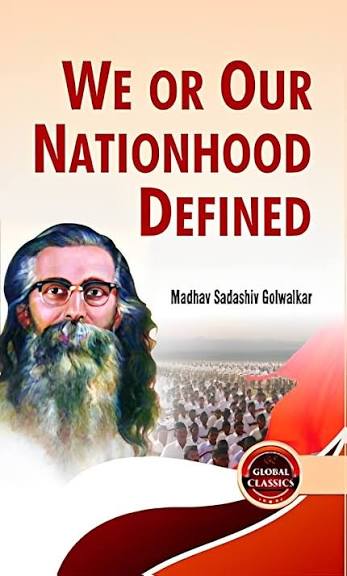
M.S. Golwalkar, who led the Rashtriya Swayamsevak Sangh from 1940 to 1973, shifted the register decisively. Where Savarkar grounded the nation in race and territory and had little use for religion as such, Golwalkar infused the project with Hindu spiritual and metaphysical content — the sacredness of Bharat, the dharmic mission of the Hindu people, a civilisational destiny cast in religious language. Deendayal Upadhyaya’s doctrine of ‘Integral Humanism,’ adopted in 1965 and later made the official ideology of the Jana Sangh and then the Bharatiya Janata Party, further anchored the political project in a claimed Hindu spiritual essence. The reason for the shift is not difficult to understand. An abstract theory of ethnic nationalism, however rigorously constructed, cannot move a population. Religious sentiment — festival, symbol, deity, the deep and genuine devotional attachment of hundreds of millions of people — is among the most powerful mobilising forces in human affairs. The movement discovered what its rationalist founder had not prioritised: that to win a nation, you must reach its heart, and in India the heart is substantially religious.
One need not impute cynical motive to any individual to observe the structural result. A political ideology founded on secular-ethnic lines was, over subsequent decades, fused with the religious devotion of the Hindu masses — and in that fusion, the crucial distinction Savarkar himself had insisted upon, between Hindutva the political-national identity and Hinduism the faith, was quietly erased. The movement that claims to defend Hindu dharma was built on a foundation laid by a man who had little personal use for dharma as religion at all.
And Savarkar himself never crossed over. He remained an atheist and rationalist to the end of his life — campaigning against ritualism and caste orthodoxy through his Ratnagiri years, opening the Patit Pavan Mandir to all castes, arguing for care of the cow as a useful animal rather than worship of it as a sacred one. His relations with the RSS were notably cool; he scorned its abstention from politics, and Golwalkar’s mysticism belonged to a register the materialist Savarkar never adopted. His death in 1966 was a final statement: he ended his life by voluntarily renouncing food and medicine, justified in a rationalist essay, and his will forbade religious rites — no priests, no rituals, a motorised hearse in place of the traditional bier. The founder kept Hindutva and Hindu religiosity separate for eighty-three years, to the point of a ritual-free funeral. The fusion of the two was not his evolution. It was a second construction, built around him and after him — which is precisely why it can be unbuilt.
The Zionism Parallel: A Precise Structural Homology
This two-stage pattern is not unique to Hindutva. It follows, with striking precision, the trajectory of political Zionism — and the comparison is instructive rather than incidental. Theodor Herzl, the founder of political Zionism, was a secular, largely non-religious Viennese journalist. His 1896 work Der Judenstaat is a political and national argument, not a religious one; early political Zionism was in large part a secular nationalist movement, and many Orthodox religious authorities initially opposed it precisely because it presumed to force a national project onto what they regarded as a matter of faith and divine timing. Only later did the movement fuse itself with religious claim — the theological reading of the land, the mobilisation of scripture, and the memory of the Holocaust deployed as a unifying and legitimating force. The structure is identical to the Hindutva trajectory: a secular founder formulates an ethnic-national ideology; later leaders infuse it with religious sentiment and collective memory to achieve mass appeal and to place the project beyond ordinary political criticism.
The Warning: Where this Trajectory Leads
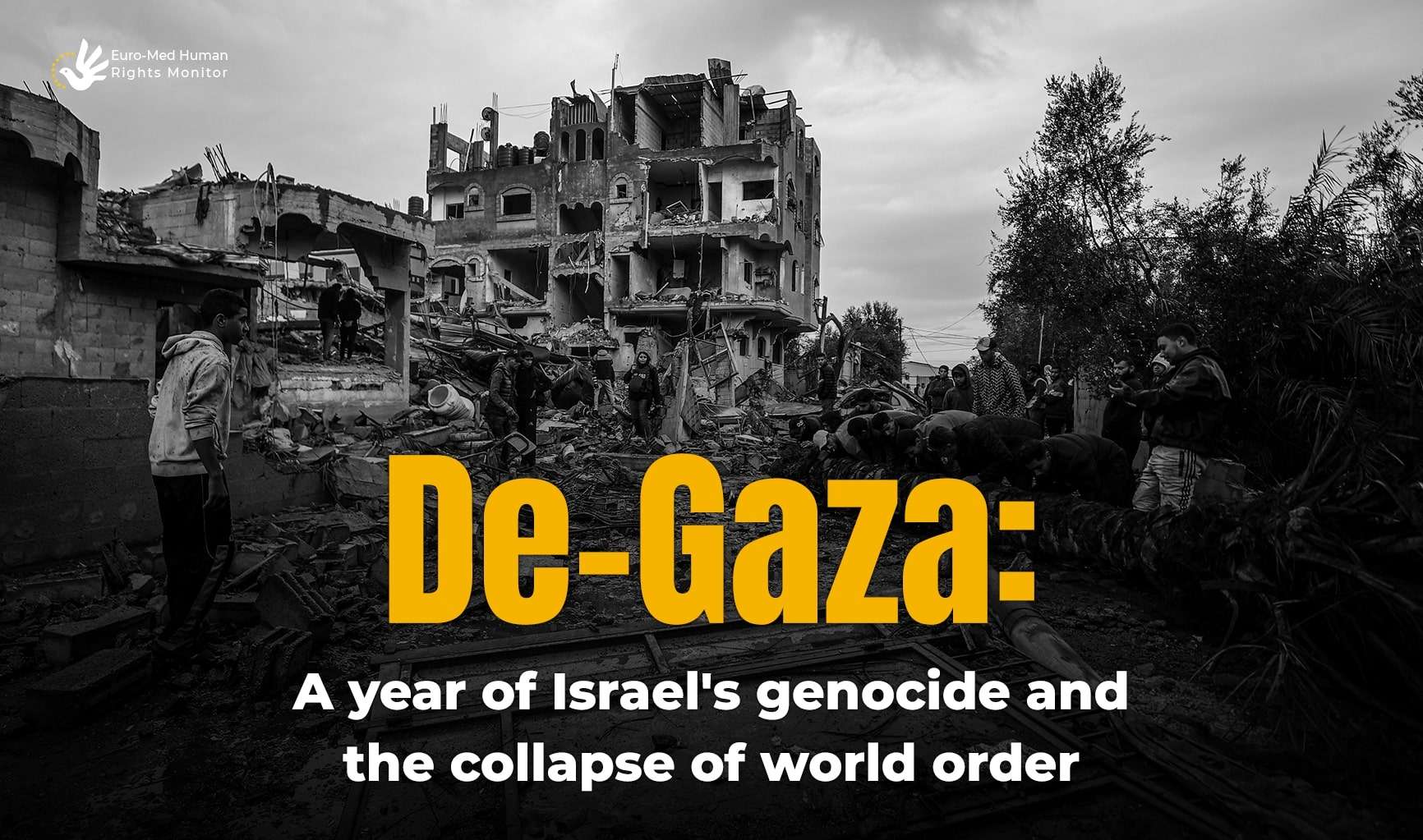
Euro-Med Human Rights Monitor brought out this report after the first year of war in Gaza by Israel. It has now been on for more than three years and has engulfed the entire West Asia.
And here the parallel carries a warning that thoughtful Indian people cannot afford to ignore. For if Hindutva’s path resembles Zionism’s in how the ideology is built, we must look honestly at where that path has led. The fusion of a secular-ethnic nationalism with religious claim did not strengthen the moral standing of the project it produced. It corrupted it. The state that emerged now stands, in the aftermath of Gaza, in a condition of profound moral and political isolation — its conduct condemned across much of the world, its claim to act in the name of an ancient faith increasingly repudiated by the faithful themselves. Many Jews who practise Judaism as a religion and a moral tradition have publicly dissociated themselves from the actions of the Israeli state, insisting on the very distinction this essay draws: that a faith is not the same as a political-national project conducted in its name, and that the project does not speak for the faith. Judaism, one of humanity’s great ethical traditions, has been ill-served by what has been done in its name.
Many Jews who practise Judaism as a religion and a moral tradition have publicly dissociated themselves from the actions of the Israeli state, insisting on the very distinction this essay draws: that a faith is not the same as a political-national project conducted in its name, and that the project does not speak for the faith. Judaism, one of humanity’s great ethical traditions, has been ill-served by what has been done in its name.
The warning for India is exact. Hindutva today shows every sign of being on a similar trajectory — the same fusion of ethnic nationalism with mobilised religious sentiment, the same erasure of the distinction between a faith and a political project, the same tendency to place that project beyond criticism by wrapping it in the sacred. If it continues down that path, it risks doing to Hinduism what political Zionism’s corruption has done to Judaism: isolating it, discrediting it, and betraying its deepest moral content — all in the name of defending it.
Why This Matters: And What is at Stake
This is why the distinction between Hinduism and Hindutva is not academic hair-splitting. It is the difference between a civilisation and an ideology that has captured its name. Hinduism is one of the oldest and most philosophically sophisticated traditions on earth. It has no single founding prophet, no single canonical scripture, no orthodoxy, and no mechanism for excommunicating heretics — because diversity of belief and inquiry is not a problem to be solved but the natural condition of a tradition too vast for any single formulation to contain. Its foundational statement, from the Rigveda, is Ekam Sat Vipra Bahudha Vadanti: truth is one, the wise call it by many names. It gave the world the Upanishads, the Jain Anekantavada — the many-sidedness of truth — the Buddha and Mahavira, the Bhakti and Sufi streams, the Tamil saint Vallalar’s image of the many religions as rivers merging into a single shoreless ocean. It is, arguably, the most spiritually plural and philosophically generous civilisational inheritance humanity possesses.
Hinduism is one of the oldest and most philosophically sophisticated traditions on earth. It has no single founding prophet, no single canonical scripture, no orthodoxy, and no mechanism for excommunicating heretics — because diversity of belief and inquiry is not a problem to be solved but the natural condition of a tradition too vast for any single formulation to contain.
Hinduism’s foundational statement, from the Rigveda, is Ekam Sat Vipra Bahudha Vadanti: truth is one, the wise call it by many names. It gave the world the Upanishads, the Jain Anekantavada — the many-sidedness of truth — the Buddha and Mahavira, the Bhakti and Sufi streams, the Tamil saint Vallalar’s image of the many religions as rivers merging into a single shoreless ocean. It is, arguably, the most spiritually plural and philosophically generous civilisational inheritance humanity possesses.
A country with over 200 million Muslim citizens — the second-largest Muslim population in the world — cannot credibly champion the Global South, the voice of universal human dignity, or the reform of the world order, if its dominant political ideology frames those citizens as the internal Other. And an ideology founded by an atheist on borrowed European ethnic-nationalist theory, later dressed in religious sentiment for political mobilisation, cannot be the authentic voice of the tradition of Ekam Sat and Anekantavada. It is, in the most precise sense, that tradition’s negation.
The strongest argument against Hindutva, therefore, is not secular liberalism, and not the critique of any political party. It is Hindu philosophy itself — the Upanishads, the Thirukkural, the Anekantavada, Vallalar’s Ocean, the Sangam world’s ‘Yaadhum Oorey, Yaavarum Kelir’. These traditions do not need political exceptionalism to survive; they are diminished by it.
“Ekam Sat Vipra Bahudha Vadanti: truth is one; the wise call it by many names” – Rigveda
Safeguarding India’s civilisational soul from the exceptionalism now deforming it from within is not an act of opposition to Hindu culture. It is its most authentic defence — and it is a task for every Indian who understands the depth of what is being risked.
— This is the third and final part of the series prologue. The series proper begins with the next post.
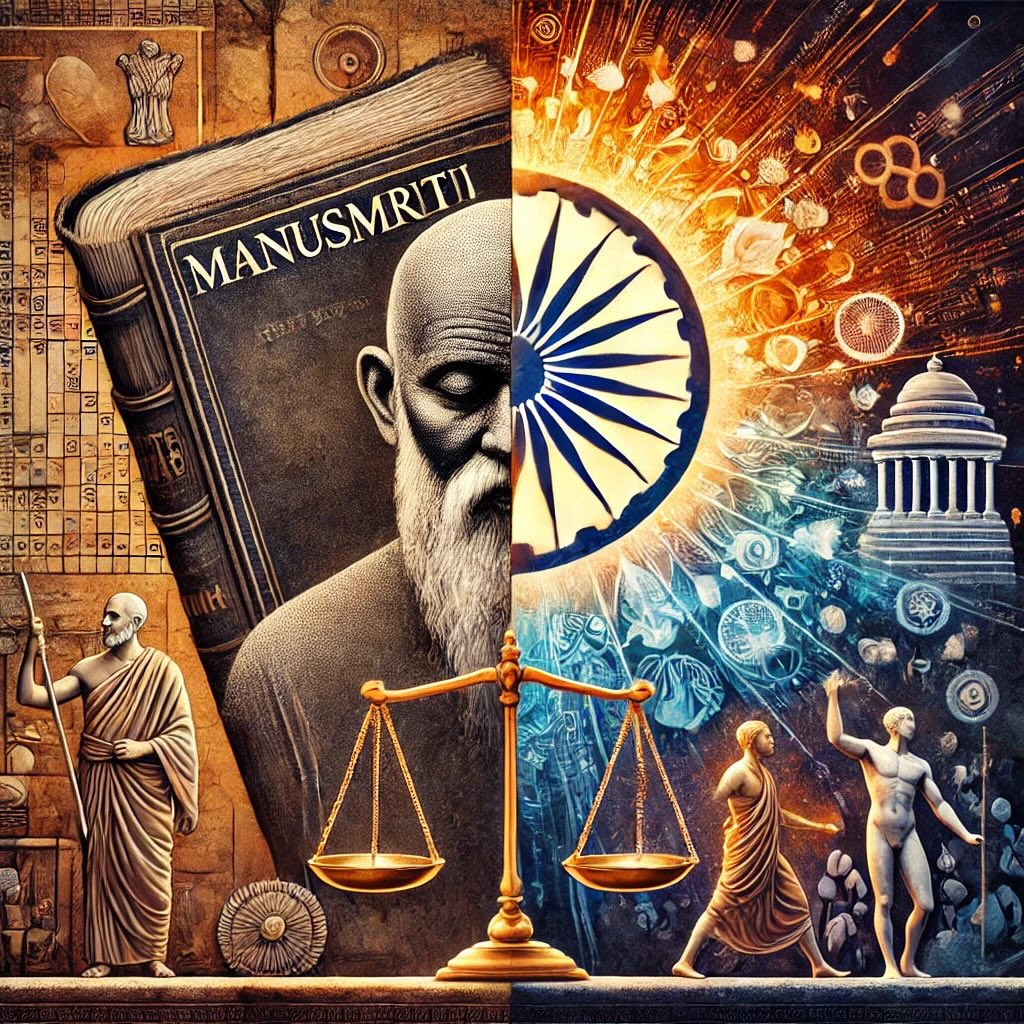
A companion essay, ‘The Constitution or the Manusmriti: India’s Civilisational Choice,’ extends this argument and is available at thepeninsula.org.in.
Air Marshal M Matheswaran (Retd) is the Founder-President of The Peninsula Foundation (@TPF_Chennai), grounded in the conviction that India’s greatest strength is its civilisational pluralism — and that any ideology, domestic or foreign, that threatens that pluralism threatens India itself.
Further Reading:
On Savarkar, his atheism, and the formulation of Hindutva:
Vinayak Damodar Savarkar, Essentials of Hindutva (1923); republished as Hindutva: Who Is a Hindu? (1928).
Janaki Bakhle, Savarkar and the Making of Hindutva (Princeton University Press, 2024).
The definitive intellectual biography; on Savarkar’s atheism, rationalism, and the territorial-ethnic (not religious) definition of the Hindu.
Vikram Visana, ‘Savarkar before Hindutva: Sovereignty, Republicanism, and Populism in India, c. 1900–1920,’ Modern Intellectual History (Cambridge University Press, 2021).
On Savarkar’s debt to European ethnic-nationalist thought, including Bluntschli.
Johann Kaspar Bluntschli, The Theory of the State (1875; English trans. Clarendon Press, 1885).
Bluntschli was Swiss-born (Zurich, 1808), working within the German tradition of Staatslehre.
On the shift to religious mass mobilisation — Golwalkar and Upadhyaya:
M.S. Golwalkar, We, or Our Nationhood Defined (1939) and Bunch of Thoughts (1966).
Deendayal Upadhyaya, Integral Humanism (1965).
Christophe Jaffrelot, The Hindu Nationalist Movement and Indian Politics, 1925 to the 1990s (Hurst, 1996).
On the RSS’s development and the religious infusion of Savarkar’s originally secular-ethnic framework.
Chetan Bhatt, Hindu Nationalism: Origins, Ideologies and Modern Myths (Berg, 2001).
On political Zionism, its secular origins, and Jewish dissent:
Theodor Herzl, Der Judenstaat (The Jewish State) (1896).
Shlomo Sand, The Invention of the Jewish People (Verso, 2009).
Yakov M. Rabkin, A Threat from Within: A Century of Jewish Opposition to Zionism (Fernwood/Zed Books, 2006).
On the theological and secular Jewish opposition to political Zionism, from its origins to the present.
On Hindu philosophical pluralism:
Rigveda, 1.164.46: Ekam Sat Vipra Bahudha Vadanti.
The Indian Constitution is not merely a legal document. It is a civilisational achievement, and arguably the most important moral document India has ever produced — more consequential than any scripture, because it carries the binding force of law and the democratic legitimacy of a sovereign people’s collective commitment to one another.
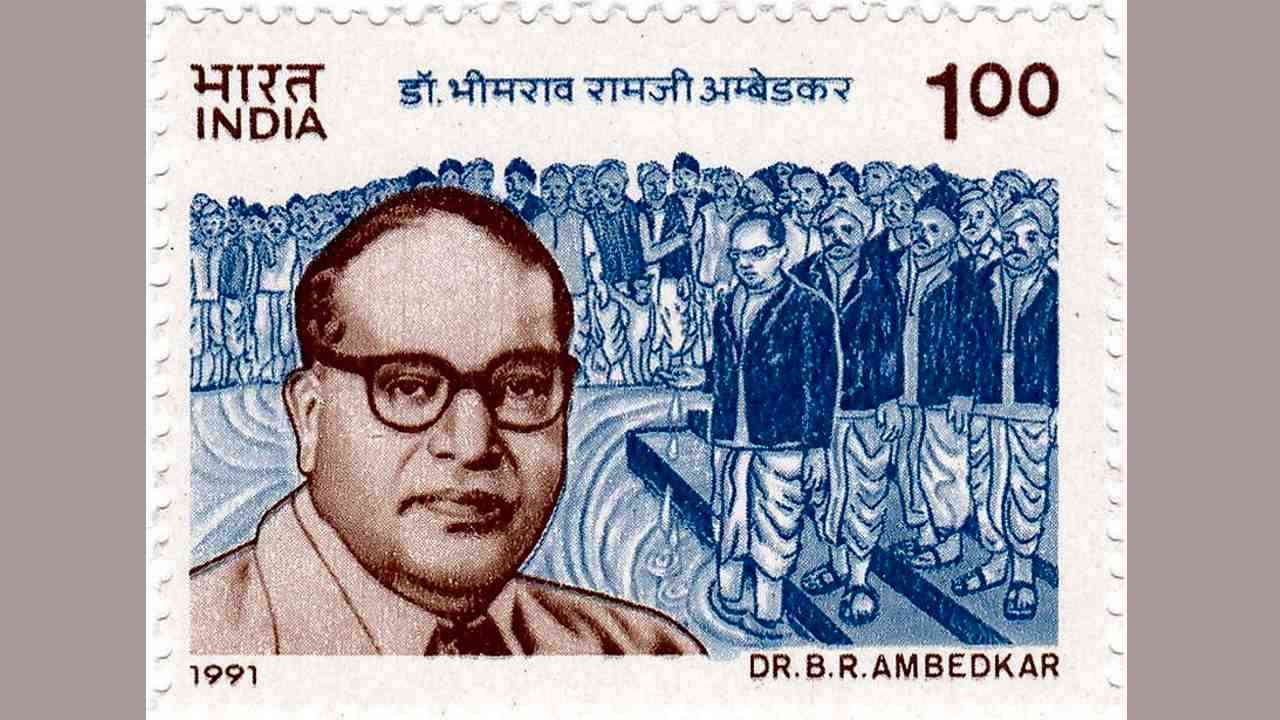
On 25 December 1927, in the small coastal town of Mahad in Maharashtra, Dr B.R. Ambedkar stood before a specially constructed pyre and set fire to a copy of the Manusmriti. It was not an act of rage. It was an act of civilisational critique — the most deliberate and consequential symbolic gesture in the history of India’s struggle for human dignity.
The Manusmriti — the Laws of Manu, composed between approximately 200 BCE and 200 CE — is a Dharmashastra, a text of social and legal prescription that codifies a system of human inequality so comprehensive and so absolute that it assigns worth, rights, duties, and punishments on the basis of birth alone. It is not a text that merely reflects the prejudices of its era. It is a text that systematises those prejudices into an architecture of oppression — and then claims divine sanction for it.
Its prescriptions are worth stating plainly, because the groups that invoke its authority today rarely quote them. A Shudra, the Manusmriti declares, is created to serve the three higher varnas. Even if emancipated by his master, he is not released from servitude, “since that is innate in him — who can set him free from it?” A Shudra who dares to recite the Vedas shall have hot molten lead poured into his ears. A Shudra who presumes to sit on the same seat as his superior shall be branded and banished.
On women, the text is equally explicit: “In childhood, a female must be protected by her father; in youth, by her husband; when her lord is dead, by her sons. A woman should never be independent.” Women and Shudras are grouped together in multiple passages — as categories of humanity requiring permanent supervision, incapable of autonomy, and unfit for learning.
The Manusmriti does not merely describe inequality. It prescribes it as sacred duty — ordained by creation, enforced by punishment, and justified by divine law. It is, by any ethical standard that takes human dignity seriously, a blasphemy against it.
These are not peripheral verses. They are the structural logic of the text. The Manusmriti does not merely describe inequality. It prescribes it as sacred duty — ordained by creation, enforced by punishment, and justified by divine law. It is, by any ethical standard that takes human dignity seriously, a blasphemy against it. This is what Ambedkar understood — and what he burned.
But Ambedkar did not stop at rejection. He built the answer. The Indian Constitution, which Ambedkar went on to draft as Chairman of the Drafting Committee and which was adopted on 26 January 1950, is the most comprehensive and systematic repudiation of the Manusmriti’s vision of human society that any civilisation has ever produced. Every foundational provision of the Constitution is the precise negation of a Manusmriti prescription.
Where the Manusmriti assigns human worth by birth, Article 14 guarantees equality before the law to every person. Where it prescribes differential punishment by caste, Article 15 prohibits discrimination on grounds of religion, race, caste, sex, or place of birth. Where it declares that a Shudra is created to serve, Article 17 abolishes untouchability in all its forms and makes its practice a punishable offence. Where it assigns women to perpetual dependency, Articles 15 and 16 guarantee equal rights and opportunities regardless of gender. Where it reserves learning for the upper castes, the Constitution establishes education as a fundamental right for all.
The Constitution does not merely reject caste. It replaces the entire ontological framework of the Manusmriti — the idea that human beings are born into fixed, divinely ordained hierarchies — with a radically different proposition: that sovereignty resides in the people, that every citizen carries equal dignity, and that the state exists to serve all of them without distinction. This is not merely a legal document. It is a civilisational achievement, and arguably the most important moral document India has ever produced — more consequential than any scripture, because it carries the binding force of law and the democratic legitimacy of a sovereign people’s collective commitment to one another.
Which brings us to the present. There are political forces in India today that invoke the Manusmriti — not always openly, but through the framework of social hierarchy and caste assertion it codifies — and regard the Constitution’s egalitarianism not as India’s greatest moral achievement but as an obstacle, an imposition of Western liberal values on an ancient civilisation. This argument must be met head-on, because it is both historically false and civilisationally dangerous.
The Constitution is as Indian as the Rigveda. It is more Indian than the Manusmriti, which codifies a hierarchy that India’s own deepest philosophical traditions — the Upanishadic teaching that the Atman is one in all beings, the Thirukkural’s insistence on a common human dignity, the Tamil Sangam’s declaration that every person is kin — explicitly reject.
First, the Constitution is not a Western import. It was drafted by an Indian — among the most intellectually formidable Indians of the 20th century — who drew not only on Western constitutional traditions but on the Buddhist principles of liberty, equality, and fraternity, on the Bhakti movement’s radical egalitarianism, and on his own lived experience as a Dalit denied water from a public well because of his birth. The Constitution is as Indian as the Rigveda. It is more Indian than the Manusmriti, which codifies a hierarchy that India’s own deepest philosophical traditions — the Upanishadic teaching that the Atman is one in all beings, the Thirukkural’s insistence on a common human dignity, the Tamil Sangam’s declaration that every person is kin — explicitly reject.
Second, to elevate the Manusmriti above the Constitution is not a defence of Hindu civilisation. It is its betrayal. Hindu civilisation at its greatest has always been characterised by philosophical openness and the recognition that truth cannot be confined to a single text. The Manusmriti is not the tradition. It is a single prescriptive text from a single period — and it is contradicted by the tradition’s own deepest currents.
Third — and this is the point that must be made most clearly — the Indian Constitution is the instrument through which India chose, as a sovereign people, to become something better than its worst historical inheritance. Every nation has texts and traditions that codify inequality. What distinguishes a civilisation is not the absence of such texts but the courage to repudiate them and the wisdom to build something better. Ambedkar gave India both: the courage to burn the Manusmriti, and the wisdom to write the Constitution.
The choice India faces today is the same one Ambedkar posed in 1927, and the same one the Constituent Assembly resolved in 1950: whether India’s social and political order will be governed by a text that assigns human worth by birth — or by a document that declares, with the full force of democratic sovereignty, that every Indian citizen is born equal, lives equal, and deserves equal dignity, opportunity, and protection under the law. That is not a political question. It is a civilisational one. And for those of us who believe in India’s civilisational greatness — in the Rigveda’s declaration that truth has many names, in the Thirukkural’s universalism, in the Sangam poet’s conviction that every person is kin — the answer is not in doubt.
The Constitution is not the enemy of Hindu civilisation. It is its finest modern expression.
Air Marshal M Matheswaran (Retd) is the Founder-President of The Peninsula Foundation (@TPF_Chennai), an independent policy research think tank in Chennai, grounded in the conviction that India’s civilisational greatness lies in its pluralism — and that the Indian Constitution is its most important institutional guarantee.
This essay is a companion to the third article in the prologue in the series ‘India’s Strategic Choices and Civilisational Responsibilities,’ published at thepeninsula.org.in.
Further Reading:
On the Manusmriti
Patrick Olivelle, Manu’s Code of Law: A Critical Edition and Translation of the Manava-Dharmasastra (Oxford University Press, 2005).
The authoritative modern critical edition and translation; source for all verse citations in this essay.
Wendy Doniger and Brian K. Smith, trans., The Laws of Manu (Penguin, 1991).
On Ambedkar and the Mahad Satyagraha
B.R. Ambedkar, Writings and Speeches, vols. 1–17 (Government of Maharashtra, 1979–2003).
Christophe Jaffrelot, Dr Ambedkar and Untouchability: Analysing and Fighting Caste (Hurst, 2005).
Eleanor Zelliot, Ambedkar’s World: The Making of Babasaheb and the Dalit Movement (Navayana, 2013).
On the Mahad Satyagraha and the Manusmriti burning of 25 December 1927.
On the Indian Constitution
Granville Austin, The Indian Constitution: Cornerstone of a Nation (Oxford University Press, 1966).
Granville Austin, Working a Democratic Constitution (Oxford University Press, 1999).
Rohit De, A People’s Constitution: The Everyday Life of Law in the Indian Republic (Princeton University Press, 2018).
On Ambedkar’s intellectual sources
B.R. Ambedkar, The Buddha and His Dhamma (1957; repr. Oxford University Press, 2011).
On the grounding of the Constitution’s egalitarian principles in Buddhist philosophy and the Bhakti tradition.
On Hindu philosophical pluralism
Rigveda, 1.164.46: Ekam Sat Vipra Bahudha Vadanti.
Series: India’s Strategic Choices, Civilisational Responsibilities, and the Contest for the Emerging World Order
This is the second of a three-part prologue to a series on India’s strategic choices, civilisational responsibilities, and the contest for the emerging world order.
Ideological Engine crafted with Religious Endorsement
In my previous post, I traced the material foundations of the current world order — the knowledge borrowed from the Islamic world, the wealth extracted from the Americas, two-thirds of humanity colonised and enslaved. It was the extraction, the enslavement, and the colonial architecture that built Western dominance. But material power alone does not sustain five centuries of global domination. It requires an ideological engine — a moral framework that converts extraction into mission, conquest into duty, and atrocity into the necessary price of civilisation. That engine was exceptionalism. And it was powered by religion.
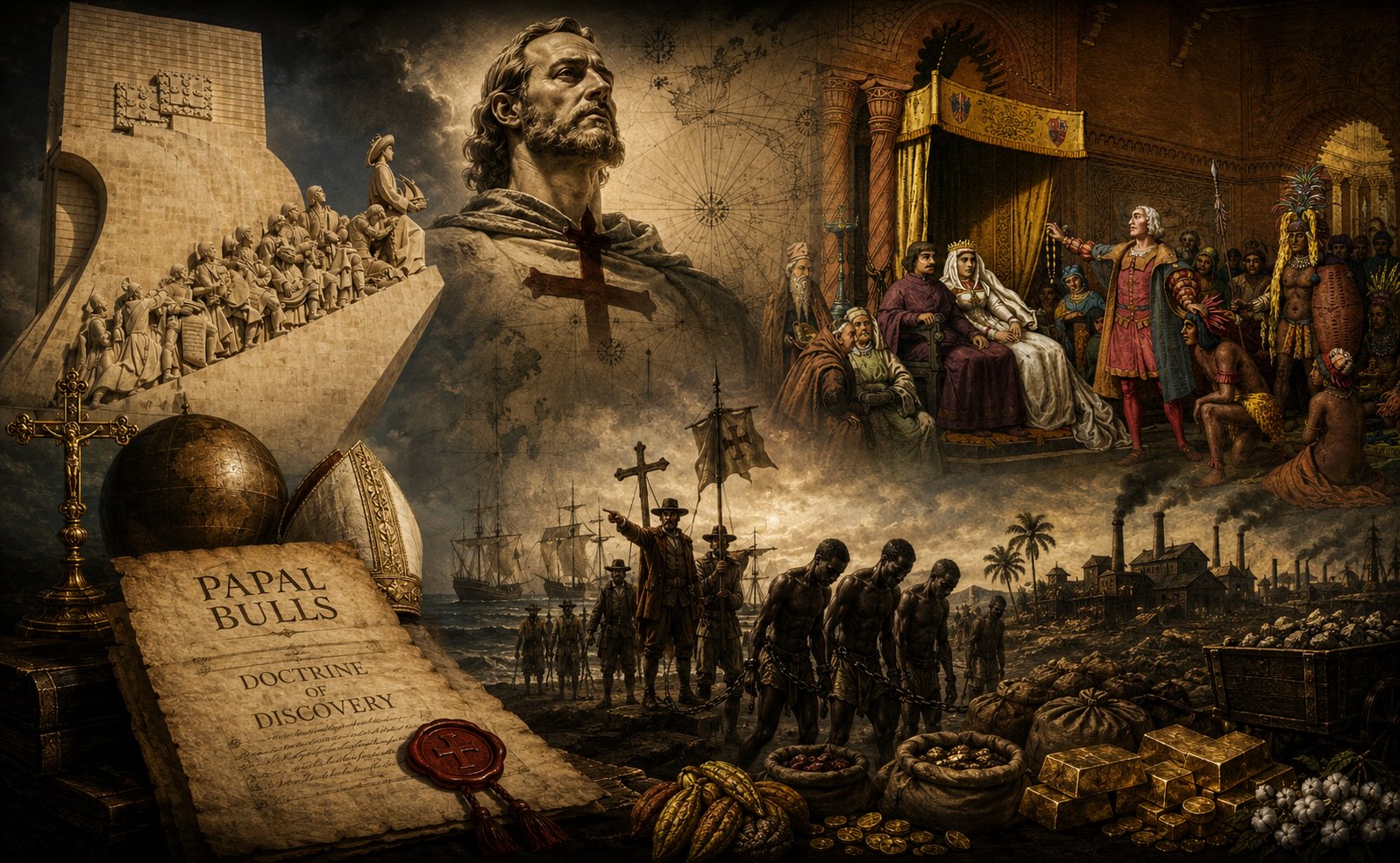
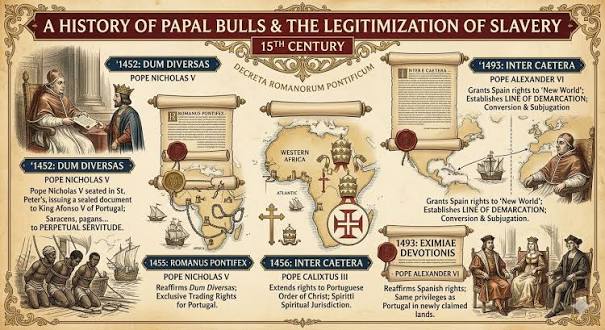
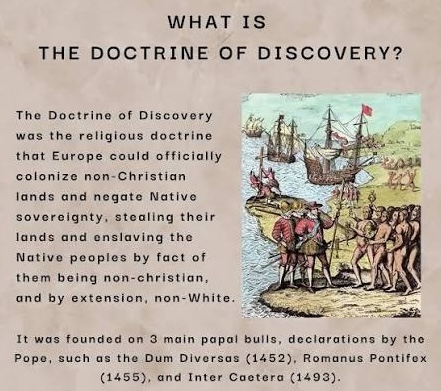
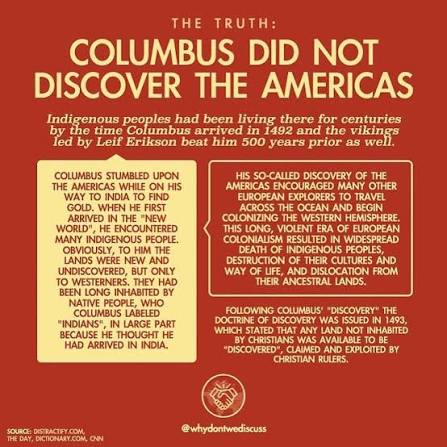
The mechanism was constructed with precision. In 1452, Pope Nicholas V issued the papal bull Dum Diversas, authorising the King of Portugal to “capture, vanquish, and subdue the Saracens, pagans, and any other unbelievers and enemies of Christ” and “reduce their persons to perpetual servitude.” Three years later, Romanus Pontifex extended this authority to conquer the lands of infidels for “the salvation of all”. In 1493, following Columbus’s return from the Americas, Pope Alexander VI issued Inter Caetera — the foundational document of the Doctrine of Discovery — declaring that any land not under Christian rule could be seized, its peoples subjugated, and its resources claimed, in the service of Christianising the world.
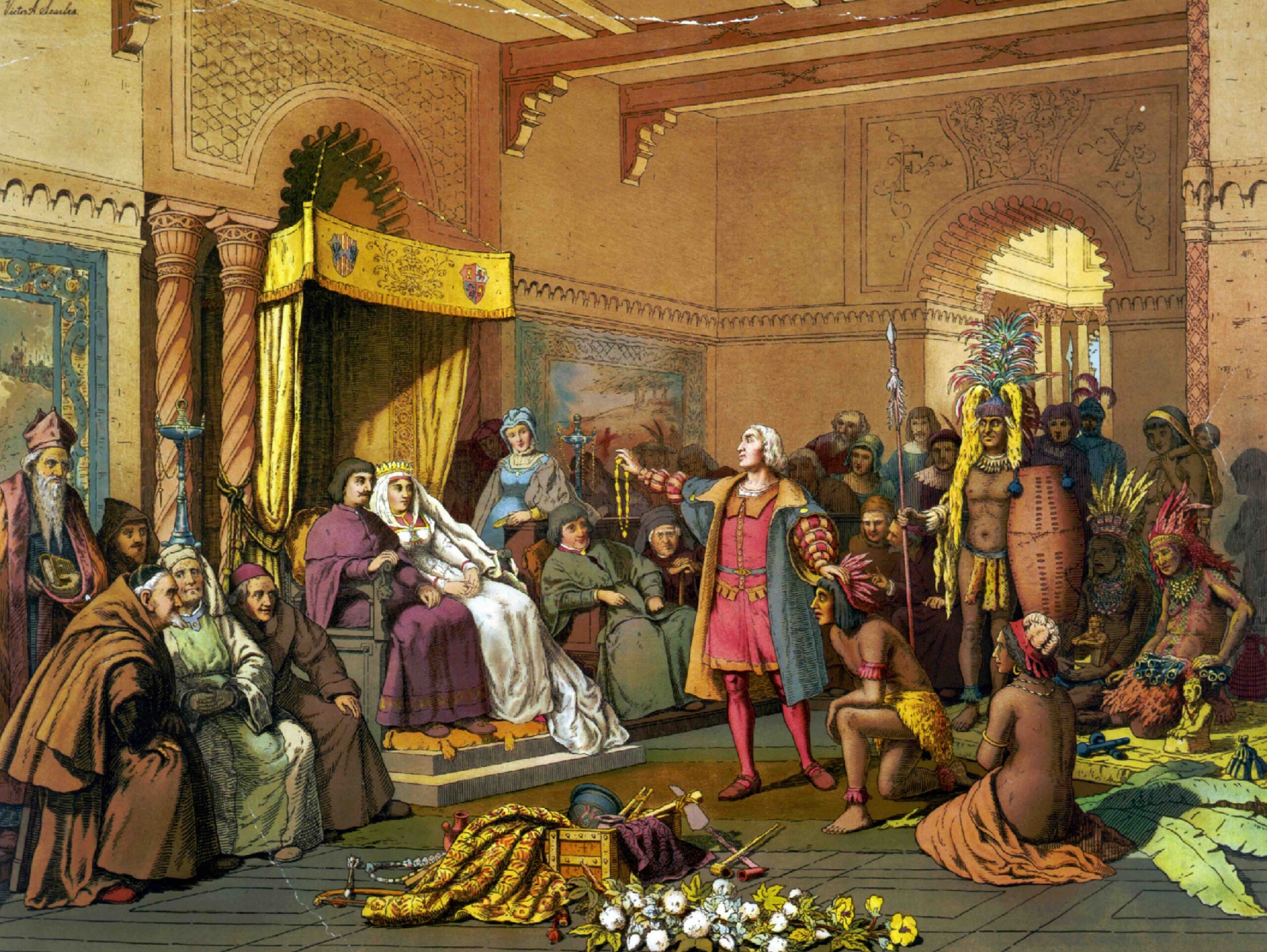
Columbus at the court of Barcelona. Christopher Columbus standing before the King and Queen of Spain, presenting Indians and treasures from the New World, 1493. (Newscom TagID: whphotos146159.jpg) [Photo via Newscom]
These were not peripheral theological documents. They were the legal and moral architecture of the colonial project, establishing in explicit terms sanctioned by the highest religious authority in the Western world that non-Christians were less than human, that killing them was not a sin, and that converting or enslaving them was a sacred duty. The Doctrine of Discovery was subsequently incorporated into the legal systems of the United States, Canada, Australia, and other settler-colonial states, where it shaped land law, property rights, and indigenous dispossession for centuries. The Vatican formally repudiated the Doctrine of Discovery only in 2023 — more than five centuries after the damage was done.
And here is what makes that repudiation hollow: the doctrine did not stay in the fifteenth century. It became the operating law of the settler-colonial states, and it remains so.
In 1823, the United States Supreme Court, in Johnson v. McIntosh, formally incorporated the Doctrine of Discovery into American law. Chief Justice John Marshall ruled that Indigenous peoples did not own their lands once those lands had been “discovered” by Christian colonists — that discovery itself conferred title on the discovering Christian nation, reducing the original inhabitants to mere occupants on their own soil. Marshall himself conceded the principle was “extravagant.” He made it law regardless. It has never been overturned. Two centuries later, it remains the foundation of all federal Indian law in the United States.
Plenary power — plenitudo potestatis, the fullness of power — is the exact phrase by which the fifteenth-century popes claimed the authority to authorise conquest and enslavement in the first place.
The living force of this doctrine was demonstrated in 2023 — the very year of the Vatican’s repudiation. In Haaland v. Brackeen, the US Supreme Court affirmed the modern form of the doctrine: the “plenary power” of the federal government over Native peoples. The term is not incidental. Plenary power — plenitudo potestatis, the fullness of power — is the exact phrase by which the fifteenth-century Popes claimed the authority to authorise conquest and enslavement in the first place. The Vatican renounced the doctrine in March 2023. Three months later, in June, the highest court of the United States reaffirmed its modern expression as settled law. One institution let go of the fiction. The other continued to build on it.
Terra Nullius and the Concepts of Exceptionalism and Manifest Destiny
The pattern is not confined to the Americas. In Australia, the entire continent was claimed under the doctrine of terra nullius — the legal fiction that the land belonged to no one, that sixty thousand years of continuous Aboriginal civilisation and hundreds of distinct nations simply did not count as habitation. The Australian Constitution, when it came into force in 1901, contained Section 127, which declared that “in reckoning the numbers of the people of the Commonwealth, aboriginal natives shall not be counted.” The original inhabitants of the continent were constitutionally excluded from the population of their own country. That exclusion was not removed until a referendum in 1967. The fiction of terra nullius itself was not overturned until the High Court’s Mabo judgment in 1992 — one hundred and ninety-two years after colonisation began.
The Doctrine of Discovery is not a historical curiosity to be studied and regretted. It is the living legal architecture on which the settler-colonial states were built, and on which — as the events of 2023 demonstrate — they continue to stand. The exceptionalism that authorised conquest in 1452 was not repented and abandoned. It was secularised, constitutionalised, and preserved.
This is the point that must be understood clearly. The Doctrine of Discovery is not a historical curiosity to be studied and regretted. It is the living legal architecture on which the settler-colonial states were built, and on which — as the events of 2023 demonstrate — they continue to stand. The exceptionalism that authorised conquest in 1452 was not repented and abandoned. It was secularised, constitutionalised, and preserved.
This is not a distortion of Christianity. It is the documented institutional expression of a specific tradition within it: the doctrine that one’s own community occupies a uniquely chosen position in the divine order — that the Other is not merely different but lesser, and that this difference legitimates domination.
The same logic operated, in different institutional forms, across other traditions. The conquering caliphates that used the concept of jihad to justify forced conversion were not the whole of Islamic tradition, which contains rich pluralist and humanistic streams. They were the weaponisation of religious exceptionalism by those who held political and military power. Political Zionism, in its most extreme contemporary expressions, follows the same pattern: the theological claim to exclusive divine right over territory and the dehumanisation of non-Jewish populations, ruthlessly visible from the Nakba in 1947-48 to the present conduct of the Gaza war, in full view of the world and with endorsement by the West. It follows the same pattern: religious exceptionalism converted into political licence for dispossession and violence.
The pattern is not one religion. It is a specific logic — the claim to divine chosenness that exempts a community from the moral constraints that apply to others – that has been institutionalised, at different moments and in different traditions, wherever political power has found it useful.
In Western civilisation, this logic found its most durable and consequential expression in American exceptionalism. In 1630, Puritan leader John Winthrop, preparing to establish the Massachusetts Bay Colony, called for the creation of a community that would be “as a City upon a Hill, the eyes of all people upon us.” This was not yet a global claim. It was a theological self-conception: a chosen people, on a divinely appointed errand, under special divine scrutiny. But the seed was planted. Two centuries later, in 1845, John L. O’Sullivan gave it political form: “our manifest destiny to overspread the continent allotted by Providence for the free development of our yearly multiplying millions.” God-given expansion across a continent — regardless of the peoples already living on it — was reframed as destiny, not conquest.
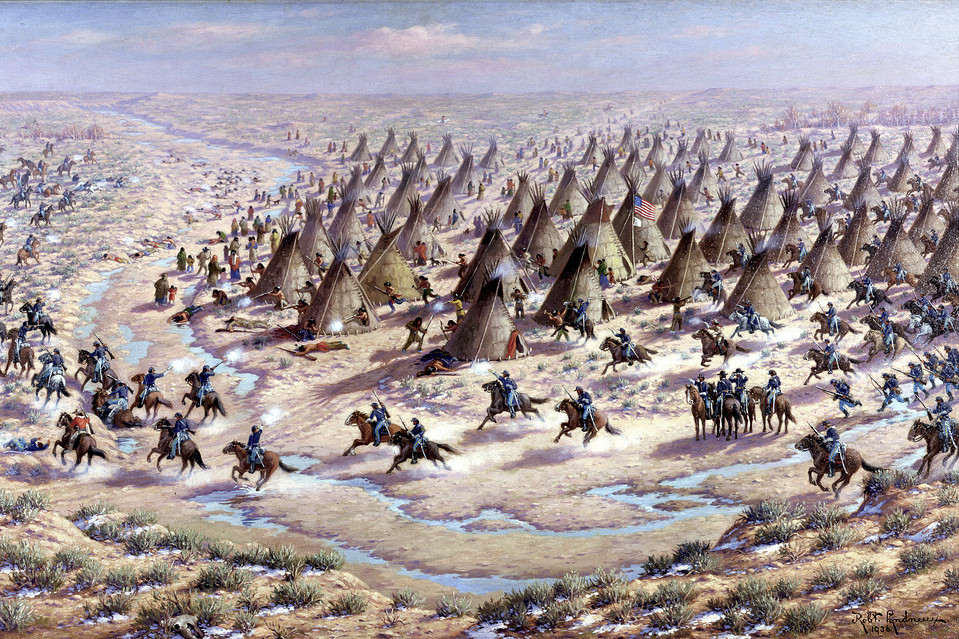
The indigenous peoples of North America experienced what that destiny meant in practice. At Sand Creek in November 1864, a Colorado militia under Colonel John Chivington attacked a Cheyenne and Arapaho village whose chief, Black Kettle, was flying both an American flag and a white flag of truce. Roughly 150 people were killed, the majority of them women, children, and the elderly; the soldiers mutilated the dead and paraded body parts through the streets of Denver. Three separate investigations — two congressional, one military — condemned it as a massacre. Not one man was ever indicted. The campaigns that defined the conquest of the West — villages destroyed, food supplies burned, non-combatants killed as a matter of strategy — were not the excesses of rogue commanders. They were the method.
And the men who carried them out were not disgraced but memorialised. George Armstrong Custer, who at dawn on the Washita River in 1868 attacked the village of that same Black Kettle, who had survived Sand Creek and was again seeking peace, killed him and his wife in the assault, while his aggressive forces killed a large number of unarmed women and children. Custer was mythologised into a national hero, his death at the Little Bighorn recast as a noble sacrifice. This is exceptionalism completing its work: not merely committing the atrocity, but converting it, in the national memory, into valour. The conversion of conquest into heroism is not a distortion of the exceptionalist project. It is the project.
It is worth pausing to see precisely how this engine is built, because it reveals something the comfortable version of history conceals. There are two broad models of colonialism, and they are not the same. Extractive colonialism — the Spanish in Peru, the British in India — needs the colonised population alive: to mine the silver, to work the plantations, to pay the taxes. It subjugates.
But settler colonialism, of the kind practised in North America and Australia, does not primarily want the people. It wants the land. And a population that comes to stay on land already inhabited requires something darker than subjugation: it requires removal. The historian Patrick Wolfe named this the ‘logic of elimination’ — the observation that in the settler-colonial project, invasion is not an event but a structure, and the indigenous inhabitant is not a labour force to be exploited but an obstacle to be cleared. This is why the settler variant needed its ideological engine to run at maximum power. To subjugate a people, you need only believe they are lesser. To eliminate them, you must first erase them — conceptually, legally, theologically — before you erase them in fact. Terra nullius, the empty land; the savage without real title; the wilderness awaiting God’s chosen — these were not decorative rhetoric. They were the necessary vocabulary of replacement.
A society that never hears the moral objection is merely benighted. A society that hears it clearly, debates it in its legislature, affirms it in its highest court — and proceeds anyway, in the name of Providence — has not failed to find its conscience. It has chosen to override it. That is what the ideological engine is for: not to fill a silence where conscience is absent, but to drown out a conscience that is present.
And here is the fact that removes every excuse: the conscience was present. It was not that no one knew, or that no one objected. Roger Williams argued in the 1630s that the Crown had no right to grant land it did not own, that it had to be purchased from its actual inhabitants — and he was banished for saying so. The Quaker John Woolman condemned the dispossession on moral grounds a century before it reached the Mississippi. When the Indian Removal Act came before the United States Congress in 1830, it passed by 102 votes to 97 — a bitter, closely fought debate, not a silent consensus. When the Cherokee took their case to the Supreme Court, Chief Justice John Marshall ruled in Worcester v. Georgia that they possessed sovereign rights the state was bound to respect. President Andrew Jackson ignored the ruling and carried out the removal regardless; on the Trail of Tears that followed, thousands died. This is the point that must be held onto. A society that never hears the moral objection is merely benighted. A society that hears it clearly, debates it in its legislature, affirms it in its highest court — and proceeds anyway, in the name of Providence — has not failed to find its conscience. It has chosen to override it. That is what the ideological engine is for: not to fill a silence where conscience is absent, but to drown out a conscience that is present.
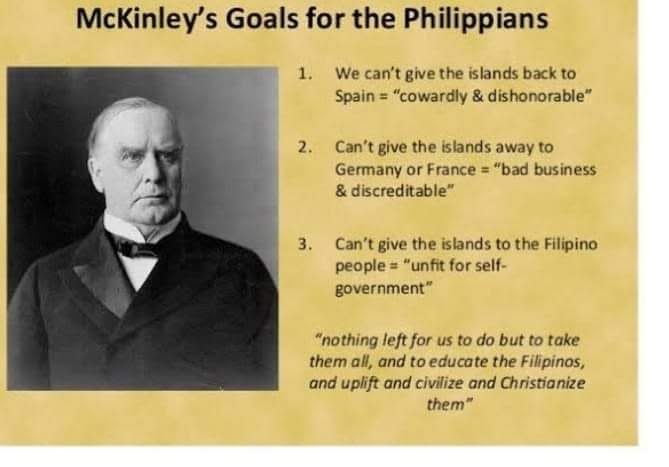
The same logic was exported globally. In 1898, the United States entered the Spanish-American War, having suggested to Filipino independence fighters that it was their ally against Spanish colonial rule. When Spain was defeated, the Philippines was not given its independence. It was purchased for twenty million dollars and then colonised. The Philippine-American War resulted in the deaths of over 20,000 Filipino combatants and as many as 200,000 Filipino civilians through violence, famine, and disease. McKinley called his policy “Benevolent Assimilation.” The Philippines did not receive full independence until 1946 — forty-eight years after the liberation that was promised.
This is the pattern that repeats from Vietnam to Iraq to Afghanistan to Iran: intervention justified as liberation, freedom invoked to mask extraction, and sovereignty violated in the name of the values that sovereignty was supposed to protect.
The Civilisational Alternative
Now consider the contrast. India, China, and Persia are rooted in civilisational traditions that are fundamentally pluralist in their relationship to truth and the divine. Hinduism, Buddhism, Jainism, and Zoroastrianism do not claim exclusive possession of truth. They understand the search for ultimate reality as a path that admits multiple valid routes — that the divine is too vast and complex for any single tradition to comprehend fully. This epistemological humility produces a fundamentally different relationship to the Other: not as a lesser being to be converted or eliminated, but as a fellow traveller on a different path through the same reality — or, in the Tamil saint Vallalar’s image, rivers of many names flowing to a single shoreless ocean.
A tradition whose foundational claim is Ekam Sat Vipra Bahudha Vadanti — truth is one, the wise call it by many names — or the Jain Anekantavada, the many-sidedness of truth, or the Tamil Yaadhum Oorey-Yaavarum Kelir, that every place is home and every person kin, is structurally resistant to exceptionalism, because its highest ideal explicitly denies the premise exceptionalism requires: that a single community owns the truth and stands chosen above the rest.
The distinction I am drawing must be stated carefully, because it is easy to misread as a claim that one civilisation is virtuous and another is wicked. That is not the claim, and it would be false. The impulse to dress conquest in sacred language is close to universal — it appears wherever power seeks to launder its crimes, and no civilisation, India’s included, is innocent of it. Ashoka built his empire by the sword before he turned to the dharma. India’s own caste hierarchy was given cosmic sanction, as I have argued elsewhere in examining the Manusmriti. The human capacity to summon the transcendent in defence of the indefensible is not the property of any one people. What differs is not the impulse to justify but what each tradition installs as its highest principle — and therefore what any justification of atrocity must first overcome. A tradition whose foundational claim is Ekam Sat Vipra Bahudha Vadanti — truth is one, the wise call it by many names — or the Jain Anekantavada, the many-sidedness of truth, or the Tamil Yaadhum Oorey-Yaavarum Kelir, that every place is home and every person kin, is structurally resistant to exceptionalism, because its highest ideal explicitly denies the premise exceptionalism requires: that a single community owns the truth and stands chosen above the rest.
One can still commit atrocity within such a tradition — humans always can — but one cannot easily make the tradition’s own highest principle bless it. A covenantal structure built on a chosen people, an exclusive truth, and a promised land contains that raw material at its theological core. It does not compel atrocity, and most who inherit it are decent people who read it toward mercy — the abolitionists and Roger Williams drew on it too. But the doctrine of chosenness is available to be weaponised in a way that Ekam Sat structurally is not. That is the civilisational difference that matters: not that one people is depraved and another pure, but that traditions differ in whether their deepest ideal resists the engine of exceptionalism or supplies its fuel.
Scholarly analysis consistently describes India’s conduct as just war traditions with no ulterior motive of imperialism or fiscal interest. There is no comparable example in the modern history of any Western military power.
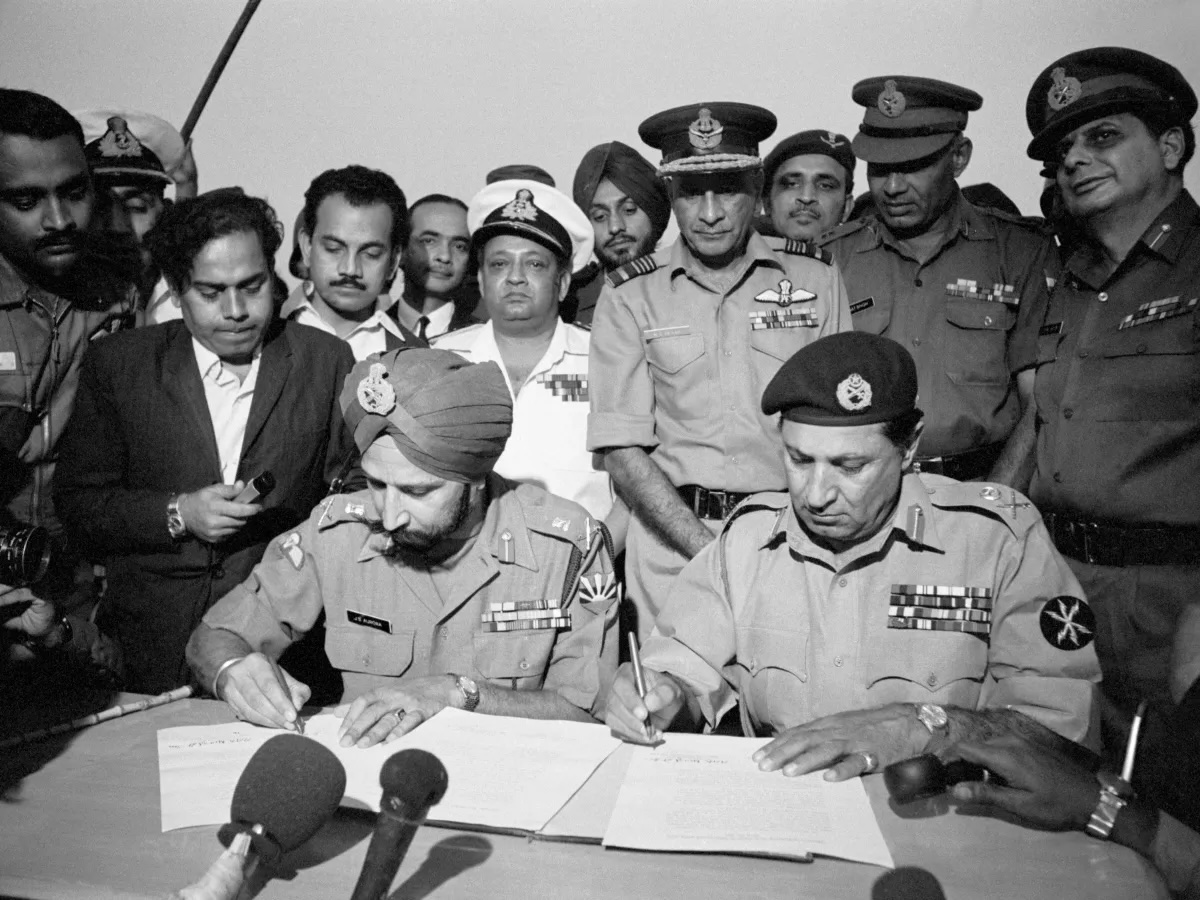
This civilisational disposition is not merely philosophical. It expresses itself in conduct. In December 1971, India made the decision to intervene militarily in East Pakistan in response to one of the most egregious humanitarian catastrophes of the 20th century — the Bangladesh genocide. The intervention was swift and decisive. Indian military forces liberated Bangladesh in thirteen days of formal war. Pakistani forces surrendered on December 16, 1971. The Indian military then withdrew completely. No occupation. No extraction. No installation of a client government. No strategic bases retained. Full sovereignty was transferred immediately to the people of Bangladesh. India returned over 90,000 Pakistani prisoners of war through the Simla Agreement. Scholarly analysis consistently describes India’s conduct as just war traditions with no ulterior motive of imperialism or fiscal interest. There is no comparable example in the modern history of any Western military power.
These are not coincidental differences. They are civilisational ones. The world is now in contest over what the emerging order will be built upon. The declining Western order was built on exceptionalism — the claim to divine chosenness that converts domination into duty, secularised into legal doctrine but never abandoned. The Asian civilisational alternative — pluralist, non-exclusivist, epistemologically humble — offers a different foundation. India’s 1971 conduct is the most precise proof available that this alternative is not merely philosophical. It has been demonstrated operationally.
The question is whether India — in Gaza, in Iran, in the institutions of the emerging world order — is willing to act consistently with the civilisational tradition it inherits.
— This is the second in the series prologue.
Air Marshal M Matheswaran (Retd) is the Founder-President of The Peninsula Foundation (@TPF_Chennai), grounded in the conviction that power without ethics is tyranny — and that India’s civilisational traditions offer the world something Western exceptionalism cannot.
Further Reading:
On the Doctrine of Discovery and the Papal Bulls
Pope Nicholas V, Dum Diversas, 18 June 1452. Full Latin text and English translation: Doctrine of Discovery Project, doctrineofdiscovery.org.
Pope Nicholas V, Romanus Pontifex, 8 January 1455.
Pope Alexander VI, Inter Caetera, 4 May 1493.
Robert J. Miller, Jacinta Ruru, Larissa Behrendt, and Tracey Lindberg, Discovering Indigenous Lands: The Doctrine of Discovery in the English Colonies (Oxford University Press, 2010).
Steven T. Newcomb, Pagans in the Promised Land: Decoding the Doctrine of Christian Discovery (Fulcrum, 2008).
On the Vatican’s 2023 repudiation
Dicastery for Culture and Education and Dicastery for Promoting Integral Human Development, ‘Joint Statement on the Doctrine of Discovery,’ Vatican, 30 March 2023.
On the incorporation and persistence of the Doctrine of Discovery in US law
Johnson v. McIntosh, 21 U.S. (8 Wheat.) 543 (1823).
Haaland v. Brackeen, 599 U.S. 255 (2023).
On the affirmation of ‘plenary power’ over Native peoples as the modern descendant of the Doctrine of Discovery, see the analysis by Peter d’Errico and the essays in the ‘200 Years of Johnson v. M’Intosh’ series, Canopy Forum, 2023.
Robert J. Miller, ‘The Doctrine of Discovery in American Indian Law,’ Idaho Law Review, 42 (2005).
Lindsay G. Robertson, Conquest by Law: How the Discovery of America Dispossessed Indigenous Peoples of Their Lands (Oxford University Press, 2005).
On Australia, terra nullius, and constitutional exclusion
Mabo v. Queensland (No. 2) (1992) 175 CLR 1.
Section 127, Constitution of Australia (repealed by referendum, 1967).
Henry Reynolds, The Law of the Land (Penguin, 1987).
Bain Attwood, Rights for Aborigines (Allen & Unwin, 2003).
On Section 127 and the 1967 referendum: National Museum of Australia, ‘Indigenous Referendum,’ and George Williams’ analysis of the ‘race power’ in Australia’s constitutional history.
On American exceptionalism — Puritan origins and Manifest Destiny
John Winthrop, ‘A Modell of Christian Charity’ (1630).
John L. O’Sullivan, ‘Annexation,’ The United States Magazine and Democratic Review, 17(1), July–August 1845.
Anders Stephanson, Manifest Destiny: American Expansion and the Empire of Right (Hill and Wang, 1995).
Hilde Eliassen Restad, American Exceptionalism: An Idea That Made a Nation and Remade the World (Routledge, 2014).
On the Sand Creek Massacre and the conquest of the Plains
U.S. Congress, Joint Committee on the Conduct of the War, Massacre of the Cheyenne Indians (38th Congress, 2nd Session, 1865).
The contemporary Congressional investigation that condemned the massacre; the primary documentary record.
Ari Kelman, A Misplaced Massacre: Struggling over the Memory of Sand Creek (Harvard University Press, 2013).
Dee Brown, Bury My Heart at Wounded Knee: An Indian History of the American West (Holt, Rinehart & Winston, 1970).
On the Washita (1868), the killing of Black Kettle, and the pattern of village attacks; also on the mythologisation of George Armstrong Custer.
Nathaniel Philbrick, The Last Stand: Custer, Sitting Bull, and the Battle of the Little Bighorn (Viking, 2010).
On the Philippines, 1898–1946
Stanley Karnow, In Our Image: America’s Empire in the Philippines (Random House, 1989).
Paul A. Kramer, The Blood of Government: Race, Empire, the United States, and the Philippines (University of North Carolina Press, 2006).
On India’s 1971 Bangladesh liberation
Srinath Raghavan, 1971: A Global History of the Creation of Bangladesh (Harvard University Press, 2013).
Gary J. Bass, The Blood Telegram: Nixon, Kissinger, and a Forgotten Genocide (Knopf, 2013).
On Asian civilisational pluralism
Amartya Sen, The Argumentative Indian: Writings on Indian History, Culture and Identity (Penguin, 2005).
Wendy Doniger, The Hindus: An Alternative History (Penguin, 2009).
This is the first in a series on India’s strategic choices, civilisational responsibilities, and the contest for the emerging world order.
The Material Foundations of Western Power
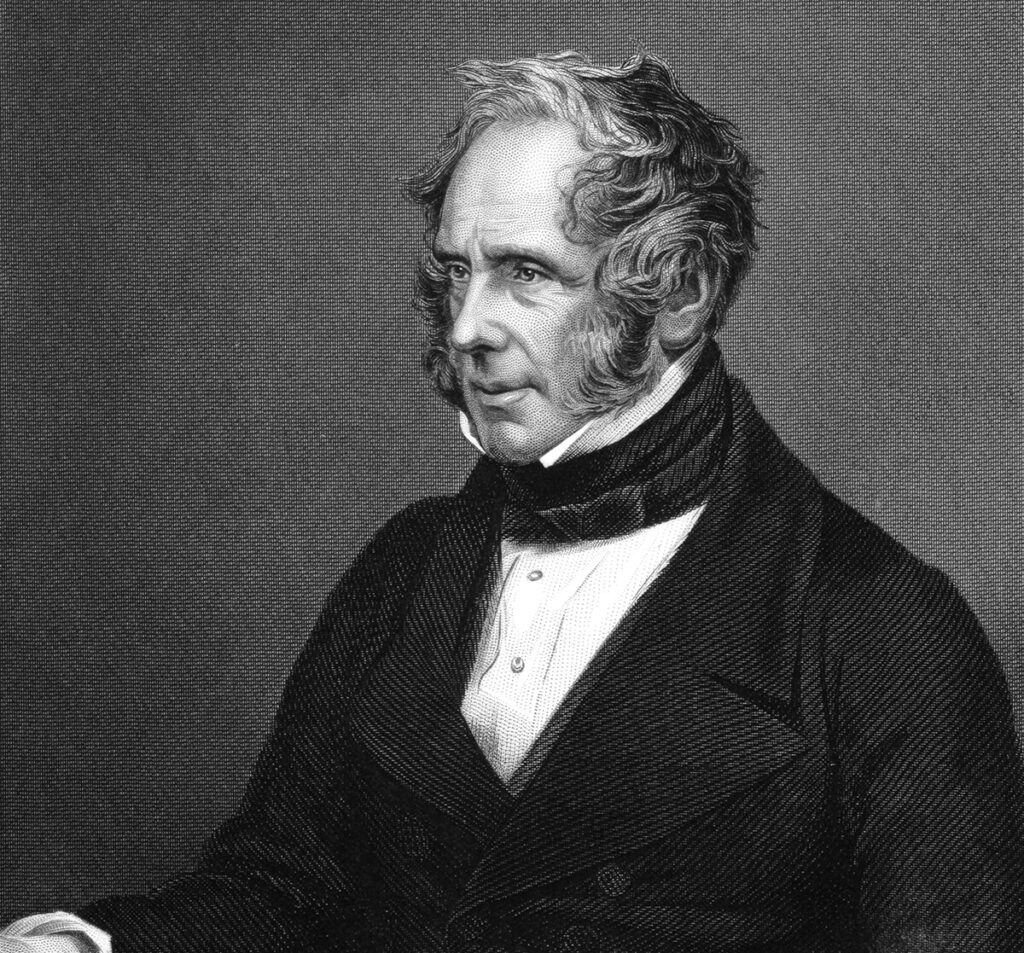
The world of strategists is familiar with the quote of Lord Palmerston, Britain’s nineteenth-century Prime Minister. He famously declared: “There are no permanent friends or enemies, only permanent interests.”
Lord Palmerston
As a description of statecraft, this is not wrong. Every civilisation that has endured has pursued its interests — including the ones this series will spend considerable space defending. Kautilya’s Rajamandala is, at its core, a theory of interest-based alignment. The Cholas sailed across the Bay of Bengal to protect Tamil trading interests. No serious tradition of statecraft has ever pretended that interest does not matter, and none should.
The question worth asking is not whether interests are permanent. It is whether anything else is.
Palmerston’s formulation, taken as a complete theory of how a state should conduct itself — not as one true observation among several, but as the only thing that needs ever to be consulted — becomes something different. It becomes a licence. If interest is permanent and nothing else is, then ethical limits on how interest is pursued are, by definition, temporary: honoured when convenient, discarded when not. That is not realism. That is realism with the safety catch removed.
This is the civilisational fork in the road, and four hundred years of history show which branch the dominant powers took — and still take.
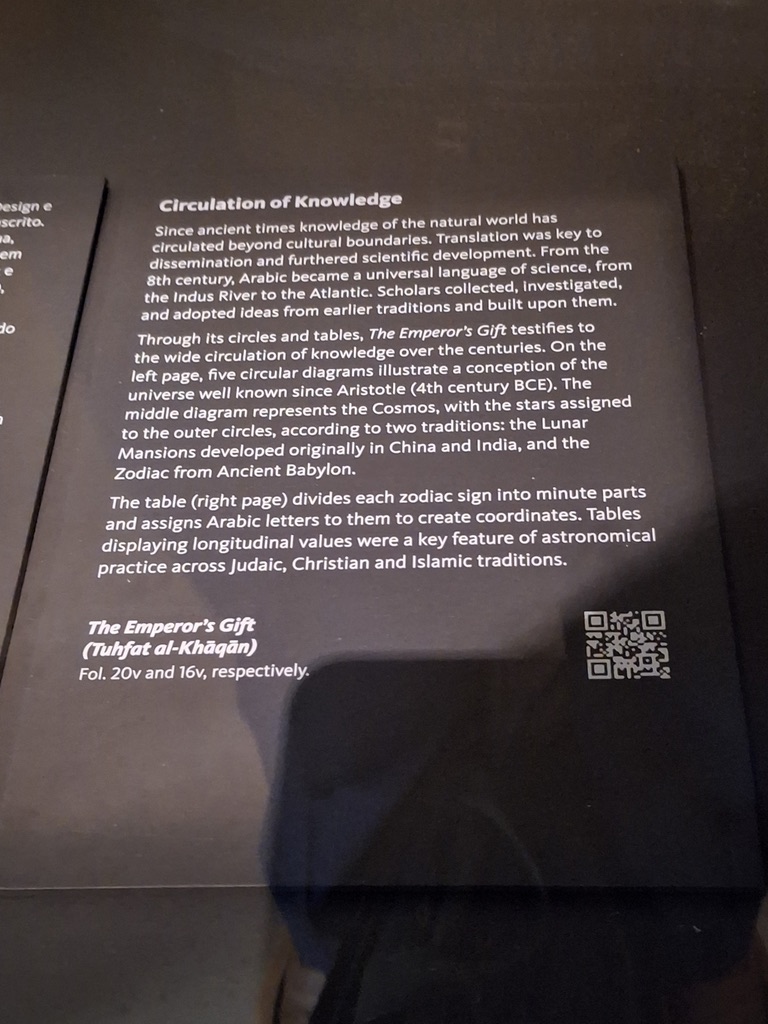
The Islamic Golden Age — spanning roughly the 8th to the 14th century — was one of the greatest intellectual achievements in human history. Scholars at Baghdad’s House of Wisdom undertook a systematic, state-sponsored project of translation and synthesis: gathering the accumulated knowledge of Greece, Persia, India, and China, translating it into Arabic, and building upon it with original contributions in mathematics, astronomy, medicine, philosophy, optics, and chemistry. Avicenna’s Canon of Medicine became a foundational text in European universities. Averroes’ commentaries on Aristotle shaped medieval European philosophy.
Exhibit in Gulbenkian Museum, Lisbon – Photo by Author
Europe in the early medieval period was not the centre of the world. It was its periphery — impoverished, fragmented, and in the grip of what its own historians call the Dark Ages. While Europe’s literacy rates collapsed and theological conformity suppressed inquiry, something extraordinary was unfolding in Baghdad, Cordoba, and Cairo. The Islamic Golden Age — spanning roughly the 8th to the 14th century — was one of the greatest intellectual achievements in human history. Scholars at Baghdad’s House of Wisdom undertook a systematic, state-sponsored project of translation and synthesis: gathering the accumulated knowledge of Greece, Persia, India, and China, translating it into Arabic, and building upon it with original contributions in mathematics, astronomy, medicine, philosophy, optics, and chemistry. Avicenna’s Canon of Medicine became a foundational text in European universities. Averroes’ commentaries on Aristotle shaped medieval European philosophy. The numeral system through which all modern mathematics operates — including the zero — came to Europe through the Arabic transmission of Indian mathematics. This was not borrowing. It was the rescue and synthesis of civilisational knowledge — and without it, the European Renaissance would have had no foundation on which to build.
The numeral system through which all modern mathematics operates — including the zero — came to Europe through the Arabic transmission of Indian mathematics. This was not borrowing. It was the rescue and synthesis of civilisational knowledge — and without it, the European Renaissance would have had no foundation on which to build.
Europe’s intellectual reawakening in the 14th and 15th centuries drew directly on this Islamic transmission. The Renaissance, together with the gunpowder revolution and the state system formalised at the Peace of Westphalia in 1648, gave European civilisation (viewing it as a single civilisation may not be truly appropriate – disparate kingdoms, fused by the race for maritime trade dominance and military conquest – Italian, Spanish, Portuguese, Dutch, French, British, Russian, etc.) something it had never possessed before: military-technological superiority, organised state power, and the bureaucratic capacity to project both across the world.
This wealth — extracted through conquest, forced indigenous labour, and the systematic destruction of existing civilisations — capitalised the European empires that would go on to colonise two-thirds of the world
Columbus – Truth vs Myth
The rise of the West that followed the maritime route discoveries of Columbus and Vasco da Gama needs to be understood correctly, devoid of the myths built around them. The West celebrates them, but the truth is they were plunderers who unleashed the genocidal expansion of the West. This truth is now being brought out by brilliant and unbiased historians such as Howard Zinn and Utsa Patnaik. Howard Zinn writes – ” what Columbus did to the Arawaks of the Bahamas, Cortés did to the Aztecs of Mexico, Pizarro to the Incas of Peru, and the English settlers of Virginia and Massachusetts to the Powhatans and the Pequots. They used the same tactics, and for the same reasons – the frenzy in the early capitalist states of Europe for gold, for slaves, for products of the soil, to pay for the bondholders and stockholders of the expeditions, to finance the monarchical bureaucracies rising in Western Europe, to spur the growth of the new money economy rising out of feudalism…These were the violent beginnings of an intricate system of technology, business, politics, and culture that would dominate the world for the next five centuries.”
What followed was not a story of civilisational achievement. It was a story of extraction on a scale without precedent in human history — extraction conducted on the understanding that, once interest was engaged, nothing else needed to be weighed. From the Americas alone, Spanish colonial mining operations extracted approximately 150,000 metric tonnes of silver between 1500 and 1800 — representing 80 to 90 per cent of global silver production over three centuries. By 1600, 25,000 tonnes of silver had crossed the Atlantic. This wealth — extracted through conquest, forced indigenous labour, and the systematic destruction of existing civilisations — capitalised the European empires that would go on to colonise two-thirds of the world. The Atlantic slave trade transported an estimated twelve to fifteen million Africans into forced labour over three centuries.
The British were ruthless in pursuing their interests at the expense of the people and the geography of their colonial empire, particularly in India. The economy under the British Raj was not a system of governance or development – it was a system of systematic wealth extraction unprecedented in scale and duration. From 1765 (when Robert Clive obtained the Diwani Rights, that is, the right to collect taxes and revenue, from the Mughal emperor as a result of the Battle of Buxar) to 1947 – 182 years – Britain drained India’s wealth through every possible mechanism. The scale of this drain was staggering. Britain extracted the equivalent of about $45 trillion (in current dollar terms) from India during its colonial rule. This wasn’t accidental impoverishment or the natural result of economic evolution. This was deliberate policy, implemented systematically through revenue extraction, deindustrialisation, trade manipulation, and infrastructural control.
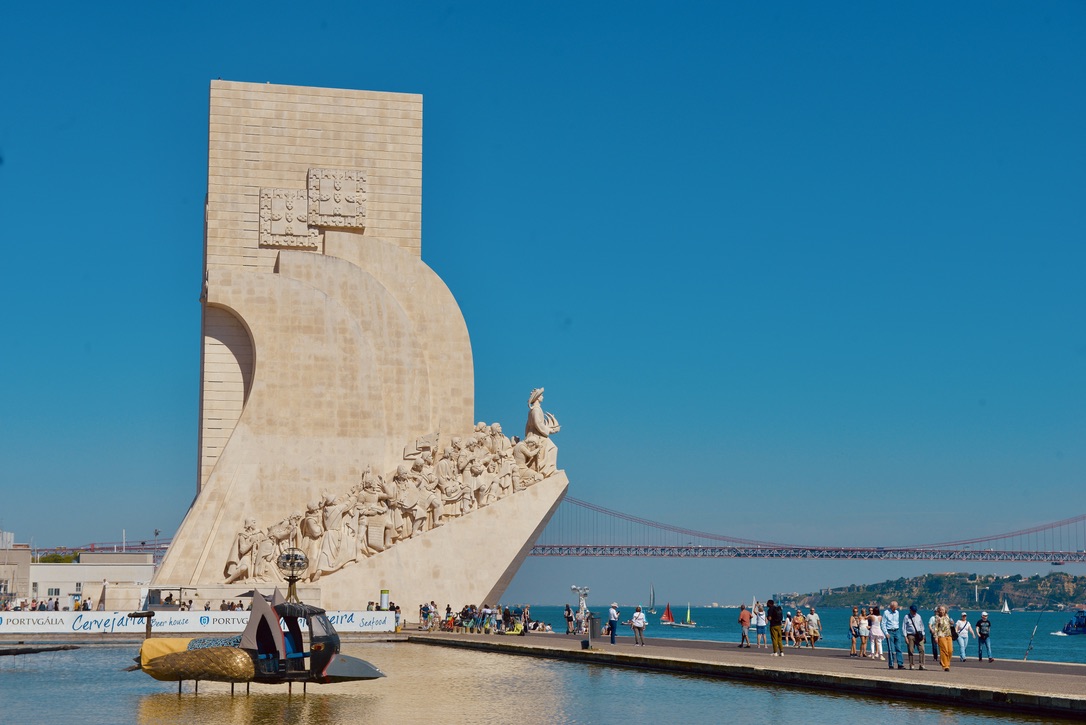
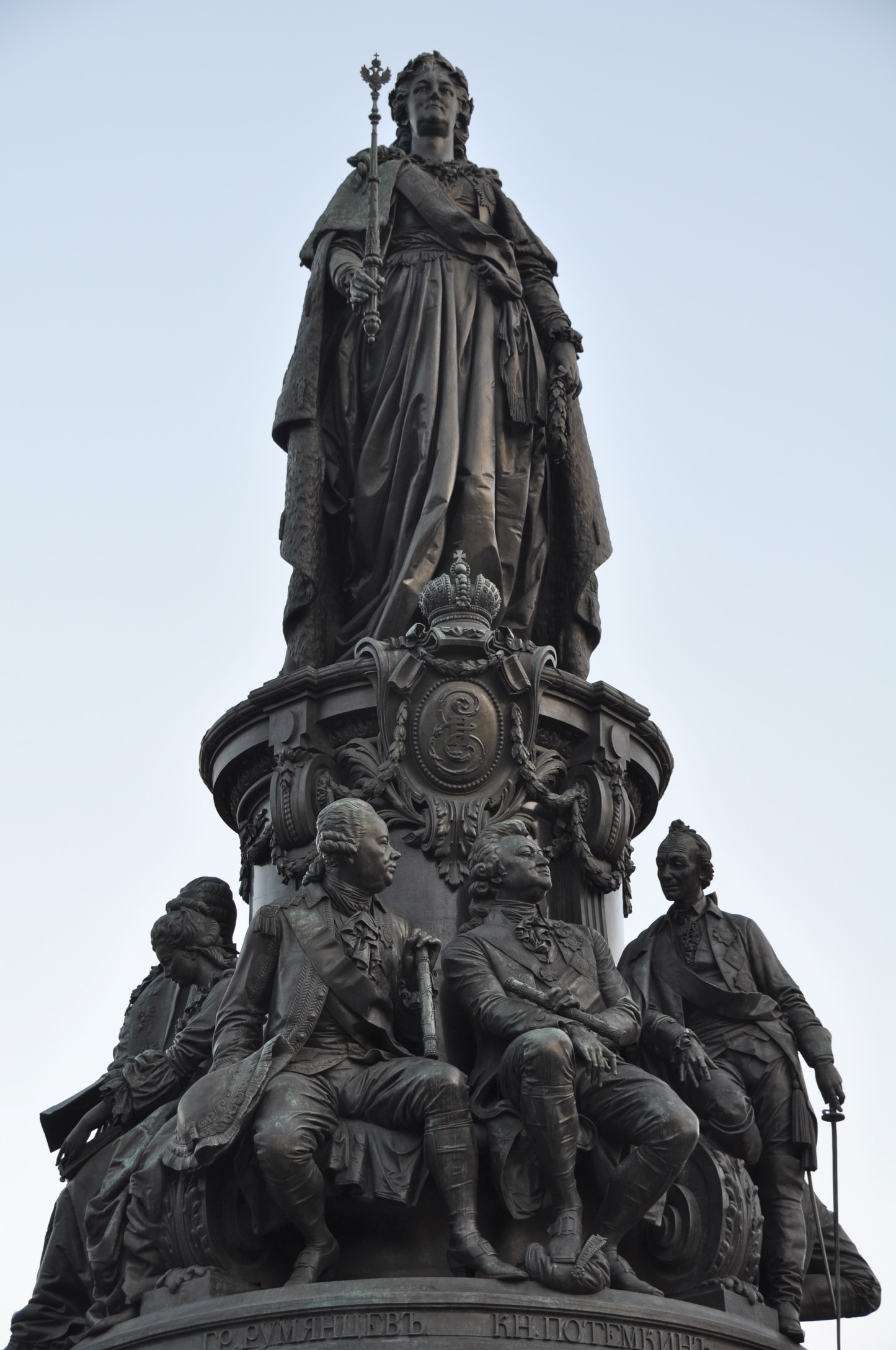
500-year Commemoration of Vasco-da-Gama’s voyage to India -Lisbon – defining moments of colonialism. Photo by AuthorThe Russian empire was equally consumed by Western Europe’s passion for colonies. Catherine the Great, Russian Empress and originally a German princess, was a ruthless expansionist of the Russian Empire. However, Russia differed significantly from Western colonialism. Catherine the Great’s Statue in St. Petersburg. Photo by Author.
None of this was an aberration from Western values. It was the expression of them. Palmerston’s formulation was not a description of how all states behave. It was a justification for a specific civilisational approach: that power exists to be exercised without ethical constraint, that the strong may do what they will, and that the legitimating language of civilisation, Christianity, and later human rights, are instruments of justification rather than a genuine limits on conduct.
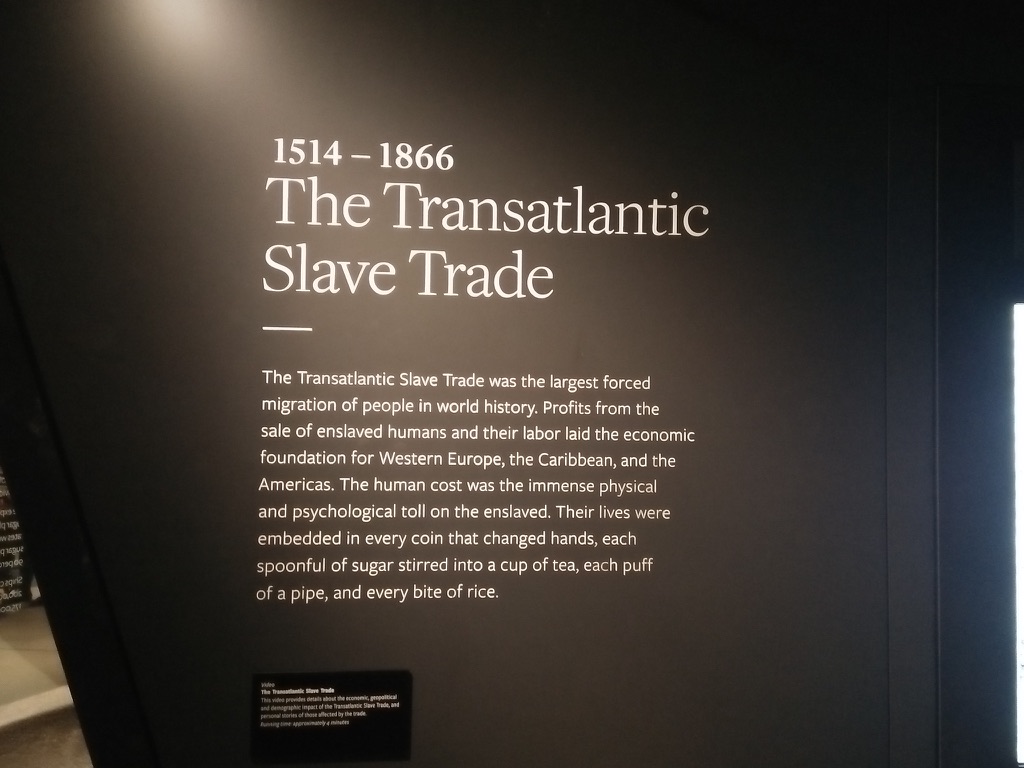
Slavery was the most crucial contributor to the West’s development. This was a critical element of the transatlantic world. exhibit in the African American Museum, Washington, D.C. Photo by Author.
The Berlin Conference of 1884–85 is its most clinical illustration. Otto von Bismarck convened the European powers to divide Africa between them. Not a single African leader was present. A request by the Sultan of Zanzibar to attend was dismissed. The Congo basin — a territory larger than Western Europe, home to millions of people with ancient civilisations, cultures, and governance systems — was assigned as the personal property of Belgian King Leopold II, one of the vilest European monarchs in human history. In the years that followed, hundreds of thousands of Congolese were worked to death on rubber plantations. Those who failed their quotas had their hands amputated. Leopold accumulated one of the largest personal fortunes in history from the proceeds.
This was not an exceptional act of cruelty. It was Palmerston’s formulation taken to its logical and undiluted conclusion.
Whatever the merits claimed for each individually, taken together they represent the same formula: interest declared permanent, leading to the ruthless pursuit of national interests; ethical limits declared situational, that is, practically irrelevant.
The pattern did not end with empire. It changed vocabulary. The wars launched and led by the United States since 2001 — in Afghanistan, Iraq, Libya, Syria and beyond — were conducted in the language of security, liberation, and the defence of human rights. By the most careful independent estimates, their costs have run into the hundreds of thousands of civilian lives, and their stated justifications have repeatedly diverged from their actual outcomes. Whatever the merits claimed for each individually, taken together they represent the same formula: interest declared permanent, leading to the ruthless pursuit of national interests; ethical limits declared situational, that is, practically irrelevant. The vocabulary had changed since 1884. The structure of the choice had not.
The economic register tells the same story. The formal end of colonialism did not end the system. It adapted it. The International Monetary Fund and World Bank, established at Bretton Woods in 1944, became the institutional mechanisms through which the global south’s economic policies were directed from Washington. Structural adjustment programmes imposed fiscal austerity, market liberalisation, and debt dependency on nations that had barely emerged from colonial rule.
Francophone West Africa became perhaps the most striking contemporary illustration of this persistence. Fourteen countries continued to use the CFA franc — a currency whose reserves were held in the French Treasury, whose exchange rate was set in Paris, and whose monetary sovereignty had never been genuinely transferred since formal independence. Long-term analysis tells the structural story: The Ivory Coast reached its peak in income per capita in 1978, in less than two decades after independence. It then stagnated over the next fifty years. Niger reached its highest level in 1965 — the year of independence. Seven decades of formal sovereignty. Not a single decade of genuine economic progress. France’s control was not only monetary. It was political and military. French intelligence maintained deep ties with governing elites. French military bases ensured that no elected government that moved too far from French interests would survive. The system corrupted the democratic process itself.
When Thomas Sankara became President of Burkina Faso in 1983 and attempted to secure genuine sovereignty — nationalising land, refusing IMF debt, building schools and healthcare, and articulating a vision of African self-reliance — he was assassinated in 1987. French agents were present in the capital the following day. Blaise Compaoré, who replaced him, immediately reversed every policy of sovereignty and ruled for 27 years. When a popular uprising removed him in 2014, French troops exfiltrated him to the Ivory Coast. He was later convicted in absentia by a Burkinabe court and sentenced to life imprisonment for Sankara’s murder. The system did not merely extract wealth. It murdered the leaders who sought to end the extraction.
“Anything that maintains us in slavery, we will break those bonds” – Captain Ibrahim Traore
Then, between 2021 and 2023, something changed. A new generation of young, educated, patriotic military officers — shaped by Sankara’s tradition — moved. Mali, Burkina Faso, and Niger formed the Alliance of Sahel States, expelled French and American military forces, and announced their intention to abandon the CFA franc entirely. Burkina Faso’s Captain Ibrahim Traore declared: “Anything that maintains us in slavery, we will break those bonds.” These are not coups in the traditional sense. They are the consequence of a system that used democratic institutions as a mechanism of foreign control for seven decades. As I write this essay, Burkina Faso officially severed all diplomatic relations with France on June 26, 2026. The African nation’s Communications Minister announced the decision on national television, stating that the essential conditions for mutual respect, trust, and non-interference were absent. President Ibrahim Traore accused Paris of harbouring “neo-colonial ambitions,” backing terrorist groups, and acting against Burkinabe interests. African countries are rising against the strangulating control of the West and its neo-colonialism of the last seven decades.
This is the order that India inhabits. This is the order India is being asked to join as a rising power. The contest for a new world order is not simply a geopolitical competition between states. It is a civilisational question —not the one Palmerston’s critics often imagine. The question is not whether a rising power will have permanent interests. Of course it will, and should. The question is whether it will articulate, with equal permanence and equal seriousness, the ethical limits within which those interests are pursued — limits that hold even when honouring them is costly.
India has the history, the philosophy, and the standing to make that commitment. The question is whether it has the will.
—
Further Reading:
On Palmerston’s statement and interest-based statecraft
Lord Palmerston, Speech to the House of Commons, 1 March 1848. Hansard, House of Commons Debates, vol. 97, cols. 66–123.
Kautilya, Arthashastra, Books VI–VII (Mandala theory of interstate relations). Trans. R.P. Kangle, The Kautiliya Arthashastra, 3 vols. (University of Bombay, 1960–65).
On the Islamic Golden Age and knowledge transmission to Europe
George Saliba, Islamic Science and the Making of the European Renaissance (MIT Press, 2007).
Jonathan Lyons, The House of Wisdom: How the Arabs Transformed Western Civilisation (Bloomsbury, 2009).
Dimitri Gutas, Greek Thought, Arabic Culture: The Graeco-Arabic Translation Movement in Baghdad and Early ‘Abbasid Society (Routledge, 1998).
Georges Ifrah, The Universal History of Numbers (Wiley, 2000). On the transmission of Hindu-Arabic numerals, including the zero.
On colonial extraction — the Americas
Dennis O. Flynn and Arturo Giráldez, ‘Cycles of Silver: Global Economic Unity through the Mid-18th Century,’ Journal of World History, 13(2), 2002.
Source for the 150,000-tonne / 80–90% global silver production estimates, 1500–1800.
Earl J. Hamilton, American Treasure and the Price Revolution in Spain, 1501–1650 (Harvard University Press, 1934).
Foundational source for the c. 25,000-tonne figure by 1600.
On the Atlantic slave trade
David Eltis and David Richardson, Atlas of the Transatlantic Slave Trade (Yale University Press, 2010).
The Slave Voyages Database, Emory University. slavevoyages.org.
Basis for the 12–15 million estimate.
On the Berlin Conference and the Congo Free State
Adam Hochschild, King Leopold’s Ghost: A Story of Greed, Terror, and Heroism in Colonial Africa (Houghton Mifflin, 1998).
S.E. Crowe, The Berlin West African Conference, 1884–1885 (Longmans, 1942).
Matthew Craven, ‘Between Law and History: The Berlin Conference of 1884–1885 and the Logic of Free Trade,’ London Review of International Law, 3(1), 2015.
On the Sultan of Zanzibar’s exclusion.
On post-2001 conflicts and civilian costs
Costs of War Project, Watson Institute for International and Public Affairs, Brown University. costsofwar.org.
Cumulative estimates of direct and indirect deaths in post-9/11 wars (Afghanistan, Iraq, Pakistan, Syria, Yemen).
Iraq Body Count project. iraqbodycount.org.
Independent database of documented civilian deaths in Iraq since 2003.
Gilbert Burnham et al., ‘Mortality after the 2003 invasion of Iraq: a cross-sectional cluster sample survey,’ The Lancet, 368(9545), 2006.
One of several widely-cited epidemiological estimates; cited to indicate the range of credible estimates rather than to adjudicate between methodologies.
On Bretton Woods, the IMF/World Bank, and structural adjustment
Eric Helleiner, Forgotten Foundations of Bretton Woods: International Development and the Making of the Postwar Order (Cornell University Press, 2014).
Ngaire Woods, The Globalizers: The IMF, the World Bank, and Their Borrowers (Cornell University Press, 2006).
On the CFA franc and Francophone West Africa
Fanny Pigeaud and Ndongo Samba Sylla, Africa’s Last Colonial Currency: The CFA Franc Story (Pluto Press, 2021).
World Bank, World Development Indicators (databank.worldbank.org).
Basis for the Ivory Coast (1978 peak) and Niger (1965 peak) GDP per capita figures.
On Thomas Sankara and Blaise Compaoré
Ernest Harsch, Thomas Sankara: An African Revolutionary (Ohio University Press, 2014).
On the French intelligence presence following the 1987 coup: reporting by Jeune Afrique and Radio France Internationale (RFI), 1987.
On Compaoré’s 2014 exfiltration: Reuters and Agence France-Presse, October 2014.
On Compaoré’s conviction: ‘Burkina Faso: Blaise Compaoré sentenced to life in prison over Thomas Sankara’s assassination.’ Reuters, 6 April 2022.
On the Alliance of Sahel States (2021–2024)
Formation of the Alliance of Sahel States, September 2023, and withdrawal from ECOWAS, January 2024: Reuters, Al Jazeera, and AfricaNews coverage, 2023–2024.
Captain Ibrahim Traoré, ‘Anything that maintains us in slavery, we will break those bonds.’ Public addresses, widely reported across pan-African and international media, 2023–2024.
On the closure of the US drone facility at Agadez, Niger: ‘Niger orders US military to leave the country.’ BBC News, 17 March 2024.
—
Air Marshal M Matheswaran (Retd) is the Founder-President of The Peninsula Foundation (@TPF_Chennai), an independent policy research think tank in Chennai, rooted in the conviction that governance must serve conscience and that the world order India helps shape must be grounded in ethics, not merely in interests.
For Indians researching security issues in the Northeast, three recent developments in Myanmar have once again put the spotlight on the situation there. The first is a May 2026 report by Human Rights Watch (HRW) that pieces together eyewitness accounts of the killing of at least 170 Rohingya men, women, and children, with many others likely injured, in Hoyyar Siri village in Buthidaung township in Northern Rakhine on 02 May 2024[i]. The second is an account of another influx of Chin refugees into Mizoram in May 2026, following the Tatmadaw’s capture of Falam town in Chin state (adjoining Mizoram and Manipur).[ii] The third is the recently concluded visit of Myanmar President (formerly General) U Min Aung Hlaing to India from May 30 to June 03, 2026. According to the initial press release of the Ministry of External Affairs, ‘…he will be accompanied by a high-level delegation comprising several Cabinet Ministers, senior officials and business leaders. This will be the first visit of President U Min Aung Hlaing to India in his current capacity.’ The three events encompass a spectrum of issues that impact India’s relations with Myanmar, broader regional security, and India’s Act East Policy.
Map: Courtesy – Nations online Project
Myanmar is the bridge connecting Northeast India to Southeast Asia. If geographically included in Southeast Asia, it would be the region’s largest country, with 135 officially recognised ethnicities and a population of over 52 million (2003 census)[iii]. Myanmar is more than four and a half times larger in area than its Western neighbour, Bangladesh, yet has roughly one third of its population. Myanmar is a vital component of India’s Act East policy
Outline Economic Situation
Myanmar’s parliamentary elections were held from Dec 25 to Jan 26, with the Junta-supported Union Solidarity and Development Party (USDP) winning an overwhelming majority, further consolidating the military’s hold over the state apparatus. As a result of the USDP being perceived as a proxy for the military regime, the continuing clampdowns on civil liberties at home and the visibly close ties with Russia, most sanctions imposed earlier by the West on the military government remain in place. The nexus between Myanmar’s military and Iran, which is rumoured to be supplying drone parts to the Tatmadaw, has also reinforced the West’s perception of the Junta[iv].
The pressure of sanctions was intensified by the impact of the war in Ukraine and compounded by energy shocks from the current West Asian crisis. According to the Lowy Institute, ‘Myanmar has probably been affected more than any other country in Southeast Asia — both in terms of the lack of access to fuel, and also the rising prices…Myanmar is the only country in Southeast Asia whose economy has not recovered to its 2019 pre-COVID levels[v]. With fuel prices having increased more than threefold and deepening scarcity in rural areas, the economy is in a downward spiral, accelerated by power outages, a shortage of essentials such as fertiliser (due to cutbacks by exporters like China), and an overall lack of investment. As per figures of the Asian Development Bank (ADB), ‘…GDP has declined by a cumulative 16 per cent since 2020, with growth falling 2.2 per cent in fiscal year 2025 alone. Inflation has been consistently high, reaching 29 per cent in 2024 and 25 per cent in 2025.[vi]Today, Myanmar has the highest inflation rate in the whole of Southeast Asia[vii].
Currency: One of the most significant issues for the economy is the agreement between the Central Bank of Myanmar and the People’s Bank of China to link the Kyat and Renminbi digitally[viii]. This would bypass the international SWIFT banking system and convert Kyats directly to Renminbi, reducing dependence on the dollar. This move effectively ties Myanmar’s economy to China’s, with attendant consequences, especially regarding sovereignty.
The Security Situation
The civil war between the Tatmadaw and ethnic armies continues unabated in a see-saw fashion. It is taking a toll on the military, which is in the process of updating its conscription lists. According to a May 2026 report, around 13 million citizens have been found fit for conscription, and about 120,000 individuals have been recruited since the Conscription Law was enacted in February 2024[ix].
Since its reverses after the launch of ‘Operation 1027’ on 27 October 2023 (an offensive by the Three Brotherhood Alliance (3BTA), composed of three Ethnic Armed Organisations (EAOs) in Shan state bordering China, with tacit Chinese approval for rooting out the scam centres there, the Junta has managed to claw back territory. After 15 months, it is in full control of an important central artery, the Mandalay Myitkyina Road and the connected towns in the Sagaing region[x] (see map on first page). With the capture of Myitkyina, the capital of Kachin state, the Junta is inducting fresh troops and equipment into Kachin. Seeing this, the regional EAO, the Kachin Independent Army (KIA), is reported to have gone on the defensive[xi]. The Junta also continues to hold the important ports of Kyaukphyu (the mouth of the China-Myanmar Economic Corridor) and Sittwe (the gateway of the India-built Kaladan Multimodal Port Project), both in Rakhine, though Sittwe is blockaded on land by the AA and is being supplied by air and sea.
Elsewhere, too, the Tatmadaw has gone on the offensive. It has launched an offensive on multiple fronts to retake the trading hub of Maw Taung, which borders Thailand in the Thantharyi region (see map below) and has been under the control of the Karen National Liberation Army (KNLA) since November 2025.
Note: Location of Maw Taung is approximate and not to scale. Map: Courtesy – Nations online Project.
As mentioned earlier, Falam, where Chin state’s only airport is located, was captured by the Tatmadaw in April 2026. With the Tatmadaw aiming to reestablish control over the Myanmar-Mizoram border crossings, the Myanmar border town of Rikhawdar would be the next objective (see map). This could spark another influx of refugees into India’s Zokhawthar. Even today, after the May 2026 influx of Chins into Zokhawthar, residents claim thatrefugees now outnumber the local residents there[xii].
Overall, the Tatmadaw has enhanced its capabilities with assistance from its main benefactors, China and Russia, enabling it to conduct offensive operations across the country. In the short- to medium-term, any overthrow of the regime by EAOs aligned with the opposition National Unity Government (NUG) appears unlikely, despite the EAOs still controlling substantial portions of territory in various regions.
Interestingly, the NUG continues to retain Myanmar’s seat in the UN. It has recently cleared pending UN membership dues of around one million dollars using existing funds and public contributions[xiii], a symbol of the support they still generate.
Outside Influences
Myanmar is one state in the Bay of Bengal where Russia, China and the USA have specific, sometimes overlapping and frequently competing interests. Gen (now President) Hlaing has visited Russia seven times to date. Russia is a major supplier of weapons to Myanmar and is rumoured to have shared intelligence with the Tatmadaw, even as it continues cooperation in the energy sphere, including nuclear energy. In February 2026, it signed a five-year military cooperation agreement with Myanmar to protect its territorial integrity and strengthen national sovereignty and security, as per Defence Minister Sergei Shoigu during his visit to Naypyidaw[xiv], further consolidating ties with the Junta. Russia, therefore, has no interest in regime change.
China continues with its on-off strategy of support to the Tatmadaw and the rebels, stopping aid when its own interests, especially along the China-Myanmar Economic Corridor (CMEC), are threatened. China supported the EAOs in cleaning up the scam centres on the border when the Tatmadaw was unable to do so. Its role in subordinating Myanmar’s economy has already been mentioned. The release of Aung San Suu Kyi from prison to house arrest days after Chinese Foreign Minister Wang Yi’s visit in the last week of April is being interpreted as another sign of Chinese influence over the Junta[xv]. Also, between 2021 and 2023, it has supplied around $ 267 million worth of weapons to the Junta[xvi]. Thus far, it has shown no interest in engineering regime change. China appears to be working towards better border security, securing Myanmar’s rare earth supply chains to Yunnan, and making economic investments in that country. Its other objective is access to the Bay of Bengal. Towards this end, it practices ‘selective intervention through multi-actor engagement, ceasefire management, security outsourcing and border pressure. Though it speaks the language of non-interference, China is actively shaping developments in its neighbour to advance its strategic interests in the Indo-Pacific...’[xvii]
The USA has drastically reduced assistance by nearly $1.1 billion since 2025[xviii], but lifted some sanctions on Myanmar companies. The Junta is interested in repairing relations with the US and has hired a Washington, D.C., lobbying firm for around $3 million per year to that end[xix]. The US has shown interest in the rare earth deposits in Kachin state, which are currently being mined by China and, in value terms, account for 60% of Chinese imports – though the process for moving the minerals out of Myanmar remains unclear, as do the prospects for future cooperation. However, it is apparent that the US, like China, increasingly views Myanmar (and Bangladesh) through the Indo-Pacific lens and would endeavour to expand its influence in myriad ways, including using aid as a lever to consolidate further in the Bay of Bengal region and limit Chinese influence.
The Rohingya Factor
There is increasingly palpable discontent among the Rohingya. Many still attempt to enter Malaysia (which is reported to hold over 200,000 Rohingya) by sea. Inside refugee camps in Bangladesh, cuts in food rations, overall shortages and depredations by militias /criminal gangs, including killings, torture and abductions, have worsened the law-and-order situation[xx]. Hierarchies, some of them criminal, run daily lives here through enforced diktats. Recently, triggered by the death of a youth, the Rohingya Gen Z organised themselves in protest by carrying out a coordinated online campaign in the camp, challenging self-styled community leaders. As observed by a journalist,’…for the first time in years, a segment of the Rohingya community is not just reacting to events, it is attempting to shape them’[xxi]
Rohingya militancy is getting increasingly better organised. Four known groups operate across the Myanmar-Bangladesh border and in settlements – the Arakan Rohingya Salvation Army (ARSA), Rohingya Solidarity Organisation (RSO), Arakan Rohingya Army (ARA), and Rohingya Islami Mahaz (RIM)[xxii]. The Junta frequently employs ARSA to fight the Arakan Army (AA), which ARSA regards as its main enemy. The AA’s self-propagated doctrine, ‘The Way of Rakhita’[xxiii] with its four pillars- Nationalism, Militarism, Historical Criticism and Pragmatism, has varying interpretations. It could denote inclusiveness and a broader national identity, safeguarding the nation, revisiting past errors, and preparing for the future in a practical way – which might include reconciliation with the Rohingya. Equally, it might indicate a narrow focus on an exclusive Arakan identity, backed by military force and a willingness to deal with anyone supporting such goals, which bodes ill for future prospects for the Rohingya and Myanmar-Bangladesh ties. With relief aid for Rohingyas progressively reducing and unrest in the camps barely contained, Bangladesh’s social fabric is coming under increasing strain. This is fuelled by the spillover of activities of such terrorist groups into Bangladesh, which finds its policy options in Myanmar increasingly restricted as outside powers come to terms with the Junta. The fallout of the Rohingya and Chin refugee crisis remains of prime concern for India, which shares borders with both countries, warranting greater vigilance by Indian border guarding forces and dynamic updation of internal security schemes, co-opting the latest technologies.
Views of the NUG: The NUG, Myanmar’s shadow government, recently announced a new council in a statement titled ‘Announcement by the Steering Council for the Emergence of a Federal Democratic Union (SCEF) ‘ on its website. A line on ‘inclusiveness’ states ‘…Furthermore, we are committed to protecting and promoting the diverse identities of all ethnic nationalities residing within member states and units of the Union, and to firmly building a new Federal Democratic Union composed of states that fully guarantee equality among nationalities and the right to self-determination. However, as mentioned earlier, the question of the NUG coming to power remains moot, as does the issue of implementing such a contentious agenda in a nation with a well-documented history of ethnic violence and discrimination.
India and Myanmar
Indian President, Draupadi Murmu, with the President of Myanmar, Min Aung Hlaing
Despite the 2021 coup and the overthrow of Aung San Suu Kyi’s government, India has continued to adhere to its principle of non-interference in the affairs of neighbouring states. Accordingly, it has maintained bilateral relations with the Junta. Following February 2021, as a large number of Myanmarese Chins sought refuge with their kin in Mizoram (and some in Manipur, where ethnic strife between Meiteis and other tribal groups continues), India had to formulate a uniform policy to address this issue, incorporating humanitarian aspects, local sensitivities and security concerns. This has since been done.
To ensure peace at the local level and prevent disruption to work on its two-decade-old Kaladan Multimodal Port Project (KMMPP), which links Kolkata to Mizoram (via Sittwe onto Paletwa on the Kaladan River and thence onward to Zorinpui in Mizoram by road, bypassing Bangladesh), India resorted to a tactical outreach that included an unofficial meeting between an Indian Member of Parliament and Myanmar rebel groups[xxiv]. This was further expanded by opening a dialogue in Delhi in late 2024 with the concerned EAOs in Chin and Rakhine, as well as representatives of the NUG and the Junta. Ultimately, separate meetings were held with each group; India advocated for a ‘Myanmar-led, and Myanmar-owned’ solution, thereby reiterating its policy of non-interference.
President Hlaing’s visit to Delhi in June 2026 may have been partly inspired by an appreciation of India’s articulation of the above (non-threatening) policy. Some opine that the primary objective of this visit was to bolster the regime[xxv]‘s legitimacy. That said, the briefing by the Foreign Secretary after President Hlaing’s meeting with Prime Minister Modi indicates that Myanmar has broadly agreed to accommodate India’s major security concerns, notably an ‘assurance that Myanmar’s territory would not be permitted to be used against India’s security interests’[xxvi]. India further emphasised the importance of stability and peace in Myanmar for the security of its Northeast along the 1,643-km-long border. Discussions on cooperation in defence and security, critical minerals and rare earth and connectivity projects were also held. It is hoped that these interactions will lead to visible improvements in border security.
India’s contribution to various facets of Myanmar’s development (as with its other neighbours in South Asia) is vividly illustrated in the note on bilateral relations posted on the website of the Indian Embassy in Yangon. While discussion on defence cooperation during the recent visit was limited to aspects of training, capacity building, institution building, and UN peacekeeping, the larger issue of cooperation in the Bay of Bengal and the Indo-Pacific was addressed during the visit of India’s naval Chief, Admiral DK Tripathi, to Yangon in May 2026. This included strengthening existing arrangements for joint exercises, patrolling, hydrographic surveys, training exchanges, and staff talks. With increasing Chinese naval activity in the Bay of Bengal, India-Myanmar naval cooperation is likely to become increasingly important for India, especially given China’s majority shareholding in Kyaukphyu port at the mouth of the China-Myanmar Economic Corridor (CMEC) and the rumoured infrastructure build-up in the Coco Islands[xxvii].
Conclusion
Internally in turmoil, Myanmar, as a neighbour, is becoming increasingly important to India. Great power competition, increasing Chinese inroads into that country and its impact on India’s security remain prime concerns. This necessitates realistic, sustained engagement with the ruling regime. Another factor is the future of India’s substantial investments in infrastructure projects in Myanmar, such as the Trans-Asian Highway and the KMMPP. Of these, the KMMPP, which was initiated in 2007-2008, was estimated to cost around Rs 3,200 crore four years ago [xxviii]. Yet even now, the Paletwa port on the Kaladan river remains in the hands of the AA. This also requires India to maintain engagement with rebel groups.
Overall, India needs to retain leverage with all parties in Myanmar without being perceived as an inimical neighbour. Only then will its border be secured and the vision of Act East, which includes developing the Northeast as a springboard towards Southeast Asia, be actualised.
References:
[i] ‘Skeletons and Skulls Scattered Everywhere’ Arakan Army Massacre of Rohingya Muslims in Hoyyar Siri, Myanmar 18 May 2026.
[ii] ‘Over 800 Myanmar refugees enter Mizoram amid Fears of fresh Junta offensive’ The Assam Tribune 17 May 2026.
[iii] Website of the Embassy of the Republic of the Union of Myanmar, New Delhi.
[iv] ‘New resistance alliance built to win Myanmar’s civil war’ Dan Swift and Sean Turnell Asia Times 15 April 2026.
[v] Podcast ‘Myanmar at a crossroads: Five years after the coup’ by Hunter Marston, Sean Turnell The Lowy Institute 22 May 2026.
[vi] Myanmar’s Economy Faces Grim Outlook Under New Government ‘ Ambassador Scot Marciel Bower Group Asia 23 April 2026.
[vii] Inflation Forecast 2026 South East Asia (from TheGlobalEconomy.com)
[viii] ‘Myanmar at a crossroads: Five years after the coup’ Podcast by Hunter Marston and Sean Turnell , Lowy Institute 22 May 2026.
[ix] ‘New Myanmar Regime Tightens Forcible Conscription Covering 13 Million Citizens’ Myo Pyae The Irrawady 18 May 2026.
[x] ‘Myanmar Regime Takes Full Control of Mandalay–Myitkina Road to Kachin’ The Irrawady 08 May 2026.
[xi] ‘KIA Announces Shift to Defensive Strategy as Regime Troops Pour into Kachin State’ The Irrawaddy
May 19, 2026.
[xii] ‘‘Over 800 Myanmar refugees enter Mizoram amid Fears of fresh Junta offensive’ The Assam Tribune 17 May 2026.
[xiii] ‘NUG-funded payments secure Myanmar’s UN voting rights through 2026’ Mizzima News 11 February 2026.
[xiv] ‘Russia and Myanmar Sign Military Cooperation Agreement’ AFP 03 Feb 2026.
[xv] ‘Optics Over Outcomes: Myanmar’s Diplomatic Rehabilitation and India’s Tightrope’ Sreeparna Benerjee Observer Research Forum 13 May 2026.
[xvi] ‘Tatmadaw Moves to Re-Establish Control Over The India-Myanmar Border’ Afiya Ibnath Ayshi Bangladesh Defence Journal 14 May 2026.
As West Asia’s geopolitical flashpoints grew more volatile, most notably with direct confrontation between the U.S., Iran and Israel, and the broader regional escalation, New Delhi’s diplomatic posture has come under intense scrutiny. India’s response is not a sign of diplomatic paralysis, nor a passive withdrawal from the global stage, but a calculated, measured quietude – an active realisation of its “calibrated multi-alignment” strategy.
This analysis decodes the rationale behind India’s silence through the lens of deep economic vulnerabilities, critical infrastructure dilemmas and multilateral frictions that New Delhi must navigate in order to preserve its foundational doctrine of strategic autonomy.
Juggling Act of Multi-Alignment
India’s diplomatic manoeuvring is taking place in a highly fractured West Asian landscape. Crucial regional partners are pulling New Delhi in opposite directions, and the government has to use precise verbiage and a highly restrained tone.
Two conflicting diplomatic realities illuminate the complexity of this tightrope. One is New Delhi’s Gulf alignment. India signed landmark defence and energy pacts during a high-profile state visit by the Indian Prime Minister Narendra Modi to the UAE, standing “shoulder-to-shoulder” with Abu Dhabi after drone and missile strikes by Iran hit Emirati soil.
Second is Tehran’s direct engagement with New Delhi, assuring the security of Indian commercial ships in the key Strait of Hormuz, and proposing a long-term constructive role for India in the region.
At the same time India was hard at work, striving to ensure some degree of balancing vis-à-vis the warring parties that include negotiating for U.S. strategic partnership and Israeli technology and weapons (The West and Israel Axis); UAE energy and defence cooperation and Saudi capital flows (The Gulf Cooperation Council – GCC); and striving to retain its stakes in the Iran and Eurasian corridor via the Chabahar port and INSTC (International North–South Transport Corridor) trade route.
Now that these bedrock bilateral partnerships are in direct conflict, it is extraordinarily difficult to maintain tight strategic autonomy.
Costs of Silence
Diplomatically, India’s external attitude is restrained, but the internal home reality is one of high-stakes management of acute energy and trade vulnerabilities. The ongoing conflict between the U.S., Israel and Iran has created immediate economic headwinds to New Delhi’s neutrality, threatening its viability.
Economic Vulnerability
For New Delhi, the most immediate casualty is energy supply security with long-term impacts. Retaliatory disruptions in the Strait of Hormuz have forced India to draw down its national petroleum inventories by 15%. Rising domestic fuel prices and supply chain shocks present a risk to broader inflationary pressures. These are evident in high-level political appeals to citizens to conserve fuel and undertake temporary demand reduction, and in suggestions of structural changes, including working from home and limiting gold imports, to stabilise the current account deficit.
Unfortunately, the public at large interpreted these as signs of impending doom rather than the precautionary measures, which were the intent. Thus, people rushed in to stock up on cooking gas, vehicle fuels, and even groceries, with many hoteliers reducing their menu offerings and food aggregators that service home delivery charging additional amounts in the guise of “packing charges,” etc., pushing up retail prices for unfounded reasons.
The most chaotic but strategic impact is expatriate safety. The transport disruptions, especially air transport to and from the Middle East, heightened fears of the potential displacement of the large Indian workforce in the region (approximately 8.5 to 10 million Indians reside and work across West Asia, primarily in the GCC countries). This prompted transactional diplomacy over “prestige politics,” focusing on localised maritime safe-passages and repatriation readiness.
Chabahar Port Puzzle & Infrastructure Stakes
India’s Eurasian connectivity plan is based on two big projects, the Chabahar Port in Iran and the International North-South Transport Corridor (INSTC). New Delhi’s investments are designed to bypass overland blockades and build a direct trade route to Central Asia and Russia. However, the recent surge of regional hostilities has put these strategic transit corridors in temporary jeopardy.
India can cede operational stakes to an indigenous Iranian operator to avoid secondary sanctions, or retain direct control and risk an instant diplomatic confrontation with Washington.
The impasse starkly illustrates the tension between India’s desire for sovereign regional connectivity and the hard realities of international secondary sanctions regimes.
Strategic Silence: Neutrality and Autonomy
India’s quiet reactions and generic pleas for “dialogue and restraint” are often seen by detractors as diplomatically problematic – the reluctance of a rising power to take a stand. But this could also be interpreted as a deliberate tactic for survival.
For decades, India has been decoupling its bilateral ties under its multi-alignment framework: procuring oil from Iran and the Gulf; sourcing weapons and defence technology from Israel; securing advanced technology and strategic backing from the U.S.; and taking sovereign wealth and capital out of the UAE and Saudi Arabia.
Both the Russian and Iranian leaderships have publicly called upon India to use its unique position to be a long-term mediator, but New Delhi has deliberately refrained from doing so.
India has thus been consciously avoiding “prestige politics” by not taking on high-risk mediation initiatives beyond its immediate regional mandate. This stance replaces grandstanding with pragmatic, transactional arrangements, such as securing localised maritime safe passages for its commercial ships, rather than seeking to resolve deep-seated ideological wars.
Process Diplomacy: Handling Multilateral Frictions
The West Asia skirmishes have also tested India’s aspirations to lead the Global South, particularly in larger international platforms such as BRICS. The June 2026 BRICS foreign ministers meeting held in India exposed the limitations of consensus-based diplomacy.
Iran and the UAE, the new members, joined the forum in the midst of a heated deadlock; Tehran insisted on a direct and explicit condemnation of the U.S. and Israel, while Abu Dhabi countered with a call for a formal condemnation of Iranian actions in the region.
India used procedural diplomacy to recognise internal rifts without sweeping them away, avoiding the fracturing of the broader multilateral partnership over regional disputes, and thereby preserving its bilateral capital with both capitals- Abu Dhabi and Tehran.
Conclusion: Is Calibrated Silence Sustainable?
India’s strategic quiet is not an abnegation of responsibility. It is a conscious effort to protect its national interests from a volatile external crisis. In a remarkable blend of procedural diplomacy at forums like BRICS, refusal to be sucked into risky regional mediation, and pragmatic bilateral hedging, New Delhi has managed to avoid burning its bridges with either Tehran or the US-Israel-Gulf axis.
At the same time, this crisis is a crucial test of New Delhi’s professed policy of strategic autonomy. As the country’s domestic oil reserves dwindle and external sanctions squeeze key assets such as the Chabahar Port, the economic repercussions may ultimately outweigh the benefits of diplomatic quietude. India’s challenge going forward will be to ensure that its calculated neutrality is flexible enough to change if the regional balance tips into an outright breakdown of the regional order from a managed crisis.
India banned a joke on national security grounds. The joke went to court, found a cause, and began to splinter — all in a single week. None of it is a revolution yet. All of it is worth watching.
When the Chief Justice of India reportedly likened unemployed young people to cockroaches and parasites, he was not making policy. He was making a mistake. The clarification came within a day — he meant only holders of fake degrees; the youth are “the pillars of a developed India.” But the insult had escaped. Within a week, a satirical “Cockroach Janta Party,” its name a mocking echo of the ruling party, had drawn more than twenty-two million Instagram followers — more than double the BJP’s, well past the Congress’s — along with a million sign-ups and a petition. Then the government did the most revealing thing it could have done. It treated the joke as a threat to India’s sovereignty.
On the twenty-first of May, the Ministry of Electronics and Information Technology ordered the party’s account to be blocked under Section 69A of the IT Act, acting on Intelligence Bureau inputs alleging it endangered national security. No public order was published; the directive remains secret under the blocking rules. The website went dark, the founder’s personal pages were hacked, and — by his account — the death threats arrived, one reportedly promising he could be “murdered even in America.” Sit with the official rationale, because it collapses under its own weight. A state cannot, in one breath, tell its citizens that something is a frivolous meme and that it imperils the nation. By reaching for the sovereignty of India against an Instagram page, the government made a public confession about which of the two it believes. A confident order ignores satire. It does not invoke the Intelligence Bureau against it.
That is the first thing worth noticing, and it is not the follower count. It is the asymmetry. A throwaway courtroom remark, instantly retracted, produced a movement; a movement of memes produced a national-security order. When effects keep dwarfing their causes like this, the cause is never really the cause. The Chief Justice did not create the anger he released, and the censor did not create the defiance he provoked. Both struck matches beside a fuse that has lain there, dry, for more than a decade.
The fuse is not mysterious. India’s inequality is the highest in its recorded history — the top one per cent holds about forty per cent of the nation’s wealth, a concentration the economists who measured it called hard to sustain “without major social and political upheaval.” The country graduates more than eight million young people a year into a graduate unemployment rate near thirty per cent. A quarter of Indians belong to a generation promised development and handed a culture war. For ten years, the noise of majoritarian politics kept that fuse damp. The cockroach remark landed because it told an entire generation, in one word, what the system thought of them. The ban landed because it proved the system was afraid of what they might do about it.
And yet — to say this plainly, because the temptation to romance the moment is strong — this is not a revolution, and a ban will not make it one. Not because Indians are docile; that old slander is simply false. This is the country of the JP Movement, of the 2011 anti-corruption surge, of the farmers who made a government blink. It is because the things that actually topple regimes are absent here, and the thing that is present is the thing that stops them.
Revolutions do not run on anger. If they did, half the world would be in flames. They run on state collapse. France in 1789 was bankrupt; Russia in 1917 was losing a war; the regimes that fell in Sri Lanka, Bangladesh and Nepal these past three years were small, centralised, and hollow, where seizing one square in the capital was the same as seizing the country. None of that describes India. Its treasury is solvent, its army intact, its agencies obedient. There is also an exit the burning countries lacked: a ballot that still works — in 2024 the ruling party lost its majority and now governs on sufferance, its worst losses where the jobs ran out. And there is the deepest barrier of all: India is too many things at once. The countries that fell had a single national crowd. India has a hundred separate angers that flare in the same season without ever becoming the same fire. A movement can own the internet in Delhi and remain a rumour in Chennai. India’s diversity, so often praised as its glory, is also its great circuit-breaker. It does not extinguish anger. It prevents anger from adding up.
Watch, then, what the past week has actually done to the joke — because the most interesting news is not the ban but everything that has happened since, and almost all of it cuts both ways. The movement went to the Delhi High Court, challenging the block as unconstitutional. That is the system working as designed: anger flowing into an institutional channel rather than onto the street, the very pressure valve a revolution requires to be sealed shut. At the same moment, the energy found something a meme had lacked — a concrete cause. The party has fused itself to the NEET examination scandal, the leaked medical entrance test that was cancelled in May, that upended the futures of twenty-two lakh students, and that has been linked to at least fourteen student suicides. Its demand is now specific and nameable: the resignation of the education minister. A grievance with a face and a number is a different creature from a grievance with only a punchline.
And then, almost on cue, the splintering began. A lawyer in Haryana, declaring himself the movement’s “national convener,” filed to register the party with the Election Commission in his own name — with a softened, sanded-down list of aims — against the wishes of its founder. Opposition figures rushed to amplify the memes; Congress and Left accounts adopted the cockroach as their own. This is the oldest story in Indian protest, and it is happening in fast-forward: the instant a movement matters, the formal players move to capture, fork or absorb it. India did this to the 2011 anti-corruption wave, which it turned into a party and then ground down — and the cockroach’s own founder comes from precisely that lineage. The system’s reflex is not to crush such energy. It is to digest it. A week in, the digestion has already started.
So why does a confident state still swat so frantically at a cartoon insect? Because it has read the same history I have, and read it badly. It remembers that Nepal’s collapse last year was triggered not by hunger but by a clumsy social-media ban — and it has just repeated the act it should most have feared. Suppression does not delete a grievance; it dramatises it. The party was back within hours under a new handle, Cockroach is Back — “You thought you can get rid of us? Lol” — and a resurrection travels further than a meme. Every citizen who watches the government panic over a joke quietly revises upward the number of people who must, like them, be unhappy. That is the real engine here: not the followers, but what the followers learn about one another when the state overreacts. Denying a permit for a human chain in Bengaluru, or floating a criminal probe, only widens the audience for the next post.
Here is the part the censors have not thought through. The one grievance that could cross India’s linguistic borders — the borders that have always kept its angers apart — is an attack on the internet itself, because the net is the country’s only truly national commons. A Tamil student and a graduate in the Hindi belt do not share a language, a politics, or a hero. They share a feed, and now they share a banned one, and a ruined exam that was sat in five hundred cities at once. In choosing to censor the single medium that ignores the firewalls — over a scandal that respects no region — the government may have picked the rare battlefield where India’s diversity does not protect it. That is why this is a blunder, not merely a heavy hand.
India now carries nearly every structural precondition for upheaval — the inequality, the idle graduates, the curdled consent, a dead exam with a body count, and a state frightened enough to show its hand — and is held back by exactly one thing. Its anger has not yet become a single anger.
Even so, resist both the fantasy and the complacency. The fantasy is that twenty-two million followers, a viral ban, or a court date are a barricade. They are not; the Indian state has blocked 1,400 accounts in a single protest before and absorbed the consequences, and a movement already fighting over its own name before the Election Commission is not yet a threat to anyone’s power. The complacency is the old lie that Indians never revolt. The truth is more demanding than either: India now carries nearly every structural precondition for upheaval — the inequality, the idle graduates, the curdled consent, a dead exam with a body count, and a state frightened enough to show its hand — and is held back by exactly one thing. Its anger has not yet become a single anger.
Watch for the day it does. Not the follower counts, not the unemployment graphs — those are already maxed out. Watch whether the High Court lets the block stand or strikes it down; watch whether the NEET families in one state find the banned feed in another and recognise their grief in it; watch whether the movement survives its own capture. The government has handed that convergence its best possible candidate — not a judge’s insult, not joblessness in the abstract, but a censored network and a wrecked examination, two things that look identical in every language. The cockroach did not break the firewall. The question this week left open is whether the people swinging at it have just found the one crack that runs all the way through.
Dubbed as the “mother of all deals”, the agreement links India’s tightly guarded market to the 27 nations of the EU bloc. The focus will be on the manufacturing and services sectors and on easing market access for key European products such as cars and wine, in return for easier exports of textiles, gems, and pharmaceuticals. The formal signing of the agreement would take place later this year, after the legal scrubbing is complete and ratification by EU member states.
The evolution of bilateral ties and the FTA
Post-Cold War, shared democratic values increased political and economic engagement, leading to the establishment of a Strategic Partnership in 2004. The Eurozone crisis stalled the progress made under the Joint Action Plan (2005) and Broad-based Trade and Investment Agreement (BTIA) talks (2007). Ties remained under-leveraged as Europe turned inward and India diversified its partnerships, turning the relationship economically transactional and geopolitically underdeveloped.
The talks for the FTA started in 2007, but differences over market access for automobiles in 2013 led to a jettison. The EU had stringent legal mandates for Intellectual Property Rights (IPR), investment protection, massive import duty cuts and sustainable development goals (SDGs). India, on the other hand, needed a more liberal framework for skilled professionals, addressing non-tariff barriers and excluding government procurement.
The 2019 COVID-19 Pandemic resulted in supply chain shocks. China’s assertiveness triggered convergence on resilience and technology, leading to the revival of trade talks and the establishment of the trade and technology council (2022).The resumption of negotiations aimed at three separate agreements- two on investment protection and geographical indication, to try for an early harvest on trade. Issues like data privacy and security-related legislation, Carbon Border Adjustment Mechanism (CBAM) and IPR were not of primary concern and opening up government procurement was to follow the deals as concluded with the UAE and UK in 2025.
The FTA has now been finalised during the 16th India-EU summit, held in New Delhi on 27 January 2026. The summit has also led to the creation of a comprehensive strategic agenda towards 2030, which will replace the EU-India Strategic Partnership: A Roadmap to 2025. The past six months of accelerated talks leading up to the agreement are a by-product of incessant increases in tariff rates on the US side, China’s economic heft, and the economic impact on the EU from the Russian invasion of Ukraine. The deal aims to advance the security alignment between the EU and Indiaami with growing concerns about India’s ties with Russia.
The EU-India Agenda 2025 strategy is to reinforce prosperity and security with India. The key pillars of this engagement are foreign policy and security cooperation, trade and investment, sustainable modernisation, transport and urban development, clean energy, focus on outer space, artificial intelligence, issues such as global economic governance, migration and mobility, education and culture and human rights.
Sectors of engagement
Currently, the major focus of bilateral ties is the trade and services sector, which is showing steady growth. The EU is India’s largest trading partner; total merchandise trade with the bloc was 136.54 billion USD in 2024-25. Indian exports have increased from EUR 19 billion in 2019 to EUR 37 billion in 2024, and imports from the EU have also reached EUR 29 billion in 2024. India-EU trade in services reached INR 7.2 Lakh Crore (USD 83.10 billion) in 2024.
Security and defence ties have deepened since the College of Commissioners’ visit to India in February 2025. The statement from this visit agreed to explore a security and defence partnership between the EU Commissioner for Defence and Space and India’s Minister of State for Defence. Simultaneous visits from the EU delegation in September and December 2025 led to advances in strategic dialogue.
The talks have been complemented by joint naval exercises and escort operations for humanitarian assistance near Somalia in 2018 and 2019, the Gulf of Aden in June 2021, the Gulf of Guinea in October 2023 and the Indian Ocean in June 2025. On the sidelines of the EU-India summit, a security and defence partnership has also been signed. This will expand cooperation in maritime security, counter terrorism and cyber defence.
Benefits for EU countries
Tariffs on 96.6% of EU goods will be eliminated or reduced, saving up to 4 billion euros per year in duties on European products. The FTA grants a competitive advantage for EU exporters, granting the biggest trade opening India has given to any trade partner. The deal ensures privileged access to the Indian services market in key sectors like financial services and maritime transport, but also ensures protection of the EU intellectual property, like trademarks. This makes the customs procedures in exports quicker and easier.
Breaking down the available data on exports for 2024 and considering the current and finalised tariff rates for the upcoming year, the bilateral relations look promising. The exports of machinery and electrical equipment amounted to 16.3 billion euros in 2024, with prevailing tariff rates of 44%. Aircraft and spacecraft, optical, medical, and surgical equipment exports amount to up to 6.4 and 3.4 billion euros, with tariff rates of 11% and 27.5%, respectively. Exports of plastics and pearls, precious stones and metals amounted to 2.2 and 2.1 billion euros, with tariff rates of up to 16.6% and 22.5%, respectively, in 2024.
Similarly, trade in other products is depicted as product (amount of exports, tariff rates) as of 2024: In chemicals (€3.2 billion, 22%), motor vehicles (€1.6 billion, 110%), Iron and steel (€1.5 billion, 22%) and pharmaceuticals (€1.1 billion, 11%) are also remarkable. The future tariffs on these products, as part of the deal, will be 0% except for motor vehicles, which will be 10% with a quota of 250,000 EU vehicles annually; this is still beneficial for European car makers.
Benefits for Indian sectors
With the FTA, over 99% of Indian exports gain preferential entry into the EU, apart from bolstering the ‘Make in India’ initiative, granting new opportunities for MSMEs and creating jobs for women, artisans, youth and professionals. Indian products worth 75 billion USD are set to be exported, and commodities from sectors like textiles, leather, marine products, gems, and jewellery amounting to 33 billion USD will gain immensely from the preferential access from the FTA.
India is powered by a young and dynamic workforce that can be leveraged to unlock opportunities across sectors and to enhance competitiveness on the global stage. The FTA also helps in integrating Indian businesses more deeply into global value chains, ensuring the country maintains its role as a key player and supplier in global trade. The labour mobility agreement opens opportunities for young professionals and seasonal workers and brings India into the EU’s Horizon research programme. The EU’s commitment to opening 144 subsectors in IT, professional services and education, and to facilitating easier labour mobility has also brought in a positive outlook.
In exchange for the tariff cuts, the EU has granted India immediate zero-duty access for labour-intensive exports such as textiles, apparel, leather, footwear, gems and jewellery. The deal is also expected to boost India’s agricultural and food sector through preferential market access for its agricultural exports and increased competitiveness for processed foods.
Geopolitical side of the agreement
In the past two decades, EU-India relations have matured in a stable geopolitical environment. The India-US relationship and Europe’s transatlantic bond were held as a matter of long-term potential rather than immediate necessity. But the scenario has changed, with rampant changes in the political leadership and incessant wars. Russia’s invasion of Ukraine has forced Europe to commit to long-term defence rearmament and deterrence planning. The return of President Donald Trump to the White House has reduced trust and introduced uncertainty into Washington’s role for both Brussels and New Delhi, albeit in different ways.
The FTA was the result of a growing common concern: aggressive tariff rates by the US and its one-sided, unilateral approach with absolute disregard for the principle of reciprocity. Some EU countries recently faced fresh tariff threatsfrom Trump, who was put out by their refusal to accept his proposed takeover of Greenland. The deal was secured amid a flurry of countries striking deals and patching things up to navigate global uncertainty. During negotiations for the FTA, the potential repercussions of US interference were a concern, particularly the kinds of reactions to the agreement.
India-US Trade Deal
Fortunately for India, the US and India reached a trade deal on 1 February 2026, less than a week after the India-EU FTA was announced. The current tariff rates will be cut down from 50% to 18% on Indian goods in the US. The trade relationship between the US and India has been strained since the US imposed 50% tariffs, including a 25% penalty linked to India’s purchases of Russian oil. US stocks inched higher after Trump announced the deal with Delhi on Truth Social. On the other hand, this reduction will affect small businesses in the US, which will have to pay an average tariff of 2.5% on goods from India.
India, EU, Russia and China Relations
The EU-India relationship is often framed as a natural strategic alignment rooted in shared values and converging interests, but it is better understood as a parallel response to a shared pressure environment. India’s decision to preserve ties with Moscow, refrain from political condemnation, and expand economic engagement through a sharp rise in energy imports remains a persistent source of friction in the EU-India relationship. Meanwhile, recalibrated threat perceptions regarding economic and security policy are a serious point of friction with India. On the sidelines of the announcement of the trade deal, the EU has pressed for a change in India’s stance toward Moscow.
In their dealings with China, neither side can afford to fully decouple from Beijing. Deeper EU-India economic integration can help mitigate vulnerabilities linked to trade imbalances, technological dependence, and critical digital infrastructure. But India’s concerns about China’s territorial proximity and its defence engagement with Pakistan are significant. The FTA functions less as a mechanism for strategic risk reduction than as a political catalyst for strengthening resilience and autonomy.
Challenges
The lack of a resolution in some of the issues that jeopardised the finalisation of the deal in 2013 persists and is not addressed in the current agreement. Agricultural trade negotiations, which historically have been a sticking point, are kept outside the tariff reductions on both sides. Under the agreement, India will not be granted exemptions under the CBAM, which came into effect on 1 January 2026. CBAM can negatively impact Indian Iron and Steel exports. This was a contentious issue even in the India-UK FTA, with a fear of exporters from India having to pay ‘Green tax’. The duty-free access of EU goods into India can disrupt the trade balance and negatively affect domestic products.
On issues like easing of regulatory complexity, non-tariff barriers, high compliance standards, climate-related commitments, and rules of origin, both parties have differing interests. All of these issues carry adjustment costs that may be felt most acutely by exporters and suppliers operating with limited capacity. It would be critical to see whether, after the current geopolitical uncertainty settles, the intention to smooth these issues still remains.
The FTA’s ratification in the European Parliament is pending, but the commitment to early operationalisation means the deal is set to enter into force within a year. However, the EU-Mercosur agreement, concluded after 25 years of negotiations, is now facing opposition from the European Parliament. Although approval from each country is not necessary for the India-EU FTA to be operationalised, it would still need parliamentary approval.
Apart from the trade deal, the agreement also considers a broad array of topics. Maintaining balance amid shifting positions and competing geopolitical interests is essential for the deal to meet its preconditions.
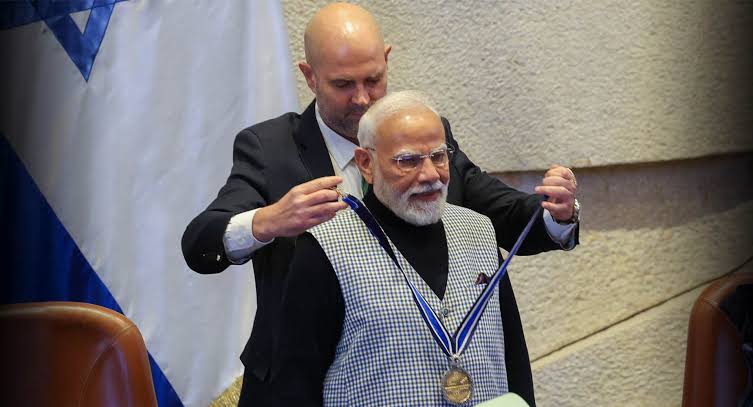

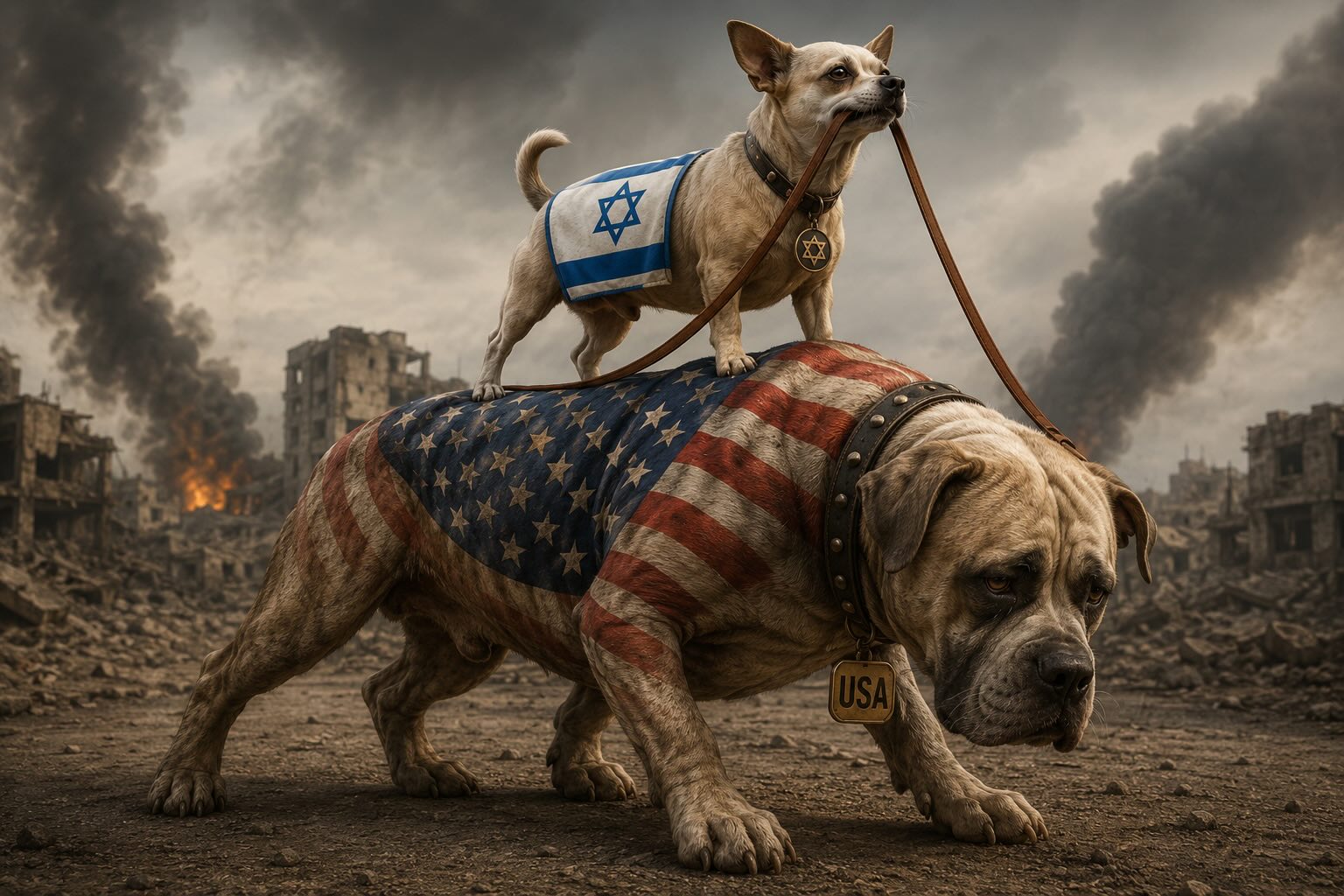 As remains evident, Zionist influence on Congress and the Government is fairly obvious, and in the circumstances one can clearly understand Trump’s fawning over Netanyahu, and as to why the Israeli tail gets to wag the American dog when it comes to West Asia.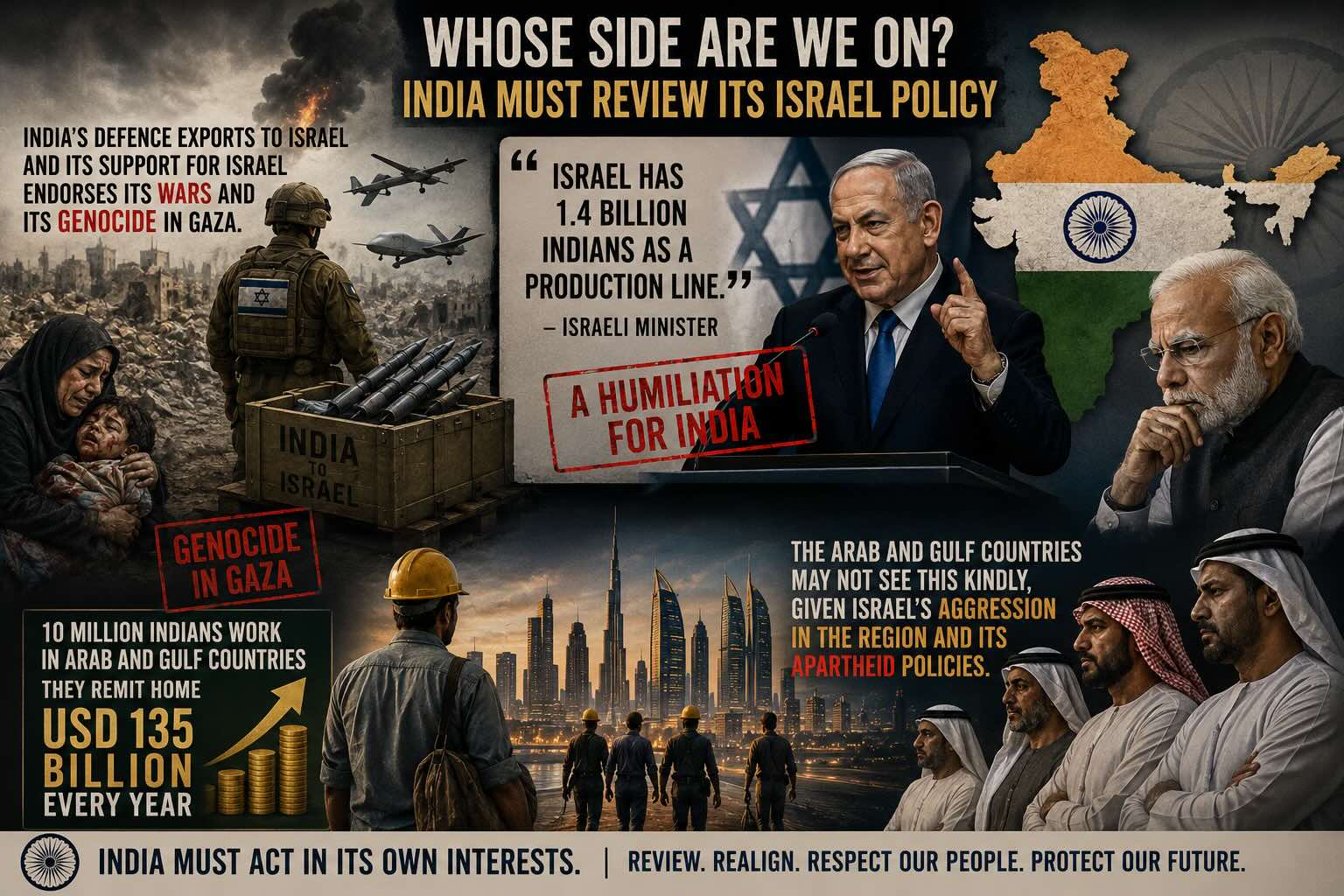
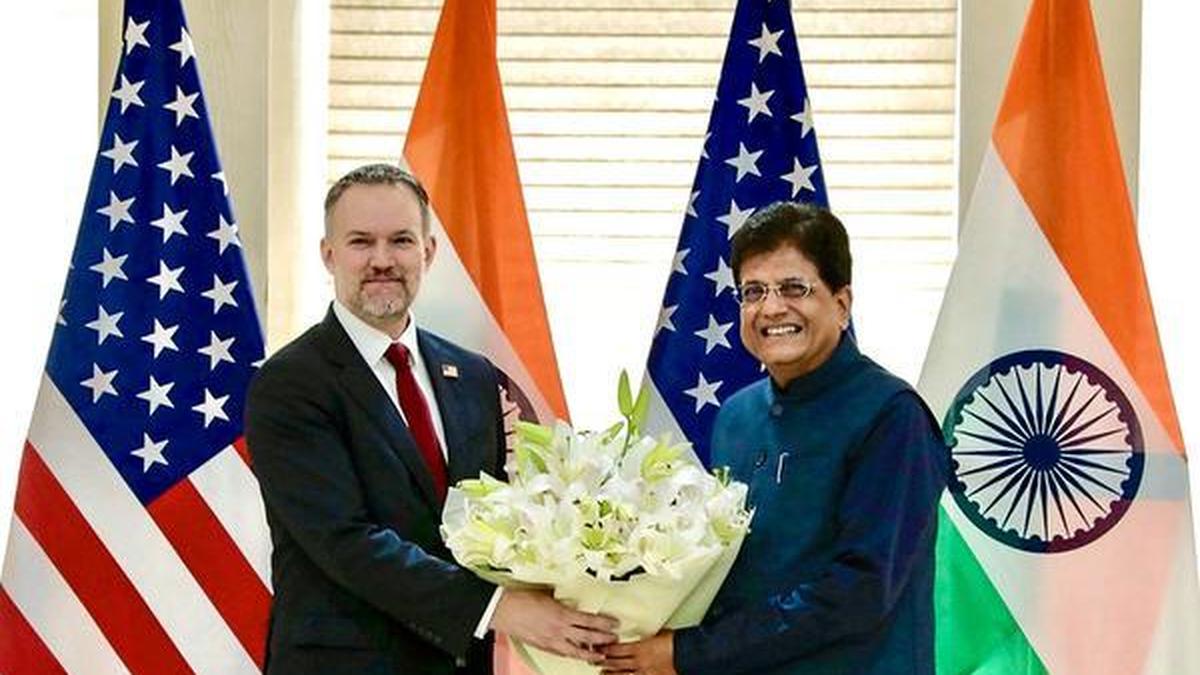
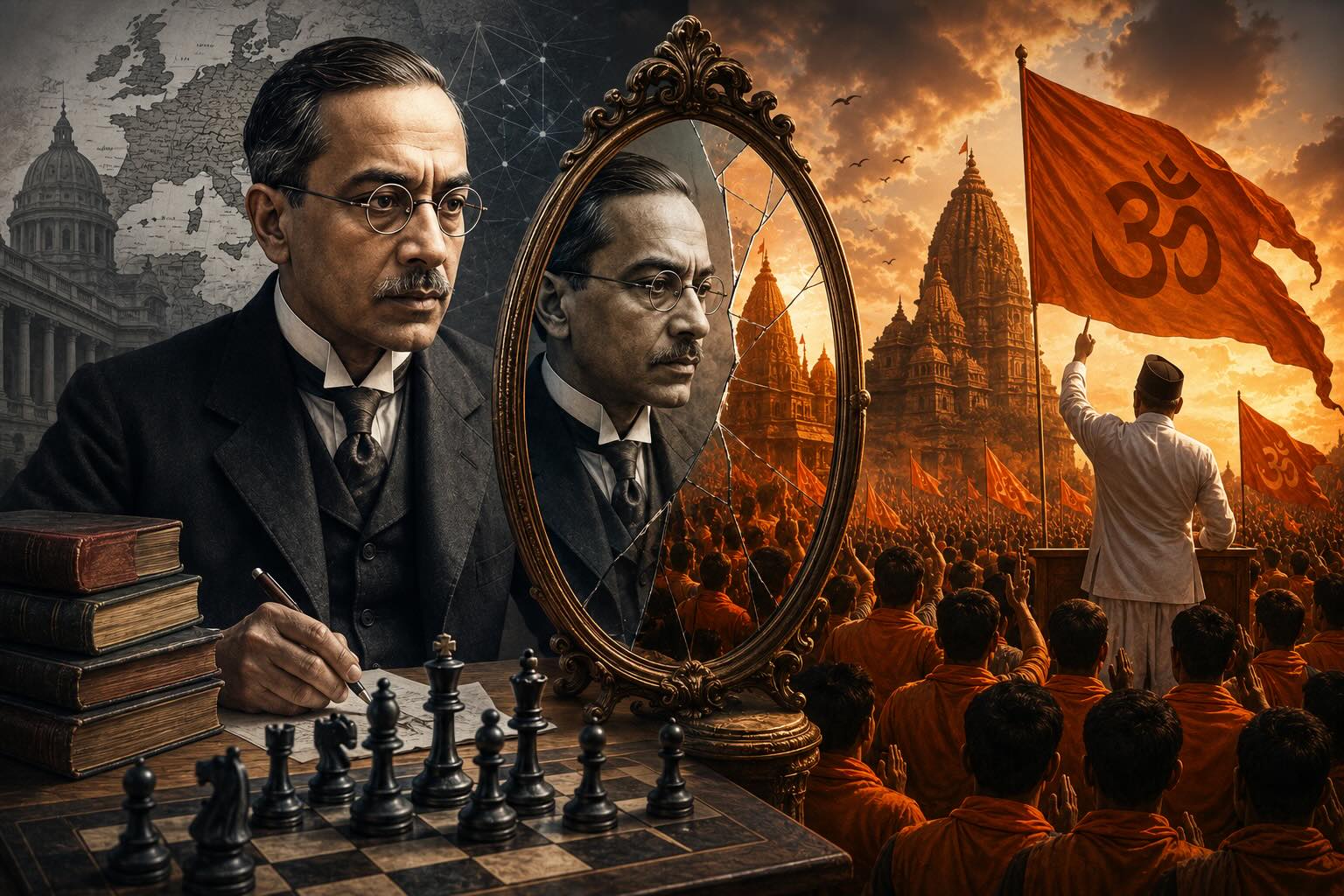
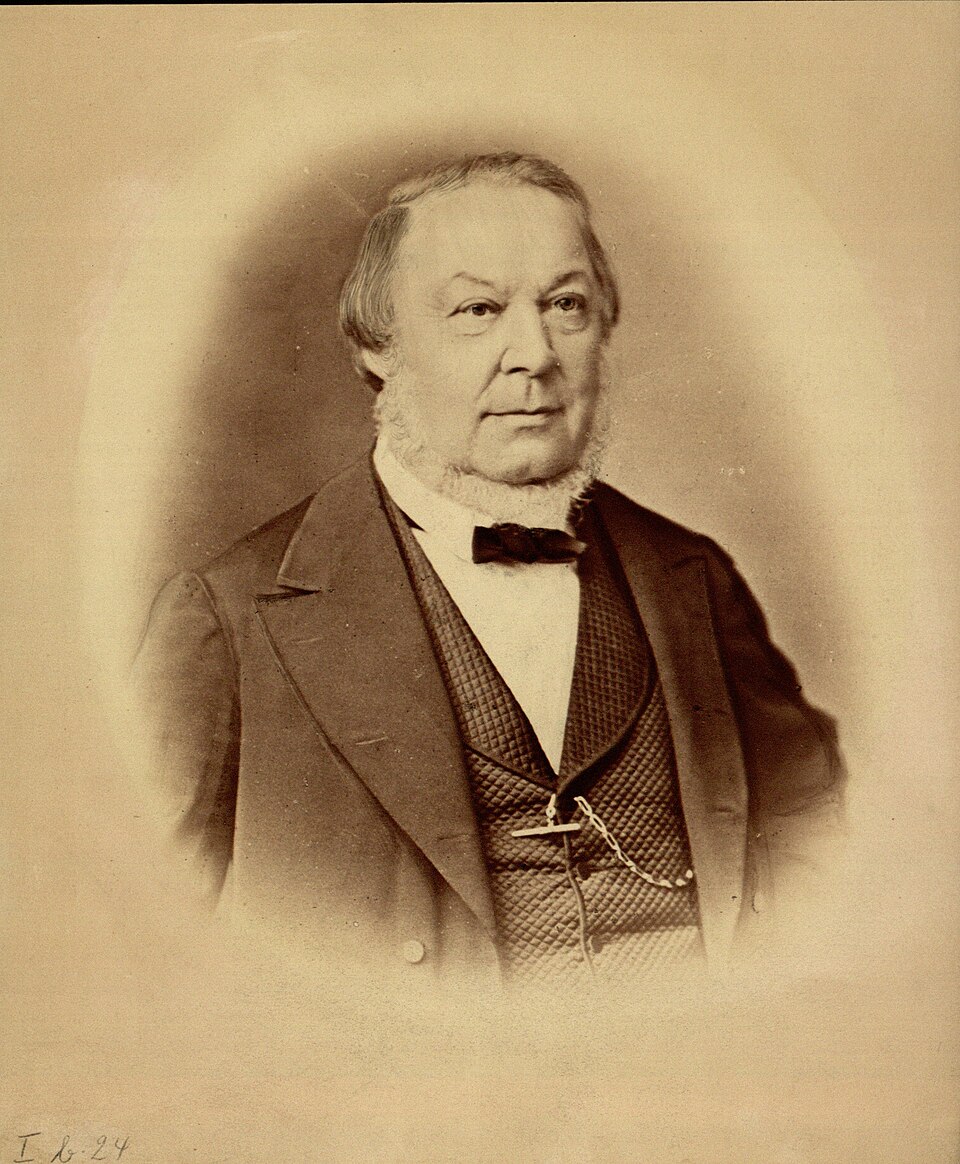
 Where did this conception come from? Not from the Vedas, the Upanishads, or any Hindu philosophical source. It came from Europe. Savarkar’s framework of organic ethnic nationalism drew on the nineteenth-century European tradition of the nation as a racial-cultural organism — the tradition of the Swiss-born jurist Johann Kaspar Bluntschli, who worked within German Staatslehre and distinguished between a nation’s racially rooted ‘principal’ people and those he regarded as alien to it. It drew, too, on the ethnic nationalisms then ascendant across Europe, the same intellectual currents that were hardening elsewhere into far darker forms. This is the first irony, and it is foundational: the ideology that today presents itself as the authentic voice of Hindu civilisation was constructed by an atheist using conceptual tools borrowed from European ethnic nationalism — the very tradition most alien to India’s own pluralist philosophical inheritance.