Tag: USA

  • The Mask of Western Liberalism Has Slipped

    The Mask of Western Liberalism Has Slipped

    This is an interesting analysis published by ‘Global Geopolitics’ that highlights the aggressive, ruthlessly ‘might is right’ strategy the US employs to restore or sustain its fast-declining hegemony by disrupting global energy security. India’s petroleum minister announces that India’s LPG procurement from the US has climbed to 67%, from less than 10% last year. Nothing could be economically more unwise and disastrous for India. But the petroleum minister is proud of it!                          – Team TPF

    Western Industrial Policy and the Abandonment of Market Orthodoxy Expose the Class War in the Face of Chinese Competition.

    The ideological edifice upon which Western global dominance was constructed has collapsed with remarkable speed. For decades, the United States and its allies justified their hegemony through a simple formula that presented liberal democracy and free markets as the natural endpoint of human development, with China condemned for its authoritarian state capitalism, its violation of free market principles, and its excessive government intervention in the economy. The entire apparatus of liberal ideology rested upon the claim that decentralised markets, guided by the invisible hand, would always outperform the clumsy, coercive hand of the state, and that any deviation from this path represented a regression toward tyranny and economic stagnation. This narrative proved remarkably durable for as long as the West maintained its productive superiority, but the emergence of China as the world’s second-largest economy and the principal strategic competitor to the United States has exposed the lie at the heart of the liberal project (13).

    The West is now adopting China’s methods to defeat China, and in doing so, it is proving through its own actions that the Marxist analysis of the state was correct all along. The state is not a neutral arbiter of national interest, but an instrument of class rule, and the free market was never a universal principle but a weapon wielded against rivals and a self-serving narrative advertised to the masses. The same ruling class that preached fiscal discipline and limited government is now centralising power on an unprecedented scale, coordinating industrial policy, and weaponising the state not for the benefit of the working class but for the preservation of oligarchic hegemony. The mask has slipped, the class war is explicit, and the consequences will determine the trajectory of the twenty-first century.

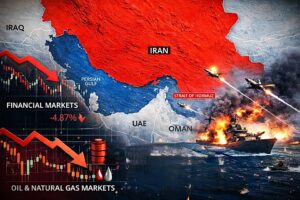
    Now, the United States is practising the most ambitious state-directed energy strategy in modern history, constructing a global energy monopoly through deliberate acts of sabotage, sanctions, and military aggression. The Nord Stream pipeline, which supplied cheap Russian gas to Germany for decades, was destroyed in an act of industrial sabotage bearing all the hallmarks of a state-sponsored attack, and the Strait of Hormuz, through which passes one-fifth of the world’s oil, is now effectively blockaded through a US-led military encirclement that has deliberately escalated regional conflict to disrupt global energy flows.

    The energy front provides the most dramatic demonstration of this ideological volte-face. The West spent decades lecturing the world on the sanctity of free markets in energy, demanding that governments privatise state oil companies, open resources to foreign investment, and refrain from any interference that might distort the efficient allocation of supply and demand. Now, the United States is practising the most ambitious state-directed energy strategy in modern history, constructing a global energy monopoly through deliberate acts of sabotage, sanctions, and military aggression. The Nord Stream pipeline, which supplied cheap Russian gas to Germany for decades, was destroyed in an act of industrial sabotage bearing all the hallmarks of a state-sponsored attack, and the Strait of Hormuz, through which passes one-fifth of the world’s oil, is now effectively blockaded through a US-led military encirclement that has deliberately escalated regional conflict to disrupt global energy flows. Qatari liquefied natural gas exports, once a major source of energy for Asia, are statistically at zero after Iranian strikes on the Ras Laffan refinery, an attack made possible by the regional conflagration that Washington ignited (1).

    Asian countries that once bought from Qatar are now forced to purchase American LNG at extortionate spot prices that have spiked from ten dollars to twenty-five dollars per million British thermal units, and Japan’s imports of US LNG have increased fifteenfold since February.

    The consequence of this centrally planned energy blockade is the systematic transformation of Asian energy dependency from West Asian producers to American suppliers. Asian countries that once bought from Qatar are now forced to purchase American LNG at extortionate spot prices that have spiked from ten dollars to twenty-five dollars per million British thermal units, and Japan’s imports of US LNG have increased fifteenfold since February. Europe’s gas reserves are so depleted that the entire continent would run out of stored energy in less than six weeks of a cold winter, while American LNG tankers divert to Asia to chase higher profits. This is not a market; it is a centrally planned energy blockade designed to control global energy flows and weaponise them against China, the world’s largest oil importer, whose industrial base depends upon affordable energy imports. The empire’s strategy is to deny China access to affordable energy, fracture its supply chains, and force its vassals into permanent dependency, while the profits for Exxon, Chevron, and the LNG cartel represent a welcome side effect of uncontested global hegemony.

    The financial front reveals an equally stark contradiction between liberal ideology and imperial practice. The West built its ideological dominance on the myth of fiscal responsibility, imposing austerity on the Global South through the structural adjustment programmes of the International Monetary Fund and the World Bank, while governments that printed money to fund development were condemned as irresponsible populists. Now, the empire is debasing its own currency on a scale that would make the populists blush, borrowing trillions to fund the artificial intelligence arms race, the military buildup, and the energy war, while weaponising the dollar through sanctions, reserve freezes, and exclusion from the SWIFT payment system. The recent intervention to support the Japanese yen reveals the true nature of this financial architecture, as the United States Treasury sold euros to purchase yen in a rare market operation, marking the first American intervention to strengthen the currency since 1998 (1-13).

    The mechanism of dependency is the Federal Reserve’s Foreign and International Monetary Authorities Repo Facility, which allows Japan to swap its US debt holdings for dollars without selling them on the open market, but the price of this facility is permanent financial vassalage. Japan is structurally prevented from diversifying away from the dollar, and the US Treasury now holds effective veto power over Japanese monetary policy, ensuring that Tokyo cannot chart an independent course, trade freely with China, join alternative financial architectures, or refuse to participate in the empire’s economic war. A Japan locked into the FIMA Facility must hold US debt, defend the dollar, and follow Washington’s lead, and this dynamic is being replicated across the empire’s network of vassals. The empire is tightening the leash not merely to enrich Wall Street but to ensure that when the order comes to isolate, embargo, or wage proxy war against China, its vassals have no choice but to obey (13).

    The military front demonstrates the empire’s willingness to abandon its stated values in pursuit of strategic advantage. The United States presented itself as the indispensable nation defending freedom and democracy against tyranny, with NATO portrayed as a defensive alliance and wars justified as humanitarian interventions to liberate the oppressed and spread universal values. Now, the mask has slipped entirely, as Washington constructs the institutional architecture for a global war against multipolarity. NATO is expanding not to defend against a non-existent Russian invasion but to encircle China, and AUKUS, the Quad, and the deepening US-Japan-South Korea trilateral military alliance are not defensive arrangements but the scaffolding of a centrally planned military encirclement designed to control the South China Sea, the Taiwan Strait, and the sea lanes on which China’s trade depends (1).

    The US-Israel military merger, which passed the House in late July by a narrow vote, directs the Secretary of Defense to designate a permanent executive agent to accelerate the integration of American and Israeli defence technology, research, and production, authorising seven hundred and fifty million dollars for joint projects and making the relationship institutionally permanent. Once a supply chain is integrated and a production line is established, it becomes nearly impossible to dismantle, and this represents class interest institutionalised through a permanent military alliance that will be used to project power in the Middle East against China’s Belt and Road Initiative. The USS George Washington Carrier Strike Group sails through the South China Sea, challenging Beijing’s territorial claims, while Washington coordinates the defence industries of its vassals, directs their military spending, and integrates their command structures. This is not about selling weapons, though the defence contractors profit handsomely; it is about strategic encirclement, preparing for a confrontation that the empire knows it cannot win through economic competition alone (1).

    The technology front represents the most complete abandonment of liberal ideology, as the West practises the most aggressive state-directed industrial policy since the Soviet Five-Year Plans. The CHIPS Act pours tens of billions of dollars into domestic semiconductor manufacturing, explicitly framed as a response to China’s dominance, and tariffs on Chinese electric vehicles, solar panels, and batteries are not temporary adjustments but permanent walls designed to strangle China’s green technology advantage. Export controls on advanced semiconductors, artificial intelligence chips, and chip-making equipment are not about national security but about denying China access to the technological base of the twenty-first century. Japan’s $2.3 trillion industrial revival plan is explicitly dependent on American technology, including 27,500 Nvidia Rubin chips to build artificial intelligence-powered robotics systems to challenge China in manufacturing, ensuring that any challenge to US hegemony would mean economic collapse for the vassal (13).

    The same policies that the West condemned when China practised them, including state subsidies, industrial policy, and protectionism, are now the official doctrine of the empire, and the goal is not to enrich Silicon Valley but to strangle China’s technological independence. A China that controls its own semiconductor supply chain, its own artificial intelligence infrastructure, and its own green energy technology is a China that cannot be stopped, and the empire’s technology strategy is designed to prevent that outcome. The West’s embrace of state-directed industrial policy is the most explicit admission that the “free market” was always a weapon to be wielded against rivals and abandoned when it ceased to serve the interests of the ruling class (5-13).

    The contradictions documented across these four fronts are not accidents, policy mistakes, or temporary deviations from liberal principles; they are the exposure of a lie that was always at the core of the liberal project. The Western ruling class never believed in free markets; it believed in markets when it was winning and abandoned them when it started losing. The rules-based order was a weapon to discipline rivals while the empire did whatever it wanted, and now that the rivals are too strong to discipline, the empire is tearing up the rulebook and revealing its true nature: a centralised capitalist dictatorship organised for class war. The liberals are no longer liberal, because the material conditions no longer permit the luxury of ideological consistency. When the empire was ascendant, it could afford to preach free trade, open markets, and limited government; now that China is overtaking it, the empire must do exactly what it condemned China for doing: plan, direct, and control (5-13).

    This is the class war revealed, with the Western oligarchy consolidating a centralised capitalist dictatorship to defend its global hegemony against China’s socialist-oriented state, while the liberals who once defended freedom and democracy now cheer the empire’s authoritarian turn.

    The difference between these two systems is the class that each serves. China’s planning serves the working class, lifting eight hundred million people from poverty, building the world’s largest high-speed rail network, and leading the green energy transition, while the empire’s planning serves the oligarchy, enriching the few, immiserating the many, and preparing for war. This is the class war revealed, with the Western oligarchy consolidating a centralised capitalist dictatorship to defend its global hegemony against China’s socialist-oriented state, while the liberals who once defended freedom and democracy now cheer the empire’s authoritarian turn. They were never defenders of liberty; they were defenders of a system that benefited their class, and now that the system requires centralised, authoritarian methods to survive, they embrace those methods without hesitation (5-8).

    The mask has slipped, and what remains visible is the reality that Marxism has always insisted upon: the state is an instrument of class rule, and the free market was always a lie sold to the masses while the ruling class did whatever it wanted. The Western ruling class is adopting China’s methods to defeat China, proving that China’s methods were always superior and revealing that the ideological contest was never about freedom versus tyranny but about which class would control the fruits of production. The empire is preparing for a confrontation that will determine the future of humanity, centralising power on every front, sacrificing short-term profits for long-term domination, and willing to immiserate billions to achieve its goal. The struggle continues, and the outcome will be determined not by the sophistication of liberal ideology but by the capacity of the working class to recognise the class war and unite in opposition to the oligarchy that wages it.


    References

    China Daily. 2026. “Deepening Geopolitical Differences Highlighted Before Munich Meeting.” China Daily, 11 February.

    China Daily. 2026. “Negotiating the ‘Gracchi Trap’.” China Daily Global, 6 August.

    Dawn. 2026. “Dawn of Highly Volatile Multipolar Order.” Dawn, 23 March.

    Munich Security Conference. 2026. Munich Security Report 2026. Munich: Munich Security Conference Foundation.

    Xinhua Español. 2026. “Latinoamérica y el Caribe Posee Activos para Sortear Nueva Era Geopolítica.” Xinhua, 5 August.


    This article was authored and published earlier by Global Geopolitics

    Feature Image Credit: ussc.edu.au


  • On the wrong side of History

    On the wrong side of History

    So, at a time when Israel finds itself on the back foot and bereft of friends, the question arises as to how have we ended up backing this losing horse? In actual fact, we have, as a nation, leaving aside the odd oligarch, little to gain from this relationship and much to lose.

    Some may be aware of the global internet-based market research and data analytics firm, YouGov, that continuously collects and disseminates data from around the world on all manner of topics, concerns, and opinions, including political opinion polls. In fact, the banner headline on its website reads “YouGov: What the World Thinks”.

    However, a caveat here worth keeping in mind, however accurate their polls, perceptions and opinions tend to be highly subjective and not necessarily an accurate reflection of ground realities.

    For example, the vast majority around the world must necessarily be quite upset with the intemperate behaviour and antics of President Trump, especially his blatant racism, misogyny and the horrendous Epstein allegations. Apart from the horrific devastation he has wrought in Iran, his clampdown on immigration and the tariff fiasco have had a debilitating impact globally.

    Given his multitude of sins, one could easily be forgiven for believing that he must surely be the worst performing and least popular President in American history. One would be wrong in drawing such a conclusion, because YouGov in its latest polls ranks him 38th out of the 45 Presidents to date. Incidentally, not unexpectedly, Abraham Lincoln leads this poll, with George Washington a close second, followed by John F Kennedy.

    Interestingly, among the top three Presidents in popularity, two ended up assassinated. This not only makes popularity a questionable aspiration in the States, but also speaks volumes about the American psyche. Indeed, Trump would probably do well to avoid topping the charts, though if history is any indication, the real threat to his life may well lie elsewhere, and not necessarily from Iran, if some commentators are to be believed.

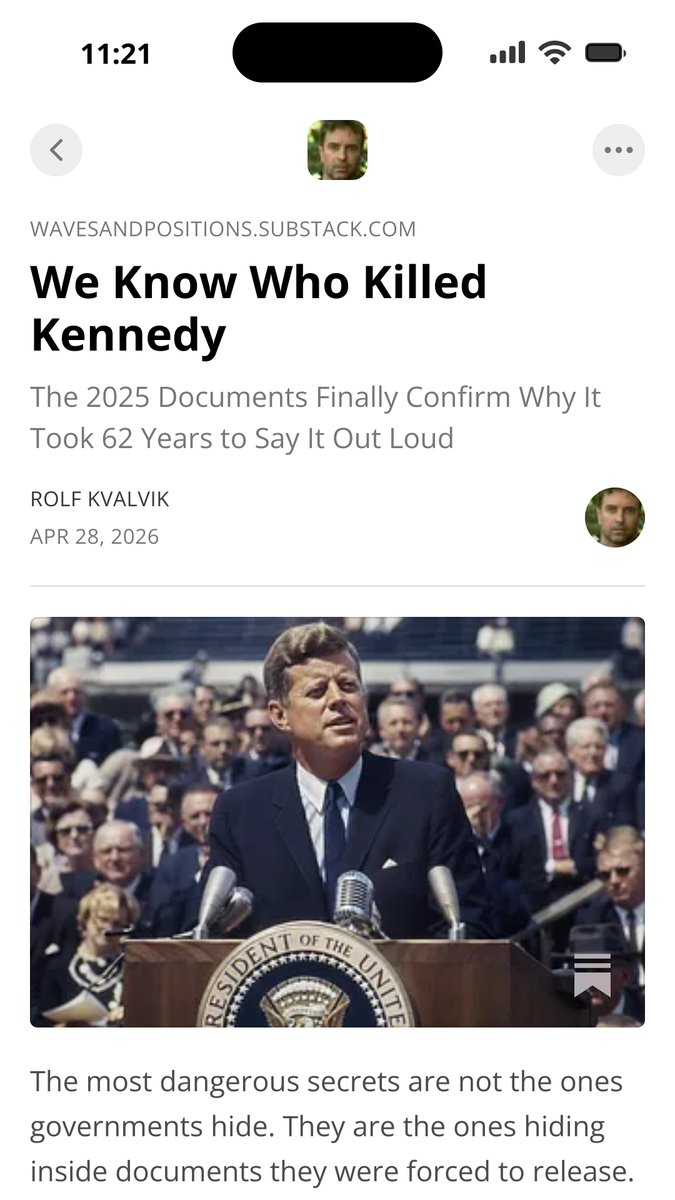
    There is an interesting series on Substack by US Navy veteran, Rolf Kvalvik, on the JFK assassination that makes fascinating reading—-

    In this eight-part series, he delves into new documentation that has recently been unclassified, ironically enough by President Trump, on the assassination of President Kennedy.

    He points out that President Kennedy was extremely upset with Israel over its secret nuclear weapons programme and had put in motion various robust steps to shut it down. Going so far as to threatening to cut off all aid to that country, apart from clipping the wings of the very influential Zionist lobby in the States. So much so, that his actions were perceived as an existential threat by the Israeli leadership.

    In Kvalvik’s view, he was thus neutralised by the Israeli Intelligence Services working in collusion with rogue elements within the CIA, the Mafia, Zionist lobby groups in the United States and some senior politicians.

    Indeed, following his murder, Israel benefitted the most. Within days President Johnson ensured JFK’s directives against Israel were watered down sufficiently enough to make them ineffective and within two years Israel had produced a workable nuclear bomb.

    Trump must be fully aware of what these and other documents hold, as well as of the brutal truth that the Zionist regime will stop at nothing, including blackmail, assassination, deception and false flag operations, in its pursuit of its Greater Israel agenda.


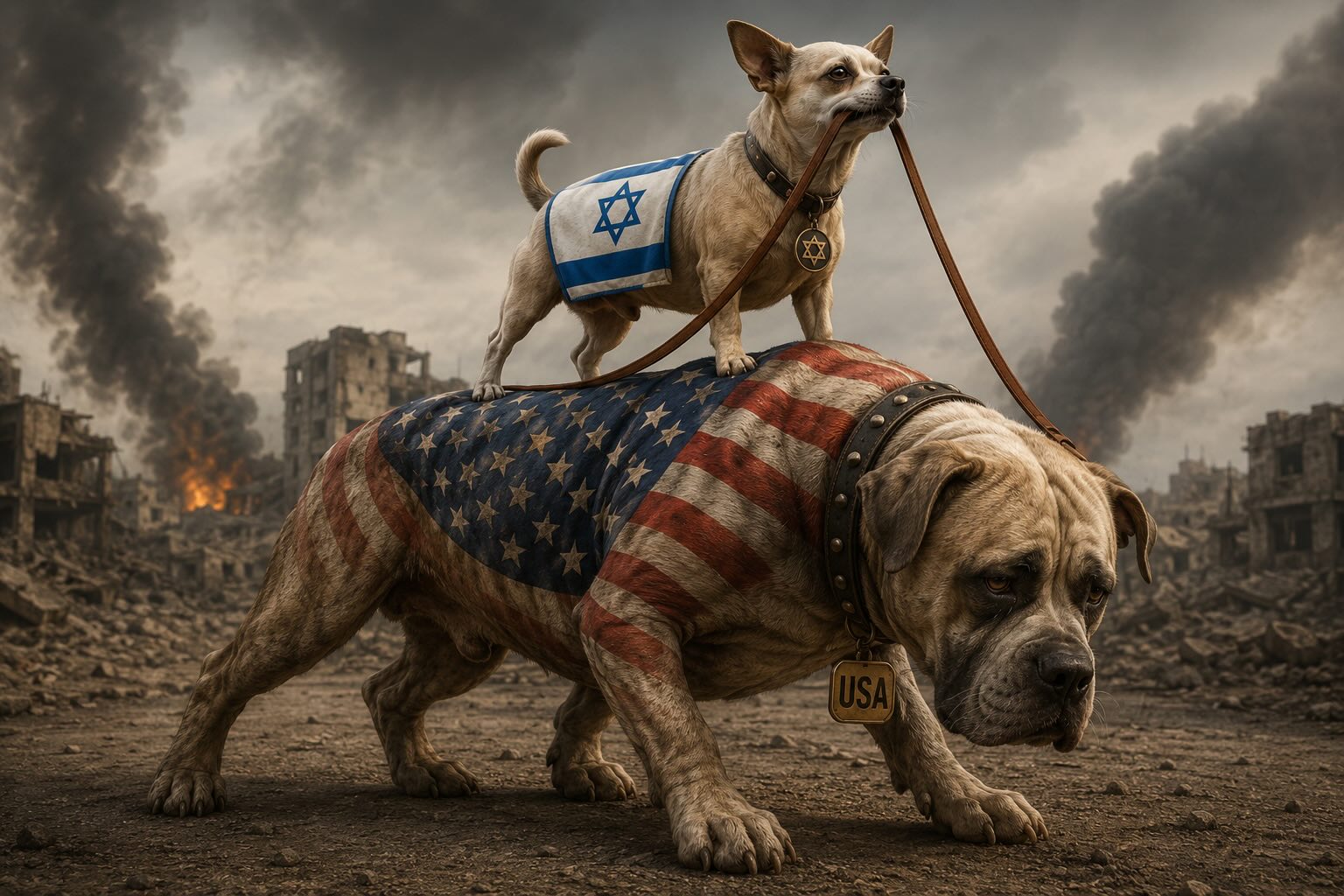
    As remains evident, Zionist influence on Congress and the Government is fairly obvious, and in the circumstances one can clearly understand Trump’s fawning over Netanyahu, and as to why the Israeli tail gets to wag the American dog when it comes to West Asia.

    Unfortunately for Israel, however, their pet project appears to have hit a dead end, thanks to Iran’s intransigence, against which even American military power seems rather ineffectual. Of course, America does have the ability to initiate massive destruction all around, but that in turn is bound to result in a military confrontation with Russia and China. Even Trump’s compromised military leadership must baulk at such a possibility.

    So, at a time when Israel finds itself on the back foot and bereft of friends, the question arises as to how have we ended up backing this losing horse? In actual fact, we have, as a nation, leaving aside the odd oligarch, little to gain from this relationship and much to lose.

    Aside from advanced weaponry, whose value in the transformed conventional warfare environment is highly questionable, seeing their inability to stop Iranian attacks, they have little to give us. In any case, those weapons don’t come cheap.

    Of course, there is the employment factor, as Israel is keen; we provide the menial and blue- collar labour they require as replacement for the Palestinians who performed those tasks earlier. Ironically, one could say we are Israel’s equivalent of the much-maligned Bangladeshi’s here. In any case, this will amount to around a lakh or so at best finding employment.

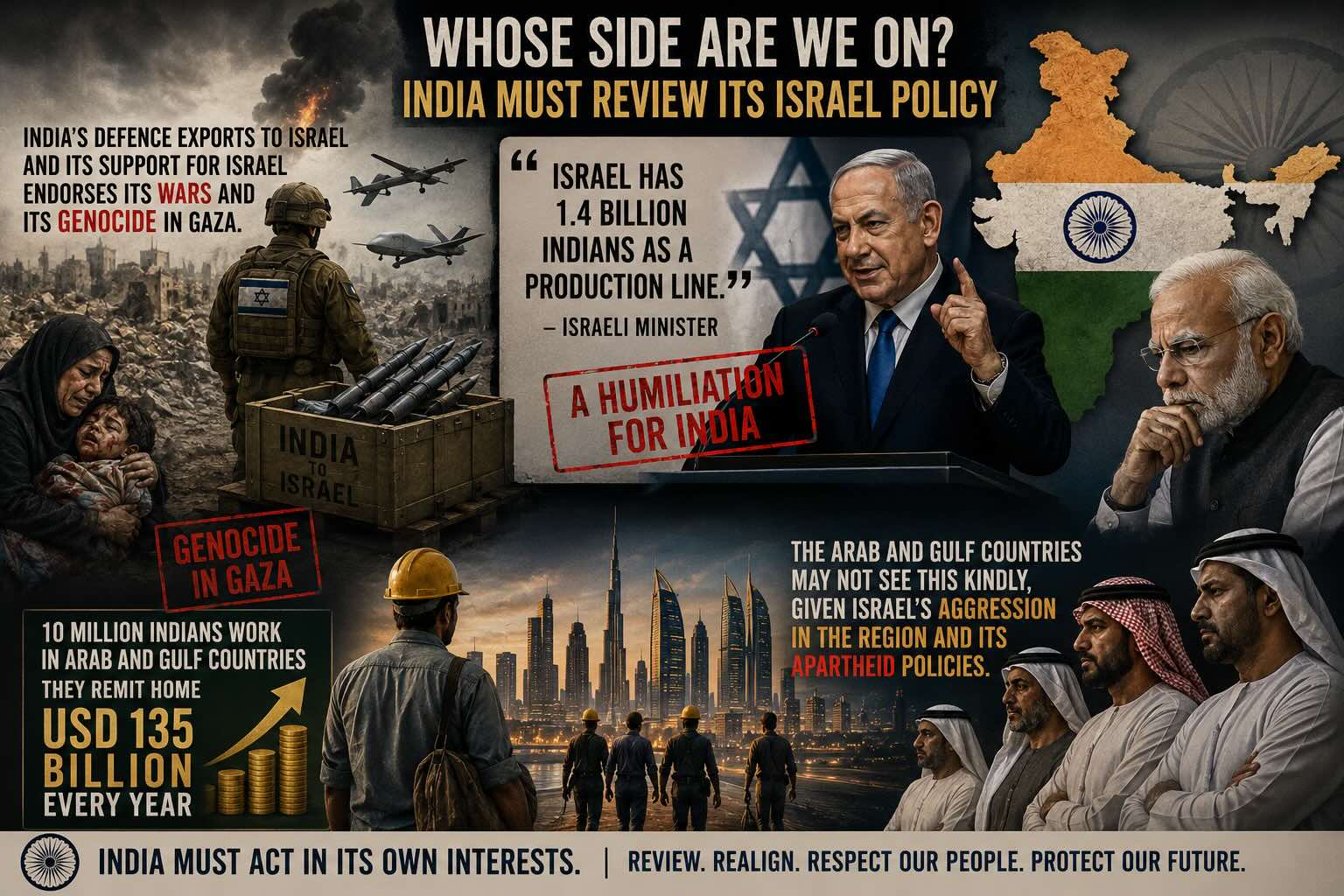
    Our importance lies in what Brigadier General (Reserve) Erez Winner told a mainstream television channel: “Israel has 1.4 billion Indians as a production line”. We are perceived by them as bonded labour available to them to fulfil their Zionist agenda.

    From the Israeli point of view, however, apart from providing their murdering conscripts a safe and cheap haven to chill out in after completion of their terms, our importance lies in what Brigadier General (Reserve) Erez Winner told a mainstream television channel: “Israel has 1.4 billion Indians as a production line”. We are perceived by them as bonded labour available to them to fulfil their Zionist agenda.

    Being perceived as lackeys of the Israeli-American duopoly is hardly helpful for the government’s reputation and plainly demeaning for us as well. Clearly, in purely geopolitical or socio-economic terms, there is hardly any reason to justify our pro-Israel tilt. Especially given that around 10 million of our citizens are employed around the region, other than in Israel.

    Some opposition politicians, analysts and commentators here tend to believe that our government’s tilt towards Israel is predicated on the fact that the Hindutva and Zionist agenda have much in common, especially in regard to their virulent hatred for the Muslim community. While there may well be some truth to this, it is inconceivable that any government would risk its relationship with other countries of the region over this, given the socio-economic impact that would have.

    In the circumstances, it increasingly appears, as Mr Gandhi and the Congress allege, that our government is being held hostage to other extraneous factors that could well embarrass the government if they ever came into the public domain. One cannot help but wonder what cost the general public will have to pay in the long term to keep these secrets out of the public eye.


    Views expressed are the author’s own.


  • Analysing India’s Trade Bottlenecks

    Analysing India’s Trade Bottlenecks

    U.S. is raising vague arguments and challenges such as ‘forced labour’ and ‘surplus capacity’, while advanced countries do not help with technological development.

    On July 15, the India-U.K. trade deal came into force. That day, India banned the import of goods made using forced labour so as not to get unfavourable treatment from the U.S. under Section 301. A day later came the news that a bipartisan Bill has been proposed by U.S. Senators to levy up to 100% tariff on India and others for buying Russian crude. One way or the other, India’s trade with the U.S. is being buffeted by bottlenecks.

    China’s trade
    In contrast, without a trade deal, China has become India’s largest trading partner. Imports from China in the first half of 2026 have shot up by 21.8% while exports have risen by 37.2%, though on a small base. The already-high trade deficit with China of $116 billion last year is likely to rise since it has already topped $67 billion in the first half of the current year. The imports from China are high- and low-tech items, while exports are mostly low-value-added items.
    India’s dependence on China is overwhelming. Factories and exports increasingly depend on China for machinery and intermediates. For instance, pharmaceuticals depend on imports of API from China. The average wage rates in key sectors such as automobiles and apparel are half to one-third of China’s. Yet, India is unable to outcompete China in global markets because of the huge technological advantage the latter has gained in the past 35 years.
    While multinational companies (MNCs) have invested in China, as a share of total investment, it has been small. Further, to capture markets, China has been investing in other countries under the One Belt, One Road initiative. Thus, net foreign investment in China has been small. Finally, as Chinese companies have become big, they are outcompeting MNCs such as Tesla. And many U.S. companies have left China, including Amazon, Apple, Dell, IBM, and Uber.
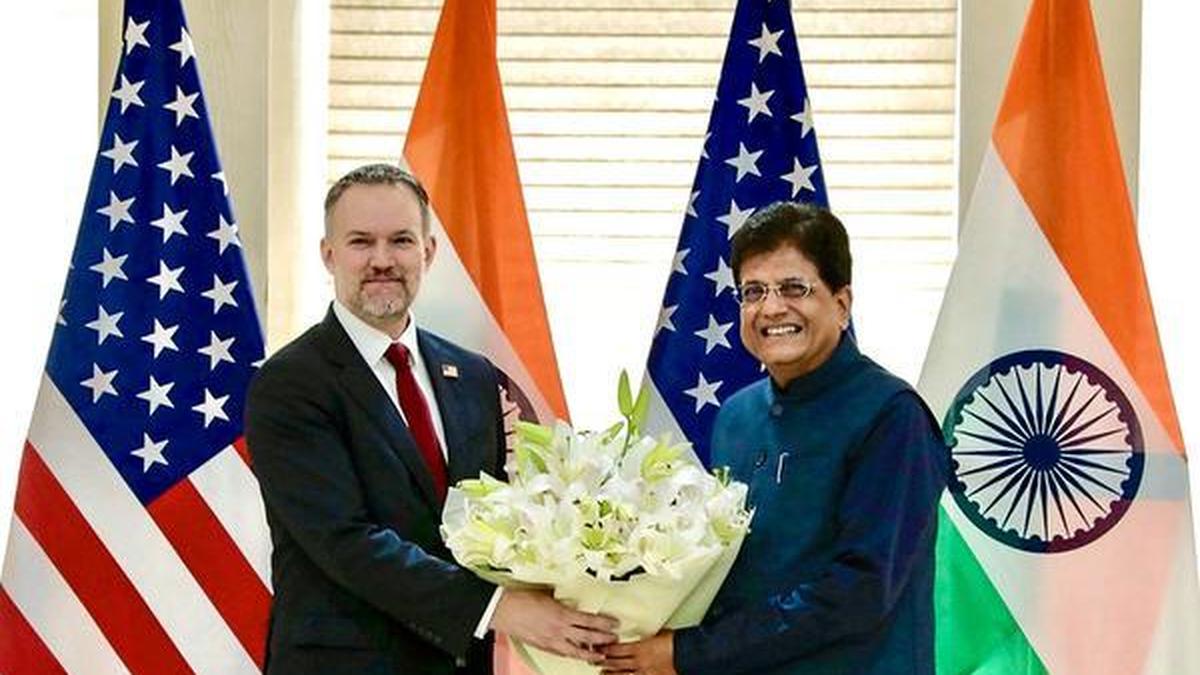
    India is unable to finalise a trade deal with the U.S. since at least July 2025, though Commerce Minister Piyush Goyal keeps assuring the nation that it is almost done. Last August, India’s exports were hit by a 50% tariff, leading to a decline in labour-intensive exports of apparel, shrimps, leather goods, and so on. India’s overall trade deficit increased in 2025 to $120 billion from $94 billion in 2024. China faced high US tariffs, but by diversifying trade, it increased its trade surplus in 2025 to $1.19 trillion from $992 billion in 2024.
    Technology and investment
    The lesson is that technology is the key to trade in today’s globalised world. China is accused by the West of currency manipulation and massive government help to cheapen its exports. The implication is that China is draining its surplus to sell to the rest of the world. And, it is supposed to have been doing so for at least the past 35 years. Such trade over long periods of time should have drained resources and made China suffer. Instead, the Chinese economy has boomed and become five times larger than India’s economy.

    The reason is China’s high savings rate of above 35% of GDP since the 1980s and at times reaching close to 50%. This has been able to finance its huge investments of 40% and more, peaking at 47%. Its growth has not depended on foreign investment.
    This massive investment has enabled China to invest in technology development and expand its industry. This has fuelled rapid economic growth, and initial low consumption levels have risen rapidly, as is visible in any modern Chinese city. The U.S. has tried to thwart Chinese advances in technology by putting restrictions, but China has managed to circumvent that and continue upgrading technology. So much so that the U.S. has come to depend on Chinese imports.

    Since Trump has squeezed India, the latter has entered into trade agreements with important trade partners — the U.K., the European Union, the UAE, New Zealand, and so on. But caution is required since the earlier trade agreements with Japan, Korea and Australia led to a larger trade deficit with them. India could not increase its exports as much as others could because of their technological advantage.

    The advanced countries have not helped India with technological development. They want to export but not share technology. The United States Deputy Secretary of State said at the Raisina Dialogue in New Delhi that the U.S. made a major strategic and economic error roughly 20 years ago by giving China extensive access to American markets, technology, and capital. He said such a mistake would not be made vis-a-vis India. The implication is that India has to develop its own technology; otherwise, it will lag behind the advanced countries and China.

    Forced labour
    By investigating India on “forced labour” under Section 301, the U.S. is seeking to create a bottleneck to extract concessions. Forced labour implies coercion to work. Workers have no choice but to do the bidding of the employer because the option is hunger. Employers take advantage and pay low wages. This gives an exporter an advantage as its produce becomes cheaper. The U.S. says that is unfair to its producers.

    But wages in the developing world are much less than in the advanced nations. Does that mean that all production in the developing world is using forced labour? In India, unorganised labour receives low wages since it has little bargaining power to obtain decent wages. Thus, most of India’s production can be said to be based on forced labour. And its imports from developing nations can be said to be based on forced labour. This is a non-tariff barrier that the U.S. wants to apply to India.
    Another non-tariff barrier the U.S. is threatening to use is “surplus capacity” in steel, textiles, and so on. Any export by any country is over and above what it uses within its own territory. So, all export is based on surplus capacity. The U.S. has a massive agricultural surplus which it wants to dump on India. Its companies provide massive amounts of defence armament to the rest of the world. Which country does not produce for export so that it can import what is needed by its economy? Entire trade depends on these surpluses based on “comparative advantage”. So, what is India being penalised for? Are these bargaining chips to extract concessions?

    India’s trade with the U.S., till recently its largest trading partner, is being buffeted by vague arguments and challenges. Earlier it was the so-called “reciprocal tariffs” and now, Russian crude purchases, “forced labour” and “surplus capacity”. This huge uncertainty is buffeting Indian exporters. Indian officials negotiating a trade deal with the U.S. were hoping for favourable treatment, but that seems unlikely.

    Meanwhile, trade with China has boomed, though there is no trade agreement with it. India avoided joining the RCEP in 2019 to stall Chinese dominance. Given U.S. coercive steps on trade, both India and China have diversified their trade with the rest of the world. That is the way to go. And the lesson from China is that trade deals or not, India needs to upgrade its R&D to become globally competitive.

    This article was published earlier in ‘The Hindu.”

    Feature Image Credit: aninews.in      US Trade Representative Jamieson Greer meeting Union Minister of Commerce and Industry Piyush Goyal in New Delhi in June. | Photo Credit: ANI 

  • Venezuela’s Earthquake Tragedy: A Natural Disaster that Worsened an Already Crisis-Stricken Nation

    Venezuela’s Earthquake Tragedy: A Natural Disaster that Worsened an Already Crisis-Stricken Nation

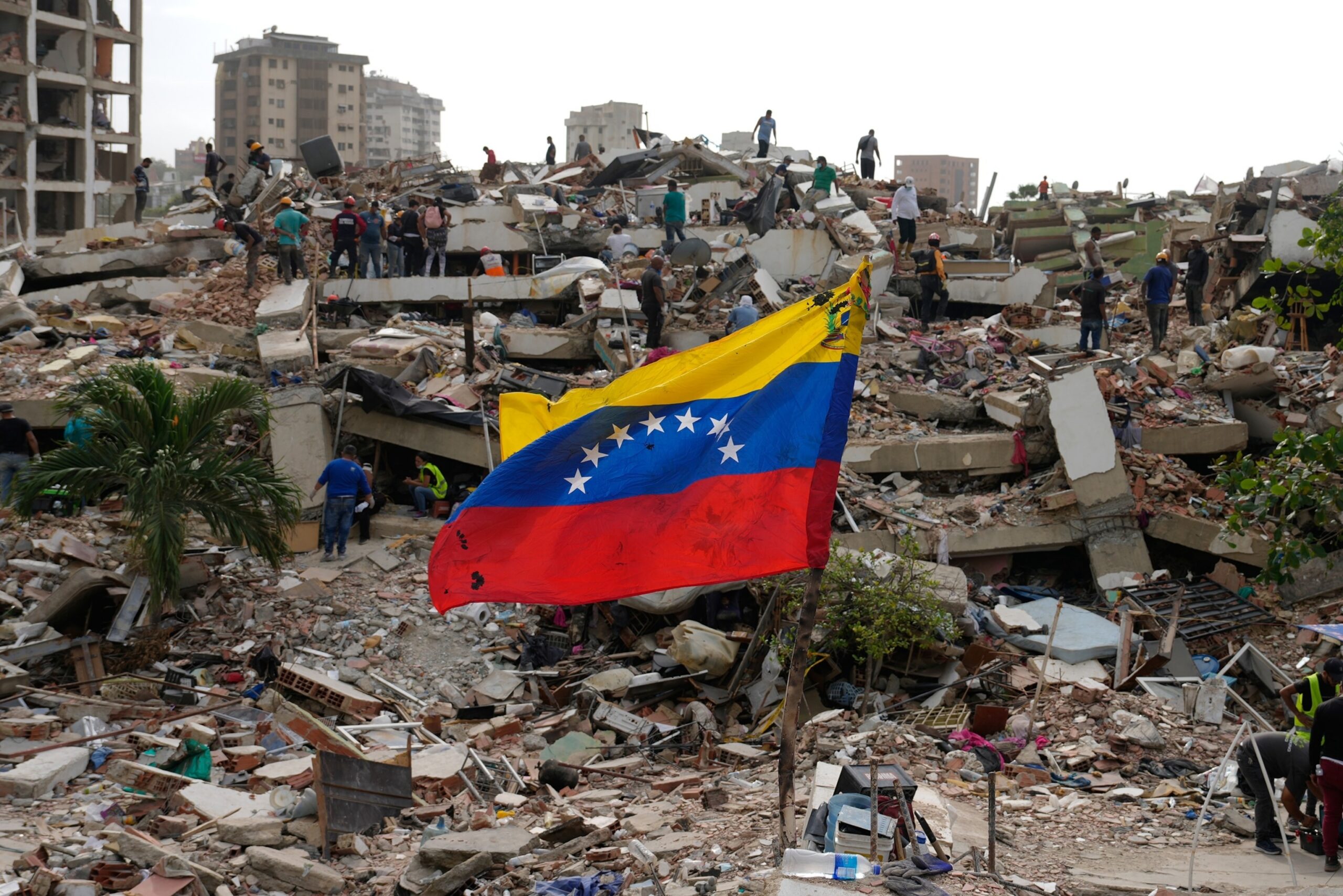
    On June 24, 2026 Venezuela experienced one of the most devastating natural disasters in its modern history when two powerful earthquakes measuring 7.2 and 7.5 struck within seconds of each other along the country’s north-central Caribbean coast. The shallow earthquakes, centred near Morón, sent powerful tremors across Caracas, La Guaira, Carabobo, Yaracuy and Miranda, causing widespread structural collapse, crippling transport networks, disrupting electricity supplies and severely damaging hospitals and other critical infrastructure. Hundreds of aftershocks further complicated rescue operations, making this the country’s strongest seismic event in more than a century.

    The Humanitarian Catastrophe

    The scale of destruction has been staggering. Thousands of buildings—including residential apartments, schools, hospitals and public facilities—either collapsed or suffered extensive damage. Rescue teams, supported by international search-and-rescue missions, continue to search through debris for survivors. Recent estimates place the death toll at well over 1,450, with more than 3,000 injured and tens of thousands displaced from their homes. While international humanitarian assistance has begun arriving from multiple countries, damaged roads, disrupted communications and recurring aftershocks have slowed relief efforts considerably. India on its part has sent two C-17 Indian Air Force aircrafts under Operation Amistad to aid the crisis stricken country.

    From a disaster management perspective, the earthquakes have exposed the vulnerability of ageing infrastructure and inadequate urban preparedness. Hospitals already operating with limited resources have struggled to cope with the influx of trauma patients, while shortages of medical equipment, emergency supplies and trained personnel have further constrained rescue and relief operations. As in many fragile states, the disaster has demonstrated how natural hazards become significantly more destructive when institutional capacity is weak.

    Geopolitics, Sovereignty and Venezuela’s Oil

    The earthquake also unfolded against an exceptionally volatile geopolitical backdrop. Barely six months earlier, Venezuela underwent a dramatic political transition following a U.S. military operation that resulted in the capture and removal of former President Nicolás Maduro. The operation generated widespread international debate, with several international law scholars, United Nations experts and governments describing it as a violation of Venezuelan sovereignty and questioning its compatibility with the principles of the UN Charter.

    The post-Maduro transition has also reshaped U.S.–Venezuela relations. Washington has moved towards supporting Venezuela’s interim administration, easing selected sanctions and reopening engagement with the country’s energy sector. Given that Venezuela possesses the world’s largest proven crude oil reserves, renewed American interest in rebuilding the country’s petroleum industry has inevitably fueled geopolitical debate regarding the strategic importance of energy security in shaping U.S. policy. While some commentators argue that access to Venezuela’s vast oil resources has become a central strategic consideration, others view the engagement primarily through the lens of regional stability, democratic transition and humanitarian assistance. These competing interpretations continue to shape international discourse surrounding Venezuela’s future.

    A Disaster that Struck a Nation Already in Crisis

    This national tragedy is particularly severe because it has struck a country that has spent over a decade grappling with profound political, economic and humanitarian challenges. Years of economic contraction, hyperinflation, international sanctions, declining oil production, institutional deterioration and the migration of millions of Venezuelans have considerably weakened the state’s ability to prepare for and respond to major disasters. Public investment in infrastructure maintenance, healthcare and emergency management had already declined substantially before the earthquake, leaving many critical facilities vulnerable to seismic damage.

    Consequently, the earthquake has not merely created a humanitarian emergency; it has compounded an already fragile national situation. Reconstruction costs are expected to run into several billions of dollars at a time when Venezuela continues to face severe fiscal constraints. Although the country’s oil production infrastructure largely escaped catastrophic damage, disruptions to electricity networks, ports and petrochemical facilities have slowed industrial activity and complicated recovery efforts. The earthquake has therefore added another layer of economic uncertainty to a nation that was only beginning to show modest signs of stabilization after years of decline.

    Conclusion

    Venezuela’s twin earthquakes illustrate how natural disasters rarely occur in isolation. Instead, they intersect with existing political instability, economic fragility and geopolitical competition, magnifying their human and developmental consequences. While international relief efforts may alleviate immediate suffering, long-term recovery will require far more than rebuilding damaged infrastructure. It will depend upon restoring institutional capacity, strengthening governance, revitalizing the economy and ensuring that humanitarian assistance remains insulated from geopolitical contestation. For Venezuela, recovery is therefore not merely a question of reconstruction—it is a test of whether a nation burdened by years of crisis can rebuild both its physical landscape and its political future.

  • Guyana’s Energy Rise and the US-China Contest

    Guyana’s Energy Rise and the US-China Contest

    Introduction

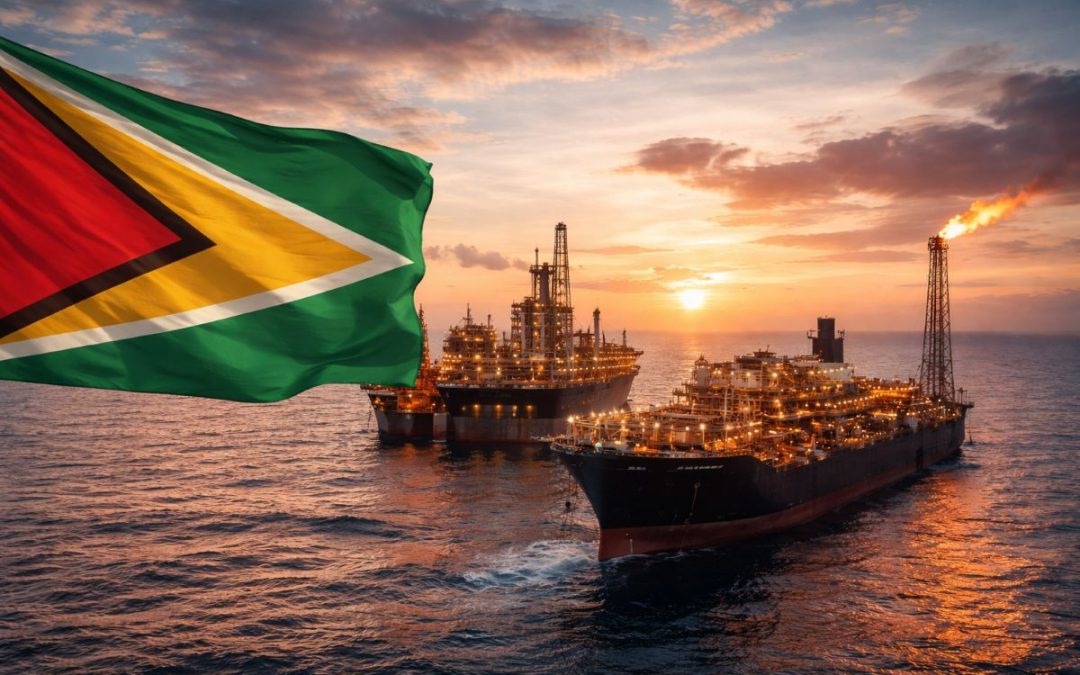
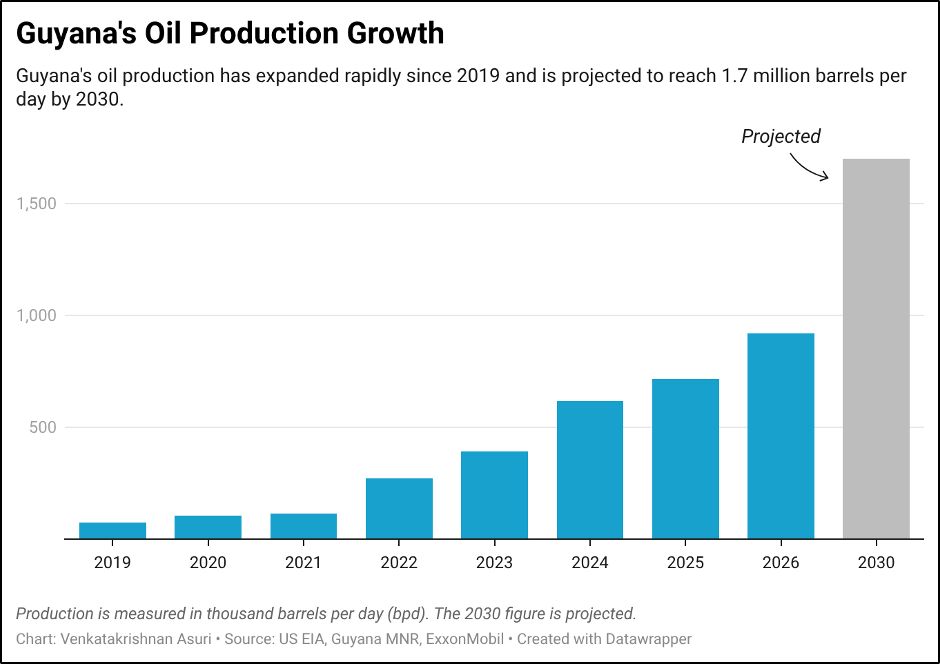
    In just five years after oil production began, Guyana has become the world’s largest per-capita oil producer and South America’s second-largest supplier of crude. Daily output now stands at ~926,000 barrels, with recoverable reserves exceeding 11 billion barrels in the Stabroek Block alone. Guyana has recorded a GDP growth of 43.6 per cent in 2024, one of the fastest rates globally. The former British colony has very rapidly transitioned from being a peripheral Caribbean economy to a strategically significant energy producer. This has attracted growing attention from both the United States and China, both seeking to secure economic, political and strategic influence in the world’s newest petro state. The manner in which Georgetown navigates and hedges against great-power competition over its resources shall determine whether its oil wealth translates into prosperity or succumbs to the familiar resource curse.

    The Energy Architecture

    Guyana’s transition has been remarkably rapid, with commercial oil production commencing in December 2019, within five years after ExxonMobil’s discovery in 2015. The Stabroek consortium, comprising ExxonMobil (45 per cent), Chevron (30 per cent) and China National Offshore Oil Corporation (CNOOC) (25 per cent), has invested billions in developing Guyana’s offshore resources. CNOOC alone has committed approximately $17.7 billion across six projects, making Guyana the company’s largest overseas investment. ExxonMobil projects production to reach 1.7 million barrels per day by 2030, placing Guyana among the world’s major non-OPEC producers.


    Guyana’s energy strategy also goes beyond crude extraction. The Guyanese government is pursuing downstream industrialisation through the $2 billion Gas-to-Energy project, which will transport offshore natural gas to a 300-megawatt power plant at Wales. Supported by a $526 million loan from the US Export-Import Bank, it aims to reduce electricity costs and support the development of a domestic manufacturing base. The participation of companies such as TotalEnergies, QatarEnergy and Petronas indicates efforts to broaden the investor base beyond the Stabroek consortium. At the same time, the continued political consensus around the original Stabroek production-sharing agreement between the Guyanese government and the Stabroek consortium has provided a degree of policy predictability through the 2030s.

    Washington’s Role

    The United States has moved quickly to leverage Guyana’s newfound energy boom into a broader strategic partnership. In March 2026, US Energy Secretary Chris Wright met President Irfaan Ali ahead of the inaugural Shield of the Americas Summit, describing Guyana as “a huge part of this strategy, a very well-governed country with great energy resources”. The summit established the Americas Counter-Cartel Coalition, including Georgetown among a select group of participating Caribbean states. While it has been officially framed as a counter-transnational crime initiative, the initiative reflects broader US efforts to strengthen its security presence in the Caribbean and refocus attention on the Western hemisphere.

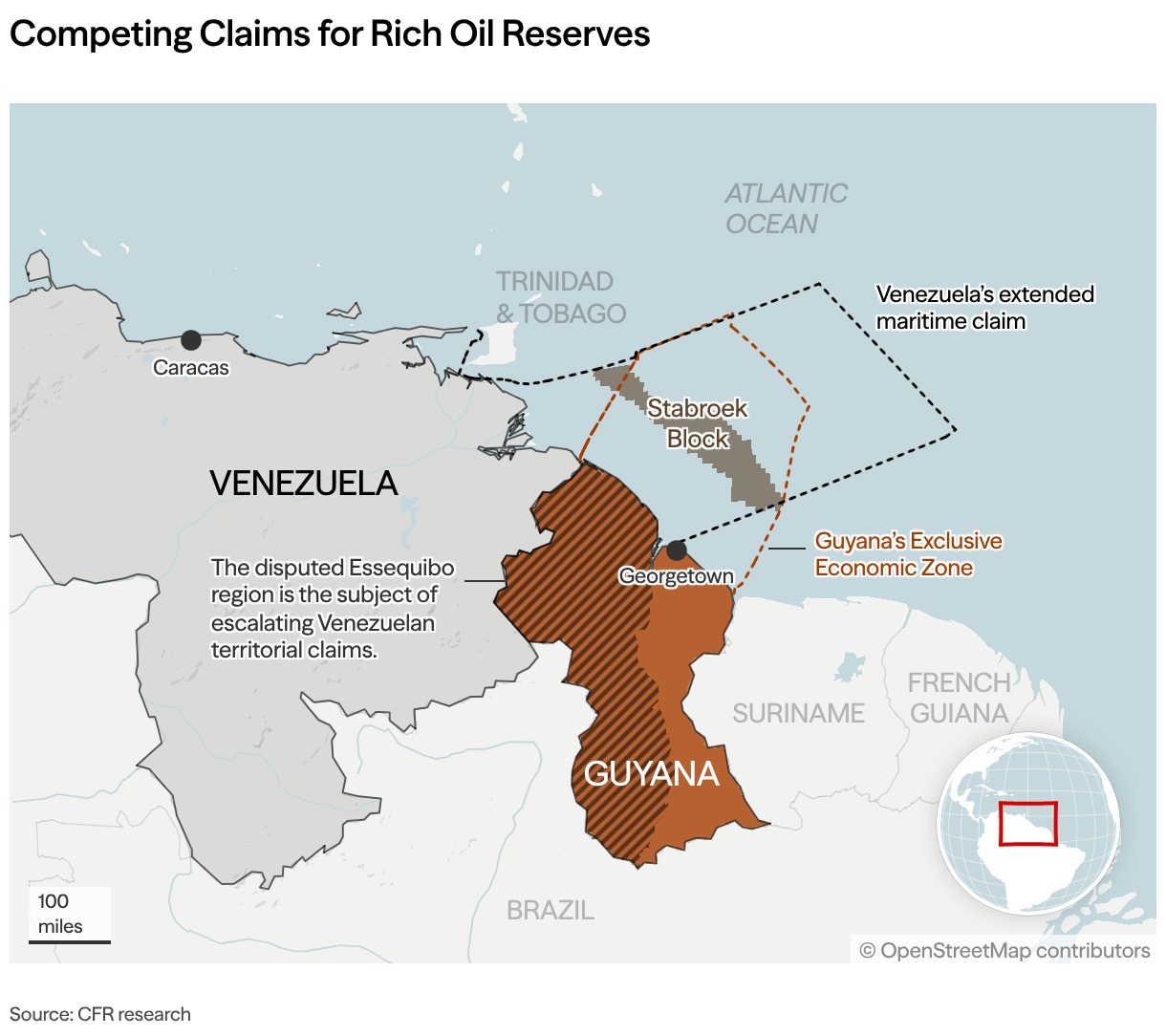
    US engagement has also deepened militarily, with the USS Normandy and USS Mahan conducting exercises with the Guyana Defence Force (GDF) in 2025, while US Army Security Force Assistance Brigades have trained GDF units in jungle warfare and engineering since 2022. Washington has also supported the development of coast guard facilities and communications infrastructure, aiming to strengthen Guyana’s security amid continuing tensions over the Essequibo dispute with neighbouring Venezuela. The growing American footprint in Guyana is visible in the consolidation of Washington’s economic and strategic presence across Guyana’s energy, infrastructure and security sectors. Guyana’s strategic value to Washington also lies in its geography, where a sustained American presence in Georgetown helps shape the trajectory of a post-Maduro Venezuela, particularly as the question of whether Caracas drifts back into Beijing’s or Moscow’s orbit remains unresolved through the medium term.

    Beijing’s Parallel Track

    China’s presence in Guyana differs in scope and character. CNOOC is a passive financial partner in the Stabroek block, earning returns from a basin operated primarily by US energy companies. However, CNOOC has leveraged this expertise, earning secure production-sharing contracts for two offshore blocks in Trinidad and Tobago, citing its experience in Guyana.

    For Georgetown, Beijing has emerged as a significant infrastructure and development partner. Guyana signed a Belt and Road Initiative (BRI) memorandum in 2018 and is negotiating a Joint Action Plan. Chinese state entities have financed or constructed major projects, including the expansion of the Cheddi Jagan International Airport, the $260 million Demerara River Bridge, East Coast road upgrades, and the $184 million East Coast rail-highway project. Beyond existing ones, Chinese developmental financing has been associated with prospective projects, including a deep-water harbour and the Amaila Falls hydropower project. Beijing has also provided approximately $36.6 million in debt relief, helping it earn political goodwill without generating the levels of debt distress seen elsewhere in the Caribbean. At the same time, Guyana’s trade asymmetry is visible, with its non-oil exports to China at $17 million in 2022, while imports from China are multiple times higher at $372 million. The Chinese telecom giant Huawei has emerged as a major player in Guyana’s telecommunications sector, drawing scrutiny from Washington on data governance and cybersecurity, amplified by cybersecurity researchers and Guyanese civil society.

    Venezuela’s Shadow

    For Guyana’s rise, the unresolved Essequibo dispute continues to cast a long shadow, with Caracas having escalated its rhetoric under former Venezuelan president Nicolás Maduro. With Maduro’s removal, the risk of military escalation over the Essequibo has diminished, and the transition government in Caracas is likely to prioritise political stabilisation and economic recovery. However, the medium to long-term challenge for Georgetown remains economic, as Venezuela, which is gradually integrating into global energy markets, will compete with Guyana for the same Gulf Coast refining demand. Guyana’s growth opportunity remains intact, provided that the Caribbean remains within the US security umbrella and the Venezuelan energy sector’s recovery remains gradual.

    Guyana’s Balancing

    Amid intensifying great power competition, Guyana has sought to pursue multi-alignment. President Irfaan Ali’s re-election in September 2025 has ensured continuity in economic and foreign policy at a critical moment in the country’s growth story. Alongside the expansion of hydrocarbon production, Georgetown has pursued a dual-track approach to balance its oil-led growth by advancing its Low Carbon Development Strategy 2030 using its extensive forest cover to generate revenue through carbon credit mechanisms, including a $750 million agreement with Hess Corporation. At the same time, Georgetown has maintained close security and economic cooperation with the United States, retaining Chinese participation in the energy and infrastructure sectors, and continuing its adherence to Beijing’s One China policy. These policies reflect Guyana’s attempt to advance its economic and strategic objectives pragmatically, while seemingly preserving strategic autonomy by leveraging external partnerships.

    The Outlook

    By 2030, Guyana’s oil production could reach 1.7 million barrels per day. As the country’s energy sector grows, competition between the United States and China is likely to intensify in areas such as infrastructure and digital connectivity. While souring relations between Guyana and Venezuela increases Georgetown’s security dependence on Washington, a stable regional environment would allow Guyana to pursue a balanced foreign policy and more diversified external partnerships. Ultimately, Guyana is better positioned than other petrostates to convert its hydrocarbon wealth into prosperity, with the Natural Resource Fund Act of 2019 and the Stabroek production-sharing structure indicating a stable economic and institutional architecture that was absent in Venezuela. Georgetown’s deliberate policy of balancing American security cooperation with Chinese infrastructure financing is indicative of a conscious strategy of multi-alignment, rather than succumbing to great power competition that has polarised other petrostates.


    Feature Image Credit: panamericanworld.com

    Guyana map Credit: cfr.org

  • The Costs of Strategic Silence: An Analysis of India’s Stance during the 2026 Iran War

    The Costs of Strategic Silence: An Analysis of India’s Stance during the 2026 Iran War

    As West Asia’s geopolitical flashpoints grew more volatile, most notably with direct confrontation between the U.S., Iran and Israel, and the broader regional escalation, New Delhi’s diplomatic posture has come under intense scrutiny. India’s response is not a sign of diplomatic paralysis, nor a passive withdrawal from the global stage, but a calculated, measured quietude – an active realisation of its “calibrated multi-alignment” strategy.
    This analysis decodes the rationale behind India’s silence through the lens of deep economic vulnerabilities, critical infrastructure dilemmas and multilateral frictions that New Delhi must navigate in order to preserve its foundational doctrine of strategic autonomy.

    Juggling Act of Multi-Alignment

    India’s diplomatic manoeuvring is taking place in a highly fractured West Asian landscape. Crucial regional partners are pulling New Delhi in opposite directions, and the government has to use precise verbiage and a highly restrained tone.

    Two conflicting diplomatic realities illuminate the complexity of this tightrope. One is New Delhi’s Gulf alignment. India signed landmark defence and energy pacts during a high-profile state visit by the Indian Prime Minister Narendra Modi to the UAE, standing “shoulder-to-shoulder” with Abu Dhabi after drone and missile strikes by Iran hit Emirati soil.

    Second is Tehran’s direct engagement with New Delhi, assuring the security of Indian commercial ships in the key Strait of Hormuz, and proposing a long-term constructive role for India in the region.

    At the same time India was hard at work, striving to ensure some degree of balancing vis-à-vis the warring parties that include negotiating for U.S.  strategic partnership and Israeli technology and weapons (The West and Israel Axis); UAE energy and defence cooperation and Saudi capital flows (The Gulf Cooperation Council – GCC); and striving to retain its stakes in the Iran and Eurasian corridor via the Chabahar port and INSTC (International North–South Transport Corridor) trade route.

    Now that these bedrock bilateral partnerships are in direct conflict, it is extraordinarily difficult to maintain tight strategic autonomy.

    Costs of Silence

    Diplomatically, India’s external attitude is restrained, but the internal home reality is one of high-stakes management of acute energy and trade vulnerabilities. The ongoing conflict between the U.S., Israel and Iran has created immediate economic headwinds to New Delhi’s neutrality, threatening its viability.

    Economic Vulnerability

    For New Delhi, the most immediate casualty is energy supply security with long-term impacts.  Retaliatory disruptions in the Strait of Hormuz have forced India to draw down its national petroleum inventories by 15%. Rising domestic fuel prices and supply chain shocks present a risk to broader inflationary pressures. These are evident in high-level political appeals to citizens to conserve fuel and undertake temporary demand reduction, and in suggestions of structural changes, including working from home and limiting gold imports, to stabilise the current account deficit.

    Unfortunately, the public at large interpreted these as signs of impending doom rather than the precautionary measures, which were the intent. Thus, people rushed in to stock up on cooking gas, vehicle fuels, and even groceries, with many hoteliers reducing their menu offerings and food aggregators that service home delivery charging additional amounts in the guise of “packing charges,” etc., pushing up retail prices for unfounded reasons.

    The most chaotic but strategic impact is expatriate safety. The transport disruptions, especially air transport to and from the Middle East, heightened fears of the potential displacement of the large Indian workforce in the region (approximately 8.5 to 10 million Indians reside and work across West Asia, primarily in the GCC countries). This prompted transactional diplomacy over “prestige politics,” focusing on localised maritime safe-passages and repatriation readiness.

    Chabahar Port Puzzle & Infrastructure Stakes

    India’s Eurasian connectivity plan is based on two big projects, the Chabahar Port in Iran and the International North-South Transport Corridor (INSTC). New Delhi’s investments are designed to bypass overland blockades and build a direct trade route to Central Asia and Russia. However, the recent surge of regional hostilities has put these strategic transit corridors in temporary jeopardy.
    India can cede operational stakes to an indigenous Iranian operator to avoid secondary sanctions, or retain direct control and risk an instant diplomatic confrontation with Washington.
    The impasse starkly illustrates the tension between India’s desire for sovereign regional connectivity and the hard realities of international secondary sanctions regimes.

    Strategic Silence: Neutrality and Autonomy
    India’s quiet reactions and generic pleas for “dialogue and restraint” are often seen by detractors as diplomatically problematic – the reluctance of a rising power to take a stand. But this could also be interpreted as a deliberate tactic for survival.

    For decades, India has been decoupling its bilateral ties under its multi-alignment framework: procuring oil from Iran and the Gulf; sourcing weapons and defence technology from Israel; securing advanced technology and strategic backing from the U.S.; and taking sovereign wealth and capital out of the UAE and Saudi Arabia.

    Both the Russian and Iranian leaderships have publicly called upon India to use its unique position to be a long-term mediator, but New Delhi has deliberately refrained from doing so.

    India has thus been consciously avoiding “prestige politics” by not taking on high-risk mediation initiatives beyond its immediate regional mandate. This stance replaces grandstanding with pragmatic, transactional arrangements, such as securing localised maritime safe passages for its commercial ships, rather than seeking to resolve deep-seated ideological wars.

    Process Diplomacy: Handling Multilateral Frictions

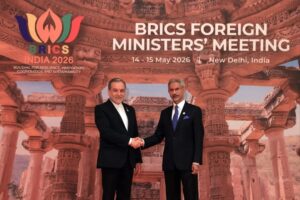
    The West Asia skirmishes have also tested India’s aspirations to lead the Global South, particularly in larger international platforms such as BRICS. The June 2026 BRICS foreign ministers meeting held in India exposed the limitations of consensus-based diplomacy.


    Iran and the UAE, the new members, joined the forum in the midst of a heated deadlock; Tehran insisted on a direct and explicit condemnation of the U.S. and Israel, while Abu Dhabi countered with a call for a formal condemnation of Iranian actions in the region.

    India used procedural diplomacy to recognise internal rifts without sweeping them away, avoiding the fracturing of the broader multilateral partnership over regional disputes, and thereby preserving its bilateral capital with both capitals- Abu Dhabi and Tehran.

    Conclusion: Is Calibrated Silence Sustainable?

    India’s strategic quiet is not an abnegation of responsibility. It is a conscious effort to protect its national interests from a volatile external crisis. In a remarkable blend of procedural diplomacy at forums like BRICS, refusal to be sucked into risky regional mediation, and pragmatic bilateral hedging, New Delhi has managed to avoid burning its bridges with either Tehran or the US-Israel-Gulf axis.

    At the same time, this crisis is a crucial test of New Delhi’s professed policy of strategic autonomy. As the country’s domestic oil reserves dwindle and external sanctions squeeze key assets such as the Chabahar Port, the economic repercussions may ultimately outweigh the benefits of diplomatic quietude. India’s challenge going forward will be to ensure that its calculated neutrality is flexible enough to change if the regional balance tips into an outright breakdown of the regional order from a managed crisis.

    Feature Image Credit: https://thewire.in

  • Flattery’s Limits: How Pandering to Trump Undermines Pakistan’s Mediation

    Flattery’s Limits: How Pandering to Trump Undermines Pakistan’s Mediation

    Flattery may open doors, but it cannot sustain trust in high-stakes diplomacy. Pakistan’s Trump-centric approach reveals the limits of personality-driven foreign policy.

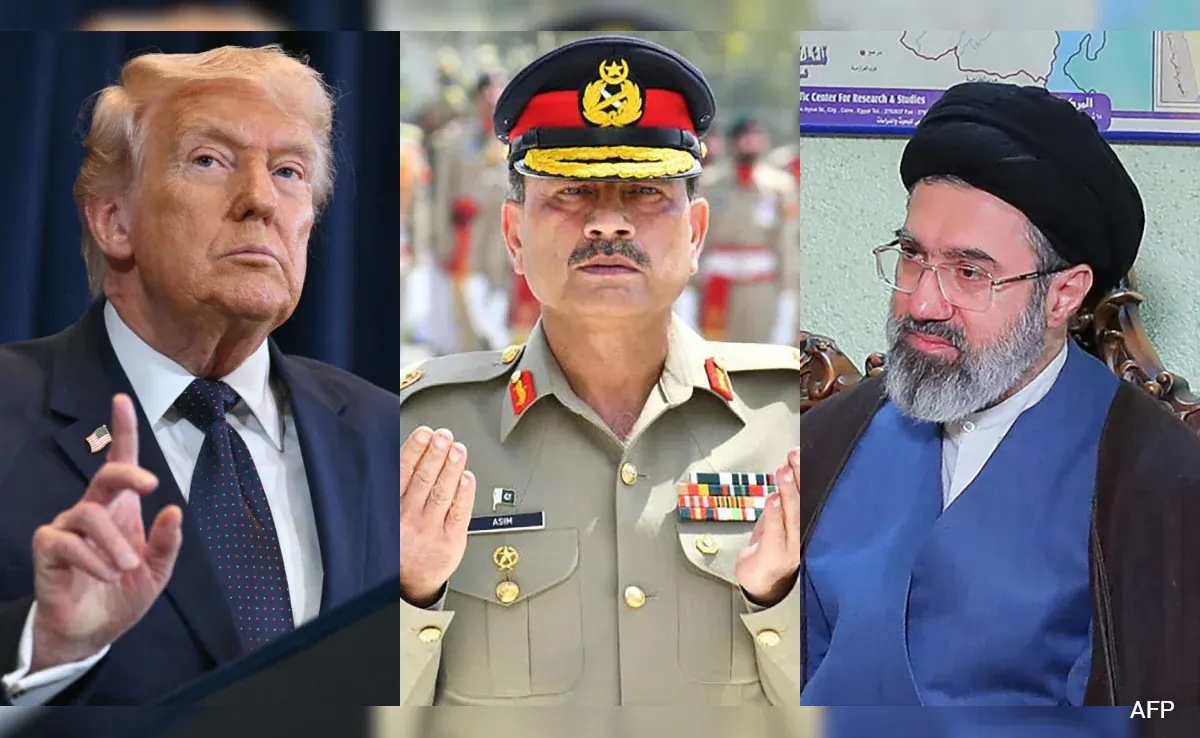
    Pakistan’s recent foreign policy under a hybrid regime led by its Field Marshal Asif Munir and Prime Minister Shehbaz Sharif is heavily influenced by a personality-driven dynamic, particularly in its engagement with Donald Trump. As pointed out by Mehdi Hasan, a British-American journalist and political commentator, in an interview with NDTV, Pakistanis have “done a good job of sucking up to Trump,” underscoring a growing reliance on flattery and ego-boosting tactics to remain in Trump’s good books.

    When Flattery Becomes a Diplomatic Constraint

    From the early phase of Donald Trump’s second term, especially after developments like Operation Sindoor, Pakistan openly credited Trump for ceasefire efforts—something India refrained from doing. Islamabad went further by nominating Trump multiple times for the Nobel Peace Prize. At many international platforms, particularly during the Gaza Board of Peace meeting in Washington and earlier at the Gaza peace summit at Sharm el-Sheikh, Pakistan’s leadership left no stone unturned in praising Trump, with Prime Minister Shehbaz Sharif describing him as a “man of peace” and even a “saviour of South Asia.” Even during recent ceasefire extensions by Trump, Pakistan continued this pattern of excessive praise.

    This reflected a calculated strategy: to appeal to Trump’s personality, which is widely perceived as ego-driven and narcissistic. By consistently affirming his self-image and constantly putting messages into his psychological zone of acceptance. Pakistan managed to secure his attention and, to some extent, his favour. Of course, the United States has its own strategic calculations—particularly regarding Iran—but the personal dimension of Trump’s leadership style makes such flattery tactically useful in the short term.

    However, this approach is now showing clear limitations, especially in the context of reaching any peace deal with Iran. The very strategy that helped Pakistan gain proximity is now constraining its ability to act as a credible intermediary. Because Islamabad has focused primarily on sending positive, non-confrontational messages to Trump, it appears reluctant—or unable—to convey messages that might irritate or challenge him.

    This concern has been explicitly raised by Iranian voices. Iranian analysts and officials have questioned whether Pakistan is genuinely transmitting Tehran’s positions to Washington. One such voice, Iranian lawmaker Ebrahim Rezaei, pointed out that Pakistan is no longer seen as a neutral mediator. According to him, Islamabad selectively communicates, prioritising Trump’s preferences over balanced diplomacy. He stated that Pakistan “lacks the necessary credibility” and “always takes Trump’s ego into account and does not say a word against his wishes,” underscoring a growing perception that its role as an intermediary is increasingly compromised.

    Importantly, the United States now appears to be echoing similar concerns. A CNN report published on May 12, 2026, titled “Trump increasingly considers resuming large-scale military action against Iran,” stated that many Trump administration officials believed Pakistan had been sharing “a more positive version of the Iranian position with the US than what reflects reality,” while also questioning whether Islamabad was “aggressively conveying Trump’s displeasure” to Tehran. Significantly, an earlier CNN report published on May 6, 2026, titled “US and Iran closing in on memorandum aimed at ending war, source says,” had already hinted at scepticism inside the White House, noting that Pakistani mediators were presenting an optimistic assessment of Iranian flexibility that some US officials did not fully share.

    This is the core psychological flaw in a personality-centric foreign policy. When diplomacy is personalised to accommodate one man’s ego, it is bound to hinder strategic flexibility. Mediators must be in a position to deliver awkward truths and dissenting opinions. But when a state is afraid to upset a leader like Trump, it starts filtering messages, putting them into what can be called the ‘zone of psychological acceptance.’ Anything outside that zone is open to suppression.

    Erosion of Trust and Mediation Credibility

    As a result, trust erodes. Iran’s scepticism about Pakistan’s neutrality is not incidental—it is a direct consequence of this ego-management strategy. Even technical issues, such as disagreements over the scope of ceasefire agreements—for example, whether regions like Lebanon were included when the initial ceasefire between the United States and Iran was reached—became points of contention because communication was filtered, biased, and incomplete. This then became a major point of contention, with Iran maintaining that Lebanon formed part of the ceasefire framework, while the United States rejected this interpretation, deepening mistrust and reinforcing perceptions of inconsistency in how the agreement was conveyed. As Ebrahim Rezaei further said, “They are unwilling to tell the world that America first accepted Pakistan’s proposal but then went back on its word. They do not say that the Americans had commitments regarding Lebanon or the blocked assets, but that they failed to fulfil them. A mediator must be impartial, not always leaning to one side.”

    In the long run, such a policy is unsustainable. Personality-driven diplomacy may yield short-term visibility and tactical gains, but it weakens institutional credibility. Relationships built around individuals rather than enduring interests and institutions tend to fade with political transitions. When leadership changes in Washington, Pakistan may once again find itself marginalised, having invested too heavily in a single personality rather than in a broader strategic framework.

    As Pakistani security analyst and president of the Pakistan Institute for Peace Studies, Muhammad Amir Rana, warned in his February 1, 2026, article “Pakistan’s Trump Test” published in Dawn, “The post-Trump phase will test Pakistan’s diplomacy and political leadership,” while also questioning “how far the country can maintain its relevance” once Trump exits the political stage. Rana further argued that Pakistan’s current diplomatic positioning is too closely tied to a “Trump-endorsed defence equation” and cautioned that, without developing “alternative strategic options,” Islamabad could face increasing diplomatic marginalisation in the future. These concerns reinforce the broader perception that Pakistan’s recent diplomatic gains are heavily dependent on Trump-era political dynamics rather than on durable institutional and bipartisan foundations in Washington.

    Playing to a leader’s ego can open doors, but it also shrinks the space for honest diplomacy. Pakistan’s experience suggests that an over-reliance on psychological appeasement in foreign policy can compromise both credibility and effectiveness in complex negotiations. As also noted by American psychologist Michael Maccoby in his book, “The Productive Narcissist: The Promise and Peril of Visionary Leadership,” leaders with strong narcissistic traits may initially respond positively to admiration and validation. However, their effectiveness tends to decline over time as underlying behavioural patterns become more visible. In such contexts, strategies based on flattery and ego management may generate short-term gains but ultimately constrain credibility and weaken long-term influence.

  • Jeffrey D. Sachs: Briefing of the UN Security Council on Venezuela

    Jeffrey D. Sachs: Briefing of the UN Security Council on Venezuela

    Jeffrey D. Sachs: Briefing of the UN Security Council on Venezuela
    January 5, 2026


    Mr. President,
    Distinguished Members of the Security Council,

    The issue before the Council today is not the character of the government of Venezuela.

    The issue is whether any Member State—by force, coercion, or economic strangulation—has the right to determine Venezuela’s political future or to exercise control over its affairs.

    This question goes directly to Article 2(4) of the United Nations Charter, which prohibits the threat or use of force against the territorial integrity or political independence of any state.

    The Council must decide whether that prohibition is to be upheld or abandoned.

    Abandoning it would carry consequences of the gravest kind.

    Background and context

    Since 1947,United States foreign policy has repeatedly employed force, covert action, and political manipulation to bring about regime change in other countries. This is a matter of carefully documented historical record. In her book Covert Regime Change (2018), political scientist Lindsey O’Rourke documents 70 attempted US regime-change operations between 1947 and 1989 alone.

    These practices did not end with the Cold War. Since 1989, major United States regime-change operations undertaken without authorization by the Security Council have included, among the most consequential: Iraq (2003), Libya (2011), Syria (from 2011), Honduras (2009), Ukraine (2014), and Venezuela (from 2002 onward).

    The methods employed are well established and well documented. They include open warfare; covert intelligence operations; instigation of unrest; support for armed groups; manipulation of mass and social media; bribery of military and civilian officials; targeted assassinations; false-flag operations; and economic warfare aimed at collapsing civilian life.

    These measures are illegal under the UN Charter, and they typically result is ongoing violence, lethal conflict, political instability, and deep suffering of the civilian population.

    The case of Venezuela

    The recent United States record with respect to Venezuela is clear.

    In April 2002, the United States knew of and approved an attempted coup against the Venezuelan government.

    In the 2010s, the United States funded civil society groups actively engaged in anti-government protests, notably in 2014. When the government cracked down on the protests, the US followed with a series of sanctions. In 2015, President Barrack Obama declared Venezuela to be “an unusual and extraordinary threat to the national security and foreign policy of the United States.”

    In 2017, at a dinner with Latin American leaders on the margins of the UN General Assembly, President Trump openly discussed the option of the US invading Venezuela to overthrow the government.

    During 2017 to 2020, the US imposed sweeping sanctions on the state oil company. Oil production fell by 75 percent from 2016 to 2020, and real GDP per capita (PPP) declined by 62 percent.

    The UN General Assembly has repeatedly voted overwhelmingly against such unilateral coercive measures. Under international law, only the Security Council has the authority to impose such sanctions.

    On 23 January 2019, the United States unilaterally recognized Juan Guaidó as “interim president” of Venezuela and on 28 January 2019 froze approximately $7 billion of Venezuelan sovereign assets held abroad and gave Guaidó authority over certain assets.

    These actions form part of a continuous United States regime-change effort spanning more than two decades.

    Recent United States global escalation

    In the past year, the United States has carried out bombing operations in seven countries, none of which were authorized by the Security Council and none of which were undertaken in lawful self-defense under the Charter. The targeted countries include Iran, Iraq, Nigeria, Somalia, Syria, Yemen, and now Venezuela.

    In the past month, President Trump has issued direct threats against at least six UN member states, including Colombia, Denmark, Iran, Mexico, Nigeria and of course Venezuela. These threats are summarized in Annex I to this statement.

    What is at stake today

    Members of the Council are not called upon to judge Nicolás Maduro.

    They are not called upon to assess whether the recent United States attack and ongoing naval quarantine of Venezuela result in freedom or in subjugation.

    Members of the Council are called upon to defend international law, and specifically the United Nations Charter.

    The realist school of international relations, articulated most brilliantly by John Mearsheimer, accurately describes the condition of international anarchy as “the tragedy of great power politics.” Realism is therefore a description of geopolitics, not a solution for peace. Its own conclusion is that international anarchy leads to tragedy.

    In the aftermath of World War I, the League of Nations was created to end the tragedy through the application of international law. Yet the world’s leading nations failed to defend international law in the 1930s, leading to renewed global war.

    The United Nations emerged from that catastrophe as humanity’s second great effort to place international law above anarchy. In the words of the Charter, the UN was created “to save succeeding generations from the scourge of war, which twice in our lifetime has brought untold sorrow to mankind.”

    Given that we are in the nuclear age, failure cannot be repeated. Humanity would perish. There would be no third chance.

    Measures required of the Security Council

    To fulfill its responsibilities under the Charter, the Security Council should immediately affirm the following actions:

    1. The United States shall immediately cease and desist from all explicit and implicit threats or use of force against Venezuela.
    2. The United States shall terminate its naval quarantine and all related coercive military measures undertaken in the absence of authorization by the Security Council.
    3. The United States shall immediately withdraw its military forces from within and along the perimeter of Venezuela, including intelligence, naval, air, and other forward-deployed assets positioned for coercive purposes.
    4. Venezuela shall adhere to the UN Charter and to the human rights protected in the Universal Declaration of Human Rights.
    5. The Secretary-General shall immediately appoint a Special Envoy, mandated to engage relevant Venezuelan and international stakeholders and to report back to the Security Council within fourteen days with recommendations consistent with the Charter of the United Nations, and the Security Council shall remain urgently seized of this matter.
    6. All Member States shall refrain from unilateral threats, coercive measures, or armed actions undertaken outside the authority of the Security Council, in strict conformity with the Charter.

    In Closing

    Mr. President, Distinguished Members,

    Peace and the survival of humanity depend on whether the United Nations Charter remains a living instrument of international law or is allowed to wither into irrelevance.

    That is the choice before this Council today.

    Thank you.


    Courtesy: commondreams.org

  • Navigating Geopolitical Turbulence in a Fragmented International System

    Navigating Geopolitical Turbulence in a Fragmented International System

    The old world order is not returning; the international system is structurally transforming into a fragmented multipolar reality. In this age of disorder, flexible institutions and reformist leadership—exemplified by India—are essential to sustain global governance.

    The 56th World Economic Forum Annual Meeting took place in Davos-Klosters, Switzerland, from January 19 to 23, 2026, under the theme “A Spirit of Dialogue.” The forum brought together global political, business, and intellectual leaders at a moment when the international order is not merely under strain but undergoing a deeper structural transformation. Discussions at Davos underscored a shared recognition that dialogue in today’s fractured global environment is not a sentimental ideal but a strategic necessity—particularly amid intensifying geopolitical competition, accelerating technological disruption, economic fragmentation, and the growing limitations of established institutional frameworks. Significantly, the conversations reflected a broader shift in global thinking, moving away from nostalgia for a stable post–Cold War order toward an urgent search for more flexible and adaptive forms of global governance capable of managing uncertainty, fragmentation, and persistent conflict.

    The contemporary international system is undergoing an unprecedented degree of geopolitical turbulence. Institutions such as the United Nations and other global governance mechanisms—established in the aftermath of the Second World War—were designed to manage conflict and promote cooperation within the structural realities of that era. Today, however, the assumptions underpinning these institutions no longer align with prevailing geopolitical conditions, rendering many of them increasingly ineffective and disconnected from contemporary realities. This growing institutional disconnect is inseparable from deeper structural changes in the global system itself. As Zack Cooper, a Senior Fellow at the American Enterprise Institute, notes in his Stimson Center essay “An American Strategy for a Multipolar World”, “a multipolar world is now unavoidable, with legacy powers increasingly accompanied by a number of rising powers… this is a much more complex system than the multipolar dynamic that existed in Europe after the Congress of Vienna… today’s multipolar system is highly fragmented along regional and functional lines.” This observation captures the core challenge of the present international system: it is not merely shifting in power distribution, but fundamentally transforming in structure and complexity.

    From Bipolarity to Fragmentation

    The post–Second World War order was shaped initially by Cold War bipolarity and later by a brief unipolar moment following the end of the Cold War. In contrast, the current system is marked by fragmentation, instability, and a gradual transition toward multipolarity. Historically, periods of power transition—particularly multipolar configurations—have been associated with heightened uncertainty, miscalculation, and conflict. The present environment reflects this pattern, as competing power centres and overlapping crises push the international system toward persistent volatility.

    In this volatile context, states are increasingly adopting hedging strategies to manage risks and vulnerabilities. From Europe to Asia and beyond, countries are diversifying partnerships, avoiding rigid alignments, and seeking strategic flexibility. This behaviour is neither anomalous nor irrational; rather, it is a structural response to systemic uncertainty. Such adaptive behaviour, however, is itself a symptom of deeper structural instability in the international system.

    As many scholars, most notably Kenneth Waltz, have long argued, an emerging multipolar order tends to be among the most unstable configurations in international politics, marked by heightened risks of conflict, miscalculation, and escalation. With multiple powers competing simultaneously and no clear hegemon capable of stabilising the system, the international order becomes increasingly fragile and prone to error. The contemporary system appears to be operating on this edge, shaped by overlapping crises and rival power centres.

    Compounding this instability is the rapid emergence of critical and disruptive technologies, advanced weapons platforms, cyber capabilities, and artificial intelligence. These developments further intensify volatility by lowering barriers to conflict, accelerating escalation dynamics, and complicating traditional deterrence frameworks. International experts at a 2025 conference warned that such technologies are “eroding present deterrence frameworks” and could destabilise the global security order without a global regulatory consensus. Similarly, the World Economic Forum’s Global Cybersecurity Outlook 2025 notes that “cybersecurity is entering an era of unprecedented complexity,” as the rapid adoption of AI without adequate safeguards creates far-reaching security risks requiring multilateral cooperation.

    While some observers attribute current turbulence primarily to political leaders such as Donald Trump, this interpretation is overly simplistic. Trump’s policies may have accelerated existing trends, but they are not the root cause. The deeper drivers lie in structural shifts within the international system and in long-term transformations within American domestic politics that have altered the foundations of US global engagement.

    Davos and the Recognition of a New World Order

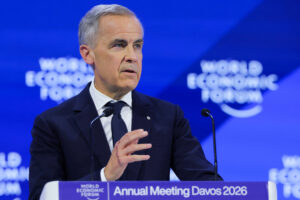
    These concerns have been openly acknowledged by global leaders at the World Economic Forum. Canadian Prime Minister Mark Carney, speaking at Davos, argued that “the old world order is not coming back,” cautioning against nostalgia-driven policymaking and warning that the global system is undergoing a rupture rather than a smooth transition. He further observed that economic interdependence has increasingly been weaponised and warned middle powers that “if you are not at the table, you are on the menu.” Such remarks reflect a growing recognition that disorder, competition, and power asymmetries are now embedded features of the international system.

    Similarly, World Economic Forum President Børge Brende highlighted the depth of uncertainty confronting the global order, noting that “the political, geopolitical, and macroeconomic landscape is shifting under our feet.” Emphasising the limits of unilateralism and rigid frameworks, Brende stressed that “dialogue is a necessity, not a luxury,” reinforcing the idea that cooperation must persist even in an era of fragmentation. These statements underline a critical point: the challenge today is not the absence of institutions, but their inability to adapt to changing geopolitical realities.

    French President Emmanuel Macron further reinforced this diagnosis at Davos by warning of a “shift towards a world without rules, where international law is trampled underfoot and where the law of the strongest prevails.” His remarks underscore the erosion of the post–Second World War multilateral framework under the pressure of returning imperial ambitions, coercive diplomacy, and unilateral action. Macron’s warning reflects a broader concern that global politics is increasingly shaped by power rather than norms. At the same time, he rejected intimidation as an organising principle of international relations, stating that “we prefer respect to bullies,” and called for effective multilateralism—one that is reformed and updated rather than dismantled.

    Reforming Global Governance for an Age of Disorder

    Against this backdrop, the central question is how states can navigate such geopolitical turbulence. A rigid, blueprint-based institutional approach—reminiscent of Cold War–era frameworks—is no longer viable. What is required instead are flexible, adaptive institutions capable of absorbing shocks, accommodating diverse interests, and operating under conditions of persistent uncertainty. Since traditional multilateralism is increasingly strained, it is essential to recognise that disorder itself is likely to remain a defining feature of the contemporary international system.

    Any effort to design or reform institutions must therefore begin with this recognition. Fragmentation and regionalisation—particularly through minilateral and issue-based coalitions—are inevitable outcomes of a multipolar environment. However, this does not eliminate the need for global cooperation. Rather, it demands cooperation frameworks that are flexible, inclusive, and responsive to evolving geopolitical realities. Institutions must be capable of adapting to shifting power balances rather than attempting to impose outdated structures on a transformed system. In these tough times, the world requires greater cooperation and coordinated action, because the challenges we face—such as climate change, cyber threats, economic instability, and regional conflicts—are global in nature and cannot be solved through isolated national approaches.

    Another limitation in current thinking is the tendency to interpret global politics solely through the lens of US–China rivalry. While great power competition undeniably shapes the international environment, such a narrow focus underestimates the agency of middle and regional powers. Many states actively shape outcomes, norms, and institutions rather than merely reacting to great power pressures. Effective institutional design must therefore reflect this distributed agency and avoid reducing global politics to a binary rivalry.

    Equally important is the need to move beyond linear and deterministic thinking. The contemporary world is characterised by non-linear dynamics, uncertainty, and complex interactions. Predicting the future exclusively through the lens of past patterns—particularly those rooted in liberal or Cold War assumptions—is increasingly misleading. Institutional responses must be grounded in realism, flexibility, and adaptability rather than static or idealised models of order.

    Recent initiatives such as Donald Trump’s proposal for a “Board of Peace,” driven largely by personal leadership and transactional logic, illustrate the limitations of personality-centric approaches to global governance. Given their temporary nature and the likelihood of reversal under future administrations, such initiatives lack durability. Moreover, such proposals are often unrepresentative and do not reflect the realities of the international system; they are based on authoritarian-style solutions rather than broad-based legitimacy, consensus, and institutional resilience. In contrast, reforming existing institutions—particularly the United Nations—offers a more sustainable path forward. Reforms that reflect contemporary geopolitical realities would enhance the UN’s relevance without undermining its foundational principles.

    India’s Reformist Approach to Global Governance

    India’s approach to global governance is particularly instructive in this context. When India criticises the United Nations or other global institutions, its objective is not to dismantle them but to reform them. This distinguishes India from countries such as China and Russia, which often seek to replace existing structures with alternative, and frequently anti-Western, institutional arrangements. India positions itself not as an anti-Western power, but as a non-Western one—committed to liberal democracy, pluralism, and engagement with existing global frameworks. As India’s Ministry of External Affairs has emphasised, “the architecture of global governance in 2025 for the future cannot be written in ink from 1945,” highlighting the need to update institutions rather than replace them.

    This distinction is crucial. India has significantly benefited from the existing international order, and its economic transformation since the post-1991 reforms has been largely enabled by the stability, access to global markets, and investment flows that the post-World War II system provided. Consequently, India has little incentive to support a China-centric alternative. Reforming the current system, rather than replacing it, aligns with India’s long-term strategic interests. Moreover, India’s leadership and participation in forums such as the SCO and BRICS have played a stabilising role. Without India’s presence, these platforms could easily evolve into explicitly anti-Western blocs. India’s foreign policy is best understood as reformist rather than revisionist, acting as a bridge between the West and the Global South; as Chatham House notes, India seeks to “change the international order from within rather than overthrow it.” Yet many Western policymakers fail to understand India’s global vision and often categorise it alongside other revisionist powers, viewing India narrowly through a bilateral prism or primarily as a counterweight to China. This misreading overlooks India’s broader role as an independent norm-shaping power.

    In light of these dynamics, the most effective strategy for navigating contemporary geopolitical turbulence lies in reforming and revitalising existing institutions rather than constructing entirely new ones based on rigid, blueprint-style thinking. A blueprint approach assumes that we can predict the future and design institutions accordingly—an assumption that is inherently flawed because the future is always uncertain and unknowable. Institutions must therefore be designed to capture the reality of moving from the known to the unknown and to adapt continuously as new challenges emerge. They must be made flexible, resilient, and responsive to disorder rather than designed to eliminate it. Accepting instability as a structural condition—and designing mechanisms of cooperation accordingly—offers the best chance of sustaining global governance in an increasingly fragmented world.


    Feature Image Credit: www.byarcadia.org

  • European Russophobia and Europe’s Rejection of Peace: A Two-Century Failure

    European Russophobia and Europe’s Rejection of Peace: A Two-Century Failure

    The Triumphal Arch in Moscow, built in 1829-1834 on Tverskaya Zastava Square to Joseph Bove’s design, commemorates Russia’s victory over Napoleon during the French invasion of Russia in 1812. The arch was dismantled in 1936 as part of Joseph Stalin’s reconstruction of downtown Moscow. The current arch was built to Bove’s original designs in 1966-68 in the middle of Kutuzovsky Avenue (the prospect was named after Marshall Mikhail Kutuzov, who led Russia to victory over Napoleon in 1812. Photo credit: M Matheswaran

    My argument is not that Russia has been entirely benign or trustworthy. Rather, it is that Europe has consistently applied double standards in the interpretation of security. While other great powers are presumed to have legitimate security interests that must be balanced and accommodated, Russia’s interests are presumed illegitimate unless proven otherwise.

    The lesson, written in blood across two centuries, is not that Russia or any other country must be trusted in all regards. It is that Russia and its security interests must be taken seriously. Europe has repeatedly rejected peace with Russia, not because it was unavailable, but because acknowledging Russia’s security concerns was wrongly treated as illegitimate.

    Europe has repeatedly rejected peace with Russia at moments when a negotiated settlement was available, and those rejections have proven profoundly self-defeating. From the nineteenth century to the present, Russia’s security concerns have been treated not as legitimate interests to be negotiated within a broader European order, but as moral transgressions to be resisted, contained, or overridden. This pattern has persisted across radically different Russian regimes—Tsarist, Soviet, and post-Soviet—suggesting that the problem lies not primarily in Russian ideology, but in Europe’s enduring refusal to recognise Russia as a legitimate and equal security actor.

    My argument is not that Russia has been entirely benign or trustworthy. Rather, it is that Europe has consistently applied double standards in the interpretation of security. Europe treats its own use of force, alliance-building, and imperial or post-imperial influence as normal and legitimate, while construing comparable Russian behaviour—especially near Russia’s own borders—as inherently destabilising and invalid. This asymmetry has narrowed diplomatic space, delegitimised compromise, and made war more likely. Likewise, this self-defeating cycle remains the defining characteristic of European-Russian relations in the twenty-first century.

    A recurring failure throughout this history has been Europe’s inability—or refusal—to distinguish between Russian aggression and Russian security-seeking behaviour. In multiple periods, actions interpreted in Europe as evidence of inherent Russian expansionism were, from Moscow’s perspective, attempts to reduce vulnerability in an environment perceived as increasingly hostile. Meanwhile, Europe consistently interpreted its own alliance building, military deployments, and institutional expansion as benign and defensive, even when these measures directly reduced Russian strategic depth. This asymmetry lies at the heart of the security dilemma that has repeatedly escalated into conflict: one side’s defence is treated as legitimate, while the other side’s fear is dismissed as paranoia or bad faith.

    Western Russophobia should not be understood primarily as emotional hostility toward Russians or Russian culture. Instead, it operates as a structural prejudice embedded in European security thinking: the assumption that Russia is the exception to normal diplomatic rules. While other great powers are presumed to have legitimate security interests that must be balanced and accommodated, Russia’s interests are presumed illegitimate unless proven otherwise. This assumption survives changes in regime, ideology, and leadership. It transforms policy disagreements into moral absolutes and renders compromise as suspect. As a result, Russophobia functions less as a sentiment than as a systemic distortion—one that repeatedly undermines Europe’s own security.

    The Crimean War emerges as the founding trauma of modern Russophobia: a war of choice pursued by Britain and France despite the availability of diplomatic compromise, driven by the West’s moralised hostility and imperial anxiety rather than unavoidable necessity.

    I trace this pattern across four major historical arcs. First, I examine the nineteenth century, beginning with Russia’s central role in the Concert of Europe after 1815 and its subsequent transformation into Europe’s designated menace. The Crimean War emerges as the founding trauma of modern Russophobia: a war of choice pursued by Britain and France despite the availability of diplomatic compromise, driven by the West’s moralised hostility and imperial anxiety rather than unavoidable necessity. The Pogodin memorandum of 1853 on the West’s double standard, featuring Tsar Nicholas I’s famous marginal note—“This is the whole point”—serves not merely as an anecdote, but as an analytical key to Europe’s double standards and Russia’s understandable fears and resentments.

    Second, I turn to the revolutionary and interwar periods, when Europe and the United States moved from rivalry with Russia to direct intervention in Russia’s internal affairs. I examine in detail the Western military interventions during the Russian Civil War, the refusal to integrate the Soviet Union into a durable collective-security system in the 1920s and 1930s, and the catastrophic failure to ally against fascism, drawing especially on the archival work of Michael Jabara Carley. The result was not the containment of Soviet power, but the collapse of European security and the devastation of the continent itself in World War II.

    Third, the early Cold War presented what should have been a decisive corrective moment; yet, Europe again rejected peace when it could have been secured. Although the Potsdam conference reached an agreement on German demilitarisation, the West subsequently reneged. Seven years later, the West similarly rejected the Stalin Note, which offered German reunification based on neutrality. The dismissal of reunification by Chancellor Adenauer—despite clear evidence that Stalin’s offer was genuine—cemented Germany’s postwar division, entrenched the bloc confrontation, and locked Europe into decades of militarisation.

    Europe chose NATO expansion, institutional asymmetry, and a security architecture built around Russia rather than with it. This choice was not accidental. It reflected an Anglo-American grand strategy—articulated most explicitly by Zbigniew Brzezinski—that treated Eurasia as the central arena of global competition and Russia as a power to be prevented from consolidating security or influence.

    Finally, I analyse the post-Cold War era, when Europe was offered its clearest opportunity to escape this destructive cycle. Gorbachev’s vision of a “Common European Home” and the Charter of Paris articulated a security order based on inclusion and indivisibility. Instead, Europe chose NATO expansion, institutional asymmetry, and a security architecture built around Russia rather than with it. This choice was not accidental. It reflected an Anglo-American grand strategy—articulated most explicitly by Zbigniew Brzezinski—that treated Eurasia as the central arena of global competition and Russia as a power to be prevented from consolidating security or influence.

    The consequences of this long pattern of disdain for Russian security concerns are now visible with brutal clarity. The war in Ukraine, the collapse of nuclear arms control, Europe’s energy and industrial shocks, Europe’s new arms race, the EU’s political fragmentation, and Europe’s loss of strategic autonomy are not aberrations. They are the cumulative costs of two centuries of Europe’s refusal to take Russia’s security concerns seriously.

    My conclusion is that peace with Russia does not require naïve trust. It requires the recognition that durable European security cannot be built by denying the legitimacy of Russian security interests. Until Europe abandons this reflex, it will remain trapped in a cycle of rejecting peace when it is available—and paying ever higher prices for doing so.

    The Origins of Structural Russophobia

    The recurrent European failure to build peace with Russia is not primarily a product of Putin, communism, or even twentieth-century ideology. It is much older—and it is structural. Repeatedly, Russia’s security concerns have been treated by Europe not as legitimate interests subject to negotiation, but as moral transgressions. In this sense, the story begins with the nineteenth-century transformation of Russia from a co-guarantor of Europe’s balance into the continent’s designated menace.

    After the defeat of Napoleon in 1815, Russia was not peripheral to Europe; it was central. Russia bore a decisive share of the burden in defeating Napoleon, and the Tsar was a principal architect of the post-Napoleonic settlement. The Concert of Europe was built on an implicit proposition: peace requires the great powers to accept one another as legitimate stakeholders and to manage crises by consultation rather than by moralised demonology. Yet, within a generation, a counterproposition gained strength in British and French political culture: that Russia was not a normal great power but a civilizational danger—one whose demands, even when local and defensive, should be treated as inherently expansionist and therefore unacceptable.

    That shift is captured with extraordinary clarity in a document highlighted by Orlando Figes in The Crimean War: A History (2010) as being written at the hinge point between diplomacy and war: Mikhail Pogodin’s memorandum to Tsar Nicholas I in 1853. Pogodin lists episodes of Western coercion and imperial violence—far-flung conquests and wars of choice—and contrasts them with Europe’s outrage at Russian actions in adjacent regions:

    France takes Algeria from Turkey, and almost every year England annexes another Indian principality: none of this disturbs the balance of power, but when Russia occupies Moldavia and Wallachia, albeit only temporarily, that disturbs the balance of power. France occupies Rome and stays there several years during peacetime: that is nothing; but Russia only thinks of occupying Constantinople, and the peace of Europe is threatened. The English declare war on the Chinese, who have, it seems, offended them: no one has the right to intervene, but Russia is obliged to ask Europe for permission if it quarrels with its neighbour. England threatens Greece to support the false claims of a miserable Jew and burns its fleet: that is a lawful action, but Russia demands a treaty to protect millions of Christians, and that is deemed to strengthen its position in the East at the expense of the balance of power.

    Pogodin concludes: “We can expect nothing from the West but blind hatred and malice,” to which Nicholas famously wrote in the margin: “This is the whole point.”

    The Pogodin–Nicholas exchange matters because it frames the recurring pathology that returns in every major episode that follows. Europe would repeatedly insist on the universal legitimacy of its own security claims while treating Russia’s security claims as phoney or suspect. This stance creates a particular kind of instability: it makes compromise politically illegitimate in Western capitals, causing diplomacy to collapse not because a bargain is impossible, but because acknowledging Russia’s interests is treated as a moral error.
    The Crimean War is the first decisive manifestation of this dynamic. While the proximate crisis involved the Ottoman Empire’s decline and disputes over religious sites, the deeper issue was whether Russia would be allowed to secure a recognised position in the Black Sea–Balkan sphere without being treated as a predator. Modern diplomatic reconstructions emphasise that the Crimean crisis differed from earlier “Eastern crises” because the Concert’s cooperative habits were already eroding, and British opinion had swung toward an extreme anti-Russian posture that narrowed the room for settlement.

    What makes the episode so telling is that a negotiated outcome was available. The Vienna Note was intended to reconcile Russian concerns with Ottoman sovereignty and preserve peace. However, it collapsed amid distrust and political incentives for escalation. The Crimean War followed. It was not “necessary” in any strict strategic sense; it was made likely because British and French compromise with Russia had become politically toxic. The consequences were self-defeating for Europe: massive casualties, no durable security architecture, and the entrenchment of an ideological reflex that treated Russia as the exception to normal great-power bargaining. In other words, Europe did not achieve security by rejecting Russia’s security concerns. Rather, it created a longer cycle of hostility that made later crises harder to manage.

    The West’s Military Campaign Against Bolshevism 

    This cycle carried forward into the revolutionary rupture of 1917. When Russia’s regime type changed, the West did not shift from rivalry to neutrality; instead, it moved toward active intervention, treating the existence of a sovereign Russian state outside Western tutelage as intolerable.

    Crucially, the Western powers did not simply “watch” the outcome. They intervened militarily in Russia across vast spaces—North Russia, the Baltic approaches, the Black Sea, Siberia, and the Far East—under justifications that rapidly shifted from wartime logistics to regime change.
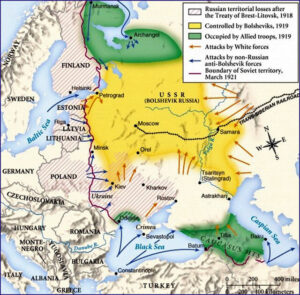
    The Bolshevik Revolution and the subsequent Civil War produced a complex conflict involving Reds, Whites, nationalist movements, and foreign armies. Crucially, the Western powers did not simply “watch” the outcome. They intervened militarily in Russia across vast spaces—North Russia, the Baltic approaches, the Black Sea, Siberia, and the Far East—under justifications that rapidly shifted from wartime logistics to regime change.

    One can acknowledge the standard “official” rationale for initial intervention: the fear that war supplies would fall into German hands after Russia’s exit from World War I, and the desire to reopen an Eastern Front. Yet, once Germany surrendered in November 1918, the intervention did not cease; it mutated. This transformation explains why the episode matters so profoundly: it reveals a willingness, even amidst the devastation of World War I, to use force to shape Russia’s internal political future.

    David Foglesong’s America’s Secret War against Bolshevism (1995)—published by UNC Press and still the standard scholarly reference for U.S. policy—captures this precisely. Foglesong frames the U.S. intervention not as a confused sideshow, but as a sustained effort aimed at preventing Bolshevism from consolidating power. Recent high-quality narrative history has further brought this episode back into public view; notably, Anna Reid’s A Nasty Little War (2024) describes the Western intervention as a poorly executed yet deliberate effort to overturn the 1917 Bolshevik Revolution.

    The geographic scope itself is instructive, for it undermines later Western claims that Russia’s fears were mere paranoia. Allied forces landed in Arkhangelsk and Murmansk to operate in North Russia; in Siberia, they entered through Vladivostok and along the rail corridors; Japanese forces deployed on a massive scale in the Far East; and in the south, landings and operations around Odessa and Sevastopol. Even a basic overview of the intervention’s dates and theatres—from November 1917 through the early 1920s—demonstrates the persistence of the foreign presence and the vastness of its range.

    the West did not merely oppose Bolshevism; it often did so by aligning with forces whose brutality and war aims sat uneasily with later Western claims to liberal legitimacy.

    Nor was this merely “advice” or a symbolic presence. Western forces supplied, armed, and in some instances effectively supervised White formations. The intervening powers became enmeshed in the moral and political ugliness of White politics, including reactionary programs and violent atrocities. This reality renders the episode particularly corrosive to Western moral narratives: the West did not merely oppose Bolshevism; it often did so by aligning with forces whose brutality and war aims sat uneasily with later Western claims to liberal legitimacy.

    From Moscow’s perspective, this intervention confirmed the warning issued by Pogodin decades earlier: Europe and the United States were prepared to use force to determine whether Russia would be allowed to exist as an autonomous power. This episode became foundational to Soviet memory, reinforcing the conviction that Western powers had attempted to strangle the revolution in its cradle. It demonstrated that Western moral rhetoric concerning peace and order could seamlessly coexist with coercive campaigns when Russian sovereignty was at stake.

    The intervention also produced a decisive second-order consequence. By entering Russia’s civil war, the West inadvertently strengthened Bolshevik legitimacy domestically. The presence of foreign armies and foreign-backed White forces allowed the Bolsheviks to claim they were defending Russian independence against imperial encirclement. Historical accounts consistently note how effectively the Bolsheviks exploited the Allied presence for propaganda and legitimacy. In other words, the attempt to “break” Bolshevism helped consolidate the very regime it sought to destroy

    This dynamic reveals the precise cycle of history: Russophobia proves strategically counterproductive for Europe. It drives Western powers toward coercive policies that do not resolve the challenge but exacerbate it. It generates Russian grievances and security fears that later Western leaders will dismiss as irrational paranoia. Furthermore, it narrows future diplomatic space by teaching Russia—regardless of its regime—that Western promises of settlement may be insincere.

    By the early 1920s, as foreign forces withdrew and the Soviet state consolidated, Europe had already made two fateful choices that would resonate for the next century. First, it had helped foster a political culture that transformed manageable disputes—like the Crimean crisis—into major wars by refusing to treat Russian interests as legitimate. Second, it demonstrated, through military intervention, a willingness to use force not merely to counter Russian expansion but to shape Russian sovereignty and regime outcomes. These choices did not stabilise Europe; rather, they sowed the seeds for subsequent catastrophes: the interwar breakdown of collective security, the Cold War’s permanent militarisation, and the post-Cold War order’s return to frontier escalation.

    Collective Security and the Choice Against Russia

    By the mid-1920s, Europe confronted a Russia that had survived every attempt—revolution, civil war, famine, and direct foreign military intervention—to destroy it. The Soviet state that emerged was poor, traumatised, and deeply suspicious—but also unmistakably sovereign. At precisely this moment, Europe faced a choice that would recur repeatedly: whether to treat this Russia as a legitimate security actor whose interests had to be incorporated into European order, or as a permanent outsider whose concerns could be ignored, deferred, or overridden. Europe chose the latter, and the costs proved enormous.

    The legacy of the Allied interventions during the Russian Civil War cast a long shadow over all subsequent diplomacy. From Moscow’s perspective, Europe had not merely disagreed with Bolshevik ideology; it had attempted to decide Russia’s internal political future by force. This experience mattered profoundly. It shaped Soviet assumptions about Western intentions and created a deep skepticism toward Western assurances. Rather than recognising this history and seeking reconciliation, European diplomacy often behaved as if Soviet mistrust were irrational—a pattern that would persist into the Cold War and beyond.

    Throughout the 1920s, Europe oscillated between tactical engagement and strategic exclusion. Treaties such as Rapallo (1922) demonstrated that Germany, itself a pariah after Versailles, could pragmatically engage with Soviet Russia. Yet for Britain and France, engagement with Moscow remained provisional and instrumental. The USSR was tolerated when it served British and French interests and sidelined when it did not. No serious effort was made to integrate Russia into a durable European security architecture as an equal.

    This ambivalence hardened into something far more dangerous and self-destructive in the 1930s. While the rise of Hitler posed an existential threat to Europe, the continent’s leading powers repeatedly treated Bolshevism as the greater danger. This was not merely rhetorical; it shaped concrete policy choices—alliances foregone, guarantees delayed, and deterrence undermined.

    France, Britain, and Poland repeatedly made strategic choices that excluded the Soviet Union from European security arrangements, even when Soviet participation would have strengthened deterrence against Hitler’s Germany.

    It is essential to underscore that this was not merely an Anglo-American failure, nor a story in which Europe was passively swept along by ideological currents. European governments exercised agency, and they did so decisively—and disastrously. France, Britain, and Poland repeatedly made strategic choices that excluded the Soviet Union from European security arrangements, even when Soviet participation would have strengthened deterrence against Hitler’s Germany. French leaders preferred a system of bilateral guarantees in Eastern Europe that preserved French influence but avoided security integration with Moscow. Poland, with the tacit backing of London and Paris, refused transit rights to Soviet forces even to defend Czechoslovakia, prioritising its fear of Soviet presence over the imminent danger of German aggression. These were not small decisions. They reflected a European preference for managing Hitlerian revisionism over incorporating Soviet power, and for risking Nazi expansion rather than legitimising Russia as a security partner. In this sense, Europe did not merely fail to build collective security with Russia; it actively chose an alternative security logic that excluded Russia and ultimately collapsed under its own contradictions.

    Here, Michael Jabara Carley’s archival work is decisive. His scholarship demonstrates that the Soviet Union, particularly under Foreign Commissar Maxim Litvinov, made sustained, explicit, and well-documented efforts to build a system of collective security against Nazi Germany. These were not vague gestures. They included proposals for mutual assistance treaties, military coordination, and explicit guarantees for states such as Czechoslovakia. Carley shows that Soviet entry into the League of Nations in 1934 was accompanied by genuine Russian attempts to operationalise collective deterrence, not simply to seek legitimacy.

    However, these efforts collided with a Western ideological hierarchy in which anti-communism trumped anti-fascism. In London and Paris, political elites feared that an alliance with Moscow would legitimise Bolshevism domestically and internationally. As Carley documents, British and French policymakers repeatedly worried less about Hitler’s threats than about the political consequences of cooperation with the USSR. The Soviet Union was treated not as a necessary partner against a common threat, but as a liability whose inclusion would “contaminate” European politics.

    This hierarchy had profound strategic consequences. The policy of appeasement toward Germany was not merely a misreading of Hitler; it was the product of a worldview that treated Nazi revisionism as potentially manageable, while treating Soviet power as inherently subversive. Poland’s refusal to allow Soviet troops transit rights to defend Czechoslovakia—maintained with tacit Western support—is emblematic. European states preferred the risk of German aggression to the certainty of Soviet involvement, even when Soviet involvement was explicitly defensive.

    The Anglo-French negotiations with the Soviet Union in Moscow were not sabotaged by Soviet duplicity, contrary to later mythology. They failed because Britain and France were unwilling to make binding commitments or to recognise the USSR as an equal military partner.

    The culmination of this failure came in 1939. The Anglo-French negotiations with the Soviet Union in Moscow were not sabotaged by Soviet duplicity, contrary to later mythology. They failed because Britain and France were unwilling to make binding commitments or to recognise the USSR as an equal military partner. Carley’s reconstruction shows that the Western delegations to Moscow arrived without negotiating authority, without urgency, and without political backing to conclude a real alliance. When the Soviets repeatedly asked the essential question of any alliance—Are you prepared to act?—the answer, in practice, was no.
    The Molotov–Ribbentrop Pact that followed has been used ever since as retroactive justification for Western distrust. Carley’s work reverses that logic. The pact was not the cause of Europe’s failure; it was the consequence. It emerged after years of the West’s refusal to build collective security with Russia. It was a brutal, cynical, and tragic decision—but one taken in a context where Britain, France, and Poland had already rejected peace with Russia in the only form that might have stopped Hitler.

    The result was catastrophic. Europe paid the price not only in blood and destruction but in the loss of agency. The war that Europe failed to prevent destroyed its power, exhausted its societies, and reduced the continent to the primary battlefield of superpower rivalry. Once again, rejecting peace with Russia did not produce security; it produced a far worse war under far worse conditions.

    One might have expected that the sheer scale of this disaster would have forced a rethinking of Europe’s approach to Russia after 1945. It did not.

    From Potsdam to NATO: The Architecture of Exclusion

    The immediate postwar years were marked by a rapid transition from alliance to confrontation. Even before Germany surrendered, Churchill shockingly instructed British war planners to consider an immediate conflict with the Soviet Union. “Operation Unthinkable,” drafted in 1945, envisioned using Anglo-American power—and even rearmed German units—to impose Western will on Russia in 1945 or soon after. While the plan was deemed to be militarily unrealistic and was ultimately shelved, its very existence reveals how deeply ingrained the assumption had become that Russian power was illegitimate and must be constrained by force if necessary.

    Western diplomacy with the Soviet Union similarly failed. Europe should have recognised that the Soviet Union had borne the brunt of defeating Hitler—suffering 27 million casualties—and that Russia’s security concerns regarding German rearmament were entirely real. Europe should have internalised the lesson that a durable peace required the explicit accommodation of Russia’s core security concerns, above all, the prevention of a remilitarized Germany that could once again threaten the eastern plains of Europe.

    In formal diplomatic terms, that lesson was initially accepted. At Yalta and, more decisively, at Potsdam in the summer of 1945, the victorious Allies reached a clear consensus on the basic principles governing postwar Germany: demilitarisation, denazification, democratisation, decartelization, and reparations. Germany was to be treated as a single economic unit; its armed forces were to be dismantled; and its future political orientation was to be determined without rearmament or alliance commitments.

    For the Soviet Union, these principles were not abstract; they were existential. Twice within thirty years, Germany had invaded Russia, inflicting devastation on a scale without parallel in European history. Soviet losses in World War II gave Moscow a security perspective that cannot be understood without acknowledging that trauma. Neutrality and permanent demilitarisation of Germany were not bargaining chips; they were the minimum conditions for a stable postwar order from the Soviet point of view.

    At the Potsdam Conference in July 1945, these concerns were formally recognised. The Allies agreed that Germany would not be allowed to reconstitute military power. The language of the conference was explicit: Germany was to be prevented from “ever again threatening its neighbours or the peace of the world.” The Soviet Union accepted the temporary division of Germany into occupation zones precisely because this division was framed as an administrative necessity, not a permanent geopolitical settlement.

    Yet almost immediately, the Western powers began to reinterpret—and then quietly dismantle—these commitments. The shift occurred because U.S. and British strategic priorities changed. As Melvyn Leffler demonstrates in A Preponderance of Power (1992), American planners rapidly came to view German economic recovery and political alignment with the West as more important than maintaining a demilitarised Germany acceptable to Moscow. The Soviet Union, once an indispensable ally, was recast as a potential adversary whose influence in Europe needed to be contained.

    This reorientation preceded any formal Cold War military crisis. Long before the Berlin Blockade, Western policy began to consolidate the Western zones economically and politically. The creation of the Bizone in 1947, followed by the Trizone, directly contradicted the Potsdam principle that Germany would be treated as a single economic unit. The introduction of a separate currency in the western zones in 1948 was not a technical adjustment; it was a decisive political act that made German division functionally irreversible. From Moscow’s perspective, these steps were unilateral revisions of the postwar settlement.

    The Soviet response—the Berlin Blockade—has often been portrayed as the opening salvo of Cold War aggression. Yet, in context, it appears less as an attempt to seize Western Berlin than as a coercive effort to force a return to four-power governance and prevent the consolidation of a separate West German state. Regardless of whether one judges the blockade wisely, its logic was rooted in the fear that the Potsdam framework was being dismantled by the West without negotiation. While the airlift resolved the immediate crisis, it did not address the underlying issue: the abandonment of a unified, demilitarised Germany.

    The decisive break came with the outbreak of the Korean War in 1950. The conflict was interpreted in Washington not as a regional war with specific causes, but as evidence of a monolithic global communist offensive. This reductionist interpretation had profound consequences for Europe. It provided the strong political justification for West German rearmament—something that had been explicitly ruled out only a few years earlier. The logic was now framed in stark terms: without German military participation, Western Europe could not be defended.

    The remilitarization of West Germany was not forced by Soviet action in Europe; it was a strategic choice made by the United States and its allies in response to a globalised Cold War framework the U.S. had constructed. Britain and France, despite deep historical anxieties about German power, acquiesced under American pressure.

    This moment was a watershed. The remilitarization of West Germany was not forced by Soviet action in Europe; it was a strategic choice made by the United States and its allies in response to a globalised Cold War framework the U.S. had constructed. Britain and France, despite deep historical anxieties about German power, acquiesced under American pressure. When the proposed European Defence Community—a means of controlling German rearmament—collapsed, the solution adopted was even more consequential: West Germany’s accession to NATO in 1955.

    From the Soviet perspective, this represented the definitive collapse of the Potsdam settlement. Germany was no longer neutral. It was no longer demilitarised. It was now embedded in a military alliance explicitly oriented against the USSR. This was precisely the outcome that Soviet leaders had sought to prevent since 1945, and which the Potsdam Agreement had been designed to forestall.

    It is essential to underline the sequence, as it is often misunderstood or inverted. The division and remilitarization of Germany were not the result of Russian actions. By the time Stalin made his 1952 offer of German reunification based on neutrality, the Western powers had already set Germany on a path toward alliance integration and rearmament. The Stalin Note was not an attempt to derail a neutral Germany; it was a serious, documented, and ultimately rejected attempt to reverse a process already underway.

    Seen in this light, the early Cold War settlement appears not as an inevitable response to Soviet intransigence, but as another instance in which Europe and the U.S. chose to subordinate Russian security concerns to the NATO alliance architecture. Germany’s neutrality was not rejected because it was unworkable; it was rejected because it conflicted with a Western strategic vision that prioritised bloc cohesion and U.S. leadership over an inclusive European security order.

    The costs of this choice were immense and enduring. Germany’s division became the central fault line of the Cold War. Europe was permanently militarised, and nuclear weapons were deployed across the continent. European security was externalised to Washington, with all the dependency and loss of strategic autonomy that entailed. Furthermore, the Soviet conviction that the West would reinterpret agreements when convenient was reinforced once again.

    This context is indispensable for understanding the Stalin Note in 1952. It was not a “bolt from the blue,” nor a cynical manoeuvre detached from prior history. It was an urgent response to a postwar settlement that had already been broken—another attempt, like so many before and after, to secure peace through neutrality, only to see that offer rejected by the West.

    1952: The Rejection of German Reunification

    It is worth examining the Stalin Note in greater detail. Stalin’s call for a reunified and neutral Germany was neither ambiguous, tentative, nor insincere. As Rolf Steininger has demonstrated conclusively in The German Question: The Stalin Note of 1952 and the Problem of Reunification (1990), Stalin proposed German reunification under conditions of permanent neutrality, free elections, the withdrawal of occupation forces, and a peace treaty guaranteed by the great powers. This was not a propaganda gesture; it was a strategic offer rooted in a genuine Soviet fear of German rearmament and NATO expansion.

    Steininger’s archival research is devastating to the standard Western narrative. Particularly decisive is the 1955 secret memorandum by Sir Ivone Kirkpatrick, in which he reports the German ambassador’s admission that Chancellor Adenauer knew the Stalin Note was genuine. Adenauer rejected it regardless. He feared not Soviet bad faith, but German democracy. He worried that a future German government might choose neutrality and reconciliation with Moscow, undermining West Germany’s integration into the Western bloc.

    In essence, peace and reunification were rejected by the West not because they were impossible, but because they were politically inconvenient for the Western alliance system. Because neutrality threatened NATO’s emerging architecture, it had to be dismissed as a “trap.”

    Chancellor Adenauer’s rejection of German neutrality was not an isolated act of deference to Washington but reflected a broader consensus among West European elites who preferred American tutelage to strategic autonomy and a unified Europe. Neutrality threatened not only NATO’s architecture but also the postwar political order in which these elites derived security, legitimacy, and economic reconstruction through U.S. leadership.

    European elites were not merely coerced into Atlantic alignment; they actively embraced it. Chancellor Adenauer’s rejection of German neutrality was not an isolated act of deference to Washington but reflected a broader consensus among West European elites who preferred American tutelage to strategic autonomy and a unified Europe. Neutrality threatened not only NATO’s architecture but also the postwar political order in which these elites derived security, legitimacy, and economic reconstruction through U.S. leadership. A neutral Germany would have required European states to negotiate directly with Moscow as equals, rather than operating within a U.S.-led framework that insulated them from such engagement. In this sense, Europe’s rejection of neutrality was also a rejection of responsibility: Atlanticism offered security without the burdens of diplomatic coexistence with Russia, even at the price of Europe’s permanent division and militarisation of the continent.

    In March 1954, the Soviet Union applied to join NATO, arguing that NATO would thereby become an institution for European collective security. The US and its allies immediately rejected the application on the grounds that it would dilute the alliance and forestall Germany’s accession to NATO.  The US and its allies, including West Germany itself, once again rejected the idea of a neutral, demilitarised Germany and a European security system built on collective security rather than military blocs.

    The Austrian State Treaty of 1955 further exposed the cynicism of this logic. Austria accepted neutrality, Soviet troops withdrew, and the country became stable and prosperous. The predicted geopolitical “dominoes” did not fall. The Austrian model demonstrates that what was achieved there could have been achieved in Germany, potentially ending the Cold War decades earlier. The distinction between Austria and Germany lay not in feasibility, but in strategic preference. Europe accepted neutrality in Austria, where it did not threaten the U.S.-led hegemonic order, but rejected it in Germany, where it did.

    The consequences of these decisions were immense and enduring. Germany remained divided for nearly four decades. The continent was militarised along a fault line running through its centre, and nuclear weapons were deployed across European soil. European security became dependent on American power and American strategic priorities, rendering the continent, once again, the primary arena of great-power confrontation.

    By 1955, the pattern was firmly established. Europe would accept peace with Russia only when it aligned seamlessly with the U.S.-led, Western strategic architecture. When peace required genuine accommodation of Russian security interests—German neutrality, non-alignment, demilitarisation, or shared guarantees—it was systematically rejected. The consequences of this refusal would unfold over the ensuing decades.

    The 30-Year Refusal of Russian Security Concerns

    If there was ever a moment when Europe could have broken decisively with its long tradition of rejecting peace with Russia, it was the end of the Cold War. Unlike 1815,1919, or 1945, this was not a moment imposed by military defeat alone; it was a moment shaped by choice. The Soviet Union did not collapse in a hail of artillery fire; it withdrew and unilaterally disarmed. Under Mikhail Gorbachev, the Soviet Union renounced force as an organising principle of European order. Both the Soviet Union and, subsequently, Russia under Boris Yeltsin accepted the loss of military control over Central and Eastern Europe and proposed a new security framework based on inclusion rather than competing blocs. What followed was not a failure of Russian imagination, but a failure of Europe and the U.S.-led Atlantic system to take that offer seriously.

    Mikhail Gorbachev’s concept of a “Common European Home” was not a mere rhetorical flourish. It was a strategic doctrine grounded in the recognition that nuclear weapons had rendered traditional balance-of-power politics suicidal. Gorbachev envisioned a Europe in which security was indivisible, where no state enhanced its security at the expense of another, and where Cold War alliance structures would gradually yield to a pan-European framework. His 1989 address to the Council of Europe in Strasbourg made this vision explicit, emphasising cooperation, mutual security guarantees, and the abandonment of force as a political instrument. The Charter of Paris for a New Europe, signed in November 1990, codified these principles, committing Europe to democracy, human rights, and a new era of cooperative security.

    At this juncture, Europe faced a fundamental choice. It could have treated these commitments seriously and built a security architecture centred on the OSCE, in which Russia was a co-equal participant—a guarantor of peace rather than an object of containment. Alternatively, it could preserve the Cold War institutional hierarchy while rhetorically embracing post-Cold War ideals. Europe chose the latter.

    NATO did not dissolve, transform itself into a political forum, or subordinate itself to a pan-European security institution. On the contrary, it expanded. The rationale offered publicly was defensive: NATO enlargement would stabilise Eastern Europe, consolidate democracy, and prevent a security vacuum. Yet, this explanation ignored a crucial fact that Russia repeatedly articulated and that Western policymakers privately acknowledged: NATO expansion directly implicated Russia’s core security concerns—not abstractly, but geographically, historically, and psychologically.

    Declassified documents and contemporaneous accounts confirm that Soviet leaders were repeatedly told that NATO would not move eastward beyond Germany. These assurances shaped Soviet acquiescence to German reunification—a concession of immense strategic significance. When NATO expanded regardless, initially at America’s behest, Russia experienced this not as a technical legal adjustment, but as a deep betrayal of the settlement that had facilitated German reunification.
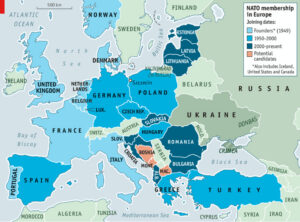
    The controversy over assurances given by the U.S. and Germany during German reunification negotiations illustrates the deeper issue. Western leaders later insisted that no legally binding promises had been made regarding NATO expansion because no agreement was codified in writing. However, diplomacy operates not only through signed treaties but through expectations, understandings, and good faith. Declassified documents and contemporaneous accounts confirm that Soviet leaders were repeatedly told that NATO would not move eastward beyond Germany. These assurances shaped Soviet acquiescence to German reunification—a concession of immense strategic significance. When NATO expanded regardless, initially at America’s behest, Russia experienced this not as a technical legal adjustment, but as a deep betrayal of the settlement that had facilitated German reunification.

    Over time, European governments increasingly internalised NATO expansion as a European project, not merely an American one. German reunification within NATO became the template rather than the exception. EU enlargement and NATO enlargement proceeded in tandem, reinforcing one another and crowding out alternative security arrangements such as neutrality or non-alignment. Even Germany, with its Ostpolitik tradition and deepening economic ties to Russia, progressively subordinated its policies, favouring accommodation to alliance logic. European leaders framed expansion as a moral imperative rather than a strategic choice, thereby insulating it from scrutiny and rendering Russian objections illegitimate. In doing so, Europe surrendered much of its capacity to act as an independent security actor, tying its fate ever more tightly to an Atlantic strategy that privileged expansion over stability.

    This is where Europe’s failure becomes most stark. Rather than acknowledging that NATO expansion contradicted the logic of indivisible security articulated in the Charter of Paris, European leaders treated Russian objections as illegitimate—as residues of imperial nostalgia rather than expressions of genuine security anxiety. Russia was invited to consult, but not to decide. The 1997 NATO–Russia Founding Act institutionalised this asymmetry: dialogue without a Russian veto, partnership without Russian parity. The architecture of European security was being built around Russia, and despite Russia, not with Russia.

    George Kennan’s 1997 warning that NATO expansion would be a “fateful error” captured the strategic risk with remarkable clarity. Kennan did not argue that Russia was virtuous; he argued that humiliating and marginalising a great power at a moment of weakness would produce resentment, revanchism, and militarisation. His warning was dismissed as outdated realism, yet subsequent history has vindicated his logic almost point by point.

    The ideological underpinning of this dismissal can be found explicitly in the writings of Zbigniew Brzezinski. In The Grand Chessboard (1997) and in his Foreign Affairs essay “A Geostrategy for Eurasia” (1997), Brzezinski articulated a vision of American primacy grounded in control over Eurasia. He argued that Eurasia was the “axial supercontinent,” and U.S. global dominance depended on preventing the emergence of any power capable of dominating it. In this framework, Ukraine was not merely a sovereign state with its own trajectory; it was a geopolitical pivot. “Without Ukraine,” Brzezinski famously wrote, “Russia ceases to be an empire.”

    This was not an academic aside; it was a programmatic statement of U.S. imperial grand strategy. In such a worldview, Russia’s security concerns are not legitimate interests to be accommodated in the name of peace; they are obstacles to be overcome in the name of U.S. primacy. Europe, deeply embedded in the Atlantic system and dependent on U.S. security guarantees, internalised this logic—often without acknowledging its full implications. The result was a European security policy that consistently privileged alliance expansion over stability, and moral signalling over durable settlement.

    The consequences became unmistakable in 2008. At NATO’s Bucharest Summit, the alliance declared that Ukraine and Georgia “will become members of NATO.” This statement was not accompanied by a clear timeline, but its political meaning was unequivocal. It crossed what Russian officials across the political spectrum had long described as a red line. That this was understood in advance is beyond dispute. William Burns, then U.S. ambassador to Moscow, reported in a cable titled “NYET MEANS NYET” that Ukrainian NATO membership was perceived in Russia as an existential threat, uniting liberals, nationalists, and hardliners alike. The warning was explicit. It was ignored.

    From Russia’s perspective, the pattern was now unmistakable. Europe and the United States invoked the language of rules and sovereignty when it suited them, but dismissed Russia’s core security concerns as illegitimate. The lesson Russia drew was the same lesson it had drawn after the Crimean War, after the Allied interventions, after the failure of collective security, and after the rejection of the Stalin Note: peace would be offered only on terms that preserved Western strategic dominance.

    The crisis that erupted in Ukraine in 2014 was therefore not an aberration but a culmination. The Maidan uprising, the collapse of the Yanukovych government, Russia’s annexation of Crimea, and the war in Donbas unfolded within a security architecture already strained to the breaking point. The U.S. actively encouraged the coup that overthrew Yanukovych, even plotting in the background regarding the composition of the new government. When the Donbas region erupted in opposition to the Maidan coup, Europe responded with sanctions and diplomatic condemnation, framing the conflict as a simple morality play. Yet even at this stage, a negotiated settlement was possible. The Minsk agreements, particularly Minsk II in 2015, provided a framework for de-escalation of the conflict, autonomy for the Donbas, and reintegration of Ukraine and Russia within an expanded European economic order.

    When Western leaders later suggested that Minsk II had functioned primarily to “buy time” for Ukraine to strengthen militarily, the strategic damage was severe. From Moscow’s perspective, this confirmed the suspicion that Western diplomacy was cynical and instrumental rather than sincere—that agreements were not meant to be implemented, only to manage optics.

    Minsk II represented an acknowledgement—however reluctant—that peace required compromise and that Ukraine’s stability depended on addressing both internal divisions and external security concerns. What ultimately destroyed Minsk II was Western resistance. When Western leaders later suggested that Minsk II had functioned primarily to “buy time” for Ukraine to strengthen militarily, the strategic damage was severe. From Moscow’s perspective, this confirmed the suspicion that Western diplomacy was cynical and instrumental rather than sincere—that agreements were not meant to be implemented, only to manage optics.

    By 2021, the European security architecture had become untenable. Russia presented draft proposals calling for negotiations over NATO expansion, missile deployments, and military exercises—precisely the issues it had warned about for decades. These proposals were dismissed by the U.S. and NATO out of hand. NATO expansion was declared non-negotiable. Once again, Europe and the United States refused to engage Russia’s core security concerns as legitimate subjects of negotiation. War followed.

    When Russian forces entered Ukraine in February 2022, Europe described the invasion as “unprovoked.” While this absurd description may serve a propaganda narrative, it utterly obscures history. The Russian action hardly emerged from a vacuum. It emerged from a security order that had systematically refused to integrate Russia’s concerns and from a diplomatic process that had ruled out negotiation on the very issues that mattered most to Russia.

    Even then, peace was not impossible. In March and April 2022, Russia and Ukraine engaged in negotiations in Istanbul that produced a detailed draft framework. Ukraine proposed permanent neutrality with international security guarantees; Russia accepted the principle. The framework addressed force limitations, guarantees, and a longer process for territorial questions. These were not fantasy documents. They were serious drafts reflecting the realities of the battlefield and the structural constraints of geography.

    Yet the Istanbul talks collapsed when the U.S. and U.K. stepped in and told Ukraine not to sign. As Boris Johnson later explained, nothing less than Western hegemony was on the line. The collapsed Istanbul Process demonstrates concretely that peace in Ukraine was possible soon after the start of Russia’s special military operation. The agreement was drafted and nearly completed, only to be abandoned at the behest of the U.S. and the U.K.

    By 2025, the grim irony became clear. The same Istanbul framework resurfaced as a reference point in renewed diplomatic efforts. After immense bloodshed, diplomacy circled back to a plausible compromise. This is a familiar pattern in wars shaped by security dilemmas: early settlements that are rejected as premature later reappear as tragic necessities. Yet even now, Europe resists a negotiated peace.

    For Europe, the costs of this long refusal to take Russia’s security concerns seriously are now unavoidable and massive. Europe has borne severe economic losses from energy disruption and de-industrialisation pressures. It has committed itself to long-term rearmament with profound fiscal, social, and political consequences. Political cohesion within European societies is badly frayed under the strain of inflation, migration pressures, war fatigue, and diverging viewpoints across European governments. Europe’s strategic autonomy has diminished as Europe once again becomes the primary theatre of great-power confrontation rather than an independent pole.

    Perhaps most dangerously, nuclear risk has returned to the centre of European security calculations. For the first time since the Cold War, European publics are once again living under the shadow of potential escalation between nuclear-armed powers. This is not the result of moral failure alone. It is the result of the West’s structural refusal, stretching back to Pogodin’s time, to recognise that peace in Europe cannot be built by denying Russia’s security concerns. Peace can only be built by negotiating them.

    The tragedy of Europe’s denial of Russia’s security concerns is that it becomes self-reinforcing. When Russian security concerns are dismissed as illegitimate, Russian leaders have fewer incentives to pursue diplomacy and greater incentives to change facts on the ground. European policymakers then interpret these actions as confirmation of their original suspicions, rather than as the utterly predictable outcome of a security dilemma they themselves created and then denied. Over time, this dynamic narrows the diplomatic space until war appears to many not as a choice but as an inevitability. Yet the inevitability is manufactured. It arises not from immutable hostility but from the persistent European refusal to recognise that durable peace requires acknowledging the other side’s fears as real, even when those fears are inconvenient.

    The tragedy is that Europe has repeatedly paid heavily for this refusal. It paid in the Crimean War and its aftermath, in the catastrophes of the first half of the twentieth century, and in decades of Cold War division. And it is paying again now. Russophobia has not made Europe safer. It has made Europe poorer, more divided, more militarised, and more dependent on external power.

    By refusing to treat Russia as a normal security actor, Europe has helped generate the very instability it fears, while incurring mounting costs in blood, treasure, autonomy, and cohesion.

    The added irony is that while this structural Russophobia has not weakened Russia in the long run, it has repeatedly weakened Europe. By refusing to treat Russia as a normal security actor, Europe has helped generate the very instability it fears, while incurring mounting costs in blood, treasure, autonomy, and cohesion. Each cycle ends the same way: a belated recognition that peace requires negotiation after immense damage has already been done. The lesson Europe has yet to absorb is that recognising Russia’s security concerns is not a concession to power, but a prerequisite for preventing its destructive uses.

    The lesson, written in blood across two centuries, is not that Russia or any other country must be trusted in all regards. It is that Russia and its security interests must be taken seriously. Europe has repeatedly rejected peace with Russia, not because it was unavailable, but because acknowledging Russia’s security concerns was wrongly treated as illegitimate. Until Europe abandons that reflex, it will remain trapped in a cycle of self-defeating confrontation—rejecting peace when it is possible and bearing the costs long after.

    This article was published earlier at www.cirsd.org