Tag: India

  • A discourse in Refugee Policy and National Decisions : The  Indian context

    A discourse in Refugee Policy and National Decisions : The Indian context

    South Asian states have experienced refugee movements since independence from the British colonial rule and yet once again in 1971 when East Pakistan was split from West Pakistan. The territory of India as it is today has been at the forefront of this influx along with two other nations in the region – Pakistan and Bangladesh while Afghanistan has been a state that has sent out its citizens as refugees all along due to the state of prolonged internal conflicts, and in its immediate neighborhood.

    According to the United Nations, the projected number of refugees is estimated to be around 2.5 million in South Asia, with India alone hosting around 2,00,000 (number registered with UNHCR). Unofficially, India is said to have nearly 437,000 refugees. It is not only the regional atmosphere but also the volatility of the countries in neighboring regions – Syria, Iraq, Tibet and Myanmar that have led to an exodus of populations into South Asia. Apart from wars and persecution, economic deprivation and climate change are driving people out of their home countries. India, sharing borders with all of the South Asian countries where Maldives being contiguous in the Indian Ocean Region, has inevitably been the first or second destination for refugees fleeing their homes. However, India has failed to adopt a legal framework to confer refugee status to people who have fled home countries for a well-founded fear of persecution, discrimination or deprivation of any kind thus blurring the lines between migrants who have entered illegally and refugees.

    Recently, India passed the Citizenship Amendment Act that seeks to grant citizenship to Buddhists, Christians, Hindus, Jains, Parsis and Sikhs who entered India before the 31st of December 2015 from Pakistan, Bangladesh and Afghanistan. The Act has an arbitrary cut-off date, omits the mention of Muslims, does not convincingly explain the rationale behind grouping the three countries, thus any argument of replacing the ad hoc refugee policy would only stand frail. This article, with this premise at the crux will attempt to examine why India has to work towards formulating a holistic refugee policy framework followed by a law and how there is a need for one to ensure the domestic population does not turn hostile to refugees.

    Understanding Refugees in India

    India has allowed for the entry of refugees under the Foreigners Act, 1946; The Foreigners Order, 1948; Registration of Foreigners Act, 1939; and The Passport Act (Entry into India), 1920; The Passport Act, 1967. Refugee populations from Afghanistan, Bangladesh, Myanmar, Eritrea, Iraq, Iran, Pakistan, Sri Lanka and Tibet among many other countries have crossed borders to enter India due to sectarian conflicts, political instability and even economic and climate change.

    South Asia is one of the most disaster-prone regions of the earth and has in recent years witnessed droughts, heatwaves, floods and rise in sea levels threatening both human lives and livelihoods for indefinite periods. Around 46 million people are estimated to have fled their homes in South Asia due to natural disasters between 2008 and 2013 despite a lack of precise estimate in how many have solely migrated due to climate change other than seasonal migration. This thus creates an intersection between economic and climate-induced migration. An estimated 20 million have been migrating from Bangladesh to India every year due to environmental adversities.

    However, it has only been the discourse on traditional security that has dominated the discussions outside of academia questioning the preparedness of India in managing the influx of refugees in the run-up to global and regional crises due to non-traditional securities such as environmental degradation and resulting ‘environment-economic’ splinter effects.

    Diplomacy vis a vis domestic governance

    While we are already witnessing how different sections of the society have not taken it well to religious narrative embedded in the Act, several other factors have also threaded themselves to the dismay of locals due to lack of concentrated effort to treat refugees. Refugees who fear deportation and brutal treatment under the law may disguise themselves as residents and thus in the long run contributing to the alarm and insecurity amongst the locals. This has been very evident in Assam that has for decades agitated over the growth in population in the state due to illegal migration from Bangladesh. It was more to do with struggle for resources, fears of demographic changes and losing control of governance, and less about religion. By resorting to naturalizing refugees and not resorting to repatriation agreements, India today maybe adding fire to the already burning fuel of ‘more mouths to feed and fewer resources’.

    India’s ad hoc policy has given it a leeway to treat refugees based on the country of origin depending on the geopolitics of the day. Today by sealing this arbitrariness as a law India has threatened its own scope to rectify its position in the wake of contestations. It is uncertain even being a signatory to The New York Declaration of Refugees and Migrants 2016, the precursor to the Global Compact on Refugees can realize India’s image as a responsible power while denying Rohingyas and Sri Lankan Tamils the due recognition as refugees.

    On the global stage, India’s treatment of refugees had until recently attracted a fair share of appreciation despite the lack of a national refugee law and notwithstanding the fact that the country is a non-signatory to the United Nations Refugee Convention nor the 1967 Protocol.

    India may not have an official reason on why it has not signed the convention, but sufficient correlative studies show us India’s skepticism arising due to the Euro-centrism of the convention, a threat to sovereignty and a narrow definition of refugees that does not cover the economic, social, and political aspects. Apart from this, the episodes of 1971 influx of refugees and earlier in 1945 linger over India’s unpleasant memories.

    Conclusion

    No refugee policy or domestic law remains an internal concern especially in South Asia where not only are the territorial borders porous but so are the divisions between communities. Due to its relatively better availability of economic opportunity and being a secular state, Indian policymakers are challenged by protracted refugee situations.

    Given the pressure on India’s resources from its huge and growing population, it does not have the capacity to host large refugee populations. India, therefore, has to evolve a 21st-century diplomatic mechanism with both the global community and the sending states to create opportunities for resettlement of refugees. With evolving geopolitics and rise of non-traditional security, it would be in India’s best interests to formulate multifaceted refugee policies bilaterally and multilaterally.

    Jayashri Ramesh Sundaram holds a masters in IR from RSIS, Nanyang Technological University, Singapore. She focuses on refugee issues and policy analysis. Views expressed are the author’s own.

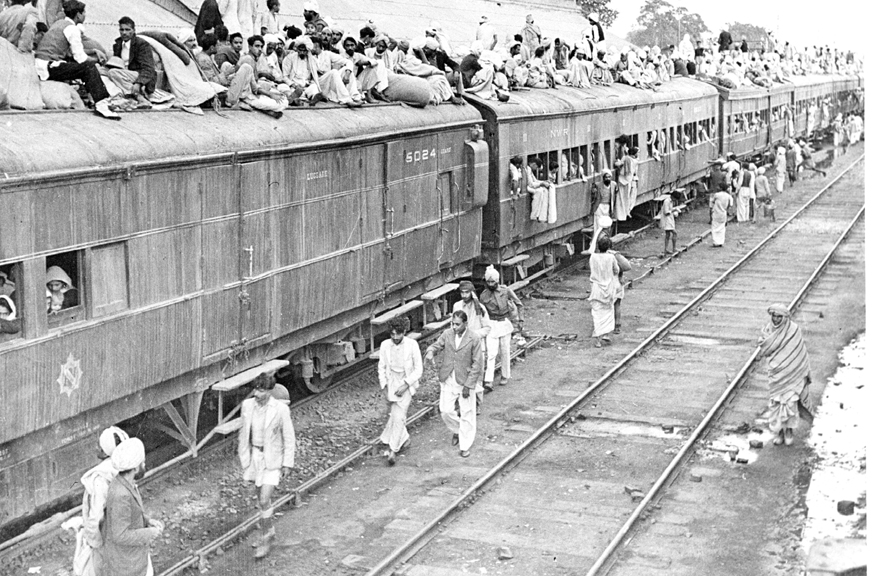
    Image Credit: A Refugee special train during Partition. commons.wikipedia.org

  • India and Nepal: Energy Cooperation

    India and Nepal: Energy Cooperation

    Introduction

    Sustained availability of energy at affordable cost is an essential prerequisite for the growth of a country. Currently the energy consumption per capita in case of Nepal is134 KWH per capita per year, as against world average of 2674 KWH per capita per year.

    GDP Per Capita in $ (PPP)

    Country Energy Consumption in kWh per capita per year GDP Per Capita in $ (PPP) GDP Per Capita in $ (Nominal)
    World Average 2674 11673 11673
    Bhutan 2779 3392 3392
    India 1122 1980 1980
    Maldives 1122 9802 9802
    Pakistan 471 539 539
    Sri Lanka 414 4135 4135
    Bangladesh 351 1564 1564
    Myanmar 193 1256 1256
    Afghanistan 141 538 538
    Nepal 134 900 900

    Table-1: Energy Consumption Vs Gross Domestic Product
    Source:  1.GDP figures for 2017 vide https://www.worldometers.info/gdp/gdp-per-capita
         2.World Fact Book: Power consumption for various countries of the World.

    Although correlation between energy consumption and the prosperity depends on a number of factors like population but a fact which clearly overshadows others is that as energy consumption increases the prosperity increases. This relationship is equally valid for reverse relationship, i.e. as prosperity increases the necessity for additional energy becomes obligatory. Another interesting observation can be made based on the content of this table. Bhutan is a land locked country which has hardly any major industry in that country, yet their GDP per capita is more than India’s. An examination suggests that Bhutan has adequate hydro resources and hydroelectricity generated exploiting her indigenous resources is far more than her requirement. This surplus generation is sold by Bhutan to India. Revenue thus earned has transformed the country from a poor developing country to a prosperous country quite distinct from other South Asian countries. For the record Bhutan’s revenue from hydro power is 27% of the entire govt revenue and is 14% of Bhutan’s GDP. This also flags an approach which can also help other South Asian countries to improve their economic strength by exploiting their indigenous resources. Another country of South Asia; Nepal can benefit from the model which Bhutan is currently following for sharing its energy resources with India in a ‘win-win’ situation.

    Topography of Nepal

    topography-of-nepal

    Map1: Nepal and its Rivers and Physical features
    Source: https://en.wikipedia.org/wiki/Geography_of_Nepal 

    A report of International Hydropower Association, “Bhutan” uploaded on https://www.hydropower.org/country-profile/bhutanography_of_Nepal 

    • Lie of the country is such that all the rivers flow from Nepal to India.
    • High Himalayas separate Nepal from Tibet, whereas southern side of the country is having  a terrain which is plain and that separates Nepal from India therefore while Northern Areas of Nepal act as a barrier between Nepal and Tibet, plains in southern side of the country lends itself for cooperation between India and Nepal. Recent operationalization of an oil pipeline from Motihari in Bihar to Amlekhganj in Nepal is a manifestation of such a cooperation (Little more about it a little later.)
    • Nepal has a huge hydropower potential. In fact, the perennial nature of Nepali rivers and the steep gradient of the country’s topography provide ideal conditions for the development of some of the world’s largest hydroelectric projects in Nepal. Current estimates are that Nepal has approximately 43,000 MW of economically feasible hydropower potential. However, the present situation is that Nepal has developed only approximately 753 MW of hydropower. Therefore, bulk of the economically feasible generation has not been realized yet. Besides, the multi-purpose secondary and tertiary benefits have not been realised from the development of its rivers. Nepal is utilising only 2% of it (i.e., 98% remains unutilised). It may be noted that an optimum exploitation of the hydro resources will contribute substantially to the financial well-being of Nepal. However, it is also a fact that Nepal neither has the financial muscle nor technical knowhow to harness its hydro resources. Therefore, support from friendly foreign countries becomes essential. China has been trying to make inroads into Nepal but whether it can be cost-effective or not is something that needs to be examined in carefully. India, on the contrary, has everything in her favour to support hydro power exploitation by Nepal. In fact power generated in Nepal can also be shared with Bangladesh using Indian grid system, which will be an excellent example of Nepal-India-Bangladesh cooperation, and still better as a BBIN (Bhutan-Bangladesh- India-Nepal) initiative and will be a ‘Win Win’ situation for all three countries.  India will have to use all its traditional heft with Nepal, its diplomatic skills, financial support to beat China who is trying hard to gain a foothold in Nepal’s Hydro energy exploitation domain as they are desperately wanting power.

    Map-3: River Systems of Nepal
    Source: Firoz Alam et al, “A review of hydropower projects in Nepal1st International Conference on Energy and Power”, presented during ICEP2016 at RMIT University, Melbourne, Australia, 14-16 December 2016 and Available online at www.sciencedirect.com ScienceDirect Energy Procedia 110 (2017) 581 – 585

    • While planning hydro power plants in Nepal, some extra care would be required to be undertaken. Nepal’s topography is unstable due to seismic activities. Hence, all hydropower plants with dam must be well planned and designed to mitigate the environmental impact. Also most Himalayan Rivers contain huge quantities of sediment with hard abrasive particles. The region’s climate and tectonic conditions as well as human activities are highly conducive for erosion and sedimentation. Therefore, sediment management is paramount for the safety, reliability and longer life of infrastructures (hydropower dam, equipment, roads, bridges, irrigation systems and drinking water).

    As close neighbours, India and Nepal share unique ties of friendship and cooperation characterised by an open border and deep-rooted people-to-people contacts of kinship and culture. There has been a long tradition of free movement of people across the border. Nepal shares a border of over 1850 km with five Indian states – Sikkim, West Bengal, Bihar, Uttar Pradesh and Uttarakhand. The India-Nepal Treaty of Peace and Friendship of 1950 forms the bedrock of the special relations that exist between India and Nepal. Nepalese citizens avail facilities and opportunities at par with Indian citizens in accordance with the provisions of the Treaty. Nearly 6 million Nepalese citizens live and work in India. However Nepal is still not well developed and as has been explained earlier suffer from lack adequate energy to fuel its development. India has been a major partner in exploiting its indigenous energy resources and also making up the shortfall on this account.

    Potential and Scope of Hydro Power Cooperation

    Certain studies have been done to ascertain scope for the Indo-Nepal Cooperation in the domain of energy. It has been concluded that in the high build scenario, Nepal’s hydropower capacity is estimated to be 4551 MW. The generation cost in an arrangement of Indo-Nepal combined system would fall by approximately US $106 billion per year. This enhanced capacity will help Nepal to increase her power export to India by 60%. However Nepal’s high build out hydro resources would be fully utilised if operations between Nepal and India are further coordinated and an economic union strategy adopted by the two countries. Effectively, this would mean that trade with Nepal is institutionally is same as trade is between Indian States. Such enhanced power generation will help Nepal to become net exporter of power during dry as well as wet season, with reduced generation cost. On the contrary India ranks 81st in overall energy self-sufficiency at 66% in 2014 . Primary energy consumption in India grew by 7.9% in 2018 and it happens to be the third biggest consumer after China and USA, with 5.8% global share.

    Details of Completed Projects for Energy Cooperation between India and Nepal

    Motihari-Amlekhgunj Oil Pipeline: On 10th September 2019, the Prime Ministers of Nepal and India jointly inaugurated a cross-border oil pipeline through video conferencing. This line will transport fuel to the landlocked country. The aim of this pipe line is to cement India-Nepal ties in the face of major inroads made by China into the Himalayan nation, and seeks to repair the trust deficit between the two countries due to an economic blockade allegedly imposed by India in 2015 to persuade Nepal to change some provisions in its new constitution. Basically the protests at that time were done by people of Madhesh (region bordering India) as they felt that there were certain provisions of the constitution of Nepal which were discriminatory against them. India said at that time that the trucks laden with fuel and medicines, besides other essentials, were stopped by sections of Nepalese population (Madheshis) unhappy with some provisions of their constitution, which they felt were practically disenfranchising them. Nepal, however, viewed it as if India was blocking the supplies to compel Kathmandu to amend the provisions of the constitution that was seen as disenfranchising almost half of the Nepalese population. Therefore, the current initiative seeks to rebuild the confidence between the two countries and will help to bind Nepal closer to New Delhi, economically and strategically. The development comes against the backdrop of recent plans for a rail link between Nepal and China cutting through the Himalayas. There were also plans to link Nepal and China through an energy pipeline running through the Himalayas. Both were seen as means by Nepal to find an alternative to its dependency on India. The 69 km pipeline will transport fuel from the Barauni refinery in Bihar to Amlekhgunj in south-east Nepal and is the first cross-border petroleum products pipeline in South Asia. The Motihari-Amlekhgunj oil pipeline project was first proposed in 1996. The project was put back on the agenda during Prime Minister Narendra Modi’s visit to Kathmandu in 2014. The two governments had signed an agreement to execute the project in August 2015. Construction had begun in April 2018. Construction of the pipeline was undertaken by the Indian Oil Corp. Ltd (IOCL), India’s largest refiner, with an investment of over ₹324 crore, in collaboration with Nepal Oil Corp. Ltd (NOCL). The two sides are also working on building additional storage facility at the Amlekhgunj Depot, wherein NOCL has committed an estimated ₹75 crore. The pipeline can carry up to 2 million metric tonnes of petroleum products each year. Currently, petroleum products are carried from India to Nepal using oil tankers as part of an arrangement which has been in place since 1973. The NOCL not only hopes to save ₹200 crore annually with the new pipeline but will also ensure the transportation is no longer vulnerable to any kind of blockade.

    Power Supply from India to Nepal: India and Nepal have a Power Exchange Agreement since 1971 for meeting the power requirements in the border areas of the two countries, taking advantage of each other’s transmission infrastructure. There are more than twenty 132 kV, 33 kV and 11 kV transmission interconnections which are used both for power exchange in the border areas and for power trade. For enhanced transmission of electricity, the first high-capacity Muzaffarpur (India) – Dhalkebar (Nepal) cross-border power transmission line (initially charged at 132 kV), with GoI Letter of credit (LoC) funding of US$ 13.2 million, was completed in 2016. Two additional 132 kV cross-border transmission lines between Kataiya (India) – Kusaha (Nepal) and Raxaul (India) – Parwanipur (Nepal), built with GoI grant assistance, were completed in 2017. India is currently supplying a total of about 450 MW of power to Nepal. An Agreement on ‘Electric Power Trade, Cross-border Transmission Interconnection and Grid Connectivity’ between India and Nepal was signed on 21 October 2014. The Agreement is aimed at facilitating and further strengthening cross-border electricity transmission, grid connectivity and power trade between Nepal and India. The Agreement provides a framework for power trade between the two countries, import by Nepal from India until it becomes power surplus and subsequent import by Indian entities from Nepal, on mutually acceptable terms and conditions. Two mechanisms, Joint Working Group (JWG) and Joint Steering Committee (JSC) envisaged under the Agreement have been established. Joint Technical Team (JTT) was formed for preparation of a long-term integrated transmission plan covering projects up to 2035.

    Cooperation in the Domain of Hydro Energy: Cooperation in water resources primarily concerning the common rivers is one of the most important areas of bilateral relations. A large number of small and large rivers flow from Nepal into India and constitute an important part of the Ganges River basins (Refer Map-3 above). These rivers have the potential to become major sources of irrigation and power for Nepal and India. A three-tier bilateral mechanism was established in 2008, to discuss issues relating to cooperation in water resources, flood management, inundation and hydropower between the two countries. A Development Authority was set up in September 2014 to carry out the Pancheshwar Multipurpose project. A Power Development Agreement (PDA) for the 900 MW Arun-III hydroelectric project between India’s Satluj Jal Vidyut Nigam Limited and the Investment Board of Nepal (IBN) was concluded in November 2014. Also, a PDA for the 900 MW Upper Karnali hydroelectric project was concluded between IBN and M/s GMR in September 2014.

    Projects under Planning/Execution

    Pancheshwar Multipurpose Project: India and Nepal had signed a Treaty known as Mahakali Treaty in February’1996. Implementation of Pancheshwar Multipurpose Project is the centerpiece of the Mahakali Treaty. Required field investigations for the Pancheshwar Multipurpose Project have been completed by a Joint Project Office (JPO-PI) in 2002 (except for some confirmatory tests). But mutually acceptable DPR of Pancheshwar Project is yet to be finalised. The constitution of Pancheswar Development Authority has already been notified. Pancheshwar Multipurpose Project (PMP) is a bilateral project, primarily aimed at energy production and augmenting irrigation in India and Nepal. A Treaty known as “Mahakali Treaty” concerning the integrated development of the Mahakali River, which included Sarada barrage, Tanakpur barrage and Pancheshwar Dam Project, was signed between the Government of Nepal and the Government of India on February 12, 1996. During the year 2009, pursuant to the Article-10 of the Mahakali Treaty, the Government of India and the Government of Nepal agreed and framed draft ToR for setting up the Pancheshwar Development Authority, as an independent autonomous body, for development, execution and operation of the Pancheshwar Multipurpose Project. To accomplish this shared goal, the Terms of Reference (ToR) of the PDA as agreed upon by the two Governments and as may be amended from time to time, were created. As per the Statute of PDA the administrative organs of the authority are the Governing Body (GB) and the Executive Committee (EC). In order to execute the specific tasks assigned to the Governing Body, five meetings of GB have taken place so far. Pancheshwar Main Dam is proposed on River Mahakali (known as River Sarada in India), where the river forms the international boundary between the Far Western Development Region of Nepal and State of Uttarakhand in India. The dam site is around 2.5 km downstream of the confluence of River Sarju with River Mahakali. The project would comprise of a rock-fill dam with central clay core of 311m height from the deepest foundation level. Two underground power houses at Pancheshwar dam, one on each bank of Mahakali River, each with a capacity of (6×400 MW) with the total installed capacity of nearly 4800 MW are proposed to be constructed. The power plant at main dam will be operated as the peaking station to meet energy demand in India and Nepal. A re-regulating dam at Rupaligad is proposed around 27 km downstream of the main dam to even out peaking flows released from Pancheshwar power houses for meeting downstream irrigation water requirement. Here, two underground powerhouses on both sides of river with total installed capacity of 240 MW (2 x 60 MW on either bank) are envisaged. The main dam (when impounded with water up to Flood Regulating Level (FRL)) will form a reservoir of around 11,600 hectare area with a gross storage volume of about 11,355 million cubic metres. The submergence area on Indian side is 7,600 hectare, covering districts namely Pithoragarh, Almora and Champawat in the state of Uttarakhand whereas remaining 4000 hectares of submergence will be in Nepal. The project aims at producing hydro power and enhance the food grains production in both the countries by providing additional irrigation resulting from the augmentation of dry season flows. Year round irrigation will be possible in agricultural land in Kanchanpur district in Nepal due to enhancement in flows during non-monsoon months. The project will generate Two underground power houses at Pancheshwar dam, one on each bank of Mahakali River, each with a capacity of (6×400 MW) with the total installed capacity of nearly 4800 MW are proposed to be constructed. The power plant at main dam will be operated as the peaking station to meet energy demand in India and Nepal. Power generated will be shared equally between both the nations as per Treaty. Irrigation benefits in form of annual irrigation will be about 0.43 Mha, out of this, annual irrigation in Nepal would be 0.17 Mha and remaining 0.26 Mha in India. In addition, due to moderation of flood peak at reservoir(s), incidental flood control benefits for both the countries are also envisaged from the project. Pancheshwar Multipurpose Project is one of the top priority projects to be implemented in phased manner to reap the benefits of the project as early as possible. The work of preparation of Detailed Project Report (DPR) was entrusted to Water and Power Consultancy Services Limited (WAPCOS) by PDA and WAPCOS have in turn submitted the draft final DPR of the project to PDA in November, 2016. At present the finalization of Detailed Project Report (DPR) of the project is underway. A Team of Experts/Officials has been formed by both the countries for discussing and resolving all issues towards finalization of the DPR. After finalization of DPR, the Pancheshwar Development Authority shall undertake the execution, operation and maintenance of the project, including the work of re-regulating dam at Rupaligad site in an integrated manner.

    Sapta-Kosi High Dam Project and SUN Kosi storage cum diversion scheme: After exchange of letter of Understanding between the two Governments in June’ 2004, a Joint Project Office (JPO) was set up in August’ 2004 to undertake detailed field investigations for preparation of DPR of SaptaKosi High Dam Project at Barakshetra in Nepal.  DPR is under progress.

    Kamla and Bagmati Multipurpose Projects The JPO-SKSKI has also been entrusted to undertake the feasibility study of Kamla Dam and preliminary study of Bagmati Dam Projects. These studies are in progress.

    Project Completion Prospects

    Hydro power projects have a long gestation period and therefore, it can safely be assumed that the export from Nepal of power will not be able to commence before 2025. Nepal will be able to export 18 billion kWh in 2025 which will go up to 93 billion kWh by 2035 and then will start flattening and by 2040 it would be 115 trillion Watt hour because by that time it is anticipated that because of the growing prosperity domestic consumption will also pick up. In rainy season when the reservoirs will be at their peak capacity, it is estimated that by 2030 13 GW would be available for export.

    Conclusion

    Notwithstanding the political division within South Asia, it is important to appreciate that the energy resources are monolithic in nature. Due to topography of the country most of the hydropower resources are concentrated in the Himalayas; spanning Nepal, Bhutan and Indian states of Arunachal Pradesh, Sikkim, Uttarakhand and Himachal Pradesh. Hydro power is a form of green energy and it would be ideal in case a mechanism can be evolved to exploit it for common good. It is essential that India, in conjunction with Nepal, Bhutan and Bangladesh, needs to make attempts to make use of energy resources available in all these countries; hydro power is one such resource. In this connection the platform of BBIN (Bhutan-Bangladesh-India-Bhutan-IndiaNepal) needs to be exploited. In fact recent pipeline laid by India between Motihari in Bihar and Amlekhgunj in Nepal is great example of cooperation that benefits the region and the parties involved.

  • Conference Report- India and the Indian Ocean Region: Dynamics of Geopolitics, Security, and Global Commons

    Conference Report- India and the Indian Ocean Region: Dynamics of Geopolitics, Security, and Global Commons

    TPF Team                                                                                                    August 19, 2019/Conference

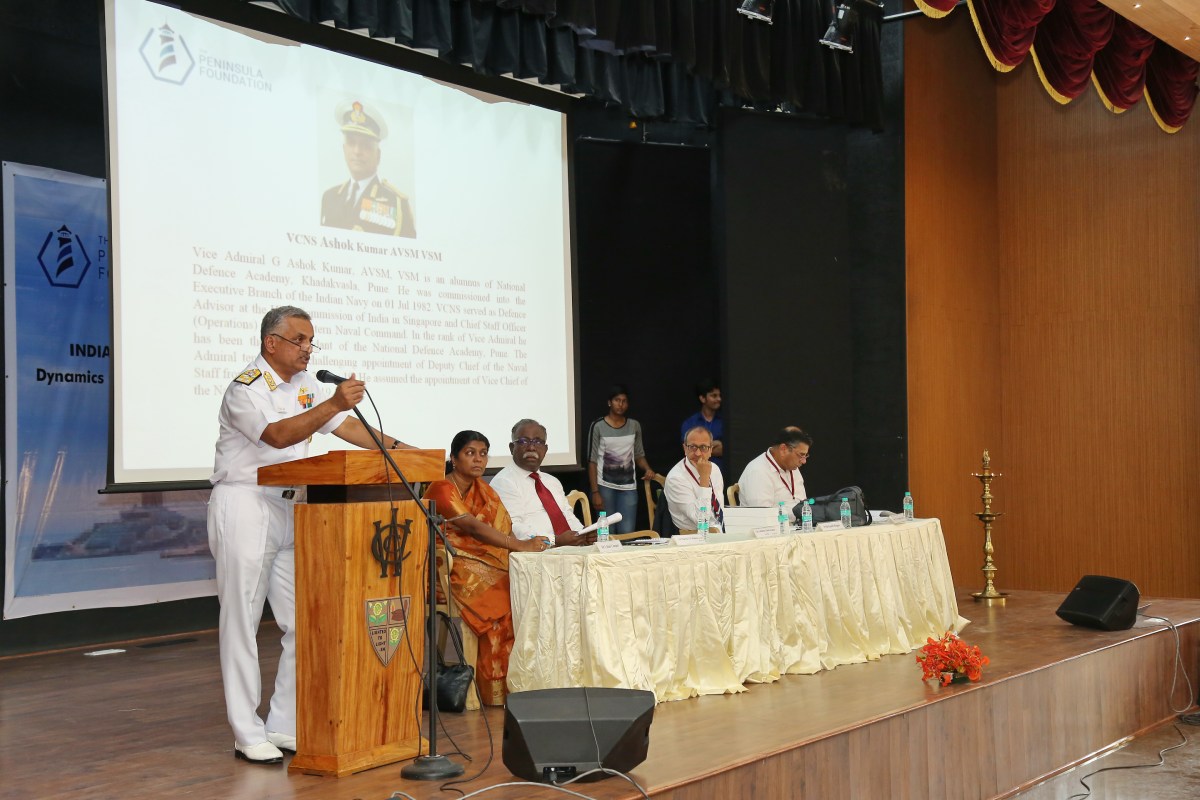
    The Peninsula Foundation held its first international conference titled “India and the Indian Ocean Region: Dynamics of Geopolitics, Security and Global Commons” on the 12thand 13thof July at the Women’s Christian College, Chennai. Fifteen papers authored by research scholars from various institutions and backgrounds were presented during the course of the two-day conference comprising five sessions.The inaugural address was delivered by the Chief Guest, Vice Admiral N Ashok Kumar AVSM VSM, Vice Chief of Naval Staff (VCNS). In an eloquent speech, the VCNS highlighted the growing importance of the Indian Ocean Region and the need to debate and discuss issues relating to chokepoints and the trade routes. He spoke about historical evidence of the criticality of the trade routes in the Indian Ocean Region (IOR), and related it to the present context of ship movements in vital sea lanes of communications (SLOCs) that are vital for economic growth of countries in the Asia-Pacific Region. India’s geographic location gives it a dominant strategic position, as seventy-five percent of international shipping links go through the IOR. He pointed out that China is deeply focussed on safeguarding its interests in the IOR since more than seventy percent of its energy requirements are dependent on Indian Ocean sea lanes. Stressing on the importance of the IOR, the VCNS highlighted the vulnerability of chokepoints and the need to ensure freedom of the seas.

                The keynote address was delivered by Professor Kanti Prasad Bajpai, Vice Dean and Wilmar Professor of Asian Studies at the Lee Kuan Yew School of Public Policy, National University of Singapore. He focused on the contemporary understanding of the term ‘region’ and its context with regards to geopolitics and international relations, stating that when we refer to a region in the geopolitical context, we essentially refer to a zone of conflict, a war-zone or an area of potential conflict. Thus, South Asia often implies the India-Pakistan conflict, Middle East or West Asia the Arab-Israeli conflict, or the conflict between North and South Korea when talking about Korea as a region. Similarly, the Indian Ocean region is one of geopolitical contest amongst the great powers. It is a strategically important region where interdependence is inevitable amongst the nations that have vested interests in the IOR.

                Professor Bajpai further elucidated the fundamentals of trade development in the region and substantiated a case for the IOR as a strategic zone, citing the consistency with which external powers compete to control the region. He highlighted the three forms of culture that govern or define power positions in the IOR: classical culture, popular culture and strategic culture. India, aspiring to position itself as an important player in the region, has to evaluate the choices that are available to it: accept one dominant power to manage the region in a rule-based order or actively participate in the dialogue for a negotiated order that can be achieved through multilateral trade agreements. In conclusion, Professor Bajpai raised questions to be addressed in the upcoming sessions. The inaugural session ended with a special lecture on the cultural legacies of the Asia-Pacific Region, delivered by Indian classical dancer and Padma Bhushan awardee, Dr Padma Subrahmanyam.

    Session One: ‘Indian Ocean: Culture, Civilizations and Connectivity’

                The topic of the first session chaired by Cmde. C. Uday Bhaskar, Director of the Society for Policy Studies (SPS), was ‘Indian Ocean: Culture, Civilizations and Connectivity’. The speakers discussed the history, culture and impact of trade on the IOR. G Padmaja, an independent researcher, emphasised India’s maritime heritage and argued that policies do not move beyond mere talk with respect to the IOR. Dr Vijay Sakhuja, Trustee of The Peninsula Foundation, stated that the IOR is the busiest trade route in terms of development and commodity exchange. He elucidated the importance of digital shipping and the scope of 5G technology and reliance on Artificial Intelligence in driving the trading ecosystem. The third speaker Dr D Dhanuraj, Chairman, Centre for Public Policy Research (CPPR), explored the idea of the modern political economy influencing the flow of men and commodities, and talked about the possibility of India reclaiming its rights over the IOR.

    Session Two: ‘Power Politics in the IOR: Geostrategies and Geo-economics’

                Through his paper “Competing Pivots in the Indian Ocean Region”, Dr Lawrence Prabhakar, Associate Professor, Madras Christian College, highlighted that the region can be constructed and contested through a maritime mandala that goes beyond security and economic factors to include cultural, governance, transnational and other aspects. Dr Arvind Kumar, HOD, Department of Geopolitics, Manipal University, in his paper “Stability of Trade and Commerce: Energy Corridor” discussed the potential of energy resources in the IOR and the need to include energy security as a significant feature in global trade and growth drive. In his paper titled “China’s BRI: Responses in the IOR and Implications for Regional Order”, Dr Jabin Jacob, Associate Professor, Shiv Nadar University, focussed on smaller nations affected by the Belt and Road Initiative and the responses by the Chinese government. Chairperson Dr TCA Raghavan, DG, ICWA, summarised the session by observing that the actions of regional states cannot be categorised as malicious but are rather reactions to Indian and Chinese policies over time.

    Session Three: India’s Strategic Interests in the IOR

                In the final session of the day, speakers discussed maritime security, power projections and evolving ties with littoral states in the region.  The session was chaired by Vice Admiral Shekhar Sinha (retd), Trustee, India Foundation. Cmde Somen Bannerjee, of Vivekananda International Foundation, pointed out in his paper titled “Maritime Security and Power Projections” that China is set to become the biggest power in the IOR in the next fifteen years. He also discussed the need for India to strategize power projection as a necessary course of action in order to secure importance on the global stage.  Through his paper, “Strategic Partnerships: India & ASEAN”, Ambassador Antonio Chiang brought to attention the strategic partnership between Taiwan and China, and the implications of China’s rise to power on Taiwan. Group Captain PB Nair spoke about the role of the Indian Air Force (IAF) in the context of the IOR, providing assistance in navigating sea routes, and the significance of Artificial Intelligence (AI) technology in carrying out sea operations.

    Day Two: Panel Discussion on India’s Approaches in the IOR

                Day Two commenced with a panel discussion on India’s strategic approaches in the IOR, its aspirations and the contradictions. The panel consisted of Dr TCA Raghavan, Ambassador Antonio Chiang, Lt Gen S.L. Narasimhan, Cmde Uday Bhaskar and Professor Kanti Bajpai. The session, moderated by Air Marshal M Matheswaran, addressed three main points: the power struggle in Asia, India’s inadequate investment with regard to being a rising power, and India’s engagement with multilateral institutions.

                The discussion focussed on the ramifications of Chinese economic power and military strength in the region, its effect on India’s policies, as well as the need for utilization of soft power and soft balancing techniques by smaller countries to level the international playing field.

                With regard to India’s investment activities, Dr TCA Raghavan mentioned that ineptness in domestic spheres would spill over and reflect in international projects.

                On the topic of India’s engagement in multilateral institutions, Professor Kanti Bajpai noted that while it cannot be said that India doesn’t deliver, there is a certain level of ambiguity about what the expectations are. The delay in finalising the Regional Comprehensive Economic Partnership (RCEP) was discussed; Lt Gen S L Narasimhan explored the reason behind India’s hesitancy to the agreement, stating that RCEP only covered the free movement of goods and not of services. Thus, India being a service-strong nation would be at a disadvantage.

                With regard to China’s technological advancements and its potential economic superpower status, Ambassador Chiang stated that intellectual power would be a game-changer for India. He noted that China resorts to hard and fast action for solving problems as opposed to the kind of strategic decision-making employed by India.

    Session Four: International Cooperation and Global Commons

                Session Four of the conference was chaired by Dr Joshua Thomas, Deputy Director at the North Eastern Regional Centre of the Indian Council of Social Science Research (ICSSR). The first speaker, Dr Suba Chandran, spoke on the topic of “Cultural Legacies & Competing Zones of Influence: India, China and External Powers.” His talk addressed two questions: who the actors are and their nature of influence, and how India can respond.  Embracing our shared religious and cultural history and strengthening the education system in India were among the measures suggested by Dr Chandran to build bridges and enable India to assume a more central position of power in the region. Rear Admiral S Shrikande presented a paper on the subject of “International Institutions: SLOCs, Chokepoints, Freedom of Navigation”, and shared insights on the United Nations Convention on the Law of the Sea (UNCLOS). The final speaker of the session, Rear Admiral K Swaminathan, spoke on India’s role as a net security provider in the region, and mentioned several instances of the Indian Navy providing assistance to neighbours in times of need and contributing to preserving international security. While Dr Chandran spoke about cultural connectivity across countries in the IOR through a ‘Bring East Policy’, the naval officers emphasised on the need for connectivity, capacity and credibility in the international sphere.

    Session Five: Transnational Issues, Threats and Challenges in the IOR

                In his paper titled “International and Regional Cooperation in Disaster Management”, Air Vice Marshal Ashutosh Dixit underlined the vital role played by the UN and Armed forces in mitigating the risks of disasters. While the UN plays a multifaceted role of being the interface between local and international responders, it is most often the armed forces that promptly and efficiently mobilize resources to the disaster-struck nation, as their reach has no limitations. Dr Arabinda Acharya, Associate Professor, National Defense University, Washington DC, in his paper “Non Traditional Security Threats: Piracy, Maritime Terrorism, Climate Change, Illegal Unreported and Unregulated (IUU) Fishing, Illegal Immigration, and Smuggling of Arms and Drugs” explored challenges to good order at sea and proposed investment in resources to thwart non-state actors on land so as to reduce their power at sea. Through his paper, “India and the Blue Economy: Evolving Partnerships,” Dr R P Pradhan, Associate Professor at BITS Pilani, Goa Campus, emphasised the critical role of the Big Push Theory in developing the blue economy. Investing in strategic assets such as seaports similar to China, Indonesia, South Korea, etc. is vital for realising India’s aspirations for a larger role in the regionIn his closing remarks, Lt General SL Narasimhan, Director General, Centre for Contemporary Chinese Studies, Ministry of External Affairs, emphasised the need for states and regional organizations to collaborate rather than compete in order to address challenges that transcend national borders.

                Lastly, in his valedictory address, Dr TCA Raghavan identified crucial points with respect to the theme of the conference, including the difference between military and diplomatic thinking, and strategic and tactical strength. Dr Raghavan stressed the need for developing dialogue forums and intergovernmental organisations in the Arabian Sea littoral with countries such as Saudi Arabia, Yemen and Iran, among others, to focus on pressing issues in the region.

    [sc name=”donte”]

  • TPF Conference India and the Indian Ocean Region

    TPF Conference India and the Indian Ocean Region

    TPF Conference

    “India and the Indian Ocean Region: Dynamics of Geopolitics, Security, and Global Commons”

    Venue: WCC, Chennai

    Registration

    08:15 to 09:00

    Speakers

    Inaugural Session (9:00 to 10:45)

    dr-lilian-i-jasper
    Dr Lilian Jasper

    Principal, WCC, Chennai

    Dr Lilian Jasper
    Welcome Address
    air-marshal-m-matheswaran-avsm-vm-phd-retd
    Air Marshal M Matheswaran

    President, The Peninsula Foundation, Chennai

    Air Marshal M Matheswaran AVSM VM PhD (Retd)
    Presidential Address and Overview
    ashok-kumar
    Vice Admiral Ashok Kumar

    AVSM VSM Vice Chief Of Naval Staff HQ

    Vice Admiral Ashok Kumar AVSM VSM Vice Chief of Naval Staff
    Inaugural Address

    Prof Kanti Bajpai

    LKYS of Public Policy, NUS, Singapore

    Prof Kanti Bajpai
    Key Note Address

    COFFEE BREAK

    10:45 to 11:10

    Special Lecture 11:15 to 12:00

    Dr. Padma Subrahmanyam, Padma Bhushan awardee/Classical Dancer
    India’s Art & Culture in IOR

    Session I (12:00 to 13:30)

    Cmde Uday Bhaskar (Retd) – Director, Society for Policy Studies, New Delhi

    Indian Ocean: Culture, Civilizations and Connectivity

    Mrs G Padmaja – Former Regional Director, National Maritime Foundation, Vizag

    Topic: Historical and Cultural Dynamism of the Indian Ocean

    Dr. Vijay Sakhuja – Trustee, The Peninsula Foundation, Chennai

    Topic: Cargos and Commodities: Then and Now

    Dr. D Dhanuraj – Chairman, Centre for Public Policy Resrarch. Cochin

    Topic: Impact of Trade and Migration Flows: Past and Present

    LUNCH BREAK

    13:00 to 14:15

    Session II (14:15 to 15:45)

    Dr. TCA Raghavan – Director General, Indian Council for World Affairs, New Delhi

    Power Politics in IOR: Geostrategies and Geo-economics

    Dr Lawrence Prabhakar – Associate Professor, Madras Christian College, Chennai

    Topic: Competing Pivots: China, US, Japan, Russia, India and the EU

    Dr Arvind Kumar – HOD, Department of Geopolitics, Manipal University

    Topic: Geopoltics of Energy in the IOR

    Dr Jabin Jacob – Associate Professor, Shiv Nadar University, Noida

    Topic: China’s BRI: Contrasting Responses

    COFFEE BREAK

    15:45 to 16:00

    Session III (16:00 to 17:30)

    Vice Admiral Shekhar Sinha (Retd)- Trustee, India Foundation, New Delhi

    India’s Strategic Interests in the IOR- Maritime Security, Power Projections and Evolving Partnerships

    Cmde Somen Bannerjee – Senior Fellow, Vivekananda International Foundation, New Delhi

    Topic: India’s Maritime Security and Power Projection

    Amb Antonio Chiang – Policy Advisor to the President; Board Director, Institute for National Defence and Security Research

    Topic: Strategic Partnerships: India and ASEAN

    Group Captain PB Nair – Directing Staff, Defence Services Staff College, Wellington

    Topic: Air and Space: Dimension of India’s IOR Strategy

    End of Day 1 – 17:30

    Network Dinner (By Invitation)

    19:30 to 22:00

    Gold Sponsors

    Event Sponsors

    Speakers

    Panel Discussion (9:00 to 11:00)

    Topic – India’s Strategic Approaches in IOR: Between Aspirations and Contradictions

    Moderator

    Air Marshal M Matheswaran AVSM VM PhD (Retd)

    Prof Kanti Bajpai – Panelist

    Dr TCA Raghavan – Panelist

    Amb Antonio Chiang – Panelist

    Lt Gen SL Narasimhan – Panelist

    Cmde Uday Bhaskar – Panelist

    COFFEE BREAK

    11:00 to 11:15

    Session IV (11:15 to 12:45)

    Dr. Joshua Thomas – Deputy Director, ICSSR, NERC, Shillong

    International Cooperation and Global Commons

    Dr Suba Chandran – Professor and Dean, School of Conflict and Security Studies, NIAS, Bangalore

    Topic: Cultural Legacies and Competing for Zones of Influence: India, China and External Powers

    Rear Adm S Shrikande AVSM (Retd) – Goa

    Topic: International Institutions: SLOCs, Chokepoints, Freedom of Navigation

    Rear Adm K Swaminathan – FOST, Southern Naval Command, Cochin

    Topic: India’s Ability to Provide Net Security and Balance Global Public Goods

    LUNCH BREAK

    12:45 to 13:45

    Session V (13:45 to 15:15)

    Lt Gen SL Narasimhan – Director General, Centre for Contemporary Chinese Studies, MEA

    Transnational Issues, Threats and Challenges in the IOR

    Dr R P Pradhan – Associate Professor, BITS, Goa

    Topic: India and the Blue Economy: Evolving Partnerships

    Dr Arabinda Acharya – Associate Professor, International relarions, NDU, Washington

    Topic: Non Traditional Security Threats: Piracy, Maritime Terrorism, Climate Change, Illegal, Unreported and Unregulated (IUU) Fishing, Illegal Immigration, and Smuggling of Arms and Drugs

    AVM Ashutosh Dixit – AD Commander HQ, Southern Air Command, IAF, Trivandrum

    Topic: International and Regional Cooperation in Disaster Management

    COFFEE BREAK

    15:15 to 15:30

    Valedictory Session (15:30 to 17:00)

    Air Marshal M Matheswaran AVSM VM PhD (Retd) – Chairman and President, The Peninsula Foundation, Chennai

    Topic: President’s Introduction

    Dr TCA Raghavan, IFS (Retd) – Director General, Indian Council of World Affairs, New Delhi

    Topic: Valedictory Address

    Brigadier Albert Pakianathan VSM and Bar – Director- Research and Admin, The Peninsula Foundation, Chennai

    Topic: Vote of Thanks

    View Event Gallery

    [sc name=”donte”]

  • Strategic Autonomy and the Looming Oil Crisis

    Strategic Autonomy and the Looming Oil Crisis

    Kamal Davar                                                                                             May 31, 2019/Commentary

    The new Modi government will have to speedily contend with a serious foreign policy challenge on its hands.

    That this ordeal comes in the wake of some underplayed serious economy problems currently facing the nation will compound the problems for India which imports over 80 per cent of its burgeoning oil needs.

    Thus, if the looming crisis in the Persian Gulf between an arrogant US and an equally defiant Iran does not get resolved peacefully, ominous ramifications await the region, the world and all those nations which import crude oil from Iran.

    The genesis of the current crisis between the US and Iran has its roots in the Joint Comprehensive Plan Of Action (JCPOA) which was agreed upon by Iran and six western nations in 2015, led by the US, to curb Iran’s nuclear programme, which boils down to deterring Iran from developing nuclear weapons. But in May 2018, the US, under its mercurial President Donald Trump, chose to renege on this treaty as Trump felt that this was the “worst deal ever negotiated.”

    It is also a fact that Iran did not violate any norms of the law as regards this agreement.

    Meanwhile, the US allowed some nations, including India, which import oil from Iran a six-month waiver, which ended on May 2, 2019. As a consequence of the US action, oil prices the world over have jacked and soon its adverse effects will be felt in India as inflation will hit the already strained Indian economy. Over a 10 per cent hike in global oil prices has already taken place in the last one month and a crippling escalation in oil prices ahead is well on the cards.

    Notwithstanding any US pressure on India, the unalterable fact of Iran’s strategic significance to India in the region remains beyond question. India imported 24 million metric tonnes of crude from Iran in the 2018-19. India was Iran’s second largest buyer of crude last year, while Tehran was the third largest supplier to India after Iraq and Saudi Arabia (11 per cent of a total of India’s oil imports).

    Additionally, Iranian crude comes with a longer credit period and cheaper freight owing to Iran’s geographical proximity to India and, thus, Iranian oil remains the best option for India in more ways than one.

    Higher oil prices also make the Indian rupee weaker, making imports to India costlier. Importantly, that Iran-India collaboration in the development in the vital Chabahar Port in Iran will give India vital ingress to Afghanistan and the Central Asian Republics cannot be understated.

    Meanwhile, the US has rushed the formidable USS Abraham Lincoln carrier-borne Task Force to the Persian Gulf region and undertaken certain prophylactic steps in case war breaks out.

    The Iranians, too, have mounted some small-range anti-ship missiles on their warships. Iranian President Hassan Rouhani recently said that his nation is facing acute pressure from international sanctions, dubbing it a “war unprecedented in the history of the Islamic revolution.”

    The US has also branded Iran’s elite Revolutionary Guards as a foreign terrorist organisation. A war of words has broken out, with President Trump declaring that if “Iran wants to fight, that will be the official end of Iran. Never threaten the United States again.”

    Replying back sternly, Iranian Foreign Minister Javad Zarif retorted that Iranians have stood tall for millennia against aggression and that “economic terrorism and genocidal taunts won’t end Iran.” He added that “never threaten an Iranian. Try respect it works.”

    Importantly, even US allies have steered away from of taking any partisan positions with either the US or Iran. Meanwhile, oil-producing nations like Saudi Arabia, Kuwait, Mexico and the US itself have been requested to step up their oil production to cater for Iranian oil shortfalls.

    How this oil crisis will shape up to meet global demands is anyone’s guess.

    It is a strategist’s nightmare in conjuring up a scenario concerning the ramifications of a war between Iran and the US. The Persian Gulf is easily one of the world’s critically significant strategic waterways through which one-third of the world’s oil is transported.

    In the event of a war, Iran will definitely close the vital Straits of Hormuz for commercial shipping purposes, throwing the region’s economy out of shape — an eventuality which, hopefully, should not ever take place.

    Preoccupied with its General Election, India, as a major regional player, has so far not reached out to its strategic partner, the US, to impress upon it to defuse the crisis.

    Recently, the Iranian Foreign Minister made a trip to India to explain their position to India on the current standoff.

    India, however, need not succumb to any US pressures or take sides. India has an adequate financial standing and moral stature to play a peacemaker’s role. India must conscientiously follow the time-honoured policy of zealously guarding its strategic autonomy. Respect for India from nations even adversarial to each other — as in earlier decades — will follow automatically and some of India’s economic tribulations will also get simultaneously addressed.

    Let the new government in New Delhi bear in mind Iran’s more than significant strategic value for India in the region.

    The author, Lt Gen Kamal davar is a former DGDIA and is visiting Distinguished fellow at TPF. 

    This article was earlier published in The Tribune.

  • Advantage India, after Balakot air strike

    Advantage India, after Balakot air strike

    G Parthasarathy                                                                                     March 8, 2019/Op-Ed

    After the precision air strikes by the Indian Air Force on the small town of Balakot in Pakistan’s Khyber Pakhtunkhwa Province, public attention in India is now focused on bringing the leaders of the Jaish-e- Mohammed, including Jaish Supremo Maulana Masood Azhar to justice.

    Ironically, Azhar would not have been such a threat today if we did not cravenly release him after being blackmailed, during the Kandahar hijacking of IC 814. Those then released, included terrorists like Omar Syed Sheikh, who funded the 9/11 hijackers in the US and murdered American journalist Daniel Pearl.

    Recurring pattern

    The mass killing of Indians in terrorist strikes organised by the ISI has been a continuing feature of Pakistani policies, since the Mumbai bomb blasts on March 12, 1993. People seem to forget that 253 people were killed and 713 injured in the terrorist strikes in Mumbai in 1993. These killings were organised by the then ISI Chief Lt. General Javed Nasir, who incidentally enjoyed the patronage of Nawaz Sharif for years.

    The mastermind of the 1993 bomb blasts, Dawood Ibrahim, lives under heavy security protection, in the elite locality of Clifton in Karachi. There is conclusive evidence that the attack on India’s Parliament in December 13, 2001 was organised by Maulana Masood Azhar’s Jaish-e-Mohammed.

    A former ISI Chief Lt. General Javed Akhtar admitted this, in March 2004, in Pakistan’s Parliament. In the Kargil conflict in 1999, 527 Indian soldiers had been killed and 453 wounded, which was ostensibly designed to disrupt India’s supply lines to its forces in Siachen.

    When the Jaish-e-Mohammed, thereafter, briefly receded into the background, the ISI backed Lashkar-e-Taiba mounted yet another terrorist attack on November 26, 2008 on Mumbai, when 139 Indians died and 256 were injured. This received huge international attention, as the casualties included citizens of countries like US, UK, France, Germany and Israel.

    Yet, within a few months, we were back to a “Composite Dialogue” with Pakistan, after the Sharm el Sheikh Summit, where the focus of attention was not the 26/11 terrorist strike on Mumbai, but unfounded Pakistani allegations of Indian involvement in the freedom struggle in Baluchistan! Sadly, this was a manifestation of Indian diplomacy, at its worst.

    The Balakot Air Strikes by IAF Mirage 2000 aircraft was marked by the use of precision guided Israeli Spice 2000 bombs, which function with deadly accuracy. There is now conclusive evidence that the target was a Jaish-e-Mohammed Madrassa, which was badly damaged.

    Hundreds of Jaish Jihadis, preparing for “martyrdom” in Jammu and Kashmir, were motivated and trained in Balakot, for “Jihad” in Kashmir. The training was embellished with promises of an after life in a heavenly abode. Our government would, however, have been better advised, if unverified claims of hundreds of casualties were not prematurely made, or publicised.

    What will, however, please our Russian friends, is the fact that an upgraded frontline American F-16 equipped with highly sophisticated AAM-RAM missiles, was shot down by a 1970s-1980s vintage, Russian Mig 21 BIS of the IAF. This incident again exposed the notorious inefficiency of our Defence Ministry, which has delayed a proposal for modernisation of the IAF’s fighter fleet for over two decades.

    Successive Defence Ministers must accept constitutional responsibility for the cavalier manner the entire issue of modernisation of our fighter fleet has been handled. More importantly, the decision-making organisational structure in our Defence Ministry, dominated by a generalist bureaucracy, needs to be drastically restructured and reformed.

    Pakistan should be made to realise that India’s air strike in Balakot marks only the beginnings of a new approach, which India will now undertake.

    Upgrade covert actions

    Firstly, it is time for decision-makers in New Delhi to realise that our covert actions capabilities on foreign soil need to be upgraded. I had occasion to recently read a book by journalist Sandeep Unnithan, due for release shortly, on how Prime Minister Indira Gandhi personally supervised covert actions in Bangladesh in 1971, which virtually destroyed maritime communications facilities there, even before the conflict started in December 1971.

    The Israelis spent years developing capabilities to seek out the perpetrators of the Second World War “Holocaust,” across the world. Their Iranian rivals have developed similar capabilities, which one saw recently, when Iran responded to a terrorist attack from Pakistani soil, which killed 29 Iranian Revolutionary Guards, near the border between Pakistani Baluchistan and the Sunni majority Iranian Province of Sistan-Baluchistan, where the port of Chabahar is located.

    In an almost immediate Iranian counter-strike, across the border, over eight Pakistani soldiers were killed and a large number injured.

    The time for developing capabilities for counter-strikes is now ripe. The global political, diplomatic and economic scenario in India and Pakistan has changed drastically, over the past two decades.

    Pakistan remains, in international perspectives, an economically bankrupt and politically dysfunctional country, which is ostensibly democratic, but run by a military elite, which is given to promoting religious extremism across its neighbourhood. Its actions, like hosting Osama bin Laden secretly for over a decade, promoting Taliban extremism in Afghanistan and using internationally discredited terrorist groups for Jihad abroad, have irreparably sullied its international image and reliability.

    Islamabad is addicted to seeking doles from rich Arab neighbours, China and international financial institutions like the IMF, Asian Development Bank and the World Bank. Pakistan is constantly dependent on these countries and international institutions, for its economic survival.

    In contrast, India is seen today as a country with the fastest growing economy in the world, which is increasingly attractive for foreign investment. India is at peace and enjoys excellent relations with all countries (except Pakistan) in its Indian Ocean neighbourhood.

    It has multiple free trade and comprehensive economic cooperation agreements within SAARC and with members of Bimstec and Asean. There are, likewise, Comprehensive Economic Cooperation Agreements with South Korea and Japan.

    Across its western maritime frontiers, India is the only country, which enjoys excellent relations at the same time, with the oil rich Arab Gulf States, Iran and Israel. Prime Minister Narendra Modi has publicly expressed India’s thanks for American understanding and support in recent days.

    These developments now need, in course of time, to be augmented by moves to engage people in Pakistan, making it clear that India wishes them well.

    They have to be made to realise that their present miseries are the result of actions by a power hungry and rogue army, which is undermining democracy and leading the country to economic disaster and international isolation.

    Ambassador G Parthasarathy IFS (Retd) is a former High Commissioner in Pakistan, and is a Trustee of ‘The Peninsula Foundation’. Views expressed are author’s own.

    This article was published earlier in ‘The Hindu-Businessline‘. 

    Image Credit

  • Reaping the Whirlwind: Pulwama and After

    Reaping the Whirlwind: Pulwama and After

    Deepak Sinha                                                                                                         01 Mar 2019

    It was the military disaster of 1971 that forced the Pakistani establishment, the military which runs the country for all practical purposes, to face up to the fact that it could never win a conventional war against India. If it was to avenge its humiliation and cut India down to size, it had little choice but to fight through proxies, bleed India through a thousand cuts.

                This idea must surely have germinated from its successful employment of Islamic militants, the forerunners of the Taliban, used to oppose the rule of the Marxist People’s Democratic Party of Afghanistan (PDPA) that had deposed President Mohammed Daud Khan in what came to be known as the Saur or April Revolution of 1978, It was this Pakistani fomented insurgency which finally led to the Soviet intervention and occupation of Afghanistan in Dec 1979. Incidentally, while conventional wisdom would have us believe that it was the CIA that came up with the idea of using militants to fight the Soviets, facts show that they came to the party much later and only added their considerable resources to the techniques perfected by Pakistan’s Inter-Services Intelligence in the use of irregulars for its own ends.

                Thus from the early Eighties Pakistan commenced its support for secessionist elements within India that were involved in fighting against the State, firstly the Khalistan Movement and subsequently, with greater success, in Jammu and Kashmir. It clearly had advantages as there was credible deniability, economy of effort with the dirty work being done by proxies keeping Indian Security Forces tied down and finally, the most important of all, creating fear and anxiety within the general population that impacted every aspect of our democratic way of life.

                There is of course one major disadvantage of using proxies, they tend to have a mind of their own and often times respond inappropriately and at cross purposes to what its mentors may be wishing to achieve. The Pulwama suicide attack falls in this category. There have been numerous statements over the past four years that have made clear that Pakistan prefers to deal with Indian Governments run by the more “liberal and secular” parties compared to having to deal with the more conservative, Hindutva driven BJP. With elections around the corner and with the BJP facing the very real likelihood of a serious decline, if the recent state elections were any indication, it would have been in Pakistan’s best interest to maintain a low profile.

                Masood Azhar, the Jaish- e- Mohammed supremo, obviously had a different view. Not only did his organization carry out the suicide attack that led to the death of 45 policemen, but also went on to claim credit for the action. Thus, in one thoughtless act he not only destroyed the Pakistan Government’s attempts at deniability, but he also made Imran Khan’s call for India to provide credible evidence infructuous. Most importantly, the timing of the devastating attack left the Modi Government with little choice but to respond overtly and with speed, if it was to still retain any hope of doing well at the hustings. There was also the possibility that if India responded in an effective manner to the outrage, the Governments stock would go up rapidly and that would enhance Mr. Modi’s reputation and chances of return to power, just as the earlier cross- border strike helped the BJP in the Uttar Pradesh elections. This could hardly have been to Pakistan’s advantage and in the event it was facilitated by the Army, then General Bajwa has certainly made a serious miscalculation.

                Regardless of the number of casualties that the Indian Air Force’s attack on terror camps deep inside Pakistan may have caused, the very fact that the Indian Government displayed the intent to take on terrorists inside Pakistan has clearly changed the narrative prevalent for the past four decades. It has also shown up Pakistan’s repeated threats of a nuclear riposte as sheer hyperbole and bluster. More importantly the initiative has finally shifted in India’s favour along with world opinion which has had enough of Pakistan’s duplicitous behaviour. Moreover, any escalation above a perfunctory retaliation, which was to be expected to assuage domestic opinion, by Pakistan, would destroy the fig leaf of deniability it has used over the years. Most importantly, it would force their military into a direct confrontation, something that the proxy war waged by them over the years allowed them to avoid.

                In this context one can only hope better sense will prevail and we will be able to avoid a serious escalation of the conflict which can hardly help either side given the huge challenges that we face in lifting vast swathes of our population out of the twin evils of poverty and illiteracy.  However, it must be emphasized that true progress will only occur as and when Pakistan starts to wind up the Jihad factory it has built over these years. In any case the Indian cross- border raid cannot be a one- off affair and we must be willing to do all that it takes to neutralize the Jihadi network and its vast army of financiers, mangers and facilitators.

                Finally, while all our attention may be taken in dealing with the issue at hand, the fact as to what led to the Pulwama attack must not be lost sight off. For this serious lapse on the part of our intelligence services, it is imperative that heads must roll. There have also been clear indications that despite increasing numbers of militants being neutralized in the Valley the Army and other Security Forces were being increasingly marginalized, especially in South Kashmir, because of popular discontent. They had consequently lost their ability to dominate the countryside, thereby losing out on intelligence. These aspects continued to be ignored by the Central Government and the military hierarchy. Little thought was given to the necessity for reviewing either counter insurgency strategies or tactical procedures and the leadership continued to be swayed by tactical successes with little attempt to resolve the growing disillusionment and radicalization within the population, especially the youth. This must certainly change.


    The writer, a military veteran is a Consultant with the Observer Research Foundation, New Delhi and Senior Visiting Fellow with The Peninsula Foundation, Chennai.

    This article was also published in the Pioneer https://www.dailypioneer.com/2019/columnists/stifle-the-jihadi-network.html. Opinions expressed in the article are those of the author alone.

  • Poll Trail in India’s Backyard

    Poll Trail in India’s Backyard

    This article was published earlier in ‘The Tribune’.

    A DEVELOPMENT that has received scant notice in global politics is the democratisation of South Asia, where elected governments rule all the regional countries. An alliance of Maoists and the Communist Party (UML) was voted to power in Nepal in November-December 2017. Scheduled elections were held this year in Bhutan, where the enlightened monarchy voluntarily ceded power to elected governments. Pakistan saw a change in government recently, when the Imran Khan-led Tehreeq-e-Insaf party was voted to power, though there is evidence that the victory was ‘facilitated’ by the army. The Maldives saw a welcome change in government, with opposition parties joining hands to nominate the soft-spoken Ibrahim Mohammed Solih, to oust the authoritarian and anti-India government of President Abdullah Yameen.

    Bangladesh is now headed for general election on December 30. This will be followed by the General Election in India next year. Presidential elections are also scheduled in Afghanistan next year. Interestingly, it is President Ghani who is determined to hold these elections next year. The Trump administration, however, seems keen to thrust a government with Taliban participation on the Afghan people, to facilitate the expeditious withdrawal of its troops from Afghanistan, instead of backing a constitutionally mandated election.

    After going through the traumatic experience of having its elected government arbitrarily dismissed and its legislature dissolved by President Sirisena, Sri Lanka has seen its elected government and parliament being restored, with the judiciary asserting its constitutional authority. Presidential and parliamentary elections in Sri Lanka are scheduled in 2020. But given the continuing personal and policy differences between President Sirisena and PM Wickremesinghe, the island nation appears headed for uncertain times politically and economically in coming months.

    Developments in South Asia will also be seriously affected by what transpires in the elections in Bangladesh, the results of which will have a bearing on the security of India’s Northeast. The results could shape the contours of Pakistan-sponsored terrorism against India, by groups operating from Bangladesh. India has seen a vast improvement in relations with Bangladesh during the past decade, because of the cooperation and understanding of the Awami League government headed by Sheikh Hasina.

    The last decade saw the resolution of the long-pending problem of demarcation of India’s borders with Bangladesh and exchange of enclaves, which was completed in 2016. Likewise, the demarcation of the maritime boundary with Bangladesh was completed, with a UN tribunal awarding Bangladesh 19,467 sq km of the disputed 25,602 sq km in the Bay of Bengal. Sheikh Hasina’s two terms in office in recent years have also seen a remarkable strengthening of anti-terrorism cooperation with India. This involved firm action against Indian separatist groups, which were provided a haven by Khaleda Zia and her Bangladesh National Party, with Pakistani involvement. India and Bangladesh have acted jointly against Pakistan-sponsored terrorism on their soil by measures like the decision not to participate in the SAARC Summit to be held in Islamabad.

    India’s economic cooperation with Bangladesh has increased substantially in recent years, with projects for the supply of over 3600 MW hydroelectric and thermal power by India. This has been accompanied by substantial expansion in road and rail communication links. Moreover, under Sheikh Hasina’s leadership, Bangladesh achieved an unprecedented rise in economic growth, with a threefold increase in per capita income and a reduction of people living below the poverty line, from 19 per cent to 9 per cent. Bangladesh is no longer classified as a ‘least developed country’. A booming textile industry and moves to step up growth in areas like pharmaceuticals and IT have spurred optimism that Bangladesh could soon reach a 9 per cent growth rate.

    Hasina has virtually decimated her rival Khaleda and her party. Also, the formidable Jamat-e-Islami has been banned from participating in elections. Khaleda is in jail, convicted on charges of corruption. Accusations of authoritarianism against Sheikh Hasina have, however, resulted in the forging of opposition unity. The octogenarian Dr Kamal Hossain, who played a leading role in the Bangladesh freedom struggle and became a close associate of Sheikh Mujibur Rahman, engineered this development. The opposition parties, including Khaleda’s BNP and members of the Jamat-e-Islami, have joined this alliance, labelled as the Jatiya Oikya Front (National Unity Front), to take on the Awami League. Pakistan has maintained close ties with the BNP and Jamat-e-Islami.

    Sheikh Hasina has welcomed Chinese assistance, including financing of important projects. China has committed $38 billion in loans, though Bangladesh officials have made it clear that they have no intention of walking into a debt trap, like Pakistan and Sri Lanka. But Bangladesh has welcomed Chinese efforts to find an amicable solution to the Rohingya issue. Sheikh Hasina has averred that Bangladesh will not get involved in US-China rivalries, stating: ‘Our foreign policy is very clear. We want friendly relations with everyone. What China and US are doing is between them.’ But China let the cat out of the bag about its preferences in Bangladesh, when Khaleda met President Xi in 2016 during his visit to Bangladesh. A press note by the Chinese embassy in Dhaka noted: ‘President Xi Jinping appreciated that the BNP has firmly maintained a friendly policy towards China for years.’ Despite protestations of ‘non-interference’, China has given indications of its involvement in the internal politics of Sri Lanka and the Maldives, where Chinese and Pakistani preferences have been identical. Sheikh Hasina and the Awami League are approaching the electorate with a creditable record on economic development. The challenge by a united opposition can’t, however, be ignored.

    Ambassador G Parthasarathy is a former diplomat and a prolific commentator on geopolitics. He is a trustee of TPF. The views expressed are his own.

    Note: Since the time this article was published, Bangladesh went to polls and Sheikh Hasina has won a land-slide victory. This is bound to have a very positive impact on the region, and on India-Bangladesh relations in particular – TPF research team.

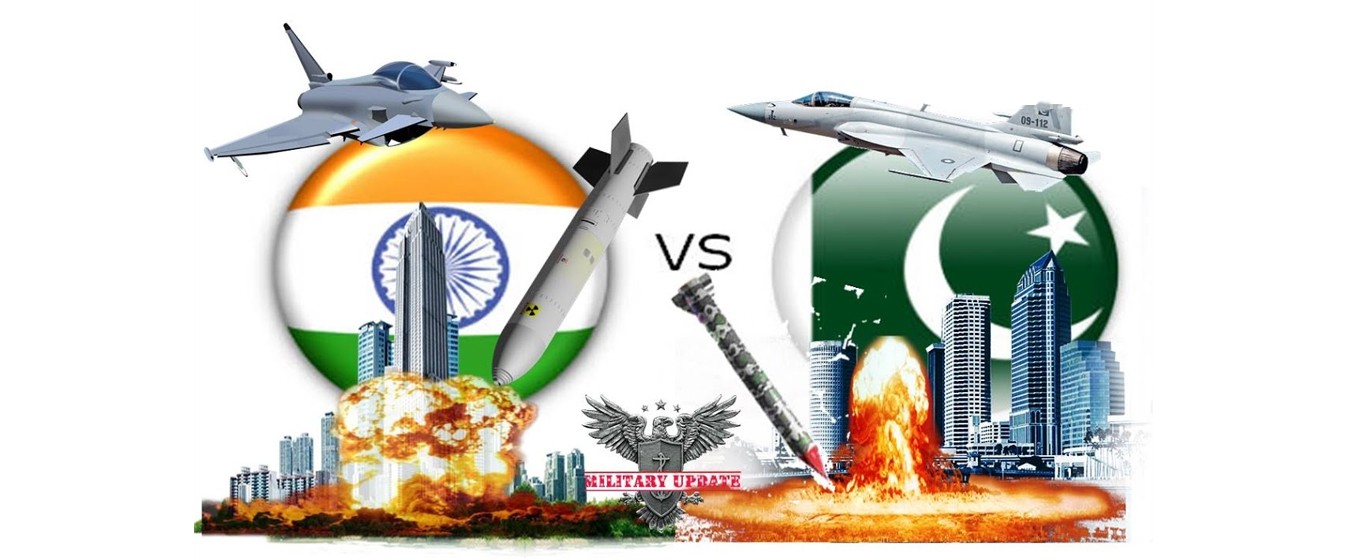
  • Nuclear Stability in Asia and South Asia: the Dynamics of a Fragile Stability

    Nuclear Stability in Asia and South Asia: the Dynamics of a Fragile Stability

    Download Here for Full Report

    M. Matheswaran

    India-Pakistan-China relations determine South Asia’s strategic stability. Recent events and disputes have heightened regional tensions, and have drawn the world’s attention on the region’s potential for conflict. The fact that all three nuclear weapon states have long-standing border disputes has been used by the non-proliferation lobbies to consistently highlight South Asia as a nuclear flash point. The intractable Kashmir dispute continues to be cited as the potential trigger for any nuclear escalation. These concerns were brought to the fore as the world witnessed the two nuclear armed adversaries fight it out on the Himalayan heights of Kargil in May 1999. While India fought the war firmly, and displayed significant escalation control and management of international opinion, it must be acknowledged that both countries kept the conflict below the nuclear threshold, thus questioning the nuclear flash point theory.


    Download Here to read more…


    *This article was published in Indian Foreign Affairs Journal – Apr-Jun 2018.

  • Changing Paradigms of Political Canvas in Sri Lanka

    Changing Paradigms of Political Canvas in Sri Lanka

    The intransigent ethno-political emotional divide amongst the Sri Lankan society of 1980s manifested into a bloodiest insurgency with the Tamil separatists almost succeeding in carving out a separate Tamil Elam in the North and Eastern regions of the island nation. The political divide at that juncture was result of a racial cleavage between the Sinhala majority and oppressed Tamil minority which prompted the later to rebel in the face of socio-economic denials of all kinds.

    It was India who came to rescue of the Sri Lankan government of the day in 1987 to ensure territorial integrity of the country even at the cost of negative political repercussions within India. The India had to pay the price of this political outreach to Sri Lanka with life of Rajiv Gandhi, the prime minister who went out of way to help them in their hour of crisis. The deeply indebted Sinhala dominated Sri Lanka of 80s seem to be chartering a different trajectory now with self serving opportunist afflictions due to inducements of easy money from extra regional players, especially China.

    While encashing the apparent Chinese benevolence, the gullible Sri Lankan politicians seem to have ignored the basic dictum that ‘there are no free lunches’ in this world. And the slip is showing wherein the Sri Lankan political dispensation seems to have compromised on their territorial integrity by leasing out Habantota port and 15000 acres of land in lieu of repayment of Chinese loans. A precedence has been set for more such sovereign compromises in times to come for which India had fought a bloody battle against their own co ethnic insurgents.

    The motive of the ongoing political drama appears to be focused on facilitating the Chinese cause even if it amounts to tempering with the constitutional jurisprudence. Indeed, there is a paradigm shift in political thinking with its doctrine of development through Chinese support which has obvious inherent centrifugal tendencies as against focus on internal economic consolidation. Instead of reclaiming the lost politico-economic ground to China post Habantota episode, a major part of Sri Lankan polity seem to be under compulsion to toe the Chinese lines due to debt diplomacy so cleverly orchestrated by the Chinese.

    The close scrutiny of Sri Lankan political conduct in the past hinges on the non accommodation of rival ethnic, social or political groups within the Sri Lankan society which seem to continue even today in some form or other. Earlier it was based on ethnic rivalry between Sinhala and Tamils, and now it is intra Sinhala dispensation vying for more political and money power in a political set up with opportunist tendencies. Despite a vibrant democratic political dispensation to take care of well being of its subjects, the island nation has witnessed spells of changing political priorities and concomitant societal upheavals in the recent times. The military driven turbulent ethno- political complexion of 80s gave way to consolidation of socio-political synergies alongside resolving the internal security issues for almost three decades.

    Subsequently, in the aftermath of subjugation of Tamil insurgency in 2009, the priorities changed to the much needed economic development of the nation. However, the tourist predominant economy had woeful inadequacies of infrastructure and public conveniences to tap the potential of the nation at par with other international tourist destinations close by. To do that, there was no money due to prolonged war effort which in turn prompted Sri Lankan polity to look outwards paving way for externally influenced politico-economic opportunism.

    Chinese concept of BRI suited both China as well as the Sri Lanka as a mutually beneficial mechanism to take care of each other’s interests. The BRI concept envisages development of communication and transportation net work, industrial and power corridors as part of Chinese grand game for their global economic expansion. As far as China is concerned all the countries in the Indian Ocean are important for Chinese geo political matrix as a response mechanism for the security of her economic interests. Chinese conduct when hyphenated with their ‘’String of Pearls in the Indian Ocean’’, and their defiant politico-military stance in the South China Sea speaks of their seriousness and sensitivities of their interest in the Indo Pacific region. Sri Lanka happens to be in a pivotal position to serve the Chinese geo political interests.

    In the given circumstances, close affiliation with the China is a win -win situation for Sri Lanka for their economic buoyancy and a politically strong anchor to stand by their side in the time of crisis. However, there are also apprehensions of negative fallouts of new found political bonhomie with an outsider with prospects of disturbing existing stable regional political equilibrium fully aligned with socio- cultural emotional bind of Indian legacy. Accordingly, there is an emerging pattern of an internal political divide amongst Sri Lankan parties and individuals believing in encashing the pragmatic opportunism as against continuation of stability through India centric regional cohesiveness.

    The Mahindra Rajpaksha during his premiership was given loans worth $ 6 billion for various infrastructural projects including Hambantota port. Later the dept trap diplomacy of China got highlighted in their demand of ownership of the port plus land adjacent to it. It, surely, has exposed the dubious ways of China which has prompted number of recipients of Chinese benevolence to revisit their commitments with them as regards to BRI scheme. Sri Lankan civil society is ceased with this Chinese conduct and there is a resistance to encouraging Chinese intrusion into Sri Lankan affairs beyond a point.

    The opponent Ranil Wickremasinghe, is known to be a proponent of the Indian lobby who had, recently , cancelled housing project of more than 50,000 houses in North and Eastern Tamil areas given earlier to China in favour of Indian companies. The Rajapaksha was brought back as the prime minister by the president through an untenable political move leaving the country in a political chaos. The parliament was dissolved paving way for fresh elections. However, the Supreme Court ruled against this unconstitutional move by the president. It was probably done as Rajapakshe, like his previous tenure, would facilitate better relationship with the China looking at their current political compulsions and national interests.

    What is happening in the Sri Lankan political canvas seem to have imprints of pro India vs pro China lobbies. The fact that there is an outstanding loan of almost $ 5 billion despite handing over the Hambantota port to them, China may be pulling the strings to bring in a political dispensation favourable to them to do their bidding. The way the democratic norms are being flouted do indicate a desperate situation precipitated by the looming economic catastrophe waiting to happen.

    The military geography of Sri Lanka has bestowed her with a unique location to take care of the most vulnerable security concerns of China with 70% of trade and 90% of energy supplies passing through the Indian Ocean. Therefore, it is obvious that China is here to stay as a permanent feature and to do that they seem to have acquired a substantial political space in the Sri Lanka. Whereas, the Sri Lanka seem to have lost out on her autonomy to some extent as there is a probability of China dictating their terms when they find the policies are not in sync with Chinese interests.

    The likely Chinese naval presence at Hambantota port barely few hundred miles from Indian shores is a security concern for India. The Chinese politico-military afflictions in Sri Lanka is likely to prompt the western powers also to further enhance their military presence closer to the Indian shores. It, obviously, would impact the Indian security matrix with the extra regional players milling around in the areas of Indian influence all this time. The new nomenclature of ‘Indo Pacific ‘ referring to erstwhile IOR and Asia Pacific is manifestation new US maritime doctrine as a response mechanism to Chinese geo political expansion. The increase in the US sponsored military diplomacy in the region and revival of Quad are all indicative of new global strategic grand games being unfolded closer to the Indian shores.

    India has no choice but to upgrade her military capabilities to take care of the inimical developments around her periphery both on land as well as maritime domain. It warrants looking beyond defensive doctrines and acquire offensive capabilities for optimum power projection in the areas of concern, besides defence of the island territories and international maritime obligations. Given the distances from the main land and bottle necks for shipping, China would always be militarily vulnerable in the Indian Ocean. It stands to an advantage for India which need to be factored in the design of the military doctrine and its political strategic outreach.

    The Sri Lanka needs to recall that they stand integrated today due to unflinching support by India in their hour of crisis and sacrifices made by the Indian soldiers to hold their country together. They should also appreciate that the India continues to be the stabilizing factor for Sri Lanka and a friend in need. China on other hand is here to exploit the Sri Lankan geographical space for their geo political motives sans any benevolent emotional connect. In fact, China has already usurped their strategically located land through their manipulative ways. If the Sri Lankan polity has not understood their game plan then they should be prepared for more such disintegrating moves as part of their dubious debt diplomacy. The Sri Lanka is in economic crisis and stands vulnerable which is reflective in their recent political conduct. In that, there seem to be tell tale signs of Chinese complicity in the ongoing happenings in the Sri Lankan political space which is not a good news.

    India, obviously, has not been pro active enough to sense the aspirations of her neighbours and propensity of China to exploit the political deficit on the strength of her deep pockets and liberal military outreach. The Sri Lanka has a great significance for Indian security and we need to take all the possible measures to neutralize the Chinese foot prints in the island nation. India fortunately has a large influence in the Sri Lankan society and reckonable political leverages which needs to be nurtured and exploited in our national interests. India as a responsible regional country need to go all out to extend a helping hand to Sri Lanka in her testing times as their political stability is essential to the Indian strategic interests.

    Lt Gen Rameshwar Yadav is an Indian Army veteran and former Director General, Infantry. The views expressed are his own. This article was published earlier in https://cenjows.gov.in/article-detail?id=122