Tag: Governance

  • The state of Bihar!?

    The state of Bihar!?

    The Prime Minister in the run up to the Bihar assembly elections announced a Rs.50,000 crores package for the state. Just as he announced a Rs.100,000 crores package for Jammu and Kashmir that July. Bihar has a population of over 103 million and J&K has a population of 12.5 million.

    This is not a new story. Bihar has been systematically exploited by denying it its rightful and deserved share of central funds from the First Plan.

    That Bihar is India’s poorest and most backward state is undeniable. The facts speak for themselves. But what makes its situation truly unique is that Bihar is the only state in India where the incidence of poverty is uniformly at the highest level (46-70%) in all the sub-regions. The annual real per capita income of Bihar of Rs. 3650 is about a third of the national average of Rs.11, 625. Bihar is also the only Indian state where the majority of the population – 52.47% – is illiterate.

    But Bihar has its bright spots also. Its infant mortality rate is 62 per 1000, which is below the national average of 66 per 1000. But what is interesting is that it is better than not just states like UP (83) and Orissa (91), but better than even states like Andhra Pradesh and Haryana (both 66).

    Even in terms of life expectancy, the average Bihari male lives a year longer (63.6 yrs.) than the average Indian male (62.4 yrs) and the state’s performance in increasing life spans has been better than most during the past three years.

    Bihar has 7.04 mn. hectares under agriculture and its yield of 1679 kgs. per hectare, while less than the national average of 1739 kgs. per hectare is better than that of six other states, which include some big agricultural states like Karnataka and Maharashtra.

    Despite this, in overall socio-economic terms, Bihar is quite clearly in a terrible shape.

    As opposed to an All-India per capita developmental expenditure during the last three years of Rs.7935.00, Bihar’s is less than half at Rs.3633.00. While development expenditure depends on a bunch of factors including a state’s contribution to the national exchequer, no logic can explain away the per capita Tenth Plan size, which at Rs. 2533.80 is less than a third of that of states like Gujarat (Rs.9289.10), Karnataka (Rs.8260.00) and Punjab (Rs.7681.20).

    Simple but sound economic logic tells us that when a region is falling behind, not just behind but well behind, it calls for a greater degree of investment in its progress and development. It is analogous to giving a weak or sick child in the family better nutrition and greater attention. Only in the animal kingdom do we see survival of the fittest with the weak and infirm neglected, deprived and even killed.

    But instead of this we see that Bihar is being systematically denied, let alone the additional assistance its economic and social condition deserves, but also what is its rightful due.

    From the pitiful per capita investment in Bihar, it is obvious that the Central Government has been systematically starving Bihar out of funds. Quite obviously Bihar has also paid the price for being politically out of sync with the central government for long periods. The last one was for a dozen years from 1992 to 2004. For the last one year Bihar had a government in New Delhi that was supposed to be favorably disposed to the regime in Patna.

    Quite clearly states that are in political sync do much better in terms of central assistance. Lets take a look at how Andhra Pradesh, a state that has stayed largely in political sync with New Delhi, has fared in the past few years. In terms of grants from the Central Government (2000 to 2005), Bihar fared poorly receiving only Rs. 10833.00 crores while AP got Rs. 15542.00 crores.

    Bihar has also been neglected as far as net loans from the center are concerned. It received just Rs.2849.60 as against Rs.6902.20 received by AP from 2000-02. It’s only in terms of per capita share of central taxes do we see Bihar getting its due. This gross neglect by the central government is reflected in the low per capita central assistance (additional assistance, grants and net loans from the center) received by Bihar in 2001. While AP received Rs.625.60 per capita, Bihar got a paltry Rs.276.70.

    The results of the economic strangulation of Bihar can be seen in the abysmally low investments possible in the state government’s four major development thrusts. Bihar’s per capita spending on Roads is Rs.44.60, which is just 38% of the national average, which is Rs.117.80. Similarly for Irrigation and Flood Control Bihar spends just Rs.104.40 on a per capita basis as opposed to the national average of Rs.199.20.

    Now the question of how much did Bihar “forego”? If Bihar got just the All-India per capita average, it would have got Rs. 48,216.66 crores for the 10th Five Year Plan instead of the Rs.21,000.00 crores it has been allocated.

    This trend was established in the very first five-year plan and the cumulative shortfall now would be in excess of Rs. 80,000.00 crores. That’s a huge handicap now to surmount. Then it would have got Rs. 44,830 crores as credit from banks instead of the Rs. 5635.76 crores it actually got, if it were to get the benefit of the prevalent national credit/deposit ratio.

    Similarly Bihar received a pittance from the financial institutions, a mere Rs.551.60 per capita, as opposed to the national average of Rs.4828.80 per capita. This could presumably be explained away by the fact that Bihar now witnesses hardly any industrial activity. But no excuses can be made for the low investment by NABARD. On a cumulative per capita basis (2000 to 2002) Bihar received just Rs.119.00 from NABARD as against Rs.164.80 by AP and Rs.306.30 by Punjab. It can be nobody’s argument that there is no farming in Bihar.

    If the financial institutions were to invest in Bihar at the national per capita average, the state would have got Rs.40, 020.51 crores as investment instead of just Rs.4571.59 crores that it actually received.

    Quite clearly Bihar is not only being denied its due share, but there is a flight of capital from Bihar, India’s poorest and most backward state. This is a cruel paradox indeed. The cycle then becomes vicious. This capital finances economic activity in other regions, leading to a higher cycle of taxation and consequent injection of greater central government assistance there. If one used harsher language one can even say that Bihar is being systematically exploited, and destroyed by denying it its rightful share of central funds.

    To even make a dent on the abysmal state that Bihar is now in, Bihar will need at least twice what it gets from the Centre, as of yesterday.


    Mohan Guruswamy is a prolific commentator on politics, economics, development and governance. He is a trustee of TPF. The views expressed are the author’s own.
  • Governance

    Governance

    My dog Charlie is long gone. But Charlie, who was a brown “Great indian Mongrel”, was wise in the ways of the world. He taught me a lesson in public policy I will never forget.

    Corruption is India’s favorite conversation topic. We love discussing it and bemoaning its all pervasiveness. We are experts at it and have all experienced it at in some form or the other and at all levels. Yet with so much collective experience it is a difficult topic to write about. Like our gods it takes so many myriad forms. It defies a simple definition. But we all know what it is. What Justice Potter Stewart of the US| Supreme Court said in the context of obscenity – “I know it when I see it”- is equally applicable to corruption. It is the most obscene of obscenities but is a fairly common one.

    Economists prefer to bandy about a different term when referring to corruption. They call it “economic rent”. According to the IMF “it is the extra amount paid (over what would have been paid for the best alternative use) to somebody or for something useful whose supply is limited either by nature or through human ingenuity.” Quite clearly this definition excludes the moral dimension. But then our problems get even more compounded when we realize that the moral dimension is very elastic and varies.

    Take for instance the case of former Prime Minister Manmohan Singh. As far as the Rajya Sabha is concerned, he is a tenant of Mrs Hiteshwar Saikia and is a resident of Guwahati in Assam. But we know that is not true and that he has been ordinarily resident in New Delhi from ever since we came to know him. LK Advani, has been just as peripatetic. At one time he declared he was a resident of Ujjain in MP for the sake of a Rajya Sabha seat. Now he is a resident of Ahmedabad. Arun Jaitley has similarly been vagrant. He is a Delhiwala, but went to Amritsar where he announced he was buying a house to reloacte in 2014. The Amritsaris didnt want teh likes of him, so now he is a resident of Ahmedabad. But if you and I were as cavalier as this in declaring our place of residence, say for the purpose of a passport, we could end up in prison.

    Economic rent takes other forms, which tax the common good much more. High import duties, for instance, meant to restrain imports actually serve to increase prices and profits for domestic manufacturers. The Hindustan Ambassador, that immortal symbol of a mindless and rapacious bureaucracy, actually gave its manufacturer and employees as much joy as it gave sorrow to those who owned or drove these cars. Did you notice how all car tyres or batteries cost about the same? Or how all similar sized air-conditioners and refrigerators cost about the same? Or till recently how all air-tickets cost the same and an arm and a leg at the same time? Adam Smith explained it best by noting that “People of the same trade seldom meet together, even for merriment and diversion, but the conversation ends in a conspiracy against the public.”

    These conspiracies cannot succeed without the active connivance of the politicians and bureaucrats. We know what they mostly do, but thanks to the exertions of Aniruddha Bahal, purporting to represent an industry association, we have proof for the first time of this. Our MP’s have much to thank Dr. Manmohan Singh for conjuring up MPLADs (MP’s local area development scheme), but the then Finance Minister probably never contemplated the likes of the venerable Sakshi Maharaj who turned the scheme into one of personal development. But though both the two stings involve MP’s scams evidenced are of different natures. The money for questions business is a common place as a traffic cop collecting money from errant drivers. The payment itself is a punishment for the truancy and it does not seem to matter very much where the money paid ends up, We learn our lessons from it. But when the cops collect for registering an FIR or for no rhyme of reason then it belongs to a different class and we are truly outraged.

    Those of us in Delhi who built houses or made alterations without the sanction of the authorities paid for the deviations knowing it was contrary to the law. But it was commonplace and that seemed to make it okay. But when the High Court has ordered them demolished we were outraged. What if the same High Court ordered that MP’s making false statements about their place of residence must quit? Would we be outraged? We may be happy but not outraged. This is clearly a subject that requires far greater deliberation and discussion and there is much Parliament can do by way of introspection. There are many who are quite expert on the subject. Chandan Mitra, a former  BJP MP, whose concern for probity is as well known as his Chattarpur farmhouse, has even written a book on the subject of corruption.

    Opinion polls show that there are some professions we believe to be almost entirely corrupt. Politicians and policemen top this list with 99% of those polled believing them to be crooks. Much of the corruption we witness in everyday life is a result of their unnecessary exertions. In the past few months I have had opportunity every morning to contemplate a vacant plot of land in the neighborhood I live in. The plot is bounded by roads on all four sides and naturally people walking take a short cut across it. Some well meaning soul has taken upon himself to put an end to this practice. First a sign came up demanding that people not do the most rational thing, that is take a short cut. The sign was ignored and my dog Charlie has been using the signpost to leave his signature. Then a small length of barbed wire pegged between two poles appeared astride the path at both ends. The people who use the path still find it convenient to go around the poles and take the not so short shortcut. Good old Charlie just slips under the wire and seems quite happy that he has two more poles to leave his daily markers.

    The nature of most of our lawmaking is just like this. They are irrational and people will respond rationally to them, by circumventing them if not ignoring them. Just as Dr.Manmohan Singh has done to the requirement that MP’s to the upper house be ordinarily resident in the state. Now the only way that plot can be prevented from being used as a short cut is to either build on it. If the empty plot is just walled up, the walls will encourage another use, which will be odious to boot. Which brings me to another aspect. We have laws that prohibit pissing in public and on walls, private and public. Pissing is meant to be a private business. But where are people to pee when you just don’t have enough urinals? So a law against pissing in public makes sense only when you have enough public urinals.

    Thoughtless laws corrode a state thoroughly. This is why states built around tight regulation and appeals to a higher human idealism fail. The crime wave that engulfed the former USSR was really due to the old nomenklatura doing the only thing they were adept at. It is not that other social and political systems do not germinate corruption. Corruption is all-pervasive and a world wide phenomenon. It comes built in with nature. Animals steal food from each other just as humans extort from others. But human beings live in organised societies and societies are nothing but systems based on laws. For laws to work it must be clear that if caught, trial will be swift and if found guilty retribution will be commensurate.

    That’s where we have serious problems. Who makes the law? Politicians. Who enforces the laws? The police. Both are believed to be overwhelmingly corrupt.

  • The Demand for Gondwana: India’s Adivasi Homeland

    The Demand for Gondwana: India’s Adivasi Homeland

    Mohan Guruswamy December 03, 2017

     The scion of the former Gond kings of Chandagarh or Chandrapur now in Maharashtra, Birshah Atram was recently visiting the Gond homelands in the former composite Adilabad district to meet his kinsmen in the various garhi’s in the region. Birshah Atram is descended from a line that was established in Chandrapur in the 13th century by Kandakya Balal Sah. The Gond kings ruled till 1751 when the British annexed it after the Raja of Nagpur died childless. Birshah who holds two PhD’s in English and Ancient Indian History has for long been seeking a solution to the vexed Adivasi problem, that has also morphed into the Telugu led Naxalite rebellion that enables the Central and State governments to turn it into a law and order issue, by highlighting the grievances of the Adivasi people. He believes that the Central Government needs to implement the constitutional provisions and promises made in the Constituent Assembly by recognizing Gondi language and self-rule for the Gond people by carving out a Gondwana state of the Gond homelands in Maharashtra, Madhya Pradesh, Andhra Pradesh and Chhattisgarh.

    There is a vast and mostly forested region spanning almost the entire midriff of India from Orissa to Gujarat, lying between the westbound Narmada and eastbound Godavari, bounded by many mountain ranges like the Vindhya, Satpura, Mahadeo, Meykul, and Abujhmar, that was once the main home of the Adivasi. The late Professor Nihar Ranjan Ray, one of our most distinguished historians, described the central IndianAdivasis as “the original autochthonous people of India” meaning that their presence in India pre-dated by far the Dravidians, the Aryans and whoever else settled in this country. The anthropologist Dr. Verrier Elwin states this more emphatically when he wrote: “These are the real swadeshi products of India, in whose presence all others are foreign. These are ancient people with moral rights and claims thousands of years old. They were here first and should come first in our regard.”

    Unfortunately like indigenous people all over the world, the India’sAdivasis too have been savaged and ravaged by later people claiming to be more “civilized”. They still account for almost 8% of India’s population and are easily it’s most deprived and oppressed section. Though this is the home of many tribal groups, the largest tribal group, the Gonds, dominated the region. The earliest Gond kingdom appears to date from the 10th century and the Gond Rajas were able to maintain a relatively independent existence until the 18th century, although they were compelled to offer nominal allegiance to the Mughal Empire.

     The great historian Sir Jadunath Sarkar records: “In the sixteenth and seventeenth century much of the modern Central Provinces (today’s MP) were under the sway of aboriginal Gond chiefs and was known under the name of Gondwana. A Mughal invasion and the sack of the capital had crippled the great Gond kingdom of Garh-Mandla in Akbar’s reign and later by Bundela encroachments from the north. But in the middle of the seventeenth century another Gond kingdom with its capital at Deogarh, rose to greatness, and extended its sway over the districts of Betul, Chindwara, and Nagpur, and portions of Seoni, Bhandara and Balaghat. In the southern part of Gondwana stood the town of Chanda, the seat of the third Gond dynasty and hereditary foe and rival of the Raja of Deogarh.” But the glory of Deogarh departed when the Maratha ruler of Nagpur annexed Deogarh after the death of Chand Sultan.

    Incidentally the Gond ruler of Deogarh, Bakht Buland, founded the city of Nagpur. Jadunath Sarkar writes about him thus: “He lived to extend the area, power and prosperity of his kingdom very largely and to give the greatest trouble to Aurangzeb in the last years of his reign.” In fact the one big reason Aurangzeb could not deploy all his power against Shivaji was because the Gond kings were constantly at war with the Mughals and kept interdicting the lines from the Deccan to Agra. But of course the history of modern India is not generous to them.

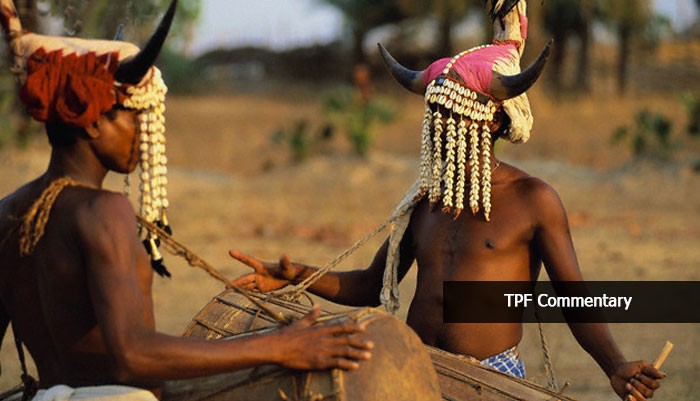
    During the British days this region constituted much of the Central Provinces of India later to become Madhya Pradesh. This is the main home of about sixteen million Gond people who are India’s largest single tribal grouping. The Gonds are now a culturally and linguistically heterogeneous people having attained much cultural uniformity with the dominant linguistic influences of their region. Thus, the Gonds of the eastern and northwestern Madhya Pradesh region that now includes the new state of Chhattisgarh speak Chhattisgarhi and western Hindi. But the Gonds of Bastar, which is at the southeastern end of this vast region and a part of Chhattisgarh, are different in this respect. Though there are many tribal groups like the Halbas, Bhatras, Parjas and Dorlas, the Maria and Bison Horned Gonds are the most numerous. The language spoken by them, like that of the Koyas of AP is an intermediate Dravidian language closer to Telugu and Kannada.

    The process of Hinduization combined with Hindi culture has reduced the egalitarian Koitur to the bottom of the social strata. Dr. Kalyan Kumar Chakravarthy, Director of the Indira Gandhi Rashtriya Manav Sangrahalaya, Bhopal has written eloquently and cogently on this in his concluding chapter “Extinction or Adaptation of the Gonds” in the book “Tribal Identity in India” also edited by him. The real enemy of theAdivasi is the creeping Hinduization with all its attendant values and exclusionary practices, seems to me a good start to the process of saving its tribal society from extinction. All over the rest of India’s central highlands our policies by forcing the Adivasis to merge their identities with that of the encroaching culture have crushed them into a becoming a feeble and self-pitying underclass.

    Clearly there are two distinct reasons for the present unrest in the Adivasihomelands of India. The first and probably the more important one is the struggle for identity against the creeping Hinduization or de-culturization of Adivasi society. Adivasi society was built on a foundation of equality. People were given respect and status according to their contribution to social needs but only while they were performing that particular function. Such a value-system was sustainable as long as the Adivasi community was non-acquisitive and all the products of society were shared. Adivasisociety has been under constant pressure as the money economy grew and made traditional forms of barter less difficult to sustain.

    The Fifth and Sixth Schedules under Article 244 of the Indian Constitution in 1950 provided for self-governance in specified tribal majority areas. In 1999 the Government of India even issued a draft National Policy on Tribals to address the developmental needs of tribal people. Special emphasis was laid on education, forestry, healthcare, languages, resettlement and land rights. The draft was meant to be circulated between MP’s, MLA’s and Civil Society groups. A Cabinet Committee on Tribal Affairs was meant to constantly review the policy. Little has happened since. The draft policy is still a draft, which means there is no policy.

    Even before Independence on December 16 1946, welcoming the Objectives Resolution in the Constituent Assembly, the legendary Adivasileader Jaipal Singh stated the tribal case and apprehensions explicitly. He said: “Sir, if there is any group of Indian people that has been shabbily treated it is my people. They have been disgracefully treated, neglected for the last 6,000 years. …The whole history of my people is one of continuous exploitation and dispossession by the non-aboriginals of India punctuated by rebellions and disorder, and yet I take Pandit Jawahar Lal Nehru at his word. I take you all at your word that now we are going to start a new chapter, a new chapter of independent India where there is equality of opportunity, where no one would be neglected.”

    The Adivasi’s paid dearly for taking Jawaharlal Nehru and the Constituent Assembly at their word.

    Shri Mohan Guruswamy is a former Rajya Sabha MP and a political commentator. He is a Trustee of TPF.

    This article was published earlier in ‘The Citizen’.