Blog

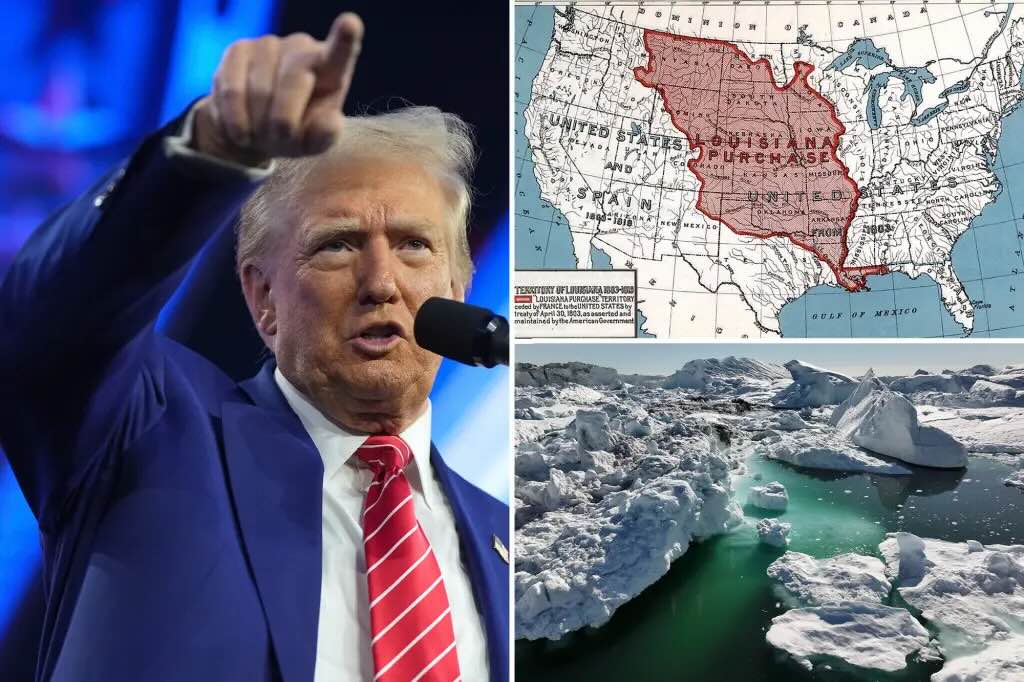
  • Trump followed four years later by Trump: Would America’s trustiness and system of alliances survive?

    Trump followed four years later by Trump: Would America’s trustiness and system of alliances survive?

    [powerkit_button size=”lg” style=”info” block=”false” url=”https://admin.thepeninsula.org.in/wp-content/uploads/2024/12/OCP-5-1-Trump-followed-four-years-later-by-Trump-website.pdf” target=”_blank” nofollow=”false”]
    Download
    [/powerkit_button]
  • Women in Afghanistan : The Fight Back

    Women in Afghanistan : The Fight Back

    [powerkit_button size=”lg” style=”info” block=”false” url=”https://admin.thepeninsula.org.in/wp-content/uploads/2024/12/OCP-4-1-Women-in-Afghanistan-website.pdf” target=”_blank” nofollow=”false”]
    Download
    [/powerkit_button]
  • Is Singularity Here ?

    Is Singularity Here ?


    [powerkit_button size=”lg” style=”info” block=”false” url=”https://admin.thepeninsula.org.in/wp-content/uploads/2024/12/OCP-3-1-Is-Singularity-Here-website.pdf” target=”_blank” nofollow=”false”]
    Download
    [/powerkit_button]
  • India and Myanmar: Two Years After The Coup

    India and Myanmar: Two Years After The Coup


    [powerkit_button size=”lg” style=”info” block=”false” url=”https://admin.thepeninsula.org.in/wp-content/uploads/2024/12/OCP-1-1-India-and-Myanmar-website-1.pdf” target=”_blank” nofollow=”false”]
    Download
    [/powerkit_button]
  • Indian Philosophy and Religion

    Indian Philosophy and Religion


    [powerkit_button size=”lg” style=”info” block=”false” url=”https://admin.thepeninsula.org.in/wp-content/uploads/2024/12/OCP-2-1-Indian-Philosophy-and-Religion-website-1.pdf” target=”_blank” nofollow=”false”]
    Download
    [/powerkit_button]
  • An Outside View of the US 2024 Presidential Election

    An Outside View of the US 2024 Presidential Election

    What was the voter turnout?

    The big change is that Harris, so far, has lost 9 million voters since 2020, while Trump has gained only 1.2 million. Harris’s count of lost votes will decline as the final votes come in, but the bigger story remains that Harris lost more votes than Trump gained.

    Voter turnout is NOT final, but it is likely between 153 and 156 million, down from 2020 but still the second-highest percentage turnout in 100 years. At a minimum, 107 million adults did not vote (88 million of whom are “eligible” to vote). Thus, 41% or more of the adult population and 36% of the eligible voters did not vote.

    Using the percentage of voter groups who voted for Trump is misleading.  The news remains that the significant change is the loss of Harris voters.

    What were the economic issues?

    Daily survival has become a serious problem for the bottom 65% due, specifically, to the inflation of grocery items and increasing mortgage payments and rent. Aggregate figures don’t reflect this reality.

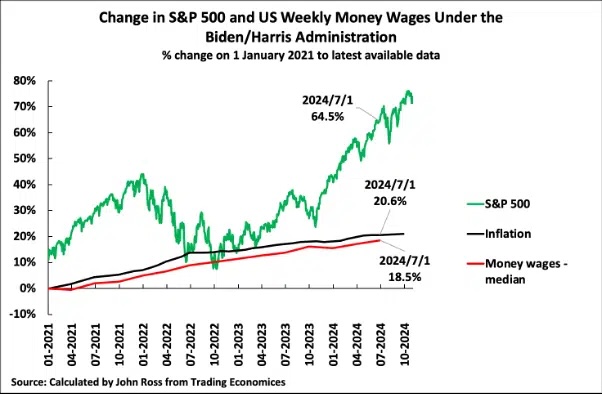
    Workers’ actual standard of living was worse under Biden than under Trump.

    Real wages in the US remain lower than they were a half-century ago.

    Are there differences between Democrats and Republicans?

    US electoral parties are NOT like those in Europe – they have always been a different version of bourgeois electoral systems. Both major US parties are corporations, not parties with memberships, ideologies, and programs. They are designed like a marketplace of individuals preening for the Presidency, much like the Westminster Kennel Club Dog Show, but only held every four years.

    The Democrats turned over their foreign policy to the CNAS group of neo-con warmongers who will now be displaced.

    The Republicans are also not an actual party; Trump proved this, and what is next for Republicans post-Trump is also uncertain.

    What are the class shifts in the US?

    There is a new stratification of the bourgeoisie, with billionaires as a new factor. The increasingly dominant discourse amongst the capitalist class has the wherewithal to exert its influence.

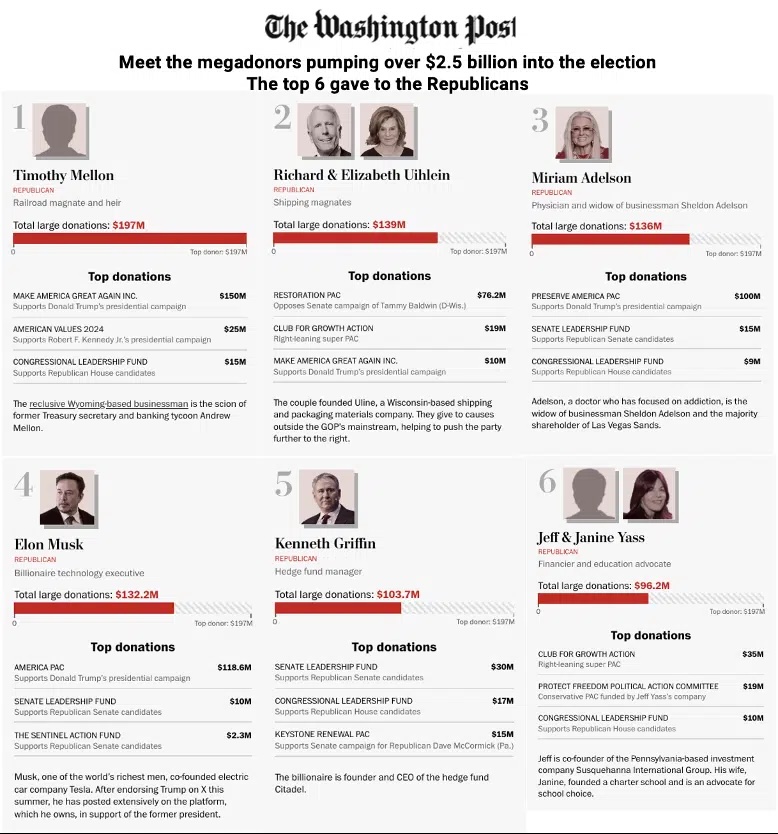
    Fifty Billionaires put 2.5 billion US dollars, 45% of the 5.5 billion total, into the Presidential election. Of this, 1.6 billion went to the Republicans, 750 million to the Democrats, and the rest to both. The total spent on the election, in all races, was 16 billion, a sign of a kleptocracy, not a thriving democracy.

    washingtonpost.com/elections/interactive/2024/biggest-campaign-donors-election-2024

    There is a concerted effort by a section of libertarian tech billionaires, including Thiel and Musk, to have their hands directly on the levers of the state to control the race for global domination of AI. They believe that they alone should control the advances in the AI space for the world and that the initial next step is what is called Artificial General Intelligence (AGI). These megalomaniacs believe this will begin the control of humans by machine intelligence and, perhaps, in their perverse dreams, the end of humanity.

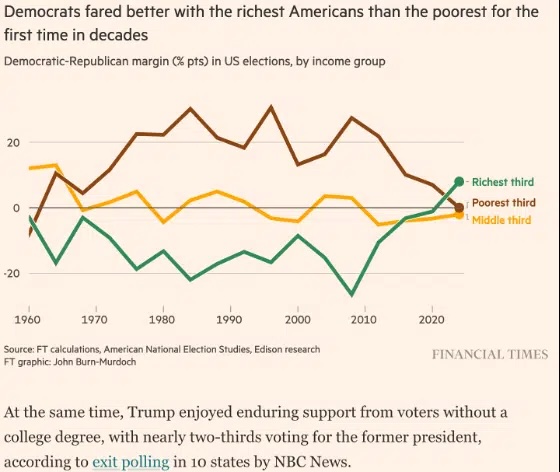
    A growing number of lesser capitalists, such as multimillionaires, are now being lumped into the upper middle class and the wealthiest one-third of voters. One very important trend to note is that in the last fifteen years, the richest one-third have switched allegiance from Republicans to Democrats.

    Why did Harris lose 6 to 9 million votes?

    Workers were worse off, wages did not keep up, and inflation left a long, lingering impact.  Some of the youth vote left for economic reasons. Others were disillusioned and demoralised by the full-throated support of the genocidal war in Gaza by the Democratic Party. Muslims, while a small group, voted for a third party or Trump.

    Despite the fabrications of the Democratic Party corporate handlers, Harris was, in fact, inauthentic, unlikeable, shallow, and could not mask her history as a prosecutor who spent her life attacking the rights of the poor.

    Dissatisfaction with many Western elected parties is growing – Conservative in the UK, Centre Right in France, right-wing in Germany – all thrown out. Biden left a demoralised Democratic Party and left too late.

    Fear-mongering about fascism was core to the rhetoric of the Democrats, even though no one knows what the term means.  Some voters became annoyed at the harassment by the liberals to vote for them since they were the last rail of defence against fascism. Many people did not believe Trump was, in fact, a fascist, nor did they believe that every one of their family members who listened to Trump was a fascist.

    Apathy is growing and remains a real issue.

    Probably over a million stayed at home as they could not stomach the Democratic Party’s gleeful support for Genocide. Trump’s victory in Michigan was certainly due to this issue.

    Harris played to and fawned over the war criminal Dick Cheney, the architect of the invasion of Iraq and a historic right-wing enemy of the Democrats.  We don’t know how many voters left in disgust. 

    Why did Trump gain votes?

    Trump took advantage of working-class dissatisfaction. Even so, he only gained less than 2 million total new votes. There is no evidence of a widescale shift of working-class votes to the Republicans in this election.

    Working-class women voted for local candidates supporting abortion but voted for Trump for economic and other reasons. Others voted on local issues important to them and then voted for Trump as they felt that despite his unsavoury behaviours, he was more committed to “shaking things up”.

    The billionaire class made sure that Trump had ample funds. Elon Musk’s America Pac spent $118 million handling field operations for the Trump campaign, an unusual role for a super PAC.

    From 2008 to 2020, there was a decline in the percentage of voters supporting the Democrats amongst the bottom 1/3 of income earners in the US.

    ft.com/content/6de668c7-64e9-4196-b2c5-9ceca966fe3f


    Too little data is available now to provide a detailed answer about the relatively insignificant number of voters who voted Democrat in 2020 and Republican in 2024.

    What is the assessment of the new cabinet positions announced?

    Trump’s sixteen appointments to date are all vocal supporters of genocide in Palestine. In the United States, there are both Jewish and Christian Zionists. Trump has appointed several Christian Zionists. The majority are China hawks.

    When analysed from a US statecraft point of view, many are extremely underwhelming candidates. These include:

    • Secretary of State: Senator Marco Rubio: He is a rigid, fierce anti-communist.
    • Secretary of Defense: Pete Hegseth, an Army National Guard veteran and Fox News host: He is divisive and has no high-level military experience.
    • Attorney General: Representative Matt Gaetz of Florida: He has no experience in the Department of Justice and has had past legal controversies.
    • Director of National Intelligence: Former Representative Tulsi Gabbard of Hawaii. She has no intelligence background but is perhaps less rigid on international issues, a non-interventionist, and has a friendship with Indian Prime Minister Modi.
    • Ambassador to the United Nations: Representative Elise Stefanik of New York. She is an extreme Zionist, has near zero diplomatic experience, and has focused only on domestic issues, but is loyal to Trump.
    • Secretary of Homeland Security: South Dakota Governor Kristi Noem. She lacks national government experience, and her actions have veered toward radical anti-federalism.

    Due to some of these appointments, US stature in international affairs will likely diminish.

    Trump has brilliantly dismissed the extremely dangerous Pompeo. He has made it clear that few from the first inner group of his cabinet and advisors will return. The world will not miss them. Yet there is little evidence to suggest that Trump has the capacity to lead any group successfully for even an intermediate period. He is known for turning on people and turning them against each other.

    How do we interpret the vote?

    A significant section of the working class understandably abandoned the Democrats in this election.

    There is not a major right-wing shift in US attitudes, but there is a real base for the right.

    The Democratic Party elite is completely divorced from the masses. Parading the loyal royal cultural elite like Taylor Swift, Beyonce, and Bruce Springsteen reeked of wealth, opulence, and tone-deafness.

    Apathy should not be understated. At least 88 million didn’t vote, with a further 19 million disenfranchised.

    Third parties are structurally prevented from winning even a single state in a presidential election. They are structurally locked out of Congress. The United States has locked in a two-party system. Most voters have been captured by this belief.

    Small exceptions to this are wealthy candidates like Ross Perot in 1992 and Robert Kennedy Junior.

    There was huge intimidation at the end against supporters of third-party candidates, which depressed their vote even more than usual. In this just-held election, the Party for Liberation and Socialism Candidate Claudia Cruz received 134,348 votes so far.  Claudia Cruz’s 134 thousand votes is the highest number of votes for an explicit communist in American history. It exceeds the CPUSA’s William Z. Foster’s previous record of 120,000 votes in 1932. The 1932 vote was a higher percentage of the population as the US was smaller in 1932. These facts are a reminder of the long-term campaign of anti-communism within the US.

    Capital is clearly happy with Trump’s win, as evidenced by the November 6th celebration rally on Wall Street. They disagree with the liberal hype that he will bring an end to American society.

    Despite the lies of the liberals, the facts are that Trump formally initiated the New Cold War on China. His inner team are more fiercely anti-China than the Democrats, who are more bound to the Ukraine War.

    Trump has fewer restraints, controlling the Senate, House, Supreme Court, and Presidency.

    He could well launch a Third World War.  It would be a mistake to underestimate this danger.

    Other things people outside the US should know

    There is a tendency in some parts of the Global South to have a simplistic and false analysis that any enemy of the liberals is a friend of the Global South. This is a severely flawed argument. The imperialist far-right is not a good guy, a cultural conservative who wants to protect families and cultural life. Inside the US, conservative culture is tightly tied to slavery and genocide. It is misogynistic, racist, militaristic, and reactionary. We should not confuse the histories of Iran, Turkey, India, Ghana, and China with those of the US.

    Welcoming divisions in the enemy camp is often entirely correct. But Communists, socialists, and true democrats do not support reactionary views and always side with the people, not the far-right ideologues.

    There is also great confusion about MAGA and MAGA-Communism. First, Make America Great Again (MAGA) means returning (the second “A” in MAGA) to the full glory of the US industrial past. But what was that past? It was, in fact, the total economic, political, military, and racial subordination of the peoples of the Global South states to the US. It was the century of humiliation in China. This is not a return to be welcomed by history. MAGA is a profoundly reactionary, unacceptable outcome and concept.

    One of the greatest poets in the United States is Langston Hughes. One of his poems was called “Let America Be America Again.” But this was a parody as the actual statement was made in the refrain, “America Never Was America to Me”. The meaning of this poem was the false portrayal of the United States as ever having a glorious past, which was never true for the slaves or the working class.

    Second, there are a handful of personalities in the US who have taken the great word communism and sullied it with the idea of returning to this falsely idealised America. The old “strong” American industry was built on the backs of low-paid workers in the mines in Africa and elsewhere.

    Desiring a real communist path is a good thing. But tying it to an imperialist past, a past of violence, with reactionary views is the opposite path taken by Lenin, Mao, and Fidel.

    There is also a dangerous tendency to simply reject the liberal concepts of identity politics and embrace the values of far-right conservatism while lacking scientific thinking about the plight of women and other vulnerable groups.

    The CPC led the country in the first national Soviets in Ruijin in the struggle to abolish the prejudices of feudalism and emancipate women and national minorities in China. However, these rights have not yet been achieved in many countries, as there has been no communist revolution.

    True Communism is the path to advancing the overall interests of the working class in all countries, including women, national minorities, and other vulnerable groups.

    The Republican voter base in class-terms is the lower-middle class, which is overwhelmingly white, suburban, rural. It is amplified by fundamentalist Christians and the Republican regional strongholds.

    There are six “ideological” trends, all extreme right, in the Republican camp:

    1. Populist demagogues
    2. Extreme Libertarians
    3. Fanatical Christian-Zionists
    4. Virulent anti-communists
    5. Dangerous AI-obsessed Tech billionaires
    6. Complex conservatives

    The US economy will continue to perform poorly but better than the rest of the West. It will continue to use its dollar hegemony, reinforced with sanctions, to remove hundreds of billions from the Global South and to force Europe, Australia, and Japan to subordinate their economic interests to those of the US.

    The actual US budget for the military was $1.8 trillion last year. Significant cuts seem improbable.

    There is now a permanent Black upper middle class that produces a Black mis-leadership. This mis-leadership group has created two decades of Black war criminals and apologists for empire. The rise of this mis-leadership gang, however, should not overshadow the fact that most blacks remain oppressed and exploited.

    The anti-immigrant politics in the U.S. is directed primarily at undocumented immigrants from Mexico, Central America and the Caribbean.

    But there is a false belief that all immigrants in the US are working class and progressive – it is just not true. An important stratum of non-working-class immigrants in the US are amongst the most virulent defenders of US atrocities in the world.

    There is a belief that there is a conspiracy of some secret group of members of the military and government that decide most things, which they call the Deep State. This is a lazy concept. It denies that all states have a class character and permanent army. In the US, it has been estimated that over 5 million people have security clearance, and many have near-lifetime employment. There is no need for conspiracy theories. The US does have an advanced state that functions on behalf of capital. This state manages the affairs of the often-competing large capitalists and is now increasingly primarily favouring the billionaires amongst the capitalist class. Thus, a better way to see the US State is through the lens of Mao, Lenin, and Marx and not as some inexplicable conspiracy.

    There is a special relationship between the US and Israel, both extreme white-settler states. In the US alone, over 30 House, Senate, and cabinet members are dual citizens of the US and Israel. Israel does not control the US, BUT they are socially a duopoly.

    They are the CORE of Ring 1 of the Global North, the core of the imperialist bloc, along with the UK, Canada, and Australia.

    The long-term trend is clear – bourgeois liberal democracy is failing globally.

    What is the domestic consequence of the vote?

    Since 2016, the very top of the capitalist class has led and mobilised a neo-fascist movement. Increasing levels of force and lawfare will now be used internally inside the US.

    Trump himself is not a fascist per se. He is super-egoistic and believes he can act with near absolute impunity.

    But he is riding on, and a beneficiary of changing class phenomena.

    Fascism is not so much an ideology as a structural class relationship in which the lower-middle class, which has a revanchist ideology, is mobilized by big capital during a period of internal and external disequilibrium.

    The New York Times and Financial Times use the word fascism as a scare tactic to maintain their role and influence in the state. Neo-fascism is a more precise word than fascism at this moment to describe the changes in the US.

    Historically, there are a few things that are necessary to define a fully fascist state in imperialist countries. One is that the state uses methods of control it would typically use only for its colonies and neo-colonies, i.e., extreme widespread violence and force.  The other is that they resort to the overthrow of the constitution.

    The Constitution is unlikely to be changed directly. However, the original Constitution, an eighteenth-century document, has many gaps that can be exploited.

    Radical and extreme legal changes are thus probable. There will be a reversal of 70 years of civil rights.

    Overall, it remains to be seen how far the capitalist class is willing to go.

    State capacity in many areas other than defence and border police will be diminished. Trump 1 saw big cuts in the State Department.  Even with Rubio present, it is unlikely to be refunded to its old level.

    The Billionaires will play a direct role in key tasks, from meeting Zelensky to chain-sawing government departments. Some departments, like Agriculture, Education, and Health and Human Services, are, in fact, decrepit, corrupt and dysfunctional. But a billionaire-led revamp will result in an unsavoury privatized equally dysfunctional capitalist state bureaucracy.

    Trump is committed to a long-term isolationist strategy.  But the US has over 900 military bases abroad. It has fully supported the expansion of Israel’s War in the Middle East, building up its military in the process.

    Trump will not block the infrastructure projects that were voted in during Biden. The US recognises that its lost manufacturing capacity is a strategic deficit in military supply.

    The brunt of the cutbacks will still increase the suffering of the 150 million working-class poor in the US.

    The Left will be even more subjected to severe repression. Rubio is salivating.

    What are the possible international consequences?

    Despite the recent Zelensky meeting, the US will probably push a cease-fire and curtail the Ukraine war. Crimea is off the table. The current military lines will be the starting point. Doing this could reduce the immediate danger of a nuclear war. In April of this year, both Vance and Rubio voted against the 95-billion-dollar US military aid bill for Ukraine.

    With Israel, there are three main possibilities:

    1. Trump curtails Netanyahu and calls for an end to Lebanon, no regime change in Iran, and an unjust peace agreement.
    2. He falls prey to the Christian Zionists and continues Genocide against Palestine.
    3. He goes against his no-war statements and approves an escalation with Iran.

    We don’t know, but option one is not impossible. Trump wants a deal with Saudi Arabia.

    A few days ago, MBS was forced to call it a Genocide, a rare statement from a long-term US ally.

    With China, there are also three possibilities:

    1. Trump says tariffs are his favourite word in the English language and wants to increase them and eliminate domestic taxes.
    2. Rubio and other super China-hating cabinet members push him to escalate.
    3. US national security elements and US tech moguls like Peter Thiel push US military preparations.

    On the question of Taiwan, some in the Global South fall for the liberal messaging soundbite in the West that Trump, the dealmaker, will sell Taiwan for a fee. This would bring strong resistance from the US military and large sections of the anti-communist members of his core group. This is a very unlikely case.

    The world should not be confused if Trump does initiate a ceasefire in Ukraine and pressures Netanyahu to curtail the Genocide. Neither of these actions reverses the long-term trend of the US towards militarization against China. Nothing Trump does will turn around anaemic long-term US economic growth.

    China is still on target to surpass the US in current exchange rate GDP within 10 years.

    The US state is still on a long-term course to use its self-perceived military supremacy to destroy what it perceives as the Eurasian threat. It remains committed to dismembering the Russian Federation and overthrowing the CPC. The imperialists believe this is the path to a thousand-year reign of unilateral power.

    The US will continue, unabated, its strategy of seeking nuclear primacy and what is called the “counterforce” strategy, which plans on the use of a first strike or launch of nuclear weapons. Evidence of these dangerous changes in US military strategy can be seen by their unilateral withdrawal from the following treaties:

    • 2002 (Bush): the Anti-Ballistic Missile (ABM) treaty.
    • 2019 (Trump): the Intermediate Nuclear Forces (INF) treaty
    • 2020 (Trump): the Open Skies treaty

    Tucker Carlson has Trump’s ear for now and is not a proponent of military conflict.

    In 2023, a four-star general, Minihan, claimed that the US would be in a hot war with China in 2025. These are not accidental statements.

    It is unknown if Rubio, some of the far-right libertarians, and CNAS-influenced military forces can overcome Trump’s dislike of military conflict.

    The US is likely to increase its attention on Latin America and increase support for the far right like Bolsonaro and Milei.

    Large-scale aid to Africa is not likely to happen. The Angola railway project is now improbable.

    Final comments

    The US state is still on a long-term course to use its self-perceived military supremacy to destroy the Eurasian threat.

    The US has adopted counterforce and nuclear supremacy as its prime military strategy.

    The threat of war has not changed due to a new administration. Only, perhaps, the speed at which it will be accomplished.

    The economic and political assaults against the US working class will escalate, especially against progressives.

    The state will continue to tighten its grip on the so-called bourgeois democratic freedoms by further restricting voting rights, civil rights, and freedom of speech.


    This article was published earlier on MRonline 
    The article is republished underCreative Commons  Attribution-NonCommercial-NoDerivatives 4.0 International License.

    Creative Commons License


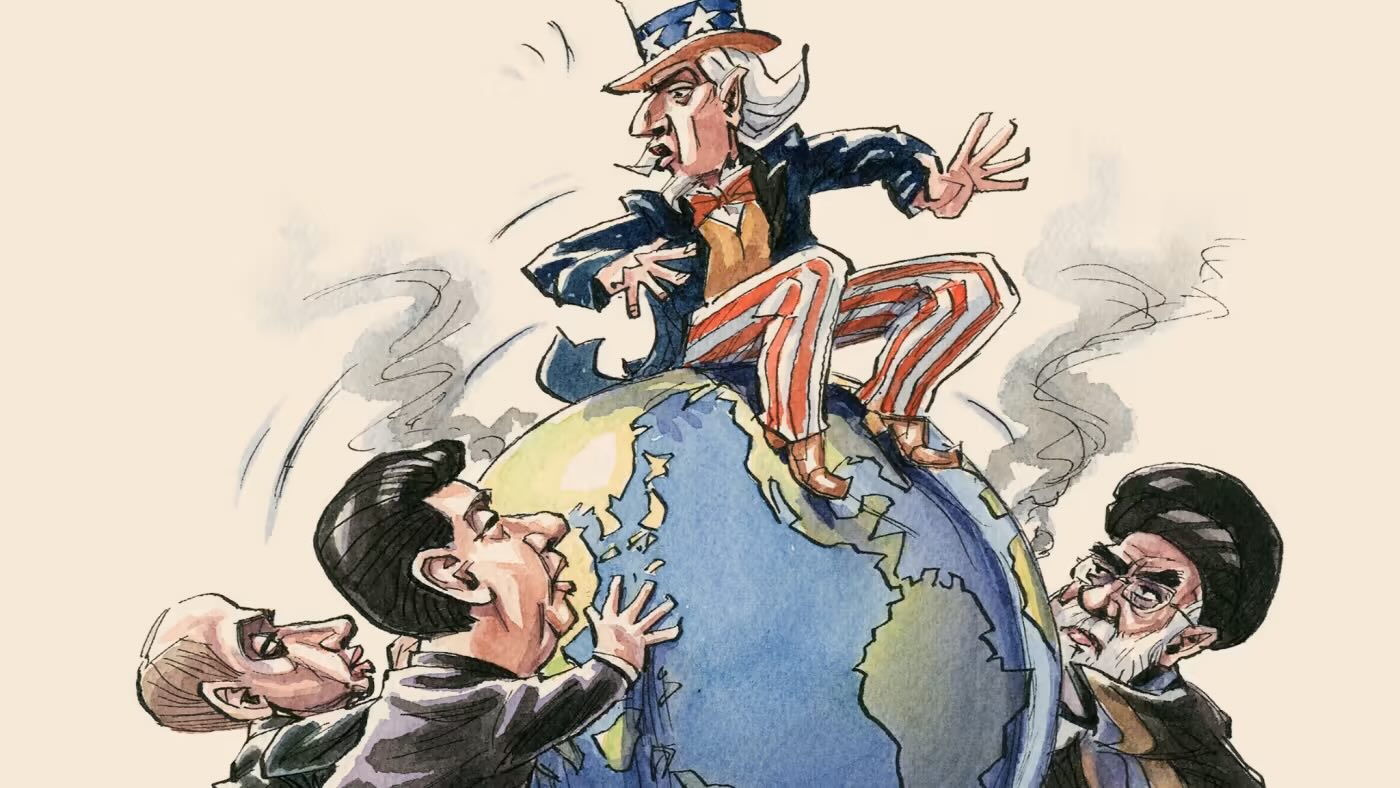
  • China and the Sunset of the International Liberal Order

    China and the Sunset of the International Liberal Order


    Rise of Multipolar World Order – www.newsvoyagernet.com

           The irrational amounts that the Soviet Union allocated to its defense budget not only represented a huge burden on its economy, but imposed a tremendous sacrifice on the standard of living of its citizens. Subsidies to the rest of the members of the Soviet bloc had to be added to this bill.

             Such amounts were barely sustainable for a country that, as from the first half of the 1960s, was subjected to a continuous economic stagnation. This situation became aggravated by the strong decline of oil prices, USSR’s main export, since the mid 1980s. The reescalation of the Cold War undertaken by Jimmy Carter and Ronald Reagan, particularly the latter, put in motion an American military buildup, that could not be matched by Moscow.

             With the intention of avoiding the implosion of its system, Moscow triggered a reform process that attained none other than accelerating such outcome. Indeed, Mikhail Gorbachev opened the pressure cooker hoping to liberate, in a controlled manner, the force contained in its interior. Once liberated, however, this force swept away with everything on its path. Initially came its European satellites, subsequently Gorbachev’s power base, and, finally, the Soviet Union itself. The Soviet system had reached the point where it could not survive without changes, but neither could assimilate them. In other words, it had exhausted its survival capacity.

              Without a shot being fired, Washington had won the Cold War. The exuberant sentiment of triumph therein derived translated into the “end of history” thesis. Having defeated its ideological rival, liberalism had become the final point in the ideological evolution of humanity. If anything, tough, the years that followed to the Soviet implosion were marred by trauma and conflict. In the essential, however, the idea that the world was homogenizing under the liberal credo was correct.

             On the one hand, indeed, the multilateral institutions, systems of alliances and rules of the game created by the United States shortly after World War II, or in subsequent years, allowed for a global governance architecture. A rules based liberal international order imposed itself over the world. On the other hand, the so-called Washington Consensus became a market economy’s recipe of universal application. This homogenization process was helped by two additional factors. First, the seven largest economies that followed the U.S., were industrialized democracies firmly supportive of its leadership. Second, globalization in its initial stage acted as a sort of planetary transmission belt that spread the symbols, uses, and values of the leading power.

             The new millennium thus arrived with an all-powerful America, whose liberal imprint was homogenizing the planet. The United States had indeed attained global hegemony, and Fukuyama’s end of history thesis seemed to reflect the emerging reality.

    But things turned out to be more complex than this, and the history of the end of history proved out to be a brief one. In a few years’ time, global “Pax Americana” began to be challenged by the presence of a powerful rival that seemed to have emerged out of the blue: China. How had this happened?

             Beginning the 1970s, Beijing and Washington had reached a simple but transformative agreement. Henceforward, the United States would recognize the Chinese Communist regime as China’s legitimate government. Meanwhile, China would no longer seek to constrain America’s leadership in Asia. By extension, this provided China with an economic opening to the West. Although it would be only after Deng Xiaoping’s arrival to power, that the real meaning of the latter became evident.

             In spite of the multiple challenges encountered along the way, both the United States and China made a deliberate effort to remain within the road opened in 1972. Their agreement showed to be not only highly resilient, but able to evolve amid changing circumstances. The year 2008, however, became an inflexion point within their relationship. From then onwards, everything began to unravel. Why was it so?

             The answer may be found in a notion familiar to the Chinese mentality, but alien to the Western one – the shi. This concept can be synthesized as an alignment of forces able to shape a new situation. More generally, it encompasses ideas such as momentum, strategic advantage, or propensity for things to happen. Which were, hence, the alignment of forces that materialized in that particular year? There were straightforward answers to that question: The U.S.’ financial excesses that produced the world’s worst financial crisis since 1929; Beijing’s sweeping efficiency in overcoming the risk of contagion from this crisis; China’s capability to maintain its economic growth, which helped preventing a major global economic downturn; and concomitantly, the highly successful Beijing Olympic games of that year, which provided the country with a tremendous self-esteem boost.

             The United States, indeed, had proven not to be the colossus that the Chinese had presumed, while China itself turned out to be much stronger than assumed. This implied that the U.S. was passing its peak as a superpower, and that the curves of the Chinese ascension and the American decline, were about to cross each other. Deng Xiaoping’s advice for future leadership generations, had emphasized the need of preserving a low profile, while waiting for the attainment of a position of strength. In Chinese eyes, 2008 seemed to show that China was muscular enough to act more boldly. Moreover, with the shi in motion, momentum had to be exploited.

             Beijing’s post-2008 assertiveness became much bolder after Xi Jinping’s arrival to power in 2012-2013. China, in his mind, was ready to contend for global leadership. More to the point within its own region, China’s centrality and the perception of the U.S. as an alien power, had to translate into pushing out America’s presence.

    Challenged by China, Washington reacted forcefully. Chinese perceptions run counter to the fact that the U.S.’ had been a major power in East Asia since 1854, which translated into countless loss of American lives in four wars. Moreover, safeguarding the freedom of navigation in the South China Sea, a key principle within the rules based liberal international order, provided a strong sense of staying power. This was reinforced by the fact that America’s global leadership was also at stake, thus requiring not to yield presence in that area for reputational reasons. The containment of Beijing’s ascendancy, became thus a priority for Washington.

             However, accommodating two behemoths that feel entitled to pre-eminence is a daunting task. Specially so, when one of them feels under threat of exclusion from the region, and the other feels that its emergence is being constrained. On top, both remain prisoners of their history and of their national myths. This makes them incapable of looking at the facts, without distorting them with the subjective lenses of their perceived sense of mission and superiority.

             War ensuing, under those circumstances, is an ongoing risk. But if war is a possibility, Cold War is already a fact. This implies a multifaceted wrestle in which geopolitics, technology, trade, finances, alliances, and warfare capabilities are all involved. And even if important convergent interest between them still remains in place, ties are being cut by the day. As a matter of fact, if in the past economic interdependence helped to shield from geopolitical dissonances, the opposite is the case today. Indeed, a whole array of zero-sum geopolitical controversies are rapidly curtailing economic links.

             The U.S., particularly during the Biden administration, chose to contain China through a regional architecture of alliances and by way of linking NATO with Indo-Pacific problems and selective regional allies. The common denominator that gathers them together is the preservation of the rules based liberal international order. An order, threatened by China’s geostrategic regional expansionism.


    However, China itself is not short of allies. A revisionist axis, that aims at ending the rules based liberal international order, has taken shape. The same tries to throw back American power and to create its own spheres of influence. This axis represents a competing center of gravity, where countries dissatisfied with the prevailing international order can turn to. Together with China two additional Asia-Pacific powers, Russia and North Korea, are part of this bloc.

    Trump’s return to the White House might change the prevailing regional configuration of factors. Although becoming more challenging to Beijing from a trade perspective, he could substantially weaken not only the rules based liberal international order, but the architecture of alliances that contains China. The former, because the illiberal populism that he represents is at odds with the liberal order. The latter, not only because he could take the U.S. out of NATO, but because his transactional approach to foreign policy, which favors trade and money over geopolitics, could turn alliances upside down.

    The rules based liberal international order, which became universal over the ashes of the Soviet Union, could now be facing its sunset. This, not only because its main challenger, China, may strengthen its geopolitical position in the face of its rival alliances’ disruption, but, more significantly, because the U.S. itself may cease to champion it.

    Feature Image Credit: www.brookings.edu


  • The Cultural Revolution from the Right: From the Democratic Concept of the People to its Ethnic-religious Understanding

    The Cultural Revolution from the Right: From the Democratic Concept of the People to its Ethnic-religious Understanding

    Despite all the real political problems we face, it is essential for the twenty-first century to defend the equality of all people, regardless of biological differences such as gender or ethnicity. It is not our biology that defines us as human beings, but our morality.
    According to Dominique Moisi, the Western states are consumed with fear of decline, the Islamic-Arab world is full of despair at unfulfilled promises, and East and Southeast Asia are full of hope for a better life. These global political sentiments are largely responsible for the escalation of conflicts, the disintegration of social cohesion and the spread of violence. 
    More than 50 years ago, a cultural revolution from the left shook the whole world. In the USA, there were demonstrations against the Vietnam War, and the hippie movement gathered hundreds of thousands in search of a new lifestyle and attitude to life. Flower, power, love was the motto of the legendary Woodstock. In Germany, young people turned against old traditions and the concealment of their parents’ and grandparents’ guilt under fascism. But here, too, the double face of the youth movement became apparent: when they celebrated the North Vietnamese leader Ho Chi Minh in their demonstrations, they were in no way aware of the political practice in North Vietnam. This process was even more dramatic during the Chinese Cultural Revolution when the youth were mobilised to ultimately legitimise the claim to power of the “Great Leader” Mao-TseTong. The lesson of that period was that a cultural revolution must precede political change. For some time now, a cultural revolution from the right has been following this pattern. It is characterised on the one hand by social developments in polarised societies, and on the other by a targeted and strategic discourse on the part of the new right. Without underestimating the importance of personalities such as former and newly elected President Trump, as well as Erdogan in Turkey and Putin in Russia (and many others) for this development, they have only been able to achieve such success because they have tapped into the “zeitgeist”. According to Dominique Moisi, the Western states are consumed with fear of decline, the Islamic-Arab world is full of despair at unfulfilled promises, and East and Southeast Asia are full of hope for a better life. These global political sentiments are largely responsible for the escalation of conflicts, the disintegration of social cohesion and the spread of violence.
    In the Western world, instead of recognising the equality of other civilisations, nations and states, the “others” were blamed for the loss of the “white man’s” superiority. The ideology of the white man’s burden to educate the uneducated and indigenous peoples of the world, developed at the beginning of the last century, was revived after the fall of the Soviet Union, but could no longer be sustained with the rise of the others and the newly industrialised nations. However, a dilemma arose – if the success of the others was attributed to them, they would be strengthened and the whites would be even less able to maintain their own sense of superiority. So people looked for internal others to blame for their own decline. This is at the heart of the cultural revolution from the right. It is explained by the fear of no longer being able to maintain the supposed superiority of the “white man” if, for example, a country like Indonesia (i.e. no longer just Japan and China) overtakes Germany’s gross domestic product around 2030. Meanwhile, the US, Germany and many other European countries are not only no longer relatively superior, but parts of the US, for example, are at levels that used to be ascribed only to developing countries. And scapegoats are easy to find and, above all, interchangeable – sometimes it can be emancipated women, migrants, the “elites”, the Chinese, Africans, African-Americans, or anyone who is different. Trump’s statement that migrants are taking “black jobs” from US Americans reveals the core of this ideology: the MAGA movement is the best illustration of this development. Despite Trump’s irrationality and narrow-mindedness, “Make America Great Again” can only take hold if many people fear decline or have already experienced it. Like the masterminds of the cultural revolution on the right, they are trying to conquer the more rural regions first.
    The reference to ethnic pluralism is also one of the defining characteristics of the New Right. The right of all cultures and ethnic groups to exist is unconditionally recognised, but only as long as people remain among themselves or on the territory intended for them. Trump’s idea of expelling millions of Latinos after winning the election corresponds perfectly with the German right’s idea of enforcing re-migration. In Germany, Carl Schmitt and Martin Heidegger, Ernst Jünger and Oswald Spengler, and even Nietzsche, are relativised in order to legitimise the cultural revolution of the right. Antonio Gramsci, actually a progressive Marxist, whose concept of achieving cultural hegemony in the “pre-political space” is pursued by the Right as “metapolitics”, gains central importance.
    At its core, however, the new right is about undermining human equality – in its view, we are only equal to our own nation or religion and gender. This exclusionary equality only with one’s own kind is at the heart of the right’s cultural revolution, whose ideal model is itself based on hierarchical notions, a graded dignity. Such attempts to undo the gains of the struggle for equality in a counter-revolution can be found all over the world – whether in nationalism, ethnocentrism, misogyny, cultural relativism (“they just have a different culture”) or thinly veiled racism.
    The only thing “new” about this right-wing movement is that it uses different terms. The New Right concentrates on the “battle for the heads”, leaving the battles for the streets and, in some cases, the parliaments to other groups of the extreme right. The storming of the Capitol and the German Bundestag were such actions of the extreme right. It must be admitted that the whole world is in turmoil. At its core, however, the new right is about undermining human equality – in its view, we are only equal to our own nation or religion and gender. This exclusionary equality only with one’s own kind is at the heart of the right’s cultural revolution, whose ideal model is itself based on hierarchical notions, a graded dignity. Such attempts to undo the gains of the struggle for equality in a counter-revolution can be found all over the world – whether in nationalism, ethnocentrism, misogyny, cultural relativism (“they just have a different culture”) or thinly veiled racism. It is also marked by the revival of toxic masculinity (Raewen Connel) through the MAGA movement and in particular Trump’s enthusiasm for the wrestling mentality and martial arts. Opinions can be divided on these as sports, but they have no place in politics and point to an absolutely exaggerated and violent masculinity that Trump embodies. These political discourses are used to win elections in the West. In one sentence, the New Right shifts the concept of the democratic people to the ethno-religious people.
    When the few people of Pegida (Patriotic Europeans to defend the Abendland) in Germany shout into the camera: “We are the people”, they are turning the slogan of the democratic revolution of 1989 into an ethno-nationalist revolution. From the mid-nineteenth century to the mid-twentieth century, we have witnessed this transformation from the democratic to the ethnic concept of the people. Despite all the real political problems we face, it is essential for the twenty-first century to defend the equality of all people, regardless of biological differences such as gender or ethnicity. It is not our biology that defines us as human beings, but our morality.
    Feature Image Credit: Equality Trust
    from ‘The Link Between Inequality and the Far-Right’ – https://equalitytrust.org.uk
    The far-right has always been part of politics. The current global wave of far-right populist political movements began in the late 1970s, grew in the 1990s, and accelerated dramatically in the late 2000s. It has mirrored a sharp increase in inequality across developed economies, the globalisation of neoliberal economics, and the creation of an international super-rich. 
  • Crimson Cows and Indian Sensibilities

    Crimson Cows and Indian Sensibilities

    That Israel, in addition to being an apartheid state, has gone completely rogue is no longer in doubt. As Israel digs itself into a deeper hole, in the belief that it can kill its way to success, it finds that this year its GDP has collapsed from 4.8% in 2022 to 1.5%, with over 46000 small businesses having shut down. By some estimates, between 500,000 to 1 million Israelis have permanently emigrated.


    Approximately 7 million Jewish Israelis and an equal number of Palestinians live cheek-by-jowl between the Mediterranean Sea and the Jordan River. The area encompasses Israel, the occupied territories of the West Bank, including East Jerusalem, and the Gaza Strip.  Nominally, the Palestinians in the West Bank do have limited self-rule, but defacto have no control over the movement of people and goods, or taxes. Agreements signed in the 1990’s, permit the Israeli Government to collect taxes on behalf of the Palestinian Authority (PA), which it then disburses to the PA for its use. These taxes make up over 65-70% of the PA’s public budget and have a critical impact on the quality of life of ordinary Palestinians.

    As has been the norm with Israel, it has used every means, including financial control, to inflict collective punishment on the Palestinians at any attempt by them to free themselves from Israeli occupation. In May this year, for example, it withheld disbursal of all taxes collected over the past three months on grounds that Spain, Ireland and Norway had announced they would recognise the Palestinian State. This resulted in the breakdown of municipal services and widespread loss of jobs. Subsequently, in June it indulged in blatant blackmail when it agreed to disburse withheld funds, provided the PA retroactively approved five settlements in the West Bank that had been illegally established earlier, despite condemnation by Palestinians and the international community.

    While the Hamas attack of 7 October 2023, especially their despicable actions against women, children and civilians, has been widely condemned, the fact that over half of the 1200 Israelis killed, were by their own military in pursuant of the reprehensible “Hannibal Directive”, continues to be glossed over. Oddly enough, over the course of that year, prior to the attack, the fact that over 200 Palestinians had been killed by the Israeli military and settlers for a variety of reasons has simply been ignored by the international media and not been seen as the immediate provocation for the attack, especially its ferocity.

    It now emerges, that the numbers of Palestinians killed by the Israeli response has been grossly underestimated. As per a study dated 10 July 2024 in the Lancet, a respectable and authoritative medical journal, an estimated 186000-200,000 Palestinians have been killed in Gaza, directly or indirectly. This is approximately 9% of the total population, the overwhelming majority of them being women and children.

    The Israeli response to this attack was disproportionate, to put it mildly, but it still continues to receive full support from Western Governments. It now emerges, that the numbers of Palestinians killed by the Israeli response has been grossly underestimated. As per a study dated 10 July 2024 in the Lancet, a respectable and authoritative medical journal, an estimated 186000-200,000 Palestinians have been killed in Gaza, directly or indirectly. This is approximately 9% of the total population, the overwhelming majority of them being women and children.

    The difference between these estimates and the official figures released by the Gaza Health Ministry, which presently stands at approximately 43000, is explained by the fact that the Ministry only accounts for bodies that have been found and not for those remaining under the rubble, that the cities have been reduced to. Nor does it account for the indirect deaths due to hunger, non-availability of medical help etc. Studies suggest that these tend to be between 5-10 times higher than the official figures.

    Israel’s inhuman and deliberate response has been decried by experts, governments, United Nations Agencies and NGOs. They have gone on to accuse Israel of carrying out a genocide against the Palestinian population in Gaza, and more recently, in the West Bank. What is even more horrific, if that is even possible, are the accusations made by Dr. Feroze Sidhwa, an American trauma surgeon, on his return from Gaza. In his devastating op-ed in The New York Times, titled “65 Doctors, Nurses and Paramedics: What We Saw in Gaza”, he recounts harrowing stories from dozens of healthcare workers and CT scans of children shot in the head or the left side of the chest. The Times called the corresponding images of the patients too graphic to publish. In his words, “44 doctors, nurses and paramedics saw multiple cases of preteen children who had been shot in the head or chest in Gaza… He personally identified 13 such cases in his two weeks there”.

    That Israel, in addition to being an apartheid state, has gone completely rogue is no longer in doubt. In July this year, for example,  a video was leaked of the gangrape of a male Palestinian prisoner by guards of the IDF at the Sde Teiman detention facility in Southern Israel. Commentators in Israel referred to this video as just the tip of the iceberg, but what followed is instructive. Ten soldiers were arrested and faced trial for this act, but not before a mob, led by government ministers, attempted to free them forcibly from detention. Another minister demanded an investigation to identify the individual who had leaked the video so that he could be tried for treason. An MP from the governing Likud Party defended the actions of the guards in Parliament, responding to a question by an Arab-Israeli MP with “If he is a Nukhba (Hamas militant), everything is legitimate to do! Everything!”  Even the Minister responsible for  Prison Services, Ben-Gvir, told Israeli media on the day of the reservists’ arrest that it was “shameful for Israel to arrest our best heroes”.

    This race to the bottom doesn’t end there of course, and as the saying goes, the best is yet to come. As is well known, the Holy City of Old Jerusalem is home to the “Temple”, or as it is now known the Temple Mount. It refers to the two existing Islamic religious structures, the Dome of the Rock and the Al Aqsa Mosque, collectively known as Haram al-Sharif, and considered the third holiest site in Islam. However, according to the Tanakh or the Hebrew Bible, prior to these structures, the ‘First Temple’ was supposedly built on that very site in the 10th century BCE by King Solomon, and stood for five hundred years before being destroyed by the Babylonians. Almost a century later, it was replaced by the ‘Second Temple’ built by Cyrus the Great, only for it to be destroyed by the Romans in 70 CE. The New Testament holds that important events in Jesus’ life took place in the Temple, and the Crusaders attributed the name “Templum Domini” to the Dome of the Rock.

    However, many Jews see the building of a “Third Temple” in Jerusalem as an object of longing and a symbol of future redemption, as it would announce the arrival of a new Messiah who would unite the flock and lead them to salvation. Incidentally, the promised land would incorporate the whole of Palestine, along with parts of Turkey, Syria, Iraq, Saudi Arabia and Kuwait.

    Thus the religious significance and sensitivity of Temple Mount cannot be underestimated. Fortunately, as things stand Non-Muslims are not permitted to enter the two structures, while Jews are only allowed to pray at the Western Wall that runs along the side of the hill and is thought to be a remnant of the Second Temple. However, many Jews see the building of a “Third Temple” in Jerusalem as an object of longing and a symbol of future redemption, as it would announce the arrival of a new Messiah who would unite the flock and lead them to salvation. Incidentally, the promised land would incorporate the whole of Palestine, along with parts of Turkey, Syria, Iraq, Saudi Arabia and Kuwait.

    But before its construction can be undertaken, it would require purification of the site and of the construction crew. That would, however, only be feasible, by sacrificing a red heifer, specifically bred to meet stringent biblical requirements. It would be required to be burnt alive at the Mount of Olives, adjacent to the Al Aqsa Mosque, and its ashes used to consecrate the holy ground and the people. The stuff of hopes and dreams for a tiny minority, with little hope of fulfilment in the modern world, or so one thought.

    These cows represent a tangible step towards the construction of the Temple and fulfilment of the prophecy.  The next obvious step in this tragedy will be the demolition of the Haram al-Sharif, for which dry rehearsals have already been undertaken. The consequences of such a step in the region are not difficult to visualise, but will it stop the extremists? Very unlikely.

    However, in September 2022, an unprincipled collaboration between extreme Zionist religious leaders, Right-Wing Christian Evangelicals and the present Israeli Government allowed for five red heifers to be flown from Texas to Israel. Ironically enough, despite the Evangelicals being well-known for their antisemitic beliefs. Brought in as pets, to avoid existing restrictions on livestock, they are now kept in an archaeological park in Shiloh, an illegal Israeli settlement, near the Palestinian city of Nablus. These cows represent a tangible step towards the construction of the Temple and fulfilment of the prophecy.  The next obvious step in this tragedy will be the demolition of the Haram al-Sharif, for which dry rehearsals have already been undertaken. The consequences of such a step in the region are not difficult to visualise, but will it stop the extremists? Very unlikely.

    As Israel digs itself into a deeper hole, in the belief that it can kill its way to success, it finds that this year its GDP has collapsed from 4.8% in 2022 to 1.5%, with over 46000 small businesses having shut down. By some estimates, between 500,000 to 1 million Israelis have permanently emigrated. In addition, it finds itself short of weapons, ammunition, tanks and manpower as heavy casualties in the ongoing conflict have taken their toll. Yet, its arrogant leadership refuses to pay heed to that one cardinal rule about tackling insurgencies; they are a political problem and can only be resolved politically.

    The question that it raises for us is do we really need such friends, and more importantly, are our commercial interests so important that we are willing to forego all that we hold sacred?

    Clearly, if Israel refuses to change direction its days are numbered. After all its most steadfast ally, the United States, can only support so many losing causes. With Ukraine on the brink, an ascending Russo-China coalition to deal with and Taiwan increasingly under threat, an intransigent Benjamin Netanyahu is a liability, who may well find himself the target of a drone, be it American or Iranian. This is very likely despite Trump’s victory to become the 47th President of the United States. The question that it raises for us is do we really need such friends, and more importantly, are our commercial interests so important that we are willing to forego all that we hold sacred?

    Feature Image Credit: Middle East Eye
    Image – De Gaza: reliefweb.int
    Children of Gaza Image Credit: Middle East Eye – How Israel’s Genocide in Gaza sparked a protest movement in the UK.
    Wailing Wall and Al Aqsa Mosque: Tourist Israel
    Red Heifer Sacrifice Ritual Image: thetorah.com

  • Why Nations succeed or fail: a Nobel cause

    Why Nations succeed or fail: a Nobel cause

    Daron Acemoglu, Simon Johnson and James A Robinson have been awarded the Nobel (really the Riksbank prize) in economics “for studies of how institutions are formed and affect prosperity.” Daron Acemoglu is a professor at the Massachusetts Institute of Technology. Simon Johnson is a professor at the same university. And James Robinson is a professor at the University of Chicago.

    Here is what the Nobel judges say was the reason for winning:

    Today, the richest 20 percent of countries are around 30 times wealthier than the poorest 20 percent of countries. The income gaps across countries have been highly persistent over the past 75 years.39 The available data also show that between-country disparities in income have grown over the past 200 years. Why are the income differences across countries so large and so persistent?

    This year’s Laureates have pioneered a new approach to providing credible, quantitative answers to this crucial question for humanity. By empirically examining the impact and persistence of colonial strategies on subsequent economic development, they have identified historical roots for the extractive institutional environments that characterize many low-income countries. Their emphasis on using natural experiments and historical data has initiated a new research tradition that continues to help uncover the historical drivers of prosperity, or lack thereof.

    Their research centers on the idea that political institutions fundamentally shape the wealth of nations. But what shapes these institutions? By integrating existing political science theories on democratic reform into a game-theoretic framework, Acemoglu and Robinson developed a dynamic model in which the ruling elite make strategic decisions about political institutions—particularly whether to extend the electoral franchise—in response to periodic threats. This framework is now standard for analyzing political institutional reform and has significantly impacted the research literature. And evidence is mounting in support of one of the model’s core implications: more inclusive governments promote economic development.

    Over the years (or is it decades?) I have posted on the work of various Nobel winners in economics.

    What I have found is that, whatever the quality of the winner’s work, he or she (occasionally) usually got the prize for their worst piece of research, namely work that confirmed the mainstream view of the economic world, while not actually taking us further into understanding its contradictions.

    This conclusion I think applies to the latest winners. The work for which they received the $1m prize is for research that purports to show that those countries that achieve prosperity and end poverty are those that adopt ‘democracy’ (and by that is meant Western-style liberal democracy where people can speak out (mostly), can vote for officials every so often and expect the law to protect their lives and property (hopefully). Societies that are controlled by elites without any democratic accountability are ‘extractive’ of resources, do not respect property and value and so over time do not prosper. In a series of papers applying some empirical analysis (ie correlating democracy (as defined) with levels of prosperity), the Nobel winners claim to show this.

    Indeed, the Nobel winners argue that colonisation of the Global South in the 18th and 19thcenturies could be ‘inclusive’ and so turn the likes of North America into prosperous nations (forgetting the indigenous population) or ‘extractive’ and so keep countries in dire poverty (Africa). It all depends. Such is the theory.

    This sort of economics is what is called institutional, namely that it is not so much the blind forces of the market and capital accumulation that drives growth (and inequalities), but the decisions and structures set up by humans. Supporting this model, the winners assert that revolutions precede economic changes and not that economic changes (or the lack thereof before a new economic environment) precede revolutions.

    Two points follow from this. First, if growth and prosperity go hand in hand with ‘democracy’ and the likes of the Soviet Union, China, and Vietnam are considered to have elites that are ‘extractive’ or undemocratic, how do our Nobellists explain their undoubted economic performance? Apparently, it is explained by the fact they started out poor and had a lot of ‘catching up’ to do, but soon their extractive character will catch up with them and China’s hyper-growth will run out of steam. Perhaps now?

    Second, is it correct to say that revolutions or political reforms are necessary to set things on the path to prosperity? Well, there may be some truth in that: would Russia in the early 20thcentury be where it is today without the 1917 revolution or China be where it is in 2024 without the revolution of 1949? But our Nobellists do not present us with those examples: theirs are getting the vote in Britain in the 19th century or independence for the American colonies in the 1770s.

    But surely, the state of the economy, the way it functions, the investment and productivity of the workforce also have an effect? The emergence of capitalism and the industrial revolution in Britain preceded the move to universal suffrage. The English Civil War of the 1640s laid the political basis for the hegemony of the capitalist class in Britain, but it was the expansion of trade (including in slaves) and colonisation in the following century that took the economy forward.

    The irony of this award is that the best work of Acemoglu and Johnson has come much more recently than in the past works that the Nobel judges have focused on. Only last year, the authors published Power and Progress , where they pose the contradiction in modern economies between technology driving up the productivity of labour but also with the likelihood of increased inequality and poverty. Of course, their policy solutions do not touch on the question of a change in property relations, except to call for a greater balance between capital and labour.

    What you can say in favour of this year’s winners is that at least their research is about trying to understand the world and its development, instead of some arcane theorem of equilibrium in markets that many past winners have been honoured for. It’s just that their theory of ‘catching up’ is vague (or ‘contingent’ as they put it) and unconvincing.

    I think we have a much better and more convincing explanation of the processes of catching up (or not) from the recent book by Brazilian Marxist economists Adalmir Antonio Marquetti, Alessandro Miebach and Henrique Morrone who have produced an important and insightful book on global capitalist development, with an innovative new way of measuring the progress for the majority of humanity in the so-called Global South in ‘catching up’ on living standards with the ‘Global North’. This book deals with all the things that the Nobel winners ignore: productivity, capital accumulation, unequal exchange, exploitation—as well as the key institutional factor of who controls the surplus.