This analytical report on the perils of US hegemony was released by China on the 20th of February 2023. It is evident that much of the world is now alienated by the USA and the West. This is particularly so after the Ukraine-Russia conflict that erupted a year ago. The majority of the world remains non-commital but certainly does not support the US or Ukraine in this conflict nor do they condemn Russia. In effect, the non-western world has openly indicated that this unnecessary war is caused by the aggressive actions of NATO and the US to provoke Russia. The constant interventions and wars waged by the US and NATO in the name of democracy and disregarding the UN are now being questioned. China has cleverly utilised this sentiment to time its publication. The paper is very well analysed, crisply argued, and has flagged real questions to the world community. In short, the paper implies that the US and its allies pose the gravest threat to global stability and peace, and more so to the sovereignty of all countries.
This paper was published earlier in fmprc.gov.cn
Introduction
Since becoming the world’s most powerful country after the two world wars and the Cold War, the United States has acted more boldly to interfere in the internal affairs of other countries, pursue, maintain and abuse hegemony, advance subversion and infiltration, and willfully wage wars, bringing harm to the international community.
The United States has developed a hegemonic playbook to stage “colour revolutions,” instigate regional disputes and even directly launch wars under the guise of promoting democracy, freedom and human rights. Clinging to the Cold War mentality, the United States has ramped up bloc politics and stoked conflict and confrontation. It has overstretched the concept of national security, abused export controls and forced unilateral sanctions upon others. It has taken a selective approach to international law and rules, utilizing or discarding them as it sees fit, and has sought to impose rules that serve its own interests in the name of upholding a “rules-based international order.”
This report, by presenting the relevant facts, seeks to expose the U.S. abuse of hegemony in the political, military, economic, financial, technological and cultural fields and to draw greater international attention to the perils of the U.S. practices to world peace and stability and the well-being of all peoples.
I. Political Hegemony – Throwing Its Weight Around
The United States has long been attempting to mould other countries and the world order with its own values and political system in the name of promoting democracy and human rights.
◆ Instances of U.S. interference in other countries’ internal affairs abound. In the name of “promoting democracy,” the United States practised a “Neo-Monroe Doctrine” in Latin America, instigated “colour revolutions” in Eurasia, and orchestrated the “Arab Spring” in West Asia and North Africa, bringing chaos and disaster to many countries.
In 1823, the United States announced the Monroe Doctrine. While touting an “America for the Americans,” what it truly wanted was an “America for the United States.”
Since then, the policies of successive U.S. governments toward Latin America and the Caribbean Region have been riddled with political interference, military intervention and regime subversion. From its 61-year hostility toward and blockade of Cuba to its overthrow of the Allende government of Chile, U.S. policy on this region has been built on one maxim-those who submit will prosper; those who resist shall perish.
The year 2003 marked the beginning of a succession of “colour revolutions” – the “Rose Revolution” in Georgia, the “Orange Revolution” in Ukraine and the “Tulip Revolution” in Kyrgyzstan. The U.S. Department of State openly admitted playing a “central role” in these “regime changes.” The United States also interfered in the internal affairs of the Philippines, ousting President Ferdinand Marcos Sr. in 1986 and President Joseph Estrada in 2001 through the so-called “People Power Revolutions.”
In January 2023, former U.S. Secretary of State Mike Pompeo released his new book Never Give an Inch: Fighting for the America I Love. He revealed in it that the United States had plotted to intervene in Venezuela. The plan was to force the Maduro government to reach an agreement with the opposition, deprive Venezuela of its ability to sell oil and gold for foreign exchange, exert high pressure on its economy, and influence the 2018 presidential election.
◆ The U.S. exercises double standards on international rules. Placing its self-interest first, the United States has walked away from international treaties and organizations and put its domestic law above international law. In April 2017, the Trump administration announced that it would cut off all U.S. funding to the United Nations Population Fund (UNFPA) with the excuse that the organization “supports, or participates in the management of a program of coercive abortion or involuntary sterilization.” The United States quit UNESCO twice in 1984 and 2017. In 2017, it announced leaving the Paris Agreement on climate change. In 2018, it announced its exit from the UN Human Rights Council, citing the organization’s “bias” against Israel and failure to protect human rights effectively. In 2019, the United States announced its withdrawal from the Intermediate-Range Nuclear Forces Treaty to seek the unfettered development of advanced weapons. In 2020, it announced pulling out of the Treaty on Open Skies.
The United States has also been a stumbling block to biological arms control by opposing negotiations on a verification protocol for the Biological Weapons Convention (BWC) and impeding international verification of countries’ activities relating to biological weapons. As the only country in possession of a chemical weapons stockpile, the United States has repeatedly delayed the destruction of chemical weapons and remained reluctant in fulfilling its obligations. It has become the biggest obstacle to realizing “a world free of chemical weapons.”
◆ The United States is piecing together small blocs through its alliance system. It has been forcing an “Indo-Pacific Strategy” onto the Asia-Pacific region, assembling exclusive clubs like the Five Eyes, the Quad and AUKUS, and forcing regional countries to take sides. Such practices are essentially meant to create division in the region, stoke confrontation and undermine peace.
◆ The U.S. arbitrarily passes judgment on democracy in other countries and fabricates a false narrative of “democracy versus authoritarianism” to incite estrangement, division, rivalry and confrontation. In December 2021, the United States hosted the first “Summit for Democracy,” which drew criticism and opposition from many countries for making a mockery of the spirit of democracy and dividing the world. In March 2023, the United States will host another “Summit for Democracy,” which remains unwelcome and will again find no support.
II. Military Hegemony – Wanton Use of Force
The history of the United States is characterized by violence and expansion. Since it gained independence in 1776, the United States has constantly sought expansion by force: it slaughtered Indians, invaded Canada, waged a war against Mexico, instigated the American-Spanish War, and annexed Hawaii. After World War II, the wars either provoked or launched by the United States included the Korean War, the Vietnam War, the Gulf War, the Kosovo War, the War in Afghanistan, the Iraq War, the Libyan War and the Syrian War, abusing its military hegemony to pave the way for expansionist objectives. In recent years, the U.S. average annual military budget has exceeded $700 billion, accounting for 40 percent of the world’s total, more than the 15 countries behind it combined. The United States has about 800 overseas military bases, with 173,000 troops deployed in 159 countries.
According to the book America Invades: How We’ve Invaded or been Militarily Involved with almost Every Country on Earth, the United States has fought or been militarily involved with almost all the 190-odd countries recognized by the United Nations with only three exceptions. The three countries were “spared” because the United States did not find them on the map.
◆ As former U.S. President Jimmy Carter put it, the United States is undoubtedly the most warlike nation in the history of the world. According to a Tufts University report, “Introducing the Military Intervention Project: A new Dataset on U.S. Military Interventions, 1776-2019,” the United States undertook nearly 400 military interventions globally between those years, 34 percent of which were in Latin America and the Caribbean, 23 percent in East Asia and the Pacific, 14 percent in the Middle East and North Africa, and 13 percent in Europe. Currently, its military intervention in the Middle East and North Africa and sub-Saharan Africa is on the rise.
Alex Lo, a South China Morning Post columnist, pointed out that the United States has rarely distinguished between diplomacy and war since its founding. It overthrew democratically elected governments in many developing countries in the 20th century and immediately replaced them with pro-American puppet regimes. Today, in Ukraine, Iraq, Afghanistan, Libya, Syria, Pakistan and Yemen, the United States is repeating its old tactics of waging proxy, low-intensity, and drone wars.
◆ U.S. military hegemony has caused humanitarian tragedies. Since 2001, the wars and military operations launched by the United States in the name of fighting terrorism have claimed over 900,000 lives, with some 335,000 of them civilians, injured millions and displaced tens of millions. The 2003 Iraq War resulted in some 200,000 to 250,000 civilian deaths, including over 16,000 directly killed by the U.S. military, and left more than a million homeless.
The United States has created 37 million refugees around the world. Since 2012, the number of Syrian refugees alone has increased tenfold. Between 2016 and 2019, 33,584 civilian deaths were documented in the Syrian fighting, including 3,833 killed by U.S.-led coalition bombings, half of them women and children. The Public Broadcasting Service (PBS) reported on November 9, 2018, that the air strikes launched by U.S. forces on Raqqa alone killed 1,600 Syrian civilians.
The two-decade-long war in Afghanistan devastated the country. A total of 47,000 Afghan civilians and 66,000 to 69,000 Afghan soldiers and police officers unrelated to the September 11 attacks were killed in U.S. military operations, and more than 10 million people were displaced. The war in Afghanistan destroyed the foundation of economic development there and plunged the Afghan people into destitution. After the “Kabul debacle” in 2021, the United States announced that it would freeze some 9.5 billion dollars in assets belonging to the Afghan central bank, a move considered “pure looting.”
In September 2022, Turkish Interior Minister Suleyman Soylu commented at a rally that the United States has waged a proxy war in Syria, turned Afghanistan into an opium field and heroin factory, thrown Pakistan into turmoil, and left Libya in incessant civil unrest. The United States does whatever it takes to rob and enslave the people of any country with underground resources.
The United States has also adopted appalling methods in war. During the Korean War, the Vietnam War, the Gulf War, the Kosovo War, the War in Afghanistan and the Iraq War, the United States used massive quantities of chemical and biological weapons as well as cluster bombs, fuel-air bombs, graphite bombs and depleted uranium bombs, causing enormous damage on civilian facilities, countless civilian casualties and lasting environmental pollution.
III. Economic Hegemony – Looting and Exploitation
After World War II, the United States led efforts to set up the Bretton Woods System, the International Monetary Fund and the World Bank, which, together with the Marshall Plan, formed the international monetary system centred around the U.S. dollar. In addition, the United States has established institutional hegemony in the international economic and financial sector by manipulating the weighted voting systems, rules and arrangements of international organizations, including “approval by 85 percent majority” and its domestic trade laws and regulations. By taking advantage of the dollar’s status as the major international reserve currency, the United States is basically collecting “seigniorage” from around the world; and using its control over international organizations, it coerces other countries into serving America’s political and economic strategy.
◆ The United States exploits the world’s wealth with the help of “seigniorage.” It costs only about 17 cents to produce a $100 bill, but other countries had to pony up $100 worth of actual goods in order to obtain one. It was pointed out more than half a century ago that the United States enjoyed exorbitant privilege and deficit without tears created by its dollar and used the worthless paper note to plunder the resources and factories of other nations.
◆ The hegemony of the U.S. dollar is the main source of instability and uncertainty in the world economy. During the COVID-19 pandemic, the United States abused its global financial hegemony and injected trillions of dollars into the global market, leaving other countries, especially emerging economies, to pay the price. In 2022, the Fed ended its ultra-easy monetary policy and turned to aggressive interest rate hikes, causing turmoil in the international financial market and substantial depreciation of other currencies, such as the euro, many of which dropped to a 20-year low. As a result, a large number of developing countries were challenged by high inflation, currency depreciation and capital outflows. This was exactly what Nixon’s secretary of the treasury, John Connally, once remarked, with self-satisfaction yet sharp precision, “The dollar is our currency, but it is your problem.”
◆ With its control over international economic and financial organizations, the United States imposes additional conditions for assisting other countries. In order to reduce obstacles to U.S. capital inflow and speculation, the recipient countries are required to advance financial liberalization and open up financial markets so that their economic policies would fall in line with America’s strategy. According to the Review of International Political Economy, along with the 1,550 debt relief programs extended by the IMF to its 131 member countries from 1985 to 2014, as many as 55,465 additional political conditions had been attached.
◆ The United States willfully suppresses its opponents with economic coercion. In the 1980s, to eliminate the economic threat posed by Japan and control and use the latter in service of America’s strategic goal of confronting the Soviet Union and dominating the world, the United States leveraged its hegemonic financial power against Japan and concluded the Plaza Accord. As a result, the yen was pushed up, and Japan was pressed to open up its financial market and reform its financial system. The Plaza Accord dealt a heavy blow to the growth momentum of the Japanese economy, leaving Japan to what was later called “three lost decades.”
◆ America’s economic and financial hegemony has become a geopolitical weapon. Doubling down on unilateral sanctions and “long-arm jurisdiction,” the United States has enacted such domestic laws as the International Emergency Economic Powers Act, the Global Magnitsky Human Rights Accountability Act, and the Countering America’s Adversaries Through Sanctions Act, and introduced a series of executive orders to sanction specific countries, organizations or individuals. Statistics show that U.S. sanctions against foreign entities increased by 933 percent from 2000 to 2021. The Trump administration alone has imposed more than 3,900 sanctions, which means three sanctions per day. So far, the United States had or has imposed economic sanctions on nearly 40 countries across the world, including Cuba, China, Russia, the DPRK, Iran and Venezuela, affecting nearly half of the world’s population. “The United States of America” has turned itself into “the United States of Sanctions.” And “long-arm jurisdiction” has been reduced to nothing but a tool for the United States to use its means of state power to suppress economic competitors and interfere in normal international business. This is a serious departure from the principles of a liberal market economy that the United States has long boasted.
IV. Technological Hegemony – Monopoly and Suppression
The United States seeks to deter other countries’ scientific, technological and economic development by wielding monopoly power, suppression measures and technology restrictions in high-tech fields.
◆ The United States monopolizes intellectual property in the name of protection. Taking advantage of the weak position of other countries, especially developing ones, on intellectual property rights and the institutional vacancy in relevant fields, the United States reaps excessive profits through monopoly. In 1994, the United States pushed forward the Agreement on Trade-Related Aspects of Intellectual Property Rights (TRIPS), forcing the Americanized process and standards in intellectual property protection in an attempt to solidify its monopoly on technology.
In the 1980s, to contain the development of Japan’s semiconductor industry, the United States launched the “301” investigation, built bargaining power in bilateral negotiations through multilateral agreements, threatened to label Japan as conducting unfair trade, and imposed retaliatory tariffs, forcing Japan to sign the U.S.-Japan Semiconductor Agreement. As a result, Japanese semiconductor enterprises were almost completely driven out of global competition, and their market share dropped from 50 percent to 10 percent. Meanwhile, with the support of the U.S. government, a large number of U.S. semiconductor enterprises took the opportunity and grabbed a larger market share.
◆ The United States politicizes and weaponizes technological issues and uses them as ideological tools. Overstretching the concept of national security, the United States mobilized state power to suppress and sanction Chinese company Huawei, restricted the entry of Huawei products into the U.S. market, cut off its supply of chips and operating systems, and coerced other countries to ban Huawei from undertaking local 5G network construction. It even talked Canada into unwarrantedly detaining Huawei’s CFO, Meng Wanzhou, for nearly three years.
The United States has fabricated a slew of excuses to clamp down on China’s high-tech enterprises with global competitiveness and has put more than 1,000 Chinese enterprises on sanction lists. In addition, the United States has also imposed controls on biotechnology, artificial intelligence and other high-end technologies, reinforced export restrictions, tightened investment screening, suppressed Chinese social media apps such as TikTok and WeChat, and lobbied the Netherlands and Japan to restrict exports of chips and related equipment or technology to China.
The United States has also practised double standards in its policy on China-related technological professionals. To sideline and suppress Chinese researchers, since June 2018, visa validity has been shortened for Chinese students majoring in certain high-tech-related disciplines, repeated cases have occurred where Chinese scholars and students going to the United States for exchange programs and study were unjustifiably denied and harassed, and large-scale investigation on Chinese scholars working in the United States was carried out.
◆ The United States solidifies its technological monopoly in the name of protecting democracy. By building small blocs of technology, such as the “chips alliance” and “clean network,” the United States has put “democracy” and “human rights” labels on high technology and turned technological issues into political and ideological issues to fabricate excuses for its technological blockade against other countries. In May 2019, the United States enlisted 32 countries to the Prague 5G Security Conference in the Czech Republic and issued the Prague Proposal in an attempt to exclude China’s 5G products. In April 2020, then U.S. Secretary of State Mike Pompeo announced the “5G clean path,” a plan designed to build a technological alliance in the 5G field with partners bonded by their shared ideology on democracy and the need to protect “cyber security.” The measures, in essence, are the U.S. attempts to maintain its technological hegemony through technological alliances.
◆ The United States abuses its technological hegemony by carrying out cyberattacks and eavesdropping. The United States has long been notorious as an “empire of hackers,” blamed for its rampant acts of cyber theft around the world. It has all kinds of means to enforce pervasive cyberattacks and surveillance, including using analogue base station signals to access mobile phones for data theft, manipulating mobile apps, infiltrating cloud servers, and stealing through undersea cables. The list goes on.
U.S. surveillance is indiscriminate. All can be targets of its surveillance, be they rivals or allies, even leaders of allied countries such as former German Chancellor Angela Merkel and several French Presidents. Cyber surveillance and attacks launched by the United States, such as “Prism,” “Dirtbox,” “Irritant Horn” and “Telescreen Operation,” are all proof that the United States is closely monitoring its allies and partners. Such eavesdropping on allies and partners has already caused worldwide outrage. Julian Assange, the founder of Wikileaks, a website that has exposed U.S. surveillance programs, said, “Do not expect a global surveillance superpower to act with honour or respect. There is only one rule: There are no rules.”
V. Cultural Hegemony – Spreading False Narratives
The global expansion of American culture is an important part of its external strategy. The United States has often used cultural tools to strengthen and maintain its hegemony in the world.
◆ The United States embeds American values in its products, such as movies. American values and lifestyle are tied to its movies, TV shows, publications, media content and programs by government-funded non-profit cultural institutions. It thus shapes a cultural and public opinion space in which American culture reigns and maintains cultural hegemony. In his article “The Americanization of the World,” John Yemma, an American scholar, exposed the real weapons in U.S. cultural expansion, Hollywood, the image design factories on Madison Avenue and the production lines of Mattel Company and Coca-Cola.
There are various vehicles the United States uses to keep its cultural hegemony. American movies are the most used; they now occupy more than 70 percent of the world’s market share. The United States skillfully exploits its cultural diversity to appeal to various ethnicities. When Hollywood movies descend on the world, they scream the American values tied to them.
◆ American cultural hegemony not only shows itself in “direct intervention” but also in “media infiltration” and as “a trumpet for the world.” U.S.-dominated Western media has a particularly important role in shaping global public opinion in favour of U.S. meddling in the internal affairs of other countries.
The U.S. government strictly censors all social media companies and demands their obedience. Twitter CEO Elon Musk admitted on December 27, 2022, that all social media platforms work with the U.S. government to censor content, reported Fox Business Network. Public opinion in the United States is subject to government intervention to restrict all unfavourable remarks. Google often makes pages disappear.
The U.S. Department of Defense manipulates social media. In December 2022, The Intercept, an independent U.S. investigative website, revealed that in July 2017, U.S. Central Command official Nathaniel Kahler instructed Twitter’s public policy team to augment the presence of 52 Arabic-language accounts on a list he sent, six of which were to be given priority. One of the six was dedicated to justifying U.S. drone attacks in Yemen, such as by claiming that the attacks were precise and killed only terrorists, not civilians. Following Kahler’s directive, Twitter put those Arabic-language accounts on a “white list” to amplify certain messages.
◆The United States practices double standards on the freedom of the press. It brutally suppresses and silences the media of other countries by various means. The United States and Europe bar mainstream Russian media, such as Russia Today and Sputnik, from their countries. Platforms such as Twitter, Facebook and YouTube openly restrict official accounts of Russia. Netflix, Apple and Google have removed Russian channels and applications from their services and app stores. Unprecedented draconian censorship is imposed on Russia-related content.
◆The United States abuses its cultural hegemony to instigate “peaceful evolution” in socialist countries. It sets up news media and cultural outfits targeting socialist countries. It pours staggering amounts of public funds into radio and TV networks to support their ideological infiltration, and these mouthpieces bombard socialist countries in dozens of languages with inflammatory propaganda day and night.
The United States uses misinformation as a spear to attack other countries and has built an industrial chain around it; there are groups and individuals making up stories and peddling them worldwide to mislead public opinion with the support of nearly limitless financial resources.
Conclusion
While a just cause wins its champion-wide support, an unjust one condemns its pursuer to be an outcast. The hegemonic, domineering, and bullying practices of using strength to intimidate the weak, taking from others by force and subterfuge, and playing zero-sum games are exerting grave harm. The historical trends of peace, development, cooperation and mutual benefit are unstoppable. The United States has been overriding truth with its power and trampling justice to serve self-interest. These unilateral, egoistic and regressive hegemonic practices have drawn growing, intense criticism and opposition from the international community.
Countries need to respect each other and treat each other as equals. Big countries should behave in a manner befitting their status and take the lead in pursuing a new model of state-to-state relations featuring dialogue and partnership, not confrontation or alliance. China opposes all forms of hegemonism and power politics and rejects interference in other countries internal affairs. The United States must conduct serious soul-searching. It must critically examine what it has done, let go of its arrogance and prejudice, and quit its hegemonic, domineering and bullying practices.
Feature Image: Photograph by M Matheswaran
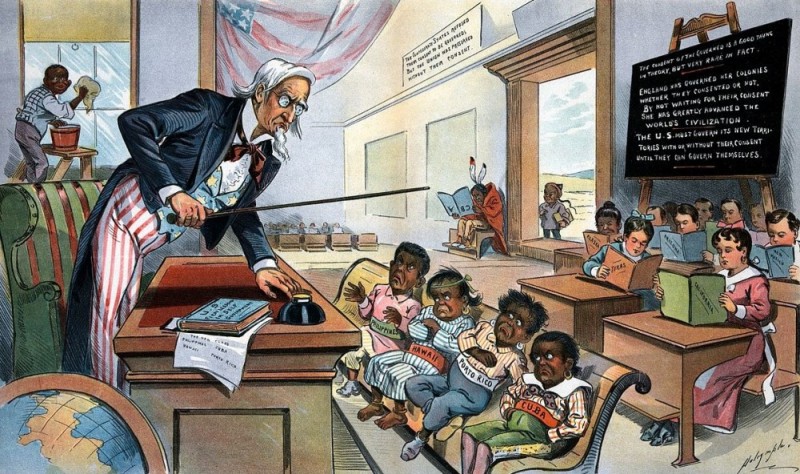
Cartoon: canadiandimensions.com Caricature showing Uncle Sam lecturing four children labelled Phillippines (who appears similar to Phillippine leader Emilio Aguinaldo), Hawaii, Porto (sic) Rio, and Cuba in front of children holding books labelled with various US states. In the background are an American Indian holding a book upside down, a Chinese boy at the door and a black boy cleaning the window. Originally published on p. 8-9 of the January 25, 1899 issue of Puck magazine.