Category: Politics & Society

  • “Aapada mein Avasar”: Examining India’s Engagement with the International Community Amidst the Pandemic

    “Aapada mein Avasar”: Examining India’s Engagement with the International Community Amidst the Pandemic

    [powerkit_button size=”lg” style=”info” block=”true” url=”https://admin.thepeninsula.org.in/wp-content/uploads/2022/05/TPF-Issue-Brief-Aapada-mein-Avasar-1_compressed-2.pdf” target=”_blank” nofollow=”false”]
    Download PDF
    [/powerkit_button]

    Abstract

    Health security has often been considered an issue of “low politics”. However, in the past two years, the global economy has suffered the most since the Great Depression and global supply chains have been hampered. The developed countries were caught off-guard at par with the rest of the world with global resource inequities at display. As the developed world resorted to “medicine nationalism” and “vaccine nationalism,” their credibility as “global leaders” was sharply questioned. Amidst this, the allegations of the pandemic’s origins generated reactions from an emergent China which stopped concealing its geopolitical ambitions and adopted an unapologetically aggressive posture. Moreover, the credibility of a prominent international organization, the World Health Organization, in terms of its inability in notifying and managing the pandemic was heavily criticised. Each of these occurrences having emerged from a global health crisis has unexpectedly altered the prioritization of matters in the international order, and thereby international diplomacy.

    With the developing and least developed countries deprived of critical medical supplies due to hoarding by developed countries – India’s active engagement in medical diplomacy in the initial phase garnered international appreciation. While it cannot be looked at in a transactional sense, it visibly helped India push for its geopolitical interests in the middle of a global crisis – finding the adequate avasar (possibilities) in the ongoing aapada (crisis). Although flaws on the domestic front existed during the first wave, their impact on India’s medical diplomacy was limited. However, a domestic crisis during the second wave turned out to be an eye-opener and prominently impacted foreign policy initiatives. Considering the lessons so learnt and applied in managing the third wave, this paper examines the tremendous domestic potential of India, while also looking at its historical legacy. In doing so, it emphasises the relevance of domestic affairs as a determinant of successful medical diplomacy outreach – thereby impacting the larger foreign policy objectives.

    Introduction

    While health security has often been relegated as a low-priority issue in the geopolitical landscape, the last two years have unprecedentedly changed everything. A majority of developed nations have appeared helpless in managing the human catastrophe thereby resorting to vaccine and medicine protectionism. To put this on record, over six million people worldwide have lost their lives (COVID Live – Coronavirus Statistics, 2022) during these two years – with the maximum number of lives lost in the United States of America. The global economy has suffered the most since the Great Depression as a fallout of extended total lockdowns that hampered global supply chains. Moreover, an unexpected, unrealised over-dependency of global supply chains on a single country’s economy – China – caught the international community unprepared. Gradually, newer possibilities and threats have emerged through a changing character of the global economy, society, as well as politics and warfare – each of these shifting to the virtual domain.

    [powerkit_button size=”lg” style=”info” block=”true” url=”https://admin.thepeninsula.org.in/wp-content/uploads/2022/05/TPF-Issue-Brief-Aapada-mein-Avasar-1_compressed-2.pdf” target=”_blank” nofollow=”false”]
    Read More
    [/powerkit_button]

    Feature Image Credits: ABC

  • Urdu, Hindu Attire, Abrahamisation | It’s much ado about nothing

    Urdu, Hindu Attire, Abrahamisation | It’s much ado about nothing

    Urdu in India seems to have suffered because of a mistaken identity, and has had a decline from the time Pakistan declared Urdu as her national language

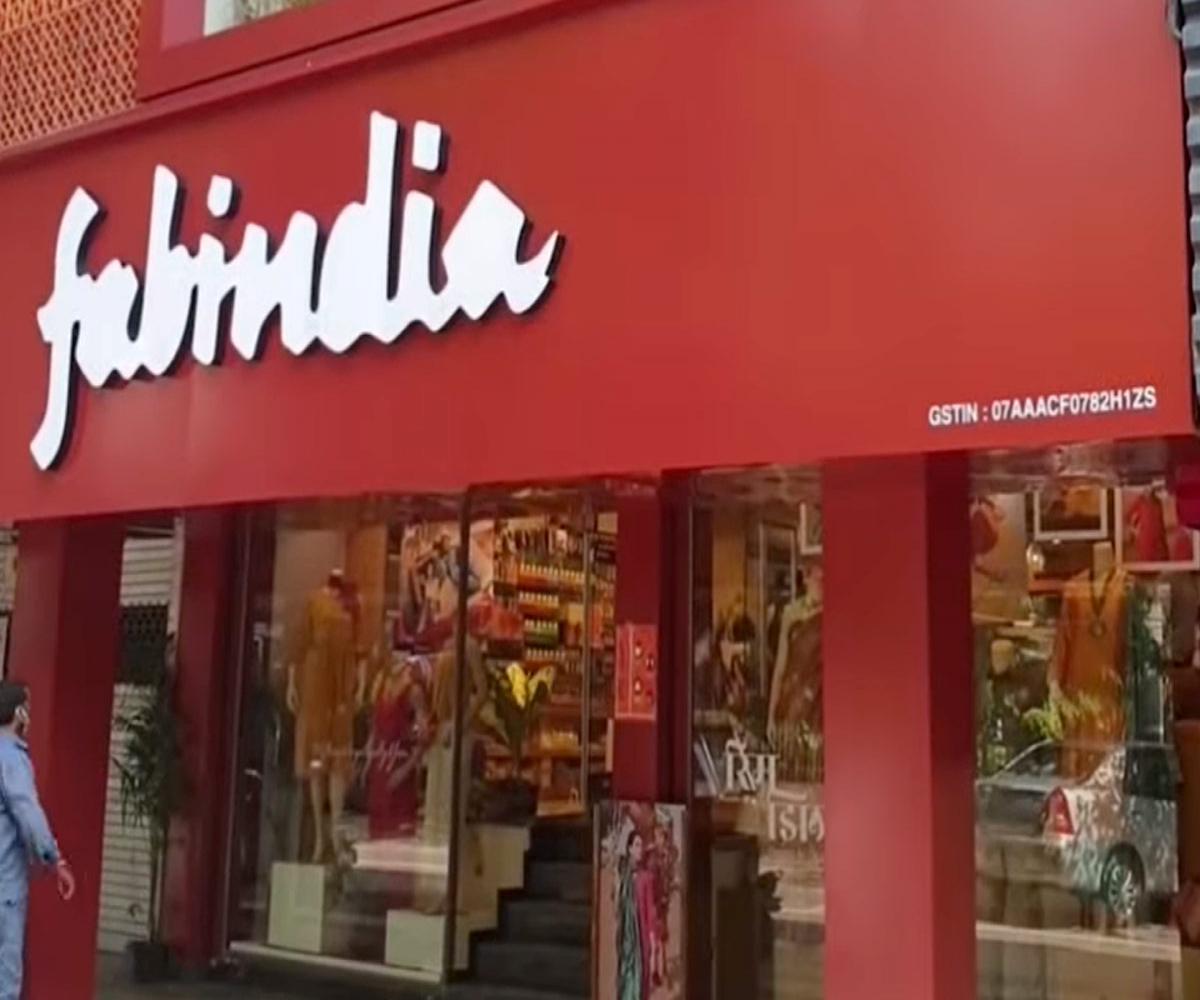
    Reacting to the Fabindia’s ‘Jashn-e-Riwaaz’ advertisement, on October 18 Bharatiya Janata Party (BJP) leader Tejasvi Surya, who is also president of the Bharatiya Janata Yuva Morcha, and a member of the Lok Sabha from Bengaluru, called it a ‘deliberate attempt of abrahamisation of Hindu festivals, depicting models without traditional Hindu attires….’. For those who are unfamiliar with the term ‘Abrahamisation’, a simple explanation, as conceived by some in the Right wing, is: ‘the process by which tenets of Hinduism are modified to have features of monotheistic religions (Judaism, Christianity and Islam)’.

    In what way does the advertisement amount to abrahamisation? Surya says the models are without traditional ‘Hindu attires’. This is not true by any stretch of imagination, as none — none — can have or provide a single monolithic picture of what constitutes ‘Hindu attire’. This argument in itself is both ambivalent, and supercilious. We shall get back to the attire squabble in a bit.

    What to Surya’s mind is more abhorrent, and prompts him to utilise the moniker ‘abrahamisation’ could be the phrase ‘Jashn-e-Riwaaz’, which undoubtedly is a Urdu phrase. Unfortunately, anything that is even remotely connected with Urdu raises the hackles of the Right wing in India. The entire rub as regards the advertisement has to do with this Urdu phrase, as by extension, anything that relates to Urdu gets identified with Muslims.

    It is that what appears to prompt Surya to mark out the advertisement as an attempt at ‘abrahamisation’. If this is the case, the attire has been used as a camouflage to attack the Urdu rendering in the advertisement. Let us dwell deeper on this association of Urdu with Muslims, and analyse to what extent, if any, is such an association (or nexus, depending on how one sees it) valid?

    Urdu Speakers

    The Muslim population of India is about 14 percent, and the proportion of those who speak Urdu as their mother tongue/first language is just about 4 percent. Interestingly, all of these 4 percent Urdu speakers are not necessarily Muslims. So, an overwhelmingly large proportion of Muslims do not have Urdu as their mother tongue/first language.

    Muslims are found all over India, from Kashmir to Kanyakumari and from Arunachal Pradesh in the extreme east to Gujarat in the west. Invariably, all of them speak the local/state languages. So where do Muslims speak Urdu? In a relatively small zone in the central-north areas. Also, small numbers of ‘migrants’ in other states, including the Deccani version, in some pockets in Andhra Pradesh, Karnataka and Telangana.

    Urdu Literature And Journalism

    The very first Urdu newspaper, Jam-i-Jahan-Numa, was published in Calcutta by Harihar Dutta as early as 1822. The weekly Kohinoor was started by Munshi Harsukh Rai in 1850. In 1858, Manbir Kabiruddin started the Urdu Guide. Munshi Nawal Kishore started the first Urdu newspaper, Oudh Akhbar, from Lucknow, also in 1858.

    In 1913 Ganesh Shankar founded Pratap, a famous revolutionary weekly in Kanpur which became a daily in 1920. Now it is published from Delhi. In 1923 Lala Kushal Chand, an Arya Samaji, started the Milap, an Urdu daily, from Lahore. After Independence it was shifted to Delhi, and is still in circulation as the largest Urdu newspaper in India.

    Urdu literature has been overwhelmingly patronised by non-Muslim writers and poets. Some of them are: Krishan Chander, Munshi Premchand, Rajinder Singh Bedi, Raghupati Sahay (Firaq Gorakhpuri), Gulzar (Sampooran Singh Kalra), Khushwant Singh, and so on.

    Clearly, some of the best patrons of Urdu have been non-Muslims. Given all these, where does the Urdu-equals-Muslim equation come from?

    Urdu literature has been overwhelmingly patronised by non-Muslim writers and poets. Some of them are: Krishan Chander, Munshi Premchand, Rajinder Singh Bedi, Raghupati Sahay (Firaq Gorakhpuri), Gulzar (Sampooran Singh Kalra), Khushwant Singh, and so on.


    The Pakistan Angle

    That equation came into prominence in 1947. After Pakistan came into being, surprisingly Urdu became her national language, though overall an overwhelming majority spoke Bangla. In the western wing the autochthones of Pakistan, namely the five main ethnic groups — Punjabis, Pathans, Sariakis, Balochis and Sindhis — all spoke a different language, and had very little to do with Urdu.

    It was just small sections in urban areas, and those who went over as Mohajirs (migrants) from India at Partition, who had Urdu as their mother tongue. It must not be forgotten that the 1971 secession of the eastern wing of Pakistan and the genesis of Bangladesh had a lot to do with the politico-linguistic neglect of Bangla.

    Urdu in India seems to have suffered, and has had a decline from the time Pakistan declared Urdu as her national language. No need to go into the political details of that here, except to point out that Punjabi which had till then adopted the Perseo-Arabic script that Urdu uses, gradually shifted to Gurmukhi script subsequent to Partition.

    The attribution of Urdu as an Islamic/Muslim language, and the generalisation to define a homogenous ‘Hindu attire’ are both problematic, as at its core both are built on false assumptions.

    The Attire Conundrum

    Now to the ‘Hindu attire’ ingredient of Surya’s assertion. The models featured in the advertisement do not by any sort of contention wear anything that could be thought of as non-Hindu, or anything offensive, or for that matter anything to suggest that these are ‘abrahamic’. Where do we look for those traditional ‘Hindu attires’?

    We do not have any comprehensive studies as to what women wore during ancient times in different parts of India, and if there was any unanimity or monolithic depiction as regards their attire. Besides, all over the country there have always been a range of dress patterns, and these did, and still do, cut across the various ethnic, religious and caste groups. To take up just a single example, the dress worn by Kathak dancers is common not just to dancers from various religious groups but also to the different genders. Among many other factors climatic conditions and local availability of fabric — and not religion — often determines attire.

    The attribution of Urdu as an Islamic/Muslim language, and the generalisation to define a homogenous ‘Hindu attire’ are both problematic, as at its core both are built on false assumptions. On a related note, the stigmatisation of Urdu by those who are unaware of its rich past can be seen when English is categorised as a ‘foreign language’.

    This article was earlier published in –  money control

    Image Credit: The News Minute

  • Narcotic Jihad | Can science and reason defeat religious polarisation in Kerala?

    Narcotic Jihad | Can science and reason defeat religious polarisation in Kerala?

    It is surprising that in today’s Kerala the well-educated religious lot, who are expected to have had a smattering of science, and who are expected to be the ones who see reason, are the ones who are raising the bogeys of ‘love jihad’ and ‘narcotic jihad’.

    Bertrand Russell, the great mathematician-philosopher and polymath had famously held that “Religion is something left over from the infancy of our intelligence; it will fade away as we adopt reason and science as our guidelines”. When we reflect on Russell’s quotation and introspect the religious realm in India per se, not to talk about contemporary events in Kerala, it is quite disconcerting and distressing; and a few crucial issues ensue from there.

    First and foremost, either Russell was wrong in his assertion as regards the fading away of religion in the wake of the adoption of reason and science by humans, or his understanding and definition of ‘religion’, ‘intelligence’, ‘reason’, and ‘science’ were at variance with the general, and usually acceptable, notions/definitions that are prevalent in civic society at large.

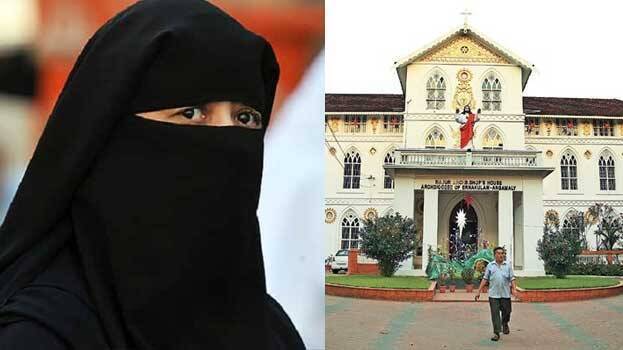
    It is rather surprising that in today’s Kerala the well-educated religious lot, the clergy, who are expected to have had a smattering of science, and who are expected to be the ones who see reason, are the ones who are raising the bogeys of ‘love jihad’ and ‘narcotic jihad’, notwithstanding the fact that probes by different agencies, including the National Investigation Agency, have debunked such allegations.

    The clergy concerned, particularly the bishop of Pala and other priest(s) who have indulged in such rhetoric, may not necessarily have played on into the hands of the Sangh Parivar, but have certainly touched the hearts and endeared themselves to the latter to the extent that the latter are ecstatic. Also, they have, along with other Right-wing groups, extolled the bishop of Pala, and have extended their support to him.

    However, something that has been very heartening and positive in this dark and murky scenario has been the bold and defiant stand of a group of nuns who not only spoke out against the bishop but also walked out of the mass of the priest who preached hate by going to the extent of beseeching his flock to boycott Muslims traders as also Muslim autorickshaw drivers.

    One would not have been surprised if insinuations and allegations of ‘love jihad’ and ‘narcotic jihad’ were made by Right-wing extremist groups because it is, inevitably, their wont to do so. But coming from the clergy in a state which has historically seen relatively amicable and amiable relations between Muslims and Christians wherein they have prospered together, belies logic.

    Pre-Islamic Arab contact with Kerala and the rest of the west coast of India dates back to the ‘Before Christ’ era, which gradually transformed into the Islamic one from the seventh century AD onwards.

    The oldest mosque to be built in the Indian subcontinent was the Cheramaan Juma Mosque in Methala, Thrissur district, in 629 CE. It is significant to point out that the north-centric way of looking at and referring to Islam in India by certain historians is quite misplaced. By the time Islam made any impact in the northwest and north of India, full-fledged Islamic societies had been formed in Kerala that extended beyond and along the Coromandel Coast in Tamil Nadu and spread towards South East Asia.

    Similarly, the Christian connection and the advent of Christianity in Kerala go back to 52 CE. For centuries, these religious groups, namely, Christians and Muslims, have coexisted and inhabited common spaces all over Kerala, along with the pre-existing indigenous communities. Also, there has been a high degree of acculturation between the various religious groups in terms of language, food, clothing, and other cultural practices including in the religious realm.

    There were, no doubt, skirmishes between the Christians and Muslims with the arrival of the Portuguese during the late fifteenth and early sixteenth century, but these have to be treated more as aberrations for economic gains than something that disturbed the overall ambiance of peace and communal harmony. The erstwhile situation as regards peaceful coexistence between the different religious communities prevailed in Kerala in spite of quite a few communal riots in other parts of India, both before and after the Independence.

    It is felt in some circles in Kerala that due to the COVID-19 pandemic and the restrictions as regards congregations, the footfalls have declined to result in drastically reduced revenues in the churches, and that has made some clergy feel insecure; and one way of getting back the faithful could be to polarise the communities in the expectation that would help in consolidating their own followers.

    Of late, the anti-Muslim rant that has emanated in Kerala is not confined to the borders of the state. The overt and manifest support in social media and through videos, for Israel’s bombing of Gaza during the recent conflict vis-à-vis the Palestinians, too, is, at one level quite disturbing, and at another level, points to the mindset that such perpetrators are embedded in.

    The proclivity to reduce the Palestinian identity to just a Muslim/Islamic one is one of the most irrational ways of looking at a people and explicating their ethnicity. Christian Palestinians too are at the forefront in their resistance to Israeli imperialism, and the occupation of Palestine. The well-known academic and crusader for peace, late Professor Edward Said, was one such.

    This article was published earlier in moneycontrol.com

    Featured Image: keralakaumudi.com

  • Religion and Governance: An Important Lesson from India’s History

    Religion and Governance: An Important Lesson from India’s History

    The fortunes of India had irrevocably changed on May 29, 1658, when two Indian armies clashed on the dusty fields of Samugarh, near Agra. India’s history changed forever. Aurangzeb’s victory over his brother Dara Shikoh marked the beginning of Islamic bigotry in India that not only alienated the Hindus but also the much more moderate Sufis and Shias as well.

    Aurangzeb’s narrow Sunni beliefs were to make India the hotbed of Muslim fundamentalists, long before the Wahabis of Saudi Arabia sponsored the fanatics of the Taliban and the Islamic State. It was not only a battle for the Mughal throne but also a battle for the very soul of India

    Aurangzeb’s victory here and other successful campaigns resulted in the creation of the greatest and biggest imperial India till then. But the seeds of India’s collapse were sowed.

    In 1620 India had the world’s greatest national income, over a third of it, and was its greatest military power as well. It was the envy of Europe. The European traders came to seek Indian goods for their markets. But no sooner was the iron hand of Aurangzeb no more that his imperial India began to disintegrate. The iron hand that ruled by dividing rather than uniting and that sought to impose a hierarchy by theological preferences gave rise to much discordance. But for Aurangzeb, Shivaji Bhonsle might have remained a minor western Indian feudatory? There are important lessons to be learned from all this for those who rule and seek to rule India.

    The weakening central rule and profit-seeking peripheral kingdoms allowed European trading posts to be established. Weakening regimes led to the trading posts raising armed guards. Soon the overseas trading companies began warring each other and with so many minor states now free to make their destinies joining hands with one or the other it was the Europeans who got gradually got established. The Anglo-French wars of the Carnatic were fought by Indian armies beefed up by trading company levies. The East India Company of the British ultimately prevailed and the French, Dutch, Portuguese and Danish got reduced to pockets.

    A hundred years later, in 1757, the era of total foreign supremacy over India began when the East India Company’s troops drawn from South India and officered by English company executives defeated the army of Nawab Siraj-ud-Daulah at Plassey (Palashi) in Bengal, with the now usual mix of superior drilling, resolute leadership and a bit of treachery. At a crucial time, Mir Jaffar and his troops crossed over. India lay prostrate before Robert Clive.

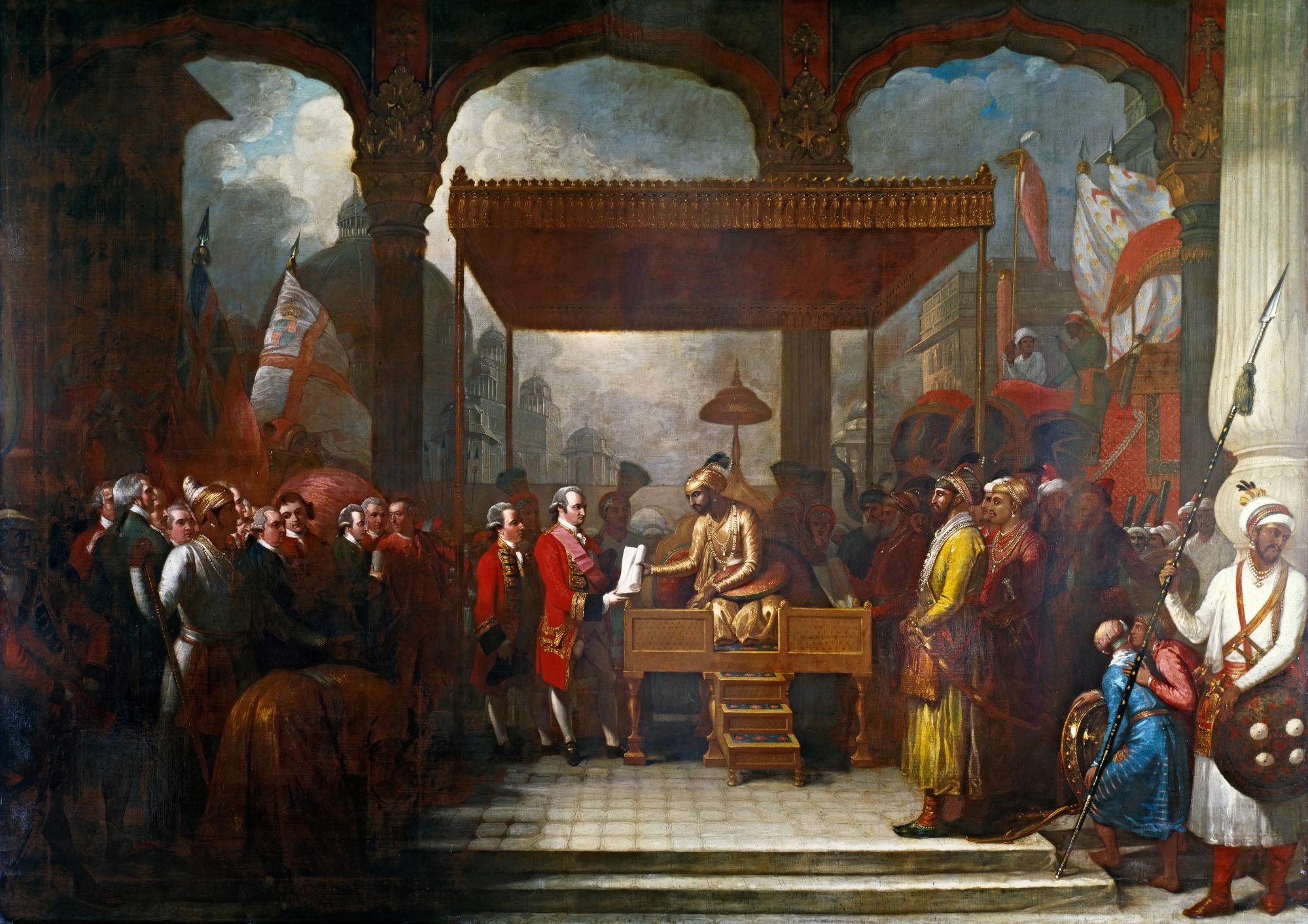
    Within a decade, on August 12, 1765, Clive obtained a firman from the then Mughal Emperor, Shah Alam, granting the Diwani of Bengal, Bihar, and Odisha to the Company. A Muslim contemporary indignantly exclaims that so great a “transaction was done and finished in less time than would have been taken up in the sale of a jackass”. By this deed the Company became the real sovereign ruler of 30 million people, yielding a revenue of four millions sterling. The John Company grew from strength to strength, and by 1857 the Grand Mughal was reduced to his fort conducting poetry soirees. It was the golden age of Urdu poetry.

    The events of 1857 led to the formal establishment of India as a directly ruled colony of the British empire. It was yet another epochal event. India changed, for the better and for the worse. Once again India absorbed from outsiders, as it absorbed from the Dravidians, Aryans, Greeks, Persians, Kushans, Afghans, Uzbeks, and all those who came to seek their fortunes here. The British were the only ones who came to take away its vast wealth in a systematic manner. The wealth taken from India to a great extent financed the Industrial Revolution in England.

    From then to another epochal year ending with seven took ninety years. In 1947, India became independent. Its GDP is now the world’s third-biggest. In a few decades, it could conceivably become its biggest. But have we learned any lessons from history?

    Given its abject failures on the economic front, the BJP/RSS regime in New Delhi is now pushing India towards a Hindutva nationhood, by seeking to victimise a minority for the perceived wrongs and slights of the past. An intolerant religion can never be the basis of nationhood and national unity in India. The legacy of Aurangzeb tells us that. Aurangzeb had created the greatest empire that India had seen since Ashoka the Great. But it didn’t take very long for it to dissipate. In the hundred years that followed, a foreign mercantile company gained control over all of India.

    The BJP under Narendra Modi might keep gaining electoral dominion over all or most of India. But has the BJP learned any lessons from history? Does the PM  want to become the Hindu Aurangzeb? What is worrisome is that we know well that history is not Narendra Modi’s forte.


    This article was published earlier in Deccan Chronicle. The opinions expressed in the article are the author’s personal views and do not reflect TPF’s institutional position or analysis.

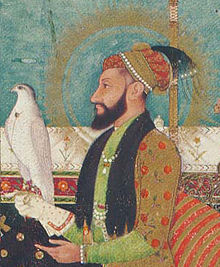
    Featured Image: Shah Alam conveying the grant of the Diwani to Lord Clive. en.wikipedia.org

  • What Putin nemesis Alexei Navalny is, and what he is not

    What Putin nemesis Alexei Navalny is, and what he is not

    Anatol Lieven highlights America’s blundering tendency to view world personalities in typically American lens, ignoring the realities of them being citizens of their countries and focusing on their national interests . He uses the examples of Russia’s Navalny and Myanmar’s Aung San Suu Kyi to make his point emphatically. His analysis is relevant to other countries as well. 

    This article was published earlier in Responsible Statecraft

    It is very human and natural to admire courage and resolution — these are qualities that Russian opposition leader Alexei Navalny possesses to a quite remarkable degree. It is also natural to sympathize with suffering — and Navalny has suffered and very nearly died for his beliefs and goals. And of course it is natural to feel disgust with the increasingly criminal behavior of the Putin administration in Russia.

    However, admiration, sympathy and disgust are emotions, not arguments or analysis, and should be employed with great caution in the formulation of state policy.

    In his confirmation hearings, now-Secretary of State Anthony Blinken pledged Biden administration support for Navalny and called him “a voice for millions and millions of Russians.” Statements by the U.S. embassy in Moscow on the Navalny movement have come very close to calling for the end of the present Russian government.

    Recent weeks have seen a tremendous outpouring of American sympathy for Navalny and his movement against the Putin administration. In his confirmation hearings, now-Secretary of State Anthony Blinken pledged Biden administration support for Navalny and called him “a voice for millions and millions of Russians.” Statements by the U.S. embassy in Moscow on the Navalny movement have come very close to calling for the end of the present Russian government. The semi-official American Radio Free Europe/Radio Liberty is openly and passionately supportive of Navalny’s movement. Richard Haas, President of the Council on Foreign Relations, proposed that Navalny be awarded the Nobel Peace Prize.

    Such overt U.S. support is not wise. In the first place, it may actually hurt the cause of progressive reform in Russia. The Russian government, like those of Iran and China, has relentlessly propagated the idea that the opposition is being backed if not bankrolled by Washington in order to weaken their countries; and indeed, Russian liberals have done themselves terrible damage by allowing themselves to be cast as representatives of the West, not of the Russian people.

    The second, very familiar problem is the hypocrisy involved. In the latest volume of President Obama’s memoirs, “A Promised Land,” he describes how Hillary Clinton — who relentlessly presented herself in public as an advocate of spreading democracy — argued that Washington should support Egyptian President Hosni Mubarak’s brutal 2011 crackdown on Arab Spring opposition protests on the grounds that he was a U.S. ally and his fall would lead to chaos and Islamist revolution. In her early public statements, as well, she warned against hastening Mubarak’s exit.

    In proposing Navalny for the Nobel Peace Prize, Haas seems to have forgotten the last time the honor was given to an opposition politician.

    An even greater problem presents itself when one looks at the actual politics of some of the opposition figures who draw such waves of American and Western enthusiasm. In proposing Navalny for the Nobel Peace Prize, Haas seems to have forgotten the last time the honor was given to an opposition politician. The award to Aung San Suu Kyi in 1991 was supposed to be for “her non-violent struggle for democracy and human rights… one of the most extraordinary examples of civil courage in Asia in recent decades.”

    After Suu Kyi joined the government in Myanmar she’s been damned in the West for her failure to prevent or condemn the savage state persecution of Myanmar’s Rohingya minority, and most of her human rights awards (though not the Nobel prize itself) have been revoked.

    After Suu Kyi joined the government in Myanmar she’s been damned in the West for her failure to prevent or condemn the savage state persecution of Myanmar’s Rohingya minority, and most of her human rights awards (though not the Nobel prize itself) have been revoked. What her previous Western admirers are not doing — what they almost never do — is to ask themselves why they so completely misunderstood her before.

    But she is a Burmese politician, not a Western democratic leader, and in building her up as a liberal heroine, the Western media and activists willfully ignored not just the political realities of Myanmar, but her own Burmese nationalist antecedents.  

    (Just in the last 48 hours, Suu Kyi has been detained in an apparent military takeover of her democratically elected government and Biden is predictably mulling over his options for reviewing sanctions and taking “appropriate action.”)

    Like Navalny, Suu Kyi is indeed an exceptionally brave and determined human being and in her way a fine leader; just as Navalny might make a fine Russian president. But she is a Burmese politician, not a Western democratic leader, and in building her up as a liberal heroine, the Western media and activists willfully ignored not just the political realities of Myanmar, but her own Burmese nationalist antecedents.

    There are two factors at work here. The first is a basic human one. Courage, like hard work and self-sacrifice, is a quality that it is humanly impossible not to admire, but the possession of it says absolutely nothing at all about the goals to which they are put. All the leaders of the ghastly totalitarian revolutions of the 20th century were exceptionally brave and determined men.

    The second factor relates to some enduring and seemingly incorrigible flaws in most Western reporting and analysis. One of them is the tendency to personalize issues, whereby “Putin” is used as a synonym for the whole Russian state, and “Navalny” is now being presented as a synonym for the entire, enormously disparate Russian opposition. The merest glance at the groups represented at the pro-Navalny demonstrations reveals that together with genuine liberal democrats, there are also numerous Communists and extreme nationalists whose anti-Western positions are much more extreme and reckless than those of Putin himself. As Aleksandr Baunov of the Carnegie Moscow Centre has written:

    Saturday’s protests were undeniably anti-regime, anti-elite and anti-corruption but not necessarily liberal, pro-Western and pro-democracy. It’s not surprising that such protests frighten not only the authorities, but also successful members of society: even those who don’t consider themselves supporters of the regime.

    In their blind demonization of Putin, and consequent sanctification of Navalny, Western commentators seem to be implicitly assuming that should Navalny win power (which he almost certainly will not), Russia’s foreign policy would change radically in a pro-Western direction. This is nonsense. Navalny’s supporters are backing him out of (entirely justified) fury at Russian state corruption, lawlessness, and economic failure, not to change foreign policy. Every independent opinion poll has suggested that Putin’s foreign and security policies have enjoyed overwhelming public support; and above all, there is very little in Navalny’s own record to suggest that he would change them.

    As a 2013 essay by Robert Coalson in The Atlantic documented, Navalny supported the Russian war with Georgia in 2008. He has expressed strongly ethno-nationalist attitudes towards the Caucasian minorities in Russia, and previously made opposition to illegal immigration a key part of his platform. In October 2014 he suggested to a reporter that if he became president he would not return Crimea, which was annexed by Russia earlier that year, to Ukraine (though he also said in that same interview that, “It’s not in the interests of Russians to seize neighboring republics, it’s in their interests to fight corruption, alcoholism and so on — to solve internal problems.”

    Rather like Donald Trump concerning American interventionism, Navalny has strongly condemned Russian military intervention in the Middle East on the grounds of cost and irrelevance to real Russian interests; but (as with Trump), that does not necessarily say much about what he would actually do if in power. Apart from anything else, Russia, like the U.S., has a foreign and security establishment “Blob” with firmly established and deeply held collective views on Russia’s vital interests.

    It is to remind Americans that he is a Russian politician, not an American one; that he will respond to Russian realities, not Washington fantasies; and that in the end, U.S. administrations will have to deal with whatever government is in power in Moscow.

    To recall this is not to condemn Navalny. It is to remind Americans that he is a Russian politician, not an American one; that he will respond to Russian realities, not Washington fantasies; and that in the end, U.S. administrations will have to deal with whatever government is in power in Moscow. Russian governments will defend Russian interests, along lines that are mostly quite predictable if one knows Russian history and culture. The sooner we realize this, and stop setting up plaster saints in the hope that they will perform miracles, the better for U.S. foreign policy overall.


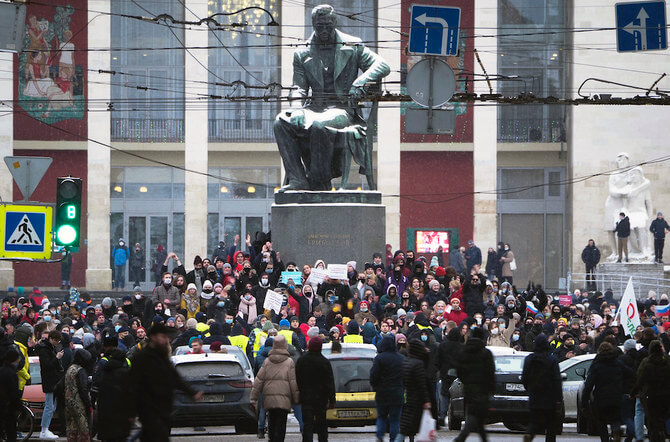
    Feature Image – Protesters gather near a monument of Russian playwright Alexander Griboyedov during a protest against the jailing of opposition leader Alexei Navalny in St. Petersburg, Russia, Sunday, Jan. 31, 2021. www.arabnews.com
    Image – 
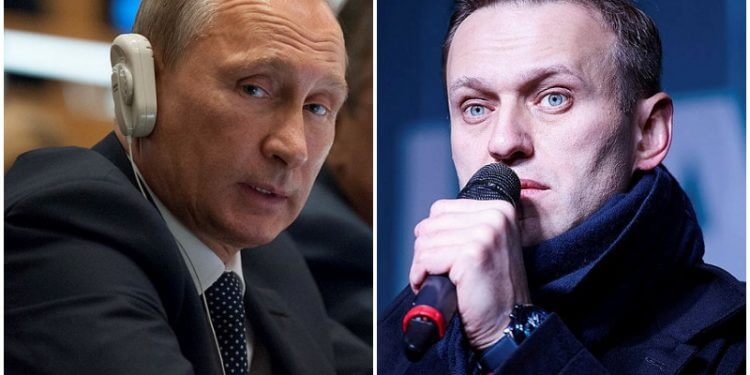
    Navalny and Putin: www.hilltimes.com
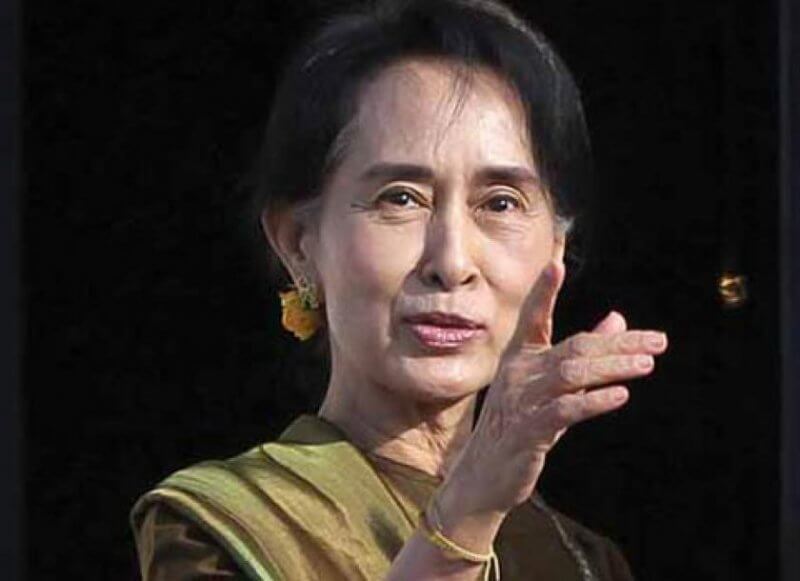
    Image – Aung San Suu Kyi: www.mmtimes.com

  • Nationalism Today: A Threat to Democracy and Multilateralism?

    Nationalism Today: A Threat to Democracy and Multilateralism?

    The idea of ‘nationalism’ and a sense of cohesive national identity has existed perhaps longer than the system of modern nation-states came to be. Except for a few, every empire, kingdom, and the territorial state tried to legitimise and conceptualise its authority in the minds of its citizens through ideology. A phenomenon that recurs throughout history, nationalism has only recently taken on the connotations it holds today: a malignant force that separates and divides rather than unites and deteriorates rather than improves.

    A phenomenon that recurs throughout history, nationalism has only recently taken on the connotations it holds today: a malignant force that separates and divides rather than unites and deteriorates rather than improves.

    In the contemporary context, this phenomenon presents across the world and appears to be accelerated by the current global pandemic. If one begins their survey at the Westernmost end, it is easy to witness this wave all over: in the United States, ahead of the elections, with Trump’s white supremacist, protectionist agenda underlined by anti-immigration measures; further in Europe, the rise of nationalist parties in Italy and Spain; Russia’s stifling of dissent and opposition under the mandate of national security, Viktor Orban’s rule by decree-law in Hungary to take over complete control in the Covid-19 backdrop- and further east, India’s and China’s majoritarian movements reflecting minority suppression and territorial aggression respectively.

    Considering these developments, the looming health crisis appears to be the catalyst for the rise of this aggressive, exclusionary brand of nationalism, or as observers have called it, hyper-nationalism. But looking beyond the surface one can discern the vast backdrop of a competitive international system that allowed these movements to become the popular political tool of the time.

    The past decades were characterised by some major changes in the international order; most importantly, the transition from a unipolar world under American hegemony to an emerging multipolar polar one with the rise of Asian powers and a Russia hoping to regain its superpower status. Economic ebbs and falls, the climate crisis, and a shift from multilateralism and globalism was the backdrop against which China grew as a rule-maker in the international system. China’s rapid rise as a global power gives the spectre of a possible bipolar world.

    Akin to the Cold War, wherein ideological systems competed, this decade in the post-COVID-19 world is also marked by alliances, power clusters, challenges to the globalised economy, and the visible fragility of the liberal democracy. While nations like the US prompt the liberal world to identify China as the face of the abstract systemic threat to the framework of democracy, liberalism and multilateral cooperation, the real danger may lie elsewhere. Besides coronavirus and the human tragedy, it evoked, the endemic threat to the norms and values of the democratic order is most likely internal and to be found in the political weaponry of modern democracy.

    What does nationalism mean as a value? To a nation-state, creating a sense of allegiance to the nation-state is extremely important and vital to its survival. Nationalism may be a force of resistance against oppressive authorities, or toward self-determination. The Irish and Indian national movements against colonisation, for instance, were nationalistic struggles that established self-governance in these countries and were spearheaded by the people themselves. However, nationalism may also manifest as state-led, systemic, and top-down approach under the authority of a populist leader who commands the support of many. An example is Mussolini’s fascist movement in Italy, prompted by the poverty and economic downfall of the interwar period.

    Triggered (although not caused) by extreme crises like the pandemic, this kind of nationalism uses a nationwide problem to appropriate control and stir political unrest.

    What we see in the world today is ostensibly the latter: aggressive, top-down nationalism where individuals and groups have little organic agency or innovation. Triggered (although not caused) by extreme crises like the pandemic, this kind of nationalism uses a nationwide problem to appropriate control and stir political unrest. These forms of control may involve excessive use of the police apparatus to restrict movement, a suspension of electoral or democratic processes and accountability mechanisms, or the use of the pandemic to enforce identity politics against minorities. In India, the police crackdown on the Shaheen Bagh riots in January 2020, a series of protests against the discriminatory Citizenship Amendment Act, is an example along with the United States’ successive episodes of racially motivated police brutality against African Americans. In Hungary, Orban has been pushing towards a regionalist, Christian, Central European community at the expense of minorities and immigrants (while heavily militarising Budapest in the wake of the coronavirus pandemic).

    This causality, somewhere in the 21st century, seems to have weathered down and given way to   monolithic ideas of territoriality, authority, centralisation, and capitalism, propelled especially by the role of contemporary social media.

    Nationalism has historically been espoused with democratic revolution and civil rights movements. In the French Revolution, the Irish Independence movements, and the colonial liberation movements of many other colonies, nationalist movements allowed a people to unite for a secular, democratic cause: self-determination. Even as of the late 20th century, nationalism served to demolish imperialism, colonialism, and dictatorships giving rise to civil rights, suffrage, labour rights, and even the welfare states. This causality, somewhere in the 21st century, seems to have weathered down and given way to   monolithic ideas of territoriality, authority, centralisation, and capitalism, propelled especially by the role of contemporary social media. The question that we must ask is this: Is the current flavour of nationalism serving any advantage to strengthening the democratic apparatus? Does it help make our leaders accountable, our parties representative, and our economies more resilient to face unexpected crises?

     
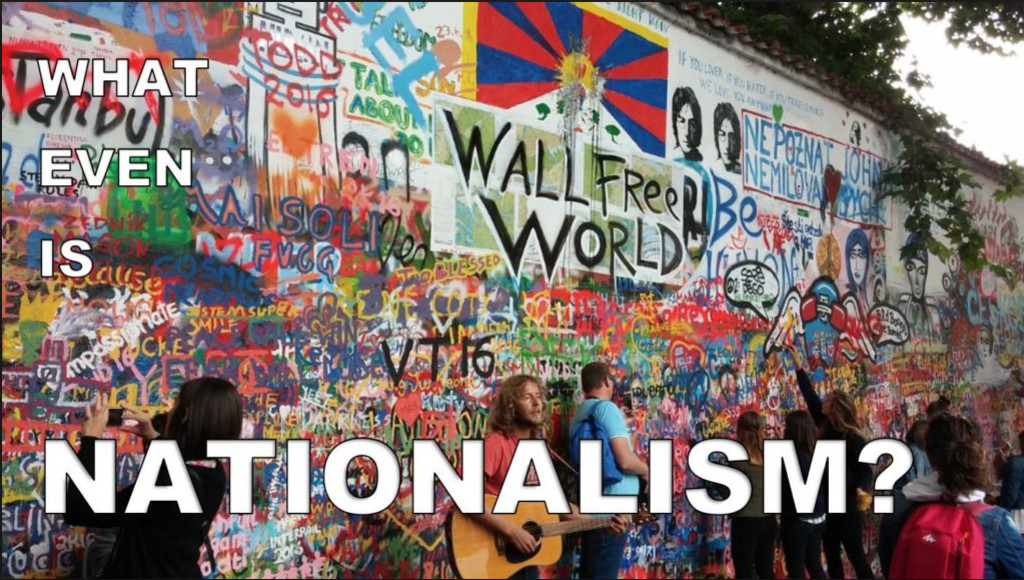
    Image credit: vocal.media

  • Local Protests: A New Status-Quo in Political Lifestyle?

    Local Protests: A New Status-Quo in Political Lifestyle?

    Hong Kong and Chile convulse, Lebanon possibly spiralling into a civil strife, and sanctions induced discontent paralysing Iran, a pattern of global protests is increasingly evident. The global political landscape is currently marked by frequent mass protests, and this wave is geographically much broader and unfolding in countries at different stages of development. Unlike earlier protest movements that aimed at radical political change and revolutionising the existing order, the modern demands abandon this narrative of overthrowing the system instead aiming for democratisation of the established institutions. In other words, the anti-government protests cropping up in various parts are not trying to dismantle the democratic structures but to redefine its scope and depth.

    New Wave of Protests – questioning inept governance

    In contrast to the previous waves of uprising like the Pink Tide in Latin America or the Arab Spring, that was spreading in a particular region with similar agenda, the recent protests are occurring in different zones and is marked by the uniqueness of initial triggers and demands put forth by the protestors. In Lebanon, the discontent was sparked by regressive taxes proposed (mainly Whatsapp tax) but turned into massive demonstrations, transcending sects and classes, calling for a technocratic government in the backdrop of sectarian political regime, widespread corruption and mishandling of the economy. The Yellow Vest movement in France originally against the fuel tax snowballed into nationwide protests to address the socio economic inequalities, stemming from high unemployment and stagnating economy. Protests in Chile against hiked transport fares escalated to countrywide riots revealing the dissatisfaction with the pro rich growth, heavily privatised welfare system and pro market regime. On observation, these isolated protests by themselves can be a defining feature of the current wave of protests, different from the previous waves that were characterised by common contestations.

    Despite being unrelated events with independent agendas, the countries undergoing mass protests share similar trends of inequality and economic downturns. Further scrutiny beyond the seemingly small initial triggers reveal an evident pattern of economic anger and insecurity in these nations. Experts have suggested that Hong Kong’s pro democracy movement is also fuelled by wide income inequality (highest among developed nations), especially in the last 45 years since its handover to the Chinese. The Latin American region, witnessing the most number of countries breaking into sustained protests, is the world’s most unequal zone. In addition to inequality, sustained unrest in states like Colombia, Catalonia to Iraq and Egypt, the protests are driven by slowing economic growth, mounting public debt and austerity measures. Even in populist and authoritarian regimes, citizens are demanding an end to corruption and restoration of democratic rule of law. For instance, long serving, extremely popular, leftist leader Evo Morales was forced to resign in Bolivia after protests erupted accusing him of undermining democracy to extent his rule. There are increasing clashes against repressive democracy in Russia, and revolts against autocrats in Slovenia and Czech Republic.

    Leaderless or smart mobilization?

    Interestingly, a majority of the modern protests are leaderless, led by students and youth. In Hong Kong, the protests are gaining momentum through the active involvement of the students while in Chile the unrest for systematic change was ignited after school students launched a campaign to end the 4 percent subway fare increase. Niall Ferguson noted that this demographic trend of the young leading the demonstrations is a repeat of the 1960s, which like the present had an excess of educated youth over the number of available jobs. Another similarity amongst the protests is the urban-centric mass unrest. According to migration theorists, uncontrolled urbanisation resulting in rural to urban movements is a major cause for the ongoing demonstrations. Pushed into informal settlements in cities, often ignored by authorities and without basic social coverage, the urban area becomes a ground for discontent. For instance, in Haiti the protests began due to gasoline and food scarcity. Therefore, the socio-economic marginalisation of the urban poor is a significant yet overlooked factor that drives people to the streets. This is also compounded by a lack of faith in the government. More than the poor state policies adopted and prevalent corruption, in some protesting nations, there is deep distrust among the citizens. Hong Kongers believe that their government does not have legitimate powers over Beijing, and in countries like Lebanon, Chile or Ecuador, reversal of the initial triggers did not stop the dissenters from demanding a new government.

    The youth bulge and the shrinking economic opportunities only partly explains the global protests. The reach and accessibility of social media and free messaging apps have exploded in the past decade. In addition to acting as a medium to organise and sustain mass protests, these channels are also used to express political frustrations. Unlike before when media had a monopoly over mass reach, individuals and groups have the capacity to mobilise and garner support over specific issues. While the protests seem unconnected, it is possible to see a copycat element in the way protests are carried out. The coverage of news and faster reach makes it possible for protestors to adopt methods of action that were successful elsewhere. It is also harder for states to contain and repress dissenting voices. Thus, the spread of communicative technology and social platforms offer a conducive environment for protests. 

    Social Media enables activism

    The ability of electronic media to break down physical barriers and bring more events to global audiences might be increasing the visibility of protests, which would have otherwise remained local. Data from GEDLT Project, which has been tracking protests around the world from the past 40 years, reveals that the frequency of protests has not significantly increased. However, the intensity and the length of protests have improved. Despite a spike in these political activities wherein citizens are actively mobilising to pursue their demands, there has been a decline in the success rate of protests. A recent study highlights the staggering decline in success rate of protests from 70 percent in 1990s to 30 percent in 2010. Some highlight the “smart” methods adopted by regimes to prevent and suppress clashes like reinforcing loyalty of the elite, infiltrating and dividing the opposition, etc. For instance, in Lebanon, the initially united protests has created anti protest groups that supports the Hezbollah. Governments are also adopting a strategy of blaming foreigners and outsiders to reinforce support from the public. For instance, China is building a narrative of US backed forces disrupting Hong Kong to get an advantage in the ongoing trade war, which has strengthened after US signed a Hong Kong Human Rights and Democracy law. Iran’s authorities are also blaming outsiders, especially the US, for the violence that ensued after state raising gasoline prices by 50 percent.

    Overall, there is an influx in political activism. Global unrests are now spreading and have significant implications for countries everywhere. With electronic media and its potential for mobilisation, it is now easier to bring issues to national discourse. However, while the willingness and ability of mass political activism to recur and cause disruptions have increased manyfold, its success rates have decreased. It may be said that the political frustrations and the current protests will not bring a major transformation in the political structures but rather it is a new status quo in the nature of political lifestyles.  

    Renuka Paul is a Research Analyst with TPF. She holds a masters in Public Policy.

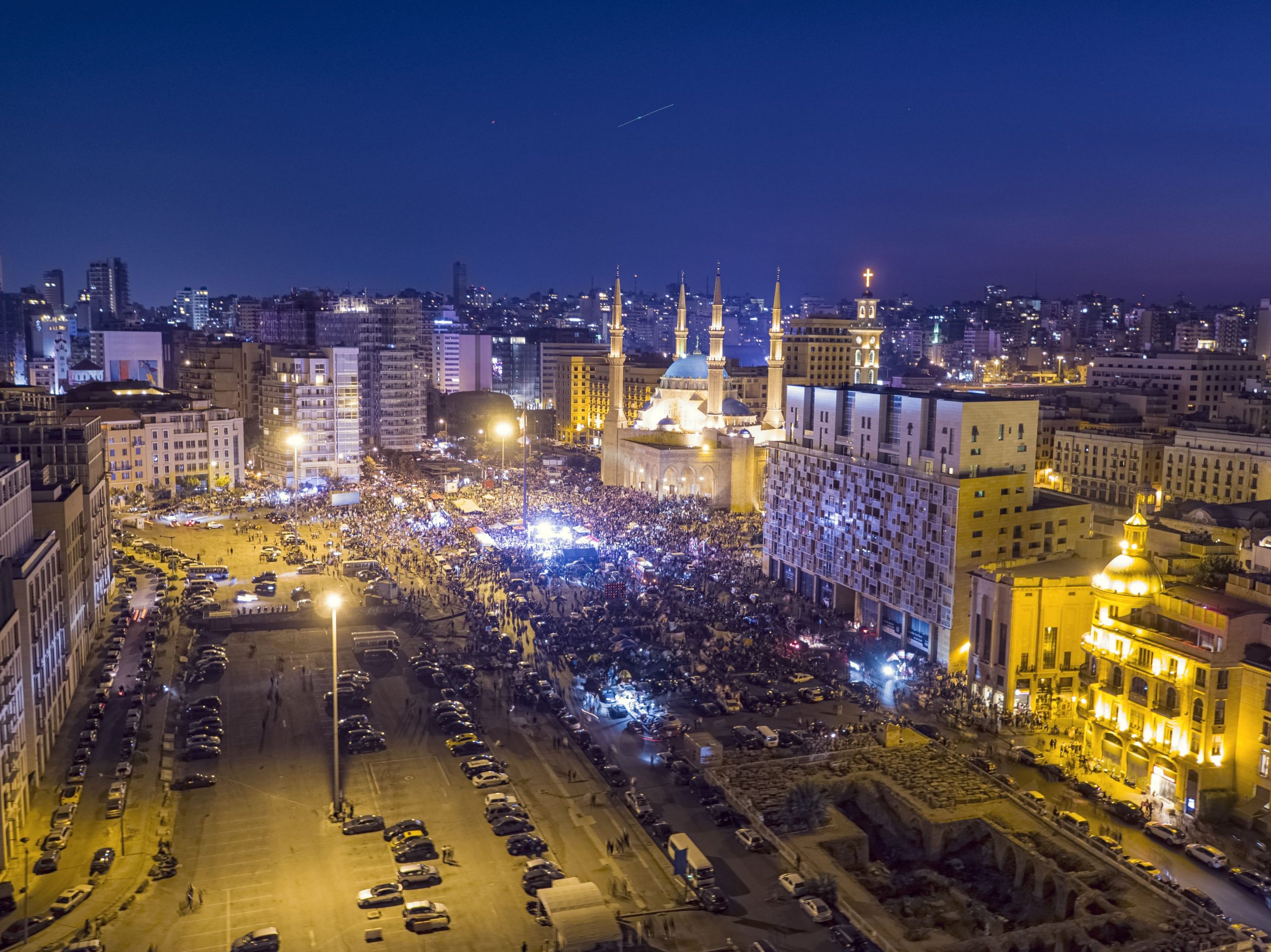
    Image: Aerial night shot of Beirut Downtown, Lebanon during protest against Government, Lebanese revolution – Phot by Ramzi – Licensed from www.stock.adobe.com