Category: Politics & Society

  • The Atheist Who Invented Hindutva: The Mirror Turned Inward

    The Atheist Who Invented Hindutva: The Mirror Turned Inward

    Series Prologue: Part 3

    Series: India’s Strategic Choices and Civilisational Responsibilities

    The ideology that today presents itself as the authentic voice of Hindu civilisation was constructed by an atheist using conceptual tools borrowed from European ethnic nationalism — the very tradition most alien to India’s own pluralist philosophical inheritance.

    In the previous two posts in this prologue, I traced the material foundations and ideological engine of five centuries of Western domination. I argued that India’s civilisational traditions offer a fundamentally different foundation for the emerging world order: pluralist, ethically grounded, and rooted in the universal kinship expressed in Kanian Poongundranar’s “Yaadhum Oorey, Yaavarum Kelir” and the Thirukkural’s vision of Aram, Porul, and Inbam. But intellectual honesty requires that the mirror be turned inward. Because the logic of exceptionalism — the claim to a uniquely chosen identity that exempts a community from the ethical constraints applying to others — is not exclusively a Western pathology. It is a temptation that every civilisation faces when political power finds it useful. And India is not immune.

    The ideology known as Hindutva, which exercises dominant political influence in India today, must be examined with the same analytical rigour we have applied to Western and Zionist exceptionalism. Not because the comparison is comfortable — it is not — but because intellectual integrity demands it, and because India’s civilisational integrity depends on it. The examination is best conducted in three stages, because the ideology was not built in one.

    Stage One: The Founder Who Separated the Nation from the Faith

    The first and most important fact is one the movement rarely acknowledges: “Hindutva is not Hinduism.” Hindutva was founded by an atheist, and it was not, in its original formulation, a religious idea at all. Vinayak Damodar Savarkar, who coined the term in his 1923 pamphlet ‘Essentials of Hindutva’, was a self-declared atheist, rationalist, and materialist. He rejected scripture, ridiculed cow worship and ritual superstition, and championed European scientific temper over what he saw as the dead weight of religious tradition. He was explicit that Hindutva was not Hinduism. He defined a ‘Hindu’ not by religious belief but by three criteria: Pitribhumi, a common fatherland; Jati, a common race or descent; and Sanskriti, a common culture. A Hindu, in Savarkar’s definition, need not believe in any god at all. What mattered was that India was both his fatherland and his Holyland — a territorial and ethnic test, not a spiritual one.

    Savarkar defined a ‘Hindu’ not by religious belief but by three criteria: Pitribhumi, a common fatherland; Jati, a common race or descent; and Sanskriti, a common culture.
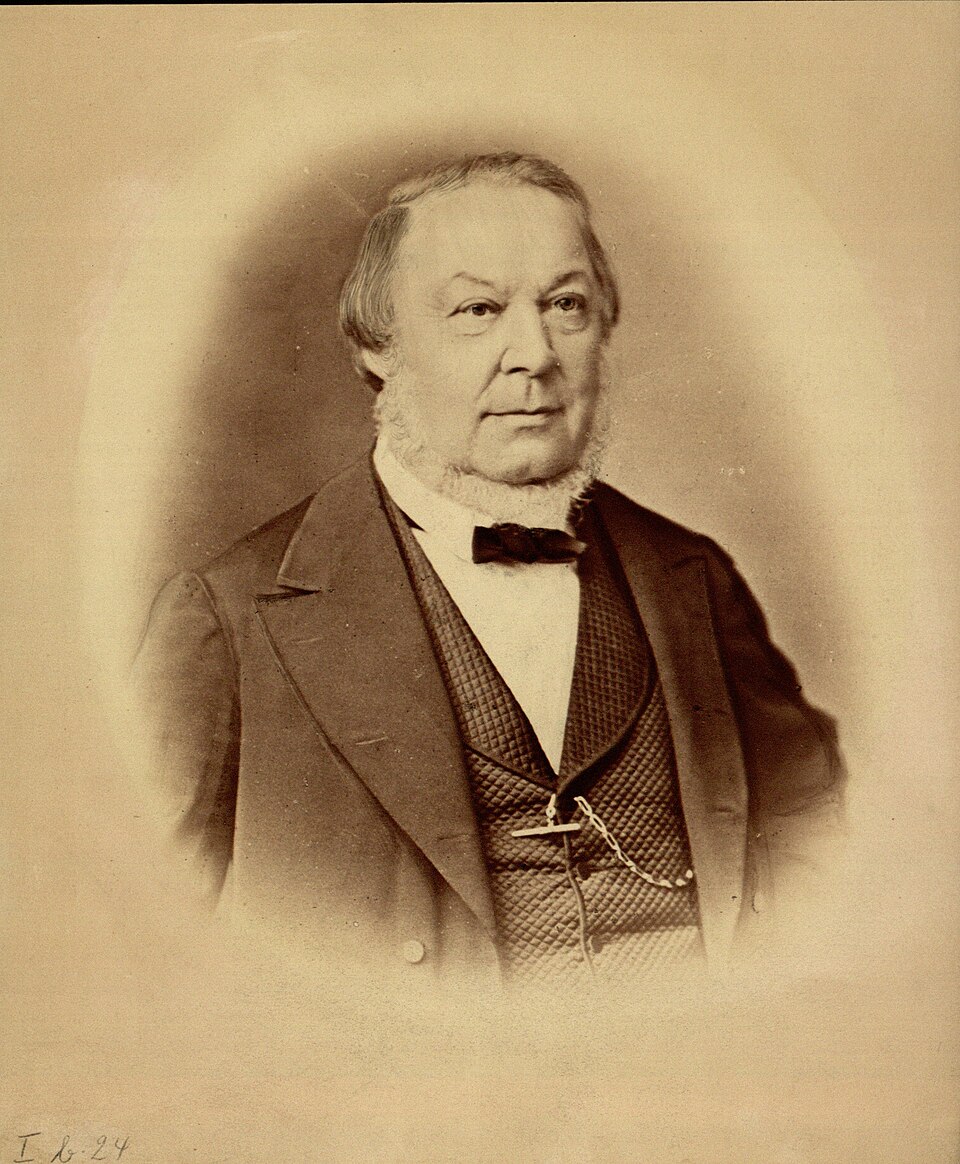
    Johan Caspar Bluntschli


    Where did this conception come from? Not from the Vedas, the Upanishads, or any Hindu philosophical source. It came from Europe. Savarkar’s framework of organic ethnic nationalism drew on the nineteenth-century European tradition of the nation as a racial-cultural organism — the tradition of the Swiss-born jurist Johann Kaspar Bluntschli, who worked within German Staatslehre and distinguished between a nation’s racially rooted ‘principal’ people and those he regarded as alien to it. It drew, too, on the ethnic nationalisms then ascendant across Europe, the same intellectual currents that were hardening elsewhere into far darker forms. This is the first irony, and it is foundational: the ideology that today presents itself as the authentic voice of Hindu civilisation was constructed by an atheist using conceptual tools borrowed from European ethnic nationalism — the very tradition most alien to India’s own pluralist philosophical inheritance.

    Stage Two: The Fusion of Ethnic Nationalism with Religious Sentiment

    If Savarkar’s Hindutva was a rationalist, secular-ethnic nationalism, how did it become the religiously charged mass movement we see today — mobilising temple, festival, deity, and devotional feeling for political ends? The answer is that this was a second and distinct stage, carried out by different men, for a different purpose: mass mobilisation.
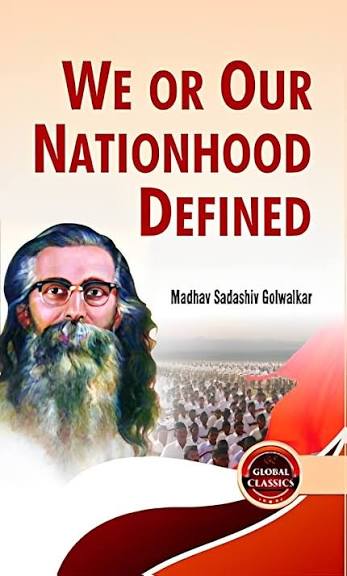
    M S Golwalkar

    M.S. Golwalkar, who led the Rashtriya Swayamsevak Sangh from 1940 to 1973, shifted the register decisively. Where Savarkar grounded the nation in race and territory and had little use for religion as such, Golwalkar infused the project with Hindu spiritual and metaphysical content — the sacredness of Bharat, the dharmic mission of the Hindu people, a civilisational destiny cast in religious language. Deendayal Upadhyaya’s doctrine of ‘Integral Humanism,’ adopted in 1965 and later made the official ideology of the Jana Sangh and then the Bharatiya Janata Party, further anchored the political project in a claimed Hindu spiritual essence. The reason for the shift is not difficult to understand. An abstract theory of ethnic nationalism, however rigorously constructed, cannot move a population. Religious sentiment — festival, symbol, deity, the deep and genuine devotional attachment of hundreds of millions of people — is among the most powerful mobilising forces in human affairs. The movement discovered what its rationalist founder had not prioritised: that to win a nation, you must reach its heart, and in India the heart is substantially religious.

    One need not impute cynical motive to any individual to observe the structural result. A political ideology founded on secular-ethnic lines was, over subsequent decades, fused with the religious devotion of the Hindu masses — and in that fusion, the crucial distinction Savarkar himself had insisted upon, between Hindutva the political-national identity and Hinduism the faith, was quietly erased. The movement that claims to defend Hindu dharma was built on a foundation laid by a man who had little personal use for dharma as religion at all.

    And Savarkar himself never crossed over. He remained an atheist and rationalist to the end of his life — campaigning against ritualism and caste orthodoxy through his Ratnagiri years, opening the Patit Pavan Mandir to all castes, arguing for care of the cow as a useful animal rather than worship of it as a sacred one. His relations with the RSS were notably cool; he scorned its abstention from politics, and Golwalkar’s mysticism belonged to a register the materialist Savarkar never adopted. His death in 1966 was a final statement: he ended his life by voluntarily renouncing food and medicine, justified in a rationalist essay, and his will forbade religious rites — no priests, no rituals, a motorised hearse in place of the traditional bier. The founder kept Hindutva and Hindu religiosity separate for eighty-three years, to the point of a ritual-free funeral. The fusion of the two was not his evolution. It was a second construction, built around him and after him — which is precisely why it can be unbuilt.

    The Zionism Parallel: A Precise Structural Homology

    This two-stage pattern is not unique to Hindutva. It follows, with striking precision, the trajectory of political Zionism — and the comparison is instructive rather than incidental. Theodor Herzl, the founder of political Zionism, was a secular, largely non-religious Viennese journalist. His 1896 work Der Judenstaat is a political and national argument, not a religious one; early political Zionism was in large part a secular nationalist movement, and many Orthodox religious authorities initially opposed it precisely because it presumed to force a national project onto what they regarded as a matter of faith and divine timing. Only later did the movement fuse itself with religious claim — the theological reading of the land, the mobilisation of scripture, and the memory of the Holocaust deployed as a unifying and legitimating force. The structure is identical to the Hindutva trajectory: a secular founder formulates an ethnic-national ideology; later leaders infuse it with religious sentiment and collective memory to achieve mass appeal and to place the project beyond ordinary political criticism.

    The Warning: Where this Trajectory Leads
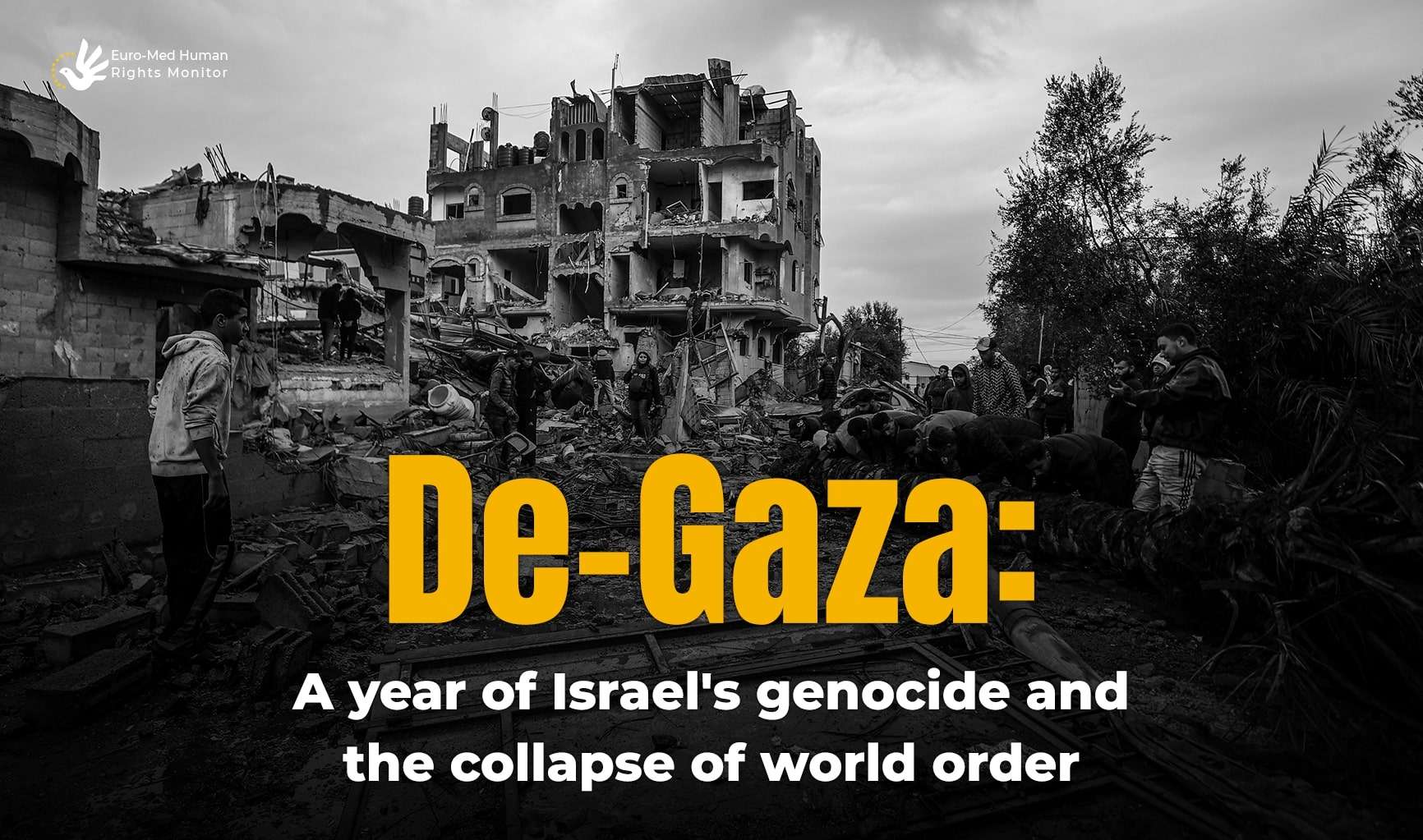
    Euro-Med Human Rights Monitor brought out this report after the first year of war in Gaza by Israel. It has now been on for more than three years and has engulfed the entire West Asia.

    And here the parallel carries a warning that thoughtful Indian people cannot afford to ignore. For if Hindutva’s path resembles Zionism’s in how the ideology is built, we must look honestly at where that path has led. The fusion of a secular-ethnic nationalism with religious claim did not strengthen the moral standing of the project it produced. It corrupted it. The state that emerged now stands, in the aftermath of Gaza, in a condition of profound moral and political isolation — its conduct condemned across much of the world, its claim to act in the name of an ancient faith increasingly repudiated by the faithful themselves. Many Jews who practise Judaism as a religion and a moral tradition have publicly dissociated themselves from the actions of the Israeli state, insisting on the very distinction this essay draws: that a faith is not the same as a political-national project conducted in its name, and that the project does not speak for the faith. Judaism, one of humanity’s great ethical traditions, has been ill-served by what has been done in its name.

    Many Jews who practise Judaism as a religion and a moral tradition have publicly dissociated themselves from the actions of the Israeli state, insisting on the very distinction this essay draws: that a faith is not the same as a political-national project conducted in its name, and that the project does not speak for the faith. Judaism, one of humanity’s great ethical traditions, has been ill-served by what has been done in its name.

    The warning for India is exact. Hindutva today shows every sign of being on a similar trajectory — the same fusion of ethnic nationalism with mobilised religious sentiment, the same erasure of the distinction between a faith and a political project, the same tendency to place that project beyond criticism by wrapping it in the sacred. If it continues down that path, it risks doing to Hinduism what political Zionism’s corruption has done to Judaism: isolating it, discrediting it, and betraying its deepest moral content — all in the name of defending it.

    Why This Matters: And What is at Stake

    This is why the distinction between Hinduism and Hindutva is not academic hair-splitting. It is the difference between a civilisation and an ideology that has captured its name. Hinduism is one of the oldest and most philosophically sophisticated traditions on earth. It has no single founding prophet, no single canonical scripture, no orthodoxy, and no mechanism for excommunicating heretics — because diversity of belief and inquiry is not a problem to be solved but the natural condition of a tradition too vast for any single formulation to contain. Its foundational statement, from the Rigveda, is Ekam Sat Vipra Bahudha Vadanti: truth is one, the wise call it by many names. It gave the world the Upanishads, the Jain Anekantavada — the many-sidedness of truth — the Buddha and Mahavira, the Bhakti and Sufi streams, the Tamil saint Vallalar’s image of the many religions as rivers merging into a single shoreless ocean. It is, arguably, the most spiritually plural and philosophically generous civilisational inheritance humanity possesses.

    Hinduism is one of the oldest and most philosophically sophisticated traditions on earth. It has no single founding prophet, no single canonical scripture, no orthodoxy, and no mechanism for excommunicating heretics — because diversity of belief and inquiry is not a problem to be solved but the natural condition of a tradition too vast for any single formulation to contain.

    Hinduism’s foundational statement, from the Rigveda, is Ekam Sat Vipra Bahudha Vadanti: truth is one, the wise call it by many names. It gave the world the Upanishads, the Jain Anekantavada — the many-sidedness of truth — the Buddha and Mahavira, the Bhakti and Sufi streams, the Tamil saint Vallalar’s image of the many religions as rivers merging into a single shoreless ocean. It is, arguably, the most spiritually plural and philosophically generous civilisational inheritance humanity possesses.

    A country with over 200 million Muslim citizens — the second-largest Muslim population in the world — cannot credibly champion the Global South, the voice of universal human dignity, or the reform of the world order, if its dominant political ideology frames those citizens as the internal Other. And an ideology founded by an atheist on borrowed European ethnic-nationalist theory, later dressed in religious sentiment for political mobilisation, cannot be the authentic voice of the tradition of Ekam Sat and Anekantavada. It is, in the most precise sense, that tradition’s negation.

    The strongest argument against Hindutva, therefore, is not secular liberalism, and not the critique of any political party. It is Hindu philosophy itself — the Upanishads, the Thirukkural, the Anekantavada, Vallalar’s Ocean, the Sangam world’s ‘Yaadhum Oorey, Yaavarum Kelir’. These traditions do not need political exceptionalism to survive; they are diminished by it.

    “Ekam Sat Vipra Bahudha Vadanti: truth is one; the wise call it by many names” – Rigveda

    Safeguarding India’s civilisational soul from the exceptionalism now deforming it from within is not an act of opposition to Hindu culture. It is its most authentic defence — and it is a task for every Indian who understands the depth of what is being risked.

    — This is the third and final part of the series prologue. The series proper begins with the next post.

    A companion essay, ‘The Constitution or the Manusmriti: India’s Civilisational Choice,’ extends this argument and is available at thepeninsula.org.in.

    Air Marshal M Matheswaran (Retd) is the Founder-President of The Peninsula Foundation (@TPF_Chennai), grounded in the conviction that India’s greatest strength is its civilisational pluralism — and that any ideology, domestic or foreign, that threatens that pluralism threatens India itself.

    Further Reading:

    On Savarkar, his atheism, and the formulation of Hindutva:

    Vinayak Damodar Savarkar, Essentials of Hindutva (1923); republished as Hindutva: Who Is a Hindu? (1928).

    Janaki Bakhle, Savarkar and the Making of Hindutva (Princeton University Press, 2024).

    The definitive intellectual biography; on Savarkar’s atheism, rationalism, and the territorial-ethnic (not religious) definition of the Hindu.

    Vikram Visana, ‘Savarkar before Hindutva: Sovereignty, Republicanism, and Populism in India, c. 1900–1920,’ Modern Intellectual History (Cambridge University Press, 2021).

    On Savarkar’s debt to European ethnic-nationalist thought, including Bluntschli.

    Johann Kaspar Bluntschli, The Theory of the State (1875; English trans. Clarendon Press, 1885).

    Bluntschli was Swiss-born (Zurich, 1808), working within the German tradition of Staatslehre.

    On the shift to religious mass mobilisation — Golwalkar and Upadhyaya:

    M.S. Golwalkar, We, or Our Nationhood Defined (1939) and Bunch of Thoughts (1966).

    Deendayal Upadhyaya, Integral Humanism (1965).

    Christophe Jaffrelot, The Hindu Nationalist Movement and Indian Politics, 1925 to the 1990s (Hurst, 1996).

    On the RSS’s development and the religious infusion of Savarkar’s originally secular-ethnic framework.

    Chetan Bhatt, Hindu Nationalism: Origins, Ideologies and Modern Myths (Berg, 2001).

    On political Zionism, its secular origins, and Jewish dissent:

    Theodor Herzl, Der Judenstaat (The Jewish State) (1896).

    Shlomo Sand, The Invention of the Jewish People (Verso, 2009).

    Yakov M. Rabkin, A Threat from Within: A Century of Jewish Opposition to Zionism (Fernwood/Zed Books, 2006).

    On the theological and secular Jewish opposition to political Zionism, from its origins to the present.

    On Hindu philosophical pluralism:

    Rigveda, 1.164.46: Ekam Sat Vipra Bahudha Vadanti.

    Ramalinga Adigalar (Vallalar), Thiru Arutpa, Sixth Thirumurai, Verse 3907.

    Thiruvalluvar, Thirukkural. Trans. P.S. Sundaram (Penguin, 1990).

    Amartya Sen, The Argumentative Indian (Penguin, 2005).

    Wendy Doniger, The Hindus: An Alternative History (Penguin, 2009).

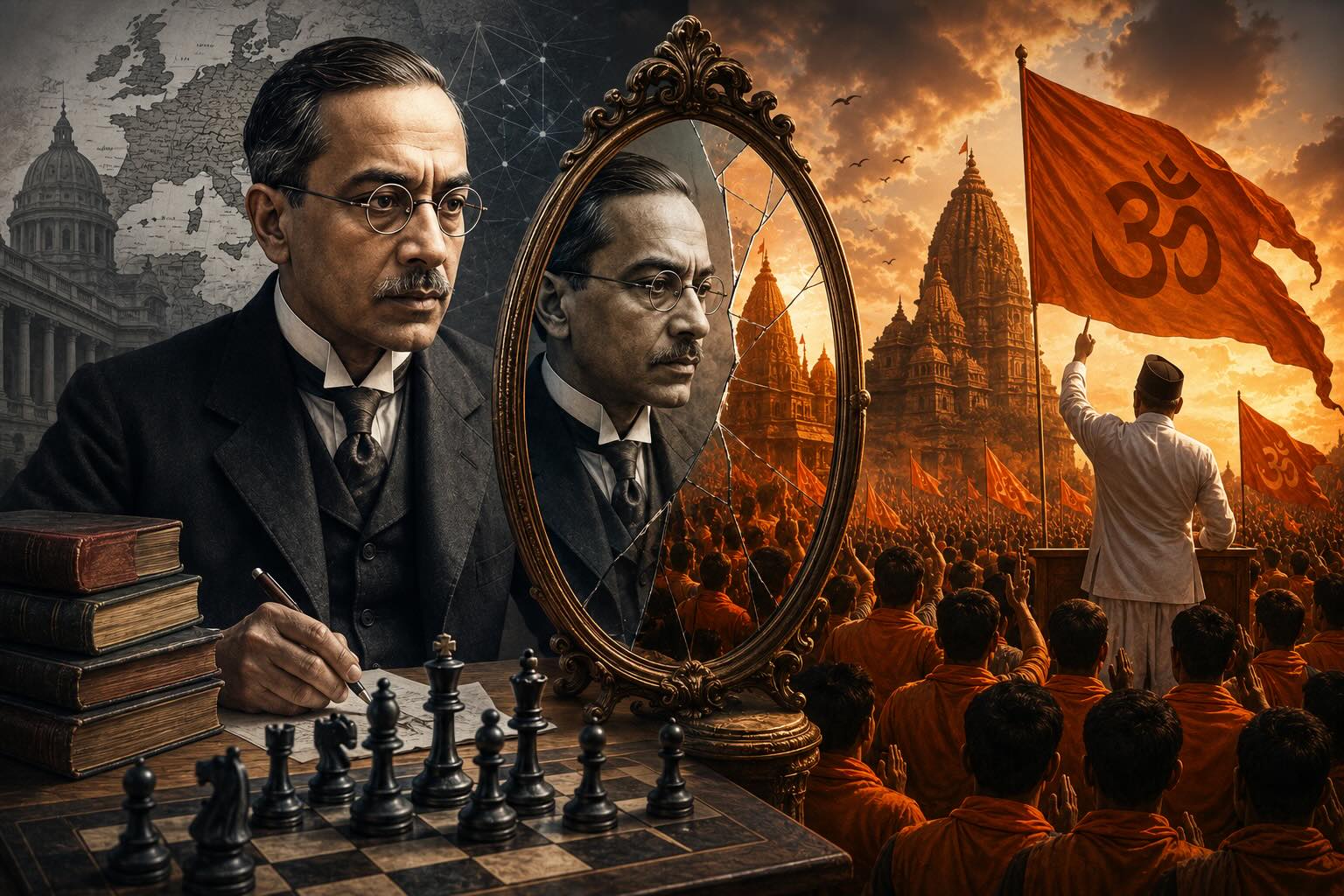
    Feature Image Credit: Savarkar and Hindutva – image made with AI assistance.
  • The Ideological Engine: Exceptionalism, Religion, and the Civilisational Alternative

    The Ideological Engine: Exceptionalism, Religion, and the Civilisational Alternative

    Series: India’s Strategic Choices, Civilisational Responsibilities, and the Contest for the Emerging World Order

    This is the second of a three-part prologue to a series on India’s strategic choices, civilisational responsibilities, and the contest for the emerging world order.

    Ideological Engine crafted with Religious Endorsement

    In my previous post, I traced the material foundations of the current world order — the knowledge borrowed from the Islamic world, the wealth extracted from the Americas, two-thirds of humanity colonised and enslaved. It was the extraction, the enslavement, and the colonial architecture that built Western dominance. But material power alone does not sustain five centuries of global domination. It requires an ideological engine — a moral framework that converts extraction into mission, conquest into duty, and atrocity into the necessary price of civilisation. That engine was exceptionalism. And it was powered by religion.

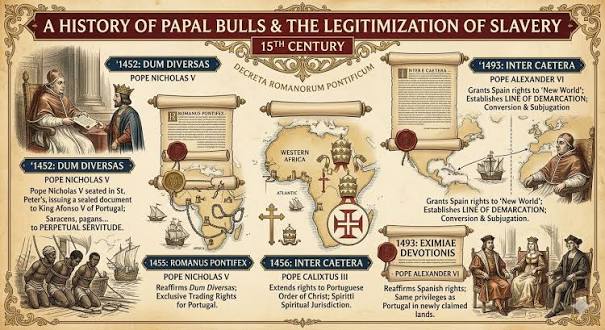
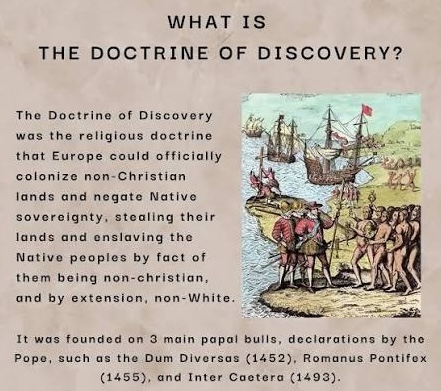
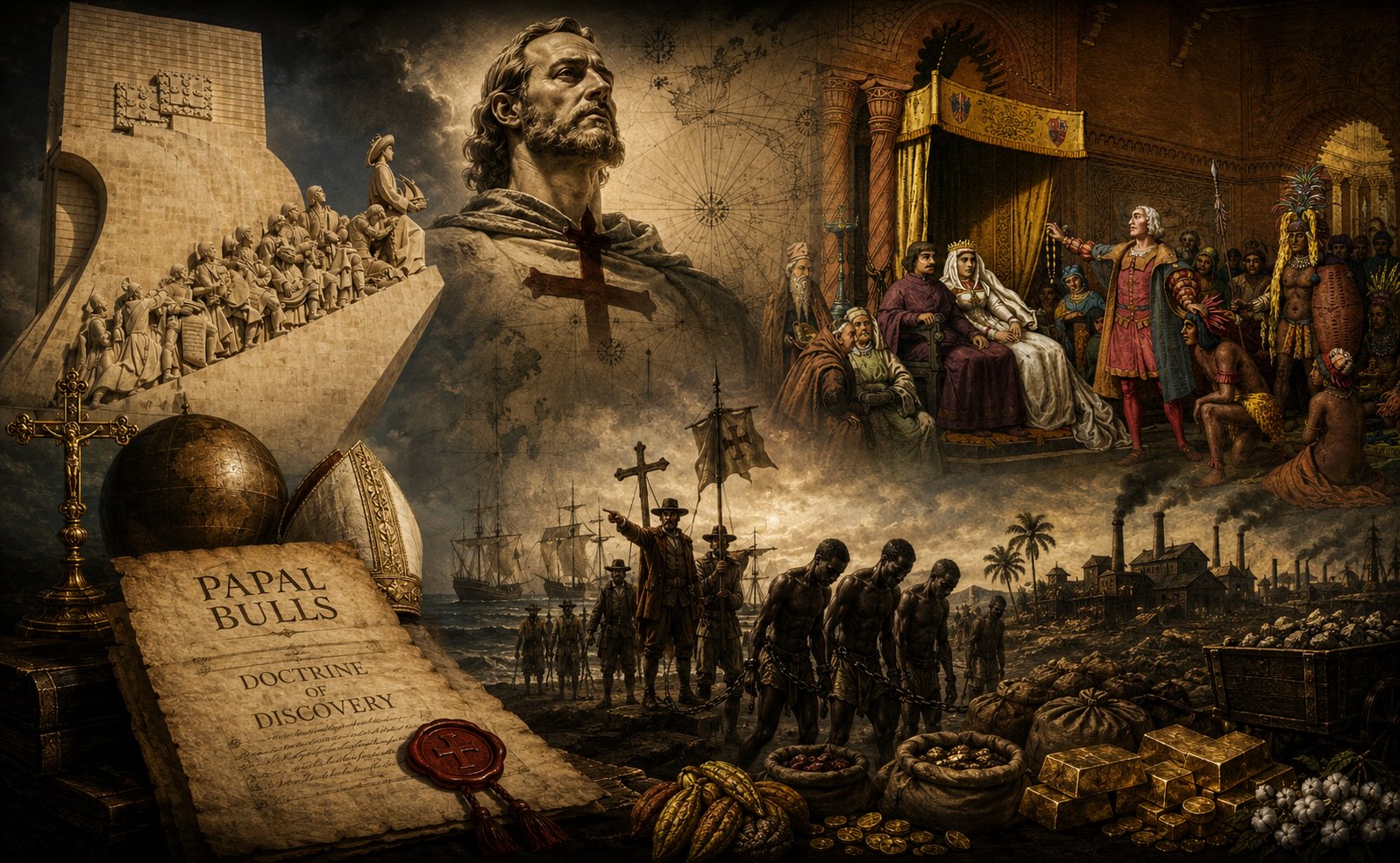
    The mechanism was constructed with precision. In 1452, Pope Nicholas V issued the papal bull Dum Diversas, authorising the King of Portugal to “capture, vanquish, and subdue the Saracens, pagans, and any other unbelievers and enemies of Christ” and “reduce their persons to perpetual servitude.” Three years later, Romanus Pontifex extended this authority to conquer the lands of infidels for “the salvation of all”. In 1493, following Columbus’s return from the Americas, Pope Alexander VI issued Inter Caetera — the foundational document of the Doctrine of Discovery — declaring that any land not under Christian rule could be seized, its peoples subjugated, and its resources claimed, in the service of Christianising the world.

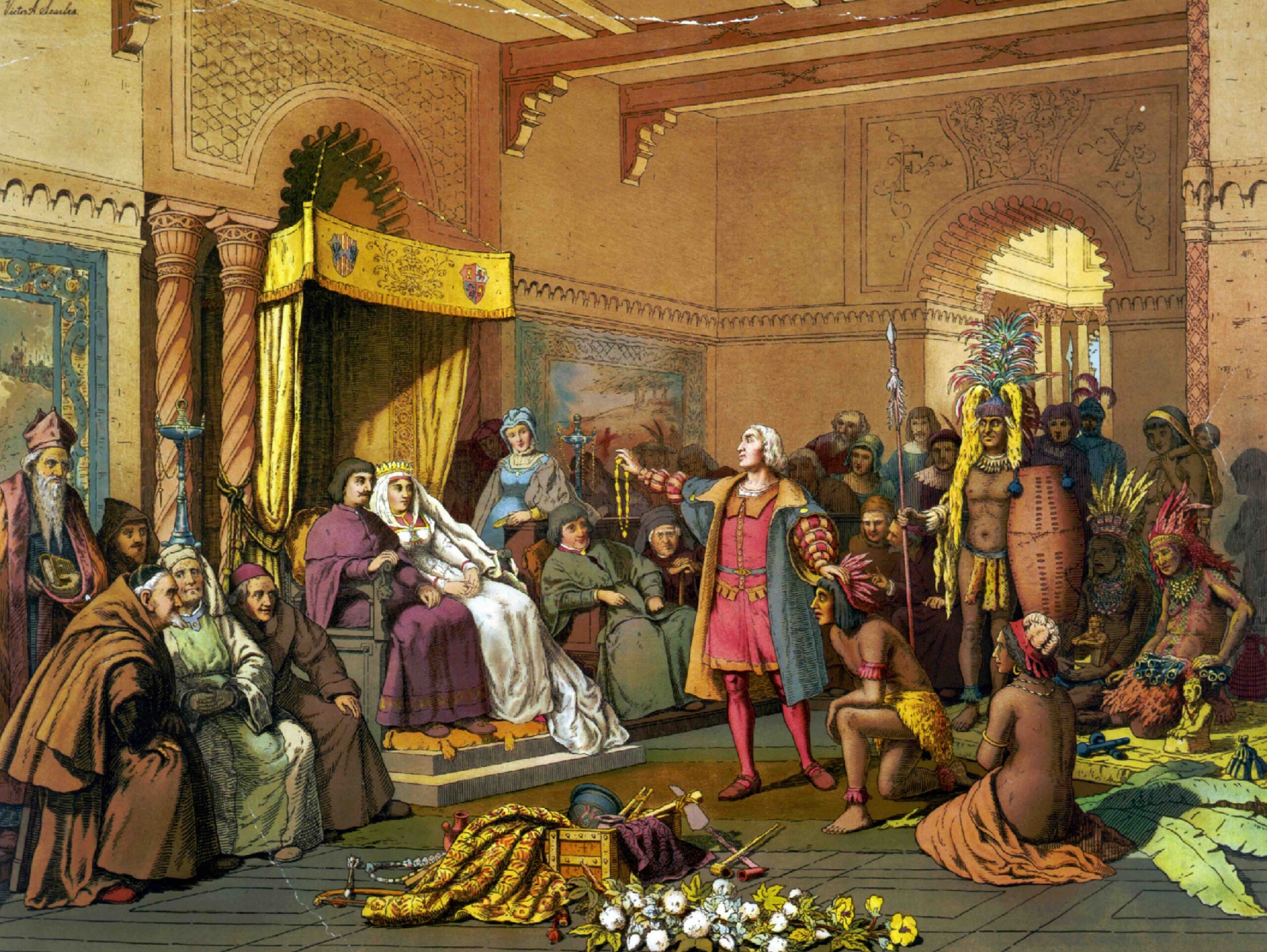
    Columbus at the court of Barcelona. Christopher Columbus standing before the King and Queen of Spain, presenting Indians and treasures from the New World, 1493. (Newscom TagID: whphotos146159.jpg) [Photo via Newscom]

    These were not peripheral theological documents. They were the legal and moral architecture of the colonial project, establishing in explicit terms sanctioned by the highest religious authority in the Western world that non-Christians were less than human, that killing them was not a sin, and that converting or enslaving them was a sacred duty. The Doctrine of Discovery was subsequently incorporated into the legal systems of the United States, Canada, Australia, and other settler-colonial states, where it shaped land law, property rights, and indigenous dispossession for centuries. The Vatican formally repudiated the Doctrine of Discovery only in 2023 — more than five centuries after the damage was done.

    And here is what makes that repudiation hollow: the doctrine did not stay in the fifteenth century. It became the operating law of the settler-colonial states, and it remains so.

    In 1823, the United States Supreme Court, in Johnson v. McIntosh, formally incorporated the Doctrine of Discovery into American law. Chief Justice John Marshall ruled that Indigenous peoples did not own their lands once those lands had been “discovered” by Christian colonists — that discovery itself conferred title on the discovering Christian nation, reducing the original inhabitants to mere occupants on their own soil. Marshall himself conceded the principle was “extravagant.” He made it law regardless. It has never been overturned. Two centuries later, it remains the foundation of all federal Indian law in the United States.

    Plenary power — plenitudo potestatis, the fullness of power — is the exact phrase by which the fifteenth-century popes claimed the authority to authorise conquest and enslavement in the first place.

    The living force of this doctrine was demonstrated in 2023 — the very year of the Vatican’s repudiation. In Haaland v. Brackeen, the US Supreme Court affirmed the modern form of the doctrine: the “plenary power” of the federal government over Native peoples. The term is not incidental. Plenary power — plenitudo potestatis, the fullness of power — is the exact phrase by which the fifteenth-century Popes claimed the authority to authorise conquest and enslavement in the first place. The Vatican renounced the doctrine in March 2023. Three months later, in June, the highest court of the United States reaffirmed its modern expression as settled law. One institution let go of the fiction. The other continued to build on it.

    Terra Nullius and the Concepts of Exceptionalism and Manifest Destiny

    The pattern is not confined to the Americas. In Australia, the entire continent was claimed under the doctrine of terra nullius — the legal fiction that the land belonged to no one, that sixty thousand years of continuous Aboriginal civilisation and hundreds of distinct nations simply did not count as habitation. The Australian Constitution, when it came into force in 1901, contained Section 127, which declared that “in reckoning the numbers of the people of the Commonwealth, aboriginal natives shall not be counted.” The original inhabitants of the continent were constitutionally excluded from the population of their own country. That exclusion was not removed until a referendum in 1967. The fiction of terra nullius itself was not overturned until the High Court’s Mabo judgment in 1992 — one hundred and ninety-two years after colonisation began.

    The Doctrine of Discovery is not a historical curiosity to be studied and regretted. It is the living legal architecture on which the settler-colonial states were built, and on which — as the events of 2023 demonstrate — they continue to stand. The exceptionalism that authorised conquest in 1452 was not repented and abandoned. It was secularised, constitutionalised, and preserved.

    This is the point that must be understood clearly. The Doctrine of Discovery is not a historical curiosity to be studied and regretted. It is the living legal architecture on which the settler-colonial states were built, and on which — as the events of 2023 demonstrate — they continue to stand. The exceptionalism that authorised conquest in 1452 was not repented and abandoned. It was secularised, constitutionalised, and preserved.

    This is not a distortion of Christianity. It is the documented institutional expression of a specific tradition within it: the doctrine that one’s own community occupies a uniquely chosen position in the divine order — that the Other is not merely different but lesser, and that this difference legitimates domination.

    The same logic operated, in different institutional forms, across other traditions. The conquering caliphates that used the concept of jihad to justify forced conversion were not the whole of Islamic tradition, which contains rich pluralist and humanistic streams. They were the weaponisation of religious exceptionalism by those who held political and military power. Political Zionism, in its most extreme contemporary expressions, follows the same pattern: the theological claim to exclusive divine right over territory and the dehumanisation of non-Jewish populations, ruthlessly visible from the Nakba in 1947-48 to the present conduct of the Gaza war, in full view of the world and with endorsement by the West. It follows the same pattern: religious exceptionalism converted into political licence for dispossession and violence.

    The pattern is not one religion. It is a specific logic — the claim to divine chosenness that exempts a community from the moral constraints that apply to others – that has been institutionalised, at different moments and in different traditions, wherever political power has found it useful.

    In Western civilisation, this logic found its most durable and consequential expression in American exceptionalism. In 1630, Puritan leader John Winthrop, preparing to establish the Massachusetts Bay Colony, called for the creation of a community that would be “as a City upon a Hill, the eyes of all people upon us.” This was not yet a global claim.  It was a theological self-conception: a chosen people, on a divinely appointed errand, under special divine scrutiny. But the seed was planted. Two centuries later, in 1845, John L. O’Sullivan gave it political form: “our manifest destiny to overspread the continent allotted by Providence for the free development of our yearly multiplying millions.” God-given expansion across a continent — regardless of the peoples already living on it — was reframed as destiny, not conquest.

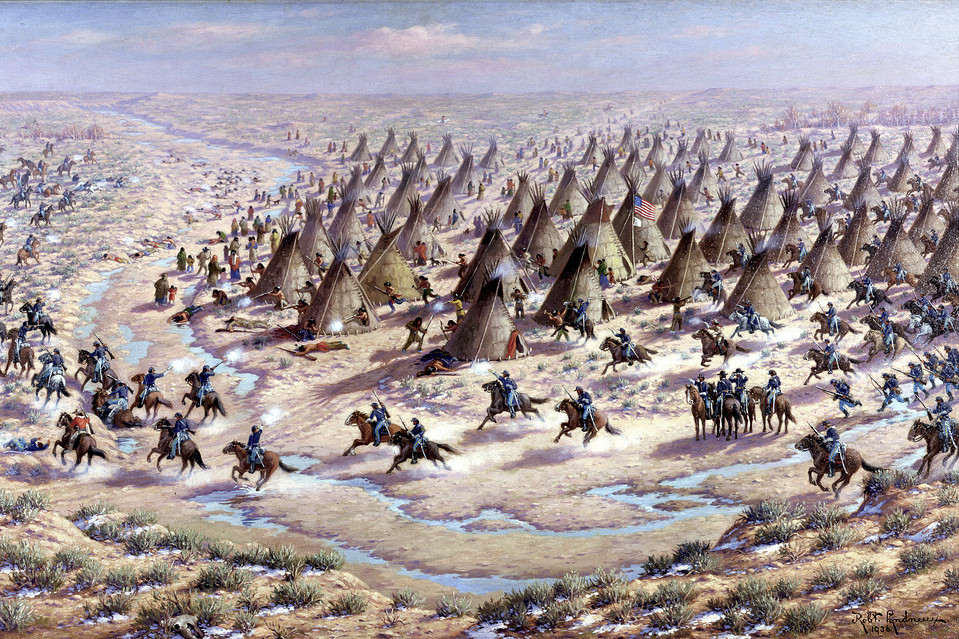
    The indigenous peoples of North America experienced what that destiny meant in practice. At Sand Creek in November 1864, a Colorado militia under Colonel John Chivington attacked a Cheyenne and Arapaho village whose chief, Black Kettle, was flying both an American flag and a white flag of truce. Roughly 150 people were killed, the majority of them women, children, and the elderly; the soldiers mutilated the dead and paraded body parts through the streets of Denver. Three separate investigations — two congressional, one military — condemned it as a massacre. Not one man was ever indicted. The campaigns that defined the conquest of the West — villages destroyed, food supplies burned, non-combatants killed as a matter of strategy — were not the excesses of rogue commanders. They were the method.

    And the men who carried them out were not disgraced but memorialised. George Armstrong Custer, who at dawn on the Washita River in 1868 attacked the village of that same Black Kettle, who had survived Sand Creek and was again seeking peace, killed him and his wife in the assault,  while his aggressive forces killed a large number of unarmed women and children. Custer was mythologised into a national hero, his death at the Little Bighorn recast as a noble sacrifice. This is exceptionalism completing its work: not merely committing the atrocity, but converting it, in the national memory, into valour. The conversion of conquest into heroism is not a distortion of the exceptionalist project. It is the project.

    It is worth pausing to see precisely how this engine is built, because it reveals something the comfortable version of history conceals. There are two broad models of colonialism, and they are not the same. Extractive colonialism — the Spanish in Peru, the British in India — needs the colonised population alive: to mine the silver, to work the plantations, to pay the taxes. It subjugates.

    But settler colonialism, of the kind practised in North America and Australia, does not primarily want the people. It wants the land. And a population that comes to stay on land already inhabited requires something darker than subjugation: it requires removal. The historian Patrick Wolfe named this the ‘logic of elimination’ — the observation that in the settler-colonial project, invasion is not an event but a structure, and the indigenous inhabitant is not a labour force to be exploited but an obstacle to be cleared. This is why the settler variant needed its ideological engine to run at maximum power. To subjugate a people, you need only believe they are lesser. To eliminate them, you must first erase them — conceptually, legally, theologically — before you erase them in fact. Terra nullius, the empty land; the savage without real title; the wilderness awaiting God’s chosen — these were not decorative rhetoric. They were the necessary vocabulary of replacement.

    A society that never hears the moral objection is merely benighted. A society that hears it clearly, debates it in its legislature, affirms it in its highest court — and proceeds anyway, in the name of Providence — has not failed to find its conscience. It has chosen to override it. That is what the ideological engine is for: not to fill a silence where conscience is absent, but to drown out a conscience that is present.

    And here is the fact that removes every excuse: the conscience was present. It was not that no one knew, or that no one objected. Roger Williams argued in the 1630s that the Crown had no right to grant land it did not own, that it had to be purchased from its actual inhabitants — and he was banished for saying so. The Quaker John Woolman condemned the dispossession on moral grounds a century before it reached the Mississippi. When the Indian Removal Act came before the United States Congress in 1830, it passed by 102 votes to 97 — a bitter, closely fought debate, not a silent consensus. When the Cherokee took their case to the Supreme Court, Chief Justice John Marshall ruled in Worcester v. Georgia that they possessed sovereign rights the state was bound to respect. President Andrew Jackson ignored the ruling and carried out the removal regardless; on the Trail of Tears that followed, thousands died. This is the point that must be held onto. A society that never hears the moral objection is merely benighted. A society that hears it clearly, debates it in its legislature, affirms it in its highest court — and proceeds anyway, in the name of Providence — has not failed to find its conscience. It has chosen to override it. That is what the ideological engine is for: not to fill a silence where conscience is absent, but to drown out a conscience that is present.

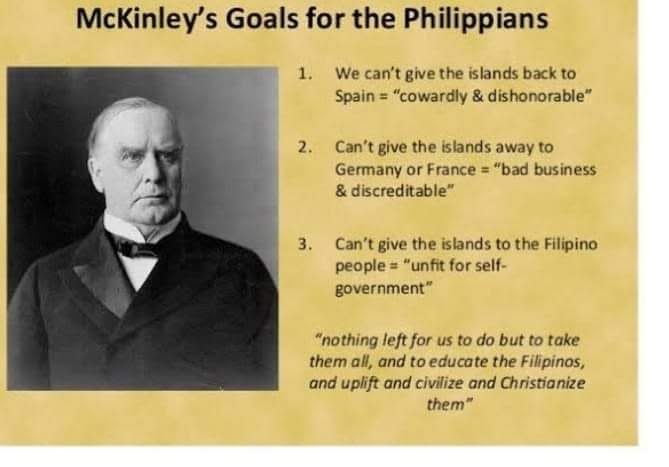
    The same logic was exported globally. In 1898, the United States entered the Spanish-American War, having suggested to Filipino independence fighters that it was their ally against Spanish colonial rule. When Spain was defeated, the Philippines was not given its independence. It was purchased for twenty million dollars and then colonised. The Philippine-American War resulted in the deaths of over 20,000 Filipino combatants and as many as 200,000 Filipino civilians through violence, famine, and disease. McKinley called his policy “Benevolent Assimilation.” The Philippines did not receive full independence until 1946 — forty-eight years after the liberation that was promised.

    This is the pattern that repeats from Vietnam to Iraq to Afghanistan to Iran: intervention justified as liberation, freedom invoked to mask extraction, and sovereignty violated in the name of the values that sovereignty was supposed to protect.

    The Civilisational Alternative 

    Now consider the contrast. India, China, and Persia are rooted in civilisational traditions that are fundamentally pluralist in their relationship to truth and the divine. Hinduism, Buddhism, Jainism, and Zoroastrianism do not claim exclusive possession of truth. They understand the search for ultimate reality as a path that admits multiple valid routes — that the divine is too vast and complex for any single tradition to comprehend fully. This epistemological humility produces a fundamentally different relationship to the Other: not as a lesser being to be converted or eliminated, but as a fellow traveller on a different path through the same reality — or, in the Tamil saint Vallalar’s image, rivers of many names flowing to a single shoreless ocean.

    A tradition whose foundational claim is Ekam Sat Vipra Bahudha Vadanti — truth is one, the wise call it by many names — or the Jain Anekantavada, the many-sidedness of truth, or the Tamil Yaadhum Oorey-Yaavarum Kelir, that every place is home and every person kin, is structurally resistant to exceptionalism, because its highest ideal explicitly denies the premise exceptionalism requires: that a single community owns the truth and stands chosen above the rest.

    The distinction I am drawing must be stated carefully, because it is easy to misread as a claim that one civilisation is virtuous and another is wicked. That is not the claim, and it would be false. The impulse to dress conquest in sacred language is close to universal — it appears wherever power seeks to launder its crimes, and no civilisation, India’s included, is innocent of it. Ashoka built his empire by the sword before he turned to the dharma. India’s own caste hierarchy was given cosmic sanction, as I have argued elsewhere in examining the Manusmriti. The human capacity to summon the transcendent in defence of the indefensible is not the property of any one people. What differs is not the impulse to justify but what each tradition installs as its highest principle — and therefore what any justification of atrocity must first overcome. A tradition whose foundational claim is Ekam Sat Vipra Bahudha Vadanti — truth is one, the wise call it by many names — or the Jain Anekantavada, the many-sidedness of truth, or the Tamil Yaadhum Oorey-Yaavarum Kelir, that every place is home and every person kin, is structurally resistant to exceptionalism, because its highest ideal explicitly denies the premise exceptionalism requires: that a single community owns the truth and stands chosen above the rest.

    One can still commit atrocity within such a tradition — humans always can — but one cannot easily make the tradition’s own highest principle bless it. A covenantal structure built on a chosen people, an exclusive truth, and a promised land contains that raw material at its theological core. It does not compel atrocity, and most who inherit it are decent people who read it toward mercy — the abolitionists and Roger Williams drew on it too. But the doctrine of chosenness is available to be weaponised in a way that Ekam Sat structurally is not. That is the civilisational difference that matters: not that one people is depraved and another pure, but that traditions differ in whether their deepest ideal resists the engine of exceptionalism or supplies its fuel.

    Scholarly analysis consistently describes India’s conduct as just war traditions with no ulterior motive of imperialism or fiscal interest. There is no comparable example in the modern history of any Western military power.

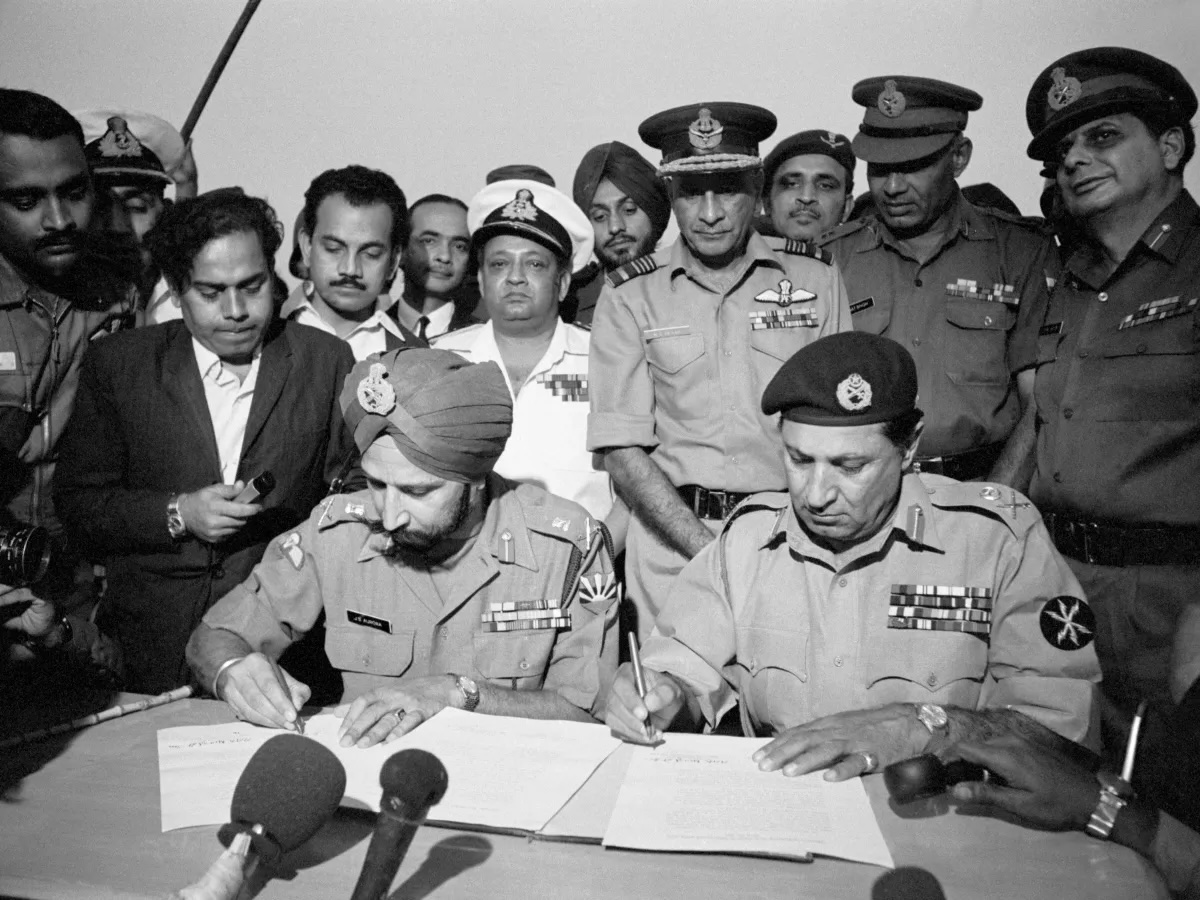
    This civilisational disposition is not merely philosophical. It expresses itself in conduct. In December 1971, India made the decision to intervene militarily in East Pakistan in response to one of the most egregious humanitarian catastrophes of the 20th century — the Bangladesh genocide. The intervention was swift and decisive. Indian military forces liberated Bangladesh in thirteen days of formal war. Pakistani forces surrendered on December 16, 1971. The Indian military then withdrew completely. No occupation. No extraction. No installation of a client government. No strategic bases retained. Full sovereignty was transferred immediately to the people of Bangladesh. India returned over 90,000 Pakistani prisoners of war through the Simla Agreement. Scholarly analysis consistently describes India’s conduct as just war traditions with no ulterior motive of imperialism or fiscal interest. There is no comparable example in the modern history of any Western military power.

    These are not coincidental differences. They are civilisational ones. The world is now in contest over what the emerging order will be built upon. The declining Western order was built on exceptionalism — the claim to divine chosenness that converts domination into duty, secularised into legal doctrine but never abandoned. The Asian civilisational alternative — pluralist, non-exclusivist, epistemologically humble — offers a different foundation. India’s 1971 conduct is the most precise proof available that this alternative is not merely philosophical. It has been demonstrated operationally.

    The question is whether India — in Gaza, in Iran, in the institutions of the emerging world order — is willing to act consistently with the civilisational tradition it inherits.

    — This is the second in the series prologue.

    Air Marshal M Matheswaran (Retd) is the Founder-President of The Peninsula Foundation (@TPF_Chennai), grounded in the conviction that power without ethics is tyranny — and that India’s civilisational traditions offer the world something Western exceptionalism cannot.


    Further Reading:

    On the Doctrine of Discovery and the Papal Bulls

    Pope Nicholas V, Dum Diversas, 18 June 1452. Full Latin text and English translation: Doctrine of Discovery Project, doctrineofdiscovery.org.

    Pope Nicholas V, Romanus Pontifex, 8 January 1455.

    Pope Alexander VI, Inter Caetera, 4 May 1493.

    Robert J. Miller, Jacinta Ruru, Larissa Behrendt, and Tracey Lindberg, Discovering Indigenous Lands: The Doctrine of Discovery in the English Colonies (Oxford University Press, 2010).

    Steven T. Newcomb, Pagans in the Promised Land: Decoding the Doctrine of Christian Discovery (Fulcrum, 2008).

    On the Vatican’s 2023 repudiation

    Dicastery for Culture and Education and Dicastery for Promoting Integral Human Development, ‘Joint Statement on the Doctrine of Discovery,’ Vatican, 30 March 2023.

    On the incorporation and persistence of the Doctrine of Discovery in US law

    Johnson v. McIntosh, 21 U.S. (8 Wheat.) 543 (1823).

    Haaland v. Brackeen, 599 U.S. 255 (2023).

    On the affirmation of ‘plenary power’ over Native peoples as the modern descendant of the Doctrine of Discovery, see the analysis by Peter d’Errico and the essays in the ‘200 Years of Johnson v. M’Intosh’ series, Canopy Forum, 2023.

    Robert J. Miller, ‘The Doctrine of Discovery in American Indian Law,’ Idaho Law Review, 42 (2005).

    Lindsay G. Robertson, Conquest by Law: How the Discovery of America Dispossessed Indigenous Peoples of Their Lands (Oxford University Press, 2005).

    On Australia, terra nullius, and constitutional exclusion

    Mabo v. Queensland (No. 2) (1992) 175 CLR 1.

    Section 127, Constitution of Australia (repealed by referendum, 1967).

    Henry Reynolds, The Law of the Land (Penguin, 1987).

    Bain Attwood, Rights for Aborigines (Allen & Unwin, 2003).

    On Section 127 and the 1967 referendum: National Museum of Australia, ‘Indigenous Referendum,’ and George Williams’ analysis of the ‘race power’ in Australia’s constitutional history.

    On American exceptionalism — Puritan origins and Manifest Destiny

    John Winthrop, ‘A Modell of Christian Charity’ (1630).

    John L. O’Sullivan, ‘Annexation,’ The United States Magazine and Democratic Review, 17(1), July–August 1845.

    Anders Stephanson, Manifest Destiny: American Expansion and the Empire of Right (Hill and Wang, 1995).

    Hilde Eliassen Restad, American Exceptionalism: An Idea That Made a Nation and Remade the World (Routledge, 2014).

    On the Sand Creek Massacre and the conquest of the Plains

    U.S. Congress, Joint Committee on the Conduct of the War, Massacre of the Cheyenne Indians (38th Congress, 2nd Session, 1865).

    The contemporary Congressional investigation that condemned the massacre; the primary documentary record.

    Ari Kelman, A Misplaced Massacre: Struggling over the Memory of Sand Creek (Harvard University Press, 2013).

    Dee Brown, Bury My Heart at Wounded Knee: An Indian History of the American West (Holt, Rinehart & Winston, 1970).

    On the Washita (1868), the killing of Black Kettle, and the pattern of village attacks; also on the mythologisation of George Armstrong Custer.

    Nathaniel Philbrick, The Last Stand: Custer, Sitting Bull, and the Battle of the Little Bighorn (Viking, 2010).

    On the Philippines, 1898–1946

    Stanley Karnow, In Our Image: America’s Empire in the Philippines (Random House, 1989).

    Paul A. Kramer, The Blood of Government: Race, Empire, the United States, and the Philippines (University of North Carolina Press, 2006).

    On India’s 1971 Bangladesh liberation

    Srinath Raghavan, 1971: A Global History of the Creation of Bangladesh (Harvard University Press, 2013).

    Gary J. Bass, The Blood Telegram: Nixon, Kissinger, and a Forgotten Genocide (Knopf, 2013).

    On Asian civilisational pluralism

    Amartya Sen, The Argumentative Indian: Writings on Indian History, Culture and Identity (Penguin, 2005).

    Wendy Doniger, The Hindus: An Alternative History (Penguin, 2009).

    Ramalinga Adigalar (Vallalar), Thiru Arutpa, Sixth Thirumurai, Verse 3907.

    The metaphor of the many religions as rivers merging into a single shoreless ocean. See thiruarutpa.org.


  • Clausewitz’s War Within the Chains of Reason versus Girard, the Apocalypse, and the Far-Right Christian Movement in the U.S.

    Clausewitz’s War Within the Chains of Reason versus Girard, the Apocalypse, and the Far-Right Christian Movement in the U.S.

    To lend greater legitimacy to his controversial position, Girard explicitly cites the foremost theorist of warfare, Carl von Clausewitz. In his three treatises on the escalation of war, Clausewitz had indeed argued that mimetic rivalry would degenerate into violence that would destroy lives and even human civilisation were it not for the scapegoat mechanism.

    Girard’s tendency toward absolute peacefulness is unrealistic, whereas the religiously legitimised far right seeks to wage the final battle internally and externally. Yet, both refer to the assumption of an impending apocalypse. This is the core of the problem, which leads, on one side, to absolute pacifism and, on the other, to a similarly absolute “battling to the end”.

    The media’s focus on the current U.S. president’s personality can easily lead us to overlook deeper, underlying changes. It is well known that French sociologist René Girard plays a significant role in shaping the self-image of Silicon Valley tech billionaires. In particular, his disciple Peter Thiel, founder of Palantir, is advancing this agenda and strongly influencing U.S. Vice President J.D. Vance, whom Thiel financially supported during his campaign. This connection leads to a billionaire-backed far-right movement that sees its legitimacy in a fundamentalistic interpretation of Christianity. This has already been amply documented in numerous U.S. discussions. The rather helpless counterreaction attempts to prove that Girard is merely being exploited and misunderstood. He certainly is—but the central problem is that in his book Battling to the End, Girard describes the approaching apocalypse. To escape it, Girard recommends absolute nonviolence, which he sees as realised in Christianity. Peter Thiel and the other tech billionaires, however, believe that in this approaching apocalypse, one must fight to the bitter end to survive. It is no coincidence that the latest book by the U.S. “Minister of War,” Pete Hegseth, is titled American Crusade. Hegseth compared the rescue of the American pilot at Easter to the resurrection of Christ. Girard is indeed being instrumentalised by Thiel and others. However, the problem is that Girard adopts an apocalyptic approach and appears to justify it scientifically by referring to a reductionist interpretation of Clausewitz, arguably the most significant theorist of war. Only through reference to Clausewitz does Girard’s theory of imitation (mimesis) gain the political explosiveness that would otherwise remain confined to academia.

    René Girard’s theories on mimesis, mimetic rivalry, scapegoating, and the role of myth and religion in the emergence of culture provide profound insights into human history and behaviour. So, what is mimetic desire?

     Mimetic desire begins with human needs and desires. While needs are biologically rooted, desires are strongly influenced by others. Girard’s identification of the basis of the human problem is simple: most of the things we desire—be they a person, a relationship, an object, an experience, or a feeling—are based on imitation. We develop a desire for these things through our observation of others who desire or possess them, whether consciously or not. This explains the power of advertising—when we see enough people using something, we want it too—as well as the power of celebrity. We want the kind of house, car, clothes, or wife that the rich, famous, and powerful man has.

    Children learn through imitation, acquiring language and other skills necessary for social success. By learning the ethos of their culture, they become part of the community and eventually pass it on to the next generation. In this respect, mimesis is unproblematic. However, for Girard, mimesis is also the primary cause of social unrest and violence because mimesis leads to rivalry when people compete for scarce resources. Sometimes, class differences separate the object of rival desire, such as when one harbours a mimetic desire for what the rich possess. In this situation, which Girard calls “external mediation,” violent conflict arising from mimetic rivalry is unlikely. However, in situations of internal mediation, where individuals or groups desire the same thing and are close to one another, the possibility of violence is real.

    Girard asserts that this mimetic rivalry is the primary cause of human violence: tribes fight over resources, men for power and wealth, and the contest for power escalates into violence. Examples include tribes fighting over resources, two men desiring the same woman, and envy of another’s wealth, fame, honour, or power escalating into violence.

    Girard argues that mimetic rivalry would degenerate into violence that would destroy lives and even human civilisation, were it not for the scapegoat mechanism. By creating a scapegoat, one can blame all of one’s problems on that person and cast them out or sacrifice them, thereby stabilising one’s identity and community. Determining who belongs to a community and who does not reunites it. A famous example is Kaiser Wilhelm II before World War I, who declared, “I no longer know of any parties; I know only Germans.” Anti-Semitism, too, was based on this combination of exclusion and the sacrifice of others; in essence, it is elevated to what appears to be a sacred act.

    Girard argues that Jesus’s voluntary sacrificial death broke this scapegoat mechanism once and for all because he took on the sins of the world. However, regardless of any theological assessment, this interpretation clearly does not apply to the Crusades, religious wars of the Middle Ages, colonisation, the two world wars, or the Holocaust. In fact, one could view these events as repetitions of the scapegoat mechanism, where unity is created through the “sacrifice” of others. This raises the fundamental question of whether Christianity is characterised by a particular form of nonviolence, as devout Christians would argue, or by a particular escalation of violence aimed at establishing “eternal peace” on earth, as its universal claim suggests. Historically speaking, societies that saw themselves as Christian have a distinct history of violence (as does Islam, which likewise views itself as fundamentally peaceful). Of course, Christians will say that their religion is fundamentally peaceful and has merely been misunderstood. The victims of colonisation and the Holocaust would disagree. To lend greater legitimacy to his controversial position, Girard explicitly cites the foremost theorist of warfare, Carl von Clausewitz. In his three treatises on the escalation of war, Clausewitz had indeed argued that mimetic rivalry would degenerate into violence that would destroy lives and even human civilisation were it not for the scapegoat mechanism. By constructing a scapegoat, one is made responsible for all one’s own problems and cast out or sacrificed, thereby stabilising one’s own identity and community.

    Clausewitz had, in fact, advocated a nearly mimetic position in his three principles regarding the escalation of war. He accompanies the mutual escalation to the extreme at the beginning of his book with the words “the enemy does the same.” He justifies this, on the one hand, by arguing that whoever escalates the spiral of violence gains the upper hand and wins the war. Furthermore, he argues that as long as I have not subdued the enemy, I must fear that he will subdue and defeat me—thus, it is the fear and dread of defeat that compels both adversaries to escalate further and further. Ultimately, it is the mutual striving for power on both sides that leads to this escalation. Furthermore, in parts of his book, Clausewitz regards the absolute and the extreme as the ideal of warfare. To this extent, one could certainly understand Girard.

    However, Girard overlooks significant differences. For example, Clausewitz’s three dynamics leading to escalation are followed by three dynamics aimed at moderating war. These dynamics occur on both sides. The crucial point is that the desired post-war political state—and thus peace—already exerts a retroactive influence on the conduct of war.

    However, Girard overlooks significant differences. For example, Clausewitz’s three dynamics leading to escalation are followed by three dynamics aimed at moderating war. These dynamics occur on both sides. The crucial point is that the desired post-war political state—and thus peace—already exerts a retroactive influence on the conduct of war. At the end of the first chapter, Clausewitz emphasises that war consists of inherent violence, the interplay of probabilities and chance, and the subordinate nature of war as a political tool. He attributes war to pure reason. Thus, the tendency toward extremes, as interpreted by Girard, is indeed present in Clausewitz; however, it is limited and contained by “pure reason,” with which Clausewitz associates politics. Whether monotheistic religions, which see themselves as peace-loving, harbour a core of violence is a matter of debate. This could be the case when they became state religions, because at that point, they had to legitimise war as an exception. However, religiously motivated war has always brought with it a particular escalation, whether internally or externally. Girard’s tendency toward absolute peacefulness is unrealistic, whereas the religiously legitimised far right seeks to wage the final battle internally and externally. Yet, both refer to the assumption of an impending apocalypse. This is the core of the problem, which leads, on one side, to absolute pacifism and, on the other, to a similarly absolute “battling to the end”.

    Rene Girard Image Credit: From the article ” Peter Thiel, René Girard, and Vance’s Moral Conundrum by Jesse Callahan Bryant

    Vice President Vance misinterpreted a social scientist and, as a result, converted to Catholicism. If you read JD Vance’s 2020 essay (“How I Joined the Resistance”) about his conversion to Catholicism, you’ll learn that his real moment of spiritual transition from atheist to Catholic oddly came during a 2011 talk that Peter Thiel gave at Yale Law School.

    Crucifixion Panel Credit: The Crucifixion, centre panel of the Isenheim Altarpiece (closed view), by Matthias Grünewald, c. 1512–15; in the Musée Unterlinden, Colmar, France. www.britannica.com

  • The Cultural Revolution from the Right: From the Democratic Concept of the People to its Ethnic-religious Understanding

    The Cultural Revolution from the Right: From the Democratic Concept of the People to its Ethnic-religious Understanding

    Despite all the real political problems we face, it is essential for the twenty-first century to defend the equality of all people, regardless of biological differences such as gender or ethnicity. It is not our biology that defines us as human beings, but our morality.
    According to Dominique Moisi, the Western states are consumed with fear of decline, the Islamic-Arab world is full of despair at unfulfilled promises, and East and Southeast Asia are full of hope for a better life. These global political sentiments are largely responsible for the escalation of conflicts, the disintegration of social cohesion and the spread of violence. 
    More than 50 years ago, a cultural revolution from the left shook the whole world. In the USA, there were demonstrations against the Vietnam War, and the hippie movement gathered hundreds of thousands in search of a new lifestyle and attitude to life. Flower, power, love was the motto of the legendary Woodstock. In Germany, young people turned against old traditions and the concealment of their parents’ and grandparents’ guilt under fascism. But here, too, the double face of the youth movement became apparent: when they celebrated the North Vietnamese leader Ho Chi Minh in their demonstrations, they were in no way aware of the political practice in North Vietnam. This process was even more dramatic during the Chinese Cultural Revolution when the youth were mobilised to ultimately legitimise the claim to power of the “Great Leader” Mao-TseTong. The lesson of that period was that a cultural revolution must precede political change. For some time now, a cultural revolution from the right has been following this pattern. It is characterised on the one hand by social developments in polarised societies, and on the other by a targeted and strategic discourse on the part of the new right. Without underestimating the importance of personalities such as former and newly elected President Trump, as well as Erdogan in Turkey and Putin in Russia (and many others) for this development, they have only been able to achieve such success because they have tapped into the “zeitgeist”. According to Dominique Moisi, the Western states are consumed with fear of decline, the Islamic-Arab world is full of despair at unfulfilled promises, and East and Southeast Asia are full of hope for a better life. These global political sentiments are largely responsible for the escalation of conflicts, the disintegration of social cohesion and the spread of violence.
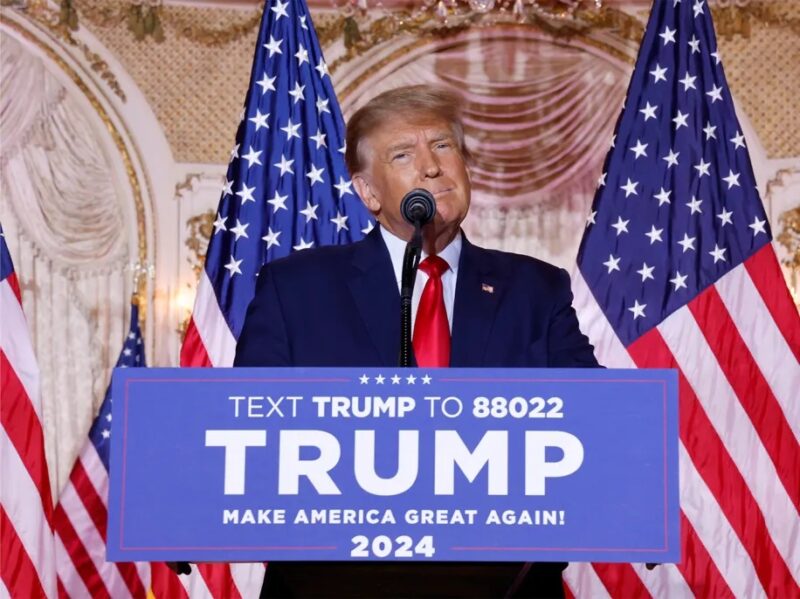
    In the Western world, instead of recognising the equality of other civilisations, nations and states, the “others” were blamed for the loss of the “white man’s” superiority. The ideology of the white man’s burden to educate the uneducated and indigenous peoples of the world, developed at the beginning of the last century, was revived after the fall of the Soviet Union, but could no longer be sustained with the rise of the others and the newly industrialised nations. However, a dilemma arose – if the success of the others was attributed to them, they would be strengthened and the whites would be even less able to maintain their own sense of superiority. So people looked for internal others to blame for their own decline. This is at the heart of the cultural revolution from the right. It is explained by the fear of no longer being able to maintain the supposed superiority of the “white man” if, for example, a country like Indonesia (i.e. no longer just Japan and China) overtakes Germany’s gross domestic product around 2030. Meanwhile, the US, Germany and many other European countries are not only no longer relatively superior, but parts of the US, for example, are at levels that used to be ascribed only to developing countries. And scapegoats are easy to find and, above all, interchangeable – sometimes it can be emancipated women, migrants, the “elites”, the Chinese, Africans, African-Americans, or anyone who is different. Trump’s statement that migrants are taking “black jobs” from US Americans reveals the core of this ideology: the MAGA movement is the best illustration of this development. Despite Trump’s irrationality and narrow-mindedness, “Make America Great Again” can only take hold if many people fear decline or have already experienced it. Like the masterminds of the cultural revolution on the right, they are trying to conquer the more rural regions first.
    The reference to ethnic pluralism is also one of the defining characteristics of the New Right. The right of all cultures and ethnic groups to exist is unconditionally recognised, but only as long as people remain among themselves or on the territory intended for them. Trump’s idea of expelling millions of Latinos after winning the election corresponds perfectly with the German right’s idea of enforcing re-migration. In Germany, Carl Schmitt and Martin Heidegger, Ernst Jünger and Oswald Spengler, and even Nietzsche, are relativised in order to legitimise the cultural revolution of the right. Antonio Gramsci, actually a progressive Marxist, whose concept of achieving cultural hegemony in the “pre-political space” is pursued by the Right as “metapolitics”, gains central importance.
    At its core, however, the new right is about undermining human equality – in its view, we are only equal to our own nation or religion and gender. This exclusionary equality only with one’s own kind is at the heart of the right’s cultural revolution, whose ideal model is itself based on hierarchical notions, a graded dignity. Such attempts to undo the gains of the struggle for equality in a counter-revolution can be found all over the world – whether in nationalism, ethnocentrism, misogyny, cultural relativism (“they just have a different culture”) or thinly veiled racism.
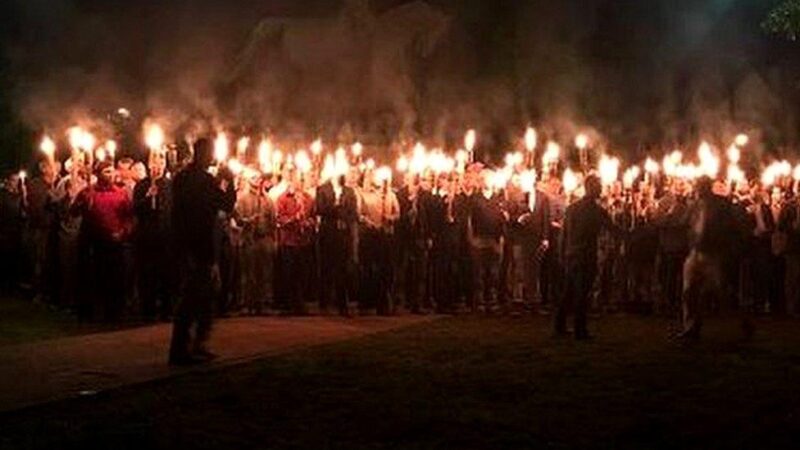
    The only thing “new” about this right-wing movement is that it uses different terms. The New Right concentrates on the “battle for the heads”, leaving the battles for the streets and, in some cases, the parliaments to other groups of the extreme right. The storming of the Capitol and the German Bundestag were such actions of the extreme right. It must be admitted that the whole world is in turmoil. At its core, however, the new right is about undermining human equality – in its view, we are only equal to our own nation or religion and gender. This exclusionary equality only with one’s own kind is at the heart of the right’s cultural revolution, whose ideal model is itself based on hierarchical notions, a graded dignity. Such attempts to undo the gains of the struggle for equality in a counter-revolution can be found all over the world – whether in nationalism, ethnocentrism, misogyny, cultural relativism (“they just have a different culture”) or thinly veiled racism. It is also marked by the revival of toxic masculinity (Raewen Connel) through the MAGA movement and in particular Trump’s enthusiasm for the wrestling mentality and martial arts. Opinions can be divided on these as sports, but they have no place in politics and point to an absolutely exaggerated and violent masculinity that Trump embodies. These political discourses are used to win elections in the West. In one sentence, the New Right shifts the concept of the democratic people to the ethno-religious people.
    When the few people of Pegida (Patriotic Europeans to defend the Abendland) in Germany shout into the camera: “We are the people”, they are turning the slogan of the democratic revolution of 1989 into an ethno-nationalist revolution. From the mid-nineteenth century to the mid-twentieth century, we have witnessed this transformation from the democratic to the ethnic concept of the people. Despite all the real political problems we face, it is essential for the twenty-first century to defend the equality of all people, regardless of biological differences such as gender or ethnicity. It is not our biology that defines us as human beings, but our morality.
    Feature Image Credit: Equality Trust
    from ‘The Link Between Inequality and the Far-Right’ – https://equalitytrust.org.uk
    The far-right has always been part of politics. The current global wave of far-right populist political movements began in the late 1970s, grew in the 1990s, and accelerated dramatically in the late 2000s. It has mirrored a sharp increase in inequality across developed economies, the globalisation of neoliberal economics, and the creation of an international super-rich. 
  • Untangling the “socialism” vs. “capitalism” Dichotomy

    Untangling the “socialism” vs. “capitalism” Dichotomy

    Few ideological dichotomies polarize opinions as readily and as completely as that between “socialism” and “capitalism.” Those who embrace socialism tend to blame capitalism for everything that’s wrong with our world today. Those who embrace capitalism harbor a seething contempt for socialists, but both camps base their views on ideology with only vague notions about the true nature of either system.

    The “socialists” think of capitalism as a rapacious system of exploitation that favors a few at the detriment of many. There is some truth in that. The “capitalists” think of socialism as a system that gives free stuff to the lazy and undeserving, choking society’s progress. There’s some truth in that too, but having lived in both systems and having experienced the ideological brainwash from both sides, I find neither side convincing.

    Spoiler alert: it’s not a left vs. right thing. It’s a top-down vs. bottom-up thing.

    So, you’re a communist!?

    Both system’s ideological foundations amount to marketing, the intellectual gloss on the cover of their respective sales brochures. But the gloss never captures the essence of either system – an omission that is so egregious that it is almost certainly deliberate. Clear understanding of the essence of this dichotomy is not encouraged and instead of exploring all the relevant issues, on both sides of the ideological divide people readily resort to derogatory labels which usually shut down the much needed open minded discussion.

    Last week I had the privilege of participating in a “Capitalist Exploits” conference in Dubai. The event was by invitation only and attended by about 70 participants, all successful entrepreneurs and investors from all over the world. Our various discussion panels covered a lot of ground including health, technology, investing, politics and geopolitics. For my humble contribution I had the honor of being called a communist. This was in jest and not with malice, but as they say, there’s some truth in every joke. I earned the distinction simply by questioning the ideological orthodoxy prevalent in the “capitalist” Western world.

    As someone who grew up in the Communist block and experienced the Marxist brainwash, being called a communist felt comical: I’d rejected the Marxist ideology already as a teenager, not because I had any deep understanding of the economic and socio-political issues we faced but because the system wasn’t delivering as advertised: it was clearly evolving in the opposite direction from the promised utopia.

    At the age of 17, I moved to the “capitalist” United States which appeared to be based on a much, much superior system to the one I knew. The U.S. economy was vibrant with entrepreneurship and innovation and the American people seemed significantly more prosperous than we were. But the more I learned about the “capitalist” system, the more I became convinced that the same seed of doom that made “socialism” unsustainable was also baked into the foundation of the “capitalist” system.

    For starters, in both systems we had the familiar old fiat currency with fractional reserve lending. This one element guarantees the collapse of both systems: over time it reliably corrodes the democratic framework of society, suffocates free market economy, kills entrepreneurship and innovation, and guarantees that government sector of the economy will gradually displace more and more private enterprise. It does this due to an economic effect called the deflationary gap.

    Deflationary gap

    The following few paragraphs may seem convoluted but please bear with me, we’re getting to the essence of the issue at hand. To understand the deflationary gap, let’s consider a closed economic system that produces a certain quantity of goods and services. By “closed” I mean that we’ll assume the system has no foreign trade.

    The total of all the price tags attached to the goods and services produced is the aggregate cost of the system’s output: it represents the amounts of money expended by the businesses on things like raw materials, wages, rents and interest plus the entrepreneurs’ profits. These sums are income to those who receive them and also comprise the system’s total purchasing power. On the whole, the aggregate costs, aggregate incomes and aggregate prices are all the same, because they represent the opposite sides of the same transactions.

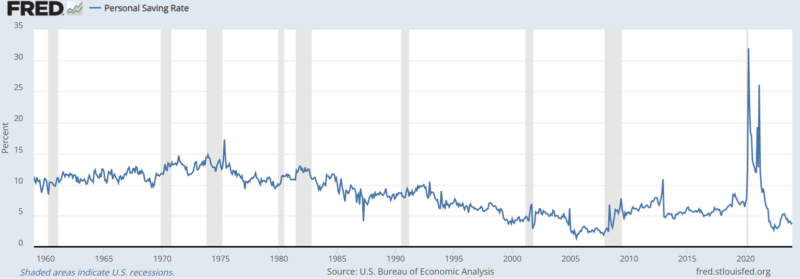
    The prices at which the system’s output can be sold in the marketplace are determined by the total amount of money which is available for spending in a given period of time. For the system to be in equilibrium, aggregate prices should exactly absorb the system’s total purchasing power. But a problem arises because in the current monetary system, there are two factors that significantly reduce the system’s purchasing power: (1) savings and (2) debt repayments.

    Namely, people don’t always spend all of their income. Instead, they prefer to set aside a part of it as savings which has the effect of reducing the total purchasing power available in the system.

    This is a problem

    So, if there are any savings, the available purchasing power will be less than the aggregate asking prices. For the system to remain in balance the savings would have to reappear in the market in the form of investments, but if total investment is less than total savings, the purchasing power will still fall short of the amount needed for all of the output to be sold at asking prices. This shortfall of purchasing power in the system, the excess of savings over investment is the deflationary gap.

    The other systemic drain on purchasing power (hat tip to author Liam Allonefor pointing this out to me) are debt repayments: since (nearly) all currency enters into circulation as debt, paying down debts extinguishes the currency and the purchasing power with it.

    Without government intervention we get a depression

    The system can be balanced either by lowering the supply and prices of goods, by enhancing its total purchasing power, or a combination of both. Lowering prices and production of goods will stabilize the economic system at a low level of economic activity. Increasing the purchasing power in the system will stabilize it on a higher level of activity. Left to itself and without intervention, a modern economic system would fall into what we call a self-reinforcing deflationary depression: the deflationary gap would lead to falling prices and output, decline of income and rising unemployment. Furthermore, in recessions and depressions, the level of investment typically declines even more rapidly than savings. To avert this, government intervention is necessary.

    Without government intervention, the economy would stabilize when the level of savings declined to the level of investments which would be at a depression level of activity. This is an anathema in all modern economies, and governments invariably pursue the imperative of economic growth. To generate growth, they must inject new purchasing power into the system. This cannot be done through taxation since taxation doesn’t create new purchasing power: taxes only transfer money from those who earn it to the government.

    This is why governments have no alternative but to continuously engage in deficit spending, adding debt in excess of their tax receipts. This is why virtually all governments in the world today run budget deficits and chronically grow public debt. In spite of all the incessant talk about balancing the budget, paying down debts or imposing debt ceilings, the debts only keep rising at rates that predictably accelerate over time. It doesn’t matter whether we call the system “socialist” or “capitalist,” they both necessitate an ever growing role of government in the economy.

    Today, in many of the “capitalist” nations, government spending accounts for almost half of the GDP and in some cases significantly more. In the UK, the mothership of capitalism, the government’s share of GDP is 44%. In France it’s over 58%.

    The great American debt ceiling Kabuki theater

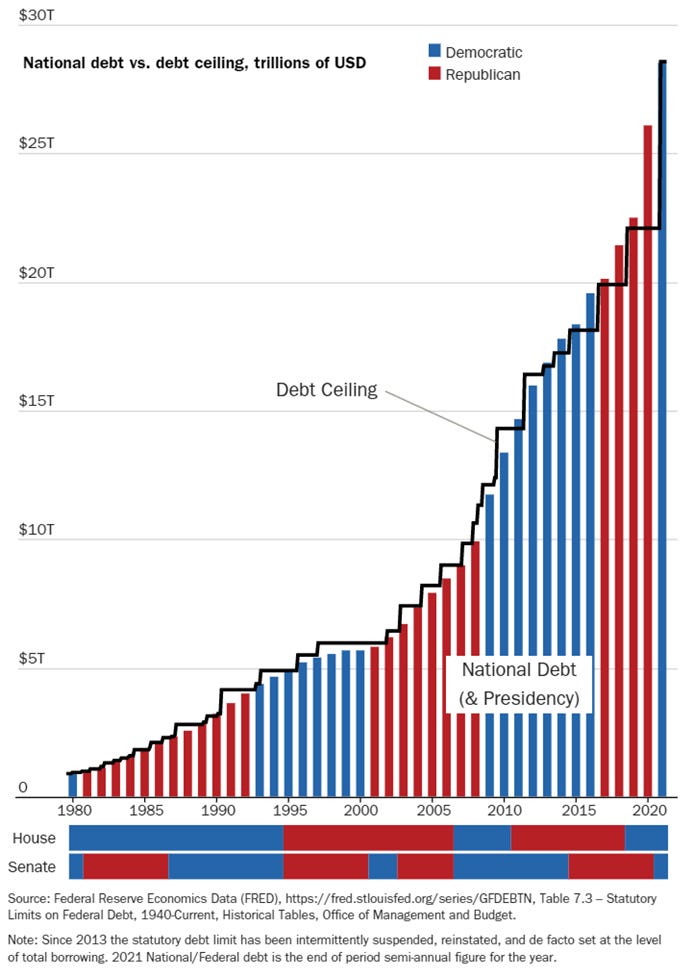
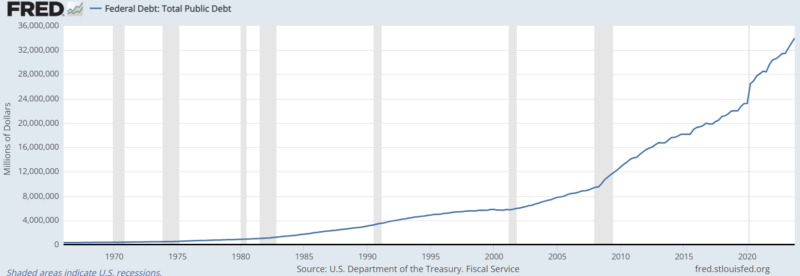
    In the United States, for over a century now we’ve been treated to periodic reruns of the “debt ceiling” Kabuki theatre. When public debt reaches the “debt ceiling,” free-spending socialists call for more government spending and a raising of the debt ceiling. The conservatives enjoy grandstanding about fiscal conservatism and balancing budgets, but regardless of which side controls the Presidency or the Congress, for over a century now the debt ceiling has been raised every time. The only exceptions have been periods when the ceiling was simply ignored and the public debt continued its accelerating upward trajectory:

    You get socialism, whether you like it or not!

    Averting a depression and achieving economic growth necessitates government intervention and guarantees an accelerating rise in deficit spending with the corresponding rise in public debt regardless of whether we are talking about a “capitalist” or a “socialist” economies. This should be obvious, as the evolution of public debt in the U.S. illustrates:


    There’s no point railing against “socialism” and dreaming about a small government, private capital utopia which doesn’t, and cannot exist so long as our economies are based on fiat currencies with fractional reserve lending. Even if we start with zero public debt, the pursuit of economic growth will lead to the same outcomes.

    With fullness of time, government sector will progressively crowd out private enterprise: it’s a mathematical certainty. As a result, we get socialism whether we like it or not. Even if a political leader declares himself to be an anarcho-capitalist and thinks he can create the capitalist utopia (like Argentina’s Javier Millei), the endgame will be the same.

    The passionate disciples of capitalist ideology will protest and invoke the theoretical works by economists like Ludwig Von Mises, Murray Rothbardor Friedrich Hayek but I would simply ask them to please name one real-world example of a successful free market capitalist economy where the government never ran budget deficits and piled up public debt. I can wait.

    For those who would defend the free market ideology and excuse its failing as a consequence of human corruption and weakness of the structures of society, I’d warn them that this was exactly how Marxists explained away the failures of communist utopia.

    Top-down or bottom-up?

    With that, we can address the false dichotomy between “socialist” and “capitalist” economies as they’re commonly discussed. Namely, in what we call “capitalist” economies, a larger proportion of government-injected purchasing power flows top-down. In what we call “socialist” economies, it flows bottom-up.

    Capitalist governments splurge their largesse on large private corporations in the form of subsidies and generous government contracts. Socialist governments splurge on social welfare programs like low-cost or free health care, education, generous unemployment benefits and pension plans, and programs that maintain full employment even where jobs couldn’t be justified by private enterprise.

    It’s what the “capitalists” hate. As a rule, individuals who strongly favor free market capitalism tend to be the successful, entrepreneurial types who value risk taking, hard work and creating wealth through private initiative. The idea that the state would splurge on the lazy and undeserving free-loaders is understandably revolting.

    However, the alternative in splurging on large corporations is far more dangerous. If purchasing power is distributed bottom up, the decisions about how to spend that purchasing power are up to the ordinary people. As such, they’ll tend to benefit ordinary businesses that produce consumer goods and services: bakers, apparel makers, restaurants, coffee shops, musicians, tour guides, bicycle repairmen, etc.

    By contrast, if the state spends top-down, it runs the moral hazard of determining the winners and losers in the supposedly free market competition. The winners will tend to be those corporations and groups that can “invest” the most in political lobbying efforts. As a result, we get the TBTF banking behemoths, big Ag, big Pharma, big Media, big Tech and a massively bloated military-industrial complex. Ultimately, this favors the emergence of corporatism, as Benito Mussolini characterized fascism. Today we prefer the sanitized term, “private-public partnership.” The adverse effect of all this is a society’s addiction to permanent wars and a penchant for empire-building.


    This article is published in Alex Krainer’s Substack.


  • The Impact of Domestic Politics on Foreign Policy: The Colombian Case Study

    The Impact of Domestic Politics on Foreign Policy: The Colombian Case Study

    Introduction

    Colombia is amongst the world’s highly polarised states and has endured conflict for decades. The country witnessed around 50 years of armed struggle between militant groups, the government, and the drug cartels and has seen various forms of human rights violations in these years. The country saw more than 220,000 people killed in the conflict, roughly 25000 kidnapped or disappeared and more than 5 million displaced citizens (García-Perdomo, Harlow & Brown, 2022). However, after much pressure from the people and the government, the guerrilla factions and the ruling party convened to sign a peace agreement that essentially brought the active warring factions to a pause. On November 24, 2016, the Revolutionary Armed Forces of Colombia – People’s Army, or FARC, signed a landmark peace agreement, which also saw the militants present a public apology to the people of Colombia for their violent actions (Georgi, 2022).

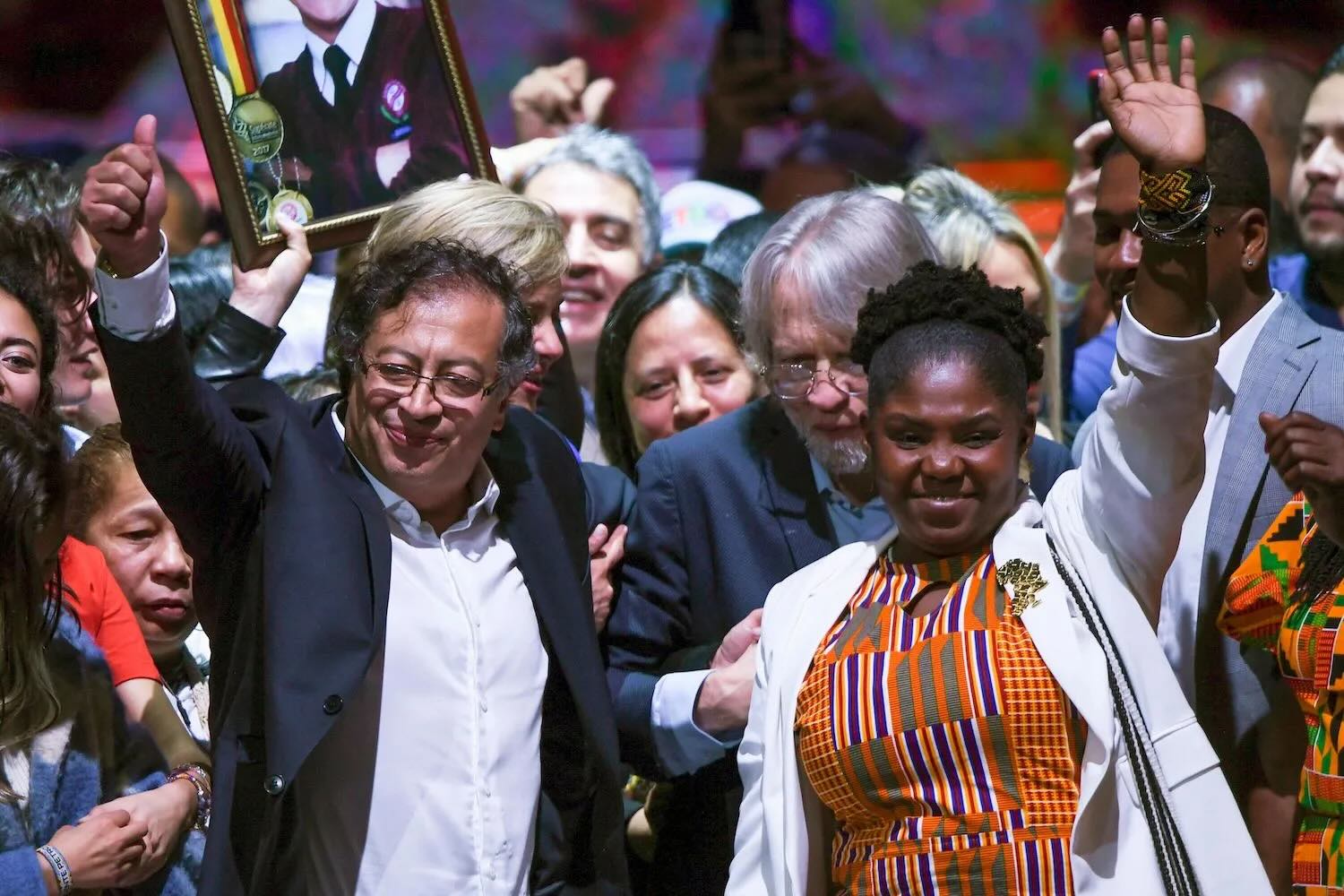
    Since the end of the Second World War, Colombia has seen various governments adopt different stances and approaches to their foreign policies. Multiple domestic actors – state and non-state- have strongly influenced the country’s diplomacy. For example, between 1998 – 2002, Colombia moved from the narrative of remaining a failed state and developed ties with the US (Monroy & Sanchez, 2017). The Republic of Colombia has had 17 presidents since 1946, most of whom belong to Right-Wing conservative parties. The current President, Gustavo Francisco Petro Urrego, is the first President from a liberal and leftist political party (Tickner, 2022, 8:10) in decades. The country has never had a progressive-left leader in its political history, and his government has been making waves on all fronts concerning ties with neighbouring countries, attempting to resolve the internal conflict, and dealing with economic disparities within the population.

    A state’s foreign policy primarily focuses on interactions with other states and international actors and is essential to its political agenda. Given the interdependence of these two domains, domestic politics play a vital role in determining a state’s foreign policy. Foreign policy refers to a state’s approach and actions internationally. In contrast, domestic politics refers to the political processes, institutions, and actors within a state that affect the country’s policies. This essay uses Colombia as a case study to investigate how the country’s domestic politics and conflicts have affected its foreign policy. The timeline under revision is from the end of the Second World War to the present.

    This paper will look at the following factors as critical points of discussion. Determining the success of a policy is done by evaluating its efficiency and the evident improvement of situations. The paper will examine 1. How has the evolution of state leadership impacted Colombia’s foreign policy? 2. What role did the insurgents and drug lords play in this scenario? The state leadership (Hey, 1997), the insurgents, and the drug lords are critical players in Colombia’s political landscape and the evolution of its foreign policy. King, Keohane and Verba (1994, p.76) define causality as “a theoretical concept independent of the data used to learn about it”. It is difficult to draw causal inferences in a limited paper. Still, by examining the players mentioned earlier, this paper hopes to attract inferences between domestic politics and the direction of the country’s foreign policy.

    State Leadership and Foreign Policy

    There is a crisp scent of dependency theory when exploring literature about the foreign policies of Latin American countries (Hey, 1997). Similarly, Colombia – a state that witnessed long years of violent conflicts, deaths, kidnappings and illegal drug production continued on the same path as the rest of the countries in the continent. Significant economic disparities and multiple right-wing presidencies saw the inequality between people grow larger and larger (Hey, 1997). These were all critical factors in shaping how the country’s foreign policy presented itself to the world. After the end of the Second World War, Colombia maintained a low profile with respect to its foreign policy (Drekonja-Kornat, 1983). However, Colombia did have a traditional foreign policy – as in a Ministry to oversee relations and maintain ties with neighbouring countries, especially since border disagreements were high. Colombia had closer ties with the US than its immediate neighbouring states. At the same time, there appeared to be a consensus on the state leadership directing policies to suit principles of capitalistic democracy, free trade and markets; Colombia’s external affairs seemed to feed off of international support, especially from the United States of America. The US, in its quest to spread its capitalist democracy, assisted the various presidencies with aid and other means to combat guerrilla movements and insurgent activities. In turn, Colombia helped the US in the Korean War and stood by the US during the Cold War years, too. Drekonja-Kornat (1983) says Colombia was the only Latin American Country involved in the Korean conflict. During Turbay’s presidency, the US-Colombia ties grew closer, and US assistance helped establish his regime further (Hey, 1997). He held office from 1978 – 1982.

    The state’s leadership, in return, adopted and often tailored policies to suit strategic and international partners, particularly the US. Examples of presidencies adopting such policies include supporting the US stance on drugs (Hey, 1997), committing to recognise threats and terrorist activities as adjudged by the US and the EU, etc. (United States Department of State, 2021). Colombia’s constant internal security dilemma accentuates the existence of a dependency theory of Foreign Policy.

    Impact of the Internal Conflict on Colombia’s Foreign Policy

    The insurgents, guerrilla groups, and drug cartels played a role in shaping the foreign policy of Colombia. The entry of drugs into neighbouring countries, particularly the US, brought an international player into Colombia’s domestic issues (Gomez-Suarez & Newman, 2013). The United States desperately tried to solve the drug menace, which led to fighting the drug cartels and networks. America aided and supported the governments in curbing the cartel’s activities and eliminating insurgents who pushed for a more communist ideology, primarily in the Cold War period. Colombia’s alignment with the US on account of the Cold War influenced its domestic politics, which had a more significant say in shaping the country’s foreign policy. The United States of America is Colombia’s largest aid donor; listed below are some of the aid packages received by Colombia:

    1. The US has provided more than $1 billion in direct and indirect support for implementing peace in Colombia since 2016. (United States Department of State, 2021).
    2. The US provided roughly $700 million to assist Colombia with the Venezuelan migrant crisis and host approximately 1.8 million refugees in Colombia. (United States Department of State, 2021).

    Viewing the case from a realist perspective, much of Colombia’s foreign affairs has been dictated by the ebbs and flow of the insurgency. With Colombia’s development and domestic affairs requiring external support, it lacked the necessary flexibility to implement social development schemes as dependency on external aid was high (Monroy & Sanchez, 2017). Colombia became an instrument of the American War on Drugs, almost a pawn to the American foreign policy in Latin America (Tickner, 2011).

    While examining the history of how the state’s leadership handled its foreign policy directives and its domestic issues, there is space for some leniency. Many attempts to broker a peace agreement between the insurgents and the state were met with strong reluctance from the general public and a lack of participation from insurgent groups. Furthermore, corruption in various levels of government offices withheld any progress that could have been made. One could interpret the constant repetition of right-wing presidencies as people’s reluctance to move away from conservative rules, much to the dismay of insurgents, ultimately rendered the public most affected in the struggle for domestic power in the country.

    The Way Forward

    Gustavo Petro became the first leftist President of Colombia on June 19, 2022, in decades (Freeman, 2023). His Presidential victory also marked the first-ever Afro-Colombian, Francia Marquez, to take office as Vice President. Unlike his liberal predecessors, the change in power was smooth from his rightist counterparts. As a leftist, there were questions about his merit and reputation as the country’s leftists were primarily likened to insurgents and militants. While the 2016 Peace Accords dismantled and disarmed most militants from the Fuerzas Armadas Revolucionarias de Colombia or FARC, the associations took longer to change.

    President Petro, however, is having quite the start to office. He is leading a policy of ‘Total Peace’, an effort to include all factions and players in the internal conflict and arrive at an end to the insurgency; his presidency plans to shift Colombia’s economic dependency on trade from the US, fossil fuels and the illicit drug trade to a more sustainable approach (Freeman, 2023), that would be similar to the Green Theory. One can interpret his actions as playing on both sides of the solid and historical US-Colombia ties (Santa Eulalia, 2022). Owing to the associations with his left-leaning tendencies, his moves are somewhat open to more scrutiny by the public. After all, no incumbent President has been re-elected to office in the last 15 elections (Freeman, 2023).

    A significant part behind his election to office has been the general public’s displeasure at rising economic inequalities between people, the inability of the previous government to provide and implement social welfare schemes and the financial toll caused by inactivity during the Covid-19 pandemic. While Drekonja-Konrat (1986) argues that most Latin-American countries can shape their foreign policies to the extent that it doesn’t hurt US interests, Petro is challenging the very notion of keeping his voters happy (Santa Eulalia, 2022). The truth in the details is that they are pretty co-dependent; Colombia needs the support of the US in tackling drug issues and the matter of the guerrilla militant groups, while the US views Colombia as a key strategic partner in the region. Accordingly, Petro has to carefully cater to his vote-bank’s anti-Americanism and yet maintain cordial ties with the US. It is a fragile line to tread, but the room to navigate and keep the US and the public happy is also quite small. Political revisionism is prevalent, given Petro is trying to appease both sides of support, constantly showing evident links as to how a country’s domestic politics can affect its foreign policy.

    References

    Drekonja-Kornat., G. (1983). Colombia: Learning the Foreign Policy Process, Journal of Inter-American Studies and World Affairs, 25(2). Pp- 229-250.

    Drekonja-Kornat., G. (1986). The rise of Latin America’s foreign policy: Between hegemony and autonomy. Latin American Research Review, 21(1), 239-259.

    Freeman, W. (February 2023). Colombia tries a transformative Left Turn, Council on Foreign Relations. Retrieved from: https://www.cfr.org/article/colombia-tries-transformative-left-turn

    García-Perdomo, V.,  Harlow, S. & Brown, D. K., (2022). Framing the Colombian Peace Process: Between Peace and War Journalism, Journalism Practice.

    Georgie, R. (2022). Peace that antagonises: Reading Colombia’s peace process as a hegemonic crisis, Security Dialogue, pp – 1-19.

    Gomez-Suarez, A. & Newman, J., (2013). Safeguarding Political Guarantees in the Colombian Peace Process: have Santos and FARC learnt the lessons from the past?, Third World Quarterly, 34(5), pp – 819-837.

    Hey, J. A. K. (1997). Three Building Blocks of a Theory of Latin American Foreign Policy, Third World Quarterly, 18(4), pp -631-658.

    King, G., Keohane, R.O, & Verba, S. (1994). Designing Social Inquiry: Scientific Inference in Qualitative Research.Princeton, NJ, Princeton University Press.

    Monroy, M. C. & Sánchez, F. (2017) Foreign Policy Analysis and the Making of Plan Colombia, Global Society, 31(2), pp – 245-271.

    Santaeulilah, I. (October 2022). Petro Playing Both Sides in Colombia-US Relations, El Pais. Retrieved from: https://english.elpais.com/international/2022-10-26/petro-playing-both-sides-in-colombia-us-relations.html

    Feature Image Credit: Foreign Policy


  • Trump followed four years later by Trump: Would America’s trustiness and system of alliances survive?

    Trump followed four years later by Trump: Would America’s trustiness and system of alliances survive?

    Ambassador Alfredo Toro Hardy examines, in this excellently analysed paper, the self-created problems that have contributed to America’s declining influence in the world. As he rightly points out, America helped construct the post-1945 world order by facilitating global recovery through alliances, and mutual support and interweaving the exercise of its power with international institutions and legal instruments. The rise of neoconservatism following the end of the Cold War, particularly during the Bush years from 2000 to 2008, led to American exceptionalism, unipolar ambitions, and the failure of American foreign policy.  Obama’s Presidency was, as Zbigniew Brezinski said, a second chance for restoring American leadership but those gains were nullified in Donald Trump’s 2016-20 presidency leading to the loss of trust in American Leadership. In a final analysis that may be questionable for some, Ambassador Alfredo sees Biden’s administration returning to the path of liberal internationalism and recovering much of the lost trust of the world.  His fear is that it may all be lost if Trump returns in 2024.                               – Team TPF


    TPF Occasional Paper   9/2023    

    Trump followed four years later by Trump: Would America’s trustiness and system of alliances survive?


    According to Daniel W. Drezner: “Despite four criminal indictments, Donald Trump is the runaway frontrunner to win the GOP nomination for president. Assuming he does, current polling shows a neck-and-neck race between Trump and Biden in the general election. It would be reckless for other leaders to dismiss the possibility of a second Trump term beginning on January 20, 2025. Indeed, the person who knows this best is Biden himself. In his first joint address to Congress, Biden said that in a conversation with world leaders, he has ‘made it known that America is back’, and their responses have tended to be a variation of “but for how long?”. [1]

    A bit of historical context

    In order to duly understand the implications of a Trump return to the White House, a historical perspective is needed. Without context, it is difficult to comprehend the meaning of the “but for how long?” that worries so many around the world. Let’s, thus, go back in time.

    Under its liberal internationalist grand vision, Washington positioned itself at the top of a potent hegemonic system. One, allowing that its leadership could be sustained by the consensual acquiescence of others. Indeed, through a network of institutions, treaties, mechanisms and initiatives, whose creation it promoted after World War II, the United States was able to interweave the exercise of its power with international institutions and legal instruments. Its alliances were a fundamental part of that system. On the other side of the Iron Curtain, though, the Soviet Union established its own system of alliances and common institutions.

                In the 1970s, however, America’s leadership came into question. Two reasons were responsible for it. Firstly, the Vietnam War. The excesses committed therein and America’s impotence to prevail militarily generated great discomfort among several of its allies. Secondly, the crisis of the Bretton Woods system. As a global reserve currency issuer, the stability of the U.S. currency was fundamental. In a persistent way, though, Washington had to run current account deficits to fulfil the supply of dollars at a fixed parity with gold. This impacted the desirability of the dollar, which in turn threatened its position as a reserve currency issuer. When a run for America’s gold reserves showed a lack of trust in the dollar, President Nixon decided in 1971 to unhook the value of the dollar from gold altogether.

                Notwithstanding these two events, America’s leadership upon its alliance system would remain intact, as there was no one else to face the Soviet threat. However, when around two decades later the Soviet Union imploded, America’s standing at the top would become global for the same reason: There was no one else there. Significantly, the United States’ supremacy was to be accepted as legitimate by the whole international community because, again, it was able to interweave the exercise of its power with international institutions and legal instruments.

    Inexplicable under the light of common sense

                In 2001, however, George W. Bush’s team came into government bringing with them an awkward notion about the United States’ might. Instead of understanding that the hegemonic system in place served their country’s interests perfectly well, the Bush team believed that such a system had to be rearranged in tandem with America’s new position as the sole superpower. As a consequence, they began to turn upside down a complex structure that had taken decades to build.

    The Bush administration’s world frame became, indeed, a curious one. It believed in unconditional followers and not in allies’ worthy of respect; it believed in ad hoc coalitions and “with us or against us” propositions where multilateral institutions and norms had little value; it believed in the punishment of dissidence and not in the encouragement of cooperation; it believed in preventive action prevailing over international law.

    In proclaiming the futility of cooperative multilateralism, which in their perspective just constrained the freedom of action of America’s might, they asserted the prerogatives of a sole superpower. The Bush administration’s world frame became, indeed, a curious one. It believed in unconditional followers and not in allies’ worthy of respect; it believed in ad hoc coalitions and “with us or against us” propositions where multilateral institutions and norms had little value; it believed in the punishment of dissidence and not in the encouragement of cooperation; it believed in preventive action prevailing over international law. Well-known “neoconservatives” such as Charles Krauthammer, Robert Kagan, and John Bolton, proclaimed America’s supremacy and derided countries not willing to follow its unilateralism.

                But who were these neoconservatives? They were the intellectual architects of Bush’s foreign policy, who saw themselves as the natural inheritors of the foreign policy establishment of Truman’s time. The one that had forged the fundamental guidelines of America’s foreign policy during the Cold War, in what was labelled as the “creation”. In their view, with the United States having won the Cold War, a new creation was needed. Their beliefs could be summed up as diplomacy if possible, force if necessary; U.N. if possible, ad hoc coalitions, unilateral action, and preemptive strikes if necessary. America, indeed, should not be constrained by accepted rules, multilateral institutions, or international law. At the same time, the U.S.’ postulates of freedom and democracy, expressions of its exceptionalism, entailed the right to propitiate regime change whenever necessary, in order to preserve America’s security and the world order.

    Bogged down in Iraq and Afghanistan, while deriding and humiliating so many around the world, America’s neoconservatives undressed the emperor. By taking off his clothes, they made his frailties visible for everyone to watch.

    Inexplicable, under the light of common sense, the Bush team disassociated power from the international structures and norms that facilitated and legitimized its exercise. As a consequence, America moved from being the most successful hegemonic power ever to becoming a second-rate imperial power that proved incapable of prevailing in two peripheral wars. Bogged down in Iraq and Afghanistan, while deriding and humiliating so many around the world, America’s neoconservatives undressed the emperor. By taking off his clothes, they made his frailties visible for everyone to watch.

                At the beginning of 2005, while reporting a Pew Research Center poll, The Economist stated that the prevailing anti-American sentiment around the world was greater and deeper than at any other moment in history. The BBC World Service and Global Poll Research Partners, meanwhile, conducted another global poll in which they asked, “How do you perceive the influence of the U.S. in the world?”. The populations of some of America’s traditional allies gave an adverse answer in the following percentages: Canada 60%; Mexico 57%; Germany 54%; Australia 52%; Brazil 51%; United Kingdom 50%. With such a negative perception among Washington’s closest allies, America’s credibility was in tatters.[2]

             Is the liberal international order ending? what is next? dailysabah.com

     While Bush’s presidency was reaching its end, Zbigniew Brzezinski wrote a pivotal book that asserted that the United States had lost much of its international standing. This felt, according to the book, particularly disturbing. Indeed, as a result of the combined impact of modern technology and global political awakening, that speeded up political history, what in the past took centuries to materialize now just took decades, whereas what before had taken decades, now could materialize in a single year. The primacy of any world power was thus faced with immense pressures of change, adaptation and fall. Brzezinski believed, however, that although America had deeply eroded its international standing, a second chance was still possible. This is because no other power could rival Washington’s role. However, recuperating the lost trust and legitimacy would be an arduous job, requiring years of sustained effort and true ability. The opportunity of this second chance should not be missed, he insisted, as there wouldn’t be a third one. [3]

    A second chance

                Barak Obama did certainly his best to recover the space that had been lost during the preceding eight years. That is, the U.S.’s leading role within a liberal internationalist structure. However, times had changed since his predecessor’s inauguration. In the first place, a massive financial crisis that had begun in America welcomed Obama, when he arrived at the White House. This had increased the international doubts about the trustiness of the country. In the second place, China’s economy and international position had taken a huge leap ahead during the previous eight years. Brzezinski’s notion that no other power could rival the United States was rapidly evolving. As a result, Obama was left facing a truly daunting challenge.

                To rebuild Washington’s standing in the international scene, Obama’s administration embarked on a dual course of action. He followed, on the one hand, cooperative multilateralism and collective action. On the other hand, he prioritized the U.S.’ presence where it was most in need, avoiding unnecessary distractions as much as possible. Within the first of these aims, Obama seemed to have adhered to Richard Hass’ notion that power alone was simple potentiality, with the role of a successful foreign policy being that of transforming potentiality into real influence. Good evidence of this approach was provided through Washington’s role in the Paris Agreement on Climate Change, in the Joint Comprehensive Plan of Action in relation to Iran, in the NATO summits, in the newly created G20, and in the summits of the Americas, among many other instances. By not becoming too overbearing, and by respecting other countries’ points of view, the Obama Administration played a leading influence within the context of collective action. Although theoretically being one among many, the United States always played the leading role.[4]

    Within this context, Obama’s administration followed a coalition-building strategy. The Trans-Pacific Partnership represented the economic approach to the pivot and aimed at building an association covering forty per cent of the global economy. There, the United States would be the first among equals. As for the security approach to the pivot, the U.S. Navy repositioned its forces within the Pacific and the Atlantic oceans.

                To prioritize America’s presence where it was most needed, Obama turned the attention to China and the Asia-Pacific. While America was focusing on the Middle East, China enjoyed a period of strategic opportunity. His administration’s “pivot to Asia” emerged as a result. This policy had the dual objective of building economic prosperity and security, within that region. Its intention was countering, through facts, the notion that America was losing its staying power in the Pacific. Within this context, Obama’s administration followed a coalition-building strategy. The Trans-Pacific Partnership represented the economic approach to the pivot and aimed at building an association covering forty per cent of the global economy. There, the United States would be the first among equals. As for the security approach to the pivot, the U.S. Navy repositioned its forces within the Pacific and the Atlantic oceans. From a roughly fifty-fifty correlation between the two oceans, sixty per cent of its fleet was moved to the Pacific. Meanwhile, the U.S. increased joint exercises and training with several countries of the region, while stationing 2,500 marines in Darwin, Australia. As a result of the pivot, many of China’s neighbours began to feel that there was a real alternative to this country’s overbearing assertiveness.[5]

                Barak Obama was on a good track to consolidating the second chance that Brzezinski had alluded to. His foreign policy helped much in regaining international credibility and standing for his country, and the Bush years began to be seen as just a bump on the road of America’s foreign policy. Unfortunately, Donald Trump was the next President. And Trump coming just eight years after Bush, was more than what America’s allies could swallow.

    Dog-eat-dog foreign policy

                The Bush and Trump foreign policies could not be put on an equal footing, though. The abrasive arrogance of Bush’s neoconservatives, however distasteful, embodied a school of thought in matters of foreign policy. One, characterized by a merger between exalted visions of America’s exceptionalism and Wilsonianism. Francis Fukuyama defined it as Wilsionanism minus international institutions, whereas John Mearsheimer labelled it as Wilsionanism with teeth. Although overplaying conventional notions to the extreme, Bush’s foreign policy remained on track with a longstanding tradition. Much to the contrary, Trump’s foreign policy, according to Fareed Zakaria, was based on a more basic premise– The world was largely an uninteresting place, except for the fact that most countries just wanted to screw the United States. Trump believed that by stripping the global system of its ordering arrangements, a “dog eat dog” environment would emerge. One, in which his country would come up as the top dog. His foreign policy, thus, was but a reflection of gut feelings, sheer ignorance and prejudices.[6]

                Trump derided multilateral cooperation and preferred a bilateral approach to foreign relations. One, in which America could exert its full power in a direct way, instead of letting it dilute by including others in the decision-making process. Within this context, the U.S.’ market leverage had to be used to its full extent, to corner others into complying with Washington’s positions. At the same time, he equated economy and national security and, as a consequence, was prone to “weaponize” economic policies. Moreover, he premised on the use of the American dollar as a bullying tool to be used to his country’s political advantage. Not only China but some of America’s main allies as well, were targeted within this approach. Dusting off Section 323 of the 1962 Trade Expansion Act, which allowed tariffs on national security grounds, Trump imposed penalizations in every direction. Some of the USA’s closest allies were badly affected as a result.

                Given Trump’s contempt for cooperative multilateralism, but also aiming at erasing Obama’s legacy, an obsessive issue with him, he withdrew the U.S. from the Trans-Pacific Partnership, from the Paris Agreement on Climate Change, and from the Joint Comprehensive Plan of Action in relation to Iran. He also withdrew his country from other multilateral institutions, such as the United Nations’ Human Rights Commission and, in the middle of the Covid 19 pandemic, from the World Health Organization. Trump threatened to cut funding to the U.N., waged a largely victorious campaign to sideline the International Criminal Court, and brought the World Trade Organization to a virtual standstill. Even more, he did not just walk away from the Joint Comprehensive Plan of Action, in relation to Iran, but threatened its other signatories to impose sanctions on them if, on the basis of the agreement, they continued to trade with Iran.

    Trump followed a transactional approach to foreign policy in which principles and allies mattered little, and where trade and money were prioritized over security considerations.

                Trump followed a transactional approach to foreign policy in which principles and allies mattered little, and where trade and money were prioritized over security considerations. In 2019, he asked Japan to increase fourfold its annual contribution for the privilege of hosting 50,000 American troops in its territory, while requesting South Korea to pay 400 percent more for hosting American soldiers. This, amid China’s increasing assertiveness and North Korea’s continuous threats. In his relations with New Delhi, a fundamental U.S. ally within any containment strategy to China, he subordinated geostrategic considerations to trade. On the premise that India was limiting American manufacturers from access to its market, Trump threatened this proud nation with a trade war.[7]

                Irritated because certain NATO member countries were not spending enough on their defence, Trump labelled some of Washington’s closest partners within the organization as “delinquents”. He also threatened to reduce the U.S.’ participation in NATO, calling it “obsolete”, while referring to Germany as a “captive of Russia”. At the same time, Trump abruptly cancelled a meeting with the Danish Prime Minister, because she was unwilling to discuss the sale of Greenland to the United States. This, notwithstanding the fact that this was something expressively forbidden by the 1975 Helsinki Final Act, represents the cornerstone of European stability. The European Union, in his view, was not a fundamental ally, but a competitor and an economic foe. Deliberately, Trump antagonized European governments, including that of London at the time, by cheering Brexit. Meanwhile, he imposed tariffs on steel and aluminium on many of its closest partners and humiliated Canada and Mexico by imposing upon them a tough renegotiation of NAFTA. One, whose ensuing accord did not bring significant changes. Moreover, he fractured the G7, a group integrated by Washington’s closest allies, leaving the United States standing alone on one side with the rest standing on the other.

    In June 2018, Donald Tusk, President of the European Council, expressed his bewilderment at seeing that the rules-based international order was being challenged precisely by its main architect and guarantor– the United States. Financial Times columnist Martin Wolf summoned up all of this, by expressing that under Trump the U.S. had become a rogue superpower.

                Unsurprisingly, thus, America’s closest allies reached the conclusion that they could no longer trust it. Several examples attested to this. In November 2017, Canberra’s White Paper on the security of Asia expressed uncertainty about America’s commitment to that continent. In April 2018, the United Kingdom, Germany and France issued an official statement expressing that they would forcefully defend their interests against the U.S.’ protectionism. On May 10, 2018, Angela Merkel stated in Aquisgran that the time in which Europe could trust America was over. On May 31, 2018, Justin Trudeau aired Canada’s affront at being considered a threat to the United States. In June 2018, Donald Tusk, President of the European Council, expressed his bewilderment at seeing that the rules-based international order was being challenged precisely by its main architect and guarantor– the United States. In November 2019, in an interview given to The Economist, Emmanuel Macron stated that the European countries could no longer rely on the United States, which had turned its back on them. Financial Times columnist Martin Wolf summoned up all of this, by expressing that under Trump the U.S. had become a rogue superpower.[8]

    The return of liberal internationalism

    Politically and geopolitically Biden rapidly went back to the old premises of liberal internationalism. Cooperative multilateralism and collective action were put back in place, and alliances became, once again, a fundamental part of America’s foreign policy. 

               As mentioned, George W. Bush followed a few years later by Donald Trump was more than what America’s allies could handle. Fortunately for that country, and for its allies, Trump failed to be re-elected in 2020, and Joe Biden came to power. True, the latter’s so-called foreign policy for the middle classes kept in place some of Trump’s international trade policies. However, politically and geopolitically he rapidly went back to the old premises of liberal internationalism. Cooperative multilateralism and collective action were put back in place, and alliances became, once again, a fundamental part of America’s foreign policy.  Moreover, Biden forcefully addressed some of his country’s main economic deficiencies, which had become an important source of vulnerability in its rivalry with China. In sum, Biden strengthened the United States’ economy, its alliances, and its international standing.

                Notwithstanding the fact that Biden had to fight inch by inch with a seemingly unconquerable opposition, while continuously negotiating with two reluctant senators from his own party, he was able to pass a group of transformational laws. Among them, are the Infrastructure Investment and Job Act, the CHIPS and Science Act and the Inflation Reduction Act. Together, these legislations allow for a government investment of a trillion dollars in the modernization of the country’s economy and its re-industrialization, including the consolidation of its technological leadership, the updating of its infrastructures and the reconversion of its energy matrix towards clean energy. Private investments derived from such laws would be gigantic, with the sole CHIPS Act having produced investment pledges of more than 100 billion dollars. This projects, vis-à-vis China’s competition, an image of strength and strategic purpose. Moreover, before foes and friends, these accomplishments prove that the U.S. can overcome its legislative gridlocks, in order to modernize its economy and its competitive standing.

                Meanwhile, Washington’s alliances have significantly strengthened. In Europe, Russia’s invasion of Ukraine and Washington’s firm reaction to it had important consequences. While the former showed to its European allies that America’s leadership was still indispensable, the latter made clear that the U.S. had the determination and the capacity to exercise such leadership. Washington has indeed led in response to the invasion, in the articulation of the alliances and the revitalization of NATO, in sanctions on Russia, and in the organization of the help provided to Ukraine. It has also been Kyiv’s main source of support in military equipment and intelligence, deciding at each step of the road what kind of armament should be supplied to the Ukrainian forces. In short, before European allies that had doubted Washington’s commitments to its continent, and of the viability of NATO itself, America proved to be the indispensable superpower.

                Meanwhile, American alliances in the Indo-Pacific have also been strengthened and expanded, with multiple initiatives emerging as a result. As the invasion of Ukraine made evident the return of geopolitics by the big door, increasing the fears of China’s threat to regional order, Washington has become for many the essential partner. America’s security umbrella has proved to be for them a fundamental tool in containing China’s increasing arrogance and disregard for international law and jurisprudence. Among the security mechanisms or initiatives created or reinforced under its stewardship are an energized Quad; the emergence of AUKUS; NATO’s approach to the Indo-Pacific region; the tripartite Camp David’s security agreement between Japan, South Korea and the U.S.; a revamped defence treaty with The Philippines; an increased military cooperation with Australia; and Hanoi’s growing strategic alignment with Washington. On the economic side, we find the Indo-Pacific Economic Framework for Prosperity and the freshly emerged Partnership for Global Infrastructure and Investment & India-Middle East-Europe Economic Corridor.

    Enough would be enough

                Although the Global South has proved to be particularly reluctant to fall back under the security leadership of the superpowers, Washington has undoubtedly become the indispensable partner for many in Europe and the Indo-Pacific. Thanks to Biden, the United States has repositioned itself on the cusp of a potent alliance system, regaining credibility and vitality. What would happen, thus, if he is defeated in the 2024 elections and Trump regains the White House? In 2007, Brzezinski believed, as mentioned, that although America had deeply eroded its international standing, a second chance was still possible. Actually, with Biden (and thanks in no small part to the Russian invasion and China’s pugnacity), the U.S. got an unexpected third chance. But definitively, enough would be enough. Moreover, during Trump’s first term in office, a professional civil service and an institutional contention wall (boosted by the so-called “adults in the room”), may have been able to keep at bay Trump’s worst excesses. According to The Economist, though, that wouldn’t be the case during a second term, where thousands of career public servants would be fired and substituted by MAGA followers. The deconstruction of the so-called “deep State” would be the aim to be attained, which would translate into getting rid of anyone who knows how to get the job done within the Federal Government. Hence, for America’s allies, Trump’s nightmarish first period would pale in relation to a second one. Trump followed four years later by Trump, no doubt about it, would shatter America’s trustiness, credibility, international standing, and its system of alliances. [9]

    Notes:

    [1] “Bracing for Trump 2.0”, Foreign Affairs, September 5, 2023

    [2] The Economist, 19th February, 2005; Walt, Stephen M, Taming American Power, New York: W.W. Norton and Company, 2005, p.72.

    [3] Second Chance, New York: Basic Books, 2007, p. 191, 192, 206.

    [4] Hass, Richard, “America and the Great Abdication”, The Atlantic, December 28, 2017.

    [5] Campbell, Kurt, The Pivot, New York: Twelve, 2016, pp. 11-28.

    [6] Steltzer, Irwin, Neoconservatism, London: Atlantic Books, 2004, pp. 3-28; Fukuyama, Francis, “After the Neoconservatives”, London: Profile Books, 2006, p. 41; Zakaria, Farid, “The Self-Destruction of American Power”, Foreign Affairs, July-August 2019.

    [7] World Politics Review, “Trump works overtime to shake down alliances in Asia and appease North Korea”, October 14, 2019.

    [8] White, Hugh, “Canberra voices fears”, The Strait Time, 25 November, 2017; Breuninger, Kevin, “Canada announces retaliatory tariffs”, CNBC, May 31, 2018; The Economist, “Emmanuel Macron warns Europe”, November 7th, 2019; Kishore Mahbubani, Has China Won? New York: Public Affairs, 2020, p. 56; Cooley, Alexander and Nexon, Daniel, Exit from Hegemony , Oxford: Oxford University Press, 2020, p. 70.

    [9]  The Economist, “Preparing the way: The alarming plans for Trump’s second term”, July 15th, 2023.


    Feature Image Credit: livemint.com

    Cartoon Credit: seltzercreativegroup.com

  • Balancing Civilizations: Neither Clash, mere Multiplicity nor Conversion

    Balancing Civilizations: Neither Clash, mere Multiplicity nor Conversion

    The modern world is a product of intense competition and conflict that evolved from the European ‘system of states’ propensity and greed for the acquisition of territory and resources through colonialism and imperialism. The post-1945 world continues to suffer the ills of Western domination and exploitation as is evidenced by the innumerable number of wars, conflicts, and interventions….supposedly part of the imperial civilising missions. As the non-Western world rises the choices are either conflict or cooperation. The G20 Summit 2023 being held in New Delhi is an opportunity to recognise and chart a new path for the world. The authors, Andreas Herberg-Rothe and Key-young Son, emphasise the importance and need for cooperation and harmony amongst the civilisations of the world.

    G20 Summit 2023 in New Delhi is underway on September 9-10, 2023. 

    We propose the non-binary concepts of Clausewitzian floating equilibrium, Confucian harmony, and Arendtian politics of plurality as key ideas to avert and mitigate contemporary conflicts.

    In many of the world’s hot spots, both civil and governmental combatants have become embroiled in unending conflicts based on a binary position: “us against the rest.” After two hundred years of imperialism and Euro-American hegemony that have produced varying degrees of adaptation or rejection of Western modernity, it may be time for the world’s great civilizations to learn how to live harmoniously with one another. The world order of the twenty-first century will not be based entirely on modernist ideas and institutions such as nation-states, laissez-faire capitalism, individualism, science and technology, and progress. How then can we accommodate other civilizations and cultures?

    We propose mediation, recognition, harmony and floating balance as key principles for inter-civilizational and inter-cultural dialogue and conviviality, accompanied by the awareness that we are all descended from a small group of African ancestors. Mediation and recognition between friends and enemies will be the initial recipes for transforming hostility into partnership, while harmony and floating balance between and within opposites, such as individual versus community, freedom versus equality, will help sustain the momentum for forging constructive relationships.

    After the process of political decolonization in the twentieth century, we still need to decolonize our way of thinking. The values of the East and the West cannot survive in their absolute form in this globalized world.

    As former Israeli Prime Minister Yitzhak Rabin put it, “You don’t have to make peace with your friends; you have to make peace with your enemies. As a legacy of previous centuries, however, the binary thinking of “us against them” has paradoxically retained a strong presence in twenty-first-century international relations. If this thinking continues to be the decisive force, we could repeat the catastrophes of the twentieth century. After the process of political decolonization in the twentieth century, we still need to decolonize our way of thinking. The values of the East and the West cannot survive in their absolute form in this globalized world. It is our deepest conviction that the Western and like-minded states could only hold on to values such as freedom, equality, emancipation and human rights if they could be harmoniously balanced with the contributions of other civilizations and cultures.

    The concept of floating equilibrium, derived from our interpretation of the “wondrous trinity” of the Prussian military theorist Carl von Clausewitz, means not relativity, but relationality and proportionality. At the end of his life, Clausewitz drew the conclusion for the theory of violent conflict that every war is composed of the three opposing tendencies of primordial violence, which he compared to hatred and enmity as a blind natural force, to chance and probability, and to the subordination of war as a political instrument, which makes war subject to pure reason. With Clausewitz’s concept, it is clear that war involves two extreme opposites – primordial violence on the one hand and pure reason on the other. By adding the third tendency, chance and probability, wars become different in their composition.

    We use Clausewitz’s concept as a methodological starting point to find a floating balance between various contrasts and contradictions that are evident in the current phase of globalization, which Zygmunt Bauman calls “liquid modernity”. These contrasts include those between the individual and the community, equality and freedom, war and peace, and recognition and disrespect. We argue that Clausewitz’s wondrous trinity and “floating equilibrium” can be used as a way to interpret and mitigate today’s conflicts, although Clausewitz developed these notions to analyze the warfare of his time.

    Globalization has led to the “rise of the rest” or Amitav Acharya’s “multiplex world” of nation-states, NGOs, global institutions, global terrorism, and violent gangs of young people from the suburbs of Paris to the slums of Rio who are excluded from the benefits of globalization. This includes both of the following macro developments:

    On the one hand, globalization allows the former empires (China, Russia and India) and some developing countries with large populations (Brazil, Indonesia, South Africa) to regain their status as great powers. This development could lead to a global network of megacities competing on connectivity rather than borders, as in China’s efforts to reestablish the ancient trade routes of the Silk Road. On the other hand, it dissolves traditional identities and forms of governance to some extent as a result of social inequality, leading to fragmented societies and a re-ideologization of domestic conflicts, as already seen with the rise of the far right in the US, Europe and Russia, but also Salafism, exaggerated Hindu and Chinese nationalist movements.

    the terrible inequalities in this world, where 1% of the world’s population has as much as 99% of the “rest”, or 62 billionaires own as much as 3.5 billion people, are the result of unrestricted and unbalanced freedom. We need to reinvent a balance between freedom and equality so as not to legitimize the inversion of freedom in the name of freedom by the aristocracy of property owners.

    Failed states, the wave of migrants and refugees around the world, climate catastrophes, and growing inequalities are the result of the “liquid modernity” that accompanies the dissolution of individual, community, and state identities. Ideologies did not dissolve with the end of the twentieth century or the advent of globalization but rather shifted from modern, utopian ideologies such as socialism and democracy and their aberrations such as Nazism and Stalinism to postmodern ones. The rise of postmodern ideologies such as Salafism is the result of globalization and the West’s refusal to recognize other civilizations and cultures. Moreover, the terrible inequalities in this world, where 1% of the world’s population has as much as 99% of the “rest”, or 62 billionaires own as much as 3.5 billion people, are the result of unrestricted and unbalanced freedom. We need to reinvent a balance between freedom and equality so as not to legitimize the inversion of freedom in the name of freedom by the aristocracy of property owners.

    In short, we propose the non-binary concepts of Clausewitzian floating equilibrium, Confucian harmony, and Arendtian politics of plurality as key ideas to avert and mitigate contemporary conflicts. Both Confucian harmony and Hanna Arendt’s concept of plurality are based on the harmonious relationship between different actors, or the floating balance of equality and difference, given that all human beings are similar enough to understand each other, but each is an individual endowed with uniqueness.

    Due to the speed and scale of information processing and transmission, the contemporary world is turning much faster than the commonly known modern world. If modernity is a temporal and spatial playground for rationality, the contemporary world is rather a playground for the mixture of the Clausewitzian trinity: reason, emotion, and chance. This means that while we would like to use reason in making decisions, we are often swamped by emotion and ultimately forced to take chances, given the short time frame available for any reasonable calculation and the ever-changing, chameleon-like internal and external environments. As an analyst of war, Clausewitz had long studied this trinity, for war, as a microcosm of human realities, is where reason, emotion, and chance play their respective roles.

    In this everyday situation of war, Clausewitz’s revived ideas can offer his posterity many valuable insights. All in all, Clausewitz diverts our attention from the unbalanced diet of the modernists in favour of rationality and offers a healthy recipe for analyzing contemporary problems where reason, emotion, and chance intersect, often with an unexpected outcome.

    No matter how powerful a single state may be, it will remain a minority compared to the rest of the world. In this globalized world, there would be no room for any kind of exceptionalism, American or Chinese, but only a floating balance between the world’s great civilizations.

    It is a choice between repeating the same mistake of forcibly imposing our own values on the rest of the world, as we did in the twentieth century, or embarking on a new civilizational project of harmony and co-prosperity. No matter how powerful a single state may be, it will remain a minority compared to the rest of the world. In this globalized world, there would be no room for any kind of exceptionalism, American or Chinese, but only a floating balance between the world’s great civilizations. Such a floating balance is a kind of mediation between the opposites of Huntington’s clash of civilizations on the one hand and the generalization of the values of only one civilization on the other. A mere multiplicity of approaches would only lead to a variant of the clash of civilizations. The first step in this direction is to recognize that in a globalized world, great civilizations must learn from each other for their own benefit and interest. If the values of the Western world lead to such terrible and immoral inequalities, we need to rethink our value systems – and if the concept of hierarchy in the Eastern world leads to violations of a harmoniously balanced society, we need to rethink those value systems as well. Whereas in classical Confucianism harmony was based on strict hierarchical oppositions, in a globalized world we need a floating balance between hierarchical and symmetrical social relations, combining Clausewitz and Confucius.

    Feature Image Credit: Storming of the Srirangapattinam Fort by the British. Fourth Anglo-Mysore War, 1799. Consolidation of colonialism and imperialism. www.mediastorehoise.com

  • The Atomic Executioner’s Lament

    The Atomic Executioner’s Lament

    While the world focuses on the trials and travails of the scientists who invented the atomic bomb, little attention is paid to the hard positions taken by the nuclear executioners, the men called upon to drop these bombs in time of war.


    Crew of the Enola Gay, returning from their atomic bombing mission over Hiroshima, Japan. At center is navigator Capt. Theodore Van Kirk; to the right, in foreground, is flight commander Col. Paul Tibbetts. (Wikimedia Commons, Public domain)


    There is an interesting scene in Chris Nolan’s film Oppenheimer, one which could easily get lost in the complexity of telling the story of the man considered to be the father of the American atomic bomb, J. Robert Oppenheimer.

    The Trinity test of the first nuclear device has been successfully completed, and Oppenheimer is watching as two men in military uniform are packing up one of Oppenheimer’s “gadgets” for shipment out of Los Alamos to an undisclosed destination.

    Oppenheimer talks to them about the optimum height for the detonation of the weapon above ground, but is cut off by one of the soldiers, who, smiling, declares “We’ve got it from here.”

    Such men existed, although the scene in the movie — and the dialogue — was almost certainly the product of a scriptwriter’s imagination. The U.S. military went to great lengths to keep the method of delivery of the atomic bomb a secret, not to be shared with either Oppenheimer or his scientists.

    Formed on March 6, 1945, the 1st Ordnance Squadron, Special (Aviation) was part of the 509th Composite Group, commanded by then-Lieutenant Colonel Paul Tibbets. Prior to being organized into the 1st Ordnance Squadron, the men of the unit were assigned to a U.S. Army ordnance squadron stationed a Wendover, Utah, where Tibbets and the rest of the 509th Composite Group were based.

    Mission map for the bombings of Hiroshima and Nagasaki, Aug. 6 and Aug. 9, 1945. Scale is not consistent due to the curvature of the Earth. Angles and locations are approximate. Kokura was included as the original target for Aug. 9 but weather obscured visibility; Nagasaki was chosen instead. (Mr.98, Wikimedia Commons, Public domain)

    While Oppenheimer and his scientists designed the nuclear device, the mechanism of delivery — the bomb itself — was designed by specialists assigned to the 509th. It was the job of the men of the 1st Ordnance Squadron to build these bombs from scratch.

    The bomb dropped on Hiroshima by Paul Tibbets, flying a B-29 named the Enola Gay, was assembled on the Pacific Island of Tinian by the 1st Ordnance Squadron.

    Concerned about the possibility of the B-29 crashing on takeoff, thereby triggering the explosive charge that would send the uranium slug into the uranium core (the so-called gun device), the decision was made that the final assembly of the bomb would be done only after the Enola Gay took off.

    One of the 1st Ordnance Squadron technicians placed the uranium slug into the bomb at 7,000 feet over the Pacific Ocean.

    The bomb worked as designed, killing more than 80,000 Japanese in an instant; hundreds of thousands more died afterwards from the radiation released by the weapon.

    For the pilot and crew of the Enola Gay, there was no remorse over killing so many people. “I knew we did the right thing because when I knew we’d be doing that I thought, yes, we’re going to kill a lot of people, but by God we’re going to save a lot of lives,’ Tibbets recounted to Studs Terkel in 2002. He added:

    “We won’t have to invade [Japan]. You’re gonna kill innocent people at the same time, but we’ve never fought a damn war anywhere in the world where they didn’t kill innocent people,” Tibbets told Terkel. “If the newspapers would just cut out the shit: ‘You’ve killed so many civilians.’ That’s their tough luck for being there.

    An atomic bomb victim with burns, Ninoshima Quarantine Office, Aug. 7, 1945. (Onuka Masami, Wikimedia Commons, Public domain)

    Major Charles Sweeney, the pilot of Bockscar, the B-29 that dropped the second American atomic bomb on the city of Nagasaki on Aug. 9, 1945, held similar convictions about his role in killing 35,000 Japanese instantly.

    “I saw these beautiful young men who were being slaughtered by an evil, evil military force,” Sweeney recounted in 1995. “There’s no question in my mind that President Truman made the right decision.” However, Sweeney noted, “As the man who commanded the last atomic mission, I pray that I retain that singular distinction.”

    History records the remorse felt by Oppenheimer and his Soviet counterpart, Andrei Sakharov, and the punishment they both suffered at the hands of their respective governments. They suffered from designer’s remorse, a regret — stated after the fact — that what they had built should not be used, but somehow locked away from the world, as if the Pandora’s Box of nuclear weaponization had never been opened.

    Having designed their respective weapons, however, both Oppenheimer and Sakharov lost control of their creations, turning them over to military establishments which did not participate in the intellectual and moral machinations of bringing such a weapon into existence, but rather the cold, hard reality of using these weapons to achieve a purpose and goal which, as had been the case for Tibbets and Sweeney, seemed justified.

    Ignoring the Executioner

    Brigadier General Charles W. Sweeney, pilot of the aircraft that dropped the atomic bomb on Nagasaki. (Public domain, Wikimedia Commons)
    This is the executioners’ lament, a contradiction of emotions where the perceived need for justice outweighs the costs associated.

    While the world focuses on the trials and travails of Oppenheimer and Sakharov, they remain silent about the hard positions taken by the nuclear executioners, the men called upon to drop these bombs in time of war.  There have only been two such men, and they remained resolute in their judgement that it was the right thing to do.

    The executioner’s lament is overlooked by most people involved in supporting nuclear disarmament. This is a mistake, because the executioner, as was pointed out to Oppenheimer by the men of the 1stOrdnance Squadron, is in control.

    They possess the weapons, and they are the ones who will be called upon to deliver the weapons. Their loyalty and dedication to the task are constantly tested in order to ensure that, when the time comes to execute orders, they will do so without question.

    Image of a younger Petrov from a family album.
    (Stanislav Petrov’s Personal Library, Wikimedia Commons, CC0)


    Those opposed to nuclear weapons often point to the example of Stanislav Petrov, a former lieutenant colonel of the Soviet Air Defense Forces who, in 1983, twice made a decision to delay reporting the suspected launch of U.S. missiles towards the Soviet Union, believing (rightly) that the launch detection was a result of malfunctioning equipment.

    But the fact is that Petrov was an outlier who himself admitted that had another officer been on duty that fateful day, they would have reported the American missile launches per protocol.

    Those who will execute the orders to use nuclear weapons in any future nuclear conflict will, in fact, execute those orders. They are trained, like Tibbets and Sweeney, to believe in the righteousness of their cause.

    Dmitry Medvedev, the former Russian prime minister and president who currently serves as the deputy chairman of the Russian National Security Council, has publicly warned the Western supporters of Ukraine that Russia would “have to” use nuclear weapons if Ukrainian forces were to succeed in their goal of recapturing the former territories of Ukraine that have been claimed by Russia in the aftermath of referenda held in September 2022.

    “Imagine,” Medvedev said, “if the offensive, which is backed by NATO, was a success and they tore off a part of our land, then we would be forced to use a nuclear weapon according to the rules of a decree from the president of Russia. There would simply be no other option.”

    Some in the West view Medvedev’s statement to be an empty threat; U.S. President Joe Biden said last month that there is no real prospect of Russian President Vladimir Putin ordering the use of nuclear weapons against either Ukraine or the West.

    “Not only the West, but China and the rest of the world have said: ‘don’t go there,’ ” Biden said following the NATO Summit in Vilnius.

    Ignoring Russian Doctrine

    But Biden, like other doubters, emphasizes substance over process, denying the role played by the executioner in implementing justice defined on their terms, not that of those being subjected to execution.

    Russia has a nuclear doctrine that mandates that nuclear weapons are to be used “when the very existence of the state is put under threat.” According to Medvedev, “there would simply be no other option,” ironically noting that “our enemies should pray” for a Russian victory, as the only way to make sure “that a global nuclear fire is not ignited.”

    The Russians who would execute the orders to launch nuclear weapons against the West would be operating with the same moral clarity as had Paul Tibbets and Charles Sweeney some 88 years ago. The executioner’s lament holds that they will be saddened by their decision but convinced that they had no other choice.

    Proving them wrong will be impossible because, unlike the war with Japan, where the survivors were given the luxury of reflection and accountability, there will be no survivors in any future nuclear conflict.

    The onus, therefore, is on the average citizen to get involved in processes that separate the tools of our collective demise — nuclear weapons — from those who will be called upon to use them.

    Meaningful nuclear disarmament is the only hope humankind has for its continued survival.

    The time to begin pushing for this is now, and there is no better place to start than on Aug. 6, 2023 — the 78th anniversary of the bombing of Hiroshima, when like-minded persons will gather outside the United Nations to begin a dialogue about disarmament that will hopefully resonate enough to have an impact of the 2024 elections.


    This article was published earlier in consortiumnews.com

    The views expressed are the author’s own.

    Feature Image: The devastated city of Hiroshima after the atomic bomb blast – bbc.com

  • From Civil Wars to Gang Wars

    From Civil Wars to Gang Wars

    Depending on the context, these uprooted and redundant young people can become terrorists, child soldiers, members of youth gangs that dominate the suburbs from Paris to Rio, drug cartels, mafia gangs, or human traffickers.

    With the end of the Cold War in 1991, interstate war seemed to have said goodbye. But even then, there was no end of history, as Francis Fukuyama had assumed. Instead, interstate war was largely replaced by wars of intervention in weak states and civil wars. At the latest since the war in Ukraine, however, interstate war is back on the agenda and a new arms race has begun – the wars of the present have been nationalized. What is often overlooked, however, is that civil wars have not completely ceased to exist but have been replaced by gang wars. This will be analyzed here using the example of South American gangs, but it applies equally to large parts of Africa, Iraq, or Southeast Asia.

    A Brief Review

    In order to analyze this, a brief review is necessary. After the fall of the USSR, a return to the Middle Ages was diagnosed in security policy, and a return to pre-modern weapon carriers such as child soldiers, warlords, and private security companies. After the attacks of September 11, the fight against a new totalitarianism, this time Islamist, seemed imminent, and the “war on terror” was proclaimed. Meanwhile, China and Russia have re-emerged as serious rivals to the U.S., at least militarily, and a new arms race is on the horizon. The U.S. has been weakened by its lost wars in Afghanistan and Iraq, which even the much-vaunted and overestimated military-technological revolution could not stop.

    While in the 19th century the Western states conquered the whole world, in the 20th century the defeated empires and civilizations had to learn to live with the victorious West, and now the resurgent empires and the West have to learn to live with each other.

    Are there long-term trends in this rapid succession of different experiences and analyses of violent events? Two immediately come to mind: the “rise of the others,” as the influential US columnist Fareed Zakaria has called it, that is, the resurgence of the great empires and civilizations submerged by European colonization and US hegemony. These are primarily China and India, but also Russia and the littoral states of the North Pacific. In short, world affairs are shifting from the North Atlantic to the North Pacific. Whereas the entire 20th century was dominated by the North Atlantic littoral states (with the exception of Japan), in the 21st century there are at least two such centers: the North Atlantic littoral states and the North Pacific littoral states.  Here, the United States has the unbeatable geostrategic advantage of being located on both oceans. These former great empires and civilizations have almost one goal: to no longer be considered underdeveloped or backward by the states of the West, but as equals. While in the 19th century the Western states conquered the whole world, in the 20th century the defeated empires and civilizations had to learn to live with the victorious West, and now the resurgent empires and the West have to learn to live with each other.

    more and more people are becoming aware that Western modernity has a Janus face.   What is the hallmark of Western modernity: human rights, democracy and the emancipation of women, or colonialism, racism, two world wars?

    While until well into the 20th century many assumptions were that the values of Western modernity would spread throughout the world, more and more people are becoming aware that Western modernity has a Janus face.   What is the hallmark of Western modernity: human rights, democracy and the emancipation of women, or colonialism, racism, two world wars? And even Auschwitz was not carried out by “barbarians” but by the Germans, of all people, who are often associated abroad with Goethe, Schiller, Bach, Beethoven, and Mozart.  The opposing interpretations either argue that this is regrettable but has nothing to do with the nature of the West. And conversely, critics of the West argue just as one-sidedly that Western values are just empty words, and that the reality of Western politics is characterized by colonialism and racism. And Donald Trump’s current polemic against female Democratic Party politicians with immigrant backgrounds is racist, colonialist, and hostile to women. And the fact that there has been no outcry from the liberal West against this polemic may even indicate a concealed complicity because we Europeans also come to terms with racist and colonialist stereotypes. Donald Trump’s racism can be summed up in the simple formula: Make America white again. People of a different skin color or origin are only tolerated as long as they fit into the new hierarchy.

    Racist polemics like those of the new right in Europe, of White Power in the U.S., or even of Bolsonaro’s movement in Brazil can really only be understood against a backdrop of fundamental insecurity and grievance. The West feels deeply offended that the “others” who were always seen as less developed no longer want to copy it, and full of fear that they could even overtake the West. Fear rules the politics of the West, fear of the end of its feeling of superiority and of the fact that nothing could then be left if one no longer feels superior to the others.  Freely according to the motto: I am nothing, I can do nothing, but I am German – and this shows its ugly grimace in hate speech and violent outbursts. But we are not alone in this respect. For alongside the resurgence of the Others, which is significant in terms of world politics, civil wars around the world are turning into gang wars – the political community is disintegrating into ever new gangs. This has not been adequately perceived in the West until today because we have not been able to describe this process adequately with our conceptual system. In Western thought, the paradigm of Thomas Hobbes from the 17th century is still valid. It states that in a theoretically constructed state of nature, which always occurs when there is no longer a functioning state, the “state of nature” of the “war of all against all” occurs. In this conception, everyone is absolutely free and has a right to everything he can take, provided he has the power to do so. This life, however, according to Hobbes, is full of violence and fear eats the soul. To overcome this self-destructive “state of nature,” all individuals transfer all violence to a single sovereign, who in return provides them with protection and security. In this simple construction the modern state was born, secured by the state monopoly of violence. Here, only the state has a right to legitimately exercise violence, and non-state violence is criminalized.

    Gang Wars

    What is not included in this construction are gangs – groups of mostly young men left over from the civil wars since the end of the Cold War, uprooted in the refugee movements, or who have lost their identity in the dramatic transformation process we trivialize as globalization. Depending on the context, these uprooted and redundant young people can become terrorists, child soldiers, members of youth gangs that dominate the suburbs from Paris to Rio, drug cartels, mafia gangs, or human traffickers. The context varies, but the cause is the same everywhere: these young people feel marginalized, superfluous, and uprooted. Approaches that have analyzed related global violence have almost always emphasized individual violence or violent enrichment. Of course, there are civil war economies, markets of violence, and state collapse, including “new wars” (Kaldor and Münkler) characterized by the privatization and economization of violence and asymmetric warfare against the weakest in societies. In such markets of violence, people are traded first and foremost, and about 79% of them are women and children, but also weapons, drugs, rare earths, and the well-known blood diamonds as a synonym for precious stones. In many countries, however, violent gangs play at least as large a role.

    A characteristic feature of these gangs is that they are not exclusively concerned with private enrichment through violence, but paradoxically give their members a sense of identity and even home through their violence. This paradox is not provided for in our conceptual system for understanding violence.  Islamist terrorism can in no way be attributed to the pursuit of material interests. It is true that the Islamic State also used oil and that the Taliban dominate the opium trade in the Golden Crescent between Iran, Afghanistan and Pakistan. This only proves that there is a link between political and economic struggles, not that the struggles for recognition and identity in these organizations are economically determined. This means that there is still a link between violence and the market, perhaps it has just become more “invisible”, more visible at the micro level. Macro-violence, on the other hand, is increasingly characterized by struggles for identity and recognition.

    If we say there is a transition to a global war of all against all, I think there is a global transition to gang wars. These may or may not be youth gangs. Drug cartels and mafia organizations can also be based on gang structures. Of course, economic interests play an important role here, but I doubt that cohesion is guaranteed by economic interests alone. One example is the Japanese Yakuza. What are gangs?  A gang is a group that originally formed spontaneously and socializes and integrates its members through fighting and conflict. Typical behaviors include meeting in person, hanging out and occupying public space, traveling in a group, and having a high propensity for conflict – such as rocker groups.

    Many children, adolescents, and young adults in Central and South America are active members of youth gangs called “maras” or “pandillas”.

    The result of this behavior is the development of a distinct tradition, an unreflective internal structure, an esprit de corps, paradoxically solidarity and morality within the group, and a sense of belonging to a unified territory.  The leader must constantly maintain a threatening gesture against his own and also constantly rekindle the waning enthusiasm of his followers; in other words, respect for him must be constantly maintained. Many children, adolescents, and young adults in Central and South America are active members of youth gangs called “maras” or “pandillas”.

    After the end of the civil wars in Nicaragua in 1990, El Salvador in 1992, and Guatemala in 1996, there was a forced migration of illegal immigrants from the U.S. to their home countries, including the deportation of Central American-born members of street gangs formed in the U.S. to their parents’ home countries.  These young people had fled poverty and civil war, formed criminal gangs (maras) primarily on the West Coast of the U.S., and were now forced to return to their home countries, which they may never have seen. Back in Latin America, the mareros regrouped and received a large influx of both young people looking for direction and demobilized security forces and guerrillas (there were about 40,000 of them at the time).

    The most important aspects of a Latin American gang member’s life are honor, drugs, and violence. This is what a pandillero’s entire daily life revolves around, and in most cases, it also determines the when, how, and why of his death. In the gangs, there is a certain code of honor that states that gang solidarity and reputation are more important than anything else.  In a sense, the honor of the gang becomes the transcendence of the members, as the collective as such is religiously exalted and the individual counts for less and less. The individual is obligated to kill unconditionally for the honor of the group or die himself. There is also a paradoxical construction in another point: on the one hand, there is an absolute hierarchy, on the other hand, there is a feeling of being a gang: “We rule the barrio so that no one tells us what to do. If someone does, we silence them. You submit because we are many. We young people rule.  The response of the pandillero in a world where he is nothing is to attack, to dominate the barrio, to submit because he is submitted, to define a territory because he lives in uprootedness, to join an institution that gives identity because he lacks it. The pandillero strives to dominate in an environment that excludes him.

    Whoever belongs to a pandilla must not only master the exercise of violence, but must also be able to accept the suffering of violence. The initiation rituals for men and women are different: men must allow themselves to be beaten by existing members of the gang for a certain period of time, which varies from gang to gang, while women must allow themselves to be raped by any member of the gang. The unimaginable extent of violence in Central American youth gangs is an indication that gangs cannot be attributed to interests alone, for although these interests may be predominant in the exercise of violence, they are unlikely to play a role in voluntary submission to the group, self-sacrifice for it, and endurance of violence. Rather, the recognition by group members of having endured violence is the central aspect of one’s identity and loyalty to the gang. This is the too often overlooked connection between the wars of states and parastatal organizations (IS, Hamas, Hezbollah, Iran’s Revolutionary Guards) and the violence that takes place on a mass but individual level (Hobbes, war of all against all). They cannot be attributed to either level, but are the intermediate realm, the hybrid between the two.

    Feature Image: Salvadoran left wing revolutionary group Farabundo Marti National Liberation Front