Category: Policy Analysis

  • India’s Duality on Growth and EIA Regulations

    India’s Duality on Growth and EIA Regulations

    Amidst the first nationwide Covid-19 emergency lockdown, the Ministry of Environment, Forest and Climate Change [MoEF&CC] published the draft Environment Impact Assessment (EIA) notification 2020 to replace the earlier 2006 notification under the Environment (Protection) Act, 1986. EIA is a process to estimate the overall environmental impacts of projects by taking into consideration the views of the people to decide whether the proposed project is approved for operation. Implementation of EIA is a form of control over the exploitative malpractices of private players while at the same time, it could also form a prerequisite for grants and loans by various international financing institutions.

    The major flaw with the previous EIA which even the current draft failed to fix was its low integration with other frameworks of ecological governance and public policy.

    Commonly the EIA has an entire process of reporting depending on the country and the industry. India follows four major steps in this process: scoping (issuing terms of reference), preparation of the report, public consultation, final expert appraisal. The major flaw with the previous EIA which even the current draft failed to fix was its low integration with other frameworks of ecological governance and public policy. The argument of rent-seeking, red-tape bureaucracy, delay in clearance were legitimate criticism by the current government and developers when we look into the number of scattered amendments made to EIA 2006.

    However, the aim of making the new draft more transparent and pragmatic was proposed through the removal of several activities from consultation and granting post-facto approval. It dismantles the notion of prior clearance from expert committees based on the categorization (A, B1 and B2), construction project size (built-up area up to 150,000 sq. m), reduction in monitoring period (from every 6 months to once a year), exemptions to ‘strategic’ programs and ‘border regions’ all of which were set arbitrarily (Gupta 2020). Reducing the notice period for a public hearing from 30 days to 20 days further dilutes the effectiveness.

    While massive online protests, public feedbacks and petitions ensued, there were cases of websites blocked by filing Unlawful Activities Prevention Act (UAPA) to few environmental groups such as ‘Fridays For Future’ and others

    Additionally, the possibility of granting resumption through remediation of ecological damage based on assessment goes against the precautionary principle of avoiding environmental harm. The notification also excludes reporting public violations, instead only reports by government and regulatory authority, appraisal community and violator-promoter are reckoned. According to many activists, the reluctance of the MoEF&CC in translating the draft document in vernacular languages for people without any literacy in Hindi and English further favour the majority. While massive online protests, public feedbacks and petitions ensued, there were cases of websites blocked by filing Unlawful Activities Prevention Act (UAPA) to few environmental groups such as ‘Fridays For Future’ and others (Kunal 2020).

    Nonetheless, the Ministry has appointed the National Environmental Engineering Research Institute (NEERI) to compile the comments received from the public. Post which the final draft will be scrutinised by the committee headed under SR Wate, former director of NEERI who was already given the mandate to re-engineering EIA 2006 and had chaired panels such as appraisal on post-factor clearance (Jackson and Gunasekar 2020). This poses a predicament, as the appointment of the above-mentioned individual might already have a biased viewpoint over the draft.

    The global economy, particularly the developed countries are working towards building an entire ecosystem of environmental, social and governance (ESG) investing. They were developed while keeping societal impact and the conservation and preservation of nature in mind. Various civil groups and governments are becoming more and more acceptable in forfeiting their wealth which increases their domestic input costs in an order to choose merchandise producing lower greenhouse gas emissions. Many mutual funds and portfolios are available for ESG investing though there has not been a uniform standard set to determine these stocks make the cut (Borate 2020).

    The adverse effect of polluting industries can be noted from the Environment Performance Index (EPI) 2020 by researchers in Yale and Columbia University which ranked India at 168th position out of 180 countries (“India EPI – Country Scorecard.” 2020).

    EIA draft presents a contradiction on the government’s aim of emphasising ESG metric (Figure Below). We notice a diversion in the policymaking when the recent National Guidelines on Responsible Business Conduct (NGRBC) was laid down by the Ministry of Corporate Affairs (MCA) in 2019. Based on which the subsequent consultation paper of the Business Responsibility and Sustainability Report (BRSR) from the top 100 to top 1000 listed market companies were released by the Securities and Exchange Board of India (SEBI) (Consultation paper 2020).


    EIA based on its principle was supposed to be a tool for the protection of natural resources and marginalised community who receive negative externalities from the polluting industries. The adverse effect of which can be noted from the Environment Performance Index (EPI) 2020 by researchers in Yale and Columbia University which ranked India at 168th position out of 180 countries (“India EPI – Country Scorecard.” 2020).

    The author’s opinion over the larger framework is that environmental costs are being balanced with post-facto redressal. The emphasis put upon the private sector for green investing and other mandatory disclosures cannot be followed by diminishing the baseline surveys and the benchmark of EIA regulations. This can lead to more frequent outcomes of incidents such as Assam’s Baghjan oil spill and fire and the Vizag gas leak incident. Instead, the government should develop policies that restrain further ecological damages in the first place.


    References:

    Borate, Neil. “ESG Investments Are Fast Gaining Traction in India.” Mint, 11 Nov. 2020, www.livemint.com/money/personal-finance/esg-investments-are-fast-gaining-traction-in-india-11605111323843.html.

    Consultation Paper on the Format for Business Responsibility and Sustainability Reporting. SEBI, 2020, www.sebi.gov.in/reports-and-statistics/reports/aug-2020/consultation-paper-on-the-format-for-business-responsibility-and-sustainability-reporting_47345.html.

    Gupta, Debayan, et al. The Draft EIA Notification, 2020: Reduced Regulations and Increased Exemptions Part I & II, 31 July 2020, www.cprindia.org/research/reports/draft-eia-notification-2020-reduced-regulations-and-increased-exemptions-part-i-ii.

    “India EPI – Country Scorecard.” Environment Performance Index (EPI), 2020, epi.yale.edu/epi-results/2020/country/ind.

    Jackson, Jacqueline, and Karthik Gunasekar. “Decoding the Current Status of Draft EIA 2020.” The News Minute, 23 Sept. 2020, www.thenewsminute.com/article/decoding-current-status-draft-eia-2020-133728.

    Kunal, Kumar. UAPA Charge in Notice to Environmental Group Fridays for Future Due to ‘Clerical Error’: Delhi Police. India Today, 23 July 2020, www.indiatoday.in/india/story/uapa-charge-in-notice-to-environmental-group-fridays-for-future-due-to-clerical-error-delhi-police-1703716-2020-07-23.

    Vencatesan, Anjana. “[Commentary] The Two Faces of Environmental Regulation.” Mongabay, 21 Dec. 2020, india.mongabay.com/2020/12/commentary-the-two-faces-of-environmental-regulation/.

  • Rethinking Monetary policy during a Crisis: Are Unconventional Policies here to Stay?

    Rethinking Monetary policy during a Crisis: Are Unconventional Policies here to Stay?

    With global crises such as the 2008 financial crisis and more recently the COVID-19 pandemic, monetary policy worldwide has increasingly ventured into uncharted territory. In the last 10 years alone, the world has seen 3 major crises that have affected financial markets extensively. Given the increasingly complex nature of economies and financial markets, central bankers have had to function under great uncertainty and shrinking policy space. Even as governments and policymakers worldwide leave no stone unturned in the fightback against crises, the traditional policy has often fallen short of its objectives. In light of growing limits of existing policy tools during a crisis, it has forced central banks to resort to unconventional measures such as negative interest rates (NIRP), quantitative easing, forward guidance and yield curve controls. Before the financial crisis of 2008, such unorthodox policies were relatively less commonplace. Today they are increasingly becoming key components of the monetary toolbox. However, much of these new policies is yet to be studied or tested in the real world. The long-term effect of such policies is still unclear. In this light, it becomes imperative to understand and analyse these unconventional policies to chart a course for monetary policy in the near to long term.

    What is Unconventional Monetary Policy?

    Under normal conditions, the most powerful weapon in a central banker’s toolkit is the policy interest rate. However, as global financial markets get more interconnected and complex, central bankers have to act under great uncertainty. As crises push traditional policy tools to their limits, central bankers have had to bank on more unconventional policies than ever before. As the governor of the Swedish central bank, Stefan Ingves puts it, “Monetary policy and the way we ‘do’ monetary policy has changed. All the time, we need to stand ready to develop new tools and make new kinds of analysis – If the world changes, we need to change with it”.


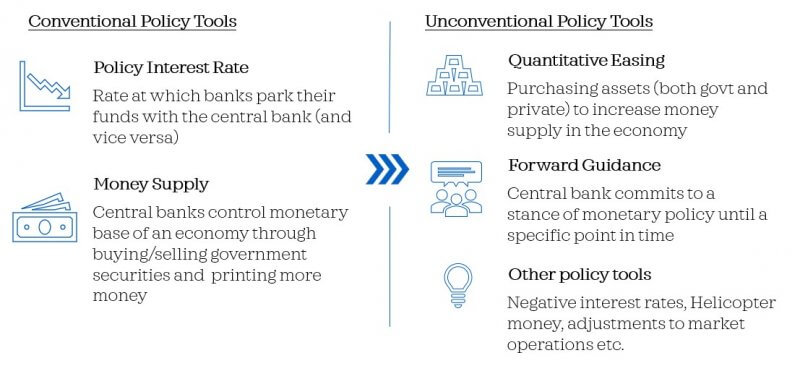
    Figure 1: Policy Tools Comparison

    Typically, interest rates and money supply are the two run-of-the-mill tools that central bankers resort to. Extreme versions of these policies, such as negative interest rates and quantitative easing, are termed unconventional monetary policies since they deviate from the traditional policy measures of a central bank. According to RBI’s Deepak Mohanty, “When central banks look beyond their traditional instrument of policy interest rate, the monetary policy takes an unconventional character”. Essentially, an Unconventional monetary policy is a set of measures taken by a central bank to bring an end to an exceptional economic situation. Central banks use these measures only in extraordinary situations when conventional monetary policy instruments cannot achieve the desired effect [1].

     Quantitative Easing

     Quantitative easing (QE) is a form of extreme and targeted control of the money supply in the economy. At its core, QE seeks to increase the money supply in the economy through the purchase of securities and bonds in the open market. When a central bank uses QE, it purchases large quantities of assets, such as government bonds, to lower borrowing costs, boost spending, support economic growth, and ultimately increase inflation.

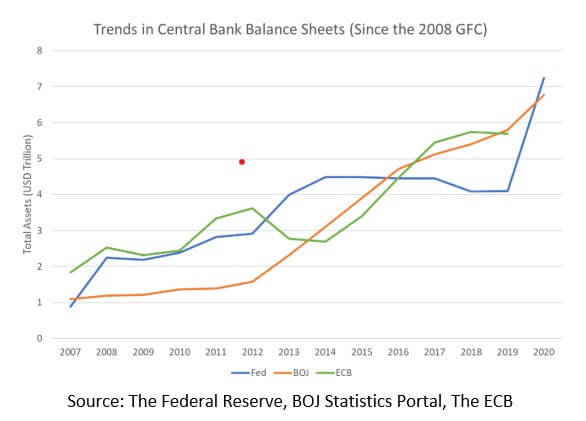
    Before the 2008 financial crisis, only one major economy, Japan, had implemented a significant Quantitative Easing program in the 1990s. Today, however, almost all major economies have some sort of QE or an asset purchase program. According to a report by Fitch Ratings, global QE asset purchases are set to hit $6 trillion in 2020 alone, which is more than half the cumulative global QE total seen over 2009 to 2018 [2]. As seen in the figure below, the balance sheets of major central banks have been expanding significantly since the financial crisis.


    Figure 2

    Quantitative Easing has been the cornerstone of the Fed’s crisis response since 2008. In the three rounds of QE post the 2008 crisis, the Fed balance sheets increased from $870 billion in August 2007 to $4.5 trillion in early 2015. Earlier this year, the Fed purchased a record $1.4 trillion worth of US treasuries in just six weeks in response to the COVID-19 crisis, speaking volumes of the role played by the unconventional policy during a period of crisis. Also, it’s not just the advanced economies that are resorting to extensive QE programs. Nearly 13 emerging market economies, including India, announced some form of a QE program following the crisis. In India, the RBI injected durable liquidity of ₹1.1 lakh crore through the purchase of securities under open market operations (OMOs) [3].

    Zero or Negative Interest Rates

    Quantitative easing was just the beginning of the long list of tricks central bankers pulled out of their sleeves. Closely accompanying QE policies were accommodative monetary regimes of ultra-low interest rates. In 2020 alone, interest rates have been slashed across the globe on 37 separate occasions [4]. Interest rates have been falling across the globe even before the crisis, and the current pandemic has only sped up this fall.

    While many economies have reached the theoretical zero lower-bound of rates, some have even dared to venture below the surface into negative territory. As of today, 5 economies in the world follow a Negative Interest Rate Policy. While the very concept of negative rates may seem baffling, it’s even more shocking to note that over $15 trillion worth of bonds is traded at negative yields globally [5]. This means that over 30% of the world’s investment-grade securities are traded in a manner such that lenders pay borrowers to use their funds. Central banks envisage that negative policy rates would induce increased spending and stimulate the economy in two ways – first, by forcing banks to hold lesser deposits with the central bank and channelling these funds into increased lending to households and businesses. Second, a cut in the policy rate would also lead to lower rates in the overall lending market, thus encouraging borrowing and spending.

    Forward Guidance

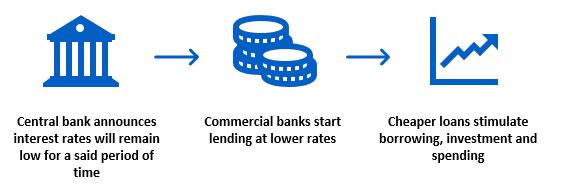
    Forward guidance refers to official communication from a central bank on the future course of monetary policy in the economy for a specific period. It is more of a monetary policy stance than a monetary policy tool. The key idea here is to keep markets informed and eliminate any form of uncertainty, which becomes especially imperative during times of crisis.


    Figure 3

    Gone are the days when central bank rate cuts and other announcements of secrets that were sprung upon the markets when they least expect it. With forward guidance, central banks provide communication well in advance about the likely future course of monetary policy in the economy, and this boosts the confidence of investors, consumers and companies. The US’s Fed was one of the major central banks to adopt this policy during the COVID crisis – providing clear forward guidance in June showing that it will probably keep rates low until at least 2022. The policy has been the cornerstone of the Eurozone’s crisis response since the sovereign debt crisis. In July 2012, at the height of the crisis, ECB President Mario Draghi adopted a form of Forward Guidance, stating that the ECB will do “whatever it takes” to save the euro. It is believed that these three words single-handedly turned around the eurozone crisis.

    Are Unconventional Policies Here to Stay?

    Apart from QE, NIRP and FG, there are several other unconventional policies in practice world over – Australia is experimenting with yield curve controls, the Fed is attempting to influence markets with forward guidance while Japan is considering printing helicopter money. There are so many extreme measures being adopted across the globe that policy commentators are now referring to these nations as swimming in an alphabet soup of unconventional policies (QE, NIRP, ZIRP, U-FX, NDR etc.). Post the 2008 crisis, when such policies were first being debated upon and economies were just dipping their toes in the ocean of unconventional policy, many warned of dire consequences such as hyperinflation and collapsing currencies. Luckily for central bankers, none of these predicaments came true. Most advanced economies are still struggling to combat deflation and extremely low levels of inflation despite adopting several unconventional policies. In this scenario, fears of hyperinflation seem to be unwarranted. While there have been studies documenting the potentially harmful effects of unconventional policies, economies still seem to stick with these policies. On one hand, central bankers have no better alternative tools, and second, the positive effects seem to fairly outweigh the negative externalities.

    Thus, unconventional policy tools are going to be around for the near future. As economies and global markets grow more complex, so will the policies and policy tools regulating them. Similar to how drastically monetary policy has changed within just 10 years after the financial crisis, it will keep evolving and adapting with time by developing new tools and analyses. Monetary toolbox a decade or two later will look radically different from what it is now. The important question then becomes not whether unconventional policies are here to stay, but how nations can make the most effective use of them.

    The new monetary tools, including QE and forward guidance, should become permanent parts of the monetary policy toolbox – Ben Bernanke, Ex-Fed Chair

    Need for Monetary Policy and Fiscal Policy to Work in Tandem

    While central bankers have no stone unturned in the fightback against crises, the success of unconventional policies has been fairly moderate. In Japan, for example, the NIRP has failed to stimulate spending and investment in the economy. Rather, negative rates have only forced a massive outflow of funds from the country in favour of foreign assets. In the Eurozone as well, the policy has achieved no significant impact, with banks continuing to pay billions of euros as negative fees to the ECB. While QE has fared slightly better than the rest as a policy tool, the experiences of various economies with it have been mixed.

    The experiences of several economies have shown that while unconventional policies may work better than conventional ones during a crisis, there are limits to their performance as well. One of the key failures of unconventional policies (and conventional policies) has been the inability to stimulate healthy inflation in recessionary economies. Policies such as QE and NIRP, despite increasing the monetary base of economies, have failed to spur spending and investments. As we have seen in Japan, a standalone monetary policy, no matter how accommodative, is insufficient to pull economies out of downturns. In this light, it is imperative that monetary policy, conventional or unconventional, be accompanied by temporary fiscal stimulus during recessions. Public investment in infrastructure could give economies a much-needed boost in the absence of a private appetite for investments. Infrastructure is an enormous economic multiplier, and governments would do well to work in tandem with monetary regimes to provide the initial spur in economic activity. Several studies have shown that public investment during crises can generate employment and increase output. Originally theorised by British economist J.M. Keynes, the ‘Keynesian Multiplier’ of government spending could be the magic potion that makes unconventional policies go from good to great.

    How does the Keynesian Multiplier Work?

    During times of recession or economic downturn, government spending puts into action the Keynesian Multiplier. According to the Keynesian Multiplier, theorised by prominent economists such as Keynes, Kahn and Hicks, short term government spending boosts the economy by more than what is spent. Keynes was of the view that during a recession with a high level of unemployment, Governments should raise public spending to sustain effective demand and profits.


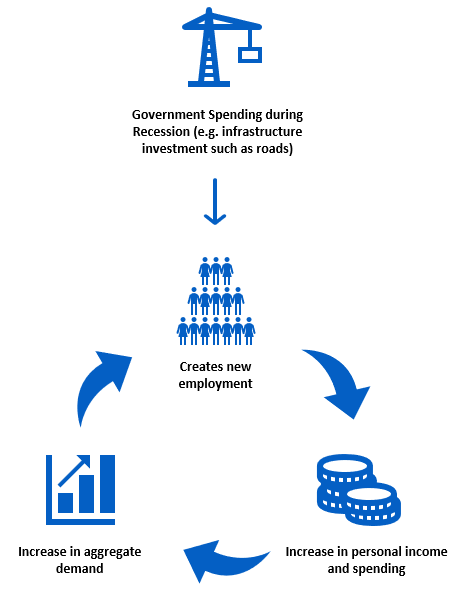
    Figure 4

    As seen from the figure above, an increase in government spending on large projects such as road building will lead to the creation of alternative employment. The increase in personal incomes and consequently aggregate demand in the economy will further stimulate economic activity and will create more employment than what was originally created by government spending. In effect, every unit of money spent by the government during a downturn increases GDP by a greater proportion than what was spent.

    Conclusion

    While unconventional policies are here to stay, they are a step in the dark. Economies are still experimenting and attempting to figure out the most effective use of these policies. Considering the fairly moderate performance of standalone unconventional policies, there is an established need for complementary fiscal policy to accompany monetary policy. An increase in infrastructure investment coupled with an accommodative monetary regime could help stimulate stagnant demand during a crisis. In developing economies, it can also help address structural bottlenecks subduing growth. These investments from the government, however, must be productive and efficient. Otherwise, they just end up adding on to already high levels of debt, especially during periods of crisis when governments have to borrow extensively for emergency requirements. It is also imperative that this investment is temporary and not permanent. Long-term government debt is unsustainable and can crowd out much-needed private investment.


    References


    [1] Central Charts. (2019). Definition of Unconventional Monetary Policy. Retrieved from

    https://www.centralcharts.com/en/gm/1-learn/9-economics/35-central-bank/976-definition-unconventional-monetary-policy

    [2] Fitch Ratings. (2020). Global QE Asset Purchases to Reach USD6 Trillion in 2020. Retrieved from

    https://www.fitchratings.com/research/sovereigns/global-qe-asset-purchases-to-reach-usd6-trillion-in-2020-24-04-2020

    [3] Reserve Bank of India. (2020). Policy Environment. Retrieved from

    https://www.rbi.org.in/scripts/PublicationsView.aspx?id=20269

    [4] Desjardins, J. (2020, March 17). The Downward Spiral in Interest Rates. Visual Capitalist.

    https://www.visualcapitalist.com/chart-the-downward-spiral-in-interest-rates/#:~:text=Global%20Rate%20Slashing,light%20of%20current%20oil%20prices.

    [5] Mullen, C. (2020, November 6). World’s Negative-Yield Debt Pile Has Just Hit a New Record. Bloomberg Quint.

    https://www.bloombergquint.com/onweb/negative-yielding-debt-hits-record-17-trillion-on-bond-rally#:~:text=The%20market%20value%20of%20the,it%20reached%20in%20August%202019.


    Image Credit: The Conversation

  • To Become Atmanirbhar, Bharat Needs Strong R&D

    To Become Atmanirbhar, Bharat Needs Strong R&D

    India has gone full circle from Gandhi’s days of Swadeshi to Nehru’s vision of self-reliant India to New Economic Policies of indiscriminate opening of the economy to Atmanirbhar Bharat. In between lip service was paid to Swadeshi in 1998 but the government continue with the indiscriminate opening up of the economy. Even agriculture was not left untouched with the opening up of 1400 commodities after the Seattle round of negotiations in 1999.

    What is Atmanirbharta?

    What do we understand by atmanirbhar – is it at the narrow level of producing most things that we need ourselves or at the wider philosophical level? If the latter, it implies independence of thought and development of socially relevant knowledge. It could lead to an alternate vision of development and prosperity for the nation.

    In an open economy people will then buy the foreign produced cheaper goods. So, the more important aspect of atmanirbharta is the philosophical aspect.

    The idea of producing most things ourselves runs into a contradiction in a globalizing world which is premised on marketization. Most things are being produced cheaper and better somewhere else, including our cultural symbols such as gulal, diyas and ganesh statue. In an open economy people will then buy the foreign produced cheaper goods. So, the more important aspect of atmanirbharta is the philosophical aspect.

    Opening up the Economy

    In 1991, with the New Economic Policies we gave up the idea of ourselves producing most things that we need. Our global trade increased dramatically with the percentage of export plus import of goods and services in GDP rising from around 17% in 1991 to about 55.8% by 2013. In 2019 it is down to about 40%.

    With the evolution of Washington Consensus in the 1980s, based on the idea of marketization, the world started to integrate in the 1990s with all countries showing a sharp rise in trade to GDP ratio. China captured a large share of the world markets and built a huge trade surplus. Its foreign exchange reserves rose to over $3.5 trillion. This gave it enormous clout globally not only with developing countries but also with the developed countries.

    The idea of atmanirbharta or self-reliance underwent a change. It became a matter of global competition to gain market share globally. One imported more to export more. Growth was supposed to depend on this. South East Asia and China were given as examples of success of such openness and rapid improvement in the living standard of the population. China post-Mao successfully adopted such a strategy. It was a large economy so it could not even be said that India cannot do what Singapore can do.

    Globalization is all about development of technology and India has lagged behind in that.

    Lessons from China

    What are the lessons India can learn from China’s achievements in the last thirty years? Apart from the fact that it is an authoritarian state with a strong sense of nationalism, its advances in research are stupendous.

    China has invested huge sums in building a strong infrastructure and research base in Universities, Institutions and Industry. It has one of the highest investment and savings rate in the world at 44 per cent in 2019. India’s comparative figure for 2019 is around 30%. It has developed the 5G technology faster than others and is willing to provide it cheaper than its competitors. This is also the case with many other lines of production such as, electronics, pharmaceuticals, automobiles and toys. It has moved rapidly in various fields such as development of artificial intelligence and applications of internet for commerce and financial sectors.

    Globalization is all about development of technology and India has lagged behind in that.

    China has had the long term vision to develop this rapidly by investing heavily in Research and Development. After getting technology from foreign companies, it has advanced the same by mastering it. Unfortunately, India has not done so and has repeatedly imported the next level of technology.

    Need for strong R&D

    India’s investment in R&D has been minimal. The private sector has been investing little in technology development. And, the public sector has been hamstrung in technology development by lack of autonomy, bureaucratization and corruption.

    Global competitiveness requires rapid development of technology. It requires massive investment in both absorption and development of technology. Instead, India’s investment in R&D has been minimal. The private sector has been investing little in technology development. And, the public sector has been hamstrung in technology development by lack of autonomy, bureaucratization and corruption.

    Research and Development require autonomy for researchers and a long term vision. Of course resources are also required but autonomy and vision are crucial and these have been weak in India. The same Indian researchers are able to do well in foreign lands but when in India they are not able to deliver. Our research establishment are rather feudal in approach and work within rigid hierarchies so that often talent gets suppressed.

    a culture of promoting independent and critical thinking is largely missing and that reacts back on research and generation of new ideas.

    Universities are the places where autonomy is greater and a long term vision can flourish away from the immediate profit motive. But unfortunately most of our universities are also bureaucratized and do not give autonomy to the academics. The authorities largely with bureaucratized and feudal mindset see independent thinking as a threat to themselves and, therefore, put up road blocks in the path of the independent thinkers thereby frustrating them and making their functioning difficult. Often the independent minded are seen as trouble makers and a challenge to the domination of the authorities. This is true not only in social sciences but also in the case of sciences in most universities. Thus, a culture of promoting independent and critical thinking is largely missing and that reacts back on research and generation of new ideas.

    Imperatives of Strengthening R&D

    Atmanirbharta in the present day world does not imply closing the economy but having the strength to face the challenge from other nations. This has to be based on a long term vision and cannot be achieved in the short run or by ad hoc measures.

    It requires high quality education right from the school stage. Thus, the education budget has to be expanded and teaching paid much higher attention than given at present. The status of teachers has to be enhanced so that talented people come in to academia.

    The world has been globalizing for thousands of years with trade and exchange of knowledge across nations and across continents. But earlier it was a slow two way process. Colonization turned into a one way process with western knowledge and thought establishing its hegemony globally and more so in India. That killed the internal dynamism of Indian society. It reinforced feudalism in India and decimated the quest for socially relevant knowledge generation.

    There has to be a continuum in knowledge generation but with an Indian perspective. India has to have the self-confidence that it can move ahead without denying the last few hundred years. Denial is only a sign of weakness.

    As Gandhi suggested, there is need for Indian modernity. Achieving that is crucial. Can it be based on denying what has happened over the last 250 years and going to what existed prior to that? Such a gap would undermine our understanding of social developments in India. That would be a recipe for repeating our mistakes. There has to be a continuum in knowledge generation but with an Indian perspective. India has to have the self-confidence that it can move ahead without denying the last few hundred years. Denial is only a sign of weakness.

    Denial would prevent us from understanding the nature of globalization we are undergoing and therefore we would not be able to work out any correctives that are needed. It would lead to much confusion in society. For instance, we would not be able to understand why consumerism is sweeping the world, including the poor in India or why our research lacks dynamism. In brief, Atmanirbharta requires India to move with self-confidence and not be in denial.


  • e-SLA and the Delhi Act 2011 (Right of Citizen to Time-bound delivery of Services)- Policy Analysis

    e-SLA and the Delhi Act 2011 (Right of Citizen to Time-bound delivery of Services)- Policy Analysis

    Introduction

    As the functions of the modern welfare state expand and the dependency of citizens on it increases, its services must be delivered in timely manner. To this end, the Delhi government developed a robust policy. Through the Delhi Act of 2011 (Right of Citizen to Time Bound Delivery of Services), referred to as “the Act”, and the Delhi (Right of Citizen to Time Bound Delivery of Services) Rules, 2011 [“the Rules”], it has guaranteed timely delivery of 361 services.[1] Delhi is not the only state to confer such a right. However, in these other states, the enforcement of this right requires physical presence. Delhi has used an e-Service Level Agreement [“e-SLA”] to digitise the entire enforcement process. Digitisation has enabled greater accountability, performance review, and convenience, whilst also reducing the invested time and cost of every stakeholder. Thus, through this e-governance tool, Delhi has developed a ‘new ecology’ for the citizen-state relationship.

    In this paper, I will first provide a primer on both the Act and the e-SLA. In the second section, I will examine the constitutionality of the Act. Last, I will test the Act against the principles of good governance and citizen-centric administration.

    Understanding the Act and e-SLA

    The Act and e-SLA are deeply interrelated. While the Act defines the legal rights, procedures, and obligations, e-SLA is the mechanism for their execution. The Act comprises four major components: defined rights and corresponding liabilities, procedural prescriptions, the delegation of rulemaking, and the monitoring platform.

    Every citizen is conferred with the right to time-bound delivery of services,[2] and a liability of compliance imposed on government servants.[3] In cases of default, the government servant is liable to pay the compensatory cost of ₹10 per day for the period of delay, subject to a maximum of ₹200 per application.[4] Correspondingly, citizens are entitled to recover the compensatory costs.[5]

    The Act makes three different but interrelated procedural prescriptions. First, it provides the appointment process, eligibility criteria, and powers of the “competent officer”.[6] He/she must not be below the rank of Deputy Secretary or its equivalent rank and is empowered to impose a compensatory cost on the defaulting government servant. Second, it establishes the procedure governing fixation of liability.[7] If there is a delay, the aggrieved citizen can approach the competent officer, who immediately pays the cost that has been automatically calculated by e-SLA.[8] At a second stage, the officer issues show-cause notice to the concerned servant. If justifiable grounds exist, then the payment is debited from the government exchequer. Otherwise, it is reimbursed from the concerned servant. Third, it prescribes the appointment process, eligibility criteria, and powers of appellate authority as well as a 30-day time limit for filing an appeal. He/she must not be below the rank of Joint Secretary or its equivalent rank and has final authority on the matter.[9]

    The Act provides for delegation of legislative authority in two senses. There is a power to make rules,[10] and the power to remove difficulties.[11] However, the exercise of these powers is subject to Parliamentary scrutiny.

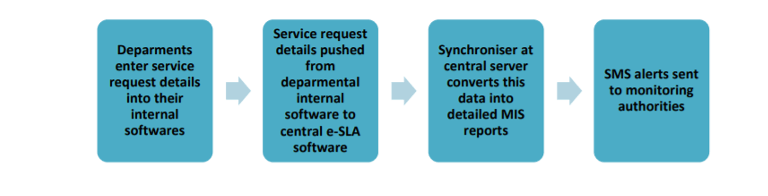
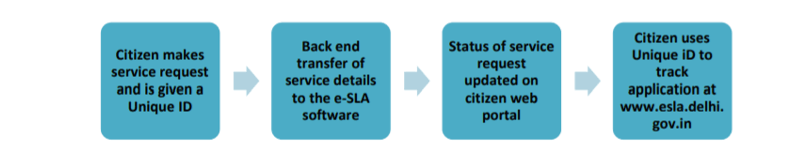
    It is the duty of departments and local bodies to process the application of every citizen and provide an application number. Furthermore, these authorities are obligated to maintain and update the status of applications online.[12] The e-SLA monitoring system has been designated as an online database.[13] To the government, it provides detailed information on the number of disposed or pending cases, which helps in performance evaluation and corrective measures. To the citizens, it provides online facility to track their applications.[14] The information flow is explained below:


    Figure 1: Information flow between government officials under e-SLA


    Figure 2: Information flow between government officials and citizens under e-SLA


    Constitutionality of the Act

    The Constitution provides certain safeguards to “civil servants”.[15] At the outset, it must be noted that these employees are only a sub-set of the “government servants” defined in the Act.[16] Thus, the applicable scope of protection, if any, is not to the entire class of employees enumerated in the Act, but only to civil servants.

    The legal issue herein is the constitutionality of imposing a compensation cost on the civil servant. This is a two-fold question:

    1. Whether there is the power to impose such a cost?

    Appropriate legislatures are empowered to regulate the service conditions of civil servants.[17] As the cost relates to a service condition (i.e., timely delivery), the Delhi Legislative Assembly was empowered in imposing it.

    1. If so, has this exercise violated any constitutional safeguard?

    However, this power is subject to constitutional safeguards guaranteed under Article 311.[18] The protection offered under Article 311(2) is exhaustive and with specific reference to the imposition of three penalties: dismissal, removal, and demotion.[19] Accordingly, the imposition of compensatory cost on the civil servant is beyond the scope of three-fold protection offered by Article 311. Thus, no constitutional safeguard has been violated herein.

    As the imposition of compensatory cost on the civil servants is both within the power and compliant with safeguards, it is constitutional.

    Testing the Act against principles of Good Governance and Citizen-Centric Administration

    Governance refers to the process of decision-making, and the process of implementing those decisions.[20] Good governance is when these processes are tested against a normative standard. Citizen-centric administration refers to governance that places citizens at the centre of all administrative functions.[21] In this section, I will use the characteristics of good governance and the principles of citizen-centric administration as a collective standard[22] to analyze the process of formation and implementation of the Act, its Rules, and e-SLA.

    Assessing Compliance in Formation and Implementation

    a) Participatory. In the absence of statutory provisions, the administrative authorities are not bound to comply with any procedural norms, including notice and prior consultation with the interested parties. The Delhi Act, 2011 does not provide for any such consultation or ante-natal publicity. In the process of policy-making, there was participation only from the relevant government ministries and departments. The government did not take any active steps to broaden consultation to stakeholders such as the civic society organizations, labour unions, or even the general public.

    The lack of participatory policy-making has directly impacted its awareness and enthusiasm among citizens. It was found that only 50% of the people know that their unique ID can be used to track their applications online. Further, only 15% of the people used their ID to track their application.[23]

    b) Transparency. The e-SLA allows for complete transparency to the citizen as to the status of all his applications. The information is not only easily comprehensible but also accessible. However, the transparency does not extend to releasing statistics of operations to the public domain. Currently, these statistics, such as the figures on the number of applications, pendency, disposal rate, performing/underperforming departments, are accessible only to government officials.[24]

    c) Responsiveness. The e-SLA system does not provide for any feedback mechanism. Thus, there is no avenue for the citizens availing these services to share their experiences. As feedback is the basis on which the system continually improves, this deficiency hinders the potential effectiveness of e-SLA.[25]

    1. Accountability

    The right to time-bound service delivery through the mechanism of compensatory cost has, in theory, ensured that the government and its officials are accountable to citizens. This is buttressed by the fact that the Act seeks to develop a culture of timely delivery among the government servants by additionally punishing habitual offenders and providing cash incentives for those without a single default in a year.[26] However, the liability of government servant has been capped at ₹200, compared to other state legislation that penalizes in thousands. Further, the cash incentives are only up to ₹5000. Thus, the quantum is inadequate to cause attitudinal changes in the servants.

    Moreover, there is no culture among public servants to hold their non-performing colleagues in disrepute.[27] There is no indication that this non-performance is factored into promotions. Anyhow, such public servants are typically complacent and not seeking promotions. The security of their present job and status is adequate incentive to persist with present behaviour. Thus, promotions and reputational loss among peers are not adequate incentives for performance either.

    Furthermore, by releasing all relevant statistics of operations to the public domain, the government can broaden its accountability. These statistics can be used by stakeholders, such as news and media agencies and policy think-tanks, to supplement the government in identifying issues and corrective measures. This would also pressurize the government to be more proactive.

         2.  Consensus orientation

    Through reasonable and extensively deliberated timelines, the Act sufficiently balances the interests of citizens in securing timely delivery with the government’s limited capacity.

         3.  Effectiveness and Efficiency

    The usage of e-governance to guarantee the right to public service is a revolutionary process reform. This must be gauged at two levels:

    • For the citizen, this system has reduced the number of physical visits required, thus saving time and cost. In a survey, 66.6% reported that they are not required to visit government offices more than once after submitting their applications.[28]
    • For the government, it eliminates systemic errors and inefficiencies.[29] The statistics help in assessing performance and preparing corrective action.[30] However, if the system can track internal departmental processes too, it would allow determining the exact level at which service delivery is being delayed. Furthermore, the Act ignores the quality of timely delivered services.[31] To provide a comprehensive right to public service, the legislature must develop standards to assess the quality of services rendered on time.


        4.  Equitable and Inclusive

    Under the Act, while the citizen is immediately compensated, the government servant is not immediately penalized for default. The procedure allows him/her to provide justified grounds that could excuse liability. For greater inclusivity, the government can prescribe a pro-rata calculation of the penalty. As the amount is automatically calculated by e-SLA, even complex formulas are acceptable.

       5.  Rule of Law

    The Act provides for a fair legal framework and impartial enforcement.

    Conclusion

    Executing the right to time-bound service delivery through an online portal is truly revolutionary. It has emerged as model legislation for other governments. The Act is constitutionally valid. However, when tested against standards of good governance, this policy suffers from problems of non-participation, transparency, responsiveness, accountability, and effectiveness at the government-level. But it scores par excellence on the principles of consensus orientation, effectiveness at the citizen-level, inclusiveness, and rule of law. To embrace the truly revolutionary potential of this policy, the government must make the suggestions recommended in the last section of the paper, vis-à-vis each principle.


    References:

    [1] IANS, ‘245 services brought under Delhi time-bound delivery act’ (Business Standard, 24 August 2014) <https://www.business-standard.com/article/news-ians/245-services-brought-under-delhi-time-bound-delivery-act-114082400707_1.html> accessed 17 January 2021.

    [2] The Act, s. 3.

    [3] The Act, s. 4.

    [4] The Act, s. 7.

    [5] The Act, s. 8.

    [6] The Act, s. 9.

    [7] The Act, s. 10.

    [8] The Rules, r. 4(1).

    [9] The Act, s. 11(1).

    [10] The Act, s. 15.

    [11] The Act, s. 16.

    [12] The Act, s. 5.

    [13] The Rules, r. 2(c).

    [14] Arjun Kapoor & Niranjan Sahoo, India’s Shifting Governance Structure: From Charter of Promises to Services Guarantee (ORF Occasional Paper No 35, 2012).

    [15] Constitution of India 1950, Art. 309, 310, 311.

    [16] The Act, s. 2(g).

    [17] Constitution of India 1950, Art. 309.

    [18] Union of India v. S.P. Sharma (2014) 6 SCC 351.

    [19] Yashomati Ghosh, Textbook on Administrative Law (1st edn, Lexis Nexis 2015) 416.

    [20] UN Economic and Social Commission for Asia and the Pacific, ‘What is Good Governance?’ <http://www. unescap.org/sites/default/files/good-governance.pdf>.

    [21] Ghosh (n 19) 14.

    [22] Second Administrative Reforms Commission, Citizen-Centric Administration (Report No 12, 2009) p. 8.

    [23] Audit of Functioning of Government of Delhi’s e-SLA Scheme, by Management Development Institute, Gurgaon (2012).

    [24] Ibid.

    [25] Rohit Sinha, ‘Delivering on service guarantee: A case of Delhi’s e-SLA’ (ORF, 29 December 2012) <https://www.orfonline.org/research/delivering-on-service-guarantee-a-case-of-delhis-e-sla/> accessed 17 January 2021.

    [26] The Act, s. 12.

    [27] Kapoor & Sahoo (n 14); Amit Chandea & Surbhi Bhatia, The Right of Citizens for Time Bound Delivery of Goods and Services and Redressal of their Grievances Bill, 2011 (CCS, 2015) p. 25-26.

    [28] Sinha (n 25).

    [29] Chandea & Bhatia (n 27).

    [30] Ibid.

    [31] Kapoor & Sahoo (n 14).


    Image Credit: Forbes India

  • Chief of Defence Staff, a year later: Lack of Clarity and an ambiguous Mandate

    Chief of Defence Staff, a year later: Lack of Clarity and an ambiguous Mandate

    On 31st of Dec 2020 India’s first Chief of Defence Staff (CDS), Gen Bipin Rawat, completed one-year in office.  With China recently unveiling its 14th Five Year Plan aiming to bring its military on par with the USA by 2027, it would be interesting to observe if the appointment of CDS has helped the Indian Military spruce up its structure and operational philosophy in any manner.

    Appointment of CDS was put on hold for almost two decades after the Kargil Review Committee made its recommendations.  Opinion among the strategic community has always been divided on the appointment of CDS. Those who argued in favour espoused that CDS would be the panacea for all ills while those who opposed, opined that the time-tested Higher Defence Organisation proposed by Lord Ismay has worked well over the years and hence, the western concept of CDS is unnecessary. Now that the CDS is in place, it is futile to revisit the debate but the functioning of CDS would be a subject of scrutiny for the next few years.

    In the last few months, the Department of Military Affairs (DMA) headed by the CDS came for intense criticism for making proposals about the increase in retirement age and reduction in pensions. Previous proposals such as the closure of CSD canteens at peace stations, opening up of cantonment, doing away with Army Day parade etc, which are believed to have emanated from the DMA have been subjected to ridicule and disdain in the social media. It wasn’t exactly clear as to why the office of CDS was being used for such purely administrative issues, which are counterproductive in enhancing the morale and pride of the forces.

    Men in uniform yearned that CDS would play a vital role in bringing about the true integration of Services HQ with the MoD and expedite the process of defence modernisation. However, after one year, it is indeed of great concern that the office of CDS (read DMA) appears to be focussed on administrative and ceremonial issues with absolutely no strategic significance.

    When CDS assumed charge on 1st Jan 20, it was reported that the CDS would be the Principal Military Advisor to the Government (read Def Minister) and he would head the newly created DMA.  Additionally, he would assume charge of the Integrated Defence Staff (IDS), serve as the permanent Chairman of the Chiefs of Staff Committee (COSC), Head the Tri-Service Commands, and be a member of the Defence Acquisition Council besides the Nuclear Command Authority. Quite a tall order indeed but doesn’t seem to be adequately equipped with a statutory mandate to perform effectively. Men in uniform yearned that CDS would play a vital role in bringing about the true integration of Services HQ with the MoD and expedite the process of defence modernisation. However, after one year, it is indeed of great concern that the office of CDS (read DMA) appears to be focussed on administrative and ceremonial issues with absolutely no strategic significance. One of the first initiatives announced by Gen Rawat was to create an Air Defence Command which is yet to materialise and creation of Theatre Commands seems to be a long haul.

    it is beyond comprehension to fathom what prompted the Government to create a Department of Military Affairs within the MoD when the Integrated Defence Staff (IDS) was already functioning since 2001 awaiting the appointment of a CDS.  As Service Chiefs continue to exercise Command over their respective Service, the CDS as the head of IDS would be rightly placed to promote joint training initiatives, validate joint operational plans and act as a catalyst in defence modernisation.  However, for all this to be achieved, the role and functioning of the CDS should be spelt out; particularly the role of CDS as the “Principal Military Advisor” to the Raksha Mantri, vis-à-vis the Defence Secretary who continues to be the “Principal Advisor” to the Defence Minister. Such vital aspects are never left to chance based on an individual’s equations with political leadership but need to be appropriately institutionalised, mandated and published.

    Currently, Defence Secretary functions as head of the Department of Defence and is additionally responsible for coordinating the activities of the five Departments in the Ministry, including the newly created DMA. The Defence Secretary draws his functional powers from the Cabinet Secretariat –Manual of Office Procedures (CS-MoP) which clearly states that the Secretary of the Department “is the principal adviser of the Minister on all matters of policy and administration within his Ministry/Department, and his responsibility is complete and undivided”. If Defence Secretary is coordinating the affairs of all the five departments including DMA as the Principal Advisor, what is the status of the four-star-CDS?

    The Government of India (Allocation of Business) Rules, 1961 are made by the President of India under Article 77 of the Constitution for the allocation of business of the Government of India. The business of the Government is transacted in the Ministries/Departments, Secretariats and offices (referred to as ‘Department’) as per the distribution of subjects specified in these Rules. Allocation of Business Rules has not been revised since 2017 though DMA has been created one year ago.  As a result, the DMA is not listed in the First Schedule of the Allocation of Business.

    Transaction of Business (Rules) 1961 are made by the President of India for the convenient transaction of the Business of the Government of India. The disposal of business by various ministries, inter-departmental transactions and mandates of various committees are published in these rules. The significance of these rules can be gauged from the fact that the rules have been recently amended to deal with unprecedented challenges posed by Covid 19 pandemic. Cabinet Secretariat has amended Government of India Transaction of Business Rules, 1961 to widen powers of two committees to meet the economic crisis caused by Covid 19, using the powers under the Act. However, Transaction of Business Rules has not been revised clearly defining the role of CDS as the Principal Military Advisor to the Government.

    The organisation chart in the MoD has been removed possibly because it would only be too embarrassing to place the CDS under the Defence Secretary. There is an urgent need for the GoI to create a meaningful role for the CDS and empower him with a statutory mandate.

    A cursory glance at the website of the Ministry of Defence would reveal a lack of any sincerity in assigning specific responsibilities for DMA. It has been casually mentioned that DMA “deals with the armed forces of the Union….. and promotes jointness among the three services”. Were these objectives not met by the MoD in the past? So what value addition has the DMA provided? The organisation chart in the MoD has been removed possibly because it would only be too embarrassing to place the CDS under the Defence Secretary. There is an urgent need for the GoI to create a meaningful role for the CDS and empower him with a statutory mandate.

    Indian Military is not expeditionary. However, if there is a convincing need to create Theatre Commands in pursuit of joint operations and interoperability, replacing the existing 17 Service-specific Commands by fewer Theatre Commands would be the most challenging task for the CDS. If the experience of USA, UK and other major militaries is anything go by, such major military reforms could be pushed through only with steadfast backing from the government, taking all three services into confidence and aligning the entire military leadership with the desired outcomes of this humungous exercise which may eventually need constitutional validity through an Act of the parliament.

    For the appointment of CDS to make a meaningful purpose the following measures are imperative:

    • Abolish the DMA and facilitate the CDS to take complete control of the IDS, keeping its functioning outside the purview of Def Secretary
    • Revise the CS-MOP, Allocation of Business Rules, Transaction of Business rules and the Warrant of Precedence, clearly bringing out the role and responsibilities of CDS as the Principal Military Advisor to the Defence Minister, in contrast to the roles and responsibilities of the Defence Secretary which may also now need to be re-drafted.
    • Make CDS a permanent member of the Cabinet Committee on Security facilitating the single-point military advice to the National Security Council.
    • The cabinet should spell out a Defence Policy Guidance (DPG) with a 12 year to the 15-year horizon in the light of prevailing and forecasted geo-political scenario and assist the CDS in preparing a clear roadmap for Indian Military Modernisation

    To abrogate the stigma of “Attached Offices”, and to integrate the Services HQ with MoD, a beginning needs to be made by augmenting the IDS with officials from the MoD.

    • Currently, the budgeting and procurement plans are made in isolation and subject to scrutiny by the Ministry of Fin (Def) thereby losing time and effort. IDS needs to be adequately empowered by augmenting it with an integral wing of the Ministry of Fin (Def) headed by a Joint Secretary ranked officer.
    • A Defence Production Wing under the charge of an Additional Secretary ranked officer reporting directly to the CDS should be created with the long term objective of achieving complete integration of the department of defence production with IDS. This suggestion would certainly be the most unpopular with the bureaucracy but could turn out to be a game-changer if achieved.

    Kargil Review Committee had recommended the appointment of CDS to integrate the armed forces in their planning, procurement and functioning to transform the Indian Military as a unitary force to reckon with.  In the absence of a clear mandate and constitutional validity for the functioning of the CDS, the entire effort of instituting one, seems to be of little consequence, much less, competent of driving any significant reforms. The current arrangement needs a complete overhaul if that is to be achieved.

  • Evaluating the Make in India Policy for Defence Manufacturing and Technology Acquisition

    Evaluating the Make in India Policy for Defence Manufacturing and Technology Acquisition

    Led by the Department of Industrial Policy & Promotion, Ministry of Commerce, the Make in India policy (“MII”) extends to 25 focused sectors. Among these is the defence sector, where the nature of the sector renders MII extremely important and relevant. This is outlined by India’s status as the second-largest standing army and third-largest military spender in the world.[1] Yet, it remains the second-largest arms importer and its exports merely amount to 0.2% of the global pie.[2] China is the fifth-largest arms exporter at 5.5% of the global share.[3] However, this is likely to fall in the post-pandemic world, where China’s credibility has been severely tainted.[4] This represents an opportunity for Indian defence manufacturers to attract present and future foreign investment.

    Against this background, MII was enacted with two objectives: (1) to increase domestic manufacturing of defence equipment; and (2) address the national security interest of self-sufficiency over key technologi. There are two ways in which technology up-gradation can happen: (1) indigenous efforts; and (2) transfer of technology, through international agreements. In this article, I flag the main challenges to argue that India has significantly underperformed in both. Subsequently, I propose macro-policy changes to address identified challenges.

    Evaluating technological upgradation in the Defence sector in india

    1. Evaluating ‘Indigenous Efforts’

    Indigenous efforts are confronted with three main challenges:

    • Inadequate Investment for Research & Development (R&D)

    Only 5.7% of the defence budget is allocated to R&D,[5] despite successive parliamentary committees recommending at least 10% to meet minimum requirements.[6] The average allocation among global rivals like USA, UK, France, and China is well above 15%.[7] Even private-sector players in India, like Tata, L&T, and Mahindra and Mahindra, invest less than 1% of their turnover in R&D, as against the average of 10% in the aforementioned countries.[8] The producer lacks the basic R&D required even for making marginal improvements in performance to the product, or altering it based on user-specifications.[9] The effect of this is that the resulting product is obsolete in an already disruptive market. Thus, a buyer, even if domestic, is unwilling to accept such an obsolete product at higher prices merely for the sake of indigenous production.

    • Shortage of Skilled Workforce

    A skilled workforce is the key to achieving self-sufficiency in defence manufacturing because of the highly specialized nature of this sector and the workforces’ vision and skills determine the efficacy of the produced/procured domestic technology. This shortage exists at both the research and procurement level.

    At the research level, there is a severe shortage of skilled human resources, in terms of quantity and quality, at R&D organizations like DRDO.[10] With more than 3,500 engineering colleges producing about 1.5 million engineering graduates annually, India has an unparalleled talent availability.[11] However, only 17.5% of these graduates are employable because colleges lack proper infrastructure and faculty,[12] along with current curriculum ignoring industry skills, defined career paths, and evolving technologies.[13] Thus, organizations are compelled to spend significantly in making fresh talent “employable”.

    While India has a decent pool of highly qualified low-cost engineers and scientists,[14] they are unwilling to work in the public sector due to limited opportunities and low growth potential,[15] where most defence R&D is undertaken. As the departure of 132 scientists in the last five years from DRDO shows,[16] even those employed mostly do not continue long-term due to better opportunities elsewhere.[17] The contribution of most of these scientists has been limited to the production of academic articles,[18] which hasn’t seen any significant and meaningful absorption in the policy. Therefore, the policy has been unable to capture the huge latent employment potential in this sector.[19]

    This position must be contrasted against global competitors like the US and China, where the highly skilled and employable workforce is significantly and routinely absorbed into the most impactful R&D organization, whether private or public.[20] Moreover, unlike other leading countries, India lacks any training and education infrastructure specialized for R&D personnel in the defence sector. These countries have developed specialist defence schools that have managed to produce large pools of exclusive talent. France itself has managed to produce 134,000 specialist employees.[21]

    At the procurement level, the asset acquisition process is not tasked to a dedicated cadre of the workforce.[22] Further, there are no educational or training programs for employees involved in this process.[23] Thus, there is the loss in terms of the benefits of specialization, especially in a sector where progress is characterized by specialization.

    • Limited Involvement of the Private Sector

    There is a significant lack of incentive for greater private sector involvement. The private sector is commercially motivated to establish its manufacturing base only when it has a good chance, or preferably guarantee, of getting frequent and sizeable orders.[24] However, the current manufacturing and procurement process has ignored this motivation but is also completely converse to it.

    As the BJP government’s Rafale fiasco indicates, the procurement processes lack transparency, and frequently fraught with allegations and counter-allegations.[25] This disincentivizes both domestic and global private sector players from conducting business.

    Despite unprecedented inclusion of the private sector, it is widely believed in the private sector that the government is biased towards public sector undertakings, denying a level-playing field for the private sector and even denying opportunities to bid.[26]

    The government’s Strategic Partnership Model, aimed at inviting world-class defence giants to collaborate with Indian entities, has unduly restricted autonomy. Under this program, the government chooses the Indian partner for the foreign OEM, without consulting them.[27] Global defence giants, like Airbus, Lockheed Martin, ThyssenKrupp, and Dassault, have shown interest in contracting with the Indian private sector.[28] However, it is a combination of these factors that this interest has largely failed to materialise into successfully concluded deals.

    Even where, despite these disincentives, the private sector has been involved, this has been in non-critical and less required areas. Most of India’s defence imports are in the category of major platforms such as fighter aircraft, helicopters, naval guns, and anti-submarine missiles.[29] However, the private sector initiatives are predominantly in the category of ammunitions (including rockets and bombs), and surveillance and tracking systems.[30]

    1. Evaluating ‘Transfer of Technology’

    There has been no transfer of technology (“ToT”) in the critical defence procurement process. All major contracts under MII have been “off the shelf”, and without any crucial ToT.[31] As per the CAG Report, between 2007 and 2018, the government concluded 46 offset contracts but failed to implement the ToT agreements in any of them.[32]

    The failure here can be attributed to successive governments unduly hoping that India’s status as a large arms importer would necessarily make international players compliant as regards sharing their intellectual property (“IP”). While foreign companies have shown interest in contracting with Indian players, the large purchase orders have been inadequate to incentivize foreign players to share their IP.[33]

    The government has also been overly ambitious of ToT as a means of technology upgradation. Even implementing the negotiated ToT is not the end because the more challenging issues of absorption of this technology and ownership of IP remain.[34] Moreover, the ToT route provides India only with the ‘know-how’, without any insight into the ‘know-why’.[35] As India’s acquisition of the Sukhoi Su-30 has shown, the public sector is critically dependent on the OEMs, here the Russians, for even minor systemic upgradations.

    Way Forward

    The government must increase allocation to defence R&D to at least 10% and must incentivize greater contributions from the private sector. Existing capabilities and services at training and diploma centres must be upgraded through public-private partnerships. There must be a separate and devoted institutional structure for all procurement-related functions. The procurement policy must also aim at buying talent, besides technology, to bridge technology gaps. The education curriculum at engineering universities needs to be modernized, with a focus on employability. Specialist defence schools must also be established. However, it is most important that the public sector aims at retaining its talent through unique and lucrative incentive structures.

    To incentivize the private sector through minimum order guarantees, the government must utilize ‘public procurement of innovation’. Under this policy tool, the government uses its exchequer to artificially generate demand for an emerging innovative solution, unavailable on a commercial scale.[36] The private sector can further be incentivized by streaming the procurement and dispute resolution process. As for procurement, a fast-track procedure with single-window clearances can be adopted.[37] As for dispute resolution a permanent arbitration tribunal must be established to expeditiously settle disputes with finality.[38]

    Conclusion

    Firstly, the indigenous efforts at technology up-gradation have failed due to limited R&D output, shortage of skilled workforce, and limited private sector involvement. The R&D budgetary allocation is way below the recommended and global standard. The shortage of skilled workforce is both at the research and procurement due to a lack of education and training infrastructure specific to the defence sector, low employability among most graduates, and unwillingness to work in the public sector among highly qualified graduates. The private sector has been disincentivized due to a lack of order guarantees, the unrealistic and retroactive manner of the procurement process, the constant allegations and counter-allegations, and the continued bias towards the public sector. Moreover, the private sector has been involved in non-critical and less required areas.

    Secondly, while the government has concluded ToT agreements, it has been inefficient in enforcing them. Moreover, even if this were to succeed, it has not established any action plan for absorbing this technology and addressing ownership of IP. It has also been overly ambitious of the utility of ToT.


    References

    [1] Kuldip Singh, ‘Yes, Indian Military Can Go the ‘Make in India’ Way – Just Not Yet’ (The Quint, 25 May 2020) <https://www.thequint.com/voices/opinion/india-armed-forces-defence-sector-military-expenditure-budget-technology-upgrade-make-in-india> accessed 19 December 2020.

    [2] Arjun Srinivas, ‘Private defence business gets one more nudge’ (LiveMint, 1 October 2020) <https://www.livemint.com/news/india/private-defence-business-gets-one-more-nudge-11601460654397.html> accessed 19 December 2020.

    [3] Snehesh Alex Philip, ‘China has become a major exporter of armed drones, Pakistan is among its 11 customers’ (The Print, 23 November 2020) <https://theprint.in/defence/china-has-become-a-major-exporter-of-armed-drones-pakistan-is-among-its-11-customers/549841/> accessed 4 January 2021.

    [4] Rajan Kochhar, ‘Preparing defence sector for post COVID-19 world: Time to treat private sector as equal partner’ (Economic Times, 5 May 2020) <https://government.economictimes.indiatimes.com/news/governance/opinion-make-in-india-a-dream-or-reality-for-the-armed-forces/75552970> accessed 19 December 2020.

    [5] Jayant Singh, ‘Industry Scenario’ (Invest India) <https://www.investindia.gov.in/sector/defence-manufacturing> accessed 19 December 2020.

    [6] Prof (Dr) SN Misra, ‘Make in India: Challenges Before Defence Manufacturing’ (2015) 30(1) Indian Defence Rev <http://www.indiandefencereview.com/news/make-in-india-challenges-before-defence-manufacturing/2/> accessed 19 December 2020.

    [7] ‘Government Expenditures on Defence Research and Development by the United States and Other OECD Countries: Fact Sheet’ (2020) Congressional Research Service R45441 <https://fas.org/sgp/crs/natsec/R45441.pdf> accessed 19 December 2020; A Sivathanu Pillai, ‘Defence R&D’ in Vinod Misra (ed), Core Concerns in Indian Defence and the Imperatives for Reforms (Pentagon Press & IDSA 2015) 132-133.

    [8] Misra (n 6).

    [9] Amitabha Pande, ‘Defence, Make in India and the Illusive Goal of Self Reliance’ (The Hindu Centre for Public Policy, 11 April 2019) <https://www.thehinducentre.com/the-arena/current-issues/article26641241.ece> accessed 19 December 2020.

    [10] Azhar Shaikh, Dr. Uttam Kinange, & Arthur Fernandes, ‘Make in India: Opportunities and Challenges in the Defence Sector’ (2016) 7(1) Intl J Research in Commerce & Management 13, 14-15.

    [11] Kishore Jayaraman, ‘How Can India Bridge The Skill Gap in Aerospace & Defence Sector?’ (All Things Talent, 24 September 2018) <https://allthingstalent.org/2018/09/24/how-can-india-bridge-skill-gap-in-aerospace-defence-sector/> accessed 30 December 2020.

    [12] Dr. JP Dash & BB Sharma, ‘Skilling Gaps in Defence Sector for ‘Make in India’’ (2017) 32(2) Indian Defence Rev <http://www.indiandefencereview.com/spotlights/skilling-gaps-in-defence-sector-for-make-in-india/> accessed 30 December 2020.

    [13] Jayaraman (n 10); Dhiraj Mathur, ‘Unlocking defence R&D in India – Do we have the skill?’ (Firstpost, 6 April 2016)<https://www.firstpost.com/business/unlocking-defence-rd-in-india-do-we-have-the-skill-2715650.html> accessed 30 December 2020.

    [14] Mathur (n 13).

    [15] PR Sanjai, ‘Indian aerospace sector needs one million skilled workforce in next 10 years’ (Livemint, 20 February 2015) <https://www.livemint.com/Politics/hRJQjq7ZKVXQ5RFkzWbmAJ/Indian-aerospace-sector-needs-one-million-skilled-workforce.html> accessed 30 December 2020.

    [16] PTI, ‘132 scientists left DRDO on personal grounds in last 5 years: Govt’ (Economic Times, 12 March 2020) <https://economictimes.indiatimes.com/news/defence/132-scientists-left-drdo-on-personal-grounds-in-last-5-years-govt/articleshow/74579857.cms?from=mdr> accessed 30 December 2020.

    [17] Dash (n 12).

    [18] PTI, ‘India is world’s third largest producer of scientific articles: Report’ (Economic Times, 18 December 2019) <https://economictimes.indiatimes.com/news/science/india-is-worlds-third-largest-producer-of-scientific-articles-report/articleshow/72868640.cms?from=mdr> accessed 30 December 2020.

    [19] ‘Make in India: An Overview of Defence Manufacturing in India’ (2015) Singhania & Partners LLP Report <https://www.gita.org.in/Attachments/Reports/Make-in-India-Defence-Manufacturing-in-India.pdf> accessed 19 December 2020.

    [20] Ranjit Ghosh, ‘Defence Research and Development: International Approaches for Analysing the Indian Programme’ (2015) IDSA Occasional Paper 41, 11-34 <https://idsa.in/system/files/opaper/OP41__RanjitGhosh_140815.pdf> accessed 19 December 2020.

    [21] Dash (n 12).

    [22] Shaikh (n 10) 15.

    [23] Ibid.

    [24] Rohit Srivastava, ‘New measures for self-sufficiency in defence – industry perspective’ (Indian Defence Industries, 19 May 2020) <https://indiandefenceindustries.in/defence-reforms-industry-perspective> accessed 19 December 2020.

    [25] Pradip R Sagar, ‘How ‘Make in India’ in defence sector is still an unfulfilled dream’ (The Week, 25 May 2019) <https://www.theweek.in/theweek/current/2019/05/25/how-make-in-india-in-defence-sector-is-still-an-unfulfilled-dream.html> accessed 19 December 2020.

    [26] Ibid; Lt. Gen. (Retd.) (Dr). Subrata Saha, ‘Execution key for defence manufacturing in India’ (LiveMint, 2 April 2020) <https://www.livemint.com/Opinion/Gx9NVPGvIsVbVzLTJ0VouK/Execution-key-for-defence-manufacturing-in-India.html> accessed 19 December 2020.

    [27] Prasanna Karthik, ‘India’s strategic partnership policy is counter-productive in its current form’ (Observer Research Foundation, 8 June 2020) <https://www.orfonline.org/expert-speak/indias-strategic-partnership-policy-is-counter-productive-in-its-current-form-67511/> accessed 19 December 2020.

    [28] Sagar (n 25).

    [29] Srinivas (n 3).

    [30] Ibid.

    [31] Singh (n 1); Sagar (n 25).

    [32] Joe C Mathew, ‘Defence offset policy performance dismal: CAG’ (Business Today, 24 September 2020) <https://www.businesstoday.in/current/economy-politics/defence-offset-policy-performance-dismal-cag/story/416872.html> accessed 19 December 2020.

    [33] Lieutenant Commander L Shivaram (Retd), ‘Understanding ‘Make in India’ in the Defence Sector’ (2015) 145(601) J United Service Institution of India <https://usiofindia.org/publication/usi-journal/understandingmake-in-india-in-the-defence-sector/> accessed 19 December 2020.

    [34] Lt Gen A B Shivane, ‘India needs outcome oriented defence reforms’ (Indian Defence Industries, 22 May 2020) <https://indiandefenceindustries.in/india-outcome-oriented-reforms> accessed 19 December 2020.

    [35] Misra (n 6).

    [36] E. Uyarra & J. Edler, ‘Barriers to Innovation through Public Procurement: A Supplier Perspective’ (2014) 34(10) Science Direct <https://www.sciencedirect.com/science/article/pii/S0166497214000388> accessed 19 December 2020.

    [37] Kochhar (n 4).

    [38] Lt. Gen. (Retd.) Dalip Bharadwaj, ‘‘Make in India’ in defence sector: A distant dream’ (Observer Research Foundation, 7 May 2018) <https://www.orfonline.org/expert-speak/make-in-india-defence-sector-distant-dream/> accessed 19 December 2020.

  • Examining the Policy Effectiveness of Negative Interest Rates: A Case Study on Japan

    Examining the Policy Effectiveness of Negative Interest Rates: A Case Study on Japan

    As a global health crisis ravages across the world, central bankers have rushed to lower rates to historic levels in an attempt to soften the economic blow of the pandemic. Since the crisis hit in early 2020, interest rates have been slashed across the globe on 37 separate occasions. Almost all major economies have cut their policy rates and many are at near-zero levels. In light of this economic climate, the debate on whether negative interest rates could prove effective in adverse conditions has come to the forefront again.

    As of today, 5 economies in the world follow a negative interest rate policy (NIRP).  In 2012, Denmark was the first country to announce negative rates, subsequently followed by the Eurozone, Switzerland, Sweden and Japan.

    The decrease in interest rates is not a new phenomenon, rates have been sliding globally for the last 30 years [1]. This trend has been more pronounced since the financial crisis of 2008. While many economies have reached the theoretical zero lower-bound of rates, some have even dared to venture below the surface into negative territory. As of today, 5 economies in the world follow a negative interest rate policy (NIRP).  In 2012, Denmark was the first country to announce negative rates, subsequently followed by the Eurozone, Switzerland, Sweden and Japan. While the very concept of negative rates may seem baffling, it’s even more shocking to note that over $15 trillion’ worth of bonds is traded at negative yields globally [2]. This means that over 30% of the world’s investment-grade securities are traded in a manner such that lenders pay borrowers to use their funds.

    Negative Interest Rates in Theory

    Interest rates have widely been regarded as the most powerful weapon in a central banker’s arsenal. Until very recently, their only limitation seemed to be the zero-lower bound beyond which bankers have had their hands tied. However, with Denmark’s policy rates going negative in 2012, this limit seems to have been breached. In theory, the NIRP is put in effect by central banks making the policy rate or repo rate (rate at which banks park their funds with the central bank) negative. While the negative rates directly apply only to banks, its effects are transmitted to the entire system by effectively lowering overall real interest rates. Central banks envisage that negative policy rates would induce increased spending and stimulate the economy in two ways – firstly, by forcing banks to hold lesser deposits with the central bank and channelling these funds into increased lending to households and businesses. Secondly, a cut in the policy rate would also lead to lower rates in the overall lending market, thus encouraging borrowing and spending.

    This policy, however, is riddled with several loopholes and works only under certain conditions. There has also been evidence of unwanted externalities associated with negative rates. The experience of the 5 economies which implemented the NIRP has been mixed and there is no consensus so far among economists and policymakers on the merits/demerits of the policy.

    Japan’s Tryst with Negative Rates: A Case Study

    In 2016 the Bank of Japan (BOJ), facing a relentless battle against deflation and a depreciating Yen, decided to venture into negative territory and has stayed there ever since.  The Japanese economy’s long downward spiral began with the real-estate asset bubble bursting in 1989-90. While Japan’s ‘lost decade’ is a widely known concept, many academics argue that Japan has lost more than a decade and has not fully recovered yet. The economy has been in first-gear ever since the crash – today, almost 30 years hence, the Nikkei 225 is still languishing at about 40% of its 1989 peak [3].

    Over the years, the BOJ has tried almost every trick in the trade – low rates, printing more money, rounds of quantitative easing, you name it and it has been done already. But much like a car stuck in the mud, the Japanese economy just seems to be spinning its wheels in one place. It is in this backdrop that the BOJ pulled out one last trick up its sleeve, announcing a negative interest rate regime.

    What Did Japan Hope to Achieve Through the NIRP?

    To combat deflation, the BOJ has long been involved in multiple rounds of aggressive bond-buying, hoping to inject more cash in the economy. According to data from the BOJ statistics portal, the central bank has been purchasing bonds worth 8-12 trillion Yen per month consistently. This has led to a mammoth increase in the bond holdings of the BOJ and also the monetary base of the Japanese economy. This has had two direct implications –

    • Japanese banks were now flush with money but this did not translate into increased lending activity. Rather banks were now parking this excess cashback with the central bank as reserves, thus defeating the purpose. It has been estimated that over 90% of the new money created by the BOJ since 2013 has ended up back with the central bank
    • The downside of this aggressive bond-buying policy was that Japan had now accumulated a mountain of debt. As of 2020, Japan was the most indebted nation in the world, with its debt accounting for over 234% of its GDP [4]

    The BOJ hoped that the NIRP would help address both these concerns. By announcing a 0.1% negative interest rate on excess reserves, it hoped to force banks to hold lesser reserves with the BOJ and use the money for lending purposes. On the other hand, negative rates would also help ease the burden of interest payments on the national debt.

    Reasons for Failure of NIRP in Japan

    While the NIRP did succeed in its immediate goal of reducing banks holdings with the BOJ, it has failed to stimulate bank lending. Instead, Japanese banks are now looking to park their funds elsewhere, to beat the low returns at home. With rates at historic lows in Japan and lacklustre borrowing sentiment from households and businesses, banks have turned to foreign investments to rake up profits. The NIRP, rather than stimulate the economy through increasing lending has instead spurred a massive outflow of funds in favour of overseas assets. As a result, Japanese banks hold nearly 20% of the world’s CLO’s (collateralized loan obligations) [5]. The foreign investments of the Japan Post Office Bank (owned by the government) alone stood at $630 billion as of 2020, showing glimpses into the outflow of reserves from the domestic economy.

    The NIRP, rather than stimulate the economy through increasing lending has instead spurred a massive outflow of funds in favour of overseas assets. As a result, Japanese banks hold nearly 20% of the world’s CLO’s (collateralized loan obligations).

    The failure of the NIRP to stimulate domestic spending and investments has shown that the Japanese economy faces several structural challenges that need to be addressed first. Given Japan’s ageing workforce, it will not be easy to discourage households from saving, especially in the current economic climate. Unless businesses and households are willing to spend or invest, the availability of cheap loans is redundant. No matter how low the BOJ pushes interest rates, the economy cannot be revived unless the structural bottlenecks subduing growth are addressed.

    Policy Shortcomings of the NIRP

    Japan’s case and the experiences of the other four economies have highlighted several loopholes in the NIRP. While it has been successful in reducing commercial bank holdings with central banks, it has not managed to translate this into lending activity. As in the case of Japan, banks can always find other ways to make use of excess funds. Even if banks manage to pass on the negative rates to the general public, households would continue to hoard cash in the form of mattress money, thus defeating the purpose of the policy. Take Sweden’s case for example – despite having negative rates, Sweden still has the 3rd highest household savings rate in the world.

    The NIRP has also been associated with several unwanted externalities –

    • Decreasing Bank Profitability

    Negative rates can destabilize the entire banking system by adversely affecting bank profits. In the Euro-zone alone, banks have transferred $24.2 billion to the European Central Bank (ECB) as negative fees in the five years since negative interest rates were introduced

    • Create asset bubbles

    A negative rate regime could also lead to the creation of property and other asset bubbles. Since rates are low (or negative) for cash holdings, people tend to invest in real estate or other tangible assets, thus driving up prices.

    • Erode Pension Funds

    Many academics believe that negative rates would hurt economies in the long run by eroding pension funds. This could potentially be a major cause for concern for countries like Japan which have an ageing population

    Is the NIRP here to stay?

    Despite its long list of flaws and potential side-effects, nations still seem to be sticking with the NIRP, with trends showing that even more may follow suit soon. Given the current economic climate, central bankers are left with no choice but to continue with low rates – that they do so despite its shortcomings speaks volumes of the precarious global economic conditions. The NIRP however, cannot be written off as a completely failed policy as it has shown that it can be successful under certain conditions. In Switzerland for example, the NIRP has been largely successful in helping depreciate the Franc (to keep exports competitive) and maintaining exchange rate parity in the face of large foreign inflows into the country. Switzerland’s experience is replicated in Sweden, with negative rates helping boost exports, although not substantially.

    Different nations have had different motives for venturing into negative territory – while countries like Japan wanted to stimulate inflation, others like Switzerland and Sweden were more interested in maintaining their exchange rates. Success or failure of the NIRP depends on the prevailing conditions of the economy and the desired end-goals that countries are after. Since it has been a relatively new policy, countries are still in the phase of experimenting with negative rates and it is too early to draw conclusions on their successes and failures.  On whether the NIRP is an effective policy tool, the jury is still out.


    References

    [1] Neufeld, D. (2020, February 4). Visualizing the 700-Year Fall of Interest Rates. Visual Capitalist. https://www.visualcapitalist.com/700-year-decline-of-interest-rates/

    [2] Mullen, C & Ainger, J. (2020, November 6). World’s Negative-Yield Debt Pile Has Just Hit a New Record. Bloomberg Quint. https://www.bloombergquint.com/onweb/negative-yielding-debt-hits-record-17-trillion-on-bond-rally#:~:text=The%20market%20value%20of%20the,it%20reached%20in%20August%202019.

    [3] Tamura, M. (2019, December 29). 30 years since Japan’s stock market peaked, climb back continues. Nikkei Asia. https://asia.nikkei.com/Spotlight/Datawatch/30-years-since-Japan-s-stock-market-peaked-climb-back-continues

    [4] World Population Review. (2020). Debt to GDP Ratio by Country 2020. Retrieved from https://worldpopulationreview.com/countries/countries-by-national-debt

    [5] Japanese banks own 20% of collateralized loans market – survey. (2020, June 2). Reuters. https://in.reuters.com/article/japan-economy-boj-loans/japanese-banks-own-20-of-collateralised-loans-market-survey-idUSL4N2DF1LP


    Image Credit: www.gulftoday.ae

  • Revamping PSUs in India – is Disinvestment the only way forward?

    Revamping PSUs in India – is Disinvestment the only way forward?

    Back in 1948 when India’s first Public Sector Unit (Indian Telephone Industries) was established, India was a newly independent agrarian economy with a weak industrial base. It was clear that the country needed to embark on a path of rapid industrialization if it was to improve the economic status and standards of living. The need was felt for large scale investment from the public sector that private players could not provide. It was in this backdrop that PSUs were first established in the country. It was envisioned that these state-run entities would jumpstart industrialization and spearhead development.

    Today, almost 70 years later, the country itself has come a long way. Once seen as the knights in shining armour come to rescue India’s economy, the same PSUs have come under fire for squandering crores of taxpayer money today. Far removed from their past glories, PSUs today are a cesspool of unproductivity where taxpayer money dies a slow painful death. The sorry state of PSUs in India has even warranted nicknames in the likes of ‘Zombie Companies’ and ‘Zombieland of Taxpayer Money’. While these nomenclatures may seem extreme, they are not without merit.

    The combined loss of these PSU’s amounts to over Rs. 31,635 crores in taxpayer money [1]. What’s more, this number is not inclusive of the losses reported by the dozen public sector banks, which would only add to the already huge mountain of debt.

    Current State of PSU’s in India

    Back in 1951, there were only 5 public sector enterprises in existence. Since then the government has gone on a spending spree, entering more and more businesses over the years. Today the government runs more than 300 PSUs across a plethora of industries ranging from hotels & watches to telecom and steel. It doesn’t come as a surprise that over 70 of these entities are running a net loss. The combined loss of these PSU’s amounts to over Rs. 31,635 crores in taxpayer money [1]. What’s more, this number is not inclusive of the losses reported by the dozen public sector banks, which would only add to the already huge mountain of debt. If the central public sector enterprises have fared poorly, the state-level public enterprises (SLPE) paint a bleaker picture. Barring certain states, the SLPEs of almost all the states in India report a net loss. The losses reported by these SLPEs are almost 3 times greater than the amount reported by their central counterparts.

    The PSUs which have not reported a net loss has not escaped public scrutiny either, with almost all of them losing value over the last decade. While some do report profits, their returns have been dwindling, save a few. The rate of return on capital employed (ROCE), widely used as a measure of profitability and efficiency, has been on a downward trend for PSUs. It has been reported that PSU efficiency has fallen by over 50% in the last decade [2]. In the last six years alone the total market cap of all public sector firms and banks fell by 36% even as the market cap of all BSE and NSE listed companies have almost doubled in the same period [3]. 

    The bad news is that this dismal performance of PSUs is only going to get worse, especially given the current economic climate. Despite years of turnaround efforts and crores of bailout money, these state-run entities have shown no signs of recovery, save a few. In this light, much of the discourse around PSUs has been focused on disinvestment. The government too seems to echo this sentiment as it has chosen to embark upon a long-drawn journey of divesting its holdings. Several sectors in India are already heading towards 100% privatization. With the sale of Air India, the civil aviation industry will become fully private. In the power sector, there has been a growing emphasis on private generation, with the centre reducing its stake in NTPC and BHEL. Sooner or later this sector is also headed for 100% privatization. In other sectors like telecom and health, the government has just a token presence, with much of the market being dominated by private players.

    Push for Privatization

    This push for privatization is welcome and much needed in sectors like civil aviation which lack strategic importance. The sorry state of Air India has made clear that the government simply cannot compete with private players in a highly commercialised industry like aviation. Air India in particular has been languishing for years and has eroded crores of taxpayer money in the process. This has been the case not just for India but for other developing economies like Brazil and Malaysia as well. Malaysia has been trying to turn around Malaysia Airlines for decades altogether with no end in sight. After years of struggle, it seems the government has finally decided to change tracks as it is now looking to give up its majority stake in the airline to private investors. The case with Brazil is no different – the failing national aerospace conglomerate Embraer was revived just in time with a dose of privatization.

    The Embraer turnaround model in particular offers some interesting lessons for India. What started off as a government entity in 1969 was privatised in 1994 in order to avoid bankruptcy [4]. Embraer then went from near bankruptcy to becoming the third-largest aircraft manufacturer in the world. What’s striking here is that the Brazilian government played its cards to near perfection – while it completely privatized the airline, the Brazilian government still holds a ‘golden share’ in Embraer giving it veto power over strategic decisions involving military programs and any change in its controlling interest. This model ensured a win-win situation for the Brazilian government and the rest, of course, is history. 

    Instead of divesting its bleeding PSU’s, the government is currently in the process of selling its 100% stake in 3 large profitable companies (BPCL, CCI, and the Shipping Corporation). While it’s tempting to believe this is a part of an extensive government masterplan, the stark reality is that the government has let fiscal pressures dictate its divestment strategy.

    The problem with the centre’s current disinvestment strategy, however, is that it is focused merely on balancing government books and lacks a long-term strategic vision. Instead of divesting its bleeding PSU’s, the government is currently in the process of selling its 100% stake in 3 large profitable companies (BPCL, CCI, and the Shipping Corporation). While it’s tempting to believe this is a part of an extensive government masterplan, the stark reality is that the government has let fiscal pressures dictate its divestment strategy. It appears the government is simply selling its stake in PSUs to make quick money and ease the fiscal books. There are also concerns that 100% privatization of entities like BPCL and HPCL will feed private monopoly and leave India’s energy security purely in the hands of private players. Even in the sale of loss-making entities the government has lacked a systematic plan, with divestment being carried out in penny packets. This sort of disinvestment just to stop the bleeding is a short term stop-gap measure and will surely have long term repercussions. 

    The case for Public Sector Presence

    While privatization plays are much needed in sectors like civil aviation, the same cannot be said for strategic sectors such as power, pharma, and health. A diluted public sector presence in strategic industries may not bode well for the economy, especially for a developing country like India. As the COVID-19 pandemic has shown, strong public systems are essential to absorbing global shocks. While proponents of disinvestment seek to cut the economic costs of bleeding PSUs, they often ignore the social costs involved in the process and the impact it will have on a developing economy like ours.

    In light of the current global economic climate, as more and more countries turn inward, the role of state-run entities has become all the more important. The experiences of other Asian economies like China and Singapore have shown that state-run units could be tools of economic growth if utilised effectively. Most of China’s industrial push, including the recent ‘Made in China 2025’ plan has been heralded by State-Owned Enterprises (SOE’s). Among the 124 Chinese companies in the Fortune Global 500 list, more than half were SOE’s [5]. Out of these, 3 of the Chinese SOE’s feature in the top 5 globally, speaking volumes of the role they have played in the growth of the country. China has effectively put SOE’s at the core of its vision to combat the challenges it currently faces, including the escalating trade war with the USA. China’s model is also noteworthy given the level of collaborative investments between SOE’s and private players. India can take a leaf or two out of China’s book on the successful use of SOE’s to drive its growth story.

    Turning around existing PSU’s – success stories 

    It is clear that the government simply cannot take the easy way out of simply divesting and washing its hands off the bleeding PSUs. In certain critical sectors (that first need to be recognized in line with the long-term strategy) the government still needs to work on repairing the damage and turning around its existing underperformers. While the task seems impossible given the current state of affairs, policymakers can take heart from the fact that it has been done before both in India and globally.

    One such global success story is that of the Kiwi national carrier Air New Zealand. In a world of post-privatization success stories, Air NZ stands out as one of the few lone dissenters to buck this trend. The NZ based company, privatised by the government in 1989, had to be re-nationalised again in 2001 after it ran into financial troubles. The fortunes of the New Zealand economy have been closely tied to that of Air NZ, with the country being heavily dependent on local and international tourism. Within just two years of nationalisation Air NZ was able to fashion a comeback from near ruin, and today is one of the biggest revenue earners for the NZ government. That a company that failed in private hands was able to be revived by the government offers a beacon of hope for struggling public enterprises worldwide.

    Back home in India as well such success stories do exist, albeit in a bygone era. Aptly recognised as one of the greatest public sector managers of India, Dr. V. Krishnamurthy is the mastermind behind these success stories. His unparalleled contributions to the public sector have earned him several monikers such as ‘the helmsman’ and ‘the man with the golden touch’. He has been largely credited with successfully turning around public sector giants like BHEL, SAIL, GAIL, and Maruti. At a time when public sector turnarounds were unheard of in India, Dr. Krishnamurthy managed to increase profits of BHEL from 17 crore rupees to 57 crores during his five-year tenure [6]. He also came to be widely regarded as the ‘Steel Man of India’ after his successful turnaround of SAIL in the late 1980s. 

    At Maruti he decided to take a different approach, inviting private sector participation through a JV. While many skeptics were against this move initially, the helmsman had the last laugh as Maruti went on to dominate the automobile market in India for decades. Maruti’s turnaround story is also a shining example of the merits of public-private collaboration – something which today’s policymakers have chosen to largely overlook. Maruti today is a 100% private company and is widely credited with creating the automobile industry revolution in India. 

    Way Forward – a two-pronged approach to fix PSU’s

    While such success stories may be scant and the field is mired with accounts of public failure, it is evident that such turnarounds are not impossible. As we have seen from the examples in India and elsewhere, with the right leadership any enterprise can be pulled out of the mud. What is clear is that there is no simple one size fits all answer to the woes of PSU’s in India. Several countries have taken different approaches to tackle this issue. While China has followed a model of strong public presence in several industries, countries like the USA hardly have a public sector presence. The United States government rather exercises its presence by closely regulating and monitoring the industry through effective policy mechanisms.  Other countries like Singapore have chosen to manage PSUs through sovereign funds and holding companies. Singapore plays in the public sector via its two sovereign funds, Temasek and GIC. The companies owned by these funds operate as commercial entities and are no different from private players. Such a model has ensured that the companies get the best of both worlds – public ownership but with private, commercial management.

    countries like Singapore have chosen to manage PSUs through sovereign funds and holding companies. Singapore plays in the public sector via its two sovereign funds, Temasek and GIC.

    While there are many such different models that India can take inspiration from, the verdict is clear that the government must stop the bleeding in the public sector quickly or face the wrath of taxpayers. Going forward, the government must adopt a two-pronged approach to fix PSUs – some need to be killed, while others deserve a chance at resurrection.

    Firstly, the government needs to shut down bleeding enterprises in sectors that have no strategic relevance. The government is present in sectors like biofuel, airlines, hotels, and watches despite making heavy losses every year. Public entities simply cannot compete in these industries nor is there any strategic need to do so. The logical step for the government would be to send these entities to the graveyard and stop the bleeding.

    The top 10 loss making PSU’s account for over 94% of the overall losses reported by all PSU’s together.

    Secondly, efforts must be made to turnaround/transform remaining entities in strategic sectors. The top 10 loss making PSU’s account for over 94% of the overall losses reported by all PSUs together. These large offenders would be the best places to start – the government would do well to either transform these entities in-house through fresh leadership or by inviting private partnerships.

    The above tasks are easier said than done and may take years of policy reform to become a reality. While the problem does seem formidable, it is not unique to India alone. Several economies around the world, developing and developed alike, are grappling with the issue of falling public sector productivity and the need to stay relevant. Indian policymakers and public sector managers have a long road ahead of them, especially given the current global socio-economic scenario. But they can definitely take inspiration (and some valuable lessons) from the several public sector turnaround stories globally and from India’s great helmsman himself.


    References

    [1] Department of Public Enterprises. (2019). Public Enterprises Survey 2018-19 (Volume 1, Statement 1). Retrieved from https://dpe.gov.in/public-enterprises-survey-2018-19

    [2] Rai, D. (2019, September 11). PSU returns fell 50% in the past decade; 44 new entities created. Business Today. https://www.businesstoday.in/current/corporate/in-depth-government-companies-almost-lost-half-of-their-efficiency-in-last-10-years/story/378508.html

    [3] How PSU’s market cap fell by 36% in 6 years under Modi govt, while stock market doubled theirs. (2020, October 30). The Print. https://theprint.in/opinion/how-psus-market-cap-fell-by-36-in-6-years-under-modi-govt-while-stock-market-doubled-theirs/533743/

    [4] Haynes, B & Boadle, A. Boeing willing to preserve Brazil’s ‘golden share’ in Embraer deal. (2018, January 19). Reuters. https://www.reuters.com/article/us-embraer-m-a-boeing-idUSKBN1F72XB

    [5] Fortune. (2020). Fortune Global 500 2020. Retrieved from https://fortune.com/global500/

    [6] Nayar, L. V. Krishnamurthy, SAIL, BHEL, Maruti. (20187, March 23). Outlook India. https://magazine.outlookindia.com/story/v-krishnamurthy-sail-bhel-maruti/298634


  • Contract Farming in India: A long-pending Reform but not a Panacea for all Agri-issues

    Contract Farming in India: A long-pending Reform but not a Panacea for all Agri-issues

    India’s agricultural sector has for long been mired in issues of low productivity, land fragmentation, poor infrastructure, and inadequate delivery mechanisms among others that have often rendered farmers, victims of a system, without proper regulatory mechanisms. The requirement for better infrastructure, technology, and quality-produce has been at the forefront while pushing for more private investment into the sector. However, real gains in agriculture can only be seen when all farmers gain equal access to this investment and receive fair benefits.

    Around 126 million farmers in the country, as of today, are small and marginal farmers with an average holding size of 0.6 hectares.  It means they cannot produce a surplus and can barely sustain their families, a leading factor in the agrarian crisis that has befallen India.

    India’s agrarian crisis: A quick snapshot

    In India, small and marginal farmers makeup 86.2% of all farmers in India but own only 47.3% of crop area. Around 126 million farmers in the country, as of today, are small and marginal farmers with an average holding size of 0.6 hectares.  It means they cannot produce a surplus and can barely sustain their families, a leading factor in the agrarian crisis that has befallen India. Fragmentation of holdings also hinders access to government-offered new technology and farm support schemes fundamental to making the sector profitable. Experts believe that the only way out is to provide farmers with access to better technology and markets and to make small farms more economically viable through diversification into high-value crops and massive capital investments in value chains.

    To address these issues, the government recently passed three agricultural reform bills–The Farmers’ Produce Trade and Commerce (Promotion and Facilitation) Bill, 2020; The Farmers (Empowerment and Protection) Agreement of Price Assurance and Farm Services Bill, 2020; and The Essential Commodities (Amendment) Bill, 2020. Essentially, the bills break the monopolistic powers of the Agriculture Produce Management Committee (APMC) markets, allow contract farming, and remove stocking limits on traders for many commodities, with some caveats still in place.

    Among the concerns raised, many believe that enabling contract farming will leave small farmers vulnerable and at the mercy of private players, leaving them worse off than before.

    The bills, in the views of many, are inherently anti-farmer in nature, triggering farmer protests across the country and the Union Minister for Food Processing Harsimrat Kaur Badal resigning in protest. Among the concerns raised, many believe that enabling contract farming will leave small farmers vulnerable and at the mercy of private players, leaving them worse off than before.

    Reforms and changes to liberalize the Indian Agri-market was long due, with bills of similar nature pursued both at the Union and State level.

    Liberalization of Indian agriculture through the years

    In fact, the first attempt at the reforms in agricultural markets was made by the union government in 2003 with the model Agricultural Produce Marketing Committee (APMC) Act,  which made new market channels, such as direct purchase, private wholesale markets, and contract farming (CF), legal for farmers and buyers alike. Set against the backdrop of poorly functioning APMC markets (regulated and unregulated), that even today cannot deliver MSPs to the farmers, the bill pushed States to amend their own APMC Acts.  Today, in all major agricultural States, there are many cases of contract farming and direct purchase by various groups of traders dealing with farm produce. Yet contract farming faced setbacks, as it was still within the APMC domain and hence saw a conflict of interest with even traders and commission agents strongly opposing it.

    In order to resolve this deadlock, a new and improvised Agricultural Produce, and Livestock Marketing (Promotion and Facilitation) Act, 2017 (APLMA, 2017) was passed by the government in order to take contract farming out of the APMC domain. This led to the birth of a separate model act on Agricultural Produce and Livestock Contract Farming and Services 2018 (Promotion and Facilitation – APLCFS2018). Among other major provisions, the act mandated the removal of market fees and commission charges to buyers resulting in a saving of 5%–10% of transaction cost, thus making the market more conducive to private players. However, all said and done, contrary to popular belief, the Indian experience with contract farming (CF) is not new.

    The first widely acknowledged incident of contract farming in the Indian context was the entrance of Pepsi Foods Ltd. into Punjab in 1989. The company intended to specifically focus on exports of value-added processed foods. This led to the birth of PepsiCo’s backward linkage with farmers of Punjab. The PepsiCo model of contract farming opened up new options for farmers, led to productivity increase, and introduced modern technology for the tomato crop. Following the Pepsico example, local firms such as Nijjar in Punjab and Bhilai Engineering in Madhya Pradesh also took up a tomato contract cultivation.

    The Indian experience with Contract Farming: Are farmers really benefitting?

    Studies of the CF system in India have tried to establish whether crops under the contract system have better outcomes than those under non-contracts/traditional systems. Findings show that contract production gave much higher gross and net returns compared with that from the traditional crops of wheat, paddy, and potato, those under non-contract situations. This was because of the higher yield and assured price under contracts and better-quality inputs.

    The Punjab and Haryana CF experience has been far from satisfactory with studies revealing that contract growers faced many problems like the undue quality cut on produce by firms, delayed deliveries at the factory, delayed payments, low price, and pest attack on the contract crop which raised the cost of production. The firms also manipulated provisions of the contracts in practice and also delayed payments up to 60 days. But it locked growers into these contracts because of the firm-specific fixed investments they had made.

    It is clear then that CF often protected company interest at the expense of the farmer and did not cover farmer’s production risk e.g. crop failure, and kept the right of the company to change price, and offered prices based on open market prices.

    It is clear then that CF often protected company interest at the expense of the farmer and did not cover farmer’s production risk e.g. crop failure, and kept the right of the company to change price, and offered prices based on open market prices. This is a serious issue as market prices are volatile and even premiums may not help a farmer if market prices go down significantly, which is not uncommon in India. (MSPs which benefit only 6% of Indian farmers have also been historically low in recent times)

    Contract farming in India was also mainly carried out with only large and medium farmers.  This bias in favour of large/medium farmers perpetuated the practice of reverse tenancy in regions like Punjab where contract farmers leased inland from marginal and small farmers for contract production, creating even larger issues of land control versus ownership.

    Given the big farmer preference and the pernicious harms that CF brings with it, the heralding of a new era of Agri reforms thus rightfully raises the question of what the road ahead looks like for small farmers in India.

    The road ahead: Viable modes of contract farming for Indian farmers

    The only way that small farmers can realistically realize returns and stand their ground is through organizing themselves in the form of Farmer- producer organizations, bargaining cooperatives, and group contracts. Producer organizations are beneficial as they amplify the political voice of smallholder producers, create opportunities for producers to get more involved in value-adding activities such as input supply, credit, processing, marketing, and distribution. They also lower the transaction costs for the processing/marketing agencies working with growers and negotiate fair contracts for buyers and growers.  The legal system in India has made available the organizational option of the Producer Companies (co-operative companies) under the Companies Act, in which farmers in many states have gone ahead with various existing and new projects.

    Another form of organization that can be explored is that of New Generation Co-operatives (NGCs) which are voluntary, more market-oriented, member responsive, self-governed, and avoid free-riding and horizon problems as they have contractual equity-based transactions with grower members and limited membership.

    Collective action through cooperatives or associations is important not only to reduce the information asymmetry between the growers and the firm, but also to help small farmers adapt to new patterns and greater levels of competition.

    Collective action through cooperatives or associations is important not only to reduce the information asymmetry between the growers and the firm, but also to help small farmers adapt to new patterns and greater levels of competition. Thus, there is a need to promote/encourage farmer groups for CF as in Thailand where besides contract grower groups, the potato growers co-operative also dealt with a multinational contracting company on behalf of its members.

    On legal grounds, there needs to be a serious consideration of protection accorded to contract growers as a group. In Japan, subcontracting agencies have seen legal protection given to them in their relations with large firms. These laws specify the duties and forbidden acts for the large parent firm such as defaulting on payments and are monitored and kept in check by the Fair Trade Commission. Necessary safeguards and flexible systems need to come in the legal sphere to protect small farmer interests. The new 2020 Agri bills largely leave regulation out of the purview of government responsibility and have no mention of how contracts are to be regulated.

    State support to CF arrangements needs to account for the size of holdings else it will not be beneficial to small farmers at all.  In Thailand, the state not only provided coordination and support of local authorities but also initially provided interest compensation to farmers to encourage participation and lower costs. Subsequently, the practice was replaced by low-interest loans. They gave training in CF to farmers and state intervention helped the farm sector by promoting competition.

    Policy design should focus on small farmers

    The glaring problem that burdens small farmers is that they are simply not assured of a strong support mechanism from private players to protect their interests in aspects like delayed payments and deliveries, contract cancellation damages, inducement/force/intimidation to enter a contract, disclosure of material risks, competitive performance-based payments, and sharing of production risks. Only when they can be guaranteed that they will not be exploited on such grounds can the benefits of CF arrangements materialize.

    Thus policies concerning the design of contract agreements need to be fair and should ensure clauses on increased competition for procurement instead of monopsony, a guaranteed market for farmer produce, effective repayment mechanism, market information for farmers to effectively bargain with companies, a commitment to fair sharing of risk and innovating pricing mechanisms( bonus, fixed price, share in equity, and quality-based pricing).

    The 2020 Agri bills may have been too ambitious in opening up markets to private players without locking-in adequate safeguards for farmers.

    Contract farming is not a panacea to the issues that plague the agricultural sector in India. It is not an end but a welcome step towards agricultural development. The 2020 Agri bills may have been too ambitious in opening up markets to private players without locking-in adequate safeguards for farmers. If contract farming needs to see returns in the Indian context, it cannot do so until it recognizes that the twin planks of efficiency and inclusivity need to go hand in hand.

    Image: Rice fields by Nandlal Sarkar from Pixabay

  • US strategists lost empathy, along with their wars

    US strategists lost empathy, along with their wars

    This article was published earlier in Responsible Statecraft.

    The great realist thinker Hans Morgenthau stated that a fundamental ethical duty of the statesman is the cultivation of empathy: the ability through study to see the world through the eyes of rival state elites. Empathy in this sense is not identical with sympathy. Thus, George Kennan’s deep understanding of Stalinism led to an absolute hostility to that system.

    This kind of empathy has very valuable consequences for foreign policy. It makes for an accurate assessment of another state establishment’s goals based on its own thoughts, rather than a picture of those goals generated by one’s own fears and hopes; above all, it permits one to identify the difference between the vital and secondary interests of a rival country as that country’s rulers see them.

    A vital interest is one on which a state will not compromise unless faced with irresistible military or economic pressure. Otherwise, it will resist to the very limit of its ability, including, if necessary, by war. A statesman who sets out to challenge another state’s vital interests must therefore be sure not only that his or her country possesses this overwhelming power, but that it is prepared actually to use it.

    Geopolitical power is really, in the end, local and relative: it is the power that a state is willing to bring to bear in a particular place or on a particular issue relative to the power that a rival state will bring to bear. Furthermore, the degree of the willingness to mobilize and use power and to make sacrifices depends ultimately on whether the issue concerned is believed to be a vital national interest. If it is only a secondary interest, then it is one on which the statesman should be prepared to make concessions and seek compromise.

    The first step in this process of empathy is simply to listen to what the other side says. This however is not in itself enough, for they may of course be exaggerating an issue’s importance as a bluff or a negotiating gambit. It is therefore also necessary to study in depth the history, politics and culture of the country concerned. Thus, despite what Chinese officials say, we might doubt that they would actually go to war if Taiwan declares independence. A study of modern Chinese history, and of the importance of nationalism to the legitimacy of the Chinese state, makes clear that they are not bluffing.

    What makes this search for understanding easier is that foreign and security establishments generally hold historically-derived doctrines about their country’s vital interests that are relatively easy to identify given study and an open mind.

    The greatest enemy of an open mind and a capacity for empathy is self-righteousness. One aspect of self-righteousness is a confusion between basic moral commitments and the inevitable moral compromises forced upon state representatives trying to defend their country’s interests in a morally flawed and chaotic world.

    The morality of Western policymakers lies in their commitment to Western democracy, and their renunciation of absolutely immoral means: notably the mass murder of civilians. This commitment however, while it may restrain Western democracies from the most evil actions, does not confer some kind of innate innocence on their conduct of policy.

    This is especially true of the Middle East where I have worked for a number of years. Given the nature of this region, any outside state, democratic or otherwise, seeking to play an important role there will inevitably be compelled to engage in certain immoral actions — including alliances with corrupt and murderous dictatorships. What Western policymakers can, however, be blamed for is the pretense that because our systems are democratic, this somehow in itself makes these immoral actions better than those same actions when engaged in by other states.

    The least excusable Western failure of empathy since the end of the Cold War has been with regard to Russia because — by contrast to some Middle East countries, let alone North Korea — the attitudes and beliefs of the Russian establishment are not hard to understand, at least for anyone with a minimal grasp of Russian history and culture. Moreover, the realism of Russian policymakers fits the mindset of many American security officials.

    The vital interests of Russia are adhered to by the Russian establishment as a whole. They consist chiefly of a belief that Russia must be one pole of a multipolar world — not a superpower, but a great power with real international influence. Also: that Russia must retain predominant influence on the territory of the former Soviet Union, that any rival alliance must be excluded, and that international order depends on the preservation of existing states. In addition, as with any political system, there is a commitment to the existing Russian political order and a determination that any change in it must not be directed from outside.

    There are obvious tensions between some of these Russian interests and secondary U.S. interests, but on one issue — the danger from Sunni Islamist extremism and terrorism — a vital interest of Russia is completely identical with our own. Because of this danger, U.S. administrations, like the Russians, have often supported existing authoritarian Muslim states for fear that their overthrow would lead to chaos and the triumph of Islamist extremism.

    In Syria, Russia followed the policy of the U.S. in Algeria 20 years earlier — and indeed in its support for General Abdel Fattah al-Sisi in Egypt today. Russian fears of an ISIS takeover of Syria if the state collapsed were echoed in briefings to President Obama by the CIA. Yet a Western narrative has emerged of Russia engaging in wicked support for “brutal dictatorships” in the Middle East, and that this policy in turn is linked not to fear of Islamist extremism, but implacable anti-Americanism and reckless geopolitical ambition.

    Straightforward Western prejudices (now dignified with the abominable euphemism of “narratives”) are part of the reason for these false perceptions derived from the Cold War. The collapse of Communism, however, also led to a growth in Western hubris that led Western policymakers to fail either to listen to their Russian colleagues when they stated Russia’s vital interests, or to study Russia in sufficient depth to understand that they were not bluffing but really meant what they said. Instead, you had the tragicomic picture of American officials lecturing Russian officials on the “real” interests of Russia.

    As a result, U.S. and British officials ignored Russian warnings that if Washington persisted in trying to extend NATO membership to Georgia and Ukraine, Russia would fight. And when Russia did fight — albeit in a very limited way — this was taken as a sign not of a Western failure to listen, but of Russian “madness,” aggression, and evil. Though if one thinks of the Monroe Doctrine, Russian concerns in this regard should hardly be incomprehensible to an American official. It should also have been easy enough to accept the Russian point that this was a vital interest for the sake of which Moscow was prepared to make very important concessions to Washington on other issues.

    Instead, the United States establishment embroiled itself in confrontations with Russia, only to recognize at the last moment in Georgia in 2008 and Ukraine in 2014 that these countries were not in fact American vital interests, and that the U.S. was not prepared to fight to defend them. An additional danger therefore in refusing to study other countries’ vital interests is that it makes it more difficult to think seriously about your own. We had better hope that in dealing with the vastly more formidable challenge of China our policy elites will engage in real study, eschew self-righteousness, and identify and not attack the vital interests of China, as long as Beijing does not seek to attack our own.

    This article is republished with the permission of the author and Quincy Institute.
    Image credit: Pexels