Category: Opinion/Commentary

  • Perpetrators and Victims: Ways Out of Violence?

    Perpetrators and Victims: Ways Out of Violence?

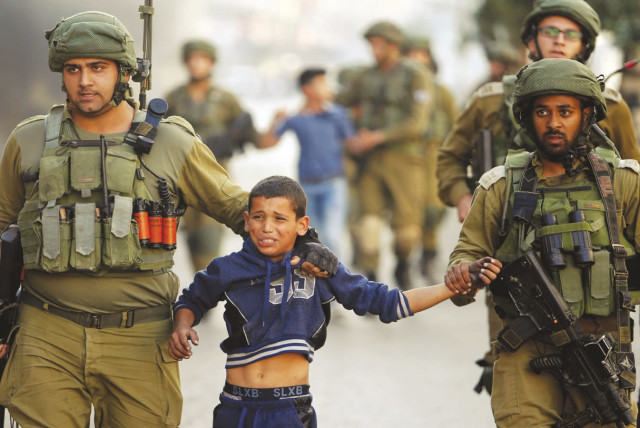
    Franz Fanon had sharpened the problem in such a way that the colonised would only really liberate themselves through violence and the killing of the colonialists because only in this way could they free themselves from the humiliation they had suffered.

    the real evil is humiliation – and many civilisations and peoples of the world have not only been exploited in colonisation but, perhaps more importantly, humiliated.

    violent action changes one’s own soul.


    I would like to emphasise from the outset that many readers of these lines will, of course, think that this is the writing of a Western-influenced intellectual, especially a German, who is marked by the guilt of the Germans for Auschwitz. Indeed, I am. Nevertheless, I want to address several issues beyond the current conflicts.

    An explanation of the causes of violence can very quickly turn into an understanding, and this into a legitimation of violent action. Although the boundary between these three concepts is fluid, it does not follow that identifying the causes of violent experiences legitimises all forms of one’s violent actions. Thus, while one can legitimise the violent resistance of the Palestinians and the establishment of their Palestinian state, one cannot legitimise all forms of one’s use of violence. The Queen of Jordan is indeed absolutely right when she accuses the West of double standards in the application of morality – but the need for moral recognition of the opponent as a human person is in no way invalidated by the Western double standard. In my view, there is no difference in principle whether Palestinian or Israeli children suffer. But the suffering of children on one side does not justify the suffering of children on the other side. At the moment, we are also in an information war in which precisely this is being conveyed – my own experience of violence as a victim legitimises the use of violence by myself. In his anticolonialism impulse, Franz Fanon had sharpened the problem in such a way that the colonised would only really liberate themselves through violence and the killing of the colonialists because only in this way could they free themselves from the humiliation they had suffered. This assumption, however, turned out to be highly counterproductive because violent action changes one’s own soul. While I fully agree with Jacques Vergés that the real evil is humiliation – and many civilisations and peoples of the world have not only been exploited in colonisation but, perhaps more importantly, humiliated. Here the distinction between a biological human being and a legal-moral person took on its nation-destroying dynamic and became a double standard – moral-legal qualities were granted only to Europeans, all others were degraded to half-monkeys, uneducated primitive peoples, or sub-humans (the Jews to the Nazis). This degradation did not kill the body, but like all rape, it killed the soul.

    Perhaps we need to get away from reducing every form of violence to its purpose – violent actions can also become independent. You can’t use violence the way you use cutlery and plates at dinner – after you wash up, everything looks the same, but people have gotten used to violence taking on a life of its own. The surviving fighters from the civil wars in the former Yugoslavia, Chechnya, Syria, and Iraq form a group of some 40,000 mercenaries who fight each other in ever-changing constellations. The 2012 “Tuareg” rebellion in Mali was also supported by such independent fighters, who returned from Palestine and helped themselves to the weapons stockpiles of the collapsed Ghaddafi regime. Chechen fighters, in turn, were a central part of the IS leadership; today, they are fighting on both sides in Ukraine. A tragic consequence of these developments is the inversion of the perpetrator-victim relationship. Many victims of violence have such fragmented souls that they use violence themselves to prevent themselves from ever being victims again, even at the cost of becoming perpetrators. Ideologies and political goals then become an indiscriminate source of legitimation for one’s violent actions, which ultimately only serve the purpose of no longer being a victim.

    Discourses of history: Throughout the Islamic sphere of influence, as in all colonised countries, there is a pronounced discourse of victimhood – the problem is that while the people concerned were indeed victims to the extent that the Western world still finds difficult or impossible to admit, a discourse of victimhood leads to legitimising even one’s own most horrific forms of violence by saying that one was a victim. Stalinism and Nazism, as well as the ideologies of al-Qaeda, Daesh/IS, the Taliban, and Hamas in Gaza, derive their legitimacy from this discourse of victimhood. At a training course in Yad Vashem, the Israeli Holocaust memorial, this victim discourse, the reversal of the victim-perpetrator relationship, was very vividly presented – not by me, but by the Israeli leaders of the training course. The symbol for this is the desert fortress Massada, where the last Jewish defenders committed suicide in order not to be humiliated as slaves by the Romans.

    But the consequence was the motto: Never again, Massada!

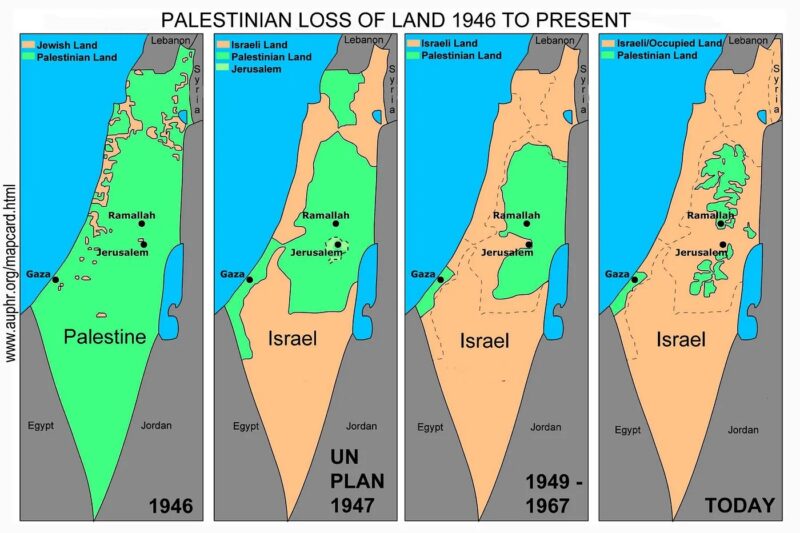
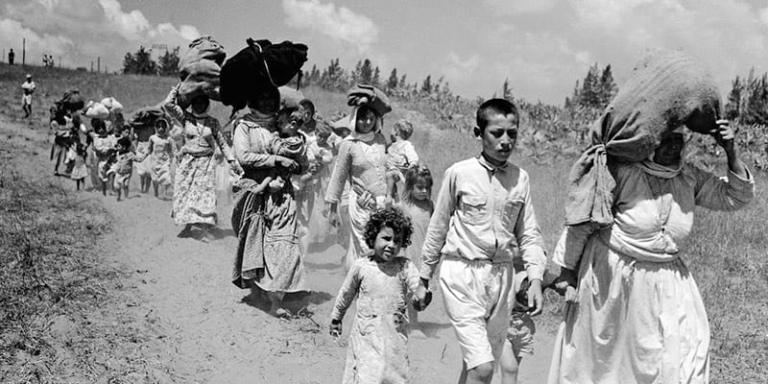
    And the Holocaust, anti-Semitism and Islamic Jew-hatred are not a distant past for Israelis but part of the present discourse – just as for many Palestinians, the Nakba is an ongoing part of the present. In Arabic, the Nakba refers to the flight and expulsion of some 700,000 Arab Palestinians from the former British Mandate of Palestine. It took place between the 1947 UN partition plan for Palestine and the 1949 armistice following the Palestine War, waged by six Arab states against the state of Israel, which was founded on May 14, 1948. In the historical narrative of Palestinians, other Arabs, and anti-Zionists, the Nakba is usually described as a pre-planned ethnic cleansing by the Israeli military; in the historical narrative of Israel, it is generally described as a voluntary flight in response to Arab calls. In my lecture at the World Peace Museum in Kyoto, Japan, I also wanted to talk about the crimes of the Japanese Empire in the 20th century. The colleague who invited me responded, at first incomprehensibly to me, that this could not be made a topic: He meant that you Germans were lucky, you had your Hitler. To my incomprehension, he explained that the Germans could blame the Holocaust entirely on Hitler and his few comrades, which, according to recent research, is not valid. But if he had to talk about the crimes of the Japanese army, he would speak of his father, but really about himself. He found himself unable to distance himself even minimally from his father. Although the greater sense of family in many non-Western societies can be a useful corrective to Western over-individualisation, the danger lies in the repetition of age-old conflicts. To my surprise, even the famous peace researcher Johann Galtung had postulated at a conference in Basel that 3 million deaths in the “Killing Fields” of the Red Khmer were compared to 3000 years of oppression. The undisputed experience of oppression led him to relativise a crime against humanity.

    The problem, however, is that for every terrorist killed, General Abi Zaid, the former commander of U.S. forces in Iraq, estimates that five new ones grow. After the violent excesses of Hamas members, it is “understandable” that the relatives of the victims want to kill them, but this will most likely only multiply the number of violent and militant supporters.

      Even with regard to the Holocaust, Hannah Arendt had distinguished between the unforgivable act and the perpetrator, whom one must be able to forgive. But “forgiveness” depends on the admission of guilt. And this admission is made virtually impossible by the victim discourse. In addition, it is difficult to come to terms with one’s own violent actions. Many of these people will never be able to return to civilian society – this could be observed, for example, in the case of US soldiers who, decades after the Vietnam War, still had to “play” the war over and over again in the Nevada desert, because the violence they had committed had filled their identity entirely. There is a drug that is more quickly and deeply addictive than even heroin – and that is violence. Violence eats the soul. And even if Arendt distinguishes between the perpetrator and the act, what to do with perpetrators who cannot distance themselves from the act is problematic. In a study of the recruitment of IS supporters in Iraq, it was found that the main recruitment base for IS was the prisons there. Even in Western prisons, petty criminals often turn out to be serious criminals. Sometimes, you have to admit that the only way to deal with people who are entirely violent is to kill them – like the IS supporters who abused Yazidi women as sex slaves. To this day, it is difficult to understand why the neighbouring states did not put an end to the violent excesses of IS earlier since it would have had no chance against a functioning modern army. The problem, however, is that for every terrorist killed, General Abi Zaid, the former commander of U.S. forces in Iraq, estimates that five new ones grow. After the violent excesses of Hamas members, it is “understandable” that the relatives of the victims want to kill them, but this will most likely only multiply the number of violent and militant supporters.

     Both Hamas and the religious extremists in Israel and the settlers in the West Bank are obviously trying to turn a political dispute into a religiously underpinned clash of civilisations, or, as Samuel P. Huntington better calls it, a clash of civilisations. Hamas is not only a liberation movement, as it is often ascribed in defence of its actions, but at least a religious movement oriented toward an eschatological struggle – just like the religious extremists in Israel. Both rely on the construction of identity that Huntington also advocates: we know who we are when we know who we are against. Although there is a renaissance of religion around the world, and it is often very violent, this does not mean that religions per se are violent. But religious belief necessarily excludes other beliefs. It is different from the civilisations associated with them. While religions exclude others, civilisations are much more likely to include others. This difference also explains why the followers of the great monotheistic religions, while claiming to be peace-loving, have been responsible for unparalleled excesses of violence throughout their history. The Islamic wars of conquest, the Crusades, the Ottoman conquests, the Thirty Years’ War, Islamic and Atlantic slavery, and, finally, worldwide colonisation leave a single trail of blood. And this, of all things, from two world religions that considered themselves peace-loving. The traditional explanation is no longer valid: these excesses of violence had nothing to do with religion but only with socio-historical conditions, which themselves were oriented towards eternal peace. This is certainly true for these civilisations (even if the concept of civilisation has been distorted by European colonisation), but not for the religions (which is why the Global Ethic project has failed so spectacularly, contrary to its own claims because it has not gone beyond a minimal consensus).

    Huntington’s liberal critics had argued not only that there should not be a clash of civilisations but also that there could not be one – because, in their eyes, there was only one civilisation, the Western one. The others are religions or cultures, but not civilisations. It is time to abandon this liberal and Western conceit, and the replacement of Eurocentrism with ethnocentrism or religious centrism is not an adequate response to the problems of exploding violence.

     At first glance, a dialogue of the world’s civilisations seems unrealistic in the face of worldwide explosions of violence. On the contrary, it is necessary to prevent political disputes from becoming a clash of civilisations. Huntington’s liberal critics had argued not only that there should not be a clash of civilisations but also that there could not be one – because, in their eyes, there was only one civilisation, the Western one. The others are religions or cultures, but not civilisations. It is time to abandon this liberal and Western conceit, and the replacement of Eurocentrism with ethnocentrism or religious centrism is not an adequate response to the problems of exploding violence. Instead, the appropriate response to the increasing number of wars and excesses of violence worldwide must be to separate the hardliners discursively, politically, and militarily from the population, not to drive the population into the hands of the hardliners. In the latter case, we would only be threatened with a new “bloody century” like the first half of the 20th century. A dialogue among the world’s civilisations is necessary, if perhaps only modest, step to avoid this. For in the mutual recognition of the world’s civilisations, both sides will be bound by their own civilisational principles.

    Feature Image: Nakba of 1948 – Palestinians being forced out by Israelis – arabcenterdc.org

  • Propaganda Blitz: How Mainstream Media is Pushing Fake Palestine Stories

    Propaganda Blitz: How Mainstream Media is Pushing Fake Palestine Stories

    Biased media reporting and propaganda with fake news is now a major strategy to create polarised perceptions worldwide. This type of reporting is now led by leading media houses of the West, whose only aim is to create a narrative that suits their foreign policy and economic objectives. Truth is a big casualty in the bargain, along with innocent lives, communities, and nations. The ongoing Israel-Hamas conflict is mired in heavy propaganda. It is important for the world to re-examine the past, extract the truth and history, and the current geopolitical machinations to understand this long-drawn Middle East conflict properly. TPF endeavours to provide, through select articles and accurate analysis, the right analysis and perspective of the Israel-Palestine issue. In the article below, Alan Macleod clearly describes how mainstream media pushes many false narratives to obfuscate the true nature, causes, and victims of the conflict.         – Team TPF


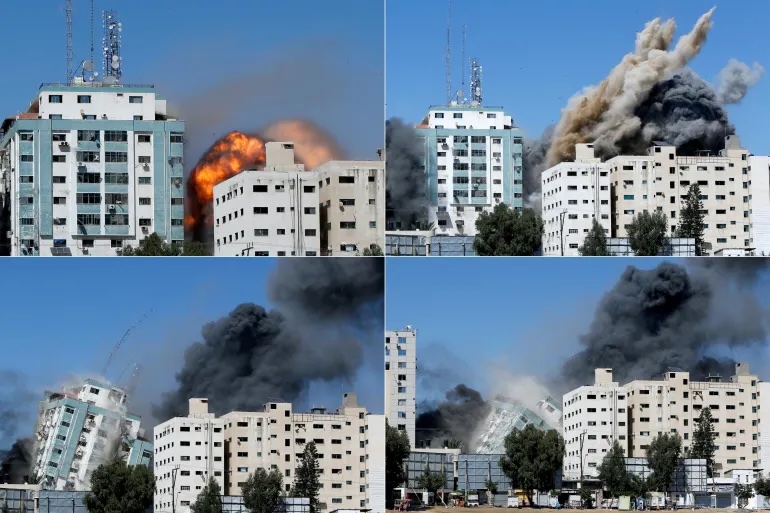
    After Hamas launched a surprise attack on Israel, IDF forces responded with airstrikes, levelling Gazan buildings. The violence so far has claimed the lives of more than 2,500 people. Western media, however, show far more interest and have much greater sympathy with Israeli dead than Palestinian ones and have played their usual role as unofficial spokespersons for the Israeli Defense Forces (IDF).

    EXTRAORDINARY CLAIMS, ZERO EVIDENCE

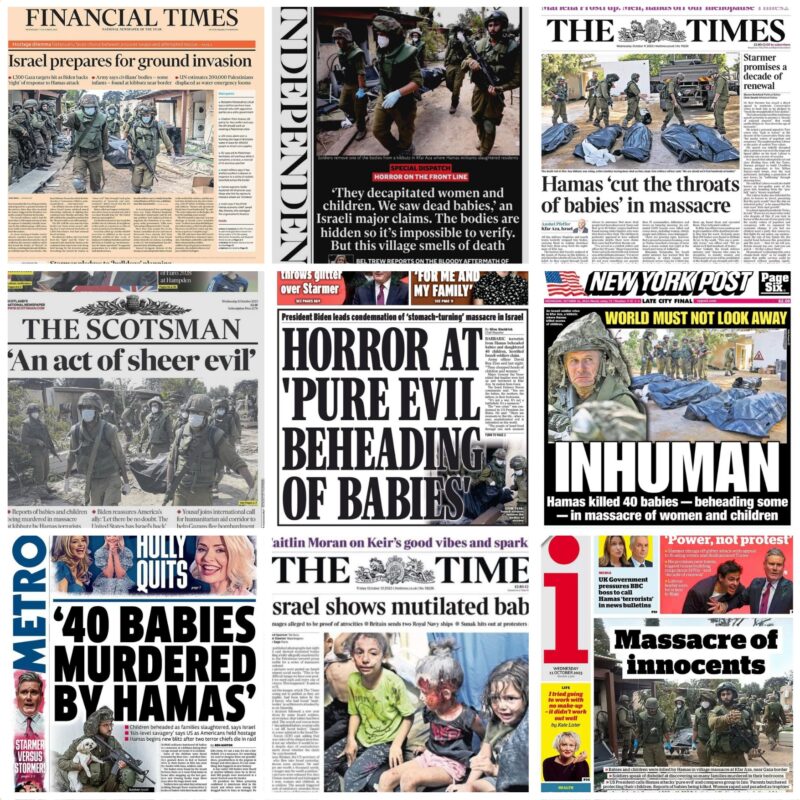
    One case in point is the claim that, during their incursion into southern Israel, Hamas fighters stopped to round up, kill and mutilate 40 Israeli babies, beheading them and leaving their bodies behind.

    The extraordinary assertion was originally reported by the Israeli channel i24 News, which based it on anonymous Israeli military sources. Despite offering no proof whatsoever, this highly inflammatory claim about an enemy made by an active participant in a conflict was picked up and repeated across the world by a host of media (e.g., in the United States by Fox NewsCNNMSNBusiness Insider, and The New York Post)

    Meanwhile, the front pages of the United Kingdom’s largest newspapers were festooned with the story, the press outraged at the atrocity and inviting their readers to feel the same way.

    Extraordinary claims should require extraordinary evidence, and a story like this should have been met with serious skepticism, given who was making the claim. The first question any reporter should have asked was, “Where is the evidence?” Given multiple opportunities to stand by it, the IDF continually distanced itself from the claims. Nevertheless, the story was simply too useful not to publish.

    The decapitated baby narrative was so popular that even President Biden referenced it, claiming to have seen “confirmed” images of Hamas killing children. This claim, however, was hastily retracted by his handlers at the White House, who noted that Biden was simply referencing the i24 News report.

    The story looked even more like a piece of cheap propaganda after it was revealed that the key source for the claim was Israeli soldier David Ben Zion, an extremist settler who had incited race riots against Palestinians earlier this year, describing them as “animals” with no heart who needs to be “wiped out.”

    Manipulating the U.S. public into supporting the war by feeding them atrocity propaganda about mutilating babies has a long history. In 1990, for instance, a girl purporting to be a local nurse was brought before Congress, where she testified that Iraqi Dictator Saddam Hussein’s men had ripped hundreds of Kuwaiti babies from their incubators and left them to die. The story helped whip the American public up into a pro-war fervor. It was later revealed that it was a complete hoax dreamed up by a public relations firm.

    THE MURDERED GIRL WHO CAME BACK TO LIFE

    Another piece of blatantly fake news is the case of Shani Louk. Louk attended the Supernova Festival, ambushed by Hamas. It was widely reported that Hamas murdered her (e.g., Daily MailMarcaYahoo! NewsTMZBusiness Insider), stripped her, and paraded her naked body trophy-like through the streets on the back of a truck. Louk’s case incited global anger and calls for an overwhelming Israeli military response.

    There was only one problem: Louk was later confirmed to be alive and in hospital, a fact that suggests the videos of her on the back of a truck were actually images of people saving her life by taking her to seek medical assistance.

    Few of the outlets irresponsibly publishing these wildly incendiary stories have printed apologies or even retractions. The Los Angeles Times was one exception: after publishing a report claiming that Palestinians had raped Israeli civilians, it later informed readers that “such reports have not been substantiated.”

    LIONIZING ISRAEL, DEHUMANIZING PALESTINIANS

    Few readers, however, see these retractions. Instead, they are left with visceral feelings of anger and disgust towards Hamas, priming them to support Western military action against Palestine or the wider region.

    In case their audiences did not get the message, op-eds and editorials in major newspapers hammered home this idea. The Wall Street Journal ran an op-ed entitled “The Moral Duty to Destroy Hamas”, which insisted to readers that “Israel is entitled to do whatever it takes to uproot this evil, depraved culture that resides next to it.” Thus, the outlet implicitly gave Israel a free pass to carry out whatever war crimes it wished on the civilian population, whether that is using banned chemical weapons, cutting off electricity and water, or targeting ambulances or United Nations officials.

    The National Review’s editorial board was of a similar mind, stating that “Israel needs a long leash to destroy Hamas.” This long leash, they explained, meant giving Israel far more time to carry out the destruction of Gaza. Western leaders would have to refrain from criticizing Israel or calling for calm and peace.

    The message was clear: international unity was paramount at this time. Mere trifles such as war crimes must be overlooked. And while Israel and its people were treated with special sympathy (e.g., Washington Post), the other side was written off as bloodthirsty radicals. While the phrase “Palestinian terrorists” could be found across the media spectrum (e.g., Fox NewsNew York PostNew York Times), its opposite, “Israeli terrorists” was completely absent from corporate media. This, despite casualties on the Palestinian side, outnumbering Israelis.

    Underlining the fact that Israeli lives are deemed more important is the way in which deaths from each side are reported. The BBC, for example, told its readers that Israelis have been “killed” while people in Gaza merely “died,” removing any agency from its perpetrators and almost suggesting their deaths were natural.

    CONTEXT-FREE VIOLENCE

    Missing from most of the reporting was the basic factual background of the attack. Few articles mentioned that Israel was built upon an existing Palestinian state and that most of the inhabitants of Gaza are descended from refugees ethnically cleansed from southern Israel in order to make way for a Jewish state. Also left unmentioned was that Israel controls almost every aspect of Gazan’s life. This includes deciding who can enter or leave the densely populated strip and limiting the import of food, medicine and other crucial goods. Aid groups have called Gaza “the world’s largest open-air prison.” The United Nations has declared the conditions in Gaza to be so bad as to be unlivable.

    One of the principal reasons that this crucial context is not given is that it could influence Western audiences into sympathizing with Palestinians or supporting Palestinian liberation. Giant media corporations are largely owned by wealthy oligarchs or by transnational corporations, both of whom have a stake in preserving the status quo and neither of whom wish to see national liberation movements succeed.

    https://twitter.com/AlanRMacLeod/status/1712797752709566763?ref_src=twsrc%5Etfw%7Ctwcamp%5Etweetembed%7Ctwterm%5E1712797752709566763%7Ctwgr%5Eb05f8d7d7e0b67196918b4e46787442438501a6b%7Ctwcon%5Es1_&ref_url=https%3A%2F%2Fscheerpost.com%2F2023%2F10%2F14%2Fpropaganda-blitz-how-mainstream-media-is-pushing-fake-palestine-stories%2F

    Some media outlets make this explicit. Axel Springer – the enormous German broadcaster that owns Politico – requires its employees to sign its mission statement endorsing “the trans-Atlantic alliance and Israel” and has told any staff members that support Palestine to leave their jobs.

    Other outlets are slightly less overt but nonetheless have Israel red lines that employees cannot cross. CNN fired anchor Marc Lamont Hill for calling for a free Palestine. Katie Halper was fired from The Hill for (accurately) calling Israel an Apartheid state. The Associated Press dismissed Emily Wilder after it became known that she had been a pro-Palestine activist during her college years. And The Guardian sacked Nathan J. Robinson after he made a joke mocking US military aid to Israel. These cases serve as examples to the rest of the journalistic world. The message is that one cannot criticize the Israeli government’s violent apartheid system or show solidarity for Palestine without risking losing their livelihoods.

    Ultimately, then, corporate media play a key role in maintaining the occupation by manipulating public opinion. If the American people were aware of the history and the reality of Israel/Palestine, the situation would be untenable. For those wishing to maintain the unequal state of affairs whereby an apartheid government expels or imprisons its indigenous population, the pen is as important as the sword.


    This article was published earlier in scheerpost.com and is republished under the Creative Commons Attribution-NonCommercial-NoDerivatives 4.0 International license

    Feature Image Credit: aljazeera.com


  • Indian Air Force at 91:  Challenges and Opportunities

    Indian Air Force at 91: Challenges and Opportunities

    The Indian Air Force, created on October 8, 1932, completes 91 years of glorious service as it celebrates the Air Force Day today, October 8, 2023. As the IAF celebrates its annual day with customary elan, it is a time to reflect and assess the future in terms of challenges and opportunities. On the operational front, the die is already cast with two nuclear-powered neighbours, one in political and economic turmoil and the other continuing an aggressive posture. A three-yearlong standoff on the northern border with no signs of reconciliation makes the environment precarious.

    China, with its goal of becoming the leading military power with global reach by 2049, has moved fast to replace and transform its antiquated equipment, systems, and organizations, especially after observing the 1991 Gulf War. Reorganization of the PLA in the last decade, consolidation of forces under one command to oversee military operations against India and creation a Special Support Group (SSG) has enhanced its force application capabilities. Specifically, the upgradation of military infrastructure, airfields, and helipads just north of India is a matter of concern. Robust military hardware production for modern systems and investment in R&D in new-era fields like quantum computing, quantum radars, artificial intelligence, and aircraft and weapon systems development have facilitated significant growth in PLA’s capabilities. Qualitatively and quantitatively, India cannot match the Chinese economy, military hardware, military industry, or infrastructure in the foreseeable future. The only way forward for India is to use its resources in a focused manner to achieve its well-defined strategic goals commensurate with available resources. Lessons from the ongoing Russia-Ukraine war, a contest between unequal forces, are relevant in our context.

    Force Structure Challenges to Overcome

    Besides the operational challenges the Indian Air Force faces on the borders, there are issues related to equipment and organization.


    The salience of combat aircraft in battlespace is well known. However, combat aircraft numbers are declining worldwide, with older systems paving the way for modern and more capable platforms. In India, the decline has been rather steep, and replacements are not potent enough to offset the quantity quality. Against an authorization of over 1000 combat aircraft, the Indian armed forces are now in the region of 600. This decline will continue, and by 2030, IAF combat aircraft strength will be down to 450 with the phase-out of MiG-21, MiG-29, Jaguar, and Mirage-2000 fleets. The induction of 36 Rafales, the prolonged induction of LCA, and the planned acquisition of more Su30MKIs will not be able to reverse the declining trend. The ambitious plans for India’s fifth-generation aircraft, AMCA, are still far away. Given this reality, the IAF must make do with, at best, 34-36 fighter squadrons in the 2035 timeframe. It must work on operational strategies based on superior tactics and a local favourable balance of power in case a war is inevitable during this period.

    In the critical area of force multipliers, the numbers have been nearly static since their initial induction in 2003 concerning IL-78 In-Flight Refuellers and in 2010 concerning AWACS. The number of long-range weapons is somewhat limited. And in the surveillance and space domains, the resources are meagre. The situation is unlikely to change in the foreseeable future.

    There are positive changes regarding airlift capability, and single-wave airlift capability is gradually increasing with the commencement of induction of the first of the 56 new C-295 transport aircraft replacing vintage Avro. Despite the gradual phase-out of heavy lift Il-76 and light transport aircraft An-32, the fleet of C-17 and C-130 will sustain the requisite airlift capability that enabled the rapid deployment of Indian Army units in Ladakh against PLA build-up. Similarly, the enhanced number of more versatile and potent indigenous helicopters, ALH and LCH, will increase local mobility and firepower.

    The area that is yet to take centre stage is the Unmanned systems. Although the numbers and types increase due to imports, recent conflicts have demonstrated their hugely versatile utility. This aspect needs more attention to offset the capability deficit owing to the reduced number of combat aircraft. Tasks like intelligence, surveillance, reconnaissance, and ground and maritime attack can be effectively performed by unmanned aerial systems, resulting in the release of aircraft for other roles.

    New and more capable radars and integrated networks are replacing the older systems, giving a robust defensive capability. These need to be backed by long-range and quick-reaction surface-to-air weapon systems. Currently, the numbers are limited, and the area to be covered is extensive. Agility in planning, deployment and redeployment is the key to effective defence with limited resources.

    Evolving Battlespace and the Imperative of Jointness

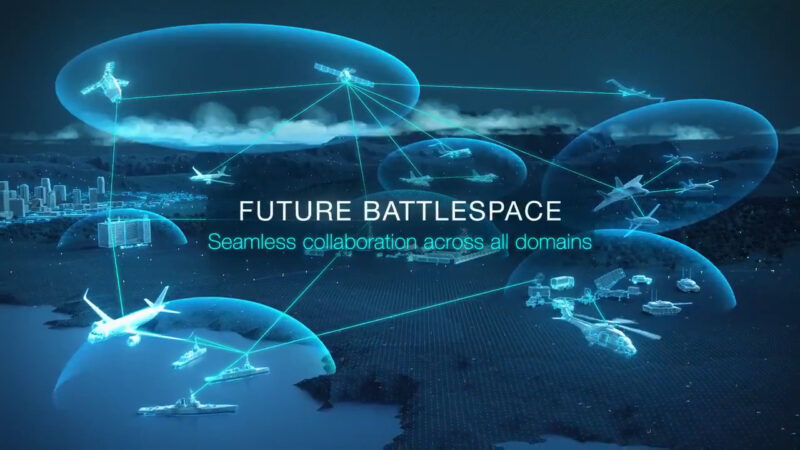
    The battle space is evolving. Conflict hybridization has accelerated the expansion of battlespace, leading to enhanced significance of battlespace transparency. Induction of hypersonic systems, fast relocation of combat elements, and reduced times for systems operationalization have compressed the reaction time. This time-compression for action has tilted the offence-defence balance in favour of the offence. The concept of operations needs to factor in these realities, especially when dealing with a potent and stronger adversary with significant reverse capability.

    Organisationally, the integration of three wings of the Indian armed forces will likely pick up pace in the coming year(s). Integration is now an operational necessity and needs to be fast-tracked. Once theatre commands come into being, the most critical factor will be the allocation and plan of utilization of various combat assets that are limited in numbers but can operate seamlessly between multiple sectors. Will the integration model follow the complex assignment of such resources? That will be suboptimal and possibly counterproductive to enhancing combat capability through integration. IAF will have to make a holistic plan to exploit the full combat potential of its assets, irrespective of how the integration model pans out. Organisationally, this will be the most significant challenge for the men and women in blue in the coming year(s).

    Conclusion

    In the last five decades, India has taken the pole position in money spent on military hardware imports. Saudi Arabia is a distant second, spending less than half of Indian expenditure in this sector. How did India reach here? Public sector monopoly in defence has not yielded the desired results for the last seven decades. Inadequate focus and investment in R&D, captive customers, the Indian armed forces not hand-holding the industry, restrictive policies, monopoly of the public sector, dependency on imported military hardware and inability to leverage large imports for technology access are the factors contributing to this state. Atamnirbhar, from being a rhetoric, is gradually taking shape with orders being placed on Indian enterprises. The policy of earmarking part of the capital budget for Indian manufacturers will undoubtedly encourage the Indian defence industry. Although production efficiency and quality control have been a concern regarding the public sector, things are likely to improve as they face competition from the private sector. The lack of control over critical technologies in areas of aero engines, air-launched weapons, and electronic warfare systems remains a severe vulnerability. Opening the defence sector for private entities, allowing DRDO to share available testing facilities and technology, and creating defence manufacturing corridors are steps in the right direction.

    Capability differential and information differential between the competing sides form the basis of military operations. A classical information matrix about the opposing force includes intent, strategy, military doctrine, and military objectives; besides the overall direction that military strategy gives, an operational plan and its execution are based on an information matrix to achieve defined goals with the least cost or in the minimum possible timeframe. IAF, with its new doctrine IAP2000-22, endeavours to capture the essence of these changes. Indian Air Force needs to be ready with its limited assets and deter war. IAF must augment its limited resources with courage, ingenuity and clever resource employment to outwit the adversary. Given the limited resources and challenges ahead, the IAF will need to be a smart force for efficient management of resources and clever exploitation of force application.

    Photo Credits: Sunil Jain

    The views expressed are the author’s own and do not reflect that of the TPF or the IAF.

  • Balancing Civilizations: Neither Clash, mere Multiplicity nor Conversion

    Balancing Civilizations: Neither Clash, mere Multiplicity nor Conversion

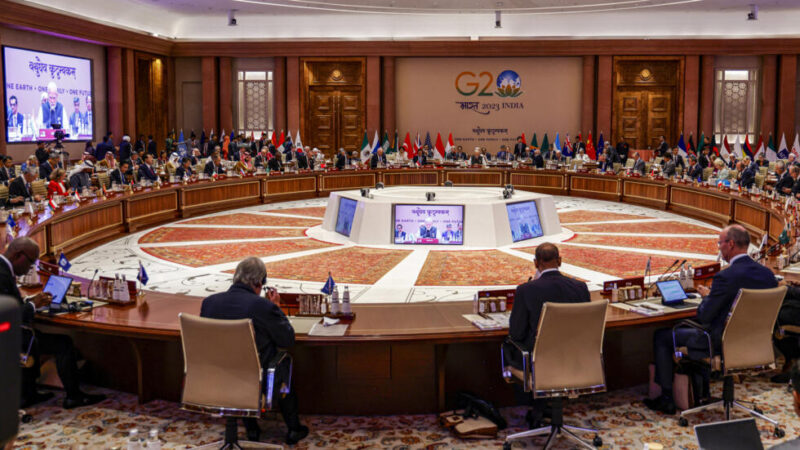
    The modern world is a product of intense competition and conflict that evolved from the European ‘system of states’ propensity and greed for the acquisition of territory and resources through colonialism and imperialism. The post-1945 world continues to suffer the ills of Western domination and exploitation as is evidenced by the innumerable number of wars, conflicts, and interventions….supposedly part of the imperial civilising missions. As the non-Western world rises the choices are either conflict or cooperation. The G20 Summit 2023 being held in New Delhi is an opportunity to recognise and chart a new path for the world. The authors, Andreas Herberg-Rothe and Key-young Son, emphasise the importance and need for cooperation and harmony amongst the civilisations of the world.

    G20 Summit 2023 in New Delhi is underway on September 9-10, 2023. 

    We propose the non-binary concepts of Clausewitzian floating equilibrium, Confucian harmony, and Arendtian politics of plurality as key ideas to avert and mitigate contemporary conflicts.

    In many of the world’s hot spots, both civil and governmental combatants have become embroiled in unending conflicts based on a binary position: “us against the rest.” After two hundred years of imperialism and Euro-American hegemony that have produced varying degrees of adaptation or rejection of Western modernity, it may be time for the world’s great civilizations to learn how to live harmoniously with one another. The world order of the twenty-first century will not be based entirely on modernist ideas and institutions such as nation-states, laissez-faire capitalism, individualism, science and technology, and progress. How then can we accommodate other civilizations and cultures?

    We propose mediation, recognition, harmony and floating balance as key principles for inter-civilizational and inter-cultural dialogue and conviviality, accompanied by the awareness that we are all descended from a small group of African ancestors. Mediation and recognition between friends and enemies will be the initial recipes for transforming hostility into partnership, while harmony and floating balance between and within opposites, such as individual versus community, freedom versus equality, will help sustain the momentum for forging constructive relationships.

    After the process of political decolonization in the twentieth century, we still need to decolonize our way of thinking. The values of the East and the West cannot survive in their absolute form in this globalized world.

    As former Israeli Prime Minister Yitzhak Rabin put it, “You don’t have to make peace with your friends; you have to make peace with your enemies. As a legacy of previous centuries, however, the binary thinking of “us against them” has paradoxically retained a strong presence in twenty-first-century international relations. If this thinking continues to be the decisive force, we could repeat the catastrophes of the twentieth century. After the process of political decolonization in the twentieth century, we still need to decolonize our way of thinking. The values of the East and the West cannot survive in their absolute form in this globalized world. It is our deepest conviction that the Western and like-minded states could only hold on to values such as freedom, equality, emancipation and human rights if they could be harmoniously balanced with the contributions of other civilizations and cultures.

    The concept of floating equilibrium, derived from our interpretation of the “wondrous trinity” of the Prussian military theorist Carl von Clausewitz, means not relativity, but relationality and proportionality. At the end of his life, Clausewitz drew the conclusion for the theory of violent conflict that every war is composed of the three opposing tendencies of primordial violence, which he compared to hatred and enmity as a blind natural force, to chance and probability, and to the subordination of war as a political instrument, which makes war subject to pure reason. With Clausewitz’s concept, it is clear that war involves two extreme opposites – primordial violence on the one hand and pure reason on the other. By adding the third tendency, chance and probability, wars become different in their composition.

    We use Clausewitz’s concept as a methodological starting point to find a floating balance between various contrasts and contradictions that are evident in the current phase of globalization, which Zygmunt Bauman calls “liquid modernity”. These contrasts include those between the individual and the community, equality and freedom, war and peace, and recognition and disrespect. We argue that Clausewitz’s wondrous trinity and “floating equilibrium” can be used as a way to interpret and mitigate today’s conflicts, although Clausewitz developed these notions to analyze the warfare of his time.

    Globalization has led to the “rise of the rest” or Amitav Acharya’s “multiplex world” of nation-states, NGOs, global institutions, global terrorism, and violent gangs of young people from the suburbs of Paris to the slums of Rio who are excluded from the benefits of globalization. This includes both of the following macro developments:

    On the one hand, globalization allows the former empires (China, Russia and India) and some developing countries with large populations (Brazil, Indonesia, South Africa) to regain their status as great powers. This development could lead to a global network of megacities competing on connectivity rather than borders, as in China’s efforts to reestablish the ancient trade routes of the Silk Road. On the other hand, it dissolves traditional identities and forms of governance to some extent as a result of social inequality, leading to fragmented societies and a re-ideologization of domestic conflicts, as already seen with the rise of the far right in the US, Europe and Russia, but also Salafism, exaggerated Hindu and Chinese nationalist movements.

    the terrible inequalities in this world, where 1% of the world’s population has as much as 99% of the “rest”, or 62 billionaires own as much as 3.5 billion people, are the result of unrestricted and unbalanced freedom. We need to reinvent a balance between freedom and equality so as not to legitimize the inversion of freedom in the name of freedom by the aristocracy of property owners.

    Failed states, the wave of migrants and refugees around the world, climate catastrophes, and growing inequalities are the result of the “liquid modernity” that accompanies the dissolution of individual, community, and state identities. Ideologies did not dissolve with the end of the twentieth century or the advent of globalization but rather shifted from modern, utopian ideologies such as socialism and democracy and their aberrations such as Nazism and Stalinism to postmodern ones. The rise of postmodern ideologies such as Salafism is the result of globalization and the West’s refusal to recognize other civilizations and cultures. Moreover, the terrible inequalities in this world, where 1% of the world’s population has as much as 99% of the “rest”, or 62 billionaires own as much as 3.5 billion people, are the result of unrestricted and unbalanced freedom. We need to reinvent a balance between freedom and equality so as not to legitimize the inversion of freedom in the name of freedom by the aristocracy of property owners.

    In short, we propose the non-binary concepts of Clausewitzian floating equilibrium, Confucian harmony, and Arendtian politics of plurality as key ideas to avert and mitigate contemporary conflicts. Both Confucian harmony and Hanna Arendt’s concept of plurality are based on the harmonious relationship between different actors, or the floating balance of equality and difference, given that all human beings are similar enough to understand each other, but each is an individual endowed with uniqueness.

    Due to the speed and scale of information processing and transmission, the contemporary world is turning much faster than the commonly known modern world. If modernity is a temporal and spatial playground for rationality, the contemporary world is rather a playground for the mixture of the Clausewitzian trinity: reason, emotion, and chance. This means that while we would like to use reason in making decisions, we are often swamped by emotion and ultimately forced to take chances, given the short time frame available for any reasonable calculation and the ever-changing, chameleon-like internal and external environments. As an analyst of war, Clausewitz had long studied this trinity, for war, as a microcosm of human realities, is where reason, emotion, and chance play their respective roles.

    In this everyday situation of war, Clausewitz’s revived ideas can offer his posterity many valuable insights. All in all, Clausewitz diverts our attention from the unbalanced diet of the modernists in favour of rationality and offers a healthy recipe for analyzing contemporary problems where reason, emotion, and chance intersect, often with an unexpected outcome.

    No matter how powerful a single state may be, it will remain a minority compared to the rest of the world. In this globalized world, there would be no room for any kind of exceptionalism, American or Chinese, but only a floating balance between the world’s great civilizations.

    It is a choice between repeating the same mistake of forcibly imposing our own values on the rest of the world, as we did in the twentieth century, or embarking on a new civilizational project of harmony and co-prosperity. No matter how powerful a single state may be, it will remain a minority compared to the rest of the world. In this globalized world, there would be no room for any kind of exceptionalism, American or Chinese, but only a floating balance between the world’s great civilizations. Such a floating balance is a kind of mediation between the opposites of Huntington’s clash of civilizations on the one hand and the generalization of the values of only one civilization on the other. A mere multiplicity of approaches would only lead to a variant of the clash of civilizations. The first step in this direction is to recognize that in a globalized world, great civilizations must learn from each other for their own benefit and interest. If the values of the Western world lead to such terrible and immoral inequalities, we need to rethink our value systems – and if the concept of hierarchy in the Eastern world leads to violations of a harmoniously balanced society, we need to rethink those value systems as well. Whereas in classical Confucianism harmony was based on strict hierarchical oppositions, in a globalized world we need a floating balance between hierarchical and symmetrical social relations, combining Clausewitz and Confucius.

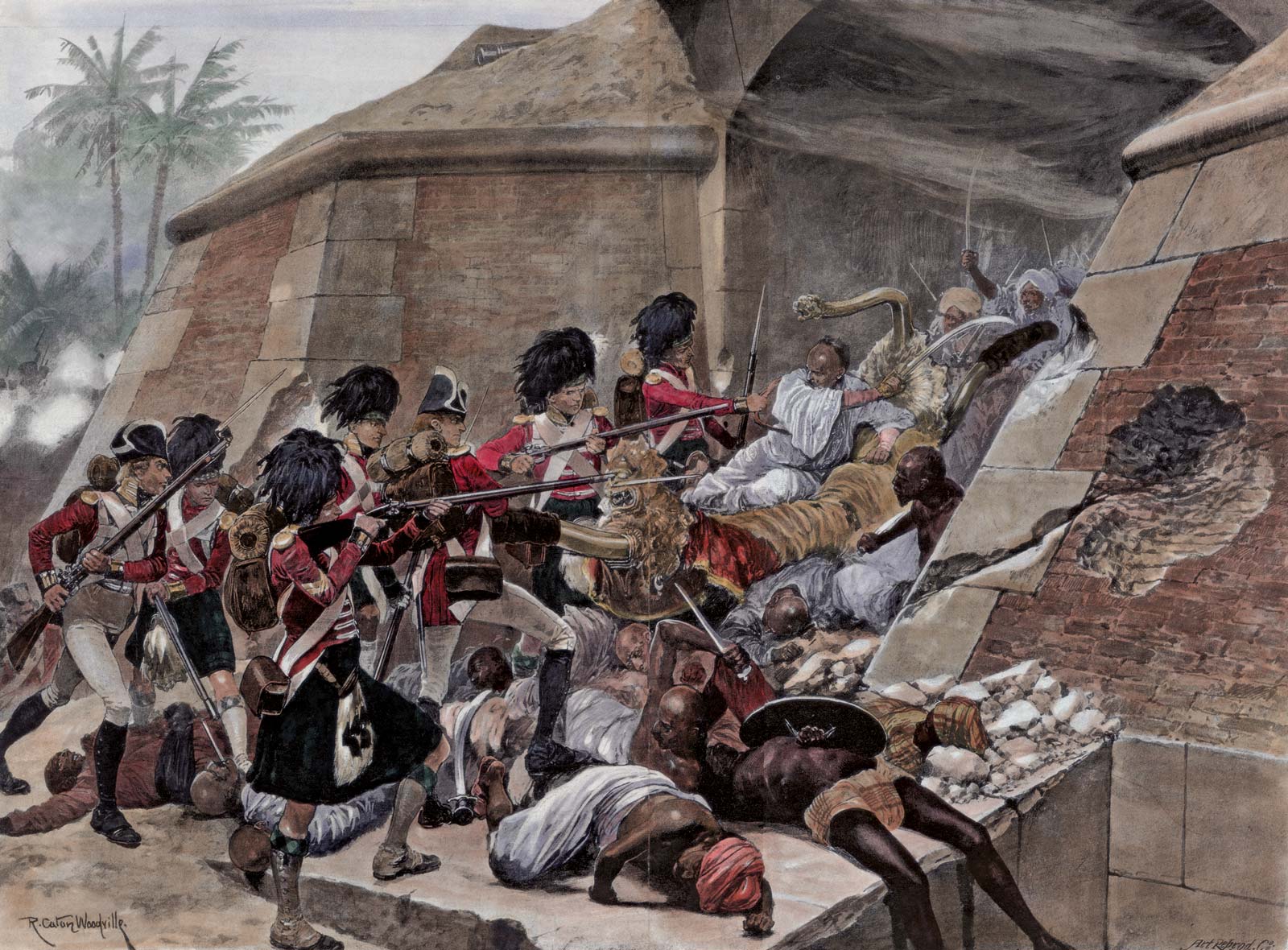
    Feature Image Credit: Storming of the Srirangapattinam Fort by the British. Fourth Anglo-Mysore War, 1799. Consolidation of colonialism and imperialism. www.mediastorehoise.com

  • The US economic war on China

    The US economic war on China

    The anti-China policies come out of a familiar playbook of US policy-making. The aim is to prevent economic and technological competition from a major rival.

    China’s economy is slowing down. Current forecasts put China’s GDP growth in 2023 at less than 5%, below the forecasts made last year and far below the high growth rates that China enjoyed until the late 2010s. The Western press is filled with China’s supposed misdeeds: a financial crisis in the real estate market, a general overhang of debt, and other ills. Yet much of the slowdown is the result of US measures that aim to slow China’s growth. Such US policies violate World Trade Organization rules and are a danger to global prosperity. They should be stopped.
    The anti-China policies come out of a familiar playbook of US policy-making. The aim is to prevent economic and technological competition from a major rival. The first and most obvious application of this playbook was the technology blockade that the US imposed on the Soviet Union during the Cold War. The Soviet Union was America’s declared enemy and US policy aimed to block Soviet access to advanced technologies.

    At the end of the 1980s and early 1990s, the US deliberately sought to slow Japan’s economic growth. This may seem surprising, as Japan was and is a US ally. Yet Japan was becoming “too successful,” as Japanese firms outcompeted US firms in key sectors, including semiconductors, consumer electronics, and automobiles.

    The second application of the playbook is less obvious, and in fact, is generally overlooked even by knowledgeable observers. At the end of the 1980s and early 1990s, the US deliberately sought to slow Japan’s economic growth. This may seem surprising, as Japan was and is a US ally. Yet Japan was becoming “too successful,” as Japanese firms outcompeted US firms in key sectors, including semiconductors, consumer electronics, and automobiles. Japan’s success was widely hailed in bestsellers such as Japan as Number One by my late, great colleague, Harvard Professor Ezra Vogel.
    In the mid-to-late 1980s, US politicians limited US markets to Japan’s exports (via so-called “voluntary” limits agreed with Japan) and pushed Japan to overvalue its currency. The Japanese Yen appreciated from around 240 Yen per dollar in 1985 to 128 Yen per dollar in 1988 and 94 Yen to the dollar in 1995, pricing Japanese goods out of the US market. Japan went into a slump as export growth collapsed. Between 1980 and 1985, Japan’s exports rose annually by 7.9 percent; between 1985 and 1990, export growth fell to 3.5 percent annually; and between 1990 and 1995, to 3.3 percent annually. As growth slowed markedly, many Japanese companies fell into financial distress, leading to a financial bust in the early 1990s.

    In the mid-1990s, I asked one of Japan’s most powerful government officials why Japan didn’t devalue the currency to re-establish growth. His answer was that the US wouldn’t allow it.

    Now the US is taking aim at China. Starting around 2015, US policymakers came to view China as a threat rather than a trade partner. This change of view was due to China’s economic success. China’s economic rise really began to alarm US strategists when China announced in 2015 a “Made in China 2025” policy to promote China’s advancement to the cutting edge of robotics, information technology, renewable energy, and other advanced technologies. Around the same time, China announced its Belt and Road Initiative to help build modern infrastructure throughout Asia, Africa and other regions, largely using Chinese finance, companies, and technologies.

    After winning the 2016 election on an anti-China platform, Trump imposed unilateral tariffs on China that clearly violated WTO rules. To ensure that WTO would not rule against the US measures, the US disabled the WTO appellate court by blocking new appointments.

    The US dusted off the old playbook to slow China’s surging growth. President Barrack Obama first proposed to create a new trading group with Asian countries that would exclude China, but presidential candidate Donald Trump went further, promising outright protectionism against China. After winning the 2016 election on an anti-China platform, Trump imposed unilateral tariffs on China that clearly violated WTO rules. To ensure that WTO would not rule against the US measures, the US disabled the WTO appellate court by blocking new appointments. The Trump Administration also blocked products from leading Chinese technology companies such as ZTE and Huawei and urged US allies to do the same.

    When President Joe Biden came to office, many (including me) expected Biden to reverse or ease Trump’s anti-China policies. The opposite happened. Biden doubled down, not only maintaining Trump’s tariffs on China but also signing new executive orders to limit China’s access to advanced semiconductor technologies and US investments. American firms were advised informally to shift their supply chains from China to other countries, a process labelled “friend-shoring” as opposed to offshoring. In carrying out these measures, the US completely ignored WTO principles and procedures.

    The US strongly denies that it is in an economic war with China, but as the old adage goes, if it looks like a duck, swims like a duck, and quacks like a duck, it’s probably a duck. The US is using a familiar playbook, and the Washington politicians are invoking martial rhetoric, calling China an enemy that must be contained or defeated.

    The results are seen in a reversal of China’s exports to the US. In the month that Trump came into office, January 2017, China accounted for 22 per cent of US merchandise imports. By the time Biden came into office in January 2021, China’s share of US imports had dropped to 19 per cent. As of June 2023, China’s share of US imports had plummeted to 13 per cent. Between June 2022 and June 2023, US imports from China fell by a whopping 29 per cent.

    Of course, the dynamics of China’s economy are complex and hardly driven by China-US trade alone. Perhaps China’s exports to the US will partly rebound. Yet Biden seems unlikely to ease trade barriers with China in the lead-up to the 2024 election.

    Unlike Japan in the 1990s, which was dependent on the US for its security, and so followed US demands, China has more room for maneuver in the face of US protectionism. Most importantly, I believe, China can substantially increase its exports to the rest of Asia, Africa, and Latin America, through policies such as expanding the Belt and Road Initiative. My assessment is that the US attempt to contain China is not only wrongheaded in principle but destined to fail in practice. China will find partners throughout the world economy to support a continued expansion of trade and technological advances.


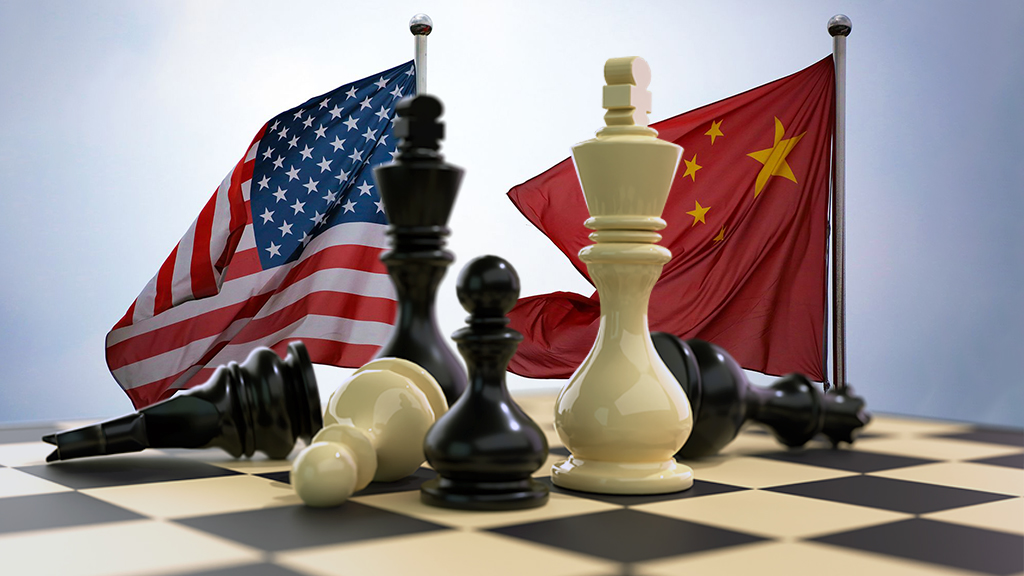
    Feature Image Credit: The limits of US-China Economic Rivalry www.setav.org

  • BRICS: On 1 January 2024, the World’s Centre of Gravity will Shift

    BRICS: On 1 January 2024, the World’s Centre of Gravity will Shift

    As is often the case in history, the actions of a dying empire create common ground for its victims to look for new alternatives, no matter how embryonic and contradictory they are. The diversity of support for the expansion of BRICS is an indication of the growing loss of the political hegemony of imperialism.

    On the last day of the BRICS summit in Johannesburg, South Africa, the five founding states (Brazil, Russia, India, China, and South Africa) welcomed six new members: Argentina, Egypt, Ethiopia, Iran, Saudi Arabia, and the United Arab Emirates (UAE). The BRICS partnership now encompasses 47.3 per cent of the world’s population, with a combined global Gross Domestic Product (by purchasing power parity, or PPP,) of 36.4 per cent. In comparison, though the G7 states (Canada, France, Germany, Italy, Japan, the United Kingdom, and the United States) account for merely 10 per cent of the world’s population, their share of the global GDP (by PPP) is 30.4 per cent. In 2021, the nations that today form the expanded BRICS group were responsible for 38.3 percent of global industrial output while their G7 counterparts accounted for 30.5 percent. All available indicators, including harvest production and the total volume of metal production, show the immense power of this new grouping. Celso Amorim, advisor to the Brazilian government and one of the architects of BRICS during his former tenure as foreign minister, said of the new development that ‘[t]he world can no longer be dictated by the G7’.

    Certainly, the BRICS nations, for all their internal hierarchies and challenges, now represent a larger share of the global GDP than the G7, which continues to behave as the world’s executive body. Over forty countries expressed an interest in joining BRICS, although only twenty-three applied for membership before the South Africa meeting (including seven of the thirteen countries in the Organisation of Petroleum Exporting Countries, or OPEC). Indonesia, the world’s seventh largest country in terms of GDP (by PPP), withdrew its application to BRICS at the last moment but said it would consider joining later. Indonesia’s President Joko Widodo’s comments reflect the mood of the summit: ‘We must reject trade discrimination. Industrial down streaming must not be hindered. We must all continue to voice equal and inclusive cooperation’.

    The facts are clear: the Global North’s percentage of world GDP fell from 57.3 per cent in 1993 to 40.6 per cent in 2022, with the US’s percentage shrinking from 19.7 per cent to only 15.6 per cent of global GDP (by PPP) in the same period – despite its monopoly privilege. In 2022, the Global South, without China, had a GDP (by PPP) greater than that of the Global North.

    BRICS does not operate independently of new regional formations that aim to build platforms outside the grip of the West, such as the Community of Latin America and Caribbean States (CELAC) and the Shanghai Cooperation Organisation (SCO). Instead, BRICS membership has the potential to enhance regionalism for those already within these regional fora. Both sets of interregional bodies are leaning into a historical tide supported by important data, analysed by Tricontinental: Institute for Social Research using a range of widely available and reliable global databases. The facts are clear: the Global North’s percentage of world GDP fell from 57.3 per cent in 1993 to 40.6 per cent in 2022, with the US’s percentage shrinking from 19.7 per cent to only 15.6 per cent of global GDP (by PPP) in the same period – despite its monopoly privilege. In 2022, the Global South, without China, had a GDP (by PPP) greater than that of the Global North.

    The West, perhaps because of its rapid relative economic decline, is struggling to maintain its hegemony by driving a New Cold War against emergent states such as China. Perhaps the single best evidence of the racial, political, military, and economic plans of the Western powers can be summed up by a recent declaration of the North Atlantic Treaty Organisation (NATO) and the European Union (EU): ‘NATO and the EU play complementary, coherent and mutually reinforcing roles in supporting international peace and security. We will further mobilise the combined set of instruments at our disposal, be they political, economic, or military, to pursue our common objectives to the benefit of our one billion citizens’.

    Why did BRICS welcome such a disparate group of countries, including two monarchies, into its fold? When asked to reflect on the character of the new full member states, Brazil’s President Luiz Inácio Lula da Silva said, ‘What matters is not the person who governs but the importance of the country. We can’t deny the geopolitical importance of Iran and other countries that will join BRICS’. This is the measure of how the founding countries made the decision to expand their alliance. At the heart of BRICS’s growth are at least three issues: control over energy supplies and pathways, control over global financial and development systems, and control over institutions for peace and security.

    A larger BRICS has now created a formidable energy group. Iran, Saudi Arabia, and the UAE are also members of OPEC, which, with Russia, a key member of OPEC+, now accounts for 26.3 million barrels of oil per day, just below thirty per cent of global daily oil production. Egypt, which is not an OPEC member, is nonetheless one of the largest African oil producers, with an output of 567,650 barrels per day. China’s role in brokering a deal between Iran and Saudi Arabia in April enabled the entry of both of these oil-producing countries into BRICS. The issue here is not just the production of oil, but the establishment of new global energy pathways.

    The Chinese-led Belt and Road Initiative has already created a web of oil and natural gas platforms around the Global South, integrated into the expansion of Khalifa Port and natural gas facilities at Fujairah and Ruwais in the UAE, alongside the development of Saudi Arabia’s Vision 2030. There is every expectation that the expanded BRICS will begin to coordinate its energy infrastructure outside of OPEC+, including the volumes of oil and natural gas that are drawn out of the earth. Tensions between Russia and Saudi Arabia over oil volumes have simmered this year as Russia exceeded its quota to compensate for Western sanctions placed on it due to the war in Ukraine. Now these two countries will have another forum, outside of OPEC+ and with China at the table, to build a common agenda on energy. Saudi Arabia plans to sell oil to China in renminbi (RMB), undermining the structure of the petrodollar system (China’s two other main oil providers, Iraq and Russia, already receive payment in RMB).

    Both the discussions at the BRICS summit and its final communiqué focused on the need to strengthen a financial and development architecture for the world that is not governed by the triumvirate of the International Monetary Fund (IMF), Wall Street, and the US dollar. However, BRICS does not seek to circumvent established global trade and development institutions such as the World Trade Organisation (WTO), the World Bank, and the IMF. For instance, BRICS reaffirmed the importance of the ‘rules-based multilateral trading system with the World Trade Organisation at its core’ and called for ‘a robust Global Financial Safety Net with a quota-based and adequately resourced [IMF] at its centre’. Its proposals do not fundamentally break with the IMF or WTO; rather, they offer a dual pathway forward: first, for BRICS to exert more control and direction over these organisations, of which they are members but have been suborned to a Western agenda, and second, for BRICS states to realise their aspirations to build their own parallel institutions (such as the New Development Bank, or NDB). Saudi Arabia’s massive investment fund is worth close to $1 trillion, which could partially resource the NDB.

    BRICS’s agenda to improve ‘the stability, reliability, and fairness of the global financial architecture’ is mostly being carried forward by the ‘use of local currencies, alternative financial arrangements, and alternative payment systems’. The concept of ‘local currencies’ refers to the growing practice of states using their own currencies for cross-border trade rather than relying upon the dollar. Though approximately 150 currencies in the world are considered to be legal tender, cross-border payments almost always rely on the dollar (which, as of 2021, accounts for 40 per cent of flows over the Society for Worldwide Interbank Financial Telecommunications, or SWIFT, network).

    Other currencies play a limited role, with the Chinese RMB comprising 2.5 per cent of cross-border payments. However, the emergence of new global messaging platforms – such as China’s Cross-Border Payment Interbank System, India’s Unified Payments Interface, and Russia’s Financial Messaging System (SPFS) – as well as regional digital currency systems promise to increase the use of alternative currencies. For instance, cryptocurrency assets briefly provided a potential avenue for new trading systems before their asset valuations declined, and the expanded BRICS recently approved the establishment of a working group to study a BRICS reference currency.

    Following the expansion of BRICS, the NDB said that it will also expand its members and that, as its General Strategy, 2022–2026 notes, thirty per cent of all of its financing will be in local currencies. As part of its framework for a new development system, its president, Dilma Rousseff, said that the NDB will not follow the IMF policy of imposing conditions on borrowing countries. ‘We repudiate any kind of conditionality’, Rousseff said. ‘Often a loan is given upon the condition that certain policies are carried out. We don’t do that. We respect the policies of each country’.

    In their communiqué, the BRICS nations write about the importance of ‘comprehensive reform of the UN, including its Security Council’

    In their communiqué, the BRICS nations write about the importance of ‘comprehensive reform of the UN, including its Security Council’. Currently, the UN Security Council has fifteen members, five of whom are permanent (China, France, Russia, the UK, and the US). There are no permanent members from Africa, Latin America, or the most populous country in the world, India. To repair these inequities, BRICS offers its support to ‘the legitimate aspirations of emerging and developing countries from Africa, Asia, and Latin America, including Brazil, India, and South Africa to play a greater role in international affairs’. The West’s refusal to allow these countries a permanent seat at the UN Security Council has only strengthened their commitment to the BRICS process and to enhance their role in the G20.

    The entry of Ethiopia and Iran into BRICS shows how these large Global South states are reacting to the West’s sanctions policy against dozens of countries, including two founding BRICS members (China and Russia). The Group of Friends in Defence of the UN Charter – Venezuela’s initiative from 2019 – brings together twenty UN member states that are facing the brunt of illegal US sanctions, from Algeria to Zimbabwe. Many of these states attended the BRICS summit as invitees and are eager to join the expanded BRICS as full members.

    We are not living in a period of revolutions. Socialists always seek to advance democratic and progressive trends. As is often the case in history, the actions of a dying empire create common ground for its victims to look for new alternatives, no matter how embryonic and contradictory they are. The diversity of support for the expansion of BRICS is an indication of the growing loss of the political hegemony of imperialism.

    This article was published earlier in tricontinental.org and is republished under the Creative Commons.


  • Migrant or native, we are all out of Africa

    Migrant or native, we are all out of Africa

    No human group can make a concerted claim as regards nativism and try to make an ‘other’ an immigrant, foreigner or outsider

    Why, and how, does Mizoram get involved in the ongoing ethnic (and religious) strife that has been on for over three months in Manipur? The Kukis and Zomis in Manipur are ethnically related to the Mizos, the dominant community in Mizoram. The Mizos, in turn, are ethnically related to the Chins in Myanmar and the Kuki-Chins in Bangladesh.

    Together they all belong to the greater Zo community, speak a similar language, have common ancestry and parallels as regards their cultures and traditions. These latter groups are predominantly Christian and hence have a strong bond with the Mizos in Mizoram, a ‘Christian state’, like Nagaland. The Chief Minister of Mizoram, Zoramthanga, is a Mizo.

    In Manipur, the Meiteis, a Hindu community, are the majority and overwhelmingly numerically dominant. But it is interesting that the Meiteis are found in small numbers in Mizoram too, and many have started fleeing from the state. A similar fleeing of the Kukis from Manipur to Mizoram has happened. Also, there are the Naga groups in different pockets of Manipur. The neighbouring state of Nagaland has 17 officially recognised Naga groups.

    It is exasperating, and quite disquieting, to note the presence of ethnic groups that are dominant in one state, being minorities in a neighbouring state. Such existence has given rise to very foreboding situations and added to the already prevailing ethnic conflicts in India’s North-East.

    It is not just that the Indian states in the region share common borders. There are international borders too in the area, as Bangladesh and Myanmar adjoin the Indian states. Different communities/tribes/groups of people have lived in the regions that are the focus of our discussion for aeons. Such inter-state and international habitations of ethnic groups across states/countries are come across elsewhere in the world too.

    One of the most interesting and classic instances of a single ethnic group, who regard themselves as a single nation, and inhabit more than one country, is that of the Bedouin (found in Syria, Algeria, Morocco, Libya, Egypt, Israel, and so on). Such situations come about because free-ranging groups of people, or partially or fully settled groups of people, got divided into different states or countries because of the coming in of boundaries and division of territories.

    What would have been the scenario if these borders between states and countries had not come up? We would undoubtedly have diverse groups living in enclaves, either quite separated or adjoining each other either as small groups or larger ones, but sans the borders dividing them; the question of majority/minority or dominance/subservience would not, probably, have had the same kind of meaning or effect as has happened due to the drawing of borders between states and countries.

    Borders that formed between enclaves of diverse inhabitants and made groups of people dominant and/or majority groups have resulted in hegemony, where the traditions, customs, practices, and mores of that group have gained significance. These traditions and customs prevail extensively when compared to the practices of the smaller groups in that same area. Invariably, the dominant group makes claims to being the ‘original inhabitants’ and the ‘natives’ of the state/country concerned.

    Quite often co-habitants develop similar institutions and social and cultural practices despite the differences and diversity between them, and this is quite apparent in multicultural societies. Amitav Ghosh argues that “it is … the vitality of the place itself that creates commonalities between the people who dwell in it, no matter what their origin” (The Nutmeg’s Curse, page 221). But sadly, it is the differences that often come to the fore, and similarities remain latent.

    Here, it is pertinent for us to dwell on the facets of claims that groups make as regards being the autochthons and natives of a given state/country. By extension, the non-dominant groups are labelled ‘immigrants’, ‘foreigners’, and ‘outsiders’. Prior to ‘Out of Africa’, and the spread of Homo sapiens to the different parts of the world, somewhere between 80,000 and 50,000 years ago, there were no fully evolved human beings in any part of the world. Subsequent to a group of them leaving Africa, different parts of the Earth got populated gradually.

    All the physiognomic and phenotypical differences that we find among humans today, including skin colour, hair texture, and colour of the eyes came about as a result of where people settled.

    To put it tersely, no human group can make a concerted claim as regards nativism and try to make an ‘other’ an immigrant, foreigner or outsider. Ghosh endorses this when he says “Except for one small part of Africa, nowhere on Earth can people be said to be truly native, in the sense of having come into being on that soil” (The Nutmeg’s Curse, page 221).


    This article was published earlier in Deccan Herald.

    Feature Image:Kuki women leave after attending a protest against the alleged sexual assault of two tribal women, in Churachandpur district in Manipur. Credit: Retuers Photo


  • Why India risks a quantum tech brain drain

    Why India risks a quantum tech brain drain

    Clear career progression would help India’s quantum workforce and avoid a brain drain overseas

    India could lose its best quantum tech talent if the industry doesn’t get its act together.

    Quantum technology has the potential to revolutionise our lives through speeds which once seemed like science fiction.

    India is one of a few nations with national quantum initiatives and it stands on the threshold of potentially enormous technological and social benefits.

    The National Quantum Mission, approved by the national cabinet in April, is a timely government initiative that has the potential to catapult India to a global leader leading in quantum research and technologies if leveraged correctly.

    Its main areas of research are quantum computing, secure quantum communications, quantum sensing and metrology and quantum materials.

    The challenge for India is how it ensures it gets the best out of the mission.

    The benefits of the technology can benefit many aspects of society through processing power, accuracy and speed and can positively impact health, drug research, finance and economics.

    Similarly, quantum security can revolutionise security in strategic communication sectors including defence, banking, health records and personal data.

    Quantum sensors can enable better GPS services through atomic clocks and high-precision imaging while quantum materials research can act as an enabler for more quantum technologies.

    But the Indian quantum ecosystem is still academia-centric.

    India’s Department of Science and Technology had set up a pilot programme on Quantum Enabled Science and Technologies — a precursor to the National Quantum Mission.

    As a result, India has a large number of young and energetic researchers, working at places such as RRI Bangalore, TIFR and IIT Delhi who have put an infrastructure in place for the next generation quantum experiments with capabilities in different quantum technology platforms. These include quantum security through free space, fibres as well-integrated photonics, quantum sensing and metrology.

    The prospects and impact of quantum technologies will be hugely strategic. Predictions suggest quantum computing will have a profound impact on financial services, logistics, transportation, aerospace and automotive, materials science, energy, agriculture, pharmaceuticals and healthcare, and cybersecurity. All of these areas are strategic on macroeconomic and national security scales.

    Even as it has taken significant policy initiative to kickstart research into quantum technologies, India will need to craft a national strategy with a long-term perspective and nurture and develop its research work force.

    Clear career progression would help India’s quantum workforce. The risk of brain drain, where local talent moves overseas for better opportunities, could be a real possibility if different industries which can benefit from the technology fail to recognise its transformative capabilities and how it can help create jobs and opportunities.

    While there are multiple labs working in different quantum sectors, the career path of students and post-doctoral researchers remains unclear as there are not enough positions in the academic sector.

    One problem is industry and academia are competing with each other for quantum research funding which is why equal emphasis on quantum technology development in the industrial sector could help.

    While India does have some quantum start-ups, more lab-to-market innovations which would make the technology practically useful could give the field momentum. Currently, the big industrial firms in India are not yet committed to quantum technology.

    The lack of homegrown technologies like optical, optomechanical and electronic components for precision research is another impediment. Most of these are imported, resulting in financial drain and long delays in research.

    The National Quantum Mission could help fix a number of these problems.

    Hurdles could be turned into opportunities if more start-ups and established industries were to manufacture high-end quantum technology enabling products in India.

    Another major deterrent is the lack of coordination. Multiple efforts to develop and research the technology, across government and start-ups, do not seem to have coherence and still lack maturity. People involved in quantum research are hopeful the mission will help address this.

    Like most other countries, India has witnessed plenty of hype about quantum research. While this may help provide a short-term boost to the field, excessive hype can lead to unrealistic expectations.

    Continuing to build a skilled workforce and a clear career progression plan for those involved in research and development of quantum technologies can help secure India’s future in this space.

    There is a distinction between magic and miracles and while believing in one, one should not start expecting the latter as that can only lead to disappointment in the long run.


    This article was originally published under Creative Commons by 360info™.


  • The Atomic Executioner’s Lament

    The Atomic Executioner’s Lament

    While the world focuses on the trials and travails of the scientists who invented the atomic bomb, little attention is paid to the hard positions taken by the nuclear executioners, the men called upon to drop these bombs in time of war.


    Crew of the Enola Gay, returning from their atomic bombing mission over Hiroshima, Japan. At center is navigator Capt. Theodore Van Kirk; to the right, in foreground, is flight commander Col. Paul Tibbetts. (Wikimedia Commons, Public domain)


    There is an interesting scene in Chris Nolan’s film Oppenheimer, one which could easily get lost in the complexity of telling the story of the man considered to be the father of the American atomic bomb, J. Robert Oppenheimer.

    The Trinity test of the first nuclear device has been successfully completed, and Oppenheimer is watching as two men in military uniform are packing up one of Oppenheimer’s “gadgets” for shipment out of Los Alamos to an undisclosed destination.

    Oppenheimer talks to them about the optimum height for the detonation of the weapon above ground, but is cut off by one of the soldiers, who, smiling, declares “We’ve got it from here.”

    Such men existed, although the scene in the movie — and the dialogue — was almost certainly the product of a scriptwriter’s imagination. The U.S. military went to great lengths to keep the method of delivery of the atomic bomb a secret, not to be shared with either Oppenheimer or his scientists.

    Formed on March 6, 1945, the 1st Ordnance Squadron, Special (Aviation) was part of the 509th Composite Group, commanded by then-Lieutenant Colonel Paul Tibbets. Prior to being organized into the 1st Ordnance Squadron, the men of the unit were assigned to a U.S. Army ordnance squadron stationed a Wendover, Utah, where Tibbets and the rest of the 509th Composite Group were based.

    Mission map for the bombings of Hiroshima and Nagasaki, Aug. 6 and Aug. 9, 1945. Scale is not consistent due to the curvature of the Earth. Angles and locations are approximate. Kokura was included as the original target for Aug. 9 but weather obscured visibility; Nagasaki was chosen instead. (Mr.98, Wikimedia Commons, Public domain)

    While Oppenheimer and his scientists designed the nuclear device, the mechanism of delivery — the bomb itself — was designed by specialists assigned to the 509th. It was the job of the men of the 1st Ordnance Squadron to build these bombs from scratch.

    The bomb dropped on Hiroshima by Paul Tibbets, flying a B-29 named the Enola Gay, was assembled on the Pacific Island of Tinian by the 1st Ordnance Squadron.

    Concerned about the possibility of the B-29 crashing on takeoff, thereby triggering the explosive charge that would send the uranium slug into the uranium core (the so-called gun device), the decision was made that the final assembly of the bomb would be done only after the Enola Gay took off.

    One of the 1st Ordnance Squadron technicians placed the uranium slug into the bomb at 7,000 feet over the Pacific Ocean.

    The bomb worked as designed, killing more than 80,000 Japanese in an instant; hundreds of thousands more died afterwards from the radiation released by the weapon.

    For the pilot and crew of the Enola Gay, there was no remorse over killing so many people. “I knew we did the right thing because when I knew we’d be doing that I thought, yes, we’re going to kill a lot of people, but by God we’re going to save a lot of lives,’ Tibbets recounted to Studs Terkel in 2002. He added:

    “We won’t have to invade [Japan]. You’re gonna kill innocent people at the same time, but we’ve never fought a damn war anywhere in the world where they didn’t kill innocent people,” Tibbets told Terkel. “If the newspapers would just cut out the shit: ‘You’ve killed so many civilians.’ That’s their tough luck for being there.

    An atomic bomb victim with burns, Ninoshima Quarantine Office, Aug. 7, 1945. (Onuka Masami, Wikimedia Commons, Public domain)

    Major Charles Sweeney, the pilot of Bockscar, the B-29 that dropped the second American atomic bomb on the city of Nagasaki on Aug. 9, 1945, held similar convictions about his role in killing 35,000 Japanese instantly.

    “I saw these beautiful young men who were being slaughtered by an evil, evil military force,” Sweeney recounted in 1995. “There’s no question in my mind that President Truman made the right decision.” However, Sweeney noted, “As the man who commanded the last atomic mission, I pray that I retain that singular distinction.”

    History records the remorse felt by Oppenheimer and his Soviet counterpart, Andrei Sakharov, and the punishment they both suffered at the hands of their respective governments. They suffered from designer’s remorse, a regret — stated after the fact — that what they had built should not be used, but somehow locked away from the world, as if the Pandora’s Box of nuclear weaponization had never been opened.

    Having designed their respective weapons, however, both Oppenheimer and Sakharov lost control of their creations, turning them over to military establishments which did not participate in the intellectual and moral machinations of bringing such a weapon into existence, but rather the cold, hard reality of using these weapons to achieve a purpose and goal which, as had been the case for Tibbets and Sweeney, seemed justified.

    Ignoring the Executioner

    Brigadier General Charles W. Sweeney, pilot of the aircraft that dropped the atomic bomb on Nagasaki. (Public domain, Wikimedia Commons)

    This is the executioners’ lament, a contradiction of emotions where the perceived need for justice outweighs the costs associated.

    While the world focuses on the trials and travails of Oppenheimer and Sakharov, they remain silent about the hard positions taken by the nuclear executioners, the men called upon to drop these bombs in time of war.  There have only been two such men, and they remained resolute in their judgement that it was the right thing to do.

    The executioner’s lament is overlooked by most people involved in supporting nuclear disarmament. This is a mistake, because the executioner, as was pointed out to Oppenheimer by the men of the 1stOrdnance Squadron, is in control.

    They possess the weapons, and they are the ones who will be called upon to deliver the weapons. Their loyalty and dedication to the task are constantly tested in order to ensure that, when the time comes to execute orders, they will do so without question.

    Image of a younger Petrov from a family album.
    (Stanislav Petrov’s Personal Library, Wikimedia Commons, CC0)


    Those opposed to nuclear weapons often point to the example of Stanislav Petrov, a former lieutenant colonel of the Soviet Air Defense Forces who, in 1983, twice made a decision to delay reporting the suspected launch of U.S. missiles towards the Soviet Union, believing (rightly) that the launch detection was a result of malfunctioning equipment.

    But the fact is that Petrov was an outlier who himself admitted that had another officer been on duty that fateful day, they would have reported the American missile launches per protocol.

    Those who will execute the orders to use nuclear weapons in any future nuclear conflict will, in fact, execute those orders. They are trained, like Tibbets and Sweeney, to believe in the righteousness of their cause.

    Dmitry Medvedev, the former Russian prime minister and president who currently serves as the deputy chairman of the Russian National Security Council, has publicly warned the Western supporters of Ukraine that Russia would “have to” use nuclear weapons if Ukrainian forces were to succeed in their goal of recapturing the former territories of Ukraine that have been claimed by Russia in the aftermath of referenda held in September 2022.

    “Imagine,” Medvedev said, “if the offensive, which is backed by NATO, was a success and they tore off a part of our land, then we would be forced to use a nuclear weapon according to the rules of a decree from the president of Russia. There would simply be no other option.”

    Some in the West view Medvedev’s statement to be an empty threat; U.S. President Joe Biden said last month that there is no real prospect of Russian President Vladimir Putin ordering the use of nuclear weapons against either Ukraine or the West.

    “Not only the West, but China and the rest of the world have said: ‘don’t go there,’ ” Biden said following the NATO Summit in Vilnius.

    Ignoring Russian Doctrine

    But Biden, like other doubters, emphasizes substance over process, denying the role played by the executioner in implementing justice defined on their terms, not that of those being subjected to execution.

    Russia has a nuclear doctrine that mandates that nuclear weapons are to be used “when the very existence of the state is put under threat.” According to Medvedev, “there would simply be no other option,” ironically noting that “our enemies should pray” for a Russian victory, as the only way to make sure “that a global nuclear fire is not ignited.”

    The Russians who would execute the orders to launch nuclear weapons against the West would be operating with the same moral clarity as had Paul Tibbets and Charles Sweeney some 88 years ago. The executioner’s lament holds that they will be saddened by their decision but convinced that they had no other choice.

    Proving them wrong will be impossible because, unlike the war with Japan, where the survivors were given the luxury of reflection and accountability, there will be no survivors in any future nuclear conflict.

    The onus, therefore, is on the average citizen to get involved in processes that separate the tools of our collective demise — nuclear weapons — from those who will be called upon to use them.

    Meaningful nuclear disarmament is the only hope humankind has for its continued survival.

    The time to begin pushing for this is now, and there is no better place to start than on Aug. 6, 2023 — the 78th anniversary of the bombing of Hiroshima, when like-minded persons will gather outside the United Nations to begin a dialogue about disarmament that will hopefully resonate enough to have an impact of the 2024 elections.


    This article was published earlier in consortiumnews.com

    The views expressed are the author’s own.

    Feature Image: The devastated city of Hiroshima after the atomic bomb blast – bbc.com

  • The South Asia Nuclear Zero

    The South Asia Nuclear Zero

    The nuclear tests, of May 1998, by India and Pakistan, marked an epochal juncture for South Asia. The Doomsday Clock maintained by the Bulletin of the Atomic Scientists, jumped from 11:43 to 11:51, or just “9 minutes to midnight.”

    While, in India, the “Shakti” tests, do find celebratory mention, Pakistan observes the Chagai series of nuclear tests, as a national day, termed “Yom-e-Taqbir.” On the 25th anniversary of this event, Lt Gen Khalid Kidwai (Retd), currently, advisor, to Pakistan’s National Command Authority (NCA), delivered an address at the Arms Control and Disarmament Centre of the Institute of Strategic Studies, Islamabad.

    Kidwai, who served, for 14 years, as the Director-General of Pakistan’s Strategic Plans Division (SPD), was at the heart of Pakistan’s NCA, and oversaw the operationalisation of its nuclear deterrent. Although his talk was for public consumption, given the historic absence of an Indo-Pak nuclear dialogue, some of Kidwai’s statements – if taken at face value – contain worrisome undertones, which need analysis.

    After mentioning the rationale for Pakistan embarking on nuclear weaponization (“humiliation of the 1971 War followed by India’s nuclear test of May 1974”) Kidwai proceeded to enlighten the audience about the implications of Pakistan’s new policy of Full Spectrum Deterrence (FSD) and how it kept, “India’s aggressive designs, including the Indian military’s Cold Start Doctrine, in check.”

    While retaining the fig leaf of Credible Minimum Deterrence (CMD), Kidwai went on to mention the “horizontal dimension” of Pakistan’s nuclear inventory, held by the individual Strategic Force Commands of the Army, Navy and Air Force. The “vertical dimension,” of the Pak deterrent, he said, encapsulated “adequate range coverage from zero meters to 2750 km, as well as nuclear weapons of destructive yields at three tiers: strategic, operational and tactical.”

    While the missile range of 2750 km, corresponds, roughly, to the distance from a launch-point in south-east Sindh, to the Andaman Islands, and indicates the “India-specificity” of the Shaheen III missile, it is the mention of “zero metres” that is intriguing. Pakistan already has the 60 km range, “Nasr” missile, projected as a response to India’s Cold Start doctrine. Therefore, unless used as a colloquialism, Kidwai’s mention of “zero metres” range could only imply a pursuit of ultra short-range, tactical nuclear weapons (TNW), like artillery shells, land mines, and short-range missiles, armed with small warheads, of yields between 0.1 to 1 kiloton (equivalent of 100 to 1000 tons of TNT).

    By shifting from CMD to FSD, with the threat of nuclear first use, to defend against an Indian conventional military thrust, Pakistan is aping the, discredited, US-NATO Cold War concept of Flexible Response. Fearing their inability to withstand a massive Warsaw Pact armoured offensive, this 1967 doctrine saw the US and NATO allies deploy a large number of TNW to units in the field.

    However, the dangers of escalation arising from the use of TNW were soon highlighted, by US Secretary Defence, Robert McNamara’s, public confession: “It is not clear how theater nuclear war could actually be exe­cuted without incurring a very serious risk of escalating to general nuclear war.” This marked a turning point in US-NATO nuclear strategy.

    Kidwai’s speech contains three statements of note. Firstly, he attempts to dilute India’s declared policy of “massive retaliation” (MR), in response to a nuclear strike, by claiming that Pakistan possesses an entire range of survivable nuclear warheads of desired yield, in adequate numbers, to respond to India’s MR. He adds, “Pakistan’s counter-massive retaliation can therefore be as severe (as India’s) if not more.”

    Far more significant is Kidwai’s declaration that, since Pakistan’s missiles can threaten the full extent of the Indian landmass and island territories, “…there is no place for India’s strategic weapons to hide” (emphasis added).

    Secondly, in an attempt to downplay India’s (inchoate) ballistic missile defence (BMD), he declares that in a “target-rich India”, Pakistan is at liberty to expand the envelope and choose from counter-value, counterforce and battlefield targets, “notwithstanding the indigenous Indian BMD or the Russian S-400” (air-defence systems).

    Far more significant is Kidwai’s declaration that, since Pakistan’s missiles can threaten the full extent of the Indian landmass and island territories, “…there is no place for India’s strategic weapons to hide” (emphasis added). The assumption, so far, was that, given its limitations in terms of missile accuracy, real-time surveillance and targeting information, Pakistan would follow a “counter-value” or “counter-city” targeting strategy. The specific targeting of India’s nuclear arsenal, especially, if undertaken by conventional (non-nuclear) missiles, would add a new dimension to the India-Pakistan nuclear conundrum.

    Delivered in the midst of Pakistan’s acute financial crisis, as well as the ongoing political turmoil and civil-military tensions, one may be tempted to dismiss Lt Gen Kidwai’s recent discourse. However, as the longest-serving, former head of the SPD and architect of Pakistan’s nuclear deterrent, his views are widely heard and deserve our attention.

    Having voluntarily pledged “no first use” (NFU), India’s 2003 Nuclear Doctrine, espoused a “credible minimum deterrent” and promised “massive retaliation,” in response to a nuclear first strike. Since then, our two adversaries, China and Pakistan, have expanded and upgraded their nuclear arsenals, presumably, with corresponding updating of doctrines. India’s strategic enclave has, however, not only maintained a stoic silence and doctrinal status quo but also defended the latter.

    BJP’s 2014 Election Manifesto, had undertaken to “revise and update” India’s nuclear doctrine and to “make it relevant to current times,” but this promise has not been kept. Thus, India, currently, faces a moral dilemma as well as a question of “proportionality”: will the loss of a few tanks or soldiers to a Pakistani nuclear artillery salvo, on its own soil, prompt India to destroy a Pakistani city of a few million souls? Since India, too, has developed a family of tactical missiles, capable of counterforce strikes, does it indicate a shift away from CMD and NFU, calling for a response from our adversaries?

    These are just some of the manifold reasons why there is a most urgent need for the initiation of a sustained nuclear dialogue between India and Pakistan, insulated from the vagaries of politics. Such an interaction, by reducing mutual suspicion and enhancing transparency, might slow down the nuclear arms race and mindless build-up of arsenals.

    This article was published earlier in Indian Express.