Category: Opinion/Commentary

  • Between the Devil & the Deep Blue Sea: Tackling India’s Internal Security Challenges

    Between the Devil & the Deep Blue Sea: Tackling India’s Internal Security Challenges

    Our ability to develop and prosper, both as a society and a nation, are wholly dependent on the smooth functioning of our democratic institutions and their ability to faithfully uphold the tenets laid down in our Constitution.

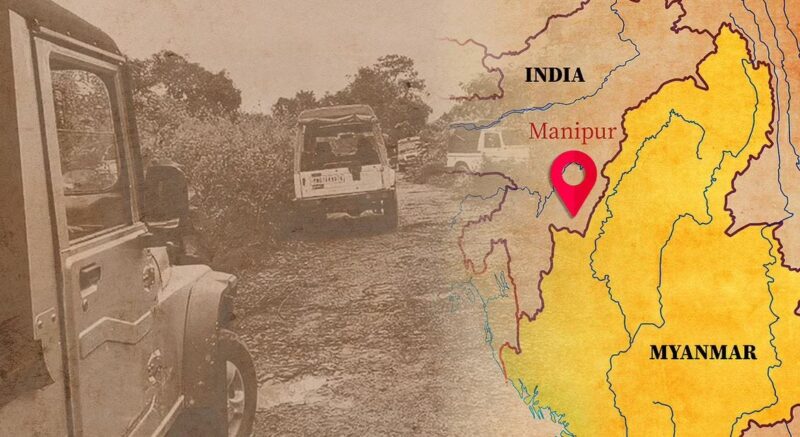
    Our progress since Independence has not been without bumps along the road. Not only has the detritus of Partition haunted us, but we have also had to confront antagonistic neighbours intent on grabbing territory, creating divisions and curtailing our economic development and influence around the world. They have tried to do this by resorting to conventional operations, grey zone warfare, including using terrorist groups. In addition, we’ve had to overcome our internal troubles as well, what V.S. Naipaul referred to as a “million mutinies”, rebellions and insurgencies, for the most part, along our border regions. Undertaken by our disaffected citizens, in most cases with external support, aspiring to establish their own independent homelands because of ideological or religious motivations or out of a sense of frustration at being treated as second-class citizens within their own country.

    The response of the State and Central Governments to these internal challenges has invariably been to initially attempt some sort of half-hearted political accommodation or initiative aimed at preserving the status quo and giving themselves political advantage. Once this fails, as it is bound to, the Central Armed Police Forces or the Army are brought in, depending on the levels of violence, to neutralise the insurgency and regain political and administrative control. This can take anywhere from a decade to three or more. The Mizoram Insurgency, for example, commenced in 1966 and was successfully terminated with the agreement being signed between opposing sides in 1986, while the Punjab Insurgency lasted from the mid-80s to the mid-90s, though there are efforts to restart it.

    Unfettered exploitation of natural resources and minerals from those resource-rich regions by large corporations and their political acolytes has led to the displacement of tribals from their homelands and added to their economic woes. Given that the political, security and administrative establishments are wholly compromised and corrupt, the tribals have alleged that they have had little choice but to take up arms in an effort to break the nexus and get their rightful dues.

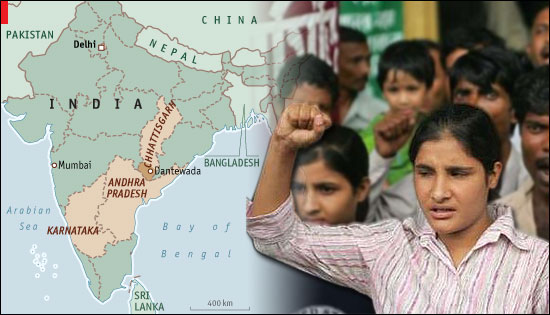
    We’ve had similar problems in our North-eastern States of Assam, Nagaland, Manipur and Tripura, which continue to persist in fits and starts, aided, and abetted by China. We have also faced a long-running Maoist rebellion in our hinterland, organised and conducted by tribals from those regions. Unfettered exploitation of natural resources and minerals from those resource-rich regions by large corporations and their political acolytes has led to the displacement of tribals from their homelands and added to their economic woes. Given that the political, security and administrative establishments are wholly compromised and corrupt, the tribals have alleged that they have had little choice but to take up arms in an effort to break the nexus and get their rightful dues.

    The issue we seem to have failed to comprehend is the transformation that has taken place in understanding what constitutes the basic elements of national security.

    Fortunately, good sense prevailed within the political and security establishment, and the military, other than limited support in casualty evacuation and surveillance by the Air Force was completely kept out of ant-Maoist operations. The military’s job is not to protect marauding corporates but our sovereignty from the depredations of inimical elements, both internal and external. The dynamics of the Military’s involvement in countering the Maoist insurgency would have undoubtedly had serious repercussions within the military’s functioning, and over a period of time, would have adversely impacted our existing governance structures, much in the manner that some of our neighbours have been so affected. The issue we seem to have failed to comprehend is the transformation that has taken place in understanding what constitutes the basic elements of national security. Until the end of the Cold War and before the advent of globalisation, national security had purely military and economic connotations with the stress on territorial control. This was achieved by controlling the flow of information, goods and services and the movement of people through various means, including physical barriers. The advent of the Info-Tech revolution and the consequent move towards globalisation made it increasingly difficult for governments to control access to and the free flow of information, ideas, digital services, and finances.

    As Professors, Wilson and Donan, note in their book, ‘Border Identities: Nation and State at the International Frontiers’ (UK, Cambridge: University Press, 1998), “International borders are becoming so porous that they no longer fulfil their historical role as barriers to the movement of goods, ideas and people and as markers of the extent of the power of the state.”

    Perforce, governments the world over have been forced into the realisation, for many at great cost, that it has become impossible to lock up people or ideas and isolate them from the global discourse. Thus, in the context of the security of the state, more than just ensuring territorial integrity, it is the security of the people through sustainable human development that is non-negotiable. We are today at a stage where, while traditional physical threats continue to pose serious challenges, especially from China and Pakistan, it is the non-military threats that are more dominant. These arise, on one side, from the host of cross-border insurgencies that afflict us because of ethnic, ideological, economic or religious conflicts, and on the other side, because of policies that emanate from politics of exclusion and economic exploitation. In both cases endemic corruption due to the nexus between the political-bureaucracy-security establishment and criminal elements involved in the smuggling of drugs and weapons and human trafficking remains the common thread. As a result, we not only face the threat of violence but also have to confront the increasing spread of religious radicalization.

    For example, in the Northeast, as my colleagues, Lt Gen J S Bajwa (Retd), Maj Gen N G George (Retd) and I, have pointed out in our paper, ‘Makeover of Rainbow Country: Border Security and connecting the Northeast’ (Manekshaw Paper No 62, Centre for Land Warfare Studies, 2016), “we are faced with a trans-border insurgency affecting our states that has metamorphosed into a serious law and order issue due to trans-national criminal syndicates having established linkages with armed gangs that are opposed to the existing political status-quo. This has also been accentuated with these groups being used by China and Pakistan for meeting their own nefarious designs…. Criminal syndicates have extended their reach to include complete control and dominance over all smuggling activities, be it of small arms, psychotropic drugs, livestock, or human trafficking. This economic clout has enabled them to subvert elements within the political parties, the bureaucracy, and the security establishment….”. Thus, it appears that the defining characteristic of on-going insurgencies is that they are nothing more than “businesses”, using all means at their disposal to make a profit. Thus, we see that has been that they have never crossed the threshold of violence or mass mobilisation that would lead to the next logical phase; from insurgency to civil war, where insurgent forces take on the military in conventional operations. These regions are further adversely impacted by poor governance, ineffective policing, agonisingly slow judicial processes, and unchecked criminal activity. The ability of the local populace to oppose the injustices heaped on them has been very subtly neutralised using the Security Forces and Police with wide ranging powers, including in some regions the use of AFSPA, to maintain the status quo. Our ability to develop and prosper, both as a society and a nation, are wholly dependent on the smooth functioning of our democratic institutions and their ability to faithfully uphold the tenets laid down in our Constitution. This is not feasible without sustained focus on providing high quality of universal education, emphasis on social justice and inclusion and an unvarying commitment to ensuring accountability and the rule of law. Focus on infrastructure development in border areas as well as ensuring free and fair elections, greater accountability and breaking the existing nexus between criminal groups and the local political and administrative establishment and unethical corporate houses. Clearly, all stakeholders have to accept that resorting to the use of force in order to ensure a stable security environment is an unviable option with very limited positives.

    The ability of the local populace to oppose the injustices heaped on them has been very subtly neutralised using the Security Forces and Police with wide ranging powers, including in some regions the use of AFSPA, to maintain the status quo.

    Finally, a word with regard to countering terrorist actions such as the one that targeted Mumbai on 26 November 2008. Much has changed since then with our major cites becoming far less vulnerable thanks to a quantum enhancement of the coastal surveillance infrastructure as well as better coordination, integration and demarcation of responsibilities amongst the stakeholders such as the Indian Navy, Coast Guard, local police and the intelligence agencies. In addition, the establishment of integrated National Security Guards (NSG) hubs in Mumbai and other metropolises ensures much speedier response as well as better coordination with local police and their Special Weapons and Tactics (SWAT) Teams. Efforts have also been directed to enhancing training of personnel and upgrading technical capabilities.

    Unfortunately, politics has played a major spoilsport and two important initiatives planned in the aftermath of the Mumbai attack, the establishment of the National Counter Terrorism Centre (NCTC) and its intelligence data exchange architecture (NATGRID) have not fully fructified. There can be little doubt that these initiatives, if pushed through as visualised, would have been of immense utility in ensuring our ability to prevent and respond to terror threats in a timely and effective manner. To conclude, it would be fair to suggest that we face an extremely difficult and challenging internal security environment that is deeply entwined in, and impacted by, our external threat perceptions. Of necessity, we must adopt robust policies, with the requisite capabilities, to be able to respond appropriately so as to be perceived as a ‘hard state’ by our neighbours. This would give us the necessary space andenvironment to push through policies focussing on sustainable human development, which is the only feasible option to ameliorate our internal security challenges.


    Feature Image Credit: the diplomat

  • West Asian moves and countermoves: Challenges of them spinning out of control

    West Asian moves and countermoves: Challenges of them spinning out of control

    What will the complex calculus of the new Middle East crisis resolve into, and what will be the impact on India?

    ISRAEL has succeeded in diverting world attention from Gaza and Hamas to Iran. This is similar to how Hamas, in October 2023, successfully short-circuited US efforts at normalising relations between the Arab states and Israel under the Abrahams Accord.

    These moves and countermoves are ratcheting up the intensity of conflict in West Asia with serious global implications, including for India. The Indian approach seems to be similar to that in the case of the conflict in Ukraine— to play both sides.

    Countermoves

    Iran’s attack on Israeli soil is unprecedented. It is a response to the Israeli attack on its consulate in Syria on April 1, killing some of its top army commanders. It had warned of a retaliation and that gave Israel and its partners, the US, the UK, etc., time to prepare.

    The US had already moved its forces and prepared its allies in the region to shoot down the projectiles from Iran. Even Jordan apparently participated in this. Israel could take care of the projectiles that managed to reach its territory. So, 99 percent of the projectiles were shot down in the air and there was little damage in Israel.

    The Indian approach seems to be similar to that in the case of the conflict in Ukraine— to play both sides.

    It provided a sense of victory to Israel, the US and their allies. This was US President Joe Biden’s message to Israeli Prime Minister Benjamin Netanyahu and to forestall any immediate Israeli retaliation.

    Did Iran need 15 days to prepare to attack Israel? Could it not have used many more than 300 projectiles to attack to overwhelm Israeli defences? Could the Iranian allies like the Hezbollah in Lebanon and the Houthis in Yemen not have fired a much larger number of projectiles?

    Clearly, Iran was making a show of avenging an attack on them but did not want to hit Israel. It did not want to provoke an attack on its territory from the much superior US and Israeli forces.

    The Iranian foreign minister stated in a press conference after the attack that the US, Turkey and some Arab neighbours were given advance information about the limited attack. The US has denied that it had advance information.

    Not only were 15 days given to Israel to prepare its defence, the timing of the attack was also conveyed in advance. The drones, which would take six–seven hours to reach Israel, and cruise missiles, which would take two–three hours, were bound to be neutralised given the advance preparations.

    Only ballistic missiles, which take only a few minutes to traverse the distance that exists between Israel and Iran, were a serious challenge, but due to the advanced notice and preparation, even they got neutralised.

    The Iranian army briefing after the attack also mentioned that the attack was a limited one and had achieved its objective and no more attacks would occur unless Israel attacked its territory. Thus, the Iranian attack was for show and not effect.

    The US and the G7 that met in the aftermath of the Iranian attack while condemning the Iranian attack suggested that Israel had won and that it should not retaliate against Iran.

    Some even argue that this presents an opportunity to take out Iran’s nuclear establishments and cripple its nuclear bomb capability.

    Indeed, Israel’s attack on the embassy in Syria was meant to draw the US and other allies into unequivocally supporting Israel. That support had been dwindling due to the ongoing genocide in Gaza which was inflaming world opinion. Israel has succeeded in this aim. Today, the attention has shifted from genocide in Gaza to the global implications of a wider war in West Asia.

    Pressures escalating

    The US, while saying it does not want an escalation and that it would not support an Israeli strike, has also said its support to Israel is “ironclad”. Just as Israel has defied US advice to avoid civilian casualties in Gaza and allow more humanitarian aid to enter, it can defy the current US advice to not escalate the conflict.

    Israel could attack, secure in the fact that the US and the allies would defend it if Iran retaliates substantially in response to the Israeli retaliation.

    Will Israel oblige by not attacking Iran? The ultra-right in Israel is pressurising the government to retaliate. They have been a part of the growing problem created by the displacement of Palestinians from the West Bank, coming up of new settlements and aggressive assertions in Jerusalem. All this has led to rising Palestinian resentment.

    Many Israelis and conservative Republicans in the US are arguing for Israeli retaliation. The Israeli war cabinet said the conflict is “not over yet” and we will “extract a price”.

    Even the moderate leader Benny Gantz wants retaliation, though at a time of Israel’s choosing. The ultras argue that Iran has crossed a red line by attacking Israeli soil and it must pay for that.

    Some even argue that this presents an opportunity to take out Iran’s nuclear establishments and cripple its nuclear bomb capability.

    Hamas’s action was a result of perceived subjugation and atrocities by Israel over a long period, which could not have been anticipated by Israel and the US.

    But, there are limits to such actions since there are other players who may be forced to intervene. Also, it could lead to a wider conflict in West Asia. The Sunni nations, though not allies of Iran, may also be forced to act. Already, some of these US allies have prohibited the use of their air space by the US.

    Limits of shadow fights

    Israel has a huge network of intelligence in not only Gaza but all over West Asia. It has been able to kill its opponents’ leaders in Gaza, Lebanon, Iran, Iraq and Syria. Recently, it could kill the sons and grandsons of Hamas leader.

    But, the October 7 attack by Hamas in Israel and Hamas still being able to fight in Gaza six months later lays bare the limits of their intelligence. The extensive network of tunnels in Gaza, the troop strength of Hamas and Israel’s inability to get hostages released for six months also point to the same limitation.

    All this points to the limits of shadow fighting in international relations. Hamas’s attack on October 7 destroyed an equilibrium because it was willing to accept the massive death and destruction in Gaza.

    Israel’s attack on the embassy in Syria knowing that Iranians would retaliate has further shifted the out-of-equilibrium position. These instabilities are feeding into each other since one cannot anticipate what nations may do under uncertainty no matter how well a powerful nation may plan.

    Hamas’s action was a result of perceived subjugation and atrocities by Israel over a long period, which could not have been anticipated by Israel and the US.

    The attack on the embassy in Syria was also unanticipated and a result of Israel’s perception that Iran is behind the Hamas, Hezbollah and Houthis. Iran’s attack on Israel is also a result of its perception of having been attacked on its soil which required an attack on Israeli soil.

    Conclusion: Rising global challenges

    Now that the world is divided into two blocs, the situation has become more worrisome. Iran is a part of the bloc consisting of Russia and China. It has been supplying drones to Russia for its war in Ukraine. Even though this bloc may not want a second front, it cannot but stand with Iran in case of a Western bloc attack on Iran.

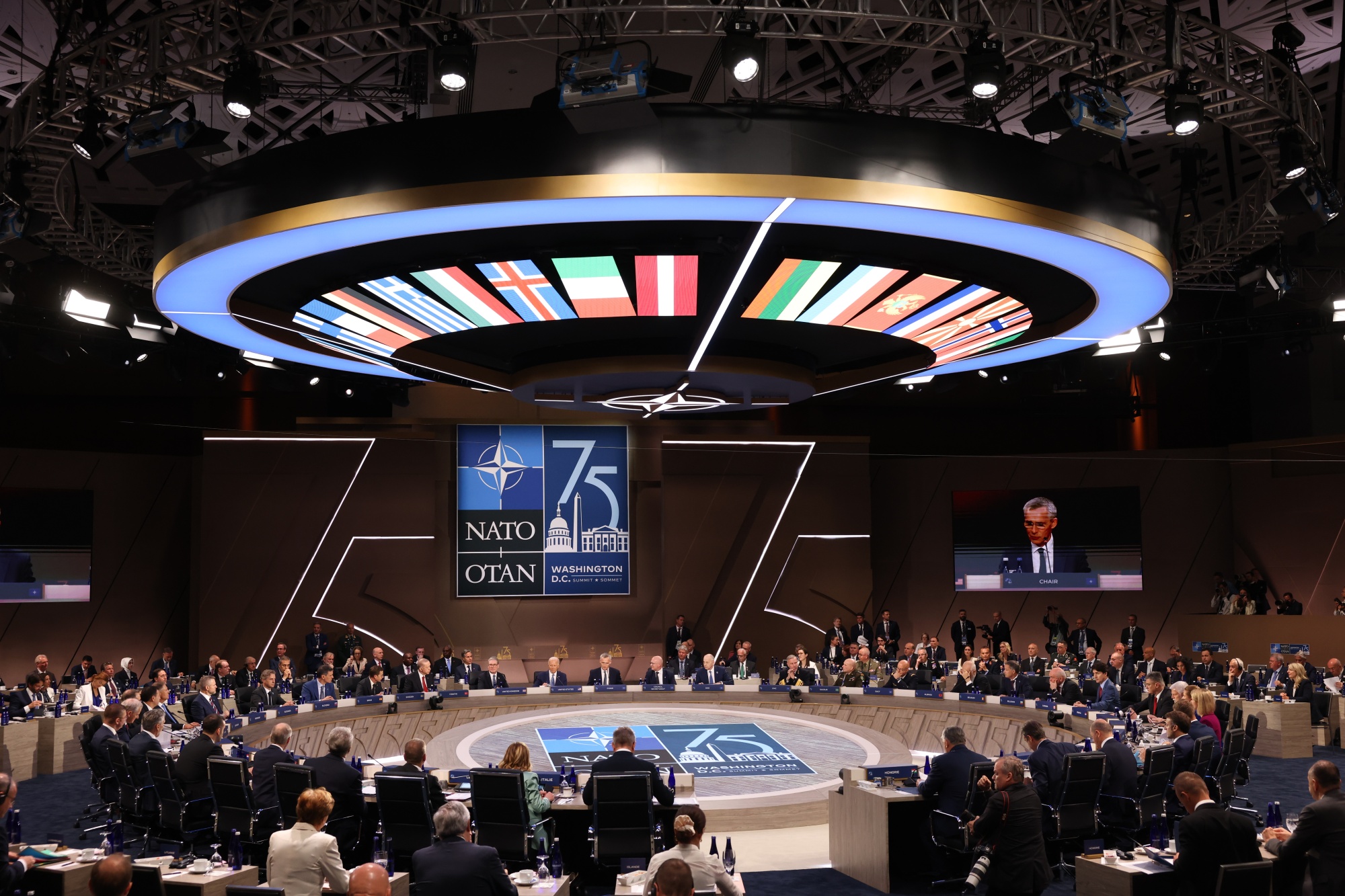
    Its stand on the issue will be a crucial determinant of what happens next. The stance of G7 and NATO will be vital since they have been unsuccessfully trying to restrain Israel. Military mobilisation will rise in key nations. The beneficiary will be the military-industrial complex.

    War in West Asia will impact the petroleum products market. If Iran is attacked and it blocks the Hormuz Strait or attacks oil tankers, petro-goods prices will rise. Shipping through the Suez has already been impacted and may face further disruption.

    India imports 85 percent of its petroleum requirements so the outgo of foreign exchange may increase leading to a deterioration in the balance of payments (BOP), weakening of the Indian rupee and higher inflation.

    Thus, the post-pandemic easing of supply bottlenecks may reappear and create inflation globally, disrupting many economies.

    India imports 85 percent of its petroleum requirements so the outgo of foreign exchange may increase leading to a deterioration in the balance of payments (BOP), weakening of the Indian rupee and higher inflation.

    Foreign investments may slow down. A substantial number of Indians working in West Asia may be forced to return and that will reduce repatriation by non-resident Indians.

    Thus, capital flows may be impacted and further aggravate the BOP. India would need to prepare for these challenges in the midst of the fraught election season where the leadership’s attention is not where it should be.


    This article was published earlier in The Leaflet.

    Feature Image Credit: Wall Street Journal.

  • Untangling the “socialism” vs. “capitalism” Dichotomy

    Untangling the “socialism” vs. “capitalism” Dichotomy

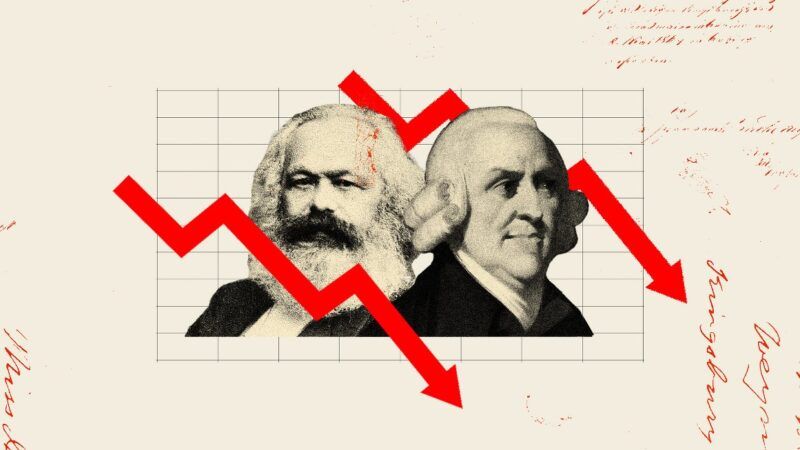
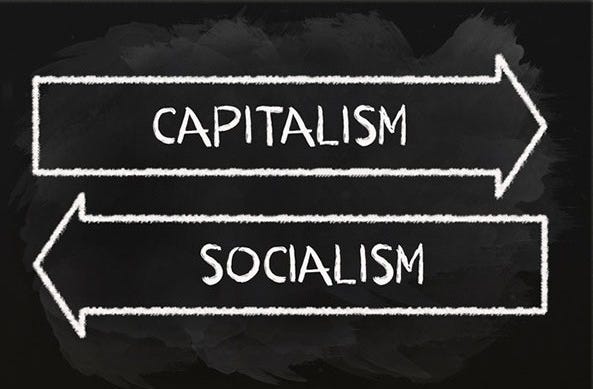
    Few ideological dichotomies polarize opinions as readily and as completely as that between “socialism” and “capitalism.” Those who embrace socialism tend to blame capitalism for everything that’s wrong with our world today. Those who embrace capitalism harbor a seething contempt for socialists, but both camps base their views on ideology with only vague notions about the true nature of either system.

    The “socialists” think of capitalism as a rapacious system of exploitation that favors a few at the detriment of many. There is some truth in that. The “capitalists” think of socialism as a system that gives free stuff to the lazy and undeserving, choking society’s progress. There’s some truth in that too, but having lived in both systems and having experienced the ideological brainwash from both sides, I find neither side convincing.

    Spoiler alert: it’s not a left vs. right thing. It’s a top-down vs. bottom-up thing.

    So, you’re a communist!?

    Both system’s ideological foundations amount to marketing, the intellectual gloss on the cover of their respective sales brochures. But the gloss never captures the essence of either system – an omission that is so egregious that it is almost certainly deliberate. Clear understanding of the essence of this dichotomy is not encouraged and instead of exploring all the relevant issues, on both sides of the ideological divide people readily resort to derogatory labels which usually shut down the much needed open minded discussion.

    Last week I had the privilege of participating in a “Capitalist Exploits” conference in Dubai. The event was by invitation only and attended by about 70 participants, all successful entrepreneurs and investors from all over the world. Our various discussion panels covered a lot of ground including health, technology, investing, politics and geopolitics. For my humble contribution I had the honor of being called a communist. This was in jest and not with malice, but as they say, there’s some truth in every joke. I earned the distinction simply by questioning the ideological orthodoxy prevalent in the “capitalist” Western world.

    As someone who grew up in the Communist block and experienced the Marxist brainwash, being called a communist felt comical: I’d rejected the Marxist ideology already as a teenager, not because I had any deep understanding of the economic and socio-political issues we faced but because the system wasn’t delivering as advertised: it was clearly evolving in the opposite direction from the promised utopia.

    At the age of 17, I moved to the “capitalist” United States which appeared to be based on a much, much superior system to the one I knew. The U.S. economy was vibrant with entrepreneurship and innovation and the American people seemed significantly more prosperous than we were. But the more I learned about the “capitalist” system, the more I became convinced that the same seed of doom that made “socialism” unsustainable was also baked into the foundation of the “capitalist” system.

    For starters, in both systems we had the familiar old fiat currency with fractional reserve lending. This one element guarantees the collapse of both systems: over time it reliably corrodes the democratic framework of society, suffocates free market economy, kills entrepreneurship and innovation, and guarantees that government sector of the economy will gradually displace more and more private enterprise. It does this due to an economic effect called the deflationary gap.

    Deflationary gap

    The following few paragraphs may seem convoluted but please bear with me, we’re getting to the essence of the issue at hand. To understand the deflationary gap, let’s consider a closed economic system that produces a certain quantity of goods and services. By “closed” I mean that we’ll assume the system has no foreign trade.

    The total of all the price tags attached to the goods and services produced is the aggregate cost of the system’s output: it represents the amounts of money expended by the businesses on things like raw materials, wages, rents and interest plus the entrepreneurs’ profits. These sums are income to those who receive them and also comprise the system’s total purchasing power. On the whole, the aggregate costs, aggregate incomes and aggregate prices are all the same, because they represent the opposite sides of the same transactions.

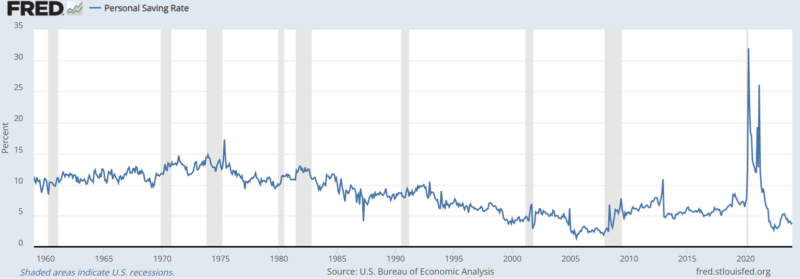
    The prices at which the system’s output can be sold in the marketplace are determined by the total amount of money which is available for spending in a given period of time. For the system to be in equilibrium, aggregate prices should exactly absorb the system’s total purchasing power. But a problem arises because in the current monetary system, there are two factors that significantly reduce the system’s purchasing power: (1) savings and (2) debt repayments.

    Namely, people don’t always spend all of their income. Instead, they prefer to set aside a part of it as savings which has the effect of reducing the total purchasing power available in the system.

    This is a problem

    So, if there are any savings, the available purchasing power will be less than the aggregate asking prices. For the system to remain in balance the savings would have to reappear in the market in the form of investments, but if total investment is less than total savings, the purchasing power will still fall short of the amount needed for all of the output to be sold at asking prices. This shortfall of purchasing power in the system, the excess of savings over investment is the deflationary gap.

    The other systemic drain on purchasing power (hat tip to author Liam Allonefor pointing this out to me) are debt repayments: since (nearly) all currency enters into circulation as debt, paying down debts extinguishes the currency and the purchasing power with it.

    Without government intervention we get a depression

    The system can be balanced either by lowering the supply and prices of goods, by enhancing its total purchasing power, or a combination of both. Lowering prices and production of goods will stabilize the economic system at a low level of economic activity. Increasing the purchasing power in the system will stabilize it on a higher level of activity. Left to itself and without intervention, a modern economic system would fall into what we call a self-reinforcing deflationary depression: the deflationary gap would lead to falling prices and output, decline of income and rising unemployment. Furthermore, in recessions and depressions, the level of investment typically declines even more rapidly than savings. To avert this, government intervention is necessary.

    Without government intervention, the economy would stabilize when the level of savings declined to the level of investments which would be at a depression level of activity. This is an anathema in all modern economies, and governments invariably pursue the imperative of economic growth. To generate growth, they must inject new purchasing power into the system. This cannot be done through taxation since taxation doesn’t create new purchasing power: taxes only transfer money from those who earn it to the government.

    This is why governments have no alternative but to continuously engage in deficit spending, adding debt in excess of their tax receipts. This is why virtually all governments in the world today run budget deficits and chronically grow public debt. In spite of all the incessant talk about balancing the budget, paying down debts or imposing debt ceilings, the debts only keep rising at rates that predictably accelerate over time. It doesn’t matter whether we call the system “socialist” or “capitalist,” they both necessitate an ever growing role of government in the economy.

    Today, in many of the “capitalist” nations, government spending accounts for almost half of the GDP and in some cases significantly more. In the UK, the mothership of capitalism, the government’s share of GDP is 44%. In France it’s over 58%.

    The great American debt ceiling Kabuki theater

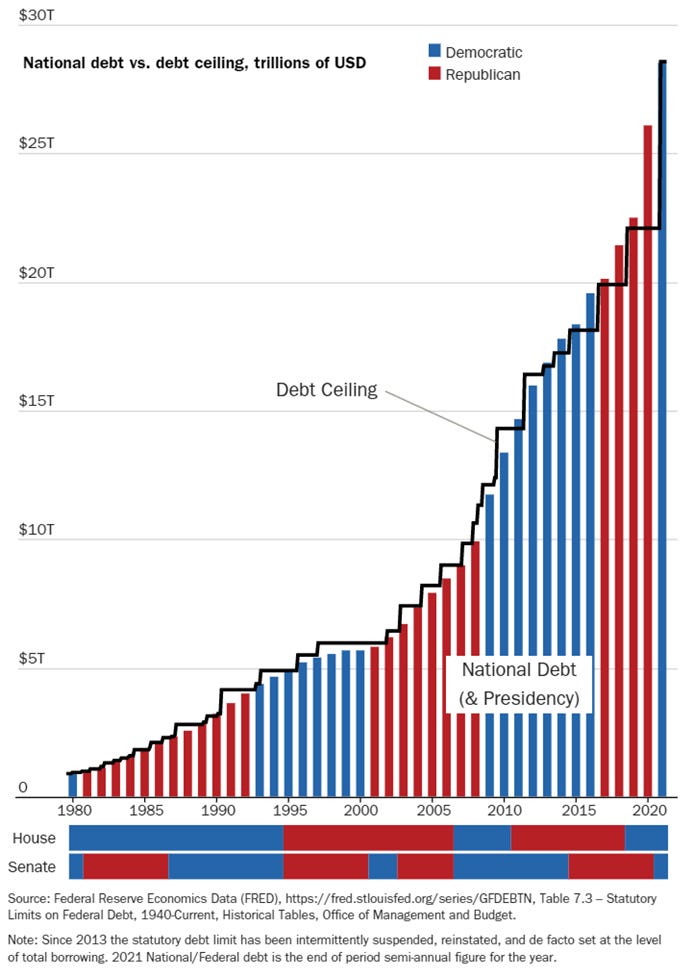
    In the United States, for over a century now we’ve been treated to periodic reruns of the “debt ceiling” Kabuki theatre. When public debt reaches the “debt ceiling,” free-spending socialists call for more government spending and a raising of the debt ceiling. The conservatives enjoy grandstanding about fiscal conservatism and balancing budgets, but regardless of which side controls the Presidency or the Congress, for over a century now the debt ceiling has been raised every time. The only exceptions have been periods when the ceiling was simply ignored and the public debt continued its accelerating upward trajectory:

    You get socialism, whether you like it or not!

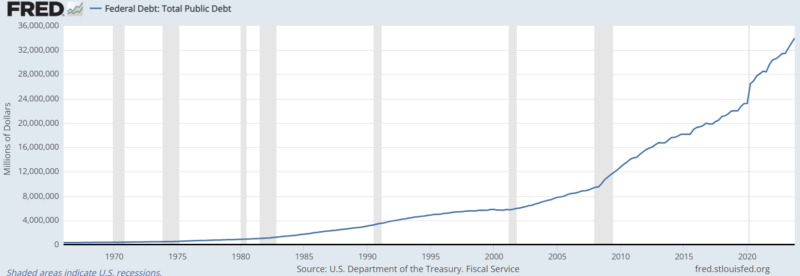
    Averting a depression and achieving economic growth necessitates government intervention and guarantees an accelerating rise in deficit spending with the corresponding rise in public debt regardless of whether we are talking about a “capitalist” or a “socialist” economies. This should be obvious, as the evolution of public debt in the U.S. illustrates:


    There’s no point railing against “socialism” and dreaming about a small government, private capital utopia which doesn’t, and cannot exist so long as our economies are based on fiat currencies with fractional reserve lending. Even if we start with zero public debt, the pursuit of economic growth will lead to the same outcomes.

    With fullness of time, government sector will progressively crowd out private enterprise: it’s a mathematical certainty. As a result, we get socialism whether we like it or not. Even if a political leader declares himself to be an anarcho-capitalist and thinks he can create the capitalist utopia (like Argentina’s Javier Millei), the endgame will be the same.

    The passionate disciples of capitalist ideology will protest and invoke the theoretical works by economists like Ludwig Von Mises, Murray Rothbardor Friedrich Hayek but I would simply ask them to please name one real-world example of a successful free market capitalist economy where the government never ran budget deficits and piled up public debt. I can wait.

    For those who would defend the free market ideology and excuse its failing as a consequence of human corruption and weakness of the structures of society, I’d warn them that this was exactly how Marxists explained away the failures of communist utopia.

    Top-down or bottom-up?

    With that, we can address the false dichotomy between “socialist” and “capitalist” economies as they’re commonly discussed. Namely, in what we call “capitalist” economies, a larger proportion of government-injected purchasing power flows top-down. In what we call “socialist” economies, it flows bottom-up.

    Capitalist governments splurge their largesse on large private corporations in the form of subsidies and generous government contracts. Socialist governments splurge on social welfare programs like low-cost or free health care, education, generous unemployment benefits and pension plans, and programs that maintain full employment even where jobs couldn’t be justified by private enterprise.

    It’s what the “capitalists” hate. As a rule, individuals who strongly favor free market capitalism tend to be the successful, entrepreneurial types who value risk taking, hard work and creating wealth through private initiative. The idea that the state would splurge on the lazy and undeserving free-loaders is understandably revolting.

    However, the alternative in splurging on large corporations is far more dangerous. If purchasing power is distributed bottom up, the decisions about how to spend that purchasing power are up to the ordinary people. As such, they’ll tend to benefit ordinary businesses that produce consumer goods and services: bakers, apparel makers, restaurants, coffee shops, musicians, tour guides, bicycle repairmen, etc.

    By contrast, if the state spends top-down, it runs the moral hazard of determining the winners and losers in the supposedly free market competition. The winners will tend to be those corporations and groups that can “invest” the most in political lobbying efforts. As a result, we get the TBTF banking behemoths, big Ag, big Pharma, big Media, big Tech and a massively bloated military-industrial complex. Ultimately, this favors the emergence of corporatism, as Benito Mussolini characterized fascism. Today we prefer the sanitized term, “private-public partnership.” The adverse effect of all this is a society’s addiction to permanent wars and a penchant for empire-building.


    This article is published in Alex Krainer’s Substack.


  • An Education Policy for Colonising Minds

    An Education Policy for Colonising Minds

    Imperialist hegemony over the third world is exercised not just through arms and economic might but also through the hegemony of ideas by making the victims see the world the way imperialism wants them to see it. A pre-requisite for freedom in the third world, therefore, is to shake off this colonisation of the mind, and to seek truth beyond the distortions of imperialism. The anti-colonial struggle was aware of this; in fact, the struggle begins with the dawning of this awareness. And since the imperialist project does not come to an end with formal political decolonisation, the education system in the newly independent ex-colonies must continuously aim to go beyond the falsehoods of imperialism.

    This requires that the course contents and syllabi in Indian educational institutions must be different from those in metropolitan institutions. This is obvious in the case of humanities and social sciences, where it is impossible to understand the present of the country without reckoning with its colonised past; and metropolitan universities scrupulously avoid making this connection, attributing the current state of underdevelopment of the country to all sorts of extraneous factors like laziness, lack of enterprise, superstition, and, above all, excessive population growth. But even in the case of natural sciences, the syllabi and course contents in third-world universities cannot be identical with those in metropolitan universities, not because Einstein’s theory or quantum physics have any imperialist ideology in them, but because the range of scientific concerns in the third world is not necessarily the same as in the metropolitan countries. In fact, this was the view of JD Bernal, the British scientist and Marxist intellectual, one of the great figures of the twentieth century.

    To believe that the syllabi and course contents in third-world universities should be identical to those in metropolitan universities is itself a symptom of being hegemonised by imperialism. Education policy in the dirigiste period in India was aware of this; despite the obvious failings of the education system the education policy of that period could not be faulted for having a wrong vision.

    With neo-liberalism, however, things begin to change, as the Indian big bourgeoisie gets integrated with globalised finance capital, as the Indian upper middle-class youth looks for employment in multinational corporations, as the nation’s development is made dependent upon exporting goods to foreign markets and attracting foreign finance and foreign direct investment to the country. Significantly, even top functionaries of the government started talking about reinviting the East India Company back to India.

    Since the era of neo-liberalism entails the hegemony of globalised finance capital, and since this capital requires a globalised (or at least a homogeneous) technocracy, the emphasis shifts to having a homogeneous education system internationally to train such a technocracy; and obviously such a system necessarily has to be one that emanates from the metropolis.

    This means an education system not for decolonising minds but for recolonising minds. To this end, the UPA government earlier had invited several well-known foreign universities to set up branches in India and even to “adopt’ some Indian universities that could be developed in their own image. Oxford, Harvard, and Cambridge were obviously invited under this scheme not to follow the syllabi and course contents prepared within India but to replicate what they followed back home. The idea was to start a process whereby there would be a uniformity of course contents and syllabi between the Indian and metropolitan universities, that is, to roll back the attempt made earlier towards decolonisation of minds in Indian universities. In fact, an Indian Human Resource Development minister had openly stated in parliament that his objective was to provide a Harvard education in India so that Indian students would not have to go abroad for it.

    The NDA government has carried forward to a very great extent what the UPA government had started; and the National Education Policy it has enacted gives an official imprimatur to this idea of a uniform education system between India and the metropolis, which necessarily means the adoption of common curricula, course contents and syllabi between Indian and metropolitan universities.

    Towards this uniformity, it has taken two decisive steps: one is the destruction of those universities in India that were providing a counter to the imperialist discourse and that had, for this very reason, attracted worldwide attention; the obvious examples here are the Jawaharlal Nehru University, the Hyderabad Central University, Jadavpur University, and others.

    The other is the carrying out of negotiations under the pressure of the University Grants Commission between individual Indian universities and foreign universities to make the course contents in various disciplines in the former clones of those in the latter. The only caveat here is that the UGC insists on having some material on subjects like Vedic Mathematics included in the course contents of Indian universities, which the foreign universities do not always agree with.

    No doubt, some accord will be reached on these issues in due course, in which case the Indian universities would have curricula and course contents that represent an admixture of the demands of neo-liberalism and the demands of the Hindutva elements. It would be a colonisation of minds with a veneer of “how great our country was in ancient times”. Imperialism should not have any problem with that. As long as imperialism, which is a modern phenomenon that has emerged with the development of capitalism, is painted not as an exploitative system but as a benevolent civilising mission for countries like India, as long as the present state of underdevelopment of these countries is not in any way linked to the phenomenon of imperialism, which it would not be if there is uniformity of course contents with metropolitan universities, then what had happened in ancient times is not of much concern to imperialism, at least to the liberal imperialist viewpoint, as distinct from the extreme right which favours a white supremacist discourse.

    An alternative tendency with the same consequence of recolonising minds is to do away with the social sciences and humanities altogether or to reduce them to inconsequential subjects and substitute them with courses that are exclusively “job-oriented” and do not ask questions about society, like management and cost accountancy. In fact, both the Hindutva elements and the corporates have a vested interest in this since both are keen to have students who are exclusively self-centred and do not ask questions about the trajectory of social development. This tendency, too, is gathering momentum at present.

    An education system that recolonises minds is the counterpart of the corporate-Hindutva alliance that has acquired political hegemony in the country. Such a recolonisation is what the corporates want; and the Hindutva elements that were never associated with the anti-colonial struggle, that never understood the meaning of nation-building, that do not understand the role and significance of imperialism, and hence of the need for decolonising minds, are quite content as long as lip service is paid to the greatness of ancient India. An education system that purveys the imperialist ideology with some Vedic seasoning is good enough for them. This is exactly the education system that the country is now in the process of building.

    The corporate- Hindutva alliance, however, is a response to the crisis of neo-liberalism, when corporate capital feels the need to ally itself with the Hindutva elements to maintain its hegemony in the face of the crisis. The National Education Policy likewise is not for carrying the nation forward but for managing the crisis by destroying thought and preventing people from asking questions and seeking the truth. The “job orientation” that this policy prides itself on is only for a handful of persons; in fact, the crisis of neo-liberalism means fewer jobs overall. In sync with this, the education system excludes large numbers of persons; their minds are to be filled instead with communal poison within an altered discourse that bypasses issues of material life and makes them potential low-wage recruits for fascistic thug-squads.

    This education policy, therefore, can only be transitory until the youth starts asking questions about the unemployment and distress that has become its fate. And as an alternative development trajectory beyond neo-liberal capitalism is explored, the quest for an education system beyond what the NDA government is seeking to introduce will also begin; and decolonisation of the mind will again come onto the agenda, as it had done during the anti-colonial struggle.


    This article was published earlier in People’s Democracy.

  • Achieving the Two-State Solution in the Wake of Gaza War

    Achieving the Two-State Solution in the Wake of Gaza War

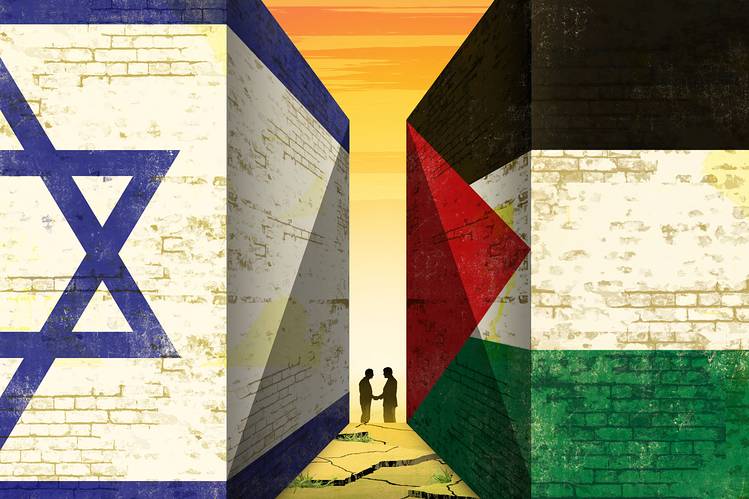
    Peace can come through the immediate implementation of the two-state solution, making the admission of Palestine to the United Nations the starting point, not the ending point.


    The two-state solution is enshrined in international law and is the only viable path to a long-lasting peace. All other solutions—a continuation of Israel’s apartheid regime, one bi-national state, or one unitary state—would guarantee a continuation of war by one side or the other or both. Yet the two-state solution seems irretrievably blocked. It is not. Here is a pathway.

    The Israeli government strongly opposes a two-state solution, as does a significant proportion of the Israeli population, some on religious grounds (“God gave us the land”) and some on security grounds (“We can never be safe with a State of Palestine”). A significant proportion of Palestinians regard Israel as an illegitimate settler-colonial entity and, in any event, distrust any peace process.

    How, then, to proceed?

    The usual recommendation is the following six-step sequence of events: (1) ceasefire; (2) release of hostages; (3) humanitarian assistance; (4) reconstruction; (5) peace conference for negotiations between Israel and Palestine; and finally (6) establishment of two states on agreed boundaries. This path is impossible. There is a perpetual deadlock on steps 5 and 6, and this sequence has failed for 57 years since the 1967 war.

    Two sovereign states, on the boundaries of June 4, 1967, protected initially by UN-backed peacekeepers and other guarantees, will be the starting point for a comprehensive and just peace…

    The failure of Oslo is the paradigmatic case in point. There are irreconcilable differences, such as the status of East Jerusalem. Israeli zealots would force from power any Israeli politician who dares to give up East Jerusalem to Palestinian sovereignty and Palestinian zealots would do the same with any Palestinian leader who gave up sovereignty over East Jerusalem. We should relinquish the continuing illusion that Israel will ever reach an agreement or that Palestine would ever have the negotiating power to engage meaningfully with Israel, especially when the Palestinian Authority is highly dependent on the US and other funders.

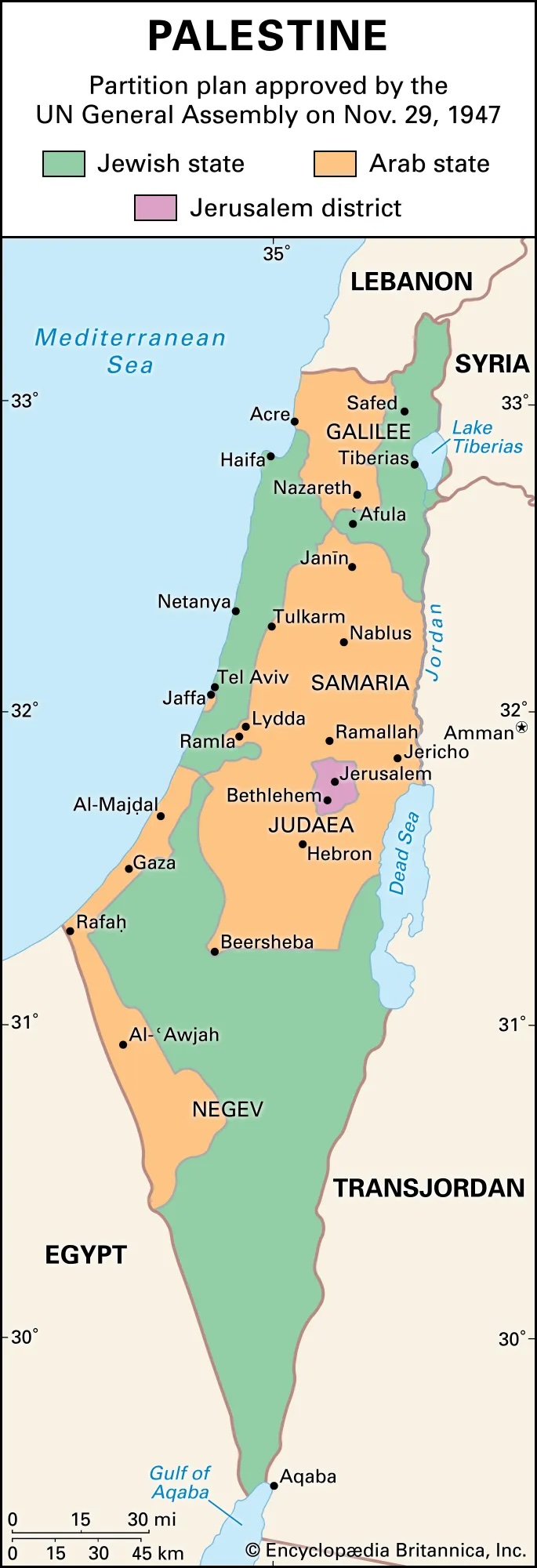
    The correct approach is, therefore, the opposite, starting with the establishment of two states on globally agreed boundaries, notably the boundaries of June 4, 1967, as enshrined in UN Security Council and UN General Assembly resolutions. The UN member states will have to impose the two-state solution instead of waiting for yet another Palestinian-Israeli failed negotiation.

    Thus, the settlement should follow this order: (1) establishment of Palestine as 194th member state within a two-state solution framework on June 4, 1967 borders; (2) immediate ceasefire; (3) release of hostages; (4) humanitarian assistance; (5) peacekeepers, disarmament and mutual security; and (6) negotiation on modalities (settlements, return of refugees, mutually agreed land-swaps, and others; but not boundaries).

    In 2011, the State of Palestine (now recognized by 140 UN member states but not yet as a UN member state itself) applied for full UN member status. The UN Security Council Committee on New Members (constituted by the UN Security Council) recognized the legitimacy of Palestine’s application, but as is utterly typical in the “peace process,” the US government prevailed on the Palestinian Authority to accept “observer status,” promising that full UN membership would soon follow. Of course, it did not.

    The Security Council, backed by the UN General Assembly, has the power under the UN Charter to impose the two-state settlement. It can do so as a matter of international law, following decades of relevant resolutions. It can then enforce the solution through a combination of carrots (economic inducements, reconstruction funding, UNSC-backed peacekeepers, disarmament, border security, etc.) and sticks (sanctions for violations by either party).

    The only conceivable border for creating the two-state solution is June 4, 1967. Starting from that border, the two sides might indeed negotiate a mutually agreed-upon swap of land for mutual benefit, but they would do so knowing that the “best alternative to a negotiated agreement” (BATNA) is the June 4, 1967 border.

    It is quite possible, indeed likely, that the US would initially veto the proposed pathway. After all, the US has already used its veto multiple times to block merely a ceasefire. Yet, the process of eliciting the US veto and then securing a large majority vote in the UN General Assembly will be salutary for three reasons.

    First, US politics is shifting rapidly against Israeli policies, given the US public’s growing understanding of Israel’s war crimes and Israel’s political extremism. This shift in public opinion makes it far more likely that the US leaders will sooner rather than later accept the basic approach outlined here because of US domestic political dynamics. Second, the increasing US isolation in the UN Security Council and UN General Assembly is also weighing heavily on US leaders and forcing the US leadership to reconsider its policy positions in view of geopolitical considerations. Third, a strong vote in the UNSC and UNGA for the two-state solution on June 4, 1967 borders, will help to strengthen international law and the terms of the eventual settlement as soon as the US veto is lifted.

    For these reasons, there is a realistic prospect that the UN will finally exercise its international legal and political authority to create the conditions for peace.

    Twenty-two years ago, Arab and Islamic leaders affirmed in the 2002 Arab Peace Initiative that the only pathway to peace is through the two-state solution. On February 7, 2024, the Saudi Ministry of Foreign Affairs reasserted that a comprehensive peace will only be achieved by recognizing an independent Palestinian state on the 1967 borders and East Jerusalem as the capital. The Arab states and the world community generally shouldn’t buy into another vague peace process that is likely doomed to fail, especially given the urgency caused by the ongoing genocide in Gaza and the bad-will accumulated over the past 57 years of a fruitless “Peace Process.”

    Peace can come through the immediate implementation of the two-state solution, making the admission of Palestine to the UN the starting point, not the ending point. Two sovereign states, on the boundaries of June 4, 1967, protected initially by UN-backed peacekeepers and other guarantees, will be the starting point for a comprehensive and just peace not only between Israel and Palestine—and also a regional peace that would secure diplomatic relations across the Middle East and end this conflict that has burdened the inhabitants, the region, and the world, for more than a century.

    This article was published earlier in Common Dreams.

    Feature Image Credit: news.sky.com

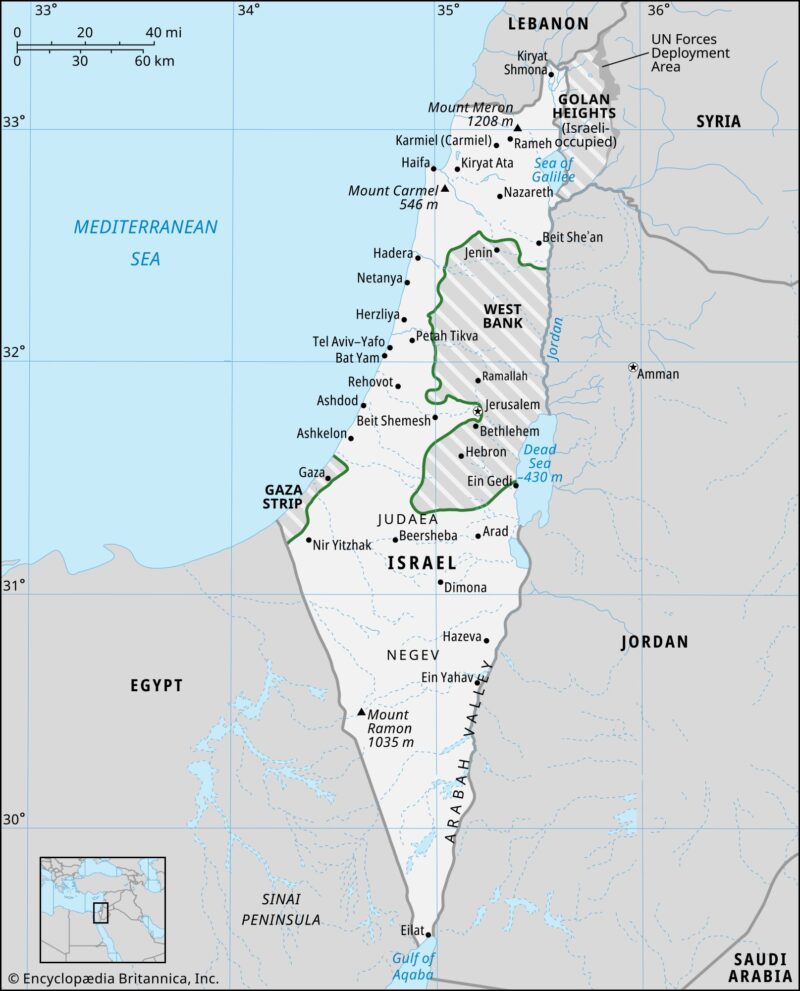
    Maps Credit: britannica.com

  • India’s National River Linking Project: Will it work or end up a Disaster?

    India’s National River Linking Project: Will it work or end up a Disaster?

    In October, India’s ambitious scheme to build a 230-kilometre canal between the Ken and Betwa rivers was finally approved. It’s the first of many projects planned for implementation under the National River Linking Project (NRLP), which aims to connect 37 Himalayan and peninsular rivers across the country via some 3,000 reservoirs and 15,000 kilometres of dams and canals. The government has touted the NRLP, which was first mooted more than four decades ago, as the solution to drought-proofing the country. But new research suggests the US$168 billion project could actually make the drought worse. 

    – From a study by the ‘Geographical‘ – Dec 2023.


    I keep hearing that Modiji is going to unveil the often-spoken and then shelved Rivers Link Up Scheme as his grand vision to enrich the farmers and unite India. In a country where almost two-thirds of the agricultural acreage is rainfed, water is wealth. Telangana has shown the way. Once India’s driest region has in just eight years been transformed into another granary of India. Three years ago, he had promised to double farmers’ incomes by 2022, and he has clearly failed. He now needs a big stunt. With elections due in 2024, he doesn’t even have to show any delivery. A promise will do for now.

    This is also a Sangh Parivar favourite, and I am quite sure the nation will once again set out to undertake history’s greatest civil engineering project by seeking to link all our major rivers. It will irretrievably change India. If it works, it will bring water to almost every parched inch of land and just about every parched throat in the land.

    On the other hand, if it doesn’t work, Indian civilization as it exists even now might then be headed the way of the Indus Valley or Mesopotamian civilizations destroyed by a vengeful nature, for interfering with nature is also a two-edged sword. If the Aswan High Dam turned the ravaging Nile into a saviour, the constant diversion of the rivers feeding Lake Baikal have turned it into a fast-receding and highly polluted inland sea, ranking it as one of the world’s greatest ecological disasters. Even in the USA, though the dams across the mighty Colorado have turned it into a ditch when it enters Mexico, California is still starved for water.

    I am not competent to comment on these matters, and I will leave this debate for the technically competent and our perennial ecological Pooh-Bahs. But the lack of this very debate is cause for concern. It is true that the idea of linking up our rivers has been afloat for a long time. Sir Arthur Cotton was the first to propose it in the 1800’s. The late KL Rao, considered by many to be an outstanding irrigation engineer and a former Union Minister for Irrigation, revived this proposal in the late 60’s by suggesting the linking of the Ganges and Cauvery rivers. It was followed in 1977 by the more elaborate and gargantuan concept of garland canals linking the major rivers, thought up by a former airline pilot, Captain Dinshaw Dastur. Morarji Desai was an enthusiastic supporter of this plan.

    The return of Indira Gandhi in 1980 sent the idea back into dormancy, where it lay all these years, till President APJ Abdul Kalam revived it on the eve of the Independence Day address to the nation in 2002. It is well known that Presidents of India only read out what the Prime Ministers give them, and hence, the ownership title of Captain Dastur’s original idea clearly was vested with Atal Behari Vajpayee.

    India’s acute water problem is widely known. Over sixty per cent of our cropped areas are still rain-fed, much too abjectly dependent on the vagaries of the monsoon. The high incidence of poverty in certain regions largely coincides with the source of irrigation, clearly suggesting that water for irrigation is integral to the elimination of poverty. In 1950-51, when Jawaharlal Nehru embarked on the great expansion of irrigation by building the “temples of modern India” by laying great dams across our rivers at places like Bhakra Nangal, Damodar Valley and Nagarjunasagar, only 17.4% or 21 million hectares of the cropped area of 133 million hectares was irrigated. That figure rose to almost 35% by the late 80s, and much of this was a consequence of the huge investment by the government in irrigation, amounting to almost Rs. 50,000 crores.

    Ironically enough, this also coincided with the period when water and land revenue rates began to steeply decline to reach today’s zero level. Like in the case of power, it seems that once the activity ceased to be profitable to the State, investment too tapered off.

    The scheme is humongous. It will link the Brahmaputra and Ganges with the Mahanadi, Godavari and Krishna, which in turn will connect to the Pennar and Cauvery. On the other side of the country, it will connect the Ganges, Yamuna, with the Narmada, traversing in part the supposed route of the mythical Saraswathi. This last link has many political and mystical benefits, too.

    There are many smaller links as well, such as joining the Ken and Betwa rivers in MP, the Kosi with the Gandak in UP, and the Parbati, Kalisindh and Chambal rivers in Rajasthan. The project, when completed, will consist of 30 links, with 36 dams and 10,800 km of canals diverting 174,000 million cubic meters of water. Just look at the bucks that will go into this big bang. It was estimated to cost Rs. 560,000 crores in 2002 and entail the spending of almost 2% of our GNP for the next ten years. Now, it will cost twice or more than that, but our GDP is now three times more, and it might be more affordable and, hence, more tempting to attempt.

    The order to get going with the project was the output of a Supreme Court bench made up of then Chief Justice BN Kirpal and Justices KG Balakrishnan and Arjit Pasayat, which was hearing a PIL filed by the Dravida Peravai, an obscure Tamil activist group. The learned Supreme Court sought the assistance of a Senior Advocate, Mr Ranjit Kumar, and acknowledging his advice, recorded: “The learned Amicus Curiae has drawn our attention to Entry 56 List of the 7th Schedule to the Constitution of India and contends that the interlinking of the inter-State rivers can be done by the Parliament and he further contends that even some of the States are now concerned with the phenomena of drought in one part of the country, while there is flood in other parts and disputes arising amongst the egalitarian States relating to sharing of water. He submits that not only these disputes would come to an end but also the pollution levels in the rivers will be drastically decreased, once there is sufficient water in different rivers because of their inter-linking.”

    The only problem with this formulation is that neither the learned Amicus Curiae nor the learned Supreme Court are quite so learned as to come to such sweeping conclusions.

    Feature Image Credit: geographical.co.uk

    Opinions expressed are that of the author and do not reflect TPF’s position on the issue.

  • The Indian Military: Five Issues for the immediate Future

    The Indian Military: Five Issues for the immediate Future

    While much has happened in 2023, new developments in the security dynamic warrant a relook at the transformation process. India now has to be prepared to prosecute both short and prolonged wars. Clearly defined political aims must be translated into achievable military objectives on the borders.

    2023 was an eventful year. In addition to ongoing conflicts in Africa, Afghanistan, Syria and Ukraine, it witnessed the start of yet another war in the Gaza Strip, which by early 2024 had expanded across West Asia. The Red Sea region is witnessing duels between the Houthis and the West. Israel and Hezbollah are skirmishing in Lebanon. Iran has carried out strikes in Iraq and Syria. The US has blamed Iranian proxies for causing the deaths of its service personnel in Jordan and retaliated accordingly across Iraq and Syria. Iran and Pakistan have carried out tit-for-tat missile strikes. While conflicts such as Nagorno Karabakh have ended for now, other potential trouble spots in the Balkans and South and East China Seas continue to make headlines.

    This uncertain security environment has put trade, supply chains and, in some cases, national sovereignty at risk. At home, long-festering structural issues in the India-China relationship have come to a head. China’s belligerence is on full display along our Northern borders even as it makes further inroads in Bhutan, Bangladesh, Nepal and Sri Lanka. In 2024, Maldives has displayed a pronounced anti-India tilt. Pakistan’s intractability and support for terrorism, despite its precarious internal situation and volatile borders on its West, remains a cause for concern. In Myanmar, the civil war rages on, while the outcome of ethno-religious conflict, which has spilled across international borders in Manipur and Mizoram, poses a different challenge.

    Despite 20 rounds of Corps Commanders talks, the Army is completing its fourth winter of ‘mirror deployment’ along the Line of Actual Control (LAC). Small-scale operations at the LAC have continued at least till 2022, as citations for gallantry in respect of individual soldiers on Republic Day indicate. The Chief of Army Staff (COAS) announced in his annual press conference in January that there will be no reduction in troop levels until the return to the ‘status quo ante as of mid-2020. Concurrently, the Army continues to battle terrorists on both sides of the Pir Panjal ranges in Jammu and Kashmir. The Air Force remains highly alert even as the Navy is committed full time in the Western Arabian Sea and East coast of Africa, successfully protecting Indian shipping ( and ships of other nations) from piracy and other threats. In sum, the Indian military is committed to ensuring the nation’s security full-time.

    The Indian Army had labelled 2023 as its ‘Year of Transformation’, based on the five pillars of Force Structuring & Optimisation, Modernisation & Technology Infusion, Systems, Processes & Functions, Human Resource Management and Jointness & Integration. The Ministry of Defence (MoD), in its 2023 Year End Review, has listed various proposals totalling over Rs 3.50 lakh crores that were approved to enhance operational preparedness. These cover a wide range of equipment and upgrades – from procurement of light combat helicopters to indigenous upgradation of Su-30 MKI aircraft, purchase of medium-range anti-ship missiles for the Navy and acquisition of towed gun systems for the Army. Other notable items are procurement of Sea/ Sky Guardian drones (31 of these since approved for sale by the US State Department in February 2024), utility helicopters, light armoured multi-purpose vehicles, anti-tank guided missiles (ATGMs), Very Short Range Air Defence Systems (VSHORAD) and cadet training ships. Improvements in other spheres – progress towards Atmanirbharta, indigenisation, border infrastructure, roads, induction and career management of women, and welfare of veterans- have also been covered. The individual services have also listed their achievements in enhancing operational capabilities and overall efficiency.

    While much has happened in 2023, new developments in the security dynamic warrant a relook at the transformation process. India now has to be prepared to prosecute both short and prolonged wars. Clearly defined political aims must be translated into achievable military objectives on the borders. The nature of these conflicts will be difficult to determine. With elements of both the conventional and non-conventional employment of weapon systems across all five domains with simultaneous conduct of information operations, they will be genuinely hybrid and constantly mutating, based on whichever element achieves more significant success.

    As a first step, it becomes necessary to incorporate fresh thought and prepare a fully fleshed-out tri-service Indian military doctrine. The integrated doctrine issued by the Integrated Defence Staff (IDS) in 2017 requires review to incorporate analysis and lessons learnt from Nagorno Karabakh, Ukraine, Gaza and our current experiences on the Northern borders, with the ‘collusive threat’ now a reality. Given that doctrine is essentially a set of principles that tells us ‘how to do’, i.e. how to achieve desired effects and not specifically ‘what to do’, capability development logically flows from doctrine analysis. Here, there has to be a consensus between the services on capabilities necessary to fulfil the military’s mandate – new platforms or technology, organisational issues, enhancement of joint or single service logistic capability, training and human resource aspects or upgrades.

    For the short to medium term, increasing focus on new technology must be balanced with the capacity to absorb technology and the context in which such weapons are envisaged to be employed. While incorporation of  AI, quantum computing, electronic warfare, stealth technology, space warfare and the like will be very much on the cards, all these can truly be incorporated once there is greater clarity and broader consensus upon two issues – what is the right weapon mix for a country like India to have, in terms of the proportion of latest generation weapons vis a vis what remains in the inventory and can be employed effectively now and in the immediate future, to thwart the enemy’s perceived designs? This is especially important when we look at the options available to incorporate new technology in terms of the time required for indigenous self-development and the secretive mindset of foreign suppliers with respect to sharing the intricacies of technologies that power such costly weapon systems. Secondly, a holistic consideration of the number of technologies that need to be developed in this time frame as part of capability development becomes necessary when we analyse the weapon/capability mix required to defend against an attacker – including one whose political and military objectives at the start of a conflict remain opaque, and whose capabilities and pattern of operations are possibly more overhyped than actual.

    The above issues become even more relevant when we look at the allocations for defence in the interim budget presented in Parliament on 01 February this year. Detailed analyses on the defence aspect will likely be published in days to come. In the context of this article, just two examples are highlighted. First, the 30 per cent higher allocation for Border Roads is hugely appropriate as it fits into future planning and enhances capability and capacities. Second, the deployment of the budget of Rs 23,855 crores to the DRDO and planned funding of a Rs 1 Lakh crore corpus for R&D projects, including ‘deep defence’ technology, while a positive step, must be carefully thought out, based on the aspects highlighted in the preceding paragraphs.Industry start-ups are doing a valuable job introducing the latest generation of weapons and technology to the military in concert with organisations like the Army Design Bureau. The incorporation of new technology and subsequent production of new weapons will be predicated on answers to these issues.

    Organisational aspects are another area for the military’s focus in 2024. Work on integrated theatre commands continues and will surely see the light of day. Notwithstanding the non-availability of a National Security Strategy, the Integrated Defence Staff (IDS) has to list out with absolute clarity what the mission of each theatre command is, in synchronicity with national aims. How to ensure optimal efficiency of these integrated resources for mission accomplishment has to be carefully thought out through multiple iterations with all stakeholders. This will have to be subject to rigorous validation in several tabletop and ground variety exercises to arrive at a common and operationally validated solution.

    Human resource issues will compete equally for the military’s attention. The Agniveer experiment has completed a little over one year. The performance of these soldiers in operations has been on par with their counterparts of yesteryears (of the same seniority). However, it is their performance in garrison soldiering that is yet to be fully gauged. As mentioned by the COAS, their assessment at multiple levels has to be continuously finetuned to remove any traces of subjectivity. Close monitoring of this scheme is necessary before pronouncing judgement on its success or otherwise, specifically its impact on regimental ethos and overall effect on unit efficiency. Employment of increasing numbers of woman Agniveers and woman officer intakes is another area which will occupy the minds of Commanding Officers (COs) of the three services. The recent decision of the Karnataka High Court in January 2024 striking down the provision of the Indian Military Nursing Services Ordinance 1943, which gives 100% reservation for women in nursing officer posts, is another spinoff in the battle for gender equality. This lends further urgency to the need to evolve an Indian model for the successful integration of women into the armed forces. Gender sensitisation of both sexes in uniform is of utmost priority.

    Managing high quality men and women drawn from all corners of India mandates a high degree of personal and professional integrity, sense of balance, and strength of character in military leaders at every level, specially so in an era where misinformed (or deliberate) inputs on social media can wreak havoc in society.

    Finally, as always, the military has to continue focusing on reinforcing institutional values. All militaries are dynamic. They must be nurtured and motivated by caring, professional and impartial leadership. A quote attributed to Sir Winston Churchill in his address to the House of Commons in 1923 says ‘…the armed forces.. are living things, if they are bullied, they sulk, if they are unhappy, they pine, if they are harried, sufficiently they get feverish, if they are sufficiently disturbed, they will wither and dwindle and almost die…’.Preserving the health of their respective services along with enhanced operational preparedness is the foremost task of the service chiefs. This comes about by careful selection of higher leadership, strict adherence to the culture, ethics and norms of the Indian military while forswearing all else at the altar of professionalism. Managing high quality men and women drawn from all corners of India mandates a high degree of personal and professional integrity, sense of balance, and strength of character in military leaders at every level, specially so in an era where misinformed (or deliberate) inputs on social media can wreak havoc in society. The responsibility of the Chiefs in this regard is onerous indeed and cannot be overemphasised. All else follows from this.

    Feature Image Credit: scroll.in

  • What the Global Economy and Security Require

    What the Global Economy and Security Require

    With the new year 2024 well underway, the world is afflicted with wars, economic challenges, and the larger issues of climate change impact that threaten the very survival of the planet. It is paradoxical to see that great powers are still focused on competition and conflict. The year ahead portends continued conflicts, wars, and the weaponisation of economic infrastructures, demonstrated by Israel’s genocidal war against the Palestinians. Carla Norrlof highlights the increase in geopolitical conflicts and the complex relationship between economics and security. The article, like most Western academics, looks from the American perspective. and may miss the larger worldview.

    – Team TPF

    This article was published earlier in Project Syndicate.


    If America and its allies are to maximize both security and prosperity in the coming years, policymakers and strategists will have to understand the complex interplay of forces that is making the world more adversarial and fraught with risk. The global environment demands a comprehensive new economic-security agenda. The global order is undergoing significant changes that demand a new economic-security agenda.

    From hot wars and localized insurgencies to great-power standoffs, geopolitical conflict has made the complex relationship between economics and security a daily concern for ordinary people everywhere. Complicating matters even more is the fact that emerging markets are gaining economic clout and directly challenging traditional powers’ longstanding dominance through new networks and strategic alliances.

    These developments alone would have made this a tumultuous period marked by economic instability, inflation, and supply-chain disruptions. But one also must account for rapid technological advances – which have introduced new security risks (such as arms races and cyber threats) – as well as natural risks such as pandemics and climate change.

    To navigate this dangerous new world, we must reckon with three interrelated dimensions: the effects of geopolitics on the global economy; the influence of global economic relations on national security; and the relationship between global economic competition and overall prosperity.

    Each pathway sheds light on the multifaceted interplay between economics and security. We will need to understand all of them if we are to tackle the varied and complex challenges presented by our highly interconnected global system.

    As recent years have shown, geopolitics can profoundly affect the global economy, reshaping trade, investment flows, and policies sometimes almost overnight. Aside from their devastating human toll, wars like the Russian invasion of Ukraine and Israel’s campaign in Gaza often reverberate far beyond the immediate theater of conflict.

    For example, Western-led sanctions on Russia, and the disruption of Ukrainian grain exports through the Black Sea, caused energy and food prices to soar, resulting in supply insecurity and inflation on a global scale. Moreover, China has deepened its economic relationship with Russia following the mass exodus of Western firms in 2022 and 2023.

    Similarly, Israel’s bombing of Gaza has destabilized the entire Middle East, especially tourism-dependent neighbouring countries such as Egypt, Jordan, and Lebanon. Meanwhile, Yemeni Houthi rebels, long supplied by Iran, have been attacking cargo ships in the Red Sea, leading international shipping firms to suspend or adjust their routes and directly impeding trade through the Suez Canal – a major artery of global commerce.

    We are witnessing the destabilizing effects of natural threats as well. The COVID-19 pandemic drove a massive shift away from cost-effective “just-in-time” supply chains to a “just-in-case” model aimed at strengthening resilience during disruptions. And, more recently, an El Niño-induced drought has diminished the capacity of the Panama Canal – another major artery of global commerce. Whether for geopolitical or ecological reasons, rerouting around these new bottlenecks inevitably increases shipping costs, causes delivery delays, disrupts global supply chains, and creates inflationary pressure.

    Turning to the second dimension – the implications of global economic relations for national security – it is clear that countries will be more likely to adopt bold or aggressive security policies if they already have a web of economic ties that can either attract support or dampen opposition. China, for example, is counting on economically dependent countries within its Belt and Road Initiative to accept its political influence and longer-term bid for hegemony. Many countries also now rely on China for critical defence-related supply-chain components, which leaves them vulnerable diplomatically and militarily.

    More broadly, global connectivity, in the form of economic networks and infrastructure, is increasingly being weaponized for geopolitical ends. As Russia’s war on Ukraine shows, economic ties can create dependencies that raise the cost of opposing assertive security policies (or even outright aggression). The implicit threat of supply disruptions has a coercive – sometimes quite subtle and insidious – effect on a country’s national security objectives. Owing to the network effects of the dollar system, the United States retains significant leverage to enforce international order through coercive sanctions against states that violate international norms.

    Trading with the enemy can be lucrative, or simply practical, but it also alters the distribution of power. As Western governments learned over the past two decades, the advantages conferred by technological superiority can be substantially offset by forced technology transfers, intellectual property theft, and reverse engineering.

    The third dimension – the relationship between global economic competition and prosperity – has been complicated by these first two dynamics, because the pursuit of material well-being now must be weighed against security considerations. Discussions in this area thus centre around the concept of economic security, meaning stable incomes and a reliable supply of the resources needed to support a given standard of living. Both Donald Trump’s “Make America Great Again” slogan and President Joe Biden’s “Build Back Better” plan reflect concerns that economic relations with China harm US prosperity.

    The challenge for the US and its allies is to manage the tensions between these varying economic and security objectives. There is a potential conflict between adapting to market- and geopolitically-driven shifts in economic power and sustaining the economic strength to finance a military force capable of protecting the global economy. The US, as the dominant power, must remain both willing and capable of preserving an open, rules-based global economy and a peaceful international order. That will require additional investments in military capabilities and alliances to counteract territorial aggression and safeguard sea lanes, as well as stronger environmental policies and frameworks to distribute global economic gains according to market principles.

    By attempting to mitigate security risks through deglobalization (reshoring, onshoring, and “friend-shoring”), we risk adding to the economic and security threats presented by a more fragmented world. Though economic ties with rivals can create dangerous dependencies, they also can act as a safeguard against hostility.

    All governments will need to grapple with these tensions as they develop a new economic-security agenda. The world is quickly becoming more adversarial and fraught with risk. To maximize both security and prosperity, we will have to understand the complex interplay of forces that are creating it.

    Feature Image Credit: India Today

  • Our Nearest Neighbours

    Our Nearest Neighbours

    In anticipation of a holiday gift, I kept asking members of my research team every week whether they noticed any anomalous object among the nearly hundred thousand objects imaged by the Galileo Project Observatory at Harvard University over the past couple of months. The reason is simple.

    Finding a package from a neighbour among familiar rocks in our backyard is an exciting event. So is the discovery of a technological object near Earth that was sent from an exoplanet. It raises the question: which exoplanet? As a follow-up on such a finding, we could search for signals coming from any potential senders, starting from the nearest houses on our cosmic street.

    Summer Triangle, which consists of the three of the brightest stars in the sky–Vega, Deneb, and Altair. The Summer Triangle is high overhead throughout the summer, and it sinks lower in the west as fall progresses. For this star hop, start from brilliant blue-white Vega (magnitude 0), the brightest of the three stars of the Summer Triangle.
    From Vega, look about 15 degrees west for the distinctive 4-sided figure in the centre of Hercules known as the keystone. On the north side of the keystone, imagine a triangle pointing to the north, with the tip of the triangle slightly shifted toward Vega (as shown in the chart below). This is the location of M92.

    The opportunity for a two-way communication with another civilization during our lifetime is limited to a distance of about thirty light years. How many exoplanets reside in the habitable zone of their host star? This zone corresponds to a separation where liquid water could exist on the surface of an Earth-mass rock with an atmosphere. Also known as the Goldilocks’ zone, this is the separation where the temperature is just right, not too cold for liquid water to solidify into ice, and not too hot for liquid water to vaporize.

    So far, we know of a dozen habitable exoplanets within thirty light years (abbreviated hereafter as `ly’) from Earth. The nearest among them is Proxima Centauri b, at a distance of 4.25 ly. Farther away are Ross 128b at 11 ly; GJ 1061c and d at 11.98 ly, Luyten’s Star b at 12.25 ly, Teegarden’s Star b and c at 12.5 ly, Wolf 1061c at 14 ly, GJ 1002b and c at 15.8 ly, Gliese 229Ac at 18.8 ly, and planet c of Gliese 667 C at 23.6 ly. These confirmed planets have an orbital period that ranges between a week to a month, much shorter than a year because their star is fainter than the Sun. This list must be incomplete because two-thirds of the count is within a distance of 15 ly whereas the volume out to 30 ly is 8 times bigger. Given that the nearest habitable Earth-mass exoplanet is at 4.25 ly, there should be of order four hundred similar planets within 30 ly. We are only aware of a few per cent of them.

    But even if we identified all the nearby candidate planets for a two-way conversation, they would constitute a tiny fraction of the tens of billions of habitable planets within the Milky Way galaxy. Having any of the nearby candidates host a communicating civilization would imply statistically an unreasonably large population of transmitting civilizations for SETI surveys.

    Most likely, any visiting probe we encounter had originated tens of thousands of light-years away. In that case, we will not be able to converse with the senders during our lifetime. Instead, we will need to infer their qualities from their probes, similarly to the prisoners in Plato’s Allegory of the Cave, who attempt to infer the nature of objects behind them based on the shadows they cast on the cave walls.

    It is better not to imagine your neighbours before meeting them because they might be very different than anticipated. My colleague Ed Turner from Princeton University, used to say that the more time he spends in Japan, the less he understands the Japanese culture. According to Ed, visiting Japan is the closest he ever got to meeting extraterrestrials. My view is that an actual encounter with aliens or their products would be far stranger than anything we find on Earth.

    Personally, I am inspired by the stars because they might be home to neighbours from whom we can learn. The stars in the sky look like festive lights on a Christmas tree which lasts billions of years. A few days ago, a woman coordinated dinner with me as a holiday gift to her husband, who follows my work. At the end of dinner, they gave me a large collection of exceptional Japanese chocolates, which I will explore soon. In return, I autographed my two recent books on extraterrestrials for their kids with the hope that they would inherit my fascination with the stars.

    Here’s hoping that our children will have the opportunity to correspond with the senders of an anomalous object near Earth. During this holiday season, I wish for a Messianic age of peace and prosperity for all earthlings as a result of the encounter with this gift.


    Feature Image Credit: Messier 92 is one of two beautiful globular clusters in Hercules, the other being the famous M13. Although M92 is not quite as large and bright as M13, it is still an excellent sight in a medium to large telescope, and it should not be overlooked. The cluster is about 27,000 light years away and contains several hundred thousand stars. www.skyledge.net

    Other Two Pictures in Text: www.skyledge.net

    This article was published earlier in medium.com

  • The Morals of Hamas and Israel — A Dharmic Perspective

    The Morals of Hamas and Israel — A Dharmic Perspective

    In this analysis of the catastrophic destruction unleashed by Israel on Gaza in response to the Hamas’ attack on October 7th, Dr Seshadri Kumar poses very pertinent and valuable questions to the Indian policymakers and the audience in general.

    This article was published earlier in medium.com

    I have seen a number of Indians try to draw a moral equivalence between the attacks by Hamas on Israeli civilians that precipitated the ongoing war in Palestine and the retaliatory attacks of the Israeli Defense Forces on Gaza civilians. Both are equally wrong, these people say. Cruelty and barbarism are wrong, whatever the circumstances, they say. And they also say, therefore, that the Palestinians deserve the brutal bombardment that Israel is inflicting on them because they acted brutally by attacking first. Basically, they asked for it. The fact that the Palestinians are Muslims, a minority that is hated by the majority of Hindus (and, as I am finding out, Christians as well) in India, helps in developing this response.

    But are these two actions equivalent? Most of my friends are Indians, and Hindus at that, so I will draw upon Hindu mythology, which is revered in India, to answer this.

    First, one must understand what the Palestinians have gone through. The very creation of Israel was an injustice to the Arabs living in Palestine, as they were forcibly removed from their homes and forced to be refugees. Initially, all the other Arab countries supported them and fought many wars with Israel. But they lost every time, and the Palestinians lost more and more land each time.

    But the Bible is not history, and even if Jews used to live in that land centuries ago, brutally uprooting people living in Palestine in 1948 was a gross human rights violation. By this logic, the Chola kings of South India were once in control of Sri Lanka, Cambodia, and Thailand, so India is entitled to invade those countries and expel their populations from their lands.

    Some people say that the land that forms the state of Israel was once populated by Jews if we go by the Bible, and therefore Israel has a right to that land. But the Bible is not history, and even if Jews used to live in that land centuries ago, brutally uprooting people living in Palestine in 1948 was a gross human rights violation. By this logic, the Chola kings of South India were once in control of Sri Lanka, Cambodia, and Thailand, so India is entitled to invade those countries and expel their populations from their lands.

    After a lot of conflict over decades, the Israelis gave two parcels of land to the Palestinians to live in and self-govern, but the Jews control the lifelines to both areas — the West Bank, ruled by Fatah, and the Gaza Strip, ruled by Hamas.

    Palestinians are routinely terrorized and humiliated by Israel. Their demand for a Palestinian homeland has come to nought despite years of negotiations. Israel is a brutal occupation force in Palestine.

    If all this were not enough, even the small area still occupied by Arabs is constantly encroached upon by Jews. Jews build settler colonies in Palestinian areas, taking away more and more of the little land the Muslims own. Muslim families living in Jerusalem are often forced at gunpoint from their own homes to make way for Jews. The number of Jewish settlers in Palestinian areas was just over half a million in 2010; today, it is just under three-quarters of a million. This increase has happened because of explicit support and encouragement of forced settlement policies by various governments in Israel, including the current Likud-led government of Benjamin Netanyahu and by the US. Another reason for this is that Jews anywhere have an automatic right to become Israeli citizens, and this has led to a huge influx of Jewish immigrants into Israel. Any protest by Palestinians is met with disproportionate retaliation. Children who throw stones are met with machine gunfire. A single rocket is replied to by a hail of bombs from aircraft. Collective punishment of Palestinians is and has been the norm. Israel has been deliberately provoking the Palestinians more and more, and the US has been openly partisan, as when President Trump recognized Jerusalem as Israel’s capital.

    If this were still not bad enough, the Palestinians seem to be losing all their Arab friends. There seems to be Palestine fatigue in the Arab world. Egypt normalized relations with Israel long ago. More recently, other countries, including the UAE, Sudan, Bahrain, and Morocco, have normalized relations. Even Saudi Arabia is on the cusp of normalizing relations with Israel. Clearly, there is nobody left to stand up for the Palestinians.

    A peaceful resolution is clearly not getting the Palestinians anywhere. Despite condemnation by the UN, Israel is continuing its settlement policy. At this rate, the Palestinians will all be begging for a living on the streets.

    How should Palestinians fight for their rights? Talks have failed. How should they “fight” Israel? By engaging in a direct military confrontation with the far superior Israeli army, using primitive weapons, and without an air force — to end up with a guaranteed defeat?

    So, if you say you are sympathetic to the plight of the Palestinians, you are giving them only three options:

    1. Have round after round of negotiations, which don’t get anywhere.
    2. Fight a direct war with a far superior army and an air force, which will lead to complete defeat.
    3. Watch Israeli civilians encroach on what Palestinians still consider their land, until nothing is left, and end up as slave labour for the Jews.

    It is worth noting that the Palestinians living in the West Bank, under Fatah rule, have not indulged in violence all these years. Yet, what has it gained them? Israel withdrew all its settlements from the Gaza Strip in 2010 but is briskly building new Jewish settlements in the West Bank. This is what Fatah got by being peaceful.

    People become terrorists when they have no other option. Asymmetric warfare is the weapon of the weak. When one has a just cause, and all acceptable and peaceful ways of securing one’s rights have come to nought, then one adopts unacceptable and violent ways. In other words, the ends justify the means.

    Hindus can understand this by reading the great Hindu epic, the Mahabharata. The Mahabharata is the story of a conflict between two sets of cousins, the Kauravas and the Pandavas, for control of a kingdom, Hastinapura. In the Mahabharata, the principle that any means are acceptable in order for a just end to prevail, referred to as the principle of Brihaspati, the preceptor of the Gods, is invoked by both sides.

    The operative portion of the story in the Mahabharata starts when King Vichitravirya dies. He has two sons: the elder, Dhritarashtra, is blind, and therefore is passed over for the kingship. His younger brother, Pandu, is crowned king. But King Pandu is cursed by a dying sage during a hunting accident, loses interest in the kingdom, and abdicates, upon which Dhritarashtra is crowned king by default. The children of Dhritarashtra are called the Kauravas, and the children of Pandu are called the Pandavas. Both the Pandavas and Kauravas therefore have a legitimate claim to the kingdom — the former are the children of the last legitimate king, who was the younger brother, whereas the latter are the children of the elder brother who is the current king, albeit by default.

    Duryodhana, the eldest of the Kauravas, believes that the entire kingdom should belong to him, and that the Pandavas do not have a legitimate claim to “even a needlepoint of land.” The Pandavas, on the other hand, are amenable to a split of the kingdom, with half going to their cousins and half ruled by them.

    Duryodhana hates the Pandavas because they are rival claimants to the kingdom. He tries to have them poisoned and then and burned to death. When all that fails, Dhritarashtra tries to achieve peace by partitioning the kingdom. Duryodhana then cheats the Pandavas for their share of the kingdom by winning a rigged game of dice. The condition of the game is that the Pandavas must go into exile for 13 years. When the Pandavas return from exile, Duryodhana refuses to return their portion of the kingdom to them. He justifies all his actions to his father by quoting Brihaspati — that one may take any steps necessary for the elimination of a powerful adversary.

    The Pandavas decide to fight for their right in the great war of Kurukshetra when Duryodhana refuses to return to their kingdom.

    In the setting of the Mahabharata, there are rules by which one is expected to fight on the battlefield. One must not attack someone who is not fighting them. One must not attack an unarmed opponent. One must not strike below the waist. No fighting at night, except by prior agreement. These rules are referred to as the “dharma” (right conduct) of battle. Violation of these rules would be called “adharma.” (Violation of dharma was viewed in the same way as we view human rights violations today.)

    Now the Pandavas can regain their kingdom only by defeating the Kauravas in battle. But the Kauravas are invincible in battle. They have great warriors who have never been defeated in war: Bhishma, the grand-uncle of the Pandavas and Kauravas, a student of the great Parashurama, the greatest warrior the world has known; Drona, the martial teacher of both the Pandavas and Kauravas, another disciple of Parashurama; Karna, the son of the Sun god, born with impregnable armor, and yet another disciple of Parashurama; and many other great warriors such as Bhurishravas. Duryodhana himself is invincible when fighting with his favourite weapon, the mace or bludgeon.

    While the Pandavas themselves have great warriors, notably Bhima, the second of the five Pandavas, the strongest man of his time; and Arjuna, the third of the Pandavas, the greatest archer of his time; even these cannot kill the undefeated warriors on the Kaurava side.

    But the Pandavas also have on their side Krishna, who is an incarnation of the God Vishnu in human form, who wants to help the Pandavas win because he is on the side of justice and fairness, and he believes that the Pandavas are on the side of dharma.

    Krishna knows that the Pandavas can never beat the Kauravas in a fair fight. So, he resorts to dishonourable tactics, or adharma, to win.

    Bhishma has taken a vow that he will never fight a woman. There is a warrior on the Pandava side, Shikhandi, who was born a woman, but who underwent a gender change and became a man. However, Bhishma still considers this warrior a woman, and his code of chivalry will not allow him to fight Shikhandi. But Shikhandi is incapable of killing Bhishma. So Krishna instructs Arjuna to position himself behind Shikhandi and shoot arrows at Bhishma. Bhishma will not shoot at Arjuna because Shikhandi stands in between, and so allows himself to be killed by Arjuna. This is clearly a violation of dharma by the Pandavas — attacking a foe who is not fighting you.

    Drona is told a lie that his son, Aswatthama, has been killed. On hearing this, Drona loses all interest in life and goes into meditation. When he is thus unarmed and defenceless, a warrior named Dhrishtadyumna chops off his head. Another violation of dharma.

    Karna, similarly, is killed by Arjuna when his chariot is stuck in the mud, and he is unable to fight Arjuna. Dharma would have required Arjuna not to attack Karna when he was unarmed and not engaged in battle with him. But upon Krishna’s urging, Arjuna kills Karna from behind when he is engaged in removing his wheel from the mud.

    Similarly, Bhurishravas is engaged in a fight with another warrior when Arjuna cuts his hand off with an arrow from behind. A disillusioned Bhurishravas goes into meditation, at which point his opponent beheads him while he is unarmed and in meditation.

    In the final battle of the war, Duryodhana and Bhima are fighting with their maces, and Bhima is finding the going tough, because Duryodhana is unbeatable with the mace. At this point, Krishna signals to Bhima to strike Duryodhana below the navel, a violation of the rules of war. Bhima strikes Duryodhana’s thighs and mortally wounds him. More adharma.

    Krishna justifies every one of these transgressions of dharma by saying that the ends justify the means. A dying Duryodhana accuses the Pandavas of violating the rules of war to defeat him. Krishna recalls all of Duryodhana’s evil deeds, and says that without violating the rules of war, without adharma, the Pandavas could never have avenged the great wrongs done to them. Adharma was required to defeat adharma.

    And so, the Mahabharata is a deeply pessimistic story, because it says that the virtuous can never defeat the wicked by following fair play in war. They must resort to trickery, unfair and illegitimate tactics — adharma — in order for dharma to prevail. After trying to follow dharma their entire lives, even not retaliating when their wife Draupadi was disrobed in the great assembly of Hastinapura by the Kauravas during the game of dice, after patiently enduring multiple assassination attempts, after being deprived of their kingdom by fraud, after enduring 13 years in exile, the Pandavas finally come to the realization that they can get their rightful inheritance only through evil and unfair means, through adharma. Even to ensure the victory of virtue, one must embrace vice.

    Similarly, the Palestinians have not gotten justice for 75 years by appealing to dharma, and today Hamas is pursuing the path of adharma. The injustice of the Palestinians began in 1948 with the nakba, the forced expulsion of more than 700,000 Palestinians from the new state of Israel and the destruction of more than 500 villages. Some 5000 Palestinians were massacred by Israel at the time. The injustice has only grown worse in the last 75 years.

    If the present adharma of Hamas is wrong, then the actions of the Pandavas in the Mahabharata were also wrong. And if what the Pandavas did was right, then what Hamas has done is also right. In both cases, adharma was committed to securing justice and fairness. Hindus must decide which course of action they find morally right — but they must choose consistently.

    A system where dharma is never respected and followed can only result in adharma. We have no choice but to accept this reality.

    Had Dhritarashtra upheld dharma when the Pandavas pleaded for their rights with him, they would never have had to engage in adharma to get their rights. If we claim to value dharma, then we must be consistent in upholding it. Otherwise, we are engaging in adharma ourselves.

    Had the world listened to the anguished cries of the Palestinians over the last 75 years, a just solution would have been worked out for them and some of them (i.e., Hamas) would not need to engage in terrorism today. But by turning a deaf ear and a blind eye to their suffering, the West has forced Hamas to engage in the only way that the West pays attention to — terrorism.

    It is not enough to say that you condemn both the violence against civilians by Hamas and the state terrorism of Israel equally. By doing so, you are only enabling the powerful terrorist state of Israel, because your condemnation means nothing to them — they have been engaging in state terrorism for 75 years and getting away with it scot-free. The only people to face consequences for their terrorism are the weak — in this case, Hamas, and in decades past, the PLO. They are blacklisted, their assets are frozen, they are put on Interpol arrest lists, whereas the terrorists who rule the state of Israel roam the world as royalty.

    The world is not equal and fair. The powerful have more privileges. And so, if you value human rights and freedom, you must not condemn equally. If you genuinely care about justice, you must side with the weak, not be even-handed.

    Be like Krishna. Not like Dhritarashtra.

    Feature Image Credit: www.lapresalatina.com