Category: Opinion/Commentary

  • The Cultural Revolution from the Right: From the Democratic Concept of the People to its Ethnic-religious Understanding

    The Cultural Revolution from the Right: From the Democratic Concept of the People to its Ethnic-religious Understanding

    Despite all the real political problems we face, it is essential for the twenty-first century to defend the equality of all people, regardless of biological differences such as gender or ethnicity. It is not our biology that defines us as human beings, but our morality.
    According to Dominique Moisi, the Western states are consumed with fear of decline, the Islamic-Arab world is full of despair at unfulfilled promises, and East and Southeast Asia are full of hope for a better life. These global political sentiments are largely responsible for the escalation of conflicts, the disintegration of social cohesion and the spread of violence. 
    More than 50 years ago, a cultural revolution from the left shook the whole world. In the USA, there were demonstrations against the Vietnam War, and the hippie movement gathered hundreds of thousands in search of a new lifestyle and attitude to life. Flower, power, love was the motto of the legendary Woodstock. In Germany, young people turned against old traditions and the concealment of their parents’ and grandparents’ guilt under fascism. But here, too, the double face of the youth movement became apparent: when they celebrated the North Vietnamese leader Ho Chi Minh in their demonstrations, they were in no way aware of the political practice in North Vietnam. This process was even more dramatic during the Chinese Cultural Revolution when the youth were mobilised to ultimately legitimise the claim to power of the “Great Leader” Mao-TseTong. The lesson of that period was that a cultural revolution must precede political change. For some time now, a cultural revolution from the right has been following this pattern. It is characterised on the one hand by social developments in polarised societies, and on the other by a targeted and strategic discourse on the part of the new right. Without underestimating the importance of personalities such as former and newly elected President Trump, as well as Erdogan in Turkey and Putin in Russia (and many others) for this development, they have only been able to achieve such success because they have tapped into the “zeitgeist”. According to Dominique Moisi, the Western states are consumed with fear of decline, the Islamic-Arab world is full of despair at unfulfilled promises, and East and Southeast Asia are full of hope for a better life. These global political sentiments are largely responsible for the escalation of conflicts, the disintegration of social cohesion and the spread of violence.
    In the Western world, instead of recognising the equality of other civilisations, nations and states, the “others” were blamed for the loss of the “white man’s” superiority. The ideology of the white man’s burden to educate the uneducated and indigenous peoples of the world, developed at the beginning of the last century, was revived after the fall of the Soviet Union, but could no longer be sustained with the rise of the others and the newly industrialised nations. However, a dilemma arose – if the success of the others was attributed to them, they would be strengthened and the whites would be even less able to maintain their own sense of superiority. So people looked for internal others to blame for their own decline. This is at the heart of the cultural revolution from the right. It is explained by the fear of no longer being able to maintain the supposed superiority of the “white man” if, for example, a country like Indonesia (i.e. no longer just Japan and China) overtakes Germany’s gross domestic product around 2030. Meanwhile, the US, Germany and many other European countries are not only no longer relatively superior, but parts of the US, for example, are at levels that used to be ascribed only to developing countries. And scapegoats are easy to find and, above all, interchangeable – sometimes it can be emancipated women, migrants, the “elites”, the Chinese, Africans, African-Americans, or anyone who is different. Trump’s statement that migrants are taking “black jobs” from US Americans reveals the core of this ideology: the MAGA movement is the best illustration of this development. Despite Trump’s irrationality and narrow-mindedness, “Make America Great Again” can only take hold if many people fear decline or have already experienced it. Like the masterminds of the cultural revolution on the right, they are trying to conquer the more rural regions first.
    The reference to ethnic pluralism is also one of the defining characteristics of the New Right. The right of all cultures and ethnic groups to exist is unconditionally recognised, but only as long as people remain among themselves or on the territory intended for them. Trump’s idea of expelling millions of Latinos after winning the election corresponds perfectly with the German right’s idea of enforcing re-migration. In Germany, Carl Schmitt and Martin Heidegger, Ernst Jünger and Oswald Spengler, and even Nietzsche, are relativised in order to legitimise the cultural revolution of the right. Antonio Gramsci, actually a progressive Marxist, whose concept of achieving cultural hegemony in the “pre-political space” is pursued by the Right as “metapolitics”, gains central importance.
    At its core, however, the new right is about undermining human equality – in its view, we are only equal to our own nation or religion and gender. This exclusionary equality only with one’s own kind is at the heart of the right’s cultural revolution, whose ideal model is itself based on hierarchical notions, a graded dignity. Such attempts to undo the gains of the struggle for equality in a counter-revolution can be found all over the world – whether in nationalism, ethnocentrism, misogyny, cultural relativism (“they just have a different culture”) or thinly veiled racism.
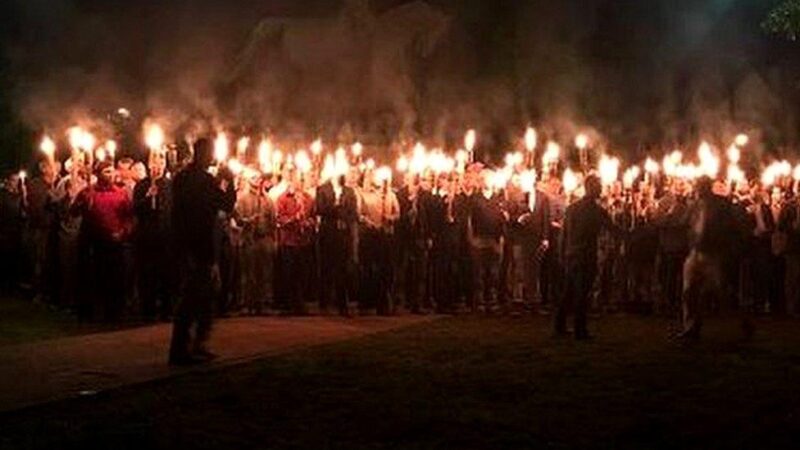
    The only thing “new” about this right-wing movement is that it uses different terms. The New Right concentrates on the “battle for the heads”, leaving the battles for the streets and, in some cases, the parliaments to other groups of the extreme right. The storming of the Capitol and the German Bundestag were such actions of the extreme right. It must be admitted that the whole world is in turmoil. At its core, however, the new right is about undermining human equality – in its view, we are only equal to our own nation or religion and gender. This exclusionary equality only with one’s own kind is at the heart of the right’s cultural revolution, whose ideal model is itself based on hierarchical notions, a graded dignity. Such attempts to undo the gains of the struggle for equality in a counter-revolution can be found all over the world – whether in nationalism, ethnocentrism, misogyny, cultural relativism (“they just have a different culture”) or thinly veiled racism. It is also marked by the revival of toxic masculinity (Raewen Connel) through the MAGA movement and in particular Trump’s enthusiasm for the wrestling mentality and martial arts. Opinions can be divided on these as sports, but they have no place in politics and point to an absolutely exaggerated and violent masculinity that Trump embodies. These political discourses are used to win elections in the West. In one sentence, the New Right shifts the concept of the democratic people to the ethno-religious people.
    When the few people of Pegida (Patriotic Europeans to defend the Abendland) in Germany shout into the camera: “We are the people”, they are turning the slogan of the democratic revolution of 1989 into an ethno-nationalist revolution. From the mid-nineteenth century to the mid-twentieth century, we have witnessed this transformation from the democratic to the ethnic concept of the people. Despite all the real political problems we face, it is essential for the twenty-first century to defend the equality of all people, regardless of biological differences such as gender or ethnicity. It is not our biology that defines us as human beings, but our morality.
    Feature Image Credit: Equality Trust
    from ‘The Link Between Inequality and the Far-Right’ – https://equalitytrust.org.uk
    The far-right has always been part of politics. The current global wave of far-right populist political movements began in the late 1970s, grew in the 1990s, and accelerated dramatically in the late 2000s. It has mirrored a sharp increase in inequality across developed economies, the globalisation of neoliberal economics, and the creation of an international super-rich. 
  • Intelligence: The Crux of Targetted Assassinations

    Intelligence: The Crux of Targetted Assassinations

    The USA has followed targetted assassination strategy since WW II days. It has cooped its allies such as Israel, Australia, and the UK. Targetted killings in the Middle East has been led by Israel with active intelligence support by the USA. With modern ISR capabilities, targets can be monitored or looked for on 24/7 basis for all 365 days of the year. A world that is integrated by common communications protocols and digital standards for ease of normal business becomes vulnerable to intelligence agencies by the same process of commonality. 


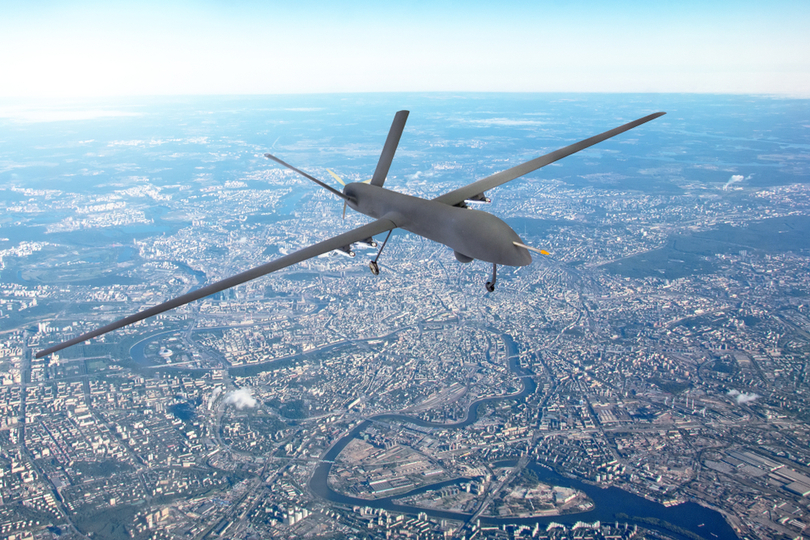
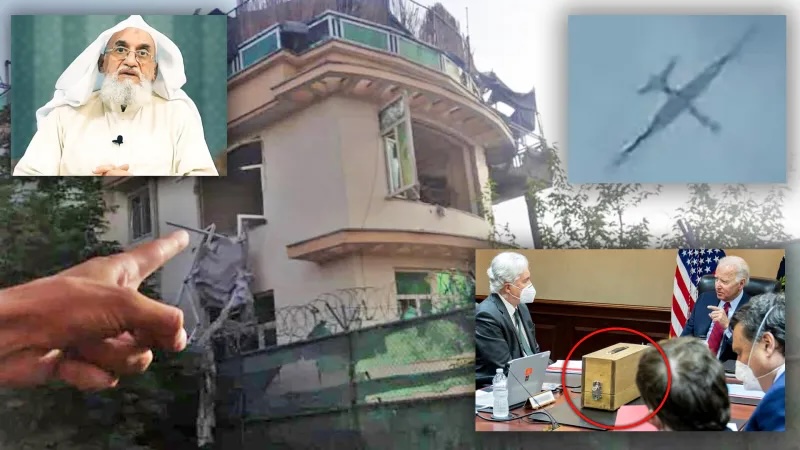
    On July 31, 2022, Osama bin Laden’s successor as the global head of Al Qaeda, Ayman al-Zawahiri, stepped out onto the balcony of his Taliban safe house in Kabul’s tony Wazir Akbar Khan area to catch a breath of fresh air and a bit of sunshine. About 40,000 feet above an American Predator B (aka Reaper MQ-9) drone, loitering to get a glimpse of him, caught him in its camera, and after its operators in Nevada, USA confirmed it with facial identification technology, ordered it to fire its single Hellfire R9X missile. The Hellfire is a small 100 lbs and five feet long air-to-ground missile (AGM) that races down a reflected laser beam with unerring accuracy. It costs about $ 150,000. The R9X, which was developed at the express request of Barack Obama, who wanted to minimise collateral damage due to an explosive charge, is a kinetic weapon that unsheathes multiple blades from its fuselage as it approaches the target at almost 900 mph like a whirling swordsman. Al-Zawahiri didn’t stand a chance.

    The USA and some other countries have bevvies of space satellites orbiting at preselected trajectories to watch over areas of interest. These satellites not only listen to targets but also track them and identify faces and vehicles by their plates. Osama bin Laden never looked up while on his morning walk at his Abbottabad residence but he was recognised by his height and the length of his shadow at the time of the day and by his gait. Al-Zawahari was either careless or underestimated America’s appetite for his head. He still had a $ 25 million reward, appetising enough for any informants.

    The number of active mobile phones worldwide exceeded 15 billion, which means that many people have more than a couple. Of these 7.2 billion are smartphones connecting people with huge reservoirs of information and content. India has 1.28 billion and China has 1.9 billion phones. The USA follows with 327 million and a dysfunctional country like Pakistan has 125 million. Even in countries with little semblance of a government or a state, like Somalia and Afghanistan or Mali or Libya, there are functioning mobile phone networks.

    As of June 30, 2021, there were about 4.86 billion internet users worldwide. Of these 44.8% were in Asia, 21.5% in Europe and 11.4% in all of North America. India was one of the last countries operating a telegraph service and as of end 2021, even that is in the past. Literally, it’s all up in the air now.

    But since data exchanged on cellular and internet networks fly through the ether and not as pulses racing through copper wires, they are easier to net by electronic interception. But these nets catch them in huge numbers. This is where the supercomputers come in. The messages that are netted every moment are run through sieves of sophisticated and complex computer programs that can simultaneously decode, detect and unravel, and by further analyzing the incoming and outgoing patterns of calls and data transfers for the sending and receiving terminals or phones, can with a fair probability of accuracy tell the agency seeking information about what is going on and who is up to what?

    The problem is that since this information also goes through mobile phone networks and Internet Service Providers (ISP), and the data actually gets decoded from electronic blips into voice and digital data, the private players too can gain access to such information.

    A few years ago we had the case of the infamous Amar Singh CDs, which titillated so many with their graphic content and low-brow conversations featuring the likes of Anil Ambani, Jayaprada, Bipasha Basu and some others. Then we had the episode of the Radia tapes where we were privy to the machinations of Tata’s corporate lobbyist in the national capital fixing policy, positioning ministers and string-pulling media stars. But more useful than this, a mobile phone, by nature of its technology, is also a personalised GPS indicator. It tells them where that phone is at any instant it is on. The Al Qaeda terrorist and US citizen Anwar el-Awlaki was blasted by a Hellfire missile fired from a CIA Predator drone flying over Yemen with the coordinates provided by Awlaki’s mobile phone.

    Since a mobile phone is usually with you it tells the network ( and other interested parties) where you are or were, and even where you are headed. If you are on a certain street since it reveals where exactly you are and the direction of your movement, it can tell you where the next pizza place is or where and what is on sale. This is also a breach of privacy, but often useful to you. But if you are up to no good, then a switched-on mobile phone is a certain giveaway.

    That’s what gave away Osama bin Laden in the end. A momentary indiscretion by a trusted courier and bodyguard and a name gleaned from a long-ago water-boarding session was all it took. To know what happened next see “Zero Dark Thirty” by Katherine Bigelow (now on Netflix and YouTube).

    The NSA is all hi-tech. NSA collects intelligence from four geostationary satellites. These satellites track and monitor millions of conversations and the NSA’s banks of high-speed supercomputers process all these messages for certain phrases and patterns of conversations to decide if the persons at either end were worthy of further interest.

    The NSA’s eavesdropping mission includes radio broadcasting, both from various organisations and individuals, the internet, telephone calls, and other intercepted forms of communication. Its secure communications mission includes military, diplomatic, and all other sensitive, confidential or secret government communications. The NSA is all hi-tech. NSA collects intelligence from four geostationary satellites. These satellites track and monitor millions of conversations and the NSA’s banks of high-speed supercomputers process all these messages for certain phrases and patterns of conversations to decide if the persons at either end were worthy of further interest. Link this information with the data from the CIA’s spinning satellites watching the movements of groups, individuals and vehicles, and you have a broad picture of what the people are doing.

    According to the Washington Post, “every day, collections systems at the National Security Agency intercept and store 1.7 billion e-mails, phone calls and other types of communications.” The NSA and CIA together comprise the greatest intelligence-gathering effort in the world. The overall U.S. intelligence budget is now declared to be $62.8 billion.


    Feature Image Credit: E-International Relations

    Article Image Credit: www.twz.com


  • Indus Water Treaty: A Model for International Water Governance

    Indus Water Treaty: A Model for International Water Governance

    Introduction

    Water is the basis of biological sustenance, without which no civilisation can sustain. Access to clean and safely managed water is therefore a human right, not a privilege.

    According to the United Nations Development Programme (UNDP) —

    One in four people still lives without safely managed water services or clean drinking water. Approximately 4 billion people live with severe water scarcity for at least one month of the year, and about half a billion people face water scarcity year-round.

    The water crisis is not an isolated issue but a global challenge. It calls for effective governance not just within the local governments and authorities of a country but transnationally as well.

    International Water Governance refers to this process of decision-making, formulation, and implementation of policies pertaining to the use, management, and distribution of transboundary water resources.

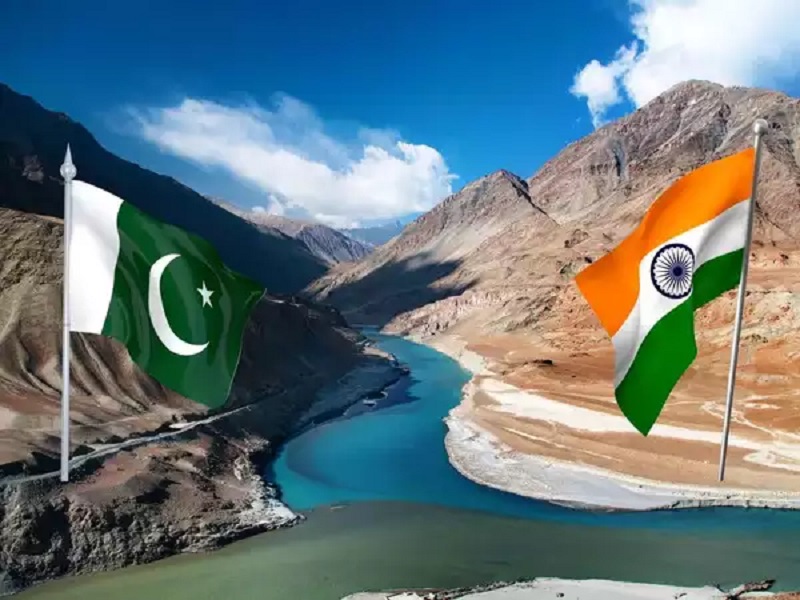
    Peace and cooperation on matters of conflict over water are hard to reach and much harder to maintain. Treaties, multilateral agreements and conventions often govern transboundary waters; one such example of a successful bilateral water-distribution treaty is the Indus Water Treaty (the IWT) of 1960 between India and Pakistan over the regulation and use of the Indus River Basin and its tributaries.

    Indus Water Treaty

    The Indus Water Treaty was signed in 1960 in Karachi between India and Pakistan as facilitated by the World Bank (erstwhile International Bank for Reconstruction and Development or IBRD). It demarcates the sharing and usage of the Indus River and its major tributaries, categorised into “eastern” and “western” rivers for Indian and Pakistani use, respectively.

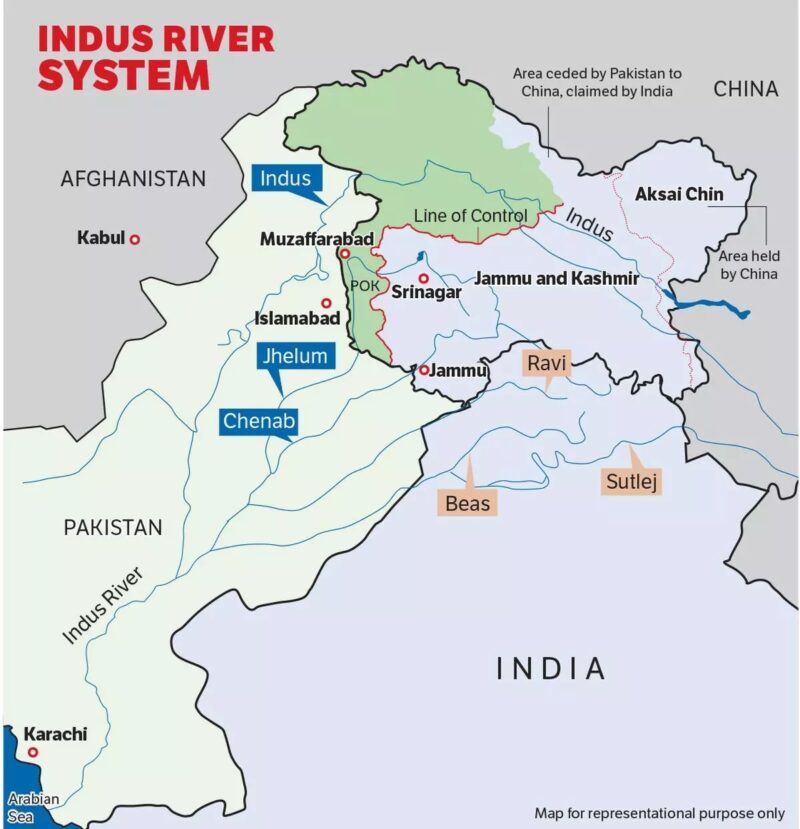
    The Indus River flows mainly from Tibet and the Himalayan regions of India’s Himachal Pradesh and Jammu and Kashmir and across Pakistan’s Punjab and Sindh before emptying into the Arabian Sea through Karachi.

    Of the six major tributaries of the Indus River— the Beas, Ravi and Sutlej are the “eastern rivers” and the Indus, Chenab and Jhelum are the “western rivers”. The former is for India’s exclusive use after Pakistan’s permitted water use, and the latter is for Pakistan’s exclusive use after the criteria of India’s permitted use are met.

    As a result, the split was made in the ratio of about 20:80 of the total water flow from the Indus system in favour of Pakistan. Pakistan has unrestricted access to the waters of the western rivers for agricultural, domestic, and industrial purposes.

    India too is permitted to use a limited amount of water from these rivers, apart from the eastern rivers, for specified purposes, such as irrigation and power generation. It also lays down detailed regulations for India in building projects over the western rivers.

    Historical context and Security concerns

    As the partition of British India took place on religious lines instead of geographic factors, the division of the historically integrated water system in a manner satisfactory to both countries was a challenging feat. Although most of the river naturally flows through the regions of Pakistan, it primarily originates from India before it enters the former. Hence, Pakistan is the downstream nation of the Indus River. This places Pakistan in a vulnerable position, exposed to the risks of India causing artificial droughts or flooding of its arable lands, which may be used as leverage to control water and food security in times of hostilities.

    According to Pakistan, it was entitled to all the waters of the Indus and its tributaries due to its historical right before or until the partition, also highlighting the threat of severe water scarcity without the continuous flow of the rivers. Whereas India insisted that the waters be equitably distributed on a new post-partition basis by proposing for the first time the separate rationing of the western and eastern rivers between the two nations. Ergo, paving the way for arguably one of the most successful, long-standing bilateral agreements struck between any two agnostic states.

    Provisions and Objectives of IWT

    In 1952, with the World Bank as the mediator, a Working Party consisting of Indian, Pakistani, and World Bank engineers was formed to draw up a cooperative plan for the use, allocation and distribution of the disputed waters. After almost eight long years of negotiations, the Indus Water Treaty was finally ratified in 1960.

    The main provisions of the IWT are as follows:

    • Water distribution:

    India and Pakistan received approximately 30% and 70% of the total waters of the Indus rivers located in India. India’s eastern rivers have a mean annual flow of 40b/m3 while the western of Pakistan have an MAF of 100b/m3.

    • Regulation of water use:

    Use of waters of the eastern and western rivers are explicitly demarcated between India and Pakistan while limited usage of the other country’s rivers is also permitted for specific purposes that are of non-consumptive nature, like hydropower generation, fishing, etc.

    • Water rights:

    According to IWT, although the liberty to use unutilized water of the other country exists, the right over the water is not forfeited over time, even in case of repeated underutilization.

    • Conflict resolution:

    A Permanent Indus Commission (PIC) comprising commissioners from both India and Pakistan is provided for by the Treaty. The PIC serves as a forum for the exchange of hydrological data, information, and views on the implementation of the treaty and the resolution of disputes.

    Aftermath

    The treaty has survived several border skirmishes, terror attacks including the 26/11, and even two full-fledged wars in 1965 and 1971. The terms of water sharing as agreed upon have been adhered to despite such hostilities.

    After the 2016 Uri Attack on an Indian Army base in Jammu and Kashmir and the 2019 Pulwama Attack, threats of revoking the Treaty have been made by India but never materialised, as the Treaty continues to remain intact. However, according to the IWT, the bombing or destroying of dams, barrages, power stations, etc. located in the Indian part of the Indus basin by Pakistan violates the Treaty which can lead to its abrogation.

    Despite Pakistan’s repeated violation of the Treaty by using groundwater of Ravi and Sutlej areas of India for various uses before they cross into its area, and by constructing river training works to reduce river flooding in Pakistan and enhance flooding in India’s Great Rann of Kutch area; no concerns have been raised by the latter hereto.

    With the Treaty in place, several projects have been undertaken on the allotted rivers, India has constructed the Bhakra-Nangal and Salal dams for hydroelectric power generation. Pakistan constructed the Tarbela and Mangla Dams for water storage, irrigation, and hydropower generation.

    Shahpur Kandi and Ratle Projects:

    The Shahpur Kandi project of India over the Ujh river has been objected to by Pakistan for diverting waters of Ujh, a tributary of Ravi, an eastern river exclusive for India’s use. The dam was officially completed in February 2024.

    India’s ongoing Ratle Hydroelectric Project on the Chenab also made headlines, for Pakistan’s objection to its construction in the Indian area after its funding was finally approved in 2021. The dam would have an 850 MW generative capacity, for which a limited reserve of water is required to be reserved. This alarmed Pakistan as it claimed it would pose a risk of possible weaponization of water supply by India in wartime situations. Disagreement over the summoning of a Neutral Expert or a Court of Arbitration as authorised by the Treaty for dispute resolution was settled in 2016 by the World Bank’s decision to let both motions proceed simultaneously. Later, India was allowed to construct the dam by the World Bank despite objections by Pakistan. The project is scheduled to commence operations in 2026.

    A Blueprint for Transboundary Water Cooperation

    The success of the IWT sets an example of how countries can overcome their political differences and contribute to an efficient system of shared resource governance. It successfully helped the Indian subcontinent evade a potential war between the two nuclear-armed states over the river basin, a model for other regions struggling with water scarcity and competition to follow.

    Climate change coupled with the construction of dams and barrages for water storage and regulation carries heavy ecological repercussions like the disruption of river ecosystems, aquatic habitats, and biodiversity of the concerned region. Consequently, endangering the livelihood of the nearby occupants, even forcing them to relocate.  Hence, such a cooperative regulatory mechanism must be in place to facilitate constructive dialogue towards incorporating environmental considerations into water management strategies to tackle and mitigate any negative repercussions.

    The Indus Water Treaty has demonstrated its efficacy as a significant diplomatic agreement between the two neighbouring states, consistently withstanding various challenges over time. The treaty primarily emphasises the importance of cooperation and diplomacy in resolving transboundary water disputes while also establishing a foundation and providing scope for potential future collaboration in numerous domains of shared governance.

    Proposals for its abrogation have been deemed impractical for both parties, as the treaty has endured for six decades. Nevertheless, there is a recognised need to re-examine, renegotiate, revise, and amend the long-standing Treaty to better address contemporary issues, including new ecological and climate change concerns, as well as evolving terms of negotiation.


    References:

    ET Online, (2024, February 26). India completely stops Ravi River water flow to Pakistan. Historical context and significance. The Economic Times. https://economictimes.indiatimes.com/news/india/india-completely-stops-ravi-river-water-flow-to-pakistan-historical-context-and-significance/articleshow/107980936.cms

    Gupta, M.S. (2024, February 25). Shahpurkandi dam complete after 3 decades, will help check unutilised Ravi water flowing to Pakistan. The Print. https://theprint.in/india/governance/shahpurkandi-dam-complete-after-3-decades-will-help-check-unutilised-ravi-water-flowing-to-pakistan/1978380/

    Gupta, S [The Print]. (2023, January 31). Understanding the Indus Waters Treaty & why India is pushing Pakistan for changes [Video]. YouTube. https://youtu.be/pVp93u2IgSg

    MEA Media Centre, (1960, September 19). Bilateral/Multilateral Documents: Indus Waters Treaty. Ministry of External Affairs, Government of India (MEA, GOI). https://www.mea.gov.in/bilateral-documents.htm?dtl/6439/Indus

    Samantha, P.D. (2023, January 31). The Indus Question: India, Pakistan and rivers of concern. The Economic Times. https://economictimes.indiatimes.com/news/india/analysis-india-pakistan-looking-to-exploit-resources-for-more-electricity/articleshow/97462196.cms

    Times Now Digital, (2018, November 7). Pak ‘diplomatic sabotage’ busted: India to go ahead with Ratle hydroelectric project, govt to send team to J&K. Times Now. https://web.archive.org/web/20190225224015/https://www.timesnownews.com/india/article/pakistan-india-ratle-hydroelectric-project-indus-water-treaty-agreement-chenab-shahpur-kandi-dam-project-ujh-multipurpose-project-jammu-and-kashmir/310636

  • What International Order?

    What International Order?

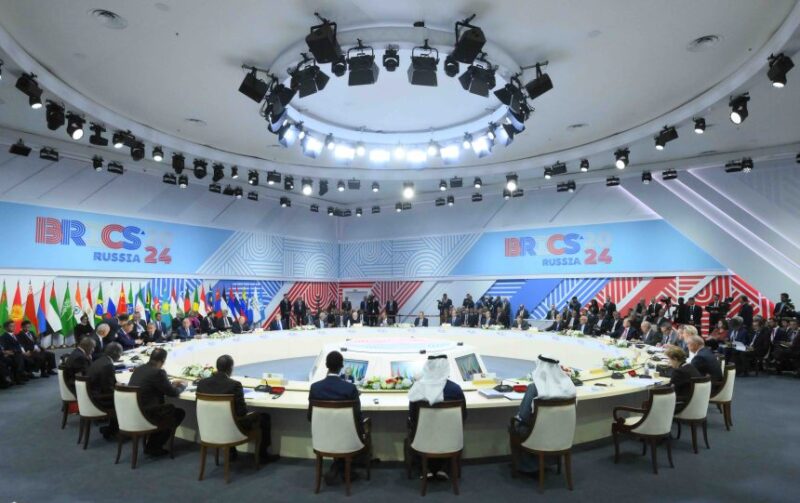
    The recently concluded BRICS summit confirms the process of inevitable transformation of the international order. The US-led West, since the fall of the USSR, has increasingly demonstrated intolerance to their view of the world. The ongoing conflicts in UKraine and Gaza has exposed their duplicity and the entire Global South have come to realise the anamolies in international order and the so-called rules-based system. The West’s unabashed support to Israel’s genocide and babarism in Gaza, despite their peoples’ opposition makes the claims of democracy and humanism in the West sound hollow. Thierry Meyssan dealt incisively with this duplicity of the West, primarily the Ango-Saxon powers, in his speech last year in Magdeburg (Germany), at the conference organized by the magazine Compact, “Amitie avec la Russie”, on November 4, 2023.

    We reproduce the text of Thierry Meyssan’s speech, translated by Roger Lagasse’, and published earlier in voltairenet.org

    In it, he explains what, in his view, constitutes the fundamental difference between the two conceptions of the world order now clashing from the Donbass to Gaza: that of the Western bloc and that to which the rest of the world refers. The question is not whether this order should be dominated by one power (unipolar) or by a group of powers (multipolar), but whether or not it should respect the sovereignty of each. He draws on the history of international law, as conceived by Tsar Nicholas II and Nobel Peace Prize winner Léon Bourgeois.

    – Team TPF

    BRICS Summit 2024 in Kazan, Russia, October 23,2024. Sputnik . Photo hosting agency brics-russia2024.ru

    What International Order?

    Thierry Meyssan

    We’ve seen NATO’s crimes, but why affirm our friendship with Russia? Isn’t there a risk of Russia behaving tomorrow like NATO does today? Are we not substituting one form of slavery for another?

    To answer this question, I would draw on my successive experience as advisor to five heads of state. Everywhere, Russian diplomats have told me: you’re on the wrong track: you’re committed to putting out one fire here, while another has started elsewhere. The problem is deeper and broader.

    I would therefore like to describe the difference between a world order based on rules and one based on international law. This is not a linear story, but a struggle between two worldviews – a struggle we must continue.

    In the 17th century, the Treaties of Westphalia established the principle of state sovereignty. Each is equal to the others, and no one may interfere in the internal affairs of others. For centuries, these treaties governed relations between the present-day Länder, as well as between European states. They were reaffirmed by the Congress of Vienna in 1815 when Napoleon I was defeated.

    On the eve of the First World War, Tsar Nicholas II convened two International Peace Conferences (1899 and 1907) in The Hague to “seek the most effective means of assuring all peoples the benefits of a real and lasting peace”. Together with Pope Benedict XV, he prepared them on the basis of canon law, not the law of the strongest. After two months of deliberation, 27 states signed the final proceedings. The president of the French Radical [Republican] Party, Léon Bourgeois, presented his thoughts [1] on the mutual dependence of states and their interest in uniting despite their rivalries.

    At the instigation of Léon Bourgeois, the Conference created an International Court of Arbitration to settle disputes by legal means rather than by war. According to Bourgeois, states would only agree to disarm when they had other guarantees of security.

    The final text instituted the notion of “the duty of States to avoid war”… by resorting to arbitration.

    At the instigation of one of the Tsar’s ministers, Frédéric Fromhold de Martens, the Conference agreed that, during armed conflict, populations and belligerents must remain under the protection of the principles resulting from “the usages established between civilized nations, the laws of humanity and the dictates of public conscience”. In short, the signatories undertook to stop behaving like barbarians.

    This system only works between civilized states that honour their signatures and are accountable to public opinion. It failed, in 1914, because states had lost their sovereignty by entering into defense treaties that required them to go to war automatically in certain circumstances that they could not assess for themselves.

    Léon Bourgeois’s ideas gained ground, but met with opposition, including from his rival in Georges Clemenceau’s Radical Party. Clemenceau did not believe that public opinion could prevent wars. Nor did the Anglo-Saxons, U.S. President Woodrow Wilson and British Prime Minister Lloyd George. At the end of the First World War, these three men substituted the might of the victors for the fledgling international law. They shared the world and the remnants of the Austro-Hungarian, German and Ottoman empires. They blamed Germany alone for the massacres, denying their own. They imposed disarmament without guarantees. To prevent the emergence of a rival to the British Empire in Europe, the Anglo-Saxons began to pit Germany against the USSR, and secured France’s silence by assuring her that she could plunder the defeated Second Reich. In a way, as the first President of the Federal Republic, Theodor Heuss, put it, they organized the conditions for the development of Nazism.

    As they had agreed among themselves, the three men reshaped the world in their own image (Wilson’s 14 points, the Sykes-Picot agreements, the Balfour Declaration). They created the Jewish homeland of Palestine, dissected Africa and Asia, and tried to reduce Turkey to its minimum size. They organized all the current disorders in the Middle East.

    Yet it was on the basis of the ideas of the late Nicholas II and Léon Bourgeois that the League of Nations (League) was established after the First World War, without the participation of the United States, which thus officially rejected any idea of International Law. However, the League also failed. Not because the United States refused to join, as some say. That was their right. But firstly, because it was incapable of re-establishing strict equality between states, as the United Kingdom was opposed to considering colonized peoples as equals. Secondly, it did not have a common army. And finally, because the Nazis massacred their opponents, destroyed German public opinion, violated the Berlin signature and did not hesitate to behave like barbarians.

    As early as the Atlantic Charter in 1942, the new U.S. President, Franklin Roosevelt, and the new British Prime Minister, Winston Churchill, set themselves the common goal of establishing a world government at the end of the conflict. The Anglo-Saxons, who imagined they could rule the world, did not, however, agree amongst themselves on how to go about it. Washington did not wish London to meddle in its affairs in Latin America, while London had no intention of sharing the hegemony of the Empire over which “the sun never set”. During the war, the Anglo-Saxons signed numerous treaties with Allied governments, including those in exile, which they hosted in London.

    Incidentally, the Anglo-Saxons failed to defeat the Third Reich, and it was the Soviets who overthrew it and took Berlin. Joseph Stalin, First Secretary of the CPSU, was opposed to the idea of a world government, and an Anglo-Saxon one at that. All he wanted was an organization capable of preventing future conflicts. In any case, it was Russian conceptions that gave birth to the system: that of the United Nations Charter, at the San Francisco conference.

    In the spirit of the Hague Conferences, all UN member states are equal. The Organization includes an internal tribunal, the International Court of Justice, responsible for settling disputes between its members. However, in the light of previous experience, the five victorious powers have a permanent seat on the Security Council, with a veto. Given that there was no trust between them (the Anglo-Saxons had planned to continue the war with the remaining German troops against the USSR) and that it was unknown how the General Assembly would behave, the various victors wanted to ensure that the UN would not turn against them (the USA had committed appalling war crimes by dropping two atomic bombs against civilians, while Japan… was preparing its surrender to the Soviets). But the great powers did not understand the veto in the same way. For some, it was a right to censor the decisions of others; for others, it was an obligation to take decisions unanimously.

    Except that, right from the start, the Anglo-Saxons didn’t play ball: an Israeli state declared itself (May 14, 1948) before its borders had been agreed, and the UN Secretary-General’s special envoy to oversee the creation of a Palestinian state, Count Folke Bernadotte, was assassinated by Jewish supremacists under the command of Yitzhak Shamir. Moreover, the seat on the Security Council allocated to China, in the context of the end of the Chinese Civil War, was given to Chiang Kai-shek’s Kuomintang and not to Beijing. The Anglo-Saxons proclaimed the independence of their Korean zone of occupation as the “Republic of Korea” (August 15, 1948), created NATO (April 4, 1949), and then proclaimed the independence of their German zone of occupation as “Federal Germany” (May 23, 1949).

    The USSR considered itself fooled, and slammed the door (“empty seat” policy). The Georgian Joseph Stalin had mistakenly believed that the veto was not a right of censure, but a condition of unanimity of the victors. He thought he could block the organization by boycotting it.

    The Anglo-Saxons interpreted the text of the Charter they had drafted and took advantage of the Soviets’ absence to place “blue helmets” on the heads of their soldiers and wage war on the North Koreans (June 25, 1950) in the “name of the international community” (sic). Finally, on August 1, 1950, the Soviets returned to the UN after an absence of six and a half months.

    The North Atlantic Treaty may be legal but NATO’s rules of procedure violate the UN Charter. It places the Allied armies under Anglo-Saxon command. Its Commander-in-Chief, the SACEUR, is necessarily an American officer. According to its first Secretary General, Lord Ismay, the Alliance’s real aim was neither to preserve the peace nor to fight the Soviets, but to “keep the Americans in, the Russians out and the Germans under control” [2]. In short, it was the armed wing of the world government that Roosevelt and Churchill wanted to create. It was in pursuit of this goal that President Joe Biden ordered the sabotage of the Nord Stream gas pipeline linking Russia and Germany.

    At the Liberation, MI6 and OPC (the future CIA) secretly set up a stay-behind network in Germany. They placed thousands of Nazi leaders in this network, helping them to escape justice. Klaus Barbie, who tortured French Resistance coordinator Jean Moulin, became the first commander of this shadow army. The network was then incorporated into NATO, where it was greatly reduced. It was then used by the Anglo-Saxons to interfere in the political life of their supposed allies, who were in reality their vassals.

    Joseph Goebbels’ former collaborators created the Volksbund für Frieden und Freiheit. With the help of the USA, they persecuted German communists. Later, NATO’s stay-behind agents were able to manipulate the extreme left to make it detestable. A case in point is the Bader gang. But as these men were arrested, the stay-behind came and murdered them in prison, before they could stand trial and speak out. In 1992, Denmark spied on Chancellor Angela Merkel on NATO instructions, just as in 2022, Norway, another NATO member, helped the USA sabotage Nord Stream…

    Returning to international law, things gradually returned to normal, until in 1968, during the Prague Spring, the Ukrainian Leonid Brezhnev did in Central Europe what the Anglo-Saxons were doing everywhere else: he forbade the USSR’s allies to choose an economic model other than their own.

    With the dissolution of the USSR, things began to get worse. The US Undersecretary of Defense, Paul Wolfowitz, drew up a doctrine according to which, to remain masters of the world, the United States had to do everything in its power to prevent the emergence of a new rival, starting with the European Union. It was in application of this idea that Secretary of State James Baker imposed the enlargement of the European Union to include all the former states of the Warsaw Pact and the USSR. By expanding in this way, the Union deprived itself of the possibility of becoming a political entity. It was again in application of this doctrine that the Maastricht Treaty placed the EU under NATO’s protection. And it is still in the application of this doctrine that Germany and France are paying for and arming Ukraine.

    Then came Czech-US professor Josef Korbel. He proposed that the Anglo-Saxons should dominate the world by rewriting international treaties. All that was needed, he argued, was to substitute Anglo-Saxon law, based on custom, for the rationality of Roman law. In this way, in the long term, all treaties would give the advantage to the dominant powers: the United States and the United Kingdom, linked by a “special relationship”, in the words of Winston Churchill. Professor Korbel’s daughter, Democrat Madeleine Albright, became Ambassador to the UN, then Secretary of State. Then, when the White House passed into Republican hands, Professor Korbel’s adopted daughter, Condoleeza Rice, succeeded her as National Security Advisor, then Secretary of State. For two decades, the two “sisters” [3]patiently rewrote the main international texts, ostensibly to modernize them, but in fact to change their spirit.

    Today, international institutions operate according to Anglo-Saxon rules, based on previous violations of international law. This law is not written in any code, since it is an interpretation of custom by the dominant power. Every day, we substitute unjust rules for International Law and violate our own signature.

    For example:

    • When the Baltic States were created in 1990, they made a written commitment to preserve the monuments to the sacrifices of the Red Army. The destruction of these monuments is therefore a violation of their own signature.
    • Finland made a written commitment in 1947 to remain neutral. Joining NATO is therefore a violation of its own signature.
    • On October 25, 1971, the United Nations adopted Resolution 2758 recognizing Beijing, not Taiwan, as the sole legitimate representative of China. As a result, Chiang Kai-shek’s government was expelled from the Security Council and replaced by that of Mao Zedong. Consequently, China’s recent naval manoeuvres in the Taiwan Strait do not constitute aggression against a sovereign state, but the free deployment of its forces in its own territorial waters.
    • The Minsk agreements were intended to protect Russian-speaking Ukrainians from harassment by “integral nationalists”. France and Germany vouched for them before the Security Council. But, as Angela Merkel and François Hollande have said, neither of them had any intention of implementing them. Their signatures are worthless. If it had been otherwise, there would never have been a war in Ukraine.

    The perversion of International Law reached a peak with the appointment, in 2012, of the American Jeffrey Feltman as Director of Political Affairs. From his office in New York, he oversaw the Western war on Syria. Using the institutions of peace to wage war [4].

    Until the United States threatened it by stockpiling weapons on its border, the Russian Federation respected all the commitments it had signed or that the Soviet Union had signed. The Nuclear Non-Proliferation Treaty (NPT) obliges the nuclear powers not to spread their nuclear arsenals around the world. The United States, in violation of its signature, has been stockpiling atomic bombs in five vassal countries for decades. They train allied soldiers in the handling of these weapons at the Kleine Brogel base in Belgium, the Büchel base here in Germany (Rhineland-Palatinate), the Aviano and Ghedi bases in Italy, the Volkel base in the Netherlands and the Incirlik base in Turkey.

    Then they say, by virtue of their coups de force, that this has become the custom.
    Now, the Russian Federation, considering itself under siege after a US nuclear bomber flew over the Gulf of Finland, has also played with the Non-Proliferation Treaty and installed atomic bombs on the territory of Belarus. Of course, Belarus is not Cuba. Placing Russian nuclear bombs there changes nothing. It’s just a message sent to Washington: if you want to re-establish the Law of the Strongest, we can accept that too, except that, from now on, we’re the strongest. Note that Russia has not violated the letter of the Treaty, as it is not training the Belarusian military in these weapons, but it has taken liberties with the spirit of the Treaty.

    As Léon Bourgeois explained in the last century, to be effective and lasting, disarmament treaties must be based on legal guarantees. It is therefore urgent to return to international law, failing which we will plunge headlong into a devastating war.

    Our honour and our interest lie in re-establishing international law. It’s a fragile construction. If we want to avoid war, we must re-establish it, and we can be sure that Russia thinks as we do, that it will not violate it.

    Or we can support NATO, which brought its 31 defence ministers together in Brussels on October 11 to listen to their Israeli counterpart announce, via videoconference, that he was going to raze Gaza to the ground. And none of our ministers, including Germany’s Boris Pistorius, dared to speak out against the planning of this mass crime against civilians. The honour of the German people has already been betrayed by the Nazis, who ultimately sacrificed you. Don’t let yourselves be betrayed again, this time by the Social Democratic Party and the Greens.

    We don’t have to choose between two overlords, but to protect peace, from the Donbass to Gaza, and, ultimately, to defend International Law.


    Source: “What international order?”, by Thierry Meyssan, Translation Roger Lagassé, Voltaire Network, 7 November 2023, www.voltairenet.org/article219965.html

    Republished under Creative Commons CC-BY-NC-ND

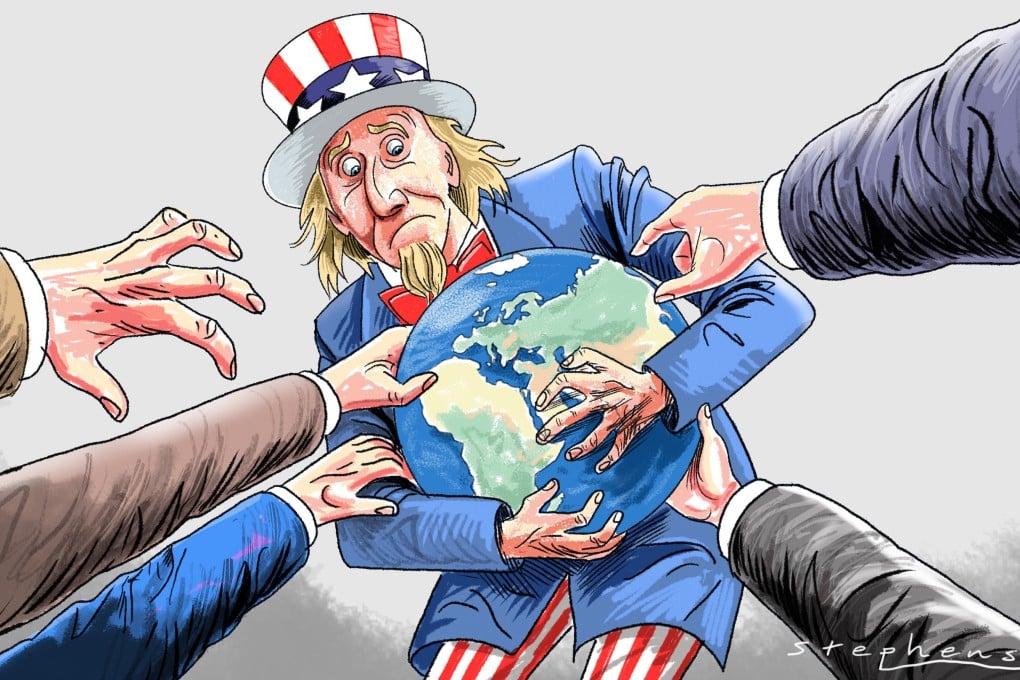
    Feature Image Credit: ‘Imagine a World free from the Oppression of a US-led global Order’ – www.scmp.com


  • The beginning of the end of Israel

    The beginning of the end of Israel

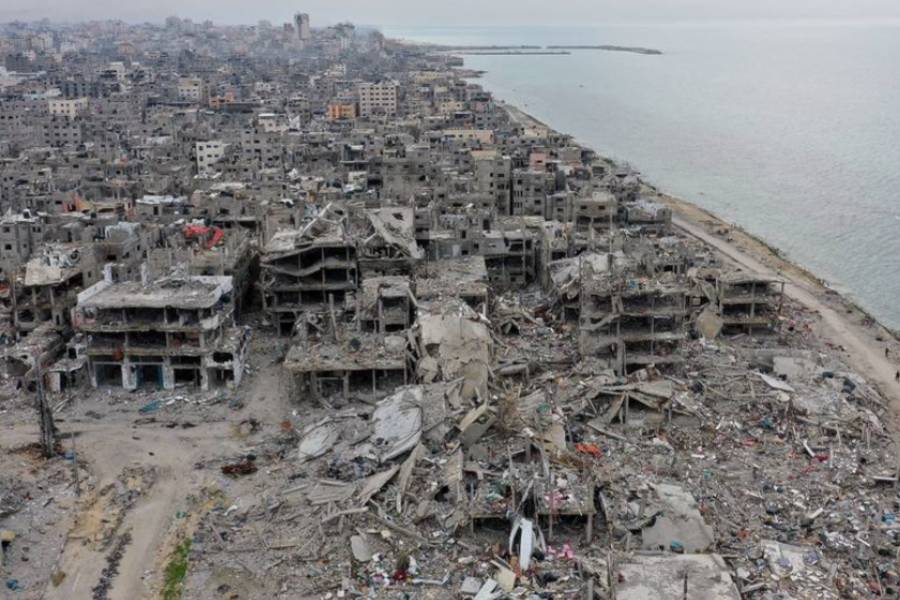
    One year later, the flames of genocide still burn, but after decades of persecution and bloodshed, we may well be seeing the beginning of the end of the settler-colonial project in Palestine.

    We have reached a grim milestone. A full year of gruesome Israeli mass murder. A year of epic Palestinian suffering.

    A year of direct Western complicity. A year of continuous media incitement. A year of shameful inaction by international institutions.

    For twelve months, we have seen relentless persecution of human rights defenders across the West, solely for peacefully opposing genocide and apartheid.

    And fifty-two weeks of a horrified global public helplessly witnessing on their screens the first live-streamed genocide in history.

    The carnage of this past year is unprecedented. The destruction is almost unimaginable.

    Still, this genocide will end. The Palestinian people and their besieged nation will undoubtedly emerge from the ashes of genocide, recover, and reassert their inalienable rights in their ancient homeland.

    But international institutions and the global human rights system will be left bruised and battered.

    The political capital expended by the US empire and the broader West in defence of the slaughter, as well as their global standing and reputation, will never be recouped.

    And, almost certainly, this year of cruelty and lawlessness will mark the beginning of the end for the Zionist project in Palestine and, therefore, of the state of Israel as we know it.

    A formula for disaster

    Of course, neither the genocide nor the current wave of slaughter of Palestinians started in October of 2023. The systematic massacre, purging, and erasure of the indigenous Palestinian people began in earnest with the Nakba of 1947-48, and it has not ceased since that bloody beginning.

    And the genocidal threat was always obvious. Any thinking person could see, even prior to the establishment of the state of Israel, that the Zionist project of the West was a formula for disaster.

    First, at the very historic moment when colonialism was being dismantled around the world, and global human rights rules were being adopted at the United Nations, the West carved out an exception for Palestine.

    It was at this moment that Zionist forces chose to attack Palestine, murder and terrorize its population, chase many survivors away in terror, and begin the erasure of the indigenous people, and their replacement with a European settler colony founded by foreign invaders and radicalized by a deeply racist and fundamentally violent political ideology.

    The colony was to be sustained at the barrel of a gun by waging constant war both against the Indigenous people and against the neighbouring states.

    A colonial education system and a media ecosystem were built to dehumanize the Indigenous and neighbouring peoples and to instil a supremacist ideology into the settler population.

    The settler state, its economy, and its society were thoroughly militarized, enlisting all adults in the project of state violence, arming it to the teeth, including with nuclear, chemical, and biological weapons, and even integrating the field-testing of new weapons on captive civilian populations as part of the business model of the colony’s arms industry.

    They ring-fenced the entire project with western-guaranteed impunity, carving out an exception to the application of all rules of international law.

    And they built an all-encompassing machinery of repression, including laws, policies, practices, and technologies to ensure the constant subjugation, dehumanization, and persecution of the indigenous Palestinian people.

    The toxic cocktail was complete.

    Maintaining Western support

    Of course, an artificially imposed European colony in the heart of the Middle East, which is necessarily maintained by force, could never become self-sufficient. Rather, it has always, and will always, rely on massive support from Western states, especially the US. Maintaining that vital support was to become a key goal of the Israeli state and its transnational network of proxy groups.

    As such, in the intervening years, the Israeli regime adopted a strategy of incremental genocide, with simmering persecution and dispossession, punctuated by periodic full-blown massacres and marked by a continuous march of expansion.

    It was a pace, tried and true over 75 years, with which the regime’s Western sponsors were comfortable, allowing them to continue unbroken the flow of military, economic, and diplomatic support without significant domestic pressure at home.

    And it allowed like-minded media corporations, decade after decade, to continuously disseminate pro-Israel propaganda as a smokescreen to obscure the horrific realities being perpetrated against the indigenous people on the ground.

    Expedited genocide

    But when Israel’s current ultra-Zionist government took power last year, it immediately abandoned the strategy of incremental genocide.

    In its place, it moved to expedited genocide (beginning with waves of ethnic cleansing in occupied Jerusalem and the West Bank), betting that its Western sponsors (and their captured politicians and complicit media) would not dare (or care) to take the steps necessary to stop it, even when it launched wholesale civilian slaughter in Gaza.

    They were right.

    So much so that Western countries like the U.S., UK, Germany, and others quickly moved beyond mere acquiescence for the genocide and into direct complicity and participation in it.

    As a result, one year later, we are witnessing unprecedented bloodshed in the region, and the broader world is in deep trouble.

    Axis of Genocide

    Thus, Israel is not alone in its march of terror. It is accompanied, in lockstep, by what has been called the Axis of Genocide.

    Four members of that Axis, Israel, the U.S., the UK, and France, are nuclear-armed states. A fifth, Germany, is a serial genocide perpetrator and a major European economic power. Three (the U.S., UK, and France) have veto power in the UN Security Council.

    Adding to the danger, all of its members share a common ideological grounding in militarism, colonialism, white supremacy, and political Zionism. Most have the stain of genocide on their historical records.

    All have political systems that are deeply compromised and corrupted by the influence of the weapons industry, the billionaire class, and the Israeli lobby. And all are marked by profound societal levels of Islamophobia, anti-Arab racism, and anti-Palestinian bigotry.

    And, in defence of a single, small, oppressive, and violent settler colony in the Middle East, all have quickly abandoned the entire edifice of international law and international institutions built up since the end of the Second World War, and which they once claimed as part of their brand.

    As recent history has shown, these biases, linkages, and incentives have become a formula not only for genocide in Palestine but for catastrophe on a global scale.

    Breaking bones and records

    And, indeed, the cost of Western-secured Israeli impunity has been shockingly high.

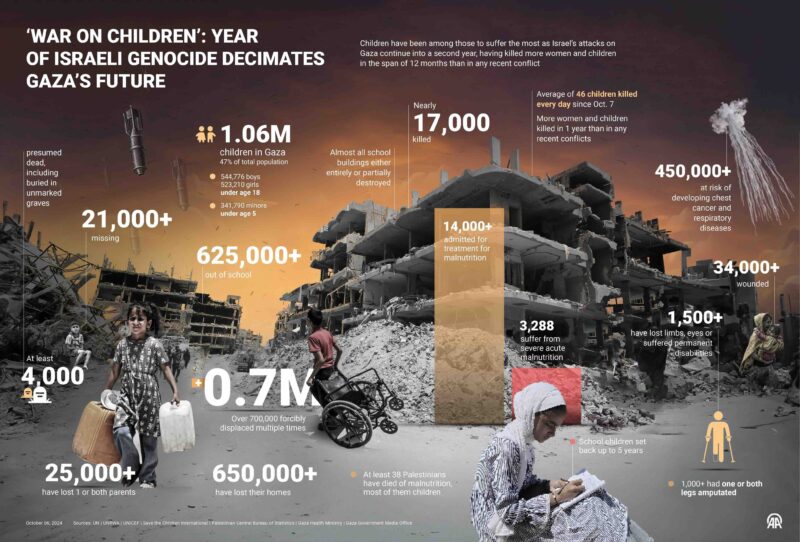
    Image Credit: @anadoluagency

    In one year, Israel has set new records for the pace of civilian killing, the rate of destruction of civilian infrastructure, the killing of children, the killing of medical personnel, the killing of journalists, the killing of humanitarian workers, and the killing of UN staff.

    The depravity of Israel’s actions has shocked the world. Collective punishment, a chain of massacres, summary executions, torture camps, systematic sexual violence, starvation tactics, imposed disease, the direct targeting of small children with sniper rifles, and the blocking of humanitarian aid to facilitate starvation.

    We have all seen the images. The methodic eradication of whole neighbourhoods, schools, hospitals, universities, food stores, shelters, refugee camps, agricultural fields, and even cemeteries.

    The mangled bodies of Palestinians, the fear-filled eyes of the children, the terror as bombs fall on bread lines. The cold-blooded murder of innocents, of defenceless children like Hind Rajab, trapped in the family car, terrified for hours and then slaughtered by Israeli soldiers, and of thousands of others like her.

    And we have seen the cold, cruel laughter of the Israeli soldiers, the deranged chants of violent Israeli settlers, the genocidal pledges of Israeli political and military leaders.

    The promise of the Prime Minister to wipe out the Palestinians “like Amalek”, a biblical verse that calls for Israel to “utterly destroy all that they have and spare them not; but slay both man and woman, infant and suckling, ox and sheep, camel and ass.”

    The calls of Israeli leaders to perpetrate another Nakba, to raze Gaza to the ground, to make no distinction between civilians and fighters. To “bury them.”

    And, by now, we have all memorized the familiar barbarous pattern of Israel’s crimes: target civilians and civilian infrastructure, then target the rescue workers who come to help, then celebrate in Hebrew but switch to English to claim that they were all terrorists, human shields, or collateral damage, then reload and do it again.

    The accumulated criminal guilt of the Israeli perpetrators and their complicit Western partners is staggering. But so too is the historic moral lapse of the wider world, both those who have defended the genocide and those who have remained silent as it has been carried out with their tax dollars, with their government’s political support, or in their name.

    Today, everyone knows. No one can say they were not warned before the catastrophe. And no one can say they did not know of the horrors that followed, broadcast in real-time to all of us.

    Seventy-six blood-soaked years into this colonial enterprise, it is clear to all who will see that what the West has constructed in the heart of the Middle East is not an enlightened project, but rather a rampaging Frankenstein monster that threatens to drag the indigenous Palestinian people, the region, and the world into a conflagration from which it may not recover for generations.

    The darkness spreads

    How long the rampage can be sustained is an open question. But there will undoubtedly be much more darkness before the dawn.

    Israel, drunk with Western-backed impunity, even as it continues its genocide in Palestine, is now spreading its attacks across the region and leaving mountains of bodies and rivers of blood in its wake.

    In a matter of weeks, it has waged terror attacks with booby-trapped communication devices in Lebanon, assassinated leaders across the region, launched military attacks on Gaza, the West Bank, Lebanon, Syria, Iraq, Iran, and Yemen, has invaded Lebanese territory, and is now seeking to draw its U.S. sponsor into an all-out regional war of conquest and domination.

    For their part, collaborationist governments in the West show little appetite for reining in the rampaging monster that they themselves created in the Middle East, and to which they continue to provide endless flows of arms, money, intelligence, diplomatic cover, legal exceptionalism, and a heretofore impenetrable cocoon of impunity.

    When the reckoning comes, as it must, the accountability of both Israel and its Western accomplices must be secured, lest these horrors be repeated in an endless cycle of atrocity, impunity, and recidivism.

    Israeli impunity is coming to an end

    But there are flickering lights in the darkness, and they are growing.

    The just cause of Palestine and the steadfastness of her people have inspired millions around the world to stand up and fight back. The civilized world is now more mobilized than it has been in generations to oppose the horrific evil unleashed on the world by Israel and its Western sponsors.

    More and more people are escaping from the distorting matrix of Western corporate media and turning to independent media and first-hand sources on social media, delivering a powerful blow to the controlled, pro-Israel narrative of official Western institutions.

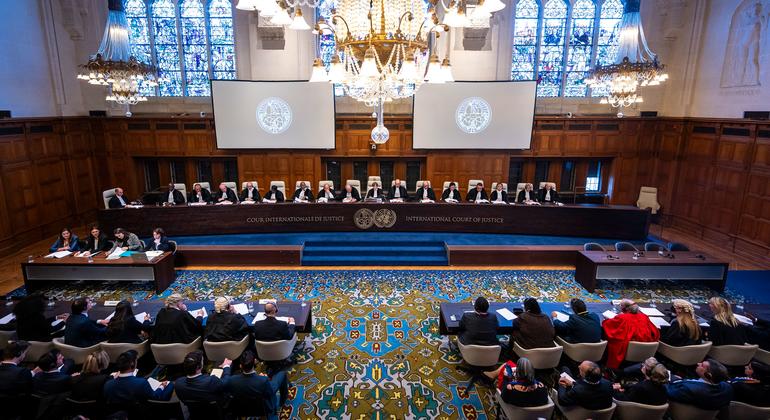
    Today, Israel is on trial for genocide at the World Court, and its leaders are the subject of arrest warrant requests at the International Criminal Court for crimes against humanity, including extermination.

    The ICJ has already issued a series of provisional anti-genocide measures against Israel, and a growing list of countries is lining up behind Palestine and South Africa in the genocide case against Israel.

    A dedicated international tribunal is under discussion at the UN. Cases have already been brought in national courts around the world, and more are certain to follow. Plans are also underway to mandate an international anti-apartheid body to focus on Israel.

    In the meantime, the United Nations, its independent human rights mechanisms, and the leading international, Palestinian, and Israeli human rights organizations have all collected massive quantities of evidence, have strongly condemned Israel for its shocking criminality, and are working to ensure accountability.

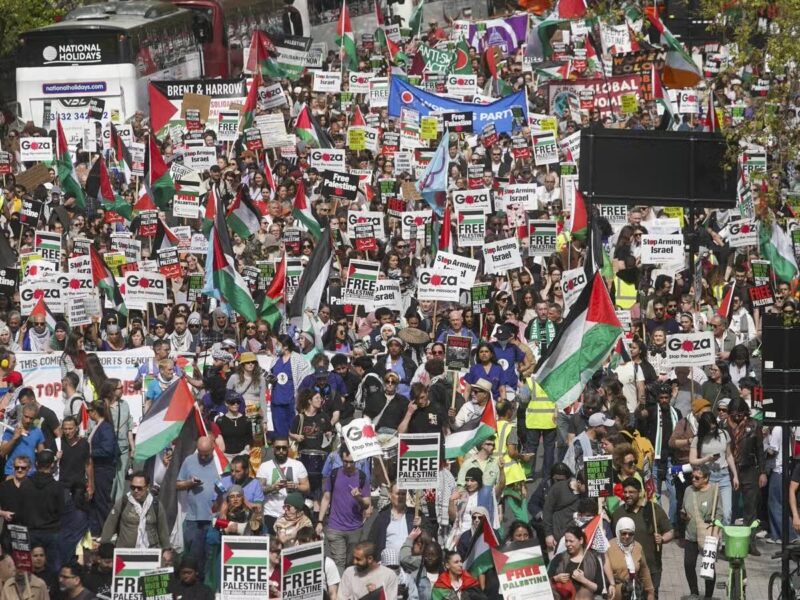
    Mass demonstrations against Israel are not only daily occurrences in capitals around the globe, but they are actually growing, undeterred by the often-brutal efforts (especially of Western governments) to suppress them.

    The ICJ has declared the obligation of all states to cut off all recognition, aid, investment, trade, weapons, and support of any kind with Israel’s colonial project in the occupied Palestinian territory.

    Israel is increasingly isolated on the global stage. And the global movement for boycott, divestment and sanctions is growing with every passing day.

    In other words, the age of Israeli impunity is coming to an end, despite the best efforts of the U.S., the UK, Germany, and other complicit Western states.

    And we may well be seeing, after decades of endless persecution and bloodshed, the beginning of the end of the European settler-colonial project in Palestine.

    One year later, the flames of genocide still burn. At this tragic moment, it is hard to see through the smoke that obscures the path forward. But white supremacist settler colonialism was defeated in South Africa, Rhodesia, Namibia, and Algeria. It will be defeated in Israel too. Through struggle and solidarity, with law and politics, in resistance and resilience, this will end.


    Feature Image Credit: Palestinian Return Center

    This article was published earlier in mondoweiss.net

  • China has achieved escape velocity: it is now unstoppable

    China has achieved escape velocity: it is now unstoppable

    The 21st century is shaping up to be the Asian, Eurasian, and Chinese century.

    While the Hegemon spent at least $7 trillion – and counting – on unwinnable Forever Wars, China is spending $1 trillion in an array of Belt and Road Initiative (BRI) projects across the Global South: the emphasis is digital/transportation connectivity corridors. Geoeconomic imperatives intertwined with rising geopolitical influence.

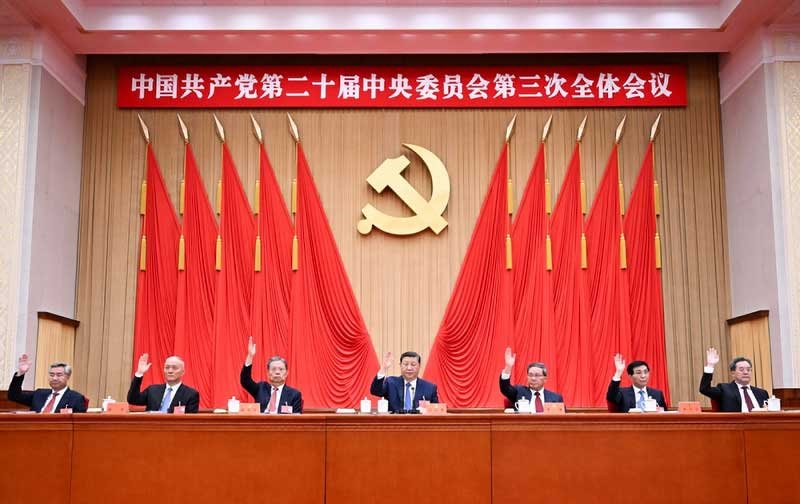
    The four-day, twice-a-decade plenum of the Communist Party of China that took place last week in Beijing, designing an economic road map all the way to 2029, was a stunning affair in more ways than one.

    Let’s start with continuity – and stability. There’s no question after the plenum that Xi Dada, or The Big Panda, will stay on the helm until 2029 – the end of the current five-year economic drive.

    And if Xi is healthy enough, he will stay until 2035: the fateful and uber-game-changing target year for China to exhibit a GDP per capita of $30,000, with massive worldwide reverberations.

    Here, we see the confluence between the progression of “socialism with Chinese characteristics” and the defining contours, if not of a Pax Sinica, at least of the non-Hegemon-centric, multi-nodal world (italics mine).

    The proverbial U.S. Think Tankland/Sinophobia axis has been hysterical on China not being able to sustain a 5% a year growth rate for the next few years – the target once again stressed at the plenum.

    The Chinese themselves have not bothered about the growth rate for a long time, since in 2018 they switched to a strategy of so-called qualitative development, that is, not at the expense of traditional industries, but on the basis of high technologies and the creation of new areas, such as the production of new energy sources and artificial intelligence.

    A Russian analysis by the Center for Geopolitical Forecasts makes a crucial point: “The Chinese themselves have not bothered about the growth rate for a long time, since in 2018 they switched to a strategy of so-called qualitative development, that is, not at the expense of traditional industries, but on the basis of high technologies and the creation of new areas, such as the production of new energy sources and artificial intelligence.”

    That’s the rationale behind Made in China 2025 – which is being implemented at breakneck speed: high-tech development leading the way towards a “high-level socialist market economy”, to be consolidated by 2025 and fully constructed by 2035.

    The next step will be to attain the status of “modernized socialist power” by 2049, at the 100th anniversary of the People’s Republic of China (PRC).

    The plenum proved once more that “socialism with Chinese characteristics” – or, for the recalcitrant, Chinese-modified capitalism – is “people-centric”. The supreme values are national interest and the people’s interests – attested by the fact that large private corporations remain under the strategic control of the CPC.

    It’s idle to try to find in the final communique at the end of the plenum any restrictions on private capital on the path to “universal prosperity”. The key point is that the role of capital should always be subordinated to the concept of “socialism with Chinese characteristics”.

    Watch the reform ship steadily sailing

    Everything is explained here in nearly didactic terms, chronicling the birth of the “Decision of the CPC Central Committee on further comprehensive deepening of reforms to promote Chinese modernization”.

    What is now already referred to colloquially all across China as “The Decision” spreads across 15 parts and 60 articles, divided into three main sections, proposing more than 300 important reforms.

    “The Decision”, in full, has not yet been published; only the road map of how Beijing planners got there. Of course, this is no mere policy paper; it’s a quintessentially CPC-style dissertation in which the details of economic and political measures are obscured by clouds of images and metaphors.

    Take a look, for instance, at this passage:

    “To ensure that the reform ship sails forward steadily, the ‘Decision’ proposes that further comprehensive deepening of reform must implement the “six principles”: adhere to the party’s overall leadership, adhere to the people-centred approach, adhere to the principle of maintaining the integrity and promoting innovation, adhere to system building as the main line, adhere to the comprehensive rule of law, and adhere to a systematic approach.”

    Most of the “Decision” – 6 parts in a total of 13 – is about economic reform. Will China pull it off? Of course, it will.

    Just look at the precedents. In 1979, the Little Helmsman Deng Xiaoping started to transform a nation of farmers and peasants into a well-oiled machine of efficient industrial workers. Along the way, GDP per capita was multiplied by no less than 30 times.

    Now, the ramifications of Made in China 2025 are turning a nation of factory workers into a nation of engineers. Of 10,5 million university graduates a year, a third are engineers.

    The emphasis on AI has led, among other examples, to the automobile industry being able to produce a $9,000 EV in complete automation and make a profit. China is already a global leader in EVs (BYD building plants in Brazil, Thailand, Turkey, Hungary), solar power, drones, telecom infrastructure (Huawei, ZTE), steel, shipbuilding – and soon, also semiconductors (thank you, Trump sanctions).

    While the Hegemon spent at least $7 trillion – and counting – on unwinnable Forever Wars, China is spending $1 trillion in an array of Belt and Road Initiative (BRI) projects across the Global South: the emphasis is digital/transportation connectivity corridors. Geoeconomic imperatives intertwined with rising geopolitical influence.

    Hegemon hysteria aside, the fact is the Chinese economy will grow by a whopping $1.7 trillion only in 2024. That is more than in all but the last three years – because of the Covid effect.

    And Beijing borrowed exactly zero yuan for this growth. The U.S. economy, by comparison, may grow by $300 billion in 2024, but Washington had to borrow $3.3 trillion for that to happen.

    Researcher Geoff Roberts has compiled a very useful list of what China is doing right.

    And when it comes to the nitty gritty, the numbers are staggering. Here are just a few, apart from GDP growth:

    • Foreign goods trade is up 6.1% to $2.9 trillion year-on-year.
    • The trade surplus is at $85 billion, up 12% compared to 2023.
    • ASEAN trade is up by 10.5% to $80 billion; China is the number one trade partner of individual ASEAN members.
    • China had a record crop of 150 million tons of cereal grains.
    • The courier sector handled 80 billion parcels, up 23% year-on-year.
    • SMIC is the world’s number two pure-play foundry after Taiwan’s TSMC.
    • China Telecom paid $265 million for 23% of QuantumCTek, the patenter of Micius, the world’s first quantum communications satellite.
    • Commercial aerospace launched 39% of China’s 26 rockets.
    • Invention patents rose 43% to 524,000. China is the first country with 4 million domestic invention patents in force.
    • Baidu’s 1,000 robotaxis in Wuhan will break even in Q4 and will be profitable next year.
    • China has 47% of the world’s top AI talent. It added no less than 2000 AI courses to school and college curricula since 2019.
    • On world-class institutions doubling as research leaders, 7 out of 10 are Chinese, including the top one: the Chinese Academy of Sciences, ahead of Harvard.

    Exceptionalist China “experts” believe their own fantasy that the U.S. allied with occupied Japan, Germany and South Korea would be able to match and surpass China’s pull with the Global Majority, because they have more resources and more capital.

    Nonsense. Even more nonsense is to believe that the Hegemon’s NATO “partners” – as in vassals – will follow the leader in creating cutting-edge technology.

    The high-speed train that matters has already left the station. The 21st century is shaping up to be the ‘Asian, Eurasian, and Chinese’ century.


    Feature Image Credit: The Diplomat

    The article is republished from the Strategic Culture Foundation.

  • The NATO Declaration and the Deadly Strategy of Neoconservatism

    The NATO Declaration and the Deadly Strategy of Neoconservatism

    For the sake of America’s security and world peace, the U.S. should immediately abandon the neocon quest for hegemony in favour of diplomacy and peaceful co-existence.

    In 1992, U.S. foreign policy exceptionalism went into overdrive. The U.S. has always viewed itself as an exceptional nation destined for leadership, and the demise of the Soviet Union in December 1991 convinced a group of committed ideologues—who came to be known as neoconservatives—that the U.S. should now rule the world as the unchallenged sole superpower.

    Despite countless foreign policy disasters at neocon hands, the 2024 NATO Declaration continues to push the neocon agenda, driving the world closer to nuclear war.
    The neoconservatives were originally led by Richard Cheney, the Defense Secretary in 1992. Every President since then—Clinton, Bush, Obama, Trump, and Biden—has pursued the neocon agenda of U.S. hegemony, leading theU.S. into perpetual wars of choice, including Serbia, Afghanistan, Iraq, Syria, Libya, and Ukraine, as well as relentless eastward expansion of NATO, despite a clear U.S. and German promise in 1990 to Soviet President Mikhail Gorbachev that NATO would not move one inch eastward.
    The core neocon idea is that the U.S. should have military, financial, economic, and political dominance over any potential rival in any part of the world. It is targeted especially at rival powers such as China and Russia and, therefore, brings the U.S. into direct confrontation with them. The American hubris is stunning: most of the world does not want to be led by the U.S., much less led by a U.S. state clearly driven by militarism, elitism and greed.
    The neocon plan for U.S. military dominance was spelt out in the Project for a New American Century. The plan includes relentless NATO expansion eastward and the transformation of NATO from a defensive alliance against a now-defunct Soviet Union to an offensive alliance used to promote U.S. hegemony. The U.S. arms industry is the major financial and political backer of the neocons. The arms industry spearheaded the lobbying for NATO’s eastward enlargement starting in the 1990s. Joe Biden has been a staunch neocon from the start, first as Senator, then as Vice President, and now as President.
    To achieve hegemony, the neocon plans rely on CIA regime-change operations; U.S.-led wars of choice; U.S. overseas military bases (now numbering around 750 overseas bases in at least 80 countries); the militarization of advanced technologies (biowarfare, artificial intelligence, quantum computing, etc.); and relentless use of information warfare.
    The quest for U.S. hegemony has pushed the world to open warfare in Ukraine between the world’s two leading nuclear powers, Russia and the United States. The war in Ukraine was provoked by the relentless determination of the U.S. to expand NATO to Ukraine despite Russia’s fervent opposition, as well as the U.S. participation in the violent Maidan coup (February 2014) that overthrew a neutral government and the U.S. undermining of the Minsk II agreement that called for autonomy for the ethnically Russian regions of eastern Ukraine.
    The NATO Declaration calls NATO a defensive alliance, but the facts say otherwise. NATO repeatedly engages in offensive operations, including regime-change operations. NATO led the bombing of Serbia in order to break that nation into two parts, with NATO placing a major military base in the breakaway region of Kosovo. NATO has played a major role in many U.S. wars of choice. NATO bombing of Libya was used to overthrow the government of Moammar Qaddafi.
    The U.S. quest for hegemony, which was arrogant and unwise in 1992, is absolutely delusional today since the U.S. clearly faces formidable rivals that can compete with the U.S. on the battlefield, in nuclear arms deployments and in the production and deployment of advanced technologies. China’s GDP is now around 30% larger than the U.S. when measured at international prices, and China is the world’s low-cost producer and supplier of many critical green technologies, including EVs, 5G, photovoltaics, wind power, modular nuclear power, and others. China’s productivity is now so great that the U.S. complains of China’s “over-capacity.”

    Sadly and alarmingly, the NATO declaration repeats the neoconservative delusions.
    The Declaration falsely declares that “Russia bears sole responsibility for its war of aggression against Ukraine,” despite the U.S. provocations that led to the outbreak of the war in 2014.
    The NATO Declaration reaffirms Article 10 of the NATO Washington Treaty, according to which NATO’s eastward expansion is none of Russia’s business. Yet the U.S. would never accept Russia or China establishing a military base on the US border (say in Mexico), as the U.S. first declared in the Monroe Doctrine in 1823 and has reaffirmed ever since.
    The NATO Declaration reaffirms NATO’s commitment to biodefense technologies, despite growing evidence that U.S. biodefense spending by NIH financed the laboratory creation of the virus that may have caused the Covid-19 pandemic.
    The NATO Declaration proclaims NATO’s intention to continue to deploy anti-ballistic Aegis missiles (as it has already done in Poland, Romania, and Turkey) despite the fact that the U.S. withdrawal from the ABM Treaty and placement of Aegis missiles in Poland and Romania has profoundly destabilized the nuclear arms control architecture.
    The NATO Declaration expresses no interest whatsoever in a negotiated peace for Ukraine.
    The NATO Declaration doubles down on Ukraine’s “irreversible path to full Euro-Atlantic integration, including NATO membership.” Yet Russia will never accept Ukraine’s NATO membership, so the “irreversible” commitment is an irreversible commitment to war.
    The Washington Post reports that in the lead-up to the NATO summit, Biden had serious qualms about pledging an “irreversible path” to Ukraine’s NATO membership, yet Biden’s advisors brushed aside these concerns.

    The neoconservatives have created countless disasters for the U.S. and the world, including several failed wars, a massive buildup of U.S. public debt driven by trillions of dollars of wasteful war-driven military outlays, and the increasingly dangerous confrontation of the U.S. with China, Russia, Iran, and others. The neocons have brought the Doomsday Clock to just 90 seconds to midnight (nuclear war), compared with 17 minutes in 1992.

    For the sake of America’s security and world peace, the U.S. should immediately abandon the neocon quest for hegemony in favour of diplomacy and peaceful co-existence.
    Alas, NATO has just done the opposite.


    Feature Image Credit: Bloomberg

  • “And Now to some serious Governance”

    “And Now to some serious Governance”

    A time comes for each leader and government to rise above pettiness, discarding ill will and hatred towards all. For the BJP, now uniquely in its third term, this is the time to show the nation that it is a party with a difference. For the opposition equally, this is the time to cooperate with the government on critical issues impacting the country.  


    Since my retirement from active service, I have avoided politics and political writings like the plague, but the avoidable happenings of the past few months have caused me, like am sanguine would have to millions of our countrymen, pain and a sense of despair.

    India has conducted over 18   general elections to its Parliament since 1952 with a lot of fury and vibrancy, but the Lok Sabha 2024 general elections were indeed an example of abysmally low-level politics transcending our better senses.

            How the world’s largest democracy indulged in its Lok Sabha 2024 elections was hardly complimenting to it considering the unquestionable fact that among the emerging nations in the world, call it from the Global South, the conduct of our elections showed some among those participating in poor light. Between competing political parties, enlightened debates and mutual civility were sadly lacking.   India has conducted over 18   general elections to its Parliament since 1952 with a lot of fury and vibrancy, but the Lok Sabha 2024 general elections were indeed an example of abysmally low-level politics transcending our better senses. India, which carries a fair amount of moral authority and is considered an example of a true and vibrant democracy, cannot let its hallowed image be sullied attributable to the selfish electoral games of some of its political leaders. The party in power at the Centre, the principal Opposition party and all those regional parties at the helm in the states have to display adequate maturity and a modicum of propriety and civility towards each other and not politicize each and every aspect of governance or national issues impacting India. The opposition, as it shows the mirror to the government on critical issues of governance, must not criticise each and every act of the government as a matter of routine.

             With the outcome of the general elections now done and dusted and the previous BJP government back in power, albeit with a clear reduction in its seats tally from 303 down to 240, it must get down to the exacting business of good governance from the Centre. That the same government, with its experience of the last ten continuous years in power, fielding more or less the same faces in the Cabinet in critical ministries and importantly serviced by the same bureaucrats should have, relatively speaking, not such an arduous task in governance. However, the thrust for fair, equitable, and sensitive handling of all critical matters across the nation has to come from the top political leadership. All our states must never feel discrimination by the Centre, especially in financial allocations urgently required for developmental works and disaster management. Additionally, the new government must take stern measures to keep rising inflation and unnecessary governmental expenditure under check before the economy takes a severe nose-dive.

             The Modi government, with the continuous experience of the last ten years, will have more than a good idea of the systemic improvements required and about areas needing additional financial resources and effort. It is unnecessary to worry too much about criticisms from the opposition but to carry on regardless in developmental works, without fear or favour, and with impartiality towards all the states in the true spirit of federalism. A time comes for each leader and government to rise above pettiness, discarding ill will and hatred towards all. For the BJP, now uniquely in its third term, this is the time to show the nation that it is a party with a difference. For the opposition equally, this is the time to cooperate with the government on critical issues impacting the country.

             New Delhi’s hands will be full of the nation’s diverse and formidable challenges, requiring attention and effectiveness. On the foreign policy front, India will have to walk the tightrope of maintaining strategic autonomy and sustaining its good relations with both the US and Russia. However, as it determinedly confronts an overly assertive China, India needs to use its economic clout and sophisticated diplomacy to get its South Asian neighbourhood closer to it and each other, avoiding the debt trap diplomacy and financial machinations of China.

    The number of terror-related incidents in J&K has gone up substantially in the last three months, and Pakistan will have to be kinetically chastened.

          India must, at the appropriate level, convey to China that their confrontationist attitude towards us will be harmful to the Chinese, too and may propel India to rethink its existing Tibet policy. Nevertheless, India must maintain the utmost vigil along the 3485 km Line of Actual Control/ IB, which it shares with  China. Meanwhile, Pakistan once again needs to be cautioned against stepping up terror activities in J&K  or elsewhere in the Indian hinterland. India is in full knowledge of Pakistan’s many fault lines. Still, it has refrained from exploiting these, and Pakistan must also cooperate in ensuring a peaceful and prosperous South Asian neighbourhood independent of China’s wily stratagems. The number of terror-related incidents in J&K has gone up substantially in the last three months, and Pakistan will have to be kinetically chastened.

    Meanwhile, India’s preparations to successfully improve its security capabilities to confront a two-front war must go ahead with realism and an unfailing determination. Measures to augment capital expenditure for major defence acquisitions must be identified. Transformative defence reforms like the introduction of integrated theatre commands will need the attention of the Centre. In addition, India must take all steps to restore peace in our restive NE states.

             The Modi government has come in for some criticism abroad on its human rights record and dealings with its Muslim population. This unjust criticism must be dealt with judiciously and with maturity. India’s overall inclusiveness and celebration of its diversity are unique examples for the entire world, especially the nations of the Global South. We must never deviate or be even seen to shift from this noble orientation.

    Reduction of the yawning gap between the countless ultra-rich and those millions in abject poverty is essential as we boast of becoming the 5th largest economy in the world. The many human indices where we are faltering also need to be addressed.

             As economic strength is the pillar that propels and sustains progress, the Modi government must take measures to improve our economic health. Reduction of the yawning gap between the countless ultra-rich and those millions in abject poverty is essential as we boast of becoming the 5th largest economy in the world. The many human indices where we are faltering also need to be addressed.

             By all yardsticks, India is deservingly on the cusp of acquiring a seat on the global high table. Let us not squander away this golden opportunity by internal squabbling but instead work together in addressing crucial issues that affect our nation; we must seize this opportunity.

    Feature Image Credit:  vskbharat.com    

    Cartoon Credit: Times of India

  • The Perils and Promise of the Emerging Multipolar World

    The Perils and Promise of the Emerging Multipolar World

    The world economy is experiencing a deep process of economic convergence, according to which regions that once lagged the West in industrialisation are now making up for lost time.

    We are therefore entering a post-hegemonic, multipolar world.

    The World Bank’s release on May 30 of its latest estimates of national output (up to the year 2022) offers an occasion to reflect on the new geopolitics. The new data underscore the shift from a U.S.-led world economy to a multipolar world economy, a reality that U.S. strategists have so far failed to recognize, accept, or admit.

    The World Bank figures make clear that the economic dominance of the West is over. In 1994, the G7 countries (Canada, France, Germany, Italy, Japan, U.K., U.S.) constituted 45.3% of world output, compared with 18.9% of world output in the BRICS countries (Brazil, China, Egypt, Ethiopia, India, Iran, Russia, South Africa, United Arab Emirates). The tables have turned. The BRICS now produce 35.2% of world output, while the G7 countries produce 29.3%.

    As of 2022, the largest five economies in descending order are China, the U.S., India, Russia, and Japan. China’s GDP is around 25% larger than the U.S.’ (roughly 30% of the U.S. GDP per person but with 4.2 times the population). Three of the top five countries are in the BRICS, while two are in the G7. In 1994, the largest five were the U.S., Japan, China, Germany, and India, with three in the G7 and two in the BRICS.

    The core U.S.-led alliance, which includes the U.S., Canada, U.K., European Union, Japan, Korea, Australia, and New Zealand, was 56% of world output in 1994, but now is only 39.5%. As a result, the U.S. global influence is waning.
    As the shares of world output change, so too does global power. The core U.S.-led alliance, which includes the U.S., Canada, U.K., European Union, Japan, Korea, Australia, and New Zealand, was 56% of world output in 1994, but now is only 39.5%. As a result, the U.S. global influence is waning. As a recent vivid example, when the U.S.-led group introduced economic sanctions on Russia in 2022, very few countries outside the core alliance joined. As a result, Russia had little trouble shifting its trade to countries outside the U.S.-led alliance.
    The world economy is experiencing a deep process of economic convergence, according to which regions that once lagged the West in industrialization in the 19th and 20th centuries are now making up for lost time. Economic convergence actually began in the 1950s as European imperial rule in Africa and Asia came to an end. It has proceeded in waves, starting first in East Asia, then roughly 20 years later India, and for the coming 20-40 years in Africa.

    These and some other regions are growing much faster than the Western economies since they have more “headroom” to boost GDP by rapidly raising education levels, boosting workers’ skills, and installing modern infrastructure, including universal access to electrification and digital platforms. The emerging economies are often able to leapfrog the richer countries with state-of-the-art infrastructure (e.g., fast intercity rail, 5G, modern airports and seaports) while the richer countries remain stuck with aging infrastructure and expensive retrofits. The IMF’s World Economic Outlook projects that the emerging and developing economies will average growth of around 4% per year in the coming five years, while the high-income countries will average less than 2% per year.

    It’s not only in skills and infrastructure that convergence is occurring. Many of the emerging economies, including China, Russia, Iran, and others, are advancing rapidly in technological innovations as well, in both civilian and military technologies.

    China’s capacity for innovation and low-cost production is underpinned by enormous R&D spending and its vast and growing labor force of scientists and engineers.

    China clearly has a large lead in the manufacturing of cutting-edge technologies needed for the global energy transition, including batteries, electric vehicles, 5G, photovoltaics, wind turbines, fourth generation nuclear power, and others. China’s rapid advances in space technology, biotechnology, nanotechnology, and other technologies is similarly impressive. In response, the U.S. has made the absurd claim that China has an “overcapacity” in these cutting-edge technologies, while the obvious truth is that the U.S. has a significant under-capacity in many sectors. China’s capacity for innovation and low-cost production is underpinned by enormous R&D spending and its vast and growing labor force of scientists and engineers.

    Despite the new global economic realities, the U.S. security state still pursues a grand strategy of “primacy,” that is, the aspiration of the U.S. to be the dominant economic, financial, technological, and military power in every region of the world. The U.S. is still trying to maintain primacy in Europe by surrounding Russia in the Black Sea region with NATO forces, yet Russia has resisted this militarily in both Georgia and Ukraine. The U.S. is still trying to maintain primacy in Asia by surrounding China in the South China Sea, a folly that can lead the U.S. into a disastrous war over Taiwan. The U.S. is also losing its standing in the Middle East by resisting the united call of the Arab world for recognition of Palestine as the 194th United Nations member state.

    Yet primacy is certainly not possible today, and was hubristic even 30 years ago when U.S. relative power was much greater. Today, the U.S. share of world output stands at 14.8%, compared with 18.5% for China, and the U.S. share of world population is a mere 4.1%, compared with 17.8% for China.
    The trend toward broad global economic convergence means that U.S. hegemony will not be replaced by Chinese hegemony. Indeed, China’s share of world output is likely to peak at around 20% during the coming decade and thereafter to decline as China’s population declines. Other parts of the world, notably including India and Africa, are likely to show a large rise in their respective shares of global output, and with that, in their geopolitical weight as well.

    We are therefore entering a post-hegemonic, multipolar world. It too is fraught with challenges. It could usher in a new “tragedy of great power politics,” in which several nuclear powers compete—in vain—for hegemony. It could lead to a breakdown of fragile global rules, such as open trade under the World Trade Organization. Or, it could lead to a world in which the great powers exercise mutual tolerance, restraint, and even cooperation, in accord with the U.N. Charter, because they recognize that only such statecraft will keep the world safe in the nuclear age.


    This article was published earlier in commondreams

    Feature Image Credit: The World Financial Review

  • The Centre is notional, the States the real entities

    The Centre is notional, the States the real entities

    Utilisation of the country’s resources needs to be decided jointly by the Centre and the States. The changed political situation after the general election makes this feasible.

    The results of the general election 2024 have thrown up a surprise. They portend greater democratisation in the country, with the regional parties doing well. These parties will share space on the ruling party benches as well as on the Opposition side in Parliament. This will help strengthen federalism, which is so crucial for a diverse nation such as India. It was badly fraying until recently.
    Centre-State relations became contentious during the general election campaign. The idea of’ 400 par’, ‘one nation, one election’, and the Prime Minister threatening that the corrupt (i.e., Opposition leaders) would soon be in jail were perceived as threats to the Opposition-ruled States.
    The Opposition-ruled States have been complaining about step-motherly treatment by the Centre. Protests have been held in Delhi and the State capitals. The Supreme Court of India has said that ‘a steady stream of States are compelled to approach it against the Centre’. Kerala has complained about the inadequate transfer of resources, Karnataka about drought relief and West Bengal about funds for the Mahatma Gandhi National Rural Employment Guarantee Scheme (MGNREGS). The attempt seems to be to show the Opposition-ruled States in a bad light.
    The Supreme Court, expressing its helplessness, recently said that Centre-State issues need to be sorted out amicably. When the Bharatiya Janata Party came to power in 2014, it had talked of cooperative federalism. The introduction of the Goods and Services Tax (GST) in 2017 was an example of this when some States that had reservations about it eventually agreed to its rollout. But that was the last of it. With federalism fraying, discord has grown between the Centre and the Opposition-ruled States.
    There is huge diversity among the States—Assam is unlike Gujarat, and Himachal Pradesh is very different from Tamil Nadu. A common approach is not conducive to the progress of such diverse States. They need greater autonomy to address their issues in their own unique ways. This is both democracy and federalism. So, a dominant Centre forcing its will on the States, leading to the deterioration in Centre-State relations, does not augur well for India.

    Financing and conflict is one issue
    States face three broad kinds of issues. Some of them can be dealt with by each State without impacting other States, such as education, health, and social services. But infrastructure and water sharing require States to come to an agreement. Issues such as currency and defence require a common approach. The last two kinds of issues require a higher authority, in the form of the Centre, to bring about coordination and optimality.
    Expenditures have to be financed to achieve goals, and that results in conflict. Revenue has to be raised through taxes, non-tax sources and borrowings. The Centre has been given a predominant role in raising resources due to its efficiency in collecting taxes centrally. Among the major taxes, personal income tax (PIT), corporation tax, customs duty and excise duty are collected by the Centre. GST is collected by both the Centre and the States and shared. So, the Centre controls most of the resources, and they have to be devolved to the States to enable them to fulfil their responsibilities.

    The Centre sets up the Commission and has mostly set its terms of reference. This introduces a bias in favour of the Centre and becomes a source of conflict between the Centre and the States.

    A Finance Commission is appointed to decide on the devolution of funds from the Centre to the States and the share of each State. The Centre sets up the Commission and has mostly set its terms of reference. This introduces a bias in favour of the Centre and becomes a source of conflict between the Centre and the States. Further, there has been an implicit bias in the Commissions that the States are not fiscally responsible. This reflects the Centre’s bias — that the States are not doing what they should and that they make undue demands on the Centre.
    The States also pitch their demands high to try and get a larger share of the revenues. They tend to show lower revenue collection and higher expenditures in the hope that there will be a greater allocation from the Commission. The Commission becomes an arbiter, and the States the supplicants.

    Inter-State tussles, Centre-State relations
    The States cannot have a common position as they are at different stages of development and with vastly different resource positions. The rich States have more resources, while the poor ones need more resources in order to develop faster and also play catch up. So, the Finance Commission is supposed to devolve proportionately more funds to the poorer States. Unfortunately, despite the efforts of the 15 Finance Commissions so far, the gap still remains wide.
    The rich States, which contribute more and get proportionately less, have resented this. What they forget is that the poorer States provide them the market, which enables them to grow faster. The poorer States also lose much of their savings which leak out to the rich States, accelerating their development. It is often said that as Mumbai contributes a bulk of the corporate and income taxes, it should get more. But this is because Mumbai is the financial capital. So, the big corporations are based there and pay their tax in Mumbai. More revenue is contributed in an accounting sense, and not that production is taking place in Mumbai.
    The Centre allocates resources to the States in two ways. First, on account of the Finance Commission award. Second, the Centre is notional, while the States are real. So, all expenditures by the Centre are in some State. The amount spent in each State is also a transfer. This becomes another source of conflict. Expenditures lead to jobs and prosperity in a State. Benefits accrue in proportion to the funds spent. As a result, each State wants more expenditure in its territory. The Centre can play politics in the allocation of schemes and projects. For instance, it is accused of favouring Gujarat and Uttar Pradesh. The Opposition-ruled States have for long complained of step-motherly treatment.
    To get more resources, the States have to fall in line with the Centre’s diktat. This has taken a new form when the call is for a ‘double engine ki sarkar’, i.e. for the same political party to be governing at the Centre and the States. It is an admission that the Opposition-ruled States will be at a disadvantage. This undermines the autonomy of the States and also weakens federalism.

    State autonomy is not to be confused with freedom to do anything. It is circumscribed by the need to function within a national framework for the wider good. It implies a fine balance between the common and the diverse.

    Issues in federalism
    The Sixteenth Finance Commission has begun work. It should try to reverse fraying federalism and strengthen the spirit of India as a ‘Union of States’. This is not only a political task but also an economic one. The Commission could suggest that there is even-handed treatment of all the States by the Centre and also less friction among the rich and poor States when proportionately more resources are transferred to poor States so as to keep rising inequality in check.
    The issue of governance, both at the Centre and in the States, needs to be flagged. It determines investment productivity and the pace of development. Corruption and cronyism lead to resources being wasted and a loss of social welfare.
    To reduce the domination of the Centre over the States, the devolution of resources from the Centre to the States could be raised substantially from its current level of 41%. The Centre’s role could be curtailed. For instance, the Public Distribution System and MGNREG Scheme are joint schemes, but the Centre asserts that it be given credit. It has penalised States that have not done so.

    The Centre is notional and constitutionally created, while States and local bodies are the real entities where economic activity occurs and resources are generated.

    The Centre’s undue assertiveness undermines federalism. Funds with the Centre are public funds collected from the States and spent in the States. The Centre is notional and constitutionally created, while States and local bodies are the real entities where economic activity occurs and resources are generated. The States have agreed to the Centre’s constitutional position, but that does not make them supplicants for their own funds.

    It is time that the utilisation of the country’s resources is jointly decided by the Centre and the States on the basis of being equal partners. This has become more feasible with the changed political situation after the results of the 2024 general election.


    This article was published earlier in The Hindu.

    Feature Image Credit: rediff.com