Category: Opinion/Commentary

  • Bengal’s thinking is clear: will rest of India follow?

    Bengal’s thinking is clear: will rest of India follow?

    The second wave of Covid-19 began on February 10 when India reported 11,000 new cases. In the next 50 days, the daily average was 22,000 cases. In the following 10 days the daily average touched 89,800. We are now adding over 400,000 a day. India has never been engulfed by a crisis of this order.

    We are woefully short of hospital beds, oxygen, Remdesivir and Tocli-zumab, vaccines, ambulances and sadly even space in our crematoria. The growth and spread are expected to scale to almost a million a day. In two months, India has become the world’s basket case. Yet, on January 28 this year, speaking to the World Economic Forum in Davos, Prime Minister Narendra Modi showed a blissful and disturbing ignorance of the perfect storm looming. The committee of scientists monitoring the virus warned the PMO of the gathering storm. He was not interested. He was crowing about his perceived “achievement” of beating back the much-mutated “Chinese virus”. He was so wrong, and the country is paying a huge price. There is no Modi image of competence left.

     Prime Minister Modi’s inability to defend India against the second Covid-19 wave, and his inability to cajole the Chinese from withdrawing from areas they occupied in Ladakh now make him an easy target.

    The elections to the four states and Puducherry, which he was so focused on, have been his undoing. He began campaigning on February 5 and 7 in Assam and West Bengal. After that he addressed 20 more rallies in West Bengal and six more in Assam. He also addressed 10 rallies in Tamil Nadu, three in Kerala and one in Puducherry, in all around 40 giant rallies criss-crossing across in IAF Boeings. I wouldn’t even hazard the true cost to the exchequer, but I have heard it said the PM himself is liable to a charge of Rs 6 per air km. Other costs are borne by the PMO.  But the cost is not important. The time spent on huckstering is important. He lost almost a month campaigning, instead of managing the engulfing crisis. I always had a low opinion of his intellect, but even he could have surmised the risks posed to the nation by the renewed pandemic. Clearly, he factored winning West Bengal was more important and worth the cost. Mr Modi himself cheerfully paraphrased what Gopal Krishna Gokhale said almost 100 years ago: “What Bengal thinks today, India thinks tomorrow”!

    West Bengal has unambiguously expressed what it is thinking. It has rejected Mr Modi and his message and campaign-style, lock, stock and barrel. A subservient Election Commission helpfully broke up West Bengal’s polls into eight phases starting March 27 and closing April 29. During this period the daily Covid-19 cases rose in West Bengal from 812 to 17,403. Breaking it into eight phases didn’t help the BJP either. It lost in every phase and got double digits only in four. West Bengal has a sizable Muslim electorate and Mr Modi didn’t mince words in targeting them by making it appear they were Mamata Banerjee’s personal votebank. He didn’t bother to even conceal what he thought of them. His electoral style touched a new low, even by his standards and most certainly by the standards expected of a PM, when he jibed her by catcalling “Didi-O-Didi”. Urban Bengal responded to this by defeating the BJP soundly in all urban constituencies. There is a message here. All over the country the BJP and RSS have strong urban bases, but urban and urbane Bengal administered a resounding slap to gutter politics. With no record to show, Mr Modi’s politics are nothing but that now.

    There was no surprise in Assam. The BJP was returned by almost the same margin as in 2016, getting a majority with the AGP’s nine seats. The Congress lacked a visible local leadership who could match wits with the BJP’s Hemanta Biswa Sarma. Tamil Nadu was as expected. The two so-called national parties were clinging to crumbs thrown by the two so-called Dravidian parties. In Kerala, Pinrayi Vijayan showed why he’s India’s topmost and only surviving commissar. The DMK’s Stalin made no bones about what he thinks of Mr Modi’s Hindu and Hindi-centric politics. The Modi government used every means, including ED raids, to slow down Stalin. The ED even raided Stalin’s daughter.

    So where does our politics go from here? One clear conclusion is that both the BJP and Congress were dealt severe blows. It’s interesting the BJP’s campaigns were entirely shouldered by Narendra Modi and Amit Shah. None of the other top BJP leaders even bothered to show up anywhere. What shouldn’t be missed is that the Raksha Mantri, a former BJP president, was the first from the party to congratulate Mamata Banerjee. In Assam, Mr Sarma’s supporters have gone public crediting the victory to their leader. Mr Sarma has already fired a shot across Sarbananda Sonowal’s bow, saying he was no longer interested in being just a minister in someone’s Cabinet. The numbers might work for him, as he needs just a dozen MLAs to cross over and give Assam a new government. Mr Sarma was a Congress satrap till Rahul Gandhi insulted him by playing with his dog rather than listening to him. Rahul will be all ears now.

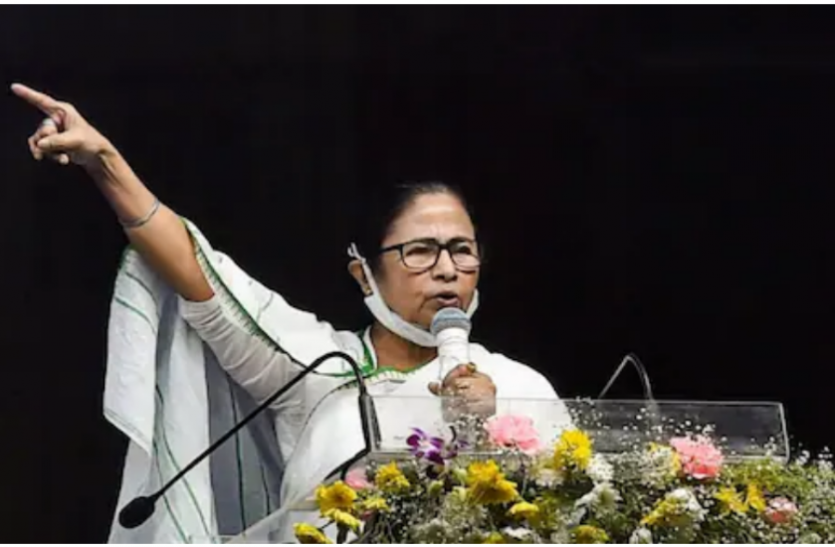
    Mamata Banerjee’s stunning victory puts her squarely on the centre stage of Opposition politics. Joining her there will be Lalu Prasad Yadav, released on bail by the Supreme Court despite the government’s strenuous objections. Tejashwi Yadav has shown he’s capable of leading a party when the RJD came so close to upstaging the BJP-JDU alliance in Bihar. Rajasthan’s Ashok Gehlot and Punjab’s Amarinder Singh have emerged as fairly independent Congress satraps. Uddhav Thackeray has shrugged off the Shiv Sena’s pariah status by providing Maharashtra with good leadership and a penchant for making politics the art of the possible. In Telangana, KCR has put the BJP in its place by a resounding win in Nagarjunasagar after its surprise showing in the Dubbaka and GHMC polls. YSRC scored a resounding win in Tirupati with the BJP candidate, a retired chief secretary, losing her deposit. The anti-BJP lineup now has seven chief ministers, excluding Naveen Patnaik. Seven CMs will mean the election and propaganda machines can be kept well-greased and the powder kegs dry and replenished. Prime Minister Modi’s inability to defend India against the second Covid-19 wave, and his inability to cajole the Chinese from withdrawing from areas they occupied in Ladakh now make him an easy target. The Gujarat model has been long exposed as bogus. There is light seen at the end of the tunnel.

    Image Credit: Patrika.com
  • Let’s do away with marks, grades, and this façade of examination

    Let’s do away with marks, grades, and this façade of examination

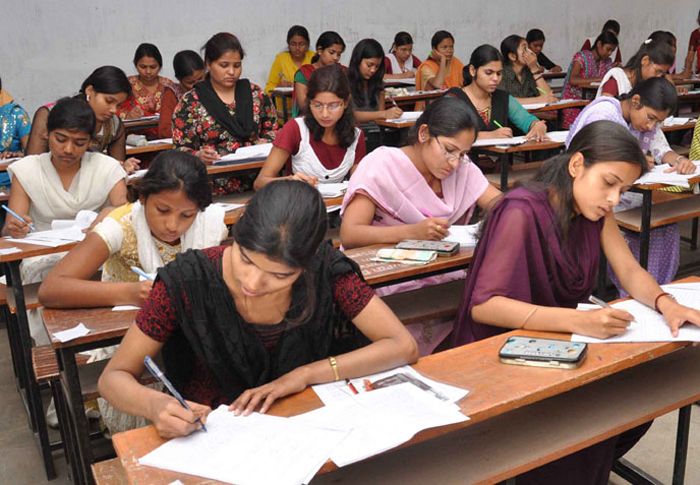
    The Central Board of Secondary Education (CBSE) has cancelled examinations for Class 10 and postponed the one for Class 12. This adds to the uncertainty that had gripped the education sector ever since the pandemic broke out. Add to that the cascading effect it will have on entrance examinations and graduate courses.

    Currently, stakeholders, namely, the higher educational institutions such as colleges and universities, state governments, high courts, students and their parents, and the University Grants Commission (UGC), are also embroiled in the exams dilemma. This has to do with whether exams are to be held or not; and if yes, then in what way? Virtually or physically?

    The Examination Train

    The manifest justification for holding examinations are to test the pupils, award them marks/grades, rank them in an order of ‘merit’, or segregate them as per mediocrity. Away from the rather narrow confines of academics, who cares for marks/grades in the world outside? Hardly an organisation/institution gives any credence to marks awarded by colleges and universities. Public sector and private sector organisations, including the banks, the Union Public Service Commission (UPSC), and what have you, conduct their own examinations/tests to recruit personnel.

    If nobody outside of the academic realm cares for marks/grades and recruiting organisations devise their own way of assessing graduates, why do we go through the examination rigmarole? 

    The only thing they look for is the minimum qualification. Generally, graduation, at the most. Also, they have their own in-house training, orientation/refresher courses or workshops. Significantly, the UPSC has prescribed just graduation as the minimum qualification for the highly-desired and coveted civil services, to recruit personnel for the foreign, administrative and police, and other allied central services.

    Even ardent followers of Mahatma Gandhi who have passionately and zealously travelled in the ‘Third Class’ all through their academic careers, are eligible to appear at the prelims or the CSAT (Civil Services Aptitude Test) that the UPSC conducts. These Gandhians as well as those who have a second class, qualify in large numbers, and are in no way inferior to the self-styled first class passengers of/on our examination trains.

    Cracks and Fissure

    There appears to be hardly any correlation between the marks/grades/class awarded by our colleges and universities and those who get through the CSAT and make it to the civil services. Are there, going by what is obtained above, any chinks in the system that is so highly-skewed in favour of rote-learning, examination-based structure of our educational set-up? Of course, there appear to be multiple cracks and fissures, to say the least.

    Just look at the countless students awarded A+ or O (outstanding) grades, lots having secured 90 to 95 percent at the Master’s level (MA/MSc/MCom) struggling, if not failing, to get through the National Eligibility Test (NET) to become eligible for an assistant professor’s job.

    The UGC, the overarching Big Brother that avidly extends its leash over the state and central universities (also the deemed ones), itself has very little faith in marks/grades awarded by its various constituents. There is ample empirical evidence to uphold the misgivings of the UGC on this count. Just look at the countless students awarded A+ or O (outstanding) grades, lots having secured 90 to 95 percent at the Master’s level (MA/MSc/MCom) struggling, if not failing, to get through the National Eligibility Test (NET) to become eligible for an assistant professor’s job.

    It is another matter that many state governments contrived their own ways to dilute the stronghold of the UGC’s NET by devising alternative routes called SET (State Eligibility Test) and SLET (State Level Eligibility Test), and have succeeded in browbeating the UGC as regards recruitment to teaching posts in state/central universities.

    The Merit Myth

    Years back, the UGC wrote to various universities that those with really high marks at the postgraduate examinations performed abysmally in the NET. Moral of the story is that in spite of the UGC lurking in the background and looking over the shoulder, its affiliated constituents have been happy in dispensing the largesse of grades/marks over-generously. Unfortunately, this is perceived as merit.

    The facade of examinations that has taken generations of students, parents, and society in general, for a ride needs a serious revisit.

    The facade of examinations that has taken generations of students, parents, and society in general, for a ride needs a serious revisit. If nobody, virtually nobody, in the real world outside of the academic realm cares for the marks/grades and classes dished out by our universities, and each recruiting organisation assiduously tests and devises its own way of assessing our graduates and postgraduates (and doctorates too), why do we go through the examination rigmarole?

    Marks to what avail?

    Why not just handover certificates, listing courses/papers taught/learnt and assignments completed. At the end of the required term just make them qualify for the degree sought by them sans the drama staged pertaining to examinations. Some educational institutions, such as the Ducere Global Business School, in Melbourne, Australia, award graduate and postgraduate degrees without exams. It has been pointed out that “assessment is articulated through solution finding, improvisation, interrogation, interaction, integration and imagination — all of which shape change”.

    The agencies interested in employing these candidates have their own manner of assessing them through written, oral and associated tests. That they have been doing, anyway, for years, even to those students who have obtained grade sheets and marks cards testifying that they have been placed in A+, or had 90 to 95 percent and have been rank holders, or have obtained a first class.

    Are we ready and willing to deliberate and debate examinations and allied issues at different levels? For a start we could wake up the UGC to shed its lethargy and set it on an examination reform and course correction path.

    This article was published earlier in www.moneycontrol.com
    Featured Image: thewire.in


  • China’s New Coast Guard Act: Vietnam could lead Response

    China’s New Coast Guard Act: Vietnam could lead Response

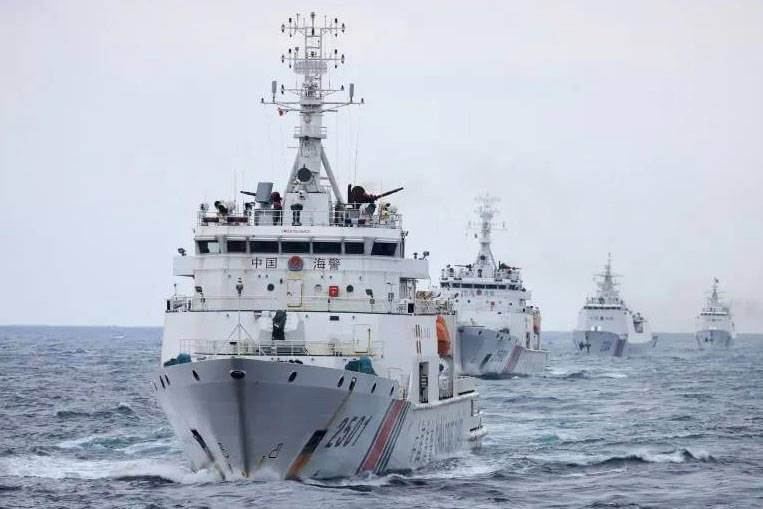
    China’s new Coast Guard Act has put the ‘cat among the pigeons’ and the South China Sea claimants Brunei, Malaysia, Philippines, Vietnam and Taiwan are visibly worried. The Act has also attracted international attention; for some, it is an act of war and for others, it violates the 1982 United Nations Convention on the Law of the Sea (UNCLOS).

    The Act came into effect last month on 01 February. In its administrative content, the Act is the culmination of at least two reorganizations of the Chinese Coast Guard (CCG) that began in 2013 involving administrative and operational control of five closely associated national maritime law enforcement agencies, also referred to as the Five Dragons , that were brought under one umbrella. In 2018, CCG became part of the People’s Armed Police Force.

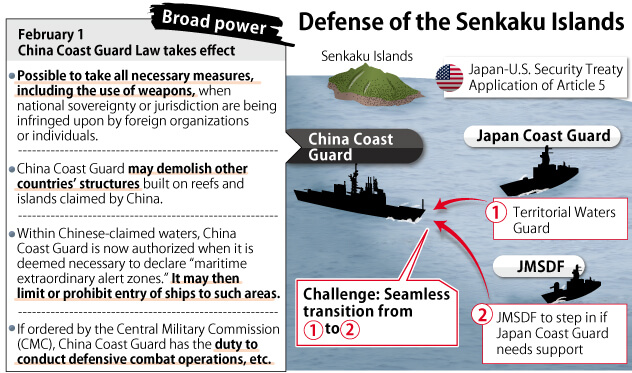
    Under the new Act, it is feared, the CCG would conduct operations just like the PLA Navy and would be directly controlled by the Chinese Communist Party Central Committee. The CCG is empowered with powerful ‘security and control measures’ and has the rights to take necessary actions to “restrain foreign military vessels and foreign vessels used for non-commercial purposes in waters under China’s jurisdiction from violating the laws or regulations of China” which is potentially in contravention to the 1982 UNCLOS.

    The Act has also attracted international attention; for some, it is an act of war and for others, it violates the 1982 United Nations Convention on the Law of the Sea (UNCLOS).

    Under Article 20, the CCG may demolish “buildings, structures, and various fixed or floating devices” built by foreigners “in the sea areas and islands under our jurisdiction”, and Article 47 authorizes the agency to “directly use weapons if there is no time for warning or if there is a risk of serious harm after giving a warning.”

    It is the latter that prompted Japan to label the Act as “blatantly threatening” and “aimed directly at the Senkakus” raisingspeculation that the Japanese Coast Guard, which hitherto could “fire weapons directly at foreign vessels in cases of self-defence and emergency escape” may now “ fire on foreign official vessels under laws by regarding vessels aiming to land on the Senkaku Islands as committing violent crimes”.

    However, it is fair to say that some of the provisions contained in the Chinese Coast Guard Act are not extraordinary. Navies, Coast Guards and law enforcement agencies of many countries are administratively controlled by the ministries of national defence and routinely operate with the national navies albeit pursue different rules of engagements. Many maritime law enforcement agencies are also known to intercept and even sink foreign fishing vessels especially when these engage in IUU fishing. These naturally attract diplomatic protests from the affected countries including China.

    Be that as it may, the ASEAN and China signed the Code for Unplanned Encounters at Sea (CUES) in the South China Sea in 2016 under which both sides are committed to “maintaining regional peace and stability, maximum safety at sea, promoting good neighbourliness and reducing risks during mutual unplanned encounters in air and at sea, and strengthening cooperation among navies”. This agreement is for the navies and draws upon the CUES (voluntary and non-binding) adopted by the Western Pacific Naval Symposium (WPNS).

    The new Chinese Coast Guard Act may have created an opportunity for ASEAN and China to conceptualize CUES that is tailored to the mandate of the Coast Guards i.e. law enforcement. The issue can also be on the agenda of the Heads of Asian Coast Guard Agency Meeting (HACGAM), a grouping of 22 Member States and multilateral organisations, which aims at cooperative and proactive efforts to address maritime issues confronting the region.

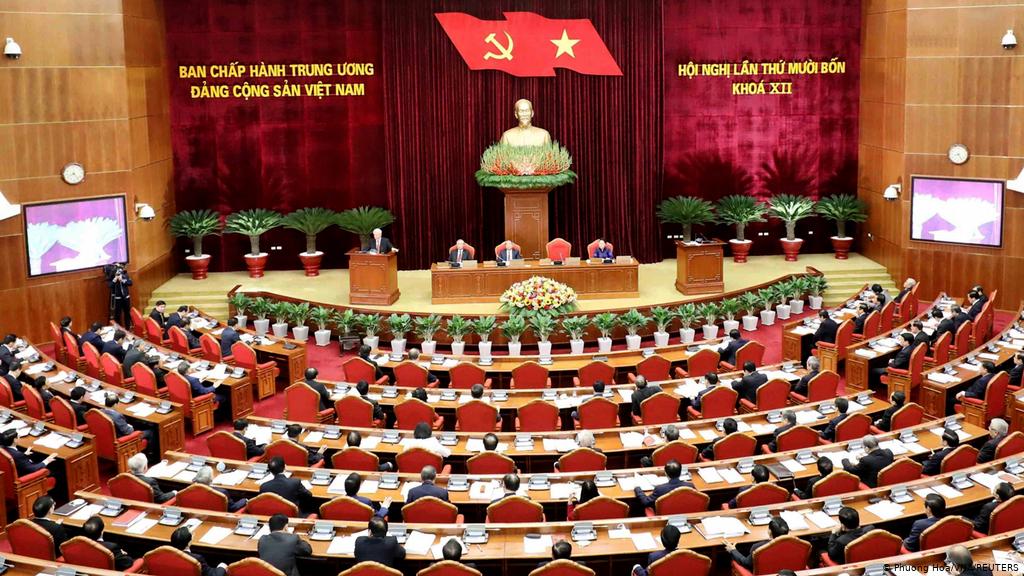
    Among the ASEAN member countries, Vietnam is well placed to lead the initiative for at least three reasons.  First, it is a claimant and some of the features in the South China Sea are under its control; second, it has a larger Coast Guard when compared to the capabilities of the other ASEAN claimants; and third, the Vietnamese Communist Party maintains close contacts with their counterparts in China and this could be a useful channel to facilitate a dialogue.

    However, it remains to be seen if Beijing would allow debate and discussion on the Coast Guard Act particularly when it also involves contested areas such as the South China Sea. For that deft diplomacy by Vietnam could be a good idea.

    Feature Image: www.japantimes.co.jp

  • What Putin nemesis Alexei Navalny is, and what he is not

    What Putin nemesis Alexei Navalny is, and what he is not

    Anatol Lieven highlights America’s blundering tendency to view world personalities in typically American lens, ignoring the realities of them being citizens of their countries and focusing on their national interests . He uses the examples of Russia’s Navalny and Myanmar’s Aung San Suu Kyi to make his point emphatically. His analysis is relevant to other countries as well. 

    This article was published earlier in Responsible Statecraft

    It is very human and natural to admire courage and resolution — these are qualities that Russian opposition leader Alexei Navalny possesses to a quite remarkable degree. It is also natural to sympathize with suffering — and Navalny has suffered and very nearly died for his beliefs and goals. And of course it is natural to feel disgust with the increasingly criminal behavior of the Putin administration in Russia.

    However, admiration, sympathy and disgust are emotions, not arguments or analysis, and should be employed with great caution in the formulation of state policy.

    In his confirmation hearings, now-Secretary of State Anthony Blinken pledged Biden administration support for Navalny and called him “a voice for millions and millions of Russians.” Statements by the U.S. embassy in Moscow on the Navalny movement have come very close to calling for the end of the present Russian government.

    Recent weeks have seen a tremendous outpouring of American sympathy for Navalny and his movement against the Putin administration. In his confirmation hearings, now-Secretary of State Anthony Blinken pledged Biden administration support for Navalny and called him “a voice for millions and millions of Russians.” Statements by the U.S. embassy in Moscow on the Navalny movement have come very close to calling for the end of the present Russian government. The semi-official American Radio Free Europe/Radio Liberty is openly and passionately supportive of Navalny’s movement. Richard Haas, President of the Council on Foreign Relations, proposed that Navalny be awarded the Nobel Peace Prize.

    Such overt U.S. support is not wise. In the first place, it may actually hurt the cause of progressive reform in Russia. The Russian government, like those of Iran and China, has relentlessly propagated the idea that the opposition is being backed if not bankrolled by Washington in order to weaken their countries; and indeed, Russian liberals have done themselves terrible damage by allowing themselves to be cast as representatives of the West, not of the Russian people.

    The second, very familiar problem is the hypocrisy involved. In the latest volume of President Obama’s memoirs, “A Promised Land,” he describes how Hillary Clinton — who relentlessly presented herself in public as an advocate of spreading democracy — argued that Washington should support Egyptian President Hosni Mubarak’s brutal 2011 crackdown on Arab Spring opposition protests on the grounds that he was a U.S. ally and his fall would lead to chaos and Islamist revolution. In her early public statements, as well, she warned against hastening Mubarak’s exit.

    In proposing Navalny for the Nobel Peace Prize, Haas seems to have forgotten the last time the honor was given to an opposition politician.

    An even greater problem presents itself when one looks at the actual politics of some of the opposition figures who draw such waves of American and Western enthusiasm. In proposing Navalny for the Nobel Peace Prize, Haas seems to have forgotten the last time the honor was given to an opposition politician. The award to Aung San Suu Kyi in 1991 was supposed to be for “her non-violent struggle for democracy and human rights… one of the most extraordinary examples of civil courage in Asia in recent decades.”

    After Suu Kyi joined the government in Myanmar she’s been damned in the West for her failure to prevent or condemn the savage state persecution of Myanmar’s Rohingya minority, and most of her human rights awards (though not the Nobel prize itself) have been revoked.

    After Suu Kyi joined the government in Myanmar she’s been damned in the West for her failure to prevent or condemn the savage state persecution of Myanmar’s Rohingya minority, and most of her human rights awards (though not the Nobel prize itself) have been revoked. What her previous Western admirers are not doing — what they almost never do — is to ask themselves why they so completely misunderstood her before.

    But she is a Burmese politician, not a Western democratic leader, and in building her up as a liberal heroine, the Western media and activists willfully ignored not just the political realities of Myanmar, but her own Burmese nationalist antecedents.  

    (Just in the last 48 hours, Suu Kyi has been detained in an apparent military takeover of her democratically elected government and Biden is predictably mulling over his options for reviewing sanctions and taking “appropriate action.”)

    Like Navalny, Suu Kyi is indeed an exceptionally brave and determined human being and in her way a fine leader; just as Navalny might make a fine Russian president. But she is a Burmese politician, not a Western democratic leader, and in building her up as a liberal heroine, the Western media and activists willfully ignored not just the political realities of Myanmar, but her own Burmese nationalist antecedents.

    There are two factors at work here. The first is a basic human one. Courage, like hard work and self-sacrifice, is a quality that it is humanly impossible not to admire, but the possession of it says absolutely nothing at all about the goals to which they are put. All the leaders of the ghastly totalitarian revolutions of the 20th century were exceptionally brave and determined men.

    The second factor relates to some enduring and seemingly incorrigible flaws in most Western reporting and analysis. One of them is the tendency to personalize issues, whereby “Putin” is used as a synonym for the whole Russian state, and “Navalny” is now being presented as a synonym for the entire, enormously disparate Russian opposition. The merest glance at the groups represented at the pro-Navalny demonstrations reveals that together with genuine liberal democrats, there are also numerous Communists and extreme nationalists whose anti-Western positions are much more extreme and reckless than those of Putin himself. As Aleksandr Baunov of the Carnegie Moscow Centre has written:

    Saturday’s protests were undeniably anti-regime, anti-elite and anti-corruption but not necessarily liberal, pro-Western and pro-democracy. It’s not surprising that such protests frighten not only the authorities, but also successful members of society: even those who don’t consider themselves supporters of the regime.

    In their blind demonization of Putin, and consequent sanctification of Navalny, Western commentators seem to be implicitly assuming that should Navalny win power (which he almost certainly will not), Russia’s foreign policy would change radically in a pro-Western direction. This is nonsense. Navalny’s supporters are backing him out of (entirely justified) fury at Russian state corruption, lawlessness, and economic failure, not to change foreign policy. Every independent opinion poll has suggested that Putin’s foreign and security policies have enjoyed overwhelming public support; and above all, there is very little in Navalny’s own record to suggest that he would change them.

    As a 2013 essay by Robert Coalson in The Atlantic documented, Navalny supported the Russian war with Georgia in 2008. He has expressed strongly ethno-nationalist attitudes towards the Caucasian minorities in Russia, and previously made opposition to illegal immigration a key part of his platform. In October 2014 he suggested to a reporter that if he became president he would not return Crimea, which was annexed by Russia earlier that year, to Ukraine (though he also said in that same interview that, “It’s not in the interests of Russians to seize neighboring republics, it’s in their interests to fight corruption, alcoholism and so on — to solve internal problems.”

    Rather like Donald Trump concerning American interventionism, Navalny has strongly condemned Russian military intervention in the Middle East on the grounds of cost and irrelevance to real Russian interests; but (as with Trump), that does not necessarily say much about what he would actually do if in power. Apart from anything else, Russia, like the U.S., has a foreign and security establishment “Blob” with firmly established and deeply held collective views on Russia’s vital interests.

    It is to remind Americans that he is a Russian politician, not an American one; that he will respond to Russian realities, not Washington fantasies; and that in the end, U.S. administrations will have to deal with whatever government is in power in Moscow.

    To recall this is not to condemn Navalny. It is to remind Americans that he is a Russian politician, not an American one; that he will respond to Russian realities, not Washington fantasies; and that in the end, U.S. administrations will have to deal with whatever government is in power in Moscow. Russian governments will defend Russian interests, along lines that are mostly quite predictable if one knows Russian history and culture. The sooner we realize this, and stop setting up plaster saints in the hope that they will perform miracles, the better for U.S. foreign policy overall.


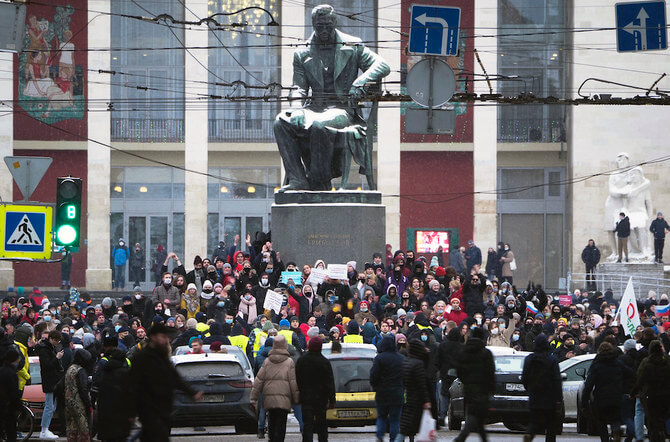
    Feature Image – Protesters gather near a monument of Russian playwright Alexander Griboyedov during a protest against the jailing of opposition leader Alexei Navalny in St. Petersburg, Russia, Sunday, Jan. 31, 2021. www.arabnews.com
    Image – 
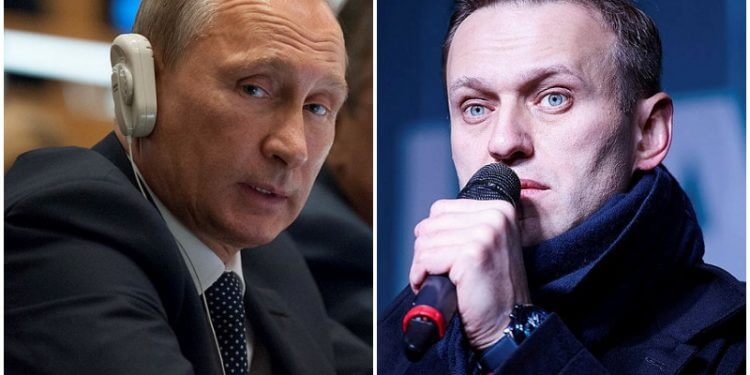
    Navalny and Putin: www.hilltimes.com
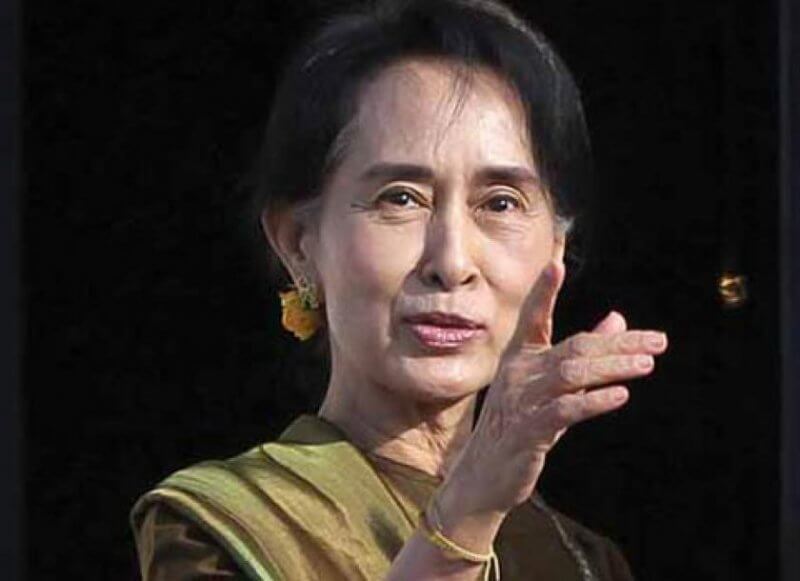
    Image – Aung San Suu Kyi: www.mmtimes.com

  • India, China, and Arunachal Pradesh

    India, China, and Arunachal Pradesh

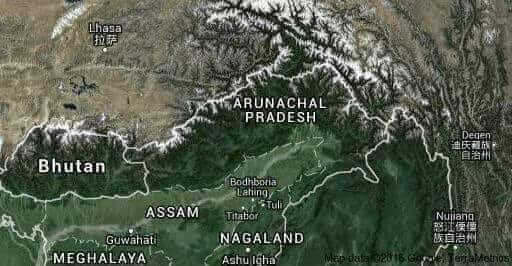
    The satellite picture below brilliantly depicts the geographical separation of Arunachal Pradesh (called Lower Tibet by the Chinese) and Tibet. The McMahon Line more or less runs along the crest line of the Himalayas.

    The Chinese have never been quite explicit on how much of Arunachal they seek.  I once saw an official map displayed in a travel agents office in Lhasa that showed only the Tawang tract as Chinese territory. In other maps they have their border running along the foothills, which means all of Arunachal.

    The Chinese have based their specific claim on the territory on the premise that Tawang was administered from Lhasa, and the contiguous areas owed allegiance to the Dalai Lama, the spiritual and temporal ruler of Tibet. Then the Chinese must also consider this. Sikkim till into the 19th century a vassal of Tibet and Darjeeling was forcibly taken from it by the British! By extending this logic could they realistically stake a claim for Sikkim and Darjeeling? Of course not. It would be preposterous. History has moved on. The times have changed. For the 21st century to be stable 20th century borders must be stable, whatever be our yearnings.

    At the crux of this issue is the larger question of the national identities of the two nations and when and how they evolved. The Imperial India of the Mughals spanned from Afghanistan to Bengal but did not go very much below the Godavari in the South. The Imperial India of the British incorporated all of today’s India, Pakistan and Bangladesh, but had no Afghanistan, not for want of trying. It was the British who for the first time brought Assam into India in 1826 when they defeated Burma and formalized the annexation with the treaty of Yandabo.

    It was only in 1886 that the British first forayed out of the Brahmaputra valley when they sent out a punitive expedition into the Lohit valley in pursuit of marauding tribesmen who began raiding the new tea gardens. Apparently the area was neither under Chinese or Tibetan control for there were no protests either from the Dalai Lama or the Chinese Amban in Lhasa. Soon the British stayed put.

    Tibet remained in self imposed isolation and the race to be first into Lhasa became the greatest challenge for explorers and adventurers in the second half of the 19th century. Not the least among these were the spies of the Survey of India, the legendary pundits. The most renowned of these was the Sarat Chandra Das whose books on Tibet are still avidly read today. As the adventurers, often military officers masquerading as explorers began visiting Tibet the British in India began worrying. Reports that the most well-known of Czarist Russia’s military explorers, Col. Grombchevsky was sighted in Tibet had Lord Curzon, the Governor General of India most worried.

    In 1903 Curzon decided to send a military expedition into Tibet led by Grombchevsky’s old antagonist, Col. Francis Younghusband. A brigade strong mixed force of Gurkhas and Tommies went over the Nathu La into the Chumbi valley and advanced unhindered till Shigatse. A Tibetan military force met them there but offered what can only be described as passive resistance. Not a shot was fired back as the British Indian troops rained bullets on them. It was a forerunner to Jallianwalla Bagh. From Shigatse Younghusband made a leisurely march into Lhasa. The British got the Tibetans to agree to end their isolation and having extracted trade concessions withdrew in 1904, the way they came.

    In 1907 Britain and Russia formally agreed that it was in their interests to leave Tibet “in that state of isolation from which, till recently, she has shown no intention to depart.” It may be of interest to the reader to know that the Great Game nevertheless continued. In 1907 Col. Mannerheim then of the Russian Army, later Field Marshal Mannerheim and first President of Finland, led a horseback expedition from Kyrgyzstan to Harbin on China’s northeast to identify a route for the cavalry.

    The next important year was 1913 when the Tibetans declared independence after the collapse of the Qing dynasty and the establishment of a Republic in China under Sun Yat Sen. They attacked and drove the Chinese garrisons in Tibet into India over the Nathu La. Also in 1913 the British convened the Simla Conference to demarcate the India-Tibet border. The British proposed the 1914 McMahon Line, as we know it. The Tibetans accepted it. The Chinese Amban however initialed the agreement under protest. But his protest seemed mostly about the British negotiating directly with Tibet as a sovereign state and not over the McMahon Line as such.

    Things moved on then. In 1935 at the insistence of Sir Olaf Caroe ICS, then Deputy Secretary in the Foreign Department, the McMahon Line was notified. In 1944 JP Mills ICS established British Indian administration in NEFA, but excluding Tawang which continued to be administered by the Lhasa appointed head lama at Tawang despite the fact that it lay well below the McMahon Line. This was largely because Henry Twynam, the Governor of Assam lost his nerve and did not want to provoke the Tibetans. In 1947 the Dalai Lama (the same gentleman who is now in Dharamshala) sent the newly independent India a note laying claim to some districts in NEFA/Arunachal.

    On October 7, 1950 the Chinese attacked the Tibetans at seven places on their frontier and made known their intention of reasserting control over all of Tibet. As if in response on February 16, 1951 Major Relangnao ‘Bob’ Khating IFAS raised the India tricolor in Tawang and took over the administration of the tract. The point of this narration is to bring home the fact that India’s claim over Arunachal Pradesh doesn’t rest on any great historical tradition or cultural affinity. We are there because the British went there. But then the Chinese have no basis whatsoever to stake a claim, besides a few dreamy cartographic enlargements of the notion of China among some of the hangers-on in the Qing emperor’s court. The important thing now is that we have been there for over a hundred years and that settles the issue.

    Arunachal Pradesh has a very interesting population mix. Only less than 10% of its population is Tibetan. Indo-Mongoloid tribes account for 68% of the population. The rest are migrants from Nagaland and Assam. As far as religious affinities go Hindus are the biggest group with 37%, followed by 36% animists, 13% Buddhists. Recent census figures suggest a spurt in Christianity, possibly induced by pocketbook proselytizing. In all there are 21 major tribal groups and over 100 ethnically distinct sub-groupings, speaking over 50 distinct languages and dialects. The population of about a million is spread out over 17 towns and 3649 villages. With the exception of a few villages of Monpas who live north of the McMahon Line, it is an ethnically compact and contiguous area.

    In fact in future boundary negotiations India could make a case for inclusion of the few Monpa villages left behind north of the McMahon Line? Many knowledgeable observers suggest that the area south of the Huangpo/Brahmaputra from the Pemako gorge till it enters the Subansiri division of Arunachal would be a logical boundary as the raging and hence un-fordable and unbridgeable river ensures hardly any Chinese administrative presence in the area.

    It is true that historically India never had a direct border with Tibet till the British took Kumaon and Garhwal from Nepal in 1846 and extended its domain over Arunachal in 1886. On the other hand the formidable Himalayas were always culturally a part of India and formed a natural barrier against ingress from the north, whether Tibetan or Chinese. But times have moved and technology and mankind’s great engineering powers now make it possible for even the most hostile terrain to be subjugated. The Himalayas are no longer the barrier they once were. As China and India emerge as the world’s great economies and powers can India possibly allow China a strategic trans-Himalayan space just a few miles from the plains?

    The view from the Chinese side about what exactly constitutes China is no less confused. Apparently like the British, the Manchu’s who ruled China from the 17th to the early 20th century had a policy of staking claim to the lands that lay ahead of their frontiers in order to provide themselves with military buffers. In a recent article in the China Review magazine, Professor Ge Jianxiong, Director of the Institute of Chinese Historical Geography at Fudan University in Shanghai writes: “to claim that Tibet has always been a part of China since the Tang dynasty; the fact that the Qinghai-Tibetan plateau subsequently became a part of the Chinese dynasties does not substantiate such a claim.” Ge also notes that prior to 1912 when the Republic of China was established the idea of China was not clearly conceptualized. Even during the late Qing period (Manchu) the term China would on occasion refer to the Qing state including all the territory that fell within the boundaries of the Qing Empire. At other times it would be taken to refer to only the eighteen interior provinces excluding Manchuria, Inner Mongolia, Tibet and Sinkiang.

    Professor Ge further adds that the notions of “Greater China” were based entirely on the “one-sided views of Qing court records that were written for the courts self-aggrandizement.” Ge criticizes those who feel that the more they exaggerate the territory of historical China the more “patriotic” they are. In this context I would like to recall a recent conversation I had with the then Chinese Ambassador to India, Sun Yuxi. Ambassador Sun said that while he was soundly castigated in India for his unintended comment, he gained a major constituency in China. The mandarins in the Beijing would do well to take heed to Ge Jianxiong’s advice: “If China really wishes to rise peacefully and be on solid footing in the future, we must understand the sum of our history and learn from our experiences.” The same holds true for the babus in South Block and ‘the having writ move on’ media pundits. If we don’t then we know who will be laughing!


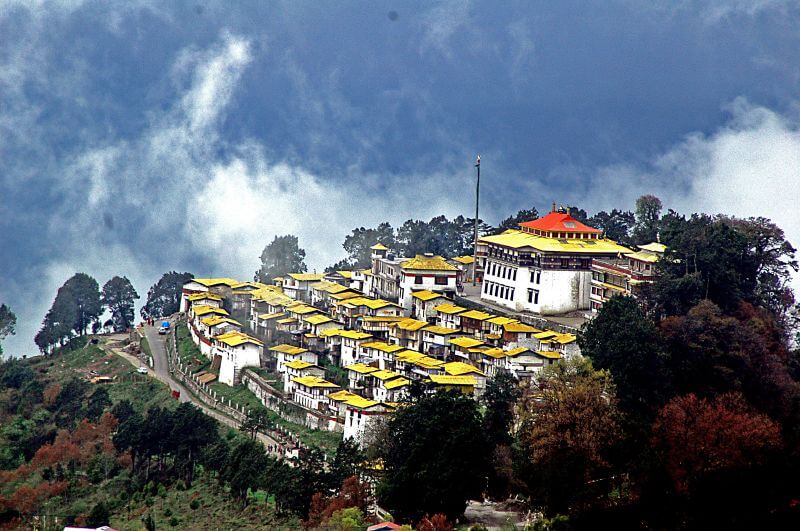
    Image Credit: Tawang Monastery

  • History – Thailand’s Golden Buddha

    History – Thailand’s Golden Buddha

    In the month of May 2007 I was invited to speak at the Mahidol University of Bangkok during the SSEASR Conference. I gave a talk on Yogachara Buddhism there. During this occasion, I had the opportunity to visit various Buddhist temples at Bangkok. They include the magnificent ones like Emerald Buddha, Golden Buddha, Buddha in his Maha nirvana time etc. It is very interesting to note that in the Sanctum Sanctorum of all Buddha temples, while the right side wall is covered with pictures depicting instances in Buddha’s life, the left side has paintings exclusively from Ramayana. For a Thai devotee, Hinduism is as important as Mahayana Buddhism.

    During the visit of one of the temple, I learnt this great truth about ignorance obscuring Reality.

    One of these famous temples has a Buddha icon nearly 17 feet tall, which is known till the beginning of 20th century as “Terracotta Buddha temple” . The temple was established in the 13th century with its huge icon of Buddha, for several centuries it was worshipped by the devotees as “Terracotta Buddha”. One day the authorities decided to shift the Terracotta Buddha image to a place several kilometers away, probably to do some repairs to the temple. They put the Terracotta Buddha on a truck and were moving it. When they were half way through, a heavy downpour started. The rain was so heavy that the clay image of Buddha started dissolving. They tried to protect the image with tarpaulins and umbrellas, but to no effect. There was a very heavy wind which blew away the tarpaulins and umbrellas. Due to the heavy rain, the Buddha icon in clay was dissolving fast. The devotees were grief-stricken. They were wondering whether it would have been wiser to have left the temple un-repaired rather than allowing the centuries old terracotta Buddha icon to get dissolved in the heavy downpour.


    Presto! A wonderful thing was happening. As the clay was dissolving, from within the clay was emerging a golden Buddha idol! as the idol there was of clay. After a short while all the clay, which was covering the idol got completely dissolved. The people were witnessing the presence of a resplendent “Golden Buddha” appearing before them in all its grandeur.

    What really happened? It was really a golden Buddha at the time of its installation in the 13th century. After some time Thailand was experiencing foreign invasions. Fearing that the invaders would take away the golden image, which was 5.5 tons of solid gold, the devotees covered the image with clay. Thinking that it was only a Terracotta Buddha, the invaders left it untouched. That generation knowing that it was a golden Buddha inside the clay, worshipped Buddha in that form. As many years passed by, the subsequent generations were not aware of this fact. They truly believed in what they saw externally and worshipped it as a Terracotta Buddha only. Thus their minds were conditioned by externalities. Once the clay dissolved what is truly inside came out with all its effulgence. It is today worshipped as the golden Buddha in Bangkok.

    It is happening to all of us everyday, we assume ourselves to be only a body-mind-intellect complex and nothing beyond it. We are conditioned by our awareness of our body, our thinking process and our analysis of the phenomena. These are only externalities within each one of us. It is only a clay that surrounds the wonderful Immanence within us. Within each one of us is the golden Buddha, the great immanent Lord who is also transcendent, he is the great Shiva, who is constantly performing his cosmic dance. In our hearts we not aware of it as our minds are conditioned by what we see, do and think. It is like the Thais seeing only the clay image and concluding it as only terracotta Buddha. As the rain dissolved the clay, the golden icon which is the true-one inside is revealed. Likewise when the spiritual sadhaha and devotion dissolves our mental conditioning, the Lord within ourselves is also revealed. This is the lesson we learn from the Golden Buddha temple.

    The same idea is beautifully explained in Thirumoolar’s Thirumantiram. A sculptor has carved out a beautiful elephant from a block of wood. When you see it as an elephant, you do not see the underlying reality of the wood. When you will be able to see the substratum, the underlying reality of the wood, with which all the objects of carving are made, you do not see the carved elephant; you see the substratum of the wood. Likewise, the ignorance enveloping our minds obscure the ultimate reality within us, when we are graded by the body-mind-intellect complex. When the revelation comes to us through god’s grace and gurus’ teachings coupled with our devotion to Him, the conditioning disappears. The phenomena abide in the ultimate. We experience the Divinity within us.

    Even in the area of management, the story of Golden Buddha has a great relevance. A competent Manager, with a penetrating mind, should be able to see what is the reality hidden in the numerous external information. The external covering only obscures the truth, which you will be able to get through. Once you see the substratum, the ultimate truth is revealed.


    Image Credit: Wikimedia Commons

  • The South: Where the Chariots stopped in the Past

    The South: Where the Chariots stopped in the Past

    There is no apparent reason why Dr. John Jackson (1835-1911), a 19th-century Yorkshire-born British Psychologist should be of any interest to us in the 21st India. Yet, he is important in order to understand what is happening to the BJP’s misplaced ambitions in India south of the Vindhyas.

    First about Dr. Jackson. He was the first scientist to come up with the answer as to why mariners experience directional disorientation when they sail on vast seas. This navigational impairment, described by Jackson as ‘topological agnosia’ (literally, loss of knowledge about directions) was caused in his analysis by a distortion in an individual’s memory. An individual afflicted by this agnosia is found unable to remember to a destination known to him to be able to recall important landmarks seen a long time ago. Among the patients that Jackson studied were some women who knew where the London Bridge was, but they did not know how to go there from their homes. In their memory, the ‘little maps’ were forgotten, though the larger maps were inscribed in their brain. European colonial expansion was distinctly marked by this disorientation. When it was spreading south of Europe, the colonial powers thought of the south as ‘east’ and built a strong binary between the west and the east.

    Topological Agnosia is the term that can most accurately describe the BJP’s ‘Mission South.’ In order to understand why the party that feels so much at home in the Hindi heartland in the north should feel so unsure of its direction in the south, we need to look at the context within which its foundations were laid. Obviously, one has to refer to the shaping of the core ideas of the Hindutva ideology. It is not necessary to state that at its heart is the dubious and non-scientific theory of ‘Aryans as a Master Race’. This idea was in circulation among some of the 19th century European linguists. They imagined that what was initially proposed as the name of a language (‘Indo-Aryan’) was in fact the name of a community (or a race). Some of them went to the length of proving that the Aryans resided in remote ancient times in North Europe. Karl Plenka actually gave a homeland for this imagined master race, unquestioningly assuming that the master race was the master race of the pure Aryans.

    Besides, the traditions of spirituality and worship developed in the south for the last three millennia have their own distinct and syncretic trajectories which do not easily gel with the RSS-VHP idea of Hinduism. Besides, as Basavanna, Akkamma, Periyar, Phule, Shahu, and Ambedkar so ably demonstrate, a larger majority of the people south of the Vindhyas have reason to find the exclusionary and myopic social and cultural interpretations of history entirely repugnant.

    Adolf Hitler

    In the third decade of the 20th century, Adolf Hitler made these theories the foundation of his ‘National Socialism’ and the associated drive for ‘racial purification.’ The founders of the RSS in India were his contemporaries and shared his enthusiasm for the theory of Aryan supremacy. Though completely unscientific in terms of the history of the people of India, the RSS, and the BJP like to believe that someday in the future they will be able to establish the supremacy of the (imaginary) Aryans over the diverse peoples in the Indian subcontinent, the south included. To aid this wishful aspiration, the RSS has brought in a misconstrued idea of what constitutes being Hindu. However, the Indian sub-continent South of the Vindhyas has a long history of resistance to the domination from the north. Besides, the traditions of spirituality and worship developed in the south for the last three millennia have their own distinct and syncretic trajectories which do not easily gel with the RSS-VHP idea of Hinduism. Besides, as Basavanna, Akkamma, Periyar, Phule, Shahu, and Ambedkar so ably demonstrate, a larger majority of the people south of the Vindhyas have reason to find the exclusionary and myopic social and cultural interpretations of history entirely repugnant. It is not a surprise, therefore, that despite desperate efforts by the VHP and RSS throughout the twentieth century, their general support base in the southern states had remained nominal.

    This has changed since 2014. The current regime has displayed an unmatched zeal in intimidating political leaders by using the ED, the CBI, and troll gangs. It has displayed a skill in the use of post-truth and propaganda for generating popular opinion as never before. The erosion of media and the collapse of institutions that are expected to uphold constitutional values and constitutional arrangements to safeguard democracy has apparently increased the chance of success for BJP’s south mission. Besides, the use of funds for party-swapping is a trick that the BJP has mastered well. All these factors—the use of muscle, official machinery, money, intimidation, and propaganda—have made the south more vulnerable to the divisive, exclusionary, and myopic nationalism of the BJP.

    Yet, it would be naïve to believe that countering the Hindutva and Pseudo-Nationalism onslaught would be possible by mouthing our worn-out phrases and analysis related to class-based or caste-based understanding of India in the third decade of the 21st century.

    Countering the flawed ideas of nationalism and the exclusionary notion of dharma is an urgent need for the people, language-communities and the political parties south of the Vindhyas. Probably, it is them alone who are now left with the capacity to do so, since the ‘Hindi, Hindu, Hindustan’ tune has overpowered the people and the northern ‘heartland-states’. Yet, it would be naïve to believe that countering the Hindutva and Pseudo-Nationalism onslaught would be possible by mouthing our worn-out phrases and analysis related to class-based or caste-based understanding of India in the third decade of the 21st century. Also, being fiercely against any geographical, linguistic or social factionalism, we have to reinvent our politics and political terminology. Remaining entirely within the framework of the Constitution, one very powerful message that the Southern States and people can give to the rest of India is that of federalism.

    The Constitution describes the country as a union of states’ and its provisions are oriented towards keeping this union intact and integrated by respecting the difference and diversity.

    The Constitution describes the country as a union of states’ and its provisions are oriented towards keeping this union intact and integrated by respecting the difference and diversity. Hence, our insistence on the principle of federalism would also mean our insistence on constitutional values. It would reiterate the need for recognizing and respecting diversities and, therefore, rejecting the Hindutva agenda of the RSS-BJP. This understanding, if shared by the communities, movements, language groups, political parties, theological sects, and cultural-industries in the states south of the Vindhyas, can—together—stop the BJP where it should be stopped and reverse the fortunes of fascism in India. We all owe it to India, our sacred nation. We also owe it to the great tradition of civilization that the south has built over the past millennia.

    The opinions expressed are personal views of the author.

    This article was published earlier in gaurilankeshnews.com

  • Sedition Law: Sensitivity and trepidations of the State

    Sedition Law: Sensitivity and trepidations of the State

    This article was published earlier in moneycontrol.com

    A few activists and intellectuals, some of them octogenarians, are in jail for varied periods having been arrested for sedition. A question being asked since then is: can intellectuals and activists who fight for the rights of the deprived, underprivileged and downtrodden be seditious and subversive? The law of sedition is a remnant from the days of colonial rule in India.

    Should the State feel helpless and orphaned if the law of sedition is to be repealed? The fact that for seven decades and more the State has staunchly held on to this law suggests so

    The (British) colonial administration was constantly apprehensive and on tenterhooks that the ‘natives’ (the dominated subjects) would rebel against it in conduct, speech, or action. Hence, the sedition law was introduced through Clause 113 of the Draft Indian Penal Code in 1837 by Thomas Macaulay.

    The colonialists wanted to guard themselves against any kind of protest. Any activity that was unpalatable to the colonialists was conceived of as ‘treason’ and ‘subversion’. In order to maintain an untrammeled stronghold on the populace, the colonial administration thought it essential to promulgate a sedition law; an overarching law to protect what it thought was its sovereignty and suzerainty.

    Interestingly, in the 1860 Indian Penal Code (IPC) the law of sedition was not included. However, due to an ‘increase’ in ‘revolutionary’ activities and ‘unrest’ on the part of the Indian ‘rebels’, in 1870, the British inserted Section 124A and amended the IPC to include the law.

    Suppression and subjugation through draconian measures were resorted to by the foreign power for its political and economic gains and ends, in a system that was tyrannical, authoritarian, and dictatorial, and ran through its course till 1947

    Though the Constitution of India (with its oft-quoted Preamble) was to come a bit later, India did become a sovereign, socialist, democratic republic when it got rid of the colonial yoke. So, how come the Law of Sedition got carried over into a republic that became a free country and a democratic political entity?

    On the one hand, why the need for a law of sedition in a free, sovereign country. On the other hand, a look at the way sedition is being interpreted currently.

    In 1929, Mahatma Gandhi called sedition a “rape of the word law” and asked the people to go in for a countrywide agitation to demand the repeal of Section 124A. He said, “In my humble opinion, every man has a right to hold any opinion he chooses, and to give effect to it also, so long as, in doing so, he does not use physical violence against anybody.”

    Subsequently, after Independence, during the debate on the first amendment to the Indian Constitution in 1951, then Prime Minister Jawaharlal Nehru, called the law of sedition fundamentally unconstitutional and declared “now so far as I am concerned [Section 124A] is highly objectionable and obnoxious and it should have no place both for practical and historical reasons. The sooner we get rid of it the better.”

    Intriguingly, the Law of Sedition was not repealed, as it should have been, ideally, during the first Parliament session itself; and has been retained during Nehru’s government and subsequent governments too.

    Should the State feel helpless and orphaned if the law of sedition is to be repealed? The fact that for seven decades and more the State has staunchly held on to this law suggests so; more so today as during the last nearly seven years the number of times that the State has resorted to the use of this law is disturbing, to say the least. Besides, the State is arming itself with yet another draconian handle in promulgating the Unlawful Activities (Prevention) Amendment Act (UAPA).

    Was there ever such a low in independent India in terms of lack of tolerance on the part of the State? Any sort of criticism against the government seems to automatically get interpreted as anti-national. This manufactured binary — anti-government equals anti-national — has been the dominant credo ever since the Bharatiya Janata Party (BJP) came to power in 2014.

    In a recent article, Amartya Sen says, ‘The confusion between “anti-government” and “anti-national” is typical of autocratic governance’.

    Intellectuals, opposition leaders, activists in different realms, are all swept into the hold-all like sedition law. Also, international voluntary organisations, as also Indian NGOs, have been targeted and attempts are made to stifle them whenever there has been any criticism of the government, however, legitimate or valid the censure be.

    The government’s actions have prompted UN Human Rights Chief Michelle Bachelet to raise issues of a crackdown on CAA protesters, UAPA, Hathras case, and marching orders given to Amnesty International. New Delhi’s response in its lame defence to the criticism has been: ‘The framing of laws is obviously a sovereign prerogative. Violations of law, however, cannot be condoned under the pretext of human rights.’


  • As the US exits Afghanistan, who is there to tame Taliban?

    As the US exits Afghanistan, who is there to tame Taliban?

    Sometimes, the best way to triumph over an enemy is to quit the game. In an attempt to honour his election campaign promise of bringing the American soldiers back home, President Trump announced the complete withdrawal of American troops from Afghanistan and Iraq. About eight thousand six hundred remaining boys in boots will return from Afghanistan by Christmas this year. The Taliban, whom American forces have been fighting for the last two decades, is now a closed-door dialogue partner of the White House. The arch-rivals in the eerie battleground are now facing off each other in opulent hotels.

    In Doha, the Afghan government caught up with the Taliban at the much-awaited intra-Afghan peace talk, held in September

    In the two-decade-long war, America has paid enormously in currency, diplomacy, and defence. It has cost the US exchequer almost $2 trillion. Several efforts to bring peace have gone in vain. Ultimately, Washington has successfully brought the Taliban and the Afghan government to talk to each other. The two belligerent parties are now engaged in the tete-a-tete. In Doha, the Afghan government caught up with the Taliban at the much-awaited intra-Afghan peace talk, held in September. Despite several attempts, an agreement between the Taliban and the Afghan government could not take place earlier as the bellicose force never recognized the legitimacy of the elected government in Afghanistan. In the eyes of the Taliban, the incumbent in Kabul remains a puppet government of the Western powers. What contrasts the most between the present administration and the earlier Talibani rule is their diametrically opposite ideologies. Whereas the present system in Afghanistan runs democratically, the Taliban believes in the Islamic Sharia law. The battle is now between democracy and theocracy.

    The ongoing peace process is a continuum of American mediation between the Taliban and the Afghan government since February 2020.  White House is nearing an imminent peace deal with the Taliban as they are no longer deeply interested in Afghanistan. Washington’s priority is now countering China’s growing influence.

    In the previous peace talks, the western states sat with the Taliban, disdaining the Afghan government. Even Russia’s attempts failed to produce any fruitful results in favour of Afghanistan. One of the major reasons for the failure is about diluting the Afghan government authority. The Afghan government never endorsed the efforts of foreign nations in the Afghan peace negotiations, in which the Afghan government itself is side-lined. Afghan government affirmed that any kind of peace deal would not be entertained as the legitimate government was not a part of it as it was a clear violation of Afghan sovereignty.  Afghan government took the issue to the United Nations and accused Pakistan of bypassing it in peace talks with the Taliban.

    a large area of Afghanistan and its people are under the Taliban’s control. The Taliban is collecting taxes from the citizens to exercise their undisputed rule.

    Unlike the previous attempts, the intra-Afghan dialogue has raised much hope among the Afghans, the Government, and the international community. But both parties are likely to face many tough challenges to achieve the desired outcome.  The Taliban has already violated the agreement with the United States that resulted in the death of Afghan civilians and army personnel but stresses that it is continuing with the ceasefire. It is possible that by claiming to maintain the ceasefire the Taliban is trying to put pressure on the Afghan government. Despite this hostile situation, the Afghan government has agreed to negotiate with the Taliban mainly for two reasons. First, most of the International Security Assistance Forces and North Atlantic Treaty Organization (NATO) forces have left Afghanistan. The Afghan security forces have neither the training nor the institutional mechanism to provide security to its people. Second, a large area of Afghanistan and its people are under the Taliban’s control. The Taliban is collecting taxes from the citizens to exercise their undisputed rule.

    Unlike the previous peace processes, the current one does not rely much on foreign countries. But the peace deal is likely to affect Afghanistan’s external relations adversely. If the Taliban reverts to its Islamic radicalism, Afghanistan may lose billions of foreign aid it has been receiving since the last decade for the reconstruction of the country. The Afghan government worries that the premature departure of American troops may have a negative impact on international assistance.

    Although both parties agreed to negotiate on the peace deal, there is dissatisfaction within the cadres of the parties. In the recent elections, the two Presidential contestants each claimed electoral victory. A power-sharing arrangement was concluded where Ashraf Ghani is the President and Abdullah Abdullah exercises power as the chairperson of the High Council for National Reconciliation. On the Taliban side, many leaders do not support the peace process as they believe that they could win the Afghan war by military means. They consider  Pentagon’s departure from Afghanistan as a sign of their victory.

    The Taliban continues to maintain its contact with the Al-Qaeda, according to a UN security council report. The US -Taliban agreement of February demands a complete divorce between the Taliban and the Al-Qaeda.  UN reports and the violation of ceasefire show that the Taliban is not adhering to the agreement. Once the peace deal is completed, the Taliban could take advantage of the absence of US troops in Afghanistan and renege on their commitments by maintaining close ties with the Al Qaeda, Haqqani Network, and the other extremist groups. The training camps of these Islamist terrorist groups are being used by Pakistan based terror outfits like Lashkar and Jaish-e-Mohammed. When Soviet troops left Afghanistan in 1989, insurgency and terrorism increased in Kashmir. It saw a drastic fall when Washington waged war on Taliban and other Islamist extremist groups.

    If the Sharia law returns to Afghanistan, all the democratic rights and the freedom that the Afghan people have seen since the last decade, are likely to be lost.

    The consequences would be grave if the peace deal doesn’t fetch the desired results. The peace deal is necessary for the Afghan government in maintaining peace and stability in Afghanistan. If the Sharia law returns to Afghanistan, all the democratic rights and the freedom that the Afghan people have seen since the last decade, are likely to be lost. Even if a peace deal fructifies, it may not ensure peace for every section of society. During the previous Taliban rule, the fundamental rights of women- ranging from education to employment, were denied. Women had to live a sub-human life. At present, women hold 28 percent of the total seats in the parliament. So, if the Sharia law is enacted again, it will deny the basic rights of Afghan women. Millions of Afghan refugees in neighbouring Iran, Pakistan, and elsewhere in European countries cannot hope to return home. The host countries, however, have started sending back the Afghan refugees forcefully amid instability.

    Afghanistan is a country of over a hundred ethnic groups, tribes, non-Muslims, and other communities. Most ethnic groups have a conflict with each other. In recent times, the Taliban attacked the non-Muslim communities, especially Hindus and Sikhs. The Ministry of External Affairs of India facilitated the travels of a few Hindu families to India. Even after the Afghan government concludes a peace deal with the Taliban, conflicts may continue and peace may still be elusive. The effectiveness of the peace deal will depend on the commitments of each party.

    European countries do not have the military or economic strength to prosecute overseas conflicts. The internal mechanism of NATO is weaker than before. And after the Brexit deal, the fragmented European union lacks the political will to intervene in the war-torn state. China’s interests in Afghanistan are mostly commercial. Infrastructures or projects under Belt and Road Initiative can’t be built amid the carnage. China has the political, financial, and military strength to fill the void, after the complete withdrawal of the US forces. The Chinese financial contribution in Afghanistan is a clear sign that the country has a long-term strategy in the region. This apart, China has security concerns as well in Afghanistan. The rise of extremist movements in Afghanistan is likely to impact security in China, especially in Xinjiang province. In recent years, China has increased its military ties with Afghanistan. In the absence of the American troops, Afghanistan may consider China as possible support.

    Once the US exits, Kabul will have an option to raise the peace issue in the Shanghai Cooperation Organization (SCO). The SCO can be the main military and economic block in Asia. Except for Turkmenistan, all the bordering countries of Afghanistan and other major players in South Asia have either members-status or observer status at the SCO. It can certainly play a very effective role as the peacemaker providing its members, each with considerably different stakes in Afghanistan can get their act together.

    The Taliban in the Afghan government would provide political leverage to Pakistan over India.

    If the Taliban assumes power, India-Afghanistan bonhomie will turn frosty. Unlike other countries, the Indian government never supported the Taliban. India has been a staunch supporter of Afghan-led, Afghan controlled and Afghan-owned peace deal. Pakistan has always been supportive of the Taliban as it serves its strategic interests. The Taliban in the Afghan government would provide political leverage to Pakistan over India. Seeing that it has been left out of the Afghan peace talks, it appears that India is coming around to talk to the Taliban.

    Afghans are exhausted from bloodshed in the last few decades. The region has turned into a breeding ground for Islamic State in Khorasan, Al-Qaeda, and other terrorist groups. A stable and democratic Afghan government is necessary for maintaining peace in the South Asian region. As the effectiveness of SAARC continues to be hampered by India-Pakistan animosity, other South Asian states, Organization of Islamic Cooperation member states, and other Islamic states like Saudi Arabia or Turkey should act to restrain the Taliban and pave the way for peace in Afghanistan.


    Image: US Secretary of State Mike Pompeo meets with Taliban’s Mullah Abdul Ghani Baradar and members of his negotiating team. Credit: www.voanews.com


  • Nationalism Today: A Threat to Democracy and Multilateralism?

    Nationalism Today: A Threat to Democracy and Multilateralism?

    The idea of ‘nationalism’ and a sense of cohesive national identity has existed perhaps longer than the system of modern nation-states came to be. Except for a few, every empire, kingdom, and the territorial state tried to legitimise and conceptualise its authority in the minds of its citizens through ideology. A phenomenon that recurs throughout history, nationalism has only recently taken on the connotations it holds today: a malignant force that separates and divides rather than unites and deteriorates rather than improves.

    A phenomenon that recurs throughout history, nationalism has only recently taken on the connotations it holds today: a malignant force that separates and divides rather than unites and deteriorates rather than improves.

    In the contemporary context, this phenomenon presents across the world and appears to be accelerated by the current global pandemic. If one begins their survey at the Westernmost end, it is easy to witness this wave all over: in the United States, ahead of the elections, with Trump’s white supremacist, protectionist agenda underlined by anti-immigration measures; further in Europe, the rise of nationalist parties in Italy and Spain; Russia’s stifling of dissent and opposition under the mandate of national security, Viktor Orban’s rule by decree-law in Hungary to take over complete control in the Covid-19 backdrop- and further east, India’s and China’s majoritarian movements reflecting minority suppression and territorial aggression respectively.

    Considering these developments, the looming health crisis appears to be the catalyst for the rise of this aggressive, exclusionary brand of nationalism, or as observers have called it, hyper-nationalism. But looking beyond the surface one can discern the vast backdrop of a competitive international system that allowed these movements to become the popular political tool of the time.

    The past decades were characterised by some major changes in the international order; most importantly, the transition from a unipolar world under American hegemony to an emerging multipolar polar one with the rise of Asian powers and a Russia hoping to regain its superpower status. Economic ebbs and falls, the climate crisis, and a shift from multilateralism and globalism was the backdrop against which China grew as a rule-maker in the international system. China’s rapid rise as a global power gives the spectre of a possible bipolar world.

    Akin to the Cold War, wherein ideological systems competed, this decade in the post-COVID-19 world is also marked by alliances, power clusters, challenges to the globalised economy, and the visible fragility of the liberal democracy. While nations like the US prompt the liberal world to identify China as the face of the abstract systemic threat to the framework of democracy, liberalism and multilateral cooperation, the real danger may lie elsewhere. Besides coronavirus and the human tragedy, it evoked, the endemic threat to the norms and values of the democratic order is most likely internal and to be found in the political weaponry of modern democracy.

    What does nationalism mean as a value? To a nation-state, creating a sense of allegiance to the nation-state is extremely important and vital to its survival. Nationalism may be a force of resistance against oppressive authorities, or toward self-determination. The Irish and Indian national movements against colonisation, for instance, were nationalistic struggles that established self-governance in these countries and were spearheaded by the people themselves. However, nationalism may also manifest as state-led, systemic, and top-down approach under the authority of a populist leader who commands the support of many. An example is Mussolini’s fascist movement in Italy, prompted by the poverty and economic downfall of the interwar period.

    Triggered (although not caused) by extreme crises like the pandemic, this kind of nationalism uses a nationwide problem to appropriate control and stir political unrest.

    What we see in the world today is ostensibly the latter: aggressive, top-down nationalism where individuals and groups have little organic agency or innovation. Triggered (although not caused) by extreme crises like the pandemic, this kind of nationalism uses a nationwide problem to appropriate control and stir political unrest. These forms of control may involve excessive use of the police apparatus to restrict movement, a suspension of electoral or democratic processes and accountability mechanisms, or the use of the pandemic to enforce identity politics against minorities. In India, the police crackdown on the Shaheen Bagh riots in January 2020, a series of protests against the discriminatory Citizenship Amendment Act, is an example along with the United States’ successive episodes of racially motivated police brutality against African Americans. In Hungary, Orban has been pushing towards a regionalist, Christian, Central European community at the expense of minorities and immigrants (while heavily militarising Budapest in the wake of the coronavirus pandemic).

    This causality, somewhere in the 21st century, seems to have weathered down and given way to   monolithic ideas of territoriality, authority, centralisation, and capitalism, propelled especially by the role of contemporary social media.

    Nationalism has historically been espoused with democratic revolution and civil rights movements. In the French Revolution, the Irish Independence movements, and the colonial liberation movements of many other colonies, nationalist movements allowed a people to unite for a secular, democratic cause: self-determination. Even as of the late 20th century, nationalism served to demolish imperialism, colonialism, and dictatorships giving rise to civil rights, suffrage, labour rights, and even the welfare states. This causality, somewhere in the 21st century, seems to have weathered down and given way to   monolithic ideas of territoriality, authority, centralisation, and capitalism, propelled especially by the role of contemporary social media. The question that we must ask is this: Is the current flavour of nationalism serving any advantage to strengthening the democratic apparatus? Does it help make our leaders accountable, our parties representative, and our economies more resilient to face unexpected crises?

     
    Image credit: vocal.media