Category: Maritime Affairs

  • UNCLOS and Marine Pollution

    UNCLOS and Marine Pollution

    Download Full Report

    SRUTHY SREEKUMAR
    January, 2019

    In order to appreciate the momentous significance of the United Nations Convention on the Law of the Sea 1982, it is necessary to address the historical background of this event.  An indispensable dimension of the law of the sea has historically been the so-called freedom of the seas which related to fisheries and navigation in the earlier period and was extended to scientific research, laying of pipelines and air navigation in later years. However, during the age of discovery around the fifteenth century, the powerful maritime states of Spain and Portugal claimed sovereignty over large areas of ocean space. For example, Portugal claimed sovereignty over the Indian Ocean and a large portion of the Atlantic Ocean. Spain claimed sovereignty over the Pacific and England over the North Sea.  However, Grotius and other leading publicists persistently advocated the freedom of the seas which was generally accepted by nations of the international community as complying with their national interests. At the same time, it was generally recognized by the eighteenth century that coastal States were entitled to a belt of sea adjacent to their coasts up to a seaward limit of three miles advocated by Bynkershoek. Bearing in mind the foregoing, the ensuing discussion outlines the development of the concept of the law of the sea with particular reference to enforcement powers of the coastal state in the territorial sea.

    Download Full Report to read more…


  • The Challenges of AI-enabled Underwater Platforms

    The Challenges of AI-enabled Underwater Platforms

    Vijay Sakhuja  Aug 03, 2018

    The Chinese People’s Liberation Army Navy (PLAN) is likely to acquire a new type of submarine by the early 2020s. According to the South China Morning Post, the Shenyang Institute of Automation under the Chinese Academy of Sciences (CAS) is engaged in developing a series of extra-large unmanned underwater vehicle (XLUUV) that will feature Artificial Intelligence (AI). The vessels will be capable of performing a number of tasks without “human intervention,” “handle their assignments and return to base on their own,” and carry out reconnaissance, surveillance, combat operations against enemy targets, and undertake activities such as whale tracking. It will be possible to integrate these vessels with other manned and unmanned platforms and systems at sea, in air as also on land to carry out coordinated missions.

    Lin Yang, the project director and a marine technology specialist, has noted that Chinese interest in these platforms is prompted by US plans to acquire XLUUVs capable of carrying “a variety of payloads, from sensors to weapons.” Two prototype units have been contracted, one to Lockheed Martin and the other to Boeing, and they have been granted US$ 43.2 million and US$ 42.3 million, respectively for research, design, and testing in 2020. The winner will receive orders for production of up to five platforms. Unlike China and the US, Russia is developing the Status-6 autonomous torpedo capable of delivering 100-megaton warhead capable of “wiping out all living things” within a 1,500 km radius.

    These developments are clear signs of the role of AI-enabled underwater platforms and weapons in the future, and add a new dimension to underwater operations. There are at least four issues concerning them that merit attention.

    First is naval warfare. Navies have traditionally employed conventional submarines for intelligence gathering, laying mines, attacking enemy submarines and ships, and more recently, conducting strikes against shore targets by using land attack cruise missiles. The usual tactic for conventional submarine has been the ‘lie-in-wait’ position at the entrance to harbours or close to choke points and attack the enemy. Like their conventional counterparts, AI-enabled platforms can serve as scouts, and smaller platforms can masquerade as decoys to attract the enemy, forcing it to expose its position. If necessary, the AI-tool kit should be able to detect, track, generate high speed, and attack the enemy like a torpedo.

    It is useful to mention that the US’ XLUUVs will “operate autonomously for weeks or even months, periodically phoning home to check for new orders,” giving the US Navy a significant advantage in tactical operations. Similarly, the Status-6 autonomous torpedo can be used by the Russian defence ministry’s special division for deep-sea research and deliver “deep-sea equipment or installing surveillance devices.”

    Second, the XLUUVs may entail new legal challenges. There is an ongoing debate raging over regulating lethal autonomous weapon systems (LAWS), including a call to ban fully autonomous weapon systems centered on the Principle of Non-Delegation of the Authority to Kill by non-human mechanisms. A global campaign – Coalition to Stop Killer Robots – has called for an international ban on ‘killer robots’, and “a treaty for emerging weapons.” There is a belief that morality and generally accepted ethics need to be injected into the use of AI-enabled weapon systems given that “inanimate machines cannot understand or respect the value of life.” If the XLUUVs are put to combat operations, it would result in the weaponisation of AI, and this empowers humans to absolve themselves of any moral consequences of killing or using these for self-defence.

    It is important to mention that engineers and scientists from the technology industry signed a pledge in Stockholm at the 2018 International Joint Conference on Artificial Intelligence (IJCAI) and called upon “governments and government leaders to create a future with strong international norms, regulations and laws against lethal autonomous weapons.” They have since been joined by corporates such as Google DeepMind, the XPRIZE Foundation, University College London, ClearPath Robotics/OTTO Motors, the European Association for AI, and the Swedish AI Society.

    Third, the XLUUVs rely primarily on AI to conduct operations. These platforms would transit long distances passing through a variety of undersea topography, ie ridges, mounts, trenches, rocks, slopes and basins, and would be vulnerable to collisions, detection by civilian research and survey vessels, enemy submarines and warship, and underwater military detection systems including those used for seismic warnings. Further, underwater activity such as laying of oil and gas pipelines and fiber optic cables can impact their safety. Besides, natural occurrences such as currents and tides can result in drift and cause considerable difficulty to being positioned in the designated destination.

    Fourth regards the impact of AI-enabled underwater platforms on the marine environment, particularly marine life such as whales, sharks, dolphins and other migratory species. Sonar transmissions by XLUUVs can cause potential damage to mammals’ sensory organs resulting in disorientation or death. Whales may even misunderstand sonar waves as that of an attacker, and panic can drive them towards the platform.

    The development of XLUUVs presents clear dangers and could have potentially destabilising consequences for all countries. Further, their impact on marine life and the associated ecosystem – which is already witnessing stress due to pollution and plastic – does not appear to have been taken into consideration. Finally, an international treaty for emerging AI-enabled underwater platforms needs to be prepared, debated, and signed.

    This article was originally published in IPCS.

    http://ipcs.org/comm_select.php?articleNo=5497
  • The San Juan Incident

    The San Juan Incident

    K N Sushil   December 08, 2017

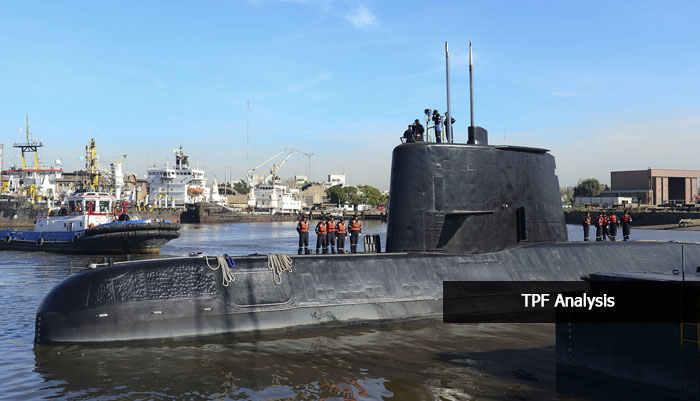
    The ARA San Juan disappeared a few hundred kilometers off Argentina’s coast on November 15, and despite an extensive air and sea search no sign of the sub has been found. Eight days after the sub vanished, the Vienna-based Comprehensive Nuclear Test-Ban Treaty Organisation said that it had detected hydro-acoustic anomaly” about 30 nautical miles (60km) north of the sub’s last-known position at 10:31 (13:31 GMT) few hours after the sub’s last contact. The analysis of the acoustic incident was reported as follows.

    The acoustic signal associated with the loss of the Argentina Submarine ARA SANJUAN confirms the following:

    That acoustic signal originated near 46-10S, 59-42W at 1358Z (GMT) on 15 November 2017. It was produced by the collapse (implosion) of the ARA SAN JUAN pressure-hull at a depth of 1275-feet. Sea pressure at the collapse depth was 570 PSI. The frequency of the collapse event signal (bubble-pulse) was about 4.4Hz. The energy released by the collapse was equal to the explosion of 12,500 pounds of TNT at the depth of 1275-feet. That energy was produced by the nearly instantaneous conversion of potential energy (sea-pressure) to kinetic energy, the motion of the intruding water-ram which entered the SAN JUAN pressure-hull at a speed of about 1800 mph.
    The entire pressure-hull was completely destroyed (fragmented/compacted) in about 40 milliseconds (0.040s or 1/25th of a second), the duration of the compression phase of the collapse event which is half the minimum time required for cognitive recognition of an event. Although the crew may have known collapse was imminent, they never knew it was occurring. They did not drown or experience pain. Death was instantaneous.
    The SAN JUAN wreckage sank vertically at an estimated speed between 10 and 13 knots. Bottom impact would not have produced an acoustic event detectable at long range

    The ARA San Juan was an IKL(German) designed type 1700 submarine built by TKMS in their Essen yard in 1985 at about the same time the Indian type 1500 was being built at HDW(Kiel). Both the submarines have great deal of similarities. Therefore, having commanded two type 1500s I will venture to hazard a guess on what could have afflicted the submarine.

    Facts as gleaned from various reports.

    15 Nov 0030Hrs. Submarine surfaced to report Water ingress through snort system causing a short circuit in the forward battery group. The forward battery group was isolated. The submarine charged her batteries on surface

    At 0600 The message is transmitted through normal communication channels.

    At 0730 the Captain informs base that he intend to continue his passage dived (Presumably because the sea was rough) At 1031, according to the CTBT report the submarine imploded at a depth of 1275 ft.

    From the above it would appear that the submarine was snorting before she surfaced at 0030hrs. If there was water ingress through the snort mast that caused a short in the forward battery group then the submarine was unable to maintain snorting depth, because the sea may have been too rough and the “head valve” (that prevents water from coming into the mast, when the mast dips even momentarily) was not functioning. As part of the SOP the snort induction drain, which drains into the bilges is kept open for the duration of the snort.  In any case during the snorting, the diesel engines are used to create the suction that draws all the foul air from all over the submarine. The fresh air coming from the snort mast merely spreads to fill the vacuum. Therefore flooding through the snort system would normally have no effect on the battery groups.

    The submarine remained on surface for seven hours post an incident of fire and smoke, which was attributed to short circuiting of the forward battery group. The crew, it seems, did not see any fire but managed to clear the smoke after isolating the forward battery group.

    A fire in a battery group is one of the most dreaded emergencies on board any submarine. Therefore the damage control actions and subsequent analysis would have been painstakingly thorough. If there was a fire in the battery pits the firefighting system would have been activated (manually or automatically). Once the system is activated the battery pits are to be kept in a sealed condition for at least one hour. Thereafter the pit is ventilated for at least an hour before inspecting it. In these types of submarines one has to lie down on a trolley and manoeuvre manually over the batteries. If the sea is rough it becomes extremely difficult and dangerous.  It may therefore be possible that they may have dispensed with the inspection whilst on surface.

    In the seven hours on surface the crew must have thoroughly examined the power distribution network and come to the conclusion that the problem was contained, and the submarine was reasonably safe to continue dived with a single battery group. They may even have considered that it would be safer and easier to inspect the battery pit while the submarine is underwater.

    The submarine dived at 0730 hrs. After 3 hours it appears to have imploded at a depth of 388 Meters. 388 Meters is of course below the normal operating depth but well above the crushing depth. If the submarine did indeed implode at that depth the inescapable inference is that there were severe structural problems that had weakened the pressure hull. The Argentinean Navy must have known if any structural limitations were reported or imposed.

    If the structural problems were not severe enough then some event that occurred in the 3 hours she was submerged must have been responsible. That event was so catastrophic that the submarine was unable to prevent an uncontrolled descent. Given the background situation the captain would have ordered the submarine to dive to 50 Meters. As soon as he settled down to that depth, he would have ordered the inspection of the battery pit. Unless there are clear tell tale signs, it is possible to miss some things which may have the potential to cause damage. Anyhow the inference and action post this inspection is not known. Did they reconnect the forward group? We will never know. The inspection would have taken about 45 minutes to an hour. The fact that they did not surface immediately after the inspection indicates that they did not notice anything alarming.

    In the three hours that the submarine was under water, if there had been a gradual flooding, the crew would have taken action to mitigate the effects, and would have ample reaction time to surface. Therefore loss of control must have been triggered by a sudden event. A pressure hull breech and flooding that must have cause to rapidly lose depth. The most immediate response is to use speed to create dynamic vectors to aid depth control. Since the submarine had only one battery group connected the speed of the submarine would be restricted to about 8 Knots ahead and about 4 Knots astern.  This would not be sufficient to delay the descent so that de-ballasting and pumping out capacities can effectively annul or reduce the rate of flooding. The rate of flooding keeps on increasing with depth.

    Now we have a situation where the submarine with the forward (or all) ballast tank probably blown going down. At depths greater than 180 meters the effect of blowing ballast with High Pressure air (250Bar)is painstakingly slow. The next stage is when the submarine crosses 15 meters more than the operational depth the Hydrazine emergency de-ballasting system will be triggered. This system is designed to clear the forward and aft main ballast tanks in 12 seconds at any depth. The problem would be if the Ballast tanks already contain air the Hydrazine will cause an explosion in the ballast tanks. If that happens there is nothing left to create positive buoyancy.

    The Next question is why did the submarine implode at 388 meters? As brought out earlier it clearly points to structural weakness in the pressure. If such a situation did not pre-exist then it may be possible that the battery pit event may have cause massive spillage of acid into the pit causing the pit to corrode in the almost 10 hours this corrosion may have weakened the hull sufficiently to cause a substantial breech in the pressure hull. The flooding of the pits could an explosion as the water level reaches to short the terminal connectors.  This is only a conjecture.

    San Juan went down without a trace. The crew did not even have the time or opportunity to release the systems and tell tale indicators that were meant tell the outside world that the submarine is in distress.

    It is said what goes up must come down. Submariners know that what goes down need not necessarily come up. San Juan RIP.

    In the language of the submarine community San Juan is on eternal patrol.

    Vice Admiral K N Sushil (retd) is a Indian Navy Veteran, and the former Flag Officer commanding-in-Chief of Southern Naval Command.[/vc_column_text][/vc_column][/vc_row]