Category: HomepageSlider

  • US and China Compete over AI-enabled Military Hardware

    US and China Compete over AI-enabled Military Hardware

    Vijay Sakhuja September 02, 2018

    There is a sense of urgency among the militaries of United States and China to gain ascendency in the field of artificial intelligence and machine learning. The United States Department of Defence has set upJoint Artificial Intelligence Center (JAIC) that will help the US military to “preserve and expand military advantage” as also pursue “AI applications with boldness and alacrity while ensuring strong commitment to military ethics and AI safety.” The JAIC will costan estimated $1.7 billion over the next six years. It will work on nearly 600 AI projects in partnershipwith the industry, academia and allies, and will have oversight over almost all service and defense agency AI efforts.

    Defense Secretary Jim Mattis has urgedPresident Donald Trumpto consider formulating a national strategy for artificial intelligence. Meanwhile, the US Army has establishedan AI Task Force and given itself three months to identify “specific skill sets that we’re going to need to be relevant and to thrive in this environment that will include AI and machine learning.”

    Likewise, the Chinese government is pursuing an aggressive policy for the development of artificial intelligence at the national level. In December 2017, the Chinese Ministry of Industry and Information Technology through Circular No. 315called on all agencies under the Central Government to implement ‘Made in China 2025’ and ‘New Generation Artificial Intelligence Development Plan’ and ‘ accelerate the development of artificial intelligence industry, promote the deep integration of artificial intelligence and real economy” It also laid out a ‘Three-Year Action Plan for Promoting the Development of a New Generation of Artificial Intelligence Industry ( 2018 – 2020).

    According to a reporttitled “China’s AI Development Report 2018” released by Tsinghua University, the China’s artificial intelligence (AI) market touched 23.7 billion yuan ($3.5 billion) in 2017, with the growth rate expected to reach 75 percent in 2018. Further, China emerged as the ‘most attractive country for AI investment and financing’ and in the last five years since 2013 the Chinese AI industry accounted for 60 percent of the world’s total including 18,232 AI technology research experts  accounting ‘for 8.9 percent of the world’s total and was second only to the United States, which accounted for 13.9 percent’.

    In China, AI is used in a number of sectors like robotics, drones, autonomous vehicles such as cars and trucks, in manufacturing white goods including marketing services. Perhaps what merits attention is that China is investingin AI-related devices and systems that range from the anodyne to the dystopian wherein the military is looking to the technology to work in concert with its military strategy? Further, experts believethat the Chinese are “making their machines more creative” and “A little bit of automation gives the machines a tremendous boost” which can be characterized as “remote warfare”.

    The US is visibly concerned about losing military edge to China in the field of artificial intelligence. The PLA Navy presents different challenges with significant investments made in weapons such as the Electromagnetic Railgun (EMRG), Solid State Lasers (SSLs) and other systems and sensors.As noted earlier, AI technologies are also being incorporated into a new generation of anti-ship missiles through autonomous targeting capabilities. Similarly, autonomous air and underwater drones and miniaturized assault boats would soon be part of its force structure It is quite plausible that the PLA Navy may have begun to conduct exercises based on AI and ML and assimilated commonly used and commercially available communication devices such as smart phones, tablets and hybrid devices into its naval strategy.

    AI is surely adding to the war fighting tool kit of both the US Navy and the PLA Navy through stealthy ‘robotic trimaran’(Sea hunter and D3000 respectively)thatcould result in a dangerous escalations of a new kind of competition between the two navies. Similarly, China is developing autonomous robotic submarines which are likely to be ready for operations by the early 2020s and supplement regular human-operated submarines. This is sure to pose another set of challenge to the US Navy.

    Dr Vijay Sakhuja is a Trustee of TPF.
  • The Centrality of MADness in Nuclear Doctrine

    The Centrality of MADness in Nuclear Doctrine

    Mohan Guruswamy August 24, 2018

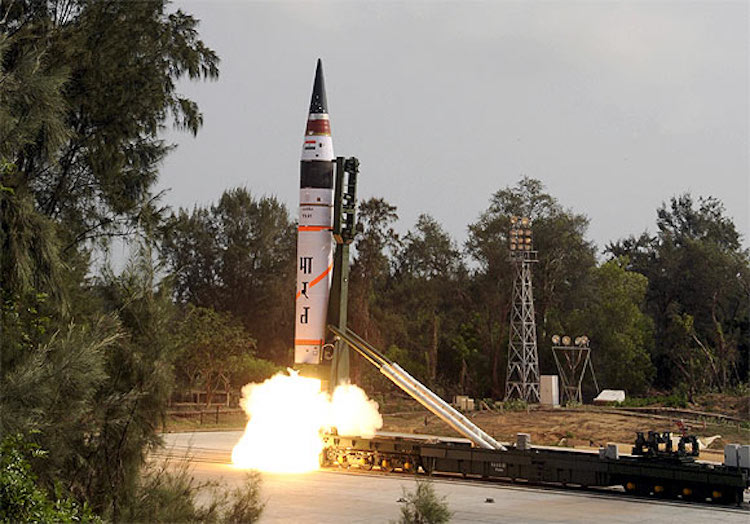
    It has been reported that the defence acquisitions council (DAC), chaired by defence minister, Nirmala Sitharaman, has approved the “acceptance of necessity (AoN) for the acquisition of the National Advanced Surface to Air Missile System-II (NASAMS-II) worth around $1 billion from the US. However, in 2002 the USA had vetoed India’s bid to acquire the Israeli Arrow-2 missile interceptor system. Consequently, DRDO began developing the Prithvi Air Defense (PAD), which will provide long-range high-altitude ballistic missile interception during an incoming missile’s midcourse phase as well as interception during the terminal phase. At various times these systems had different monikers like ballistic missile defence (BMD) or anti-ballistic missile system (ABM).

    The people who decide on such things reside in New Delhi and understandably their safety gets priority. So it is the NCR that will get the expensive and exaggerated sense of protection such systems tend to generate. But no air defence system can be deemed impenetrable. The Americans and Russians realized much before the Cold War ended that the costs involved will be prohibitive, even for them and made a virtue of necessity. But the idea was seductive. Even as the Cold War was waning, Ronald Reagan toyed with the idea of a strategic defence initiative (SDI), which envisaged an ABM systems stationed deep in space that will launch on picking up a launch. It seemed far-fetched and futuristic that commentators took to calling it Star Wars.

    This thought has been high on the minds of our security establishment ever since it learned that on May 26, 1990 China tested a Pakistani derivative of its CHIC-4 design at the Lop Nor test site, with a yield in the 10 to 12 kiloton (kt) range. That yield estimate accords with recorded yields of Pakistan’s 1998 nuclear tests, which are somewhere between 5 and 12 kt. Refinements in boosting and efficient plutonium use are the normal next steps in weapon improvement, along with miniaturization of the warheads to fit into smaller and lighter reentry vehicles. Pakistan has done all of these to arm its cruise and ballistic missiles with lighter payloads. Once India deploys the PAD system around its capital, we can be assured that Pakistan too will deploy an ABM around Islamabad. We can also rest assured that China will assist it in “developing” such a capability.

    The International Panel on Fissile Materials has estimated that Pakistan has an inventory of approximately 3,100 kilograms (kg) of highly enriched uranium (HEU) and roughly 170kg of weapon-grade plutonium This is enough to potentially produce 200 to 300 warheads. Pakistan has also frequently tested the ranges of about a dozen Chinese derived missiles from the Hatf (50 km) to Shaheen III (2750 km). There is little doubt that Pakistan has planned for all eventualities, from local battlefield use and to feed its desire to have a credible “Islamic” bomb capability, and for that its reach must include Tel Aviv.

    Long after the Cold War has ended, nuclear deterrence is still based on Mutually Assured Destruction (MAD). This simply means that any sneak decapitating or debilitating first strike will be responded with a massive retaliation, the fear of which should instill good sense. That after almost three quarters of a century when the nuclear genie was uncorked from the bottle, we have not had a nuclear war or weapon use is living proof of its robust common sense. So much so, that when developments in ABM or BMD capability reached fruition, the two Cold War protagonists, the USA and now defunct USSR, had a treaty restricting these systems. Ironically even well before they had a treaty on reducing the number of nuclear bombs.

    The MAD doctrine was made painfully credible, by the development of nuclear arsenal survivability by widespread deployment (at the peak of the Cold War America and Russia each had over 30,000 nuclear bombs.) This credibility got its biggest boost when submarines, initially diesel and then nuclear powered, capable of firing nuclear armed missiles (SSBN) from the impenetrable dark recesses of the oceans were introduced. The first of these submarines was the Russian Zulu Class submarine capable of firing from underwater an early Scud missile (1955). The Americans were the first to deploy a long endurance, deep diving and very silent nuclear powered submarine – George Washington – in 1959. Since then MAD was ensured by the highly accurate missiles in the bellies of such submarines operated by the US, Russian, British, French, Chinese and India navies. Pakistan too is now reportedly testing nuclear capable missiles fired from underwater on modified diesel submarines.

    We need to learn from how nuclear weapons strategies evolved during the Cold War, instead of mimicking USA and Soviet follies. The notion of deterrence between the USA and USSR was based on no escape from MAD. The march of the Cold War follies peaked with the two protagonists together deploying almost 70,000 warheads each aimed at a specific target. At the height of this madness almost every open ground was targeted as possible tank marshaling or military logistics areas. The last thing we hence want is getting into a numbers game with Pakistan or China. Credibility depends on reducing the uncertainty of use from the opposite perspective. The Indian PAD missile defence system only increases them. India and Pakistan have ensured a modicum of confidence by not mating the warheads and delivery systems, giving a vital period to rollback the unleashing of Armageddon. But now both countries will have to evolve a launch on warning doctrine.

    Clearly, the two South Asian nuclear powers too have a local version of MAD in place. The Pakistani doctrine “commits itself” to use battlefield nuclear weapons if an Indian conventional assault threatens its essential nationhood and hence it has steadfastly refused to accept the notion of “no first use” (NFU). The Indian doctrine emphasizes NFU but also makes it explicit that any Pakistani use of nuclear weapons on India or its forces will be responded with a massive retaliation. India may have less nuclear weapons, not because it cannot make more, but what it has is enough to ensure the complete annihilation of Pakistan, which is geographically too a much smaller country. China has moved on from NFU to a doctrine now called “credible minimum deterrence”. But how much is credible?

    Mercifully, nuclear doctrines these days are couched in such abstractions as MAD requires a degree of predictability, ironically ensured by opacity. The USA’s “single integrated operational plan” (SIOP) began with the ominous words that its objective, after the outbreak of a general war with the then Soviet Union to turn it into a “smoking radiating ruin.” It was written by its the certifiable USAF chief, Gen. Curtis Lemay Jr., based on whom the character played by George C. Scott in the Stanley Kubrick classic “Dr. Strangelove” was created. But people like Lemay who gave MAD credibility. Since no one of a sane frame of mind would even contemplate the enormity of the disaster of a nuclear war, uncertainty of use was a key element of MAD. It has been written that Soviet President Leonid Brezhnev used to have sleepless nights thinking of a man like Richard Nixon with his finger on the button.

    India’s nuclear strategy documents in detail as to who the nuclear command would devolve to in the unlikely event of a decapitating first strike on New Delhi with the aim of eliminating its national leadership. It is said that chain of nuclear command keeps descending downwards to a Major General, a modern day Raja Parikshit so to say who will perform the final obsequies. At last count India had over 600 military officers at that level. Decapitating all of them is a near statistical and physical impossibility. It will take tens of thousands to precision nuclear weapons to annihilate India’s military chain of command, and it can be speculated whether even America or Russia can achieve that, let alone Pakistan?

    Ironically, the evocative acronym MAD doctrine is eminently sensible. Good sense should tell us that enough of this madness and leave MAD alone.

    This Op-Ed was originally published in Asian Age.

    Mohan Guruswamy is a Trustee of TPF.

  • The Challenges of AI-enabled Underwater Platforms

    The Challenges of AI-enabled Underwater Platforms

    Vijay Sakhuja  Aug 03, 2018

    The Chinese People’s Liberation Army Navy (PLAN) is likely to acquire a new type of submarine by the early 2020s. According to the South China Morning Post, the Shenyang Institute of Automation under the Chinese Academy of Sciences (CAS) is engaged in developing a series of extra-large unmanned underwater vehicle (XLUUV) that will feature Artificial Intelligence (AI). The vessels will be capable of performing a number of tasks without “human intervention,” “handle their assignments and return to base on their own,” and carry out reconnaissance, surveillance, combat operations against enemy targets, and undertake activities such as whale tracking. It will be possible to integrate these vessels with other manned and unmanned platforms and systems at sea, in air as also on land to carry out coordinated missions.

    Lin Yang, the project director and a marine technology specialist, has noted that Chinese interest in these platforms is prompted by US plans to acquire XLUUVs capable of carrying “a variety of payloads, from sensors to weapons.” Two prototype units have been contracted, one to Lockheed Martin and the other to Boeing, and they have been granted US$ 43.2 million and US$ 42.3 million, respectively for research, design, and testing in 2020. The winner will receive orders for production of up to five platforms. Unlike China and the US, Russia is developing the Status-6 autonomous torpedo capable of delivering 100-megaton warhead capable of “wiping out all living things” within a 1,500 km radius.

    These developments are clear signs of the role of AI-enabled underwater platforms and weapons in the future, and add a new dimension to underwater operations. There are at least four issues concerning them that merit attention.

    First is naval warfare. Navies have traditionally employed conventional submarines for intelligence gathering, laying mines, attacking enemy submarines and ships, and more recently, conducting strikes against shore targets by using land attack cruise missiles. The usual tactic for conventional submarine has been the ‘lie-in-wait’ position at the entrance to harbours or close to choke points and attack the enemy. Like their conventional counterparts, AI-enabled platforms can serve as scouts, and smaller platforms can masquerade as decoys to attract the enemy, forcing it to expose its position. If necessary, the AI-tool kit should be able to detect, track, generate high speed, and attack the enemy like a torpedo.

    It is useful to mention that the US’ XLUUVs will “operate autonomously for weeks or even months, periodically phoning home to check for new orders,” giving the US Navy a significant advantage in tactical operations. Similarly, the Status-6 autonomous torpedo can be used by the Russian defence ministry’s special division for deep-sea research and deliver “deep-sea equipment or installing surveillance devices.”

    Second, the XLUUVs may entail new legal challenges. There is an ongoing debate raging over regulating lethal autonomous weapon systems (LAWS), including a call to ban fully autonomous weapon systems centered on the Principle of Non-Delegation of the Authority to Kill by non-human mechanisms. A global campaign – Coalition to Stop Killer Robots – has called for an international ban on ‘killer robots’, and “a treaty for emerging weapons.” There is a belief that morality and generally accepted ethics need to be injected into the use of AI-enabled weapon systems given that “inanimate machines cannot understand or respect the value of life.” If the XLUUVs are put to combat operations, it would result in the weaponisation of AI, and this empowers humans to absolve themselves of any moral consequences of killing or using these for self-defence.

    It is important to mention that engineers and scientists from the technology industry signed a pledge in Stockholm at the 2018 International Joint Conference on Artificial Intelligence (IJCAI) and called upon “governments and government leaders to create a future with strong international norms, regulations and laws against lethal autonomous weapons.” They have since been joined by corporates such as Google DeepMind, the XPRIZE Foundation, University College London, ClearPath Robotics/OTTO Motors, the European Association for AI, and the Swedish AI Society.

    Third, the XLUUVs rely primarily on AI to conduct operations. These platforms would transit long distances passing through a variety of undersea topography, ie ridges, mounts, trenches, rocks, slopes and basins, and would be vulnerable to collisions, detection by civilian research and survey vessels, enemy submarines and warship, and underwater military detection systems including those used for seismic warnings. Further, underwater activity such as laying of oil and gas pipelines and fiber optic cables can impact their safety. Besides, natural occurrences such as currents and tides can result in drift and cause considerable difficulty to being positioned in the designated destination.

    Fourth regards the impact of AI-enabled underwater platforms on the marine environment, particularly marine life such as whales, sharks, dolphins and other migratory species. Sonar transmissions by XLUUVs can cause potential damage to mammals’ sensory organs resulting in disorientation or death. Whales may even misunderstand sonar waves as that of an attacker, and panic can drive them towards the platform.

    The development of XLUUVs presents clear dangers and could have potentially destabilising consequences for all countries. Further, their impact on marine life and the associated ecosystem – which is already witnessing stress due to pollution and plastic – does not appear to have been taken into consideration. Finally, an international treaty for emerging AI-enabled underwater platforms needs to be prepared, debated, and signed.

    This article was originally published in IPCS.

    http://ipcs.org/comm_select.php?articleNo=5497

  • The San Juan Incident

    The San Juan Incident

    K N Sushil   December 08, 2017

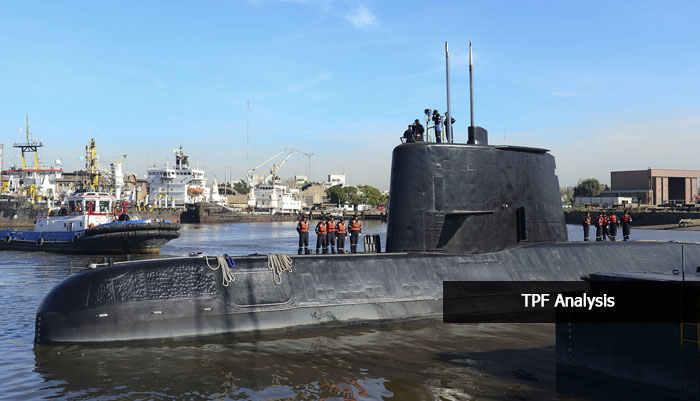
    The ARA San Juan disappeared a few hundred kilometers off Argentina’s coast on November 15, and despite an extensive air and sea search no sign of the sub has been found. Eight days after the sub vanished, the Vienna-based Comprehensive Nuclear Test-Ban Treaty Organisation said that it had detected hydro-acoustic anomaly” about 30 nautical miles (60km) north of the sub’s last-known position at 10:31 (13:31 GMT) few hours after the sub’s last contact. The analysis of the acoustic incident was reported as follows.

    The acoustic signal associated with the loss of the Argentina Submarine ARA SANJUAN confirms the following:

    That acoustic signal originated near 46-10S, 59-42W at 1358Z (GMT) on 15 November 2017. It was produced by the collapse (implosion) of the ARA SAN JUAN pressure-hull at a depth of 1275-feet. Sea pressure at the collapse depth was 570 PSI. The frequency of the collapse event signal (bubble-pulse) was about 4.4Hz. The energy released by the collapse was equal to the explosion of 12,500 pounds of TNT at the depth of 1275-feet. That energy was produced by the nearly instantaneous conversion of potential energy (sea-pressure) to kinetic energy, the motion of the intruding water-ram which entered the SAN JUAN pressure-hull at a speed of about 1800 mph.
    The entire pressure-hull was completely destroyed (fragmented/compacted) in about 40 milliseconds (0.040s or 1/25th of a second), the duration of the compression phase of the collapse event which is half the minimum time required for cognitive recognition of an event. Although the crew may have known collapse was imminent, they never knew it was occurring. They did not drown or experience pain. Death was instantaneous.
    The SAN JUAN wreckage sank vertically at an estimated speed between 10 and 13 knots. Bottom impact would not have produced an acoustic event detectable at long range

    The ARA San Juan was an IKL(German) designed type 1700 submarine built by TKMS in their Essen yard in 1985 at about the same time the Indian type 1500 was being built at HDW(Kiel). Both the submarines have great deal of similarities. Therefore, having commanded two type 1500s I will venture to hazard a guess on what could have afflicted the submarine.

    Facts as gleaned from various reports.

    15 Nov 0030Hrs. Submarine surfaced to report Water ingress through snort system causing a short circuit in the forward battery group. The forward battery group was isolated. The submarine charged her batteries on surface

    At 0600 The message is transmitted through normal communication channels.

    At 0730 the Captain informs base that he intend to continue his passage dived (Presumably because the sea was rough) At 1031, according to the CTBT report the submarine imploded at a depth of 1275 ft.

    From the above it would appear that the submarine was snorting before she surfaced at 0030hrs. If there was water ingress through the snort mast that caused a short in the forward battery group then the submarine was unable to maintain snorting depth, because the sea may have been too rough and the “head valve” (that prevents water from coming into the mast, when the mast dips even momentarily) was not functioning. As part of the SOP the snort induction drain, which drains into the bilges is kept open for the duration of the snort.  In any case during the snorting, the diesel engines are used to create the suction that draws all the foul air from all over the submarine. The fresh air coming from the snort mast merely spreads to fill the vacuum. Therefore flooding through the snort system would normally have no effect on the battery groups.

    The submarine remained on surface for seven hours post an incident of fire and smoke, which was attributed to short circuiting of the forward battery group. The crew, it seems, did not see any fire but managed to clear the smoke after isolating the forward battery group.

    A fire in a battery group is one of the most dreaded emergencies on board any submarine. Therefore the damage control actions and subsequent analysis would have been painstakingly thorough. If there was a fire in the battery pits the firefighting system would have been activated (manually or automatically). Once the system is activated the battery pits are to be kept in a sealed condition for at least one hour. Thereafter the pit is ventilated for at least an hour before inspecting it. In these types of submarines one has to lie down on a trolley and manoeuvre manually over the batteries. If the sea is rough it becomes extremely difficult and dangerous.  It may therefore be possible that they may have dispensed with the inspection whilst on surface.

    In the seven hours on surface the crew must have thoroughly examined the power distribution network and come to the conclusion that the problem was contained, and the submarine was reasonably safe to continue dived with a single battery group. They may even have considered that it would be safer and easier to inspect the battery pit while the submarine is underwater.

    The submarine dived at 0730 hrs. After 3 hours it appears to have imploded at a depth of 388 Meters. 388 Meters is of course below the normal operating depth but well above the crushing depth. If the submarine did indeed implode at that depth the inescapable inference is that there were severe structural problems that had weakened the pressure hull. The Argentinean Navy must have known if any structural limitations were reported or imposed.

    If the structural problems were not severe enough then some event that occurred in the 3 hours she was submerged must have been responsible. That event was so catastrophic that the submarine was unable to prevent an uncontrolled descent. Given the background situation the captain would have ordered the submarine to dive to 50 Meters. As soon as he settled down to that depth, he would have ordered the inspection of the battery pit. Unless there are clear tell tale signs, it is possible to miss some things which may have the potential to cause damage. Anyhow the inference and action post this inspection is not known. Did they reconnect the forward group? We will never know. The inspection would have taken about 45 minutes to an hour. The fact that they did not surface immediately after the inspection indicates that they did not notice anything alarming.

    In the three hours that the submarine was under water, if there had been a gradual flooding, the crew would have taken action to mitigate the effects, and would have ample reaction time to surface. Therefore loss of control must have been triggered by a sudden event. A pressure hull breech and flooding that must have cause to rapidly lose depth. The most immediate response is to use speed to create dynamic vectors to aid depth control. Since the submarine had only one battery group connected the speed of the submarine would be restricted to about 8 Knots ahead and about 4 Knots astern.  This would not be sufficient to delay the descent so that de-ballasting and pumping out capacities can effectively annul or reduce the rate of flooding. The rate of flooding keeps on increasing with depth.

    Now we have a situation where the submarine with the forward (or all) ballast tank probably blown going down. At depths greater than 180 meters the effect of blowing ballast with High Pressure air (250Bar)is painstakingly slow. The next stage is when the submarine crosses 15 meters more than the operational depth the Hydrazine emergency de-ballasting system will be triggered. This system is designed to clear the forward and aft main ballast tanks in 12 seconds at any depth. The problem would be if the Ballast tanks already contain air the Hydrazine will cause an explosion in the ballast tanks. If that happens there is nothing left to create positive buoyancy.

    The Next question is why did the submarine implode at 388 meters? As brought out earlier it clearly points to structural weakness in the pressure. If such a situation did not pre-exist then it may be possible that the battery pit event may have cause massive spillage of acid into the pit causing the pit to corrode in the almost 10 hours this corrosion may have weakened the hull sufficiently to cause a substantial breech in the pressure hull. The flooding of the pits could an explosion as the water level reaches to short the terminal connectors.  This is only a conjecture.

    San Juan went down without a trace. The crew did not even have the time or opportunity to release the systems and tell tale indicators that were meant tell the outside world that the submarine is in distress.

    It is said what goes up must come down. Submariners know that what goes down need not necessarily come up. San Juan RIP.

    In the language of the submarine community San Juan is on eternal patrol.

    Vice Admiral K N Sushil (retd) is a Indian Navy Veteran, and the former Flag Officer commanding-in-Chief of Southern Naval Command.[/vc_column_text][/vc_column][/vc_row]