Mohan Guruswamy May 22, 2019/Analysis
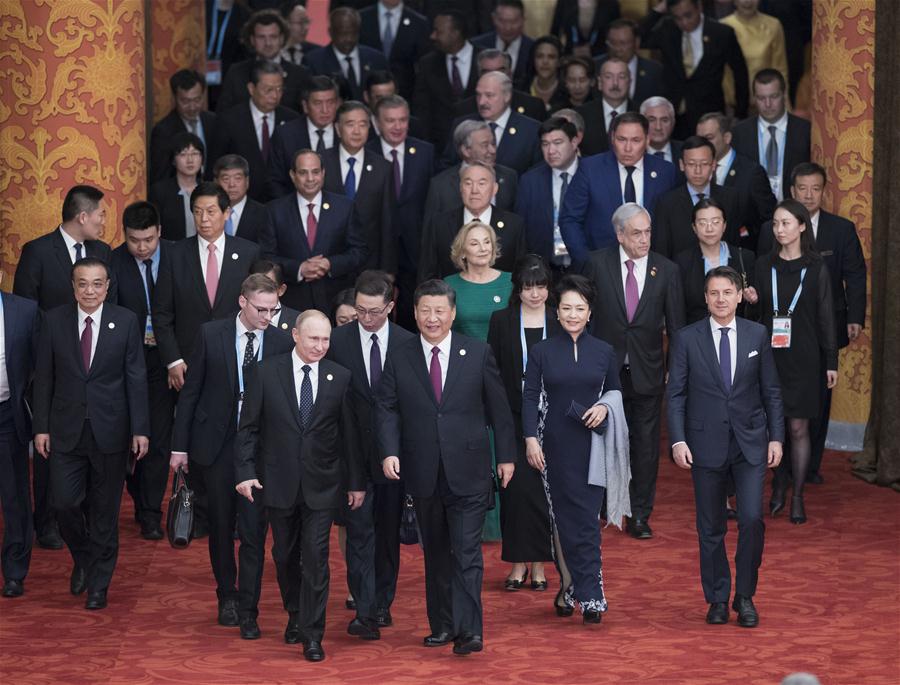
Almost two years after China hosted a well-attended and hugely-touted conference to promote its One Belt, One Road (OBOR) initiative, it held the second summit last month. It is apparent the grand design outlined at the first summit hasn’t quite shaped up as intended. Questions were asked about its real intentions, economic benefits and usurious tendencies.
The Chinese have begun backtracking a bit. Already, Malaysia has renegotiated the terms of the rail project with a much-reduced outlay, lower interest rates and increased local participation. It may be mentioned that the original deal was signed by paying the disgraced former Malaysian PM Najib Razak a sizeable bribe. Even Pakistan, Beijing’s so-called “all-weather” friend and ally, has begun questioning the terms of the China-Pakistan Economic Corridor (CPEC) after deriving lessons from what happened to Sri Lanka when the birds came home to roost at Hambantota.
The second edition of the Belt and Road Initiative Summit got under way in Beijing on Thursday last week. It seems that India’s opposition to it might have also been addressed somewhat when the BRI map showing routes rather curiously shows the whole of Jammu and Kashmir and Arunachal Pradesh as part of India. Is this a signal, or just artistic licence? The map even portrayed India as a part of BRI, despite India having boycotted the summit for the second time.
Typically, many Indian commentators have started seeing meaning in it. Maps be damned, we can see meaning in BRI only when the norms and terms conform to accepted international norms, such as those of lending agencies like the World Bank.
The BRI is seen as China’s big play to seek world domination. Both the fears and the optimism are unfounded. The BRI is a project meant to very simply get out the Chinese reserves invested in Western banks into investments where these will fetch a much higher rate of return; and to take up the slack from the huge overcapacity problem that plagues the Chinese economy.
Speaking at the first BRI (then OBOR) conference, President Xi Jinping had announced that Beijing would advance 380 billion yuan ($55 billion) to support it. This was a far cry from the huge figures, sometimes as high as $750 billion to $1 trillion, that were bandied about. Exaggerating the size of the lollipop is an integral aspect of China’s economic diplomacy.
While economists are generally sceptical about China’s goals and intentions, strategists — mostly the garden-variety Indian military types — have endowed this project with sinister overtones. I was on a television show when a prominent “security analyst” and the anchor raised the issue of the so-called “string of pearls”. To them it seemed that every port or airport where a Chinese company is the contractor had a military purpose. Most of these folks have not progressed beyond Mahan and Mackinder, whose theories were fashioned in a much earlier era when coaling and oil refuelling points were very critical.
The “string of pearls” is a bogus idea. It was cooked up by consultants working for a company called Booz Allen Hamilton, which was linked to the US department of defence and the Central Intelligence Agency, and was given a lot of traction by some well-known Indian “strategic thinkers”. I was once at a conference where Adm. Dennis Blair, a former US Navy chief and later President Barack Obama’s Director of National Intelligence, was asked about it. He called it a “stupid notion”, and said no one who has run a large navy or held a responsible position in a navy will ever say an oceanside blockade is possible. He explicitly and loudly said to Indian strategists who harped on the “string of pearls” that no navy could encircle a country with just a few ports.
The question that we need to ponder over a bit is how long will these “ports” survive after any outbreak of hostilities? The Indian Air Force and the Indian Navy have enough airpower at hand to sort them out, and our Navy can effectively blockade hostile ports in the neighbourhood. It may be noted that the IAF has operationalised an airbase in Thanjavur and will fly SU30 MKIs from there. The Navy deploys MiG-29K fighters as well as P-8i Poseidon maritime surveillance and attack aircraft, and has a formidable fleet of combat vessels. We have not been exactly sleeping or need to be overly worried. The same Sri Lanka that once hosted a Chinese Jinn class nuclear submarine ostensibly on a goodwill mission last year turned away a conventional submarine of the PLA Nany wanting to pick up supplies.
Now to the economics of BRI. There is a reality most of our commentators do not see or understand. By 2013, China had accumulated foreign exchange reserves of about $3.5 trillion. The capital it claims it is prepared to subscribe for the NDB, AIIB and Silk Road Fund would amount to only around seven per cent of its total foreign exchange reserves invested in Western banks. As these China-promoted institutions will provide infrastructure lending rather than grants, the return on capital from these investments could be significantly higher than the returns China gets from its foreign exchange reserves now invested in low-yielding US government bonds. It’s very simple. China needs to get value for its money and also help its demand-starved industries. They have found a typically Chinese solution to it, and are making a virtue out of a necessity.
Look at it from another angle. The US dollar is also steadily depreciating in the long term against other major currencies. With no interest and with depreciation factored in China’s huge reserves, accumulated by extracting surpluses in its sweatshops, are steadily shrinking in value. The question which Beijing seeks to grapple is this. One way is to put these funds to work in investment-starved countries in Africa and Asia and assures themselves of returns for a long time to come. In some, the birds have come home to roost quite early. The grandiose Hambantota port project in Sri Lanka, which once had the same bunch of Indian “strategic thinkers” in a tizzy, hosts no ships and doesn’t earn very much. China is now pressuring Sri Lanka to service the debt and is seeking to extract some more in lieu of that. Much of the Hambantota investment has been recouped by China via material and labour supplied to complete the project. That’s why one prominent European commentator then called OBOR “One Belt, One Road and One Trap”.
Like Sri Lanka, some other intended beneficiaries have now begun to ask questions about the utility and intentions of OBOR. Pakistan’s Dawn newspaper has said: “But the main thrust of the plan actually lies in agriculture, contrary to the image of CPEC as a massive industrial and transport undertaking, involving power plants and highways. The plan acquires its greatest specificity, and lays out the largest number of projects and plans for their facilitation, in agriculture.” It then questions the benefits that will arise from linking mostly dry and barren Xinjiang, and in particular the predominantly Turkestani Muslim Kashgar prefecture with its restive four million people, to an increasingly water-starved and already much troubled Pakistan. Once when a Pakistani interlocutor at a Track-2 session asked me what then would be the economic gains to Pakistan, I replied they could sell tea and samosas to the traffic!
Much is being made about the overland link between China and Europe by rail and road links. Most commentators seem to miss that the Trans-Siberian Railway line from Vladivostok to Moscow is almost a hundred years old. Its capacity can be beefed up. Yet overland freight costs will always be much more expensive than sea freight costs. Business is about cutting costs and taking the least expensive option. No one with common sense will prefer to shift by land what can be shipped. Others make much of the so-called Malacca dilemma. The Arctic route is now opening up, and the real Malacca dilemma soon will be the rapid decrease in freighters through it. There is always the option of a canal for freighters across the Kra Isthmus, a project that will bring China and Japan much closer to India.
Mohan Guruswamy is a Trustee and a Distinguished Fellow of TPF. He is a prolific commentator on economic and security issues, and specialises on China.
This article was published earlier in Deccan Chronicle.