Author: Mr Mohan Guruswamy MA MBA

  • GDP Growth by increasing the Cost of Government!

    GDP Growth by increasing the Cost of Government!

    Mohan Guruswamy  11 July 2018

    The truth is now staring us in the face. The latest breakdown of sectoral contribution to growth is out. Get ready for this. Public Administration, which somewhat perversely is classified as part of services, has now grown by 7% over the previous quarter making it the biggest driver of growth in India. Very simply this means as you keep paying government employees more the GDP will keep growing ever faster till one day you run out of breath and cash. In the Q3 of 2018, Public Administration added contributed 17.3% towards growth. In Q4 of 2018 it has grown to 22.4% making is a fraction smaller than the contribution of manufacturing at 22.7%.

    But hold your breath. Not satisfied with the 7th Pay Commission’s across the board hike of 23%, government employees are hopeful that the Prime Minister on August 15 will make an announcement fulfilling the promise made by the Finance Minister to give central government employees a pay hike beyond the recommendations of the pay commission. They are also hopeful that the retirement age will be raised to 62 years, allowing them to serve this poor and hapless country longer.

    There had been a spate of commentaries about how beneficial the 7th Pay Commission mandated pay hikes, and now approved by the Union Government with retrospective effect will benefit the economy. Despite this munificence, some government employees have called the 23.5% across the board hike peanuts! Others have made comments like “you pay peanuts you get monkeys!” as if you will now have earnest and honest public servants because the same fellows get more pay? The metaphor is unfortunate as well as illogical as the “monkeys” are already in place, only now the diet has become much more richer. Fat monkeys are what you will get.

    The high cost of wages has also slowed down intake into government and most departments are hugely understaffed. For instance the Revenue collecting departments are under strength by as much as 45.45%, Health by 27.59%, Railways by 15.15% and that the MHA is under strength by only 7.2% speaks volumes about how much has gone wrong in our system. We have a saying that the main business of government is to collect taxes so that they may be spent for the benefit of all the people. Thus we see the main business of government is now its least concern.

    The sheer absurdity of the logic that higher government salaries are beneficial to the economy speaks volumes of the kind of stupidity that permeates our policy thinking at high places. By this logic if the pay hike was higher GDP growth would be even higher. But think of this in terms of money denied for critically needed infrastructure and social development such as rods, power plants, schools and hospitals. As if these don’t generate GDP growth? Higher salaries mostly benefit those who get them. Period.

    The last pay hike hike benefitted 23 million government employees in the central and state governments and their PSU’s. No doubt this will make the CII and FICCI members will hear the music louder and dance all the way to the bank.  No wonder the top industry and banking analysts have given a big thumbs up to the Union Cabinet decision stating the move will “boost consumption in the economy” and lead to higher GDP growth. Its their fond hope that the pay hike combined with continued public push to the capital expenditure will help steer the economy to higher growth levels of 8% and above.

    “The pay hike of nearly Rs. 1 lakh crores for government employees will give a strong boost to the consumer demand and help uplift the growth of the economy,” said Didar Singh. the then secretary general, FICCI.  He will approve being a former IAS officer rehired by the industry trade union. But has FICCI noticed the IIM, Ahmedabad study that has found the “pay in the government sector is distinctly greater than that in the private sector?” The 23.5% average hike in central government employees’ salaries pushed up the government’s wage bill, including arrears, by an estimated R. 1.14 lakh crores.

    While you worry about the high cost of government, I will give you another reason to worry? If you wonder why our public administration is so ineffective, consider this. An analysis by a leading media organization suggests that roughly 14% officers get transferred within one year of service and another 54% within 18 months. In other words, 68%, or over two-thirds of India’s top bureaucrats, last on an average less than 18 months at a posting. Only 8% of the officers analyzed had average tenures of more than two years and there are only 14 officers who have managed to complete an average stay of more than three years between transfers. So what is the government you are getting for all the money we spend?

    This when 648 million Indians are living below the UNDP stipulated poverty line. The question we all must ask is growth at whose cost? Arun Jaitley crowing about it is akin to the head of a family who prefers to increase his spending on smoking and drinking by cutting down on the milk for the growing children.

    The three levels of government together employ about 185 lakh persons. The central government employs 34 lakhs, all the state governments together employ another 72.18 lakhs, quasi-government agencies account for a further 58.14 lakhs, and at the local government level, a tier with the most interface with the common citizens, we have only 20.53 lakhs employees. In other words it simply means we have five persons telling us to do this or do that, for every one supposedly serving us. And whom even these one out of six persons are answerable to is still a big question?

    Do we then have a big government bearing down on us? Not really.

    Consider this: India has 1,622.8 government servants for every 100,000 citizens. In stark contrast, the U.S. has 7,681. The central government, with 3.1 million employees, thus has 257 serving every 100,000 population, against the U.S. federal government’s 840. Now look at the next tier at the state level. Bihar has just 457.60 per 100,000, Madhya Pradesh 826.47, Uttar Pradesh has 801.67, Orissa 1,191.97 and Chhattisgarh 1,174.62.

    This is not to suggest there is a causal link between poverty and low levels of public servants: Gujarat has just 826.47 per 100,000 and Punjab 1,263.34. The troubled states or really speaking the troublesome states actually fare far better on this score. Thus, Mizoram has 3,950.27 public servants per the 100,000 populations, Nagaland 3,920.62 and Jammu and Kashmir 3,585.96. Bar Sikkim, with 6,394.89 public servants per 100,000, no state comes close to international levels.

    Very clearly for the most part, India’s relatively backward states have low numbers of public servants. This means staff is not available for the provision of education, health and social services needed to address poverty. It would seem that instead of getting better government and more public servants, we are getting more expensive government.

    We are now riding the tiger of a high wage enclave of government employees, who also drive consumption and hence GDP growth. It may now be difficult to get off this tiger

    Shri Mohan Guruswamy is a former Rajya Sabha MP and a political commentator. He is a Trustee of TPF.
    This article was earlier published in National Herald.
  • Foreign Reserves beyond a point are Pointless

    Foreign Reserves beyond a point are Pointless

    Mohan Guruswamy  October 07, 2017

    Clearly the Indian economy is not at a place where it wants to be. The Modi government is finds itself in a chakravyuh that it is unable to fight its way out. The government is just unable to make or attract the investment needed to make the economy buoyant again. India enjoyed a decade of unprecedented growth from 2004-14 that seemed to have lost steam in the last year. It was largely caused by a huge decline in the proportion of capital investment expenditure. Despite the growth of the private and foreign investment, the Indian economy is still largely dependent on government investment to lead the investment and growth cycle.

    The promise of Modi was that he was expected to set right this trend and once again begin a new cycle with government led investment. He promised us a hundred new cities, a nationwide grid of high-speed rail networks, a national river-linking program and so many other major transformational projects. A hundred new cities have now become a hundred smart cities, which means little more than free wi-fi networks. The nationwide grid of fast trains has now become an exorbitant and apparently uneconomical single bullet train joining Ahmedabad and Bombay. Similarly all other feasible and exciting promises made are now mere caricatures of what were promised. It is simply that the Modi government has been unable to free the economy from its high subsidy burden and PSU black hole, where only the oil and power companies earn a profit due to administered pricing.

    Consequently the picture continues to be bleak. Output of capital goods contracted 1% in July against growth of 8.8% a year ago. Production of consumer durable goods shrank 1.3% against a nominal increase of 0.2% a year earlier.

    Then came the twin black swan events. Demonetization came as a body blow to the cash-dependent unorganized sector that makes up 40% of India’s GDP. The unorganized sector also accounts for 90% of the total employment of around 450 million. The loss of jobs due to the two events – demonetization and hasty implementation of GST- is still not empirically confirmed. Estimates vary. The construction and vegetable and fruit retail sectors seem to have taken a massive hit and the ballpark estimation of loss of jobs is at about 25-30 million. These sectors mostly employ rural landless labour with few skills and hence forced into taking up daily wage and earnings sustenance. They don’t shout much and few notice their pain. Unlike the loss of even a few thousand jobs in the IT sector.

    The implementation of GST forced companies to reduce production in the run-up to its 1 July implementation as dealers reduced inventory. The inadequate training and preparation was abundantly evident. The announcement of rates was hasty and the many mismatches between input and output rates compounded the confusion. Of the Rs.95000 crores collected in the first month, as much as Rs.65000 is due to be refunded. The problem is that the government doesn’t seem to have the cash to do so.

    In a belated effort to reverse these trends the government is planning to loosen its fiscal deficit target of 3.2% of GDP to enable it to spend up to Rs. 50,000 crore. This is piddly sum for an economy whose GDP is over Rs.150 lakh crores now. Right now we have a net outflow of foreign investment. What we need is a huge dollop of cash infusion to boost investment. Loosening fiscal deficit norms will help. But meaningfully slashing subsidies when Modi’s term is on the slope to elections is not politically feasible.

    There is that old saying that when the going gets tough, the tough get going.  Modi should now show toughness and imagination that is tempered with realism.  He needs to revive the national mood and generate optimism over the economy. He now needs a plan to drive investment. He doesn’t have to go far to find the money to fund this plan.

    The government is sitting with reserves of nearly $400 billion with about $135 billion alone sitting in US banks earning next to nothing. These reserves are equal to about 80% of our foreign debt. Even after providing a quarter of the reserves to cover short-term hot money of NRI investors each taking a pound of flesh for mostly foreign bank financed investment in their mother country, we will still have $300 billion in hand.  How much money can be freed from the other $300 billion for investment is the big question now? Kaushik Basu has said that India’s foreign reserves need not be more than the current account deficit (CAD) or about $80 billion. Others are more cautious.

    This will certainly raise many eyebrows. One is surprised over the number of people who think holding huge reserves abroad in ridiculously low yield securities is a sign of our wealth. No. It is a sign of our stupidity.

    Just holding enough reserves to cover the CAD or exports for a few months would be about enough. This nonsense of holding reserves to at least cover six months imports is just plain arbitrary and concocted by the people who made the Washington Consensus. This “consensus” assures New York banks plenty of cheap money to finance American domestic consumption and extravagances. The Chinese have now realized the stupidity of financing the US cheaply with their reserves which not long ago almost touched $4trillion. They have run it down by about $1trillion since.

    Now how much do you think the US foreign reserves amount to? Hold your seat. It is now $65 billion or about a fifth of India’s. What a travesty.

    Clearly running them down by $100-120 billion or Rs.6.5L- 8L crores can be contemplated. The government could establish an India Infrastructure Investment Fund and start shifting meaningful fractions from the foreign reserves into this fund. A board of well-regarded experts, who can allocate investments on merits to prevent the usual leakages and political misuse, could administer the fund. The fund must also mandate the minimum level of local procurement and investment to boost Make in India.

    Slow growth and no new jobs are Narendra Modi’s twin Achilles heels. He is vulnerable on both counts. He must seize the moment with both hands and start running with both legs.

    Shri Mohan Guruswamy is a former Rajya Sabha MP and a political commentator. He is a Trustee of TPF.
    This article was earlier published in ‘The Economic Times’.

  • The Demand for Gondwana: India’s Adivasi Homeland

    The Demand for Gondwana: India’s Adivasi Homeland

    Mohan Guruswamy December 03, 2017

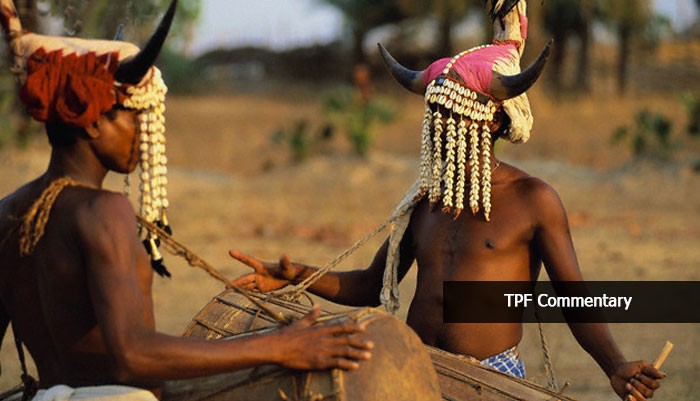
     The scion of the former Gond kings of Chandagarh or Chandrapur now in Maharashtra, Birshah Atram was recently visiting the Gond homelands in the former composite Adilabad district to meet his kinsmen in the various garhi’s in the region. Birshah Atram is descended from a line that was established in Chandrapur in the 13th century by Kandakya Balal Sah. The Gond kings ruled till 1751 when the British annexed it after the Raja of Nagpur died childless. Birshah who holds two PhD’s in English and Ancient Indian History has for long been seeking a solution to the vexed Adivasi problem, that has also morphed into the Telugu led Naxalite rebellion that enables the Central and State governments to turn it into a law and order issue, by highlighting the grievances of the Adivasi people. He believes that the Central Government needs to implement the constitutional provisions and promises made in the Constituent Assembly by recognizing Gondi language and self-rule for the Gond people by carving out a Gondwana state of the Gond homelands in Maharashtra, Madhya Pradesh, Andhra Pradesh and Chhattisgarh.

    There is a vast and mostly forested region spanning almost the entire midriff of India from Orissa to Gujarat, lying between the westbound Narmada and eastbound Godavari, bounded by many mountain ranges like the Vindhya, Satpura, Mahadeo, Meykul, and Abujhmar, that was once the main home of the Adivasi. The late Professor Nihar Ranjan Ray, one of our most distinguished historians, described the central IndianAdivasis as “the original autochthonous people of India” meaning that their presence in India pre-dated by far the Dravidians, the Aryans and whoever else settled in this country. The anthropologist Dr. Verrier Elwin states this more emphatically when he wrote: “These are the real swadeshi products of India, in whose presence all others are foreign. These are ancient people with moral rights and claims thousands of years old. They were here first and should come first in our regard.”

    Unfortunately like indigenous people all over the world, the India’sAdivasis too have been savaged and ravaged by later people claiming to be more “civilized”. They still account for almost 8% of India’s population and are easily it’s most deprived and oppressed section. Though this is the home of many tribal groups, the largest tribal group, the Gonds, dominated the region. The earliest Gond kingdom appears to date from the 10th century and the Gond Rajas were able to maintain a relatively independent existence until the 18th century, although they were compelled to offer nominal allegiance to the Mughal Empire.

     The great historian Sir Jadunath Sarkar records: “In the sixteenth and seventeenth century much of the modern Central Provinces (today’s MP) were under the sway of aboriginal Gond chiefs and was known under the name of Gondwana. A Mughal invasion and the sack of the capital had crippled the great Gond kingdom of Garh-Mandla in Akbar’s reign and later by Bundela encroachments from the north. But in the middle of the seventeenth century another Gond kingdom with its capital at Deogarh, rose to greatness, and extended its sway over the districts of Betul, Chindwara, and Nagpur, and portions of Seoni, Bhandara and Balaghat. In the southern part of Gondwana stood the town of Chanda, the seat of the third Gond dynasty and hereditary foe and rival of the Raja of Deogarh.” But the glory of Deogarh departed when the Maratha ruler of Nagpur annexed Deogarh after the death of Chand Sultan.

    Incidentally the Gond ruler of Deogarh, Bakht Buland, founded the city of Nagpur. Jadunath Sarkar writes about him thus: “He lived to extend the area, power and prosperity of his kingdom very largely and to give the greatest trouble to Aurangzeb in the last years of his reign.” In fact the one big reason Aurangzeb could not deploy all his power against Shivaji was because the Gond kings were constantly at war with the Mughals and kept interdicting the lines from the Deccan to Agra. But of course the history of modern India is not generous to them.

    During the British days this region constituted much of the Central Provinces of India later to become Madhya Pradesh. This is the main home of about sixteen million Gond people who are India’s largest single tribal grouping. The Gonds are now a culturally and linguistically heterogeneous people having attained much cultural uniformity with the dominant linguistic influences of their region. Thus, the Gonds of the eastern and northwestern Madhya Pradesh region that now includes the new state of Chhattisgarh speak Chhattisgarhi and western Hindi. But the Gonds of Bastar, which is at the southeastern end of this vast region and a part of Chhattisgarh, are different in this respect. Though there are many tribal groups like the Halbas, Bhatras, Parjas and Dorlas, the Maria and Bison Horned Gonds are the most numerous. The language spoken by them, like that of the Koyas of AP is an intermediate Dravidian language closer to Telugu and Kannada.

    The process of Hinduization combined with Hindi culture has reduced the egalitarian Koitur to the bottom of the social strata. Dr. Kalyan Kumar Chakravarthy, Director of the Indira Gandhi Rashtriya Manav Sangrahalaya, Bhopal has written eloquently and cogently on this in his concluding chapter “Extinction or Adaptation of the Gonds” in the book “Tribal Identity in India” also edited by him. The real enemy of theAdivasi is the creeping Hinduization with all its attendant values and exclusionary practices, seems to me a good start to the process of saving its tribal society from extinction. All over the rest of India’s central highlands our policies by forcing the Adivasis to merge their identities with that of the encroaching culture have crushed them into a becoming a feeble and self-pitying underclass.

    Clearly there are two distinct reasons for the present unrest in the Adivasihomelands of India. The first and probably the more important one is the struggle for identity against the creeping Hinduization or de-culturization of Adivasi society. Adivasi society was built on a foundation of equality. People were given respect and status according to their contribution to social needs but only while they were performing that particular function. Such a value-system was sustainable as long as the Adivasi community was non-acquisitive and all the products of society were shared. Adivasisociety has been under constant pressure as the money economy grew and made traditional forms of barter less difficult to sustain.

    The Fifth and Sixth Schedules under Article 244 of the Indian Constitution in 1950 provided for self-governance in specified tribal majority areas. In 1999 the Government of India even issued a draft National Policy on Tribals to address the developmental needs of tribal people. Special emphasis was laid on education, forestry, healthcare, languages, resettlement and land rights. The draft was meant to be circulated between MP’s, MLA’s and Civil Society groups. A Cabinet Committee on Tribal Affairs was meant to constantly review the policy. Little has happened since. The draft policy is still a draft, which means there is no policy.

    Even before Independence on December 16 1946, welcoming the Objectives Resolution in the Constituent Assembly, the legendary Adivasileader Jaipal Singh stated the tribal case and apprehensions explicitly. He said: “Sir, if there is any group of Indian people that has been shabbily treated it is my people. They have been disgracefully treated, neglected for the last 6,000 years. …The whole history of my people is one of continuous exploitation and dispossession by the non-aboriginals of India punctuated by rebellions and disorder, and yet I take Pandit Jawahar Lal Nehru at his word. I take you all at your word that now we are going to start a new chapter, a new chapter of independent India where there is equality of opportunity, where no one would be neglected.”

    The Adivasi’s paid dearly for taking Jawaharlal Nehru and the Constituent Assembly at their word.

    Shri Mohan Guruswamy is a former Rajya Sabha MP and a political commentator. He is a Trustee of TPF.

    This article was published earlier in ‘The Citizen’.