Author: M Matheswaran

  • Quad 2.0: Can it be a win-win for the four Democracies

    Quad 2.0: Can it be a win-win for the four Democracies

    China’s GDP expanded from USD 6 trillion in 2010 to USD 14.3 trillion in 2019. It has had exponential growth over the last three decades, with an average GDP growth rate of 9.23% from 1989 to 2020. Although the impact of the COVID pandemic pushed its GDP into decline and negative (-6.80%) in the first quarter of 2020, it has rebounded with a growth of 5% in the third quarter. It’s military spending, officially, is more than three times that of India, unofficially maybe five times or more. China has become one of the key players in the Indo-Pacific as a significant part of its economic activities depend on this region.

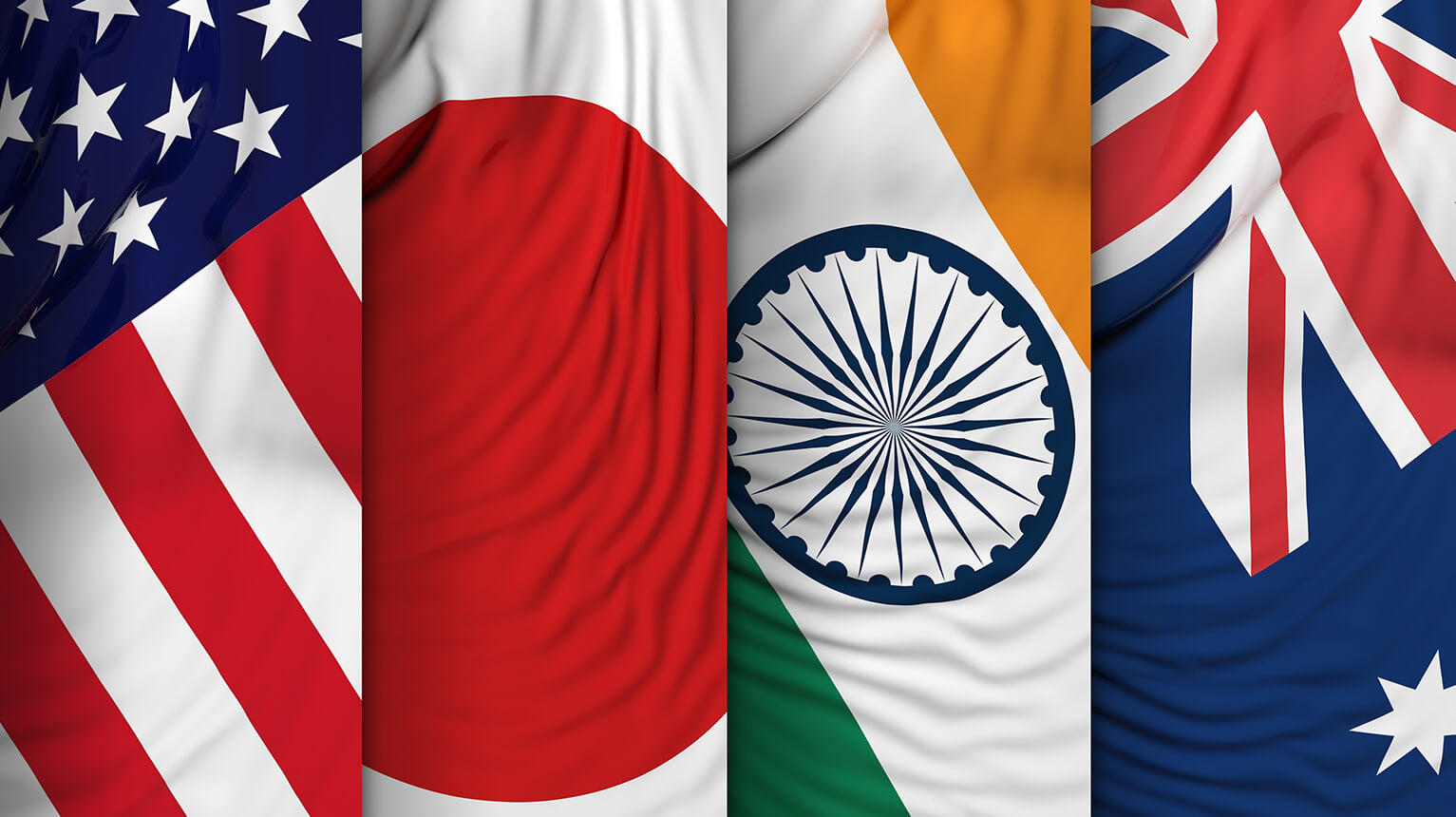
    The Indo-Pacific has replaced the Trans-Atlantic as the epicentre of global politics. Its importance to the global order is multifarious. In economic terms, one half of the world’s commercial influx goes through the Indo-Pacific sea routes and the Indian Ocean carries two-thirds of global oil shipments. Besides, a few of the biggest military spenders are part of the region. China’s hostile actions and policies have agitated the US, Japan, Australia and India. A shared concern over the expansion of China’s political and military clout was fundamental to the revival of the Quadrilateral Security Dialogue (Quad 2.0), on the sidelines of the ASEAN summit in Manila, in 2017.

    Quad is seen as cooperation between four large democracies that share the idea of an open and inclusive Indo-Pacific

    There is growing speculation over what the re-emergence of the Quad means. On the one hand, it is seen as cooperation between four large democracies that share the idea of an open and inclusive Indo-Pacific; on the other, a strategic alliance towards keeping China’s assertive actions in check.

    The Quad: Overcoming Intransigence

    The Quad is a mechanism that enables a dialogue on regional security issues between the four countries. Its revival, this year, reflects an intersection of strategic interests: that of an open and inclusive Indo-Pacific and a rules-based international order. The Quad came together in November for the naval exercise – Exercise Malabar – in two phases, in the Bay of Bengal and the Arabian Sea. The exercise, in its 24th edition, is the biggest so far and has sent significant strategic signalling to China.

    The Quad should be considered less as a formal alliance and more as a mechanism built on existing bilateral and trilateral partnerships between the four countries. It first emerged as a cooperative response to the 2004 tsunami, when the four navies were involved in providing humanitarian and disaster relief. Despite strong support from Japan and the US to formalise the group, it disbanded with Australia and India backing out in 2007, due to concerns about China’s reaction to the grouping. This gave rise to multilateral partnerships among the four countries.

    Between the four democracies, there are three trilateral and six bilateral partnerships. Trilaterally, Japan, India and Australia first came together in 2015 to discuss shared concerns over maritime security in the Indo-Pacific Region and freedom of navigation in the South China Sea. More recently, the three countries agreed to develop a supply chain resilience program for the Indo-Pacific Region amid growing recognition of their excessive, economic reliance on China.

    Bilaterally, the US and India signed the Basic Exchange and Cooperation Agreement (BECA) on October 27 that gives India access to American geospatial intelligence that will be useful for precision guidance of its missiles. Further, India-Australia ties have strengthened over the last few years with their initial 2+2 dialogue in 2017 and with Australian participation in India’s Milan exercise in 2018, focusing on interoperability between navies in the region.

    China and the Quad

    Over the years, the Indo-Pacific has emerged as a region of strategic importance. As China expands into the region, its actions have created tensions with the Quad members.

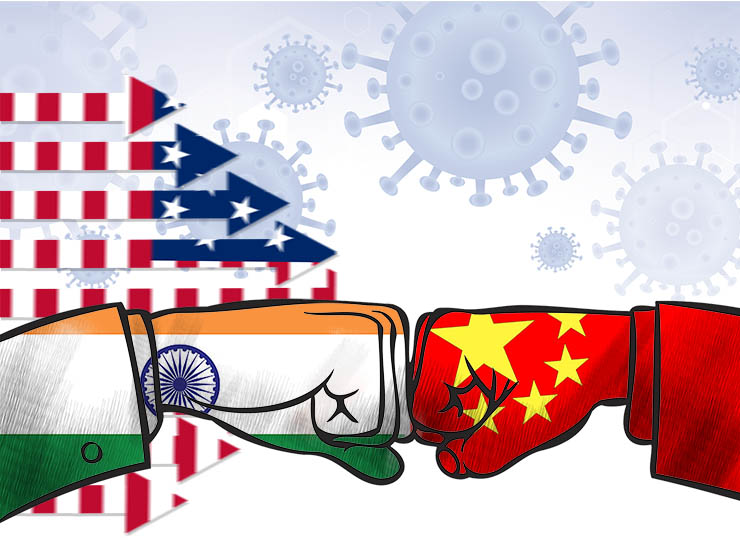
    Sino-Indian relations:  India-China relations have touched rock-bottom since the clashes on the LAC in Ladakh.  China’s intrusions and violations along the LAC have been backed up by significant massing of PLA forces, for the first time in 40 years. India’s strong actions at the LAC and subsequent sanctions and banning of Chinese IT applications have signalled that India is not shy of escalating its response. China’s actions are seen as part of its coercive strategy to India’s refusal to back China on BRI, and its vehement opposition to CPEC. It sees India’s closeness to the USA and its coordination in the Quad as a threat to China’s strategic interests.

    China’s increasing influence in the Indian Ocean Region (IOR) has raised India’s concerns. It has always been wary of ties between Beijing and Islamabad, which intensified with the launch of the China-Pakistan Economic Corridor (CPEC) in 2013. The Chinese-operated Gwadar port off the Arabian Sea in Pakistan, which can be used by the Chinese navy to establish a submarine presence in the region, did not rest well with India. Such a port would also help China with its ‘Malacca Dilemma’. Other ports of such concern are Hambantota in Sri Lanka and Kyaukphyu in Myanmar. Though China claims these ports are of economic significance, these are also militarily strategic ports that give it an advantage in the IOR.

    In light of these issues, a revived and active Quad will benefit India’s strategic interests. The partnership could affect China in two ways. First, China would face increased competition in the IOR from India that now works with strong allies. Second, with the recent imposition of the technology ban, China stands to lose a large market for its products.

     Japan-China relations: Over the past few years, the situation in the South China Sea (SCS) has worsened with China’s land reclamation activities and militarisation of islands. Japan sees the South China Sea as key to its security because of its crucial sea lanes vital to its trade and economic health. It is also wary of China’s ability to influence the energy supply chains, which East Asia is dependent on, and the PLA’s movement in the Indo-Pacific region that could affect regional security.

    Despite its renewed trade with China and the recent signing of the RCEP, increased tensions in the SCS has forced Japan to support revival of the Quad. China’s increased naval and air activities in the South China Sea makes the Quad and its possible expansion into Quad Plus even more relevant for Japan.

    China-Australia relations: Australia backed out of the Quad in 2007 primarily because it was concerned about how China would view it, and the possible impact it might have on their bilateral trade. By 2017, China became Australia’s top export destination, and this trend has continued through 2019, pushing Australia into a dangerous economic dependency with China. Further, Australia’s 2016 White Paper called out China for its coercive behaviour in the Indo-Pacific, identifying the South China Sea and the Southern Pacific as vital strategic regions.

    Australia’s economic dependence on China is high and this is unlikely to change despite the strong statements from prime minister Morrison.  Australia’s strong stand against China is also seen as emanating from American pressure. Australia actively supports Quad as it sees an increasingly powerful China working to change the world order. Australia is also a member of the newly signed RCEP, the new economic grouping that will be dominated by China. While Australia has hedged its economic interests by signing the RCEP, its strategic and security priorities are linked to the Quad.

    China-US relations:  China’s rising military power is now seen as a threat to American power and the liberal world order. Since 2011, American strategies and policies have focussed more on the Indo-Pacific. This shift in focus has strengthened its ties with Japan, Australia and India. Tensions between the US and China have increased since then and the 2018 trade war not only aggravated their relations but also kept the rest of the world on an edge.

    With a strong Quad partnership, the US expects to regain and strengthen its influence in the Indo-Pacific. For China already hit hard by the US trade war, more setbacks will accentuate the problems. Moreover, with a more focused Quad led by the US, China’s efforts to project its power and influence in the Indo-Pacific region will come under pressure.

     Conclusion

     A few aspects about the Quad remain unclear. First, its intent is still uncertain because the respective countries have to evaluate their relations with China if they want to make the bloc official. Second, if it were to be official, to what extent would it serve the interests of the member countries? Third, is the Quad a concert of democracies to contain China? Last, will it coordinate with other members in the Indo-Pacific region, that is will Quad translate into Quad Plus?

    China’s actions have managed to bring the four countries closer.  China, however, has scored a success when the RCEP (Regional Comprehensive Economic Partnership), the world’s largest plurilateral trade agreement was signed on November 15th. Both Japan and Australia are members of the RCEP. Many see this as a setback for India and America, and an important building block in a new world order, in which China calls the shots all over Asia. It puts in doubt the viability of SCRI (Supply Chain Resilience Initiative), an effort by Quad members to create an alternative to Chinese domination of supply chains.

    The nature of China’s challenge to the global order and the Indo-Pacific is geoeconomics in design, as evidenced by its Belt and Road Initiative and its recent success in RCEP. The Quad will need to go beyond security cooperation.

    While security and military cooperation will help in checking China’s aggressive approach, it must be recognised that this alone will be an incomplete strategy. The nature of China’s challenge to the global order and the Indo-Pacific is geoeconomics in design, as evidenced by its Belt and Road Initiative and its recent success in RCEP. The Quad will need to go beyond security cooperation.

    The conclusion of RCEP maybe China’s gain, but it is important to recognise the fact that ASEAN is the main driver of RCEP. In attempting to balance China, ASEAN and Japan have kept the door open for India to re-join the RCEP. It is possible that the US, under the Biden presidency, may revive the TPP (now proposed by Japan as CATPP, Comprehensive and Progressive Agreement on Trans-Pacific Partnership), which could balance the RCEP. The Quad, in this context, will continue to be very relevant for peace and security in the Indo-Pacific.
     

  • A third aircraft carrier for India: Budget versus necessity

    A third aircraft carrier for India: Budget versus necessity

    Category: Defence Policy, Military Power & Modernisation

    Title: A Third Aircraft Carrier for India: Budget vs necessity

    Author: M Matheswaran  02.06.2020

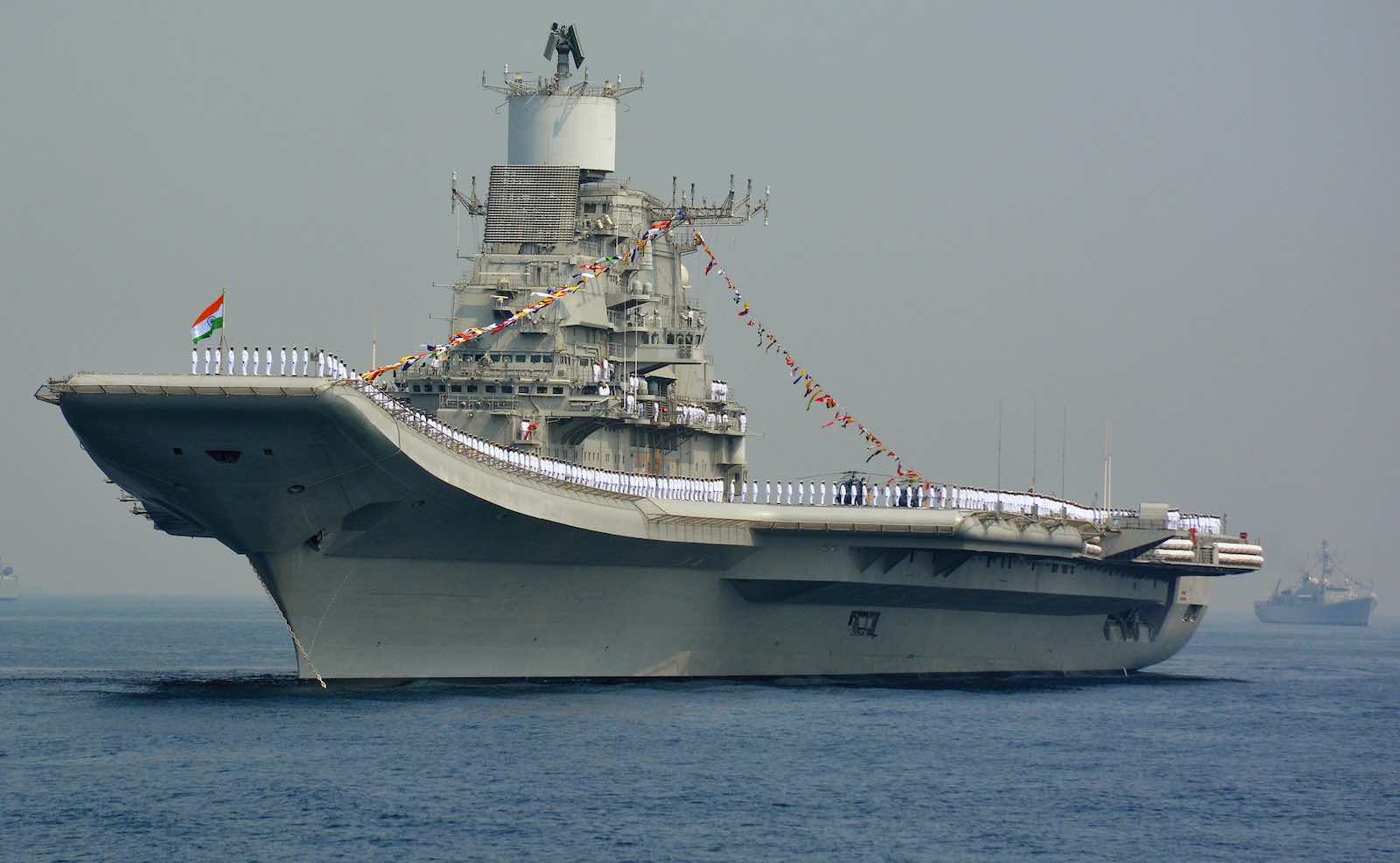
    The Indian military is undergoing what may be its most significant reorganisation since India’s independence, with considerable implications for its future strategic posture. One important issue that has been brought to the fore is the role of the Indian Navy as a regional power projection force built around three aircraft carriers. The government’s decision on this issue will have significant implications for the region.


    Read More

  • India-Australia Strategic Partnership: Leveraging Aerospace Capacity

    India-Australia Strategic Partnership: Leveraging Aerospace Capacity

    Category : India India’s, Military, India-Australia Relations
    Title : India-Australia strategic partnership: Leveraging aerospace capacity
    Author : M Matheswaran 02-06-2020

    The forthcoming virtual summit between Indian Prime Minister Narendra Modi and Australian Prime Minister Scott Morrison assumes considerable significance for an India-Australia strategic partnership, particularly as it comes against the backdrop of heightened friction with China for both countries. Enhanced defence cooperation between the two countries could be an important signal to Beijing of the costs of overly assertive strategic behaviour – whether in the Himalaya or in trade. For some years, defence cooperation has largely focused on the naval relationship. Now is the time for enhanced air-power cooperation.

    Read More

  • President Trump’s India Visit : Balancing Optics with Substance

    President Trump’s India Visit : Balancing Optics with Substance

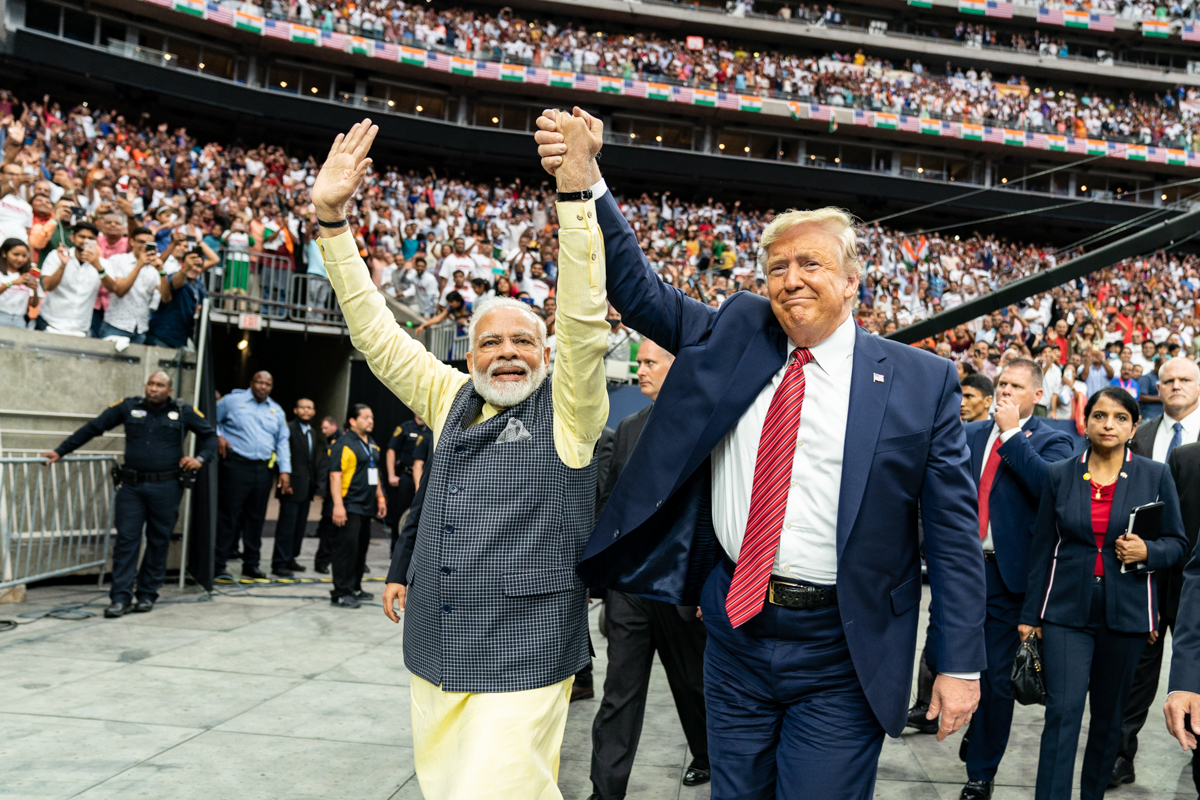
    As President Donald Trump arrives in India today, 24 February 2020,on his maiden official visit to India,  there is significant level of discussions amongst the academics, strategists, and foreign policy experts about whether this visit is more about optics than substantive discussions on strategies and agreements to strengthen the US-India strategic partnership. On arrival the president’s first public engagement is a super spectacle, ‘Namaste Trump’ at the new Motera Stadium in Ahmedabad that will have more than 100,000 people, which is Prime Minister Modi’s way of reciprocating for ‘Howdy, Modi’ at Houston last year. Most opine that while Mr Trump’s visit will be packed with pageantry, it will be light on policy and therefore, unlike previous presidential visits this one may not yield many break-through agreements. There are, however, some important developments that are very unique to the Trump-Modi era when compared to the previous visits of American presidents. Both leaders excel in showmanship and also in projecting strong nationalistic orientation to each one’s domestic constituency. Trump, with his transactional and disruptive approach comes off as more unpredictable when it comes to foreign policy and strategic issues.

    Politics and Showmanship

    It has taken Mr Trump, more than three years since he assumed office to visit India. This could mean that India was not a high priority for the Trump regime in the initial years, or as it turned out India was not the target of Trump’s disruptive strategy that he employed against USA’s traditional allies, China, Russia, and others. The final year of a POTUS term is generally termed as the ‘lame duck year’, where very few presidents have had a good last year and many were hampered by major controversies. It is important to note that India is the first country that President Trump is traveling to after his impeachment trial. There is more to Mr Trump’s India relationship than just this visit. One must remember that he is a shrewd businessman, and even before he became the president, India was already home to the most Trump ventures outside of North-America.  While India’s strategic importance is well recognised by all presidents since Bill Clinton, President Trump’s approach is considerably different than the others. His daughter Ivanka Trump made headlines when she visited Hyderabad, as White House Advisor, for the Global Entrepreneurship Summit in Nov 2017 and the prime minister broke protocol to host a dinner in her honour.

    That the Trump administration has followed a calibrated strategy of recognising and enhancing PM Modi’s image for significant gains to the American defence industry in particular is evident. The current visit, therefore, focuses primarily on strengthening strategic partnership issues in areas such as defence trade, intelligence sharing, counter terrorism, and visa issues. American side may make a token mention about Trump’s offer to facilitate improvement of India-Pakistan talks, China and issues of religious freedom.  However, these will get swamped by the more visible spectacle that will be on display at Ahmedabad and Agra.

    Defence Relationship – the most substantive progress

    India – US defence partnership has progressed significantly over the last decade and a half. The two militaries are exercising together more frequently than ever, and the strategic interactions are moving more towards equitable approach to various aspects. The Trump administration has covered significant ground in nudging India, despite its reluctance, towards partnerships such as the ‘Quad’ and moving towards interoperability by concluding various agreements including the foundational agreements through Defence-Trade-Technology relationship mechanisms.

    Defence trade between the two countries has grown exponentially since 2007. Two major procurements are likely to be signed by the Indian government during this visit: acquisition of 24 Sea-Hawk naval multi-role helicopters (NMRH) from Lockheed Martin worth $ 2.6 billion for the Indian Navy and six AH-64E Apache attack helicopters from Boeing worth $ 930 million for the Indian Army. Both procurements will be through the FMS (Foreign Military Sales) route. Trump administration cleared the decks for enhanced defence cooperation with India by approving India as a major Non-NATO defence partner in 2019, thus smoothening the process for exporting or selling hi-tech weapon systems to India. This is often confused with India becoming a major Non-NATO ally, which is clearly not the case.

    What is clear is that the US has secured major business deals with India to its great advantage, without India gaining much in terms of technology access or industrial production of hi-tech weaponry. The US objective is clearly to wean India away from its heavy dependence on Russian weaponry and secure much broader business relationship with American arms industry. The MIC (military industrial complex) of the USA is clearly focused on India now as its major avenue of business in the 21st century. The Americans were clearly unhappy that India went ahead with S-400 purchase from Russia despite the threat of CAATSA. That India has decided to buy an air defence missile system from the US, again through FMS route, worth $ 1.9 billion seems to be a compensation for such a decision.

    The US-India defence deal will scale $ 20 billion this year after the Trump visit. Many of these weapon system procurements, in terms of numbers, are not of a scale sufficient to create major industrial partnerships for manufacturing. India, however, will need to look at ways and means of acquiring significant technologies from the US through joint ventures, co-design and co-development. Otherwise, there lurks the danger of India being trapped in an all too familiar pattern of buyer-seller relationship rather than as strategic partners.

    Strategic gains?

    The visit’s focus is in areas of trade, defence, counter-terrorism, energy, and co-ordination on regional and global issues. These are areas in which considerable ground has been covered and is a continuing process. The agreement on trade deal, which was keenly expected, has been deferred. With President Trump accusing India of high tariffs and dashing all hopes of a deal before the visit, it is clear that the USA intends to push hard for favourable access to Indian markets for American companies. There are some positives that are emerging. The prospects for increased collaboration in space between ISRO and NASA looks bright.

    The focus of the American side is primarily on Defence trade.  Increase in investments in defence production may become a possibility with major projects in the pipeline. Both Boeing and Lockheed Martin are pushing hard for IAF’s 114 aircraft order, which will be processed under the strategic partnership model of ‘Make in India’ program. This could expand the production run to over 200 aircraft. Similarly, the naval  helicopter (NMRH) procurement has a possibility  of expanding into ‘Make in India’ project for over 100 helicopters. Boeing’s S-76D is a contender for Navy’s utility helicopter procurement under ‘make in India’ program.

    The spectacle of this visit will certainly contribute to both leaders’ constituencies, for President Trump’s re-election campaign and for PM Modi it may divert people’s attention from current issues of flagging economy, Delhi electoral reverses, the Kashmir issue and ongoing protests on CAA and NRC. India however, will need to negotiate hard and leverage the expanding defence business to address technology access and  strengthen Indian industry by enabling them into global supply chain. For this the Indian establishment will need to see well beyond the optics to assess real gains.

    Air Marshal M Matheswaran AVSM VM PhD (retd) is the President of TPF and a former Deputy Chief of the Integrated Defence Staff.


  • India’s impending Fighter Aircraft Choices: Finding the Elusive Solution?

    India’s impending Fighter Aircraft Choices: Finding the Elusive Solution?

    Category : Defence & Aerospace/India

    Title : India’s impending Fighter Aircraft Choices: Finding the Elusive Solution?

    Author : M Matheswaran 02.02.2020

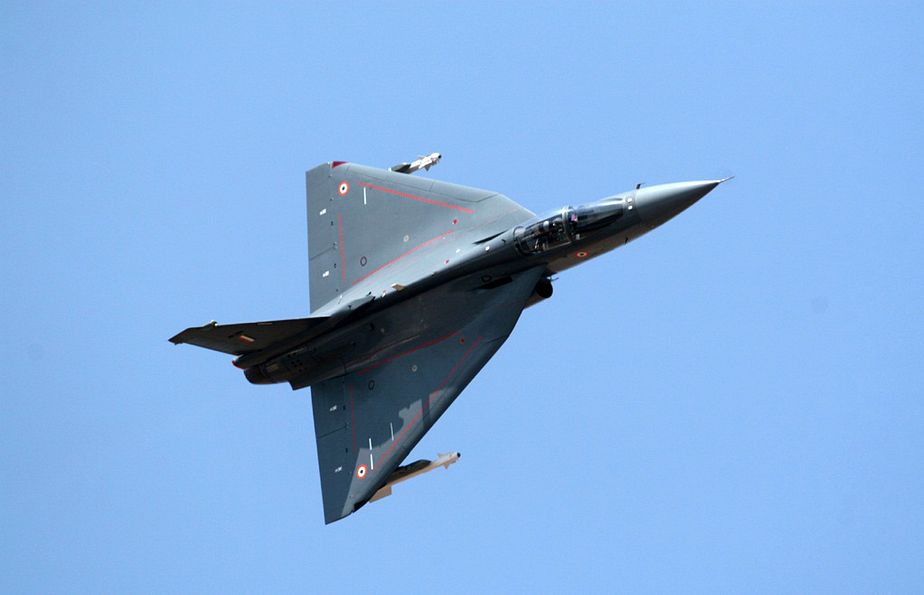
    The Indian Air Force has been afflicted with decreasing force strength due to phasing out of old aircraft and increasing obsolescence of its fleets. Despite the induction of Rafale and Tejas, the IAF will continue to face challenges of reducing numbers and a large chunk of old platforms in its inventory. The IAF is facing serious shortages in its fighter aircraft strength. Air Marshal M Matheswaran examines the possible strategy that can best address IAF’s choice of fighter aircraft for its future.

    Read More

  • Time for Structural Reforms, Modernisation

    Time for Structural Reforms, Modernisation

    The Prime Minister’s announcement on independence day of his decision to appoint Chief of Defence Staff (CDS) as the single-point military advisor to the CCS and the PM was received with great enthusiasm. The appointment of CDS, recommended in 2001 by the Kargil Review Committee and endorsed strongly by the Group of Ministers’ headed by the then Deputy Prime Minister Shri L K Advani has been long overdue. Like with every other decision with respect to military reforms, the CDS decision became a victim of bureaucratic manoeuvring, vindictiveness, engineered turf battles, and political indecisiveness. The process of setting up a tri-service integrated headquarters was, however, incorporated with a Vice Chief equivalent, CISC heading it. Major reforms such as integration of service headquarters, appointment of the CDS, and establishment of Indian Defence University – all remained in limbo or with just cosmetic changes. There is no doubt that the Indian military is in crying need of major structural reforms in tune with 21stcentury environment, technologies, strategies, and the primacy of joint operations in the conduct of war. The CDS is more than a single person’s appointment, it is an entire system.  Therefore, it needs to be accompanied by other major structural reforms.

     Integrated Defence Staff (IDS), the joint headquarters structure to assist the CDS is already in place. The current head, CISC, would become the VCDS. It has taken more than a decade for the IDS to establish a mature and optimised acquisition system and processes, develop Long-Term Integrated Perspective Plans, optimise the defence intelligence agency, and address joint operational and training systems. While significant expertise has evolved including coordination with multiple MOD agencies, the CISC has had to depend on the Chairman, COSC for major decisions. This was invariably subordinated to the Chairman’s priority for his role as the Chief of his Service. An integrated approach, driven by the CDS, should ensure speedy and optimal modernisation of individual services towards enhancing our joint warfare capability.

     Currently, Chiefs of respective services are responsible for operational capability, training, and the requisite modernisation plans. Acquisitions and modernisation plans were largely driven by individual service specific interests, and very often these ended up getting delayed or blocked by turf wars and prioritisation battles for share of the defence budget pie. This would change under the CDS, with operational decisions being driven by the CDS system while the Chiefs would be responsible for their service capability development, training, and maintenance in tune with joint strategies. This should speed up the modernisation process.

    This year’s defence budget is barely above the subsistence level. A decade of stalled modernisation has brought all three services to their lowest levels of force structures and capabilities. The Indian Air Force is down to 32 squadrons, and is likely to go down 28 squadrons over the next five years as the older, overdue for phase out aircraft are finally laid off. It would take more than a decade for the IAF to get back to its authorised force strength of 42 squadrons provided its modernisation process is undertaken on a war-footing. If not it would be at least two decades for full recovery. The Army is no better, as a former VCOAS stated – 60% of its weapon systems are vintage. Army’s two major modernisation programs – TCS and BMS, intended to be through ‘make’ route, has been shelved after more than a decade of work with two consortiums of Indian majors. This is bound to have huge adverse impact on its modernisation efforts. One can’t blame the Army though. Repeated delays in routine procurements, and lack of accountability on development programs have cost the Army dearly. Notwithstanding some of the recent decisions such as the joint venture between Kalashnikov and the OFB for small arms manufacture, light-weight howitzer and the fast-track procurement of assault rifles and weaponry for special forces, Army’s overall capability for a two-front war is  of concern. The FICV project continues to be in a limbo. Army Chief’s restructuring efforts towards ‘Integrated Battle Groups’ is a welcome step and would help the cause of jointness.

    Navy modernisation efforts are no better either. The progress of the Indian Aircraft Carrier continues in its slow pace. Very well laid out plans such as 30-year ship building and submarine-building programs have been approved years ago, if not decades ago. These have floundered for lack of timely budget allocation. Effectively the Navy continues to grapple with ageing ships, submarines and weapon systems.

    Much of the modernisation that has accrued over the last 15 years has been largely due to procurements from the US, almost exclusively through the FMS route, that is government-to-government contracts. It does not speak well for all our sloganeering on ‘make in India’, and reflects the lack of a coherent national strategy. This is a domain the CDS will need to address.

    In a recent announcement, the government indicated that it would allocate USD 130 billions over the next five to seven years for modernisation of the three services. The CDS will need to move beyond the current system of work in the IDS, as far as modernisation goes. Currently, the LTIPP is seen as a ‘Desired Capability’ document, which the government is happy to concur. There is no assurance of financial commitment, and so the plans remain wishful thinking. Big headlines are made whenever the DAC approves ‘Acceptance of Necessity’ for thousands of crores worth acquisitions. These turn out to be meaningless as the subsequent processes takes years, more than 50% AONs elapse, and less than 25% of approved AONs fructify into desired inductions. On an average the time taken from AON to contract signing has been about 9-10 years. The flaw lies in the mismatch between various aspects of indigenous development, ‘make in India’ manufacturing and huge import dependency versus the combat capability of the forces.

    It is quite clear that various organs of the government, over the last 70 years, have failed to address effectively the need of a vibrant indigenous defence industry that is export oriented and reduces our forces’ import dependency. The CDS system, if evolved correctly, should integrate different aspects of  integrated operational philosophy, requisite force structures and combat capability with indigenous manufacturing, technology development, and a balanced, accountable, and efficient  acquisition process. The CDS must also be given enough power to take operational and financial decisions to ensure appropriate force structures for India’s defence. The bottom line, however, is to see the wisdom that an allocation of 1.35% of GDP is abysmally low to meet India’s defence needs in the 21stcentury.

    This article was published earlier in Deccan Herald on 22 Sep 2019.

    The author is the Founder-Chairman and President of The Peninsula Foundation. He is a former Deputy Chief of Integrated Defence Staff. The views expressed are author’s own.

  • Qatar Rafale Issue: Getting a Realist Perspective

    Qatar Rafale Issue: Getting a Realist Perspective

    M Matheswaran                                                                                                       May 23, 2019/Commentary

    Over the last two weeks, much has been written about the controversy emanating from the possibility of Pakistan Air Force pilotshaving trained and flown the Rafale aircraft in France. A lot of concern has been expressed about the operational capabilities of the Rafale being compromised. One needs to examine this carefully. A better understanding of technology would make it easy even for the layman to appreciate and deduce from available open source knowledge what  modern aircraft are capable of. Given this, one can imagine what a trained and experienced fighter pilot would be capable of deducing, and hence evolve his tactics, by visually observing and studying various parameters of the aircraft, leave alone flying it. Hence, to get a realist perspective of this situation, we need to examine various factors, particularly Qatar-Pakistan relations.

                But first take a look at the technical issues. The Rafale is a 4.5 generation aircraft. Its design, in terms of its clean aerodynamics and an optimal design to create minimal radar signature, would make it clear to any professional that this is an aircraft capable of exceptional manoeuvring. It is also an established fact that amongst all 4.5 generation aircraft, there would be very little difference in terms of combat performance. Quite obviously, the most critical elements of the aircraft consist of its sensors, avionics systems, radar, and weapons. Both India and Qatar have contracted for similar version of aircraft, F3R.The systems and weapons have some similarities but also major differences. Modern fighter aircraft are systems intensive and function as system of systems.

                Features that are common to both Qatar Air Force and Indian Air Force Rafales are primarily the RBE 2-AA AESA radar, SPECTRA self-protection suite, IFF with full Mode-5/Mode-S compatibility, Elbit’s TARGO-II Helmet Mounted Display System, and some of the most critical weapons such as Meteor BVRAAM, Mica air-to-air missile, and SCALP air-to-ground long-range cruise missile. Anyone who flies the aircraft will, obviously, get to know the full functioning, performance, and envelope of the systems and the weapons. Most critical would be the intimate knowledge of the AESA radar and the important weapons. However, one must understand that deeper technical knowledge of systems like the radar would not be available to Qatar. Given the long-standing relationship between France and Qatar, any high level systems programming and integration would be retained by the French. This has been the practice in the past, and it is so with most Arab countries. Additionally, AESA radar configurations and source codes are highly secure and it would be virtually impossible for anyone to break into it, even if we assume that Pakistani pilots and technicians would make an attempt to do so, which is very unlikely. Weapon envelopes would certainly be known in the course of training on them. Training on systems like SPECTRA, while providing its functional knowledge, does not compromise any security. The crux of SPECTRA lies in its threat library programming, which is exclusive to the host nation, and on response algorithms that will not be open to anyone other than the designer.

                Indian Rafales, however, will have significant security measures. These lie in completely different secure communication systems that would be incorporated, and India’s own secure datalink capability that would be incorporated. Qatar Rafales would have the Link-16 compliant datalink systems, which India will never incorporate. As the French Rafales upgrade to F4 status, much of those upgrades may become available to India, and IAF aircraft will become uniquely different and highly secure with its own NCW architecture. In terms of EO designation and Recce pods, Qatar Rafale will have the Lockheed Martin’s Sniper pod while IAF have the well-proven and advanced Litening-4 EO pod integrated. EW capabilities and hence, EW tactics and strategies will be completely different for IAF’s aircraft. Unlike in the past, this contract envisages French cooperation and full access to integrating additional weapons and systems of India’s choice, which will make the aircraft considerably different.

                So what should we make of the news about Pakistani pilots flying the Rafale in Qatar and subsequent denial by the French ambassador in India? As for Pakistani pilots sizing up the Rafale against the F-16, it is a non-issue as the two are just not comparable. The upgraded F-16s of PAF is of Block-50 standard at best, and that is clearly one generation behind Rafale. The concern, therefore, is irrelevant.

    One must take into account various regional geopolitical issues to get a realist perspective. Qatar is a small country of 2.8 million inhabitants, with nearly 80% of the population located in the capital city of Doha. With highest per capita GDP in the world, Qatar focuses on rapid development towards first world status, and displays its ambitions in playing a geopolitical role, punching well above its weight much like Singapore. Doha has been host to major international events, and will be hosting the FIFA 2022.

                Considering that Qatar is a tiny kingdom on the Arabian peninsula, Saudi Arabia has always tried to dominate and control the state as a subordinate. Qatar has successfully dismissed these attempts by breaking out and engaging countries at the global level. It has made itself a major diplomatic player, a generous donor of foreign aid, and a leader in modernising education in the region. It has maintained strong relations with Iran and Turkey as much as with other Islamic states. It has sought to balance different groups and organisations with a moderating influence and has sought to push for peace in the region. These efforts, and the overwhelming popularity of ‘Al Jazeera’ has riled countries like Saudi Arabia, Egypt, Bahrain, and UAE into sanctioning Qatar and curtailing diplomatic relations.

                Pakistan, which has very strong relationship with all Arab countries, has maintained a neutral stance in the Qatar-Saudi Arabian dispute, despite strong pressures from Saudi Arabia. Pakistan’s military presence in these countries, in terms of training local forces as well as providing fully deployed troops to augment local defences has been a long-standing practice. Pakistan Air Force pilots have regularly flown for the Air Forces of these states. Hence, access to military resources in terms of operational flying experience on these aircraft has been a huge advantage for PAF. Since the Iraq war in 1991, Qatar has sought to build a significant military capability, its Air Force in particular.

                While India and Qatar have excellent relations (Qatar meets nearly 60% of India’s LPG needs), to meet its military training and force requirements Qatar has engaged Pakistan’s services in addition to European and British professionals. All these pilots, essentially mercenary in nature, have become Qatar citizens as well. Qatar has provided air base for US air forces  at al-Udeid, 20 miles from Doha. The base services US Central Command, including US forces in Afghanistan and Syria. Qatar addresses Pakistan’s energy security significantly, and both nations have cultivated their relationship carefully. Qatar has allowed Taliban to set up office in its territory and has worked to encourage dialogue with all parties involved in the Afghan conflict. In return, Pakistan has been careful to balance its relations with all gulf countries, and values its engagement with Qatar highly, as the recent visit of Pakistan’s Prime Minister shows.

                For a very small state, Qatar is on track to building significant air power capability. After signing initial contract for 24 Rafales with French Dassault in 2015, Qatar placed additional orders for 12 more aircraft, making it a total of 36 Rafales. This was preceded by an earlier order for Boeing’s 36 Qatar advanced-variant Eagles from the USA for $ 12 billion, with an option to increase the order later to 72. In another major deal with BAe, Qatar concluded a contract for supply of 24 Eurofighter Typhoons and 9 Hawk advanced jet trainers, worth over $ 6.6 billion, with first payment made in Sep 2018. For an air force whose strength was just 2100 personnel in 2010 and just 13 Mirage 2000-5 fighters in early 2000s, this build up with three fleets of 4.5 generation aircraft and substantial increase in numbers is unprecedented. Qatar’s decision to go in for a seven-fold increase in its air power capability is curious and there are questions as to how this tiny air force will absorb the massive capabilities in which it is investing. More importantly, it is inevitable that it would need pilots on hire to fly these aircraft. This where the Pakistani relationship comes into focus. In addition work is already underway to increase the infrastructure  in terms of building an additional base and expanding existing bases at al-Udeid and Doha.

                Pakistani pilots who fly for Qatar air force may do so after being given Qatar citizenship. Unlike India, Pakistan allows dual citizenship passports. It is therefore, quite obvious that Pakistani pilots will fly all these aircraft being procured by Qatar. It is irrelevant whether they have been trained in France on Rafales contracted for Qatar, in all likelihood they would have. India, therefore, would do well to factor this reality in its calculations.

    The author is the founder Chairman of TPF, IAF veteran and former Deputy Chief of Integrated Defence Staff. Opinions expressed are the author’s own.

    A shorter version of this article was published in Deccan Herald.

    Image Credit – rafale.co.in

  • How the newly inducted IAF Chinook heavy-lift helicopters provide huge versatility in operations

    How the newly inducted IAF Chinook heavy-lift helicopters provide huge versatility in operations

    M Matheswaran                                                                                                 May 22, 2019/Opinion

    The Indian Air Force inducted the first batch of four Boeing C-47 F(I) Chinook helicopters last month into its inventory. These are part of the order for fifteen heavy lift helicopters. With a payload capability of 10 tonnes and a significantly good high altitude performance, the Chinooks fill a long-felt gap in IAF’s heavy lift helicopter capability. For long the IAF had depended solely on its small fleet of Russian built Mi-26 helicopter, which is still the world’s largest and heaviest payload helicopter. The Mi-26, with an enormous payload capability of 20 tonnes, had provided yeoman service for more than two decades.

    Starting with a fleet of four aircraft, the Mi-26 has played extensive role in meeting major airlift requirements of material, machinery, and men, for the military and civil administration in the Himalayan border regions.With one aircraft having crashed few years ago, the surviving fleet had been hampered by maintenance and technical support problems, virtually bringing to halt the heavy heli-lift capability of the IAF. Besides, increasing emphasis on infrastructure build-up in the border regions has highlighted the importance of heli-lift capabilities for both the IAF and the Indian Army. This is what prompted the IAF to look out for building and enhancing its heli-lift capabilities in the heavy-segment.

    India’s borderlands, dominated by the mighty Himalayan ranges, are unique, treacherous, and the most demanding in the world. The need to operate at altitudes higher than 20000 ft on regular basis is unique to India, and is a challenge to most helicopters designed in the West and Russia. Operations in Indian environment puts gruelling demands on these helicopters. High altitude performance in other parts of the world is at less than 20000ft, in fact, it would average between 5000 and 10000 ft, with exceptions at 15000 ft. In India, 20000 ft operations would be routine in the Himalayan stretches and valleys all across our nearly 4000 km long border in the north and north-west. High altitude operations put severe demands on the engine, has a drastic reduction in effective payload, and has adverse impact on total technical life. These will need to be addressed by appropriate technical enhancements that are fairly expensive as well.

    Indian MOD signed the contract with M/s Boeing in Sep 2015 for supply of 15 CH-47F(I) Chinook Helicopters. The contract is for USD 1.1 billion, with an option clause for further seven aircraft. All 15 aircraft are planned to be supplied before March, 2020. It is almost certain that the option clause would be exercised. The first aircraft was handed over in a ceremony at the manufacturer’s production facility in Philadelphia on Feb 1 st , and the first batch of four were shipped out to Mundra Port in Gujarat. The four were then assembled and integrated into fully operational helicopters at the IAF base in Chandigarh and inducted on the 25 th March. Some of the specialist systems, self-protection systems and EW equipment are contracted through the FMS (Foreign Military Sales) procedure.

    While the payload capability is only half that of the Mi-26 helicopter, the Chinook provides huge versatility in operations. The IAF version is the CH-47 F(I), which is the latest and advanced version of the Chinook, designed more than 50 years ago in 1962. The IAF aircraft is upgraded with new generation avionics and flight control systems that make the aircraft capable of very precise and versatile operations during day and night. The Chinook’s twin-rotor design gives it good agility and stability in high altitude operations. Its advanced mission computer and the DAFCS (Digital Automatic Flight Control System) allows the pilot to feed in the complete mission profile and fly automatically and with hover precision in one foot increments vertically and laterally. The CH-47 F(I) is an advanced multi mission helicopter with the true multi-role, vertical-lift capability. It contains a fully integrated, digital cockpit management system, Common Aviation Architecture Cockpit and advanced cargo-handling capabilities that complement the aircraft’s mission performance and handling characteristics. Its primary role will be for transportation of troops, artillery, equipment, and fuel. The army is particularly keen on the Chinook heavy heli-lift capability for transportation and deployment of its recently procured M-777 Ultra-Light howitzer artillery guns in the Himalayan border regions with China.

    As opposed to the small fleet of three Mi-26 helicopters, the larger fleet size of the CH- 47 F(I) would provide the IAF immense flexibility and availability of aircraft for a variety of tasks. It will provide a boost to the construction of infrastructure and border road projects, long overdue. Border Roads Organisation would get a fillip to its long-delayed road construction projects in the north-east. Our continued requirements of aerial maintenance in remote regions will be better served with this new capability, as also for critical needs of HADR operations, in missions for transportation of relief supplies, and evacuation of refugees. The IAF plans to deploy the two squadrons, one in the Western sector in Himachal Pradesh and adjoining Himalayan regions, and the other in the East sector in Assam/Arunachal Pradesh.

    The Chinook acquisition was also accompanied by acquisition of the Apache attack helicopter, also from Boeing. Both contracts, worth together over USD 3.5 billion, were signed on the same day on 28 Sep 2015. Both are also a combination of DCS (Direct Commercial Sales) and FMS (Foreign Military Sales) processes. The two inductions have followed a series of procurements from the USA, mostly through the FMS route. Having started with the first major defence deal in 2008, the Indo-USA defence business is likely to touch a whopping USD 18 billion by the end of 2019. Most of these acquisitions are through FMS and are virtually replacing the earlier Russian fleets: Apache replacing the Mi-35, Chinook replacing Mi-26, Sikorsky MH-60 Romeo replacing the Kamov in the Navy, with the likelihood of 110 NMRH to follow; this is a sort of indirect CAATSA in play.
    It is important for India to realise that while many of these acquisitions have given significant teeth to Indian operational capability, in terms of business it has been huge business to the US companies with very little to show for India in 3 terms of Technology transfer or industrial gain in terms of manufacture or co-design and co- development.

    The CAG report number 3 of 2019 comes down heavily on these acquisitions. It castigates the MOD and the IAF for procedural lapses, long drawn out acquisition processes, and more importantly of having skewed the QRs in such a way that only Chinook and Apache would have been successful. That’s a serious indictment. However, India will do well to remember that major procurements like the Apache and the Chinook at huge costs, while meeting the IAF’s operational requirements, should also be leveraged to benefit India’s larger strategic interests of technology acquisition, industrial capability, global partnerships, and of course, strengthening US-India strategic partnership. It needs to be a win-win for both.

    The author is retired Air Marshal and former Deputy Chief of Integrated Defence Staff. He is the founding Chairman and President of The Peninsula Foundation, Chennai. Views expressed are personal. 

    This article was published earlier in Financial Express.

    Image Credit.

  • Nuclear Stability in Asia and South Asia: the Dynamics of a Fragile Stability

    Nuclear Stability in Asia and South Asia: the Dynamics of a Fragile Stability

    Download Here for Full Report

    M. Matheswaran

    India-Pakistan-China relations determine South Asia’s strategic stability. Recent events and disputes have heightened regional tensions, and have drawn the world’s attention on the region’s potential for conflict. The fact that all three nuclear weapon states have long-standing border disputes has been used by the non-proliferation lobbies to consistently highlight South Asia as a nuclear flash point. The intractable Kashmir dispute continues to be cited as the potential trigger for any nuclear escalation. These concerns were brought to the fore as the world witnessed the two nuclear armed adversaries fight it out on the Himalayan heights of Kargil in May 1999. While India fought the war firmly, and displayed significant escalation control and management of international opinion, it must be acknowledged that both countries kept the conflict below the nuclear threshold, thus questioning the nuclear flash point theory.


    Download Here to read more…


    *This article was published in Indian Foreign Affairs Journal – Apr-Jun 2018.

  • An analysis of the draft space activities bill (2017), as an effective impetus to private sector space activities in India.

    An analysis of the draft space activities bill (2017), as an effective impetus to private sector space activities in India.

    P.Joseph Mario Ritvik                                                            January 1, 2019/Report

    Space activities in India, since the early 1960s, were pursued only by Department of Space (DOS), as nodal agency for space activities in India. As per ‘Government of India (Allocation of Business) Rules 1961, the DOS has been responsible for the space activities in India, for more than five decades, with the major objective of bringing the benefits of space technology and its applications to societal needs and national development.

    Internationally, the outer space activities are governed by relevant chapters of international law in general and by United Nations’ (UN) Treaties and principles evolved under UN Committee on Peaceful Uses of Outer Space (UNCOPUOS) in particular.

    The obligations of a State Party under international treaties on outer space activities are expected to be complied/ discharged through national mechanisms, namely domestic space legislations.

    India is a State Party to major treaties of UN on outer space activities and has been performing space activities in compliance with the obligations of UN Treaties on Outer Space activities purely under Governmental control.

    Download Full Report to read more..