Author: M Matheswaran

  • The West Will Fall; Fall It Must: A Moral and Civilisational Analysis of Hegemonic Decline and the Imperative of Justice

    The West Will Fall; Fall It Must: A Moral and Civilisational Analysis of Hegemonic Decline and the Imperative of Justice

    Colonial and Imperial culture of greed for wealth, manifested in exploitative and extractive strategies, and an attitude of racial supremacy-endorsed by the Church,  is so deeply entrenched in the West that it has never gone away but has continued in different forms and structures. It is this culture that needs to fall, to truly lead to a world of equality, values and ethics – reflected by the 2000-year old declaration –

    “Yaadhum Oorey, Yavarum Kelir”  – meaning “To us the world is one, All people are Kin”.

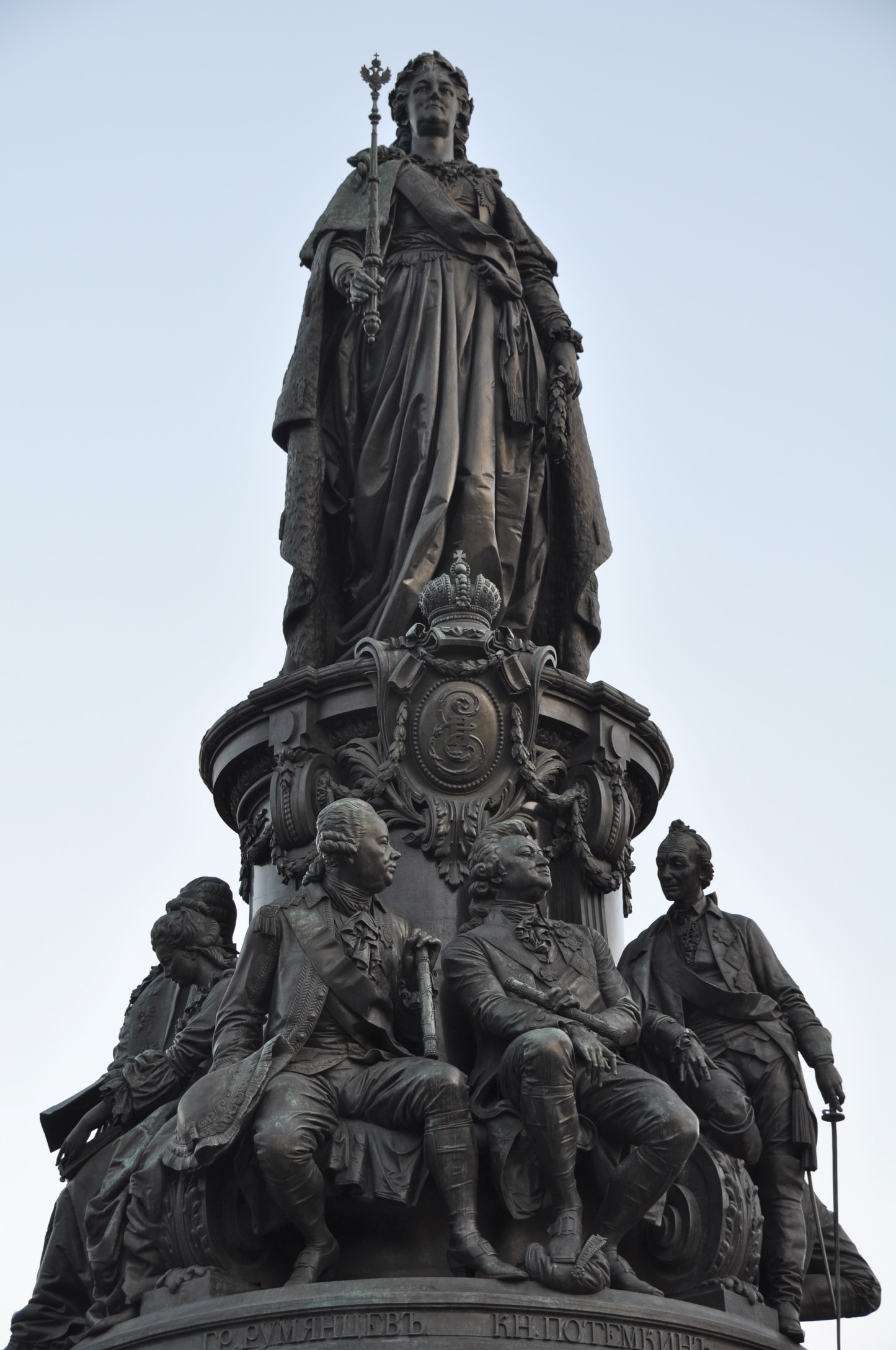
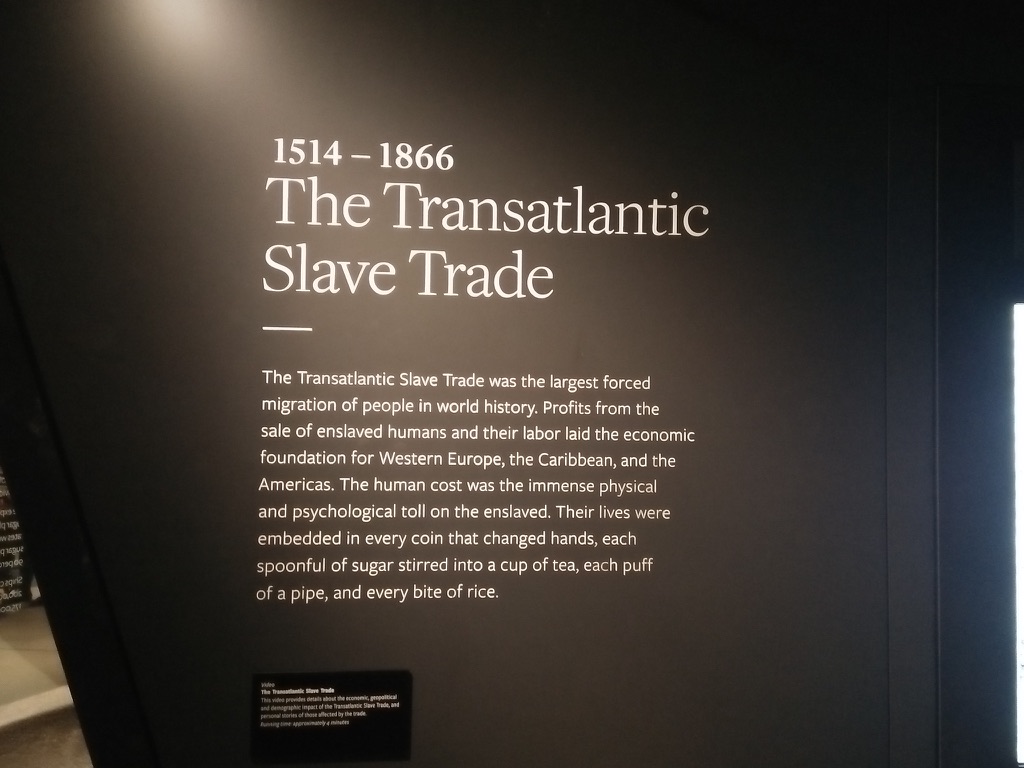
    To say the West will fall is neither prophecy nor vindictiveness but the recognition of a historical necessity. Western global dominance — built across six centuries of slavery, colonial extraction, and neocolonial control — rested on the systematic violation of ethical principles that every major civilisation has independently affirmed. Systems founded on extraction and racial hierarchy carry the mechanisms of their own collapse. The decline now visible across economic, diplomatic, and moral indicators is not an accident of geopolitics but a consequence.

    The Peninsula Foundation reads this moment through humanity’s deepest ethical traditions: Thiruvalluvar’s Thirukkural, Kaniyan Poongundranar’s declaration that all places are one and all people kin, Confucian governance by virtue, Platonic justice as harmony, and African Ubuntu — a person is a person through other people, in other words – I am because We are. Arising independently across continents and millennia, they converge on the very principles imperialism negates: universal human dignity, compassionate restraint, justice as social order, and communal interdependence.

    By 2026, even Western institutions will concede the turn. The UN Secretary-General calls for accelerating an inclusive multipolarity; the JPMorgan Centre for Geopolitics describes a multi-speed order in which universal rules no longer bind; at Davos, middle powers spoke of permanent rupture rather than transition. Against this backdrop, the United States Secretary of State stood before the world’s premier security forum and called for the restoration of five centuries of colonial empires.

    The Rubio Confession

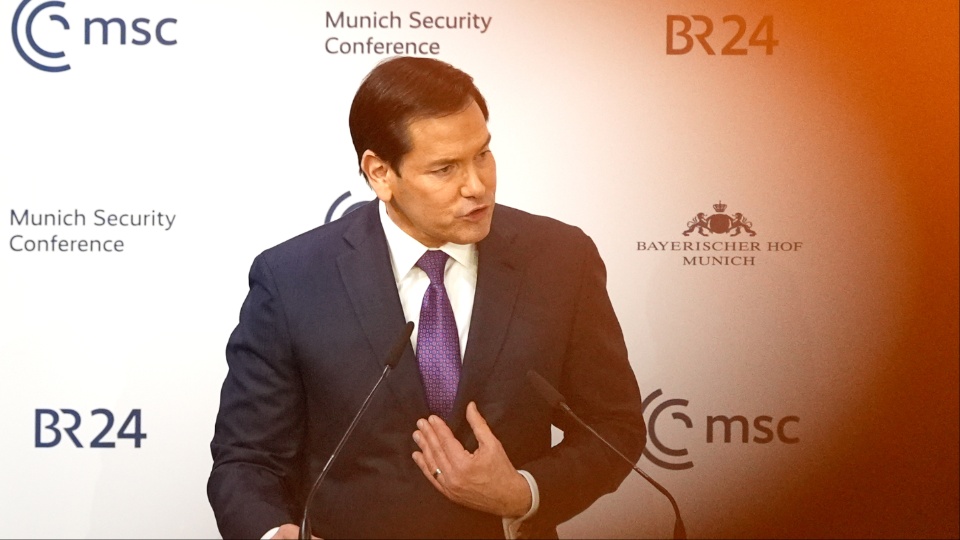
    On 14 February 2026, at the Munich Security Conference, Secretary of State Marco Rubio delivered what critics across the spectrum called the most openly pro-colonial address by a senior Western official this century. He mourned the loss of five centuries of Western imperial expansion; named anti-colonial uprisings as a cause of Western decline; urged European allies to shed their guilt and shame over colonialism; and summoned the West to a new Western century by competing for market share in the economies of the Global South — framing that South not as sovereign nations but as an economic space to be recaptured, that precise colonial and predatory framing.

    This is not merely reprehensible; it is a confession. Facing structural decline, the imperial culture has abandoned even the pretence of moral authority and reverted openly to the logic of domination. Harvard’s Mathias Risse called the speech civilisational panic dressed as statecraft. The Global South’s response was swift: Indian commentary asked whether an American East India Company was coming; Brahma Chellaney saw the restoration of an exclusionary hierarchy; Sanjaya Baru urged India, as the beacon of anti-colonialism, to condemn it with the contempt it deserves.

    The Architecture of Extraction

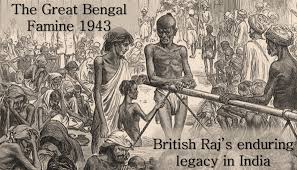
    Rubio’s call to shed guilt is not only obscene; it is historically false. Utsa Patnaik’s study for Columbia University Press establishes that Britain drained £9.2 trillion — some $45 trillion — from India between 1765 and 1938, seventeen times Britain’s current annual GDP, by compounding India’s intercepted export-surplus earnings at the ordinary rate of opportunity cost.

    India’s gold and foreign-exchange earnings — among the largest in the world — were permanently diverted to London, funding Britain’s industrial revolution, its wars, and its administration, and consuming between a quarter and a third of the central budget.

    The mechanism was an elegant deception. After 1765, the East India Company taxed Indian producers, then used roughly a third of that revenue to buy their goods for export — paying them with their own taxes while acquiring their produce for nothing. The Council Bills system of 1861 industrialised this: foreign buyers paid London in gold and sterling for bills cashable only in rupees, which the colonial government paid out of its own budget. India’s gold and foreign-exchange earnings — among the largest in the world — were permanently diverted to London, funding Britain’s industrial revolution, its wars, and its administration, and consuming between a quarter and a third of the central budget.

    Jason Hickel calculates that rich countries have drained $152 trillion from the Global South since 1960 alone. There is no Western century to restore that was not built on the theft of other civilisations’ wealth — legitimised for six centuries by the Three Cs of civilisation, Christianity, and commerce, and continued after independence through structural-adjustment programmes, an African external debt of $824 billion, and more than 13,000 active US sanctions.

    The result was stark. India held the world’s second-largest export surplus for three decades before 1929, yet per capita income barely moved between 1900 and 1946, because the surplus was siphoned abroad rather than invested at home. Its share of global industrial output collapsed from 25 per cent in 1750 to 2 per cent in 1900. Japan, which kept its earnings, industrialised; India, whose earnings were confiscated, could not. The same logic ran through slavery, which research now confirms accelerated Britain’s industrial revolution — vindicating Marx’s image of capital arriving dripping with blood and dirt. Jason Hickel calculates that rich countries have drained $152 trillion from the Global South since 1960 alone. There is no Western century to restore that was not built on the theft of other civilisations’ wealth — legitimised for six centuries by the Three Cs of civilisation, Christianity, and commerce, and continued after independence through structural-adjustment programmes, an African external debt of $824 billion, and more than 13,000 active US sanctions.

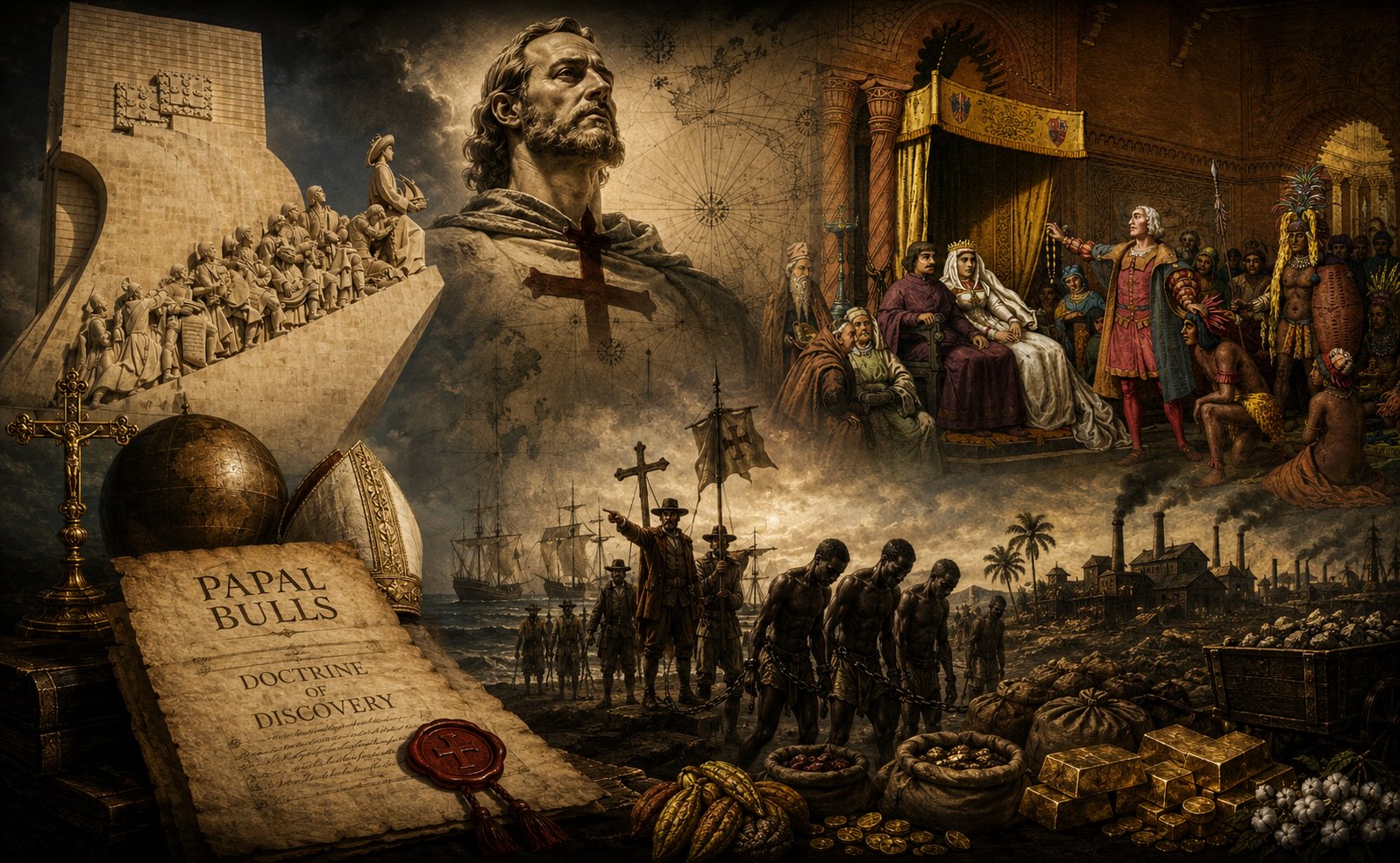
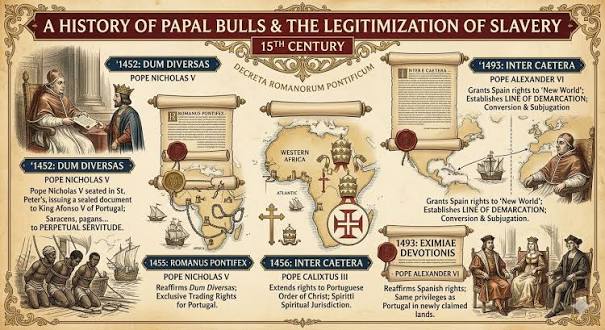
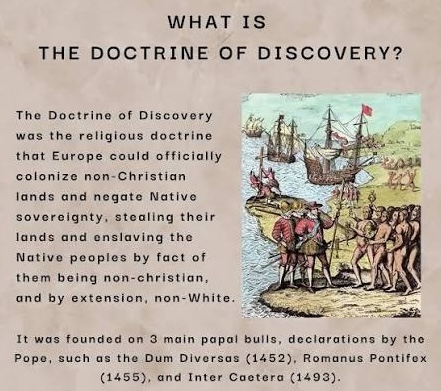
    The sanctifying licence was issued long before the Council Bills, in Rome. A sequence of papal bulls — Nicholas V’s Dum Diversas (1452) and Romanus Pontifex (1455), and Alexander VI’s Inter Caetera (1493), proclaimed the year after Columbus reached the Americas — granted Catholic monarchs the asserted right to “invade, search out, capture, vanquish and subdue” non-Christian peoples, reduce them to perpetual slavery, seize their lands, and partition the non-Christian world between Spain and Portugal. From these decrees grew the Doctrine of Discovery: the claim that lands not inhabited by Christians were free to be “discovered” and their peoples’ sovereignty void. It furnished the racial and civilisational hierarchy — Christian over heathen, European over all others — on which five centuries of conquest were built, dressing the pursuit of gold, land, and labour in the vestments of salvation. The piety was the facade; extraction was the motive. Nor is the point contested by Rome: in 2023 the Vatican formally repudiated the doctrine, conceding the bulls were “linked to political questions” and never expressions of the faith — an admission, five centuries late, that the licence to colonise was always politics wearing the mask of God.

    The Civilisational Verdict

    Every tradition the Foundation invokes condemns this architecture. Thiruvalluvar’s Kural 113 warns that gain wrongly acquired must not be retained even for a day — the exact verdict on a Council Bills system that gave Indians rupees while stealing their gold; his Kural 551 holds a ruler who works injustice crueller than a murderer. Kaniyan Poongundranar’s Yaadhum Oore Yaavarum Kelir dissolves, at its root, the civilisational tribalism Rubio attempts to revive, for exploitation requires first believing that the exploited are not our kin. Confucius taught that legitimacy flows from virtue, not force; Plato named the tyrant as one who turns governance to private enrichment — the shape of a state that declares it will run another nation and seize its oil; and Ubuntu’s relational personhood is negated wherever a system is built to take from people, unawares, what they have earned.

    Risse’s verdict is sharper still: Rubio’s West has no Indigenous peoples, no colonised subjects, no enslaved Africans, no Buchenwald near Weimar — only heroes and temporary setbacks. Such a West has never existed, and cannot be reinvigorated in 2026.

    The New Theatre of Predation

    The doctrine is not rhetorical. In January 2026, the United States bombed Venezuela, abducted its elected president, and announced that US companies would seize its oil while Washington “ran the country” — a clear violation of Article 2(4) of the UN Charter, the International Commission of Jurists held. The same month, it cut off Cuba’s main oil supplier and, through Executive Order 14380, threatened any country that resupplied it, until the UN warned of humanitarian collapse — collective punishment of a civilian population. And in February 2026, the US and Israel launched a full-scale attack on Iran, killing its Supreme Leader, striking over 42,000 civilian sites, and — at a girls’ school in Minab — at least 167 children; the American Society of International Law named it a crime of aggression, and the UN Secretary-General confirmed it contravened international law. As Britain once dressed theft as commerce, the US now dresses resource seizure as law enforcement — the structural logic is identical.

    The Measured Decline

    The economic premise of the Rubio doctrine is fiction. Asia’s share of global GDP reached 55 per cent in 2024, years ahead of projection, and BRICS economies now exceed the G7 at purchasing-power parity. The Global South’s ascent is no Western beneficence but a return to the norm colonialism interrupted — China and India together held half of world income in 1700 before colonialism drove their share below a tenth. A declining West, in truth, needs the Global South to survive.

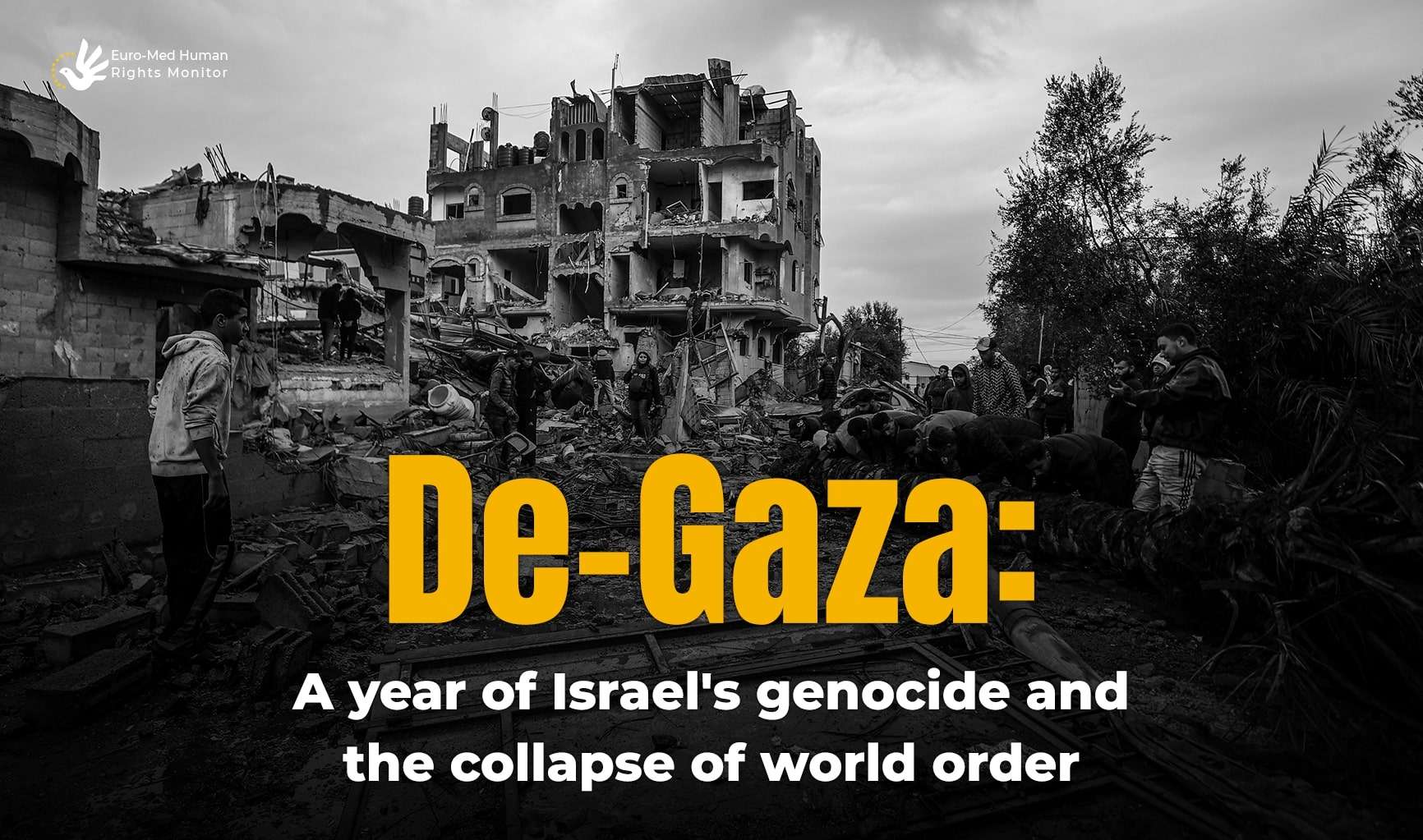
    Moral authority has collapsed in tandem. Only 39 per cent of Americans now believe the United States is the world’s moral leader, down from 60 per cent in 2017; across Europe, support for Israel has fallen to between 13 and 21 per cent. Above all, Gaza has erased Western moral pretension: independent research estimates roughly 75,200 violent deaths and the displacement of about 90 per cent of the population, as governments that once lectured the world on human rights moved to justify mass killing — not an aberration, as one analysis put it, but an unveiling.

    The Oligarchy Behind the Flag

    Analysing nearly 1,800 US policy decisions, Martin Gilens and Benjamin Page found that economic elites and business groups exert substantial independent influence on policy while ordinary citizens have little or none — a pattern they termed economic-elite domination rather than democracy.

    There is a sharper way to name what must fall. “The West” is not its peoples; it is a structure of concentrated power that governs in their name while serving far narrower interests. Analysing nearly 1,800 US policy decisions, Martin Gilens and Benjamin Page found that economic elites and business groups exert substantial independent influence on policy while ordinary citizens have little or none — a pattern they termed economic-elite domination rather than democracy. Their method has been contested, but elite-skewed influence is widely corroborated.

    The architecture is visible and legal. Since Citizens United (2010), outside US election spending has risen more than twenty-eight-fold — from $144 million in 2008 to over $4.2 billion in 2024 — roughly $1.9 billion of it untraceable “dark money,” a few hundred mega-donors providing the bulk. Oxfam records billionaire wealth at a record $18.3 trillion in 2026, up 81 per cent since 2020; the twelve richest now hold more than the poorest four billion people, and billionaires are four thousand times likelier than ordinary citizens to hold office. Across 66 countries, nearly half of those surveyed say the rich simply buy elections.

    The same convergence runs through the war and information economies. Some $191 million was spent lobbying the US defence sector in 2025, and more than 315 senior officers passed through the revolving door into the top weapons firms between 1995 and 2021 — Eisenhower’s “military-industrial complex” at industrial scale. At the 2025 presidential inauguration, the heads of Amazon, Meta, Apple, Google, and Tesla stood arrayed behind the president — a tableau of what Shoshana Zuboff calls surveillance capitalism, in which control over information becomes a lever over democracy itself, as a Stanford working group chaired by Francis Fukuyama warned.

    None of this requires a secret cabal — only aligned interests, legalised influence, and a public whose consent is manufactured rather than freely given. The decisive point is this: the structure that drains the Global South is the same one that hollows out wages, democracy, and dignity within the West. The dividing line is not West against the rest but concentrated extractive power against the world’s peoples — the Western working majority among them, conscripted to fight its wars and absorb its costs. When we say the West must fall, it is this structure that must fall, and democratic power that must be restored, at home as much as abroad. That is not the elimination of a people; it is the end of their domination by an oligarchy that has long claimed to speak in their name.

    The Self-Defeating Logic of Overreach

    Like the Council Bills before it, the Rubio doctrine carries the mechanism of its own defeat, for each intervention rebounds structurally. The seizure of Russian assets accelerated de-dollarisation; the bombing of Iran united a region against the US–Israel alliance; the abduction of Venezuela’s president hastened Latin America’s diversification away from Washington; the oil siege of Cuba drew unprecedented condemnation. An order that must abduct, blockade, and bomb to assert itself is not ascendant — it is exhausting the legitimacy on which power finally depends.

    The Imperative of Justice

    The fall of Western hegemony opens the possibility of justice but does not guarantee it; the outcome depends on whether rising powers build the multipolar order on genuine ethical foundations rather than replicating what they inherit. That demands sovereign equality without exception — Article 2(4) applied universally, and a Security Council reformed so that no state acts as judge, party, and executor at once. It demands historical accountability: reparative justice through climate finance, debt cancellation, technology transfer, and restitution is not charity but the minimum acknowledgement of documented theft. It demands that the ICJ, ICC, and UN human-rights bodies function without great-power interference; civilisational pluralism against civilisational supremacism; and, finally, democratic renewal within the Western societies themselves, whose peoples are not the authors of empire but among its subjects.

    India is uniquely placed to articulate that alternative. Its inheritance — Thiruvalluvar’s justice, Kaniyan Poongundranar’s universal kinship, and the Gandhian tradition of non-violent resistance to precisely the domination Rubio seeks to revive — is the moral tradition colonialism suppressed but could never extinguish. Against a new Western century of restored hierarchy, the Peninsula Foundation offers the Tamil poet’s ancient answer, as relevant in Munich today as on the banks of the Kaveri two millennia ago:

    Yaadhum Oore, Yaavarum Kelir — to us all towns are one, all people are our kin.

    The West will fall. Fall it must. From its ruins, may justice arise.

    Sources

    THE MULTIPOLAR TRANSITION

    • JPMorgan Centre for Geopolitics — World Rewired: Navigating a Multi-Speed, Multipolar Order
    • United Nations — Secretary-General’s press conference on his 2026 priorities
    • World Economic Forum — Davos 2026: How middle powers are reading the global moment

    THE RUBIO MUNICH SPEECH AND RESPONSES

    • US Department of State — Secretary Rubio at the Munich Security Conference (14 February 2026)
    • The New York Times — In Munich, Rubio Stresses Shared History to Europeans
    • Mathias Risse, Harvard Kennedy School (Carr Center) — A Human-Rights-Based Reply to Marco Rubio’s Munich Speech
    • China-US Focus — American Neo-Colonialism and the Confessional State
    • Chatham House — The West vs the West at the Munich Security Conference
    • India Today — Rubio’s Munich speech signals US colonial competition for the Global South
    • The Wire — Marco Rubio’s Defence of Colonialism Demands a Response from India
    • Firstpost — Rubio’s claim of a Western century is a myth

    COLONIAL EXTRACTION: THE DRAIN AND THE COUNCIL BILLS

    • Utsa Patnaik (Columbia University Press), via Al Jazeera — How Britain stole $45 trillion from India
    • NDTV — How the British Empire robbed India of $45 trillion
    • self_study_history — Drain of Wealth: the Council Bills mechanism
    • COLLECTIVE India — ‘Drain of Wealth’, today
    • Wikipedia — Economy of India under the British Raj (global GDP share)
    • CEPR / VoxEU — Slavery and the British Industrial Revolution
    • Walter Rodney — How Europe Underdeveloped Africa
    • Jason Hickel, via Al Jazeera — Rich countries drained $152tn from the global South since 1960

    THE LICENCE TO COLONISE: PAPAL BULLS, CHRISTIANITY, AND NEOCOLONIALISM

    • Vatican News (2023) — Church defends Indigenous peoples: ‘Doctrine of Discovery’ was never Catholic — the formal repudiation
    • Canadian Museum for Human Rights — The Doctrine of Discovery (papal bulls and their language)
    • Church Life Journal, University of Notre Dame — Papal Condemnation of the Doctrine of Discovery
    • Emory University — The Philosophy of Colonialism: Civilization, Christianity and Commerce
    • Church Mission Society — Mission after George Floyd: on white supremacy, colonialism and world Christianity
    • Catalyst (McGill) — The IMF and World Bank: Neocolonial Domination, Debt Trap and Resistance

    THE CIVILISATIONAL FRAMEWORK

    • Thiruvalluvar, Thirukkural (G.U. Pope translation) — Project Madurai
    • Kaniyan Poongundranar, Purananuru 192 — Kaniyan Pungundranar
    • Confucius, The Analects — LibreTexts, Compact Anthology of World Literature
    • Plato, Republic — Plato’s Theory of Justice
    • Mogobe B. Ramose — African Philosophy Through Ubuntu

    THE OLIGARCHY BEHIND THE FLAG: CONCENTRATED POWER IN THE WEST

    • Martin Gilens & Benjamin I. Page — Testing Theories of American Politics: Elites, Interest Groups, and Average Citizens (2014)
    • Omar S. Bashir (Research & Politics, 2015) — A Review of the ‘Oligarchy’ Result — methodological critique
    • Oxfam International (January 2026) — Resisting the Rule of the Rich: billionaire wealth and political inequality
    • Brennan Center for Justice — Dark Money Hit a Record High of $1.9 Billion in 2024 Federal Races
    • Center for American Progress — Undoing Citizens United and Reining In Super PACs (28-fold rise in outside spending)
    • OpenSecrets — Defense Lobbying Profile ($191m in 2025)
    • Quincy Institute, via Jacobin — The Publicly Funded Defense Contractor Revolving Door (315+ officers)
    • ProMarket (Stigler Center) — The Trends That Defined US Antitrust in 2025 (platform power and modern oligarchy)
    • Shoshana Zuboff — The Age of Surveillance Capitalism (PublicAffairs, 2019)

    VENEZUELA

    • International Commission of Jurists — Territorial sovereignty, the rule of law and human rights must be respected
    • Le Monde — The US intervention in Venezuela violates foundational principles of international law
    • UN Security Council — US action in Venezuela puts sovereignty of states, international law at stake

    CUBA

    • Al Jazeera — US sanctions reshaping life in Cuba: UN rapporteur
    • Baker McKenzie — US declares national emergency on Cuba; Executive Order 14380
    • UN News — Cuba: UN warns of possible humanitarian ‘collapse’ as oil supplies cut

    IRAN

    • American Society of International Law — Statement Regarding the Use of Force Against Iran (2 March 2026)
    • Reuters — Iran’s UN envoy says 1,332 civilians killed in the war
    • Al Jazeera — Iranian government reveals scale of civilian casualties (42,000+ sites damaged)
    • Associated Press — International legal order tested by war in Iran (‘crime of aggression’)

    DECLINE METRICS AND MORAL AUTHORITY

    • Atlantic Council — Piece by piece, the BRICS really are building a multipolar world
    • Mastercard — Welcome to the nuanced reality of the Asian Century
    • Forbes — Americans think the US is losing its moral authority, new poll shows
    • The New Humanitarian — The end of Western values

    GAZA

    • Al Jazeera — Gaza death toll exceeds 75,000 as independent data verify loss
    • OHCHR — End unfolding genocide or watch it end life in Gaza: UN experts
  • The Cockroach and the Firewall

    The Cockroach and the Firewall

    India banned a joke on national security grounds. The joke went to court, found a cause, and began to splinter — all in a single week. None of it is a revolution yet. All of it is worth watching.

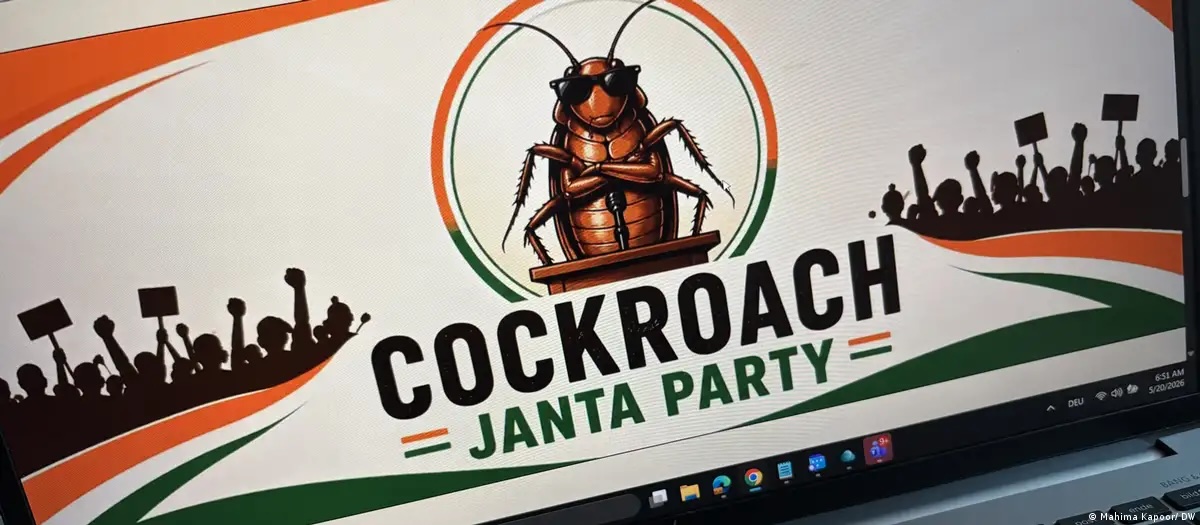
    When the Chief Justice of India reportedly likened unemployed young people to cockroaches and parasites, he was not making policy. He was making a mistake. The clarification came within a day — he meant only holders of fake degrees; the youth are “the pillars of a developed India.” But the insult had escaped. Within a week, a satirical “Cockroach Janta Party,” its name a mocking echo of the ruling party, had drawn more than twenty-two million Instagram followers — more than double the BJP’s, well past the Congress’s — along with a million sign-ups and a petition. Then the government did the most revealing thing it could have done. It treated the joke as a threat to India’s sovereignty.

    On the twenty-first of May, the Ministry of Electronics and Information Technology ordered the party’s account to be blocked under Section 69A of the IT Act, acting on Intelligence Bureau inputs alleging it endangered national security. No public order was published; the directive remains secret under the blocking rules. The website went dark, the founder’s personal pages were hacked, and — by his account — the death threats arrived, one reportedly promising he could be “murdered even in America.” Sit with the official rationale, because it collapses under its own weight. A state cannot, in one breath, tell its citizens that something is a frivolous meme and that it imperils the nation. By reaching for the sovereignty of India against an Instagram page, the government made a public confession about which of the two it believes. A confident order ignores satire. It does not invoke the Intelligence Bureau against it.

    That is the first thing worth noticing, and it is not the follower count. It is the asymmetry. A throwaway courtroom remark, instantly retracted, produced a movement; a movement of memes produced a national-security order. When effects keep dwarfing their causes like this, the cause is never really the cause. The Chief Justice did not create the anger he released, and the censor did not create the defiance he provoked. Both struck matches beside a fuse that has lain there, dry, for more than a decade.

    The fuse is not mysterious. India’s inequality is the highest in its recorded history — the top one per cent holds about forty per cent of the nation’s wealth, a concentration the economists who measured it called hard to sustain “without major social and political upheaval.” The country graduates more than eight million young people a year into a graduate unemployment rate near thirty per cent. A quarter of Indians belong to a generation promised development and handed a culture war. For ten years, the noise of majoritarian politics kept that fuse damp. The cockroach remark landed because it told an entire generation, in one word, what the system thought of them. The ban landed because it proved the system was afraid of what they might do about it.

    And yet — to say this plainly, because the temptation to romance the moment is strong — this is not a revolution, and a ban will not make it one. Not because Indians are docile; that old slander is simply false. This is the country of the JP Movement, of the 2011 anti-corruption surge, of the farmers who made a government blink. It is because the things that actually topple regimes are absent here, and the thing that is present is the thing that stops them.

    Revolutions do not run on anger. If they did, half the world would be in flames. They run on state collapse. France in 1789 was bankrupt; Russia in 1917 was losing a war; the regimes that fell in Sri Lanka, Bangladesh and Nepal these past three years were small, centralised, and hollow, where seizing one square in the capital was the same as seizing the country. None of that describes India. Its treasury is solvent, its army intact, its agencies obedient. There is also an exit the burning countries lacked: a ballot that still works — in 2024 the ruling party lost its majority and now governs on sufferance, its worst losses where the jobs ran out. And there is the deepest barrier of all: India is too many things at once. The countries that fell had a single national crowd. India has a hundred separate angers that flare in the same season without ever becoming the same fire. A movement can own the internet in Delhi and remain a rumour in Chennai. India’s diversity, so often praised as its glory, is also its great circuit-breaker. It does not extinguish anger. It prevents anger from adding up.

    Watch, then, what the past week has actually done to the joke — because the most interesting news is not the ban but everything that has happened since, and almost all of it cuts both ways. The movement went to the Delhi High Court, challenging the block as unconstitutional. That is the system working as designed: anger flowing into an institutional channel rather than onto the street, the very pressure valve a revolution requires to be sealed shut. At the same moment, the energy found something a meme had lacked — a concrete cause. The party has fused itself to the NEET examination scandal, the leaked medical entrance test that was cancelled in May, that upended the futures of twenty-two lakh students, and that has been linked to at least fourteen student suicides. Its demand is now specific and nameable: the resignation of the education minister. A grievance with a face and a number is a different creature from a grievance with only a punchline.

    And then, almost on cue, the splintering began. A lawyer in Haryana, declaring himself the movement’s “national convener,” filed to register the party with the Election Commission in his own name — with a softened, sanded-down list of aims — against the wishes of its founder. Opposition figures rushed to amplify the memes; Congress and Left accounts adopted the cockroach as their own. This is the oldest story in Indian protest, and it is happening in fast-forward: the instant a movement matters, the formal players move to capture, fork or absorb it. India did this to the 2011 anti-corruption wave, which it turned into a party and then ground down — and the cockroach’s own founder comes from precisely that lineage. The system’s reflex is not to crush such energy. It is to digest it. A week in, the digestion has already started.

    So why does a confident state still swat so frantically at a cartoon insect? Because it has read the same history I have, and read it badly. It remembers that Nepal’s collapse last year was triggered not by hunger but by a clumsy social-media ban — and it has just repeated the act it should most have feared. Suppression does not delete a grievance; it dramatises it. The party was back within hours under a new handle, Cockroach is Back — “You thought you can get rid of us? Lol” — and a resurrection travels further than a meme. Every citizen who watches the government panic over a joke quietly revises upward the number of people who must, like them, be unhappy. That is the real engine here: not the followers, but what the followers learn about one another when the state overreacts. Denying a permit for a human chain in Bengaluru, or floating a criminal probe, only widens the audience for the next post.

    Here is the part the censors have not thought through. The one grievance that could cross India’s linguistic borders — the borders that have always kept its angers apart — is an attack on the internet itself, because the net is the country’s only truly national commons. A Tamil student and a graduate in the Hindi belt do not share a language, a politics, or a hero. They share a feed, and now they share a banned one, and a ruined exam that was sat in five hundred cities at once. In choosing to censor the single medium that ignores the firewalls — over a scandal that respects no region — the government may have picked the rare battlefield where India’s diversity does not protect it. That is why this is a blunder, not merely a heavy hand.

    India now carries nearly every structural precondition for upheaval — the inequality, the idle graduates, the curdled consent, a dead exam with a body count, and a state frightened enough to show its hand — and is held back by exactly one thing. Its anger has not yet become a single anger.

    Even so, resist both the fantasy and the complacency. The fantasy is that twenty-two million followers, a viral ban, or a court date are a barricade. They are not; the Indian state has blocked 1,400 accounts in a single protest before and absorbed the consequences, and a movement already fighting over its own name before the Election Commission is not yet a threat to anyone’s power. The complacency is the old lie that Indians never revolt. The truth is more demanding than either: India now carries nearly every structural precondition for upheaval — the inequality, the idle graduates, the curdled consent, a dead exam with a body count, and a state frightened enough to show its hand — and is held back by exactly one thing. Its anger has not yet become a single anger.

    Watch for the day it does. Not the follower counts, not the unemployment graphs — those are already maxed out. Watch whether the High Court lets the block stand or strikes it down; watch whether the NEET families in one state find the banned feed in another and recognise their grief in it; watch whether the movement survives its own capture. The government has handed that convergence its best possible candidate — not a judge’s insult, not joblessness in the abstract, but a censored network and a wrecked examination, two things that look identical in every language. The cockroach did not break the firewall. The question this week left open is whether the people swinging at it have just found the one crack that runs all the way through.

    Feature Image Credit: dw.com

    Text Image Credit: pratidintime.com

    This article has used AI assistance.
  • Using Artificial Intelligence to address Corruption: A proposal for Tamilnadu

    Using Artificial Intelligence to address Corruption: A proposal for Tamilnadu

    Nations must adopt Artificial Intelligence as a mechanism to build transparency, integrity, and trustworthiness, which are necessary to fight corruption. Without effective public scrutiny, the risk of money being lost to corruption and misappropriation was vast. Dr Chris Kpodar, a global Artificial Intelligence Specialist, has advocated the use of artificial intelligence as an anti-corruption tool through the redesigning of systems to address systems that were previously prone to bribery and corruption.


    Artificial Intelligence Tools

    Artificial Intelligence has become popular due to its increasing applications in many fields. Recently, IIT Madras opened a course on B.Tech Data Science in Tanzania, demonstrating the popularity of Artificial Intelligence. The history of Artificial Intelligence goes back to the 1950s when computing power was less, and hardware were huge. These days, computing power has increased exponentially along with the miniaturisation of hardware, leading to algorithms being able to compute larger datasets. The field of AI, however, has gone through ups and downs in terms of popularity.

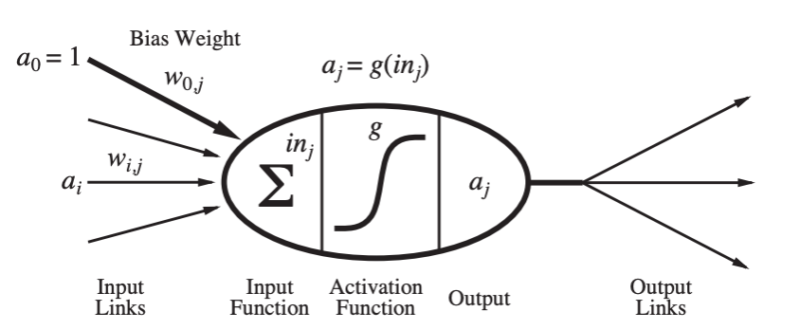
    Researchers have worked on Neural Networks (Figure below), a mathematical model modelled after neurons in the brain, a foundation unit, and one of the foundations of state-of-the-art AI.

    Artificial intelligence (AI), machine learning, deep learning, and data science are popular terms that describe computing fields that teach a machine how to learn. AI is a catch-all term that broadly means computing systems designed to understand and replicate human intelligence. Machine Learning is a subfield of AI where algorithms are trained on datasets to make predictions or decisions without explicitly being programmed. Deep Learning is a subfield of Machine Learning, which specifically refers to using multi-layers of neural networks to learn from large datasets, mimicking cognition of the neurons in the brain. Recently, the field of AI has resurged in popularity after a popular type of neural network architecture, AlexNET, achieved impressive results in the Image Recognition Challenge in 2012. Since then, neural networks have started to enter into applications in the industry, with colossal research funding mobilised.

    Breakthroughs that can aid Policy Implementation

    There are many types of neural networks, each designed for a particular application. The recent popularity of applications like ChatGPT is due to a neural network called Language Models. Language Models are probability models which ask the question, what is the next best token to generate, given the previous token?

    Two significant breakthroughs led towards ChatGPT, including translating language from one language to another using a machine learning technique called attention mechanism. Secondly, this technique was introduced in transformer-type language models, which led to increased state-of-the-art performance in many tasks in artificial intelligence.

    Transformers, a robust neural network, was introduced in 2017 by Google Researchers in “Attention is All You Need”. This translates into generating human-like text in ChatGPT. Large language models have taken a big step in the technology landscape. As Machine Learning applications are being deployed rapidly, it calls for a governance model for these models, as research in AI models is advancing quickly with innumerable breakthroughs. Earlier in 2019, GPT-2, a Machine Learning model based on transformers, could not solve fundamental mathematical problems such as elucidating numbers from 0-100. Within a year, more advancement in the GPT models led to models being able to perform higher-level scores in SAT exams, GRE, etc. Another breakthrough advancement was the ability of machine-learning programs to generate code, which has increased developer productivity automatically.

     Moreover, many researchers are working on AGI (Artificial General Intelligence), and nobody knows precisely when such capabilities might be developed or researched. Researchers have not settled on a convincing definition of AGI agreeable to everyone in the AI research community. The rate of advancement and investment in AI research is staggering, which calls for ethical concerns and governance of these large language models. India is an emerging economy where all sectors are growing rapidly. India’s economy grows nearly 10% yearly, with the services sector making up almost 50% of the entire economy. This translates to the government enjoying high tax revenues from this sector, generating high-paying jobs. Most of the Indian workforce is employed in the industrial and agricultural sectors.

    Using AI to deal with Corruption and enhance Trust

    The primary issue in India has been corruption at all levels of the government, from the panchayat, district level, and state level to central machinery. Corruption is attributed mainly to regulation, rent-seeking behaviour, lack of accountability, and requiring permits from the Government. Indian bureaucratic system and government employees are among the least efficient across sectors such as infrastructure, real estate, metal & mining, aerospace & defence, power and utility, which are also most susceptible to corruption. Due to inefficiency, the productivity of the public sector is low, impacting the local Indian economy.

    India ranks 85 out of 180 countries using the Corruption Index measured in 2022, with close to 62% of Indians encountering corruption, paying bribes to government officials to get the job done. There are many reasons for corruption in India: excessive regulation, a complicated tax system, bureaucratic hurdles, lack of ownership of work, and the public sector being the least productive organisation. Corruption is dishonest or fraudulent conduct by those in power, typically involving bribery. Bribery is defined generally as corrupt solicitation, acceptance, or transfer of value in exchange for official action. In bribery, there are two actors in the transaction, the giver and the receiver; however, corruption involves primarily one actor who abuses the position of power for personal gain. Bribery is a singular act, while corruption might be an ongoing abuse of power to benefit oneself.

    Trust is a critical glue in financial transactions; where trust between individuals is higher, the economic transactions are faster, and the economy grows, with more businesses moving, bringing capital, and increasing the production and exchange of goods. However, when trust is low, businesses hesitate, and the economy either stagnates or declines. High-trust societies like Norway have advanced financial systems, where credit and financial instruments are more developed, compared with lower-trust societies such as Kenya and India, where many financial instruments and capital markets to raise finances are unavailable. Therefore, public policymakers must seek ways to increase trust in their local economies by forming policies conducive to business transactions.

    The real-estate sector in Tamilnadu: a fit case for the use of AI

    Tamil Nadu is India’s second-largest economy and is the most industrialised and urbanised state in India. Real estate is an economic growth engine and a prime mover of monetary transactions. It is a prime financial asset for most Tamils from many social strata. However, real estate in Tamil Nadu is prone to corruption at many levels. One specific popular method is the forgery of land registration documents, which has resulted in a lack of trust among investors at all levels in Tamil Nadu.

    To address this lack of trust, we can use technology tools to increase confidence and empower the public to create an environment of accountability, resulting in greater confidence. Machine Learning can provide algorithms to detect these forgeries and prevent land grabbing. Tools such as identity analysis, document analysis, and transaction pattern analysis can help to provide more accountability. In addition to the above, machine learning offers many methods or combinations of methods that can be used. One advanced way is using transformer-based models, which are the foundation for language models such as BERT and generative Pre-Trained Models for text-based applications. The original documents could be trained using large language models as a baseline to frequently check and find forgeries. Documents can be encoded to compare semantic anomalies between different types of documents.

    Once forgery is detected, it can be automatically sent to civil magistrates or pertinent authorities. Additionally, the recent introduction of Software repository sites allows the public to be informed or notice any change in the status or activity. Customised public repositories based on GitHub might create immense value for Tamil Nadu’s Department of Revenue, create accountability, increase productivity and reduce workload. The Customised public repositories displaying land transaction activity might inform the public of such forgeries, thus creating an environment of greater accountability and trust for the people. Another popular method can be introduced by introducing Computer Vision Algorithms, such as convolutional neural networks combined with BERT, that can validate signatures, document tampering, and time-frames to flag forgeries. This can be done by training original documents with specific algorithms and checking documents with reasonable doubts about forgery.

    Another primary concern in Tamil Nadu’s Government has been people in positions of power in the government or close to financial oversight. They are more prone to corruption, which can be flagged or monitored using graph neural networks, which can map individuals, connections, and economic transactions in a network to flag which individuals are more likely or prone to corruption. Another method to reduce corruption is to remove personal discretion in the process, which Machine Learning can enable to automate the tasks and documents in land registration; digitisation might help reduce corruption. Large Language Models can also be used as classifiers and released to the public to keep accountability on the Tamil Nadu Government’s spending, so the public is aware and personal gain of Government money can be further reduced this way. Another central area of corruption is the tender, the bidding process for government contracts in Tamil Nadu, such as public development works or engineering projects. Tamil Nadu’s tender or bidding process can be made more public, and machine learning algorithms can be used to check if norms, contracts, and procedures are followed to award tender bids for government projects. To save wasteful expenditure, algorithms can check if objective conditions are met, with any deviations flagged and in the public domain. Given any suspicion, the public can file a PIL in Tamil Nadu’s court system.

    We can argue and conclude that with more deployed machine learning tools being part of Tamil Nadu’s State machinery, we can confidently say that corruption can be reduced to more significant levels by releasing all information to the public and creating an environment of greater accountability.

    References:

    1. Russell, Stuart J.; Norvig, Peter. (2021). Artificial Intelligence: A Modern Approach

    2.Bau, D., Elhussein, M., Ford, J. B., Nwanganga, H., & Sühr, T. (n.d.). Governance of AI models. Managing AI risks. https://managing-ai-risks.com/

    1. S. Department of State. (2021). 2021 Country Reports on Human Rights Practices: India. U.S. Department of State. https://www.state.gov/reports/2021-country-reports-on-human-rights-practices/india/
    1. Devlin, J., Chang, M.-W., Lee, K., & Toutanova, K. (2019). BERT: Pre-training of deep bidirectional transformers for language understanding. In Proceedings of NAACL-HLT (pp. 4171-4186). https://arxiv.org/abs/1810.04805
    1. Radford, A., Wu, J., Child, R., Luan, D., Amodei, D., & Sutskever, I. (2019). Language models are unsupervised multitask learners. OpenAI blog, 1(8). https://openai.com/blog/better-language-models/
    1. Radford, A., Narasimhan, K., Salimans, T., & Sutskever, I. (2018). Improving language understanding by generative pre-training. OpenAI blog, 12. https://openai.com/blog/language-unsupervised/
    2. Bai, Y., Kadavath, S., Kundu, S., Askell, A., Kernion, J., Jones, A., … Kaplan, J. (2022). Constitutional AI: Harmlessness from AI feedback. arXiv preprint arXiv:2212.08073. https://arxiv.org/pdf/2212.08073.pdf,

    https://www.anthropic.com/news/constitutional-ai-harmlessness-from-ai-feedback

    1. Reinforcement Learning with Human Feedback (RLHF), Ouyang, L., Wu, J., Jiang, X., Almeida, D., Wainwright, C. L., Mishkin, P., Zhang, C., Agarwal, S., Slama, K., Ray, A., Schulman, J., Hilton, J., Kelton, F., Miller, L., Simens, M., Askell, A., Welinder, P., Christiano, P., Leike, J., & Lowe, R. (2022). Training language models to follow instructions with human feedback. arXiv preprint arXiv:2203.02155. https://arxiv.org/abs/2203.02155

    Feature Image: modernghana.com

  • India’s rocky path to establishing joint theatre commands

    India’s rocky path to establishing joint theatre commands

    The Indian military has been seeking to build jointness among its services for decades, including through proposals to establish regional joint theatre commands with responsibility for different areas of the subcontinent and beyond. But those efforts hit a roadblock earlier this year when the Indian Air Force (IAF) objected to its capabilities being split across commands and relegated to providing tactical support to land operations. A truly joint Indian military may still be a long way off.


    Read More

  • Security through Deterrence and Power Projection

    Security through Deterrence and Power Projection

    Having lost out big time due to short-sighted piecemeal procurements, India’s acquisition process needs an overhaul and improve its track-record. With correct lessons derived and applied diligently, India can truly emerge as a globally competitive defence manufacturer and achieve control over critical technologies.

    This October 8th the IAF completes 90 years of glorious service to the nation. The past nine-decades is a saga of critical contribution to nation-building, warfighting, support to civil administration, air defence, international cooperation and peace keeping, military diplomacy, and deterrence of adversaries. The demand on these roles of the IAF have increased substantially in recent decades. Kargil to Balakot and Ladakh exemplify the value of the IAF as a critical tool of state power. In the 21st century, aerospace power has emerged as the critical tool of deterrence and power projection. The ability of the IAF to provide an array of choices to the national leadership depends on its force structure and the pace of modernisation. IAF’s 100th anniversary is just ten years away and there are, as Robert Frost said, miles to go. Modernisation is a continuous process. Sustaining the optimal force structure despite the delays of modernisation should remain the paramount task.

    [powerkit_button size=”lg” style=”info” block=”true” url=”https://raksha-anirveda.com/security-through-deterrence-and-power-projection/” target=”_blank” nofollow=”false”]
    Read More
    [/powerkit_button]

  • India’s Fighter Aircraft Needs: Strategies in the face of Geopolitical and Economic Crisis

    India’s Fighter Aircraft Needs: Strategies in the face of Geopolitical and Economic Crisis

    Having lost out big time due to short-sighted piecemeal procurements, India’s acquisition process needs an overhaul and improve its track-record. With correct lessons derived and applied diligently, India can truly emerge as a globally competitive defence manufacturer and achieve control over critical technologies

    The ongoing Russia-Ukraine war, now in its fifth month, has major lessons for India and the rest of the world, not only in terms of the future of war and military operations but more importantly on the importance of military capability and technological sovereignty. The war will be studied for its various aspects: the role and effectiveness of air dominance and air defence, Ukrainian use of anti-tank missiles and shoulder-fired missiles, anti-shipping missiles, heavy use of artillery, urban warfare, Russia’s use of long-range and hypersonic precision missiles, it’s artillery dominated grinding nature of the land campaign, use of drones by both sides, communications and the use of satellite networks, and the overbearing influence of ISR. The geopolitical fall-out of the war on India needs to be considered carefully. The comprehensive and large-scale sanctions imposed on Russia are already resulting in a multi-dimensional impact on the rest of the world.

    The USA and its allies have pressurised India to not only denounce Russia’s military action against Ukraine but to go along with their sanctions by severing India’s military armament and energy relationship with Russia. When analysed carefully, we can see that the real objective of their strategy is to severe economic and military-industrial relations of the former Soviet republics with Russia and incorporate them into the western economic system. This has been done successfully in countries like Poland, the Czech Republic, Baltic states, Romania, and now is being attempted in Ukraine. A sanction is an important tool for this strategy. While the war is on in Europe, India’s lucrative defence market has been the primary objective of this strategy ever since 2014 and later when CAATSA was introduced. India has been careful to safeguard its strategic relations with not only Russia but the US and Western Europe as well. The US has gone on record to say that its objective is to wean India away from its reliance on military imports from Russia. The Ukrainian crisis has given a sense of urgency to the USA about its India strategy.

    [powerkit_button size=”lg” style=”info” block=”true” url=”https://raksha-anirveda.com/indias-fighter-aircraft-needsstrategies-in-the-face-of-geopolitical-and-economic-crisis/” target=”_blank” nofollow=”false”]
    Read More
    [/powerkit_button]

  • China’s Growing Space Power Significant for India

    China’s Growing Space Power Significant for India

    Space has become an arena of competition for power and influence. Big powers have invested heavily in their military space capabilities. Amid an accelerated militarisation of space, China’s space capabilities have grown by leaps and bounds. China has identified Space as a critical domain in the perspective of its global ambitions. The rapid growth in China’s Space capabilities and its articulated ambitions are of significant importance to India’s Space security and national interests.

    Space has become an enormously important facet of our daily life. The increasing utility and critical need for space-based services have made it a rapidly-growing economic and technological arena. Space capabilities now symbolise a nation-state’s growing economic power. Innovation and disruptive technologies are now characterising the growth of the space industry, both in the private and public sectors. In all this, play the most important role as space has become an arena of competition for power and influence.

    Traditionally, military uses of space technologies have revolved around advanced communication, precise navigation, improved Intelligence, Surveillance, Reconnaissance (ISR) capabilities, and meteorology. Further developments have enabled these technologies to be used in Ballistic Missile Defence (BMD), advanced sensors, early warning systems, and anti-satellite (ASAT) systems.

    [powerkit_button size=”lg” style=”info” block=”true” url=”https://raksha-anirveda.com/chinas-growing-space-power-significant-for-india/” target=”_blank” nofollow=”false”]
    Read More
    [/powerkit_button]

  • IAF’s Force Structure: Strategy for Overcoming the Crisis

    IAF’s Force Structure: Strategy for Overcoming the Crisis

    Aligned with its national security interests, India’s strong geostrategic role-play, amidst the changing world order as a rising military power, aerospace power in particular must be rooted in the Indian industry.

    The ongoing conflict in Ukraine has many cautions for India. War at anytime and anywhere is a human catastrophe and therefore, all efforts to prevent or stop war should not be spared. While the American-led side wants India to take a stand in favour of their position, the Russian side is appreciative of India’s neutral stand. Recent visits by leaders from the USA, UK, EU, and Japan have emphasised the need for India to condemn Russia’s actions in Ukraine.

    What is of concern, however, is the fact that the USA and others stressing their view that India’s excessive dependence on Russia for its military equipment is the reason for its refusal to support their sanctions on Russia. Various officials from the US State Department and the DOD have openly advocated their objective of weaning India’s defence imports from Russia. There lies the real issue.

    India’s defence market is too huge and attractive for Western defence industries, and hence, it is the focus of strategic dialogues of many of these countries with India.

    India’s defence market is too huge and attractive for Western defence industries, and hence, it is the focus of strategic dialogues of many of these countries with India. India has diversified its military procurements in the last three decades to ensure it does not become vulnerable to a single source supply. As a result, India’s defence supplies from Russia, which was as high as 70-75% in the early 2000s came down to a current level of 50-55%. The US has been the biggest gainer in this diversification, garnering nearly $ 22 billion in sales to India in the last 15 years to emerge as its number 1 supplier. The Ukraine conflict and the resultant sanctions are being used by the USA to pressurise India to reduce its imports from Russia. The real objective is to ensure the US and its European allies replace Russia as India’s major if not exclusive supplier of defence equipment. The threat of CAATSA on India’s S-400 air defence missile deal with Russia is a prime example. The crux of the India-USA strategic partnership is really about capturing India’s defence market for the Military-Industrial Complex of the USA.

    [powerkit_button size=”lg” style=”info” block=”true” url=”https://raksha-anirveda.com/iafs-force-structure-strategy-for-overcoming-the-crisis/” target=”_blank” nofollow=”false”]
    Read More
    [/powerkit_button]

  • The Need for National Aerospace Strategy

    The Need for National Aerospace Strategy

    India needs a comprehensive and coherent national aerospace strategy to accelerate indigenous development in the rapidly evolving geopolitical environment.

    As the 2022 edition of the ‘DefExpo’ gets underway in a few days, it is important to recognise the fact India’s ‘Defence and Aerospace’ sector is growing significantly, aided by the Government’s policy initiatives such as ‘Make in India’ that have created opportunities for many joint ventures with international companies. Platforms like the ‘DefExpo’ and ‘Aero India’ are providing the necessary boost and visibility to Indian manufacturing.

    Recent announcements on the agreement with the Philippines to export ‘BRAHMOS’ missile is a significant achievement. Similarly, last week’s news that DRDO and SAFRAN will jointly develop the 125 KN engine for the AMCA is major news that could be transformational if the collaboration is well crafted keeping Indian interests in perspective. However, one must keep in mind that much work needs to be done beyond the optics of a defence exhibition. Translating the MoUs into real JVs is a big challenge. Unless the Indian defence industry breaks into the export market in a big way by becoming part of the global supply, the challenges to the Indian industry will continue to be significant.

    [powerkit_button size=”lg” style=”info” block=”true” url=”https://raksha-anirveda.com/the-need-for-national-aerospace-strategy/” target=”_blank” nofollow=”false”]
    Read More
    [/powerkit_button]

  • India, the Sino-US Rivalry, and the post-pandemic World Order

    India, the Sino-US Rivalry, and the post-pandemic World Order

    India has a vital stake in the geopolitical contest between the US and China, particularly in the context of the rising Sino-Indian rivalry. India’s strategies, therefore, must focus on ensuring its security and its freedom of action in global affairs. It will also need to play an active role in reforming the world to more equitable and multipolar governance.

    The global disruption caused by the Covid-19 pandemic that engulfed the world at the end of 2019 and continues to this day is the biggest economic, political, and technological disruption since the Second World War. The pandemic has exposed the serious deficiencies in national healthcare systems in all countries, developed and developing. More importantly, the pandemic has raised questions on the relevance and effectiveness of the current world order, about the future of international organisations and multilateral frameworks, and poses challenges to international political and economic relations.


    Read more