Author: Andreas Herberg-Rothe

  • Consumption as a Substitute Religion – A Critique of Capitalism

    Consumption as a Substitute Religion – A Critique of Capitalism

    Consumption is becoming the new substitute religion. This is certainly progress for former poor countries, but in the long run it dissolves the cohesion of society and is only apparently covered up by aggressive enemy declarations. The newly industrialised nations should take the dissolution of social cohesion in the West as a warning example.

    With the triumph of neo-liberalism, all forms of identity worldwide are becoming fluid, uncertain or even dissolved. It is true that it was right to leave behind the binary oppositions of Western modernity to “non-modern” societies, which were associated with static, entrenched forms of identity. But the orientation towards models of consumption does not lead to a real pluralisation, but reproduces ever new rigid identities and thinking in tribal opposites: “us against the others”, whoever the others are. The Chinese dream, New Russia, make America great again, the rise of right-wing populism in Europe and the USA, the division of Israeli society and the temporary triumph of the extreme religious right there are all reactions to the dissolution of identities through the transformation of citizens into consumers. Consumption is becoming the new substitute religion. This is certainly progress for former poor countries, but in the long run, it dissolves the cohesion of society and is only apparently covered up by aggressive enemy declarations. The newly industrialised nations should take the dissolution of social cohesion in the West as a warning example.

    If about 6 people have as much property as 3.6 billion “others or in the near future 1% of the world’s population as much as the “remaining” 99%, then this is an absolutely obscene inequality, which we only accept becauseö the ideology of consumption, capitalism and neo-liberalism has become the new world religion. As Walter Benjamin already pointed out, it serves the same basic need as the monotheistic religions. “Then said the Lord unto Moses, Thus shalt thou say unto the children of Israel, Ye have seen that I have spoken unto you from heaven. Ye shall set nothing by my side: silver gods and gold gods ye shall not have.” (Exodus 20:22). “And when the people saw that Moses came not down from the mount so long, they gathered themselves about Aaron, and said unto him, Arise, make us a god to go before us: for we know not what is befallen this man Moses. (…) And Aaron took the gold out of their hand and poured it into a clay mould, and made it a cast calf. Then they said: This is thy God, O Israel, which brought thee up out of the land of Egypt.” (Ex 32:1) We today may think ourselves exalted at the idea of worshipping a golden figure. But in reality, aren’t we merely replacing it with Wall Street or the Frankfurt Stock Exchange, or even globalisation, which is supposed to lead us to the promised land, i.e. prosperity and wealth? It is true that we do not entrust our wives’ and daughters’ earrings to the stock exchange, but often all our savings, individual fates as well as those of entire countries are determined by the price of coffee, bananas and other commodities. Gunter Henn, the architect of the VW Autostadt, one of the new temples, underlined the claim for the creation of meaning by companies: “Who else offers orientation, where does that leave us with our childlike religiosity? The churches are dead, the state is withdrawing, and the ideologues have lost their power. What remains are the companies.”

    This story of the Golden Calf, which was put in the place of God at the very moment when he had revealed his will to the people of Israel in the Ten Commandments, illustrates a fundamental problem of religion, of the religious. For religion is obviously based on a two-way relationship. On the one hand, there is a need for a god or gods to reveal themselves, to show themselves, and on the other hand, there is an ineradicable need, an insatiable human desire for the divine, for the religious. This deep-seated longing can have many different reasons. In the sociology of religion and philosophy, it is described in such a way that religion, the religious, has fundamental functions for individual people as well as human societies, for example, the endurance of the fear of one’s own death, the embedding in communities that outlast death, the giving of meaning to life, the transcending of one’s own boundaries in an ordered whole, the construction of something sacred, untouchable.  The problem that arises from this, however, is that this insatiable longing can obviously also refer to something other than the revealing God, precisely to a golden calf, but also to the God of reason, to one’s own nation or race, to the world-historical mission of the proletariat, or even to science and technology. Science and technology may relegate the religious to the very back seats – often with the sole effect of putting themselves in its place. Carl Schmitt, one of the most important as well as most controversial theorists of political theory, emphasised, for example, that at the beginning of the 20th-century religious belief in God was replaced by religious belief in technology and the omnipotence of man. With regard to National Socialism, this has been proven in many cases, as there was a deliberate and purposeful instrumentalisation of religious practices for party congresses and mass marches – incidentally an essential aspect of why this inhuman ideology could nevertheless be so successful.  “Führer, our daily bread give us today.”

    ‘As Walter Benjamin already noted, capitalism is a pure cult religion that has neither a dogma nor a theology’

    But let’s move on to the gods of the market, consumerism and cult marketing when brand companies and belonging to this community take on cultic, religious proportions. And let’s put it bluntly: This cult marketing appeals to religious feelings much more simply and directly than a reflected faith ever can, religious feelings that at best come to the fore in community experiences at church conventions. Their religious character is also not always overt, since there is an essential difference between consumption, cult marketing and the Christian understanding of religion. Substitute religions are usually polytheistic, but Christianity is monotheistic. For followers of monotheistic religions, polytheistic ones often do not appear as a religion at all, but as something that one shrugs off or is amazed at, but considers oneself to be superior to this preform of religion. Such a view fails to recognise that these polytheistic forms of religion nevertheless serve religious feelings, without which their success is difficult to explain. Moreover, as Walter Benjamin already noted, capitalism is a pure cult religion that has neither a dogma nor a theology – unless one also wants to understand the currently dominant neoclassicism as a substitute religion. A cult religion, in any case, is directly practically oriented, just like the archetypes of pagan religiosity, which practises its rite without God’s word, without revelation. Pagan is to be defined in such a way that the cult takes precedence over the doctrine, which only appears implicitly. Capitalism is a form of neo-paganism, Benjamin concludes.

    Just as religion tries to help life succeed by conveying a meaningful way of living, so advertising tries to do by suggesting to customers that they can only live fulfilled lives or belong to the in-group by buying, owning and using a certain product. It is striking that in many cases advertising no longer presents the real advantages of a product, but values such as friendship. Advertising instrumentalises religious motifs to turn people into customers and customers into brand believers. In doing so, it builds on the religious basis still dormant in the hidden human being, tries to appeal to this sacral subconscious and therefore creates new forms of cult marketing, through which modern man is supposed to find cosy, warm places for his longings. In the spiritual desert of modernity, marketing strategies fill the vacant position of religion with advertising in general and the positions previously held by God and the sacred with products in particular and everything connected with the use of such a product: instead of religious practice, consumption; instead of gods, idols of consumption; instead of churches, temples of consumption; instead of religious faith communities, those of consumption. In this context, belonging to the ingroup is considered constitutive in the choice of brand and ex-communication is threatened in an equally consistent manner if the wrong brand is chosen. The myth created around a brand gives its products a spiritual added value that is supposed to set them apart from the mass of competing products of the same quality.

    Consumerism was aggressively propagated as an alternative and implicitly as a substitute for religion vis-à-vis traditional religions by the media theorist Norbert Bolz in his Consumerist Manifesto. For him, consumerism is the immune system of world society against the virus of fanatical religions. Consumerism promises neither the goal nor the end of history, but “only the ever-new”.  Independent of the implicit and recurring criticism of monotheism, the question arises as to the price that must be paid for the production of the ever-new.

    Not only are quite normal products being elevated far beyond their utility value to cult brands, to a substitute for religion. In the new marketing, the customer is not only king, as it used to be called, but god-like. In largely saturated markets, it is mainly about creating ever-new desires. Customers are told that, compared to whatever they may already have, there are still many, many more possibilities, infinitely new possibilities. This amusement park has not yet been visited, that trip has not yet been taken, this hair shampoo could be cheaper or even better than that one, you can shop better in Frankfurt than in Kassel or vice versa or somewhere else. In the meantime, you can also fly to London in one day to go shopping, “how have you not yet been to Paris to go shopping?”

    The decisive factor is not whether one actually uses this or that offer, but that there are always even better, even fancier POTENTIAL possibilities that one has not yet realised…. “Anything goes” used to be a slogan of resistance against repressive social structures – today it is the symbol for the market of limitless possibilities. Due to this limitlessness of possibilities of consumption, a constant depressive feeling arises in MANY people that they have not yet exhausted any consumption possibilities – and if one were to devote one’s whole life to consumption, there would still be something that would have to be done without.

    This pressure of seemingly limitless possibilities to live like “God in France” is exacerbated for those whose financial possibilities are limited, such as in the case of unemployment, because here the tension between the real limited and the potentially infinite consumption possibilities is particularly great.

    From this tension follows a clinical picture that characterises modern capitalism, our market society, and depression as an awareness of what is potentially possible and what is actually possible. Depression threatens the individual who only resembles himself, just as sin pursues the soul turned towards God or guilt pursues the human being torn apart in conflict. It arises both when the awareness of potential possibilities far exceeds that of the real ones and in those cases where the consumer is called upon to constantly reinvent himself.

    This last problem can be illustrated by a cigarette advertisement that virtually signals the reversal of traditional advertising promises because it boldly states that this particular brand of cigarettes does not taste good to everyone – and that is portrayed as a good thing, according to the slogan. At the same time, of course, this advertising is aimed at the largest possible group of buyers, the more the better. This gives rise to the deliberate paradox that one is all the more an absolutely unique individual if one consumes exactly what everyone is buying.

    The individual here is not something self-evident, born or given by nature, but a laboriously constructed social role. As an individual, man makes himself the cult centre of a religion of uniqueness. That’s why Buddhism is often in vogue today – as a doctrine of self-redemption without a saviour god. And for those who find that too spiritual, self-excitement and self-challenge remain. You take drugs, get high on the body’s own endorphins – or best of all: on the drug “I”. But it would be a misunderstanding to believe that the cult of the ego is a step towards liberating the individual from the shackles of society. In the cult of the ego, the human being is less a sovereign individual than an unhappy prosthetic god. He surrounds himself with auxiliary constructions from the world of fashions, drugs and distractions.

    The emancipation of the sixties and seventies has often freed us from the dramas of guilt and obedience, but it has brought us new dramas of responsibility and action in an uncertain and conflicting world.

    In this invention of a seemingly unique individuality through the consumption of branded products, individuals are overburdened without limits – the customer is no longer king, but god-like in marketing strategies – we fulfil their most secret wishes, everything they desire, there are no limits to their desires. But people remain humans, they are not gods and often break down at this imposition of being equal only to themselves. Only God, who in the Old Testament logically demands that there should be no gods beside Him, is equal only to Himself. The emancipation of the sixties and seventies has often freed us from the dramas of guilt and obedience, but it has brought us new dramas of responsibility and action in an uncertain and conflicting world. Thus, through human self-empowerment and the marketing strategy of the individual responsible only to himself, depressive exhaustion accompanies neurotic anxiety not only on an individual level but could be also witnessed in Western societies as a whole. The alternative to rigid forms of identity and political systems is not consumerism, which only leads to new forms of such ideologies. What is needed is a floating balance of the individual and the community.

  • Indian Philosophy and religion: Abolishing the caste system as an attempt in Intercultural Philosophy

    Indian Philosophy and religion: Abolishing the caste system as an attempt in Intercultural Philosophy

    We start the year 2023 with an examination of philosophy and society and through it the social evil of caste. The origin of the caste system in Hindu society lies buried in many myths and misconceptions. Caste is often linked by many to the core of Hindu philosophy. This is a deeply flawed understanding. The caste system has been and continues to be a tool of power and economic exploitation by oppressing large segments of the population. It is largely an invention by the clergy to establish their power and domination through rituals and codes and by ascribing to them a forced religious sanctity. As it also becomes convenient to the rulers, caste and class are prevalent in all societies. Philosophy and true religion, as Andreas points out in this working paper,  have had nothing to do with caste or class.                                        – TPF Editorial Team


    Introduction

    Intercultural philosophy is absolutely necessary in order to cope with the current and new phase of hybrid globalization, which is dissolving all kinds of traditional identities. Whereas the current reaction to this process is the development of ideologies centred on the idea of “we against the rest”, whoever the “Rest” might be, we need to construct positive concepts of identity, which does not exclude but include the other. These can be based on the mutual recognition of the civilizations of the world and their philosophies. According to Karl Jaspers the godfather of intercultural philosophy, between the sixth and third century BC the development of great cities, and the development in agriculture and sciences led to a growth of the populace that forced humankind to develop new concepts of thinking. He labelled this epoch as the axial age of world history in which everything turned around. He even argued that in this time the particular human being or human thinking was born with which we still live today – my thesis is that all human religions, civilizations and philosophies share the same problems and questions but did find different solutions.

    A vivid example might be the relationship between happiness and suffering. In the philosophy of the Greek philosopher Aristotle, to achieve eudemonia or happiness in your earthly life was the greatest aim whereas in a popular understanding of Karma, life is characterized by suffering and the aim is to overcome suffering by transcending to Nirvana. You see, the problem is the same, but there are different solutions in various philosophies. Although Jaspers didn’t share the reduction of philosophy and civilization to the European or even German experience and included mainly the Chinese and Indian civilization, he nevertheless excluded the African continent and both Americas, Muslim civilization as well as the much older Egyptian civilization. So, although he enlarged our knowledge and understanding of civilizations his point of reference was still “Western modernity” and within it, the concept of functional differentiation played the major role.

    Another solution is embodied in the belief of the three monotheistic religions, that an omnipotent god is the unifying principle despite all human differentiations and even the differences between the living and the dead, love and hate, between war and peace, men and women, old and young, linear and non-linear understanding of time, beginning and ending, happiness and suffering.  In this belief system, we are inevitably confronted with unsurpassable contrasts, conflicts and contradictions – but an all-powerful and absolute good god is the one who is uniting all these contrasts.

    In principle in Chinese philosophy, we have the same problem – but instead of an all-powerful God, we as humans have the task to live in harmony with the cosmic harmony. So, I really think that we humans share the same philosophical problems – how to explain and overcome death, evil, suffering, and the separation from transcendence. Although Karl Jaspers could be seen as the founding father of intercultural philosophy, I think he put too much emphasis solely on the functional differentiation that an ever-growing populace could live together without violence. In my view, the questions of life and death are running deeper. I would not exclude functional differentiation as one of the driving forces of human development but at least we also need an understanding of human existence that is related to transgressing the contrasts of life.

    In this draft, I would like to give some impressions concerning this same problem based on my limited knowledge of Indian philosophy and religion and try to show that both are opposing the caste system as well as any kind of dogmatism. An Indian student asked me in the run-up to this draft how one could understand Indian philosophy if one had not internalized the idea of rebirth since you are a baby. From her point of view, the whole thinking on the Indian subcontinent is thus determined by the idea of rebirth – this problem will still occupy us in the question of whether the terrible caste system in India is compatible with the original intentions of the Indian religions, whether it can be derived from them or contradicts them. I will try to give a reason for the assumption that Indian philosophy is quite universal and at the same time open to different strands of philosophical thought, retaining its core.

    In its essence, it is about Karma, rebirth, and Moksha. An understanding of Atman and Brahman is essential. Atman is the soul, indestructible, and is part of Brahman (omnipresent God). When Atman continues to reform and refine itself through rebirths aspiring to become one with Brahman, that is Moksha. To attain Moksha is the purpose of each life. Moksha is being one with God…a state where there is no more rebirths. Of course, differences are there in interpreting Atman and Brahman, depending on the Advaita and Dwaita schools of philosophy. Ultimately both narrow down to the same point – Moksha. Karma is the real part. True Karma is about doing your work in life as duty and dispassionately. Understanding that every life form has a purpose, one should go about it dispassionately. Easier said than done. Understanding this is the crux. In an ideal life where one has a full understanding of Karma and performs accordingly, he/she will have no rebirth. Indian philosophy is careful to separate the religious and social practices of the common folks and the high religion.  Hence Caste and hierarchy are not part of the philosophical discourse, although many make the mistake of linking them. Caste, like in any other religion, is a clergy-driven issue for power and economic exploitation.

    Indian Philosophy (or, in Sanskrit, Darshanas), refers to any of several traditions of philosophical thought that originated in the Indian subcontinent, including Hindu philosophy, Buddhist philosophy, and Jain philosophy. It is considered by Indian thinkers to be a practical discipline, and its goal should always be to improve human life. In contrast to the major monotheistic religions, Hinduism does not draw a sharp distinction between God and creation (while there are pantheistic and panentheistic views in Christianity, Judaism, and Islam, these are minority positions). Many Hindus believe in a personal God and identify this God as immanent in creation. This view has ramifications for the science and religion debate, in that there is no sharp ontological distinction between creator and creature. Philosophical theology in Hinduism (and other Indic religions) is usually referred to as dharma, and religious traditions originating on the Indian subcontinent, including Hinduism, Jainism, Buddhism, and Sikhism, are referred to as dharmic religions. Philosophical schools within dharma are referred to as darśana.

    Religion and science

    One factor that unites dharmic religions is the importance of foundational texts, which were formulated during the Vedic period, between ca. 1600 and 700 BCE. These include the Véda (Vedas), which contain hymns and prescriptions for performing rituals, Brāhmaṇa, accompanying liturgical texts, and Upaniṣad, metaphysical treatises. The Véda appeals to a wide range of gods who personify and embody natural phenomena such as fire (Agni) and wind (Vāyu). More gods were added in the following centuries (e.g., Gaṇeśa and Sati-Parvati in the fourth century CE). Ancient Vedic rituals encouraged knowledge of diverse sciences, including astronomy, linguistics, and mathematics. Astronomical knowledge was required to determine the timing of rituals and the construction of sacrificial altars. Linguistics developed out of a need to formalize grammatical rules for classical Sanskrit, which was used in rituals. Large public offerings also required the construction of elaborate altars, which posed geometrical problems and thus led to advances in geometry.

    Classic Vedic texts also frequently used very large numbers, for instance, to denote the age of humanity and the Earth, which required a system to represent numbers parsimoniously, giving rise to a 10-base positional system and a symbolic representation for zero as a placeholder, which would later be imported in other mathematical traditions. In this way, ancient Indian dharma encouraged the emergence of the sciences.

    The relationship between science and religion on the Indian subcontinent is complex, in part because the dharmic religions and philosophical schools are so diverse.

    Around the sixth–fifth century BCE, the northern part of the Indian subcontinent experienced extensive urbanization. In this context, medicine became standardized (āyurveda). This period also gave rise to a wide range of philosophical schools, including Buddhism, Jainism, and Cārvāka. The latter defended a form of metaphysical naturalism, denying the existence of gods or karma. The relationship between science and religion on the Indian subcontinent is complex, in part because the dharmic religions and philosophical schools are so diverse. For example, Cārvāka proponents had a strong suspicion of inferential beliefs, and rejected Vedic revelation and supernaturalism in general, instead favouring direct observation as a source of knowledge. Such views were close to philosophical naturalism in modern science, but this school disappeared in the twelfth century. Nevertheless, already in classical Indian religions, there was a close relationship between religion and the sciences.

    Opposing dogmatism: the role of colonial rule

    The word “Hinduism” emerged in the nineteenth century, and some scholars have argued that the religion did so, too. They say that British colonials, taken aback by what they experienced as the pagan profusion of cults and gods, sought to compact a religious diversity into a single, subsuming entity. Being literate Christians, they looked for sacred texts that might underlay this imputed tradition, enlisting the assistance of the Sanskrit-reading Brahmins. A canon and an attendant ideology were extracted, and with it, Hinduism. Other scholars question this history, insisting that a self-conscious sense of Hindu identity preceded this era, defined in no small part by contrast to Islam.  A similar story could be told about other world religions. We shouldn’t expect to resolve this dispute, which involves the weightings we give to points of similarity and points of difference. And scholars on both sides of this divide acknowledge the vast pluralism that characterized, and still characterizes, the beliefs, rituals, and forms of worship among the South Asians who have come to identify as Hindu.

    Here I would like to mention some of the scriptures in Hinduism: The longest of these is the religious epic, the Mahabharata, which clocks in at some 180000 thousand words, which is ten times the size of the Iliad and the Odyssey of Homer combined. Then there’s the Ramayana, which recounts the heroic attempts of Prince Rama to rescue his wife from a demon king. It has as many verses as the Hebrew bible. The Vedas which are the oldest Sanskrit scriptures include hymns and other magical and liturgical; and the Rig-Veda, the oldest, consists of nearly 11 000 lines of hymns of praise to the gods.

    But the Rig Veda does not only contain hymns of praise of God but a philosophical exposition which can be compared with Hegel’s conceptualization of the beginning in his “Logic”, which is not just about logic in the narrow sense but about being and non-being:

    In the Rig Veda we find the following hymn:

    Nasadiya Sukta (10. 129)

    There was neither non-existence nor existence then;
    Neither the realm of space nor the sky which is beyond;
    What stirred? Where? In whose protection?

    There was neither death nor immortality then;
    No distinguishing sign of night nor of day;
    That One breathed, windless, by its own impulse;
    Other than that there was nothing beyond.

    Darkness there was at first, by darkness hidden;
    Without distinctive marks, this all was water;
    That which, becoming, by the void was covered;
    That One by force of heat came into being.

    Who really knows? Who will here proclaim it?
    Whence was it produced? Whence is this creation?
    Gods came afterwards, with the creation of this universe.
    Who then knows whence it has arisen?

    Whether God’s will created it, or whether He was mute;
    Perhaps it formed itself, or perhaps it did not;
    Only He who is its overseer in highest heaven knows,

    Only He knows, or perhaps He does not know.

    —Rigveda 10.129 (Abridged, Tr: Kramer / Christian)

    Nasadiya Sukta begins rather interestingly, with the statement – “Then, there was neither existence nor non-existence.” It ponders over the when, why and by whom of creation in a very sincere contemplative tone and provides no definite answers. Rather, it concludes that the gods too may not know, as they came after creation. And maybe the supervisor of creation in the highest heaven knows, or maybe even he does not know.

    The philosophical character of this hymn becomes obvious when stating that there was something or someone who created even the gods. This question might be similar to the one that created the big bang thirteen billion years ago. In my view, the Rigveda is the most elaborate Veda opposing any kind of dogmatism, any ideology. Instead, it gives reason for the assumption which is of paramount importance in an ever-changing world, that there is no absolute knowledge, there is an increasing sense of unsureness, and we can’t rely on fixed rules – but that we are responsible for our actions.

    Müller made the term central to his criticism of Western theological and religious exceptionalism (relative to Eastern religions) focusing on a cultural dogma which held “monotheism” to be both fundamentally well-defined and inherently superior to differing conceptions of God.

    The second problem is related to the question of whether this hymn should be interpreted as monotheistic, dualistic or polytheistic. Some scholars like Frederik Schelling have invented the term Henotheism (from, greek ἑνός θεοῦ (henos theou), meaning ‘of one god’) is the worship of a single god while not denying the existence or possible existence of other deities. Schelling coined the word, and Frederik Welcker (1784–1868) used it to depict primitive monotheism in ancient Greeks. Max Müller (1823–1900), a German philologist and orientalist, brought the term into wider usage in his scholarship on the Indian religions, particularly Hinduism whose scriptures mention and praise numerous deities as if they are one ultimate unitary divine essence.  Müller made the term central to his criticism of Western theological and religious exceptionalism (relative to Eastern religions) focusing on a cultural dogma which held “monotheism” to be both fundamentally well-defined and inherently superior to differing conceptions of God.

    Mueller in the end emphasizes that henotheism is not a primitive form of monotheism but a different conceptualization. We find a similar passage in the gospel of John in which it is stated:

    1In the beginning was the Word, and the Word was with God, and the Word was God. 2 He was with God in the beginning. 3 Through him all things were made; without him, nothing was made that has been made. 4 In him was life, and that life was the light of all mankind. 5 The light shines in the darkness, and the darkness has not overcome it.

    It is clearly written that in the beginning there was the word – not God. In the original Greek version of this gospel, the term logos is used, and Hegel made this passage the foundation of his whole philosophy. Closely related to the Rig Veda is the concept of Atman. Ātman (Atma, आत्मा, आत्मन्) is a Sanskrit word which means “essence, breath, soul” and which is for the first time discussed in the Rig-Veda.  Nevertheless, this concept is most cherished in the Upanishads, which are written precisely between the 8th to 5th centuries B.C., the period in which according to Jaspers the axial age began. Again, this concept is an attempt to reconcile the various differentiations which were necessary for the function of a society with an ever-increasing population.

    I want to highlight that Hinduism – in its Vedic and classic variants – did not support the caste system; but that it rigorously opposed it in practice and principle. Even after the emergence of the caste system, Hindu society still saw considerable occupational and social mobility. Moreover, Hinduism created legends to impress on the popular mind the invalidity of the caste system – a fact further reinforced by the constant efflorescence of reform movements throughout history. The caste system survived despite this because of factors that ranged from the socio-economic to the ecological sphere, which helped sustain and preserve the balance among communities in a non-modern world.

    It would be absolutely necessary to demolish the myth that the caste system is an intrinsic part of Hinduism as a religion as well as a philosophy.  Although, there is a historically explainable link between both but not one which I would label a necessary or logical connection. Of course, the proponents of the caste system tried to legitimize the caste system by using references from the ancient scriptures – but as we maintain we must not understand Hinduism just in relation to Dharma if we would understand it just as jati or birth-based social division.

    The myth of the caste system being an intrinsic part of Hinduism is a discourse in the meaning in which Foucault has used this concept as just exercising power.

    I’m not sure whether this interpretation represents the major understanding in India, but I think it might be essential in a globalized world to debunk this only seemingly close relation, which has just a historical dimension and would therefore be a vivid example just of a discursive practice. The myth of the caste system being an intrinsic part of Hinduism is a discourse in the meaning in which Foucault has used this concept as just exercising power.

    This discourse is believed by orthodox elements in Hinduism as well as propagated by elements outside of Hinduism who are trying to proselyte Hindus. I would like to treat this problem a little bit more extensively because it might be used for other religions and civilizations, too, in which suppression and dominance are seemingly legitimized by holy scriptures but by taking a closer look this relation is just a discourse of power.

     Nevertheless, there is a very old text of Hinduism in which the caste system is legitimized. It is called  Manusmṛiti (Sanskrit: मनुस्मृति), also spelt as Manusmruti, is an ancient legal text. It was one of the first Sanskrit texts to have been translated into English in 1794, by Sir William Jones, and was used to formulate the Hindu law by the British colonial government.

    Over fifty manuscripts of the Manusmriti are now known, but the earliest discovered, most translated and presumed authentic version since the 18th century has been the “Calcutta manuscript with Kulluka Bhatta commentary”.

    How did caste come about?

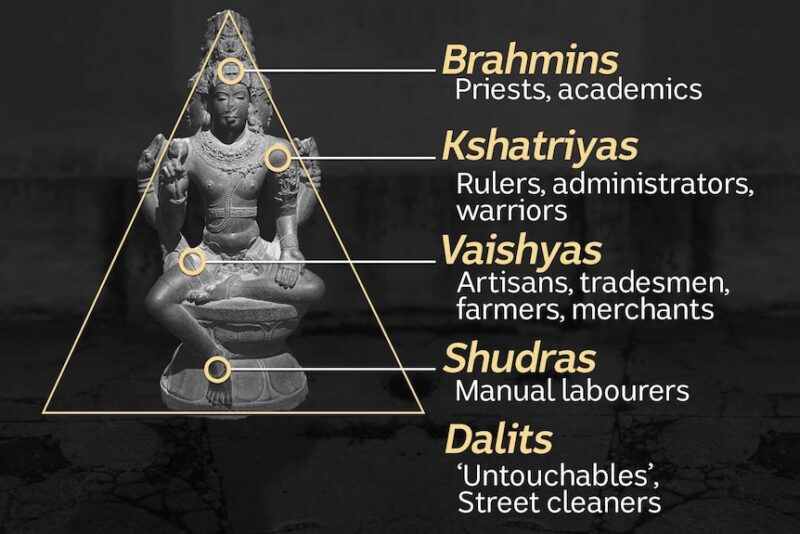
    Manusmriti, widely regarded to be the most important and authoritative book on Hindu law and dating back to at least 1,000 years before Christ was born, seems to “acknowledge and justify the caste system as the basis of order and regularity of society”. The caste system divides Hindus into four main categories – Brahmins, Kshatriyas, Vaishyas and the Shudras. Many believe that the groups originated from Brahma, the Hindu God of creation.

    At the top of the hierarchy were the Brahmins who were mainly teachers and intellectuals and are believed to have come from Brahma’s head. Then came the Kshatriyas, or the warriors and rulers, supposedly from his arms. The third slot went to the Vaishyas, or the traders, who were created from his thighs. At the bottom of the heap were the Shudras, who came from Brahma’s feet and did all the menial jobs. The main castes were further divided into about 3,000 castes and 25,000 sub-castes, each based on their specific occupation. Outside of this Hindu caste system were the achhoots – the Dalits or the untouchables.

    How does caste work?

    For centuries, caste has dictated almost every aspect of Hindu religious and social life, with each group occupying a specific place in this complex hierarchy. Rural communities have long been arranged on the basis of castes – the upper and lower castes almost always lived in segregated colonies, the water wells were not shared, Brahmins would not accept food or drink from the Shudras, and one could marry only within one’s caste. The system bestowed many privileges on the upper castes while sanctioning repression of the lower castes by privileged groups.

    New research shows that hard boundaries between the social groups were only set by British colonial rulers who made caste India’s defining social feature when they used censuses to simplify the system, primarily to create a single society with a common law that could be easily governed.

    Often criticized for being unjust and regressive, it remained virtually unchanged for centuries, trapping people into fixed social orders from which it was impossible to escape. Despite the obstacles, however, some Dalits and other low-caste Indians, such as BR Ambedkar who authored the Indian constitution, and KR Narayanan who became the nation’s first Dalit president, have risen to hold prestigious positions in the country. Historians, though, say that until the 18th Century, the formal distinctions of caste were of limited importance to Indians, social identities were much more flexible, and people could move easily from one caste to another. New research shows that hard boundaries between the social groups were only set by British colonial rulers who made caste India’s defining social feature when they used censuses to simplify the system, primarily to create a single society with a common law that could be easily governed.

    So, the caste system in its strict interpretation is an invention of British rules – of course, it existed already in some form around three thousand years ago. However, it is disputed whether in ancient times it was more of a kind of functional differentiation in the meaning of Karl Jaspers, whereas since colonial times it became a separation boundary between the various groups. I assume that the colonial rulers transformed an existing variety of functional differentiations of identities into strictly separated castes for reasons of securing their rule. As in other colonial rules like in Africa, the colonizers were puzzled by the plurality of social groups, their ability to change from one group to the other and transformed social groups based on functional differentiation into castes and classes to facilitate their own rule. Overcoming the caste system thus involves overcoming colonialism.

  • Killing in War – Between Striving for Power and Self-Preservation

    Killing in War – Between Striving for Power and Self-Preservation

    [powerkit_button size=”lg” style=”info” block=”false” url=”https://admin.thepeninsula.org.in/wp-content/uploads/2022/10/TPF-Research-Paper-Killing-in-War-1.pdf” target=”_blank” nofollow=”false”]
    Download
    [/powerkit_button]

    Introduction:

    How does it come about that humans kill each other en masse in wars? Within the animal kingdom, they seem to have a special position in this respect. Many animal species have a killing taboo within the species, but at the same time, there is a displacement competition, which is often decided by fights. This displacement of conspecifics corresponds to the formation of communities as well as processes of belonging to or exclusion from them. If the displaced conspecifics do not succeed in forming or joining their own communities, they usually perish, for example, because they are denied access to food sources. The displacement of conspecifics serves their own survival and the formation of a group that enables this survival directly or in the transmission of the biological heritage.

    Living and surviving in the community, exclusion and displacement of conspecifics not belonging to the community – this can be considered as a basic pattern of conflicts within a species. In the animal kingdom, such conflicts are usually ritualized rank fights in which the killing of the opponent is usually avoided. However, this cannot hide the fact that killing also takes place here – for example, when the inferior is forced into a territory where he has no chance of survival (Eibl-Eibesfeldt, 1984). While in the animal kingdom the right of the physically stronger is almost unrestricted, there is a special feature in humans. Because of their intelligence, they are able to recognize that displacement from the community means immediate death and makes biological reproduction impossible (Orywal et al., 1995).

    Recognition of the connection between displacement from the community (or displacement of one’s own by competing communities) and personal death or restriction of reproductive opportunity is the decisive reason for the skipping of the killing taboo within the human species.

    Recognition of the connection between displacement from the community (or displacement of one’s own by competing communities) and personal death or restriction of reproductive opportunity is – according to my central hypothesis – the decisive reason for the skipping of the killing taboo within the human species. In addition, there is in the human being the ability, also developed by his mind, that the weakest or a group of weaker can kill the strongest. This happens with the help of tools, above all weapons, but also by “cunning and trickery”, i.e. by the use of intelligence. At the same time, this basic constellation also gives rise to the possible realization that a fight to the death can lead to the downfall of one’s own community. At a certain point in the conflict, it may therefore be more advisable to abandon the struggle and secure one’s own survival through other efforts – e.g., through improved food production, development of new technical processes, etc. (this is the core idea of Hegel’s struggle for recognition; Herberg-Rothe, 2007).

    Defensive also appears in cases where the militant preservation of one’s identity is not a reaction to an attack from outside but means an attempt to prevent the internal disintegration of one’s community. When a community is threatened by internal tensions, war may serve to stabilize it by fighting an external enemy. Paradigmatic for this is the well-known dictum of Kaiser Wilhelm II at the beginning of World War I that he no longer knew any parties, he only knew Germans.

    Likewise, wars are waged in order to establish a community with its own identity in the first place. Here, the war is supposed to constitute the political greatness through whose anticipated existence it legitimizes itself. This motif emerges most clearly in the national-revolutionary liberation movements, whose strategy is to establish in the struggle the nation for which the war is waged. The talk of the purifying power of war (Ernst Jünger) or the purifying function of violence (Frantz Fanon) acquires its political content here. In the struggle, the community is to be “forged together” (Münkler calls this the existential dimension of war; Münkler, 1992).

    This keeps people in its clutches by no means exclusively because war is essentially determined by feelings (van Creveld, 1998 and Ehrenreich, 1997), but because it subjectively or objectively serves the material as well as ideal self-preservation of communities internally and externally. It is true that feelings play an essential, if not often even decisive role within wars – but the respective decision to go to war is in the rarest cases dominated by feelings alone.  With this determination, however, only one side is mentioned. Defence and self-preservation appear as the real core of war only insofar as it is determined by the aspect of fighting. If, on the other hand, we take more account of its “original violence”, the first moment of Clausewitz’s “whimsical trinity”, and the membership of the combatants in a comprehensive community, war remains equally determined by the aspect of the violent “wanting to have more” (Plato) of material or ideal goods as by the preservation (or creation) of one’s own identity in the struggle, in the displacement competition of communities.

    Let us recapitulate why this cut-throat competition is violent. In a non-violent competition between communities, one of them can be defeated. In order to preserve its physical or symbolic existence, the side that subjectively or objectively sees itself as the loser resorts to violent means. This is the fear of the physical or symbolic death of one’s own community, which can be maintained solely by struggle and, in the last resort, by war. Contrary to the assumption of Thomas Hobbes, the founder of modern political theory, according to my hypothesis, the fear of one’s own death does not lead to the abandonment of the struggle for life and death, but rather to its unleashing.

    While Hobbes’s assumption may be largely plausible with respect to single individuals, although it underestimates the momentum of self-definition through violence (Sofsky, 1996), it is fundamentally wrong with respect to communities. Here, many individuals put their lives on the line precisely because they thereby enable the “survival of the community” and thus their own symbolic or biological survival. The same mechanism of displacement competition, however, can also lead to the insight that the preservation and strengthening of one’s own community can be promoted much better by cooperative behaviour than by a violent conflict.

    If we apply this hypothesis to the interstate sphere, all those approaches fail that derive causes of war only from a single essence, for example from violent struggle (Hondrich, 2002), from the apparently aggressive nature of man or from the struggle for survival (sociobiological theories). The same is true, conversely, for attempts at explanation that see human beings as basically peaceable and seek the causes of wars solely in structures that have taken on an independent existence, such as the state, “capitalism,” the arms industry, dictatorships, or the lack of democratic participation.

    Rather, violence and war are a possibility of self-preservation inherent in human action and, at the same time, of self-delimitation (“wanting more” of material as well as ideal things) of communities. Since this possibility can never be completely excluded, the decisive task of political action is the limitation of violence and war in world society.

    Abolishing proximity and creating distance

    In his study on killing, former Colonel Dave Grossman describes his experiences with U.S. Army training programs that teach soldiers how to kill. He sees the decisive approach in switching off the soldiers’ thinking and automating their actions. Using historical examples, Grossman tries to prove that in a battle only 15-25% of soldiers actually have the willingness to kill others. Grossman concludes that there is an anthropological inhibition to kill others “eye to eye” (Grossman, 1995).  But 15-25 of those involved in war who kill, rape, maim are, in this perspective, either mentally ill to an even lesser degree or subject to a process of violence taking on a life of its own.  Violence is perhaps the drug that is most quickly addictive and considered “normal” by its practitioners.

    According to Grossman, there is an inhibition to killing due to the perceived anthropological sameness and the resulting proximity to the respective opponent, it is precisely this proximity that leads to explosive excesses of violence in mixed settlement areas.

    While, according to Grossman, there is an inhibition to killing due to the perceived anthropological sameness and the resulting proximity to the respective opponent, it is precisely this proximity that leads to explosive excesses of violence in mixed settlement areas. The conclusions drawn from this are extremely contradictory. While in cases of great (spatial or interpersonal) distance the killing inhibition is eliminated by the fact that the opponent is no longer perceived in his sameness as a human being, the use of force in complex and confusing civil war situations can contribute to the creation of distance between people. Last, however, distance can also lead to the limitation of violence. Proximity and distance thus structure the occurrence of violence in very different ways.

    Eliminating proximity between opponents to reduce the inhibition to kill can be done in very different ways. Systematically, three methods can be distinguished that have also played a major role historically: first, the creation of spatial distance, second, social distance, and third, the integration of the combatants into tightly knit communities in which it is no longer the individual who acts, but the group. Belonging to a group and its courses of action are then stronger than the individual’s inhibition to kill.

    One instrument for creating social distance is the degradation of the opponent by denying him his humanity. The demonization of the opponent is the prerequisite for his destruction.

    The creation of spatial distance between combatants is above all a characteristic of modern warfare and the development of distance weapons. The extent of interpersonal distance appears to be directly proportional to the range of the weapons. In the case of bows and arrows, the distance is still relatively small, as it was in the early development of rifles. Only in connection with another distancing principle, the integration into firmly established formations, did these weapons attain their historical significance. The situation is already different with weapons that have an effect at a greater distance, such as artillery in the Napoleonic Wars and World War I or the modern use of aircraft and rocket-propelled grenades. Bomber pilots can no longer see their opponent and perceive him as a human being. They drop their bombs on illuminated squares or leave target acquisition to the sensors of their weapons systems. In the most modern form of spatial distance, the enemy no longer appears as a human being at all, but only as a number and a diagram on computer screens.

    One instrument for creating social distance is the degradation of the opponent by denying him his humanity. The demonization of the opponent is the prerequisite for his destruction. Thus, in the metaphoric of the Nazi regime, political opponents mutated into vermin and rats. In the political propaganda between the world wars, the ideological opponent was also assigned animal characteristics (“Russian bear”). The stigmatization of the opponent as a “machine being” also belongs to this category. In all these cases, the humanity of the opponent is negated, on the one hand, in order to strengthen the sense of belonging to one’s own community by spreading fear and terror, and on the other hand, in order to lift anthropological inhibitions against killing.

    The Nazi concentration camps played a special role in the creation of social distance. In them, two mechanisms of action were applied: on the one hand, the organized and purposeful dehumanization of people, who were degraded to mere numbers by systematic terror. Their individuality was erased by pain and hunger to such an extent that in the end, they were only walking skeletons, “Muselmanen” (Sofsky, 1993, 229 ff.). On the other hand, a sophisticated form of “division of labour” was developed, especially in the pure extermination camps.

    Inhibition to kill was also lowered in groups whose coherence and inner structure had a stronger effect than individuality. The importance of group cohesion was particularly evident in World War I. For many men, the war was the only place “where men could love passionately” (Stephan, 1998, 34 f.) What is meant, however, is not primarily homosexual love (although it always played a major role in men’s alliances), but the intoxicating, emotional bond with the community (ibid.). These men did not fight out of fear of their superiors or of punishment, but primarily out of comradely feelings: Just as they could rely on their comrades, the comrades should be able to rely on them. Possibly, this bond to the group through stress and practiced movements is more important and obvious than abstract ideals or interests for which the individual goes into battle. The decisive factor then is the community on a small scale, which must be defended.

    The fear of one’s own death, the fear of being killed by another person, can only be countered in hopeless situations by killing the other person. The fear of one’s own death or the death of a member of the group leads directly to wanting to kill the cause of this fear of oneself. Fear of death and killing are directly related. The subjective impression arises, as if only the opponent brings one to kill oneself. In this case, the opponent seems to be responsible for the painful overcoming of one’s own inhibition to kill. This creates a boundless rage against him, because it is he through whose behaviour one’s own killing inhibition has been lifted. In the direct fight (“eye to eye”) for life and death, the fear of one’s own death becomes the furore of immoderate violence.

    This “automatic killing” out of fear of one’s own death is described most vividly in Erich Maria Remarque’s novel Nothing New in the West. It says: “I think nothing, I make no decision – I thrust furiously and feel only how the body twitches and then softens and slumps.” And further: “If we were not automata at this moment, we would remain lying, exhausted, will-less. But we have pulled forward again, will-less and yet madly furious, wanting to kill, for that there are our mortal enemies now, their guns and shells aimed at us. We are numb dead men who can still run and kill by a dangerous spell” (Remarque, 1998).

    If one assumes an anthropologically conditioned inhibition of killing in humans, one can furthermore interpret the mutilation of the opponent as a reaction to the fact that precisely despite the prohibition of killing “the other” was killed. The mutilation mitigates the guilt of killing a conspecific by the fact that this conspecific is no longer identifiable as a human being. In the act of killing a conspecific, its mutilation restores the distance between the opponents.

    Whether the “lust” for killing described by Remarque is the result of a drive remains to be seen. It is more likely that the feelings felt in the existential situation of struggle are an expression of triumph over death because one’s own fear of death had to be held down in order to be able to act (Sofsky, 2002). If one assumes an anthropologically conditioned inhibition of killing in humans, one can furthermore interpret the mutilation of the opponent as a reaction to the fact that precisely despite the prohibition of killing “the other” was killed. The mutilation mitigates the guilt of killing a conspecific by the fact that this conspecific is no longer identifiable as a human being. In the act of killing a conspecific, its mutilation restores the distance between the opponents. Especially in the desecration of the dead, as often occurs in massacres, the motive of one’s own “apology” is revealed in the attempt to rob the opponent of even the last vestige of humanity.

    Killing and proximity

    In the case of groups and communities that are closely connected spatially and through neighbourhood relations, emerging socio-economic, religious-cultural, ethnic or political conflicts that are no longer negotiable can turn into extreme mutual anger.

    So far, the creation of spatial and social distance has been discussed as a prerequisite for the individual as well as mass killing. In contrast, in situations characterized by great proximity, killing is often a means of re-establishing distance. It is a well-known fact that most murders committed by private individuals occur in the immediate social environment of the perpetrators. It is also no coincidence that the cruellest ethnic persecutions and exterminations take place between neighbouring or closely related population groups, as the example of Serbs, Croats and Bosniaks teach us. Sigmund Freud, the founder of psychoanalysis, spoke of the “narcissism of small differences” (Freud, 2001): The closer individuals and groups of people are to each other, the more disappointed expectations of love and happiness, unfulfilled claims, and hurt feelings of self-esteem play a decisive role in the mutual relationship. One cannot be as disappointed and hurt by “strangers,” by those who are not the same as by those who are closest to one (Mentzos, 2002).

    Particularly in the case of groups and communities that are closely connected spatially and through neighbourhood relations, emerging socio-economic, religious-cultural, ethnic or political conflicts that are no longer negotiable can turn into extreme mutual anger. Because of manifold mutual dependencies, it may be necessary for such conflict situations to reassure oneself of one’s own identity by distancing oneself from the other group. One’s own self or that of the group finally experiences its own power and independence in a violent struggle, in which, precisely because of the dangerous proximity to other people or to the other group, not least one’s own elementary recognition is at stake (Altmeyer, 2002).

    Victims

    For Martin van Creveld, war does not begin when groups of people kill and murder others. Rather, a war begins at the point when the former risk being killed themselves. For van Creveld, those who kill for “base motives” are not belligerents, but butchers, murderers, and assassins (van Creveld 1998, 234-238). Despite all commonalities, the opinions of the theorists of the “New Wars” diverge widely at this point. While some emphasize the independence of violence, the excesses and irregularity of warfare, and pursue a culturally pessimistic approach (especially Sofsky), others primarily stress the aspect of the victim. War is understood here as an almost “sacred act” in defense of the existence of communities (van Creveld, 1998) and civilization (Keegan), characterized essentially by the soldierly willingness to sacrifice for the community (Ehrenreich, 1997 and Stephan, 1998). By considering only one side of the pair of opposites of victims and perpetrators, these theories transfigure war into a pure act of sacrifice, ultimately the most selfless of human activities (van Creveld, 1998).

    The blurring of the contrast between victims and perpetrators in war is summarized by Thomas Kühne in the concept of the victim myth. In modern military life, this myth takes on the task of making an active killing in war socially acceptable, and of dissolving the contradiction between killing and being killed in a sacred aura.

    The question, however, is who is a victim and who is a perpetrator in combat in wars. And when and where do the lines between the two blur? There is a long tradition of the myth of sacrifice, in which even the most barbaric destruction of the other was passed off as self-sacrifice for a higher cause. Heinrich Himmler, for example, spent some effort convincing his subordinates that the extermination of Jews in the gas chambers was in fact a heroic act. A distinguishing criterion obviously lies in whether one’s violent act is directed against the defenseless or against persons who have an opportunity for self-defense or escape. The blurring of the contrast between victims and perpetrators in war is summarized by Thomas Kühne in the concept of the victim myth. In modern military life, this myth takes on the task of making an active killing in war socially acceptable, and of dissolving the contradiction between killing and being killed in a sacred aura. The myth of sacrifice created a symbolic order in the moral and emotional conflict between the experience of death and killing, between feelings of omnipotence and powerlessness (Kühne, 1999 and 2001).

    We will not abolish war in the 21st century, but we must limit it for reasons of self-preservation.

    If we summarize, violence in war is possible because the other is no longer seen as equal, but a spatial or social distance makes it possible in the first place. Through our intelligence, even the physically weakest can defeat a stronger one and does not have to succumb to cut-throat competition. In part, violence also creates social distance in the first place, an aspect we find especially in civil wars. I am unsure whether violence has tended to increase or decrease in wars. Steven Pincker argued that, regardless of media portrayals, violence has decreased to a significant degree worldwide (Pinker, 2013) – to what extent the Ukraine war heralds a contrary trend is impossible to predict. What is likely, however, is that the wars of the future will revolve around ideas of order, around the resurgence of empires and civilizations that have been submerged in colonization and European-American hegemony and that are pushing onto the world stage (Herberg-Rothe & Son, 2018). Whether the possibility of overcoming violence or intensifying it follows from this will remain contested. A positive example could be the end of the Cold War, in which the countless overkill capabilities themselves overcame the antagonistic opposition between capitalism and communism, because the threat of the planet’s self-destruction made people realize not to fight a war with nuclear weapons. The other possibility remains that a new thirty-year war for recognition and order is looming. To be sure, war is not the “father of all things,” as Heraclitus opined. But its horrible destructiveness is nevertheless integrated with the dialectic of self-preservation – on the one hand through the increase of power and material, on the other hand, the preservation of an own physical or symbolic identity.  This dialectical development can also contribute to the self-preservation of humankind, as it succeeded in the nuclear arms race of the Cold War, albeit with great luck in some cases. War as a means of self-preservation is abolished in the nuclear age. Even at the micro level, unleashing violence would endanger humanity’s self-preservation. We will not abolish war in the 21st century, but we must limit it for reasons of self-preservation.

    References

    Altmeyer, Martin (2000), Narzissmus und Objekt, Göttingen.

    Ehrenreich, Barbara (1997), Blutrituale. Ursprung und Geschichte der Lust am Krieg, München.

    Creveld, Martin van (1998), Die Zukunft des Krieges, München.

    Eibl-Eibesfeldt, Irenäus (1984), Krieg und Frieden aus der Sicht der Verhaltensforschung, München.

    Gray, Chris Habbles (1997), Postmodern War, London.

    Grossman, Dave (1995), On Killing. The Psychological Costs of Learning to Kill in War and Society, Boston.

    Herberg-Rothe, Andreas (2007), Clausewitz’s puzzle. Oxford.

    Herberg-Rothe, Andreas (2017), Der Krieg. 2. Aufl. Frankfurt.

    Herberg-Rothe, Andreas and Son, Key-young (2018), Order wars and floating balance. How the rising powers are reshaping our worldview in the twenty-first century. New York.

    Hondrich, Klaus (2002), Wieder Krieg, Frankfurt.

    Kühne, Thomas (1999), Der Soldat. In: Frevert, Ute/Haupt, Heinz-Gerhard (Hrsg.), Der

    Mensch des 20. Jahrhunderts, Frankfurt New York, 344-372.

    Kühne, Thomas (2001), Lust und Leiden an der kriegerischen Gewalt.

    Traditionen und Aneignungen des Opfermythos, ungedruckter Vortragstext zur Jahrestagung des Arbeitskreises Historische Friedensforschung “Vom massenhaften gegenseitigen Töten – oder: Wie die Erforschung des Krieges zum Kern kommt”, Ev. Akademie Loccum, 2.-4. Nov. 2001.

    Mentzos, Stavros (2002), Der Krieg und seine psychosozialen Kosten, Göttingen.

    Münkler, Herfried (1992), Gewalt und Ordnung, Frankfurt.

    Orywal, Erwin u.a. (Hrsg.), (1995),, Krieg und Kampf. Die Gewalt in unseren Köpfen, Berlin.

    Pinker, Steven (2013), Gewalt. Eine neue Geschichte der Menschheit. Frankfurt

    Remarque, Erich Maria (1998), Im Westen nichts Neues, Köln.

    Sofsky, Wolfgang (2002), Zeiten des Schreckens, Frankfurt.

    Sofsky, Wolfgang (1993), Die Ordnung des Terrors, Frankfurt.

    Sofsky, Wolfgang (1996), Traktat über die Gewalt, 2. Aufl., Frankfurt.

    Stephan, Cora (1998), Das Handwerk des Krieges, Berlin.

    [powerkit_button size=”lg” style=”info” block=”true” url=”https://admin.thepeninsula.org.in/wp-content/uploads/2022/10/TPF-Research-Paper-Killing-in-War-1.pdf” target=”_blank” nofollow=”false”]
    Download
    [/powerkit_button]

  • Mankind as a wholeness – we must comprehend ourselves as a unity in order to survive

    Mankind as a wholeness – we must comprehend ourselves as a unity in order to survive

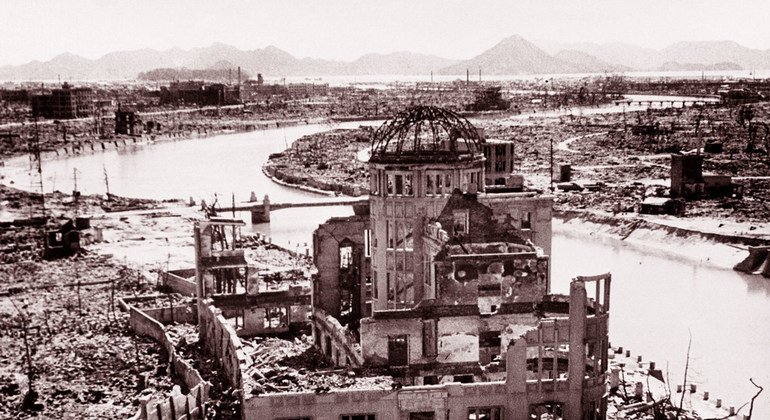
    One might think that mankind has not changed for millennia – we are still antiquated, as Günther Anders had pointed out after his visit to Hiroshima shortly after the atomic bombing. Basically, Anders argued that technical-industrial possibilities have rushed far ahead of comprehension and our moral responsibility – as evidenced in the use of nuclear power, the possibility of self-destruction of humanity during the nuclear arms race (especially in 1983), which was partly prevented only by chance, genetic engineering, and medical possibilities at the beginning and end of life. Add to this climate change and obscene inequality throughout the world.


    Looking at the current explosions of violence on the macro level (Ukraine, Syria, new arms race between the great powers) as well as on the micro level (for example in Central America the Maras) one might think that mankind has not changed for millennia – we are still antiquated, as Günther Anders had pointed out after his visit to Hiroshima shortly after the atomic bombing. Basically, Anders argued that technical-industrial possibilities have rushed far ahead of comprehension and our moral responsibility – as evidenced in the use of nuclear power, the possibility of self-destruction of humanity during the nuclear arms race (especially in 1983), which was partly prevented only by chance, genetic engineering, and medical possibilities at the beginning and end of life. Add to this climate change and obscene inequality throughout the world, we must ask ourselves who we are as humans? How can we explain to our children and grandchildren what we have done for them – or more importantly, not done? Statistically, however, we are living in the most peaceful age in human history to date. The present dominance of the violence topic, of fears and despair as world-politically effective emotions can therefore be a question of the increased and partly medially staged perception – or nevertheless a real setback.  But also, here it could be true that mainly our terms and conceptions are put to the test. For such setbacks primarily question the idea of the linearity of progress, not necessarily progress itself. If we assume the models of a linear ascending progress as in the Enlightenment or in Kant or an equally linear pure history of decay, we cannot integrate contrary developments into our world view – and every contrary development calls the whole model into question. In contrast, models of history based on a cycle (Greek Stoa, Hinduism) are able to capture the constant in change but can only imperfectly explain progress at the societal level. The historical model of a Machiavelli, on the other hand, includes change, but change is always repeated and can best be compared to a sine curve.

    The argument about models of history is by no means abstract, as it appears at first sight. The Marxists as well as Leninists and finally the Stalinists have pursued radical politics with the linear model of progress, just as the idea of the thousand-year Reich had influence on the politics of the National Socialists. Are there alternative models beyond pure decay, equally linear progress, or the assumption that humans do not change after all, or lag behind their technological capabilities in moral and spiritual terms?

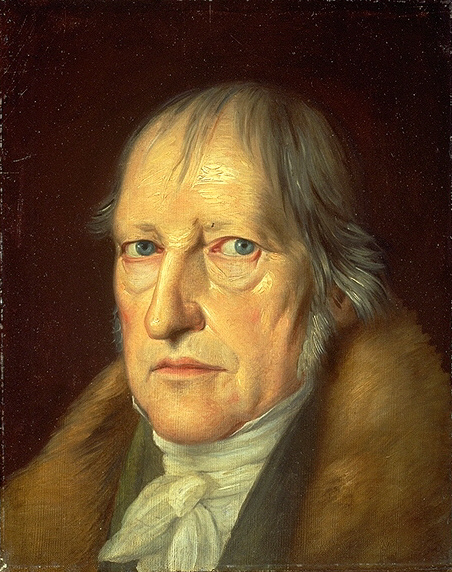
    Models for Understanding History – G W F Hegel

    These positions are not unfounded – however, their absolutization is wrong. As in various psychological (Piaget and Kohlberg) and sociological (Auguste Comte) approaches, the German philosopher Georg W.F. Hegel starts from a stage model in which he develops a progress of world history in the consciousness of freedom. Despite his own Eurocentrism, stage models are in principle capable of countering a pure binary opposition of affirmation or negation of progress in human history. They also do not imply an absolutely inevitable development, as can be seen from the fact that Kohlberg, for example, does not assume that all people reach the highest level, but emphasizes, like all stage theorists, that one cannot skip any of the stages. But Hegel was just not in the tradition of the Enlightenment and Kant, who assumed a linear model of progress, but developed a dialectical sequence of stages, which in my interpretation could best be compared to a sine curve (as in Machiavelli) but erected on an ascending x-axis. In such a model, we can think of the Enlightenment’s idea of progress (in the ascending x-axis) as well as cyclical developments (Machiavelli) of rise and fall, progress, and regress in world history together.

    In this model developed by the author, there is progress, but it is not linear, but itself cyclical. We know such cycles from the business cycle theories in the wake of Kondratieff’s research or also from hegemonic cycles. In contrast to these theoretical approaches, the model of history advocated here is related to a (more or less) slightly ascending x-axis and is derived from Hegel’s conception of becoming at the beginning of his monumental work on the “Science of Logic”, since coming into being and passing away are not completely cancelled out, but a “surplus” arises which goes beyond the infinite coming into being and passing away.  Such a model is on the one hand closed (with respect to the high and low points on the Y-axis), at the same time open on the X-axis and develops “between” its high and low points.

    Hegel’s stage model has itself been a great historical advance; at the same time, we need to go beyond Hegel to overcome his tendency of constructing a systematic closure (which was then taken as an absolute by Marx in a perfect society of communism) in favour of an approach that is at once closed and open. Despite his Eurocentric reductions, Hegel develops a systematic development of the idea of freedom. In his sequence of stages, human history begins with the development of states in which at first only one was free – the ruler, mostly in the figure of the priest-king, who symbolizes the laws of the gods and rule. Still with Plato we find the construction of the philosopher, who must be at the same time king and vice versa. This all-surpassing freedom of the priest-kings is clearly found for Hegel in the pyramids of Egypt. Hegel calls this phase the infancy of history. Greek antiquity, and here especially the city of Athens, is for him the adolescence of world history – the first individualities are formed. The aesthetics of the Greek statues symbolize for him this phase, in which man understands himself as free, when he professes his free polis. In a certain sense, this phase can be understood as that of the aristocracy, because Athens symbolizes the beginning of democracy, but of the approximately 200,000 inhabitants, only about 30,000 were free – slaves, women and metics (“strangers”) were excluded from freedom.

    The focus is no longer on the individual, but on the supra-individual law. Even today, the study of law begins with Roman law (e.g., in dubio pro reo or nulla poene sine lege). Of course, not only Hegel’s choice of words is problematic (e.g., that of “oriental despotism” as the beginning of world history), but also the identification of the fourth stage with the “Germanic period” as the “goal of world history.”

    For Hegel, the manhood of world history is that of the Roman Empire. Here, not the individual but the state has become the supreme purpose and Roman law is developed. The focus is no longer on the individual, but on the supra-individual law. Even today, the study of law begins with Roman law (e.g., in dubio pro reo or nulla poene sine lege). Of course, not only Hegel’s choice of words is problematic (e.g., that of “oriental despotism” as the beginning of world history), but also the identification of the fourth stage with the “Germanic period” as the “goal of world history.” Nevertheless, his characterization is noteworthy. In this stage the state is ordered according to reasonable principles, the individual is completely free because he lives in a reasonable society whose laws he recognizes and to which he can refer. Community and individual are reconciled, the ups and downs of world history (as illustrated in the sine curve) seem to have come to their end and now the real history of mankind begins, a happy time.

    Of course, we know that this was not so, as Hegel assumed – the violent conquest of the world in colonial times, two world wars, Auschwitz, and Hiroshima, the almost self-destruction of mankind in the cold war, all this was still to come. But is Hegel thereby refuting? Or can and perhaps must we continue Hegel?

    Differences to Hegel

     In contrast to Hegel’s conception of world history as a progress in the consciousness of freedom, I argue that this development is a progress in the consciousness and practices of humanity to be a wholenessness. Hereby, I no longer foreground Kant’s four questions concerning the individual human being or even an “I”, but rather transform them into who is humanity, what should we do as humanity, what can we know and hope as humanity? The concept of humanity contains the single individual, but this goes beyond the generalization of the individual as in Kant’s categorical imperative. Also, here the old sentence of Aristotle is valid that the whole is more than the sum of the parts – and so I would like to add, mankind as a wholeness is more than the accumulation of at present over 7.8 billion people. At the same time, humanity is realized in individual human beings; there is no humanity without individual human beings.

    According to the “Out of Africa thesis,” the genus Homo originated in Africa and spread from there to all continents. One of these groups, immodestly calling itself homo sapiens, has not only outlasted all other human species, but has populated even the most distant tip of this earth, moreover, is making its way to other planets of our solar system. Arnold Gehlen’s determination of man (as also already Aristotle) as imperfect, forces mankind to develop more and more. During this time of spreading over the whole planet, however, the individual groups lost contact with each other, because this lasted for millennia and the distances became too great for the time to bridge in shorter periods of time – they became estranged from each other and lived in isolated cultural islands (for example in China, India, in Africa south of the Sahara, the two Americas or also in the more European part of Eurasia as well as in West Asia). With the increasing spread of these initially isolated cultural islands, they came back into contact with each other – which turned out to be peaceful or sometimes warlike. Huntington’s thesis that these contacts were mainly violent underestimates the mutual cultural influences and learning processes. Globalization since European colonization brought humanity into ever closer contact with each other and made it possible for the first time to think of humanity as a wholeness.

     Of course, the setbacks and low blows must not be forgotten – the wars between the great empires, the almost perpetual state of war at the edges of these empires, colonialism, Islamic and Atlantic slavery, racism, two world wars and Auschwitz as a sign of history – but in the end they confirmed the dictum of Goethe and, derived from this, systematized by Hegel as the cunning of history. This is a part of that force which always wills evil and yet creates good. This does not mean to relativize the suffering of countless people. But perhaps we must differentiate and not already take the ideals of the Enlightenment at face value. For this was not only compatible with racism, colonialism, and slavery, two world wars and the Cold War – according to Zygmunt Bauman, these were even direct consequences of a one-sided Enlightenment.

    There is currently a worldwide biologisation of the social in the form of ethnicities, gender antagonisms, nationalism and tribalism (Make America great again by Donald Trump, the Chinese Dream by President Xi Jinping, New Russia by Vladimir Putin, Salafism, right-wing nationalist movements in Europe).

    If, on the other hand, we assume that the impulse of the realization of human rights could actually only fully develop after World War II and the Holocaust, and included all people, not just one’s own ethnic, cultural, or religious group, we are only at the beginning of the realization of human rights. Again, while it is true that there are setbacks at present – in the form of a discourse of “We against the Rest,” the current replacement of global governance by a renationalisation of world politics, the return of tribal thinking to cope with the demands of globalization, this is not the whole picture. It is also true that globalized liquid modernity (Bauman) is leading to the dissolution of all traditional identities including patriarchy as well as consumerism and many states and nations are updating ancient identities because they trust them to outdo even this accelerated transformation, There is currently a worldwide biologisation of the social in the form of ethnicities, gender antagonisms, nationalism and tribalism (Make America great again by Donald Trump, the Chinese Dream by President Xi Jinping, New Russia by Vladimir Putin, Salafism, right-wing nationalist movements in Europe). Nevertheless, while we are simultaneously witnessing the (often violent) dissolution of the old world, we are also experiencing the birth pangs of a new world. After the West defeated the rest of the world in the 19th century, colonised or submerged peoples and civilizations in the 20th century had to learn to live with the victorious West. In the 21st century, the world’s civilizations must finally learn to live with each other.

    In the 1990s, Samuel P. Huntington put forward the much-publicised thesis that the cold war between the ideologically opposed superpowers would be replaced by a similar contest between the world’s civilizations and their respective core states (Russia, India, China, the United States). On the surface, Huntington received more criticism than approval. A closer reading of his approach reveals that he had not drawn up an instruction manual for the “clash of civilizations,” but had formulated a warning to avoid it. The liberal critics, however, emphasized in particular that not only should there not be a clash of civilizations, but also that there could not be, because there was only one civilization in the world, the Western one. The other civilizations mentioned by Huntington are determined by different religions and cultures, but they would not be civilizations. In contrast, the “clash of civilizations” involves a conflict, but the implicit recognition that civilizations other than the Western one exists at all.

    In the 21st century, the world’s civilizations must finally learn to live with each other.

    This recognition of a limited plurality of civilizations makes possible for the first time the thinking, experiencing, and acting of humanity as a wholenessness. In such a wholenessness, opposites, conflicts and even wars are conceivable – from a sociological perspective, conflicts are not opposed to a socialization of humanity (sociology of conflict in the wake of Tönnies and Simmel), even if these bring much suffering with them.  All high religions that emerged between the 7th century B.C. (Judaism, Confucianism, Buddhism, Hinduism, Christianity) and the 7th century A.D. (Islam) formulate an overcoming and renunciation of infinite suffering. This ethicization of transcendence (Jaspers) or also of immanence (Confucianism) contains in its core a perspective of the abolition of suffering, which can be overcome either in transcendence or, with appropriate conduct of life, already in immanence. Suffering, war, and violence are thus no longer accepted as “natural”, but an attempt is made to leave them behind. Although in Hinduism the cycle (symbolized in the wheel) is emphasized – but the goal of life in the different rebirths consists in overcoming this cycle. Therefore, a core message of Hinduism is the statement that the end is good – but if it is not good, it is not the end. While in the “nature religions” like also the Egyptian mythology, before the emergence of these high religions the transcendence was only a mirror of the earthly life, this is explained now to be absolute good – connected with the perspective to orientate the own life at this construction.

    in Hinduism the cycle (symbolized in the wheel) is emphasized – but the goal of life in the different rebirths consists in overcoming this cycle. Therefore, a core message of Hinduism is the statement that the end is good – but if it is not good, it is not the end.

    Here it should not be concealed that this ethicization of the transcendent as well as of immanence can be and has been used to legitimize violence – in direct inversion to Goethe and Hegel we have to acknowledge that the absolutization of the good has also contributed to the legitimization of war and violence in the form: “this is a part of that force which always wants the good and yet creates evil” (Herberg-Rothe). In contrast to positions that attribute the positive sides of religions only to these themselves, the negative ones exclusively to the respective social, political, cultural, and historical circumstances, I assume that the absolutization of the respective ideas contains a tendency to violence. After the western modernity had written the generalization of the presupposed individual on the flags, a new balance of the individual and the communality is to be constructed for a dialogue of the civilizations, which contains at the same time their further development.

    Mankind understood in this way does not include a pure juxtaposition in the sense of a diversity of the civilizations of the world, as this is laid out – despite all remarkable insights – in the conception of a multiplex world or a Global International Relations Theory (Global IRT), both by Amitav Acharya, which is connected only by communication. The conceptions of diversity also do not go beyond mere multiplicity. All these conceptions in the wake of the French post-structuralisms have their strength in the critique as well as overcoming of totalitarian and authoritarian social relations or system constraints and discourses of power. However, since their own approach excludes borders per se, they cannot include any border of their respective approach. Diversity is wonderful and colourful – also the questioning and de-construction of the “normal” following Foucault has been an essential progress, just as tolerance is a moral value to be demanded always. The question, however, is where the limits of tolerance are – we should be far less tolerant of human rights violations, even if the understanding of human rights remains contested in different “cultures.”

    Conclusion

    From Thomas Hobbes we have learned that unlimited freedom leads to war of all against all, civil war.  Freedom must therefore be limited in order to enable people to live together peacefully. But how can freedom be meaningfully limited without oppressing people? Kant’s solution, that my freedom ends where the freedom of the other begins, is a nice metaphor, but far from adequate when two or more parties lay claim to the same good in the broadest sense.  The idea that it is not an oppression of freedom if it is limited only by the freedom of the other is a pure illusion. Even if in the wars and civil wars of the present, the refugee movements and in the worldwide slums, a human life seems to count for little, it must be maintained that all human beings have the same human rights, they are equally endowed with dignity and conscience. Freedom thus finds its limits not primarily in the freedom of others, but, since it is not an abstract freedom, rather one of human beings – thus in their fundamental equality as human beings and thus human rights. Following Hannah Arendt, one can say that freedom does not consist in arbitrariness, but in the right to be different from others. The path of humanity is shown here as self-preservation based in our equality and self-transgression in the freedom to differ from other humans. Such an understanding of the equality of us all as humans seem to contradict all current developments and appears as a kind of wishful thinking. But it is perhaps not just an idea of a better future, but the question how mankind could see itself as a wholeness in order to survive.


    References:

    Acharya, Amitav and Barry Buzan (ed.). Non-Western International Relations Theory: Perspectives on and beyond Asia. New York: Routledge, 2010.

    Anders, Gunther; Christopher John Muller. Prometheanism: technology, digital culture, and human obsolescence. London: Rowman & Littlefield International Ltd., 2016.

    Arendt, Hannah; Danielle Allen and Margaret Canovan. The Human Condition. Chicago: The University of Chicago Press, 2018.

    Arendt, Hannah and Anne Applebaum. The Origins of Totalitarianism. Harcourt: Brace & co, 1951.

    Bauman, Zygment. Modernity and the Holocaust. New York: Cornell University Press, 2000.

    Bauman, Zygment. Born Liquid. Polity Press, 2018.

    Comte, Auguste and Harriet Martineau. The Positive Philosophy of Auguste Comte: Freely translated and condensed by Harriet Martineau. New York: C. Blanchard, 1858.

    Gehlen, Arnold. Man, his Nature and Place in the World. New York: Columbia University Press, 1988.

    Hobbes, Thomas. Leviathan. London: Andrew Crooke, 1651.

    Huntington, Samuel P. The Clash of Civilizations and the Remaking of World Order. New York: Simon & Schuster, 1996.

    Kant, Immanuel; J M D Meiklejohn. Critique of Pure Reason: Tr. from German of Immanuel Kant. London: Bell, 1881.

    Machiavelli, Niccolo. Discourses. S. I.: Open Road Media, 2020. Internet.

    Magen, Nathan H. The Kondratieff Waves. New York: Praeger, 987.

    Marx, Karl and Friedrich Engels; David McLellen. Communist Manifesto. Oxford University Press, 1992.

    Shuman James B., and David Rosenau. The Kondratieff Wave by James B. Shuman and David Rosenau.New York: World Pub, 1972.

    Tonnies, Ferdinand; edited by Jose Harris. Ferdinand Tonnies: Community and Society. Cambridge; Cambridge University Press, 2001.


    Feature Image Credit: NDTV

  • Towards a New Movement of Non-Alignment: Politics of John Mearsheimer and Alexander Dugin

    Towards a New Movement of Non-Alignment: Politics of John Mearsheimer and Alexander Dugin

    Only last August, the U.S. had to leave Afghanistan in disgrace, leaving behind a destroyed country – and now they suddenly appear as the guardians of freedom, human rights and as the leading power of the West?

    Without equating Russia and the USA, they are very similar in their foreign policy behaviour. Despite all the problems under Trump, the U.S. is and remains a democracy in which human rights can be litigated. Russia is only formally an (electoral) democracy, as Putin himself once put it, a managed democracy in which human rights can hardly be claimed. Despite this fundamental difference, it is quite astonishing how the past 20 years have been forgotten in the West. Were the wars in Afghanistan, Iraq and Libya always and in every respect legitimate? Weren’t hundreds of thousands of people killed in them and by no means always only the soldiers? Only last August, the U.S. had to leave Afghanistan in disgrace, leaving behind a destroyed country – and now they suddenly appear as the guardians of freedom, human rights and as the leading power of the West? Conversely, we need to realize that while the U.S. would advocate regime change in Russia as well, does this legitimize all the actions of the Russian leadership and the Russian army?

    It is not only questionable whether Mearsheimer had the ear of the U.S. government – much more decisive is that he not only presents an analysis but in a sense naturalizes the struggle for spheres of influence and large areas. 

    And in essence, Mearsheimer can hardly hide the fact that neo-realism has models in the large-area policy of the Nazis and at least that of Carl Schmitt.

    To find an explanation for the conflict over Ukraine, two theorists are very often referred to, John Mearsheimer from the U.S. and Alexander Dugin from Russia. The defenders of Russia resort to the line of thought of the neo-realists, which was significantly influenced by Mearsheimer. And Mearsheimer argues that Ukraine is not the issue at all, but rather a global political showdown between the United States and Russia over spheres of influence. He attests that the Russian side under Putin is only reacting to a covert war of the USA – with the means at their disposal. And with countries like Sweden, Finland and even Switzerland soon to join NATO, the U.S. strategy – if the government in Washington had stuck to Mearsheimer’s indirect script – would have been extremely successful. The unity of the West under U.S. leadership has also been restored overnight. Mearsheimer is always used in this context as evidence of the true intentions of the U.S. and the real culprit in this war. However, it is not only questionable whether Mearsheimer had the ear of the U.S. government – much more decisive is that he not only presents an analysis but in a sense naturalizes the struggle for spheres of influence and large areas. For the next step, if one were to share his views, one would have to concede such a policy to the US as well? And in essence, Mearsheimer can hardly hide the fact that neo-realism has models in the large-area policy of the Nazis and at least that of Carl Schmitt.

    Dugin’s vision of Eurasia, on the other hand, is ideologically determined. But from his writings can be read the will to reconquer the Baltic states and large parts of the former Soviet Union and the Warsaw Treaty after Ukraine and to achieve at least Russian hegemony in Europe.

    The same applies to the dreams of Alexander Dugin, a neo-fascist ideologue who has at times been said to be particularly close to Vladimir Putin. Just as with Mearsheimer, the government action of Russia cannot be traced to his ideologue, but there are similarities here as well. Dugin, too, starts from large spaces and, like Putin, includes in his considerations the great Eurasian project, the political-ideological linking of Asia and Europe under Russian leadership. And indeed, this perspective already exists in the Chinese New Silk Road and is being built up economically by President Xi and the Chinese leadership with billions of Yuan. Dugin’s vision of Eurasia, on the other hand, is ideologically determined. But from his writings can be read the will to reconquer the Baltic states and large parts of the former Soviet Union and the Warsaw Treaty after Ukraine and to achieve at least Russian hegemony in Europe.

    What seems progressive here at first glance is the rejection of human equality – at its core, Dugin is concerned with a strictly hierarchical, estates-based society in which “white, male Europeans” are at the top.

    In this way, Dugin positioned himself as an outstanding representative of geopolitical thought as well as a mastermind of a “Eurasian” – as opposed to “Atlantic” – cultural space. This corresponds to the “fourth political theory” he postulates, which, after liberalism, fascism and communism, is most likely to ensure the survival of mankind in the age of globalization in his view. Dugin’s theoretical advisers, besides Heidegger, is the French founder of the “Nouvelle Droite,” Alain de Benoist.  All political systems of modernity are accordingly the results of three ideologies: The first and oldest, he says, is liberal democracy, the second is Marxism, and the third is fascism. The latter has long since failed, banished from history; the first no longer functions as an ideology, but as something taken for granted. The world today is on the brink of a post-political reality in which the values of liberalism are so deeply ingrained that the average person is not even aware of the effect of an ideology in his environment. Thus, liberalism threatens to monopolize political discourse, to flood the world with a universalistic sameness, and to destroy everything that makes different cultures and peoples unique. What seems progressive here at first glance is the rejection of human equality – at its core, Dugin is concerned with a strictly hierarchical, estates-based society in which “white, male Europeans” are at the top.

    a new policy of the Non-Aligned Movement is necessary, because as understandable as partisanship may be due to the suffering in Ukraine, we should not allow ourselves to be instrumentalized by either side.

    At their core, Mearsheimer and equally Dugin are representatives of a neo-colonial policy, in that they want to divide the whole world into their spheres of influence. This is what the U.S. has been trying to do since 2001 and now Russia as well. Still unclear is the role of China, which has not yet made a final decision and sees itself equally threatened by both visions. Instead of taking sides for one of the two positions, a new policy of the Non-Aligned Movement is necessary, because as understandable as partisanship may be due to the suffering in Ukraine, we should not allow ourselves to be instrumentalized by either side. Foreign Minister Lavrov had spoken of the need for a balanced world order during his visit to New Delhi. It would be of fundamental importance if Russia were to adhere to this itself. The real actors in such a balanced world order, however, would be the middle powers in a new movement of non-aligned states.

    Feature Image Credit: ipis.ir

  • 100 Years after the End of the First World War: Are we slipping again into a World War?

    100 Years after the End of the First World War: Are we slipping again into a World War?

    In view of the developments in Ukraine, the question arises whether there could be a repetition of the First World War in slipping into a new World War that no one intended. This original thesis is accentuated in different ways, whether in the form that European politicians behaved like “somnambulists (Clark) or just failed (Münkler). The blame for the war was also sought in Serbia or Vienna. Hereby the original thesis of the main war guilt of Germany is questioned, as it was fixed in the Treaty of Versailles and by the historian Fritz Fischer as the “grip on the world power” of Germany. However, if the causes of the First World War and, above all, its escalation are no longer seen in the German Empire alone, but are more or less equally distributed among the major European powers, this does not mean that “nothing and nobody” is responsible for the primordial catastrophe of the 20th century: Nationalism, arms race, industrialized warfare, pure power politics – all these are factors that contributed decisively to the First World War. Moreover, it should be emphasized, which even today is far from being overcome in many parts of the world. Against the backdrop of the Ukraine War, a much-discussed book by the highly influential American political scientist Robert Kagan takes on a whole new relevance. Kagan suggests the idea that Europeans could live in a paradise of peace and order after World War II only because the Americans were prepared to confront possible threats to that peace decisively and violently. Thanks to America’s power, Europeans could have indulged in the belief that (military) power was no longer important. But does the principle follow from this that law and order must be upheld in dealings with one another, but in the violent “jungle, we must follow the laws of the jungle”? Or, conversely, is it not the case that state warfare and the exercise of violence that does not adhere to its self-imposed conventions and limitations will stir up more violent resistance than they, in turn, can fight?

    Kagan is partly correct. All modern states are based on the state’s monopoly on the use of force, and almost all of them have emerged through a violent process-remember the English, American, and French Revolutions, the German wars of unification, the wars of decolonization, and the emergence of new nation-states after World Wars I and II. Therefore, however, states do not as such embody an order of violence. Hegel had argued that violence is the appearing beginning of the state, but not its substantial principle. Nor is order powerlessness, as Robert Kagan’s much-discussed book on “Power and Powerlessness” in the New World Order suggests. Does political power come from the barrels of guns, as Mao Tse Tung suggested? If so, the Soviet Union should never have collapsed because gun barrels were more than enough for the Red Army.

    Kagan assigns the opposition of power and order thinking to contemporary American and European thinking but admits this has not always been the case. As he points out, the situation was just the opposite for a long time. The Americans up to Woodrow Wilson at the beginning of the last century, he says, were committed to thinking of order and a world-political idealism of spreading human rights, while the Europeans remained committed to pure thinking of power until World War II. What is astonishing, if we take Kagan’s own analysis seriously, is why he does not ask to what final conclusion this “pure power thinking” among Europeans led – to nothing other than the catastrophes of World War I and World War II. Kagan may be right about one thing: in view of the “state-failure” problems in numerous Third World states on the one hand (emphasized by the Europeans in the anti-terror struggle) and those of the so-called “rogue states” on the other (on which American interest focused under Bush), illusions about the end of history and a largely peaceful, because economically determined, 21st century is fast fading. However, this cannot mean developing a new metaphysics of struggle and self-assertion that only force can enforce.

    Historical Traditions

    In determining the political sphere in categories of power or order, Kagan finds himself in a long ancestral line of the history of political ideas. Dolf Sternberger distinguished three different roots of the concept of politics: cooperation, following Aristotle; demonology, starting from Machiavelli; and eschatology, as he essentially saw it realized in Marxism, starting from the church father, Augustine. Sternberger’s distinction is phenomenological still valid today, even if his evaluations are problematic because he saw himself in the tradition of the Aristotelian concept of politics and – as the term demonology already shows – fiercely fought the opposite position.

    How are these distinctions to be understood? Here are two quotations: Aristotle begins his work on politics with the definition: “Everything that is called state is obviously a kind of community, and every community is formed and exists for the purpose of obtaining some good.” In contrast, Jean Bodin, perhaps the most important constitutionalist of the 16th century, referred directly to Aristotle. However, his position should be read as his deliberate inversion: “Republic is a lawful government over several households and what is common to them, with sovereign power.” Precisely because Bodin modelled his work on Aristotle’s, the contrast between the two determinations jumps out all the more clearly: on the one hand, a community for the sake of a common goal; on the other, rule endowed with sovereign power. Marx’s eleventh Feuerbach thesis best describes the third dimension of Sternberger’s distinction: “The philosophers have only interpreted the world differently; what matters is to change it.” In contrast to Sternberger’s notion of demonology, however, one side of this line of tradition is by no means “Machiavellianism,” a struggle for power for power’s sake. Instead, it claims to constitute an (absolute) power out of insight into the violence of human nature, which prevents the struggle of all against all.

    Sternberger emphasizes the fundamental difference between the first two concepts of politics when he asks in summary: “Is it the conflict of interests, powers, beliefs, and wills that thus characterizes the political in its peculiar essence? Or is it rather the balance, the compromise, the contract, the common rule of life. And conversely asked: should we interpret peace – civil peace as well as peace among nations – as the abolition and overcoming, as the negation of politics, or, on the contrary, as its completion?”

    Struggle for power and domination, on the one hand, negotiation and the establishment of order on the other, are the two opposite definitions of the essence of politics that run through the history of political ideas. As antipodes may be mentioned only: Thucydides and Plato resp. Aristotle, Machiavelli and Erasmus of Rotterdam, Hegel and Kant, Schmitt and Arendt, recently Foucault, resp. Luhmann and Habermas.

    If we take a closer look at this line of ancestors, it should be enough reason to warn us not to reduce politics to pure power politics. Thomas Hobbes, for example, with his conception of the state monopoly on the use of force, justified internal peace and the avoidance of civil war, but at the same time advocated an absolute sovereign. And Carl Schmitt stands paradigmatically for the problem of reducing politics to pure power politics. For it was not personal opportunism or immoderate ambition that justified his closeness to the National Socialists, but the extreme consequence of his reduction of the political to the distinction between friend and foe in a crisis-ridden world-historical situation. Carl Schmitt wrote in this regard: A total state “does not allow any anti-state, state-inhibiting or state-dividing forces to arise within it. It does not think of handing over the new means of power to its own enemies and destroyers. Such a state can distinguish friend from foe.” The reduction of the political to only one of two sides, the exercise of power or reliance on the establishment of order, has always led to problematic consequences in historical development. Against the false alternative between power or order and their immediate connection in order of power, the “middle” between power and order has to be found again. Violence cannot establish peace, but it can limit other violence to such an extent that other than violent structures come into play. Perhaps America and Europe have more to learn from each other than either side realizes.

    Developments after September 11

    Especially after the attacks of September 11, hardly any author in his assessment of the events could do without reference to Carl Schmitt’s world-famous definition of the political as the distinction between friend and foe. Even before the attacks, however, the political theory had already noted the shift from “Kant to Schmitt” as a consequence of the crisis of the political. Finally, George W. Bush elevated Schmitt’s definition of the political to a quasi-official governmental program in the United States. In this perspective, Robert Kagan denies that Europe and the USA still have a common view of the world at all. “Americans are from Mars, and Europeans are from Venus.” By this, he means that Europe lives in a Kantian fantasy world of eternal peace, while America is called upon and alone empowered to create order in Hobbesian anarchy on a global scale.

    Schmitt as the “mastermind” of the Western world? The tendency to refer back to Schmitt is not unproblematic, however. The possible linking of politics and political theory to Carl Schmitt’s definition of the political cannot, in principle, disregard Schmitt’s temporary proximity to the National Socialists. For it was not personal opportunism or immoderate ambition that justified this closeness, but the extreme consequence of his reduction of the political to the distinction between friend and foe in a crisis-like world-historical situation. Carl Schmitt wrote about this, as indicated: A total state “does not allow any anti-state, state-inhibiting or state-dividing forces to arise within it. It does not think of handing over the new means of power to its own enemies and destroyers……. Such a state can distinguish friend from foe.” Are we not already living in such a total surveillance state?

    The reduction of the political to a pure struggle for power, to a pure friend-enemy distinction, has problematic consequences, as is revealed especially in Schmitt. Conversely, the reduction of the political to the establishment of the agreement, of acting together, leads either to “apolitical” idealism or violent utopianism, as was shown especially in Marxism/communism. But which is now the solution? The distinction between friend and foe is a precondition of political action, but it is not its goal – the goal of politics regarding war and violence is the “mediation” of friend and foe. Or as Yitzhak Rabin described it: Peace is not made with friends, but with enemies! This is the art of politics, to enable a peaceful conflict resolution with opponents instead of falling into the traps of pure power politics – this is the lesson of the First World War then and today.

    Feature Image Credit: powervertical.org 


  • Liquid Globalization and Intercultural Practical Philosophy

    Liquid Globalization and Intercultural Practical Philosophy

    This essay is based on a lecture given by the author at the German Jordanian University in Amman on the 18th of November 2021.

    Abstract

    We are witnessing the birth pains of a new global order. The previous order based on the hegemony of the Western states is in tatters and the newly industrialized nations are no longer seeking to imitate Western modernity but to rely on their own civilizational achievements. They are trying to combine a kind of modernity with an identity of their own. Nevertheless, opposing the declining West is not enough to initiate a global order, which is surpassing the previous one. The most successful challengers of Western modernity are relying on authoritarian or even totalitarian (IS, Taliban) conceptions of identity. But the alternative to the (neo-)liberal world order should not be an illiberal order. In order to design such an alternative, we need to conduct a discourse of the civilizational foundations of our different approaches by further developing intercultural philosophy. Intercultural philosophy has had already its height after the demise of the USSR but remained mainly a theoretical enterprise; it is of paramount importance in the conflicts about the new world order.   Assuming that we are witnessing a new phase of globalization, which can be characterized by the simultaneous processes of the rise (Zakaria) as well as the demise of the other (Herberg-Rothe), intercultural philosophy is becoming a practical philosophy designated to mitigate conflicts about interests.

    Intercultural Philosophy as a Practical Approach

    The Western model of society is viewed to be in crisis and for many people, nations and civilizations it is no longer an attractive role model.

    Intercultural philosophy has had already its height after the end of the Cold War but was mainly a theoretical enterprise. Assuming that we are witnessing a new phase of globalization, which can be characterized by the simultaneous processes of the rise (Zakaria, 2008) as well as the demise of the other (Herberg-Rothe and Foerstle, 2020), intercultural philosophy is becoming a practical philosophy designated to mitigate conflicts about interests and culture to cope with this process. The current phase of globalization, which in the footsteps of Zygmunt Bauman could be labelled hybrid globalization (Bauman, 2000), is accompanied by emotions (Moisi, 2010) like insecurity, uncertainty and dissolution of identities. Hybrid globalization is characterized by the ongoing process of globalization and local resistance against it. The Western model of society is viewed to be in crisis and for many people, nations and civilizations it is no longer an attractive role model. But all nations and civilizations need to find a balance between their civilizational traditions and coping with hybrid globalization. Mutual recognition of the civilizational foundations of the Western and Non-Western world may be a possible means to cope with this process. I’m assuming that the alternative to Western modernity and the global order which is based on it should not be illiberalism or even authoritarian rule but a new balance of the normative foundations of all civilizations (Katzenstein, 2009).

    What we need, therefore, is to initiate a virtuous circle as follows:

    1. Research on the subject of how conflicts are articulated in terms of culture and religion.
    2. Relating these concepts to different understandings of civilization.
    3. Mutual recognition of the civilizational foundations of Islam and Western thinking.
    4. Self-recognition is not only as religion or culture but as a civilization.
    5. Self-binding to civilizational norms in order to be recognized as equally valued civilization.

    Based on our interpretation of Clausewitz (Herberg-Rothe, 2007) we think that mutual recognition among the great civilizations of the earth is the prerequisite of settling disputes over diverging interests. 

    What we need, therefore, is the initiative of a discourse of mutual recognition of the great civilizations on earth and even a discourse, where the diverse understandings of central concepts like order, self-determination, emancipation, identity, dignity and so forth differ. At the same time, a closer look at the civilizations’ common grounds is essential, to eventually provide a basis for a meaningful dialogue. We think that we must find a balance between the Western model of the billiard game and the Eastern model of the concentric circles (Qin, 2016 and Yan, 2011).

    Additionally, most countries of the Non-Western world are no longer seeing the Western world as a role model they must follow but are seeking to find their own identity as a balance of their traditions and civilizational achievements – be it the Chinese dream of Xi Jinping, Hindu nationalism in India, and the revival of Confucianism in East Asia.

    We assume that there is a close linkage of struggles for recognition, the question of identity and increasing radicalization (Herberg-Rothe and Foerstle, 2020). The fundamental problem existed in the assumption that the uprooted, redundant, and excluded members of society would come to terms with their destiny on an individual level. We assume that these excluded are forming violent groups, in which they find a kind of stable identity through recognition by exercising violence. Only by recognizing the contributions of the civilizations of the world to the heritage of mankind, it is possible to enable a stable identity contrary to violent actions (Herberg-Rothe and Son, 2018). Additionally, most countries of the Non-Western world are no longer seeing the Western world as a role model they must follow but are seeking to find their own identity as a balance of their traditions and civilizational achievements – be it the Chinese dream of Xi Jinping, Hindu nationalism in India, and the revival of Confucianism in East Asia. Especially in China, the concept of harmony in Confucianism serves the purpose of balancing the other two C’s, communism and capitalism (Herberg-Rothe and Son, 2018).

    The denial of recognition versus mutual recognition

    The denial of recognition and the struggle for recognition play an ever-increasing role in intra-state conflicts in a globalized world as well as the international sphere, which is characterized by the “Rise of the Other” (Zakaria, 2008). We live in an increasingly globalized world, in which we assume that difficulties concerning recognition (between individuals, groups, ethnos, religious communities, nations or even civilizations) are a major source for radicalization. If mutual recognition is non-existent or cannot be built, conflicting interests are much more likely to escalate. There is a broad consensus (in the field of socialization research and increasingly also within social sciences in general) that the urge for recognition is the important factor for forming and stabilizing identity (personal, group, national, and civilizational) (Daase, 2015)

    Samuel P. Huntington was widely criticized for his assumption that we are facing a clash of civilizations (Huntington, 1996). What the liberal critics of Huntington were highlighting was that there should not be a clash of civilizations, but even more important that there could not be a clash of civilizations because in their view there was only one civilization, the Western one. The others were in their view religions or cultures, but no civilizations, because they did not undergo the process of secularization, which is in the Western discourse a dogma (Katzenstein, 2009).

    So, my first proposition for the mutual recognition of the civilizations of the earth is that most are based on religion, not in opposition to or separation from their related religions. For example, the Han dynasty created Confucianism as a civilization three centuries after Confucius, similarly Buddhist culture and civilization was constructed and expanded on a worldwide scale by Emperor Ashoka in India, nearly three centuries after Buddha. 

    Through the achievement of mutual recognition, the rapidly growing radicalization tendencies are supposed to be reduced and in the long run, peaceful coexistence is more likely. However, recognition requires awareness for differences and communalities (ontological perspective) or is otherwise produced within a process (epistemological approach). The outlook is thus the development of a third way in between universalization of only one culture or civilization (in the form of “We against the Rest”; Herberg-Rothe and Son, 2018), be it eurocentrism or any other kind of ethnocentrism and cultural relativism to stimulate peaceful cooperation and to limit the dramatic tendencies of radicalization throughout the world (Herberg-Rothe and Foerstle, 2020).

    Given the absence or non-maturity of Chinese, Russian, African, Islamic, or Indian IRTs, the mainstream IRT originated almost exclusively from the Anglo-Saxon world, for example, realism, neo-realism, neo-conservatism, liberal institutionalism, and theories of democratic peace (although in connection to Kant).

    In the wake of globalization, many pundits articulated whether the theoretical concepts developed from the era of nation-states (Beck, 1992) are still tenable for the portrayal of twenty-first century international relations. Furthermore, many concepts regarded as central in the IRT came to be perceived as a mere form of American political science (Acharya, 2000 and 2014). Given the absence or non-maturity of Chinese, Russian, African, Islamic, or Indian IRTs, the mainstream IRT originated almost exclusively from the Anglo-Saxon world, for example, realism, neo-realism, neo-conservatism, liberal institutionalism, and theories of democratic peace (although in connection to Kant). The reason is that in most Non-Western countries’ societies, cultures and civilizations are more important than the state, whereas in the Western understanding the state is the most important institution.

    My second proposition for the mutual recognition of the civilizations of the earth is, therefore, to be aware that in the Western world the state has the dominant role – international relations are relations between states – whereas in the Non-Western world the state is a variable of society, culture. In the process of globalization this separation between the Western World and all other civilizations is dissolving (Herberg-Rothe and Son,  2018)

    The problem of identity in a globalized world

    One’s identity is shaped through a difficult and open-ended interplay and mutual interdependency of personal performance and societal consideration. Recognition is thus the result of an exchange, during which the failure of a human being is feasible. No given script through societal framing is existent anymore, whereby risk and insecurity increase significantly. It is not necessarily the need for recognition that is “new” and for this reason just generated through modernity, rather the conditions are new in this context. An unsatisfactory identity-building leads to rage and an imminent loss of identity leads to fear – both hold enormously destructive potentials. The paradox of all rebellious attempts to create an identity is thereby that a conspicuous or provocative behaviour of young persons is often, citing Erik Erikson, just a “request for brotherly recognition” (Herberg-Rothe and Son, 2018). Although I share the critique of identity politics put forward by Francis Fukuyama in general, in which identity is related to a fixed core, my consequence is to conceptualize identity as a balance of conflicting tendencies within individuals, societies and communities (Herberg-Rothe, 2007; Herberg-Rothe and Son, 2018 and  Fukuyama, 2018)

    Through the social change in rendering globalization, the individual, as well as collectives, face increasing societal pressure. Zygmunt Bauman speaks of the transition from a “solid” into a “fluid” modernity (Bauman, 2000). Former stable identities (determined through solid social and spatial borders which offer, despite quite critical aspects of these borders, still a secured room for identity shaping) become insecure, if not destructed (Beck, 1992). The outcome of this is a high demand on individuals as well as collectives to cope with the obstacles of identity building in constant active work. The continually transforming social, cultural and political spaces and contexts hinder this process additionally. If the obstacles appear to be insuperable or if no realistic options for action exist, societies with a multiplicity of fragmented identities develop. 

    To sum up, the big identity question has such importance because radicalization drifts are an increasing phenomenon in heterogeneous societies.

    To sum up, the big identity question has such importance because radicalization drifts are an increasing phenomenon in heterogeneous societies. Globalization represents profound structural changes that are accompanied by momentous crises (Moisi, 2010). Anyway, existing social inequalities become more and more intensified and find expression in intra-societal tensions. Adjustment processes appear almost impossible, as the promises based on modernity are broadly seen as unrealistic or not reasonable. According to this, an alternative to cope with the rapidly changing transformation must be discovered (Herberg-Rothe and Son, 2018)

    The developments and assumptions regarding identity, recognition and radicalization serve as the basis for our research project. To enable unstable individuals or collectives to recover their identity, it is necessary, by focusing on the macro level, to foster mutual recognition between the world’s civilizations. Dialogue and with it an associated discourse of mutual recognition is supposed to contribute as a crucial component of avoidance of radicalization. The aim is to establish dialogues and to find practical approaches for inter-civilizational agreement. Under the overall scheme of mutual recognition versus radicalization, it is, for now, the purpose to elaborate differences and similarities of the world’s civilizations. The focus lies on the understanding of societal and international relations in order to initiate a dialogue in which the denial of recognition does not transform conflicts about interests into struggles for recognition, which are again the main source for radicalization processes (Herberg-Rothe and Foerstle, 2020).

    One can view this kind of balancing and harmonizing as a form of limited plurality or as articulated by Hannah Arendt, unity of multiplicity and multiplicity within unity.

    According to this, the focus lies on mutual understanding and recognition as powerful tools to prevent vanished and unstable identities in the globalized world, to see the last resort in radical thinking and acting. Yet the question arises, how much plurality and variety in thinking and acting is really desirable, respectively rated as positive in principle. It is therefore also an important element of our research, to find a way in between the fundamental contrast, on the one side of the universalism of values of just one civilization and cultural relativism on the other. Amitav Acharya’s concept of “universal pluralism” is in this respect ground-breaking, but still insufficient in our eyes (Acharya 2000 and 2014). We advocate the development of a process, in which the concepts of Clausewitz’s “floating balance” (Clausewitz, 1976), Confucian’s “harmony”, and Hegel’s “mutual recognition” are examined closely (Herberg-Rothe and Son, 2018). One can view this kind of balancing and harmonizing as a form of limited plurality or as articulated by Hannah Arendt, unity of multiplicity and multiplicity within unity. In this way, we aim to devise ways to effectively cope with or govern differences and contrasts facing the international society of the twenty-first century. All in all, we seek to adopt a harmonious mutual recognition of Western and East Asian thoughts and devise a better set of theories and methodologies to analyse the contemporary world.  It is our deepest conviction that the Western and like-minded states could only hold on to such values as freedom, equality, emancipation, and human rights if these could be harmoniously balanced with the contributions of other civilizations (Zhang, 2012) and cultures.

    Intercultural philosophy as a foundational approach for mutual recognition

    Intercultural philosophy can play an important role in this process of the mutual recognition of the civilizations of the earth. Since Karl Jaspers, the godfather of intercultural philosophy acknowledged the existence of four different civilizations, immense progress has been made concerning understanding of the different approaches (Katzenstein, 2009). Nevertheless, I strongly believe that all civilizations have posed the same question but did find different answers. So, intercultural philosophy is in my view possible beyond the acknowledgement of a mere multiplicity of philosophies, because we as humans are posing the same questions. For example, concerning being born, living and dying, between immanence and transcendence, between the individual and community, between our limited abilities and the desire for eternity, the relation of us as being to some degree animals and ethics which constitutes us as humans – our ethical convictions may be different, but all civilizations have an ethical foundation. I would even argue that it is ethics, which distinguishes us from animals, not our intellect. We might get aware of the full realization of this proposition when relating it to the development of artificial intelligence.

    Although I’m advocating the development of intercultural philosophy as a part of transnational governance and the mutual recognition of the civilizations of the earth, I would like to highlight the main problem, at least in my view.

    Aristotle already posed the decisive question, whether the whole is more than the sum of its parts? If I understand with my very limited knowledge of Islamic philosophy rightly it is based on the assumption that the whole is more than the sum of its parts – we might label this position a holistic approach. On the contrary Western thinking is characterized by the approach of exchanging the whole exactly through the sum of its parts. We might label this an atomistic approach – atoms are just differentiated by the number of electrons, neutrons and so on. Concerning holism, I would argue that the task might be how to distinguish the whole from mere hierarchies – concerning the concept of harmony in Confucianism I would argue that true harmony is related to a balance of hierarchical and symmetrical societal and international relations. Instead of the false assumption in Western approaches that we could transform all hierarchical relations into symmetrical ones, I think that we need to construct a balance between both (Herberg-Rothe and Foerstle, 2020). If I’m not misguided there is also a concept in Islam that might be comparable to that of balance and harmony. Harmony is not sameness but implies a lot of tensions: to be clear: harmony can be characterized by “unity with difference and difference with unity” (Herberg-Rothe and Son, 2018). I compare this perspective sometimes with a water wave in a sea: If there are no waves at all, the sea is dying, if the waves are Tsunamis, they are destructive for society.

    My colleague Peng Lu from Fujian university made the following proposition: In the 19th century, the Europeans conquered the whole world, in the twentieth century the defeated nations and civilizations needed to live with the victorious West, in the twenty-first century the civilizations of the earth finally need to learn to live with one another.  This is the task of the century.

    References: 

    Acharya, Amitav. The End of American World Order. Cambridge: Polity Press, 2014.

    Acharya, Amitav, The Quest for Identity: International Relations of Southeast Asia. Oxford: Oxford University Press, 2000.

    Bauman, Zygmunt, Liquid Modernity. Cambridge: Polity Press, 2000.

    Beck, Ulrich, Risk Society. Towards a New Modernity. Thousand Oaks: Sage publications, 1992.

    Clausewitz, Carl von, On War. Edited and translated by Michael Howard and Peter Paret. Princeton: Princeton University Press. 1976

    Daase, Christopher et. al. (eds.), Recognition in International Relations. Rethinking a Political Concept in a Global Context. New York: Palgrave, 2015.

    Fukuyama, Francis (2018), Against Identity Politics. The New Tribalism and the Crisis of Democracy. In: Foreign Affairs, Sept./Oct. Retrieved from: https://www.foreignaffairs.com/articles/americas/2018-08-14/against-identity-politics-tribalism-francis-fukuyama; last access, 3.10.2018, 10.21.

    Herberg-Rothe, Andreas, Clausewitz‘s puzzle. The political theory of war. OUP: Oxford 2007.

    Herberg-Rothe, Andreas und Son, Key-young, Order wars and floating balance. How the rising powers are reshaping our world view in the twenty-first century. Routledge: New York 2018.

    Herberg-Rothe, Andreas und Foerstle, Miriam, The dissolution of identities in liquid globalization and the emergence of violent uprisings. In: African Journal of Terrorism and Insurgency Research – Volume 1 Number 1, April 2020 b, pp. 11-32.

    Huntington, Samuel. The clash of civilizations and the remaking of world order. New York: Simon & Schuster, 1996.

    Katzenstein, Peter J, Civilizations in world politics. Plural and pluralistic perspectives. Routledge: New York 2009.

    Moisi, Dominique, The Geopolitics of Emotion: How Cultures of Fear, Humiliation, and Hope are Reshaping the World, New York: Doubleday, 2010.

    Qin, Yaqing. “A Relational Theory of World Politics.” International Studies Review 18 (2016): 33-47.

    Yan, Xuetong. Ancient Chinese Thought, Modern Chinese Power. Princeton: Princeton University Press, 2011.

    Zakaria, Fareed, The Post-American World, New York/London: W. W. Norton, 2008.

    Zhang, Wei-Wei, The China Wave: Rise of A Civilizational State. Hackensack: World Century Publishing Corporation, 2012.

    Feature Image Credit: Harvard Business Review

  • Are we on the path to World War III? The rise of Asia and lessons from World War I

    Are we on the path to World War III? The rise of Asia and lessons from World War I

    Robert McNamara, the US Secretary of State during the Cuban Missile Crisis, famously noted that it was sheer luck, not rationality, that prevented the escalation of this crisis into a world war.

    The rise of East Asia and South-East Asia is inevitable – unless there would be World War III in this region. Whereas World War I was fought by the powers located at the shore of the North-Atlantic, World War II by those of the North-Atlantic and North-Pacific, World War III would be fought by those powers solely at the North-Pacific and the Indian Ocean. Are there lessons to be learned from the devastating conduct and outcome of World War I for our times? Is there only one lesson to be learned – that you can learn nothing from history? Or are we doomed to repeat history if we don’t learn anything from it? History will not repeat itself precisely, but wars repeatedly occur throughout history, even great wars. We are living in an age in which a war between the great powers is viewed as unlikely because it seems to be in no one’s interest, as the outcome of such a war would be so devastating that each party would do the utmost to avoid it. Rationality seems to dominate the assumptions and way of thinking in our times. But no war would have been waged if the losing side, or even both sides, would have known the outcome in advance.


    But what if conflicts in Asia would not be fought to pursue national interests so much as recognition? What would this mean: to be accepted as equal again after the humiliation in the course of European colonization and subsequent American hegemony? Indeed, acknowledgement of past suffering seems to be a trauma in the conscience of many Asian nations. Are those desires only irrational or a different kind of rationality, which we have to take into account?


    There are striking similarities between the Pre-World War I era and the current developments in Asia: World War I signifies the danger, not the inevitability, of a new world war in the decades to come. World War I is a symbolic representation of the risk that war amongst the great powers could erupt although nobody would benefit from it. It is a writing on the wall, that rationality is not a guarantee for avoiding self-destruction. All reckonings regarding the repetition of World War I in Asia are based on the assumption that it would be in no one’s interest to fight a large-scale war, even with WMD, which could lead to the destruction of great parts of Asia. But what if conflicts in Asia would not be fought to pursue national interests so much as recognition? What would this mean: to be accepted as equal again after the humiliation in the course of European colonization and subsequent American hegemony? Indeed, acknowledgement of past suffering seems to be a trauma in the conscience of many Asian nations. Are those desires only irrational or a different kind of rationality, which we have to take into account? At present, we have apparently a conflict between democracies in the Pacific and the Indian Ocean on one side and authoritarian China on the other. But during my few visits I got the impression that the trauma of colonization and the non-recognition of the Asian civilizations is more counting in the cultural memory of the Asian nations. And especially India should be wary to be instrumentalised by the US in their conflict with China.


    During her last visit to Beijing in September 2012, then US secretary of state Hillary Clinton held a press conference in which she stated that the world would soon see, but for the first time in history, that a rising power and an established power would not engage in a war. Of course, her statement was related to China and the US. Additionally, she even compared the competition between China and the US with that of the Peloponnesian War between Sparta and Athens – authoritarian Sparta against democratic Athens. Athens, the strongest city-state in Greece before the war, was reduced to a state of near-complete subjection, while Sparta became established as the leading power. Thucydides, the chronicler of the Peloponnesian War and one of the ancient world’s most important historians, saw the initial cause of this war in the growth of Athenian power: “What made war inevitable was the growth of Athenian power and the fear which this caused in Sparta.”

    Unlike Plato, though, Thucydides argues that it was not the striving for power in itself but rather fear of loss of power and, in the long term, fear of being oppressed, robbed of one’s freedom, and enslaved that caused the escalation leading to war. In Thucydides’ account, fear was the cause of war on both sides. Sparta was afraid of the growth of Athenian power, and Athens was afraid of what might happen if it gave in to an escalating series of demands and threats, the result of which could not be foreseen.

    The Europeans who went to war assumed they would be home by Christmas 1914. We know now, of course, that World War I not only happened but that it also resulted in the self-destruction of the European powers in two world wars. World War I is foremost a lesson that a limited conflict could escalate into a nightmare of millions of deaths and unspeakable suffering, for which no rational explanation could be found.


    No one wanted World War I to happen. Or, at least, no one wanted the kind of war that actually took place. The general assumption was that the conflict would be very limited. The Europeans who went to war assumed they would be home by Christmas 1914. We know now, of course, that World War I not only happened but that it also resulted in the self-destruction of the European powers in two world wars. World War I is foremost a lesson that a limited conflict could escalate into a nightmare of millions of deaths and unspeakable suffering, for which no rational explanation could be found. Military aims and strategies gained priority above meaningful political purposes. Although the generals of the German empire believed that they were relying on Clausewitz’s theory, in fact, they perverted him. Tactics replaced strategy, strategy substituted politics, politics gained momentum above policy, and policy was militarized. It was as if everybody was saying: being at war would mean a stop to thinking.


    This does not mean a simple equation of rising China with the then rising German Empire. Although the actors then and today seem to be quite different, the dynamics generated by the conflict between emerging, rising and declining powers are strikingly comparable.


    Perhaps the deepest and hidden reason for this escalation was that no war party could admit neither defeat nor failure. Striking evidence for this assumption is that the proclaimed war aims of the German Empire got momentum the more they got unrealistic and irrational. The pride, honour and identity of the German Reich prohibited the acknowledgement of defeat and failure. This was the same with Russia, France, England and the Habsburg Empire – and the Turk Empire too. Perhaps especially these Empires knew that their rule wouldn’t survive if they would have had to acknowledge military defeat or failure. Military defeat or failure would have humiliated their identity and their “face”: their social recognition within their society and community. A military defeat would signal their “symbolic death” – and so, the empires fought a war for life and death. This does not mean a simple equation of rising China with the then rising German Empire. Although the actors then and today seem to be quite different, the dynamics generated by the conflict between emerging, rising and declining powers are strikingly comparable.

    Robert McNamara, the US Secretary of State during the Cuban Missile Crisis, famously noted that it was sheer luck, not rationality, that prevented the escalation of this crisis into a world war. In 1983 the world did even need twice more than a great fortune to avoid a nuclear disaster. In current times all great powers are using military means to pursue their political and economic interests. But we just should not allow ourselves to bet in a casino-like style that military conflicts and strategies could not lead to the escalation of limited conflicts into great power wars. The path to World War III would not be similar to that leading to World War II, but comparable to the pre-World War I era.

    This article is an amended version of the Introduction in his book “Lessons from World War I for the Rise of Asia” by Stuttgart:Ibidem Publishers.

    Feature Image Credit: www.express.co.uk 

    Article Images: www.fr21news.com , www.bloomberg.com , L’EXPRESS

  • Harmony – the soft power of the East-Asian civilizations

    Harmony – the soft power of the East-Asian civilizations

    To date, the Western understanding of freedom as liberation still seems to be the hegemonic discourse. But as we know from Thomas Hobbes excessive freedom is leading to civil wars – and the ideology of unlimited freedom in the market economy and over excessive consumption is burning the world in climate change.

    East Asia and South-East Asia are emerging as the world’s largest economic powerhouse and perhaps even as a technological superpower.  Nevertheless, a deeper understanding of the consequences of this process will remain elusive, unless we squarely look at the puzzles surrounding the norms and preferences of major East Asian states. In contrast to the Western neo-liberal model, which puts excessive emphasis on individual freedom leading in the Western countries to the dissolution of the social fabric of the societies, there is an authoritarian temptation to maintain social cohesion in light of the dramatic social transformation worldwide. But mere authoritarianism is not compatible with the progress of societies because it does lack the incentive to rise above your current situation. We all know we started to live in a new world different from what we used to. But it is still early to name or define this Chameleon-like world of incessant transformation. Western triumphalism, perhaps understandable after the end of the Cold War, was long gone. Perhaps, we are destined to live in limbo for the near future. In order to cope with this process, East Asia needs not only economic and technological progress but also the soft power of ideas. To date, the Western understanding of freedom as liberation still seems to be the hegemonic discourse. But as we know from Thomas Hobbes excessive freedom is leading to civil wars – and the ideology of unlimited freedom in the market economy and over excessive consumption is burning the world in climate change.

    Harmony in the Confucian tradition is also not a fixed status, but the task is to harmonize the contrasts and opposites.

    An alternative value system might be the Confucian and East Asian concepts of harmony.  Harmony is not sameness but implies tensions like those in a symphony. In music, we find a lot of contrasts for example in a symphony of Beethoven but at the same time, we enjoy the harmony of the whole composition. Already in the first very old appearances of the concept of harmony, it is related to the singing of birds and music in general. Harmony is therefore related to the balancing of contrasts. Harmony in the Confucian tradition is also not a fixed status, but the task is to harmonize the contrasts and opposites. And of course, a part of harmony is related to freedom, but unrestricted freedom is not the ultimate goal. The question, therefore, is how to limit unrestricted freedom without suppressing the people? The answer might be to harmonize and balance freedom with equality.

    The question, therefore, is how to limit unrestricted freedom without suppressing the people? The answer might be to harmonize and balance freedom with equality.

    As in a symphony, real harmony is achieved when we are able to balance the contrasts of life: between the whole and the part, being born and dying, the individual and the community, between freedom and equality. We could compare such a balance with a water wave. If there are no movements and waves at all, the sea is dying – if it is a Tsunami the waves are destructive for the individual and the community. Harmony is superseding the Western discourse of absolute freedom because in a harmonious society freedom is not abandoned but a part of the greater whole.  Neither the authoritarian rule nor excessive freedom should be the alternative for world order in the twenty-first century – what we desperately need in a burning world is a harmony or floating balance between and within our societies as well as us as individuals.


    Feature Image: The Idea of Harmony wsimag.com

  • The Democratic Warrior – Countering Unrestricted Violence with Clausewitz

    The Democratic Warrior – Countering Unrestricted Violence with Clausewitz

    This research paper was originally published in the “African Journal of Terrorism and Insurgency Research (AJoTIR)”, Volume 2, Number 1, April 2021. Pp. 89-106.


    Abstract

    We often find the application of indistinctive, brutal and extraordinary violence by all fighters and soldiers in terrorist, insurgency, and counter-insurgency acts in Africa. This article argues that we need a code of honour for those bearing arms to limit these unrestricted acts of violence, a code of honour that combines military duties with the demands of civil society in the model democratic warrior. The changes to the global system that followed the end of the Cold War are widely regarded as requiring a different kind of soldier for democratic societies. A number of writers have proposed that the new model should be that of the “warrior,” a concept that highlights the psychological and social distinctiveness of those who bear arms. Such men and (rarely) women are often conceived as operating according to a distinctive code of honour that sets them apart from civil society, usually in a positive way. But we know that the concept of honour may also lead to a terrible escalation. So, the task is to reconnect the concepts—warrior and honour—to civil society to de-escalate the ongoing brutal violence in civil wars. There is no honour in killing innocent people. On the contrary, it is perhaps the most egregious act against one’s honour and dignity to torture, violate, or kill the innocent. The concept of the democratic warrior seeks to reinstate honour and dignity to those bearing arms.Keywords: democracy, warrior, civil society, civil war, honour, dignity, terrorism, Clausewitz, wondrous trinity, containing violence.

    Introduction

    At first glance, the concept of the democratic warrior appears contradictory. Indeed, it combines seemingly conflicting value systems in a single concept. Like a magnet or Clausewitz’s favoured model of the unity of polar opposition between attack and defence, a methodology can be formulated to explain how this type of conflicted unity is not necessarily a logical opposition and can be a dynamic interrelationship on a continuum. At one end of the continuum is democratic equality and non-violent conflict resolution, while at the other end is the threat of (and sometimes) violently enforced limitation of war and violence; at one end is a civilized society, while at the other is a subsystem of society whose identity is defined by martial honour.

    The decisive bond that can link the two poles of this dynamic relationship, without eliminating their opposition, is the classical republican virtues, which can lay claim to relative validity in both spheres. Since Plato, the classical virtues have been prudence (wisdom), justice, fortitude, and temperance. Without a specific ethos aimed at the political functioning of the polity, a state can sustain itself only under the conditions of a dictatorship. If republican virtue, which is oriented toward the polity, cannot be directly reconciled with liberal democracy and its focus on the individual, it can take on a completely new significance as a bond linking a democratic society to democratic warriors. For Machiavelli, republican virtue already guarantees both external and internal freedom. In this respect, the necessary though not yet adequate condition of the democratic warrior is to also be a republican soldier. Add to this the limitation of war and violence in a global society to make democratic societies possible. A renewal of the republican virtue is the link between a liberal-democratic society and a warrior ethos.

    The “warrior” is by definition someone who chooses to bear arms and is proficient in their use. In this sense, whatever the distinctive characteristics of the warrior ethos, its institutionalization reflects the same preferences for professionalism, expertise, and individualism that are characteristic of modern society as a whole. Contemporary conditions, it is argued, no longer call for armed masses, but for experts whose willingness to serve in uniform will allow others the freedom not to serve.

    It must be admitted, however, that the concept of the warrior does not call forth associations with modernity, but rather of the “archaic combatant” (Röhl 2005), whose ethos, skills, and experiences set him apart from normal society and in opposition to its basic values, of which the most cherished is, of course, peace. The fact the warrior freely chooses his profession may be consistent with democratic values, but the existence of a “warrior class” uniquely skilled in the use of force, whose values are not those of society as a whole, is scarcely consistent with democratic interests. It is also true that those who serve in today’s democratic armies are called upon to do a great deal more than fight. Although phrases like “armed social worker” undervalue and denigrate the martial qualities that remain foundational to military life, it is true that only a small percentage of men and women in uniform actually fight, and that their duties entail a wide range of activities in which violence plays no part. To those who wish to uphold the warrior spirit, the diverse requirements of modern military missions are liable to hold scant appeal, which may undermine the sense of purpose and identity that drew them to the profession in the first place.

    The discussion that follows seeks to build a bridge between the distinctive ethos of the warrior and the moral and political requirements of democratic societies, using the concept of the “democratic warrior.” It seeks to do justice to the self-image of those who bear arms (a morally distinctive task) while connecting it to the various goals and practices of democratic societies, and the diverse uses to which they put their armed forces. We may begin by noting that a warrior, even in the most traditional terms, is not merely a combatant—a fighter—but has always performed and embodied a range of social, military, and political roles. Our starting point for considering what those roles must be is Clausewitz’s concept of the trinity, a metaphor intended to encompass all types of war, which, by extension, can provide a lens through which the ideal range of characteristics required of the democratic warrior can be envisioned. War itself, as Clausewitz avers, is compounded of primordial passions, an irreducible element of chance, and what he called an element of “subordination” to reason, by which its instrumental character is revealed. When Clausewitz set forth his trinity, he posited that the chief concern of the warrior must be the mastery of chance through intelligence and creativity; and so it remains. Yet there is no reason to suppose that such mastery means that war’s social and political requirements should be ignored. On the contrary, unless they too are mastered, the warriors sent forth by democratic societies cannot represent the values and interests of the communities that depend on them, and of which they remain apart (Herberg-Rothe 2007).

    Soldiers and Warriors

    In both German and English, the word “soldier” (soldat) originally referred to a paid man-at-arms. The term became common in early modern Europe and distinguished those who were paid to fight— primarily in the service of the increasingly powerful territorial states that were then coming to dominate the continent—from members of militias, criminal gangs, volunteer constabulary and local self-defence forces, and other forms of vernacular military organizations. The rise of the soldier was linked to the rise of the state. This connection distinguished him from the “mercenary,” who also fought for pay, but as a private entrepreneur, what we would today call a “contractor.” Standing armies comprised of soldiers were different from and militarily superior to, the feudal hosts of the past, whose fighters served out of customary social obligation and generally possessed neither the discipline nor the martial proficiency that the soldier embodied. Clausewitz highlights these developments briefly in the last book of On War, and portrays them as an advance in political organization and military efficiency (Clausewitz 1984, 587-91).

    The absolute monarchies that made the paid soldier the standard of military excellence in early modern Europe were generally indifferent to the social and political identities of those they paid to fight, though not always. Frederick the Great, for instance, lamented his reliance on foreign troops and believed that his own subjects made better soldiers. “With such troops,” he wrote, “one might defeat the entire world, were not victories as fatal to them as to their enemies” (quoted in Moran 2003, 49). It was, however, only with the French Revolution that a firm expectation was established that a soldier bore arms not merely for pay, but out of personal loyalty to the state, an identity that was in turn supposed to improve his performance on the battlefield. This connection, needless to say, was largely mythical. Most of the men who fought in the armies of the Revolution, and all major European wars since then, are conscripts who would not have chosen to bear arms on behalf of the state if the law had not compelled them to do so. Nevertheless, submission to conscription was itself regarded as an expression of the ideal of citizenship, a concept that, like honour, depends upon the internalization and subjective acceptance by individuals of norms arising within the larger society.

    The French Republic never referred to its soldiers as conscripts, always as volunteers. The success of its armies and those of Napoleon, although transient, insured that “defence of the Fatherland [became] the foundation myth of modern armies”(Sikora 2002). The myth of voluntary sacrifice by the “citizen-soldier” to defend the community proved central to the legitimization of conscript armies, even in societies where democratic values were slow to emerge. In the middle of the nineteenth century, as Frederick Engels observed, conscription was Prussia’s only democratic institution (Frevert 1997, 21).

    It had been introduced in reaction to Prussia’s defeat by Napoleon, whose triumph was owed to the fact that the resources of the entire French nation were at his disposal. The aim of the Prussian military reforms was to accomplish a similar mobilization of social energy for war, but without inciting the revolutionary transformation of society that had made such mobilization possible in France. Prussia was no sovereign nation of citizens, and while the reform of its armed forces helped it to regain its position among the leading states of Europe, their political effect was limited.

    Many of those who promoted reform, including Clausewitz, hoped conscription would contribute to the democratization of Prussia’s armed forces, and, indirectly, of society as a whole. But the moral influence could as easily run the other way, and, as Friedrich Meinecke observed, measures designed to bind army and society together had the effect, in Prussia, of militarizing society instead. Even the Great War did not fully succeed in stripping war of its moral glamour. The supposedly heroic massacre of German troops attacking the British at Langemarck (1914), for instance, remained a staple of right-wing mythology until the end of the Third Reich, by which “our grief for the bold dead is so splendidly surpassed by the pride in how well they knew how to fight and die (Hüppauf, 1993, 56). Alongside this kind of blood-drenched nostalgia, the industrialized warfare exemplified by battles like Verdun (1916) also asserted themselves. Under these circumstances, fighting and dying well acquired some of the aspects of industrialized labour, in which a soldier’s duty expresses itself, not through the mastery of chance as Clausewitz proposed, but through submission to what Ernst Jüngercalled “the storm of steel.”

    It was only after World War II that German soldiers became authentically democratic citizens in uniform. According to Wilfried von Bredow, the creation of the Bundeswehr in 1956 was “one of the Federal Republic of Germany’s most innovative and creative political reforms, fully comparable in its significance to the conception of the social market economy” (Bredow 2000). Its evolution as an integral part of German society has embodied a calculated break with the German past, one that has become even more apparent since the demise of the Soviet Union has shifted the mission of the German army away from national defence and toward expeditionary operations calculated to help maintain regional and global order. As the conscript armies of the past have given way to the professional and volunteer armies of the present, in Germany and elsewhere, the model of the democratic “citizen in uniform” has once again been required to adapt to new conditions.

    It is perhaps slightly paradoxical that as wars have become smaller and more marginal in relation to society as a whole, the ideal of the warrior as an apolitical professional fighter has regained some of its old prominences. Such individuals are thought to embody values different than those of society as a whole, to the point where their loyalties, like their special capabilities in battle, are thought to spring solely from their organization and mutual affiliation. John Keegan, a proponent of the new warrior, explains the rejection of the values of civil society in terms of the psychological impact of violence on those who experience and employ it. War, Keegan argues, reaches into the most secret depths of the human heart, where the ego eliminates rational goals, where pride reigns, where emotions have the upper hand, and instinct rules. One of Keegan’s models of the warrior is the Roman centurion. These officers were soldiers through and through. They entertained no expectation of rising to the governing class, their ambitions were entirely limited to those of success within what could be perceived, for the first time in history, as an esteemed and self-sufficient profession. The values of the Romans professional soldier have not diminished with the passage of time: pride in a distinctly masculine way of life, the good opinion of comrades, satisfaction in the tokens of professional success, and the expectation of an honourable discharge and retirement remain the benchmarks of the warrior’s life (Keegan 1995, 389-391).

    The enthusiasm of Keegan and others for the revival of the warrior ethos is the belief that “honour” can play an important role in limiting violence, far more effective than the proliferation of legal norms that lack the binding psychological validity required to stay the hand of those who actually take life and risk their own. Warriors use force within a customary framework of mutual respect for one another. This is part of what has always been meant by “conventional warfare”, a form of fighting that necessarily includes a dissociation from combatants considered to be illegitimate. How and whether these kinds of customary restraints can be successfully reasserted under contemporary conditions is one of the central problems with which the concept of the democratic warrior must contend. In opposition to Keegan, I think, that the warriors’ code of honour must be related back to civil society, although this is a task which requires bridging a gap and remains a kind of hybrid.

    Old and New Wars

    To judge what kind of “weapon carrier” will be needed in the twenty-first century, we must begin by looking at developments since the end of the East-West conflict. It has proven, broadly speaking, to be a period of rapid social, political, and economic development whose outstanding characteristics are marked by the decline or disappearance of familiar frameworks and inherited values. Thus, one speaks of denationalization, de-politicization, de-militarization, de-civilization, de-territorialization, and delimitation.

    Unsurprisingly, these changes are also supposed to be marked by “new” wars, characterized by the decline of statehood, the rise of privatized violence, the development of civil war economies, and the reappearance of types of combatants thought to be long gone— mercenaries, child soldiers, warlords, and so on. The new types of combatants are in turn associated with rising incidences of suicide bombing, massacre, and other forms of atavistic and irrational violence(Kaldor 1999, Münkler 2004).

    Political and academic discourses have produced a range of new concepts designed to capture these conditions, including privatized war, asymmetrical warfare, small wars, wild wars, low-intensity conflict, post-national wars; wars of globalization on the one hand, and of “global fragmentation” on the other. It is apparent, however, that each of these terms describes only one segment of a complex reality. To some extent, a new type of war is being discovered with each new war. At the same time, these different terms share a common assumption that war now consists mainly of conflicts involving non-state actors on at least one side, and, by extension, that the motivation and goals of such belligerents are likely to prove unfathomable in political terms. The result for some is an approaching anarchy (Kaplan 1994), whose remedy is a revived liberal interventionism, the only principle that seems able to guarantee a modicum of global order (Münkler 2007).

    It is possible, however, that the contemporary diffusion of conflict beyond the confines of the state system is no more than a transitional phase, with particular strong links to those parts of the world—Africa and Central Asia above all—where the challenges of post-imperial social and political adaptation are still especially pronounced. Neither does the fact that the parties to war are non-state actors necessarily mean that such wars lack a political or ideological basis. Such wars may not represent a clash between order and anarchy but between competing conceptions of order (Münkler 2004). While a revived interventionism may indeed be a suitable antidote to anarchy, it is unlikely to do more than aggravate indigenous conflicts over the politics of order – and as it seems at present, it is contributing to the escalation of violence throughout the world. Now, as in the past, violence is not simply a source of disorder. It is also a means of shaping order and providing the basis for community formation.

    It is possible to wonder, in other words, how new the “new wars” actually are. Widespread atavistic and vernacular violence were already prominent features of the Chinese civil war, the Russian civil war, the Armenian genocide, and many other episodes of “old wars”. Those who favour the concept note a number of formal changes that resulted from the disappearance of Soviet-American rivalry, above all a decline in external assistance. The proxy wars of the past have become the civil wars of the present, conducted by parties that must rely on their own efforts to obtain the necessary resources, including illegal trafficking in diamonds, drugs, and women; brutal exploitation of the population; extreme violence as a way of attracting humanitarian assistance that can then be plundered; and the violent acquisition of particularly valuable resources (robber capitalism). These changes may well amplify the social consequences of violence, but do not necessarily deprive it of its instrumental and political character (Schlichte 2006).

    The point of departure for the study by Isabelle Duyvesteyn, for example, is a very broad definition of politics based on Robert Dahl: “any persistent pattern of human relationship that involves, to a significant extent, power, rule or authority” (Duyvesteyn 2005, 9). Duyvesteyn refers especially to the fact that in the fast-developing states she has studied, the differences between economics and politics are not as clear cut as Westerners expect. Struggles that seem to be about the acquisition of resources can be motivated by power politics to obtain a separate constituency. Because the position of power in these conflicts is often determined by the reputation of the leader, what may appear to be personal issues can also be incorporated into a power-political context. Her hypothesis is not that economically, religiously, ethnically, or tribally defined conflicts are masks for politics, but rather that these conflicts remain embedded in a political framework that is understandable to the participants.

    It is also apparent today’s civil wars do not always trend irrevocably toward social and political fragmentation, becoming increasingly privatized until they reach the smallest possible communities, which are held together by only violence itself. The defeat of the Soviets in Afghanistan, for instance, gave rise to a civil war between warlords and individual tribes that appeared to be tending in this direction for a time, only to acquire a new and recognizably ideological shape once the Taliban seized power. This new tendency was confirmed by the Talibans’ willingness to give shelter to al-Qaeda, a global and trans-national organization of almost unlimited ambition, whose attacks upon the United States have in turn embroiled Afghanistan in a conflict about the world order pitting the West against militant Islam. At present, we witness in “Sahelistan” a similar development, but this is not confined to a single state, but to the whole region.

    At a minimum, it seems clear that the new wars, to the extent that they are new, are not all new in the same way. In some, violence does indeed appear to gravitate downwards towards privatized war; in others, however, the movement is upwards, towards supra-state wars of world order. Although these trends are linked in practice, analytically they are distinct. States do still wage wars, but for the most part, they are now doing so not in pursuit of their own particular interests but for reasons related to world order. This is what accounts for the new interest in an American empire and hegemony (Walzer 2003). Nor is America the only state capable of seeking and exercising global influence.

    Russia, China, India and Europe (whose superficial fragmentation masks its concerted economic, regulatory and power-political influence) are all capable of challenging American influence in particular spheres of activity; and one day they may do so in all spheres (Zakaria 2009). In any event, the use of force by strong states in pursuit of world order, whether cooperatively or competitively, is likely to remain the dominant strategic reality for some time to come; a fact that should not be obscured by the simultaneous proliferation of privatized violence on the periphery of the world system.

    Clausewitz’s Trinity as a Coordinate System

    The argument about the newness of new wars is also an argument about the continuing salience of Clausewitz’s understanding of war as, in his words, a “wondrous trinity,” by which primordial violence and the exigencies of combat may finally be subjugated to reason and politics. It is apparent, however, that while the proportions of these three elements may vary, a good deal nowadays, perhaps more so than in some periods in the past, they do not escape the theoretical framework that Clausewitz established. At the same time, his trinity points us towards the essential characteristics of the “democratic warrior,” whose success requires that he masters the multiple sources of tensions that Clausewitz detected in the nature of war itself.

    Clausewitz’s trinity present war as embodying three elements in constant tension with each other: primordial violence, the fuel on which war feeds; the fight between two or more opponents, by which violence is given military effective form; and the community, whose interests, as represented by policy, give war its purpose, and whose existence provides the soldier with his essential identity: as one who fights for something larger than himself. The shifting proportions among these elements that modern war continues to display would not have surprised Clausewitz. On the contrary, he knew that all three would always be present in every war and that a “theory that ignores any one of them . . . would conflict with reality to such an extent that for this reason alone it would be totally useless” (Clausewitz, On War, 1984, 89; see Herberg-Rothe 2007). Each requires exploration if the characteristics of the democratic warrior are to be understood.

    Violence and force

    The most crucial polarity in Clausewitz’s trinity is between the instrumentality of war and the autonomy of violence. Clausewitz noted the tendency of violence to become absolute, and therefore an end in itself, a tendency that was restrained both by the instrumental rationality of policy and, less obviously perhaps, by the skill of the combatants. Clausewitz also notes the paradoxical influences that can attend the use of force at a distance. If combatants are separated from each other in space and time, it may promote relative rationality in the use of force; or it may not, since it introduces the disinhibiting influence of impersonal killing, in which the humanity of the opponent is no longer perceived. Fighting “face-to-face” demands personal aggressiveness and even hatred, which can lead to increasing ferocity in the use of force. At the same time, however, it may make it easier to perceive the opponent as human. A similarly paradoxical logic may arise from the use of expensive weapons versus simple ones. Expensive weapons systems and the highly trained combatants required to use them can lead to a certain limitation of war because these cannot be so easily risked (as was the case, he argued, in the wars of the 18th century). In contrast, wars waged by relatively unskilled combatants employing cheap and simple weapons may be more likely to escalate – as is evident from many of the civil wars in Africa, particularly with child soldiers.

    The Fight

    The most basic reason that the violence of war is prone to escalate is that combatants share a common interest in not being destroyed. In most other respects, however, their interaction is asymmetrical, most profoundly so, as Clausewitz says, in the contrasting aims and methods of attack and defence, which he avers are two very different things. The shape of combat is also influenced by whether war is directed against the opposing will (in effect, a war to change the adversary’s mind)or if it aims at his “destruction.” Clausewitz specifies that by the destruction of the opposing armed forces, he simply means reducing them to such a condition that they can no longer continue the fight. Nevertheless, Clausewitz long favoredNapoleon’s approach to warfare, which emphasized direct attack against the main forces of the enemy. Other forms of fighting are also possible, however, whose aim is to exhaust the enemy’s patience or resources indirectly, rather than confront and defeat his armed forces in the field. The real war, in Clausewitz’s days and in ours, is generally a combination of direct and indirect methods, whose proportions will vary with the interests at stake and the resources available.

    Warring Communities

    When referring to warring communities, we must first differentiate between relatively new communities and those of long-standing. This is because in newly constructed communities, recourse to fighting is liable to play a greater relative role in its relations with adversaries; whereas, in the case of long-standing communities, additional factors come into play. Clausewitz argues that the length of time a group of communities has existed significantly reduces the tendency for escalation because their long-standing interactions will include elements other than war, and each party envision the other’s continued existence once peace is made, a consideration that may moderate the use of force.

    War’s character will also vary depending on whether it aims to preserve the existence of a community or, as in revolutionary crises, to form a new one; whether war is waged in the pursuit of interests, or to maintain and spread the values, norms, and ideals of the particular community (see Herberg-Rothe 2007). Closely related to this contrast, although not exactly congruent with it, is the question of whether the purpose of war lies outside itself or, especially in warring cultures, whether the violence of the fight has independent cultural significance. The social composition of each society and the formal composition of its armed forces (regular armies, conscripts, mercenaries, militias, etc), play an important role here. Summarizing these fundamental differences yields the coordinate system of war and violence shown in the diagram.
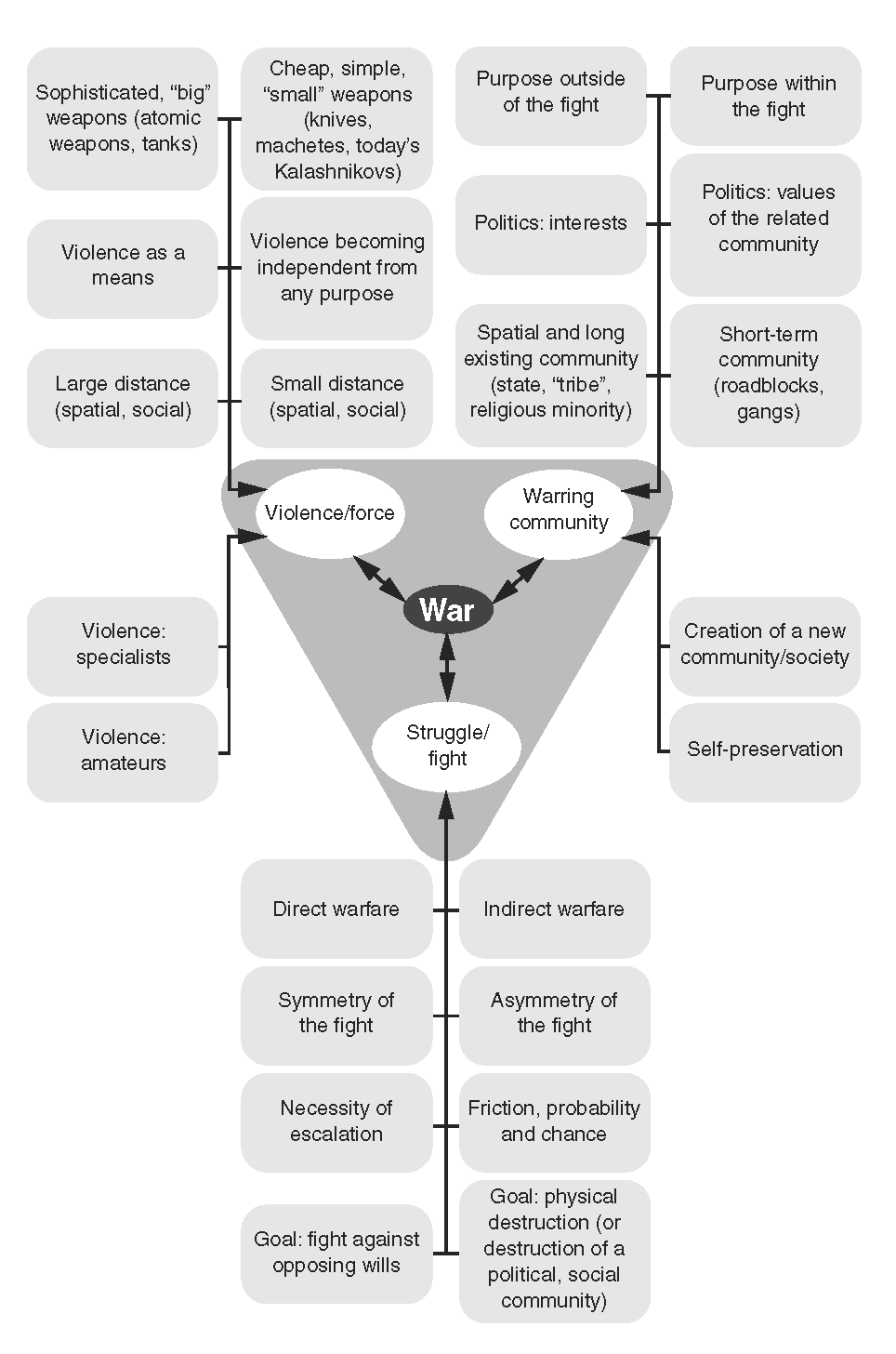
     

    Every war is accordingly defined in terms of its three essential dimensions: violence, combat, and the affiliation of the combatants with a community on whose behalf the combatants act. Historically, these three tendencies within the “wondrous trinity” display almost infinite combinations and multiple, cross-cutting tensions since every war is waged differently. Thus, every war has symmetrical and asymmetrical tendencies, for instance, even when it may appear that only one of these tendencies comes to the fore (Herberg-Rothe 2007).

    The tension between the coordinates of Clausewitz’s trinity may also be heightened by different forms of military organization. Those that feature strict hierarchies of command are perhaps most conducive to the transmission of political guidance to operating forces; whereas what is today called network-centric warfare is characterized by loose and diffuse organizational structures, in which the community’s political will and mandate can no longer be so readily imposed on combatants directly engaged with the enemy. As in the warfare of partisans, networked military organizations place a high value on the political understanding of the individual soldier. It is because of the relative independence of soldiers in network-centric warfare that this type of warfare does not require an “archaic combatant,” but a democratic warrior who has fully internalized the norms of the community for which he fights.

    The Democratic Warrior in the Twenty-first Century

    Even in Clausewitz’s day, war was not the only instrument of policy that state’s possessed, though it was undoubtedly the most central. Today, its centrality is less obvious, even as the complexity of its connections to other forms of state power has increased (Thiele 2009). Combining the different perspectives afforded by foreign, economic, developmental, judicial, domestic, and defence policy permits a global approach to conflict resolution while making the considerations surrounding the use of force more complicated than ever. States now pursue their security through many avenues at once, and all the agencies involved must consciously coordinate, connect, and systematically integrate their goals, processes, structures, and capabilities.

    Given the continuing expansion of the concept of security in recent years, a democratic army needs a specific task and function since its essential purpose—the use of force—can not be dispensed with. There have been those who thought it might be. When the East-West conflict ended, Francis Fukuyama announced the “end of history,” meaning an end to the practice of war and violence (Fukuyama 1992). The triumphant advance of democracy and free markets seemed unstoppable, to the point where it appeared as if the twenty-first century would be an age defined by economics and thus, to a large extent, by peace. These expectations have now been decisively overturned by ongoing massacres and genocide in Africa; by the return of war in Europe (as happened in the former Yugoslavia); by the September 11, 2001 attacks on the United States and, the subsequent wars in Afghanistan and Iraq; the war between Georgia and Russia over South Ossetia in 2008, the civil war in Syria and Iraq and finally the prospect of war to suppress Iran’s nuclear program (itself a profoundly dangerous and destabilizing step, should it become reality).

    In a complete reversal of Fukuyama’s thesis, a struggle against a new brand of Islamic totalitarianism appears to have begun, in which violence has become “unbounded”—because terrorist attacks are potentially ever-present because no end to them is in sight and there is no reason to assume there is any limit to the scale of violence terrorists might employ, including the use of nuclear weapons should they come to possess them. These processes of growing disinhibition must be countered by a new containment policy that limits the expansion of war and violence in the world.

    Two basic assumptions underlie this conception. The first is that the escalation of violence in world society is so multifaceted and differentiated that a single counter-strategy will not suffice. Rather, an overarching perspective is required to decide which measures are suitable in individual cases—without being able to exclude the possibility of terrible errors and miscalculations. The second assumption is that in today’s global society—as has been the case throughout history—many contrary processes are at work. Thus, regard for only one counter-strategy can have paradoxical, unanticipated consequences.

    This can be clarified using the example of democratization. If a general effort at worldwide democratization was the only counter-strategy against the disinhibition of violence and war, the results would almost certainly be counterproductive, not least because the spreading of democracy might itself be a violent process. A one-sided demand for democratic reform without regard for local conditions might, in individual cases, contribute to the creation of anti-democratic movements. The historical experience bears this out. After the First World War, nearly all of the defeated states underwent an initial process of democratization under the tutelage and supervision of the victors. Yet, almost all ended in authoritarian or even totalitarian regimes.

    Thus, the concept of the democratic warrior is not based on imposing democracy by force, but on limiting war and violence to enable the organic development of democratic self-determination. A differentiated counter-strategy of curbing war and violence in the world, with a view to fostering good governance (as a first step toward democratic governance), is the common element shared by humanitarian intervention and the development of a culture of civil conflict management. To this must be added measures to limit the causes of war and violence, such as poverty, oppression, and ignorance. Last but not least, this new form of containment requires effective restraint not just in the proliferation of weapons of mass destruction, but also of small arms, which continue to kill far more people than any other kind of arms.

    The containment of violence does not mean there will be entirely non-violent societies, much less a non-violent world society, in the foreseeable future. All else aside, the goal of completely eliminating violent conflict would ignore the fact that historically speaking, conflicts and their resolution have often furthered human development toward free and democratic ideals—as per the American struggle for independence and the French Revolution. The primary task of politics in the twenty-first century is therefore to radically limit violence and war so that non-violent structures and the mechanisms of the “social world” can have an impact. In this context, democratic warriors have a unique role to play; not as those who impose democracy by force, but as those who make diverse forms of culturally authentic self-determination possible, by curbing and containing war and violence.

    Conclusion

    It must be repeated, the concept of the democratic warrior appears to be contradictory. Indeed, it combines contradictory value systems in a single concept. Nevertheless, to adopt the metaphor favoured by Clausewitz (Herberg-Rothe 2007), the elements of tension in the democratic warrior’s identity can be conceived as the poles of a magnet, whose mutual opposition is not an illusion but is nevertheless a means to a larger, unitary end. It is what creates the magnet: the north pole of a magnet cannot exist alone. At one end of the continuum of the democratic warrior’s identity lies the values of democratic equality and non-violent conflict resolution; at the other, the realization that force itself may sometimes be necessary to limit war. At one end, is a civilized society, and at the other a subsystem of that same society, whose identity is defined by traditional concepts of honour and martial valour.

    As observed at the beginning of this essay, the bonds that link the two poles of this relationship, without eliminating their opposition, are the classical republican virtues, which lay claim to validity in both spheres. It was Plato who defined the classical virtues as intelligence, justice, fortitude, and temperance, which is also are characteristics in the Confucian tradition (Piper 1998 concerning Plato). Without them, a state can sustain itself only under dictatorship. With them, both external and internal freedoms are possible (Llanque 2008). They are the keys to the democratic warrior’s identity, providing the crucial link between the values of liberal-democratic society and those other values—courage, loyalty, self-sacrifice—that have always set the warrior apart.


    References

    Bredow, Wilfried von (2000), Demokratie und Streitkräfte (Wiesbaden: VS publishers, 2000).

    Clausewitz, Carl von (1984), On War. Ed. by Peter Paret and Michael Howard (Oxford: OUP).

    Duyvesteyn, Isabelle (2005), Clausewitz and African War (London: Routledge).

    Frevert, Ute (1997), Die kasernierte Nation (Munich: C. H. Beck, 2001).

    Frevert, Ute(ed.), (1997), Militär und Gesellschaft im 19. und 20. Jahrhundert

    (Stuttgart: Klett–Cotta).

    Fukuyama Francis (1992), The End of History and the Last Man (New York: Free Press).

    Herberg-Rothe, Andreas (2007), Clausewitz’s puzzle (Oxford: OUP). Herberg-Rothe, Andreas (2017), Der Krieg. 2.Edition. (Frankfurt:

    Campus).

    Herberg-Rothe, Andreas and Son, Key-young (2019), Order wars and floating balance. How the rising powers are reshaping our world view in the twenty-first century (New York: Routledge).

    Hüppauf, Bernd (1993), “Schlachtenmythen und die Konstruktion des ‘Neuen Menschen’,” in Keiner fühlt sich hier mehr als Mensch . . . : Erlebnis und Wirkung des ersten Weltkrieges, ed. Gerhard Hirschfeld, et al. (Essen: Klartext, 1993).

    Llanque, Marcus (2008) Politische Ideengeschichte. Ein Gewebe politischer Diskurse (Munich: Oldenbourg.

    Kaldor, Mary (1999), New and Old Wars: Organized Violence in a Global Era

    (Stanford: Stanford University Press).

    Kaplan, Robert (1994), “The Coming Anarchy.”In: Atlantic Monthly no.

    273, 44–76.

    Keegan, John (1995), Kultur des Krieges (Berlin: Rowohlt).

    Kuemmel, Gerhard (2005), Streitkräfte im Einsatz: Zur Soziologie militärischer Interventionen (Baden-Baden: Nomos).

    Moran, Daniel (2003), “Arms and the Concert: The Nation in Arms and the Dilemmas of German Liberalism,” in The People in Arms: Military Myth and National Mobilization since the French Revolution, ed. Daniel Moran and Arthur Waldron(Cambridge: Cambridge University Press).

    Münkler, Herfried (2004), The New Wars (New York: Policy). Münkler, Herfried (2007), Empires (Cambridge:Polity Press).

    Pieper, Josef (1998), Das Viergespann—Klugheit, Gerechtigkeit, Tapferkeit, Maß (Munich: Kösel).

    Röhl, Wolfgang (2005), “Soldat sein mit Leib und Seele. Der Kämpfer als existenzielles Leitbild einer Berufsarmee in EinJob wie jeder andere. Zum Selbst- und Berufsverständnis von Soldaten, ed. Sabine Collmer and Gerhard Kümmel (Baden-Baden:Nomos, 2005) 9–21.

    Schlichte, Klaus (2006), “Staatsbildung oder Staatszerfall. Zum Formwandel kriegerischer Gewalt in der Weltgesellschaft,In: ”Politische Vierteljahresschrift 47, no. 4.

    Sikora, Michael (2003), “Der Söldner,” in Grenzverletzer. Figuren politischer Subversion, ed. Eva Horn, Stefan Kaufmann, and Ulrich Bröckling (Berlin: Kulturverlag Kadmos, 2002).

    Thiele, Ralph (2009), “Trendforschung in der Bundeswehr”. In: Zeitschrift für Sicherheits- und Außenpolitik 2, 1–11.

    Walzer, Michael (2003), “Is there an American Empire?” In: Dissent Magazine 1 (2003), URL; http://www.dissentmagazine.org/menutest/archives/2003/fa03/walzer.htm  last accessed 16. 4. 2020.

    Zakaria, Faared (2009), The Post-American World (New York: W. W. Norton).