Author: Dr Andreas Herberg-Rothe, PhD

  • The Democratic Warrior – Countering Unrestricted Violence with Clausewitz

    The Democratic Warrior – Countering Unrestricted Violence with Clausewitz

    This research paper was originally published in the “African Journal of Terrorism and Insurgency Research (AJoTIR)”, Volume 2, Number 1, April 2021. Pp. 89-106.


    Abstract

    We often find the application of indistinctive, brutal and extraordinary violence by all fighters and soldiers in terrorist, insurgency, and counter-insurgency acts in Africa. This article argues that we need a code of honour for those bearing arms to limit these unrestricted acts of violence, a code of honour that combines military duties with the demands of civil society in the model democratic warrior. The changes to the global system that followed the end of the Cold War are widely regarded as requiring a different kind of soldier for democratic societies. A number of writers have proposed that the new model should be that of the “warrior,” a concept that highlights the psychological and social distinctiveness of those who bear arms. Such men and (rarely) women are often conceived as operating according to a distinctive code of honour that sets them apart from civil society, usually in a positive way. But we know that the concept of honour may also lead to a terrible escalation. So, the task is to reconnect the concepts—warrior and honour—to civil society to de-escalate the ongoing brutal violence in civil wars. There is no honour in killing innocent people. On the contrary, it is perhaps the most egregious act against one’s honour and dignity to torture, violate, or kill the innocent. The concept of the democratic warrior seeks to reinstate honour and dignity to those bearing arms.Keywords: democracy, warrior, civil society, civil war, honour, dignity, terrorism, Clausewitz, wondrous trinity, containing violence.

    Introduction

    At first glance, the concept of the democratic warrior appears contradictory. Indeed, it combines seemingly conflicting value systems in a single concept. Like a magnet or Clausewitz’s favoured model of the unity of polar opposition between attack and defence, a methodology can be formulated to explain how this type of conflicted unity is not necessarily a logical opposition and can be a dynamic interrelationship on a continuum. At one end of the continuum is democratic equality and non-violent conflict resolution, while at the other end is the threat of (and sometimes) violently enforced limitation of war and violence; at one end is a civilized society, while at the other is a subsystem of society whose identity is defined by martial honour.

    The decisive bond that can link the two poles of this dynamic relationship, without eliminating their opposition, is the classical republican virtues, which can lay claim to relative validity in both spheres. Since Plato, the classical virtues have been prudence (wisdom), justice, fortitude, and temperance. Without a specific ethos aimed at the political functioning of the polity, a state can sustain itself only under the conditions of a dictatorship. If republican virtue, which is oriented toward the polity, cannot be directly reconciled with liberal democracy and its focus on the individual, it can take on a completely new significance as a bond linking a democratic society to democratic warriors. For Machiavelli, republican virtue already guarantees both external and internal freedom. In this respect, the necessary though not yet adequate condition of the democratic warrior is to also be a republican soldier. Add to this the limitation of war and violence in a global society to make democratic societies possible. A renewal of the republican virtue is the link between a liberal-democratic society and a warrior ethos.

    The “warrior” is by definition someone who chooses to bear arms and is proficient in their use. In this sense, whatever the distinctive characteristics of the warrior ethos, its institutionalization reflects the same preferences for professionalism, expertise, and individualism that are characteristic of modern society as a whole. Contemporary conditions, it is argued, no longer call for armed masses, but for experts whose willingness to serve in uniform will allow others the freedom not to serve.

    It must be admitted, however, that the concept of the warrior does not call forth associations with modernity, but rather of the “archaic combatant” (Röhl 2005), whose ethos, skills, and experiences set him apart from normal society and in opposition to its basic values, of which the most cherished is, of course, peace. The fact the warrior freely chooses his profession may be consistent with democratic values, but the existence of a “warrior class” uniquely skilled in the use of force, whose values are not those of society as a whole, is scarcely consistent with democratic interests. It is also true that those who serve in today’s democratic armies are called upon to do a great deal more than fight. Although phrases like “armed social worker” undervalue and denigrate the martial qualities that remain foundational to military life, it is true that only a small percentage of men and women in uniform actually fight, and that their duties entail a wide range of activities in which violence plays no part. To those who wish to uphold the warrior spirit, the diverse requirements of modern military missions are liable to hold scant appeal, which may undermine the sense of purpose and identity that drew them to the profession in the first place.

    The discussion that follows seeks to build a bridge between the distinctive ethos of the warrior and the moral and political requirements of democratic societies, using the concept of the “democratic warrior.” It seeks to do justice to the self-image of those who bear arms (a morally distinctive task) while connecting it to the various goals and practices of democratic societies, and the diverse uses to which they put their armed forces. We may begin by noting that a warrior, even in the most traditional terms, is not merely a combatant—a fighter—but has always performed and embodied a range of social, military, and political roles. Our starting point for considering what those roles must be is Clausewitz’s concept of the trinity, a metaphor intended to encompass all types of war, which, by extension, can provide a lens through which the ideal range of characteristics required of the democratic warrior can be envisioned. War itself, as Clausewitz avers, is compounded of primordial passions, an irreducible element of chance, and what he called an element of “subordination” to reason, by which its instrumental character is revealed. When Clausewitz set forth his trinity, he posited that the chief concern of the warrior must be the mastery of chance through intelligence and creativity; and so it remains. Yet there is no reason to suppose that such mastery means that war’s social and political requirements should be ignored. On the contrary, unless they too are mastered, the warriors sent forth by democratic societies cannot represent the values and interests of the communities that depend on them, and of which they remain apart (Herberg-Rothe 2007).

    Soldiers and Warriors

    In both German and English, the word “soldier” (soldat) originally referred to a paid man-at-arms. The term became common in early modern Europe and distinguished those who were paid to fight— primarily in the service of the increasingly powerful territorial states that were then coming to dominate the continent—from members of militias, criminal gangs, volunteer constabulary and local self-defence forces, and other forms of vernacular military organizations. The rise of the soldier was linked to the rise of the state. This connection distinguished him from the “mercenary,” who also fought for pay, but as a private entrepreneur, what we would today call a “contractor.” Standing armies comprised of soldiers were different from and militarily superior to, the feudal hosts of the past, whose fighters served out of customary social obligation and generally possessed neither the discipline nor the martial proficiency that the soldier embodied. Clausewitz highlights these developments briefly in the last book of On War, and portrays them as an advance in political organization and military efficiency (Clausewitz 1984, 587-91).

    The absolute monarchies that made the paid soldier the standard of military excellence in early modern Europe were generally indifferent to the social and political identities of those they paid to fight, though not always. Frederick the Great, for instance, lamented his reliance on foreign troops and believed that his own subjects made better soldiers. “With such troops,” he wrote, “one might defeat the entire world, were not victories as fatal to them as to their enemies” (quoted in Moran 2003, 49). It was, however, only with the French Revolution that a firm expectation was established that a soldier bore arms not merely for pay, but out of personal loyalty to the state, an identity that was in turn supposed to improve his performance on the battlefield. This connection, needless to say, was largely mythical. Most of the men who fought in the armies of the Revolution, and all major European wars since then, are conscripts who would not have chosen to bear arms on behalf of the state if the law had not compelled them to do so. Nevertheless, submission to conscription was itself regarded as an expression of the ideal of citizenship, a concept that, like honour, depends upon the internalization and subjective acceptance by individuals of norms arising within the larger society.

    The French Republic never referred to its soldiers as conscripts, always as volunteers. The success of its armies and those of Napoleon, although transient, insured that “defence of the Fatherland [became] the foundation myth of modern armies”(Sikora 2002). The myth of voluntary sacrifice by the “citizen-soldier” to defend the community proved central to the legitimization of conscript armies, even in societies where democratic values were slow to emerge. In the middle of the nineteenth century, as Frederick Engels observed, conscription was Prussia’s only democratic institution (Frevert 1997, 21).

    It had been introduced in reaction to Prussia’s defeat by Napoleon, whose triumph was owed to the fact that the resources of the entire French nation were at his disposal. The aim of the Prussian military reforms was to accomplish a similar mobilization of social energy for war, but without inciting the revolutionary transformation of society that had made such mobilization possible in France. Prussia was no sovereign nation of citizens, and while the reform of its armed forces helped it to regain its position among the leading states of Europe, their political effect was limited.

    Many of those who promoted reform, including Clausewitz, hoped conscription would contribute to the democratization of Prussia’s armed forces, and, indirectly, of society as a whole. But the moral influence could as easily run the other way, and, as Friedrich Meinecke observed, measures designed to bind army and society together had the effect, in Prussia, of militarizing society instead. Even the Great War did not fully succeed in stripping war of its moral glamour. The supposedly heroic massacre of German troops attacking the British at Langemarck (1914), for instance, remained a staple of right-wing mythology until the end of the Third Reich, by which “our grief for the bold dead is so splendidly surpassed by the pride in how well they knew how to fight and die (Hüppauf, 1993, 56). Alongside this kind of blood-drenched nostalgia, the industrialized warfare exemplified by battles like Verdun (1916) also asserted themselves. Under these circumstances, fighting and dying well acquired some of the aspects of industrialized labour, in which a soldier’s duty expresses itself, not through the mastery of chance as Clausewitz proposed, but through submission to what Ernst Jüngercalled “the storm of steel.”

    It was only after World War II that German soldiers became authentically democratic citizens in uniform. According to Wilfried von Bredow, the creation of the Bundeswehr in 1956 was “one of the Federal Republic of Germany’s most innovative and creative political reforms, fully comparable in its significance to the conception of the social market economy” (Bredow 2000). Its evolution as an integral part of German society has embodied a calculated break with the German past, one that has become even more apparent since the demise of the Soviet Union has shifted the mission of the German army away from national defence and toward expeditionary operations calculated to help maintain regional and global order. As the conscript armies of the past have given way to the professional and volunteer armies of the present, in Germany and elsewhere, the model of the democratic “citizen in uniform” has once again been required to adapt to new conditions.

    It is perhaps slightly paradoxical that as wars have become smaller and more marginal in relation to society as a whole, the ideal of the warrior as an apolitical professional fighter has regained some of its old prominences. Such individuals are thought to embody values different than those of society as a whole, to the point where their loyalties, like their special capabilities in battle, are thought to spring solely from their organization and mutual affiliation. John Keegan, a proponent of the new warrior, explains the rejection of the values of civil society in terms of the psychological impact of violence on those who experience and employ it. War, Keegan argues, reaches into the most secret depths of the human heart, where the ego eliminates rational goals, where pride reigns, where emotions have the upper hand, and instinct rules. One of Keegan’s models of the warrior is the Roman centurion. These officers were soldiers through and through. They entertained no expectation of rising to the governing class, their ambitions were entirely limited to those of success within what could be perceived, for the first time in history, as an esteemed and self-sufficient profession. The values of the Romans professional soldier have not diminished with the passage of time: pride in a distinctly masculine way of life, the good opinion of comrades, satisfaction in the tokens of professional success, and the expectation of an honourable discharge and retirement remain the benchmarks of the warrior’s life (Keegan 1995, 389-391).

    The enthusiasm of Keegan and others for the revival of the warrior ethos is the belief that “honour” can play an important role in limiting violence, far more effective than the proliferation of legal norms that lack the binding psychological validity required to stay the hand of those who actually take life and risk their own. Warriors use force within a customary framework of mutual respect for one another. This is part of what has always been meant by “conventional warfare”, a form of fighting that necessarily includes a dissociation from combatants considered to be illegitimate. How and whether these kinds of customary restraints can be successfully reasserted under contemporary conditions is one of the central problems with which the concept of the democratic warrior must contend. In opposition to Keegan, I think, that the warriors’ code of honour must be related back to civil society, although this is a task which requires bridging a gap and remains a kind of hybrid.

    Old and New Wars

    To judge what kind of “weapon carrier” will be needed in the twenty-first century, we must begin by looking at developments since the end of the East-West conflict. It has proven, broadly speaking, to be a period of rapid social, political, and economic development whose outstanding characteristics are marked by the decline or disappearance of familiar frameworks and inherited values. Thus, one speaks of denationalization, de-politicization, de-militarization, de-civilization, de-territorialization, and delimitation.

    Unsurprisingly, these changes are also supposed to be marked by “new” wars, characterized by the decline of statehood, the rise of privatized violence, the development of civil war economies, and the reappearance of types of combatants thought to be long gone— mercenaries, child soldiers, warlords, and so on. The new types of combatants are in turn associated with rising incidences of suicide bombing, massacre, and other forms of atavistic and irrational violence(Kaldor 1999, Münkler 2004).

    Political and academic discourses have produced a range of new concepts designed to capture these conditions, including privatized war, asymmetrical warfare, small wars, wild wars, low-intensity conflict, post-national wars; wars of globalization on the one hand, and of “global fragmentation” on the other. It is apparent, however, that each of these terms describes only one segment of a complex reality. To some extent, a new type of war is being discovered with each new war. At the same time, these different terms share a common assumption that war now consists mainly of conflicts involving non-state actors on at least one side, and, by extension, that the motivation and goals of such belligerents are likely to prove unfathomable in political terms. The result for some is an approaching anarchy (Kaplan 1994), whose remedy is a revived liberal interventionism, the only principle that seems able to guarantee a modicum of global order (Münkler 2007).

    It is possible, however, that the contemporary diffusion of conflict beyond the confines of the state system is no more than a transitional phase, with particular strong links to those parts of the world—Africa and Central Asia above all—where the challenges of post-imperial social and political adaptation are still especially pronounced. Neither does the fact that the parties to war are non-state actors necessarily mean that such wars lack a political or ideological basis. Such wars may not represent a clash between order and anarchy but between competing conceptions of order (Münkler 2004). While a revived interventionism may indeed be a suitable antidote to anarchy, it is unlikely to do more than aggravate indigenous conflicts over the politics of order – and as it seems at present, it is contributing to the escalation of violence throughout the world. Now, as in the past, violence is not simply a source of disorder. It is also a means of shaping order and providing the basis for community formation.

    It is possible to wonder, in other words, how new the “new wars” actually are. Widespread atavistic and vernacular violence were already prominent features of the Chinese civil war, the Russian civil war, the Armenian genocide, and many other episodes of “old wars”. Those who favour the concept note a number of formal changes that resulted from the disappearance of Soviet-American rivalry, above all a decline in external assistance. The proxy wars of the past have become the civil wars of the present, conducted by parties that must rely on their own efforts to obtain the necessary resources, including illegal trafficking in diamonds, drugs, and women; brutal exploitation of the population; extreme violence as a way of attracting humanitarian assistance that can then be plundered; and the violent acquisition of particularly valuable resources (robber capitalism). These changes may well amplify the social consequences of violence, but do not necessarily deprive it of its instrumental and political character (Schlichte 2006).

    The point of departure for the study by Isabelle Duyvesteyn, for example, is a very broad definition of politics based on Robert Dahl: “any persistent pattern of human relationship that involves, to a significant extent, power, rule or authority” (Duyvesteyn 2005, 9). Duyvesteyn refers especially to the fact that in the fast-developing states she has studied, the differences between economics and politics are not as clear cut as Westerners expect. Struggles that seem to be about the acquisition of resources can be motivated by power politics to obtain a separate constituency. Because the position of power in these conflicts is often determined by the reputation of the leader, what may appear to be personal issues can also be incorporated into a power-political context. Her hypothesis is not that economically, religiously, ethnically, or tribally defined conflicts are masks for politics, but rather that these conflicts remain embedded in a political framework that is understandable to the participants.

    It is also apparent today’s civil wars do not always trend irrevocably toward social and political fragmentation, becoming increasingly privatized until they reach the smallest possible communities, which are held together by only violence itself. The defeat of the Soviets in Afghanistan, for instance, gave rise to a civil war between warlords and individual tribes that appeared to be tending in this direction for a time, only to acquire a new and recognizably ideological shape once the Taliban seized power. This new tendency was confirmed by the Talibans’ willingness to give shelter to al-Qaeda, a global and trans-national organization of almost unlimited ambition, whose attacks upon the United States have in turn embroiled Afghanistan in a conflict about the world order pitting the West against militant Islam. At present, we witness in “Sahelistan” a similar development, but this is not confined to a single state, but to the whole region.

    At a minimum, it seems clear that the new wars, to the extent that they are new, are not all new in the same way. In some, violence does indeed appear to gravitate downwards towards privatized war; in others, however, the movement is upwards, towards supra-state wars of world order. Although these trends are linked in practice, analytically they are distinct. States do still wage wars, but for the most part, they are now doing so not in pursuit of their own particular interests but for reasons related to world order. This is what accounts for the new interest in an American empire and hegemony (Walzer 2003). Nor is America the only state capable of seeking and exercising global influence.

    Russia, China, India and Europe (whose superficial fragmentation masks its concerted economic, regulatory and power-political influence) are all capable of challenging American influence in particular spheres of activity; and one day they may do so in all spheres (Zakaria 2009). In any event, the use of force by strong states in pursuit of world order, whether cooperatively or competitively, is likely to remain the dominant strategic reality for some time to come; a fact that should not be obscured by the simultaneous proliferation of privatized violence on the periphery of the world system.

    Clausewitz’s Trinity as a Coordinate System

    The argument about the newness of new wars is also an argument about the continuing salience of Clausewitz’s understanding of war as, in his words, a “wondrous trinity,” by which primordial violence and the exigencies of combat may finally be subjugated to reason and politics. It is apparent, however, that while the proportions of these three elements may vary, a good deal nowadays, perhaps more so than in some periods in the past, they do not escape the theoretical framework that Clausewitz established. At the same time, his trinity points us towards the essential characteristics of the “democratic warrior,” whose success requires that he masters the multiple sources of tensions that Clausewitz detected in the nature of war itself.

    Clausewitz’s trinity present war as embodying three elements in constant tension with each other: primordial violence, the fuel on which war feeds; the fight between two or more opponents, by which violence is given military effective form; and the community, whose interests, as represented by policy, give war its purpose, and whose existence provides the soldier with his essential identity: as one who fights for something larger than himself. The shifting proportions among these elements that modern war continues to display would not have surprised Clausewitz. On the contrary, he knew that all three would always be present in every war and that a “theory that ignores any one of them . . . would conflict with reality to such an extent that for this reason alone it would be totally useless” (Clausewitz, On War, 1984, 89; see Herberg-Rothe 2007). Each requires exploration if the characteristics of the democratic warrior are to be understood.

    Violence and force

    The most crucial polarity in Clausewitz’s trinity is between the instrumentality of war and the autonomy of violence. Clausewitz noted the tendency of violence to become absolute, and therefore an end in itself, a tendency that was restrained both by the instrumental rationality of policy and, less obviously perhaps, by the skill of the combatants. Clausewitz also notes the paradoxical influences that can attend the use of force at a distance. If combatants are separated from each other in space and time, it may promote relative rationality in the use of force; or it may not, since it introduces the disinhibiting influence of impersonal killing, in which the humanity of the opponent is no longer perceived. Fighting “face-to-face” demands personal aggressiveness and even hatred, which can lead to increasing ferocity in the use of force. At the same time, however, it may make it easier to perceive the opponent as human. A similarly paradoxical logic may arise from the use of expensive weapons versus simple ones. Expensive weapons systems and the highly trained combatants required to use them can lead to a certain limitation of war because these cannot be so easily risked (as was the case, he argued, in the wars of the 18th century). In contrast, wars waged by relatively unskilled combatants employing cheap and simple weapons may be more likely to escalate – as is evident from many of the civil wars in Africa, particularly with child soldiers.

    The Fight

    The most basic reason that the violence of war is prone to escalate is that combatants share a common interest in not being destroyed. In most other respects, however, their interaction is asymmetrical, most profoundly so, as Clausewitz says, in the contrasting aims and methods of attack and defence, which he avers are two very different things. The shape of combat is also influenced by whether war is directed against the opposing will (in effect, a war to change the adversary’s mind)or if it aims at his “destruction.” Clausewitz specifies that by the destruction of the opposing armed forces, he simply means reducing them to such a condition that they can no longer continue the fight. Nevertheless, Clausewitz long favoredNapoleon’s approach to warfare, which emphasized direct attack against the main forces of the enemy. Other forms of fighting are also possible, however, whose aim is to exhaust the enemy’s patience or resources indirectly, rather than confront and defeat his armed forces in the field. The real war, in Clausewitz’s days and in ours, is generally a combination of direct and indirect methods, whose proportions will vary with the interests at stake and the resources available.

    Warring Communities

    When referring to warring communities, we must first differentiate between relatively new communities and those of long-standing. This is because in newly constructed communities, recourse to fighting is liable to play a greater relative role in its relations with adversaries; whereas, in the case of long-standing communities, additional factors come into play. Clausewitz argues that the length of time a group of communities has existed significantly reduces the tendency for escalation because their long-standing interactions will include elements other than war, and each party envision the other’s continued existence once peace is made, a consideration that may moderate the use of force.

    War’s character will also vary depending on whether it aims to preserve the existence of a community or, as in revolutionary crises, to form a new one; whether war is waged in the pursuit of interests, or to maintain and spread the values, norms, and ideals of the particular community (see Herberg-Rothe 2007). Closely related to this contrast, although not exactly congruent with it, is the question of whether the purpose of war lies outside itself or, especially in warring cultures, whether the violence of the fight has independent cultural significance. The social composition of each society and the formal composition of its armed forces (regular armies, conscripts, mercenaries, militias, etc), play an important role here. Summarizing these fundamental differences yields the coordinate system of war and violence shown in the diagram.
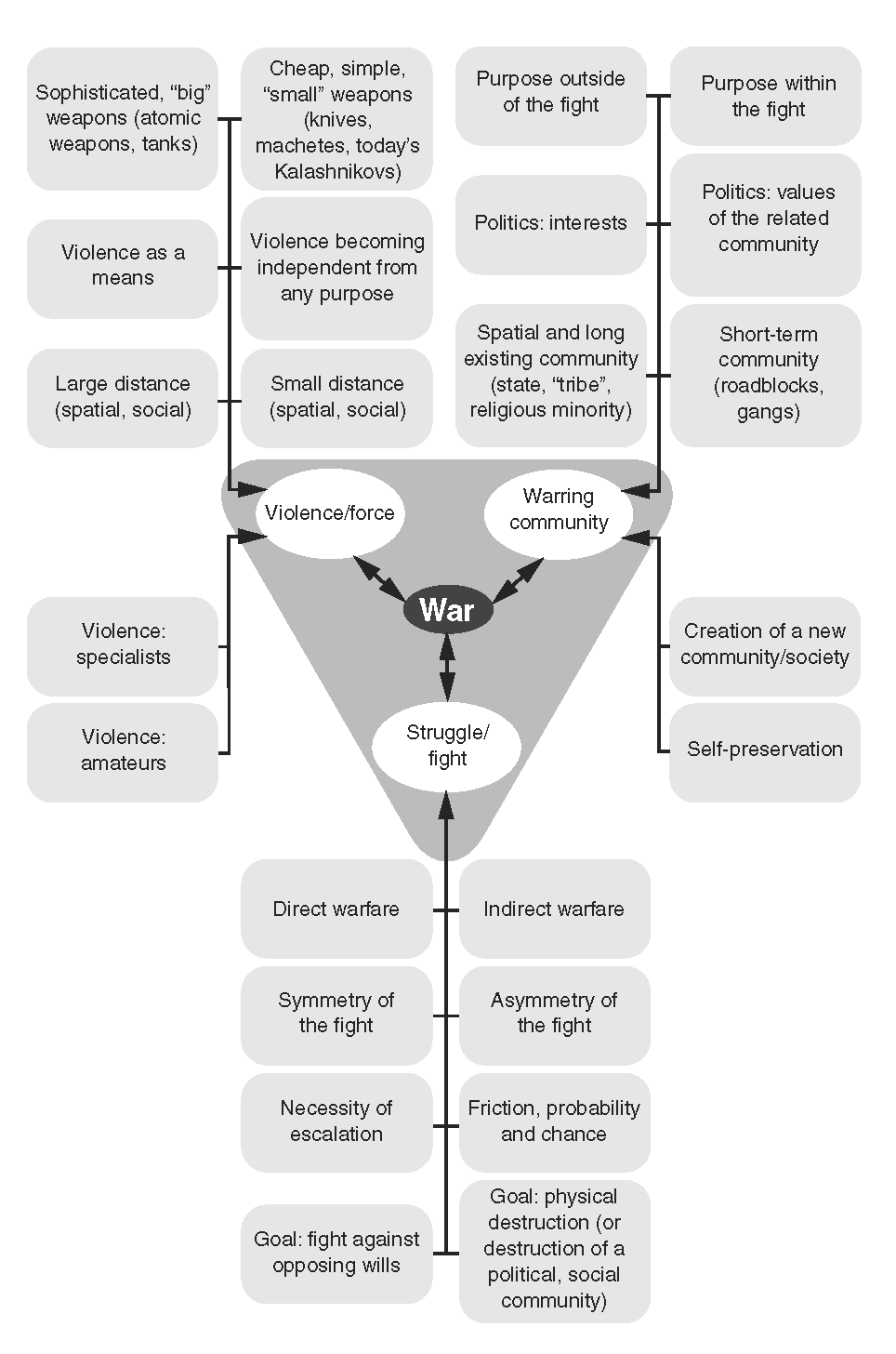
     

    Every war is accordingly defined in terms of its three essential dimensions: violence, combat, and the affiliation of the combatants with a community on whose behalf the combatants act. Historically, these three tendencies within the “wondrous trinity” display almost infinite combinations and multiple, cross-cutting tensions since every war is waged differently. Thus, every war has symmetrical and asymmetrical tendencies, for instance, even when it may appear that only one of these tendencies comes to the fore (Herberg-Rothe 2007).

    The tension between the coordinates of Clausewitz’s trinity may also be heightened by different forms of military organization. Those that feature strict hierarchies of command are perhaps most conducive to the transmission of political guidance to operating forces; whereas what is today called network-centric warfare is characterized by loose and diffuse organizational structures, in which the community’s political will and mandate can no longer be so readily imposed on combatants directly engaged with the enemy. As in the warfare of partisans, networked military organizations place a high value on the political understanding of the individual soldier. It is because of the relative independence of soldiers in network-centric warfare that this type of warfare does not require an “archaic combatant,” but a democratic warrior who has fully internalized the norms of the community for which he fights.

    The Democratic Warrior in the Twenty-first Century

    Even in Clausewitz’s day, war was not the only instrument of policy that state’s possessed, though it was undoubtedly the most central. Today, its centrality is less obvious, even as the complexity of its connections to other forms of state power has increased (Thiele 2009). Combining the different perspectives afforded by foreign, economic, developmental, judicial, domestic, and defence policy permits a global approach to conflict resolution while making the considerations surrounding the use of force more complicated than ever. States now pursue their security through many avenues at once, and all the agencies involved must consciously coordinate, connect, and systematically integrate their goals, processes, structures, and capabilities.

    Given the continuing expansion of the concept of security in recent years, a democratic army needs a specific task and function since its essential purpose—the use of force—can not be dispensed with. There have been those who thought it might be. When the East-West conflict ended, Francis Fukuyama announced the “end of history,” meaning an end to the practice of war and violence (Fukuyama 1992). The triumphant advance of democracy and free markets seemed unstoppable, to the point where it appeared as if the twenty-first century would be an age defined by economics and thus, to a large extent, by peace. These expectations have now been decisively overturned by ongoing massacres and genocide in Africa; by the return of war in Europe (as happened in the former Yugoslavia); by the September 11, 2001 attacks on the United States and, the subsequent wars in Afghanistan and Iraq; the war between Georgia and Russia over South Ossetia in 2008, the civil war in Syria and Iraq and finally the prospect of war to suppress Iran’s nuclear program (itself a profoundly dangerous and destabilizing step, should it become reality).

    In a complete reversal of Fukuyama’s thesis, a struggle against a new brand of Islamic totalitarianism appears to have begun, in which violence has become “unbounded”—because terrorist attacks are potentially ever-present because no end to them is in sight and there is no reason to assume there is any limit to the scale of violence terrorists might employ, including the use of nuclear weapons should they come to possess them. These processes of growing disinhibition must be countered by a new containment policy that limits the expansion of war and violence in the world.

    Two basic assumptions underlie this conception. The first is that the escalation of violence in world society is so multifaceted and differentiated that a single counter-strategy will not suffice. Rather, an overarching perspective is required to decide which measures are suitable in individual cases—without being able to exclude the possibility of terrible errors and miscalculations. The second assumption is that in today’s global society—as has been the case throughout history—many contrary processes are at work. Thus, regard for only one counter-strategy can have paradoxical, unanticipated consequences.

    This can be clarified using the example of democratization. If a general effort at worldwide democratization was the only counter-strategy against the disinhibition of violence and war, the results would almost certainly be counterproductive, not least because the spreading of democracy might itself be a violent process. A one-sided demand for democratic reform without regard for local conditions might, in individual cases, contribute to the creation of anti-democratic movements. The historical experience bears this out. After the First World War, nearly all of the defeated states underwent an initial process of democratization under the tutelage and supervision of the victors. Yet, almost all ended in authoritarian or even totalitarian regimes.

    Thus, the concept of the democratic warrior is not based on imposing democracy by force, but on limiting war and violence to enable the organic development of democratic self-determination. A differentiated counter-strategy of curbing war and violence in the world, with a view to fostering good governance (as a first step toward democratic governance), is the common element shared by humanitarian intervention and the development of a culture of civil conflict management. To this must be added measures to limit the causes of war and violence, such as poverty, oppression, and ignorance. Last but not least, this new form of containment requires effective restraint not just in the proliferation of weapons of mass destruction, but also of small arms, which continue to kill far more people than any other kind of arms.

    The containment of violence does not mean there will be entirely non-violent societies, much less a non-violent world society, in the foreseeable future. All else aside, the goal of completely eliminating violent conflict would ignore the fact that historically speaking, conflicts and their resolution have often furthered human development toward free and democratic ideals—as per the American struggle for independence and the French Revolution. The primary task of politics in the twenty-first century is therefore to radically limit violence and war so that non-violent structures and the mechanisms of the “social world” can have an impact. In this context, democratic warriors have a unique role to play; not as those who impose democracy by force, but as those who make diverse forms of culturally authentic self-determination possible, by curbing and containing war and violence.

    Conclusion

    It must be repeated, the concept of the democratic warrior appears to be contradictory. Indeed, it combines contradictory value systems in a single concept. Nevertheless, to adopt the metaphor favoured by Clausewitz (Herberg-Rothe 2007), the elements of tension in the democratic warrior’s identity can be conceived as the poles of a magnet, whose mutual opposition is not an illusion but is nevertheless a means to a larger, unitary end. It is what creates the magnet: the north pole of a magnet cannot exist alone. At one end of the continuum of the democratic warrior’s identity lies the values of democratic equality and non-violent conflict resolution; at the other, the realization that force itself may sometimes be necessary to limit war. At one end, is a civilized society, and at the other a subsystem of that same society, whose identity is defined by traditional concepts of honour and martial valour.

    As observed at the beginning of this essay, the bonds that link the two poles of this relationship, without eliminating their opposition, are the classical republican virtues, which lay claim to validity in both spheres. It was Plato who defined the classical virtues as intelligence, justice, fortitude, and temperance, which is also are characteristics in the Confucian tradition (Piper 1998 concerning Plato). Without them, a state can sustain itself only under dictatorship. With them, both external and internal freedoms are possible (Llanque 2008). They are the keys to the democratic warrior’s identity, providing the crucial link between the values of liberal-democratic society and those other values—courage, loyalty, self-sacrifice—that have always set the warrior apart.


    References

    Bredow, Wilfried von (2000), Demokratie und Streitkräfte (Wiesbaden: VS publishers, 2000).

    Clausewitz, Carl von (1984), On War. Ed. by Peter Paret and Michael Howard (Oxford: OUP).

    Duyvesteyn, Isabelle (2005), Clausewitz and African War (London: Routledge).

    Frevert, Ute (1997), Die kasernierte Nation (Munich: C. H. Beck, 2001).

    Frevert, Ute(ed.), (1997), Militär und Gesellschaft im 19. und 20. Jahrhundert

    (Stuttgart: Klett–Cotta).

    Fukuyama Francis (1992), The End of History and the Last Man (New York: Free Press).

    Herberg-Rothe, Andreas (2007), Clausewitz’s puzzle (Oxford: OUP). Herberg-Rothe, Andreas (2017), Der Krieg. 2.Edition. (Frankfurt:

    Campus).

    Herberg-Rothe, Andreas and Son, Key-young (2019), Order wars and floating balance. How the rising powers are reshaping our world view in the twenty-first century (New York: Routledge).

    Hüppauf, Bernd (1993), “Schlachtenmythen und die Konstruktion des ‘Neuen Menschen’,” in Keiner fühlt sich hier mehr als Mensch . . . : Erlebnis und Wirkung des ersten Weltkrieges, ed. Gerhard Hirschfeld, et al. (Essen: Klartext, 1993).

    Llanque, Marcus (2008) Politische Ideengeschichte. Ein Gewebe politischer Diskurse (Munich: Oldenbourg.

    Kaldor, Mary (1999), New and Old Wars: Organized Violence in a Global Era

    (Stanford: Stanford University Press).

    Kaplan, Robert (1994), “The Coming Anarchy.”In: Atlantic Monthly no.

    273, 44–76.

    Keegan, John (1995), Kultur des Krieges (Berlin: Rowohlt).

    Kuemmel, Gerhard (2005), Streitkräfte im Einsatz: Zur Soziologie militärischer Interventionen (Baden-Baden: Nomos).

    Moran, Daniel (2003), “Arms and the Concert: The Nation in Arms and the Dilemmas of German Liberalism,” in The People in Arms: Military Myth and National Mobilization since the French Revolution, ed. Daniel Moran and Arthur Waldron(Cambridge: Cambridge University Press).

    Münkler, Herfried (2004), The New Wars (New York: Policy). Münkler, Herfried (2007), Empires (Cambridge:Polity Press).

    Pieper, Josef (1998), Das Viergespann—Klugheit, Gerechtigkeit, Tapferkeit, Maß (Munich: Kösel).

    Röhl, Wolfgang (2005), “Soldat sein mit Leib und Seele. Der Kämpfer als existenzielles Leitbild einer Berufsarmee in EinJob wie jeder andere. Zum Selbst- und Berufsverständnis von Soldaten, ed. Sabine Collmer and Gerhard Kümmel (Baden-Baden:Nomos, 2005) 9–21.

    Schlichte, Klaus (2006), “Staatsbildung oder Staatszerfall. Zum Formwandel kriegerischer Gewalt in der Weltgesellschaft,In: ”Politische Vierteljahresschrift 47, no. 4.

    Sikora, Michael (2003), “Der Söldner,” in Grenzverletzer. Figuren politischer Subversion, ed. Eva Horn, Stefan Kaufmann, and Ulrich Bröckling (Berlin: Kulturverlag Kadmos, 2002).

    Thiele, Ralph (2009), “Trendforschung in der Bundeswehr”. In: Zeitschrift für Sicherheits- und Außenpolitik 2, 1–11.

    Walzer, Michael (2003), “Is there an American Empire?” In: Dissent Magazine 1 (2003), URL; http://www.dissentmagazine.org/menutest/archives/2003/fa03/walzer.htm  last accessed 16. 4. 2020.

    Zakaria, Faared (2009), The Post-American World (New York: W. W. Norton).
     

  • Liquid globalization and inter-civilizational Dialogue

    Liquid globalization and inter-civilizational Dialogue

    The Western world is not only in relative decline, but also faces the inevitable ‘rise of the rest’ (Zakaria), as well as an increasing level of instability and unruliness in many parts of the world. Although there has already been a lot of research in post-colonial studies and intercultural communication, the binary code between the imaginary West and the multiplicity of non-Western approaches was yet to be resolved. Given the relative decline of the West, the dissolution of identities throughout the world, and the rise of the newly industrialized nations, there is an imminent urgency to address and overcome this binary code because it is not only situated in discourses but also manifested itself in all our living environment and within ourselves.

    This approach is based on the assumption that the West, as well as the non-Western world, have their shares of dark sides in history. When it comes to the Western world, we cannot deny brutal colonialism, the religious wars, the two world wars, Auschwitz, and the sheer luck of averted atomic world war, which would have destroyed all living being. On the other side, there is often an unbearable degree of intra-societal violence in the Non-Western World. – peoples in a lot of countries face a living hell. For them, hell is not an afterlife. They experience it already in their own life.

    As we are all living on one planet featuring more connectivity, we become more and more aware that there cannot be any more islands of prosperity, peace and well-being within a sea of violence, hatred, extreme poverty, and the dissolution of the fabric of societies. In some parts of the world, they experience something very close to the Hobbesian war of all against all, or Carl Schmitt’s never-ending civil wars between communities.

    In order to cope with these developments, a dialogue about the civilization foundations of our world society is needed. I explicitly use the concept of civilization in the footsteps of Karl Jaspers, Shmuel Eisenstadt and Peter J. Katzenstein, because civilizations are much more inclusive than religions. This is particularly clear with civilizations that descended from religions. In my view, the contrast is based on that of the Western billiard game model versus the model of concentric circles. Of course, we can easily differentiate these models. For example, when the balls in the billiard game attract each other, we are in the theoretical domain of idealism and cooperation; if they push off each other we are in the realm of competition, conflict and war. And, of course, if the balls cooperate, we are in the realm of all kinds of institutionalism. But the main concept in this model is the importance of rule and methods. The model of concentric circles on the other side can be distinguished by the relation of centre, semi-centre, semi-periphery and periphery (by slight modification of proximity and distance to the centre). In case that we have a transfer of goods, people, ideas, raw materials from the periphery to the centre we label this imperialism, the other way round, from the centre to the periphery I’m tempted to judge this as a form of civilization.

    Traditional forms of societies can be explained by overlapping circles of politics, societal relations, economy, economy and the environment:


    In such a traditional society there is a great correspondence and overlapping of the different spheres – identity is based on an ostensible core and seems to be related to culturally determined values that were handed over from generation to generation.

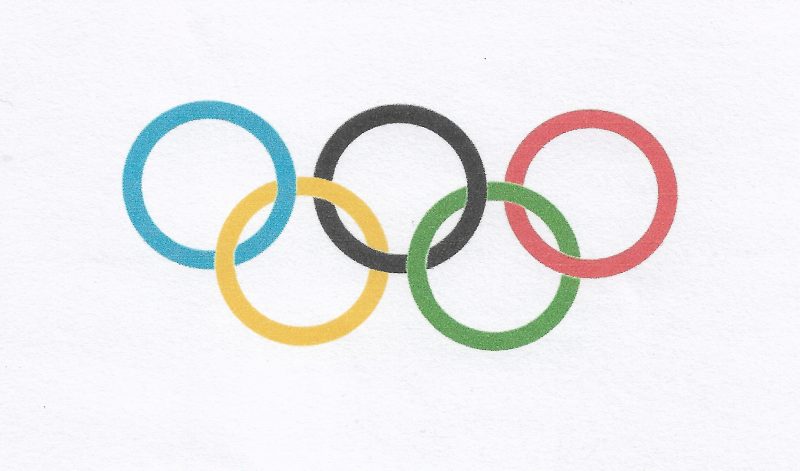
    A “modern” society (first modernity, Ulrich Beck) to the contrary can be characterized by the assumption that the different circles are much lesser overlapping, they are forming different spheres which have their laws and logics – we may label this a kind of functional differentiation (Niklas Luhmann) and it could either be characterized by the interaction and different functions of the organs of a body or the Olympic Rings.

    The spheres in which these rings are overlapping are the institutions in modern societies like the state, the political system, law and the judicial system, the church as an institution, labour unions and civil society.

    In liquid globalization and as a result of military interventions, civil wars, these rings of political, social, economic, and cultural and security spheres are separated from one another and could no longer be held together by a core identity.


    Within this model, there is a sphere that remains blank and could be characterized as a kind of emptiness. In such an understanding the social fabric is increasingly dissolved and especially the young generation is set free from all social norms. This concept is able to overcome the binary alternative which characterizes the discussion about the causes of terrorism, whether these actions are either related to an aggressive ideology or the social disintegration in societies and failed states, as in the ring of fire around Europe, mainly in the Arab-Islamic states, but also in Africa as a whole. It also explains why identity and recognition count so much in a lot of conflicts throughout the world.

    Based on this concept it becomes obvious that this emptiness can be filled with different content, for example with radical ideologies, private enrichments, drug, weapons and human trafficking, but also with the recourse to ethnic and even tribal identities, masculinity and patriarchy and finally violence itself which gives the excluded, superfluous (population growth) and uprooted young generation in these countries and regions the feeling not to be absolute powerless but all-powerful.

    The rise of the others in a globalized world is inevitable (Zakaria) – our task is to develop forms of recognition that centre on the civilizational foundations of Islam, Buddhism/Taoism, Confucianism, Christianity and Hinduism and African kinds of solidarity.

    The alternative to such a violent filling of the emptiness caused by liquid globalization is the mutual recognition of the civilizations of the earth. The rise of the others in a globalized world is inevitable (Zakaria) – our task is to develop forms of recognition that centre on the civilizational foundations of Islam, Buddhism/Taoism, Confucianism, Christianity and Hinduism and African kinds of solidarity. Only by recognizing their civilizational achievements, the uprooted, excluded and superfluous people of the world, which are the vast majority of mankind, can build an identity by their own in fluid globalization.

    Assuming that we all are already living in such spheres which are not overlapping, producing a kind of emptiness, the two different solutions might be to solve this problem by constructing a core as identity, which leads to thinking in categories of we against the rest of the far-right, whereas a different attempt would be to develop a discourse in which identity is constructed as a kind of floating (Clausewitz) and progressing (Hegel) balance or harmony (Confucius), understood as unity with difference and difference with unity.

  • Clausewitz or Sun Tzu: Re-Claiming the primacy of policy

    Clausewitz or Sun Tzu: Re-Claiming the primacy of policy

    World War I teaches the lesson that a limited conflict can escalate into a nightmare of millions of deaths and unspeakable suffering for which no rational explanation could be found. Military aims and strategies gained priority over meaningful political goals. Although the generals of the German Empire believed that they were relying on Clausewitz’s theory, they actually perverted it. Tactics replaced strategy, strategy replaced politics, politics replaced policy, and policy was militarized.

    The same occurred in the interval between the first and second wars in Iraq (1991 and 2003), which have seen a remarkable shift from Clausewitz to Sun Tzu in the discourse about contemporary warfare. Clausewitz enjoyed an undreamed-of renaissance in the USA after the Vietnam War and seemed to have attained the status of master thinker. On War enabled many theorists to recognise the causes of America’s traumatic defeat in Southeast Asia, as well as the conditions for gaining victory in the future. More recently, however, he has very nearly been outlawed. The reason for this change can be found in two separate developments. First of all, there has been an unleashing of war and violence in the ongoing civil wars and massacres, especially in sub-Saharan Africa, in the secessionist wars in the former Yugoslavia, in Syria and Yemen and in the persistence of inter-communal violence along the fringes of Europe’s former empires. These developments seemed to indicate a departure from interstate wars, for which Clausewitz’s theory appeared to be designed, and the advent of a new era of civil wars, non-state wars, and social anarchy. Sun Tzu’s The Art of War seemed to offer a better understanding of these kinds of war, because he lived in an era of never ending civil wars.

    The second reason for the change from Clausewitz to Sun Tzu is connected with the ‘Revolution in military affairs’ (RMA). The concepts of Strategic Information Warfare (SIW) and 4th generation warfare have made wide use of Sun Tzu’s thought to explain and illustrate their position. The ‘real father’ of ‘shock and awe’ in the Iraq war of 2003 was Sun Tzu, argued one commentator. Some pundits even claimed triumphantly that Sun Tzu had defeated Clausewitz in this war, because the US army seemed to have conducted the campaign in accordance with principles of Sun Tzu, whereas the Russian advisers of the Iraqi army had relied on Clausewitz and the Russian defence against Napoleon’s army in his Russian campaign of 1812. The triumphant attitude has long been abandoned, since it is now apparent that there is much to be done before a comprehensive approach of the Iraq War will be possible. Yet it seems fair enough to say that, if Sun Tzu’s principles are seen to have been of some importance for the conduct of the war, he must also share responsibility for the problems that have arisen afterwards.

    Sun Tzu’s The Art of War, as well as the theoreticians of Strategic Information Warfare, network centric warfare and 4th generation warfare, lack the political dimension with respect to the situation after the war. They concentrate too much on purely military success and undervalue the process of transforming military success into true victory.

    And this is exactly the problem. Sun Tzu’s The Art of War, as well as the theoreticians of Strategic Information Warfare, network centric warfare and 4th generation warfare, lack the political dimension with respect to the situation after the war. They concentrate too much on purely military success and undervalue the process of transforming military success into true victory. The three core elements of Sun Tzu’s strategy could not easily be applied in our times: a general attitude to deception of the enemy runs the risk of deceiving one’s own population, which would be problematic for any democracy. An indirect strategy in general would weaken deterrence against an adversary who could act quickly and with determination. Concentration on influencing the will and mind of the enemy may merely enable him to avoid fighting at a disadvantageous time and place, and make it possible for him to choose a better opportunity as long as he is in possession of the necessary means – weapons and armed forces.

    One can win battles and even campaigns with Sun Tzu, but it is difficult to win a war by following his principles. The reason for this is that Sun Tzu was never interested in shaping the political conditions, because he lived in an era of seemingly never-ending civil wars. The only imperative for him was to survive while paying the lowest possible price and avoiding fighting, because even a successful battle against one foe might leave one weaker when the moment came to fight the next one. As always in history, if one wishes to highlight the differences to Clausewitz, the similarities between the two approaches are neglected. For example, the approach in Sun Tzu’s chapter about ‘Moving swiftly to overcome Resistance’ would be quite similar to one endorsed by Clausewitz and was practised by Napoleon.

    But the main problem is that Sun Tzu is neglecting the strategic perspective of shaping the political-social conditions after the war and their impact ‘by calculation’ on the conduct of war. As mentioned before, this was not a serious matter for Sun Tzu and his contemporaries, but it is one of the most important aspects of warfare of our own times.
    Finally, one has to take into account the fact that Sun Tzu’s strategy is presumably successful against adversaries with a very weak order of the armed forces or the related community, such as warlord-systems and dictatorships, which were the usual adversaries in his times. His book is full of cases in which relatively simple actions against the order of the adversary’s army or its community lead to disorder on the side of the adversary, to the point where these are dissolved or lose their will to fight entirely. Such an approach can obviously be successful against adversaries with weak armed forces and a tenuous social base, but they are likely to prove problematic against more firmly situated adversaries.

    Clausewitz: a new Interpretation

    Nearly all previous interpretations have drawn attention to the importance of Napoleon’s successful campaigns for Clausewitz’s thinking. In contrast, I wish to argue that not only Napoleon’s successes but also the limitations of his strategy, as revealed in Russia and in his final defeat at Waterloo, enabled Clausewitz to develop a general theory of war. Clausewitz’s main problem in his lifelong preoccupation with the analysis of war was that the same principles and strategies that were the decisive foundation of Napoleon’s initial successes proved inadequate in the special situation of the Russian campaign and eventually contributed to his final defeat at Waterloo. Although Clausewitz was an admirer of Napoleon for most of his life, in his final years he recognised the theoretical significance that arose from the different historical outcomes that followed from the application of a consistent, but nevertheless single military strategy. He finally tried desperately to find a resolution that could reconcile the extremes symbolised by Napoleon’s success at Jena and Auerstedt, the limitations of the primacy of force revealed by the Russian campaign, and Napoleon’s final defeat at Waterloo.

    Therefore there can be found four fundamental contrasts between the early and later Clausewitz that need to be emphasised, because they remain central to contemporary debates about his work:

    a.   The primacy of military force versus the primacy of politics.
    b.   Existential warfare, or rather warfare related to one’s own identity, which engaged
    Clausewitz most strongly in his early years, as against the instrumental view of war that
    prevails in his later work.
    c.   The pursuit of military success through unlimited violence embodying ‘the principle
    of destruction’, versus the primacy of limited war and the limitation of violence in war,
    which loom increasingly large in Clausewitz’s later years.
    d.   The primacy of defence as the stronger form of war, versus the promise of decisive
    results that was embodied in the seizure of offensive initiative.

    Clausewitz’s final approach is condensed in his Trinity, which comes at the end of the first chapter of book I. The Trinity, with all its problems by its own, is the real legacy of Clausewitz and the real beginning of his theory, as he emphasised himself: ‘At any rate, the (…) concept of war [the Trinity, AH-R] which we have formulated casts a first ray of light on the basic structure of theory and enables us to make an initial differentiation and identification of its major components.’
    Clausewitz describes the trinity as follows: ‘War is more than a true chameleon that slightly adapts its characteristics to the given case. As a total phenomenon its dominant tendencies always make war a paradoxical Trinity – composed of primordial violence, hatred, and enmity, which are to be regarded as a blind natural force; of the play of chance and probability within which the creative spirit is free to roam; and of its element of subordination, as an instrument of policy, which makes it subject to pure reason.’

    The first chapter of On War, and the Trinity as Clausewitz’s result for theory at its end, are an attempt to summarise these quite different war experiences, and to analyse and describe a general theory of war on the basis of Napoleon’s successes, the limitations of his strategy, and his final defeat.

    Although Summers referred to Clausewitz’s concept of the Trinity in his very influential book about the war in Vietnam, he falsified Clausewitz’s idea fundamentally. 

    Clausewitz’s Trinity is quite different from so-called ‘trinitarian war’. This concept is not derived from Clausewitz himself but from the work of Harry G. Summers Jr. Although Summers referred to Clausewitz’s concept of the Trinity in his very influential book about the war in Vietnam, he falsified Clausewitz’s idea fundamentally. Clausewitz explains in his paragraph about the Trinity that the first of its three tendencies mainly concerns the people, the second mainly concerns the commander and his army, and the third mainly concerns the government. On the basis of this ‘mehr’ (mainly), we cannot conclude that ‘trinitarian war’ with its three components of people, army, and government is Clausewitz’s categorical conceptualisation of how the three underlying elements of his Trinity may be embodied.

    Since Summers put forward this conception it has been repeated frequently, most influentially by Martin van Creveld. On the contrary, it must be concluded that these three components of ‘trinitarian war’ are only examples of the use of the more fundamental Trinity for Clausewitz. These examples of its use can be applied meaningfully to some historical and political situations, as Summers demonstrated for the case of the war in Vietnam with the unbridgeable gap between the people, the army and the government of the USA. Notwithstanding the possibility of applying these examples of use, there can be no doubt that Clausewitz defined the Trinity differently and in a much broader, less contingent and more conceptual sense.

    Looking more closely at his formula, we can see that he describes war as a continuation of politics, but with other means than those that belong to politics itself.

    Clausewitz’s concept of the Trinity is explicitly differentiated from his famous formula of war, described as a continuation of policy by other means. Although Clausewitz seems at first glance to repeat his formula in the Trinity, this is here only one of three tendencies which all have to be considered if one does not want to contradict reality immediately, as Clausewitz emphasised. Looking more closely at his formula, we can see that he describes war as a continuation of politics, but with other means than those that belong to politics itself. These two parts of his statement constitute two extremes: war described either as a continuation of politics, or as something that mainly belongs to the military sphere. Clausewitz emphasises that policy uses other, non-political means. This creates an implicit tension, between war’s status as a continuation of policy, and the distinctive nature of its ‘other’ means.

    In the present discourse on the new forms of war Clausewitz stands representatively for the “old form” of war. One of the most common criticisms is that Clausewitz’s theory only applies to state-to-state wars. Antulio Echevarria, to the contrary, stated that “Clausewitz’s theory of war will remain valid as long as warlords, drug barons, international terrorists, racial or religious communities will wage war.” In order to harmonize this position with Clausewitz’s very few statements concerning state policy, his concept of politics must be stretched a long way. In this interpretation, it must mean something like the political-social constitution of a community. This interpretation is based on an often-neglected chapter in On War, in which Clausewitz deals with the warfare of the “semi barbarous Tartars, the republics of antiquity, the feudal lords and trading cities of the Middle Ages, 18th Century kings and the rulers and peoples of the 19th Century.” All these communities conducted war “in their own particular way, using different methods and pursuing different aims”. Despite this variability, Clausewitz stresses that war is also in these cases a continuation of their policy by other means.

    However, this makes it impossible to express the difference between the policy of states and the values, intentions and aims of the various communities waging war. Therefore, it would make sense to supplement the primacy of politics as a general category by the affiliation of the belligerents to a warring community. If these communities are states, one can speak of politics in the modern sense; if they are racial, religious or other communities, the value systems and goals of these communities (i.e. their “culture”) are the more important factors. Based upon this proposal, we could replace Clausewitz’s meaning of state with the notion of it being that of the intentions, aims or values of the “warring community,” thus remaining much more faithful to his understanding of what a state embodies. Otherwise, we would implicitly express a modern understanding of Clausewitz’s concept of state.

    Whereas Sun Tzu was generalising strategic principles for use against weak adversaries, which may lead to success in particular circumstances, Clausewitz developed a wide-ranging political theory of war by reflecting on the success, the limitations, and the failure of Napoleon’s way of waging war. 

    Taken into account this small change in understanding what Clausewitz was endorsing when speaking of “state policy” his trinity is the starting point for a general theory of war and violent conflict. Whereas Sun Tzu was generalising strategic principles for use against weak adversaries, which may lead to success in particular circumstances, Clausewitz developed a wide-ranging political theory of war by reflecting on the success, the limitations, and the failure of Napoleon’s way of waging war. Although he might have reflected merely a single strategy, he was able by taking into account its successes, limits, and failure to develop a general theory of war, which transcended a purely and historically limited military strategy.

    Clausewitz formulates also a crucial reminder. He stressed that, in his Russian campaign, Napoleon Bonaparte—who Clausewitz sarcastically called the “God of War”—won each individual battle of the war. At the end of this war, he was nevertheless the defeated one and had to return to Paris like a beggar, without his destroyed army. Altogether, in almost twenty years of war, Napoleon lost only three large battles—and nevertheless lost everything, since he provoked by the primacy of military success more resistance than his still very large army, the largest which the world at that time had seen, could fight. Despite his military genius, Napoleon was missing a fundamental characteristic: He was not a great statesman. Both qualities collected would have been necessary, in order to arrange from military strength a durable order of peace.


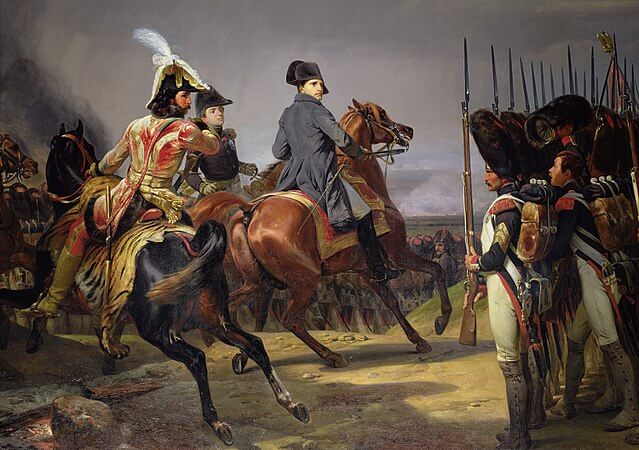
    Feature Image Credit: Battle of Jena – Wikimedia Commons

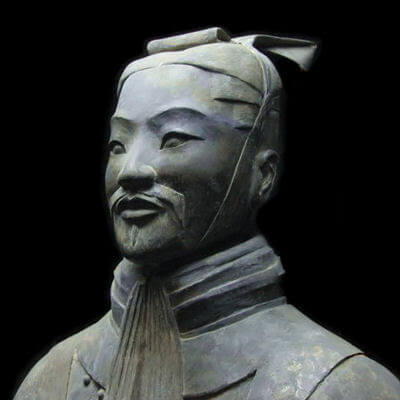
    Sun Tzu Image: Sun Tzu – The Art of War

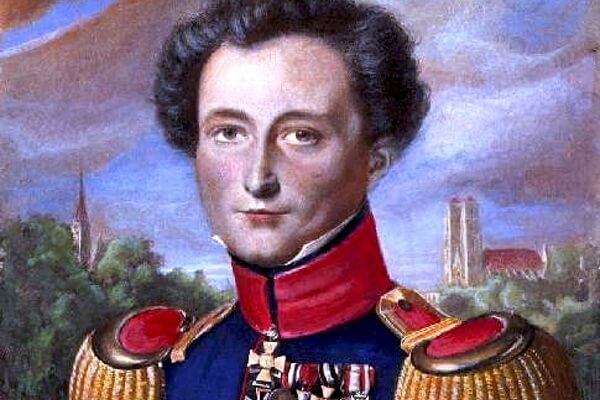
    Clausewitz Image: historynewsnetwork.org

  • Lessons from countering the corona-virus for war and violence:  Containment, Common Security and Cooperation

    Lessons from countering the corona-virus for war and violence: Containment, Common Security and Cooperation

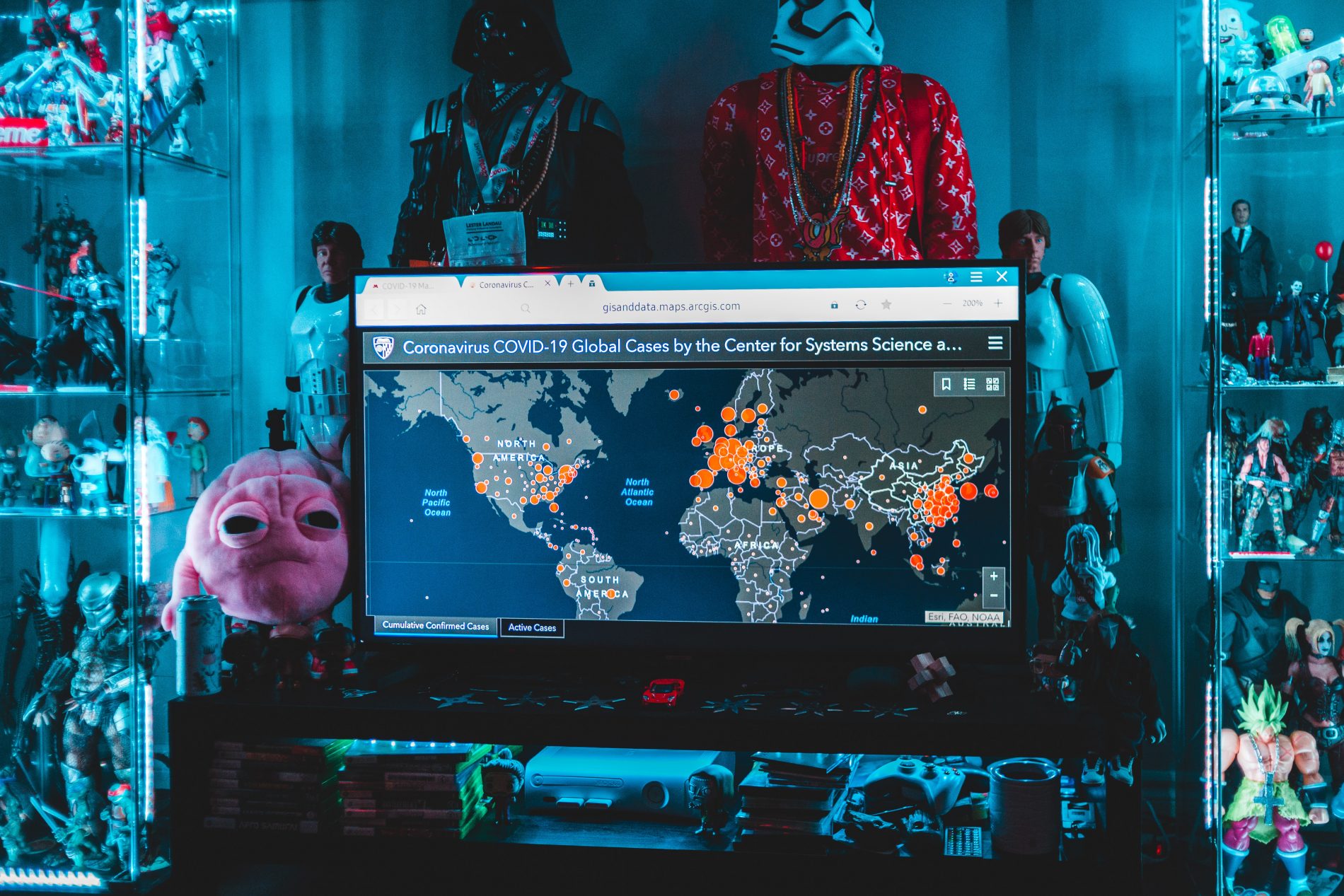
    The world is engulfed in the ‘Corona Virus’ pandemic. As national health systems are being stretched to their limits, countries are closing their borders, banning travel, and isolating themselves…all in an international co-operative strategy to contain its spread and eliminate this pandemic. Andreas Herberg-Rothe sees valuable lessons in this international co-operation to be used to contain war and violence. Taking a leaf out of the broad ‘containment theory’ articulated by the late George Kennan in an anonymous article published in 1947 in the FP magazine, Andreas proposes a containment strategy for the world from the scourge of terrorism, religious fanaticism, and wars for world dominance (both proxy as well as interventions). This strategy for ‘common security’ can succeed only if it respects pluralism of cultures, religions, and social orders…M Matheswaran.


    The initial measures against the spread of the new corona-virus could be summarized by one word – containment of the virus and hindering its spreading. This current prominence of the concept of containment could be used for other world problems. By having a closer look at the concept of containment it becomes obvious that it also included the concept of common security and cooperation – the same is true with the corona-virus. We are witnessing a worldwide expansion of war and violence, which should be countered by a new containment, just as George Kennan emphasized as early as 1987: “And for these reasons we are going to have to develop a wider concept of what containment means (…) – a concept, in other words, more responsive to the problems of our own time – than the one I so light-heartedly brought to expression, hacking away at my typewriter there in the northwest corner of the War College building in December of 1946.” Nearly seventy-five years have already passed, since George Kennan formulated his original vision of containment. Although his original concept would be altered, in application by various administrations of the US-Government, in practice it has been incorporated within the concept and politics of common security, which has been the essential complement to pure militarily containment. These ideas are still valid – and as Kennan himself pointed out, they are in more need of explication and implementation than ever.

    The disinhibition of war and a new containment

    The triumphant advance of democracy and free markets in the wake of the Soviet collapse seemed to be unstoppable, to the point where it appeared for a time as if the twenty-first century would be an age defined by economics and thus, to a great extent, peace.  However, these expectations were quickly disappointed, not only because of the ongoing massacres and genocide in Africa, but also by the return of war to Europe (primarily in the former Yugoslavia), together with the attacks of September 11, 2001 in the USA, the Iraq war, the war in Syria with its on-going, violent consequences. A struggle against a new totalitarianism of an Islamic type appears to have started, in which war and violence are commonly perceived as having an unavoidable role. One can also speak of a new dimension to violence with respect to its extent and brutality – as exemplified by the extreme violence of the ongoing civil wars in Africa and the Middle East.  Additionally we are facing completely new types of threats, for example the possession of weapons of mass destruction by terrorist organizations or the development of atomic bombs by “problematic” states like North Korea. The potential emergence of a new Superpower, China, and perhaps of new “great” powers like India may lead to a new arms race, which presumably have a nuclear dimension as well. In the consciousness of many, violence appears to be slipping the leash of rational control, an image the media has not hesitated for foster, especially with respect to Africa. Will there be “another bloody century,” as Colin Gray has proposed?

    Although the current situation and the foreseeable future is not as immediately ominous as in the Cold War, it may be even worse in the long run. On one side, the prospect of planetary self-destruction via nuclear overkill, which loomed over the Cold War– and what could be worse than that, has been successfully averted. On the other hand, after having been granted a brief respite in the 1990s, mankind now feels itself to be confronting a “coming anarchy” of unknown dimensions and a new conflict between the US and China seems to be inevitable. If the horrific destructive potential threat of the Cold War has been reduced in scale, less cataclysmic possibilities have also become more imminent.

    As compared to the Cold War, there is no longer an exclusive actor to be contained, as the Soviet Union was. Even if one were to anticipate China’s emergence as a new superpower in the next twenty years, it would not be reasonable, in advance of this actually happening, to  develop a strategy of military containment against China similar to that against the Soviet Union in the 50s and 60s of  last century, since doing so might well provoke the kind of crises and conflicts that such a strategy would be intended to avoid. The attempt to build up India as counter-weight to China and facilitating its nuclear ambitions, for instance, might risk undermining the international campaign to limit the proliferation of nuclear weapons in the world. Therefore we need quite another concept of containment, which could not be perceived as a threat to China.

    The second difference is, that current developments in the strategic environment display fundamentally conflicting tendencies: between globalization and struggles over identities, locational advantages, and interests; between high-tech wars and combat with “knives and machetes” or suicide bombers; between symmetrical and asymmetrical warfare; between the privatization of war and violence and their re-politicization and re-ideologization as well as wars over “world order”; between the formation of new regional power centres and the imperial-hegemonic dominance of the only Superpower; between international organized crime and the institutionalization of regional and global institutions and communities; between increasing violations of international law and human rights on one side  and their expansion on the other. A strategy designed to counter only one of these conflicting tendencies may be problematic with respect to the others.  I therefore stress the necessity of striking a balance between competing possibilities.

    The third difference is that the traditional containment was perceived mainly as military deterrence of the Soviet Union, although in its original formulation by George Kennan it was quite different from such a reductionism. Our main and decisive assumption is that a new containment must combine traditional, military containment on one side, and a range of opportunities for cooperation on the other. That’s not only necessary with respect to China, but even to the political Islam, in order to reduce the appeal of militant Islamic movements to millions of Muslim youth.

    Such an overarching perspective has to be self-evident, little more than common sense, because it has to be accepted by quite different political leaders and peoples. The self-evidence of this concept could go so far that one could ask why we are discussing it. On the other hand, such a concept must be able to be distinguished by competing concepts. Last but not least, it should be regarded as an appropriate concept to counter contemporary developments. Finally, taking into account, that Kennan’s concept would not have succeeded, if it had been directed against the actions of the international community or the United States, it should be to some extend only brings to expression, what the international community is already doing anyway.

    A concept that realized these demands of a political concept for contemporary needs was that of “common security”, developed in the 1970s. In the special situation of the cold war and of mutual deterrence this concept didn’t imply a common security shared among states with similar values and policies. On the contrary, this concept, perhaps developed for the first time by Klaus von Schubert, emphasized a quite different meaning. Traditionally, opponents have understood security as security from each other. The new approach laid down by Klaus von Schubert derived from the assumption, that in a world of multiple capacities of annihilating the planet, security could only be defined as common security. This small difference between security from each other and common security — shared security against a universal threat — was nothing less than a paradigm change in the Cold war.

    The question of course remains, how to deter the true-believers, members of terrorist networks or people like the previous President of Iran, for whom even self-destruction may be a means of hastening millenarian goals. Of course, the “true-believers” or the “hard-core terrorist” could hardly be deterred. But this is just the reason, why containment should not be reduced to a strategy of deterrence. The real task even in these cases therefore is to act politically and militarily in a manner, that would enable to separate the “true believers” from the “believers” and those from the followers. This strategy can include military actions and credible threats, but at the same time it should be based on a double strategy of offering a choice between alternatives, whereas the reduction to military means would only intensify violent resistance. Additionally, even the true believers could be confronted with the choice, either further to be an accepted part of their social and religious environment (or to be excluded from them) or to reduce their millenarian aspirations. Of course, by following this strategy, there is no guarantee, that each terrorist attack could be averted. But this is not the real question. Assuming, that the goal of the terrorists and millenarian Islamists is to provoke an over-reaction of the West in order to ignite an all-out war between the West and the Islamic world, there is no choice than trying to separate them from their political, social and religious environment.

    The concept of containment and contemporary warfare

    The goal of the war on terror should not try to gain victory, because no one could explain, what victory would mean with regard to this special war. Moreover, trying to gain a decisive victory about the terrorists would even produce much more of them.  The additional problem is not only, how we ourselves conceive the concept of victory, but even more important, in which ways for example the low-tech enemies define victory and defeat. That is an exercise, that requires cultural and historical knowledge much more than it does gee-whiz technology.

    Instead one could argue, that the goal is “to contain terror”, which is of course something quite different from appeasement.  An essential limitation of the dangers, posed by terrorist organizations could be based on three aspects: first, a struggle of political ideas for the hearts and minds of the millions of young people; second the attempt to curb the exchanges of knowledge, financial support, communication between the various networks with the aim of isolating them on a local level; and finally, but only as one of these three tasks, to destroy what one could label the terrorist infrastructure. In my understanding, trying to achieve victory in a traditional military manner would not only fail, but additionally would perhaps lead to much more terrorism in the foreseeable future.

    The concept of the “centre of gravity” in warfare can provide another illustration of the way in which my conception makes a difference. Clausewitz defines war as an act of violence to compel our enemy to do our will. This definition suits our understanding of war between equal opponents, between opponents in which one side doesn’t want to annihilate the other or his political, ethnic or tribal body. But in conflicts between opponents with a different culture or ethnic background, the imposition of ones will on the other is often perceived as an attempt to annihilate the other’s community and identity. Hence, for democratic societies, the alternative is only to perceive war as an act of violence where, rather than compelling our own will to the opponent, your opponent is rendered unable any more to pursue his own will violently, unable to use his full power to impose his will on us or others. Consequently the abilities of his power must be limited, that he is no more able to threaten or fight us in order to compel us to do his will.

    The purpose of containing war and violence, therefore, is, to remove from the belligerent adversary his physical and moral freedom of action, but without attacking the sources of his power and the order of his society. The key to “mastering violence” is to control certain operational domains, territory, mass movement, and armaments, but also information and humanitarian operations. But this task of  “mastering violence” should no longer be perceived as being directed against the centre of gravity, but to the “lines” of the field of gravitation. Instead of an expansion of imposing one’s own will on the adversary up to the point of controlling his mind, as the protagonists of Strategic Information Warfare put it, the only way of ending conflict in the globalized  21st century is to set limits for action, but at the same time to give room for action (in the sense, Hannah Arendt used this term) and even  resistance, which of course has the effect of legitimising action within those limits.

    The overall political perspective on which the concept of the containing of war and violence in world society rests therefore consists of the following elements, the “pentagon of containing war and violence”:

    ▪ the ability to deter and discourage any opponent to fight a large scale war and to conduct pin-point military action as last resort,

    ▪ the possibility of using military force in order to limit and contain particularly excessive, large-scale violence which has the potential to destroy societies;

    ▪ the willingness to counter phenomena which help to cause violence such as poverty and oppression, especially in the economic sphere, and also the recognition of a pluralism of cultures and styles of life in world society;

    ▪ the motivation to develop a culture of civil conflict management (concepts which can be summed up with the “civilizational hexagon”, global governance, and democratic peace), based on the observation, that the reduction of our action to military means have proved counterproductive and would finally overstretch the military capabilities

    and

    ▪ restricting the possession and proliferation of weapons of mass destruction, their delivery systems, as well as of small arms, because the unhindered proliferation of both of them is inherently destructive to social order.

    The position I have put forward is oriented towards a basically peaceful global policy, and treats the progressive limitation of war and violence as both an indefinite, on-going process and as an end in itself. The lasting and progressive containment of war and violence in world society is therefore necessary for the self-preservation of states, even their survival and of the civility of individual societies and world society.    

    Image Credit:Photo by Erik Mclean on Unsplash


  • The end of the liberal world order is not the end of the world – we just need to fight for freedom AND equality

    The end of the liberal world order is not the end of the world – we just need to fight for freedom AND equality

    The turmoil concerning Brexit, the Rise of the „Rest” (the fast developing countries), dramatic social inequality, the exclusion of ever larger parts of the populace (the decline of the „Rest“, which is excluded from globalization), the rise of radical Salafism, all these developments have contributed to worldwide emotions, that the promises of globalization have been disappointed and been revealed as illusions. When Juergen Habermas, the noted German philosopher judged in 1991 concerning the democratic revolutions in the former states of the Warsaw treaty, that Western modernity would now transcend into the Orient not only with its technical achievements, but also with its emancipatory and democratic principles he was hardly more than the prisoner of the idealism concerning Western modernity. Although being fully aware of the negative impact of two world wars, colonization and its exorbitant violence, Auschwitz and the Cold War, and fighting for his whole life against a repetition of these developments he still believed to be able to rely on a cleaned, purified Western modernity, an approach which his companions, Anthony Giddens and Ulrich Beck, labeled second modernity. Again, in the years starting with the Arab Rebellion or the Arab Spring it seemed as if the conceptions of democracy, human rights and freedom were transcending from the Western world to the Orient, and its final victory seemed to be plausible – a purified Western modernity would triumph in the end – and Francis Fukuyama wrote his second masterpiece by arguing that at the end of history still stands democracy. But now we are already discussing post-democracy and Paraq Khanna is labeling the current phase as devolution – struggles for a local or at least regional identity.

    The liberal world order after 1991 was based on capitalism (centered on property as natural and human right), the assumption that worldwide free trade will finally lead to peace (economic globalization) and is accompanied by the orientation towards consumerism as a cultural norm. But consume does neither generate values nor identity. International organizations served the purpose of regulating conflicts between sovereign states and the military, political and economic hegemony of the United States secured this kind of liberal world order, or rather the United States payed the costs (this is the point Trump hangs up), both, out of their own interest or as being the trustee of the whole. This liberal world order now is tattered in fragments, not least because the US under Trump abandoned it willfully, whereas the Europeans are desperately trying to preserve it but don’t stand a chance, because they are relying on an idealized past which never existed in the developing and poor countries.

    Contrary to the assumptions of the pundits of glo-calization (Robertson and Bauman), the local showed to be not only an amendment of neoliberal globalization, but a counter-movement to the process of globalization (IS, Trump, „Buy American“, Brexit, Marine Le Pen, Duterte, Bolsonaro, Salafism, the European radical right, populistic movements). In his notes on Nationalism, George Orwell already wrote, that emotion does not always attach itself to a nation. It can attach itself to a church or a class, or it may work in a merely negative sense, against something or other – we can add against anybody, who does not belong to “us”. In short: We against the Rest. But the “Rest” is not far away anymore, as in neoliberal globalization the regions in Sub-Saharan and Saharan Africa, in southern India, in the MENA-states, but they are within the West (either as excluded sub-proletarians, the precariat, or as refugees). Although being a counter-reaction, the current waves of struggles for local identities and advantages are as a negation bound to neo-liberal globalization, the globalization of liberalism without equality, which we label tribal globalization.

    The advent of tribal globalization does not signify the end of globalization, but the end into the illusions into globalization, which nevertheless has its undisputed successes. But there is no way back to an idealized globalization before Trump, Salafism, or an idealized neo-liberal world-order, because these developments were exactly the result of which they are purporting to fight. The exclusion of the „superfluous“, the „Rest“, produced by neo-liberal globalization, the advent of precarious kinds of life and the liquidity of identity throughout the world must be understood as a double one: The “Rest” is excluded from the positive aspects of globalization and people who are belonging to the  Rest are the arbitrarily used enemy-image to construct a fixed „We“-identity („We against the Rest”). And this “Rest” comprises roughly two third of the world’s populace. As the neo-liberal globalization has led to such a social acceleration of the transformation of the whole world,  people, communities and polities of all kinds are trying to cope with this process by re-inventing age-old static identities, which are so old, that it is supposed that these will outdo even this transformation. Such seemingly fixed identities are: Race, ethnicity, religion, patriarchy, and – perhaps the oldest one, sex and gender (this can explain the terrible rise of violence against women); and of course, identity through the exercise of violence itself, which is reverting the feeling of being totally powerless into being almighty. Especially biological differences are re-actualized, because they seem to be not subject to change.

    These seemingly fixed identities are those of the pluperfect, the far distant past, which can be viewed as being free from the failures of the simple past, and mainly free from the failure of the immediate fathers – as already was typically for the German Nazis. Tribal identity is a perfect construction, because it is transporting the ideal of being absolutely united against everybody who is not belonging – and the question: Do I belong is the most important question in tribal globalization. Whereas tribes throughout the world are vanishing, tribal thinking in terms of „We against the Rest“ is flourishing. Such a modern tribe could be based on ethnicity, religion, sex, nation or whatsoever, it is not the content, which characterizes a modern tribe, but having a tribal identity (typically is Trump’s crony capitalism and with relation to the IS, not their ideology is so much counting, but belonging to a previously powerful tribe). With the emergence of tribal globalization, the very understanding of local order and world order is at stake; order wars are arising, when our order or that of others is dissolving (either only in our perception or in reality); our own order is challenged by another concept or and another order is transgressing into our own (the refugee crisis in Europe). The fast developing countries are not immune concerning the accelerated transformation of societies and identities and the task to cope with this development.  As the main problem of neo-liberal globalization is the dissolution of identities and the exclusion of ever growing parts of the populace, that of the emerging tribal globalization the re-invention of age-old fixed identities, which is leading to order wars, what might be a solution?

    Based on the concept of the floating (Clausewitz) and developing (Hegel) balance and harmony (Confucius), we strongly advocate the position, that the West as well as the East is only able to hold on their order and values, if these are discursively balanced and harmonized by the contribution of all great civilizations of the earth. Although the liberal world had its undisputed advantages like the rise of the newly industrialized nations, the current developments are already indicating its end. To put it to the core: freedom as the basis of the liberal world order is turning into oppression or civil wars without equality– just in the name of freedom. Whereas in the 20th century the colonized civilizations had to learn to live with the victorious West, in the twenty-first century the civilizations of the earth finally have to learn to live with one another. This task requires a floating balance (Clausewitz) between freedom and equality, a kind of harmony (Confucius: difference with unity and unity with difference) within societies and between states.

    Image Credit: WikiImages from Pixabay