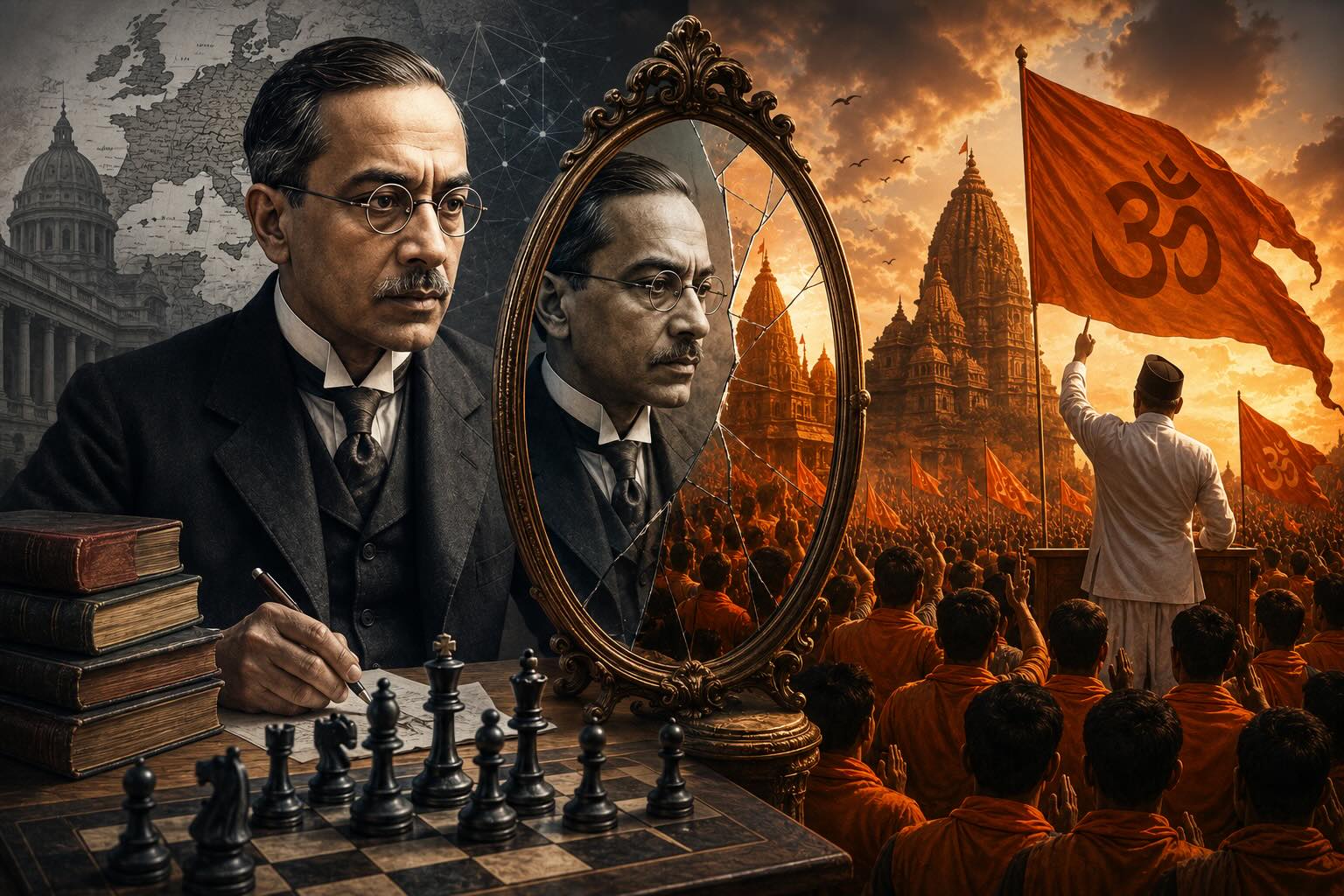
Series Prologue: Part 3
Series: India’s Strategic Choices and Civilisational Responsibilities
The ideology that today presents itself as the authentic voice of Hindu civilisation was constructed by an atheist using conceptual tools borrowed from European ethnic nationalism — the very tradition most alien to India’s own pluralist philosophical inheritance.
In the previous two posts in this prologue, I traced the material foundations and ideological engine of five centuries of Western domination. I argued that India’s civilisational traditions offer a fundamentally different foundation for the emerging world order: pluralist, ethically grounded, and rooted in the universal kinship expressed in Kanian Poongundranar’s “Yaadhum Oorey, Yaavarum Kelir” and the Thirukkural’s vision of Aram, Porul, and Inbam. But intellectual honesty requires that the mirror be turned inward. Because the logic of exceptionalism — the claim to a uniquely chosen identity that exempts a community from the ethical constraints applying to others — is not exclusively a Western pathology. It is a temptation that every civilisation faces when political power finds it useful. And India is not immune.
The ideology known as Hindutva, which exercises dominant political influence in India today, must be examined with the same analytical rigour we have applied to Western and Zionist exceptionalism. Not because the comparison is comfortable — it is not — but because intellectual integrity demands it, and because India’s civilisational integrity depends on it. The examination is best conducted in three stages, because the ideology was not built in one.
Stage One: The Founder Who Separated the Nation from the Faith
The first and most important fact is one the movement rarely acknowledges: “Hindutva is not Hinduism.” Hindutva was founded by an atheist, and it was not, in its original formulation, a religious idea at all. Vinayak Damodar Savarkar, who coined the term in his 1923 pamphlet ‘Essentials of Hindutva’, was a self-declared atheist, rationalist, and materialist. He rejected scripture, ridiculed cow worship and ritual superstition, and championed European scientific temper over what he saw as the dead weight of religious tradition. He was explicit that Hindutva was not Hinduism. He defined a ‘Hindu’ not by religious belief but by three criteria: Pitribhumi, a common fatherland; Jati, a common race or descent; and Sanskriti, a common culture. A Hindu, in Savarkar’s definition, need not believe in any god at all. What mattered was that India was both his fatherland and his Holyland — a territorial and ethnic test, not a spiritual one.
Savarkar defined a ‘Hindu’ not by religious belief but by three criteria: Pitribhumi, a common fatherland; Jati, a common race or descent; and Sanskriti, a common culture.
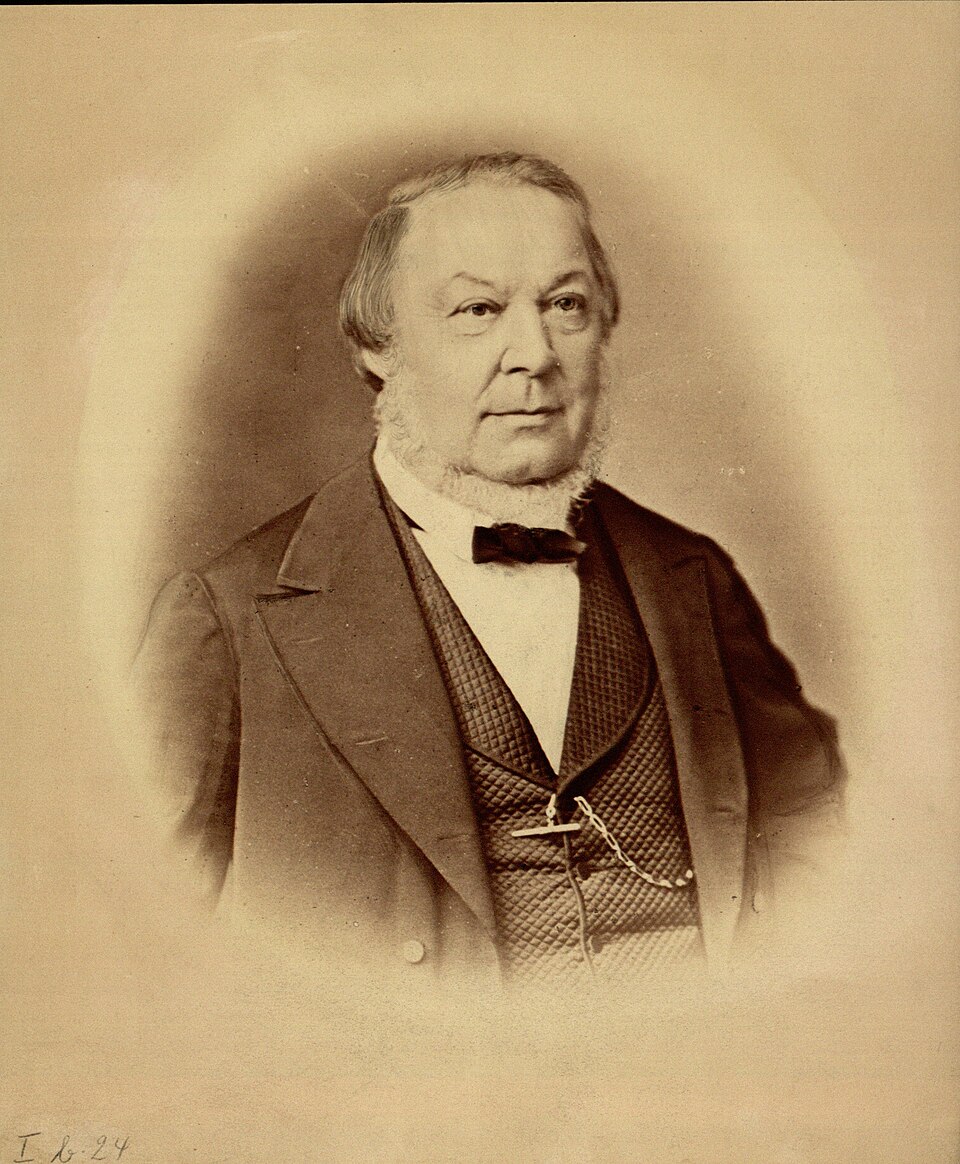
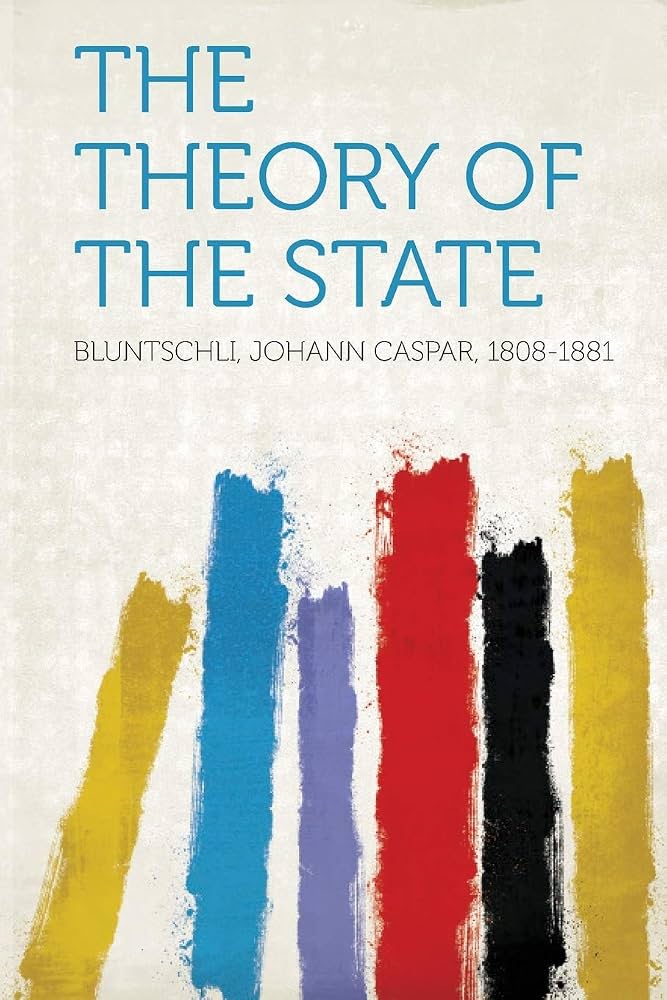 Where did this conception come from? Not from the Vedas, the Upanishads, or any Hindu philosophical source. It came from Europe. Savarkar’s framework of organic ethnic nationalism drew on the nineteenth-century European tradition of the nation as a racial-cultural organism — the tradition of the Swiss-born jurist Johann Kaspar Bluntschli, who worked within German Staatslehre and distinguished between a nation’s racially rooted ‘principal’ people and those he regarded as alien to it. It drew, too, on the ethnic nationalisms then ascendant across Europe, the same intellectual currents that were hardening elsewhere into far darker forms. This is the first irony, and it is foundational: the ideology that today presents itself as the authentic voice of Hindu civilisation was constructed by an atheist using conceptual tools borrowed from European ethnic nationalism — the very tradition most alien to India’s own pluralist philosophical inheritance.
Stage Two: The Fusion of Ethnic Nationalism with Religious Sentiment
If Savarkar’s Hindutva was a rationalist, secular-ethnic nationalism, how did it become the religiously charged mass movement we see today — mobilising temple, festival, deity, and devotional feeling for political ends? The answer is that this was a second and distinct stage, carried out by different men, for a different purpose: mass mobilisation.
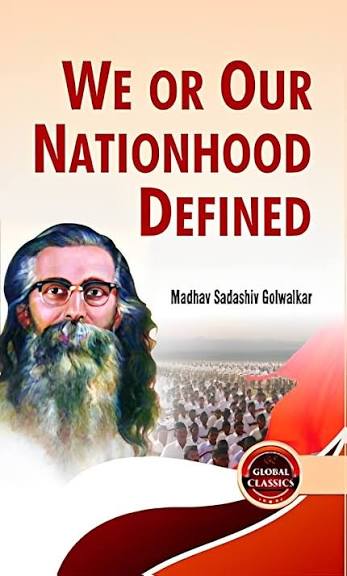
M.S. Golwalkar, who led the Rashtriya Swayamsevak Sangh from 1940 to 1973, shifted the register decisively. Where Savarkar grounded the nation in race and territory and had little use for religion as such, Golwalkar infused the project with Hindu spiritual and metaphysical content — the sacredness of Bharat, the dharmic mission of the Hindu people, a civilisational destiny cast in religious language. Deendayal Upadhyaya’s doctrine of ‘Integral Humanism,’ adopted in 1965 and later made the official ideology of the Jana Sangh and then the Bharatiya Janata Party, further anchored the political project in a claimed Hindu spiritual essence. The reason for the shift is not difficult to understand. An abstract theory of ethnic nationalism, however rigorously constructed, cannot move a population. Religious sentiment — festival, symbol, deity, the deep and genuine devotional attachment of hundreds of millions of people — is among the most powerful mobilising forces in human affairs. The movement discovered what its rationalist founder had not prioritised: that to win a nation, you must reach its heart, and in India the heart is substantially religious.
One need not impute cynical motive to any individual to observe the structural result. A political ideology founded on secular-ethnic lines was, over subsequent decades, fused with the religious devotion of the Hindu masses — and in that fusion, the crucial distinction Savarkar himself had insisted upon, between Hindutva the political-national identity and Hinduism the faith, was quietly erased. The movement that claims to defend Hindu dharma was built on a foundation laid by a man who had little personal use for dharma as religion at all.
And Savarkar himself never crossed over. He remained an atheist and rationalist to the end of his life — campaigning against ritualism and caste orthodoxy through his Ratnagiri years, opening the Patit Pavan Mandir to all castes, arguing for care of the cow as a useful animal rather than worship of it as a sacred one. His relations with the RSS were notably cool; he scorned its abstention from politics, and Golwalkar’s mysticism belonged to a register the materialist Savarkar never adopted. His death in 1966 was a final statement: he ended his life by voluntarily renouncing food and medicine, justified in a rationalist essay, and his will forbade religious rites — no priests, no rituals, a motorised hearse in place of the traditional bier. The founder kept Hindutva and Hindu religiosity separate for eighty-three years, to the point of a ritual-free funeral. The fusion of the two was not his evolution. It was a second construction, built around him and after him — which is precisely why it can be unbuilt.
The Zionism Parallel: A Precise Structural Homology
This two-stage pattern is not unique to Hindutva. It follows, with striking precision, the trajectory of political Zionism — and the comparison is instructive rather than incidental. Theodor Herzl, the founder of political Zionism, was a secular, largely non-religious Viennese journalist. His 1896 work Der Judenstaat is a political and national argument, not a religious one; early political Zionism was in large part a secular nationalist movement, and many Orthodox religious authorities initially opposed it precisely because it presumed to force a national project onto what they regarded as a matter of faith and divine timing. Only later did the movement fuse itself with religious claim — the theological reading of the land, the mobilisation of scripture, and the memory of the Holocaust deployed as a unifying and legitimating force. The structure is identical to the Hindutva trajectory: a secular founder formulates an ethnic-national ideology; later leaders infuse it with religious sentiment and collective memory to achieve mass appeal and to place the project beyond ordinary political criticism.
The Warning: Where this Trajectory Leads
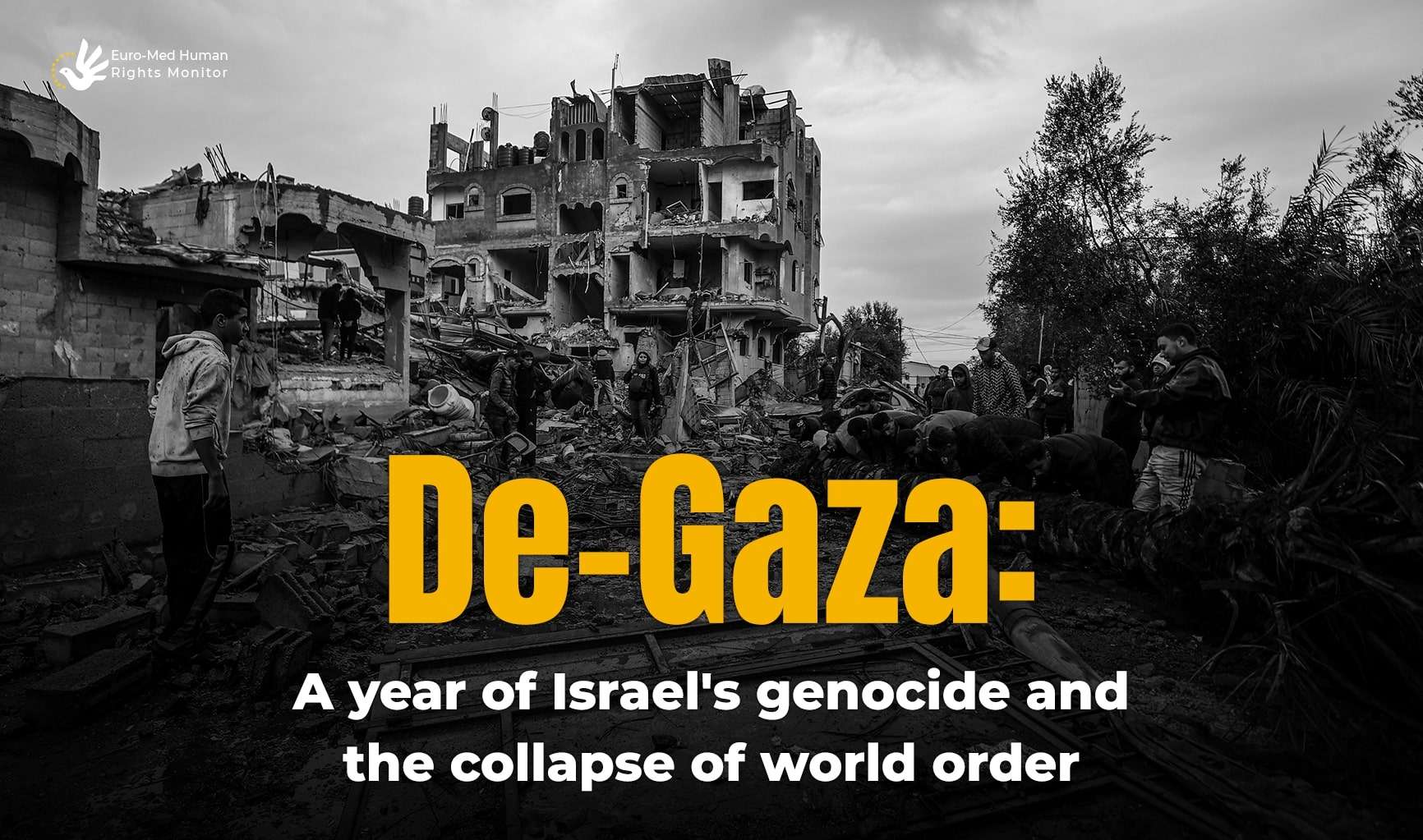
And here the parallel carries a warning that thoughtful Indian people cannot afford to ignore. For if Hindutva’s path resembles Zionism’s in how the ideology is built, we must look honestly at where that path has led. The fusion of a secular-ethnic nationalism with religious claim did not strengthen the moral standing of the project it produced. It corrupted it. The state that emerged now stands, in the aftermath of Gaza, in a condition of profound moral and political isolation — its conduct condemned across much of the world, its claim to act in the name of an ancient faith increasingly repudiated by the faithful themselves. Many Jews who practise Judaism as a religion and a moral tradition have publicly dissociated themselves from the actions of the Israeli state, insisting on the very distinction this essay draws: that a faith is not the same as a political-national project conducted in its name, and that the project does not speak for the faith. Judaism, one of humanity’s great ethical traditions, has been ill-served by what has been done in its name.
Many Jews who practise Judaism as a religion and a moral tradition have publicly dissociated themselves from the actions of the Israeli state, insisting on the very distinction this essay draws: that a faith is not the same as a political-national project conducted in its name, and that the project does not speak for the faith. Judaism, one of humanity’s great ethical traditions, has been ill-served by what has been done in its name.
The warning for India is exact. Hindutva today shows every sign of being on a similar trajectory — the same fusion of ethnic nationalism with mobilised religious sentiment, the same erasure of the distinction between a faith and a political project, the same tendency to place that project beyond criticism by wrapping it in the sacred. If it continues down that path, it risks doing to Hinduism what political Zionism’s corruption has done to Judaism: isolating it, discrediting it, and betraying its deepest moral content — all in the name of defending it.
Why This Matters: And What is at Stake
This is why the distinction between Hinduism and Hindutva is not academic hair-splitting. It is the difference between a civilisation and an ideology that has captured its name. Hinduism is one of the oldest and most philosophically sophisticated traditions on earth. It has no single founding prophet, no single canonical scripture, no orthodoxy, and no mechanism for excommunicating heretics — because diversity of belief and inquiry is not a problem to be solved but the natural condition of a tradition too vast for any single formulation to contain. Its foundational statement, from the Rigveda, is Ekam Sat Vipra Bahudha Vadanti: truth is one, the wise call it by many names. It gave the world the Upanishads, the Jain Anekantavada — the many-sidedness of truth — the Buddha and Mahavira, the Bhakti and Sufi streams, the Tamil saint Vallalar’s image of the many religions as rivers merging into a single shoreless ocean. It is, arguably, the most spiritually plural and philosophically generous civilisational inheritance humanity possesses.
Hinduism is one of the oldest and most philosophically sophisticated traditions on earth. It has no single founding prophet, no single canonical scripture, no orthodoxy, and no mechanism for excommunicating heretics — because diversity of belief and inquiry is not a problem to be solved but the natural condition of a tradition too vast for any single formulation to contain.
Hinduism’s foundational statement, from the Rigveda, is Ekam Sat Vipra Bahudha Vadanti: truth is one, the wise call it by many names. It gave the world the Upanishads, the Jain Anekantavada — the many-sidedness of truth — the Buddha and Mahavira, the Bhakti and Sufi streams, the Tamil saint Vallalar’s image of the many religions as rivers merging into a single shoreless ocean. It is, arguably, the most spiritually plural and philosophically generous civilisational inheritance humanity possesses.
A country with over 200 million Muslim citizens — the second-largest Muslim population in the world — cannot credibly champion the Global South, the voice of universal human dignity, or the reform of the world order, if its dominant political ideology frames those citizens as the internal Other. And an ideology founded by an atheist on borrowed European ethnic-nationalist theory, later dressed in religious sentiment for political mobilisation, cannot be the authentic voice of the tradition of Ekam Sat and Anekantavada. It is, in the most precise sense, that tradition’s negation.
The strongest argument against Hindutva, therefore, is not secular liberalism, and not the critique of any political party. It is Hindu philosophy itself — the Upanishads, the Thirukkural, the Anekantavada, Vallalar’s Ocean, the Sangam world’s ‘Yaadhum Oorey, Yaavarum Kelir’. These traditions do not need political exceptionalism to survive; they are diminished by it.
“Ekam Sat Vipra Bahudha Vadanti: truth is one; the wise call it by many names” – Rigveda
Safeguarding India’s civilisational soul from the exceptionalism now deforming it from within is not an act of opposition to Hindu culture. It is its most authentic defence — and it is a task for every Indian who understands the depth of what is being risked.
— This is the third and final part of the series prologue. The series proper begins with the next post.
A companion essay, ‘The Constitution or the Manusmriti: India’s Civilisational Choice,’ extends this argument and is available at thepeninsula.org.in.
Air Marshal M Matheswaran (Retd) is the Founder-President of The Peninsula Foundation (@TPF_Chennai), grounded in the conviction that India’s greatest strength is its civilisational pluralism — and that any ideology, domestic or foreign, that threatens that pluralism threatens India itself.
Further Reading:
On Savarkar, his atheism, and the formulation of Hindutva:
Vinayak Damodar Savarkar, Essentials of Hindutva (1923); republished as Hindutva: Who Is a Hindu? (1928).
Janaki Bakhle, Savarkar and the Making of Hindutva (Princeton University Press, 2024).
The definitive intellectual biography; on Savarkar’s atheism, rationalism, and the territorial-ethnic (not religious) definition of the Hindu.
Vikram Visana, ‘Savarkar before Hindutva: Sovereignty, Republicanism, and Populism in India, c. 1900–1920,’ Modern Intellectual History (Cambridge University Press, 2021).
On Savarkar’s debt to European ethnic-nationalist thought, including Bluntschli.
Johann Kaspar Bluntschli, The Theory of the State (1875; English trans. Clarendon Press, 1885).
Bluntschli was Swiss-born (Zurich, 1808), working within the German tradition of Staatslehre.
On the shift to religious mass mobilisation — Golwalkar and Upadhyaya:
M.S. Golwalkar, We, or Our Nationhood Defined (1939) and Bunch of Thoughts (1966).
Deendayal Upadhyaya, Integral Humanism (1965).
Christophe Jaffrelot, The Hindu Nationalist Movement and Indian Politics, 1925 to the 1990s (Hurst, 1996).
On the RSS’s development and the religious infusion of Savarkar’s originally secular-ethnic framework.
Chetan Bhatt, Hindu Nationalism: Origins, Ideologies and Modern Myths (Berg, 2001).
On political Zionism, its secular origins, and Jewish dissent:
Theodor Herzl, Der Judenstaat (The Jewish State) (1896).
Shlomo Sand, The Invention of the Jewish People (Verso, 2009).
Yakov M. Rabkin, A Threat from Within: A Century of Jewish Opposition to Zionism (Fernwood/Zed Books, 2006).
On the theological and secular Jewish opposition to political Zionism, from its origins to the present.
On Hindu philosophical pluralism:
Rigveda, 1.164.46: Ekam Sat Vipra Bahudha Vadanti.
Ramalinga Adigalar (Vallalar), Thiru Arutpa, Sixth Thirumurai, Verse 3907.
Thiruvalluvar, Thirukkural. Trans. P.S. Sundaram (Penguin, 1990).
Amartya Sen, The Argumentative Indian (Penguin, 2005).
Wendy Doniger, The Hindus: An Alternative History (Penguin, 2009).
Feature Image Credit: Savarkar and Hindutva – image made with AI assistance.