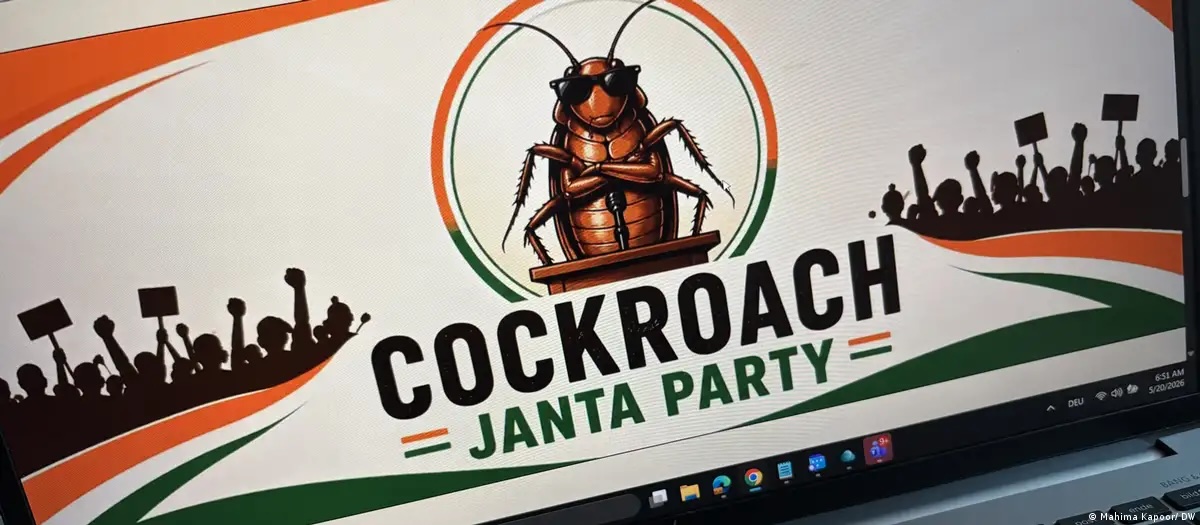
India banned a joke on national security grounds. The joke went to court, found a cause, and began to splinter — all in a single week. None of it is a revolution yet. All of it is worth watching.

When the Chief Justice of India reportedly likened unemployed young people to cockroaches and parasites, he was not making policy. He was making a mistake. The clarification came within a day — he meant only holders of fake degrees; the youth are “the pillars of a developed India.” But the insult had escaped. Within a week, a satirical “Cockroach Janta Party,” its name a mocking echo of the ruling party, had drawn more than twenty-two million Instagram followers — more than double the BJP’s, well past the Congress’s — along with a million sign-ups and a petition. Then the government did the most revealing thing it could have done. It treated the joke as a threat to India’s sovereignty.
On the twenty-first of May, the Ministry of Electronics and Information Technology ordered the party’s account to be blocked under Section 69A of the IT Act, acting on Intelligence Bureau inputs alleging it endangered national security. No public order was published; the directive remains secret under the blocking rules. The website went dark, the founder’s personal pages were hacked, and — by his account — the death threats arrived, one reportedly promising he could be “murdered even in America.” Sit with the official rationale, because it collapses under its own weight. A state cannot, in one breath, tell its citizens that something is a frivolous meme and that it imperils the nation. By reaching for the sovereignty of India against an Instagram page, the government made a public confession about which of the two it believes. A confident order ignores satire. It does not invoke the Intelligence Bureau against it.
That is the first thing worth noticing, and it is not the follower count. It is the asymmetry. A throwaway courtroom remark, instantly retracted, produced a movement; a movement of memes produced a national-security order. When effects keep dwarfing their causes like this, the cause is never really the cause. The Chief Justice did not create the anger he released, and the censor did not create the defiance he provoked. Both struck matches beside a fuse that has lain there, dry, for more than a decade.
The fuse is not mysterious. India’s inequality is the highest in its recorded history — the top one per cent holds about forty per cent of the nation’s wealth, a concentration the economists who measured it called hard to sustain “without major social and political upheaval.” The country graduates more than eight million young people a year into a graduate unemployment rate near thirty per cent. A quarter of Indians belong to a generation promised development and handed a culture war. For ten years, the noise of majoritarian politics kept that fuse damp. The cockroach remark landed because it told an entire generation, in one word, what the system thought of them. The ban landed because it proved the system was afraid of what they might do about it.
And yet — to say this plainly, because the temptation to romance the moment is strong — this is not a revolution, and a ban will not make it one. Not because Indians are docile; that old slander is simply false. This is the country of the JP Movement, of the 2011 anti-corruption surge, of the farmers who made a government blink. It is because the things that actually topple regimes are absent here, and the thing that is present is the thing that stops them.
Revolutions do not run on anger. If they did, half the world would be in flames. They run on state collapse. France in 1789 was bankrupt; Russia in 1917 was losing a war; the regimes that fell in Sri Lanka, Bangladesh and Nepal these past three years were small, centralised, and hollow, where seizing one square in the capital was the same as seizing the country. None of that describes India. Its treasury is solvent, its army intact, its agencies obedient. There is also an exit the burning countries lacked: a ballot that still works — in 2024 the ruling party lost its majority and now governs on sufferance, its worst losses where the jobs ran out. And there is the deepest barrier of all: India is too many things at once. The countries that fell had a single national crowd. India has a hundred separate angers that flare in the same season without ever becoming the same fire. A movement can own the internet in Delhi and remain a rumour in Chennai. India’s diversity, so often praised as its glory, is also its great circuit-breaker. It does not extinguish anger. It prevents anger from adding up.
Watch, then, what the past week has actually done to the joke — because the most interesting news is not the ban but everything that has happened since, and almost all of it cuts both ways. The movement went to the Delhi High Court, challenging the block as unconstitutional. That is the system working as designed: anger flowing into an institutional channel rather than onto the street, the very pressure valve a revolution requires to be sealed shut. At the same moment, the energy found something a meme had lacked — a concrete cause. The party has fused itself to the NEET examination scandal, the leaked medical entrance test that was cancelled in May, that upended the futures of twenty-two lakh students, and that has been linked to at least fourteen student suicides. Its demand is now specific and nameable: the resignation of the education minister. A grievance with a face and a number is a different creature from a grievance with only a punchline.
And then, almost on cue, the splintering began. A lawyer in Haryana, declaring himself the movement’s “national convener,” filed to register the party with the Election Commission in his own name — with a softened, sanded-down list of aims — against the wishes of its founder. Opposition figures rushed to amplify the memes; Congress and Left accounts adopted the cockroach as their own. This is the oldest story in Indian protest, and it is happening in fast-forward: the instant a movement matters, the formal players move to capture, fork or absorb it. India did this to the 2011 anti-corruption wave, which it turned into a party and then ground down — and the cockroach’s own founder comes from precisely that lineage. The system’s reflex is not to crush such energy. It is to digest it. A week in, the digestion has already started.
So why does a confident state still swat so frantically at a cartoon insect? Because it has read the same history I have, and read it badly. It remembers that Nepal’s collapse last year was triggered not by hunger but by a clumsy social-media ban — and it has just repeated the act it should most have feared. Suppression does not delete a grievance; it dramatises it. The party was back within hours under a new handle, Cockroach is Back — “You thought you can get rid of us? Lol” — and a resurrection travels further than a meme. Every citizen who watches the government panic over a joke quietly revises upward the number of people who must, like them, be unhappy. That is the real engine here: not the followers, but what the followers learn about one another when the state overreacts. Denying a permit for a human chain in Bengaluru, or floating a criminal probe, only widens the audience for the next post.
Here is the part the censors have not thought through. The one grievance that could cross India’s linguistic borders — the borders that have always kept its angers apart — is an attack on the internet itself, because the net is the country’s only truly national commons. A Tamil student and a graduate in the Hindi belt do not share a language, a politics, or a hero. They share a feed, and now they share a banned one, and a ruined exam that was sat in five hundred cities at once. In choosing to censor the single medium that ignores the firewalls — over a scandal that respects no region — the government may have picked the rare battlefield where India’s diversity does not protect it. That is why this is a blunder, not merely a heavy hand.
India now carries nearly every structural precondition for upheaval — the inequality, the idle graduates, the curdled consent, a dead exam with a body count, and a state frightened enough to show its hand — and is held back by exactly one thing. Its anger has not yet become a single anger.
Even so, resist both the fantasy and the complacency. The fantasy is that twenty-two million followers, a viral ban, or a court date are a barricade. They are not; the Indian state has blocked 1,400 accounts in a single protest before and absorbed the consequences, and a movement already fighting over its own name before the Election Commission is not yet a threat to anyone’s power. The complacency is the old lie that Indians never revolt. The truth is more demanding than either: India now carries nearly every structural precondition for upheaval — the inequality, the idle graduates, the curdled consent, a dead exam with a body count, and a state frightened enough to show its hand — and is held back by exactly one thing. Its anger has not yet become a single anger.
Watch for the day it does. Not the follower counts, not the unemployment graphs — those are already maxed out. Watch whether the High Court lets the block stand or strikes it down; watch whether the NEET families in one state find the banned feed in another and recognise their grief in it; watch whether the movement survives its own capture. The government has handed that convergence its best possible candidate — not a judge’s insult, not joblessness in the abstract, but a censored network and a wrecked examination, two things that look identical in every language. The cockroach did not break the firewall. The question this week left open is whether the people swinging at it have just found the one crack that runs all the way through.
Feature Image Credit: dw.com
Text Image Credit: pratidintime.com
This article has used AI assistance.