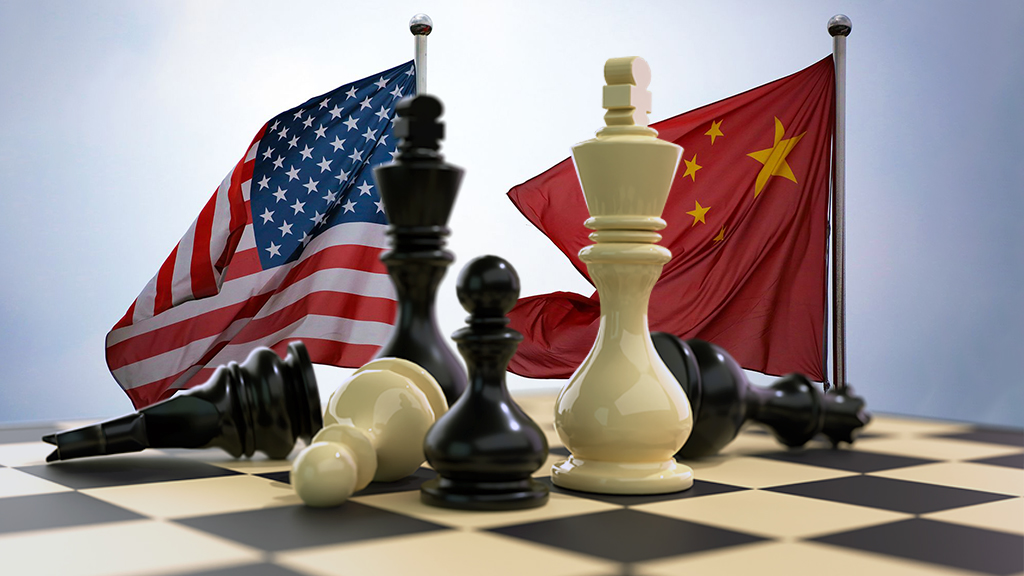
The anti-China policies come out of a familiar playbook of US policy-making. The aim is to prevent economic and technological competition from a major rival.
China’s economy is slowing down. Current forecasts put China’s GDP growth in 2023 at less than 5%, below the forecasts made last year and far below the high growth rates that China enjoyed until the late 2010s. The Western press is filled with China’s supposed misdeeds: a financial crisis in the real estate market, a general overhang of debt, and other ills. Yet much of the slowdown is the result of US measures that aim to slow China’s growth. Such US policies violate World Trade Organization rules and are a danger to global prosperity. They should be stopped.
The anti-China policies come out of a familiar playbook of US policy-making. The aim is to prevent economic and technological competition from a major rival. The first and most obvious application of this playbook was the technology blockade that the US imposed on the Soviet Union during the Cold War. The Soviet Union was America’s declared enemy and US policy aimed to block Soviet access to advanced technologies.
At the end of the 1980s and early 1990s, the US deliberately sought to slow Japan’s economic growth. This may seem surprising, as Japan was and is a US ally. Yet Japan was becoming “too successful,” as Japanese firms outcompeted US firms in key sectors, including semiconductors, consumer electronics, and automobiles.
The second application of the playbook is less obvious, and in fact, is generally overlooked even by knowledgeable observers. At the end of the 1980s and early 1990s, the US deliberately sought to slow Japan’s economic growth. This may seem surprising, as Japan was and is a US ally. Yet Japan was becoming “too successful,” as Japanese firms outcompeted US firms in key sectors, including semiconductors, consumer electronics, and automobiles. Japan’s success was widely hailed in bestsellers such as Japan as Number One by my late, great colleague, Harvard Professor Ezra Vogel.
In the mid-to-late 1980s, US politicians limited US markets to Japan’s exports (via so-called “voluntary” limits agreed with Japan) and pushed Japan to overvalue its currency. The Japanese Yen appreciated from around 240 Yen per dollar in 1985 to 128 Yen per dollar in 1988 and 94 Yen to the dollar in 1995, pricing Japanese goods out of the US market. Japan went into a slump as export growth collapsed. Between 1980 and 1985, Japan’s exports rose annually by 7.9 percent; between 1985 and 1990, export growth fell to 3.5 percent annually; and between 1990 and 1995, to 3.3 percent annually. As growth slowed markedly, many Japanese companies fell into financial distress, leading to a financial bust in the early 1990s.
In the mid-1990s, I asked one of Japan’s most powerful government officials why Japan didn’t devalue the currency to re-establish growth. His answer was that the US wouldn’t allow it.
Now the US is taking aim at China. Starting around 2015, US policymakers came to view China as a threat rather than a trade partner. This change of view was due to China’s economic success. China’s economic rise really began to alarm US strategists when China announced in 2015 a “Made in China 2025” policy to promote China’s advancement to the cutting edge of robotics, information technology, renewable energy, and other advanced technologies. Around the same time, China announced its Belt and Road Initiative to help build modern infrastructure throughout Asia, Africa and other regions, largely using Chinese finance, companies, and technologies.
After winning the 2016 election on an anti-China platform, Trump imposed unilateral tariffs on China that clearly violated WTO rules. To ensure that WTO would not rule against the US measures, the US disabled the WTO appellate court by blocking new appointments.
The US dusted off the old playbook to slow China’s surging growth. President Barrack Obama first proposed to create a new trading group with Asian countries that would exclude China, but presidential candidate Donald Trump went further, promising outright protectionism against China. After winning the 2016 election on an anti-China platform, Trump imposed unilateral tariffs on China that clearly violated WTO rules. To ensure that WTO would not rule against the US measures, the US disabled the WTO appellate court by blocking new appointments. The Trump Administration also blocked products from leading Chinese technology companies such as ZTE and Huawei and urged US allies to do the same.
When President Joe Biden came to office, many (including me) expected Biden to reverse or ease Trump’s anti-China policies. The opposite happened. Biden doubled down, not only maintaining Trump’s tariffs on China but also signing new executive orders to limit China’s access to advanced semiconductor technologies and US investments. American firms were advised informally to shift their supply chains from China to other countries, a process labelled “friend-shoring” as opposed to offshoring. In carrying out these measures, the US completely ignored WTO principles and procedures.
The US strongly denies that it is in an economic war with China, but as the old adage goes, if it looks like a duck, swims like a duck, and quacks like a duck, it’s probably a duck. The US is using a familiar playbook, and the Washington politicians are invoking martial rhetoric, calling China an enemy that must be contained or defeated.
The results are seen in a reversal of China’s exports to the US. In the month that Trump came into office, January 2017, China accounted for 22 per cent of US merchandise imports. By the time Biden came into office in January 2021, China’s share of US imports had dropped to 19 per cent. As of June 2023, China’s share of US imports had plummeted to 13 per cent. Between June 2022 and June 2023, US imports from China fell by a whopping 29 per cent.
Of course, the dynamics of China’s economy are complex and hardly driven by China-US trade alone. Perhaps China’s exports to the US will partly rebound. Yet Biden seems unlikely to ease trade barriers with China in the lead-up to the 2024 election.
Unlike Japan in the 1990s, which was dependent on the US for its security, and so followed US demands, China has more room for maneuver in the face of US protectionism. Most importantly, I believe, China can substantially increase its exports to the rest of Asia, Africa, and Latin America, through policies such as expanding the Belt and Road Initiative. My assessment is that the US attempt to contain China is not only wrongheaded in principle but destined to fail in practice. China will find partners throughout the world economy to support a continued expansion of trade and technological advances.
Feature Image Credit: The limits of US-China Economic Rivalry www.setav.org