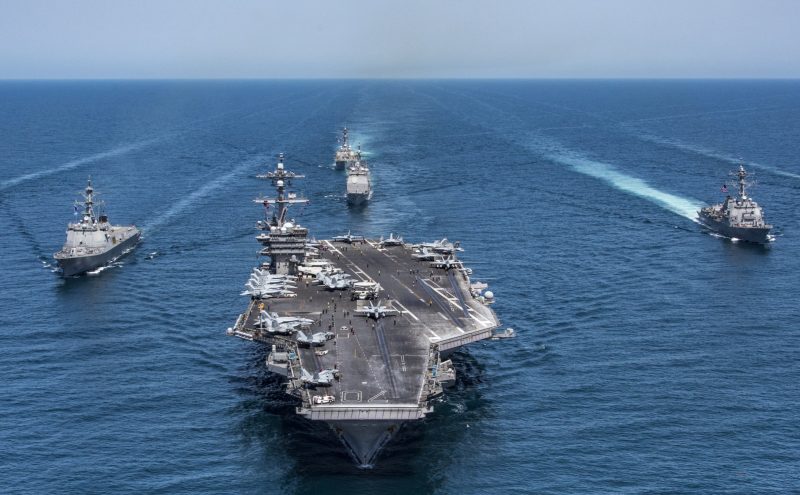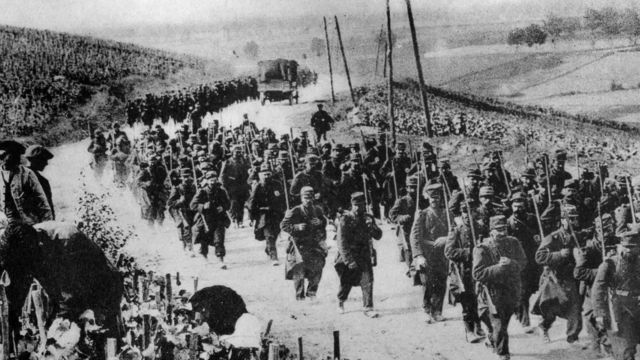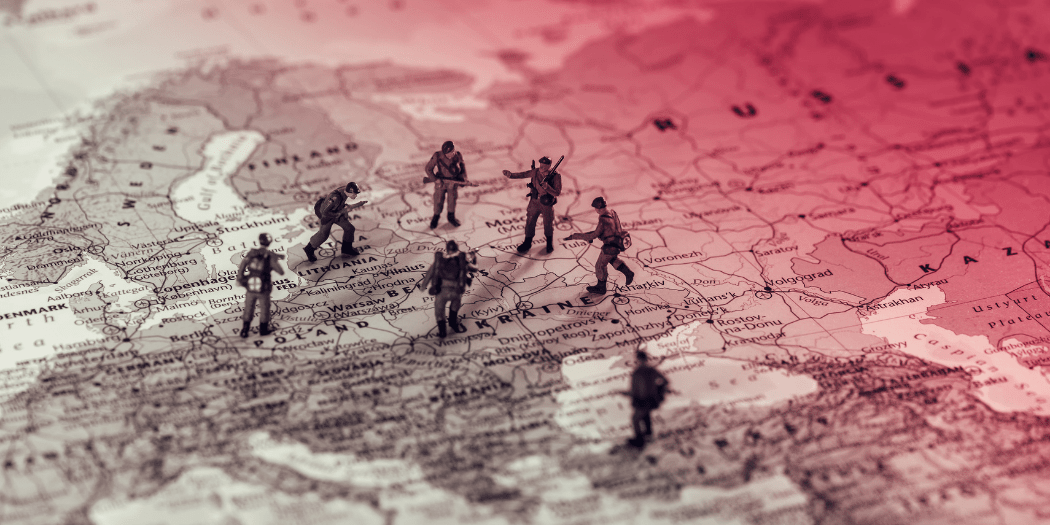
In view of the developments in Ukraine, the question arises whether there could be a repetition of the First World War in slipping into a new World War that no one intended. This original thesis is accentuated in different ways, whether in the form that European politicians behaved like “somnambulists (Clark) or just failed (Münkler). The blame for the war was also sought in Serbia or Vienna. Hereby the original thesis of the main war guilt of Germany is questioned, as it was fixed in the Treaty of Versailles and by the historian Fritz Fischer as the “grip on the world power” of Germany. However, if the causes of the First World War and, above all, its escalation are no longer seen in the German Empire alone, but are more or less equally distributed among the major European powers, this does not mean that “nothing and nobody” is responsible for the primordial catastrophe of the 20th century: Nationalism, arms race, industrialized warfare, pure power politics – all these are factors that contributed decisively to the First World War. Moreover, it should be emphasized, which even today is far from being overcome in many parts of the world. Against the backdrop of the Ukraine War, a much-discussed book by the highly influential American political scientist Robert Kagan takes on a whole new relevance. Kagan suggests the idea that Europeans could live in a paradise of peace and order after World War II only because the Americans were prepared to confront possible threats to that peace decisively and violently. Thanks to America’s power, Europeans could have indulged in the belief that (military) power was no longer important. But does the principle follow from this that law and order must be upheld in dealings with one another, but in the violent “jungle, we must follow the laws of the jungle”? Or, conversely, is it not the case that state warfare and the exercise of violence that does not adhere to its self-imposed conventions and limitations will stir up more violent resistance than they, in turn, can fight?
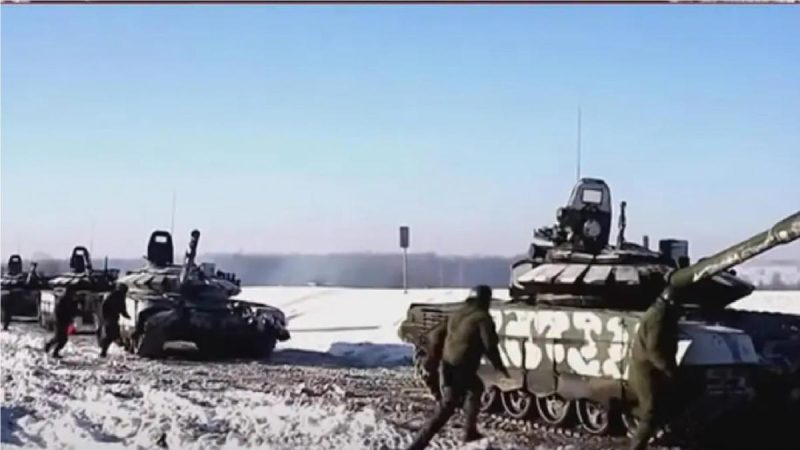
Kagan is partly correct. All modern states are based on the state’s monopoly on the use of force, and almost all of them have emerged through a violent process-remember the English, American, and French Revolutions, the German wars of unification, the wars of decolonization, and the emergence of new nation-states after World Wars I and II. Therefore, however, states do not as such embody an order of violence. Hegel had argued that violence is the appearing beginning of the state, but not its substantial principle. Nor is order powerlessness, as Robert Kagan’s much-discussed book on “Power and Powerlessness” in the New World Order suggests. Does political power come from the barrels of guns, as Mao Tse Tung suggested? If so, the Soviet Union should never have collapsed because gun barrels were more than enough for the Red Army.
Kagan assigns the opposition of power and order thinking to contemporary American and European thinking but admits this has not always been the case. As he points out, the situation was just the opposite for a long time. The Americans up to Woodrow Wilson at the beginning of the last century, he says, were committed to thinking of order and a world-political idealism of spreading human rights, while the Europeans remained committed to pure thinking of power until World War II. What is astonishing, if we take Kagan’s own analysis seriously, is why he does not ask to what final conclusion this “pure power thinking” among Europeans led – to nothing other than the catastrophes of World War I and World War II. Kagan may be right about one thing: in view of the “state-failure” problems in numerous Third World states on the one hand (emphasized by the Europeans in the anti-terror struggle) and those of the so-called “rogue states” on the other (on which American interest focused under Bush), illusions about the end of history and a largely peaceful, because economically determined, 21st century is fast fading. However, this cannot mean developing a new metaphysics of struggle and self-assertion that only force can enforce.
Historical Traditions
In determining the political sphere in categories of power or order, Kagan finds himself in a long ancestral line of the history of political ideas. Dolf Sternberger distinguished three different roots of the concept of politics: cooperation, following Aristotle; demonology, starting from Machiavelli; and eschatology, as he essentially saw it realized in Marxism, starting from the church father, Augustine. Sternberger’s distinction is phenomenological still valid today, even if his evaluations are problematic because he saw himself in the tradition of the Aristotelian concept of politics and – as the term demonology already shows – fiercely fought the opposite position.
How are these distinctions to be understood? Here are two quotations: Aristotle begins his work on politics with the definition: “Everything that is called state is obviously a kind of community, and every community is formed and exists for the purpose of obtaining some good.” In contrast, Jean Bodin, perhaps the most important constitutionalist of the 16th century, referred directly to Aristotle. However, his position should be read as his deliberate inversion: “Republic is a lawful government over several households and what is common to them, with sovereign power.” Precisely because Bodin modelled his work on Aristotle’s, the contrast between the two determinations jumps out all the more clearly: on the one hand, a community for the sake of a common goal; on the other, rule endowed with sovereign power. Marx’s eleventh Feuerbach thesis best describes the third dimension of Sternberger’s distinction: “The philosophers have only interpreted the world differently; what matters is to change it.” In contrast to Sternberger’s notion of demonology, however, one side of this line of tradition is by no means “Machiavellianism,” a struggle for power for power’s sake. Instead, it claims to constitute an (absolute) power out of insight into the violence of human nature, which prevents the struggle of all against all.
Sternberger emphasizes the fundamental difference between the first two concepts of politics when he asks in summary: “Is it the conflict of interests, powers, beliefs, and wills that thus characterizes the political in its peculiar essence? Or is it rather the balance, the compromise, the contract, the common rule of life. And conversely asked: should we interpret peace – civil peace as well as peace among nations – as the abolition and overcoming, as the negation of politics, or, on the contrary, as its completion?”
Struggle for power and domination, on the one hand, negotiation and the establishment of order on the other, are the two opposite definitions of the essence of politics that run through the history of political ideas. As antipodes may be mentioned only: Thucydides and Plato resp. Aristotle, Machiavelli and Erasmus of Rotterdam, Hegel and Kant, Schmitt and Arendt, recently Foucault, resp. Luhmann and Habermas.
If we take a closer look at this line of ancestors, it should be enough reason to warn us not to reduce politics to pure power politics. Thomas Hobbes, for example, with his conception of the state monopoly on the use of force, justified internal peace and the avoidance of civil war, but at the same time advocated an absolute sovereign. And Carl Schmitt stands paradigmatically for the problem of reducing politics to pure power politics. For it was not personal opportunism or immoderate ambition that justified his closeness to the National Socialists, but the extreme consequence of his reduction of the political to the distinction between friend and foe in a crisis-ridden world-historical situation. Carl Schmitt wrote in this regard: A total state “does not allow any anti-state, state-inhibiting or state-dividing forces to arise within it. It does not think of handing over the new means of power to its own enemies and destroyers. Such a state can distinguish friend from foe.” The reduction of the political to only one of two sides, the exercise of power or reliance on the establishment of order, has always led to problematic consequences in historical development. Against the false alternative between power or order and their immediate connection in order of power, the “middle” between power and order has to be found again. Violence cannot establish peace, but it can limit other violence to such an extent that other than violent structures come into play. Perhaps America and Europe have more to learn from each other than either side realizes.
Developments after September 11
Especially after the attacks of September 11, hardly any author in his assessment of the events could do without reference to Carl Schmitt’s world-famous definition of the political as the distinction between friend and foe. Even before the attacks, however, the political theory had already noted the shift from “Kant to Schmitt” as a consequence of the crisis of the political. Finally, George W. Bush elevated Schmitt’s definition of the political to a quasi-official governmental program in the United States. In this perspective, Robert Kagan denies that Europe and the USA still have a common view of the world at all. “Americans are from Mars, and Europeans are from Venus.” By this, he means that Europe lives in a Kantian fantasy world of eternal peace, while America is called upon and alone empowered to create order in Hobbesian anarchy on a global scale.
Schmitt as the “mastermind” of the Western world? The tendency to refer back to Schmitt is not unproblematic, however. The possible linking of politics and political theory to Carl Schmitt’s definition of the political cannot, in principle, disregard Schmitt’s temporary proximity to the National Socialists. For it was not personal opportunism or immoderate ambition that justified this closeness, but the extreme consequence of his reduction of the political to the distinction between friend and foe in a crisis-like world-historical situation. Carl Schmitt wrote about this, as indicated: A total state “does not allow any anti-state, state-inhibiting or state-dividing forces to arise within it. It does not think of handing over the new means of power to its own enemies and destroyers……. Such a state can distinguish friend from foe.” Are we not already living in such a total surveillance state?
The reduction of the political to a pure struggle for power, to a pure friend-enemy distinction, has problematic consequences, as is revealed especially in Schmitt. Conversely, the reduction of the political to the establishment of the agreement, of acting together, leads either to “apolitical” idealism or violent utopianism, as was shown especially in Marxism/communism. But which is now the solution? The distinction between friend and foe is a precondition of political action, but it is not its goal – the goal of politics regarding war and violence is the “mediation” of friend and foe. Or as Yitzhak Rabin described it: Peace is not made with friends, but with enemies! This is the art of politics, to enable a peaceful conflict resolution with opponents instead of falling into the traps of pure power politics – this is the lesson of the First World War then and today.
Feature Image Credit: powervertical.org
 The rise of East Asia and South-East Asia is inevitable – unless there would be World War III in this region. Whereas World War I was fought by the powers located at the shore of the North-Atlantic, World War II by those of the North-Atlantic and North-Pacific, World War III would be fought by those powers solely at the North-Pacific and the Indian Ocean. Are there lessons to be learned from the devastating conduct and outcome of World War I for our times? Is there only one lesson to be learned – that you can learn nothing from history? Or are we doomed to repeat history if we don’t learn anything from it? History will not repeat itself precisely, but wars repeatedly occur throughout history, even great wars. We are living in an age in which a war between the great powers is viewed as unlikely because it seems to be in no one’s interest, as the outcome of such a war would be so devastating that each party would do the utmost to avoid it. Rationality seems to dominate the assumptions and way of thinking in our times. But no war would have been waged if the losing side, or even both sides, would have known the outcome in advance.