Tag: War

  • An Outside View of the US 2024 Presidential Election

    An Outside View of the US 2024 Presidential Election

    What was the voter turnout?

    The big change is that Harris, so far, has lost 9 million voters since 2020, while Trump has gained only 1.2 million. Harris’s count of lost votes will decline as the final votes come in, but the bigger story remains that Harris lost more votes than Trump gained.

    Voter turnout is NOT final, but it is likely between 153 and 156 million, down from 2020 but still the second-highest percentage turnout in 100 years. At a minimum, 107 million adults did not vote (88 million of whom are “eligible” to vote). Thus, 41% or more of the adult population and 36% of the eligible voters did not vote.

    Using the percentage of voter groups who voted for Trump is misleading.  The news remains that the significant change is the loss of Harris voters.

    What were the economic issues?

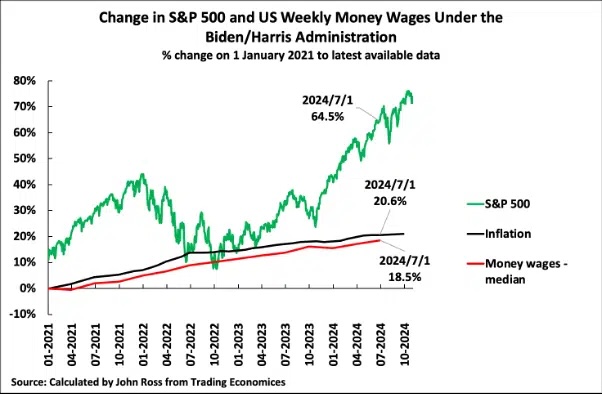
    Daily survival has become a serious problem for the bottom 65% due, specifically, to the inflation of grocery items and increasing mortgage payments and rent. Aggregate figures don’t reflect this reality.

    Workers’ actual standard of living was worse under Biden than under Trump.

    Real wages in the US remain lower than they were a half-century ago.
    Are there differences between Democrats and Republicans?

    US electoral parties are NOT like those in Europe – they have always been a different version of bourgeois electoral systems. Both major US parties are corporations, not parties with memberships, ideologies, and programs. They are designed like a marketplace of individuals preening for the Presidency, much like the Westminster Kennel Club Dog Show, but only held every four years.

    The Democrats turned over their foreign policy to the CNAS group of neo-con warmongers who will now be displaced.

    The Republicans are also not an actual party; Trump proved this, and what is next for Republicans post-Trump is also uncertain.

    What are the class shifts in the US?

    There is a new stratification of the bourgeoisie, with billionaires as a new factor. The increasingly dominant discourse amongst the capitalist class has the wherewithal to exert its influence.

    Fifty Billionaires put 2.5 billion US dollars, 45% of the 5.5 billion total, into the Presidential election. Of this, 1.6 billion went to the Republicans, 750 million to the Democrats, and the rest to both. The total spent on the election, in all races, was 16 billion, a sign of a kleptocracy, not a thriving democracy.
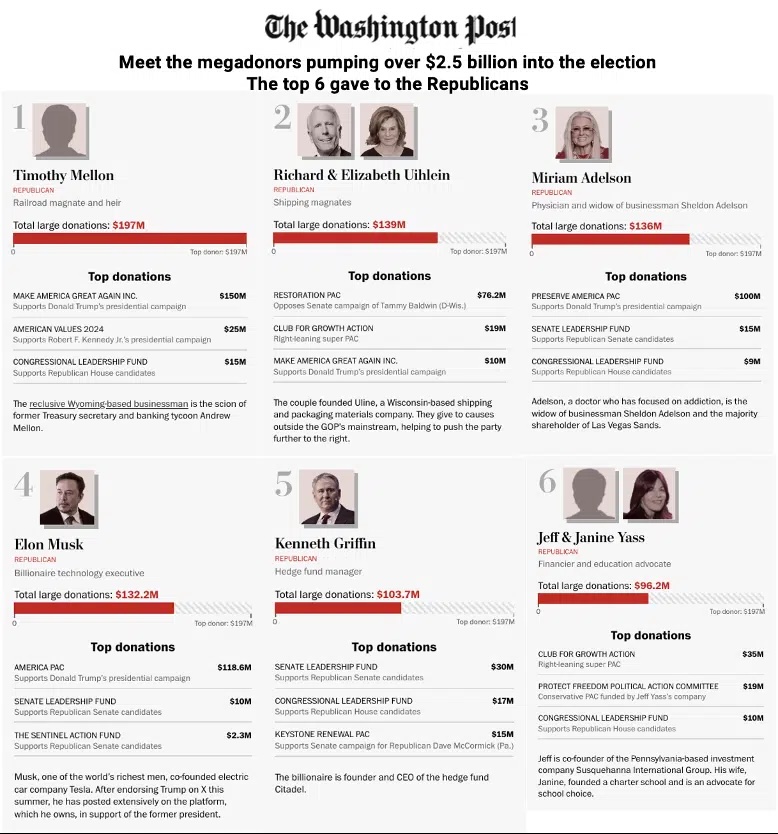
    washingtonpost.com/elections/interactive/2024/biggest-campaign-donors-election-2024

    There is a concerted effort by a section of libertarian tech billionaires, including Thiel and Musk, to have their hands directly on the levers of the state to control the race for global domination of AI. They believe that they alone should control the advances in the AI space for the world and that the initial next step is what is called Artificial General Intelligence (AGI). These megalomaniacs believe this will begin the control of humans by machine intelligence and, perhaps, in their perverse dreams, the end of humanity.

    A growing number of lesser capitalists, such as multimillionaires, are now being lumped into the upper middle class and the wealthiest one-third of voters. One very important trend to note is that in the last fifteen years, the richest one-third have switched allegiance from Republicans to Democrats.

    Why did Harris lose 6 to 9 million votes?

    Workers were worse off, wages did not keep up, and inflation left a long, lingering impact.  Some of the youth vote left for economic reasons. Others were disillusioned and demoralised by the full-throated support of the genocidal war in Gaza by the Democratic Party. Muslims, while a small group, voted for a third party or Trump.

    Despite the fabrications of the Democratic Party corporate handlers, Harris was, in fact, inauthentic, unlikeable, shallow, and could not mask her history as a prosecutor who spent her life attacking the rights of the poor.

    Dissatisfaction with many Western elected parties is growing – Conservative in the UK, Centre Right in France, right-wing in Germany – all thrown out. Biden left a demoralised Democratic Party and left too late.

    Fear-mongering about fascism was core to the rhetoric of the Democrats, even though no one knows what the term means.  Some voters became annoyed at the harassment by the liberals to vote for them since they were the last rail of defence against fascism. Many people did not believe Trump was, in fact, a fascist, nor did they believe that every one of their family members who listened to Trump was a fascist.

    Apathy is growing and remains a real issue.

    Probably over a million stayed at home as they could not stomach the Democratic Party’s gleeful support for Genocide. Trump’s victory in Michigan was certainly due to this issue.

    Harris played to and fawned over the war criminal Dick Cheney, the architect of the invasion of Iraq and a historic right-wing enemy of the Democrats.  We don’t know how many voters left in disgust. 

    Why did Trump gain votes?

    Trump took advantage of working-class dissatisfaction. Even so, he only gained less than 2 million total new votes. There is no evidence of a widescale shift of working-class votes to the Republicans in this election.

    Working-class women voted for local candidates supporting abortion but voted for Trump for economic and other reasons. Others voted on local issues important to them and then voted for Trump as they felt that despite his unsavoury behaviours, he was more committed to “shaking things up”.

    The billionaire class made sure that Trump had ample funds. Elon Musk’s America Pac spent $118 million handling field operations for the Trump campaign, an unusual role for a super PAC.

    From 2008 to 2020, there was a decline in the percentage of voters supporting the Democrats amongst the bottom 1/3 of income earners in the US.
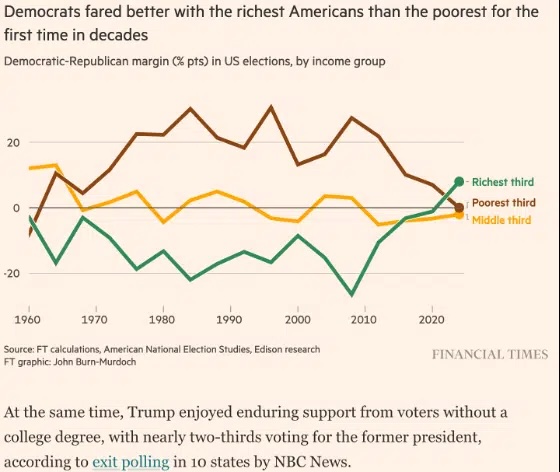
    ft.com/content/6de668c7-64e9-4196-b2c5-9ceca966fe3f


    Too little data is available now to provide a detailed answer about the relatively insignificant number of voters who voted Democrat in 2020 and Republican in 2024.

    What is the assessment of the new cabinet positions announced?

    Trump’s sixteen appointments to date are all vocal supporters of genocide in Palestine. In the United States, there are both Jewish and Christian Zionists. Trump has appointed several Christian Zionists. The majority are China hawks.

    When analysed from a US statecraft point of view, many are extremely underwhelming candidates. These include:

    • Secretary of State: Senator Marco Rubio: He is a rigid, fierce anti-communist.
    • Secretary of Defense: Pete Hegseth, an Army National Guard veteran and Fox News host: He is divisive and has no high-level military experience.
    • Attorney General: Representative Matt Gaetz of Florida: He has no experience in the Department of Justice and has had past legal controversies.
    • Director of National Intelligence: Former Representative Tulsi Gabbard of Hawaii. She has no intelligence background but is perhaps less rigid on international issues, a non-interventionist, and has a friendship with Indian Prime Minister Modi.
    • Ambassador to the United Nations: Representative Elise Stefanik of New York. She is an extreme Zionist, has near zero diplomatic experience, and has focused only on domestic issues, but is loyal to Trump.
    • Secretary of Homeland Security: South Dakota Governor Kristi Noem. She lacks national government experience, and her actions have veered toward radical anti-federalism.

    Due to some of these appointments, US stature in international affairs will likely diminish.

    Trump has brilliantly dismissed the extremely dangerous Pompeo. He has made it clear that few from the first inner group of his cabinet and advisors will return. The world will not miss them. Yet there is little evidence to suggest that Trump has the capacity to lead any group successfully for even an intermediate period. He is known for turning on people and turning them against each other.

    How do we interpret the vote?

    A significant section of the working class understandably abandoned the Democrats in this election.

    There is not a major right-wing shift in US attitudes, but there is a real base for the right.

    The Democratic Party elite is completely divorced from the masses. Parading the loyal royal cultural elite like Taylor Swift, Beyonce, and Bruce Springsteen reeked of wealth, opulence, and tone-deafness.

    Apathy should not be understated. At least 88 million didn’t vote, with a further 19 million disenfranchised.

    Third parties are structurally prevented from winning even a single state in a presidential election. They are structurally locked out of Congress. The United States has locked in a two-party system. Most voters have been captured by this belief.

    Small exceptions to this are wealthy candidates like Ross Perot in 1992 and Robert Kennedy Junior.

    There was huge intimidation at the end against supporters of third-party candidates, which depressed their vote even more than usual. In this just-held election, the Party for Liberation and Socialism Candidate Claudia Cruz received 134,348 votes so far.  Claudia Cruz’s 134 thousand votes is the highest number of votes for an explicit communist in American history. It exceeds the CPUSA’s William Z. Foster’s previous record of 120,000 votes in 1932. The 1932 vote was a higher percentage of the population as the US was smaller in 1932. These facts are a reminder of the long-term campaign of anti-communism within the US.

    Capital is clearly happy with Trump’s win, as evidenced by the November 6th celebration rally on Wall Street. They disagree with the liberal hype that he will bring an end to American society.

    Despite the lies of the liberals, the facts are that Trump formally initiated the New Cold War on China. His inner team are more fiercely anti-China than the Democrats, who are more bound to the Ukraine War.

    Trump has fewer restraints, controlling the Senate, House, Supreme Court, and Presidency.

    He could well launch a Third World War.  It would be a mistake to underestimate this danger.

    Other things people outside the US should know

    There is a tendency in some parts of the Global South to have a simplistic and false analysis that any enemy of the liberals is a friend of the Global South. This is a severely flawed argument. The imperialist far-right is not a good guy, a cultural conservative who wants to protect families and cultural life. Inside the US, conservative culture is tightly tied to slavery and genocide. It is misogynistic, racist, militaristic, and reactionary. We should not confuse the histories of Iran, Turkey, India, Ghana, and China with those of the US.

    Welcoming divisions in the enemy camp is often entirely correct. But Communists, socialists, and true democrats do not support reactionary views and always side with the people, not the far-right ideologues.

    There is also great confusion about MAGA and MAGA-Communism. First, Make America Great Again (MAGA) means returning (the second “A” in MAGA) to the full glory of the US industrial past. But what was that past? It was, in fact, the total economic, political, military, and racial subordination of the peoples of the Global South states to the US. It was the century of humiliation in China. This is not a return to be welcomed by history. MAGA is a profoundly reactionary, unacceptable outcome and concept.

    One of the greatest poets in the United States is Langston Hughes. One of his poems was called “Let America Be America Again.” But this was a parody as the actual statement was made in the refrain, “America Never Was America to Me”. The meaning of this poem was the false portrayal of the United States as ever having a glorious past, which was never true for the slaves or the working class.

    Second, there are a handful of personalities in the US who have taken the great word communism and sullied it with the idea of returning to this falsely idealised America. The old “strong” American industry was built on the backs of low-paid workers in the mines in Africa and elsewhere.

    Desiring a real communist path is a good thing. But tying it to an imperialist past, a past of violence, with reactionary views is the opposite path taken by Lenin, Mao, and Fidel.

    There is also a dangerous tendency to simply reject the liberal concepts of identity politics and embrace the values of far-right conservatism while lacking scientific thinking about the plight of women and other vulnerable groups.

    The CPC led the country in the first national Soviets in Ruijin in the struggle to abolish the prejudices of feudalism and emancipate women and national minorities in China. However, these rights have not yet been achieved in many countries, as there has been no communist revolution.

    True Communism is the path to advancing the overall interests of the working class in all countries, including women, national minorities, and other vulnerable groups.

    The Republican voter base in class-terms is the lower-middle class, which is overwhelmingly white, suburban, rural. It is amplified by fundamentalist Christians and the Republican regional strongholds.

    There are six “ideological” trends, all extreme right, in the Republican camp:

    1. Populist demagogues
    2. Extreme Libertarians
    3. Fanatical Christian-Zionists
    4. Virulent anti-communists
    5. Dangerous AI-obsessed Tech billionaires
    6. Complex conservatives

    The US economy will continue to perform poorly but better than the rest of the West. It will continue to use its dollar hegemony, reinforced with sanctions, to remove hundreds of billions from the Global South and to force Europe, Australia, and Japan to subordinate their economic interests to those of the US.

    The actual US budget for the military was $1.8 trillion last year. Significant cuts seem improbable.

    There is now a permanent Black upper middle class that produces a Black mis-leadership. This mis-leadership group has created two decades of Black war criminals and apologists for empire. The rise of this mis-leadership gang, however, should not overshadow the fact that most blacks remain oppressed and exploited.

    The anti-immigrant politics in the U.S. is directed primarily at undocumented immigrants from Mexico, Central America and the Caribbean.

    But there is a false belief that all immigrants in the US are working class and progressive – it is just not true. An important stratum of non-working-class immigrants in the US are amongst the most virulent defenders of US atrocities in the world.

    There is a belief that there is a conspiracy of some secret group of members of the military and government that decide most things, which they call the Deep State. This is a lazy concept. It denies that all states have a class character and permanent army. In the US, it has been estimated that over 5 million people have security clearance, and many have near-lifetime employment. There is no need for conspiracy theories. The US does have an advanced state that functions on behalf of capital. This state manages the affairs of the often-competing large capitalists and is now increasingly primarily favouring the billionaires amongst the capitalist class. Thus, a better way to see the US State is through the lens of Mao, Lenin, and Marx and not as some inexplicable conspiracy.

    There is a special relationship between the US and Israel, both extreme white-settler states. In the US alone, over 30 House, Senate, and cabinet members are dual citizens of the US and Israel. Israel does not control the US, BUT they are socially a duopoly.

    They are the CORE of Ring 1 of the Global North, the core of the imperialist bloc, along with the UK, Canada, and Australia.

    The long-term trend is clear – bourgeois liberal democracy is failing globally.

    What is the domestic consequence of the vote?

    Since 2016, the very top of the capitalist class has led and mobilised a neo-fascist movement. Increasing levels of force and lawfare will now be used internally inside the US.

    Trump himself is not a fascist per se. He is super-egoistic and believes he can act with near absolute impunity.

    But he is riding on, and a beneficiary of changing class phenomena.

    Fascism is not so much an ideology as a structural class relationship in which the lower-middle class, which has a revanchist ideology, is mobilized by big capital during a period of internal and external disequilibrium.

    The New York Times and Financial Times use the word fascism as a scare tactic to maintain their role and influence in the state. Neo-fascism is a more precise word than fascism at this moment to describe the changes in the US.

    Historically, there are a few things that are necessary to define a fully fascist state in imperialist countries. One is that the state uses methods of control it would typically use only for its colonies and neo-colonies, i.e., extreme widespread violence and force.  The other is that they resort to the overthrow of the constitution.

    The Constitution is unlikely to be changed directly. However, the original Constitution, an eighteenth-century document, has many gaps that can be exploited.

    Radical and extreme legal changes are thus probable. There will be a reversal of 70 years of civil rights.

    Overall, it remains to be seen how far the capitalist class is willing to go.

    State capacity in many areas other than defence and border police will be diminished. Trump 1 saw big cuts in the State Department.  Even with Rubio present, it is unlikely to be refunded to its old level.

    The Billionaires will play a direct role in key tasks, from meeting Zelensky to chain-sawing government departments. Some departments, like Agriculture, Education, and Health and Human Services, are, in fact, decrepit, corrupt and dysfunctional. But a billionaire-led revamp will result in an unsavoury privatized equally dysfunctional capitalist state bureaucracy.

    Trump is committed to a long-term isolationist strategy.  But the US has over 900 military bases abroad. It has fully supported the expansion of Israel’s War in the Middle East, building up its military in the process.

    Trump will not block the infrastructure projects that were voted in during Biden. The US recognises that its lost manufacturing capacity is a strategic deficit in military supply.

    The brunt of the cutbacks will still increase the suffering of the 150 million working-class poor in the US.

    The Left will be even more subjected to severe repression. Rubio is salivating.

    What are the possible international consequences?

    Despite the recent Zelensky meeting, the US will probably push a cease-fire and curtail the Ukraine war. Crimea is off the table. The current military lines will be the starting point. Doing this could reduce the immediate danger of a nuclear war. In April of this year, both Vance and Rubio voted against the 95-billion-dollar US military aid bill for Ukraine.

    With Israel, there are three main possibilities:

    1. Trump curtails Netanyahu and calls for an end to Lebanon, no regime change in Iran, and an unjust peace agreement.
    2. He falls prey to the Christian Zionists and continues Genocide against Palestine.
    3. He goes against his no-war statements and approves an escalation with Iran.

    We don’t know, but option one is not impossible. Trump wants a deal with Saudi Arabia.

    A few days ago, MBS was forced to call it a Genocide, a rare statement from a long-term US ally.

    With China, there are also three possibilities:

    1. Trump says tariffs are his favourite word in the English language and wants to increase them and eliminate domestic taxes.
    2. Rubio and other super China-hating cabinet members push him to escalate.
    3. US national security elements and US tech moguls like Peter Thiel push US military preparations.

    On the question of Taiwan, some in the Global South fall for the liberal messaging soundbite in the West that Trump, the dealmaker, will sell Taiwan for a fee. This would bring strong resistance from the US military and large sections of the anti-communist members of his core group. This is a very unlikely case.

    The world should not be confused if Trump does initiate a ceasefire in Ukraine and pressures Netanyahu to curtail the Genocide. Neither of these actions reverses the long-term trend of the US towards militarization against China. Nothing Trump does will turn around anaemic long-term US economic growth.

    China is still on target to surpass the US in current exchange rate GDP within 10 years.

    The US state is still on a long-term course to use its self-perceived military supremacy to destroy what it perceives as the Eurasian threat. It remains committed to dismembering the Russian Federation and overthrowing the CPC. The imperialists believe this is the path to a thousand-year reign of unilateral power.

    The US will continue, unabated, its strategy of seeking nuclear primacy and what is called the “counterforce” strategy, which plans on the use of a first strike or launch of nuclear weapons. Evidence of these dangerous changes in US military strategy can be seen by their unilateral withdrawal from the following treaties:

    • 2002 (Bush): the Anti-Ballistic Missile (ABM) treaty.
    • 2019 (Trump): the Intermediate Nuclear Forces (INF) treaty
    • 2020 (Trump): the Open Skies treaty

    Tucker Carlson has Trump’s ear for now and is not a proponent of military conflict.

    In 2023, a four-star general, Minihan, claimed that the US would be in a hot war with China in 2025. These are not accidental statements.

    It is unknown if Rubio, some of the far-right libertarians, and CNAS-influenced military forces can overcome Trump’s dislike of military conflict.

    The US is likely to increase its attention on Latin America and increase support for the far right like Bolsonaro and Milei.

    Large-scale aid to Africa is not likely to happen. The Angola railway project is now improbable.

    Final comments

    The US state is still on a long-term course to use its self-perceived military supremacy to destroy the Eurasian threat.

    The US has adopted counterforce and nuclear supremacy as its prime military strategy.

    The threat of war has not changed due to a new administration. Only, perhaps, the speed at which it will be accomplished.

    The economic and political assaults against the US working class will escalate, especially against progressives.

    The state will continue to tighten its grip on the so-called bourgeois democratic freedoms by further restricting voting rights, civil rights, and freedom of speech.


    This article was published earlier on MRonline 
    The article is republished underCreative Commons  Attribution-NonCommercial-NoDerivatives 4.0 International License.

    Creative Commons License


  • What the Global Economy and Security Require

    What the Global Economy and Security Require

    With the new year 2024 well underway, the world is afflicted with wars, economic challenges, and the larger issues of climate change impact that threaten the very survival of the planet. It is paradoxical to see that great powers are still focused on competition and conflict. The year ahead portends continued conflicts, wars, and the weaponisation of economic infrastructures, demonstrated by Israel’s genocidal war against the Palestinians. Carla Norrlof highlights the increase in geopolitical conflicts and the complex relationship between economics and security. The article, like most Western academics, looks from the American perspective. and may miss the larger worldview.

    – Team TPF

    This article was published earlier in Project Syndicate.


    If America and its allies are to maximize both security and prosperity in the coming years, policymakers and strategists will have to understand the complex interplay of forces that is making the world more adversarial and fraught with risk. The global environment demands a comprehensive new economic-security agenda. The global order is undergoing significant changes that demand a new economic-security agenda.

    From hot wars and localized insurgencies to great-power standoffs, geopolitical conflict has made the complex relationship between economics and security a daily concern for ordinary people everywhere. Complicating matters even more is the fact that emerging markets are gaining economic clout and directly challenging traditional powers’ longstanding dominance through new networks and strategic alliances.

    These developments alone would have made this a tumultuous period marked by economic instability, inflation, and supply-chain disruptions. But one also must account for rapid technological advances – which have introduced new security risks (such as arms races and cyber threats) – as well as natural risks such as pandemics and climate change.

    To navigate this dangerous new world, we must reckon with three interrelated dimensions: the effects of geopolitics on the global economy; the influence of global economic relations on national security; and the relationship between global economic competition and overall prosperity.

    Each pathway sheds light on the multifaceted interplay between economics and security. We will need to understand all of them if we are to tackle the varied and complex challenges presented by our highly interconnected global system.

    As recent years have shown, geopolitics can profoundly affect the global economy, reshaping trade, investment flows, and policies sometimes almost overnight. Aside from their devastating human toll, wars like the Russian invasion of Ukraine and Israel’s campaign in Gaza often reverberate far beyond the immediate theater of conflict.

    For example, Western-led sanctions on Russia, and the disruption of Ukrainian grain exports through the Black Sea, caused energy and food prices to soar, resulting in supply insecurity and inflation on a global scale. Moreover, China has deepened its economic relationship with Russia following the mass exodus of Western firms in 2022 and 2023.

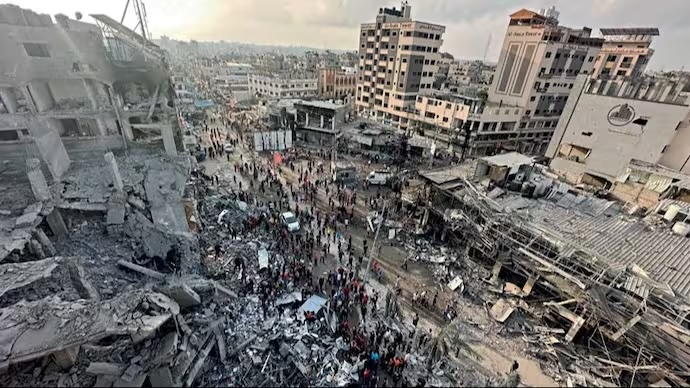
    Similarly, Israel’s bombing of Gaza has destabilized the entire Middle East, especially tourism-dependent neighbouring countries such as Egypt, Jordan, and Lebanon. Meanwhile, Yemeni Houthi rebels, long supplied by Iran, have been attacking cargo ships in the Red Sea, leading international shipping firms to suspend or adjust their routes and directly impeding trade through the Suez Canal – a major artery of global commerce.

    We are witnessing the destabilizing effects of natural threats as well. The COVID-19 pandemic drove a massive shift away from cost-effective “just-in-time” supply chains to a “just-in-case” model aimed at strengthening resilience during disruptions. And, more recently, an El Niño-induced drought has diminished the capacity of the Panama Canal – another major artery of global commerce. Whether for geopolitical or ecological reasons, rerouting around these new bottlenecks inevitably increases shipping costs, causes delivery delays, disrupts global supply chains, and creates inflationary pressure.

    Turning to the second dimension – the implications of global economic relations for national security – it is clear that countries will be more likely to adopt bold or aggressive security policies if they already have a web of economic ties that can either attract support or dampen opposition. China, for example, is counting on economically dependent countries within its Belt and Road Initiative to accept its political influence and longer-term bid for hegemony. Many countries also now rely on China for critical defence-related supply-chain components, which leaves them vulnerable diplomatically and militarily.

    More broadly, global connectivity, in the form of economic networks and infrastructure, is increasingly being weaponized for geopolitical ends. As Russia’s war on Ukraine shows, economic ties can create dependencies that raise the cost of opposing assertive security policies (or even outright aggression). The implicit threat of supply disruptions has a coercive – sometimes quite subtle and insidious – effect on a country’s national security objectives. Owing to the network effects of the dollar system, the United States retains significant leverage to enforce international order through coercive sanctions against states that violate international norms.

    Trading with the enemy can be lucrative, or simply practical, but it also alters the distribution of power. As Western governments learned over the past two decades, the advantages conferred by technological superiority can be substantially offset by forced technology transfers, intellectual property theft, and reverse engineering.

    The third dimension – the relationship between global economic competition and prosperity – has been complicated by these first two dynamics, because the pursuit of material well-being now must be weighed against security considerations. Discussions in this area thus centre around the concept of economic security, meaning stable incomes and a reliable supply of the resources needed to support a given standard of living. Both Donald Trump’s “Make America Great Again” slogan and President Joe Biden’s “Build Back Better” plan reflect concerns that economic relations with China harm US prosperity.

    The challenge for the US and its allies is to manage the tensions between these varying economic and security objectives. There is a potential conflict between adapting to market- and geopolitically-driven shifts in economic power and sustaining the economic strength to finance a military force capable of protecting the global economy. The US, as the dominant power, must remain both willing and capable of preserving an open, rules-based global economy and a peaceful international order. That will require additional investments in military capabilities and alliances to counteract territorial aggression and safeguard sea lanes, as well as stronger environmental policies and frameworks to distribute global economic gains according to market principles.

    By attempting to mitigate security risks through deglobalization (reshoring, onshoring, and “friend-shoring”), we risk adding to the economic and security threats presented by a more fragmented world. Though economic ties with rivals can create dangerous dependencies, they also can act as a safeguard against hostility.

    All governments will need to grapple with these tensions as they develop a new economic-security agenda. The world is quickly becoming more adversarial and fraught with risk. To maximize both security and prosperity, we will have to understand the complex interplay of forces that are creating it.

    Feature Image Credit: India Today

  • Perpetrators and Victims: Ways Out of Violence?

    Perpetrators and Victims: Ways Out of Violence?

    Franz Fanon had sharpened the problem in such a way that the colonised would only really liberate themselves through violence and the killing of the colonialists because only in this way could they free themselves from the humiliation they had suffered.

    the real evil is humiliation – and many civilisations and peoples of the world have not only been exploited in colonisation but, perhaps more importantly, humiliated.

    violent action changes one’s own soul.


    I would like to emphasise from the outset that many readers of these lines will, of course, think that this is the writing of a Western-influenced intellectual, especially a German, who is marked by the guilt of the Germans for Auschwitz. Indeed, I am. Nevertheless, I want to address several issues beyond the current conflicts.

    An explanation of the causes of violence can very quickly turn into an understanding, and this into a legitimation of violent action. Although the boundary between these three concepts is fluid, it does not follow that identifying the causes of violent experiences legitimises all forms of one’s violent actions. Thus, while one can legitimise the violent resistance of the Palestinians and the establishment of their Palestinian state, one cannot legitimise all forms of one’s use of violence. The Queen of Jordan is indeed absolutely right when she accuses the West of double standards in the application of morality – but the need for moral recognition of the opponent as a human person is in no way invalidated by the Western double standard. In my view, there is no difference in principle whether Palestinian or Israeli children suffer. But the suffering of children on one side does not justify the suffering of children on the other side. At the moment, we are also in an information war in which precisely this is being conveyed – my own experience of violence as a victim legitimises the use of violence by myself. In his anticolonialism impulse, Franz Fanon had sharpened the problem in such a way that the colonised would only really liberate themselves through violence and the killing of the colonialists because only in this way could they free themselves from the humiliation they had suffered. This assumption, however, turned out to be highly counterproductive because violent action changes one’s own soul. While I fully agree with Jacques Vergés that the real evil is humiliation – and many civilisations and peoples of the world have not only been exploited in colonisation but, perhaps more importantly, humiliated. Here the distinction between a biological human being and a legal-moral person took on its nation-destroying dynamic and became a double standard – moral-legal qualities were granted only to Europeans, all others were degraded to half-monkeys, uneducated primitive peoples, or sub-humans (the Jews to the Nazis). This degradation did not kill the body, but like all rape, it killed the soul.

    Perhaps we need to get away from reducing every form of violence to its purpose – violent actions can also become independent. You can’t use violence the way you use cutlery and plates at dinner – after you wash up, everything looks the same, but people have gotten used to violence taking on a life of its own. The surviving fighters from the civil wars in the former Yugoslavia, Chechnya, Syria, and Iraq form a group of some 40,000 mercenaries who fight each other in ever-changing constellations. The 2012 “Tuareg” rebellion in Mali was also supported by such independent fighters, who returned from Palestine and helped themselves to the weapons stockpiles of the collapsed Ghaddafi regime. Chechen fighters, in turn, were a central part of the IS leadership; today, they are fighting on both sides in Ukraine. A tragic consequence of these developments is the inversion of the perpetrator-victim relationship. Many victims of violence have such fragmented souls that they use violence themselves to prevent themselves from ever being victims again, even at the cost of becoming perpetrators. Ideologies and political goals then become an indiscriminate source of legitimation for one’s violent actions, which ultimately only serve the purpose of no longer being a victim.

    Discourses of history: Throughout the Islamic sphere of influence, as in all colonised countries, there is a pronounced discourse of victimhood – the problem is that while the people concerned were indeed victims to the extent that the Western world still finds difficult or impossible to admit, a discourse of victimhood leads to legitimising even one’s own most horrific forms of violence by saying that one was a victim. Stalinism and Nazism, as well as the ideologies of al-Qaeda, Daesh/IS, the Taliban, and Hamas in Gaza, derive their legitimacy from this discourse of victimhood. At a training course in Yad Vashem, the Israeli Holocaust memorial, this victim discourse, the reversal of the victim-perpetrator relationship, was very vividly presented – not by me, but by the Israeli leaders of the training course. The symbol for this is the desert fortress Massada, where the last Jewish defenders committed suicide in order not to be humiliated as slaves by the Romans.

    But the consequence was the motto: Never again, Massada!

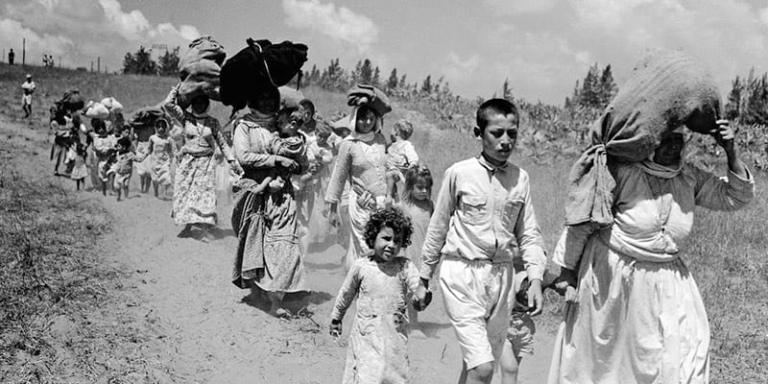
    And the Holocaust, anti-Semitism and Islamic Jew-hatred are not a distant past for Israelis but part of the present discourse – just as for many Palestinians, the Nakba is an ongoing part of the present. In Arabic, the Nakba refers to the flight and expulsion of some 700,000 Arab Palestinians from the former British Mandate of Palestine. It took place between the 1947 UN partition plan for Palestine and the 1949 armistice following the Palestine War, waged by six Arab states against the state of Israel, which was founded on May 14, 1948. In the historical narrative of Palestinians, other Arabs, and anti-Zionists, the Nakba is usually described as a pre-planned ethnic cleansing by the Israeli military; in the historical narrative of Israel, it is generally described as a voluntary flight in response to Arab calls. In my lecture at the World Peace Museum in Kyoto, Japan, I also wanted to talk about the crimes of the Japanese Empire in the 20th century. The colleague who invited me responded, at first incomprehensibly to me, that this could not be made a topic: He meant that you Germans were lucky, you had your Hitler. To my incomprehension, he explained that the Germans could blame the Holocaust entirely on Hitler and his few comrades, which, according to recent research, is not valid. But if he had to talk about the crimes of the Japanese army, he would speak of his father, but really about himself. He found himself unable to distance himself even minimally from his father. Although the greater sense of family in many non-Western societies can be a useful corrective to Western over-individualisation, the danger lies in the repetition of age-old conflicts. To my surprise, even the famous peace researcher Johann Galtung had postulated at a conference in Basel that 3 million deaths in the “Killing Fields” of the Red Khmer were compared to 3000 years of oppression. The undisputed experience of oppression led him to relativise a crime against humanity.

    The problem, however, is that for every terrorist killed, General Abi Zaid, the former commander of U.S. forces in Iraq, estimates that five new ones grow. After the violent excesses of Hamas members, it is “understandable” that the relatives of the victims want to kill them, but this will most likely only multiply the number of violent and militant supporters.

      Even with regard to the Holocaust, Hannah Arendt had distinguished between the unforgivable act and the perpetrator, whom one must be able to forgive. But “forgiveness” depends on the admission of guilt. And this admission is made virtually impossible by the victim discourse. In addition, it is difficult to come to terms with one’s own violent actions. Many of these people will never be able to return to civilian society – this could be observed, for example, in the case of US soldiers who, decades after the Vietnam War, still had to “play” the war over and over again in the Nevada desert, because the violence they had committed had filled their identity entirely. There is a drug that is more quickly and deeply addictive than even heroin – and that is violence. Violence eats the soul. And even if Arendt distinguishes between the perpetrator and the act, what to do with perpetrators who cannot distance themselves from the act is problematic. In a study of the recruitment of IS supporters in Iraq, it was found that the main recruitment base for IS was the prisons there. Even in Western prisons, petty criminals often turn out to be serious criminals. Sometimes, you have to admit that the only way to deal with people who are entirely violent is to kill them – like the IS supporters who abused Yazidi women as sex slaves. To this day, it is difficult to understand why the neighbouring states did not put an end to the violent excesses of IS earlier since it would have had no chance against a functioning modern army. The problem, however, is that for every terrorist killed, General Abi Zaid, the former commander of U.S. forces in Iraq, estimates that five new ones grow. After the violent excesses of Hamas members, it is “understandable” that the relatives of the victims want to kill them, but this will most likely only multiply the number of violent and militant supporters.

     Both Hamas and the religious extremists in Israel and the settlers in the West Bank are obviously trying to turn a political dispute into a religiously underpinned clash of civilisations, or, as Samuel P. Huntington better calls it, a clash of civilisations. Hamas is not only a liberation movement, as it is often ascribed in defence of its actions, but at least a religious movement oriented toward an eschatological struggle – just like the religious extremists in Israel. Both rely on the construction of identity that Huntington also advocates: we know who we are when we know who we are against. Although there is a renaissance of religion around the world, and it is often very violent, this does not mean that religions per se are violent. But religious belief necessarily excludes other beliefs. It is different from the civilisations associated with them. While religions exclude others, civilisations are much more likely to include others. This difference also explains why the followers of the great monotheistic religions, while claiming to be peace-loving, have been responsible for unparalleled excesses of violence throughout their history. The Islamic wars of conquest, the Crusades, the Ottoman conquests, the Thirty Years’ War, Islamic and Atlantic slavery, and, finally, worldwide colonisation leave a single trail of blood. And this, of all things, from two world religions that considered themselves peace-loving. The traditional explanation is no longer valid: these excesses of violence had nothing to do with religion but only with socio-historical conditions, which themselves were oriented towards eternal peace. This is certainly true for these civilisations (even if the concept of civilisation has been distorted by European colonisation), but not for the religions (which is why the Global Ethic project has failed so spectacularly, contrary to its own claims because it has not gone beyond a minimal consensus).

    Huntington’s liberal critics had argued not only that there should not be a clash of civilisations but also that there could not be one – because, in their eyes, there was only one civilisation, the Western one. The others are religions or cultures, but not civilisations. It is time to abandon this liberal and Western conceit, and the replacement of Eurocentrism with ethnocentrism or religious centrism is not an adequate response to the problems of exploding violence.

     At first glance, a dialogue of the world’s civilisations seems unrealistic in the face of worldwide explosions of violence. On the contrary, it is necessary to prevent political disputes from becoming a clash of civilisations. Huntington’s liberal critics had argued not only that there should not be a clash of civilisations but also that there could not be one – because, in their eyes, there was only one civilisation, the Western one. The others are religions or cultures, but not civilisations. It is time to abandon this liberal and Western conceit, and the replacement of Eurocentrism with ethnocentrism or religious centrism is not an adequate response to the problems of exploding violence. Instead, the appropriate response to the increasing number of wars and excesses of violence worldwide must be to separate the hardliners discursively, politically, and militarily from the population, not to drive the population into the hands of the hardliners. In the latter case, we would only be threatened with a new “bloody century” like the first half of the 20th century. A dialogue among the world’s civilisations is necessary, if perhaps only modest, step to avoid this. For in the mutual recognition of the world’s civilisations, both sides will be bound by their own civilisational principles.

    Feature Image: Nakba of 1948 – Palestinians being forced out by Israelis – arabcenterdc.org

  • Mercenaries in Libyan Conflict: Need for a Strong International Law Against Mercenary Activities

    Mercenaries in Libyan Conflict: Need for a Strong International Law Against Mercenary Activities

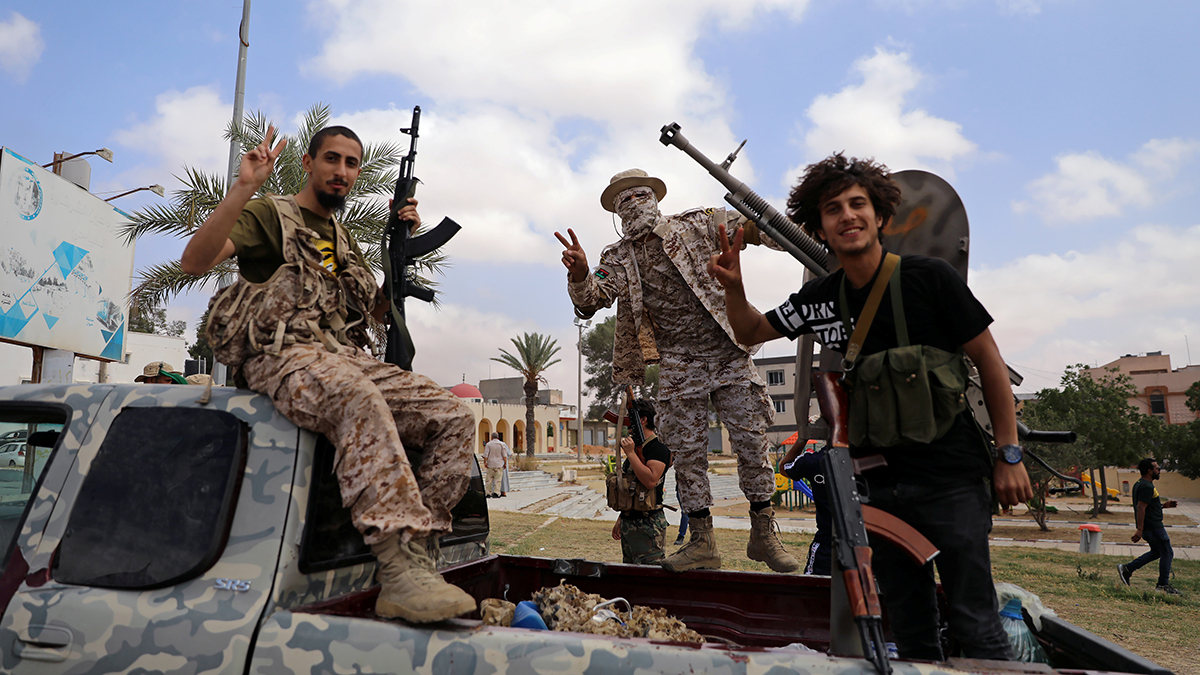
    The presence of mercenary groups and foreign fighters in Libya potentially had an impact in intensifying and prolonging the Libyan conflict, further complicating the search for a peaceful solution to the crisis. Foreign fighters and mercenaries have grossly violated domestic and international human rights and contributed to enormous human suffering. Mohamad Aujjar, Chair of the independent international fact-finding mission on Libya, told the UN Human Rights Council that the “mission’s investigations had found that all parties to the conflict in Libya since 2016, including third states, foreign fighters, and mercenaries, have violated international humanitarian law, particularly the principles of proportionality and distinction, and that some had committed war crimes”. Twelve years after violent conflicts and political crises, Libya is turning to a crucial election this year, one that was originally scheduled in December 2021 but could not be held due to disagreement between various political groups. It is considered that the presence of mercenaries and foreign fighters in the conflicting territories will be an obstacle to peaceful elections. African Union chairman stated that “the departure of foreign mercenaries could help Libya to achieve greater stability which was in a constant tussle since 2011”. As mentioned previously, mercenary involvement is one of the primary causes for the prolongation of the Libyan conflict, caused by the absence of firm international law concerning mercenary activities.

    The growing presence of mercenaries in armed conflicts across the world, and the threat that mercenaries are posing towards international peace and human security is a signal of the need for a strong legal framework for regulating mercenary activities.

    The conflict in Libya started when NATO-backed Western powers toppled the former authoritarian leader Muammar Gaddafi in 2011 and failed in placing a stable central authority in the country. In 2014 this political vacuum and crisis turned into a civil war between two rival groups, the Government of National Accord (GNA) in the western parts of the country that is recognised by the United Nations, and the Libyan National Army (LNA) in the eastern parts of the country, headed by Khalifa Haftar. Foreign powers had strategically aligned with the conflicting parties to protect their own parochial geopolitical and economic interests in the region. GNA had the support of Turkey and Western countries like Italy. In December 2020, the Turkish parliament authorised the deployment of troops to Libya in support of the GNA. It is estimated that Turkey sent between 2000 and 4000 mercenaries from Syria to Libya, all of whom were under the direct control of the Turkish military. The Sadat, a Turkish private military firm, was also directly involved in the Libyan conflict. On the other hand, the LNA enjoyed the support of Russia, Egypt, and the United Arab Emirates (UAE). Since 2014, UAE has supported the LNA by supplying arms while Russia sent mercenaries to boost LNA. In February 2021, the UN-led Libyan Political Dialogue Forum (LPDF) formed a new government called the Government of National Unity (GNU) with Abdulhamid AlDabaiba as Prime Minister with the approval of the Libyan House of Representatives. GNU failed to hold the national election which was the main purpose for the formation of the GNU. Thus, the country was again divided into two camps. On the one side, Egypt, Russia, France, and Qatar supported Bashaga and his eastern supporters. On the other side were Italy, Turkey (with some exceptions), the United Nations, and the United States. The UAE, surprisingly, supported Dbeibah. Once again, the situation on the ground demonstrates that a plethora of foreign actors are interfering in Libyan domestic affairs, each pursuing its interests rather than those of Libya and the entire region. Libya has become another battleground for proxy wars between Russia and Western powers. For Russian oil companies, Libya is attractive due to its vast oil reserves and vital from a military standpoint due to its strategic location. By constructing naval facilities in the Mediterranean, Russia would be able to expand its military presence further west. Regional and global powers are struggling to reshape the region according to their interests in the Sahel region. Russia and Turkey are leaders in this trend by using several mercenary groups. Thus, the complete elimination of mercenaries from Libya is one of the preconditions for peace and stability in Libya.

    The growing presence of mercenaries in armed conflicts across the world, and the threat that mercenaries are posing towards international peace and human security is a signal of the need for a strong legal framework for regulating mercenary activities. There are a few reasons why mercenaries need to be legally regulated. First, mercenaries are beyond state control and may pose a practical threat to state sovereignty and security, as well as challenge the traditional realist idea of the state monopoly to use coercion or force, though realists agree that the nation-states no longer hold a monopoly over coercive instruments*. Second, mercenaries are profit-oriented firms, where financial gain is the goal. This raises both a political and moral dilemma that an individual who does not have any political or ideological affiliation towards the conflict is direct participant in the conflict. Above all, mercenary involvements in conflicts across the world are significantly changing the nature of conflicts by intensifying and complicating the pre-existing dynamics, especially considering they openly defy human rights and avoid related responsibilities.

    The major treatise and conventions that regulate mercenary activities include Additional Protocol I and II to Article 47 of the Geneva Convention (1949), the Organisation of African Unity (OAU) Convention for the Elimination of Mercenaries in Africa (1972), and the International Convention against the Recruitment, Use, Financing and Training of Mercenaries (1989). However, these treatises are far from perfect as Sarah Percy says, “International law dealing with mercenaries is notoriously flawed”. According to her, the primary reason why international is weak is that states, back in the 1970s and 1980s, did not care enough to create effective regulations as they were not considered enough of a “practical difficulty” or warranted enough “moral attention” to necessitate legal attention. Another reason is that notably, weaker African states are vulnerable to mercenary activities as even Western states were willing to use mercenaries in the African continent for their strategic gains, and as well these African states have intentionally created loopholes within the law to use mercenaries themselves for their advantage. Immediately following World War II, Western states suppressed the African people’s struggle for self-determination and sovereignty by using mercenaries. Dusoulier says that “the private security industry has a long history on the African continent whether in the Sahel, Mali, or the Central African Republics”. He further points out that this state of affairs is a consequence of two factors: the weakness of government institutions in some countries and the continent’s wealth of mineral resources. Hence, it is evident that the laws concerning mercenaries are not strong enough to contain the spread of mercenary activities across the globe.

    Recent conflicts in Libya, Yemen, Ukraine, and Syria are showing the paucity of international law concerning mercenary activities. Without an effective international framework to regulate mercenary activities, conflicts in this world will be turning more violent and intensified. Bilateral cooperation, information sharing, and the efforts of international organisations are important in this regard. The withdrawal of mercenaries from Libya will contribute to peaceful elections in the country and further lead to peace and stability in the country. Peace and stability in Libya will create a larger scope for peace in the entire Sahel region. 

    REFERENCES

    1. OHCHR. (n.d.). All Parties to the Conflict in Libya, including Third States, Foreign Fighters and Mercenaries, Have Violated International Humanitarian Law, and Some Have Also Committed War Crimes, Chair of Fact-finding Mission on Libya Tells Human Rights Council. https://www.ohchr.org/en/press-releases/2021/10/all-parties-conflict-libya-including-third-states-foreign-fighters-and
    2. Cascais, A., & Koubakin, R. (2023b, January 17). Mercenary armies in Africa. Retrieved from https://www.dw.com/en/the-rise-of-mercenary-armies-in-africa/a-61485270
    3. Beaumont, P. (2020, January 3). Turkish MPs pass bill to send troops to support Libyan government. Retrieved from https://www.theguardian.com/world/2020/jan/02/turkish-parliament-to-vote-on-sending-troops-to-libya
    4. Libya: Help make 2023 the year of ‘free and fair elections’, Security Council urged. (2022b, December 16). Retrieved from https://news.un.org/en/story/2022/12/1131817
    5. El-Assasy, A. (2023, February 20). AU Voices Commitment to Reconciliation in Libya. Retrieved from https://libyareview.com/32092/african-union-voices-commitment-to-reconciliation-initiative-in-libya/
    6. Powers, M. (2021, October 8). Making Sense of SADAT, Turkey’s Private Military Company – War on the Rocks. Retrieved from https://warontherocks.com/2021/10/making-sense-of-sadat-turkeys-private-military-company/
    7. Percy, S. V. (2007). Mercenaries: Strong Norm, Weak Law. International Organization, 61(02). https://doi.org/10.1017/s0020818307070130
    8. On the Approval of the Government of Libyan National Unity. (n.d.). Retrieved from https://www.embassyoflibyadc.org/news/on-the-approval-of-the-government-of-libyan-national-unity

    Featured Image Credits: Council on Foreign Relations

  • Clausewitz and Sun Tzu – Paradigms of Warfare in the 21st Century

    Clausewitz and Sun Tzu – Paradigms of Warfare in the 21st Century

    [powerkit_button size=”lg” style=”info” block=”true” url=”https://admin.thepeninsula.org.in/wp-content/uploads/2023/04/Clausewitz-and-Sun-Tzu-1.pdf” target=”_blank” nofollow=”false”]
    Download
    [/powerkit_button]

    “No principle in the world is always right, and no thing is always wrong. What was used yesterday may be rejected today, what is rejected now may be used later on. This use or disuse has no fixed right or wrong. To avail yourself of opportunities at just the right time, responding to events without being set in your ways is in the domain of wisdom. If your wisdom is insufficient (…) you’lle come to an impasse wherever you go.”

    –  Taostic Text

    Every war has its own strategy and also its own theorist. In fact, there are only two great theorists of war and warfare, the Prussian “philosopher of war” Carl von Clausewitz, and the ancient Chinese theorist of the “art of war”, Sun Tzu. Nevertheless, there is no single strategy that applies equally to all cases, i.e., not even Clausewitz’s or Sun Tzu’s. Often an explanation for success or failure is sought in the strategies used only in retrospect. For example, Harry G. Summers (Summers 1982) attributed the defeat of the United States in the Vietnam War to the failure to take into account the unity of people, army, and government, Clausewitz’s “wondrous trinity.” In contrast, after the successful campaign against Iraq in 1991, the then Chief of Staff of the U.S. Army, Colin Powell, appeared before the press with Clausewitz’s Book of War and signaled, see, we learned from the mistakes of the Vietnam War and won the Iraq War with Clausewitz (Herberg-Rothe 2007). Similarly, after World War I, there was a discourse that amounted to if the German generals had read Clausewitz correctly, the war would not have been lost. This position referred to the victory of the German forces in the Franco-Prussian War of 1870-71 and the assessment of the then Chief of General Staff, Helmut von Moltke, that he was able to fight this war successfully by studying Clausewitz’s “On War.” Since then, Clausewitz’s book has been searched for reasons for victory or defeat (Herberg-Rothe 2007).

    If Clausewitz’s status seemed unchallenged after the Iraq war in 1991, it was gradually questioned and often replaced by Sun Tzu. Two reasons played a role here – on the one hand, the new forms of non-state violence and, on the other, the new technological possibilities, the revolution in military affais (RMA), which is far from being completed. In particular, robotic and hybrid warfare, as well as the incorporation of artificial intelligence, that of space, and the development of quantum computers. The trigger of the change from Clausewitz to Sun Tzu was a seemingly new form of war, the so-called “New Wars”, which in the strict sense were not new at all, but are civil wars or those of non-state groups. In the view of the epoch-making theorist of the “New Wars”, Mary Kaldor (Kaldor 2000, much more differentiated Münkler 2002), interstate war was replaced by non-state wars, which were characterized by special cruelty of the belligerents. These weapon bearers, seemingly a return to the past, were symbolized by child soldiers, warlords, drug barons, archaic fighters, terrorists, and common criminals who were stylized as freedom fighters (Herberg-Rothe 2017).

    Since Sun Tzu lived in a time of perpetual civil wars in China, his “art of war” seemed more applicable to intrastate war, (McNeilley 2001) while Clausewitz’s conception was attributed to interstate war. In combating these new weapons carriers and the “markets of violence,” civil war economies, or “spaces open to violence” associated with them, Napoleon’s guiding principle was applied: “Only partisans help against partisans” (Herberg-Rothe 2017). Accordingly, conceptions of warfare were developed by John Keegan and Martin van Creveld, for example, that amounted to an archaic warrior with state-of-the-art technologies (Keegan 1995, van Creveld 1991). On the military level, the transformation of parts of the Western armed forces as well as the Bundeswehr from a defensive army to an intervention army took place. In contrast to the United States, the Bundeswehr placed greater emphasis on pacifying civil society in these civil war economies, and ideally the soldier became a social worker in uniform (Bredow 2006).

    The battle was fought by highly professional special forces in complex conflict areas. The initial success of the U.S. Army in Afghanistan can be attributed to the use of such special forces, which, as a result of modern communications capabilities, were able to engage superior U.S. airpower at any time. Because interstate warfare has returned to the forefront with the Ukraine war, Clausewitz may regain relevance in the coming years – unless the controversial concepts of hybrid warfare, John Boyd’s OODA loop, or NATO’s comprehensive approach gain further influence. At their core, these are based on non-state warfare by states, thus enabling a renaissance of Sun Tzu.

    However, the paradigm shift from Clausewitz to Sun Tzu became even clearer during the Second Iraq war in 2003. From the perspective of one commentator, this campaign was won in just a few weeks because the U.S. army was guided by Sun Tzu’s principles, while Saddam Hussein’s Russian advisors adhered to Clausewitz and Moscow’s defense against Napoleon (Macan 2003/Peters 2003). Before the fall of Afghanistan, former U.S. Secretary of Defense James Mattis brought up the Clausewitz/Sun Tzu distinction anew. “The Army was always big on Clausewitz, the Prussian; the Navy on Alfred Thayer Mahan, the American; and the Air Force on Giulio Douhet, the Italian. But the Marine Corps has always been more Eastern-oriented. I am much more comfortable with Sun-Tzu and his approach to warfare.” (Mattis 2008).

    Without fully following this distinction, it gives us hints that we cannot find absolutely valid approaches in Clausewitz’s and Sun Tzu’s conceptions, but differentiations in warfare. If we simplify the difference between the two, Clausewitz’s approach is more comparable to wrestling (Clausewitz 1991, 191), while Sun Tzu’s is comparable to jiu-jitsu. The difference between the two becomes even clearer when comparing Clausewitz’s conception to a boxing match. The goal is to render the opponent incapable of fighting (Clausewitz 1991, 191) by striking his body, as Clausewitz himself points out, thereby forcing him to make any peace. In contrast, Sun Tzu’s goal is to unbalance his opponent so that even a light blow will force him to the ground because he will be brought down by his own efforts. Of course, all two aspects play a major role in both Clausewitz and Sun Tzu, but Clausewitz’s strategy relates more to the body, the material means available to the war opponents, Sun Tzu’s strategy more to the mind, the will to fight. Both strategies have also often been conceptualized as the antithesis of direct and indirect strategy – in direct strategy, two more or less similar opponents fight on a delineated battlefield with roughly equal weapons and “measure their strength” – in indirect strategy, on the other hand, attempts are made, for example, to disrupt the enemy’s supply of food and weapons or to break the will of the opposing population to continue supporting the war. Examples of this in World War II would be the tank battles for symmetric and the bombing of German cities and the atomic bombing of Hiroshima and Nagasaki as an example of asymmetric warfare. Non-state warfare is also asymmetrically structured in nearly all cases, as it is primarily directed against the enemy civilian population (Wassermann 2015). Perhaps asymmetric warfare was most evident in the Yom Kippur War between Israel and the Egyptian army. The latter had indeed surprised Israel and managed to overrun Israeli positions along the Suez Canal. However, instead of giving the Egyptian army a tank battle in the Sinai, a relatively small group of tanks set back across the Suez Canal and in the back of the Egyptian army, cutting it off from the water supply, forcing the Egyptian army to surrender within a few days (Herberg-Rothe 2017).

    This distinction between Clausewitz and Sun Tzu can be contradicted insofar as Clausewitz begins with a “definition” of war in which the will plays a major role and which states that war is an act of violence to force the opponent to fulfill our will (Clausewitz 1991, 191). But how is the opponent forced to do this in Clausewitz’s conception? A few pages further on it says by destroying the opponent’s forces. By this concept of annihilation, however, he does not understand physical destruction in the narrower sense, but to put the armed forces of the opponent in such a state that they can no longer continue the fight (Clausewitz 1991 215).

    Sun Tzu

    Sun Tzu’s approach relates more directly to the enemy’s thinking. “The greatest achievement is to break the enemy’s resistance without a fight” (Sunzi 1988, 35). Accordingly, Basil Liddell Hart later formulated, “Paralyzing the enemy’s nervous system is a more economical form of operation than blows to the enemy’s body.” (Liddel Hart, 281). Sun Tzu’s methodical thinking aims at a dispassionate assessment of the strategic situation and thus at achieving inner distance from events as a form of objectivity. This approach is rooted in Taoism, and in it the presentation of paradoxes is elevated to a method. Although the “Art of War” contains a number of seemingly unambiguous doctrines and rules of thumb, they cannot be combined into a consistent body of thought.

    In this way, Sun Tsu confronts his readers (who are also his students) with thinking tasks that must be solved. Often these tasks take the form of the paradoxical. This becomes quite obvious in the following central paradox: “To fight and win in all your battles is not the greatest achievement. The greatest achievement is to break the enemy’s resistance without a fight.”(Sun Tzu). In clear contradiction to the rest of the book, which deals with warfare, Sun Tsu here formulates the ideal of victory without a battle and thus comes very close to the ideal of hybrid warfare, in which possible battle is only one of several options.

    Obviously, he wants to urge his readers to carefully consider whether a war should be waged and, if so, under what conditions. It is consistent with this that Sun Tsu repeatedly reflects on the economy of war, on its economic and social costs, and at the same time refers to the less expensive means of warfare: cunning, deception, forgery, and spies. Victory without combat is thus the paradox with which Sun Tsu seeks to minimize the costs of an unavoidable conflict, limit senseless violence and destruction, and point to the unintended effects.

    The form of the paradox is used several times in the book, for example when Sun Tsu recommends performing deceptive maneuvers whenever possible; this contradicts his statement that information about the opponent can be obtained accurately and used effectively – at least when the opponent is also skilled in deceptive maneuvers or is also able to see through the deceptions of his opponent. This contradiction stands out particularly glaringly when one considers that Sun Tsu repeatedly emphasizes the importance of knowledge, for example when he says: “If you know the enemy and yourself, there is no doubt about your victory; if you know heaven and earth, then your victory will be complete” (Sunzi 1988, 211). In a situation in which one must assume that the other person also strives to know as much as possible, this sentence can only be understood as a normative demand, as an ideal: Knowledge becomes power when it represents a knowledge advantage, as Michel Foucault has emphasized in more recent times: For him, knowledge is power. Cunning, deception, and the flow of information, even when they are not absolutely necessary, are, however, in danger of becoming ends in themselves, because they alone guarantee an advantage in knowledge. Information, then, is the gold and oil of the 21st century.

    The presentation of paradoxes is not an inadequacy for Sun Tsu, but the procedure by which he instructs his readers/students. In contrast to the theoretical designs of many Western schools, Sun Tsu relies here on non-directive learning: the paradox demands active participation from the reader, mirrors to him his structure of thinking, and makes him question the suitability of his own point of view in thinking through the position of the opponent. Sun Tsu thereby forces his recipients to constantly examine the current situation and to frequently reflect. By repetitively thinking through paradoxical contradictions, the actor gains the inner distance and detachment from the conflict that are necessary for an impersonal, objectifying view of events. By being confronted with paradoxes, the reader learns to simultaneously adopt very different points of view, to play through the given variants, to form an understanding for the contradictions of real situations, and at the same time to make decisions as rationally as possible. In this way, the text encourages people not to rely on the doctrines it formulates as positive knowledge about conflict strategies, but to practice repeated and ever new thinking through as a method. Sun Tzu’s approach is thus characterized by highlighting paradoxes of warfare by designing strategies of action through reflection aimed at influencing the thinking of the opponent.

    Elective Affinities with Mao Tse-tung

    The conception of the “people’s war” by the Chinese revolutionary Mao Tse-Tung is a further development of that of Sun Tzu and the dialectical thinking of Marx and Engels. At the same time, in these paradoxes, he tries to provide an assessment and analysis of the situation that is as objective-scientific as possible, linking it to subjective experience: “Therefore, the objects of study and cognition include both the enemy’s situation and our own situation, these two sides must be considered as objects of investigation, while only our brain (thought) is the investigating object” (Mao 1970, 26).

    The comprehensive analyses that Mao prefaces each of his treatises have two purposes: On the one hand, they serve as sober, objective investigations before and during the clashes, which are intended to ensure rational predictions of what will happen and are based on reliable information and the most precise planning. On the other hand, Mao uses them to achieve the highest level of persuasion and to mobilize his followers through politicization. Not for nothing are terms like “explain,” “persuade,” “discuss,” and “convince” constantly repeated in his writings, since the people’s war he propagates requires unconditional loyalty and high morale.

    Mao repeatedly demonstrates thinking in interdependent opposites, which can be understood as a military adaptation of the Chinese concept of Yin and Yang. His precise analyses demonstrate dialectical reversals; thus he can show that in strength is hidden weakness and in weakness is hidden strength. According to this thinking, in every disadvantage an advantage can be found, and in every disadvantage an advantage. An example of this is his explanation of the dispersion of forces: while conventional strategies proclaim the concentration of forces (as does Clausewitz, Clausewitz 1991, 468), Mao relies on dispersion. This approach confuses the opponent and creates the illusion of the omnipresence of his opponent.

    Mao understands confrontations as reciprocal interactions and, from this perspective, is able to weigh the relationship between concentration and dispersion differently: “Performing a mock maneuver in the East, but undertaking the attack in the West” (Mao 1970, 372) means to bind the attention of the opponent, but at the same time to become active where the opponent least expects it. Mao’s method of dialectically seeking out weakness in strength and strength in weakness leads him to the flexibility that is indispensable for confronting a stronger opponent.

    Finally, it is the ruthless analysis of one’s own mistakes that bring Mao to his guiding principles; from a series of sensitive defeats, he concluded, “The aim of war consists in nothing other than ‘self-preservation and the destruction of the enemy’ (to destroy the enemy means to disarm him or ‘deprive him of his power of resistance,’ but not to physically destroy him to the last man)” (Mao 1970, 349). On this point, Mao Tse Tung is in complete agreement with Clausewitz. Mao also clarifies this core proposition by defining the concept of self-preservation dialectically – namely, as an amalgamation of opposites: “Sacrifice and self-preservation are opposites that condition each other. For such sacrifices are not only necessary in order to preserve one’s own forces-a partial and temporary failure to preserve oneself (the sacrifice or payment of the price) is indispensable if the whole is to be preserved for the long run” (Mao 1970, 175).

    Sun Tzu problems

    Sun Tzu’s “The Art of War” as well as the theorists of network-centric warfare and 4th and 5th generation warfare focus on military success but miss the political dimension with regard to the post-war situation. They underestimate the process of transforming military success into real victory (Macan 2003, Peters 2003, Echevarria 2005). The three core elements of Sun Tzu’s strategy could not be easily applied in our time: Deceiving the opponent in general risks deceiving one’s own population as well, which would be problematic for any democracy. An indirect strategy in general would weaken deterrence against an adversary who can act quickly and decisively. Focusing on influencing the will and mind of the adversary may enable him to avoid a fight and merely resume it at a later time under more favorable conditions.

    Sun Tzu is probably more likely to win battles and even campaigns than Clausewitz, but it is difficult to win a war by following his principles. The reason is that Sun Tzu was never interested in shaping the political conditions after the war, because he lived in a time of seemingly never-ending civil wars. The only imperative for him was to survive while paying the lowest possible price and avoiding fighting, because even a successful battle against one enemy could leave you weaker when the moment came to fight the next. As always in history, when people want to emphasize the differences with Clausewitz, the similarities between the two approaches are neglected. For example, the approach in Sun Tzu’s chapter on “Swift Action to Overcome Resistance” would be quite similar to the approach advocated by Clausewitz and practiced by Napoleon. The main problem, however, is that Sun Tzu neglects the strategic perspective of shaping postwar political-social relations and their impact “by calculation” (Clausewitz 1991, 196) on the conduct of the war. As mentioned earlier, this was not a serious issue for Sun Tzu and his contemporaries, but it is one of the most important aspects of warfare in our time (Echevarria 2005¸ Lonsdale 2004).

    Finally, one must take into account that Sun Tzu’s strategy is likely to be successful against opponents with a very weak order of forces or associated community, such as warlord systems and dictatorships, which were common opponents in his time. His book is full of cases where relatively simple actions against the order of the opposing army or its community lead to disorder on the part of the opponent until they are disbanded or lose their will to fight altogether. Such an approach can obviously be successful with opponents who have weak armed forces and a weak social base but is likely to prove problematic with more entrenched opponents.

    Here, the Ukraine war could be a cautionary example. Apparently, the Russian military leadership and the political circle around Putin were convinced that this war, like the intervention in Crimea, would end quickly, because neither the resistance of the Ukrainian population nor its army was expected, nor the will of the Western states to support Ukraine militarily. To put it pointedly, one could say that in the second Iraq war, Sun Tzu triumphed over Clausewitz, but in the Ukraine war Clausewitz triumphed over Sun Tzu. This also shows that while wars in an era of hybrid globalization (Herberg-Rothe 2020) necessarily also take on a hybrid character, it is much more difficult to successfully practice hybrid warfare-such a conflation of opposites is strategically at odds with those writings of Clausewitz in which he generalizes the principles of Napoleonic warfare, though not with his determination of defense. The Ukraine war can even be seen as evidence of the greater strength of defense as postulated by Clausewitz (Herberg-Rothe 2007).

    And Clausewitz?

    At first glance, Clausewitz’s position is not compatible with that of Sun Tzu. In his world-famous formula of the continuation of war by other means (Clausewitz 1991, 210), Clausewitz takes a hierarchical position, with politics determining the superior end. Immediately before this formula, however, he writes that politics will pervade the entire warlike act, but only insofar as the nature of the forces exploding within it permits (Clausewitz 1991, ibid.). By this statement, he relativizes the heading of the 24th chapter, which contains the world-famous formula. In addition, all headings of the first chapter, with the exception of the result for the theory, the final conclusion of the first chapter, were written in the handwriting of Marie von Clausewitz, while only the actual text was written by Clausewitz (Herberg-Rothe 2023, on the discovery of the manuscript by Paul Donker).

    The tension only implicit in the formula becomes even clearer in the “wondrous trinity,” Clausewitz’s “result for the theory” of war. Here he writes that war is not only a true chameleon, because it changes its nature somewhat in each concrete case, but a wondrous trinity. This is composed of the original violence of war, hatred, and enmity, which can be seen as a blind natural instinct, the game of probabilities and chance, and war as an instrument of politics, whereby war falls prey to mere reason. Violence, hatred, and enmity like a blind natural instinct on the one side, and mere understanding on the other, this is the decisive contrast in Clausewitz’s wondrous trinity. For Clausewitz, all three tendencies of the wondrous trinity are inherent in every war; their different composition is what makes wars different (Clausewitz 1991, 213, Herberg-Rothe 2009).

    While Clausewitz formulates a clear hierarchy between the end, aim, and means of war in the initial definition and the world-famous formula, the wondrous trinity is characterized by a principled equivalence of the three tendencies of war’s violence, the inherent struggle and its instrumentality. At its core, Clausewitz’s wondrous trinity is a hybrid determination of war, which is why the term “paradoxical trinity” is more often used in English versions. In his determination of the three interactions to the extreme, made at the beginning of the book, Clausewitz emphasizes the problematic nature of the escalation of violence in the war due to its becoming independent, because the use of force develops its own dynamics (Clausewitz 1991, 192-193, Herberg-Rothe 2007 and 2017). The three interactions have often been misunderstood as mere guides to action, but they are more likely to be considered as escalation dynamics in any war. This is particularly evident in escalation sovereignty in war – the side gains an advantage that can outbid the use of force. However, this outbidding of the adversary (Herberg-Rothe 2001) brings with it the problem of violence taking on a life of its own. This creates a dilemma, which Clausewitz expresses in the wondrous trinity.

    This dilemma between the danger of violence becoming independent and its rational application gives rise to the problem formulated at the outset, namely that there cannot be a single strategy applicable to all cases, but that a balance of opposites is required (Herberg-Rothe 2014). In it, the primacy of politics is emphasized, but at the same time, this primacy is constructed as only one of three opposites of equal rank. Thus, Clausewitz’s conception of the wondrous trinity is also to be understood as a paradox, a dilemma, and a hybrid.

    As already observed in ethics, there are different ways to deal with such dilemmas (Herberg-Rothe 2011). One is to make a hierarchy between opposites. Here, particular mention should be made of the conception of trinitarian war, which was wrongly attributed to Clausewitz by Harry Summers and Martin van Creveld and was one of the causes of Clausewitz being considered obsolete by Mary Kaldor regarding the “New Wars.” For in the conception of trinitarian war, the balance of three equal tendencies emphasized by Clausewitz is explicitly transformed into a hierarchy of government, army, and people/population. Even if it should be noted that this interpretation was favored by a faulty translation in which Clausewitz’s notion of “mere reason” was transformed into the phrase “belongs to reason alone” (Clausewitz 1984), the problem is systematically conditioned. For one possible way of dealing with action dilemmas is such a hierarchization or what Niklas Luhmann called “functional differentiation”. We find a corresponding functional differentiation in all modern armies – Clausewitz himself had developed such a differentiation in his conception of the “Small War”, which was not understood as an opposition to the “Great War”, but as its supporting element. In contrast, Clausewitz developed the contrast to the “Great War” between states in the “People’s War” (Herberg-Rothe 2007).

    A second way of dealing with dilemmas of action is to draw a line up to which one principle applies and above which the other applies – that is, different principles would apply to state warfare than to “people’s war,” guerrilla warfare, the war against terrorists, warlords, wars of intervention in general. This was, for example, the proposal of Martin van Creveld and Robert Kaplan, who argued that in war against non-state groups, the laws of the jungle must apply, not those of “civilized” state war (van Creveld 1998, Kaplan 2002). In contrast, there are also approaches that derive the uniformity of war from the ends, aims, means relation, arguing that every war, whether state war or people’s war, has these three elements and that wars differ only in which ends are to be realized by which opponents with which means (I assume that this is the position of the Clausewitz-orthodoxy). It must be conceded that Clausewitz is probably inferior to Sun Tzu in practical terms with regard to the “art of warfare” – because in parts of his work, he gave the word to a one-sided absolutization of Napoleon’s warfare – while only in the book on defense did he develop a more differentiated strategy (Herberg-Rothe 2007, Herberg-Rothe 2014). Perhaps one could say that Sun Tzu is more relevant to tactics, whereas Clausewitz has the upper hand in strategy (Herberg-Rothe 2014).

    Summary

    If we return to the beginning, Clausewitz is the (practical) philosopher of war (Herberg-Rothe 2022), while Sun Tzu focuses on the “art of warfare”. As is evident in the hybrid war of the present, due to technological developments and the process I have labeled hybrid globalization (Herberg-Rothe 2020), every war can be characterized as a hybrid. However, as is currently evident in the Ukraine War, the designation of war as a hybrid is different from successful hybrid warfare. This is because hybrid warfare necessarily combines irreconcilable opposites. This mediation of opposites (Herberg-Rothe 2005) requires political prudence as well as the skill of the art of war. The ideal-typical opposition of both is correct in itself, if we provide these opposites with a “more” in each case, not an exclusive “or”.

    Clausewitz’s conception is “more” related to

    “politics, one’s own material possibilities and those of the opponent, a direct strategy, and that of the late Clausewitz on a relative symmetry of the combatants and the determination of war as an instrument. This can be illustrated with a boxing match in which certain blows are allowed or forbidden (conventions of war), the battlefield and the time of fighting remain delimited (declaration of war, conclusion of peace)”.

    Sun Tzu’s conception, on the other hand, refers to more

    “directly on the military opponent, his thinking and “nervous system” (Liddel-Heart), an indirect strategy (because a direct strategy in his time would have resulted in a weakening of one’s own position even if successful), and a relative asymmetry of forms of combat”.

    Despite this ideal-typical construction, every war is characterized by a combination of these opposites. Consequently, the question is neither about an “either-or” nor a pure “both-and,” but involves the question of which strategy is the appropriate one in a concrete situation. To some extent, we must also distinguish in Clausewitz’s conception of politics between a purely hierarchical understanding and a holistic construction. Put simply, the former conception is addressed in the relationship between political and military leadership; in the latter, any violent action by communities is per se a political one (Echevarria 2005, Herberg-Rothe 2009). From a purely hierarchical perspective, it poses no problem to emphasize the primacy of politics in a de-bounded, globalized world with Clausewitz. If, on the other hand, in a holistic perspective all warlike actions are direct expressions of politics, the insoluble problem arises of how limited warfare could be possible in a de-bounded world.

    This raises the question of which of the two, Clausewitz or Sun Tzu, will be referred to more in the strategic debates of the future. In my view, this depends on the role that information technologies, quantum computers, artificial intelligence, drones, and the development of autonomous robotic systems will play in the future – in simple terms, the role that thought and the “soul” will play in comparison to material realities in a globalized world. The Ukraine war arguably shows an overestimation of the influence of thought and soul (identity) on a community like Ukraine, but with respect to autocratic states like Russia and China, possibly an underestimation, at least temporarily, of the possibilities of manipulating the population through the new technologies. Regardless of the outcome of the war, the argument about Clausewitz and/or Sun Tzu will continue as an endless story – but this should not proceed as a mere repetition of dogmatic arguments, but rather answer the question of which of the two is the better approach can be taken in which concrete situation.

    Bibliography

    Bredow, Wilfried von (2006), Kämpfer und Sozialarbeiter – Soldatische Selbstbilder im Spannungsfeld herkömmlicher und neuer Einsatzmissionen. In: Gareis, S.B., Klein, P. (eds) Handbuch Militär und Sozialwissenschaft. VS Verlag für Sozialwissenschaften: Wiesbaden.

    Clausewitz, Carl von (199119), Vom Kriege. Dümmler: Bonn.

    Clausewitz, Carl von (1984), On War. OUP: Oxford.

    Creveld, Martin van (1991), The transformation of war. The Free Press: New York.

    Echevarria, Antulio II (2005), Fourth-generation warfare and other myths. Carlisle.

    Herberg-Rothe, Andreas (2001), Das Rätsel Clausewitz. Fink: München

    Herberg-Rothe, Andreas (2007), Clausewitz’s puzzle. OUP: Oxford

    Herberg-Rothe, Andreas (2009), Clausewitz’s “Wondrous Trinity” as a Coordinate System of War and Violent Conflict. In: International

    Journal of Violence and Conflict (IJVC) 3 (2), 2009, pp.62-77.

    Herberg-Rothe, Andreas (2011), Ausnahmen bestätigen die Moral. In: Frankfurter Rundschau vom 16. Juni 2011, 31.

    Herberg-Rothe, Andreas (2014), Clausewitz’s concept of strategy – Balancing purpose, aims and means. In: Journal of Strategic Studies. 2014; volume 37, 6-7, 2014, pp. 903-925. Also published online (17.4.2014): http://www.tandfonline.com/doi/full/10.1080/01402390.2013.853175

    Herberg-Rothe, Andreas (2015), Theory and Practice: The inevitable dialectics. Thinking with and beyond Clausewitz’s concept of theory. In: Militaire Spectator. Jaargang 184, Den Haag, Nr. 4, 2015, pp. 160-172.

    Herberg-Rothe, Andreas (2020), The dissolution of identities in liquid globalization and the emergence of violent uprisings. In: African Journal of Terrorism and Insurgency Research – Volume 1 Number 1, April 2020, pp. 11-32.

    Herberg-Rothe, Andreas (2022), Clausewitz as a practical philosopher. Special issue of the Philosophical Journal of Conflict and Violence. Guest editor: Andreas Herberg-Rothe. Trivent: Budapest, 2022. Also published online: https://trivent-publishing.eu/home/140-philosophical-journal-of-conflict-and-violence-pjcv-clausewitz-as-a-practical-philosopher.html

    Kaldor, Mary (2000), Neue und alte Kriege. Organisierte Gewalt im Zeitalter der Globalisierung. Suhrkamp: Frankfurt.

    Kaplan, Robert D. (2002), Warrior Politics. Vintage books: New York 2002

    Keegan, John (1995), Die Kultur des Krieges. Rowohlt: Berlin

    Liddell Hart, Basil Henry (1955), Strategie. Aus dem Englischen übertragen von Horst Jordan, Wiesbaden: Rheinische Verlags-Anstalt.

    Lonsdale, David (2004), The nature of war in the information age. Frank Cass: London

    Macan Marker, Marwaan (2003), Sun Tzu: The real father of shock and Awe, Asia Times, 2, April 2003

    Mao Tsetung (1970), Sechs Militärische Schriften, Peking: Verlag für fremdsprachige Literatur

    Mattis, James (2008), quoted in https://foreignpolicy.com/2015/06/08/quote-of-the-day-gen-mattis-reading-list-and-why-he-looks-more-to-the-east/); last access: 15.1.2023.

    McNeilly, Mark (2001), Sun Tzu and the Art of Modern Warfare. Oxford: Oxford University Press

    Münkler, Herfried (2002), Die neuen Kriege. Rowohlt: Reinbek bei Hamburg.

    Peters, Ralph, A New Age of War, New York Post, 10. April 2003.

    Summers, Harry G. Jr. (1982), On Strategy: A critical analysis of the Vietnam War. Novato.

    Sun Tzu (2008), The Art of War. Spirituality for Conflict. Woodstock.

    Sunzi (1988), Die Kunst des Kriegs, hrsg. und mit einem Vorwort von James Clavell, München 1988.

    Wassermann, Felix (2015), Asymmetrische Kriege. Eine politiktheoretische Untersuchung zur Kriegführung im 21. Jahrhundert: Campus: Frankfurt.

    Featured Image Credits: U.S Army

    [powerkit_button size=”lg” style=”info” block=”true” url=”https://admin.thepeninsula.org.in/wp-content/uploads/2023/04/Clausewitz-and-Sun-Tzu-1.pdf” target=”_blank” nofollow=”false”]
    Download
    [/powerkit_button]

  • U.S. Hegemony and its Perils

    U.S. Hegemony and its Perils

    This analytical report on the perils of US hegemony was released by China on the 20th of February 2023. It is evident that much of the world is now alienated by the USA and the West. This is particularly so after the Ukraine-Russia conflict that erupted a year ago. The majority of the world remains non-commital but certainly does not support the US or Ukraine in this conflict nor do they condemn Russia. In effect, the non-western world has openly indicated that this unnecessary war is caused by the aggressive actions of NATO and the US to provoke Russia. The constant interventions and wars waged by the US and NATO in the name of democracy and disregarding the UN are now being questioned. China has cleverly utilised this sentiment to time its publication. The paper is very well analysed, crisply argued, and has flagged real questions to the world community. In short, the paper implies that the US and its allies pose the gravest threat to global stability and peace, and more so to the sovereignty of all countries.

    This paper was published earlier in fmprc.gov.cn


    Introduction

    Since becoming the world’s most powerful country after the two world wars and the Cold War, the United States has acted more boldly to interfere in the internal affairs of other countries, pursue, maintain and abuse hegemony, advance subversion and infiltration, and willfully wage wars, bringing harm to the international community.

    The United States has developed a hegemonic playbook to stage “colour revolutions,” instigate regional disputes and even directly launch wars under the guise of promoting democracy, freedom and human rights. Clinging to the Cold War mentality, the United States has ramped up bloc politics and stoked conflict and confrontation. It has overstretched the concept of national security, abused export controls and forced unilateral sanctions upon others. It has taken a selective approach to international law and rules, utilizing or discarding them as it sees fit, and has sought to impose rules that serve its own interests in the name of upholding a “rules-based international order.”

    This report, by presenting the relevant facts, seeks to expose the U.S. abuse of hegemony in the political, military, economic, financial, technological and cultural fields and to draw greater international attention to the perils of the U.S. practices to world peace and stability and the well-being of all peoples.

    I. Political Hegemony – Throwing Its Weight Around

    The United States has long been attempting to mould other countries and the world order with its own values and political system in the name of promoting democracy and human rights.

    ◆ Instances of U.S. interference in other countries’ internal affairs abound. In the name of “promoting democracy,” the United States practised a “Neo-Monroe Doctrine” in Latin America, instigated “colour revolutions” in Eurasia, and orchestrated the “Arab Spring” in West Asia and North Africa, bringing chaos and disaster to many countries.

    In 1823, the United States announced the Monroe Doctrine. While touting an “America for the Americans,” what it truly wanted was an “America for the United States.”

    Since then, the policies of successive U.S. governments toward Latin America and the Caribbean Region have been riddled with political interference, military intervention and regime subversion. From its 61-year hostility toward and blockade of Cuba to its overthrow of the Allende government of Chile, U.S. policy on this region has been built on one maxim-those who submit will prosper; those who resist shall perish.

    The year 2003 marked the beginning of a succession of “colour revolutions” – the “Rose Revolution” in Georgia, the “Orange Revolution” in Ukraine and the “Tulip Revolution” in Kyrgyzstan. The U.S. Department of State openly admitted playing a “central role” in these “regime changes.” The United States also interfered in the internal affairs of the Philippines, ousting President Ferdinand Marcos Sr. in 1986 and President Joseph Estrada in 2001 through the so-called “People Power Revolutions.”

    In January 2023, former U.S. Secretary of State Mike Pompeo released his new book Never Give an Inch: Fighting for the America I Love. He revealed in it that the United States had plotted to intervene in Venezuela. The plan was to force the Maduro government to reach an agreement with the opposition, deprive Venezuela of its ability to sell oil and gold for foreign exchange, exert high pressure on its economy, and influence the 2018 presidential election.

    ◆ The U.S. exercises double standards on international rules. Placing its self-interest first, the United States has walked away from international treaties and organizations and put its domestic law above international law. In April 2017, the Trump administration announced that it would cut off all U.S. funding to the United Nations Population Fund (UNFPA) with the excuse that the organization “supports, or participates in the management of a program of coercive abortion or involuntary sterilization.” The United States quit UNESCO twice in 1984 and 2017. In 2017, it announced leaving the Paris Agreement on climate change. In 2018, it announced its exit from the UN Human Rights Council, citing the organization’s “bias” against Israel and failure to protect human rights effectively. In 2019, the United States announced its withdrawal from the Intermediate-Range Nuclear Forces Treaty to seek the unfettered development of advanced weapons. In 2020, it announced pulling out of the Treaty on Open Skies.

    The United States has also been a stumbling block to biological arms control by opposing negotiations on a verification protocol for the Biological Weapons Convention (BWC) and impeding international verification of countries’ activities relating to biological weapons. As the only country in possession of a chemical weapons stockpile, the United States has repeatedly delayed the destruction of chemical weapons and remained reluctant in fulfilling its obligations. It has become the biggest obstacle to realizing “a world free of chemical weapons.”

    ◆ The United States is piecing together small blocs through its alliance system. It has been forcing an “Indo-Pacific Strategy” onto the Asia-Pacific region, assembling exclusive clubs like the Five Eyes, the Quad and AUKUS, and forcing regional countries to take sides. Such practices are essentially meant to create division in the region, stoke confrontation and undermine peace.

    ◆ The U.S. arbitrarily passes judgment on democracy in other countries and fabricates a false narrative of “democracy versus authoritarianism” to incite estrangement, division, rivalry and confrontation. In December 2021, the United States hosted the first “Summit for Democracy,” which drew criticism and opposition from many countries for making a mockery of the spirit of democracy and dividing the world. In March 2023, the United States will host another “Summit for Democracy,” which remains unwelcome and will again find no support.

    II. Military Hegemony – Wanton Use of Force

    The history of the United States is characterized by violence and expansion. Since it gained independence in 1776, the United States has constantly sought expansion by force: it slaughtered Indians, invaded Canada, waged a war against Mexico, instigated the American-Spanish War, and annexed Hawaii. After World War II, the wars either provoked or launched by the United States included the Korean War, the Vietnam War, the Gulf War, the Kosovo War, the War in Afghanistan, the Iraq War, the Libyan War and the Syrian War, abusing its military hegemony to pave the way for expansionist objectives. In recent years, the U.S. average annual military budget has exceeded $700 billion, accounting for 40 percent of the world’s total, more than the 15 countries behind it combined. The United States has about 800 overseas military bases, with 173,000 troops deployed in 159 countries.

    According to the book America Invades: How We’ve Invaded or been Militarily Involved with almost Every Country on Earth, the United States has fought or been militarily involved with almost all the 190-odd countries recognized by the United Nations with only three exceptions. The three countries were “spared” because the United States did not find them on the map.

    ◆ As former U.S. President Jimmy Carter put it, the United States is undoubtedly the most warlike nation in the history of the world. According to a Tufts University report, “Introducing the Military Intervention Project: A new Dataset on U.S. Military Interventions, 1776-2019,” the United States undertook nearly 400 military interventions globally between those years, 34 percent of which were in Latin America and the Caribbean, 23 percent in East Asia and the Pacific, 14 percent in the Middle East and North Africa, and 13 percent in Europe. Currently, its military intervention in the Middle East and North Africa and sub-Saharan Africa is on the rise.

    Alex Lo, a South China Morning Post columnist, pointed out that the United States has rarely distinguished between diplomacy and war since its founding. It overthrew democratically elected governments in many developing countries in the 20th century and immediately replaced them with pro-American puppet regimes. Today, in Ukraine, Iraq, Afghanistan, Libya, Syria, Pakistan and Yemen, the United States is repeating its old tactics of waging proxy, low-intensity, and drone wars.

    ◆ U.S. military hegemony has caused humanitarian tragedies. Since 2001, the wars and military operations launched by the United States in the name of fighting terrorism have claimed over 900,000 lives, with some 335,000 of them civilians, injured millions and displaced tens of millions. The 2003 Iraq War resulted in some 200,000 to 250,000 civilian deaths, including over 16,000 directly killed by the U.S. military, and left more than a million homeless.

    The United States has created 37 million refugees around the world. Since 2012, the number of Syrian refugees alone has increased tenfold. Between 2016 and 2019, 33,584 civilian deaths were documented in the Syrian fighting, including 3,833 killed by U.S.-led coalition bombings, half of them women and children. The Public Broadcasting Service (PBS) reported on November 9, 2018, that the air strikes launched by U.S. forces on Raqqa alone killed 1,600 Syrian civilians.

    The two-decade-long war in Afghanistan devastated the country. A total of 47,000 Afghan civilians and 66,000 to 69,000 Afghan soldiers and police officers unrelated to the September 11 attacks were killed in U.S. military operations, and more than 10 million people were displaced. The war in Afghanistan destroyed the foundation of economic development there and plunged the Afghan people into destitution. After the “Kabul debacle” in 2021, the United States announced that it would freeze some 9.5 billion dollars in assets belonging to the Afghan central bank, a move considered “pure looting.”

    In September 2022, Turkish Interior Minister Suleyman Soylu commented at a rally that the United States has waged a proxy war in Syria, turned Afghanistan into an opium field and heroin factory, thrown Pakistan into turmoil, and left Libya in incessant civil unrest. The United States does whatever it takes to rob and enslave the people of any country with underground resources.

    The United States has also adopted appalling methods in war. During the Korean War, the Vietnam War, the Gulf War, the Kosovo War, the War in Afghanistan and the Iraq War, the United States used massive quantities of chemical and biological weapons as well as cluster bombs, fuel-air bombs, graphite bombs and depleted uranium bombs, causing enormous damage on civilian facilities, countless civilian casualties and lasting environmental pollution.

    III. Economic Hegemony – Looting and Exploitation

    After World War II, the United States led efforts to set up the Bretton Woods System, the International Monetary Fund and the World Bank, which, together with the Marshall Plan, formed the international monetary system centred around the U.S. dollar. In addition, the United States has established institutional hegemony in the international economic and financial sector by manipulating the weighted voting systems, rules and arrangements of international organizations, including “approval by 85 percent majority” and its domestic trade laws and regulations. By taking advantage of the dollar’s status as the major international reserve currency, the United States is basically collecting “seigniorage” from around the world; and using its control over international organizations, it coerces other countries into serving America’s political and economic strategy.

    ◆ The United States exploits the world’s wealth with the help of “seigniorage.” It costs only about 17 cents to produce a $100 bill, but other countries had to pony up $100 worth of actual goods in order to obtain one. It was pointed out more than half a century ago that the United States enjoyed exorbitant privilege and deficit without tears created by its dollar and used the worthless paper note to plunder the resources and factories of other nations.

    ◆ The hegemony of the U.S. dollar is the main source of instability and uncertainty in the world economy. During the COVID-19 pandemic, the United States abused its global financial hegemony and injected trillions of dollars into the global market, leaving other countries, especially emerging economies, to pay the price. In 2022, the Fed ended its ultra-easy monetary policy and turned to aggressive interest rate hikes, causing turmoil in the international financial market and substantial depreciation of other currencies, such as the euro, many of which dropped to a 20-year low. As a result, a large number of developing countries were challenged by high inflation, currency depreciation and capital outflows. This was exactly what Nixon’s secretary of the treasury, John Connally, once remarked, with self-satisfaction yet sharp precision, “The dollar is our currency, but it is your problem.”

    ◆ With its control over international economic and financial organizations, the United States imposes additional conditions for assisting other countries. In order to reduce obstacles to U.S. capital inflow and speculation, the recipient countries are required to advance financial liberalization and open up financial markets so that their economic policies would fall in line with America’s strategy. According to the Review of International Political Economy, along with the 1,550 debt relief programs extended by the IMF to its 131 member countries from 1985 to 2014, as many as 55,465 additional political conditions had been attached.

    ◆ The United States willfully suppresses its opponents with economic coercion. In the 1980s, to eliminate the economic threat posed by Japan and control and use the latter in service of America’s strategic goal of confronting the Soviet Union and dominating the world, the United States leveraged its hegemonic financial power against Japan and concluded the Plaza Accord. As a result, the yen was pushed up, and Japan was pressed to open up its financial market and reform its financial system. The Plaza Accord dealt a heavy blow to the growth momentum of the Japanese economy, leaving Japan to what was later called “three lost decades.”

    ◆ America’s economic and financial hegemony has become a geopolitical weapon. Doubling down on unilateral sanctions and “long-arm jurisdiction,” the United States has enacted such domestic laws as the International Emergency Economic Powers Act, the Global Magnitsky Human Rights Accountability Act, and the Countering America’s Adversaries Through Sanctions Act, and introduced a series of executive orders to sanction specific countries, organizations or individuals. Statistics show that U.S. sanctions against foreign entities increased by 933 percent from 2000 to 2021. The Trump administration alone has imposed more than 3,900 sanctions, which means three sanctions per day. So far, the United States had or has imposed economic sanctions on nearly 40 countries across the world, including Cuba, China, Russia, the DPRK, Iran and Venezuela, affecting nearly half of the world’s population. “The United States of America” has turned itself into “the United States of Sanctions.” And “long-arm jurisdiction” has been reduced to nothing but a tool for the United States to use its means of state power to suppress economic competitors and interfere in normal international business. This is a serious departure from the principles of a liberal market economy that the United States has long boasted.

    IV. Technological Hegemony – Monopoly and Suppression

    The United States seeks to deter other countries’ scientific, technological and economic development by wielding monopoly power, suppression measures and technology restrictions in high-tech fields.

    ◆ The United States monopolizes intellectual property in the name of protection. Taking advantage of the weak position of other countries, especially developing ones, on intellectual property rights and the institutional vacancy in relevant fields, the United States reaps excessive profits through monopoly. In 1994, the United States pushed forward the Agreement on Trade-Related Aspects of Intellectual Property Rights (TRIPS), forcing the Americanized process and standards in intellectual property protection in an attempt to solidify its monopoly on technology.

    In the 1980s, to contain the development of Japan’s semiconductor industry, the United States launched the “301” investigation, built bargaining power in bilateral negotiations through multilateral agreements, threatened to label Japan as conducting unfair trade, and imposed retaliatory tariffs, forcing Japan to sign the U.S.-Japan Semiconductor Agreement. As a result, Japanese semiconductor enterprises were almost completely driven out of global competition, and their market share dropped from 50 percent to 10 percent. Meanwhile, with the support of the U.S. government, a large number of U.S. semiconductor enterprises took the opportunity and grabbed a larger market share.

    ◆ The United States politicizes and weaponizes technological issues and uses them as ideological tools. Overstretching the concept of national security, the United States mobilized state power to suppress and sanction Chinese company Huawei, restricted the entry of Huawei products into the U.S. market, cut off its supply of chips and operating systems, and coerced other countries to ban Huawei from undertaking local 5G network construction. It even talked Canada into unwarrantedly detaining Huawei’s CFO, Meng Wanzhou, for nearly three years.

    The United States has fabricated a slew of excuses to clamp down on China’s high-tech enterprises with global competitiveness and has put more than 1,000 Chinese enterprises on sanction lists. In addition, the United States has also imposed controls on biotechnology, artificial intelligence and other high-end technologies, reinforced export restrictions, tightened investment screening, suppressed Chinese social media apps such as TikTok and WeChat, and lobbied the Netherlands and Japan to restrict exports of chips and related equipment or technology to China.

    The United States has also practised double standards in its policy on China-related technological professionals. To sideline and suppress Chinese researchers, since June 2018, visa validity has been shortened for Chinese students majoring in certain high-tech-related disciplines, repeated cases have occurred where Chinese scholars and students going to the United States for exchange programs and study were unjustifiably denied and harassed, and large-scale investigation on Chinese scholars working in the United States was carried out.

    ◆ The United States solidifies its technological monopoly in the name of protecting democracy. By building small blocs of technology, such as the “chips alliance” and “clean network,” the United States has put “democracy” and “human rights” labels on high technology and turned technological issues into political and ideological issues to fabricate excuses for its technological blockade against other countries. In May 2019, the United States enlisted 32 countries to the Prague 5G Security Conference in the Czech Republic and issued the Prague Proposal in an attempt to exclude China’s 5G products. In April 2020, then U.S. Secretary of State Mike Pompeo announced the “5G clean path,” a plan designed to build a technological alliance in the 5G field with partners bonded by their shared ideology on democracy and the need to protect “cyber security.” The measures, in essence, are the U.S. attempts to maintain its technological hegemony through technological alliances.

    ◆ The United States abuses its technological hegemony by carrying out cyberattacks and eavesdropping. The United States has long been notorious as an “empire of hackers,” blamed for its rampant acts of cyber theft around the world. It has all kinds of means to enforce pervasive cyberattacks and surveillance, including using analogue base station signals to access mobile phones for data theft, manipulating mobile apps, infiltrating cloud servers, and stealing through undersea cables. The list goes on.

    U.S. surveillance is indiscriminate. All can be targets of its surveillance, be they rivals or allies, even leaders of allied countries such as former German Chancellor Angela Merkel and several French Presidents. Cyber surveillance and attacks launched by the United States, such as “Prism,” “Dirtbox,” “Irritant Horn” and “Telescreen Operation,” are all proof that the United States is closely monitoring its allies and partners. Such eavesdropping on allies and partners has already caused worldwide outrage. Julian Assange, the founder of Wikileaks, a website that has exposed U.S. surveillance programs, said, “Do not expect a global surveillance superpower to act with honour or respect. There is only one rule: There are no rules.”

    V. Cultural Hegemony – Spreading False Narratives

    The global expansion of American culture is an important part of its external strategy. The United States has often used cultural tools to strengthen and maintain its hegemony in the world.

    ◆ The United States embeds American values in its products, such as movies. American values and lifestyle are tied to its movies, TV shows, publications, media content and programs by government-funded non-profit cultural institutions. It thus shapes a cultural and public opinion space in which American culture reigns and maintains cultural hegemony. In his article “The Americanization of the World,” John Yemma, an American scholar, exposed the real weapons in U.S. cultural expansion, Hollywood, the image design factories on Madison Avenue and the production lines of Mattel Company and Coca-Cola.

    There are various vehicles the United States uses to keep its cultural hegemony. American movies are the most used; they now occupy more than 70 percent of the world’s market share. The United States skillfully exploits its cultural diversity to appeal to various ethnicities. When Hollywood movies descend on the world, they scream the American values tied to them.

    ◆ American cultural hegemony not only shows itself in “direct intervention” but also in “media infiltration” and as “a trumpet for the world.” U.S.-dominated Western media has a particularly important role in shaping global public opinion in favour of U.S. meddling in the internal affairs of other countries.

    The U.S. government strictly censors all social media companies and demands their obedience. Twitter CEO Elon Musk admitted on December 27, 2022, that all social media platforms work with the U.S. government to censor content, reported Fox Business Network. Public opinion in the United States is subject to government intervention to restrict all unfavourable remarks. Google often makes pages disappear.

    The U.S. Department of Defense manipulates social media. In December 2022, The Intercept, an independent U.S. investigative website, revealed that in July 2017, U.S. Central Command official Nathaniel Kahler instructed Twitter’s public policy team to augment the presence of 52 Arabic-language accounts on a list he sent, six of which were to be given priority. One of the six was dedicated to justifying U.S. drone attacks in Yemen, such as by claiming that the attacks were precise and killed only terrorists, not civilians. Following Kahler’s directive, Twitter put those Arabic-language accounts on a “white list” to amplify certain messages.

    ◆The United States practices double standards on the freedom of the press. It brutally suppresses and silences the media of other countries by various means. The United States and Europe bar mainstream Russian media, such as Russia Today and Sputnik, from their countries. Platforms such as Twitter, Facebook and YouTube openly restrict official accounts of Russia. Netflix, Apple and Google have removed Russian channels and applications from their services and app stores. Unprecedented draconian censorship is imposed on Russia-related content.

    ◆The United States abuses its cultural hegemony to instigate “peaceful evolution” in socialist countries. It sets up news media and cultural outfits targeting socialist countries. It pours staggering amounts of public funds into radio and TV networks to support their ideological infiltration, and these mouthpieces bombard socialist countries in dozens of languages with inflammatory propaganda day and night.

    The United States uses misinformation as a spear to attack other countries and has built an industrial chain around it; there are groups and individuals making up stories and peddling them worldwide to mislead public opinion with the support of nearly limitless financial resources.

    Conclusion

    While a just cause wins its champion-wide support, an unjust one condemns its pursuer to be an outcast. The hegemonic, domineering, and bullying practices of using strength to intimidate the weak, taking from others by force and subterfuge, and playing zero-sum games are exerting grave harm. The historical trends of peace, development, cooperation and mutual benefit are unstoppable. The United States has been overriding truth with its power and trampling justice to serve self-interest. These unilateral, egoistic and regressive hegemonic practices have drawn growing, intense criticism and opposition from the international community.

    Countries need to respect each other and treat each other as equals. Big countries should behave in a manner befitting their status and take the lead in pursuing a new model of state-to-state relations featuring dialogue and partnership, not confrontation or alliance. China opposes all forms of hegemonism and power politics and rejects interference in other countries internal affairs. The United States must conduct serious soul-searching. It must critically examine what it has done, let go of its arrogance and prejudice, and quit its hegemonic, domineering and bullying practices.

    Feature Image: Photograph by M Matheswaran

    Cartoon: canadiandimensions.com    Caricature showing Uncle Sam lecturing four children labelled Phillippines (who appears similar to Phillippine leader Emilio Aguinaldo), Hawaii, Porto (sic) Rio, and Cuba in front of children holding books labelled with various US states. In the background are an American Indian holding a book upside down, a Chinese boy at the door and a black boy cleaning the window. Originally published on p. 8-9 of the January 25, 1899 issue of Puck magazine.

  • Don’t Put Troops in Harm’s Way

    Don’t Put Troops in Harm’s Way

    Every military campaign is fraught with dangers. The Russian army finds it in a mess it cannot jiggle out of. We should think twice before any adventurism in POK.

    Nine months on into the conflict in Ukraine, with its reputation and capabilities in tatters, the Russian Armed Forces are just hanging on by the skin of their teeth, hoping that the winter will allow them a badly needed reprieve to reorganise. One cannot help but wonder as to how they found themselves in such dire circumstances, despite a decade of reforms and modernisation.

    Clearly, much of the responsibility for the utter disaster that has ensued and the difficult predicament Russia finds itself in, must rest with Putin. However, it is utterly inconceivable that he acted without the advice, support and acquiescence of the military hierarchy. Though many of the missteps may be attributable to faulty intelligence assessments, the responsibility for the military’s non-performance rests squarely on the senior hierarchy of the Russian Armed Forces. Their obvious incompetence, lack of leadership skills and professional acumen, and the corruption that has been laid bare are without parallel. Yet, they are the lucky ones, given that Stalin executed Generals for much less.

    It is standard practice in all countries that selection of the military’s top leadership is overseen and approved at the highest political level, as it should be. Where autocracies and totalitarian regimes differ from democracies is in the necessity for them to give primacy to ideology or loyalty to the Supreme Leader even at the cost of professionalism. This lack is bound to percolate to lower levels over time and while it ensures the leadership remains unchallenged in the normal course of events, its consequences in a conflict can be devastating as has been the case with the Russians.

    [powerkit_button size=”lg” style=”info” block=”true” url=”https://www.dailypioneer.com/2022/columnists/don—t-put-troops-in-harm—s-way.html” target=”_blank” nofollow=”false”]
    Read More
    [/powerkit_button]

  • Russia: The Migration Dimension of the War in Ukraine

    Russia: The Migration Dimension of the War in Ukraine

    Abstract

    The Russian invasion of Ukraine on February 24, 2022 has drastically changed both the internal situation in the Russian Federation (RF) and the country’s relationship with the international community. The impact of these developments is multidimensional and has a significant human dimension, including the formation of new migration flows marked by high shares of young people, males, and members of various elite groups. The elite migrant flow generally includes four major categories of migrants: academic personnel, highly skilled workers (including representatives of professional, business, creative, and athletic elites), students, and so-called investment migrants.

    Economic Impact

    Shrinking economic output1 and the withdrawal of numerous transnational companies from the RF have threatened the jobs and livelihoods of a large segment of the Russian population, hurting first and foremost its elite segments. Indeed, the introduction of new sanctions cut the long-term international ties established in the economic, political, academic, artistic, and athletic spheres, to name just a few, impacting the lives of millions of people, chief among them the representatives of various professional, business, academic, cultural, and athletic elites.

    This negative impact has been aggravated by both the transborder transfers of transnational corporations’ offices and the flight of numerous Russian businesses, as well as individual enterpreneurs, to locations outside the RF. These movements, mostly economically and professionally motivated, have been supplemented by the emigration of people opposing the war as a matter of principle.

    Second Wave Exceeds First

    The second wave of emigration, significantly larger than the first, formed as a direct consequence of the declaration by Russian President Vladimir Putin on September 21 of a 300,000-strong “partial” mobilization and the subsequent announcement by RF Defense Minister Sergei Shoigu that up to 25 million Russian citizens might be eligible for mobilization orders—an announcement that de facto involved in the war the majority of the RF’s population (between the potential reservists and their family members). These developments and the subsequent mishandling of the mobilization process, marked by disorganization and numerous widely reported instances of corruption and abuse, acted as additional push factors of migration, which took on an increasingly politicized character.

    Thus, the migration flow in 2022 has essentially consisted of two—separate and consecutive—subflows. These are far from the only large-scale population movements in post-Soviet Russian history: they follow the “brain drain” of the 1990s and the smaller in scale but consistent population movements of the first two decades of the current century. Yet there are huge differences between the current developments and previous trends.

    Historical Perspective

    Russia saw its position in the global migration chain change drastically after the dissolution of the USSR in 1991. In its aftermath, the RF quickly became an active participant in the globalization process, following the general trend among those states that were previously the centers of multinational empires: the United Kingdom, France, Spain, Portugal, the Netherlands, Belgium, and especially the territorially contiguous empires (Germany, Austria, and Turkey) have received, since their empires’ collapse, considerable migrant flows of two major types. The first wave was the permanent—and mostly politically motivated—return migration of the representatives of the former “imperial” nation to their ethnic homelands (the Britons, French, Spaniards, Turks, etc.). They were soon followed by migrants from developing countries—primarily the former colonies of the metropole. These were people who spoke its language, knew its culture, and could rely on the support there of their long-established ethnic diasporas.

    As a result, Russia—previously one of the most isolated countries in the world—quickly became, after 1991, the center of a vast Eurasian migration system that was one of the four largest in the world (alongside those in North America; Western Europe; and the Middle East, centered on the Persian Gulf). By 2010, more than 12 million RF residents (about 8.5% of its population) had been born outside the country. In 2015, Russia ranked third in the world—after India and Mexico—in terms of its number of emigrants: 10.5 million.2 While most of these migrants moved within the post-Soviet space, in 1991–2005 alone, more than 1.3 million Russian citizens obtained permits for permanent emigration to the West.3 Overall, the number of those who were born in Russia but currently live in countries outside the former USSR is estimated at approximately 3,000,000.4

    This flow was generated by both the “pull” and “push” factors of migration. In the case of emigration outside the post-Soviet region, an important role was played by the liberalization of the migration regime and the emergence of opportunities to work and study abroad; higher living standards; prospects for professional growth; and the genearally welcoming atmosphere for Russian scholars, students, and professionals at that time. “Push” factors included the economic and political instability in Russia, specifically the rapid degradation of Russian state-run industry and of the academic sphere. Research expenditure as a share of Russian GDP was 0.50% in 1992 and 0.24% in 2000 (representing 2.43% and 1.69% of the federal budget, respectively). During this period (1992–2000), the number of those employed by the academic institutions fell from 1,532,000 to 887,729 (a 42% drop), while the number of researchers declined from 804,000 to 425,954 (a 47% drop).5

    With the economic and political stabilization of the early Putin years, budgetary expenditures increased, peaking in 2015 at 2.81% of the federal budget (0.53% of GDP).

    These processes led to the formation of significant elite Russian diasporas in the major receiving countries. Already by 2010–11, more than 660,000 university educated Russians were living abroad, putting the RF into the category of states with large elite diasporas (300,000 to 1,000,000 migrants with a university degree)—along with such countries as Mexico, South Korea, Vietnam, Iran, Taiwan, Morocco, and Colombia.6 Of particular importance was the massive emigration of Russian scholars and educators: I previously estimated the size of this elite diaspora at about 300,000–350,000 in 2012, including, as of 2015, approximately 56,000 students studying abroad. The academic flow was heavily dominated by basic and technical sciences experts, while specialists in social sciences and the humanities accounted for just 6.1% of the total in 2002–03.7 The flow was also skewed geographically toward the two highly developed Global North regions of North America and Western Europe, which respectively accounted for 30.4% and 42.4% of the intellectual migration flow. The largest receiving countries were the United States (28.7%) and Germany (19%); these two states also held first and second place, respectively, among receiving countries in practically all academic subfields.8

    With the economic and political stabilization of the early Putin years, budgetary expenditures increased, peaking in 2015 at 2.81% of the federal budget (0.53% of GDP). This served to slow down the academic personnel decline and the elite outflow: between 2000 and 2019, the number of those employed in the academic sphere declined from 887,729 to 682,464 (or by 23.1%), while the number of researchers fell from 425,954 to 348,221 (or by 18.2%9 —see Figures 1a and 1b below and Table 1 on p. 11). While the number of Russian students studying abroad remained relatively stable at 50,000–60,000, the RF during that period rebuilt its position as one of the leading hubs for international students—ranking sixth in the world behind the US, the UK, Australia, France, and Germany.10 Their numbers grew steadily, from 153,800 in 2010/2011 to 298,000 in the 2019/2020 academic year.11

    Figure 1a: Russian R&D Dynamics, 1992–2019: Personnel (mln.)

    Figure 1b: Russian R&D Dynamics, 1992–2019: Expenditures

    Source: Federal’naia sluzhba gosudarstvennoi statistiki, “Rossiia v Tsifrakh—2020,” 2021, https://gks.ru/bgd/regl/b20_11/Main.htm; Federal’naia sluzhba gosudarstvennoi statistiki, Rossiiskii Statisticheskii ezhegodnik 2009 (Moscow, 2009), 543, 553; Federal’naia sluzhba gosudarstvennoi statistiki, Rossiiskii Statisticheskii ezhegodnik 2020 (Moscow, 2020), 495–6, https://rosstat.gov.ru/storage/mediabank/Ejegodnik_2020.pdf; Gosudarstvennyi komitet Rossiiskoi Federatsii po statistike, Rossiiskii Statisticheskii ezhegodnik 2003 (Moscow, 2003), 531.

    Russia, while losing its elite migrants to the more developed countries of the Global North, was at least partially substituting for their loss with immigration from less developed states, primarily those in the post-Soviet space.

    Overall, it could be concluded that Russia transformed in the early 2000s from the country in deep economic and social crisis—and source of massive elite outflows— that it had been in the 1990s into a state with a moderate level of development that played multiple roles in the world migration chain: both sending and receiving migrants as well as acting as a migrant transit country. Russia, while losing its elite migrants to the more developed countries of the Global North, was at least partially substituting for their loss with immigration from less developed states, primarily those in the post-Soviet space. The impact of the “pull” factors of migration increased, while that of the “push” factors decreased, at least in relative terms.

    After the Invasion

    This multiplicity of roles was for the most part retained by the RF after the first invasion of Ukraine in 2014 (even under the conditions of the expanding sanctions
    regime) and during the general decline of migration activity worldwide as a result of COVID-19 restrictions. Yet the events of 2022 have drastically changed the migration environment, returning it to a crisis level, with the “push” factors of migration (such as the deteriorating political situation, sharp disagreements with governmental policies among certain segments of society, the unwillingness of many to serve in the RF military, the fear of losing jobs and sources of income, etc.) coming to the forefront.

    When it comes to the contrast between current migration flows and previous post-Soviet flows, the following points should be noted:

    • The 2022 migration waves are defined primarily by “push” factors, which have frequently forced people to leave even in the absence of adequate preparation
      (previous experience of work or study abroad, personal or professional networks) or clear prospects in destination countries.
    • Migration in 2022 is frequently directed toward smaller and economically weaker countries than in the 1990s, including those in Eastern Europe, the post-Soviet space (Central Asia, the Caucasus), and the Persian Gulf, as well as Turkey and Mongolia. This may lead to the reversal of the trends that have dominated (especially elite) migration patterns in Central Eurasia for the last three decades. This reversal, which has important symbolic value, may create significant long-term labor-market and demographic problems for the RF.
    • In contrast to previous migration waves, the current ones are marked by their hectic, spontaneous character and the heavy presence in the flow of young people working in the IT and business sectors, who are relatively flexible and could either seek jobs or create private-sector businesses. At the same time, there is also a significant share of people, especially within the academic bloc, who hold Humanities and Social Sciences degrees and have very limited prospects of finding jobs that correspond to their qualifications. Thus, even under the current crisis conditions, substantial return migration can be expected.
    • In 2022, movement is further complicated by the heritage of the COVID-19 pandemic and the new limitations resulting from the 2022 sanctions— these are related to the blocking of RF-issued credit cards, the break-up of direct transportation links with most European countries, complications with getting visas, and frequently prohibitive airfare rates. An additional complication is presented by the recent proposals, in a number of Western countries, to arrest RF citizens or confiscate their property.
    • A particular feature of the 2022 flows has been their “explosive,” emergency character, marked by very high intensity in the initial weeks and a relatively
      quick decline thereafter.

    There also exist visible differences between the flow that followed the developments of February 2022 and the flow that followed the events of September 2022. In particular,

    • A noticeable discrepancy exists in terms of their scale and gender structure. The first flow was on the order of 100,000–150,000 people and was relatively balanced in gender terms, frequently including whole families with children. The second, which followed Putin’s mobilization announcement, has been heavily dominated by young males. This in itself poses significant problems for Russia’s demographic and economic future.
    • The first flow was directed, first and foremost, toward all the countries neighboring Russia. The current one, meanwhile, is taking place under the conditions of
      changing public attitudes and governmental policies toward RF citizens, even those who oppose Putin’s actions. This dynamic could lead to general change in the direction of migration flows.
    • The flow of the first half of 2022 was marked by heavy presence of foreign citizens and people with dual citizenship or other legal status, who moved to the countries where they held such status. The participants in the current flow, who are primarily RF citizens, face additional legal problems in receiving countries by comparison.
    • The original flow included large numbers of people who worked in the RF offices of transnational companies that relocated, along with their personnel, to other countries. These people had some social guarantees, had experience of work for a TNC, and could rely on their companies’ support. People emigrating in the newest waves lack these opportunities.
    • The large-scale arrival of migrants in countries with relatively weak infrastructure and limited economic capacity (the states of the Baltic, the Transcaucasus, and Central Asia) has put significant pressure on these states’ economies and labor markets. Successive waves of migrants will therefore increasingly  encounter competition, economic hardship, and negative public attitudes.

    While there exist huge discrepancies in the estimates of migration flows made by various entities—both governmental agencies and non-governmental organization —in Russia as well as the receiving states, it is clear that the most recent flow has been much larger than the one in the first half of 2022. The most frequently cited figure is on the order of 700,000 people.12 How-ever, a major problem is that most estimates rely on the statistical data of the national border guard services, which report the number of border crossings in a particular period of time without accounting for repeat crossings, return migration, movement to the third countries, “shuttle” activities, irregular migration, etc.13 Because of these limitations, it is likely that the overall number of migrants in the “second wave” is currently in the range of 350,000–450,000. Thus, the overall number of migrants who have left the RF in the two urgent and chaotic waves of 2022 can be estimated at about 500,000. Even this figure represents a substantial potential loss for a country—particularly one like Russia that was already experiencing population decline.14 It is a special concern considering the skewed gender, age, and qualification structure of those currently leaving the RF.

    Table 1: Russian R&D Dynamics, 1992–2019

    Source: Federal’naia sluzhba gosudarstvennoi statistiki, “Rossiia v Tsifrakh—2020,” 2021, https://gks.ru/bgd/regl/b20_11/Main.htm; Federal’naia sluzhba gosudarstvennoi statistiki, Rossiiskii Statisticheskii ezhegodnik 2009 (Moscow, 2009), 543, 553; Federal’naia sluzhba gosudarstvennoi statistiki, Rossiiskii Statisticheskii ezhegodnik 2020 (Moscow, 2020), 495–6, https://rosstat.gov.ru/storage/mediabank/Ejegodnik_2020.pdf; Gosudarstvennyi komitet Rossiiskoi Federatsii po statistike, Rossiiskii Statisticheskii ezhegodnik 2003 (Moscow, 2003), 531.

    While these factors represent some very important arguments for putting an immediate end to the military action, it is clear that demographic, labor market, and socio-economic considerations are of minor significance for Vladimir Putin. More than that, following Alexander Lukashenka’s example in Belarus following the protests there in 2020, the RF leadership could perceive the current migration outflows as politically useful, ridding it of opponents to the war and regime and further weakening the country’s civil society. Thus, the disastrous 2022 policies might continue, aggravating both the domestic socio-economic situation and the RF’s position in the world.

    References:

    1. In particular, Russia’s industrial output in September 2022 was 9% of that in September 2021 (Federal’naia Sluzhba Gosudarstvennoi Statistiki, “Operativnye Pokazateli,” 2022, https://rosstat.gov.ru/).
    2. United Nations Department of Economic and Social Affairs, Population Division, Trends in International Migration Stock: The 2015 Revi- sion (New York: United Nations, 2015).
    3. Anatolii Vishnevskii, , Naseleniie Rossii 2003-2004: Odinnadtsatyi-dvenadtsatyi ezhegodnyi demograficheskii doklad (Moscow: Nauka, 2006), 325.
    4. “‘Meduza’ ob emigratsii iz Rossii,” Demoscope 945–6 (17–30 May 2022), http://www.demoscope.ru/weekly/2022/0945/gazeta01.php.
    5. Federal’naia sluzhba gosudarstvennoi statistiki, “Rossiia v Tsifrakh—2020,” 2021, https://gks.ru/bgd/regl/b20_11/Main.htm; Gosudarst- vennyi komitet Rossiiskoi Federatsii po statistike, Rossiiskii Statisticheskii ezhegodnik 2003 (Moscow, 2003),
    6. This group is second to that of countries with extra-large diasporas (more than 1,000,000 people). As of 2015, that group included India (2,080,000), China (1,655,000), the Philippines, the UK, and See Irina Dezhina, Evgeny Kuznetsov, and Andrei Korobkov, Raz- vitie Sotrudnichestva s Russkoiazychnoi Diasporoi: Opyt, Problemy, Perspektivy (Moscow, 2015), http://russiancouncil.ru/upload/Report- Scidiaspora-23-Rus.pdf, 18.
    7. V. Korobkov and Zh. A. Zaionchkovskaya, “Russian Brain Drain: Myths and Reality,” Communist and Post-Communist Studies 45, no. 3-4 (September-December 2012): 332.
    8. , 335–6. See also Andrei Korobkov, “Russian Academic Diaspora: Its Scale, Dynamics, Structural Characteristics, and Ties to the RF,” in Migration from the Newly Independent States: 25 Years After the Collapse of the USSR, ed. Mikhail Denisenko, Salvatore Strozza, and Matthew Light (New York: Springer, 2020), 299–322.
    9. Federal’naia sluzhba gosudarstvennoi statistiki, “Rossiia v Tsifrakh—2020;” Federal’naia sluzhba gosudarstvennoi statistiki, Rossiiskii Stat- isticheskii ezhegodnik 2020 (Moscow, 2020), 495–6, https://rosstat.gov.ru/storage/mediabank/Ejegodnik_2020.pdf.
    10. “Mezhdunarodnye studenty,” Unipage, 2019, https://unipage.net/ru/student_statistics.
    11. Federal’naia sluzhba gosudarstvennoi statistiki, “Rossiia v Tsifrakh—2020;” Federal’naia sluzhba gosudarstvennoi statistiki, Rossiiskii Stat- isticheskii ezhegodnik 2020, 206, https://rosstat.gov.ru/storage/mediabank/Ejegodnik_2020.pdf.
    12. See, for instance, “Forbes: posle ob”iavleniia mobilizatsii Rossiiu pokinuli primerno 700 chelovek,” Kommersant, October 4, 2022, https://www.kommersant.ru/doc/5594533.
    13. For example, the Interior Ministry of Kazakhstan reported at the beginning of October that in the wake of the mobilization announcement by Vladimir Putin on September 21, 2022, more than 200,000 people had crossed the country’s border with Russia, of whom just seven had been deported back to the At the same time, this report noted that 147,000 of them had already left Kazakhstan within a period of less than two weeks. See Mikhail Rodionov, “V Kazakhstan s 21 sentiabria v”ekhali bolee 200 tysiach rossiian. Deportirovali semerykh,” Gazeta. ru, October 4 2022, https://www.gazeta.ru/politics/2022/10/04/15571807.shtml.
    14. In 2019, the fertility rate in Russia was 1.504. See Federal’naia sluzhba gosudarstvennoi statistiki, “Rossiia v Tsifrakh—2020;” Federal’naia sluzhba gosudarstvennoi statistiki, Rossiiskii Statisticheskii ezhegodnik 2020, 103.

    This article was originally published at the Center for Security Studies (CSS)

    Featured Image Credits: Politico

  • The Great Chips War

    The Great Chips War

    The supply chain disruptions for semiconductor chips and the increasing sanctions imposed by the US on high-tech chips access to China and Russia has signalled the critical relevance of control over this technology and process for national security. Chip design and manufacture involve heavy capital investments and access to special machinery that is monopolised by very few American-controlled/influenced companies in Europe and East Asia. India, having missed the boat earlier due to poor investment decisions, has recognised chip manufacturing as a critical strategic industry and is investing efforts to establish significant capabilities. This could take years as challenges still remain.  – TPF Editorial Team

    Following the US Commerce Department’s announcement of severe new restrictions on sales of advanced semiconductors and other US high-tech goods to China, the Sino-American rivalry has entered an important new phase. Even under the best circumstances, China will have a difficult time adapting to its new reality.

    In addition to dealing with the fallout from open warfare in eastern Europe, the world is witnessing the start of a full-scale economic war between the United States and China over technology. This conflict will be highly consequential, and it is escalating rapidly. Earlier this month, the US Commerce Department introduced severe new restrictions on the sale of advanced semiconductors and other US high-tech goods to China. While Russia has used missiles to try to cripple Ukraine’s energy and heating infrastructure, the US is now using export restrictions to curtail China’s military, intelligence, and security services.

    The new chip war is a war for control of the future.

    Moreover, in late August, US President Joe Biden signed the CHIPS Act, which includes subsidies and other measures to bolster America’s domestic semiconductor industry. Semiconductors are and will remain, at the heart of the twenty-first-century economy. Without microchips, our smartphones would be dumb phones, our cars wouldn’t move, our communications networks wouldn’t function, any form of automation would be unthinkable, and the new era of artificial intelligence that we are entering would remain the stuff of sci-fi novels. Controlling the design, fabrication, and value chains that produce these increasingly important components of our lives is thus of the utmost importance. The new chip war is a war for control of the future.

    The semiconductor value chain is hyper-globalized, but the US and its closest allies control all the key nodes. Chip design is heavily concentrated in America, and production would not be possible without advanced equipment from Europe, and fabrication of the most advanced chips – including those that are critical for AI – is located exclusively in East Asia. The most important player by far is Taiwan, but South Korea is also in the picture.

    In its own pursuit of technological supremacy, China has become increasingly reliant on these chips, and its government has been at pains to boost domestic production and achieve “self-sufficiency.” In recent years, China has invested massively to build up its own semiconductor design and manufacturing capabilities. But while there has been some progress, it remains years behind the US; and, crucially, the most advanced chips are still beyond China’s reach.

    It has now been two years since the US banned all sales of advanced chips to the Chinese telecom giant Huawei, which was China’s global technology flagship at the time. The results have been dramatic. After losing 80% of its global market share for smartphones, Huawei was left with no choice but to sell off its smartphone unit, Honor, and reorient its corporate mission. With its latest move, the US is now aiming to do to all of China what it did to Huawei.

    This dramatic escalation of the technology war is bound to have equally dramatic economic and political consequences, some of which will be evident immediately, and some of which will take some time to materialize. China most likely has stocked up on chips and is already working to create sophisticated new networks to circumvent the sanctions. (After Huawei spun it off in late 2020, Honor quickly staged a comeback, selling phones that use chips from the US multinational Qualcomm.)

    Still, the new sanctions are so broad that, over time, they will almost certainly strike a heavy blow not only to China’s high-tech sector but also to many other parts of its economy. A European company that exports to China now must be doubly sure that its products contain no US-connected chips. And, owing to the global nature of the value chain, many chips from Taiwan or South Korea also will be off-limits.

    The official aim of the US policy is to keep advanced chips out of the Chinese military’s hands. But the real effect will be to curtail China’s development in the sectors that will be critical to national power in the decades ahead.

    The official aim of the US policy is to keep advanced chips out of the Chinese military’s hands. But the real effect will be to curtail China’s development in the sectors that will be critical to national power in the decades ahead. China will certainly respond with even stronger efforts to develop its own capabilities. But even under the best circumstances, and despite all the resources it will throw at the problem, any additional efforts will take time to bear fruit, especially now that US restrictions are depriving China of the inputs that it needs to achieve self-sufficiency.

    The new chips war eliminates any remaining doubt that we are witnessing a broader Sino-American decoupling. That development will have far-reaching implications – only some of them foreseeable – for the rest of the global economy.

    Ukraine is already repairing and restarting the power stations that have been hit by Russian missile barrages since the invasion began in February. But it will be much more difficult for China to overcome the loss of key technologies. As frightening as Russia’s twentieth-century-style war is, the real sources of power in the twenty-first century do not lie in territorial conquest. The most powerful countries will be those that master the economic, technological, and diplomatic domains.

    This article was published earlier in Project Syndicate.

    Images Credit: Globaltimes.cn

  • The Meaning of War in the 21st Century

    The Meaning of War in the 21st Century

    War is, as Clausewitz said, a continuation of politics…or to be precise it is part of geopolitical machinations.  The complexity of the conflict in Ukraine can be understood only if one examines the many dimensions at play in 21st-century wars.  French journalist and political scientist, Thierry Meyssan delivers some thoughts on the evolution of the human dimension of war. The end of industrial capitalism and the globalization of exchanges do not only transform our societies and our ways of thinking but the meaning of all our activities, including wars.                                          – TPF Editorial Team


    The atomic bombings of Hiroshima and Nagasaki were not part of any military strategy. Japan had already intended to surrender. The United States just wanted them not to surrender to the Soviets who were beginning to pour into Manchuria, but to themselves.


    Since the end of World War II 77 years ago, Europeans (except for the former Yugoslavs) have known peace on their soil. They have forgotten this distant memory and discovered war with horror in Ukraine. The Africans of the Great Lakes, the ex-Yugoslavs and the Muslims from Afghanistan to Libya, passing through the Horn of Africa, look at them with disgust: for many decades, the Europeans ignored their sufferings and accused them of being responsible for the misfortunes they were suffering.

    The war in Ukraine started with Nazism according to some, eight years ago according to others, but it is only two months old in the consciousness of Westerners. They see some of the sufferings it causes, but they do not yet perceive all its dimensions. Above all, they misinterpret it according to the experience of their great-grandparents and not according to their own experience.

    Wars only a Succession of Crimes

     As soon as it starts, war forbids nuances. It forces everyone to position themselves in one of the two camps. The two jaws of the beast immediately crush those who do not comply.
    The ban on nuances forces everyone to rewrite events. There are only “good guys”, us, and “bad guys”, those on the other side. War propaganda is so powerful that after a while, no one can distinguish the facts from the way they are described. We are all in the dark and no one knows how to turn on the light.
    War causes suffering and death without distinction. It doesn’t matter to which side you belong. It doesn’t matter if you are guilty or innocent. One suffers and dies not only from the blows of those on the other side, but also collaterally from those on one’s own side. War is not only suffering and death, but also injustice, which is much more difficult to bear.
    None of the rules of civilized nations remain. Many give in to madness and no longer behave like humans. There is no longer any authority to make people face the consequences of their actions. Most people can no longer be counted on. Man has become a wolf for man.

    Something fascinating is happening. If some people turn into cruel beasts, others become luminous and their eyes enlighten us.

    I spent a decade on the battlefields and never went home. Although I now flee from suffering and death, I am still irresistibly drawn to those looks. That is why I hate war and yet I miss it. Because in this tangle of horrors there is always a sublime form of humanity.

    The Wars of the 21st Century

    I would now like to offer you some thoughts that do not commit you to this or that conflict and even less to this or that side. I will just lift a veil and invite you to look at what it hides. What I am about to say may shock you, but we can only find peace by accepting reality.

    Wars are changing. I am not talking about weapons and military strategies, but about the reasons for conflicts, about their human dimension. Just as the transition from industrial capitalism to financial globalization is transforming our societies and pulverizing the principles that organized them, so this evolution is changing wars. The problem is that we are already incapable of adapting our societies to this structural change and therefore even less capable of thinking about the evolution of war.

     War always seeks to solve the problems that politics has failed to solve. It does not happen when we are ready for it, but when we have eliminated all other solutions.

    This is exactly what is happening today. The US Straussians have inexorably cornered Russia in Ukraine, leaving it no option but to go to war. If the Allies insist on pushing her back, they will provoke a World War.

    The periods between the two eras, when human relationships must be rethought, are conducive to this kind of disaster. Some people continue to reason according to principles that have proven their effectiveness but are no longer adapted to the world. They are nevertheless advancing and can provoke wars without wanting to.


    On the night of May 9, 1945, the US air force bombed Tokyo. In one night more than 100,000 people were killed and more than 1 million were left homeless. It was the largest massacre of civilians in history.


    If in peacetime, we distinguish between civilians and soldiers, this way of reasoning no longer makes sense in modern warfare. Democracies have swept away the organization of societies into castes or orders. Everyone can become a combatant. Mass mobilizations and total wars have blurred the lines. From now on, civilians are in charge of the military. They are no longer innocent victims but have become the first responsible for the general misfortune of which the militaries are only the executors.

    In the Western Middle Ages, war was the business of the nobles and of them alone. In no case did the population participate. The Catholic Church had enacted laws of war to limit the impact of conflicts on civilians. All this does not correspond anymore to what we live and is not based on anything.

    The equality between men and women has also reversed the paradigms. Not only are soldiers now women, but they can be civilian commanders too. Fanaticism is no longer the exclusive domain of the so-called stronger sex. Some women are more dangerous and cruel than some men.

    We are not aware of these changes. In any case, we do not draw any conclusions from them. This leads to bizarre positions such as the refusal of Westerners to repatriate the families of jihadists they have let go to the battlefields and to judge them. Everyone knows that many of these women are far more fanatical than their husbands were. Everyone knows that they represent a much greater danger. But nobody says so. They prefer to pay Kurdish mercenaries to keep them and their children in camps, as far away as possible.

    Only the Russians have repatriated the children, who were already contaminated by this ideology. They entrusted them to their grandparents, hoping that the latter would be able to love and care for them.

    For the past two months, we have been receiving Ukrainian civilians fleeing the fighting. They are only women and children who suffer. So we do not take any precautions. However, a third of these children have been trained in the summer camps of the Banderites. There they learned the handling of weapons and the admiration of the criminal against humanity, Stepan Bandera.

    The Geneva Conventions are only a vestige of the time when we reasoned as humans. They do not stick to any reality. Those who apply them do so not because they believe they are obliged to, but because they hope to remain human and not sink into a sea of crimes. The notion of “war crimes” is meaningless, since the purpose of war is to commit successive crimes in order to achieve the victory that could not be obtained by civilized means, and in a democracy, each voter is responsible.

    In the past, the Catholic Church forbade strategies directed against civilians, such as the siege of cities, on pain of ex-communication. Besides the fact that today there is no moral authority to enforce rules, no one is shocked by “economic sanctions” affecting entire peoples, even to the point of causing murderous famines, as was the case against North Korea.

    Given the time we need to draw conclusions from what we are doing, we continue to consider certain weapons as prohibited while using them ourselves. For example, President Barack Obama explained that the use of chemical or biological weapons is a red line that should not be crossed, but his Vice President Joe Biden has installed a large research system in Ukraine. The only people who have forbidden themselves any weapon of mass destruction are the Iranians since Imam Ruhollah Khomeini morally condemned them. Precisely, they are the ones we accuse of wanting to build an atomic bomb, as they do nothing of the kind.

     In the past, wars were declared in order to take over territories. In the end, a peace treaty was signed to modify the land register. In the age of social networks, the issue is less territorial and more ideological. The war can only end with the discrediting of a way of thinking. Although territories have changed hands, some recent wars have resulted in armistices, but none in a peace treaty and reparations.

    We can see that, despite the dominant discourse in the West, the war in Ukraine is not territorial, but ideological. President Volodymyr Zelensky is the first warlord in history to speak several times a day. He spends much more time talking than commanding his army. He writes his speeches around historical references. We react to the memories he evokes and ignore what we don’t understand. To the English, he speaks like Winston Churchill, they applaud him; to the French, he reminds them of Charles De Gaulle, and they applaud him; etc… To all, he concludes “Glory to Ukraine!”, they do not understand the allusion which they find pretty.

    Those who know the history of Ukraine recognize the war cry of the Banderites. The one they shouted while massacring 1.6 million of their fellow citizens, including at least 1 million Jews. But how could a Ukrainian call for the massacre of other Ukrainians and a Jew for the massacre of Jews?

    Our innocence makes us deaf and blind.


    For the first time in a conflict, one side censored the enemy media before the war started. RT and Sputnik were shut down in the European Union because they could have challenged what was to come. After the Russian media, opposition media are beginning to be censored. The Voltaire Network’s website, Voltairenet.org, has been censored in Poland for a month by decision of the National Security Council.


    War is no longer limited to the battlefield. It becomes essential to win over the spectators. During the war in Afghanistan, US President George W. Bush and British Prime Minister Tony Blair considered destroying the satellite TV channel Al-Jazeera. It had no impact on the belligerents, but it gave pause to viewers in the Arab world.

    It is worth noting that after the 2003 war in Iraq, French researchers imagined that military warfare might turn into cognitive warfare. If the nonsense about Saddam Hussein’s weapons of mass destruction only lasted a few months, the way in which the United States and the United Kingdom managed to get everyone to believe it was perfect. In the end, Nato added a sixth domain to its usual five (air, land, sea, space and cyber): the human brain. While the Alliance is currently avoiding confrontation with Russia in the first four domains, it is already at war in the last two.

    As the areas of intervention expand, the notion of a belligerent is fading. It is no longer men who confront each other, but systems of thought. War is thus becoming globalized. During the Syrian war, more than sixty states that had nothing to do with this conflict sent weapons to the country, and today, twenty states are sending weapons to Ukraine. As we do not understand the events live, but interpret them in the light of the old world, we believed that the Western weapons were used by the Syrian democratic opposition while they were going to the jihadists and we are convinced that they are going to the Ukrainian army and not to the Banderites.

    The road to hell is paved with good intentions.


    This article was published earlier in voltairenet.org and is republished under Creative Commons License 4.0.

    Feature Image Credit: Proxy Wars and 21st Century Merchants of Death.