Tag: Ukraine

  • The End of War in Ukraine: A Tough Road Ahead

    The End of War in Ukraine: A Tough Road Ahead

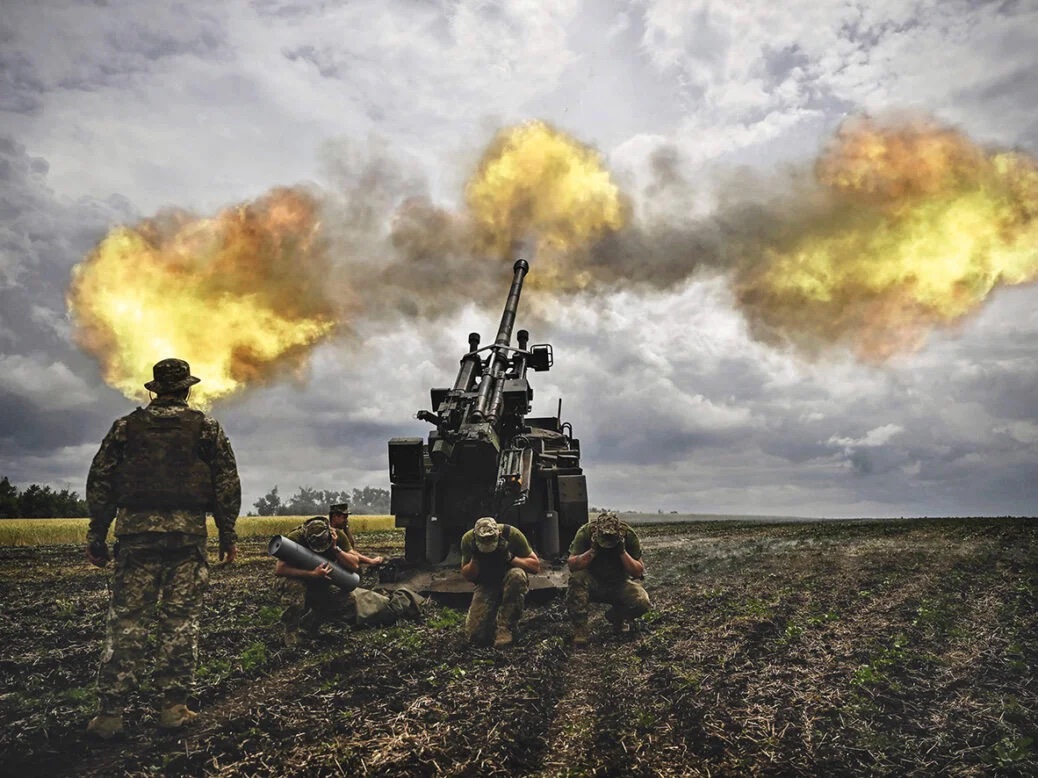
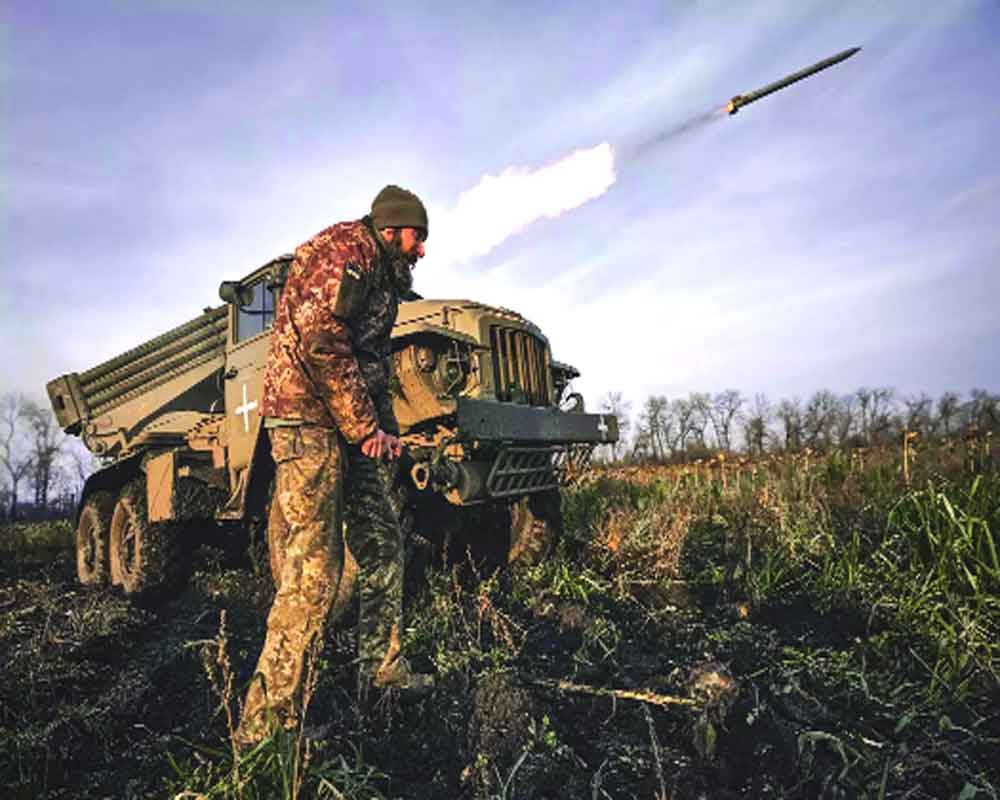
    The war, which began when NATO leaders dismissed Russia’s demand for security guarantees from the West, was intended as a way for Russia to reclaim its power and prestige on the global stage while strengthening its security in the region. Neither of these objectives has been achieved, nor will they be with Ukraine’s defeat. The war quickly escalated into a proxy conflict between Moscow and the collective West, with significant losses on both sides.

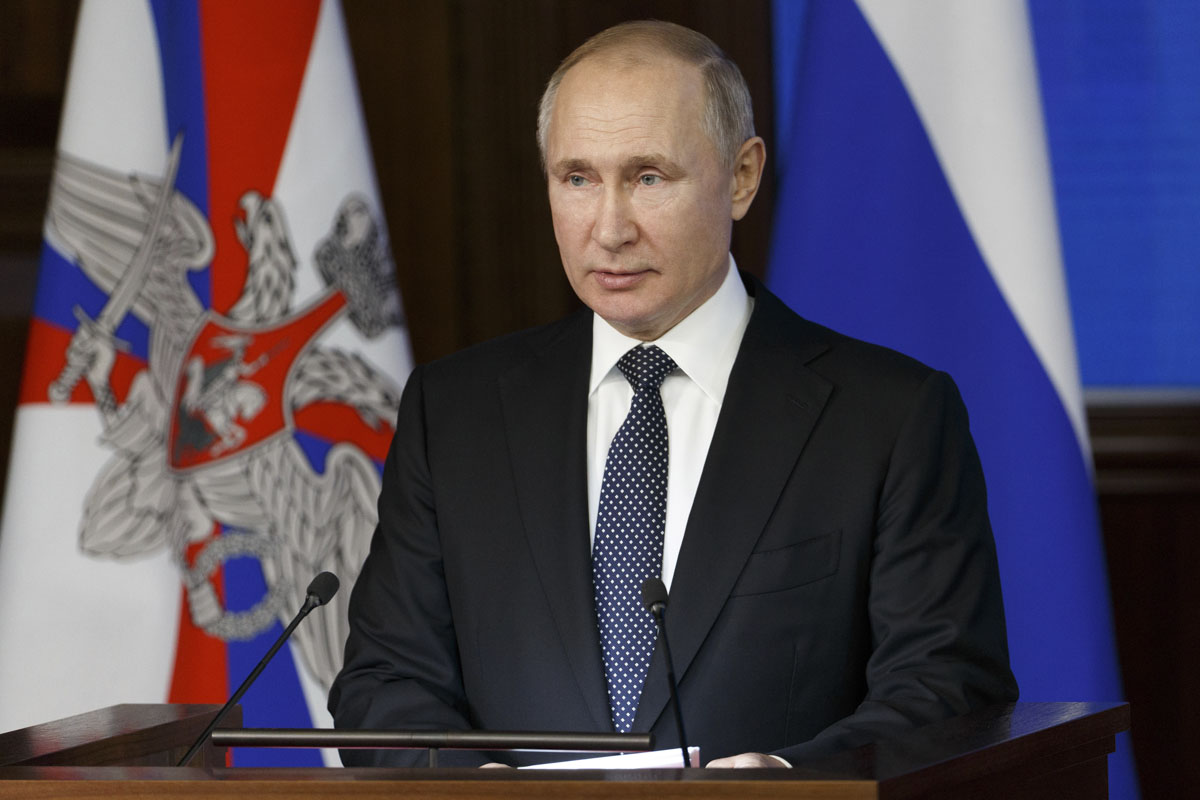
    Given that President Putin has recently signed an order to draft 160,000 additional soldiers with the goal of “finishing off” the Ukrainian resistance, the Russia-Ukraine war is far from a definitive resolution. Nonetheless, it is never too early to begin considering the options for a successful post-war settlement and the potential to transform the US-advocated ceasefire (if it ever materializes) into a lasting peace.


    Unfortunately, neither side of the conflict has presented anything even remotely resembling a plan for a sustainable, acceptable post-war settlement. The war, which began when NATO leaders dismissed Russia’s demand for security guarantees from the West, was intended as a way for Russia to reclaim its power and prestige on the global stage while strengthening its security in the region. Neither of these objectives has been achieved, nor will they be with Ukraine’s defeat. The war quickly escalated into a proxy conflict between Moscow and the collective West, with significant losses on both sides. Russia’s international security situation is now worse than it was before the war began, and this will remain the case for some time, regardless of what happens in Ukraine.

    Ukraine, in fact, is fighting a losing battle. Its leaders are sacrificing the country in the midst of a geopolitical rivalry involving Russia, Europe, and the USA. If Ukraine accepts a Trump-mediated deal with Russia, it will lose four regions occupied by Russian forces since 2022, agree to the annexation of Crimea, and abandon any hopes of NATO membership in the future. If Ukraine is defeated on the battlefield, it will lose its independence and be forced to submit to what Russian leaders refer to as demilitarization and denazification—essentially, a regime change and the reconstitution of Ukrainian governance.

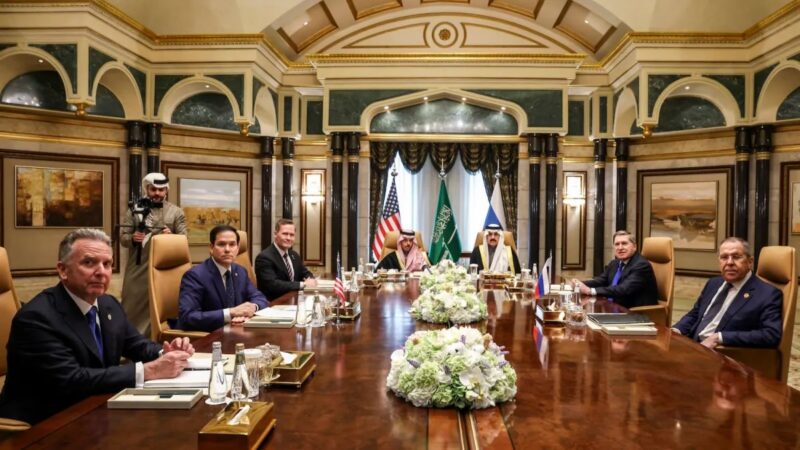
    With no realistic prospect of pushing Russian forces out of the country and with the increasing likelihood of an exploitative “resources plus infrastructure” deal imposed by Washington, Ukraine risks losing not only its state sovereignty but any semblance of international agency. If Ukraine’s role in a post-war settlement, as envisioned in the Saudi negotiations, is reduced to either a Russian-occupied territory or a de facto resource colony of the United States, such a “settlement” would merely serve as an interlude between two wars, offering no lasting resolution to the conflict.

    As the Kremlin proposes placing Ukraine under external governance and the White House demands control over all of Ukraine’s natural resource income for several years—along with a perpetual share of that revenue—the process of transforming Ukraine into a non-self-governing territory accelerates. However, Russia also faces setbacks. Despite Putin’s efforts to halt NATO’s expansion and push the alliance back to its 1997 military posture, NATO has grown closer to Russia’s borders, with formerly neutral Sweden and Finland joining the alliance in direct response to Russia’s invasion of Ukraine. Trump’s previous alignment with Putin prompted EU leaders to agree to a substantial €800 billion increase in defence spending, while French President Macron proposed extending France’s nuclear deterrent to protect all of Europe from potential Russian threats. This may lead to France positioning its nuclear-capable jets in Poland or Estonia, and its ballistic-missile submarines in the Baltic Sea. The British nuclear deterrent is already committed to NATO policy, and it is not unimaginable that some or all of the UK’s nuclear submarines could be deployed closer to Russia’s borders. A UK contribution to a European nuclear umbrella, along with the creation of a low-yield variant of existing nuclear capabilities, would further erode Russia’s already fragile security.

    Putin’s proposal for the external governance of Ukraine reveals Russia’s deep vulnerabilities, which the full occupation of Ukraine would soon expose. A collapse of Ukrainian statehood and the need to occupy the entire country would require Russia to maintain an occupation force of several hundred thousand troops, while also assuming responsibility for law enforcement, security, state administration, essential services, and more. Rebuilding Ukraine’s devastated southeast would cost billions of dollars, and efforts to restore the entire former Ukrainian nation are simply beyond Russia’s capacity. Meanwhile, the guerrilla warfare that the Ukrainians will inevitably intensify in response to Russia’s territorial expansion will further drain the occupiers’ resources.

    The end of the war would mark a slowdown in the military-industrial complex that has driven Russia’s economic growth in recent years. Additionally, the ongoing militarization of society, the rise of nationalist totalitarianism, and the enormous costs of occupying the “new territories” highlight the Pyrrhic nature of Russia’s supposed “victory.”

    Despite the Kremlin’s bravado, Russia’s economy and society have been significantly weakened by the war. With the key interest rate at 21 percent, annual inflation at 10 percent, dwindling welfare fund reserves, and an estimated 0.5 to 0.8 million casualties (killed and wounded) on the battlefield, it’s unclear how much longer Putin can stave off economic decline and maintain reluctant public support for his administration. The end of the war would mark a slowdown in the military-industrial complex that has driven Russia’s economic growth in recent years. Additionally, the ongoing militarization of society, the rise of nationalist totalitarianism, and the enormous costs of occupying the “new territories” highlight the Pyrrhic nature of Russia’s supposed “victory.” The best possible settlement from Russia’s perspective—leaving a rump Ukraine that is independent, self-sufficient, and friendly—is simply out of reach. The remaining options will only delay the inevitable second round of hostilities.

    Finally, the Western proposals for post-war settlements are either unsustainable or outright counterproductive. This is perplexing, given that the war has cost Europe dearly, and it should be in the EU’s interest to see it end as soon as possible. While predictions of seeing the Russian economy in tatters have not materialized, Europe now faces an imminent financial crisis. With the EU economy growing by less than 1 percent in 2024, while Russia’s economy grows 4.5 times faster, it’s time for those like President Macron of France—who advocate continuing the war with extensive European military and financial support—to reconsider their stance.

    However, this is not happening. Instead, EU leaders are urging Russia to agree to an “immediate and unconditional ceasefire on equal terms, with full implementation,” under the threat of new sanctions and the redoubling of Europe’s support for Ukraine.

    This approach is counterproductive and likely to strengthen Russia’s resolve. Beyond the fact that continued support for Ukraine’s war effort will further strain the already fragile budgets of the supporting states, insisting that Ukraine fight to the bitter end is both practically and morally indefensible. At the same time, abandoning Ukraine to face Russia alone could lead to the collapse of Ukrainian statehood. In either case, the collective West loses.

    A negotiated settlement, as proposed by President Trump, is a lesser evil under the current circumstances. Yes, it’s a suboptimal solution that could embolden Putin, harm Ukraine, deepen the divide between Russia and Europe, and create new challenges for international security.

    Yet, the preservation of Ukrainian statehood would be ensured. Death and destruction would cease. Europe’s economy would recover, and the global economy would see a boost. The risk of nuclear war in Europe would fade away. The need for European citizens to stockpile 72 hours’ worth of supplies, as per the European Commission’s recent guidance, might become less of a priority for the already-intimidated European citizens.

    European leaders should consider working alongside Trump, Putin, and Zelensky to craft a balanced, negotiated solution that accounts for the interests of all sides. Even if everyone must make sacrifices, it is better than losing everything. 

    While any path out of this war will be difficult, the strategy of threatening Russia with harsher sanctions, forming “coalitions of the willing,” and creating EU nuclear-armed forces will not make it any easier. Instead, European leaders should consider working alongside Trump, Putin, and Zelensky to craft a balanced, negotiated solution that accounts for the interests of all sides. Even if everyone must make sacrifices, it is better than losing everything.

    Feature Image Credit: www.pbs.org

  • What International Order?

    What International Order?

    The recently concluded BRICS summit confirms the process of inevitable transformation of the international order. The US-led West, since the fall of the USSR, has increasingly demonstrated intolerance to their view of the world. The ongoing conflicts in UKraine and Gaza has exposed their duplicity and the entire Global South have come to realise the anamolies in international order and the so-called rules-based system. The West’s unabashed support to Israel’s genocide and babarism in Gaza, despite their peoples’ opposition makes the claims of democracy and humanism in the West sound hollow. Thierry Meyssan dealt incisively with this duplicity of the West, primarily the Ango-Saxon powers, in his speech last year in Magdeburg (Germany), at the conference organized by the magazine Compact, “Amitie avec la Russie”, on November 4, 2023.

    We reproduce the text of Thierry Meyssan’s speech, translated by Roger Lagasse’, and published earlier in voltairenet.org

    In it, he explains what, in his view, constitutes the fundamental difference between the two conceptions of the world order now clashing from the Donbass to Gaza: that of the Western bloc and that to which the rest of the world refers. The question is not whether this order should be dominated by one power (unipolar) or by a group of powers (multipolar), but whether or not it should respect the sovereignty of each. He draws on the history of international law, as conceived by Tsar Nicholas II and Nobel Peace Prize winner Léon Bourgeois.

    – Team TPF

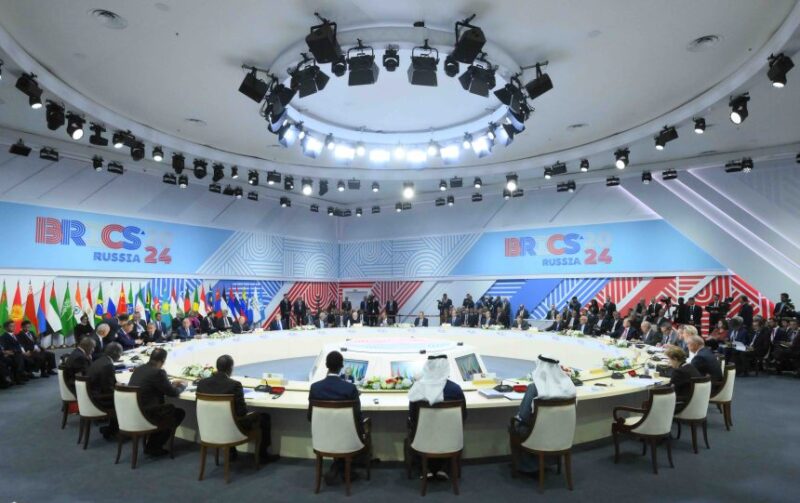
    BRICS Summit 2024 in Kazan, Russia, October 23,2024. Sputnik . Photo hosting agency brics-russia2024.ru

    What International Order?

    Thierry Meyssan

    We’ve seen NATO’s crimes, but why affirm our friendship with Russia? Isn’t there a risk of Russia behaving tomorrow like NATO does today? Are we not substituting one form of slavery for another?

    To answer this question, I would draw on my successive experience as advisor to five heads of state. Everywhere, Russian diplomats have told me: you’re on the wrong track: you’re committed to putting out one fire here, while another has started elsewhere. The problem is deeper and broader.

    I would therefore like to describe the difference between a world order based on rules and one based on international law. This is not a linear story, but a struggle between two worldviews – a struggle we must continue.

    In the 17th century, the Treaties of Westphalia established the principle of state sovereignty. Each is equal to the others, and no one may interfere in the internal affairs of others. For centuries, these treaties governed relations between the present-day Länder, as well as between European states. They were reaffirmed by the Congress of Vienna in 1815 when Napoleon I was defeated.

    On the eve of the First World War, Tsar Nicholas II convened two International Peace Conferences (1899 and 1907) in The Hague to “seek the most effective means of assuring all peoples the benefits of a real and lasting peace”. Together with Pope Benedict XV, he prepared them on the basis of canon law, not the law of the strongest. After two months of deliberation, 27 states signed the final proceedings. The president of the French Radical [Republican] Party, Léon Bourgeois, presented his thoughts [1] on the mutual dependence of states and their interest in uniting despite their rivalries.

    At the instigation of Léon Bourgeois, the Conference created an International Court of Arbitration to settle disputes by legal means rather than by war. According to Bourgeois, states would only agree to disarm when they had other guarantees of security.

    The final text instituted the notion of “the duty of States to avoid war”… by resorting to arbitration.

    At the instigation of one of the Tsar’s ministers, Frédéric Fromhold de Martens, the Conference agreed that, during armed conflict, populations and belligerents must remain under the protection of the principles resulting from “the usages established between civilized nations, the laws of humanity and the dictates of public conscience”. In short, the signatories undertook to stop behaving like barbarians.

    This system only works between civilized states that honour their signatures and are accountable to public opinion. It failed, in 1914, because states had lost their sovereignty by entering into defense treaties that required them to go to war automatically in certain circumstances that they could not assess for themselves.

    Léon Bourgeois’s ideas gained ground, but met with opposition, including from his rival in Georges Clemenceau’s Radical Party. Clemenceau did not believe that public opinion could prevent wars. Nor did the Anglo-Saxons, U.S. President Woodrow Wilson and British Prime Minister Lloyd George. At the end of the First World War, these three men substituted the might of the victors for the fledgling international law. They shared the world and the remnants of the Austro-Hungarian, German and Ottoman empires. They blamed Germany alone for the massacres, denying their own. They imposed disarmament without guarantees. To prevent the emergence of a rival to the British Empire in Europe, the Anglo-Saxons began to pit Germany against the USSR, and secured France’s silence by assuring her that she could plunder the defeated Second Reich. In a way, as the first President of the Federal Republic, Theodor Heuss, put it, they organized the conditions for the development of Nazism.

    As they had agreed among themselves, the three men reshaped the world in their own image (Wilson’s 14 points, the Sykes-Picot agreements, the Balfour Declaration). They created the Jewish homeland of Palestine, dissected Africa and Asia, and tried to reduce Turkey to its minimum size. They organized all the current disorders in the Middle East.

    Yet it was on the basis of the ideas of the late Nicholas II and Léon Bourgeois that the League of Nations (League) was established after the First World War, without the participation of the United States, which thus officially rejected any idea of International Law. However, the League also failed. Not because the United States refused to join, as some say. That was their right. But firstly, because it was incapable of re-establishing strict equality between states, as the United Kingdom was opposed to considering colonized peoples as equals. Secondly, it did not have a common army. And finally, because the Nazis massacred their opponents, destroyed German public opinion, violated the Berlin signature and did not hesitate to behave like barbarians.

    As early as the Atlantic Charter in 1942, the new U.S. President, Franklin Roosevelt, and the new British Prime Minister, Winston Churchill, set themselves the common goal of establishing a world government at the end of the conflict. The Anglo-Saxons, who imagined they could rule the world, did not, however, agree amongst themselves on how to go about it. Washington did not wish London to meddle in its affairs in Latin America, while London had no intention of sharing the hegemony of the Empire over which “the sun never set”. During the war, the Anglo-Saxons signed numerous treaties with Allied governments, including those in exile, which they hosted in London.

    Incidentally, the Anglo-Saxons failed to defeat the Third Reich, and it was the Soviets who overthrew it and took Berlin. Joseph Stalin, First Secretary of the CPSU, was opposed to the idea of a world government, and an Anglo-Saxon one at that. All he wanted was an organization capable of preventing future conflicts. In any case, it was Russian conceptions that gave birth to the system: that of the United Nations Charter, at the San Francisco conference.

    In the spirit of the Hague Conferences, all UN member states are equal. The Organization includes an internal tribunal, the International Court of Justice, responsible for settling disputes between its members. However, in the light of previous experience, the five victorious powers have a permanent seat on the Security Council, with a veto. Given that there was no trust between them (the Anglo-Saxons had planned to continue the war with the remaining German troops against the USSR) and that it was unknown how the General Assembly would behave, the various victors wanted to ensure that the UN would not turn against them (the USA had committed appalling war crimes by dropping two atomic bombs against civilians, while Japan… was preparing its surrender to the Soviets). But the great powers did not understand the veto in the same way. For some, it was a right to censor the decisions of others; for others, it was an obligation to take decisions unanimously.

    Except that, right from the start, the Anglo-Saxons didn’t play ball: an Israeli state declared itself (May 14, 1948) before its borders had been agreed, and the UN Secretary-General’s special envoy to oversee the creation of a Palestinian state, Count Folke Bernadotte, was assassinated by Jewish supremacists under the command of Yitzhak Shamir. Moreover, the seat on the Security Council allocated to China, in the context of the end of the Chinese Civil War, was given to Chiang Kai-shek’s Kuomintang and not to Beijing. The Anglo-Saxons proclaimed the independence of their Korean zone of occupation as the “Republic of Korea” (August 15, 1948), created NATO (April 4, 1949), and then proclaimed the independence of their German zone of occupation as “Federal Germany” (May 23, 1949).

    The USSR considered itself fooled, and slammed the door (“empty seat” policy). The Georgian Joseph Stalin had mistakenly believed that the veto was not a right of censure, but a condition of unanimity of the victors. He thought he could block the organization by boycotting it.

    The Anglo-Saxons interpreted the text of the Charter they had drafted and took advantage of the Soviets’ absence to place “blue helmets” on the heads of their soldiers and wage war on the North Koreans (June 25, 1950) in the “name of the international community” (sic). Finally, on August 1, 1950, the Soviets returned to the UN after an absence of six and a half months.

    The North Atlantic Treaty may be legal but NATO’s rules of procedure violate the UN Charter. It places the Allied armies under Anglo-Saxon command. Its Commander-in-Chief, the SACEUR, is necessarily an American officer. According to its first Secretary General, Lord Ismay, the Alliance’s real aim was neither to preserve the peace nor to fight the Soviets, but to “keep the Americans in, the Russians out and the Germans under control” [2]. In short, it was the armed wing of the world government that Roosevelt and Churchill wanted to create. It was in pursuit of this goal that President Joe Biden ordered the sabotage of the Nord Stream gas pipeline linking Russia and Germany.

    At the Liberation, MI6 and OPC (the future CIA) secretly set up a stay-behind network in Germany. They placed thousands of Nazi leaders in this network, helping them to escape justice. Klaus Barbie, who tortured French Resistance coordinator Jean Moulin, became the first commander of this shadow army. The network was then incorporated into NATO, where it was greatly reduced. It was then used by the Anglo-Saxons to interfere in the political life of their supposed allies, who were in reality their vassals.

    Joseph Goebbels’ former collaborators created the Volksbund für Frieden und Freiheit. With the help of the USA, they persecuted German communists. Later, NATO’s stay-behind agents were able to manipulate the extreme left to make it detestable. A case in point is the Bader gang. But as these men were arrested, the stay-behind came and murdered them in prison, before they could stand trial and speak out. In 1992, Denmark spied on Chancellor Angela Merkel on NATO instructions, just as in 2022, Norway, another NATO member, helped the USA sabotage Nord Stream…

    Returning to international law, things gradually returned to normal, until in 1968, during the Prague Spring, the Ukrainian Leonid Brezhnev did in Central Europe what the Anglo-Saxons were doing everywhere else: he forbade the USSR’s allies to choose an economic model other than their own.

    With the dissolution of the USSR, things began to get worse. The US Undersecretary of Defense, Paul Wolfowitz, drew up a doctrine according to which, to remain masters of the world, the United States had to do everything in its power to prevent the emergence of a new rival, starting with the European Union. It was in application of this idea that Secretary of State James Baker imposed the enlargement of the European Union to include all the former states of the Warsaw Pact and the USSR. By expanding in this way, the Union deprived itself of the possibility of becoming a political entity. It was again in application of this doctrine that the Maastricht Treaty placed the EU under NATO’s protection. And it is still in the application of this doctrine that Germany and France are paying for and arming Ukraine.

    Then came Czech-US professor Josef Korbel. He proposed that the Anglo-Saxons should dominate the world by rewriting international treaties. All that was needed, he argued, was to substitute Anglo-Saxon law, based on custom, for the rationality of Roman law. In this way, in the long term, all treaties would give the advantage to the dominant powers: the United States and the United Kingdom, linked by a “special relationship”, in the words of Winston Churchill. Professor Korbel’s daughter, Democrat Madeleine Albright, became Ambassador to the UN, then Secretary of State. Then, when the White House passed into Republican hands, Professor Korbel’s adopted daughter, Condoleeza Rice, succeeded her as National Security Advisor, then Secretary of State. For two decades, the two “sisters” [3]patiently rewrote the main international texts, ostensibly to modernize them, but in fact to change their spirit.

    Today, international institutions operate according to Anglo-Saxon rules, based on previous violations of international law. This law is not written in any code, since it is an interpretation of custom by the dominant power. Every day, we substitute unjust rules for International Law and violate our own signature.

    For example:

    • When the Baltic States were created in 1990, they made a written commitment to preserve the monuments to the sacrifices of the Red Army. The destruction of these monuments is therefore a violation of their own signature.
    • Finland made a written commitment in 1947 to remain neutral. Joining NATO is therefore a violation of its own signature.
    • On October 25, 1971, the United Nations adopted Resolution 2758 recognizing Beijing, not Taiwan, as the sole legitimate representative of China. As a result, Chiang Kai-shek’s government was expelled from the Security Council and replaced by that of Mao Zedong. Consequently, China’s recent naval manoeuvres in the Taiwan Strait do not constitute aggression against a sovereign state, but the free deployment of its forces in its own territorial waters.
    • The Minsk agreements were intended to protect Russian-speaking Ukrainians from harassment by “integral nationalists”. France and Germany vouched for them before the Security Council. But, as Angela Merkel and François Hollande have said, neither of them had any intention of implementing them. Their signatures are worthless. If it had been otherwise, there would never have been a war in Ukraine.

    The perversion of International Law reached a peak with the appointment, in 2012, of the American Jeffrey Feltman as Director of Political Affairs. From his office in New York, he oversaw the Western war on Syria. Using the institutions of peace to wage war [4].

    Until the United States threatened it by stockpiling weapons on its border, the Russian Federation respected all the commitments it had signed or that the Soviet Union had signed. The Nuclear Non-Proliferation Treaty (NPT) obliges the nuclear powers not to spread their nuclear arsenals around the world. The United States, in violation of its signature, has been stockpiling atomic bombs in five vassal countries for decades. They train allied soldiers in the handling of these weapons at the Kleine Brogel base in Belgium, the Büchel base here in Germany (Rhineland-Palatinate), the Aviano and Ghedi bases in Italy, the Volkel base in the Netherlands and the Incirlik base in Turkey.

    Then they say, by virtue of their coups de force, that this has become the custom.
    Now, the Russian Federation, considering itself under siege after a US nuclear bomber flew over the Gulf of Finland, has also played with the Non-Proliferation Treaty and installed atomic bombs on the territory of Belarus. Of course, Belarus is not Cuba. Placing Russian nuclear bombs there changes nothing. It’s just a message sent to Washington: if you want to re-establish the Law of the Strongest, we can accept that too, except that, from now on, we’re the strongest. Note that Russia has not violated the letter of the Treaty, as it is not training the Belarusian military in these weapons, but it has taken liberties with the spirit of the Treaty.

    As Léon Bourgeois explained in the last century, to be effective and lasting, disarmament treaties must be based on legal guarantees. It is therefore urgent to return to international law, failing which we will plunge headlong into a devastating war.

    Our honour and our interest lie in re-establishing international law. It’s a fragile construction. If we want to avoid war, we must re-establish it, and we can be sure that Russia thinks as we do, that it will not violate it.

    Or we can support NATO, which brought its 31 defence ministers together in Brussels on October 11 to listen to their Israeli counterpart announce, via videoconference, that he was going to raze Gaza to the ground. And none of our ministers, including Germany’s Boris Pistorius, dared to speak out against the planning of this mass crime against civilians. The honour of the German people has already been betrayed by the Nazis, who ultimately sacrificed you. Don’t let yourselves be betrayed again, this time by the Social Democratic Party and the Greens.

    We don’t have to choose between two overlords, but to protect peace, from the Donbass to Gaza, and, ultimately, to defend International Law.


    Source: “What international order?”, by Thierry Meyssan, Translation Roger Lagassé, Voltaire Network, 7 November 2023, www.voltairenet.org/article219965.html

    Republished under Creative Commons CC-BY-NC-ND

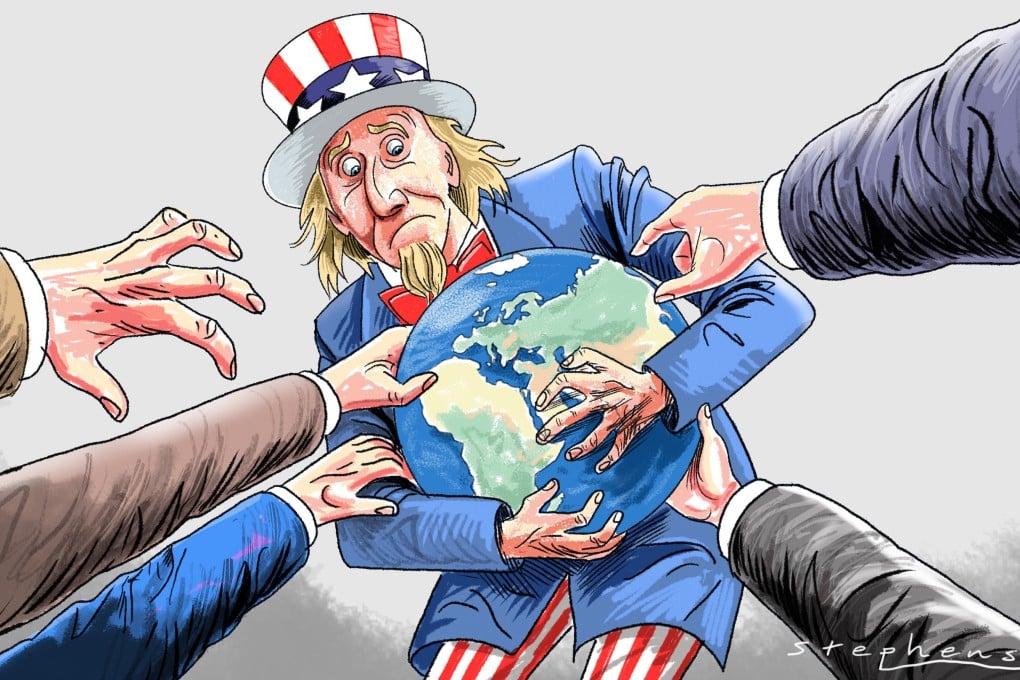
    Feature Image Credit: ‘Imagine a World free from the Oppression of a US-led global Order’ – www.scmp.com


  • The NATO Declaration and the Deadly Strategy of Neoconservatism

    The NATO Declaration and the Deadly Strategy of Neoconservatism

    For the sake of America’s security and world peace, the U.S. should immediately abandon the neocon quest for hegemony in favour of diplomacy and peaceful co-existence.

    In 1992, U.S. foreign policy exceptionalism went into overdrive. The U.S. has always viewed itself as an exceptional nation destined for leadership, and the demise of the Soviet Union in December 1991 convinced a group of committed ideologues—who came to be known as neoconservatives—that the U.S. should now rule the world as the unchallenged sole superpower.

    Despite countless foreign policy disasters at neocon hands, the 2024 NATO Declaration continues to push the neocon agenda, driving the world closer to nuclear war.
    The neoconservatives were originally led by Richard Cheney, the Defense Secretary in 1992. Every President since then—Clinton, Bush, Obama, Trump, and Biden—has pursued the neocon agenda of U.S. hegemony, leading theU.S. into perpetual wars of choice, including Serbia, Afghanistan, Iraq, Syria, Libya, and Ukraine, as well as relentless eastward expansion of NATO, despite a clear U.S. and German promise in 1990 to Soviet President Mikhail Gorbachev that NATO would not move one inch eastward.
    The core neocon idea is that the U.S. should have military, financial, economic, and political dominance over any potential rival in any part of the world. It is targeted especially at rival powers such as China and Russia and, therefore, brings the U.S. into direct confrontation with them. The American hubris is stunning: most of the world does not want to be led by the U.S., much less led by a U.S. state clearly driven by militarism, elitism and greed.
    The neocon plan for U.S. military dominance was spelt out in the Project for a New American Century. The plan includes relentless NATO expansion eastward and the transformation of NATO from a defensive alliance against a now-defunct Soviet Union to an offensive alliance used to promote U.S. hegemony. The U.S. arms industry is the major financial and political backer of the neocons. The arms industry spearheaded the lobbying for NATO’s eastward enlargement starting in the 1990s. Joe Biden has been a staunch neocon from the start, first as Senator, then as Vice President, and now as President.
    To achieve hegemony, the neocon plans rely on CIA regime-change operations; U.S.-led wars of choice; U.S. overseas military bases (now numbering around 750 overseas bases in at least 80 countries); the militarization of advanced technologies (biowarfare, artificial intelligence, quantum computing, etc.); and relentless use of information warfare.
    The quest for U.S. hegemony has pushed the world to open warfare in Ukraine between the world’s two leading nuclear powers, Russia and the United States. The war in Ukraine was provoked by the relentless determination of the U.S. to expand NATO to Ukraine despite Russia’s fervent opposition, as well as the U.S. participation in the violent Maidan coup (February 2014) that overthrew a neutral government and the U.S. undermining of the Minsk II agreement that called for autonomy for the ethnically Russian regions of eastern Ukraine.
    The NATO Declaration calls NATO a defensive alliance, but the facts say otherwise. NATO repeatedly engages in offensive operations, including regime-change operations. NATO led the bombing of Serbia in order to break that nation into two parts, with NATO placing a major military base in the breakaway region of Kosovo. NATO has played a major role in many U.S. wars of choice. NATO bombing of Libya was used to overthrow the government of Moammar Qaddafi.
    The U.S. quest for hegemony, which was arrogant and unwise in 1992, is absolutely delusional today since the U.S. clearly faces formidable rivals that can compete with the U.S. on the battlefield, in nuclear arms deployments and in the production and deployment of advanced technologies. China’s GDP is now around 30% larger than the U.S. when measured at international prices, and China is the world’s low-cost producer and supplier of many critical green technologies, including EVs, 5G, photovoltaics, wind power, modular nuclear power, and others. China’s productivity is now so great that the U.S. complains of China’s “over-capacity.”

    Sadly and alarmingly, the NATO declaration repeats the neoconservative delusions.
    The Declaration falsely declares that “Russia bears sole responsibility for its war of aggression against Ukraine,” despite the U.S. provocations that led to the outbreak of the war in 2014.
    The NATO Declaration reaffirms Article 10 of the NATO Washington Treaty, according to which NATO’s eastward expansion is none of Russia’s business. Yet the U.S. would never accept Russia or China establishing a military base on the US border (say in Mexico), as the U.S. first declared in the Monroe Doctrine in 1823 and has reaffirmed ever since.
    The NATO Declaration reaffirms NATO’s commitment to biodefense technologies, despite growing evidence that U.S. biodefense spending by NIH financed the laboratory creation of the virus that may have caused the Covid-19 pandemic.
    The NATO Declaration proclaims NATO’s intention to continue to deploy anti-ballistic Aegis missiles (as it has already done in Poland, Romania, and Turkey) despite the fact that the U.S. withdrawal from the ABM Treaty and placement of Aegis missiles in Poland and Romania has profoundly destabilized the nuclear arms control architecture.
    The NATO Declaration expresses no interest whatsoever in a negotiated peace for Ukraine.
    The NATO Declaration doubles down on Ukraine’s “irreversible path to full Euro-Atlantic integration, including NATO membership.” Yet Russia will never accept Ukraine’s NATO membership, so the “irreversible” commitment is an irreversible commitment to war.
    The Washington Post reports that in the lead-up to the NATO summit, Biden had serious qualms about pledging an “irreversible path” to Ukraine’s NATO membership, yet Biden’s advisors brushed aside these concerns.

    The neoconservatives have created countless disasters for the U.S. and the world, including several failed wars, a massive buildup of U.S. public debt driven by trillions of dollars of wasteful war-driven military outlays, and the increasingly dangerous confrontation of the U.S. with China, Russia, Iran, and others. The neocons have brought the Doomsday Clock to just 90 seconds to midnight (nuclear war), compared with 17 minutes in 1992.

    For the sake of America’s security and world peace, the U.S. should immediately abandon the neocon quest for hegemony in favour of diplomacy and peaceful co-existence.
    Alas, NATO has just done the opposite.


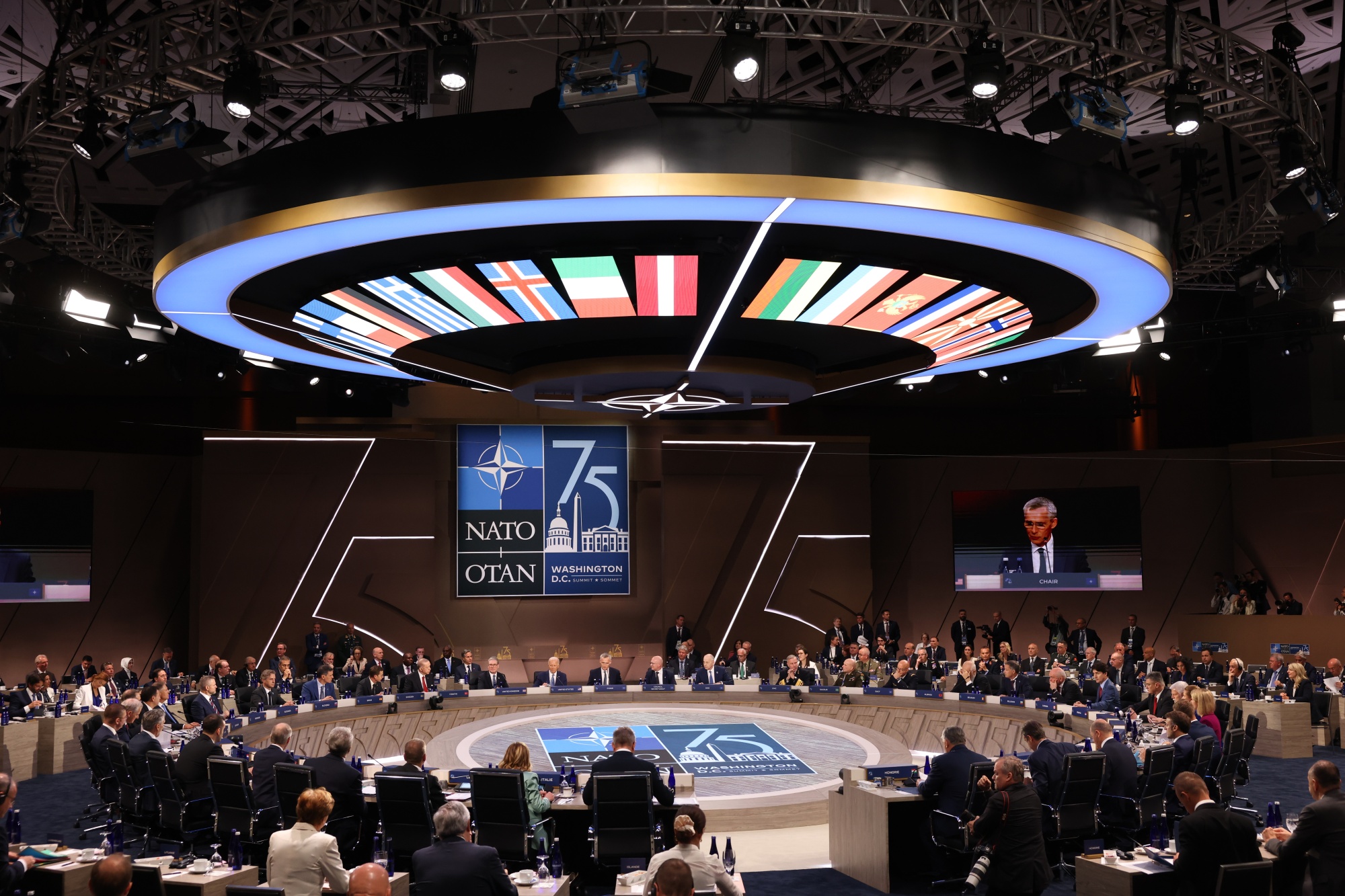
    Feature Image Credit: Bloomberg

  • The United States as an Empire in Decline: A Talk by Jeremy Kuzmarov

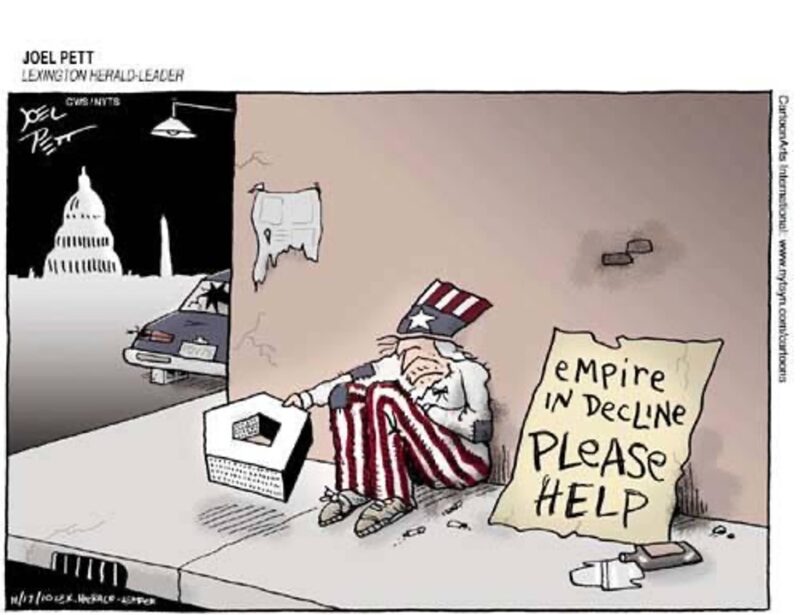
    The United States as an Empire in Decline: A Talk by Jeremy Kuzmarov

    The Peninsula Foundation organised a webinar titled ” World Order Turmoil: The Reality of American Empire” on the 19th of January 2024. The main talk was given by the Chief Guest Jermey Kuzmarow and further comments was provided by the Discussant, Mohan Guruswamy. The event led to excellent discussions with critical comments from both the speakers. The discussions were moderated by Air Marshal M Matheswaran, President-TPF.

    Jeremy Kuzmarov is Managing editor of CovertAction Magazine and author of five books on U.S. foreign policy. His website can be accessed here. Mohan Guruswamy is our Governing Council member and a Distinguished Fellow and a prolific writer on economics, security, and geopolitics.


    Given below is the text of jeremy Kuzmarow’s talk, along with questions and answers.
     

    (Source: tunnelwall.blogspot.com)

    In September, I attended a talk sponsored by the Tulsa Committee on Foreign Relations by an inside-the-beltway pundit named Ali Wyne, a former senior fellow at the pro-NATO Atlantic Council and David Rockefeller fellow at the elitist Trilateral Commission.

    Wyne told the audience in so many words that the sun had not yet set on the American empire; that the Biden administration was outmaneuvering the evil Putin in Ukraine; and that the U.S. was still a beacon of hope for the rest of humanity.

    Toward the end, Wyne personalized the talk, discussing how his family had migrated to the U.S. from Pakistan with nothing, and that through hard work he was able to achieve the American dream.

    But Wyne seemed oblivious to the fact that that dream is increasingly unreachable for the majority of people in an increasingly stratified society marred by a decline in civilian manufacturing and public services and skyrocketing education costs.

    Wyne also failed to point out that the American dream historically was achieved at the expense of Third World nations that were looted by U.S. corporations, and by endless wars that killed millions of people.

    Wyne’s delusional worldview is underscored in a new book by Fadi Lama, Why the West Can’t Win: From Bretton Woods to a Multipolar World (Atlanta: Clarity Press, 2023), which shows that the American Century has ended and that a new multipolar world order has been established in which economic dynamism lies primarily in the East.

    Lama is an international adviser for the European Bank for Reconstruction and Development (EBRD) and geopolitical consultant with a Ph.D. in mechanical engineering from the Georgia Institute of Technology (Georgia Tech).
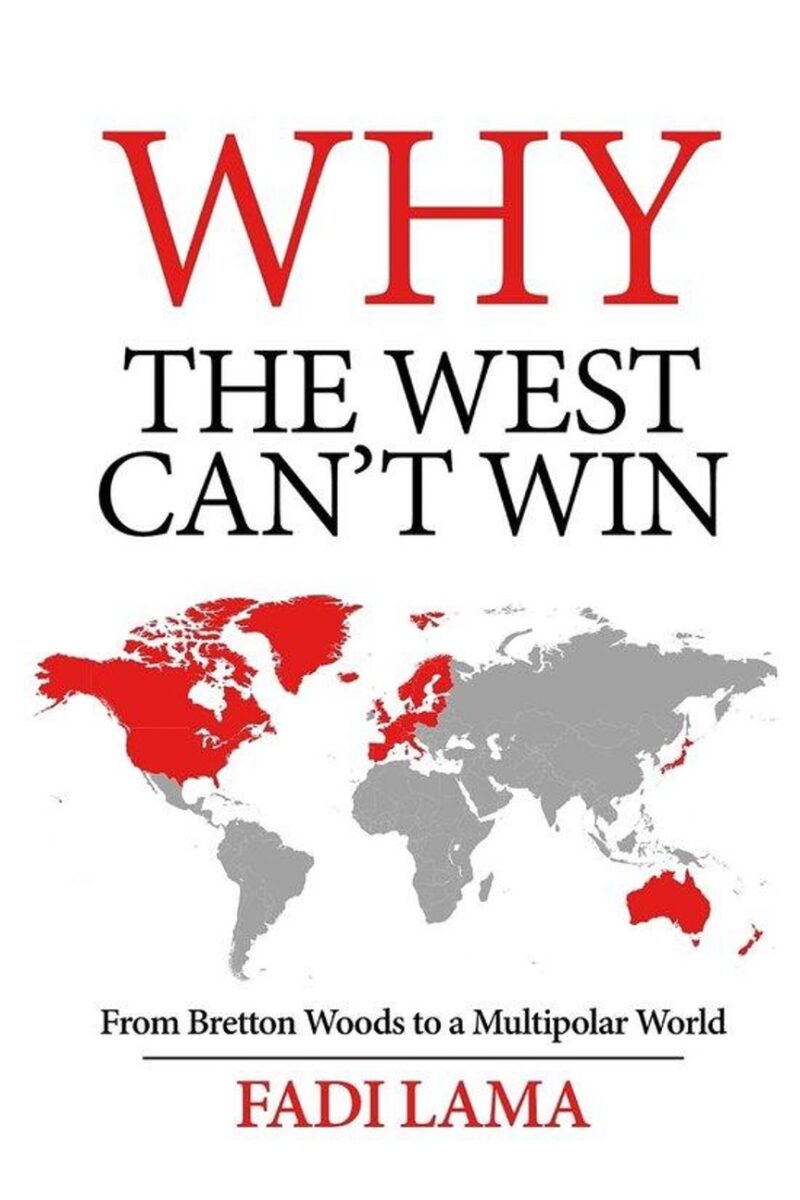
    He points out at the beginning of his book that in 1500, prior to the era of Western colonialism, there was a relatively fair political-economic world order with a close equilibrium between population and wealth generation. But by the end of World War II, the West accounted for only 30% of global population but 60% of global Gross Domestic Product (GDP).

    When many colonized nations gained their independence, the West imposed a neo-colonial framework that enabled their resources to be exploited by Western multinational corporations.

    Some countries on the front lines of the Cold War, such as West Germany, Japan and South Korea, were allowed unhindered development as part of a geopolitical strategy designed to keep them within the Western orbit and curb the advance of Communism. However, being pseudo-independent states, when the political necessity was removed, they were cut back to size.

    The liberation of China in the 1949 Communist-led revolution (an event known in the U.S. as the “loss of China”) was a historical turning point that began to reverse the Western monopolization of wealth and power and set the stage for the re-empowerment of the Global South.

    By 2017, China—known as the “sick man of Asia” in the 19th century following its de facto colonization of Great Britain following the Opium War—was the world’s number one economy with its real goods production amounting to 24% of global real goods production.

    Under CCP leadership, China regained its sovereignty and lifted 770 million people out of poverty, with homelessness now being practically non-existent.

    According to Lama, China’s staggering economic success resulted from a centralized political system in which commercial banking was dominated by the public sector. Central bank financial and monetary policies were further put under the control of the Chinese government, which implemented policies serving the national interest rather than those of the Western financial oligarchy.

    China’s economic success contrasts markedly with the growing economic stagnation in Western countries and the U.S. resulting from the neo-liberal economic model in which the private sector is elevated above the public sector.

    By 2014, the top 0.1% in the U.S. owned as many assets as the bottom 90%, an obscene inequality ratio accompanied by a dramatic rise in poverty, which had been reduced massively in China under more socialist-oriented policies.

    China’s superior state-centric economic model is currently being followed by Russia which has withstood record U.S. sanctions under Vladimir Putin’s leadership through a renewed commitment to economic autarky (self-sufficiency) and investment in local industries and technologies.

    Following the collapse of the Soviet Union, U.S. strategic planners saw a golden opportunity to reduce Russia’s status to that of a fourth-rate power and to enable the plunder of its bountiful natural resources.

    The overzealous policies backfired, however, pushing Russia into alliance with China that signifies the birth of a new multi-polar world order that holds the potential to restore the global economic parity from 1500—before Western colonization took root.

    Lama emphasizes the fact that Russia now provides food aid in Afghanistan and Africa and fertilizer to poor countries, and has forged growing relations with both China and Iran, the latter having gained independence from Western colonial tutelage in 1979 when the Shah was overthrown.

    Lama finds significant economic synergy and growing win-win cooperation in the economic, cultural, scientific and military fields between China, Russia and Iran, which he says are “de facto allies in the struggle for a ‘Fair World.’”

    Russia and China today are leading the way in space exploration, clean energy technologies as well as cutting-edge missile technologies at a time that U.S. weapons systems are proving to be extraordinarily costly and inefficient owing to a Byzantine Pentagon contracting system and under-skilled workforce due to the skyrocketing costs of higher education.

    Today’s shifting power balance can be compared with 1997 when “‘the empire’ had control over three of the top four energy reserves: Venezuela was a U.S. vassal, Russian energy resources were under control of the Money Powers (Western financial oligarchs) via their proxy Russian oligarchs, and Saudi Arabia was a compliant U.S. tributary. Of the top four, only Iranian reserves were out of the Money Powers’ control.”

    By 2022, Lama writes, “the Empire had lost control of the top three reserves, Venezuela, Iran and Russia, while Saudi Arabia is no longer as compliant as it was in 1997.”

    What happened in the interim was a period of heightened military intervention and imperial overreach resulting in a counter-mobilization that signifies the end of the era of Western empires dating back to the 16th century.

    Bretton Woods: From Military to Financial Colonialism

    The imperial framework after World War II was established through the Bretton Woods economic system, which Lama says was designed to “lock countries into a financial structure controlled by the West.”

    Lama writes that this structure “requires central bank governors be independent of their governments, but dependent on rules established by the Bank for International Settlements (BIS), at the top of the pyramid in the Bretton Woods system.

    Established in 1930 to handle reparations payments imposed on Germany at the Versailles Conference after World War I, BIS had helped finance Hitler’s rise to power and was owned by central banks, setting policies for them that directly influenced the global economy.

    Franklin D. Roosevelt had proposed liquidating the BIS due to its cooperation with Nazi Germany, though the resolution that he sponsored to that effect at the July 1944 Bretton Woods Conference at which the post-World War II monetary and political global structure was being set, was revoked after Roosevelt’s death.
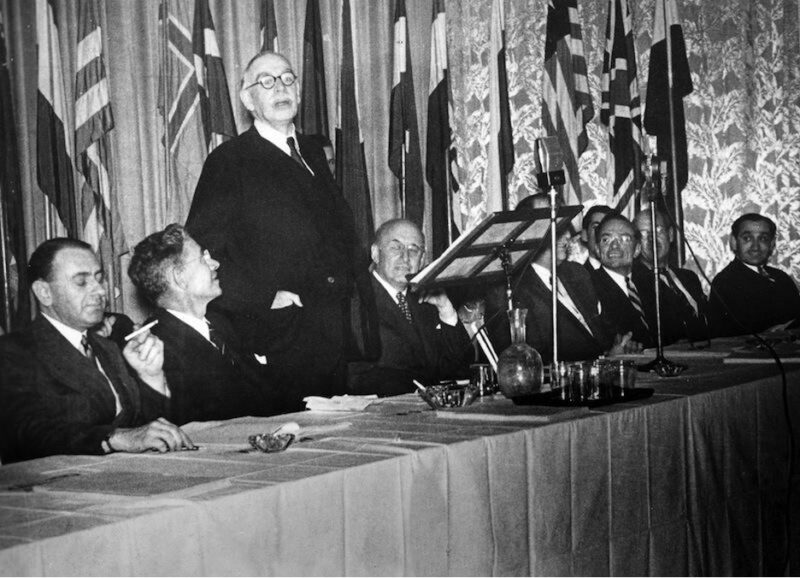
    John Maynard Keynes addressing the July 1944 Bretton Woods Conference in New Hampshire. [Source: centerforfinancialstability.org

    According to Lama, when some newly decolonized countries tried to adopt an alternative economic arrangement to Bretton Woods, their leaders (Togo’s Sylvanus Olympio, Egypt’s Nasser; Indonesia’s Sukarno; Democratic Republic of Congo’s Lumumba; Iran’s Mossadegh; Ecuador’s Jaime Roldos; Panama’s Omar Torrijos) were eliminated by wars, coups or assassinations [over a 25-year span].

    Economic hit men would descend on developing countries offering loans for infrastructure projects whose real purpose was to plunge these countries into debt so they would become dependent on foreign creditors and their economies could be restructured along neo-liberal lines and in the service of multi-national corporations.

    A pillar of the Bretton Woods system was that the U.S. dollar was established as the international trade currency, which was convertible into gold at the fixed rate of $35 per ounce of gold.

    With the decline of U.S. competitiveness in the 1960s, the Nixon administration froze the convertibility of the U.S. dollar in gold and, instead, made it convertible to oil, provided that oil was sold only in U.S. dollars.

    This led to a dramatic increase in the price of oil and petrodollar arrangement with Saudi Arabia by which the U.S. provided military protection and weapons to the Saudis in exchange for the promise of them trading their oil in U.S. dollars and using income from oil to buy U.S. Treasury bills. Interest on these sales was then spent by the U.S. Department of the Treasury on infrastructure projects in Saudi Arabia to be executed by U.S. companies.

    The fact that other countries had to hold reserves in U.S. dollars to cover their oil imports allowed the U.S. to incur high trade deficits bred by deindustrialization in the neo-liberal era without causing a depreciation of the U.S. dollar.

    However, this is no longer sustainable in the long term and Russia and China are spearheading a shift in the global economy by which oil and other commodities are no longer being traded in U.S. dollars, ushering in the end of the American Century.

    The Money Power

    Lama’s book includes discussion of the growth of the Western financial oligarchy, or what he calls the Money Power, who are the major shareholders of the leading hedge funds (BlackRock, Vanguard and State Street) and have become the absolute rulers over society.

    According to Lama, the Money Power is well placed to control elections in Western democracies and control mass media in all its forms, print, TV and social media platforms.

    They support free trade agreements designed to usurp what little is left of national sovereignty and a neo-liberal vulture economy in which all aspects of the economy are privatized in order to maximize corporate profits.

    The U.S. decline has been fueled by the Money Power’s recognition that maintaining a strong manufacturing base was no longer necessary when trade deficits could be offset by currency manipulation owing to Nixon’s convertibility of the U.S. dollar to oil and the trade in oil around the world in U.S. dollars.

    The U.S. economy is increasingly dominated by the financial sector which flourishes at the expense of other vital economic sectors, leading to the high wealth concentration and impoverishment of society made worse by austerity measures entailing cutbacks in social and other government services.

    Russophobia, Sinophobia and the End of an Era

    The intense Russophobia cultivated in the U.S. media over the last decade is the result of the Money Power’s lust for Russia’s immense wealth, which it was starting to gain access to in the 1990s before Vladimir Putin reasserted national control over Russia’s economy.

    The anti-Russia propaganda has had the greatest impact on the educated classes, as 77% of Americans with post-graduate degrees considered Russia an enemy in a March 2022 poll, compared to 66% with high school education or less.

    Russophobia has been combined with an ascendant Islamophobia and Sinophobia, whose purpose is to mobilize public support for confronting the troika of powers (Russia, Iran and China), which threaten Western hegemony.

    According to Lama, if a date were to be identified for the end of the U.S. empire, it would be January 8, 2020, when Iran avenged the assassination of General Qasem Soleimani by attacking a U.S. air base in Iraq and displaying Iran’s weapons capability.

    Afterwards, the U.S. Central Command (Centcom) significantly relocated its headquarters from Doha, Qatar, just 125 miles from Iranian shores, to safety in Tampa, Florida.

    While the current U.S. war in Gaza has created a renewed pretext for expanded U.S. military intervention in the Middle East, Lama’s book makes clear that the U.S. could not win a war against Iran for regime change.

    Contrary to Wyne’s analysis, the U.S. has also been outmaneuvered in Ukraine, whose army is in a state of disrepair after a failed counteroffensive. It is further being outmaneuvered by China, which is winning hearts and minds through the Belt and Road Initiative (BRI) that provides low-interest loans to countries for infrastructural development with no strings attached.

    In sum, the Great Game for world domination appears to be up and the Money Power has lost. That is why they are behaving so erratically in manufacturing crisis after crisis as they desperately attempt to sustain a fading world order defined by profound inequality and injustice. For the rest of my talk, I will try and further answer some of the questions that were posed prior to the seminar:

    Question 1) This dealt with consistent U.S. war making as a tool in which the US tried to sustain its hegemony, and growing pushback with the rise of BRICS, Shanghai Cooperation Organization and Rise of China? How will all this shape the future world order?

    Answer: There is the threat of a world war breaking out provoked by the U.S. as the U.S. cannot tolerate geopolitical competition or being relegation to a second rate power, and will respond violently—as it is already doing. Currently, the U.S. is provoking wars simlutaneously with Russia, China and the Middle East, with catastrophic consequences already for the people of Ukraine, Russia and Gaza. The great Australian journalist John Pilger produced a documentary in 2016 warning about the U.S. military buildup in the Asia Pacific and coming war with China, which would be catastrophic for everyone involved.

    It is instructive to look back in history to the 1930s when Japan challenged U.S. and Western empires in the Asia Pacific with the establishment of the Greater Economic Co-Prosperity Sphere. This challenge and effort by Japan to establish an alternative yen bloc in Southeast Asia and to supplant the Western colonial powers led directly to the Pacific War. Records from the time reveal how the U.S. manuevered Japan into firing the first shot (an explicit goal of U.S. policy as outlined by Secretary of State Henry Stimson) by imposing a naval buildup in the South China sea and crippling oil embargo that threatened to cut off Japan’s oil supply and undermine its empire in the Asia-Pacific.

    There is evidence that FDR knew about the impending Pearl Harbor attacks but allowed them to take place because the American public would only support military intervention if America were attacked and the attack was made to look like a sneak attack by a dastardly enemy.

    History could easily repeat itself today; the U.S. military is in fact preparing for war in the Asia Pacific; building a new military base in Micronesia in the middle of the Pacific Ocean, and training soldiers in jungle warfare in Hawaii while studying military battles in the Pacific War, like the Battle of Guadalcanal.

    Gen. Charles A. Flynn, the commander of U.S. Army Pacific, was quoted in The New York Times stating that China had been on “an incremental, insidious and irresponsible path for decades.” Now more than ever, the “total Army,” he said, needs to prioritize relevant Pacific experience.
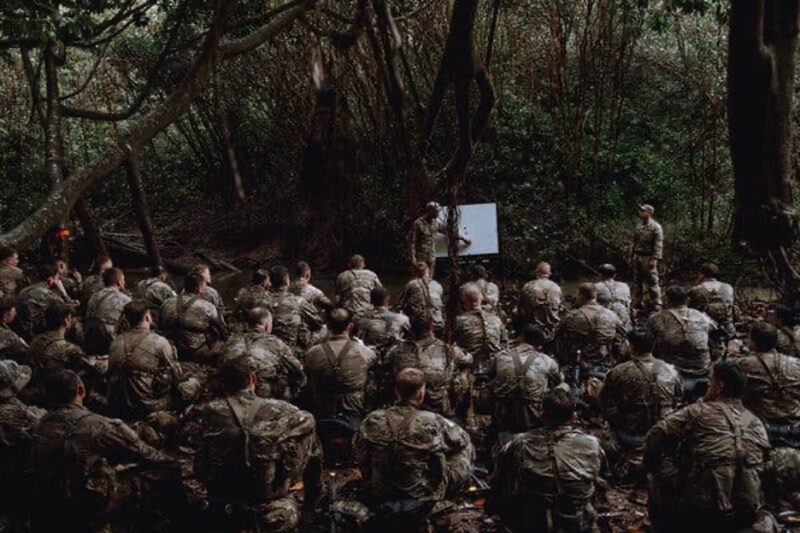
    U.S. soldiers being trained to fight a 21st Century Pacific War—this time against China. [Source: nytimes.com]

    After provoking a war with China, like with Japan in World War II, the U.S. would surely make it look like China started it and that it was somehow innocent. This has been a feature of US imperial wars going back to the era of the Indian Wars.

    Question 2: The first half of the 20th century was essentially a contest of empires. The two World Wars were fundamentally European wars or a contest of colonial empires. While the European empires were destroyed, the gain was for the U.S. as it emerged as the most powerful actor.

    Answer: Agreed. I would add that the U.S. defeated the Japanese empire in the Pacific theater of World War II, which enabled the U.S. to establish a chain of military bases in the Asia Pacific as a linchpin of U.S. imperialism. U.S. strategic planners had long considered the Asia Pacific key to world domination because of its economic vitality and rich resources and geography and this is why the U.S. cannot accept any rival powers there, including Japan, and now China.

    Question 3: Did the U.S. foresee this and plan its rise to a position as the pre-eminent power ensuring the destruction of the European powers?

    Answer: Yes, absolutely. As one example of dispacing European empires, I was just reading a book about U.S. policy in Congo in the 1960s by David Gibbs, The Political Economy of Third World Intervention. The book showed how U.S. mining tycoons (Maurice Templesman and Harold Hochschild) came to oppose Belgian colonialism so American corporations could replace Belgian ones in controlling and profiting from Congo’s lucrative mineral wealth. Templesman and Hochschild financed CIA front organizations and supported the murder of Patrice Lumumba who wanted to nationalize Congo’s mines after independence. They cultivated very close ties with Joseph Mobutu; Lumumba’s replacement and murderer, who cultivated the image of a Pan-Africanist devoted to African culture, but who sold out Congo and its economy to foreign interests. The CIA funded Mobutu’s security apparatus so he could crush a secessionist movement in the diamond rich Katanga province backed by the Belgians. The goal was for Mobutu to consolidate his control over Congo and for U.S. corporations to take over the mines from Belgians in Katanga. Here is U.S. neocolonialism at work, and muscling out of the Europeans.

    Question 4: The U.S.-led post-1945 world order rests on its control of the three pillars – political, economic, and security ( Allies/Vassals, Economic Control through Bretton Woods systems + USD as the global reserve currency, and the UN Security Council+NATO). Is Western Europe an Ally of the US or is it an unequal relationship?

    Answer: I would say its an ally of the U.S. to a point, as we see from the example of the Belgians in Congo. Many Europeans are starting to question alliance with the U.S. and whether the US has the best interests of European countries in mind. The U.S. involvement in Ukraine and destruction of the Nordstream II pipeline, for example, has been deterimental to European economies, including especially that of Germany that relied on cheap Russian natural gas imports. With the destruction of the pipeline, they were forced to purchase natural gas at a much higher cost from the Middle East and from U.S. natural gas suppliers in Texas and elsewhere who were financing politicians in the U.S. that supported the copious military aid to Ukraine along with the weapons contractors. European countries historically benefited from trade with Russia, so the war in Ukraine has generally hurt their economies and it is not clear for how much longer their populations will put up with this and just go along with the New Cold War.

    Question 5: Decolonisation was superficial as the U.S.-led West retained much of the colonial and imperial controls. Is it right to say that the U.S., in effect, has been an expanding empire since the American-Spanish War? The Cold War was a check on the American expansion.

    Answer: Decolonization was indeed superficial as the U.S. used clandestine and sometimes not so clandestine means toinfluence and control postcolonial leaders across much of the Third World and to sustain neocolonial economic relationships where Third World countries exported raw materials to the West and purchased products that were manufactured there, or had their resources owned and controlled by U.S. corporations.

    I would suggest that the U.S. was an expanding empire from the formation of the country. Historian Richard Van Alstyne wrote an important book in 1960 entitled The Rising American Empire. The book shows how the American founding fathers all conceived of the U.S. as an empire and had ambitions of eclipsing the British and Roman empires at their height. Van Alstyne also addresses how the pacification of the Native Americans and takeover of their resources and land and massacre of those who resisted previewed what the U.S. would do to other peoples around the world.
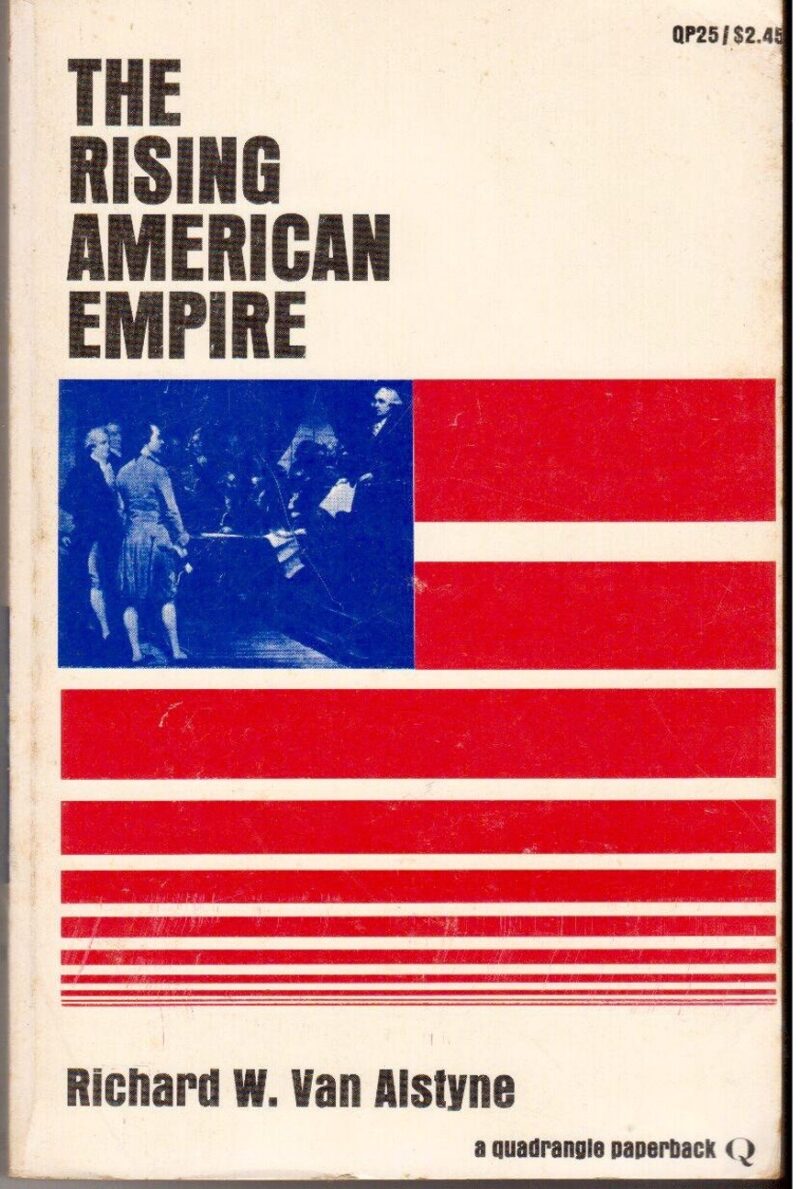
    As far as the Cold War, my book, The Russians are Coming, Again with John Marciano shows that rather than being a check on U.S. expansion, the Cold War served to validate heightened U.S. intervention across the Third World under the pretext of fighting and combatting communism. In fact the real communist threat, as Noam Chomsky has emphasized, was a threat to U.S. business interests and ability to encourage development of an alternative state-centered model of governance that would prevent corporate pillage and the kind of neoloconial arrangements that prevailed quite widely in this period and beyond.

    Question 6: The end of the Cold War and American unipolar dominance unleashed the push for the American Empire—through GWOT and a series of wars.

    Answer: Absolutely: We have the U.S. empire on steroids with the Global War on Terror. It has given a pretext for the U.S. to invade and bomb many Middle-Eastern countries. And it has been totally ridden with contradictions, as the U.S. has supported leading terrorist states like Saudi Arabia and committed large scale terrorist acts based on standard definitions of terrorism as acts of violence targeting civilians with the purpose of affecting a political goal or political change.

                                                                                                                                                              Source: goodreads.com

    Question 7: NATO Expansion – conflict with Russia and anti-China strategy – a clear case of imperial overstretch and suicidal?

    Answer: Yes I think so. Back in 1996, George Kennan, the father of the containment strategy and original Cold War, warned about NATO expansion, stating: that NATO expansion would amount to a “strategic blunder of epic proportions” and the “most fateful error of American policy in the entire post-Cold War era,” as it would “inflame the nationalistic, anti-Western and militaristic tendencies in Russian opinion, restore the atmosphere of the cold war to East-West relations,” and “impel Russian foreign policy in a direction decidedly not to our liking.”

    Kennan’s prediction proved to be true and look where we are today: in a new Cold War, with the U.S. having torn up the arms control treaties of the 1980s; initiated a proxy war with Russia that could lead to a full-blown war between the two countries and nuclear conflict. If the latter transpires, the NATO expansion surely will have been suicidal. Already it is diverting badly needed resources towards the military and a senseless new arms race, much like in the original cold war, where it produced heavy deficits and Third World type living conditions in the U.S. with astronimical inequality levels, underfunded edcuation and health care system, and abysmally poor public services, including in areas like mental health treatment, and programs to assist the homeless. One consequence is the extremely high crime rates in the U.S. and overcrowded prisons.
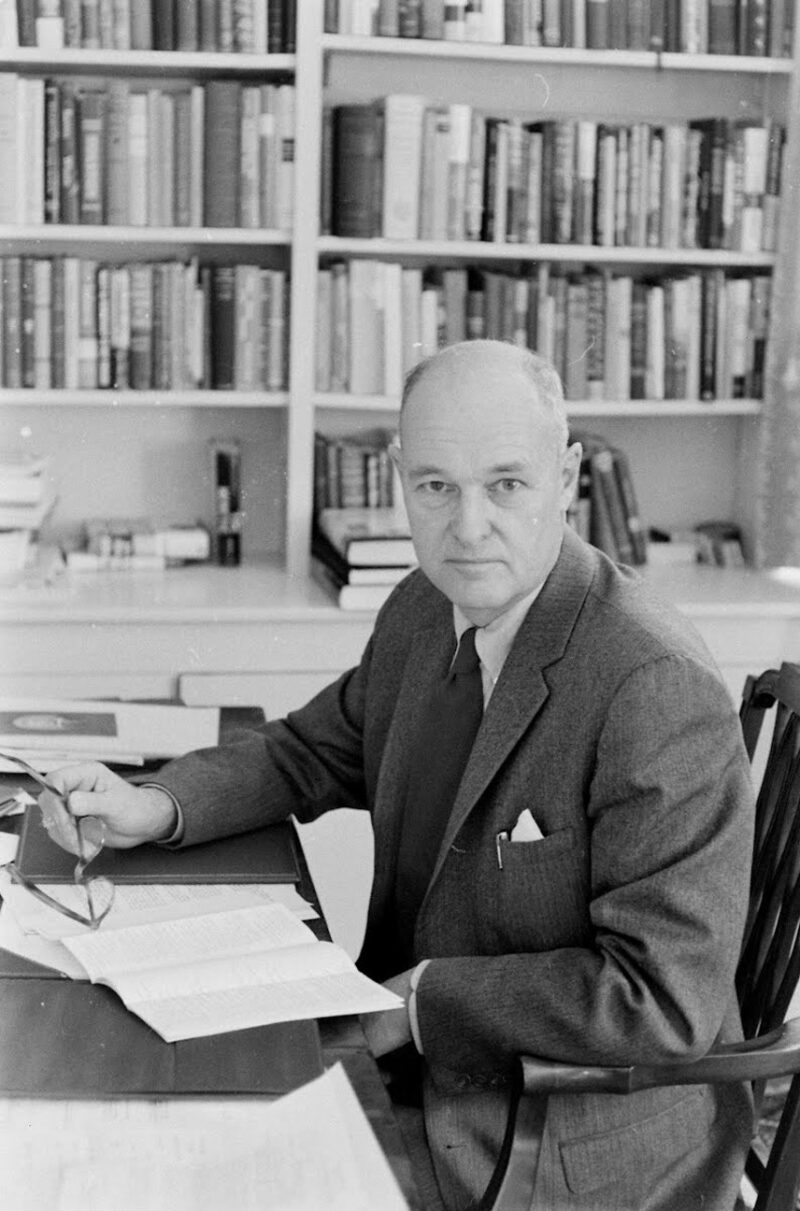
    George F. Kennan: if only U.S. leaders in the 1990s and 2000s had listened to him [Source: artsandculture.google.com

    As far as China, the provocations by the Biden administration may be even more insane than with regards to Russia, as a) the U.S. depends on Chinese purchasing of U.S. debt; b) the U.S. economy is quite dependant on China’s; and c) China has superior military technology capabilities that would give it the edge in any war with the U.S.

    Charles Freeman is a retired diplomat who served as Nixon’s translator when he famously visited China in theearly 1970s to reestablish U.S. diplomatic relations during the Cold War. Freeman told me when I interviewed him that China was in no way a military threat to the U.S., but the U.S. sees it as a threat because its economy has been growing and slowly surpassing that of the U.S. The U.S., however, should not view China as a threat of any kind, and should consider its economic growth an opportunity for the U.S. if it tried to harness China’s economic growth to its own. This would mesh well with the win-win strategy advocated for by Chinese Premer Xi Jinping in which China and the U.S. would cooperate to mutual economic benefit.
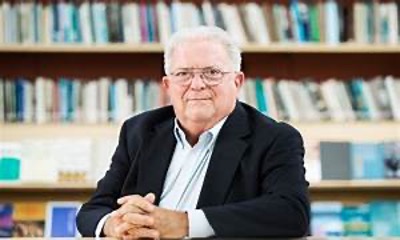
    Charles Freeman [Source: globaltimes.cn]

    Instead, the U.S. has sought to a) encircle China militarily, b) arm Taiwan to the teeth in violation of the “One China” policy and incite Taiwanese separatist elements, c) try and undermine Chinese interests throughout Southeast Asia, and d) provoke it by launching drone surveillance missions over its borders and in Chinese controlled waters off Taiwan, and e) sailing U.S. naval ships in Chinese waters.

    This is in addition to a) the propaganda directed against China in the U.S., b) the persecution of Chinese scientists; c) support for separatist elements in Xinjiang and Tibet; and d) the waging of an economic war on China and efforts to sabotage China’s economy—a policy that had been pursued by the FDR administration against Japan that directly provoked war with it.

    Question 8: Are current wars in Ukraine and Gaza—a sign of major turbulence in the World Order?

    Answer: Yes absoutely. These wars were both easily avoidable and were a direct result of U.S. foreign policy and its extremism.

    1. In the case of Ukraine, the U.S. was intent on using Ukraine as a battering ram directed against Russia. The U.S. orchestrated the 2014 Maidan coup and empowered and armed far right, Russophobic elements who triggered the war with Russia by a) attacking the ethnic Russian population in Eastern Ukraine; and b) reneging on any commitments in the Minsk peace agreements that would have given greater autonomy to the Luhansk and Donetsk provinces. The U.S. aim was similar to Afghanistan in the 1980s where they wanted to draw the Russians into a military quagmire and trap and discredit Putin and cripple his regime by ratcheting up economic sanctions against him (which it was believed would create disaffection with his rule and trigger a movement for regime change). This strategy was born of desperation because Putin was succeeding in strengthening Russia and blocking the neoconservative designs to control Eurasia and its rich oil and gas reserves, which was only possible with a weakened Russia.
    2. Gaza: The U.S. has long used Israel as an outpost of its power in the Middle East, recently establishing secret military bases in the Negev. The neocons in Washington have long sought regime change in Iran and see Israel as their vehicle to help achieve that. They also wanted regime change in Syria and to ensure Israeli control over the Golan Heights, where oil reserves have been discovered. U.S. weapons have emboldened hardliners in Israel and enabled Israeli aggression in Gaza and now Lebanon with disastrous human costs for the civilian population that people are comparing to a new Holocaust.

    Question 9:  With the rise of China, India, and the BRICS—is this a Power Transition moment?

    Answer: Yes. We are seeing major historical changes in real-time. China’s achievements through the One Belt, One Road initiative were so impressive they led to a copycat effort by the Biden and Boris Johnson admiinistrations that never really got off the ground. The SCO is enabling countries also to get around the World Bank and IMF by offering loans with no strings attached. China’s rise is epitlmized by its trading alliance with Russia and influence throughout Africa, where China is clearly winning the Great Game. While Chinese labor practices may be bad in many places, China is bringing tangible benefits to African countries through the building of impressive infrastructure, whereas all the U.S. offers is drone bases and IMF structural adjustment programs that push economic austerity measures and reinforce social inequality.

    Question 10: Is this a sign of the end of Western dominance of the last 500 years?

    Answer: I believe that yes, we are seeing major historical shifts. It may take some more time as empires often do have lasting power and can linger on even when their legitimacy has been eroded, but change is coming about.

    Question 11: In its entire history, the USA has been at war for all but 15-20 years. Is the USA a war-mongering state?

    Answer: Sadly, yes. It goes back to the founding of the country as a settler colonial state rooted in the military conquest and genocide of the Native Americans. The colonial mentality is so deep that the U.S. names a lot of its weapons systems after native tribes that were vanquished, like the Apache helicopter for example. The Operation to kill Osama bin Laden was called Operation Geronimo after the Apache chief who was vanquished in the 19th century. Noam Chomsky once asked; imagine the nazis had won World War II, and named weapons: “gypsys” and ‘Jews.”
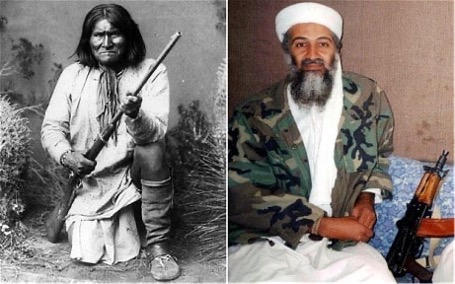
    [Source: telegraph.co.uk]

    This reflects something rotten at the core of imperialism and a deep imperial mentality that is hard to vanquish and is passed on generation after generation. This mentality and the war like culture in the U.S. is seen in a hero worship of soldiers and the military at sporting events, and in the denigration and marginalization of peace activists in popular and intellectual culture.

    That the military culture is a largely top down phenomenon though should be emphasized as since Vietnam, the U.S. government has dared not reintroduce the draft, lest it face a societal revolt remniscent of the 1960s counter-culture movement. So a lot of Americans see through the lies and are not so hawkish—that’s why the government has to distance the public from the wars; lie to them repeatedly about what they are all about; and develop new technologies and AI that could ensure a reliance on machines in fighting wars rather than the American people who often see through the lies and will protest an unjust war—particularly if there are a large number of U.S. ground troops potentially being put in harms way (like in Vietnam).

    Question 12: What is the future of 21st century world order? Barry Posan says the era of Superpower is over. Has the multipolar world emerged? what would be its shape?

    Answer: I think we are indeed seeing the birth of a new multipolar world order in which the center of economic power in the world increasingly lies in the East and in which China is a powerhouse and Southeast Asia is a key motor of economic growth in the Global economy. The U.S. is sliding more towards authoritarianism and potentially even a civil war, and may be further weakened by domestic unrest as it loses its economic supremacy and the U.S. dollar ceases to be a main currency of global trade. U.S. military interventions may focus more on South America and Mexico (which some Republicans want to bomb now to stem the immigration tide) and the U.S. army may have to be deployed more often to contain domestic unrest and right wing estremists/neofascists and to control armies of homeless people who are a product of a failed economic model.

    Related to the last question about U.S. adaptation to the new realities, a great danger is that the U.S. won’t accept reality, and will attempt to violently reimpose its hegemony, triggering a new Pacific War or world war that would result in millions of deaths.

    The recent escalation of conflict in Ukraine and the Middle East as well as U.S. saber rattling towards China and over Taiwan, makes this threat all too real and ominous.

    Feature Image Credit: iai.tv
  • The War in Ukraine Was Provoked—and Why That Matters to Achieve Peace

    The War in Ukraine Was Provoked—and Why That Matters to Achieve Peace

    By recognizing that the question of NATO enlargement is at the center of this war, we understand why U.S. weaponry will not end this war. Only diplomatic efforts can do that.

    George Orwell wrote in 1984 that “Who controls the past controls the future: who controls the present controls the past.” Governments work relentlessly to distort public perceptions of the past. Regarding the Ukraine War, the Biden administration has repeatedly and falsely claimed that the Ukraine War started with an unprovoked attack by Russia on Ukraine on February 24, 2022. In fact, the war was provoked by the U.S. in ways that leading U.S. diplomats anticipated for decades in the lead-up to the war, meaning that the war could have been avoided and should now be stopped through negotiations.

    Recognizing that the war was provoked helps us to understand how to stop it. It doesn’t justify Russia’s invasion. A far better approach for Russia might have been to step up diplomacy with Europe and with the non-Western world to explain and oppose U.S. militarism and unilateralism. In fact, the relentless U.S. push to expand NATO is widely opposed throughout the world, so Russian diplomacy rather than war would likely have been effective.

    The Biden team uses the word “unprovoked” incessantly, most recently in Biden’s major speech on the first-year anniversary of the war, in a recent NATO statement, and in the most recent G7 statement. Mainstream media friendly to Biden simply parrot the White House. TheNew York Times is the lead culprit, describing the invasion as “unprovoked” no fewer than 26 times, in five editorials, 14 opinion columns by NYT writers, and seven guest op-eds!

    There were in fact two main U.S. provocations. The first was the U.S. intention to expand NATO to Ukraine and Georgia in order to surround Russia in the Black Sea region by NATO countries (Ukraine, Romania, Bulgaria, Turkey, and Georgia, in counterclockwise order). The second was the U.S. role in installing a Russophobic regime in Ukraine by the violent overthrow of Ukraine’s pro-Russian President, Viktor Yanukovych, in February 2014. The shooting war in Ukraine began with Yanukovych’s overthrow nine years ago, not in February 2022 as the U.S. government, NATO, and the G7 leaders would have us believe.

    The key to peace in Ukraine is through negotiations based on Ukraine’s neutrality and NATO non-enlargement.

    Biden and his foreign policy team refuse to discuss these roots of the war. To recognize them would undermine the administration in three ways. First, it would expose the fact that the war could have been avoided, or stopped early, sparing Ukraine its current devastation and the U.S. more than $100 billion in outlays to date. Second, it would expose President Biden’s personal role in the war as a participant in the overthrow of Yanukovych, and before that as a staunch backer of the military-industrial complex and very early advocate of NATO enlargement. Third, it would push Biden to the negotiating table, undermining the administration’s continued push for NATO expansion.

    The archives show irrefutably that the U.S. and German governments repeatedly promised to Soviet President Mikhail Gorbachev that NATO would not move “one inch eastward” when the Soviet Union disbanded the Warsaw Pact military alliance. Nonetheless, U.S. planning for NATO expansion began early in the 1990s, well before Vladimir Putin was Russia’s president. In 1997, national security expert Zbigniew Brzezinski spelled out the NATO expansion timeline with remarkable precision.

    U.S. diplomats and Ukraine’s own leaders knew well that NATO enlargement could lead to war. The great US scholar-statesman George Kennan called NATO enlargement a “fateful error,” writing in the New York Times that, “Such a decision may be expected to inflame the nationalistic, anti-Western and militaristic tendencies in Russian opinion; to have an adverse effect on the development of Russian democracy; to restore the atmosphere of the cold war to East-West relations, and to impel Russian foreign policy in directions decidedly not to our liking.”

    President Bill Clinton’s Secretary of Defense William Perry considered resigning in protest against NATO enlargement. In reminiscing about this crucial moment in the mid-1990s, Perry said the following in 2016: “Our first action that really set us off in a bad direction was when NATO started to expand, bringing in eastern European nations, some of them bordering Russia. At that time, we were working closely with Russia and they were beginning to get used to the idea that NATO could be a friend rather than an enemy … but they were very uncomfortable about having NATO right up on their border and they made a strong appeal for us not to go ahead with that.”

    In 2008, then U.S. Ambassador to Russia, and now CIA Director, William Burns, sent a cable to Washington warning at length of grave risks of NATO enlargement: “Ukraine and Georgia’s NATO aspirations not only touch a raw nerve in Russia, they engender serious concerns about the consequences for stability in the region. Not only does Russia perceive encirclement, and efforts to undermine Russia’s influence in the region, but it also fears unpredictable and uncontrolled consequences which would seriously affect Russian security interests. Experts tell us that Russia is particularly worried that the strong divisions in Ukraine over NATO membership, with much of the ethnic-Russian community against membership, could lead to a major split, involving violence or at worst, civil war. In that eventuality, Russia would have to decide whether to intervene; a decision Russia does not want to have to face.”

    Ukraine’s leaders knew clearly that pressing for NATO enlargement to Ukraine would mean war. Former Zelensky advisor Oleksiy Arestovych declared in a 2019 interview “that our price for joining NATO is a big war with Russia.”

    Nuland makes clear on the call that she was coordinating closely with then Vice President Biden and his national security advisor Jake Sullivan, the same Biden-Nuland-Sullivan team now at the center of U.S. policy vis-à-vis Ukraine.

    During 2010-2013, Yanukovych pushed neutrality, in line with Ukrainian public opinion. The U.S. worked covertly to overthrow Yanukovych, as captured vividly in the tape of then U.S. Assistant Secretary of State Victoria Nuland and U.S. Ambassador Geoffrey Pyatt planning the post-Yanukovych government weeks before the violent overthrow of Yanukovych. Nuland makes clear on the call that she was coordinating closely with then Vice President Biden and his national security advisor Jake Sullivan, the same Biden-Nuland-Sullivan team now at the center of U.S. policy vis-à-vis Ukraine.

    After Yanukovych’s overthrow, the war broke out in the Donbas, while Russia claimed Crimea. The new Ukrainian government appealed for NATO membership, and the U.S. armed and helped restructure the Ukrainian army to make it interoperable with NATO. In 2021, NATO and the Biden Administration strongly recommitted to Ukraine’s future in NATO.

    In the immediate lead-up to Russia’s invasion, NATO enlargement was center stage. Putin’s draft US-Russia Treaty (December 17, 2021) called for a halt to NATO enlargement. Russia’s leaders put NATO enlargement as the cause of war in Russia’s National Security Council meeting on February 21, 2022. In his address to the nation that day, Putin declared NATO enlargement to be a central reason for the invasion.

    Historian Geoffrey Roberts recently wrote: “Could war have been prevented by a Russian-Western deal that halted NATO expansion and neutralised Ukraine in return for solid guarantees of Ukrainian independence and sovereignty? Quite possibly.” In March 2022, Russia and Ukraine reported progress towards a quick negotiated end to the war based on Ukraine’s neutrality. According to Naftali Bennett, former Prime Minister of Israel, who was a mediator, an agreement was close to being reached before the U.S., U.K., and France blocked it.

    While the Biden administration declares Russia’s invasion to be unprovoked, Russia pursued diplomatic options in 2021 to avoid war, while Biden rejected diplomacy, insisting that Russia had no say whatsoever on the question of NATO enlargement. And Russia pushed diplomacy in March 2022, while the Biden team again blocked a diplomatic end to the war.

    By recognizing that the question of NATO enlargement is at the center of this war, we understand why U.S. weaponry will not end this war. Russia will escalate as necessary to prevent NATO enlargement to Ukraine. The key to peace in Ukraine is through negotiations based on Ukraine’s neutrality and NATO non-enlargement. The Biden administration’s insistence on NATO enlargement to Ukraine has made Ukraine a victim of misconceived and unachievable U.S. military aspirations. It’s time for the provocations to stop, and for negotiations to restore peace to Ukraine.

    This article was published earlier in commondreams.org and is republished under Creative Commons(CC BY-NC-ND 3.0).

    Feature Image Credit: columbian.com

  • India and the New Geopolitical Churnings

    India and the New Geopolitical Churnings

    In an interdependent world, India must manage both its internal pressures and external challenges with vision, a sense of balance and determination. The coming years project immense promise for India in diverse fields of human endeavour. Let’s capitalize on our innate strengths and an inclusive vision for all in our great nation and be a beacon for humanity.

    “Ukraine today may be East Asia tomorrow.”

    — Japanese PM Fumio Kishida at the 2022 Shangri La Dialogue

    Historically speaking, there usually remains an uneasy consistency in the geopolitical world order as the strategic interests of nations are not given easy alterability. Nevertheless, the traumatic geopolitical churning witnessed by the world in the last three years has no parallels since the end of World War II in 1945. Even by conservative standards, the overall impact on the world—political, economic, social and diplomatic— has been unmistakably tectonic.

    As all nations, including the major powers, endeavour to absorb the cataclysmic effects of the events of the last three years, the early months of 2023 also display a susceptibility for this adverse impact continuing in relations between nations and severe economic and health challenges remaining to the fore threatening the overall worsening of the established global order. It brooks no elaboration to state that the current and likely continuing geopolitical differences in the world community will drive geo-economic warfare and vastly augment the risk of multi-domain conflicts. By any standards, the future in geopolitical churns across the globe remains steeped in uncertainty!

    Recent Traumatic Events And Geopolitical Churnings

    The end of 2019 witnessed a global catastrophe with the outbreak of Covid19 pandemic also known as the coronavirus pandemic. Originating from the Chinese city of Wuhan, it could not be contained there and quickly spread to other Asian nations and in a few months from early 2020, virtually engulfed the entire globe. Reportedly, till date, this virus has affected 676 million cases causing over 6.88 million deaths. According to the WHO, this virus still exists in many parts of the globe in some form or the other. This Black Swan event affected the global economy, politics, health, ecology and environment besides adversely affecting many other aspects of life as never before. The globe is still reeling under the adverse impact of this virus.

    [powerkit_button size=”lg” style=”info” block=”true” url=”https://www.dsalert.org/DSA-Editions/2023/May/DSA_May-2023_Lt_Gen_Kamal_Davar_(Retd).pdf” target=”_blank” nofollow=”false”]
    Read More
    [/powerkit_button]

  • What Ukraine needs to learn from Afghanistan about proxy wars

    What Ukraine needs to learn from Afghanistan about proxy wars

    The greatest enemy of economic development is war. If the world slips further into global conflict, our economic hopes and our very survival could go up in flames. The Bulletin of the Atomic Scientists has moved the hands of the Doomsday Clock to a mere 90 seconds to midnight. The world’s biggest economic loser in 2022 was Ukraine, where the economy collapsed by 35% according to the International Monetary Fund. The war in Ukraine could end soon, and economic recovery could begin, but this depends on Ukraine understanding its predicament as a victim of a US-Russia proxy war that broke out in 2014.

    The US has been heavily arming and funding Ukraine since 2014 with the goal of expanding Nato and weakening Russia. America’s proxy wars typically rage for years and even decades, leaving battleground countries like Ukraine in rubble.

    Unless the proxy war ends soon, Ukraine faces a dire future. Ukraine needs to learn from the horrible experience of Afghanistan to avoid becoming a long-term disaster. It could also look to the US proxy wars in Vietnam, Cambodia, Lao PDR, Iraq, Syria, and Libya.

    Starting in 1979, the US armed the mujahideen (Islamist fighters) to harass the Soviet-backed government in Afghanistan. As president Jimmy Carter’s national security advisor Zbigniew Brzezinski later explained, the US objective was to provoke the Soviet Union to intervene, in order to trap the Soviet Union in a costly war. The fact that Afghanistan would be collateral damage was of no concern to US leaders.

    The Soviet military entered Afghanistan in 1979 as the US hoped, and fought through the 1980s. Meanwhile, the US-backed fighters established al-Qaeda in the 1980s, and the Taliban in the early 1990s. The US “trick” on the Soviet Union had boomeranged.

    In 2001, the US invaded Afghanistan to fight al-Qaeda and the Taliban. The US war continued for another 20 years until the US finally left in 2021. Sporadic US military operations in Afghanistan continue.

    Afghanistan lies in ruins. While the US wasted more than $ 2 trillion of US military outlays, Afghanistan is impoverished, with a 2021 GDP below $400 per person! As a parting “gift” to Afghanistan in 2021, the US government seized Afghanistan’s tiny foreign exchange holdings, paralysing the banking system.

    The proxy war in Ukraine began nine years ago when the US government backed the overthrow of Ukraine’s president Viktor Yanukovych. Yanukovych’s sin from the US viewpoint was his attempt to maintain Ukraine’s neutrality despite the US desire to expand Nato to include Ukraine (and Georgia). America’s objective was for Nato countries to encircle Russia in the Black Sea region. To achieve this goal, the US has been massively arming and funding Ukraine since 2014.

    The American protagonists then and now are the same. The US government’s point person on Ukraine in 2014 was Assistant Secretary of State Victoria Nuland, who today is Undersecretary of State. Back in 2014, Nuland worked closely with Jake Sullivan, president Joe Biden’s national security adviser, who played the same role for vice president Biden in 2014.

    The US overlooked two harsh political realities in Ukraine. The first is that Ukraine is deeply divided ethnically and politically between Russia-hating nationalists in western Ukraine and ethnic Russians in eastern Ukraine and Crimea.

    The second is that Nato enlargement to Ukraine crosses a Russian redline. Russia will fight to the end, and escalate as necessary, to prevent the US from incorporating Ukraine into Nato.

    The US repeatedly asserts that Nato is a defensive alliance. Yet Nato bombed Russia’s ally Serbia for 78 days in 1999 in order to break Kosovo away from Serbia, after which the US established a giant military base in Kosovo. Nato forces similarly toppled Russian ally Moammar Qaddafi in 2011, setting off a decade of chaos in Libya. Russia certainly will never accept Nato in Ukraine.

    At the end of 2021, Russian president Vladimir Putin put forward three demands to the US: Ukraine should remain neutral and out of Nato; Crimea should remain part of Russia; and the Donbas should become autonomous in accord with the Minsk II Agreement.

    The Biden-Sullivan-Nuland team rejected negotiations over Nato enlargement, eight years after the same group backed Yanukovych’s overthrow. With Putin’s negotiating demands flatly rejected by the US, Russia invaded Ukraine in February 2022.

    In March 2022, Ukraine’s president Volodymyr Zelensky seemed to understand Ukraine’s dire predicament as a victim of a US-Russia proxy war. He declared publicly that Ukraine would become a neutral country, and asked for security guarantees. He also publicly recognised that Crimea and Donbas would need some kind of special treatment.

    Israel’s prime minister at that time, Naftali Bennett, became involved as a mediator, along with Turkey. Russia and Ukraine came close to reaching an agreement. Yet, as Bennett has recently explained, the US “blocked” the peace process.

    Since then, the war has escalated. According to US investigative reporter Seymour Hersh, US agents blew up the Nord Stream pipelines in September, a claim denied by the White House. More recently, the US and its allies have committed to sending tanks, longer-range missiles, and possibly fighter jets to Ukraine.

    The basis for peace is clear. Ukraine would be a neutral non-Nato country. Crimea would remain home to Russia’s Black Sea naval fleet, as it has been since 1783. A practical solution would be found for the Donbas, such as a territorial division, autonomy, or an armistice line.

    Most importantly, the fighting would stop, Russian troops would leave Ukraine, and Ukraine’s sovereignty would be guaranteed by the UN Security Council and other nations. Such an agreement could have been reached in December 2021 or in March 2022.

    Above all, the government and people of Ukraine would tell Russia and the US that Ukraine refuses any longer to be the battleground of a proxy war. In the face of deep internal divisions, Ukrainians on both sides of the ethnic divide would strive for peace, rather than believing that an outside power will spare them the need to compromise.
    Feature Image Credit: politico.eu

    This article was published earlier in dailymaverick.co.za and is republished with the permission of the author.

  • ‘World War 3 has already started’ between US and Russia/China, argues French scholar

    ‘World War 3 has already started’ between US and Russia/China, argues French scholar

    Ben Norton reviews the interview given by the prominent French Scholar, Emmanuel Todd. The interview was in French and published in the major French newspaper ‘Le Figaro’. Emmanuel Todd argues the Ukraine proxy war is the start of WWIII, and is “existential” for both Russia and the US “imperial system”, which has restricted the sovereignty of Europe, making Brussels into Washington’s “protectorate”. 

    America is fragile. The resistance of the Russian economy is pushing the American imperial system toward the precipice. No one had expected that the Russian economy would hold up against the “economic power” of NATO. I believe that the Russians themselves did not anticipate it –  Emmanuel Todd

    A prominent French intellectual has written a book arguing that the United States is already waging World War Three against Russia and China.

    He also warned that Europe has become a kind of imperial “protectorate”, which has little sovereignty and is essentially controlled by the US.

    Emmanuel Todd is a widely respected anthropologist and historian in France.

    In 2022, Todd published a book titled “The Third World War Has Started” (“La Troisième Guerre mondiale a commencé” in French). At the moment, it is only available in Japan.

    But Todd outlined the main arguments he made in the book in a French-language interview with the major newspaper Le Figaro, conducted by the journalist Alexandre Devecchio.

    According to Todd, the proxy war in Ukraine is “existential” not only for Russia, but also for the United States.

    The US “imperial system” is weakening in much of the world, he observed, but this is leading Washington to “strengthen its hold on its initial protectorates”: Europe and Japan.

    This means that “Germany and France had become minor partners in NATO”, Todd said, and NATO is really a “Washington-London-Warsaw-Kiev” bloc.

    US and EU sanctions have failed to crush Russia, as Western capitals had hoped, he noted. This means that “the resistance of the Russian economy is pushing the American imperial system toward the precipice”, and “the American monetary and financial controls of the world would collapse”.

    The French public intellectual pointed to UN votes concerning Russia, and cautioned that the West is out of touch with the rest of the world.

    “Western newspapers are tragically funny. They don’t stop saying, ‘Russia is isolated, Russia is isolated’. But when we look at the votes of the United Nations, we see that 75% of the world does not follow the West, which then seems very small”, Todd observed.

    He also criticized the GDP metrics used by Western neoclassical economists for downplaying the productive capacity of the Russian economy, while simultaneously exaggerating that of financialized neoliberal economies like in the United States.

    In the Le Figaro interview, Todd argued (all emphasis added):

    This is the reality, World War III has begun. It is true that it started ‘small’ and with two surprises. We went into this war with the idea that the Russian army was very powerful and that its economy was very weak.

    It was thought that Ukraine was going to be crushed militarily and that Russia would be crushed economically by the West. But the reverse happened. Ukraine was not crushed militarily even if it lost 16% of its territory on that date; Russia was not crushed economically. As I speak to you, the ruble has gained 8% against the dollar and 18% against the euro since the day before the start of the war.

    So there was a sort of misunderstanding. But it is obvious that the conflict, passing from a limited territorial war to a global economic confrontation, between the whole of the West on the one hand and Russia backed by China on the other hand, has become a war world. Even if military violence is low compared to that of previous world wars.

    The newspaper asked Todd if he was exaggerating. He replied, “We still provide weapons. We kill Russians, even if we don’t expose ourselves. But it remains true that we Europeans are above all economically engaged. We also feel our true entry into war through the inflation and shortages”.

    Todd understated his case. He didn’t mention the fact that, after the US sponsored the coup that overthrew Ukraine’s democratically elected government in 2014, setting off a civil war, the CIA and Pentagon immediately began training Ukrainian forces to fight Russia.

    The New York Times has acknowledged that the CIA and special operations forces from numerous European countries are on the ground in Ukraine. And the CIA and a European NATO ally are even carrying out sabotage attacks inside Russian territory.

    Nevertheless, in the interview, Todd continued:

    Putin made a big mistake early on, which is of immense sociohistorical interest. Those who worked on Ukraine on the eve of the war considered the country not as a fledgling democracy, but as a society in decay and a ‘failed state’ in the making.

    I think the Kremlin’s calculation was that this decaying society would crumble at the first shock, or even say ‘welcome Mom’ to holy Russia. But what we have discovered, on the contrary, is that a society in decomposition, if it is fed by external financial and military resources, can find in war a new type of balance, and even a horizon, a hope. The Russians could not have foreseen it. No one could.

    Todd said he shares the view of Ukraine of US political scientist John Mearsheimer, a realist who has criticized Washington’s hawkish foreign policy.

    Mearsheimer “told us that Ukraine, whose army had been taken over by NATO soldiers (American, British and Polish) since at least 2014, was therefore a de facto member of NATO, and that the Russians had announced that they would never tolerate a NATO member Ukraine,” Todd said.

    For Russia, this is there a war that is “from their point of view defensive and preventative,” he conceded.

    “Mearsheimer added that we would have no reason to rejoice in the eventual difficulties of the Russians because, since this is an existential question for them, the harder it was, the harder they would hit. The analysis seems to hold true.”

    Germany and France had become minor partners in NATO and were not aware of what was going on in Ukraine on the military level. French and German naivety has been criticized because our governments did not believe in the possibility of a Russian invasion. True, but because they did not know that Americans, British and Poles could make Ukraine be able to wage a larger war. The fundamental axis of NATO now is Washington-London-Warsaw-Kiev.

    However, Todd argued that Mearsheimer “does not go far enough” in his analysis. The US political scientist has overlooked how Washington has restricted the sovereignty of Berlin and Paris, Todd said:

    Germany and France had become minor partners in NATO and were not aware of what was going on in Ukraine on the military level. French and German naivety has been criticized because our governments did not believe in the possibility of a Russian invasion. True, but because they did not know that Americans, British and Poles could make Ukraine be able to wage a larger war. The fundamental axis of NATO now is Washington-London-Warsaw-Kiev.

    Mearsheimer, like a good American, overestimates his country. He considers that, if for the Russians the war in Ukraine is existential, for the Americans it is nothing but a power “game” among others. After Vietnam, Iraq and Afghanistan, one debacle more or less… What does it matter?

    The basic axiom of American geopolitics is: ‘We can do whatever we want because we are sheltered, far away, between two oceans, nothing will ever happen to us’. Nothing would be existential for America. Insufficiency of analysis which today leads Biden to a series of reckless actions.

    America is fragile. The resistance of the Russian economy is pushing the American imperial system toward the precipice. No one had expected that the Russian economy would hold up against the “economic power” of NATO. I believe that the Russians themselves did not anticipate it.

    The French public intellectual went on in the interview to argue that, by resisting the full force of Western sanctions, Russia and China pose a threat to “the American monetary and financial controls of the world”.

    This, in turn, challenges the US status as the issuer of the global reserve currency, which gives it the ability to maintain a “huge trade deficit”:

    If the Russian economy resisted the sanctions indefinitely and managed to exhaust the European economy, while it itself remained backed by China, the American monetary and financial controls of the world would collapse, and with them the possibility for United States to fund its huge trade deficit for nothing.

    This war has therefore become existential for the United States. No more than Russia, they cannot withdraw from the conflict, they cannot let go. This is why we are now in an endless war, in a confrontation whose outcome must be the collapse of one or the other.

    Todd warned that, while the United States is weakening in much of the world, its “imperial system” is “strengthening its hold on its initial protectorates”: Europe and Japan.

    He explained:

    Everywhere we see the weakening of the United States, but not in Europe and Japan because one of the effects of the retraction of the imperial system is that the United States strengthens its hold on its initial protectorates.

    If we read [Zbigniew] Brzezinski (The Grand Chessboard), we see that the American empire was formed at the end of the Second World War by the conquest of Germany and Japan, which are still protectorates today. As the American system shrinks, it weighs more and more heavily on the local elites of the protectorates (and I include all of Europe here).

    The first to lose all national autonomy will be (or already are) the English and the Australians. The Internet has produced human interaction with the United States in the Anglosphere of such intensity that its academic, media and artistic elites are, so to speak, annexed. On the European continent we are somewhat protected by our national languages, but the fall in our autonomy is considerable, and rapid.

    As an example of a moment in recent history when Europe was more independent, Todd pointed out, “Let us remember the war in Iraq, when Chirac, Schröder and Putin held joint press conferences against the war” – referring to the former leaders of France (Jacques Chirac) and Germany (Gerhard Schröder).

    The interviewer at Le Figaro newspaper, Alexandre Devecchio, countered Todd asking, “Many observers point out that Russia has the GDP of Spain. Aren’t you overestimating its economic power and resilience?”

    Todd criticized the overreliance on GDP as a metric, calling it a “fictional measure of production” that obscures the real productive forces in an economy:

    War becomes a test of political economy, it is the great revealer. The GDP of Russia and Belarus represents 3.3% of Western GDP (the US, Anglosphere, Europe, Japan, South Korea), practically nothing. One can ask oneself how this insignificant GDP can cope and continue to produce missiles.

    The reason is that GDP is a fictional measure of production. If we take away from the American GDP half of its overbilled health spending, then the “wealth produced” by the activity of its lawyers, by the most filled prisons in the world, then by an entire economy of ill-defined services, including the “production” of its 15 to 20 thousand economists with an average salary of 120,000 dollars, we realize that an important part of this GDP is water vapor.

    War brings us back to the real economy, it allows us to understand what the real wealth of nations is, the capacity for production, and therefore the capacity for war.

    Todd noted that Russia has shown “a real capacity to adapt”. He attributed this to the “very large role for the state” in the Russian economy, in contrast to the US neoliberal economic model:

    If we come back to material variables, we see the Russian economy. In 2014, we put in place the first important sanctions against Russia, but then it increased its wheat production, which went from 40 to 90 million tons in 2020. Meanwhile, thanks to neoliberalism, American wheat production, between 1980 and 2020, went from 80 to 40 million tons.

    Russia has therefore a real capacity to adapt. When we want to make fun of centralized economies, we emphasize their rigidity, and when we glorify capitalism, we praise its flexibility.

    The Russian economy, for its part, has accepted the rules of operation of the market (it is even an obsession of Putin to preserve them), but with a very large role for the state, but it also derives its flexibility from training engineers, who allow the industrial and military adaptations.

    This point is similar to what economist Michael Hudson has argued – that although Moscow’s economy is no longer socialist, like that of the Soviet Union was, the Russian Federation’s state-led industrial capitalism clashes with the financialized model of neoliberal capitalism that the United States has tried to impose on the world.


    The Peninsula Foundation is happy to republish this article with the permission of the author, Ben Norton.

    The article was published earlier in geopoliticaleconomy.com

    Feature Image Credit: newstatesman.com

    Portrait Sketch of Emmanuel Todd: Fabien Clairefond


  • Ukraine War Tolls Death Knell for NATO

    Ukraine War Tolls Death Knell for NATO

    President Vladimir Putin addressed an expanded meeting of the Russian Defence Ministry Board, Moscow on Dec. 21, 2022

    The defining moment in US President Joe Biden’s press conference at the White House last Wednesday, during President Zelensky’s visit, was his virtual admission that he is constrained in the proxy war in Ukraine, as European allies don’t want a war with Russia. 

    To quote Biden, “Now, you say, ‘Why don’t we just give Ukraine everything there is to give?’  Well, for two reasons. One, there’s an entire Alliance that is critical to stay with Ukraine.  And the idea that we would give Ukraine material that is fundamentally different than is already going there would have a prospect of breaking up NATO and breaking up the European Union and the rest of the world… I’ve spent several hundred hours face-to-face with our European allies and the heads of state of those countries, making the case as to why it was overwhelmingly in their interest that they continue to support Ukraine… They understand it fully, but they’re not looking to go to war with Russia.  They’re not looking for a third World War.”

    Biden realised at that point that “I probably already said too much” and abruptly ended the press conference. He probably forgot that he was dwelling on the fragility of Western unity.

    The whole point is that the western commentariat largely forgets that Russia’s core agenda is not about territorial conquest — much as Ukraine is vital to Russian interests —but about NATO expansion. And that has not changed.

    Every now and then President Putin revisits the fundamental theme that the US consistently aimed to weaken and dismember Russia. As recently as last Wednesday, Putin invoked the Chechen war in the 1990s — “the use of international terrorists in the Caucasus, to finish off Russia and to split the Russian Federation… They [US]claimed to condemn al-Qaeda and other criminals, yet they considered using them on the territory of Russia as acceptable and provided all kinds of assistance to them, including material, information, political and any other support, notably military support, to encourage them to continue fighting against Russia.”

    Putin has a phenomenal memory and would have been alluding to Biden’s careful choice of William Burns as his CIA chief. Burns was Moscow Embassy’s point person for Chechnya in the 1990s! Putin has now ordered a nationwide campaign to root out the vast tentacles that the US intelligence planted on Russian soil for internal subversion. Carnegie, once headed by Burns, has since shut down its Moscow office, and the Russian staff fled to the West!

    The leitmotif of the expanded meeting of the Board of the Defence Ministry in Moscow on Wednesday, which Putin addressed, was the profound reality that Russia’s confrontation with the US is not going to end with the Ukraine war. Putin exhorted the Russian top brass to “carefully analyse” the lessons of the Ukraine and Syrian conflicts.

    Importantly, Putin said, “We will continue maintaining and improving the combat readiness of the nuclear triad. It is the main guarantee that our sovereignty and territorial integrity, strategic parity and the general balance of forces in the world are preserved. This year, the level of modern armaments in the strategic nuclear forces has already exceeded 91 per cent. We continue rearming the regiments of our strategic missile forces with modern missile systems with Avangard hypersonic warheads.”

    Equally, Defence Minister Sergei Shoigu proposed at Wednesday’s meeting a military build-up “to bolster Russia’s security,” including:

    • Creation of a corresponding group of forces in Russia’s northwest to counter Finland and Sweden’s induction as NATO members;
    • Creation of two new motorised infantry divisions in the Kherson and Zaporozhya regions, as well as an army corps in Karelia, facing the Finnish border;
    • Upgrade of 7 motorised infantry brigades into motorised infantry divisions in the Western, Central and Eastern military districts, and in the Northern Fleet;
    • Addition of two more air assault divisions in the Airborne Forces;
    • Provision of a composite aviation division and an army aviation brigade with 80-100 combat helicopters within each combined arms (tank) army;
    • Creation of 3 additional air division commands, eight bomber aviation regiments, one fighter aviation regiment, and six army aviation brigades;
    • Creation of 5 district artillery divisions, as well as super-heavy artillery brigades for building artillery reserves along the so-called strategic axis;
    • Creation of 5 naval infantry brigades for the Navy’s coastal troops based on the existing naval infantry brigades;
    • Increase in the size of the Armed Forces to 1.5 million service personnel, with 695,000 people serving under contract.

    Putin summed up: “We will not repeat the mistakes of the past… We are not going to militarise our country or militarise the economy… and we will not do things we do not really need, to the detriment of our people and the economy, the social sphere. We will improve the Russian Armed Forces and the entire military component. We will do it calmly, routinely and consistently, without haste.”

    If the neocons in the driving seat in the Beltway wanted an arms race, they have it now. The paradox, however, is that this is going to be different from the bipolar Cold War era arms race.

    If the US intention was to weaken Russia before confronting China, things aren’t working that way. Instead, the US is getting locked into a confrontation with Russia and the ties between the two big powers are at a breaking point. Russia expects the US to roll back NATO’s expansion, as promised to the Soviet leadership in 1989.

    The neocons had expected a “win-win” in Ukraine: Russian defeat and a disgraceful end to Putin’s presidency; a weakened Russia, as in the 1990s, groping for a new start; consolidation of western unity under a triumphant America; a massive boost in the upcoming struggle with China for supremacy in the world order; and a New American Century under the “rules-based world order”.

    But instead, this is turning out to be a classic Zugzwang in the endgame — to borrow from German chess literature — where the US is under obligation to make a move on Ukraine but whichever move it makes will only worsen its geopolitical position.

    Biden has understood that Russia cannot be defeated in Ukraine; nor are Russian people in any mood for an insurrection. Putin’s popularity is soaring high, as Russian objectives in Ukraine are being steadily realised. Thus, Biden is getting a vague sense, perhaps, that Russia isn’t exactly seeing things in Ukraine as a binary of victory and defeat, but is gearing up for the long haul to sort out NATO once and for all.

    The transformation of Belarus as a “nuclear-capable” state carries a profound message from Moscow to Brussels and Washington. Biden cannot miss it. (See my blog NATO nuclear compass rendered unavailing, Indian Punchline, Dec. 21, 2022

    Logically, the option open to the US at this point would be to disengage. But that becomes an abject admission of defeat and will mean the death knell for NATO, and Washington’s transatlantic leadership goes kaput. And, worse still, major west European powers — Germany, France and Italy — may start looking for a modus vivendi with Russia. Above all, how can NATO possibly survive without an “enemy”?

    Clearly, neither the US nor its allies are in a position to fight a continental war. But even if they are, what about the emerging scenario in the Asia-Pacific, where the “no limits” partnership between China and Russia has added an intriguing layer to the geopolitics?

    The neocons in the Beltway have bitten more than what they could chew. Their last card will be to push for a direct US military intervention in the Ukraine war under the banner of a “coalition of the willing.” 


    This commentary was published earlier on the author’s website – indianpunchline.com

    Feature Image Credit: Ministry of Defense of the Russian Federation


  • Don’t Put Troops in Harm’s Way

    Don’t Put Troops in Harm’s Way

    Every military campaign is fraught with dangers. The Russian army finds it in a mess it cannot jiggle out of. We should think twice before any adventurism in POK.

    Nine months on into the conflict in Ukraine, with its reputation and capabilities in tatters, the Russian Armed Forces are just hanging on by the skin of their teeth, hoping that the winter will allow them a badly needed reprieve to reorganise. One cannot help but wonder as to how they found themselves in such dire circumstances, despite a decade of reforms and modernisation.

    Clearly, much of the responsibility for the utter disaster that has ensued and the difficult predicament Russia finds itself in, must rest with Putin. However, it is utterly inconceivable that he acted without the advice, support and acquiescence of the military hierarchy. Though many of the missteps may be attributable to faulty intelligence assessments, the responsibility for the military’s non-performance rests squarely on the senior hierarchy of the Russian Armed Forces. Their obvious incompetence, lack of leadership skills and professional acumen, and the corruption that has been laid bare are without parallel. Yet, they are the lucky ones, given that Stalin executed Generals for much less.

    It is standard practice in all countries that selection of the military’s top leadership is overseen and approved at the highest political level, as it should be. Where autocracies and totalitarian regimes differ from democracies is in the necessity for them to give primacy to ideology or loyalty to the Supreme Leader even at the cost of professionalism. This lack is bound to percolate to lower levels over time and while it ensures the leadership remains unchallenged in the normal course of events, its consequences in a conflict can be devastating as has been the case with the Russians.

    [powerkit_button size=”lg” style=”info” block=”true” url=”https://www.dailypioneer.com/2022/columnists/don—t-put-troops-in-harm—s-way.html” target=”_blank” nofollow=”false”]
    Read More
    [/powerkit_button]