Tag: Thailand

  • History – Thailand’s Golden Buddha

    History – Thailand’s Golden Buddha

    In the month of May 2007 I was invited to speak at the Mahidol University of Bangkok during the SSEASR Conference. I gave a talk on Yogachara Buddhism there. During this occasion, I had the opportunity to visit various Buddhist temples at Bangkok. They include the magnificent ones like Emerald Buddha, Golden Buddha, Buddha in his Maha nirvana time etc. It is very interesting to note that in the Sanctum Sanctorum of all Buddha temples, while the right side wall is covered with pictures depicting instances in Buddha’s life, the left side has paintings exclusively from Ramayana. For a Thai devotee, Hinduism is as important as Mahayana Buddhism.

    During the visit of one of the temple, I learnt this great truth about ignorance obscuring Reality.

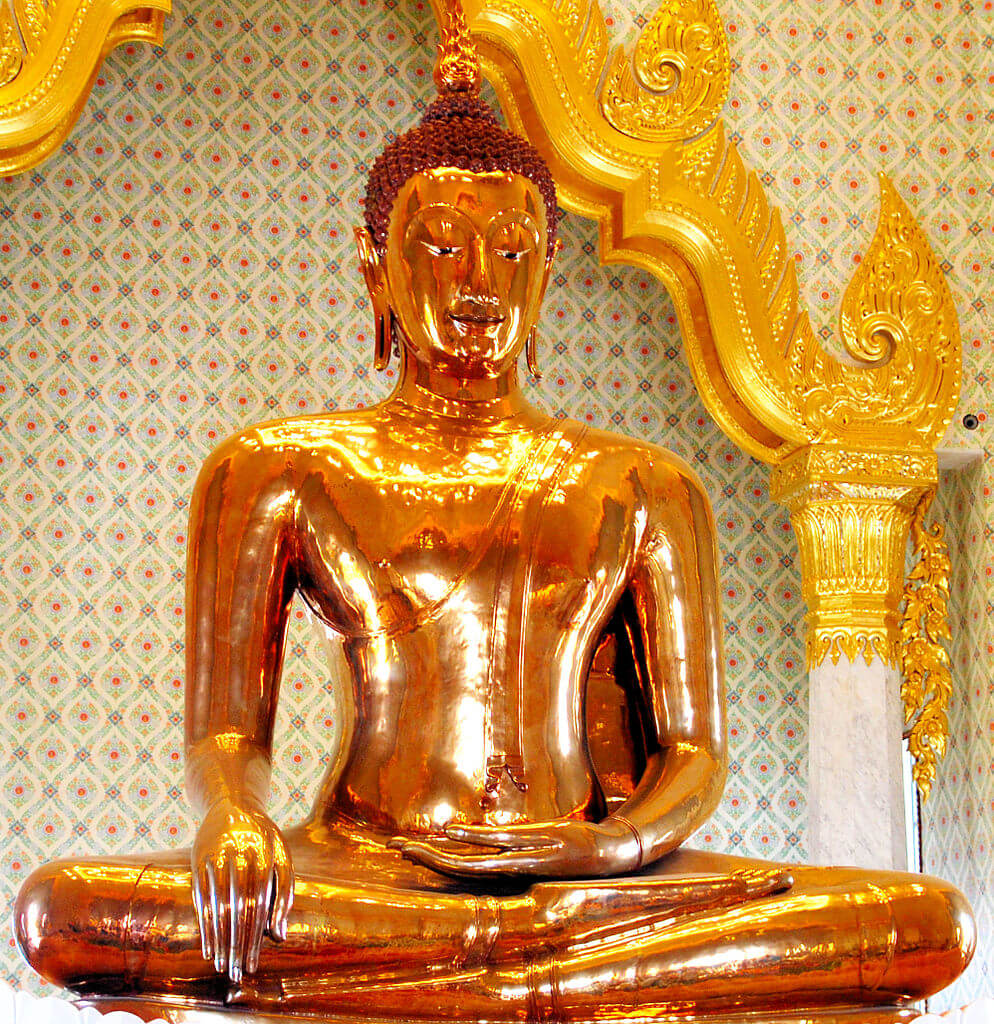
    One of these famous temples has a Buddha icon nearly 17 feet tall, which is known till the beginning of 20th century as “Terracotta Buddha temple” . The temple was established in the 13th century with its huge icon of Buddha, for several centuries it was worshipped by the devotees as “Terracotta Buddha”. One day the authorities decided to shift the Terracotta Buddha image to a place several kilometers away, probably to do some repairs to the temple. They put the Terracotta Buddha on a truck and were moving it. When they were half way through, a heavy downpour started. The rain was so heavy that the clay image of Buddha started dissolving. They tried to protect the image with tarpaulins and umbrellas, but to no effect. There was a very heavy wind which blew away the tarpaulins and umbrellas. Due to the heavy rain, the Buddha icon in clay was dissolving fast. The devotees were grief-stricken. They were wondering whether it would have been wiser to have left the temple un-repaired rather than allowing the centuries old terracotta Buddha icon to get dissolved in the heavy downpour.
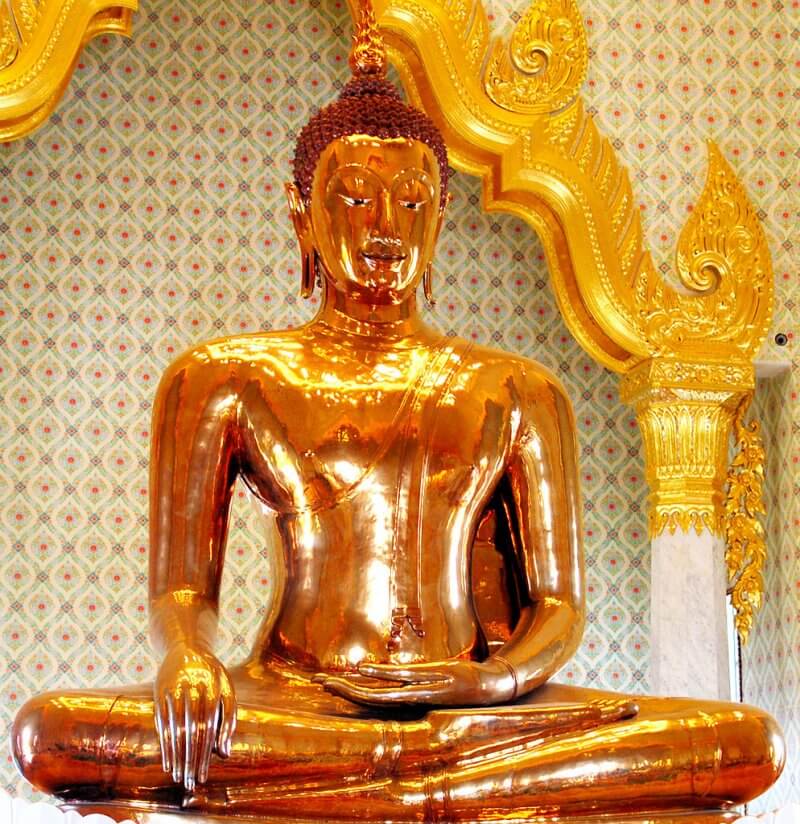
     

    Presto! A wonderful thing was happening. As the clay was dissolving, from within the clay was emerging a golden Buddha idol! as the idol there was of clay. After a short while all the clay, which was covering the idol got completely dissolved. The people were witnessing the presence of a resplendent “Golden Buddha” appearing before them in all its grandeur.

    What really happened? It was really a golden Buddha at the time of its installation in the 13th century. After some time Thailand was experiencing foreign invasions. Fearing that the invaders would take away the golden image, which was 5.5 tons of solid gold, the devotees covered the image with clay. Thinking that it was only a Terracotta Buddha, the invaders left it untouched. That generation knowing that it was a golden Buddha inside the clay, worshipped Buddha in that form. As many years passed by, the subsequent generations were not aware of this fact. They truly believed in what they saw externally and worshipped it as a Terracotta Buddha only. Thus their minds were conditioned by externalities. Once the clay dissolved what is truly inside came out with all its effulgence. It is today worshipped as the golden Buddha in Bangkok.

    It is happening to all of us everyday, we assume ourselves to be only a body-mind-intellect complex and nothing beyond it. We are conditioned by our awareness of our body, our thinking process and our analysis of the phenomena. These are only externalities within each one of us. It is only a clay that surrounds the wonderful Immanence within us. Within each one of us is the golden Buddha, the great immanent Lord who is also transcendent, he is the great Shiva, who is constantly performing his cosmic dance. In our hearts we not aware of it as our minds are conditioned by what we see, do and think. It is like the Thais seeing only the clay image and concluding it as only terracotta Buddha. As the rain dissolved the clay, the golden icon which is the true-one inside is revealed. Likewise when the spiritual sadhaha and devotion dissolves our mental conditioning, the Lord within ourselves is also revealed. This is the lesson we learn from the Golden Buddha temple.

    The same idea is beautifully explained in Thirumoolar’s Thirumantiram. A sculptor has carved out a beautiful elephant from a block of wood. When you see it as an elephant, you do not see the underlying reality of the wood. When you will be able to see the substratum, the underlying reality of the wood, with which all the objects of carving are made, you do not see the carved elephant; you see the substratum of the wood. Likewise, the ignorance enveloping our minds obscure the ultimate reality within us, when we are graded by the body-mind-intellect complex. When the revelation comes to us through god’s grace and gurus’ teachings coupled with our devotion to Him, the conditioning disappears. The phenomena abide in the ultimate. We experience the Divinity within us.

    Even in the area of management, the story of Golden Buddha has a great relevance. A competent Manager, with a penetrating mind, should be able to see what is the reality hidden in the numerous external information. The external covering only obscures the truth, which you will be able to get through. Once you see the substratum, the ultimate truth is revealed.


    Image Credit: Wikimedia Commons
  • US-China Tensions Could Spill Into Lancang-Mekong River Basin

    US-China Tensions Could Spill Into Lancang-Mekong River Basin

     The Lancang-Mekong River is the 12th longest river and runs through six countries i.e. China (upper riparian), Myanmar, Thailand, Laos, Cambodia and Vietnam (the lower riparian)and finally discharges into South China.

    A recent US government-funded study has noted that in 2019 China held back large amounts of water upstream in dams on the Mekong River which caused a  severe drought in the downstream countries,[1] prompting a US ambassador in the region accusing China of “hoarding” water and “harming the livelihoods of millions of people in downstream countries”.[2] Likewise, another report by Stimson Centre, a Washington-based think tank, has corroborated the above and pointed that in 2019 “upstream dams at Nuozhadu and Xiaowan had restricted around 20 billion cubic meters of water between July and November” and that current “satellite images show those dams are once again poised to restrict a similar amount of water from July 2020 through the end of this year … Portions of the Mekong mainstream are once again dropping to historically low levels,”[3]

    China has dismissed the reports and the Global Times in an article cited a report by the Tsinghua University and clarified that the “river dams in China [instead] helped alleviate drought along Lancang-Mekong”; furthermore, in November 2019, the Mekong River Commission (MRC) had concluded that “the drought was caused by insufficient rainfall during the wet season with a delayed arrival and earlier departure of the monsoon rain and an El Niño event that led to abnormally high temperatures and high evapotranspiration”.[4]

    At the heart of this problem is that China has built as many as 11 dams on the 4,800 kilometres long Lancang-Mekong River that originates in the Tibetan Plateau.

    At the heart of this problem is that China has built as many as 11 dams on the 4,800 kilometres long Lancang-Mekong River that originates in the Tibetan Plateau.  The Lancang-Mekong River is the 12th longest river and runs through six countries i.e. China (upper riparian), Myanmar, Thailand, Laos, Cambodia and Vietnam (the lower riparian)and finally discharges into South China.

    China has been reluctant to share hydrological data particularly during the dry seasons and releases water during rainy seasons causing flooding in lower riparian countries. This is despite the 2002 MoU under which China had agreed to provide daily river flow and rainfall data from two monitoring stations in Yunnan Province during the wet season, and the periodic MRC Heads of Government meeting over a Summit which is held every four years.

    Earlier this year, the Chinese State Councilor and Foreign Minister Wang Yi had assured that his country would “give positive consideration to share the full-year hydrological information with Mekong countries and enhance cooperation under the Lancang-Mekong Cooperation (LMC) framework to ensure reasonable and sustainable use of water resources”.[5]

    Perhaps a recent statement by the MRC may temporarily obviate suspicions over China not sharing hydrological information on the Lancang-Mekong River which notes that it welcomes China’s sharing of data “ throughout the year” as also for the “ establishment of an information-sharing platform for water resources cooperation led by China and Myanmar”.[6] Also, during the 3rd Mekong-Lancang Cooperation (MLC) Leaders’ Meeting, the Global Center for Mekong Studies (GCMS) has been tasked to study the potential benefits from “aligning and synergizing the MLC and the New International Land-Sea Trade Corridor with a vast market”.[7]

    It has been observed that although the 1995 Agreement on the Cooperation for the Sustainable Development of the Mekong River Basin is legally binding, it “does not have a compliance mechanism such as punitive measures on the party that violates the spirit and principles of the Agreement.

    In 1995, the upper and lower riparian countries had adopted Agreement on the Cooperation for the Sustainable Development of the Mekong River Basin which lays out “principles and norms of regional cooperation in managing the river basin”. A formal dialogue process under the MRC was instituted to address issues relating to Mekong River and the Member States agreed to “promote common procedures and practices throughout the region for data collection, storage and analysis to support data sharing and integration of existing data management systems based on the voluntary participation of countries and institutions.”[8] In 2001, they adopted the “Procedures for Data and Information Exchange and Sharing,” or PDIES to enable the Member States to share data ‘to provide real-time water level information and more accurate flood forecasting.

    It has been observed that although the 1995 Agreement on the Cooperation for the Sustainable Development of the Mekong River Basin is legally binding, it “does not have a compliance mechanism such as punitive measures on the party that violates the spirit and principles of the Agreement. The conflict resolution mechanism is also not clearly stipulated”.[9] This is one of the many reasons for discord among the Parties which needs to be addressed by the MRC whose mandate includes dispute resolution.

    Be that as it may, the lower Mekong countries have set up the Mekong Water Data Initiative, and at the 10th Ministerial Meeting of the Lower Mekong Initiative (LMI) in 2017 to ‘create a robust, integrated, and transparent platform for collecting, sharing, and managing data on the Mekong River system.’[10]

    there are fears that the Lancang-Mekong River issue is slowly shaping into a major ASEAN-China bilateral issue similar to the contestation in the South China Sea.

    At another level, there are fears that the Lancang-Mekong River issue is slowly shaping into a major ASEAN-China bilateral issue similar to the contestation in the South China Sea; and the current situation is being described as “becoming a geopolitical issue, much like the South China Sea, between the United States and China,”[11] Perhaps the biggest worry is that the Lancang-Mekong River should not attract contestation between the US and China which surely is going to make the region more turbulent. It would thus be prudent that ASEAN and China work on a Code of Conduct to manage the river affairs or add more robustness in the existing dialogue mechanism over the Lancang-Mekong River.

     
    End Notes
    [1] “China could have choked off the Mekong and aggravated a drought, threatening the lifeline of millions in Asia”, https://www.cnbc.com/2020/04/28/china-choked-off-the-mekong-which-worsened-southeast-asia-drought-study.html  (accessed 12 September 2020).
    [2] “Water wars: Mekong River another front in U.S.-China rivalry”, https://www.japantimes.co.jp/news/2020/07/25/asia-pacific/mekong-river-us-china/  (accessed 12 September 2020).
    [3] “The next US-China battleground: Chinese dams on the Mekong River?”,https://www.scmp.com/week-asia/politics/article/3095581/next-us-china-battleground-chinese-dams-mekong-river  (accessed 12 September 2020).
    [4] “River dams in China helped alleviate drought along Lancang-Mekong, research finds”, https://www.globaltimes.cn/content/1194654.shtml  (accessed 10 September 2020).
    [5] “River dams in China helped alleviate drought along Lancang-Mekong, research finds”, https://www.globaltimes.cn/content/1194654.shtml  (accessed 10 September 2020).
    [6] “Lancang-Mekong cooperation provide stronger impetus for regional development and prosperity”, http://www.lmcchina.org/eng/hzdt_1/t1812281.htm  (accessed 12 September 2020)
    [7] “Full text of Co-chairs’ Statement on Cooperation of Synergizing the MLC and the New International Land-Sea Trade Corridor of the Third MLC Leaders’ Meeting”, http://www.lmcchina.org/eng/zyxw_5/t1808947.htm  (accessed 12 September 2020).
    [8] “Joint Statement To Strengthen Water Data Management and Information Sharing in The Lower Mekong”,
    https://www.lowermekong.org/news/joint-statement-strengthen-water-data-management-and-information-sharing-lower-mekong (accessed 14 April 219)
    [9] “Code of Conduct for the Mekong”,https://vannarithchheang.com/2018/04/04/code-of-conduct-for-the-mekong/  (accessed 12 September 2020).
    [10] “Mekong River Commission keen to improve data sharing and management in the Lower Mekong Basin”, https://mrcmekong.org/news-and-events/news/mrc-keen-data-management-in-mekong-basin/  (accessed 12 September 2020.
    [11] “Water wars: Mekong River another front in U.S.-China rivalry”, https://www.japantimes.co.jp/news/2020/07/25/asia-pacific/mekong-river-us-china/  (accessed 12 September 2020).
     
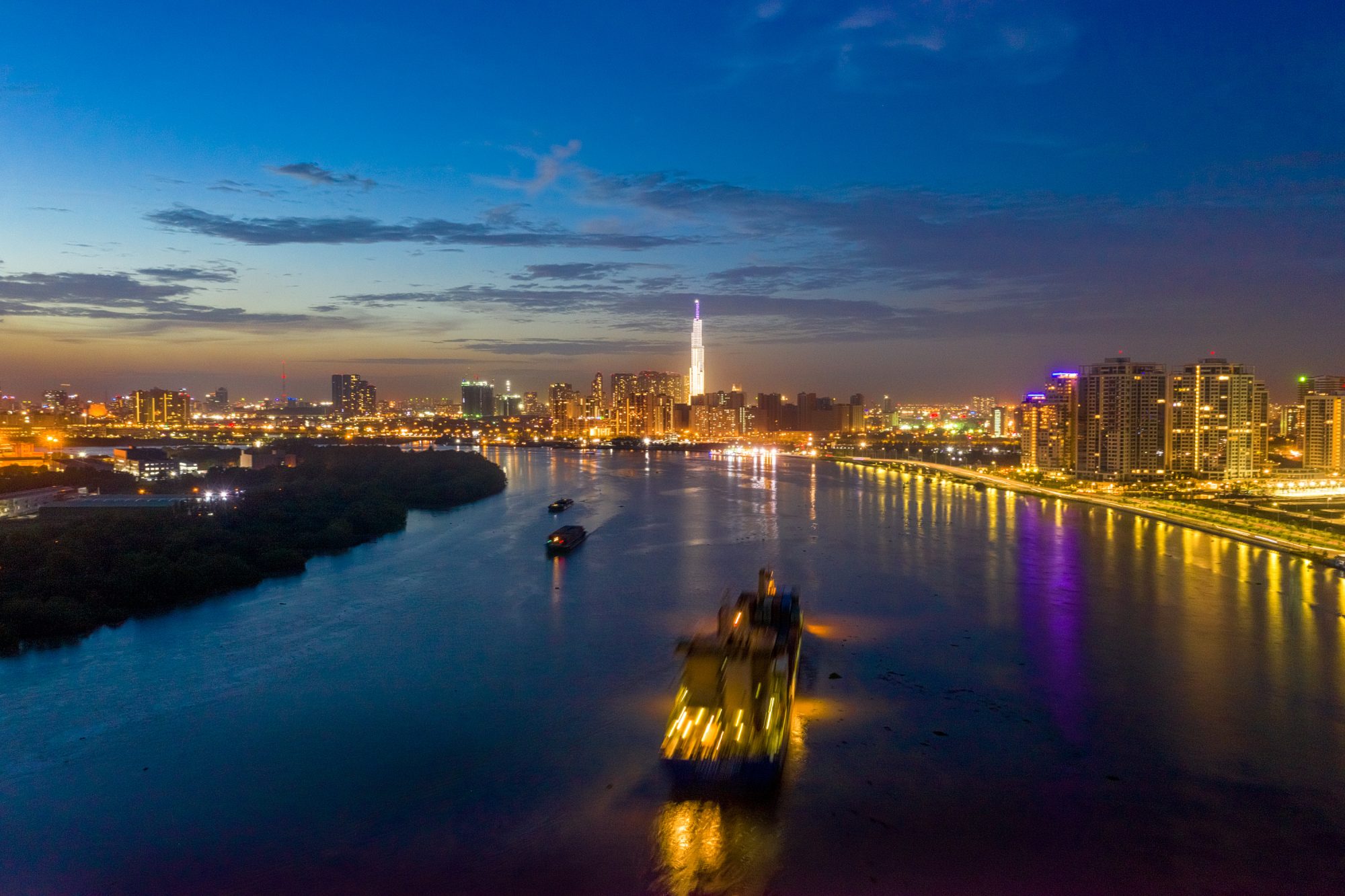
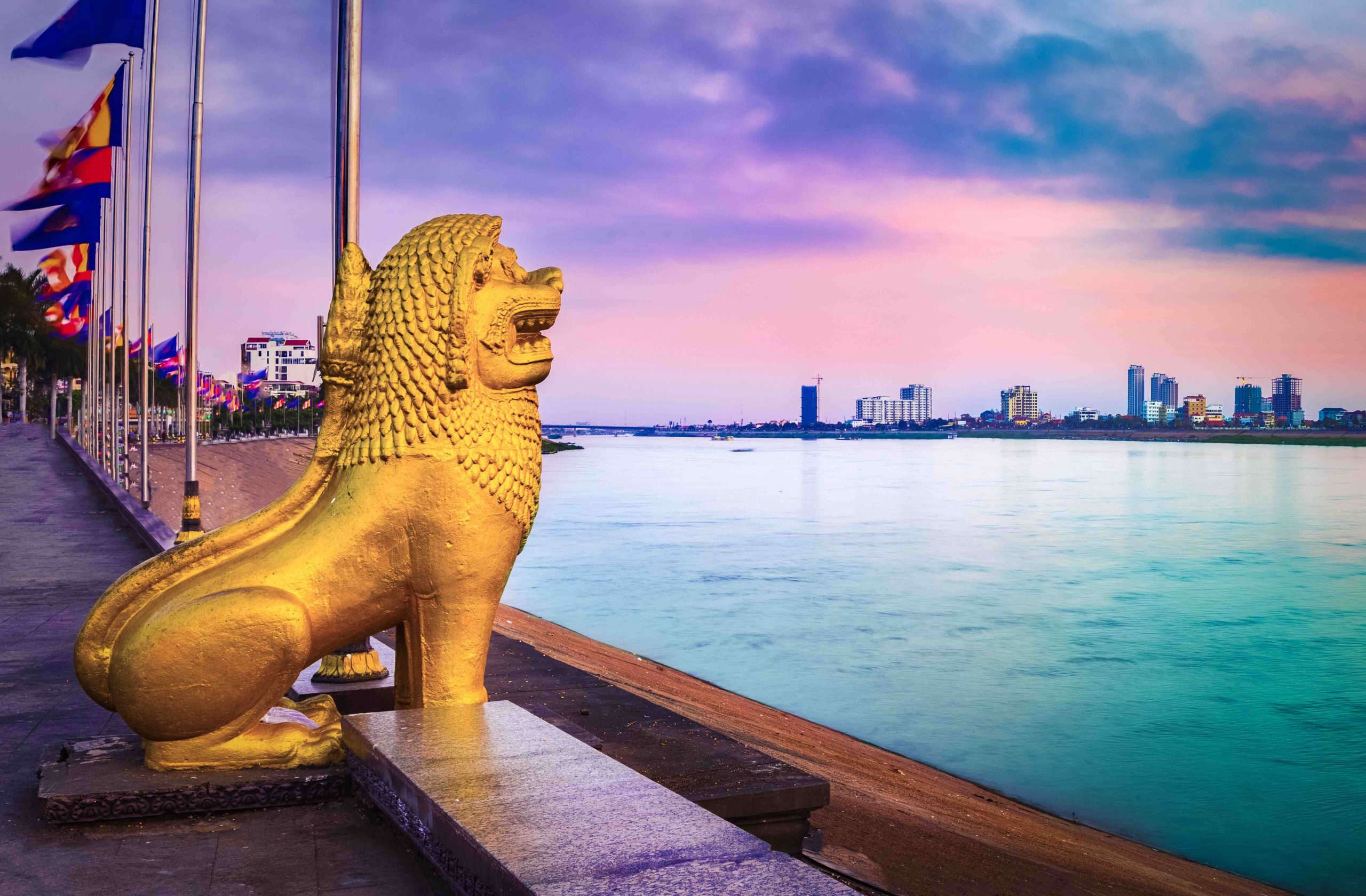
    Image: Mekong Riverside, Phnom Penh-Cambodia

  • Vietnam: Bright Economic Outlook post-COVID

    Vietnam: Bright Economic Outlook post-COVID

    COVID-19 is truly a ‘Black Swan’ event and its impact is being felt across the globe. There is widespread worry about the future of economic growth in the post-pandemic period and the World Bank has observed that the pandemic caused the deepest global recession since Second World War. [i] There are at least three reasons which triggered and added to the current crisis. First, it has involved the US and China in a trade war since July 2018, when US President Donald Trump imposed wide-ranging tariffs on China for its alleged unfair trade practices. In August 2019, Trump ordered U.S. companies to “immediately start looking for an alternative to China, including bringing your companies home and making your products in the USA.”[ii] China responded in a similar manner with counter tariffs on US goods. Since then numerous negotiations between them have been held, the last in June 2020 at Hawaii, did not yield any breakthrough. This revengeful tariff war has now blown into a full-fledged trade war and President Trump aggravated with the renewed threat of a “complete decoupling from China.”

    There is widespread worry about the future of economic growth in the post-pandemic period and the World Bank has observed that the pandemic caused the deepest global recession since Second World War.

    Second, amid the trade war, the Corona-19 pandemic made matters worse for the two protagonists. The US accused China of withholding information about the Wuhan virus which was detected in December 2019 and Beijing did not make public the information till January 2020 after which it spread across the globe from Europe to the US. The pandemic has caused massive disruptions in supply chains and some countries have decided to shift businesses out of China. For instance, Prime Minister Shinzo Abe government announced US $2.2 billion stimulus package to help companies shift production out of China back to Japan or elsewhere.[iii]

    Third, the new security law in Hong Kong has triggered an exodus by several companies to move out of China. The Law “targets acts of secession, subversion, terrorism and collusion with foreign forces, with life in prison for those committing the most serious offences”[iv] has scared common people. Many technology companies, startups, entrepreneurs are now confronted with uncertainty and are exploring alternative destinations.[v]

    many companies are being forced to shut down their operation in China and rethink-reevaluate-reinvest in new destinations to remain buoyant for the time being and slowly make their networks more resilient across sectors for the future.

    Furthermore, the pandemic exposed the weaknesses and susceptibilities of many organizations, business houses and industries particularly those that are intimately connected and dependent on China to fulfil their need for raw materials or finished products. Consequently, many companies are being forced to shut down their operation in China and rethink-reevaluate-reinvest in new destinations to remain buoyant for the time being, and slowly make their networks more resilient across sectors for the future. According to a leading business research and advisory company, “tariffs imposed by the U.S. and Chinese governments during the past years have increased supply chain costs by up to 10% for over 40% of organizations” and “popular alternative locations are Vietnam, India, and Mexico.” [vi]

    Vietnam and Thailand have a very good scorecard in their fight against COVID-19 and are rearing to attract investments and kick start the economy.

    Even before COVID-19 pandemic crisis, in 2019, five Asian countries i.e. Malaysia, India, Thailand, Indonesia and Vietnam (MITI-V) or “Mighty Five” had been identified as “up-and-coming players” with high potential for being world’s next manufacturing hubs.[vii] Among these, Vietnam and Thailand have a very good scorecard in their fight against COVID-19 and are rearing to attract investments and kick start the economy.

    According to the World Economic Forum, Vietnam’s economic rise is marked by trade liberalization, domestic reforms through deregulation, lowering the cost of doing business and investments made in human resource development.[viii] During the first six months of the current year, FDI commitments was at over US$15 billion which is a positive outlook for the country. In fact, Vietnam has attracted FDI from 136 countries and territories with nearly 32,000 projects with a combined value of US$378 billion. Among these Japan is the second largest investor with over US$60 billion. Last month, Vietnam’s Ministry of Planning and Investment, Embassy of Japanese at Hanoi, Japan External Trade Organization (JETRO), and Japan Bank for International Cooperation (JBIC) held a virtual conference to explore FDI investments “especially in the context of Japanese government providing a US$2.3 billion aid package for Japanese firms to diversify their supply chains”.[ix]

    Vietnam has many common export products from China such as broadcasting equipment, and could emerge as the “top exporter of broadcasting equipment to developed countries” but is constrained by “smaller GDP and workforce”; but its   progresses in infrastructure could potentially make it a more appealing option.[x]

    Vietnam has attracted FDI from 136 countries and territories with nearly 32,000 projects with a combined value of US$378 billion. Among these Japan is the second largest investor with over US$60 billion.

    Besides, there are other contenders such as Thailand and India to attract FDI and these two countries offer attractive FDI policies and manufacturing infrastructure. In mid-2019, as many as 200 American companies were planning to move their manufacturing base from China and were looking at India.[xi] Similar trends have been reported from South Korea [xii] and Japan [xiii] who could migrate to “production-conducive economies like India, Vietnam and Thailand”.[xiv]

    According to one estimate, FDI “across the globe may decline by 40% this year due to the Covid-19 crisis”[xv], but by all counts and accounts, Vietnam is a resounding success story.  It is a stable economy, possesses necessary infrastructure and facilities, and above all it enjoys “multilateral and bilateral agreements with foreign countries”[xvi], which makes it a popular destination in the post-COVID economic revival outlook.

    Notes

    [i] “Global Economic Prospects”, https://www.worldbank.org/en/publication/global-economic-prospects (accessed 16 July 2020).
    [ii] “Trump says he’s ordering American companies to immediately start looking for an alternative to China”, https://www.cnbc.com/2019/08/23/trump-says-hes-ordering-american-companies-to-immediately-start-looking-for-an-alternative-to-china.html (accessed 30 July 2020).
    [iii] “Coronavirus Impact: Japan to offer $2.2 billion to firms shifting production out of China”, https://www.businesstoday.in/current/world/coronavirus-impact-japan-to-offer-22-billion-to-firms-shifting-production-out-of-china/story/400721.html (accessed 30 July 2020).
    [iv] “Hongkongers contemplate a second exodus”, https://www.scmp.com/week-asia/politics/article/3093517/home-and-away-after-national-security-law-hongkongers (accessed 30 July 2020).
    [v] “Tech Firms Begin to Abandon Hong Kong over Security Law”, https://webcache.googleusercontent.com/search?q=cache:tmQW3Yjx5vcJ:https://www.bloomberg.com/news/articles/2020-07-20/tech-firms-begin-to-abandon-hong-kong-because-of-security-law+&cd=13&hl=en&ct=clnk&gl=in (accessed 30 July 2020).
    [vi] “Gartner Survey Reveals 33% of Supply Chain Leaders Moved Business Out of China or Plan to by 2023”, https://www.gartner.com/en/newsroom/press-releases/2020-06-24-gartner-survey-reveals-33-percent-of-supply-chain-leaders-moved-business-out-of-china-or-plan-to-by-2023 (accessed 30 July 2020).
    [vii] “5 China Sourcing Alternatives In Asia”, https://www.intouch-quality.com/blog/5-alternatives-to-sourcing-from-china (accessed 30 July 2020).
    [viii] “Vietnam races ahead of China in economic growth: opportunities and challenges for Vietnam in the post-COVID- 19 period”, https://timesofindia.indiatimes.com/blogs/ChanakyaCode/vietnam-races-ahead-of-china-in-economic-growth-opportunities-and-challenges-for-vietnam-in-the-post-covid-19-period/ (accessed 30 July 2020).
    [ix] Ibid.
    [x] “COVID-19: Developing countries and shrouded opportunities”, https://www.orfonline.org/expert-speak/covid-19-developing-countries-and-shrouded-opportunities/ (accessed 30 July 2020).
    [xi] “About 200 US firms aim to move manufacturing base from China to India post-general election: USISPF”, https://www.businesstoday.in/current/economy-politics/about-200-us-firms-aim-to-move-manufacturing-base-from-china-to-india-post-general-election-usispf/story/341011.html ( 30 July 2020).
    [xii] “Korean companies keen to move out of China to India”, http://timesofindia.indiatimes.com/articleshow/75130387.cms?utm_source=contentofinterest&utm_medium=text&utm_campaign=cppst (30 July 2020).
    [xiii] “Global firms look to shift from China to India”, https://www.livemint.com/industry/manufacturing/global-firms-look-to-shift-from-china-to-india-11587494725838.html  (30 July 2020).
    [xiv] “India isn’t ready yet for foreign companies that want to quit China”, https://theprint.in/opinion/india-isnt-ready-yet-for-foreign-companies-that-want-to-quit-china/415040/ (accessed 30 July 2020).
    [xv] “1,000 Japanese firms looking for investment opportunities in Vietnam”, http://hanoitimes.vn/1000-japaneses-firms-looking-for-investment-opportunities-in-vietnam-313133.html (accessed 30 July 2020).
    [xvi] “Vietnam races ahead of China in economic growth: opportunities and challenges for Vietnam in the post-COVID- 19 period”, https://timesofindia.indiatimes.com/blogs/ChanakyaCode/vietnam-races-ahead-of-china-in-economic-growth-opportunities-and-challenges-for-vietnam-in-the-post-covid-19-period/ (accessed 30 July 2020).


    Image: Ho Chi Minh city and Saigon River – Credit: Adobe Stock