Tag: Sun Tzu

  • Kautilya, Sun Tzu and Clausewitz: A Complementary Grammar of Strategy — and Why the Indian Tradition Begins with the King’s Self-Mastery

    Kautilya, Sun Tzu and Clausewitz: A Complementary Grammar of Strategy — and Why the Indian Tradition Begins with the King’s Self-Mastery

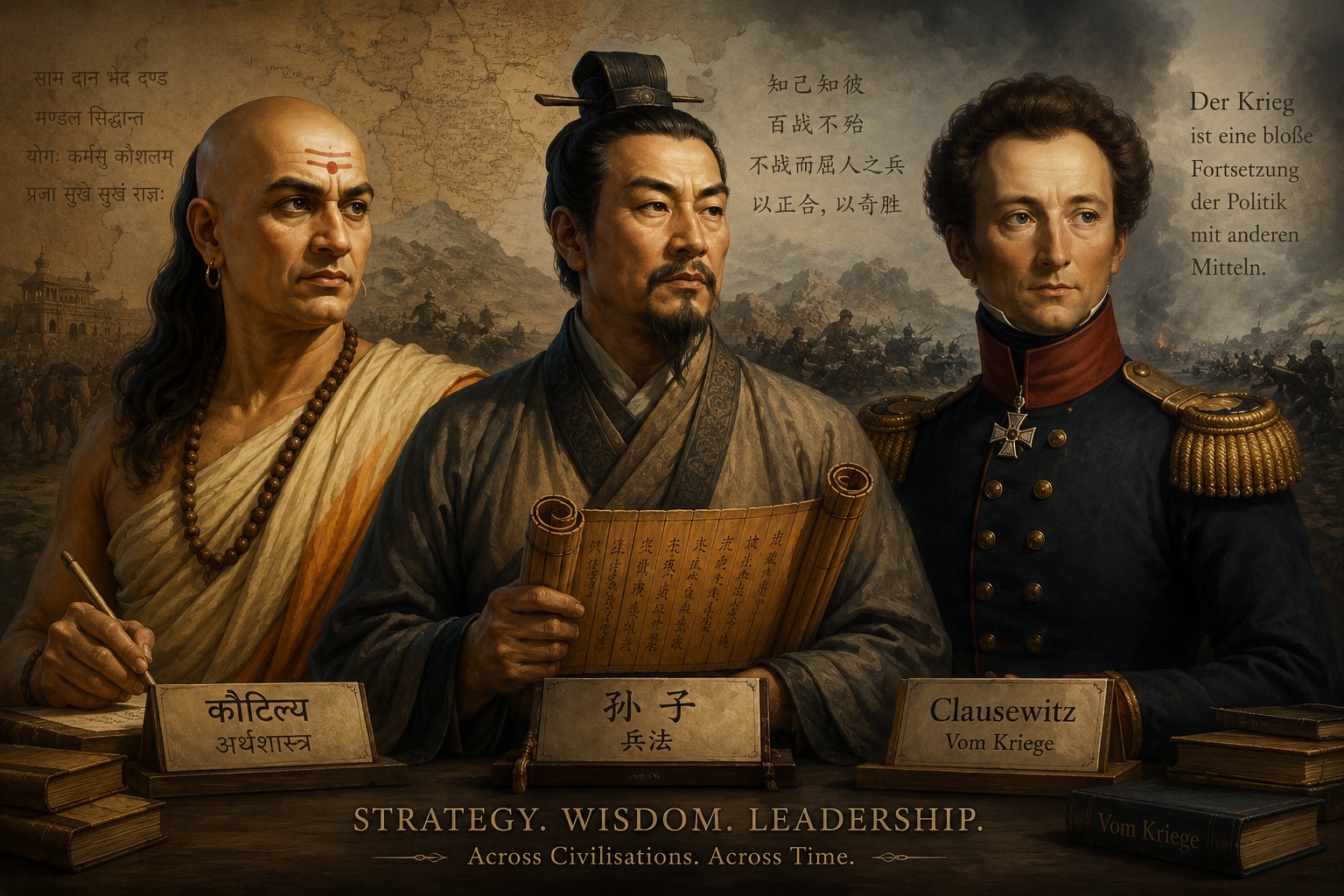
    TPF’s Distinguished Adjunct Scholar, Andreas Herberg-Rothe analyses not only the interconnectedness between Kautilya, Sun Tzu, and Clausewitz but develops a syntheised understanding that highlights Kautilya’s larger statecraft, realism, and the ethical underpinning exemplified later by one of India’s and the world’s greatest emperors – ‘Asoka the Great’.


    Abstract

    It is right to insist that any serious Indian debate on strategy must return to Kautilya. Kautilya is not merely one strategic thinker among others whom India happened to produce early, but the most complete account we possess of the state as a system — of war as one instrument within a standing order of economy, administration, intelligence, and alliance. Where I part company with the tendency to treat Kautilya as sufficient is this. A grammar of statecraft is not the whole of strategy. Sun Tzu and Clausewitz are not rivals to be defeated or predecessors to be surpassed; each addresses precisely what the other two leave dark. Clausewitz corrects Sun Tzu’s confidence that war can be won in the enemy’s mind before the first blow; Sun Tzu and Kautilya together correct Clausewitz’s fixation on the symmetrical clash of mass armies; Kautilya anchors both in the institutional foundation on which any campaign, and any peace, must stand. I therefore argue for two theses that operate along different axes. Horizontally, the three thinkers form a complementary system in which each compensates for the others’ blind spots. Vertically, within the Indian tradition itself, Kautilya’s realism already carries the seed of its own moral limit: the Rajarishi, the self-mastered king, is the hinge on which Ashoka’s later turn to Dharmavijaya could swing. Power without an ordering purpose is self-destructive, and a moral purpose without power is defenceless. That is why I begin with Kautilya — but do not end there. In the end, I attempt to apply my brief discussion of Kautilya, Clausewitz, and Sun Tzu to India’s situation.

    Why Begin with Kautilya

    In the Western reception, there is a habit of turning to Kautilya only as an exotic confirmation of something already believed — “the Indian Machiavelli”, as though the Arthashastra were a footnote to The Prince. I want to begin with Kautilya for three analytical reasons.

    First, the order of explanation. Sun Tzu tells us how to prevail in a campaign; Clausewitz tells us what happens when force is actually used; Kautilya tells us what must exist before either question can be asked — a treasury, an administration, an intelligence apparatus, a body of allies, a food supply. His Saptanga, or the seven limbs of the state, is not a list of assets but a theory of what a polity is. If we are looking for the ground on which the other two operate, it is here. To begin with Kautilya is to begin with the state, and only then to ask how it fights.

    Second, the Indian frame of the conversation is examined. This is a dialogue conducted in and about India, and it would be a small intellectual dishonesty to use Clausewitz as the measure against which the Arthashastra is graded. The more interesting movement runs the other way: to take Kautilya as the primary text and ask what the European and Chinese traditions add to it and where they expose its limits. This is the posture I adopt throughout.

    Third, the moral question is already present in Kautilya. The reason I do not treat Kautilya as a pure realist to be balanced, from the outside, by Ashokan ethics is that the balance is internal to his own text. He opens the Arthashastra not with tactics but with the education and self-conquest of the ruler. Begin anywhere else, and one misses the seed. Begin with Kautilya, and the path to Ashoka is already visible in the first book.

    Kautilya’s State: War as One Instrument Among Many
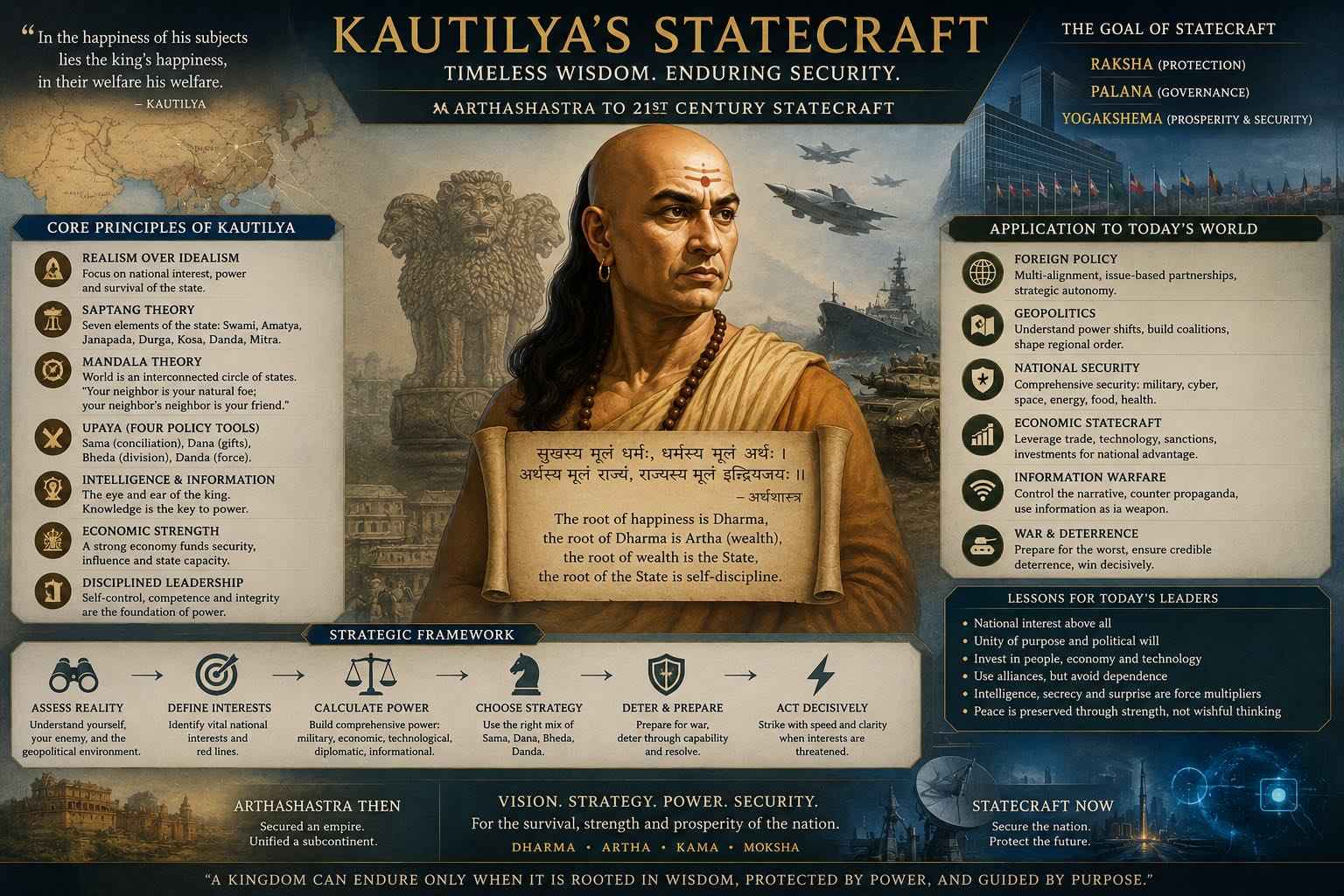
    Kautilya’s account of foreign policy and security in the Arthashastra is a pragmatic synthesis of realpolitik and administration. It treats the relentless pursuit of the state’s interest, the management of alliances, and comprehensive security as a single problem, refusing to separate the external from the internal: domestic stability and external deterrence are the same pillar seen from two sides. Five elements carry most of this weight.

    The Mandala: geography as the map of friendship and enmity

    Kautilya reads a state’s environment as a circle of states, the Mandala, in which relations are dictated less by sentiment than by position: the immediate neighbour is a presumptive rival; the state beyond the rival is a natural ally — the ancient form of “the enemy of my enemy is my friend”. The Vijigishu, the would-be conqueror or the home state, must work this circle continuously through diplomacy, espionage, and alliance to maintain a regional balance. What matters for my argument is that the balance is structural and permanent, not the product of a single campaign.

    The six measures (Sadgunya): policy as a spectrum, not a switch

    Toward other states, Kautilya prescribes not a choice between peace and war but a graded set of six measures, selected by the balance of power of the moment:

    • Sandhi — peace: treaties made when the opponent is stronger, to buy time and rebuild.
    • Vigraha — hostility: open conflict when victory is likely, or provocation demands it.
    • Asana — neutrality: remaining still when neither attack nor submission is advantageous.
    • Yana — the expedition: active mobilisation and the march.
    • Samsraya — shelter: seeking the protection of a stronger power under immediate threat.
    • Dvaidhibhava — the double policy: peace with one power while preparing for war against another.

    The point is the continuity of the scale. War is not a rupture of politics but one register of it — a formulation to which I will return, because it is also, in a different key, the core of Clausewitz.

    The four expedients (Upaya): force as the last of four, not the first

    Before using force, Kautilya insists that peaceful avenues be exhausted. He orders them:

    • Sama — conciliation: negotiation and treaty.
    • Dana — gift: economic inducement or concession.
    • Bheda — dissension: the covert splitting of an adversary’s alliances from within.
    • Danda — punishment: the last resort of military or economic coercion when other means have failed.

    It is easy to read Bheda and Danda as evidence of unlimited cynicism. I think that is a misreading, and the reason is the placement: coercion is fourth, not first, and it is the servant of an order it does not itself define.

    Comprehensive security: the Saptanga and the ecology of the state

    Kautilya’s Saptanga, the seven limbs — sovereign, ministers, population, fortified towns, treasury, army, and allies — treats security as an interconnected ecology rather than a military department. He counts as threats not only invading armies but also famine, disease, and economic collapse; a powerful army, he warns, is worth nothing if the treasury is empty or the population is in revolt. This is what modern strategists relabel as “comprehensive security,” and it is the element of Kautilya that the twentieth century’s narrower schools most conspicuously lack.

    Intelligence as a permanent organ of the state

    A standing, state-run intelligence network is not an accessory to Kautilya’s system but one of its organs. Its agents gather foreign intelligence, gauge public mood, detect internal dissent, and assess the capabilities of allies and adversaries alike. For Kautilya, security is dual and requires continuous vigilance — outward against the rival and inward against decay — and the two are never separated.

    Three Thinkers, Three Grammars

    Set beside Kautilya, Sun Tzu, and Clausewitz look less like competitors than like specialists in different parts of a single problem. All three are realists — none mistakes war for a moral pageant — but they are not, for that reason, immoralists. They simply enter the subject through different doors.

    • Kautilya — comprehensive statecraft. War is one instrument within a standing political, economic, and intelligence order.
    • Sun Tzu — the psychological and the subversive. The ideal is to win without fighting by breaking the opponent’s will and cohesion.
    • Clausewitz — the philosophy of war itself: its violence, its friction, its stubborn refusal to be dictated to by the opponent; “war is the continuation of politics by other means.”

    Reduced to a sentence each: Sun Tzu teaches how to defeat the opponent’s mind; Clausewitz how to survive the violent clash; Kautilya how to run a state so secure that its rivals are undone before they know the contest has begun. Stated that way, the three are obviously incomplete on their own, which underpins my next argument.

    The Complementary System: How Each Compensates the Other

    The three should be read neither as competing dogmas nor as ingredients to be blended into a single syncretic paste. They form a dynamic system in which each addresses, quite precisely, the blind spots of the others. This is the horizontal axis of my argument, and it is where I most respectfully qualify the claim that Kautilya suffices.

    Kautilya compensates Clausewitz: the foundation and the aftermath

    Clausewitz’s genius lies in exposing war as a duel of reciprocal interaction — Wechselwirkung — and in locating its decision in the destruction of the enemy’s centre of gravity. However, his lens narrows to the clash. He tells us that war is an instrument of policy and says remarkably little about how a state builds the economic, social, and institutional resilience to endure a long conflict, still less about how to construct a durable peace after it. Kautilya fills exactly this void. The Saptanga presents military power as the product of a whole ecology — treasury, justice, alliance — rather than a free-standing lever. For him, war is a temporary phase within a permanent condition of statecraft, and military action is subordinated to a protective, welfare-oriented purpose (Yogakshema). Kautilya thus anchors Clausewitz’s volatile escalation on a foundation that can survive it.

    Clausewitz compensates Sun Tzu: the shock of reality against the illusion of control

    Sun Tzu’s fascination with deception, intelligence, and manoeuvre culminates in the ideal of subduing the enemy without fighting. The hidden danger is the assumption beneath it: that conflict can be run like a rational game of chess or wei-qi, in which a clever enough commander reads and moves every piece. This structurally underestimates what Clausewitz called the remarkable trinity: the primordial violence and passion of the people, the play of chance and friction in the hands of the commander, and the rational calculation of the government. Clausewitz is the reality check on Sun Tzu’s optimism. The adversary is an independent will whose hostility, courage, and counteraction (Gegenhandeln) can shatter the most elegant deception the moment violence is unleashed. While Sun Tzu assumes that the theatre can be read, Clausewitz insists on the non-linearity of force once it is in motion.

    Sun Tzu and Kautilya compensate Clausewitz: beyond the symmetrical clash

    Clausewitz’s model grows from a European tradition of symmetrical clashes between mass armies; his dialectic of attack and defence is at its sharpest in the open shock of forces. He attends far less to the asymmetric, the irregular, the purely psychological — to forms of conflict that bypass the battlefield altogether. Here, Sun Tzu and Kautilya jointly enlarge the field. Sun Tzu shows how informational asymmetry and psychological paralysis can collapse an enemy before a blow lands; Kautilya details Guda Yuddha, the clandestine war of subversion, diplomatic friction, and internal destabilisation, dismantling an opponent’s cohesion from within. The most decisive victories, on this combined view, often occur long before a Clausewitzian duel can take shape.

    The Vulnerability of Deception: A Critique of Sun Tzu

    The result is a balanced matrix rather than a hierarchy: Kautilya secures the institutional foundation; Sun Tzu reduces material costs through psychological agility; Clausewitz provides the analytical honesty to confront violence when it arises. Remove any one, and the account bleeds at the seam the other two were covering.

    Perhaps the most important aspect of Sun Tzu’s strategy is deceiving the enemy. However, this approach has a fundamental problem. In order to deceive the enemy, we must make our deception so realistic that we risk deceiving ourselves.

    A personal anecdote illustrates this point. During the era of “real existing socialism”, it was customary for the population to march in large crowds past the Politburo building in East Berlin. One participant explained it to me this way: “When these ‘crowds’ marched past the podium, they turned off, walked behind the stage, and then reappeared at the front.” He added that, initially, this had been a pleasant Sunday stroll with the family, but later, people had to run at a brisk pace because there were so few participants. Everyone knew the truth, yet everyone participated in the charade.

    However, a deeper structural problem was that although the Politburo members were technically aware of the operational deception, they gradually came to believe that their performance was genuinely being mistaken for reality by the outside world and by their own apparatus. In terms of Sun Tzu’s principle of deception, it becomes profoundly self-destructive if the political and military leadership believes their own deception is effective—and by doing so, they ultimately deceive themselves. They mistook the simulation for the baseline of power.

    The Clausewitzian Corrective

    This is precisely where the matrix requires Clausewitz’s analytical honesty to stabilise the structure. Sun Tzu’s deception operates in the realm of appearance, yet it remains a dangerous epiphenomenon. If a state relies too heavily on psychological manipulation, its strategic calculus becomes hollow. Clausewitz provides the necessary antidote to this self-induced “fog of war.” By anchoring strategy in the immutable, violent friction of reality and in the strict relationship between political purpose and material means, Clausewitz forces the strategist to look beyond the theatre.

    In the contemporary context of India’s rivalry with China, this critique is vital. While China employs Sun Tzu-inspired psychological and informational warfare to project an aura of absolute dominance, India must avoid competitive simulation. Kautilya could guarantee that India’s domestic and institutional foundations remain structurally sound. Clausewitz ensures that India retains the unvarnished analytical clarity to evaluate China’s actual material capabilities—rather than Beijing’s self-deceiving theatre—while preparing for the physical reality of conflict if deterrence fails.

    The Vertical Axis: From Danda to Dharma, from Kautilya to Ashoka

    The complementarity above is horizontal — three grammars of how a state contends. There is a second axis, vertical and internal to the Indian tradition, concerning the purpose of the instruments of power. It is here that I locate my disagreement with any reading of Kautilya as merely amoral, and here that the Kautilya–Ashoka relationship, so often drawn as mere opposition, is better drawn as a sequence. Machiavelli is the useful analogy: the sharp realism of The Prince serves, in the Discorsi, the longer survival and freedom of the republic. Kautilya’s pragmatism is likewise anchored in a wider order — Dharma, the moral and cosmic law. His ideal of the self-mastered king, the Rajarshi, is not the opposite of Ashoka’s later Dharmavijaya, victory through righteousness. It is its seed.

    Self-mastery (Indriya-jaya) as a hard security requirement

    Kautilya opens not with the army but with a discussion of the ruler’s character. The Rajarshi must achieve Indriya-jaya, the conquest of his own senses and passions — lust, anger, greed, arrogance, and vanity. This is not soft counsel. For Kautilya, a ruler’s ethical integrity is a national security requirement: a leader enslaved by his passions will corrupt the state and drag it to ruin. Read this forward, and Ashoka’s remorse after Kalinga, his turn away from conquest, is the historical fulfilment of Indriya-jaya — the king conquering his own imperial ambition in the service of a higher duty.

    Collective welfare (Yogakshema) as the purpose of the state

    One of Kautilya’s most cited lines states this point without ambiguity:

    “In the happiness of his subjects lies the king’s happiness; in their welfare, his welfare. What pleases himself he shall not consider as good, but whatever pleases his subjects he shall consider as good.”

    This is not the charter of a predatory elite. The state exists for Yogakshema — the security, livelihood, and welfare of its people — and coercion (Danda) is legitimate only because it holds back Matsya-nyaya, the law of the fish, in which the strong devour the weak. Ashoka adopted this protective philosophy in its entirety and expanded its radius. When he declared that “all men are my children”, he was extending Kautilya’s duty of care from a particular political community to all living beings.

    From power to righteousness: inversion, not demolition

    In Kautilya’s universe, coercion is the material instrument that upholds the moral law: without institutional power, justice cannot survive in an imperfect world, so power is subordinated to order. Ashoka’s achievement was not to dismantle the efficient Mauryan apparatus he inherited — an apparatus shaped through and through by Kautilyan principles — but to invert its priority. Recognising that conquest through raw Danda leaves generational trauma in its wake, he used the resilient vessel of the Kautilyan state to carry the universal ethic of the Dhamma. The machine was Kautilya’s; the purpose poured into it was Ashoka’s. That is why I hold that power without an ordering purpose is self-destructive, and a moral purpose without the machinery of power is defenceless — the two are complementary in exactly the same way that Kautilya and Ashoka are.

    Conclusion: A Framework for the Present Dialogue

    Ashoka’s ethical turn was not an ahistorical break; it was the flowering of a seed already present in Kautilya’s insistence on the king’s self-conquest and on welfare as the state’s purpose. This is the vertical lesson. The horizontal lesson is that no single tradition — not even one as complete as Kautilya’s — holds the whole of strategy: Clausewitz keeps us honest about violence, Sun Tzu about the mind, and Kautilya about the state that must outlast both. Put together, the two axes give a usable framework for the contemporary Indian debate: a strategy that is Kautilyan in its comprehensiveness, Sun Tzuan in its economy of force, Clausewitzian in its clear sight of what force actually is — and Ashokan in its sense of what all of it is finally for.

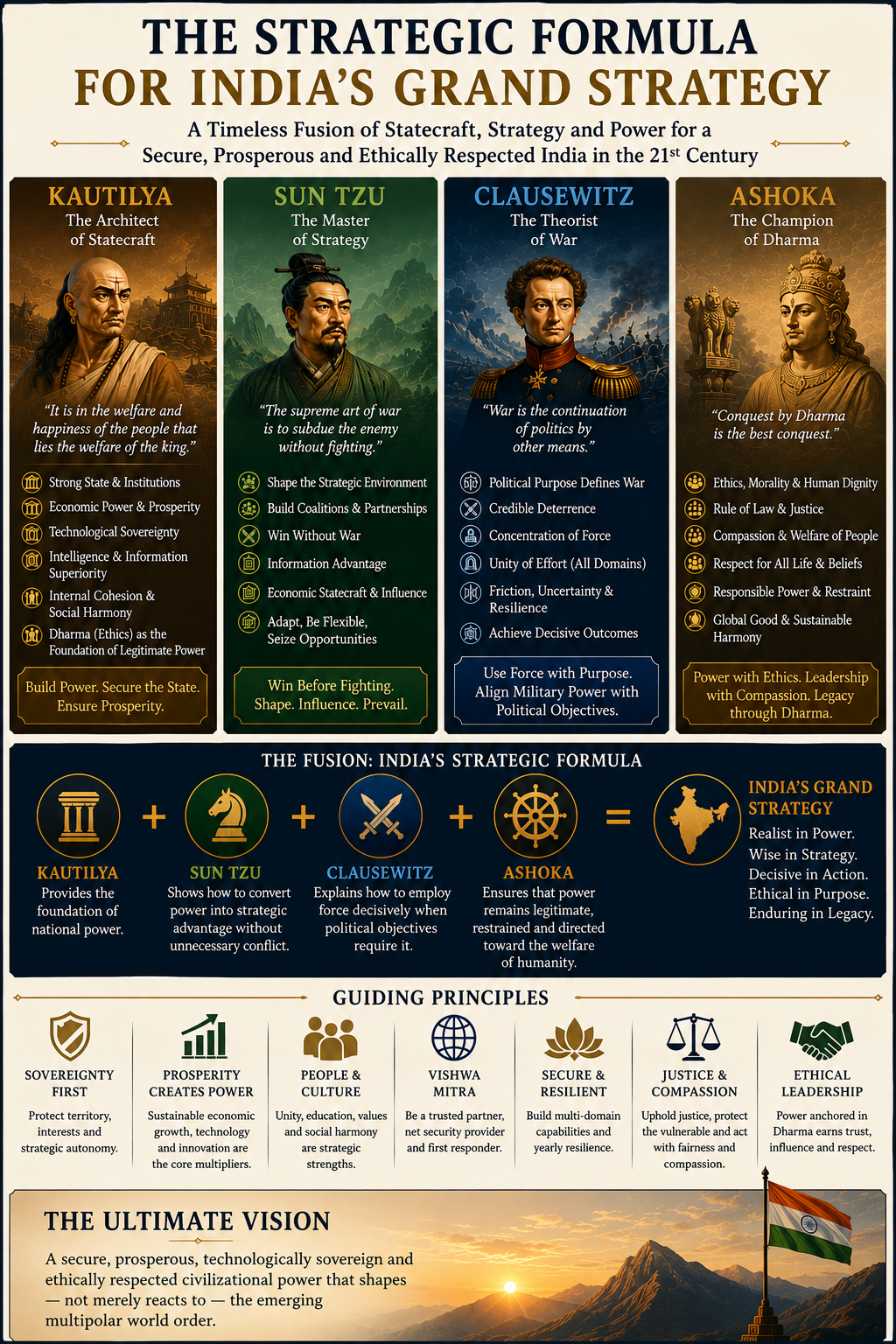
    My claim is only this: begin with Kautilya, by all means — but do not stop with him, and do not forget the Rajarshi who stands, self-mastered, at the very front of his book.

    Possible Strategic Implications for India’s Security Architecture

    1. Maritime Space and “Hinterindia” (Southeast Asia): Expanding the Mandala
    • The Clausewitzian/Kautilyan Baseline: Clausewitz’s Centre of Gravity (Schwerpunkt) in the Strait of Malacca cannot be controlled by India through mere operational posturing; it requires physical mass, sustained naval projection and logistical depth. This aligns with Kautilya’s insistence on Dravyaprakriti (the material resource base) and Durga/Kosha (fortifications and financial reserves) as the mandatory prerequisites for external power projection. Through the lens of India’s Act East Policy, “Hinterindia” (Southeast Asia/ASEAN states) constitutes the outer ring of Kautilya’s Mandala theory—the “neighbours of the neighbour” who share India’s existential concerns regarding Chinese expansionism.
    • The Sun Tzu Leverage & The Critique of Deception: Sun Tzu’s hierarchy of success dictates that we must “prevent the junction of the enemy’s forces.” China attempts to counter this by creating a simulated narrative of inevitable regional hegemony, seeking to deceive Southeast Asian nations into bandwagoning with it.
    • The Strategic Balance: India must counter China’s psychological narrative not with empty rhetoric but by offering a robust institutional and material alternative for Southeast Asia (e.g., defence exports such as BrahMos missile transfers and shared maritime domain awareness). By anchoring Kautilya’s Mandala in tangible material foundations, India may create a structural counterweight to “Hinterindia.” This turns Sun Tzu’s “victory without battle” into a tangible reality: China’s strategy to dominate the Strait of Malacca is thwarted because the littoral states of Southeast Asia are firmly integrated into a resilient, material balancing system led by New Delhi.
    1. The Two-Front Reality: Prakashayuddha (West) vs. Tushnimyuddha (East and Cyber)
    • The Clausewitzian/Kautilyan Baseline: India faces two fundamentally different forms of warfare that demand distinct structural foundations. On the Western Front (Pakistan), India confronts Prakashayuddha—open, visible, conventional warfare. This theatre is dominated by Clausewitz’s trinitarian element of “primordial violence, hatred, and enmity.” It is a highly emotionalised, zero-sum clash, with the danger of rapid escalation to absolute war ever-present. Conversely, in the Eastern and Maritime domains (China), the conflict takes the form of Tushnimyuddha—the silent, concealed grey-zone warfare. This involves cyber subversion, maritime encirclement, and informational pressure, aimed at eroding India’s power from within before a single shot is fired.
    • The Sun Tzu Leverage and Critique of Deception: Pakistan has historically used asymmetric deception (proxy networks and nuclear brinkmanship) to mask its internal systemic decline. Applying the critique of self-deception, Pakistani leadership became victims of their own theatre—believing their deceptive proxies could paralyse India, while in reality this strategy hollowed out Pakistan’s economic and institutional foundations (Saptanga). In the East, China utilises highly sophisticated, automated deception (AI-driven cyber operations and the “Three Warfares” narrative) to project an aura of absolute dominance over the Indo-Pacific.

    The Strategic Balance:

    • In the realm of Prakashayuddha (the West): India needs the unvarnished analytical honesty of Clausewitz to confront raw violence without allowing the conflict’s emotionality to dictate its grand strategy. India must economise on this front through unyielding, visible conventional deterrence, ensuring that Pakistan’s self-deceiving provocations do not drain India’s core resources.
    • In the realm of Tushnimyuddha (East/Cyber): India cannot counter China’s silent warfare with empty psychological manoeuvres. True resilience in Tushnimyuddha requires solid domestic, institutional, and societal foundations. In the cyber domain, this means building domestic technological sovereignty and public trust to make society immune to external fractures. By standing firmly on its own domestic ground (Saptanga), India can ensure that its political purpose (Clausewitz) remains independent.
    1. The China-USA Dilemma: Strategic Autonomy in a Multi-Polar Mandala
    • The Clausewitzian/Kautilyan Baseline: Clausewitz strictly warns that the political purpose must always remain the “original measure” of war. If India relies on the USA to balance China, it risks subordinating its political objectives to Washington’s global design and fracturing its strategic autonomy. Kautilya resolves this dilemma through the Saptanga theory, in which the state’s internal pillars (Swami-Amatya-Janapada) must be structurally robust enough to resist external co-optation.
    • The Sun Tzu Leverage: Sun Tzu warns against protracted external dependencies and conflicts that drain the state’s core resources: “There is no instance of a country having benefited from prolonged warfare.”
    • The Strategic Balance: To preserve strategic autonomy between China and the US, India’s deterrence cannot be borrowed or faked—it must spring from its own Comprehensive National Power. Kautilya’s Shadgunya framework permits temporary, transactional alignments (Samsraya), strictly as a breathing space to build internal material strength. Combined with Clausewitz’s insistence on the primacy of the independent political purpose, India should use its relationship with the US not as a strategic crutch but as an institutional catalyst to accelerate its domestic economic, technological, and military foundations. Deterrence against China is thus achieved not by proxy diplomacy but by the undeniable structural weight of a self-reliant Indian state.
    1. Strategic Autonomy and Internal Emancipation: Beyond the Prussian and Meiji Trap
    • The Structural Challenge: True structural deterrence against an external adversary such as China cannot coexist with deep systemic fragmentation at home. India’s historical vulnerabilities—the persistence of the caste system, the marginalisation of Dalits, and pervasive poverty—constitute severe internal fractures (Vyasanas) in Kautilyan terms. Kautilya’s warnings against internal rebellion (Abhyantara-Kopa) explicitly state that internal fractures are far more dangerous than external invasion. A state that systematically excludes or impoverishes a vast segment of its population violates the core principle of Yogakshema (the material and moral welfare of the people).
    • The Historical Matrix: Historically, states facing existential external pressure have often resorted to a “revolution from above” to modernise their societies, as seen in 19th-century Prussia and Meiji Japan. However, both historical trajectories fell into the trap of hyper-militarism by subordinating the entire social fabric to the military apparatus, ultimately leading to catastrophic conflicts.
    • The Kautilyan Alternative: Kautilya’s Saptanga framework offers a safeguard against militaristic traps. Unlike the Prussian or Japanese models, which elevated the military (Danda) to an absolute end in itself, Kautilya strictly subordinates military force to civil governance (Amatya), as Clausewitz does, and to the material welfare of the population (Yogakshema).
    • The Strategic Balance: For contemporary India, overcoming internal problems is not a secondary moral goal but a primary strategic imperative. A just, inclusive, and cohesive society is India’s ultimate defence infrastructure. By operationalising national self-preservation and defensive modernisation as vehicles for internal emancipation—expanding technical education, institutional trust, and industrial opportunities for the most marginalised echelons of society—India can dismantle archaic barriers through the pragmatic necessity of its national survival. Securing the external realm is achieved by immunising the domestic foundation.
    1. Epilogue: The Civilizational Horizon and Intercultural Recognition
    • The Demographic Gravity of the Northern Belt: Looking beyond the immediate operational timeline towards 2050, India’s long-term geopolitical architecture cannot be detached from global demographic shifts. While the Russian Federation faces a massive population surge along its southern “Islamic belt,” from New Delhi’s geographic perspective, this same space constitutes an expansive northern and western Islamic belt. A purely militaristic and exclusionary response to this demographic reality is unsustainable. Instead, this development demands a shift from religious fragmentation to a broader civilisational paradigm. While religions, by their doctrinal nature, tend toward theological exclusion, civilisations have historically possessed the capacity for pluralistic inclusion and cross-cultural balance.
    • The Balance of Kautilya and Ashoka: To articulate a genuinely Indian contribution to the global order without falling into the ideological trap of contemporary Hindu nationalism (Hindutva), India’s strategic culture must synthesise its two foundational, dialectical pillars: Kautilya and Ashoka. Kautilya provides the unyielding institutional, economic, and structural baseline (Saptanga) necessary to preserve state survival and sovereignty. Yet this material power remains hollow—and prone to internal fracturing—without Ashoka’s ethical and universalist horizon. Ashoka’s edicts did not establish a homogeneous religious empire but rather a civilisational space anchored in Dhamma (righteousness, social ethics, and mutual tolerance), which actively accommodated diverse belief systems and ethnicities.

    Selected works by the author:

    Herberg-Rothe, Andreas, Clausewitz’s puzzle. The political theory of war. OUP: Oxford 2007. (published in Chinese in 2020).

    References to Kautilya:

    • Encyclopaedia Britannica Online; Entry: “Artha-shastra” com.

    The entry defines the Arthaśāstra not merely as a military manual, but as a comprehensive treatise on statecraft that integrates legal codes, economic management, and administrative systems into a unified standing order. It explicitly demonstrates how external warfare and foreign policy are treated as internal instruments of a highly organised, centralised state apparatus, which relies extensively on domestic stability, economic oversight, and sophisticated intelligence networks

    • Encyclopaedia.com

    “Kautilya” https://www.encyclopedia.com/places/britain-ireland-france-and-low-countries/british-and-irish-political-geography/kautilya

    This text emphasises the rigorous institutional and structural foundations of Kautilya’s polity, outlining how military campaigns are subordinate to and dependent upon a robust domestic administration. It details Kautilya’s intricate systems of taxation, social welfare, and resource regulation, illustrating that a state’s capacity for external war or lasting peace must firmly stand on its internal institutional infrastructure.”

    The article challenges the reductionist view of Kautilya as a purely amoral realist, highlighting that the Arthaśāstra is fundamentally concerned with securing the welfare and prosperity of its citizens under a just government. This underscores that the king is not an absolute despot but merely one of seven interdependent institutes of the state (Saptanga), tasked with safeguarding the good of the people in a dharma-sanctioned manner. This structural insistence on the sovereign’s self-discipline directly anchors the moral limits of power, providing the conceptual bridge to the tradition’s later ethical evolution.”

    A note on further sources about Clausewitz, Kautilya, and Sun Tzu:

    For readers who wish to check the argument against the texts rather than against summaries of them, the standard points of entry are as follows:

    • Kautilya, The Arthashastra, ed. and trans. L. N. Rangarajan (Penguin, 1992); and R. P. Kangle, The Kautiliya Arthasastra, 3 vols. (Motilal Banarsidass) — the Saptanga, the Sadgunya, and the Upaya are set out in Books 6–7, the education and self-mastery of the ruler in Book 1.
    • Sun Tzu, The Art of War, trans. Samuel B. Griffith (Oxford, 1963) or Roger Ames (1993) — “to subdue the enemy without fighting” and “all warfare is based on deception” appear in chapters 3 and 1, respectively.
    • Carl von Clausewitz, On War, ed. and trans. Michael Howard and Peter Paret (Princeton, 1976) — the definition of war as the continuation of policy, the remarkable trinity, and friction are in Book 1; see also A. Herberg-Rothe, Clausewitz’s Puzzle (Oxford, 2007).
    • On Ashoka, the Rock and Pillar Edicts in Romila Thapar, Asoka and the Decline of the Mauryas (Oxford, rev. ed.) — “all men are my children” is from the Separate Rock Edict at Dhauli/Jaugada.

    Feature Image and other Images: Made with AI assistance
  • Clausewitz and Sun Tzu – Paradigms of Warfare in the 21st Century

    Clausewitz and Sun Tzu – Paradigms of Warfare in the 21st Century

    [powerkit_button size=”lg” style=”info” block=”true” url=”https://admin.thepeninsula.org.in/wp-content/uploads/2023/04/Clausewitz-and-Sun-Tzu-1.pdf” target=”_blank” nofollow=”false”]
    Download
    [/powerkit_button]

    “No principle in the world is always right, and no thing is always wrong. What was used yesterday may be rejected today, what is rejected now may be used later on. This use or disuse has no fixed right or wrong. To avail yourself of opportunities at just the right time, responding to events without being set in your ways is in the domain of wisdom. If your wisdom is insufficient (…) you’lle come to an impasse wherever you go.”

    –  Taostic Text

    Every war has its own strategy and also its own theorist. In fact, there are only two great theorists of war and warfare, the Prussian “philosopher of war” Carl von Clausewitz, and the ancient Chinese theorist of the “art of war”, Sun Tzu. Nevertheless, there is no single strategy that applies equally to all cases, i.e., not even Clausewitz’s or Sun Tzu’s. Often an explanation for success or failure is sought in the strategies used only in retrospect. For example, Harry G. Summers (Summers 1982) attributed the defeat of the United States in the Vietnam War to the failure to take into account the unity of people, army, and government, Clausewitz’s “wondrous trinity.” In contrast, after the successful campaign against Iraq in 1991, the then Chief of Staff of the U.S. Army, Colin Powell, appeared before the press with Clausewitz’s Book of War and signaled, see, we learned from the mistakes of the Vietnam War and won the Iraq War with Clausewitz (Herberg-Rothe 2007). Similarly, after World War I, there was a discourse that amounted to if the German generals had read Clausewitz correctly, the war would not have been lost. This position referred to the victory of the German forces in the Franco-Prussian War of 1870-71 and the assessment of the then Chief of General Staff, Helmut von Moltke, that he was able to fight this war successfully by studying Clausewitz’s “On War.” Since then, Clausewitz’s book has been searched for reasons for victory or defeat (Herberg-Rothe 2007).

    If Clausewitz’s status seemed unchallenged after the Iraq war in 1991, it was gradually questioned and often replaced by Sun Tzu. Two reasons played a role here – on the one hand, the new forms of non-state violence and, on the other, the new technological possibilities, the revolution in military affais (RMA), which is far from being completed. In particular, robotic and hybrid warfare, as well as the incorporation of artificial intelligence, that of space, and the development of quantum computers. The trigger of the change from Clausewitz to Sun Tzu was a seemingly new form of war, the so-called “New Wars”, which in the strict sense were not new at all, but are civil wars or those of non-state groups. In the view of the epoch-making theorist of the “New Wars”, Mary Kaldor (Kaldor 2000, much more differentiated Münkler 2002), interstate war was replaced by non-state wars, which were characterized by special cruelty of the belligerents. These weapon bearers, seemingly a return to the past, were symbolized by child soldiers, warlords, drug barons, archaic fighters, terrorists, and common criminals who were stylized as freedom fighters (Herberg-Rothe 2017).

    Since Sun Tzu lived in a time of perpetual civil wars in China, his “art of war” seemed more applicable to intrastate war, (McNeilley 2001) while Clausewitz’s conception was attributed to interstate war. In combating these new weapons carriers and the “markets of violence,” civil war economies, or “spaces open to violence” associated with them, Napoleon’s guiding principle was applied: “Only partisans help against partisans” (Herberg-Rothe 2017). Accordingly, conceptions of warfare were developed by John Keegan and Martin van Creveld, for example, that amounted to an archaic warrior with state-of-the-art technologies (Keegan 1995, van Creveld 1991). On the military level, the transformation of parts of the Western armed forces as well as the Bundeswehr from a defensive army to an intervention army took place. In contrast to the United States, the Bundeswehr placed greater emphasis on pacifying civil society in these civil war economies, and ideally the soldier became a social worker in uniform (Bredow 2006).

    The battle was fought by highly professional special forces in complex conflict areas. The initial success of the U.S. Army in Afghanistan can be attributed to the use of such special forces, which, as a result of modern communications capabilities, were able to engage superior U.S. airpower at any time. Because interstate warfare has returned to the forefront with the Ukraine war, Clausewitz may regain relevance in the coming years – unless the controversial concepts of hybrid warfare, John Boyd’s OODA loop, or NATO’s comprehensive approach gain further influence. At their core, these are based on non-state warfare by states, thus enabling a renaissance of Sun Tzu.

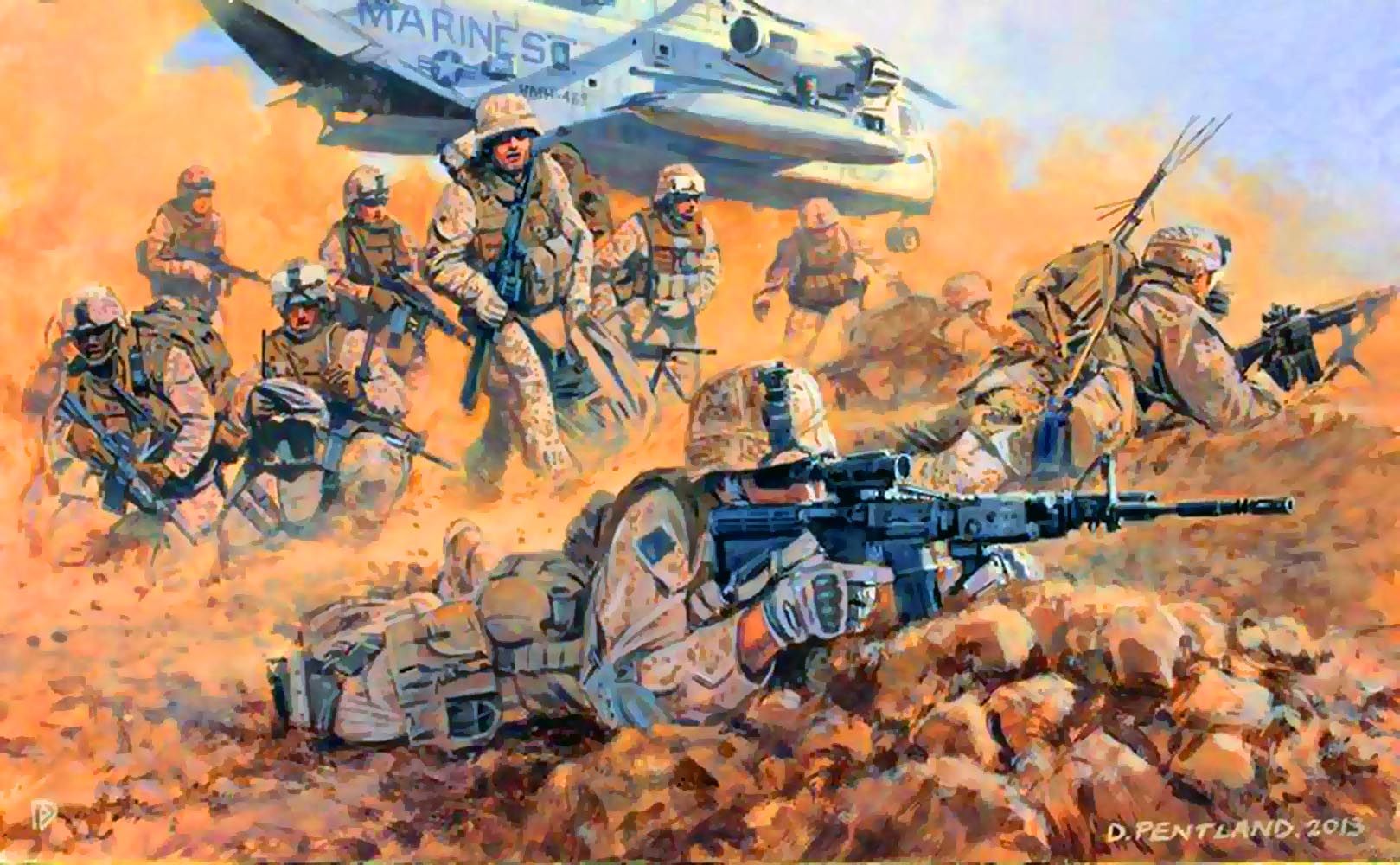
    However, the paradigm shift from Clausewitz to Sun Tzu became even clearer during the Second Iraq war in 2003. From the perspective of one commentator, this campaign was won in just a few weeks because the U.S. army was guided by Sun Tzu’s principles, while Saddam Hussein’s Russian advisors adhered to Clausewitz and Moscow’s defense against Napoleon (Macan 2003/Peters 2003). Before the fall of Afghanistan, former U.S. Secretary of Defense James Mattis brought up the Clausewitz/Sun Tzu distinction anew. “The Army was always big on Clausewitz, the Prussian; the Navy on Alfred Thayer Mahan, the American; and the Air Force on Giulio Douhet, the Italian. But the Marine Corps has always been more Eastern-oriented. I am much more comfortable with Sun-Tzu and his approach to warfare.” (Mattis 2008).

    Without fully following this distinction, it gives us hints that we cannot find absolutely valid approaches in Clausewitz’s and Sun Tzu’s conceptions, but differentiations in warfare. If we simplify the difference between the two, Clausewitz’s approach is more comparable to wrestling (Clausewitz 1991, 191), while Sun Tzu’s is comparable to jiu-jitsu. The difference between the two becomes even clearer when comparing Clausewitz’s conception to a boxing match. The goal is to render the opponent incapable of fighting (Clausewitz 1991, 191) by striking his body, as Clausewitz himself points out, thereby forcing him to make any peace. In contrast, Sun Tzu’s goal is to unbalance his opponent so that even a light blow will force him to the ground because he will be brought down by his own efforts. Of course, all two aspects play a major role in both Clausewitz and Sun Tzu, but Clausewitz’s strategy relates more to the body, the material means available to the war opponents, Sun Tzu’s strategy more to the mind, the will to fight. Both strategies have also often been conceptualized as the antithesis of direct and indirect strategy – in direct strategy, two more or less similar opponents fight on a delineated battlefield with roughly equal weapons and “measure their strength” – in indirect strategy, on the other hand, attempts are made, for example, to disrupt the enemy’s supply of food and weapons or to break the will of the opposing population to continue supporting the war. Examples of this in World War II would be the tank battles for symmetric and the bombing of German cities and the atomic bombing of Hiroshima and Nagasaki as an example of asymmetric warfare. Non-state warfare is also asymmetrically structured in nearly all cases, as it is primarily directed against the enemy civilian population (Wassermann 2015). Perhaps asymmetric warfare was most evident in the Yom Kippur War between Israel and the Egyptian army. The latter had indeed surprised Israel and managed to overrun Israeli positions along the Suez Canal. However, instead of giving the Egyptian army a tank battle in the Sinai, a relatively small group of tanks set back across the Suez Canal and in the back of the Egyptian army, cutting it off from the water supply, forcing the Egyptian army to surrender within a few days (Herberg-Rothe 2017).

    This distinction between Clausewitz and Sun Tzu can be contradicted insofar as Clausewitz begins with a “definition” of war in which the will plays a major role and which states that war is an act of violence to force the opponent to fulfill our will (Clausewitz 1991, 191). But how is the opponent forced to do this in Clausewitz’s conception? A few pages further on it says by destroying the opponent’s forces. By this concept of annihilation, however, he does not understand physical destruction in the narrower sense, but to put the armed forces of the opponent in such a state that they can no longer continue the fight (Clausewitz 1991 215).

    Sun Tzu

    Sun Tzu’s approach relates more directly to the enemy’s thinking. “The greatest achievement is to break the enemy’s resistance without a fight” (Sunzi 1988, 35). Accordingly, Basil Liddell Hart later formulated, “Paralyzing the enemy’s nervous system is a more economical form of operation than blows to the enemy’s body.” (Liddel Hart, 281). Sun Tzu’s methodical thinking aims at a dispassionate assessment of the strategic situation and thus at achieving inner distance from events as a form of objectivity. This approach is rooted in Taoism, and in it the presentation of paradoxes is elevated to a method. Although the “Art of War” contains a number of seemingly unambiguous doctrines and rules of thumb, they cannot be combined into a consistent body of thought.

    In this way, Sun Tsu confronts his readers (who are also his students) with thinking tasks that must be solved. Often these tasks take the form of the paradoxical. This becomes quite obvious in the following central paradox: “To fight and win in all your battles is not the greatest achievement. The greatest achievement is to break the enemy’s resistance without a fight.”(Sun Tzu). In clear contradiction to the rest of the book, which deals with warfare, Sun Tsu here formulates the ideal of victory without a battle and thus comes very close to the ideal of hybrid warfare, in which possible battle is only one of several options.

    Obviously, he wants to urge his readers to carefully consider whether a war should be waged and, if so, under what conditions. It is consistent with this that Sun Tsu repeatedly reflects on the economy of war, on its economic and social costs, and at the same time refers to the less expensive means of warfare: cunning, deception, forgery, and spies. Victory without combat is thus the paradox with which Sun Tsu seeks to minimize the costs of an unavoidable conflict, limit senseless violence and destruction, and point to the unintended effects.

    The form of the paradox is used several times in the book, for example when Sun Tsu recommends performing deceptive maneuvers whenever possible; this contradicts his statement that information about the opponent can be obtained accurately and used effectively – at least when the opponent is also skilled in deceptive maneuvers or is also able to see through the deceptions of his opponent. This contradiction stands out particularly glaringly when one considers that Sun Tsu repeatedly emphasizes the importance of knowledge, for example when he says: “If you know the enemy and yourself, there is no doubt about your victory; if you know heaven and earth, then your victory will be complete” (Sunzi 1988, 211). In a situation in which one must assume that the other person also strives to know as much as possible, this sentence can only be understood as a normative demand, as an ideal: Knowledge becomes power when it represents a knowledge advantage, as Michel Foucault has emphasized in more recent times: For him, knowledge is power. Cunning, deception, and the flow of information, even when they are not absolutely necessary, are, however, in danger of becoming ends in themselves, because they alone guarantee an advantage in knowledge. Information, then, is the gold and oil of the 21st century.

    The presentation of paradoxes is not an inadequacy for Sun Tsu, but the procedure by which he instructs his readers/students. In contrast to the theoretical designs of many Western schools, Sun Tsu relies here on non-directive learning: the paradox demands active participation from the reader, mirrors to him his structure of thinking, and makes him question the suitability of his own point of view in thinking through the position of the opponent. Sun Tsu thereby forces his recipients to constantly examine the current situation and to frequently reflect. By repetitively thinking through paradoxical contradictions, the actor gains the inner distance and detachment from the conflict that are necessary for an impersonal, objectifying view of events. By being confronted with paradoxes, the reader learns to simultaneously adopt very different points of view, to play through the given variants, to form an understanding for the contradictions of real situations, and at the same time to make decisions as rationally as possible. In this way, the text encourages people not to rely on the doctrines it formulates as positive knowledge about conflict strategies, but to practice repeated and ever new thinking through as a method. Sun Tzu’s approach is thus characterized by highlighting paradoxes of warfare by designing strategies of action through reflection aimed at influencing the thinking of the opponent.

    Elective Affinities with Mao Tse-tung

    The conception of the “people’s war” by the Chinese revolutionary Mao Tse-Tung is a further development of that of Sun Tzu and the dialectical thinking of Marx and Engels. At the same time, in these paradoxes, he tries to provide an assessment and analysis of the situation that is as objective-scientific as possible, linking it to subjective experience: “Therefore, the objects of study and cognition include both the enemy’s situation and our own situation, these two sides must be considered as objects of investigation, while only our brain (thought) is the investigating object” (Mao 1970, 26).

    The comprehensive analyses that Mao prefaces each of his treatises have two purposes: On the one hand, they serve as sober, objective investigations before and during the clashes, which are intended to ensure rational predictions of what will happen and are based on reliable information and the most precise planning. On the other hand, Mao uses them to achieve the highest level of persuasion and to mobilize his followers through politicization. Not for nothing are terms like “explain,” “persuade,” “discuss,” and “convince” constantly repeated in his writings, since the people’s war he propagates requires unconditional loyalty and high morale.

    Mao repeatedly demonstrates thinking in interdependent opposites, which can be understood as a military adaptation of the Chinese concept of Yin and Yang. His precise analyses demonstrate dialectical reversals; thus he can show that in strength is hidden weakness and in weakness is hidden strength. According to this thinking, in every disadvantage an advantage can be found, and in every disadvantage an advantage. An example of this is his explanation of the dispersion of forces: while conventional strategies proclaim the concentration of forces (as does Clausewitz, Clausewitz 1991, 468), Mao relies on dispersion. This approach confuses the opponent and creates the illusion of the omnipresence of his opponent.

    Mao understands confrontations as reciprocal interactions and, from this perspective, is able to weigh the relationship between concentration and dispersion differently: “Performing a mock maneuver in the East, but undertaking the attack in the West” (Mao 1970, 372) means to bind the attention of the opponent, but at the same time to become active where the opponent least expects it. Mao’s method of dialectically seeking out weakness in strength and strength in weakness leads him to the flexibility that is indispensable for confronting a stronger opponent.

    Finally, it is the ruthless analysis of one’s own mistakes that bring Mao to his guiding principles; from a series of sensitive defeats, he concluded, “The aim of war consists in nothing other than ‘self-preservation and the destruction of the enemy’ (to destroy the enemy means to disarm him or ‘deprive him of his power of resistance,’ but not to physically destroy him to the last man)” (Mao 1970, 349). On this point, Mao Tse Tung is in complete agreement with Clausewitz. Mao also clarifies this core proposition by defining the concept of self-preservation dialectically – namely, as an amalgamation of opposites: “Sacrifice and self-preservation are opposites that condition each other. For such sacrifices are not only necessary in order to preserve one’s own forces-a partial and temporary failure to preserve oneself (the sacrifice or payment of the price) is indispensable if the whole is to be preserved for the long run” (Mao 1970, 175).

    Sun Tzu problems

    Sun Tzu’s “The Art of War” as well as the theorists of network-centric warfare and 4th and 5th generation warfare focus on military success but miss the political dimension with regard to the post-war situation. They underestimate the process of transforming military success into real victory (Macan 2003, Peters 2003, Echevarria 2005). The three core elements of Sun Tzu’s strategy could not be easily applied in our time: Deceiving the opponent in general risks deceiving one’s own population as well, which would be problematic for any democracy. An indirect strategy in general would weaken deterrence against an adversary who can act quickly and decisively. Focusing on influencing the will and mind of the adversary may enable him to avoid a fight and merely resume it at a later time under more favorable conditions.

    Sun Tzu is probably more likely to win battles and even campaigns than Clausewitz, but it is difficult to win a war by following his principles. The reason is that Sun Tzu was never interested in shaping the political conditions after the war, because he lived in a time of seemingly never-ending civil wars. The only imperative for him was to survive while paying the lowest possible price and avoiding fighting, because even a successful battle against one enemy could leave you weaker when the moment came to fight the next. As always in history, when people want to emphasize the differences with Clausewitz, the similarities between the two approaches are neglected. For example, the approach in Sun Tzu’s chapter on “Swift Action to Overcome Resistance” would be quite similar to the approach advocated by Clausewitz and practiced by Napoleon. The main problem, however, is that Sun Tzu neglects the strategic perspective of shaping postwar political-social relations and their impact “by calculation” (Clausewitz 1991, 196) on the conduct of the war. As mentioned earlier, this was not a serious issue for Sun Tzu and his contemporaries, but it is one of the most important aspects of warfare in our time (Echevarria 2005¸ Lonsdale 2004).

    Finally, one must take into account that Sun Tzu’s strategy is likely to be successful against opponents with a very weak order of forces or associated community, such as warlord systems and dictatorships, which were common opponents in his time. His book is full of cases where relatively simple actions against the order of the opposing army or its community lead to disorder on the part of the opponent until they are disbanded or lose their will to fight altogether. Such an approach can obviously be successful with opponents who have weak armed forces and a weak social base but is likely to prove problematic with more entrenched opponents.

    Here, the Ukraine war could be a cautionary example. Apparently, the Russian military leadership and the political circle around Putin were convinced that this war, like the intervention in Crimea, would end quickly, because neither the resistance of the Ukrainian population nor its army was expected, nor the will of the Western states to support Ukraine militarily. To put it pointedly, one could say that in the second Iraq war, Sun Tzu triumphed over Clausewitz, but in the Ukraine war Clausewitz triumphed over Sun Tzu. This also shows that while wars in an era of hybrid globalization (Herberg-Rothe 2020) necessarily also take on a hybrid character, it is much more difficult to successfully practice hybrid warfare-such a conflation of opposites is strategically at odds with those writings of Clausewitz in which he generalizes the principles of Napoleonic warfare, though not with his determination of defense. The Ukraine war can even be seen as evidence of the greater strength of defense as postulated by Clausewitz (Herberg-Rothe 2007).

    And Clausewitz?

    At first glance, Clausewitz’s position is not compatible with that of Sun Tzu. In his world-famous formula of the continuation of war by other means (Clausewitz 1991, 210), Clausewitz takes a hierarchical position, with politics determining the superior end. Immediately before this formula, however, he writes that politics will pervade the entire warlike act, but only insofar as the nature of the forces exploding within it permits (Clausewitz 1991, ibid.). By this statement, he relativizes the heading of the 24th chapter, which contains the world-famous formula. In addition, all headings of the first chapter, with the exception of the result for the theory, the final conclusion of the first chapter, were written in the handwriting of Marie von Clausewitz, while only the actual text was written by Clausewitz (Herberg-Rothe 2023, on the discovery of the manuscript by Paul Donker).

    The tension only implicit in the formula becomes even clearer in the “wondrous trinity,” Clausewitz’s “result for the theory” of war. Here he writes that war is not only a true chameleon, because it changes its nature somewhat in each concrete case, but a wondrous trinity. This is composed of the original violence of war, hatred, and enmity, which can be seen as a blind natural instinct, the game of probabilities and chance, and war as an instrument of politics, whereby war falls prey to mere reason. Violence, hatred, and enmity like a blind natural instinct on the one side, and mere understanding on the other, this is the decisive contrast in Clausewitz’s wondrous trinity. For Clausewitz, all three tendencies of the wondrous trinity are inherent in every war; their different composition is what makes wars different (Clausewitz 1991, 213, Herberg-Rothe 2009).

    While Clausewitz formulates a clear hierarchy between the end, aim, and means of war in the initial definition and the world-famous formula, the wondrous trinity is characterized by a principled equivalence of the three tendencies of war’s violence, the inherent struggle and its instrumentality. At its core, Clausewitz’s wondrous trinity is a hybrid determination of war, which is why the term “paradoxical trinity” is more often used in English versions. In his determination of the three interactions to the extreme, made at the beginning of the book, Clausewitz emphasizes the problematic nature of the escalation of violence in the war due to its becoming independent, because the use of force develops its own dynamics (Clausewitz 1991, 192-193, Herberg-Rothe 2007 and 2017). The three interactions have often been misunderstood as mere guides to action, but they are more likely to be considered as escalation dynamics in any war. This is particularly evident in escalation sovereignty in war – the side gains an advantage that can outbid the use of force. However, this outbidding of the adversary (Herberg-Rothe 2001) brings with it the problem of violence taking on a life of its own. This creates a dilemma, which Clausewitz expresses in the wondrous trinity.

    This dilemma between the danger of violence becoming independent and its rational application gives rise to the problem formulated at the outset, namely that there cannot be a single strategy applicable to all cases, but that a balance of opposites is required (Herberg-Rothe 2014). In it, the primacy of politics is emphasized, but at the same time, this primacy is constructed as only one of three opposites of equal rank. Thus, Clausewitz’s conception of the wondrous trinity is also to be understood as a paradox, a dilemma, and a hybrid.

    As already observed in ethics, there are different ways to deal with such dilemmas (Herberg-Rothe 2011). One is to make a hierarchy between opposites. Here, particular mention should be made of the conception of trinitarian war, which was wrongly attributed to Clausewitz by Harry Summers and Martin van Creveld and was one of the causes of Clausewitz being considered obsolete by Mary Kaldor regarding the “New Wars.” For in the conception of trinitarian war, the balance of three equal tendencies emphasized by Clausewitz is explicitly transformed into a hierarchy of government, army, and people/population. Even if it should be noted that this interpretation was favored by a faulty translation in which Clausewitz’s notion of “mere reason” was transformed into the phrase “belongs to reason alone” (Clausewitz 1984), the problem is systematically conditioned. For one possible way of dealing with action dilemmas is such a hierarchization or what Niklas Luhmann called “functional differentiation”. We find a corresponding functional differentiation in all modern armies – Clausewitz himself had developed such a differentiation in his conception of the “Small War”, which was not understood as an opposition to the “Great War”, but as its supporting element. In contrast, Clausewitz developed the contrast to the “Great War” between states in the “People’s War” (Herberg-Rothe 2007).

    A second way of dealing with dilemmas of action is to draw a line up to which one principle applies and above which the other applies – that is, different principles would apply to state warfare than to “people’s war,” guerrilla warfare, the war against terrorists, warlords, wars of intervention in general. This was, for example, the proposal of Martin van Creveld and Robert Kaplan, who argued that in war against non-state groups, the laws of the jungle must apply, not those of “civilized” state war (van Creveld 1998, Kaplan 2002). In contrast, there are also approaches that derive the uniformity of war from the ends, aims, means relation, arguing that every war, whether state war or people’s war, has these three elements and that wars differ only in which ends are to be realized by which opponents with which means (I assume that this is the position of the Clausewitz-orthodoxy). It must be conceded that Clausewitz is probably inferior to Sun Tzu in practical terms with regard to the “art of warfare” – because in parts of his work, he gave the word to a one-sided absolutization of Napoleon’s warfare – while only in the book on defense did he develop a more differentiated strategy (Herberg-Rothe 2007, Herberg-Rothe 2014). Perhaps one could say that Sun Tzu is more relevant to tactics, whereas Clausewitz has the upper hand in strategy (Herberg-Rothe 2014).

    Summary

    If we return to the beginning, Clausewitz is the (practical) philosopher of war (Herberg-Rothe 2022), while Sun Tzu focuses on the “art of warfare”. As is evident in the hybrid war of the present, due to technological developments and the process I have labeled hybrid globalization (Herberg-Rothe 2020), every war can be characterized as a hybrid. However, as is currently evident in the Ukraine War, the designation of war as a hybrid is different from successful hybrid warfare. This is because hybrid warfare necessarily combines irreconcilable opposites. This mediation of opposites (Herberg-Rothe 2005) requires political prudence as well as the skill of the art of war. The ideal-typical opposition of both is correct in itself, if we provide these opposites with a “more” in each case, not an exclusive “or”.

    Clausewitz’s conception is “more” related to

    “politics, one’s own material possibilities and those of the opponent, a direct strategy, and that of the late Clausewitz on a relative symmetry of the combatants and the determination of war as an instrument. This can be illustrated with a boxing match in which certain blows are allowed or forbidden (conventions of war), the battlefield and the time of fighting remain delimited (declaration of war, conclusion of peace)”.

    Sun Tzu’s conception, on the other hand, refers to more

    “directly on the military opponent, his thinking and “nervous system” (Liddel-Heart), an indirect strategy (because a direct strategy in his time would have resulted in a weakening of one’s own position even if successful), and a relative asymmetry of forms of combat”.

    Despite this ideal-typical construction, every war is characterized by a combination of these opposites. Consequently, the question is neither about an “either-or” nor a pure “both-and,” but involves the question of which strategy is the appropriate one in a concrete situation. To some extent, we must also distinguish in Clausewitz’s conception of politics between a purely hierarchical understanding and a holistic construction. Put simply, the former conception is addressed in the relationship between political and military leadership; in the latter, any violent action by communities is per se a political one (Echevarria 2005, Herberg-Rothe 2009). From a purely hierarchical perspective, it poses no problem to emphasize the primacy of politics in a de-bounded, globalized world with Clausewitz. If, on the other hand, in a holistic perspective all warlike actions are direct expressions of politics, the insoluble problem arises of how limited warfare could be possible in a de-bounded world.

    This raises the question of which of the two, Clausewitz or Sun Tzu, will be referred to more in the strategic debates of the future. In my view, this depends on the role that information technologies, quantum computers, artificial intelligence, drones, and the development of autonomous robotic systems will play in the future – in simple terms, the role that thought and the “soul” will play in comparison to material realities in a globalized world. The Ukraine war arguably shows an overestimation of the influence of thought and soul (identity) on a community like Ukraine, but with respect to autocratic states like Russia and China, possibly an underestimation, at least temporarily, of the possibilities of manipulating the population through the new technologies. Regardless of the outcome of the war, the argument about Clausewitz and/or Sun Tzu will continue as an endless story – but this should not proceed as a mere repetition of dogmatic arguments, but rather answer the question of which of the two is the better approach can be taken in which concrete situation.

    Bibliography

    Bredow, Wilfried von (2006), Kämpfer und Sozialarbeiter – Soldatische Selbstbilder im Spannungsfeld herkömmlicher und neuer Einsatzmissionen. In: Gareis, S.B., Klein, P. (eds) Handbuch Militär und Sozialwissenschaft. VS Verlag für Sozialwissenschaften: Wiesbaden.

    Clausewitz, Carl von (199119), Vom Kriege. Dümmler: Bonn.

    Clausewitz, Carl von (1984), On War. OUP: Oxford.

    Creveld, Martin van (1991), The transformation of war. The Free Press: New York.

    Echevarria, Antulio II (2005), Fourth-generation warfare and other myths. Carlisle.

    Herberg-Rothe, Andreas (2001), Das Rätsel Clausewitz. Fink: München

    Herberg-Rothe, Andreas (2007), Clausewitz’s puzzle. OUP: Oxford

    Herberg-Rothe, Andreas (2009), Clausewitz’s “Wondrous Trinity” as a Coordinate System of War and Violent Conflict. In: International

    Journal of Violence and Conflict (IJVC) 3 (2), 2009, pp.62-77.

    Herberg-Rothe, Andreas (2011), Ausnahmen bestätigen die Moral. In: Frankfurter Rundschau vom 16. Juni 2011, 31.

    Herberg-Rothe, Andreas (2014), Clausewitz’s concept of strategy – Balancing purpose, aims and means. In: Journal of Strategic Studies. 2014; volume 37, 6-7, 2014, pp. 903-925. Also published online (17.4.2014): http://www.tandfonline.com/doi/full/10.1080/01402390.2013.853175

    Herberg-Rothe, Andreas (2015), Theory and Practice: The inevitable dialectics. Thinking with and beyond Clausewitz’s concept of theory. In: Militaire Spectator. Jaargang 184, Den Haag, Nr. 4, 2015, pp. 160-172.

    Herberg-Rothe, Andreas (2020), The dissolution of identities in liquid globalization and the emergence of violent uprisings. In: African Journal of Terrorism and Insurgency Research – Volume 1 Number 1, April 2020, pp. 11-32.

    Herberg-Rothe, Andreas (2022), Clausewitz as a practical philosopher. Special issue of the Philosophical Journal of Conflict and Violence. Guest editor: Andreas Herberg-Rothe. Trivent: Budapest, 2022. Also published online: https://trivent-publishing.eu/home/140-philosophical-journal-of-conflict-and-violence-pjcv-clausewitz-as-a-practical-philosopher.html

    Kaldor, Mary (2000), Neue und alte Kriege. Organisierte Gewalt im Zeitalter der Globalisierung. Suhrkamp: Frankfurt.

    Kaplan, Robert D. (2002), Warrior Politics. Vintage books: New York 2002

    Keegan, John (1995), Die Kultur des Krieges. Rowohlt: Berlin

    Liddell Hart, Basil Henry (1955), Strategie. Aus dem Englischen übertragen von Horst Jordan, Wiesbaden: Rheinische Verlags-Anstalt.

    Lonsdale, David (2004), The nature of war in the information age. Frank Cass: London

    Macan Marker, Marwaan (2003), Sun Tzu: The real father of shock and Awe, Asia Times, 2, April 2003

    Mao Tsetung (1970), Sechs Militärische Schriften, Peking: Verlag für fremdsprachige Literatur

    Mattis, James (2008), quoted in https://foreignpolicy.com/2015/06/08/quote-of-the-day-gen-mattis-reading-list-and-why-he-looks-more-to-the-east/); last access: 15.1.2023.

    McNeilly, Mark (2001), Sun Tzu and the Art of Modern Warfare. Oxford: Oxford University Press

    Münkler, Herfried (2002), Die neuen Kriege. Rowohlt: Reinbek bei Hamburg.

    Peters, Ralph, A New Age of War, New York Post, 10. April 2003.

    Summers, Harry G. Jr. (1982), On Strategy: A critical analysis of the Vietnam War. Novato.

    Sun Tzu (2008), The Art of War. Spirituality for Conflict. Woodstock.

    Sunzi (1988), Die Kunst des Kriegs, hrsg. und mit einem Vorwort von James Clavell, München 1988.

    Wassermann, Felix (2015), Asymmetrische Kriege. Eine politiktheoretische Untersuchung zur Kriegführung im 21. Jahrhundert: Campus: Frankfurt.

    Featured Image Credits: U.S Army

    [powerkit_button size=”lg” style=”info” block=”true” url=”https://admin.thepeninsula.org.in/wp-content/uploads/2023/04/Clausewitz-and-Sun-Tzu-1.pdf” target=”_blank” nofollow=”false”]
    Download
    [/powerkit_button]

  • Clausewitz or Sun Tzu: Re-Claiming the primacy of policy

    Clausewitz or Sun Tzu: Re-Claiming the primacy of policy

    World War I teaches the lesson that a limited conflict can escalate into a nightmare of millions of deaths and unspeakable suffering for which no rational explanation could be found. Military aims and strategies gained priority over meaningful political goals. Although the generals of the German Empire believed that they were relying on Clausewitz’s theory, they actually perverted it. Tactics replaced strategy, strategy replaced politics, politics replaced policy, and policy was militarized.

    The same occurred in the interval between the first and second wars in Iraq (1991 and 2003), which have seen a remarkable shift from Clausewitz to Sun Tzu in the discourse about contemporary warfare. Clausewitz enjoyed an undreamed-of renaissance in the USA after the Vietnam War and seemed to have attained the status of master thinker. On War enabled many theorists to recognise the causes of America’s traumatic defeat in Southeast Asia, as well as the conditions for gaining victory in the future. More recently, however, he has very nearly been outlawed. The reason for this change can be found in two separate developments. First of all, there has been an unleashing of war and violence in the ongoing civil wars and massacres, especially in sub-Saharan Africa, in the secessionist wars in the former Yugoslavia, in Syria and Yemen and in the persistence of inter-communal violence along the fringes of Europe’s former empires. These developments seemed to indicate a departure from interstate wars, for which Clausewitz’s theory appeared to be designed, and the advent of a new era of civil wars, non-state wars, and social anarchy. Sun Tzu’s The Art of War seemed to offer a better understanding of these kinds of war, because he lived in an era of never ending civil wars.

    The second reason for the change from Clausewitz to Sun Tzu is connected with the ‘Revolution in military affairs’ (RMA). The concepts of Strategic Information Warfare (SIW) and 4th generation warfare have made wide use of Sun Tzu’s thought to explain and illustrate their position. The ‘real father’ of ‘shock and awe’ in the Iraq war of 2003 was Sun Tzu, argued one commentator. Some pundits even claimed triumphantly that Sun Tzu had defeated Clausewitz in this war, because the US army seemed to have conducted the campaign in accordance with principles of Sun Tzu, whereas the Russian advisers of the Iraqi army had relied on Clausewitz and the Russian defence against Napoleon’s army in his Russian campaign of 1812. The triumphant attitude has long been abandoned, since it is now apparent that there is much to be done before a comprehensive approach of the Iraq War will be possible. Yet it seems fair enough to say that, if Sun Tzu’s principles are seen to have been of some importance for the conduct of the war, he must also share responsibility for the problems that have arisen afterwards.

    Sun Tzu’s The Art of War, as well as the theoreticians of Strategic Information Warfare, network centric warfare and 4th generation warfare, lack the political dimension with respect to the situation after the war. They concentrate too much on purely military success and undervalue the process of transforming military success into true victory.

    And this is exactly the problem. Sun Tzu’s The Art of War, as well as the theoreticians of Strategic Information Warfare, network centric warfare and 4th generation warfare, lack the political dimension with respect to the situation after the war. They concentrate too much on purely military success and undervalue the process of transforming military success into true victory. The three core elements of Sun Tzu’s strategy could not easily be applied in our times: a general attitude to deception of the enemy runs the risk of deceiving one’s own population, which would be problematic for any democracy. An indirect strategy in general would weaken deterrence against an adversary who could act quickly and with determination. Concentration on influencing the will and mind of the enemy may merely enable him to avoid fighting at a disadvantageous time and place, and make it possible for him to choose a better opportunity as long as he is in possession of the necessary means – weapons and armed forces.

    One can win battles and even campaigns with Sun Tzu, but it is difficult to win a war by following his principles. The reason for this is that Sun Tzu was never interested in shaping the political conditions, because he lived in an era of seemingly never-ending civil wars. The only imperative for him was to survive while paying the lowest possible price and avoiding fighting, because even a successful battle against one foe might leave one weaker when the moment came to fight the next one. As always in history, if one wishes to highlight the differences to Clausewitz, the similarities between the two approaches are neglected. For example, the approach in Sun Tzu’s chapter about ‘Moving swiftly to overcome Resistance’ would be quite similar to one endorsed by Clausewitz and was practised by Napoleon.

    But the main problem is that Sun Tzu is neglecting the strategic perspective of shaping the political-social conditions after the war and their impact ‘by calculation’ on the conduct of war. As mentioned before, this was not a serious matter for Sun Tzu and his contemporaries, but it is one of the most important aspects of warfare of our own times.
    Finally, one has to take into account the fact that Sun Tzu’s strategy is presumably successful against adversaries with a very weak order of the armed forces or the related community, such as warlord-systems and dictatorships, which were the usual adversaries in his times. His book is full of cases in which relatively simple actions against the order of the adversary’s army or its community lead to disorder on the side of the adversary, to the point where these are dissolved or lose their will to fight entirely. Such an approach can obviously be successful against adversaries with weak armed forces and a tenuous social base, but they are likely to prove problematic against more firmly situated adversaries.

    Clausewitz: a new Interpretation

    Nearly all previous interpretations have drawn attention to the importance of Napoleon’s successful campaigns for Clausewitz’s thinking. In contrast, I wish to argue that not only Napoleon’s successes but also the limitations of his strategy, as revealed in Russia and in his final defeat at Waterloo, enabled Clausewitz to develop a general theory of war. Clausewitz’s main problem in his lifelong preoccupation with the analysis of war was that the same principles and strategies that were the decisive foundation of Napoleon’s initial successes proved inadequate in the special situation of the Russian campaign and eventually contributed to his final defeat at Waterloo. Although Clausewitz was an admirer of Napoleon for most of his life, in his final years he recognised the theoretical significance that arose from the different historical outcomes that followed from the application of a consistent, but nevertheless single military strategy. He finally tried desperately to find a resolution that could reconcile the extremes symbolised by Napoleon’s success at Jena and Auerstedt, the limitations of the primacy of force revealed by the Russian campaign, and Napoleon’s final defeat at Waterloo.

    Therefore there can be found four fundamental contrasts between the early and later Clausewitz that need to be emphasised, because they remain central to contemporary debates about his work:

    a.   The primacy of military force versus the primacy of politics.
    b.   Existential warfare, or rather warfare related to one’s own identity, which engaged
    Clausewitz most strongly in his early years, as against the instrumental view of war that
    prevails in his later work.
    c.   The pursuit of military success through unlimited violence embodying ‘the principle
    of destruction’, versus the primacy of limited war and the limitation of violence in war,
    which loom increasingly large in Clausewitz’s later years.
    d.   The primacy of defence as the stronger form of war, versus the promise of decisive
    results that was embodied in the seizure of offensive initiative.

    Clausewitz’s final approach is condensed in his Trinity, which comes at the end of the first chapter of book I. The Trinity, with all its problems by its own, is the real legacy of Clausewitz and the real beginning of his theory, as he emphasised himself: ‘At any rate, the (…) concept of war [the Trinity, AH-R] which we have formulated casts a first ray of light on the basic structure of theory and enables us to make an initial differentiation and identification of its major components.’
    Clausewitz describes the trinity as follows: ‘War is more than a true chameleon that slightly adapts its characteristics to the given case. As a total phenomenon its dominant tendencies always make war a paradoxical Trinity – composed of primordial violence, hatred, and enmity, which are to be regarded as a blind natural force; of the play of chance and probability within which the creative spirit is free to roam; and of its element of subordination, as an instrument of policy, which makes it subject to pure reason.’

    The first chapter of On War, and the Trinity as Clausewitz’s result for theory at its end, are an attempt to summarise these quite different war experiences, and to analyse and describe a general theory of war on the basis of Napoleon’s successes, the limitations of his strategy, and his final defeat.

    Although Summers referred to Clausewitz’s concept of the Trinity in his very influential book about the war in Vietnam, he falsified Clausewitz’s idea fundamentally. 

    Clausewitz’s Trinity is quite different from so-called ‘trinitarian war’. This concept is not derived from Clausewitz himself but from the work of Harry G. Summers Jr. Although Summers referred to Clausewitz’s concept of the Trinity in his very influential book about the war in Vietnam, he falsified Clausewitz’s idea fundamentally. Clausewitz explains in his paragraph about the Trinity that the first of its three tendencies mainly concerns the people, the second mainly concerns the commander and his army, and the third mainly concerns the government. On the basis of this ‘mehr’ (mainly), we cannot conclude that ‘trinitarian war’ with its three components of people, army, and government is Clausewitz’s categorical conceptualisation of how the three underlying elements of his Trinity may be embodied.

    Since Summers put forward this conception it has been repeated frequently, most influentially by Martin van Creveld. On the contrary, it must be concluded that these three components of ‘trinitarian war’ are only examples of the use of the more fundamental Trinity for Clausewitz. These examples of its use can be applied meaningfully to some historical and political situations, as Summers demonstrated for the case of the war in Vietnam with the unbridgeable gap between the people, the army and the government of the USA. Notwithstanding the possibility of applying these examples of use, there can be no doubt that Clausewitz defined the Trinity differently and in a much broader, less contingent and more conceptual sense.

    Looking more closely at his formula, we can see that he describes war as a continuation of politics, but with other means than those that belong to politics itself.

    Clausewitz’s concept of the Trinity is explicitly differentiated from his famous formula of war, described as a continuation of policy by other means. Although Clausewitz seems at first glance to repeat his formula in the Trinity, this is here only one of three tendencies which all have to be considered if one does not want to contradict reality immediately, as Clausewitz emphasised. Looking more closely at his formula, we can see that he describes war as a continuation of politics, but with other means than those that belong to politics itself. These two parts of his statement constitute two extremes: war described either as a continuation of politics, or as something that mainly belongs to the military sphere. Clausewitz emphasises that policy uses other, non-political means. This creates an implicit tension, between war’s status as a continuation of policy, and the distinctive nature of its ‘other’ means.

    In the present discourse on the new forms of war Clausewitz stands representatively for the “old form” of war. One of the most common criticisms is that Clausewitz’s theory only applies to state-to-state wars. Antulio Echevarria, to the contrary, stated that “Clausewitz’s theory of war will remain valid as long as warlords, drug barons, international terrorists, racial or religious communities will wage war.” In order to harmonize this position with Clausewitz’s very few statements concerning state policy, his concept of politics must be stretched a long way. In this interpretation, it must mean something like the political-social constitution of a community. This interpretation is based on an often-neglected chapter in On War, in which Clausewitz deals with the warfare of the “semi barbarous Tartars, the republics of antiquity, the feudal lords and trading cities of the Middle Ages, 18th Century kings and the rulers and peoples of the 19th Century.” All these communities conducted war “in their own particular way, using different methods and pursuing different aims”. Despite this variability, Clausewitz stresses that war is also in these cases a continuation of their policy by other means.

    However, this makes it impossible to express the difference between the policy of states and the values, intentions and aims of the various communities waging war. Therefore, it would make sense to supplement the primacy of politics as a general category by the affiliation of the belligerents to a warring community. If these communities are states, one can speak of politics in the modern sense; if they are racial, religious or other communities, the value systems and goals of these communities (i.e. their “culture”) are the more important factors. Based upon this proposal, we could replace Clausewitz’s meaning of state with the notion of it being that of the intentions, aims or values of the “warring community,” thus remaining much more faithful to his understanding of what a state embodies. Otherwise, we would implicitly express a modern understanding of Clausewitz’s concept of state.

    Whereas Sun Tzu was generalising strategic principles for use against weak adversaries, which may lead to success in particular circumstances, Clausewitz developed a wide-ranging political theory of war by reflecting on the success, the limitations, and the failure of Napoleon’s way of waging war. 

    Taken into account this small change in understanding what Clausewitz was endorsing when speaking of “state policy” his trinity is the starting point for a general theory of war and violent conflict. Whereas Sun Tzu was generalising strategic principles for use against weak adversaries, which may lead to success in particular circumstances, Clausewitz developed a wide-ranging political theory of war by reflecting on the success, the limitations, and the failure of Napoleon’s way of waging war. Although he might have reflected merely a single strategy, he was able by taking into account its successes, limits, and failure to develop a general theory of war, which transcended a purely and historically limited military strategy.

    Clausewitz formulates also a crucial reminder. He stressed that, in his Russian campaign, Napoleon Bonaparte—who Clausewitz sarcastically called the “God of War”—won each individual battle of the war. At the end of this war, he was nevertheless the defeated one and had to return to Paris like a beggar, without his destroyed army. Altogether, in almost twenty years of war, Napoleon lost only three large battles—and nevertheless lost everything, since he provoked by the primacy of military success more resistance than his still very large army, the largest which the world at that time had seen, could fight. Despite his military genius, Napoleon was missing a fundamental characteristic: He was not a great statesman. Both qualities collected would have been necessary, in order to arrange from military strength a durable order of peace.


    Feature Image Credit: Battle of Jena – Wikimedia Commons

    Sun Tzu Image: Sun Tzu – The Art of War

    Clausewitz Image: historynewsnetwork.org