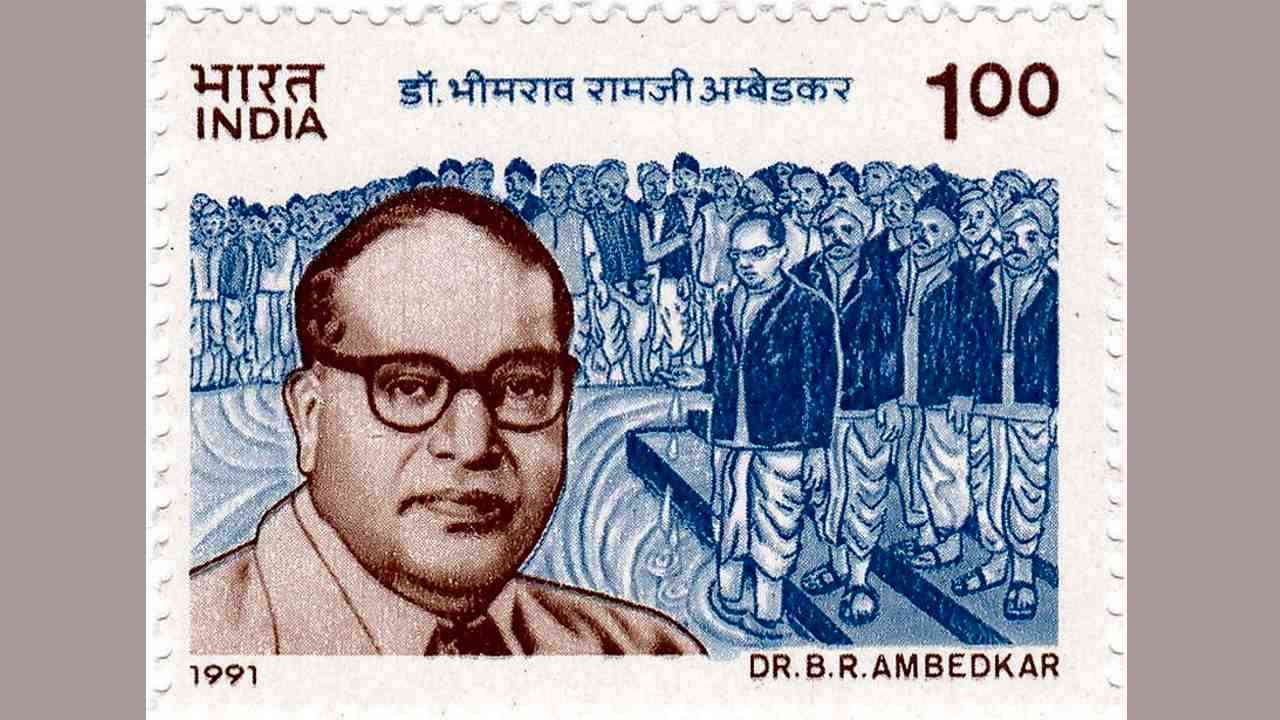
The Indian Constitution is not merely a legal document. It is a civilisational achievement, and arguably the most important moral document India has ever produced — more consequential than any scripture, because it carries the binding force of law and the democratic legitimacy of a sovereign people’s collective commitment to one another.
On 25 December 1927, in the small coastal town of Mahad in Maharashtra, Dr B.R. Ambedkar stood before a specially constructed pyre and set fire to a copy of the Manusmriti. It was not an act of rage. It was an act of civilisational critique — the most deliberate and consequential symbolic gesture in the history of India’s struggle for human dignity.
The Manusmriti — the Laws of Manu, composed between approximately 200 BCE and 200 CE — is a Dharmashastra, a text of social and legal prescription that codifies a system of human inequality so comprehensive and so absolute that it assigns worth, rights, duties, and punishments on the basis of birth alone. It is not a text that merely reflects the prejudices of its era. It is a text that systematises those prejudices into an architecture of oppression — and then claims divine sanction for it.
Its prescriptions are worth stating plainly, because the groups that invoke its authority today rarely quote them. A Shudra, the Manusmriti declares, is created to serve the three higher varnas. Even if emancipated by his master, he is not released from servitude, “since that is innate in him — who can set him free from it?” A Shudra who dares to recite the Vedas shall have hot molten lead poured into his ears. A Shudra who presumes to sit on the same seat as his superior shall be branded and banished.
On women, the text is equally explicit: “In childhood, a female must be protected by her father; in youth, by her husband; when her lord is dead, by her sons. A woman should never be independent.” Women and Shudras are grouped together in multiple passages — as categories of humanity requiring permanent supervision, incapable of autonomy, and unfit for learning.
The Manusmriti does not merely describe inequality. It prescribes it as sacred duty — ordained by creation, enforced by punishment, and justified by divine law. It is, by any ethical standard that takes human dignity seriously, a blasphemy against it.
These are not peripheral verses. They are the structural logic of the text. The Manusmriti does not merely describe inequality. It prescribes it as sacred duty — ordained by creation, enforced by punishment, and justified by divine law. It is, by any ethical standard that takes human dignity seriously, a blasphemy against it. This is what Ambedkar understood — and what he burned.
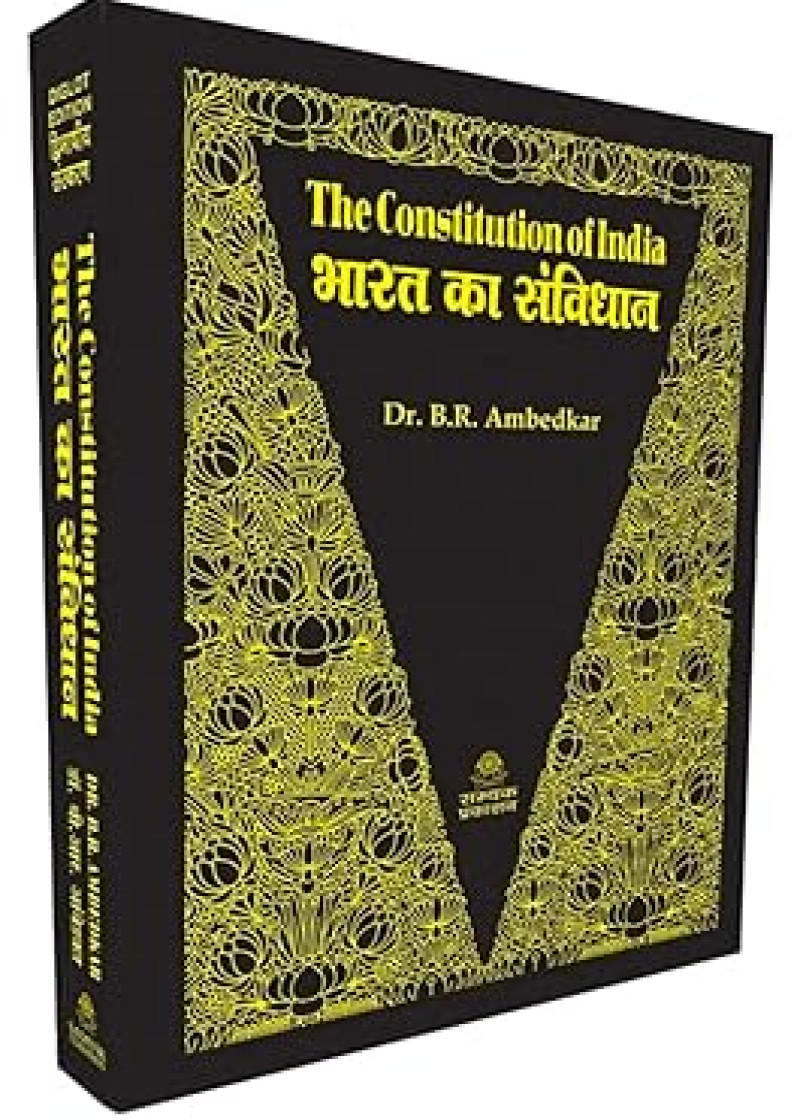
But Ambedkar did not stop at rejection. He built the answer. The Indian Constitution, which Ambedkar went on to draft as Chairman of the Drafting Committee and which was adopted on 26 January 1950, is the most comprehensive and systematic repudiation of the Manusmriti’s vision of human society that any civilisation has ever produced. Every foundational provision of the Constitution is the precise negation of a Manusmriti prescription.
Where the Manusmriti assigns human worth by birth, Article 14 guarantees equality before the law to every person. Where it prescribes differential punishment by caste, Article 15 prohibits discrimination on grounds of religion, race, caste, sex, or place of birth. Where it declares that a Shudra is created to serve, Article 17 abolishes untouchability in all its forms and makes its practice a punishable offence. Where it assigns women to perpetual dependency, Articles 15 and 16 guarantee equal rights and opportunities regardless of gender. Where it reserves learning for the upper castes, the Constitution establishes education as a fundamental right for all.
The Constitution does not merely reject caste. It replaces the entire ontological framework of the Manusmriti — the idea that human beings are born into fixed, divinely ordained hierarchies — with a radically different proposition: that sovereignty resides in the people, that every citizen carries equal dignity, and that the state exists to serve all of them without distinction. This is not merely a legal document. It is a civilisational achievement, and arguably the most important moral document India has ever produced — more consequential than any scripture, because it carries the binding force of law and the democratic legitimacy of a sovereign people’s collective commitment to one another.
Which brings us to the present. There are political forces in India today that invoke the Manusmriti — not always openly, but through the framework of social hierarchy and caste assertion it codifies — and regard the Constitution’s egalitarianism not as India’s greatest moral achievement but as an obstacle, an imposition of Western liberal values on an ancient civilisation. This argument must be met head-on, because it is both historically false and civilisationally dangerous.
The Constitution is as Indian as the Rigveda. It is more Indian than the Manusmriti, which codifies a hierarchy that India’s own deepest philosophical traditions — the Upanishadic teaching that the Atman is one in all beings, the Thirukkural’s insistence on a common human dignity, the Tamil Sangam’s declaration that every person is kin — explicitly reject.
First, the Constitution is not a Western import. It was drafted by an Indian — among the most intellectually formidable Indians of the 20th century — who drew not only on Western constitutional traditions but on the Buddhist principles of liberty, equality, and fraternity, on the Bhakti movement’s radical egalitarianism, and on his own lived experience as a Dalit denied water from a public well because of his birth. The Constitution is as Indian as the Rigveda. It is more Indian than the Manusmriti, which codifies a hierarchy that India’s own deepest philosophical traditions — the Upanishadic teaching that the Atman is one in all beings, the Thirukkural’s insistence on a common human dignity, the Tamil Sangam’s declaration that every person is kin — explicitly reject.
Second, to elevate the Manusmriti above the Constitution is not a defence of Hindu civilisation. It is its betrayal. Hindu civilisation at its greatest has always been characterised by philosophical openness and the recognition that truth cannot be confined to a single text. The Manusmriti is not the tradition. It is a single prescriptive text from a single period — and it is contradicted by the tradition’s own deepest currents.
Third — and this is the point that must be made most clearly — the Indian Constitution is the instrument through which India chose, as a sovereign people, to become something better than its worst historical inheritance. Every nation has texts and traditions that codify inequality. What distinguishes a civilisation is not the absence of such texts but the courage to repudiate them and the wisdom to build something better. Ambedkar gave India both: the courage to burn the Manusmriti, and the wisdom to write the Constitution.
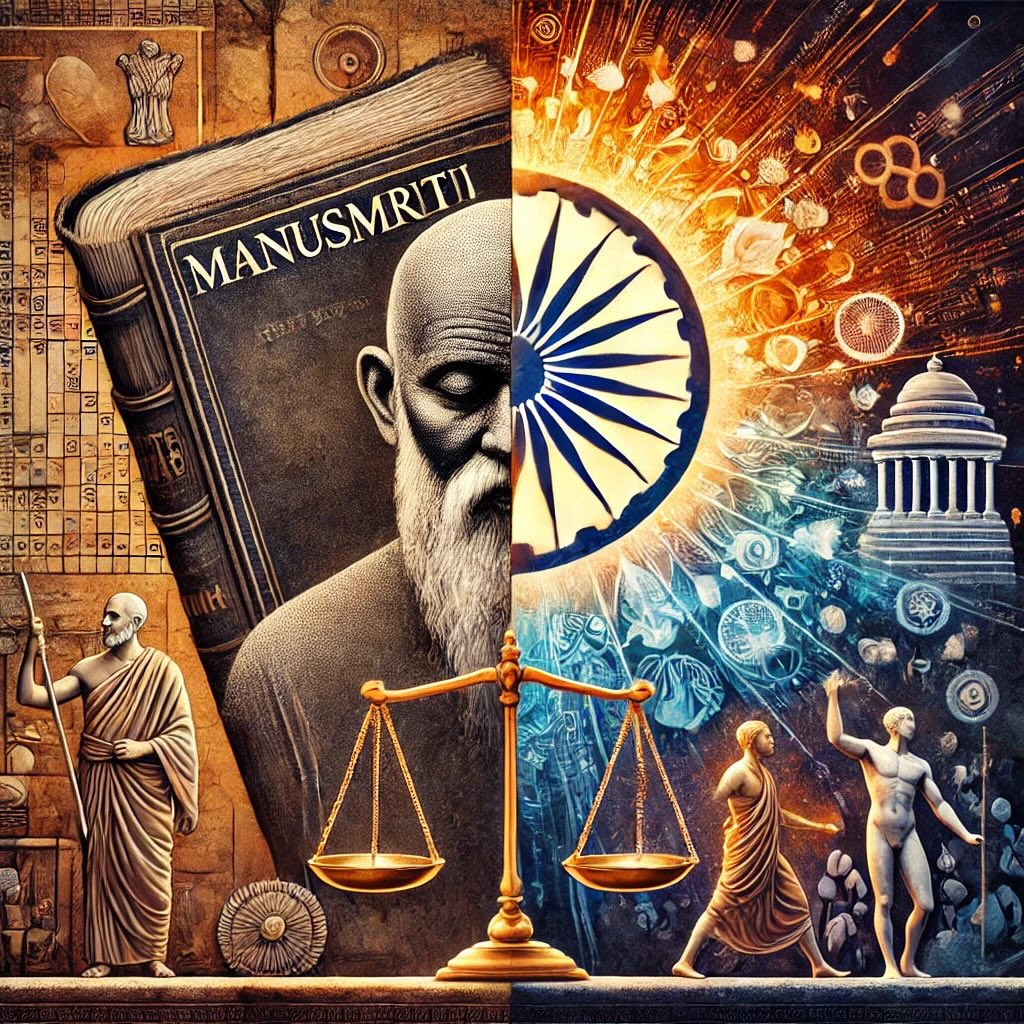
The choice India faces today is the same one Ambedkar posed in 1927, and the same one the Constituent Assembly resolved in 1950: whether India’s social and political order will be governed by a text that assigns human worth by birth — or by a document that declares, with the full force of democratic sovereignty, that every Indian citizen is born equal, lives equal, and deserves equal dignity, opportunity, and protection under the law. That is not a political question. It is a civilisational one. And for those of us who believe in India’s civilisational greatness — in the Rigveda’s declaration that truth has many names, in the Thirukkural’s universalism, in the Sangam poet’s conviction that every person is kin — the answer is not in doubt.
The Constitution is not the enemy of Hindu civilisation. It is its finest modern expression.
Air Marshal M Matheswaran (Retd) is the Founder-President of The Peninsula Foundation (@TPF_Chennai), an independent policy research think tank in Chennai, grounded in the conviction that India’s civilisational greatness lies in its pluralism — and that the Indian Constitution is its most important institutional guarantee.
This essay is a companion to the third article in the prologue in the series ‘India’s Strategic Choices and Civilisational Responsibilities,’ published at thepeninsula.org.in.
Further Reading:
On the Manusmriti
Patrick Olivelle, Manu’s Code of Law: A Critical Edition and Translation of the Manava-Dharmasastra (Oxford University Press, 2005).
The authoritative modern critical edition and translation; source for all verse citations in this essay.
Wendy Doniger and Brian K. Smith, trans., The Laws of Manu (Penguin, 1991).
On Ambedkar and the Mahad Satyagraha
B.R. Ambedkar, Writings and Speeches, vols. 1–17 (Government of Maharashtra, 1979–2003).
Christophe Jaffrelot, Dr Ambedkar and Untouchability: Analysing and Fighting Caste (Hurst, 2005).
Eleanor Zelliot, Ambedkar’s World: The Making of Babasaheb and the Dalit Movement (Navayana, 2013).
On the Mahad Satyagraha and the Manusmriti burning of 25 December 1927.
On the Indian Constitution
Granville Austin, The Indian Constitution: Cornerstone of a Nation (Oxford University Press, 1966).
Granville Austin, Working a Democratic Constitution (Oxford University Press, 1999).
Rohit De, A People’s Constitution: The Everyday Life of Law in the Indian Republic (Princeton University Press, 2018).
On Ambedkar’s intellectual sources
B.R. Ambedkar, The Buddha and His Dhamma (1957; repr. Oxford University Press, 2011).
On the grounding of the Constitution’s egalitarian principles in Buddhist philosophy and the Bhakti tradition.
On Hindu philosophical pluralism
Rigveda, 1.164.46: Ekam Sat Vipra Bahudha Vadanti.
Thiruvalluvar, Thirukkural. Trans. P.S. Sundaram (Penguin, 1990).
Kaniyan Poongundranar, Purananuru 192: ‘Yaadhum Oorey, Yavarum Kelir.’
Feature Image Credit: liberation.org.in