Tag: South Africa

  • BRICS: On 1 January 2024, the World’s Centre of Gravity will Shift

    BRICS: On 1 January 2024, the World’s Centre of Gravity will Shift

    As is often the case in history, the actions of a dying empire create common ground for its victims to look for new alternatives, no matter how embryonic and contradictory they are. The diversity of support for the expansion of BRICS is an indication of the growing loss of the political hegemony of imperialism.
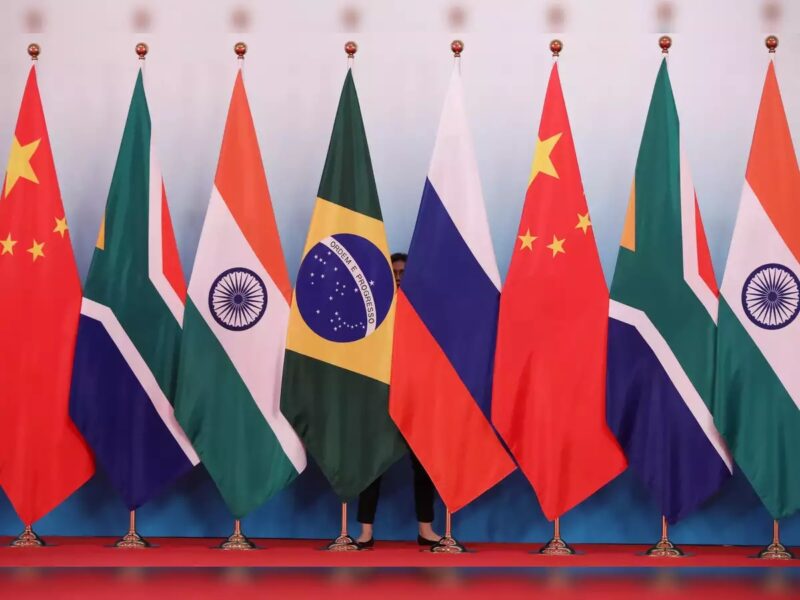
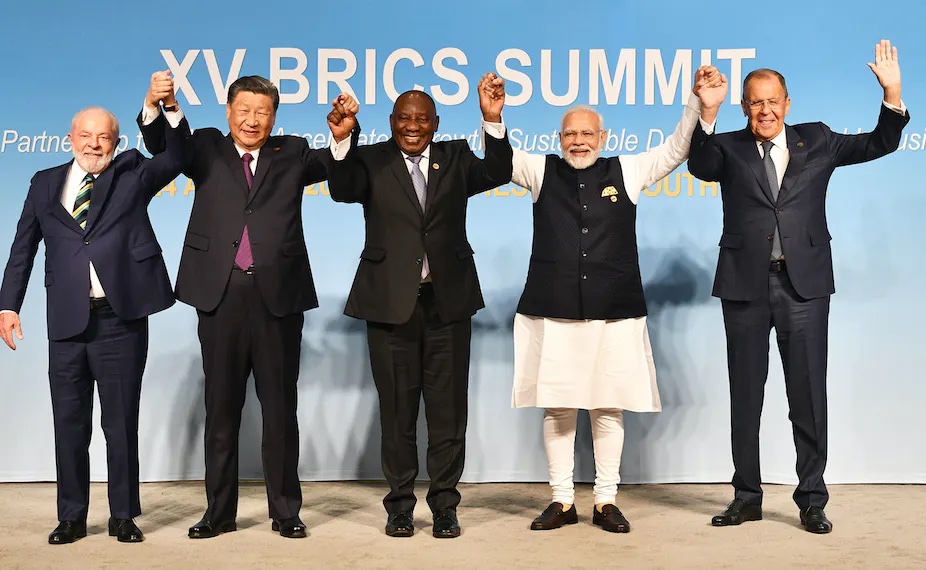
    On the last day of the BRICS summit in Johannesburg, South Africa, the five founding states (Brazil, Russia, India, China, and South Africa) welcomed six new members: Argentina, Egypt, Ethiopia, Iran, Saudi Arabia, and the United Arab Emirates (UAE). The BRICS partnership now encompasses 47.3 per cent of the world’s population, with a combined global Gross Domestic Product (by purchasing power parity, or PPP,) of 36.4 per cent. In comparison, though the G7 states (Canada, France, Germany, Italy, Japan, the United Kingdom, and the United States) account for merely 10 per cent of the world’s population, their share of the global GDP (by PPP) is 30.4 per cent. In 2021, the nations that today form the expanded BRICS group were responsible for 38.3 percent of global industrial output while their G7 counterparts accounted for 30.5 percent. All available indicators, including harvest production and the total volume of metal production, show the immense power of this new grouping. Celso Amorim, advisor to the Brazilian government and one of the architects of BRICS during his former tenure as foreign minister, said of the new development that ‘[t]he world can no longer be dictated by the G7’.

    Certainly, the BRICS nations, for all their internal hierarchies and challenges, now represent a larger share of the global GDP than the G7, which continues to behave as the world’s executive body. Over forty countries expressed an interest in joining BRICS, although only twenty-three applied for membership before the South Africa meeting (including seven of the thirteen countries in the Organisation of Petroleum Exporting Countries, or OPEC). Indonesia, the world’s seventh largest country in terms of GDP (by PPP), withdrew its application to BRICS at the last moment but said it would consider joining later. Indonesia’s President Joko Widodo’s comments reflect the mood of the summit: ‘We must reject trade discrimination. Industrial down streaming must not be hindered. We must all continue to voice equal and inclusive cooperation’.

    The facts are clear: the Global North’s percentage of world GDP fell from 57.3 per cent in 1993 to 40.6 per cent in 2022, with the US’s percentage shrinking from 19.7 per cent to only 15.6 per cent of global GDP (by PPP) in the same period – despite its monopoly privilege. In 2022, the Global South, without China, had a GDP (by PPP) greater than that of the Global North.

    BRICS does not operate independently of new regional formations that aim to build platforms outside the grip of the West, such as the Community of Latin America and Caribbean States (CELAC) and the Shanghai Cooperation Organisation (SCO). Instead, BRICS membership has the potential to enhance regionalism for those already within these regional fora. Both sets of interregional bodies are leaning into a historical tide supported by important data, analysed by Tricontinental: Institute for Social Research using a range of widely available and reliable global databases. The facts are clear: the Global North’s percentage of world GDP fell from 57.3 per cent in 1993 to 40.6 per cent in 2022, with the US’s percentage shrinking from 19.7 per cent to only 15.6 per cent of global GDP (by PPP) in the same period – despite its monopoly privilege. In 2022, the Global South, without China, had a GDP (by PPP) greater than that of the Global North.

    The West, perhaps because of its rapid relative economic decline, is struggling to maintain its hegemony by driving a New Cold War against emergent states such as China. Perhaps the single best evidence of the racial, political, military, and economic plans of the Western powers can be summed up by a recent declaration of the North Atlantic Treaty Organisation (NATO) and the European Union (EU): ‘NATO and the EU play complementary, coherent and mutually reinforcing roles in supporting international peace and security. We will further mobilise the combined set of instruments at our disposal, be they political, economic, or military, to pursue our common objectives to the benefit of our one billion citizens’.

    Why did BRICS welcome such a disparate group of countries, including two monarchies, into its fold? When asked to reflect on the character of the new full member states, Brazil’s President Luiz Inácio Lula da Silva said, ‘What matters is not the person who governs but the importance of the country. We can’t deny the geopolitical importance of Iran and other countries that will join BRICS’. This is the measure of how the founding countries made the decision to expand their alliance. At the heart of BRICS’s growth are at least three issues: control over energy supplies and pathways, control over global financial and development systems, and control over institutions for peace and security.
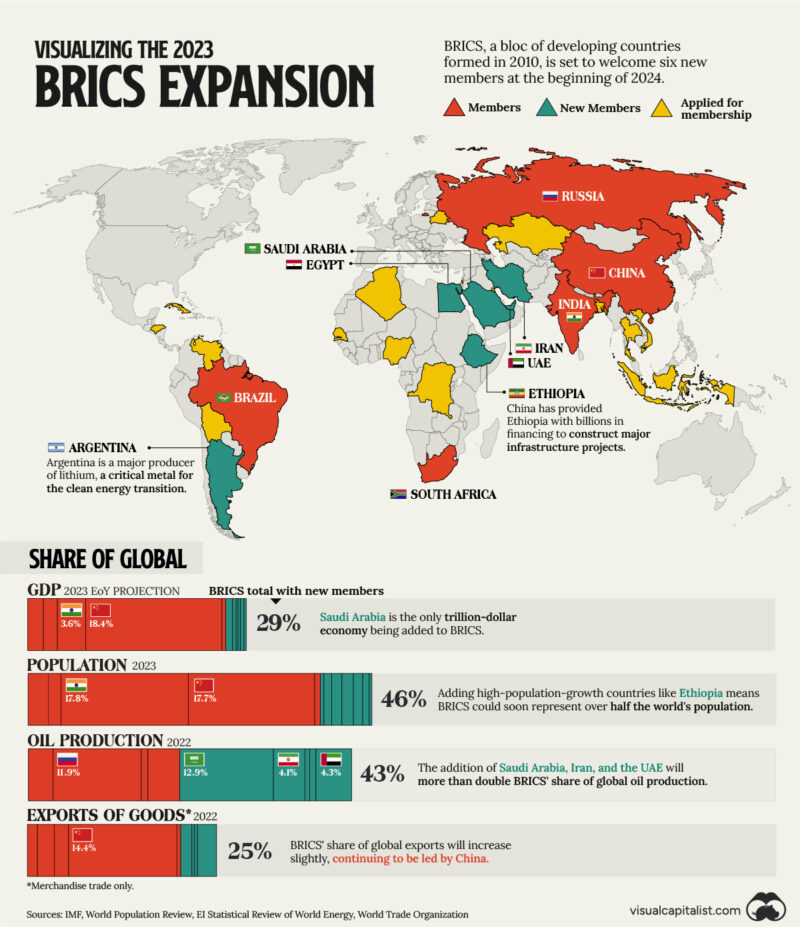
    A larger BRICS has now created a formidable energy group. Iran, Saudi Arabia, and the UAE are also members of OPEC, which, with Russia, a key member of OPEC+, now accounts for 26.3 million barrels of oil per day, just below thirty per cent of global daily oil production. Egypt, which is not an OPEC member, is nonetheless one of the largest African oil producers, with an output of 567,650 barrels per day. China’s role in brokering a deal between Iran and Saudi Arabia in April enabled the entry of both of these oil-producing countries into BRICS. The issue here is not just the production of oil, but the establishment of new global energy pathways.

    The Chinese-led Belt and Road Initiative has already created a web of oil and natural gas platforms around the Global South, integrated into the expansion of Khalifa Port and natural gas facilities at Fujairah and Ruwais in the UAE, alongside the development of Saudi Arabia’s Vision 2030. There is every expectation that the expanded BRICS will begin to coordinate its energy infrastructure outside of OPEC+, including the volumes of oil and natural gas that are drawn out of the earth. Tensions between Russia and Saudi Arabia over oil volumes have simmered this year as Russia exceeded its quota to compensate for Western sanctions placed on it due to the war in Ukraine. Now these two countries will have another forum, outside of OPEC+ and with China at the table, to build a common agenda on energy. Saudi Arabia plans to sell oil to China in renminbi (RMB), undermining the structure of the petrodollar system (China’s two other main oil providers, Iraq and Russia, already receive payment in RMB).

    Both the discussions at the BRICS summit and its final communiqué focused on the need to strengthen a financial and development architecture for the world that is not governed by the triumvirate of the International Monetary Fund (IMF), Wall Street, and the US dollar. However, BRICS does not seek to circumvent established global trade and development institutions such as the World Trade Organisation (WTO), the World Bank, and the IMF. For instance, BRICS reaffirmed the importance of the ‘rules-based multilateral trading system with the World Trade Organisation at its core’ and called for ‘a robust Global Financial Safety Net with a quota-based and adequately resourced [IMF] at its centre’. Its proposals do not fundamentally break with the IMF or WTO; rather, they offer a dual pathway forward: first, for BRICS to exert more control and direction over these organisations, of which they are members but have been suborned to a Western agenda, and second, for BRICS states to realise their aspirations to build their own parallel institutions (such as the New Development Bank, or NDB). Saudi Arabia’s massive investment fund is worth close to $1 trillion, which could partially resource the NDB.

    BRICS’s agenda to improve ‘the stability, reliability, and fairness of the global financial architecture’ is mostly being carried forward by the ‘use of local currencies, alternative financial arrangements, and alternative payment systems’. The concept of ‘local currencies’ refers to the growing practice of states using their own currencies for cross-border trade rather than relying upon the dollar. Though approximately 150 currencies in the world are considered to be legal tender, cross-border payments almost always rely on the dollar (which, as of 2021, accounts for 40 per cent of flows over the Society for Worldwide Interbank Financial Telecommunications, or SWIFT, network).

    Other currencies play a limited role, with the Chinese RMB comprising 2.5 per cent of cross-border payments. However, the emergence of new global messaging platforms – such as China’s Cross-Border Payment Interbank System, India’s Unified Payments Interface, and Russia’s Financial Messaging System (SPFS) – as well as regional digital currency systems promise to increase the use of alternative currencies. For instance, cryptocurrency assets briefly provided a potential avenue for new trading systems before their asset valuations declined, and the expanded BRICS recently approved the establishment of a working group to study a BRICS reference currency.

    Following the expansion of BRICS, the NDB said that it will also expand its members and that, as its General Strategy, 2022–2026 notes, thirty per cent of all of its financing will be in local currencies. As part of its framework for a new development system, its president, Dilma Rousseff, said that the NDB will not follow the IMF policy of imposing conditions on borrowing countries. ‘We repudiate any kind of conditionality’, Rousseff said. ‘Often a loan is given upon the condition that certain policies are carried out. We don’t do that. We respect the policies of each country’.

    In their communiqué, the BRICS nations write about the importance of ‘comprehensive reform of the UN, including its Security Council’

    In their communiqué, the BRICS nations write about the importance of ‘comprehensive reform of the UN, including its Security Council’. Currently, the UN Security Council has fifteen members, five of whom are permanent (China, France, Russia, the UK, and the US). There are no permanent members from Africa, Latin America, or the most populous country in the world, India. To repair these inequities, BRICS offers its support to ‘the legitimate aspirations of emerging and developing countries from Africa, Asia, and Latin America, including Brazil, India, and South Africa to play a greater role in international affairs’. The West’s refusal to allow these countries a permanent seat at the UN Security Council has only strengthened their commitment to the BRICS process and to enhance their role in the G20.

    The entry of Ethiopia and Iran into BRICS shows how these large Global South states are reacting to the West’s sanctions policy against dozens of countries, including two founding BRICS members (China and Russia). The Group of Friends in Defence of the UN Charter – Venezuela’s initiative from 2019 – brings together twenty UN member states that are facing the brunt of illegal US sanctions, from Algeria to Zimbabwe. Many of these states attended the BRICS summit as invitees and are eager to join the expanded BRICS as full members.

    We are not living in a period of revolutions. Socialists always seek to advance democratic and progressive trends. As is often the case in history, the actions of a dying empire create common ground for its victims to look for new alternatives, no matter how embryonic and contradictory they are. The diversity of support for the expansion of BRICS is an indication of the growing loss of the political hegemony of imperialism.

    This article was published earlier in tricontinental.org and is republished under the Creative Commons.
     

  • BRICS Summit 2023

    BRICS Summit 2023

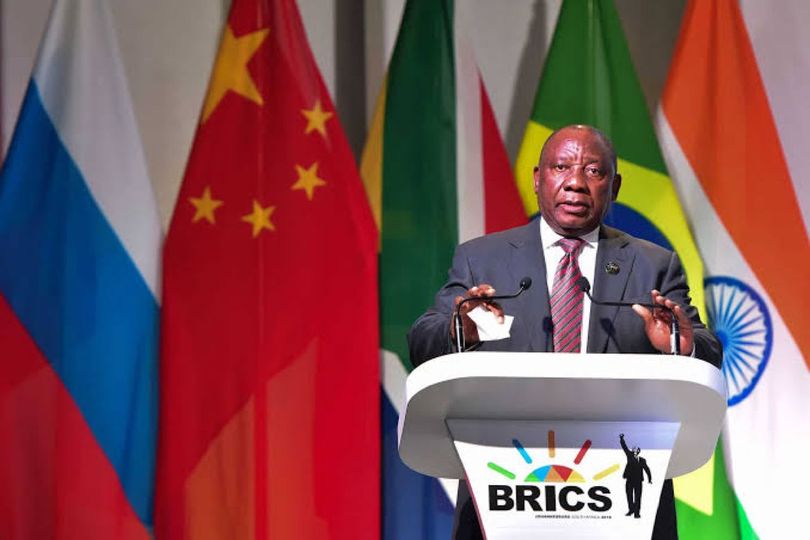
    The 15th BRICS Summit will be held next week from the 22nd to the 24th of August in Johannesburg under the chairmanship of South Africa. Unlike in the past when the West largely ignored the summits as of little consequence, the 15th Summit has got the world’s attention in a major way. Given the current turmoil in the world order and the realisation in much of the world that the West is largely responsible for the unending wars and interventions, this summit has assumed enormous importance. To put it bluntly, the BRICS is being seen as having the potential to end Western dominance and reshape the world into a more equitable and multipolar world order. The summit, which South Africa hosts next week, could mark a significant step in the reconfiguration of geopolitical power in the not-too-distant future.

    Already, BRICS countries represent over 40% of the global population and an estimated 30% of its GDP, and with China expected to overtake the United States as early as 2035 as the world’s largest economy, many sovereign states are eager to establish themselves for a de-dollarised future. 40 countries have expressed their interest to join BRICS, while 23 countries have formally applied, including Argentina, Iran, Saudi Arabia, the United Arab Emirates, Indonesia, Thailand, Cuba, Egypt, and Nigeria. A total of 67 countries, including 53 African states have been invited to the BRICS Summit 2023. This is a significant development. The important issues likely to be discussed at the summit include the expansion of BRICS and the possible introduction of BRICS currency.  As a prelude, the joint statement of BRICS’ foreign ministers meeting in June 2023 shows the expanding domains of cooperation that included international security and world order. The joint statement is reproduced below.

    – Team TPF

    Joint Statement of the BRICS Ministers of Foreign Affairs and International Relations Cape Town, South Africa 1 June 2023

    1. The BRICS Ministers of Foreign Affairs and International Relations met on 1 June 2023 in Cape Town, South Africa. They exchanged views on major global and regional trends and issues. They reaffirmed their commitment to strengthening the framework of BRICS cooperation under the three pillars of political and security, economic and financial, and cultural and people-to-people cooperation upholding the BRICS spirit featuring mutual respect and understanding, equality, solidarity, openness, inclusiveness, and consensus.

    2. The Ministers reiterated their commitment to strengthening multilateralism and upholding international law, including the purposes and principles enshrined in the Charter of the United Nations (UN) as its indispensable cornerstone, and the central role of the UN in an international system in which sovereign states cooperate to maintain peace and security, advance sustainable development, ensure the promotion and protection of democracy, human rights and fundamental freedoms for all, and promoting cooperation based on the spirit of solidarity, mutual respect, justice and equality.

    3. The Ministers expressed concern about the use of unilateral coercive measures, which are incompatible with the principles of the Charter of the UN and produce negative effects notably in the developing world. They reiterated their commitment to enhancing and improving global governance by promoting a more agile, effective, efficient, representative and accountable international and multilateral system.

    4. The Ministers recalled UN General Assembly (UNGA) Resolution 75/1 and reiterated the call for reforms of the principal organs of the United Nations. They recommitted to instil new life in the discussions on the reform of the UN Security Council (UNSC) and continue the work to revitalise the General Assembly and strengthen the Economic and Social Council. They recalled the 2005 World Summit Outcome document and reaffirmed the need for a comprehensive reform of the UN, including its Security Council, with a view to making it more representative, effective and efficient, and to increase the representation of the developing countries so that it can adequately respond to global challenges. China and Russia reiterated the importance they attach to the status and role of Brazil, India and South Africa in international affairs and supported their aspiration to play a greater role in the UN.

    5. The Ministers reaffirmed the importance of the G20 to continue playing the role of the premier multilateral forum in the field of economic cooperation that comprises both developed and developing countries where major economies jointly seek solutions to global challenges. They looked forward to the successful hosting of the 18th G20 Summit under the Indian G20 Presidency. They noted the opportunities to build sustained momentum for change by India, Brazil and South Africa chairing the G20 from 2023 to 2025 and expressed support for continuity and collaboration in their G20 presidencies and wish them all success in their endeavours.

    6. The Ministers called for the implementation of the 2030 Agenda for Sustainable Development in its three dimensions – economic, social and environmental – in a balanced and integrated manner by mobilising the means required to implement the 2030 Agenda. They highlighted in this regard that the Sustainable Development Goals (SDGs) Summit, to be held in New York in September 2023, constitutes a unique opportunity for renewing international commitment to the implementation of the 2030 Agenda.

    7. The Ministers recognised the impact on the world economy from unilateral approaches in breach of international law and they also noted that the situation is complicated further by unilateral economic coercive measures, such as sanctions, boycotts, embargoes and blockades.

    8. The Ministers expressed their support for the free, open, transparent, fair, predictable, inclusive, equitable, non-discriminatory and rules-based multilateral trading system with the World Trade Organisation (WTO) at its core, with special and differential treatment (S&DT) for developing countries, including Least Developed Countries. They stressed their support to work towards positive and meaningful outcomes on the issues at the 13th Ministerial Conference (MC13). They committed to engage constructively to pursue the necessary WTO reform with a view to presenting concrete deliverables to MC13. They called for the restoration of a fully and well-functioning dispute settlement system accessible to all members by 2024, and the selection of new Appellate Body Members without further delay. They condemned unilateral protectionist measures under the pretext of environmental concerns such as unilateral and discriminatory carbon border adjustment mechanisms, taxes and other measures.

    9. They supported a robust Global Financial Safety Net with a quota-based and adequately resourced International Monetary Fund (IMF) at its centre. They called on continuing the process of IMF governance reform under the 16th General Review of Quotas, including a new quota formula as a guide, to be completed by 15 December 2023.

    10. The Ministers congratulated Ms Dilma Rousseff, former President of the Federative Republic of Brazil, as President of the New Development Bank (NDB) and expressed confidence that it will contribute to strengthening the NDB in effectively achieving its mandate. They encouraged the NDB to follow the member-led and demand-driven principle, mobilise financing from diversified sources, enhance innovation and knowledge exchange, assist member countries in achieving the SDGs and further improve efficiency and effectiveness to fulfil its mandate, aiming to be a premier multilateral development institution.

    11. The Ministers emphasised the importance of financial inclusion so that citizens can reap the benefits of economic growth and prosperity and welcomed the many new technological instruments for financial inclusion, developed in BRICS countries, that can contribute to ensuring the citizens full participation in the formal economy.

    12. Ministers underscored the importance of encouraging the use of local currencies in international trade and financial transactions between BRICS as well as their trading partners.

    13. The Ministers emphasised that ensuring energy security is a crucial foundation for economic development, social stability, national security, and the welfare of all nations worldwide. They called for resilient global supply chains and predictable, stable energy demand to ensure universal access to affordable, reliable, sustainable, and modern energy sources. They also stressed the importance of enhancing energy security and market stability by strengthening value chains, promoting open, transparent, and competitive markets, and ensuring the protection of critical energy infrastructure. They strongly condemned all terrorist attacks against critical infrastructure, including critical energy facilities, and against other vulnerable targets.

    14. The Ministers reiterated that the objectives, principles and provisions of the United Nations Framework Convention on Climate Change (UNFCCC) and its Paris Agreement, in particular, the principles of common but differentiated responsibilities and respective capabilities (CBDR-RC) in the light of different national circumstances, must be honoured. They reaffirmed their national and joint efforts to promote the implementation of the Paris Agreement In this regard, they stressed the importance of the fulfilment by developed countries of their commitments to provide technology and adequate, predictable, timely, new and additional climate finance that is long overdue to assist developing countries to address climate change. They expressed concern that the goal of developed countries to jointly mobilise USD 100 billion per year by 2020, and annually through 2025, has not been achieved and urged developed countries to meet their commitments. They rejected attempts to link security with the climate change agenda and recalled that the UNFCCC, including the annual Conference of the Parties (COP) sessions, is the appropriate and legitimate international forum to discuss the issue of climate change in all its dimensions.

    15. The Ministers emphasised their determination to contribute to a successful COP28 in Dubai, later this year, with the focus on implementation. As the main mechanism for promoting implementation and climate action on all aspects of the Paris Agreement under the UNFCCC, the Global Stocktake must be effective in assessing and identifying implementation gaps on the global response to climate change, whilst prospectively laying the foundations for enhanced ambition by all, in particular by developed countries, and for the fulfilment of outstanding gaps in means of implementation for mitigation and adaptation actions in developing countries.

    16. The Ministers welcomed Brazil’s candidacy to host COP30 as the year 2025 will be key to the very future of the global response to climate change.

    17. The Ministers recognised the importance of the inclusion of women in peace processes including in conflict prevention and resolution, peacebuilding, post-conflict reconstruction and development, and sustaining peace.

    18. The Ministers recalled their national positions concerning the situation in and around Ukraine as expressed at the appropriate fora, including the UNSC and UNGA. They noted with appreciation relevant proposals of mediation and good offices aimed at peaceful resolution of the conflict through dialogue and diplomacy. They called for the full and effective implementation of both the Black Sea Grain Initiative and the Memorandum of Understanding between the Russian Federation and the Secretariat of the United Nations on promoting Russian food products and fertilizers to the world markets and stress the importance of allowing grains and fertilisers to continue to reach those most in need.

    19. The Ministers expressed serious concern over continued conflicts in the Middle East and North Africa (MENA) region and endorsed the Joint Statement by BRICS Deputy Foreign Ministers and Special Envoys at their meeting of 26 April 2023.

    20. The Ministers welcomed the readmission of the Syrian Arab Republic to the League of Arab States on 7 May 2023 and reaffirmed their support to all efforts conducive to a political and negotiated solution that respects Syrian sovereignty and territorial integrity.

    21. The Ministers expressed concern about the outbreak of violence in Sudan. They urged the immediate cessation of hostilities and they called for the unimpeded access of the Sudanese population to humanitarian assistance. They welcomed the efforts of the African Union, the Intergovernmental Authority for Development, the League of Arab States, the United Nations and its Security Council in seeking solutions for the ongoing crisis. They further welcomed support rendered by various countries, international organisations and agencies in the evacuation of foreign citizens from Sudan.

    22. The Ministers expressed strong condemnation of terrorism in all its forms and manifestations whenever, wherever and by whomsoever committed. They recognised the threat emanating from terrorism, extremism conducive to terrorism and radicalisation. They are committed to combating terrorism in all its forms and manifestations, including the cross-border movement of terrorists, and terrorism financing networks and safe havens. They reiterated that terrorism should not be associated with any religion, nationality, civilisation or ethnic group. They reaffirmed their unwavering commitment to contribute further to the global efforts of preventing and countering the threat of terrorism on the basis of respect for international law, in particular the Charter of the United Nations, and human rights, emphasising that States have the primary responsibility in combating terrorism with the United Nations continuing to play central and coordinating role in this area. They also stressed the need for a comprehensive approach of the whole international community to effectively curb the terrorist activities, which pose a serious threat, including in the present-day pandemic environment. The Ministers rejected double standards in countering terrorism and extremism conducive to terrorism. The Ministers called for an expeditious finalisation and adoption of the Comprehensive Convention on International Terrorism within the UN framework and for launching multilateral negotiations on an international convention for the suppression of acts of chemical and biological terrorism, at the Conference of Disarmament. They welcomed the activities of the BRICS Counter-Terrorism Working Group and its five Subgroups based upon the BRICS Counter-Terrorism Strategy and the BRICS Counter-Terrorism Action Plan. We also look forward to further deepening counter-terrorism cooperation.

    23. They expressed the need to comprehensively strengthen mechanisms for countering the increased use, in a globalised society, by terrorists and their supporters of emerging and evolving technologies such as Unmanned Aerial Systems, the Internet and other information and communications technologies, including social media platforms, for terrorist purposes, such as for recruitment and incitement to commit terrorist acts, as well as for the financing, planning, and preparation of their activities.

    24. The Ministers called for strengthening the system of arms control, disarmament and non-proliferation, including the Convention on the Prohibition of the Development, Production and Stockpiling of Bacteriological (Biological) and Toxin Weapons and on their Destruction (BTWC) and the Convention on the Prohibition of the Development, Production, Stockpiling and Use of Chemical Weapons and on Their Destruction (CWC), and for preserving their integrity and effectiveness to maintain global stability and international peace and security. They underlined the need to comply with and strengthen the BTWC, including by adopting a legally binding Protocol to the Convention that provides for, inter alia, an efficient verification mechanism. The Ministers reasserted their support for ensuring the long-term sustainability of outer space activities and prevention of an arms race in outer space (PAROS) and of its weaponization, including through negotiations to adopt a relevant legally binding multilateral instrument. They recognised the value of the updated Draft Treaty on the Prevention of the Placement of Weapons in Outer Space, the Threat or Use of Force against Outer Space Objects (PPWT) submitted to the Conference on Disarmament in 2014. They stressed that practical Transparency and Confidence-Building Measures (TCBMs), may also contribute to PAROS.

    25. The Ministers, while emphasising the formidable potential of the ICTs for growth and development, recognised new associated possibilities they bring for criminal activities and threats, and expressed concern over the rising level and complexity of criminal misuse of ICTs. They welcomed the ongoing work in the Ad Hoc Committee to elaborate a comprehensive international convention on countering the use of ICTs for criminal purposes and reaffirmed their commitment to cooperating in the implementation of the mandate adopted by the UN General Assembly resolution 75/282 in a timely manner.

    26. In line with paragraph 57 of the Beijing Declaration, the Ministers emphasised the responsible and ethical development and use of Artificial Intelligence (AI) for socio-economic development and inclusive growth of all societies. They supported communication and cooperation on AI technology to promote mutual benefits, called for strengthening AI international governance and encourage policy exchanges and dialogues on AI, with a view to exploring to establish an effective global governance framework with the aim to protect human rights and spur innovation and economic growth.

    27. The Ministers reiterated the need for all countries to cooperate in promoting and protecting human rights and fundamental freedoms under the principles of equality and mutual respect. They agreed to continue to treat all human rights, including the right to development, in a fair and equal manner, on the same footing and with the same emphasis. They agreed to strengthen cooperation on issues of common interests both within BRICS and in multilateral fora including the United Nations General Assembly and Human Rights Council, taking into account the necessity to promote, protect and fulfil human rights in a non-selective, non-politicised and constructive manner and without double standards.

    28. The Ministers noted the Chair’s internal report on BRICS Institutional Development in line with paragraphs 71 to 73 of the Beijing Declaration.

    29. The Ministers welcomed the Friends of BRICS Foreign Ministers meeting on 2 June 2023.

    30. The Ministers expressed their full support to South Africa’s BRICS Chairship in 2023 under the theme “BRICS and Africa: Partnership for Mutually Accelerated Growth, Sustainable Development, and Inclusive Multilateralism”. They expressed their commitment to working together to ensure the success of the XV BRICS Summit. The Ministers looked forward to the next BRICS Ministers of Foreign Affairs and International Relations meeting to be held on the margins of UNGA78 and hosted by the Russian Federation as the incoming Chair of BRICS in 2024.


  • BRICS Real Value: One Step Towards New World Order

    BRICS Real Value: One Step Towards New World Order

    While “BRICS” has been a frequently occurring acronym in our discourse in recent years, not many seem to have grasped the reality of Brics and its actual utility.

    The post-Cold War era has seen the economic and political rise of a host of nations — Brazil, China and India being foremost among them. Since 2000 and the advent of Vladimir Putin, Russia has with some help from soaring oil prices made impressive economic gains. The new South Africa, based equally on the industrial inheritance of the robust but unequal and exploitative apartheid regime and the bounty of nature, now finds itself as an advancing economic power. Unlike Nigeria, which has frittered its oil wealth and has been looted by its native kleptocracy, South Africa has been a relative symbol of responsible government and probity in public life. Each one of these nations is now a major economic player and some already have bigger GDPs than many countries in the Group of Seven. Together, in the next two decades, Brics is likely to outstrip the G-7.

    [powerkit_button size=”lg” style=”info” block=”true” url=”https://www.deccanchronicle.com/opinion/columnists/270722/mohan-guruswamy-brics-real-value-one-step-towards-new-world-orde.html” target=”_blank” nofollow=”false”]
    Read More
    [/powerkit_button]