Tag: Productivity

  • India’s Farming Progress Lies In Adoption Of Smart Agriculture

    India’s Farming Progress Lies In Adoption Of Smart Agriculture

    From being a country that was a food importer till the early 1970s, India’s green revolution transformed the country into becoming self-sufficient in food production and a significant exporter of agricultural products. However, Indian agriculture, hampered by marginal farm holdings suffered from poor technology and lack of modernisation, resulting in production that is far below its potential. With a population of 1.24 billion, Indian agriculture is already challenged.
    The Railway versus Irrigation controversy during the early years of the 20th century was evidence that the British undervalued the significance of improving irrigation in an agrarian economy such as India. R C Dutt, in his famous book ‘The Economic History of India in the Victorian Age’, shows the disparity in funds allocated for railways and that for irrigation purposes. The glaring disparity is believed to be one of the reasons for the 1890 famines. Akin to the pre-independence time, the Economic Survey 2019-20 shows static growth in agriculture from 2014 to the present day. The growth rate in agriculture was a negative 0.2% in 2014-15. Inadequate fund allocation, illiteracy of the farmers, deficient safety nets, lack of microcredit organizations and low incentive for the farmers to adopt climate-smart and efficient technology are some of the reasons for prolonged sluggishness in Indian agriculture. India’s prosperous neighbour, China, however, has managed accelerated growth in both agricultural and industrial sectors. The reason is the proactive nature of the Chinese and the ability to make the most out of little. Since the 1990s China has left India far behind in the field of revamping farming techniques. A leader of innovation, China has turned its weaknesses into strength- rooftop agriculture to compensate for the lack of adequate farming land, AI sensing smart robots to store data and supplement human labour, automated water management schemes that led to rice becoming one of Chinas staple food grains. China has surpassed India in rice production, despite India having more available freshwater for crop production. This indicates the need for India to improve its learning curve as far as international agricultural policies are concerned.
    China has surpassed India in rice production, despite India having more available freshwater for crop production.

    Smart Techniques and Precision Farming

    In this vein, the identification of the techniques of smart farming that can give a boost to the decaying agricultural sector of India is critical. Using smarter techniques like Precision farming, efficient water management techniques and Artificial intelligence are sure-shot methods to increase productivity per acre of land. Precision Agriculture avoids the improper and excess application of pesticides and fertilizers and enables the farmer to use land according to its quality and nature. This leads to a reduction in cost, increase in output and climate-friendly agriculture. ‘Big data’ in Precision farming provides the farmer with data regarding soil quality, raw material requirements and weather changes, which can be stored for a later date. This is a massive game-changer for a sector which substantially depends on weather conditions and faces the brunt of climate change. China has been using automated ‘driverless’ tractors, mowers, AI drones to spray pesticides, and smart robotic sensors to analyse environmental conditions. This increases the speed of farming at an exceptional rate. Precision Farming is a potential salvager at a time when the water tables in India are diminishing at a rapid rate due to unprecedented demand by the agricultural and industrial sectors. Smart farming can potentially break the nexus between outmoded agriculture, climate change and hunger. The longer we delay the implementation of such techniques, the closer we move towards an impasse, which even modernisation might not be able to fix.
    ‘Big data’ in Precision farming provides the farmer with data regarding soil quality, raw material requirements and weather changes, which can be stored for a later date. This is a massive game-changer for a sector which substantially depends on weather conditions and faces the brunt of climate change.

    Predicament of Marginal Holdings

    The Indian predicament can be traced back to decades of neglect towards the agricultural sector. Even with plans like ‘doubling farmer’s income by 2022’, most states except Punjab, Haryana and Karnataka have not even envisaged a plan for smart farming. A plethora of structural barriers impedes the coveted modernization required by our agricultural sector. The average size of landholding by an Indian rural household is a marginal 1.1 hectare. This restricts the use of modern equipment like large tractors and robot sensors as a smart substitute for manual labour. The digital illiteracy of the farmers also presents a hurdle owing to the absence of local experts to impart training and information to the farmers. The connectivity and problem of unstable internet is also a cause of roadblock. Government policies historically have adopted a ‘one-size-fits-all’ approach, thus excluding approximately 86% of small and marginal farmers. For schemes like PM-Fasal Bima Yojana, the small farmers have to pay balance of the premium for crop insurance, which is almost impossible for a debt-strapped farmer. The newly extended PM-KISAN scheme requires farmers in a digitally primitive nation to check their balance by registering themselves on a web-portal page. With basic crop insurance schemes not living up to the expectation, we naturally question the efficacy of schemes to promote smart agriculture. The evaluation of the NMMI scheme for Micro Irrigation recorded that the benefit from the scheme did not reach almost half of the intended beneficiaries, even after they applied for it. The PMKSY scheme simply reached a meagre 1/10th of the farming population targeted.
    A plethora of structural barriers impedes the coveted modernization required by our agricultural sector. The average size of landholding by an Indian rural household is a marginal 1.1 hectare.

    Policy Focus for Smart Agriculture

    A dedicated approach to developing smart agriculture with mass disbursements of benefits, education and economic incentives to our farmers will eventually translate into long-run economies of scale for the agricultural community at large. The US government extensively aids research and development in agricultural technology, along with training given to farmers to understand the new technology. The British government, besides allocating 20 million dollars for sustainable agriculture, also incentivizes private aggrotech firms to invest in smart technology. South Korean government has already created 4,300 jobs in the smart agricultural sector through timely action and aid. India, although lagging in several fields, is endowed with cheap rural labour, the second largest arable land area after the US, a leader in global trade in raw agricultural products and a massive potential growth trajectory in agriculture. Extension services and R&D are at a nascent stage in India and only within reach of large farmers. To expand the scale of the programme it is necessary to ease the transition of small and marginal farmers into the ambit of smart farming. Institutional setups, adequate support and building a steady architecture to execute smart farming should be focus areas for the Indian government in the face of dwindling food production.

    References:

    https://www.smart-akis.com/index.php/network/what-is-smart-farming/
    https://www.smartindianagriculture.com/https://www.changemakers.com/discussions/entries/smart-agriculture-helping-structure-new-industry-chinahttps://www.basf.com/cn/en/media/BASF-Information/Food-nutrition/future-farming.htmlhttps://www.youtube.com/watch?v=PdIr6pP-Rec&list=PLTeiJVqL7DL6yhlOMh4lPv_BCQ5KKMgBd&index=2&t=0shttps://www.downtoearth.org.in/coverage/natural-disasters/climate-smart-agriculture-54437https://www.futurefarming.com/Smart-farmers/Articles/2018/5/South-Korea-creates-4300-jobs-in-smart-farm-industry-283765E/https://krishijagran.com/agriculture-world/amazing-how-smart-farming-techniques-by-south-korea-can-future-proof-agriculture/Image Credit: Adobe Stock
  • Problems of Indian Agriculture: Low Incomes, Marginal Farmers , and lack of Modernisation

    Problems of Indian Agriculture: Low Incomes, Marginal Farmers , and lack of Modernisation

    Manjari Balu                                                                                                   August 23, 2019/Analysis

    Substantial fall in the number of farmers in the past decade with stagnant agriculture growth of 2.88 per cent corroborates the bleak condition of the Indian agriculture sector. The dire status of the agriculture assigns the state to either invest for agriculture (asset creation) or invest in agriculture (includes subsidized input). The ostensible manifestation for agriculture is visible during the union budget 2019 with falling public investment for agriculture even as budget expenditure rises. The number of cultivator has decreased by 7.5 per centfrom 2001 to 2011 but the number of labourers engaged in agriculture increased by 3.5 per cent for the same years. Contextualizing the movement of labourers with the ambitious plan of doubling the farmers’ income urges the need to investigate the income and wages which currently stands at INR 8931 per month. This figure includes both large landowners and marginal farmers   In the year 2018, waves of protests sparked off across the country, with disgruntled farmers demanding better support prices and waivers of loans. Fear mounted that frustrated farmers would jeopardise the electoral victory of the ruling party. In response, an annual cash transfer of INR 6000 to all marginal farmers was announced in the interim budget of 2019. The strategy paid off. Post-poll survey shows that around 68 per cent of Indian farmers were satisfied with the record of the BJP led government despite strong protests demonstrated earlier in the same year.

    Investments and Subsidies : Misplaced Priorities

    Marginal farmers account for 86 per cent of India’s total farmers. The government has proposed an allocation of INR 85,000 crore in the interim budget to directly support the small farmers and boost their income levels. The re-election of BJP to power is an approval from the agrarian society for idealistic pledges with an ultra-nationalistic manifesto.  But the party in power is resorting to increasing the quantum of spending on agriculture without addressing fundamental issues of the sector. Almost half of the population is engaged in agriculture and the sector accounts for nearly 17 per cent of total Gross Domestic Product (GDP). The 2019 budget has allotted INR 1,51,000 crores for agriculture and allied sectors; this constitutes a 75 per cent hike from the previous budget. Subsidies on fertilizers occupy a highly prominent position in the budget expenditure; INR 73,435 crores is budgeted for fertilizer subsidies for the year 2018-19. Fertilizer subsidy is increasing at an annual rate of 11.4 percent while the share of public investment in agriculture is a mere 0.4 percent of the total investment. The rationale behind large fertilizer subsidies is to reduce input cost and thereby increasing income margin of the farmers. However, a study conducted to assess the impact of different investment components on return on agriculture ranked subsidies below investment in Research & Development (R&D). The output elasticity of the States for expenditure varies from high-income states to low-income states. A state-wise subsidies plan has to be strategized to have a remunerative effect on the productivity and hence the income of the farmers.

                A disproportionate investment in subsidies might lead to short term rise in income but at the cost of long term productivity. The rising burden of liabilities to fertilizers companies is straining the government’s fiscal position. Comptroller Audit General India has criticized the recent budget for resorting to off-budget financing (to cover subsidies through bank loans) to reach the 3.3 per cent target of fiscal deficit. Such offset financing severely strains the government balance sheet and mounting liabilities would dent the future economy.

    Public investment in agriculture is much lower than private investment. In 2016-17, government spending on capital formation stood at only INR 45,981 crore while private spending was INR 2,19,371 crores. While overall public spending has been growing, the share of capital formation in the budget is relatively low.

    Agriculture Strategies in Indian and China: Difference is Technology and Modernisation

     An elementary comparison of India’s growth in agriculture with China highlights the divergent growth due to the different strategies adopted during their post-reformperiod. China focused on irrigation and invested in technology to attain efficiency in water management. The Total Factor Productivity (TFP) which measures the economic efficiency of inputs estimates China’s agriculture TFP to be growing at an average rate of 3.40 percent post the reforms. In contrast, India’s post reforms agriculture TFP stood at around 0.54 percent illustrating the deficiency in technology investment and excessive subsidies on credit, power and fertilizers. China’s indisputable focus was on rural spatial restructuringand land consolidation. Optimizing land-usepatterns and investing in rural regions to enhance productivity can be a transformative solution to address the problems created by industrialization. The remarkable success of China can also be attested to the stabilization of agricultural subsidies in the year 2009. Though input subsidies in 2004 were exponentially growing, the Chinese government conceded the inefficiency of resources allocated to the farmers.

    The principal justification behind institutionalising subsidies on credit, irrigation and fertilizers is to bolster marginal farmers in minimizing the difference between input costs and output prices. The input cost is primarily financed by short term agriculture credit; the short term crop loan has increased by 18 per cent from 2014 to 2018. Theoretically, a positive trend in the short term credit to farmers duplicates the function of subsidies to reduce the input cost. The dispensable expenditure on subsidies can be reduced if state prioritizes to streamline the credit flow to avoid leakages in the system. A fundamental task of the government is to channelize the gain from productivity and translate it to income and wages. Input cost reduction approach, in the long run, suffers from a potential threat of income being concentrated in the large land cultivators while labourers are discouraged to take up farm jobs.

    Income Wage paradox

    The average operational landholding reduced from 2.28 hectares in 1970-71 to 1.08 hectares in 2015-16 as a result of excessive land fragmentation with a swelling rural population. Farmers from India’s rural areas generate income majorly from cultivation and wages. Mahatma Gandhi National Rural Employment Guarantee Act is one such gambit to accelerate employment and incomes of the rural populace. Though the state intervention in the rural labour market has been acclaimed to the extent that it engages India’s unskilled labour force, the flaws of national workfare program are only too apparent with poor monitoring and supervision. A visible trend of farm labourers moving togovernment employment programs has contributed to the recent labour scarcity in agriculture. A shortfall of the labour force in labour-intensivecrops invariably inflates the wage even in the absence of skill augmentation and mechanization of agriculture. Rural workers are more attracted to employment programs as it offers fixed wages as opposed to volatile wage rates in agriculture.

    The union budget has provided an abstract roadmap to increase the income by hiking the Minimum Support Price (MSP) and reducing the input cost. Overall, the average daily wage rates of agriculture labourers in real terms are observed to be falling rapidly from 11.08 percent (derived from government data) in 2007-08 to 4.3 percent in 2018-19. The implication of government strategies to increase the farmers’ income and not that of the labour is based on the assumption that the profit is effectively channelized as wages. However, the discernible movement of the workforce from a labour-intensive agriculture sector to the service sector on account of surety implies the failure of State to stabilise income through agriculture. Indian agriculture has achieved only 40 percent of mechanization while the United States of America has 95 percent of farm mechanization. A transition to capital intensive production would justify a movement of labourers from the agriculture sector to the non-farmsector, but the majority of the farms being labour intensive faces low productivity due to the labour shift.  The disturbed labour market offers higher wages in agriculture but labourers choose to settle for the employment program due to less skill requirement and guarantee of a minimum wage. The farmers in need of labourers, work at a below optimal level with less productivity as it is hard to afford labourers at a higher wage. To untie the complex knot- dynamics of labourers and farmers, it needs to be thoroughly examined to achieve enhanced productivity through income. A mere cash transfer or subsidizing input cost would not guarantee higher income or efficient productivity in the long run.

    A quantitative study conducted to analyse income inequality in the agriculture sector concluded that there has been little change in the structural and distributional factors in the agricultural economy. The findings of the study stated that inequality in income is driven by the share of land ownership. The importance of examining income affected by land size is more relevant as the continuous land fragmentation gains logical attention with an income determined framework proposed by the government. Thus an important fact to be recognizedis that the marginal farmer households earn 9 percent of the total agriculture income while medium and large farmers earn 91 percent of the income. Evidence for growing income inequality based on the land size and land ownership implies the state expenditure has to be designed to redistribute the investment with a view to minimizing the disparity.

    Need for Effective Policy Alternatives

    There is a pressing need to consolidate land holdings and address the deteriorating quality of soil and incentivize farmers to specialize in production by cooperative farming. Self Help Groups is a success story for community-drivenentrepreneurship, a similar model can be experimented in agriculture, factoring the viability and feasibility. A revision of land reform policies to restructure the arable lands for achieving higher productivity needs to be factored in the entire spending formula. There should be a balance in capital and revenue expenditure for agriculture to avoid concentration of funds only on overheads. The state should facilitate a platform for a smooth transition from labour intensive to capital intensive agriculture from both sides. Incentivize farmers to own lands that can be mechanized and equip the residual labourers with skills to acquire jobs in the service and manufacturing sector. A prime target of improving productivity and maintaining the ecological balance has to be influenced to enhance the living standards of farmers.

    Three critical paradoxes that are driving Indian agriculture need to be studied in detail for  better fiscal and policy decisions. These are (i) problem of low productivity despite availability of abundant arable land with a tremendous history of agrarian community, (ii) Bulging population with increasing unemployment yet labour shortage in agriculture sector, and (iii) huge share of agriculture expenditure yet no substantial asset creation or returns on investment. Central government must assess the quality of natural resources and make initiatives for precision farming a priority component in respective states. A revision of labour wages based on productivity and employment programs have to be framed to engage workers in building agriculture infrastructure. The choice of viewing income as a means to achieve productivity or income as an end to beguile the voters during the election season lies with the government.

    Manjari Balu is a Research Analyst with The Peninsula Foundation.

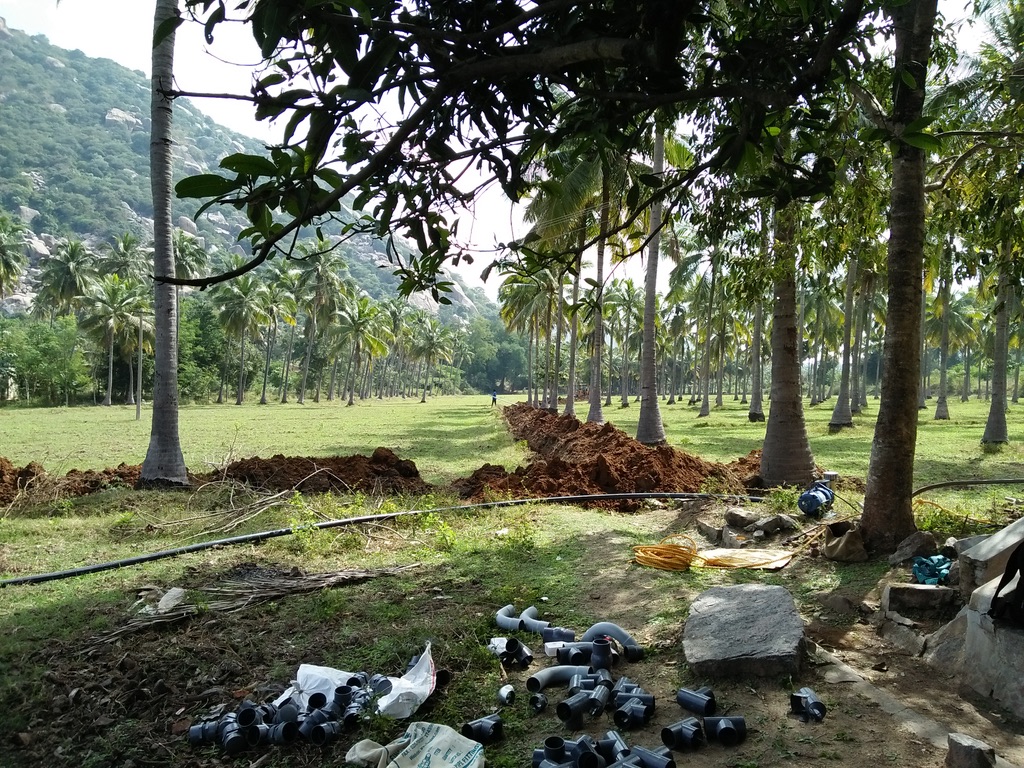
    Photo : Small Farm in Vellore Dt, Tamilnadu, India.  Credit: M Matheswaran