

Tag: Policy Intervention

  • Responsible Decision-making in the Face of Corona – A Need for a Metric

    Responsible Decision-making in the Face of Corona – A Need for a Metric

    [powerkit_button size=”lg” style=”info” block=”false” url=”https://admin.thepeninsula.org.in/wp-content/uploads/2022/02/Issue-Brief-TPF_Corona-Metric-2_compressed-1-12-1.pdf” target=”_blank” nofollow=”false”]
    DOWNLOAD PDF
    [/powerkit_button]


    Abstract

    The asymmetry of the human mind in treating the information that is currently available and the information we do not have is remarkable. During the Covid-19 pandemic, many people have been conscious to take precautions to prevent contracting the virus oneself or their family members. However, the consequences of a person infecting another are not consciously considered by everyone while going on about their ‘new normal’ life making daily transactions that involve the labour of a multitude of people. Nobody pauses to wonder whether anyone in the supply chain of the product or service consumed by an individual has contracted the virus or died due to the virus in the process of its production. This is because that information is unavailable to us in a tangible form for our minds to perceive and hence it chooses to ignore it. Although the number of cases increases with every wave, people have started accepting it or rather have become desensitised to the number of lives lost to Covid-19, mainly because these deaths are unseen. This article explores whether such a pondering – number of people infected and consequently lives compromised – would be a consideration in the decision-making in the production and consumption of products and services. If so, is there a need to develop a metric to inform us of this number? Would it be feasible to have such a metric? This article attempts to quantify these unseen deaths, so as to sensitise people to the consequences of a person getting infected.

    Introduction:

    Now, two years after the onset of the Covid-19 pandemic, most people reading this would have lost one or more relatives, friends, colleagues or an acquaintance due to the infection. I am no exception. But the trigger for this article is the death of a couple, Razia and Nasir (names changed) that happened in the summer of 2021. Their small fruits and vegetable outlet, by a synergic arrangement, was situated within the spacious premises of another outlet – a cold storage that dispenses meat, poultry and fish for the upwardly mobile residents living in a posh locality of Bangalore. 

    [powerkit_button size=”lg” style=”info” block=”true” url=”https://admin.thepeninsula.org.in/wp-content/uploads/2022/02/Issue-Brief-TPF_Corona-Metric-2_compressed-1-12-1.pdf” target=”_blank” nofollow=”false”]
    READ MORE
    [/powerkit_button]

    Featured Image Credit: OSORIOartist
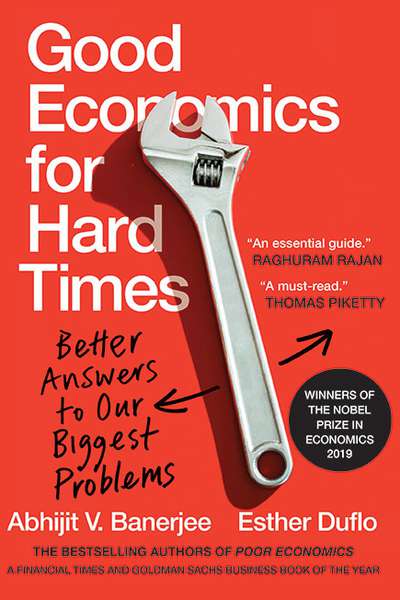
  • Good Economics For Hard Times

    Good Economics For Hard Times

    Title : Good Economics for Hard Times

    By Esther Duflo and Abhijit Bannerjee

    Published by Public Affairs, Hachette Book Group, New York

    Year :  November 2019

    Honesty is a quality seldom found among economists. More often than not, economists refuse to acknowledge the limitations of economic models that rely on, at times, completely unrealistic assumptions. That is, fortunately, not the case with this book. This book does not over-simplify economic issues and makes a compelling argument against making sweeping generalizations in a profession that relies on studying human behaviour.

    One of the best things about this book is its accessibility, it is as accessible to a layman as it is to a seasoned economist. This book, in a significant departure from their first book Poor Economics, focuses on the burning issues of wealthy countries instead. The writing is witty and succinct, full of interesting personal anecdotes.

    They start with the politically sensitive issue of immigration and show why conventional models of supply and demand don’t work for labour markets. Conventional theory, and critics of immigration, would have us believe that an influx of immigrants would drive down wages in the area and result in job losses for the natives. But Banerjee and Duflo show that the immigrants don’t just increase the labour force, they’re also consumers. Thus, they increase demand and by extension, employment and GDP in the area. They also point out that there is no strong evidence that even large influxes impact wages severely.

    However, when it comes to growth they’re not as clear as they are about the impact of immigration. They make a case as to why nobody really knows what drives growth in the long term and why prominent growth economists (Sollow, Romer etc) were all right as well as wrong at the same time. According to them, both the optimists and pessimists make sound arguments and it is impossible to predict if growth will continue or perish given the humongous number of variables involved and the sheer unpredictability of technology.

    Their support for free trade, unsurprisingly, is not unconditional. They don’t think it is the panacea that the neo-liberal discourse makes it out to be. Expansion of trade, they believe, is the driver of despair globally because of its random behaviour as they write, “Trade has created a more volatile world where jobs suddenly vanish only to turn up a thousand miles away.” They also present evidence showing that, at times, free trade has done more harm than good and argue that the state must provide proper support to the losers from trade if they want to mitigate the damage.

    Cutting tax rates for the rich has long been argued as a certain method to improve growth by many economists. Banerjee and Duflo, however, disagree. They write “In a policy world that has mostly abandoned reason … let’s be clear: Tax cuts for the wealthy do not produce economic growth.” They argue that even the (in)famous Reagan-Thatcher era tax cuts did little to revive growth. Instead, those tax cuts, accompanied by cuts in welfare spending contributed immensely to income inequality. Advocates of tax cuts often argue that raising taxes stifle innovation, but that is clearly false as Bill Gates himself argues here.

    Where a lot of economists fail and they excel, is bringing the social science aspect into economics. They don’t see people just as means to an end (growth) and emphasize on prioritising non-economic goals that don’t necessarily result into higher growth but instead improve overall happiness, dignity, self-respect and give people a sense of purpose. According to them, in this growing environment of despair, it is important to provide people with a sense of purpose.

    They argue, quite successfully, that we should change our policy response to poverty and stop letting only poverty define poor people. They recommend that poor people be seen just like normal people who have dreams and desires and policymakers need to stop believing that they know better about what poor people need than the people themselves.

    Lastly, they say that the message of policy interventions should not be ‘you are being rescued by the state’ and instead ‘this is the state’s support to ensure you have the basic rights you deserve.’ It is vital that they’re given the respect they deserve if we want them to lead dignified lives and not make them feel like they’re living on handouts from the state as even the needy hate being dependent on others. Restoring the dignity of the poor is an important step in eradicating poverty, they say.

    This book’s brilliance, in my opinion, is evident from the fact that economists across the ideological spectrum, from Sollow to Piketty, are all in awe of this work of art. To be honest, I have learnt more about economics and policymaking from this book than I did as an economics graduate.

    The arguments put forth in this book were, to an extent, eye-opening for me. I found them compelling and I believe you will too.

    Mohit Verma is a Research Intern in TPF. He is pursuing his Masters at the Madras School of Economics (MSE), Chennai.