Tag: Palestine

  • The Shame and The Pain

    The Shame and The Pain

    A prominent historian is working on a book about AIPAC and interviewed me. Although they’re fairly mainstream, it was clear from their questions that this will be an exposé focused heavily on AIPAC’s interference in U.S. elections, beginning in the late 1990s.

    I told them everything I knew. My memories from that era come not from working at AIPAC—which I did from 1982 to 1986—but from my time on Capitol Hill, where I dealt with them regularly as a staffer.

    Although even during my time there, I witnessed them arranging the shipment of cash deliveries to favoured candidates, that was nothing compared to the $1.6 million they give to House Democratic Leader Hakeem Jeffries alone now! (In case you are wondering why the #1 Democrat in Congress refuses to endorse Zohran Mamdani, the Democratic nominee for mayor of his own city).

    I won’t go into what I said.

    Anyone who reads my Substack already knows what I think: that AIPAC’s existence has inflicted incalculable harm on the United States, on American Jews, on Israel’s long-term survival as a Jewish homeland, and on Judaism. I didn’t even need to mention the damage—”harm” is too soft a word—done to the Palestinian people.

    AIPAC is not merely complicit in genocide; if AIPAC did not exist, Joe Biden would have stopped it before it started, not because he isn’t a true-blue Israel lover but because (I think) even for him, genocide is a bridge too far. He could have ended it with a single phone call, the way President Reagan ended the bombing of Beirut. (PLEASE read Reagan’s diary entry here.)

    I also made clear that I didn’t always feel this way. I left AIPAC amicably in 1986. I was the most dovish person on staff, but I didn’t leave in protest.

    I left simply for another job. It was 10 years before I realised what AIPAC was, but it was another four years before I came to understand what Israel is. 

    That was in 2000 when Prime Minister Ehud Barak sabotaged the Oslo peace process that Yitzhak Rabin had launched. Instead of following through with a withdrawal from the West Bank, Gaza, and East Jerusalem in exchange for peace and normalisation, Barak offered noncontiguous slices of land that could never constitute anything remotely like a Palestinian state.

    Cheering him on was the U.S. “peace team,” led by Dennis Ross, a fervent Zionist, who worked hand in glove with their Israeli counterparts. The Palestinians—who naively thought they were negotiating with the Israelis, with the US serving as mediators—sensed, and then saw the evidence, that they were negotiating with a combined US-Israel team. One team: all Zionists.

    In fact, President Clinton had privately assured Barak that if the summit failed, he’d pin the blame on the Palestinians no matter who was responsible. He kept that promise—and later came to regret it.

    That’s when I began to reexamine everything I thought I knew about Israel. That process hasn’t stopped. Today, I support a single democratic state for all the people of Israel and Palestine—equal rights, no state religion but freedom of religion or no religion for all, security guaranteed by an international force like NATO.

    None of this will surprise anyone who reads me.

    But during the interview, the historian asked a question that caught me off guard. He said he found my career interesting—he was impressed I’d discussed the Middle East and AIPAC with every Democratic president since Carter—and wanted to know which part of my career I was most proud of.

    I gave a modest but truthful answer because the truth is, I never held any power. I was never important but had some influence at the margins—nothing more. But I told him honestly: this is the part of my career I’m proudest of. I’m retired. No one pays me a salary. I don’t “do meetings” on the Hill or the White House.

    I’m just proud that I was smart enough to recognise that what I’d believed for most of my life was propaganda, grounded in ethnic identity, not facts.

    The Six-Day War made me a Zionist. I stayed one for 33 years. Then it ended. I’ve been to Israel dozens of times. I loved Tel Aviv. But I doubt I’ll ever go back—unless, by some miracle, Israel becomes a real democracy for both peoples. At 77, I don’t expect to see that. Nor, I expect, will anyone else.

    These are terrible times. My own country has been captured by a racist, fascist clique—a nonmilitary junta. And Israel, a country I once loved, has become an international pariah, deservedly so, for its genocidal war in Gaza and 58 years of occupation in the West Bank.

    Judaism—for thousands of years a light in a dark world—has been stained by the crimes committed in its name, and in the name of the Jewish people. And yet, it will survive and flourish. As most Jews outside the (10%) Orthodox minority turn away from Israel, many—especially the young—are rediscovering the richness of Jewish culture and faith on their own terms.

    I myself have one source of peace, besides family and friends: I woke up in time. I saw through the lies. And I’ve raised my small voice against one of the great crimes of any century—the destruction of Palestine. Feeling good about oneself at this age is no small thing.

    The truth does set you free.

    But it does nothing to ease the shame and the pain.

    This article was published earlier in Scheerpost.

    Feature Image: Amnestyusa

  • The End of Pluralism in the Middle East

    The End of Pluralism in the Middle East

    A  truly seismic change in the Middle East has occurred.  At its heart is a devil’s bargain – Turkey and the Gulf States accept the annihilation of the Palestinian nation and the creation of a Greater Israel, in return for the annihilation of the Shia minorities of Syria and Lebanon and the imposition of Salafism across the Eastern Arab world.

    This also spells the end for Lebanon and Syria’s Christian communities. Witness the tearing down of all Christmas decorations, the smashing of all alcohol and the forced imposition of the veil on women when the jihadists — who overthrew the government of Bashar al-Assad on Sunday — first took Aleppo a mere two weeks ago.

    The speed of the collapse of Syria took everybody by surprise. Next, a renewed Israeli attack on Southern Lebanon to coincide with a Salafist invasion of the Bekaa Valley seems inevitable, as the Israelis would obviously wish their border with their new Taliban-style Greater Syrian neighbour to be as far North as possible.

    It could be a race for Beirut, unless the Americans have already organised who gets it.

    It is no coincidence that the attack on Syria started the day of the Lebanon/Israel ceasefire. The jihadist forces do not want to be seen to be fighting alongside Israel, even though they are fighting forces which have been relentlessly bombed by Israel, and in the case of Hezbollah are exhausted from fighting Israel.

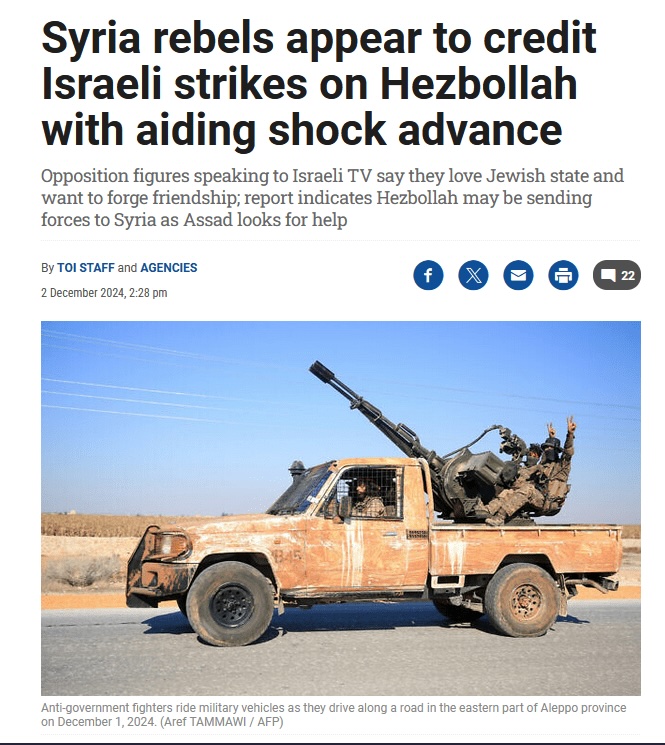
    The Times of Israel has no compunction about saying the quiet part out loud, unlike the British media:

    In fact, Israeli media is giving a lot more truth about the Syrian rebel forces than British and American media. This is another article from The Times of Israel:

    “While HTS officially seceded from Al Qaeda in 2016, it remains a Salafi jihadi organization designated as a terror organization in the US, the EU and other countries, with tens of thousands of fighters.

    Its sudden surge raises concerns that a potential takeover of Syria could transform it into an Islamist, Taliban-like regime – with repercussions for Israel at its south-western border. Others, however, see the offensive as a positive development for Israel and a further blow to the Iranian axis in the region.”

    Contrast this to the U.K. media, which from the Telegraph and Express to The Guardian has promoted the official narrative that not just the same organisations, but the same people responsible for mass torture and executions of non-Sunnis, including Western journalists, are now cuddly liberals.

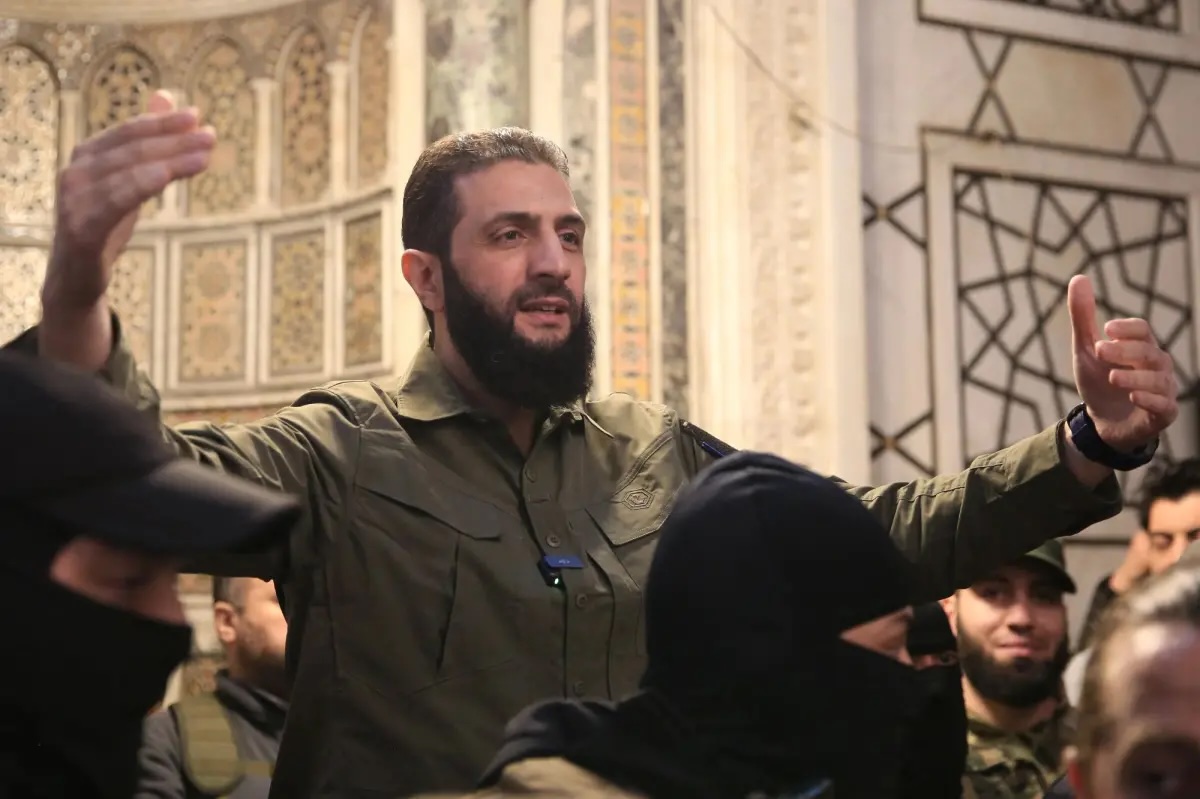
    Nowhere is this more obvious than the case of Abu Mohammad Al-Jolani, sometimes spelt Al-Julani or Al-Golani, who, now nominally in charge in Damascus, is being boosted throughout Western media as a moderate leader. He was the deputy leader of ISIS, and the CIA actually has a $10 million bounty on his head! Yes, that is the same CIA. which is funding and equipping him and giving him air support.

    Supporters of the Syrian rebels still attempt to deny that they have Israeli and U.S. support – despite the fact that almost a decade ago there was open Congressional testimony in the U.S.A. that, to that point, over half a billion dollars had been spent on assistance to Syrian rebel forces, and the Israelis have openly been providing medical and other services to the jihadists and effective air support.

    Violates UK Terrorism Act

    One interesting consequence of this joint NATO/Israel support for the jihadist groups in Syria is a further perversion of domestic rule of law. To take the U.K. as an example, under Section 12 of the Terrorism Act it is illegal to state an opinion that supports, or may lead somebody else to support, a proscribed organisation.

    The abuse of this provision by British police to persecute Palestinian supporters for allegedly encouraging support for proscribed organisations Hamas and Hezbollah is notorious, with even tangential alleged references leading to arrest. Sarah Wilkinson, Richard Medhurst, Asa Winstanley, Richard Barnard and myself are all notable victims, and the persecution has been greatly intensified by Keir Starmer.

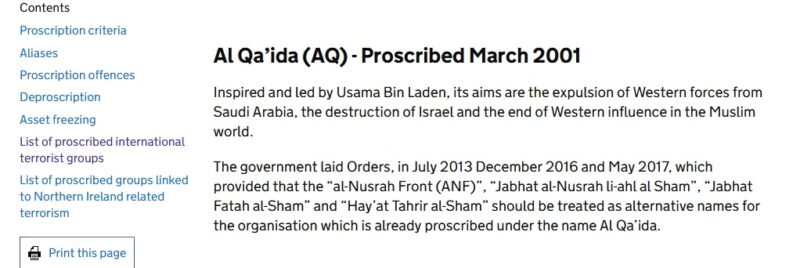
    Yet Hay’at Tahrir Al-Sham (HTS) is also a proscribed group in the U.K. But both British mainstream media and British Muslim outlets have been openly promoting and praising HTS – frankly much more openly than I have ever witnessed anyone in the U.K. support Hamas and Hezbollah – and not a single person has been arrested or even warned by U.K. police.


    That in itself is the strongest of indications that Western security services are fully behind the overthrow of the government in Syria.

    For the record, I think it is an appalling law, and nobody should be prosecuted for expressing an opinion either way. But the politically biased application of the law is undeniable.

    When the entire corporate and state media in the West puts out a unified narrative that Syrians are overjoyed to be released by HTS from the tyranny of the Assad regime – and says nothing whatsoever of the accompanying torture and execution of Shias, and destruction of Christmas decorations and icons – it ought to be obvious to everybody where this is coming from.

    Yet – and this is another U.K. domestic repercussion – a very substantial number of Muslims in the U.K. support HTS and the Syrian rebels, because of the funding pumped into U.K. mosques from Saudi and Emirate Salafist sources.

    This is allied to the U.K. security service influence also wielded through the mosques, both by sponsorship programmes and “think tanks” benefiting approved religious leaders, and by the execrable coercive Prevent programme.

    U.K. Muslim outlets that have been ostensibly pro-Palestinian – like Middle East Eye and 5 Pillars – enthusiastically back Israel’s Syrian allies in ensuring the destruction of resistance to the genocide of the Palestinians. Al Jazeera alternates between items detailing dreadful massacre in Palestine, and items extolling the Syrian rebels bringing Israel-allied rule to Syria.

    Among the mechanisms they employ to reconcile this is a refusal to acknowledge the vital role of Syria in enabling the supply of weapons from Iran to Hezbollah. Which supply the jihadists have now cut off, to the absolute delight of Israel, and in conjunction with both Israeli and U.S. air strikes.

    In the final analysis, for many Sunni Muslims both in the Middle East and in the West, the pull seems to be a stronger sectarian hatred of the Shia and the imposition of Salafism, than preventing the ultimate destruction of the Palestinian nation.

    I am not a Muslim. My Muslim friends happen to be almost entirely Sunni. I personally regard the continuing division over the leadership of the religion over a millennium ago as deeply unhelpful and a source of unnecessary continued hate.

    Classic Divide and Rule

    But as a historian, I do know that the Western colonial powers have consciously and explicitly used the Sunni/Shia split for centuries to divide and rule. In the 1830s, Alexander Burnes was writing reports on how to use the division in Sind between Shia rulers and Sunni populations to aid British colonial expansion.

    On May 12, 1838, in his letter from Simla setting out his decision to launch the first British invasion of Afghanistan, British Governor General Lord Auckland included plans to exploit the Shia/Sunni division in both Sind and Afghanistan to aid the British military attack.

    The colonial powers have been doing it for centuries, Muslim communities keep falling for it, and the British and Americans are doing it right now to further their remodelling of the Middle East.

    Simply put, many Sunni Muslims have been brainwashed into hating Shia Muslims more than they hate those currently committing genocide of an overwhelmingly Sunni population in Gaza.

    I refer to the U.K. because I witnessed this first-hand during the election campaign this year in Blackburn [where Murray ran for Parliament.] But the same is true all over the Muslim world. Not one Sunni Muslim-led state has lifted a single finger to prevent the genocide of the Palestinians.

    Their leadership is using anti-Shia sectarianism to maintain popular support for a de facto alliance with Israel against the only groups – Iran, Houthi and Hezbollah – which actually did attempt to give the Palestinians practical support in resistance. And against the Syrian government which facilitated supply.

    The unspoken but very real bargain is this: The Sunni powers will accept the wiping out of the entire Palestinian nation and formation of Greater Israel, in return for the annihilation of the Shia communities in Syria and Lebanon by Israel and forces backed by NATO (including Turkey).

    There are, of course, contradictions in this grand alliance. The United States’ Kurdish allies in Iraq are unlikely to be happy with Turkey’s destruction of Kurdish groups in Syria, which is what Turkish President Recep Tayyip Erdogan gains from Turkey’s very active military role in toppling Syria – in addition to extending Turkish control of oilfields.

    The Iran-friendly Iraqi government will have further difficulty with reconciling the U.S. continuing occupation of swathes of its country, as they realise they are the next target.

    The Lebanese army is under the control of the U.S.A., and Hezbollah must have been greatly weakened to have agreed to the disastrous ceasefire with Israel. Christian fascist militias traditionally allied to Israel are increasingly visible in parts of Beirut, though whether they would be stupid enough to make common cause with jihadists from the North may be open to question.

    But now that Syria has fallen to jihadist rule, I do not rule out Lebanon following very quickly indeed, and being integrated into a Salafist Greater Syria.

    How the Palestinians of Jordan would react to this disastrous turn of events, it is hard to be sure. The British puppet Hashemite Kingdom is the designated destination for ethnically cleansed West Bank Palestinians under the Greater Israel plan.

    What this all potentially amounts to is the end of pluralism in the Levant and its replacement by supremacism. An ethno-supremacist Greater Israel and a religio-supremacist Salafist Greater Syria.

    Unlike many readers, I have never been a fan of the Assad regime or blind to its human rights violations. But what it did undeniably do was maintain a pluralist state where the most amazing historical religious and community traditions – including Sunni (and many Sunni do support Assad), Shia, Alaouites, descendants of the first Christians, and speakers of Aramaic, the language of Jesus – were all able to co-exist.

    The same is true of Lebanon.

    An End of Tolerance

    What we are witnessing is the destruction of that and the imposition of a Saudi-style rule. All the little cultural things that indicate pluralism – from Christmas trees to language classes to winemaking to women going unveiled – have been destroyed in Aleppo and soon perhaps in Damascus and Beirut.

    I do not pretend that there are not genuine liberal democrats among the opposition to Assad. But they have negligible military significance, and the idea that they would be influential in a new government is delusion.

    In Israel, which pretended to be a pluralist state, the mask is off. The Muslim call to prayer has just been banned. Arab minority members of the Knesset have been suspended for criticising Netanyahu and genocide. More walls and gates are built every day, not just in unlawfully occupied territories but in the “state of Israel” itself, to enforce apartheid.

    I confess I once had the impression that Hezbollah was itself a religio-supremacist organisation; the dress and style of its leadership look theocratic.

    Then I came here and visited places like Tyre, which has been under Hezbollah-elected local government for decades, and found that swimwear and alcohol are allowed on the beach and the veil is optional, while there are completely unmolested Christian communities there.

    I will never now see Gaza, but wonder if I might have been similarly surprised by Hamas’s rule.

    It is the United States which is promoting the cause of religious extremism and of the end, all over the Middle East, of a societal pluralism similar to Western norms.

    That is of course a direct consequence of the United States being allied to both the two religio-supremacist centres of Israel and Saudi Arabia.

    It is the U.S.A. which is destroying pluralism, and it is Iran and its allies which defend pluralism. I would not have seen this clearly had I not come here. But once seen, it is blindingly obvious.

    Feature Image: nypost.com

    This article was published earlier in scheerpost.com

    It is republished under the Creative Commons Attribution-NonCommercial-NoDerivatives 4.0 International license.

  • Crimson Cows and Indian Sensibilities

    Crimson Cows and Indian Sensibilities

    That Israel, in addition to being an apartheid state, has gone completely rogue is no longer in doubt. As Israel digs itself into a deeper hole, in the belief that it can kill its way to success, it finds that this year its GDP has collapsed from 4.8% in 2022 to 1.5%, with over 46000 small businesses having shut down. By some estimates, between 500,000 to 1 million Israelis have permanently emigrated.


    Approximately 7 million Jewish Israelis and an equal number of Palestinians live cheek-by-jowl between the Mediterranean Sea and the Jordan River. The area encompasses Israel, the occupied territories of the West Bank, including East Jerusalem, and the Gaza Strip.  Nominally, the Palestinians in the West Bank do have limited self-rule, but defacto have no control over the movement of people and goods, or taxes. Agreements signed in the 1990’s, permit the Israeli Government to collect taxes on behalf of the Palestinian Authority (PA), which it then disburses to the PA for its use. These taxes make up over 65-70% of the PA’s public budget and have a critical impact on the quality of life of ordinary Palestinians.

    As has been the norm with Israel, it has used every means, including financial control, to inflict collective punishment on the Palestinians at any attempt by them to free themselves from Israeli occupation. In May this year, for example, it withheld disbursal of all taxes collected over the past three months on grounds that Spain, Ireland and Norway had announced they would recognise the Palestinian State. This resulted in the breakdown of municipal services and widespread loss of jobs. Subsequently, in June it indulged in blatant blackmail when it agreed to disburse withheld funds, provided the PA retroactively approved five settlements in the West Bank that had been illegally established earlier, despite condemnation by Palestinians and the international community.

    While the Hamas attack of 7 October 2023, especially their despicable actions against women, children and civilians, has been widely condemned, the fact that over half of the 1200 Israelis killed, were by their own military in pursuant of the reprehensible “Hannibal Directive”, continues to be glossed over. Oddly enough, over the course of that year, prior to the attack, the fact that over 200 Palestinians had been killed by the Israeli military and settlers for a variety of reasons has simply been ignored by the international media and not been seen as the immediate provocation for the attack, especially its ferocity.

    It now emerges, that the numbers of Palestinians killed by the Israeli response has been grossly underestimated. As per a study dated 10 July 2024 in the Lancet, a respectable and authoritative medical journal, an estimated 186000-200,000 Palestinians have been killed in Gaza, directly or indirectly. This is approximately 9% of the total population, the overwhelming majority of them being women and children.

    The Israeli response to this attack was disproportionate, to put it mildly, but it still continues to receive full support from Western Governments. It now emerges, that the numbers of Palestinians killed by the Israeli response has been grossly underestimated. As per a study dated 10 July 2024 in the Lancet, a respectable and authoritative medical journal, an estimated 186000-200,000 Palestinians have been killed in Gaza, directly or indirectly. This is approximately 9% of the total population, the overwhelming majority of them being women and children.

    The difference between these estimates and the official figures released by the Gaza Health Ministry, which presently stands at approximately 43000, is explained by the fact that the Ministry only accounts for bodies that have been found and not for those remaining under the rubble, that the cities have been reduced to. Nor does it account for the indirect deaths due to hunger, non-availability of medical help etc. Studies suggest that these tend to be between 5-10 times higher than the official figures.

    Israel’s inhuman and deliberate response has been decried by experts, governments, United Nations Agencies and NGOs. They have gone on to accuse Israel of carrying out a genocide against the Palestinian population in Gaza, and more recently, in the West Bank. What is even more horrific, if that is even possible, are the accusations made by Dr. Feroze Sidhwa, an American trauma surgeon, on his return from Gaza. In his devastating op-ed in The New York Times, titled “65 Doctors, Nurses and Paramedics: What We Saw in Gaza”, he recounts harrowing stories from dozens of healthcare workers and CT scans of children shot in the head or the left side of the chest. The Times called the corresponding images of the patients too graphic to publish. In his words, “44 doctors, nurses and paramedics saw multiple cases of preteen children who had been shot in the head or chest in Gaza… He personally identified 13 such cases in his two weeks there”.

    That Israel, in addition to being an apartheid state, has gone completely rogue is no longer in doubt. In July this year, for example,  a video was leaked of the gangrape of a male Palestinian prisoner by guards of the IDF at the Sde Teiman detention facility in Southern Israel. Commentators in Israel referred to this video as just the tip of the iceberg, but what followed is instructive. Ten soldiers were arrested and faced trial for this act, but not before a mob, led by government ministers, attempted to free them forcibly from detention. Another minister demanded an investigation to identify the individual who had leaked the video so that he could be tried for treason. An MP from the governing Likud Party defended the actions of the guards in Parliament, responding to a question by an Arab-Israeli MP with “If he is a Nukhba (Hamas militant), everything is legitimate to do! Everything!”  Even the Minister responsible for  Prison Services, Ben-Gvir, told Israeli media on the day of the reservists’ arrest that it was “shameful for Israel to arrest our best heroes”.

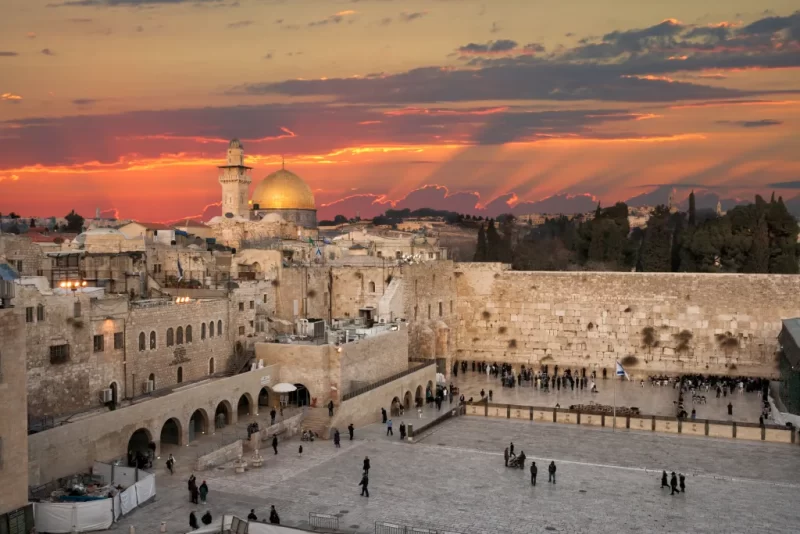
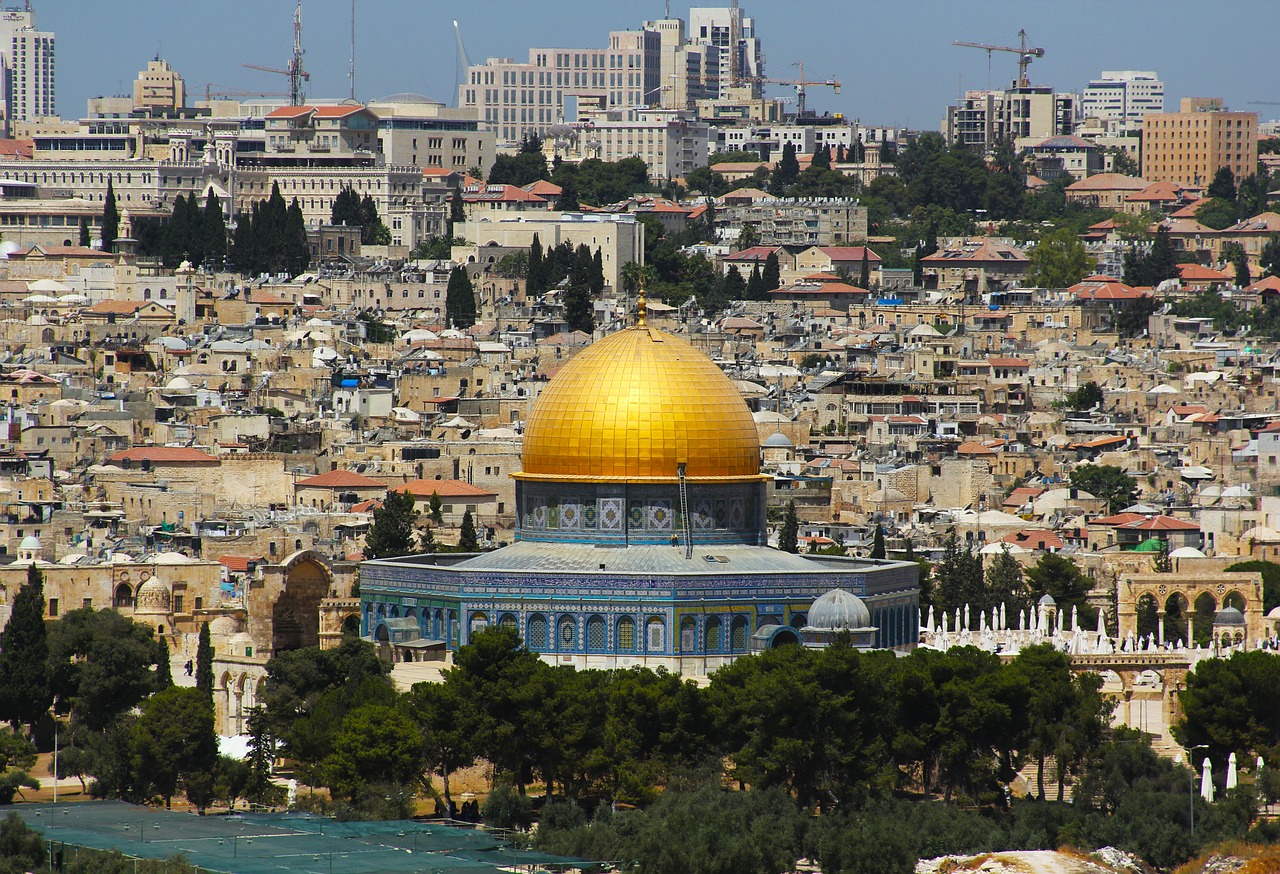
    This race to the bottom doesn’t end there of course, and as the saying goes, the best is yet to come. As is well known, the Holy City of Old Jerusalem is home to the “Temple”, or as it is now known the Temple Mount. It refers to the two existing Islamic religious structures, the Dome of the Rock and the Al Aqsa Mosque, collectively known as Haram al-Sharif, and considered the third holiest site in Islam. However, according to the Tanakh or the Hebrew Bible, prior to these structures, the ‘First Temple’ was supposedly built on that very site in the 10th century BCE by King Solomon, and stood for five hundred years before being destroyed by the Babylonians. Almost a century later, it was replaced by the ‘Second Temple’ built by Cyrus the Great, only for it to be destroyed by the Romans in 70 CE. The New Testament holds that important events in Jesus’ life took place in the Temple, and the Crusaders attributed the name “Templum Domini” to the Dome of the Rock.

    However, many Jews see the building of a “Third Temple” in Jerusalem as an object of longing and a symbol of future redemption, as it would announce the arrival of a new Messiah who would unite the flock and lead them to salvation. Incidentally, the promised land would incorporate the whole of Palestine, along with parts of Turkey, Syria, Iraq, Saudi Arabia and Kuwait.

    Thus the religious significance and sensitivity of Temple Mount cannot be underestimated. Fortunately, as things stand Non-Muslims are not permitted to enter the two structures, while Jews are only allowed to pray at the Western Wall that runs along the side of the hill and is thought to be a remnant of the Second Temple. However, many Jews see the building of a “Third Temple” in Jerusalem as an object of longing and a symbol of future redemption, as it would announce the arrival of a new Messiah who would unite the flock and lead them to salvation. Incidentally, the promised land would incorporate the whole of Palestine, along with parts of Turkey, Syria, Iraq, Saudi Arabia and Kuwait.

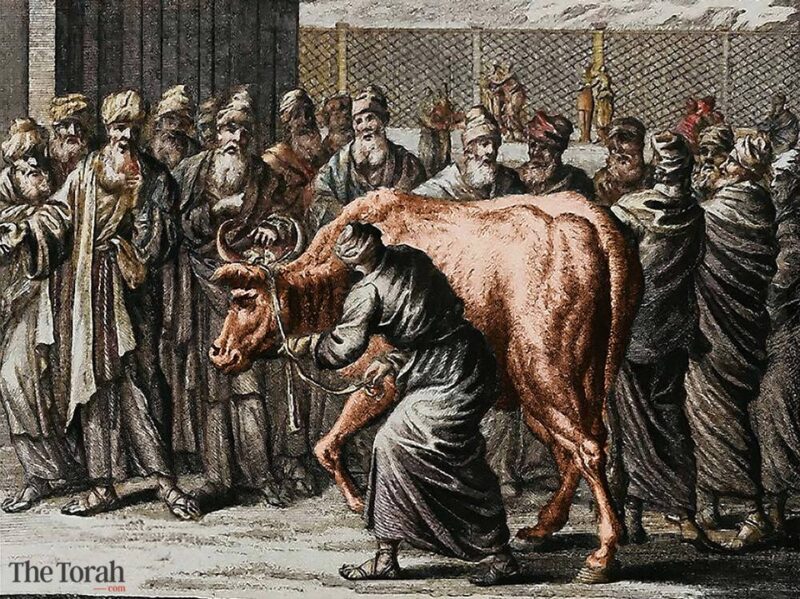
    But before its construction can be undertaken, it would require purification of the site and of the construction crew. That would, however, only be feasible, by sacrificing a red heifer, specifically bred to meet stringent biblical requirements. It would be required to be burnt alive at the Mount of Olives, adjacent to the Al Aqsa Mosque, and its ashes used to consecrate the holy ground and the people. The stuff of hopes and dreams for a tiny minority, with little hope of fulfilment in the modern world, or so one thought.

    These cows represent a tangible step towards the construction of the Temple and fulfilment of the prophecy.  The next obvious step in this tragedy will be the demolition of the Haram al-Sharif, for which dry rehearsals have already been undertaken. The consequences of such a step in the region are not difficult to visualise, but will it stop the extremists? Very unlikely.

    However, in September 2022, an unprincipled collaboration between extreme Zionist religious leaders, Right-Wing Christian Evangelicals and the present Israeli Government allowed for five red heifers to be flown from Texas to Israel. Ironically enough, despite the Evangelicals being well-known for their antisemitic beliefs. Brought in as pets, to avoid existing restrictions on livestock, they are now kept in an archaeological park in Shiloh, an illegal Israeli settlement, near the Palestinian city of Nablus. These cows represent a tangible step towards the construction of the Temple and fulfilment of the prophecy.  The next obvious step in this tragedy will be the demolition of the Haram al-Sharif, for which dry rehearsals have already been undertaken. The consequences of such a step in the region are not difficult to visualise, but will it stop the extremists? Very unlikely.

    As Israel digs itself into a deeper hole, in the belief that it can kill its way to success, it finds that this year its GDP has collapsed from 4.8% in 2022 to 1.5%, with over 46000 small businesses having shut down. By some estimates, between 500,000 to 1 million Israelis have permanently emigrated. In addition, it finds itself short of weapons, ammunition, tanks and manpower as heavy casualties in the ongoing conflict have taken their toll. Yet, its arrogant leadership refuses to pay heed to that one cardinal rule about tackling insurgencies; they are a political problem and can only be resolved politically.

    The question that it raises for us is do we really need such friends, and more importantly, are our commercial interests so important that we are willing to forego all that we hold sacred?

    Clearly, if Israel refuses to change direction its days are numbered. After all its most steadfast ally, the United States, can only support so many losing causes. With Ukraine on the brink, an ascending Russo-China coalition to deal with and Taiwan increasingly under threat, an intransigent Benjamin Netanyahu is a liability, who may well find himself the target of a drone, be it American or Iranian. This is very likely despite Trump’s victory to become the 47th President of the United States. The question that it raises for us is do we really need such friends, and more importantly, are our commercial interests so important that we are willing to forego all that we hold sacred?

    Feature Image Credit: Middle East Eye
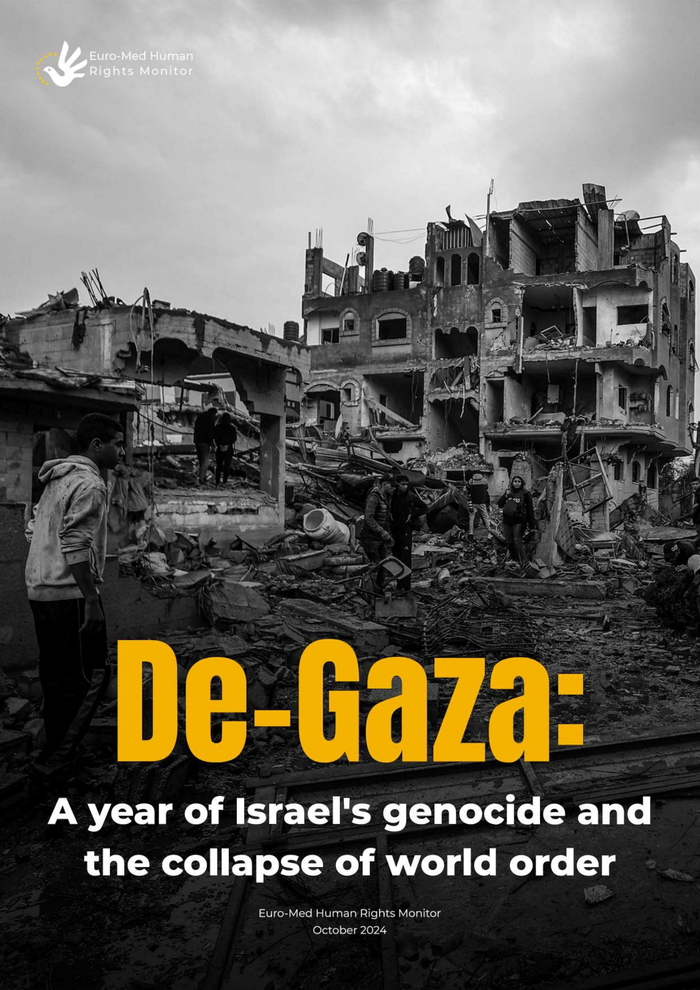
    Image – De Gaza: reliefweb.int
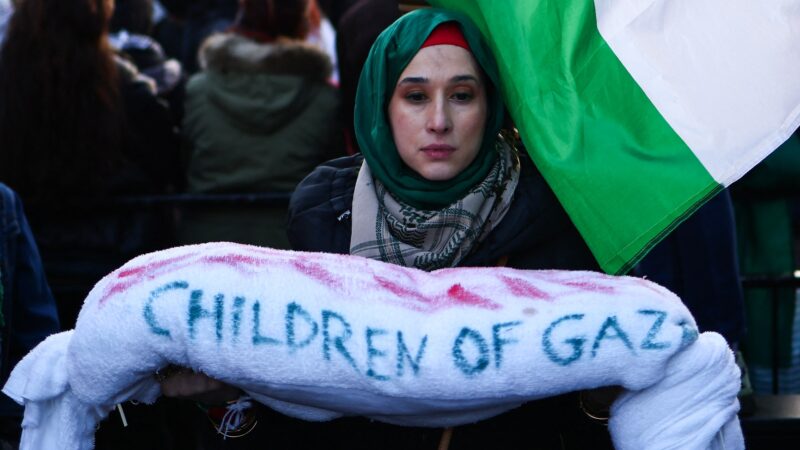
    Children of Gaza Image Credit: Middle East Eye – How Israel’s Genocide in Gaza sparked a protest movement in the UK.
    Wailing Wall and Al Aqsa Mosque: Tourist Israel
    Red Heifer Sacrifice Ritual Image: thetorah.com

  • The beginning of the end of Israel

    The beginning of the end of Israel

    One year later, the flames of genocide still burn, but after decades of persecution and bloodshed, we may well be seeing the beginning of the end of the settler-colonial project in Palestine.

    We have reached a grim milestone. A full year of gruesome Israeli mass murder. A year of epic Palestinian suffering.

    A year of direct Western complicity. A year of continuous media incitement. A year of shameful inaction by international institutions.

    For twelve months, we have seen relentless persecution of human rights defenders across the West, solely for peacefully opposing genocide and apartheid.

    And fifty-two weeks of a horrified global public helplessly witnessing on their screens the first live-streamed genocide in history.

    The carnage of this past year is unprecedented. The destruction is almost unimaginable.

    Still, this genocide will end. The Palestinian people and their besieged nation will undoubtedly emerge from the ashes of genocide, recover, and reassert their inalienable rights in their ancient homeland.

    But international institutions and the global human rights system will be left bruised and battered.

    The political capital expended by the US empire and the broader West in defence of the slaughter, as well as their global standing and reputation, will never be recouped.

    And, almost certainly, this year of cruelty and lawlessness will mark the beginning of the end for the Zionist project in Palestine and, therefore, of the state of Israel as we know it.

    A formula for disaster

    Of course, neither the genocide nor the current wave of slaughter of Palestinians started in October of 2023. The systematic massacre, purging, and erasure of the indigenous Palestinian people began in earnest with the Nakba of 1947-48, and it has not ceased since that bloody beginning.

    And the genocidal threat was always obvious. Any thinking person could see, even prior to the establishment of the state of Israel, that the Zionist project of the West was a formula for disaster.

    First, at the very historic moment when colonialism was being dismantled around the world, and global human rights rules were being adopted at the United Nations, the West carved out an exception for Palestine.

    It was at this moment that Zionist forces chose to attack Palestine, murder and terrorize its population, chase many survivors away in terror, and begin the erasure of the indigenous people, and their replacement with a European settler colony founded by foreign invaders and radicalized by a deeply racist and fundamentally violent political ideology.

    The colony was to be sustained at the barrel of a gun by waging constant war both against the Indigenous people and against the neighbouring states.

    A colonial education system and a media ecosystem were built to dehumanize the Indigenous and neighbouring peoples and to instil a supremacist ideology into the settler population.

    The settler state, its economy, and its society were thoroughly militarized, enlisting all adults in the project of state violence, arming it to the teeth, including with nuclear, chemical, and biological weapons, and even integrating the field-testing of new weapons on captive civilian populations as part of the business model of the colony’s arms industry.

    They ring-fenced the entire project with western-guaranteed impunity, carving out an exception to the application of all rules of international law.

    And they built an all-encompassing machinery of repression, including laws, policies, practices, and technologies to ensure the constant subjugation, dehumanization, and persecution of the indigenous Palestinian people.

    The toxic cocktail was complete.

    Maintaining Western support

    Of course, an artificially imposed European colony in the heart of the Middle East, which is necessarily maintained by force, could never become self-sufficient. Rather, it has always, and will always, rely on massive support from Western states, especially the US. Maintaining that vital support was to become a key goal of the Israeli state and its transnational network of proxy groups.

    As such, in the intervening years, the Israeli regime adopted a strategy of incremental genocide, with simmering persecution and dispossession, punctuated by periodic full-blown massacres and marked by a continuous march of expansion.

    It was a pace, tried and true over 75 years, with which the regime’s Western sponsors were comfortable, allowing them to continue unbroken the flow of military, economic, and diplomatic support without significant domestic pressure at home.

    And it allowed like-minded media corporations, decade after decade, to continuously disseminate pro-Israel propaganda as a smokescreen to obscure the horrific realities being perpetrated against the indigenous people on the ground.

    Expedited genocide

    But when Israel’s current ultra-Zionist government took power last year, it immediately abandoned the strategy of incremental genocide.

    In its place, it moved to expedited genocide (beginning with waves of ethnic cleansing in occupied Jerusalem and the West Bank), betting that its Western sponsors (and their captured politicians and complicit media) would not dare (or care) to take the steps necessary to stop it, even when it launched wholesale civilian slaughter in Gaza.

    They were right.

    So much so that Western countries like the U.S., UK, Germany, and others quickly moved beyond mere acquiescence for the genocide and into direct complicity and participation in it.

    As a result, one year later, we are witnessing unprecedented bloodshed in the region, and the broader world is in deep trouble.

    Axis of Genocide

    Thus, Israel is not alone in its march of terror. It is accompanied, in lockstep, by what has been called the Axis of Genocide.

    Four members of that Axis, Israel, the U.S., the UK, and France, are nuclear-armed states. A fifth, Germany, is a serial genocide perpetrator and a major European economic power. Three (the U.S., UK, and France) have veto power in the UN Security Council.

    Adding to the danger, all of its members share a common ideological grounding in militarism, colonialism, white supremacy, and political Zionism. Most have the stain of genocide on their historical records.

    All have political systems that are deeply compromised and corrupted by the influence of the weapons industry, the billionaire class, and the Israeli lobby. And all are marked by profound societal levels of Islamophobia, anti-Arab racism, and anti-Palestinian bigotry.

    And, in defence of a single, small, oppressive, and violent settler colony in the Middle East, all have quickly abandoned the entire edifice of international law and international institutions built up since the end of the Second World War, and which they once claimed as part of their brand.

    As recent history has shown, these biases, linkages, and incentives have become a formula not only for genocide in Palestine but for catastrophe on a global scale.

    Breaking bones and records

    And, indeed, the cost of Western-secured Israeli impunity has been shockingly high.
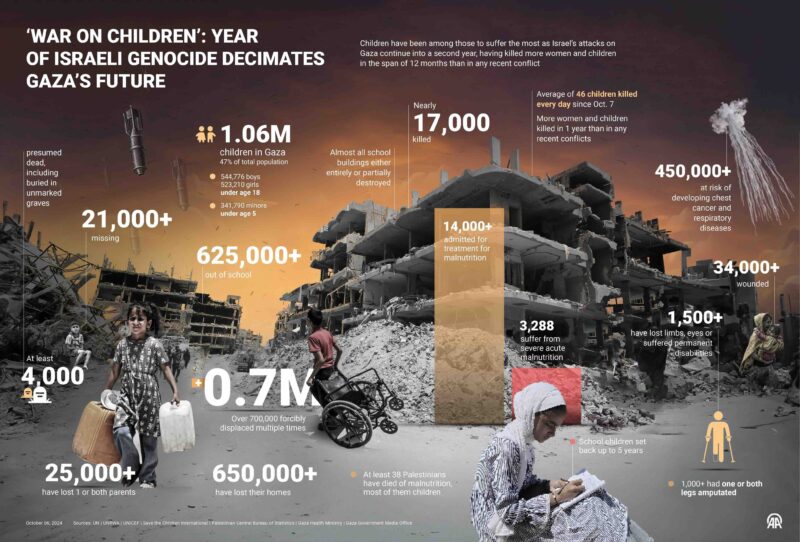
    Image Credit: @anadoluagency

    In one year, Israel has set new records for the pace of civilian killing, the rate of destruction of civilian infrastructure, the killing of children, the killing of medical personnel, the killing of journalists, the killing of humanitarian workers, and the killing of UN staff.

    The depravity of Israel’s actions has shocked the world. Collective punishment, a chain of massacres, summary executions, torture camps, systematic sexual violence, starvation tactics, imposed disease, the direct targeting of small children with sniper rifles, and the blocking of humanitarian aid to facilitate starvation.

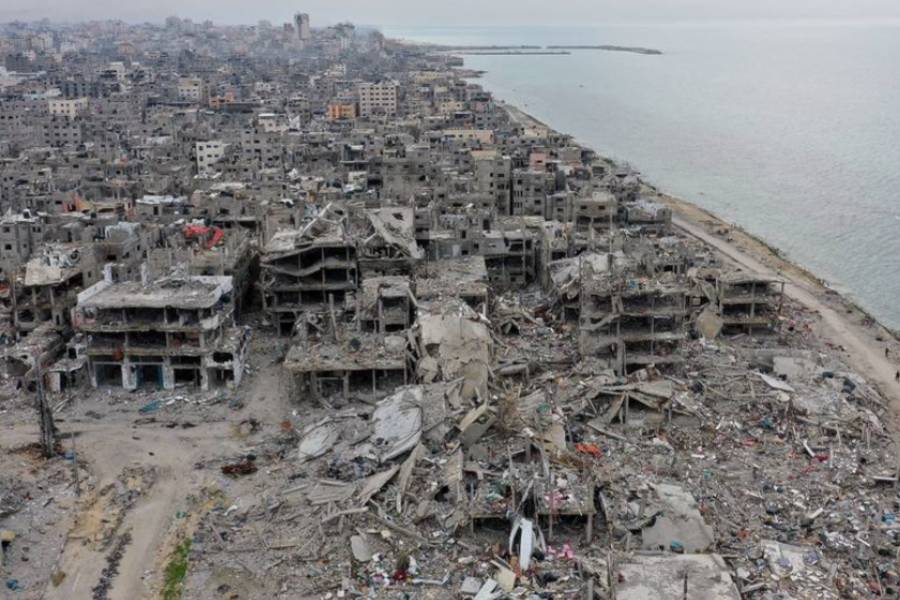
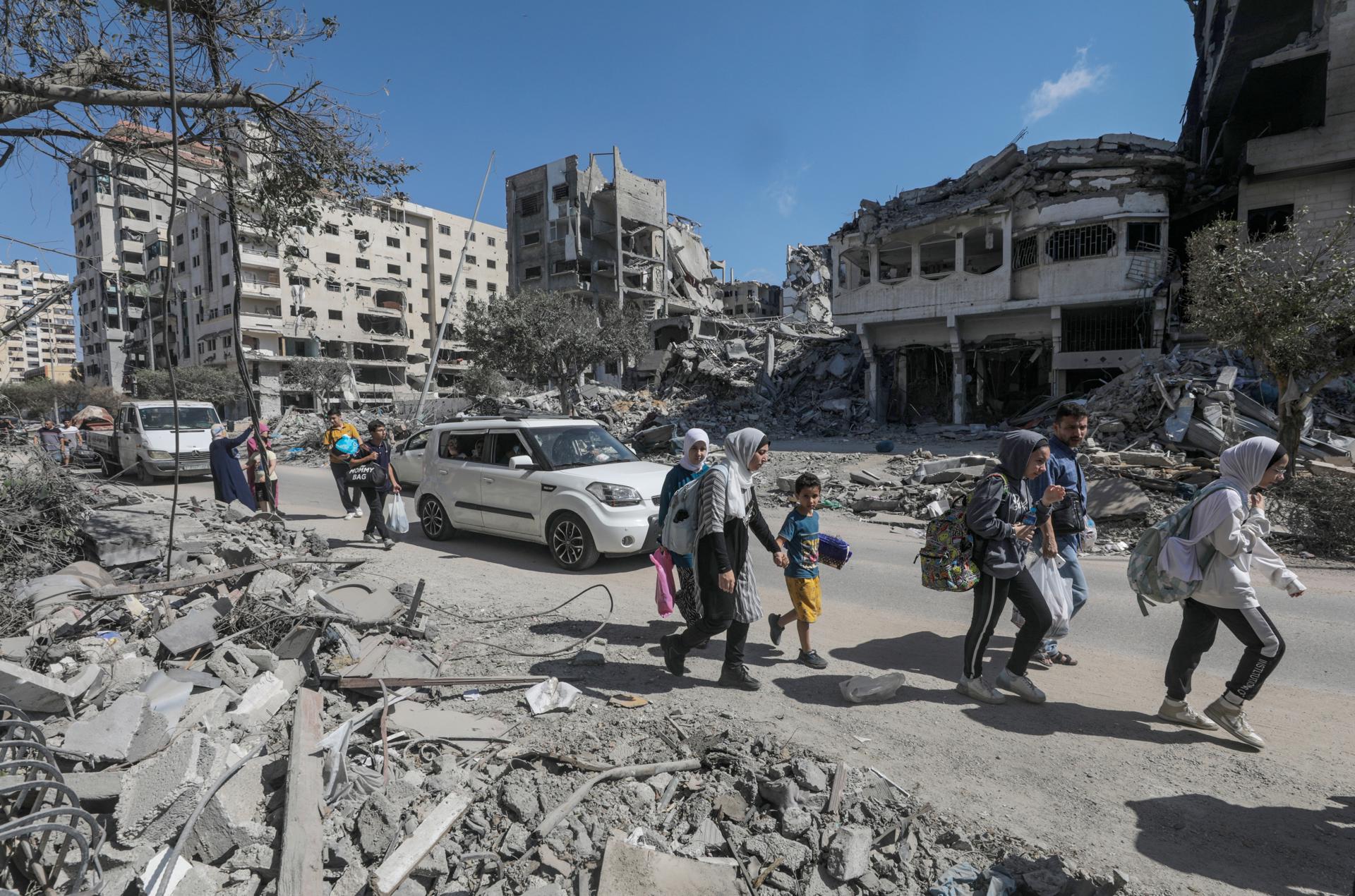
    We have all seen the images. The methodic eradication of whole neighbourhoods, schools, hospitals, universities, food stores, shelters, refugee camps, agricultural fields, and even cemeteries.

    The mangled bodies of Palestinians, the fear-filled eyes of the children, the terror as bombs fall on bread lines. The cold-blooded murder of innocents, of defenceless children like Hind Rajab, trapped in the family car, terrified for hours and then slaughtered by Israeli soldiers, and of thousands of others like her.

    And we have seen the cold, cruel laughter of the Israeli soldiers, the deranged chants of violent Israeli settlers, the genocidal pledges of Israeli political and military leaders.

    The promise of the Prime Minister to wipe out the Palestinians “like Amalek”, a biblical verse that calls for Israel to “utterly destroy all that they have and spare them not; but slay both man and woman, infant and suckling, ox and sheep, camel and ass.”

    The calls of Israeli leaders to perpetrate another Nakba, to raze Gaza to the ground, to make no distinction between civilians and fighters. To “bury them.”

    And, by now, we have all memorized the familiar barbarous pattern of Israel’s crimes: target civilians and civilian infrastructure, then target the rescue workers who come to help, then celebrate in Hebrew but switch to English to claim that they were all terrorists, human shields, or collateral damage, then reload and do it again.

    The accumulated criminal guilt of the Israeli perpetrators and their complicit Western partners is staggering. But so too is the historic moral lapse of the wider world, both those who have defended the genocide and those who have remained silent as it has been carried out with their tax dollars, with their government’s political support, or in their name.

    Today, everyone knows. No one can say they were not warned before the catastrophe. And no one can say they did not know of the horrors that followed, broadcast in real-time to all of us.

    Seventy-six blood-soaked years into this colonial enterprise, it is clear to all who will see that what the West has constructed in the heart of the Middle East is not an enlightened project, but rather a rampaging Frankenstein monster that threatens to drag the indigenous Palestinian people, the region, and the world into a conflagration from which it may not recover for generations.

    The darkness spreads

    How long the rampage can be sustained is an open question. But there will undoubtedly be much more darkness before the dawn.

    Israel, drunk with Western-backed impunity, even as it continues its genocide in Palestine, is now spreading its attacks across the region and leaving mountains of bodies and rivers of blood in its wake.

    In a matter of weeks, it has waged terror attacks with booby-trapped communication devices in Lebanon, assassinated leaders across the region, launched military attacks on Gaza, the West Bank, Lebanon, Syria, Iraq, Iran, and Yemen, has invaded Lebanese territory, and is now seeking to draw its U.S. sponsor into an all-out regional war of conquest and domination.

    For their part, collaborationist governments in the West show little appetite for reining in the rampaging monster that they themselves created in the Middle East, and to which they continue to provide endless flows of arms, money, intelligence, diplomatic cover, legal exceptionalism, and a heretofore impenetrable cocoon of impunity.

    When the reckoning comes, as it must, the accountability of both Israel and its Western accomplices must be secured, lest these horrors be repeated in an endless cycle of atrocity, impunity, and recidivism.

    Israeli impunity is coming to an end

    But there are flickering lights in the darkness, and they are growing.

    The just cause of Palestine and the steadfastness of her people have inspired millions around the world to stand up and fight back. The civilized world is now more mobilized than it has been in generations to oppose the horrific evil unleashed on the world by Israel and its Western sponsors.

    More and more people are escaping from the distorting matrix of Western corporate media and turning to independent media and first-hand sources on social media, delivering a powerful blow to the controlled, pro-Israel narrative of official Western institutions.
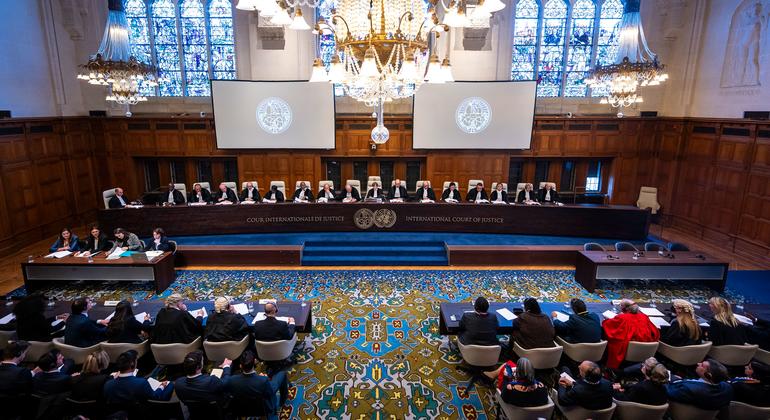
    Today, Israel is on trial for genocide at the World Court, and its leaders are the subject of arrest warrant requests at the International Criminal Court for crimes against humanity, including extermination.

    The ICJ has already issued a series of provisional anti-genocide measures against Israel, and a growing list of countries is lining up behind Palestine and South Africa in the genocide case against Israel.

    A dedicated international tribunal is under discussion at the UN. Cases have already been brought in national courts around the world, and more are certain to follow. Plans are also underway to mandate an international anti-apartheid body to focus on Israel.

    In the meantime, the United Nations, its independent human rights mechanisms, and the leading international, Palestinian, and Israeli human rights organizations have all collected massive quantities of evidence, have strongly condemned Israel for its shocking criminality, and are working to ensure accountability.
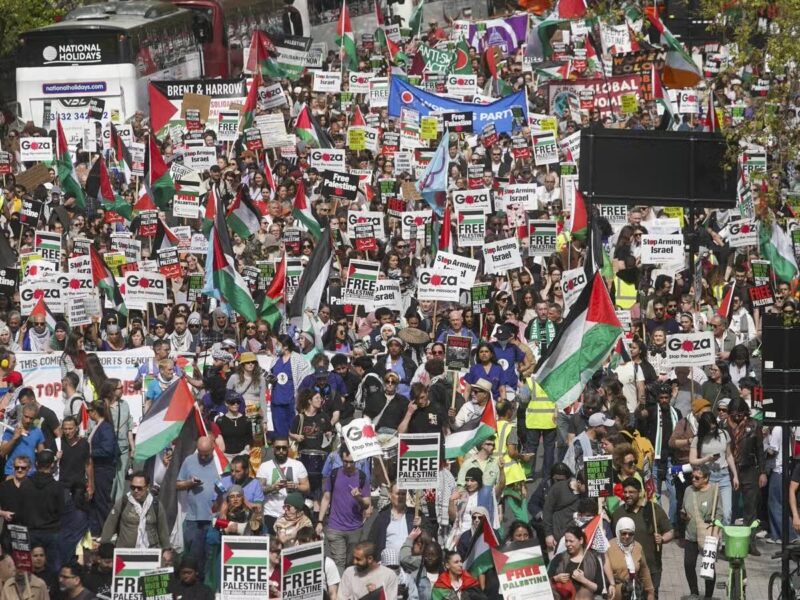
    Mass demonstrations against Israel are not only daily occurrences in capitals around the globe, but they are actually growing, undeterred by the often-brutal efforts (especially of Western governments) to suppress them.

    The ICJ has declared the obligation of all states to cut off all recognition, aid, investment, trade, weapons, and support of any kind with Israel’s colonial project in the occupied Palestinian territory.

    Israel is increasingly isolated on the global stage. And the global movement for boycott, divestment and sanctions is growing with every passing day.

    In other words, the age of Israeli impunity is coming to an end, despite the best efforts of the U.S., the UK, Germany, and other complicit Western states.

    And we may well be seeing, after decades of endless persecution and bloodshed, the beginning of the end of the European settler-colonial project in Palestine.

    One year later, the flames of genocide still burn. At this tragic moment, it is hard to see through the smoke that obscures the path forward. But white supremacist settler colonialism was defeated in South Africa, Rhodesia, Namibia, and Algeria. It will be defeated in Israel too. Through struggle and solidarity, with law and politics, in resistance and resilience, this will end.


    Feature Image Credit: Palestinian Return Center
    This article was published earlier in mondoweiss.net

  • West Asian moves and countermoves: Challenges of them spinning out of control

    West Asian moves and countermoves: Challenges of them spinning out of control

    What will the complex calculus of the new Middle East crisis resolve into, and what will be the impact on India?

    ISRAEL has succeeded in diverting world attention from Gaza and Hamas to Iran. This is similar to how Hamas, in October 2023, successfully short-circuited US efforts at normalising relations between the Arab states and Israel under the Abrahams Accord.

    These moves and countermoves are ratcheting up the intensity of conflict in West Asia with serious global implications, including for India. The Indian approach seems to be similar to that in the case of the conflict in Ukraine— to play both sides.

    Countermoves

    Iran’s attack on Israeli soil is unprecedented. It is a response to the Israeli attack on its consulate in Syria on April 1, killing some of its top army commanders. It had warned of a retaliation and that gave Israel and its partners, the US, the UK, etc., time to prepare.

    The US had already moved its forces and prepared its allies in the region to shoot down the projectiles from Iran. Even Jordan apparently participated in this. Israel could take care of the projectiles that managed to reach its territory. So, 99 percent of the projectiles were shot down in the air and there was little damage in Israel.

    The Indian approach seems to be similar to that in the case of the conflict in Ukraine— to play both sides.

    It provided a sense of victory to Israel, the US and their allies. This was US President Joe Biden’s message to Israeli Prime Minister Benjamin Netanyahu and to forestall any immediate Israeli retaliation.

    Did Iran need 15 days to prepare to attack Israel? Could it not have used many more than 300 projectiles to attack to overwhelm Israeli defences? Could the Iranian allies like the Hezbollah in Lebanon and the Houthis in Yemen not have fired a much larger number of projectiles?

    Clearly, Iran was making a show of avenging an attack on them but did not want to hit Israel. It did not want to provoke an attack on its territory from the much superior US and Israeli forces.

    The Iranian foreign minister stated in a press conference after the attack that the US, Turkey and some Arab neighbours were given advance information about the limited attack. The US has denied that it had advance information.

    Not only were 15 days given to Israel to prepare its defence, the timing of the attack was also conveyed in advance. The drones, which would take six–seven hours to reach Israel, and cruise missiles, which would take two–three hours, were bound to be neutralised given the advance preparations.

    Only ballistic missiles, which take only a few minutes to traverse the distance that exists between Israel and Iran, were a serious challenge, but due to the advanced notice and preparation, even they got neutralised.

    The Iranian army briefing after the attack also mentioned that the attack was a limited one and had achieved its objective and no more attacks would occur unless Israel attacked its territory. Thus, the Iranian attack was for show and not effect.

    The US and the G7 that met in the aftermath of the Iranian attack while condemning the Iranian attack suggested that Israel had won and that it should not retaliate against Iran.

    Some even argue that this presents an opportunity to take out Iran’s nuclear establishments and cripple its nuclear bomb capability.

    Indeed, Israel’s attack on the embassy in Syria was meant to draw the US and other allies into unequivocally supporting Israel. That support had been dwindling due to the ongoing genocide in Gaza which was inflaming world opinion. Israel has succeeded in this aim. Today, the attention has shifted from genocide in Gaza to the global implications of a wider war in West Asia.

    Pressures escalating

    The US, while saying it does not want an escalation and that it would not support an Israeli strike, has also said its support to Israel is “ironclad”. Just as Israel has defied US advice to avoid civilian casualties in Gaza and allow more humanitarian aid to enter, it can defy the current US advice to not escalate the conflict.

    Israel could attack, secure in the fact that the US and the allies would defend it if Iran retaliates substantially in response to the Israeli retaliation.

    Will Israel oblige by not attacking Iran? The ultra-right in Israel is pressurising the government to retaliate. They have been a part of the growing problem created by the displacement of Palestinians from the West Bank, coming up of new settlements and aggressive assertions in Jerusalem. All this has led to rising Palestinian resentment.

    Many Israelis and conservative Republicans in the US are arguing for Israeli retaliation. The Israeli war cabinet said the conflict is “not over yet” and we will “extract a price”.

    Even the moderate leader Benny Gantz wants retaliation, though at a time of Israel’s choosing. The ultras argue that Iran has crossed a red line by attacking Israeli soil and it must pay for that.

    Some even argue that this presents an opportunity to take out Iran’s nuclear establishments and cripple its nuclear bomb capability.

    Hamas’s action was a result of perceived subjugation and atrocities by Israel over a long period, which could not have been anticipated by Israel and the US.

    But, there are limits to such actions since there are other players who may be forced to intervene. Also, it could lead to a wider conflict in West Asia. The Sunni nations, though not allies of Iran, may also be forced to act. Already, some of these US allies have prohibited the use of their air space by the US.

    Limits of shadow fights

    Israel has a huge network of intelligence in not only Gaza but all over West Asia. It has been able to kill its opponents’ leaders in Gaza, Lebanon, Iran, Iraq and Syria. Recently, it could kill the sons and grandsons of Hamas leader.

    But, the October 7 attack by Hamas in Israel and Hamas still being able to fight in Gaza six months later lays bare the limits of their intelligence. The extensive network of tunnels in Gaza, the troop strength of Hamas and Israel’s inability to get hostages released for six months also point to the same limitation.

    All this points to the limits of shadow fighting in international relations. Hamas’s attack on October 7 destroyed an equilibrium because it was willing to accept the massive death and destruction in Gaza.

    Israel’s attack on the embassy in Syria knowing that Iranians would retaliate has further shifted the out-of-equilibrium position. These instabilities are feeding into each other since one cannot anticipate what nations may do under uncertainty no matter how well a powerful nation may plan.

    Hamas’s action was a result of perceived subjugation and atrocities by Israel over a long period, which could not have been anticipated by Israel and the US.

    The attack on the embassy in Syria was also unanticipated and a result of Israel’s perception that Iran is behind the Hamas, Hezbollah and Houthis. Iran’s attack on Israel is also a result of its perception of having been attacked on its soil which required an attack on Israeli soil.

    Conclusion: Rising global challenges

    Now that the world is divided into two blocs, the situation has become more worrisome. Iran is a part of the bloc consisting of Russia and China. It has been supplying drones to Russia for its war in Ukraine. Even though this bloc may not want a second front, it cannot but stand with Iran in case of a Western bloc attack on Iran.

    Its stand on the issue will be a crucial determinant of what happens next. The stance of G7 and NATO will be vital since they have been unsuccessfully trying to restrain Israel. Military mobilisation will rise in key nations. The beneficiary will be the military-industrial complex.

    War in West Asia will impact the petroleum products market. If Iran is attacked and it blocks the Hormuz Strait or attacks oil tankers, petro-goods prices will rise. Shipping through the Suez has already been impacted and may face further disruption.

    India imports 85 percent of its petroleum requirements so the outgo of foreign exchange may increase leading to a deterioration in the balance of payments (BOP), weakening of the Indian rupee and higher inflation.

    Thus, the post-pandemic easing of supply bottlenecks may reappear and create inflation globally, disrupting many economies.

    India imports 85 percent of its petroleum requirements so the outgo of foreign exchange may increase leading to a deterioration in the balance of payments (BOP), weakening of the Indian rupee and higher inflation.

    Foreign investments may slow down. A substantial number of Indians working in West Asia may be forced to return and that will reduce repatriation by non-resident Indians.

    Thus, capital flows may be impacted and further aggravate the BOP. India would need to prepare for these challenges in the midst of the fraught election season where the leadership’s attention is not where it should be.


    This article was published earlier in The Leaflet.

    Feature Image Credit: Wall Street Journal.

  • Achieving the Two-State Solution in the Wake of Gaza War

    Achieving the Two-State Solution in the Wake of Gaza War

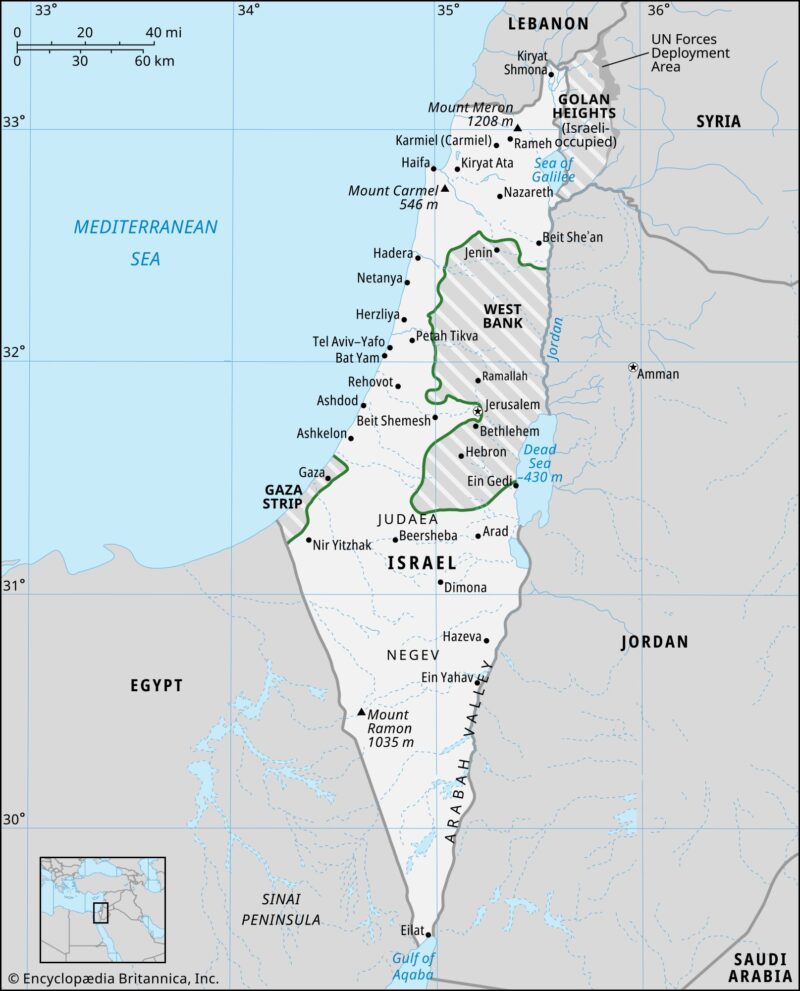
    Peace can come through the immediate implementation of the two-state solution, making the admission of Palestine to the United Nations the starting point, not the ending point.


    The two-state solution is enshrined in international law and is the only viable path to a long-lasting peace. All other solutions—a continuation of Israel’s apartheid regime, one bi-national state, or one unitary state—would guarantee a continuation of war by one side or the other or both. Yet the two-state solution seems irretrievably blocked. It is not. Here is a pathway.

    The Israeli government strongly opposes a two-state solution, as does a significant proportion of the Israeli population, some on religious grounds (“God gave us the land”) and some on security grounds (“We can never be safe with a State of Palestine”). A significant proportion of Palestinians regard Israel as an illegitimate settler-colonial entity and, in any event, distrust any peace process.

    How, then, to proceed?

    The usual recommendation is the following six-step sequence of events: (1) ceasefire; (2) release of hostages; (3) humanitarian assistance; (4) reconstruction; (5) peace conference for negotiations between Israel and Palestine; and finally (6) establishment of two states on agreed boundaries. This path is impossible. There is a perpetual deadlock on steps 5 and 6, and this sequence has failed for 57 years since the 1967 war.

    Two sovereign states, on the boundaries of June 4, 1967, protected initially by UN-backed peacekeepers and other guarantees, will be the starting point for a comprehensive and just peace…

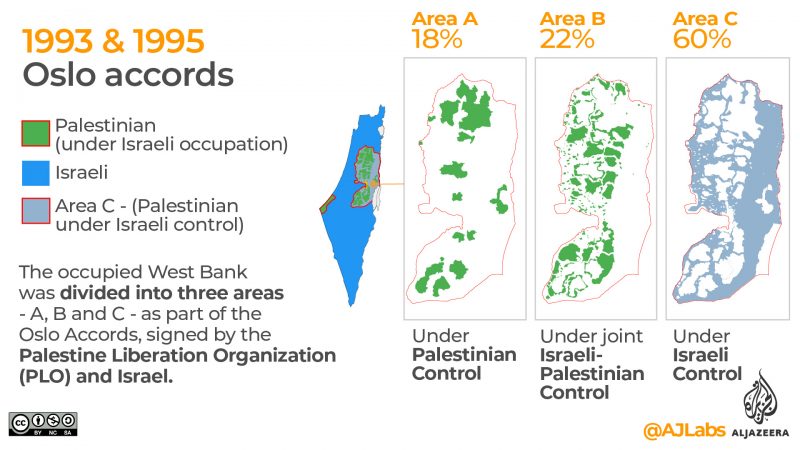
    The failure of Oslo is the paradigmatic case in point. There are irreconcilable differences, such as the status of East Jerusalem. Israeli zealots would force from power any Israeli politician who dares to give up East Jerusalem to Palestinian sovereignty and Palestinian zealots would do the same with any Palestinian leader who gave up sovereignty over East Jerusalem. We should relinquish the continuing illusion that Israel will ever reach an agreement or that Palestine would ever have the negotiating power to engage meaningfully with Israel, especially when the Palestinian Authority is highly dependent on the US and other funders.

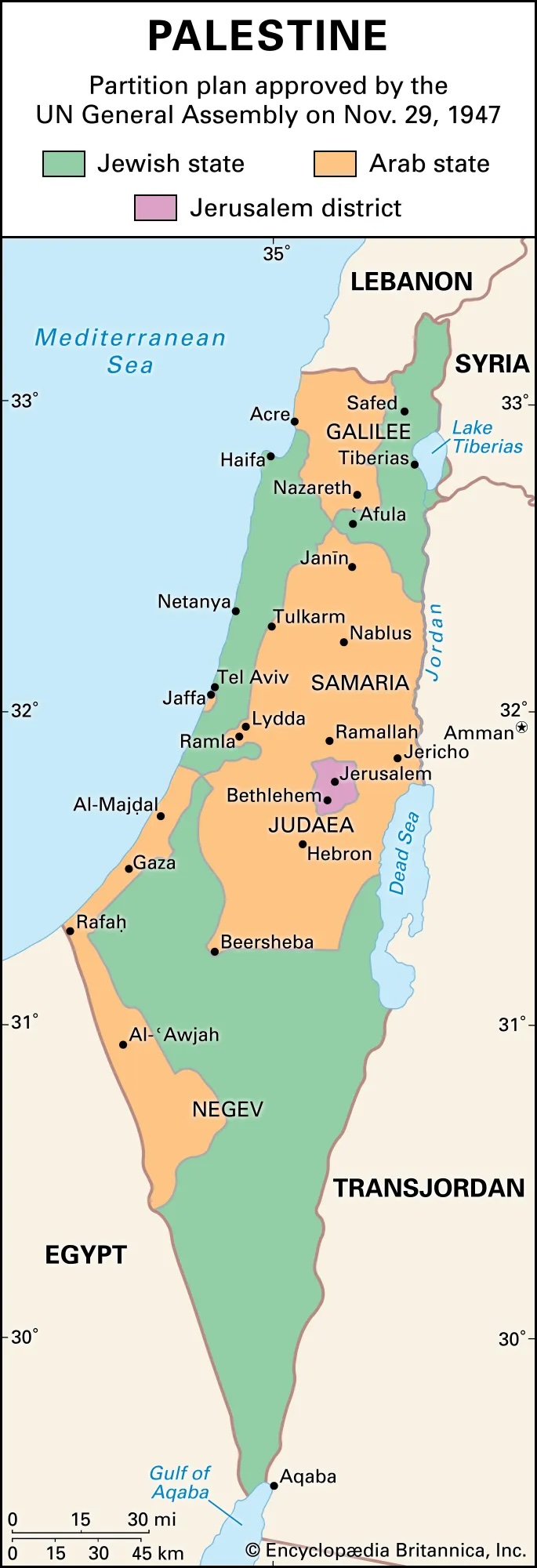
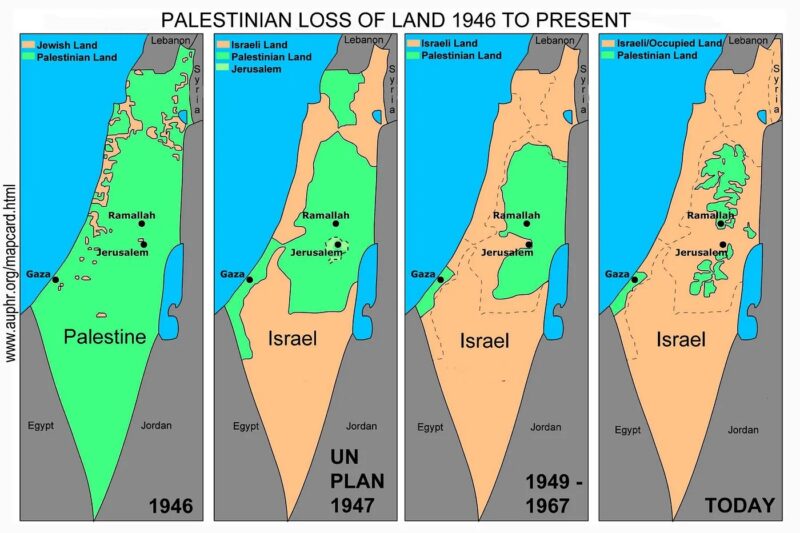
    The correct approach is, therefore, the opposite, starting with the establishment of two states on globally agreed boundaries, notably the boundaries of June 4, 1967, as enshrined in UN Security Council and UN General Assembly resolutions. The UN member states will have to impose the two-state solution instead of waiting for yet another Palestinian-Israeli failed negotiation.

    Thus, the settlement should follow this order: (1) establishment of Palestine as 194th member state within a two-state solution framework on June 4, 1967 borders; (2) immediate ceasefire; (3) release of hostages; (4) humanitarian assistance; (5) peacekeepers, disarmament and mutual security; and (6) negotiation on modalities (settlements, return of refugees, mutually agreed land-swaps, and others; but not boundaries).

    In 2011, the State of Palestine (now recognized by 140 UN member states but not yet as a UN member state itself) applied for full UN member status. The UN Security Council Committee on New Members (constituted by the UN Security Council) recognized the legitimacy of Palestine’s application, but as is utterly typical in the “peace process,” the US government prevailed on the Palestinian Authority to accept “observer status,” promising that full UN membership would soon follow. Of course, it did not.

    The Security Council, backed by the UN General Assembly, has the power under the UN Charter to impose the two-state settlement. It can do so as a matter of international law, following decades of relevant resolutions. It can then enforce the solution through a combination of carrots (economic inducements, reconstruction funding, UNSC-backed peacekeepers, disarmament, border security, etc.) and sticks (sanctions for violations by either party).

    The only conceivable border for creating the two-state solution is June 4, 1967. Starting from that border, the two sides might indeed negotiate a mutually agreed-upon swap of land for mutual benefit, but they would do so knowing that the “best alternative to a negotiated agreement” (BATNA) is the June 4, 1967 border.

    It is quite possible, indeed likely, that the US would initially veto the proposed pathway. After all, the US has already used its veto multiple times to block merely a ceasefire. Yet, the process of eliciting the US veto and then securing a large majority vote in the UN General Assembly will be salutary for three reasons.

    First, US politics is shifting rapidly against Israeli policies, given the US public’s growing understanding of Israel’s war crimes and Israel’s political extremism. This shift in public opinion makes it far more likely that the US leaders will sooner rather than later accept the basic approach outlined here because of US domestic political dynamics. Second, the increasing US isolation in the UN Security Council and UN General Assembly is also weighing heavily on US leaders and forcing the US leadership to reconsider its policy positions in view of geopolitical considerations. Third, a strong vote in the UNSC and UNGA for the two-state solution on June 4, 1967 borders, will help to strengthen international law and the terms of the eventual settlement as soon as the US veto is lifted.

    For these reasons, there is a realistic prospect that the UN will finally exercise its international legal and political authority to create the conditions for peace.

    Twenty-two years ago, Arab and Islamic leaders affirmed in the 2002 Arab Peace Initiative that the only pathway to peace is through the two-state solution. On February 7, 2024, the Saudi Ministry of Foreign Affairs reasserted that a comprehensive peace will only be achieved by recognizing an independent Palestinian state on the 1967 borders and East Jerusalem as the capital. The Arab states and the world community generally shouldn’t buy into another vague peace process that is likely doomed to fail, especially given the urgency caused by the ongoing genocide in Gaza and the bad-will accumulated over the past 57 years of a fruitless “Peace Process.”

    Peace can come through the immediate implementation of the two-state solution, making the admission of Palestine to the UN the starting point, not the ending point. Two sovereign states, on the boundaries of June 4, 1967, protected initially by UN-backed peacekeepers and other guarantees, will be the starting point for a comprehensive and just peace not only between Israel and Palestine—and also a regional peace that would secure diplomatic relations across the Middle East and end this conflict that has burdened the inhabitants, the region, and the world, for more than a century.

    This article was published earlier in Common Dreams.

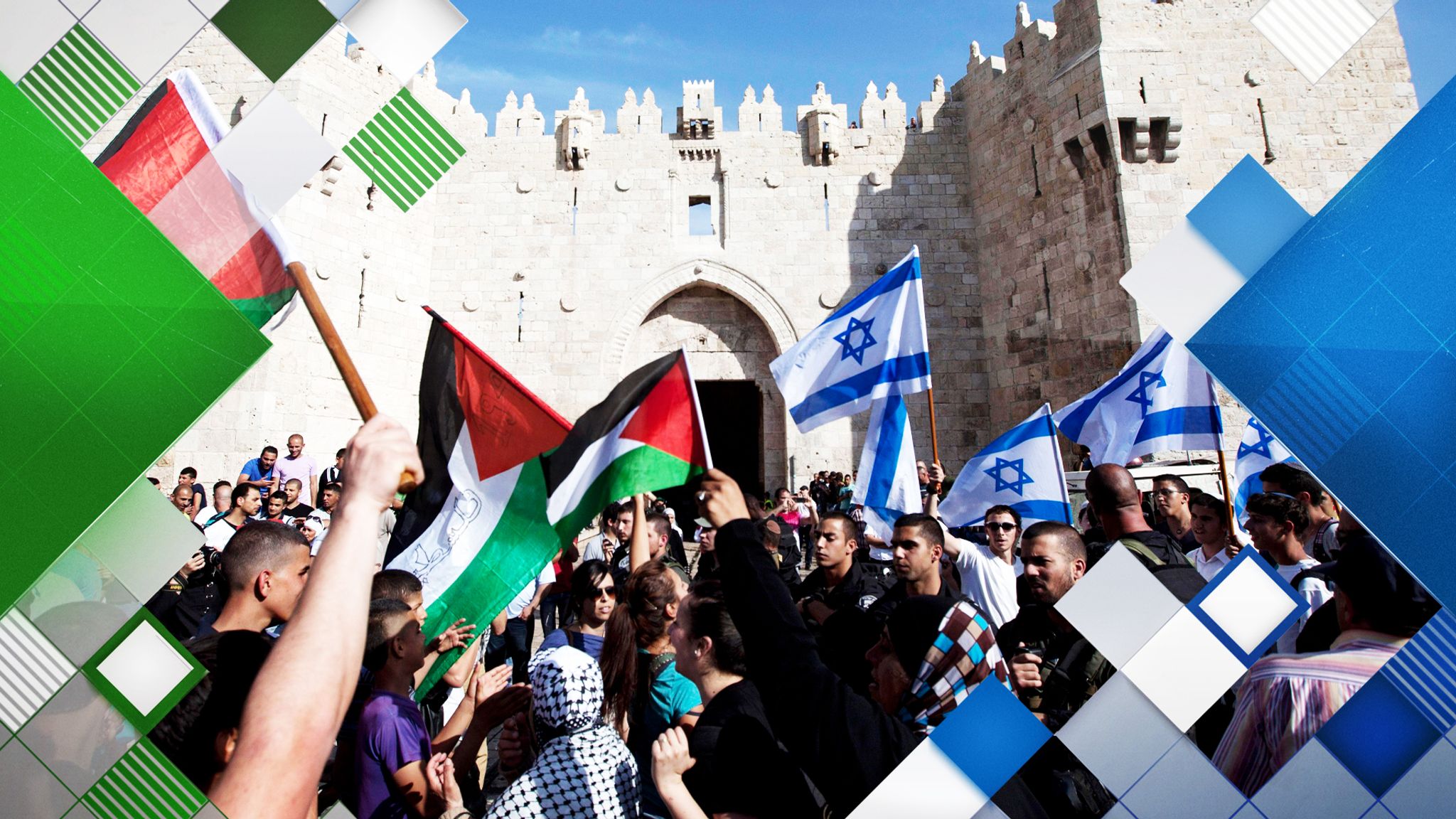
    Feature Image Credit: news.sky.com

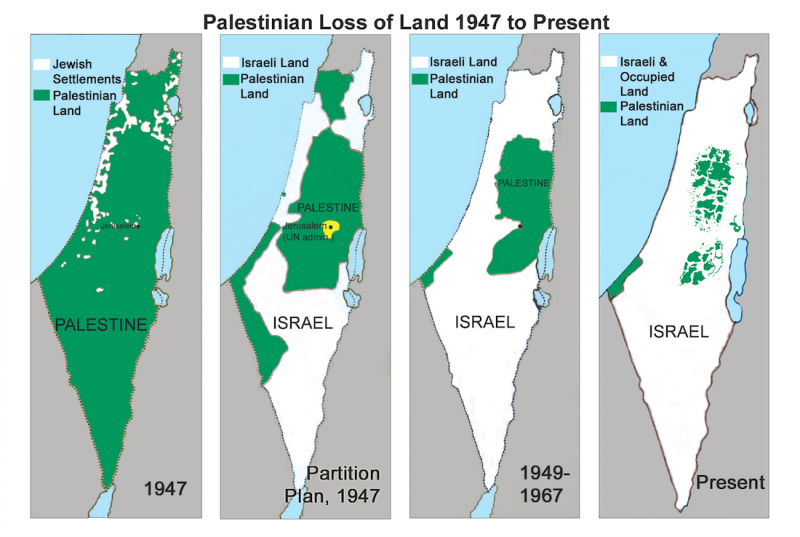
    Maps Credit: britannica.com

  • The Morals of Hamas and Israel — A Dharmic Perspective

    The Morals of Hamas and Israel — A Dharmic Perspective

    In this analysis of the catastrophic destruction unleashed by Israel on Gaza in response to the Hamas’ attack on October 7th, Dr Seshadri Kumar poses very pertinent and valuable questions to the Indian policymakers and the audience in general.

    This article was published earlier in medium.com

    I have seen a number of Indians try to draw a moral equivalence between the attacks by Hamas on Israeli civilians that precipitated the ongoing war in Palestine and the retaliatory attacks of the Israeli Defense Forces on Gaza civilians. Both are equally wrong, these people say. Cruelty and barbarism are wrong, whatever the circumstances, they say. And they also say, therefore, that the Palestinians deserve the brutal bombardment that Israel is inflicting on them because they acted brutally by attacking first. Basically, they asked for it. The fact that the Palestinians are Muslims, a minority that is hated by the majority of Hindus (and, as I am finding out, Christians as well) in India, helps in developing this response.

    But are these two actions equivalent? Most of my friends are Indians, and Hindus at that, so I will draw upon Hindu mythology, which is revered in India, to answer this.

    First, one must understand what the Palestinians have gone through. The very creation of Israel was an injustice to the Arabs living in Palestine, as they were forcibly removed from their homes and forced to be refugees. Initially, all the other Arab countries supported them and fought many wars with Israel. But they lost every time, and the Palestinians lost more and more land each time.

    But the Bible is not history, and even if Jews used to live in that land centuries ago, brutally uprooting people living in Palestine in 1948 was a gross human rights violation. By this logic, the Chola kings of South India were once in control of Sri Lanka, Cambodia, and Thailand, so India is entitled to invade those countries and expel their populations from their lands.

    Some people say that the land that forms the state of Israel was once populated by Jews if we go by the Bible, and therefore Israel has a right to that land. But the Bible is not history, and even if Jews used to live in that land centuries ago, brutally uprooting people living in Palestine in 1948 was a gross human rights violation. By this logic, the Chola kings of South India were once in control of Sri Lanka, Cambodia, and Thailand, so India is entitled to invade those countries and expel their populations from their lands.

    After a lot of conflict over decades, the Israelis gave two parcels of land to the Palestinians to live in and self-govern, but the Jews control the lifelines to both areas — the West Bank, ruled by Fatah, and the Gaza Strip, ruled by Hamas.

    Palestinians are routinely terrorized and humiliated by Israel. Their demand for a Palestinian homeland has come to nought despite years of negotiations. Israel is a brutal occupation force in Palestine.

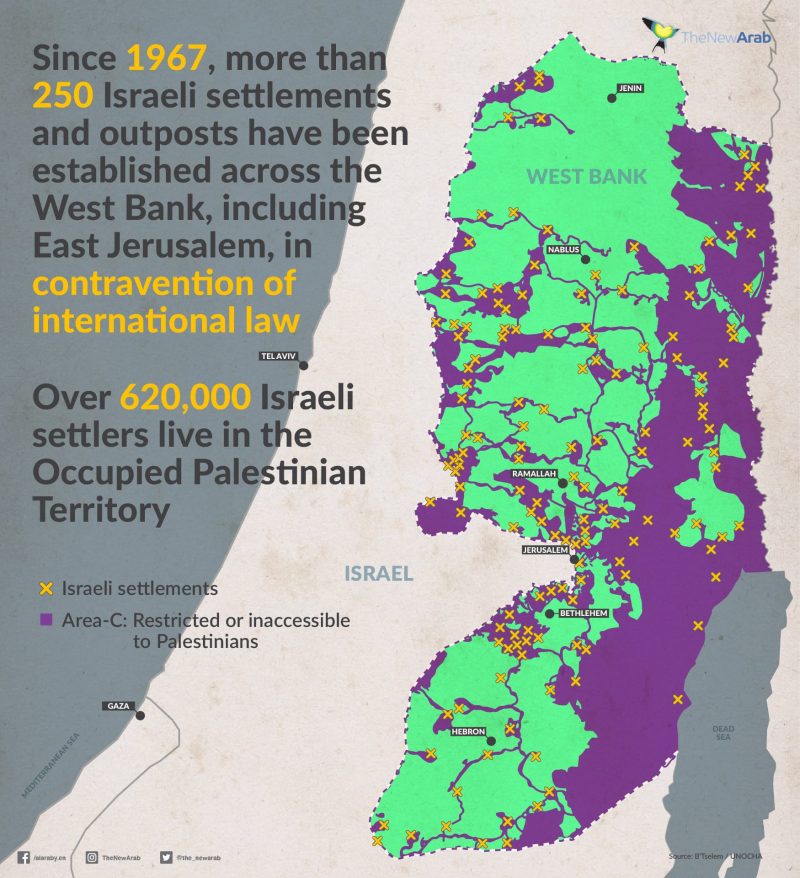
    If all this were not enough, even the small area still occupied by Arabs is constantly encroached upon by Jews. Jews build settler colonies in Palestinian areas, taking away more and more of the little land the Muslims own. Muslim families living in Jerusalem are often forced at gunpoint from their own homes to make way for Jews. The number of Jewish settlers in Palestinian areas was just over half a million in 2010; today, it is just under three-quarters of a million. This increase has happened because of explicit support and encouragement of forced settlement policies by various governments in Israel, including the current Likud-led government of Benjamin Netanyahu and by the US. Another reason for this is that Jews anywhere have an automatic right to become Israeli citizens, and this has led to a huge influx of Jewish immigrants into Israel. Any protest by Palestinians is met with disproportionate retaliation. Children who throw stones are met with machine gunfire. A single rocket is replied to by a hail of bombs from aircraft. Collective punishment of Palestinians is and has been the norm. Israel has been deliberately provoking the Palestinians more and more, and the US has been openly partisan, as when President Trump recognized Jerusalem as Israel’s capital.

    If this were still not bad enough, the Palestinians seem to be losing all their Arab friends. There seems to be Palestine fatigue in the Arab world. Egypt normalized relations with Israel long ago. More recently, other countries, including the UAE, Sudan, Bahrain, and Morocco, have normalized relations. Even Saudi Arabia is on the cusp of normalizing relations with Israel. Clearly, there is nobody left to stand up for the Palestinians.

    A peaceful resolution is clearly not getting the Palestinians anywhere. Despite condemnation by the UN, Israel is continuing its settlement policy. At this rate, the Palestinians will all be begging for a living on the streets.

    How should Palestinians fight for their rights? Talks have failed. How should they “fight” Israel? By engaging in a direct military confrontation with the far superior Israeli army, using primitive weapons, and without an air force — to end up with a guaranteed defeat?

    So, if you say you are sympathetic to the plight of the Palestinians, you are giving them only three options:

    1. Have round after round of negotiations, which don’t get anywhere.
    2. Fight a direct war with a far superior army and an air force, which will lead to complete defeat.
    3. Watch Israeli civilians encroach on what Palestinians still consider their land, until nothing is left, and end up as slave labour for the Jews.

    It is worth noting that the Palestinians living in the West Bank, under Fatah rule, have not indulged in violence all these years. Yet, what has it gained them? Israel withdrew all its settlements from the Gaza Strip in 2010 but is briskly building new Jewish settlements in the West Bank. This is what Fatah got by being peaceful.

    People become terrorists when they have no other option. Asymmetric warfare is the weapon of the weak. When one has a just cause, and all acceptable and peaceful ways of securing one’s rights have come to nought, then one adopts unacceptable and violent ways. In other words, the ends justify the means.

    Hindus can understand this by reading the great Hindu epic, the Mahabharata. The Mahabharata is the story of a conflict between two sets of cousins, the Kauravas and the Pandavas, for control of a kingdom, Hastinapura. In the Mahabharata, the principle that any means are acceptable in order for a just end to prevail, referred to as the principle of Brihaspati, the preceptor of the Gods, is invoked by both sides.

    The operative portion of the story in the Mahabharata starts when King Vichitravirya dies. He has two sons: the elder, Dhritarashtra, is blind, and therefore is passed over for the kingship. His younger brother, Pandu, is crowned king. But King Pandu is cursed by a dying sage during a hunting accident, loses interest in the kingdom, and abdicates, upon which Dhritarashtra is crowned king by default. The children of Dhritarashtra are called the Kauravas, and the children of Pandu are called the Pandavas. Both the Pandavas and Kauravas therefore have a legitimate claim to the kingdom — the former are the children of the last legitimate king, who was the younger brother, whereas the latter are the children of the elder brother who is the current king, albeit by default.

    Duryodhana, the eldest of the Kauravas, believes that the entire kingdom should belong to him, and that the Pandavas do not have a legitimate claim to “even a needlepoint of land.” The Pandavas, on the other hand, are amenable to a split of the kingdom, with half going to their cousins and half ruled by them.

    Duryodhana hates the Pandavas because they are rival claimants to the kingdom. He tries to have them poisoned and then and burned to death. When all that fails, Dhritarashtra tries to achieve peace by partitioning the kingdom. Duryodhana then cheats the Pandavas for their share of the kingdom by winning a rigged game of dice. The condition of the game is that the Pandavas must go into exile for 13 years. When the Pandavas return from exile, Duryodhana refuses to return their portion of the kingdom to them. He justifies all his actions to his father by quoting Brihaspati — that one may take any steps necessary for the elimination of a powerful adversary.

    The Pandavas decide to fight for their right in the great war of Kurukshetra when Duryodhana refuses to return to their kingdom.

    In the setting of the Mahabharata, there are rules by which one is expected to fight on the battlefield. One must not attack someone who is not fighting them. One must not attack an unarmed opponent. One must not strike below the waist. No fighting at night, except by prior agreement. These rules are referred to as the “dharma” (right conduct) of battle. Violation of these rules would be called “adharma.” (Violation of dharma was viewed in the same way as we view human rights violations today.)

    Now the Pandavas can regain their kingdom only by defeating the Kauravas in battle. But the Kauravas are invincible in battle. They have great warriors who have never been defeated in war: Bhishma, the grand-uncle of the Pandavas and Kauravas, a student of the great Parashurama, the greatest warrior the world has known; Drona, the martial teacher of both the Pandavas and Kauravas, another disciple of Parashurama; Karna, the son of the Sun god, born with impregnable armor, and yet another disciple of Parashurama; and many other great warriors such as Bhurishravas. Duryodhana himself is invincible when fighting with his favourite weapon, the mace or bludgeon.

    While the Pandavas themselves have great warriors, notably Bhima, the second of the five Pandavas, the strongest man of his time; and Arjuna, the third of the Pandavas, the greatest archer of his time; even these cannot kill the undefeated warriors on the Kaurava side.

    But the Pandavas also have on their side Krishna, who is an incarnation of the God Vishnu in human form, who wants to help the Pandavas win because he is on the side of justice and fairness, and he believes that the Pandavas are on the side of dharma.

    Krishna knows that the Pandavas can never beat the Kauravas in a fair fight. So, he resorts to dishonourable tactics, or adharma, to win.

    Bhishma has taken a vow that he will never fight a woman. There is a warrior on the Pandava side, Shikhandi, who was born a woman, but who underwent a gender change and became a man. However, Bhishma still considers this warrior a woman, and his code of chivalry will not allow him to fight Shikhandi. But Shikhandi is incapable of killing Bhishma. So Krishna instructs Arjuna to position himself behind Shikhandi and shoot arrows at Bhishma. Bhishma will not shoot at Arjuna because Shikhandi stands in between, and so allows himself to be killed by Arjuna. This is clearly a violation of dharma by the Pandavas — attacking a foe who is not fighting you.

    Drona is told a lie that his son, Aswatthama, has been killed. On hearing this, Drona loses all interest in life and goes into meditation. When he is thus unarmed and defenceless, a warrior named Dhrishtadyumna chops off his head. Another violation of dharma.

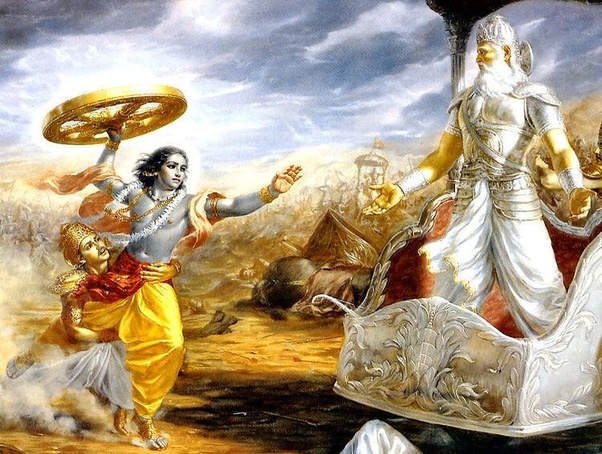
    Karna, similarly, is killed by Arjuna when his chariot is stuck in the mud, and he is unable to fight Arjuna. Dharma would have required Arjuna not to attack Karna when he was unarmed and not engaged in battle with him. But upon Krishna’s urging, Arjuna kills Karna from behind when he is engaged in removing his wheel from the mud.

    Similarly, Bhurishravas is engaged in a fight with another warrior when Arjuna cuts his hand off with an arrow from behind. A disillusioned Bhurishravas goes into meditation, at which point his opponent beheads him while he is unarmed and in meditation.

    In the final battle of the war, Duryodhana and Bhima are fighting with their maces, and Bhima is finding the going tough, because Duryodhana is unbeatable with the mace. At this point, Krishna signals to Bhima to strike Duryodhana below the navel, a violation of the rules of war. Bhima strikes Duryodhana’s thighs and mortally wounds him. More adharma.

    Krishna justifies every one of these transgressions of dharma by saying that the ends justify the means. A dying Duryodhana accuses the Pandavas of violating the rules of war to defeat him. Krishna recalls all of Duryodhana’s evil deeds, and says that without violating the rules of war, without adharma, the Pandavas could never have avenged the great wrongs done to them. Adharma was required to defeat adharma.

    And so, the Mahabharata is a deeply pessimistic story, because it says that the virtuous can never defeat the wicked by following fair play in war. They must resort to trickery, unfair and illegitimate tactics — adharma — in order for dharma to prevail. After trying to follow dharma their entire lives, even not retaliating when their wife Draupadi was disrobed in the great assembly of Hastinapura by the Kauravas during the game of dice, after patiently enduring multiple assassination attempts, after being deprived of their kingdom by fraud, after enduring 13 years in exile, the Pandavas finally come to the realization that they can get their rightful inheritance only through evil and unfair means, through adharma. Even to ensure the victory of virtue, one must embrace vice.

    Similarly, the Palestinians have not gotten justice for 75 years by appealing to dharma, and today Hamas is pursuing the path of adharma. The injustice of the Palestinians began in 1948 with the nakba, the forced expulsion of more than 700,000 Palestinians from the new state of Israel and the destruction of more than 500 villages. Some 5000 Palestinians were massacred by Israel at the time. The injustice has only grown worse in the last 75 years.

    If the present adharma of Hamas is wrong, then the actions of the Pandavas in the Mahabharata were also wrong. And if what the Pandavas did was right, then what Hamas has done is also right. In both cases, adharma was committed to securing justice and fairness. Hindus must decide which course of action they find morally right — but they must choose consistently.

    A system where dharma is never respected and followed can only result in adharma. We have no choice but to accept this reality.

    Had Dhritarashtra upheld dharma when the Pandavas pleaded for their rights with him, they would never have had to engage in adharma to get their rights. If we claim to value dharma, then we must be consistent in upholding it. Otherwise, we are engaging in adharma ourselves.

    Had the world listened to the anguished cries of the Palestinians over the last 75 years, a just solution would have been worked out for them and some of them (i.e., Hamas) would not need to engage in terrorism today. But by turning a deaf ear and a blind eye to their suffering, the West has forced Hamas to engage in the only way that the West pays attention to — terrorism.

    It is not enough to say that you condemn both the violence against civilians by Hamas and the state terrorism of Israel equally. By doing so, you are only enabling the powerful terrorist state of Israel, because your condemnation means nothing to them — they have been engaging in state terrorism for 75 years and getting away with it scot-free. The only people to face consequences for their terrorism are the weak — in this case, Hamas, and in decades past, the PLO. They are blacklisted, their assets are frozen, they are put on Interpol arrest lists, whereas the terrorists who rule the state of Israel roam the world as royalty.

    The world is not equal and fair. The powerful have more privileges. And so, if you value human rights and freedom, you must not condemn equally. If you genuinely care about justice, you must side with the weak, not be even-handed.

    Be like Krishna. Not like Dhritarashtra.

    Feature Image Credit: www.lapresalatina.com


  • Lessons from Gaza

    Lessons from Gaza

    The latest round of fighting between Israel and Palestinians within Israel and the Gaza Strip ended on Friday 21 May under an Egypt brokered ceasefire. Already categorised in the media as the Fourth Gaza War[1], the 11-day conflict left 232 Palestinians including 65 children killed and more than 1,900 wounded in aerial bombardments[2]. Israeli authorities put their death toll as 12, with hundreds injured due to rocket attacks while claiming to have killed at least 160 combatants[3]. One Indian civilian caregiver too lost her life in the line of duty.

    Patrick Kingsley’s piece in the New York Times provides a view of a series of events from early April that led to the current conflict[4]. Several avoidable actions in Jerusalem, such as cutting off loudspeakers at the Al Aqsa mosque on the first day of Ramadan to prevent Jerusalem Day celebrations at the Western Wall from being disturbed, closing off a popular plaza at the Damascus Gate where the faithful gather after prayers leading to nightly protests, and orders for the evacuation of Palestinian families from their homes as per existing law (an act seen by Palestinians as a precursor to their removal from East Jerusalem, the proposed capital of an independent Palestine) followed by clashes between Jews and Arabs –  together provided multiple triggers for the violence, aggravated further by Jewish right-wing groups marching through Jerusalem shouting provocative slogans.

    As the demonstrations gathered momentum with more Palestinians rallying in support of the families facing eviction, the order was stayed by Israel’s Supreme Court. The cancellation of elections to the Palestinian National Authority (PNA) by President Mahmoud Abbas added another element of uncertainty to the situation, fuelled by suspicion over his intent. The final straw was another police raid on the Al Aqsa Mosque on the last Friday of Ramadan and sealing off access to the mosque the next day. Sensing a cue, Hamas commenced rocket fire the following Monday from Gaza.

    International Crisis Group opines that ‘this occasion is the first since the September 2000 intifada when Palestinians have responded simultaneously and on such a massive scale throughout much of the combined territory of Israel-Palestine to the cumulative impact of military occupation, repression, dispossession and systemic discrimination[5]. It further goes on to explain how the dynamic of this conflict differs from earlier ones. Central to this is the role of Hamas – in terms of military capability through an expanded long-range rocket arsenal which has exponentially enhanced its ability to terrorize Israel’s civilian population, as also its political ambitions in trying to negotiate the future of Jerusalem as leverage for subsequent resolution of the Palestinian issue, instead of confining itself to Gaza. Tellingly, it also named its rocket offensive ‘Sword of Jerusalem’.

    The second noteworthy issue is about clashes in cities and townships across Israel and the West Bank, between Israeli Jews, Israeli Arabs and Palestinians leading to loss of life and property, something that had never happened since the Second Intifada. A state of emergency was declared in certain areas[6], and Israeli President Reuven Rivlin was constrained to warn of the danger of civil war[7]. Thirdly, as per United Nations Interim Force in Lebanon (UNIFIL) press releases of 17 and 19 May, rockets were fired on both days from South Lebanon across the Blue Line into Israel. Israeli artillery shelled the launch sites in retaliation. Also, Iranian complicity with Hamas was indicated when Israel downed an armed explosive drone, assessed to have been launched from either Syria or Iraq[8]. This raised the spectre of a wider conflict – the deepest fear of a nation-state surrounded by inimical neighbours, some of whom along with other non-state terrorist organisations refuse to recognize its right to exist.

    Strategic and military aspects of this short conflict along with outcomes warrant analysis to provide a glimpse of the way ahead. Though President Biden announced that Israel had agreed to a mutual unconditional ceasefire, it is unclear what Hamas’s final stand on the matter was. More so, since it had set two conditions for a ceasefire: that Israeli forces stop incursions into the Al-Aqsa compound, and desist from evacuating Palestinian residents from East Jerusalem. No guarantees appear to have been received on these.

    It appears, therefore, that since Hamas’s strategic aim of positioning itself as the champion of Palestinians through offensive action has been achieved, it could claim victory despite the high human, material and infrastructural cost. Israel has also claimed victory, by ensuring maintenance of the status quo along its borders and ensuring the security of its citizens at minimal cost, though with a perceptible fraying of its internal fabric. However prominent Israelis have criticized their government for lacking strategy and acting in ‘default mode’ in responding to Hamas in the same manner for the last 15 years[9].

    Essentially, this was a conflict characterized by tremendous force asymmetry between opposing sides.

    It is in the military domain that some interesting conclusions are drawn. This conflict did not witness any hand to hand fighting or launch of physical assaults, though Israel did use tanks and artillery against Hamas targets. Essentially, this was a conflict characterized by tremendous force asymmetry between opposing sides. The main weapon that Hamas used was unguided rockets of various ranges and dimensions.  While in earlier days these were received from Iran or other allies across the Egyptian border at Sinai or smuggled in through sea, Hamas has developed sufficient expertise to develop its systems, using primitive technology and materials such as steel tubing and chemicals for making explosives. Israeli estimates suggested that ‘most of Hamas’s arsenal of 5,000 to 6,000 rockets can strike somewhere between the Gaza border communities and 40-55 km. away.’[10] Other estimates posit that Hamas now has rockets with ranges of 200 km or more, some with warheads carrying hundreds of kilograms of TNT and shrapnel. Raw construction material even uses detritus from Israeli missiles, with three rocket manufacturing factories rumoured to be existing inside Gaza[11]. Overall, Hamas fired around 4,360 rockets during the 11-day campaign, including a sizeable number that fell short, inside the Gaza Strip itself[12]. The long-range versions permitted engagement of targets from just outside the Strip to as far North as Jerusalem.

    Hamas Qassam rocket ready for launch.    Photo and description: Forbes May 12, 2021


    Iron Dome carrying out intercepts – Image Credit: Businessinsider

    The Israeli response on the other hand was a combination of air power and ground-based air defence with the firepower of tanks and artillery – all state-of-the-art weapon systems with latest generation cutting edge technology, including Israeli variant F 16s, F 15 Air Defence aircraft and F 35 Stealth fighters. Videos of Israeli strikes are testimony to their effectiveness. Israel too gave its campaign a symbolic name ‘Guardian of the Walls’. The Iron Dome Missile Defence System proved its worth with engineers continuously upgrading its algorithms to improve interception capability against larger rocket salvos. This has enabled Iron Dome to intercept one of the largest barrages fired ever – of around 130 rockets towards Tel Aviv on 11 May. Despite attempts to saturate the system, Iron Dome was able to neutralize the majority, permitting only a handful to get through[13]. However, limitations of Iron Dome are becoming apparent- Israeli security officials estimate that opponents like Hezbollah can fire over 1,000 rockets per day from a stockpile of over 150,000[14], which could overwhelm its capabilities. Also, Israeli IFF (Identification Friend or Foe) techniques were shown to be wanting, as the downing of a Skylark reconnaissance drone by Iron Dome friendly fire indicates[15]

    Israeli soldiers fire a 155mm self-propelled howitzer towards the Gaza Strip from their position along the border with the Palestinian enclave on May 16, 2021. Photo: AFP/Jack Guez

    asymmetric warfare thrives on a logic of its own, where the intelligent application of limited resources by the weak ensures some degree of military success

    The above instance is a singular example of an asymmetry arising from one side’s lack of sophisticated warfighting equipment or access to technology being compensated for by sheer force of numbers, to defeat or stalemate superior enemy systems. Operations Research analysts have worked out a ratio of one Israeli dying for every 206 rockets reaching Israel in the first four days of fighting, with at least 134 rockets hitting populated areas[16]. Israeli military sources put the accuracy of these rockets at around 15 per cent. Though many fell in open areas, their deterrent effect was enough for Israelis to descend into their bomb shelters[17], thereby proving that even today, asymmetric warfare thrives on a logic of its own, where the intelligent application of limited resources by the weak ensures some degree of military success. This, despite a situation where most of the Artificial Intelligence, networked communication, quantum computing and precision standoff capability was on one side – though one could grant some level of technology available to Hamas, through its research laboratories in the Strip and inputs from Iran. Adding another dimension to such asymmetry in the larger context however is the history of injustice perpetrated on Palestinians over the years, providing strong psychological motivation in favour of any opponent of Israel.

    Coming to the issue of outcomes, it is apparent that notwithstanding the asymmetry in capability, Hamas’s strategy has paid off. Having realized that the situation during Ramadan (created by Israel mostly through application of a purely law and order cum security template) was tailor-made for exploitation, it made Jerusalem the focus of its campaign, escaping in one go from the confines of Gaza.

    With Palestinians rallying to its cause, resultant unrest in Israel and the West Bank and some support from Hezbollah in Lebanon, it was able to create a narrative in its favour. Notwithstanding its designation as a terrorist organization by the US, EU, UK and many other nations, it has garnered huge political capital, enabling it to rival the current Palestinian leadership as reports of Palestinians carrying green Hamas flags in cities on the West Bank, where the PNA traditionally holds sway, indicate[18]. The stark difference in respective casualty figures also helped, once again raising the issue of ‘proportionate vis a vis disproportionate response’, against the backdrop of repeated injustice to Palestinians over the last 70 years.

    The IDF on the other hand worked efficiently with their usual precision, taking out as many targets as possible from their prepared lists, including networks of tunnels, headquarters, senior Hamas commanders and research infrastructure in the minimum amount of time. Without a doubt, Israel is a clear winner in military terms.

    This conclusion however begs the larger question of whether military victory alone can decide winners and losers in world geopolitics. At the time of writing US Secretary of State, Blinken is on a four-day visit to the region, to interact with leaders of Israel, the PNA, Jordan and Egypt to strengthen foundations for a durable ceasefire. President Biden has signalled that West Asia is back on his agenda: in a hugely symbolic gesture, the US has announced its decision to reopen its Consulate in East Jerusalem and promised $32 million worth of aid to the UN in Gaza. White House spokesperson Jen Psaki has called this part of America’s efforts to rebuild ties with the Palestinians.

    Whether this effort will be to purely manage a crisis or look for a permanent solution is unclear. The latter venture will require creative thinking by Israel, Palestinians and their neighbours and a shift from absolute positions which have shackled the region for over 70 years.  In that eventuality, a fresh look at the Two-State Solution guaranteeing the right of both nations to exist as sovereign states might yet provide the alternative. Reverting to the status quo of April 2021 will not.


    Notes:

    [1] ‘Daily Chart. The Israel-Palestine conflict has claimed 14,000 lives since 1987’   The Economist  18 May 2021

    [2] ‘Israel-Hamas truce begins after 11 days of fighting, Palestinians celebrate’   Reuters 21 May 2021

    [3] Ibid.

    [4] ‘After Years of Quiet, Israeli-Palestinian Conflict Exploded. Why Now? ‘  Patrick Kingsley, The New York Times 15 May 2021

    [5] ‘The Israel-Palestine Crisis: Causes, Consequences, Portents’   International Crisis Group  14 May 2021

    [6] International Crisis Group 14 May 2021

    [7] ‘Israeli president warns of civil war as Jews, Arabs clash over Gaza’   Rami Ayyub  Reuters  13 May 2021

    [8] ‘Netanyahu: Drone shot down earlier this week was Iranian UAV armed with explosives’   Judah Ari Gross  The Times of Israel 20 May 2021

    [9] Maj Gen Giora Eiland Retired, former head of Israel’s National Security Council in comments to Crisis Group 14 May 2021

    [10] ‘What do Hamas and PIJ have in their rocket arsenals? – analysis’  Yonah Jeremy Bob The Jerusalem Post 11 May 2021

    [11] ‘Israel’s Gaza challenge: stopping metal tubes turning into rockets’ Arshad Mohammed, Jonathan Saul, John Irish and Parisa Hafezi, Reuters 24 May 2021.

    [12] Ibid.

    [13] ‘How Israel and Hamas returned to armed conflict’  The Economist  22 May 2021

    [14] ‘Is Iron Dome effective against Hamas rockets as originally thought?’  Yonah Jeremy Bob  The Jerusalem Post  14 May 2021.

    [15] ‘Iron Dome Shot Down an Israeli Drone During Israel-Gaza Fighting’ Yaniv Kubovich Haaretz 25 May 2021.

    [16] ‘Gaza’s rocket technology challenges Israeli defenses’  Michael J Armstrong  Asia Times 18 May 2021

    [17] ‘Israel’s Gaza challenge: stopping metal tubes turning into rockets’  Reuters 24 May 2021.

    [18] ‘Israel and Hamas Begin Cease-Fire in Gaza Conflict’  Iyad Abuheweila and Adam Rasgon  The New York Times 21 May 2021


    Image Credit: Wikipedia


  • Side-lining of Palestine Issue:  Threat to Palestinian Rights and Self-determination

    Side-lining of Palestine Issue: Threat to Palestinian Rights and Self-determination

    Over the years, the international concern for the resolution of the Palestinian conflict has been diminishing. Israel has consistently dodged the core issue of returning Palestinian lands (West Bank) they occupied in 1967. Instead, it has continued to create new settlements in the occupied territories. Israel, obviously, has no intention of returning to pre-1967 boundaries; this was clear when the current Prime Minister of Israel, Benjamin Netanyahu, announced his plan to annex the West Bank in May 2020.

    Image Credit: The New Arab

    He deferred its implementation as the normalisation of relations with the United Arab Emirates (UAE) gathered momentum. However, Netanyahu indicated that Israel will “never give up our rights to our land.” (Al Jazeera 2020). The situation and the perception created now is such that not annexing the West Bank would appear to be a concession from Israel.

    As the Arab countries are taking a realistic view in placing their national interests first, Palestine is no longer a priority issue for them.

    This paper looks at how the Palestinian issue is gradually side-lined over the last few decades by the international community. There are four factors that have contributed to this development. First is the increase in conflicts in the Arab world, which has led to fragmentation and disunity in their approach to the resolution of the conflict. As the Arab countries are taking a realistic view in placing their national interests first, Palestine is no longer a priority issue for them. Second is the realisation of the fact that Oslo deal was unfair to start with and how under the guise of negotiations Israel continued to expand settlements and limit any prospect of sovereignty for the Palestinians. The Palestinian authorities hung on to the Oslo deal even though it was flawed, leading to decades of standstill in negotiations. Third, with the rise of the militant groups around the time of 9/11, the Palestinian cause has lost significant sympathies, and Israel’s violent response is seemingly more reasonable in the views of the international community. Fourth, the United States has supported Israel consistently in many issues, keeping Israel on the safe side in international and regional politics, shielding it from any proactive criticism.

    A look at the brief history of the conflict is necessary to explore the four factors mentioned above.

    Brief History of the Conflict

    Palestine was part of the Ottoman Empire until its defeat and collapse World War I. The area became a British protectorate as the result of the armistice of 1919. It coincided with the persecution of the  Jews due to the rise of anti-Semitism across Europe. The 1917 Balfour Declaration by the British government promised the Jews a national home in Palestine. This decision failed to factor the rights of the Palestinians who have lived there for millenniums. Jews began migrating to Palestine in huge numbers despite vehement protestations from the Palestinians leading to the now perennial Israel-Palestinian dispute. As Britain vacated the region post-1945, it abdicated its moral responsibility and left the resolution of the dispute to the United Nations (UN). The withdrawal of the colonial powers and the ensuing chaos in the regions vacated by them is a recurring pattern in decolonization history. The UN tried to divide Palestine into two states; Israel and Palestine, with Jerusalem as a joint capital and an international zone. Neighbouring Arab countries saw this as a residual form of colonialism and went to war in 1948. The war resulted in the catastrophic displacement of thousands of Palestinians. This catastrophe is remembered as Nakba, a day with a lot of historical sentiment across the Arab World (Chomsky and Pappé 2015). Israel won but did not control Gaza or the West Bank. Israel occupied these areas in the six-day war in June 1967. The occupation of the West Bank continues till today, whereas Gaza is now under Hamas. Coupled with all this, there are massive human rights violations against the Palestinians. This includes humiliating Palestinians at checkpoints, arresting without trial, arresting Palestinian children etc. (Chomsky, and Pappé 2015). Moreover, when Palestinians file reports about being harassed by Israeli citizens, it does not get any attention as the conviction rate is only 3% (Oxfam 2019).

    One of the prime demands of the Palestinian struggle is a return to the borders of 1967; so that Palestine can exercise full sovereignty over Gaza and the West Bank. However, Gaza has been economically cut off because Hamas controls it, and there is a huge blockade against it making life in Gaza difficult and miserable. Hamas also attacks Israel, and this has always led the Israel Defence Forces (IDF) into retaliating. Whereas on the West Bank, there are thousands of settlements by Israel, virtually pushing Palestinians out. This settlement strategy is seen as a deliberate move to counter the demographic threat from the larger number of Palestinians inside Israel (Chomsky and Pappé 2015). The obsession with demographic re-engineering has been fundamental to Israel, and it does not intend to change its policy. It also couples this with closing Palestinian places, reducing the Palestinian economic structures present in East Jerusalem (Arafeh et al. 2017) etc. There are currently 8 million Israeli citizens of which 1.2 million are Palestinians (“Palestinian Citizens Of Israel” 2020). They are treated as second-class citizens and many of them are engaged in menial labour

    The fractures in Arab Unity  

    All the West Asian and North African countries were initially pro-Palestine during the cold-war and decolonization era. This could be associated with the Pan-Arab notion present during that period. Many Arab countries had recently secured independence, and the Palestinian injustice was still fresh in their memory. However, losing consistently in these wars was also a demotivator and blow to them; fiscally and otherwise. In the last few decades, several countries have established ties with Israel; Egypt in 1979, Jordan in 1994. This is also the time Pan-Arab spirit declined, and increased conflicts began to emerge amongst many West Asian and North African countries.

    These political conflicts include; countries taking sides in the Iran-Iraq war, funding proxy wars, taking sides on the invasion of Iraq, etc. Furthermore, security threats have been perceived to be heightened in many West Asian and North African countries due to the rise of religious radicalization and the rise of terrorist groups. Arab league relations have also been strained for various reasons, including the Syrian Civil War and over its membership (Reuters 2020).

    More importantly, Saudi Arabia and Iran have their cold war. The United States has exaggerated the Iranian threat, and both Saudi Arabia and Iran covertly fund proxy civil wars across West Asia, be it Yemen or Syria.

    Israel has emerged as a technological and military power in the region. Netanyahu says, “we believe in peace out of strength and we believe in alliances born out of Israel’s value as a technological, financial, defence, and intelligence powerhouse” (The Times of Israel 2020).  Many Arab countries may, therefore, find value in Israel’s technological capabilities. Parallelly, economic conditions in many Arab countries are worsening. Under these circumstances, with deep distrust amongst many Arab states and incentive for countries to be friendly with Israel, normalization of relations with Israel is taking place.

    Arab countries are putting their national interest first, and if the Palestinian issue is seen as an obstruction they have no qualms about relegating it to a side-issue.

    However, a majority of the Arab and Gulf countries still do not officially recognize Israel. This is where the significance of the UAE-Israel and Bahrain-Israel deal comes in. The United States uses these factions within West Asia and North Africa to pursue its agenda with Jared Kushner pushing for normalization. The United Arab Emirates and Bahrain announced decisions to normalize relations with Israel on 12th August and 12th September 2020, respectively. Many of the West Asian countries, Saudi Arabia, in particular, are close allies of the United States. As the USA nudges these countries with incentives,  Palestinian sovereignty or a fair peace treaty no longer seems to be a precondition to establishing ties with Israel. Arab countries are putting their national interest first, and if the Palestinian issue is seen as an obstruction they have no qualms about relegating it to a side-issue.

    Support for Palestine still exists, but it comes in fragments from different countries. It is important to remember that there is no coalition; no pressure; no one group that consistently fights for it.

    Long Term Effects of a Flawed Deal

    One will always remember the picture of the handshake between Yasser Arafat and Yitzhak Rabin facilitated by Bill Clinton while signing the Oslo Accords at Camp David. The Oslo Accords were an extremely publicized affair, and many proclaimed that peace to the decades-old conflict had been reached, but this was far from the truth.

    When the accord was signed in 1993, the Palestine Liberation Organization (PLO) was already weak. Additionally, there was also a general reduction of support for the PLO among Palestinians, as seen by the eruption of the first intifada, which was initially spontaneous (Hassan 2011).

    Image Credit: Aljazeera

    The Oslo accords had several terms and clauses, but it mainly called for the recognition between Israel and the PLO. The accord also stipulated that Israel would end its occupation in Gaza and certain parts of the West Bank (Oxfam 2019). There would be an interim self-governance strategy and, eventually, a shift of power in Gaza and West Bank to the Palestinian Authority (Hassan 2011). An interim period was given so that both sides would have time to “gain trust” with one another.

    The accord showed an ambiguity regarding when Israel would withdraw from Gaza. It did not recognize Israel’s occupation, and neither did it speak of the Palestinian refugees.

    However, there were many flaws with the deal from the beginning. The accord showed an ambiguity regarding when Israel would withdraw from Gaza. It did not recognize Israel’s occupation, and neither did it speak of the Palestinian refugees (Hassan 2011). There was no stringent enforcement of the deal and having no third party accountability also rendered Palestinians vulnerable, as is evident. Furthermore, the Oslo accords did not condemn or mention the human rights violations against the Palestinians (Oxfam 2019).  The flawed nature of the deal began to show signs of rupture from the early days as accounts speak of how, as early as 1994, after the accords were signed, the IDF still had control over most of the West Bank and made no plans to move and were hovering around the edge of Ramallah (Tolan 2018). The fundamental issue here was that the Oslo Accord was signed by two unequal partners with Israel displaying dominant power.

    Therefore, while the buzz around the accords was still on, in reality, Israel continued policing Palestinians and establishing settlements in the West Bank area.

    No matter the initial motive, the Oslo accord, in 2020, can be analyzed as a distraction and cover-up by Israel while they continued their settlements. There is evidence supporting this as today there are 600,000 settlers in West Bank compared to 115,600 in 1993 (Oxfam 2019).

    Another significant issue is that Mahmoud Abbas and the Palestinian Authority (PA) have no framework other than the failed and biased Oslo accords. Owing to the proclamation that this accord would end the conflict, the PA became stuck in this framework. The way forward, as said by researcher Victor Kattan is that “The PA must produce a concrete vision of the state it wants to establish” (Arafeh et al.2017).  This lack of vision by the leaders is one of the reasons for the stagnation in the negotiations. Till today, Abbas and PA threaten to quit the accords and routinely proclaim that the Oslo deal is no longer valid. However, this should have come decades ago, during the second intifada in the year 2000, which illustrated that the Oslo accords were unfavourable towards the Palestinians. It shows the PA’s failure as a representative body, and their approval rate by the Palestinian public has reduced drastically.

    There have been talks to solve the dispute after Oslo deal, for instance, the Taba Summit. However, none have gained the clout or effort that the Oslo deal garnered.

    Militancy

    Ever since the attack of 9/11, the conversation surrounding militancy has increased. Invasion of Afghanistan and Iraq by the United States, a world power, ensured that the world knew the stance of the West on militancy.

    Militancy and violent retaliation by the Palestinians armed groups have been major issues, and the world witnessed the Munich massacre of the Israeli Olympic team in 1972. Furthermore, there have been Palestinian militant factions, which is where organizations such as Hamas come in. The first intifada led to Hamas’ formation and the second intifada helped Hamas gain clout (Uslu and Karatas 2020). Hamas has been deemed a terrorist organization by the United States, the European Union, because of its fundamentalist ideology and use of violence. This also led to the Palestinian struggle to lose sympathies of the international community due to its wariness of militant groups. Hamas takes a more “hard-line” approach towards Israel and is infamous for its rocket attacks against Israel from Gaza and suicide bombings (Uslu and Karatas 2020).  Israel and Hamas are also very wary of negotiating with each other. So far, the only talks between the two groups have been to swap prisoners.

    Many have criticized Hamas for the use of violence, however, Israel and other states cannot condemn the violence being deployed by Hamas, while Israel itself consistently shows violent behaviour towards the Palestinians. Hamas gained clout after the intifadas showed the deplorable conditions of the Palestinians in the occupied territories and Gaza. Termination of aid to Gaza on account of peoples’ support to Hamas has created more problems in terms of economy and livelihood. In the end, it is Palestinian people who suffer the most.

    Pro-Israel Policies of the United States  

    The United States is a close ally of Israel; technologically, financially, and otherwise. Israel, too, provides intelligence and acts as the “eye” of the United States from the West Asian region. The US-Israel relationship was instrumental in limiting the erstwhile Soviet Union’s influence in West Asia during the cold war (Beauchamp 2018). Much of the aid the United States gives to Israel is military aid, and as an important defence ally, Israel receives state-of-the-art weapon systems and intelligence sharing (Congressional Research Service 2019). The US has played a critical role in Israel’s emergence as a technology power and a major arms exporter.

    The United States has used its veto in the security council several times to protect Israel, including when the UN looked at taking action to prevent  Israel’s invasion of Lebanon and to stop the construction of walls inside the West Bank (Zunes 2012).

    The Israel caucus and lobby in the United States is powerful and many pro-Israeli outfits/individuals are major funding sources for Congressional elections (Cook 2018). The American Israel Public Affairs Committee (AIPAC) has financially backed people in the congress, which has influenced the decisions made by many lawmakers. For instance, billionaire, Sheldon Adelson, funded 82 million dollars to Republican’s election and is known for his pro-Israel sentiments. He even pushed for the USA embassy to be moved to Jerusalem from Tel-Aviv and has also proven to be unconcerned about giving Palestinians voting rights in Israel (McGreal 2018).

    The Donald Trump administration has taken the support for Israel one step further. Trump supports Israel in controversial issues that many shy away from addressing due to the politics in West Asia and Palestine’s historical symbolization. Trump came up with a peace deal for Israel and Palestine which was criticized severely and rejected by Palestine as the negotiations did not involve them (Holmes et al. 2020). The fact that Trump did not involve Palestinians in the negotiation shows how one-sided and utterly dismissive he is of the Palestinian authorities and people. The refusal of the right to return for Palestinian refugees, keeping Jerusalem as an undivided capital of Israel, recognizing Israeli settlements are among many reasons why the deal is flawed. The United States also brokered two peace deals in West Asia, the UAE-Israel peace deal first, followed by the Bahrain-Israel deal. It has also has been pushing other Arab countries to normalize relations with Israel (Barrington and Williams 2020).

    The Trump administration also shifted the United States embassy to a contested and occupied Jerusalem in 2018. All the more, this ultimately recognized and legitimised Israel’s occupation of the West Bank. After Trump’s announcement to shift the embassy, Israel’s housing minister declared that Israel was developing 14,000 “new settlement units” in Jerusalem (Arafeh et al. 2017). Mohamoud Abbas also asserted that the United States could not be a reliable mediator after shifting capital to Jerusalem. However, the United States has continued to meddle and create a one-sided mediated plan (Arafeh et al. 2017).

    Trump has also continued to cut out aid for Palestine, which has severe repercussions for Gaza’s already poorly funded city. In 2018, after Palestinians Authorities blamed Trump for being partial, he cut 200 million dollars in economic aid and cut funding to the United Nations Relief Work Agency (UNRWA), the primary network in helping Palestinian refugees (Holmes 2020).

    During the US presidential elections, Netanyahu appealed to evangelical supporters in the United States. In a virtual conference, he said that Trump might give him the green-light to annex certain parts of the West Bank that have religious significance in the Bible (Ravid 2020). The President-Elect Joe Biden has clearly highlighted that he would review these decisions, recognise Palestinians’ right to self-determination and adopt a more balanced approach.

    It is evident that the Trump administration has played a significant role in side-lining the Palestinian issue.

    Looking Ahead

    The Palestine problem has stretched far too long, with many “negotiations” that have failed to address the historical injustice done to the Palestinians. Amidst all this, clashes continue between protestors in Gaza and Israeli forces. While there are mass casualties and acts of aggression on both sides, there is no denial of how poorly Israel has treated Palestinians over the decades. Furthermore, most issues regarding Palestine have been put on the back-burner, however, the Arab League stepped up to condemn the unfair Trump Peace Deal, which is the bare minimum it could have done.

    There needs to be more initiative from the side of the PA to have a more concrete plan for the future of Palestinian sovereignty. The PA is also dominated by older elites, but with changing aspirations of the Palestinians, there need to be more women and younger people in the body.

    Additionally, for Palestinian sovereignty to be achieved, there has to be a major restructuring of the PA. It is clear that PA has been stripped of its power over the years and afflicted with corruption, has not improved the Palestinians’ situation. There needs to be more initiative from the side of the PA to have a more concrete plan for the future of Palestinian sovereignty. The PA is also dominated by older elites, but with changing aspirations of the Palestinians, there need to be more women and younger people in the body.

    There is some importance given to Palestine in the United Nations such as making Palestine as a presiding chair for the G77 or the United Nations Security Council Resolution 2334, which says that “altering the demographic composition, character, and status of the Palestinian Territory occupied since 1967, including East Jerusalem… (is) in violation of international humanitarian law” (SC Res 2334 2016). However, voting pro-Palestinian at some UN resolutions, having Palestinian authorities come over, and reiterating a “two-state solution” is no longer enough. Furthermore, different countries use this issue as a political tool to show their “sentiments.” Instead, there needs to be more proactive international collaboration to fight for Palestinian rights consistently. The Palestinian issue is a fundamental human rights issue and should be urgently addressed before the already minimal fragments of Palestine disappear under Israel.

    References

    “Palestinian Citizens Of Israel”. Institute For Middle East Understanding, 2020, https://imeu.org/topic/category/palestinian-citizens-of-israel. Accessed 25 Sept 2020.
    Al Jazeera. “Netanyahu Says West Bank Annexation Plans Still ‘On The Table’”. 2020,   https://www.aljazeera.com/news/2020/08/13/netanyahu-says-west-bank-annexation-plans-still-on-the-table/. Accessed 12 Sept 2020.
    Arafeh, Nur et al. “Trump, Jerusalem, And The Future Of Palestine – Al-Shabaka”. Al-Shabaka, 2017, https://al-shabaka.org/roundtables/trump-jerusalem-future-palestine/. Accessed 6 Sept 2020.
    Arroyo, Carmen. “Palestinian Children, The True Victims Of The Conflict”. The Wire, 2020, https://thewire.in/world/palestinian-children-true-victims-conflict-israel. Accessed 5 Sept 2020.
    Barrington, Lisa, and Dan Williams. “After UAE-Israel Breakthrough, Kushner Pushes Other Arabs To Go Next”. Reuters, 2020, https://www.reuters.com/article/us-israel-gulf-usa/after-uae-israel-breakthrough-kushner-pushes-other-arabs-to-go-next-idUSKBN25S5QC. Accessed 20 Sept 2020.
    Beauchamp, Zack. “Why Are The US And Israel So Friendly?”. Vox, 2018, https://www.vox.com/2018/11/20/18080080/israel-palestine-us-alliance. Accessed 16 Sept 2020.
    Chomsky, Noam, and Ilan Pappé. On Palestine. Haymarket Books, 2015.
    Congressional Research Service. U.S. Foreign Aid To Israel. Congressional Research Service, Washington D.C, 2019.
    Cook, Jonathan. “Under Trump, The Israel Lobby Is A Hydra With Many Heads”. Middle East Eye, 2018, https://www.middleeasteye.net/opinion/under-trump-israel-lobby-hydra-many-heads. Accessed 7 Sept 2020.
    Hassan, Shamir. “Oslo Accords: The Genesis and Consequences for Palestine.” Social Scientist, vol. 39, no. 7/8, 2011, pp. 65–72. JSTOR, www.jstor.org/stable/41289422. Accessed 30 Sept. 2020.
    Holmes, Oliver et al. “Trump Unveils Middle East Peace Plan With No Palestinian Support”. The Guardian, 2020, https://www.theguardian.com/world/2020/jan/28/donald-trump-middle-east-peace-plan-israel-netanyahu-palestinians. Accessed 1 Sept 2020.
    Holmes, Oliver. “US To Give Palestinians $5M In Coronavirus Aid – 1% Of What Trump Cut”. The Guardian, 2020, https://www.theguardian.com/world/2020/apr/17/us-aid-palestinians-coronavirus-trump-cut. Accessed 22 Sept 2020.
    McGreal, Chris. “Sheldon Adelson: The Casino Mogul Driving Trump’s Middle East Policy”. The Guardian, 2018, https://www.theguardian.com/us-news/2018/jun/08/sheldon-adelson-trump-middle-east-policy. Accessed 17 Sept 2020.
    Oxfam. From Failed To Fair Learning From The Oslo Accords To Foster A New Rights-Based Approach To Peace For Palestinians And Israelis. Oxfam, Oxford, 2019, pp. 3-24, https://oxfamilibrary.openrepository.com/bitstream/handle/10546/620904/bp-failed-to-fair-oslo-accords-011119-en.pdf. Accessed 6 Sept 2020.
    Ravid, Barak. “Netanyahu Presses Trump By Lobbying U.S. Evangelicals To Back Annexation”. Axios, 2020, Accessed 29 Sept 2020.
    Reuters. “No Consensus Yet For Syria Return: Arab League Chief”. 2020, https://in.reuters.com/article/us-mideast-crisis-syria-arabs/no-consensus-yet-for-syria-return-arab-league-chief-idUSKCN1Q014R. Accessed 15 Sept 2020.
    SC Res 2234, UNSC, UN Doc S/RES/2334 (23 December 2016) < https://www.un.org/webcast/pdfs/SRES2334-2016.pdf> accessed 15 September 2020
    The Times of Israel. “PM Said Seeking To Formalize Relations With Saudi Arabia Before Next Election”. 2020, https://www.timesofisrael.com/pm-said-seeking-to-formalize-relations-with-saudi-arabi-before-next-election/. Accessed 24 Sept 2020.
    Tolan, Sandy. “Was Oslo Doomed From The Start?”. The Nation, 2018, https://www.thenation.com/article/archive/was-oslo-doomed-from-the-start/. Accessed 17 Sept 2020.
    Uslu, Nasuh, and Ibrahim Karataş. “Evaluating Hamas’ Struggle in Palestine.” Insight Turkey, vol. 22, no. 1, 2020, pp. 109–124. JSTOR, www.jstor.org/stable/26921171. Accessed 30 Sept. 2020.
    Zunes, Stephen. “Putting The UN Veto In Perspective”. Huffpost, 2012, https://www.huffpost.com/entry/syria-russia-un-veto_b_1267495?guccounter=1. Accessed 21 Sept 2020.
  • UAE-Israel Deal: An Analysis of its Regional Impact

    UAE-Israel Deal: An Analysis of its Regional Impact

    Introduction

    The recently brokered Abraham Accords Peace Agreement between the United Arab Emirates and Israel marks the beginning of the potential shift in West Asia’s existing power relations. Driven by their security interests, and in an attempt to amplify their power projections in the region, the two countries have come together, in what is being seen, as an opposition to the Iranian axis of influence. Although the normalization of relations with Israel marks a huge setback for the possibility of a Palestinian Statehood, several Arab countries are expected to jump on the bandwagon, with Bahrain having already concluded a treaty after UAE. This article highlights the eclectic mix of reactions from various players in West Asia and the potential opportunities and setbacks it brings with itself.

    Palestine

     Several countries held strongly pro-Palestine policies during the Cold War and decolonization period. However, in the last few decades, many have established ties with Israel; Egypt in 1979, and Jordan in1994 and now UAE and Bahrain in 2020. That being said, majority of the Arab and Gulf countries still officially do not recognize Israel. The United Arab Emirates announced its decision to normalize relations with Israel on 12th August 2020. There are many reasons why UAE and Bahrain decided to establish diplomatic relations with Israel; according to some analysts it is to counter Iran’s influence in the region, but for some it is also to establish trade and business contacts.

    However, do these developments indicate that countries in the Arab world are moving gradually into accepting Israel’s occupation of Palestinian lands as ‘fait accompli’? A significant development that needs to be recognised is the fact that many West Asian countries no longer demand the return of Palestinian lands as a precondition to normalizing ties with Israel.

    The Palestinians in the West Bank and Gaza have strongly criticised the deal and see it as betrayal of their rights and cause by the international community.

    It is long-known that Israel will not return to pre-1967 boundaries; in May 2020 Benjamin Netanyahu explicitly stated his plan to annex the West Bank. He has, however, postponed the implementation of his decision, probably indefinitely, in the interests of the deal that is likely to benefit Israel greatly.

    The Palestinians in the West Bank and Gaza have strongly criticised the deal and see it as betrayal of their rights and cause by the international community.  Banners  displaying “Treason” and “No to normalization with the occupier’ have come up across the region.  The Palestinian Authority, in very obvious response, have rejected the deals. These accords, as they rightly fear, affect the future of Palestinian sovereignty and legitimize Israel’s occupation.

    Turkey  

     President Recep Tayyip Erdogan sees himself as the champion of Muslims ever since he came to power in 2002. Under Erdogan, Turkey has pursued a clear pro-Palestinian stance. Turkey has indeed provided aid to Palestine at various times, including during COVID-19. It has criticized Trump’s peace plan for the Israel-Palestine conflict, for ignoring Palestinians’ legitimate rights. Not surprisingly, Turkey is clearly unhappy with UAE’s and Bahrain’s steps to normalize ties with Israel. Turkey has threatened with the option of halting diplomatic relations with UAE over the deal.

    However, for Palestinians Turkey’s statements ring hypocritical and hallow. Turkey was one of the earliest and the first Muslim majority state to recognize Israel in 1949. Turkey and Israel have a long history of intelligence cooperation. Even in the current situation, Turkey is focused more on dealing with the UAE on this issue, rather than Israel. Nevertheless, speaking for Palestinian rights in the international forum is equally important. In that respect, Turkey’s voice in support of the Palestinian cause is an important one.

    Saudi Arabia

     Saudi Arabia, long seen as the champion of Islamic nations, particularly in view of the fact that it is home to the two holiest shrines of Islam. Therefore, this peace agreement is a shock to the conservatives who form the majority in the Kingdom. This move by the UAE is seen as going along with the Jewish regime that denies the rights of the Palestinian Muslims. However, the Foreign Minister, Faisal bin Farhan Al Saud said the deal could be seen as positive, but his country will not normalize relations until peace is signed with the Palestinians,  within the framework of the Arab Peace Initiative.  Saudi Arabia’s track record of its unwavering support to the Palestinian cause from the days of the Yom Kippur war, also known as Ramadan War, makes the nation’s stance on the ‘Abraham Accords’ more influential than any other Gulf country. The advocacy for Palestinian state runs deep in the Saudi people. As a result, Saudi leadership’s slightest inclination towards the agreement could spark unrest among its citizens.

    The current regime under the Crown Prince of Saudi Arabia, Mohammed bin Salman (MBS), who is a very capable leader compared to his predecessors because of his broader outlook to mend diplomatic ties with the regional enemies, yields an element of uncertainty as he may be inclined towards the accord. The political and ideological differences between the people of Saudi and their leader might spark cynicism towards the government; hence, support for the accord is implausible in the short term.

    Israel, which shares the Red Sea coastline with the country and is a major player in technology innovations in the region, makes it an ideal ally for the Kingdom.

    The idea, however, is not wholly inconceivable because of MBS’s Vision 2030. Upon ascending the throne, the Crown Prince has constructed an elaborate plan to detach the Kingdom’s dependence on its natural resources and focus on bringing in diverse investments into the country. One of the main plans is to develop the Red Sea Coastline by exploiting its tourism prospects by building a smart city. Israel, which shares the Red Sea coastline with the country and is a major player in technology innovations in the region, makes it an ideal ally for the Kingdom. One of the other factors that could generate a coalition between Saudi Arabia and Israel is their common enemy, Iran.

    If MBS does accept the accord, it may not come as a surprise, but that does not warrant the fact that there is a high possibility of the decision shocking many conservative and religious establishments.  In retrospect, that could give birth to the “new” Saudi Arabia that the crown prince has promised to build.

    Qatar

    Qatar, which is considered the most developed state in the Gulf region, is in the middle of a diplomatic standoff with the regional players. Its dispute with the two major states, Saudi Arabia and UAE, has made the state go out of its way to establish diplomatic ties with parties that are not particularly approved by the GCC. The state has not given any official statement on the accord, but it’s closeness with Iran may be taken as an unofficial veto to the accord in itself. Qatar’s close relationship with the US and Iran has been a subject of debate ever since the Gulf crisis, but the state has somehow managed not to let the relationship cut across each other. This particular agreement with Israel orchestrated by the Trump government could pressure Qatar to push and resolve its issues with the UAE.

    Like any other Arab country, Qatar has advocated for the Palestinian state. It took it a little further by investing in the Gaza Strip, funding welfare payments to the coastal territory. One can suspect that the Emirati’s decision to form a coalition with the Israeli state will only deepen the ties between Qatar and Palestine.

    Though the Qatar government has been silent about the accord, Doha based news media, Al Jazeera has not shied away from raising concerns regarding the agreement. It even went to the extent of calling the accord ‘PR stunt’ initiated by the UAE. It’s support to Palestine and capitalisation of the hashtag ‘normalization as betrayal’ have received a lot of criticism from those countries that support the agreement. Qatar has always been hostile to Israel’s treatment towards the Palestinian state but has managed to have practical relations with Israel.

    Iran  

    As the world witnesses the coming together of the United Arab Emirates and Israel, two of the former adversaries, it comes as no surprise that Iran has been aggressively lashing out against the deal. With Iran still reeling under the economic pressure of the US sanctions, President Rouhani has called the deal a ‘betrayal’, aimed at satisfying the United States at a time when President Trump prepares himself to run in the national election in November. The leader of Iran-backed Hezbollah has also condemned the deal on similar grounds. Iran’s disapproval stems from two main factors – first, from its support for the Palestinian statehood; and second, more realistically, due to the increasing influence of Israel-United States nexus in the region and consequently its declining axis of influence. Iran’s insecurity is speculated to have stemmed from the confluence of actors that oppose the Islamic Republic’s attempts to establish its hegemony in the region. The confluence opens up the possibility of shifting the regional balance of power in favour of Israel, and Saudi Arabia, under the shadow of the United States. While Saudi Arabia and Israel do not yet have an official diplomatic relationship, various reports suggesting backdoor diplomacy between the two countries have surfaced over the years. The common factor bringing the two countries together has most often been assumed as the perceived threat from Iran.

    Iran and UAE, on the other hand, while maintaining a meaningful trade relationship, continue to have persistent sources of bilateral tension.

    On the other hand, while Iran and Israel have often been engaged in rhetoric of bellicose jingoism towards one another, it is essential to note that both the countries maintained a friendly relationship before the Iranian revolution of 1979, with Iran being the second Muslim country recognizing the state of Israel.

    Iran and UAE, on the other hand, while maintaining a meaningful trade relationship, continue to have persistent sources of bilateral tension, one of which is the unresolved territorial dispute over the islands of Greater Tunb, Lesser Tunb, and Abu Musa, which lie near the critical Strait of Hormuz, providing access to key shipping lanes. Despite UAE’s historical claims over their sovereignty, the islands that were forcefully occupied by Iran continue to be a strain in the relationship between the two countries. A second irritant is a growing relationship between UAE and the United States, with the former becoming one of the largest importers of US weapons and providing the US with military bases and intelligence on Iran. Worried about the growing Iranian aggression, the country has maintained a strong security relationship with the United States and has often supported the UNSC resolutions to bar sensitive materials and technology to Iran.

    Yemen

    The conflict in Yemen that began to unravel with the spread of Arab Spring in 2011 has resulted in an unprecedented loss of civilian lives across the country, making Yemen one of the world’s worst humanitarian crises. The Israel-UAE deal, which reflects the beginning of normalization of ties between Arab countries and Israel, cannot be seen in isolation from the region’s larger volatile landscape. The Peace Treaty, as it is being termed, brings with itself a plethora of threats that seek to shift the existing power relations, without aiming at the cessation of violence. UAE’s increasing outreach must be looked at in the context of its increasingly interventionist policies, especially in Yemen. The deal may ultimately lead to more interference and militarization in Yemen, prolonging the prospects for conflict resolution, and sustaining hostile conditions.

    Varied responses to the deal can be seen with the Yemeni government, and the Houthis, an armed group championing Yemen’s Zaidi Shia Muslim minority, coming out in opposition to the deal in a bid to continue their support for Palestine. On the other hand, it comes as no surprise that members of the Southern Transitional Council (southern separatists), which gets its support from the UAE, have applauded the treaty to build cooperation between UAE and Israel.

    Interest and interference in Yemen are of tremendous strategic significance to both Israel and UAE.

    Interest and interference in Yemen are of tremendous strategic significance to both Israel and UAE. In a show of its strengthening military projection, UAE seized control of the Yemeni island of Socotra, located in the Indian Ocean,allegedly allowing Israel to establish its presence in the region. The archipelago sits at a crucial strategic position en-route to Bab el-Mandeb, providing access to key shipping lanes.

    On the other hand, while there exists no diplomatic relationship between Yemen and Israel, the latter has often been seen intervening in the ongoing conflict in Yemen, “under the pretext of defending its interests in the Red Sea and the Strait of Bab-El-Mandeb”. With a military base already constructed at Emba Soira in Eritrea, Israel continues to increase its strategic presence across the Strait. Further, as speculations about the possible Houthi-Iran cooperation spread across the region, Israel’s surveillance centres continue to monitor the armed group’s actions and other actors in Yemen.

    Conclusion

    Palestine is a very sensitive and rousing issue for most of the citizens in West Asia. It is a shared memory of betrayal and expulsion; indeed, many politicians in West Asia use Palestine as an element in their speech and citizens also use it during slogans referring to Palestine protests.

    That being said, these deals are coming at a time when Israel is increasing its hawkish behaviour towards the Palestinians. Once the annexation happens, one cannot help but wonder how it could change the landscape of West Asia. Thus far, the progress made is the mild indication of some major players in the region favouring the accord.  Analysts suspect that the support for the accord will gain momentum in the long-term side-tracking religious, cultural and social identities to maintain diplomatic relations for economic growth.  If all countries, therefore, become friendly with Israel, will the annexation only receive loud threats with no actions?

    This study is put together by Dharika Athray, Rupal Anand, and Vrinda Aiyaswamy. All of them are Research Interns at TPF.