Occasional Paper: 9/2024
China and the US: Conventional and Nuclear Military Strategies
Abstract
China’s military strategy focuses on developing asymmetric capabilities to counter the United States’ technological advantages and superior military budget by investing in precision missiles, advanced targeting systems, and system destruction warfare. The US initiated the Defence Innovation Initiative to prioritise autonomous learning systems and high-speed projectiles; however, it diminished under the Trump administration, leaving the US reliant on legacy weapons systems vulnerable to new-generation autonomous and hypersonic weapons. Despite China’s advancements, the US maintains a significant advantage in nuclear warheads, with 5,800 compared to China’s 320 in 2020, consistent with Mao’s “minimum deterrent” strategy. While China’s nuclear arsenal primarily comprises strategic weapons, the US possesses both tactical and strategic types. The US complacency regarding China’s military challenge may stem from its nuclear superiority; however, as China progresses technologically, the US risks falling behind by relying on outdated weapons systems, often maintained due to their economic significance in key congressional districts.
Key Words: #nuclear warheads, #hypersonic weapons, #precision weapons, #asymmetric capabilities, #system destruction warfare, #autonomous learning systems
Introduction
Since the beginning of the millennium, China has decided to outsmart the United States’ military strength through a very particular strategy. It aimed at overcoming America’s technological advantages and much superior military budget by investing significant resources in asymmetrical capabilities. As Mark Leonard wrote, China was attempting to become an “asymmetric superpower” outside the realm of conventional military power (Leonard, 2008, p. 106).
Asymmetric superpower
Conscious that the Soviet Union had driven itself into bankruptcy by accepting a ruinous competition for military primacy with the US, China looked for cheaper ways to compete. As a result, it invested billions in an attempt to make a generational leap in military capabilities, able to neutralize and trump America’s superior conventional forces. In other words, instead of rivalling the United States on its own game, it searched to engage it in a different game altogether. It was the equivalent of what companies like Uber, Netflix, Airbnb or Spotify did in relation to the conventional economic sectors with which they competed. A novel by P.W. Singer and August Cole depicts how, through surprise and a whole array of asymmetric weapons, China defeats the superior forces of the United States (Singer and Cole, 2016).
In essence, these weapons are dual-focused. On the one hand, they emphasize long and intermediate-range precision missiles and advanced targeting systems, able to penetrate battle network defences during the opening stages of a conflict. On the other hand, they aim at systems destruction warfare, able to cripple the US’ command, control, communication and intelligence battle network systems. The objective in both cases is to target the US’ soft spots with weapons priced at a fraction of the armaments or systems that they strive to destroy or render useless. The whole notion of asymmetric weapons, indeed, is based on exploiting America’s military weaknesses (like its dependence on information highways or space satellites) while neutralizing its strengths (like its fleet of aircraft carriers). Michael Pillsbury describes this situation in graphic terms: “For two decades, the Chinese have been building arrows designed to find a singular target – the Achilles’ heel of the United States” (Pillsbury, 2015, p. 196).
America’s military legacy systems
To counter China’s emerging military threat, the Obama administration put in motion what it called the Defence Innovation Initiative. This was also known as the Third Offset Strategy, as it recalled two previous occasions in the 1950s and the 1970s when, thanks to its technological leaps, the US could overcome the challenges posed by the Soviet military. Recognizing that the technological superiority, which had been the foundation of US military dominance for years, was not only eroding but was being challenged by China, the Pentagon defined a series of areas to be prioritized. Among them were the following: Autonomous learning systems, human-machine collaborative decision-making, network-enabled autonomous weapons, and high-speed projectiles (Ellman, Samp and Coll, 2017).
However, as with many other initiatives representing the Obama legacy, this one began fading into oblivion with Trump’s arrival to power. As a result, the vision of significantly modernizing America’s military forces also faded (McLeary, 2017). This implied reverting to the previous state of affairs, which still lingers nowadays. In Raj M. Shah and Christopher M. Kirchhoff’s words: “We stand at the precipice of an even more consequential revolution in military affairs today. A new way of war is bearing down on us. Artificial-intelligence-powered autonomous weapons are going global. And the US military is not ready for them (…). Yet, as this is happening, the Pentagon still overwhelmingly spends its dollars on legacy weapons systems. It continues to rely on an outmoded and costly technical production system to buy tanks, ships and aircraft carriers that a new generation of weapons – autonomous and hypersonic – can demonstrably kill” (Shah and Kirchhoff, 2024).
Legacy systems -aircraft carriers, fighter jets, tanks – are deliberately manufactured in key congressional districts around the country so that the argument over whether a weapons system is needed gets subsumed by the question of whether it produces jobs
Indeed, as Fareed Zakaria put it: “The United States defence budget is (…) wasteful and yet eternally expanding (…). And the real threats of the future -cyberwar, space attacks- require different strategies and spending. Yet, Washington continues to spend billions on aircraft carriers and tanks” (Zakaria, 2019). A further quote explains the reason for this dependence on an ageing weapons inventory: “Legacy systems -aircraft carriers, fighter jets, tanks – are deliberately manufactured in key congressional districts around the country so that the argument over whether a weapons system is needed gets subsumed by the question of whether it produces jobs” (Sanger, 2024, p. 193). Hence, while China’s military advances towards a technological edge, America’s seems to be losing both focus and fitness.
Minimum deterrence nuclear strategy
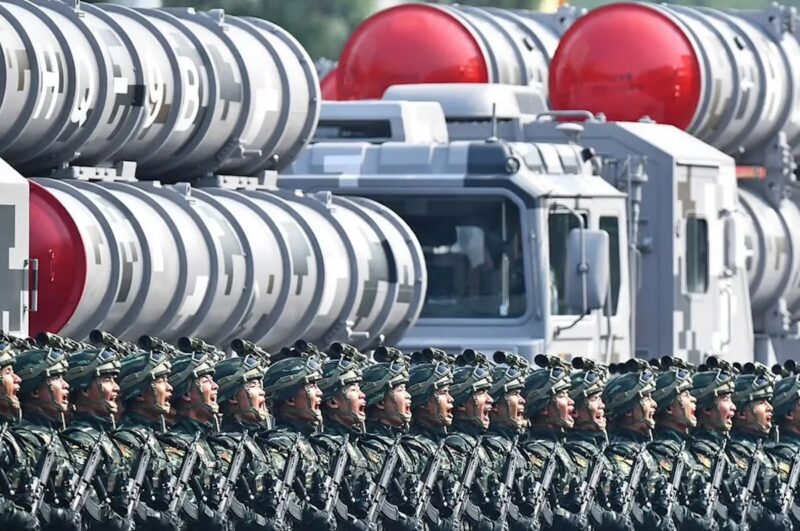
Perhaps this American complacency concerning China’s disruptive weapons and overall military challenge could be explained by an overreliance on its nuclear superiority. Indeed, in 2020, in the comparison of nuclear warheads, the United States possessed overwhelming superiority with 5,800 against China’s 320 (Arms Control Association, 2020). This was consistent with the legacy of Mao’s “minimum deterrent” strategy. Within the above count, two kinds of nuclear weapons are involved – tactical and strategic. The former, with smaller explosive capacity, are designed for use in battlefields. With a much larger capacity, the latter aims at vital targets within the enemy’s home front. In relation to tactical nuclear weapons, America’s superiority is total, as China doesn’t have any. Nonetheless, in terms of long-range, accuracy, and extensive numbers, China’s conventional ballistic missiles (like the DF-26, also known as the Guam killer) can become an excellent match to the US’ tactical nuclear weapons (Roblin, 2018). The big difference between both countries, thus, is centred on America’s overwhelming superiority in strategic nuclear warheads.
China’s minimum deterrent nuclear strategy was based on the assumption that, within cost-benefit decision-making, a limited nuclear force, able to target an adversary’s strategic objectives, could deter a superior nuclear force. This required retaliatory strike capacities that can survive a first enemy attack. In China’s case, this is attainable through road-mobile missiles that are difficult to find and destroy, and by way of missiles based on undetectable submarines. Moreover, Beijing’s hypersonic glide vehicle -whose prototype was successfully tested in July 2021- follows a trajectory that American systems cannot track. All of these impose restraint in the use of America’s more extensive arsenal and undermine its ability to carry out nuclear blackmail.
there is no US defence that “could block” China’s hypersonic glide vehicle “not just because of its speed but also due to its ability to operate within Earth’s atmosphere and to change its altitude and direction in an unpredictable manner while flying much closer to the Earth’s surface”
For the above aim, Beijing has developed new nuclear ballistic missiles, cruise missiles, and a sea-based delivery system. These include the DF-41 solid-fuel road-mobile intercontinental ballistic missile (with a range of 15,000 kilometres) or the submarine-launched JL-3 solid-fuel ballistic missile (whose range is likely to exceed 9,000 kilometres). To launch the JL-3 missiles, China counts with four Jin-class nuclear submarines, with an upgraded fifth under construction, each armed with twelve nuclear ballistic missiles (Huang, 2019; Panda, 2018). On top of that, there is no US defence that “could block” China’s hypersonic glide vehicle “not just because of its speed but also due to its ability to operate within Earth’s atmosphere and to change its altitude and direction in an unpredictable manner while flying much closer to the Earth’s surface” (Sanger, 2024, p. 190). All of this shows that America’s overwhelming superiority in terms of strategic nuclear warheads results in more theoretical than practical. What might justify a first American strategic nuclear strike on the knowledge that a Chinese retaliatory one could destroy New York, Chicago, Los Angeles, or all of the three together?
Matching the US’ overkill nuclear capacity
Being an asymmetric superpower while sustaining a minimum but highly credible deterrent nuclear strategy implied much subtility in terms of military thinking. One, in tune with the best Chinese traditions exemplified by Sun Tsu’s The Art of War and Chan-Kuo T’se’s Stratagems of the Warring States. However, in this regard, as in many others, Xi Jinping is sowing rigidity where subtility and flexibility prevailed. A perfect example of this is provided by its intent to match the US in terms of strategic nuclear warheads. In David E. Sanger’s words: “But now, it seemed apparent, Chinese leaders had changed their minds. Xi declared that China must ‘establish a strong strategic deterrence system’. And satellite images from near the cities of Yumen and Hami showed that Xi was now ready to throw Mao’s ‘minimum deterrent’ strategy out of the window” (Sanger, 2024, p. 200).
Three elements attest to the former. Firstly, 230 launching silos are under construction in China. Secondly, these silos are part of a larger plan to match the US’ “triad” of land-launched, air-launched, and sea-launched nuclear weapons. Thirdly, it is estimated that by 2030, China will have an arsenal of 1,000 strategic nuclear weapons, which should reach 1,500 by 2035. The latter would imply equalling the Russian and the American nuclear strategic warheads (Sanger, 2024, p. 197; Cooper, 2021; The Economist, 2021; Hadley, 2023).
Xi Jinping is thus throwing overboard the Chinese capability to neutralize America’s strategic nuclear superiority at a fraction of its cost, searching to match its overkill capacity. In essence, nuclear arms seek to fulfil two main objectives. In the first place, intimidating or dissuading into compliance a given counterpart. In the second place, deterring by way of its retaliatory capacity, any first use of nuclear weapons by a counterpart.
As seen, the second of those considerations was already guaranteed through its minimum deterrence strategy. In relation to the first, China already enjoys a tremendous dissuading power and the capacity to neutralize intimidation in its part of the world. Indeed, it holds firm control over the South China Sea. This is for three reasons. First, through its possession and positioning there, of the largest Navy in the world. Second, by way of the impressive firepower of its missiles, which includes the DF21/CSS-5, capable of sinking aircraft carriers more than 1,500 miles away. Third, via the construction and militarization of 27 artificial islands in the Paracel and Spratly archipelagos. All of this generates an anti-access and denial of space synergy, capable of being activated at any given time against hostile maritime forces. In other words, China cannot be intimidated into compliance by the United States in the South China Sea scenario (Fabey, 2018, pp. 228-231). Nor, in relation to Taiwan, could America’s superior nuclear forces dissuade Beijing to invade if it so decides. The US, indeed, would not be willing to trade the obliteration of Los Angeles or any other of its major cities by going nuclear in the defence of Taiwan.
Simultaneously confronting two gunfighters
It was complicated enough during the Cold War to defend against one major nuclear power. The message of the new [Chinese] silos was that now the United States would, for the first time in its history, must think about defending in the future against two major nuclear powers with arsenals roughly the size of Washington’s – and be prepared for the possibility that they might decide to work together
Matching the US’ nuclear overkill capacity will not significantly alter the strategic equation between both countries. If anything, it would only immobilize in easy-to-target silos, the bulk of its strategic nuclear force. However, Xi’s difficult-to-understand decision makes more sense if, instead of thinking of two nuclear powers, we were to think of a game of three. This would entail a more profound strategic problem for the United States that David E. Sanger synthesizes: “It was complicated enough during the Cold War to defend against one major nuclear power. The message of the new [Chinese] silos was that now the United States would, for the first time in its history, must think about defending in the future against two major nuclear powers with arsenals roughly the size of Washington’s – and be prepared for the possibility that they might decide to work together” (Sanger, 2024, p. 201). This working together factor should be seen as the new normal, as a revisionist block led by China and Russia confronts America’s system of alliances and its post-WWII rules-based world order.
Although the United States could try to increase the number of its nukes, nothing precludes its two competitors from augmenting theirs as well, with the intention of maintaining an overwhelming superiority. According to Thomas Schelling, leading Game Theory scholar and Economics Nobel Prize winner, the confrontation between two nuclear superpowers, in parity conditions, was tantamount to that of two far-west gunfighters: Whoever shot first had the upper hand. This is because it can destroy a significant proportion of its counterpart’s nuclear arsenal (Fontaine, 2024). In the case in point, Uncle Sam would have to simultaneously confront two gunfighters, each matching his skills and firepower. Although beyond a certain threshold, there wouldn’t seem to exist a significant difference in the capacity of destruction involved, nuclear blackmail could be imposed upon the weakest competitor. In this case, the United States.
Conclusion
From an American perspective, overreliance on its challenged nuclear power makes no sense. Especially if it translates into a laid-back attitude in relation to the current technological revolution in conventional warfare. If Washington doesn’t go forward with a third offset military strategy, it could find itself in an extremely vulnerable position. Just two cases can exemplify this. Aircraft carriers are becoming obsolete as a result of the Chinese DF21-CSS5 missile, able to sink them 1,500 miles away, in the same manner in which war in Ukraine is showing the obsolescence of modern tanks when faced with portable Javelins and drones. If the US is not able to undertake a leap forward in conventional military weapons and systems, it will be overcome by its rivals in both conventional and nuclear forces. For Washington, no doubt about it, this is an inflexion moment.
References:
Arms Control Association (2020). “Nuclear weapons: Who has what at a glance”, August.
Cooper, Helene (2021). “China could have 1,000 nuclear warheads by 2030, Pentagon says”. The New York Times, November 3.
Ellman, Jesse, Samp, Lisa, Coll, Gabriel (2017). “Assessing the Third Offset Strategy”. Center for Strategic & International Studies, CSIS, March.
Fabey, Michael (2018) Crashback: The Power Clash Between US and China in the Pacific. New York: Scribner.
Fontaine, Phillipe (2024). “Commitment, Cold War, and the battles of self: Thomas Schelling on Behavior Control”. Journal of the Behavioral Sciences, April.
Hadley, Greg (2023). “China Now Has More ICBM Launchers than the US”. Air & Space Forces Magazine. February 7.
Huang, Cary (2019). “China’s show of military might risk backfiring”. Inkstone, October 19.
Leonard, Mark (2008). What Does China Think? New York: HarperCollins.
McLeary, Paul (2017). “The Pentagon’s Third Offset May be Dead, But No One Knows What Comes Next”. Foreign Policy, December 18.
Panda, Ankit (2018). “China conducts first test of new JL-3 submarine-launched ballistic missile”. The Diplomat, December 20.
Pillsbury, Michael (2015). The Hundred-Year Marathon. New York: Henry Holt and Company.
Roblin, Sebastien (2018). “Why China’s DF-26 Missile is a Guam Killer”. The National Interest, November 9.
Sanger, David E. (2024). New York: Crown Publishing Books.
Shah, Raj M. and Kirchhoff, Christopher M. (2024). “The US Military is not Ready for the New Era of Warfare”. The New York Times, September 13.
Singer, P.W. and Cole, August (2016). Ghost Fleet: A Novel of the Next World War. Boston: Eamon Dolan Book.
The Economist (2021). “China’s nuclear arsenal has been extremely modest, but that is changing”, November 20.
Zakaria, Fareed (2019). “Defense spending is America’s cancerous bipartisan consensus”. The Washington Post, July 18.
Feature Image Credit: NikkeiAsia
Text Image: AsiaTimes.com